EP1432184A1 - Dispositif de détermination de chemins de communication dans un réseau de communications à commutation d'étiquettes, en présence d'attributs de sélection - Google Patents
Dispositif de détermination de chemins de communication dans un réseau de communications à commutation d'étiquettes, en présence d'attributs de sélection Download PDFInfo
- Publication number
- EP1432184A1 EP1432184A1 EP03292852A EP03292852A EP1432184A1 EP 1432184 A1 EP1432184 A1 EP 1432184A1 EP 03292852 A EP03292852 A EP 03292852A EP 03292852 A EP03292852 A EP 03292852A EP 1432184 A1 EP1432184 A1 EP 1432184A1
- Authority
- EP
- European Patent Office
- Prior art keywords
- path
- criteria
- paths
- nodes
- processing means
- Prior art date
- Legal status (The legal status is an assumption and is not a legal conclusion. Google has not performed a legal analysis and makes no representation as to the accuracy of the status listed.)
- Granted
Links
- 238000004891 communication Methods 0.000 title claims description 14
- 238000012545 processing Methods 0.000 claims abstract description 38
- 238000000034 method Methods 0.000 claims description 16
- 239000000654 additive Substances 0.000 claims description 10
- 230000000996 additive effect Effects 0.000 claims description 9
- 230000004907 flux Effects 0.000 claims description 9
- 235000008694 Humulus lupulus Nutrition 0.000 claims description 6
- 230000005540 biological transmission Effects 0.000 claims description 3
- 230000008030 elimination Effects 0.000 claims description 3
- 238000003379 elimination reaction Methods 0.000 claims description 3
- 230000000717 retained effect Effects 0.000 claims description 3
- 230000007246 mechanism Effects 0.000 claims description 2
- 238000004364 calculation method Methods 0.000 description 12
- 230000006870 function Effects 0.000 description 9
- 230000002093 peripheral effect Effects 0.000 description 9
- 230000008569 process Effects 0.000 description 6
- 239000013598 vector Substances 0.000 description 6
- 238000012795 verification Methods 0.000 description 3
- 102000036364 Cullin Ring E3 Ligases Human genes 0.000 description 2
- 108091007045 Cullin Ring E3 Ligases Proteins 0.000 description 2
- 230000006978 adaptation Effects 0.000 description 2
- 230000002457 bidirectional effect Effects 0.000 description 2
- 239000003086 colorant Substances 0.000 description 2
- 238000010276 construction Methods 0.000 description 2
- WMFYOYKPJLRMJI-UHFFFAOYSA-N Lercanidipine hydrochloride Chemical compound Cl.COC(=O)C1=C(C)NC(C)=C(C(=O)OC(C)(C)CN(C)CCC(C=2C=CC=CC=2)C=2C=CC=CC=2)C1C1=CC=CC([N+]([O-])=O)=C1 WMFYOYKPJLRMJI-UHFFFAOYSA-N 0.000 description 1
- 241000465502 Tobacco latent virus Species 0.000 description 1
- 230000015556 catabolic process Effects 0.000 description 1
- 230000000295 complement effect Effects 0.000 description 1
- 239000000470 constituent Substances 0.000 description 1
- 238000006731 degradation reaction Methods 0.000 description 1
- 238000011161 development Methods 0.000 description 1
- 229940082150 encore Drugs 0.000 description 1
- RGNPBRKPHBKNKX-UHFFFAOYSA-N hexaflumuron Chemical compound C1=C(Cl)C(OC(F)(F)C(F)F)=C(Cl)C=C1NC(=O)NC(=O)C1=C(F)C=CC=C1F RGNPBRKPHBKNKX-UHFFFAOYSA-N 0.000 description 1
- 230000010354 integration Effects 0.000 description 1
- 230000002452 interceptive effect Effects 0.000 description 1
- 238000002372 labelling Methods 0.000 description 1
- 230000037361 pathway Effects 0.000 description 1
- 230000001902 propagating effect Effects 0.000 description 1
- 238000011160 research Methods 0.000 description 1
- 230000011664 signaling Effects 0.000 description 1
- 239000013589 supplement Substances 0.000 description 1
- 230000001360 synchronised effect Effects 0.000 description 1
- 238000012546 transfer Methods 0.000 description 1
- 230000001960 triggered effect Effects 0.000 description 1
Images
Classifications
-
- H—ELECTRICITY
- H04—ELECTRIC COMMUNICATION TECHNIQUE
- H04L—TRANSMISSION OF DIGITAL INFORMATION, e.g. TELEGRAPHIC COMMUNICATION
- H04L45/00—Routing or path finding of packets in data switching networks
- H04L45/50—Routing or path finding of packets in data switching networks using label swapping, e.g. multi-protocol label switch [MPLS]
-
- H—ELECTRICITY
- H04—ELECTRIC COMMUNICATION TECHNIQUE
- H04L—TRANSMISSION OF DIGITAL INFORMATION, e.g. TELEGRAPHIC COMMUNICATION
- H04L45/00—Routing or path finding of packets in data switching networks
- H04L45/12—Shortest path evaluation
-
- H—ELECTRICITY
- H04—ELECTRIC COMMUNICATION TECHNIQUE
- H04L—TRANSMISSION OF DIGITAL INFORMATION, e.g. TELEGRAPHIC COMMUNICATION
- H04L45/00—Routing or path finding of packets in data switching networks
- H04L45/12—Shortest path evaluation
- H04L45/124—Shortest path evaluation using a combination of metrics
-
- H—ELECTRICITY
- H04—ELECTRIC COMMUNICATION TECHNIQUE
- H04L—TRANSMISSION OF DIGITAL INFORMATION, e.g. TELEGRAPHIC COMMUNICATION
- H04L45/00—Routing or path finding of packets in data switching networks
- H04L45/302—Route determination based on requested QoS
-
- H—ELECTRICITY
- H04—ELECTRIC COMMUNICATION TECHNIQUE
- H04L—TRANSMISSION OF DIGITAL INFORMATION, e.g. TELEGRAPHIC COMMUNICATION
- H04L45/00—Routing or path finding of packets in data switching networks
- H04L45/56—Routing software
-
- H—ELECTRICITY
- H04—ELECTRIC COMMUNICATION TECHNIQUE
- H04L—TRANSMISSION OF DIGITAL INFORMATION, e.g. TELEGRAPHIC COMMUNICATION
- H04L45/00—Routing or path finding of packets in data switching networks
- H04L45/60—Router architectures
Definitions
- the invention relates to the field of communications between terminals within a switched label network, and more particularly that the determination of the paths (or paths) of flow switching data between a so-called “departure” switching equipment and a so-called “destination” switching equipment.
- a so-called “switched network “labels” (or “switched label networks”), such as MPLS or GMPLS, includes switching equipment (or nodes), also called label switching routers (or LSRs for "Label Switched Routers ").
- LSRs designate two types of routers or switches coupled together: the peripheral routers (or LERs for "Label Edge Routers"), responsible for establishing a switching path labels (or LSPs for Label Switched Path) for each data they receive when requested by the network manager, and core routers (or LCRs for "Label Core Routers”), only responsible for switching data flows and transmitting data network information data.
- the establishment of a switched path consists of adding to flow data a label associated with the path to follow and to book the resources needed to route the flow to the node of destination given the type of service (or ToS for "Type of Service") and / or QoS (Quality of Service) which is (are) associated with this flow. So that each starting LER can establish a way, each flow is therefore associated with a starting LER and a LER of destination, to a transmission equivalence class (or FEC for Forwarding Equivalence Class) and a service data set defining the type of service (or ToS) and / or the quality of service (or QoS).
- FEC Forwarding Equivalence Class
- the calculation of a switched path LSP is made either from the determining the shortest path between the starting nodes and destination, either from the enumeration of a set of nodes that it must obligatorily include.
- a process says signaling establishes the switched path after having validated the steps given the QoS and / or ToS constraints required for the flow.
- the use of a single criterion (or attribute) of selection such as the path length (or the number of jumps)
- the path length or the number of jumps
- the presence of constraints limits the choice of possible links and may accentuate clutter.
- the length of the path is not necessarily the most important criterion. Other criteria may be much more relevant in some applications, such as tape required passerby.
- the invention therefore aims to remedy all or part of the aforementioned drawbacks.
- LSRs tag switching nodes
- two nodes are called "connected” if they can exchange data directly or indirectly through a or several other nodes.
- this graph is said to be connected if each pair of nodes can be connected by a path.
- the device according to the invention which can be used in the basic mode presented above, to the establishment of switched paths in a first multi-criteria mode which is characterized by taking into account criteria in the absence of constraints, can also be used for establishing roads switched into a second multi-criteria mode that is characterized by taking in account of criteria in the presence of constraint (s).
- the means may, where certain information data, associated with a set of service data, are representative of at least one local constraint, determine among the multiplicity of LSRs, all pairs of LSRs that can establish an oriented link between them supporting each local constraint stored in correspondence of a set of service associated with the stream to be switched, and then make sure that the all the LSRs of the couples.
- the treatment means can, when certain information data, associated with a set of service data, are representative of at least one global constraint, remember among the possible paths only those who satisfy each global constraint stored in correspondence of a set of service associated with the flow to be switched, in order to assign values of interest only possible paths retained.
- local constraint refers to a constraint applied to oriented links (or links), such as arcs.
- global constraint a constraint applied on a path, such as for example the number of hops in the path or the maximum duration of the path.
- At least one of the criteria used is of type no additive.
- the processing means it is advantageous for the processing means to integrate, when calculating the possible paths and deducing the ideal solution, a trace memorizing a path corresponding to a partial path, of detect and prevent the occurrence of cycles (or loops) in paths under construction. And, it is even more advantageous that means of treatment retain certain solutions, say "weakly dominated "on each criterion determined, not additive, during the procedure elimination of partial paths.
- the invention also relates to a switching router of labels equipped with a device of the type of that presented above.
- the invention is particularly well adapted to networks Label Switched Communications, such as MPLS ("MultiProtocol Label Switching") which deals with flows consisting of packets or asynchronous data cells, and GMPLS ("Generalized MPLS”) which processes flows consisting not only of packets or data cells asynchronous but also synchronous frames or frames light flow (or “light streams”).
- MPLS MultiProtocol Label Switching
- GMPLS Generalized MPLS
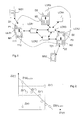
- a switched label communications network generally includes, as illustrated on the FIG. 1, a multiplicity of routers (or nodes) for switching tags (or LSRs for "Label Switched Routers”) coupled together.
- the LERs are responsible for establishing switching within the network while the CRLs are responsible for switching.
- the network is MPLS type ("MultiProtocol Label Switching"). But of course, the invention is not limited to this type of switched label network only. It relates to in general all types of label switching networks, such as GMPLS type networks ("Generalized MultiProtocol Label Switching ").
- MSk terminals are mobile stations, such as mobile phones. But, he could be any type of communications terminal capable of exchanging data with other terminals or network equipment, such as example of fixed telephones, fax machines, digital assistants Personal Digital Assistant (PDA), fixed computers or portable or content provider servers (or ASP for "Application Service Provider").
- PDA Personal Digital Assistant
- ASP "Application Service Provider”
- the invention is intended to allow the determination of path (s) of multi-criteria switching, with or without constraint (s), of data flow tagged within a label switched network (here MPLS type).
- the invention proposes for this purpose at least one computing device Dn comprising a processing module Pn, responsible for determining the best switched path, of the LSP type, between a starting LER and a LER of destination, taking into account at least two criteria, as well as possibly strain (s).
- the calculation of the path can be triggered centrally (in automatic mode or in manual (or interactive) mode) or distributed (in automatic mode), via a query flow set to switch.
- switched path an ordered sequence of nodes (or LSRs) or links (between two nodes or LSRs) starting with a LER starting and ending a destination LER.
- LSRs nodes
- links between two nodes or LSRs
- a new path calculation can be done each time one reaches the level destination LER of a zone (or domain) of the network, described in a descriptive data structure (to which we will return later), in order to to continue routing a data stream. Therefore, only the LERs of an MPLS network are able to establish a path of switching determined by a device according to the invention D and according to to the distributed network switching protocol.
- the device Dn preferably assuring, as will be seen more far, the actual labeling of a flow once determined its path so it is it is best implemented in each LERn of the MPLS network, as this is illustrated in Figure 1. Therefore, in what follows we consider that the device D1, implanted in the peripheral router LER1, which is connected an MS1 terminal that wishes to establish a communication with a terminal MS2 connected to the peripheral router LER2, receives the order of determine a switched path between the originating router LER1 and a router destination, for example LER2.
- the device Dn in the case of the establishment of a road switched multicriteria in the presence of local and / or global constraint (s). But, as mentioned previously, the device Dn is also adapted to the establishment of a multicriterion switched path in the absence of constraint.
- each data flow is associated with a starting LER and a Destination LER, to a transmission equivalence class (or FEC for Forwarding Equivalence Class) and a service data set defining the type of service (or ToS for "Type of Service”) and / or the Quality of Service (QoS).
- FEC Forwarding Equivalence Class
- QoS Quality of Service
- the processing module P1, of the device D1 is first loaded, when it receives a path set request containing a set of service data associated with a flow to be switched, to extract this set service data, and then to access a memory M1, in which finds stored a table T11 establishing correspondences between service data sets (for example representative of a type of service and / or quality of service) and information data representative of at least two selected criteria.
- service data sets for example representative of a type of service and / or quality of service
- the memory M1 is located in the router LER1.
- the memory Mn is preferable to provide a memory Mn in each peripheral router LERn.
- the processing module P1 can extract from this table T11 all the information data which are partners, and in particular the two criteria at least.
- each criterion may be associated with a weighting factor representing its relatively high level of preference other criteria.
- These weighting factors are preferentially stored in the T11 correspondence table, associated with the criteria correspondents.
- the processing module P1 interrogates a descriptive structure of information data T12, stored, preferably, in the memory M1 and comprising information data representative of the state of use and topology of the network, in order to ensure the connectivity of the multiplicity of LSRs of the network.
- This information data defines in particular the resources associated with the different links between nodes, in terms of characteristics and availability, as well as the list of LSR nodes, regularly updated. day.
- characteristics of the resources we can notably mention the topology (available links), bandwidth, and transit time between two nodes of a link.
- This information is usually provided by a link state protocol such as OPPS (for Open Shortest Path First) when it supports traffic management by TE-LSAs exchange (for "Traffic Engineering - Link State Advertisements").
- OPPS Open Shortest Path First
- TE-LSAs exchange for "Traffic Engineering - Link State Advertisements”
- other network usage characteristics such as allowed colors on linkage, the authorized classes of service, or the administrative cost of a link, are provided by the Network Management System (or NMS for Network Management System).
- the processing module P1 determines all node pairs (LSRs) which can establish between them a connection (or a link, defined by a couple (i, j) designating two nodes). In the absence of connectivity, the rest of the treatment can not be done.
- the processing module P1 then ensures the connectivity of the nodes (LSRs) in the presence of each local constraint. It's important to note that one can consider directly ascertaining the connectedness of the nodes in the presence of local constraint (s), without carrying out the verification of connectivity in the absence of constraints.
- local constraint means any constraint applicable to an oriented connection of a network, such as an arc, and in particular the band required minimum pass, the maximum length of a link, the duration maximum of one link, one or more forbidden links.
- this verification consists in determining all the pairs of nodes (LSRs) that can establish a link between them (or link, defined by a pair (i, j) designating two nodes) in the presence of each local constraint.
- LSRs pairs of nodes
- the determination of the pairs of nodes is made from the establishment of a filter graph G (X, U), where X represents the set of nodes LSRs of the network and U the set of links (or links) directional (i, j). All the links of the graph G (X, U) that violate at least one of the determined local stresses are eliminated from the graph, which produces a "filtered" graph.
- the processing module P1 then ensures that the graph G (X, U) filtered is connected (in the mathematical sense of the term). He uses to do this, preferentially, a technique for propagating information from the node of start LER (for example LER1) to all the nodes LSRs of the graph filtered, so that all LSR nodes are checked (or tested). This verification of the connectivity of the graph can be achieved, for example, with the Tarjan algorithm.
- start LER for example LER1
- the processing module P1 calculates among the nodes of the couples (or connections (i, j)) retained all the paths possible (or "efficient paths") r * between the starting node LER1 (by example), which is connected to the source terminal MS1 that requires the establishment of the communication, and a destination node, for example LER2, to which the terminal is connected directly or indirectly recipient MS2, taking into account at least both criteria determined in table T11.
- a weighting factor such as a penalty for example, on the cost of administering the CA path. This allows to reduce the calculation vectors, to which we will return later, from a dimension, and therefore limit the calculation time and memory necessary to this calculation.
- a possible path r * is calculated as indicated below.
- a path is designated by a variable r (s, t), where s designates the source node and t the destination node, as well as by a vector of performance Z (r) defined by a multiplet of components (Z1 (r), Z2 (r), ..., Zp (r)) each associated with one of the p criteria used.
- the component Z1 (r) represents the performance of path r with respect to criterion C1
- the component Z2 (r) represents the performance of the path r to criterion C2.
- Cp (i, j) designates the value of the criterion Cp for an arc (i, j).
- the performance vector Z (r *) of the path r * is then called "non-dominated solution" (or NDS) when any other path r 'has a performance vector Z (r'), one of which less of the components Zp (r ') is “less good” (or “less efficient ") than the corresponding component Zp (r *) of the path r *.
- Such path r *, associated with a non-dominated performance vector, is then called possible path (or "efficient path") or "Pareto-optimal”.
- NDS non-dominated solution determination
- Z (r *) is a non-dominated solution (or NDS), since there is no other point whose coordinates are strictly inferior to those of Z (r *).
- Each other point Z (r) has at least one component that is less good than the corresponding component of Z (r *).
- the cone, marked by dashes and placed below and to the left of Z (r *) is empty.
- Z (r ') is dominated by four points, of which Z (r *), which are placed in the cone marked by dashes placed below it, but not by the extreme points Z1 (r). min / C1 , associated with C1, and Z2 (r) min / C2 , associated with C2, which are thus also not dominated.
- Z (r ') is here a dominated solution.
- Z (r ") is a so-called” weakly non-dominated “solution by Z (r °) because at least one of the components of Z (r °) is equal (and not strictly inferior) to its homologue in Z (r ").
- Adaptation consists, in particular, of integrating with the additive criteria treated by the Martins algorithm a criterion of the non-additive type, as example a "minimum-maximum" criterion.
- a criterion of the non-additive type as example a "minimum-maximum” criterion.
- the integration of such criterion imposes adjustments to the algorithm, such as those mentioned below.
- a first development can consist in integrating into the algorithm of calculation of paths (corresponding to step d) of the method) a trace memorizing the path corresponding to a partial path, in order to detect and prevent the appearance, in roads under construction, of cycles (or loops) when advancing the algorithm.
- the processing module P1 then forms an ideal solution Z ( ). More precisely, the ideal solution Z ( ) is a vector in the form of a multiplet of components.
- the ideal path represented by the ideal solution Z ( ), does not necessarily correspond to one of the possible paths r * of the set of possible paths determined. This is rarely the case, as the links on which the optimal values are observed rarely constitute a related sequence. Nevertheless, when this is the case, it constitutes the only possible path r * since it dominates all the others.
- the processing module P1 then submits the different paths possible to at least one global constraint determined or received.
- global constraints that can be applied to paths as opposed to local constraints which apply to links (or links) between nodes. It could be, for example, the minimum bandwidth required, the maximum length of the path, the maximum number of hops in the path, and the maximum path length.
- the processing module P1 retains the possible paths r * which do not do not violate the global constraint (s) used. In the case of the establishment of a path in multi-criteria mode without constraint, this treatment is, of course, omitted.
- the processing module P1 then assigns each possible path r * a value of interest (or "path value") U (r) taking into account the ideal solution Z ( ).
- a conventional scalarization function for example a weighted Chebyshev function, which is a function of the differences between the components Zp (r) of the performance value Z (r) of the path concerned r and the corresponding components Zp ( ), representative of the ideal path .
- Wp is a coefficient (or factor) of weighting of the criterion Cp chosen during the configuration of the device and making it possible to give the criteria, possibly, different relative weights.
- the processing module P1 then classifies the possible paths r * given their respective U (r) interest values.
- the possible paths are classified by order of increasing interest value, the lowest interest value U (r) corresponding to the possible path r * best suited to the transfer of given the criteria and constraints used.
- the ranking is therefore performed with respect to an ideal point inferred by the data and not to from a comparison based on arbitrary values.
- K is an integer that can be understood by example, between 1 and 5. It is important to note that the number of paths found by the treatment described above may be less than k.
- the processing module Pn can also select a second path among the k possible paths classified, so as to offer a path backup (or "backup LSP") that can be substituted for the first path in problem on this path. It is however preferable that the (second) rescue path is disjointed from the (first) path. This allows make available to the subscriber the protection / restoration function link.
- the module processing P1 associates with the stream to switch a representative label of said path.
- the starting peripheral router LER1 can then establish the path selected by reserving resources that meet the criteria and constraints associated with the received stream. Then, it passes the tagged stream to destination destination router LER2, via each node LSR of the determined path.
- processing module P can be arranged to calculate bidirectional switched paths. This is particularly useful in the case of GMPLS type networks.
- different attributes and / or complementary to those presented above may be used, in order to to take into account their respective specificities (multiplexing networks time division (or TDM for "Time Division Multiplexing"), for example SONET and SDH networks, and length multiplex networks waveform (or WDM for "Wavelength Division Multiplexing").
- TDM time division
- WDM length multiplex networks waveform
- the transparency can be optimized by minimizing the number of hops in a path constrained by the maximum distance possible without degradation of signal.
- the specific attributes may reflect the capabilities of the links, transmitted via low TLVs level and designating for example a wavelength multiplexing, a concatenation, allocation or switching protection in the case of SDH circuits.
- the computing device D and mainly its (or its) module (s) treatment P, as well as possibly the memory (s) M, can be realized in the form of electronic circuits, software modules (or computer), or a combination of circuits and software.
- selection attributes are defined by the network operator during the network configuration, and depend on the type of service required, by example sending an e-mail or a request to set up videoconferencing, and / or the quality of service (or QoS) required during the initial reservation of resources. More precisely, we choose the criteria depending on the type of service required, while constraints, and their values, depending on the quality of service required.
- the invention can also be considered in the form of a method for determining data flow switching path (s) in a switched label communications network comprising a multiplicity of nodes (LSRs) including peripheral nodes (LERs) and heart nodes (LCRs).
- LSRs multiplicity of nodes
- LERs peripheral nodes
- LCRs heart nodes
- This method can be implemented using the computing device D presented above.
- the main and optional functions and sub-functions ensured by the steps of this process being substantially identical to those provided by the different means constituting the device D, only summarized below are the steps implementing the main functions of the process according to the invention.
- routers devices each equipped with a processing module and a memory of service and information data constituting in combination a device according to the invention.
- a shared processing module and a shared memory including all service and information data for example implemented in a dedicated network server or in the NMS.
Landscapes
- Engineering & Computer Science (AREA)
- Computer Networks & Wireless Communication (AREA)
- Signal Processing (AREA)
- Data Exchanges In Wide-Area Networks (AREA)
- Computer And Data Communications (AREA)
Abstract
Description
- des moyens de mémorisation stockant une table de correspondance entre des ensembles de données de service (par exemple représentatifs d'un type de service et/ou d'une qualité de service) et des données d'informations représentatives d'au moins deux critères choisis (ainsi qu'éventuellement des facteurs de pondération reflétant l'importance relative de ces critères), et une structure descriptive de données d'informations représentatives de l'état d'utilisation et de la topologie du réseau, et
- des moyens de traitement chargés :
- a) à réception d'une requête d'établissement de chemin contenant un ensemble de données de service associé à un flux à commuter, de déterminer dans la table au moins deux critères stockés en correspondance dudit ensemble de données de service associé au flux,
- b) de s'assurer, à partir de données d'informations représentatives de l'état d'utilisation et de la topologie du réseau, stockées dans la structure descriptive, de la connexité de la multiplicité de LSRs,
- c) de calculer parmi les LSRs des chemins possibles entre un LER de départ et un LER de destination, compte tenu d'au moins les deux critères déterminés, puis de déduire une solution idéale à partir de performances de ces chemins possibles sur au moins les critères,
- d) d'attribuer à chaque chemin possible une valeur d'intérêt compte tenu de la solution idéale, puis de classer les chemins possibles compte tenu de leurs valeurs d'intérêt respectives, et
- e) de sélectionner un chemin parmi les chemins possibles classés, puis d'associer au flux à commuter une étiquette représentative dudit chemin sélectionné afin que ce flux étiqueté soit commuté via le chemin vers le LER de destination.
- vérifier la connexité (qui est une contrainte) par un mécanisme de propagation du noeud (ou LER) de départ vers tous les autres noeuds de la multiplicité de noeuds, afin que chaque noeud soit visité. Pour ce faire, ils peuvent, par exemple, utiliser l'algorithme de Tarjan ;
- déterminer pour chaque chemin des valeurs représentatives de leur « performance » par rapport à chacun des critères déterminés, puis qualifier de chemin possible chaque chemin dont les valeurs de performance sont « non dominées ». Dans ce cas, ils peuvent également déterminer pour chaque critère, la meilleure valeur de performance observée sur les chemins possibles, dite « valeur optimale », puis construire la solution idéale sous la forme d'un multiplet de composantes constituées des différentes valeurs optimales déterminées. En fait, les liaisons sur lesquelles les valeurs optimales sont observées constituent rarement une séquence connexe. Autrement dit, un chemin idéal correspondant à une solution idéale n'existe qu'exceptionnellement ;
- attribuer la valeur d'intérêt à chaque chemin possible qui caractérise la plus grande valeur des composantes, associées aux différents critères déterminés, d'une fonction de Tchebychev pondérée, fonction des différences entre la valeur de performance du chemin concerné et la composante correspondante de la solution idéale. Dans ce cas, ils peuvent présélectionner k chemins possibles qui présentent les k plus petites valeurs d'intérêt, puis procéder à la sélection d'un chemin parmi ces k chemins présélectionnés. En outre, ils peuvent, si nécessaire, calculer des chemins bidirectionnels. De plus, ils peuvent sélectionner parmi les k chemins au moins un autre chemin dédié à la restauration de liaison.
- les éventuelles contraintes locales et/ou globales appartiennent à un groupe comprenant au moins la bande passante minimale requise, la longueur maximale du chemin, la durée maximale du chemin, une ou plusieurs liaisons interdites, le nombre minimal et/ou maximal de sauts du chemin, un ou plusieurs noeud(s) obligatoire(s), un ou plusieurs noeud(s) interdit(s), une ou plusieurs classes de service autorisées, une ou plusieurs couleurs de chemin, une capacité de multiplexage en longueurs d'onde, une capacité de concaténation, une capacité d'allocation et une capacité de protection ;
- les critères appartiennent à un groupe comprenant au moins la bande passante disponible, le nombre de sauts du chemin, la durée du chemin, une capacité de multiplexage en longueurs d'onde, une capacité de concaténation, une capacité d'allocation et une capacité de protection. Dans ce cas, il est encore plus préférable que les deux critères soient la bande passante disponible et la durée du chemin. Dans ce cas, les moyens de traitement peuvent avantageusement impacter (ou pondérer) le critère portant sur la durée du chemin par une pénalité portant, par exemple, sur le coût d'administration du chemin ;
- les critères soient pondérés en fonction de leur importance compte tenu d'informations de gestion. Dans ce cas, les facteurs de pondération sont préférentiellement stockés dans la table de correspondance, associés à certains au moins des critères.
- la figure 1 illustre de façon schématique une partie d'un réseau de communications à commutation d'étiquettes comportant une multiplicité de routeurs (ou noeuds) périphériques (LERs) équipés d'un dispositif de calcul de chemins de commutation selon l'invention, et
- la figure 2 est un graphe illustrant de façon schématique le mode de détermination de solutions dites « non dominées ».

Claims (21)
- Dispositif de détermination de chemin(s) de commutation de flux de données étiquetés dans un réseau de communications à commutation d'étiquettes comportant une multiplicité de noeuds de commutation d'étiquettes (LSR), chaque flux étant associé à une classe d'équivalence de transmission choisie et à un ensemble de données de service choisi, caractérisé en ce qu'il comporte :des moyens de mémorisation (Mn) propres à stocker une table (Tn1) de correspondance entre des ensembles de données de service et des données d'informations représentatives d'au moins deux critères choisis, et une structure descriptive (Tn2) contenant des données d'informations représentatives d'un état d'utilisation et d'une topologie du réseau,des moyens de traitement (P) agencés :a) à réception d'une requête d'établissement de chemin contenant un ensemble de données de service associé à un flux à commuter, pour déterminer dans ladite table (Tn1) au moins deux critères stockés en correspondance dudit ensemble de données de service associé au flux,b) pour s'assurer de la connexité de ladite multiplicité de noeuds, à partir des données d'informations stockées dans ladite structure descriptive (Tn2),c) pour calculer parmi lesdits noeuds (LSR) des chemins possibles (r*) entre un noeud de départ (LER1) et un noeud de destination (LER2), compte tenu d'au moins lesdits deux critères déterminés, puis pour déduire une solution idéale (Z()) à partir de performances (Z(r*)) desdits chemins possibles (r*) sur au moins lesdits critères,
 d) pour attribuer à chaque chemin possible (r*) une valeur d'intérêt (U(r)) compte tenu de ladite solution idéale (Z(
 - Dispositif selon la revendication 1, caractérisé en ce que lesdits moyens de traitement (P) sont agencés pour travailler à partir d'ensembles de données de service stockés dans ladite table (Tn1) et représentatifs d'un type de service et/ou d'une qualité de service.
- Dispositif selon la revendication 1, caractérisé en ce que certaines desdites données d'informations, associées à un ensemble de données de service, étant représentatives d'au moins une contrainte locale, lesdits moyens de traitement (Pn) sont agencés pour déterminer parmi ladite multiplicité de noeuds (LSR) tous les couples de noeuds pouvant établir entre eux une liaison orientée supportant chaque contrainte locale stockée en correspondance d'un ensemble de données de service associé audit flux à commuter, puis pour s'assurer de la connexité de l'ensemble des noeuds desdits couples.
- Dispositif selon la revendication 1, caractérisé en ce que certaines desdites données d'informations, associées à un ensemble de données de service, étant représentatives d'au moins une contrainte globale, lesdits moyens de traitement (Pn) sont agencés pour retenir parmi lesdits chemins possibles (r*) ceux qui satisfont à chaque contrainte globale stockée en correspondance d'un ensemble de données de service associé audit flux à commuter, de manière à n'attribuer des valeurs d'intérêt (U(r)) qu'auxdits chemins possibles retenus (r*).
- Dispositif selon la revendication 1, caractérisé en ce que l'un au moins desdits critères est de type non additif.
- Dispositif selon la revendication 5, caractérisé en ce que lesdits moyens de traitement (Pn) sont agencés pour intégrer, lors du calcul des chemins possibles (r*) et de la déduction de ladite solution idéale (Z(
- Dispositif selon la revendication 6, caractérisé en ce que lesdits moyens de traitement (Pn) sont agencés pour conserver des solutions, dites « faiblement non dominées » sur chaque critère déterminé, non additif, lors de la procédure d'élimination desdits chemins partiels.
- Dispositif selon la revendication 1, caractérisé en ce que lesdits moyens de traitement (Pn) sont agencés pour vérifier ladite connexité en appliquant un mécanisme de propagation du noeud de départ (LER1) vers tous les autres noeuds (LSR) de ladite multiplicité de noeuds, de sorte que chaque noeud (LSR) soit visité.
- Dispositif selon la revendication 1, caractérisé en ce que lesdits moyens de traitement (Pn) sont agencés pour déterminer pour chaque chemin des valeurs représentatives de sa « performance » (Z(r)) par rapport à chaque critère déterminé, et pour qualifier de chemin possible (r*) un chemin (r) dont lesdites valeurs de performance (Z(r)) sont dites « non dominées ».
- Dispositif selon la revendication 9, caractérisé en ce que lesdits moyens de traitement (Pn) sont agencés pour déterminer pour chaque critère déterminé la meilleure valeur de performance (Z*(r)) observée sur lesdits chemins possibles, dite « valeur optimale », puis pour construire ladite solution idéale (Z(
- Dispositif selon la revendication 10, caractérisé en ce que lesdits moyens de traitement (Pn) sont agencés pour attribuer une valeur d'intérêt (U(r)) à chaque chemin possible (r) lorsqu'elle caractérise la plus grande valeur des composantes, associées aux différents critères déterminé(s), d'une fonction de Tchebychev pondérée, fonction des différences entre la performance dudit chemin possible (r*) et la valeur optimale correspondante de ladite solution idéale (Z(
- Dispositif selon la revendication 11, caractérisé en ce que lesdits moyens de traitement (Pn) sont agencés pour effectuer une présélection de k chemins possibles présentant les k plus petites valeurs d'intérêt (U(r)), puis pour sélectionner un chemin parmi ces k chemins présélectionnés.
- Dispositif selon la revendication 12, caractérisé en ce que lesdits moyens de traitement (Pn) sont agencés pour calculer des chemins de type bidirectionnel.
- Dispositif selon la revendication 12, caractérisé en ce que lesdits moyens de traitement (Pn) sont agencés pour sélectionner parmi lesdits k chemins au moins un autre chemin dédié à la restauration de liaison.
- Dispositif selon la revendication 3, caractérisé en ce que lesdites contraintes locales et/ou globales déterminées appartiennent à un groupe comprenant au moins la bande passante minimale requise, la longueur maximale du chemin, la durée maximale du chemin, un ensemble de liaisons interdites ou obligatoires, le nombre maximal et/ou minimal de sauts du chemin, un ou plusieurs noeud(s) obligatoire(s), un ou plusieurs noeud(s) interdit(s), au moins une classe de service autorisée, un ensemble de couleurs de chemin, une capacité de multiplexage en longueurs d'onde, une capacité de concaténation, une capacité d'allocation et une capacité de protection.
- Dispositif selon la revendication 1, caractérisé en ce que lesdits critères appartiennent à un groupe comprenant au moins la bande passante disponible (C2), le nombre de sauts du chemin (C3), la durée du chemin (C1), une capacité de multiplexage en longueurs d'onde, une capacité de concaténation, une capacité d'allocation et une capacité de protection.
- Dispositif selon la revendication 16, caractérisé en ce que lesdits critères comprennent la bande passante disponible (C2) et la durée du chemin (C1).
- Dispositif selon la revendication 17, caractérisé en ce que lesdits moyens de traitement (Pn) sont agencés pour impacter ledit critère portant sur la durée du chemin (C1) par une pénalité.
- Dispositif selon la revendication 18, caractérisé en ce que ladite pénalité porte sur le coût d'administration du chemin (CA).
- Dispositif selon la revendication 1, caractérisé en ce que ladite table de correspondance (Tn1) comprend des facteurs de pondération associés à certains au moins desdits critères en fonction de leur importance.
- Routeur de commutation d'étiquettes (LER) pour un réseau de communications à commutation d'étiquettes, caractérisé en ce qu'il comprend un dispositif selon l'une des revendications 1 à 20.
Applications Claiming Priority (2)
| Application Number | Priority Date | Filing Date | Title |
|---|---|---|---|
| FR0215966A FR2848757B1 (fr) | 2002-12-17 | 2002-12-17 | Dispositif de determination de chemins de communication dans un reseau de communications a commutation d'etiquettes, en presence d'attributs de selection |
| FR0215966 | 2002-12-17 |
Publications (2)
| Publication Number | Publication Date |
|---|---|
| EP1432184A1 true EP1432184A1 (fr) | 2004-06-23 |
| EP1432184B1 EP1432184B1 (fr) | 2012-04-18 |
Family
ID=32338863
Family Applications (1)
| Application Number | Title | Priority Date | Filing Date |
|---|---|---|---|
| EP03292852A Expired - Lifetime EP1432184B1 (fr) | 2002-12-17 | 2003-11-17 | Dispositif de détermination de chemins de communication dans un réseau de communications à commutation d'étiquettes, en présence d'attributs de sélection |
Country Status (4)
| Country | Link |
|---|---|
| US (1) | US7443832B2 (fr) |
| EP (1) | EP1432184B1 (fr) |
| AT (1) | ATE554566T1 (fr) |
| FR (1) | FR2848757B1 (fr) |
Cited By (1)
| Publication number | Priority date | Publication date | Assignee | Title |
|---|---|---|---|---|
| EP2237494A1 (fr) * | 2009-03-31 | 2010-10-06 | BRITISH TELECOMMUNICATIONS public limited company | Routage de trafic dans un réseau de communications |
Families Citing this family (11)
| Publication number | Priority date | Publication date | Assignee | Title |
|---|---|---|---|---|
| FR2843263B1 (fr) * | 2002-07-30 | 2004-10-15 | Cit Alcatel | Dispositif et procede de determination de chemins de routage dans un reseau de communications, en presence d'attributs de selection |
| US20060018255A1 (en) * | 2004-07-26 | 2006-01-26 | Avaya Technology Corp. | Defining a static path through a communications network to provide wiretap law compliance |
| US9264373B2 (en) * | 2005-07-01 | 2016-02-16 | Telefonaktiebolaget L M Ericsson (Publ) | Adaptive frame structure for TDD point-to-point wireless transmission |
| US20070091875A1 (en) * | 2005-10-22 | 2007-04-26 | Revnx, Inc. | Method and System For Device Mobility Using Application Label Switching In A Mobile Communication Network |
| US7796511B2 (en) * | 2006-04-06 | 2010-09-14 | Wood Samuel F | Self-routed layer 4 packet network system and method |
| US9542642B2 (en) | 2006-04-06 | 2017-01-10 | Samuel F. Wood | Packet data neural network system and method |
| US8693340B2 (en) * | 2010-01-14 | 2014-04-08 | Tellabs Operations, Inc. | Method and apparatus for least cost routing using multiple path accumulated constraints |
| US20130094397A1 (en) * | 2011-10-15 | 2013-04-18 | Young Jin Kim | Method and apparatus for localized and scalable packet forwarding |
| WO2015013905A1 (fr) * | 2013-07-31 | 2015-02-05 | Telefonaktiebolaget L M Ericsson (Publ) | Procédé et appareil pour sélectionner un chemin parmi des chemins entre des routeurs de périphérie à commutation d'étiquettes |
| US9794165B1 (en) | 2014-09-29 | 2017-10-17 | Juniper Networks, Inc. | Batched path computation in resource-constrained networks |
| US20240048524A1 (en) * | 2021-01-21 | 2024-02-08 | Telefonaktiebolaget Lm Ericsson (Publ) | Distance-based selection |
Citations (3)
| Publication number | Priority date | Publication date | Assignee | Title |
|---|---|---|---|---|
| US6034946A (en) * | 1997-04-15 | 2000-03-07 | International Business Machines Corporation | Selection of routing paths in data communications networks to satisfy multiple requirements |
| US6301244B1 (en) * | 1998-12-11 | 2001-10-09 | Nortel Networks Limited | QoS-oriented one-to-all route selection method for communication networks |
| WO2002003716A1 (fr) | 2000-06-30 | 2002-01-10 | British Telecommunications Public Limited Company | Procede memetique d'optimisation multiobjective |
Family Cites Families (11)
| Publication number | Priority date | Publication date | Assignee | Title |
|---|---|---|---|---|
| US6965572B1 (en) * | 2000-06-07 | 2005-11-15 | At&T Corp. | Loopback capability for bi-directional multi-protocol label switching traffic engineered trucks |
| US7283477B1 (en) * | 2000-08-24 | 2007-10-16 | Nortel Networks Limited | Allocating network resources |
| JP4183379B2 (ja) * | 2000-11-27 | 2008-11-19 | 富士通株式会社 | ネットワーク及びエッジルータ |
| US7230924B2 (en) * | 2001-03-28 | 2007-06-12 | At&T Corp. | Method and apparatus for communications traffic engineering |
| US6944159B1 (en) * | 2001-04-12 | 2005-09-13 | Force10 Networks, Inc. | Method and apparatus for providing virtual point to point connections in a network |
| US6785737B2 (en) * | 2001-07-31 | 2004-08-31 | Tropic Networks Inc. | Network resource allocation methods and systems |
| US7246175B1 (en) * | 2001-12-07 | 2007-07-17 | Cisco Technology, Inc. | IPv6 over MPLS IPv4 core |
| KR100420956B1 (ko) * | 2002-02-09 | 2004-03-02 | 주식회사 케이티 | Mpls 망에서 대체 경로를 공유하는 방법, 대체 경로를설정하는 레이블 스위칭 라우터 및 그 시스템 |
| US7269132B1 (en) * | 2002-02-22 | 2007-09-11 | Nortel Networks, Ltd. | Method and apparatus for achieving transparent redundancy at a hierarchical boundary |
| US7242679B1 (en) * | 2002-10-28 | 2007-07-10 | At&T Corp. | Scheme for routing circuits with dynamic self-adjusting link weights in a network |
| US7277386B1 (en) * | 2002-11-12 | 2007-10-02 | Juniper Networks, Inc. | Distribution of label switched packets |
-
2002
- 2002-12-17 FR FR0215966A patent/FR2848757B1/fr not_active Expired - Fee Related
-
2003
- 2003-11-17 EP EP03292852A patent/EP1432184B1/fr not_active Expired - Lifetime
- 2003-11-17 AT AT03292852T patent/ATE554566T1/de active
- 2003-12-15 US US10/735,895 patent/US7443832B2/en active Active
Patent Citations (3)
| Publication number | Priority date | Publication date | Assignee | Title |
|---|---|---|---|---|
| US6034946A (en) * | 1997-04-15 | 2000-03-07 | International Business Machines Corporation | Selection of routing paths in data communications networks to satisfy multiple requirements |
| US6301244B1 (en) * | 1998-12-11 | 2001-10-09 | Nortel Networks Limited | QoS-oriented one-to-all route selection method for communication networks |
| WO2002003716A1 (fr) | 2000-06-30 | 2002-01-10 | British Telecommunications Public Limited Company | Procede memetique d'optimisation multiobjective |
Non-Patent Citations (5)
| Title |
|---|
| CHEN ET AL.: "Distributed Quality-of-service routing in High speed networks basec on selective probing", PROCEEDINGS 23RD CONFERENCE ON LOCAL COMPUTER NETWORKS; IEEE COMPUTER SOCIETY, 11 October 1998 (1998-10-11) - 14 October 1998 (1998-10-14), , Boston, Massachusetts, USA, pages 80 - 89, XP002253004, Retrieved from the Internet <URL:http://citeseer.nj.nec.com/chen99distributed.html> [retrieved on 20030901] * |
| CHEN S ET AL: "AN OVERVIEW OF QUALITY OF SERVICE ROUTING FOR NEXT-GENERATION HIGH-SPEED NETWORKS: PROBLEMS AND SOLUTIONS", IEEE NETWORK, IEEE INC. NEW YORK, US, vol. 12, no. 6, November 1998 (1998-11-01), pages 64 - 79, XP000873129, ISSN: 0890-8044 * |
| KORKMAZ T ET AL: "An efficient algorithm for finding a path subject to two additive constraints", COMPUTER COMMUNICATIONS, ELSEVIER SCIENCE PUBLISHERS BV, AMSTERDAM, NL, vol. 25, no. 3, 15 February 2002 (2002-02-15), pages 225 - 238, XP004313430, ISSN: 0140-3664 * |
| ROUHANA N ET AL: "Differentiated services and integrated services use of MPLS", 3 July 2000 (2000-07-03), pages 194 - 199, XP010505346 * |
| ZHENG WANG ET AL: "QUALITY-OF-SERVICE ROUTING FOR SUPPORTING MULTIMIDEA APPLICATIONS", IEEE JOURNAL ON SELECTED AREAS IN COMMUNICATIONS, IEEE INC. NEW YORK, US, vol. 14, no. 7, 1 September 1996 (1996-09-01), pages 1228 - 1234, XP000626273, ISSN: 0733-8716 * |
Cited By (2)
| Publication number | Priority date | Publication date | Assignee | Title |
|---|---|---|---|---|
| EP2237494A1 (fr) * | 2009-03-31 | 2010-10-06 | BRITISH TELECOMMUNICATIONS public limited company | Routage de trafic dans un réseau de communications |
| WO2010112802A1 (fr) * | 2009-03-31 | 2010-10-07 | British Telecommunications Public Limited Company | Routage de trafic dans un réseau de communications |
Also Published As
| Publication number | Publication date |
|---|---|
| EP1432184B1 (fr) | 2012-04-18 |
| FR2848757B1 (fr) | 2005-03-11 |
| US7443832B2 (en) | 2008-10-28 |
| FR2848757A1 (fr) | 2004-06-18 |
| US20040190490A1 (en) | 2004-09-30 |
| ATE554566T1 (de) | 2012-05-15 |
Similar Documents
| Publication | Publication Date | Title |
|---|---|---|
| EP1615397B1 (fr) | Dispositif de répartition de charge, multi-critères, pour un équipement périphérique d'un réseau de communications à commutation d'étiquettes | |
| EP2135403B1 (fr) | Procede et systeme de routage multitopologie | |
| FR2836314A1 (fr) | Methode dynamique et distribuee de protection locale d'un chemin a commutation d'etiquettes | |
| EP1432184B1 (fr) | Dispositif de détermination de chemins de communication dans un réseau de communications à commutation d'étiquettes, en présence d'attributs de sélection | |
| EP1387538B1 (fr) | Dispositif et procédé de détermination de chemins de routage dans un réseau de communications, en présence d'attributs de sélection | |
| FR2849560A1 (fr) | Procede de calcul de chemins contraints pour un reseau de transmission. | |
| WO2006059040A1 (fr) | Procede et systeme d'adaptation dynamique de metrique de qualite de service dans un reseau ad hoc | |
| EP1650910B1 (fr) | Contrôle des paramètres d'une connexion Ethernet-GMPLS | |
| WO2021239740A1 (fr) | Routage de paquets au sein d'un réseau de communication présentant une topologie variable et prédictible | |
| EP1796333B1 (fr) | Procédé d'établissement de connexion entre des portions d'une application distribuée dans des noeuds connectés à un réseau de communication à plan de contrôle GMPLS. | |
| WO2018114788A1 (fr) | Procédé de préparation d'un réseau de communication distribué à l'acheminement d'un flux de données à travers ledit réseau | |
| EP2103055B1 (fr) | Procédé d'optimisation du partage d'une pluralité de ressources réseau entre une pluralité de flux applicatifs | |
| CN116319536A (zh) | 基于sdwan主备链路的数据传输方法、装置、电子设备和存储介质 | |
| EP2119140B1 (fr) | Procede d'acheminement par un routeur d'un paquet de donnees dans un reseau de communication par paquets supporte par un reseau de transport | |
| WO2006013295A1 (fr) | Dispositif de gestion de ressources pour un reseau de communications a connexions inter-noeuds associees a des droits de preemption de ressources partagees et de priorite d'acces aux ressources | |
| EP1771981B1 (fr) | Procede de controle de routage dans un reseau de paquets supporte par un reseau de transport | |
| EP2472783B1 (fr) | Procédé de selection de noeuds de bordure inter-domaines | |
| EP2198573B1 (fr) | Procédé pour faire communiquer entre eux une pluralité de noeuds d'extrémité à travers un réseau de communication | |
| EP1545079A1 (fr) | Procédé d'établissement d'une connexion logique entre un noeud de départ et un noeud d'arrivée non adjacents d'un réseau de télécommunications | |
| FR2860311A1 (fr) | Methode d'allocation d'au moins une ressource dans un reseau de telecommunications multigranulaire | |
| EP1878172B1 (fr) | Controle de la reservation de ressources partagees de chemins de connexion dans un reseau de communication a commutation d'etiquettes de type "non paquet" | |
| WO2014135794A1 (fr) | Procede de controle de congestion pour reseaux de telecommunications | |
| Casellas | Partage de Charge et Ingénierie de Trafic dans les Réseaux MPLS | |
| Sanchez | Store and Forward routing in satellite constellationslations de satellites | |
| EP2009855A1 (fr) | Procédé d'assignation d'une étiquette amont contenant une information contextuelle dans un réseau de communication à communication d'étiquettes |
Legal Events
| Date | Code | Title | Description |
|---|---|---|---|
| PUAI | Public reference made under article 153(3) epc to a published international application that has entered the european phase |
Free format text: ORIGINAL CODE: 0009012 |
|
| AK | Designated contracting states |
Kind code of ref document: A1 Designated state(s): AT BE BG CH CY CZ DE DK EE ES FI FR GB GR HU IE IT LI LU MC NL PT RO SE SI SK TR |
|
| AX | Request for extension of the european patent |
Extension state: AL LT LV MK |
|
| 17P | Request for examination filed |
Effective date: 20041223 |
|
| AKX | Designation fees paid |
Designated state(s): AT BE BG CH CY CZ DE DK EE ES FI FR GB GR HU IE IT LI LU MC NL PT RO SE SI SK TR |
|
| 17Q | First examination report despatched |
Effective date: 20050318 |
|
| RAP1 | Party data changed (applicant data changed or rights of an application transferred) |
Owner name: ALCATEL LUCENT |
|
| GRAP | Despatch of communication of intention to grant a patent |
Free format text: ORIGINAL CODE: EPIDOSNIGR1 |
|
| RAP1 | Party data changed (applicant data changed or rights of an application transferred) |
Owner name: ALCATEL LUCENT |
|
| GRAS | Grant fee paid |
Free format text: ORIGINAL CODE: EPIDOSNIGR3 |
|
| GRAA | (expected) grant |
Free format text: ORIGINAL CODE: 0009210 |
|
| AK | Designated contracting states |
Kind code of ref document: B1 Designated state(s): AT BE BG CH CY CZ DE DK EE ES FI FR GB GR HU IE IT LI LU MC NL PT RO SE SI SK TR |
|
| REG | Reference to a national code |
Ref country code: GB Ref legal event code: FG4D Free format text: NOT ENGLISH |
|
| REG | Reference to a national code |
Ref country code: CH Ref legal event code: EP |
|
| REG | Reference to a national code |
Ref country code: IE Ref legal event code: FG4D Free format text: LANGUAGE OF EP DOCUMENT: FRENCH |
|
| REG | Reference to a national code |
Ref country code: AT Ref legal event code: REF Ref document number: 554566 Country of ref document: AT Kind code of ref document: T Effective date: 20120515 |
|
| REG | Reference to a national code |
Ref country code: DE Ref legal event code: R096 Ref document number: 60340641 Country of ref document: DE Effective date: 20120614 |
|
| REG | Reference to a national code |
Ref country code: NL Ref legal event code: VDEP Effective date: 20120418 |
|
| REG | Reference to a national code |
Ref country code: AT Ref legal event code: MK05 Ref document number: 554566 Country of ref document: AT Kind code of ref document: T Effective date: 20120418 |
|
| PG25 | Lapsed in a contracting state [announced via postgrant information from national office to epo] |
Ref country code: SE Free format text: LAPSE BECAUSE OF FAILURE TO SUBMIT A TRANSLATION OF THE DESCRIPTION OR TO PAY THE FEE WITHIN THE PRESCRIBED TIME-LIMIT Effective date: 20120418 Ref country code: CY Free format text: LAPSE BECAUSE OF FAILURE TO SUBMIT A TRANSLATION OF THE DESCRIPTION OR TO PAY THE FEE WITHIN THE PRESCRIBED TIME-LIMIT Effective date: 20120418 Ref country code: FI Free format text: LAPSE BECAUSE OF FAILURE TO SUBMIT A TRANSLATION OF THE DESCRIPTION OR TO PAY THE FEE WITHIN THE PRESCRIBED TIME-LIMIT Effective date: 20120418 |
|
| PG25 | Lapsed in a contracting state [announced via postgrant information from national office to epo] |
Ref country code: GR Free format text: LAPSE BECAUSE OF FAILURE TO SUBMIT A TRANSLATION OF THE DESCRIPTION OR TO PAY THE FEE WITHIN THE PRESCRIBED TIME-LIMIT Effective date: 20120719 Ref country code: SI Free format text: LAPSE BECAUSE OF FAILURE TO SUBMIT A TRANSLATION OF THE DESCRIPTION OR TO PAY THE FEE WITHIN THE PRESCRIBED TIME-LIMIT Effective date: 20120418 Ref country code: PT Free format text: LAPSE BECAUSE OF FAILURE TO SUBMIT A TRANSLATION OF THE DESCRIPTION OR TO PAY THE FEE WITHIN THE PRESCRIBED TIME-LIMIT Effective date: 20120820 |
|
| PG25 | Lapsed in a contracting state [announced via postgrant information from national office to epo] |
Ref country code: RO Free format text: LAPSE BECAUSE OF FAILURE TO SUBMIT A TRANSLATION OF THE DESCRIPTION OR TO PAY THE FEE WITHIN THE PRESCRIBED TIME-LIMIT Effective date: 20120418 Ref country code: EE Free format text: LAPSE BECAUSE OF FAILURE TO SUBMIT A TRANSLATION OF THE DESCRIPTION OR TO PAY THE FEE WITHIN THE PRESCRIBED TIME-LIMIT Effective date: 20120418 Ref country code: DK Free format text: LAPSE BECAUSE OF FAILURE TO SUBMIT A TRANSLATION OF THE DESCRIPTION OR TO PAY THE FEE WITHIN THE PRESCRIBED TIME-LIMIT Effective date: 20120418 Ref country code: CZ Free format text: LAPSE BECAUSE OF FAILURE TO SUBMIT A TRANSLATION OF THE DESCRIPTION OR TO PAY THE FEE WITHIN THE PRESCRIBED TIME-LIMIT Effective date: 20120418 Ref country code: NL Free format text: LAPSE BECAUSE OF FAILURE TO SUBMIT A TRANSLATION OF THE DESCRIPTION OR TO PAY THE FEE WITHIN THE PRESCRIBED TIME-LIMIT Effective date: 20120418 Ref country code: AT Free format text: LAPSE BECAUSE OF FAILURE TO SUBMIT A TRANSLATION OF THE DESCRIPTION OR TO PAY THE FEE WITHIN THE PRESCRIBED TIME-LIMIT Effective date: 20120418 Ref country code: SK Free format text: LAPSE BECAUSE OF FAILURE TO SUBMIT A TRANSLATION OF THE DESCRIPTION OR TO PAY THE FEE WITHIN THE PRESCRIBED TIME-LIMIT Effective date: 20120418 |
|
| PLBE | No opposition filed within time limit |
Free format text: ORIGINAL CODE: 0009261 |
|
| STAA | Information on the status of an ep patent application or granted ep patent |
Free format text: STATUS: NO OPPOSITION FILED WITHIN TIME LIMIT |
|
| PG25 | Lapsed in a contracting state [announced via postgrant information from national office to epo] |
Ref country code: IT Free format text: LAPSE BECAUSE OF FAILURE TO SUBMIT A TRANSLATION OF THE DESCRIPTION OR TO PAY THE FEE WITHIN THE PRESCRIBED TIME-LIMIT Effective date: 20120418 |
|
| 26N | No opposition filed |
Effective date: 20130121 |
|
| PG25 | Lapsed in a contracting state [announced via postgrant information from national office to epo] |
Ref country code: ES Free format text: LAPSE BECAUSE OF FAILURE TO SUBMIT A TRANSLATION OF THE DESCRIPTION OR TO PAY THE FEE WITHIN THE PRESCRIBED TIME-LIMIT Effective date: 20120729 |
|
| REG | Reference to a national code |
Ref country code: DE Ref legal event code: R097 Ref document number: 60340641 Country of ref document: DE Effective date: 20130121 |
|
| BERE | Be: lapsed |
Owner name: ALCATEL LUCENT Effective date: 20121130 |
|
| REG | Reference to a national code |
Ref country code: CH Ref legal event code: PL |
|
| PG25 | Lapsed in a contracting state [announced via postgrant information from national office to epo] |
Ref country code: LI Free format text: LAPSE BECAUSE OF NON-PAYMENT OF DUE FEES Effective date: 20121130 Ref country code: CH Free format text: LAPSE BECAUSE OF NON-PAYMENT OF DUE FEES Effective date: 20121130 Ref country code: BG Free format text: LAPSE BECAUSE OF FAILURE TO SUBMIT A TRANSLATION OF THE DESCRIPTION OR TO PAY THE FEE WITHIN THE PRESCRIBED TIME-LIMIT Effective date: 20120718 |
|
| REG | Reference to a national code |
Ref country code: IE Ref legal event code: MM4A |
|
| PG25 | Lapsed in a contracting state [announced via postgrant information from national office to epo] |
Ref country code: BE Free format text: LAPSE BECAUSE OF NON-PAYMENT OF DUE FEES Effective date: 20121130 |
|
| PG25 | Lapsed in a contracting state [announced via postgrant information from national office to epo] |
Ref country code: IE Free format text: LAPSE BECAUSE OF NON-PAYMENT OF DUE FEES Effective date: 20121117 |
|
| REG | Reference to a national code |
Ref country code: FR Ref legal event code: GC Effective date: 20131018 |
|
| PG25 | Lapsed in a contracting state [announced via postgrant information from national office to epo] |
Ref country code: MC Free format text: LAPSE BECAUSE OF NON-PAYMENT OF DUE FEES Effective date: 20121130 Ref country code: TR Free format text: LAPSE BECAUSE OF FAILURE TO SUBMIT A TRANSLATION OF THE DESCRIPTION OR TO PAY THE FEE WITHIN THE PRESCRIBED TIME-LIMIT Effective date: 20120418 |
|
| PG25 | Lapsed in a contracting state [announced via postgrant information from national office to epo] |
Ref country code: LU Free format text: LAPSE BECAUSE OF NON-PAYMENT OF DUE FEES Effective date: 20121117 |
|
| PG25 | Lapsed in a contracting state [announced via postgrant information from national office to epo] |
Ref country code: HU Free format text: LAPSE BECAUSE OF FAILURE TO SUBMIT A TRANSLATION OF THE DESCRIPTION OR TO PAY THE FEE WITHIN THE PRESCRIBED TIME-LIMIT Effective date: 20031117 |
|
| REG | Reference to a national code |
Ref country code: FR Ref legal event code: PLFP Year of fee payment: 13 |
|
| REG | Reference to a national code |
Ref country code: FR Ref legal event code: PLFP Year of fee payment: 14 |
|
| REG | Reference to a national code |
Ref country code: FR Ref legal event code: PLFP Year of fee payment: 15 |
|
| PGFP | Annual fee paid to national office [announced via postgrant information from national office to epo] |
Ref country code: DE Payment date: 20180601 Year of fee payment: 15 |
|
| PGFP | Annual fee paid to national office [announced via postgrant information from national office to epo] |
Ref country code: FR Payment date: 20180530 Year of fee payment: 15 |
|
| PGFP | Annual fee paid to national office [announced via postgrant information from national office to epo] |
Ref country code: GB Payment date: 20180530 Year of fee payment: 15 |
|
| REG | Reference to a national code |
Ref country code: DE Ref legal event code: R119 Ref document number: 60340641 Country of ref document: DE |
|
| GBPC | Gb: european patent ceased through non-payment of renewal fee |
Effective date: 20181117 |
|
| PG25 | Lapsed in a contracting state [announced via postgrant information from national office to epo] |
Ref country code: DE Free format text: LAPSE BECAUSE OF NON-PAYMENT OF DUE FEES Effective date: 20190601 Ref country code: FR Free format text: LAPSE BECAUSE OF NON-PAYMENT OF DUE FEES Effective date: 20181130 |
|
| PG25 | Lapsed in a contracting state [announced via postgrant information from national office to epo] |
Ref country code: GB Free format text: LAPSE BECAUSE OF NON-PAYMENT OF DUE FEES Effective date: 20181117 |
|
| REG | Reference to a national code |
Ref country code: DE Ref legal event code: R081 Ref document number: 60340641 Country of ref document: DE Owner name: WSOU INVESTMENTS, LLC, LOS ANGELES, US Free format text: FORMER OWNER: ALCATEL LUCENT, PARIS, FR Ref country code: DE Ref legal event code: R082 Ref document number: 60340641 Country of ref document: DE Representative=s name: BARKHOFF REIMANN VOSSIUS, DE |
|
| REG | Reference to a national code |
Ref country code: GB Ref legal event code: 732E Free format text: REGISTERED BETWEEN 20200924 AND 20200930 |