EP1431730A1 - Dispositif a surface equivalente laser parfaitement connue - Google Patents
Dispositif a surface equivalente laser parfaitement connue Download PDFInfo
- Publication number
- EP1431730A1 EP1431730A1 EP03293202A EP03293202A EP1431730A1 EP 1431730 A1 EP1431730 A1 EP 1431730A1 EP 03293202 A EP03293202 A EP 03293202A EP 03293202 A EP03293202 A EP 03293202A EP 1431730 A1 EP1431730 A1 EP 1431730A1
- Authority
- EP
- European Patent Office
- Prior art keywords
- mirror
- objective
- transmission
- adjusting
- optical axis
- Prior art date
- Legal status (The legal status is an assumption and is not a legal conclusion. Google has not performed a legal analysis and makes no representation as to the accuracy of the status listed.)
- Granted
Links
Images


Classifications
-
- G—PHYSICS
- G01—MEASURING; TESTING
- G01J—MEASUREMENT OF INTENSITY, VELOCITY, SPECTRAL CONTENT, POLARISATION, PHASE OR PULSE CHARACTERISTICS OF INFRARED, VISIBLE OR ULTRAVIOLET LIGHT; COLORIMETRY; RADIATION PYROMETRY
- G01J1/00—Photometry, e.g. photographic exposure meter
- G01J1/02—Details
- G01J1/08—Arrangements of light sources specially adapted for photometry standard sources, also using luminescent or radioactive material
-
- G—PHYSICS
- G01—MEASURING; TESTING
- G01J—MEASUREMENT OF INTENSITY, VELOCITY, SPECTRAL CONTENT, POLARISATION, PHASE OR PULSE CHARACTERISTICS OF INFRARED, VISIBLE OR ULTRAVIOLET LIGHT; COLORIMETRY; RADIATION PYROMETRY
- G01J1/00—Photometry, e.g. photographic exposure meter
- G01J1/02—Details
- G01J1/04—Optical or mechanical part supplementary adjustable parts
-
- G—PHYSICS
- G01—MEASURING; TESTING
- G01J—MEASUREMENT OF INTENSITY, VELOCITY, SPECTRAL CONTENT, POLARISATION, PHASE OR PULSE CHARACTERISTICS OF INFRARED, VISIBLE OR ULTRAVIOLET LIGHT; COLORIMETRY; RADIATION PYROMETRY
- G01J1/00—Photometry, e.g. photographic exposure meter
- G01J1/02—Details
- G01J1/04—Optical or mechanical part supplementary adjustable parts
- G01J1/0407—Optical elements not provided otherwise, e.g. manifolds, windows, holograms, gratings
- G01J1/0418—Optical elements not provided otherwise, e.g. manifolds, windows, holograms, gratings using attenuators
-
- G—PHYSICS
- G01—MEASURING; TESTING
- G01S—RADIO DIRECTION-FINDING; RADIO NAVIGATION; DETERMINING DISTANCE OR VELOCITY BY USE OF RADIO WAVES; LOCATING OR PRESENCE-DETECTING BY USE OF THE REFLECTION OR RERADIATION OF RADIO WAVES; ANALOGOUS ARRANGEMENTS USING OTHER WAVES
- G01S7/00—Details of systems according to groups G01S13/00, G01S15/00, G01S17/00
- G01S7/48—Details of systems according to groups G01S13/00, G01S15/00, G01S17/00 of systems according to group G01S17/00
- G01S7/497—Means for monitoring or calibrating
-
- G—PHYSICS
- G02—OPTICS
- G02B—OPTICAL ELEMENTS, SYSTEMS OR APPARATUS
- G02B5/00—Optical elements other than lenses
- G02B5/12—Reflex reflectors
-
- G—PHYSICS
- G02—OPTICS
- G02B—OPTICAL ELEMENTS, SYSTEMS OR APPARATUS
- G02B5/00—Optical elements other than lenses
- G02B5/20—Filters
- G02B5/205—Neutral density filters
Definitions
- the invention relates in particular to the field of performance measurements detection systems and more particularly relates to an improvement to perfectly known laser equivalent surface devices and possibly adjustable.
- a reflecting or diffusing surface This is, for example, the reticle holder blade in a viewfinder or in binoculars, the detector surface in a still camera or camera, whether they are film or digital. It is also the retina of the eye.
- a surface absorbs or transmits part of the energy to form the useful signal, for example that of a photographic image, video signal or retinal image and reflects from specular or diffuse another part of the incident energy.
- This energy is partly collected by the image-forming optics which, according to the principle of the reverse return of the light, returns it in a very directive way in the shot of the source where it is concentrated.
- Another observation instrument is located in the immediate vicinity of the object luminous, also called the source, or is virtually superimposed on it by a means optical, it receives this concentrated flow from the first observation system.
- the object is an intense light source (a laser in particular)
- the beam concentrated in return can create on this second observation system a image of the first much brighter than its environment.
- the second observation system lights up the instrument which observes it, in this case the first system which is called "Pointed optics", by means of a laser
- the optics pointed at has an equivalent laser surface (SEL) equal to this surface. So, he it is not impossible that an optic of a few square centimeters has a surface laser equivalent of several hundred square meters. It simply say that it returns as much energy to the observer as the imaginary object having such a surface.
- the definition of the laser equivalent surface is more general but we do not is concerned here only with the Equivalent Laser Equivalent Surface (SEL). In this last the laser emitter and the detector that receives the reflected light are close enough to be considered confused when seen since the first observation system.
- SEL Equivalent Laser Equivalent Surface
- the value of the laser equivalent surface is an important parameter for the observation systems because it determines their discretion vis-à-vis an active system detection using this property.
- the detection system is active, means that the system contains a light source.
- the laser equivalent surface depends many parameters such as geometric aberrations or the coefficient of reflection of the image plane at the wavelength considered (possibly affected by interference) which are dealt with by the system designer with a view to image quality, but not in that of discretion. So different instruments having an image quality meeting the same standards may have very different laser equivalent surfaces. In addition, only one instrument can have, depending on the wavelength or the angle of field, a surface value laser equivalent which varies unexpectedly.
- patent application WO02 / 33438 describes a device with a known equivalent laser surface and continuously adjustable and comprising a lens, a mirror arranged so as to form at least one optical axis of the device and means for adjusting the distance separating the lens of the mirror.
- it includes an attenuating filter capable of varying or adjusting the laser equivalent surface of the device.
- Other devices for which the "retroreflected" light intensity, that is to say reflected in the axis of illumination, is mainly linked, as in the patent cited to the geometric properties of the optical system or, on the contrary, to its diffraction are also used.
- the mirror In the first category there are reflective spherical caps and in the second there are systems limited by diffraction like reflective trihedrons, forming what is generally called a cube corner or systems made up of an objective and a surface. reflecting or diffusing placed in its home.
- the mirror In a device according to patent application WO02 / 33438, the mirror must be placed at a distance x from the focal point of the objective sufficient for the circle of the focusing defect to be large in front of the image spot. This precaution is necessary to avoid the problems of theoretically focused or weakly defocused instruments which can, depending on settings in position on the (x) axis and in the very critical field of the instrument, have a SEL varying by a value. null at a very high value seemingly randomly.
- a device for laser equivalent surface perfectly known characterized in that it comprises a radial attenuator capable of modifying the opening of the device and having a law of radial transmission in bell curve.
- it includes a lens and a mirror arranged so as to form at least one optical axis OZ of the device and at a distance x from the focal image F ', x being different from 0.
- the optical axis of the device is defined as the axis passing through the optical center of the objective and which is perpendicular to the mirror.
- a spherical mirror having for center the optical center of the objective, there are an infinity of optical axes of the device passing through the optical center of the objective and perpendicular to said mirror.
- the optical axis of the device coincides with the optical axis of the lens which passes through the center of curvature of the lens and through the image focal point. This is particularly the case when a plane mirror is arranged perpendicular to the axis lens optics.
- it includes means for adjusting the distance from the lens to the mirror.
- the relative displacement of the objective and the mirror, produced by said means of adjustment is carried out, preferably done while maintaining perpendicularity between said optical axis of the device and the mirror.
- the objective is fixed and it comprises means for adjusting the position of the mirror which are capable of adjusting the distance separating the lens from the mirror.
- the mirror is fixed and it includes means for adjusting the position of the lens which are capable of adjusting the distance separating the lens from the mirror.
- the adjustment means are of known type and can for example have a helical movement that can be manually driven or motorized for example with a stepper type electric motor.
- Control means can be associated with the adjustment means, command whose setpoint can be expressed in Laser equivalent area.
- said mirror is a plane mirror and is preferably arranged perpendicular to said optical axis of the device so that most of the incident light is returned towards the objective.
- the device according to the invention consists either of a reflective spherical cap, the spherical cap of which may or may not have a radial reflecting treatment whose reflection coefficient follows a curve in bell, either in a reflective trihedron, or include a lens and a diffusing surface placed in its focal point or at a short distance from it, either comprising a lens and a reflecting surface placed in its focus or at a short distance from this one.
- distance is meant a distance less than the distance of focus, defined by the distance at which the focus defect circle at a diameter equal to that of the image task.
- a device comprises alignment means capable of aligning it with a second device, such as a device outside active detection, so as to make this second device collinear with the axis optical
- alignment means may include sighting means by example consisting of a telescopic sight or a handlebar and an eyecup.
- the sighting means can be arranged laterally with respect to the optical axis and means for obscuring the sighting means can be provided so that these the latter do not modify the laser equivalent surface of the device according to the invention.
- an attenuating filter can be placed on the objective and, preferably, none of its faces is perpendicular to said optical axis.
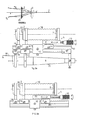
- Figure 1 shows schematically the general means of a device to laser equivalent surface perfectly known according to an alternative embodiment of the invention in which this device comprises a fixed objective 2, an attenuating filter having a bell transmission law 20, a mirror 3, preferably a plane, perpendicular to the optical axis OZ and whose distance "x" to the focal point determines with the other parameters of the assembly, such as the reflection factor R of the mirror, the transmission factor To of the lens and its focal length f the value of the surface equivalent laser and whose displacement in the direction of the optical axis OZ allows to continuously adjust this value.
- this device comprises a fixed objective 2, an attenuating filter having a bell transmission law 20, a mirror 3, preferably a plane, perpendicular to the optical axis OZ and whose distance "x" to the focal point determines with the other parameters of the assembly, such as the reflection factor R of the mirror, the transmission factor To of the lens and its focal length f the value of the surface equivalent laser and whose displacement in the direction of the optical axis O
- the value of the laser equivalent surface can be determined without taking into account the size of this spot.
- a laser equivalent surface of 100 m 2 can be obtained with an accuracy of 1% by placing the mirror at 7.09 mm ⁇ 0.05 mm.
- this assembly is equivalent to a spherical mirror with 5.64 m radius of curvature.
- the equivalent laser surface area value of 100 m 2 with a simple mirror of reflection coefficient R 1, it would be necessary to give it this radius of curvature of 5.64 m to ⁇ 0.03 m.
- the radius of curvature should be adapted as a function of the reflection coefficient; which would limit the spectral range of use.
- the command of the adjustable mirror positioning can be graduated in distance to the focal plane and instrument supplied with abacuses giving the equivalent laser surface in function of this distance and the wavelength.
- the move command could also be directly graduated in laser equivalent surface area value very much in the wavelength range covered.
- Displacement can also be blocked to obtain a laser equivalent surface area value predetermined so to form a laser equivalent surface standard.
- the device described above is associated with means 5 capable of adjusting the position of the mirror along said optical axis OZ and also to means 6 for aligning the device according to the invention with an external device 7.
- a filter attenuator 8 is disposed in front of the assembly formed by objective 2 and the filter attenuator 20, on the side of the external device 7.
- This external device 7 comprises means capable of emitting a laser radiation in a YO direction as well as photodetection means capable of detecting any retroreflected radiation in said direction YO.
- the device according to the invention comprises a doublet objective of 200 mm focal 2, a plane mirror 3 mounted on means 5 capable of adjusting the position of the mirror 3 along said optical axis OZ as well as means 6 for aligning the optical axis OZ with the external device 7.
- the means 5 capable of adjusting the position of the mirror 3 along said optical axis OZ include a plate 9 allowing, by rotation of a knurled and graduated button 10, to position the mirror 3 precisely between the focal point of the objective and the objective itself.
- These means 5 further comprise a protective bellows 19 shown in axial section and connecting the lens 2 to the mirror 3.
- the means 6 for aligning the optical axis OZ with the external device 7 comprise a support structure 12 and sighting means 11.
- the support structure 12 comprises a rail 13 which constitutes the frame of the whole device. Jumpers 14 allow the lens to be fixed on the rail 13 doublet with a focal length of 200 mm 2, the attenuating filter 8, the means 5 capable of adjusting the position of the mirror 3 along said optical axis OZ, and the sighting means 11.
- a jumper forming an adapter plate of the assembly 15 has a tapped hole which allows the assembly to be fixed on a device stand photographic.
- a shutter flap 16 is disposed in front of the sighting means 11. It can take two positions: the first in which it is outside the line of sight W and the second in which it obscures the line of sight, thereby removing any additional laser equivalent surface that the means of aim 11.
- the sighting system 11 could, by optical means, be made collinear with the axis of the instrument. However in this alternative embodiment of the invention it is arranged laterally. This brings a parallax which can be compensated in a known or neglected way, because it remains small, the distances put in play being important and the tolerance on the alignment, as in the case of the numerical example given above, not being critical.
- All the sighting means can be used. When it is a telescope, it having its own equivalent poorly controlled laser surface, must be able to be obscured when using the instrument so as not to add its surface equivalent laser to that of the instrument. If it is, as on a rifle, a handlebar and an eyecup; it then has a negligible laser equivalent surface.
- the aiming system is adjusted (its axis is made parallel to that of the instrument) in the factory by conventional methods in the optical field.
- the attenuating filter 8 makes it possible to vary or adjust the surface equivalent laser of the device according to the invention.
- This filter is preferably absorbent rather than reflective to limit the risks of uncontrolled interference in the instrument thus produced.
- This filter even fitted with anti-reflective treatments, has a reflection residue and must be tilted on the one hand so as not to risk participating in the retro-reflection towards the device transmission monostatic and on the other hand not to risk sending back to this device the reflection of an external source, for example the sun or the retroreflection of another instrument.
- a slight inclination towards the ground is often sufficient, but it is also possible to orient it so that the laser reflection falls into a light trap which then serves as a screen preventing any reflection of stray sources.
- the transmission of this filter can be fixed or continuously variable to make an instrument continuously adjustable in laser equivalent and variable area discretely for a discrete adjustment of the laser equivalent surface or for expand the range of use of a device with an equivalent variable laser surface.
- the use of a device according to the invention is particularly simple for the user.
- the manufacturer adjusts the relative orientation of the axes (harmonization), blocks the settings and provides the charts which give, depending on the wavelength and from the position of the stage, the value of the laser equivalent surface of the instrument.
- the user only has to fix the assembly on a photo stand at the level of the plate adapter 15, adjust the orientation using the photo stand using the aim 11, the shutter flap 16 being open, then close the concealment flap 16 and adjust the position of the plate 9, by simply rotating the knurled knob 10 command, at the value read on the charts.
- a first solution therefore consists in equipping the system device with a filter 20 whose radial transmission follows a curve representing a distribution Gaussian, said distribution having a small radius in front of the radius of the diaphragm so that the truncation brought by the latter eliminates only a very small part theoretically available energy under the Gaussian and only disturbs negligibly the "ideal" propagation of the Gaussian.
- the laws of propagation of the Gaussian distribution beams then allow to calculate easily the SEL value of the instrument.
- the smaller the radius (w) of the Gaussian the closer we get to an ideal propagation, but at the same time we reduce the energy entering the instrument and the acceptable system orientation error so as not to not disturb the value of its SEL.
- Tc a uniform distribution attenuator which would modify the energy transmitted in the system then retroreflected thus multiplying the SEL of the system by Tc 2 , but would have absolutely no action on the modulation problem dealt with here.
- Figure 5 shows such curves compared to the two Gaussians of larger radius. We see that they are very close to these Gaussians but do not exhibit truncation generating high disturbing frequencies.
- the bell filter 20 is slightly inclined on the optical axis OZ but preferably so that it is not parallel to the filter 8 in order to avoid interference between the two filters.
Landscapes
- Physics & Mathematics (AREA)
- General Physics & Mathematics (AREA)
- Spectroscopy & Molecular Physics (AREA)
- Engineering & Computer Science (AREA)
- Optics & Photonics (AREA)
- Computer Networks & Wireless Communication (AREA)
- Radar, Positioning & Navigation (AREA)
- Remote Sensing (AREA)
- Lenses (AREA)
- Investigating Or Analysing Materials By Optical Means (AREA)
- Removal Of Insulation Or Armoring From Wires Or Cables (AREA)
- Optical Elements Other Than Lenses (AREA)
- Length Measuring Devices By Optical Means (AREA)
Abstract
Description
D'autres dispositifs pour lesquels l'intensité lumineuse « rétroréfléchie «, c'est-à-dire réfléchie dans l'axe d'illumination, est principalement liée, comme dans le brevet cité aux propriétés géométriques du système optique ou, au contraire, à sa diffraction sont également utilisés. Dans la première catégorie on trouve des calottes sphériques réfléchissantes et dans la seconde des systèmes limités par la diffraction comme des trièdres trirectangles réfléchissants, formant ce qu'on appelle généralement un coin de cube ou des systèmes constitués d'un objectif et d'une surface réfléchissante ou diffusante placée en son foyer.
Dans un dispositif selon la demande de brevet WO02/33438 le miroir doit être placé à une distance x du foyer de l'objectif suffisante pour que le cercle du défaut de mise au point soit grand devant la tache image.
Cette précaution est nécessaire pour éviter les problèmes des instruments théoriquement focalisés ou faiblement défocalisés qui peuvent, en fonction de réglages en position sur l'axe (x) et dans le champ de l'instrument très critiques, posséder une SEL variant d'une valeur nulle à une valeur très élevée de façon apparemment aléatoire.
Cette variation de la SEL apparaissant en fonction du réglage de l'instrument, pour un instrument théoriquement situé à une distance infinie, qui est une condition de définition de la SEL, apparaít également en fonction de la distance d'utilisation dudit instrument. Ainsi, même un coin de cube parfaitement réalisé et qui ne possède aucun réglage présentera une SEL dont la valeur s'annule à certaines distances.
Ces modulations de la valeur de la SEL, difficiles à maítriser, s'étendent plus ou moins en fonction de la cohérence de la lumière incidente, des aberrations géométriques du système, de ses défauts de réalisation et de la distance d'utilisation, ce qui limite le domaine d'utilisation de tels systèmes.
- il est disposé dans le plan de la pupille,
- sa loi de transmission comporte une symétrie de révolution.
- sa loi de transmission est décroissante de façon monotone depuis le centre de la pupille jusqu'à son bord,
- sur l'ensemble de la pupille, la pente de la surface représentant la loi de transmission ne comporte pas de discontinuité,
- sa loi de transmission est de type sinusoïdale, par exemple en sin2 ou en cos2, en cos4....
- La figure 1 schématise les moyens généraux constitutifs d'une variante de réalisation de l'invention.
- La figure 2 présente une seconde variante de réalisation de l'invention,
- La figure 3a montre la position des moyens de réglage de la position du miroir pour une forte valeur de la surface équivalente laser : le miroir étant proche du foyer de l'objectif.
- La figure 3b montre la position des moyens de réglage de la position du miroir pour une plus faible valeur de la surface équivalente laser : le miroir a été éloigné du foyer.
- La figure 4 présente des lois de transmission gaussienne d'un filtre selon un premier exemple de réalisation de l'invention,
- Les figures 5 et 6 présentent différentes lois de transmission d'un filtre selon une seconde variante de réalisation de l'invention.
- Les réglages nécessaires peuvent facilement être obtenus avec la précision voulue par des moyens mécaniques de translation disponibles dans le commerce ou de conception classique dans les instruments d'optique, tels que les mouvements hélicoïdaux utilisés pour la mise au point des appareils photographiques.
- Le diamètre de pupille n'a pas besoin d'être très grand mais doit être suffisant pour que sa diffraction n'intervienne pas. Il suffit que son lobe de diffraction soit nettement moins ouvert que le lobe de divergence géométrique du dispositif.A titre d'exemple : dans le premier cas ( surface équivalente laser de 100 m2), si on prend un diamètre de 2*r0=25 mm, on obtient un rayon angulaire, pour le lobe géométrique, de 4,4 mrad et, pour le lobe de diffraction, de 0,05 mrad à la longueur d'onde de 1 µm. (Les résultats sont les mêmes si on utilise le miroir de 5,64 m de rayon de courbure). On peut tenir compte de la loi de transmission en cloche pour affiner le résultat. Toutefois, le calcul fait, sans en tenir compte donne un très bon ordre de grandeur du résultat.
- Le filtre en cloche qui atténue les bords du lobe géométrique réduit la tolérance angulaire du dispositif. Par exemple, pour une tolérance sur la valeur de la SEL de 10%, et pour un filtre en cioche en cos2B , où B=πr/2r0, traversé deux fois, la tolérance est réduite dans le rapport r/r0 pour lequel cos4B vaut 0,9 soit r/r0=0,15 ce qui donne encore une tolérance de 9mrad.
- On évite les problèmes liés au coefficient de réflexion et aux tolérances mécaniques puisque la valeur exacte de la surface équivalente laser est obtenue par un réglage opto-mécanique qui peut tenir compte des performances réelles des composants. Ainsi, le système peut être facilement utilisé dans un large domaine spectral si le traitement du miroir couvre ledit domaine spectral, même si ce traitement est imparfait, et même si l'objectif présente de l'aberration chromatique.
- Il n'est pas nécessaire d'avoir un miroir plan, mais la réalisation d'un tel miroir avec des tolérances demandées est très facile. On demande en effet le même écart à la surface sur le miroir que sur le miroir sphérique équivalent mais sur une surface beaucoup plus petite (celle du faisceau au niveau du miroir). Cela correspond donc à une tolérance sur la courbure moins serrée, et le contrôle sur un plan est plus simple.
- L'objectif doit être de bonne qualité sur l'axe mais sa focale n'a as besoin d'être définie et réalisée avec précision. Il suffit qu'elle soit mesurée avec récision pour calculer l'amplitude à donner aux mouvements du miroir.
- elle est définie à l'intérieur du diaphragme matériel définissant la pupille du système, elle présente une décroissance de préférence monotone du centre jusqu'au bord de la pupille,
- elle a préférentiellement une tangente horizontale au centre,
- sa valeur est très faible, de préférence nulle, en bord de pupille,
- elle ne présente de préférence ni discontinuité ni point anguleux dans son domaine de définition, ou, en d'autres termes, la pente de la surface représentant la loi de transmission ne comporte pas de discontinuité.
- elle atteint de préférence la valeur nulle en bord de pupille avec un raccordement à tangente horizontale.
Claims (21)
- Dispositif à surface équivalente laser parfaitement connue et apte à mesurer les performances d'un dispositif de détection active comportant une pupille et caractérisé en ce qu'il comporte un atténuateur radial (20) apte à modifier l'ouverture du dispositif et possédant une loi de transmission radiale en courbe en cloche.
- Dispositif selon la revendication 1, caractérisé en ce que l'atténuateur radial (20) est disposé dans le plan de la pupille
- Dispositif selon l'une quelconque des revendications 1 et 2, caractérisé en ce que la loi de transmission comporte une symétrie de révolution.
- Dispositif selon l'une quelconque des revendications 1 à 3, caractérisé en ce que la loi de transmission est décroissante de façon monotone depuis le centre de la pupille jusqu'à son bord.
- Dispositif selon l'une quelconque des revendications 1 à 4, caractérisé en ce que la loi de transmission est de type sinusoïdale.
- Dispositif selon l'une quelconque des revendications 1 à 5, caractérisé en ce que, sur l'ensemble de la pupille, la pente de la surface représentant la loi de transmission ne comporte pas de discontinuité.
- Dispositif selon l'une quelconque des revendications 1 à 5, caractérisé en ce qu'il comporte un objectif (2) et un miroir (3) disposé de façon à former au moins un axe optique OZ du dispositif et à une distance x de l'image foyer F', x étant différente de 0.
- Dispositif selon l'une quelconque des revendications 1 à 5, caractérisé en ce qu'il comporte un objectif (2), un miroir (3) disposé de façon à former au moins un axe optique (OZ) du dispositif et des moyens de réglage (5) de la distance séparant l'objectif (2) du miroir (3).
- Dispositif selon la revendication 8, caractérisé en ce qu'il comporte un objectif fixe (2), un miroir (3) et des moyens (5) de réglage de la position du miroir (3) qui sont aptes à régler la distance séparant l'objectif du miroir.
- Dispositif selon la revendication 8, caractérisé en ce qu'il comporte un miroir (3) fixe et des moyens de réglage de la position de l'objectif (2) qui sont aptes à régler la distance séparant l'objectif du miroir.
- Dispositif selon l'une quelconque des revendications 8 et 9, caractérisé en ce que lesdits moyens (5) de réglage comportent un moteur électrique du type pas à pas.
- Dispositif selon l'une quelconque des revendications 9 à 11, caractérisé en ce que les moyens (5) aptes à régler la position du miroir le long dudit axe optique comportent un mouvement hélicoïdal.
- Dispositif selon l'une quelconque des revendications 9 à 12, caractérisé en ce qu'il comporte des moyens de commande (10) des moyens (5) aptes à régler la position du miroir le long dudit axe optique.
- Dispositif selon la revendication 13, caractérisé en ce que les moyens de commande (10) comportent une valeur de consigne exprimée en Surface équivalente laser.
- Dispositif selon l'une quelconque des revendications 7 à 14, caractérisé en ce que ledit miroir est un miroir plan.
- Dispositif selon l'une quelconque des revendications 7 à 15, caractérisé en ce que ledit miroir est perpendiculaire audit axe optique de l'objectif.
- Dispositif selon la revendication 1, caractérisé en ce qu'il consiste en une calotte sphérique réfléchissante.
- Dispositif selon la revendication 17, caractérisé en ce que la calotte sphérique comporte un traitement réfléchissant radial dont le coefficient de réflexion suit une courbe en cloche.
- Dispositif selon la revendication 1, caractérisé en ce qu'il consiste en un trièdre trirectangle réfléchissant.
- Dispositif selon la revendication 1, caractérisé en ce qu'il comporte un objectif et une surface diffusante placée en son foyer ou à faible distance de celui-ci.
- Dispositif selon la revendication 1, caractérisé en ce qu'il comporte un objectif et une surface réfléchissante placée en son foyer ou à faible distance de celui-ci.
Applications Claiming Priority (2)
| Application Number | Priority Date | Filing Date | Title |
|---|---|---|---|
| FR0216275A FR2849189B1 (fr) | 2002-12-20 | 2002-12-20 | Dispositif a surface equivalente laser parfaitement connue |
| FR0216275 | 2002-12-20 |
Publications (2)
| Publication Number | Publication Date |
|---|---|
| EP1431730A1 true EP1431730A1 (fr) | 2004-06-23 |
| EP1431730B1 EP1431730B1 (fr) | 2005-03-23 |
Family
ID=32338975
Family Applications (1)
| Application Number | Title | Priority Date | Filing Date |
|---|---|---|---|
| EP03293202A Expired - Lifetime EP1431730B1 (fr) | 2002-12-20 | 2003-12-18 | Dispositif à surface équivalente laser parfaitement connue |
Country Status (7)
| Country | Link |
|---|---|
| US (1) | US20050018731A1 (fr) |
| EP (1) | EP1431730B1 (fr) |
| AT (1) | ATE291733T1 (fr) |
| CA (1) | CA2454140A1 (fr) |
| DE (1) | DE60300411T2 (fr) |
| ES (1) | ES2239749T3 (fr) |
| FR (1) | FR2849189B1 (fr) |
Families Citing this family (2)
| Publication number | Priority date | Publication date | Assignee | Title |
|---|---|---|---|---|
| DE102011001044A1 (de) * | 2011-03-02 | 2012-09-06 | Schmidt & Bender Gmbh & Co. Kg | Zielfernrohr mit vergrößerter Austrittspupille |
| US9841655B2 (en) | 2015-07-01 | 2017-12-12 | Kla-Tencor Corporation | Power scalable nonlinear optical wavelength converter |
Citations (6)
| Publication number | Priority date | Publication date | Assignee | Title |
|---|---|---|---|---|
| FR1523023A (fr) * | 1967-05-17 | 1968-04-02 | Dispositif avertisseur de verglas | |
| WO1997025635A1 (fr) * | 1996-10-21 | 1997-07-17 | Yalestown Corporation N.V. | Reflecteur optique |
| FR2753277A1 (fr) * | 1996-09-06 | 1998-03-13 | Thomson Csf | Procede de calibration d'un banc de mesure de surfaces equivalentes laser |
| EP0896230A2 (fr) * | 1997-08-04 | 1999-02-10 | Akio Kubo | Rétroréflecteur et procédé pour sa fabrication |
| FR2791473A1 (fr) * | 1999-03-22 | 2000-09-29 | Onera (Off Nat Aerospatiale) | Dispositif opto-electronique premuni contre les detections par un faisceau lumineux collimate. |
| WO2002033438A1 (fr) * | 2000-10-17 | 2002-04-25 | ETAT FRANCAIS représenté par LE DELEGUE GENERAL POUR L'ARMEMENT | Dispositif a surface equivalente laser parfaitement connue et procede associe |
Family Cites Families (4)
| Publication number | Priority date | Publication date | Assignee | Title |
|---|---|---|---|---|
| US5078491A (en) * | 1990-04-26 | 1992-01-07 | Coherent, Inc. | Apparatus for measuring the mode quality of a laser beam |
| US5064284A (en) * | 1990-04-26 | 1991-11-12 | Coherent, Inc. | Apparatus for measuring the mode quality of a laser beam |
| US5069527A (en) * | 1990-04-26 | 1991-12-03 | Coherent, Inc. | Apparatus for measuring the mode quality of a laser beam |
| DE19520187C1 (de) * | 1995-06-01 | 1996-09-12 | Microlas Lasersystem Gmbh | Optik zum Herstellen einer scharfen Beleuchtungslinie aus einem Laserstrahl |
-
2002
- 2002-12-20 FR FR0216275A patent/FR2849189B1/fr not_active Expired - Fee Related
-
2003
- 2003-12-17 US US10/736,977 patent/US20050018731A1/en not_active Abandoned
- 2003-12-18 DE DE60300411T patent/DE60300411T2/de not_active Expired - Lifetime
- 2003-12-18 AT AT03293202T patent/ATE291733T1/de not_active IP Right Cessation
- 2003-12-18 EP EP03293202A patent/EP1431730B1/fr not_active Expired - Lifetime
- 2003-12-18 ES ES03293202T patent/ES2239749T3/es not_active Expired - Lifetime
- 2003-12-19 CA CA002454140A patent/CA2454140A1/fr not_active Abandoned
Patent Citations (6)
| Publication number | Priority date | Publication date | Assignee | Title |
|---|---|---|---|---|
| FR1523023A (fr) * | 1967-05-17 | 1968-04-02 | Dispositif avertisseur de verglas | |
| FR2753277A1 (fr) * | 1996-09-06 | 1998-03-13 | Thomson Csf | Procede de calibration d'un banc de mesure de surfaces equivalentes laser |
| WO1997025635A1 (fr) * | 1996-10-21 | 1997-07-17 | Yalestown Corporation N.V. | Reflecteur optique |
| EP0896230A2 (fr) * | 1997-08-04 | 1999-02-10 | Akio Kubo | Rétroréflecteur et procédé pour sa fabrication |
| FR2791473A1 (fr) * | 1999-03-22 | 2000-09-29 | Onera (Off Nat Aerospatiale) | Dispositif opto-electronique premuni contre les detections par un faisceau lumineux collimate. |
| WO2002033438A1 (fr) * | 2000-10-17 | 2002-04-25 | ETAT FRANCAIS représenté par LE DELEGUE GENERAL POUR L'ARMEMENT | Dispositif a surface equivalente laser parfaitement connue et procede associe |
Also Published As
| Publication number | Publication date |
|---|---|
| US20050018731A1 (en) | 2005-01-27 |
| DE60300411D1 (de) | 2005-04-28 |
| CA2454140A1 (fr) | 2004-06-20 |
| EP1431730B1 (fr) | 2005-03-23 |
| DE60300411T2 (de) | 2006-02-02 |
| FR2849189B1 (fr) | 2005-01-28 |
| ES2239749T3 (es) | 2005-10-01 |
| ATE291733T1 (de) | 2005-04-15 |
| FR2849189A1 (fr) | 2004-06-25 |
Similar Documents
| Publication | Publication Date | Title |
|---|---|---|
| CH257776A (fr) | Lunette. | |
| FR2459496A2 (fr) | Appareil photographique rapporte pour microscopes | |
| EP2810049A1 (fr) | Système optique destiné à mesurer la brdf, bsdf et bdtf | |
| EP3237860A1 (fr) | Systeme d'imagerie grand champ infrarouge | |
| EP1431730B1 (fr) | Dispositif à surface équivalente laser parfaitement connue | |
| EP3489152B1 (fr) | Instrument d'observation comportant un autocollimateur a miroir monte sur viseur d'etoiles | |
| EP1410063A1 (fr) | Dispositif a surface equivalente laser parfaitement connue et procede associe | |
| FR2985811A1 (fr) | Dispositif optique, banc de test optique et procede de test optique. | |
| WO2017207563A1 (fr) | Drone adapté a la vision d'une scène eloignée | |
| WO2021170960A1 (fr) | Dispositif optique permettant de mesurer rapidement l'emission angulaire d'une source de lumiere de surface finie | |
| FR2668261A1 (fr) | Capteur optique avec moyens de pointage. | |
| FR1240292A (fr) | Appareil à point de visée lumineux | |
| EP0678276B1 (fr) | Dispositif de visée à suivi du regard | |
| EP0147894B1 (fr) | Dispositif pour projeter l'image d'un réticule dans un système optique | |
| EP1555506A1 (fr) | Dispositif de prise d'image assurant une mise au point indépendante de la position de l'objet | |
| FR2466790A1 (fr) | Systeme d'objectif de mise au point par zone notamment pour appareil de prise de vues photographique | |
| WO2023052371A1 (fr) | Microscope optique comprenant un dispositif opto-mécanique de réglage fin et procédé d'ajustement opto-mécanique | |
| FR3161038A1 (fr) | Système optique d’agrandissement de pupille de sortie sans grossissement | |
| FR3059156B1 (fr) | Module de detection optique | |
| CH300657A (fr) | Camera stéréoscopique. | |
| BE478675A (fr) | ||
| EP0104115A2 (fr) | Dispositif viseur à champ instantané agrandi comportant un miroir, et procédé de fabrication de ce miroir | |
| CH325892A (fr) | Dispositif de visée dit "reflexe" d'un objectif à diaphragme pour appareil de prise de vues | |
| CH504756A (fr) | Compensateur des mouvements fortuits pour un système optique | |
| FR3143136A1 (fr) | Jumelles de vision nocturne |
Legal Events
| Date | Code | Title | Description |
|---|---|---|---|
| PUAI | Public reference made under article 153(3) epc to a published international application that has entered the european phase |
Free format text: ORIGINAL CODE: 0009012 |
|
| 17P | Request for examination filed |
Effective date: 20040112 |
|
| AK | Designated contracting states |
Kind code of ref document: A1 Designated state(s): AT BE BG CH CY CZ DE DK EE ES FI FR GB GR HU IE IT LI LU MC NL PT RO SE SI SK TR |
|
| AX | Request for extension of the european patent |
Extension state: AL LT LV MK |
|
| GRAP | Despatch of communication of intention to grant a patent |
Free format text: ORIGINAL CODE: EPIDOSNIGR1 |
|
| GRAS | Grant fee paid |
Free format text: ORIGINAL CODE: EPIDOSNIGR3 |
|
| GRAA | (expected) grant |
Free format text: ORIGINAL CODE: 0009210 |
|
| AKX | Designation fees paid |
Designated state(s): AT BE BG CH CY CZ DE DK EE ES FI FR GB GR HU IE IT LI LU MC NL PT RO SE SI SK TR |
|
| AK | Designated contracting states |
Kind code of ref document: B1 Designated state(s): AT BE BG CH CY CZ DE DK EE ES FI FR GB GR HU IE IT LI LU MC NL PT RO SE SI SK TR |
|
| PG25 | Lapsed in a contracting state [announced via postgrant information from national office to epo] |
Ref country code: TR Free format text: LAPSE BECAUSE OF FAILURE TO SUBMIT A TRANSLATION OF THE DESCRIPTION OR TO PAY THE FEE WITHIN THE PRESCRIBED TIME-LIMIT Effective date: 20050323 Ref country code: NL Free format text: LAPSE BECAUSE OF FAILURE TO SUBMIT A TRANSLATION OF THE DESCRIPTION OR TO PAY THE FEE WITHIN THE PRESCRIBED TIME-LIMIT Effective date: 20050323 Ref country code: AT Free format text: LAPSE BECAUSE OF FAILURE TO SUBMIT A TRANSLATION OF THE DESCRIPTION OR TO PAY THE FEE WITHIN THE PRESCRIBED TIME-LIMIT Effective date: 20050323 Ref country code: CZ Free format text: LAPSE BECAUSE OF FAILURE TO SUBMIT A TRANSLATION OF THE DESCRIPTION OR TO PAY THE FEE WITHIN THE PRESCRIBED TIME-LIMIT Effective date: 20050323 Ref country code: SK Free format text: LAPSE BECAUSE OF FAILURE TO SUBMIT A TRANSLATION OF THE DESCRIPTION OR TO PAY THE FEE WITHIN THE PRESCRIBED TIME-LIMIT Effective date: 20050323 Ref country code: SI Free format text: LAPSE BECAUSE OF FAILURE TO SUBMIT A TRANSLATION OF THE DESCRIPTION OR TO PAY THE FEE WITHIN THE PRESCRIBED TIME-LIMIT Effective date: 20050323 Ref country code: EE Free format text: LAPSE BECAUSE OF FAILURE TO SUBMIT A TRANSLATION OF THE DESCRIPTION OR TO PAY THE FEE WITHIN THE PRESCRIBED TIME-LIMIT Effective date: 20050323 Ref country code: RO Free format text: LAPSE BECAUSE OF FAILURE TO SUBMIT A TRANSLATION OF THE DESCRIPTION OR TO PAY THE FEE WITHIN THE PRESCRIBED TIME-LIMIT Effective date: 20050323 Ref country code: IE Free format text: LAPSE BECAUSE OF FAILURE TO SUBMIT A TRANSLATION OF THE DESCRIPTION OR TO PAY THE FEE WITHIN THE PRESCRIBED TIME-LIMIT Effective date: 20050323 |
|
| REG | Reference to a national code |
Ref country code: GB Ref legal event code: FG4D Free format text: NOT ENGLISH |
|
| REG | Reference to a national code |
Ref country code: CH Ref legal event code: EP |
|
| REG | Reference to a national code |
Ref country code: IE Ref legal event code: FG4D Free format text: FRENCH |
|
| REF | Corresponds to: |
Ref document number: 60300411 Country of ref document: DE Date of ref document: 20050428 Kind code of ref document: P |
|
| GBT | Gb: translation of ep patent filed (gb section 77(6)(a)/1977) |
Effective date: 20050531 |
|
| PG25 | Lapsed in a contracting state [announced via postgrant information from national office to epo] |
Ref country code: GR Free format text: LAPSE BECAUSE OF FAILURE TO SUBMIT A TRANSLATION OF THE DESCRIPTION OR TO PAY THE FEE WITHIN THE PRESCRIBED TIME-LIMIT Effective date: 20050623 Ref country code: BG Free format text: LAPSE BECAUSE OF FAILURE TO SUBMIT A TRANSLATION OF THE DESCRIPTION OR TO PAY THE FEE WITHIN THE PRESCRIBED TIME-LIMIT Effective date: 20050623 Ref country code: DK Free format text: LAPSE BECAUSE OF FAILURE TO SUBMIT A TRANSLATION OF THE DESCRIPTION OR TO PAY THE FEE WITHIN THE PRESCRIBED TIME-LIMIT Effective date: 20050623 |
|
| PG25 | Lapsed in a contracting state [announced via postgrant information from national office to epo] |
Ref country code: HU Free format text: LAPSE BECAUSE OF FAILURE TO SUBMIT A TRANSLATION OF THE DESCRIPTION OR TO PAY THE FEE WITHIN THE PRESCRIBED TIME-LIMIT Effective date: 20050624 |
|
| REG | Reference to a national code |
Ref country code: SE Ref legal event code: TRGR |
|
| NLV1 | Nl: lapsed or annulled due to failure to fulfill the requirements of art. 29p and 29m of the patents act | ||
| PG25 | Lapsed in a contracting state [announced via postgrant information from national office to epo] |
Ref country code: PT Free format text: LAPSE BECAUSE OF FAILURE TO SUBMIT A TRANSLATION OF THE DESCRIPTION OR TO PAY THE FEE WITHIN THE PRESCRIBED TIME-LIMIT Effective date: 20050907 |
|
| REG | Reference to a national code |
Ref country code: ES Ref legal event code: FG2A Ref document number: 2239749 Country of ref document: ES Kind code of ref document: T3 |
|
| REG | Reference to a national code |
Ref country code: IE Ref legal event code: FD4D |
|
| PG25 | Lapsed in a contracting state [announced via postgrant information from national office to epo] |
Ref country code: CY Free format text: LAPSE BECAUSE OF FAILURE TO SUBMIT A TRANSLATION OF THE DESCRIPTION OR TO PAY THE FEE WITHIN THE PRESCRIBED TIME-LIMIT Effective date: 20051218 |
|
| PG25 | Lapsed in a contracting state [announced via postgrant information from national office to epo] |
Ref country code: BE Free format text: LAPSE BECAUSE OF NON-PAYMENT OF DUE FEES Effective date: 20051231 Ref country code: LU Free format text: LAPSE BECAUSE OF NON-PAYMENT OF DUE FEES Effective date: 20051231 Ref country code: MC Free format text: LAPSE BECAUSE OF NON-PAYMENT OF DUE FEES Effective date: 20051231 |
|
| PLBE | No opposition filed within time limit |
Free format text: ORIGINAL CODE: 0009261 |
|
| STAA | Information on the status of an ep patent application or granted ep patent |
Free format text: STATUS: NO OPPOSITION FILED WITHIN TIME LIMIT |
|
| 26N | No opposition filed |
Effective date: 20051227 |
|
| BERE | Be: lapsed |
Owner name: ETAT FRANCAIS REPRESENTE PAR LE DELEGUE GENERAL PO Effective date: 20051231 |
|
| REG | Reference to a national code |
Ref country code: CH Ref legal event code: PL |
|
| PG25 | Lapsed in a contracting state [announced via postgrant information from national office to epo] |
Ref country code: CH Free format text: LAPSE BECAUSE OF NON-PAYMENT OF DUE FEES Effective date: 20071231 Ref country code: LI Free format text: LAPSE BECAUSE OF NON-PAYMENT OF DUE FEES Effective date: 20071231 |
|
| PG25 | Lapsed in a contracting state [announced via postgrant information from national office to epo] |
Ref country code: FR Free format text: LAPSE BECAUSE OF NON-PAYMENT OF DUE FEES Effective date: 20091231 |
|
| PGFP | Annual fee paid to national office [announced via postgrant information from national office to epo] |
Ref country code: FR Payment date: 20111103 Year of fee payment: 9 |
|
| PGFP | Annual fee paid to national office [announced via postgrant information from national office to epo] |
Ref country code: FI Payment date: 20121220 Year of fee payment: 10 |
|
| PGFP | Annual fee paid to national office [announced via postgrant information from national office to epo] |
Ref country code: IT Payment date: 20121220 Year of fee payment: 10 Ref country code: GB Payment date: 20121221 Year of fee payment: 10 |
|
| PGFP | Annual fee paid to national office [announced via postgrant information from national office to epo] |
Ref country code: ES Payment date: 20121221 Year of fee payment: 10 Ref country code: DE Payment date: 20121227 Year of fee payment: 10 Ref country code: SE Payment date: 20121227 Year of fee payment: 10 |
|
| REG | Reference to a national code |
Ref country code: FR Ref legal event code: ST Effective date: 20130830 |
|
| PG25 | Lapsed in a contracting state [announced via postgrant information from national office to epo] |
Ref country code: FR Free format text: LAPSE BECAUSE OF NON-PAYMENT OF DUE FEES Effective date: 20130102 |
|
| REG | Reference to a national code |
Ref country code: DE Ref legal event code: R119 Ref document number: 60300411 Country of ref document: DE |
|
| REG | Reference to a national code |
Ref country code: SE Ref legal event code: EUG |
|
| GBPC | Gb: european patent ceased through non-payment of renewal fee |
Effective date: 20131218 |
|
| PG25 | Lapsed in a contracting state [announced via postgrant information from national office to epo] |
Ref country code: FI Free format text: LAPSE BECAUSE OF NON-PAYMENT OF DUE FEES Effective date: 20131218 Ref country code: SE Free format text: LAPSE BECAUSE OF NON-PAYMENT OF DUE FEES Effective date: 20131219 |
|
| REG | Reference to a national code |
Ref country code: DE Ref legal event code: R119 Ref document number: 60300411 Country of ref document: DE Effective date: 20140701 |
|
| PG25 | Lapsed in a contracting state [announced via postgrant information from national office to epo] |
Ref country code: DE Free format text: LAPSE BECAUSE OF NON-PAYMENT OF DUE FEES Effective date: 20140701 |
|
| PG25 | Lapsed in a contracting state [announced via postgrant information from national office to epo] |
Ref country code: GB Free format text: LAPSE BECAUSE OF NON-PAYMENT OF DUE FEES Effective date: 20131218 |
|
| REG | Reference to a national code |
Ref country code: ES Ref legal event code: FD2A Effective date: 20150327 |
|
| PG25 | Lapsed in a contracting state [announced via postgrant information from national office to epo] |
Ref country code: ES Free format text: LAPSE BECAUSE OF NON-PAYMENT OF DUE FEES Effective date: 20131219 |
|
| PG25 | Lapsed in a contracting state [announced via postgrant information from national office to epo] |
Ref country code: IT Free format text: LAPSE BECAUSE OF NON-PAYMENT OF DUE FEES Effective date: 20131231 |
|
| PG25 | Lapsed in a contracting state [announced via postgrant information from national office to epo] |
Ref country code: IT Free format text: LAPSE BECAUSE OF NON-PAYMENT OF DUE FEES Effective date: 20131218 |