EP1431431A1 - Zirconia-containing inorganic fiber and method for production thereof - Google Patents
Zirconia-containing inorganic fiber and method for production thereof Download PDFInfo
- Publication number
- EP1431431A1 EP1431431A1 EP02717062A EP02717062A EP1431431A1 EP 1431431 A1 EP1431431 A1 EP 1431431A1 EP 02717062 A EP02717062 A EP 02717062A EP 02717062 A EP02717062 A EP 02717062A EP 1431431 A1 EP1431431 A1 EP 1431431A1
- Authority
- EP
- European Patent Office
- Prior art keywords
- fiber
- zirconia
- containing inorganic
- inorganic fiber
- phase
- Prior art date
- Legal status (The legal status is an assumption and is not a legal conclusion. Google has not performed a legal analysis and makes no representation as to the accuracy of the status listed.)
- Granted
Links
- 0 C*1I(CN)C1 Chemical compound C*1I(CN)C1 0.000 description 1
Images



Classifications
-
- C—CHEMISTRY; METALLURGY
- C04—CEMENTS; CONCRETE; ARTIFICIAL STONE; CERAMICS; REFRACTORIES
- C04B—LIME, MAGNESIA; SLAG; CEMENTS; COMPOSITIONS THEREOF, e.g. MORTARS, CONCRETE OR LIKE BUILDING MATERIALS; ARTIFICIAL STONE; CERAMICS; REFRACTORIES; TREATMENT OF NATURAL STONE
- C04B35/00—Shaped ceramic products characterised by their composition; Ceramics compositions; Processing powders of inorganic compounds preparatory to the manufacturing of ceramic products
- C04B35/622—Forming processes; Processing powders of inorganic compounds preparatory to the manufacturing of ceramic products
- C04B35/62227—Forming processes; Processing powders of inorganic compounds preparatory to the manufacturing of ceramic products obtaining fibres
- C04B35/62272—Forming processes; Processing powders of inorganic compounds preparatory to the manufacturing of ceramic products obtaining fibres based on non-oxide ceramics
- C04B35/62277—Fibres based on carbides
- C04B35/62281—Fibres based on carbides based on silicon carbide
-
- B—PERFORMING OPERATIONS; TRANSPORTING
- B01—PHYSICAL OR CHEMICAL PROCESSES OR APPARATUS IN GENERAL
- B01D—SEPARATION
- B01D39/00—Filtering material for liquid or gaseous fluids
- B01D39/14—Other self-supporting filtering material ; Other filtering material
- B01D39/20—Other self-supporting filtering material ; Other filtering material of inorganic material, e.g. asbestos paper, metallic filtering material of non-woven wires
- B01D39/2068—Other inorganic materials, e.g. ceramics
- B01D39/2082—Other inorganic materials, e.g. ceramics the material being filamentary or fibrous
-
- B—PERFORMING OPERATIONS; TRANSPORTING
- B01—PHYSICAL OR CHEMICAL PROCESSES OR APPARATUS IN GENERAL
- B01J—CHEMICAL OR PHYSICAL PROCESSES, e.g. CATALYSIS OR COLLOID CHEMISTRY; THEIR RELEVANT APPARATUS
- B01J21/00—Catalysts comprising the elements, oxides, or hydroxides of magnesium, boron, aluminium, carbon, silicon, titanium, zirconium, or hafnium
- B01J21/06—Silicon, titanium, zirconium or hafnium; Oxides or hydroxides thereof
- B01J21/066—Zirconium or hafnium; Oxides or hydroxides thereof
-
- B—PERFORMING OPERATIONS; TRANSPORTING
- B01—PHYSICAL OR CHEMICAL PROCESSES OR APPARATUS IN GENERAL
- B01J—CHEMICAL OR PHYSICAL PROCESSES, e.g. CATALYSIS OR COLLOID CHEMISTRY; THEIR RELEVANT APPARATUS
- B01J35/00—Catalysts, in general, characterised by their form or physical properties
- B01J35/50—Catalysts, in general, characterised by their form or physical properties characterised by their shape or configuration
- B01J35/58—Fabrics or filaments
-
- C—CHEMISTRY; METALLURGY
- C03—GLASS; MINERAL OR SLAG WOOL
- C03B—MANUFACTURE, SHAPING, OR SUPPLEMENTARY PROCESSES
- C03B37/00—Manufacture or treatment of flakes, fibres, or filaments from softened glass, minerals, or slags
- C03B37/01—Manufacture of glass fibres or filaments
- C03B37/011—Manufacture of glass fibres or filaments starting from a liquid phase reaction process, e.g. through a gel phase
-
- C—CHEMISTRY; METALLURGY
- C03—GLASS; MINERAL OR SLAG WOOL
- C03C—CHEMICAL COMPOSITION OF GLASSES, GLAZES OR VITREOUS ENAMELS; SURFACE TREATMENT OF GLASS; SURFACE TREATMENT OF FIBRES OR FILAMENTS MADE FROM GLASS, MINERALS OR SLAGS; JOINING GLASS TO GLASS OR OTHER MATERIALS
- C03C13/00—Fibre or filament compositions
- C03C13/001—Alkali-resistant fibres
- C03C13/002—Alkali-resistant fibres containing zirconium
-
- C—CHEMISTRY; METALLURGY
- C04—CEMENTS; CONCRETE; ARTIFICIAL STONE; CERAMICS; REFRACTORIES
- C04B—LIME, MAGNESIA; SLAG; CEMENTS; COMPOSITIONS THEREOF, e.g. MORTARS, CONCRETE OR LIKE BUILDING MATERIALS; ARTIFICIAL STONE; CERAMICS; REFRACTORIES; TREATMENT OF NATURAL STONE
- C04B35/00—Shaped ceramic products characterised by their composition; Ceramics compositions; Processing powders of inorganic compounds preparatory to the manufacturing of ceramic products
- C04B35/622—Forming processes; Processing powders of inorganic compounds preparatory to the manufacturing of ceramic products
- C04B35/62227—Forming processes; Processing powders of inorganic compounds preparatory to the manufacturing of ceramic products obtaining fibres
- C04B35/62231—Forming processes; Processing powders of inorganic compounds preparatory to the manufacturing of ceramic products obtaining fibres based on oxide ceramics
- C04B35/6224—Fibres based on silica
-
- C—CHEMISTRY; METALLURGY
- C04—CEMENTS; CONCRETE; ARTIFICIAL STONE; CERAMICS; REFRACTORIES
- C04B—LIME, MAGNESIA; SLAG; CEMENTS; COMPOSITIONS THEREOF, e.g. MORTARS, CONCRETE OR LIKE BUILDING MATERIALS; ARTIFICIAL STONE; CERAMICS; REFRACTORIES; TREATMENT OF NATURAL STONE
- C04B35/00—Shaped ceramic products characterised by their composition; Ceramics compositions; Processing powders of inorganic compounds preparatory to the manufacturing of ceramic products
- C04B35/622—Forming processes; Processing powders of inorganic compounds preparatory to the manufacturing of ceramic products
- C04B35/62227—Forming processes; Processing powders of inorganic compounds preparatory to the manufacturing of ceramic products obtaining fibres
- C04B35/62231—Forming processes; Processing powders of inorganic compounds preparatory to the manufacturing of ceramic products obtaining fibres based on oxide ceramics
- C04B35/6225—Fibres based on zirconium oxide, e.g. zirconates such as PZT
-
- C—CHEMISTRY; METALLURGY
- C04—CEMENTS; CONCRETE; ARTIFICIAL STONE; CERAMICS; REFRACTORIES
- C04B—LIME, MAGNESIA; SLAG; CEMENTS; COMPOSITIONS THEREOF, e.g. MORTARS, CONCRETE OR LIKE BUILDING MATERIALS; ARTIFICIAL STONE; CERAMICS; REFRACTORIES; TREATMENT OF NATURAL STONE
- C04B35/00—Shaped ceramic products characterised by their composition; Ceramics compositions; Processing powders of inorganic compounds preparatory to the manufacturing of ceramic products
- C04B35/622—Forming processes; Processing powders of inorganic compounds preparatory to the manufacturing of ceramic products
- C04B35/626—Preparing or treating the powders individually or as batches ; preparing or treating macroscopic reinforcing agents for ceramic products, e.g. fibres; mechanical aspects section B
- C04B35/62605—Treating the starting powders individually or as mixtures
- C04B35/62645—Thermal treatment of powders or mixtures thereof other than sintering
- C04B35/6265—Thermal treatment of powders or mixtures thereof other than sintering involving reduction or oxidation
-
- C—CHEMISTRY; METALLURGY
- C04—CEMENTS; CONCRETE; ARTIFICIAL STONE; CERAMICS; REFRACTORIES
- C04B—LIME, MAGNESIA; SLAG; CEMENTS; COMPOSITIONS THEREOF, e.g. MORTARS, CONCRETE OR LIKE BUILDING MATERIALS; ARTIFICIAL STONE; CERAMICS; REFRACTORIES; TREATMENT OF NATURAL STONE
- C04B35/00—Shaped ceramic products characterised by their composition; Ceramics compositions; Processing powders of inorganic compounds preparatory to the manufacturing of ceramic products
- C04B35/622—Forming processes; Processing powders of inorganic compounds preparatory to the manufacturing of ceramic products
- C04B35/626—Preparing or treating the powders individually or as batches ; preparing or treating macroscopic reinforcing agents for ceramic products, e.g. fibres; mechanical aspects section B
- C04B35/62605—Treating the starting powders individually or as mixtures
- C04B35/62645—Thermal treatment of powders or mixtures thereof other than sintering
- C04B35/6267—Pyrolysis, carbonisation or auto-combustion reactions
-
- C—CHEMISTRY; METALLURGY
- C04—CEMENTS; CONCRETE; ARTIFICIAL STONE; CERAMICS; REFRACTORIES
- C04B—LIME, MAGNESIA; SLAG; CEMENTS; COMPOSITIONS THEREOF, e.g. MORTARS, CONCRETE OR LIKE BUILDING MATERIALS; ARTIFICIAL STONE; CERAMICS; REFRACTORIES; TREATMENT OF NATURAL STONE
- C04B35/00—Shaped ceramic products characterised by their composition; Ceramics compositions; Processing powders of inorganic compounds preparatory to the manufacturing of ceramic products
- C04B35/622—Forming processes; Processing powders of inorganic compounds preparatory to the manufacturing of ceramic products
- C04B35/626—Preparing or treating the powders individually or as batches ; preparing or treating macroscopic reinforcing agents for ceramic products, e.g. fibres; mechanical aspects section B
- C04B35/628—Coating the powders or the macroscopic reinforcing agents
- C04B35/62844—Coating fibres
- C04B35/62847—Coating fibres with oxide ceramics
- C04B35/62855—Refractory metal oxides
-
- D—TEXTILES; PAPER
- D01—NATURAL OR MAN-MADE THREADS OR FIBRES; SPINNING
- D01F—CHEMICAL FEATURES IN THE MANUFACTURE OF ARTIFICIAL FILAMENTS, THREADS, FIBRES, BRISTLES OR RIBBONS; APPARATUS SPECIALLY ADAPTED FOR THE MANUFACTURE OF CARBON FILAMENTS
- D01F9/00—Artificial filaments or the like of other substances; Manufacture thereof; Apparatus specially adapted for the manufacture of carbon filaments
- D01F9/08—Artificial filaments or the like of other substances; Manufacture thereof; Apparatus specially adapted for the manufacture of carbon filaments of inorganic material
-
- C—CHEMISTRY; METALLURGY
- C04—CEMENTS; CONCRETE; ARTIFICIAL STONE; CERAMICS; REFRACTORIES
- C04B—LIME, MAGNESIA; SLAG; CEMENTS; COMPOSITIONS THEREOF, e.g. MORTARS, CONCRETE OR LIKE BUILDING MATERIALS; ARTIFICIAL STONE; CERAMICS; REFRACTORIES; TREATMENT OF NATURAL STONE
- C04B2235/00—Aspects relating to ceramic starting mixtures or sintered ceramic products
- C04B2235/02—Composition of constituents of the starting material or of secondary phases of the final product
- C04B2235/30—Constituents and secondary phases not being of a fibrous nature
- C04B2235/32—Metal oxides, mixed metal oxides, or oxide-forming salts thereof, e.g. carbonates, nitrates, (oxy)hydroxides, chlorides
- C04B2235/3201—Alkali metal oxides or oxide-forming salts thereof
-
- C—CHEMISTRY; METALLURGY
- C04—CEMENTS; CONCRETE; ARTIFICIAL STONE; CERAMICS; REFRACTORIES
- C04B—LIME, MAGNESIA; SLAG; CEMENTS; COMPOSITIONS THEREOF, e.g. MORTARS, CONCRETE OR LIKE BUILDING MATERIALS; ARTIFICIAL STONE; CERAMICS; REFRACTORIES; TREATMENT OF NATURAL STONE
- C04B2235/00—Aspects relating to ceramic starting mixtures or sintered ceramic products
- C04B2235/02—Composition of constituents of the starting material or of secondary phases of the final product
- C04B2235/30—Constituents and secondary phases not being of a fibrous nature
- C04B2235/32—Metal oxides, mixed metal oxides, or oxide-forming salts thereof, e.g. carbonates, nitrates, (oxy)hydroxides, chlorides
- C04B2235/3201—Alkali metal oxides or oxide-forming salts thereof
- C04B2235/3203—Lithium oxide or oxide-forming salts thereof
-
- C—CHEMISTRY; METALLURGY
- C04—CEMENTS; CONCRETE; ARTIFICIAL STONE; CERAMICS; REFRACTORIES
- C04B—LIME, MAGNESIA; SLAG; CEMENTS; COMPOSITIONS THEREOF, e.g. MORTARS, CONCRETE OR LIKE BUILDING MATERIALS; ARTIFICIAL STONE; CERAMICS; REFRACTORIES; TREATMENT OF NATURAL STONE
- C04B2235/00—Aspects relating to ceramic starting mixtures or sintered ceramic products
- C04B2235/02—Composition of constituents of the starting material or of secondary phases of the final product
- C04B2235/30—Constituents and secondary phases not being of a fibrous nature
- C04B2235/32—Metal oxides, mixed metal oxides, or oxide-forming salts thereof, e.g. carbonates, nitrates, (oxy)hydroxides, chlorides
- C04B2235/3205—Alkaline earth oxides or oxide forming salts thereof, e.g. beryllium oxide
- C04B2235/3206—Magnesium oxides or oxide-forming salts thereof
-
- C—CHEMISTRY; METALLURGY
- C04—CEMENTS; CONCRETE; ARTIFICIAL STONE; CERAMICS; REFRACTORIES
- C04B—LIME, MAGNESIA; SLAG; CEMENTS; COMPOSITIONS THEREOF, e.g. MORTARS, CONCRETE OR LIKE BUILDING MATERIALS; ARTIFICIAL STONE; CERAMICS; REFRACTORIES; TREATMENT OF NATURAL STONE
- C04B2235/00—Aspects relating to ceramic starting mixtures or sintered ceramic products
- C04B2235/02—Composition of constituents of the starting material or of secondary phases of the final product
- C04B2235/30—Constituents and secondary phases not being of a fibrous nature
- C04B2235/32—Metal oxides, mixed metal oxides, or oxide-forming salts thereof, e.g. carbonates, nitrates, (oxy)hydroxides, chlorides
- C04B2235/3205—Alkaline earth oxides or oxide forming salts thereof, e.g. beryllium oxide
- C04B2235/3215—Barium oxides or oxide-forming salts thereof
-
- C—CHEMISTRY; METALLURGY
- C04—CEMENTS; CONCRETE; ARTIFICIAL STONE; CERAMICS; REFRACTORIES
- C04B—LIME, MAGNESIA; SLAG; CEMENTS; COMPOSITIONS THEREOF, e.g. MORTARS, CONCRETE OR LIKE BUILDING MATERIALS; ARTIFICIAL STONE; CERAMICS; REFRACTORIES; TREATMENT OF NATURAL STONE
- C04B2235/00—Aspects relating to ceramic starting mixtures or sintered ceramic products
- C04B2235/02—Composition of constituents of the starting material or of secondary phases of the final product
- C04B2235/30—Constituents and secondary phases not being of a fibrous nature
- C04B2235/32—Metal oxides, mixed metal oxides, or oxide-forming salts thereof, e.g. carbonates, nitrates, (oxy)hydroxides, chlorides
- C04B2235/3217—Aluminum oxide or oxide forming salts thereof, e.g. bauxite, alpha-alumina
-
- C—CHEMISTRY; METALLURGY
- C04—CEMENTS; CONCRETE; ARTIFICIAL STONE; CERAMICS; REFRACTORIES
- C04B—LIME, MAGNESIA; SLAG; CEMENTS; COMPOSITIONS THEREOF, e.g. MORTARS, CONCRETE OR LIKE BUILDING MATERIALS; ARTIFICIAL STONE; CERAMICS; REFRACTORIES; TREATMENT OF NATURAL STONE
- C04B2235/00—Aspects relating to ceramic starting mixtures or sintered ceramic products
- C04B2235/02—Composition of constituents of the starting material or of secondary phases of the final product
- C04B2235/30—Constituents and secondary phases not being of a fibrous nature
- C04B2235/32—Metal oxides, mixed metal oxides, or oxide-forming salts thereof, e.g. carbonates, nitrates, (oxy)hydroxides, chlorides
- C04B2235/3224—Rare earth oxide or oxide forming salts thereof, e.g. scandium oxide
- C04B2235/3225—Yttrium oxide or oxide-forming salts thereof
-
- C—CHEMISTRY; METALLURGY
- C04—CEMENTS; CONCRETE; ARTIFICIAL STONE; CERAMICS; REFRACTORIES
- C04B—LIME, MAGNESIA; SLAG; CEMENTS; COMPOSITIONS THEREOF, e.g. MORTARS, CONCRETE OR LIKE BUILDING MATERIALS; ARTIFICIAL STONE; CERAMICS; REFRACTORIES; TREATMENT OF NATURAL STONE
- C04B2235/00—Aspects relating to ceramic starting mixtures or sintered ceramic products
- C04B2235/02—Composition of constituents of the starting material or of secondary phases of the final product
- C04B2235/30—Constituents and secondary phases not being of a fibrous nature
- C04B2235/32—Metal oxides, mixed metal oxides, or oxide-forming salts thereof, e.g. carbonates, nitrates, (oxy)hydroxides, chlorides
- C04B2235/3231—Refractory metal oxides, their mixed metal oxides, or oxide-forming salts thereof
- C04B2235/3232—Titanium oxides or titanates, e.g. rutile or anatase
-
- C—CHEMISTRY; METALLURGY
- C04—CEMENTS; CONCRETE; ARTIFICIAL STONE; CERAMICS; REFRACTORIES
- C04B—LIME, MAGNESIA; SLAG; CEMENTS; COMPOSITIONS THEREOF, e.g. MORTARS, CONCRETE OR LIKE BUILDING MATERIALS; ARTIFICIAL STONE; CERAMICS; REFRACTORIES; TREATMENT OF NATURAL STONE
- C04B2235/00—Aspects relating to ceramic starting mixtures or sintered ceramic products
- C04B2235/02—Composition of constituents of the starting material or of secondary phases of the final product
- C04B2235/30—Constituents and secondary phases not being of a fibrous nature
- C04B2235/32—Metal oxides, mixed metal oxides, or oxide-forming salts thereof, e.g. carbonates, nitrates, (oxy)hydroxides, chlorides
- C04B2235/3231—Refractory metal oxides, their mixed metal oxides, or oxide-forming salts thereof
- C04B2235/3244—Zirconium oxides, zirconates, hafnium oxides, hafnates, or oxide-forming salts thereof
-
- C—CHEMISTRY; METALLURGY
- C04—CEMENTS; CONCRETE; ARTIFICIAL STONE; CERAMICS; REFRACTORIES
- C04B—LIME, MAGNESIA; SLAG; CEMENTS; COMPOSITIONS THEREOF, e.g. MORTARS, CONCRETE OR LIKE BUILDING MATERIALS; ARTIFICIAL STONE; CERAMICS; REFRACTORIES; TREATMENT OF NATURAL STONE
- C04B2235/00—Aspects relating to ceramic starting mixtures or sintered ceramic products
- C04B2235/02—Composition of constituents of the starting material or of secondary phases of the final product
- C04B2235/30—Constituents and secondary phases not being of a fibrous nature
- C04B2235/32—Metal oxides, mixed metal oxides, or oxide-forming salts thereof, e.g. carbonates, nitrates, (oxy)hydroxides, chlorides
- C04B2235/3262—Manganese oxides, manganates, rhenium oxides or oxide-forming salts thereof, e.g. MnO
-
- C—CHEMISTRY; METALLURGY
- C04—CEMENTS; CONCRETE; ARTIFICIAL STONE; CERAMICS; REFRACTORIES
- C04B—LIME, MAGNESIA; SLAG; CEMENTS; COMPOSITIONS THEREOF, e.g. MORTARS, CONCRETE OR LIKE BUILDING MATERIALS; ARTIFICIAL STONE; CERAMICS; REFRACTORIES; TREATMENT OF NATURAL STONE
- C04B2235/00—Aspects relating to ceramic starting mixtures or sintered ceramic products
- C04B2235/02—Composition of constituents of the starting material or of secondary phases of the final product
- C04B2235/30—Constituents and secondary phases not being of a fibrous nature
- C04B2235/32—Metal oxides, mixed metal oxides, or oxide-forming salts thereof, e.g. carbonates, nitrates, (oxy)hydroxides, chlorides
- C04B2235/327—Iron group oxides, their mixed metal oxides, or oxide-forming salts thereof
- C04B2235/3272—Iron oxides or oxide forming salts thereof, e.g. hematite, magnetite
-
- C—CHEMISTRY; METALLURGY
- C04—CEMENTS; CONCRETE; ARTIFICIAL STONE; CERAMICS; REFRACTORIES
- C04B—LIME, MAGNESIA; SLAG; CEMENTS; COMPOSITIONS THEREOF, e.g. MORTARS, CONCRETE OR LIKE BUILDING MATERIALS; ARTIFICIAL STONE; CERAMICS; REFRACTORIES; TREATMENT OF NATURAL STONE
- C04B2235/00—Aspects relating to ceramic starting mixtures or sintered ceramic products
- C04B2235/02—Composition of constituents of the starting material or of secondary phases of the final product
- C04B2235/30—Constituents and secondary phases not being of a fibrous nature
- C04B2235/32—Metal oxides, mixed metal oxides, or oxide-forming salts thereof, e.g. carbonates, nitrates, (oxy)hydroxides, chlorides
- C04B2235/327—Iron group oxides, their mixed metal oxides, or oxide-forming salts thereof
- C04B2235/3279—Nickel oxides, nickalates, or oxide-forming salts thereof
-
- C—CHEMISTRY; METALLURGY
- C04—CEMENTS; CONCRETE; ARTIFICIAL STONE; CERAMICS; REFRACTORIES
- C04B—LIME, MAGNESIA; SLAG; CEMENTS; COMPOSITIONS THEREOF, e.g. MORTARS, CONCRETE OR LIKE BUILDING MATERIALS; ARTIFICIAL STONE; CERAMICS; REFRACTORIES; TREATMENT OF NATURAL STONE
- C04B2235/00—Aspects relating to ceramic starting mixtures or sintered ceramic products
- C04B2235/02—Composition of constituents of the starting material or of secondary phases of the final product
- C04B2235/30—Constituents and secondary phases not being of a fibrous nature
- C04B2235/32—Metal oxides, mixed metal oxides, or oxide-forming salts thereof, e.g. carbonates, nitrates, (oxy)hydroxides, chlorides
- C04B2235/3284—Zinc oxides, zincates, cadmium oxides, cadmiates, mercury oxides, mercurates or oxide forming salts thereof
-
- C—CHEMISTRY; METALLURGY
- C04—CEMENTS; CONCRETE; ARTIFICIAL STONE; CERAMICS; REFRACTORIES
- C04B—LIME, MAGNESIA; SLAG; CEMENTS; COMPOSITIONS THEREOF, e.g. MORTARS, CONCRETE OR LIKE BUILDING MATERIALS; ARTIFICIAL STONE; CERAMICS; REFRACTORIES; TREATMENT OF NATURAL STONE
- C04B2235/00—Aspects relating to ceramic starting mixtures or sintered ceramic products
- C04B2235/02—Composition of constituents of the starting material or of secondary phases of the final product
- C04B2235/30—Constituents and secondary phases not being of a fibrous nature
- C04B2235/34—Non-metal oxides, non-metal mixed oxides, or salts thereof that form the non-metal oxides upon heating, e.g. carbonates, nitrates, (oxy)hydroxides, chlorides
- C04B2235/3418—Silicon oxide, silicic acids or oxide forming salts thereof, e.g. silica sol, fused silica, silica fume, cristobalite, quartz or flint
-
- C—CHEMISTRY; METALLURGY
- C04—CEMENTS; CONCRETE; ARTIFICIAL STONE; CERAMICS; REFRACTORIES
- C04B—LIME, MAGNESIA; SLAG; CEMENTS; COMPOSITIONS THEREOF, e.g. MORTARS, CONCRETE OR LIKE BUILDING MATERIALS; ARTIFICIAL STONE; CERAMICS; REFRACTORIES; TREATMENT OF NATURAL STONE
- C04B2235/00—Aspects relating to ceramic starting mixtures or sintered ceramic products
- C04B2235/02—Composition of constituents of the starting material or of secondary phases of the final product
- C04B2235/30—Constituents and secondary phases not being of a fibrous nature
- C04B2235/38—Non-oxide ceramic constituents or additives
- C04B2235/3817—Carbides
- C04B2235/3826—Silicon carbides
-
- C—CHEMISTRY; METALLURGY
- C04—CEMENTS; CONCRETE; ARTIFICIAL STONE; CERAMICS; REFRACTORIES
- C04B—LIME, MAGNESIA; SLAG; CEMENTS; COMPOSITIONS THEREOF, e.g. MORTARS, CONCRETE OR LIKE BUILDING MATERIALS; ARTIFICIAL STONE; CERAMICS; REFRACTORIES; TREATMENT OF NATURAL STONE
- C04B2235/00—Aspects relating to ceramic starting mixtures or sintered ceramic products
- C04B2235/02—Composition of constituents of the starting material or of secondary phases of the final product
- C04B2235/30—Constituents and secondary phases not being of a fibrous nature
- C04B2235/42—Non metallic elements added as constituents or additives, e.g. sulfur, phosphor, selenium or tellurium
- C04B2235/421—Boron
-
- C—CHEMISTRY; METALLURGY
- C04—CEMENTS; CONCRETE; ARTIFICIAL STONE; CERAMICS; REFRACTORIES
- C04B—LIME, MAGNESIA; SLAG; CEMENTS; COMPOSITIONS THEREOF, e.g. MORTARS, CONCRETE OR LIKE BUILDING MATERIALS; ARTIFICIAL STONE; CERAMICS; REFRACTORIES; TREATMENT OF NATURAL STONE
- C04B2235/00—Aspects relating to ceramic starting mixtures or sintered ceramic products
- C04B2235/02—Composition of constituents of the starting material or of secondary phases of the final product
- C04B2235/30—Constituents and secondary phases not being of a fibrous nature
- C04B2235/48—Organic compounds becoming part of a ceramic after heat treatment, e.g. carbonising phenol resins
- C04B2235/483—Si-containing organic compounds, e.g. silicone resins, (poly)silanes, (poly)siloxanes or (poly)silazanes
-
- C—CHEMISTRY; METALLURGY
- C04—CEMENTS; CONCRETE; ARTIFICIAL STONE; CERAMICS; REFRACTORIES
- C04B—LIME, MAGNESIA; SLAG; CEMENTS; COMPOSITIONS THEREOF, e.g. MORTARS, CONCRETE OR LIKE BUILDING MATERIALS; ARTIFICIAL STONE; CERAMICS; REFRACTORIES; TREATMENT OF NATURAL STONE
- C04B2235/00—Aspects relating to ceramic starting mixtures or sintered ceramic products
- C04B2235/02—Composition of constituents of the starting material or of secondary phases of the final product
- C04B2235/50—Constituents or additives of the starting mixture chosen for their shape or used because of their shape or their physical appearance
- C04B2235/52—Constituents or additives characterised by their shapes
- C04B2235/5208—Fibers
- C04B2235/5216—Inorganic
- C04B2235/522—Oxidic
- C04B2235/5232—Silica or silicates other than aluminosilicates, e.g. quartz
-
- C—CHEMISTRY; METALLURGY
- C04—CEMENTS; CONCRETE; ARTIFICIAL STONE; CERAMICS; REFRACTORIES
- C04B—LIME, MAGNESIA; SLAG; CEMENTS; COMPOSITIONS THEREOF, e.g. MORTARS, CONCRETE OR LIKE BUILDING MATERIALS; ARTIFICIAL STONE; CERAMICS; REFRACTORIES; TREATMENT OF NATURAL STONE
- C04B2235/00—Aspects relating to ceramic starting mixtures or sintered ceramic products
- C04B2235/02—Composition of constituents of the starting material or of secondary phases of the final product
- C04B2235/50—Constituents or additives of the starting mixture chosen for their shape or used because of their shape or their physical appearance
- C04B2235/52—Constituents or additives characterised by their shapes
- C04B2235/5208—Fibers
- C04B2235/5216—Inorganic
- C04B2235/524—Non-oxidic, e.g. borides, carbides, silicides or nitrides
- C04B2235/5244—Silicon carbide
-
- C—CHEMISTRY; METALLURGY
- C04—CEMENTS; CONCRETE; ARTIFICIAL STONE; CERAMICS; REFRACTORIES
- C04B—LIME, MAGNESIA; SLAG; CEMENTS; COMPOSITIONS THEREOF, e.g. MORTARS, CONCRETE OR LIKE BUILDING MATERIALS; ARTIFICIAL STONE; CERAMICS; REFRACTORIES; TREATMENT OF NATURAL STONE
- C04B2235/00—Aspects relating to ceramic starting mixtures or sintered ceramic products
- C04B2235/02—Composition of constituents of the starting material or of secondary phases of the final product
- C04B2235/50—Constituents or additives of the starting mixture chosen for their shape or used because of their shape or their physical appearance
- C04B2235/52—Constituents or additives characterised by their shapes
- C04B2235/5208—Fibers
- C04B2235/5264—Fibers characterised by the diameter of the fibers
-
- C—CHEMISTRY; METALLURGY
- C04—CEMENTS; CONCRETE; ARTIFICIAL STONE; CERAMICS; REFRACTORIES
- C04B—LIME, MAGNESIA; SLAG; CEMENTS; COMPOSITIONS THEREOF, e.g. MORTARS, CONCRETE OR LIKE BUILDING MATERIALS; ARTIFICIAL STONE; CERAMICS; REFRACTORIES; TREATMENT OF NATURAL STONE
- C04B2235/00—Aspects relating to ceramic starting mixtures or sintered ceramic products
- C04B2235/02—Composition of constituents of the starting material or of secondary phases of the final product
- C04B2235/50—Constituents or additives of the starting mixture chosen for their shape or used because of their shape or their physical appearance
- C04B2235/54—Particle size related information
- C04B2235/5409—Particle size related information expressed by specific surface values
-
- C—CHEMISTRY; METALLURGY
- C04—CEMENTS; CONCRETE; ARTIFICIAL STONE; CERAMICS; REFRACTORIES
- C04B—LIME, MAGNESIA; SLAG; CEMENTS; COMPOSITIONS THEREOF, e.g. MORTARS, CONCRETE OR LIKE BUILDING MATERIALS; ARTIFICIAL STONE; CERAMICS; REFRACTORIES; TREATMENT OF NATURAL STONE
- C04B2235/00—Aspects relating to ceramic starting mixtures or sintered ceramic products
- C04B2235/70—Aspects relating to sintered or melt-casted ceramic products
- C04B2235/74—Physical characteristics
- C04B2235/75—Products with a concentration gradient
-
- C—CHEMISTRY; METALLURGY
- C04—CEMENTS; CONCRETE; ARTIFICIAL STONE; CERAMICS; REFRACTORIES
- C04B—LIME, MAGNESIA; SLAG; CEMENTS; COMPOSITIONS THEREOF, e.g. MORTARS, CONCRETE OR LIKE BUILDING MATERIALS; ARTIFICIAL STONE; CERAMICS; REFRACTORIES; TREATMENT OF NATURAL STONE
- C04B2235/00—Aspects relating to ceramic starting mixtures or sintered ceramic products
- C04B2235/70—Aspects relating to sintered or melt-casted ceramic products
- C04B2235/80—Phases present in the sintered or melt-cast ceramic products other than the main phase
-
- C—CHEMISTRY; METALLURGY
- C04—CEMENTS; CONCRETE; ARTIFICIAL STONE; CERAMICS; REFRACTORIES
- C04B—LIME, MAGNESIA; SLAG; CEMENTS; COMPOSITIONS THEREOF, e.g. MORTARS, CONCRETE OR LIKE BUILDING MATERIALS; ARTIFICIAL STONE; CERAMICS; REFRACTORIES; TREATMENT OF NATURAL STONE
- C04B2235/00—Aspects relating to ceramic starting mixtures or sintered ceramic products
- C04B2235/70—Aspects relating to sintered or melt-casted ceramic products
- C04B2235/96—Properties of ceramic products, e.g. mechanical properties such as strength, toughness, wear resistance
-
- Y—GENERAL TAGGING OF NEW TECHNOLOGICAL DEVELOPMENTS; GENERAL TAGGING OF CROSS-SECTIONAL TECHNOLOGIES SPANNING OVER SEVERAL SECTIONS OF THE IPC; TECHNICAL SUBJECTS COVERED BY FORMER USPC CROSS-REFERENCE ART COLLECTIONS [XRACs] AND DIGESTS
- Y10—TECHNICAL SUBJECTS COVERED BY FORMER USPC
- Y10T—TECHNICAL SUBJECTS COVERED BY FORMER US CLASSIFICATION
- Y10T428/00—Stock material or miscellaneous articles
- Y10T428/29—Coated or structually defined flake, particle, cell, strand, strand portion, rod, filament, macroscopic fiber or mass thereof
- Y10T428/2913—Rod, strand, filament or fiber
- Y10T428/2933—Coated or with bond, impregnation or core
Definitions
- the present invention relates to a high-strength zirconia-containing inorganic fiber having excellent alkali resistance, oxidation resistance, catalyst function and/or catalyst-carrying function and a process for the production thereof. Specifically, it relates to a fiber which is composed of a central portion (silica phase or silicon carbide phase) taking charge of dynamic properties and a zirconia phase taking charge of various functions in a surface layer and near the surface layer and has a slope constitution toward the surface layer, and a process for the production thereof.
- Nitrogen oxides generated from internal combustion engines such as an automobile engine or industrial plants are air pollutants harmful to a human organism or the environment, so that it is required to decrease nitrogen oxides.
- As a method for removing nitrogen oxides there have been practically used a three way catalyst method for a gasoline engine and a selective catalytic reduction method using ammonia for industrial plants or the like.
- a dark smoke particulate matter (PM) discharged from a diesel engine is particularly receiving attention as a substance that causes serious harm to a human organism.
- a filter produced from a silicon-carbide-based fiber has been put to practical use. Further, there are carried out attempts to decrease PM combustion or nitrogen oxides by making a catalyst component be carried on a silicon-carbide-based fiber surface.
- a silicon-carbide-based fiber is generally poor in alkali resistance so that a very small quantity of alkali metal or alkali earth metal contained in an exhaust gas causes corrosion. Further, when alkali metal or alkali earth metal as a catalyst component is carried on the fiber, a deterioration of the fiber due to corrosion becomes very remarkable.
- a zirconia fiber excellent in alkali resistance in place of the silicon-carbide-based fiber.
- a current zirconia fiber is synthesized mainly according to a sol-gel method, as described in, for example, New Ceramic No.8, pages 53 to 58, (1996). Its tensile strength is very low or 1 Gpa or lower and it is insufficient in practical strength.
- the fiber has a larger specific surface area.
- the specific surface area of the current zirconia fiber is low or 10 m 2 /g or less.
- a high-strength zirconia-containing inorganic fiber having excellent alkali resistance, oxidation resistance, catalyst function and/or catalyst-carrying function and a process for the production thereof.
- the zirconia-containing inorganic fiber of the present invention is composed of a central portion (silica phase or silicon carbide phase) taking charge of dynamic properties and a zirconia phase taking charge of various functions in a surface layer and near the surface layer and has a fiber structure having a slope constitution toward the surface layer.
- the present invention is directed to a zirconia-containing inorganic fiber which comprises a composite oxide phase composed of a first phase mainly formed of a silica component or silicon carbide and a second phase formed of zirconia and is characterized in that the ratio of Zr slopingly increases toward the surface layer of the fiber and a process for the production thereof.
- the first phase mainly formed of a silica component or silicon carbide may be amorphous or crystalline. Further, it may contain a metal element or a metal oxide which can form a solid solution or a eutectic compound with silica.
- a metal element (A) which can form a solid solution with silica or a metal element (B) whose oxide can form a compound having a specific constitution with silica is not specially limited, for example, the metal element (A) includes titanium and the metal element (B) includes aluminum, zirconium, yttrium, lithium, sodium, barium, calcium, boron, zinc, nickel, manganese, magnesium and iron.
- the first phase mainly formed of a silica component or silicon carbide forms an inside phase of the fiber provided by the present invention and it plays an important role in taking charge of dynamic properties.
- the ratio of the first phase based on the fiber as a whole is preferably 98 to 40 % by weight. It is preferred to control the ratio of the first phase in the range of from 50 to 95 % by weight for exerting intended functions of the second phase sufficiently and exerting high dynamic properties concurrently.
- zirconia which constitutes the second phase plays an important role in exerting the intended function in the present invention. It may be amorphous or crystalline. It may be a solid solution in which calcium, yttrium or the like is dissolved.
- the ratio of the second phase which constitutes a surface layer portion of the fiber is preferably 2 to 60 % by weight. It is preferred to control the ratio of the second phase in the range of from 5 to 50 % by weight for exerting its functions sufficiently and exerting high strength concurrently.
- the ratio of Zr which constitutes the second phase slopingly increases towards the fiber surface.
- the thickness of a region where the slope of the constitution is apparently recognized is preferably controlled in the range of 5 to 500 nm.
- each of the "ratios" of the first phase and the second phase independently refers to "% by weight" of a component which constitutes the first phase or a component which constitutes the second phase based on the whole components of the first phase and the second phase, i.e., based on the whole fiber.
- the zirconia-containing inorganic fiber of the present invention preferably has a BET specific surface area of 1 m 2 /g or more, more preferably 5 m 2 /g or more. That the specific surface area is large is advantageous for increasing the catalyst-carrying function.
- the zirconia-containing inorganic fiber of the present invention is preferably used in the form of a woven fabric or a nonwoven fabric.
- a properly-selected catalyst component may be carried on the surface of the inorganic fiber.
- a weaving form for the woven fabric is not specially limited. It can be selected from various known weaving forms such as a plain weave, a satin weave, a twill weave, a mock leno weave, a leno weave, a hollow weave and a felt weave, as required.
- the basis weight of the woven fabric is preferably approximately 10 to 500 m 2 /g.
- the form thereof can be selected from various forms such as a plane form, a cylindrical form, an envelope form and a conical form as required. Further, in the present invention, other inorganic fibers such as a glass fiber, a carbon fiber and an alumina fiber, may be used in proper amounts as a fiber which constitutes the filter.
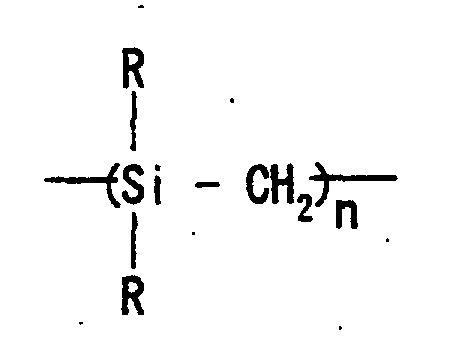
- a modified polycarbosilane obtainable by modifying a polycarbosilane which has a main chain structure represented by the formula, (in which R is a hydrogen atom, a lower alkyl group or a phenyl group) and a number average molecular weight of 200 to 10, 000, with an organic zirconium.
- the first step of the present invention's process is a step of producing a modified polycarbosilane having a number average molecular weight of 1,000 to 50,000 as a starting material used for producing the zirconia-containing inorganic fiber.
- the fundamental production process of the abcve modified polycarbosilane is remarkably similar to the production process of JP-A-56-74126. However, in the present invention, it is required to carefully control the bonding state of a functional group described in JP-A-56-74126. The general outlines thereof will be explained hereinafter.
- the modified polycarbosilane. as a starting material is derived mainly from a polycarbosilane having a main chain structure represented by the formula, (in which R is a hydrogen atom, a lower alkyl group or a phenyl group) and a number average molecular weight of 200 to 10, 000 and an organic zirconium compound having a basic structure of an organic zirconium compound having a basic structure of the formula Zr(OR')-n or the formula ZrR"m (in which R' is an alkyl group having 1 to 20 carbon atoms or a phenyl group, R" is acetylacetonate, and each of m and n is an integer of more than 1).
- the fiber having a slope constitution For producing the fiber having a slope constitution, provided by the present invention, it is required to select slow reaction conditions under which only part of the organic zirconium compound forms a bond with the polycarbosilane. For the above purpose, it is required to carry out the reaction at a temperature of 280°C or lower, preferably 250°C or lower, in an inert gas. Under the above reaction conditions, even when the above organic zirconium compound is reacted with the polycarbosilane, it bonds as a monofunctional polymer (i.e., a pendant-like bonding) and no large increase in molecular weight occurs.
- the thus-obtained modified polycarbosilane in which the organic zirconium compound is partially bonded plays an important role in improving compatibility between the polycarbosilane and the organic zirconium compound.
- the polycarbosilane forms a cross-linking structure and a noticeable increase in molecular weight is observed. In this case, sudden heat generation and an increase in melt viscosity occur in the reaction.
- a decrease in melt viscosity is observed.
- the present invention uses mainly, as a starting material, a material in which the above modified polycarbosilane coexists with an organic zirconium compound which is in an unreacted state or an organic zirconium compound which is dimer, trimer or so.
- the modified polycarbosilane alone can be similarly used as a starting material when the modified polycarbosilane contains a modified polycarbosilane component having an extremely low molecular weight.
- the modified polycarbosilane obtained in the first step or a mixture of the modified polycarbosilane and a low molecular-weight organic zirconium compound is molten to form a spinning solution, optionally the spinning solution is filtered to remove substances which are to be detriment at the time of spinning such as a microgel or impurities, and the spinning solution is spun with a generally used synthetic fiber-spinning machine While the temperature of the spinning solution at the spinning time differs depending upon the softening temperature of the modified polycarbosilane as raw materials, it is advantageous to select a temperature in the range of from 50 to 200°C.
- the above spinning machine may be provided with a humidifying and heating cylinder in a nozzle bottom portion as required.
- the diameter of a fiber is adjusted by changing the amount of ejection from a nozzle and the take-up speed of a high-speed take-up unit attached to a bottom portion of the spinning machine.
- the second step of the present invention's process can give an intended fiber by dissolving the modified polycarbosilane obtained in the first step or a mixture of the modified polycarbosilane and low molecular-weight organic zirconium compound in a solvent which can dissolve the modified polycarbosilane and the low molecular-weight organic zirconium compound, to form a spinning solution, optionally filtering the spinning solution to remove substances which. are to be detriment at the time of spinning such as a microgel or impurities, and spinning the spinning solution with a generally used synthetic fiber-spinning machine by a dry spinning method while controlling the take-up speed.
- the solvent which can dissolve the modified polycarbosilane and the low molecular-weight organic zirconium compound includes benzene, toluene, xylene and the like.
- a spinning cylinder may be attached to the spinning machine as required.
- An atmosphere in the cylinder is replaced with a mix atmosphere mixed with at least one gas selected from the above solvents or replaced with an atmosphere of air, an inert gas, heated air, a heated inert gas, steam, an ammonia gas, a hydrocarbon gas or an organosilicon compound gas, whereby solidification of the fiber in the spinning cylinder can be controlled.
- the above spun fiber is preliminarily heated in an oxidizing atmosphere under the action of tension or no tension, to infusibilize the spun fiber.
- the purpose of this step is to prevent the fiber from melting in the following calcination step and to prevent adjacent fibers from bonding to each other.
- the temperature for the treatment and the time for the treatment differ depending upon constitution. Although not specially limited, generally, the treatment is carried out in the range of 50 to 400°C for several hours to 30 hours.
- the above oxidizing atmosphere may contain moisture, nitrogen oxide, ozone, etc., which increase the oxidation strength of the spun fiber, and an oxygen partial pressure may be changed intentionally.
- the softening temperature of the spun fiber becomes less than 50°C according to the ratio of substances having a low molecular weight in raw materials.
- a treatment for promoting the oxidation of a fiber surface is previously carried out at a temperature lower than the above treatment temperature in some cases.
- the above infusible fiber is calcined under tension or no tension at a temperature in the range of 500 to 1,800°C in an oxidizing atmosphere, to obtain an intended zirconia-containing inorganic fiber formed of a composite oxide phase composed of an oxide phase (first phase) mainly formed of a silica component and a zirconia phase (second phase), in which the ratio of Zr slopingly increases towards the surface layer.
- first phase oxide phase
- second phase zirconia phase
- the calcination can be carried out in an inert atmosphere.
- the above infusible. fiber is calcined under tension or no tension at a temperature in the range of 500 to 2, 000°C in an inert atmosphere, to obtain an intended zirconia-containing inorganic fiber formed of a composite oxide phase composed of a silicon carbide phase (first phase) and a zirconia phase (second phase), in which the ratio of Zr slopingly increases towards the surface layer.
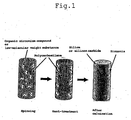
- Fig.1 schematically shows steps of the generation of the zirconia-containing inorganic fiber having an intended slope constitution, provided by the present invention.
- the mixture of the modified polycarbosilane and the low-molecular weight organic metal compound was dissolved in toluene, the resultant solution was placed in a spinning machine made of glass, it was temperature-increased in the spinning machine in which nitrogen had been sufficiently substituted to distill the toluene off and the resultant material was melt-spun at 180°C.
- the spun fiber was stepwise heated up to 150°C in air to form an infusible fiber, and the infusible fiber was calcined in air at 1,200°C for 1 hour, to obtain a zirconia-containing inorganic fiber.
- the obtained zirconia-containing fiber (average diameter: 10 ⁇ m) was analyzed with X-ray. As a result thereof, it was found that the fiber was formed of an amorphous silica and zirconia. The Zr/Si molar ratio of the fiber as a whole was 0.20. Further, the fiber was examined for the distribution state of constitutive atoms by EPMA.
- the molar ratio of Zr/Si was 0.85 in the region of from the outermost periphery portion to a depth of 1 ⁇ m, the molar ratio of Zr/Si was 0.18 in the region of from a depth of 3 ⁇ m to 4 ⁇ m below the outermost periphery, and the molar ratio of Zr/Si in the central portion was 0.05. Accordingly, it was confirmed that the fiber had a slope constitution in which zirconium increased towards the surface.
- the fiber had a tensile strength of 2.0 GPa.
- the above tensile strength of the fiber was remarkably higher than that of a zirconia fiber obtained by a conventional sol-gel method.
- the fiber had a specific surface area of 10 m 2 /g.
- the fiber was measured for the ratio of zirconia with a fully-automatic fluorescent X-ray analyser (PW2400) supplied by PHILIPS.
- the ratio of zirconia based on the fiber as a whole was 20 % by weight.
- the above zirconia-containing inorganic fiber was molded into a felt form with a needle-punch, to produce a cylindrical filter having a diameter of 200 mm and a height of 500 mm.
- Amixed gas of 100 ppm NO and 10 % O 2 was flown together with 300 ppm of propane (reducing agent) at a flow rate of 10 liters/minute from the outside of the filter.
- propane reducing agent
- an electric heater was installed at the inside surface of the filter and the temperature of the filter was maintained at 600 °C.
- a gas which had been passed through the filter was sampled and the gas was measured for a NO concentration according to a chemiluminescence method.
- the NO concentration was 1 ppm or less.
- an exhaust gas from a diesel engine was passed through the above filter for 30 minutes at a flow rate of 15 liters/minute.
- 95 % of dark smoke particulate matter (PM) in the exhaust gas was collected.
- the PM was oxidized and removed by heating the filter which collected the PM in an atmospheric air at 1, 000 °C for 30 minutes, thereby recycling the filter.
- the recycled filter had no damage.
- Example 2 The same filter as that produced in Example 1 was immersed in an aqueous solution containing potassium nitrate and cobalt nitrate and then the filter was calcined in air at 600 °C, whereby a potassium salt-cobalt oxide catalyst as a PM removal catalyst was carried on the surface of the filter.
- An exhaust gas from a diesel engine was passed through the above filter, which was kept at 700 °C, for 30 minutes at a flow rate of 15 liters/minute. At least 97 % of dark smoke particulate matter (PM) in the exhaust gas was removed.
- the filter after the test was observed to find no deterioration such as corrosion.
- Example 2 The same infusible fiber as that obtained in Example 1 was calcined in an argon gas at 1,400 °C for 1 hour, to obtain a zirconia-containing inorganic fiber.
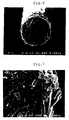
- Fig.2 and Fig.3 show a cross-sectional photograph of the whole of the zirconia-containing inorganic fiber through an electron microscope and a cross-sectional photograph of a portion near its surface layer.
- the obtained zirconia-containing fiber (average diameter: 10 ⁇ m) was analyzed with X-ray. As a result thereof, it was found that the fiber was formed of an amorphous silicon carbide and zirconia. The Zr/Si molar ratio of the fiber as a whole was 0.20. Further, the fiber was examined for the distribution state of constitutive atoms by EPMA.
- the molar ratio of Zr/Si was 0.75 in the region of from the outermost periphery portion to a depth of 1 ⁇ m, the molar ratio of Zr/Si was 0.20 in the region of from a depth of 3 ⁇ m to 4 ⁇ m below the outermost periphery, and the molar ratio of Zr/Si in the central portion was 0.10. Accordingly, it was confirmed that the fiber had a slope constitution in which zirconium increased towards the surface.
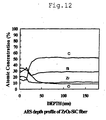
- Fig.12 shows the distribution of each element, such as zirconium, of the zirconia-containing inorganic fiber in a surface layer portion and in a region of from the surface to a depth of approximately 150 nm.
- the fiber had a tensile strength of 2.2 GPa.
- the above tensile strength of the fiber was remarkably higher than that of a zirconia fiber obtained by a conventional sol-gel method.
- the fiber had a specific surface area of 80 m 2 /g. Further, the fiber was measured for the ratio of zirconia with a fully-automatic fluorescent X-ray analyser (PW2400 ) supplied by PHILIPS.
- PW2400 fully-automatic fluorescent X-ray analyser supplied by PHILIPS.
- the ratio of zirconia based on the fiber as a whole was 22 % by weight.
- the above zirconia-containing inorganic fiber was molded into a felt form with a needle-punch, to produce a cylindrical filter having a diameter of 200 mm and a height of 500 mm.
- a mixed gas of 100 ppm NO and 10 % O 2 was flown without a reducing agent at a flow rate of 10 liters/minute from the outside of the filter.
- an electric heater was installed at the inside surface of the filter and the temperature of the filter was maintained at 600 °C.
- a gas which had been passed through the filter was sampled and the gas was measured for a NO concentration according to a chemiluminescence method. The NO concentration was 30 ppm or less. It was found that the filer adsorbed the NO gas.
- a mixed gas of 100 ppm NO and 10 % O 2 was flown together with 300 ppm of propane (reducing agent) at a flow rate of 10 liters/minute from the outside of the filter.
- propane reducing agent
- an electric heater was installed at the inside surface of the filter and the temperature of the filter was maintained at 600 °C.
- a gas which had been passed through the filter was sampled and the gas was measured for a NO concentration according to a chemiluminescence method.
- the NO concentration was 1 ppm or less.
- an exhaust gas from a diesel engine was passed through the above filter for 30 minutes at a flow rate of 15 liters/minute.
- 96 % of dark smoke particulate matter (PM) in the exhaust gas was collected.
- the PM was oxidized and removed by heating the filter which collected the PM in an atmospheric air at 1, 000 °C for 30 minutes, thereby recycling the filter.
- the recycled filter had no damage.
- a potassium salt-cobalt oxide catalyst as a PM removal catalyst was carried on the surface of the same filter as that produced in Example 3, in the same manner as in Example 2.
- An exhaust gas from a diesel engine was passed through the above filter, which was kept at 700 °C, for 30 minutes at a flow rate of 15 liters/minute. At least 99 % of dark smoke particulate matter (PM) in the exhaust gas was removed.
- the filter after the test was observed through an electron microscope to find no deterioration such as corrosion.
- Fig.4 shows a cross-sectional photograph of the whole of the fiber through an electron microscope
- Fig. 5 is a cross-sectional photograph showing a catalyst-carrying state in a portion near the surface layer of the fiber.
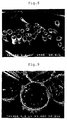
- Fig.8 shows a cross-sectional photograph of the zirconia-containing inorganic fiber after the endurance test
- Fig.9 is an electron micrograph showing the state of appearance of the fiber after the endurance test.
- a zirconia sol was prepared by using zirconium. tetrapropoxide as a main raw material according to the method described in New Ceramic No.8, pages 53 to 58 (1996).
- the zirconia sol was spun and then calcined in air at 1,000 °C for 1 hour, to obtain a zirconia fiber.
- the fiber (average diameter 13 ⁇ m) was analyzed by X-ray. It was found that the fiber was formed of zirconia alone.
- the fiber had a tensile strength of 0.7 GPa and had a specific surface area of 5 m 2 /g.
- NOx removal test and PM removal test as those carried out in Examples 1 to 4
- an attempt to mold the fiber into a felt form with a needle-punch was carried out. However, the fiber was fragile so that it was impossible to mold the fiber into a felt form.
- a cylindrical filter having a diameter of 200 mm and a height of 500 mm was prepared by using a felt of a commercially-available silicon-carbide-based fiber.
- a mixed gas of 100 ppm NO and 10 % O 2 was flown together with 300 ppm of propane (reducing agent) at a flow rate of 10 liters/minute from the outside of the filter.
- propane reducing agent
- an electric heater was installed at the inside surface of the filter and the temperature of the filter was maintained at 600 °C.
- a gas which had been passed through the filter was sampled and the gas was measured for a NO concentration according to a chemiluminescence method. The NO concentration was 100 ppm or less. No decrease of NO was found.
- an exhaust gas from a diesel engine was passed through the above filter for 30 minutes at a flow rate of 15 liters/minute.
- 95 % of dark smoke particulate matter (PM) in the exhaust gas was collected.
- the PM was oxidized and removed by heating the filter which collected the PM in an atmospheric air at 1, 000 °C for 30 minutes, thereby recycling the filter.
- the recycled filter was checked, and corrosion and oxidation due to alkali metals or alkali earth metal compounds contained in the exhaust gas were found in the fiber.
- a potassium salt-cobalt oxide catalyst as a PM removal catalyst was carried on the surface of the same silicon-carbide-based fiber filter as that produced in Comparative Example 2, in the same manner as in Example 2.
- An exhaust gas from a diesel engine was passed through the above filter, which was kept at 700 °C, for 30 minutes at a flow rate of 15 liters/minute. At least 98 % of dark smoke particulate matter (PM) in the exhaust gas was removed.
- PM dark smoke particulate matter
- Fig.10 shows a cross-sectional photograph of the silicon-carbide-based fiber after the endurance test
- Fig.11 is a photograph showing the state of appearance of the fiber after the endurance test.
- a high-strength zirconia-containing inorganic fiber having excellent alkali resistance, oxidation resistance, catalyst function and/or catalyst-carrying function and a process for the production thereof. That is, according to the present invention, there are provided a zirconia-containing inorganic fiber which is composed of a central portion (silica phase or silicon carbide phase) taking charge of dynamic properties and a zirconia phase taking charge of various functions in a surface layer and near the surface layer and has a fiber structure having a slope constitution toward the surface layer, and a process for the production thereof.
Landscapes
- Chemical & Material Sciences (AREA)
- Engineering & Computer Science (AREA)
- Manufacturing & Machinery (AREA)
- Ceramic Engineering (AREA)
- Materials Engineering (AREA)
- Organic Chemistry (AREA)
- Inorganic Chemistry (AREA)
- Chemical Kinetics & Catalysis (AREA)
- Structural Engineering (AREA)
- Life Sciences & Earth Sciences (AREA)
- Geochemistry & Mineralogy (AREA)
- Physics & Mathematics (AREA)
- Thermal Sciences (AREA)
- General Chemical & Material Sciences (AREA)
- Nanotechnology (AREA)
- Dispersion Chemistry (AREA)
- Textile Engineering (AREA)
- General Life Sciences & Earth Sciences (AREA)
- Geology (AREA)
- Combustion & Propulsion (AREA)
- Inorganic Fibers (AREA)
- Catalysts (AREA)
- Exhaust Gas Treatment By Means Of Catalyst (AREA)
- Compositions Of Oxide Ceramics (AREA)
Abstract
Description
Claims (10)
- A zirconia-containing inorganic fiber which is formed of a composite oxide phase composed of a first phase mainly formed of a silica component or silicon carbide and a second phase formed of zirconia, wherein the ratio of Zr slopingly increases toward a surface layer of the fiber.
- A zirconia-containing inorganic fiber according to claim 1, wherein the ratio of the first phase based on the fiber as a whole is 98 to 40 % by weight and the ratio of zirconia is 2 to 60 % by weight.
- A zirconia-containing inorganic fiber according to claim 1, wherein the fiber has a BET specific surface area of at least 1 m2/g.
- A zirconia-containing inorganic fiber according to claim 1, wherein a catalyst is carried on the surface of the zirconia-containing inorganic fiber.
- A use of the zirconia-containing inorganic fiber recited in claim 1 as a catalyst having a woven fabric form or a nonwoven fabric form.
- A process for the production of the zirconia-containing inorganic fiber recited in claim 1, which process comprises
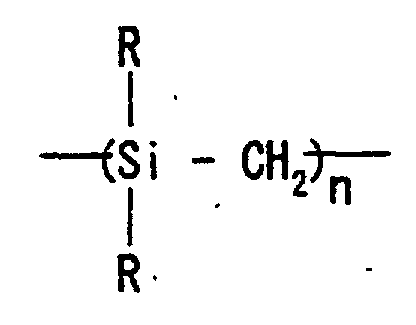
melt-spinning a modified polycarbosilane obtainable by modifying a polycarbosilane which has a main chain structure represented by the formula,(in which R is a hydrogen atom, a lower alkyl group or a phenyl group) and a number average molecular weight of 200 to 10,000, with an organic zirconium compound having a basic structure of the formula Zr (OR')n. or the formula ZrR"m (in which R' is an alkyl group having 1 to 20 carbon atoms or a phenyl group, R" is acetylacetonate, and each of m and n is an integer of more than 1), or melt-spinning a mixture of the modified polycarbosilane and an organic zirconium compound, to obtain a spun fiber,
infusibilizing the spun fiber to obtain an infusible fiber, and then,
calcining the infusible fiber in an oxidizing atmosphere or an inert atmosphere. - A process according to claim 6, wherein the modified polycarbosilane is obtained by reacting the organic zirconium compound with the polycarbosilane in an inert atmosphere at 280 °C or less.
- A process according to claim 6, wherein the organic zirconium compound in the mixture is an organic zirconium compound which is unreacted with the polycarbosilane or an organic zirconium compound which is dimer and/or trimer.
- A process according to claim 6, wherein a zirconia-containing inorganic fiber comprising a first phase mainly formed of a silica component is obtained by calcining the infusible fiber in an oxidizing atmosphere at a temperature in the range of from 500 to 1,800 °C after the infusibilizing treatment.
- A process according to claim 6, wherein a zirconia-containing inorganic fiber comprising a first phase mainly formed of silicon carbide is obtained by calcining the infusible fiber in an inert atmosphere at a temperature in the range of from 500 to 2,000 °C after the infusibilizing treatment.
Applications Claiming Priority (5)
| Application Number | Priority Date | Filing Date | Title |
|---|---|---|---|
| JP2001106634 | 2001-04-05 | ||
| JP2001106634 | 2001-04-05 | ||
| JP2001167679 | 2001-06-04 | ||
| JP2001167679 | 2001-06-04 | ||
| PCT/JP2002/003328 WO2002081795A1 (en) | 2001-04-05 | 2002-04-03 | Zirconia-containing inorganic fiber and method for production thereof |
Publications (3)
| Publication Number | Publication Date |
|---|---|
| EP1431431A1 true EP1431431A1 (en) | 2004-06-23 |
| EP1431431A4 EP1431431A4 (en) | 2005-07-27 |
| EP1431431B1 EP1431431B1 (en) | 2008-02-20 |
Family
ID=26613101
Family Applications (1)
| Application Number | Title | Priority Date | Filing Date |
|---|---|---|---|
| EP02717062A Expired - Lifetime EP1431431B1 (en) | 2001-04-05 | 2002-04-03 | Zirconia-containing inorganic fiber and method for production thereof |
Country Status (4)
| Country | Link |
|---|---|
| US (1) | US6881693B2 (en) |
| EP (1) | EP1431431B1 (en) |
| DE (1) | DE60225158T2 (en) |
| WO (1) | WO2002081795A1 (en) |
Cited By (1)
| Publication number | Priority date | Publication date | Assignee | Title |
|---|---|---|---|---|
| EP2128312A4 (en) * | 2007-03-19 | 2016-09-21 | Ube Industries | SILICA-BASED COMPOSITE OXIDE FIBER, CATALYST FIBER COMPRISING THE SAME, AND PROCESS FOR THE PRODUCTION THEREOF |
Families Citing this family (8)
| Publication number | Priority date | Publication date | Assignee | Title |
|---|---|---|---|---|
| US20050247904A1 (en) * | 2002-04-27 | 2005-11-10 | The Regents Of The University Of Colorado | Nanocomposite ceramics of oxide and no-oxide phases and methods for producing same |
| JP3465706B1 (en) * | 2002-05-01 | 2003-11-10 | 宇部興産株式会社 | Silica-based photocatalytic fiber having visible light activity and method for producing the same |
| WO2006129844A1 (en) * | 2005-05-31 | 2006-12-07 | Teijin Limited | Ceramic fiber and process for producing the same |
| CN109912803B (en) * | 2019-03-19 | 2021-08-27 | 江西嘉捷信达新材料科技有限公司 | Zirconium-containing polycarbosilane and preparation method and application thereof |
| CN110436935B (en) * | 2019-08-06 | 2022-03-04 | 江西嘉捷信达新材料科技有限公司 | Superfine zirconium dioxide/SiC composite long fiber and preparation method and application thereof |
| CN111020746B (en) * | 2019-12-25 | 2022-07-19 | 南方科技大学 | SiC/ZrC composite fiber and preparation method and application thereof |
| CN111850816A (en) * | 2020-07-30 | 2020-10-30 | 安徽同和晶体新材料股份有限公司 | High-strength zirconia fiber felt prepared by impregnation method |
| CN117702307A (en) * | 2023-12-15 | 2024-03-15 | 中国建筑材料科学研究总院有限公司 | Zirconia/silicon carbide/silicon oxide nanofiber and preparation method and application thereof |
Family Cites Families (9)
| Publication number | Priority date | Publication date | Assignee | Title |
|---|---|---|---|---|
| CA1167216A (en) * | 1980-12-18 | 1984-05-15 | Kiyohito Okamura | Continuous inorganic fibers and process for production thereof |
| JPS60185817A (en) * | 1984-03-06 | 1985-09-21 | Ube Ind Ltd | Preparation of inorganic yarn having high strength |
| US4778722A (en) * | 1986-05-15 | 1988-10-18 | Ube Industries, Ltd. | Reinforcing fibers and composite materials reinforced with said fibers |
| JPS62289614A (en) * | 1986-06-03 | 1987-12-16 | Ube Ind Ltd | Inorganic fibers for composite materials |
| US4770935A (en) * | 1986-08-08 | 1988-09-13 | Ube Industries, Ltd. | Inorganic fibrous material as reinforcement for composite materials and process for production thereof |
| JPH071837B2 (en) * | 1987-09-04 | 1995-01-11 | 宇部興産株式会社 | Electromagnetic wave absorber |
| US5292830A (en) * | 1991-06-20 | 1994-03-08 | Tonen Corporation | Thermosetting copolymers, silicon carbide-based fiber and processes for producing same |
| WO2001038616A1 (en) * | 1999-11-24 | 2001-05-31 | Ube Industries, Ltd. | Organic silicon polymer, inorganic fiber with silicon carbide base, and method of manufacture thereof |
| US6541416B2 (en) * | 2000-06-13 | 2003-04-01 | Ube Industries, Ltd. | Silica-group composite oxide fiber and process for the production thereof |
-
2002
- 2002-04-03 WO PCT/JP2002/003328 patent/WO2002081795A1/en not_active Ceased
- 2002-04-03 US US10/297,299 patent/US6881693B2/en not_active Expired - Fee Related
- 2002-04-03 DE DE60225158T patent/DE60225158T2/en not_active Expired - Lifetime
- 2002-04-03 EP EP02717062A patent/EP1431431B1/en not_active Expired - Lifetime
Cited By (1)
| Publication number | Priority date | Publication date | Assignee | Title |
|---|---|---|---|---|
| EP2128312A4 (en) * | 2007-03-19 | 2016-09-21 | Ube Industries | SILICA-BASED COMPOSITE OXIDE FIBER, CATALYST FIBER COMPRISING THE SAME, AND PROCESS FOR THE PRODUCTION THEREOF |
Also Published As
| Publication number | Publication date |
|---|---|
| US6881693B2 (en) | 2005-04-19 |
| DE60225158D1 (en) | 2008-04-03 |
| WO2002081795A1 (en) | 2002-10-17 |
| US20030134121A1 (en) | 2003-07-17 |
| EP1431431B1 (en) | 2008-02-20 |
| DE60225158T2 (en) | 2009-02-26 |
| EP1431431A4 (en) | 2005-07-27 |
Similar Documents
| Publication | Publication Date | Title |
|---|---|---|
| US7041266B1 (en) | Silicon carbide fibers essentially devoid of whiskers and products made therefrom | |
| US6753292B2 (en) | Silica-based photocatalyst fiber having visible-light activity and process for the production thereof | |
| US6881693B2 (en) | Zirconia-containing inorganic fiber and process for the production thereof | |
| KR101410454B1 (en) | Silica-based composite photocatalyst and method for producing the same | |
| EP2128312A1 (en) | Silica-based composite oxide fiber, catalyst fiber comprising the same, and process for producing the same | |
| JP4061089B2 (en) | Diesel particulate filter | |
| EP1300491B1 (en) | Process for the production of a silicon carbide fiber having boron nitride layer in fiber surface | |
| US20060147368A1 (en) | Process for producing silicon carbide fibers essentially devoid of whiskers | |
| EP1164212B1 (en) | Silica-group composite oxide fiber and process for the production thereof | |
| JP4082062B2 (en) | Zirconia-containing inorganic fiber and method for producing the same | |
| JP3812481B2 (en) | Hazardous substance removal filter | |
| JP3815393B2 (en) | Nonwoven fabric and method for producing the same | |
| US20050031866A1 (en) | Silicon carbide fiber having boron nitride layer in fiber surface and process for the production thereof | |
| JP2003175333A (en) | Purification device and photocatalyst cartridge | |
| JP2002371436A (en) | Silica-based composite oxide fiber and method for producing the same | |
| JP3815392B2 (en) | Nonwoven fabric and method for producing the same | |
| US7005184B2 (en) | Silicon carbide fiber having boron nitride layer in fiber surface and process for the production thereof | |
| JP4081752B2 (en) | Hydrazine decomposition catalyst | |
| JP3417459B2 (en) | Crystalline silicon carbide fiber having good alkali resistance and method for producing the same | |
| JPWO2008142962A1 (en) | Silicon carbide fiber and method for producing the same | |
| JPH11286833A (en) | Method for producing crystalline silicon carbide fiber |
Legal Events
| Date | Code | Title | Description |
|---|---|---|---|
| PUAI | Public reference made under article 153(3) epc to a published international application that has entered the european phase |
Free format text: ORIGINAL CODE: 0009012 |
|
| 17P | Request for examination filed |
Effective date: 20030407 |
|
| AK | Designated contracting states |
Kind code of ref document: A1 Designated state(s): AT BE CH CY DE DK ES FI FR GB GR IE IT LI LU MC NL PT SE TR |
|
| RBV | Designated contracting states (corrected) |
Designated state(s): DE FR GB |
|
| A4 | Supplementary search report drawn up and despatched |
Effective date: 20050610 |
|
| RIC1 | Information provided on ipc code assigned before grant |
Ipc: 7B 01D 39/20 B Ipc: 7B 01J 21/04 B Ipc: 7C 04B 35/622 B Ipc: 7B 01J 35/06 B Ipc: 7B 01J 21/06 B Ipc: 7C 03C 13/00 B Ipc: 7C 03B 37/01 B Ipc: 7D 01F 9/08 A |
|
| 17Q | First examination report despatched |
Effective date: 20061219 |
|
| GRAP | Despatch of communication of intention to grant a patent |
Free format text: ORIGINAL CODE: EPIDOSNIGR1 |
|
| GRAS | Grant fee paid |
Free format text: ORIGINAL CODE: EPIDOSNIGR3 |
|
| GRAA | (expected) grant |
Free format text: ORIGINAL CODE: 0009210 |
|
| AK | Designated contracting states |
Kind code of ref document: B1 Designated state(s): DE FR GB |
|
| REG | Reference to a national code |
Ref country code: GB Ref legal event code: FG4D |
|
| REF | Corresponds to: |
Ref document number: 60225158 Country of ref document: DE Date of ref document: 20080403 Kind code of ref document: P |
|
| ET | Fr: translation filed | ||
| PLBE | No opposition filed within time limit |
Free format text: ORIGINAL CODE: 0009261 |
|
| STAA | Information on the status of an ep patent application or granted ep patent |
Free format text: STATUS: NO OPPOSITION FILED WITHIN TIME LIMIT |
|
| 26N | No opposition filed |
Effective date: 20081121 |
|
| PGFP | Annual fee paid to national office [announced via postgrant information from national office to epo] |
Ref country code: GB Payment date: 20140402 Year of fee payment: 13 |
|
| PGFP | Annual fee paid to national office [announced via postgrant information from national office to epo] |
Ref country code: FR Payment date: 20140409 Year of fee payment: 13 Ref country code: DE Payment date: 20140430 Year of fee payment: 13 |
|
| REG | Reference to a national code |
Ref country code: DE Ref legal event code: R119 Ref document number: 60225158 Country of ref document: DE |
|
| GBPC | Gb: european patent ceased through non-payment of renewal fee |
Effective date: 20150403 |
|
| PG25 | Lapsed in a contracting state [announced via postgrant information from national office to epo] |
Ref country code: DE Free format text: LAPSE BECAUSE OF NON-PAYMENT OF DUE FEES Effective date: 20151103 Ref country code: GB Free format text: LAPSE BECAUSE OF NON-PAYMENT OF DUE FEES Effective date: 20150403 |
|
| REG | Reference to a national code |
Ref country code: FR Ref legal event code: ST Effective date: 20151231 |
|
| PG25 | Lapsed in a contracting state [announced via postgrant information from national office to epo] |
Ref country code: FR Free format text: LAPSE BECAUSE OF NON-PAYMENT OF DUE FEES Effective date: 20150430 |