EP1431341A1 - Vinyl chloride resin composition - Google Patents
Vinyl chloride resin composition Download PDFInfo
- Publication number
- EP1431341A1 EP1431341A1 EP02772914A EP02772914A EP1431341A1 EP 1431341 A1 EP1431341 A1 EP 1431341A1 EP 02772914 A EP02772914 A EP 02772914A EP 02772914 A EP02772914 A EP 02772914A EP 1431341 A1 EP1431341 A1 EP 1431341A1
- Authority
- EP
- European Patent Office
- Prior art keywords
- weight
- parts
- rubber polymer
- acrylic rubber
- vinyl chloride
- Prior art date
- Legal status (The legal status is an assumption and is not a legal conclusion. Google has not performed a legal analysis and makes no representation as to the accuracy of the status listed.)
- Withdrawn
Links
Classifications
-
- C—CHEMISTRY; METALLURGY
- C08—ORGANIC MACROMOLECULAR COMPOUNDS; THEIR PREPARATION OR CHEMICAL WORKING-UP; COMPOSITIONS BASED THEREON
- C08L—COMPOSITIONS OF MACROMOLECULAR COMPOUNDS
- C08L27/00—Compositions of homopolymers or copolymers of compounds having one or more unsaturated aliphatic radicals, each having only one carbon-to-carbon double bond, and at least one being terminated by a halogen; Compositions of derivatives of such polymers
- C08L27/02—Compositions of homopolymers or copolymers of compounds having one or more unsaturated aliphatic radicals, each having only one carbon-to-carbon double bond, and at least one being terminated by a halogen; Compositions of derivatives of such polymers not modified by chemical after-treatment
- C08L27/04—Compositions of homopolymers or copolymers of compounds having one or more unsaturated aliphatic radicals, each having only one carbon-to-carbon double bond, and at least one being terminated by a halogen; Compositions of derivatives of such polymers not modified by chemical after-treatment containing chlorine atoms
- C08L27/06—Homopolymers or copolymers of vinyl chloride
-
- C—CHEMISTRY; METALLURGY
- C08—ORGANIC MACROMOLECULAR COMPOUNDS; THEIR PREPARATION OR CHEMICAL WORKING-UP; COMPOSITIONS BASED THEREON
- C08L—COMPOSITIONS OF MACROMOLECULAR COMPOUNDS
- C08L51/00—Compositions of graft polymers in which the grafted component is obtained by reactions only involving carbon-to-carbon unsaturated bonds; Compositions of derivatives of such polymers
- C08L51/003—Compositions of graft polymers in which the grafted component is obtained by reactions only involving carbon-to-carbon unsaturated bonds; Compositions of derivatives of such polymers grafted on to macromolecular compounds obtained by reactions only involving unsaturated carbon-to-carbon bonds
-
- C—CHEMISTRY; METALLURGY
- C08—ORGANIC MACROMOLECULAR COMPOUNDS; THEIR PREPARATION OR CHEMICAL WORKING-UP; COMPOSITIONS BASED THEREON
- C08L—COMPOSITIONS OF MACROMOLECULAR COMPOUNDS
- C08L51/00—Compositions of graft polymers in which the grafted component is obtained by reactions only involving carbon-to-carbon unsaturated bonds; Compositions of derivatives of such polymers
- C08L51/04—Compositions of graft polymers in which the grafted component is obtained by reactions only involving carbon-to-carbon unsaturated bonds; Compositions of derivatives of such polymers grafted on to rubbers
Definitions
- the present invention relates to a vinyl chloride resin composition having particularly excellent impact resistance and weatherability.
- Molded articles of vinyl chloride resin are used in various industrial fields because they are inexpensive and have good mechanical and chemical properties. However, such molded articles have a problem that their impact resistance at normal or low temperature is inferior.
- MBS resin obtained by graft polymerization of butadiene rubber polymer with methyl methacrylate and styrene and ABS resin obtained by graft polymerization of butadiene rubber polymer with acrylonitrile and styrene are now widely used.
- molded articles of the vinyl chloride resin composition obtained therefrom has excellent weatherbility, and thus can be used as window frames or sizing materials in the construction and building industries where long-lasting weatherability is required.
- the present invention provides a vinyl chloride resin composition which has excellent impact resistance particularly at low temperature without decreasing weatherability.
- the present invention relates to a vinyl chloride resin composition
- a vinyl chloride resin composition comprising (A) 2 to 30 parts by weight of a graft copolymer and (B) 100 parts by weight of a vinyl chloride resin
- the graft copolymer (A) is obtained by polymerizing, in the presence of 70 to 95 parts by weight of a crosslinked acrylic rubber polymer (a-1) comprising 81 to 95 % by weight of butyl acrylate, 4 to 18 % by weight of an alkyl acrylate having a C 8 - 12 alkyl group and 0.2 to 0.8 % by weight of a multi-functional monomer, 5 to 30 parts by weight of a monomer component for graft polymerization (a-2) comprising 92 to 100 % by weight of methyl methacrylate, and 0 to 8 % by weight of an alkyl methacrylate having a C 2 - 8 alkyl group, an alkyl acrylate having a C 1 - 8 alky
- the crosslinked acrylic rubber polymer (a-1) contains 81 to 92 % by weight of butyl acrylate and 7 to 18 % by weight of the alkyl acrylate having a C 8 - 12 alkyl group.
- the alkyl acrylate contained in the crosslinked acrylic rubber polymer (a-1), having a C 8 - 12 alkyl group is 2-ethylhexyl acrylate.
- the graft copolymer (A) comprises 80 to 95 parts by weight of the crosslinked acrylic rubber polymer (a-1) and 5 to 20 parts by weight of the monomer component for graft polymerization (a-2).
- the graft copolymer (A) comprises 85 to 92 parts by weight of the crosslinked acrylic rubber polymer (a-1) and 8 to 15 parts by weight of the monomer component for graft polymerization (a-2).
- the present invention also relates to a molded article comprising the vinyl chloride resin composition.
- the vinyl chloride resin composition of the present invention comprises (A) 2 to 30 parts by weight of a graft copolymer and (B) 100 parts by weight of a vinyl chloride resin, wherein the graft copolymer (A) is obtained by polymerizing, in the presence of 70 to 95 parts by weight of a crosslinked acrylic rubber polymer (a-1) comprising 81 to 95 % by weight of butyl acrylate, 4 to 18 % by weight of an alkyl acrylate having a C 8 - 12 alkyl group and 0.2 to 0.8 % by weight of a multi-functional monomer, 5 to 30 parts by weight of a monomer component for graft polymerization (a-2) comprising 92 to 100 % by weight of methyl methacrylate, and 0 to 8 % by weight of an alkyl methacrylate having a C 2 - 8 alkyl group, an alkyl acrylate having a C 1 - 8 alkyl group, an unsaturated nitrile compound
- the graft copolymer (A) of the present invention is obtained by polymerizing the monomer component for graft polymerization (a-2) in the presence of the crosslinked acrylic rubber polymer (a-1).
- the crosslinked acrylic rubber polymer (a-1) is prepared by polymerization reaction of butyl acrylate, an alkyl acrylate having a C 8 -12 alkyl group and a multi-functional monomer.
- the amount of butyl acrylate is 81 to 95 % by weight, preferably 81 to 92 % by weight based on the crosslinked acrylic rubber polymer (a-1). When the amount of butyl acrylate is less than 81 % by weight or more than 95 % by weight, sufficient impact resistance cannot be achieved.
- the amount of the alkyl acrylate having a C 8 - 12 alkyl group is 4 to 18 % by weight, preferably 7 to 18 % by weight based on the crosslinked acrylic rubber polymer (a-1). When the amount of the alkyl acrylate is less than 4 % by weight or more than 18 % by weight, sufficient impact resistance cannot be achieved.
- the amount of the multi-functional monomer is 0.2 to 0.8 % by weight, preferably 0.4 to 0.6 % by weight based on the crosslinked acrylic rubber polymer (a-1). When the amount of the multi-functional monomer is less than 0.2 % by weight or more than 0.8 % by weight, sufficient impact resistance cannot be achieved.
- the alkyl acrylate having a C 8 - 12 alkyl group is a component used for preparing a rubber component having excellent weatherability and improved impact resistance.
- the number of the carbon atoms of the alkyl group is less than 8, the glass transition temperature of the rubber component becomes high and the impact resistance of molded articles cannot be exhibited easily.
- the number of the carbon atoms of the alkyl group is more than 12, polymerizability becomes inferior.
- alkyl acrylate having a C 8 - 12 alkyl group include 2-ethylhexyl acrylate and n-octyl acrylate. Among them, 2-ethylhexyl acrylate and n-octyl acrylate are preferable from the viewpoint that glass transition temperature of the rubber component becomes low and impact resistance of molded articles can be exhibited easily.
- the multi-functional monomer is a component used as a crosslinking agent.
- Typical examples thereof include aromatic multi-functional vinyl compounds such as divinylbenzene; polyhydric alcohol dimethacrylate such as polyethyleneglycol dimethacrylate and 1,3-butanediol dimethacylate; allyl esters of unsaturated carboxylic acid such as allyl methacrylate and allyl acrylate; and diallyl or triallyl compounds such as diallyl phthalate and triallyl cyanurate.
- compounds in which at least one functional group has different reactivity from other functional groups are preferable from the viewpoint that a crosslinked rubber copolymer can be obtained from a small amount of such multifunctional monomers.
- Preferable examples are allyl methacrylate and diallyl phthalate.
- the addition and polymerization of monomer components may be carried out in one step or a plurality of steps without particular limitation. That is, the above monomer components may be added in a lump or continuously after mixing the components previously. Alternatively, more than one step may be provided so that one component or at least two components are added in combination at each step.
- polymerization initiator used for the polymerization of the crosslinked acrylic rubber polymer (a-1) are organic peroxides including ketone peroxides or aldehyde peroxides such as cyclohexanone peroxide, diacyl peroxides such as acetyl peroxide, hydroperoxides such as t-butyl hydroperoxide and cumene hydroperoxide, dialkyl peroxides such as di-t-butyl peroxide, alkyl peresters such as t-butyl peroxyisobutylate, peroxy carbonates such as t-butyl peroxy isopropyl carbonate; inorganic peroxides such as hydrogen peroxide and potassium persulfate; and azo compounds such as 2,2'-azobisisobutylonitrile.
- organic peroxides including ketone peroxides or aldehyde peroxides such as cyclohexanone peroxide, diacyl peroxides such
- the polymerization initiator is not limited thereto.
- an organic peroxide and/or an inorganic peroxide may be used to carry out thermal decomposition polymerization, or those initiators may be used together with a reducing agent such as sodium ascorbate or formaldehyde sodium sulfoxylate, a co-catalyst such as ferrous sulfate or a chelating agent such as ethylene diamine tetraacetate to carry out redox polymerization, if necessary.
- a reducing agent such as sodium ascorbate or formaldehyde sodium sulfoxylate
- a co-catalyst such as ferrous sulfate
- a chelating agent such as ethylene diamine tetraacetate
- the kind of surfactant used in the emulsion polymerization is not particularly limited.
- the surfactant includes anionic surfactant, nonionic surfactant and cationic surfactant.
- anionic surfactant and nonionic surfactant are also possible.
- cationic surfactant and nonionic surfactant are also possible.
- anionic surfactant examples include alkali metal salts of fatty acids, such as potassium palmitate, sodium oleate and sodium stearate; alkali metal salts or amines, or ammonium salts of fatty alcohol sulfate such as sodium dodecylsulfate, triethanol amine dodecylsulfate and ammonium dodecylsulfate; alkali metal salts of alkylbenzenesulfonic acid or alkylnaphthalenesulfonic acid such as sodium dodecylbenzenesulfonate and sodium dodecylnaphthalenesulfonate; alkali metal salts such as sodium naphthalenesulfonates and formaldehyde polycondensation; alkali metal salts such as sodium dialkylsulfosuccinate; alkyl phosphates such as alkyl phosphate; and polyoxyethylene sulfates such as sodium poly
- nonionic surfactant examples include polyoxyethylene alkyl ethers such as polyoxyethylene dodecyl ether and polyoxyethylene stearyl ether; polyoxyethylene alkyl phenyl ethers such as polyoxyethylene nonyl phenyl ether; sorbitan esters of fatty acids such as sorbitan monostearate, sorbitan distearate and sorbitan cescheolate; polyoxyethylene sorbitan fatty acid esters such as polyoxyethylene sorbitan monostearate; polyoxyethylene acyl esters such as polyethylene glycol monostearate and polyethylene glycol distearate; a polyoxyethylene-polyoxypropylene block copolymer (molecular weight: about 2,000 to 10,000) and glycerol esters of fatty acids such as glyceryl monooleate.
- polyoxyethylene alkyl ethers such as polyoxyethylene dodecyl ether and polyoxyethylene stearyl ether
- cationic surfactant examples include alkyl amine salts such as dodecylamine acetate; quaternary ammonium salts such as dodecyl trimethyl ammonium chloride; and polyoxyethylene alkyl amine.
- alkyl amine salts such as dodecylamine acetate
- quaternary ammonium salts such as dodecyl trimethyl ammonium chloride
- polyoxyethylene alkyl amine examples include high molecular surface active agents.
- the graft copolymer (A) of the present invention is obtained by polymerizing the monomer component for graft polymerization (a-2) in the presence of the crosslinked acrylic rubber polymer (a-1).
- the amount of the crosslinked acrylic rubber polymer (a-1) is 70 to 95 parts by weight, preferably 80 to 95 parts by weight and more preferably 85 to 92 parts by weight in a total of 100 parts by weight of (a-1) and (a-2).
- the amount of crosslinked acrylic rubber polymer is less than 70 parts by weight or more than 95 parts by weight, the improving effect on impact resistance of molded articles prepared from the vinyl chloride resin composition is inferior.
- the amount of the monomer component for graft polymerization (a-2) is 5 to 30 parts by weight, preferably 5 to 20 parts by weight, and more preferably 8 to 15 parts by weight (herein, the total amount of the crosslinked acrylic rubber polymer (a-1) and the monomer component for graft polymerization (a-2) is 100 parts by weight).
- the amount of the monomer component for graft polymerization (a-2) is less than 5 parts by weight, dispersibility of the graft copolymer (A) in the molded article of the vinyl chloride resin composition is lowered.
- the amount of the monomer component for graft polymerization (a-2) is more than 30 parts by weight, the amount of the crosslinked acrylic rubber polymer (a-1) is relatively increased and improving effect on the impact resistance is decreased.
- average particle diameter of the crosslinked acrylic rubber polymer (a-1) is preferably 0.03 to 0.5 ⁇ m, more preferably 0.08 to 0.3 ⁇ m, and most preferably 0.15 to 0.18 ⁇ m.
- average particle diameter is less than 0.03 ⁇ m or more than 0.5 ⁇ m, improving effect on the impact resistance is decreased.
- the monomer component for graft polymerization (a-2) comprises methyl methacrylate, alkyl methacrylate having a C 2 - 8 alkyl group, alkyl acrylate having a C 1 - 8 alkyl group, an unsaturated nitrile compound or aromatic vinyl compound.
- the alkyl methacrylate having a C 2 - 8 alkyl group, the alkyl acrylate having a C 1 - 8 alkyl group, the unsaturated nitrile compound or the aromatic vinyl compound may be used alone or in combination of two or more.
- the graft copolymer (A) is softened and therefore it becomes difficult to separate the copolymer in the form of powder.
- alkyl methacrylate having a C 2 - 8 alkyl group are ethyl methacrylate and butyl methacrylate, but not limited thereto. These alkyl methacrylates may be used alone or in combination of two or more.
- the graft copolymer (A) is softened and therefore it becomes difficult to separate the copolymer in the form of powder.
- alkyl acrylate having a C 1 - 8 alkyl group examples are ethyl acrylate, butyl acrylate and 2-ethylhexyl acrylate, but not limited thereto. These alkyl acrylates may be used alone or in combination of two or more.
- unsaturated nitrile compounds are acrylonitrile and methacrylonitrile, but not limited thereto. These unsaturated nitrile compounds may be used alone or in combination of two or more.
- aromatic vinyl compound examples include styrene, ⁇ -methylstyrene, 1-vinylnaphthalene and 2-vinylnaphthalene, but not limited thereto. These aromatic vinyl compounds may be used alone or in combination of two or more.
- the amount of methyl methacrylate contained in the monomer component for graft polymerization (a-2) is 92 to 100 % by weight, and the amount of alkyl methacrylate having a C 2 - 8 alkyl group, alkyl acrylate having a C 1 - 8 alkyl group, unsaturated nitrile compound or aromatic vinyl compound is 0 to 8 % by weight.
- the amount of methyl methacrylate is less than 92 % by weight, the graft copolymer (A) is softened and therefore it becomes difficult to separate the copolymer in the form of powder.
- all ingredients of the monomer component for graft polymerization (a-2) may be added at one time, or part or all of the ingredients of the monomer component for graft polymerization (a-2) may be added continuously or intermittently.
- the ingredients of the monomer component for graft polymerization may be mixed before use, or graft polymerization may be carried out in a plurality of steps with making different compositions for each step within the acceptable range.
- the latex is separated with salt or acid, filtered, washed and dried or spray-dried to obtain solid particles.
- An antioxidant or ultraviolet ray absorbing agent usually used before separating with salt or acid may be added.
- the vinyl chloride resin composition of the present invention comprises 2 to 30 parts by weight of the graft copolymer (A) and 100 parts by weight of the vinyl chloride resin (B).
- the amount of the graft copolymer (A) is 3 to 15 parts by weight.
- the amount of the graft copolymer (A) is less than 2 parts by weight, improving effect on impact resistance of the molded article is not achieved.
- the amount of the graft copolymer (A) is more than 30 parts by weight, heat resistance of molded articles is decreased.
- the vinyl chloride resin (B) used in the present invention may be a vinyl chloride homopolymer or a copolymer comprising at least 70 % by weight of vinyl chloride monomer and at most 30 % by weight of other monomers copolymerizable with the vinyl chloride monomer.
- examples of other monomers are vinyl acetate, vinyl propionate, vinyl butylate, vinyl benzoate, acrylic acid, mathacrylic acid, methyl acrylate, ethyl acrylate, methyl methacrylate, ethyl methacrylate, methacrylic amide and other copolymerizable mono-olefin monomers.
- the other copolymerizable monomers may be used alone or in combination of two or more.
- the vinyl chloride resin composition of the present invention may be further incorporated with a chlorinated polyethylene or polybutadiene impact modifier.
- processing aid may be added to improve processability, and a methyl methacrylate polymer may also be added, if necessary.
- the vinyl chloride resin composition of the present invention may be prepared by blending the above materials in the same manner as preparing a common vinyl chloride resin, and there is no particular limitation for the preparation method.
- known additives generally used for preparing vinyl chloride resin composition such as a stabilizer, lubricant, plasticizer, colorant, filler, ultraviolet ray absorber, light resistance stabilizer and flame retardant may be added if necessary.
- stabilizer examples include lead stabilizers such as tribasic lead sulfate, dibasic lead phosphite, basic lead sulfite, dibasic lead phthalate, lead white and lead silicate; tin stabilizers such as butyl tin maleate, octyl tin maleate, dibutyltin dimaleate, di-n-alkyl tin mercaptide, dibutyl tin lauryl mercaptide and dioctyl tin S,S'-bis-(iso-octyl mercapto acetate; metal soap stabilizers derived from a metal such as potassium, calcium, magnesium, barium, zinc, cadmium or lead and a fatty acid such as 2-ethyl hexanoic acid, lauric acid, stearic acid, isostearic acid, hydroxy stearic acid, oleic acid, recinoleic acid, linoleic
- the vinyl chloride resin composition of the present invention can be molded into molded articles by extrusion molding, calendering molding, blow forming and injection molding in accordance with the intended use.
- a glass reactor equipped with a thermometer, an agitator, a reflux condenser, a nitrogen inlet and a feeder for monomer and emulsifier was charged with 200 parts of distilled water and 0.05 part of sodium dodecyl sulfate. With agitating under nitrogen stream, the temperature of the aqueous solution was increased to 50°C. In the next place, a mixture of 7.61 parts of BA, 0.85 part of 2-EHA, 0.04 part of AMA and 0.01 part of cumene hydroperoxide was added.
- graft copolymer latex was coagulated by salting out with an aqueous solution of calcium chloride, heat-treated, dehydrated and dried to prepare a white resin powder.
- a powder compound was obtained by blending, by a Henschel mixer, 100 parts of a vinyl chloride resin (Kanevinyl S-1001 available from Kaneka Corporation; average polymerization degree: 1,000), 4.5 parts of a lead one pack stabilizer (LGC3203 available from ACROS Co. Ltd.), 4.5 parts of titanium oxide, 8 parts of calcium carbonate, 0.5 part of processing aid (methyl methacrylate polymer such that a specific viscosity at 30°C is less than 0.5 when 0.1 g of the polymer is dissolved in chloroform solution; Kaneace PA-20 available from Kaneka Corporation) and 7 parts of the graft copolymer (A).
- a profile extrusion molded article for window frame was then produced according to the following molding conditions.
- Molding machine 65-mm twin-screw extruder made by Battenfeld Extrusionstechnik GmbH. Molding temperature: C1/ C2/ C3/ C4/ AD/ D1/ D2/ D3/ D4/ D5: 175/ 180/ 180/ 175/ 185/ 202/ 202/ 206/ 202/ 200 (°C) Number of revolutions: 24 rpm Discharge: 110 kg/ hour
- a sample was prepared from the obtained profile extrusion molded article and Charpy impact value of the sample was measured according to JIS K 7111.
- a glass reactor equipped with a thermometer, an agitator, a reflux condenser, a nitrogen inlet and a feeder for monomer and emulsifier was charged with 200 parts of distilled water and 0.05 part of sodium dodecyl sulfate. With agitating under nitrogen stream, the temperature of the aqueous solution was increased to 50°C. In the next place, a mixture of 7.19 parts of BA, 1.27 parts of 2-EHA, 0.04 part of AMA and 0.01 part of cumene hydroperoxide was added.
- a crosslinked acrylic rubber polymer (a-1) having an average particle size of 0.16 ⁇ m was obtained.
- a white resin powder was obtained and molded article was prepared therefrom to measure the impact resistance in the same manner as in Example 1 except for using the above crosslinked acrylic rubber polymer. Results are shown in Table 1.
- a glass reactor equipped with a thermometer, an agitator, a reflux condenser, a nitrogen inlet and a feeder for monomer and emulsifier was charged with 200 parts of distilled water and 0.05 part of sodium dodecyl sulfate. With agitating under nitrogen stream, the temperature of the aqueous solution was increased to 50°C. In the next place, a mixture of 8.46 parts of 2-EHA, 0.04 part of AMA and 0.01 part of cumene hydroperoxide was added.
- a crosslinked acrylic rubber polymer (a-1) having an average particle size of 0.16 ⁇ m was obtained.
- a white resin powder was obtained and molded article was prepared therefrom to measure the impact resistance in the same manner as in Example 1 except for using the above crosslinked acrylic rubber polymer. Results are shown in Table 1.
- a glass reactor equipped with a thermometer, an agitator, a reflux condenser, a nitrogen inlet and a feeder for monomer and emulsifier was charged with 200 parts of distilled water and 0.1 part of sodium dodecyl sulfate. With agitating under nitrogen stream, the temperature of the aqueous solution was increased to 50°C. In the next place, a mixture of 13.43 parts of 2-EHA, 0.07 part of AMA and 0.02 part of cumene hydroperoxide was added.
- a crosslinked acrylic rubber polymer (a-1) having an average particle size of 0.16 ⁇ m was obtained.
- a white resin powder was obtained and molded article was prepared therefrom to measure the impact resistance in the same manner as in Example 1 except for using the above crosslinked acrylic rubber polymer. Results are shown in Table 1.
- a glass reactor equipped with a thermometer, anagitator, a reflux condenser, a nitrogen inlet and a feeder for monomer and emulsifier was charged with 200 parts of distilled water and 0.05 part of sodium dodecyl sulfate. With agitating under nitrogen stream, the temperature of the aqueous solution was increased to 50°C. In the next place, a mixture of 7.19 parts of BA, 1.27 parts of 2-EHA, 0.04 part of AMA and 0.01 part of cumene hydroperoxide was added.
- a glass reactor equipped with a thermometer, an agitator, a reflux condenser, a nitrogen inlet and a feeder for monomer and emulsifier was charged with 200 parts of distilled water and 0.1 part of sodium dodecyl sulfate. With agitating under nitrogen stream, the temperature of the aqueous solution was increased to 50°C. In the next place, a mixture of 13.43 parts of 2-EHA, 0.07 part of AMA and 0.02 part of cumene hydroperoxide was added.
- a crosslinked acrylic rubber polymer (a-1) having an average particle size of 0.18 ⁇ m was obtained.
- a white resin powder was obtained in the same manner as in Example 5 except for using the above crosslinked acrylic rubber polymer, and molded article was prepared therefrom to measure the impact resistance in the same manner as in Example 1. Results are shown in Table 1.
- a glass reactor equipped with a thermometer, an agitator, a reflux condenser, a nitrogen inlet and a feeder for monomer and emulsifier was charged with 200 parts of distilled water and 0.05 part of sodium dodecyl sulfate. With agitating under nitrogen stream, the temperature of the aqueous solution was increased to 50°C. In the next place, a mixture of 8.46 parts of BA, 0.04 part of AMA and 0.01 part of cumene hydroperoxide was added.
- a crosslinked acrylic rubber polymer (a-1) having an average particle size of 0.16 ⁇ m was obtained.
- a white resin powder was obtained and molded article was prepared therefrom to measure the impact resistance in the same manner as in Example 1 except for using the above crosslinked acrylic rubber polymer. Results are shown in Table 2.
- a glass reactor equipped with a thermometer, an agitator, a reflux condenser, a nitrogen inlet and a feeder for monomer and emulsifier was charged with 200 parts of distilled water and 0.05 part of sodium dodecyl sulfate. With agitating under nitrogen stream, the temperature of the aqueous solution was increased to 50°C. In the next place, a mixture of 5.92 parts of BA, 2.54 parts of 2-EHA, 0.04 part of AMA and 0.01 part of cumene hydroperoxide was added.
- a crosslinked acrylic rubber polymer (a-1) having an average particle size of 0.16 ⁇ m was obtained.
- a white resin powder was obtained and molded article was prepared therefrom to measure the impact resistance in the same manner as in Example 1 except for using the above crosslinked acrylic rubber polymer. Results are shown in Table 2.
- a glass reactor equipped with a thermometer, an agitator, a reflux condenser, a nitrogen inlet and a feeder for monomer and emulsifier was charged with 200 parts of distilled water and 0.05 part of dodecyl sodium sulfate. With agitating under nitrogen stream, the temperature of the aqueous solution was increased to 50°C. In the next place, a mixture of 3.38 parts of BA, 5.08 parts of 2-EHA, 0.04 part of AMA and 0.01 part of cumene hydroperoxide was added.
- a crosslinked acrylic rubber polymer (a-1) having an average particle size of 0.16 ⁇ m was obtained.
- a white resin powder was obtained and molded article was prepared therefrom to measure the impact resistance in the same manner as in Example 1 except for using the above crosslinked acrylic rubber polymer. Results are shown in Table 2.
- a glass reactor equipped with a thermometer, an agitator, a reflux condenser, a nitrogen inlet and a feeder for monomer and emulsifier was charged with 200 parts of distilled water and 0.08 part of dodecyl sodium sulfate. With agitating under nitrogen stream, the temperature of the aqueous solution was increased to 50°C. In the next place, a mixture of 8.46 parts of 2-EHA, 0.04 part of AMA and 0.01 part of cumene hydroperoxide was added.
- a crosslinked acrylic rubber polymer (a-1) having an average particle size of 0.16 ⁇ m was obtained.
- a white resin powder was obtained and molded article was prepared therefrom to measure the impact resistance in the same manner as in Example 1 except for using the above crosslinked acrylic rubber polymer. Results are shown in Table 2.
- a glass reactor equipped with a thermometer, an agitator, a reflux condenser, a nitrogen inlet and a feeder for monomer and emulsifier was charged with 200 parts of distilled water and 0.4 part of dodecyl sodium sulfate. With agitating under nitrogen stream, the temperature of the aqueous solution was increased to 50°C. In the next place, a mixture of 49.75 parts of 2-EHA, 0.25 part of AMA and 0.08 part of cumene hydroperoxide was added.
- a crosslinked acrylic rubber polymer (a-1) having an average particle size of 0.16 ⁇ m was obtained.
- a white resin powder was obtained and molded article was prepared therefrom to measure the impact resistance in the same manner as in Example 1 except for using the above crosslinked acrylic rubber polymer. Results are shown in Table 2.
- a glass reactor equipped with a thermometer, an agitator, a reflux condenser, a nitrogen inlet and a feeder for monomer and emulsifier was charged with 200 parts of distilled water and 0.05 part of dodecyl sodium sulfate. With agitating under nitrogen stream, the temperature of the aqueous solution was increased to 50°C. In the next place, a mixture of 7.15 parts of BA, 1.26 parts of 2-EHA, 0.09 part of AMA and 0.01 part of cumene hydroperoxide was added.
- a glass reactor equipped with a thermometer, an agitation, a reflux condenser, a nitrogen inlet and a feeder for monomer and emulsifier was charged with 200 parts of distilled water and 0.05 part of dodecyl sodium sulfate. With agitating under nitrogen stream, the temperature of the aqueous solution was increased to 50°C. In the next place, a mixture of 7.19 parts of BA, 1.27 parts of 2-EHA, 0.04 part of AMA and 0.01 part of cumene hydroperoxide was added.
- a 5 % aqueous solution which contains 1 part of sodium dodecyl sulfate was continuously added at this same stage over 3 hours.
- agitation was continued for 1.5 hours, and a crosslinked acrylic rubber polymer (a-1) having an average particle size of 0.15 ⁇ m was obtained in a conversion ratio of 99.4 %.
- a crosslinked acrylic rubber polymer (a-1) having an average particle size of 0.15 ⁇ m was obtained in a conversion ratio of 99.4 %.
- To the crosslinked acrylic rubber polymer was continuously added a mixture of 32.3 parts of MMA, 2.8 parts of BA and 0.01 part of cumene hydroperoxide as the monomer component for graft polymerization over two hours at 50°C.
- the vinyl chloride resin composition of the present invention has excellent weatherability and impact resistance, and is suitable for preparing molded articles by extrusion or injection molding, which are used for window frames, pipes, joints, fences, door frames and switch boxes.
Landscapes
- Chemical & Material Sciences (AREA)
- Health & Medical Sciences (AREA)
- Chemical Kinetics & Catalysis (AREA)
- Medicinal Chemistry (AREA)
- Polymers & Plastics (AREA)
- Organic Chemistry (AREA)
- Graft Or Block Polymers (AREA)
- Compositions Of Macromolecular Compounds (AREA)
- Manufacture Of Macromolecular Shaped Articles (AREA)
Abstract
A vinyl chloride resin composition having excellent
weatherability and impact resistance is provided. The vinyl chloride
resin composition comprises (A) 2 to 30 parts by weight of a graft
copolymer and (B) 100 parts by weight of a vinyl chloride resin, wherein
the graft copolymer (A) is obtained by polymerizing, in the presence of 70
to 95 parts by weight of a crosslinked acrylic rubber polymer (a-1)
comprising 81 to 95 % by weight of butyl acrylate, 4 to 18 % by weight of
an alkyl acrylate having a C8-12 alkyl group and 0.2 to 0.8 % by weight of
a multi-functional monomer, 5 to 30 parts by weight of a monomer
component for graft polymerization (a-2) comprising 92 to 100 % by
weight of methyl methacrylate, and 0 to 8 % by weight of an alkyl
methacrylate having a C2-8 alkyl group, an alkyl acrylate having a C1-8
alkyl group, an unsaturated nitrile compound or an aromatic vinyl
compound, wherein the total amount of the crosslinked acrylic rubber
polymer (a-1) and the monomer component for graft polymerization (a-2)
is 100 parts by weight.
Description
The present invention relates to a vinyl chloride resin
composition having particularly excellent impact resistance and
weatherability.
Molded articles of vinyl chloride resin are used in various
industrial fields because they are inexpensive and have good mechanical
and chemical properties. However, such molded articles have a
problem that their impact resistance at normal or low temperature is
inferior.
Thus, a lot of methods have been proposed to overcome the
problems of inferior impact resistance. For example, MBS resin
obtained by graft polymerization of butadiene rubber polymer with
methyl methacrylate and styrene, and ABS resin obtained by graft
polymerization of butadiene rubber polymer with acrylonitrile and
styrene are now widely used.
However, when MBS resin or ABS resin is mixed to a vinyl
chloride resin, the impact resistance is improved but weatherability
becomes inferior and there arises a problem that the impact resistance is
remarkably decreased when molded articles are used outside. Under
such circumstances, it is proposed to graft-polymerize methyl
methacrylate, an aromatic vinyl compound or a unsaturated nitrile
compound with rubber polymer comprising alkyl acrylate which
contains no double bond in order to improve weatherability of MBS resin
with imparting impact resistance (JP-B-51-28117 and JP-B-57-8827).
In case of graft copolymers prepared by the above methods,
molded articles of the vinyl chloride resin composition obtained
therefrom has excellent weatherbility, and thus can be used as window
frames or sizing materials in the construction and building industries
where long-lasting weatherability is required.
However, impact resistance at low temperature, for example,
below 0°C, of such molded articles of the vinyl chloride resin
composition containing the above graft copolymers is insufficient
compared with that of the vinyl chloride resin composition containing
MBS resin. In order to achieve sufficient impact resistance, the above
relatively expensive graft copolymer must be used in a large amount,
which leads to increase in the costs of producing molded articles, and
there arises a problem such that tensile strength, molding temperature
and other physical properties of the molded articles are decreased.
In view of the above conventional arts, the present invention
provides a vinyl chloride resin composition which has excellent impact
resistance particularly at low temperature without decreasing
weatherability.
It has been found that the above problem can be solved by
using a graft copolymer comprising a crosslinked acrylic rubber polymer
containing butyl acrylate and a higher alkyl acrylate as main
components in a particular ratio, and the present invention has been
completed.
That is, the present invention relates to a vinyl chloride resin
composition comprising (A) 2 to 30 parts by weight of a graft copolymer
and (B) 100 parts by weight of a vinyl chloride resin, wherein the graft
copolymer (A) is obtained by polymerizing, in the presence of 70 to 95
parts by weight of a crosslinked acrylic rubber polymer (a-1) comprising
81 to 95 % by weight of butyl acrylate, 4 to 18 % by weight of an alkyl
acrylate having a C8-12 alkyl group and 0.2 to 0.8 % by weight of a
multi-functional monomer, 5 to 30 parts by weight of a monomer
component for graft polymerization (a-2) comprising 92 to 100 % by
weight of methyl methacrylate, and 0 to 8 % by weight of an alkyl
methacrylate having a C2-8 alkyl group, an alkyl acrylate having a C1-8
alkyl group, an unsaturated nitrile compound or an aromatic vinyl
compound, wherein the total amount of the crosslinked acrylic rubber
polymer (a-1) and the monomer component for graft polymerization (a-2)
is 100 parts by weight.
It is preferable that the crosslinked acrylic rubber polymer
(a-1) contains 81 to 92 % by weight of butyl acrylate and 7 to 18 % by
weight of the alkyl acrylate having a C8-12 alkyl group.
Preferably, the alkyl acrylate contained in the crosslinked
acrylic rubber polymer (a-1), having a C8-12 alkyl group is 2-ethylhexyl
acrylate.
It is preferable that the graft copolymer (A) comprises 80 to 95
parts by weight of the crosslinked acrylic rubber polymer (a-1) and 5 to
20 parts by weight of the monomer component for graft polymerization
(a-2).
It is preferable that the graft copolymer (A) comprises 85 to 92
parts by weight of the crosslinked acrylic rubber polymer (a-1) and 8 to
15 parts by weight of the monomer component for graft polymerization
(a-2).
It is preferable that 0.4 to 0.6 % by weight of the multi-functional
monomer is contained in the crosslinked acrylic rubber
polymer (a-1).
The present invention also relates to a molded article
comprising the vinyl chloride resin composition.
The vinyl chloride resin composition of the present invention
comprises (A) 2 to 30 parts by weight of a graft copolymer and (B) 100
parts by weight of a vinyl chloride resin, wherein the graft copolymer (A)
is obtained by polymerizing, in the presence of 70 to 95 parts by weight
of a crosslinked acrylic rubber polymer (a-1) comprising 81 to 95 % by
weight of butyl acrylate, 4 to 18 % by weight of an alkyl acrylate having a
C8-12 alkyl group and 0.2 to 0.8 % by weight of a multi-functional
monomer, 5 to 30 parts by weight of a monomer component for graft
polymerization (a-2) comprising 92 to 100 % by weight of methyl
methacrylate, and 0 to 8 % by weight of an alkyl methacrylate having a
C2-8 alkyl group, an alkyl acrylate having a C1-8 alkyl group, an
unsaturated nitrile compound or an aromatic vinyl compound, wherein
the total amount of the crosslinked acrylic rubber polymer (a-1) and the
monomer component for graft polymerization (a-2) is 100 parts by
weight.
The graft copolymer (A) of the present invention is obtained
by polymerizing the monomer component for graft polymerization (a-2)
in the presence of the crosslinked acrylic rubber polymer (a-1).
The crosslinked acrylic rubber polymer (a-1) is prepared by
polymerization reaction of butyl acrylate, an alkyl acrylate having a C8-12
alkyl group and a multi-functional monomer.
The amount of butyl acrylate is 81 to 95 % by weight,
preferably 81 to 92 % by weight based on the crosslinked acrylic rubber
polymer (a-1). When the amount of butyl acrylate is less than 81 % by
weight or more than 95 % by weight, sufficient impact resistance cannot
be achieved.
The amount of the alkyl acrylate having a C8-12 alkyl group is
4 to 18 % by weight, preferably 7 to 18 % by weight based on the
crosslinked acrylic rubber polymer (a-1). When the amount of the alkyl
acrylate is less than 4 % by weight or more than 18 % by weight,
sufficient impact resistance cannot be achieved.
The amount of the multi-functional monomer is 0.2 to 0.8 %
by weight, preferably 0.4 to 0.6 % by weight based on the crosslinked
acrylic rubber polymer (a-1). When the amount of the multi-functional
monomer is less than 0.2 % by weight or more than 0.8 % by weight,
sufficient impact resistance cannot be achieved.
The alkyl acrylate having a C8-12 alkyl group is a component
used for preparing a rubber component having excellent weatherability
and improved impact resistance. When the number of the carbon
atoms of the alkyl group is less than 8, the glass transition temperature
of the rubber component becomes high and the impact resistance of
molded articles cannot be exhibited easily. When the number of the
carbon atoms of the alkyl group is more than 12, polymerizability
becomes inferior. Concrete examples of alkyl acrylate having a C8-12
alkyl group include 2-ethylhexyl acrylate and n-octyl acrylate. Among
them, 2-ethylhexyl acrylate and n-octyl acrylate are preferable from the
viewpoint that glass transition temperature of the rubber component
becomes low and impact resistance of molded articles can be exhibited
easily.
The multi-functional monomer is a component used as a
crosslinking agent. Typical examples thereof include aromatic multi-functional
vinyl compounds such as divinylbenzene; polyhydric alcohol
dimethacrylate such as polyethyleneglycol dimethacrylate and 1,3-butanediol
dimethacylate; allyl esters of unsaturated carboxylic acid
such as allyl methacrylate and allyl acrylate; and diallyl or triallyl
compounds such as diallyl phthalate and triallyl cyanurate. Among
them, compounds in which at least one functional group has different
reactivity from other functional groups are preferable from the viewpoint
that a crosslinked rubber copolymer can be obtained from a small
amount of such multifunctional monomers. Preferable examples are
allyl methacrylate and diallyl phthalate.
There is no particular limit for the preparation method of the
crosslinked acrylic rubber polymer (a-1), and usual polymerization
methods such as emulsion polymerization, bulk polymerization and
solution polymerization can be used.
In preparing the crosslinked acrylic rubber polymer (a-1), the
addition and polymerization of monomer components, i.e., butyl acrylate,
alkyl acrylate having a C8-12 alkyl group and multi-functional monomer,
may be carried out in one step or a plurality of steps without particular
limitation. That is, the above monomer components may be added in a
lump or continuously after mixing the components previously.
Alternatively, more than one step may be provided so that one
component or at least two components are added in combination at each
step.
Examples of polymerization initiator used for the
polymerization of the crosslinked acrylic rubber polymer (a-1) are
organic peroxides including ketone peroxides or aldehyde peroxides
such as cyclohexanone peroxide, diacyl peroxides such as acetyl
peroxide, hydroperoxides such as t-butyl hydroperoxide and cumene
hydroperoxide, dialkyl peroxides such as di-t-butyl peroxide, alkyl
peresters such as t-butyl peroxyisobutylate, peroxy carbonates such as
t-butyl peroxy isopropyl carbonate; inorganic peroxides such as
hydrogen peroxide and potassium persulfate; and azo compounds such
as 2,2'-azobisisobutylonitrile. However, the polymerization initiator is
not limited thereto. Among them, an organic peroxide and/or an
inorganic peroxide may be used to carry out thermal decomposition
polymerization, or those initiators may be used together with a reducing
agent such as sodium ascorbate or formaldehyde sodium sulfoxylate, a
co-catalyst such as ferrous sulfate or a chelating agent such as ethylene
diamine tetraacetate to carry out redox polymerization, if necessary.
The kind of surfactant used in the emulsion polymerization is
not particularly limited. The surfactant includes anionic surfactant,
nonionic surfactant and cationic surfactant. In addition, combination
use of anionic surfactant and nonionic surfactant, and combination use
of cationic surfactant and nonionic surfactant are also possible.
Examples of anionic surfactant are not particularly limited
and include alkali metal salts of fatty acids, such as potassium
palmitate, sodium oleate and sodium stearate; alkali metal salts or
amines, or ammonium salts of fatty alcohol sulfate such as sodium
dodecylsulfate, triethanol amine dodecylsulfate and ammonium
dodecylsulfate; alkali metal salts of alkylbenzenesulfonic acid or
alkylnaphthalenesulfonic acid such as sodium
dodecylbenzenesulfonate and sodium dodecylnaphthalenesulfonate;
alkali metal salts such as sodium naphthalenesulfonates and
formaldehyde polycondensation; alkali metal salts such as sodium
dialkylsulfosuccinate; alkyl phosphates such as alkyl phosphate; and
polyoxyethylene sulfates such as sodium polyoxyethylene alkyl ether
sulfate and sodium polyoxyethylene alkyl phenyl ether sulfate.
Examples of nonionic surfactant are not particularly limited
and include polyoxyethylene alkyl ethers such as polyoxyethylene
dodecyl ether and polyoxyethylene stearyl ether; polyoxyethylene
alkyl phenyl ethers such as polyoxyethylene nonyl phenyl ether;
sorbitan esters of fatty acids such as sorbitan monostearate, sorbitan
distearate and sorbitan cescheolate; polyoxyethylene sorbitan fatty
acid esters such as polyoxyethylene sorbitan monostearate;
polyoxyethylene acyl esters such as polyethylene glycol monostearate
and polyethylene glycol distearate; a polyoxyethylene-polyoxypropylene
block copolymer (molecular weight: about 2,000 to
10,000) and glycerol esters of fatty acids such as glyceryl monooleate.
Examples of cationic surfactant are not particularly limited
and include alkyl amine salts such as dodecylamine acetate; quaternary
ammonium salts such as dodecyl trimethyl ammonium chloride; and
polyoxyethylene alkyl amine. In addition to these surfactants, high
molecular surface active agents are also available.
The graft copolymer (A) of the present invention is obtained
by polymerizing the monomer component for graft polymerization (a-2)
in the presence of the crosslinked acrylic rubber polymer (a-1).
The amount of the crosslinked acrylic rubber polymer (a-1)
is 70 to 95 parts by weight, preferably 80 to 95 parts by weight and
more preferably 85 to 92 parts by weight in a total of 100 parts by
weight of (a-1) and (a-2). When the amount of crosslinked acrylic
rubber polymer is less than 70 parts by weight or more than 95 parts
by weight, the improving effect on impact resistance of molded
articles prepared from the vinyl chloride resin composition is inferior.
The amount of the monomer component for graft
polymerization (a-2) is 5 to 30 parts by weight, preferably 5 to 20 parts
by weight, and more preferably 8 to 15 parts by weight (herein, the total
amount of the crosslinked acrylic rubber polymer (a-1) and the
monomer component for graft polymerization (a-2) is 100 parts by
weight). When the amount of the monomer component for graft
polymerization (a-2) is less than 5 parts by weight, dispersibility of the
graft copolymer (A) in the molded article of the vinyl chloride resin
composition is lowered. When the amount of the monomer component
for graft polymerization (a-2) is more than 30 parts by weight, the
amount of the crosslinked acrylic rubber polymer (a-1) is relatively
increased and improving effect on the impact resistance is decreased.
In case of emulsion polymerization, average particle diameter
of the crosslinked acrylic rubber polymer (a-1) is preferably 0.03 to 0.5
µm, more preferably 0.08 to 0.3 µm, and most preferably 0.15 to 0.18 µm.
When the average particle diameter is less than 0.03 µm or more than
0.5 µm, improving effect on the impact resistance is decreased.
The monomer component for graft polymerization (a-2)
comprises methyl methacrylate, alkyl methacrylate having a C2-8 alkyl
group, alkyl acrylate having a C1-8 alkyl group, an unsaturated nitrile
compound or aromatic vinyl compound. The alkyl methacrylate having
a C2-8 alkyl group, the alkyl acrylate having a C1-8 alkyl group, the
unsaturated nitrile compound or the aromatic vinyl compound may be
used alone or in combination of two or more. When the number of the
carbon atoms of the alkyl group of the alkyl methacrylate is more than 8,
the graft copolymer (A) is softened and therefore it becomes difficult to
separate the copolymer in the form of powder.
Concrete examples of alkyl methacrylate having a C2-8 alkyl
group are ethyl methacrylate and butyl methacrylate, but not limited
thereto. These alkyl methacrylates may be used alone or in
combination of two or more.
When the number of the carbon atoms of the alkyl group of
the alkyl acrylate is more than 8, the graft copolymer (A) is softened and
therefore it becomes difficult to separate the copolymer in the form of
powder.
Concrete examples of alkyl acrylate having a C1-8 alkyl group
are ethyl acrylate, butyl acrylate and 2-ethylhexyl acrylate, but not
limited thereto. These alkyl acrylates may be used alone or in
combination of two or more.
Concrete examples of unsaturated nitrile compounds are
acrylonitrile and methacrylonitrile, but not limited thereto. These
unsaturated nitrile compounds may be used alone or in combination of
two or more.
Concrete examples of aromatic vinyl compound are styrene,
α-methylstyrene, 1-vinylnaphthalene and 2-vinylnaphthalene, but not
limited thereto. These aromatic vinyl compounds may be used alone or
in combination of two or more.
The amount of methyl methacrylate contained in the
monomer component for graft polymerization (a-2) is 92 to 100 % by
weight, and the amount of alkyl methacrylate having a C2-8 alkyl group,
alkyl acrylate having a C1-8 alkyl group, unsaturated nitrile compound or
aromatic vinyl compound is 0 to 8 % by weight. When the amount of
methyl methacrylate is less than 92 % by weight, the graft copolymer (A)
is softened and therefore it becomes difficult to separate the copolymer
in the form of powder.
In graft polymerization, all ingredients of the monomer
component for graft polymerization (a-2) may be added at one time, or
part or all of the ingredients of the monomer component for graft
polymerization (a-2) may be added continuously or intermittently.
Alternatively, the ingredients of the monomer component for graft
polymerization may be mixed before use, or graft polymerization may be
carried out in a plurality of steps with making different compositions for
each step within the acceptable range.
When the graft copolymer (A) latex is prepared by emulsion
polymerization, the latex is separated with salt or acid, filtered, washed
and dried or spray-dried to obtain solid particles. An antioxidant or
ultraviolet ray absorbing agent usually used before separating with salt
or acid may be added.
The vinyl chloride resin composition of the present invention
comprises 2 to 30 parts by weight of the graft copolymer (A) and 100
parts by weight of the vinyl chloride resin (B). Preferably, the amount of
the graft copolymer (A) is 3 to 15 parts by weight. When the amount of
the graft copolymer (A) is less than 2 parts by weight, improving effect on
impact resistance of the molded article is not achieved. When the
amount of the graft copolymer (A) is more than 30 parts by weight, heat
resistance of molded articles is decreased.
The vinyl chloride resin (B) used in the present invention may
be a vinyl chloride homopolymer or a copolymer comprising at least 70 %
by weight of vinyl chloride monomer and at most 30 % by weight of other
monomers copolymerizable with the vinyl chloride monomer.
Examples of other monomers are vinyl acetate, vinyl propionate, vinyl
butylate, vinyl benzoate, acrylic acid, mathacrylic acid, methyl acrylate,
ethyl acrylate, methyl methacrylate, ethyl methacrylate, methacrylic
amide and other copolymerizable mono-olefin monomers. The other
copolymerizable monomers may be used alone or in combination of two
or more.
The vinyl chloride resin composition of the present invention
may be further incorporated with a chlorinated polyethylene or
polybutadiene impact modifier. In addition, processing aid may be
added to improve processability, and a methyl methacrylate polymer
may also be added, if necessary.
The vinyl chloride resin composition of the present invention
may be prepared by blending the above materials in the same manner as
preparing a common vinyl chloride resin, and there is no particular
limitation for the preparation method. In blending materials, known
additives generally used for preparing vinyl chloride resin composition,
such as a stabilizer, lubricant, plasticizer, colorant, filler, ultraviolet ray
absorber, light resistance stabilizer and flame retardant may be added if
necessary.
Examples of stabilizer include lead stabilizers such as
tribasic lead sulfate, dibasic lead phosphite, basic lead sulfite, dibasic
lead phthalate, lead white and lead silicate; tin stabilizers such as butyl
tin maleate, octyl tin maleate, dibutyltin dimaleate, di-n-alkyl tin
mercaptide, dibutyl tin lauryl mercaptide and dioctyl tin S,S'-bis-(iso-octyl
mercapto acetate; metal soap stabilizers derived from a metal such
as potassium, calcium, magnesium, barium, zinc, cadmium or lead and
a fatty acid such as 2-ethyl hexanoic acid, lauric acid, stearic acid, isostearic
acid, hydroxy stearic acid, oleic acid, recinoleic acid, linoleic acid
or behenic acid; composite metal soap stabilizer such as Ba-Ca, Ca-Zn,
Ba-Ca, Ca-Mg-Sn, Ca-Zn-Sn, Pb-Sn and Pb-Ba-Ca stabilizers; and
epoxidized oil stabilizers such as epoxidized soybean oil and epoxidized
linseed oil. These stabilizers may be used alone or in combination of
two or more.
The vinyl chloride resin composition of the present invention
can be molded into molded articles by extrusion molding, calendering
molding, blow forming and injection molding in accordance with the
intended use.
In the followings, the present invention is explained in detail
by means of examples, but these are mere examples and the invention is
not limited thereto. "Part(s)" and "%" mean "part(s) by weight" and "%
by weight", respectively, unless otherwise specified. Abbreviations
in Examples, Comparative Examples and Tables represent the
following compounds:
Evaluations in Examples and Comparative Examples were
carried out in accordance with the evaluation method described in (2)
below.
A glass reactor equipped with a thermometer, an agitator, a
reflux condenser, a nitrogen inlet and a feeder for monomer and
emulsifier was charged with 200 parts of distilled water and 0.05 part of
sodium dodecyl sulfate. With agitating under nitrogen stream, the
temperature of the aqueous solution was increased to 50°C. In the next
place, a mixture of 7.61 parts of BA, 0.85 part of 2-EHA, 0.04 part of
AMA and 0.01 part of cumene hydroperoxide was added. After 10
minutes, a solution obtained by dissolving 0.2 part of formaldehyde
sodium sulfoxylate in 5 parts of distilled water and a solution obtained
by dissolving 0.01 part of ethylenediaminetetraacetic acid·2 Na salt and
0.005 part of ferrous sulfate heptahydrate in 5 parts of distilled water
were added. After agitating for an hour, to the glass reactor was added
dropwise a monomer mixture comprising 68.51 parts of BA, 7.61 parts
of 2-EHA, 0.38 part of AMA and 0.1 part of cumene hydroperoxide over 4
hours. Simultaneously, a 5 % aqueous solution which contains 1 part
of sodium dodecyl sulfate was continuously added over 4 hours. When
the addition of monomers was completed, agitation was continued for
1.5 hours, and a crosslinked acrylic rubber polymer (a-1) having an
average particle size of 0.16 µm was obtained in a conversion ratio of
99.8 %. Then, a small amount of the crosslinked acrylic rubber
polymer (a-1) was coagulated by salting out with an aqueous solution of
calcium chloride and dried. The obtained solid substance was
subjected to extraction by using toluene at 23°C for 40 hours, and gel
content was measured to be 98.2 %. To the crosslinked acrylic rubber
polymer (a-1) was continuously added a mixture of 13.8 parts of MMA,
1.2 parts of BA and 0.01 part of cumene hydroperoxide as the monomer
component for graft polymerization (a-2) over an hour at 50°C. After
the addition, 0.01 part of cumene hydroperoxide was added and
agitation was further continued for two hours to complete the
polymerization. The conversion ratio of the monomer component for
graft polymerization was 98.3 %. The obtained graft copolymer latex
was coagulated by salting out with an aqueous solution of calcium
chloride, heat-treated, dehydrated and dried to prepare a white resin
powder.
A powder compound was obtained by blending, by a
Henschel mixer, 100 parts of a vinyl chloride resin (Kanevinyl S-1001
available from Kaneka Corporation; average polymerization degree:
1,000), 4.5 parts of a lead one pack stabilizer (LGC3203 available from
ACROS Co. Ltd.), 4.5 parts of titanium oxide, 8 parts of calcium
carbonate, 0.5 part of processing aid (methyl methacrylate polymer such
that a specific viscosity at 30°C is less than 0.5 when 0.1 g of the
polymer is dissolved in chloroform solution; Kaneace PA-20 available
from Kaneka Corporation) and 7 parts of the graft copolymer (A). A
profile extrusion molded article for window frame was then produced
according to the following molding conditions.
Molding machine: 65-mm twin-screw extruder made by Battenfeld Extrusionstechnik GmbH.
Molding temperature: C1/ C2/ C3/ C4/ AD/ D1/ D2/ D3/ D4/ D5: 175/ 180/ 180/ 175/ 185/ 202/ 202/ 206/ 202/ 200 (°C)
Number of revolutions: 24 rpm
Discharge: 110 kg/ hour
Molding machine: 65-mm twin-screw extruder made by Battenfeld Extrusionstechnik GmbH.
Molding temperature: C1/ C2/ C3/ C4/ AD/ D1/ D2/ D3/ D4/ D5: 175/ 180/ 180/ 175/ 185/ 202/ 202/ 206/ 202/ 200 (°C)
Number of revolutions: 24 rpm
Discharge: 110 kg/ hour
A sample was prepared from the obtained profile extrusion
molded article and Charpy impact value of the sample was measured
according to JIS K 7111.
Results are shown in Table 1.
A glass reactor equipped with a thermometer, an agitator, a
reflux condenser, a nitrogen inlet and a feeder for monomer and
emulsifier was charged with 200 parts of distilled water and 0.05 part of
sodium dodecyl sulfate. With agitating under nitrogen stream, the
temperature of the aqueous solution was increased to 50°C. In the next
place, a mixture of 7.19 parts of BA, 1.27 parts of 2-EHA, 0.04 part of
AMA and 0.01 part of cumene hydroperoxide was added. After 10
minutes, a solution obtained by dissolving 0.2 part of formaldehyde
sodiumsulfoxylate in 5 parts of distilled water and a solution obtained by
dissolving 0.01 part of ethylenediaminetetraacetic acid·2 Na salt and
0.005 part of ferrous sulfate heptahydrate in 5 parts of distilled water
were added. After agitating for an hour, to the glass reactor was added
dropwise a monomer mixture comprising 64.70 parts of BA, 11.42 parts
of 2-EHA, 0.38 part of AMA and 0.1 part of cumene hydroperoxide over 4
hours. Simultaneously, a 5 % aqueous solution which contains 1 part
of sodium dodecyl sulfate was continuously added over 4 hours. A
crosslinked acrylic rubber polymer (a-1) having an average particle size
of 0.16 µm was obtained. A white resin powder was obtained and
molded article was prepared therefrom to measure the impact resistance
in the same manner as in Example 1 except for using the above
crosslinked acrylic rubber polymer. Results are shown in Table 1.
A glass reactor equipped with a thermometer, an agitator, a
reflux condenser, a nitrogen inlet and a feeder for monomer and
emulsifier was charged with 200 parts of distilled water and 0.05 part of
sodium dodecyl sulfate. With agitating under nitrogen stream, the
temperature of the aqueous solution was increased to 50°C. In the next
place, a mixture of 8.46 parts of 2-EHA, 0.04 part of AMA and 0.01 part
of cumene hydroperoxide was added. After 10 minutes, a solution
obtained by dissolving 0.2 part of formaldehyde sodium sulfoxylate in 5
parts of distilled water and a solution obtained by dissolving 0.01 part of
ethylenediaminetetraacetic acid·2 Na salt and 0.005 part of ferrous
sulfate heptahydrate in 5 parts of distilled water were added. After
agitating for an hour, to the glass reactor was added dropwise a
monomer mixture comprising 76.12 parts of BA, 0.38 part of AMA and
0.1 part of cumene hydroperoxide over 4 hours. Simultaneously, a 5 %
aqueous solution which contains 1 part of sodium dodecyl sulfate was
continuously added over 4 hours. A crosslinked acrylic rubber polymer
(a-1) having an average particle size of 0.16 µm was obtained. A white
resin powder was obtained and molded article was prepared therefrom to
measure the impact resistance in the same manner as in Example 1
except for using the above crosslinked acrylic rubber polymer. Results
are shown in Table 1.
A glass reactor equipped with a thermometer, an agitator, a
reflux condenser, a nitrogen inlet and a feeder for monomer and
emulsifier was charged with 200 parts of distilled water and 0.1 part of
sodium dodecyl sulfate. With agitating under nitrogen stream, the
temperature of the aqueous solution was increased to 50°C. In the next
place, a mixture of 13.43 parts of 2-EHA, 0.07 part of AMA and 0.02 part
of cumene hydroperoxide was added. After 10 minutes, a solution
obtained by dissolving 0.2 part of formaldehyde sodium sulfoxylate in 5
parts of distilled water and a solution obtained by dissolving 0.01 part of
ethylenediaminetetraacetic acid·2 Na salt and 0.005 part of ferrous
sulfate heptahydrate in 5 parts of distilled water were added. After
agitating for an hour, to the glass reactor was added dropwise a
monomer mixture comprising 71.14 parts of BA, 0.36 part of AMA and
0.09 part of cumene hydroperoxide over 4 hours. Simultaneously, a
5 % aqueous solution which contains 1 part of sodium dodecyl sulfate
was continuously added over 4 hours. A crosslinked acrylic rubber
polymer (a-1) having an average particle size of 0.16 µm was obtained.
A white resin powder was obtained and molded article was prepared
therefrom to measure the impact resistance in the same manner as in
Example 1 except for using the above crosslinked acrylic rubber polymer.
Results are shown in Table 1.
A glass reactor equipped with a thermometer, anagitator, a
reflux condenser, a nitrogen inlet and a feeder for monomer and
emulsifier was charged with 200 parts of distilled water and 0.05 part of
sodium dodecyl sulfate. With agitating under nitrogen stream, the
temperature of the aqueous solution was increased to 50°C. In the next
place, a mixture of 7.19 parts of BA, 1.27 parts of 2-EHA, 0.04 part of
AMA and 0.01 part of cumene hydroperoxide was added. After 10
minutes, a solution obtained by dissolving 0.2 part of formaldehyde
sodium sulfoxylate in 5 parts of distilled water and a solution obtained
by dissolving 0.01 part of ethylenediaminetetraacetic acid·2 Na salt and
0.005 part of ferrous sulfate heptahydrate in 5 parts of distilled water
were added. After agitating for an hour, to the glass reactor was added
dropwise a monomer mixture comprising 68.93 parts of BA, 12.16 parts
of 2-EHA, 0.41 part of AMA and 0.11 part of cumene hydroperoxide over
4 hours. Simultaneously, a 5 % aqueous solution which contains 1
part of sodium dodecyl sulfate was continuously added over 4 hours.
When the addition of monomers was completed, agitation was carried
out for 1.5 hours, and a crosslinked acrylic rubber polymer (a-1) having
an average particle size of 0.18 µm was obtained in a conversion ratio of
99.6 %. Then, a small amount of the crosslinked acrylic rubber
polymer (a-1) was coagulated by salting out with an aqueous solution of
calcium chloride and dried. The obtained solid substance was
subjected to extraction by using toluene at 23°C for 40 hours, and gel
content was measured to be 98.4 %. To the crosslinked acrylic rubber
polymer was continuously added a mixture of 10 parts of MMA and 0.01
part of cumene hydroperoxide as the monomer component for graft
polymerization (a-2) over an hour at 50°C. After the addition, 0.01 part
of cumene hydroperoxide was added and agitation was further
continued for two hours to complete the polymerization. The
conversion ratio of the monomer component for graft polymerization was
99.1 %. The obtained graft copolymer latex was coagulated by salting
out with an aqueous solution of calcium chloride solution, heat-treated,
dehydrated and dried to prepare a white resin powder. A molded article
was prepared by using the graft copolymer and the impact resistance
was measured in the same manner as in Example 1. Results are shown
in Table 1.
A glass reactor equipped with a thermometer, an agitator, a
reflux condenser, a nitrogen inlet and a feeder for monomer and
emulsifier was charged with 200 parts of distilled water and 0.1 part of
sodium dodecyl sulfate. With agitating under nitrogen stream, the
temperature of the aqueous solution was increased to 50°C. In the next
place, a mixture of 13.43 parts of 2-EHA, 0.07 part of AMA and 0.02 part
of cumene hydroperoxide was added. After 10 minutes, a solution
obtained by dissolving 0.2 part of formaldehyde sodium sulfoxylate in 5
parts of distilled water and a solution obtained by dissolving 0.01 part of
ethylenediaminetetraacetic acid·2 Na salt and 0.005 part of ferrous
sulfate heptahydrate in 5 parts of distilled water were added. After
agitating for an hour, to the glass reactor was added dropwise a
monomer mixture comprising 76.12 parts of BA, 0.38 part of AMA and
0.1 part of cumene hydroperoxide over 4 hours. Simultaneously, a 5 %
aqueous solution which contains 1 part of sodium dodecyl sulfate was
continuously added over 4 hours. A crosslinked acrylic rubber polymer
(a-1) having an average particle size of 0.18 µm was obtained. A white
resin powder was obtained in the same manner as in Example 5 except
for using the above crosslinked acrylic rubber polymer, and molded
article was prepared therefrom to measure the impact resistance in the
same manner as in Example 1. Results are shown in Table 1.
A glass reactor equipped with a thermometer, an agitator, a
reflux condenser, a nitrogen inlet and a feeder for monomer and
emulsifier was charged with 200 parts of distilled water and 0.05 part of
sodium dodecyl sulfate. With agitating under nitrogen stream, the
temperature of the aqueous solution was increased to 50°C. In the next
place, a mixture of 8.46 parts of BA, 0.04 part of AMA and 0.01 part of
cumene hydroperoxide was added. After 10 minutes, a solution
obtained by dissolving 0.2 part of formaldehyde sodium sulfoxylate in 5
parts of distilled water and a solution obtained by dissolving 0.01 part of
ethylenediaminetetraacetic acid·2 Na salt and 0.005 part of ferrous
sulfate heptahydrate in 5 parts of distilled water were added. After
agitating for an hour, to the glass reactor was added dropwise a
monomer mixture comprising 76.12 parts of BA, 0.38 part of AMA and
0.1 part of cumene hydroperoxide over 4 hours. And simultaneously, a
5 % aqueous solution which contains 1 part of sodium dodecyl sulfate
was continuously added over 4 hours. A crosslinked acrylic rubber
polymer (a-1) having an average particle size of 0.16 µm was obtained.
A white resin powder was obtained and molded article was prepared
therefrom to measure the impact resistance in the same manner as in
Example 1 except for using the above crosslinked acrylic rubber polymer.
Results are shown in Table 2.
A glass reactor equipped with a thermometer, an agitator, a
reflux condenser, a nitrogen inlet and a feeder for monomer and
emulsifier was charged with 200 parts of distilled water and 0.05 part of
sodium dodecyl sulfate. With agitating under nitrogen stream, the
temperature of the aqueous solution was increased to 50°C. In the next
place, a mixture of 5.92 parts of BA, 2.54 parts of 2-EHA, 0.04 part of
AMA and 0.01 part of cumene hydroperoxide was added. After 10
minutes, a solution obtained by dissolving 0.2 part of formaldehyde
sodium sulfoxylate in 5 parts of distilled water and a solution obtained
by dissolving 0.01 part of ethylenediaminetetraacetic acid·2 Na salt and
0.005 part of ferrous sulfate heptahydrate in 5 parts of distilled water
were added. After agitating for an hour, to the glass reactor was added
dropwise a monomer mixture comprising 53.28 parts of BA, 22.84 parts
of 2-EHA, 0.38 part of AMA and 0.1 part of cumene hydroperoxide over 4
hours. Simultaneously, a 5 % aqueous solution which contains 1 part
of sodium dodecyl sulfate was continuously added over 4 hours. A
crosslinked acrylic rubber polymer (a-1) having an average particle size
of 0.16 µm was obtained. A white resin powder was obtained and
molded article was prepared therefrom to measure the impact resistance
in the same manner as in Example 1 except for using the above
crosslinked acrylic rubber polymer. Results are shown in Table 2.
A glass reactor equipped with a thermometer, an agitator, a
reflux condenser, a nitrogen inlet and a feeder for monomer and
emulsifier was charged with 200 parts of distilled water and 0.05 part of
dodecyl sodium sulfate. With agitating under nitrogen stream, the
temperature of the aqueous solution was increased to 50°C. In the next
place, a mixture of 3.38 parts of BA, 5.08 parts of 2-EHA, 0.04 part of
AMA and 0.01 part of cumene hydroperoxide was added. After 10
minutes, a solution obtained by dissolving 0.2 part of formaldehyde
sodium sulfoxylate in 5 parts of distilled water and a solution obtained
by dissolving 0.01 part of ethylenediaminetetraacetic acid·2 Na salt and
0.005 part of ferrous sulfate heptahydrate in 5 parts of distilled water
were added. After agitating for an hour, to the glass reactor was added
dropwise a monomer mixture comprising 30.45 parts of BA, 45.67 parts
of 2-EHA, 0.38 part of AMA and 0.1 part of cumene hydroperoxide over 4
hours. Simultaneously, a 5 % aqueous solution which contains 1 part
of sodium dodecyl sulfate was continuously added over 4 hours. A
crosslinked acrylic rubber polymer (a-1) having an average particle size
of 0.16 µm was obtained. A white resin powder was obtained and
molded article was prepared therefrom to measure the impact resistance
in the same manner as in Example 1 except for using the above
crosslinked acrylic rubber polymer. Results are shown in Table 2.
A glass reactor equipped with a thermometer, an agitator, a
reflux condenser, a nitrogen inlet and a feeder for monomer and
emulsifier was charged with 200 parts of distilled water and 0.08 part of
dodecyl sodium sulfate. With agitating under nitrogen stream, the
temperature of the aqueous solution was increased to 50°C. In the next
place, a mixture of 8.46 parts of 2-EHA, 0.04 part of AMA and 0.01 part
of cumene hydroperoxide was added. After 10 minutes, a solution
obtained by dissolving 0.2 part of formaldehyde sodium sulfoxylate in 5
parts of distilled water and a solution obtained by dissolving 0.01 part of
ethylenediaminetetraacetic acid·2 Na salt and 0.005 part of ferrous
sulfate heptahydrate in 5 parts of distilled water were added. After
agitating for an hour, to the glass reactor was added dropwise a
monomer mixture comprising 76.12 parts of 2-EHA, 0.38 part of AMA
and 0.1 part of cumene hydroperoxide over 4 hours. Simultaneously, a
5 % aqueous solution which contains 1 part of sodium dodecyl sulfate
was continuously added over 4 hours. A crosslinked acrylic rubber
polymer (a-1) having an average particle size of 0.16 µm was obtained.
A white resin powder was obtained and molded article was prepared
therefrom to measure the impact resistance in the same manner as in
Example 1 except for using the above crosslinked acrylic rubber polymer.
Results are shown in Table 2.
A glass reactor equipped with a thermometer, an agitator, a
reflux condenser, a nitrogen inlet and a feeder for monomer and
emulsifier was charged with 200 parts of distilled water and 0.4 part of
dodecyl sodium sulfate. With agitating under nitrogen stream, the
temperature of the aqueous solution was increased to 50°C. In the next
place, a mixture of 49.75 parts of 2-EHA, 0.25 part of AMA and 0.08 part
of cumene hydroperoxide was added. After 10 minutes, a solution
obtained by dissolving 0.2 part of formaldehyde sodium sulfoxylate in 5
parts of distilled water and a solution obtained by dissolving 0.01 part of
ethylenediaminetetraacetic acid·2 Na salt and 0.005 part of ferrous
sulfate heptahydrate in 5 parts of distilled water were added. After
agitating for an hour, to the glass reactor was added dropwise a
monomer mixture comprising 34.83 parts of BA, 0.17 part of AMA and
0.05 part of cumene hydroperoxide over 2 hours. And 1 part of dodecyl
sodium persulfate in 5 % aqueous solution was continuously added at
this same stage over 2 hours. A crosslinked acrylic rubber polymer (a-1)
having an average particle size of 0.16 µm was obtained. A white
resin powder was obtained and molded article was prepared therefrom to
measure the impact resistance in the same manner as in Example 1
except for using the above crosslinked acrylic rubber polymer. Results
are shown in Table 2.
A glass reactor equipped with a thermometer, an agitator, a
reflux condenser, a nitrogen inlet and a feeder for monomer and
emulsifier was charged with 200 parts of distilled water and 0.05 part of
dodecyl sodium sulfate. With agitating under nitrogen stream, the
temperature of the aqueous solution was increased to 50°C. In the next
place, a mixture of 7.15 parts of BA, 1.26 parts of 2-EHA, 0.09 part of
AMA and 0.01 part of cumene hydroperoxide was added. After 10
minutes, a solution obtained by dissolving 0.2 part of formaldehyde
sodium sulfoxylate in 5 parts of distilled water and a solution obtained
by dissolving 0.01 part of ethylenediaminetetraacetic acid·2 Na salt and
0.005 part of ferrous sulfate heptahydrate in 5 parts of distilled water
were added. After agitating for an hour, to the glass reactor was added
dropwise a monomer mixture comprising 64.37 parts of BA, 11.36 parts
of 2-EHA, 0.77 part of AMA and 0.1 part of cumene hydroperoxide over 4
hours. Simultaneously, a 5 % aqueous solution which contains 1 part
of sodium dodecyl sulfate was continuously added at this same stage
over 4 hours. A crosslinked acrylic rubber polymer (a-1) having an
average particle size of 0.16 µm was obtained. A white resin powder
was obtained and molded article was prepared therefrom to measure the
impact resistance in the same manner as in Example 1 except for using
the above crosslinked acrylic rubber polymer. Results are shown in
Table 2.
A glass reactor equipped with a thermometer, an agitation, a
reflux condenser, a nitrogen inlet and a feeder for monomer and
emulsifier was charged with 200 parts of distilled water and 0.05 part of
dodecyl sodium sulfate. With agitating under nitrogen stream, the
temperature of the aqueous solution was increased to 50°C. In the next
place, a mixture of 7.19 parts of BA, 1.27 parts of 2-EHA, 0.04 part of
AMA and 0.01 part of cumene hydroperoxide was added. After 10
minutes, a solution obtained by dissolving 0.2 part of formaldehyde
sodium sulfoxylate in 5 parts of distilled water and a solution obtained
by dissolving 0.01 part of ethylenediaminetetraacetic acid·2 Na salt and
0.005 part of ferrous sulfate heptahydrate in 5 parts of distilled water
were added. After agitating for an hour, to the glass reactor was added
dropwise a monomer mixture comprising 47.79 parts of BA, 8.43 parts
of 2-EHA, 0.28 part of AMA and 0.08 part of cumene hydroperoxide over
3 hours. Simultaneously, a 5 % aqueous solution which contains 1
part of sodium dodecyl sulfate was continuously added at this same
stage over 3 hours. When the addition of monomers was completed,
agitation was continued for 1.5 hours, and a crosslinked acrylic rubber
polymer (a-1) having an average particle size of 0.15 µm was obtained in
a conversion ratio of 99.4 %. To the crosslinked acrylic rubber polymer
was continuously added a mixture of 32.3 parts of MMA, 2.8 parts of BA
and 0.01 part of cumene hydroperoxide as the monomer component for
graft polymerization over two hours at 50°C. After the addition, 0.01
part of cumene hydroperoxide was added and agitation was further
continued for two hours to complete the polymerization. The obtained
graft copolymer latex was coagulated by salting out with an aqueous
solution of calcium chloride, heat-treated, dehydrated and dried to
prepare a white resin powder. A molded article was prepared by using
the graft copolymer and the impact resistance was measured in the
same manner as in Example 1. Results are shown in Table 2.
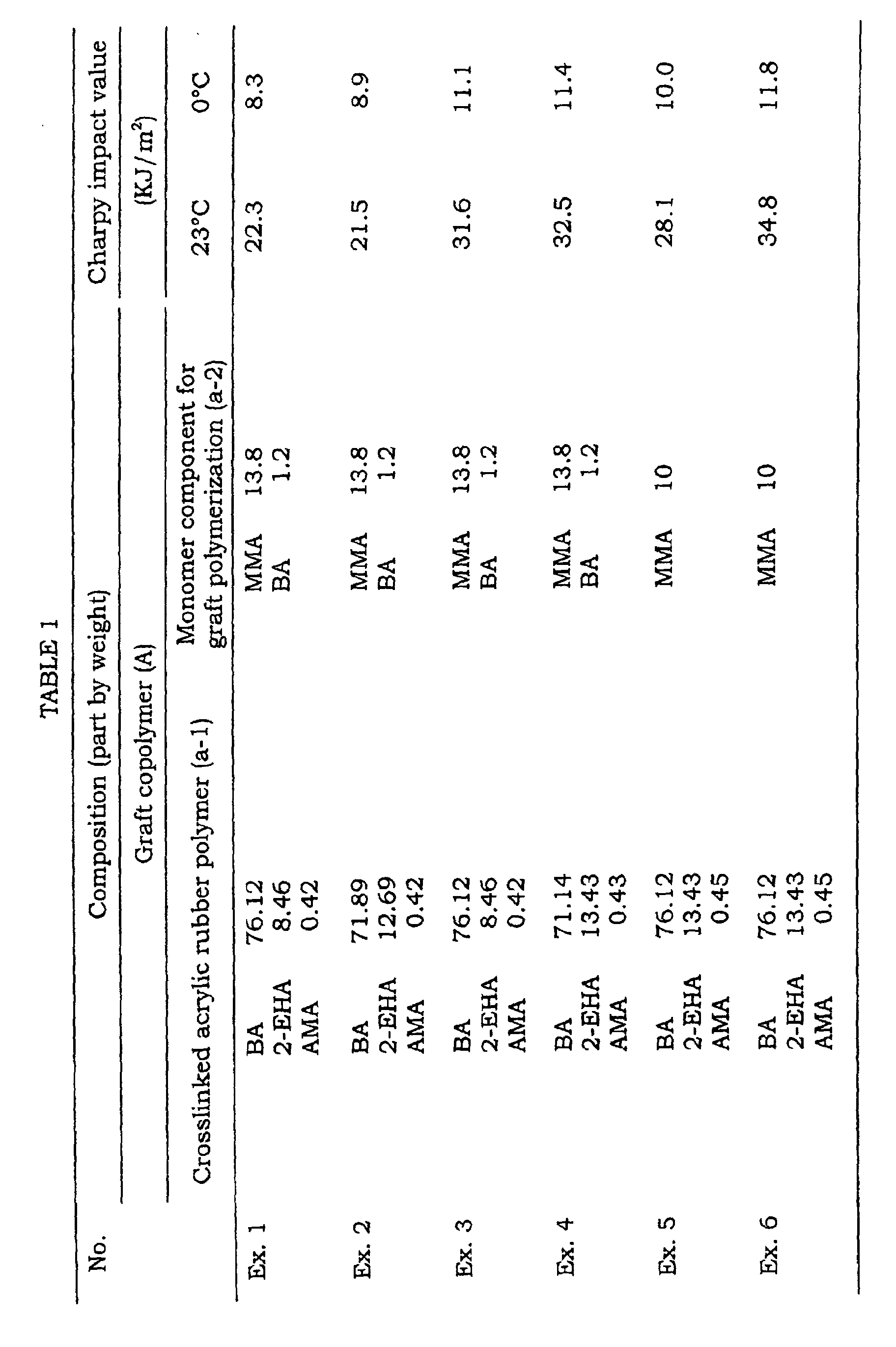
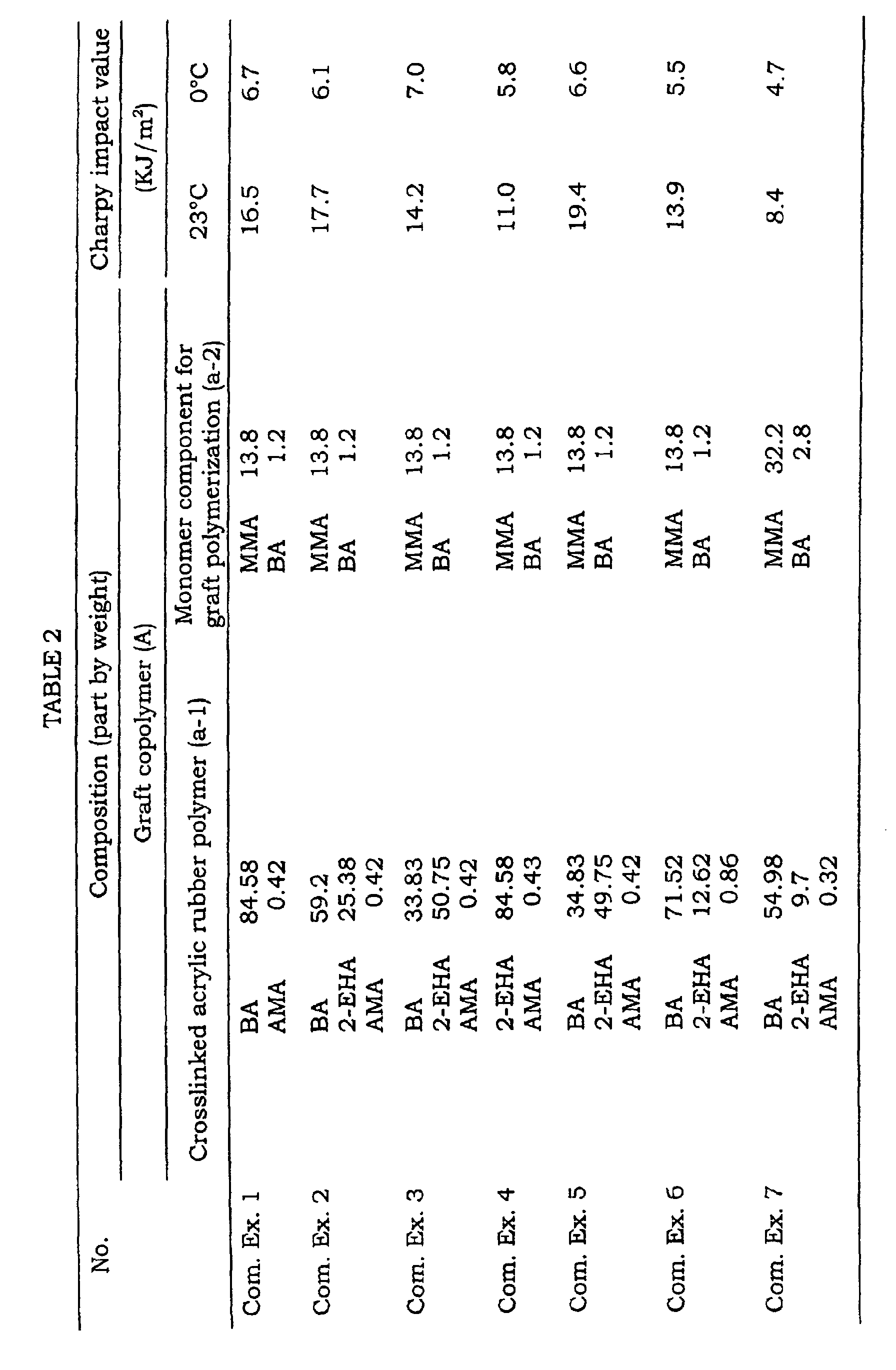
The vinyl chloride resin composition of the present invention
has excellent weatherability and impact resistance, and is suitable for
preparing molded articles by extrusion or injection molding, which are
used for window frames, pipes, joints, fences, door frames and switch
boxes.
Claims (7)
- A vinyl chloride resin composition comprising,wherein said graft copolymer (A) is obtained by polymerizing, in the presence of(A) 2 to 30 parts by weight of a graft copolymer and(B) 100 parts by weight of a vinyl chloride resin,
70 to 95 parts by weight of a crosslinked acrylic rubber polymer (a-1) comprising 81 to 95 % by weight of butyl acrylate, 4 to 18 % by weight of an alkyl acrylate having a C8-12 alkyl group and 0.2 to 0.8 % by weight of a multi-functional monomer,
5 to 30 parts by weight of a monomer component for graft polymerization (a-2) comprising 92 to 100 % by weight of methyl methacrylate, and 0 to 8 % by weight of an alkyl methacrylate having a C2-8 alkyl group, an alkyl acrylate having a C1-8 alkyl group, an unsaturated nitrile compound or an aromatic vinyl compound,
wherein the total amount of said crosslinked acrylic rubber polymer (a-1) and said monomer component for graft polymerization (a-2) is 100 parts by weight. - The vinyl chloride resin composition of Claim 1, wherein said crosslinked acrylic rubber polymer (a-1) contains 81 to 92 % by weight of said butyl acrylate and 7 to 18 % by weight of said alkyl acrylate having a C8-12 alkyl group.
- The vinyl chloride resin composition of Claim 1, wherein said alkyl acrylate contained in said crosslinked acrylic rubber polymer (a-1), having a C8-12 alkyl group is 2-ethylhexyl acrylate.
- The vinyl chloride resin composition of Claim 1, wherein said graft copolymer (A) comprises,
80 to 95 parts by weight of said crosslinked acrylic rubber polymer (a-1) and
5 to 20 parts by weight of said monomer component for graft polymerization (a-2). - The vinyl chloride resin composition of Claim 1, wherein said graft copolymer (A) comprises,
85 to 92 parts by weight of said crosslinked acrylic rubber polymer (a-1) and
8 to 15 parts by weight of said monomer component for graft polymerization (a-2). - The vinyl chloride resin composition of Claim 1, wherein 0.4 to 0.6 % by weight of said multi-functional monomer is contained in said crosslinked acrylic rubber polymer (a-1).
- A molded article comprising the vinyl chloride resin composition of Claim 1.
Applications Claiming Priority (3)
| Application Number | Priority Date | Filing Date | Title |
|---|---|---|---|
| JP2001303842A JP5210479B2 (en) | 2001-09-28 | 2001-09-28 | Vinyl chloride resin composition |
| JP2001303842 | 2001-09-28 | ||
| PCT/JP2002/009900 WO2003029348A1 (en) | 2001-09-28 | 2002-09-25 | Vinyl chloride resin composition |
Publications (2)
| Publication Number | Publication Date |
|---|---|
| EP1431341A1 true EP1431341A1 (en) | 2004-06-23 |
| EP1431341A4 EP1431341A4 (en) | 2004-11-17 |
Family
ID=19123856
Family Applications (1)
| Application Number | Title | Priority Date | Filing Date |
|---|---|---|---|
| EP02772914A Withdrawn EP1431341A4 (en) | 2001-09-28 | 2002-09-25 | Vinyl chloride resin composition |
Country Status (8)
| Country | Link |
|---|---|
| US (1) | US20040014885A1 (en) |
| EP (1) | EP1431341A4 (en) |
| JP (1) | JP5210479B2 (en) |
| KR (1) | KR100739394B1 (en) |
| CN (1) | CN1246380C (en) |
| CA (1) | CA2429680A1 (en) |
| TW (1) | TW574299B (en) |
| WO (1) | WO2003029348A1 (en) |
Families Citing this family (8)
| Publication number | Priority date | Publication date | Assignee | Title |
|---|---|---|---|---|
| JP4787545B2 (en) * | 2005-05-30 | 2011-10-05 | 住江織物株式会社 | PVC recycled carpet and manufacturing method thereof |
| JPWO2007094208A1 (en) | 2006-02-16 | 2009-07-02 | 株式会社カネカ | Thermoplastic resin composition |
| KR101056931B1 (en) * | 2006-09-22 | 2011-08-12 | 주식회사 엘지화학 | Acrylic copolymer for processing aid of vinyl chloride-based resin composition, method for preparing the same, and vinyl chloride-based resin composition comprising the same |
| CN104403226A (en) * | 2014-11-07 | 2015-03-11 | 苏州蔻美新材料有限公司 | Deodorizing medical material and preparation method thereof |
| EP3029076A1 (en) * | 2014-12-04 | 2016-06-08 | Arkema France | Pressure sensitive compositions based on a modified rubber polymer aqueous dispersion |
| CN106024945A (en) * | 2016-06-15 | 2016-10-12 | 李孟平 | A high-durability back film for solar panels |
| EP3617267A4 (en) * | 2017-04-28 | 2020-11-04 | Hanwha Chemical Corporation | Vinyl chloride resin latex composition and method for preparing same |
| US12378401B2 (en) | 2020-07-20 | 2025-08-05 | Lg Chem, Ltd. | Thermoplastic resin and method of preparing the same |
Family Cites Families (12)
| Publication number | Priority date | Publication date | Assignee | Title |
|---|---|---|---|---|
| JPS4948745A (en) * | 1972-09-12 | 1974-05-11 | ||
| US4014842A (en) * | 1973-05-24 | 1977-03-29 | Kanegafuchi Kagaku Kogyo Kabushiki Kaisha | Vinyl chloride resin compositions |
| JPS578826B2 (en) * | 1973-07-25 | 1982-02-18 | ||
| IE57758B1 (en) * | 1983-08-31 | 1993-03-24 | Mitsubishi Rayon Co | Impact modifier and thermoplastic resin compositions using the same |
| JPS60215041A (en) * | 1984-04-10 | 1985-10-28 | Kanegafuchi Chem Ind Co Ltd | Vinyl chloride resin composition excellent in weather resistance and processability |
| EP0700965B1 (en) * | 1994-09-08 | 1998-05-13 | Rohm And Haas Company | Impact-modified poly(vinylchloride) |
| ATE233285T1 (en) * | 1995-10-27 | 2003-03-15 | Atochem North America Elf | CORE-SHELL TOUGHNESS PROMOTER FOR THERMOPLASTIC POLYMERS |
| JP3376283B2 (en) * | 1998-07-14 | 2003-02-10 | 三菱レイヨン株式会社 | Acrylic rubber-based impact strength modifier and hard vinyl chloride-based resin composition using the same |
| JP2000119347A (en) * | 1998-10-13 | 2000-04-25 | Sekisui Chem Co Ltd | Vinyl chloride resin composition |
| JP2000186105A (en) * | 1998-12-22 | 2000-07-04 | Kanegafuchi Chem Ind Co Ltd | Composite rubber, composite rubber-containing graft polymer particles and thermoplastic resin composition |
| JP2000344841A (en) * | 1999-06-04 | 2000-12-12 | Mitsubishi Rayon Co Ltd | Graft copolymer, method for producing the same, and resin composition |
| US6686411B2 (en) * | 2000-03-31 | 2004-02-03 | Kaneka Corporation | Vinyl chloride resin composition |
-
2001
- 2001-09-28 JP JP2001303842A patent/JP5210479B2/en not_active Expired - Fee Related
-
2002
- 2002-09-24 TW TW091121851A patent/TW574299B/en not_active IP Right Cessation
- 2002-09-25 US US10/416,871 patent/US20040014885A1/en not_active Abandoned
- 2002-09-25 WO PCT/JP2002/009900 patent/WO2003029348A1/en not_active Ceased
- 2002-09-25 CN CNB028032888A patent/CN1246380C/en not_active Expired - Fee Related
- 2002-09-25 CA CA002429680A patent/CA2429680A1/en not_active Abandoned
- 2002-09-25 EP EP02772914A patent/EP1431341A4/en not_active Withdrawn
- 2002-09-25 KR KR1020037008076A patent/KR100739394B1/en not_active Expired - Fee Related
Also Published As
| Publication number | Publication date |
|---|---|
| JP5210479B2 (en) | 2013-06-12 |
| KR100739394B1 (en) | 2007-07-13 |
| EP1431341A4 (en) | 2004-11-17 |
| CA2429680A1 (en) | 2003-04-10 |
| KR20040038904A (en) | 2004-05-08 |
| CN1479767A (en) | 2004-03-03 |
| JP2003105151A (en) | 2003-04-09 |
| US20040014885A1 (en) | 2004-01-22 |
| WO2003029348A1 (en) | 2003-04-10 |
| TW574299B (en) | 2004-02-01 |
| CN1246380C (en) | 2006-03-22 |
Similar Documents
| Publication | Publication Date | Title |
|---|---|---|
| JP2002363372A (en) | Polymer composition | |
| EP1209196B1 (en) | Vinyl chloride resin composition | |
| US5674933A (en) | Low fogging rubbery polymer | |
| US20040014885A1 (en) | Vinyl chloride resin composition | |
| US7309729B1 (en) | Aqueous additive systems for polymeric matrices | |
| JP3504215B2 (en) | Processing aid, vinyl chloride resin composition using the same, and method for producing molded article using the same | |
| JPWO2001072896A1 (en) | Vinyl chloride resin composition | |
| EP0368660B1 (en) | Impact modifier, thermoplastic resin composition using the same and moulded article obtained therefrom | |
| EP1033390A1 (en) | Aqueous additive systems for polymeric matrices | |
| US4663382A (en) | Non-rigid vinyl chloride polymer resin composition | |
| US20040063814A1 (en) | Impact modifier for thermoplastic resin and resin composition containing the same | |
| JPH0535173B2 (en) | ||
| US5969047A (en) | Thermoplastic polyurethane/rubbery polymer blend | |
| KR101797777B1 (en) | Thermoplastic resin composition and moldings thereof | |
| JPH0742341B2 (en) | Thermoplastic resin composition | |
| JPH0774306B2 (en) | Thermoplastic resin composition | |
| KR20010043012A (en) | Vinyl chloride resin composition and molded object comprising the same | |
| JP2001200120A (en) | Vinyl chloride resin composition | |
| JPH11279354A (en) | Vinyl chloride resin composition |
Legal Events
| Date | Code | Title | Description |
|---|---|---|---|
| PUAI | Public reference made under article 153(3) epc to a published international application that has entered the european phase |
Free format text: ORIGINAL CODE: 0009012 |
|
| 17P | Request for examination filed |
Effective date: 20030612 |
|
| AK | Designated contracting states |
Kind code of ref document: A1 Designated state(s): BE DE FR GB NL |
|
| A4 | Supplementary search report drawn up and despatched |
Effective date: 20041001 |
|
| 17Q | First examination report despatched |
Effective date: 20041126 |
|
| STAA | Information on the status of an ep patent application or granted ep patent |
Free format text: STATUS: THE APPLICATION IS DEEMED TO BE WITHDRAWN |
|
| 18D | Application deemed to be withdrawn |
Effective date: 20050406 |