EP1431314A2 - Process for the living radical polymerization of oliffinically unsaturated monomers - Google Patents
Process for the living radical polymerization of oliffinically unsaturated monomers Download PDFInfo
- Publication number
- EP1431314A2 EP1431314A2 EP03079067A EP03079067A EP1431314A2 EP 1431314 A2 EP1431314 A2 EP 1431314A2 EP 03079067 A EP03079067 A EP 03079067A EP 03079067 A EP03079067 A EP 03079067A EP 1431314 A2 EP1431314 A2 EP 1431314A2
- Authority
- EP
- European Patent Office
- Prior art keywords
- alkyl
- process according
- general formula
- polymerization
- monomers
- Prior art date
- Legal status (The legal status is an assumption and is not a legal conclusion. Google has not performed a legal analysis and makes no representation as to the accuracy of the status listed.)
- Granted
Links
Classifications
-
- C—CHEMISTRY; METALLURGY
- C08—ORGANIC MACROMOLECULAR COMPOUNDS; THEIR PREPARATION OR CHEMICAL WORKING-UP; COMPOSITIONS BASED THEREON
- C08F—MACROMOLECULAR COMPOUNDS OBTAINED BY REACTIONS ONLY INVOLVING CARBON-TO-CARBON UNSATURATED BONDS
- C08F2/00—Processes of polymerisation
- C08F2/38—Polymerisation using regulators, e.g. chain terminating agents, e.g. telomerisation
-
- C—CHEMISTRY; METALLURGY
- C07—ORGANIC CHEMISTRY
- C07F—ACYCLIC, CARBOCYCLIC OR HETEROCYCLIC COMPOUNDS CONTAINING ELEMENTS OTHER THAN CARBON, HYDROGEN, HALOGEN, OXYGEN, NITROGEN, SULFUR, SELENIUM OR TELLURIUM
- C07F7/00—Compounds containing elements of Groups 4 or 14 of the Periodic Table
- C07F7/02—Silicon compounds
- C07F7/08—Compounds having one or more C—Si linkages
- C07F7/0803—Compounds with Si-C or Si-Si linkages
- C07F7/081—Compounds with Si-C or Si-Si linkages comprising at least one atom selected from the elements N, O, halogen, S, Se or Te
Definitions
- the present invention relates to a process for the living radical polymerization of olefinically unsaturated monomers.
- the present invention relates to a polymerization process, by means of free radicals, having the characteristics of a living polymerization system as it is capable of producing polymers having a pre-determined molecular weight with a very narrow molecular weight distribution and, following the subsequent addition of different monomers, can be used for producing block polymers.
- This process can consequently be used for producing polymers with a complex architecture, for example variously branched homo and copolymers.
- a new living radical polymerization process of olefinically unsaturated monomers has now been found by the Applicant, and this forms an object of the present invention, which comprises (co)polymerizing an olefin with a catalytic system comprising:
- Any olefinic monomer can be used in the process, object of the present invention, even if vinyl aromatic monomers used alone or in a mixture with 0-50% by weight of other olefinically unsaturated monomers, are preferred.
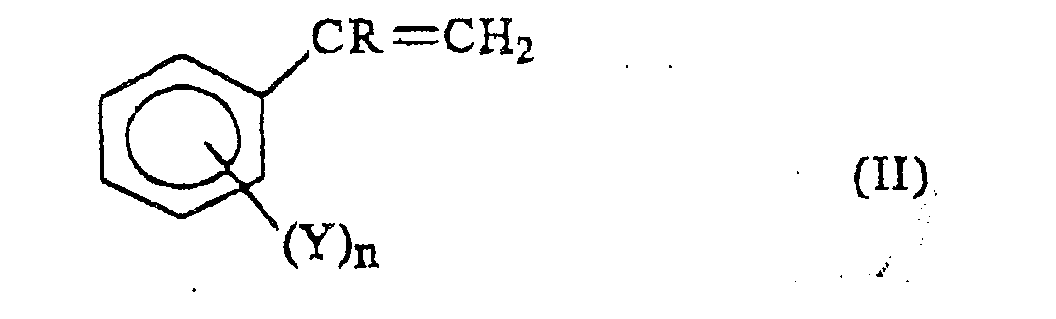
- vinyl aromatic monomer as used in the present invention and claims, essentially refers to at least one product which corresponds to the following general formula (II): wherein R is a hydrogen or methyl group, n is zero or an integer ranging from 1 to 5 and Y is a halogen, such as chlorine or bromine, or an alkyl or alkoxyl radical having from 1 to 4 carbon atoms.
- vinyl aromatic monomers having the general formula indicated above are: styrene, ⁇ -methyl styrene, methyl styrene, ethyl styrene, butyl styrene, dimethyl styrene, mono-, di-, tri-, tetra-, and penta-chloro styrene, bromo-styrene, methoxy-styrene, acetoxy-styrene, etc.
- Preferred vinyl aromatic monomers are styrene and ⁇ -methyl styrene.
- the vinyl aromatic monomers having general formula (II) can be used alone or in a mixture with up to 50% by weight of other copolymerizable monomers.
- these monomers are (meth)acrylic acid, C 1 -C 4 alkyl esters of (meth)acrylic acid such as methyl acrylate, methyl methacrylate, ethyl acrylate, ethyl methacrylate, isopropyl acrylate, butyl acrylate, amides and nitriles of (meth)acrylic acid such as acryl amide, methacryl amide, acrylonitrile, methacrylonitrile, butadiene, ethylene, divinyl benzene, maleic anhydride, etc.
- Preferred copolymerizable monomers are acrylonitrile and methyl methacrylate.
- the copolymerization is carried out at a temperature higher than 50°C, preferably from 60 to 120°C, in the presence of the initiator having general formula (I).
- the latter is present in such concentrations as to trigger the (co)polymerization reaction and terminate it when the desired molecular weight has been reached.
- Typical concentrations range from 0.01 to 2% in moles with respect to the total moles of the monomers fed.
- the initiator having general formula (I) can be used in a mixture with radical generator compounds (G) such as peroxides, hydroperoxides, peresters, percarbonates, azobis dialkyl dinitriles, etc. with I/G molar ratios lower than 8.
- G radical generator compounds
- the initiator having general formula (I) can be used with free radical generators (G) such as dibenzoyl peroxide, dicumyl peroxide, dilauryl peroxide, t-butyl peroxy acetate, t-butyl peroxy benzoate, di-isopropyl peroxy dicarbonate, dicyclohexyl peroxy dicarbonate, N,N'-azobis isobutyronitrile (AIBN) with I/G molar ratios ranging from 1 to 8.
- G free radical generators
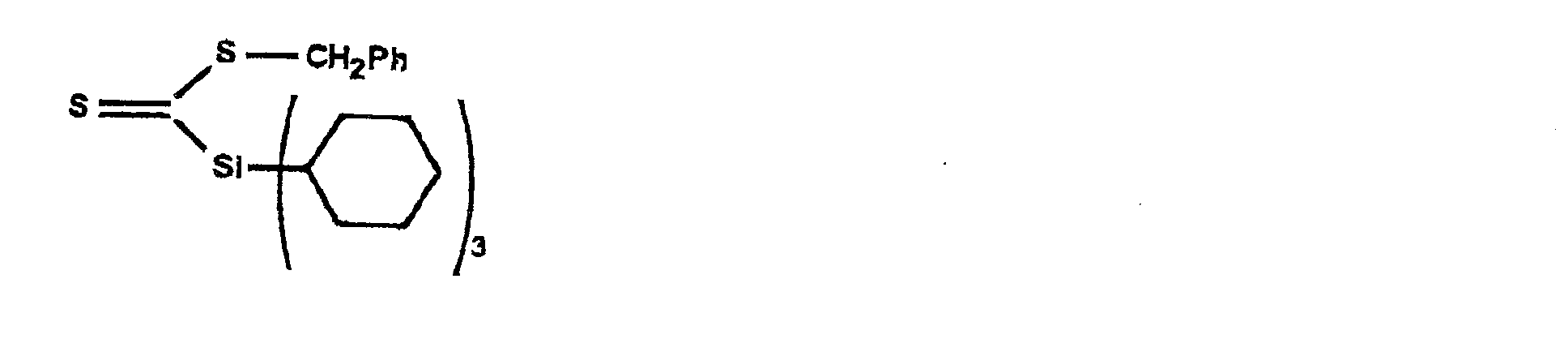
- the products having general formula (I) are new products, which have never been described in literature and can be obtained by the reaction of disilanes with metal lithium, subsequent reaction with carbon sulfide and reaction of the lithium silyl dithioformiate derivative, for example with benzyl halides.
- the (co)polymerization can be carried out batchwise, in continuous, or semi-continuous at a temperature higher than 50°C and at a pressure which is such as to maintain the monomers in liquid phase. Furthermore the (co)polymerization can take place in the presence of an organic solvent, in suspension or in mass.
- the initiator system is added to the olefinic monomer, pure or in the form of a solution or suspension in the above-mentioned quantities.
- the reaction is continued at the desired temperature for a period of time ranging from 15 minutes to 24 hours. At the end the (co)polymer thus produced is recovered.
- the olefinic monomer, initiator system and, optionally, the solvent are fed in continuous to a (co)polymerization reactor at a flow-rate which is such as to provide suitable residence times for reaching conversions ranging from 5 to 99.9%.
- a (co)polymerization reactor At the outlet of the reactor, the reaction mixture is treated for the recovery of the product.
- the polymer is isolated from the polymerization mixture with one of the methods known in the art, for example by precipitation with a suitable non-solvent or by distillation, and removal of the residues under vacuum, at a high temperature.
- (co)polymers are obtained, with an average molecular weight Mw ranging from 5,000 to 1,000,000, preferably from 20,000 to 500,000.
- the catalysts prepared in the previous examples are now used in polymerization reactions of styrene.
- the monomers were purified (to remove the inhibitors) and distilled under vacuum immediately before their use.
- the solutions for the polymerizations were degassed through three freezing-vacuum-nitrogen cycles. Once degassed, the vials were sealed under nitrogen and completely immersed in an oil bath at the temperature specified for the time indicated in the respective tables.
- the polymer obtained was purified by dissolving it in methylene chloride and precipitating it twice in methanol, it was then dried under vacuum at room temperature. The conversion was determined gravimetrically.
- the molecular weight and molecular weight distribution were determined by means of steric exclusion chromatography (SEC).
- SEC steric exclusion chromatography
- a Hewlett Packard chromatograph was used, equipped with a PLgel Mixed-D column (molecular weight range 200-400,000) and two different detection systems, a refraction index detector and an ultraviolet detector. Tetrahydrofuran was used as eluant at a flow of 1 ml/min and a polystyrene standard for calibrating the column.
- Mn, Mw, Mw/Mn are used for indicating the average number molecular weight, the average weight molecular weight and the polydispersity of the polymers, respectively.
- a solution was prepared, containing styrene (13.0 ml, 113.6 mmoles), azobis isobutyronitrile (3.7 mg, 22.5 ⁇ moles) and benzyl dithiobenzoate of Example 1 (30.0 mg, 123.0 ⁇ moles) .
- a solution was prepared, containing styrene (12.5 ml, 109.2 mmoles), azobis isobutyronitrile (3.5 mg, 21.3 ⁇ moles) and benzyl triphenylsilyl dithioformiate prepared according to Example 2 (49.8 mg, 117.0 ⁇ moles).
- a solution was prepared, containing styrene (8.0 ml, 69.9 mmoles), azobis isobutyronitrile (2.3 mg, 14.0 ⁇ moles) and pentafluorobenzyl methyl diphenylsilyl dithioformiate prepared according to Example 5 (33.6 mg, 74.0 ⁇ moles).
- a solution was prepared, containing styrene (4.0 ml, 35.0 mmoles) and polystyrene (0.1504 g) prepared according to the conditions of Example 6 (reaction time 20 hours, Mn 16600, Mw/Mn 1.10). Aliquots of this solution were removed and placed in a vial, degassed, sealed and then immersed in a thermostated bath at 90°C for the times indicated in Table 6. Test Time/hours Mn Mw/Mn Conv.% 1 4 64800 1.20 10.1 2 15 79800 1.38 18.8
- a solution was prepared, containing styrene (4.0 ml, 35.0 mmoles) and polystyrene (0.1508 g) prepared according to the conditions of Example 7 (reaction time 16 hours, Mn 12750, Mw/Mn 1.14). Aliquots of this solution were removed and placed in a vial, degassed, sealed and then immersed in a thermostated bath at 90°C for the times indicated in Table 7. Test Time/hours Mn Mw/Mn Conv.% 1 4 46500 1.27 7.8 2 15 56700 1.43 19.2
- a solution was prepared, containing styrene (2.0 ml, 17.5 mmoles), AIBN (0.2 mg, 1.2 ⁇ moles) and polystyrene (0.1004 g) prepared according to the conditions of Example 6 (reaction time 20 hours, Mn 16600, Mw/Mn 1.10). This solution was placed in a vial, degassed, sealed and then immersed in a thermostated bath at 60°C for 24 hours. The results are indicated in Table 8. Test Time/hours Mn Mw/Mn Conv.% 1 24 64100 1.36 16.9
- a solution was prepared, containing styrene (2.0 ml, 17.5 mmoles), AIBN (0.2 mg, 1.2 ⁇ moles) and polystyrene (0.0764 g) prepared according to the conditions of Example 7 (reaction time 16 hours, Mn 12750, Mw/Mn 1.14). This solution was placed in a vial, degassed, sealed and then immersed in a thermostated bath at 60°C for 24 hours. The results are indicated in Table 9. Test Time/hours Mn Mw/Mn Conv.% 1 24 74600 1.33 17.6
- a solution was prepared, containing styrene (3.40 ml, 29.7 mmoles), acrylonitrile (1.20 ml, 18.2 mmoles), AIBN (0.35 mg, 2.14 ⁇ moles) and polystyrene (0.240 g) prepared according to the conditions of Example 9 (reaction time 20 hours, Mn 22500, Mw/Mn 1.35).
- This solution was placed in a vial, degassed, sealed and then immersed in a thermostated bath at 60°C for 20 hours. The results are indicated in Table 11. Test Time/hours Mn Mw/Mn Conv.% 1 20 179000 1.53 28.0
Landscapes
- Chemical & Material Sciences (AREA)
- Organic Chemistry (AREA)
- Health & Medical Sciences (AREA)
- Chemical Kinetics & Catalysis (AREA)
- Medicinal Chemistry (AREA)
- Polymers & Plastics (AREA)
- Addition Polymer Or Copolymer, Post-Treatments, Or Chemical Modifications (AREA)
- Organic Low-Molecular-Weight Compounds And Preparation Thereof (AREA)
Abstract

a free radical generator, soluble in the reaction medium, active at the (co)polymerization temperature.
Description


a free radical generator, soluble in the reaction medium, active at the (co)polymerization temperature.
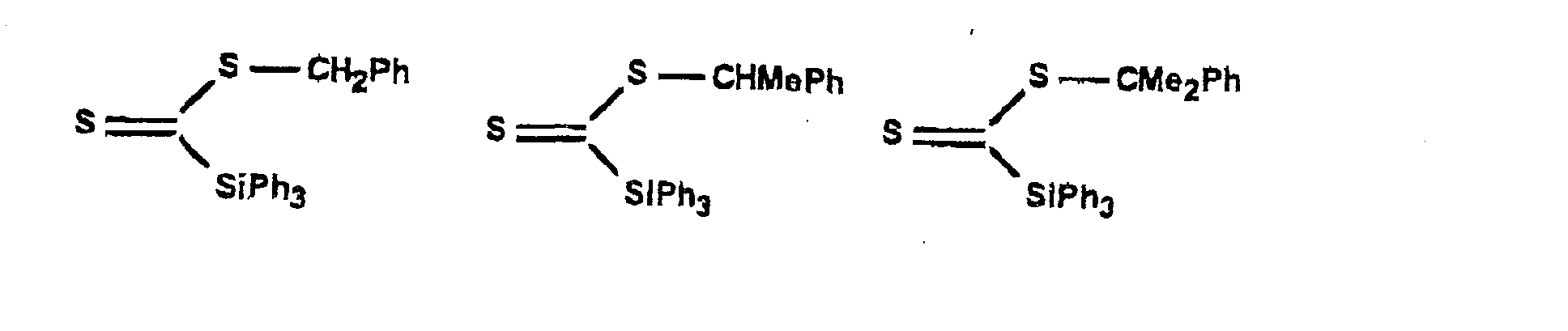



1H-NMR/400MHz (CDCl3, δ, ppm from TMS): 4.617 (s, 2H), 7.20-7.51 (m, 14H), 7.658 (d, J = 7 Hz, 6H).
13C-NMR/100MHz (CDCl3, δ, ppm from TMS): 39.712, 127.342, 127.496, 127.726, 128.450, 129.097, 130.059, 131.772, 136.384, 257.186.
m/z: 335 (m+ - benzyl, 100), 315, 291.
1H-NMR/400MHz (CDCl3 δ, ppm from TMS): 4.645 (s, 2H), 7.35-7.56 (m, 9H), 7.368 (d, J = 6.5 Hz, 6H).
13C-NMR/100MHz (CDCl3, δ, ppm from TMS): 29.842, 127.818, 130.621, 131.291, 135.191, 163.363, 137.37 (bd, JCF = 245.6 Hz), 140.63 (bd, JCF = 252.2 Hz), 144.87 (bd, JCF = 248.9 Hz), 256.438.
m/z: 468 (m+ - H2S), 277 (100), 181 (C6F5CH2) .
1H-NMR/400MHz (CDCl3, δ, ppm from TMS): 0.716 (s, 3H), 4.010 (s, 2H), 7.30-7.45 (m, 11H), 7.606 (d, J = 7.7 Hz, 4H).
13C-NMR/100MHz (CDCl3, δ, ppm from TMS): -1.872, 40.161, 127.508, 127.645, 128.288, 128.867, 129.395, 134.226, 134.800, 136.067, 259.628.
m/z: 286, 271, 211 (100), 193, 151.
1H-NMR/400MHz (CDCl3, δ, ppm from TMS): 0.946 (s, 3H), 4.615 (s, 2H), 7.36-7.47 (m, 6H), 7.605 (d, J = 8.2 Hz, 4H) .
13C-NMR/100MHz (CDCl3, δ, ppm from TMS): -2.402, 29.842, 127.677, 127.886, 130.128, 132.817, 135.060, 137.43 (bd, JCF = 247.0 Hz), 140.69 (bd, JCF = 252.6 Hz), 145.17 (bd, JCF = 244.8 Hz), 258.931.
m/z: 197 (m+ - C6F5C (S) S) .
| Test | Time/hours | Mn | Mw/Mn | Conv.% | Mn (calc) |
| 1 | 4 | 3950 | 1.21 | 2.8 | 2690 |
| 2 | 8 | 4550 | 1.27 | 3.0 | 2882 |
| 3 | 20 | 16600 | 1.10 | 14.6 | 14024 |
| 4 | 30 | 22600 | 1.15 | 19.1 | 18250 |
| Test |
| Time/hours |
| Mn |
| Mw/Mn |
| Conv.% |
| Mn (calc) |
| Test | Time/hours | Mn | Mw/Mn | Conv.% |
| 1 | 8 | 8600 | 1.22 | 7.6 |
| 2 | 14 | 14000 | 1.20 | 13.0 |
| 3 | 20 | 20000 | 1.18 | 20.5 |
| 4 | 30 | 26500 | 1.19 | 31.0 |
| Test | Time/hours | Mn | Mw/Mn | Conv.% | Mn (calc) |
| 1 | 4 | 6600 | 1.30 | 6.0 | 4090 |
| 2 | 14 | 10800 | 1.27 | 12.0 | 7990 |
| 3 | 20 | 15500 | 1.30 | 18.3 | 12000 |
| 4 | 30 | 20000 | 1.22 | 23.7 | 15700 |
| Test | Time/hours | Mn | Mw/Mn | Conv.% |
| 1 | 8 | 9000 | 1.22 | 8 |
| 2 | 14 | 13500 | 1.24 | 14 |
| 3 | 20 | 19000 | 1.23 | 21 |
| 4 | 30 | 27500 | 1.21 | 32 |
| Test | Time/hours | Mn | Mw/Mn | Conv.% |
| 1 | 4 | 64800 | 1.20 | 10.1 |
| 2 | 15 | 79800 | 1.38 | 18.8 |
| Test | Time/hours | Mn | Mw/Mn | Conv.% |
| 1 | 4 | 46500 | 1.27 | 7.8 |
| 2 | 15 | 56700 | 1.43 | 19.2 |
| Test | Time/hours | Mn | Mw/Mn | Conv.% |
| 1 | 24 | 64100 | 1.36 | 16.9 |
| Test | Time/hours | Mn | Mw/Mn | Conv.% |
| 1 | 24 | 74600 | 1.33 | 17.6 |
| Test | Time/hours | Mn | Mw/Mn | Conv.% |
| 1 | 20 | 143000 | 1.55 | 31.2 |
| Test | Time/hours | Mn | Mw/Mn | Conv.% |
| 1 | 20 | 179000 | 1.53 | 28.0 |
Claims (10)
- A living radical polymerization process of olefinically unsaturated monomers which comprises (co)polymerizing an olefin with a catalytic system comprising:wherein R' is a C3-C20 alkyl or C7-C20 alkyl aryl group, whereas the R" groups, the same or different, represent a phenyl group, a C1-C10 alkyl group, a C7-C20 alkyl aryl group; and optionallya thioester containing silicon atoms having general formula (I)

a free radical generator, soluble in the reaction medium, active at the (co)polymerization temperature. - The process according to claim 1, wherein the olefin is selected from vinyl aromatic monomers used alone or in a mixture with 0-50% by weight of other olefinically unsaturated monomers.
- The process according to claim 2, wherein the vinyl aromatic monomer corresponds to the following general formula (II):wherein R is a hydrogen or methyl group, n is zero or an integer ranging from 1 to 5 and Y is a halogen, such as chlorine or bromine, or an alkyl or alkoxyl radical having from 1 to 4 carbon atoms.

- The process according to claim 2, wherein the copolymerizable monomers are (meth)acrylic acid, C1-C4 alkyl esters of (meth)acrylic acid such as methyl acrylate, methyl methacrylate, ethyl acrylate, ethyl methacrylate, isopropyl acrylate, butyl acrylate, amides and nitriles of (meth)acrylic acid such as acryl amide, methacryl amide, acrylonitrile, methacrylonitrile, butadiene, ethylene, divinyl benzene, maleic anhydride.
- The process according to any of the previous claims, wherein the (co)polymerization is carried out at a temperature higher than 50°C.
- The process according to any of the previous claims, wherein the initiator having general formula (I) is present in concentrations ranging from 0.01 to 2% in moles with respect to the total moles of the monomers fed.
- The process according to any of the previous claims, wherein the initiator having general formula (I) is used in a mixture with radical generator compounds (G) selected from peroxides, hydroperoxides, peresters, percarbonates, azobis dialkyl dinitriles, with I/G molar ratios lower than 8.
- The process according to claim 7, wherein the initiator having general formula (I) is used with free radical generators (G) selected from dibenzoyl peroxide, dicumyl peroxide, dilauryl peroxide, t-butyl peroxy acetate, t-butyl peroxy benzoate, di-isopropyl peroxy dicarbonate, dicyclohexyl peroxy dicarbonate, N,N'-azobis isobutyronitrile (AIBN) with I/G molar ratios ranging from 1 to 8.
- The process according to any of the previous claims, wherein the (co)polymerization is carried out batchwise, in continuous, or semi-continuous at a temperature higher than 50°C, at a pressure which is such as to maintain the monomers in liquid phase and in the presence of an organic solvent or in suspension or in mass.
- Organic derivatives of silicon having general formula (I)wherein R' is a C3-C20 alkyl or C7-C20 alkyl aryl group, whereas the R" groups, the same or different, represent a phenyl group, a C1-C10 alkyl group, a C7-C20 alkyl aryl group.

Applications Claiming Priority (2)
| Application Number | Priority Date | Filing Date | Title |
|---|---|---|---|
| IT002703A ITMI20022703A1 (en) | 2002-12-20 | 2002-12-20 | PROCEDURE FOR THE LIVING RADICAL POLYMERIZATION OF HYPHOLICALLY UNSATURATED MONOMERS. |
| ITMI20022703 | 2002-12-20 |
Publications (3)
| Publication Number | Publication Date |
|---|---|
| EP1431314A2 true EP1431314A2 (en) | 2004-06-23 |
| EP1431314A3 EP1431314A3 (en) | 2004-09-01 |
| EP1431314B1 EP1431314B1 (en) | 2005-11-16 |
Family
ID=32375554
Family Applications (1)
| Application Number | Title | Priority Date | Filing Date |
|---|---|---|---|
| EP03079067A Expired - Lifetime EP1431314B1 (en) | 2002-12-20 | 2003-12-15 | process for the living radical polymerization of olefinically unsaturated monomers |
Country Status (5)
| Country | Link |
|---|---|
| EP (1) | EP1431314B1 (en) |
| AT (1) | ATE310022T1 (en) |
| DE (1) | DE60302320T2 (en) |
| ES (1) | ES2252615T3 (en) |
| IT (1) | ITMI20022703A1 (en) |
Cited By (1)
| Publication number | Priority date | Publication date | Assignee | Title |
|---|---|---|---|---|
| WO2009047070A3 (en) * | 2007-10-08 | 2009-08-06 | Wacker Chemie Ag | Silane-substitted raft-reagents and silane-cross-linkable polymers |
Family Cites Families (3)
| Publication number | Priority date | Publication date | Assignee | Title |
|---|---|---|---|---|
| EP0910587B1 (en) * | 1996-07-10 | 2001-12-12 | E.I. Du Pont De Nemours And Company | Polymerization with living characteristics |
| IL139666A0 (en) * | 1997-07-21 | 2002-02-10 | Commw Scient Ind Res Org | Synthesis of dithioester chain transfer agents and use of bis (thioacyl) disulfides or dithioesters as chain transfer agents |
| FR2802208B1 (en) * | 1999-12-09 | 2003-02-14 | Rhodia Chimie Sa | PROCESS FOR THE SYNTHESIS OF POLYMERS BY CONTROLLED RADICAL POLYMERIZATION USING XANTHATES |
-
2002
- 2002-12-20 IT IT002703A patent/ITMI20022703A1/en unknown
-
2003
- 2003-12-15 AT AT03079067T patent/ATE310022T1/en not_active IP Right Cessation
- 2003-12-15 ES ES03079067T patent/ES2252615T3/en not_active Expired - Lifetime
- 2003-12-15 EP EP03079067A patent/EP1431314B1/en not_active Expired - Lifetime
- 2003-12-15 DE DE60302320T patent/DE60302320T2/en not_active Expired - Fee Related
Cited By (1)
| Publication number | Priority date | Publication date | Assignee | Title |
|---|---|---|---|---|
| WO2009047070A3 (en) * | 2007-10-08 | 2009-08-06 | Wacker Chemie Ag | Silane-substitted raft-reagents and silane-cross-linkable polymers |
Also Published As
| Publication number | Publication date |
|---|---|
| DE60302320T2 (en) | 2006-07-13 |
| ITMI20022703A1 (en) | 2004-06-21 |
| EP1431314B1 (en) | 2005-11-16 |
| ES2252615T3 (en) | 2006-05-16 |
| DE60302320D1 (en) | 2005-12-22 |
| EP1431314A3 (en) | 2004-09-01 |
| ATE310022T1 (en) | 2005-12-15 |
Similar Documents
| Publication | Publication Date | Title |
|---|---|---|
| JP2975967B2 (en) | A method of radically polymerizing or copolymerizing a (meth) acrylic monomer, a vinyl monomer, a vinylidene monomer, and a diene monomer under control, and a (co) polymer obtained by the method | |
| JP3624259B2 (en) | Control of polymer molecular weight and end group functionality | |
| CZ464799A3 (en) | Synthesis process of block polymers by employing controlled free-radical polymerization | |
| ZA200109549B (en) | Synthesis method for polymers by controlled radical polymerisation using halogenated xanthates. | |
| CN1331851C (en) | Chain transfer agent | |
| EP0184863A2 (en) | Tris(dimethylamino)sulfonium bifluoride catalysts | |
| CA2494826A1 (en) | Alkoxyamines originating from beta-phosphorylated nitroxides and use thereof in radical polymerisation | |
| NO312196B1 (en) | Polymerization in the vicinity of a <beta> -substituted nitric oxide radical | |
| WO2002026836A2 (en) | Control agents for living-type free radical polymerization, methods of polymerizing, emulsions and polymers with same | |
| US6916884B2 (en) | Method for block polymer synthesis by controlled radical polymerization in the presence of a disulphide compound | |
| EP0095086B1 (en) | Polymerizable, optically active polymer and process for preparing polymerizable polymer | |
| AU2001274216B2 (en) | Polymerisation initiator and use | |
| EP1431314B1 (en) | process for the living radical polymerization of olefinically unsaturated monomers | |
| JP5083556B2 (en) | Living radical polymerization initiator and method for producing polymer | |
| Ito et al. | Synthesis of well-defined block copolymers containing poly (N-isopropylacrylamide) segment by anionic block copolymerization of N-methoxymethyl-N-isopropylacrylamide | |
| JP5003550B2 (en) | Polyfunctional living radical polymerization initiator and polymer production method | |
| Song et al. | Synthesis of phosphinodiselenoic acid ester derivatives and their application in the controlled radical polymerization of styrene | |
| US6720429B2 (en) | Thiocarbonylthio compound and living free radical polymerization using the same | |
| US6258905B1 (en) | Stabilized, unimolecular initiators for hydrocarbon polymerization | |
| US4943648A (en) | Initiators for group transfer polymerization | |
| Sugiyama et al. | Anionic polymerization of 2-haloethyl methacrylates | |
| CA2232454A1 (en) | Initiating system comprising an aminoalcoholate ligand for the anionic (co)polymerization of (meth)acrylic monomers, and process of using them | |
| JP3275714B2 (en) | Polymerization initiator for peroxide and vinyl monomers and polymerization method using the same | |
| KR100385724B1 (en) | Dithioesters and method for polymerization of vinyl polymer using the same | |
| EP3438136A1 (en) | Method for producing copolymer, and method for producing latex |
Legal Events
| Date | Code | Title | Description |
|---|---|---|---|
| PUAI | Public reference made under article 153(3) epc to a published international application that has entered the european phase |
Free format text: ORIGINAL CODE: 0009012 |
|
| AK | Designated contracting states |
Kind code of ref document: A2 Designated state(s): AT BE BG CH CY CZ DE DK EE ES FI FR GB GR HU IE IT LI LU MC NL PT RO SE SI SK TR |
|
| AX | Request for extension of the european patent |
Extension state: AL LT LV MK |
|
| PUAL | Search report despatched |
Free format text: ORIGINAL CODE: 0009013 |
|
| AK | Designated contracting states |
Kind code of ref document: A3 Designated state(s): AT BE BG CH CY CZ DE DK EE ES FI FR GB GR HU IE IT LI LU MC NL PT RO SE SI SK TR |
|
| AX | Request for extension of the european patent |
Extension state: AL LT LV MK |
|
| 17P | Request for examination filed |
Effective date: 20050222 |
|
| AKX | Designation fees paid |
Designated state(s): AT BE BG CH CY CZ DE DK EE ES FI FR GB GR HU IE IT LI LU MC NL PT RO SE SI SK TR |
|
| GRAP | Despatch of communication of intention to grant a patent |
Free format text: ORIGINAL CODE: EPIDOSNIGR1 |
|
| RTI1 | Title (correction) |
Free format text: PROCESS FOR THE LIVING RADICAL POLYMERIZATION OF OLEFINICALLY UNSATURATED MONOMERS |
|
| GRAS | Grant fee paid |
Free format text: ORIGINAL CODE: EPIDOSNIGR3 |
|
| GRAA | (expected) grant |
Free format text: ORIGINAL CODE: 0009210 |
|
| AK | Designated contracting states |
Kind code of ref document: B1 Designated state(s): AT BE BG CH CY CZ DE DK EE ES FI FR GB GR HU IE IT LI LU MC NL PT RO SE SI SK TR |
|
| PG25 | Lapsed in a contracting state [announced via postgrant information from national office to epo] |
Ref country code: FI Free format text: LAPSE BECAUSE OF FAILURE TO SUBMIT A TRANSLATION OF THE DESCRIPTION OR TO PAY THE FEE WITHIN THE PRESCRIBED TIME-LIMIT Effective date: 20051116 Ref country code: CH Free format text: LAPSE BECAUSE OF FAILURE TO SUBMIT A TRANSLATION OF THE DESCRIPTION OR TO PAY THE FEE WITHIN THE PRESCRIBED TIME-LIMIT Effective date: 20051116 Ref country code: SK Free format text: LAPSE BECAUSE OF FAILURE TO SUBMIT A TRANSLATION OF THE DESCRIPTION OR TO PAY THE FEE WITHIN THE PRESCRIBED TIME-LIMIT Effective date: 20051116 Ref country code: EE Free format text: LAPSE BECAUSE OF FAILURE TO SUBMIT A TRANSLATION OF THE DESCRIPTION OR TO PAY THE FEE WITHIN THE PRESCRIBED TIME-LIMIT Effective date: 20051116 Ref country code: CZ Free format text: LAPSE BECAUSE OF FAILURE TO SUBMIT A TRANSLATION OF THE DESCRIPTION OR TO PAY THE FEE WITHIN THE PRESCRIBED TIME-LIMIT Effective date: 20051116 Ref country code: SI Free format text: LAPSE BECAUSE OF FAILURE TO SUBMIT A TRANSLATION OF THE DESCRIPTION OR TO PAY THE FEE WITHIN THE PRESCRIBED TIME-LIMIT Effective date: 20051116 Ref country code: TR Free format text: LAPSE BECAUSE OF FAILURE TO SUBMIT A TRANSLATION OF THE DESCRIPTION OR TO PAY THE FEE WITHIN THE PRESCRIBED TIME-LIMIT Effective date: 20051116 Ref country code: AT Free format text: LAPSE BECAUSE OF FAILURE TO SUBMIT A TRANSLATION OF THE DESCRIPTION OR TO PAY THE FEE WITHIN THE PRESCRIBED TIME-LIMIT Effective date: 20051116 Ref country code: RO Free format text: LAPSE BECAUSE OF FAILURE TO SUBMIT A TRANSLATION OF THE DESCRIPTION OR TO PAY THE FEE WITHIN THE PRESCRIBED TIME-LIMIT Effective date: 20051116 Ref country code: NL Free format text: LAPSE BECAUSE OF FAILURE TO SUBMIT A TRANSLATION OF THE DESCRIPTION OR TO PAY THE FEE WITHIN THE PRESCRIBED TIME-LIMIT Effective date: 20051116 Ref country code: LI Free format text: LAPSE BECAUSE OF FAILURE TO SUBMIT A TRANSLATION OF THE DESCRIPTION OR TO PAY THE FEE WITHIN THE PRESCRIBED TIME-LIMIT Effective date: 20051116 |
|
| REG | Reference to a national code |
Ref country code: GB Ref legal event code: FG4D |
|
| REG | Reference to a national code |
Ref country code: CH Ref legal event code: EP |
|
| PG25 | Lapsed in a contracting state [announced via postgrant information from national office to epo] |
Ref country code: IE Free format text: LAPSE BECAUSE OF NON-PAYMENT OF DUE FEES Effective date: 20051215 Ref country code: CY Free format text: LAPSE BECAUSE OF FAILURE TO SUBMIT A TRANSLATION OF THE DESCRIPTION OR TO PAY THE FEE WITHIN THE PRESCRIBED TIME-LIMIT Effective date: 20051215 |
|
| REF | Corresponds to: |
Ref document number: 60302320 Country of ref document: DE Date of ref document: 20051222 Kind code of ref document: P |
|
| REG | Reference to a national code |
Ref country code: IE Ref legal event code: FG4D |
|
| PG25 | Lapsed in a contracting state [announced via postgrant information from national office to epo] |
Ref country code: MC Free format text: LAPSE BECAUSE OF NON-PAYMENT OF DUE FEES Effective date: 20051231 |
|
| PG25 | Lapsed in a contracting state [announced via postgrant information from national office to epo] |
Ref country code: LU Free format text: LAPSE BECAUSE OF NON-PAYMENT OF DUE FEES Effective date: 20060116 |
|
| PG25 | Lapsed in a contracting state [announced via postgrant information from national office to epo] |
Ref country code: DK Free format text: LAPSE BECAUSE OF FAILURE TO SUBMIT A TRANSLATION OF THE DESCRIPTION OR TO PAY THE FEE WITHIN THE PRESCRIBED TIME-LIMIT Effective date: 20060216 Ref country code: BG Free format text: LAPSE BECAUSE OF FAILURE TO SUBMIT A TRANSLATION OF THE DESCRIPTION OR TO PAY THE FEE WITHIN THE PRESCRIBED TIME-LIMIT Effective date: 20060216 Ref country code: GR Free format text: LAPSE BECAUSE OF FAILURE TO SUBMIT A TRANSLATION OF THE DESCRIPTION OR TO PAY THE FEE WITHIN THE PRESCRIBED TIME-LIMIT Effective date: 20060216 Ref country code: SE Free format text: LAPSE BECAUSE OF FAILURE TO SUBMIT A TRANSLATION OF THE DESCRIPTION OR TO PAY THE FEE WITHIN THE PRESCRIBED TIME-LIMIT Effective date: 20060216 |
|
| PG25 | Lapsed in a contracting state [announced via postgrant information from national office to epo] |
Ref country code: PT Free format text: LAPSE BECAUSE OF FAILURE TO SUBMIT A TRANSLATION OF THE DESCRIPTION OR TO PAY THE FEE WITHIN THE PRESCRIBED TIME-LIMIT Effective date: 20060417 |
|
| REG | Reference to a national code |
Ref country code: HU Ref legal event code: AG4A Ref document number: E000273 Country of ref document: HU |
|
| NLV1 | Nl: lapsed or annulled due to failure to fulfill the requirements of art. 29p and 29m of the patents act | ||
| REG | Reference to a national code |
Ref country code: ES Ref legal event code: FG2A Ref document number: 2252615 Country of ref document: ES Kind code of ref document: T3 |
|
| REG | Reference to a national code |
Ref country code: CH Ref legal event code: PL |
|
| ET | Fr: translation filed | ||
| PLBE | No opposition filed within time limit |
Free format text: ORIGINAL CODE: 0009261 |
|
| STAA | Information on the status of an ep patent application or granted ep patent |
Free format text: STATUS: NO OPPOSITION FILED WITHIN TIME LIMIT |
|
| REG | Reference to a national code |
Ref country code: IE Ref legal event code: MM4A |
|
| 26N | No opposition filed |
Effective date: 20060817 |
|
| PGFP | Annual fee paid to national office [announced via postgrant information from national office to epo] |
Ref country code: ES Payment date: 20081226 Year of fee payment: 6 |
|
| PGFP | Annual fee paid to national office [announced via postgrant information from national office to epo] |
Ref country code: IT Payment date: 20081222 Year of fee payment: 6 |
|
| PGFP | Annual fee paid to national office [announced via postgrant information from national office to epo] |
Ref country code: DE Payment date: 20090202 Year of fee payment: 6 |
|
| PGFP | Annual fee paid to national office [announced via postgrant information from national office to epo] |
Ref country code: GB Payment date: 20081229 Year of fee payment: 6 |
|
| PGFP | Annual fee paid to national office [announced via postgrant information from national office to epo] |
Ref country code: BE Payment date: 20090202 Year of fee payment: 6 |
|
| PGFP | Annual fee paid to national office [announced via postgrant information from national office to epo] |
Ref country code: FR Payment date: 20081217 Year of fee payment: 6 |
|
| PGFP | Annual fee paid to national office [announced via postgrant information from national office to epo] |
Ref country code: HU Payment date: 20091126 Year of fee payment: 7 |
|
| BERE | Be: lapsed |
Owner name: *ENI S.P.A. Effective date: 20091231 Owner name: *POLIMERI EUROPA S.P.A. Effective date: 20091231 |
|
| GBPC | Gb: european patent ceased through non-payment of renewal fee |
Effective date: 20091215 |
|
| REG | Reference to a national code |
Ref country code: FR Ref legal event code: ST Effective date: 20100831 |
|
| PG25 | Lapsed in a contracting state [announced via postgrant information from national office to epo] |
Ref country code: BE Free format text: LAPSE BECAUSE OF NON-PAYMENT OF DUE FEES Effective date: 20091231 Ref country code: FR Free format text: LAPSE BECAUSE OF NON-PAYMENT OF DUE FEES Effective date: 20091231 |
|
| PG25 | Lapsed in a contracting state [announced via postgrant information from national office to epo] |
Ref country code: DE Free format text: LAPSE BECAUSE OF NON-PAYMENT OF DUE FEES Effective date: 20100701 |
|
| PG25 | Lapsed in a contracting state [announced via postgrant information from national office to epo] |
Ref country code: GB Free format text: LAPSE BECAUSE OF NON-PAYMENT OF DUE FEES Effective date: 20091215 |
|
| PG25 | Lapsed in a contracting state [announced via postgrant information from national office to epo] |
Ref country code: IT Free format text: LAPSE BECAUSE OF NON-PAYMENT OF DUE FEES Effective date: 20091215 |
|
| REG | Reference to a national code |
Ref country code: ES Ref legal event code: FD2A Effective date: 20110401 |
|
| PG25 | Lapsed in a contracting state [announced via postgrant information from national office to epo] |
Ref country code: ES Free format text: LAPSE BECAUSE OF NON-PAYMENT OF DUE FEES Effective date: 20110322 |
|
| PG25 | Lapsed in a contracting state [announced via postgrant information from national office to epo] |
Ref country code: ES Free format text: LAPSE BECAUSE OF NON-PAYMENT OF DUE FEES Effective date: 20091216 |
|
| PG25 | Lapsed in a contracting state [announced via postgrant information from national office to epo] |
Ref country code: HU Free format text: LAPSE BECAUSE OF NON-PAYMENT OF DUE FEES Effective date: 20101216 |