EP1431305A1 - Thiocarboxylic acid organic salts and processes utilizing the same - Google Patents
Thiocarboxylic acid organic salts and processes utilizing the same Download PDFInfo
- Publication number
- EP1431305A1 EP1431305A1 EP03257879A EP03257879A EP1431305A1 EP 1431305 A1 EP1431305 A1 EP 1431305A1 EP 03257879 A EP03257879 A EP 03257879A EP 03257879 A EP03257879 A EP 03257879A EP 1431305 A1 EP1431305 A1 EP 1431305A1
- Authority
- EP
- European Patent Office
- Prior art keywords
- thiocarboxylic acid
- salt
- mixture
- process according
- organic amine
- Prior art date
- Legal status (The legal status is an assumption and is not a legal conclusion. Google has not performed a legal analysis and makes no representation as to the accuracy of the status listed.)
- Withdrawn
Links
- 150000003566 thiocarboxylic acids Chemical class 0.000 title claims abstract description 30
- 150000003839 salts Chemical class 0.000 title claims abstract description 12
- 238000000034 method Methods 0.000 title claims description 15
- 150000007530 organic bases Chemical group 0.000 claims abstract description 4
- WMWTYOKRWGGJOA-CENSZEJFSA-N fluticasone propionate Chemical compound C1([C@@H](F)C2)=CC(=O)C=C[C@]1(C)[C@]1(F)[C@@H]2[C@@H]2C[C@@H](C)[C@@](C(=O)SCF)(OC(=O)CC)[C@@]2(C)C[C@@H]1O WMWTYOKRWGGJOA-CENSZEJFSA-N 0.000 claims description 27
- -1 thiocarboxylic acid salt Chemical class 0.000 claims description 26
- WEVYAHXRMPXWCK-UHFFFAOYSA-N Acetonitrile Chemical compound CC#N WEVYAHXRMPXWCK-UHFFFAOYSA-N 0.000 claims description 24
- 229960000289 fluticasone propionate Drugs 0.000 claims description 22
- 239000000203 mixture Substances 0.000 claims description 18
- ZMANZCXQSJIPKH-UHFFFAOYSA-N Triethylamine Chemical compound CCN(CC)CC ZMANZCXQSJIPKH-UHFFFAOYSA-N 0.000 claims description 16
- XWCDCDSDNJVCLO-UHFFFAOYSA-N Chlorofluoromethane Chemical compound FCCl XWCDCDSDNJVCLO-UHFFFAOYSA-N 0.000 claims description 14
- 239000000725 suspension Substances 0.000 claims description 13
- 150000001412 amines Chemical class 0.000 claims description 12
- PAMIQIKDUOTOBW-UHFFFAOYSA-N 1-methylpiperidine Chemical compound CN1CCCCC1 PAMIQIKDUOTOBW-UHFFFAOYSA-N 0.000 claims description 11
- JGFZNNIVVJXRND-UHFFFAOYSA-N N,N-Diisopropylethylamine (DIPEA) Chemical compound CCN(C(C)C)C(C)C JGFZNNIVVJXRND-UHFFFAOYSA-N 0.000 claims description 11
- KFZMGEQAYNKOFK-UHFFFAOYSA-N Isopropanol Chemical group CC(C)O KFZMGEQAYNKOFK-UHFFFAOYSA-N 0.000 claims description 10
- 239000013078 crystal Substances 0.000 claims description 5
- 238000001816 cooling Methods 0.000 claims description 4
- 238000001914 filtration Methods 0.000 claims description 4
- 238000010438 heat treatment Methods 0.000 claims description 4
- 239000002904 solvent Substances 0.000 claims description 4
- 125000000217 alkyl group Chemical group 0.000 claims description 3
- 125000002947 alkylene group Chemical group 0.000 claims description 3
- 125000005529 alkyleneoxy group Chemical group 0.000 claims description 3
- 125000003710 aryl alkyl group Chemical group 0.000 claims description 3
- 125000003118 aryl group Chemical group 0.000 claims description 3
- 125000000753 cycloalkyl group Chemical group 0.000 claims description 3
- 229910052739 hydrogen Inorganic materials 0.000 claims description 3
- 239000001257 hydrogen Substances 0.000 claims description 3
- 125000004435 hydrogen atom Chemical class [H]* 0.000 claims description 3
- 239000011541 reaction mixture Substances 0.000 claims description 3
- 238000003756 stirring Methods 0.000 claims description 2
- 238000004519 manufacturing process Methods 0.000 claims 1
- 238000000926 separation method Methods 0.000 claims 1
- 239000000047 product Substances 0.000 description 8
- 238000004128 high performance liquid chromatography Methods 0.000 description 7
- 238000002360 preparation method Methods 0.000 description 7
- YNAVUWVOSKDBBP-UHFFFAOYSA-N Morpholine Chemical compound C1COCCN1 YNAVUWVOSKDBBP-UHFFFAOYSA-N 0.000 description 6
- PAFZNILMFXTMIY-UHFFFAOYSA-N cyclohexylamine Chemical compound NC1CCCCC1 PAFZNILMFXTMIY-UHFFFAOYSA-N 0.000 description 6
- 238000006243 chemical reaction Methods 0.000 description 5
- XBPCUCUWBYBCDP-UHFFFAOYSA-N Dicyclohexylamine Chemical compound C1CCCCC1NC1CCCCC1 XBPCUCUWBYBCDP-UHFFFAOYSA-N 0.000 description 3
- 150000001875 compounds Chemical class 0.000 description 3
- HPNMFZURTQLUMO-UHFFFAOYSA-N diethylamine Chemical compound CCNCC HPNMFZURTQLUMO-UHFFFAOYSA-N 0.000 description 3
- 239000012535 impurity Substances 0.000 description 3
- UIIMBOGNXHQVGW-UHFFFAOYSA-M Sodium bicarbonate Chemical compound [Na+].OC([O-])=O UIIMBOGNXHQVGW-UHFFFAOYSA-M 0.000 description 2
- 229940125782 compound 2 Drugs 0.000 description 2
- 239000011521 glass Substances 0.000 description 2
- XAEFZNCEHLXOMS-UHFFFAOYSA-M potassium benzoate Chemical compound [K+].[O-]C(=O)C1=CC=CC=C1 XAEFZNCEHLXOMS-UHFFFAOYSA-M 0.000 description 2
- 125000001424 substituent group Chemical group 0.000 description 2
- KIZNNYSYHSZKQC-UHFFFAOYSA-N 2-oxobutanethioic s-acid Chemical compound CCC(=O)C(S)=O KIZNNYSYHSZKQC-UHFFFAOYSA-N 0.000 description 1
- 206010061218 Inflammation Diseases 0.000 description 1
- 206010039085 Rhinitis allergic Diseases 0.000 description 1
- 206010039094 Rhinitis perennial Diseases 0.000 description 1
- 230000000172 allergic effect Effects 0.000 description 1
- 201000010105 allergic rhinitis Diseases 0.000 description 1
- 230000003266 anti-allergic effect Effects 0.000 description 1
- 230000003110 anti-inflammatory effect Effects 0.000 description 1
- 208000006673 asthma Diseases 0.000 description 1
- LHMHCLYDBQOYTO-UHFFFAOYSA-N bromofluoromethane Chemical compound FCBr LHMHCLYDBQOYTO-UHFFFAOYSA-N 0.000 description 1
- 238000002425 crystallisation Methods 0.000 description 1
- 230000008025 crystallization Effects 0.000 description 1
- 229940079593 drug Drugs 0.000 description 1
- 239000003814 drug Substances 0.000 description 1
- 238000002474 experimental method Methods 0.000 description 1
- XGVXNTVBGYLJIR-UHFFFAOYSA-N fluoroiodomethane Chemical compound FCI XGVXNTVBGYLJIR-UHFFFAOYSA-N 0.000 description 1
- 238000009472 formulation Methods 0.000 description 1
- 238000011065 in-situ storage Methods 0.000 description 1
- 230000004054 inflammatory process Effects 0.000 description 1
- 229910017053 inorganic salt Inorganic materials 0.000 description 1
- 238000002955 isolation Methods 0.000 description 1
- 238000012986 modification Methods 0.000 description 1
- 230000004048 modification Effects 0.000 description 1
- 239000003960 organic solvent Substances 0.000 description 1
- 239000002244 precipitate Substances 0.000 description 1
- 229910000030 sodium bicarbonate Inorganic materials 0.000 description 1
- 230000000699 topical effect Effects 0.000 description 1
Classifications
-
- C—CHEMISTRY; METALLURGY
- C07—ORGANIC CHEMISTRY
- C07J—STEROIDS
- C07J31/00—Normal steroids containing one or more sulfur atoms not belonging to a hetero ring
- C07J31/006—Normal steroids containing one or more sulfur atoms not belonging to a hetero ring not covered by C07J31/003
Definitions
- the present invention relates to a method for the preparation and isolation of organic salts of 6 ⁇ -9 ⁇ -difluoro-11 ⁇ -hydroxy-17 ⁇ -propionyloxy-16 ⁇ -methylpregna-3-oxo-1,4-diene-17 ⁇ -thio-carboxylic acid in a pure state and to these compounds per se. These salts are useful for producing Fluticasone propionate of high purity.
- 6 ⁇ -9 ⁇ -difluoro-11 ⁇ -hydroxy-17 ⁇ -propionyloxy-16 ⁇ -methyl-pregna-3-oxo-1,4-diene-17 ⁇ -thiocarboxylic acid ( 1 ) is a key intermediate in the preparation of Fluticasone propionate ( 2 ), a well known antiallergic and anti-inflammatory corticosteriod that is a very efficient drug for the treatment of asthma, allergic and perennial rhinitis and topical inflammation.
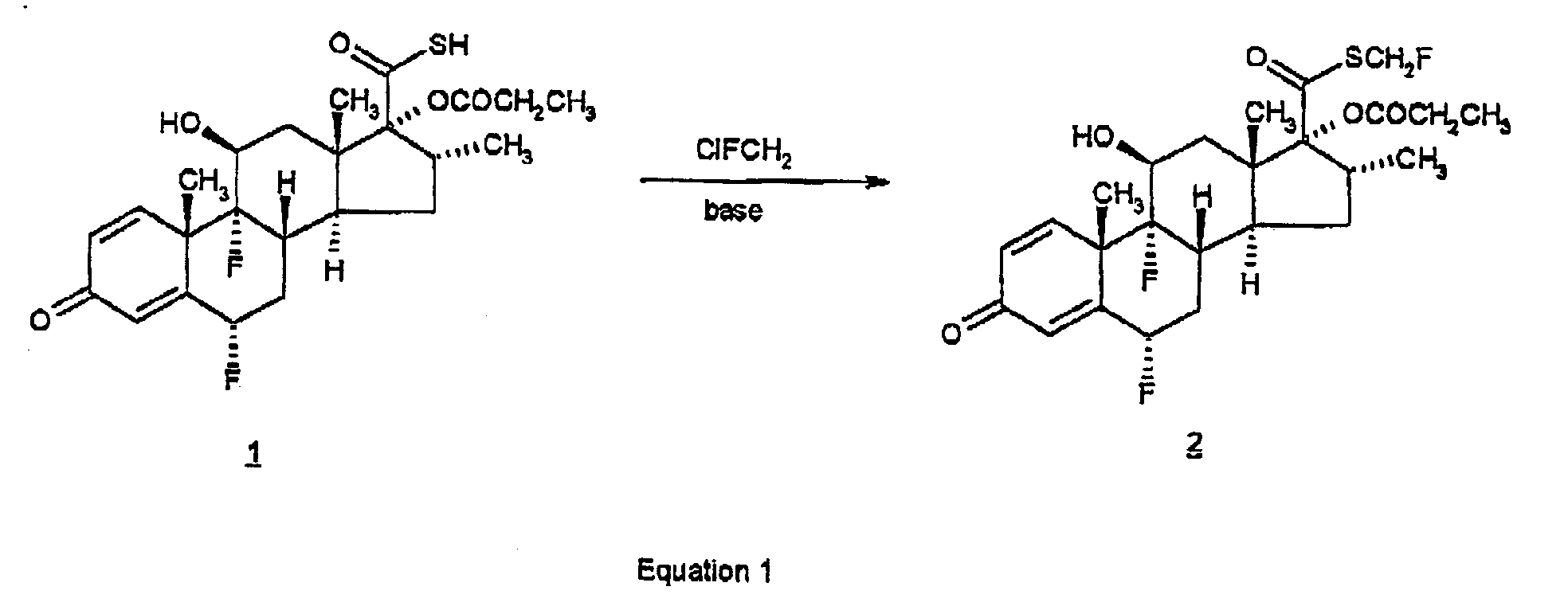
- Fluticasone propionate ( 2 ) is obtained from the thiocarboxylic acid ( 1 ) using chlorofluoromethane in the presence of a base as described in equation 1 according to the Israeli patent, IL 109656.
- 3720 the authors describe a process in which the potassium salt of the thiocarboxylic acid ( 3 ) is converted to the fluoromethyl thioester ( 2 ) using fluoroiodomethane or bromofluoromethane as described in equation 2. No experimental details are given as to how to obtain the potassium salt 3 .
- the present invention relates to a process for isolating organic salts of 6 ⁇ -9 ⁇ -difluoro-11 ⁇ -hydroxy-17 ⁇ -(propionyloxy)-16 ⁇ - methylpregna-3-oxo-1,4-diene-17 ⁇ -thiocarboxylic acid ( 6 ) obtained as a result of the reaction of the thiocarboxylic acid ( 1 ) with an organic base B ( 5 ) in an organic solvent at temperatures in the range of 25°-60°C.
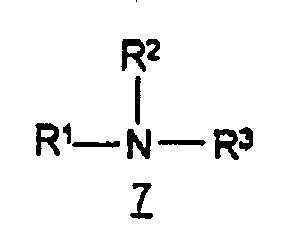
- B represents an organic amine of the general formula: wherein the substituents R 1 , R 2 and R 3 are independently hydrogen, C 1 - C 6 straight or branched alkyl, cycloalkyl, aryl, aralkyl, alkylene and alkyleneoxy.
- the thiocarboxylic acid ( 1 ) is reacted with the organic amine ( 7 ) to afford the organic amine salt of 6 ⁇ -9 ⁇ -difluoro-11 ⁇ -hydroxy-17 ⁇ -(propionyloxy)-16 ⁇ - methylpregna-3-oxo-1,4-diene-17 ⁇ -thiocarboxylic acid ( 8 ).
- the preferred solvent for performing the reaction is isopropanol.
- the preferred temperature is at ambient temperature.
- the isolated thiocarboxylic acid organic amine salt ( 8 ) is reacted with chlorofluoromethane in acetonitrile at 50°C in a closed vessel to afford a highly pure form of Fluticasone propionate ( 2 ).
- the above sequence of reactions is outlined in the following scheme.
- R 1 , R 2 and R 3 in formulae 7 and 8 are independently hydrogen, C 1 - C 6 straight or branched alkyl, cycloalkyl, aryl, aralkyl, alkylene and alkyleneoxy.
- the preferred organic amine of formula 7 is diisopropylethylamine.
- the preparation of the organic amine salt 8 comprises the following steps:
- Fluticasone propionate prepared from isolated organic amine salt had an HPLC purity that was not less than 99.7%.
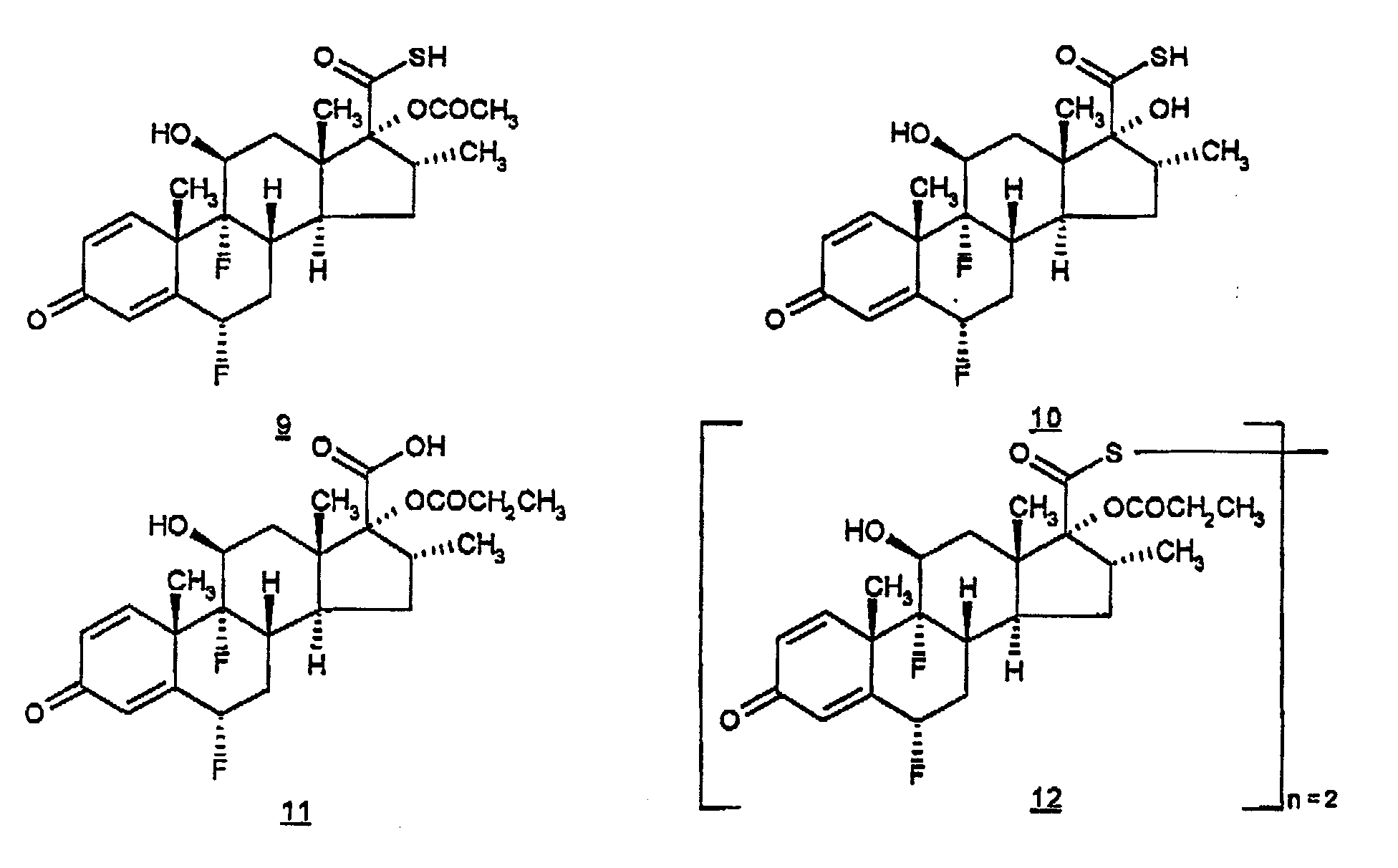
- Some of the major impurities that are reduced by this method are the thiocarboxylic acid acetate 9 , the des propionyl thiocarboxylic acid 10 , the carboxylic acid propionate 11 and disulphide 12 .
- Fluticasone propionate can be prepared by reacting the thiocarboxylic acid ( 1 ) with chlorofluoromethane and an organic amine in acetonitrile, a purer product is obtained by using the isolated organic amine salt 8 .
- the reaction vessel is charged with 10 g of the thiocarboxylic acid of 91.7% chromatographic purity (0.0214 moles, 1 eq.) and 30 ml isopropanol.
- To the stirred suspension is added 5.6 ml diisopropylethylamine (0.032 moles, 1.5 eq.) in portions at 25°C.
- the reaction is slightly exothermic.
- On completion of the addition a solution is obtained.
- the solution is stirred for 15 min. at 25°C after which time a suspension is formed.
- the mixture is cooled to 5°C and stirred at this temperature for three hours.
- the product is filtered, washed with cold isopropanol and dried at 50°C to afford 10.4 g of product in 82% yield.
- the HPLC chromatographic purity is 95.8%.
- a 200 ml glass autoclave is charged with 10 g of the diisopropylethylamine salt of the thiocarboxylic acid (0.0167 moles, 1 eq.) and 50 ml acetonitrile.
- Into the stirred suspension is bubbled 2.55 g chlorofluoromethane (0.037 moles, 2.2 eq.).
- the autoclave is closed.
- the stirred suspension is heated to 50°C to afford a solution after about 30 min.
- a pressure of about 1.3 bar is produced.
- the mixture is heated at 50°C for a period of 5 hours during which time a suspension is produced. After the heating period, the vent is opened and the mixture cooled to 25°C.
- the mixture is stirred at 25°C for 16 hours (overnight).
- the suspension is cooled to 5°C and stirred at this temperature for 1 hour.
- the product is filtered, washed with cold acetonitrile and dried at 60°C to afford 5.0 g of product in 60% yield.
- the HPLC chromatographic purity is 99.86%.
- Example 1 On the basis of the results presented in Example 1 and Examples 2 - 5, the tertiary thioacid amine salts ⁇ diisopropylethylamine, triethylamine and 1-methylpiperidine ⁇ that were studied were the preferred ones for producing Fluticasone propionate ( 2 ) of high quality.
- a 200 ml glass autoclave is charged with 7.8 g of the thiocarboxylic acid ( 1 ) of 91.7% chromatographic purity (0.0167 moles, 1 eq.) and 50 ml acetonitrile.
- To the stirred suspension is added 4.4 ml diisopropylethylamine (0.026 moles, 1.5 eq.). The mixture is stirred for 15 min. to afford a clear yellow solution.
- Into the stirred solution is bubbled 2.55 g chlorofluoromethane (0.037 moles, 2.2 eq.). The autoclave is closed.
- the stirred suspension is heated to 50°C to afford a solution after about 30 min. A pressure of about 1.3 bar is produced.
- the mixture is heated at 50°C for a period of 5 hours during which time a suspension is produced. After the heating period, the vent is opened and the mixture cooled to 25°C. The mixture is stirred at 25°C for 16 hours (overnight). The suspension is cooled to 5°C and stirred at this temperature for 1 hour. The product is filtered, washed with cold acetonitrile and dried at 60°C to afford 5.0 g of product in 60% yield. The HPLC chromatographic purity is 98%.
Landscapes
- Chemical & Material Sciences (AREA)
- Organic Chemistry (AREA)
- Health & Medical Sciences (AREA)
- General Health & Medical Sciences (AREA)
- Pharmaceuticals Containing Other Organic And Inorganic Compounds (AREA)
- Steroid Compounds (AREA)
Abstract
The invention provides a thiocarboxylic acid organic salt of the formula:
Description
- The present invention relates to a method for the preparation and isolation of organic salts of 6α-9α-difluoro-11β-hydroxy-17α-propionyloxy-16α-methylpregna-3-oxo-1,4-diene-17β-thio-carboxylic acid in a pure state and to these compounds per se. These salts are useful for producing Fluticasone propionate of high purity.
- 6α-9α-difluoro-11β-hydroxy-17α-propionyloxy-16α-methyl-pregna-3-oxo-1,4-diene-17β-thiocarboxylic acid (1) is a key intermediate in the preparation of Fluticasone propionate (2), a well known antiallergic and anti-inflammatory corticosteriod that is a very efficient drug for the treatment of asthma, allergic and perennial rhinitis and topical inflammation.
- Fluticasone propionate (2) is obtained from the thiocarboxylic acid (1) using chlorofluoromethane in the presence of a base as described in equation 1 according to the Israeli patent, IL 109656.In J. Med. Chem. 37 (1994), 3720 the authors describe a process in which the potassium salt of the thiocarboxylic acid (3) is converted to the fluoromethyl thioester (2) using fluoroiodomethane or bromofluoromethane as described in equation 2. No experimental details are given as to how to obtain the potassium salt 3.

- In a recent patent application, WO 0162722, the authors claim that compound 4 wherein M is Li, Na, or K. Compound 4 can be reacted with chlorofluoromethane in the presence of a second base such as NaHCO3 to afford compound 2 as outlined in equation 3. The inorganic salt of 4 is not isolated but reacted in situ with chlorofluoromethane to afford compound 2.

- The present invention relates to a process for isolating organic salts of 6α-9α-difluoro-11β-hydroxy-17α-(propionyloxy)-16α- methylpregna-3-oxo-1,4-diene-17β-thiocarboxylic acid (6) obtained as a result of the reaction of the thiocarboxylic acid (1) with an organic base B (5) in an organic solvent at temperatures in the range of 25°-60°C.

- Thus according to the present invention there is now provided a thiocarboxylic acid organic salt of the formula:wherein B is an organic base.

- In a preferred embodiment of this invention, B represents an organic amine of the general formula:wherein the substituents R1, R2 and R3 are independently hydrogen, C1- C6 straight or branched alkyl, cycloalkyl, aryl, aralkyl, alkylene and alkyleneoxy.

- In a preferred embodiment of this invention, the thiocarboxylic acid (1) is reacted with the organic amine (7) to afford the organic amine salt of 6α-9α-difluoro-11β-hydroxy-17α-(propionyloxy)-16α- methylpregna-3-oxo-1,4-diene-17β-thiocarboxylic acid (8). The preferred solvent for performing the reaction is isopropanol. The preferred temperature is at ambient temperature. The isolated thiocarboxylic acid organic amine salt (8) is reacted with chlorofluoromethane in acetonitrile at 50°C in a closed vessel to afford a highly pure form of Fluticasone propionate (2). The above sequence of reactions is outlined in the following scheme.
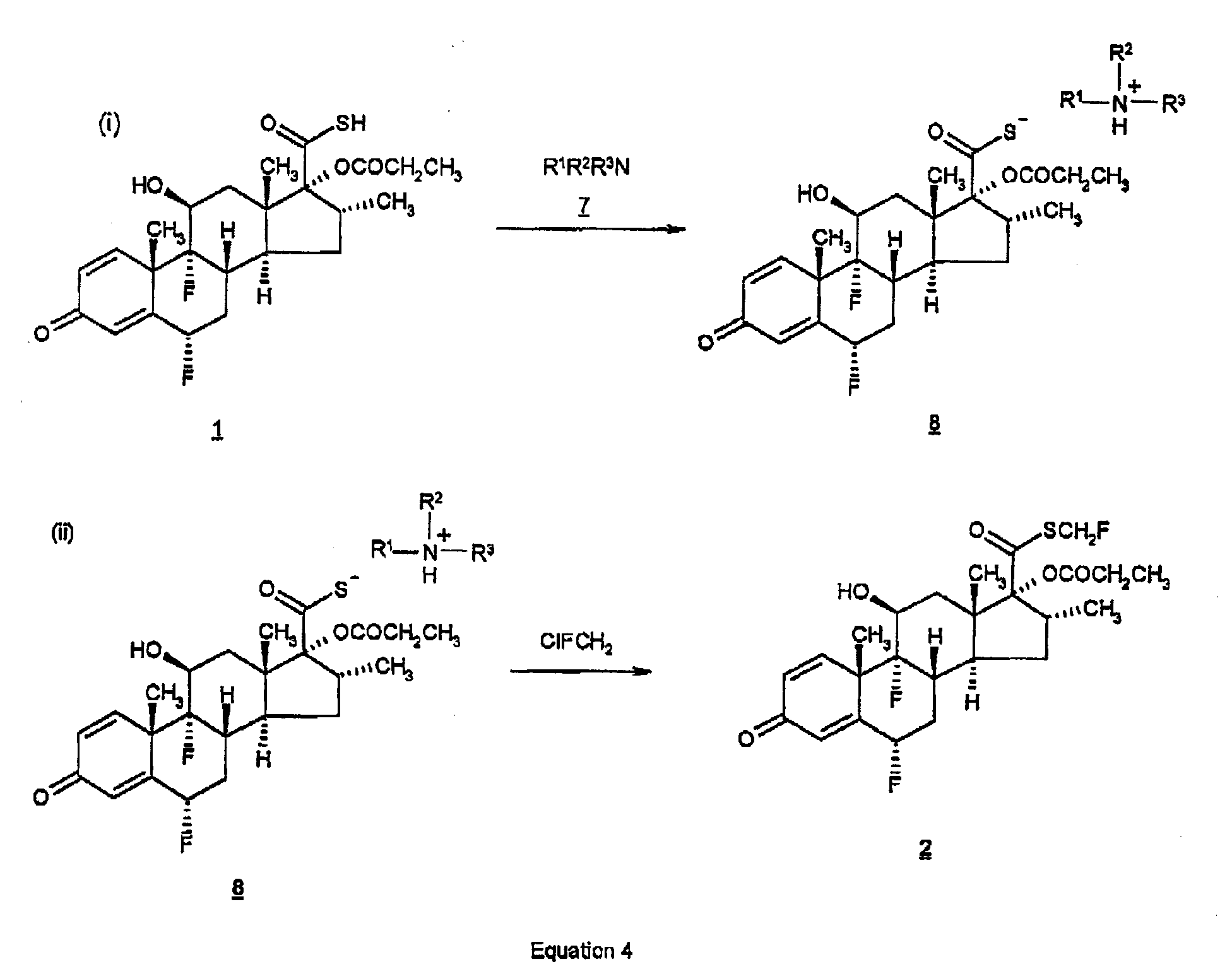
- The substituents R1, R2 and R3 in formulae 7 and 8 are independently hydrogen, C1 - C6 straight or branched alkyl, cycloalkyl, aryl, aralkyl, alkylene and alkyleneoxy. The preferred organic amine of formula 7 is diisopropylethylamine.
- According to the present invention, a process is now available for producing Fluticasone propionate of improved quality using an organic amine salt of 1.
- The preparation of the organic amine salt 8 comprises the following steps:
- (i) preparing a suspension of 1 in isopropanol at 25°-30°C
- (ii) adding the organic amine (7) to the above suspension at 25°-30°C
- (iii) stirring the resulting mixture at 25°-30°C for a specified period of time
- (iv) cooling the reaction mixture to a temperature lower than 10°C
- (v) separating the precipitated crystals by filtration
-
- Surprisingly, it was found that the quality of Fluticasone propionate (2) was improved by reacting the isolated organic amine salts 8 with chlorofluoromethane. The improved quality of the organic amine salts 8 is evident by the HPLC chromatographic purity. In one instance, the purity of the thiocarboxylic acid 1 was increased from 91.7% to 94.8% for the isolated organic amine salt 8. The improvement in quality of the organic amine salt of 1 resulted in a purer Fluticasone propionate (2) prepared from the organic amine salt. In the majority of cases checked, the HPLC chromatographic purity of Fluticasone propionate in which the organic amine salt was not isolated was about 98% (see reference example). On the other hand, Fluticasone propionate prepared from isolated organic amine salt had an HPLC purity that was not less than 99.7%. Some of the major impurities that are reduced by this method are the thiocarboxylic acid acetate 9, the des propionyl thiocarboxylic acid 10, the carboxylic acid propionate 11 and disulphide 12.
- In addition, an attempt to purify 1 by crystallization proved to be inefficient.
- By preparing and isolating the amine salt, some of the impurities will remain in solution and not precipitate with the amine salt. If the procedure of initially preparing the amine salt is not applied, some of the impurities will remain in the Fluticasone propionate.
- The organic amine salts 8 are reacted with chlorofluoromethane in the following manner:
- (i) preparing a mixture of the thiocarboxylic acid organic amine salt (8) in an appropriate solvent, preferably acetonitrile.
- (ii) adding to this mixture about a two-fold excess of chlorofluoromethane
- (iii) heating the mixture at 45°-50°C for a specified period of time
- (iv) cooling the reaction mixture to a temperature lower than 10°C
- (v) separating the precipitated crystals by filtration
-
- It should be emphasized that although Fluticasone propionate can be prepared by reacting the thiocarboxylic acid (1) with chlorofluoromethane and an organic amine in acetonitrile, a purer product is obtained by using the isolated organic amine salt 8.
- While the invention will now be described in connection with certain preferred embodiments in the following examples so that aspects thereof may be more fully understood and appreciated, it is not intended to limit the invention to these particular embodiments. On the contrary, it is intended to cover all alternatives, modifications and equivalents as may be included within the scope of the invention as defined by the appended claims. Thus, the following examples which include preferred embodiments will serve to illustrate the practice of this invention, it being understood that the particulars shown are by way of example and for purposes of illustrative discussion of preferred embodiments of the present invention only and are presented in the cause of providing what is believed to be the most useful and readily understood description of formulation procedures as well as of the principles and conceptual aspects of the invention.
- The reaction vessel is charged with 10 g of the thiocarboxylic acid of 91.7% chromatographic purity (0.0214 moles, 1 eq.) and 30 ml isopropanol. To the stirred suspension is added 5.6 ml diisopropylethylamine (0.032 moles, 1.5 eq.) in portions at 25°C. The reaction is slightly exothermic. On completion of the addition a solution is obtained. The solution is stirred for 15 min. at 25°C after which time a suspension is formed. The mixture is cooled to 5°C and stirred at this temperature for three hours. The product is filtered, washed with cold isopropanol and dried at 50°C to afford 10.4 g of product in 82% yield. The HPLC chromatographic purity is 95.8%.
- The product is characterized as follows:
m.p.: 182.7°C - A 200 ml glass autoclave is charged with 10 g of the diisopropylethylamine salt of the thiocarboxylic acid (0.0167 moles, 1 eq.) and 50 ml acetonitrile. Into the stirred suspension is bubbled 2.55 g chlorofluoromethane (0.037 moles, 2.2 eq.). The autoclave is closed. The stirred suspension is heated to 50°C to afford a solution after about 30 min. A pressure of about 1.3 bar is produced. The mixture is heated at 50°C for a period of 5 hours during which time a suspension is produced. After the heating period, the vent is opened and the mixture cooled to 25°C. The mixture is stirred at 25°C for 16 hours (overnight). The suspension is cooled to 5°C and stirred at this temperature for 1 hour. The product is filtered, washed with cold acetonitrile and dried at 60°C to afford 5.0 g of product in 60% yield. The HPLC chromatographic purity is 99.86%.
- In a similar fashion, a series of experiments were performed using the following organic amines: triethylamine, 1-methylpiperidine, diethylamine, morpholine, dicyclohexylamine and cyclohexylamine. For triethylamine, 1-methylpiperidine, diethylamine and morpholine the resulting isolated organic amine salts were converted to Fluticasone propionate as described above. In the case of dicyclohexylamine and cyclohexylamine the organic amine salts were not obtained in crystalline form but rather as an oil which was reacted with chlorofluoromethane to afford Fluticasone propionate. The results are listed in the following table.
Example Organic Amine HPLC Purity (%) Thiocarboxylic acid Thioacid salt
(mp)Fluticasone propionate 2 Triethylamine 89.4 93.9
(161.7°C)99.7 3 1-methyl-piperidine 90.4 96.2
(182.1°C)99.7 4 Diethylamine 88.8 95.0
(156.4°C)99.7 5 Morpholine 89.1 95.6
(162.7°C)81.6 6 Dicyclohexylamine 88.8 87.5
(oil)98.9 7 Cyclohexylamine 88.8 86.3
(oil)90.5 - On the basis of the results presented in Example 1 and Examples 2 - 5, the tertiary thioacid amine salts ― diisopropylethylamine, triethylamine and 1-methylpiperidine ― that were studied were the preferred ones for producing Fluticasone propionate (2) of high quality.
- The following example is provided to illustrate the results obtained when the thiocarboxylic acid 1 is reacted directly with chlorofluoromethane to afford Fluticasone propionate.
- A 200 ml glass autoclave is charged with 7.8 g of the thiocarboxylic acid (1) of 91.7% chromatographic purity (0.0167 moles, 1 eq.) and 50 ml acetonitrile. To the stirred suspension is added 4.4 ml diisopropylethylamine (0.026 moles, 1.5 eq.). The mixture is stirred for 15 min. to afford a clear yellow solution. Into the stirred solution is bubbled 2.55 g chlorofluoromethane (0.037 moles, 2.2 eq.). The autoclave is closed. The stirred suspension is heated to 50°C to afford a solution after about 30 min. A pressure of about 1.3 bar is produced. The mixture is heated at 50°C for a period of 5 hours during which time a suspension is produced. After the heating period, the vent is opened and the mixture cooled to 25°C. The mixture is stirred at 25°C for 16 hours (overnight). The suspension is cooled to 5°C and stirred at this temperature for 1 hour. The product is filtered, washed with cold acetonitrile and dried at 60°C to afford 5.0 g of product in 60% yield. The HPLC chromatographic purity is 98%.
- It will be evident to those skilled in the art that the invention is not limited to the details of the foregoing illustrative examples and that the present invention may be embodied in other specific forms without departing from the essential attributes thereof, and it is therefore desired that the present embodiments and examples be considered in all respects as illustrative and not restrictive, reference being made to the appended claims, rather than to the foregoing description, and all changes which come within the meaning and range of equivalency of the claims are therefore intended to be embraced therein.
Claims (12)
- A thiocarboxylic acid organic salt of the formula:wherein B is an organic base.

- A thiocarboxylic acid organic salt according to claim 1 where B is an organic amine of the general formula:wherein R1, R2 and R3 are independently hydrogen, C1 - C6 straight or branched alkyl, cycloalkyl, aryl, aralkyl, alkylene and alkyleneoxy.
- A thiocarboxylic acid organic salt according to claim 2 wherein said organic amines B are selected from the group consisting of diisopropylethylamine, triethylamine and 1-methylpiperidine.
- A process for preparing highly pure Fluticasone propionate which comprises reacting a thiocarboxylic acid organic salt of formula 6 as defined in claim 1 and chlorofluoromethane.
- A process according to claim 4 wherein the thiocarboxylic acid salt 8 is prepared by reacting 1 with an organic amine of formula 7 comprising the following steps:
 (i) preparing a suspension of 1 in an appropriate solvent;(ii) adding the organic amine (7);(iii) stirring the mixture at a temperature range 1;(iv) cooling the mixture to a temperature range 2; and(v) separating the crystals that are formed.
 - A process according to claim 5 wherein the solvent is isopropanol.
- A process according to claim 5 wherein the temperature range 1 is 25°-60°C.
- A process according to claim 5 wherein the temperature range 2 is -10°-10°C.
- A process according to claim 5 wherein the separation of crystals is done by filtration.
- A process according to claim 4 wherein the Fluticasone propionate is . produced according to the following steps:(i) preparing a mixture of the isolated thiocarboxylic acid organic amine salt (8)in acetonitrile;
 (ii) adding to this mixture about a two-fold molar excess of chlorofluoromethane;(iii) heating the mixture at 50°C for a specified period of time;(iv) cooling the reaction mixture to a temperature lower than 10°C; and(v) separating the precipitated crystals by filtration.
 - A process according to claim 5 wherein the thiocarboxylic acid organic amine salts are selected from the group consisting of
6α,9α-difluoro-11β-hydroxy-7α-propionyloxy-16α-methylpregna-3-oxo-1,4-diene-17β-thiocarboxylic acid diisopropylethylamine salt, triethylamine salt and N-methylpiperidine salt. - Fluticasone propionate prepared as described in claim 10.
Applications Claiming Priority (2)
| Application Number | Priority Date | Filing Date | Title |
|---|---|---|---|
| IL15346202A IL153462A0 (en) | 2002-12-16 | 2002-12-16 | Thiocarboxylic acid organic salts and processes utilizing the same |
| IL15346202 | 2002-12-16 |
Publications (1)
| Publication Number | Publication Date |
|---|---|
| EP1431305A1 true EP1431305A1 (en) | 2004-06-23 |
Family
ID=29798371
Family Applications (1)
| Application Number | Title | Priority Date | Filing Date |
|---|---|---|---|
| EP03257879A Withdrawn EP1431305A1 (en) | 2002-12-16 | 2003-12-16 | Thiocarboxylic acid organic salts and processes utilizing the same |
Country Status (3)
| Country | Link |
|---|---|
| US (1) | US20040116396A1 (en) |
| EP (1) | EP1431305A1 (en) |
| IL (1) | IL153462A0 (en) |
Cited By (3)
| Publication number | Priority date | Publication date | Assignee | Title |
|---|---|---|---|---|
| WO2012029077A2 (en) | 2010-09-01 | 2012-03-08 | Cadila Healthcare Limited | Process for preparing fluticasone propionate/furoate |
| US8344168B2 (en) | 2006-06-14 | 2013-01-01 | Generics (Uk) Limited | Process for the preparation of fluticasone propionate |
| US9303060B1 (en) | 2014-10-03 | 2016-04-05 | Amphaster Pharmaceuticals, Inc. | Methods of preparing intermediate of fluticasone propionate |
Citations (4)
| Publication number | Priority date | Publication date | Assignee | Title |
|---|---|---|---|---|
| US20020133032A1 (en) * | 2000-02-25 | 2002-09-19 | Jufang Barkalow | Method for the preparation of fluticasone and related 17beta-carbothioic esters using a novel carbothioic acid synthesis and novel purification methods |
| WO2003066653A2 (en) * | 2002-02-04 | 2003-08-14 | Glaxo Group Limited | Process for the production of fluticasone propionate, in particular of polymorphic form 1 |
| WO2003066654A1 (en) * | 2002-02-04 | 2003-08-14 | Glaxo Group Limited | Process for the production of 6.alpha.,9.alpha-difluoro-17.alpha.-(1-oxopropoxy-11.beta.-hydroxy-16.alpha.-methyl-3-oxo-androst-1,4-diene-17.beta.-carbothioic acid |
| US20030199485A1 (en) * | 2000-08-05 | 2003-10-23 | Keith Biggadike | Novel anti-inflammatory androstane derivative |
Family Cites Families (2)
| Publication number | Priority date | Publication date | Assignee | Title |
|---|---|---|---|---|
| US3725508A (en) * | 1968-10-25 | 1973-04-03 | Stauffer Chemical Co | Thiol derivatives of olefin-maleic anhydride copolymers |
| JPS61200996A (en) * | 1985-03-04 | 1986-09-05 | Agency Of Ind Science & Technol | Production of organic electrically-conductive material crystal |
-
2002
- 2002-12-16 IL IL15346202A patent/IL153462A0/en unknown
-
2003
- 2003-04-04 US US10/406,310 patent/US20040116396A1/en not_active Abandoned
- 2003-12-16 EP EP03257879A patent/EP1431305A1/en not_active Withdrawn
Patent Citations (4)
| Publication number | Priority date | Publication date | Assignee | Title |
|---|---|---|---|---|
| US20020133032A1 (en) * | 2000-02-25 | 2002-09-19 | Jufang Barkalow | Method for the preparation of fluticasone and related 17beta-carbothioic esters using a novel carbothioic acid synthesis and novel purification methods |
| US20030199485A1 (en) * | 2000-08-05 | 2003-10-23 | Keith Biggadike | Novel anti-inflammatory androstane derivative |
| WO2003066653A2 (en) * | 2002-02-04 | 2003-08-14 | Glaxo Group Limited | Process for the production of fluticasone propionate, in particular of polymorphic form 1 |
| WO2003066654A1 (en) * | 2002-02-04 | 2003-08-14 | Glaxo Group Limited | Process for the production of 6.alpha.,9.alpha-difluoro-17.alpha.-(1-oxopropoxy-11.beta.-hydroxy-16.alpha.-methyl-3-oxo-androst-1,4-diene-17.beta.-carbothioic acid |
Cited By (3)
| Publication number | Priority date | Publication date | Assignee | Title |
|---|---|---|---|---|
| US8344168B2 (en) | 2006-06-14 | 2013-01-01 | Generics (Uk) Limited | Process for the preparation of fluticasone propionate |
| WO2012029077A2 (en) | 2010-09-01 | 2012-03-08 | Cadila Healthcare Limited | Process for preparing fluticasone propionate/furoate |
| US9303060B1 (en) | 2014-10-03 | 2016-04-05 | Amphaster Pharmaceuticals, Inc. | Methods of preparing intermediate of fluticasone propionate |
Also Published As
| Publication number | Publication date |
|---|---|
| IL153462A0 (en) | 2003-07-06 |
| US20040116396A1 (en) | 2004-06-17 |
Similar Documents
| Publication | Publication Date | Title |
|---|---|---|
| JP4584709B2 (en) | Production process of quinoline derivatives | |
| JP5161023B2 (en) | Process for producing piperazine derivatives | |
| EP0599376A2 (en) | A process for the production of finasteride | |
| EP3490973B1 (en) | Polymorphic forms of belinostat and processes for preparation thereof | |
| JPH0460990B2 (en) | ||
| HUP0301108A2 (en) | Oxidation process for preparing the intermediate 6alpha, 9alpha-difluoro-11beta, 17alpha-dihydroxy-16alpha-methyl-androst-1,4-dien-3-one 17beta-carboxylic acid | |
| ZA200404080B (en) | Crystalline venlafaxine base and novel polymorphs of venlafaxine hydrochloride, processes for preparing thereof | |
| JP3440129B2 (en) | Method for producing glutamine derivative | |
| US20040116396A1 (en) | Thiocarboxylic acid organic salts and processes utilizing the same | |
| CN101679268A (en) | Process for preparing sodium salt of 1- (((1(R) - (3- (2- (7-chloro-2-quinolinyl) -ethenyl) phenyl) -3- (2- (1-hydroxy-1-methylethyl) phenyl) propyl) sulfanyl) methyl) cyclopropaneacetic acid | |
| CN101171251A (en) | The preparation method of aztreonam | |
| WO2023006986A1 (en) | Method for preparing and purifying an agent suitable for treating anemia | |
| EP3805244B1 (en) | Synthesis of glycoconjugate derivatives of a bile acid | |
| JP2001521498A (en) | Method for producing O- (3-amino-2-hydroxy-propyl) -hydroxymic acid halide | |
| EP2044098B1 (en) | Process for the preparation of 6-alpha ,9-alpha-difluoro-17-alpha - ((2-furanylcarbonyl)oxy)-11-beta -hydroxy-16-alpha -methyl-3-oxo-androsta-1,4-diene-17-beta- -carbothioic acid s-fluoromethyl ester | |
| JPS6355512B2 (en) | ||
| JP3046258B2 (en) | Method for producing 1-chlorocarbonyl-4-piperidinopiperidine or hydrochloride thereof | |
| JP4986343B2 (en) | Method for treating 1-chlorocarbonylpiperidine derivative hydrochloride | |
| EP2297122B1 (en) | New process for the preparation of levocetirizine and intermediates thereof | |
| JPS6119624B2 (en) | ||
| CN101356157B (en) | Process for making montelukast and intermediates therefor | |
| JPH0558985A (en) | Production of cyanoguanidine derivative | |
| CA2473753A1 (en) | Process for the production of 6.alpha.,9.alpha-difluoro-17.alpha.-(1-oxopropoxy-11.beta.-hydroxy-16.alpha.-methyl-3-oxo-androst-1,4-diene-17.beta.-carbothioic acid | |
| EP0690848B1 (en) | Piperazinylpyridinyl water clathrates | |
| JP3538889B2 (en) | Method for producing alkylthioacetamide |
Legal Events
| Date | Code | Title | Description |
|---|---|---|---|
| PUAI | Public reference made under article 153(3) epc to a published international application that has entered the european phase |
Free format text: ORIGINAL CODE: 0009012 |
|
| AK | Designated contracting states |
Kind code of ref document: A1 Designated state(s): AT BE BG CH CY CZ DE DK EE ES FI FR GB GR HU IE IT LI LU MC NL PT RO SE SI SK TR |
|
| AX | Request for extension of the european patent |
Extension state: AL LT LV MK |
|
| AKX | Designation fees paid |
Designated state(s): AT BE BG CH CY CZ DE DK EE ES FI FR GB GR HU IE IT LI LU MC NL PT RO SE SI SK TR |
|
| STAA | Information on the status of an ep patent application or granted ep patent |
Free format text: STATUS: THE APPLICATION IS DEEMED TO BE WITHDRAWN |
|
| 18D | Application deemed to be withdrawn |
Effective date: 20041224 |