EP1431284A1 - Diaryl sulfide derivative, addition salt thereof, and immunosuppressant - Google Patents
Diaryl sulfide derivative, addition salt thereof, and immunosuppressant Download PDFInfo
- Publication number
- EP1431284A1 EP1431284A1 EP02768057A EP02768057A EP1431284A1 EP 1431284 A1 EP1431284 A1 EP 1431284A1 EP 02768057 A EP02768057 A EP 02768057A EP 02768057 A EP02768057 A EP 02768057A EP 1431284 A1 EP1431284 A1 EP 1431284A1
- Authority
- EP
- European Patent Office
- Prior art keywords
- carbon atoms
- general formula
- compound
- hydrate
- propanediol
- Prior art date
- Legal status (The legal status is an assumption and is not a legal conclusion. Google has not performed a legal analysis and makes no representation as to the accuracy of the status listed.)
- Granted
Links
- 0 *CCc(cc1)ccc1Sc1cc(*)cc(C(F)(F)F)c1 Chemical compound *CCc(cc1)ccc1Sc1cc(*)cc(C(F)(F)F)c1 0.000 description 1
- XFOFVVIQDFKAFA-UHFFFAOYSA-N CCCc(cc1)ccc1Sc1cc(O)ccc1 Chemical compound CCCc(cc1)ccc1Sc1cc(O)ccc1 XFOFVVIQDFKAFA-UHFFFAOYSA-N 0.000 description 1
Images
Classifications
-
- A—HUMAN NECESSITIES
- A61—MEDICAL OR VETERINARY SCIENCE; HYGIENE
- A61K—PREPARATIONS FOR MEDICAL, DENTAL OR TOILETRY PURPOSES
- A61K31/00—Medicinal preparations containing organic active ingredients
- A61K31/13—Amines
- A61K31/145—Amines having sulfur, e.g. thiurams (>N—C(S)—S—C(S)—N< and >N—C(S)—S—S—C(S)—N<), Sulfinylamines (—N=SO), Sulfonylamines (—N=SO2)
-
- A—HUMAN NECESSITIES
- A61—MEDICAL OR VETERINARY SCIENCE; HYGIENE
- A61P—SPECIFIC THERAPEUTIC ACTIVITY OF CHEMICAL COMPOUNDS OR MEDICINAL PREPARATIONS
- A61P11/00—Drugs for disorders of the respiratory system
- A61P11/06—Antiasthmatics
-
- A—HUMAN NECESSITIES
- A61—MEDICAL OR VETERINARY SCIENCE; HYGIENE
- A61P—SPECIFIC THERAPEUTIC ACTIVITY OF CHEMICAL COMPOUNDS OR MEDICINAL PREPARATIONS
- A61P17/00—Drugs for dermatological disorders
-
- A—HUMAN NECESSITIES
- A61—MEDICAL OR VETERINARY SCIENCE; HYGIENE
- A61P—SPECIFIC THERAPEUTIC ACTIVITY OF CHEMICAL COMPOUNDS OR MEDICINAL PREPARATIONS
- A61P17/00—Drugs for dermatological disorders
- A61P17/06—Antipsoriatics
-
- A—HUMAN NECESSITIES
- A61—MEDICAL OR VETERINARY SCIENCE; HYGIENE
- A61P—SPECIFIC THERAPEUTIC ACTIVITY OF CHEMICAL COMPOUNDS OR MEDICINAL PREPARATIONS
- A61P19/00—Drugs for skeletal disorders
- A61P19/02—Drugs for skeletal disorders for joint disorders, e.g. arthritis, arthrosis
-
- A—HUMAN NECESSITIES
- A61—MEDICAL OR VETERINARY SCIENCE; HYGIENE
- A61P—SPECIFIC THERAPEUTIC ACTIVITY OF CHEMICAL COMPOUNDS OR MEDICINAL PREPARATIONS
- A61P29/00—Non-central analgesic, antipyretic or antiinflammatory agents, e.g. antirheumatic agents; Non-steroidal antiinflammatory drugs [NSAID]
-
- A—HUMAN NECESSITIES
- A61—MEDICAL OR VETERINARY SCIENCE; HYGIENE
- A61P—SPECIFIC THERAPEUTIC ACTIVITY OF CHEMICAL COMPOUNDS OR MEDICINAL PREPARATIONS
- A61P37/00—Drugs for immunological or allergic disorders
- A61P37/02—Immunomodulators
-
- A—HUMAN NECESSITIES
- A61—MEDICAL OR VETERINARY SCIENCE; HYGIENE
- A61P—SPECIFIC THERAPEUTIC ACTIVITY OF CHEMICAL COMPOUNDS OR MEDICINAL PREPARATIONS
- A61P37/00—Drugs for immunological or allergic disorders
- A61P37/02—Immunomodulators
- A61P37/06—Immunosuppressants, e.g. drugs for graft rejection
-
- A—HUMAN NECESSITIES
- A61—MEDICAL OR VETERINARY SCIENCE; HYGIENE
- A61P—SPECIFIC THERAPEUTIC ACTIVITY OF CHEMICAL COMPOUNDS OR MEDICINAL PREPARATIONS
- A61P37/00—Drugs for immunological or allergic disorders
- A61P37/08—Antiallergic agents
-
- C—CHEMISTRY; METALLURGY
- C07—ORGANIC CHEMISTRY
- C07C—ACYCLIC OR CARBOCYCLIC COMPOUNDS
- C07C317/00—Sulfones; Sulfoxides
- C07C317/14—Sulfones; Sulfoxides having sulfone or sulfoxide groups bound to carbon atoms of six-membered aromatic rings
-
- C—CHEMISTRY; METALLURGY
- C07—ORGANIC CHEMISTRY
- C07C—ACYCLIC OR CARBOCYCLIC COMPOUNDS
- C07C317/00—Sulfones; Sulfoxides
- C07C317/26—Sulfones; Sulfoxides having sulfone or sulfoxide groups and nitrogen atoms, not being part of nitro or nitroso groups, bound to the same carbon skeleton
- C07C317/32—Sulfones; Sulfoxides having sulfone or sulfoxide groups and nitrogen atoms, not being part of nitro or nitroso groups, bound to the same carbon skeleton with sulfone or sulfoxide groups bound to carbon atoms of six-membered aromatic rings of the carbon skeleton
-
- C—CHEMISTRY; METALLURGY
- C07—ORGANIC CHEMISTRY
- C07C—ACYCLIC OR CARBOCYCLIC COMPOUNDS
- C07C323/00—Thiols, sulfides, hydropolysulfides or polysulfides substituted by halogen, oxygen or nitrogen atoms, or by sulfur atoms not being part of thio groups
- C07C323/23—Thiols, sulfides, hydropolysulfides or polysulfides substituted by halogen, oxygen or nitrogen atoms, or by sulfur atoms not being part of thio groups containing thio groups and nitrogen atoms, not being part of nitro or nitroso groups, bound to the same carbon skeleton
- C07C323/31—Thiols, sulfides, hydropolysulfides or polysulfides substituted by halogen, oxygen or nitrogen atoms, or by sulfur atoms not being part of thio groups containing thio groups and nitrogen atoms, not being part of nitro or nitroso groups, bound to the same carbon skeleton having the sulfur atom of at least one of the thio groups bound to a carbon atom of a six-membered aromatic ring of the carbon skeleton
- C07C323/32—Thiols, sulfides, hydropolysulfides or polysulfides substituted by halogen, oxygen or nitrogen atoms, or by sulfur atoms not being part of thio groups containing thio groups and nitrogen atoms, not being part of nitro or nitroso groups, bound to the same carbon skeleton having the sulfur atom of at least one of the thio groups bound to a carbon atom of a six-membered aromatic ring of the carbon skeleton having at least one of the nitrogen atoms bound to an acyclic carbon atom of the carbon skeleton
-
- C—CHEMISTRY; METALLURGY
- C07—ORGANIC CHEMISTRY
- C07C—ACYCLIC OR CARBOCYCLIC COMPOUNDS
- C07C323/00—Thiols, sulfides, hydropolysulfides or polysulfides substituted by halogen, oxygen or nitrogen atoms, or by sulfur atoms not being part of thio groups
- C07C323/23—Thiols, sulfides, hydropolysulfides or polysulfides substituted by halogen, oxygen or nitrogen atoms, or by sulfur atoms not being part of thio groups containing thio groups and nitrogen atoms, not being part of nitro or nitroso groups, bound to the same carbon skeleton
- C07C323/39—Thiols, sulfides, hydropolysulfides or polysulfides substituted by halogen, oxygen or nitrogen atoms, or by sulfur atoms not being part of thio groups containing thio groups and nitrogen atoms, not being part of nitro or nitroso groups, bound to the same carbon skeleton at least one of the nitrogen atoms being part of any of the groups, X being a hetero atom, Y being any atom
- C07C323/43—Y being a hetero atom
-
- C—CHEMISTRY; METALLURGY
- C07—ORGANIC CHEMISTRY
- C07F—ACYCLIC, CARBOCYCLIC OR HETEROCYCLIC COMPOUNDS CONTAINING ELEMENTS OTHER THAN CARBON, HYDROGEN, HALOGEN, OXYGEN, NITROGEN, SULFUR, SELENIUM OR TELLURIUM
- C07F7/00—Compounds containing elements of Groups 4 or 14 of the Periodic Table
- C07F7/02—Silicon compounds
- C07F7/08—Compounds having one or more C—Si linkages
- C07F7/18—Compounds having one or more C—Si linkages as well as one or more C—O—Si linkages
- C07F7/1804—Compounds having Si-O-C linkages
Definitions
- the present invention relates to diaryl sulfide derivatives, salts and hydrates thereof that are useful as an immunosuppressive agent.
- Immunosuppressive agents are widely used as a treatment for autoimmune diseases such as rheumatoid arthritis, nephritis, osteoarthritis and systemic lupus erythematosus, chronic inflammatory diseases such as inflammatory bowel disease, and allergic diseases such as asthma and dermatitis.
- autoimmune diseases such as rheumatoid arthritis, nephritis, osteoarthritis and systemic lupus erythematosus
- chronic inflammatory diseases such as inflammatory bowel disease
- allergic diseases such as asthma and dermatitis.
- Immunosuppressive agents also play a significant role to this end.
- immunosuppressors commonly used in organ transplantation are antimetabolites, such as azathioprine and mycophenolate mofetil, calcineurin inhibitors, such as cyclosporin A and tacrolimus, and corticosteroid, such as prednisolone.
- antimetabolites such as azathioprine and mycophenolate mofetil
- calcineurin inhibitors such as cyclosporin A and tacrolimus
- corticosteroid such as prednisolone.
- none of conventional immunosuppressive agents are satisfactory in view of efficacy and potential side effects.
- the present inventors discovered that novel diaryl sulfide derivatives that have a different structure from conventional immunosuppressors exhibit strong immunosuppressive effects.
- the compounds are such that one of the aryl groups includes, at its para-position, a carbon chain with an aminopropanediol group and the other aryl group includes a substituent at its meta-position. This discovery led the present inventors to devise the present invention.
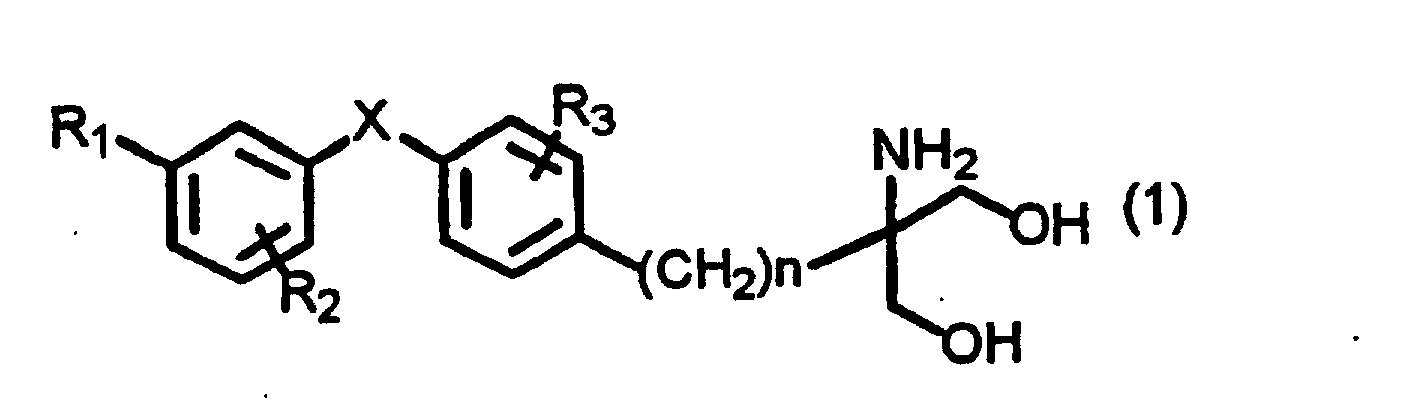
- the present invention thus is an immunosuppressive agent containing as an active ingredient at least one of a diaryl sulfide derivative, a pharmaceutically acceptable salt and hydrate thereof, the diaryl sulfide derivative represented by the following general formula (1): wherein R 1 is halogen, trihalomethyl, hydroxy, lower alkyl having 1 to 7 carbon atoms, substituted or unsubstituted phenyl, aralkyl, lower alkoxy having 1 to 4 carbon atoms, trifluoromethyloxy, phenoxy, cyclohexylmethyloxy, substituted or unsubstituted aralkyloxy, pyridylmethyloxy, cinnamyloxy, naphthylmethyloxy, phenoxymethyl, hydroxymethyl, hydroxyethyl, lower alkylthio having 1 to 4 carbon atoms, lower alkylsulfinyl having 1 to 4 carbon atoms, lower alkylsulfonyl having 1 to 4 carbon atoms,
- the present invention is an immunosuppressive agent containing as an active ingredient at least one of a diaryl sulfide derivative, a pharmaceutically acceptable salt and hydrate thereof, the diaryl sulfide derivative represented by the following general formula (1a): wherein R 2 , R 3 , and n are the same as defined above.
- the present invention is an immunosuppressive agent containing as an active ingredient at least one of a diaryl sulfide derivative, a pharmaceutically acceptable salt and hydrate thereof, the diaryl sulfide derivative represented by the following general formula (1b): wherein R 2 , R 3 , and n are the same as defined above; and R 4 is hydrogen, halogen, lower alkyl having 1 to 7 carbon atoms, lower alkoxy having 1 to 4 carbon atoms, or trifluoromethyl.
- the compounds of the general formulae (1), (1a), and (1b) are each a novel compound.
- Examples of the pharmaceutically acceptable salt of the compound of the general formula (1) include acid salts, such as hydrochloride, hydrobromide, acetate, trifluoroacetate, methanesulfonate, citrate, and tartrate.
- the term 'halogen atom' encompasses fluorine, chlorine, bromine, and iodine atom.
- the term 'trihalomethyl group' encompasses trifluoromethyl and trichloromethyl.
- the phrase 'lower alkyl group having 1 to 7 carbon atoms' encompasses straight-chained or branched hydrocarbons having 1 to 7 carbon atoms, such as methyl, ethyl, propyl, isopropyl, butyl, t-butyl, pentyl, hexyl, and heptyl.
- the phrase 'substituted or unsubstituted phenoxy group' encompasses those that have, at any position of its benzene ring, a halogen atom, such as fluorine, chlorine, bromine and iodine, trifluoromethyl, lower alkyl having 1 to 4 carbon atoms, or lower alkoxy having 1 to 4 carbon atoms.
- a halogen atom such as fluorine, chlorine, bromine and iodine, trifluoromethyl
- lower alkyl having 1 to 4 carbon atoms or lower alkoxy having 1 to 4 carbon atoms.
- the term 'aralkyl group' as in 'aralkyl group' or 'aralkyloxy group' encompasses benzyl, diphenylmethyl, phenethyl, and phenylpropyl.
- 'lower alkyl group' as used in 'lower alokoxy group having 1 to 4 carbon atoms,' 'lower alkylthio group having 1 to 4 carbon atoms,' 'lower alkylsulfinyl group having 1 to 4 carbon atoms,' or 'lower alkylsulfonyl group having 1 to 4 carbon atoms,' encompasses straight-chained or branched hydrocarbons having 1 to 4 carbon atoms, such as methyl, ethyl, propyl, isopropyl, and butyl.
- phrase 'substituted or unsubstituted aralkyl group' encompasses those that have, at any position of its benzene ring, a halogen atom, such as fluorine, chlorine, bromine and iodine, trifluoromethyl, lower alkyl having 1 to 4 carbon atoms, or lower alkoxy having 1 to 4 carbon atoms.
- a halogen atom such as fluorine, chlorine, bromine and iodine, trifluoromethyl, lower alkyl having 1 to 4 carbon atoms, or lower alkoxy having 1 to 4 carbon atoms.
- the compounds of the general formula (1) can be produced in the following pathways:
- the compound involved in the synthetic pathway 1 that is represented by the following general formula (3): (wherein R 5 is lower alkyl having 1 to 4 carbon atoms; Boc is t -butoxycarbonyl; and R 1 , R 2 , R 3 , X and n are the same as described above) can be prepared by reacting a compound of the following general formula (2): (wherein Y is chlorine, bromine, or iodine; and R 1 , R 2 , R 3 , X and n are as described above) with a compound of the following general formula (5): (wherein R 5 and Boc are as described above) in the presence of a base (Step 1).
- This reaction can be carried out using a reaction solvent such as methanol, ethanol, 1,4-dioxane, dimethylsulfoxide (DMSO), N,N-dimethylformamide (DMF), or tetrahydrofuran (THF) at a reaction temperature of 0°C to reflux temperature, preferably at a temperature of 80°C to 100°C, in the presence of an inorganic base such as sodium hydride, potassium hydride, sodium alkoxide, and potassium alkoxide.
- a reaction solvent such as methanol, ethanol, 1,4-dioxane, dimethylsulfoxide (DMSO), N,N-dimethylformamide (DMF), or tetrahydrofuran (THF)
- the compound involved in the synthetic pathway 1 that is represented by the following general formula (4): (wherein R 1 , R 2 , R 3 , X, Boc, and n are as described above) can be prepared by the reduction of the compound of the general formula (3) (Step 2).
- This reaction can be carried out at a reaction temperature of 0°C to reflux temperature, preferably at room temperature, using an alkylborane derivative, such as borane (BH 3 ) and 9-borabicyclo[3.3.1]nonane (9-BBN), or a metal hydride complex, such as diisobutylaluminum hydride ((iBu)2AlH), sodium borohydride (NaBH 4 ) and lithium aluminum hydride (LiAlH 4 ), preferably lithium borohydride (LiBH 4 ), and using a reaction solvent such as THF, ethanol and methanol.
- an alkylborane derivative such as borane (BH 3 ) and 9-borabicyclo[3.3.1]nonane (9-BBN
- a metal hydride complex such as diisobutylaluminum hydride ((iBu)2AlH), sodium borohydride (NaBH 4 ) and lithium aluminum hydride (LiAlH
- the compound involved in the synthetic pathway 1 that is represented by the general formula (1): (wherein R 1 , R 2 , R 3 , X and n are as described above) can be prepared by the acidolysis of the compound of the general formula (4) (Step 3).
- This reaction can be carried out at a reaction temperature in the range of 0°C to room temperature in an inorganic or organic acid, such as acetic acid, hydrochloric acid, hydrobromic acid, methanesulfonic acid and trifluoroacetic acid, or in a mixed solvent with an organic solvent such as methanol, ethanol, THF, 1,4-dioxane, and ethyl acetate.
- an inorganic or organic acid such as acetic acid, hydrochloric acid, hydrobromic acid, methanesulfonic acid and trifluoroacetic acid
- an organic solvent such as methanol, ethanol, THF, 1,4-dioxane, and ethyl acetate.
- those in which X is either SO or SO 2 namely, those represented by the following general formula (6): (wherein m is an integer of 1 or 2; and R 1 , R 2 , R 3 , R 5 , Boc, and n are as described above) may also be prepared by the oxidizing a compound represented by the following general formula (7): (wherein R 1 , R 2 , R 3 , R 5 , Boc, and n are as described above).
- This reaction can be carried out using a reaction solvent, such as 1,4-dioxane, DMSO, DMF, THF, methylene chloride or chloroform, along with an oxidizing agent, such as potassium permanganate, m-chloroperbenzoic acid or aqueous hydrogen peroxide, at a reaction temperature of 0°C to reflux temperature, preferably at room temperature.
- a reaction solvent such as 1,4-dioxane, DMSO, DMF, THF, methylene chloride or chloroform
- an oxidizing agent such as potassium permanganate, m-chloroperbenzoic acid or aqueous hydrogen peroxide
- the reaction between the compound of the general formula (9) and the compound of the general formula (12) or the compound of the general formula (13) can be carried out at a reaction temperature in the range of room temperature to 100°C either in the presence of a Lewis acid such as zinc chloride or in the presence of an acid catalyst such as camphorsulfonic acid, paratoluenesulfonic acid, and pyridinium paratoluenesulfonic acid, and may be carried out either in the absence of solvent or in the presence of a reaction solvent such as DMF, THF, and methylene chloride.
- a reaction temperature in the range of room temperature to 100°C either in the presence of a Lewis acid such as zinc chloride or in the presence of an acid catalyst such as camphorsulfonic acid, paratoluenesulfonic acid, and pyridinium paratoluenesulfonic acid, and may be carried out either in the absence of solvent or in the presence of a reaction solvent such as DMF, THF, and m
- the reaction between the compound of the general formula (9) and the compound of the general formula (14) can be carried out at a reaction temperature of 0°C to 100°C in the presence of a base, such as triethylamine, pyridine, 2,6-lutidine, and imidazole, and can be carried out using a reaction solvent such as DMF, THF, methylene chloride, chloroform, and acetonitrile.
- a base such as triethylamine, pyridine, 2,6-lutidine, and imidazole
- a reaction solvent such as DMF, THF, methylene chloride, chloroform, and acetonitrile.
- the compound involved in the synthetic pathway 2 that is represented by the following general formula (11): (wherein R 1 , R 2 , R 3 , R 6 , R 7 , Z, Boc, m and n are as described above) can be prepared by the oxidizing the compound of the general formula (10).
- This reaction can be carried out using a reaction solvent, such as 1,4-dioxane, DMSO, DMF, THF, methylene chloride or chloroform, along with an oxidizing agent, such as potassium permanganate, m-chloroperbenzoic acid or aqueous hydrogen peroxide, at a reaction temperature of 0°C to reflux temperature, preferably at room temperature.
- a reaction solvent such as 1,4-dioxane, DMSO, DMF, THF, methylene chloride or chloroform
- an oxidizing agent such as potassium permanganate, m-chloroperbenzoic acid or aqueous hydrogen peroxide
- the compound of the general formula (8) involved in the synthetic pathway 2 can be prepared by the acidolysis, or desilylation followed by acidolysis, of the compound of the general formula (11).
- This reaction can be carried out at a reaction temperature of 0°C to room temperature in an inorganic or organic acid, such as acetic acid, hydrochloric acid, hydrobromic acid, methanesulfonic acid, trifluoroacetic acid, or in a mixed solution with an organic solvent, such as methanol, ethanol, THF, 1,4-dioxane, and ethyl acetate.
- an inorganic or organic acid such as acetic acid, hydrochloric acid, hydrobromic acid, methanesulfonic acid, trifluoroacetic acid
- an organic solvent such as methanol, ethanol, THF, 1,4-dioxane, and ethyl acetate.
- the compound of the general formula (11) may also be synthesized by a reaction with potassium fluoride, cesium fluoride, or tetrabutylammonium fluoride, carried out at a temperature of 0°C to room temperature in a solvent such as THF, DMF, 1,4-dioxane, followed by the above-described acidolysis.
- the compound of Reference Example 28 was subjected to the same process as that of Reference Example 31 to synthesize an ethyl ester, which in turn was subjected to the same process as that of Reference Example 29 to obtain a pale yellow oil.
- the compound of Reference Example 18 (3.60g) was dissolved in methanol (50mL). Magnesium (500mg) was then added to the solution while the solution was stirred at 10°C. The solution was stirred for another 1 hour at this temperature, followed by addition of magnesium (250mg) and further stirring for 3 hours. Subsequently, diluted hydrochloric acid was added to the reaction mixture and the mixture was extracted with ethyl acetate. The organic phase was sequentially washed with water and a saturated aqueous solution of sodium chloride and was dried with anhydrous sodium sulfate. The solvent was removed by distillation under reduced pressure to obtain the desired product (3.13g) as a pale yellow oil.
- the compound of Reference Example 19 (1.50g) was dissolved in THF (30mL). Lithium aluminum hydride (200mg) was then added to the solution while the solution was stirred at 0°C. After 30 minutes, a 20% NaOH solution was added and the crystallized inorganic deposits were removed by filtration through celite. The filtrate was extracted with ethyl acetate and the organic phase was sequentially washed with water and a saturated aqueous solution of sodium chloride and was dried with anhydrous sodium sulfate. The solvent was removed by distillation under reduced pressure to obtain the desired product (1.38g) as a colorless oil.
- the compound of Reference Example 35 (1.38g) was dissolved in THF (20mL). Imidazole (545mg), triphenylphosphine (2.10g) and iodine (2.00g) were added to the solution while the solution was stirred at 0°C. The reaction mixture was further stirred for 2 hours at this temperature and another 1.5 hours at room temperature, followed by the addition of imidazole (160mg), triphenylphosphine (600mg) and iodine (500mg). The mixture was subsequently stirred overnight. Water and then sodium thiosulfate were added to the reaction mixture, followed by extraction with ethyl acetate.
- the organic phase was sequentially washed with water and a saturated aqueous solution of sodium chloride and was dried with anhydrous sodium sulfate.
- the compound of Reference Example 7 was treated in the same manner as in Reference Example 35 to obtain an alcohol.
- the alcohol (5.64g) was dissolved in methylene chloride (100mL) and phosphorus tribromide (2.25mL) was added dropwise.
- the mixture was stirred at room temperature for 1 hour, followed by addition of ice water and extraction with ethyl acetate.
- the organic phase was sequentially washed with water and a saturated aqueous solution of sodium chloride and was dried with anhydrous sodium sulfate.
- the solvent was removed by distillation to obtain a pale yellow oil.
- the desired ethyl ester was treated in the same manner as in Reference Example 26 and then in the same manner as in Reference Example 57-2 to form an ethyl ester, which in turn was subjected to the same process as that of Reference Example 29 to obtain a benzyl ether.
- the compound of Reference Example 57-3 was used as the starting material and was subjected to the same process as that of Reference Example 35 to obtain 4'-(3-benzyloxyphenylthio)-2'-chlorophenethyl alcohol, which in turn was subjected to the same process as that of Reference Example 46 to obtain the desired product as a colorless oil.
- the compound of Reference Example 57-3 was subjected to alkaline hydrolysis and then to condensation with N,O-dimethylhydroxyamine to form an amid, which in turn was reduced in the same manner as in Reference Example 35 to obtain the aldehyde as a yellow oil.
- the compound of Reference Example 58-2 was used as the starting material and was subjected to the same process as that of Reference Example 57 to obtain the desired product as a colorless oil.
- the compound of Reference Example 59-1 was subjected to the same process as that of Reference Example 29 to obtain a benzyl ether, which in turn was treated in the same manner as in Reference Example 35 to form an alcohol. Subsequently, using carbon tetrabromide in place of iodine, the reaction product was treated in the same manner as in Reference Example 46. In this manner, the desired product was obtained as a colorless oil.
- Example 2 The compound of Example 2 (1.50g) was dissolved in methylene chloride (80mL) and, while the solution was stirred at 0°C, m-chloroperbenzoic acid (450mg) was added in small portions. The resulting mixture was stirred for 1 hour at the same temperature and then another 2 hours at room temperature, followed by the addition of water. The resulting mixture was extracted with ethyl acetate. The organic phase was sequentially washed with a saturated aqueous solution of sodium bicarbonate and a saturated aqueous solution of sodium chloride and was dried with anhydrous sodium sulfate.
- m-chloroperbenzoic acid 450mg
- Example 1 The compound of Example 1 (1.87g) was dissolved in THF (30mL) and lithium borohydride (675mg) was added to the solution while the solution was stirred at 0°C. Subsequently, ethanol (5mL) was added to the solution and the mixture was stirred overnight while allowed to gradually warm to room temperature. Ice water was then added to the reaction mixture and the organic solvent was removed by distillation under reduced pressure. 10% aqueous citric acid was added to the residue to adjust the pH to 3 and the mixture was extracted with ethyl acetate. The organic phase was sequentially washed with water and a saturated aqueous solution of sodium chloride and was dried with anhydrous sodium sulfate.
- di- t -butylsilyl bis(trifluoromethanesulfonate) (0.55mL) was added to a DMF solution (15mL) containing the compound of Example 30 (490mg) and 2,6-lutidine (0.35mL). The mixture was stirred for 5 hours until room temperature and was poured into ice water. The mixture was then extracted with ethyl acetate. The organic phase was sequentially washed with water and a saturated aqueous solution of sodium chloride and was dried with anhydrous sodium sulfate.
- Example 31 The compound of Example 31 was oxidized in the same manner as in Example 14 to obtain the desired product as a colorless powder.
- Example 59 Using the compound of Reference Example 59, the reaction was carried out in the same manner as in Example 1 to synthesize an ester, which in turn was subjected to the same process as that of Reference Example 16 to be converted to a diol. Subsequently, the diol was treated in the same manner as in Example 35 to obtain the desired product as a yellow oil.
- Example 26 was subjected to the reaction in the same manner as in Example 35 and was subsequently oxidized in the same fashion as in Example 14 to obtain the desired product as a colorless powder.
- Example 53 The compound of Example 53 was oxidized in the same manner as in Example 14 to obtain the desired product as a colorless powder.
- the spleens were placed in a phosphate-buffered saline (PBS(-), NISSUI PHARMACEUTICAL Co., Ltd.) or in an RPMI-1640 medium (GIBCO INDUSTRIES Inc., or IWAKI GLASS Co., Ltd.) and were either passed through a stainless steel mesh, or gently pressed between two slide glasses and then passed through a cell strainer (70 ⁇ m, Falcon), to form a cell suspension. The suspension was then centrifuged and the supernatant was discarded. An ammonium chloride-Tris isotonic buffer was added to the suspension to lyse erythrocytes.
- PBS(-) phosphate-buffered saline
- RPMI-1640 medium GBCO INDUSTRIES Inc., or IWAKI GLASS Co., Ltd.
- the cells were then centrifuged and washed three times in PBS (-) or RPMI-1640 medium and were resuspended in an RPMI-1640 medium.
- mitomycin C KYOWA HAKKO KOGYO Co., Ltd.
- the cells were again centrifuged and washed in PBS (-) or RPMI-1640 medium and were resuspended in an RPMI-1640 medium so that the medium would contain 2.5 X 10 8 cells/mL.
- This suspension served as a "stimulation cell suspension.”
- 20 ⁇ L (5 X 10 6 cells/mouse) of the stimulation cell suspension was subcutaneously injected into the right hind footpad of 7 to 9 week old male C3H/HeN mice (CLEA JAPAN Inc., CHARLES RIVER JAPAN Inc., or JAPAN SLC Inc.).
- a group of mice was injected with RPMI-1640 medium alone to serve as normal control. 4 days after the injection, right popliteal lymph nodes were collected and were weighed on a Mettler AT201 electronic scale (METTLER TOLEDO Co., Ltd.).
- Example No. .Dose (mg/kg) Inhibition (%) 36 0.03 85 45 0.3 101 37 10 92 46 0.3 80 38 10 56 47 0.3 87 39 0.3 83 48 0.3 48 41 3 89 49 0.3 63 42 10 76 51 10 50 43 10 64
- mice were challenged with the antigen to induce delayed-type hypersensitive responses: First, the initial thickness of each ear was measured by the dial thickness gauge G (0.01-10mm, OZAKI MFG Co., Ltd.) and a test compound was administered. 30 minutes after the administration, 10 ⁇ L of a 0.2% (v/v) DNFB solution was applied to the inner and outer surfaces of the right ear of each animal for antigen challenge. The left ear of each animal was challenged with the solvent alone. 24 hours after the challenge, the increase in the ear thickness was measured for each ear and the difference in thickness between the right and the left ears was determined for each individual. The test compound was dissolved, or suspended, in an ultra pure water and was orally administered at a dose of 0.1mL/10g of body weight. A control group was administered ultra pure water alone. The results are shown in Table 12 below: Example No. Dose (mg/kg) Inhibition (%) 36 1 86 37 30 87 39 3 55 49 30 81
- graft bed a circular area, approximately 8mm in diameter, was prepared in the back of anesthetized male BALB/c mice with a scalpel while the skin was pinched by forceps.
- Each graft obtained from the DBA/2 mice was placed on the graft bed formed in the backs of the BALB/c mice and was secured with a strip of adhesive bandage while held down from the top. 6 days after transplantation, the bandage was removed and the graft was subsequently observed everyday.
- each compound was evaluated based on the length of the graft survival period, which is defined as the number of days for rejection.
- Each test compound was dissolved in ultra pure water and was orally administered once a day, starting from the day of transplantation. In a similar fashion, the control group was administered ultra pure water alone.
- the present invention has been devised in recognition of the fact that the novel diaryl sulfide derivatives, in particular those in which one of the aryl groups includes, at its para-position, a carbon chain with an aminopropanediol group and the other of the aryl groups includes a substituent at its meta-position, exhibit strong immunosuppressive effects.
- Effective immunosuppressors the compounds of the present invention have a strong potential as a prophylactic or therapeutic agent against rejection in organ or bone marrow transplantation, autoimmune diseases, rheumatoid arthritis, psoriasis, atopic dermatitis, bronchial asthma, pollinosis and various other diseases.
Landscapes
- Chemical & Material Sciences (AREA)
- Organic Chemistry (AREA)
- Health & Medical Sciences (AREA)
- Veterinary Medicine (AREA)
- Medicinal Chemistry (AREA)
- Pharmacology & Pharmacy (AREA)
- Life Sciences & Earth Sciences (AREA)
- Animal Behavior & Ethology (AREA)
- General Health & Medical Sciences (AREA)
- Public Health (AREA)
- Bioinformatics & Cheminformatics (AREA)
- Engineering & Computer Science (AREA)
- Chemical Kinetics & Catalysis (AREA)
- General Chemical & Material Sciences (AREA)
- Nuclear Medicine, Radiotherapy & Molecular Imaging (AREA)
- Immunology (AREA)
- Pulmonology (AREA)
- Dermatology (AREA)
- Epidemiology (AREA)
- Rheumatology (AREA)
- Pain & Pain Management (AREA)
- Orthopedic Medicine & Surgery (AREA)
- Physical Education & Sports Medicine (AREA)
- Transplantation (AREA)
- Acyclic And Carbocyclic Compounds In Medicinal Compositions (AREA)
- Organic Low-Molecular-Weight Compounds And Preparation Thereof (AREA)
- Pharmaceuticals Containing Other Organic And Inorganic Compounds (AREA)
Abstract

Description
- The present invention relates to diaryl sulfide derivatives, salts and hydrates thereof that are useful as an immunosuppressive agent.
- Immunosuppressive agents are widely used as a treatment for autoimmune diseases such as rheumatoid arthritis, nephritis, osteoarthritis and systemic lupus erythematosus, chronic inflammatory diseases such as inflammatory bowel disease, and allergic diseases such as asthma and dermatitis. Progress in medicine has led to an increase in the number of tissue and organ transplantations performed each year. In such a situation of modern medicine, having as much control as possible over the rejection following transplantation is a key to successful transplantation. Immunosuppressive agents also play a significant role to this end.
- Among immunosuppressors commonly used in organ transplantation are antimetabolites, such as azathioprine and mycophenolate mofetil, calcineurin inhibitors, such as cyclosporin A and tacrolimus, and corticosteroid, such as prednisolone. Despite their popularity, some of these drugs are not effective enough while others require continuous monitoring of the blood drug level to avoid renal failure and other serious side effects. Thus, none of conventional immunosuppressive agents are satisfactory in view of efficacy and potential side effects.
- Multiple drug combined-therapy, in which different immunosuppressive drugs with different mechanisms of action are used, is becoming increasingly common with the aims of alleviating the side effects of the drugs and achieving sufficient immunosuppressive effects. Also, development of new types of immunosuppressive agents that have completely different mechanisms of action is sought.
- In an effort to respond to such demands, the present inventors conducted a search for new types of immunosuppressive agents with main emphasis on 2-amino-1,3-propanediol derivatives.
- While the use of 2-amino-1,3-propanediol derivatives as immunosuppressive agents has been disclosed in PCT publication WO94/08943 (YOSHITOMI PHARMACEUTICAL INDUSTRIES, Ltd., TAITO Co., Ltd.) and in Japanese Patent Publication No. Hei 9-2579602 (YOSHITOMI PHARMACEUTICAL INDUSTRIES, Ltd., TAITO Co., Ltd.), it has not been previously known that 2-amino-1,3-propanediol derivatives having a diaryl sulfide group, which are subjects of the present invention, can serve as an effective immunosuppressor.
- Accordingly, it is an objective of the present invention to provide a diaryl sulfide derivative that exhibits significant immunosuppressive effects with little side effects.
- In the course of studies on immunosuppressive agents that have different mechanisms of action from antimetabolites and calcineurin inhibitors, the present inventors discovered that novel diaryl sulfide derivatives that have a different structure from conventional immunosuppressors exhibit strong immunosuppressive effects. Specifically, the compounds are such that one of the aryl groups includes, at its para-position, a carbon chain with an aminopropanediol group and the other aryl group includes a substituent at its meta-position. This discovery led the present inventors to devise the present invention.
- The present invention thus is an immunosuppressive agent containing as an active ingredient at least one of a diaryl sulfide derivative, a pharmaceutically acceptable salt and hydrate thereof, the diaryl sulfide derivative represented by the following general formula (1):wherein R1 is halogen, trihalomethyl, hydroxy, lower alkyl having 1 to 7 carbon atoms, substituted or unsubstituted phenyl, aralkyl, lower alkoxy having 1 to 4 carbon atoms, trifluoromethyloxy, phenoxy, cyclohexylmethyloxy, substituted or unsubstituted aralkyloxy, pyridylmethyloxy, cinnamyloxy, naphthylmethyloxy, phenoxymethyl, hydroxymethyl, hydroxyethyl, lower alkylthio having 1 to 4 carbon atoms, lower alkylsulfinyl having 1 to 4 carbon atoms, lower alkylsulfonyl having 1 to 4 carbon atoms, benzylthio, acetyl, nitro, or cyano; R2 is hydrogen, halogen, trihalomethyl, lower alkoxy having 1 to 4 carbon atoms, lower alkyl having 1 to 7 carbon atoms, phenethyl, or benzyloxy; R3 is hydrogen, halogen, trifluoromethyl, lower alkoxyl having 1 to 4 carbon atoms, hydroxy, benzyloxy, lower alkyl having 1 to 7 carbon atoms, phenyl, or lower alkoxymethyl having 1 to 4 carbon atoms; X is S, SO, or SO2; and n is an integer from 1 to 4.

- More specifically, the present invention is an immunosuppressive agent containing as an active ingredient at least one of a diaryl sulfide derivative, a pharmaceutically acceptable salt and hydrate thereof, the diaryl sulfide derivative represented by the following general formula (1a):wherein R2, R3, and n are the same as defined above.

- Furthermore, the present invention is an immunosuppressive agent containing as an active ingredient at least one of a diaryl sulfide derivative, a pharmaceutically acceptable salt and hydrate thereof, the diaryl sulfide derivative represented by the following general formula (1b):wherein R2, R3, and n are the same as defined above; and R4 is hydrogen, halogen, lower alkyl having 1 to 7 carbon atoms, lower alkoxy having 1 to 4 carbon atoms, or trifluoromethyl.
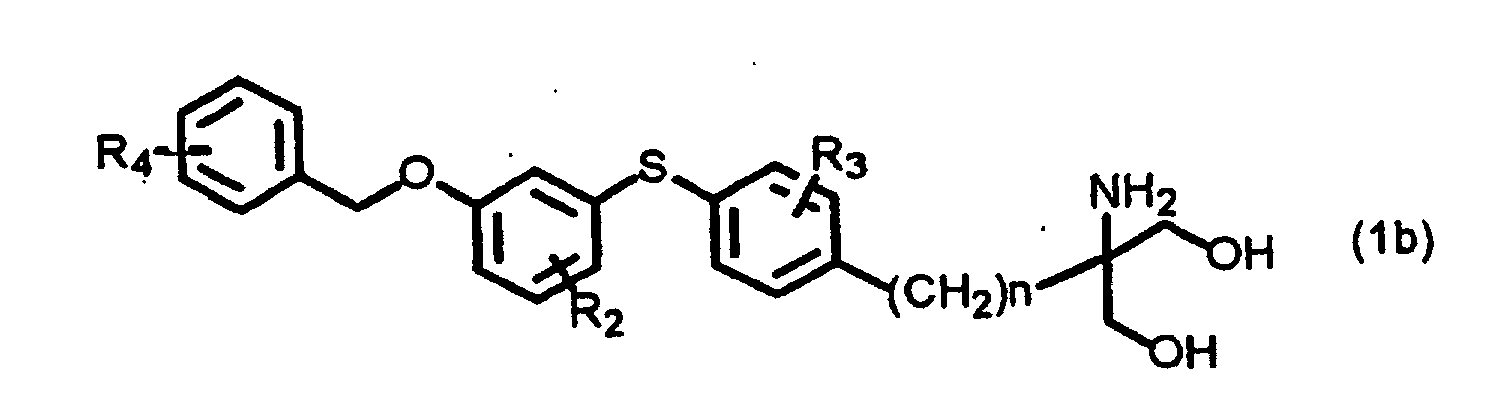
- The compounds of the general formulae (1), (1a), and (1b) are each a novel compound.
- Examples of the pharmaceutically acceptable salt of the compound of the general formula (1) include acid salts, such as hydrochloride, hydrobromide, acetate, trifluoroacetate, methanesulfonate, citrate, and tartrate.
-
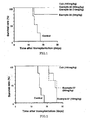
- Fig. 1 is a graph showing activities of a test compound in a mouse skin graft model.
- Fig. 2 is a graph showing activities of a test compound in a mouse skin graft model.
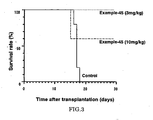
- Fig. 3 is a graph showing activities of a test compound in a mouse skin graft model.
-
- With regard to the general formula (1), the term 'halogen atom' encompasses fluorine, chlorine, bromine, and iodine atom. The term 'trihalomethyl group' encompasses trifluoromethyl and trichloromethyl. The phrase 'lower alkyl group having 1 to 7 carbon atoms' encompasses straight-chained or branched hydrocarbons having 1 to 7 carbon atoms, such as methyl, ethyl, propyl, isopropyl, butyl, t-butyl, pentyl, hexyl, and heptyl. The phrase 'substituted or unsubstituted phenoxy group' encompasses those that have, at any position of its benzene ring, a halogen atom, such as fluorine, chlorine, bromine and iodine, trifluoromethyl, lower alkyl having 1 to 4 carbon atoms, or lower alkoxy having 1 to 4 carbon atoms. The term 'aralkyl group' as in 'aralkyl group' or 'aralkyloxy group' encompasses benzyl, diphenylmethyl, phenethyl, and phenylpropyl. The term 'lower alkyl group' as used in 'lower alokoxy group having 1 to 4 carbon atoms,' 'lower alkylthio group having 1 to 4 carbon atoms,' 'lower alkylsulfinyl group having 1 to 4 carbon atoms,' or 'lower alkylsulfonyl group having 1 to 4 carbon atoms,' encompasses straight-chained or branched hydrocarbons having 1 to 4 carbon atoms, such as methyl, ethyl, propyl, isopropyl, and butyl. The phrase 'substituted or unsubstituted aralkyl group' encompasses those that have, at any position of its benzene ring, a halogen atom, such as fluorine, chlorine, bromine and iodine, trifluoromethyl, lower alkyl having 1 to 4 carbon atoms, or lower alkoxy having 1 to 4 carbon atoms.
- According to the present invention, the compounds of the general formula (1) can be produced in the following pathways:

- The compound involved in the synthetic pathway 1 that is represented by the following general formula (3):(wherein R5 is lower alkyl having 1 to 4 carbon atoms; Boc is t-butoxycarbonyl; and R1, R2, R3, X and n are the same as described above) can be prepared by reacting a compound of the following general formula (2):
 (wherein Y is chlorine, bromine, or iodine; and R1, R2, R3, X and n are as described above) with a compound of the following general formula (5):
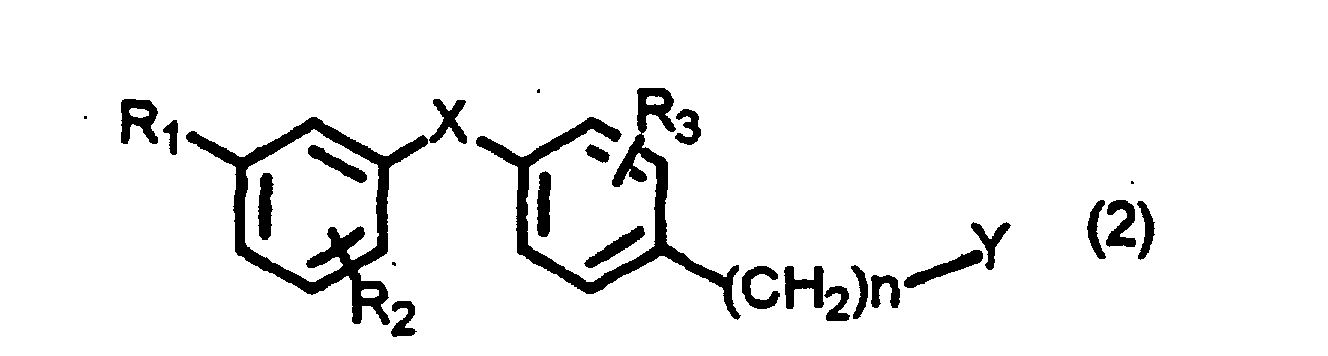 (wherein R5 and Boc are as described above) in the presence of a base (Step 1).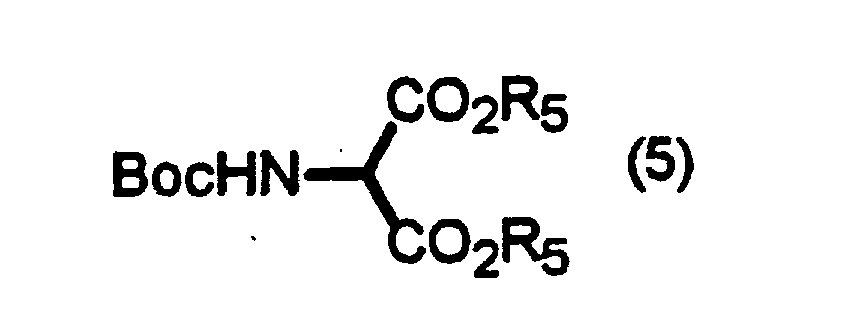
- This reaction can be carried out using a reaction solvent such as methanol, ethanol, 1,4-dioxane, dimethylsulfoxide (DMSO), N,N-dimethylformamide (DMF), or tetrahydrofuran (THF) at a reaction temperature of 0°C to reflux temperature, preferably at a temperature of 80°C to 100°C, in the presence of an inorganic base such as sodium hydride, potassium hydride, sodium alkoxide, and potassium alkoxide.
- The compound involved in the synthetic pathway 1 that is represented by the following general formula (4):(wherein R1, R2, R3, X, Boc, and n are as described above) can be prepared by the reduction of the compound of the general formula (3) (Step 2).

- This reaction can be carried out at a reaction temperature of 0°C to reflux temperature, preferably at room temperature, using an alkylborane derivative, such as borane (BH3) and 9-borabicyclo[3.3.1]nonane (9-BBN), or a metal hydride complex, such as diisobutylaluminum hydride ((iBu)2AlH), sodium borohydride (NaBH4) and lithium aluminum hydride (LiAlH4), preferably lithium borohydride (LiBH4), and using a reaction solvent such as THF, ethanol and methanol.
- The compound involved in the synthetic pathway 1 that is represented by the general formula (1):(wherein R1, R2, R3, X and n are as described above) can be prepared by the acidolysis of the compound of the general formula (4) (Step 3).
- This reaction can be carried out at a reaction temperature in the range of 0°C to room temperature in an inorganic or organic acid, such as acetic acid, hydrochloric acid, hydrobromic acid, methanesulfonic acid and trifluoroacetic acid, or in a mixed solvent with an organic solvent such as methanol, ethanol, THF, 1,4-dioxane, and ethyl acetate.
- Of the compounds of the general formula (3), those in which X is either SO or SO2, namely, those represented by the following general formula (6):(wherein m is an integer of 1 or 2; and R1, R2, R3, R5, Boc, and n are as described above) may also be prepared by the oxidizing a compound represented by the following general formula (7):
 (wherein R1, R2, R3, R5, Boc, and n are as described above).
- This reaction can be carried out using a reaction solvent, such as 1,4-dioxane, DMSO, DMF, THF, methylene chloride or chloroform, along with an oxidizing agent, such as potassium permanganate, m-chloroperbenzoic acid or aqueous hydrogen peroxide, at a reaction temperature of 0°C to reflux temperature, preferably at room temperature.
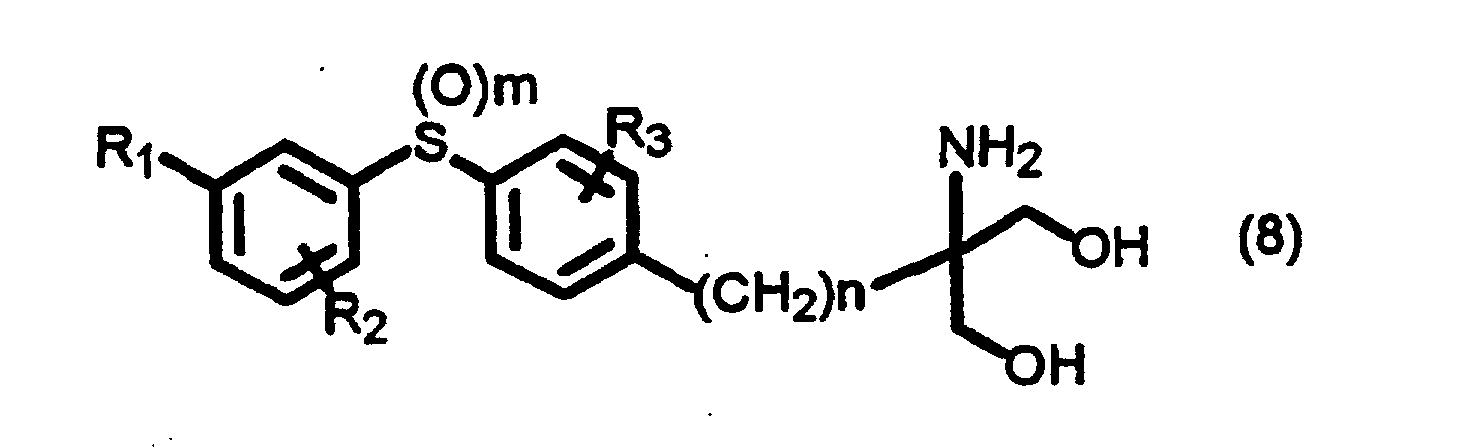
- Of the compounds of the general formula (1), those in which X is either SO or SO2, namely, those represented by the following general formula (8)):(wherein R1, R2, R3, Boc, m, and n are as described above) may also be prepared by the following synthetic pathway:

- Specifically, a compound represented by the following general formula (9):(wherein R1, R2, R3, Boc, and n are as described above) can be reacted either with a compound represented by the following general formula (12):
 (wherein R6 and R7 each independently represent hydrogen or lower alkyl having 1 to 4 carbon atoms), or with a compound represented by the following general formula (13):
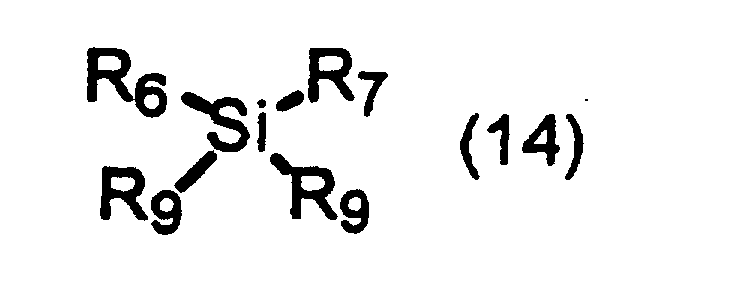
 (wherein R8 is lower alkyl having 1 to 4 carbon atoms; and R6 and R7 are as described above), or with a compound represented by the following general formula (14):
 (wherein R9 is chlorine or trifluoromethanesulfonyloxy; and R6 and R7 are as described above) to produce a compound represented by the following general formula (10):
 (whrein Z is carbon or silicon; and R1, R2, R3, R6, R7, Boc, and n are as described above).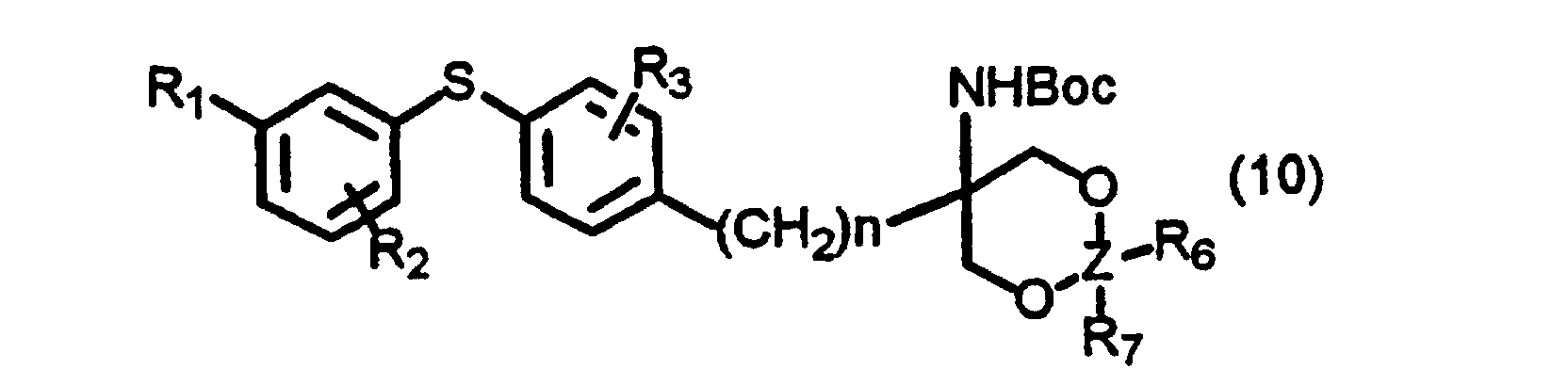
- The reaction between the compound of the general formula (9) and the compound of the general formula (12) or the compound of the general formula (13) can be carried out at a reaction temperature in the range of room temperature to 100°C either in the presence of a Lewis acid such as zinc chloride or in the presence of an acid catalyst such as camphorsulfonic acid, paratoluenesulfonic acid, and pyridinium paratoluenesulfonic acid, and may be carried out either in the absence of solvent or in the presence of a reaction solvent such as DMF, THF, and methylene chloride.
- The reaction between the compound of the general formula (9) and the compound of the general formula (14) can be carried out at a reaction temperature of 0°C to 100°C in the presence of a base, such as triethylamine, pyridine, 2,6-lutidine, and imidazole, and can be carried out using a reaction solvent such as DMF, THF, methylene chloride, chloroform, and acetonitrile.
- The compound involved in the synthetic pathway 2 that is represented by the following general formula (11):(wherein R1, R2, R3, R6, R7, Z, Boc, m and n are as described above) can be prepared by the oxidizing the compound of the general formula (10).

- This reaction can be carried out using a reaction solvent, such as 1,4-dioxane, DMSO, DMF, THF, methylene chloride or chloroform, along with an oxidizing agent, such as potassium permanganate, m-chloroperbenzoic acid or aqueous hydrogen peroxide, at a reaction temperature of 0°C to reflux temperature, preferably at room temperature.
- The compound of the general formula (8) involved in the synthetic pathway 2 can be prepared by the acidolysis, or desilylation followed by acidolysis, of the compound of the general formula (11).
- This reaction can be carried out at a reaction temperature of 0°C to room temperature in an inorganic or organic acid, such as acetic acid, hydrochloric acid, hydrobromic acid, methanesulfonic acid, trifluoroacetic acid, or in a mixed solution with an organic solvent, such as methanol, ethanol, THF, 1,4-dioxane, and ethyl acetate.
- When Z in the general formula (11) is a silicon atom, the compound of the general formula (11) may also be synthesized by a reaction with potassium fluoride, cesium fluoride, or tetrabutylammonium fluoride, carried out at a temperature of 0°C to room temperature in a solvent such as THF, DMF, 1,4-dioxane, followed by the above-described acidolysis.
- The present invention will now be described with reference to examples, which are provided by way of example only and are not intended to limit the scope of the invention in any way.
-

- Potassium carbonate (2.76g) was added to a solution of 2-chloro-4-fluorobenzaldehyde (1.15g) and 3-(trifluoromethyl)thiophenol (1.33g) in DMF (20mL) and the mixture was stirred for 1 hour while heated to 120°C. The reaction mixture was poured into water and was extracted with ethyl acetate. The organic phase was sequentially washed with water and a saturated aqueous solution of sodium chloride and was dried with anhydrous sodium sulfate. The solvent was removed by distillation under reduced pressure and the residue was purified by silica gel column chromatography (hexane: ethyl acetate = 10:1). In this manner, the desired product (1.96g) was obtained as a pale yellow oil.
- Using various thiophenols and aldehydes, the compounds shown in Table 1 below were each synthesized in the same manner as described above.

-
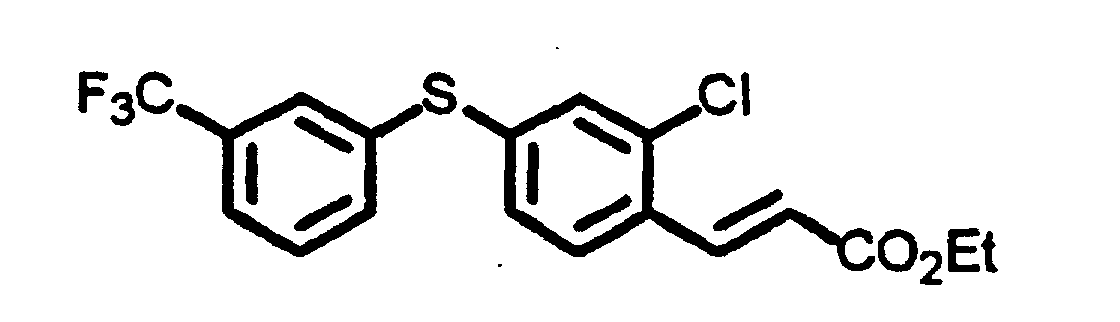
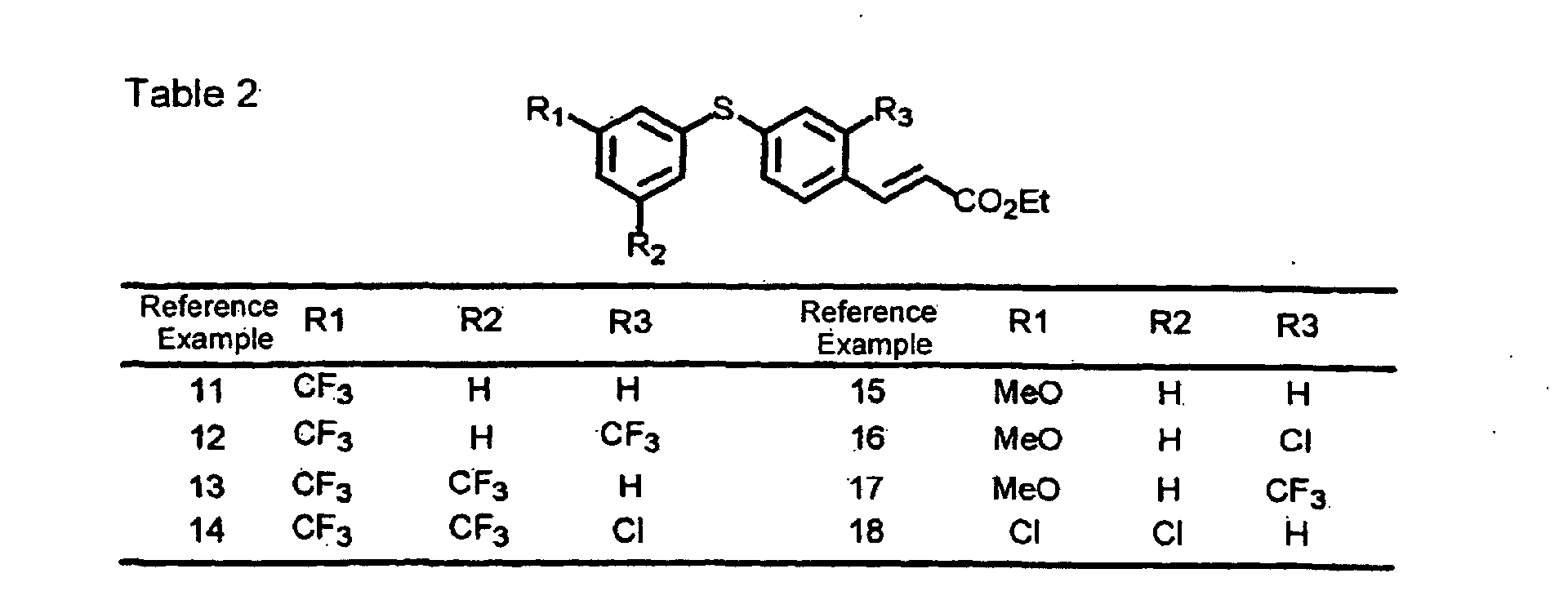
- Under argon, 60% sodium hydride (272mg) was added to a solution of ethyl (diethylphosphono)acetate (1.35mL) in THF (30ml) at 0°C and the mixture was stirred for 30 minutes. A solution of the compound of Reference Example 1 (1.96g) in THF (15mL) was then added dropwise. With the temperature maintained, the mixture was further stirred for 2 hours, followed by addition of water and then extraction with ethyl acetate. The organic phase was sequentially washed with water and a saturated aqueous solution of sodium chloride and was dried with anhydrous sodium sulfate. The solvent was removed by distillation under reduced pressure and the residue was purified by silica gel column chromatography (hexane: ethyl acetate = 10:1). In this manner, the desired product (1.72g) was obtained as a colorless oil.
- Using the compounds of Reference Examples 2 through 9, the compounds shown in Table 2 below were each synthesized in the same manner as described above.
-
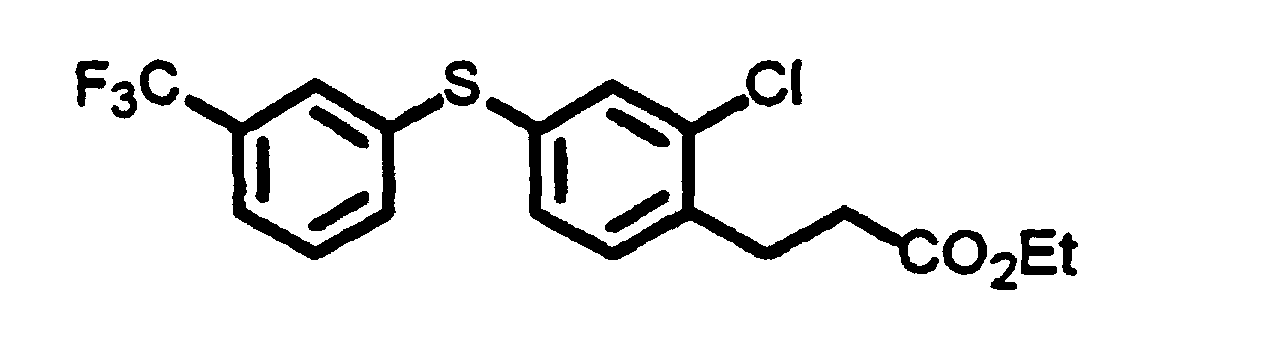
- The compound of Reference Example 10 (1.72g) was dissolved in ethanol (70mL). Bismuth chloride (703mg) was then added to the solution while the solution was stirred at 0°C. To the resulting mixture, sodium borohydride (673mg) was added in small portions, and the mixture was stirred for 1 hour at the same temperature and subsequently for 3 hours at room temperature. Ice water was then added to the reaction mixture and the crystallized inorganic deposits were filtered out through celite. The filtrate was extracted with ethyl acetate. The organic phase was sequentially washed with water and a saturated aqueous solution of sodium chloride and was dried with anhydrous sodium sulfate. The solvent was removed by distillation under reduced pressure. In this manner, the desired product (1.50g) was obtained as a colorless oil.
- Using the compounds of Reference Examples 11, 12, and 14 through 17, the compounds shown in Table 3 below were each synthesized in the same manner as described above.

-
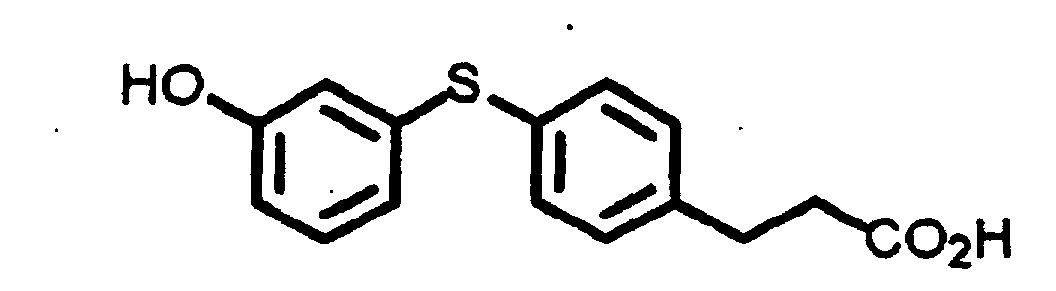
- Under argon, a 1mol/L solution of boron tribromide in methylene chloride (20mL) was added to a solution of the compound of Reference Example 23 (3.20g) in methylene chloride (50mL), and the mixture was stirred for 8 hours until room temperature. Water was then added to the mixture and the mixture was extracted with ethyl acetate. The organic phase was sequentially washed with water, a saturated aqueous solution of sodium bicarbonate, and a saturated aqueous solution of sodium chloride, and was dried with anhydrous sodium sulfate. The solvent was removed by distillation under reduced pressure and the residue was purified by silica gel column chromatography (hexane: ethyl acetate = 2:1). In this manner, the desired product (2.00g) was obtained as a colorless powder.
- Using the compounds of Reference Examples 24 and 25, the compounds shown below were each synthesized in the same manner as in Reference Example 26.

-

- The compound of Reference Example 26 (2.00g) was dissolved in DMF (30mL), and benzyl bromide (2.4mL) and potassium carbonate (2.00g) were added to the solution. The mixture was stirred at 60°C for 2 hours. Water was then added to the mixture and the mixture was extracted with ethyl acetate. The organic phase was sequentially washed with water and a saturated aqueous solution of sodium chloride and was dried with anhydrous sodium sulfate. The solvent was removed by distillation under reduced pressure and the residue was purified by silica gel column chromatography (hexane: ethyl acetate = 5:1). In this manner, the desired product (2.29g) was obtained as a colorless oil.
-

- Using the compound of Reference Example 27, the reaction was carried out in the same manner as in Reference Example 29 to obtain the desired product as a yellow oil.
-
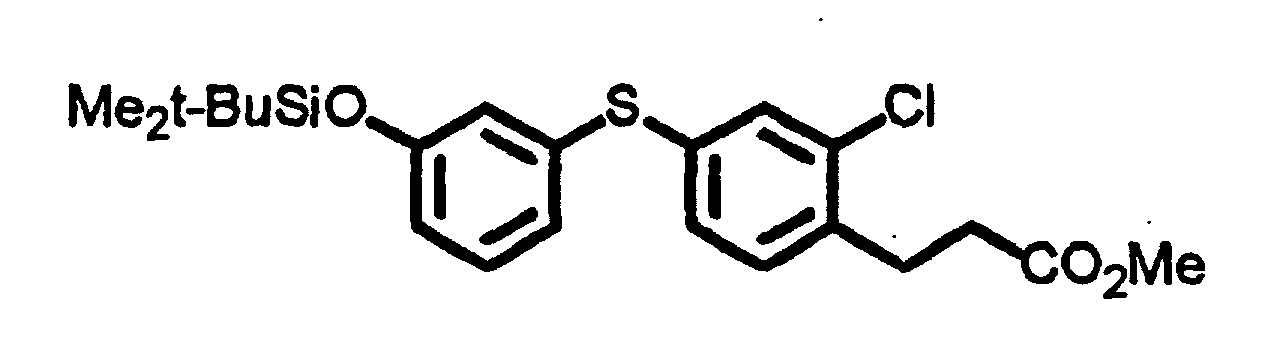
- To a methanol solution (70mL) of the compound of Reference Example 27 (6.20g), thionyl chloride (2.2mL) was added dropwise and the mixture was refluxed for 1 hour. The solvent was removed by distillation under reduced pressure to obtain a methyl ester as a colorless oil (5.80g). The resulting ester (5.80g) was dissolved in DMF (80mL) to form a solution. To this solution, imidazole (1.57g) and t-butyldimethylchlorosilane (3.47g) were added at 0°C and the mixture was stirred for 7 hours until room temperature was reached. Subsequently, water was added to the mixture and the mixture was extracted with ethyl acetate. The organic phase was sequentially washed with water and a saturated aqueous solution of sodium chloride and was dried with anhydrous sodium sulfate. The solvent was removed by distillation under reduced pressure and the residue was purified by silica gel column chromatography (hexane: ethyl acetate = 5:1). In this manner, the desired product (7.26g) was obtained as a colorless oil.
-

- Using ethanol, the compound of Reference Example 28 was subjected to the same process as that of Reference Example 31 to synthesize an ethyl ester, which in turn was subjected to the same process as that of Reference Example 29 to obtain a pale yellow oil.
-

- Under argon, the compound of Reference Example 18 (3.60g) was dissolved in methanol (50mL). Magnesium (500mg) was then added to the solution while the solution was stirred at 10°C. The solution was stirred for another 1 hour at this temperature, followed by addition of magnesium (250mg) and further stirring for 3 hours. Subsequently, diluted hydrochloric acid was added to the reaction mixture and the mixture was extracted with ethyl acetate. The organic phase was sequentially washed with water and a saturated aqueous solution of sodium chloride and was dried with anhydrous sodium sulfate. The solvent was removed by distillation under reduced pressure to obtain the desired product (3.13g) as a pale yellow oil.
-

- Using the compound of Reference Example 13, the reaction was carried out in the same manner as in Reference Example 33 to obtain the desired product as a colorless oil.
-
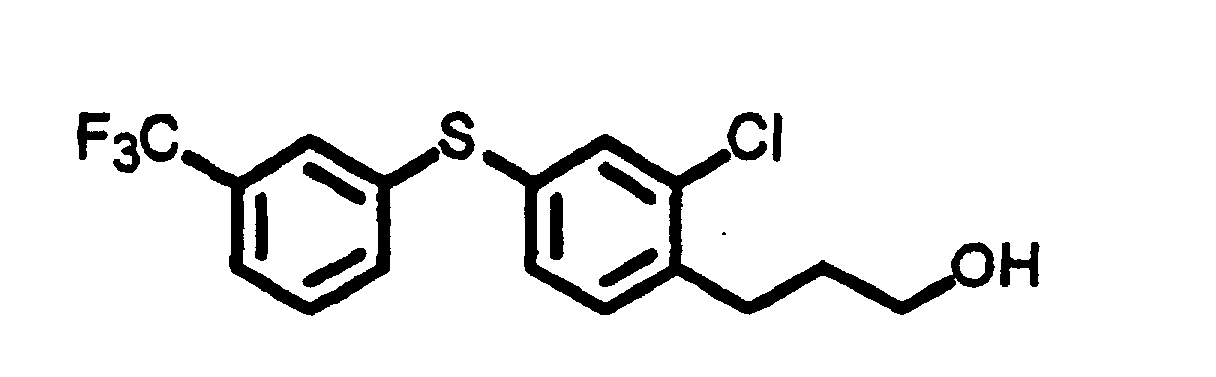
- The compound of Reference Example 19 (1.50g) was dissolved in THF (30mL). Lithium aluminum hydride (200mg) was then added to the solution while the solution was stirred at 0°C. After 30 minutes, a 20% NaOH solution was added and the crystallized inorganic deposits were removed by filtration through celite. The filtrate was extracted with ethyl acetate and the organic phase was sequentially washed with water and a saturated aqueous solution of sodium chloride and was dried with anhydrous sodium sulfate. The solvent was removed by distillation under reduced pressure to obtain the desired product (1.38g) as a colorless oil.
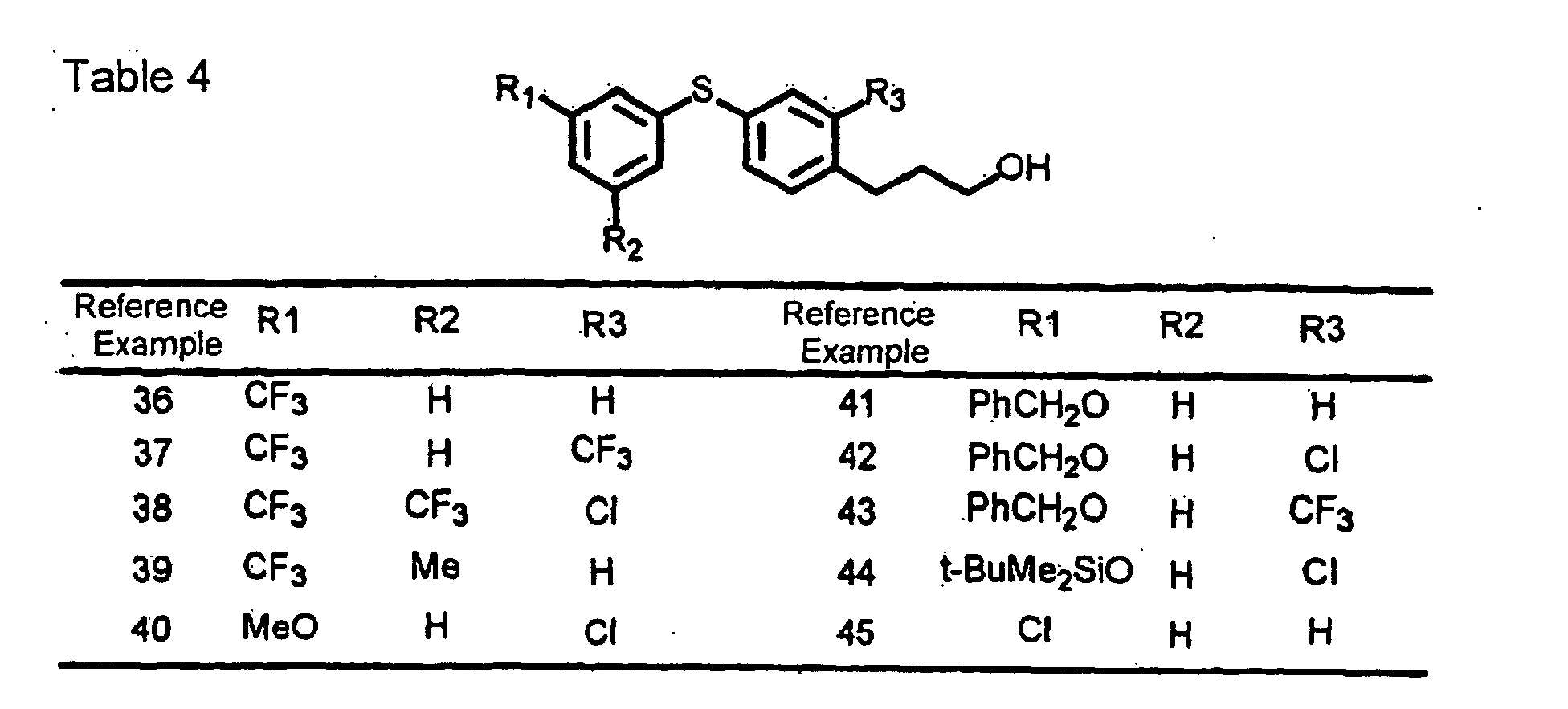
- Using the compounds of Reference Examples 20 through 22, 24, and 29 through 34, the reactions were carried out in the same manner as in Reference Example 35 to synthesize the compounds shown in Table 4 below.
-
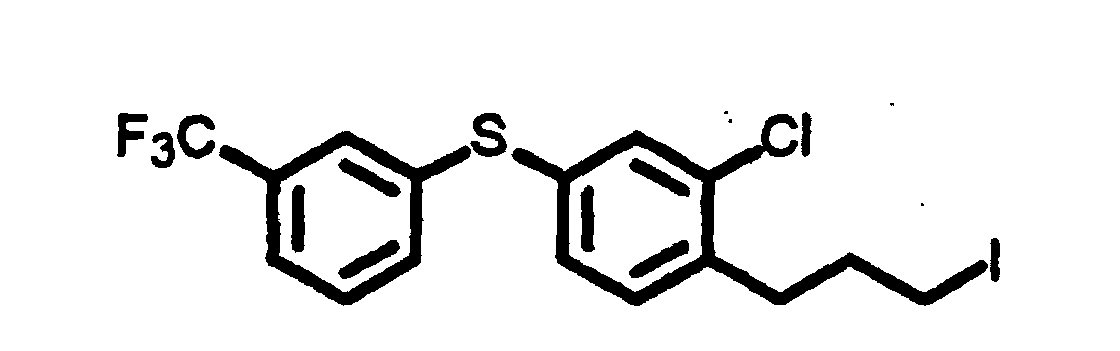
- The compound of Reference Example 35 (1.38g) was dissolved in THF (20mL). Imidazole (545mg), triphenylphosphine (2.10g) and iodine (2.00g) were added to the solution while the solution was stirred at 0°C. The reaction mixture was further stirred for 2 hours at this temperature and another 1.5 hours at room temperature, followed by the addition of imidazole (160mg), triphenylphosphine (600mg) and iodine (500mg). The mixture was subsequently stirred overnight. Water and then sodium thiosulfate were added to the reaction mixture, followed by extraction with ethyl acetate. The organic phase was sequentially washed with water and a saturated aqueous solution of sodium chloride and was dried with anhydrous sodium sulfate. The solvent was removed by distillation under reduced pressure and the residue was purified by silica gel column chromatography (hexane: ethyl acetate = 50:1). In this manner, the desired product (1.55g) was obtained as a colorless oil.
- Using the compounds of Reference Examples 36 through 45, the reactions were carried out in the same manner as in Reference Example 46 to synthesize the compounds shown in Table 5 below.

-
-

- The compound of Reference Example 7 was treated in the same manner as in Reference Example 35 to obtain an alcohol. The alcohol (5.64g) was dissolved in methylene chloride (100mL) and phosphorus tribromide (2.25mL) was added dropwise. The mixture was stirred at room temperature for 1 hour, followed by addition of ice water and extraction with ethyl acetate. The organic phase was sequentially washed with water and a saturated aqueous solution of sodium chloride and was dried with anhydrous sodium sulfate. The solvent was removed by distillation to obtain a pale yellow oil. The oil and potassium cyanide (1.56g) were dissolved in a mixed solvent of DMSO (25mL) and water (10mL) and the solution was stirred at 90°C for 5 hours. Water was then added to the mixture and the mixture was extracted with ethyl acetate. The organic phase was sequentially washed with water and a saturated aqueous solution of sodium chloride and was dried with anhydrous sodium sulfate. The solvent was removed by distillation and the residue was purified by silica gel column chromatography (hexane: ethyl acetate = 10:1). In this manner, the desired cyanide form (3.81g) was obtained as a pale yellow oil.
-

- The above cyanide (3.81g) and potassium hydroxide (3.68g) were dissolved in a mixed solvent of ethanol (80mL) and water (10mL) and the solution was refluxed for 6 hours. The solution was then allowed to cool and the insoluble deposits were removed by filtration. The filtrate was neutralized with diluted hydrochloric acid and was extracted with ethyl acetate. The organic phase was sequentially washed with water and a saturated aqueous solution of sodium chloride and was dried with anhydrous sodium sulfate. The solvent was removed by distillation and ethanol (50mL) and thionyl chloride (2mL) were added to the resulting residue. The mixture was stirred at room temperature for 1 hour and the solvent was removed by distillation. The resulting residue was purified by silica gel column chromatography (hexane: ethyl acetate = 10:1). In this manner, the desired ethyl ester form (3.89g) was obtained as a colorless oil.
-

- The desired ethyl ester was treated in the same manner as in Reference Example 26 and then in the same manner as in Reference Example 57-2 to form an ethyl ester, which in turn was subjected to the same process as that of Reference Example 29 to obtain a benzyl ether.
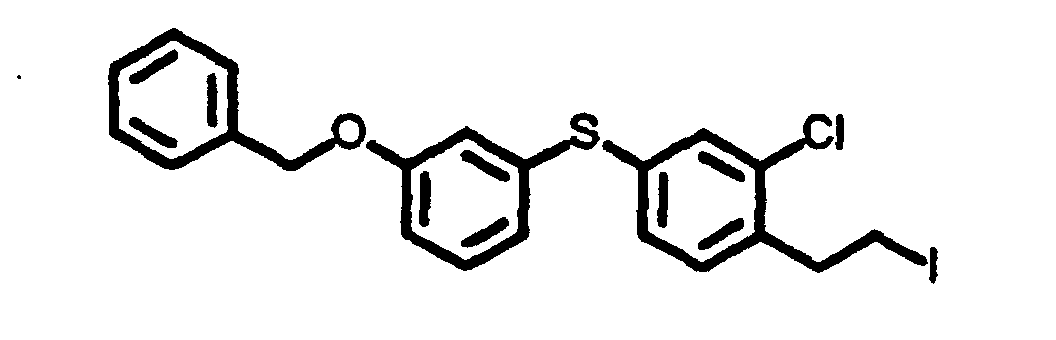
- The compound of Reference Example 57-3 was used as the starting material and was subjected to the same process as that of Reference Example 35 to obtain 4'-(3-benzyloxyphenylthio)-2'-chlorophenethyl alcohol, which in turn was subjected to the same process as that of Reference Example 46 to obtain the desired product as a colorless oil.
-

-

- The compound of Reference Example 57-3 was subjected to alkaline hydrolysis and then to condensation with N,O-dimethylhydroxyamine to form an amid, which in turn was reduced in the same manner as in Reference Example 35 to obtain the aldehyde as a yellow oil.
-
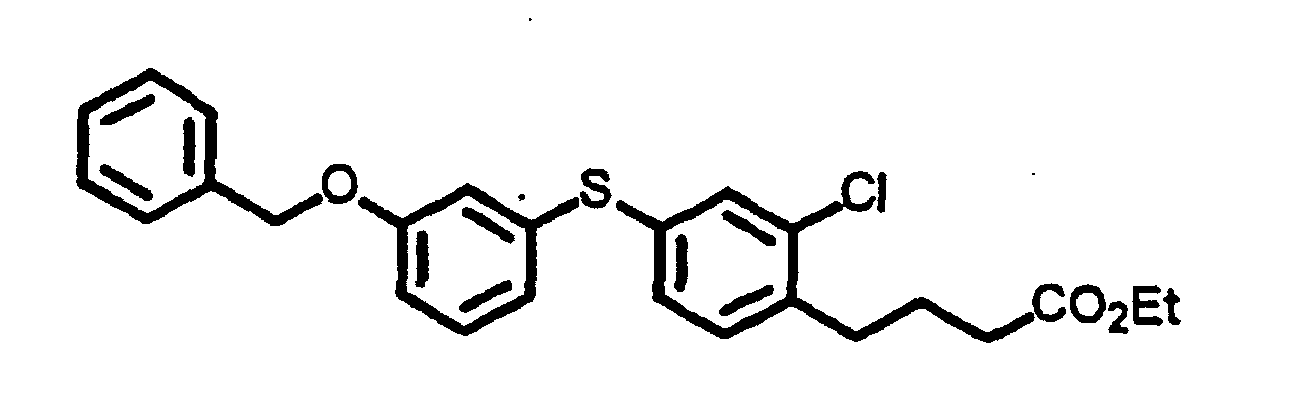
- The compound of Reference Example 58-1 was treated in the same manner as in Reference Example 10 and then in the same manner as in Reference Example 19 to obtain the desired ethyl butyrate derivative.
- The compound of Reference Example 58-2 was used as the starting material and was subjected to the same process as that of Reference Example 57 to obtain the desired product as a colorless oil.
-
-

- 2-chloro-4-fluorobenzonitrile, in place of 2-chloro-4-fluorobenzaldehyde, was used in the same process as that of Reference Example 1 to obtain 2-chloro-4-(3-methoxyphenylthio)benzonitrile, which in turn was hydrolyzed in the same manner as in Reference Example 57-2. Then, in the same fashion as in Reference Example 26, methoxy group was removed from the reaction product and the product was subjected to esterification to obtain the desired product as a yellow oil.
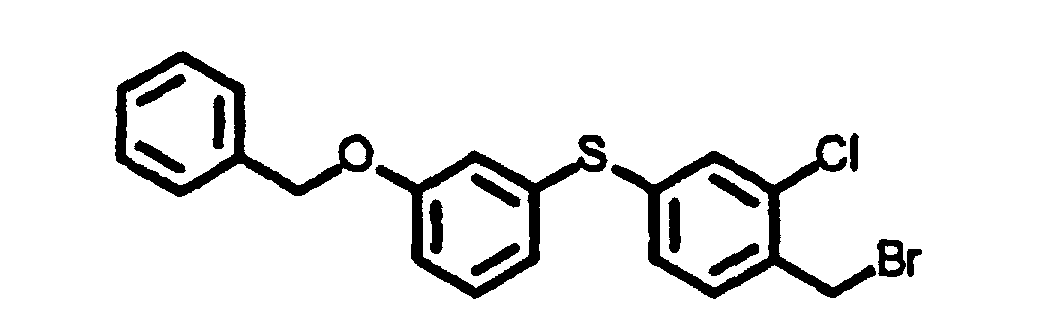
- The compound of Reference Example 59-1 was subjected to the same process as that of Reference Example 29 to obtain a benzyl ether, which in turn was treated in the same manner as in Reference Example 35 to form an alcohol. Subsequently, using carbon tetrabromide in place of iodine, the reaction product was treated in the same manner as in Reference Example 46. In this manner, the desired product was obtained as a colorless oil.
-

- Under argon and at room temperature, sodium-t-butoxide (490mg) was added to diethyl 2-t-butoxycarbonylaminomalonate (1.3mL) dissolved in a mixed solvent of THF (35mL) and DMF (4mL). The mixture was then stirred at 80°C for 20 minutes and was allowed to cool to room temperature. A solution of the compound of Reference Example 46 (1.55g) in THF (5mL) was added to the mixture. Subsequently, the mixture was refluxed for 5 hours and was then poured into ice water. The resulting mixture was extracted with ethyl acetate. The organic phase was sequentially washed with water and a saturated aqueous solution of sodium chloride and was dried with anhydrous sodium sulfate. The solvent was removed by distillation under reduced pressure and the residue was purified by silica gel column chromatography (hexane: ethyl acetate = 5:1). In this manner, the desired product (1.87g) was obtained as a colorless oil.
1H-NMR (400MHz, CDCl3) δ 1.22-1.36(6H, m), 1.42(9H, s), 1.45-1.53(2H, m), 2.37(2H, br), 2.74(2H, t, J=7.8Hz), 4.23(4H, m), 5.94(1H, s), 7.16-7.21(2H, m), 7.36-7.56(5H, m) - Using the compounds of Reference Examples 47 through 58, the reactions were carried out in the same manner as in Example 1 to synthesize the compounds shown in Table 6 below:

-
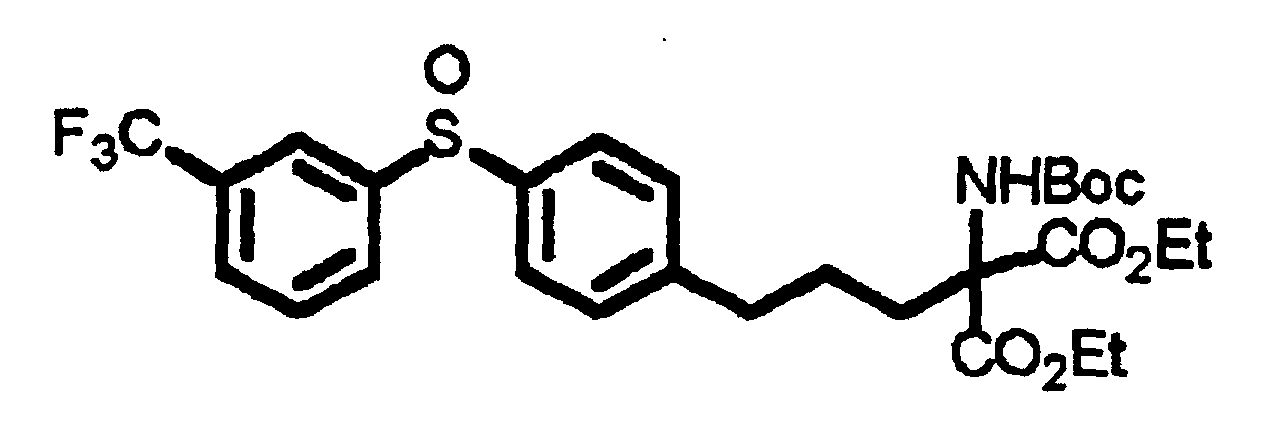
- The compound of Example 2 (1.50g) was dissolved in methylene chloride (80mL) and, while the solution was stirred at 0°C, m-chloroperbenzoic acid (450mg) was added in small portions. The resulting mixture was stirred for 1 hour at the same temperature and then another 2 hours at room temperature, followed by the addition of water. The resulting mixture was extracted with ethyl acetate. The organic phase was sequentially washed with a saturated aqueous solution of sodium bicarbonate and a saturated aqueous solution of sodium chloride and was dried with anhydrous sodium sulfate. The solvent was removed by distillation under reduced pressure and the residue was purified by silica gel column chromatography (hexane: ethyl acetate = 1:1). In this manner, the desired product (1.10g) was obtained as a colorless oil.
1H-NMR(400MHz, CDCl3) δ 1.18-1.21(6H, m), 1.40(9H, s), 1.44-1.52(2H, m), 2.30(2H, br), 2.66(2H, t, J=7.3Hz), 4.14-4.22(4H, m), 5.91(1H, br ), 7.27(2H, d, J=8.3Hz), 7.56(2H, d, J=8.3Hz), 7.59(1H, t, J=8.3Hz), 7.69(1H, d, J=8.3Hz), 7.78(1H, d, J=8.3Hz), 7.95(1H, s) -

- Using the compound of Example 5, the reaction was carried out in the same manner as in Example 14 to obtain the desired product as a colorless oil.
FABMS : 600 ([M+H]+)
1H-NMR(400MHz, CDCl3) δ 1.18-1.22(6H, m), 1.41(9H, s), 1.46-1.50(2H, m), 2.31(2H, br), 2.45(3H, s), 2.66(2H, t, J=7.3Hz), 4.14-4.22(4H, m), 5.92(1H, br s), 7.27(2H, d, J=7.8Hz), 7.48(1H, s), 7.55(2H, d, J=7.8Hz), 7.62(1H, s), 7.70(1H, s) -

- The compound of Example 1 (1.87g) was dissolved in THF (30mL) and lithium borohydride (675mg) was added to the solution while the solution was stirred at 0°C. Subsequently, ethanol (5mL) was added to the solution and the mixture was stirred overnight while allowed to gradually warm to room temperature. Ice water was then added to the reaction mixture and the organic solvent was removed by distillation under reduced pressure. 10% aqueous citric acid was added to the residue to adjust the pH to 3 and the mixture was extracted with ethyl acetate. The organic phase was sequentially washed with water and a saturated aqueous solution of sodium chloride and was dried with anhydrous sodium sulfate. The solvent was removed by distillation under reduced pressure and the residue was purified by silica gel column chromatography (hexane: ethyl acetate = 1:1) to obtain the desired product (1.10g) as a colorless oil.
FABMS : 520 ([M+H]+)
1H-NMR(400MHz, CDCl3) δ 1. 43 (9H, s), 1.62-1.65(4H, m), 2.72(2H,br), 3.31(2.H, br), 3.57-3.62(2H, m), 3.81-3.85(2H, m), 4.93(1H, s), 7.20-7.27(3H, m), 7.38-7.55(4H, m) - Using the compounds of Examples 2 through 15, the reactions were carried out in the same manner as in Example 16 to synthesize the compounds shown in Table 7 below.

-

- At 0°C, di-t-butylsilyl bis(trifluoromethanesulfonate) (0.55mL) was added to a DMF solution (15mL) containing the compound of Example 30 (490mg) and 2,6-lutidine (0.35mL). The mixture was stirred for 5 hours until room temperature and was poured into ice water. The mixture was then extracted with ethyl acetate. The organic phase was sequentially washed with water and a saturated aqueous solution of sodium chloride and was dried with anhydrous sodium sulfate. The solvent was removed by distillation under reduced pressure and the residue was purified by silica gel column chromatography (hexane: ethyl acetate = 8:1) to obtain the desired product (630mg) as a colorless powder.
1H-NMR(400MHz, CDCl3) δ 1.05(9H, s), 1.06(9H, s), 1.43(9H, s),1.57-1.62(4H, m), 2.58(2H, br), 3.89(2H, d, J=10.7Hz), 4.22(2H, d, J=10.7Hz), 4.92(1H, br s), 7.09-7.20(6H, m), 7.34(2H, d, J=8.3Hz) -

- The compound of Example 31 was oxidized in the same manner as in Example 14 to obtain the desired product as a colorless powder.
1H-NMR(400MHz, CDCl3) δ 1.04(9H, s), 1.05(9H, s), 1.41(9H, s), 1.55-1.57(4H, m), 2.63(2H, br), 3.86(2H, d, J=11.2Hz), 4.19(2H, d, J=11.2Hz), 4.92(1H, br), 7.29(2H, d, J=8.3Hz), 7.44(1H, t, J=8.3Hz), 7.50-7.53(1H, m), 7.80-7.85(1H, m), 7.84(2H, d, J=8.3Hz), 7.91-7.92(1H, m) -
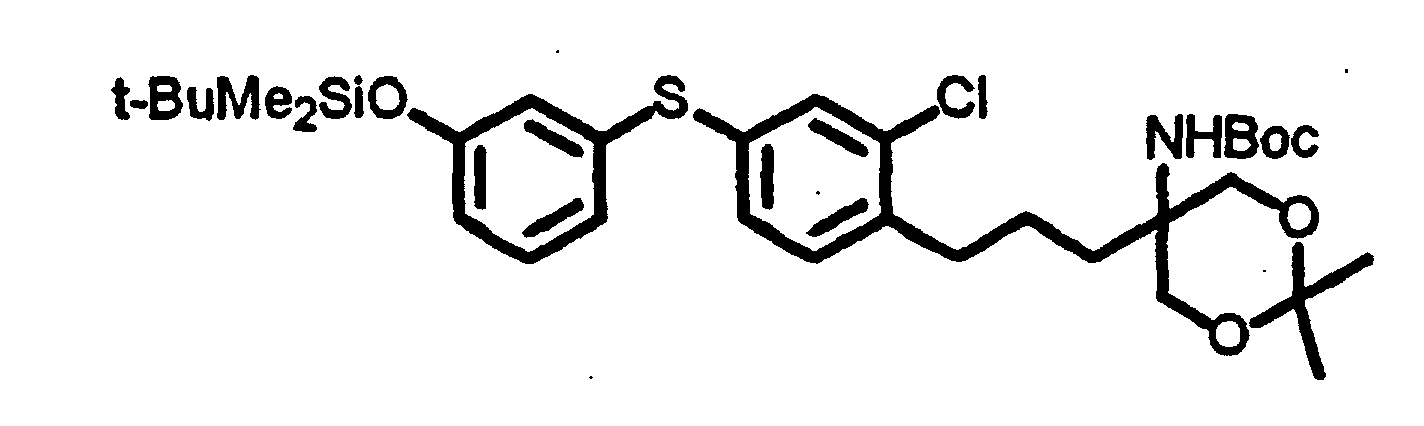
- To a solution of the compound of Example 29 (1.88g) in DMF (30mL), 2,2-dimethoxypropane (2.5mL) along with p-toluenesulfonic acid (100mg) was added and the mixture was stirred for 5 hours while heated at 80°C. The reaction mixture was poured into water and was extracted with ethyl acetate. The organic phase was then sequentially washed with water and a saturated aqueous solution of sodium chloride and was dried with anhydrous sodium sulfate. The solvent was removed by distillation under reduced pressure and the residue was purified by silica gel column chromatography (hexane: ethyl acetate = 3:1) to obtain the desired product (1.11g) as a colorless powder.
-
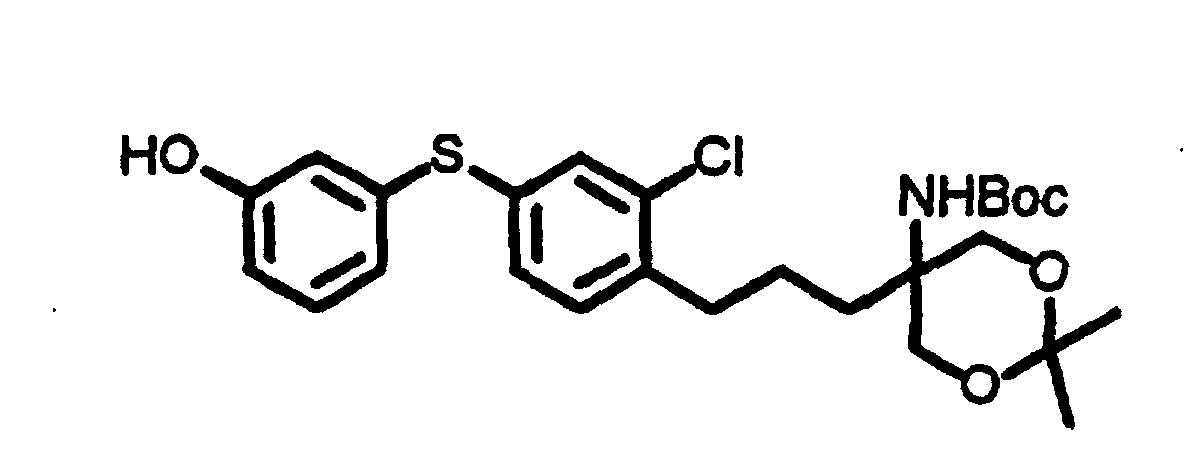
- To a solution of the compound of Example 33 (1.10g) in THF (20mL), a 1mol/L solution of tetrabutylammonium fluoride in THF (5mL) was added. After 10 minutes, the reaction mixture was poured into water and was extracted with ethyl acetate.
The organic phase was sequentially washed with water and a saturated aqueous solution of sodium chloride and was dried with anhydrous sodium sulfate. The solvent was removed by distillation under reduced pressure to obtain the desired product (900mg) as a colorless powder.
1H-NMR(400MHz, CDCl3) δ 1.39(9H, s), 1.40(3H, s), 1.41(3H, s), 1.60(4H, br s), 2.78(2H, br s), 3.64(2H, d, J=11.7Hz), 3.83(2H, d, J=11.7Hz), 4.89(1H,br), 7.27(1H, br), 6.53(1H, br), 6.65(1H, d, J=6.9Hz), 6.85(1H, d,J=8.3Hz), 7.11-7.16(2H, m), 7.26-7.28(1H, m), 7.45(1H, br s) -

- To a solution of the compound of Example 34 (500mg) in DMF (10mL), potassium carbonate (500mg) and m-chlorobenzyl bromide (0.16mL) were added and the mixture was stirred at 70°C for 1 hour. The reaction mixture was then poured into water and was extracted with ethyl acetate. The organic phase was sequentially washed with water and a saturated aqueous solution of sodium chloride and was dried with anhydrous sodium sulfate. The solvent was removed by distillation under reduced pressure and the residue was purified by silica gel column chromatography (hexane: ethyl acetate = 3:1) to obtain the desired product (520mg) as a colorless powder.
1H-NMR(400MHz, CDCl3) δ 1.41(3H, s), 1.42(12H, s), 1.53-1.56(2H, m), 1.76(2H, br), 2.69(2H, t, J=7.8Hz), 3.65(2H, d, J=11.7Hz), 3.88(2H, d, J=11.7Hz), 4.88(1H, br), 4.99(2H, s), 6.86(1H, dd, J=8.3, 2.0Hz), 6.92-6.95(2H, m), 7.11-7.16(2H, m), 7.21-7.32(5H, m), 7.40(1H, s) -

- Ethyl acetate (100mL) containing 3mol/L hydrochloric acid was added to a methanol solution (150mL) of the compound of Example 26 (6.91g) and the mixture was stirred at room temperature for 1 hour. The solvent was removed by distillation under reduced pressure. A mixture of methylene chloride and hexane (methylene chloride:hexane = 1:5) was added to the residue and the resultant crystals were collected by filtration. After drying, the desired product (5.75g) was obtained as a colorless powder.
FABMS: 458([M+H]+)
1H-NMR(400MHz, DMSO-d6) δ 1.57(4H, br s), 2.64(2H, br s), 3.36-3.46(4H, m), 5.09(2H, s), 5.31(2H, t, J=4.9Hz), 6.89(1H, d, J=8.3Hz), 6.95(1H, t, J=2.0Hz), 6.99(1H, dd, J=8.3Hz, 2.0Hz), 7.23(1H, dd, J=7.8Hz, 2.0Hz), 7.29(8H, m), 7.70(3H, br s) Melting point = 132-133°C (EtOH-iPr2O)Elemental analysis (%): C25H28ClNO3S·HCl C H N Calcd. 60.72 5.91 2.83 Found 60.71 5.85 2.91 - Using the compounds of Examples 16 through 24, the reactions were carried out in the same manner as in Example 36 to synthesize the compounds shown in Table 8 below.

-

- Using the compound of Example 25, the reaction was carried out in the same manner as in Example 36 to obtain the desired product.
1H-NMR(400MHz, DMSO-d6) δ 1.75-1.79(2H, m), 2.69-2.73(2H, m), 3.54(2H, s), 5.10(2H, s), 5.40(2H, t, J=4.0Hz), 6.91(1H, dd, J=8.3Hz, 1.8Hz), 6.96(1H, t, J=1.8Hz), 7.00(1H, dd, J=8.3Hz, 1.8Hz), 7.26(1H, dd, J=8.8Hz, 1.8Hz), 7.30-7.42(8H, m), 7.82(3H, br)
FABMS: 444([M+H]+) Melting point = 143-145°C (EtOH-iPr2O)Elemental analysis (%): C24H26ClNO3S·HCl C H N Calcd. 60.00 5.66 2.92 Found 59.88 5.61 2.97 - Using the compounds of Examples 27, 28, 30, 32, and 35, the reactions were carried out in the same manner as in Example 36 to synthesize the compounds shown in Table 9 below.

-

- Using the compound of Reference Example 59, the reaction was carried out in the same manner as in Example 1 to synthesize an ester, which in turn was subjected to the same process as that of Reference Example 16 to be converted to a diol. Subsequently, the diol was treated in the same manner as in Example 35 to obtain the desired product as a yellow oil. 1H-NMR(400MHz, CDCl3) δ 1.43(6H, s), 1.46(9H, s), 3.23(2H, s), 3.83(2H, d, J=11.7Hz), 3.89(2H, d, J=11.7Hz), 4.84(1H, br s), 5.03(2H, s), 6.91(1H, ddd, J=8.3Hz, 2.4Hz, 1.0Hz), 6.95-6.99(2H, m), 7.12(1H, dd, J=8.3Hz, 2.0Hz), 7.22-7.41(8H, m)
-

- The compound of Example 26 was subjected to the reaction in the same manner as in Example 35 and was subsequently oxidized in the same fashion as in Example 14 to obtain the desired product as a colorless powder.
1H-NMR(400MHz, CDCl3) δ 1.40(3H, s), 1.41(12H, s), 1.51-1.56(2H, m), 1.73-1.75(2H, m), 2.72(2H, t, J=7.8Hz), 3.64(2H, d, J=11.7Hz), 3.85(2H, d, J=11.7Hz), 4.87(1H, br s), 5.09(2H, s), 7.05(1H, dd, J=8.3Hz, 2.9Hz), 7.19(1H, d, J=8.3Hz), 7.22-7.42(9H, m), 7.59(1H, d,J=2.9Hz) -

- The compound of Example 53 was oxidized in the same manner as in Example 14 to obtain the desired product as a colorless powder.
1H-NMR(400MHz, CDCl3) δ 1.40(3H, s), 1.41(12H, s), 1.53-1.60(2H, m), 1.73-1.75(2H, m), 2.74(2H, t, J=7.3Hz), 3.64(2H, d, J=11.7Hz), 3.84(2H, d, J=11.7Hz), 4.87(1H, br s), 5.10(2H, s), 7.15(1H, dd, J=7.8Hz, 1.5Hz), 7.31-7.53(9H, m), 7.69(1H, dd, J =7.8Hz, 2Hz), 7.86(1H, d, J=1.5Hz) - Using the compounds of Examples 52 through 54, the reactions were carried out in the same manner as in Example 36 to synthesize the compounds shown in Table 10 below.

- The following experiments were conducted to prove the effectiveness of the compounds of the present invention.
- This experiment was performed according to the method described in Transplantation, 55, No.3 (1993): 578-591. Spleens were collected from 9 to 11 week old male BALB/c mice (CLEA JAPAN Inc., CHARLES RIVER JAPAN Inc., or JAPAN SLC Inc.). The spleens were placed in a phosphate-buffered saline (PBS(-), NISSUI PHARMACEUTICAL Co., Ltd.) or in an RPMI-1640 medium (GIBCO INDUSTRIES Inc., or IWAKI GLASS Co., Ltd.) and were either passed through a stainless steel mesh, or gently pressed between two slide glasses and then passed through a cell strainer (70µm, Falcon), to form a cell suspension. The suspension was then centrifuged and the supernatant was discarded. An ammonium chloride-Tris isotonic buffer was added to the suspension to lyse erythrocytes. The cells were then centrifuged and washed three times in PBS (-) or RPMI-1640 medium and were resuspended in an RPMI-1640 medium. To this suspension, mitomycin C (KYOWA HAKKO KOGYO Co., Ltd.) was added to a final concentration of 25µg/mL and the suspension was incubated for 30 minutes at 37°C in a 5% CO2 atmosphere. The cells were again centrifuged and washed in PBS (-) or RPMI-1640 medium and were resuspended in an RPMI-1640 medium so that the medium would contain 2.5 X 10⁸ cells/mL. This suspension served as a "stimulation cell suspension." Using a 27G needle along with a microsyringe (Hamilton), 20µL (5
X 106 cells/mouse) of the stimulation cell suspension was subcutaneously injected into the right hind footpad of 7 to 9 week old male C3H/HeN mice (CLEA JAPAN Inc., CHARLES RIVER JAPAN Inc., or JAPAN SLC Inc.). A group of mice was injected with RPMI-1640 medium alone to serve as normal control. 4 days after the injection, right popliteal lymph nodes were collected and were weighed on a Mettler AT201 electronic scale (METTLER TOLEDO Co., Ltd.). Each animal was intraperitoneally administered a test compound once a day for four consecutive days starting on the day of the injection of the stimulation cells (i.e., total of 4 times). Controls were administered a vehicle that has the same composition as that used in the preparation of the test compounds. The results are shown in Table 11 below:Example No. Dose (mg/kg) Inhibition (%) Example No. .Dose (mg/kg) Inhibition (%) 36 0.03 85 45 0.3 101 37 10 92 46 0.3 80 38 10 56 47 0.3 87 39 0.3 83 48 0.3 48 41 3 89 49 0.3 63 42 10 76 51 10 50 43 10 64 - This experiment was performed according to the method described in Methods in Enzymology, 300 (1999): 345-363. 1-fluoro-2,4-dinitrobenzene (DNFB, NACALAI TESQUE Inc.) was dissolved in a mixture of acetone and olive oil (acetone: olive oil = 4:1) to a concentration of 1% (v/v). 10µL of the 1% DNFB solution was applied to the footpad of each hind leg of male BALB/c mice (JAPAN SLC Inc. or CHARLES RIVER JAPAN Inc.) for sensitization. The sensitization was done for 2 consecutive days (
day 0 and day 1). On day 5, the mice were challenged with the antigen to induce delayed-type hypersensitive responses: First, the initial thickness of each ear was measured by the dial thickness gauge G (0.01-10mm, OZAKI MFG Co., Ltd.) and a test compound was administered. 30 minutes after the administration, 10µL of a 0.2% (v/v) DNFB solution was applied to the inner and outer surfaces of the right ear of each animal for antigen challenge. The left ear of each animal was challenged with the solvent alone. 24 hours after the challenge, the increase in the ear thickness was measured for each ear and the difference in thickness between the right and the left ears was determined for each individual. The test compound was dissolved, or suspended, in an ultra pure water and was orally administered at a dose of 0.1mL/10g of body weight. A control group was administered ultra pure water alone. The results are shown in Table 12 below:Example No. Dose (mg/kg) Inhibition (%) 36 1 86 37 30 87 39 3 55 49 30 81 - Effects of the test compounds were examined on skin transplantation model in mice. The experimental procedure was referred to the method described in Journal of Experimental Biology , 28, No.3 (1951); 385-405.
- First, dorsal skin from male DBA/2 mice were stripped of the fatty layer and the panniculus carnosus and, cut into circular grafts with a diameter of 8mm. Next, graft bed, a circular area, approximately 8mm in diameter, was prepared in the back of anesthetized male BALB/c mice with a scalpel while the skin was pinched by forceps. Each graft obtained from the DBA/2 mice was placed on the graft bed formed in the backs of the BALB/c mice and was secured with a strip of adhesive bandage while held down from the top. 6 days after transplantation, the bandage was removed and the graft was subsequently observed everyday. The activity of each compound was evaluated based on the length of the graft survival period, which is defined as the number of days for rejection. Each test compound was dissolved in ultra pure water and was orally administered once a day, starting from the day of transplantation. In a similar fashion, the control group was administered ultra pure water alone.
- The results are shown in Figs. 1 through 3.
- As can be seen from the results, the compounds of the present invention represented by the general formula (1) have proven effective in animal model.
- As set forth, the present invention has been devised in recognition of the fact that the novel diaryl sulfide derivatives, in particular those in which one of the aryl groups includes, at its para-position, a carbon chain with an aminopropanediol group and the other of the aryl groups includes a substituent at its meta-position, exhibit strong immunosuppressive effects. Effective immunosuppressors, the compounds of the present invention have a strong potential as a prophylactic or therapeutic agent against rejection in organ or bone marrow transplantation, autoimmune diseases, rheumatoid arthritis, psoriasis, atopic dermatitis, bronchial asthma, pollinosis and various other diseases.
Claims (16)
- A diaryl sulfide derivative, a pharmaceutically acceptable salt or hydrate thereof, the diaryl sulfide derivative represented by the following general formula (1):wherein R1 is halogen, trihalomethyl, hydroxy, lower alkyl having 1 to 7 carbon atoms, phenyl, aralkyl, lower alkoxy having 1 to 4 carbon atoms, trifluoromethyloxy, substituted or unsubstituted phenoxy, cyclohexylmethyloxy, substituted or unsubstituted aralkyloxy, pyridylmethyloxy, cinnamyloxy, naphthylmethyloxy, phenoxymethyl, hydroxymethyl, hydroxyethyl, lower alkylthio having 1 to 4 carbon atoms, lower alkylsulfinyl having 1 to 4 carbon atoms, lower alkylsulfonyl having 1 to 4 carbon atoms, benzylthio, acetyl, nitro, or cyano; R2 is hydrogen, halogen, trihalomethyl, lower alkoxy having 1 to 4 carbon atoms, lower alkyl having 1 to 7 carbon atoms, phenethyl, or benzyloxy; R3 is hydrogen, halogen, trifluoromethyl, lower alkoxy having 1 to 4 carbon atoms, hydroxy, benzyloxy, lower alkyl having 1 to 7 carbon atoms, phenyl, or lower alkoxymethyl having 1 to 4 carbon atoms; X is S, SO, or SO2; and n is an integer from 1 to 4).

- The diaryl sulfide derivative, pharmaceutically acceptable salt and hydrate thereof according to claim 1, wherein the compound of the general formula (1) is a compound represented by the following general formula (1a):wherein R2, R3, and n are the same as defined above.

- The diaryl sulfide derivative, pharmaceutically acceptable salt and hydrate thereof according to claim 2, wherein R3 is chlorine.
- The diaryl sulfide derivative, pharmaceutically acceptable salt and hydrate thereof according to claim 2, wherein R3 is trifluoromethyl.
- The diaryl sulfide derivative, pharmaceutically acceptable salt and hydrate thereof according to claim 1, wherein the compound of the general formula (1) is a compound represented by the following general formula (1b):wherein R2, R3, and n are the same as defined above; and R4 is hydrogen, halogen, lower alkyl having 1 to 7 carbon atoms, lower alkoxy having 1 to 4 carbon atoms, or trifluoromethyl.

- The diaryl sulfide derivative, pharmaceutically acceptable salt and hydrate thereof according to claim 5, wherein R3 is chlorine.
- The diaryl sulfide derivative, pharmaceutically acceptable salt and hydrate thereof according to claim 5, wherein R3 is trifluoromethyl.
- The diaryl ether derivative, pharmaceutically acceptable salt and hydrate thereof according to claim 1, wherein the compound of the general formula (1) is 1) 2-amino-2-[4-(3-benzyloxyphenylthio)-2-chlorophenyl]propyl-1,3-propanediol; 2) 2-amino-2-[4-(3-benzyloxyphenylthio)phenyl]propyl-1,3-propanediol; 3) 2-amino-2-[4-(3-benzyloxyphenylthio)-2-chlorophenyl]ethyl-1,3-propanediol; 4) 2-amino-2-[4-(3-benzyloxyphenylthio)-2-chlorophenyl]butyl-1,3-propanediol; 5) 2-amino-2-[4-(3-(3'-chlorobenzyloxy)phenylthio)-2-chlorophenyl]propyl-1,3-propanediol; 6) 2-amino-2-[4-(3-benzyloxyphenylthio)-2-trifluoromethylphenyl]propyl-1,3-propanediol; 7) 2-amino-2-[4-(3,5-bistrifluoromethyl-2-chlorophenylthio)phenyl]propyl-1,3-propanediol; 8) 2-amino-2-[4-(3-trifluoromethylphenylthio)phenyl]propyl-1,3-propanediol; 9) 2-amino-2-[2-chloro-4-(3-trifluoromethylphenylthio)phenyl]propyl-1,3-propanediol; or 10) 2-amino-2-[2-trifluoromethyl-4-(3-trifluoromethylphenylthio)phenyl]propyl-1,3-propanediol.
- An immunosuppressive agent containing as an active ingredient at least one of a diaryl sulfide derivative, a pharmaceutically acceptable salt and a hydrate thereof, the diaryl sulfide derivative represented by the following general formula (1):wherein R1 is halogen, trihalomethyl, hydroxy, lower alkyl having 1 to 7 carbon atoms, substituted or unsubstituted phenyl, aralkyl, lower alkoxy having 1 to 4 carbon atoms, trifluoromethyloxy, phenoxy, cyclohexylmethyloxy, substituted or unsubstituted aralkyloxy, pyridylmethyloxy, cinnamyloxy, naphthylmethyloxy, phenoxymethyl, hydroxymethyl, hydroxyethyl, lower alkylthio having 1 to 4 carbon atoms, lower alkylsulfinyl having 1 to 4 carbon atoms, lower alkylsulfonyl having 1 to 4 carbon atoms, benzylthio, acetyl, nitro, or cyano; R2 is hydrogen, halogen, trihalomethyl, lower alkoxy having 1 to 4 carbon atoms, lower alkyl having 1 to 7 carbon atoms, phenethyl, or benzyloxy; R3 is hydrogen, halogen, trifluoromethyl, lower alkoxy having 1 to 4 carbon atoms, hydroxy, benzyloxy, lower alkyl having 1 to 7 carbon atoms, phenyl, or lower alkoxymethyl having 1 to 4 carbon atoms; and X is S, SO, or SO2; and n is an integer from 1 to 4.

- The immunosuppressive agent according to claim 9, containing as an active ingredient at least one of a diaryl sulfide derivative, a pharmaceutically acceptable salt and a hydrate thereof, wherein the compound of the general formula (1) is a compound represented by the following general formula (1a):wherein R2, R3, and n are the same as defined above.
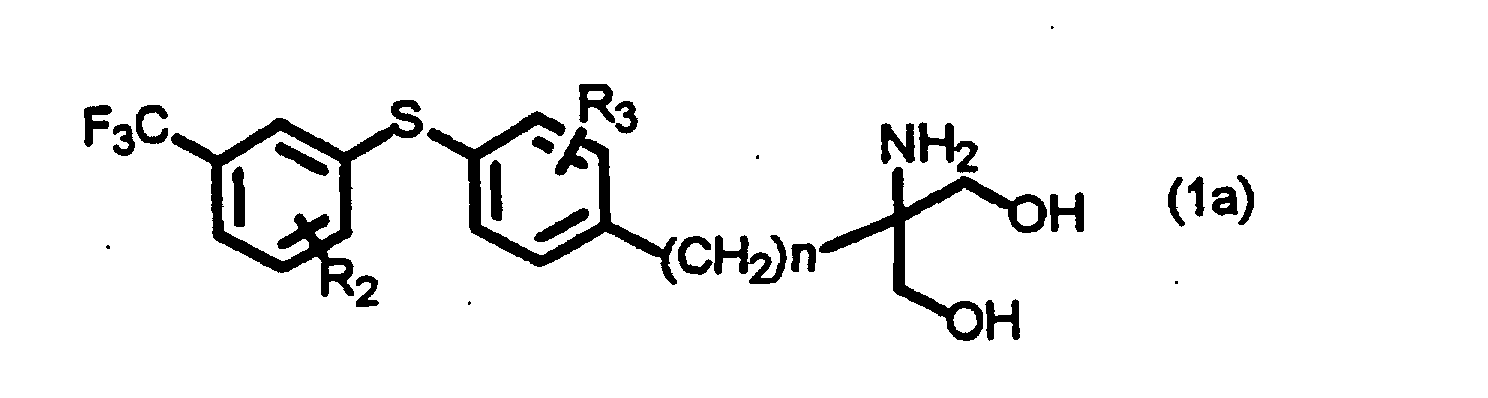
- The immunosuppressive agent according to claim 9, containing as an active ingredient at least one of a diaryl sulfide derivative, a pharmaceutically acceptable salt and a hydrate thereof, wherein the compound of the general formula (1) is a compound represented by the following general formula (1b):wherein R2, R3, and n are the same as defined above; and R4 is hydrogen, halogen, lower alkyl having 1 to 7 carbon atoms, lower alkoxy having 1 to 4 carbon atoms, or trifluoromethyl.
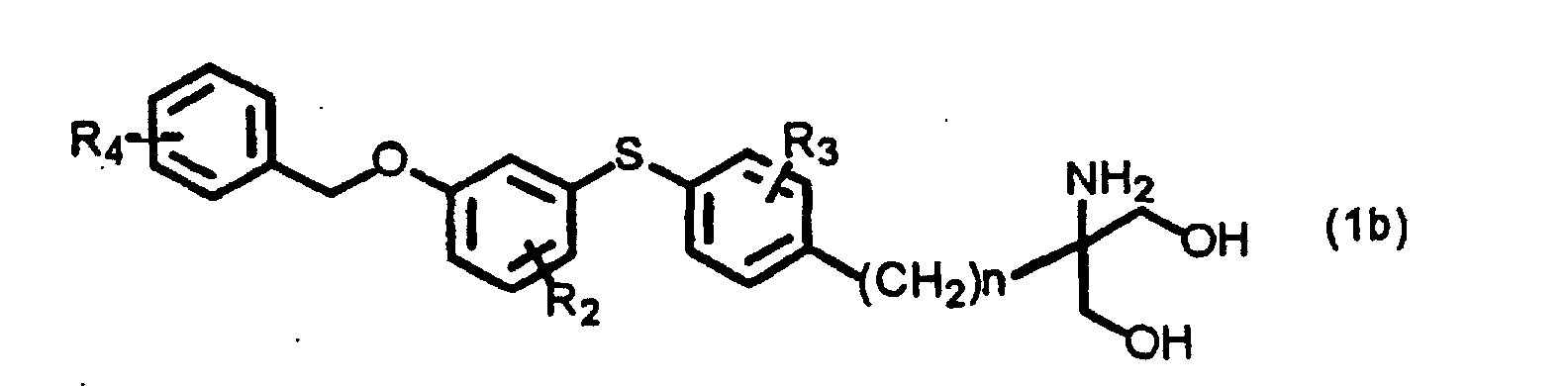
- The immunosuppressive agent according to any one of claims 9 to 11, serving as a prophylactic or therapeutic agent against autoimmune diseases.
- The immunosuppressive agent according to any one of claims 9 to 11, serving as a prophylactic or therapeutic agent against rheumatoid arthritis.
- The immunosuppressive agent according to any one of claims 9 to 11, serving as a prophylactic or therapeutic agent against psoriasis or atopic dermatitis.
- The immunosuppressive agent according to any one of claims 9 to 11, serving as a prophylactic or therapeutic agent against bronchial asthma or pollinosis.
- The immunosuppressive agent according to any one of claims 9 to 11, serving as a prophylactic or therapeutic agent against rejection in organ or bone marrow transplantation.
Priority Applications (1)
| Application Number | Priority Date | Filing Date | Title |
|---|---|---|---|
| CY20081100086T CY1107272T1 (en) | 2001-09-27 | 2008-01-25 | PRODUCT OF DIARYL SULFIDE, SALT ADD THESE AND IMMUNOSTABLE |
Applications Claiming Priority (5)
| Application Number | Priority Date | Filing Date | Title |
|---|---|---|---|
| JP2001297411 | 2001-09-27 | ||
| JP2001297411 | 2001-09-27 | ||
| JP2002216192 | 2002-07-25 | ||
| JP2002216192 | 2002-07-25 | ||
| PCT/JP2002/009865 WO2003029205A1 (en) | 2001-09-27 | 2002-09-25 | Diaryl sulfide derivative, addition salt thereof, and immunosuppressant |
Publications (3)
| Publication Number | Publication Date |
|---|---|
| EP1431284A1 true EP1431284A1 (en) | 2004-06-23 |
| EP1431284A4 EP1431284A4 (en) | 2006-03-01 |
| EP1431284B1 EP1431284B1 (en) | 2007-11-21 |
Family
ID=26623111
Family Applications (1)
| Application Number | Title | Priority Date | Filing Date |
|---|---|---|---|
| EP02768057A Expired - Lifetime EP1431284B1 (en) | 2001-09-27 | 2002-09-25 | Diaryl sulfide derivative, addition salt thereof, and immunosuppressant |
Country Status (15)
| Country | Link |
|---|---|
| US (1) | US6960692B2 (en) |
| EP (1) | EP1431284B1 (en) |
| JP (2) | JP4217620B2 (en) |
| KR (1) | KR100913269B1 (en) |
| CN (1) | CN1329372C (en) |
| AU (1) | AU2002332289B2 (en) |
| BR (1) | BRPI0212894B8 (en) |
| CA (1) | CA2461212C (en) |
| CY (1) | CY1107272T1 (en) |
| DE (1) | DE60223699T2 (en) |
| DK (1) | DK1431284T3 (en) |
| ES (1) | ES2292809T3 (en) |
| MX (1) | MXPA04002679A (en) |
| PT (1) | PT1431284E (en) |
| WO (1) | WO2003029205A1 (en) |
Cited By (22)
| Publication number | Priority date | Publication date | Assignee | Title |
|---|---|---|---|---|
| WO2005105146A1 (en) * | 2004-05-03 | 2005-11-10 | Novartis Ag | Combinations comprising a s1p receptor agonist and a jak3 kinase inhibitor |
| US7199150B2 (en) | 2002-01-11 | 2007-04-03 | Sankyo Company, Limited | Amino alcohol compounds |
| WO2007028821A3 (en) * | 2005-09-09 | 2007-05-03 | Novartis Ag | Treatment of autoimmune diseases |
| EP1772145A4 (en) * | 2004-07-16 | 2009-07-08 | Kyorin Seiyaku Kk | METHOD FOR EFFECTIVE USE OF A MEDICAMENT AND METHOD FOR PREVENTING SIDE EFFECTS |
| US7645779B2 (en) | 2001-09-14 | 2010-01-12 | Amgen Inc. | Linked biaryl compounds |
| WO2010020609A1 (en) * | 2008-08-18 | 2010-02-25 | Novartis Ag | Amino alcohol derivatives for the treatment of demyelinating peripheral neuropathies |
| EP1982708A4 (en) * | 2006-02-06 | 2010-03-17 | Kyorin Seiyaku Kk | THERAPEUTIC AGENT FOR INFLAMMATORY ABDOMINAL DISEASE WHICH INCLUDES A 2-AMINO-1,3-PROPANEDIOL DERIVATIVE AS ACTIVE INGREDIENT AND METHOD FOR THE TREATMENT OF INFLAMMATORY ABDOMINAL DISEASE |
| EP1932522A4 (en) * | 2005-10-07 | 2010-07-07 | Kyorin Seiyaku Kk | THERAPEUTIC AGENT FOR LIVER DISEASE CONTAINING 2-AMINO-1,3-PROPANEDIOL DERIVATIVE AS AN ACTIVE INGREDIENT AND ASSOCIATED THERAPEUTIC METHOD FOR LIVER DISEASE |
| US7910617B2 (en) | 2004-02-24 | 2011-03-22 | Sankyo Company, Limited | Method for suppressing the number of peripheral blood lymphocytes using an amino alcohol compound |
| EP1944026A3 (en) * | 2002-05-16 | 2011-06-01 | Novartis AG | Use of EDG receptor binding agents in cancer |
| WO2011138393A1 (en) * | 2010-05-06 | 2011-11-10 | Novartis Ag | Treatment of autoimmune diseases |
| WO2011138398A1 (en) * | 2010-05-06 | 2011-11-10 | Novartis Ag | Dosage regimen of diaryl sulfide derivatives |
| EP2168944A4 (en) * | 2007-06-14 | 2011-11-30 | Mitsubishi Tanabe Pharma Corp | AMINO COMPOUND AND ITS PHARMACEUTICAL USE |
| US8071300B2 (en) | 2006-08-04 | 2011-12-06 | Daiichi Sankyo Company, Limited | Drug-phosphorylating enzyme |
| US8114902B2 (en) | 2006-04-28 | 2012-02-14 | Mitsubishi Tanabe Pharma Corporation | 2-aminobutanol compound and use thereof for medical purposes |
| WO2012015758A3 (en) * | 2010-07-30 | 2012-03-22 | Saint Louis University | Methods of treating pain |
| RU2458044C2 (en) * | 2006-08-08 | 2012-08-10 | Киорин Фармасьютикал Ко., Лтд. | Amino alcohol and immunodepressant containing it as active ingredient |
| RU2478384C2 (en) * | 2004-11-29 | 2013-04-10 | Новартис Аг | Course of treatment with application of receptor s1p agonist |
| US8476305B2 (en) | 2008-02-07 | 2013-07-02 | Kyorin Pharmaceutical Co., Ltd. | Therapeutic agent or prophylactic agent for inflammatory bowel disease comprising amino alcohol derivative as active ingredient |
| US9415024B2 (en) | 2003-10-15 | 2016-08-16 | Novartis Ag | Aminoalkanol derivatives |
| US9657043B2 (en) | 2012-04-23 | 2017-05-23 | Mitsubishi Tanabe Pharma Corporation | Amine compound and use thereof for medical purposes |
| US10251867B2 (en) | 2008-03-17 | 2019-04-09 | Actelion Pharmaceuticals Ltd. | Dosing regimen for a selective S1P1 receptor agonist |
Families Citing this family (55)
| Publication number | Priority date | Publication date | Assignee | Title |
|---|---|---|---|---|
| AU2003264430B2 (en) * | 2002-09-19 | 2009-03-19 | Kyorin Pharmaceutical Co., Ltd. | Amino alcohol derivative, addition salt thereof, and immunosuppressant |
| MXPA05003254A (en) | 2002-09-24 | 2005-06-08 | Novartis Ag | Sphingosine-1-phosphate receptor agonists in the treatment of demyelinating disorders. |
| DE202004021680U1 (en) | 2003-04-08 | 2010-04-22 | Novartis Ag | Solid pharmaceutical composition |
| ATE547395T1 (en) * | 2003-04-30 | 2012-03-15 | Novartis Pharma Gmbh | AMINOPROPANOL DERIVATIVES AS MODULATORS OF THE SPHINGOSINE-1 PHOSPHATE RECEPTOR |
| GB0320638D0 (en) | 2003-09-03 | 2003-10-01 | Novartis Ag | Organic compounds |
| GB0329498D0 (en) | 2003-12-19 | 2004-01-28 | Novartis Ag | Organic compounds |
| GB0500020D0 (en) | 2005-01-04 | 2005-02-09 | Novartis Ag | Organic compounds |
| JP2007186422A (en) * | 2004-01-28 | 2007-07-26 | Astellas Pharma Inc | Aryl sulfide derivatives |
| TW200611687A (en) * | 2004-07-29 | 2006-04-16 | Sankyo Co | Pharmaceutical compositions used for immunosuppressant |
| PT1773307E (en) * | 2004-07-30 | 2015-01-14 | Novartis Ag | Compound formulations of 2-amino-1,3-propanediol compounds |
| AU2005272619A1 (en) | 2004-08-13 | 2006-02-23 | Praecis Pharmaceuticals, Inc. | Methods and compositions for modulating sphingosine-1-phosphate (SIP) receptor activity |
| US20060223866A1 (en) * | 2004-08-13 | 2006-10-05 | Praecis Pharmaceuticals, Inc. | Methods and compositions for modulating sphingosine-1-phosphate (S1P) receptor activity |
| AU2005292984B2 (en) * | 2004-10-12 | 2011-01-20 | Kyorin Pharmaceutical Co., Ltd. | Process for producing 2-amino-2-[2-[4-(3-benzyloxyphenylthio)-2-chlorophenyl]ethyl]-1,3-propanediol hydrochloride or hydrate thereof and intermediate for the same |
| GB0504544D0 (en) | 2005-03-04 | 2005-04-13 | Novartis Ag | Organic compounds |
| TWI418350B (en) * | 2005-06-24 | 2013-12-11 | Sankyo Co | Use of pharmaceutical compositions comprising ppar modulator |
| GT200600350A (en) * | 2005-08-09 | 2007-03-28 | LIQUID FORMULATIONS | |
| JP5044919B2 (en) * | 2005-10-07 | 2012-10-10 | Jnc株式会社 | Compound having alkyl group in benzene ring, liquid crystal composition containing this compound, and liquid crystal display device containing this liquid crystal composition |
| CA2643680A1 (en) | 2006-04-11 | 2007-11-22 | Novartis Ag | Hcv/hiv inhibitors and their uses |
| US8232319B2 (en) | 2006-08-08 | 2012-07-31 | Kyorin Pharmaceutical Co., Ltd. | Amino phosphate derivative and S1P receptor modulator having same as an active ingredient |
| CA2684953C (en) | 2007-05-04 | 2016-08-09 | Novartis Ag | Use of s1p receptor modulator |
| PT2465492E (en) | 2007-10-12 | 2015-10-15 | Novartis Ag | Compositions comprising sphingosine i phosphate (sip) receptor modulators |
| CN106366027A (en) | 2008-03-24 | 2017-02-01 | 杏林制药株式会社 | Method for crystallization of 2-amino-2-[2-[4-(3- benzyloxyphenylthio)-2-chlorophenyl]ethyl]-1,3-propanediol hydrochloride |
| CA2724450A1 (en) * | 2008-05-19 | 2009-11-26 | Takeshi Tsubuki | Method for producing optically active aminoalcohol derivative |
| EP2305305A4 (en) * | 2008-05-20 | 2013-02-13 | Kyorin Seiyaku Kk | INDUCTION / MAINTENANCE TRANSMITTER |
| HRP20161133T1 (en) | 2008-07-23 | 2016-12-02 | Arena Pharmaceuticals, Inc. | DERIVATIVES OF SUBSTITUTED 1,2,3,4-TETRAHYDROCYCLOPENT [b] INDOL-3-IL-ACETIC ACIDS USED IN THE TREATMENT OF AUTOIMMUNE AND INFLAMMATORY DISORDERS |
| CN105816453B (en) | 2008-08-27 | 2021-03-05 | 艾尼纳制药公司 | Substituted tricyclic acid derivatives as S1P1 receptor agonists for the treatment of autoimmune and inflammatory disorders |
| US20110182850A1 (en) | 2009-04-10 | 2011-07-28 | Trixi Brandl | Organic compounds and their uses |
| US8512690B2 (en) | 2009-04-10 | 2013-08-20 | Novartis Ag | Derivatised proline containing peptide compounds as protease inhibitors |
| PT2452944E (en) | 2009-07-09 | 2014-10-13 | Kyorin Seiyaku Kk | Diphenyl sulfide derivatives and medicines containing them as active ingredient |
| CA2786994C (en) | 2010-01-27 | 2018-01-16 | Arena Pharmaceuticals, Inc. | Processes for the preparation of (r)-2-(7-(4-cyclopentyl-3-(trifluoromethyl)benzyloxy)-1,2,3,4-tetrahydrocyclopenta[b]indol-3-yl)acetic acid and salts thereof |
| CN105503882B (en) | 2010-03-03 | 2019-07-05 | 艾尼纳制药公司 | The method for preparing S1P1 receptor modulators and its crystal form |
| EP2624826B1 (en) | 2010-10-08 | 2018-07-18 | Novartis AG | Vitamin e formulations of sulfamide ns3 inhibitors |
| WO2012073249A1 (en) | 2010-12-01 | 2012-06-07 | Arch Pharmalabs Limited | A novel process for the preparation of 3-(benzyloxy)- benzenethiol, a key intermediate for the preparation of pharmaceutical drugs. |
| TWI519539B (en) | 2010-12-21 | 2016-02-01 | Kyorin Seiyaku Kk | Diphenyl sulfide derivatives and pharmaceuticals as an active ingredient |
| CN102120720B (en) * | 2011-01-25 | 2013-05-22 | 上海华升生物科技有限公司 | Novel synthesis method of fingolimod hydrochloride |
| CN102863345A (en) * | 2011-07-06 | 2013-01-09 | 中国医学科学院药物研究所 | Amino propylene glycol derivative, preparation method of amino propylene glycol derivative, medicine composition of amino propylene glycol derivative and application of amino propylene glycol derivative |
| ES2665312T3 (en) * | 2012-04-18 | 2018-04-25 | Kyorin Pharmaceutical Co., Ltd. | 4- (3-benzyloxyphenylthio) -2-chloro-1- (3-nitropropyl) benzene crystal |
| CN103113270A (en) * | 2012-11-26 | 2013-05-22 | 盛世泰科生物医药技术(苏州)有限公司 | Synthesis method of 4-(3-benzyloxy-phenylsulfanyl)-2-chloro-vinylbenzene |
| PL2958624T3 (en) * | 2013-02-20 | 2021-10-04 | Priothera Limited | Treatment of graft versus host disease in transplant patients |
| JP6294872B2 (en) | 2013-04-26 | 2018-03-14 | 国立大学法人京都大学 | Pharmaceutical composition for inhibiting or reducing the formation and / or increase of cerebral aneurysms |
| AU2016205361C1 (en) | 2015-01-06 | 2021-04-08 | Arena Pharmaceuticals, Inc. | Methods of treating conditions related to the S1P1 receptor |
| PL3310760T3 (en) | 2015-06-22 | 2023-03-06 | Arena Pharmaceuticals, Inc. | Crystalline l-arginine salt of (r)-2-(7-(4-cyclopentyl-3-(trifluoromethyl)benzyloxy)-1,2,3,4-tetrahydrocyclo-penta[b]indol-3-yl)acetic acid for use in s1p1 receptor-associated disorders |
| JP2020507610A (en) | 2017-02-16 | 2020-03-12 | アリーナ ファーマシューティカルズ, インコーポレイテッド | Compounds and methods for the treatment of inflammatory bowel disease with parenteral symptoms |
| KR20190116416A (en) | 2017-02-16 | 2019-10-14 | 아레나 파마슈티칼스, 인크. | Compounds and Methods for Treating Primary Bile Cholangitis |
| AU2019280822A1 (en) | 2018-06-06 | 2021-01-07 | Arena Pharmaceuticals, Inc. | Methods of treating conditions related to the S1P1 receptor |
| CN112512516A (en) | 2018-07-27 | 2021-03-16 | 普瑞奥治疗有限公司 | Active agent for inhibiting recurrence of hematologic malignancy in patient who has undergone hematopoietic stem cell transplantation |
| EP3847158A1 (en) | 2018-09-06 | 2021-07-14 | Arena Pharmaceuticals, Inc. | Compounds useful in the treatment of autoimmune and inflammatory disorders |
| TW202131921A (en) | 2019-10-31 | 2021-09-01 | 瑞士商愛杜西亞製藥有限公司 | Combination of a cxcr7 antagonist with an s1p1 receptor modulator |
| KR20230136603A (en) | 2021-01-28 | 2023-09-26 | 프리오테라 에스에이에스 | Treatment methods using S1P receptor modulators |
| WO2022162409A1 (en) | 2021-01-28 | 2022-08-04 | Priothera Sas | Methods of treatment with s1p receptor modulators |
| TW202341971A (en) | 2022-02-16 | 2023-11-01 | 法商普萊歐塞拉公司 | Methods of treatment with car cells in combination with s1p receptor modulators |
| EP4282407A1 (en) | 2022-05-27 | 2023-11-29 | Priothera SAS | Treatment of cancer with s1p receptor agonists |
| WO2025083549A1 (en) | 2023-10-16 | 2025-04-24 | Sun Pharma Advanced Research Company Limited | Methods and combinations of inhibitors of il-23 pathway and modulators of s1p signaling pathway for the treatment of autoimmune disorders |
| WO2025109119A1 (en) | 2023-11-22 | 2025-05-30 | Priothera Sas | Methods of treatment with multispecific antigen-binding proteins in combination with s1p receptor modulators |
| CN118388360B (en) * | 2024-04-17 | 2025-04-04 | 北京悦康科创医药科技股份有限公司 | Long-acting spleen-targeted cationic lipid compound containing benzene ring structure, composition containing same and use thereof |
Family Cites Families (4)
| Publication number | Priority date | Publication date | Assignee | Title |
|---|---|---|---|---|
| US5284971A (en) * | 1992-07-16 | 1994-02-08 | Syntex (U.S.A.) Inc. | 4-(3-cyclohexyl-4-hydroxy or-methoxy phenylsulfonyl) 3,5 dibromo phenyl acetic thyromimetic cholesterol-lowering agents |
| EP0627406B1 (en) * | 1992-10-21 | 1998-10-28 | Yoshitomi Pharmaceutical Industries, Ltd. | 2-amino-1,3-propanediol compound and immunosuppressant |
| CA2286315C (en) * | 1997-04-04 | 2007-03-06 | Yoshitomi Pharmaceutical Industries Ltd. | 2-aminopropane-1,3-diol compound, pharmaceutical use thereof and synthetic intermediates therefor |
| ATE463478T1 (en) * | 2001-09-27 | 2010-04-15 | Kyorin Seiyaku Kk | DIARYL ETHER DERIVATIVE, ITS ADDITION SALT AND IMMUNOSUPPRESSANT |
-
2002
- 2002-09-25 AU AU2002332289A patent/AU2002332289B2/en not_active Ceased
- 2002-09-25 KR KR1020047004284A patent/KR100913269B1/en not_active Expired - Fee Related
- 2002-09-25 US US10/489,820 patent/US6960692B2/en not_active Expired - Lifetime
- 2002-09-25 CN CNB028190629A patent/CN1329372C/en not_active Expired - Fee Related
- 2002-09-25 EP EP02768057A patent/EP1431284B1/en not_active Expired - Lifetime
- 2002-09-25 CA CA2461212A patent/CA2461212C/en not_active Expired - Lifetime
- 2002-09-25 MX MXPA04002679A patent/MXPA04002679A/en active IP Right Grant
- 2002-09-25 DK DK02768057T patent/DK1431284T3/en active
- 2002-09-25 WO PCT/JP2002/009865 patent/WO2003029205A1/en not_active Ceased
- 2002-09-25 DE DE60223699T patent/DE60223699T2/en not_active Expired - Lifetime
- 2002-09-25 JP JP2003532456A patent/JP4217620B2/en not_active Expired - Fee Related
- 2002-09-25 ES ES02768057T patent/ES2292809T3/en not_active Expired - Lifetime
- 2002-09-25 BR BRPI0212894A patent/BRPI0212894B8/en not_active IP Right Cessation
- 2002-09-25 PT PT02768057T patent/PT1431284E/en unknown
-
2008
- 2008-01-25 CY CY20081100086T patent/CY1107272T1/en unknown
- 2008-10-10 JP JP2008264592A patent/JP4917589B2/en not_active Expired - Fee Related
Non-Patent Citations (2)
| Title |
|---|
| No further relevant documents disclosed * |
| See also references of WO03029205A1 * |
Cited By (52)
| Publication number | Priority date | Publication date | Assignee | Title |
|---|---|---|---|---|
| US7645779B2 (en) | 2001-09-14 | 2010-01-12 | Amgen Inc. | Linked biaryl compounds |
| EP1435946B1 (en) * | 2001-09-14 | 2013-11-06 | Amgen Inc. | Linked biaryl compounds |
| US8067396B2 (en) | 2002-01-11 | 2011-11-29 | Sankyo Company, Limited | Amino alcohol compounds or phosphonic acid derivatives thereof |
| US7199150B2 (en) | 2002-01-11 | 2007-04-03 | Sankyo Company, Limited | Amino alcohol compounds |
| US8101650B2 (en) | 2002-01-11 | 2012-01-24 | Daiichi Sankyo Company, Limited | Method for treating a immunology-related disease |
| US7638551B2 (en) | 2002-01-11 | 2009-12-29 | Sankyo Company, Limited | Amino alcohol compounds or phosphonic acid derivatives thereof |
| EP1944026A3 (en) * | 2002-05-16 | 2011-06-01 | Novartis AG | Use of EDG receptor binding agents in cancer |
| US9415024B2 (en) | 2003-10-15 | 2016-08-16 | Novartis Ag | Aminoalkanol derivatives |
| US7910617B2 (en) | 2004-02-24 | 2011-03-22 | Sankyo Company, Limited | Method for suppressing the number of peripheral blood lymphocytes using an amino alcohol compound |
| WO2005105146A1 (en) * | 2004-05-03 | 2005-11-10 | Novartis Ag | Combinations comprising a s1p receptor agonist and a jak3 kinase inhibitor |
| CN101905023B (en) * | 2004-07-16 | 2012-07-11 | 杏林制药株式会社 | Method of effectively using medicine and method concerning prevention of side effect |
| CN101014329B (en) * | 2004-07-16 | 2010-09-08 | 杏林制药株式会社 | Pharmaceutical composition for prevention or treatment of rejection of organ or tissue transplantation or graft-versus-host reaction of bone marrow transplantation |
| RU2396982C2 (en) * | 2004-07-16 | 2010-08-20 | Киорин Фармасьютикал Ко., Лтд. | Effective method of using drugs and method for prevention of by-effects intensity |
| CN101884781B (en) * | 2004-07-16 | 2012-07-18 | 杏林制药株式会社 | Pharmaceutical composition for preventing or treating rejection reaction of organ or tissue transplantation or graft versus host reaction of bone marrow transplantation |
| EP1772145A4 (en) * | 2004-07-16 | 2009-07-08 | Kyorin Seiyaku Kk | METHOD FOR EFFECTIVE USE OF A MEDICAMENT AND METHOD FOR PREVENTING SIDE EFFECTS |
| RU2478384C2 (en) * | 2004-11-29 | 2013-04-10 | Новартис Аг | Course of treatment with application of receptor s1p agonist |
| RU2493840C2 (en) * | 2005-09-09 | 2013-09-27 | Новартис Аг | Treating autoimmune diseases |
| WO2007028821A3 (en) * | 2005-09-09 | 2007-05-03 | Novartis Ag | Treatment of autoimmune diseases |
| AU2006289100B2 (en) * | 2005-09-09 | 2010-07-22 | Novartis Ag | Treatment of autoimmune diseases |
| RU2424795C2 (en) * | 2005-09-09 | 2011-07-27 | Новартис Аг | Treatment of autoimmune diseases |
| EP2295049A1 (en) * | 2005-09-09 | 2011-03-16 | Novartis AG | Treatment of autoimmune diseases |
| EP1932522A4 (en) * | 2005-10-07 | 2010-07-07 | Kyorin Seiyaku Kk | THERAPEUTIC AGENT FOR LIVER DISEASE CONTAINING 2-AMINO-1,3-PROPANEDIOL DERIVATIVE AS AN ACTIVE INGREDIENT AND ASSOCIATED THERAPEUTIC METHOD FOR LIVER DISEASE |
| AU2006300485B2 (en) * | 2005-10-07 | 2011-08-25 | Kyorin Pharmaceutical Co., Ltd. | Therapeutic agent for liver disease containing 2-amino-1,3-propanediol derivative as active ingredient and therapeutic method for liver disease |
| CN101277687B (en) * | 2005-10-07 | 2012-07-18 | 杏林制药株式会社 | Therapeutic agent for liver disease containing 2-amino-1,3-propanediol derivative as active ingredient and therapeutic method for liver disease |
| RU2421214C2 (en) * | 2005-10-07 | 2011-06-20 | Киорин Фармасьютикал Ко., Лтд. | Therapeutic agent for treating hepatitis, and method of treating hepatitis |
| EP2520291A1 (en) * | 2006-02-06 | 2012-11-07 | Kyorin Pharmaceutical Co., Ltd. | Therapeutic agent for inflammatory bowel disease containing as active ingredient 2-amino-1,3-propanediol derivative, or method for treating inflammatory bowel disease |
| EP1982708A4 (en) * | 2006-02-06 | 2010-03-17 | Kyorin Seiyaku Kk | THERAPEUTIC AGENT FOR INFLAMMATORY ABDOMINAL DISEASE WHICH INCLUDES A 2-AMINO-1,3-PROPANEDIOL DERIVATIVE AS ACTIVE INGREDIENT AND METHOD FOR THE TREATMENT OF INFLAMMATORY ABDOMINAL DISEASE |
| RU2428976C2 (en) * | 2006-02-06 | 2011-09-20 | Киорин Фармасьютикал Ко., Лтд. | Therapeutic medication for inflammatory intestinal diseases which contains derivative of 2-amino-1,3-propandiol as active ingredient, or method of treating inflammatory intestinal diseases |
| HRP20080421B1 (en) * | 2006-02-06 | 2015-07-17 | Kyorin Pharmaceutical Co., Ltd. | Therapeutic agent for inflammatory bowel disease comprising 2-amino-1,3-propanaediol derivative as active ingredient, and method for treatment of inflammatory bowel disease |
| US8114902B2 (en) | 2006-04-28 | 2012-02-14 | Mitsubishi Tanabe Pharma Corporation | 2-aminobutanol compound and use thereof for medical purposes |
| US8071300B2 (en) | 2006-08-04 | 2011-12-06 | Daiichi Sankyo Company, Limited | Drug-phosphorylating enzyme |
| RU2458044C2 (en) * | 2006-08-08 | 2012-08-10 | Киорин Фармасьютикал Ко., Лтд. | Amino alcohol and immunodepressant containing it as active ingredient |
| US8129361B2 (en) | 2007-06-14 | 2012-03-06 | Mitsubishi Tanabe Pharma Corporation | Amine compound and pharmaceutical use thereof |
| EP2168944A4 (en) * | 2007-06-14 | 2011-11-30 | Mitsubishi Tanabe Pharma Corp | AMINO COMPOUND AND ITS PHARMACEUTICAL USE |
| US8476305B2 (en) | 2008-02-07 | 2013-07-02 | Kyorin Pharmaceutical Co., Ltd. | Therapeutic agent or prophylactic agent for inflammatory bowel disease comprising amino alcohol derivative as active ingredient |
| US10251867B2 (en) | 2008-03-17 | 2019-04-09 | Actelion Pharmaceuticals Ltd. | Dosing regimen for a selective S1P1 receptor agonist |
| US10660880B2 (en) | 2008-03-17 | 2020-05-26 | Actelion Pharmaceuticals Ltd | Dosing regimen for a selective S1P1 agonist |
| AU2009284224B2 (en) * | 2008-08-18 | 2013-02-28 | Novartis Ag | Amino alcohol derivatives for the treatment of demyelinating peripheral neuropathies |
| WO2010020609A1 (en) * | 2008-08-18 | 2010-02-25 | Novartis Ag | Amino alcohol derivatives for the treatment of demyelinating peripheral neuropathies |
| EA019808B1 (en) * | 2008-08-18 | 2014-06-30 | Новартис Аг | Amino alcohol derivatives for the treatment of demyelinating peripheral neuropathies |
| CN104892474A (en) * | 2008-08-18 | 2015-09-09 | 诺华股份有限公司 | Amino alcohol derivatives for the treatment of demyelinating peripheral neuropathies |
| US20170119702A1 (en) * | 2010-05-06 | 2017-05-04 | Novartis Ag | Dosage Regimen of Diaryl Sulfide Derivatives |
| AU2011249784B2 (en) * | 2010-05-06 | 2014-03-06 | Novartis Ag | Treatment of autoimmune diseases |
| WO2011138393A1 (en) * | 2010-05-06 | 2011-11-10 | Novartis Ag | Treatment of autoimmune diseases |
| WO2011138398A1 (en) * | 2010-05-06 | 2011-11-10 | Novartis Ag | Dosage regimen of diaryl sulfide derivatives |
| AU2011249789B2 (en) * | 2010-05-06 | 2015-03-19 | Novartis Ag | Dosage regimen of diaryl sulfide derivatives |
| US20130210924A1 (en) * | 2010-05-06 | 2013-08-15 | Novartis Ag | Dosage Regimen of Diaryl Sulfide Derivatives |
| US8747844B2 (en) | 2010-07-30 | 2014-06-10 | Saint Louis University | Methods of treating pain |
| WO2012015758A3 (en) * | 2010-07-30 | 2012-03-22 | Saint Louis University | Methods of treating pain |
| US8945549B2 (en) | 2010-07-30 | 2015-02-03 | Saint Louis University | Methods of treating antinociceptive tolerance |
| JP2013533286A (en) * | 2010-07-30 | 2013-08-22 | セントルイス ユニバーシティ | How to treat pain |
| US9657043B2 (en) | 2012-04-23 | 2017-05-23 | Mitsubishi Tanabe Pharma Corporation | Amine compound and use thereof for medical purposes |
Also Published As
| Publication number | Publication date |
|---|---|
| EP1431284B1 (en) | 2007-11-21 |
| JPWO2003029205A1 (en) | 2005-01-13 |
| KR20040037107A (en) | 2004-05-04 |
| CA2461212C (en) | 2010-08-17 |
| CN1329372C (en) | 2007-08-01 |
| MXPA04002679A (en) | 2004-07-30 |
| CA2461212A1 (en) | 2003-04-10 |
| JP2009040794A (en) | 2009-02-26 |
| WO2003029205A1 (en) | 2003-04-10 |
| US6960692B2 (en) | 2005-11-01 |
| CY1107272T1 (en) | 2012-11-21 |
| EP1431284A4 (en) | 2006-03-01 |
| BRPI0212894B8 (en) | 2021-05-25 |
| JP4917589B2 (en) | 2012-04-18 |
| JP4217620B2 (en) | 2009-02-04 |
| AU2002332289B2 (en) | 2007-05-10 |
| BR0212894A (en) | 2004-10-13 |
| ES2292809T3 (en) | 2008-03-16 |
| DE60223699T2 (en) | 2008-10-30 |
| US20040254222A1 (en) | 2004-12-16 |
| DE60223699D1 (en) | 2008-01-03 |
| KR100913269B1 (en) | 2009-08-21 |
| PT1431284E (en) | 2008-01-21 |
| BRPI0212894B1 (en) | 2019-07-30 |
| CN1561331A (en) | 2005-01-05 |
| DK1431284T3 (en) | 2008-02-18 |
Similar Documents
| Publication | Publication Date | Title |
|---|---|---|
| EP1431284B1 (en) | Diaryl sulfide derivative, addition salt thereof, and immunosuppressant | |
| CA2460640C (en) | Diaryl ether derivatives, salts thereof and immunosuppressive agents using the same | |
| KR101003877B1 (en) | Aminoalcohol derivatives, addition salts and immunosuppressants thereof | |
| TWI451865B (en) | Amine compound and its medical use | |
| JPS6110528A (en) | Phenol derivative, manufacture and antiestrogenic medicinal composition | |
| US8114902B2 (en) | 2-aminobutanol compound and use thereof for medical purposes | |
| WO2001062714A1 (en) | Novel phenylheteroalkylamine derivatives |
Legal Events
| Date | Code | Title | Description |
|---|---|---|---|
| REG | Reference to a national code |
Ref country code: SE Ref legal event code: TRGR |
|
| PUAI | Public reference made under article 153(3) epc to a published international application that has entered the european phase |
Free format text: ORIGINAL CODE: 0009012 |
|
| 17P | Request for examination filed |
Effective date: 20040408 |
|
| AK | Designated contracting states |
Kind code of ref document: A1 Designated state(s): AT BE BG CH CY CZ DE DK EE ES FI FR GB GR IE IT LI LU MC NL PT SE SK TR |
|
| AX | Request for extension of the european patent |
Extension state: AL LT LV MK RO SI |
|
| A4 | Supplementary search report drawn up and despatched |
Effective date: 20060118 |
|
| GRAP | Despatch of communication of intention to grant a patent |
Free format text: ORIGINAL CODE: EPIDOSNIGR1 |
|
| GRAS | Grant fee paid |
Free format text: ORIGINAL CODE: EPIDOSNIGR3 |
|
| GRAA | (expected) grant |
Free format text: ORIGINAL CODE: 0009210 |
|
| AK | Designated contracting states |
Kind code of ref document: B1 Designated state(s): AT BE BG CH CY CZ DE DK EE ES FI FR GB GR IE IT LI LU MC NL PT SE SK TR |
|
| REG | Reference to a national code |
Ref country code: GB Ref legal event code: FG4D |
|
| REG | Reference to a national code |
Ref country code: IE Ref legal event code: FG4D |
|
| REG | Reference to a national code |
Ref country code: CH Ref legal event code: EP |
|
| REF | Corresponds to: |
Ref document number: 60223699 Country of ref document: DE Date of ref document: 20080103 Kind code of ref document: P |
|
| REG | Reference to a national code |
Ref country code: GR Ref legal event code: EP Ref document number: 20070403618 Country of ref document: GR |
|
| REG | Reference to a national code |
Ref country code: PT Ref legal event code: SC4A Free format text: AVAILABILITY OF NATIONAL TRANSLATION Effective date: 20080110 |
|
| REG | Reference to a national code |
Ref country code: EE Ref legal event code: FG4A Ref document number: E001660 Country of ref document: EE Effective date: 20071122 |
|
| REG | Reference to a national code |
Ref country code: DK Ref legal event code: T3 |
|
| REG | Reference to a national code |
Ref country code: ES Ref legal event code: FG2A Ref document number: 2292809 Country of ref document: ES Kind code of ref document: T3 |
|
| REG | Reference to a national code |
Ref country code: CH Ref legal event code: NV Representative=s name: VOSSIUS & PARTNER |
|
| ET | Fr: translation filed | ||
| PLBE | No opposition filed within time limit |
Free format text: ORIGINAL CODE: 0009261 |
|
| STAA | Information on the status of an ep patent application or granted ep patent |
Free format text: STATUS: NO OPPOSITION FILED WITHIN TIME LIMIT |
|
| 26N | No opposition filed |
Effective date: 20080822 |
|
| REG | Reference to a national code |
Ref country code: CH Ref legal event code: PFA Owner name: KYORIN PHARMACEUTICAL CO., LTD., JP Free format text: FORMER OWNER: KYORIN PHARMACEUTICAL CO., LTD., JP |
|
| REG | Reference to a national code |
Ref country code: FR Ref legal event code: PLFP Year of fee payment: 15 |
|
| REG | Reference to a national code |
Ref country code: FR Ref legal event code: PLFP Year of fee payment: 16 |
|
| REG | Reference to a national code |
Ref country code: FR Ref legal event code: PLFP Year of fee payment: 17 |
|
| PGFP | Annual fee paid to national office [announced via postgrant information from national office to epo] |
Ref country code: NL Payment date: 20200814 Year of fee payment: 19 |
|
| PGFP | Annual fee paid to national office [announced via postgrant information from national office to epo] |
Ref country code: MC Payment date: 20200826 Year of fee payment: 19 Ref country code: IE Payment date: 20200909 Year of fee payment: 19 Ref country code: TR Payment date: 20200922 Year of fee payment: 19 Ref country code: SK Payment date: 20200817 Year of fee payment: 19 Ref country code: EE Payment date: 20200828 Year of fee payment: 19 Ref country code: LU Payment date: 20200910 Year of fee payment: 19 Ref country code: FI Payment date: 20200909 Year of fee payment: 19 Ref country code: DK Payment date: 20200910 Year of fee payment: 19 Ref country code: CZ Payment date: 20200921 Year of fee payment: 19 Ref country code: GR Payment date: 20200813 Year of fee payment: 19 Ref country code: CY Payment date: 20200824 Year of fee payment: 19 |
|
| PGFP | Annual fee paid to national office [announced via postgrant information from national office to epo] |
Ref country code: CH Payment date: 20200916 Year of fee payment: 19 Ref country code: BG Payment date: 20200819 Year of fee payment: 19 Ref country code: IT Payment date: 20200812 Year of fee payment: 19 Ref country code: AT Payment date: 20200825 Year of fee payment: 19 Ref country code: SE Payment date: 20200910 Year of fee payment: 19 Ref country code: BE Payment date: 20200817 Year of fee payment: 19 |
|
| PGFP | Annual fee paid to national office [announced via postgrant information from national office to epo] |
Ref country code: ES Payment date: 20201015 Year of fee payment: 19 Ref country code: PT Payment date: 20201005 Year of fee payment: 19 |
|
| REG | Reference to a national code |
Ref country code: GB Ref legal event code: 732E Free format text: REGISTERED BETWEEN 20210408 AND 20210414 |
|
| REG | Reference to a national code |
Ref country code: DE Ref legal event code: R082 Ref document number: 60223699 Country of ref document: DE Representative=s name: VOSSIUS & PARTNER PATENTANWAELTE RECHTSANWAELT, DE Ref country code: DE Ref legal event code: R081 Ref document number: 60223699 Country of ref document: DE Owner name: PRIOTHERA LIMITED, IE Free format text: FORMER OWNER: KYORIN PHARMACEUTICAL CO., LTD., TOKIO/TOKYO, JP |
|
| PGFP | Annual fee paid to national office [announced via postgrant information from national office to epo] |
Ref country code: FR Payment date: 20210824 Year of fee payment: 20 |
|
| PGFP | Annual fee paid to national office [announced via postgrant information from national office to epo] |
Ref country code: GB Payment date: 20210928 Year of fee payment: 20 Ref country code: DE Payment date: 20210908 Year of fee payment: 20 |
|
| REG | Reference to a national code |
Ref country code: FI Ref legal event code: MAE |
|
| PG25 | Lapsed in a contracting state [announced via postgrant information from national office to epo] |
Ref country code: FI Free format text: LAPSE BECAUSE OF NON-PAYMENT OF DUE FEES Effective date: 20210925 |
|
| REG | Reference to a national code |
Ref country code: CH Ref legal event code: PL |
|
| REG | Reference to a national code |
Ref country code: DK Ref legal event code: EBP Effective date: 20210930 |
|
| REG | Reference to a national code |
Ref country code: SE Ref legal event code: EUG |
|
| REG | Reference to a national code |
Ref country code: NL Ref legal event code: MM Effective date: 20211001 |
|
| REG | Reference to a national code |
Ref country code: SK Ref legal event code: MM4A Ref document number: E 2778 Country of ref document: SK Effective date: 20210925 |
|
| REG | Reference to a national code |
Ref country code: AT Ref legal event code: MM01 Ref document number: 379009 Country of ref document: AT Kind code of ref document: T Effective date: 20210925 |
|
| REG | Reference to a national code |
Ref country code: BE Ref legal event code: MM Effective date: 20210930 |
|
| PG25 | Lapsed in a contracting state [announced via postgrant information from national office to epo] |
Ref country code: PT Free format text: LAPSE BECAUSE OF NON-PAYMENT OF DUE FEES Effective date: 20220325 Ref country code: MC Free format text: LAPSE BECAUSE OF NON-PAYMENT OF DUE FEES Effective date: 20210930 Ref country code: CZ Free format text: LAPSE BECAUSE OF NON-PAYMENT OF DUE FEES Effective date: 20210925 Ref country code: CY Free format text: LAPSE BECAUSE OF NON-PAYMENT OF DUE FEES Effective date: 20210925 |
|
| PG25 | Lapsed in a contracting state [announced via postgrant information from national office to epo] |
Ref country code: NL Free format text: LAPSE BECAUSE OF NON-PAYMENT OF DUE FEES Effective date: 20211001 |
|
| PG25 | Lapsed in a contracting state [announced via postgrant information from national office to epo] |
Ref country code: SK Free format text: LAPSE BECAUSE OF NON-PAYMENT OF DUE FEES Effective date: 20210925 Ref country code: SE Free format text: LAPSE BECAUSE OF NON-PAYMENT OF DUE FEES Effective date: 20210926 Ref country code: LU Free format text: LAPSE BECAUSE OF NON-PAYMENT OF DUE FEES Effective date: 20210925 Ref country code: IE Free format text: LAPSE BECAUSE OF NON-PAYMENT OF DUE FEES Effective date: 20210925 Ref country code: BG Free format text: LAPSE BECAUSE OF NON-PAYMENT OF DUE FEES Effective date: 20220331 Ref country code: BE Free format text: LAPSE BECAUSE OF NON-PAYMENT OF DUE FEES Effective date: 20210930 |
|
| PG25 | Lapsed in a contracting state [announced via postgrant information from national office to epo] |
Ref country code: LI Free format text: LAPSE BECAUSE OF NON-PAYMENT OF DUE FEES Effective date: 20210930 Ref country code: GR Free format text: LAPSE BECAUSE OF NON-PAYMENT OF DUE FEES Effective date: 20220407 Ref country code: CH Free format text: LAPSE BECAUSE OF NON-PAYMENT OF DUE FEES Effective date: 20210930 Ref country code: AT Free format text: LAPSE BECAUSE OF NON-PAYMENT OF DUE FEES Effective date: 20210925 |
|
| REG | Reference to a national code |
Ref country code: DE Ref legal event code: R071 Ref document number: 60223699 Country of ref document: DE |
|
| REG | Reference to a national code |
Ref country code: GB Ref legal event code: PE20 Expiry date: 20220924 |
|
| REG | Reference to a national code |
Ref country code: ES Ref legal event code: FD2A Effective date: 20221028 |
|
| PG25 | Lapsed in a contracting state [announced via postgrant information from national office to epo] |
Ref country code: IT Free format text: LAPSE BECAUSE OF NON-PAYMENT OF DUE FEES Effective date: 20210925 Ref country code: GB Free format text: LAPSE BECAUSE OF EXPIRATION OF PROTECTION Effective date: 20220924 Ref country code: DK Free format text: LAPSE BECAUSE OF NON-PAYMENT OF DUE FEES Effective date: 20210930 |
|
| PG25 | Lapsed in a contracting state [announced via postgrant information from national office to epo] |
Ref country code: PT Free format text: LAPSE BECAUSE OF EXPIRATION OF PROTECTION Effective date: 20221006 Ref country code: ES Free format text: LAPSE BECAUSE OF NON-PAYMENT OF DUE FEES Effective date: 20210926 |
|
| REG | Reference to a national code |
Ref country code: EE Ref legal event code: HC1A Ref document number: E001660 Country of ref document: EE |
|
| PG25 | Lapsed in a contracting state [announced via postgrant information from national office to epo] |
Ref country code: EE Free format text: LAPSE BECAUSE OF NON-PAYMENT OF DUE FEES Effective date: 20210930 |
|
| PG25 | Lapsed in a contracting state [announced via postgrant information from national office to epo] |
Ref country code: PT Free format text: LAPSE BECAUSE OF NON-PAYMENT OF DUE FEES Effective date: 20210927 |
|
| PG25 | Lapsed in a contracting state [announced via postgrant information from national office to epo] |
Ref country code: PT Free format text: LAPSE BECAUSE OF NON-PAYMENT OF DUE FEES Effective date: 20210927 |