EP1431275A1 - Diaryl ether derivative, addition salt thereof, and immunosuppressant - Google Patents
Diaryl ether derivative, addition salt thereof, and immunosuppressant Download PDFInfo
- Publication number
- EP1431275A1 EP1431275A1 EP02768056A EP02768056A EP1431275A1 EP 1431275 A1 EP1431275 A1 EP 1431275A1 EP 02768056 A EP02768056 A EP 02768056A EP 02768056 A EP02768056 A EP 02768056A EP 1431275 A1 EP1431275 A1 EP 1431275A1
- Authority
- EP
- European Patent Office
- Prior art keywords
- carbon atoms
- compound
- propanediol
- amino
- general formula
- Prior art date
- Legal status (The legal status is an assumption and is not a legal conclusion. Google has not performed a legal analysis and makes no representation as to the accuracy of the status listed.)
- Granted
Links
- 0 CC(C)(CC(*)=C*)CC1=CC*=CC1 Chemical compound CC(C)(CC(*)=C*)CC1=CC*=CC1 0.000 description 9
Images


Classifications
-
- C—CHEMISTRY; METALLURGY
- C07—ORGANIC CHEMISTRY
- C07D—HETEROCYCLIC COMPOUNDS
- C07D319/00—Heterocyclic compounds containing six-membered rings having two oxygen atoms as the only ring hetero atoms
- C07D319/04—1,3-Dioxanes; Hydrogenated 1,3-dioxanes
- C07D319/06—1,3-Dioxanes; Hydrogenated 1,3-dioxanes not condensed with other rings
-
- A—HUMAN NECESSITIES
- A61—MEDICAL OR VETERINARY SCIENCE; HYGIENE
- A61P—SPECIFIC THERAPEUTIC ACTIVITY OF CHEMICAL COMPOUNDS OR MEDICINAL PREPARATIONS
- A61P11/00—Drugs for disorders of the respiratory system
- A61P11/02—Nasal agents, e.g. decongestants
-
- A—HUMAN NECESSITIES
- A61—MEDICAL OR VETERINARY SCIENCE; HYGIENE
- A61P—SPECIFIC THERAPEUTIC ACTIVITY OF CHEMICAL COMPOUNDS OR MEDICINAL PREPARATIONS
- A61P11/00—Drugs for disorders of the respiratory system
- A61P11/06—Antiasthmatics
-
- A—HUMAN NECESSITIES
- A61—MEDICAL OR VETERINARY SCIENCE; HYGIENE
- A61P—SPECIFIC THERAPEUTIC ACTIVITY OF CHEMICAL COMPOUNDS OR MEDICINAL PREPARATIONS
- A61P17/00—Drugs for dermatological disorders
-
- A—HUMAN NECESSITIES
- A61—MEDICAL OR VETERINARY SCIENCE; HYGIENE
- A61P—SPECIFIC THERAPEUTIC ACTIVITY OF CHEMICAL COMPOUNDS OR MEDICINAL PREPARATIONS
- A61P17/00—Drugs for dermatological disorders
- A61P17/06—Antipsoriatics
-
- A—HUMAN NECESSITIES
- A61—MEDICAL OR VETERINARY SCIENCE; HYGIENE
- A61P—SPECIFIC THERAPEUTIC ACTIVITY OF CHEMICAL COMPOUNDS OR MEDICINAL PREPARATIONS
- A61P17/00—Drugs for dermatological disorders
- A61P17/16—Emollients or protectives, e.g. against radiation
-
- A—HUMAN NECESSITIES
- A61—MEDICAL OR VETERINARY SCIENCE; HYGIENE
- A61P—SPECIFIC THERAPEUTIC ACTIVITY OF CHEMICAL COMPOUNDS OR MEDICINAL PREPARATIONS
- A61P19/00—Drugs for skeletal disorders
- A61P19/02—Drugs for skeletal disorders for joint disorders, e.g. arthritis, arthrosis
-
- A—HUMAN NECESSITIES
- A61—MEDICAL OR VETERINARY SCIENCE; HYGIENE
- A61P—SPECIFIC THERAPEUTIC ACTIVITY OF CHEMICAL COMPOUNDS OR MEDICINAL PREPARATIONS
- A61P27/00—Drugs for disorders of the senses
- A61P27/02—Ophthalmic agents
- A61P27/14—Decongestants or antiallergics
-
- A—HUMAN NECESSITIES
- A61—MEDICAL OR VETERINARY SCIENCE; HYGIENE
- A61P—SPECIFIC THERAPEUTIC ACTIVITY OF CHEMICAL COMPOUNDS OR MEDICINAL PREPARATIONS
- A61P29/00—Non-central analgesic, antipyretic or antiinflammatory agents, e.g. antirheumatic agents; Non-steroidal antiinflammatory drugs [NSAID]
-
- A—HUMAN NECESSITIES
- A61—MEDICAL OR VETERINARY SCIENCE; HYGIENE
- A61P—SPECIFIC THERAPEUTIC ACTIVITY OF CHEMICAL COMPOUNDS OR MEDICINAL PREPARATIONS
- A61P37/00—Drugs for immunological or allergic disorders
- A61P37/02—Immunomodulators
- A61P37/06—Immunosuppressants, e.g. drugs for graft rejection
-
- A—HUMAN NECESSITIES
- A61—MEDICAL OR VETERINARY SCIENCE; HYGIENE
- A61P—SPECIFIC THERAPEUTIC ACTIVITY OF CHEMICAL COMPOUNDS OR MEDICINAL PREPARATIONS
- A61P37/00—Drugs for immunological or allergic disorders
- A61P37/08—Antiallergic agents
-
- C—CHEMISTRY; METALLURGY
- C07—ORGANIC CHEMISTRY
- C07C—ACYCLIC OR CARBOCYCLIC COMPOUNDS
- C07C217/00—Compounds containing amino and etherified hydroxy groups bound to the same carbon skeleton
- C07C217/54—Compounds containing amino and etherified hydroxy groups bound to the same carbon skeleton having etherified hydroxy groups bound to carbon atoms of at least one six-membered aromatic ring and amino groups bound to acyclic carbon atoms or to carbon atoms of rings other than six-membered aromatic rings of the same carbon skeleton
- C07C217/64—Compounds containing amino and etherified hydroxy groups bound to the same carbon skeleton having etherified hydroxy groups bound to carbon atoms of at least one six-membered aromatic ring and amino groups bound to acyclic carbon atoms or to carbon atoms of rings other than six-membered aromatic rings of the same carbon skeleton with amino groups linked to the six-membered aromatic ring, or to the condensed ring system containing that ring, by carbon chains further substituted by singly-bound oxygen atoms
Definitions
- the present invention relates to diaryl ether derivatives, salts and hydrates thereof that are useful as an immunosuppressive agent.
- Immunosuppressive agents are widely used as a treatment for autoimmune diseases such as rheumatoid arthritis, nephritis, osteoarthritis and systemic lupus erythematosus, chronic inflammatory diseases such as inflammatory bowel disease, and allergic diseases such as asthma and dermatitis.
- autoimmune diseases such as rheumatoid arthritis, nephritis, osteoarthritis and systemic lupus erythematosus
- chronic inflammatory diseases such as inflammatory bowel disease
- allergic diseases such as asthma and dermatitis.
- Immunosuppressive agents also play a significant role to this end.
- immunosuppressors commonly used in organ transplantation are antimetabolites, such as azathioprine and mycophenolate mofetil, calcineurin inhibitors, such as cyclosporin A and tacrolimus, and corticosteroid, such as prednisolone. Some of these drugs are not effective enough while others require continuous monitoring of the blood drug level to avoid renal failure and other serious side effects. Thus, none of conventional immunosuppressive agents are satisfactory in view of efficacy and potential side effects.
- the present inventors discovered that novel diaryl ether derivatives that have a different structure from conventional immunosuppressors exhibit strong immunosuppressive effects.
- the compounds are such that one of the aryl groups includes, at its para-position, a carbon chain with an aminopropanediol group and the other aryl group includes a substituent at its meta-position. This discovery led the present inventors to devise the present invention.
- the present invention thus is an immunosuppressive agent containing as an active ingredient at least one of a diaryl ether derivative, a pharmaceutically acceptable salt and hydrate thereof, the diaryl ether derivative represented by the following general formula (1): wherein R 1 is halogen, trihalomethyl, hydroxy, lower alkyl having 1 to 7 carbon atoms, substituted or unsubstituted phenyl, aralkyl, lower alkoxy having 1 to 4 carbon atoms, trifluoromethyloxy, phenoxy, cyclohexylmethyloxy, substituted or unsubstituted aralkyloxy, pyridylmethyloxy, cinnamyloxy, naphthylmethyloxy, phenoxymethyl, hydroxymethyl, hydroxyethyl, lower alkylthio having 1 to 4 carbon atoms, lower alkylsulfinyl having 1 to 4 carbon atoms, lower alkylsulfonyl having 1 to 4 carbon atoms, benzylthio
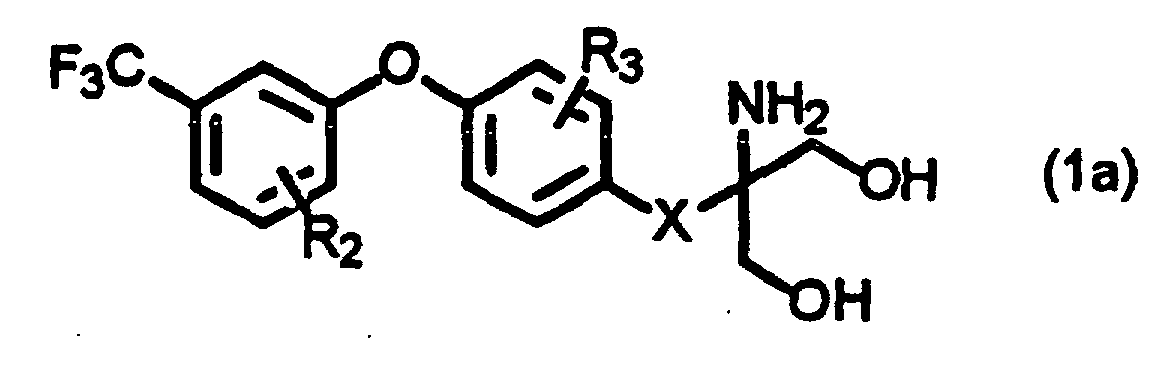
- the present invention is an immunosuppressive agent containing as an active ingredient at least one of a diaryl ether derivative, a pharmaceutically acceptable salt and hydrate thereof, the diaryl ether derivative represented by the following general formula (1a): wherein R 2 , R 3 , and X are the same as defined above.
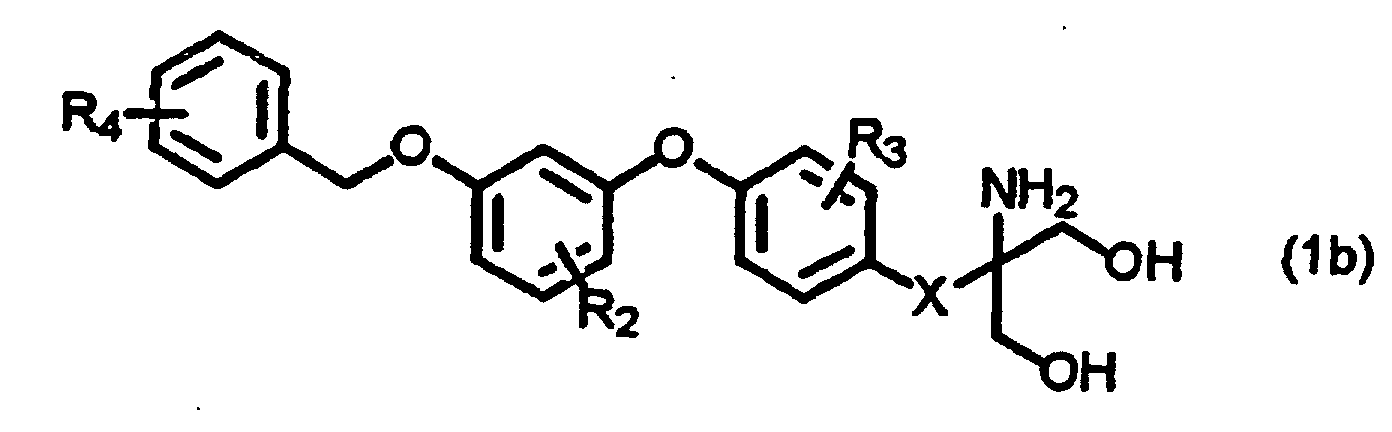
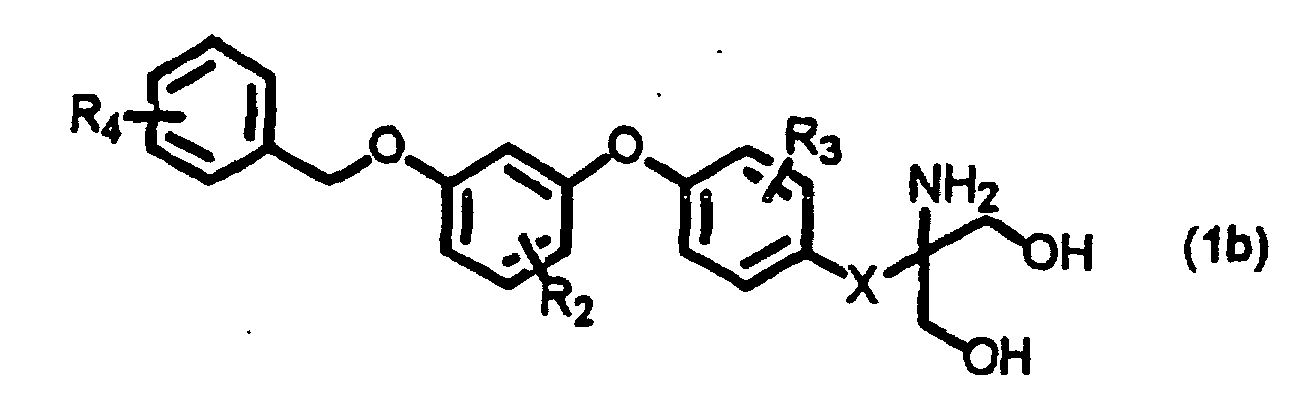
- the present invention is an immunosuppressive agent containing as an active ingredient at least one of a diaryl ether derivative, a pharmaceutically acceptable salt and hydrate thereof, the diaryl ether derivative represented by the following general formula (1b): wherein R 2 , R 3 , and X are the same as defined above; and R 4 is hydrogen, halogen, trifluoromethyl, lower alkoxy having 1 to 4 carbon atoms, or lower alkyl having 1 to 7 carbon atoms.
- the compounds of the general formulae (1), (1a) and (1b) are novel compounds.
- Examples of the pharmaceutically acceptable salt of the compound of the general formula (1) include acid salts, such as hydrochloride, hydrobromide, acetate, trifluoroacetate, methanesulfonate, citrate, and tartrate.
- the term 'halogen atom' includes fluorine, chlorine, bromine, and iodine atom.
- the term 'trihalomethyl group' includes trifluoromethyl and trichloromethyl.
- the phrase 'lower alkyl group having 1 to 7 carbon atoms' includes straight-chained or branched hydrocarbons having 1 to 7 carbon atoms, such as methyl, ethyl, propyl, isopropyl, butyl, t-butyl, pentyl, hexyl, and heptyl.
- the phrase 'substituted or unsubstituted phenoxy group' includes those that have, at any position of its benzene ring, a halogen atom, such as fluorine, chlorine, bromine and iodine, trifluoromethyl, lower alkyl having 1 to 4 carbon atoms, or lower alkoxy having 1 to 4 carbon atoms.
- a halogen atom such as fluorine, chlorine, bromine and iodine, trifluoromethyl
- lower alkyl having 1 to 4 carbon atoms or lower alkoxy having 1 to 4 carbon atoms.
- the term 'aralkyl group' as in 'aralkyl group' or 'aralkyloxy group' includes benzyl, diphenylmethyl, phenethyl, and phenylpropyl.
- 'lower alkyl group' as used in 'lower alkoxyl group having 1 to 4 carbon atoms,' 'lower alkylthio group having 1 to 4 carbon atoms,' 'lower alkylsulfinyl group having 1 to 4 carbon atoms,' or 'lower alkylsulfonyl group having 1 to 4 carbon atoms,' includes straight-chained or branched hydrocarbons having 1 to 4 carbon atoms, such as methyl, ethyl, propyl, isopropyl, and butyl.
- phrase 'substituted or unsubstituted aralkyl group' includes those that have, at any position of its benzene ring, a halogen atom, such as fluorine, chlorine, bromine and iodine, trifluoromethyl, lower alkyl having 1 to 4 carbon atoms, or lower alkoxy having 1 to 4 carbon atoms.
- a halogen atom such as fluorine, chlorine, bromine and iodine, trifluoromethyl, lower alkyl having 1 to 4 carbon atoms, or lower alkoxy having 1 to 4 carbon atoms.
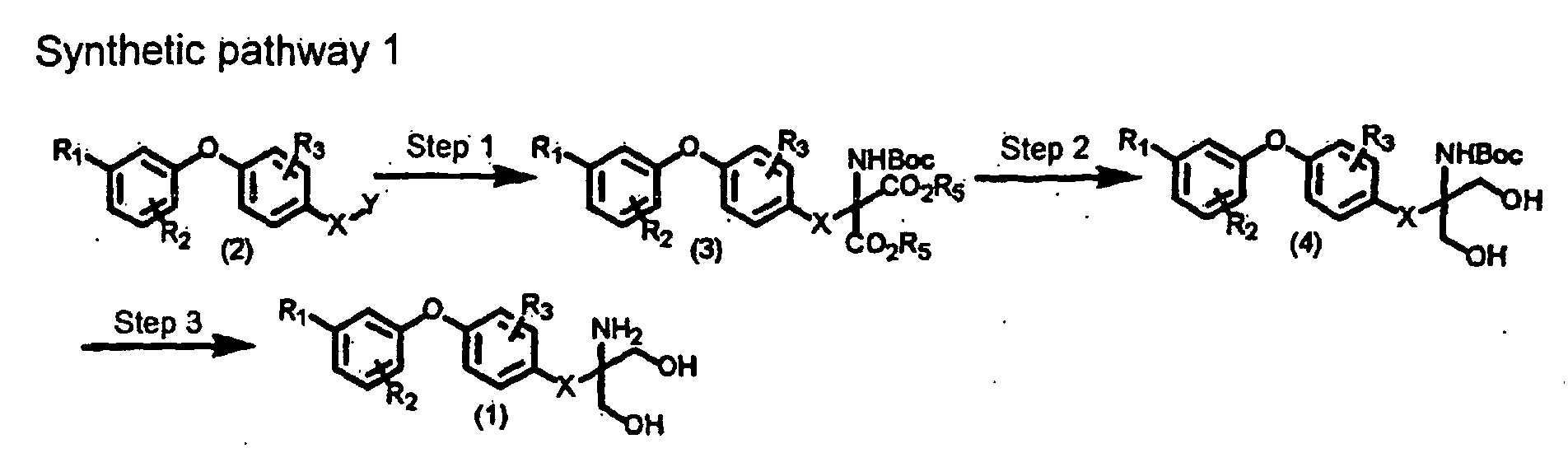
- the compounds of the general formula (1) can be produced in the following pathways:
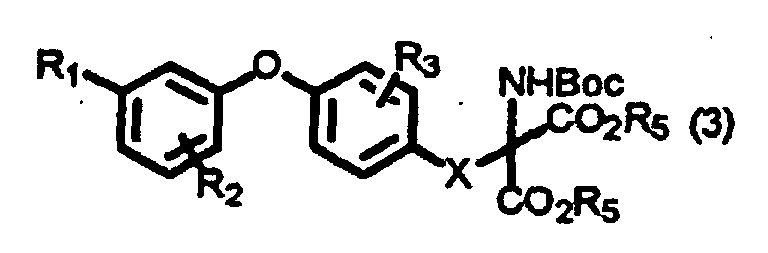
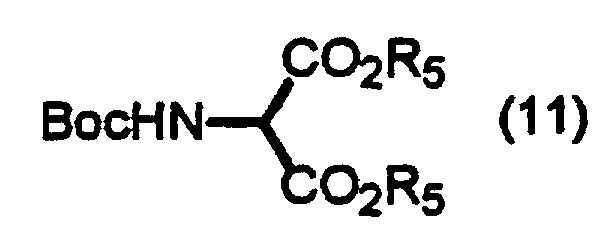
- the compound appearing in the synthetic pathway 1 and represented by the following general formula (3): (wherein R 5 is lower alkyl having 1 to 4 carbon atoms; Boc is t-butoxycarbonyl; and R 1 , R 2 , R 3 , and X are the same as described above) can be prepared by reacting a compound of the following general formula (2): (wherein Y is chlorine, bromine, or iodine; and R 1 , R 2 , R 3 , and X are as described above) with a compound of the following general formula (11): (wherein R 5 and Boc are as described above) in the presence of a base (Step 1).
- This reaction can be carried out using a reaction solvent such as 1,4-dioxane, dimethylsulfoxide (DMSO), N,N-dimethylformamide (DMF), tetrahydrofuran (THF), or ethanol at a reaction temperature of 0°C to reflux temperature, preferably at a temperature of 80°C to 100°C, in the presence of an inorganic base such as sodium hydride, potassium hydride, sodium alkoxide, and potassium alkoxide.
- a reaction solvent such as 1,4-dioxane, dimethylsulfoxide (DMSO), N,N-dimethylformamide (DMF), tetrahydrofuran (THF), or ethanol
- a reaction solvent such as 1,4-dioxane, dimethylsulfoxide (DMSO), N,N-dimethylformamide (DMF), tetrahydrofuran (THF), or ethanol
- a reaction solvent such as 1,4-dioxane,
- the compound appearing in the synthetic pathway 1 and represented by the following general formula (4): (wherein R 1 , R 2 , R 3 , R 4 , X, and Boc are as described above) can be prepared by the reduction of the compound of the general formula (3) (Step 2).
- This reaction can be carried out at a reaction temperature of 0°C to reflux temperature, preferably at room temperature, using an alkylborane derivative, such as borane (BH 3 ) and 9-borabicyclo[3.3.1)nonane (9-BBN), or a metal hydride complex, such as diisobutylaluminum hydride ((iBu)2AlH), sodium borohydride (NaBH 4 ) and lithium aluminum hydride (LiAlH 4 ), preferably lithium borohydride (LiBH 4 ), and using a reaction solvent such as THF, ethanol and methanol.
- an alkylborane derivative such as borane (BH 3 ) and 9-borabicyclo[3.3.1)nonane (9-BBN
- a metal hydride complex such as diisobutylaluminum hydride ((iBu)2AlH), sodium borohydride (NaBH 4 ) and lithium aluminum hydride (LiAlH
- the compound appearing in the synthetic pathway 1 and represented by the general formula (1): (wherein R 1 , R 2 , R 3 , and X are as described above) can be prepared by the acidolysis of the compound of the general formula (4) (Step 3).
- This reaction can be carried out at a reaction temperature in the range of 0°C to room temperature in an inorganic or organic acid, such as acetic acid, hydrochloric acid, hydrobromic acid, methanesulfonic acid and trifluoroacetic acid, or in a mixed solvent with an organic solvent such as methanol, ethanol, THF, 1,4-dioxane, and ethyl acetate.
- an inorganic or organic acid such as acetic acid, hydrochloric acid, hydrobromic acid, methanesulfonic acid and trifluoroacetic acid
- an organic solvent such as methanol, ethanol, THF, 1,4-dioxane, and ethyl acetate.
- the compound appearing in the synthetic pathway 2 and represented by the following general formula (6): (wherein R 3 , R 5 , X, and Boc are as described above) can be prepared by reacting the compound represented by the following general formula (5): (wherein R 3 , X, and Y are as described above) with the compound of the general formula (11): (wherein R 5 , and Boc are as described above) in the presence of a base (Step 4).
- This reaction can be carried out using a reaction solvent such as 1,4-dioxane, DMSO, DMF, THF, or ethanol at a reaction temperature in the range of 0°C to reflux temperature, preferably 80°C to 100°C, in the presence of an inorganic base such as sodium hydride, potassium hydride, sodium alkoxide, and potassium alkoxide.
- a reaction solvent such as 1,4-dioxane, DMSO, DMF, THF, or ethanol
- a reaction temperature in the range of 0°C to reflux temperature, preferably 80°C to 100°C
- an inorganic base such as sodium hydride, potassium hydride, sodium alkoxide, and potassium alkoxide.
- This reaction can be carried out at a reaction temperature of 0°C to reflux temperature, preferably at room temperature, using an alkylborane derivative, such as BH 3 and 9-BBN, or a metal hydride complex, such as (iBu) 2 AlH, NaBH 4 and LiAlH 4 , preferably LiBH 4 , and using a reaction solvent such as THF, ethanol, and methanol.
- an alkylborane derivative such as BH 3 and 9-BBN
- a metal hydride complex such as (iBu) 2 AlH, NaBH 4 and LiAlH 4 , preferably LiBH 4
- a reaction solvent such as THF, ethanol, and methanol.
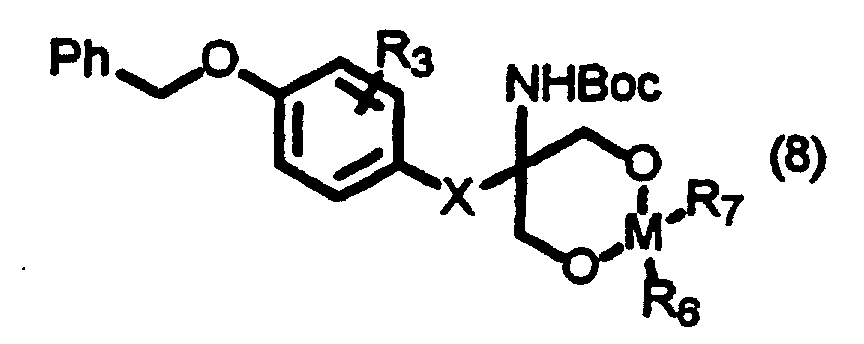
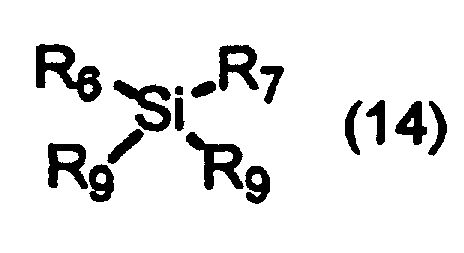
- the compound appearing in the synthetic pathway 2 and represented by the following general formula (8): (wherein M is carbon or silicon; R6 and R7 are each independently hydrogen or lower alkyl having 1 to 4 carbon atoms; and R 3 , X and Boc are as described above) can be prepared by reacting the compound of the general formula (7) with a compound of the general formula (12): (where R 6 and R 7 are as described above) or a compound of the general formula (13): (wherein R 8 is lower alkyl having 1 to 4 carbon atoms; and R 6 and R 7 are as described above) or a compound of the general formula (14): (wherein R 9 is chlorine or trifluoromethansulfonyloxy; and R 6 and R 7 are as described above) (Step 6).
- the reaction between the compound of the general formula (7) and the compound of the general formula (12) or the compound of the general formula (13) can be carried out at a reaction temperature of room temperature to 100°C either in the presence of a Lewis acid such as zinc chloride or in the presence of an acid catalyst such as camphorsulfonic acid, paratoluenesulfonic acid, and pyridinium paratoluenesulfonic acid, and either in the absence of solvent or in the presence of a reaction solvent such as DMF, THF, and methylene chloride.
- a reaction temperature of room temperature to 100°C either in the presence of a Lewis acid such as zinc chloride or in the presence of an acid catalyst such as camphorsulfonic acid, paratoluenesulfonic acid, and pyridinium paratoluenesulfonic acid, and either in the absence of solvent or in the presence of a reaction solvent such as DMF, THF, and methylene chloride.
- the reaction between the compound of the general formula (7) and the compound of the general formula (14) can be carried out at a reaction temperature of 0°C to 100°C in the presence of a base such as triethylamine, pyridine, 2,6-lutidine, and imidazole, using a reaction solvent such as DMF, THF, methylene chloride, chloroform, and acetonitrile.
- a base such as triethylamine, pyridine, 2,6-lutidine, and imidazole
- a reaction solvent such as DMF, THF, methylene chloride, chloroform, and acetonitrile.
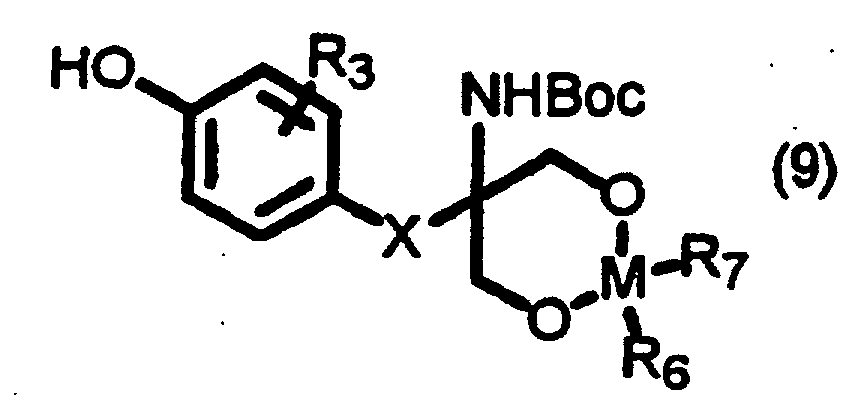
- the compound appearing in the synthetic pathway 2 and represented by the general formula (9): (wherein R 3 , R 6 , R 7 , X, Boc, and M are as described above) can be prepared by the hydrogenolysis of the compound of the general formula (8) (Step 7).
- This reaction can be carried out at a temperature in the range of room temperature to 100°C in the presence of a reduction catalyst, such as palladium carbon, platinum carbon, platinum oxide, rhodium carbon, and ruthenium carbon, in a solvent, such as ethanol, methanol, THF, DMF, and ethyl acetate, under a hydrogen pressure that is atmospheric pressure or higher.
- a reduction catalyst such as palladium carbon, platinum carbon, platinum oxide, rhodium carbon, and ruthenium carbon
- a solvent such as ethanol, methanol, THF, DMF, and ethyl acetate
- the compound appearing in the synthetic pathway 2 and represented by the general formula (10): [wherein R 1 , R 2 , R 3 , R 6 , R 7 , X, Boc, and M are as described above] can be prepared by reacting the compound of the general formula (9) with a compound of the general formula (15) : (wherein R 1 and R 2 are as described above) in the presence of copper acetate (Step 8).
- This reaction can be carried out at room temperature in the presence or absence of a molecular sieve, using copper acetate as a reaction promoter and methylene chloride or chloroform as a solvent, in the presence of a base, such as triethylamine.
- the compound appearing in the synthetic pathway 2 and represented by the general formula (1): (wherein R1, R2, R3, and X are as described above) can be prepared by the acidolysis, or desilylation followed by acidolysis, of the compound of the general formula (10) (Step 9) .
- This reaction can be carried out at a reaction temperature of 0°C to room temperature in an inorganic or organic acid, such as acetic acid, hydrochloric acid, hydrobromic acid, methanesulfonic acid, trifluoroacetic acid, or in a mixed solution with an organic solvent, such as methanol, ethanol, THF, 1,4-dioxane, and ethyl acetate.
- an inorganic or organic acid such as acetic acid, hydrochloric acid, hydrobromic acid, methanesulfonic acid, trifluoroacetic acid
- an organic solvent such as methanol, ethanol, THF, 1,4-dioxane, and ethyl acetate.
- the compound of the general formula (1) can be synthesized by reacting potassium fluoride, cesium fluoride, or tetrabutylammonium fluoride at a temperature of 0°C to room temperature in a solvent such as THF, DMF, and 1,4-dioxane and then subjecting the resulting compound to the above-described acidolysis.
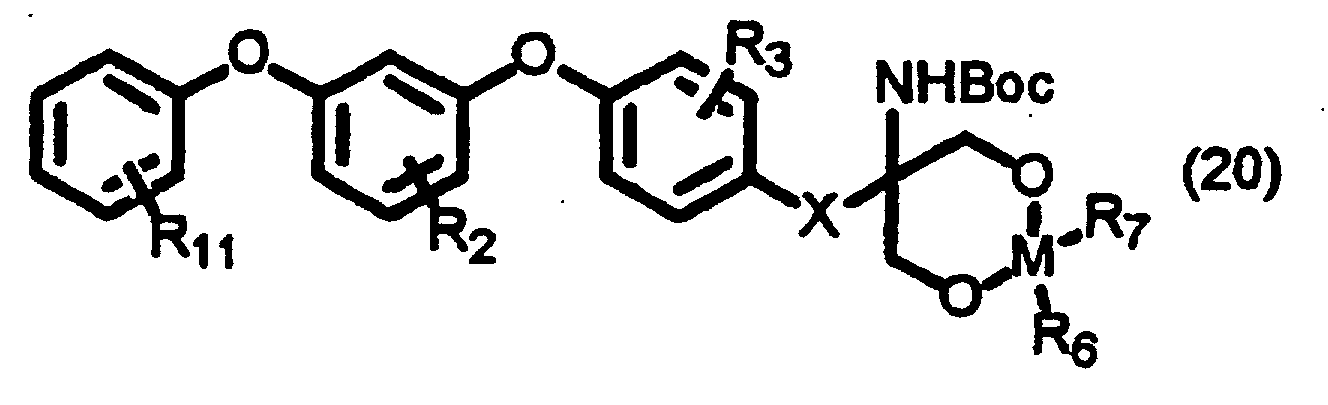
- those represented by the general formula (16) in which R 1 is a substituted or unsubstituted aralkyloxy group: (wherein R 10 is substituted or unsubstituted aralkyl; and R 2 , R 3 , R 6 , R 7 , X, Boc, and M are as described above) can also be prepared by reacting a compound of the general formula (17): (wherein R 2 , R 3 , R 6 , R 7 , X, Boc, and M are as described above) with a compound of the general formula (18): R 10 Y' (wherein Y' is halogen or hydroxy; and R 10 is as described above).
- the reaction can be carried out at a reaction temperature in the range of room temperature to 80°C, using an organic base, such as triethylamine, and pyridine, or an inorganic base, such as sodium hydride, sodium carbonate, and potassium carbonate, and using a reaction solvent, such as THF, DMF, and 1,4-dioxane:
- an organic base such as triethylamine, and pyridine
- an inorganic base such as sodium hydride, sodium carbonate, and potassium carbonate
- a reaction solvent such as THF, DMF, and 1,4-dioxane:
- reaction can be carried out at room temperature in the presence of diethyl azodicarboxylate or triphenylphosphine, using THF as a solvent.
- the compound of the general formula (17) can be prepared by the hydrogenolysis of a compound of the general formula (19): (wherein R 2 , R 3 , R 6 , R 7 , X, Boc, and M are as described above).
- This reaction can be carried out at a temperature in the range of room temperature to 100°C in the presence of a reduction catalyst, such as palladium carbon, platinum carbon, platinum oxide, rhodium carbon, and ruthenium carbon, in a solvent, such as ethanol, methanol, THF, DMF, and ethyl acetate, under a hydrogen pressure that is atmospheric pressure or higher.
- a reduction catalyst such as palladium carbon, platinum carbon, platinum oxide, rhodium carbon, and ruthenium carbon
- a solvent such as ethanol, methanol, THF, DMF, and ethyl acetate
- This reaction can be carried out preferably at room temperature in the presence or absence of a molecular sieve, using copper acetate as a reaction promoter and methylene chloride or chloroform as a solvent, in the presence of a base, such as triethylamine.
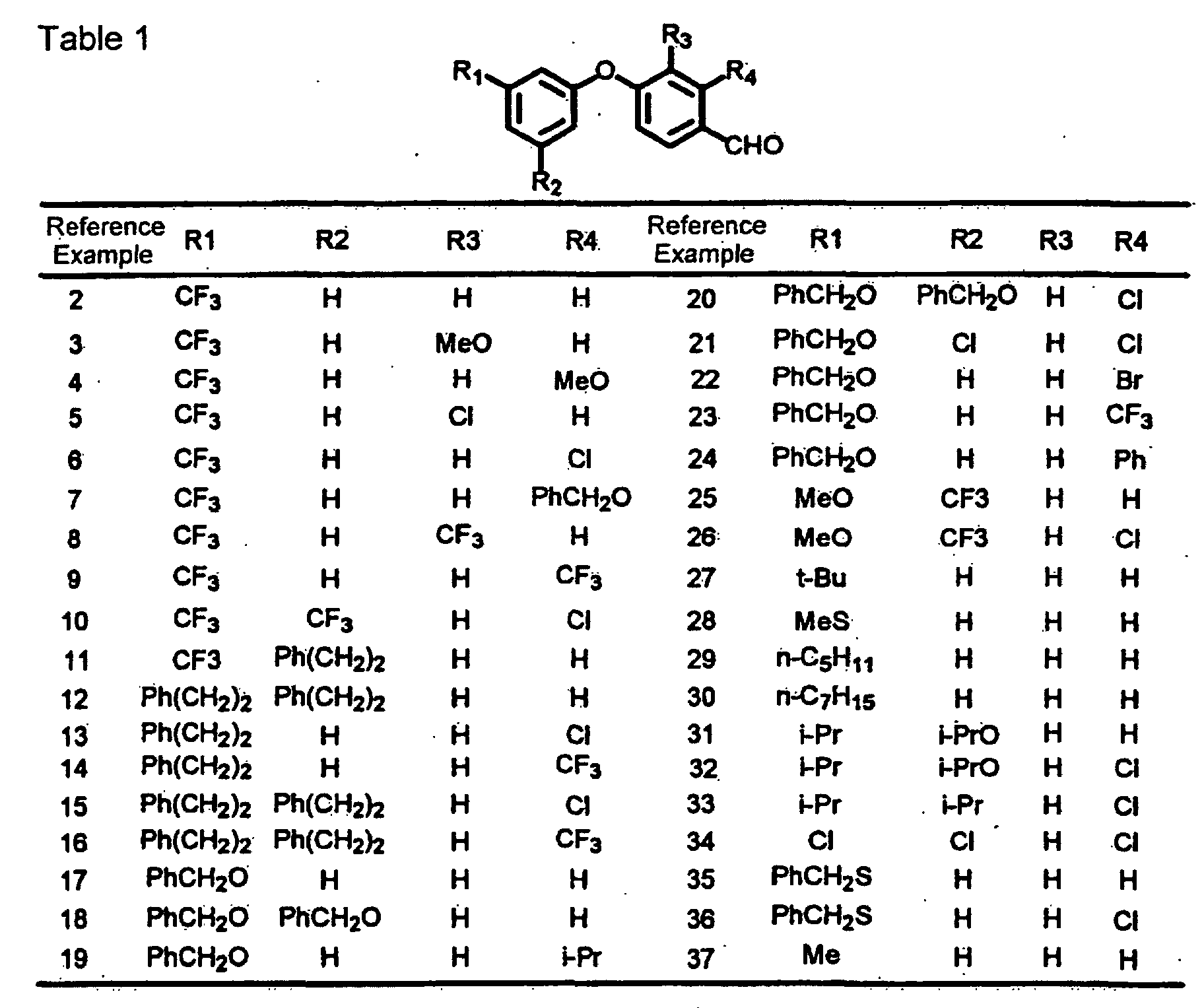
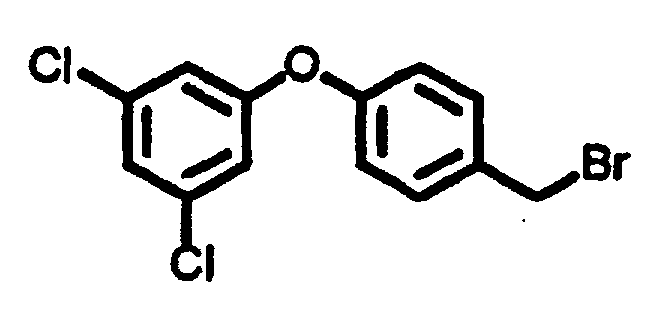
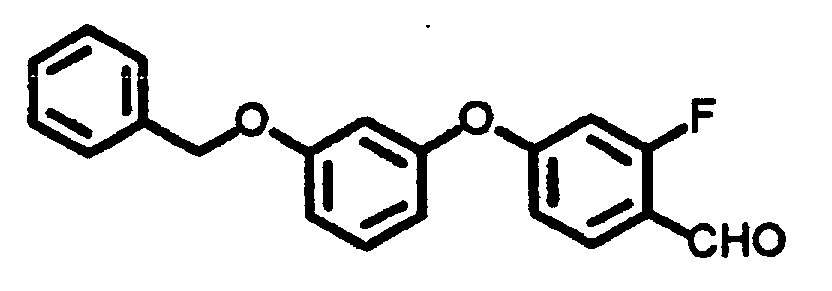
- Potassium carbonate (5.53g) was added to a DMF solution (70ml) of 2-chloro-4-fluorobenzaldehyde (3.35g) and 3-benzyloxyphenol (4.23g) and the solution was stirred for 3 hours while heated to 150°C.
- the reaction mixture was decanted into water and was extracted with ethyl acetate.
- the organic phase was sequentially washed with water and a saturated aqueous solution of sodium chloride and was dried with anhydrous sodium sulfate.
- 3-(trifluoromethyl)phenylboric acid (1.03g) and 2-fluoro-4-hydroxybenzaldehyde (760mg) were dissolved in methylene chloride. While the solution was stirred, copper acetate (985mg), molecular sieve 4A (800mg), and triethylamine (3.76mL) were added. After 6 and 24 hours, the same amount of copper acetate was added and the mixture was stirred for additional 48 hours. The insoluble material was then filtered out and the filtrate was decanted into water and was extracted with ethyl acetate. The organic phase was washed with water and then with a saturated aqueous solution of sodium chloride and was dried with anhydrous magnesium sulfate.
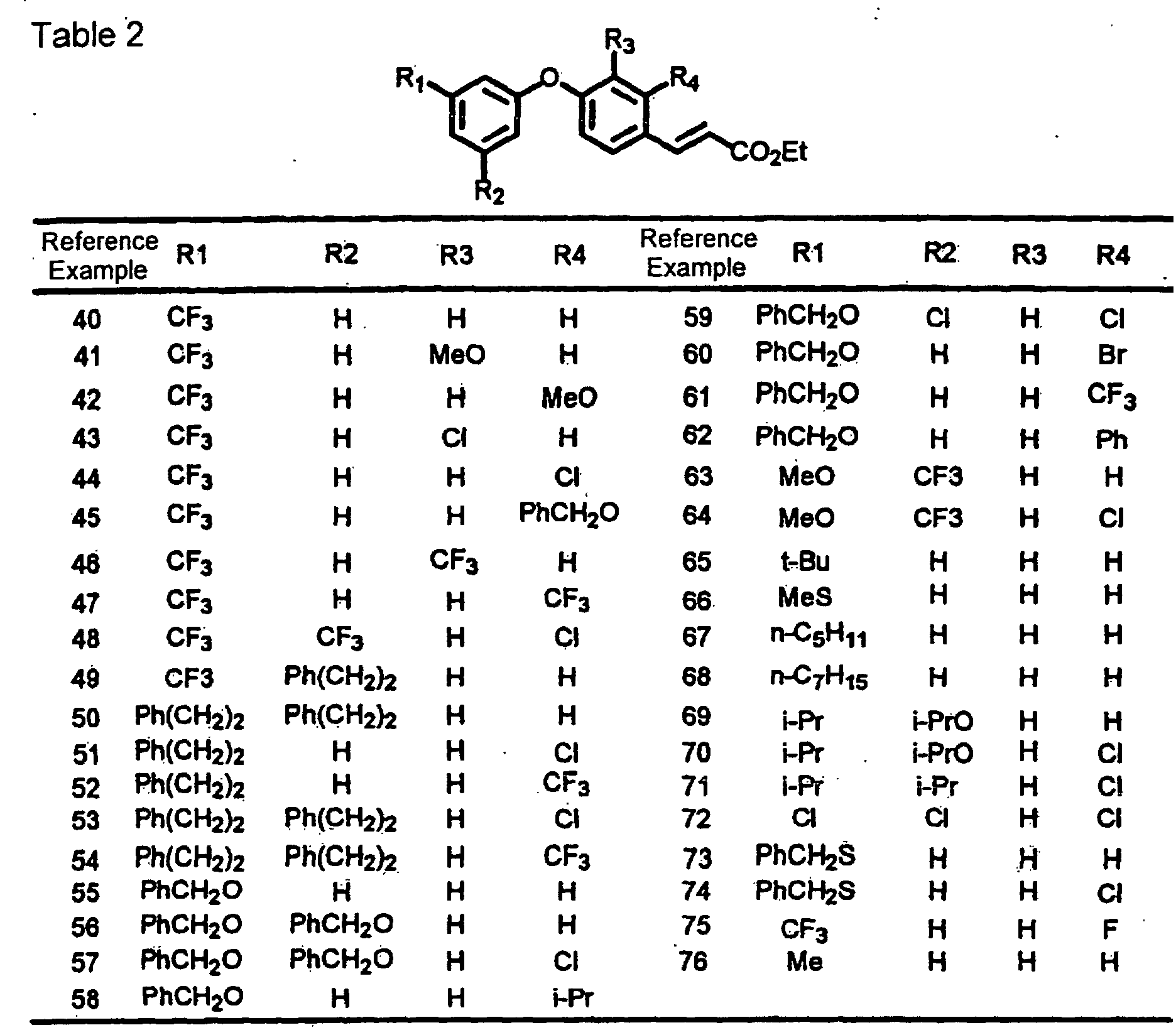
- the compound of Reference Example 39 (7.36g) was dissolved in ethanol (100mL). While the solution was stirred at 0°C, bismuth chloride (2.84g) was added. Sodium borohydride (2.72g) was then added in three portions and the mixture was subsequently stirred for 3 hours at room temperature. Ice water was then added to the reaction mixture and the crystallized inorganic deposits were filtered out through celite. The resulting filtrate was extracted with ethyl acetate. The organic phase was washed with water and then with a saturated aqueous solution of sodium chloride and was dried with anhydrous sodium sulfate. The solvent was removed by distillation under reduced pressure. In this manner, the desired product (7.40g) was obtained as a colorless oil (Method A).
- the compound of Reference Example 66 (4.07g) was dissolved in methanol (50mL). While the solution was stirred at 10°C, magnesium (1.00g) was added to the solution. With the temperature maintained, the mixture was further stirred for 3 hours, followed by addition of diluted hydrochloric acid and then extraction with ethyl acetate. The organic phase was washed with water and then with a saturated aqueous solution of sodium chloride and was dried with anhydrous sodium sulfate. The solvent was removed by distillation under reduced pressure to obtain the desired product (3.70g) as a colorless oil.
- the compound of Reference Example 106 (840mg) was dissolved in methylene chloride (20mL). While the solution was stirred at 0°C, a 1mol/L boron tribromide-methylene chloride solution (3.42mL) was added dropwise. Subsequently, the mixture was stirred overnight at room temperature. Ice water was then added to the reaction mixture and the mixture was extracted with ethyl acetate. The organic phase was sequentially washed with water and a saturated aqueous solution of sodium chloride and was dried with anhydrous sodium sulfate. The solvent was removed by distillation under reduced pressure.
- the compound of Reference Example 80 (7.40g) was dissolved in THF (100mL). While the solution was stirred at 0°C, lithium aluminum hydride (500mg) was added. After 10 minutes, a 20% aqueous solution of NaOH was added and the crystallized insoluble inorganic deposits were filtered out through celite. The filtrate was then extracted with ethyl acetate. The organic phase was sequentially washed with water and a saturated aqueous solution of sodium chloride and was dried with anhydrous sodium sulfate. The solvent was removed by distillation under reduced pressure to obtain the desired product (6.37g) as a colorless oil.
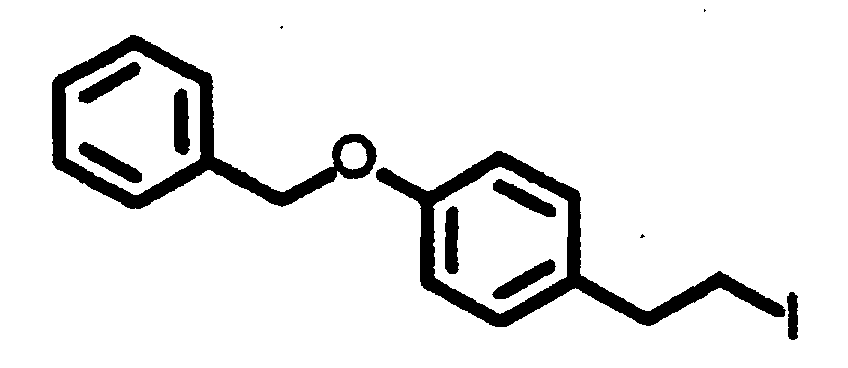
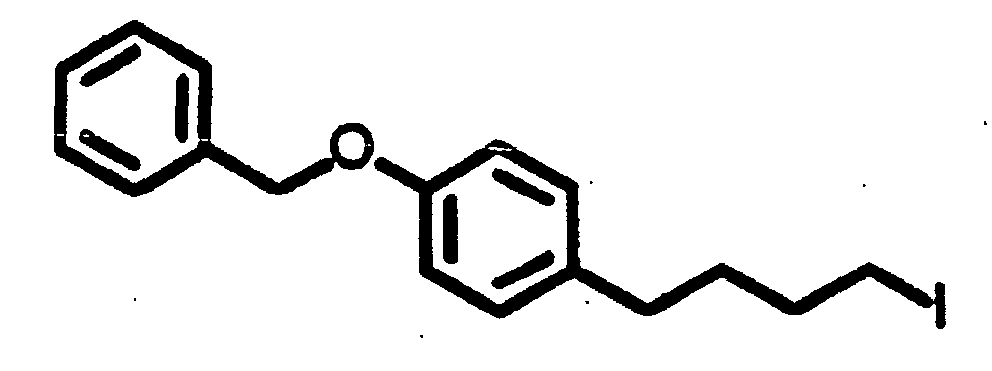
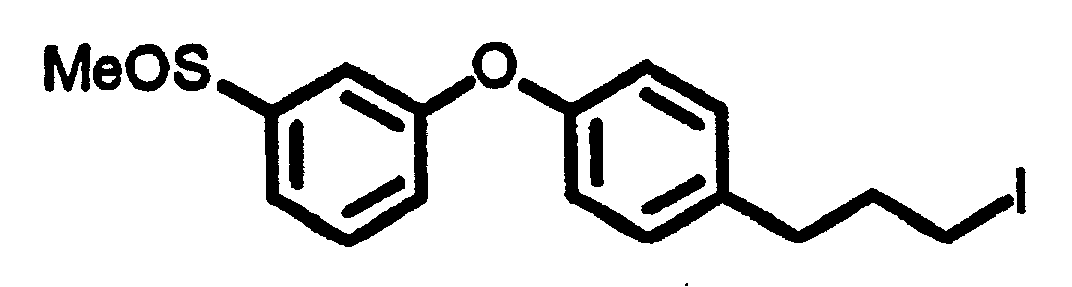
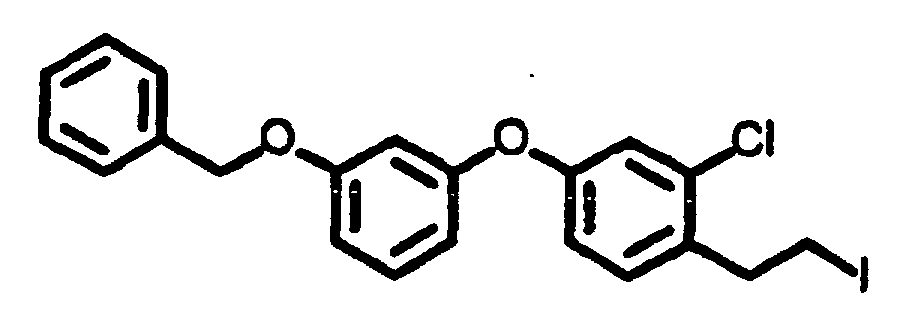
- the compound of Reference Example 123 (6.37g) was dissolved in THF (150mL). While the solution was stirred at 0°C, imidazole (2.45g), triphenylphosphine (9.44g), and iodine (9.14g) were added. With the temperature maintained, the solution was further stirred for 1 hour. Subsequently, water was added to the reaction mixture and the mixture was extracted with ethyl acetate. The organic phase was sequentially washed with water and a saturated aqueous solution of sodium chloride and was dried with anhydrous sodium sulfate.
- Ethyl 4'-[(3,5-bistrifluoromethyl)phenoxy]cinnamate(500mg) was dissolved in THF (20mL). While the solution was stirred at 0°C, a 1mol/L diisobutylaluminum hydride-toluene solution (3.0mL) was added. With the temperature maintained, the solution was stirred for 1.5 hours, and a 2mol/L aqueous solution of sodium hydroxide was added to the solution. The resulting mixture was then extracted with ethyl acetate. The organic phase was sequentially washed with water and a saturated aqueous solution of sodium chloride and was then dried with anhydrous sodium sulfate.
- Example 18 The compound of Example 18 was reduced by catalytic reduction as in Reference Example 81.
- the resultant phenol (850mg) was dissolved in DMF (20mL), and 2-iodopropane (0.2mL) and potassium carbonate (500mg) were added to the solution.
- the mixture was then stirred for 4 hours at 60°C.
- water was added to the reaction mixture, and the mixture was extracted with ethyl acetate.
- the organic phase was sequentially washed with water and a saturated aqueous solution of sodium chloride and was dried with anhydrous sodium sulfate.
- Example 44 The compound of Example 44 was reduced by catalytic reduction as in Reference Example 81.
- the resultant phenol was reacted with 3,5-bis(trifluoromethyl)phenylboric acid in the same manner as in Reference Example 38 to obtain the desired product as a pale yellow oil.
- Example 1 The compound of Example 1 (6.84g) was dissolved in THF (150mL). While the solution was stirred at 0°C, lithium borohydride (960mg) was added to the solution. Ethanol (10mL) was then added to the mixture and the mixture was stirred for 8 hours as the temperature was gradually increased to room temperature. Subsequently, ice water was added to the mixture and the organic solvent was removed by distillation under reduced pressure. A 10% aqueous solution of citric acid was added to the residue to adjust the pH to 3, and the mixture was extracted with ethyl acetate. The organic phase was sequentially washed with water and a saturated aqueous solution of sodium chloride and was dried with anhydrous sodium sulfate.
- a methylene chloride solution (5mL) of di- t -butylsilyl bistrifluoromethanesulfonate (1.67g) was added to a DMF solution (30mL) of the compound of Example 98 (1.50g) and 2,6-lutidine (0.841mL). With the temperature maintained, the mixture was stirred for 1 hour. Subsequently, the mixture was decanted into ice water and was extracted with ethyl acetate. The organic phase was sequentially washed with water and a saturated aqueous solution of sodium chloride and was dried with anhydrous sodium sulfate. The solvent was then removed by distillation under reduced pressure.
- the resultant acetonide was reduced by catalytic reduction as in Reference Example 81 to obtain the desired product (2.23g) as a colorless powder.
- an acetonide (3.21g) obtained by using the compound of Example 92 was dissolved in THF (100mL). While the solution was stirred at 0°C, a 1mol/L tetrabutylammoniumfluoride-THF solution (10mL) was added dropwise. After 10 minutes, water was added to the mixture and the mixture was extracted with ethyl acetate. The organic phase was sequentially washed with water and a saturated aqueous solution of sodium chloride and was dried with anhydrous sodium sulfate. The solvent was then removed by distillation under reduced pressure to obtain the desired product (2.60g).
- Diethyl azodicarboxylate (0.31mL) was added to a THF solution (5mL) containing the compound of Example 106 (650mg), 3,5-dichlorobenzyl alcohol (350mg), triphenylphosphine (530mg). The mixture was stirred for 18 hours. Subsequently, water was added to the mixture and the mixture was extracted with ethyl acetate. The organic phase was sequentially washed with water and a saturated aqueous solution of sodium chloride and was dried with anhydrous sodium sulfate. The solvent was then removed by distillation under reduced pressure.
- Example 105 The compound of Example 105 was reacted with phenylboric acid in the same manner as in Reference Example 38 to obtain the desired product as a colorless powder.
- Example 102 The compound of Example 102 (200mg), 3-isopropylphenylboric acid (141mg), anhydrous copper acetate (II) (97.4mg), and molecular sieve powder-4A (400mg) were suspended in dichloromethane (5mL). Triethylamine (120 ⁇ L) was then added to the suspension and the suspension was stirred for 8 hours at room temperature. Subsequently, additional 3-isopropylphenylboric acid (141mg) and triethylamine (120 ⁇ L) were added and the resulting mixture was further stirred overnight at room temperature.
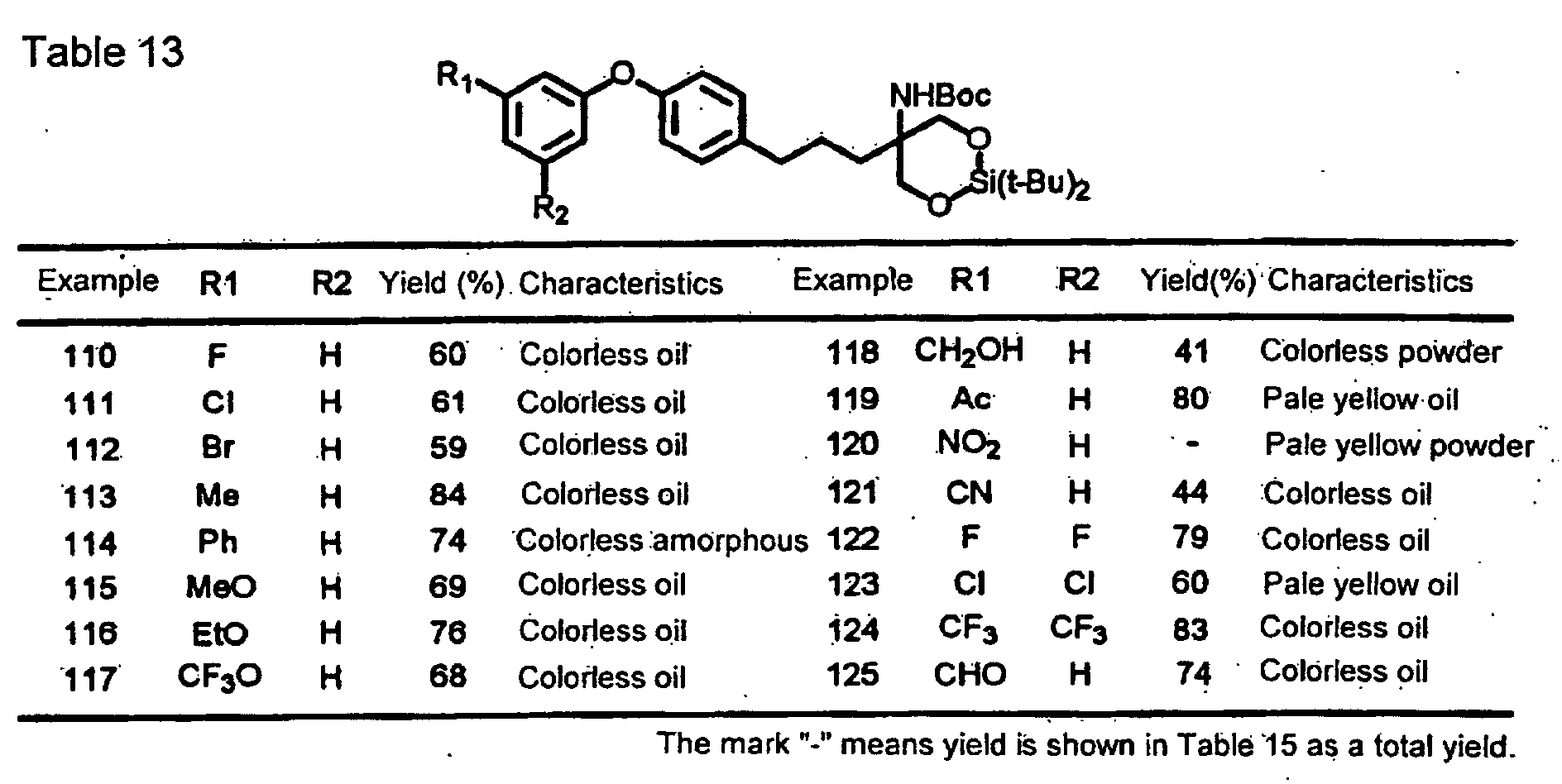
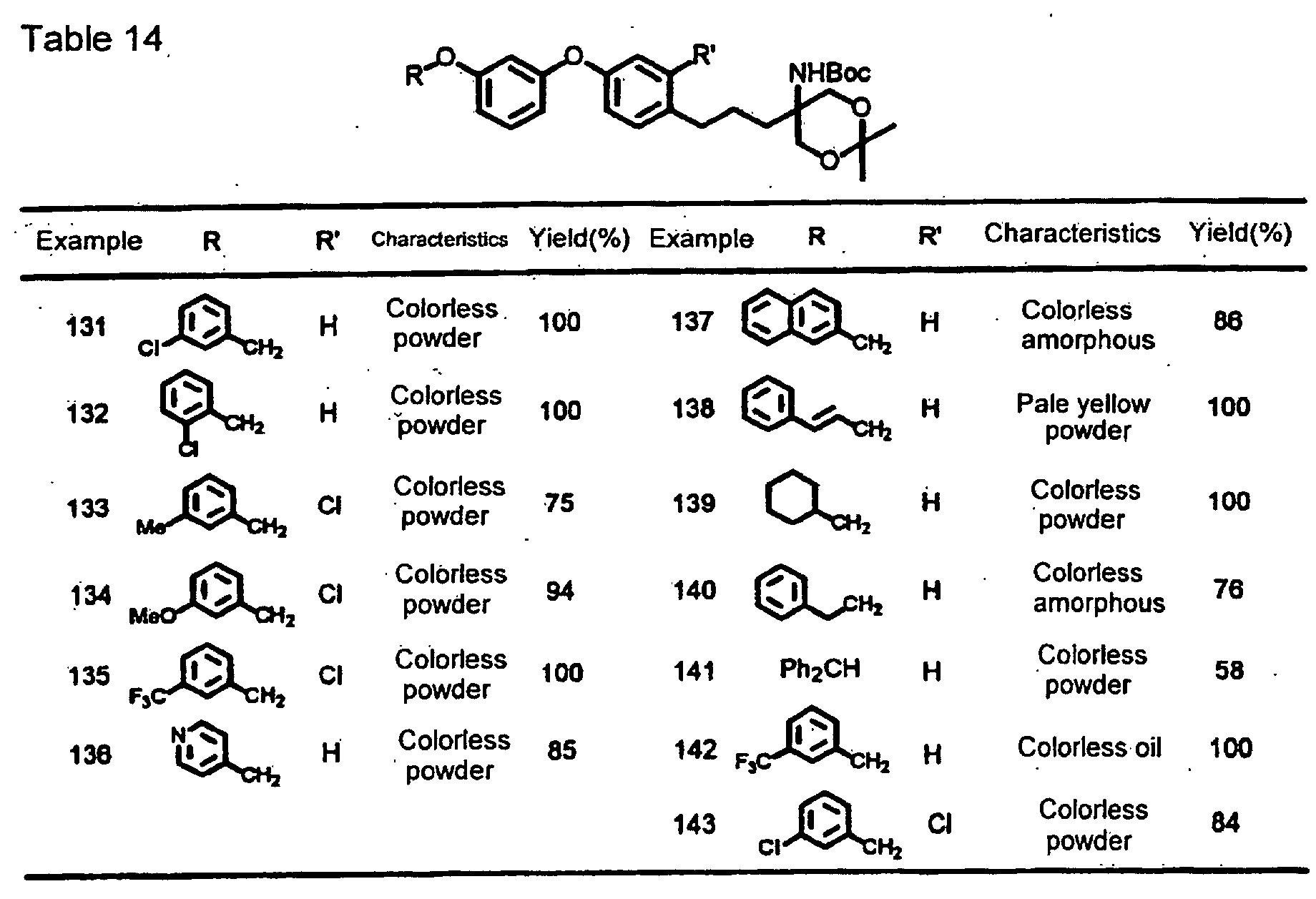
- Example 102 The compound of Example 102 was reacted with different phenylboric acids in the same manner as in Example 109 described above to synthesize the compounds shown in Table 13 below.
- Example 103 The compound of Example 103 was reacted with 3,5-bis(trifluoromethyl)phenylboric acid in the same manner as in Example 109 to obtain the desired product as a colorless powder.
- Example 104 The compound of Example 104 was reacted with 3,5-bis(trifluoromethyl)phenylboric acid in the same manner as in Example 109 to obtain the desired product as a colorless oil.
- Example 105 and 106 were reacted with different alkylhalides in the same manner as in Example 130 described above to synthesize the compounds shown in Table 14 below:
- Example 125 The compound of Example 125 (126mg) was dissolved in THF (3.0mL) and the solution was cooled to -78°C under argon. A 1mol/L methyllithium-ether solution (0.252mL) was added to the solution and the temperature of the mixture was slowly raised to 0°C. A 5% aqueous solution of citric acid was added to the reaction mixture and the mixture was extracted with ethyl acetate. The organic phase was sequentially washed with water and a saturated aqueous solution of sodium chloride and was dried with anhydrous sodium sulfate. The solvent was then removed by distillation under reduced pressure.
- Benzylphosphonylchloride (152mg) was dissolved in THF (2mL) and sodium-t-butoxide (37.6mg) was added to the solution at 0°C. The mixture was stirred for 30 minutes at room temperature and was again cooled to 0°C, at which time a THF solution (2mL) of the compound of Example 125 (202mg) was added. The reaction mixture was stirred for 1 hour at this temperature and for additional 1 hour at room temperature, followed by addition of a 5% aqueous solution of citric acid. The mixture was then extracted with ethyl acetate.
- Example 124 was used in the reaction process of Example 150 to give the same product.
- Melting point 194-196°C Elemental analysis (%): C 20 H 21 F 6 NO 3 ⁇ HCl C H N Calcd. 50.70 4.68 2.96 Found 50.70 4.66 2.91
- Example 109 The compound of Example 109 (188mg) was dissolved in THF (3.0mL) and a 1mol/L tetrabutylammoniumfluoride-THF solution (1.61mL) was added to the solution. The mixture was stirred for 2 hours at room temperature. Subsequently, water was added to the mixture and the mixture was extracted with ethyl acetate. The organic phase was sequentially washed with water and a saturated aqueous solution of sodium chloride and was dried with anhydrous sodium sulfate. The solvent was then removed by distillation under reduced pressure.
- the diol so obtained was treated in the same manner as in Example 147 to give the desired product (107mg) as a colorless amorphous.
- Example 51 The compound of Example 51 was treated in the same manner as in Example 147 to obtain the desired product as a colorless powder.
- Example 244 was treated in the same manner as in Example 51 to obtain the desired product as a colorless powder.
- Example 245 The compound of Example 245 was treated in the same manner as in Example 51 to obtain the desired product as a colorless oil.
- Example 256 The compound of Example 256 was treated in the same manner as in Example 147 to obtain the desired product as a colorless powder.
- Example 257 was treated in the same manner as in Example 147 to obtain the desired product as a pale yellow amorphous.
- the spleens were placed in a phosphate-buffered saline (PBS(-), NISSUI PHARMACEUTICAL Co., Ltd.) or in an RPMI-1640 medium (GIBCO INDUSTRIES Inc., or IWAKI GLASS Co., Ltd.) and were either passed through a stainless steel mesh, or gently pressed between two slide glasses and then passed through a cell strainer (70 ⁇ m, Falcon), to form a cell suspension. The suspension was then centrifuged and the supernatant was discarded. An ammonium chloride-Tris isotonic buffer was added to the suspension to lyse erythrocytes.
- PBS(-) phosphate-buffered saline
- RPMI-1640 medium GBCO INDUSTRIES Inc., or IWAKI GLASS Co., Ltd.
- the cells were then centrifuged and washed three times in PBS (-) or RPMI-1640 medium and were resuspended in an RPMI-1640 medium.
- mitomycin C KYOWA HAKKO KOGYO Co., Ltd.
- the cells were again centrifuged and washed in PBS (-) or RPMI-1640 medium and were resuspended in an RPMI-1640 medium so that the medium would contain 2.5 X 10 8 cells/mL.
- This suspension served as a "stimulation cell suspension.”
- 20 ⁇ L (5 X 10 6 cells/mouse) of the stimulation cell suspension was subcutaneously injected into the right hind footpad of 7 to 9 week old male C3H/HeN mice (CLEA JAPAN Inc., CHARLES RIVER JAPAN Inc., or JAPAN SLC Inc.).
- a group of mice was injected with RPMI-1640 medium alone to serve as normal control. 4 days after the injection, right popliteal lymph nodes were collected and were weighed on a Mettler AT201 electronic scale (METTLER TOLEDO Co., Ltd.).
- Each animal was intraperitoneally administered a test compound once a day for four consecutive days starting on the day of the injection of the stimulation cells ( i.e. , total of 4 times). Controls were administered a vehicle that has the same composition as that used in the preparation of the test compounds. The results are shown in Table 22 below: Example No. Dose (mg/)kg) Inhibition (%) Example No. Dose (mg/kg) Inhibition (%) Example No. Dose (mg/kg) Inhibition (%).
- the ears of the mice were challenged with the antigen to induce delayed-type hypersensitive responses: First, the thickness of each ear was measured by the dial thickness gauge G (0.01-10mm, OZAKI MFG Co., Ltd.). Next, a test compound was administered. 30 minutes after the administration, 10 ⁇ L of a 0.2% (v/v) DNFB solution was applied to the inner and outer surfaces of the right ear of each animal for antigen challenge. The left ear of each animal was challenged with the solvent alone. 24 hours after the challenge, the increase in the ear thickness was measured for each ear and the difference between the right and the left ears was determined for each individual.
- test compound was dissolved, or suspended, in an ultra pure water and was orally administered at a dose of 0,1mL/10g of body weight.
- a control group was administered ultra pure water alone.
- Table 23 Example No. 173 Dose (mg/kg) Inhibition (%) 3 64 178 10 72 181 10 69 182 30 101 190 3 67 195 30 64 198 3 57
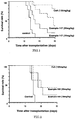
- dorsal skin from male DBA/2 mice were stripped of the fatty layer and the panniculus carnosus, and cut into circular grafts with a diameter of 8mm.
- graft bed a circular area, approximately 8mm in diameter, was prepared in the back of anesthetized.
- Each graft obtained from the DBA/2 mice was placed on the graft bed formed in the backs of the BALB/c mice and was secured with a strip of adhesive bandage while held down from the top. 6 days after transplantation, the bandage was removed and the graft was subsequently observed everyday.
- each compound was evaluated based on the length of the survival period, which is defined as the number of days for rejection.
- Each test compound was dissolved in ultra pure water and was orally administered once a day, starting from the day of transplantation. In a similar manner, the control group was administered ultra pure water alone.
- the present invention has been devised in recognition of the fact that novel diaryl derivatives, in particular those in which one of the aryl groups includes, at its para-position, a carbon chain with an aminopropanediol group and the other aryl group includes a substituent at its meta-position, exhibit strong immunosuppressive effects.
- the compounds of the present invention have a strong potential as a prophylactic or therapeutic agent against rejection in organ or bone marrow transplantation, autoimmune diseases, rheumatoid arthritis, psoriasis, atopic dermatitis, bronchial asthma, pollinosis and various other diseases.
Landscapes
- Health & Medical Sciences (AREA)
- Chemical & Material Sciences (AREA)
- Organic Chemistry (AREA)
- Veterinary Medicine (AREA)
- Engineering & Computer Science (AREA)
- Bioinformatics & Cheminformatics (AREA)
- Chemical Kinetics & Catalysis (AREA)
- General Chemical & Material Sciences (AREA)
- Medicinal Chemistry (AREA)
- Nuclear Medicine, Radiotherapy & Molecular Imaging (AREA)
- Public Health (AREA)
- Pharmacology & Pharmacy (AREA)
- Life Sciences & Earth Sciences (AREA)
- Animal Behavior & Ethology (AREA)
- General Health & Medical Sciences (AREA)
- Immunology (AREA)
- Pulmonology (AREA)
- Dermatology (AREA)
- Rheumatology (AREA)
- Orthopedic Medicine & Surgery (AREA)
- Otolaryngology (AREA)
- Toxicology (AREA)
- Transplantation (AREA)
- Ophthalmology & Optometry (AREA)
- Physical Education & Sports Medicine (AREA)
- Pain & Pain Management (AREA)
- Acyclic And Carbocyclic Compounds In Medicinal Compositions (AREA)
- Organic Low-Molecular-Weight Compounds And Preparation Thereof (AREA)
- Pyridine Compounds (AREA)
- Pharmaceuticals Containing Other Organic And Inorganic Compounds (AREA)
- Fats And Perfumes (AREA)
- Transition And Organic Metals Composition Catalysts For Addition Polymerization (AREA)
- Cephalosporin Compounds (AREA)
Abstract
Description













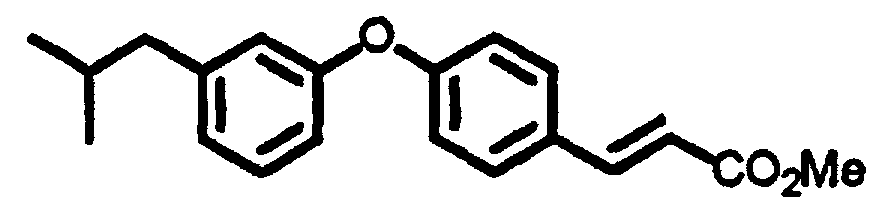

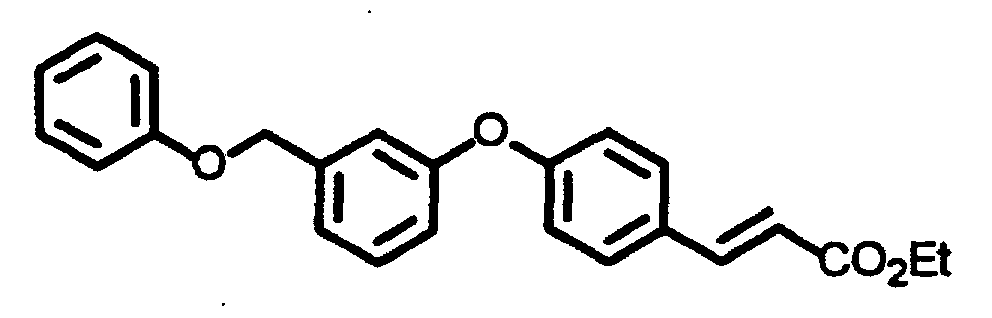
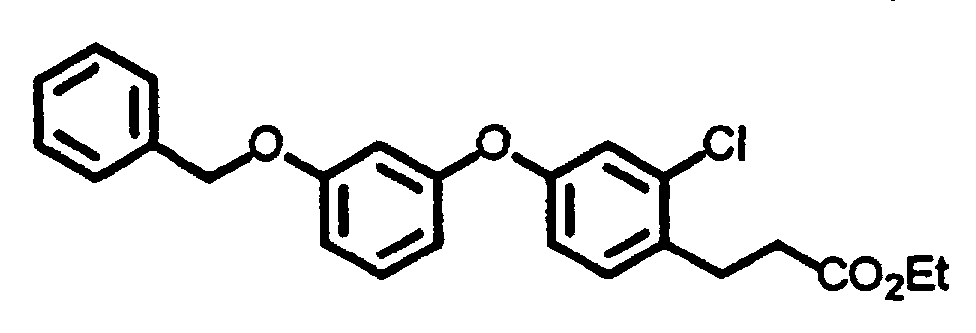


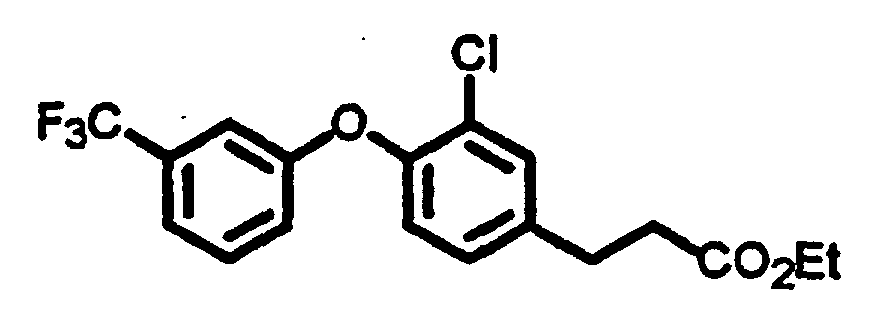


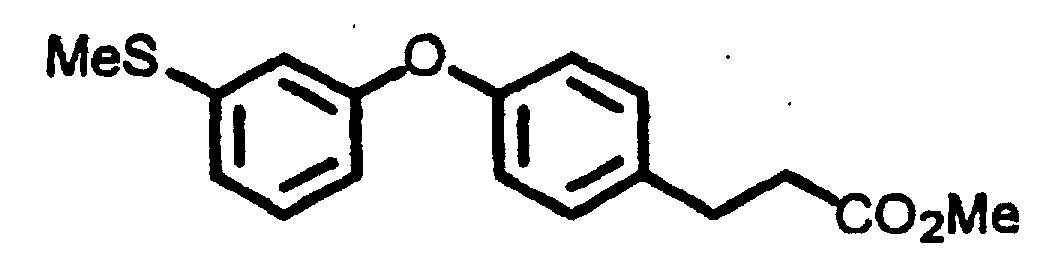

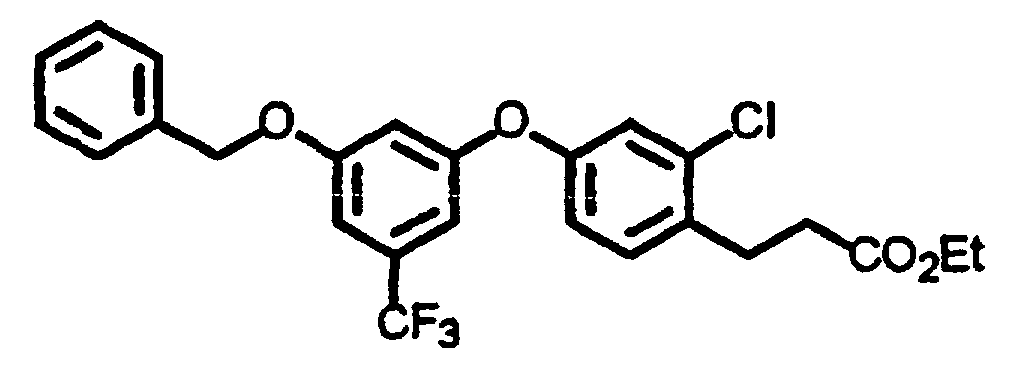

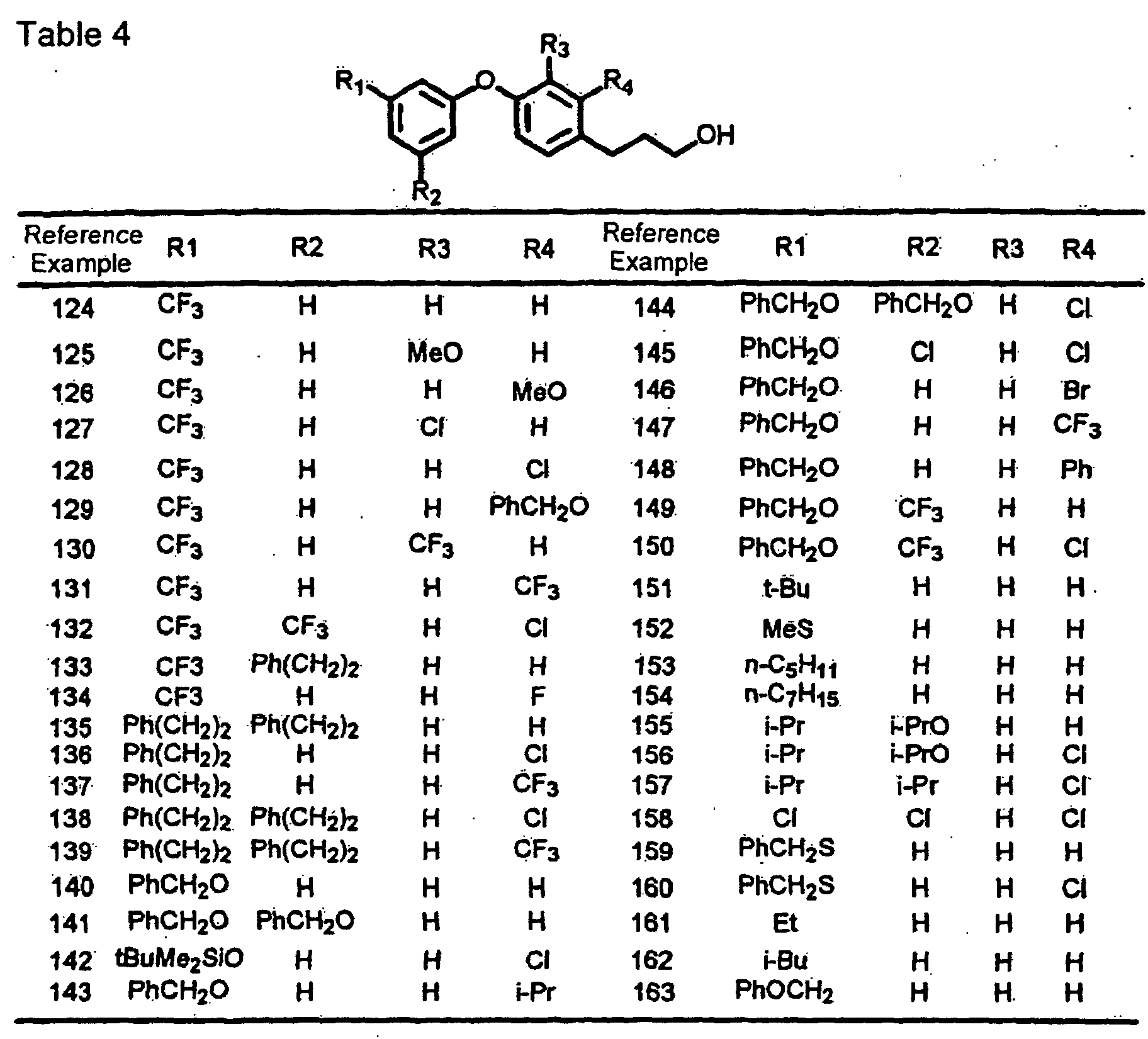

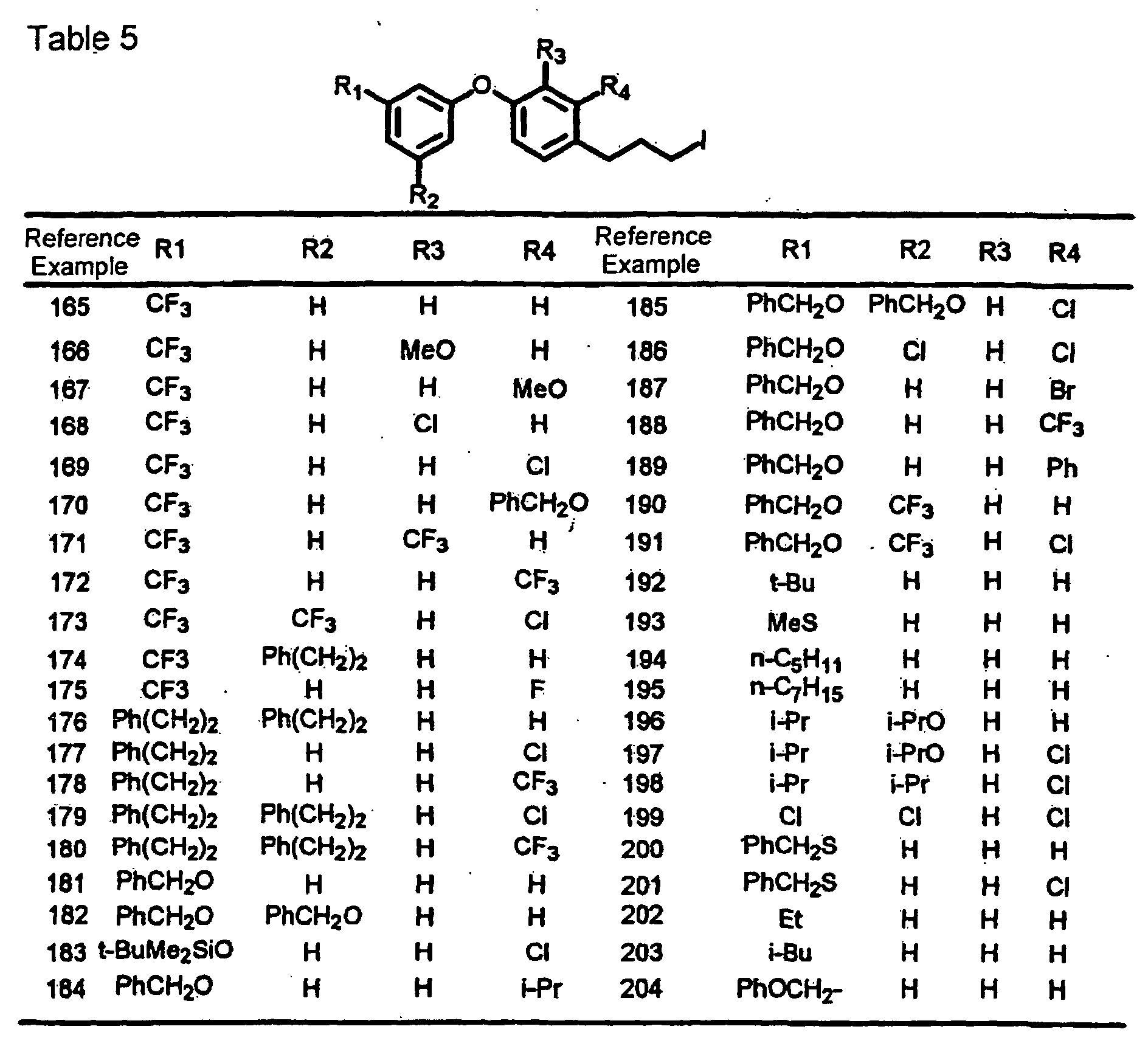








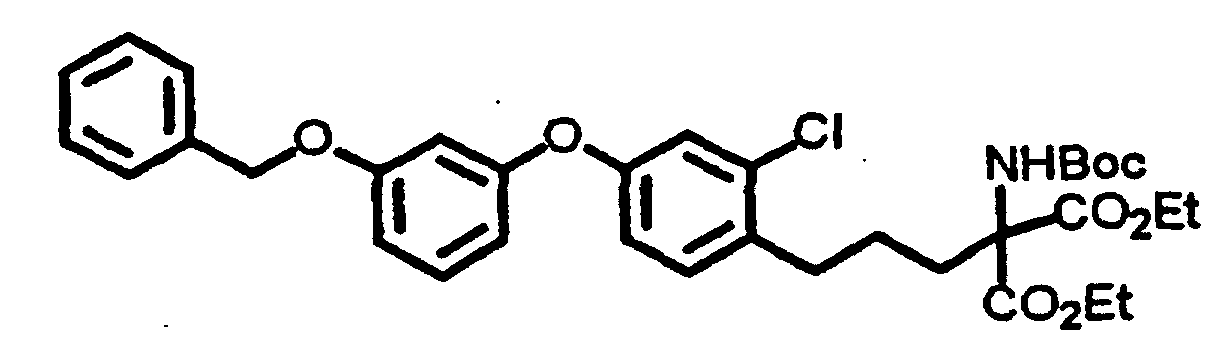
FABMS : 626 ([M+H]+)
1H-NMR (400MHz, CDCl3) δ 1.22-1.30(6H, m), 1.42(9H, s), 1.57(2H, br s), 2.37(2H, br), 2.70(2H, t, J=7.8Hz), 4.19-4.29(4H, m), 5.03(2H, s), 5.95(1H, bs), 6.57-6.62(2H, m), 6.74(1H, dd, J=8.3, 2.4Hz), 6.83(1H, dd, J=8.3, 2.4Hz), 6.98(1H, d,. J=2.4Hz), 7.13(1H, d, J=8.3Hz), 7.23(1H, t, J=8.3Hz), 7.33-7.43(5H, m)

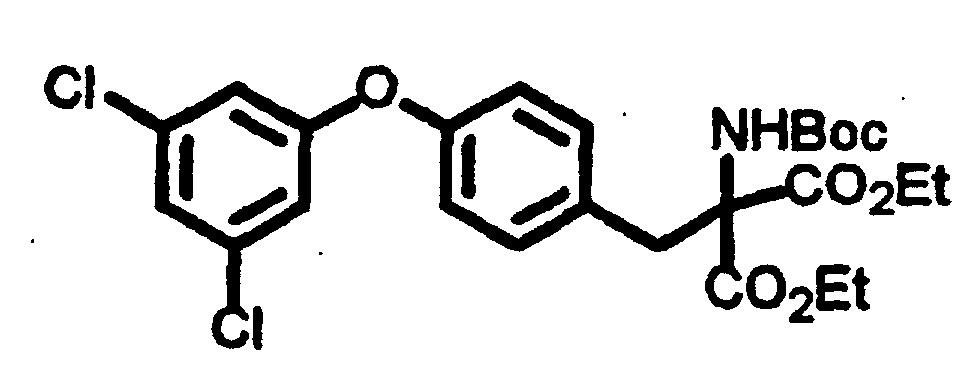
1H-NMR(400MHz, CDCl3) δ 1.28(6H, t, J=7.3Hz), 1.47(9H, br s), 3.62(2H, br s), 4.19-4.31(4H, m), 5.79(1H, br s), 6.85(2H, d, J=2.0Hz), 6.92(2H, d, J=8.8Hz), 7.04-7.08(3H, m)
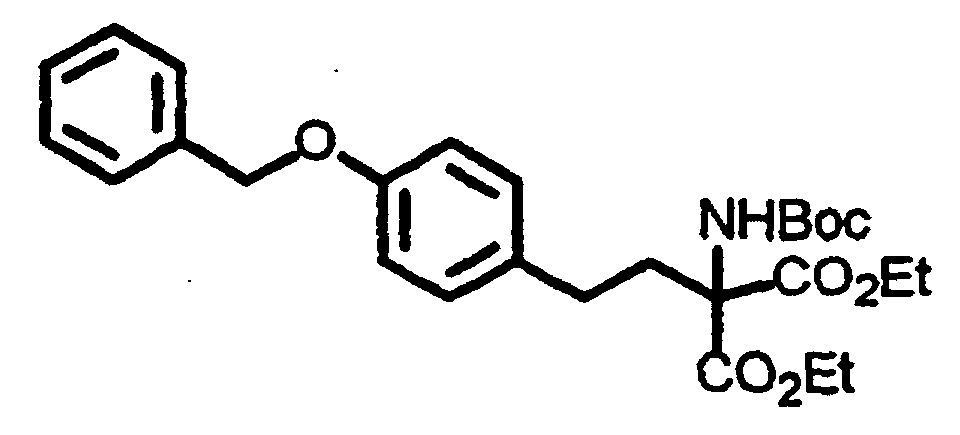
1H-NMR(400MHz, CDCl3) δ 1.23(6H, t, J=7.3Hz), 1.44(9H, s), 2.44-2.48(2H,m), 2.60(2H, br s), 4.13-4.31(4H, m), 5.04(2H, s), 5.99(1H, br s), 6.88(2H, d, J=8.8Hz), 7.07(2H, d, J=8.3Hz), 7.29-7.44(5H, m)
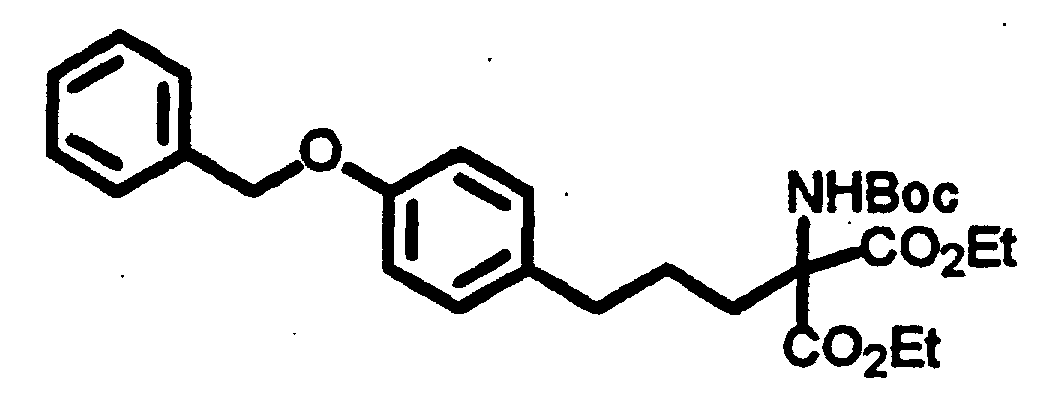
1H-NMR (400MHz, CDCl3) δ 1.22(6H, t, J=7.1Hz), 1.42(9H, s), 1.44-1.47(2H,m), 2.31(2H, br s), 2.57(2H, t, J=7.6Hz), 4.11-4.27(4H, m), 5.03(2H, s), 5.92(1H, br s), 6.88(2H, d, J=8.8Hz), 7.06(2H, d, J=8.8Hz), 7.29-7.43(5H, m)

1H-NMR(400MHz, CDCl3) δ 1.16-1.24(2H, m), 1.23(6H, t, J=7.1Hz), 1.42(9H, s), 1.56-1.63(2H, m), 2.30(2H, br ), 2.54(2H, t, J=7.8Hz), 4:16-4.29(4H, m), 5.03(2H, s), 5.92(1H, br s), 6.88(2H, d, J=8.3Hz), 7.06(2H, d, J=8.3Hz), 7.32-7.44(5H, m)
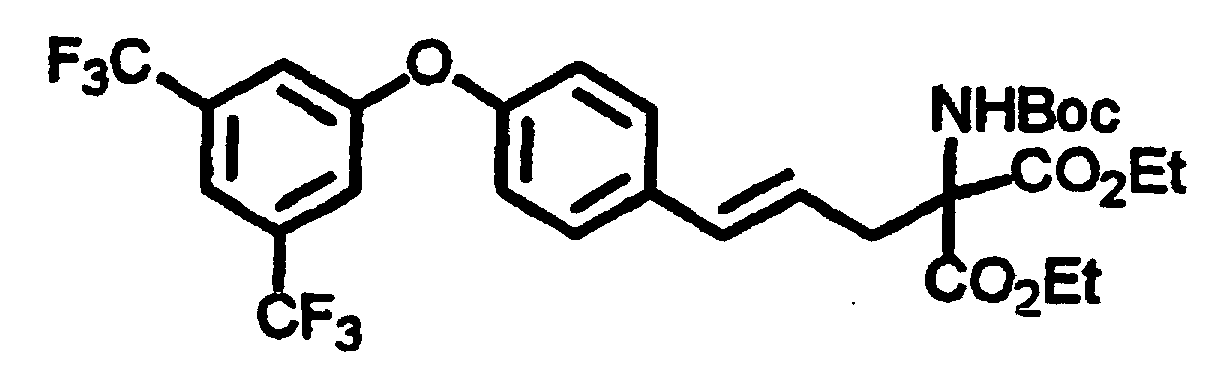
1H-NMR(400MHz, CDCl3) δ 1.27(6H, t, J=7.0Hz), 1.44(9H, s), 3.20(2H, d, J=7.0Hz), 4.20-4.32(4H, m), 5.97(1H, br s), 6.02(1H, dt, J=15.9, 7.0Hz), 6.45(1H, d, J=15.9Hz), 6.98(2H, d, J=8.5Hz), 7.36(2H, d, J=8.5Hz), 7.38(2H, s), 7.57(1H, s)
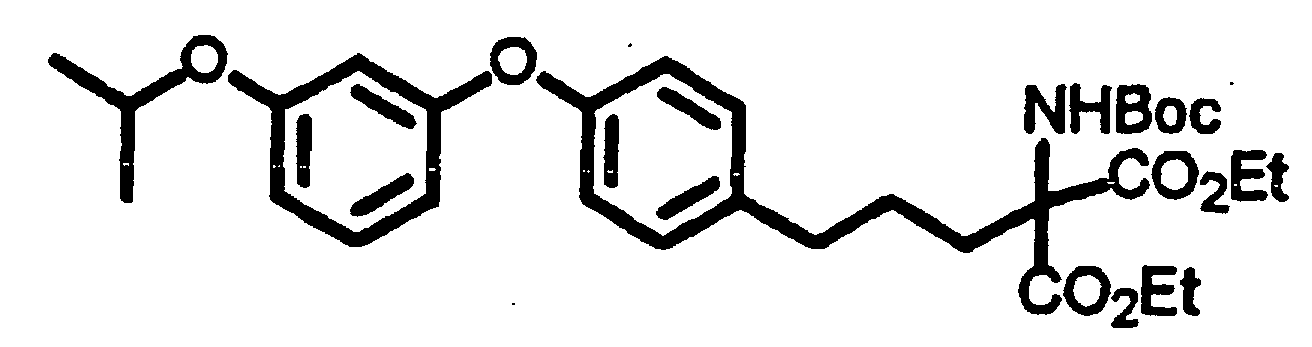
1H-NMR (400MHz, CDCl3) δ 1.23(6H, t, J=7.3Hz), 1.31(6H, d, J=5.9Hz), 1.42(9H, s), 1.45-1.52(2H, m), 2.34(2H, br), 2.61(2H, t, J=7.8Hz), 4.17-4.27(4H, m), 4.50(1H, heptet, J=5.9Hz), 5.94(1H, br s), 6.50-6.53(2H, m), 6.59-6.62(1H, m), 6.92(2H, d, J=8.8Hz), 7.10(2H, d, J=8.8Hz), 7.18(1H, t, J=8.8Hz)

1H-NMR(400MHz, CDCl3) δ 1.24(6H, t, J=7.3Hz), 1.42(9H, s), 1.47-1.56(2H, m), 2.34(2H, br), 2.64(2H, t, J=7.8Hz), 3.04(3H, s), 4.18-4.26(4H, m), 5.95(1H, br), 6.95(2H, d, J=8.8Hz), 7.17(2H, t, J=8.8Hz), 7.20-7.30(3H,m), 7.47-7.52(2H, m), 7.62(1H, d, J=8.8Hz)
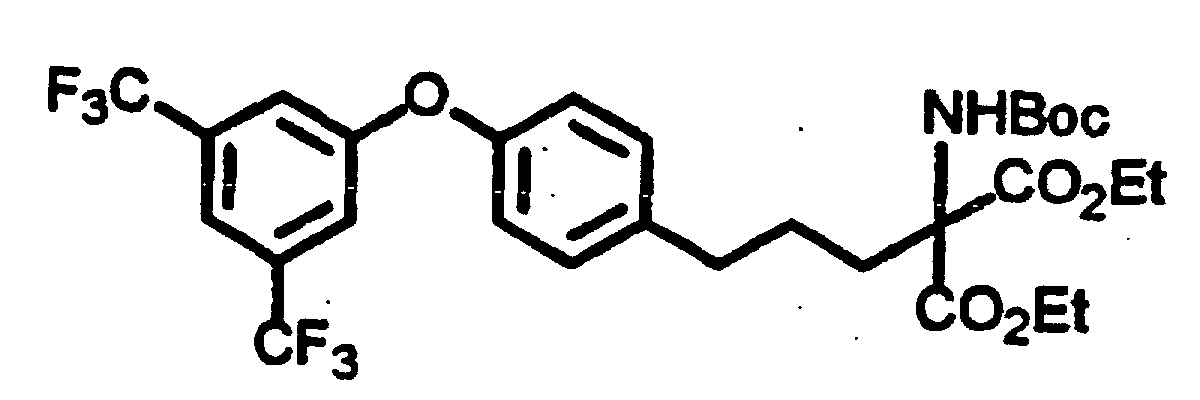
1H-NMR(400MHz, CDCl3) δ 1.24(6H, t, J=7.3Hz), 1.43(9H, s), 1.47-1.58(4H, m), 2.36(2H, br s), 2.66(2H, t, J=7.3Hz), 4.18-4.26(4H, m), 5.96(1H, br s), 6.96(2H, d, J=8.3Hz), 7.20(2H, d, J=8.3Hz), 7.36(2H, s), 7.55(1H, s)
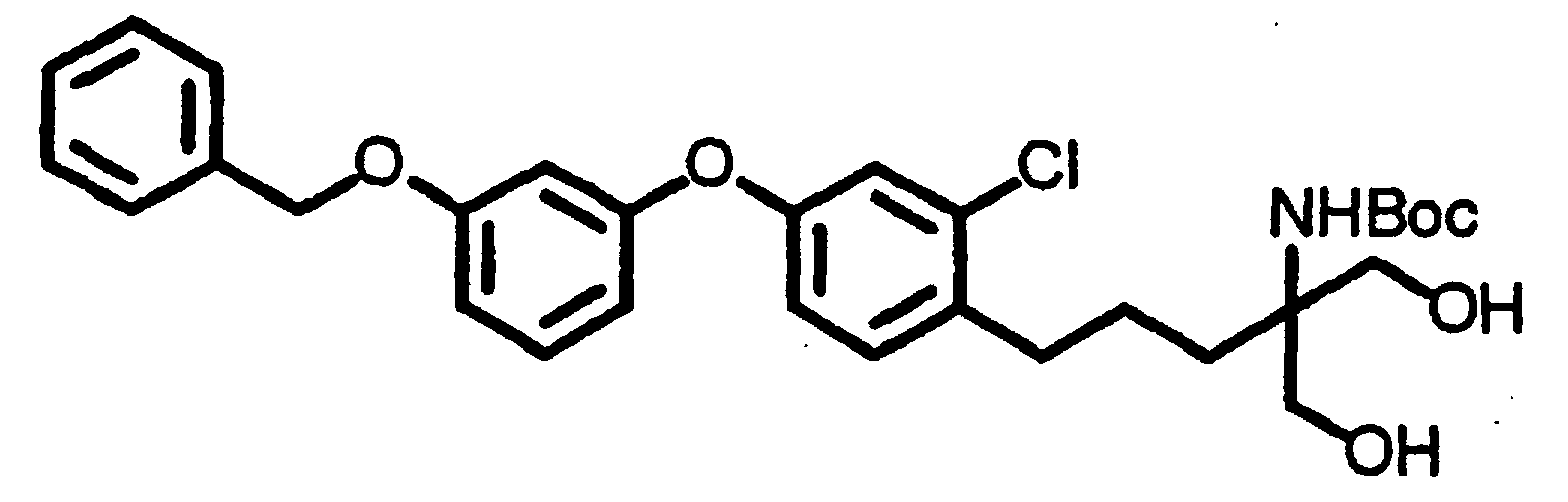
FABMS : 542 ([M+H] +)
1H-NMR (400MHz, CDCl3) δ 1.43(9H, s), 1.66(4H, br s), 2.69(2H, t, J=6.8Hz), 3.40(2H, br), 3.60(2H, dd, J=11.3, 5.9Hz), 3.84(2H, dd, J=11.3, 3.8Hz), 4.92(1H, br s), 5.03(2H,. s), 6.59-6.62(2H, m), 6.75(1H, dd, J=8.3, 2.5Hz), 6.84(1H, dd, J=8.3, 2.5Hz), 7.00(1H, d, J=2.5Hz), 7.14(1H, d, J=8.3Hz), 7.24(1H, t, J=8.3Hz), 7.31-7.43(5H, m)
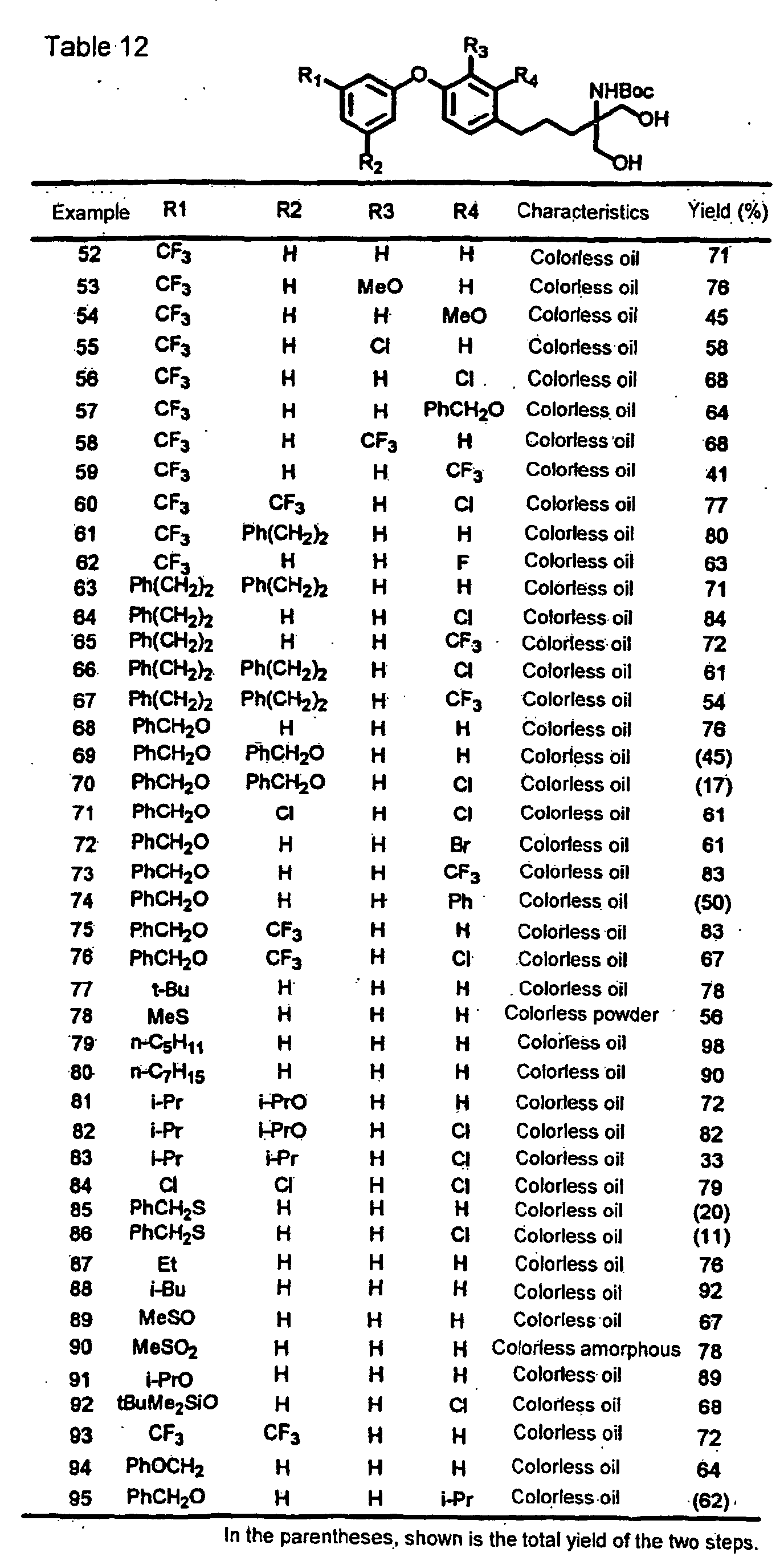

1H-NMR(400MHz, CDCl3) δ 1.46(9H, s), 2.94(2H, s), 3.60(2H, d, J=11.7Hz), 3.75(2H, d, J=11.7Hz), 4.93(1H, br s), 6.87(2H, d, J=2.0Hz), 6.98(2H, d, J=8.8Hz), 7.08(1H, t, J=2.0Hz), 7.26(2H, d, J=8.8Hz)

1H-NMR(400MHz, CDCl3) δ 1.45(9H, s), 1.83-1.88(2H, m), 2.54-2.59(2H, m), 3.39 (2H, br s) , 3. 64 (2H, d, J=11. 2Hz) , 3. 88 (2H, d, J=11.2Hz), 5.01(1H,br s), 5.03(2H, s), 6.90(2H, d, J=8.3Hz), 7.10(2H, d, J=8.3Hz), 7.30-7.44(5H, m)

1H-NMR(400MHz, CDCl3) δ 1.43(9H, s), 1.50-1.70(4H, m), 2.52-2.57(2H, m), 3.57(2H, d, J=11.2Hz), 3.82(2H, d, J=11.2Hz), 4.86(1H, br s), 5.04(2H,s), 6.90(2H, d, J=8.8Hz), 7.08(2H, d, J=8.8Hz), 7.31-7.44(5H, m)

1H-NMR(400MHz, CDCl3) δ 1.27-1.35(2H, m), 1.43(9H, s), 1.54-1.63(4H, m), 2.56(2H, t, J=7.6Hz), 3.41(2H, br s), 3.58(2H, d, J=11.7Hz), 3.82(2H, d, J=11.7Hz), 4.88(1H, br s), 5.04(2H, s), 6.89(2H, d, J=8.8Hz), 7.07(2H, d, J=8.8Hz), 7.33-7.43(5H, m)

1H-NMR(400MHz, CDCl3) δ 1.44(9H, s), 2.55(2H, d, J=7.8Hz), 3.65(2H, d, J=11.2Hz), 3.78(2H, br), 3.85(2H, d, J=11.2Hz), 5.12(1H, s), 6.20(1H, dt, J=16.1, 7.8Hz), 6.51(1H, d, J=16.1 Hz), 7.01(2H, d, J=8.3Hz), 7.38(2H,s), 7.39(2H, d, J=8.3Hz), 7.57(1H, s)
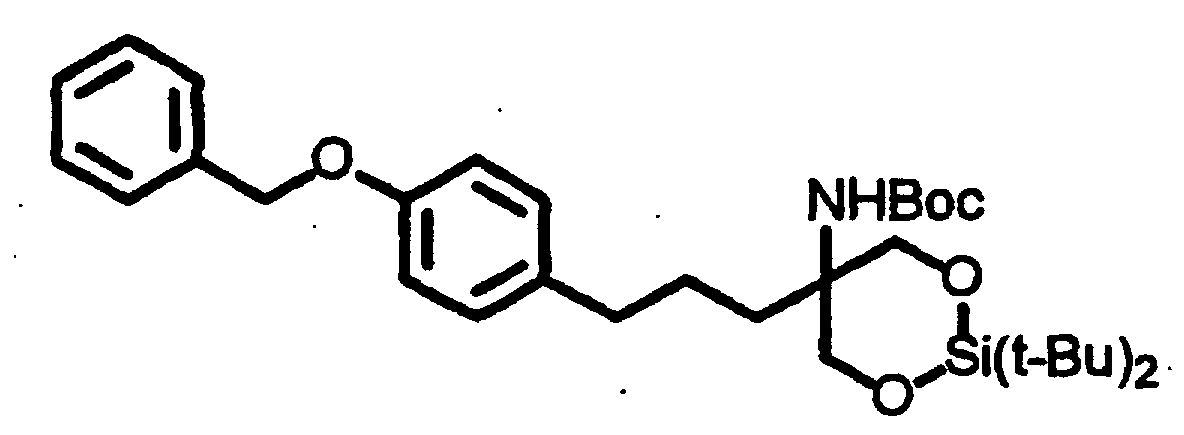
1H-NMR(400MHz, CDCl3) δ 1.04(9H, s), 1.06(9H, s), 1.42(9H, s), 1.46-1.56(4H, br s), 2.51(2H, t, J=6.8Hz), 3.88(2H, d, J=11.2Hz), 4.22(2H, d, J=11.2Hz), 4.90(1H, br s), 5.04(2H, s), 6.89(2H, d, J=8.3Hz), 7.06(2H, d, J=8.3Hz), 7.32-7.44(5H, m)
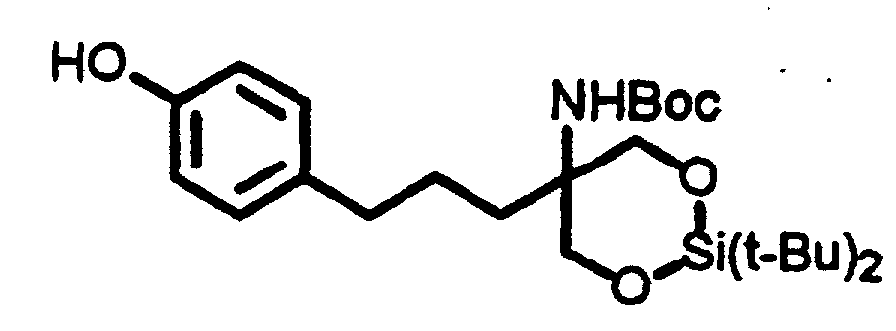
1H-NMR(400MHz, CDCl3) δ 1.04(9H, s), 1.06(9H, s), 1.43(9H, s), 1.47-1.61(4H, m), 2.49(2H, t, J=6.8Hz), 3.88(2H, d, J=11.3Hz), 4.22(2H, d, J=11.3Hz), 4.88(1H, br s), 4.91(1H, br s), 6.74(2H, d, J=8.3Hz), 6.99(2H, d, J=8.3Hz)
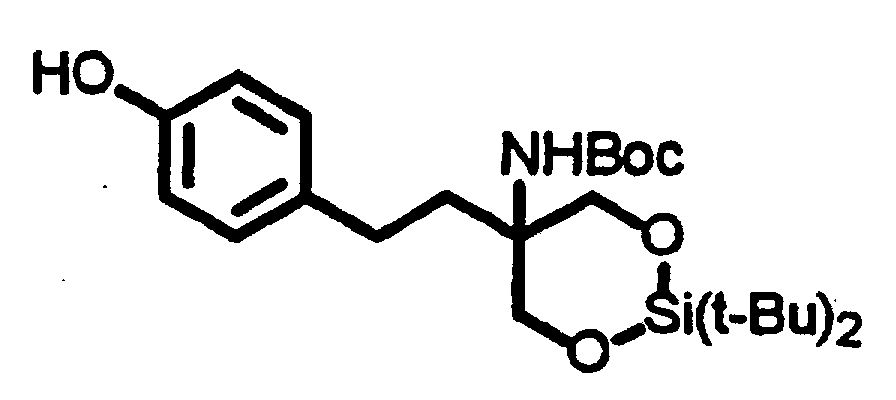
1H-NMR (400MHz, CDCl3) δ 1.06(9H, s), 1.07(9H, s), 1.46(9H, s), 1.79(2H,; m), 2.44-2.50(2H, m), 3.93(2H, d, J=11.2Hz), 4.26(2H, d, J=11.2Hz), 4.92(1H, br s), 5.01(1H, br s), 6.73(2H, d, J=8.3Hz), 7.01(2H, d, J=8.3Hz)
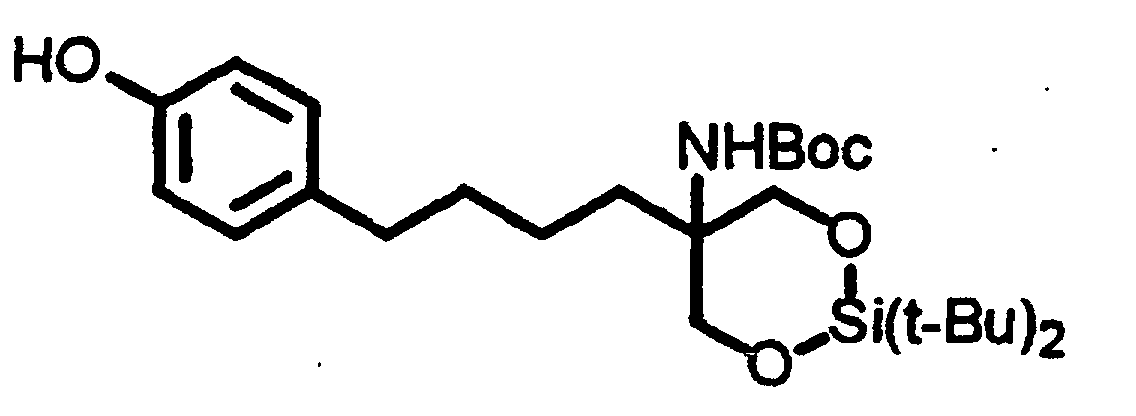
1H-NMR(400MHz, CDCl3) δ 1.05 (9H, s), 1.07(9H, s), 1.20-1.30(2H, m), 1.42(9H, s), 1.50-1.60(4H, m), 2.51(2H, t, J=7.6Hz), 3.89(2H, d, J=11.2Hz), 4.22(2H, d, J=11.2Hz), 4.78(1H, br s), 4.91(1H, br s), 6.73(2H, d, J=8.3Hz), 7.00 (2H, d, J=8.3Hz)
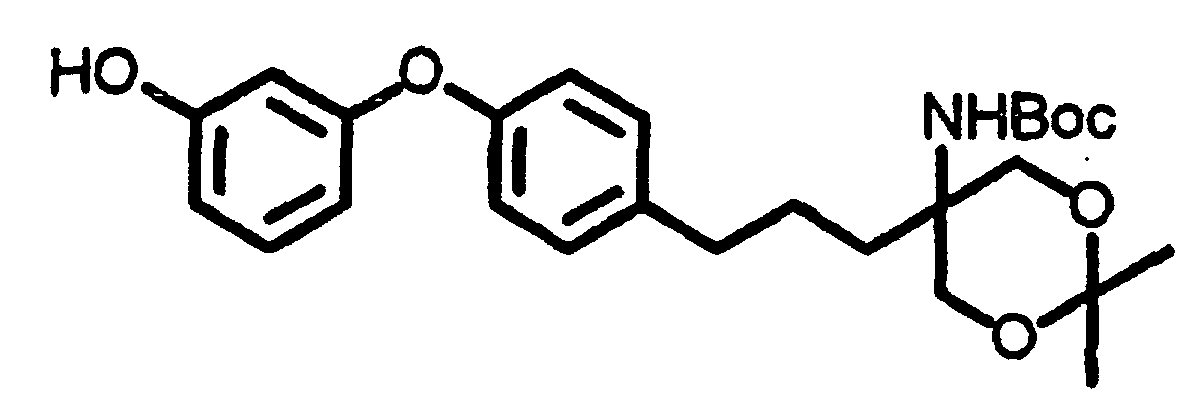
1H-NMR(400MHz, CDCl3) δ 1.40(3H, s), 1.42(12H, s), 1.54-1.69(4H, m), 2.61(2H, t, J=7.8Hz), 3.63(2H, d, J=11.2Hz), 3.87(2H, d, J=11.2Hz), 4.86(1H,br), 5.29(1H, br s), 6.32(1H, br s), 6.52(1H, dd, J=8.3, 2.4Hz), 6.57(1H, dd, J=8.3, 2.4Hz), 6.95(2H, d, J=8.3Hz), 7.13(2H, d, J=8.3Hz), 7.16(1H, t, J=8.3Hz)

FABMS : 492 ([M+H]+)
1H-NMR (400MHz, CDCl3 ) δ 1.41(3H, s), 1.42(12H, s), 1.55-1.73(4H, m), 2.70(2H, t, J=7.3Hz), 3.66(2H, d, J=11.7Hz), 3.88(2H, d, J=11.7Hz), 4.89(1H,br), 5.97(1H, br), 6.40(1H, br s), 6.56(1H, dd, J=8.3, 2.4Hz), 6.62(1H, dd, J=8.3, 2.4Hz), 6.86(1H, dd, J=8.3, 2.4Hz), 7.01(1H, d, J=2.4Hz), 7.14(1H, d, J=8.3Hz), 7.18(1H, d, J=8.3Hz)

1H-NMR(400MHz, CDCl3) δ 1.41(3H, s), 1.42(3H, s), 1.43(9H, s), 1.54-1.60(2H, m), 1.75(2H, br), 2.69(2H, t, J=7.3Hz), 3.66(2H, d, J=11.7Hz), 3.88(2H, d, J=11.7Hz), 4.89(1H, br), 4.98(2H, s), 6.58-6.64(2H, m), 6.70(1H, dd, J=8.3, 2.4Hz), 6.84(1H, dd, J=8.3, 2.4Hz), 7.00(1H, d, J=2.4Hz), 7.15(1H, d, J=8.3Hz), 7.22-7.32(4H, m)

1H-NMR (400MHz, CDCl3) δ 1.40(3H, s), 1.42(3H, s), 1.43(9H, s), 1.54-1.61(2H, m), 1.70(2H, br), 2.58(2H, t, J=7.3Hz), 3.64(2H, d, J=11.2Hz), 3.89(2H, d, J=11.2Hz), 4.87(1H,br), 6.66-6.71(3H, m), 6.94(2H, d, J=8.3Hz), 7.02(2H, d, J=8.3 Hz), 7.11-7.13(3H, m), 7.21(1H, t, J=8.3Hz), 7.34(2H, t, J=8.3Hz)
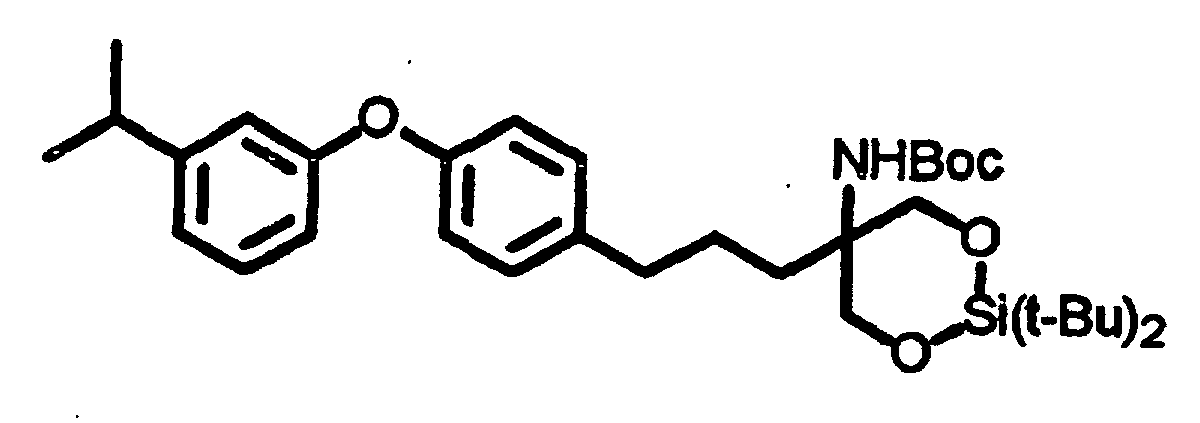
1H-NMR(400MHz, CDCl3) δ 1.05(9H, s), 1.07(9H, s), 1.23(6H, d, J=6.8Hz), 1.43(9H, s), 1.55(4H, br s), 2.55(2H, t, J=7.1Hz), 2.84-2.91(1H, m), 3.89(2H, d, J=11.7Hz), 4.23(2H, d, J=11.7Hz), 4.91(1H, br s), 6.75-6.79(1H, m), 6.89-6.91(1H, m), 6.91(2H, d, J=8.8Hz), 6.95(1H, d, J=7.8Hz), 7.09(2H, d, J=8.8Hz), 7.22(1H, t, J=7.8Hz)
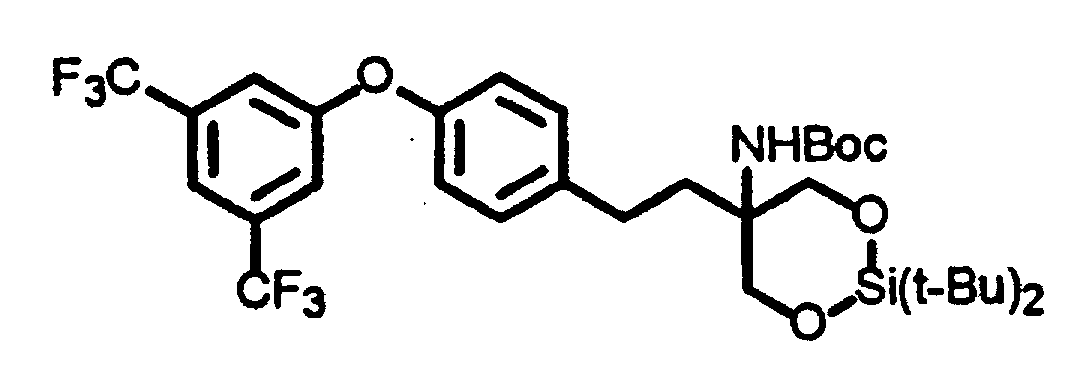
1H-NMR(400MHz, CDCl3) δ 1.07(9H, s), 1.09(9H, s), 1.47(9H, s), 1.87(2H, m), 2.55-2.60(2H, m), 3.97(2H, d, J=11.2Hz), 4.28(2H, d, J=11.2Hz), 5.05(1H, br s), 6.96(2H, d, J=8.3Hz), 7.21(2H, d, J=8.3Hz), 7.34(2H, s), 7.54(1H, s)

1H-NMR(400MHz, CDCl3) δ 1.05(9H, s), 1.08(9H, s), 1.25-1.31(2H, m), 1.42(9H, s), 1.55-1.63(4H, m), 2.61(2H, t, J=7.8Hz), 3.91(2H, d, J=11.2Hz), 4.23(2H, d, J=11.2Hz), 4.92(1H; br s), 6.95(2H, d, J=8.3Hz), 7.19(2H, d,J=8.3Hz), 7.36(2H, s), 7.54(1H, s)

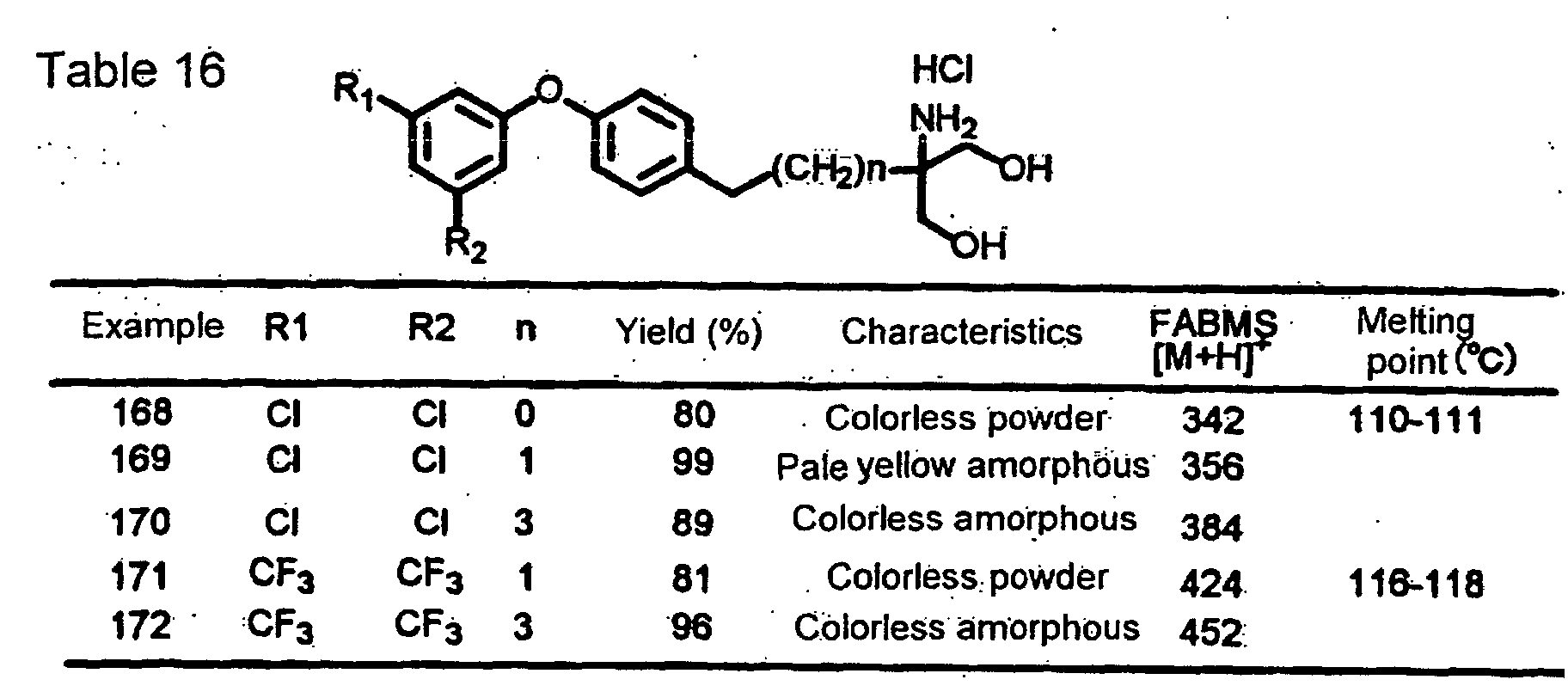
| Example | n | Yield (%) | Characteristics | Example | n | Yield (%) | Characteristics |
| 128 | 1 | 49 | Colorless oil | 129 | 3 | 67 | Colorless oil |

1H-NMR (400MHz, CDCl3) δ 1.40(3H, s), 1.42(3H, s), 1.44(9H, s), 1.56-1.61(2H, m), 1.71(2H, br), 2.59(2H, t, J=7.3Hz), 3.64(2H, d, J=11.7Hz), 3.89(2H, d, J=11.7Hz), 4.87(1H,br), 4.98(2H, s), 6.58-6.60(2H, m), 6.66-6.68(1H, m), 6.92(2H, d, J=8.3Hz), 7.12(2H, d, J=8.3Hz), 7.20 (1H, t, J=8.3Hz), 7.34(4H, s).
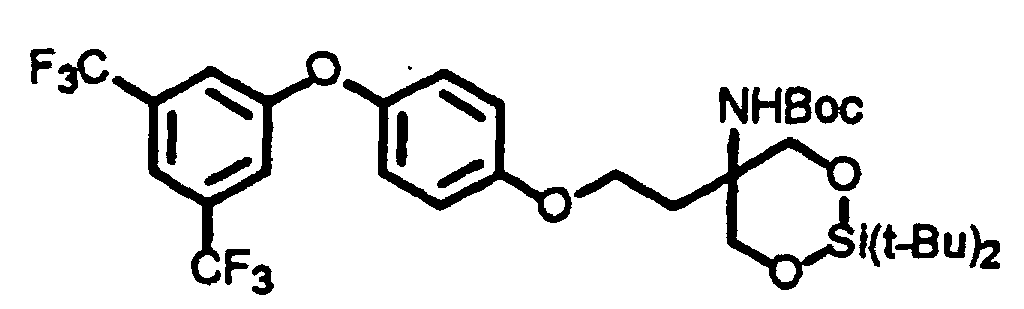
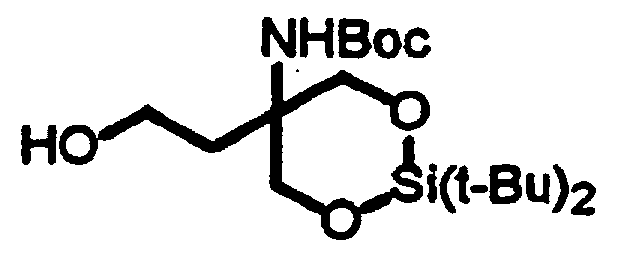
1H-NMR(400MHz, CDCl3) δ 1.08(9H, s), 1.11(9H, s), 1.44(9H, s), 2.04(2H, br s), 4.04-4.07(4H, br), 4.42(2H, d, J=11.2Hz), 5.10(1H, br s), 6.92(.2H, d, J=8.5Hz), 7.00(2H, d, J=8.5Hz), 7.32(2H, s), 7.52(1H, s)

1H-NMR(400MHz, CDCl3) δ 1.05 (9H, s), 1.07(9H, s), 1.42(9H, s), 1.48(3H, d, J=6.3Hz), 1.55(4H, br s), 1.78(1H, m), 2.56(2H, t, J=6.8Hz), 3.90(2H, d, J=11.7Hz), 4.23(2H, d, J=11.7Hz), 4.87 (1H, q, J=6.5Hz), 4.91(1H, br s), 6.86-6.89(1H, m), 6.92(2H, d, J=8. 8Hz) , 7.03 (1H, t, J=2. 0Hz) , 7.07-7.12(3H, m), 7.29(1H, t, J=8.3Hz)
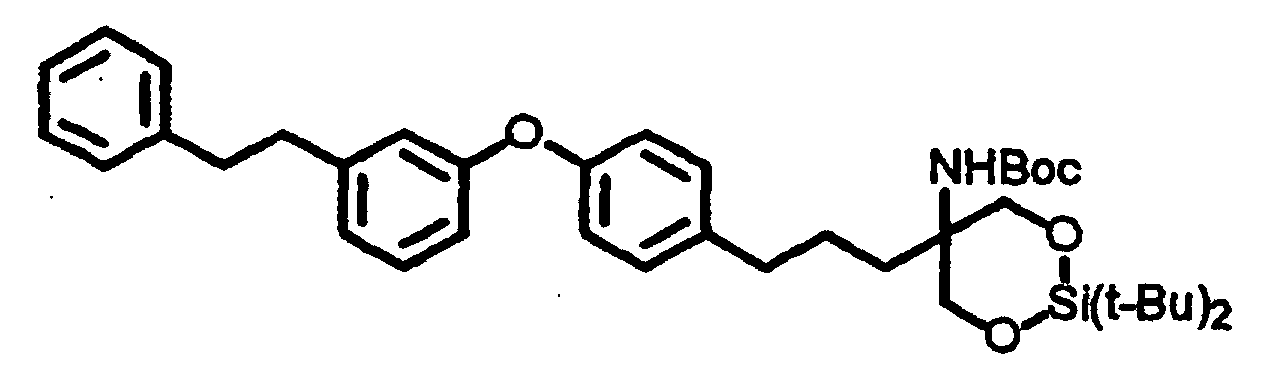
1H-NMR (400MHz, CDCl3) δ 1.05(9H, s), 1.07(9H, s), 1.43(9H, s), 1.57(4H, br s), 2.56(2H, t, J=7.1Hz), 2.90(4H, m), 3.90(2H, d, J=11.2Hz), 4.23(2H, d, J=11.2Hz), 4.92(1H, br s), 6.79-6.83(2H, m), 6.88(2H, d, J=8.3Hz), 6.89-6.92(1H, m), 7.09(2H, d, J=8.3Hz), 7.14-7.24(4H, m), 7.25-7.29(2H, m)

FABMS:438 ([M+H]+)
1H-NMR (400MHz, DMSO-d6) δ 1.55-1.58(4H, br), 2.58(2H, t, J=6.8Hz), 3.40-3.47(4H, m), 5.31(1H, br), 7.13(2H, d, J=8.3Hz), 7.31(2H, d, J=8.3Hz), 7.56(2H, s), 7.76(1H, br), 7.83(1H, s). Melting point = 194-196°C
| Elemental analysis (%): C20H21F6NO3·HCl | |||
| C | H | N | |
| Calcd. | 50.70 | 4.68 | 2.96 |
| Found | 50.70 | 4.66 | 2.91 |

Melting point: 95-98°C
FABMS:436 ([M+H]+)
1H-NMR (400MHz, DMSO-d6) δ 1.56 (4H, br), 1.97(2H, quintet, 7.3Hz), 2.49-2.53(2H, m), 3.39-3.46(4H, m), 3.92(2H, t, J=7.3Hz), 5.30(1H, br), 6.47-6.49(2H, m), 6.66-6.69(1H, m), 6.95(2H, d, J=8.8Hz), 7.12-7.29(8H, m), 7.68-7.72(2H, m)
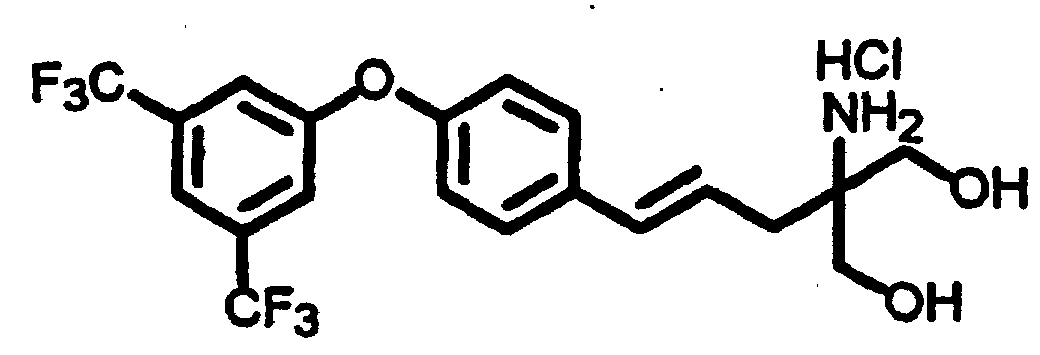
Melting point = 203-206°C
FABMS: 436 ([M+H]+)
1H-NMR (400MHz, DMSO-d6) δ 3.32(2H, d, J=7.5Hz), 3.48(4H, br), 6.23(1H, dt, J=15.5, 7.5Hz), 6.53(1H, d, 15.5Hz), 7.17(2H, d, J=8.8Hz), 7.52(2H, d, J=8.8Hz), 7.60(2H, s), 7.85(1H, s)
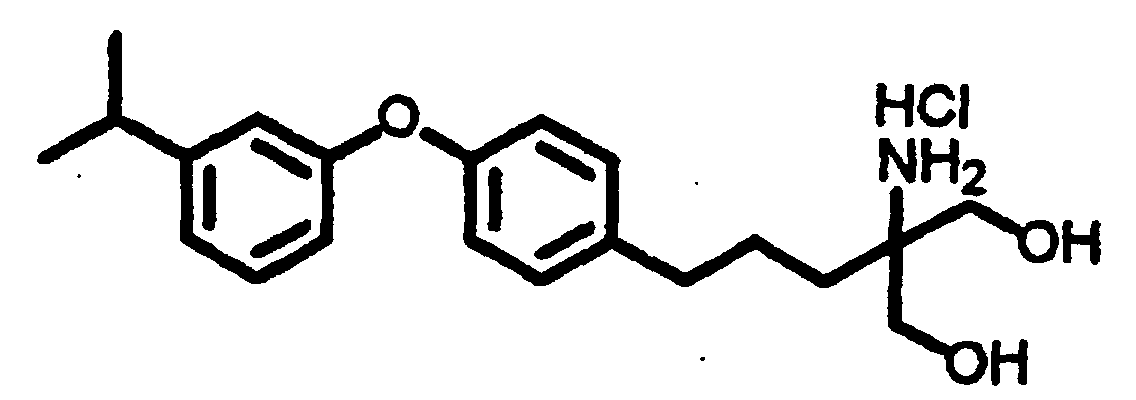
FABMS: 344 ([M+H]+)
1H-NMR (400MHz, DMSO-d6) δ 1.17(6H, d, J=6.8Hz), 1.55(4H, br s),-2.53(2H, br), 2.81-2.89(1H, m), 3.39-3.49(4H, m), 5.30(2H, t, J=5.1Hz), 6.71(1H, dd, J=8.3, 2.4Hz), 6.87(1H, t, J=2.0Hz), 6.91(2H, d, J=8.8Hz), 6.99(1H, d, J=8.3Hz), 7.19(2H, d, J=8.8Hz), 7.26(1H, t, J=8.3Hz), 7.71(3H, br s)


Melting point = 151-155°C
FABMS : 440 ([M+H] +)
1H-NMR (400MHz, DMSO-d6) δ 2.04 (2H, t, J=6.5Hz), 3.54(4H, s), 4.11 (2H, d,J=6.5Hz), 7.04(2H, d, J=9.2Hz), 7.19(2H, d, J=9.2Hz), 7.50(2H, s), 7.80(1H, s)

FABMS: 442 ([M+H]+)
1H-NMR (400MHz, DMSO-d6) δ 1.58 (4H, br s), 2. 63 (2H, br s), 3.39-3.45(4H, m), 5.08(2H, s), 5.31(2H, br), 6.56(1H, dd, J=8.3, 2.4Hz), 6.66(1H, t, J=2.4Hz), 6.83(1H, dd, J=8.3, 2.4Hz), 6.94(1H, dd, J=8.3, 2.4Hz), 7.05(1H, d, J=2.4Hz), 7.28-7.43(7H, m), 7.71(3H, br)
Melting point = 105-106°C (EtOH-iPr20)
| Elemental analysis(%): C25H28ClNO4•HCl | |||
| C | H | N | |
| Calcd. | 62.76 | 6.11 | 2.93 |
| Found | 62.76 | 6.05 | 2.92 |
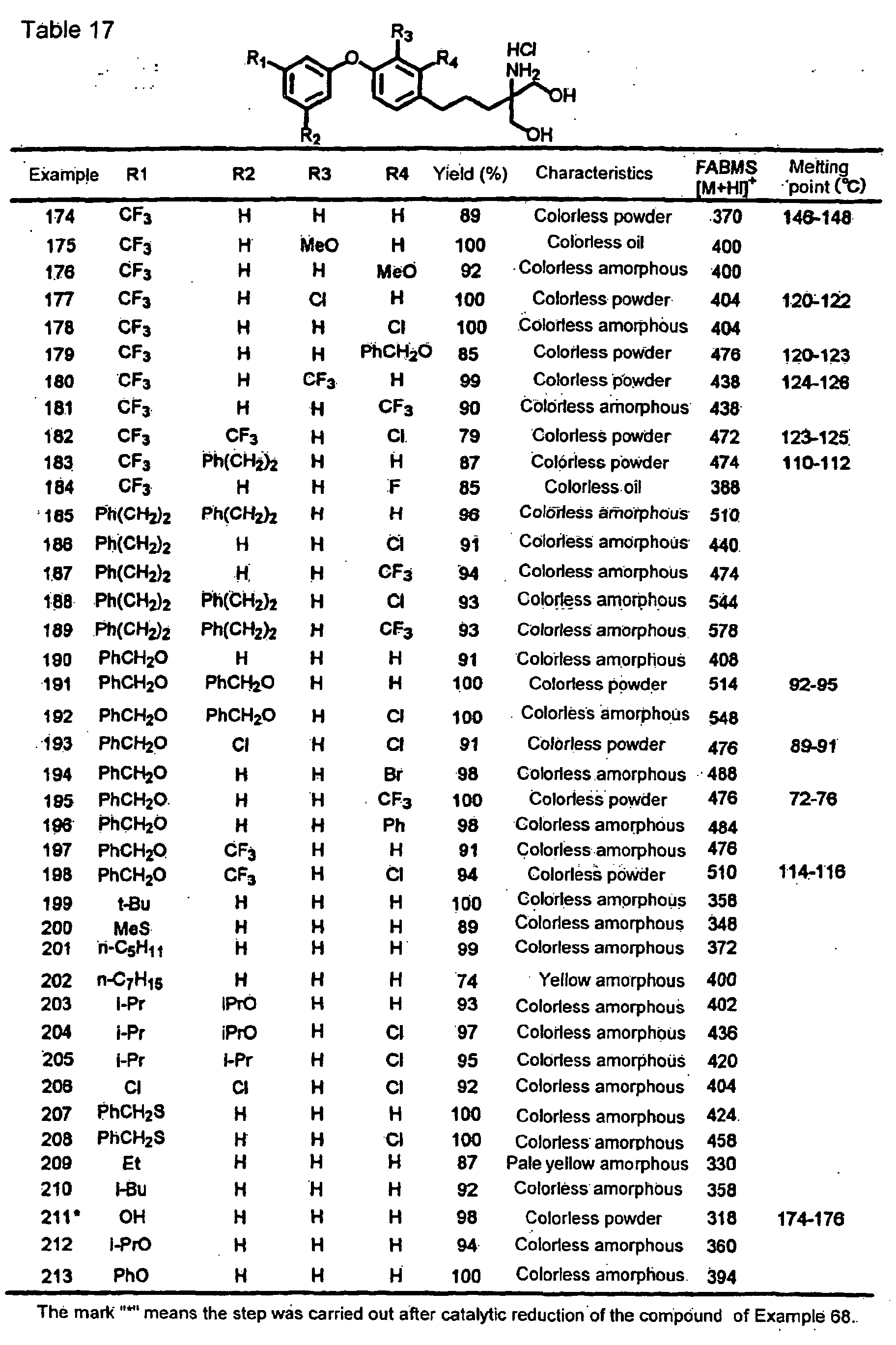

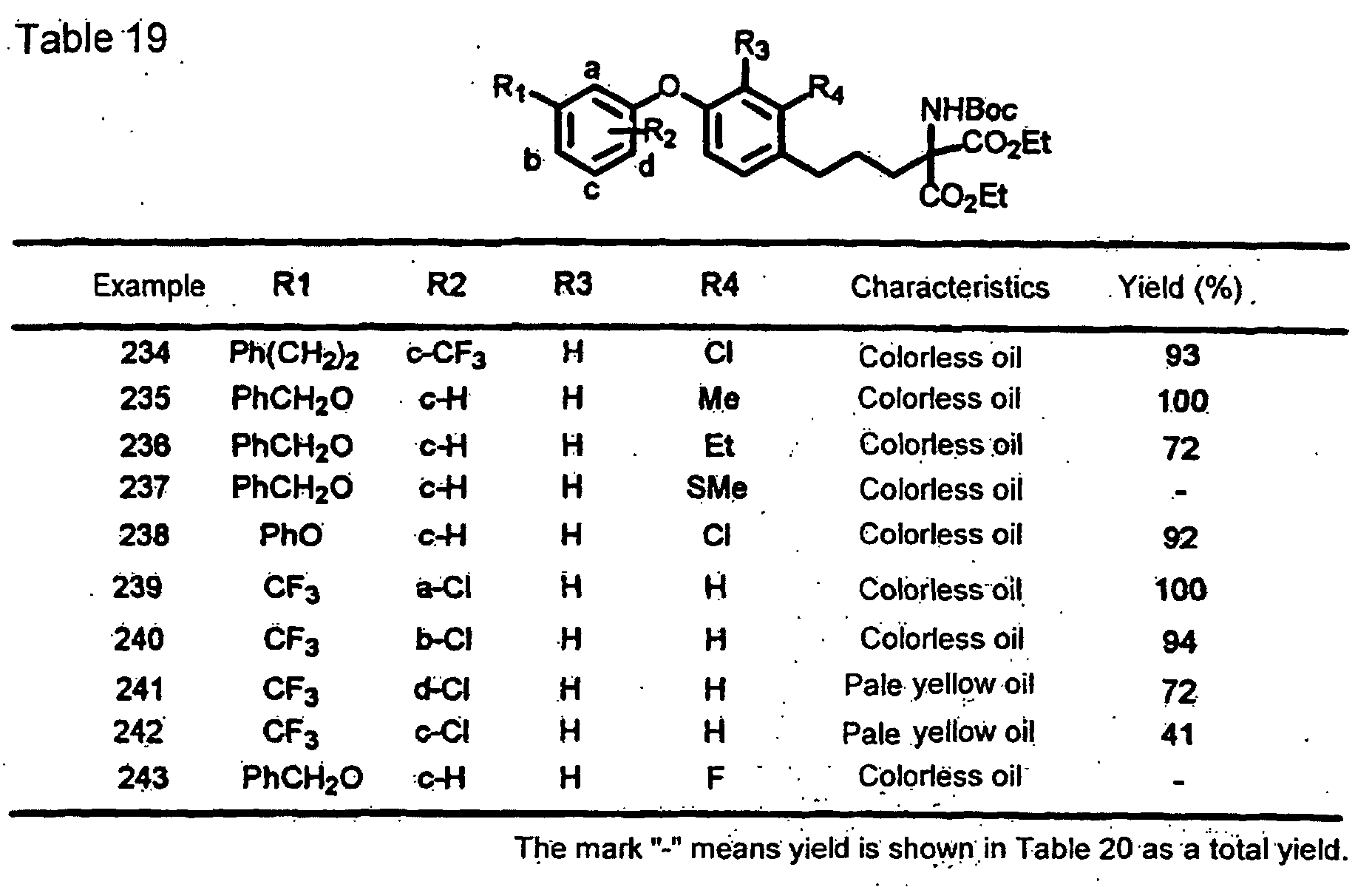
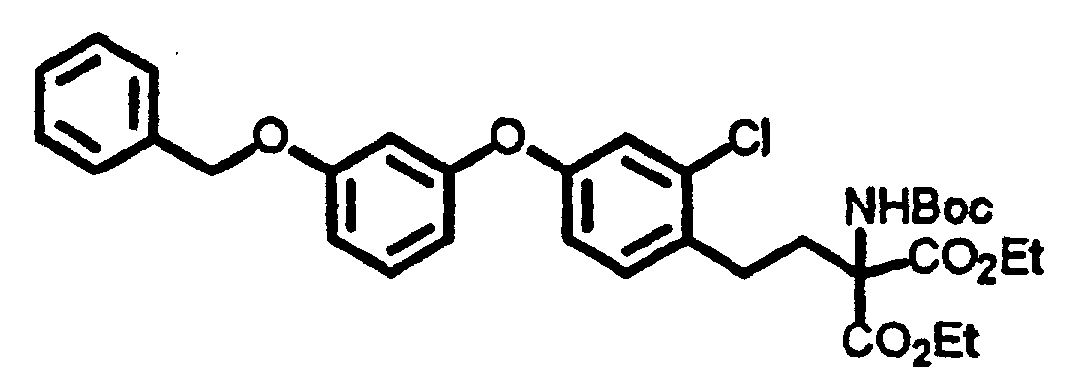
1H-NMR(400MHz, CDCl3) δ 1.23-1.32(6H, m), 1.45(9H, s), 2.59(4H, br), 4.22-4.34(4H, m), 5.03(2H, s), 6.58-6.62(2H, m), 6.75(1H, dd, J=8.3Hz, 2.4Hz), 6.83(1H, dd, J=8.3Hz, 2.4Hz), 6.98(1H, d, J=2.4Hz), 7.12(1H, d, J=8.3 Hz), 7.23(1H, t, J=8.3Hz), 7.30-7.42(5H, m)

1H-NMR (400MHz, CDCl3) δ 1.24(6H, t, J=7.3Hz), 1.43(9H, s), 1.58-1.67(4H, m), 2.33(2H, br), 2.67(2H, t, J=7.8Hz), 4.18-4.32(4H, m), 5.03(2H, s), 5.95 (1H, br s), 6.57-6.60(1H, m), 6.62(1H, t, J=2.4Hz), 6.74(1H, dd, J=8.3Hz, 2.4Hz), 6.83(1H, dd, J=8.3Hz, 2.4Hz), 6.99(1H, d, J=2.4Hz), 7.12(1H, d, J=8.3 Hz), 7.23(1H, t, J=8.3Hz), 7.30-7.42(5H, m)
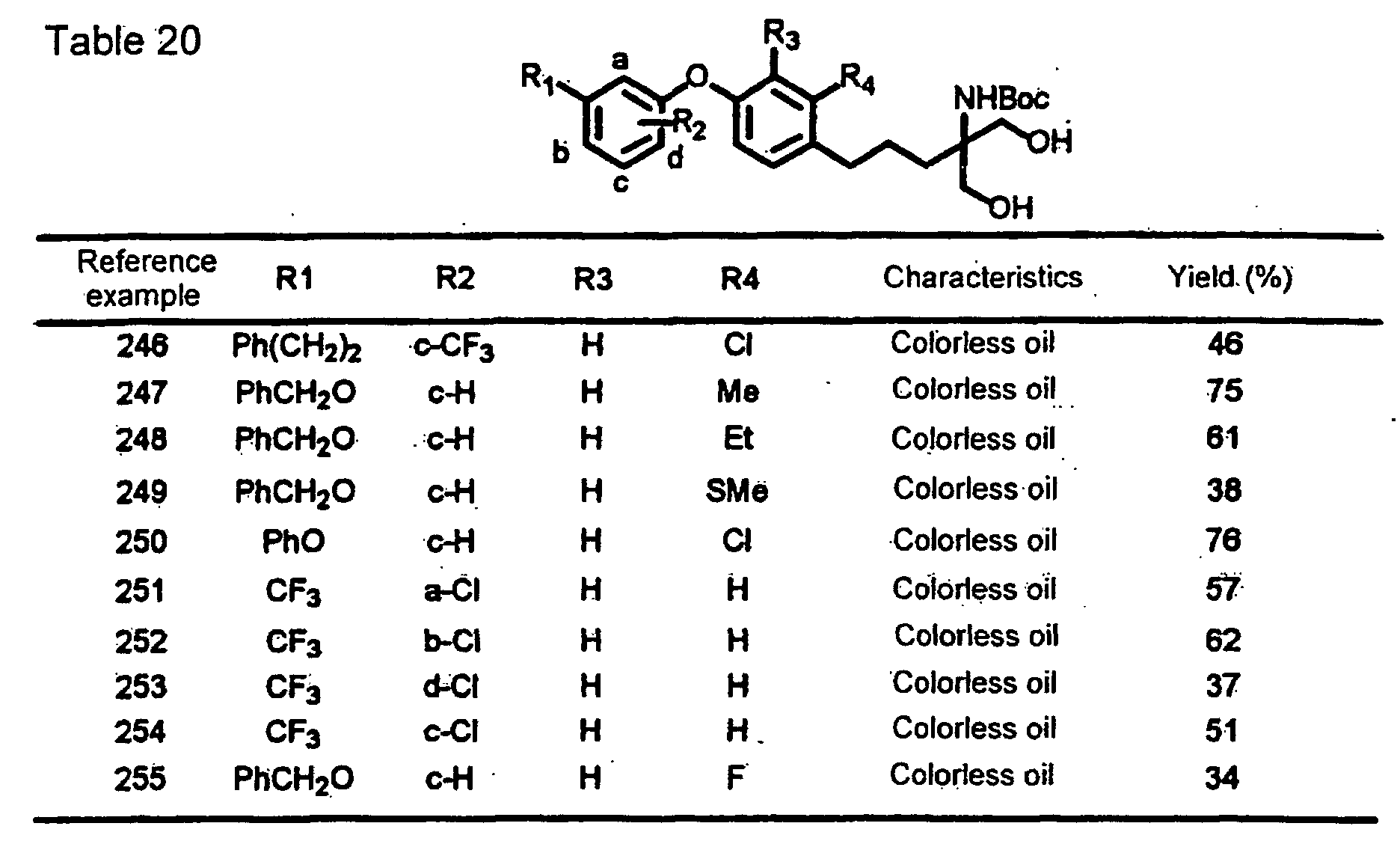
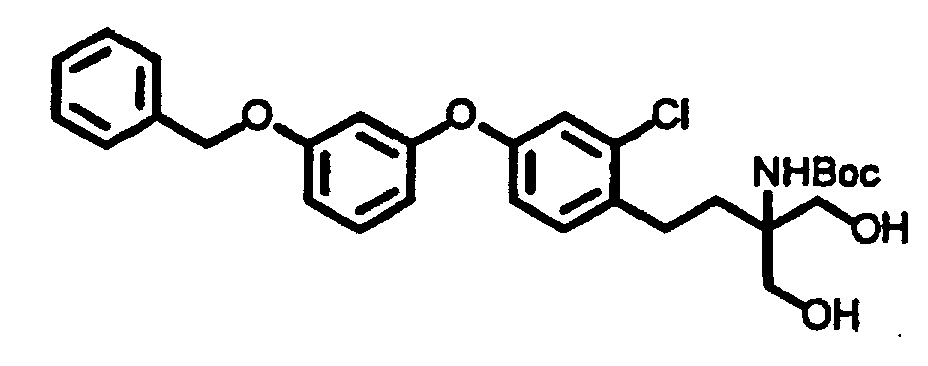
1H-NMR (400MHz, CDCl3) δ 1.46(9H, s), 1.83-1.87(2H, m), 2.69-2.73(2H, m), 3.35(2H, br), 3.67(2H, dd, J=11.7Hz, 5.9Hz), 3.92(2H, dd, J=11.7Hz, 4.9Hz), 5.03(2H, s), 5.10(1H, s), 6.57-6.62(2H, m), 6.75(1H, dd, J=8.3Hz, 2.4Hz), 6.85(1H, dd, J=8.3Hz, 2.4Hz), 7.00(1H, d, J=2.4Hz), 7.17(1H, d,J=8.3 Hz), 7.24(1H, t, J=8.3Hz), 7.32-7.42(5H, m)

1H-NMR (400MHz, CDCl3) δ 1.44(9H, s), 1.61(6H, br), 2.70(2H, t, J=7.3Hz), 3.46(2H, br), 3.57-3.60(2H, m), 3.84(2H, d, J=9.8Hz), 4.92(1H, s), 5.03(2H, s), 6.59-6.63(2H, m), 6.73-6.76(1H, m), 6.84(1H, dd, J=8.3Hz, 2.4Hz), 7.00(1H, d, J=2.4Hz), 7.13(1H, d, J=8.3Hz), 7.24(1H, t, J=8.3 Hz), 7.23-7.43(5H, m)

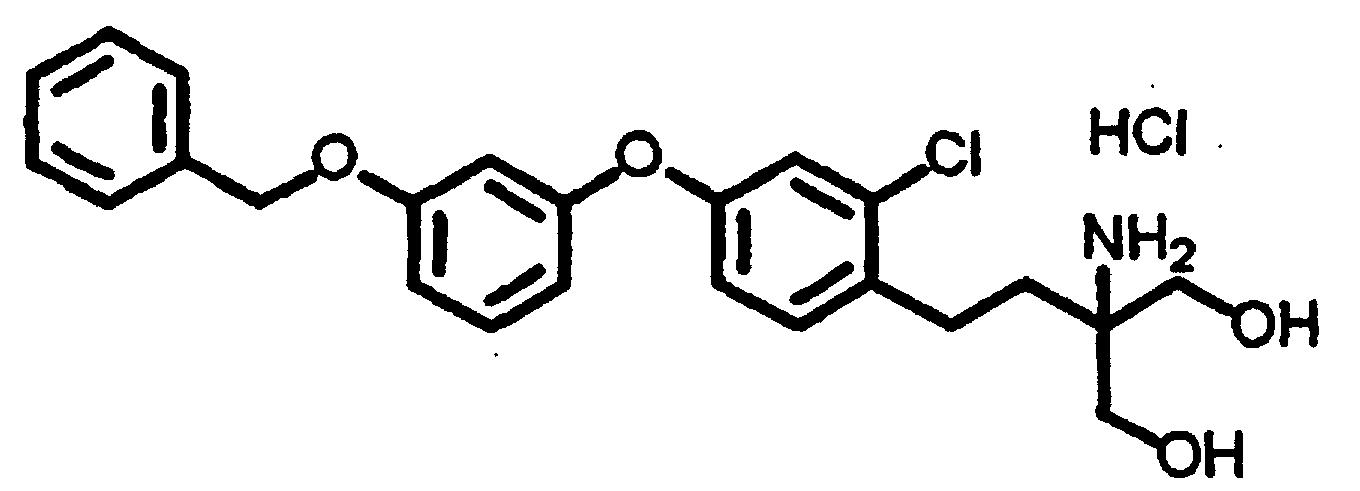
FABMS : 428 ([M+H] +)
1H-NMR(400MHz, DMSO-d6) δ 1.75-1.79(2H, m), 2.68-2.72(2H, m), 3.51-3.55(4H, m), 5.08(2H, s), 5.40(2H, t, J=4.9Hz), 6.57(1H, dd, J=8.3Hz, 2.4Hz), 6.67(1H, t, J=2.4Hz), 6.83(1H, dd, J=8.3Hz, 2.4Hz), 6.95(1H, dd, J=8.3Hz, 2.4Hz), 7.05(1H, d, J=2.4Hz), 7.27-7.43(7H, m), 7.88(3H, br)
Melting point = 150-152°C

FABMS : 456 ([M+H]+)
1H-NMR(400MHz, DMSO-d6) δ 1.30-1.40(2H, m), 1.46-1.60(4H, m), 2.64(2H, t, J=7.8Hz), 3.39-3.48(4H, m), 5.08(2H, s), 5.32(2H, t, J=5.4Hz), 6.57(1H, dd, J=8.3Hz, 2.4Hz), 6.67(1H, t, J=2.4Hz), 6.82(1H, dd, J=8.3Hz, 2.4Hz), 6.91(1H, dd, J=8.3Hz, 2.4Hz), 7.03(1H, d, J=2.4Hz), 7.27-7.43(7H, m), 7.76(3H, br) Melting point = 95-97°C
| Example No. | Dose (mg/)kg) | Inhibition (%) | Example No. | Dose (mg/kg) | Inhibition (%) | Example No. | Dose (mg/kg) | Inhibition (%). |
| 147 | 10 | 82 | 186 | 1 | 87 | 212 | 10 | 78 |
| 148 | 3 | 78 | 187 | 3 | 78 | 213 | 3 | 68 |
| 150 | 10 | 78 | 188 | 3 | 68 | 214 | 3 | 79 |
| 157 | 10 | 50 | 189 | 3 | 54 | 215 | 3 | 76 |
| 164 | 10 | 82 | 190 | 10 | 83 | 217 | 3 | 66 |
| 166 | 10 | 91 | 191 | 3 | 95 | 218 | 3 | 92 |
| 169 | 10 | 86 | 192 | 0.3 | 93 | 219 | 3 | 53 |
| 170 | 10 | 71 | 194 | 0.3 | 85 | 220 | 3 | 77 |
| 171 | 10 | 79 | 195 | 3 | 69 | 223 | 10 | 63 |
| 172 | 10 | 78 | 197 | 3 | 93 | 224 | 0.3 | 76 |
| 173 | 3 | 100 | 198 | 3 | 92 | 225 | 0.03 | 70 |
| 174 | 10 | 62 | 200 | 10 | 50 | 226 | 3 | 89 |
| 175 | 10 | 64 | 202 | 10 | 92 | 227 | 3 | 93 |
| 176 | 10 | 63 | 203 | 10 | 77 | 228 | 0.3 | 74 |
| 177 | 10 | 71 | 204 | 10 | 79 | 230 | 3 | 67 |
| 178 | 10 | 82 | 205 | 10 | 84 | 231 | 3 | 83 |
| 181 | 10 | 98 | 206 | 10 | 76 | 232 | 3 | 92 |
| 182 | 3 | 78 | 207 | 3 | 69 | 233 | 3 | 85 |
| 183 | 3 | 102 | 208 | 3 | 90 | |||
| 184 | 3 | 64 | 209 | 10 | 71 | |||
| 185 | 3 | 63 | 210 | 10 | 76 |
| Example No. 173 | Dose (mg/kg) | Inhibition (%) |
| 3 | 64 | |
| 178 | 10 | 72 |
| 181 | 10 | 69 |
| 182 | 30 | 101 |
| 190 | 3 | 67 |
| 195 | 30 | 64 |
| 198 | 3 | 57 |
Claims (20)
- A diaryl ether derivative, a pharmaceutically acceptable salt or hydrate thereof, the diaryl ether derivative represented by the following general formula (1):wherein R1 is halogen, trihalomethyl, hydroxy, lower alkyl having 1 to 7 carbon atoms, phenyl, aralkyl, lower alkoxy having 1 to 4 carbon atoms, trifluoromethyloxy, substituted or unsubstituted phenoxy, cyclohexylmethyloxy, substituted or unsubstituted aralkyloxy, pyridylmethyloxy, cinnamyloxy, naphthylmethyloxy, phenoxymethyl, hydroxymethyl, hydroxyethyl, lower alkylthio having 1 to 4 carbon atoms, lower alkylsulfinyl having 1 to 4 carbon atoms, lower alkylsulfonyl having 1 to 4 carbon atoms, benzylthio, acetyl, nitro, or cyano; R2 is hydrogen, halogen, trihalomethyl, lower alkoxy having 1 to 4 carbon atoms, lower alkyl having 1 to 7 carbon atoms, phenethyl, or benzyloxy; R3 is hydrogen, halogen, trifluoromethyl, lower alkoxy having 1 to 4 carbon atoms, hydroxy, benzyloxy, lower alkyl having 1 to 7 carbon atoms, phenyl, lower alkoxymethyl having 1 to 4 carbon atoms, or lower alkylthio having 1 to 4 carbon atoms; and X is -(CH2)n-(n is an integer from 1 to 4), -OCH2CH2-, or -CH=CHCH2-.
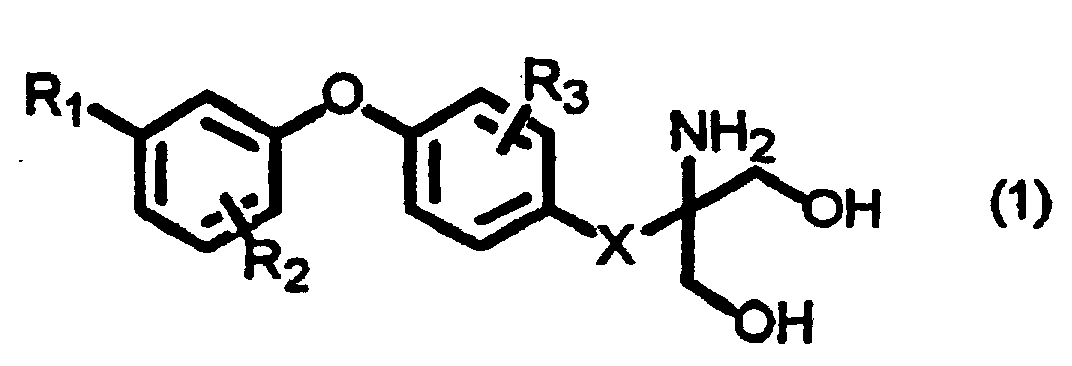
- The diaryl ether derivative, pharmaceutically acceptable. salt and hydrate thereof according to claim 1, wherein the compound of the general formula (1) is a compound represented by the following general formula (1a):wherein R2, R3, and X are the same as defined above.

- The diaryl ether derivative, pharmaceutically acceptable salt and hydrate thereof according to claim 2, wherein R3 is fluorine.
- The diaryl ether derivative, pharmaceutically acceptable salt and hydrate thereof according to claim 2, wherein R3 is chlorine.
- The diaryl ether derivative, pharmaceutically acceptable salt and hydrate thereof according to claim 2, wherein R3 is trifluoromethyl.
- The diaryl ether derivative, pharmaceutically acceptable salt and hydrate thereof according to claim 2, wherein X is -(CH2)m- (wherein m is an integer from 2 to 4).
- The diaryl ether derivative, pharmaceutically acceptable salt and hydrate thereof according to claim 1, wherein the compound of the general formula (1) is a compound represented by the following general formula (1b):wherein R2, R3, and X are the same as defined above; and R4 is hydrogen, halogen, trifluoromethyl, lower alkoxy having 1 to 4 carbon atoms, or lower alkyl having 1 to 7 carbon atoms.

- The diaryl ether derivative, pharmaceutically acceptable salt and hydrate thereof according to claim 7, wherein R3 is fluorine.
- The diaryl ether derivative, pharmaceutically acceptable salt and hydrate thereof according to claim 2, wherein R3 is chlorine.
- The diaryl ether derivative, pharmaceutically acceptable salt and hydrate thereof according to claim 7, wherein R3 is trifluoromethyl.
- The diaryl ether derivative, pharmaceutically acceptable salt and hydrate thereof according to claim 7, wherein X is -(CH2)m- (wherein m is an integer from 2 to 4).
- The diaryl ether derivative, pharmaceutically acceptable salt and hydrate thereof according to claim 1, wherein the compound of the general formula (1) is1) 2-amino-2-[4-(3-benzyloxyphenoxy)-2-chlorophenyl]propyl-1,3-propanediol;2) 2-amino-2-[4-(3-benzyloxyphenoxy)phenyl]propyl-1,3-propanediol;3) 2-amino-2-[4-(3-benzyloxyphenoxy)-2-chlorophenyl]ethyl-1,3-propanediol;4) 2-amino-2-[4-(3-benzyloxyphenoxy)-2-chlorophenyl]butyl-1,3-propanediol;5) 2-amino-2-[4-(3-(3',5'-dichlorobenzyloxy)phenoxy)-2-chlorophenyl]propyl-1,3-propanediol;6) 2-amino-2-[4-(3-(3'-chlorobenzyloxy)phenoxy)-2-chlorophenyl]propyl-2,3-propanediol;7) 2-amino-2-[4-(3-(3'-trifluoromethylbenzyloxy) phenoxy)-2-chlorophenyl]propyl-1,3-propanediol;8) 2-amino-2-[4-(3-benzyloxyphenoxy)-2-trifluoromethylphenyl]propyl-1,3-propanediol;.9) 2-amino-2-[4-(3,5-bistrifluoromethylphenoxy)phenyl]propyl-1,3-propanediol;10) 2-amino-2-[4-(3,5-bistrifluoromethyl-2-chlorophenoxy)phenyl]propyl-1,3-propanediol;11) 2-amino-2-[4-(3,5-bistrifluoromethylphenoxy)phenyl]ethyl-1,3-propanediol;12) 2-amino-2-[2-chloro-4-(3-trifluoromethylphenoxy)phenyl]propyl-1,3-propanediol;13) 2-amino-2-[2-trifluoromethyl-4-(3-trifluoromethylphenoxy)phenyl]propyl-1,3-propanediol;14) 2-amino-2-[4-(3,5-dichlorophenoxy)phenyl]propyl-1,3-propanediol;15) 2-amino-2-[4-(3-benzyloxy-5-trifluoromethylphenoxy)phenyl]propyl-1,3-propanediol; or16) 2-amino-2-[2-fluoro-4-(3-trifluoromethylphenoxy)phenyl]propyl-1,3-propanediol.
- An immunosuppressive agent containing as an active ingredient at least one of a diaryl ether derivative, a pharmaceutically acceptable salt and hydrate thereof, the diaryl ether derivative represented by the following general formula (1):wherein R1 is halogen, trihalomethyl, hydroxy, lower alkyl having 1 to 7 carbon atoms, substituted or unsubstituted phenyl, aralkyl, lower alkoxy having 1 to 4 carbon atoms, trifluoromethyloxy, phenoxy, cyclohexylmethyloxy, substituted or unsubstituted aralkyloxy, pyridylmethyloxy, cinnamyloxy, naphthylmethyloxy, phenoxymethyl, hydroxymethyl, hydroxyethyl, lower alkylthio having 1 to 4 carbon atoms, lower alkylsulfinyl having 1 to 4 carbon atoms, lower alkylsulfonyl having 1 to 4 carbon atoms, benzylthio, acetyl, nitro, or cyano; R2 is hydrogen, halogen, trihalomethyl, lower alkoxy having 1 to 4 carbon atoms, lower alkyl having 1 to 7 carbon atoms, phenethyl, or benzyloxy; R3 is hydrogen, halogen, trifluoromethyl, lower alkoxy having 1 to 4 carbon atoms, hydroxy, benzyloxy, lower alkyl having 1 to 7 carbon atoms, phenyl, lower alkoxymethyl having 1 to 4 carbon atoms, or lower alkylthio having 1 to 4 carbon atoms; and X is-(CH2)n- (n is an integer from 1 to 4), -OCH2CH2-, or -CH=CHCH2-.

- An immunosuppressive agent containing as an active ingredient at least one of the diaryl ether derivative, pharmaceutically acceptable salt and hydrate thereof according to claim 13, wherein the compound of the general formula (1) is a compound represented by the following general formula (1a):wherein R2, R3, and X are the same as defined above.

- An immunosuppressive agent containing as an active ingredient at least one of the diaryl ether derivative, pharmaceutically acceptable salt and hydrate thereof according to claim 13, wherein the compound of the general formula (1) is a compound represented by the following general formula (1b) :wherein R2, R3, and X are the same as defined above; and R4 is hydrogen, halogen, trifluoromethyl, lower alkoxy having 1 to 4 carbon atoms, or lower alkyl having 1 to 7 carbon atoms.
- The immunosuppressive agent according to any one of claims 13 to 15, serving as a prophylactic or therapeutic agent against rejection in organ or bone marrow transplantation.
- The immunosuppressive agent according to any one of claims 13 to 15, serving as a prophylactic or therapeutic agent against autoimmune diseases.
- The immunosuppressive agent according to any one of claims 13 to 15, serving as a prophylactic or therapeutic agent against rheumatoid arthritis.
- The immunosuppressive agent according to any one of claims 13 to 15, serving as a prophylactic or therapeutic agent against psoriasis or atopic dermatitis.
- The immunosuppressive agent according to any one of claims 13 to 15, serving as a prophylactic or therapeutic agent against bronchial asthma or pollinosis.
Applications Claiming Priority (5)
| Application Number | Priority Date | Filing Date | Title |
|---|---|---|---|
| JP2001297400 | 2001-09-27 | ||
| JP2001297400 | 2001-09-27 | ||
| JP2002216191 | 2002-07-25 | ||
| JP2002216191 | 2002-07-25 | ||
| PCT/JP2002/009864 WO2003029184A1 (en) | 2001-09-27 | 2002-09-25 | Diaryl ether derivative, addition salt thereof, and immunosuppressant |
Publications (3)
| Publication Number | Publication Date |
|---|---|
| EP1431275A1 true EP1431275A1 (en) | 2004-06-23 |
| EP1431275A4 EP1431275A4 (en) | 2006-05-31 |
| EP1431275B1 EP1431275B1 (en) | 2010-04-07 |
Family
ID=26623110
Family Applications (1)
| Application Number | Title | Priority Date | Filing Date |
|---|---|---|---|
| EP02768056A Expired - Lifetime EP1431275B1 (en) | 2001-09-27 | 2002-09-25 | Diaryl ether derivative, addition salt thereof, and immunosuppressant |
Country Status (7)
| Country | Link |
|---|---|
| US (1) | US6963012B2 (en) |
| EP (1) | EP1431275B1 (en) |
| JP (1) | JP4152884B2 (en) |
| AT (1) | ATE463478T1 (en) |
| CA (1) | CA2460640C (en) |
| DE (1) | DE60235900D1 (en) |
| WO (1) | WO2003029184A1 (en) |
Cited By (28)
| Publication number | Priority date | Publication date | Assignee | Title |
|---|---|---|---|---|
| US7199150B2 (en) | 2002-01-11 | 2007-04-03 | Sankyo Company, Limited | Amino alcohol compounds |
| WO2007028821A3 (en) * | 2005-09-09 | 2007-05-03 | Novartis Ag | Treatment of autoimmune diseases |
| EP1772145A4 (en) * | 2004-07-16 | 2009-07-08 | Kyorin Seiyaku Kk | METHOD FOR EFFECTIVE USE OF A MEDICAMENT AND METHOD FOR PREVENTING SIDE EFFECTS |
| WO2009058373A3 (en) * | 2007-10-31 | 2009-09-24 | Momentive Performance Materials Inc. | Halo-functional silane, process for its preparation, rubber composition containing same and articles manufactured therefrom |
| EP1982708A4 (en) * | 2006-02-06 | 2010-03-17 | Kyorin Seiyaku Kk | THERAPEUTIC AGENT FOR INFLAMMATORY ABDOMINAL DISEASE WHICH INCLUDES A 2-AMINO-1,3-PROPANEDIOL DERIVATIVE AS ACTIVE INGREDIENT AND METHOD FOR THE TREATMENT OF INFLAMMATORY ABDOMINAL DISEASE |
| US7910617B2 (en) | 2004-02-24 | 2011-03-22 | Sankyo Company, Limited | Method for suppressing the number of peripheral blood lymphocytes using an amino alcohol compound |
| EP1944026A3 (en) * | 2002-05-16 | 2011-06-01 | Novartis AG | Use of EDG receptor binding agents in cancer |
| RU2421214C2 (en) * | 2005-10-07 | 2011-06-20 | Киорин Фармасьютикал Ко., Лтд. | Therapeutic agent for treating hepatitis, and method of treating hepatitis |
| WO2011138393A1 (en) * | 2010-05-06 | 2011-11-10 | Novartis Ag | Treatment of autoimmune diseases |
| EP2168944A4 (en) * | 2007-06-14 | 2011-11-30 | Mitsubishi Tanabe Pharma Corp | AMINO COMPOUND AND ITS PHARMACEUTICAL USE |
| US8071300B2 (en) | 2006-08-04 | 2011-12-06 | Daiichi Sankyo Company, Limited | Drug-phosphorylating enzyme |
| WO2013007767A1 (en) | 2011-07-13 | 2013-01-17 | Basf Se | Fungicidal substituted 2-[2-halogenalkyl-4-(phenoxy)-phenyl]-1-[1,2,4]triazol-1-yl-ethanol compounds |
| RU2478384C2 (en) * | 2004-11-29 | 2013-04-10 | Новартис Аг | Course of treatment with application of receptor s1p agonist |
| US8476305B2 (en) | 2008-02-07 | 2013-07-02 | Kyorin Pharmaceutical Co., Ltd. | Therapeutic agent or prophylactic agent for inflammatory bowel disease comprising amino alcohol derivative as active ingredient |
| RU2505288C2 (en) * | 2008-05-20 | 2014-01-27 | Киорин Фармасьютикал Ко., Лтд. | Method for maintaining induced remission |
| US9137996B2 (en) | 2011-07-15 | 2015-09-22 | Basf Se | Fungicidal alkyl- and aryl-substituted 2[-2-chloro-4-(dihalo-phenoxy)-phenyl]-1-[1,2,4]triazol-1-yl-ethanol compounds |
| US9173402B2 (en) | 2011-07-15 | 2015-11-03 | Basf Se | Fungicidal alkyl-substituted 2[2-chloro-4-(4-chioro-phenoxy)-phenyl]-1[1,2,4]triazol-1-yl-ethanol compounds |
| US9247747B2 (en) | 2011-08-15 | 2016-02-02 | Basf Se | Fungicidal substituted 1-{2-[2-halo-4-(4-halogen-phenoxy)-phenyl]-2-alkoxy-2-alkynyl/alkenyl-ethyl}-1H-[1,2,4]triazole compounds |
| US9247746B2 (en) | 2011-08-15 | 2016-02-02 | Basf Se | Fungicidal substituted 1-{2-cyclyloxy-2-[2-halo-4-(4-halogen-phenoxy)-phenyl]-ethyl}-1H-[1,2,4]triazole compounds |
| US9295259B2 (en) | 2011-08-15 | 2016-03-29 | Basf Se | Fungicidal substituted 1-{2-[2-halo-4-(4-halogen-phenoxy)-phenyl]-2-alkoxy-3-methyl-butyl}-1H [1,2,4]triazole compounds |
| US9415024B2 (en) | 2003-10-15 | 2016-08-16 | Novartis Ag | Aminoalkanol derivatives |
| US9657043B2 (en) | 2012-04-23 | 2017-05-23 | Mitsubishi Tanabe Pharma Corporation | Amine compound and use thereof for medical purposes |
| US10212934B2 (en) | 2014-06-25 | 2019-02-26 | BASF Agro B.V. | Pesticidal compositions |
| US10251867B2 (en) | 2008-03-17 | 2019-04-09 | Actelion Pharmaceuticals Ltd. | Dosing regimen for a selective S1P1 receptor agonist |
| US10512267B2 (en) | 2013-07-08 | 2019-12-24 | BASF Agro, B.V. | Compositions comprising a triazole compound and a biopesticide |
| US10759767B2 (en) | 2012-12-20 | 2020-09-01 | BASF Agro B.V. | Compositions comprising a triazole compound |
| US10981883B2 (en) | 2013-01-09 | 2021-04-20 | BASF Agro B.V. | Process for the preparation of substituted oxiranes and triazoles |
| US12302901B2 (en) | 2014-11-07 | 2025-05-20 | Basf Se | Pesticidal mixtures |
Families Citing this family (38)
| Publication number | Priority date | Publication date | Assignee | Title |
|---|---|---|---|---|
| AU2002332289B2 (en) * | 2001-09-27 | 2007-05-10 | Kyorin Pharmaceutical Co., Ltd. | Diaryl sulfide derivative, addition salt thereof, and immunosuppressant |
| AU2003264430B2 (en) * | 2002-09-19 | 2009-03-19 | Kyorin Pharmaceutical Co., Ltd. | Amino alcohol derivative, addition salt thereof, and immunosuppressant |
| MXPA05003254A (en) | 2002-09-24 | 2005-06-08 | Novartis Ag | Sphingosine-1-phosphate receptor agonists in the treatment of demyelinating disorders. |
| DE202004021680U1 (en) * | 2003-04-08 | 2010-04-22 | Novartis Ag | Solid pharmaceutical composition |
| ATE547395T1 (en) * | 2003-04-30 | 2012-03-15 | Novartis Pharma Gmbh | AMINOPROPANOL DERIVATIVES AS MODULATORS OF THE SPHINGOSINE-1 PHOSPHATE RECEPTOR |
| GB0320638D0 (en) | 2003-09-03 | 2003-10-01 | Novartis Ag | Organic compounds |
| GB0329498D0 (en) | 2003-12-19 | 2004-01-28 | Novartis Ag | Organic compounds |
| TW200526548A (en) * | 2003-12-25 | 2005-08-16 | Sankyo Co | Ether derivatives |
| GB0500020D0 (en) | 2005-01-04 | 2005-02-09 | Novartis Ag | Organic compounds |
| MXPA06012663A (en) | 2004-05-03 | 2007-01-16 | Novartis Ag | Combinations comprising a s1p receptor agonist and a jak3 kinase inhibitor. |
| TW200611687A (en) * | 2004-07-29 | 2006-04-16 | Sankyo Co | Pharmaceutical compositions used for immunosuppressant |
| PT1773307E (en) | 2004-07-30 | 2015-01-14 | Novartis Ag | Compound formulations of 2-amino-1,3-propanediol compounds |
| AU2005292984B2 (en) | 2004-10-12 | 2011-01-20 | Kyorin Pharmaceutical Co., Ltd. | Process for producing 2-amino-2-[2-[4-(3-benzyloxyphenylthio)-2-chlorophenyl]ethyl]-1,3-propanediol hydrochloride or hydrate thereof and intermediate for the same |
| GB0504544D0 (en) | 2005-03-04 | 2005-04-13 | Novartis Ag | Organic compounds |
| TWI418350B (en) * | 2005-06-24 | 2013-12-11 | Sankyo Co | Use of pharmaceutical compositions comprising ppar modulator |
| AR057455A1 (en) * | 2005-07-22 | 2007-12-05 | Merck & Co Inc | INHIBITORS OF HIV REVERSE TRANSCRIPTASE AND PHARMACEUTICAL COMPOSITION |
| GT200600350A (en) * | 2005-08-09 | 2007-03-28 | LIQUID FORMULATIONS | |
| CA2643680A1 (en) | 2006-04-11 | 2007-11-22 | Novartis Ag | Hcv/hiv inhibitors and their uses |
| JP5100641B2 (en) | 2006-04-28 | 2012-12-19 | 田辺三菱製薬株式会社 | 2-Aminobutanol compound and pharmaceutical use thereof |
| US8232319B2 (en) | 2006-08-08 | 2012-07-31 | Kyorin Pharmaceutical Co., Ltd. | Amino phosphate derivative and S1P receptor modulator having same as an active ingredient |
| JP5140593B2 (en) * | 2006-08-08 | 2013-02-06 | 杏林製薬株式会社 | Amino alcohol derivatives and immunosuppressants containing them as active ingredients |
| PT2465492E (en) | 2007-10-12 | 2015-10-15 | Novartis Ag | Compositions comprising sphingosine i phosphate (sip) receptor modulators |
| CA2724450A1 (en) * | 2008-05-19 | 2009-11-26 | Takeshi Tsubuki | Method for producing optically active aminoalcohol derivative |
| GB0901835D0 (en) | 2009-02-04 | 2009-03-11 | Syngenta Ltd | Novel herbicides |
| GB0901834D0 (en) | 2009-02-04 | 2009-03-11 | Syngenta Ltd | Novel herbicides |
| US20110182850A1 (en) | 2009-04-10 | 2011-07-28 | Trixi Brandl | Organic compounds and their uses |
| US8512690B2 (en) | 2009-04-10 | 2013-08-20 | Novartis Ag | Derivatised proline containing peptide compounds as protease inhibitors |
| PT2452944E (en) | 2009-07-09 | 2014-10-13 | Kyorin Seiyaku Kk | Diphenyl sulfide derivatives and medicines containing them as active ingredient |
| KR101148098B1 (en) | 2010-04-30 | 2012-05-22 | 한국화학연구원 | Composition comprising 1-[4-4-nitro-penoxy-phenyl]-propane-1-one for preventing and treating the disease caused by Toxoplasmosis and Coccidium |
| AU2011249789B2 (en) | 2010-05-06 | 2015-03-19 | Novartis Ag | Dosage regimen of diaryl sulfide derivatives |
| EP2624826B1 (en) | 2010-10-08 | 2018-07-18 | Novartis AG | Vitamin e formulations of sulfamide ns3 inhibitors |
| TWI519539B (en) | 2010-12-21 | 2016-02-01 | Kyorin Seiyaku Kk | Diphenyl sulfide derivatives and pharmaceuticals as an active ingredient |
| CN102863345A (en) * | 2011-07-06 | 2013-01-09 | 中国医学科学院药物研究所 | Amino propylene glycol derivative, preparation method of amino propylene glycol derivative, medicine composition of amino propylene glycol derivative and application of amino propylene glycol derivative |
| CN104844486B (en) * | 2014-02-17 | 2018-10-30 | 中国医学科学院药物研究所 | Amido propylene glycol derivative, preparation method and its pharmaceutical composition and purposes |
| US11241012B2 (en) | 2016-03-16 | 2022-02-08 | Basf Se | Use of tetrazolinones for combating resistant phytopathogenic fungi on soybean |
| WO2017157920A1 (en) | 2016-03-16 | 2017-09-21 | Basf Se | Use of tetrazolinones for combating resistant phytopathogenic fungi on fruits |
| EP3429357B1 (en) | 2016-03-16 | 2025-09-17 | Basf Se | Use of a specific tetrazolinone for combating resistant phytopathogenic fungi on cereals |
| CN112512516A (en) | 2018-07-27 | 2021-03-16 | 普瑞奥治疗有限公司 | Active agent for inhibiting recurrence of hematologic malignancy in patient who has undergone hematopoietic stem cell transplantation |
Family Cites Families (3)
| Publication number | Priority date | Publication date | Assignee | Title |
|---|---|---|---|---|
| EP0627406B1 (en) * | 1992-10-21 | 1998-10-28 | Yoshitomi Pharmaceutical Industries, Ltd. | 2-amino-1,3-propanediol compound and immunosuppressant |
| JP3870419B2 (en) * | 1994-08-22 | 2007-01-17 | 三菱ウェルファーマ株式会社 | Benzene compounds and their use as pharmaceuticals |
| CA2286315C (en) | 1997-04-04 | 2007-03-06 | Yoshitomi Pharmaceutical Industries Ltd. | 2-aminopropane-1,3-diol compound, pharmaceutical use thereof and synthetic intermediates therefor |
-
2002
- 2002-09-25 AT AT02768056T patent/ATE463478T1/en not_active IP Right Cessation
- 2002-09-25 EP EP02768056A patent/EP1431275B1/en not_active Expired - Lifetime
- 2002-09-25 DE DE60235900T patent/DE60235900D1/en not_active Expired - Lifetime
- 2002-09-25 CA CA2460640A patent/CA2460640C/en not_active Expired - Fee Related
- 2002-09-25 US US10/490,345 patent/US6963012B2/en not_active Expired - Fee Related
- 2002-09-25 JP JP2003532439A patent/JP4152884B2/en not_active Expired - Fee Related
- 2002-09-25 WO PCT/JP2002/009864 patent/WO2003029184A1/en not_active Ceased
Cited By (50)
| Publication number | Priority date | Publication date | Assignee | Title |
|---|---|---|---|---|
| US8101650B2 (en) | 2002-01-11 | 2012-01-24 | Daiichi Sankyo Company, Limited | Method for treating a immunology-related disease |
| US7638551B2 (en) | 2002-01-11 | 2009-12-29 | Sankyo Company, Limited | Amino alcohol compounds or phosphonic acid derivatives thereof |
| US8067396B2 (en) | 2002-01-11 | 2011-11-29 | Sankyo Company, Limited | Amino alcohol compounds or phosphonic acid derivatives thereof |
| US7199150B2 (en) | 2002-01-11 | 2007-04-03 | Sankyo Company, Limited | Amino alcohol compounds |
| EP1944026A3 (en) * | 2002-05-16 | 2011-06-01 | Novartis AG | Use of EDG receptor binding agents in cancer |
| US9415024B2 (en) | 2003-10-15 | 2016-08-16 | Novartis Ag | Aminoalkanol derivatives |
| US7910617B2 (en) | 2004-02-24 | 2011-03-22 | Sankyo Company, Limited | Method for suppressing the number of peripheral blood lymphocytes using an amino alcohol compound |
| EP1772145A4 (en) * | 2004-07-16 | 2009-07-08 | Kyorin Seiyaku Kk | METHOD FOR EFFECTIVE USE OF A MEDICAMENT AND METHOD FOR PREVENTING SIDE EFFECTS |
| RU2396982C2 (en) * | 2004-07-16 | 2010-08-20 | Киорин Фармасьютикал Ко., Лтд. | Effective method of using drugs and method for prevention of by-effects intensity |
| RU2478384C2 (en) * | 2004-11-29 | 2013-04-10 | Новартис Аг | Course of treatment with application of receptor s1p agonist |
| RU2424795C2 (en) * | 2005-09-09 | 2011-07-27 | Новартис Аг | Treatment of autoimmune diseases |
| AU2006289100B2 (en) * | 2005-09-09 | 2010-07-22 | Novartis Ag | Treatment of autoimmune diseases |
| WO2007028821A3 (en) * | 2005-09-09 | 2007-05-03 | Novartis Ag | Treatment of autoimmune diseases |
| RU2421214C2 (en) * | 2005-10-07 | 2011-06-20 | Киорин Фармасьютикал Ко., Лтд. | Therapeutic agent for treating hepatitis, and method of treating hepatitis |
| AU2006300485B2 (en) * | 2005-10-07 | 2011-08-25 | Kyorin Pharmaceutical Co., Ltd. | Therapeutic agent for liver disease containing 2-amino-1,3-propanediol derivative as active ingredient and therapeutic method for liver disease |
| HRP20080421B1 (en) * | 2006-02-06 | 2015-07-17 | Kyorin Pharmaceutical Co., Ltd. | Therapeutic agent for inflammatory bowel disease comprising 2-amino-1,3-propanaediol derivative as active ingredient, and method for treatment of inflammatory bowel disease |
| RU2428976C2 (en) * | 2006-02-06 | 2011-09-20 | Киорин Фармасьютикал Ко., Лтд. | Therapeutic medication for inflammatory intestinal diseases which contains derivative of 2-amino-1,3-propandiol as active ingredient, or method of treating inflammatory intestinal diseases |
| EP1982708A4 (en) * | 2006-02-06 | 2010-03-17 | Kyorin Seiyaku Kk | THERAPEUTIC AGENT FOR INFLAMMATORY ABDOMINAL DISEASE WHICH INCLUDES A 2-AMINO-1,3-PROPANEDIOL DERIVATIVE AS ACTIVE INGREDIENT AND METHOD FOR THE TREATMENT OF INFLAMMATORY ABDOMINAL DISEASE |
| EP2520291A1 (en) * | 2006-02-06 | 2012-11-07 | Kyorin Pharmaceutical Co., Ltd. | Therapeutic agent for inflammatory bowel disease containing as active ingredient 2-amino-1,3-propanediol derivative, or method for treating inflammatory bowel disease |
| US8071300B2 (en) | 2006-08-04 | 2011-12-06 | Daiichi Sankyo Company, Limited | Drug-phosphorylating enzyme |
| EP2168944A4 (en) * | 2007-06-14 | 2011-11-30 | Mitsubishi Tanabe Pharma Corp | AMINO COMPOUND AND ITS PHARMACEUTICAL USE |
| US8129361B2 (en) | 2007-06-14 | 2012-03-06 | Mitsubishi Tanabe Pharma Corporation | Amine compound and pharmaceutical use thereof |
| US8372906B2 (en) | 2007-10-31 | 2013-02-12 | Momentive Performance Materials Inc. | Halo-functional silane, process for its preparation, rubber composition containing same and articles manufactured therefrom |
| WO2009058373A3 (en) * | 2007-10-31 | 2009-09-24 | Momentive Performance Materials Inc. | Halo-functional silane, process for its preparation, rubber composition containing same and articles manufactured therefrom |
| CN101910185B (en) * | 2007-10-31 | 2014-04-30 | 莫门蒂夫性能材料股份有限公司 | Halo-functional silane, process for its preparation, rubber composition containing same and articles manufactured therefrom |
| TWI478930B (en) * | 2007-10-31 | 2015-04-01 | Momentive Performance Mat Inc | Halogen-functional decane, the method of which comprises a rubber composition of the same and an article made from the composition |
| US7816435B2 (en) | 2007-10-31 | 2010-10-19 | Momentive Performance Materials Inc. | Halo-functional silane, process for its preparation, rubber composition containing same and articles manufactured therefrom |
| US8476305B2 (en) | 2008-02-07 | 2013-07-02 | Kyorin Pharmaceutical Co., Ltd. | Therapeutic agent or prophylactic agent for inflammatory bowel disease comprising amino alcohol derivative as active ingredient |
| US10660880B2 (en) | 2008-03-17 | 2020-05-26 | Actelion Pharmaceuticals Ltd | Dosing regimen for a selective S1P1 agonist |
| US10251867B2 (en) | 2008-03-17 | 2019-04-09 | Actelion Pharmaceuticals Ltd. | Dosing regimen for a selective S1P1 receptor agonist |
| RU2505288C2 (en) * | 2008-05-20 | 2014-01-27 | Киорин Фармасьютикал Ко., Лтд. | Method for maintaining induced remission |
| WO2011138393A1 (en) * | 2010-05-06 | 2011-11-10 | Novartis Ag | Treatment of autoimmune diseases |
| AU2011249784B2 (en) * | 2010-05-06 | 2014-03-06 | Novartis Ag | Treatment of autoimmune diseases |
| EA026736B1 (en) * | 2011-07-13 | 2017-05-31 | Басф Агро Б.В. | Fungicidal substituted 2-[2-halogenalkyl-4-(phenoxy)phenyl]-1-[1,2,4]triazol-1-yl-ethanol compounds |
| KR20140022483A (en) * | 2011-07-13 | 2014-02-24 | 바스프 에스이 | Fungicidal substituted 2-[2-halogenalkyl-4-(phenoxy)-phenyl]-1-[1,2,4]triazol-1-yl-ethanol compounds |
| US10358426B2 (en) | 2011-07-13 | 2019-07-23 | BASF Agro B.V. | Fungicidal substituted 2-[2-halogenalkyl-4-(phenoxy)-phenyl]-1-[1,2,4]triazol-1-yl-ethanol compounds |
| CN103649057A (en) * | 2011-07-13 | 2014-03-19 | 巴斯夫欧洲公司 | Fungicidal substituted 2-[2-haloalkyl-4-phenoxyphenyl]-1-[1,2,4]triazol-1-ylethanol compounds |
| WO2013007767A1 (en) | 2011-07-13 | 2013-01-17 | Basf Se | Fungicidal substituted 2-[2-halogenalkyl-4-(phenoxy)-phenyl]-1-[1,2,4]triazol-1-yl-ethanol compounds |
| CN103649057B (en) * | 2011-07-13 | 2016-05-11 | 巴斯夫农业公司 | Fungicidal substituted 2-[2-haloalkyl-4-phenoxyphenyl]-1-[1,2,4]triazol-1-ylethanol compounds |
| US9137996B2 (en) | 2011-07-15 | 2015-09-22 | Basf Se | Fungicidal alkyl- and aryl-substituted 2[-2-chloro-4-(dihalo-phenoxy)-phenyl]-1-[1,2,4]triazol-1-yl-ethanol compounds |
| US9173402B2 (en) | 2011-07-15 | 2015-11-03 | Basf Se | Fungicidal alkyl-substituted 2[2-chloro-4-(4-chioro-phenoxy)-phenyl]-1[1,2,4]triazol-1-yl-ethanol compounds |
| US9295259B2 (en) | 2011-08-15 | 2016-03-29 | Basf Se | Fungicidal substituted 1-{2-[2-halo-4-(4-halogen-phenoxy)-phenyl]-2-alkoxy-3-methyl-butyl}-1H [1,2,4]triazole compounds |
| US9247746B2 (en) | 2011-08-15 | 2016-02-02 | Basf Se | Fungicidal substituted 1-{2-cyclyloxy-2-[2-halo-4-(4-halogen-phenoxy)-phenyl]-ethyl}-1H-[1,2,4]triazole compounds |
| US9247747B2 (en) | 2011-08-15 | 2016-02-02 | Basf Se | Fungicidal substituted 1-{2-[2-halo-4-(4-halogen-phenoxy)-phenyl]-2-alkoxy-2-alkynyl/alkenyl-ethyl}-1H-[1,2,4]triazole compounds |
| US9657043B2 (en) | 2012-04-23 | 2017-05-23 | Mitsubishi Tanabe Pharma Corporation | Amine compound and use thereof for medical purposes |
| US10759767B2 (en) | 2012-12-20 | 2020-09-01 | BASF Agro B.V. | Compositions comprising a triazole compound |
| US10981883B2 (en) | 2013-01-09 | 2021-04-20 | BASF Agro B.V. | Process for the preparation of substituted oxiranes and triazoles |
| US10512267B2 (en) | 2013-07-08 | 2019-12-24 | BASF Agro, B.V. | Compositions comprising a triazole compound and a biopesticide |
| US10212934B2 (en) | 2014-06-25 | 2019-02-26 | BASF Agro B.V. | Pesticidal compositions |
| US12302901B2 (en) | 2014-11-07 | 2025-05-20 | Basf Se | Pesticidal mixtures |
Also Published As
| Publication number | Publication date |
|---|---|
| CA2460640A1 (en) | 2003-04-10 |
| US20040242654A1 (en) | 2004-12-02 |
| JPWO2003029184A1 (en) | 2005-01-13 |
| EP1431275B1 (en) | 2010-04-07 |
| CA2460640C (en) | 2011-03-29 |
| JP4152884B2 (en) | 2008-09-17 |
| DE60235900D1 (en) | 2010-05-20 |
| ATE463478T1 (en) | 2010-04-15 |
| EP1431275A4 (en) | 2006-05-31 |
| US6963012B2 (en) | 2005-11-08 |
| WO2003029184A1 (en) | 2003-04-10 |
Similar Documents
| Publication | Publication Date | Title |
|---|---|---|
| EP1431275B1 (en) | Diaryl ether derivative, addition salt thereof, and immunosuppressant | |
| CA2461212C (en) | Diaryl sulfide derivatives, salts thereof and immunosuppressive agents using the same | |
| CN1312125C (en) | Amino alcohol derivative, addition salt thereof, and immunosuppressant | |
| US20140296183A1 (en) | Amine compound and use thereof for medical purposes | |
| US20090082311A1 (en) | 2-Aminobutanol Compound and Use Thereof for Medical Purposes | |
| WO1998022480A1 (en) | Phosphorus containing aryloxy or arylthio propanolamine derivatives |
Legal Events
| Date | Code | Title | Description |
|---|---|---|---|
| PUAI | Public reference made under article 153(3) epc to a published international application that has entered the european phase |
Free format text: ORIGINAL CODE: 0009012 |
|
| 17P | Request for examination filed |
Effective date: 20040415 |
|
| AK | Designated contracting states |
Kind code of ref document: A1 Designated state(s): AT BE BG CH CY CZ DE DK EE ES FI FR GB GR IE IT LI LU MC NL PT SE SK TR |
|
| AX | Request for extension of the european patent |
Extension state: AL LT LV MK RO SI |
|
| A4 | Supplementary search report drawn up and despatched |
Effective date: 20060421 |
|
| 17Q | First examination report despatched |
Effective date: 20070719 |
|
| GRAP | Despatch of communication of intention to grant a patent |
Free format text: ORIGINAL CODE: EPIDOSNIGR1 |
|
| GRAS | Grant fee paid |
Free format text: ORIGINAL CODE: EPIDOSNIGR3 |
|
| GRAA | (expected) grant |
Free format text: ORIGINAL CODE: 0009210 |
|
| RAP1 | Party data changed (applicant data changed or rights of an application transferred) |
Owner name: KYORIN PHARMACEUTICAL CO., LTD. |
|
| AK | Designated contracting states |
Kind code of ref document: B1 Designated state(s): AT BE BG CH CY CZ DE DK EE ES FI FR GB GR IE IT LI LU MC NL PT SE SK TR |
|
| REG | Reference to a national code |
Ref country code: GB Ref legal event code: FG4D |
|
| REG | Reference to a national code |
Ref country code: CH Ref legal event code: EP |
|
| REG | Reference to a national code |
Ref country code: IE Ref legal event code: FG4D |
|
| REF | Corresponds to: |
Ref document number: 60235900 Country of ref document: DE Date of ref document: 20100520 Kind code of ref document: P |
|
| REG | Reference to a national code |
Ref country code: NL Ref legal event code: VDEP Effective date: 20100407 |
|
| PG25 | Lapsed in a contracting state [announced via postgrant information from national office to epo] |
Ref country code: SE Free format text: LAPSE BECAUSE OF FAILURE TO SUBMIT A TRANSLATION OF THE DESCRIPTION OR TO PAY THE FEE WITHIN THE PRESCRIBED TIME-LIMIT Effective date: 20100407 Ref country code: ES Free format text: LAPSE BECAUSE OF FAILURE TO SUBMIT A TRANSLATION OF THE DESCRIPTION OR TO PAY THE FEE WITHIN THE PRESCRIBED TIME-LIMIT Effective date: 20100718 Ref country code: NL Free format text: LAPSE BECAUSE OF FAILURE TO SUBMIT A TRANSLATION OF THE DESCRIPTION OR TO PAY THE FEE WITHIN THE PRESCRIBED TIME-LIMIT Effective date: 20100407 |
|
| PG25 | Lapsed in a contracting state [announced via postgrant information from national office to epo] |
Ref country code: AT Free format text: LAPSE BECAUSE OF FAILURE TO SUBMIT A TRANSLATION OF THE DESCRIPTION OR TO PAY THE FEE WITHIN THE PRESCRIBED TIME-LIMIT Effective date: 20100407 Ref country code: FI Free format text: LAPSE BECAUSE OF FAILURE TO SUBMIT A TRANSLATION OF THE DESCRIPTION OR TO PAY THE FEE WITHIN THE PRESCRIBED TIME-LIMIT Effective date: 20100407 |
|
| PG25 | Lapsed in a contracting state [announced via postgrant information from national office to epo] |
Ref country code: CY Free format text: LAPSE BECAUSE OF FAILURE TO SUBMIT A TRANSLATION OF THE DESCRIPTION OR TO PAY THE FEE WITHIN THE PRESCRIBED TIME-LIMIT Effective date: 20100414 Ref country code: GR Free format text: LAPSE BECAUSE OF FAILURE TO SUBMIT A TRANSLATION OF THE DESCRIPTION OR TO PAY THE FEE WITHIN THE PRESCRIBED TIME-LIMIT Effective date: 20100708 |
|
| PG25 | Lapsed in a contracting state [announced via postgrant information from national office to epo] |
Ref country code: EE Free format text: LAPSE BECAUSE OF FAILURE TO SUBMIT A TRANSLATION OF THE DESCRIPTION OR TO PAY THE FEE WITHIN THE PRESCRIBED TIME-LIMIT Effective date: 20100407 Ref country code: DK Free format text: LAPSE BECAUSE OF FAILURE TO SUBMIT A TRANSLATION OF THE DESCRIPTION OR TO PAY THE FEE WITHIN THE PRESCRIBED TIME-LIMIT Effective date: 20100407 Ref country code: PT Free format text: LAPSE BECAUSE OF FAILURE TO SUBMIT A TRANSLATION OF THE DESCRIPTION OR TO PAY THE FEE WITHIN THE PRESCRIBED TIME-LIMIT Effective date: 20100809 |
|
| PLBE | No opposition filed within time limit |
Free format text: ORIGINAL CODE: 0009261 |
|
| STAA | Information on the status of an ep patent application or granted ep patent |
Free format text: STATUS: NO OPPOSITION FILED WITHIN TIME LIMIT |
|
| PG25 | Lapsed in a contracting state [announced via postgrant information from national office to epo] |
Ref country code: BE Free format text: LAPSE BECAUSE OF FAILURE TO SUBMIT A TRANSLATION OF THE DESCRIPTION OR TO PAY THE FEE WITHIN THE PRESCRIBED TIME-LIMIT Effective date: 20100407 Ref country code: CZ Free format text: LAPSE BECAUSE OF FAILURE TO SUBMIT A TRANSLATION OF THE DESCRIPTION OR TO PAY THE FEE WITHIN THE PRESCRIBED TIME-LIMIT Effective date: 20100407 Ref country code: SK Free format text: LAPSE BECAUSE OF FAILURE TO SUBMIT A TRANSLATION OF THE DESCRIPTION OR TO PAY THE FEE WITHIN THE PRESCRIBED TIME-LIMIT Effective date: 20100407 |
|
| 26N | No opposition filed |
Effective date: 20110110 |
|
| PG25 | Lapsed in a contracting state [announced via postgrant information from national office to epo] |
Ref country code: IT Free format text: LAPSE BECAUSE OF FAILURE TO SUBMIT A TRANSLATION OF THE DESCRIPTION OR TO PAY THE FEE WITHIN THE PRESCRIBED TIME-LIMIT Effective date: 20100407 |
|
| PG25 | Lapsed in a contracting state [announced via postgrant information from national office to epo] |
Ref country code: MC Free format text: LAPSE BECAUSE OF NON-PAYMENT OF DUE FEES Effective date: 20100930 |
|
| REG | Reference to a national code |
Ref country code: CH Ref legal event code: PL |
|
| PG25 | Lapsed in a contracting state [announced via postgrant information from national office to epo] |
Ref country code: CH Free format text: LAPSE BECAUSE OF NON-PAYMENT OF DUE FEES Effective date: 20100930 Ref country code: IE Free format text: LAPSE BECAUSE OF NON-PAYMENT OF DUE FEES Effective date: 20100925 Ref country code: LI Free format text: LAPSE BECAUSE OF NON-PAYMENT OF DUE FEES Effective date: 20100930 |
|
| PG25 | Lapsed in a contracting state [announced via postgrant information from national office to epo] |
Ref country code: BG Free format text: LAPSE BECAUSE OF FAILURE TO SUBMIT A TRANSLATION OF THE DESCRIPTION OR TO PAY THE FEE WITHIN THE PRESCRIBED TIME-LIMIT Effective date: 20100407 Ref country code: LU Free format text: LAPSE BECAUSE OF NON-PAYMENT OF DUE FEES Effective date: 20100925 |
|
| PG25 | Lapsed in a contracting state [announced via postgrant information from national office to epo] |
Ref country code: TR Free format text: LAPSE BECAUSE OF FAILURE TO SUBMIT A TRANSLATION OF THE DESCRIPTION OR TO PAY THE FEE WITHIN THE PRESCRIBED TIME-LIMIT Effective date: 20100407 |
|
| PG25 | Lapsed in a contracting state [announced via postgrant information from national office to epo] |
Ref country code: BG Free format text: LAPSE BECAUSE OF FAILURE TO SUBMIT A TRANSLATION OF THE DESCRIPTION OR TO PAY THE FEE WITHIN THE PRESCRIBED TIME-LIMIT Effective date: 20100707 |
|
| REG | Reference to a national code |
Ref country code: FR Ref legal event code: PLFP Year of fee payment: 14 |
|
| PGFP | Annual fee paid to national office [announced via postgrant information from national office to epo] |
Ref country code: DE Payment date: 20150922 Year of fee payment: 14 Ref country code: GB Payment date: 20150923 Year of fee payment: 14 |
|
| PGFP | Annual fee paid to national office [announced via postgrant information from national office to epo] |
Ref country code: FR Payment date: 20150811 Year of fee payment: 14 |
|
| REG | Reference to a national code |
Ref country code: DE Ref legal event code: R119 Ref document number: 60235900 Country of ref document: DE |
|
| GBPC | Gb: european patent ceased through non-payment of renewal fee |
Effective date: 20160925 |
|
| REG | Reference to a national code |
Ref country code: FR Ref legal event code: ST Effective date: 20170531 |
|
| PG25 | Lapsed in a contracting state [announced via postgrant information from national office to epo] |
Ref country code: GB Free format text: LAPSE BECAUSE OF NON-PAYMENT OF DUE FEES Effective date: 20160925 Ref country code: FR Free format text: LAPSE BECAUSE OF NON-PAYMENT OF DUE FEES Effective date: 20160930 Ref country code: DE Free format text: LAPSE BECAUSE OF NON-PAYMENT OF DUE FEES Effective date: 20170401 |