EP1430783A1 - Oil/fat composition - Google Patents
Oil/fat composition Download PDFInfo
- Publication number
- EP1430783A1 EP1430783A1 EP04006225A EP04006225A EP1430783A1 EP 1430783 A1 EP1430783 A1 EP 1430783A1 EP 04006225 A EP04006225 A EP 04006225A EP 04006225 A EP04006225 A EP 04006225A EP 1430783 A1 EP1430783 A1 EP 1430783A1
- Authority
- EP
- European Patent Office
- Prior art keywords
- oil
- fat
- fatty acid
- fat composition
- weight
- Prior art date
- Legal status (The legal status is an assumption and is not a legal conclusion. Google has not performed a legal analysis and makes no representation as to the accuracy of the status listed.)
- Granted
Links
Classifications
-
- A—HUMAN NECESSITIES
- A21—BAKING; EDIBLE DOUGHS
- A21D—TREATMENT OF FLOUR OR DOUGH FOR BAKING, e.g. BY ADDITION OF MATERIALS; BAKING; BAKERY PRODUCTS
- A21D13/00—Finished or partly finished bakery products
- A21D13/06—Products with modified nutritive value, e.g. with modified starch content
- A21D13/068—Products with modified nutritive value, e.g. with modified starch content with modified fat content; Fat-free products
-
- A—HUMAN NECESSITIES
- A21—BAKING; EDIBLE DOUGHS
- A21D—TREATMENT OF FLOUR OR DOUGH FOR BAKING, e.g. BY ADDITION OF MATERIALS; BAKING; BAKERY PRODUCTS
- A21D13/00—Finished or partly finished bakery products
- A21D13/02—Products made from whole meal; Products containing bran or rough-ground grain
-
- A—HUMAN NECESSITIES
- A21—BAKING; EDIBLE DOUGHS
- A21D—TREATMENT OF FLOUR OR DOUGH FOR BAKING, e.g. BY ADDITION OF MATERIALS; BAKING; BAKERY PRODUCTS
- A21D13/00—Finished or partly finished bakery products
- A21D13/80—Pastry not otherwise provided for elsewhere, e.g. cakes, biscuits or cookies
-
- A—HUMAN NECESSITIES
- A21—BAKING; EDIBLE DOUGHS
- A21D—TREATMENT OF FLOUR OR DOUGH FOR BAKING, e.g. BY ADDITION OF MATERIALS; BAKING; BAKERY PRODUCTS
- A21D2/00—Treatment of flour or dough by adding materials thereto before or during baking
- A21D2/08—Treatment of flour or dough by adding materials thereto before or during baking by adding organic substances
- A21D2/14—Organic oxygen compounds
- A21D2/16—Fatty acid esters
-
- A—HUMAN NECESSITIES
- A23—FOODS OR FOODSTUFFS; TREATMENT THEREOF, NOT COVERED BY OTHER CLASSES
- A23D—EDIBLE OILS OR FATS, e.g. MARGARINES, SHORTENINGS OR COOKING OILS
- A23D7/00—Edible oil or fat compositions containing an aqueous phase, e.g. margarines
- A23D7/01—Other fatty acid esters, e.g. phosphatides
- A23D7/011—Compositions other than spreads
-
- A—HUMAN NECESSITIES
- A23—FOODS OR FOODSTUFFS; TREATMENT THEREOF, NOT COVERED BY OTHER CLASSES
- A23D—EDIBLE OILS OR FATS, e.g. MARGARINES, SHORTENINGS OR COOKING OILS
- A23D7/00—Edible oil or fat compositions containing an aqueous phase, e.g. margarines
- A23D7/01—Other fatty acid esters, e.g. phosphatides
- A23D7/013—Spread compositions
-
- A—HUMAN NECESSITIES
- A23—FOODS OR FOODSTUFFS; TREATMENT THEREOF, NOT COVERED BY OTHER CLASSES
- A23D—EDIBLE OILS OR FATS, e.g. MARGARINES, SHORTENINGS OR COOKING OILS
- A23D7/00—Edible oil or fat compositions containing an aqueous phase, e.g. margarines
- A23D7/015—Reducing calorie content; Reducing fat content, e.g. "halvarines"
-
- A—HUMAN NECESSITIES
- A23—FOODS OR FOODSTUFFS; TREATMENT THEREOF, NOT COVERED BY OTHER CLASSES
- A23D—EDIBLE OILS OR FATS, e.g. MARGARINES, SHORTENINGS OR COOKING OILS
- A23D9/00—Other edible oils or fats, e.g. shortenings or cooking oils
- A23D9/007—Other edible oils or fats, e.g. shortenings or cooking oils characterised by ingredients other than fatty acid triglycerides
- A23D9/013—Other fatty acid esters, e.g. phosphatides
-
- A—HUMAN NECESSITIES
- A23—FOODS OR FOODSTUFFS; TREATMENT THEREOF, NOT COVERED BY OTHER CLASSES
- A23K—FODDER
- A23K20/00—Accessory food factors for animal feeding-stuffs
- A23K20/10—Organic substances
- A23K20/158—Fatty acids; Fats; Products containing oils or fats
-
- A—HUMAN NECESSITIES
- A23—FOODS OR FOODSTUFFS; TREATMENT THEREOF, NOT COVERED BY OTHER CLASSES
- A23L—FOODS, FOODSTUFFS OR NON-ALCOHOLIC BEVERAGES, NOT OTHERWISE PROVIDED FOR; PREPARATION OR TREATMENT THEREOF
- A23L15/00—Egg products; Preparation or treatment thereof
- A23L15/20—Addition of proteins, e.g. hydrolysates, fats, carbohydrates, natural plant hydrocolloids; Addition of animal or vegetable substances containing proteins, fats, or carbohydrates
-
- A—HUMAN NECESSITIES
- A23—FOODS OR FOODSTUFFS; TREATMENT THEREOF, NOT COVERED BY OTHER CLASSES
- A23L—FOODS, FOODSTUFFS OR NON-ALCOHOLIC BEVERAGES, NOT OTHERWISE PROVIDED FOR; PREPARATION OR TREATMENT THEREOF
- A23L27/00—Spices; Flavouring agents or condiments; Artificial sweetening agents; Table salts; Dietetic salt substitutes; Preparation or treatment thereof
- A23L27/60—Salad dressings; Mayonnaise; Ketchup
-
- A—HUMAN NECESSITIES
- A23—FOODS OR FOODSTUFFS; TREATMENT THEREOF, NOT COVERED BY OTHER CLASSES
- A23L—FOODS, FOODSTUFFS OR NON-ALCOHOLIC BEVERAGES, NOT OTHERWISE PROVIDED FOR; PREPARATION OR TREATMENT THEREOF
- A23L33/00—Modifying nutritive qualities of foods; Dietetic products; Preparation or treatment thereof
- A23L33/10—Modifying nutritive qualities of foods; Dietetic products; Preparation or treatment thereof using additives
- A23L33/115—Fatty acids or derivatives thereof; Fats or oils
-
- A—HUMAN NECESSITIES
- A23—FOODS OR FOODSTUFFS; TREATMENT THEREOF, NOT COVERED BY OTHER CLASSES
- A23L—FOODS, FOODSTUFFS OR NON-ALCOHOLIC BEVERAGES, NOT OTHERWISE PROVIDED FOR; PREPARATION OR TREATMENT THEREOF
- A23L33/00—Modifying nutritive qualities of foods; Dietetic products; Preparation or treatment thereof
- A23L33/10—Modifying nutritive qualities of foods; Dietetic products; Preparation or treatment thereof using additives
- A23L33/115—Fatty acids or derivatives thereof; Fats or oils
- A23L33/12—Fatty acids or derivatives thereof
-
- A—HUMAN NECESSITIES
- A23—FOODS OR FOODSTUFFS; TREATMENT THEREOF, NOT COVERED BY OTHER CLASSES
- A23L—FOODS, FOODSTUFFS OR NON-ALCOHOLIC BEVERAGES, NOT OTHERWISE PROVIDED FOR; PREPARATION OR TREATMENT THEREOF
- A23L33/00—Modifying nutritive qualities of foods; Dietetic products; Preparation or treatment thereof
- A23L33/40—Complete food formulations for specific consumer groups or specific purposes, e.g. infant formula
-
- A—HUMAN NECESSITIES
- A61—MEDICAL OR VETERINARY SCIENCE; HYGIENE
- A61K—PREPARATIONS FOR MEDICAL, DENTAL OR TOILETRY PURPOSES
- A61K31/00—Medicinal preparations containing organic active ingredients
- A61K31/21—Esters, e.g. nitroglycerine, selenocyanates
- A61K31/215—Esters, e.g. nitroglycerine, selenocyanates of carboxylic acids
- A61K31/22—Esters, e.g. nitroglycerine, selenocyanates of carboxylic acids of acyclic acids, e.g. pravastatin
- A61K31/23—Esters, e.g. nitroglycerine, selenocyanates of carboxylic acids of acyclic acids, e.g. pravastatin of acids having a carboxyl group bound to a chain of seven or more carbon atoms
- A61K31/232—Esters, e.g. nitroglycerine, selenocyanates of carboxylic acids of acyclic acids, e.g. pravastatin of acids having a carboxyl group bound to a chain of seven or more carbon atoms having three or more double bonds, e.g. etretinate
-
- A—HUMAN NECESSITIES
- A61—MEDICAL OR VETERINARY SCIENCE; HYGIENE
- A61K—PREPARATIONS FOR MEDICAL, DENTAL OR TOILETRY PURPOSES
- A61K31/00—Medicinal preparations containing organic active ingredients
- A61K31/56—Compounds containing cyclopenta[a]hydrophenanthrene ring systems; Derivatives thereof, e.g. steroids
-
- A—HUMAN NECESSITIES
- A61—MEDICAL OR VETERINARY SCIENCE; HYGIENE
- A61K—PREPARATIONS FOR MEDICAL, DENTAL OR TOILETRY PURPOSES
- A61K45/00—Medicinal preparations containing active ingredients not provided for in groups A61K31/00 - A61K41/00
- A61K45/06—Mixtures of active ingredients without chemical characterisation, e.g. antiphlogistics and cardiaca
-
- A—HUMAN NECESSITIES
- A23—FOODS OR FOODSTUFFS; TREATMENT THEREOF, NOT COVERED BY OTHER CLASSES
- A23V—INDEXING SCHEME RELATING TO FOODS, FOODSTUFFS OR NON-ALCOHOLIC BEVERAGES AND LACTIC OR PROPIONIC ACID BACTERIA USED IN FOODSTUFFS OR FOOD PREPARATION
- A23V2002/00—Food compositions, function of food ingredients or processes for food or foodstuffs
Definitions
- the present invention relates to an oil/fat composition having a specific glyceride composition and a specific fatty acid composition, having excellent heat stability, having a body-fat-accumulation resisting action and a visceral-fat-accumulation resisting action, and being extremely useful for health.
- Lipids (oils or fats), important nutrients in addition to proteins and carbohydrates, are particularly useful as an energy source. It however has a high calorie (9 kcal/g) and intake of it promotes obesity and can be causative of problems such as life-style related diseases.
- a meal rich in lipids are typically delicious and people of the present day are accustomed to such a meal.
- an increase in lipidic intake has come to be a serious nation-wide problem together with a rise in medical expenses.
- people are highly interested particularly in health promotion and maintenance and preventive treatment of diseases and a number of investigations have been made on the relationship between lipids and obesity or life-style related diseases.
- Nutritionally essential fatty acids are, for example, linoleic acid, arachidonic acid and linolenic acid. These fatty acids are known to be utilized in the body as a constituent of a biomembrane or a raw material of eicosanoids (prostaglandin, thromboxanes, leukotrienes, etc.).
- sucrose fatty acid polyester U.S. Patent No. 3,600,186
- sucrose fatty acid polyester U.S. Patent No. 3,600,186
- an edible oil composition (EP Patent No. 0525,915), a cholesterol-level lowering agent (Japanese Patent No. 2035495), an agent for lowering the triglyceride concentration in serum (Japanese Patent Application Laid-Open No. 4-300825), a body weight increase inhibitor (Japanese Patent Application Laid-Open No. 4-300826), a preventive or therapeutic agent for fatty liver (Japanese Patent Application Laid-Open No. 4-300828) and a liquid general-purpose oil/fat composition (US Patent No. 6,004,611). They paid attention only to the effect derived from the diglyceride structure.
- An object of the present invention is to provide an extremely useful oil/fat composition which has good heat stability, which can be used widely for various purposes, which can prevent obesity due to oils or fats and contributes to good health.
- a specific oil/fat composition comprising a diglyceride having a specific unsaturated fatty acid constitution has excellent heat stability, and has a body-fat-accumulation resisting action, a visceral-fat-accumulation resisting action, an insulin resistance improving action, blood sugar level lowering action and a leptin lowering action.
- the present invention provides an oil/fat composition comprising:
- the diglyceride to be used in the present invention is required to have, 15 to 90 wt.% (which will hereafter be described % simply), preferably 20 to 80%, more preferably 30 to 70%, especially 40 to 65% of its fatty acid constituents, an ⁇ 3-unsaturated fatty acid having less than 20 carbon atoms.
- ⁇ 3-unsaturated fatty acid as used herein means an unsaturated fatty acid having a first unsaturated bond at the third carbon atom from the ⁇ -position and having a total of at least two unsaturated bonds.
- ⁇ -linolenic acid all cis-9,12,15-octadecatrienoic acid
- stearidonic acid all cis-6,9,12,15-octadecatetraenoic acid
- the diglyceride containing, as the remaining fatty acid constituent, 10 to 60%, preferably 10 to 50%, especially 12 to 30% of an ⁇ 9-unsaturated fatty acid is preferred for marked exhibition of physiological effects, good stability against oxidation and intake balance of fatty acids.
- the ⁇ 9-unsaturated fatty acid include C 10-24 ⁇ 9-unsaturated fatty acids, preferably C 16-22 ⁇ 9-unsaturated fatty acid, more specifically, oleic acid, eicosamonoenoic acid and docosamonoenoic acid. Of these, oleic acid is particularly preferred.
- olein-olein diglyceride is preferably contained in an amount less than 45%, more preferably 40% or less from the viewpoint of physiological activity.
- Diglyceride preferably contains, as another fatty acid constituent, 2 to 50%, preferably 5 to 40%, more preferably 10 to 30% of a C 18-22 ⁇ 6-fatty acid such as linoleic acid and ⁇ -linolenic acid from the viewpoint of the intake balance of fatty acids and physiologically active effects of a ⁇ 3-unsaturated fatty acid.
- a weight ratio of a fatty acid having at least two carbon-carbon double bond / ( ⁇ 9-unsaturated fatty acid + saturated fatty acid) is preferably 0.7 to 7.5, preferably 1 to 6, more preferably 1.2 to 5, especially 1.5 to 4.
- 70 to 100%, preferably 80 to 100%, more preferably 90 to 100% of the fatty acid constituents of a diglyceride is an unsaturated fatty acid having 10 to 24, preferably 16 to 22 carbon atoms.
- Such a diglyceride is incorporated in the oil/fat composition of the present invention in an amount of 5 to 59.9%, but from the viewpoints of heat stability and physiological activity, its content is preferably 7 to 55%, more preferably 10 to 50%, especially 15 to 45%.
- Fatty acid constituents of the monoglyceride to be used in the present invention are preferred to be similar to those of the diglyceride.
- the oil/fat composition of the present invention contains 0.1 to 30% of such monoglyceride.
- the content of the monoglyceride is preferably 0.1 to 10%, more preferably 0.1 to 4%, especially 0.1 to 2%, most preferably 0.1 to 1.5%.
- the diglyceride and the monoglyceride are preferably incorporated at a relative weight ratio of diglyceride/monoglyceride greater than or equal to 1, preferably 1.5 to 500, especially 2 to 250 from the viewpoints of heat stability and prevention of smoking.
- an unsaturated fatty acid is preferably incorporated in an amount of 55 to 100%, more preferably 70 to 100%, still more preferably 80 to 100%, especially 90 to 100% from the viewpoint of exhibition of physiological activity, while an 3-unsaturated fatty acid is preferably incorporated in an amount of 0 to 40%, more preferably 0 to 30, still more preferably 0 to 25%, especially 0 to 20% from the viewpoint of stability against oxidation and intake balance of fatty acids.
- such triglyceride is contained in an amount of 10.1 to 94.9%. From the viewpoint of taste masking effects and heat stability, it is preferably contained in an amount of 20 to 92.9%, especially 47 to 89.9%, most preferably 53 to 84.9%.
- a fatty acid having at least 4 carbon-carbon double bonds is contained in an amount of 15% or less, preferably 5% or less, especially 2% or less, with the composition substantially free of such a fatty acid being most preferred.
- the above-described diglyceride is available by any one of hydrolysis reaction of a linseed oil, perilla oil, soybean oil or rapeseed oil containing an ⁇ 3-unsaturated acyl group or monoenoic acyl group, ester exchange reaction of the above-exemplified oil or fat with glycerin, or esterification of a fatty acid derived from such an oil or fat with glycerin.
- the reacting method may be either one of chemical reaction in the presence of an alkali catalyst or biochemical reaction using an enzyme such as lipase.
- the triglyceride is available from a vegetable oil such as soybean oil, rapeseed oil, palm oil, sunflower oil, safflower oil, olive oil, sesame oil, rice oil or corn oil, an animal oil such as beef tallow, lard or fish oil, or hardened oil, fractionated oil, ester exchange oil or random ester exchange oil thereof.
- a vegetable oil such as soybean oil, rapeseed oil, palm oil, sunflower oil, safflower oil, olive oil, sesame oil, rice oil or corn oil
- an animal oil such as beef tallow, lard or fish oil, or hardened oil, fractionated oil, ester exchange oil or random ester exchange oil thereof.
- the oil/fat composition of the present invention is preferably provided for use after purified through degumming, acid-removing, washing with water, decoloring or deodorizing in consideration of heat stability and taste.
- the composition contains a free fatty acid (salt) preferably in an amount of 3.5% or less, more preferably 2.5% or less, still more preferably 1.5% or less, especially 1 % or less, most preferably 0.5% or less.
- a peroxide value (POV, Standard Method for the Analysis of Oils, Fats and Derivatives 2.5.2.1 of Japan Oil Chemists' Society) is 10 or less, preferably 7 or less, more preferably 5 or less, especially 3 or less, most preferably 1 or less.
- the color (10R + Y) as measured by the Lovibond method is 35 or less, preferably 30 or less, more preferably 25 or less, especially 20 or less.
- a preferred oil/fat composition of the present invention has a POV of 3 or less, has a color (10R + Y) of 25 or less, and comprises 47 to 89.9% of the triglyceride, 0.1 to 2% of the monoglyceride, 10 to 50% of the diglyceride and 1% or less of a free fatty acid (salt), wherein the diglyceride has, as fatty acid constituents thereof, 30 to 70% of ⁇ -linolenic acid, 10 to 50% of oleic acid, 5 to 40% of an ⁇ 6-unsaturated fatty acid, a fatty acid having at least two carbon-carbon double bonds/( ⁇ 9-unsaturated fatty acid + saturated fatty acid) at a weight ratio of 1.2 to 5, and 80 to 100% of an unsaturated fatty acid; the triglyceride has as its fatty acid constituent 25% or less of an ⁇ 3-unsaturated fatty acid and 55 to 100% of an unsaturated fatty acid; and a fatty acid having at
- a more preferred oil/fat composition of the present invention has a POV of 1 or less, has a color (10R + Y) of 20 or less, and comprises 53 to 84.9% of the triglyceride, 0.1 to 1.5% of the monoglyceride, 15 to 45% of the diglyceride, and 0.5% or less of a free fatty acid (salt), wherein the diglyceride has, as its fatty acid constituents, 40 to 65% of ⁇ -linolenic acid, 12 to 30% of oleic acid, 10 to 30% of an ⁇ 6-unsaturated fatty acid, a fatty acid having at least two carbon-carbon double bonds/( ⁇ 9-unsaturated fatty acid + saturated fatty acid) at a weight ratio of 1.5 to 4 and 90 to 100% of an unsaturated fatty acid; the triglyceride has, as its fatty acid constituents, 20% or less of an ⁇ 3-unsaturated fatty acid and 70 to 100% of an unsaturated fatty acid; and all
- the oil/fat composition of the present invention is preferred to contain a phytosterol.
- the phytosterol is effective for lowering a cholesterol level.
- the oil/fat composition of the present invention preferably contains a phytosterol in an amount of 0.05% or greater, especially 0.3% or greater.
- a commercially available fatty acid obtained by distillation is used as a raw material, the content of the phytosterol in the oil/fat composition lower then that prepared by other methods of purification.
- distillative preparation it is preferred to add the phytosterol to give a content of 0.05% or greater.
- the content of phytosterol may fall within a range of 0.05% to 1.2%. It may be added as needed in an amount of 1.2% or greater when a higher cholesterol reduction than that brought by the ordinary vegetable oil is intended.
- phytosterol examples include that in free form such as ⁇ -sitosterol, ⁇ -sitosterol, stigmasterol, campesterol, ⁇ -sitostanol, ⁇ -sitostanol, stigmastanol, campestanol and cycloartenol; and that in ester form such as their fatty acid esters, ferulate esters and cinnamate esters.
- the oil/fat composition of the present invention may contain an antioxidant. No limitation is imposed on the antioxidant insofar as it is usually employed for foods or pharmaceuticals. Combination of one or more of catechin, tocopherol, vitamin C fatty acid esters, phospholipid and natural antioxidant components is preferred, with catechin being particularly preferred.
- Examples of the vitamin C fatty acid esters include palmitate esters, stearate esters, while those of the natural antioxidant components include herbs such as rosemary and extracts from the leaves or roots of a peach.
- the antioxidant is preferably added to the oil/fat composition of the present invention in an amount of 0.01 to 5%, especially 0.05 to 1%.
- crystallization inhibitor used in the present invention examples include polyol fatty acid esters such as polyglycerin-condensed ricinoleate esters, polyglycerin fatty acid esters, sucrose fatty acid esters, sorbitan fatty acid esters, polyoxyethylene sorbitan fatty acid esters, and propylene glycol fatty acid esters.
- polyol fatty acid esters such as polyglycerin-condensed ricinoleate esters, polyglycerin fatty acid esters, sucrose fatty acid esters, sorbitan fatty acid esters, polyoxyethylene sorbitan fatty acid esters, and propylene glycol fatty acid esters.
- polyol fatty acid esters polyglycerin fatty acid esters, sucrose fatty acid esters and sorbitan fatty acid esters each having an HLB (calculation formula of Griffin) of 4 or less, especially 3 or less are preferred.
- the crystallization inhibitor is preferably added to the oil/fat composition of the present invention in an amount of 0.02 to 0.5%, especially 0.05 to 0.2%.
- the oil/fat composition thus obtained has excellent physiological activities such as a body-fat-accumulation resisting action, a serum-triglyceride-increase inhibiting action, a visceral-fat-accumulation resisting action, a weight-increase inhibiting action, a liver-function improving action, a blood-sugar-increase inhibiting action, an insulin-resistance improving action and a leptin-increase inhibiting action; it can be used widely for various purposes owing to excellent heat stability; and has excellent taste. Since an 3-unsaturated acyl group exists not as a free fatty acid but as an acyl group constituting the diglyceride, the composition acts even at a low concentration, has an immediate effect, has a good taste and is safe. Such excellent properties make it possible to use the oil/fat composition of the present invention for foods, feeds and pharmaceuticals.
- the oil/fat composition of the present invention can be used for an oil/fat-containing food containing the composition as a part of the food.
- Healthy foods which exhibit a special function, thereby promoting health can be given as one example of such oil/fat-containing foods.
- Specific examples include capsules, tablets, granules, powders, bakery foods such as bread, cake, cookie, pie, pizza crust and bakery mix, oil-in-water type oil/fat-containing foods such as soup, dressing, mayonnaise, coffee creamer, ice cream and whip cream, water-in-oil type oil/fat-containing foods such as margarine, spread and butter cream, confections, for example, chocolate, caramel, candy, snacks such as potato chips, and dessert, beverages, sauces, barbecue sauces, peanut butter, fry shortening, baking shortening, dough, filling, enrober, meat processed foods such as ham, sausage and hamburger steak, noodles, frozen foods, retort foods, cheese and roux.
- the above-exemplified oil/fat-containing food can be prepared by adding, in addition to the above-described oil/fat composition, food raw materials ordinarily employed depending on the kind of the food.
- the amount of the oil/fat composition of the present invention to be added to the food varies depending on the kind of the food, but is usually 0.1 to 100%, preferably 1 to 80%, especially 2 to 80%. It is preferably added in an amount of 0.2 to 50 g, preferably 1 to 25 g, especially, 2 to 15 g, in terms of the oil/fat composition, once or several times a day. It can also be used as a food raw material such as a cooking oil for frying tempura, fries and the like, as well as frizzling.
- a ratio of the oil/fat derived from the raw material to the oil/fat composition of the present invention is preferably 95:5 to 1:99, more preferably 95:5 to 5:95, still more preferably 85:15 to 5:95, especially 40:60 to 5:95.
- oils or fats examples include edible oils or fats, for example, natural animal or vegetable oils or fats, and processed oils or fats obtained by subjecting these natural animal or vegetable oils or fats to ester exchange reaction, hydrogenation or fractionation.
- Preferred examples include soybean oil, rapeseed oil, rice bran oil, corn oil, palm oil, sunflower oil, safflower oil, olive oil, sesame oil, linseed oil, perilla oil and fish oil, and processed oils or fats thereof.
- an emulsifier examples include various proteins such as egg protein, soybean protein and milk protein, proteins separated therefrom or (partially) decomposed products of these proteins; and sucrose fatty acid esters, sorbitan fatty acid esters, polyoxyethylene sorbitan fatty acid esters, glycerin fatty acid monoesters, polyglycerin fatty acid esters, polyglycerin condensed ricinoleate esters, glycerin organic acid fatty acid esters, propylene glycol fatty acid esters and lecithin, and enzymatically decomposed products thereof.
- a stabilizer examples include polysaccharide thickeners and starches such as xanthane gum, gellan gum, guar gum, carrageenan, pectin, tragacanth gum and konjac mannan.
- a flavor developing agent such as salt, sugar, vinegar or seasoning, flavoring such as spice and flavor, colorant and antioxidant such as tocopherol or natural antioxidant component can be added.
- oil/fat-containing foods of the present invention following ones are preferred.
- a weight ratio of the oil phase to the water phase is 1/99 to 90/10, preferably 10/90 to 80/20, especially 30/70 to 75/25.
- the oil phase has a POV of 10 or less, preferably 3 or less, especially 1 or less.
- the diglyceride content in the oil phase is 5 to 59.9%, preferably 10 to 50%, especially 15 to 45%, while the triglyceride content is 10.1 to 94.9%, preferably 47 to 89.9%, especially 53 to 84.9%.
- a ratio of the diglyceride content to the monoglyceride content is preferably 1 or greater.
- the ⁇ -linolenic acid content in the fatty acid constituents of the diglyceride is 20 to 80%, preferably 30 to 70%, especially 40 to 65%.
- the ratio of the content of fatty acid having at least 2 carbon-carbon double bonds/the content of ( ⁇ 9-unsaturated fatty acid + saturated fatty acid) is 0.7 to 7.5, preferably 1.2 to 5, especially 1.5 to 4.
- the content of an ⁇ 3-unsaturated fatty acid in the fatty acid constituents of the triglyceride is 40% or less, preferably 25% or less, especially 20% or less.
- the phytosterol content is 0 to 10%, preferably 1 to 7%, especially 2 to 5%
- the emulsifier content is 0.01 to 5%, especially 0.05 to 3%
- the stabilizer content is 0.5%, especially 0.01 o 2%.
- the pH is 1.0 to 7.0, preferably 2.0 to 6.0, especially 3.0 to 5.0 and can be adjusted with an organic acid (or salt thereof) such as vinegar, citric acid or lemon juice, or an inorganic acid (or salt thereof) such as phosphoric acid (salt thereof).
- oil-in-water type oil/fat-containing foods such as dressing, mayonnaise, coffee whitener, ice cream, sauce, soup and beverage can be prepared in a conventional manner.
- a weight ratio of the water phase to the oil phase is 90/10 to 1 /99, preferably 80/20 to 10/90, especially 70/30 to 35/65.
- the POV in the oil phase is 10 or less, preferably 3 or less, especially 1 or less.
- the diglyceride content in the oil phase is 5 to 59.9%, preferably 10 to 50%, especially 15 to 45%.
- the triglyceride content is 10.1 to 94.9%, preferably 47 to 89.9%, especially 53 to 84.9%.
- a ratio of the diglyceride content to the monoglyceride content is preferably 1 or greater.
- the ⁇ -linolenic acid content in the fatty acid constituents of the diglyceride is 20 to 80%, preferably 30 to 70%, especially 40 to 65%.
- a ratio of the content of fatty acid having at least 2 carbon-carbon double bonds/the content of ( ⁇ 9-unsaturated fatty acid + saturated fatty acid) is 0.7 to 7.5, preferably 1.2 to 5, especially 1.5 to 4.
- the content of an ⁇ 3-unsaturated fatty acid in the fatty acid constituents of the triglyceride is 40% or less, preferably 25% or less, especially 20% or less.
- the phytosterol content is 0 to 10%, preferably 1 to 7%, especially 2 to 5%, while the emulsifier content is 0.01 to 5%, especially 0.05 to 3%.
- water-in-oil type oil/fat-containing foods such as margarine or spread can be prepared in a conventional manner.
- the oil/fat content is 1 to 30%, preferably 1 to 20% and the POV of the oil/fat is 10 or less, preferably 3 or less, especially 1 or less.
- the diglyceride content in the oil/fat is 5 to 59.9%, preferably 10 to 50%, especially 15 to 45%.
- the triglyceride content is 10.1 to 94.9%, preferably 47 to 89.9%, especially 53 to 84.9%.
- a ratio of the diglyceride content to the monoglyceride content is preferably 1 or greater.
- the content of ⁇ -linolenic acid in the fatty acid constituents of the diglyceride is 20 to 80%, preferably 30 to 70%, especially 40 to 65%.
- a ratio of the content of fatty acid having at least 2 carbon-carbon double bonds/the content of ( ⁇ 9-unsaturated fatty acid + saturated fatty acid) is 0.7 to 7.5, preferably 1.2 to 5, especially 1.5 to 4.
- the content of an ⁇ 3-unsaturated fatty acid in the fatty acid constituents of the triglyceride is 40% or less, preferably 25% or less, especially 20% or less.
- the phytosterol content is 0 to 20%, preferably 1 to 20%, especially 2 to 15%.
- Carbohydrate such as sucrose, glucose, fructose, maltose, xylitol, sorbitol, erythritol or starch is preferably added in an amount of 40 to 99%, while a carbonating agent composed of an effervescing agent such as sodium bicarbonate and an acidic agent such as tartaric acid, fumaric acid or citric acid is preferably added in an amount of 0 to 20%, especially 1 to 10%.
- a carbonating agent composed of an effervescing agent such as sodium bicarbonate and an acidic agent such as tartaric acid, fumaric acid or citric acid is preferably added in an amount of 0 to 20%, especially 1 to 10%.
- Oil/fat-containing pocket-size foods such as tablet, candy, caramel and gummy candy can be prepared in a conventional manner by using the above-described materials.
- use of a carbonating agent makes the food melty in the mouth.
- the oil/fat content is preferably 1 to 40%, especially 5 to 35% and the POV of the oil/fat is 10 or less, preferably 3 or less, especially 1 or less.
- the diglyceride content in the oil/fat is 5 to 59.9%, preferably 10 to 50%, especially 15 to 45%.
- the triglyceride content is 10.1 to 94.9%, preferably 47 to 89.9%, especially 53 to 84.9%.
- a ratio of the diglyceride content to the monoglyceride content is preferably 1 or greater.
- the content of ⁇ -linolenic acid in the fatty acid constituents of the diglyceride is 20 to 80%, preferably 30 to 70%, especially 40 to 65%.
- a ratio of the content of fatty acid having at least 2 carbon-carbon double bonds/the content of ( ⁇ 9-unsaturated fatty acid + saturated fatty acid) is 0.7 to 7.5, preferably 1.2 to 5, especially 1.5 to 4.
- the content of an ⁇ 3-unsaturated fatty acid in the fatty acid constituents of the triglyceride is 40% or less, preferably 25% or less, especially 20% or less.
- the phytosterol content is 0 to 20%, preferably 1 to 20%, especially 1 to 15%.
- the flour content is 10 to 70%, with 20 to 60% being especially preferred.
- the bakery food is preferred to contain at least one of hen's whole egg, egg yolk and egg white, and separated or decomposed product thereof in an amount of 0 to 30%, especially 5 to 25%.
- the salt content is preferably 0 to 2%, especially 0.1 to 1%.
- the carbohydrate content is 0 to 25%, while the baking powder content is 0 to 1%.
- bakery foods such as bread, cake, biscuit and cookie can be prepared in a conventional manner.
- Examples of the pharmaceutical include orally administrable agents, e.g., solid preparations such as powders, granules, capsules, pills and tablets, liquid preparations such as aqueous preparations, suspensions and emulsions, and gel preparations.
- Such an orally administrable agent can be prepared by adding, in addition to the oil/fat composition, excipient, disintegrator, binder, lubricant, surfactant, alcohol, water, watersoluble polymer, sweetening agent, taste corrigent and acidifier, each ordinarily employed according to the dosage form of the orally administrable agent.
- Examples of the orally administrable preparation include platelet aggregation inhibitor.
- the amount of the oil/fat composition of the present invention to be added to an orally-administrable preparation may differ with its purpose or dosage form, but addition of it in an amount of 0.1 to 100%, preferably 1 to 80%, especially 5 to 80% is usually preferred.
- 0.2 to 50 g, preferably 1 to 25 g, especially 2 to 15 g in terms of the oil/fat composition is preferably administered once or several portions a day.
- Examples of the feed include livestock feed for cow, pig, fowl and sheep, feed for small animals such as rabbit, rat and mouse, feed for fishes such as eel, porgy, yellowtail and shrimp and pet foods for dog, cat, bird and squirrel.
- the amount of the oil/fat composition of the present invention to be added to feed differs depending on the using purpose of the feed, 1 to 30% is usually added, with 1 to 20% being especially preferred.
- Oil/fat composition 3 was obtained.
- Lipozyme IM 650 parts by weight of rapeseed oil fatty acid and 107 parts by weight of glycerin were esterified at 0.067 hPa and 40 °C for 5 hours, followed by the removal of the lipase preparation by filtration. After molecular distillation at 235 °C and washing with water, deodorizing was conducted at 235 °C for 1 hour, whereby Oil/fat composition 4 was obtained.
- Oil/fat Composition 2a Oil/fat Composition 2a
- An oil/fat composition 2b was prepared by mixing 100 parts by weight of Oil/fat composition 2, 0.02 part by weight of tocopherol and 0.1 part by weight of catechin and 0.1 part by weight of THL-3".
- Oil/fat composition 2c was prepared by mixing 100 parts by weight of Oil/fat composition 2, 0.02 part by weight of tocopherol, 0.1 part by weight of catechin, 0.02 part by weight of VCP (vitamin C palmitate; product of Roche, Ltd.), 0.3 parts by weight of a phytosterol and 0.1 part by weight of THL-3".
- Oil/fat composition 2d was prepared by mixing 100 parts by weight of Oil/fat composition 2, 0.02 part by weight of tocopherol, 0.02 part by weight of VCP" and 2 part by weight of a phytosterol.
- oil/fat compositions 1 to 3 according to the present invention each had excellent heat stability.
- C57BL/6J male mice aged 7 weeks were divided into 7 groups. After feeding with a diet having the below-described composition for continuous 5 months, they were weighed. The blood was collected from the aorta abdominalis under anesthesia with ether. Blood sugar level, insulin and leptin were measured and results are shown in Table 3 with those of Comparative product 1 set at 100.
- Measuring method of blood sugar level Glucose test-Wako" (product of Wako Pure Chemical Industries) Measuring method of insulin: iInsulin Measuring Kit” (product of Morinaga Seikagaku Kenkyujo) Measuring method of leptin: Mouse Leptin Measuring Kit” (product of Morinaga Seikagaku Kenkyujo)
- the oil/fat compositions of the present invention each exhibited excellent blood sugar level lowering action, insulin resistance improving action and leptin lowering action.
- Oil/fat composition 2 For 12 months, two male adult volunteers took an ordinary meal for which Oil/fat composition 2 had been used as an edible oil (cooking oil). The average intake amount of Oil/fat composition 2 was 12.3 g/person/day, similar to an average intake amount of an edible oil by a Japanese adult.
- Table 4 measured results of BMI and body fat ratio, each before and after the test are shown. A lowering tendency was recognized in any item.
- Measuring method of body fat ratio Impedance method Measuring method of visceral fat: CT scanning method Measuring method of subcutaneous fat: CT scanning method Before intake After intake A: 51 years BMI kg/m 2 25.66 23.87 old Body fat ratio % 25.5 23.2 Visceral fat cm 2 136 112 Subcutaneous fat cm 2 135 110 Serum TG mg/dL 62 49 B: 32 years BMI kg/m 2 24.65 24.15 old Body fat ratio % 24.5 23.5 Visceral fat cm 2 84 92 Subcutaneous fat cm 2 103 89 Serum TG mg/dL 86 53
- ALA-DAG containing 49% of -linolenic acid was used (Table 5).
- ALA-DAG was prepared using linseed oil (product of Yoshihara Oil Mill, Ltd.) in the presence of immobilized lipase in accordance with the method of Birgitte, et, al. (JAOCS, 65, 905(1988)).
- ALA-DAG was added to a daily intake amount, 10 g, of an edible oil.
- Dose 1 group an edible oil (2.5 g oil) obtained by mixing 2.5 g of ALA-DAG and 7.5 g of rapeseed oil was used as 10 g of a test oil, while in Dose 2 group, an edible oil (3.75 g oil) obtained by mixing 3.75 g of ALA-DAG and 6.25 g of rapeseed oil was used.
- Control group an edible oil (Control oil) composed only of TAG obtained by mixing rapeseed oil (product of Nisshin Oil Mills, Ltd) and perilla oil (Ohta Oil Mill Co., Ltd.) and then adjusting the mixture to have a similar fatty acid composition to the oil used in Dose 1 group was used (Table 6).
- test substance was supplied in the form of short bread, mayonnaise, dressing or soup prepared using each of the edible oils. Test was conducted on three groups, that is, Control group (TAG), Dose 1 group (2.5 g of ALA-DAG) and Dose 2 group (3.75 g of ALA-DAG).
- TAG Control group
- Dose 1 group 2.5 g of ALA-DAG
- Dose 2 group 3.75 g of ALA-DAG
- the tests were made on 66 healthy male adult volunteers (employees of Kao Corporation) who were 35.7 years old and had a body mass index (BMI) of 23.3 (kg/m 2 ), each on average.
- BMI body mass index
- Skinfold thickness was measured at two sites, that is, the midpoint of the extended side of the upper arm and below point of the shoulder blade in the back in accordance with the caliper method by using Fat-o-meter” manufactured by Takei Scientific Instruments Co., Ltd (ed. By Health Nutrition Information Society, National Nutrition” (1995) (Results of National Nutrition Survey in 1993), published by Daiichi Shuppan Publishing Co., Ltd.).
- the CT scanning was conducted at the cross-section at the naval part and at a position permitting the spleen and liver to be on the same cross-section.
- the data was indicated by mean ⁇ standard error.
- the body composition data were indicated relative to the data at the initiation of the test set at 100.
- the paired t-test was employed for comparison between the values at the initiation of the test and the values upon measurement in each group. For comparison between groups, t-test was employed.
- ALA-DG was prepared from perilla oil in the presence of immobilized lipase in accordance with the method of Birgitte, et al. (JAOCS, 65, 905(1988)).
- Compositions of ALA-DG and SR-oil mixture of safflower oil and rapeseed oil
- Table 9 Compositions of ALA-DG and SR-oil (mixture of safflower oil and rapeseed oil) are shown in Table 9.
- SR-oil oleic acid and linoleic acid account for 29.1% and 57.8%, respectively, of the fatty acid constituents
- -linolenic acid accounts for 60.8% of the fatty acid constituents.
- the DG and TG contents in the glyceride of ALA-DG are 85.2% and 14.1%, respectively.
- a ratio of 1,3-diglyceride to 1,2-diglyceride was about 7:3.
- the lard, sucrose, casein, cellulose, mineral mixture, vitamin mixture and -potato starch were purchased from Oriental Yeast Co., Ltd., while the safflower oil and rapeseed oil were purchased from The Nisshin Oil Mills Ltd.
- Composition of Test Oils (%) Fatty Acid SR-oil a ALA-DG b 16:0 6.0 5.7 18:0 2.2 1.8 18:1 29.1 14.0 18:2 57.8 15.9 18:3 2.5 60.8 20:0 0.4 n.d. 20:1 0.6 n.d. 22:0 0.3 n.d. 22:1 0.2 n.d.
- mice were weighed every week. Under fasting for 12 hours after completion of the test, they were anesthetized with ether. They were sacrificed under exsanguination and then anatomized. The visceral fat of each part (epididymal, mesenteric, retroperitoneal and perinephric) and the liver were weighed.
- composition and calorie of the feed are shown in Table 10.
- Composition of Diets in Experiment(%) Ingredients LF HF HF+ALA-DG ALA-DG - - 3.0 SR-oil 5.0 30.0 27.0 Sucrose - 13.0 13.0 Casein 20.0 20.0 20.0 Cellulose 4.0 4.0 4.0 Mineral mixture 3.5 3.5 3.5 Vitamin mixture 1.0 1.0 1.0 - potato starch 66.5 28.5 28.5 Calorie (Kcal/ 100g) 399.7 522.2 522.2
- Low-fat feed contains therein 5% of a lipid
- high-fat feed contains 30% of a lipid and 13% of sucrose.
- the calorie of LF is 399.7 Kcal and that of HF is 522.2 Kcal, indicating that the latter has an about 30% higher calorie than the former.
- the ALA-DG substituted feed was prepared by substituting 3% of SR-oil of HF with 3% of ALA-DG (10% substitution of total lipid). The feed thus prepared was divided into light-shading packages, each containing the feed for 2 days, and after nitrogen purging, these packages were stored at 4 °C.
- Results were expressed as mean ⁇ standard error. Statistical analysis was carried out by one-way analysis of variance (ANOVA) followed by Fisher's PLSD test, Statistical significance is defined as p ⁇ 0.05.
- the visceral fat weight, mesenteric fat weight, retroperitoneal fat weight and perinephric fat weight in the ALA-DG substituted group each showed a significantly low value compared with those of the HF group (Table 11).
- Oil/fat composition 2c of the present invention was encapsulated, whereby soft capsules were prepared.
- Oil/fat composition 2d of the present invention 10.0% Corn starch 44.0 Crystalline cellulose 40.0 Carboxymethylcellulose calcium 5.0 Silicic anhydride 0.5 Magnesium stearate 0.5
- Oil/fat composition 2b of the invention 65.0% Egg yolk 15.0 Vinegar (acidity: 10%) 7.0 Refined sugar 1.0 Sodium glutamate 0.4 Salt 0.3 Mustard (powder) 0.3 Thickener (xanthane gum) 0.2 Water 10.8
- Oil/fat composition 2b was added dropwise to preliminary emulsify the resulting mixture.
- the pre-emulsion thus obtained was homogenized further in a homomixer, whereby a mayonnaise was prepared (pH 4.0).
- the above-described oil phase and water phase were prepared, followed by mixing and emulsification in a homomixer.
- the resulting emulsion was cooled in a conventional manner and plasticized into a margarine-like spread.
- Oil/fat composition 2b of the invention 2.5 Phytosterol (product of Tama Biochemical Co., Ltd.) 2.5 Flavor (ginger oil) 1.2 Citric acid 3.0 Sodium bicarbonate 5.0 Colorant (turmeric powder) 0.5
- the resulting mixture was ground in a mortar.
- the resulting grind was compressed into tablets, each 2 g in weight, by a tableting machine (24.5 MPa, 4 seconds).
- Refined sugar, salt and Oil/fat composition 2b of the invention were put into a bowl, followed by stirring by a Hobart mixer.
- the whole egg was gradually added to the resulting mixture and they were stirred again by the Hobart mixer.
- a mixture of weak flour and strong flour mixed in advance was added in three portions, followed by stirring by the Hobart mixer.
- the dough thus prepared was divided into pieces, each 25 g in weight, and filled in a metal mold. After baking in an oven (160 °C, 50 minutes), they were released from the mold and allowed to cool down, whereby short breads were prepared.
- Oil/fat composition 2b of the invention were mixed in a Hobart mixer at a low speed for 30 seconds. Oil/fat composition 2b was then added, followed by mixing (for 5 minutes at a low speed and 22 minutes at a medium speed). For fermentation, the dough thus obtained was allowed to rise at 27 °C for 30 minutes and then at low temperature of 5 °C for 15 minutes. The resulting dough was divided into pieces, each 37 g in weight, and they were rounded like a ball. After they were allowed to rise at 33 °C for 60 minutes for fermentation, they were baked in an oven (at 190 °C for 9 minutes), whereby brioches were obtained.
- the oil/fat composition of the present invention has excellent heat stability, has body-fat-accumulation resisting action, visceral-fat-accumulation resisting action, blood sugar lowering action, insulin resistance improving action and leptin lowering action and is useful for, as well as pharmaceuticals, preventive or remedial food for diabetes or obesity and feeds.
Landscapes
- Life Sciences & Earth Sciences (AREA)
- Chemical & Material Sciences (AREA)
- Health & Medical Sciences (AREA)
- Engineering & Computer Science (AREA)
- Food Science & Technology (AREA)
- Polymers & Plastics (AREA)
- Oil, Petroleum & Natural Gas (AREA)
- Nutrition Science (AREA)
- General Health & Medical Sciences (AREA)
- Medicinal Chemistry (AREA)
- Veterinary Medicine (AREA)
- Mycology (AREA)
- Public Health (AREA)
- Pharmacology & Pharmacy (AREA)
- Epidemiology (AREA)
- Animal Behavior & Ethology (AREA)
- Botany (AREA)
- Molecular Biology (AREA)
- Emergency Medicine (AREA)
- Pediatric Medicine (AREA)
- Animal Husbandry (AREA)
- Zoology (AREA)
- Edible Oils And Fats (AREA)
- Acyclic And Carbocyclic Compounds In Medicinal Compositions (AREA)
- Coloring Foods And Improving Nutritive Qualities (AREA)
- Fats And Perfumes (AREA)
Abstract
Description
- The present invention relates to an oil/fat composition having a specific glyceride composition and a specific fatty acid composition, having excellent heat stability, having a body-fat-accumulation resisting action and a visceral-fat-accumulation resisting action, and being extremely useful for health.
- Lipids (oils or fats), important nutrients in addition to proteins and carbohydrates, are particularly useful as an energy source. It however has a high calorie (9 kcal/g) and intake of it promotes obesity and can be causative of problems such as life-style related diseases. A meal rich in lipids are typically delicious and people of the present day are accustomed to such a meal. In advanced countries under satiation, an increase in lipidic intake has come to be a serious nation-wide problem together with a rise in medical expenses. In recent days, people are highly interested particularly in health promotion and maintenance and preventive treatment of diseases and a number of investigations have been made on the relationship between lipids and obesity or life-style related diseases.
- Primary investigations to date have been related to fatty acids constituting a triglyceride, a principal component of a lipid. Nutritionally essential fatty acids are, for example, linoleic acid, arachidonic acid and linolenic acid. These fatty acids are known to be utilized in the body as a constituent of a biomembrane or a raw material of eicosanoids (prostaglandin, thromboxanes, leukotrienes, etc.). In addition, it is reported that there is a high possibility of saturated fatty acids in a diet having a blood-serum cholesterol heightening action, leading to atherosclerosis or heart diseases (Lancet, 2, 959(1950)); and a high linoleic acid oil contained much in a diet increases tumor incidence and size of experimental animals (J. National Cancer Institute, 66, 517(1971)). It is described that an oleic-acid-rich and saturated-fatty-acid-poor diet lowers LDL-cholesterol level, while maintaining an HDL-cholesterol level, thereby reducing the risk of heart diseases (J. Lipid Res., 26, 194(1985), New England J. Medicine, 314, 745(1988)). In addition, physiological activities of various ω 3-unsaturated fatty acids including antithrombus effects of eicosapentaenoic acid contained in a fish oil have drawn attention (Ann. Rev. Nutr., 8, 517(1988)). On the other hand, owing to many double bonds, eicosapentaenoic acid or docosahexaenoic acid involves a problem in stability against oxidation; and eicosapentaenoic acid has an anticoagulant action. Based on the study of intake balance of these fatty acids, a number of research reports have been presented, for example, on a recommendable ratio of saturated fatty acid : mono-unsaturated fatty acid : polyunsaturated fatty acid or a ratio of 6-unsaturated fatty acid : ω 3-unsaturated fatty acid. Research is still in progress (Nutrition and Diseases of Oils and Fats", published by Saiwai Shobo, The 6th edition of Recommended Dietary Allowances for Japanese", Ministry of Health and Welfare).
- With a view to preventing obesity, substitutes for fats and oils or non-absorptive fats and oils have been developed and typical ones include sucrose fatty acid polyester (U.S. Patent No. 3,600,186). It is excreted without being absorbed in the body so that the calorie derived from fat is 0 kcal/g. There is however a potential problem that it causes anal leakage and inhibits absorption of fat-soluble vitamins. In addition, it is not a supply source of essential fatty acids. The use of this substance was authorized by FDA in 1996, under the restriction that a semi-solid or solid sucrose fatty acid polyester having a melting point of 37.8 to 71.1 °C and containing predetermined amounts of vitamins A, D, E and K can be used only for salty snack foods. This restriction is made for preventing both anal leakage and inhibition of absorption of fat-soluble vitamins. It is reported that a medium-chain fatty acid triglyceride (MCT) is not accumulated on the body, but it has poor heat stability. Similar effects of conjugated linoleic acid, fish oil or perilla oil are disclosed (Lipids, 32, 853(1997), J. Agric. Food Chem., 46, 1225(1998)).
- Further disclosed with attention paid to the glyceride structure is an edible oil composition (EP Patent No. 0525,915), a cholesterol-level lowering agent (Japanese Patent No. 2035495), an agent for lowering the triglyceride concentration in serum (Japanese Patent Application Laid-Open No. 4-300825), a body weight increase inhibitor (Japanese Patent Application Laid-Open No. 4-300826), a preventive or therapeutic agent for fatty liver (Japanese Patent Application Laid-Open No. 4-300828) and a liquid general-purpose oil/fat composition (US Patent No. 6,004,611). They paid attention only to the effect derived from the diglyceride structure. Although they are free of problems such as anal leakage or inhibition of fat-soluble vitamin absorption, they do not induce effects of diglyceride at the maximum. In addition, when they are used as a processing edible oil, when heated at a high temperature for long hours, thus being exposed to severe conditions, their acid value (AV) tends to show a slight increase.
- An object of the present invention is to provide an extremely useful oil/fat composition which has good heat stability, which can be used widely for various purposes, which can prevent obesity due to oils or fats and contributes to good health.
- The present inventors have found that a specific oil/fat composition comprising a diglyceride having a specific unsaturated fatty acid constitution has excellent heat stability, and has a body-fat-accumulation resisting action, a visceral-fat-accumulation resisting action, an insulin resistance improving action, blood sugar level lowering action and a leptin lowering action.
- The present invention provides an oil/fat composition comprising:
- i) 10.1 to 94.9 wt.% of a triglyceride;
- ii) 0.1 to 30 wt.% of a monoglyceride; and
- iii) 5 to 59.9 wt.% of a diglyceride which contains, as a fatty acid constituent, 15 to 90 wt.% of an 3-unsaturated fatty acid having less than 20 carbon atoms.
-
- The diglyceride to be used in the present invention is required to have, 15 to 90 wt.% (which will hereafter be described % simply), preferably 20 to 80%, more preferably 30 to 70%, especially 40 to 65% of its fatty acid constituents, an ω 3-unsaturated fatty acid having less than 20 carbon atoms. The term " ω 3-unsaturated fatty acid" as used herein means an unsaturated fatty acid having a first unsaturated bond at the third carbon atom from the ω -position and having a total of at least two unsaturated bonds. Specific examples include α-linolenic acid (all cis-9,12,15-octadecatrienoic acid) and stearidonic acid (all cis-6,9,12,15-octadecatetraenoic acid), with α -linolenic acid being particularly preferred.
- The diglyceride containing, as the remaining fatty acid constituent, 10 to 60%, preferably 10 to 50%, especially 12 to 30% of an ω 9-unsaturated fatty acid is preferred for marked exhibition of physiological effects, good stability against oxidation and intake balance of fatty acids. Examples of the ω 9-unsaturated fatty acid include C10-24 ω 9-unsaturated fatty acids, preferably C16-22 ω 9-unsaturated fatty acid, more specifically, oleic acid, eicosamonoenoic acid and docosamonoenoic acid. Of these, oleic acid is particularly preferred. For example, olein-olein diglyceride is preferably contained in an amount less than 45%, more preferably 40% or less from the viewpoint of physiological activity.
- Diglyceride preferably contains, as another fatty acid constituent, 2 to 50%, preferably 5 to 40%, more preferably 10 to 30% of a C18-22 ω 6-fatty acid such as linoleic acid and γ -linolenic acid from the viewpoint of the intake balance of fatty acids and physiologically active effects of a ω 3-unsaturated fatty acid. Moreover, from the viewpoint of stability against oxidation and physiologically active effects, a weight ratio of a fatty acid having at least two carbon-carbon double bond / ( ω 9-unsaturated fatty acid + saturated fatty acid) is preferably 0.7 to 7.5, preferably 1 to 6, more preferably 1.2 to 5, especially 1.5 to 4.
- It is preferred for physiological activity that 70 to 100%, preferably 80 to 100%, more preferably 90 to 100% of the fatty acid constituents of a diglyceride is an unsaturated fatty acid having 10 to 24, preferably 16 to 22 carbon atoms.
- Such a diglyceride is incorporated in the oil/fat composition of the present invention in an amount of 5 to 59.9%, but from the viewpoints of heat stability and physiological activity, its content is preferably 7 to 55%, more preferably 10 to 50%, especially 15 to 45%.
- Fatty acid constituents of the monoglyceride to be used in the present invention are preferred to be similar to those of the diglyceride.
- The oil/fat composition of the present invention contains 0.1 to 30% of such monoglyceride. In consideration of taste masking effects, prevention of smoking and heat stability, the content of the monoglyceride is preferably 0.1 to 10%, more preferably 0.1 to 4%, especially 0.1 to 2%, most preferably 0.1 to 1.5%.
- The diglyceride and the monoglyceride are preferably incorporated at a relative weight ratio of diglyceride/monoglyceride greater than or equal to 1, preferably 1.5 to 500, especially 2 to 250 from the viewpoints of heat stability and prevention of smoking.
- As the fatty acid constituents of the triglyceride, an unsaturated fatty acid is preferably incorporated in an amount of 55 to 100%, more preferably 70 to 100%, still more preferably 80 to 100%, especially 90 to 100% from the viewpoint of exhibition of physiological activity, while an 3-unsaturated fatty acid is preferably incorporated in an amount of 0 to 40%, more preferably 0 to 30, still more preferably 0 to 25%, especially 0 to 20% from the viewpoint of stability against oxidation and intake balance of fatty acids.
- In the oil/fat composition of the present invention, such triglyceride is contained in an amount of 10.1 to 94.9%. From the viewpoint of taste masking effects and heat stability, it is preferably contained in an amount of 20 to 92.9%, especially 47 to 89.9%, most preferably 53 to 84.9%.
- In all the fatty acid constituents of the oil/fat composition, a fatty acid having at least 4 carbon-carbon double bonds is contained in an amount of 15% or less, preferably 5% or less, especially 2% or less, with the composition substantially free of such a fatty acid being most preferred.
- The above-described diglyceride is available by any one of hydrolysis reaction of a linseed oil, perilla oil, soybean oil or rapeseed oil containing an ω 3-unsaturated acyl group or monoenoic acyl group, ester exchange reaction of the above-exemplified oil or fat with glycerin, or esterification of a fatty acid derived from such an oil or fat with glycerin. The reacting method may be either one of chemical reaction in the presence of an alkali catalyst or biochemical reaction using an enzyme such as lipase. The triglyceride is available from a vegetable oil such as soybean oil, rapeseed oil, palm oil, sunflower oil, safflower oil, olive oil, sesame oil, rice oil or corn oil, an animal oil such as beef tallow, lard or fish oil, or hardened oil, fractionated oil, ester exchange oil or random ester exchange oil thereof.
- The oil/fat composition of the present invention is preferably provided for use after purified through degumming, acid-removing, washing with water, decoloring or deodorizing in consideration of heat stability and taste. The composition contains a free fatty acid (salt) preferably in an amount of 3.5% or less, more preferably 2.5% or less, still more preferably 1.5% or less, especially 1 % or less, most preferably 0.5% or less. A peroxide value (POV, Standard Method for the Analysis of Oils, Fats and Derivatives 2.5.2.1 of Japan Oil Chemists' Society) is 10 or less, preferably 7 or less, more preferably 5 or less, especially 3 or less, most preferably 1 or less. The color (10R + Y) as measured by the Lovibond method (Standard Method for the Analysis of Oils, Fats and Derivatives 2.2.1.1 of Japan Oil Chemists' Society 5 1/4 inch glass cell is used) is 35 or less, preferably 30 or less, more preferably 25 or less, especially 20 or less.
- A preferred oil/fat composition of the present invention has a POV of 3 or less, has a color (10R + Y) of 25 or less, and comprises 47 to 89.9% of the triglyceride, 0.1 to 2% of the monoglyceride, 10 to 50% of the diglyceride and 1% or less of a free fatty acid (salt), wherein the diglyceride has, as fatty acid constituents thereof, 30 to 70% of α -linolenic acid, 10 to 50% of oleic acid, 5 to 40% of an ω 6-unsaturated fatty acid, a fatty acid having at least two carbon-carbon double bonds/( ω 9-unsaturated fatty acid + saturated fatty acid) at a weight ratio of 1.2 to 5, and 80 to 100% of an unsaturated fatty acid; the triglyceride has as its fatty acid constituent 25% or less of an ω 3-unsaturated fatty acid and 55 to 100% of an unsaturated fatty acid; and a fatty acid having at least 4 carbon-carbon double bonds is 2% or less in all the fatty acid constituents.
- A more preferred oil/fat composition of the present invention has a POV of 1 or less, has a color (10R + Y) of 20 or less, and comprises 53 to 84.9% of the triglyceride, 0.1 to 1.5% of the monoglyceride, 15 to 45% of the diglyceride, and 0.5% or less of a free fatty acid (salt), wherein the diglyceride has, as its fatty acid constituents, 40 to 65% of α -linolenic acid, 12 to 30% of oleic acid, 10 to 30% of an ω 6-unsaturated fatty acid, a fatty acid having at least two carbon-carbon double bonds/( ω 9-unsaturated fatty acid + saturated fatty acid) at a weight ratio of 1.5 to 4 and 90 to 100% of an unsaturated fatty acid; the triglyceride has, as its fatty acid constituents, 20% or less of an ω 3-unsaturated fatty acid and 70 to 100% of an unsaturated fatty acid; and all the fatty acid constituents are free of a fatty acid having at least 4 carbon-carbon double bonds.
- The oil/fat composition of the present invention is preferred to contain a phytosterol. The phytosterol is effective for lowering a cholesterol level. The oil/fat composition of the present invention preferably contains a phytosterol in an amount of 0.05% or greater, especially 0.3% or greater. When a commercially available fatty acid obtained by distillation is used as a raw material, the content of the phytosterol in the oil/fat composition lower then that prepared by other methods of purification. In the case of distillative preparation, it is preferred to add the phytosterol to give a content of 0.05% or greater. The content of phytosterol may fall within a range of 0.05% to 1.2%. It may be added as needed in an amount of 1.2% or greater when a higher cholesterol reduction than that brought by the ordinary vegetable oil is intended. Examples of the phytosterol include that in free form such as α -sitosterol, β -sitosterol, stigmasterol, campesterol, α -sitostanol, β -sitostanol, stigmastanol, campestanol and cycloartenol; and that in ester form such as their fatty acid esters, ferulate esters and cinnamate esters.
- The oil/fat composition of the present invention may contain an antioxidant. No limitation is imposed on the antioxidant insofar as it is usually employed for foods or pharmaceuticals. Combination of one or more of catechin, tocopherol, vitamin C fatty acid esters, phospholipid and natural antioxidant components is preferred, with catechin being particularly preferred. Examples of the vitamin C fatty acid esters include palmitate esters, stearate esters, while those of the natural antioxidant components include herbs such as rosemary and extracts from the leaves or roots of a peach. The antioxidant is preferably added to the oil/fat composition of the present invention in an amount of 0.01 to 5%, especially 0.05 to 1%.
- It is more preferred to add a crystallization inhibitor to the oil/fat composition of the present invention, if necessary, to provide low temperature stability from a loss of transparency.
- Examples of the crystallization inhibitor used in the present invention include polyol fatty acid esters such as polyglycerin-condensed ricinoleate esters, polyglycerin fatty acid esters, sucrose fatty acid esters, sorbitan fatty acid esters, polyoxyethylene sorbitan fatty acid esters, and propylene glycol fatty acid esters.
- As the polyol fatty acid esters, polyglycerin fatty acid esters, sucrose fatty acid esters and sorbitan fatty acid esters each having an HLB (calculation formula of Griffin) of 4 or less, especially 3 or less are preferred.
- The crystallization inhibitor is preferably added to the oil/fat composition of the present invention in an amount of 0.02 to 0.5%, especially 0.05 to 0.2%.
- The oil/fat composition thus obtained has excellent physiological activities such as a body-fat-accumulation resisting action, a serum-triglyceride-increase inhibiting action, a visceral-fat-accumulation resisting action, a weight-increase inhibiting action, a liver-function improving action, a blood-sugar-increase inhibiting action, an insulin-resistance improving action and a leptin-increase inhibiting action; it can be used widely for various purposes owing to excellent heat stability; and has excellent taste. Since an 3-unsaturated acyl group exists not as a free fatty acid but as an acyl group constituting the diglyceride, the composition acts even at a low concentration, has an immediate effect, has a good taste and is safe. Such excellent properties make it possible to use the oil/fat composition of the present invention for foods, feeds and pharmaceuticals.
- The oil/fat composition of the present invention can be used for an oil/fat-containing food containing the composition as a part of the food. Healthy foods which exhibit a special function, thereby promoting health can be given as one example of such oil/fat-containing foods. Specific examples include capsules, tablets, granules, powders, bakery foods such as bread, cake, cookie, pie, pizza crust and bakery mix, oil-in-water type oil/fat-containing foods such as soup, dressing, mayonnaise, coffee creamer, ice cream and whip cream, water-in-oil type oil/fat-containing foods such as margarine, spread and butter cream, confections, for example, chocolate, caramel, candy, snacks such as potato chips, and dessert, beverages, sauces, barbecue sauces, peanut butter, fry shortening, baking shortening, dough, filling, enrober, meat processed foods such as ham, sausage and hamburger steak, noodles, frozen foods, retort foods, cheese and roux. The above-exemplified oil/fat-containing food can be prepared by adding, in addition to the above-described oil/fat composition, food raw materials ordinarily employed depending on the kind of the food. The amount of the oil/fat composition of the present invention to be added to the food varies depending on the kind of the food, but is usually 0.1 to 100%, preferably 1 to 80%, especially 2 to 80%. It is preferably added in an amount of 0.2 to 50 g, preferably 1 to 25 g, especially, 2 to 15 g, in terms of the oil/fat composition, once or several times a day. It can also be used as a food raw material such as a cooking oil for frying tempura, fries and the like, as well as frizzling.
- When a food contains an oil/fat derived from its raw material, a ratio of the oil/fat derived from the raw material to the oil/fat composition of the present invention is preferably 95:5 to 1:99, more preferably 95:5 to 5:95, still more preferably 85:15 to 5:95, especially 40:60 to 5:95.
- When the oil/fat composition of the present invention is mixed with another food raw material and provided as an oil/fat-containing processed food, following raw materials can be used. Examples include edible oils or fats, for example, natural animal or vegetable oils or fats, and processed oils or fats obtained by subjecting these natural animal or vegetable oils or fats to ester exchange reaction, hydrogenation or fractionation. Preferred examples include soybean oil, rapeseed oil, rice bran oil, corn oil, palm oil, sunflower oil, safflower oil, olive oil, sesame oil, linseed oil, perilla oil and fish oil, and processed oils or fats thereof. Examples of an emulsifier include various proteins such as egg protein, soybean protein and milk protein, proteins separated therefrom or (partially) decomposed products of these proteins; and sucrose fatty acid esters, sorbitan fatty acid esters, polyoxyethylene sorbitan fatty acid esters, glycerin fatty acid monoesters, polyglycerin fatty acid esters, polyglycerin condensed ricinoleate esters, glycerin organic acid fatty acid esters, propylene glycol fatty acid esters and lecithin, and enzymatically decomposed products thereof. Examples of a stabilizer include polysaccharide thickeners and starches such as xanthane gum, gellan gum, guar gum, carrageenan, pectin, tragacanth gum and konjac mannan. In addition, a flavor developing agent such as salt, sugar, vinegar or seasoning, flavoring such as spice and flavor, colorant and antioxidant such as tocopherol or natural antioxidant component can be added.
- As oil/fat-containing foods of the present invention, following ones are preferred.
- A weight ratio of the oil phase to the water phase is 1/99 to 90/10, preferably 10/90 to 80/20, especially 30/70 to 75/25. The oil phase has a POV of 10 or less, preferably 3 or less, especially 1 or less. The diglyceride content in the oil phase is 5 to 59.9%, preferably 10 to 50%, especially 15 to 45%, while the triglyceride content is 10.1 to 94.9%, preferably 47 to 89.9%, especially 53 to 84.9%. A ratio of the diglyceride content to the monoglyceride content is preferably 1 or greater. The α -linolenic acid content in the fatty acid constituents of the diglyceride is 20 to 80%, preferably 30 to 70%, especially 40 to 65%. The ratio of the content of fatty acid having at least 2 carbon-carbon double bonds/the content of ( ω 9-unsaturated fatty acid + saturated fatty acid) is 0.7 to 7.5, preferably 1.2 to 5, especially 1.5 to 4. The content of an ω 3-unsaturated fatty acid in the fatty acid constituents of the triglyceride is 40% or less, preferably 25% or less, especially 20% or less. The phytosterol content is 0 to 10%, preferably 1 to 7%, especially 2 to 5%, the emulsifier content is 0.01 to 5%, especially 0.05 to 3%, and the stabilizer content is 0.5%, especially 0.01 o 2%. The pH is 1.0 to 7.0, preferably 2.0 to 6.0, especially 3.0 to 5.0 and can be adjusted with an organic acid (or salt thereof) such as vinegar, citric acid or lemon juice, or an inorganic acid (or salt thereof) such as phosphoric acid (salt thereof).
- From the above-described materials, oil-in-water type oil/fat-containing foods such as dressing, mayonnaise, coffee whitener, ice cream, sauce, soup and beverage can be prepared in a conventional manner.
- A weight ratio of the water phase to the oil phase is 90/10 to 1 /99, preferably 80/20 to 10/90, especially 70/30 to 35/65. The POV in the oil phase is 10 or less, preferably 3 or less, especially 1 or less. The diglyceride content in the oil phase is 5 to 59.9%, preferably 10 to 50%, especially 15 to 45%. The triglyceride content is 10.1 to 94.9%, preferably 47 to 89.9%, especially 53 to 84.9%. A ratio of the diglyceride content to the monoglyceride content is preferably 1 or greater. The α -linolenic acid content in the fatty acid constituents of the diglyceride is 20 to 80%, preferably 30 to 70%, especially 40 to 65%. A ratio of the content of fatty acid having at least 2 carbon-carbon double bonds/the content of ( ω 9-unsaturated fatty acid + saturated fatty acid) is 0.7 to 7.5, preferably 1.2 to 5, especially 1.5 to 4. The content of an ω 3-unsaturated fatty acid in the fatty acid constituents of the triglyceride is 40% or less, preferably 25% or less, especially 20% or less. The phytosterol content is 0 to 10%, preferably 1 to 7%, especially 2 to 5%, while the emulsifier content is 0.01 to 5%, especially 0.05 to 3%.
- From the above-described materials, water-in-oil type oil/fat-containing foods such as margarine or spread can be prepared in a conventional manner.
- The oil/fat content is 1 to 30%, preferably 1 to 20% and the POV of the oil/fat is 10 or less, preferably 3 or less, especially 1 or less. The diglyceride content in the oil/fat is 5 to 59.9%, preferably 10 to 50%, especially 15 to 45%. The triglyceride content is 10.1 to 94.9%, preferably 47 to 89.9%, especially 53 to 84.9%. A ratio of the diglyceride content to the monoglyceride content is preferably 1 or greater. The content of α -linolenic acid in the fatty acid constituents of the diglyceride is 20 to 80%, preferably 30 to 70%, especially 40 to 65%. A ratio of the content of fatty acid having at least 2 carbon-carbon double bonds/the content of ( ω 9-unsaturated fatty acid + saturated fatty acid) is 0.7 to 7.5, preferably 1.2 to 5, especially 1.5 to 4. The content of an ω 3-unsaturated fatty acid in the fatty acid constituents of the triglyceride is 40% or less, preferably 25% or less, especially 20% or less. The phytosterol content is 0 to 20%, preferably 1 to 20%, especially 2 to 15%. Carbohydrate such as sucrose, glucose, fructose, maltose, xylitol, sorbitol, erythritol or starch is preferably added in an amount of 40 to 99%, while a carbonating agent composed of an effervescing agent such as sodium bicarbonate and an acidic agent such as tartaric acid, fumaric acid or citric acid is preferably added in an amount of 0 to 20%, especially 1 to 10%.
- Oil/fat-containing pocket-size foods such as tablet, candy, caramel and gummy candy can be prepared in a conventional manner by using the above-described materials. In particular, use of a carbonating agent makes the food melty in the mouth.
- The oil/fat content is preferably 1 to 40%, especially 5 to 35% and the POV of the oil/fat is 10 or less, preferably 3 or less, especially 1 or less. The diglyceride content in the oil/fat is 5 to 59.9%, preferably 10 to 50%, especially 15 to 45%. The triglyceride content is 10.1 to 94.9%, preferably 47 to 89.9%, especially 53 to 84.9%. A ratio of the diglyceride content to the monoglyceride content is preferably 1 or greater. The content of α -linolenic acid in the fatty acid constituents of the diglyceride is 20 to 80%, preferably 30 to 70%, especially 40 to 65%. A ratio of the content of fatty acid having at least 2 carbon-carbon double bonds/the content of ( ω 9-unsaturated fatty acid + saturated fatty acid) is 0.7 to 7.5, preferably 1.2 to 5, especially 1.5 to 4. The content of an ω 3-unsaturated fatty acid in the fatty acid constituents of the triglyceride is 40% or less, preferably 25% or less, especially 20% or less. The phytosterol content is 0 to 20%, preferably 1 to 20%, especially 1 to 15%. The flour content is 10 to 70%, with 20 to 60% being especially preferred. The bakery food is preferred to contain at least one of hen's whole egg, egg yolk and egg white, and separated or decomposed product thereof in an amount of 0 to 30%, especially 5 to 25%. The salt content is preferably 0 to 2%, especially 0.1 to 1%. The carbohydrate content is 0 to 25%, while the baking powder content is 0 to 1%.
- From these materials, bakery foods such as bread, cake, biscuit and cookie can be prepared in a conventional manner.
- Examples of the pharmaceutical include orally administrable agents, e.g., solid preparations such as powders, granules, capsules, pills and tablets, liquid preparations such as aqueous preparations, suspensions and emulsions, and gel preparations. Such an orally administrable agent can be prepared by adding, in addition to the oil/fat composition, excipient, disintegrator, binder, lubricant, surfactant, alcohol, water, watersoluble polymer, sweetening agent, taste corrigent and acidifier, each ordinarily employed according to the dosage form of the orally administrable agent. Examples of the orally administrable preparation include platelet aggregation inhibitor. The amount of the oil/fat composition of the present invention to be added to an orally-administrable preparation may differ with its purpose or dosage form, but addition of it in an amount of 0.1 to 100%, preferably 1 to 80%, especially 5 to 80% is usually preferred. As a dose, 0.2 to 50 g, preferably 1 to 25 g, especially 2 to 15 g in terms of the oil/fat composition, is preferably administered once or several portions a day.
- Examples of the feed include livestock feed for cow, pig, fowl and sheep, feed for small animals such as rabbit, rat and mouse, feed for fishes such as eel, porgy, yellowtail and shrimp and pet foods for dog, cat, bird and squirrel. Although the amount of the oil/fat composition of the present invention to be added to feed differs depending on the using purpose of the feed, 1 to 30% is usually added, with 1 to 20% being especially preferred.
- Having generally described this invention, a further understanding can be obtained by reference to certain specific examples which are provided herein for purposes of illustration only and are not intended to be limiting unless otherwise specified.
- The following oil/fat compositions were prepared. Analyzed results are shown in Table 1.
- Under a nitrogen gas atmosphere, 400 parts by weight of perilla oil (product of Ohta Oil Mill Co., Ltd.), 84 parts by weight of glycerin and 0.2 part by weight of sodium methoxide (CH3ONa) were reacted at 220 °C for 1.5 hours. The reaction mixture was then fractionated by chromatography on a silica gel column (eluting solvent; mixture of hexane and ethyl acetate (first, 100:0, then 90:10, then 80:20 and finally 70:30). After removal of the solvent by evaporation, the residues were mixed again, whereby Oil/fat composition 1 was obtained.
- By using Lipozyme IM" (product of Novo Nordisk Bioindustry), the immobilized lipase preparation, 650 parts by weight of perilla oil fatty acid and 107 parts by weight of glycerin were esterified at 40 °C for 6 hours at 0.07 hPa, followed by the removal of the lipase preparation by filtration. The resulting reaction mixture was then subjected to molecular distillation at 215 °C, followed by decoloring, washing with water, and then deodorizing at 215 °C for 2 hours. To 20 parts by weight of the resulting oil/fat composition, 80 parts by weight of rapeseed oil was added, whereby Oil/fat composition 2 was obtained.
- In a similar manner to that employed for the preparation of Oil/fat composition 2 (except for a decrease of the reaction time to 5 hours), 325 parts by weight of perilla oil fatty acid, 325 parts by weight of high-oleic safflower oil fatty acid and 107 parts by weight of glycerin were esterified. After filtration and molecular distillation and washing with water, deodorizing was conducted for 2 hours at 215 °C, whereby Oil/fat composition 3 was obtained.
- By using Lipozyme IM", 650 parts by weight of rapeseed oil fatty acid and 107 parts by weight of glycerin were esterified at 0.067 hPa and 40 °C for 5 hours, followed by the removal of the lipase preparation by filtration. After molecular distillation at 235 °C and washing with water, deodorizing was conducted at 235 °C for 1 hour, whereby Oil/fat composition 4 was obtained.
- Oil/fat composition 2a was prepared by mixing 100 parts by weight of Oil/fat composition 2, 0.02 part by weight of tocopherol (Mix Vitamin E MDE-6000"; product of Yashiro Co., Ltd.), 0.1 part by weight of catechin (Sunkatol No. 1"; product of Taiyo Chemical Co., Ltd.), 0.25 part by weight of rosemary (Harbalox type HT-0 Extract"; product of Kalsec, Inc.), 0.05 part by weight of a phytosterol (Tama Biochemical Co., Ltd.) and 0.1 part by weight of THL-3" (polyglycerin fatty acid ester, HLB=1; product of Sakamoto Yakuhin Kogyo Co., Ltd.).
- An oil/fat composition 2b was prepared by mixing 100 parts by weight of Oil/fat composition 2, 0.02 part by weight of tocopherol and 0.1 part by weight of catechin and 0.1 part by weight of THL-3".
- Oil/fat composition 2c was prepared by mixing 100 parts by weight of Oil/fat composition 2, 0.02 part by weight of tocopherol, 0.1 part by weight of catechin, 0.02 part by weight of VCP (vitamin C palmitate; product of Roche, Ltd.), 0.3 parts by weight of a phytosterol and 0.1 part by weight of THL-3".
- Oil/fat composition 2d was prepared by mixing 100 parts by weight of Oil/fat composition 2, 0.02 part by weight of tocopherol, 0.02 part by weight of VCP" and 2 part by weight of a phytosterol.
Oil/fat composition Oil/fat composition Invention product Comparative
product1 2 3 4 Glycerides composition
TG 40.6 81.9 68.3 13.5 DG 52.8 17.7 30.1 85.1 MG 6.4 0.3 1.2 1.1 FFA 0.2 0.1 0.4 0.3 Acid value 0.37 0.20 0.83 0.62 POV meq/kg 0.28 0.12 0.22 0.19 Color (10R+Y, Lovibond method) 23.5 12.2 15.4 13.7 DG-constituting fatty
acidsC18:3 (ω 3) 58.9 58.0 41.6 10.5 C8:1 (ω9) 12.8 17.6 34.1 57.0 C20:1 0.0 0.1 0.1 1.7 C22:1 0.0 0.0 0.0 1.0 C18:2 ( ω 6) 16.4 16.9 15.0 21.9 C16:0 5.6 5.7 6.0 3.7 C18:0 1.5 1.7 2.6 1.8 At least 2 double 3.8 3.0 1.3 0.5 bonds/( ω 9 + saturated) TG- constituting fatty
acidsC18:3 (ω 3) 58.7 12.9 39.3 10.4 C18:1 (ω 9) 12.9 56.5 35.5 57.1 C20:1 0.0 1.6 0.1 1.7 C22:1 0.0 1.0 0.0 1.0 C18:2(ω 6) 16.5 21.6 15.2 21.8 C16:0 5.7 4.0 6.2 3.8 C18:0 1.5 1.8 2.6 1.8 - In a test tube having a diameter of 20 mm, 20 g of each of the oil/fat compositions thus prepared was charged (after dissolving 0.02 part by weight of tocopherol in 100 parts by weight of the oil/fat composition). The oil/fat compositions in test tubes were heated to 180 °C. Distilled water was forcedly added at a rate of 0.1 mL/min through a stainless test tube set in the each of the oil/fat compositions. An increase in the acid value after 6 hours was measured. The said value (AV) was measured by Standard Method of the Analysis of Oils, fats and Derivatives 2.3.1 of Japan Oil Chemists' Society. Results are shown in Table 2.
Increase in acid value ΔAV Oil/fat composition 1 of the invention 0.40 Oil/fat composition 2 of the invention 0.26 Oil/fat composition 3 of the invention 0.33 Comparative oil/fat composition 4 0.67 - It has been found that the oil/fat compositions 1 to 3 according to the present invention each had excellent heat stability.
- C57BL/6J male mice aged 7 weeks were divided into 7 groups. After feeding with a diet having the below-described composition for continuous 5 months, they were weighed. The blood was collected from the aorta abdominalis under anesthesia with ether. Blood sugar level, insulin and leptin were measured and results are shown in Table 3 with those of Comparative product 1 set at 100.
Invention product Comparative Product 1 2 3 1 2 3 4 Diet composition (%) Rapeseed oil 15.0 15.0 15.0 5.0 30.0 15.0 15.0 Perilla oil - - - - - 15.0 - Invention oil/fat 15.0 - - - - - - Composition 1 Invention oil/fat - 15.0 - - - - - Composition 2 Invention oil/fat - - 15.0 - - - - Composition 3 Comparative oil/fat - - - - - - 15.0 Composition 4 Casein 20.0 20.0 20.0 20.0 20.0 20.0 20.0 Mineral mixture 3.5 3.5 3.5 3.5 3.5 3.5 3.5 Vitamin mixture 1.0 1.0 1.0 1.0 1.0 1.0 1.0 Cellulose 4.0 4.0 4.0 4.0 4.0 4.0 4.0 Starch 41.5 41.5 41.5 66.5 41.5 41.5 41.5 Body weight 114 118 117 100 132 130 121 Blood sugar level 100 113 111 100 123 120 117 Insulin 121 158 129 100 923 628 474 Leptin 342 505 414 100 1749 1287 356 - Measuring method of blood sugar level: Glucose test-Wako" (product of Wako Pure Chemical Industries)
Measuring method of insulin: iInsulin Measuring Kit" (product of Morinaga Seikagaku Kenkyujo)
Measuring method of leptin: Mouse Leptin Measuring Kit" (product of Morinaga Seikagaku Kenkyujo) - The oil/fat compositions of the present invention each exhibited excellent blood sugar level lowering action, insulin resistance improving action and leptin lowering action.
- For 12 months, two male adult volunteers took an ordinary meal for which Oil/fat composition 2 had been used as an edible oil (cooking oil). The average intake amount of Oil/fat composition 2 was 12.3 g/person/day, similar to an average intake amount of an edible oil by a Japanese adult. In Table 4, measured results of BMI and body fat ratio, each before and after the test are shown. A lowering tendency was recognized in any item.
- Measuring method of body fat ratio: Impedance method
Measuring method of visceral fat: CT scanning method
Measuring method of subcutaneous fat: CT scanning methodBefore intake After intake A: 51 years BMI kg/m2 25.66 23.87 old Body fat ratio % 25.5 23.2 Visceral fat cm2 136 112 Subcutaneous fat cm2 135 110 Serum TG mg/dL 62 49 B: 32 years BMI kg/m2 24.65 24.15 old Body fat ratio % 24.5 23.5 Visceral fat cm2 84 92 Subcutaneous fat cm2 103 89 Serum TG mg/dL 86 53 - Test was conducted using edible oils to which ALA-DAG had been added in varied amounts. As a test substance, ALA-DAG containing 49% of -linolenic acid was used (Table 5). ALA-DAG was prepared using linseed oil (product of Yoshihara Oil Mill, Ltd.) in the presence of immobilized lipase in accordance with the method of Birgitte, et, al. (JAOCS, 65, 905(1988)). In consideration of an average intake amount of an edible oil according to National Nutrition Survey in 1998, ALA-DAG was added to a daily intake amount, 10 g, of an edible oil. In Dose 1 group, an edible oil (2.5 g oil) obtained by mixing 2.5 g of ALA-DAG and 7.5 g of rapeseed oil was used as 10 g of a test oil, while in Dose 2 group, an edible oil (3.75 g oil) obtained by mixing 3.75 g of ALA-DAG and 6.25 g of rapeseed oil was used. In Control group, on the other hand, an edible oil (Control oil) composed only of TAG obtained by mixing rapeseed oil (product of Nisshin Oil Mills, Ltd) and perilla oil (Ohta Oil Mill Co., Ltd.) and then adjusting the mixture to have a similar fatty acid composition to the oil used in Dose 1 group was used (Table 6). The test substance was supplied in the form of short bread, mayonnaise, dressing or soup prepared using each of the edible oils. Test was conducted on three groups, that is, Control group (TAG), Dose 1 group (2.5 g of ALA-DAG) and Dose 2 group (3.75 g of ALA-DAG).
Composition of Experimental Lipid DG Fatty Acid Composition (%) Fatty acid ALA-DAG C14:0 0.0 C16:0 5.4 C18:0 3.4 C18:1 19.3 C18:2 15.8 C18:3 49.0 Others 7.1 Composition of glycerides ALA-DAG DG 87.0 TG 11.5 Others 1.5 Fatty Acid Composition of Dietary Lipids in Test 1 Fatty acid Control
oil2.5g
Oil3.75g
oilC14:0 0.1 0.1 0.1 C16:0 4.6 4.5 4.6 C18:0 2.0 2.4 2.5 C18:1 51.7 49.5 44.6 C18:2 19.5 19.3 18.8 C18:3 20.9 21.5 25.9 Others 1.2 2.7 3.5 - In conformity with Declaration of Helsinki, the tests were made with a sufficient care under the observation of a doctor after obtaining the approval of Clinical Test Ethics Committee of Kao Corporation.
- The tests were made on 66 healthy male adult volunteers (employees of Kao Corporation) who were 35.7 years old and had a body mass index (BMI) of 23.3 (kg/m2), each on average.
- They were classified into three groups so that BMI would be almost equal in each of three groups. After intake of a control test diet containing rapeseed oil (10 g/day) for 4 weeks, double blind intake test was conducted for 12 weeks. They were permitted to take the test substance at any time. In consideration of the average total intake amount described in National Nutrition Survey in 1998 (National Nutrition", published by Daiichi Shuppan Publishing Co., Ltd., in 2000), the total oil intake amount/day including the test diet was set at 50 ± 5 g throughout the test term according to the method of Watanabe, et. al. (J. Jpn. Oil Chem. Soc. 47, 47-54(1998)). The body composition data of each group prior to the test are shown in Table 7.
- All the subjects were educated to grasp the intake amount of energy and lipids based on the "Standard Tables of Food Composition in Japan, Fourth Revised Edition" (published by Kagawa Nutrition University's Publishing Division, in 2000). Under the guidance of a control dietitian, the energy and lipid amount were written on every menu of a weekday lunch and as a weekday supper, the subjects were served the same meal with energy and lipid amount written on its menu. With regards to the holiday meal, they were instructed to take a meal while considering the lipid amount and energy of the raw materials with reference to "Standard Tables of Food Composition in Japan, Fourth revised Edition". During the test, alcohol intake/day was limited to not greater than an alcohol amount corresponding to beer of a large bottle (633 mL). The subjects recorded details of everyday diet and refreshments in their meal diary. The details of the diet were analyzed using "Standard Tables of Food Composition in Japan, Fourth Revised Edition". The subjects were also instructed to keep, during the test, the amount of exercise equal to that before the test.
Initial Characteristics of Subjects Indexes Control ALA-DG dose 1 dose 2 Number of Subjects 22 22 22 Age (y) 34 ± 2 37 ± 2 36 ± 2 Weight (kg) 69.4 ± 1.5 67.7 ± 1.9 67.1 ± 1.4 Height (cm) 172.2 ± 1.3 171.0 ± 1.5 169.6 ± 1.4 Body mass index (kg/m2) 23.4 ± 0.6 23.1 ± 0.5 23.4 ± 0.5 Waist circumference (cm) 82.3 ± 1.8 82.5 ± 1.8 82.5 ± 1.4 Hip circumference (cm) 96.3 ± 0.8 95.7 ± 1.0 94.8 ± 0.7 Waist/Hip ratio 0.85 ± 0.01 0.86 ± 0.01 0.87 ± 0.01 Sum of skinfold thickness (mm) 32 ± 2 34 ± 2 31 ± 2 Total fat (cm2) 160.9 ± 21.8 177.0 ± 20.1 170.2 ± 15.5 Visceral fat (cm2) 60.5 ± 11 .6 57.9 ± 8.2 61.3 ± 8.7 Subcutaneous fat (cm2) 100.5 ± 12.5 119.2 ± 13.9 108.9 ± 10.1 Liver/Spleen CT ratio 0.99 ± 0.06 1.11 ± 0.05 1.08 ± 0.03 Values are means ± SE - Skinfold thickness was measured at two sites, that is, the midpoint of the extended side of the upper arm and below point of the shoulder blade in the back in accordance with the caliper method by using Fat-o-meter" manufactured by Takei Scientific Instruments Co., Ltd (ed. By Health Nutrition Information Society, National Nutrition" (1995) (Results of National Nutrition Survey in 1993), published by Daiichi Shuppan Publishing Co., Ltd.).
- The CT scanning was conducted at the cross-section at the naval part and at a position permitting the spleen and liver to be on the same cross-section.
- In accordance with the method of Tokunaga, et al., (Int. J. Obes., 7, 437(1983)), the total fat area, visceral fat area and subcutaneous fat area were determined from the CT image. From the latter two areas, a V/S ratio (visceral fat area/subcutaneous fat area) was calculated (Clinical Endocrinology, a special summer number, 35(1990); Bulletin of the Physical Fitness Research Institute, 77, 131(1991)). In accordance with the method of Katoh, et al. (Acta hepatologica Japonica, 25, 1097(1984)), a liver/spleen CT ratio was determined. For CT scanning, TCT-300" and X Vision RIAL" of Toshiba Medical Systems Co., Ltd. and PRATICO" of Hitachi Medical Corporation were employed.
- The data was indicated by mean ± standard error. The body composition data were indicated relative to the data at the initiation of the test set at 100. The paired t-test was employed for comparison between the values at the initiation of the test and the values upon measurement in each group. For comparison between groups, t-test was employed.
- In physical examination (Table 8), relative to the initial values before the starting of the tests, a significant decrease in waist circumference, hip circumference, skinfold thickness and subcutaneous fat area and a significant increase in a liver/spleen CT ratio, that is, reduction in liver fat, were recognized in each test group. In Dose 1 and Dose 2 groups, apparent decreases in visceral fat area and subcutaneous fat area relative to the initial values before starting of the test were recognized and these decreases mean a significant difference from the control group.
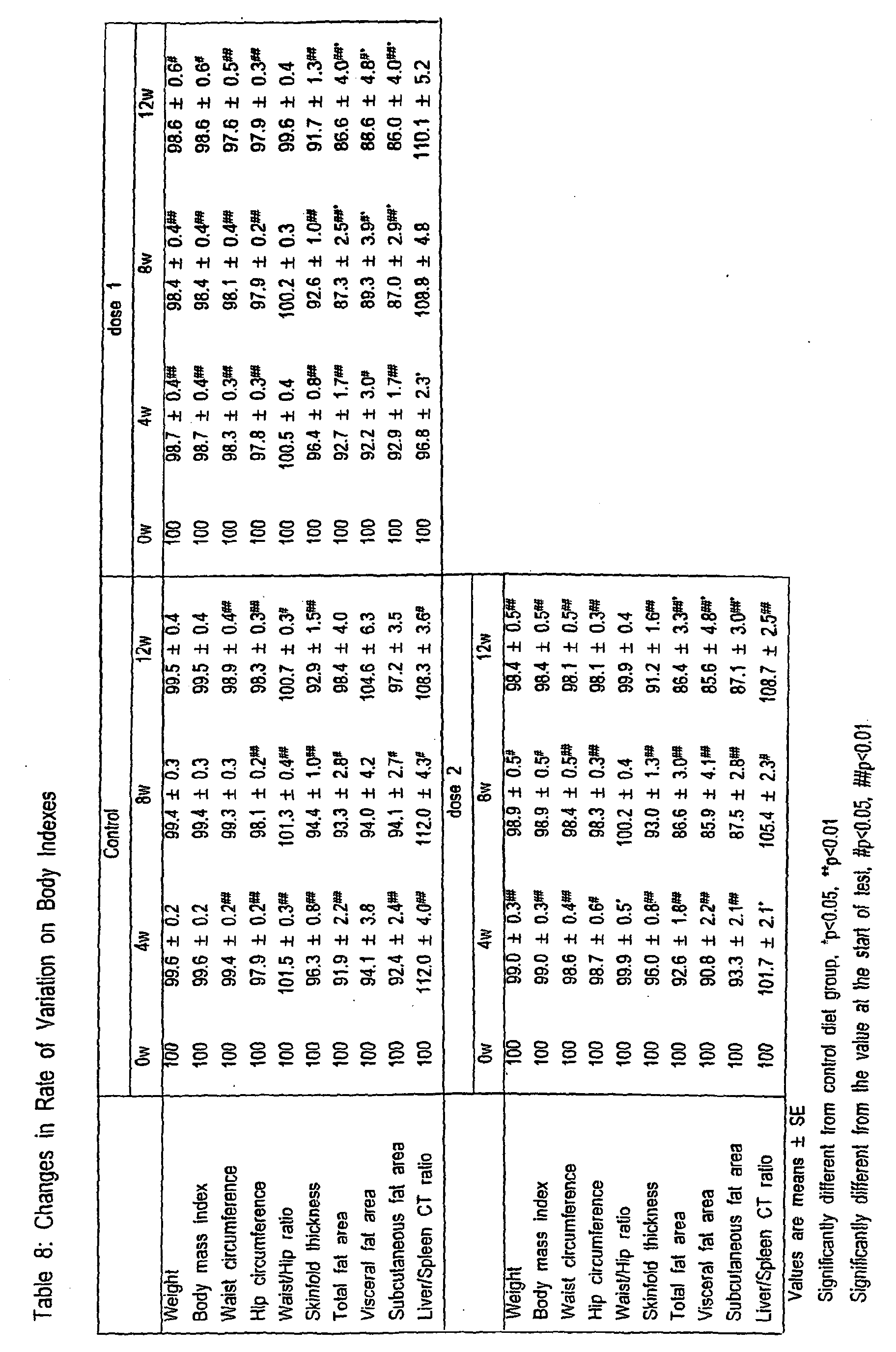
- This test was made under the approval and the administration of Animal Care Committee and Animal Ethics Committee of Kao Corporation. As an experimental animal, C57BL/6J mice (7 week old, male, purchased from CLEA JAPAN/Tokyo) was bred at room temperature of 23 ± 2 °C and relative humidity of 55 ± 10% and under illumination from 7:00 to 19:00. After they were carried in, seven days were spent for habituation. They were weighed and classified into test groups so that average weights of these groups would be substantially equal (n=5/group). They were maintained on food and water ad libitum. Feeding was carried out using a Roden CAFE (product of Oriental Yeast Co., Ltd./Tokyo) and the feed was changed every 2 days. The feed intake amount of each test group (n=5/cage/group) per 24 hours was measured once a week and energy intake amount was determined. Under the above-described conditions, they were bred for 20 weeks.
- ALA-DG was prepared from perilla oil in the presence of immobilized lipase in accordance with the method of Birgitte, et al. (JAOCS, 65, 905(1988)). Compositions of ALA-DG and SR-oil (mixture of safflower oil and rapeseed oil) are shown in Table 9. In SR-oil, oleic acid and linoleic acid account for 29.1% and 57.8%, respectively, of the fatty acid constituents, while in ALA-DG, -linolenic acid accounts for 60.8% of the fatty acid constituents. The DG and TG contents in the glyceride of ALA-DG are 85.2% and 14.1%, respectively. A ratio of 1,3-diglyceride to 1,2-diglyceride was about 7:3. The lard, sucrose, casein, cellulose, mineral mixture, vitamin mixture and -potato starch were purchased from Oriental Yeast Co., Ltd., while the safflower oil and rapeseed oil were purchased from The Nisshin Oil Mills Ltd.
Composition of Test Oils (%) Fatty Acid SR-oila ALA-DGb 16:0 6.0 5.7 18:0 2.2 1.8 18:1 29.1 14.0 18:2 57.8 15.9 18:3 2.5 60.8 20:0 0.4 n.d. 20:1 0.6 n.d. 22:0 0.3 n.d. 22:1 0.2 n.d. Others 0.9 1.8 Glycerides MG n.d. 0.7 DG 1.1 85.2 TG 97.2 14.1 a; safflower oil : rapeseed oil = 70:30 b; α -linolenic acid rich diglyceride n,d,; not detected - During the test, mice were weighed every week. Under fasting for 12 hours after completion of the test, they were anesthetized with ether. They were sacrificed under exsanguination and then anatomized. The visceral fat of each part (epididymal, mesenteric, retroperitoneal and perinephric) and the liver were weighed.
- Composition and calorie of the feed are shown in Table 10.
Composition of Diets in Experiment(%) Ingredients LF HF HF+ALA-DG ALA-DG - - 3.0 SR-oil 5.0 30.0 27.0 Sucrose - 13.0 13.0 Casein 20.0 20.0 20.0 Cellulose 4.0 4.0 4.0 Mineral mixture 3.5 3.5 3.5 Vitamin mixture 1.0 1.0 1.0 - potato starch 66.5 28.5 28.5 Calorie (Kcal/ 100g) 399.7 522.2 522.2 - Low-fat feed (LF) contains therein 5% of a lipid, while high-fat feed (HF) contains 30% of a lipid and 13% of sucrose. Per 100 g of the feed, the calorie of LF is 399.7 Kcal and that of HF is 522.2 Kcal, indicating that the latter has an about 30% higher calorie than the former. The ALA-DG substituted feed was prepared by substituting 3% of SR-oil of HF with 3% of ALA-DG (10% substitution of total lipid). The feed thus prepared was divided into light-shading packages, each containing the feed for 2 days, and after nitrogen purging, these packages were stored at 4 °C.
- Results were expressed as mean ± standard error. Statistical analysis was carried out by one-way analysis of variance (ANOVA) followed by Fisher's PLSD test, Statistical significance is defined as p < 0.05.
- No significant difference was recognized in the initial body weight among test groups (Table 11).
- In Week 20, a weight gain was recognized in each test group. In the ALA-DG substituted group, suppression of a weight gain more than that of the HF group was observed and in weight and weight gain in Week 20, a significant difference from the HF group was recognized.
- With regards to the energy intake amount during the test, although a significant difference between LF group and each of HF group and ALA-DG substituted group was recognized, there was no significant difference recognized between the HF group and ALA-DG substituted group.
- The visceral fat weight, mesenteric fat weight, retroperitoneal fat weight and perinephric fat weight in the ALA-DG substituted group each showed a significantly low value compared with those of the HF group (Table 11).
- With regards to the liver weight, the HF group and ALA-DG substituted group showed a significantly high value compared with the LF group, but no difference was recognized between the HF group and ALA-DG substituted group (Table 11).
Effects of ALA-DG on body weight, liver weight and visceral-fat weight in Week 20 Dietary treatment LF HF HF+ALA-DG Body weight (g) Initial 22.0 ± 0.6 22.5 ± 0.9 22.0 ± 0.7 Final 27.6 ± 1.7 36.4 ± 2.3 32.0 ± 3.7 Gain (20 weeks) 5.6 ± 1.2 13.8 ± 1.9 10.0 ± 3.1 Liver weight (g) 0.92 ± 0.07 1.25 ± 0.11 1.16 ± 0.12 Visceral-fat weight (g) Total 1.264 ± 0.380 3.180 ± 0.823 2.284 ± 0.873 Epididyinal 0.578 ± 0.194 1.620 ± 0.328 1.188 ± 0.516 Mesenteric 0.454 ± 0.101 0.874 ± 0.161 0.634 ± 0.156 Retroperitoneal 0.162 ± 0.068 0.488 ± 0.0094 0.340 ± 0.151 Perinephric 0.070 ± 0.022 0.198 ± 0.068 0.122 ± 0.056 Energy intake (Kcal/cage/day) 57.4 ± 2.8 68.6 ± 1.3 66.5 ± 4.2 Values are means ± SD - To 100 g of the whole egg, 0.5 g of salt and 0.1 g of pepper were added. They were beaten well by chopsticks. In a frying pan (24 cm), 5 g of Oil/fat composition 2a of the present invention was charged and heated (city gas, flow rate: 2.2L/min). Thirty seconds after, the beaten egg was poured into the frying pan. The egg was heated for 20 seconds while stirring with chopsticks. In this manner, scrambled egg was cooked.
- In oval soft capsules, 300 mg of Oil/fat composition 2c of the present invention was encapsulated, whereby soft capsules were prepared.
- The below-described components were mixed and the resulting mixture was compressed into tablets, each 200 mg in weight.
Composition of tablet: Oil/fat composition 2d of the present invention 10.0% Corn starch 44.0 Crystalline cellulose 40.0 Carboxymethylcellulose calcium 5.0 Silicic anhydride 0.5 Magnesium stearate 0.5 - With 25 parts by weight of wine vinegar (product of Nakano Suten), 1.25 parts by weight of salt, 0.3 part by weight of pepper and 0.25 part by weight of mustard were mixed. To the resulting mixture, 45 parts by weight of Oil/fat composition 2b of the present invention was added, whereby an oil-water separated dressing was prepared.
-
Composition: Oil/fat composition 2b of the invention 65.0% Egg yolk 15.0 Vinegar (acidity: 10%) 7.0 Refined sugar 1.0 Sodium glutamate 0.4 Salt 0.3 Mustard (powder) 0.3 Thickener (xanthane gum) 0.2 Water 10.8 - After stirring and mixing the above-described components other than Oil/fat composition 2b of the invention in a homomixer, Oil/fat composition 2b was added dropwise to preliminary emulsify the resulting mixture. The pre-emulsion thus obtained was homogenized further in a homomixer, whereby a mayonnaise was prepared (pH 4.0).
-
(Oil phase) parts by weight Oil/fat composition 1 of the invention 33.38 Hardened palm oil (IV=2) 4.0 Hardened soybean oil (IV=43) 2.0 Monoglyceride 0.5 Flavor 0.1 Vitamin E 0.02 (Water phase) parts by weight Distilled water 58.4 Skim milk 0.3 Salt 1.3 - The above-described oil phase and water phase were prepared, followed by mixing and emulsification in a homomixer. The resulting emulsion was cooled in a conventional manner and plasticized into a margarine-like spread.
-
parts by weight Xylitol 28.4 Sorbitol 56.9 Oil/fat composition 2b of the invention 2.5 Phytosterol (product of Tama Biochemical Co., Ltd.) 2.5 Flavor (ginger oil) 1.2 Citric acid 3.0 Sodium bicarbonate 5.0 Colorant (turmeric powder) 0.5 - After mixing the above-described raw materials, the resulting mixture was ground in a mortar. In a conventional manner, the resulting grind was compressed into tablets, each 2 g in weight, by a tableting machine (24.5 MPa, 4 seconds).
-
parts by weight Weak flour 350 Strong flour 150 Refined sugar 150 Whole egg 125 Oil/fat composition 2b of the invention 200 Salt 2.5 - Refined sugar, salt and Oil/fat composition 2b of the invention were put into a bowl, followed by stirring by a Hobart mixer. The whole egg was gradually added to the resulting mixture and they were stirred again by the Hobart mixer. A mixture of weak flour and strong flour mixed in advance was added in three portions, followed by stirring by the Hobart mixer. The dough thus prepared was divided into pieces, each 25 g in weight, and filled in a metal mold. After baking in an oven (160 °C, 50 minutes), they were released from the mold and allowed to cool down, whereby short breads were prepared.
-
Parts by weight Strong flour 100 Whole egg 50 Oil/fat composition 2b of the invention 30 Refined sugar 15 Water 15 Yeast 5 Yeast food 0.1 Skim milk 4 Salt 2 - The above-described raw materials other than Oil/fat composition 2b of the invention were mixed in a Hobart mixer at a low speed for 30 seconds. Oil/fat composition 2b was then added, followed by mixing (for 5 minutes at a low speed and 22 minutes at a medium speed). For fermentation, the dough thus obtained was allowed to rise at 27 °C for 30 minutes and then at low temperature of 5 °C for 15 minutes. The resulting dough was divided into pieces, each 37 g in weight, and they were rounded like a ball. After they were allowed to rise at 33 °C for 60 minutes for fermentation, they were baked in an oven (at 190 °C for 9 minutes), whereby brioches were obtained.
- The oil/fat composition of the present invention has excellent heat stability, has body-fat-accumulation resisting action, visceral-fat-accumulation resisting action, blood sugar lowering action, insulin resistance improving action and leptin lowering action and is useful for, as well as pharmaceuticals, preventive or remedial food for diabetes or obesity and feeds.
- Obviously, numerous modifications and variations of the present invention are possible in light of the above teachings. It is therefore to be understood that within the scope of the appended claims, the invention may be practiced otherwise than as specifically described herein
- This application is based on Japanese patent application 2000-239575 filed in the Japanese Patent Office on August 8, 2000, the entire contents of which are hereby incorporated by reference.
Claims (6)
- An oil/fat composition comprising:i) 10.1 to 94.9 wt.-% of triglyceride;ii) 0.1 to 30 wt.-% of monoglyceride;iii) 5 to 59.9 wt.-% of diglyceride which has, as a fatty acid constituent thereof, 15 to 90 wt.-% of ω3-unsaturated fatty acid having less than 20 carbon atoms, and not more than 3.5 wt.-% of a free fatty acid.
- Pharmaceutical composition containing the oil/fat composition according to claim 1.
- Use of the oil/fat composition according to claim 1 for the manufacture of a medicament.
- Use of the oil/fat composition according to claim 1 for food.
- Use of the oil/fat composition according to claim 1 for feed.
- Use of the oil/fat composition according to claim 1, wherein the food described in claim 4 is a cooking oil, an oil-in-water type oil/fat containing food, a water-in-oil type oil/fat containing food, a pocket-size oil/fat containing food, or a bakery food.
Applications Claiming Priority (3)
| Application Number | Priority Date | Filing Date | Title |
|---|---|---|---|
| JP2000239575 | 2000-08-08 | ||
| JP2000239575 | 2000-08-08 | ||
| EP01954488A EP1307107B1 (en) | 2000-08-08 | 2001-08-07 | Oil/fat composition |
Related Parent Applications (1)
| Application Number | Title | Priority Date | Filing Date |
|---|---|---|---|
| EP01954488A Division EP1307107B1 (en) | 2000-08-08 | 2001-08-07 | Oil/fat composition |
Publications (2)
| Publication Number | Publication Date |
|---|---|
| EP1430783A1 true EP1430783A1 (en) | 2004-06-23 |
| EP1430783B1 EP1430783B1 (en) | 2006-10-11 |
Family
ID=18731089
Family Applications (2)
| Application Number | Title | Priority Date | Filing Date |
|---|---|---|---|
| EP01954488A Expired - Lifetime EP1307107B1 (en) | 2000-08-08 | 2001-08-07 | Oil/fat composition |
| EP04006225A Expired - Lifetime EP1430783B1 (en) | 2000-08-08 | 2001-08-07 | Oil/fat composition |
Family Applications Before (1)
| Application Number | Title | Priority Date | Filing Date |
|---|---|---|---|
| EP01954488A Expired - Lifetime EP1307107B1 (en) | 2000-08-08 | 2001-08-07 | Oil/fat composition |
Country Status (7)
| Country | Link |
|---|---|
| US (1) | US7008661B2 (en) |
| EP (2) | EP1307107B1 (en) |
| CN (1) | CN100421565C (en) |
| BR (1) | BR0113108A (en) |
| CA (1) | CA2417971C (en) |
| DE (2) | DE60123849T2 (en) |
| WO (1) | WO2002011550A2 (en) |
Cited By (3)
| Publication number | Priority date | Publication date | Assignee | Title |
|---|---|---|---|---|
| FR2909880A1 (en) * | 2006-12-18 | 2008-06-20 | Univ Nice Sophia Antipolis Eta | Solid preparation, useful for detecting salivary function defects e.g. hyposalivation and manufacturing a means to detect the defect, comprises biscuit/granulate friable by single action of tongue or powder |
| CN116600650A (en) * | 2020-12-02 | 2023-08-15 | 花王株式会社 | oil composition |
| EP4256965A4 (en) * | 2020-12-02 | 2024-10-09 | Kao Corporation | OIL-IN-WATER EMULSION COMPOSITION |
Families Citing this family (41)
| Publication number | Priority date | Publication date | Assignee | Title |
|---|---|---|---|---|
| US6762203B2 (en) * | 1999-08-03 | 2004-07-13 | Kao Corporation | Oil composition |
| WO2001015552A1 (en) * | 1999-08-30 | 2001-03-08 | Ocean Nutrition Canada Ltd. | A nutritional supplement for lowering serum triglyceride and cholesterol levels |
| US6998501B1 (en) * | 1999-08-30 | 2006-02-14 | Ocean Nutrition Canada Limited | Nutritional supplement for lowering serum triglyceride and cholesterol levels |
| JP3769203B2 (en) | 2001-03-26 | 2006-04-19 | 花王株式会社 | Pet food or feed |
| JP4995377B2 (en) * | 2001-04-26 | 2012-08-08 | 花王株式会社 | Oil composition |
| GB0114014D0 (en) * | 2001-06-08 | 2001-08-01 | Novartis Nutrition Ag | Compostion and use |
| JP4060670B2 (en) | 2001-09-28 | 2008-03-12 | 花王株式会社 | Manufacturing method of fried food |
| JP4157765B2 (en) | 2002-02-18 | 2008-10-01 | 花王株式会社 | Powdered oil |
| US20060165735A1 (en) * | 2002-06-18 | 2006-07-27 | Abril Jesus R | Stable emulsions of oils in aqueous solutions and methods for producing same |
| TWI331017B (en) * | 2002-09-13 | 2010-10-01 | Kao Corp | Oil or fat compositions |
| US20040101545A1 (en) * | 2002-11-26 | 2004-05-27 | Schoenherr William D. | Composition and method |
| US20060233863A1 (en) | 2003-02-10 | 2006-10-19 | Enzymotec Ltd. | Oils enriched with diacylglycerols and phytosterol esters and unit dosage forms thereof for use in therapy |
| IL155136A0 (en) * | 2003-02-10 | 2003-10-31 | Enzymotec Ltd | A composition for reducing blood cholesterol and triglycerides |
| ATE430802T1 (en) | 2003-08-21 | 2009-05-15 | Monsanto Technology Llc | FATTY ACID DESATURASES FROM PRIMULA |
| US8715717B2 (en) | 2003-09-05 | 2014-05-06 | Hill's Pet Nutrition, Inc. | Composition for animal consumption |
| DE10345401A1 (en) * | 2003-09-30 | 2005-04-28 | Bioplanta Arzneimittel Gmbh | Use of alpha-linolenic acid and alpha-linolenic acid-containing vegetable oils |
| EP1682566B1 (en) | 2003-11-12 | 2013-06-05 | E.I. Du Pont De Nemours And Company | Delta-15 desaturases suitable for altering levels of polyunsaturated fatty acids in oleaginous plants and yeast |
| CN1968688A (en) | 2004-04-16 | 2007-05-23 | 孟山都技术有限公司 | Expression of fatty acid desaturases in corn |
| CA2565044C (en) * | 2004-04-28 | 2012-07-10 | Kao Corporation | A diacylglycerol-rich oil or fat composition |
| US20090232916A1 (en) * | 2004-08-09 | 2009-09-17 | Avidor Shulman | Food products for diabetics |
| EP1796726A2 (en) * | 2004-08-10 | 2007-06-20 | Enzymotec Ltd. | Mixture of phytosterol ester(s) and 1,3-diglyceride(s) for use in the treatment of medical conditions |
| JP4354392B2 (en) * | 2004-12-13 | 2009-10-28 | 理研ビタミン株式会社 | Process for producing modified natural intestine |
| ZA200705400B (en) | 2004-12-23 | 2008-09-25 | Unilever Plc | Frozen aerated confections |
| JP4972336B2 (en) * | 2006-04-24 | 2012-07-11 | 花王株式会社 | GIP secretion inhibitor |
| WO2008000440A1 (en) * | 2006-06-27 | 2008-01-03 | Lipid Nutrition B.V. | Use of a polyunsaturated fatty acid compound |
| US20090202704A1 (en) * | 2008-02-13 | 2009-08-13 | Kao Corporation | Postprandial hyperglycemia-improving agent |
| JP5242219B2 (en) * | 2008-03-31 | 2013-07-24 | 花王株式会社 | Emulsified oil and fat composition |
| WO2010019598A1 (en) * | 2008-08-11 | 2010-02-18 | Abunda, Inc. | Diacylglycerol rich fats, oils and functional foods |
| US20110236550A1 (en) * | 2009-02-18 | 2011-09-29 | Daniel Perlman | Stabilization of phenolic antioxidants in fat-containing foods |
| JP2013518566A (en) * | 2010-02-06 | 2013-05-23 | コグニス・アイピー・マネージメント・ゲゼルシャフト・ミット・ベシュレンクテル・ハフツング | Beverage |
| JP2012034687A (en) * | 2010-07-14 | 2012-02-23 | Kao Corp | Water-in-oil emulsion composition |
| ITMI20111050A1 (en) | 2011-06-10 | 2012-12-11 | Sevecom Spa | USE OF EMULSIFIERS ASSOCIATED WITH VEGETABLE OILS IN AN ANIMAL FOOD. |
| CN105212198A (en) * | 2014-05-28 | 2016-01-06 | 中粮营养健康研究院有限公司 | Emulsifying agent is as the purposes of frost resistance component and noncongealable oil oil/fat composition and application thereof |
| MA40433A (en) | 2014-07-21 | 2017-06-14 | Sevecom Spa | Powdered emulsion for animal feed |
| JP6109136B2 (en) * | 2014-11-14 | 2017-04-05 | 日清オイリオグループ株式会社 | Oil and fat composition for heating and cooking, method for producing the oil and fat composition for heating and cooking, and method for reducing oil remaining in cooking object after cooking |
| WO2016128235A1 (en) * | 2015-02-11 | 2016-08-18 | Nestec S.A. | Vitamin a composition |
| US10258058B2 (en) * | 2015-05-23 | 2019-04-16 | Oil Crops Research Institute, Chinese Academy Of Agricultural Seciences | Method for preparing functional edible oil rich in phytosterol esters and diglycerides |
| WO2017134839A1 (en) * | 2016-02-03 | 2017-08-10 | 不二製油グループ本社株式会社 | Cocoa butter |
| CN109645424A (en) * | 2019-01-04 | 2019-04-19 | 颐海(上海)食品有限公司 | A kind of chafing dish bottom flavorings and preparation method thereof containing medium chain triglyceride |
| WO2020259493A1 (en) * | 2019-06-24 | 2020-12-30 | Basf Se | Compositions and methods for the prevention or treatment, or dietary management of nafld |
| JP2023058456A (en) * | 2021-10-13 | 2023-04-25 | 花王株式会社 | antiallergic agent |
Citations (3)
| Publication number | Priority date | Publication date | Assignee | Title |
|---|---|---|---|---|
| JPS63104917A (en) * | 1986-10-22 | 1988-05-10 | Kao Corp | Oral administration composition |
| WO1996032022A1 (en) * | 1995-04-13 | 1996-10-17 | Unilever N.V. | Edible plastic spread |
| EP0953630A1 (en) * | 1991-06-27 | 1999-11-03 | Novartis AG | Transesterification products of corn oil and glycerol and their use in pharmaceutical compositions |
Family Cites Families (10)
| Publication number | Priority date | Publication date | Assignee | Title |
|---|---|---|---|---|
| JP3375726B2 (en) * | 1994-05-18 | 2003-02-10 | 雪印乳業株式会社 | Edible fats and oils and fat mixtures |
| ES2202454T3 (en) * | 1995-07-04 | 2004-04-01 | Suntory Limited | USE OF A BALANCING AGENT FOR OMEGA-3 AND OMEGA-6 Unsaturated FATTY ACIDS. |
| AUPN475095A0 (en) * | 1995-08-11 | 1995-09-07 | Hyam Myers Consulting Pty. Limited | Removal of free fatty acids from oil and fats |
| US6762203B2 (en) * | 1999-08-03 | 2004-07-13 | Kao Corporation | Oil composition |
| JP4098927B2 (en) * | 1999-08-03 | 2008-06-11 | 花王株式会社 | Oil composition |
| JP3779505B2 (en) * | 1999-08-24 | 2006-05-31 | 花王株式会社 | Oil composition |
| JP2001211305A (en) * | 2000-01-28 | 2001-08-03 | Ricoh Co Ltd | Network facsimile communication system |
| JP3752127B2 (en) * | 2000-03-21 | 2006-03-08 | 花王株式会社 | Oil composition |
| DE60143753D1 (en) * | 2000-08-08 | 2011-02-10 | Kao Corp | OIL / GREASE COMPOSITION |
| JP4391673B2 (en) * | 2000-08-08 | 2009-12-24 | 花王株式会社 | Oil composition |
-
2001
- 2001-08-07 WO PCT/JP2001/006778 patent/WO2002011550A2/en not_active Ceased
- 2001-08-07 DE DE60123849T patent/DE60123849T2/en not_active Expired - Lifetime
- 2001-08-07 US US10/343,831 patent/US7008661B2/en not_active Expired - Lifetime
- 2001-08-07 EP EP01954488A patent/EP1307107B1/en not_active Expired - Lifetime
- 2001-08-07 BR BR0113108-7A patent/BR0113108A/en not_active Application Discontinuation
- 2001-08-07 EP EP04006225A patent/EP1430783B1/en not_active Expired - Lifetime
- 2001-08-07 CA CA002417971A patent/CA2417971C/en not_active Expired - Fee Related
- 2001-08-07 DE DE60115660T patent/DE60115660T2/en not_active Expired - Lifetime
- 2001-08-07 CN CNB01816692XA patent/CN100421565C/en not_active Expired - Fee Related
Patent Citations (3)
| Publication number | Priority date | Publication date | Assignee | Title |
|---|---|---|---|---|
| JPS63104917A (en) * | 1986-10-22 | 1988-05-10 | Kao Corp | Oral administration composition |
| EP0953630A1 (en) * | 1991-06-27 | 1999-11-03 | Novartis AG | Transesterification products of corn oil and glycerol and their use in pharmaceutical compositions |
| WO1996032022A1 (en) * | 1995-04-13 | 1996-10-17 | Unilever N.V. | Edible plastic spread |
Non-Patent Citations (4)
| Title |
|---|
| "USDA Nutrient Database for Standard Reference, Release 13, Cucumber", November 1999, UNITED STATES DEPT. OF AGRICULTURE, XP002190423 * |
| DATABASE WPI Section Ch Week 198824, Derwent World Patents Index; Class B05, AN 1988-165726, XP002190424 * |
| FISHWICK, M. J., WRIGHT, A. J., AND GALLIARD, T.: "Quantitative Composition of the lipids of Cucumber Fruit", JOURNAL OF THE SCIENCE OF FOOD AND AGRICULTURE., vol. 28, 1977, ELSEVIER APPLIED SCIENCE PUBLISHERS. BARKING., GB, pages 394 - 398, XP002190421, ISSN: 0022-5142 * |
| HYO-SUN SHIN AND SUNG-WHAN KIM: "Lipid composition of Perilla Seed", JOURNAL OF THE AMERICAN OIL CHEMISTS' SOCIETY., vol. 71, no. 6, 1994, AMERICAN OIL CHEMISTS' SOCIETY. CHAMPAIGN., US, pages 619 - 622, XP002190422, ISSN: 0003-021X * |
Cited By (5)
| Publication number | Priority date | Publication date | Assignee | Title |
|---|---|---|---|---|
| FR2909880A1 (en) * | 2006-12-18 | 2008-06-20 | Univ Nice Sophia Antipolis Eta | Solid preparation, useful for detecting salivary function defects e.g. hyposalivation and manufacturing a means to detect the defect, comprises biscuit/granulate friable by single action of tongue or powder |
| WO2008093005A3 (en) * | 2006-12-18 | 2008-12-11 | Univ Nice Sophia Antipolis | Preparation for detection of a salivary malfunction |
| CN116600650A (en) * | 2020-12-02 | 2023-08-15 | 花王株式会社 | oil composition |
| EP4256967A4 (en) * | 2020-12-02 | 2024-10-09 | Kao Corporation | FAT AND OIL COMPOSITION |
| EP4256965A4 (en) * | 2020-12-02 | 2024-10-09 | Kao Corporation | OIL-IN-WATER EMULSION COMPOSITION |
Also Published As
| Publication number | Publication date |
|---|---|
| DE60123849T2 (en) | 2007-05-24 |
| WO2002011550A3 (en) | 2002-05-30 |
| US20030198727A1 (en) | 2003-10-23 |
| WO2002011550A2 (en) | 2002-02-14 |
| EP1430783B1 (en) | 2006-10-11 |
| DE60115660D1 (en) | 2006-01-12 |
| BR0113108A (en) | 2003-06-10 |
| DE60115660T2 (en) | 2006-08-03 |
| EP1307107B1 (en) | 2005-12-07 |
| CA2417971A1 (en) | 2002-02-14 |
| CN1468059A (en) | 2004-01-14 |
| CN100421565C (en) | 2008-10-01 |
| EP1307107A2 (en) | 2003-05-07 |
| CA2417971C (en) | 2010-01-19 |
| DE60123849D1 (en) | 2006-11-23 |
| US7008661B2 (en) | 2006-03-07 |
Similar Documents
| Publication | Publication Date | Title |
|---|---|---|
| EP1307107B1 (en) | Oil/fat composition | |
| US7090886B2 (en) | Oil/fat composition | |
| JP4031219B2 (en) | Oil composition | |
| US7056949B2 (en) | Oil/fat composition | |
| EP1424907B1 (en) | Oil composition | |
| US7494680B2 (en) | Fat or oil composition | |
| EP1741342B1 (en) | Fat composition | |
| AU2002328058A1 (en) | Oil composition | |
| JP4031218B2 (en) | Oil composition | |
| WO2005052102A1 (en) | A composition enriched in diglyceride with conjugated linoleic acid | |
| JP2007045789A (en) | Postprandial hyperinsulinemia improving agent |
Legal Events
| Date | Code | Title | Description |
|---|---|---|---|
| PUAI | Public reference made under article 153(3) epc to a published international application that has entered the european phase |
Free format text: ORIGINAL CODE: 0009012 |
|
| 17P | Request for examination filed |
Effective date: 20040316 |
|
| AC | Divisional application: reference to earlier application |
Ref document number: 1307107 Country of ref document: EP Kind code of ref document: P |
|
| AK | Designated contracting states |
Kind code of ref document: A1 Designated state(s): DE FR GB |
|
| AKX | Designation fees paid |
Designated state(s): DE FR GB |
|
| 17Q | First examination report despatched |
Effective date: 20050214 |
|
| GRAP | Despatch of communication of intention to grant a patent |
Free format text: ORIGINAL CODE: EPIDOSNIGR1 |
|
| GRAS | Grant fee paid |
Free format text: ORIGINAL CODE: EPIDOSNIGR3 |
|
| GRAA | (expected) grant |
Free format text: ORIGINAL CODE: 0009210 |
|
| RIN1 | Information on inventor provided before grant (corrected) |
Inventor name: HASE, TADASHI,KAO CORPORATION RESEARCH LABORAT. Inventor name: KATSURAGI, YOSHIHISA Inventor name: TAKEI, AKIRA Inventor name: MURASE, TAKATOSHI,KAO CORPORATION RESEARCH LABOR. Inventor name: YASUMASU, TAKESHI Inventor name: KOIKE, SHIN |
|
| AC | Divisional application: reference to earlier application |
Ref document number: 1307107 Country of ref document: EP Kind code of ref document: P |
|
| AK | Designated contracting states |
Kind code of ref document: B1 Designated state(s): DE FR GB |
|
| REG | Reference to a national code |
Ref country code: GB Ref legal event code: FG4D |
|
| REF | Corresponds to: |
Ref document number: 60123849 Country of ref document: DE Date of ref document: 20061123 Kind code of ref document: P |
|
| ET | Fr: translation filed | ||
| PLBE | No opposition filed within time limit |
Free format text: ORIGINAL CODE: 0009261 |
|
| STAA | Information on the status of an ep patent application or granted ep patent |
Free format text: STATUS: NO OPPOSITION FILED WITHIN TIME LIMIT |
|
| 26N | No opposition filed |
Effective date: 20070712 |
|
| REG | Reference to a national code |
Ref country code: FR Ref legal event code: PLFP Year of fee payment: 16 |
|
| REG | Reference to a national code |
Ref country code: FR Ref legal event code: PLFP Year of fee payment: 17 |
|
| PGFP | Annual fee paid to national office [announced via postgrant information from national office to epo] |
Ref country code: DE Payment date: 20170801 Year of fee payment: 17 Ref country code: GB Payment date: 20170802 Year of fee payment: 17 Ref country code: FR Payment date: 20170714 Year of fee payment: 17 |
|
| REG | Reference to a national code |
Ref country code: DE Ref legal event code: R119 Ref document number: 60123849 Country of ref document: DE |
|
| GBPC | Gb: european patent ceased through non-payment of renewal fee |
Effective date: 20180807 |
|
| PG25 | Lapsed in a contracting state [announced via postgrant information from national office to epo] |
Ref country code: DE Free format text: LAPSE BECAUSE OF NON-PAYMENT OF DUE FEES Effective date: 20190301 |
|
| PG25 | Lapsed in a contracting state [announced via postgrant information from national office to epo] |
Ref country code: FR Free format text: LAPSE BECAUSE OF NON-PAYMENT OF DUE FEES Effective date: 20180831 |
|
| PG25 | Lapsed in a contracting state [announced via postgrant information from national office to epo] |
Ref country code: GB Free format text: LAPSE BECAUSE OF NON-PAYMENT OF DUE FEES Effective date: 20180807 |