EP1430738B1 - System and method for emulating mobile networks and related device - Google Patents
System and method for emulating mobile networks and related device Download PDFInfo
- Publication number
- EP1430738B1 EP1430738B1 EP02783531A EP02783531A EP1430738B1 EP 1430738 B1 EP1430738 B1 EP 1430738B1 EP 02783531 A EP02783531 A EP 02783531A EP 02783531 A EP02783531 A EP 02783531A EP 1430738 B1 EP1430738 B1 EP 1430738B1
- Authority
- EP
- European Patent Office
- Prior art keywords
- terminal
- information
- network
- exchange
- mobile
- Prior art date
- Legal status (The legal status is an assumption and is not a legal conclusion. Google has not performed a legal analysis and makes no representation as to the accuracy of the status listed.)
- Expired - Lifetime
Links
- 238000000034 method Methods 0.000 title abstract description 38
- 230000000694 effects Effects 0.000 claims abstract description 18
- 238000012546 transfer Methods 0.000 claims description 14
- 230000004044 response Effects 0.000 claims description 3
- 230000008569 process Effects 0.000 abstract description 33
- 230000006870 function Effects 0.000 abstract description 12
- 238000004088 simulation Methods 0.000 abstract description 8
- 238000005259 measurement Methods 0.000 abstract description 4
- 230000005540 biological transmission Effects 0.000 description 6
- 238000013461 design Methods 0.000 description 4
- 238000010586 diagram Methods 0.000 description 2
- 238000005516 engineering process Methods 0.000 description 2
- 238000012986 modification Methods 0.000 description 2
- 230000004048 modification Effects 0.000 description 2
- 241000220010 Rhode Species 0.000 description 1
- 239000006227 byproduct Substances 0.000 description 1
- 239000000969 carrier Substances 0.000 description 1
- 238000004891 communication Methods 0.000 description 1
- 238000010276 construction Methods 0.000 description 1
- 230000001419 dependent effect Effects 0.000 description 1
- 238000011156 evaluation Methods 0.000 description 1
- 239000000463 material Substances 0.000 description 1
- 238000010295 mobile communication Methods 0.000 description 1
- 230000006855 networking Effects 0.000 description 1
- 238000011017 operating method Methods 0.000 description 1
- 238000012545 processing Methods 0.000 description 1
- 230000000007 visual effect Effects 0.000 description 1
Images

Classifications
-
- H—ELECTRICITY
- H04—ELECTRIC COMMUNICATION TECHNIQUE
- H04W—WIRELESS COMMUNICATION NETWORKS
- H04W24/00—Supervisory, monitoring or testing arrangements
Definitions
- the present invention relates to a system for emulating the behaviour of a network of mobile radio apparatuses (mobile radio) and to the apparatus that allows to implement said system.
- the present invention relates to an emulation system that, for given services required by a user with a terminal inserted in the mobile network, is able to represent, also visually, the result which said user can perceive as a level of service.
- a fundamental need for an operator who provides network services is to verify the characteristics of the network and to dimension it correctly according to users' requirements, for instance in terms of response times.
- Simulation tools in particular, which as is well known are constituted by programme packets (software), also comprise, in some case, emulation tools allowing to represent, in rough fashion, the effects that the results of the simulation induce on users' terminals.
- emulation tools being intrinsically associated to the simulators, are preferably not usable to provide punctual, instant by instant representation of ongoing phenomena in the mobile network, such as channel availability, time slot availability, etc.
- Known emulation tools being of the software type and dependent on the simulators, have insurmountable limits to real time emulation of phenomena that take place in the network, since:
- the aim of the present invention is to provide a system that allows to emulate the effects of the behaviour of the mobile network in terms of representation of the result perceptible by the user, independently from the analysis means used to obtain said behaviour, be they simulation tools or field measures.
- Another aim of the present invention is to provide an emulation device that allows to emulate the exchange of information between mobile terminal and mobile network in a manner that is independent and autonomous with respect to any other tools tasked with representing the characteristics of the network.
- the aim is achieved by the system and by the related device as claimed.
- the aim is achieved by the system according to the invention which comprises an emulation device able autonomously to process either field measurements or the results of a simulation and to manage them according to time cadences corresponding to the real times of handling the information by the analysed network.
- a system 10 for emulating mobile networks comprises a user terminal 15, a network terminal 16, a control terminal 14, and an emulation device (emulator) 12.
- the emulator 12 in accordance with the present embodiment, is connected by means of a first connection 14a to the control terminal 14, by means of a second connection 15a to the user terminal 15 and by means of a third connection 16a to the network terminal 16.
- the control terminal 14 for instance constituted by a known personal computer or PC, is able to exchange, in known fashion, by means of the connection 14a, for instance constituted by a serial or RS232 connection, data and commands with the emulator 12.
- control terminal 14 in accordance with the present embodiment, is able, on the basis of application programmes developed during the design of the system 10, to:
- the user terminal 15 constituted for instance by a known personal computer or PC, is able to exchange, in known fashion, by means of the connection 15a, for instance constituted by an Ethernet connection, data and commands with the emulator 12.
- the user terminal 15 in accordance with the present embodiment, is able, on the basis of known application programmes, through the connection 15a, to activate functions of:
- the user terminal 15 is able, on the basis of known application programmes, to activate functions that require an exchange of information with additional terminals and to represent on the terminal itself 15, thanks to the emulator 13, the result of such operations with an effect equivalent to the one perceptible by the user in a real mobile network.
- the network terminal 16 constituted for instance by a known work station, is able to exchange, in known fashion, by means of the connection 16a, for instance constituted by an Ethernet connection, data and commands with the emulator 12.
- the network terminal 16, in accordance with the present embodiment is able, for instance, on the basis of known application programmes corresponding to those activated by the user terminal 15, to respond to the functions activated by the user terminal 15 and transmitted to the network terminal 16 by means of the emulator 12 and of the connection 16a.
- the network terminal 16 is able to respond to Web-Browsing functions activated by the user terminal 15 and to transmit the result to the emulator 12 and therefrom to the user terminal 15.
- the network terminal 16 is able to respond, based on known application programmes, to the functions activated by the user terminal 15 and to exchange data and command with the user terminal 15 by means of the emulator 12.
- the emulator 12 one of the characteristics elements of the present invention, is interposed between the user terminal 15 and the network terminal 16 and is able to intercept and control the exchange of data and commands (data) between the user terminal 15 and the network terminal 16, dynamically emulating the behaviour of a mobile network, as is described in detail hereafter.
- the emulator 12 comprises, in accordance with the present embodiment, two circuit blocks, respectively a control circuit block (control block) 20 ( Fig. 1 and Fig. 2 ), able to control the functions of the emulator 12, and a data exchange circuit block (data block) 30, able to manage the exchange of data between the user terminal 15 and the network terminal 16.
- control block control block
- data block data exchange circuit block
- the control block 20 comprises a control unit (CPU) 21, a read-only memory (ROM) 22, a random access memory (RAM programmes and local data) 23 and a serial interface (RS232 interface) 24, all known, interconnected in known fashion by means of a data controls and commands channel (local BUS) 27 also known.
- CPU control unit
- ROM read-only memory
- RAM random access memory
- RS232 interface serial interface
- ROM 22 is stored an initialisation programme able to:
- the data block 30 comprises a first Ethernet interface (user side interface) 35 and a second Ethernet interface (network interface) 36, able to be interconnected, respectively, to the connections 15a and 16a, a random access memory (data RAM) 33, and a data controls commands channel (data BUS) 37.
- first Ethernet interface user side interface
- second Ethernet interface network interface
- data RAM random access memory
- data BUS data controls commands channel
- Each Ethernet interface, 35 and 36 is associated to a corresponding logic circuitry for direct access to the data RAM 33, respectively user DMA 35a and network DMA 36a, and is able to exchange data, directly and independently from the CPU 21, with the data RAM 33.
- the user side interface 35 is able to exchange representative traffic data for service requests with a first portion of the data RAM (user RAM) 33a and the network interface 36 is able to exchange representative traffic data in response to the service request with a second portion of the data RAM (network RAM) 33b; the reading and writing of the data is controlled by the commands received from the CPU 21, according to the procedures described hereafter.
- control block 20 and the data block 30 are able to exchange data and commands between them by means of the CPU 21 that is interconnected both to the local BUS 27 and to the data BUS 37 and is able, in particular:
- the CPU 21 Upon starting the emulator 12, the CPU 21, on the basis of the programmes stored in the ROM 22, generates the uplink and downlink processes and the control process.
- the control process receives from the control terminal 14, through the connection 14a, a first file of commands representative of the behaviour of the network in uplink mode (uplink file) and a second file of commands representative of the behaviour of the network in downlink mode (downlink file).
- uplink file a first file of commands representative of the behaviour of the network in uplink mode
- downlink file a second file of commands representative of the behaviour of the network in downlink mode
- command files have a shape and content that depends on the type of network to be emulated.
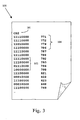
- command file 100 ( Fig. 3 ) usable to represent a GSM-GPRS (Global System for Mobile communications - General Packet Radio Service on mobile networks) network.
- GSM-GPRS Global System for Mobile communications - General Packet Radio Service on mobile networks
- FDMA access technique the data traffic for the various types of service is handled (serviced) using radio carriers with predefined frequency and, within each radio carrier (FDMA access technique), by a determined "time slot” or slot (the physical channel proper) among those periodically available within the so-called time frame used on the radio interface (TDMA access technique).
- a whole slot of the GSM time frame of the duration of about 5 ms is allocated to that user for at least 4 time slots, i.e. 20 ms, and this implies a determined transmission rate, for instance 9.05 kbit/s nominal for the data coding called CS-1 or 13.4 kbit/s nominal for the data coding called CS-2.
- the single slot is shared among the same users, up to eight users, with the consequent decrease in the transmission rate, which therefore is a function of the number of users currently active in the network.
- the phenomenon described above has characteristics that are clearly different from the typical phenomenon of simple voice traffic transmission, for which, as is well known, the slot of the GSM time frame assigned to the user is attributed thereto in unique and exclusive fashion until the telephone call is completed.
- the example of command file 100 able to represent the behaviour of this type of network, comprises 8-bit binary strings 102 in which each bit is representative, if its value is 1, of the possibility of occupation of the slot by the exchanged traffic, for instance data traffic, and in which each binary string 102 is representative of the behaviour of the network with cadence of 20 ms (5 ms x 4 time frames).
- each binary string 102 has, associated thereto, an index 104, indicative of the time frame to be emulated; the lack of the time frame is indicative, in accordance with the present embodiment, of unavailability of the network to handle the data traffic during the missing frames.
- command file 100 also comprises a code 101 indicative of the type of coding using by the mobile network to be emulated. -
- the system 10 Upon completion of the command file reception step, during which, naturally, the processes relating to network activity, i.e. the uplink and downlink processes, are kept inactive, the system 10 ( Fig. 1 and Fig. 2 ) becomes operational and able to emulate the behaviour of the mobile network.
- the user terminal 15 sends a service request, i.e. a Web-Browsing command that is read by the user side interface 35 and stored directly, in the form of Ethernet packet of determined dimensions, in the user Ram 33a by means of the uplink process that also provides, at the completion of the operation, to signal the completion of the operation to the CPU 21.
- a service request i.e. a Web-Browsing command that is read by the user side interface 35 and stored directly, in the form of Ethernet packet of determined dimensions, in the user Ram 33a by means of the uplink process that also provides, at the completion of the operation, to signal the completion of the operation to the CPU 21.
- the CPU 21 by means of the control process, copies the Ethernet packet from the user RAM 33a into the programme and local data RAM 23 and with discrete cadence of 20 ms, taking into account the configuration of the bits in the uplink files and of the associated parameters indicative, for instance, of the type of coding and of the time frames to be handled, scans the Ethernet packet until reaching or slightly exceeding the dimensions of the packet.
- the CPU 21, After completing said scanning operation, the CPU 21, through the control process, moves the content of the packet from the programme and local data RAM 23 to the network RAM 33b and signals the completion of the control process to the uplink process so that the uplink process completes the functions in uplink mode, directly transferring the Ethernet packet from the network RAM 33b to the network terminal 16 by means of the network interface 36.
- the transfer times from the user terminal 15 to the user RAM 33a and those from the network RAM 33b to the network terminal are to be deemed, thanks to the architecture of the system 10 and, in particular, of the emulator 12 as described, shorter by at least 1 or 2 orders of magnitude than the times for scanning the Ethernet packet emulated with the control process and hence to have no influence on the uplink process in emulation.
- the downlink process assumed for the sake of simplicity as the process of transferring data from the network terminal 16 to the user terminal 15, follows procedures equivalent to those described above and, as is readily apparent to a person versed in the art, is concurrent with the uplink process.
- the network terminal 16 Similar in this case to an Internet site, sends one or more Ethernet packets to the network interface 36 and stores them directly in the network RAM 33b through the downlink process which, at the completion of the operation, signals such completion of the operation to the CPU.
- the CPU 21 by means of the control process, copies each packet in succession from the network RAM 33b in the programme and local data RAM 23 and with discrete cadence of 20 ms, taking into account the configuration of the bits in the downlink file and of the associated parameter indicative, for instance, of the type of coding and of the time frame to be managed, scans in sequence each Ethernet packet until reaching or slightly exceeding the dimensions of the packet.
- the CPU 21, by means of the control process, transfers the content of each packet scanned by the programme and local data RAM 23 to the user RAM 33a and signals to the downlink process the completion of the control process for the scanned packet in such a way that the downlink process performs functions in downlink mode directly transferring the Ethernet packet scanned by the user RAM 33a to the user terminal 15.
- the CPU 21 by means of the control process, transfers the content of each packet scanned by the programme and local data RAM 23 to the user RAM 33a and signals to the downlink process the completion of the control process for the scanned packet in such a way that the downlink process performs functions in downlink mode directly transferring the Ethernet packet scanned by the user RAM 33a to the user terminal 15.
- the CPU 21 by means of the control process, transfers the content of each packet scanned by the programme and local data RAM 23 to the user RAM 33a and signals to the downlink process the completion of the control process for the scanned packet in such a way that the downlink process performs functions in downlink mode directly transferring the Ethernet packet scanned by the user
- the CPU 21, by means of the control process, in accordance with the present embodiment, is able, on the basis of the programmes developed during the design of the system 10 and stored in the ROM 22 or coming from the control terminal 14, to receive and service information requests coming from the control terminal 14, such as:
- the described system 10 allows, therefore, to emulate the behaviour of a mobile network and to make the effect of such behaviour visible to the user.
- the commands, for example for Web-Browsing, introduced by means of the user terminal 15, and the replies of the network terminal 16 are dynamically controlled (filtered) with command files, for instance generated with network simulators or by means of measuring instruments, in such a way as to be timed in a manner equivalent to the behaviour, instant-by-instant, of the network; in this way it is thus possible to render perceptible on the user terminal 15 an/or on the network terminal 16, in visual or equivalent manner, the delay and/or information loss and/or distortion effect introduced by the mobile network to be emulated.
- the system 10 and the emulator 12, as described, are able to implement the functionality of segmenting and reassembling packets, for instance of the Ethernet type, in accordance with a predefined standard or protocol; for instance in the case of the GSM-GPRS protocol the system 10 is able to reproduce the RLC-MAC (Radio Link Control-Medium Access Control) layer and to represent in realistic fashion on the user terminal 15 the delay and/or information loss and/or distortion effect introduced by the mobile network.
- RLC-MAC Radio Link Control-Medium Access Control
- the system 10 has been described assuming that the emulator would be connected to a single network terminal 16, but as is readily apparent to a person versed in the art, the system 10 is also able to support configuration in which the network interface 36 is connected to a network of the Intranet type, known in itself, able to be accessed by multiple terminals or network servers able selectively to respond to a plurality of functions activated by the user terminal 15.
- the system 10 has been described taking a GSM-GPRS mobile network as reference but, as is readily apparent to a person versed in the art, this system can be used for other types of network simply by adapting, on a case by case basis, the uplink, downlink and control processes, as well as the control files, to the type of network to be emulated.
Landscapes
- Engineering & Computer Science (AREA)
- Computer Networks & Wireless Communication (AREA)
- Signal Processing (AREA)
- Mobile Radio Communication Systems (AREA)
- Small-Scale Networks (AREA)
Abstract
Description
- The present invention relates to a system for emulating the behaviour of a network of mobile radio apparatuses (mobile radio) and to the apparatus that allows to implement said system.
- In particular, the present invention relates to an emulation system that, for given services required by a user with a terminal inserted in the mobile network, is able to represent, also visually, the result which said user can perceive as a level of service.
- As is well known, the widespread use of mobile networks has led to a rapid expansion of the services available on such networks, such as services for accessing the Internet to use electronic mail (E-Mail) and/or Web-Browsing tools.
- In this context, a fundamental need for an operator who provides network services, such as Internet access services, is to verify the characteristics of the network and to dimension it correctly according to users' requirements, for instance in terms of response times.
- To achieve such aims, operators use, as is well known, either field measurements or simulation tools which, according to the number of apparatus, characteristics of the environment, etc., allow to obtain statistics pertaining to parameters such as:
- number of serviced calls;
- number of blocked calls; etc.
and to generate tables or graphs representing such parameters. - Simulation tools (simulators), in particular, which as is well known are constituted by programme packets (software), also comprise, in some case, emulation tools allowing to represent, in rough fashion, the effects that the results of the simulation induce on users' terminals.
- As is well known, however, such emulation tools, being intrinsically associated to the simulators, are preferably not usable to provide punctual, instant by instant representation of ongoing phenomena in the mobile network, such as channel availability, time slot availability, etc. Known emulation tools, being of the software type and dependent on the simulators, have insurmountable limits to real time emulation of phenomena that take place in the network, since:
- they preferably depend on the characteristics of the type of Work Station (hardware) that houses the software, in the sense that the speed of the hardware whereon the software programmes are installed affects perceptible results;
- they preferably depend on the simulator, which is generally of the statistical type, and on the tools used to perform the simulation since the emulation is, in fact, obtained as a byproduct of the simulation.
- Therefore, known emulation tools, due to the intrinsic limitations described above, are not able adequately to represent the behaviour of the network in real operating conditions and, in particular, are not able to represent on a terminal that is similar to the one actually utilised by the user, the result of operations, for instance, of "Web-Browing", taking into account the various parameters that affect, instant by instant, the activity of the network itself.
- Kojo M. et al: "Seawind: a Wireless Network Emulator"; Seawind: A Wireless Network Emulator In Proceedings Of 11th GI/ITG Conference On Measuring, Modelling and Evaluation Of Computer And Communication Systems, September 2001, Aachen, Germany (13-09-2001), pages 1-16 discloses an emulation software which enables measurement of protocol implementations in modeled networking environments. The Seawind software intercepts the traffic flow between a client and a server transparently to the endpoints and emulates the desidered link characteristics by delaying, dropping and modifying packets in the flow.
- Burgois M et al: Necessity of an Emulator to Validate New Resources Allocation Protocols", VTC 2001 Spring. IEEE VTS 53rd. Vehicular Technology Conference. Rhodes, Greece, May 6-9, 2001, IEEE Vehicular Technology Conference, New York, NY: IEEE, US (06-05-2001), vol.4 of 4. conf. 53, pages 3049-3052 discloses the principles of a real-time GPRS network emulator.
- The aim of the present invention is to provide a system that allows to emulate the effects of the behaviour of the mobile network in terms of representation of the result perceptible by the user, independently from the analysis means used to obtain said behaviour, be they simulation tools or field measures.
- Another aim of the present invention is to provide an emulation device that allows to emulate the exchange of information between mobile terminal and mobile network in a manner that is independent and autonomous with respect to any other tools tasked with representing the characteristics of the network.
- The aim is achieved by the system and by the related device as claimed. In particular, the aim is achieved by the system according to the invention which comprises an emulation device able autonomously to process either field measurements or the results of a simulation and to manage them according to time cadences corresponding to the real times of handling the information by the analysed network.
- This and other characteristics of the present invention shall become readily apparent from the following description of a preferred embodiment, provided by way of non limiting example with the aid of the accompanying drawings, in which:
-
Fig. 1 shows a general block diagram of the system for emulating mobile networks, according to the invention; -
Fig. 2 shows a block diagram of the emulation device according to the invention; and -
Fig. 3 shows an example of command files able to control the emulation device ofFig.2 . - With reference to
Fig. 1 , asystem 10 for emulating mobile networks, according to the present invention, comprises auser terminal 15, anetwork terminal 16, acontrol terminal 14, and an emulation device (emulator) 12. Theemulator 12, in accordance with the present embodiment, is connected by means of afirst connection 14a to thecontrol terminal 14, by means of asecond connection 15a to theuser terminal 15 and by means of athird connection 16a to thenetwork terminal 16. - The
control terminal 14, for instance constituted by a known personal computer or PC, is able to exchange, in known fashion, by means of theconnection 14a, for instance constituted by a serial or RS232 connection, data and commands with theemulator 12. - In particular, the
control terminal 14, in accordance with the present embodiment, is able, on the basis of application programmes developed during the design of thesystem 10, to: - transfer to the
emulator 12 files of commands that are representative of the behaviour of the mobile network, both in user to network and in network to user transmission, and that are designed to control the operation of theemulator 12 itself, as will be described in detail hereafter; - display or store, as will be described in detail hereafter, results deriving from the activity of the
emulator 12 and received by means of theconnection 14a. - The
user terminal 15, constituted for instance by a known personal computer or PC, is able to exchange, in known fashion, by means of theconnection 15a, for instance constituted by an Ethernet connection, data and commands with theemulator 12. - In particular, the
user terminal 15, in accordance with the present embodiment, is able, on the basis of known application programmes, through theconnection 15a, to activate functions of: - Web-Browsing, and/or
- E-Mail, and/or
- Video streaming, in so-called "uplink mode" and to receive in reply, in so-called "downlink mode", the result of the activated operations, as will be described in detail hereafter.
- In general, in accordance with the present invention, the
user terminal 15 is able, on the basis of known application programmes, to activate functions that require an exchange of information with additional terminals and to represent on the terminal itself 15, thanks to the emulator 13, the result of such operations with an effect equivalent to the one perceptible by the user in a real mobile network. - The
network terminal 16, constituted for instance by a known work station, is able to exchange, in known fashion, by means of theconnection 16a, for instance constituted by an Ethernet connection, data and commands with theemulator 12. In particular, thenetwork terminal 16, in accordance with the present embodiment, is able, for instance, on the basis of known application programmes corresponding to those activated by theuser terminal 15, to respond to the functions activated by theuser terminal 15 and transmitted to thenetwork terminal 16 by means of theemulator 12 and of theconnection 16a. - For instance, the
network terminal 16 is able to respond to Web-Browsing functions activated by theuser terminal 15 and to transmit the result to theemulator 12 and therefrom to theuser terminal 15. - In general, the
network terminal 16 is able to respond, based on known application programmes, to the functions activated by theuser terminal 15 and to exchange data and command with theuser terminal 15 by means of theemulator 12. - The
emulator 12, one of the characteristics elements of the present invention, is interposed between theuser terminal 15 and thenetwork terminal 16 and is able to intercept and control the exchange of data and commands (data) between theuser terminal 15 and thenetwork terminal 16, dynamically emulating the behaviour of a mobile network, as is described in detail hereafter. - The
emulator 12 comprises, in accordance with the present embodiment, two circuit blocks, respectively a control circuit block (control block) 20 (Fig. 1 and Fig. 2 ), able to control the functions of theemulator 12, and a data exchange circuit block (data block) 30, able to manage the exchange of data between theuser terminal 15 and thenetwork terminal 16. - The
control block 20 comprises a control unit (CPU) 21, a read-only memory (ROM) 22, a random access memory (RAM programmes and local data) 23 and a serial interface (RS232 interface) 24, all known, interconnected in known fashion by means of a data controls and commands channel (local BUS) 27 also known. - The
CPU 21, for instance of the I960 type by Intel, is able to control the operation of theemulator 12 on the basis of programmes predefined during the design step and stored in theROM 22 or coming from thecontrol terminal 14, by means of theserial interface 14a. - In particular, in accordance with the present embodiment, in the
ROM 22 is stored an initialisation programme able to: - create two independent and "simultaneous" processes relating, respectively, the first one to the operation of the
user terminal 15 in uplink mode (uplink process, i.e. from theuser terminal 15 to network terminal 16), and the second one to the operation of thesame user terminal 15 in downlink mode (downlink process, i.e. from thenetwork terminal 16 to the user terminal 15); - create a third process (control process) able to wait for commands and parameters coming from the
control terminal 14, and to store them in the programme andlocal data RAM 23, and to manage them, as will be described in detail hereafter. - The
data block 30 comprises a first Ethernet interface (user side interface) 35 and a second Ethernet interface (network interface) 36, able to be interconnected, respectively, to theconnections - Each Ethernet interface, 35 and 36, is associated to a corresponding logic circuitry for direct access to the
data RAM 33, respectivelyuser DMA 35a andnetwork DMA 36a, and is able to exchange data, directly and independently from theCPU 21, with thedata RAM 33. In particular, in accordance with the present embodiment, theuser side interface 35 is able to exchange representative traffic data for service requests with a first portion of the data RAM (user RAM) 33a and thenetwork interface 36 is able to exchange representative traffic data in response to the service request with a second portion of the data RAM (network RAM) 33b; the reading and writing of the data is controlled by the commands received from theCPU 21, according to the procedures described hereafter. - The
control block 20 and thedata block 30 are able to exchange data and commands between them by means of theCPU 21 that is interconnected both to thelocal BUS 27 and to thedata BUS 37 and is able, in particular: - to transfer data from the
data RAM 33 to the programme andlocal data RAM 23, - to process such data on the basis of the programmes predefined during the design step, stored in the
ROM 22 or coming from thecontrol terminal 14, and of the commands and parameters coming from thecontrol terminal 14, by means of theserial interface 14a, and - to transfer the data processed by the programme and
local data RAM 23 to thedata RAM 33. - The operation of the
system 10 described heretofore is as follows. - Upon starting the
emulator 12, theCPU 21, on the basis of the programmes stored in theROM 22, generates the uplink and downlink processes and the control process. - In a second step, in accordance with the present embodiment, the control process receives from the
control terminal 14, through theconnection 14a, a first file of commands representative of the behaviour of the network in uplink mode (uplink file) and a second file of commands representative of the behaviour of the network in downlink mode (downlink file). - Naturally, said command files have a shape and content that depends on the type of network to be emulated.
- For the sake of the completeness of the description, hereafter is provided an example of command file 100 (
Fig. 3 ) usable to represent a GSM-GPRS (Global System for Mobile communications - General Packet Radio Service on mobile networks) network. - As is well known, in this type of network the data traffic for the various types of service is handled (serviced) using radio carriers with predefined frequency and, within each radio carrier (FDMA access technique), by a determined "time slot" or slot (the physical channel proper) among those periodically available within the so-called time frame used on the radio interface (TDMA access technique).
- In this context, if a single user requests a data transmission, a whole slot of the GSM time frame of the duration of about 5 ms is allocated to that user for at least 4 time slots, i.e. 20 ms, and this implies a determined transmission rate, for instance 9.05 kbit/s nominal for the data coding called CS-1 or 13.4 kbit/s nominal for the data coding called CS-2.
- If, instead, multiple users simultaneously make a data transmission request, the single slot is shared among the same users, up to eight users, with the consequent decrease in the transmission rate, which therefore is a function of the number of users currently active in the network.
- The phenomenon described above has characteristics that are clearly different from the typical phenomenon of simple voice traffic transmission, for which, as is well known, the slot of the GSM time frame assigned to the user is attributed thereto in unique and exclusive fashion until the telephone call is completed.
- Based on such characteristics, typical of GSM-GPRS network, the example of
command file 100, able to represent the behaviour of this type of network, comprises 8-bitbinary strings 102 in which each bit is representative, if its value is 1, of the possibility of occupation of the slot by the exchanged traffic, for instance data traffic, and in which eachbinary string 102 is representative of the behaviour of the network with cadence of 20 ms (5 ms x 4 time frames). - In the example, each
binary string 102 has, associated thereto, anindex 104, indicative of the time frame to be emulated; the lack of the time frame is indicative, in accordance with the present embodiment, of unavailability of the network to handle the data traffic during the missing frames. - The example of
command file 100 also comprises acode 101 indicative of the type of coding using by the mobile network to be emulated. - - Upon completion of the command file reception step, during which, naturally, the processes relating to network activity, i.e. the uplink and downlink processes, are kept inactive, the system 10 (
Fig. 1 and Fig. 2 ) becomes operational and able to emulate the behaviour of the mobile network. - In particular, taking as a reference example a Web-Browsing activity and the operation of a GSM-GPRS network in uplink mode, the
user terminal 15 sends a service request, i.e. a Web-Browsing command that is read by theuser side interface 35 and stored directly, in the form of Ethernet packet of determined dimensions, in theuser Ram 33a by means of the uplink process that also provides, at the completion of the operation, to signal the completion of the operation to theCPU 21. - The
CPU 21, by means of the control process, copies the Ethernet packet from theuser RAM 33a into the programme andlocal data RAM 23 and with discrete cadence of 20 ms, taking into account the configuration of the bits in the uplink files and of the associated parameters indicative, for instance, of the type of coding and of the time frames to be handled, scans the Ethernet packet until reaching or slightly exceeding the dimensions of the packet. - After completing said scanning operation, the
CPU 21, through the control process, moves the content of the packet from the programme andlocal data RAM 23 to thenetwork RAM 33b and signals the completion of the control process to the uplink process so that the uplink process completes the functions in uplink mode, directly transferring the Ethernet packet from thenetwork RAM 33b to thenetwork terminal 16 by means of thenetwork interface 36. - Naturally, as is readily understandable by the person versed in the art, the transfer times from the
user terminal 15 to theuser RAM 33a and those from thenetwork RAM 33b to the network terminal are to be deemed, thanks to the architecture of thesystem 10 and, in particular, of theemulator 12 as described, shorter by at least 1 or 2 orders of magnitude than the times for scanning the Ethernet packet emulated with the control process and hence to have no influence on the uplink process in emulation. - The downlink process, assumed for the sake of simplicity as the process of transferring data from the
network terminal 16 to theuser terminal 15, follows procedures equivalent to those described above and, as is readily apparent to a person versed in the art, is concurrent with the uplink process. - In particular, taking as a reference example a transfer activity or "download" from an Internet site to the mobile terminal in downlink mode for a GSM-GPRS network, the
network terminal 16, similar in this case to an Internet site, sends one or more Ethernet packets to thenetwork interface 36 and stores them directly in thenetwork RAM 33b through the downlink process which, at the completion of the operation, signals such completion of the operation to the CPU. - The
CPU 21, by means of the control process, copies each packet in succession from thenetwork RAM 33b in the programme andlocal data RAM 23 and with discrete cadence of 20 ms, taking into account the configuration of the bits in the downlink file and of the associated parameter indicative, for instance, of the type of coding and of the time frame to be managed, scans in sequence each Ethernet packet until reaching or slightly exceeding the dimensions of the packet. - Once this scanning operation is completed, the
CPU 21, by means of the control process, transfers the content of each packet scanned by the programme andlocal data RAM 23 to theuser RAM 33a and signals to the downlink process the completion of the control process for the scanned packet in such a way that the downlink process performs functions in downlink mode directly transferring the Ethernet packet scanned by theuser RAM 33a to theuser terminal 15. Naturally, such operations continue until all Ethernet packets are scanned and transferred to the user terminal by means of theuser side interface 35. - In addition to the functions described, the
CPU 21, by means of the control process, in accordance with the present embodiment, is able, on the basis of the programmes developed during the design of thesystem 10 and stored in theROM 22 or coming from thecontrol terminal 14, to receive and service information requests coming from thecontrol terminal 14, such as: - quantity of bits transferred per unit of time in the various modes,
- total packet transfer times,
- The described
system 10 allows, therefore, to emulate the behaviour of a mobile network and to make the effect of such behaviour visible to the user. - The commands, for example for Web-Browsing, introduced by means of the
user terminal 15, and the replies of thenetwork terminal 16 are dynamically controlled (filtered) with command files, for instance generated with network simulators or by means of measuring instruments, in such a way as to be timed in a manner equivalent to the behaviour, instant-by-instant, of the network; in this way it is thus possible to render perceptible on theuser terminal 15 an/or on thenetwork terminal 16, in visual or equivalent manner, the delay and/or information loss and/or distortion effect introduced by the mobile network to be emulated. - In general, the
system 10 and theemulator 12, as described, are able to implement the functionality of segmenting and reassembling packets, for instance of the Ethernet type, in accordance with a predefined standard or protocol; for instance in the case of the GSM-GPRS protocol thesystem 10 is able to reproduce the RLC-MAC (Radio Link Control-Medium Access Control) layer and to represent in realistic fashion on theuser terminal 15 the delay and/or information loss and/or distortion effect introduced by the mobile network. - The
system 10 has been described assuming that the emulator would be connected to asingle network terminal 16, but as is readily apparent to a person versed in the art, thesystem 10 is also able to support configuration in which thenetwork interface 36 is connected to a network of the Intranet type, known in itself, able to be accessed by multiple terminals or network servers able selectively to respond to a plurality of functions activated by theuser terminal 15. - In the described embodiment, it was assumed that the
CPU 21 manages the command files without introducing additional delay or distortion parameters, but as is readily apparent to a person versed in the art, this constraint can be easily overcome by providing additional functionalities of the control process, such as the introduction of parameters representing: - introduction of erroneous bits in the packets,
- loss of packets,
- duplication of packets,
- modification of the order of arrival of the packets.
- The
system 10 has been described taking a GSM-GPRS mobile network as reference but, as is readily apparent to a person versed in the art, this system can be used for other types of network simply by adapting, on a case by case basis, the uplink, downlink and control processes, as well as the control files, to the type of network to be emulated. - The operation of the
system 10 has been described taking a Web-Browsing activity or service as reference but, as is readily understood to a person versed in the art, with thesystem 10 and theemulator 12 according to the present invention it is also possible to emulate various types of functionalities or services, such as: - Web-Phone;
- Video Telephone;
- Obvious modifications or variations are possible to the above description, in the dimensions, shapes, materials, components, circuit elements, connections and contacts, as well as in the details of the circuitry and of the construction illustrated herein and of the operating method without thereby departing from the invention as specified by the claims that follow.
Claims (8)
- System for emulating mobile networks comprising- a first terminal (15) representative of a mobile apparatus able to request an exchange of information by means of a mobile network;- at least a second terminal (16) representative of an apparatus able to effect said exchange of information with said mobile apparatus by means of said mobile network;characterised by- an emulator device (12) interposed between said first terminal (15) and said second terminal (16), said emulator device (12) being able to control said exchange of information by dynamically applying to said information predetermined parameters; and- a third terminal (14) connected to said emulator device (12) and able to transfer said predetermined parameters to said emulator device (12), said third terminal (14) being able to transfer said predetermined parameters to said emulator device (12) by means of a command file (100) representative of a time of handling information by said mobile network and including a plurality of bits, said plurality of bits having a configuration which is indicative of the possibility of occupation of physical channels of said mobile network by said exchanged information, said emulator device (12) being adapted to emulate said exchange of information between said first and second terminal by taking into account said time of handling information and said configuration of said plurality of bits.
- System as claimed in claim 1, characterised in that in said configuration of said plurality of bits, each bit has associated a value which is indicative of the possibility of occupation of a physical channel of said mobile network.
- System as claimed in claims 1 or 2 characterised in that said first terminal (15) is able to carry out a Web-Browsing activity.
- System as claimed in claim 3 characterised in that said at least a second terminal (16) is able to carry out a data transfer or download activity in response to said Web-Browsing activity.
- System as claimed in claim 1, characterised in that said third terminal (14) is able to receive from said emulator device (12) results deriving from the activity of said emulator device.
- Device for emulating mobile networks comprising- a first interface (35) able to be connected to a first terminal (15) representative of a mobile apparatus able to request an exchange of information by means of a mobile network;- a second interface (36) able to be connected to a second terminal (16) representative of an apparatus able to carry out said information exchange with said mobile apparatus by means of said mobile network;characterised by- a control circuit (20) interposed between said first and said second interface (35, 36) and able to control said exchange of information by dynamically applying predetermined parameters to said information; and- a third interface able to be connected to a third terminal (14), said third terminal (14) being able to transfer said predetermined parameters to said emulator device (12) and said third interface (14) being able to receive said predetermined parameters by means of a command file (100) representative of a time of handling information by said mobile network and including a plurality of bits, said plurality of bits having a configuration which is indicative of the possibility of occupation of physical channels of said mobile network by said exchanged information, said emulator device (12) being adapted to emulate said exchange of information between said first and second terminal by taking into account said time of handling information and said configuration of said plurality of bits.
- Device as claimed in claim 6, characterised by a data transfer circuit (30) associated to said first and second interface (35, 36) and able to transfer said information independently from said control circuit (20).
- Device as claimed in claim 7 characterised in that said data transfer circuit (30) is associated to at least one memory (33) interposed between said first and second interface (35, 36) and able to store said information.
Applications Claiming Priority (3)
| Application Number | Priority Date | Filing Date | Title |
|---|---|---|---|
| IT2001TO000924A ITTO20010924A1 (en) | 2001-09-28 | 2001-09-28 | SYSTEM TO EMULATE MOBILE NETWORKS AND RELATED DEVICE |
| ITTO20010924 | 2001-09-28 | ||
| PCT/IT2002/000614 WO2003028394A1 (en) | 2001-09-28 | 2002-09-26 | System and method for emulating mobile networks and related device |
Publications (2)
| Publication Number | Publication Date |
|---|---|
| EP1430738A1 EP1430738A1 (en) | 2004-06-23 |
| EP1430738B1 true EP1430738B1 (en) | 2010-04-28 |
Family
ID=11459226
Family Applications (1)
| Application Number | Title | Priority Date | Filing Date |
|---|---|---|---|
| EP02783531A Expired - Lifetime EP1430738B1 (en) | 2001-09-28 | 2002-09-26 | System and method for emulating mobile networks and related device |
Country Status (7)
| Country | Link |
|---|---|
| US (1) | US7107049B2 (en) |
| EP (1) | EP1430738B1 (en) |
| AT (1) | ATE466465T1 (en) |
| CA (1) | CA2460188A1 (en) |
| DE (1) | DE60236185D1 (en) |
| IT (1) | ITTO20010924A1 (en) |
| WO (1) | WO2003028394A1 (en) |
Families Citing this family (12)
| Publication number | Priority date | Publication date | Assignee | Title |
|---|---|---|---|---|
| DE60335669D1 (en) * | 2003-11-27 | 2011-02-17 | Telecom Italia Spa | METHOD FOR SIMULATING A COMMUNICATION NETWORK THAT CHARACTERIZES THE QUALITY OF SERVICE |
| EP1695580A1 (en) * | 2003-12-18 | 2006-08-30 | Telecom Italia S.p.A. | Method for simulating communication networks, related simulator, communication network, and computer program product |
| FI116996B (en) * | 2004-11-02 | 2006-04-28 | Nethawk Oyj | Procedure for positioning mobile equipment, mobile positioning system, base station and network elements |
| US7747249B2 (en) * | 2005-03-29 | 2010-06-29 | Microsoft Corporation | GSM/UMTS emulator |
| US20060282247A1 (en) * | 2005-05-25 | 2006-12-14 | Brennan James T | Combined hardware and network simulator for testing embedded wireless communication device software and methods |
| US8589140B1 (en) | 2005-06-10 | 2013-11-19 | Wapp Tech Corp. | System and method for emulating and profiling a frame-based application playing on a mobile device |
| US7813910B1 (en) | 2005-06-10 | 2010-10-12 | Thinkvillage-Kiwi, Llc | System and method for developing an application playing on a mobile device emulated on a personal computer |
| US8248948B2 (en) * | 2007-04-03 | 2012-08-21 | Tropos Networks, Inc. | Monitoring network conditions of a wireless network |
| US8213928B2 (en) * | 2008-11-24 | 2012-07-03 | Delphi Technologies, Inc. | Test apparatus and method for testing interoperability of wireless communication devices |
| US9965133B1 (en) * | 2011-07-22 | 2018-05-08 | Ntrepid Corporation | Application for assisting in conducting covert cyber operations |
| JP6163181B2 (en) * | 2015-08-21 | 2017-07-12 | 株式会社Nttドコモ | User terminal, radio base station, and radio communication method |
| US12560644B2 (en) * | 2023-10-30 | 2026-02-24 | Keysight Technologies, Inc. | System for testing user equipment |
-
2001
- 2001-09-28 IT IT2001TO000924A patent/ITTO20010924A1/en unknown
-
2002
- 2002-09-26 CA CA002460188A patent/CA2460188A1/en not_active Abandoned
- 2002-09-26 US US10/491,208 patent/US7107049B2/en not_active Expired - Fee Related
- 2002-09-26 EP EP02783531A patent/EP1430738B1/en not_active Expired - Lifetime
- 2002-09-26 DE DE60236185T patent/DE60236185D1/en not_active Expired - Lifetime
- 2002-09-26 WO PCT/IT2002/000614 patent/WO2003028394A1/en not_active Ceased
- 2002-09-26 AT AT02783531T patent/ATE466465T1/en not_active IP Right Cessation
Also Published As
| Publication number | Publication date |
|---|---|
| CA2460188A1 (en) | 2003-04-03 |
| ITTO20010924A0 (en) | 2001-09-28 |
| US7107049B2 (en) | 2006-09-12 |
| WO2003028394A1 (en) | 2003-04-03 |
| EP1430738A1 (en) | 2004-06-23 |
| ITTO20010924A1 (en) | 2003-03-28 |
| ATE466465T1 (en) | 2010-05-15 |
| DE60236185D1 (en) | 2010-06-10 |
| US20040209612A1 (en) | 2004-10-21 |
Similar Documents
| Publication | Publication Date | Title |
|---|---|---|
| EP1384375B1 (en) | Wireless communication system having mobility-based content delivery | |
| US7107049B2 (en) | System and method for emulating mobile networks and related device | |
| CA2046950A1 (en) | Expert system method for performing window protocol-based data flow analysis within a data communication network | |
| US20070097868A1 (en) | Method for simulating a communication network that considers quality of service | |
| EP0705521B1 (en) | Signaling processor for digital mobile radio systems | |
| US20030045298A1 (en) | Method and apparatus for predicting the behavior of applications by simulating data flow through a data communications network | |
| US20090254330A1 (en) | Method and System for Simulating a Communication Network, Related Network and Computer Program Product Therefor | |
| RU2334356C2 (en) | Measured response to controlling power based on history | |
| KR100336495B1 (en) | System and method for simulating the packet transmission performance of Internet | |
| US20080311901A1 (en) | Method and Apparatus for Evaluating the Performance of a Radiomobile Transmission System | |
| Ng et al. | Simulation of general packet radio service network | |
| Carothers et al. | Simulating population dependent PCS network models using time warp | |
| EP1448004A1 (en) | Developing a user activity profile | |
| Thilakawardana et al. | Effect of service modeling on medium access control performance | |
| KR0162767B1 (en) | Parallel Processing Unit for Multi-channel Data Processing of Serial Communication Path | |
| Linnenbank et al. | A flexible and fast event-driven simulator for wireless MAC protocols | |
| CHOI et al. | Performance evaluation of a mobile servicing data traffics in cdma2000 | |
| Bernhardt | Traffic types, protocols, and system performance in wireless networks | |
| Shiba et al. | Proposal and performance evaluation of wireless AO/DS system employing PHS | |
| Hong et al. | Performance analysis of priority scheme in token bus protocol | |
| HK1137610B (en) | Method and apparatus for controlling access to content over a wireless link | |
| HK1062760B (en) | Wireless communication system having mobility-based content delivery | |
| HK1136439B (en) | Method of delivering content to a portable wireless transceiver | |
| KR20010028046A (en) | Data service simulation method of communication system |
Legal Events
| Date | Code | Title | Description |
|---|---|---|---|
| PUAI | Public reference made under article 153(3) epc to a published international application that has entered the european phase |
Free format text: ORIGINAL CODE: 0009012 |
|
| AK | Designated contracting states |
Kind code of ref document: A1 Designated state(s): AT BE BG CH CY CZ DE DK EE ES FI FR GB GR IE IT LI LU MC NL PT SE SK TR |
|
| AX | Request for extension of the european patent |
Extension state: AL LT LV MK RO SI |
|
| 17P | Request for examination filed |
Effective date: 20040227 |
|
| 17Q | First examination report despatched |
Effective date: 20070417 |
|
| GRAP | Despatch of communication of intention to grant a patent |
Free format text: ORIGINAL CODE: EPIDOSNIGR1 |
|
| RIC1 | Information provided on ipc code assigned before grant |
Ipc: H04W 24/00 20090101AFI20091026BHEP |
|
| GRAS | Grant fee paid |
Free format text: ORIGINAL CODE: EPIDOSNIGR3 |
|
| GRAA | (expected) grant |
Free format text: ORIGINAL CODE: 0009210 |
|
| AK | Designated contracting states |
Kind code of ref document: B1 Designated state(s): AT BE BG CH CY CZ DE DK EE ES FI FR GB GR IE IT LI LU MC NL PT SE SK TR |
|
| REG | Reference to a national code |
Ref country code: GB Ref legal event code: FG4D |
|
| REG | Reference to a national code |
Ref country code: CH Ref legal event code: EP |
|
| REG | Reference to a national code |
Ref country code: IE Ref legal event code: FG4D |
|
| REF | Corresponds to: |
Ref document number: 60236185 Country of ref document: DE Date of ref document: 20100610 Kind code of ref document: P |
|
| REG | Reference to a national code |
Ref country code: NL Ref legal event code: VDEP Effective date: 20100428 |
|
| PG25 | Lapsed in a contracting state [announced via postgrant information from national office to epo] |
Ref country code: ES Free format text: LAPSE BECAUSE OF FAILURE TO SUBMIT A TRANSLATION OF THE DESCRIPTION OR TO PAY THE FEE WITHIN THE PRESCRIBED TIME-LIMIT Effective date: 20100808 Ref country code: SE Free format text: LAPSE BECAUSE OF FAILURE TO SUBMIT A TRANSLATION OF THE DESCRIPTION OR TO PAY THE FEE WITHIN THE PRESCRIBED TIME-LIMIT Effective date: 20100428 Ref country code: NL Free format text: LAPSE BECAUSE OF FAILURE TO SUBMIT A TRANSLATION OF THE DESCRIPTION OR TO PAY THE FEE WITHIN THE PRESCRIBED TIME-LIMIT Effective date: 20100428 |
|
| PG25 | Lapsed in a contracting state [announced via postgrant information from national office to epo] |
Ref country code: AT Free format text: LAPSE BECAUSE OF FAILURE TO SUBMIT A TRANSLATION OF THE DESCRIPTION OR TO PAY THE FEE WITHIN THE PRESCRIBED TIME-LIMIT Effective date: 20100428 Ref country code: FI Free format text: LAPSE BECAUSE OF FAILURE TO SUBMIT A TRANSLATION OF THE DESCRIPTION OR TO PAY THE FEE WITHIN THE PRESCRIBED TIME-LIMIT Effective date: 20100428 |
|
| PG25 | Lapsed in a contracting state [announced via postgrant information from national office to epo] |
Ref country code: CY Free format text: LAPSE BECAUSE OF FAILURE TO SUBMIT A TRANSLATION OF THE DESCRIPTION OR TO PAY THE FEE WITHIN THE PRESCRIBED TIME-LIMIT Effective date: 20100428 Ref country code: GR Free format text: LAPSE BECAUSE OF FAILURE TO SUBMIT A TRANSLATION OF THE DESCRIPTION OR TO PAY THE FEE WITHIN THE PRESCRIBED TIME-LIMIT Effective date: 20100729 |
|
| PG25 | Lapsed in a contracting state [announced via postgrant information from national office to epo] |
Ref country code: PT Free format text: LAPSE BECAUSE OF FAILURE TO SUBMIT A TRANSLATION OF THE DESCRIPTION OR TO PAY THE FEE WITHIN THE PRESCRIBED TIME-LIMIT Effective date: 20100830 Ref country code: DK Free format text: LAPSE BECAUSE OF FAILURE TO SUBMIT A TRANSLATION OF THE DESCRIPTION OR TO PAY THE FEE WITHIN THE PRESCRIBED TIME-LIMIT Effective date: 20100428 Ref country code: EE Free format text: LAPSE BECAUSE OF FAILURE TO SUBMIT A TRANSLATION OF THE DESCRIPTION OR TO PAY THE FEE WITHIN THE PRESCRIBED TIME-LIMIT Effective date: 20100428 |
|
| PG25 | Lapsed in a contracting state [announced via postgrant information from national office to epo] |
Ref country code: BE Free format text: LAPSE BECAUSE OF FAILURE TO SUBMIT A TRANSLATION OF THE DESCRIPTION OR TO PAY THE FEE WITHIN THE PRESCRIBED TIME-LIMIT Effective date: 20100428 Ref country code: SK Free format text: LAPSE BECAUSE OF FAILURE TO SUBMIT A TRANSLATION OF THE DESCRIPTION OR TO PAY THE FEE WITHIN THE PRESCRIBED TIME-LIMIT Effective date: 20100428 Ref country code: CZ Free format text: LAPSE BECAUSE OF FAILURE TO SUBMIT A TRANSLATION OF THE DESCRIPTION OR TO PAY THE FEE WITHIN THE PRESCRIBED TIME-LIMIT Effective date: 20100428 |
|
| PLBE | No opposition filed within time limit |
Free format text: ORIGINAL CODE: 0009261 |
|
| STAA | Information on the status of an ep patent application or granted ep patent |
Free format text: STATUS: NO OPPOSITION FILED WITHIN TIME LIMIT |
|
| 26N | No opposition filed |
Effective date: 20110131 |
|
| PG25 | Lapsed in a contracting state [announced via postgrant information from national office to epo] |
Ref country code: MC Free format text: LAPSE BECAUSE OF NON-PAYMENT OF DUE FEES Effective date: 20100930 |
|
| REG | Reference to a national code |
Ref country code: CH Ref legal event code: PL |
|
| PG25 | Lapsed in a contracting state [announced via postgrant information from national office to epo] |
Ref country code: CH Free format text: LAPSE BECAUSE OF NON-PAYMENT OF DUE FEES Effective date: 20100930 Ref country code: LI Free format text: LAPSE BECAUSE OF NON-PAYMENT OF DUE FEES Effective date: 20100930 Ref country code: IE Free format text: LAPSE BECAUSE OF NON-PAYMENT OF DUE FEES Effective date: 20100926 |
|
| PG25 | Lapsed in a contracting state [announced via postgrant information from national office to epo] |
Ref country code: LU Free format text: LAPSE BECAUSE OF NON-PAYMENT OF DUE FEES Effective date: 20100926 Ref country code: BG Free format text: LAPSE BECAUSE OF FAILURE TO SUBMIT A TRANSLATION OF THE DESCRIPTION OR TO PAY THE FEE WITHIN THE PRESCRIBED TIME-LIMIT Effective date: 20100428 |
|
| PG25 | Lapsed in a contracting state [announced via postgrant information from national office to epo] |
Ref country code: TR Free format text: LAPSE BECAUSE OF FAILURE TO SUBMIT A TRANSLATION OF THE DESCRIPTION OR TO PAY THE FEE WITHIN THE PRESCRIBED TIME-LIMIT Effective date: 20100428 |
|
| PG25 | Lapsed in a contracting state [announced via postgrant information from national office to epo] |
Ref country code: BG Free format text: LAPSE BECAUSE OF FAILURE TO SUBMIT A TRANSLATION OF THE DESCRIPTION OR TO PAY THE FEE WITHIN THE PRESCRIBED TIME-LIMIT Effective date: 20100728 |
|
| REG | Reference to a national code |
Ref country code: FR Ref legal event code: PLFP Year of fee payment: 15 |
|
| PGFP | Annual fee paid to national office [announced via postgrant information from national office to epo] |
Ref country code: GB Payment date: 20160927 Year of fee payment: 15 |
|
| PGFP | Annual fee paid to national office [announced via postgrant information from national office to epo] |
Ref country code: FR Payment date: 20160926 Year of fee payment: 15 |
|
| PGFP | Annual fee paid to national office [announced via postgrant information from national office to epo] |
Ref country code: DE Payment date: 20160928 Year of fee payment: 15 |
|
| PGFP | Annual fee paid to national office [announced via postgrant information from national office to epo] |
Ref country code: IT Payment date: 20160923 Year of fee payment: 15 |
|
| REG | Reference to a national code |
Ref country code: DE Ref legal event code: R119 Ref document number: 60236185 Country of ref document: DE |
|
| GBPC | Gb: european patent ceased through non-payment of renewal fee |
Effective date: 20170926 |
|
| REG | Reference to a national code |
Ref country code: FR Ref legal event code: ST Effective date: 20180531 |
|
| PG25 | Lapsed in a contracting state [announced via postgrant information from national office to epo] |
Ref country code: DE Free format text: LAPSE BECAUSE OF NON-PAYMENT OF DUE FEES Effective date: 20180404 Ref country code: GB Free format text: LAPSE BECAUSE OF NON-PAYMENT OF DUE FEES Effective date: 20170926 |
|
| PG25 | Lapsed in a contracting state [announced via postgrant information from national office to epo] |
Ref country code: FR Free format text: LAPSE BECAUSE OF NON-PAYMENT OF DUE FEES Effective date: 20171002 Ref country code: IT Free format text: LAPSE BECAUSE OF NON-PAYMENT OF DUE FEES Effective date: 20170926 |