EP1429525A1 - Foldable portable telephone - Google Patents
Foldable portable telephone Download PDFInfo
- Publication number
- EP1429525A1 EP1429525A1 EP03028237A EP03028237A EP1429525A1 EP 1429525 A1 EP1429525 A1 EP 1429525A1 EP 03028237 A EP03028237 A EP 03028237A EP 03028237 A EP03028237 A EP 03028237A EP 1429525 A1 EP1429525 A1 EP 1429525A1
- Authority
- EP
- European Patent Office
- Prior art keywords
- portable telephone
- function
- data
- display
- foldable portable
- Prior art date
- Legal status (The legal status is an assumption and is not a legal conclusion. Google has not performed a legal analysis and makes no representation as to the accuracy of the status listed.)
- Withdrawn
Links
Images



Classifications
-
- H—ELECTRICITY
- H04—ELECTRIC COMMUNICATION TECHNIQUE
- H04M—TELEPHONIC COMMUNICATION
- H04M1/00—Substation equipment, e.g. for use by subscribers
- H04M1/02—Constructional features of telephone sets
- H04M1/0202—Portable telephone sets, e.g. cordless phones, mobile phones or bar type handsets
- H04M1/0206—Portable telephones comprising a plurality of mechanically joined movable body parts, e.g. hinged housings
- H04M1/0208—Portable telephones comprising a plurality of mechanically joined movable body parts, e.g. hinged housings characterized by the relative motions of the body parts
- H04M1/0214—Foldable telephones, i.e. with body parts pivoting to an open position around an axis parallel to the plane they define in closed position
-
- H—ELECTRICITY
- H04—ELECTRIC COMMUNICATION TECHNIQUE
- H04M—TELEPHONIC COMMUNICATION
- H04M1/00—Substation equipment, e.g. for use by subscribers
- H04M1/02—Constructional features of telephone sets
- H04M1/0202—Portable telephone sets, e.g. cordless phones, mobile phones or bar type handsets
- H04M1/0206—Portable telephones comprising a plurality of mechanically joined movable body parts, e.g. hinged housings
- H04M1/0241—Portable telephones comprising a plurality of mechanically joined movable body parts, e.g. hinged housings using relative motion of the body parts to change the operational status of the telephone set, e.g. switching on/off, answering incoming call
- H04M1/0245—Portable telephones comprising a plurality of mechanically joined movable body parts, e.g. hinged housings using relative motion of the body parts to change the operational status of the telephone set, e.g. switching on/off, answering incoming call using open/close detection
-
- H—ELECTRICITY
- H04—ELECTRIC COMMUNICATION TECHNIQUE
- H04M—TELEPHONIC COMMUNICATION
- H04M1/00—Substation equipment, e.g. for use by subscribers
- H04M1/72—Mobile telephones; Cordless telephones, i.e. devices for establishing wireless links to base stations without route selection
- H04M1/724—User interfaces specially adapted for cordless or mobile telephones
- H04M1/72403—User interfaces specially adapted for cordless or mobile telephones with means for local support of applications that increase the functionality
- H04M1/7243—User interfaces specially adapted for cordless or mobile telephones with means for local support of applications that increase the functionality with interactive means for internal management of messages
-
- H—ELECTRICITY
- H04—ELECTRIC COMMUNICATION TECHNIQUE
- H04M—TELEPHONIC COMMUNICATION
- H04M1/00—Substation equipment, e.g. for use by subscribers
- H04M1/02—Constructional features of telephone sets
- H04M1/23—Construction or mounting of dials or of equivalent devices; Means for facilitating the use thereof
- H04M1/236—Construction or mounting of dials or of equivalent devices; Means for facilitating the use thereof including keys on side or rear faces
-
- H—ELECTRICITY
- H04—ELECTRIC COMMUNICATION TECHNIQUE
- H04M—TELEPHONIC COMMUNICATION
- H04M1/00—Substation equipment, e.g. for use by subscribers
- H04M1/72—Mobile telephones; Cordless telephones, i.e. devices for establishing wireless links to base stations without route selection
- H04M1/724—User interfaces specially adapted for cordless or mobile telephones
- H04M1/72403—User interfaces specially adapted for cordless or mobile telephones with means for local support of applications that increase the functionality
- H04M1/72445—User interfaces specially adapted for cordless or mobile telephones with means for local support of applications that increase the functionality for supporting Internet browser applications
-
- H—ELECTRICITY
- H04—ELECTRIC COMMUNICATION TECHNIQUE
- H04M—TELEPHONIC COMMUNICATION
- H04M2250/00—Details of telephonic subscriber devices
- H04M2250/16—Details of telephonic subscriber devices including more than one display unit
Definitions
- the present invention relates to a foldable portable telephone, and in particular, to a foldable portable telephone which is to be so folded that the main operation unit and the main display come to the inner side.
- a foldable type comes to the main stream in order to cope with demands to increase displaying volume of the displays.
- a foldable portable telephone is operated after it is opened.
- a structure in which a second display is arranged at a position where information can be checked without opening the portable telephone for example, see the Japanese Patent Application Laid-open No. 2002-141993.
- a foldable portable telephone comprises: a body of the portable telephone which is foldably formed; a main operation unit for causing a function of the body of the portable telephone to be executed; a main display for displaying electronic data retained in the portable telephone; a sub-display arranged at a viewable position in the folded state; and a communication controlling means arranged at an operable position in the folded state.
- the main operation unit and the main display are arranged at positions on the inner sides of the body of the portable telephone when folded, and the sub-display displays the electronic data retained in the portable telephone.
- the communication controlling means is to be operated in the state that the body of the portable telephone is folded, and performs controlling for displaying on the sub-display the electronic data retained in the portable telephone and controlling of communications of the electronic data to be displayed on the sub-display.
- the communication control unit is operated, electronic data retained in the body of the portable telephone is displayed, and among the electronic data, a piece of electronic data to be controlled for communications is selected, in the state that the body of the portable telephone is folded. After the electronic data is selected, the communication control unit is operated again to control communications of the selected electronic data.
- electronic data retained in the portable telephone can be sent or taken into the portable telephone while the body of the portable telephone is folded.
- the electronic data is an e-mail message which has been stored and retained in the portable telephone, the message can be sent while the portable telephone is folded.
- the electronic data may be Internet data registered and retained in the portable telephone, or Web site data obtained through connecting to a Web site by using the Internet data and stored in the portable telephone. With the electronic data, it is possible to upload or download data, in the state that the body of the portable telephone is folded, with the use of the Internet.
- the communication controlling means be configured to include a plurality of operation buttons.
- buttons be arranged around the sub-display.
- the operation buttons can be operated while being checked through a display of the sub-display.
- buttons be arranged around the sub-display and on a side surface of the body of the portable telephone.
- shapes of the operation buttons may differ according to the functions thereof.
- buttons are provided, the functions necessary for communication controls can be differentiated based on the shapes of the buttons.
- the operation buttons may be assigned a function of selecting electronic mail data as well as a function other than the function of selecting electronic mail data.
- the operation buttons may be assigned a function of playing a ring tone in addition to the function of selecting electronic mail data.
- the operation buttons may be assigned a function of displaying a schedule on the sub-display in addition to the function of selecting electronic data.
- the operation buttons may also be assigned a function of displaying on the sub-display a piece of electronic mail data selected from plural pieces of electronic mail data.
- the operation buttons may also be assigned a function of registering electronic mail data.
- the operation buttons may be assigned the function of selecting electronic mail data or a function of sending electronic mail data as well as a function other than the function of selecting a mail message and the function of sending electronic mail data. Further, the operation buttons may be assigned the function of playing a ring tone in addition to the function of selecting electronic mail data or the function of sending electronic mail data. Further, the operation buttons may be assigned the function of displaying a schedule to the sub-display in addition to the function of selecting electronic mail data or the function of sending electronic mail data.
- the body of the portable telephone consists of an upper casing 1 and a lower casing 2, which are so configured as to be opened and closed with a hinge 3, as shown in Figs. 1, 2A and 2B.
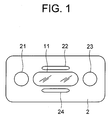
- Fig. 1 shows a state in which the upper casing 1 and the lower casing 2 of the body of the portable telephone are folded, viewing from the back surface side.
- Fig 2A shows the folded state viewing from a side surface side of the casings.
- an operation unit 27 is arranged on a surface which comes to the inner side when folded, as shown in Fig. 2B.
- the operation unit 27 is to be exposed to outside when the lower casing 2 is opened.
- the operation unit 27 is a part where the user performs various operations of the foldable portable telephone, and includes a plurality of operation buttons. It should be noted that the operation unit 27 is simply described in the Figure. In the present invention, a part for use in operation is provided in addition to the inner side of the lower casing 2, as will be explained below. Therefore, the operation unit 27 provided on the inner side of the lower casing 2 is described as a main operation unit.
- the lower casing 2 also includes a memory 5 for temporarily storing data, and a control unit (CPU)6 for controlling the whole foldable portable telephone.
- the memory 5 and the control unit 6 may be provided to the upper casing 1 or the hinge 3, instead of in the lower casing 2.
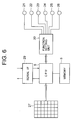
- the control unit 6 is so configured as to read out programs stored in the memory 5, to decode instructions input from the operation unit 27, and by changing the decoded instructions into electric signals, to control functions of the portable telephone via a serial interface (serial I/F). Further, the control unit 6 decodes instructions for setting functions of buttons input from the control unit 6 and outputs the setting of the buttons to a function setting unit 30.
- the function setting unit 30 sets the functions of the buttons input from the operation unit 27 by assigning them to a plurality of buttons, that is, a button A 21, a button B 22, a button C 23, a button D 24, a button E 25, and a button F 26.
- the function setting unit 30 Upon receipt of the signals input through the operations of the buttons A 21, B 22, C 23, D 24, E 25, and F 26, the function setting unit 30 analyzes the functions of the buttons, and inputs the analyzed signals to the control unit 6.
- the control unit 6 causes the portable telephone to execute functions based on the signals from the function setting unit 30.
- buttons there are set a function of sequentially scrolling data to be displayed on a back surface liquid crystal 11 which will be described below, a function of starting sending, a function of canceling an operation of the portable telephone, a function of starting a download, a function of completing or terminating a download, a function of selecting data displayed on the back surface liquid crystal 11, a function of releasing a selection of data on the back surface liquid crystal 11, a function of starting or stopping a ring tone, a function of scrolling a plurality of ring tones, and the like.
- a main display 28 is arranged on a surface of the upper casing 1, which surface comes to the inner side when closed, and is to be exposed to the outside when the upper casing 1 is opened.
- an LCD liquid crystal display
- the upper casing 1 also includes a back surface liquid crystal 11, a button A 21, a button B 22, a button C 23, and a button D 24 on a surface which comes to the outside when closed, that is, a surface to be a back surface viewing from the main display 27.
- the upper casing 1 also includes a button E 25 and a button F 26 on its side surface. It should be noted that any number of buttons may be arranged on the back surface and the side surfaces of the upper casing 1.
- buttons are arranged on the back surface and two buttons are arranged on a side surface.
- the button E 25 and the button F 26 arranged on a side surface of the upper casing 1 may be arranged on a side surface of the lower casing 2, instead of on a side surface of the upper casing 1.
- the back surface liquid crystal 11 is an LCD (liquid crystal display), having a function as a sub-display with reference to the main display 27.
- These buttons A 21 to D 24 are arranged around the back surface liquid crystal 11.
- the buttons A 21 and C 23, and the buttons B 22 and D 24, set at opposing positions each other over the back surface liquid crystal 11, are designed to be used in pairs, respectively.
- the pairs of the buttons A 21 and the buttons C 23, and the buttons B 22 and the buttons D 24 have the same shapes, respectively, considering the operations from the human engineering aspects. In the example shown in Fig.
- buttons A 21 and C 23 are formed in a circular shape, and a pair of the buttons B 22 and D 24 are formed in a narrow longitudinal shape along the longitudinal side of the back surface liquid crystal 11.
- Buttons E 25 and F 26, which exhibit a function of scrolling electronic data on the back surface liquid crystal 11, are arranged on a side surface of the casing 1 (or casing 2). These buttons E 25 and F 26 are formed to have the same shape.
- the buttons E 25 and F 26 shown in Fig. 2A are formed as rectangle.
- buttons A 21 to D 24 are provided in concentration on the surface where the back surface liquid crystal 11 of the casings 1 and 2 are set, as aforementioned, the user can send/receive electronic data by safely holding the portable telephone with both hands. Further, by setting the shapes of a pair of the buttons as a unit, the user can easily distinguish the functions of the buttons so that maloperations can be prevented.
- buttons A 21, the buttons B 22, the button C 23, the button D 24, the button E 25 and the button F 26 are assigned functions set by the user beforehand. With operations of these buttons by the user, information necessary for the user is displayed at any time on the back surface liquid crystal 11.
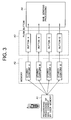
- FIG. 3 is a diagram showing an operational flow of the first embodiment.
- the foldable portable telephone is so configured that the storing area of the memory 5 shown in Fig. 6 is divided into plural parts, in one part of which a program for controlling the operation of the control unit (CPU)6 is incorporated, and using the empty storing area, mail data is incorporated.
- the mail data is prepared by the user with the button operations at the operation unit 27 and saved beforehand.
- the present invention has a feature that the mail data stored in the memory 5 is to be sent without opening the casings 1 and 2. Further, in the memory 5, in addition to the mail data, electronic data which may often be used has been stored beforehand even in a state that the user did not store anything. The user can perform downloading of necessary data or the like using the electronic data while the casings 1 and 2 are closed.
- the sending address should be registered beforehand.
- the mail sending address of the foldable portable telephone to be used is fixed as one address, it is not required to set a mail address.
- the size of the portable telephone when speaking, should have a size equal to a distance between an ear and the mouth of a human being, that is a size of a minimum length to make or receive phone calls. It is impossible to reduce this size.
- a function of making calls is eliminated when the telephone is folded, as the present invention. In the state of the phone being folded, the functions are limited to that of sending/receiving mails and that of accessing Web sites.
- the size of a foldable portable telephone can be reduced as small as possible and with the reduced size, it is possible to secure the function of sending/receiving mails and the function of accessing Web sites. Even the size of the folded portable telephone is the minimum one, it can secure the necessary size for making/receiving phone calls when the casings 1 and 2 are opened, so that no problem arises. Further, the user sets, according to his/her individuality, the functions of the buttons A 21, B 22, C 23, D 24, E 25 and F 26 beforehand through the control unit 6 and the function setting unit 30 by operating the operation unit 27, so as to easily operate the portable telephone.
- buttons A 21, B 22, C 23, D 24, E 25 and F 26 when writing/reading e-mail.
- buttons A 21, B 22, C 23, D 24, E 25 and F 26 may be overlapped. Therefore, switching of the functions set to these operation buttons is performed by the operation unit 27.
- the setting of the button functions described above only shows an example, and the button functions may be set in variable ways by the user according to his/her individuality.
- the multiple buttons A 21, B 22, C 23, D 24, E 25 and F 26 may be preset to have functions at the time of shipment, and changed by the user according to his/her preference.
- an instruction to write a reply message is output to the CPU 6 by using the operation button C 23. Further, by using the operation buttons B 22 and D 24, the user writes the message while scrolling it up and down. Content of the messages written by the user are processed to be registered using the main operation unit 27 (Step A1), so as to be saved in the memory 5 as a stored content A, a stored content B, a stored content C and a stored content D(Step A2). Unnecessary e-mail messages are to be deleted using the operation button A 21.
- the stored content A, the stored content B, the stored content C and the stored content D are made to be contents to be sent through pushing the button A 21, the button B 22, the button C 23 and the button D 24, respectively.
- a mail message is sent (Step A4).
- the user operates the buttons E 25 and F 26 to thereby select an e-mail message to be sent from the messages displayed on the back surface liquid crystal 11. Then, by operating the operation buttons B 22 and D 24 so as to scroll the content of the selected e-mail message, the user checks the content of the e-mail message. After checked, the e-mail message is to be sent by operating the operation button C 23. For terminating an operation such as reading of an e-mail message or the like, the operation button A 21 is to be operated.
- buttons A 22 to F 26 may be assigned functions required for the access.
- Figs. 4A, 4B and 4C are diagrams showing the changes of the content displayed on the back surface liquid crystal 11.
- the stored content A is displayed on the back surface liquid crystal 11 as State a (Fig. 4A).
- the button E 25 is pushed, the content displayed on the back surface liquid crystal 11 is changed to the stored content B as State b (Fig. 4B).
- the button F 26 is pushed, the content displayed on the back surface liquid crystal 11 is changed to the stored content D as State c (Fig. 4C).
- the user can select an e-mail message to be sent through checking the contents of the mail messages saved by himself/herself.
- the position of the sub-display is not limited to this position.
- the sub-display may be arranged at any position which is viewable in the folded state.
- the sub-display may be arranged on the back surface of the main operation unit of the lower casing 2, on a side surface of the upper casing 1 or the lower casing 2, or on a remote controller.
- the button A 21, the button B 22 and the like may be arranged at any position which is operable in the folded state. For example, they may be provided on a remote controller of the portable telephone.
- Fig. 5 is a diagram showing an operational flow of the second embodiment.
- This structure enables the button A 21, the button B 22, the button C 23 and the button D 24 to be assigned various functions such as playing of a ring tone and displaying of a schedule, at the user's discretion.
- Step B1 The user operates the main operation unit 27 (Step B1) to thereby assign a function A, a function B, a function C 23 and a function D 24 to the button A 21, the button B 22, the button C 23 and the button D 24, respectively (Step B2).
- Step B3 the button A 21, the button B 22, the button C or the button D is pushed
- Step B4 the function assigned to each button is executed (Step B4).
- buttons A 21 to F 26 are set as follows:
- the function A is set to be a function of playing a ring tone.
- the button A 21 is pushed, the ring tone is rang.
- the ringing tone is changed to another one, so that another registered ring tone can be listened.
- the second embodiment has, if combined with the first embodiment, both effects.
- the switching setting between the functions of the first embodiment and that of the second embodiment can be performed by operating the main operation unit 27. If the switching setting is performed with a button provided on the back surface of the upper casing 1, or on a side surface of the upper casing 1 or a lower casing 2, the switching can be achieved without opening the foldable portable telephone. Therefore, the portable telephone can be used with further conveniences.
- the present invention has an effect to improve operability in that the number of open-close operations by the user of the foldable portable telephone is reduced.
Landscapes
- Engineering & Computer Science (AREA)
- Signal Processing (AREA)
- Business, Economics & Management (AREA)
- General Business, Economics & Management (AREA)
- Human Computer Interaction (AREA)
- Computer Networks & Wireless Communication (AREA)
- Telephone Set Structure (AREA)
- Telephone Function (AREA)
Abstract
A piece of data to be sent by mail is selected from
data displayed on the back surface liquid crystal (11) in the
state of the portable telephone being folded. The selected
data is sent with a button operating (23). Upon completion of
the mail sending, the mail sending ends with a button
operation (21). Similarly, mail is received in the same manner
in the state of the portable telephone being folded.
Description
- The present invention relates to a foldable portable telephone, and in particular, to a foldable portable telephone which is to be so folded that the main operation unit and the main display come to the inner side.
- As functions of portable telephones have increased, a foldable type comes to the main stream in order to cope with demands to increase displaying volume of the displays. When operated for phone calls or mail, a foldable portable telephone is operated after it is opened. In order to solve such an inconvenience that a user operates the portable telephone after opening it, there is disclosed a structure in which a second display is arranged at a position where information can be checked without opening the portable telephone (for example, see the Japanese Patent Application Laid-open No. 2002-141993).
- However, in the conventional foldable portable telephone described above, there is a problem that when operated for calls or mail, it must be operated after opened, which is inconvenient for a user.
- With the structure disclosed in the aforementioned Japanese Patent Application Laid-open No. 2002-141993, although it is not necessary to open the portable telephone to check received mail, there still remains a problem that it must be opened for sending mail.
- It is therefore an object of the present invention to provide a foldable portable telephone with high convenience, which is capable of achieving a mail sending function and the like without open-close operations.
- A foldable portable telephone according to the present invention comprises: a body of the portable telephone which is foldably formed; a main operation unit for causing a function of the body of the portable telephone to be executed; a main display for displaying electronic data retained in the portable telephone; a sub-display arranged at a viewable position in the folded state; and a communication controlling means arranged at an operable position in the folded state. The main operation unit and the main display are arranged at positions on the inner sides of the body of the portable telephone when folded, and the sub-display displays the electronic data retained in the portable telephone. The communication controlling means is to be operated in the state that the body of the portable telephone is folded, and performs controlling for displaying on the sub-display the electronic data retained in the portable telephone and controlling of communications of the electronic data to be displayed on the sub-display.
- In the present invention, the communication control unit is operated, electronic data retained in the body of the portable telephone is displayed, and among the electronic data, a piece of electronic data to be controlled for communications is selected, in the state that the body of the portable telephone is folded. After the electronic data is selected, the communication control
unit is operated again to control communications of the selected electronic data. - Therefore, electronic data retained in the portable telephone can be sent or taken into the portable telephone while the body of the portable telephone is folded. In a case that the electronic data is an e-mail message which has been stored and retained in the portable telephone, the message can be sent while the portable telephone is folded.
- The electronic data may be Internet data registered and retained in the portable telephone, or Web site data obtained through connecting to a Web site by using the Internet data and stored in the portable telephone. With the electronic data, it is possible to upload or download data, in the state that the body of the portable telephone is folded, with the use of the Internet.
- In the present invention, it is preferable that the communication controlling means be configured to include a plurality of operation buttons.
- With this configuration, by assigning functions of the communication control means to a plurality of operation buttons, and selectively operating these operation buttons, it is possible to cause the functions of the communication control means to be executed effectively.
- It is preferable that a plurality of operation buttons be arranged around the sub-display.
- With this configuration, the operation buttons can be operated while being checked through a display of the sub-display.
- In the present invention, it is also preferable that a plurality of operation buttons be arranged around the sub-display and on a side surface of the body of the portable telephone.
- With this configuration, arrangements of the operation buttons can be set considering the functions assigned to respective operation buttons.
- Further, in the present invention, shapes of the operation buttons may differ according to the functions thereof.
- With this configuration, although a plurality of operation buttons are provided, the functions necessary for communication controls can be differentiated based on the shapes of the buttons.
- In the present invention, the operation buttons may be assigned a function of selecting electronic mail data as well as a function other than the function of selecting electronic mail data. In this case, the operation buttons may be assigned a function of playing a ring tone in addition to the function of selecting electronic mail data. Further, the operation buttons may be assigned a function of displaying a schedule on the sub-display in addition to the function of selecting electronic data. The operation buttons may also be assigned a function of displaying on the sub-display a piece of electronic mail data selected from plural pieces of electronic mail data. The operation buttons may also be assigned a function of registering electronic mail data. Further, the operation buttons may be assigned the function of selecting electronic mail data or a function of sending electronic mail data as well as a function other than the function of selecting a mail message and the function of sending electronic mail data. Further, the operation buttons may be assigned the function of playing a ring tone in addition to the function of selecting electronic mail data or the function of sending electronic mail data. Further, the operation buttons may be assigned the function of displaying a schedule to the sub-display in addition to the function of selecting electronic mail data or the function of sending electronic mail data.
-
- Fig. 1 is a diagram showing the back surface of a foldable portable telephone according to the present invention;
- Fig. 2A is a side view showing the folded state of the foldable portable telephone according to the present invention;
- Fig. 2B is a perspective view showing the opening state of the foldable portable telephone according to the present invention;
- Fig. 3 is a diagram showing an operational flow of a first embodiment according to the present invention;
- Figs. 4A, 4B and 4C are diagrams showing changes of contents displayed on the back surface liquid crystal;
- Fig. 5 is a diagram showing an operational flow of a second embodiment according to the present invention; and
- Fig. 6 is a diagram showing a mechanism for setting functions of a plurality of buttons.
-
- Embodiments of the present invention will be explained below with reference to the drawings.
- In a foldable portable telephone according to a first embodiment of the present invention, the body of the portable telephone consists of an upper casing 1 and a
lower casing 2, which are so configured as to be opened and closed with ahinge 3, as shown in Figs. 1, 2A and 2B. Fig. 1 shows a state in which the upper casing 1 and thelower casing 2 of the body of the portable telephone are folded, viewing from the back surface side. Fig 2A shows the folded state viewing from a side surface side of the casings. - In the
lower casing 2, anoperation unit 27 is arranged on a surface which comes to the inner side when folded, as shown in Fig. 2B. Theoperation unit 27 is to be exposed to outside when thelower casing 2 is opened. Theoperation unit 27 is a part where the user performs various operations of the foldable portable telephone, and includes a plurality of operation buttons. It should be noted that theoperation unit 27 is simply described in the Figure. In the present invention, a part for use in operation is provided in addition to the inner side of thelower casing 2, as will be explained below. Therefore, theoperation unit 27 provided on the inner side of thelower casing 2 is described as a main operation unit. Thelower casing 2 also includes amemory 5 for temporarily storing data, and a control unit (CPU)6 for controlling the whole foldable portable telephone. Thememory 5 and thecontrol unit 6 may be provided to the upper casing 1 or thehinge 3, instead of in thelower casing 2. - As shown in Fig. 6, the
control unit 6 is so configured as to read out programs stored in thememory 5, to decode instructions input from theoperation unit 27, and by changing the decoded instructions into electric signals, to control functions of the portable telephone via a serial interface (serial I/F). Further, thecontrol unit 6 decodes instructions for setting functions of buttons input from thecontrol unit 6 and outputs the setting of the buttons to afunction setting unit 30. Thefunction setting unit 30 sets the functions of the buttons input from theoperation unit 27 by assigning them to a plurality of buttons, that is, abutton A 21, abutton B 22, abutton C 23, abutton D 24, abutton E 25, and abutton F 26. Upon receipt of the signals input through the operations of the buttons A 21,B 22,C 23,D 24,E 25, andF 26, thefunction setting unit 30 analyzes the functions of the buttons, and inputs the analyzed signals to thecontrol unit 6. Thecontrol unit 6 causes the portable telephone to execute functions based on the signals from thefunction setting unit 30. As for the functions of the buttons, there are set a function of sequentially scrolling data to be displayed on a backsurface liquid crystal 11 which will be described below, a function of starting sending, a function of canceling an operation of the portable telephone, a function of starting a download, a function of completing or terminating a download, a function of selecting data displayed on the backsurface liquid crystal 11, a function of releasing a selection of data on the backsurface liquid crystal 11, a function of starting or stopping a ring tone, a function of scrolling a plurality of ring tones, and the like. - As shown in Fig. 2B, a
main display 28 is arranged on a surface of the upper casing 1, which surface comes to the inner side when closed, and is to be exposed to the outside when the upper casing 1 is opened. As themain display 28, an LCD (liquid crystal display) is typically used. The upper casing 1 also includes a backsurface liquid crystal 11, abutton A 21, abutton B 22, abutton C 23, and abutton D 24 on a surface which comes to the outside when closed, that is, a surface to be a back surface viewing from themain display 27. The upper casing 1 also includes abutton E 25 and abutton F 26 on its side surface. It should be noted that any number of buttons may be arranged on the back surface and the side surfaces of the upper casing 1. In the aforementioned embodiment of the present invention, it is assumed that four buttons are arranged on the back surface and two buttons are arranged on a side surface. Thebutton E 25 and thebutton F 26 arranged on a side surface of the upper casing 1 may be arranged on a side surface of thelower casing 2, instead of on a side surface of the upper casing 1. The backsurface liquid crystal 11 is an LCD (liquid crystal display), having a function as a sub-display with reference to themain display 27. - On a surface of the upper casing 1, on which the back
surface liquid crystal 11 is set, there are provided two types of buttons, that is, thebutton A 21 and thebutton C 23, and thebutton B 22 and thebutton D 24, as shown in Figs. 1, 2A and 2B. These buttons A 21 toD 24 are arranged around the backsurface liquid crystal 11. Considering the operations from the human engineering aspects, the buttons A 21 andC 23, and the buttons B 22 andD 24, set at opposing positions each other over the backsurface liquid crystal 11, are designed to be used in pairs, respectively. Further, as for the functions of the buttons A 21 toD 24, the pairs of the buttons A 21 and thebuttons C 23, and the buttons B 22 and thebuttons D 24 have the same shapes, respectively, considering the operations from the human engineering aspects. In the example shown in Fig. 1, a pair of the buttons A 21 andC 23 are formed in a circular shape, and a pair of the buttons B 22 andD 24 are formed in a narrow longitudinal shape along the longitudinal side of the backsurface liquid crystal 11.Buttons E 25 andF 26, which exhibit a function of scrolling electronic data on the backsurface liquid crystal 11, are arranged on a side surface of the casing 1 (or casing 2). Thesebuttons E 25 andF 26 are formed to have the same shape. Thebuttons E 25 andF 26 shown in Fig. 2A are formed as rectangle. - Since the multiple buttons A 21 to
D 24 are provided in concentration on the surface where the backsurface liquid crystal 11 of thecasings 1 and 2 are set, as aforementioned, the user can send/receive electronic data by safely holding the portable telephone with both hands. Further, by setting the shapes of a pair of the buttons as a unit, the user can easily distinguish the functions of the buttons so that maloperations can be prevented. - Moreover, the
button A 21, thebuttons B 22, thebutton C 23, thebutton D 24, thebutton E 25 and thebutton F 26 are assigned functions set by the user beforehand. With operations of these buttons by the user, information necessary for the user is displayed at any time on the backsurface liquid crystal 11. - Next, an operation of the first embodiment will be described. Fig. 3 is a diagram showing an operational flow of the first embodiment.
- The foldable portable telephone according to the embodiment of the present invention is so configured that the storing area of the
memory 5 shown in Fig. 6 is divided into plural parts, in one part of which a program for controlling the operation of the control unit (CPU)6 is incorporated, and using the empty storing area, mail data is incorporated. The mail data is prepared by the user with the button operations at theoperation unit 27 and saved beforehand. The present invention has a feature that the mail data stored in thememory 5 is to be sent without opening thecasings 1 and 2. Further, in thememory 5, in addition to the mail data, electronic data which may often be used has been stored beforehand even in a state that the user did not store anything. The user can perform downloading of necessary data or the like using the electronic data while thecasings 1 and 2 are closed. In this case, the sending address should be registered beforehand. However, if the mail sending address of the foldable portable telephone to be used is fixed as one address, it is not required to set a mail address. In a foldable portable telephone, the size of the portable telephone, when speaking, should have a size equal to a distance between an ear and the mouth of a human being, that is a size of a minimum length to make or receive phone calls. It is impossible to reduce this size. On the other hand, a function of making calls is eliminated when the telephone is folded, as the present invention. In the state of the phone being folded, the functions are limited to that of sending/receiving mails and that of accessing Web sites. Therefore, the size of a foldable portable telephone can be reduced as small as possible and with the reduced size, it is possible to secure the function of sending/receiving mails and the function of accessing Web sites. Even the size of the folded portable telephone is the minimum one, it can secure the necessary size for making/receiving phone calls when thecasings 1 and 2 are opened, so that no problem arises. Further, the user sets, according to his/her individuality, the functions of the buttons A 21,B 22,C 23,D 24,E 25 andF 26 beforehand through thecontrol unit 6 and thefunction setting unit 30 by operating theoperation unit 27, so as to easily operate the portable telephone. - Here, assuming that electronic data is e-mail, explanations will be given for functions to be assigned to the operation buttons A 21,
B 22,C 23,D 24,E 25 andF 26 when writing/reading e-mail. - (A) Function setting when writing e-mail:
- Operation button A 21: delete an e-mail message displayed
on the back
surface liquid crystal 11, - Operation button B 22: upwardly scroll an e-mail message
displayed on the back
surface liquid crystal 11, - Operation button C 23: reply to an e-mail message
displayed on the back
surface liquid crystal 11, - Operation button D 24: downwardly scroll an e-mail
message displayed on the back
surface liquid crystal 11, - Operation button E 25: scroll to a latter e-mail message
than one displayed on the back
surface liquid crystal 11,and - Operation button F 26: scroll to an older e-mail message
than one displayed on the back
surface liquid crystal 11. - (B) Function setting when reading e-mail:
- Operation button A 21: Cancel an operation of the portable telephone,
- Operation button B 22: upwardly scroll an e-mail message
registered in the
memory 5 and displayed on the backsurface liquid crystal 11, - Operation button C 23: send an e-mail message displayed
on the back
surface liquid crystal 11, - Operation button D 24: downwardly scroll an e-mail
message registered in the
memory 5 and displayed on the backsurface liquid crystal 11, - Operation button E 25: scroll to a latter e-mail message
than one displayed on the back
surface liquid crystal 11,and - Operation button F 26: scroll to an older e-mail message
than one displayed on the back
surface liquid crystal 11. -
- As described above relating to writing and reading of an e-mail message, functions set to the operation buttons A 21,
B 22,C 23,D 24,E 25 andF 26 may be overlapped. Therefore, switching of the functions set to these operation buttons is performed by theoperation unit 27. The setting of the button functions described above only shows an example, and the button functions may be set in variable ways by the user according to his/her individuality. The multiple buttons A 21,B 22,C 23,D 24,E 25 andF 26 may be preset to have functions at the time of shipment, and changed by the user according to his/her preference. - When the user writes an e-mail message, in a case that the e-mail message is a reply to a received e-mail message, an instruction to write a reply message is output to the
CPU 6 by using theoperation button C 23. Further, by using theoperation buttons B 22 andD 24, the user writes the message while scrolling it up and down. Content of the messages written by the user are processed to be registered using the main operation unit 27 (Step A1), so as to be saved in thememory 5 as a stored content A, a stored content B, a stored content C and a stored content D(Step A2). Unnecessary e-mail messages are to be deleted using theoperation button A 21. The stored content A, the stored content B, the stored content C and the stored content D are made to be contents to be sent through pushing thebutton A 21, thebutton B 22, thebutton C 23 and thebutton D 24, respectively. When the user pushes each button (Step A3), a mail message is sent (Step A4). - More specifically, in the state that the portable telephone is folded, the user operates the
buttons E 25 andF 26 to thereby select an e-mail message to be sent from the messages displayed on the backsurface liquid crystal 11. Then, by operating theoperation buttons B 22 andD 24 so as to scroll the content of the selected e-mail message, the user checks the content of the e-mail message. After checked, the e-mail message is to be sent by operating theoperation button C 23. For terminating an operation such as reading of an e-mail message or the like, theoperation button A 21 is to be operated. - In a case of accessing a Web site, the operation buttons A 22 to
F 26 may be assigned functions required for the access. - As described above, the
button E 25 and thebutton F 25 are assigned functions of selection and releasing data on the backsurface liquid crystal 11. This will be explained below in detail. Figs. 4A, 4B and 4C are diagrams showing the changes of the content displayed on the backsurface liquid crystal 11. In the initial state, the stored content A is displayed on the backsurface liquid crystal 11 as State a (Fig. 4A). When thebutton E 25 is pushed, the content displayed on the backsurface liquid crystal 11 is changed to the stored content B as State b (Fig. 4B). Similarly, when thebutton F 26 is pushed, the content displayed on the backsurface liquid crystal 11 is changed to the stored content D as State c (Fig. 4C). In this way, the user can select an e-mail message to be sent through checking the contents of the mail messages saved by himself/herself. - Besides the aforementioned method, it is possible to operate with less number of buttons by switching e-mail messages displayed on the back
surface liquid crystal 11 with thebutton E 25 or thebutton F 26, and sending the displayed e-mail message with another button. - By applying this mail sending function, if an e-mail message is written and saved beforehand in a place outside the service area or a situation where the signal condition is bad, the message can be easily sent when comes to a place inside the service area by operating buttons without opening the folded portable telephone.
- It should be noted that although in the first embodiment an example is shown in which the back
surface liquid crystal 11 serving as a sub-display is arranged on the back surface of themain display 28 of the upper casing 1, the position of the sub-display is not limited to this position. The sub-display may be arranged at any position which is viewable in the folded state. In other words, the sub-display may be arranged on the back surface of the main operation unit of thelower casing 2, on a side surface of the upper casing 1 or thelower casing 2, or on a remote controller. Similarly, thebutton A 21, thebutton B 22 and the like may be arranged at any position which is operable in the folded state. For example, they may be provided on a remote controller of the portable telephone. - Next, a second embodiment of the present invention will be explained. The structure of the second embodiment is the same as that of the first embodiment described in Fig. 1. Fig. 5 is a diagram showing an operational flow of the second embodiment.
- This structure enables the
button A 21, thebutton B 22, thebutton C 23 and thebutton D 24 to be assigned various functions such as playing of a ring tone and displaying of a schedule, at the user's discretion. - The user operates the main operation unit 27 (Step B1) to thereby assign a function A, a function B, a
function C 23 and afunction D 24 to thebutton A 21, thebutton B 22, thebutton C 23 and thebutton D 24, respectively (Step B2). When thebutton A 21, thebutton B 22, the button C or the button D is pushed (Step B3), the function assigned to each button is executed (Step B4). - Although a portable telephone rings a ring tone when receives e-mail, there is a request to listen to ring tones irrespective of receiving e-mail. In this case, the functions of the operation buttons A 21 to
F 26 are set as follows: - Operation button A 21: stop playing a ring tone,
- Operation button C 23: start playing a ring tone,
- Operation button E 25: scroll to a ring tone next to the currently selected ring tone,
- Operation button F 26: scroll to a ring tone prior to the currently selected ring tone.
-
- For example, in a case that a function of playing a ring tone is assigned to the
button A 21, the function A is set to be a function of playing a ring tone. When thebutton A 21 is pushed, the ring tone is rang. Further, by assigning functions of scrolling ring tones to be rang to thebutton E 25 and thebutton F 26, the ringing tone is changed to another one, so that another registered ring tone can be listened. - The second embodiment has, if combined with the first embodiment, both effects. When combined, the switching setting between the functions of the first embodiment and that of the second embodiment can be performed by operating the
main operation unit 27. If the switching setting is performed with a button provided on the back surface of the upper casing 1, or on a side surface of the upper casing 1 or alower casing 2, the switching can be achieved without opening the foldable portable telephone. Therefore, the portable telephone can be used with further conveniences. - As described above, the present invention has an effect to improve operability in that the number of open-close operations by the user of the foldable portable telephone is reduced.
- Further, it also has an effect to improve operability in that one operation can be done with one button operation without opening the foldable portable telephone.
Claims (15)
- A foldable portable telephone comprising:a body of the portable telephone which is foldably formed;a main operation unit for causing a function of the body of the portable telephone to be executed;a main display for displaying electronic data retained in the portable telephone;a sub-display arranged at a viewable position in a folded state; andcommunication controlling means arranged at an operable position in a folded state; whereinthe main operation unit and the main display are arranged at positions on inner sides of the body of the portable telephone when folded,the sub-display displays the electronic data retained in the portable telephone, andthe communication controlling means is to be operated in a state that the body of the portable telephone is folded, and performs controlling for displaying on the sub-display the electronic data retained in the portable telephone and controlling of communications of the electronic data displayed on the sub-display.
- The foldable portable telephone, as claimed in claim 1, wherein the communication controlling means includes a plurality of operation buttons.
- The foldable portable telephone, as claimed in claim 2, wherein the plurality of operation buttons are arranged around the sub-display.
- The foldable portable telephone, as claimed in claim 2, wherein the plurality of operation buttons are arranged around the sub-display and on a side surface of the body of the portable telephone.
- The foldable portable telephone, as claimed in claim 2, wherein shapes of the operation buttons differ according to functions thereof.
- The foldable portable telephone, as claimed in claim 1, wherein the electronic data may be electronic mail data to be transmitted, data to be downloaded from a Web site, or data to be uploaded to a Web site.
- The foldable portable telephone, as claimed in claim 5, wherein the operation buttons are assigned a function of selecting electronic mail data as well as a function other than the function of selecting electronic mail data.
- The foldable portable telephone, as claimed in claim 5, wherein the operation buttons are assigned a function of playing a ring tone as well as a function of selecting electronic data.
- The foldable portable telephone, as claimed in claim 5, wherein the operation buttons are assigned a function of displaying a schedule on the sub-display as well as a function of selecting electronic data.
- The foldable portable telephone, as claimed in claim 5, wherein the operation buttons are assigned a function of displaying a piece of electronic mail data selected from a plurality of pieces of electronic mail data on the sub-display.
- The foldable portable telephone, as claimed in claim 5, wherein the operation buttons are assigned a function of registering electronic mail data.
- The foldable portable telephone, as claimed in claim 5, wherein the operation buttons are assigned a function of selecting electronic mail data or a function of sending electronic mail data as well as a function other than the function of selecting a mail message and the function of sending electronic mail data.
- The foldable portable telephone, as claimed in claim 5, wherein the operation buttons are assigned a function of playing a ring tone as well as a function of selecting electronic mail data or a function of sending electronic mail data.
- The foldable portable telephone, as claimed in claim 5, wherein the operation buttons are assigned a function of displaying a schedule to the sub-display as well as a function of selecting electronic mail data or a function of sending electronic mail data.
- The foldable portable telephone, as claimed in claim 1, wherein the sub-display is arranged at a part which comes to an outer side in the folded state.
Applications Claiming Priority (2)
| Application Number | Priority Date | Filing Date | Title |
|---|---|---|---|
| JP2002359283 | 2002-12-11 | ||
| JP2002359283A JP4131165B2 (en) | 2002-12-11 | 2002-12-11 | Foldable mobile terminal |
Publications (1)
| Publication Number | Publication Date |
|---|---|
| EP1429525A1 true EP1429525A1 (en) | 2004-06-16 |
Family
ID=32322101
Family Applications (1)
| Application Number | Title | Priority Date | Filing Date |
|---|---|---|---|
| EP03028237A Withdrawn EP1429525A1 (en) | 2002-12-11 | 2003-12-09 | Foldable portable telephone |
Country Status (4)
| Country | Link |
|---|---|
| US (1) | US7167558B2 (en) |
| EP (1) | EP1429525A1 (en) |
| JP (1) | JP4131165B2 (en) |
| CN (1) | CN1326381C (en) |
Families Citing this family (9)
| Publication number | Priority date | Publication date | Assignee | Title |
|---|---|---|---|---|
| USD503697S1 (en) * | 2004-02-27 | 2005-04-05 | Nokia Corporation | Handset |
| USD508035S1 (en) * | 2004-05-06 | 2005-08-02 | Samsung Electronics Co., Ltd. | Portable telephone |
| USD534530S1 (en) * | 2004-06-11 | 2007-01-02 | Nokia Corporation | Key button area for a handset |
| USD537059S1 (en) * | 2004-11-05 | 2007-02-20 | Lg Electronics Inc. | Cellular phone |
| JP4522233B2 (en) * | 2004-11-17 | 2010-08-11 | パナソニック株式会社 | Mobile device |
| JP5217371B2 (en) * | 2007-11-12 | 2013-06-19 | 富士通モバイルコミュニケーションズ株式会社 | Mobile phone |
| JP5609884B2 (en) * | 2009-10-05 | 2014-10-22 | 日本電気株式会社 | Communication terminal having e-mail transmission function, e-mail transmission method, and program |
| US9423825B2 (en) * | 2013-02-08 | 2016-08-23 | Nvidia Corporation | Mobile computing device with expanded display size |
| US20200133480A1 (en) * | 2016-05-16 | 2020-04-30 | Motorola Solutions, Inc. | Portable communication device |
Citations (4)
| Publication number | Priority date | Publication date | Assignee | Title |
|---|---|---|---|---|
| GB2358318A (en) * | 1999-11-05 | 2001-07-18 | Matsushita Electric Industrial Co Ltd | Folding portable telephone and video game apparatus |
| GB2358758A (en) * | 1999-11-05 | 2001-08-01 | Matsushita Electric Industrial Co Ltd | Folding portable telephone apparatus with two displays |
| EP1244275A1 (en) * | 2001-03-21 | 2002-09-25 | Nec Corporation | Foldable mobile communication terminal with additional external display unit |
| US20020146989A1 (en) * | 2001-04-04 | 2002-10-10 | Nec Corporation | Mobile telephone |
Family Cites Families (9)
| Publication number | Priority date | Publication date | Assignee | Title |
|---|---|---|---|---|
| FI102711B1 (en) * | 1996-02-23 | 1999-01-29 | Nokia Mobile Phones Ltd | Formulating a phone's ringtones |
| JPH10215303A (en) | 1997-01-30 | 1998-08-11 | Saitama Nippon Denki Kk | Radio communication equipment |
| JP3209150B2 (en) | 1997-08-12 | 2001-09-17 | 日本電気株式会社 | Foldable portable wireless communication device |
| JP2001136247A (en) | 1999-11-05 | 2001-05-18 | Matsushita Electric Ind Co Ltd | Foldable mobile phone device |
| JP2001331419A (en) * | 2000-05-19 | 2001-11-30 | Nec Corp | Foldable portable telephone with electronic mail terminating function |
| JP2002141993A (en) | 2000-08-24 | 2002-05-17 | Nec Saitama Ltd | Foldable portable telephone set and back surface liquid crystal display method at the time of incoming call therefor |
| JP3530475B2 (en) * | 2000-09-25 | 2004-05-24 | 三洋電機株式会社 | Foldable communication terminal device and information display method |
| JP2002204298A (en) | 2000-12-28 | 2002-07-19 | Kyocera Corp | Mobile phone equipment |
| JP2004128908A (en) * | 2002-10-03 | 2004-04-22 | Hitachi Ltd | Mobile terminal |
-
2002
- 2002-12-11 JP JP2002359283A patent/JP4131165B2/en not_active Expired - Fee Related
-
2003
- 2003-12-09 EP EP03028237A patent/EP1429525A1/en not_active Withdrawn
- 2003-12-11 CN CNB2003101225983A patent/CN1326381C/en not_active Expired - Fee Related
- 2003-12-11 US US10/734,061 patent/US7167558B2/en not_active Expired - Fee Related
Patent Citations (4)
| Publication number | Priority date | Publication date | Assignee | Title |
|---|---|---|---|---|
| GB2358318A (en) * | 1999-11-05 | 2001-07-18 | Matsushita Electric Industrial Co Ltd | Folding portable telephone and video game apparatus |
| GB2358758A (en) * | 1999-11-05 | 2001-08-01 | Matsushita Electric Industrial Co Ltd | Folding portable telephone apparatus with two displays |
| EP1244275A1 (en) * | 2001-03-21 | 2002-09-25 | Nec Corporation | Foldable mobile communication terminal with additional external display unit |
| US20020146989A1 (en) * | 2001-04-04 | 2002-10-10 | Nec Corporation | Mobile telephone |
Also Published As
| Publication number | Publication date |
|---|---|
| JP4131165B2 (en) | 2008-08-13 |
| CN1507250A (en) | 2004-06-23 |
| CN1326381C (en) | 2007-07-11 |
| US20040120514A1 (en) | 2004-06-24 |
| JP2004193953A (en) | 2004-07-08 |
| US7167558B2 (en) | 2007-01-23 |
Similar Documents
| Publication | Publication Date | Title |
|---|---|---|
| KR100771944B1 (en) | E-mail handling method for portable telephone and portable telephone using said handling method | |
| US7310540B2 (en) | Personal communicator with flip element display | |
| AU741196B2 (en) | Apparatus and method for automatically configuring settings of software application in a portable intelligent communications device | |
| CN100512028C (en) | Radio communication terminal for changing image file of background picture and method for displaying image file of background picture | |
| CN1366439A (en) | Method of display message on biliquid crystal display folding type moving terminal | |
| US7167558B2 (en) | Foldable portable telephone | |
| US20060099996A1 (en) | Portable apparatus having a flat-panel speaker and display and control method therefor | |
| KR20040025695A (en) | Communication terminal apparatus, and method for displaying characters in the communication terminal apparatus | |
| US20030153371A1 (en) | Handphone capable of inputting characters like keyboard | |
| US20010036844A1 (en) | Mobile telephone with electronic mail function | |
| JP2000341392A (en) | Communication terminal device | |
| KR20070023049A (en) | User Interface Method for Silver Generation in Mobile Communication Devices | |
| JP3886409B2 (en) | Mobile phone | |
| KR100513895B1 (en) | Apparatus For Changing Background-picture Display In Mobile Communication Terminal | |
| KR100679076B1 (en) | How to cancel outgoing short message on mobile terminal | |
| JP3560887B2 (en) | Mobile phone | |
| KR100446513B1 (en) | Method for realizing memo function in mobile terminal | |
| JP2001189790A (en) | Mobile phone equipment | |
| JP5563422B2 (en) | Electronic device and control method | |
| JP2002208998A (en) | Portable communication device and portable electronic device | |
| KR100712844B1 (en) | Mobile communication terminal capable of checking real-time messages and its operation method | |
| JP2006128906A (en) | Electronic device and method for controlling voice reading of electronic device | |
| KR100775833B1 (en) | Mobile communication terminal and its system and operation method of mobile communication terminal | |
| KR20050055798A (en) | Method for operating memopad during conversation in mobile communication terminal | |
| JP2000115843A (en) | Portable information terminal and display control method of the terminal |
Legal Events
| Date | Code | Title | Description |
|---|---|---|---|
| PUAI | Public reference made under article 153(3) epc to a published international application that has entered the european phase |
Free format text: ORIGINAL CODE: 0009012 |
|
| 17P | Request for examination filed |
Effective date: 20040416 |
|
| AK | Designated contracting states |
Kind code of ref document: A1 Designated state(s): AT BE BG CH CY CZ DE DK EE ES FI FR GB GR HU IE IT LI LU MC NL PT RO SE SI SK TR |
|
| AX | Request for extension of the european patent |
Extension state: AL LT LV MK |
|
| 17Q | First examination report despatched |
Effective date: 20041018 |
|
| AKX | Designation fees paid |
Designated state(s): DE FR GB IT |
|
| STAA | Information on the status of an ep patent application or granted ep patent |
Free format text: STATUS: THE APPLICATION IS DEEMED TO BE WITHDRAWN |
|
| 18D | Application deemed to be withdrawn |
Effective date: 20050429 |