EP1429473A2 - Apparatus and method for dynamic resource allocation in interactive satellite multimedia system - Google Patents
Apparatus and method for dynamic resource allocation in interactive satellite multimedia system Download PDFInfo
- Publication number
- EP1429473A2 EP1429473A2 EP03255417A EP03255417A EP1429473A2 EP 1429473 A2 EP1429473 A2 EP 1429473A2 EP 03255417 A EP03255417 A EP 03255417A EP 03255417 A EP03255417 A EP 03255417A EP 1429473 A2 EP1429473 A2 EP 1429473A2
- Authority
- EP
- European Patent Office
- Prior art keywords
- amount
- resource
- frame
- allocation
- deciding
- Prior art date
- Legal status (The legal status is an assumption and is not a legal conclusion. Google has not performed a legal analysis and makes no representation as to the accuracy of the status listed.)
- Granted
Links
Images
Classifications
-
- H—ELECTRICITY
- H04—ELECTRIC COMMUNICATION TECHNIQUE
- H04B—TRANSMISSION
- H04B7/00—Radio transmission systems, i.e. using radiation field
- H04B7/14—Relay systems
- H04B7/15—Active relay systems
- H04B7/185—Space-based or airborne stations; Stations for satellite systems
- H04B7/18578—Satellite systems for providing broadband data service to individual earth stations
- H04B7/18584—Arrangements for data networking, i.e. for data packet routing, for congestion control
-
- H—ELECTRICITY
- H04—ELECTRIC COMMUNICATION TECHNIQUE
- H04W—WIRELESS COMMUNICATION NETWORKS
- H04W72/00—Local resource management
- H04W72/04—Wireless resource allocation
- H04W72/044—Wireless resource allocation based on the type of the allocated resource
- H04W72/0446—Resources in time domain, e.g. slots or frames
-
- H—ELECTRICITY
- H04—ELECTRIC COMMUNICATION TECHNIQUE
- H04W—WIRELESS COMMUNICATION NETWORKS
- H04W72/00—Local resource management
- H04W72/20—Control channels or signalling for resource management
- H04W72/21—Control channels or signalling for resource management in the uplink direction of a wireless link, i.e. towards the network
-
- H—ELECTRICITY
- H04—ELECTRIC COMMUNICATION TECHNIQUE
- H04W—WIRELESS COMMUNICATION NETWORKS
- H04W84/00—Network topologies
- H04W84/02—Hierarchically pre-organised networks, e.g. paging networks, cellular networks, WLAN [Wireless Local Area Network] or WLL [Wireless Local Loop]
- H04W84/04—Large scale networks; Deep hierarchical networks
- H04W84/06—Airborne or Satellite Networks
Definitions
- the present invention relates to an apparatus and method for resource allocation in interactive satellite multimedia system; and, more particularly, to a dynamic resource allocation apparatus and method for assigning timeslot in a return channel in multi-frequency time division multiple access (MF-TDMA) in order to have a maximum throughput.
- MF-TDMA multi-frequency time division multiple access
- TDMA time division multiple accesses
- a resource represents a frequency bandwidth used at a return link, which is a link between a return channel satellite terminals (RCSTs) to a satellite. That is, the resource is a set of timeslots in the return link in multi-frequency time division multiple access MF-TDMA.
- MF-TDMA resources are allocated as a unit of a frame or a super-frame. One frame includes a plurality of timeslots and one super-frame includes a plurality of frames.
- An interactive satellite multimedia system is a satellite network with one earth station (HUB) and a plurality of terminals called return channel satellite terminals (RCST).
- the earth station (HUB) receives a request of service through satellites and provides services to terminals (RCST) through the satellite by responding to the request.
- the earth station (HUB) receives a request of service through satellites and provides services to terminals (RCST) through the satellite by responding to the request.
- the radio resources are very expensive comparing to those in land mobile communication systems, it is one of the most important problems to maximize the link throughput using the limited available resources.
- the resource needs to be allocated by considering round-trip time (RTT) spending for requesting the resource from the terminal (RCST) to the earth station (Hub) and receiving an assignment plane from the earth station (Hub) to terminal station (RCST).
- RTT round-trip time
- the resource allocation method in the interactive satellite communication system is distinguished from the conventional technique for allocating resources in the satellite communication.
- TDMA wide-band TDMA
- the length of each timeslot is usually much shorter than that in a narrow- or medium- band TDMA.
- the scheduling period is getting short or the number of timeslots per a scheduling period is getting great, both of which make a fast timeslot scheduling more difficult, especially in such an interactive satellite network having an intrinsic round trip time between capacity request and allocation.
- an object of the present invention to provide an apparatus and method for rapidly generating a dynamic resource allocation schedule in order to maximize throughput in a return link based on MF-TDMA of an interactive multimedia network.
- an apparatus for dynamically allocating resource in an interactive satellite multimedia system including: resource request amount collection unit for accumulating a requested resource amount corresponding to each of terminals during a super-frame period; resource request amount processing unit for dividing an accumulated requested resource amount by the number of frame pairs in a super frame and storing a sum of a result of dividing and rounding up a remain of the division to a nearest integer as a request amount of each corresponding terminal ; and resource allocation unit for deciding a time slot allocated at each of terminals corresponding to a frame pair based on optimal allocation amount, which is decided based on the request amount by the requested amount processing unit.
- a method for dynamically allocating resources in an interactive satellite multimedia system including the steps of: a) accumulating a request amount of resource corresponding to each of terminals during a super-frame period; b) dividing the accumulated request amount of resource by the number of frame pairs included in one super frame and remembering a sum of a result of dividing and rounding off a remain of the division to a nearest integer as a resource request amount; and c) deciding an optimal allocation amount based on the resource request amount and deciding a time slot to be allocated to each of terminals based on the optimal allocation amount.
- a computer readable recording medium storing instructions for executing a method for actively allocation resource in two-way satellite multimedia system, including functions of: a) accumulating a request amount of resource corresponding to each of terminals during a super-frame period; b) dividing the accumulated request amount of resource by the number of frame pairs included in one super frame and remembering a sum of a result of dividing and rounding off a remain of the division to a nearest integer as a resource request amount; and c) deciding an optimal allocation amount based on the resource request amount and deciding a time slot to be allocated to each of terminals based on the optimal allocation amount.
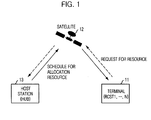
- Fig. 1 is a view representing a conventional interactive satellite multimedia system.
- the conventional interactive satellite multimedia system includes a plurality of terminals 11, a satellite 12 and a host station (HUB) 13.
- the terminals 11 send a request for resource to the host station 13 through the satellite 12.
- the host station 13 provides services to the terminals 13 through the satellite 12.
- the interactive satellite multimedia system it is one of the most important problems to maximize a throughput according to the user's traffic.
- Fig. 1 there is only one host station and one satellite however, it is possible to include multiple host stations and satellites in the satellite communication network.
- the multiple terminals 11 simultaneously request resources to the host station 13 and each of terminals uses only allocated resource (timeslot).
- the host station 13 receives and analyzes requests for resources from the multiple terminals and decides appropriate number of timeslots to assign to each of terminals according to analysis. The decision of the host station is reported to each of terminals through the satellite 12.
- the host station includes an algorithm for computing a dynamic resource allocation schedule in order to maximize the throughput of a return link between the terminal 11 to the satellite 12.
- the host station receives requests for resource of frequency from the terminals 11 and rapidly computes the dynamic resource allocation schedule.
- a requested resource for a frequency is a frequency bandwidth used for a return link between the terminal 11 and the satellite 12. That is, the requested resource for frequency is a set of a certain number of timeslots in the return link based on MF-TDMA.
- the present invention needs to improve the computational efficiency of timeslot scheduling by employing the so-called problem reduction and decomposition technique, where we separately consider how to decide an amount of allocation according to each of terminals and how to select timeslot for allocating to each of terminals.
- the amount of computation can be decreased and the speed of computation can be improved.
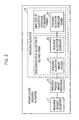
- Fig. 2 is a diagram showing a dynamic resource allocator for dynamically allocating resources in accordance with a preferred embodiment of the present invention.
- the dynamic resource allocator in the host station includes a resource request collector 21, a resource request amount processor 22 for computing an amount of resources for allocation by dividing collected request amount to the number of frame pairs and rounding off a result of division to nearest integer number, a resource allocation amount decider 24, a resource allocation scheduler 25 and a resource allocation schedule copier 26.
- the resource allocation decider 24 decides the optimal amount for each frame pair by considering how many frames are allocated to each of terminals 11.
- the resource allocation scheduler 25 makes a schedule based on the optimal amount of allocation and selects one of terminal to be assigned to allocated resource.
- the resource allocation schedule copier 26 copies allocation schedule of the first frame pair to remained frame pairs in the same superframe.
- the dynamic resource allocator used for the host station 13 includes a resource request collector 21 for accumulating an amount of request for resource during a superframe period, a resource request amount processor 22 for computing a requested resource amount by dividing collected request amount to the number of frame pairs in one of superframe and adding the result of dividing and rounding off a remain of division to nearest integer number and a resource allocator 23 for deciding an optimal amount of allocation based on the request amount of the request amount processor 22 and deciding a timeslot to be assigned to each of terminals 11 according to the frame pairs based on the optimal amount of allocation.
- the resource allocator 23 has a resource allocation amount decider 24 for deciding the optimal amount based on processed request amount in the resource request processor 22, a resource allocation scheduler 25 for selecting and deciding one of terminals RCST 11 to be allocated of a timeslot included in the first frame pair based on the optimal allocation amount and a resource allocation scheduler copier 26 for copying timeslot allocation schedule of the first frame pair to remained frame pairs in the same superframe.
- the resource request collector 21 accumulates a requested resource amount generated during the superframe according to each of terminals RCST and reports it to the resource request amount processor 22. After reporting, the accumulated amount is set to 0 and the resource request collector 21 starts to accumulate the requested resource amount with next superframe.
- the resource request amount processor 22 computes an optimal amount of allocation by dividing a resource request amount of each of terminals RCST 11 to the number of frame pairs and rounding off a result of division to the nearest integer number and the resource allocation decider 24 decides the optimal allocation amount according to priorities such as cost and weight.
- the resource allocation scheduler 25 decides terminals according to each timeslot included in the first frame pair based on the optimized allocation amount.
- the resource allocation schedule copier 26 copies schedule of resource allocation including a timeslot allocation schedule from the resource allocation scheduler 25 assigned to the first frame pair to remained frame pairs in same super-frame.
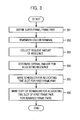
- Fig. 3 is a flowchart explaining dynamic resource allocation method in accordance with a preferred embodiment of the present invention.
- a unit of resource allocation according to a schedule is defined at step of 301. That is, a super-frame and frame pair are defined.
- the schedule for allocation is established based on a unit of frame in the superframe and one super-frame includes a plurality of frames.
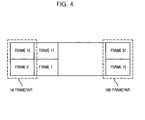
- a frame pair is a subset of the superframe and it is satisfied by below conditions.
- a frame pair is a set of frame having identical time period.
- Each of frame pairs has same arranging type of time slot and a frequency bandwidth and only difference between frame pairs is the time period. Therefore, all frame pair is a subset of the super-frame and a sum of all frame pairs defined in a given superframe constitutes a superframe.
- the resource request amount collector 21 After defining the frame pair or superframe, the resource request amount collector 21 remembers an ID of terminals, which are logged on at step of 302, and accumulated request amount during one super-frame length is stored at step of 303. At the step of 303, the request amount is updated. The accumulated request amount of each terminal is computed by dividing the accumulated request amount to the number of frame pairs in one super-frame and adding the result of division and rounding up the remain of the division to nearest integer number. A small difference will be ignored since each request amount is reputedly allocated as many as the number of frame pairs.
- the resource allocation decider 23 computes the optimal allocation amount based on request amount at step of 304 and the resource allocation scheduler 25.
- the resource allocation copier 26 decides timeslots for allocation to each terminal according to frame pair based on the optimal allocation amount at step of 305 and 306.
- the resource allocation scheduler 25 decides all time slots including the first frame pair to assign to which a terminal (RCST) 11.
- a time slot allocation schedule of the first frame pair is copied to remained frame pairs in the identical super-frame by the resource allocation schedule copier 26.
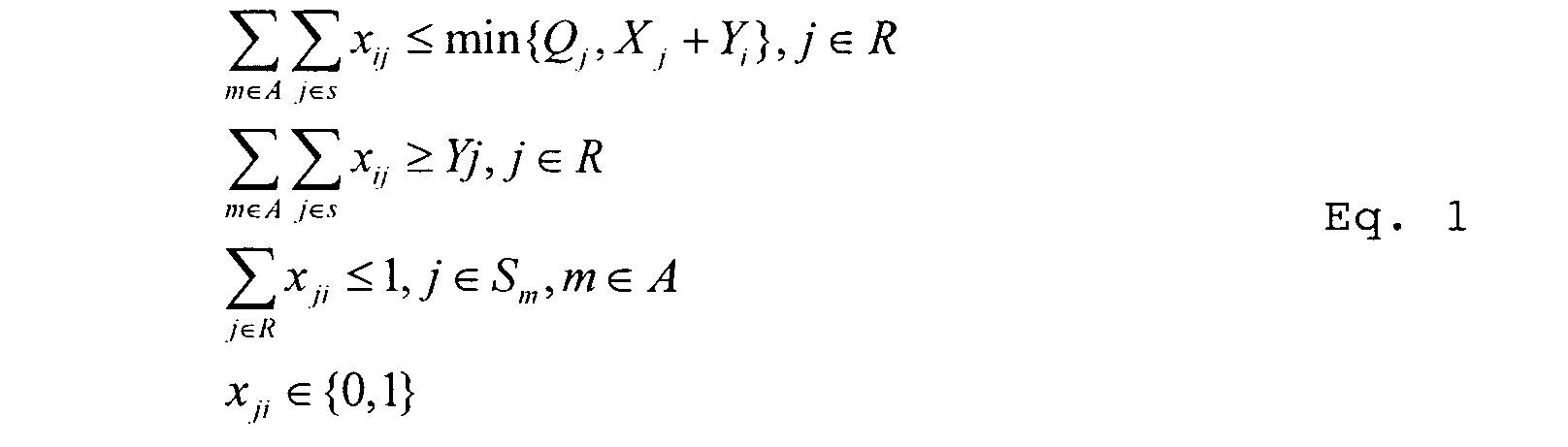
- an algorithm of equations 4 and 5 is applied for deciding to allocate a time slot to a first frame pair by generating a resource allocation schedule and for other frame pairs, the timeslots are allocated by copying the resource allocation schedule for the first frame pair.
- the above mentioned method for deciding the assignment of each time slot can reduce calculation steps and processing time. For example, if there are 2000 time slots in a frame, 2000 x 2 times of calculations for the first frame are required. That is, there are 4000 allocation schedules required and the other frame pairs use the computed allocation schedule for the first frame. However, if allocation schedules for all frame need to be calculated then there are 64000 allocation schedules required.
- step of 304 for deciding optimal allocation amount decision of the first frame pair in the identical superframe and a step of 305 for rapidly allocating time slot based on the optimal allocation amount are explained in detail.
- i is i th time slot
- j is j th terminal
- R is a set of IDs of terminals logged on.
- A is a set of ID of return link demodulators, which are available.
- S n is a set of IDs of available time slots and Q j is the maximum number of time slots, which can be allocated to the terminal j and
- X j is the number of time slots requested by terminal j, Y j is the minimum number of time slots that should be allocated to terminal j.
- X ij is a decision variable, which has a value of 1 when a time slot i is allocated to a terminal j and has a value of 0 otherwise.
- V j is a penalty coefficient (penalty weight).
- the penalty coefficient is decided according various factors such as delay of the residual packets on the transmission queue of each terminal (RCST). That is, a large value is assigned for the penalty coefficient to the terminal (RCST) when the terminal contains a lot of delayed data. As a result, fairness of allocation resources can be achieved.
- g(x) is the total penalty caused by the timeslot allocation denoted by matrix [x ij ].
- the number of time slot for allocating to each terminal must be less than a upper bound (threshold value) or request number, which is decided by system parameters such as construction of the super-frame.
- the number of time slots for allocating to each terminal must be greater than lower bound, which is decided for satisfying service quality.
- each time slot cannot be allocated to two and more terminals.
- Eq. 1 can be modified to following Eq. 2 for effectively solving a problem of resource allocation based on a concept of frame pair in accordance with the present invention.
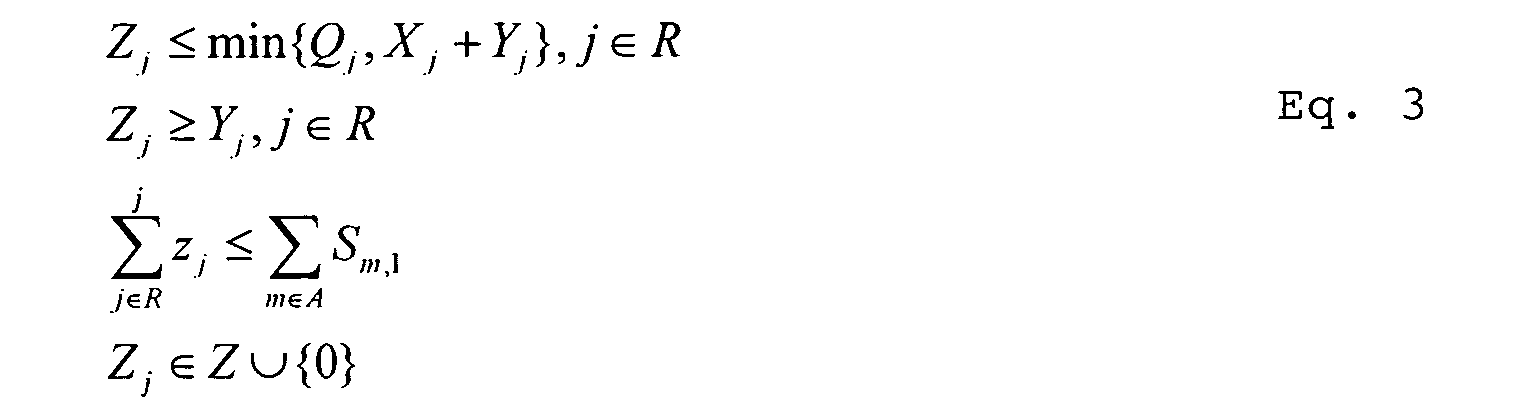
- the capacity allocation problem (CA)) can be mathematically formulated as follows: subject to
- Eq. 1 A difference between Eq. 1 and Eq. 2 is that the number of objects for allocation schedule is a total number of slots in a frame pair and a total number of slots in a superframe, therefore, the processing time may be decreased since the size of problem (CAP) and the complexity required to solve problem (CAP) are decreased. Furthermore, if the allocation schedule of the first frame pair is copied and used for remained frame pairs, the allocation schedule for time slots in the super-frame can be effectively and rapidly made.
- S m,1 is a set of available time slots included in the first superframe.
- the original problem (CAP) is divided to n sub-problems and optimize x. As a result, at the optimal solution x.
- Eq. 2 requires a preprocess of solving an allocation decision amount.
- a problem of deciding an amount of allocation v j is a weight representing how a terminal j is important comparing to other terminal.
- the weight can be decided according to a service quality. For example, resources are effectively and rapidly allocated to the terminals by assigning higher priority to a terminal, which have been delayed to be allocated of resources for long period time.
- Z j is a decision variable denoting the number of time slot allocated to the terminal j.
- f(z) denotes a total penalty according to the amount of allocation denoted by vector z.
- a total penalty according to the amount of allocation denoted by vector z.
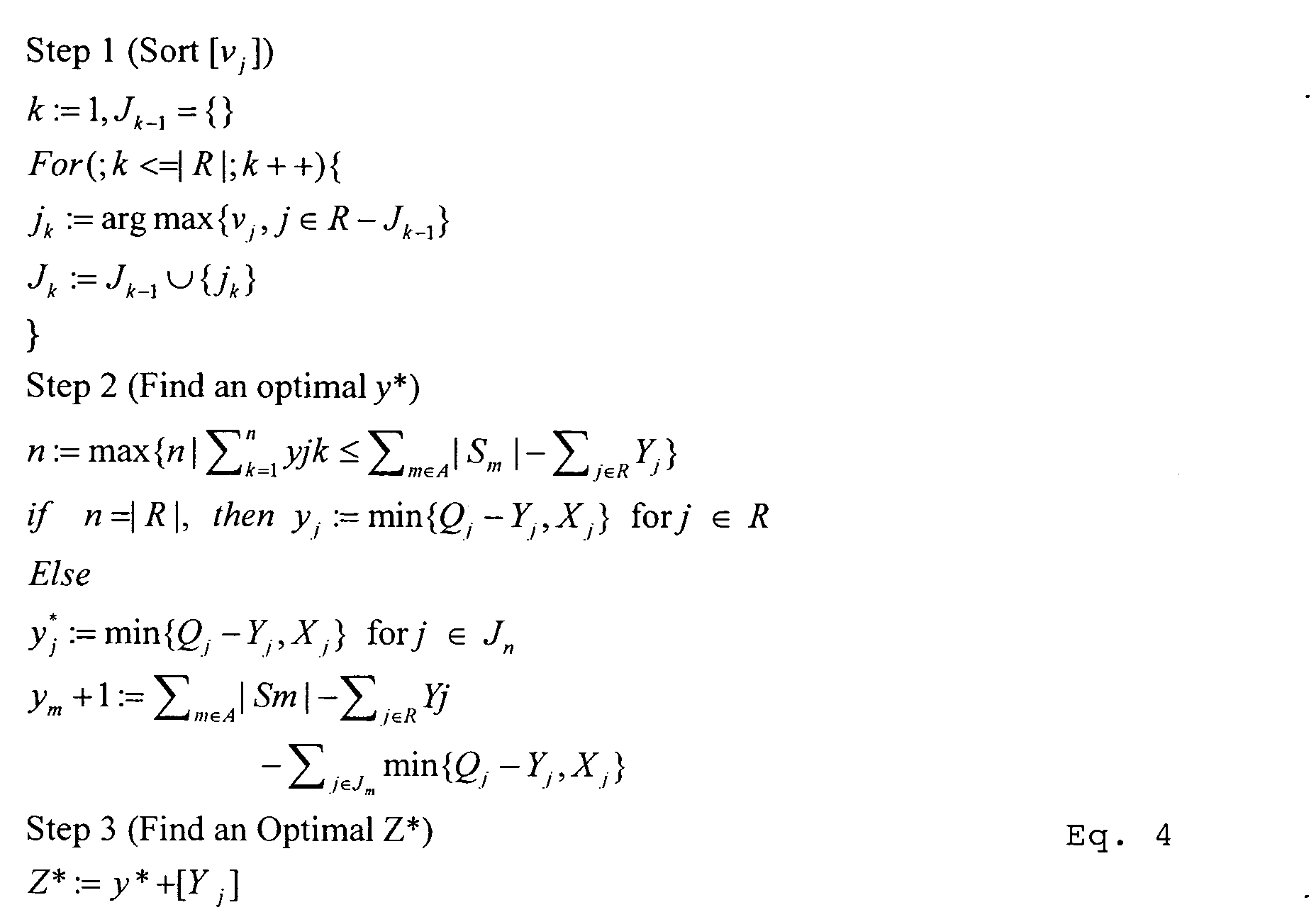
- V j is sorted from one having large weight to one having small weight.
- j k is an ID of a terminal having k th largest penalty weight (V j ).
- J k is a set having ⁇ j 1 , ..., j k ⁇ .
- additional allocation amount is optimally decided.
- the additional allocation amount is the number of variable timeslots ⁇ x jk . If an amount of remained resource is sufficient, additional requested resource is maximally allocated and if the amount of remained resource is not sufficient, additional requested resource is maximally allocated to a terminal J n having a highest priority at first and then remained resource is allocated to other terminals.
- Step 3 is a step of deciding total allocation amount.
- the total allocation amount is a sum of basic allocation amount and additional allocation amount and it is computed for each terminal.
- a step 304 for deciding optimal resource allocation amount is explained in below.
- the highest weight has an index j 1 and stored in a set J 1 .
- the k th highest weight has an index j k and stored in a set J k .
- an additional allocation amount y * / j excepting minimum allocation amount is decided at step 2.
- equation 5 shows a step 305 for deciding a time slot to be allocated to each of terminals RCST based on the optimal allocation vector z *. That is, it is a step for choosing time slot to be allocated to each of terminals based on the decided allocation amount [ z * / j ].
- a slot i is allocated to a terminal j k , x i and j k are set as 1. That is, the i is increased as many as the number of allocation and x i and j k are set as 1, therefore, an amount of allocation to the terminal j k is z * / j .
- objective time slots are all of time slots in a first frame pair.
- the time slot is allocated from one having lowest frequency (carrier) to a direction of time increase. The above mentioned step is repeated for next carrier.
- a schedule of frame pair generated in steps of 304 and 305 is copied to remained frame pairs at step of 306. Therefore, allocation schedule for all time slots included in the super-frame is completed.
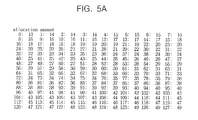
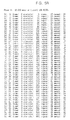
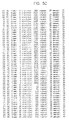
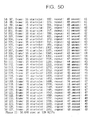
- Figs 5A to 5D shows a simulation result of the preferred embodiment of the present invention for verifying an effectiveness of the present invention.
- a personal computer with Pentium III 1.0 GHz is used for runninq simulation of the present invention.
- the simulation uses a model network having 128 terminals and 65024 time slots under conditions that all weights are 1, a minimum allocation amount is 6 per a frame, a maximum allocation amount is 508 per a frame.
- the simulation is progressed by randomly generating a request resource amount and measuring a time solving two problems of the request resource amount.
- a program used for simulation has already used at a real-time resource manager in a host station Hub 13 and it includes a time for expressing a resource allocation schedule as a type of messaging between units of the real system. According to the result of the simulation, it maximally takes a time of 10 ms for deciding an allocation amount and also maximally takes a time of 30 ms for selecting a time slot. It also takes 500 ms for requesting resource of the terminal RCST 11 to a main station Hub 13, completing an allocation schedule and the allocation schedule is passed to the terminal RCST 11 again.
- a length of superframe is a range of 2000 - 92000ms (a standard of DVB-RCS), it is clearly shows that a processing speed of the present invention is very fast comparing to prior art.
- the above-mentioned method according to the present invention can be implemented as instructions and stored to a computer readable recoding medium such as a CD-ROM, RAM, floppy disk, hard disk and optical magnetic disk.
- a computer readable recoding medium such as a CD-ROM, RAM, floppy disk, hard disk and optical magnetic disk.
- the present invention can output resource allocation schedule in order to have a maximum throughput in a timeslot allocation in a return link based on MF-TDMA of interactive multimedia network by a problem division method using a frame pair.
Landscapes
- Engineering & Computer Science (AREA)
- Computer Networks & Wireless Communication (AREA)
- Signal Processing (AREA)
- Physics & Mathematics (AREA)
- Astronomy & Astrophysics (AREA)
- General Physics & Mathematics (AREA)
- Computing Systems (AREA)
- Aviation & Aerospace Engineering (AREA)
- Radio Relay Systems (AREA)
- Time-Division Multiplex Systems (AREA)
- Two-Way Televisions, Distribution Of Moving Picture Or The Like (AREA)
Abstract
Description




Claims (11)
- An apparatus for dynamically allocating resource in an interactive satellite multimedia system, comprising:resource request amount collection means for accumulating a requested resource amount corresponding to each of terminals during a super-frame period;resource request amount processing means for dividing an accumulated requested resource amount by the number of frame pairs in a super frame and storing a sum of a result of dividing and rounding up a remain of the division to a nearest integer as a request amount of each corresponding terminal ; andresource allocation means for deciding a time slot allocated at each of terminals corresponding to a frame pair based on optimal allocation amount, which is decided based on the request amount by the requested amount processing means.
- The apparatus as recited in claim 1, wherein the resource allocation means completes a time slot allocation schedule for a first frame pair based on an optimal allocation resource amount by deciding how to allocate resource to each of terminals and the time slot allocation schedule is copied for other frame pairs.
- The apparatus as recited in claim 1, wherein the resource allocation means including:resource allocation amount deciding means for deciding an amount of resource allocated to each of terminals;resource allocation scheduling means for deciding terminals to be allocated of variable time slot included in a first frame pair based on the amount of resource decided by the resource allocation amount deciding means; andresource allocation schedule copying means for copying an allocation schedule of time slot in the first frame pair for remained frame pairs in same super-frame;
- The apparatus as recited in claim 3, wherein the frame pair is a subset of the super-frame, one of frame pairs is a set of frames or a frame having identical time period, each of frame pairs have identical a time slot allocation type or a frequency bandwidth and different time period comparing to other frame pairs, all frame pairs in one super-frame are subsets and a union of all frame pairs is the super-frame.
- The apparatus as recited in claim 4, wherein the resource request amount processing means obtains a result computed by dividing the request resource amount of each terminal by the number of frame pairs in one super-frame and rounding off a result of division to the nearest integer.
- A method for dynamically allocating resources in an interactive satellite multimedia system, comprising the steps of:a) accumulating a request amount of resource corresponding to each of terminals during a super-frame period;b) dividing the accumulated request amount of resource by frame pairs included in one super frame and remembering a sum of a result of dividing and rounding off a remain of the division to a nearest integer as a resource request amount; andc) deciding an optimal allocation amount based on the resource request amount and deciding a time slot to be allocated to each of terminals based on the optimal allocation amount.
- The method as recited in claim 6, wherein the step of c) decides a time slot allocation schedule of a first frame pair based on the optimal allocation amount by deciding the optimal allocation amount based on the resource request amount in the step b) and the time slot allocation schedule of the first frame pair is copied and used for other frame pairs.
- The method as recited in claim 6, wherein the step c) includes the steps of:d) deciding how much resource is allocated to each of terminals based on the first frame pair;e) deciding terminals to be allocated of a variable time slot included in the first frame pair base on the optimal allocation amount; andf) copying a time slot allocation schedule of the first time slot to remained frame pair in a same super frame.
- The method as recited in the claim 8, wherein the step d) decides the optimal allocation amount according to a priority of resource request amount processed at step b), deciding an additional allocation amount excepting minimum allocation amount by sorting the resource request amounts from one having higher weight to one having lower weight and calculates a total allocation amount by adding the additional allocation amount and the optimal allocation amount.
- The method as recited in the claim 6, wherein the step b) obtains a result computed by dividing the request resource amount of each terminal by the number of frame pairs in one super-frame and rounding off a result of division to the nearest integer.
- A computer readable recording medium storing instructions for executing a method for actively allocation resource in two-way satellite multimedia system, comprising functions of:a) accumulating a request amount of resource corresponding to each of terminals during a super-frame period;b) dividing the accumulated request amount of resource by frame pairs included in one super frame and remembering a sum of a result of dividing and rounding off a remain of the division to a nearest integer as a resource request amount; andc) deciding an optimal allocation amount based on the resource request amount and deciding a time slot to be allocated to each of terminals based on the optimal allocation amount.
Applications Claiming Priority (2)
| Application Number | Priority Date | Filing Date | Title |
|---|---|---|---|
| KR1020020078827A KR100565896B1 (en) | 2002-12-11 | 2002-12-11 | Dynamic Resource Allocation Apparatus and Method and Recording Media in Bidirectional Satellite Multimedia System |
| KR2002078827 | 2002-12-11 |
Publications (3)
| Publication Number | Publication Date |
|---|---|
| EP1429473A2 true EP1429473A2 (en) | 2004-06-16 |
| EP1429473A3 EP1429473A3 (en) | 2005-03-16 |
| EP1429473B1 EP1429473B1 (en) | 2008-04-02 |
Family
ID=32322375
Family Applications (1)
| Application Number | Title | Priority Date | Filing Date |
|---|---|---|---|
| EP03255417A Expired - Lifetime EP1429473B1 (en) | 2002-12-11 | 2003-08-29 | Apparatus and method for dynamic resource allocation in interactive satellite multimedia system |
Country Status (5)
| Country | Link |
|---|---|
| US (1) | US7346069B2 (en) |
| EP (1) | EP1429473B1 (en) |
| KR (1) | KR100565896B1 (en) |
| AT (1) | ATE391363T1 (en) |
| DE (1) | DE60320082T2 (en) |
Cited By (4)
| Publication number | Priority date | Publication date | Assignee | Title |
|---|---|---|---|---|
| FR2874147A1 (en) * | 2004-08-05 | 2006-02-10 | Cit Alcatel | DEVICE FOR ALLOCATING SHARED RESOURCES OF A COMMUNICATION NETWORK BY ALLOCATING TEMPORAL INTERVALS OF A DYNAMICALLY ADAPTABLE TIME / FREQUENCY PLAN |
| DE102006025037B3 (en) * | 2006-05-26 | 2007-09-13 | Deutsches Zentrum für Luft- und Raumfahrt e.V. | A resource allocation method in an interactive satellite broadcast network multimedia system |
| DE102006025038A1 (en) * | 2006-05-26 | 2007-11-29 | Deutsches Zentrum für Luft- und Raumfahrt e.V. | Dynamic resource allocation method in a satellite interactive network multimedia system |
| CN106059652A (en) * | 2016-05-30 | 2016-10-26 | 中国电子科技集团公司第五十四研究所 | Heuristic rapid satellite data receiving resource joint distribution method |
Families Citing this family (29)
| Publication number | Priority date | Publication date | Assignee | Title |
|---|---|---|---|---|
| EP1536657A1 (en) * | 2002-09-06 | 2005-06-01 | Mitsubishi Denki Kabushiki Kaisha | Radio communication system time slot allocation method |
| US20040258026A1 (en) * | 2003-06-19 | 2004-12-23 | Lau Kin Nang | Method of uplink scheduling for multiple antenna systems |
| JP4555025B2 (en) * | 2004-08-25 | 2010-09-29 | 株式会社エヌ・ティ・ティ・ドコモ | Server device, client device, and process execution method |
| US8312142B2 (en) * | 2005-02-28 | 2012-11-13 | Motorola Mobility Llc | Discontinuous transmission/reception in a communications system |
| US20060259733A1 (en) * | 2005-05-13 | 2006-11-16 | Sony Computer Entertainment Inc. | Methods and apparatus for resource management in a logically partitioned processing environment |
| US7260100B1 (en) | 2005-08-08 | 2007-08-21 | Rockwell Collins, Inc. | System and method for net formation and merging in ad hoc networks |
| US7430192B1 (en) | 2005-08-08 | 2008-09-30 | Rockwell Collins, Inc. | Net formation-merging system and method |
| US8009605B1 (en) | 2005-08-08 | 2011-08-30 | Rockwell Collins, Inc. | Low power, programmable modem for software defined radio applications |
| US7969919B1 (en) | 2005-08-08 | 2011-06-28 | Rockwell Collins, Inc. | System and method for thermal load sharing between nodes in a communications network |
| US8139624B1 (en) | 2005-08-25 | 2012-03-20 | Rockwell Collins, Inc. | System and method for providing multiple ad hoc communication networks on a hardware channel |
| KR100717846B1 (en) * | 2005-12-09 | 2007-05-14 | 한국전자통신연구원 | Dynamic Resource Allocation Apparatus and Method for Providing Quality Services in Two-way Satellite Multimedia System |
| DE102007012465A1 (en) * | 2006-11-15 | 2008-05-21 | Rohde & Schwarz Ftk Gmbh | Transmission method and transmission apparatus in a digital broadcast transmission system |
| KR100830536B1 (en) | 2006-12-01 | 2008-05-21 | 한국전자통신연구원 | Bandwidth Allocation Method and Repeater in Communication System |
| KR100890832B1 (en) * | 2007-05-15 | 2009-03-30 | 인하대학교 산학협력단 | Dynamic Channel Selection Method of Cr-Based Wireless Communication System |
| US20090109960A1 (en) * | 2007-10-30 | 2009-04-30 | Motorola, Inc. | Method and apparatus for a virtual circuit data area within a packet data frame |
| EP2351250B1 (en) * | 2008-11-18 | 2018-10-31 | ViaSat, Inc. | Efficient control signaling over shared communication channels with wide dynamic range |
| US8675545B2 (en) | 2009-08-24 | 2014-03-18 | Electronics & Telecommunications Research Institute | Method and apparatus for allocating traffic resources in multi-beam satellite communication system |
| WO2011033601A1 (en) * | 2009-09-21 | 2011-03-24 | 株式会社 東芝 | Method and apparatus for manufacturing three-dimensional integrated circuit |
| US8886755B1 (en) * | 2009-12-09 | 2014-11-11 | Marvell International Ltd. | Method and apparatus for facilitating simultaneous transmission from multiple stations |
| US8611395B2 (en) * | 2010-02-10 | 2013-12-17 | Gilat Satellite Networks Ltd. | Adaptive spreading, modulation, and coding |
| KR101490816B1 (en) * | 2011-06-01 | 2015-02-09 | 삼성탈레스 주식회사 | Automatic time slot allocating apparatus for tdma network and method there of |
| CN104737582A (en) * | 2012-08-02 | 2015-06-24 | 爱立信(中国)通信有限公司 | Resource allocation and joint transmission |
| KR102419355B1 (en) | 2016-01-27 | 2022-07-12 | 한국전자통신연구원 | Methods and Procedures for Dynamic Channel Assignment and Change in UAS Control and Non-Payload Communication |
| KR102416473B1 (en) | 2016-01-27 | 2022-07-05 | 한국전자통신연구원 | Methods for Initial Channel Setting and Connection Establishment in UAS CNPC(Control and Non-Payload Communication) |
| KR20180000954U (en) | 2016-09-29 | 2018-04-06 | 정태영 | Angle adjustment apparatus for parasol |
| CN106571863B (en) * | 2016-10-26 | 2019-07-26 | 中央军委装备发展部第六十三研究所 | Hybrid switching type satellite multi-service radio resource management method based on quick indexing |
| US10575312B2 (en) | 2016-12-01 | 2020-02-25 | Electronics And Telecommunications Research Institute | Method of assigning channel for UAS control and non-payload communication (CNPC) system |
| CN112713926A (en) * | 2020-12-15 | 2021-04-27 | 西安电子科技大学 | Intelligent planning and cloud service scheduling method and system for satellite measurement, operation and control resources |
| CN117200871B (en) * | 2023-11-06 | 2024-01-30 | 成都本原星通科技有限公司 | A satellite communication resource allocation method based on terminal location and business priority |
Family Cites Families (10)
| Publication number | Priority date | Publication date | Assignee | Title |
|---|---|---|---|---|
| FR2682243A1 (en) | 1991-10-04 | 1993-04-09 | France Telecom | METHOD OF ALLOCATING RESOURCES BY ANTICIPATED RESERVATION IN A SERVICE - INTEGRATION SATELLITE NETWORK. |
| FI114178B (en) * | 1995-01-09 | 2004-08-31 | Nokia Corp | Dynamic allocation of radio capacity in a TDMA system |
| US5732076A (en) * | 1995-10-26 | 1998-03-24 | Omnipoint Corporation | Coexisting communication systems |
| US5751702A (en) * | 1995-12-05 | 1998-05-12 | Stanford Telecommunications, Inc. | Network protocol for wireless broadband ISDN using ATM |
| US5812545A (en) | 1996-01-04 | 1998-09-22 | Orion Atlantic, L.P. | Full mesh satellite-based multimedia networking system |
| FI104142B1 (en) * | 1996-10-25 | 1999-11-15 | Nokia Mobile Phones Ltd | Control method for the use of radio resources |
| KR100528660B1 (en) | 1997-09-30 | 2005-11-15 | 코닌클리케 필립스 일렉트로닉스 엔.브이. | Channel allocation methods in a communication network and corresponding system |
| US6449267B1 (en) | 1999-02-24 | 2002-09-10 | Hughes Electronics Corporation | Method and apparatus for medium access control from integrated services packet-switched satellite networks |
| JP3710660B2 (en) * | 1999-12-15 | 2005-10-26 | 株式会社エヌ・ティ・ティ・ドコモ | Slot allocation method in mobile communication, base station using the method, and mobile station |
| US6477368B1 (en) * | 2000-04-28 | 2002-11-05 | Motorola, Inc. | Method for dynamic transmitter training for a shared communication system utilizing dynamic channel allocation |
-
2002
- 2002-12-11 KR KR1020020078827A patent/KR100565896B1/en not_active Expired - Fee Related
-
2003
- 2003-07-22 US US10/625,209 patent/US7346069B2/en not_active Expired - Lifetime
- 2003-08-29 EP EP03255417A patent/EP1429473B1/en not_active Expired - Lifetime
- 2003-08-29 DE DE60320082T patent/DE60320082T2/en not_active Expired - Lifetime
- 2003-08-29 AT AT03255417T patent/ATE391363T1/en not_active IP Right Cessation
Cited By (8)
| Publication number | Priority date | Publication date | Assignee | Title |
|---|---|---|---|---|
| FR2874147A1 (en) * | 2004-08-05 | 2006-02-10 | Cit Alcatel | DEVICE FOR ALLOCATING SHARED RESOURCES OF A COMMUNICATION NETWORK BY ALLOCATING TEMPORAL INTERVALS OF A DYNAMICALLY ADAPTABLE TIME / FREQUENCY PLAN |
| WO2006090027A1 (en) * | 2004-08-05 | 2006-08-31 | Alcatel Lucent | Device for allocating a communication network shared resources, by assigning time slots of a dynamically adaptable time/frequency plane |
| CN101006662B (en) * | 2004-08-05 | 2011-09-07 | 阿尔卡特朗讯公司 | Device for allocating a communication network shared resources, by assigning time slots of a dynamically adaptable time/frequency plane |
| DE102006025037B3 (en) * | 2006-05-26 | 2007-09-13 | Deutsches Zentrum für Luft- und Raumfahrt e.V. | A resource allocation method in an interactive satellite broadcast network multimedia system |
| DE102006025038A1 (en) * | 2006-05-26 | 2007-11-29 | Deutsches Zentrum für Luft- und Raumfahrt e.V. | Dynamic resource allocation method in a satellite interactive network multimedia system |
| DE102006025038B4 (en) * | 2006-05-26 | 2008-04-03 | Deutsches Zentrum für Luft- und Raumfahrt e.V. | A method for dynamic resource allocation in a satellite interactive network multimedia system and use of the method |
| CN106059652A (en) * | 2016-05-30 | 2016-10-26 | 中国电子科技集团公司第五十四研究所 | Heuristic rapid satellite data receiving resource joint distribution method |
| CN106059652B (en) * | 2016-05-30 | 2018-09-14 | 中国电子科技集团公司第五十四研究所 | A kind of heuristic quick satellite data reception Resource co-allocation method |
Also Published As
| Publication number | Publication date |
|---|---|
| EP1429473B1 (en) | 2008-04-02 |
| US20040125784A1 (en) | 2004-07-01 |
| ATE391363T1 (en) | 2008-04-15 |
| DE60320082D1 (en) | 2008-05-15 |
| KR100565896B1 (en) | 2006-03-31 |
| DE60320082T2 (en) | 2009-06-04 |
| US7346069B2 (en) | 2008-03-18 |
| KR20040051007A (en) | 2004-06-18 |
| EP1429473A3 (en) | 2005-03-16 |
Similar Documents
| Publication | Publication Date | Title |
|---|---|---|
| US7346069B2 (en) | Apparatus and method for dynamic resource allocation in interactive satellite multimedia system | |
| US7499421B2 (en) | Apparatus and method for resource allocation in MF-TDMA broadband satellite system | |
| US8190165B2 (en) | System and method for utility-based scheduling for space division multiple access (SDMA) on an uplink of a wireless communications network | |
| KR102615191B1 (en) | Control devices, control methods and programs | |
| US8670775B2 (en) | Allocation of radio resources in a CDMA2000 cellular system | |
| US6449267B1 (en) | Method and apparatus for medium access control from integrated services packet-switched satellite networks | |
| US6738350B1 (en) | Congestion avoidance approach for a switching communication system with transmission constraints | |
| US20060013245A1 (en) | Packet scheduling | |
| US20160072574A1 (en) | Dynamic bandwidth management with spectrum efficiency for logically grouped terminals in a broadband satellite network | |
| Liao et al. | Resource allocation and task scheduling scheme in priority-based hierarchical edge computing system | |
| US20030018803A1 (en) | Priority-based dynamic resource allocation method and apparatus for supply-demand systems | |
| US7373151B1 (en) | Distributed dynamic channel allocation technique for multi-carrier CDMA cellular systems with mobile base stations | |
| CN109743735A (en) | A dynamic channel allocation method based on deep reinforcement learning in satellite communication system | |
| US20030185214A1 (en) | System and method for scheduling protocol data units | |
| CN114142907A (en) | Channel screening optimization method and system for communication terminal equipment | |
| Cho | Adaptive dynamic channel allocation scheme for spotbeam handover in LEO satellite networks | |
| CN115065384A (en) | Multi-beam satellite communication system resource allocation method considering user association, sub-channel allocation and beam association | |
| CN111555799B (en) | Double-layer resource allocation method and system for broadband phased array satellite | |
| KR100920387B1 (en) | Apparatus and Method for Radio Resource Allocation in Adaptive Antenna System | |
| Mitchell et al. | Burst targeted demand assignment multiple-access for broadband Internet service delivery over geostationary satellite | |
| Hirayama et al. | Feedback control for QoS-aware radio resource allocation in adaptive RAN | |
| CN114726431B (en) | Wave beam hopping multiple access method facing low orbit satellite constellation | |
| CN114521027B (en) | Method, device, electronic device and storage medium for dynamic scheduling of power grid resources | |
| US6775233B1 (en) | Rate processor sharing method and apparatus for scheduling data transmissions in a CDMA wireless communication system | |
| Narula-Tam et al. | A dynamic resource allocation strategy for satellite communications |
Legal Events
| Date | Code | Title | Description |
|---|---|---|---|
| PUAI | Public reference made under article 153(3) epc to a published international application that has entered the european phase |
Free format text: ORIGINAL CODE: 0009012 |
|
| AK | Designated contracting states |
Kind code of ref document: A2 Designated state(s): AT BE BG CH CY CZ DE DK EE ES FI FR GB GR HU IE IT LI LU MC NL PT RO SE SI SK TR |
|
| AX | Request for extension of the european patent |
Extension state: AL LT LV MK |
|
| PUAL | Search report despatched |
Free format text: ORIGINAL CODE: 0009013 |
|
| AK | Designated contracting states |
Kind code of ref document: A3 Designated state(s): AT BE BG CH CY CZ DE DK EE ES FI FR GB GR HU IE IT LI LU MC NL PT RO SE SI SK TR |
|
| AX | Request for extension of the european patent |
Extension state: AL LT LV MK |
|
| 17P | Request for examination filed |
Effective date: 20050915 |
|
| AKX | Designation fees paid |
Designated state(s): AT BE BG CH CY CZ DE DK EE ES FI FR GB GR HU IE IT LI LU MC NL PT RO SE SI SK TR |
|
| 17Q | First examination report despatched |
Effective date: 20060719 |
|
| 17Q | First examination report despatched |
Effective date: 20060719 |
|
| GRAP | Despatch of communication of intention to grant a patent |
Free format text: ORIGINAL CODE: EPIDOSNIGR1 |
|
| GRAS | Grant fee paid |
Free format text: ORIGINAL CODE: EPIDOSNIGR3 |
|
| GRAA | (expected) grant |
Free format text: ORIGINAL CODE: 0009210 |
|
| AK | Designated contracting states |
Kind code of ref document: B1 Designated state(s): AT BE BG CH CY CZ DE DK EE ES FI FR GB GR HU IE IT LI LU MC NL PT RO SE SI SK TR |
|
| REG | Reference to a national code |
Ref country code: GB Ref legal event code: FG4D |
|
| REG | Reference to a national code |
Ref country code: CH Ref legal event code: EP Ref country code: IE Ref legal event code: FG4D |
|
| REF | Corresponds to: |
Ref document number: 60320082 Country of ref document: DE Date of ref document: 20080515 Kind code of ref document: P |
|
| PG25 | Lapsed in a contracting state [announced via postgrant information from national office to epo] |
Ref country code: SI Free format text: LAPSE BECAUSE OF FAILURE TO SUBMIT A TRANSLATION OF THE DESCRIPTION OR TO PAY THE FEE WITHIN THE PRESCRIBED TIME-LIMIT Effective date: 20080402 |
|
| NLV1 | Nl: lapsed or annulled due to failure to fulfill the requirements of art. 29p and 29m of the patents act | ||
| PG25 | Lapsed in a contracting state [announced via postgrant information from national office to epo] |
Ref country code: BG Free format text: LAPSE BECAUSE OF FAILURE TO SUBMIT A TRANSLATION OF THE DESCRIPTION OR TO PAY THE FEE WITHIN THE PRESCRIBED TIME-LIMIT Effective date: 20080702 Ref country code: NL Free format text: LAPSE BECAUSE OF FAILURE TO SUBMIT A TRANSLATION OF THE DESCRIPTION OR TO PAY THE FEE WITHIN THE PRESCRIBED TIME-LIMIT Effective date: 20080402 Ref country code: FI Free format text: LAPSE BECAUSE OF FAILURE TO SUBMIT A TRANSLATION OF THE DESCRIPTION OR TO PAY THE FEE WITHIN THE PRESCRIBED TIME-LIMIT Effective date: 20080402 Ref country code: PT Free format text: LAPSE BECAUSE OF FAILURE TO SUBMIT A TRANSLATION OF THE DESCRIPTION OR TO PAY THE FEE WITHIN THE PRESCRIBED TIME-LIMIT Effective date: 20080902 Ref country code: ES Free format text: LAPSE BECAUSE OF FAILURE TO SUBMIT A TRANSLATION OF THE DESCRIPTION OR TO PAY THE FEE WITHIN THE PRESCRIBED TIME-LIMIT Effective date: 20080713 |
|
| PG25 | Lapsed in a contracting state [announced via postgrant information from national office to epo] |
Ref country code: AT Free format text: LAPSE BECAUSE OF FAILURE TO SUBMIT A TRANSLATION OF THE DESCRIPTION OR TO PAY THE FEE WITHIN THE PRESCRIBED TIME-LIMIT Effective date: 20080402 |
|
| EN | Fr: translation not filed | ||
| PG25 | Lapsed in a contracting state [announced via postgrant information from national office to epo] |
Ref country code: DK Free format text: LAPSE BECAUSE OF FAILURE TO SUBMIT A TRANSLATION OF THE DESCRIPTION OR TO PAY THE FEE WITHIN THE PRESCRIBED TIME-LIMIT Effective date: 20080402 Ref country code: CZ Free format text: LAPSE BECAUSE OF FAILURE TO SUBMIT A TRANSLATION OF THE DESCRIPTION OR TO PAY THE FEE WITHIN THE PRESCRIBED TIME-LIMIT Effective date: 20080402 Ref country code: SE Free format text: LAPSE BECAUSE OF FAILURE TO SUBMIT A TRANSLATION OF THE DESCRIPTION OR TO PAY THE FEE WITHIN THE PRESCRIBED TIME-LIMIT Effective date: 20080702 |
|
| PLBE | No opposition filed within time limit |
Free format text: ORIGINAL CODE: 0009261 |
|
| STAA | Information on the status of an ep patent application or granted ep patent |
Free format text: STATUS: NO OPPOSITION FILED WITHIN TIME LIMIT |
|
| PG25 | Lapsed in a contracting state [announced via postgrant information from national office to epo] |
Ref country code: SK Free format text: LAPSE BECAUSE OF FAILURE TO SUBMIT A TRANSLATION OF THE DESCRIPTION OR TO PAY THE FEE WITHIN THE PRESCRIBED TIME-LIMIT Effective date: 20080402 Ref country code: RO Free format text: LAPSE BECAUSE OF FAILURE TO SUBMIT A TRANSLATION OF THE DESCRIPTION OR TO PAY THE FEE WITHIN THE PRESCRIBED TIME-LIMIT Effective date: 20080402 Ref country code: BE Free format text: LAPSE BECAUSE OF FAILURE TO SUBMIT A TRANSLATION OF THE DESCRIPTION OR TO PAY THE FEE WITHIN THE PRESCRIBED TIME-LIMIT Effective date: 20080402 |
|
| 26N | No opposition filed |
Effective date: 20090106 |
|
| PG25 | Lapsed in a contracting state [announced via postgrant information from national office to epo] |
Ref country code: MC Free format text: LAPSE BECAUSE OF NON-PAYMENT OF DUE FEES Effective date: 20080831 |
|
| REG | Reference to a national code |
Ref country code: CH Ref legal event code: PL |
|
| PG25 | Lapsed in a contracting state [announced via postgrant information from national office to epo] |
Ref country code: EE Free format text: LAPSE BECAUSE OF FAILURE TO SUBMIT A TRANSLATION OF THE DESCRIPTION OR TO PAY THE FEE WITHIN THE PRESCRIBED TIME-LIMIT Effective date: 20080402 |
|
| PG25 | Lapsed in a contracting state [announced via postgrant information from national office to epo] |
Ref country code: CH Free format text: LAPSE BECAUSE OF NON-PAYMENT OF DUE FEES Effective date: 20080831 Ref country code: LI Free format text: LAPSE BECAUSE OF NON-PAYMENT OF DUE FEES Effective date: 20080831 |
|
| PG25 | Lapsed in a contracting state [announced via postgrant information from national office to epo] |
Ref country code: IE Free format text: LAPSE BECAUSE OF NON-PAYMENT OF DUE FEES Effective date: 20080829 |
|
| PG25 | Lapsed in a contracting state [announced via postgrant information from national office to epo] |
Ref country code: IT Free format text: LAPSE BECAUSE OF FAILURE TO SUBMIT A TRANSLATION OF THE DESCRIPTION OR TO PAY THE FEE WITHIN THE PRESCRIBED TIME-LIMIT Effective date: 20080402 |
|
| PG25 | Lapsed in a contracting state [announced via postgrant information from national office to epo] |
Ref country code: CY Free format text: LAPSE BECAUSE OF FAILURE TO SUBMIT A TRANSLATION OF THE DESCRIPTION OR TO PAY THE FEE WITHIN THE PRESCRIBED TIME-LIMIT Effective date: 20080402 |
|
| PG25 | Lapsed in a contracting state [announced via postgrant information from national office to epo] |
Ref country code: HU Free format text: LAPSE BECAUSE OF FAILURE TO SUBMIT A TRANSLATION OF THE DESCRIPTION OR TO PAY THE FEE WITHIN THE PRESCRIBED TIME-LIMIT Effective date: 20081003 Ref country code: LU Free format text: LAPSE BECAUSE OF NON-PAYMENT OF DUE FEES Effective date: 20080829 |
|
| PG25 | Lapsed in a contracting state [announced via postgrant information from national office to epo] |
Ref country code: TR Free format text: LAPSE BECAUSE OF FAILURE TO SUBMIT A TRANSLATION OF THE DESCRIPTION OR TO PAY THE FEE WITHIN THE PRESCRIBED TIME-LIMIT Effective date: 20080402 |
|
| PG25 | Lapsed in a contracting state [announced via postgrant information from national office to epo] |
Ref country code: GR Free format text: LAPSE BECAUSE OF FAILURE TO SUBMIT A TRANSLATION OF THE DESCRIPTION OR TO PAY THE FEE WITHIN THE PRESCRIBED TIME-LIMIT Effective date: 20080703 |
|
| PGFP | Annual fee paid to national office [announced via postgrant information from national office to epo] |
Ref country code: GB Payment date: 20100825 Year of fee payment: 8 |
|
| GBPC | Gb: european patent ceased through non-payment of renewal fee |
Effective date: 20110829 |
|
| PG25 | Lapsed in a contracting state [announced via postgrant information from national office to epo] |
Ref country code: FR Free format text: LAPSE BECAUSE OF FAILURE TO SUBMIT A TRANSLATION OF THE DESCRIPTION OR TO PAY THE FEE WITHIN THE PRESCRIBED TIME-LIMIT Effective date: 20090123 Ref country code: GB Free format text: LAPSE BECAUSE OF NON-PAYMENT OF DUE FEES Effective date: 20110829 |
|
| PGFP | Annual fee paid to national office [announced via postgrant information from national office to epo] |
Ref country code: DE Payment date: 20170720 Year of fee payment: 15 |
|
| REG | Reference to a national code |
Ref country code: DE Ref legal event code: R082 Ref document number: 60320082 Country of ref document: DE Representative=s name: FLACH BAUER STAHL PATENTANWAELTE PARTNERSCHAFT, DE |
|
| REG | Reference to a national code |
Ref country code: DE Ref legal event code: R119 Ref document number: 60320082 Country of ref document: DE |
|
| PG25 | Lapsed in a contracting state [announced via postgrant information from national office to epo] |
Ref country code: DE Free format text: LAPSE BECAUSE OF NON-PAYMENT OF DUE FEES Effective date: 20190301 |