FIELD OF THE INVENTION
-
The present invention relates in general to quantum algorithms and more in
particular to a method and a relative quantum gate for performing very fast
Simon's and Shor's algorithms, without the need of storing very large matrices.
BACKGROUND OF THE INVENTION
-
Quantum algorithms are global random searching algorithms based on the
principles, laws, and quantum effects of quantum mechanics. They are used for
controlling a process or for processing data in a database. They are particularly
useful in performing intelligent processes of search-of-minima intelligent
operations.
-
In quantum search operations, each design variable is represented by a finite linear
superposition of classical initial states. Through a sequence of elementary unitary
steps the initial quantum state |i〉 (for the input) is manipulated in such a way that
a measurement of the final state of the system yields the correct output. Usually,
in the quantum search algorithm three principal operators are used, namely: linear
superposition (coherent states), entanglement, and interference.
-
For a better comprehension of the field of application of the invention, a brief
description of quantum search algorithms is provided.
A SURVEY OF QUANTUM ALGORITHMS
-
The problems solved by the quantum algorithms may be stated as follows:
| Input | A function ƒ:{0,1} n →{0,1} m |
| Problem | Find a certain property of ƒ |
-
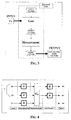
The structure of a quantum algorithm is outlined, in a high level representation, by
the diagram of Figure 1.
-
The input of a quantum algorithm is always a function
f of a binary string into a
binary string. This function is represented as a map table, defining for each string
its image. The function
f is firstly encoded into a unitary matrix operator
UF
depending on the
f properties. In a way, this operator calculates
f when its input
and output strings are encoded into canonical base vectors of a complex Hilbert
space:
UF maps the vector code of every string into the vector code of its image by
f.
-
Once the matrix operator UF has been generated, it is embedded into a quantum
gate G; a unitary matrix whose structure depends on the form of the matrix UF and
on the problem to be solved. The quantum gate is the core of a quantum
algorithm. In every quantum algorithm, the quantum gate acts on the initial
canonical base of vectors (a same vector may be always chosen) to generate a
complex linear combination (superposition) of base vectors as output. This
superposition contains all the information to answer to the initial problem.
-
After having made such a superposition, a measurement is done in order to extract
this information. In quantum mechanics, a measurement is a non-deterministic
operation that produces as output only one of the base vectors of the operation of
superposition. The probability of each base vector of being the output of the
measurement depends on its complex coefficient (probability amplitude) of
entering in said complex linear combination.
-
Each single operation of the quantum gate and the measurement constitute the so-called
quantum block. The quantum block is repeated k times in order to produce
a collection of k base vectors. Being measurement a non-deterministic operation,
these basic vectors will not necessarily be identical and each one of them encodes
a piece of the information needed to solve the problem.
-
The last part of the algorithm consists in the interpretation of the collected base
vectors in order to get with a certain probability the right answer to the initial
problem.
Encoder
-
The behavior of the encoder block is described in the detailed schematic diagram
of Figure 2.
-
Function f is encoded into matrix UF in three steps.
Step 1
-
The map table of function
f:{0,1}
n →{0,1}
m is transformed into the map table of
the
injective function
F:{0,1}
n + m →{0,1}
n + m such that:
F(x 0, ..., xn -1, y 0, ..., ym -1)= (x 0, ..., xn -1, f(x 0, ..., xn -1)⊕(y 0, ..., ym -1))
-
The need to deal with an injective function comes from the requirement that UF be
unitary. A unitary operator is reversible, so it cannot map two different inputs to
the same output. Given that UF is the matrix representation of F, F must be
injective. Should the matrix representation of function f be used, a non-unitary
matrix may result, since f could be non-injective. Therefore, injectivity is assured
by increasing the number of bits and by considering the function F instead of the
function f. Anyway, function f can always be calculated from F by putting (y 0, ...,
ym -1)=(0, ...,0) in the input string and reading the last m values of the output string.
Step 2
-
The map table of function F is transformed into UF map table, according to the
following formula:
∀s∈{0,1} n + m : UF [τ(s)]= τ[F(s)]
-
The coding map τ:{0,1}
n + m →
C 2 n + m (
C 2 n + m is the target complex Hilbert space)
is such that:
-
Code τ maps bit values into complex vectors of dimension 2 belonging to the
canonical base of C 2. Moreover, using tensor product, τ maps the general state of
a binary string of dimension n into a vector of dimension 2 n , reducing this state to
the joint state of the n bits composing the register. Every bit state is transformed
into the corresponding 2-dimension base vector and then the string state is
mapped into the corresponding 2 n -dimension base vector by composing all bit-vectors
through tensor product. In this sense, tensor product is the vector
counterpart of state conjunction.
-
Base vectors are denoted using the ket notation |i>. This notation is taken from
Dirac's description of quantum mechanics.
Step 3
-
The map table of UF is transformed into the matrix UF by using the following
transformation rule:
[UF ] ij = 1UF |j〉 = |i〉
which can be easily understood by considering the vectors |i> and |j> as column
vectors. Because these vectors belong to the canonical base, UF defines a
permutation map of the rows of the identity matrix. In general, row |j> is mapped
into row |i>.
-
This rule will be illustrated more in detail in a sample quantum algorithm, namely
the Shor's algorithm.
Quantum block
-
The core of the quantum block is the quantum gate, which depends on the
properties of the matrix UF . The scheme of Figure 3 gives a more detailed
description of the quantum block.
-
In Figure 3, the matrix operator UF is the output of the encoder block represented
in Figure 2. Here, it becomes the input for the quantum block.
-
This matrix operator is firstly embedded into a more complex gate: the quantum
gate G. Unitary matrix G is applied k times to an initial canonical base vector |i>
of dimension 2 n + m . Every time, the resulting complex superposition G|0..01..1> of
base vectors is measured, producing as result one base vector |xi >. All the
measured base vectors {|x1 >,..,|xk >} are collected together. This collection is the
output of the quantum block.
-
The "intelligence" of such algorithms rests in the ability to build a quantum gate
that is able to extract the information necessary to find the required property off
and to store it into the output vector collection.
-
The structure of the quantum gate for every quantum algorithm will be discussed
in detail, observing that a general description is possible.
-
In order to represent quantum gates some special diagrams called quantum
circuits will be employed.
-
An example of quantum circuit, relative to the so called Deutsch-Jozsa's quantum
algorithm, is reported in Figure 4. Every rectangle is associated to a matrix 2
n ×2
n ,
where
n is the number of lines entering and leaving the rectangle. For example,
the rectangle marked
UF is associated to the matrix
UF . Typically, matrix
H
represents a Hadamard rotation
-
Quantum circuits provide a high-level description of the gate and, by using some
transformation rules that are listed in Figures from 5a to 5f, it is possible to
compile them into the corresponding gate-matrix.
Example: Matrix Tensor Product
-
-
The manner of using these rules will become clearer when a first sample of
quantum algorithm will be illustrated.
Decoder
-
The decoder block has the function of interpreting the base vectors collected after
the iterated execution of the quantum block. Decoding these vectors means to
retranslate them back into binary strings and interpreting them directly if they
already contain the answer to the starting problem or using them, for instance as
coefficients vectors for some system of equations, in order to get the sought
solution. This part will not be treated in detail because it is a relatively easy
classical part of no particular interest.
-
In order to better illustrate a field of application of this invention, a brief
description of the Shor's algorithm is given.
SHOR'S ALGORITHM
Shor's problem is so stated:
Given an integer number N, find a factor p for N
-
This problem seems to be different from the other problems solved by quantum
algorithms, but it can be reduced to an equivalent problem with the same form as
the other quantum problems. This reduction is made possible by a result of the
theory of numbers that relates the period r of a special periodic function to the
factors of an integer
N. This function is:
where
a is a random number coprime to
N, namely:
gcd(a, N) = 1
where
gcd(
x,
y) is the
greatest common divisor between
x and
y.
-
This function is periodical (the period is at most N). Let the period be r. Then:
fN , a (0)=fN , a (r) ar ≡1modN
-
If the period is even, this equation can be rewritten as:
This means:
-
-
So, unless (ar /2-1) ≡0modN or (ar /2+1) ≡0modN, namely ar /2 ≡±1modN, at least
one of ar /2+1 or ar /2-1 must have a non-trivial factor in common with N. It may be
found by calculation:
gcd(ar /2 - 1,N) gcd(ar /2 + 1,N)
-
Using this reduction, the true question becomes: "What is the period of f?" Since
the period of this function is less than N, it may be restricted to the interval [0, 1,
..., N-1]. Every input value is coded as a binary string. A number of bits n=[log N]
(eventually [log N]+1) is needed to code all the N possible input values.
-
Therefore, Shor's problem is translated into the following standard quantum
problem:
| Input | f:{0,1} n →{0,1} n with period r |
| Problem | Find r |
Encoder
-
First a simple example will be dealt with, then conclusions will be generalized.
A. Introductory example
-
Consider the case:
N = 4 ⇒ n = 2; a = 3
-
Then,f map table is:
| (x 0,x 1) | f(x 0,x 1) |
| 00 | 01 |
| 01 | 11 |
| 10 | 01 |
| 11 | 11 |
-
The period of this function is r=2.
Step 1
-
Function
f is encoded into the injective function
F built using eq. (2). Therefore,
the map table of
F is as follows:
| (x 0,.., xn -1, y 0,.., yn -1) | F(x 0,.., xn -1, y 0,.., yn -1) |
| 0000 | 0001 |
| 0100 | 0111 |
| 1000 | 1001 |
| 1100 | 1111 |
| 0001 | 0000 |
| 0101 | 0110 |
| 1001 | 1000 |
| 1101 | 1110 |
| 0010 | 0011 |
| 0110 | 0101 |
| 1010 | 1011 |
| 1110 | 1101 |
| 0011 | 0010 |
| 0111 | 0100 |
| 1011 | 1010 |
| 1111 | 1100 |
Step 2
-
The function
F is encoded into the map table of the operator
UF :
| |x 0..xn -1 y 0..yn -1> | UF |x 0..xn -1 y 0..yn -1> |
| |0000> | |0001> |
| |0100> | |0111> |
| |1000> | |1001> |
| |1100> | |1111> |
| |0001> | |0000> |
| |0101> | |0110> |
| |1001> | |1000> |
| |1101> | |1110> |
| |0010> | |0011> |
| |0110> | |0101> |
| |1010> | |1011> |
| |1110> | |1101> |
| |0011> | |0010> |
| |0111> | |0100> |
| |1011> | |1010> |
| |1111> | |1100> |
Step 3
-
The matrix corresponding to
UF is obtained by using the rule:
[UF ] ij = 1 UF |j〉 = |i〉
or in other words by observing that the first two vectors in the input tensor
product are left unchanged, whereas the operator acting on the last two is chosen
inside the set {
I⊗I,
I⊗C,
C⊗I,
C⊗C} wherein
I is the identity matrix and
C is the
complement matrix, depending on the values of the first two vectors:
| UF | |00> | |01> | |10> | |11> |
| |00> | I⊗C | 0 | 0 | 0 |
| |01> | 0 | C⊗C | 0 | 0 |
| |10> | 0 | 0 | I⊗C | 0 |
| |11> | 0 | 0 | 0 | C⊗C |
-
This matrix preserves the first two vectors and:
- it preserves the third vector, flipping the fourth vector when the second vector
is |0>;
- it flips the third and fourth vectors, when the second vector is |1>.
-
It is worth noticing that the block matrix in cell (i, i) is identical to the block
matrix in cell ((i+r)modN, (i+r)modN) where i is the binary label of the vector
marking the matrix row and column of the cell.
B. Case with n=2
-
In general, if n=2, takes a different value for a and so a different period r, the
operator still maps the first n vectors into themselves, but the block matrix pattern
on the main diagonal changes.
-
The matrix
UF has the following form:
| UF | |00> | |01> | |10> | |11> |
| |00> | M 00 | 0 | 0 | 0 |
| |01> | 0 | M 01 | 0 | 0 |
| |10> | 0 | 0 | M 10 | 0 |
| |11> | 0 | 0 | 0 | M 11 |
where
Mi ∈{
I⊗
I,
I⊗C,
C⊗I,
C⊗C} and
Mi =
Mj ((
j=
i) OR (
j=(
i+
r)mod
N)).
C. General case
-
Through a similar reasoning the following general form for the matrix
UF when
n>0 may be proposed:
| UF | |0..0> | |0..1> | ... | |1..1> |
| |0..0> | M 0.. 0 | 0 | ... | 0 |
| |0..1> | 0 | M 0.. 1 | ... | 0 |
| ... | ... | ... | ... | ... |
| |1..1> | 0 | 0 | 0 | M 1.. 1 |
where
Mi =
P1 ⊗..⊗
Pn ,
Pk ∈{
I,
C},
k=1,..,
n and
Mi =
Mj
((
j=
i)OR(
j=(
i+
r)mod
N))..
-
The column labels are base vectors of dimension n.
Quantum Block
-
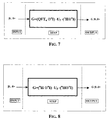
The Shor's quantum gate may be described with the quantum circuit of Figure 6.
-
Shor's quantum gate shown in Figure 7 is very similar to Simon's quantum gate
shown in Figure 8, unless for the last operator.
-
In Simon's algorithm the operator nH is applied to the first n vectors exiting from
UF . This operator of the Simon's algorithm is responsible of the annihilation of
some cells in the first column of the final gate and this produces a special
superposition of base vectors as output. By measuring this superposition it is
possible to solve the Simon's problem.
-
In Shor's algorithm the interference operator is not
nH, in fact the main diagonal
pattern of
UF is different, and therefore a different interference operator is needed
in order to extract the information. This operator is represented by the matrix
QFTn , called
Quantum Fourier Transform of order n . This operator is non-classical
because it maps a base vector into a complex linear combination of base
vectors. In general, a base vector |
i> is mapped into the linear combination α
1 y 1+
..+α
2 ny 2 n where α
i and α
i +1 have the same absolute value 1/2
n /2 but they are phase
shifted of
i·(2π/2
n ) starting with α
1=1/2
n /2. The operator is defined as follows:
| QFTn | =0
|0..0> | =2π/2 n
|0..1> | ...
... | =(2 n -1)2π/2 n
|1..1> |
| |0..0> | 1/2 n /2 | 1/2 n /2 | ... | 1/2 n /2 |
| |0..1> | 1/2 n /2 | 1/2 n /2eJ2 π /2 n | ... | 1/2 n /2eJ(2 n -1)2π/2 n |
| ... | ... | ... | ... | ... |
| |1..1> | 1/2 n /2 | 1/2 n /2eJ(2 n -1)2π/2 n | ... | 1/2 n /2eJ(2 n -1)2 2π/2 n |
where J is the imaginary unit. By using the transformation rules shown in Figures
from 5a to 5f to the circuit of Figure 6, the quantum gate of Figure 7 is obtained.
-
A discussion of the form of these gates for few particular cases will follow and the
observations will then be generalized.
A. Introductory example
-
If n=2, the quantum gate has the following form:
G=(QFT2⊗2I)·UF ·( 2H⊗ 2I)
-
This gate is now calculated for the first considered example:
| 2 H⊗2 I | |00> | |01> | |10> | |11> |
| |00> | 2 I/2 | 2 I/2 | 2 I/2 | 2 I/2 |
| |01> | 2 I/2 | -2 I/2 | 2 I/2 | -2 I/2 |
| |10> | 2 I/2 | 2 I/2 | -2 I/2 | -2 I/2 |
| |11> | 2 I/2 | -2 I/2 | -2 I/2 | 2 I/2 |
-
The matrix
UF has been already presented in Table 4, therefore
| UF ·(2 H⊗ 2 I) | |00> | |01> | |10> | |11> |
| |00> | I⊗C/2 | I⊗C/2 | I⊗C/2 | I⊗C/2 |
| |01> | C⊗C/2 | -C⊗C/2 | C⊗C/2 | -C⊗C/2 |
| |10> | I⊗C/2 | I⊗C/2 | -I⊗C/2 | -I⊗C /2 |
| |11> | C⊗C/2 | -C⊗C/2 | -C⊗C/2 | C⊗C/2 |
-
If
n = 2,
QFT2 is as follows:
| QFT2 | =0
|00> | =π/2
|01> | =π
|10> | =3π/2
|11> |
| |00> | 1/2 | 1/2 | 1/2 | 1/2 |
| |01> | 1/2 | J/2 | -1/2 | -J/2 |
| |10> | 1/2 | -1/2 | 1/2 | -1/2 |
| |11> | 1/2 | -J/2 | -1/2 | J/2 |
| QFT 2⊗2 I | |00> | |01> | |10> | |11> |
| |00> | 2 I/2 | 2 I/2 | 2 I/2 | 2 I/2 |
| |01> | 2 I/2 | J 2 I/2 | -2 I/2 | -J 2 I/2 |
| |10> | 2 I/2 | -2 I/2 | 2 I/2 | -2 I/2 |
| |11> | 2 I/2 | -J 2 I/2 | -2 I/2 | J 2 I/2 |
-
The table defining the quantum gate
G is calculated as follows:
| G | |00> | |01> | |10> | |11> |
| |00> | (I⊗C+C⊗C)/2 | (I⊗C-C⊗C)/2 | 0 | 0 |
| |01> | 0 | 0 | (I⊗C+JC⊗C)/2 | (I⊗C-JC⊗C)/2 |
| |10> | (I⊗C-C⊗C)/2 | (I⊗C+C⊗C)/2 | 0 | 0 |
| |11> | 0 | 0 | (I⊗C-JC⊗C)/2 | (I⊗C+JC⊗C)/2 |
-
By applying the operator G to the vector |0000> the following is obtained:
G|0000〉=|00〉 12 (I⊗C+C⊗C)|00〉+|10〉 12 (I⊗C-C⊗C)|00〉
-
If a measurement of this vector is made and the first two vectors of dimension 2
are encoded back into their binary labels, the possible results are:
- 00 with probability 0.5
- 10 with probability 0.5
-
-
The distance between these values is d=[|10-00|]10=[10]10=2, where [s]10 is the
decimal representation of the binary string s. It should be observed that
N/r=4/2=2, therefore d=N/r. If r is unknown, it may be calculated it as:
r=N/d
B. Case with n=2, r=2
-
As shown above, when
n=2, the quantum gate has the following form:
G=(QFT2 ⊗ 2I)·UF ·( 2H⊗ 2I)
by using the matrices calculated in the introductory example and recalling
UF
given by Table 5.
| UF ·(2 H⊗2 I) | |00> | |01> | |10> | |11> |
| |00> | M 00/2 | M 00/2 | M 00/2 | M 00/2 |
| |01> | Mol/2 | -M 01/2 | M 01/2 | -M 01/2 |
| |10> | M 10/2 | M 10/2 | -M 10/2 | -M 10/2 |
| |11> | M 11/2 | -M 11/2 | -M 11/2 | M 11/2 |
-
By recalling the expression of the interference operator
QFT 2⊗
2 I shown in Table
11, the following generalized form of G is obtained:
| G | |00> | |01> | |10> | |11> |
| |00> | (M 00+M 01+M 10 | (M 00-M 01+M 10- | (M 00+M 01-M 10- | (M 00-M 01- |
| | +M 11)/4 | M 11)/4 | M 11)/4 | M 10+M 11)/4 |
| |01> | (M 00+JM 01- | (M 00-JM 01- | (M 00+JM 01+M 10+J | (M 00-JM 01+M 10- |
| | M 10-JM 11)/4 | M 10+JM 11)/4 | M 11)/4 | JM 11)/4 |
| |10> | (M 00-M 01+M 10- | (M 00+M 01+M 10+ | (M 00-M 01- | (M 00+M 01-M 10- |
| | M 11)/4 | M 11)/4 | M 10+M 11)/4 | M 11)/4 |
| |11> | (M 00-JM 01- | (M 00+JM 01-M 10- | (M 00-JM 01+M 10- | (M 00+JM 01+M 10+ |
| | M 10+JM 11)/4 | JM 11)/4 | JM 11)/4 | JM 11)/4 |
-
If
r=2, like in our introductory example, then
M 00=
M 10≠
M 01=
M 11. This means:
| G | |00> | |01> | |10> | |11> |
| |00> | (M 00+M 01)/2 | (M 00-M 01)/2 | 0 | 0 |
| |01> | 0 | 0 | (M 00+JM 01)/2 | (M 00-JM 01)/2 |
| |10> | (M 00-M 01)/2 | (M 00+M 01)/2 | 0 | 0 |
| |11> | 0 | 0 | (M 00-JM 01)/2 | (M 00+JM 01)/2 |
-
Consider the application of G to vector |0000>:
G|0000〉 = |00〉 12 (M 00 + M 01)|00〉+|10〉 12 (M 00 - M 01)|00〉
-
If a measurement is done on this vector and the first two vectors of dimension 2
are encoded back into their binary labels, then the possible results are:
- 00 with probability 0.5
- 10 with probability 0.5
-
-
These are the same results that were obtained for our introductory example and
the same conclusions hold.
C. General case
-
As already shown, for a general case, the operator
UF is defined as in Table 6. The
quantum gate G will how be calculated for a general situation:
| nH⊗ nI | |0..0> | ... | |j> | ... | |1..1> |
| |0..0> | nI/2 n /2 | ... | nI/2 n /2 | ... | nI/2 n /2 |
| |0..1> | nI/2 n /2 | ... | (-1)(0..1)· j ( nI/2 n /2) | ... | - nI/2 n /2 |
| ... | ... | ... | ... | ... | ... |
| |i> | nI/2 n /2 | ... | (-1) i · j ( nI/2 n /2) | ... | (-1) i ·(1..1)( nI/2 n /2) |
| ... | ... | ... | ... | ... | ... |
| |1..1> | nI/2 n /2 | ... | (-1)(1..1)· j ( nI/2 n /2) | ... | (-1)(1..1)·(1..1)( nI/2 n /2) |
| UF ·( nH⊗ nI) | |0..0> | ... | |j> | ... | |1..1> |
| |0..0> | M 0..0/2 n /2 | ... | M 0..0/2 n /2 | ... | M 0..0/2 n /2 |
| ... | ... | ... | ... | ... | ... |
| |i> | Mi /2 n /2 | ... | (-1) i · j M i/2 n /2 | ... | (-1) i ·(1..1) Mi /2 n /2 |
| ... | ... | ... | ... | ... | ... |
| |1..1> | M 1..1/2 n /2 | ... | (-1)(1..1)· j M 1..1/2 n /2 | ... | (-1)(1..1)·(1..1) M 1..1/2 n /2 |
-
Observe that:
where [
i]
10 and [
j]
10 are the decimal representations of the binary strings
i and
j.
Therefore:
| QFTn ⊗ nI | |0..0> | ... | |j> | ... | |1..1> |
| |0..0> | nI/2 n /2 | ... | nI/2 n /2 | ... | nI/2 n /2 |
| ... | ... | ... | ... | ... | ... |
| |i> | nI/2 n /2 | ... | nI/2 n /2 e J[ i ]10·[ j ]102π/2 n | ... | nI/2 n /2 eJ[ i ]10·(2 n -1)2π/2 n |
| ... | ... | ... | ... | ... | ... |
| |1..1> | nI/2 n /2 | ... | nI/2 n /2 e J(2 n -1)·[j]102π/2 n | ... | nI/2 n /2 eJ(2 n -1)22π/2 n |
-
The quantum gate G has the following form:
| G | |0..0> | ... |
| |0..0> | 1/2 n Σ k ∈{0,1} ne Jπ·0·[ k ]10/2 n -1)Mk | ··· |
| ··· | ··· | ··· |
| |i> | 1/2 n Σ k ∈{0,1} ne Jπ·[i]10·[k]10/2 n -1 Mk | ··· |
| ··· | ··· | ··· |
| |1..1> | 1/2 n Σ k ∈{0,1} ne Jπ·(2 n -1)·[ k ]10/2 n -1 Mk | ··· |
-
Consider the term:
1/2 n Σ k ∈{0,1} n e Jπ·[ i ]10·[ k ]10/2 n -1 Mk
-
Since Mi = P 1⊗..⊗Pn , Pk ∈{I, C}, k=1,..,n and Mi = Mj ((j=i)OR(j=(i+r)modN))
this term may be written as:
1/2 n h∈R [e Jπ·[i]10·[h]10/2 n-1 + e Jπ·[i]10·([h]10+1r)/2 n-1 + .. + e Jπ·[i]10·([h]10+(l k -1)r)/2 n-1 ] Mh
or:
1/2 n Σ h∈R (-1)[h]10[i]10/2 n-1 [(-1)0r[i]10/2 n-1 + (-1)1r[i]10/2 n-1 + .. +(-1)(l h -1)r[i]10/2 n-1 ]Mh
where R={0..0,0..1, .., [r-1]2}. Suppose that N be a multiple of r, then lh =2 n /r=l for
every h. Therefore, the previous term can be transformed into:
1/2 n Σ h∈R (-1)[h]10[i]10/2 n-1 [(-1)2·0·[i]10/l + (-1)2·1·[i]10/l + .. + (-1)2·(l-1)·[i]10/l ]Mh
and finally:
1/2 n Σ h∈R (-1)[h]10[i]10/2 n-1 [e J·0·(2π[i]10/l) + e J·1·(2π[i]10/l) + .. + e J·(l-1)(2π[i]10/l)]Mh
-
The term:
e J·0·(2π[i]10/l) + e J·1·(2π[i]10/l) + .. + e J·(l_1)·(2π[i]10/l)
is the summation of the l roots of order l of the unity, unless i is a multiple of l.
The summation of the roots of a given order of the unity is always null.
-
Therefore in the first column of G, only those cells whose row label is |i> with i
multiple of l are non-null. This means that by applying G to vector |0..0>,
measuring the result and encoding back into their binary values the first n base
vectors of dimension 2 in the resulting tensor product, only strings i, such that
i=m*l for some integer m are obtained. This means: i≡0modl.
Decoder
-
As for Simon's algorithm, the quantum block, is repeated several times in order to
build a collection of vectors |i> such that i≡0modl. By putting these equations in a
system and solving it, the value of l is obtained. Because l=2 n /r, r=2 n /l is
calculated.
-
The number of vectors necessary for calculating r depends on the technique used
for solving the system of equations. In general, it is necessary to repeat the
quantum block for a number of times that increases according to a polynomial
rule with n.
-
If 2 n is not a multiple of r, then lh =[2 n /r], for some values of h, and lh =[2 n /r]+1, for
some other values of h. The term
e J·0(2π[i]10/lh ) + e J·1(2π[i]10/l h ) + .. + e J·(l h -1)(2π[ i ]10/l h )
is not exactly 0 when i is not a multiple of lh , although it approximates 0.
Therefore, all possible strings may be found as result of measurement, but strings
i that do not represent a multiple of 2 n /r are less likely to be found. In order to
decrease this probability (and increase the probability of 2 n /r-multiples), 2n input
bits are employed for encoding f. This means that more roots of the unity are
involved and thus a better approximation is reached.
-
According to classic approaches, it is evident that the number of qubits (quantum
bits) of a quantum algorithm may be a critical parameter that limits noticeably the
calculation speed. In fact, by referring to the scheme of Figure 6, it may be
noticed that by adding only one qubit, the size of matrices in respect to the
previous configuration is doubled and the number of multiplications to be
performed grows exponentially. This fact limits the possibility of practically
employing the Shor's and Simon's algorithms when the number n of qubits is
relatively large.
OBJECT AND SUMMARY OF THE INVENTION
-
It has now been found and is the object of this invention a faster method for
performing Simon's or Shor's quantum algorithms.
-
Differently from known methods, according to the method of this invention, the
superposition matrix operator is not generated and row-columns products are not
carried out because only the indices of the non null components of vectors
generated by the superposition operation are calculated. In so doing, only vectors
of 2 n components need to be calculated and stored, with a remarkable saving in
terms of computational complexity, time and memory space.
-
More precisely, an object of this invention is a method for performing a Simon's
or Shor's quantum algorithm over a certain function f(x) encoded with a certain
number n of qubits, that comprises:
- carrying out a superposition operation over a set of input vectors, generating a
superposition vector,
- carrying out an entanglement operation, generating a corresponding
entanglement vector,
- carrying out an interference operation, generating a corresponding output
vector.
-
The method of this invention carries out the superposition operation in a
comparably very fast manner because it generates the superposition vector by
identifying only the non null components thereof by calculating, in function of
said number n of qubits, the value 1/2 n /2 of the non null components of the
superposition vector, and by calculating the indices of these components
according to an arithmetical succession the seed of which is 1 and the common
difference is 2 n .
-
According to a preferred embodiment, similar operations are performed also for
simplifying the entanglement operation.
-
The method of this invention is implemented in a relative quantum gate that
comprises:
- a superposition subsystem carrying out a superposition operation according to a
Simon's or Shor's quantum algorithm over a set of input vectors, outputting a
superposition vector;
- an entanglement subsystem processing components of the superposition vector,
outputting a corresponding entanglement vector; and
- an interference subsystem processing components of the entanglement vector,
generating a corresponding output vector.
-
A characterizing feature of the quantum gate of this invention consists in that the
superposition subsystem comprises
- a circuit generating a first bit string representing the value 1/2 n /2 of the non
null components of the superposition vector and other 2 n bit-strings each
representing a respective index of the 2 n non null components of the
superposition vector, and
- a memory buffer storing the strings representing the value 1/2 n /2 and said
indices.
-
The invention is more precisely defined in the annexed claims.
BRIEF DESCRIPTION OF THE DRAWINGS
-
The various aspects and advantages of the invention will become even more
evident through a detailed description referring to the attached drawings, wherein:
- Figure 1 is a block diagram of quantum algorithms;
- Figure 2 is a block diagram of an Encoder;
- Figure 3 is a general structure of the Quantum Block in Figure 1;
- Figure 4 is a circuit for a Deutsch-Jozsa's quantum gate;
- Figure 5a shows an example of tensor product transformation;
- Figure 5b shows an example of dot product transformation;
- Figure 5c shows the identity transformation;
- Figure 5d shows an example of propagation rule;
- Figure 5e shows an example of iteration rule;
- Figure 5f explains the input/output tensor rule;
- Figure 6 illustrates the Shor's quantum algorithm;
- Figure 7 illustrates the Shor's quantum gate;
- Figure 8 illustrates the Simon's quantum gate.
-
DESCRIPTION OF THE INVENTION
-
Both for the Shor's algorithm as well as for the Simon's algorithm, the
superposition block is nH⊗nI. This implies that the first n qubits of the input
vector must be multiplied for nH and the second n qubits must be multiplied for
nI.
-
In order to better illustrate how, according to this invention, the superposition
operation may be greatly simplified, consider the following example with n=3.
The first 3 qubits of the vector P generated by the superposition operator are given
by:
H|0〉⊗H|0〉⊗H|0〉
-
Neglecting the constant 1/2
3/2 (
n=3), this tensor product is:
-
In general the vector P obtained with the superposition operation is
P = └p 1 p 2 ··· p 2n ┘
wherein pi = 1/2 n /2.
-
For the considered example with n=3, this vector P is
P = 123/2 ·[1 1 1 1 1 1 1 1] T ⊗ [1 0 0 0 0 0 0 0] T
-
In the general case (any value of
n) the components
pi of the vector
P obtained
with the superposition operation according to the Shor's or Simon's algorithm are:
wherein
j = 1...2
n ,
i = 1...2
2 n .
-
The components of the superposition vector may assume only two values, only 2 n
of which are non null and must be stored.
-
The great advantage in respect to the known methods consists in that it is no
longer necessary to store the whole superpositon operator nH⊗nI, which has
22 n × 22 n components, and performing row-columns products, but it is possible
instead to store only the positions of the 2 n non null components of the
superposition vector. The non null value of these components is 1/2 n /2 and may
be calculated immediately by knowing the number n of qubits.
-
According to the method of this invention, the superposition vector P is not
calculated carrying out 22 n row-column products, as in the known methods, but is
determined simply by calculating the positions of the 2 n non null components, the
value of which is 1/2 n /2.
-
These indices may be easily calculated, for instance in the form of bit strings with
a CPLD (Complex Programmable Logic Device), by simply providing the number
n of qubits.
-
According to a preferred embodiment of this invention the entanglement operation
is also rendered less complex from a computational point of view than in the
known methods.
-
It has been noticed that in all quantum algorithms, the entanglement matrix UF is a
diagonal block matrix the structure of which is strictly tied to the binary
representation of the function f. The diagonal matrix blocks are chosen from the
set constituted by the identity matrix I, the complement matrix C and matrices
obtained as tensor products thereof.
-
For instance, for the Shor's algorithm, with
n=2, the diagonal matrix blocks of the
matrix
UF are chosen from the set composed of
I ⊗ I, I ⊗ C, C ⊗ I, C ⊗ C
each having a size 2
2 × 2
2. these matrix blocks may be immediately obtained
from Table 1 noticing that, if the value 00 corresponds to a certain vector (
x 0,
x 1),
then the matrix block on the diagonal of
UF in correspondence of the row |
x 0,
x 1〉
is
I ⊗
I. Similarly, when
f(
x 0,
x 1) is equal to 01, or 10 or 11, the matrix block on
the diagonal of
UF in correspondence of the row |
x 0,
x 1〉 is respectively equal to
I ⊗
C,
C ⊗ I,
C ⊗ C. This rule is resumed in the following table:
| f(x 0, x 1) = 00 | f(x 0, x 1) = 01 | f(x 0, x 1) = 10 | f(x 0, x 1) = 11 |
| I⊗I | I⊗C | C⊗I | C⊗C |
-
In general, when this bit-string is known
f(x 0, ..., xn -1) = (z 0, ..., zm -1)
it is possible to recognize immediately that the matrix block on the main diagonal
(up-left to down-right) of UF in correspondence of the row |x 0, ···, xn -1〉 is:
(z 0·C + (1-z 0)·I)⊗···⊗(zm -1·C + (1-zm -1)·I)
-
This simple rule may be easily verified and it holds for all quantum algorithms. It
allows to calculate quickly the non null 2 n matrix blocks of UF , each having
2 n × 2 n components.
-
By knowing the non null matrix blocks of the matrix UF , it is possible to quickly
calculate the vector A obtained with the entanglement operation, recalling that
only a component per each row and per each column of the matrix UF is non null.
-
According to a preferred embodiment of the method of this invention it is possible
to calculate immediately the components ak of the entanglement vector A without
calculating any product.
-
More in detail, it has been observed that only the first row of each 2
n × 2
n matrix
block of the entanglement operator
UF gives a non null result, because the non
null components of the superposition vector
P of Shor's and Simon's algorithms
are given by eq. (6). As a consequence it is even possible to calculate the
components
ak of the entanglement vector
A by directly using the following
formula
wherein
j = 1...2
n ,
k = 1...2
2 n .
-
The result is a vector the components of which are null or assume a same non null
value that depends only on the number n of qubits.
-
As for the superposition vector, also in this case there are only 2 n non null
components having the same value, thus the entanglement vector may be
determined by the indices of the 2 n non null components.
-
Therefore, also the entanglement operation, as well as the superposition operation,
may be carried out with a circuit that generates bit-strings that represent these
indices and a memory buffer in which to store these strings.
-
It is much more difficult to perform the interference operation of the Shor's
algorithm. In fact, differently from the entanglement operation, the vector
components are not composed exclusively by two values. Moreover the presence
of tensor products, the number of which grows rapidly with n, constitutes a
critical computational problem.
-
In order to simplify the input-output relations, certain particular properties of the
matrix QFTn ⊗ nI have been considered.
-
Differently from other quantum algorithms, the interference operation in the
Shor's algorithm is performed through a quantum Fourier transformation QFT. As
all quantum operators, the QFT operator is a unary operator acting on complex
vectors of the Hilbert space. It transforms each input vector in a superposition of
base vectors of the same amplitude, but with a phase shift.
-
The interference matrix QFTn⊗nI has only few non null components. It has
2 n ·(2 n -1) zeroes in each column. As a consequence, it is not necessary to
perform all multiplications because many of them give a null result.
-
Being
bh the components of the vector
B generated with the interference
operation, the real part and the imaginary part of
bh are given by the following
equations:
being int[.] the function that generates the integer part of its argument and being
h=1..2
2 n .
-
Therefore, according to the improved method of this invention, each component is
calculated simply by performing a summation of at most 2 n cosine (or sine)
functions and multiplying this summation for 1/2 n /2, because the non null
components of the entanglement vector A are equal to 1/2 n /2.
-
The improvement in respect to the known method is evident, because they
contemplate the step of calculating the real and imaginary parts of the components
of the output vector by performing a summation of 22 n products, thus with a
remarkably greater computational complexity.








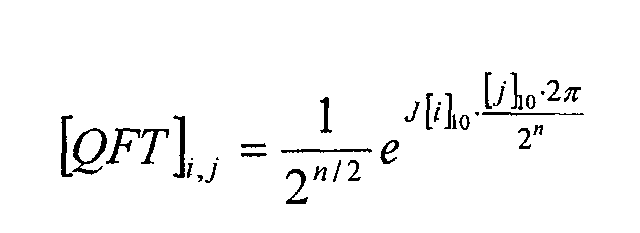



 being int[.] the function that generates the integer part of its argument and being h=1..22 n .


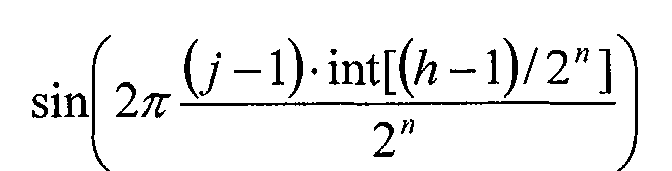 for all values of said index j of said arithmetical succession to which correspond indices (k) of non null components of said entanglement vector.