EP1429275A2 - Improvements in or relating to data processing systems - Google Patents
Improvements in or relating to data processing systems Download PDFInfo
- Publication number
- EP1429275A2 EP1429275A2 EP03257588A EP03257588A EP1429275A2 EP 1429275 A2 EP1429275 A2 EP 1429275A2 EP 03257588 A EP03257588 A EP 03257588A EP 03257588 A EP03257588 A EP 03257588A EP 1429275 A2 EP1429275 A2 EP 1429275A2
- Authority
- EP
- European Patent Office
- Prior art keywords
- processing
- analysis
- agent
- signature characteristic
- subject
- Prior art date
- Legal status (The legal status is an assumption and is not a legal conclusion. Google has not performed a legal analysis and makes no representation as to the accuracy of the status listed.)
- Withdrawn
Links
Images

Classifications
-
- G—PHYSICS
- G06—COMPUTING OR CALCULATING; COUNTING
- G06T—IMAGE DATA PROCESSING OR GENERATION, IN GENERAL
- G06T7/00—Image analysis
- G06T7/0002—Inspection of images, e.g. flaw detection
- G06T7/0012—Biomedical image inspection
-
- A—HUMAN NECESSITIES
- A61—MEDICAL OR VETERINARY SCIENCE; HYGIENE
- A61B—DIAGNOSIS; SURGERY; IDENTIFICATION
- A61B5/00—Measuring for diagnostic purposes; Identification of persons
- A61B5/05—Detecting, measuring or recording for diagnosis by means of electric currents or magnetic fields; Measuring using microwaves or radio waves
- A61B5/055—Detecting, measuring or recording for diagnosis by means of electric currents or magnetic fields; Measuring using microwaves or radio waves involving electronic [EMR] or nuclear [NMR] magnetic resonance, e.g. magnetic resonance imaging
-
- G—PHYSICS
- G01—MEASURING; TESTING
- G01R—MEASURING ELECTRIC VARIABLES; MEASURING MAGNETIC VARIABLES
- G01R33/00—Arrangements or instruments for measuring magnetic variables
- G01R33/20—Arrangements or instruments for measuring magnetic variables involving magnetic resonance
- G01R33/28—Details of apparatus provided for in groups G01R33/44 - G01R33/64
- G01R33/281—Means for the use of in vitro contrast agents
-
- G—PHYSICS
- G16—INFORMATION AND COMMUNICATION TECHNOLOGY [ICT] SPECIALLY ADAPTED FOR SPECIFIC APPLICATION FIELDS
- G16H—HEALTHCARE INFORMATICS, i.e. INFORMATION AND COMMUNICATION TECHNOLOGY [ICT] SPECIALLY ADAPTED FOR THE HANDLING OR PROCESSING OF MEDICAL OR HEALTHCARE DATA
- G16H30/00—ICT specially adapted for the handling or processing of medical images
- G16H30/20—ICT specially adapted for the handling or processing of medical images for handling medical images, e.g. DICOM, HL7 or PACS
Definitions
- the present invention is concerned with processing systems, in particular systems in which a processing apparatus is used in conjunction with a processing agent administered to a processing subject to achieve a desired process result.
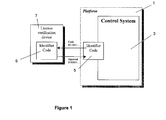
- FIG 1 illustrates schematically the conventional approach to securing the distribution of software systems such as licence identification, serial numbers, hardware locks (“dongles”) etc.
- a processing apparatus 1 includes a control system 3 which is provided with authentication functionality 5.
- This authentication functionality 5 communicates with a licence verification device 7, which includes an identifier code 9, and on provision of the correct identification to the licence verification device 7, approval is given back to the processing apparatus 1 for it to function.
- This process may be similar to the familiar one of registering software with the software manufacturer in order for it to be enabled, or may be based on the use of a "dongle” which is a small hardware device which is attached to an information interface of an apparatus, which restricts the use of the apparatus unless the dongle is attached.
- the present invention is concerned with providing an alternative way of protecting or authorising use of a processing system where that processing system is designed to be used with a processing agent.
- the invention provides for the processing agent to have a particular distinctive signature which distinguishes it from other processing agents, and for the system to include test functionality to interrogate the processing agent to ensure that its signature behaviour is consistent with that expected.
- the signature behaviour may be inherent to the processing agent, or added to it, or provided in another component which is administered along with the processing agent.
- the present invention provides a processing system comprising an processing apparatus and a processing agent, the processing agent being administrable to a processing subject and having in relation thereto a primary behaviour effective in combination with said processing apparatus to achieve a desired process result, wherein the processing agent further has a distinctive signature characteristic distinguishing it from other processing agents, and wherein the processing system comprises test functionality to test for the distinctive signature characteristic of the processing agent and selectively to modify subsequent operation of the processing apparatus based on the test result.
- the test functionality may be effective to disable, at least partially, subsequent operation of the processing apparatus in the absence of the distinctive signature characteristic. It may be effective, at least partially, to disable output of the process result.
- the processing agent may comprise a first component for providing the primary behaviour and a second component having the distinctive signature characteristic.
- the two components may be mixed, or the two may be bound at a molecular level.
- the signature characteristic may be in the behaviour of the processing agent in the processing subject, such as its time-dependent or spatial behaviour, or it may be a property of the processing agent which is detectable by the processing apparatus.
- the processing apparatus is an analysis apparatus
- the processing agent is an analysis agent
- the processing subject is an analysis subject.
- the primary behaviour of the analysis agent is effective to reveal on analysis by the analysis apparatus a condition of the analysis subject.
- the distinctive signature characteristic may be a property of the analysis agent detectable in the course of the analysis of the primary behaviour of the analysis agent.
- the analysis agent may be a contrast agent.
- the analysis agent may, for example, comprise two radioisotopes of different decay characteristics, which provide the distinctive signature characteristic, or may comprise a component emitting photons of a particular energy to provide the distinctive signature characteristic, or a component having a distinctive magnetic resonance spectrum.
- the processing subject may be a human being, plant or animal, or the processing may be in vitro.
- the invention extends to a computer program which comprises program code means for providing the test functionality, and optionally also for controlling the apparatus. Further, the invention extends to a processing agent for use in such a processing system and which is provided with a distinctive signature characteristic in addition to its primary behaviour, thus allowing it to be distinguished from other processing agents by the test functionality.
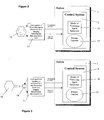
- FIG. 2 schematically illustrates a first embodiment of the invention.
- a processing apparatus 1 includes a control system 3 which is responsible for controlling the processing apparatus to achieve a desired processing result in conjunction with a processing agent 13, which may be a product for administration to a processing subject.
- the system includes test functionality illustrated here as 11 and 15 for interrogating the behaviour of the processing agent and comparing the result to a model 15 of the behaviour of the processing agent. If the result is positive then the primary function 17 of the apparatus is enabled.
- FIG 3 illustrates an alternative embodiment in which the processing agent 13 has bound to it another component 19 which provides the distinctive signature behaviour. Otherwise the operation of the embodiment of Figure 3 is the same as that of Figure 2.
- the additional component providing the distinctive signature behaviour may simply be mixed with the processing agent.
- contrast agents such as gadolinium chelates are used for contrast-enhancement.
- These may be mixed with a benign synthetic protein having a specific nuclear magnetic resonance signal (spectrum) which can be detected by the magnetic resonance scanner as part of the acquisition process.
- the scanner may be designed to enable output of the results only if the required signal of the benign synthetic protein is present.
- it may be that basic results are output with any contrast agent, regardless of the test result, but that additional processing to enhance the image is only available if the contrast agent including the benign synthetic protein is used.
- Single Photon Emission Computed Tomography cameras detect disintegration of photons from nuclear isotope sources.
- Many radioactive isotopes are used in practice, for instance 99m Tc (Technetium), or 201 T1 (Thallium).
- the disintegration of the isotope creates photons of a particular energy, which depends of the isotope and the energy level of the reaction. For instance, for 99m Tc the energy of the emitted photon is between 135 and 145 keV, for 201 T1, the energy is between 60 and 85 keV.
- a contrast agent is prepared (similar to that for a dual isotope acquisition) which contains two different isotopes A and B, for example A may be 201 T1 and B may be 99m Tc.
- Isotope A is the one used for the clinical diagnostic protocol, i.e. providing the primary behaviour of the analysis agent, and B provides the distinctive signature characteristic.
- the presence and amount of isotope B is kept secret to the manufacturer of the contrast agent and the software system controlling the SPECT apparatus.
- Providing for the SPECT apparatus to detect the proportion of isotope B present means that the apparatus can be enabled only in the presence of the expected proportion of isotope B, or the full functionality can be provided only in the presence of the expected proportion of agent B.
- the detection of the radiation from the two isotopes may be achieved during the same acquisition protocol, without the need for any additional operations by the user.
- Positron Emission Tomography detectors can identify the photon pair emitted from the disintegration of a positron, itself emitted from a radioactive isotope such as 18 F or 15 O.
- the energy of the positron is 511 keV, and although there is no possibility to differentiate a positron emitted from 18 F or from 15 O, the half-life of the two isotopes are different: for 18 F, around 2 hours, for 15 O, around 2 minutes.
- a contrast agent can be prepared as a combination of known proportions of the two different agents 18 F and 15 O; the diagnostic agent is 18 F associated for instance with the deoxy-glucose (FDG), the other one, 15 O, with water.
- FDG deoxy-glucose
- the diagnostic agent is 18 F associated for instance with the deoxy-glucose (FDG), the other one, 15 O, with water.
- the distinctive magnetic resonance spectrum of the contrast agent can form the distinctive signature characteristic.
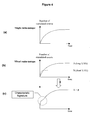
- Figure 5 illustrates a magnetic resonance spectrum for a particular molecule. As indicated in Figure 5, the position and height of peaks above the background noise form a distinctive signature for the molecule.
- Magnetic resonance imaging and spectroscopy commonly use contrast agents and such contrast agents can be combined with (either by simple mixing or molecular binding) another molecule which has a clear and distinctive magnetic resonance spectrum.
- Figure 6 illustrates the spectra for various different molecules and the presence of the different molecules can be recognised from the different curves. ( Figure 6 in fact shows two MRS curves, one in a lesion (marked "lesion") and one in a normal area of white matter (marked "NAWM").
- peaks identified and labelled indicate unequivocally the presence of the four types of molecule listed below the graph, namely: tCho - Choline; tCr - Creatine + Creatine Phosphate; NAA - N-acetylaspartate; and Ins - myo-Inositol).
- tCho - Choline a particular molecule included in the processing agent is used as a "key" to unlock the desired functionality of the processing apparatus.
- the invention is applicable to other analysis techniques and indeed broadly to processing systems which use a processing agent administered to a processing subject together with a processing apparatus.
- a processing agent administered to a processing subject together with a processing apparatus.
- This enables the use and functionality of particular apparatus to be tied with use of particular processing agents. It can therefore ensure that only approved processing protocols are used, giving quality control, and control of the use of third party apparatus and agents.
Landscapes
- Health & Medical Sciences (AREA)
- Engineering & Computer Science (AREA)
- Physics & Mathematics (AREA)
- Nuclear Medicine, Radiotherapy & Molecular Imaging (AREA)
- Life Sciences & Earth Sciences (AREA)
- General Health & Medical Sciences (AREA)
- Medical Informatics (AREA)
- Radiology & Medical Imaging (AREA)
- Quality & Reliability (AREA)
- Biomedical Technology (AREA)
- Theoretical Computer Science (AREA)
- High Energy & Nuclear Physics (AREA)
- Computer Vision & Pattern Recognition (AREA)
- Biophysics (AREA)
- Pathology (AREA)
- General Physics & Mathematics (AREA)
- Heart & Thoracic Surgery (AREA)
- Molecular Biology (AREA)
- Surgery (AREA)
- Animal Behavior & Ethology (AREA)
- Public Health (AREA)
- Veterinary Medicine (AREA)
- Medicines Containing Antibodies Or Antigens For Use As Internal Diagnostic Agents (AREA)
- Magnetic Resonance Imaging Apparatus (AREA)
Abstract
Description
- passwords/software keys/licence number authentication
- hardware locks (hardware keys "dongles")
- processor/network/hardware identification.
Claims (20)
- A processing system comprising an processing apparatus and a processing agent, the processing agent being administrable to a processing subject and having in relation thereto a primary behaviour effective in combination with said processing apparatus to achieve a desired process result, wherein the processing agent further has a distinctive signature characteristic distinguishing it from other processing agents, and wherein the processing system comprises test functionality to test for the distinctive signature characteristic of the processing agent and selectively to modify subsequent operation of the processing apparatus based on the test result.
- A processing system according to claim1 wherein the test functionality is effective to disable, at least partially, subsequent operation of the processing apparatus in the absence of said distinctive signature characteristic.
- A processing system according to claim 1 or 2 wherein the test functionality is effective to disable, at least partially, output of the process result in the absence of said distinctive signature characteristic.
- A processing system according to claim 1, 2 or 3 wherein the processing agent comprises a first component for providing said primary behaviour and a second component having said distinctive signature characteristic.
- A processing system according to any one of the preceding claims wherein the distinctive signature characteristic is in the behaviour of the processing agent in the processing subject.
- A processing system according to claim 5 wherein the distinctive signature characteristic is in the time-dependent behaviour of the processing agent in the processing subject.
- A processing system according to claim 5 or 6 wherein the distinctive signature characteristic is in the spatially-dependent behaviour of the processing agent in the processing subject.
- A processing system according to any one of the preceding claims wherein the distinctive signature characteristic is a property of the processing agent detectable by the processing apparatus.
- A processing system according to any one of the preceding claims wherein the processing apparatus comprises an analysis apparatus, the processing agent comprises an analysis agent and the processing subject is an analysis subject, the analysis agent being administrable to the analysis subject and having in relation thereto a primary behaviour effective to reveal upon analysis by the analysis apparatus a condition of the analysis subject as said process result.
- An analysis system according to claim 9 wherein the distinctive signature characteristic is a property of the processing agent detectable by the analysis apparatus on analysis of the primary behaviour of the analysis agent.
- An analysis system according to claim 9 or 10 wherein the analysis apparatus is a medical imaging apparatus and the analysis agent comprises a contrast agent.
- An analysis system according to claim 11 wherein the analysis agent comprises two radio isotopes of different decay characteristics to provide said distinctive signature characteristic.
- An analysis system according to claim 11 wherein the analysis agent comprises a component emitting photons of a particular energy to provide said distinctive signature characteristic.
- An analysis system according to claim 11 wherein the distinctive signature characteristic is the magnetic resonance spectrum of the contrast agent.
- An analysis system according to claim 11 wherein the analysis agent comprises the contrast agent and a further component having a distinctive magnetic resonance spectrum to provide said distinctive signature characteristic.
- A processing system according to any one of the preceding claims wherein the processing subject is a human being, plant or animal.
- A processing system according to any one of the preceding claims wherein the processing subject is in vitro.
- A computer program comprising program code means for providing on a programmed data processor test functionality for use in a processing system in accordance with any one of claims 1 to 17.
- A computer program according to claim 18 further comprising program code means for controlling said processing apparatus to achieve said desired process result.
- A processing agent for use in a processing system in accordance with any one of claims 1 to 17 and having in relation to a predetermined processing subject a primary behaviour effective in combination with said processing apparatus to achieve a desired process result, and further having a distinctive signature characteristic distinguishing it from other processing agents and distinguishable by said test functionality.
Applications Claiming Priority (2)
| Application Number | Priority Date | Filing Date | Title |
|---|---|---|---|
| GB0228960 | 2002-12-11 | ||
| GBGB0228960.1A GB0228960D0 (en) | 2002-12-11 | 2002-12-11 | Improvements in or relating to processing systems |
Publications (2)
| Publication Number | Publication Date |
|---|---|
| EP1429275A2 true EP1429275A2 (en) | 2004-06-16 |
| EP1429275A3 EP1429275A3 (en) | 2006-08-30 |
Family
ID=9949546
Family Applications (1)
| Application Number | Title | Priority Date | Filing Date |
|---|---|---|---|
| EP03257588A Withdrawn EP1429275A3 (en) | 2002-12-11 | 2003-12-02 | Improvements in or relating to data processing systems |
Country Status (3)
| Country | Link |
|---|---|
| US (1) | US20040143449A1 (en) |
| EP (1) | EP1429275A3 (en) |
| GB (1) | GB0228960D0 (en) |
Families Citing this family (20)
| Publication number | Priority date | Publication date | Assignee | Title |
|---|---|---|---|---|
| WO2005119025A2 (en) | 2004-06-01 | 2005-12-15 | Spectrum Dynamics Llc | Radioactive-emission-measurement optimization to specific body structures |
| US8565860B2 (en) | 2000-08-21 | 2013-10-22 | Biosensors International Group, Ltd. | Radioactive emission detector equipped with a position tracking system |
| US9040016B2 (en) | 2004-01-13 | 2015-05-26 | Biosensors International Group, Ltd. | Diagnostic kit and methods for radioimaging myocardial perfusion |
| US10964075B2 (en) | 2004-01-13 | 2021-03-30 | Spectrum Dynamics Llc | Gating with anatomically varying durations |
| US8586932B2 (en) | 2004-11-09 | 2013-11-19 | Spectrum Dynamics Llc | System and method for radioactive emission measurement |
| WO2005067383A2 (en) | 2004-01-13 | 2005-07-28 | Spectrum Dynamics Llc | Multi-dimensional image reconstruction |
| US8571881B2 (en) * | 2004-11-09 | 2013-10-29 | Spectrum Dynamics, Llc | Radiopharmaceutical dispensing, administration, and imaging |
| US8615405B2 (en) * | 2004-11-09 | 2013-12-24 | Biosensors International Group, Ltd. | Imaging system customization using data from radiopharmaceutical-associated data carrier |
| US9316743B2 (en) | 2004-11-09 | 2016-04-19 | Biosensors International Group, Ltd. | System and method for radioactive emission measurement |
| US10136865B2 (en) | 2004-11-09 | 2018-11-27 | Spectrum Dynamics Medical Limited | Radioimaging using low dose isotope |
| US8606349B2 (en) | 2004-11-09 | 2013-12-10 | Biosensors International Group, Ltd. | Radioimaging using low dose isotope |
| US8423125B2 (en) * | 2004-11-09 | 2013-04-16 | Spectrum Dynamics Llc | Radioimaging |
| WO2008059489A2 (en) | 2006-11-13 | 2008-05-22 | Spectrum Dynamics Llc | Radioimaging applications of and novel formulations of teboroxime |
| EP1908011B1 (en) | 2005-07-19 | 2013-09-04 | Spectrum Dynamics LLC | Reconstruction stabilizer and active vision |
| US8837793B2 (en) | 2005-07-19 | 2014-09-16 | Biosensors International Group, Ltd. | Reconstruction stabilizer and active vision |
| US8894974B2 (en) | 2006-05-11 | 2014-11-25 | Spectrum Dynamics Llc | Radiopharmaceuticals for diagnosis and therapy |
| WO2008075362A2 (en) | 2006-12-20 | 2008-06-26 | Spectrum Dynamics Llc | A method, a system, and an apparatus for using and processing multidimensional data |
| EP2730247B1 (en) * | 2007-02-22 | 2017-04-26 | Ramot at Tel Aviv University Ltd. | Apparatus for intraluminal treatments |
| US8338788B2 (en) | 2009-07-29 | 2012-12-25 | Spectrum Dynamics Llc | Method and system of optimized volumetric imaging |
| US11281780B2 (en) * | 2018-02-07 | 2022-03-22 | Medicapture, Inc. | System and method for authorizing and unlocking functionality embedded in a system |
Family Cites Families (14)
| Publication number | Priority date | Publication date | Assignee | Title |
|---|---|---|---|---|
| US5854084A (en) * | 1996-07-12 | 1998-12-29 | Biotraces, Inc. | Enhanced chromatography using multiphoton detection |
| US5526816A (en) * | 1994-09-22 | 1996-06-18 | Bracco Research S.A. | Ultrasonic spectral contrast imaging |
| US5819027A (en) * | 1996-02-28 | 1998-10-06 | Intel Corporation | Bus patcher |
| CA2315037A1 (en) * | 1997-12-19 | 1999-07-01 | Beth Israel Deaconess Medical Center | Methods and compositions for inhibiting tumor cell growth |
| US6088804A (en) * | 1998-01-12 | 2000-07-11 | Motorola, Inc. | Adaptive system and method for responding to computer network security attacks |
| US6217554B1 (en) * | 1999-02-12 | 2001-04-17 | Pharmaspec Corporation | Methods and apparatus for delivering substances into extravascular tissue |
| CA2372447A1 (en) * | 1999-02-19 | 2000-08-24 | Fox Chase Cancer Center | Methods of decomposing complex data |
| US6317623B1 (en) * | 1999-03-12 | 2001-11-13 | Medrad, Inc. | Apparatus and method for controlling contrast enhanced imaging procedures |
| US6167297A (en) * | 1999-05-05 | 2000-12-26 | Benaron; David A. | Detecting, localizing, and targeting internal sites in vivo using optical contrast agents |
| US6697948B1 (en) * | 1999-05-05 | 2004-02-24 | Michael O. Rabin | Methods and apparatus for protecting information |
| WO2001006233A1 (en) * | 1999-07-16 | 2001-01-25 | Human Genome Sciences, Inc. | Real-time, in situ biomanufacturing process monitoring and control in response to ir spectroscopy |
| US6514704B2 (en) * | 2001-02-01 | 2003-02-04 | Xerox Corporation | Quality control mechanism and process for a biofluid multi-ejector system |
| US7050620B2 (en) * | 2001-03-30 | 2006-05-23 | Heckman Carol A | Method of assaying shape and structural features in cells |
| US6612989B1 (en) * | 2002-06-18 | 2003-09-02 | Koninklijke Philips Electronics N.V. | System and method for synchronized persistence with contrast agent imaging |
-
2002
- 2002-12-11 GB GBGB0228960.1A patent/GB0228960D0/en not_active Ceased
-
2003
- 2003-12-02 EP EP03257588A patent/EP1429275A3/en not_active Withdrawn
- 2003-12-11 US US10/734,655 patent/US20040143449A1/en not_active Abandoned
Also Published As
| Publication number | Publication date |
|---|---|
| US20040143449A1 (en) | 2004-07-22 |
| EP1429275A3 (en) | 2006-08-30 |
| GB0228960D0 (en) | 2003-01-15 |
Similar Documents
| Publication | Publication Date | Title |
|---|---|---|
| US20040143449A1 (en) | Processing systems | |
| van de Maat et al. | MRI-based biodistribution assessment of holmium-166 poly (L-lactic acid) microspheres after radioembolisation | |
| Stella et al. | Holmium-166 radioembolization: current status and future prospective | |
| Wiesmüller et al. | Comparison of lesion detection and quantitation of tracer uptake between PET from a simultaneously acquiring whole-body PET/MR hybrid scanner and PET from PET/CT | |
| Willowson et al. | Quantitative 90Y image reconstruction in PET | |
| Essig et al. | Assessment of brain metastases with dynamic susceptibility-weighted contrast-enhanced MR imaging: initial results | |
| Afshar-Oromieh et al. | Comparison of PET/CT and PET/MRI hybrid systems using a 68Ga-labelled PSMA ligand for the diagnosis of recurrent prostate cancer: initial experience | |
| Smits et al. | In vivo dosimetry based on SPECT and MR imaging of 166Ho-microspheres for treatment of liver malignancies | |
| Fowler et al. | PET/MRI of hepatic 90Y microsphere deposition determines individual tumor response | |
| Hippeläinen et al. | Dosimetry software Hermes Internal Radiation Dosimetry: from quantitative image reconstruction to voxel-level absorbed dose distribution | |
| Wang et al. | Critical role of imaging in the neurosurgical and radiotherapeutic management of brain tumors | |
| Bailey et al. | In vivo quantification of 177Lu with planar whole-body and SPECT/CT gamma camera imaging | |
| Wong et al. | PET of hypoxia and perfusion with 62Cu-ATSM and 62Cu-PTSM using a 62Zn/62Cu generator | |
| Osborne et al. | Patient-specific extravasation dosimetry using uptake probe measurements | |
| Pujara et al. | Standardized uptake values from PET/MRI in metastatic breast cancer: an organ‐based comparison with PET/CT | |
| Shah et al. | PET/MR imaging of multiple myeloma | |
| Belov et al. | Iodine-124 as a label for pharmacological PET imaging | |
| Afshar-Oromieh et al. | Effects of arm truncation on the appearance of the halo artifact in 68Ga-PSMA-11 (HBED-CC) PET/MRI | |
| Sun et al. | [18F] ML‐10 Imaging for Assessment of Apoptosis Response of Intracranial Tumor Early after Radiosurgery by PET/CT | |
| Yamane et al. | Satisfied quantitative value can be acquired by short-time bone SPECT/CT using a whole-body cadmium–zinc–telluride gamma camera | |
| Garin et al. | Utility of quantitative 99mTc‐MAA SPECT/CT for 90yttrium‐Labelled microsphere treatment planning: calculating vascularized hepatic volume and dosimetric approach | |
| Takenaka et al. | Comparison of 11C-methionine, 11C-choline, and 18F-fluorodeoxyglucose-positron emission tomography for distinguishing glioma recurrence from radiation necrosis | |
| English et al. | Basics of physics and radiobiology for radiopharmaceutical therapies | |
| Pugmire et al. | Simultaneous whole body 18F-fluorodeoxyglucose positron emission tomography magnetic resonance imaging for evaluation of pediatric cancer: Preliminary experience and comparison with 18F-fluorodeoxyglucose positron emission tomography computed tomography | |
| Hassanzadeh et al. | Multiparametric MRI and [18F] fluorodeoxyglucose positron emission tomography imaging is a potential prognostic imaging biomarker in recurrent glioblastoma |
Legal Events
| Date | Code | Title | Description |
|---|---|---|---|
| PUAI | Public reference made under article 153(3) epc to a published international application that has entered the european phase |
Free format text: ORIGINAL CODE: 0009012 |
|
| AK | Designated contracting states |
Kind code of ref document: A2 Designated state(s): AT BE BG CH CY CZ DE DK EE ES FI FR GB GR HU IE IT LI LU MC NL PT RO SE SI SK TR |
|
| AX | Request for extension of the european patent |
Extension state: AL LT LV MK |
|
| PUAL | Search report despatched |
Free format text: ORIGINAL CODE: 0009013 |
|
| AK | Designated contracting states |
Kind code of ref document: A3 Designated state(s): AT BE BG CH CY CZ DE DK EE ES FI FR GB GR HU IE IT LI LU MC NL PT RO SE SI SK TR |
|
| AX | Request for extension of the european patent |
Extension state: AL LT LV MK |
|
| 17P | Request for examination filed |
Effective date: 20070227 |
|
| AKX | Designation fees paid |
Designated state(s): AT BE BG CH CY CZ DE DK EE ES FI FR GB GR HU IE IT LI LU MC NL PT RO SE SI SK TR |
|
| 17Q | First examination report despatched |
Effective date: 20070524 |
|
| RAP1 | Party data changed (applicant data changed or rights of an application transferred) |
Owner name: SIEMENS MEDICAL SOLUTIONS USA, INC. |
|
| STAA | Information on the status of an ep patent application or granted ep patent |
Free format text: STATUS: THE APPLICATION IS DEEMED TO BE WITHDRAWN |
|
| 18D | Application deemed to be withdrawn |
Effective date: 20080930 |