EP1428859A1 - Production process of metal phthalocyanine compound - Google Patents
Production process of metal phthalocyanine compound Download PDFInfo
- Publication number
- EP1428859A1 EP1428859A1 EP03028229A EP03028229A EP1428859A1 EP 1428859 A1 EP1428859 A1 EP 1428859A1 EP 03028229 A EP03028229 A EP 03028229A EP 03028229 A EP03028229 A EP 03028229A EP 1428859 A1 EP1428859 A1 EP 1428859A1
- Authority
- EP
- European Patent Office
- Prior art keywords
- group
- acid
- carbon atoms
- compounds
- represented
- Prior art date
- Legal status (The legal status is an assumption and is not a legal conclusion. Google has not performed a legal analysis and makes no representation as to the accuracy of the status listed.)
- Granted
Links
- -1 phthalocyanine compound Chemical class 0.000 title claims abstract description 153
- 229910052751 metal Inorganic materials 0.000 title claims abstract description 28
- 239000002184 metal Substances 0.000 title claims abstract description 28
- 238000004519 manufacturing process Methods 0.000 title description 16
- 150000001875 compounds Chemical class 0.000 claims abstract description 65
- 238000000034 method Methods 0.000 claims abstract description 62
- 238000006243 chemical reaction Methods 0.000 claims abstract description 29
- 239000002253 acid Substances 0.000 claims abstract description 28
- 150000007530 organic bases Chemical class 0.000 claims abstract description 14
- 239000007853 buffer solution Substances 0.000 claims abstract description 10
- 150000002736 metal compounds Chemical class 0.000 claims abstract description 10
- 150000007529 inorganic bases Chemical class 0.000 claims abstract description 9
- 229910052783 alkali metal Inorganic materials 0.000 claims abstract description 6
- 150000001340 alkali metals Chemical class 0.000 claims abstract description 5
- 125000001424 substituent group Chemical group 0.000 claims description 35
- 125000000623 heterocyclic group Chemical group 0.000 claims description 34
- 125000003118 aryl group Chemical group 0.000 claims description 25
- 150000007524 organic acids Chemical class 0.000 claims description 25
- 239000002585 base Substances 0.000 claims description 20
- 125000000217 alkyl group Chemical group 0.000 claims description 18
- 125000000472 sulfonyl group Chemical group *S(*)(=O)=O 0.000 claims description 14
- 125000002252 acyl group Chemical group 0.000 claims description 13
- 125000004397 aminosulfonyl group Chemical group NS(=O)(=O)* 0.000 claims description 13
- 125000003917 carbamoyl group Chemical group [H]N([H])C(*)=O 0.000 claims description 13
- 125000000475 sulfinyl group Chemical group [*:2]S([*:1])=O 0.000 claims description 11
- 125000000753 cycloalkyl group Chemical group 0.000 claims description 9
- 125000004435 hydrogen atom Chemical group [H]* 0.000 claims description 9
- 125000003342 alkenyl group Chemical group 0.000 claims description 7
- 125000000304 alkynyl group Chemical group 0.000 claims description 7
- 125000000392 cycloalkenyl group Chemical group 0.000 claims description 7
- 229910052725 zinc Inorganic materials 0.000 claims description 7
- PEDCQBHIVMGVHV-UHFFFAOYSA-N Glycerine Chemical compound OCC(O)CO PEDCQBHIVMGVHV-UHFFFAOYSA-N 0.000 claims description 6
- 229910052802 copper Inorganic materials 0.000 claims description 6
- 125000002496 methyl group Chemical group [H]C([H])([H])* 0.000 claims description 6
- 229910052759 nickel Inorganic materials 0.000 claims description 6
- 229940126062 Compound A Drugs 0.000 claims description 5
- NLDMNSXOCDLTTB-UHFFFAOYSA-N Heterophylliin A Natural products O1C2COC(=O)C3=CC(O)=C(O)C(O)=C3C3=C(O)C(O)=C(O)C=C3C(=O)OC2C(OC(=O)C=2C=C(O)C(O)=C(O)C=2)C(O)C1OC(=O)C1=CC(O)=C(O)C(O)=C1 NLDMNSXOCDLTTB-UHFFFAOYSA-N 0.000 claims description 5
- 229910052742 iron Inorganic materials 0.000 claims description 5
- 229910052793 cadmium Inorganic materials 0.000 claims description 4
- 239000007810 chemical reaction solvent Substances 0.000 claims description 4
- 229910052749 magnesium Inorganic materials 0.000 claims description 4
- 229910052748 manganese Inorganic materials 0.000 claims description 4
- 229910052763 palladium Inorganic materials 0.000 claims description 4
- OGIDPMRJRNCKJF-UHFFFAOYSA-N titanium oxide Inorganic materials [Ti]=O OGIDPMRJRNCKJF-UHFFFAOYSA-N 0.000 claims description 4
- 235000011187 glycerol Nutrition 0.000 claims description 3
- 125000004432 carbon atom Chemical group C* 0.000 description 92
- KFZMGEQAYNKOFK-UHFFFAOYSA-N Isopropanol Chemical compound CC(C)O KFZMGEQAYNKOFK-UHFFFAOYSA-N 0.000 description 56
- LYCAIKOWRPUZTN-UHFFFAOYSA-N Ethylene glycol Chemical compound OCCO LYCAIKOWRPUZTN-UHFFFAOYSA-N 0.000 description 50
- QTBSBXVTEAMEQO-UHFFFAOYSA-N Acetic acid Chemical compound CC(O)=O QTBSBXVTEAMEQO-UHFFFAOYSA-N 0.000 description 27
- 239000000203 mixture Substances 0.000 description 19
- MTHSVFCYNBDYFN-UHFFFAOYSA-N diethylene glycol Chemical compound OCCOCCO MTHSVFCYNBDYFN-UHFFFAOYSA-N 0.000 description 18
- 229940093915 gynecological organic acid Drugs 0.000 description 16
- 235000005985 organic acids Nutrition 0.000 description 16
- DNIAPMSPPWPWGF-UHFFFAOYSA-N Propylene glycol Chemical compound CC(O)CO DNIAPMSPPWPWGF-UHFFFAOYSA-N 0.000 description 14
- 230000015572 biosynthetic process Effects 0.000 description 14
- 238000002425 crystallisation Methods 0.000 description 14
- 230000008025 crystallization Effects 0.000 description 14
- 239000007787 solid Substances 0.000 description 14
- 239000002904 solvent Substances 0.000 description 14
- 238000003786 synthesis reaction Methods 0.000 description 14
- VEXZGXHMUGYJMC-UHFFFAOYSA-N Hydrochloric acid Chemical compound Cl VEXZGXHMUGYJMC-UHFFFAOYSA-N 0.000 description 12
- OKKJLVBELUTLKV-UHFFFAOYSA-N Methanol Chemical compound OC OKKJLVBELUTLKV-UHFFFAOYSA-N 0.000 description 12
- JUJWROOIHBZHMG-UHFFFAOYSA-N Pyridine Chemical compound C1=CC=NC=C1 JUJWROOIHBZHMG-UHFFFAOYSA-N 0.000 description 12
- 238000003756 stirring Methods 0.000 description 12
- WMFOQBRAJBCJND-UHFFFAOYSA-M Lithium hydroxide Chemical compound [Li+].[OH-] WMFOQBRAJBCJND-UHFFFAOYSA-M 0.000 description 11
- XQZYPMVTSDWCCE-UHFFFAOYSA-N phthalonitrile Chemical compound N#CC1=CC=CC=C1C#N XQZYPMVTSDWCCE-UHFFFAOYSA-N 0.000 description 11
- 125000000020 sulfo group Chemical group O=S(=O)([*])O[H] 0.000 description 11
- 125000003178 carboxy group Chemical group [H]OC(*)=O 0.000 description 10
- 150000002500 ions Chemical class 0.000 description 10
- KWGKDLIKAYFUFQ-UHFFFAOYSA-M lithium chloride Chemical compound [Li+].[Cl-] KWGKDLIKAYFUFQ-UHFFFAOYSA-M 0.000 description 10
- 229920006391 phthalonitrile polymer Polymers 0.000 description 10
- 150000003839 salts Chemical class 0.000 description 10
- ZMANZCXQSJIPKH-UHFFFAOYSA-N Triethylamine Chemical compound CCN(CC)CC ZMANZCXQSJIPKH-UHFFFAOYSA-N 0.000 description 9
- 235000011054 acetic acid Nutrition 0.000 description 9
- 125000004453 alkoxycarbonyl group Chemical group 0.000 description 9
- ORTQZVOHEJQUHG-UHFFFAOYSA-L copper(II) chloride Chemical compound Cl[Cu]Cl ORTQZVOHEJQUHG-UHFFFAOYSA-L 0.000 description 9
- 125000002887 hydroxy group Chemical group [H]O* 0.000 description 9
- IEQIEDJGQAUEQZ-UHFFFAOYSA-N phthalocyanine Chemical compound N1C(N=C2C3=CC=CC=C3C(N=C3C4=CC=CC=C4C(=N4)N3)=N2)=C(C=CC=C2)C2=C1N=C1C2=CC=CC=C2C4=N1 IEQIEDJGQAUEQZ-UHFFFAOYSA-N 0.000 description 9
- HZAXFHJVJLSVMW-UHFFFAOYSA-N 2-Aminoethan-1-ol Chemical compound NCCO HZAXFHJVJLSVMW-UHFFFAOYSA-N 0.000 description 8
- 239000013078 crystal Substances 0.000 description 8
- 238000000354 decomposition reaction Methods 0.000 description 8
- DXMQZKIEVHKNTN-UHFFFAOYSA-N 2-[carbamimidoyl(ethyl)amino]acetic acid Chemical compound CCN(C(N)=N)CC(O)=O DXMQZKIEVHKNTN-UHFFFAOYSA-N 0.000 description 7
- 125000003545 alkoxy group Chemical group 0.000 description 7
- 125000003282 alkyl amino group Chemical group 0.000 description 7
- 125000004104 aryloxy group Chemical group 0.000 description 7
- 125000001951 carbamoylamino group Chemical group C(N)(=O)N* 0.000 description 7
- 125000002915 carbonyl group Chemical group [*:2]C([*:1])=O 0.000 description 7
- 125000004093 cyano group Chemical group *C#N 0.000 description 7
- 238000000921 elemental analysis Methods 0.000 description 7
- 238000004992 fast atom bombardment mass spectroscopy Methods 0.000 description 7
- 125000005843 halogen group Chemical group 0.000 description 7
- 238000004949 mass spectrometry Methods 0.000 description 7
- 239000000243 solution Substances 0.000 description 7
- XLYOFNOQVPJJNP-UHFFFAOYSA-N water Substances O XLYOFNOQVPJJNP-UHFFFAOYSA-N 0.000 description 7
- ZHNUHDYFZUAESO-UHFFFAOYSA-N Formamide Chemical compound NC=O ZHNUHDYFZUAESO-UHFFFAOYSA-N 0.000 description 6
- DHMQDGOQFOQNFH-UHFFFAOYSA-N Glycine Chemical compound NCC(O)=O DHMQDGOQFOQNFH-UHFFFAOYSA-N 0.000 description 6
- YNAVUWVOSKDBBP-UHFFFAOYSA-N Morpholine Chemical compound C1COCCN1 YNAVUWVOSKDBBP-UHFFFAOYSA-N 0.000 description 6
- NQRYJNQNLNOLGT-UHFFFAOYSA-N Piperidine Chemical compound C1CCNCC1 NQRYJNQNLNOLGT-UHFFFAOYSA-N 0.000 description 6
- KWYUFKZDYYNOTN-UHFFFAOYSA-M Potassium hydroxide Chemical compound [OH-].[K+] KWYUFKZDYYNOTN-UHFFFAOYSA-M 0.000 description 6
- XSQUKJJJFZCRTK-UHFFFAOYSA-N Urea Chemical class NC(N)=O XSQUKJJJFZCRTK-UHFFFAOYSA-N 0.000 description 6
- 125000004414 alkyl thio group Chemical group 0.000 description 6
- 150000001412 amines Chemical class 0.000 description 6
- 125000003277 amino group Chemical group 0.000 description 6
- 125000006615 aromatic heterocyclic group Chemical group 0.000 description 6
- 125000001769 aryl amino group Chemical group 0.000 description 6
- 125000005110 aryl thio group Chemical group 0.000 description 6
- KRKNYBCHXYNGOX-UHFFFAOYSA-N citric acid Chemical compound OC(=O)CC(O)(C(O)=O)CC(O)=O KRKNYBCHXYNGOX-UHFFFAOYSA-N 0.000 description 6
- 230000000052 comparative effect Effects 0.000 description 6
- 238000009833 condensation Methods 0.000 description 6
- 230000005494 condensation Effects 0.000 description 6
- XBDQKXXYIPTUBI-UHFFFAOYSA-N dimethylselenoniopropionate Natural products CCC(O)=O XBDQKXXYIPTUBI-UHFFFAOYSA-N 0.000 description 6
- 230000000694 effects Effects 0.000 description 6
- RAXXELZNTBOGNW-UHFFFAOYSA-N imidazole Natural products C1=CNC=N1 RAXXELZNTBOGNW-UHFFFAOYSA-N 0.000 description 6
- BDAGIHXWWSANSR-UHFFFAOYSA-N methanoic acid Natural products OC=O BDAGIHXWWSANSR-UHFFFAOYSA-N 0.000 description 6
- 239000012046 mixed solvent Substances 0.000 description 6
- LQNUZADURLCDLV-UHFFFAOYSA-N nitrobenzene Chemical compound [O-][N+](=O)C1=CC=CC=C1 LQNUZADURLCDLV-UHFFFAOYSA-N 0.000 description 6
- 125000001476 phosphono group Chemical group [H]OP(*)(=O)O[H] 0.000 description 6
- UMJSCPRVCHMLSP-UHFFFAOYSA-N pyridine Natural products COC1=CC=CN=C1 UMJSCPRVCHMLSP-UHFFFAOYSA-N 0.000 description 6
- ZIBGPFATKBEMQZ-UHFFFAOYSA-N triethylene glycol Chemical compound OCCOCCOCCO ZIBGPFATKBEMQZ-UHFFFAOYSA-N 0.000 description 6
- OFOBLEOULBTSOW-UHFFFAOYSA-N Malonic acid Chemical compound OC(=O)CC(O)=O OFOBLEOULBTSOW-UHFFFAOYSA-N 0.000 description 5
- 125000004448 alkyl carbonyl group Chemical group 0.000 description 5
- 125000005129 aryl carbonyl group Chemical group 0.000 description 5
- 125000005162 aryl oxy carbonyl amino group Chemical group 0.000 description 5
- 125000005161 aryl oxy carbonyl group Chemical group 0.000 description 5
- 125000000751 azo group Chemical group [*]N=N[*] 0.000 description 5
- 239000003054 catalyst Substances 0.000 description 5
- 239000003795 chemical substances by application Substances 0.000 description 5
- 239000010949 copper Substances 0.000 description 5
- XIXADJRWDQXREU-UHFFFAOYSA-M lithium acetate Chemical compound [Li+].CC([O-])=O XIXADJRWDQXREU-UHFFFAOYSA-M 0.000 description 5
- 125000000449 nitro group Chemical group [O-][N+](*)=O 0.000 description 5
- 125000001820 oxy group Chemical group [*:1]O[*:2] 0.000 description 5
- 125000001997 phenyl group Polymers [H]C1=C([H])C([H])=C(*)C([H])=C1[H] 0.000 description 5
- 125000004469 siloxy group Chemical group [SiH3]O* 0.000 description 5
- 125000004149 thio group Chemical group *S* 0.000 description 5
- WADSJYLPJPTMLN-UHFFFAOYSA-N 3-(cycloundecen-1-yl)-1,2-diazacycloundec-2-ene Chemical compound C1CCCCCCCCC=C1C1=NNCCCCCCCC1 WADSJYLPJPTMLN-UHFFFAOYSA-N 0.000 description 4
- DLFVBJFMPXGRIB-UHFFFAOYSA-N Acetamide Chemical compound CC(N)=O DLFVBJFMPXGRIB-UHFFFAOYSA-N 0.000 description 4
- QTBSBXVTEAMEQO-UHFFFAOYSA-M Acetate Chemical compound CC([O-])=O QTBSBXVTEAMEQO-UHFFFAOYSA-M 0.000 description 4
- QGZKDVFQNNGYKY-UHFFFAOYSA-N Ammonia Chemical compound N QGZKDVFQNNGYKY-UHFFFAOYSA-N 0.000 description 4
- KXDAEFPNCMNJSK-UHFFFAOYSA-N Benzamide Chemical compound NC(=O)C1=CC=CC=C1 KXDAEFPNCMNJSK-UHFFFAOYSA-N 0.000 description 4
- LFQSCWFLJHTTHZ-UHFFFAOYSA-N Ethanol Chemical compound CCO LFQSCWFLJHTTHZ-UHFFFAOYSA-N 0.000 description 4
- HBBGRARXTFLTSG-UHFFFAOYSA-N Lithium ion Chemical compound [Li+] HBBGRARXTFLTSG-UHFFFAOYSA-N 0.000 description 4
- JGFZNNIVVJXRND-UHFFFAOYSA-N N,N-Diisopropylethylamine (DIPEA) Chemical compound CCN(C(C)C)C(C)C JGFZNNIVVJXRND-UHFFFAOYSA-N 0.000 description 4
- LFZAGIJXANFPFN-UHFFFAOYSA-N N-[3-[4-(3-methyl-5-propan-2-yl-1,2,4-triazol-4-yl)piperidin-1-yl]-1-thiophen-2-ylpropyl]acetamide Chemical compound C(C)(C)C1=NN=C(N1C1CCN(CC1)CCC(C=1SC=CC=1)NC(C)=O)C LFZAGIJXANFPFN-UHFFFAOYSA-N 0.000 description 4
- LGRFSURHDFAFJT-UHFFFAOYSA-N Phthalic anhydride Natural products C1=CC=C2C(=O)OC(=O)C2=C1 LGRFSURHDFAFJT-UHFFFAOYSA-N 0.000 description 4
- SMWDFEZZVXVKRB-UHFFFAOYSA-N Quinoline Chemical compound N1=CC=CC2=CC=CC=C21 SMWDFEZZVXVKRB-UHFFFAOYSA-N 0.000 description 4
- CDBYLPFSWZWCQE-UHFFFAOYSA-L Sodium Carbonate Chemical compound [Na+].[Na+].[O-]C([O-])=O CDBYLPFSWZWCQE-UHFFFAOYSA-L 0.000 description 4
- UIIMBOGNXHQVGW-UHFFFAOYSA-M Sodium bicarbonate Chemical compound [Na+].OC([O-])=O UIIMBOGNXHQVGW-UHFFFAOYSA-M 0.000 description 4
- FKNQFGJONOIPTF-UHFFFAOYSA-N Sodium cation Chemical compound [Na+] FKNQFGJONOIPTF-UHFFFAOYSA-N 0.000 description 4
- GSEJCLTVZPLZKY-UHFFFAOYSA-N Triethanolamine Chemical compound OCCN(CCO)CCO GSEJCLTVZPLZKY-UHFFFAOYSA-N 0.000 description 4
- 125000001931 aliphatic group Chemical group 0.000 description 4
- 229910001413 alkali metal ion Inorganic materials 0.000 description 4
- 125000004466 alkoxycarbonylamino group Chemical group 0.000 description 4
- 125000003710 aryl alkyl group Chemical group 0.000 description 4
- WPYMKLBDIGXBTP-UHFFFAOYSA-N benzoic acid Chemical compound OC(=O)C1=CC=CC=C1 WPYMKLBDIGXBTP-UHFFFAOYSA-N 0.000 description 4
- 238000009835 boiling Methods 0.000 description 4
- ZBCBWPMODOFKDW-UHFFFAOYSA-N diethanolamine Chemical compound OCCNCCO ZBCBWPMODOFKDW-UHFFFAOYSA-N 0.000 description 4
- 239000007791 liquid phase Substances 0.000 description 4
- 229910001416 lithium ion Inorganic materials 0.000 description 4
- 239000003960 organic solvent Substances 0.000 description 4
- SCVFZCLFOSHCOH-UHFFFAOYSA-M potassium acetate Chemical compound [K+].CC([O-])=O SCVFZCLFOSHCOH-UHFFFAOYSA-M 0.000 description 4
- BWHMMNNQKKPAPP-UHFFFAOYSA-L potassium carbonate Chemical compound [K+].[K+].[O-]C([O-])=O BWHMMNNQKKPAPP-UHFFFAOYSA-L 0.000 description 4
- 125000001453 quaternary ammonium group Chemical group 0.000 description 4
- 229910001415 sodium ion Inorganic materials 0.000 description 4
- 125000005420 sulfonamido group Chemical group S(=O)(=O)(N*)* 0.000 description 4
- ITWBWJFEJCHKSN-UHFFFAOYSA-N 1,4,7-triazonane Chemical compound C1CNCCNCCN1 ITWBWJFEJCHKSN-UHFFFAOYSA-N 0.000 description 3
- 125000002941 2-furyl group Chemical group O1C([*])=C([H])C([H])=C1[H] 0.000 description 3
- 125000000175 2-thienyl group Chemical group S1C([*])=C([H])C([H])=C1[H] 0.000 description 3
- OSWFIVFLDKOXQC-UHFFFAOYSA-N 4-(3-methoxyphenyl)aniline Chemical compound COC1=CC=CC(C=2C=CC(N)=CC=2)=C1 OSWFIVFLDKOXQC-UHFFFAOYSA-N 0.000 description 3
- WEVYAHXRMPXWCK-UHFFFAOYSA-N Acetonitrile Chemical compound CC#N WEVYAHXRMPXWCK-UHFFFAOYSA-N 0.000 description 3
- VEXZGXHMUGYJMC-UHFFFAOYSA-M Chloride anion Chemical compound [Cl-] VEXZGXHMUGYJMC-UHFFFAOYSA-M 0.000 description 3
- KCXVZYZYPLLWCC-UHFFFAOYSA-N EDTA Chemical compound OC(=O)CN(CC(O)=O)CCN(CC(O)=O)CC(O)=O KCXVZYZYPLLWCC-UHFFFAOYSA-N 0.000 description 3
- XEKOWRVHYACXOJ-UHFFFAOYSA-N Ethyl acetate Chemical compound CCOC(C)=O XEKOWRVHYACXOJ-UHFFFAOYSA-N 0.000 description 3
- PIICEJLVQHRZGT-UHFFFAOYSA-N Ethylenediamine Chemical compound NCCN PIICEJLVQHRZGT-UHFFFAOYSA-N 0.000 description 3
- 239000004471 Glycine Substances 0.000 description 3
- ZMXDDKWLCZADIW-UHFFFAOYSA-N N,N-Dimethylformamide Chemical compound CN(C)C=O ZMXDDKWLCZADIW-UHFFFAOYSA-N 0.000 description 3
- UFWIBTONFRDIAS-UHFFFAOYSA-N Naphthalene Chemical compound C1=CC=CC2=CC=CC=C21 UFWIBTONFRDIAS-UHFFFAOYSA-N 0.000 description 3
- MUBZPKHOEPUJKR-UHFFFAOYSA-N Oxalic acid Chemical compound OC(=O)C(O)=O MUBZPKHOEPUJKR-UHFFFAOYSA-N 0.000 description 3
- NPYPAHLBTDXSSS-UHFFFAOYSA-N Potassium ion Chemical compound [K+] NPYPAHLBTDXSSS-UHFFFAOYSA-N 0.000 description 3
- HEMHJVSKTPXQMS-UHFFFAOYSA-M Sodium hydroxide Chemical compound [OH-].[Na+] HEMHJVSKTPXQMS-UHFFFAOYSA-M 0.000 description 3
- 238000010521 absorption reaction Methods 0.000 description 3
- 125000004442 acylamino group Chemical group 0.000 description 3
- 125000004423 acyloxy group Chemical group 0.000 description 3
- 125000004390 alkyl sulfonyl group Chemical group 0.000 description 3
- 150000001555 benzenes Polymers 0.000 description 3
- 239000006227 byproduct Substances 0.000 description 3
- 239000004202 carbamide Substances 0.000 description 3
- 229940125904 compound 1 Drugs 0.000 description 3
- 125000001511 cyclopentyl group Chemical group [H]C1([H])C([H])([H])C([H])([H])C([H])(*)C1([H])[H] 0.000 description 3
- SZXQTJUDPRGNJN-UHFFFAOYSA-N dipropylene glycol Chemical compound OCCCOCCCO SZXQTJUDPRGNJN-UHFFFAOYSA-N 0.000 description 3
- 238000010494 dissociation reaction Methods 0.000 description 3
- 230000005593 dissociations Effects 0.000 description 3
- 125000001495 ethyl group Chemical group [H]C([H])([H])C([H])([H])* 0.000 description 3
- 235000019253 formic acid Nutrition 0.000 description 3
- XPFVYQJUAUNWIW-UHFFFAOYSA-N furfuryl alcohol Chemical compound OCC1=CC=CO1 XPFVYQJUAUNWIW-UHFFFAOYSA-N 0.000 description 3
- WGCNASOHLSPBMP-UHFFFAOYSA-N hydroxyacetaldehyde Natural products OCC=O WGCNASOHLSPBMP-UHFFFAOYSA-N 0.000 description 3
- 125000002883 imidazolyl group Chemical group 0.000 description 3
- 238000009776 industrial production Methods 0.000 description 3
- 125000001449 isopropyl group Chemical group [H]C([H])([H])C([H])(*)C([H])([H])[H] 0.000 description 3
- 229910044991 metal oxide Inorganic materials 0.000 description 3
- 150000004706 metal oxides Chemical class 0.000 description 3
- 125000005499 phosphonyl group Chemical group 0.000 description 3
- 229920001451 polypropylene glycol Polymers 0.000 description 3
- 229910001414 potassium ion Inorganic materials 0.000 description 3
- 235000019260 propionic acid Nutrition 0.000 description 3
- 125000001436 propyl group Chemical group [H]C([*])([H])C([H])([H])C([H])([H])[H] 0.000 description 3
- 125000003226 pyrazolyl group Chemical group 0.000 description 3
- 125000000246 pyrimidin-2-yl group Chemical group [H]C1=NC(*)=NC([H])=C1[H] 0.000 description 3
- IUVKMZGDUIUOCP-BTNSXGMBSA-N quinbolone Chemical compound O([C@H]1CC[C@H]2[C@H]3[C@@H]([C@]4(C=CC(=O)C=C4CC3)C)CC[C@@]21C)C1=CCCC1 IUVKMZGDUIUOCP-BTNSXGMBSA-N 0.000 description 3
- 239000002994 raw material Substances 0.000 description 3
- 230000035484 reaction time Effects 0.000 description 3
- 238000010532 solid phase synthesis reaction Methods 0.000 description 3
- 125000000999 tert-butyl group Chemical group [H]C([H])([H])C(*)(C([H])([H])[H])C([H])([H])[H] 0.000 description 3
- 125000001425 triazolyl group Chemical group 0.000 description 3
- IMFACGCPASFAPR-UHFFFAOYSA-N tributylamine Chemical compound CCCCN(CCCC)CCCC IMFACGCPASFAPR-UHFFFAOYSA-N 0.000 description 3
- 125000002023 trifluoromethyl group Chemical group FC(F)(F)* 0.000 description 3
- 0 *CC(CC=C1)=CC(C(N2)=N)=C1C2=N Chemical compound *CC(CC=C1)=CC(C(N2)=N)=C1C2=N 0.000 description 2
- KBPLFHHGFOOTCA-UHFFFAOYSA-N 1-Octanol Chemical compound CCCCCCCCO KBPLFHHGFOOTCA-UHFFFAOYSA-N 0.000 description 2
- BBMCTIGTTCKYKF-UHFFFAOYSA-N 1-heptanol Chemical compound CCCCCCCO BBMCTIGTTCKYKF-UHFFFAOYSA-N 0.000 description 2
- QPUYECUOLPXSFR-UHFFFAOYSA-N 1-methylnaphthalene Chemical compound C1=CC=C2C(C)=CC=CC2=C1 QPUYECUOLPXSFR-UHFFFAOYSA-N 0.000 description 2
- RTBFRGCFXZNCOE-UHFFFAOYSA-N 1-methylsulfonylpiperidin-4-one Chemical compound CS(=O)(=O)N1CCC(=O)CC1 RTBFRGCFXZNCOE-UHFFFAOYSA-N 0.000 description 2
- WRMNZCZEMHIOCP-UHFFFAOYSA-N 2-phenylethanol Chemical compound OCCC1=CC=CC=C1 WRMNZCZEMHIOCP-UHFFFAOYSA-N 0.000 description 2
- BWGRDBSNKQABCB-UHFFFAOYSA-N 4,4-difluoro-N-[3-[3-(3-methyl-5-propan-2-yl-1,2,4-triazol-4-yl)-8-azabicyclo[3.2.1]octan-8-yl]-1-thiophen-2-ylpropyl]cyclohexane-1-carboxamide Chemical compound CC(C)C1=NN=C(C)N1C1CC2CCC(C1)N2CCC(NC(=O)C1CCC(F)(F)CC1)C1=CC=CS1 BWGRDBSNKQABCB-UHFFFAOYSA-N 0.000 description 2
- YWCINDFPQMVFMH-UHFFFAOYSA-N 4-(3-tert-butyl-4-hydroxyphenoxy)butanamide Chemical compound CC(C)(C)C1=CC(OCCCC(N)=O)=CC=C1O YWCINDFPQMVFMH-UHFFFAOYSA-N 0.000 description 2
- CIWBSHSKHKDKBQ-JLAZNSOCSA-N Ascorbic acid Chemical compound OC[C@H](O)[C@H]1OC(=O)C(O)=C1O CIWBSHSKHKDKBQ-JLAZNSOCSA-N 0.000 description 2
- 239000005711 Benzoic acid Substances 0.000 description 2
- WKBOTKDWSSQWDR-UHFFFAOYSA-N Bromine atom Chemical group [Br] WKBOTKDWSSQWDR-UHFFFAOYSA-N 0.000 description 2
- FERIUCNNQQJTOY-UHFFFAOYSA-N Butyric acid Chemical compound CCCC(O)=O FERIUCNNQQJTOY-UHFFFAOYSA-N 0.000 description 2
- IAZDPXIOMUYVGZ-UHFFFAOYSA-N Dimethylsulphoxide Chemical compound CS(C)=O IAZDPXIOMUYVGZ-UHFFFAOYSA-N 0.000 description 2
- ZGTMUACCHSMWAC-UHFFFAOYSA-L EDTA disodium salt (anhydrous) Chemical compound [Na+].[Na+].OC(=O)CN(CC([O-])=O)CCN(CC(O)=O)CC([O-])=O ZGTMUACCHSMWAC-UHFFFAOYSA-L 0.000 description 2
- VZCYOOQTPOCHFL-OWOJBTEDSA-N Fumaric acid Chemical compound OC(=O)\C=C\C(O)=O VZCYOOQTPOCHFL-OWOJBTEDSA-N 0.000 description 2
- AEMRFAOFKBGASW-UHFFFAOYSA-N Glycolic acid Chemical compound OCC(O)=O AEMRFAOFKBGASW-UHFFFAOYSA-N 0.000 description 2
- SECXISVLQFMRJM-UHFFFAOYSA-N N-Methylpyrrolidone Chemical compound CN1CCCC1=O SECXISVLQFMRJM-UHFFFAOYSA-N 0.000 description 2
- AMQJEAYHLZJPGS-UHFFFAOYSA-N N-Pentanol Chemical compound CCCCCO AMQJEAYHLZJPGS-UHFFFAOYSA-N 0.000 description 2
- PVNIIMVLHYAWGP-UHFFFAOYSA-N Niacin Chemical compound OC(=O)C1=CC=CN=C1 PVNIIMVLHYAWGP-UHFFFAOYSA-N 0.000 description 2
- NBIIXXVUZAFLBC-UHFFFAOYSA-N Phosphoric acid Chemical compound OP(O)(O)=O NBIIXXVUZAFLBC-UHFFFAOYSA-N 0.000 description 2
- LCTONWCANYUPML-UHFFFAOYSA-N Pyruvic acid Chemical compound CC(=O)C(O)=O LCTONWCANYUPML-UHFFFAOYSA-N 0.000 description 2
- KKEYFWRCBNTPAC-UHFFFAOYSA-N Terephthalic acid Chemical compound OC(=O)C1=CC=C(C(O)=O)C=C1 KKEYFWRCBNTPAC-UHFFFAOYSA-N 0.000 description 2
- 108010021119 Trichosanthin Proteins 0.000 description 2
- 125000002777 acetyl group Chemical group [H]C([H])([H])C(*)=O 0.000 description 2
- 125000003668 acetyloxy group Chemical group [H]C([H])([H])C(=O)O[*] 0.000 description 2
- WNLRTRBMVRJNCN-UHFFFAOYSA-N adipic acid Chemical compound OC(=O)CCCCC(O)=O WNLRTRBMVRJNCN-UHFFFAOYSA-N 0.000 description 2
- 125000003806 alkyl carbonyl amino group Chemical group 0.000 description 2
- 125000005196 alkyl carbonyloxy group Chemical group 0.000 description 2
- 125000004644 alkyl sulfinyl group Chemical group 0.000 description 2
- 125000004656 alkyl sulfonylamino group Chemical group 0.000 description 2
- 229910021529 ammonia Inorganic materials 0.000 description 2
- APUPEJJSWDHEBO-UHFFFAOYSA-P ammonium molybdate Chemical compound [NH4+].[NH4+].[O-][Mo]([O-])(=O)=O APUPEJJSWDHEBO-UHFFFAOYSA-P 0.000 description 2
- 239000011609 ammonium molybdate Substances 0.000 description 2
- 235000018660 ammonium molybdate Nutrition 0.000 description 2
- 229940010552 ammonium molybdate Drugs 0.000 description 2
- JFCQEDHGNNZCLN-UHFFFAOYSA-N anhydrous glutaric acid Natural products OC(=O)CCCC(O)=O JFCQEDHGNNZCLN-UHFFFAOYSA-N 0.000 description 2
- 239000007864 aqueous solution Substances 0.000 description 2
- 125000004658 aryl carbonyl amino group Chemical group 0.000 description 2
- 125000005199 aryl carbonyloxy group Chemical group 0.000 description 2
- 125000005135 aryl sulfinyl group Chemical group 0.000 description 2
- 125000004657 aryl sulfonyl amino group Chemical group 0.000 description 2
- 125000004391 aryl sulfonyl group Chemical group 0.000 description 2
- 150000004951 benzene Polymers 0.000 description 2
- 235000010233 benzoic acid Nutrition 0.000 description 2
- 125000003236 benzoyl group Chemical group [H]C1=C([H])C([H])=C(C([H])=C1[H])C(*)=O 0.000 description 2
- 230000005587 bubbling Effects 0.000 description 2
- JHIWVOJDXOSYLW-UHFFFAOYSA-N butyl 2,2-difluorocyclopropane-1-carboxylate Chemical compound CCCCOC(=O)C1CC1(F)F JHIWVOJDXOSYLW-UHFFFAOYSA-N 0.000 description 2
- 125000004744 butyloxycarbonyl group Chemical group 0.000 description 2
- 229910052799 carbon Inorganic materials 0.000 description 2
- 229910052801 chlorine Inorganic materials 0.000 description 2
- 125000001309 chloro group Chemical group Cl* 0.000 description 2
- 238000006482 condensation reaction Methods 0.000 description 2
- 238000001816 cooling Methods 0.000 description 2
- 230000007423 decrease Effects 0.000 description 2
- TVMUHOAONWHJBV-UHFFFAOYSA-N dehydroglycine Chemical compound OC(=O)C=N TVMUHOAONWHJBV-UHFFFAOYSA-N 0.000 description 2
- 125000006575 electron-withdrawing group Chemical group 0.000 description 2
- 230000003028 elevating effect Effects 0.000 description 2
- 229910052731 fluorine Inorganic materials 0.000 description 2
- 125000001153 fluoro group Chemical group F* 0.000 description 2
- 125000002485 formyl group Chemical group [H]C(*)=O 0.000 description 2
- 238000010438 heat treatment Methods 0.000 description 2
- 150000002484 inorganic compounds Chemical class 0.000 description 2
- 229910010272 inorganic material Inorganic materials 0.000 description 2
- KQNPFQTWMSNSAP-UHFFFAOYSA-N isobutyric acid Chemical compound CC(C)C(O)=O KQNPFQTWMSNSAP-UHFFFAOYSA-N 0.000 description 2
- JVTAAEKCZFNVCJ-UHFFFAOYSA-N lactic acid Chemical compound CC(O)C(O)=O JVTAAEKCZFNVCJ-UHFFFAOYSA-N 0.000 description 2
- XGZVUEUWXADBQD-UHFFFAOYSA-L lithium carbonate Chemical compound [Li+].[Li+].[O-]C([O-])=O XGZVUEUWXADBQD-UHFFFAOYSA-L 0.000 description 2
- 229910052808 lithium carbonate Inorganic materials 0.000 description 2
- 239000000463 material Substances 0.000 description 2
- 229910001510 metal chloride Inorganic materials 0.000 description 2
- 125000001160 methoxycarbonyl group Chemical group [H]C([H])([H])OC(*)=O 0.000 description 2
- 125000006626 methoxycarbonylamino group Chemical group 0.000 description 2
- 125000004170 methylsulfonyl group Chemical group [H]C([H])([H])S(*)(=O)=O 0.000 description 2
- PSHKMPUSSFXUIA-UHFFFAOYSA-N n,n-dimethylpyridin-2-amine Chemical compound CN(C)C1=CC=CC=N1 PSHKMPUSSFXUIA-UHFFFAOYSA-N 0.000 description 2
- 230000000269 nucleophilic effect Effects 0.000 description 2
- 150000002892 organic cations Chemical class 0.000 description 2
- 150000002894 organic compounds Chemical class 0.000 description 2
- KHPXUQMNIQBQEV-UHFFFAOYSA-N oxaloacetic acid Chemical compound OC(=O)CC(=O)C(O)=O KHPXUQMNIQBQEV-UHFFFAOYSA-N 0.000 description 2
- 125000006678 phenoxycarbonyl group Chemical group 0.000 description 2
- 125000003170 phenylsulfonyl group Chemical group C1(=CC=CC=C1)S(=O)(=O)* 0.000 description 2
- XNGIFLGASWRNHJ-UHFFFAOYSA-N phthalic acid Chemical compound OC(=O)C1=CC=CC=C1C(O)=O XNGIFLGASWRNHJ-UHFFFAOYSA-N 0.000 description 2
- 239000002798 polar solvent Substances 0.000 description 2
- 235000011056 potassium acetate Nutrition 0.000 description 2
- 229910000027 potassium carbonate Inorganic materials 0.000 description 2
- 125000002924 primary amino group Chemical group [H]N([H])* 0.000 description 2
- 230000002035 prolonged effect Effects 0.000 description 2
- YPFDHNVEDLHUCE-UHFFFAOYSA-N propane-1,3-diol Chemical compound OCCCO YPFDHNVEDLHUCE-UHFFFAOYSA-N 0.000 description 2
- MCJGNVYPOGVAJF-UHFFFAOYSA-N quinolin-8-ol Chemical compound C1=CN=C2C(O)=CC=CC2=C1 MCJGNVYPOGVAJF-UHFFFAOYSA-N 0.000 description 2
- 229910000030 sodium bicarbonate Inorganic materials 0.000 description 2
- 235000017557 sodium bicarbonate Nutrition 0.000 description 2
- 229910000029 sodium carbonate Inorganic materials 0.000 description 2
- ZNCPFRVNHGOPAG-UHFFFAOYSA-L sodium oxalate Chemical compound [Na+].[Na+].[O-]C(=O)C([O-])=O ZNCPFRVNHGOPAG-UHFFFAOYSA-L 0.000 description 2
- 229940039790 sodium oxalate Drugs 0.000 description 2
- 125000005147 toluenesulfonyl group Chemical group C=1(C(=CC=CC1)S(=O)(=O)*)C 0.000 description 2
- VZCYOOQTPOCHFL-UHFFFAOYSA-N trans-butenedioic acid Natural products OC(=O)C=CC(O)=O VZCYOOQTPOCHFL-UHFFFAOYSA-N 0.000 description 2
- NQPDZGIKBAWPEJ-UHFFFAOYSA-N valeric acid Chemical compound CCCCC(O)=O NQPDZGIKBAWPEJ-UHFFFAOYSA-N 0.000 description 2
- PUPZLCDOIYMWBV-UHFFFAOYSA-N (+/-)-1,3-Butanediol Chemical compound CC(O)CCO PUPZLCDOIYMWBV-UHFFFAOYSA-N 0.000 description 1
- MTCFGRXMJLQNBG-REOHCLBHSA-N (2S)-2-Amino-3-hydroxypropansäure Chemical compound OC[C@H](N)C(O)=O MTCFGRXMJLQNBG-REOHCLBHSA-N 0.000 description 1
- GAWAYYRQGQZKCR-REOHCLBHSA-N (S)-2-chloropropanoic acid Chemical compound C[C@H](Cl)C(O)=O GAWAYYRQGQZKCR-REOHCLBHSA-N 0.000 description 1
- BJEPYKJPYRNKOW-REOHCLBHSA-N (S)-malic acid Chemical compound OC(=O)[C@@H](O)CC(O)=O BJEPYKJPYRNKOW-REOHCLBHSA-N 0.000 description 1
- RELMFMZEBKVZJC-UHFFFAOYSA-N 1,2,3-trichlorobenzene Chemical compound ClC1=CC=CC(Cl)=C1Cl RELMFMZEBKVZJC-UHFFFAOYSA-N 0.000 description 1
- CUVLMZNMSPJDON-UHFFFAOYSA-N 1-(1-butoxypropan-2-yloxy)propan-2-ol Chemical compound CCCCOCC(C)OCC(C)O CUVLMZNMSPJDON-UHFFFAOYSA-N 0.000 description 1
- QWOZZTWBWQMEPD-UHFFFAOYSA-N 1-(2-ethoxypropoxy)propan-2-ol Chemical compound CCOC(C)COCC(C)O QWOZZTWBWQMEPD-UHFFFAOYSA-N 0.000 description 1
- KPOORJWULWXLPB-UHFFFAOYSA-N 1-(cyclononen-1-yl)-3-diazocyclononene Chemical compound [N-]=[N+]=C1CCCCCCC(C=2CCCCCCCC=2)=C1 KPOORJWULWXLPB-UHFFFAOYSA-N 0.000 description 1
- RWNUSVWFHDHRCJ-UHFFFAOYSA-N 1-butoxypropan-2-ol Chemical compound CCCCOCC(C)O RWNUSVWFHDHRCJ-UHFFFAOYSA-N 0.000 description 1
- JTPNRXUCIXHOKM-UHFFFAOYSA-N 1-chloronaphthalene Chemical compound C1=CC=C2C(Cl)=CC=CC2=C1 JTPNRXUCIXHOKM-UHFFFAOYSA-N 0.000 description 1
- JOLQKTGDSGKSKJ-UHFFFAOYSA-N 1-ethoxypropan-2-ol Chemical compound CCOCC(C)O JOLQKTGDSGKSKJ-UHFFFAOYSA-N 0.000 description 1
- BWPAALSUQKGDBR-UHFFFAOYSA-N 1-hexoxypropan-2-ol Chemical compound CCCCCCOCC(C)O BWPAALSUQKGDBR-UHFFFAOYSA-N 0.000 description 1
- ARXJGSRGQADJSQ-UHFFFAOYSA-N 1-methoxypropan-2-ol Chemical compound COCC(C)O ARXJGSRGQADJSQ-UHFFFAOYSA-N 0.000 description 1
- IBLKWZIFZMJLFL-UHFFFAOYSA-N 1-phenoxypropan-2-ol Chemical compound CC(O)COC1=CC=CC=C1 IBLKWZIFZMJLFL-UHFFFAOYSA-N 0.000 description 1
- XYHKNCXZYYTLRG-UHFFFAOYSA-N 1h-imidazole-2-carbaldehyde Chemical compound O=CC1=NC=CN1 XYHKNCXZYYTLRG-UHFFFAOYSA-N 0.000 description 1
- SMZOUWXMTYCWNB-UHFFFAOYSA-N 2-(2-methoxy-5-methylphenyl)ethanamine Chemical compound COC1=CC=C(C)C=C1CCN SMZOUWXMTYCWNB-UHFFFAOYSA-N 0.000 description 1
- SBASXUCJHJRPEV-UHFFFAOYSA-N 2-(2-methoxyethoxy)ethanol Chemical compound COCCOCCO SBASXUCJHJRPEV-UHFFFAOYSA-N 0.000 description 1
- HIXDQWDOVZUNNA-UHFFFAOYSA-N 2-(3,4-dimethoxyphenyl)-5-hydroxy-7-methoxychromen-4-one Chemical compound C=1C(OC)=CC(O)=C(C(C=2)=O)C=1OC=2C1=CC=C(OC)C(OC)=C1 HIXDQWDOVZUNNA-UHFFFAOYSA-N 0.000 description 1
- XNWFRZJHXBZDAG-UHFFFAOYSA-N 2-METHOXYETHANOL Chemical compound COCCO XNWFRZJHXBZDAG-UHFFFAOYSA-N 0.000 description 1
- NIXOWILDQLNWCW-UHFFFAOYSA-N 2-Propenoic acid Natural products OC(=O)C=C NIXOWILDQLNWCW-UHFFFAOYSA-N 0.000 description 1
- COBPKKZHLDDMTB-UHFFFAOYSA-N 2-[2-(2-butoxyethoxy)ethoxy]ethanol Chemical compound CCCCOCCOCCOCCO COBPKKZHLDDMTB-UHFFFAOYSA-N 0.000 description 1
- JDSQBDGCMUXRBM-UHFFFAOYSA-N 2-[2-(2-butoxypropoxy)propoxy]propan-1-ol Chemical compound CCCCOC(C)COC(C)COC(C)CO JDSQBDGCMUXRBM-UHFFFAOYSA-N 0.000 description 1
- WFSMVVDJSNMRAR-UHFFFAOYSA-N 2-[2-(2-ethoxyethoxy)ethoxy]ethanol Chemical compound CCOCCOCCOCCO WFSMVVDJSNMRAR-UHFFFAOYSA-N 0.000 description 1
- FMVOPJLFZGSYOS-UHFFFAOYSA-N 2-[2-(2-ethoxypropoxy)propoxy]propan-1-ol Chemical compound CCOC(C)COC(C)COC(C)CO FMVOPJLFZGSYOS-UHFFFAOYSA-N 0.000 description 1
- LCZVSXRMYJUNFX-UHFFFAOYSA-N 2-[2-(2-hydroxypropoxy)propoxy]propan-1-ol Chemical compound CC(O)COC(C)COC(C)CO LCZVSXRMYJUNFX-UHFFFAOYSA-N 0.000 description 1
- WAEVWDZKMBQDEJ-UHFFFAOYSA-N 2-[2-(2-methoxypropoxy)propoxy]propan-1-ol Chemical compound COC(C)COC(C)COC(C)CO WAEVWDZKMBQDEJ-UHFFFAOYSA-N 0.000 description 1
- MXVMODFDROLTFD-UHFFFAOYSA-N 2-[2-[2-(2-butoxyethoxy)ethoxy]ethoxy]ethanol Chemical compound CCCCOCCOCCOCCOCCO MXVMODFDROLTFD-UHFFFAOYSA-N 0.000 description 1
- PCCUVQJBCDUUMM-UHFFFAOYSA-N 2-[2-[2-(2-butoxypropoxy)propoxy]propoxy]propan-1-ol Chemical compound CCCCOC(C)COC(C)COC(C)COC(C)CO PCCUVQJBCDUUMM-UHFFFAOYSA-N 0.000 description 1
- GTAKOUPXIUWZIA-UHFFFAOYSA-N 2-[2-[2-(2-ethoxyethoxy)ethoxy]ethoxy]ethanol Chemical compound CCOCCOCCOCCOCCO GTAKOUPXIUWZIA-UHFFFAOYSA-N 0.000 description 1
- LBFDHCAVTAWIQD-UHFFFAOYSA-N 2-[2-[2-(2-ethoxypropoxy)propoxy]propoxy]propan-1-ol Chemical compound CCOC(C)COC(C)COC(C)COC(C)CO LBFDHCAVTAWIQD-UHFFFAOYSA-N 0.000 description 1
- NREVKVJUSKPCFL-UHFFFAOYSA-N 2-[2-[2-(2-methoxypropoxy)propoxy]propoxy]propan-1-ol Chemical compound COC(C)COC(C)COC(C)COC(C)CO NREVKVJUSKPCFL-UHFFFAOYSA-N 0.000 description 1
- POAOYUHQDCAZBD-UHFFFAOYSA-N 2-butoxyethanol Chemical compound CCCCOCCO POAOYUHQDCAZBD-UHFFFAOYSA-N 0.000 description 1
- ZNQVEEAIQZEUHB-UHFFFAOYSA-N 2-ethoxyethanol Chemical compound CCOCCO ZNQVEEAIQZEUHB-UHFFFAOYSA-N 0.000 description 1
- UPGSWASWQBLSKZ-UHFFFAOYSA-N 2-hexoxyethanol Chemical compound CCCCCCOCCO UPGSWASWQBLSKZ-UHFFFAOYSA-N 0.000 description 1
- QCDWFXQBSFUVSP-UHFFFAOYSA-N 2-phenoxyethanol Chemical compound OCCOC1=CC=CC=C1 QCDWFXQBSFUVSP-UHFFFAOYSA-N 0.000 description 1
- YEYKMVJDLWJFOA-UHFFFAOYSA-N 2-propoxyethanol Chemical compound CCCOCCO YEYKMVJDLWJFOA-UHFFFAOYSA-N 0.000 description 1
- QCAHUFWKIQLBNB-UHFFFAOYSA-N 3-(3-methoxypropoxy)propan-1-ol Chemical compound COCCCOCCCO QCAHUFWKIQLBNB-UHFFFAOYSA-N 0.000 description 1
- GWYFCOCPABKNJV-UHFFFAOYSA-M 3-Methylbutanoic acid Natural products CC(C)CC([O-])=O GWYFCOCPABKNJV-UHFFFAOYSA-M 0.000 description 1
- VAJVDSVGBWFCLW-UHFFFAOYSA-N 3-Phenyl-1-propanol Chemical compound OCCCC1=CC=CC=C1 VAJVDSVGBWFCLW-UHFFFAOYSA-N 0.000 description 1
- LDMRLRNXHLPZJN-UHFFFAOYSA-N 3-propoxypropan-1-ol Chemical compound CCCOCCCO LDMRLRNXHLPZJN-UHFFFAOYSA-N 0.000 description 1
- MSHFRERJPWKJFX-UHFFFAOYSA-N 4-Methoxybenzyl alcohol Chemical compound COC1=CC=C(CO)C=C1 MSHFRERJPWKJFX-UHFFFAOYSA-N 0.000 description 1
- QGZKDVFQNNGYKY-UHFFFAOYSA-O Ammonium Chemical compound [NH4+] QGZKDVFQNNGYKY-UHFFFAOYSA-O 0.000 description 1
- 239000004475 Arginine Substances 0.000 description 1
- DCXYFEDJOCDNAF-UHFFFAOYSA-N Asparagine Natural products OC(=O)C(N)CC(N)=O DCXYFEDJOCDNAF-UHFFFAOYSA-N 0.000 description 1
- 239000004135 Bone phosphate Substances 0.000 description 1
- 229910021591 Copper(I) chloride Inorganic materials 0.000 description 1
- LEVWYRKDKASIDU-QWWZWVQMSA-N D-cystine Chemical compound OC(=O)[C@H](N)CSSC[C@@H](N)C(O)=O LEVWYRKDKASIDU-QWWZWVQMSA-N 0.000 description 1
- FEWJPZIEWOKRBE-JCYAYHJZSA-N Dextrotartaric acid Chemical compound OC(=O)[C@H](O)[C@@H](O)C(O)=O FEWJPZIEWOKRBE-JCYAYHJZSA-N 0.000 description 1
- 239000003109 Disodium ethylene diamine tetraacetate Substances 0.000 description 1
- VGGSQFUCUMXWEO-UHFFFAOYSA-N Ethene Chemical compound C=C VGGSQFUCUMXWEO-UHFFFAOYSA-N 0.000 description 1
- 239000005977 Ethylene Substances 0.000 description 1
- WHUUTDBJXJRKMK-UHFFFAOYSA-N Glutamic acid Natural products OC(=O)C(N)CCC(O)=O WHUUTDBJXJRKMK-UHFFFAOYSA-N 0.000 description 1
- XUJNEKJLAYXESH-REOHCLBHSA-N L-Cysteine Chemical compound SC[C@H](N)C(O)=O XUJNEKJLAYXESH-REOHCLBHSA-N 0.000 description 1
- QNAYBMKLOCPYGJ-REOHCLBHSA-N L-alanine Chemical compound C[C@H](N)C(O)=O QNAYBMKLOCPYGJ-REOHCLBHSA-N 0.000 description 1
- ODKSFYDXXFIFQN-BYPYZUCNSA-P L-argininium(2+) Chemical compound NC(=[NH2+])NCCC[C@H]([NH3+])C(O)=O ODKSFYDXXFIFQN-BYPYZUCNSA-P 0.000 description 1
- DCXYFEDJOCDNAF-REOHCLBHSA-N L-asparagine Chemical compound OC(=O)[C@@H](N)CC(N)=O DCXYFEDJOCDNAF-REOHCLBHSA-N 0.000 description 1
- CKLJMWTZIZZHCS-REOHCLBHSA-N L-aspartic acid Chemical compound OC(=O)[C@@H](N)CC(O)=O CKLJMWTZIZZHCS-REOHCLBHSA-N 0.000 description 1
- GGLZPLKKBSSKCX-YFKPBYRVSA-N L-ethionine Chemical compound CCSCC[C@H](N)C(O)=O GGLZPLKKBSSKCX-YFKPBYRVSA-N 0.000 description 1
- WHUUTDBJXJRKMK-VKHMYHEASA-N L-glutamic acid Chemical compound OC(=O)[C@@H](N)CCC(O)=O WHUUTDBJXJRKMK-VKHMYHEASA-N 0.000 description 1
- ZDXPYRJPNDTMRX-VKHMYHEASA-N L-glutamine Chemical compound OC(=O)[C@@H](N)CCC(N)=O ZDXPYRJPNDTMRX-VKHMYHEASA-N 0.000 description 1
- ROHFNLRQFUQHCH-YFKPBYRVSA-N L-leucine Chemical compound CC(C)C[C@H](N)C(O)=O ROHFNLRQFUQHCH-YFKPBYRVSA-N 0.000 description 1
- FFEARJCKVFRZRR-BYPYZUCNSA-N L-methionine Chemical compound CSCC[C@H](N)C(O)=O FFEARJCKVFRZRR-BYPYZUCNSA-N 0.000 description 1
- ROHFNLRQFUQHCH-UHFFFAOYSA-N Leucine Natural products CC(C)CC(N)C(O)=O ROHFNLRQFUQHCH-UHFFFAOYSA-N 0.000 description 1
- CWNSVVHTTQBGQB-UHFFFAOYSA-N N,N-Diethyldodecanamide Chemical compound CCCCCCCCCCCC(=O)N(CC)CC CWNSVVHTTQBGQB-UHFFFAOYSA-N 0.000 description 1
- FXHOOIRPVKKKFG-UHFFFAOYSA-N N,N-Dimethylacetamide Chemical compound CN(C)C(C)=O FXHOOIRPVKKKFG-UHFFFAOYSA-N 0.000 description 1
- WHNWPMSKXPGLAX-UHFFFAOYSA-N N-Vinyl-2-pyrrolidone Chemical compound C=CN1CCCC1=O WHNWPMSKXPGLAX-UHFFFAOYSA-N 0.000 description 1
- RZVCEPSDYHAHLX-UHFFFAOYSA-N N=C(c1ccccc11)NC1=N Chemical compound N=C(c1ccccc11)NC1=N RZVCEPSDYHAHLX-UHFFFAOYSA-N 0.000 description 1
- YVJSWSCZAGZEQJ-UHFFFAOYSA-N O=C(C1=C2C=CC=CC=C1)OC2=O Chemical compound O=C(C1=C2C=CC=CC=C1)OC2=O YVJSWSCZAGZEQJ-UHFFFAOYSA-N 0.000 description 1
- QVHMSMOUDQXMRS-UHFFFAOYSA-N PPG n4 Chemical compound CC(O)COC(C)COC(C)COC(C)CO QVHMSMOUDQXMRS-UHFFFAOYSA-N 0.000 description 1
- DYUQAZSOFZSPHD-UHFFFAOYSA-N Phenylpropyl alcohol Natural products CCC(O)C1=CC=CC=C1 DYUQAZSOFZSPHD-UHFFFAOYSA-N 0.000 description 1
- 239000002202 Polyethylene glycol Substances 0.000 description 1
- MTCFGRXMJLQNBG-UHFFFAOYSA-N Serine Natural products OCC(N)C(O)=O MTCFGRXMJLQNBG-UHFFFAOYSA-N 0.000 description 1
- KDYFGRWQOYBRFD-UHFFFAOYSA-N Succinic acid Natural products OC(=O)CCC(O)=O KDYFGRWQOYBRFD-UHFFFAOYSA-N 0.000 description 1
- FEWJPZIEWOKRBE-UHFFFAOYSA-N Tartaric acid Natural products [H+].[H+].[O-]C(=O)C(O)C(O)C([O-])=O FEWJPZIEWOKRBE-UHFFFAOYSA-N 0.000 description 1
- UWHCKJMYHZGTIT-UHFFFAOYSA-N Tetraethylene glycol, Natural products OCCOCCOCCOCCO UWHCKJMYHZGTIT-UHFFFAOYSA-N 0.000 description 1
- ATJFFYVFTNAWJD-UHFFFAOYSA-N Tin Chemical compound [Sn] ATJFFYVFTNAWJD-UHFFFAOYSA-N 0.000 description 1
- RTAQQCXQSZGOHL-UHFFFAOYSA-N Titanium Chemical compound [Ti] RTAQQCXQSZGOHL-UHFFFAOYSA-N 0.000 description 1
- WLMKEIPQEQYXIC-UHFFFAOYSA-N [V].[As] Chemical class [V].[As] WLMKEIPQEQYXIC-UHFFFAOYSA-N 0.000 description 1
- 230000002378 acidificating effect Effects 0.000 description 1
- 239000001361 adipic acid Substances 0.000 description 1
- 235000011037 adipic acid Nutrition 0.000 description 1
- 235000004279 alanine Nutrition 0.000 description 1
- 229910052784 alkaline earth metal Inorganic materials 0.000 description 1
- 150000001341 alkaline earth metal compounds Chemical class 0.000 description 1
- 150000001342 alkaline earth metals Chemical class 0.000 description 1
- 150000004996 alkyl benzenes Chemical class 0.000 description 1
- BJEPYKJPYRNKOW-UHFFFAOYSA-N alpha-hydroxysuccinic acid Natural products OC(=O)C(O)CC(O)=O BJEPYKJPYRNKOW-UHFFFAOYSA-N 0.000 description 1
- 229910000147 aluminium phosphate Inorganic materials 0.000 description 1
- 229940124277 aminobutyric acid Drugs 0.000 description 1
- YVBOZGOAVJZITM-UHFFFAOYSA-P ammonium phosphomolybdate Chemical compound [NH4+].[NH4+].[NH4+].[NH4+].[O-]P([O-])=O.[O-][Mo]([O-])(=O)=O YVBOZGOAVJZITM-UHFFFAOYSA-P 0.000 description 1
- 150000003863 ammonium salts Chemical class 0.000 description 1
- 125000002490 anilino group Chemical group [H]N(*)C1=C([H])C([H])=C([H])C([H])=C1[H] 0.000 description 1
- 229910052787 antimony Inorganic materials 0.000 description 1
- WATWJIUSRGPENY-UHFFFAOYSA-N antimony atom Chemical compound [Sb] WATWJIUSRGPENY-UHFFFAOYSA-N 0.000 description 1
- ODKSFYDXXFIFQN-UHFFFAOYSA-N arginine Natural products OC(=O)C(N)CCCNC(N)=N ODKSFYDXXFIFQN-UHFFFAOYSA-N 0.000 description 1
- 235000009697 arginine Nutrition 0.000 description 1
- 235000010323 ascorbic acid Nutrition 0.000 description 1
- 229960005070 ascorbic acid Drugs 0.000 description 1
- 239000011668 ascorbic acid Substances 0.000 description 1
- 235000009582 asparagine Nutrition 0.000 description 1
- 229960001230 asparagine Drugs 0.000 description 1
- 235000003704 aspartic acid Nutrition 0.000 description 1
- OQFSQFPPLPISGP-UHFFFAOYSA-N beta-carboxyaspartic acid Natural products OC(=O)C(N)C(C(O)=O)C(O)=O OQFSQFPPLPISGP-UHFFFAOYSA-N 0.000 description 1
- GWYFCOCPABKNJV-UHFFFAOYSA-N beta-methyl-butyric acid Natural products CC(C)CC(O)=O GWYFCOCPABKNJV-UHFFFAOYSA-N 0.000 description 1
- KGBXLFKZBHKPEV-UHFFFAOYSA-N boric acid Chemical compound OB(O)O KGBXLFKZBHKPEV-UHFFFAOYSA-N 0.000 description 1
- 239000004327 boric acid Substances 0.000 description 1
- KDPAWGWELVVRCH-UHFFFAOYSA-N bromoacetic acid Chemical compound OC(=O)CBr KDPAWGWELVVRCH-UHFFFAOYSA-N 0.000 description 1
- 230000003139 buffering effect Effects 0.000 description 1
- KDYFGRWQOYBRFD-NUQCWPJISA-N butanedioic acid Chemical compound O[14C](=O)CC[14C](O)=O KDYFGRWQOYBRFD-NUQCWPJISA-N 0.000 description 1
- VSGNNIFQASZAOI-UHFFFAOYSA-L calcium acetate Chemical compound [Ca+2].CC([O-])=O.CC([O-])=O VSGNNIFQASZAOI-UHFFFAOYSA-L 0.000 description 1
- 239000001639 calcium acetate Substances 0.000 description 1
- 235000011092 calcium acetate Nutrition 0.000 description 1
- 229960005147 calcium acetate Drugs 0.000 description 1
- 150000001768 cations Chemical class 0.000 description 1
- FOCAUTSVDIKZOP-UHFFFAOYSA-N chloroacetic acid Chemical compound OC(=O)CCl FOCAUTSVDIKZOP-UHFFFAOYSA-N 0.000 description 1
- 239000003086 colorant Substances 0.000 description 1
- 238000004440 column chromatography Methods 0.000 description 1
- 150000004696 coordination complex Chemical class 0.000 description 1
- OXBLHERUFWYNTN-UHFFFAOYSA-M copper(I) chloride Chemical compound [Cu]Cl OXBLHERUFWYNTN-UHFFFAOYSA-M 0.000 description 1
- 229940045803 cuprous chloride Drugs 0.000 description 1
- HPXRVTGHNJAIIH-UHFFFAOYSA-N cyclohexanol Chemical compound OC1CCCCC1 HPXRVTGHNJAIIH-UHFFFAOYSA-N 0.000 description 1
- XUJNEKJLAYXESH-UHFFFAOYSA-N cysteine Natural products SCC(N)C(O)=O XUJNEKJLAYXESH-UHFFFAOYSA-N 0.000 description 1
- 235000018417 cysteine Nutrition 0.000 description 1
- 229960003067 cystine Drugs 0.000 description 1
- 230000007547 defect Effects 0.000 description 1
- 229940028356 diethylene glycol monobutyl ether Drugs 0.000 description 1
- XXJWXESWEXIICW-UHFFFAOYSA-N diethylene glycol monoethyl ether Chemical compound CCOCCOCCO XXJWXESWEXIICW-UHFFFAOYSA-N 0.000 description 1
- 229940075557 diethylene glycol monoethyl ether Drugs 0.000 description 1
- ZUOUZKKEUPVFJK-UHFFFAOYSA-N diphenyl Chemical group C1=CC=CC=C1C1=CC=CC=C1 ZUOUZKKEUPVFJK-UHFFFAOYSA-N 0.000 description 1
- 235000019301 disodium ethylene diamine tetraacetate Nutrition 0.000 description 1
- RTZKZFJDLAIYFH-UHFFFAOYSA-N ether Substances CCOCC RTZKZFJDLAIYFH-UHFFFAOYSA-N 0.000 description 1
- TUEYHEWXYWCDHA-UHFFFAOYSA-N ethyl 5-methylthiadiazole-4-carboxylate Chemical compound CCOC(=O)C=1N=NSC=1C TUEYHEWXYWCDHA-UHFFFAOYSA-N 0.000 description 1
- 230000001747 exhibiting effect Effects 0.000 description 1
- 239000001530 fumaric acid Substances 0.000 description 1
- BTCSSZJGUNDROE-UHFFFAOYSA-N gamma-aminobutyric acid Chemical compound NCCCC(O)=O BTCSSZJGUNDROE-UHFFFAOYSA-N 0.000 description 1
- 235000013922 glutamic acid Nutrition 0.000 description 1
- 239000004220 glutamic acid Substances 0.000 description 1
- ZDXPYRJPNDTMRX-UHFFFAOYSA-N glutamine Natural products OC(=O)C(N)CCC(N)=O ZDXPYRJPNDTMRX-UHFFFAOYSA-N 0.000 description 1
- 150000004820 halides Chemical class 0.000 description 1
- RBTKNAXYKSUFRK-UHFFFAOYSA-N heliogen blue Chemical compound [Cu].[N-]1C2=C(C=CC=C3)C3=C1N=C([N-]1)C3=CC=CC=C3C1=NC([N-]1)=C(C=CC=C3)C3=C1N=C([N-]1)C3=CC=CC=C3C1=N2 RBTKNAXYKSUFRK-UHFFFAOYSA-N 0.000 description 1
- XLYOFNOQVPJJNP-UHFFFAOYSA-M hydroxide Chemical compound [OH-] XLYOFNOQVPJJNP-UHFFFAOYSA-M 0.000 description 1
- 239000012535 impurity Substances 0.000 description 1
- 229910017053 inorganic salt Inorganic materials 0.000 description 1
- 238000011835 investigation Methods 0.000 description 1
- 239000003350 kerosene Substances 0.000 description 1
- 239000004310 lactic acid Substances 0.000 description 1
- 235000014655 lactic acid Nutrition 0.000 description 1
- VZCYOOQTPOCHFL-UPHRSURJSA-N maleic acid Chemical compound OC(=O)\C=C/C(O)=O VZCYOOQTPOCHFL-UPHRSURJSA-N 0.000 description 1
- 239000011976 maleic acid Substances 0.000 description 1
- 239000001630 malic acid Substances 0.000 description 1
- 235000011090 malic acid Nutrition 0.000 description 1
- 229910000000 metal hydroxide Inorganic materials 0.000 description 1
- 150000004692 metal hydroxides Chemical class 0.000 description 1
- 229930182817 methionine Natural products 0.000 description 1
- 150000007522 mineralic acids Chemical class 0.000 description 1
- 239000011259 mixed solution Substances 0.000 description 1
- MEFBJEMVZONFCJ-UHFFFAOYSA-N molybdate Chemical compound [O-][Mo]([O-])(=O)=O MEFBJEMVZONFCJ-UHFFFAOYSA-N 0.000 description 1
- 239000005078 molybdenum compound Substances 0.000 description 1
- 150000002752 molybdenum compounds Chemical class 0.000 description 1
- 229910000476 molybdenum oxide Inorganic materials 0.000 description 1
- VLAPMBHFAWRUQP-UHFFFAOYSA-L molybdic acid Chemical compound O[Mo](O)(=O)=O VLAPMBHFAWRUQP-UHFFFAOYSA-L 0.000 description 1
- 235000001968 nicotinic acid Nutrition 0.000 description 1
- 239000011664 nicotinic acid Substances 0.000 description 1
- 229960003512 nicotinic acid Drugs 0.000 description 1
- 229910052755 nonmetal Inorganic materials 0.000 description 1
- 230000003287 optical effect Effects 0.000 description 1
- 235000006408 oxalic acid Nutrition 0.000 description 1
- JCGNDDUYTRNOFT-UHFFFAOYSA-N oxolane-2,4-dione Chemical compound O=C1COC(=O)C1 JCGNDDUYTRNOFT-UHFFFAOYSA-N 0.000 description 1
- PQQKPALAQIIWST-UHFFFAOYSA-N oxomolybdenum Chemical compound [Mo]=O PQQKPALAQIIWST-UHFFFAOYSA-N 0.000 description 1
- 239000003973 paint Substances 0.000 description 1
- 239000012188 paraffin wax Substances 0.000 description 1
- 229960005323 phenoxyethanol Drugs 0.000 description 1
- WVDDGKGOMKODPV-ZQBYOMGUSA-N phenyl(114C)methanol Chemical compound O[14CH2]C1=CC=CC=C1 WVDDGKGOMKODPV-ZQBYOMGUSA-N 0.000 description 1
- 108091008695 photoreceptors Proteins 0.000 description 1
- IUGYQRQAERSCNH-UHFFFAOYSA-N pivalic acid Chemical compound CC(C)(C)C(O)=O IUGYQRQAERSCNH-UHFFFAOYSA-N 0.000 description 1
- 229920001223 polyethylene glycol Polymers 0.000 description 1
- XAEFZNCEHLXOMS-UHFFFAOYSA-M potassium benzoate Chemical compound [K+].[O-]C(=O)C1=CC=CC=C1 XAEFZNCEHLXOMS-UHFFFAOYSA-M 0.000 description 1
- 239000000047 product Substances 0.000 description 1
- RUOJZAUFBMNUDX-UHFFFAOYSA-N propylene carbonate Chemical compound CC1COC(=O)O1 RUOJZAUFBMNUDX-UHFFFAOYSA-N 0.000 description 1
- 238000000746 purification Methods 0.000 description 1
- 229940107700 pyruvic acid Drugs 0.000 description 1
- 239000011541 reaction mixture Substances 0.000 description 1
- 238000011084 recovery Methods 0.000 description 1
- 238000001953 recrystallisation Methods 0.000 description 1
- 238000001226 reprecipitation Methods 0.000 description 1
- 150000003335 secondary amines Chemical class 0.000 description 1
- 238000000926 separation method Methods 0.000 description 1
- 238000007086 side reaction Methods 0.000 description 1
- 159000000000 sodium salts Chemical class 0.000 description 1
- 238000007711 solidification Methods 0.000 description 1
- 230000008023 solidification Effects 0.000 description 1
- 239000007858 starting material Substances 0.000 description 1
- 239000000126 substance Substances 0.000 description 1
- 238000006467 substitution reaction Methods 0.000 description 1
- HXJUTPCZVOIRIF-UHFFFAOYSA-N sulfolane Chemical compound O=S1(=O)CCCC1 HXJUTPCZVOIRIF-UHFFFAOYSA-N 0.000 description 1
- 125000000565 sulfonamide group Chemical group 0.000 description 1
- 239000000725 suspension Substances 0.000 description 1
- 239000011975 tartaric acid Substances 0.000 description 1
- 235000002906 tartaric acid Nutrition 0.000 description 1
- 150000003512 tertiary amines Chemical class 0.000 description 1
- 229910052718 tin Inorganic materials 0.000 description 1
- 239000011135 tin Substances 0.000 description 1
- 239000010936 titanium Substances 0.000 description 1
- 229910052719 titanium Inorganic materials 0.000 description 1
- 230000001988 toxicity Effects 0.000 description 1
- 231100000419 toxicity Toxicity 0.000 description 1
- JLGLQAWTXXGVEM-UHFFFAOYSA-N triethylene glycol monomethyl ether Chemical compound COCCOCCOCCO JLGLQAWTXXGVEM-UHFFFAOYSA-N 0.000 description 1
- WFKWXMTUELFFGS-UHFFFAOYSA-N tungsten Chemical compound [W] WFKWXMTUELFFGS-UHFFFAOYSA-N 0.000 description 1
- 150000003658 tungsten compounds Chemical class 0.000 description 1
- 238000010977 unit operation Methods 0.000 description 1
- 229940005605 valeric acid Drugs 0.000 description 1
Classifications
-
- C—CHEMISTRY; METALLURGY
- C09—DYES; PAINTS; POLISHES; NATURAL RESINS; ADHESIVES; COMPOSITIONS NOT OTHERWISE PROVIDED FOR; APPLICATIONS OF MATERIALS NOT OTHERWISE PROVIDED FOR
- C09B—ORGANIC DYES OR CLOSELY-RELATED COMPOUNDS FOR PRODUCING DYES, e.g. PIGMENTS; MORDANTS; LAKES
- C09B47/00—Porphines; Azaporphines
- C09B47/04—Phthalocyanines abbreviation: Pc
- C09B47/06—Preparation from carboxylic acids or derivatives thereof, e.g. anhydrides, amides, mononitriles, phthalimide, o-cyanobenzamide
- C09B47/067—Preparation from carboxylic acids or derivatives thereof, e.g. anhydrides, amides, mononitriles, phthalimide, o-cyanobenzamide from phthalodinitriles naphthalenedinitriles, aromatic dinitriles prepared in situ, hydrogenated phthalodinitrile
- C09B47/0678—Preparation from carboxylic acids or derivatives thereof, e.g. anhydrides, amides, mononitriles, phthalimide, o-cyanobenzamide from phthalodinitriles naphthalenedinitriles, aromatic dinitriles prepared in situ, hydrogenated phthalodinitrile having-COOH or -SO3H radicals or derivatives thereof directly linked to the skeleton
-
- C—CHEMISTRY; METALLURGY
- C09—DYES; PAINTS; POLISHES; NATURAL RESINS; ADHESIVES; COMPOSITIONS NOT OTHERWISE PROVIDED FOR; APPLICATIONS OF MATERIALS NOT OTHERWISE PROVIDED FOR
- C09B—ORGANIC DYES OR CLOSELY-RELATED COMPOUNDS FOR PRODUCING DYES, e.g. PIGMENTS; MORDANTS; LAKES
- C09B47/00—Porphines; Azaporphines
- C09B47/04—Phthalocyanines abbreviation: Pc
- C09B47/06—Preparation from carboxylic acids or derivatives thereof, e.g. anhydrides, amides, mononitriles, phthalimide, o-cyanobenzamide
-
- C—CHEMISTRY; METALLURGY
- C09—DYES; PAINTS; POLISHES; NATURAL RESINS; ADHESIVES; COMPOSITIONS NOT OTHERWISE PROVIDED FOR; APPLICATIONS OF MATERIALS NOT OTHERWISE PROVIDED FOR
- C09B—ORGANIC DYES OR CLOSELY-RELATED COMPOUNDS FOR PRODUCING DYES, e.g. PIGMENTS; MORDANTS; LAKES
- C09B47/00—Porphines; Azaporphines
- C09B47/04—Phthalocyanines abbreviation: Pc
- C09B47/06—Preparation from carboxylic acids or derivatives thereof, e.g. anhydrides, amides, mononitriles, phthalimide, o-cyanobenzamide
- C09B47/067—Preparation from carboxylic acids or derivatives thereof, e.g. anhydrides, amides, mononitriles, phthalimide, o-cyanobenzamide from phthalodinitriles naphthalenedinitriles, aromatic dinitriles prepared in situ, hydrogenated phthalodinitrile
-
- C—CHEMISTRY; METALLURGY
- C09—DYES; PAINTS; POLISHES; NATURAL RESINS; ADHESIVES; COMPOSITIONS NOT OTHERWISE PROVIDED FOR; APPLICATIONS OF MATERIALS NOT OTHERWISE PROVIDED FOR
- C09B—ORGANIC DYES OR CLOSELY-RELATED COMPOUNDS FOR PRODUCING DYES, e.g. PIGMENTS; MORDANTS; LAKES
- C09B47/00—Porphines; Azaporphines
- C09B47/04—Phthalocyanines abbreviation: Pc
- C09B47/06—Preparation from carboxylic acids or derivatives thereof, e.g. anhydrides, amides, mononitriles, phthalimide, o-cyanobenzamide
- C09B47/073—Preparation from isoindolenines, e.g. pyrrolenines
Definitions
- the present invention relates to a novel process for producing a metal phthalocyanine, more specifically, the present invention relates to a process for stably producing a metal phthalocyanine compound in a high yield under mild conditions.
- Metal phthalocyanine compounds are useful as a material for paint, printing ink, coloring agent, electrophotographic photoreceptor and optical disk and a very large number of compounds have been heretofore synthesized and produced.
- the industrial production of metal phthalocyanine compounds is described in detail in Oho Shirai and Nagao Kobayashi, Phthalocyanine -Kagaku to Kino-(Phthalocyanine -Chemistry and Function-), IPC (1997). These production methods are roughly classified into the following two types. 1) Wyler method: a production method where phthalic anhydride or phthalic anhydride imide is used as a raw material and reacted with urea and a metal salt in the presence of a condensing agent at 160 to 180°C.
- an arsenic-type inorganic salt has been long used, however, in recent years, a molybdate is generally used.
- a solid phase method of using a urea melt in place of a solvent is known but this is not preferred as a method for mass production because of probability of bubbling, defects due to solidification at the dropping of temperature, low yield and high impurity percentage in the product.
- a liquid phase method using an inactive organic solvent such as nitrobenzene and polyhalogenated benzene gives a high yield and a stable quality as compared with the solid phase method and this method is predominating at present as an industrial production method of phthalocyanine.
- This type of method includes a method called solid phase method or baking method, where a mixture of phthalonitrile and a metal salt is heated or a melted urea is used as the solvent, and a liquid phase method of performing condensation under heating in an appropriate high boiling point solvent.
- quinoline or the like is sometimes preferably used because of its activity of accelerating the condensation of a basic solvent, however, industrial use of quinoline or the like must be avoided at present in view of safety and the selection of solvent in this method is one of problems to be solved similarly to the liquid phase method in the Wyler method.
- the phthalonitrile is expensive as high as about 10 times the phthalic anhydride and therefore, this method is disadvantageous in that the raw material cost is fairly higher than that of the Wyler method.
- JP-A-49-49759 discloses a method for relieving reaction conditions by using a base in this phthalonitrile method. For example, it is revealed that when phthalonitrile and cuprous chloride are reacted at a temperature of about 100°C in ethylene glycol under bubbling of ammonia, copper phthalocyanine can be obtained in a high yield.
- phthalocyanines are being produced in industry by using a high boiling point amine such as secondary or tertiary amine as the condensing agent in place of ammonia as the base.
- Japanese Patent 2,520,476 discloses a general industrial method for producing a non-metal phthalocyanine, where amines are used as the condensing agent in addition to alcoholates and the amines are high boiling point amines such as tributylamine, diazabicycloundecene and diazobicyclononene.
- tributylamine diazabicycloundecene and diazobicyclononene.
- hydrochloric acid is generated with the progress of condensation and this acid inhibits the attack of a nucleophilic seed acting as a catalyst for condensation, as a result, the condensation reaction is gradually retarded and at last stopped even if raw materials remain.
- JP-A-2000-169743 discloses a method of producing a phthalocyanine compound in the presence of an alkaline earth metal compound. However, this method has a problem in view of yield and purity.
- an object of the present invention is to provide a process for producing a phthalocyanine compound by reacting under heating at least one of Compounds A to F represented by formula (I) and a metal compound, where a high-purity metal phthalocyanine compound can be industrially stably produced in a high yield.
- the present inventors have found that when the reaction is performed in a buffer solution, those problems can be solved.
- the present invention has been accomplished based on this finding. More specifically, according to the present invention, a production process having the following constitutions is provided and the above-described object can be attained.
- a process for industrially stably producing a high-purity metal phthalocyanine compound in a high yield can be obtained.
- the reaction system eventually becomes a buffer solution comprising an acid and a base and in this solution, the reaction efficiently proceeds without causing decomposition of Compounds A to F represented by formula (I). Furthermore, even if an acid is generated as a by-product of the reaction, since the reaction is performed in a buffer solution, the pH can be maintained and the reaction can stably proceed.
- the Hammett's substituent constant op value used in the present invention is described.
- the Hammett's rule is a rule of thumb advocated by L.P. Hammett in 1935 so as to quantitatively discuss the effect of substituent on the reaction or equilibrium of benzene derivatives and its propriety is widely admitted at present.
- the substituent constant determined by the Hammett's rule includes a ⁇ p value and a ⁇ m value and these values can be found in a large number of general publications but these are described in detail, for example, in J.A. Dean (compiler), Lange's Handbook of Chemistry , 12th ed., McGraw-Hill (1979), and Kagaku no Ryoiki (Chemistry Region) , extra number, No.
- each substituent is limited or described using the Hammett's substituent constant ⁇ p value but this does not mean that the substituent is limited only to those having a known value which can be found in the publications. Needless to say, the substituent includes substituents of which ⁇ p value is not known in publications but when measured based on the Hammett's rule, falls within the range specified.
- the ⁇ p value is used as a measure for showing the electron effect of substituent irrespective of the substitution site. In the present invention, the ⁇ p value is used in this meaning.
- the buffer solution is a solution having a large buffering activity on the change in the concentration of a certain component in the solution.
- a weak acid (AH) such as acetic acid and a conjugate base (A - ) thereof
- a - conjugate base
- B weak base
- BH + conjugate acid
- the acid for use in the present invention is not particularly limited and as long as the dissociation index pKa in an aqueous solution at 25°C is 7.0 or less, either an organic compound or an inorganic compound can be preferably used.
- the pKa represents a logarithmic value of reciprocal of the acid dissociation constant and this value is determined at an ion intensity of 0.1 and 25°C.
- the acid having pKa of 0.0 to 7.0 may be either an inorganic acid such as phosphoric acid or an organic acid such as acetic acid, malonic acid and citric acid, however, the acid having pKa of 0.0 to 7.0 and exhibiting a greater effect in the above-described improvement is an organic acid.
- organic acids having a carboxyl group are most preferred.
- the organic acid having pKa of 0.0 to 7.0 may be either a monobasic organic acid or a polybasic organic acid. In the case of a polybasic organic acid, this can also be used in the form of a metal salt (for example, sodium salt or potassium salt) or an ammonium salt as long as the pKa thereof is from 0.0 to 7.0.
- organic acids having pKa of 0.0 to 7.0 may be used as a mixture of two or more thereof.
- the amount used of the compound (acid) having pKa of 7.0 or less is from 0.05 to 20 equivalent, preferably from 0.1 to 10 times, based on the total amount used of Compounds A to F represented by formula (I). With the content in this range, the activity of preventing the decomposition of compound represented by formula (I) can be obtained.
- the amount used of the acid having pKa of 7.0 or less is less than 0.05 times the total amount used of Compounds A to F represented by formula (I)
- the decomposition of compounds represented by formula (I) cannot be satisfactorily suppressed
- the amount used of the acid having pKa of 7.0 or less exceeds 20 times the total amount used of compounds represented by formula (I)
- the reaction system deviates to the acidic side to hinder the progress of reaction or since an excess base is used until a buffer solution is obtained, a salt of acid and base may be disadvantageously produced as a crystal.
- the base which can be used in the reaction is an alkali metal-containing inorganic base or an organic base.
- Preferred examples of the inorganic base include lithium carbonate, sodium carbonate, potassium carbonate, sodium hydrogencarbonate, lithium hydroxide, sodium hydroxide and potassium hydroxide.
- the organic base is preferably an amine (e.g., triethylamine, tributylamine, diisopropylethylamine, pyridine, dimethylaminopyridine), more preferably at least one compound selected from the compounds represented by the following formula (IV):
- Y 1 , Y 2 and Y 3 each independently represents a hydrogen atom, an alkyl group, an alkenyl group, an alkynyl group, a cycloalkyl group, a cycloalkenyl group, an aryl group or a heterocyclic group.
- substituents include a linear or branched alkyl group preferably having from 1 to 30 (more preferably from 1 to 12) carbon atoms, an aralkyl group preferably having from 7 to 30 (more preferably from 7 to 18) carbon atoms, an alkenyl group preferably having from 2 to 30 (more preferably from 2 to 12) carbon atoms, a linear or branched alkynyl group preferably having from 2 to 30 (more preferably from 2 to 12) carbon atoms, a cycloalkyl group preferably having from 3 to 30 (more preferably from 3 to 12) carbon atoms, which may have a side chain, a cycloalkenyl group preferably having from 3 to 30 (more preferably from 3 to 12) carbon atoms, which may have a side chain (specific examples of these groups include methyl, ethyl, propyl, isopropyl, tert-butyl, 2-methanesulfonylethyl, 3-phenoxy
- Two or more of Y 1 , Y 2 and Y 3 may form a ring.
- Preferred examples of the ring include pyridine, imidazole, diazabicycloundecene, piperidine, morpholine, azacrown. Among these, more preferred are pyridine, imidazole, piperidine and morpholine, and still more preferred are pyridine, piperidine and morpholine.
- Y 1 , Y 2 and Y 3 each is preferably an alkyl group, a cycloalkyl group, an aryl group or a heterocyclic group, more preferably an alkyl group, an aryl group or a heterocyclic group, and most preferably an alkyl group. These groups each may further have a substituent.
- this substituent examples include a linear or branched alkyl group preferably having from 1 to 30 (more preferably from 1 to 12) carbon atoms, an aralkyl group preferably having from 7 to 30 (more preferably from 7 to 18) carbon atoms, an alkenyl group preferably having from 2 to 30 (more preferably from 2 to 12) carbon atoms, a linear or branched alkynyl group preferably having from 2 to 30 (more preferably from 2 to 12) carbon atoms, a cycloalkyl group preferably having from 3 to 30 (more preferably from 3 to 12) carbon atoms, which may have a side chain, a cycloalkenyl group preferably having from 3 to 30 (more preferably from 3 to 12) carbon atoms, which may have a side chain (specific examples of these groups include methyl, ethyl, propyl, isopropyl, tert-butyl, 2-methanesulfonylethyl, 3-phenoxyprop
- a heterocyclic group an alkyloxy group, an aryloxy group, an alkylamino group, an arylamino group, an alkylthio group, an arylthio group, an acyl group, an alkylcarbonyl group, an arylcarbonyl group, a heterocyclic carbonyl group, an ionic hydrophilic group, a hydroxyl group and an amino group
- a heterocyclic group an alkyloxy group, an aryloxy group, an alkylamino group, an arylamino group
- an acyl group an alkylcarbonyl group, an arylcarbonyl group, a heterocyclic carbonyl group, an ionic hydrophilic group, a hydroxyl group and an amino group
- still more preferred are an alkylcarbonyl group, an arylcarbonyl group, a heterocyclic carbonyl group, an ionic hydrophilic group, a hydroxyl group and an amino group
- Y 1 , Y 2 and Y 3 each is preferably an alkyl, cycloalkyl, aryl or heterocyclic group having a preferred substituent, more preferably an alkyl, aryl or heterocyclic group having a preferred substituent, still more preferably an alkyl group having a preferred substituent.
- an amine having a chelating ability for metal is preferred.
- organic base examples include triethylamine, tributylamine, diisopropylethylamine, pyridine, dimethylaminopyridine, ethanolamine, diethanolamine, triethanolamine, oxine, ethylenediamine, triethylenetriamine, glycine, iminoacetic acid and ethylenediaminetetraacetic acid.
- the alkali metal salt of these organic acids is also defined as the inorganic base.
- an organic base and an inorganic base described above are preferably used in combination. However, when such a base is dissolved in a reaction solvent, the resulting solution acts as a buffer solution, therefore, a base having high solubility is preferred, an organic base is more preferred, and an organic acid salt with the cation being an alkali metal ion is still more preferred.
- the alkali metal ion is preferably lithium ion, sodium ion or potassium ion, and an organic acid salt with lithium ion or sodium ion is most preferred.
- the amount of the base used is from 0.05 to 30.0 equivalent, preferably from 0.5 to 15.0 equivalent, based on the amount used of compounds represented by formula (I).
- the reaction temperature is from 30 to 220°C, preferably from 40 to 200°C, more preferably from 50 to 180°C. If the reaction temperature is less than 30°C, the reaction rate seriously decreases and this is unprofitable because the synthesis takes an extremely long time, whereas if the synthesis is performed at a high temperature exceeding 220°C, the amount of by-products produced disadvantageously increases.
- Compounds A to F represented by formula (I) preferred are Compounds A and B and more preferred is Compound A.
- Compounds A to F represented by formula (I) may be used individually or in combination of two or more thereof.
- the substituent a is preferably an alkyl group, an aralkyl group, an alkenyl group, an alkynyl group, a cycloalkyl group, a cycloalkenyl group, an aryl group, a heterocyclic group, an alkyloxy group, an aryloxy group, an acylamino group, an alkylamino group, an anilino group, a ureido group, a sulfamoylamino group, an alkylthio group, an arylthio group, a sulfonamido group, a carbamoyl group, a sulfamoyl group, a sulfonyl group, an alkyloxycarbonyl group, a heterocyclic oxy group, an azo group, an acyloxy group, a carbamoyloxy group, a silyloxy group, an azo group, an acyloxy group, a
- the substituent a is more preferably an aryl group, a heterocyclic group, a ureido group, a sulfonyl group, a sulfinyl group, a sulfonamido group, an acyl group, a carbamoyl group, a sulfamoyl group, an alkoxycarbonyl group or an ionic hydrophilic group.
- the substituent a is still more preferably a heterocyclic group, a sulfinyl group, a sulfonyl group, a sulfamoyl group, an acyl group, a carbamoyl group or an alkoxycarbonyl group, and particularly preferably a sulfonyl group.
- These groups each may further have a substituent such as ionic hydrophilic group, and/or an alkyl or aryl group substituted by an ionic hydrophilic group.
- a sulfonyl group (preferably an alkylsulfonyl group) substituted by an ionic hydrophilic group (preferably a sulfo group) is preferred.
- Examples of the ionic hydrophilic group as the substituent include a sulfo group, a carboxyl group, a phosphono group and a quaternary ammonium group.
- a carboxyl group and a sulfo group are preferred, and a sulfo group is more preferred.
- the carboxyl group, phosphono group and sulfo group each may be in a salt state and examples of the counter ion for forming the salt include alkali metal ion (e.g., lithium ion, sodium ion, potassium ion) and organic cation (e.g., tetramethylguanidium ion).
- alkali metal ion e.g., lithium ion, sodium ion, potassium ion
- organic cation e.g., tetramethylguanidium ion
- the substituent b is preferably a halogeno group, a cyano group, a hydroxyl group, a nitro group or an ionic hydrophilic group, more preferably a halogeno group, a cyano group, a nitro group or an ionic hydrophilic group, and most preferably a halogeno group, a cyano group or an ionic hydrophilic group.
- this substituent examples include a linear or branched alkyl group preferably having from 1 to 30 (more preferably from 1 to 12) carbon atoms, an aralkyl group preferably having from 7 to 30 (more preferably from 7 to 18) carbon atoms, an alkenyl group preferably having from 2 to 30 (more preferably from 2 to 12) carbon atoms, a linear or branched alkynyl group preferably having from 2 to 30 (more preferably from 2 to 12) carbon atoms, a cycloalkyl group preferably having from 3 to 30 (more preferably from 3 to 12) carbon atoms, which may have a side chain, a cycloalkenyl group preferably having from 3 to 30 (more preferably from 3 to 12) carbon atoms, which may have a side chain (specific examples of these groups include methyl, ethyl, propyl, isopropyl, tert-butyl, 2-methanesulfonylethyl, 3-phenoxyprop
- Compounds A to F represented by formula (I) are preferably Compounds G to L represented by formula (II), more preferably Compounds G and H, and still more preferably Compound G.
- Compounds G to L represented by formula (II) may be used individually or in combination of two or more thereof.
- the substituent represented by a 1 is a sulfinyl group, a sulfonyl group, a sulfamoyl group, an acyl group or a carbamoyl group. These groups each may have a substituent such as ionic hydrophilic group, and/or an alkyl or aryl group substituted by an ionic hydrophilic group.
- n 1 represents 1 or 2, preferably 1.
- Examples of the ionic hydrophilic group as the substituent include a sulfo group, a carboxyl group, a phosphono group and a quaternary ammonium group.
- a carboxyl group and a sulfo group are preferred, and a sulfo group is more preferred.
- the carboxyl group, phosphono group and sulfo group each may be in a salt state and examples of the counter ion for forming the salt include alkali metal ion (e.g., lithium ion, sodium ion, potassium ion) and organic cation (e.g., tetramethylguanidium ion).
- alkali metal ion e.g., lithium ion, sodium ion, potassium ion
- organic cation e.g., tetramethylguanidium ion
- the metal compound for use in the reaction of the present invention may be a metal, a metal oxide, a metal hydroxide, a metal chloride, a metal acetate or a metal complex such as aquo complex and ammine complex.
- the metal and metal oxide which can be introduced include VO, TiO, Mn, Fe, Co, Ni, Cu, Zn, Pd, Cd and Mg. Among these, Fe, Ni, Cu and Zn are preferred, and Ni Cu and Zn are more preferred.
- a chloride e.g., copper chloride
- an acetate and an aquo complex are preferred, and a chloride and an acetate are most preferred.
- the amount of the metal compound used is preferably from 0.01 to 10 times equivalent, more preferably from 0.05 to 5 times equivalent, still more preferably from 0.1 to 3 times equivalent, based on the total amount used of Compounds A to F represented by formula (I).
- a catalyst may be used at the same time.
- the catalyst for use in the present invention all catalysts commonly used in the synthesis of metal phthalocyanine compounds can be used. Examples thereof include molybdenum compounds such as ammonium molybdate, molybdic acid, ammonium phosphomolybdate and molybdenum oxide, tungsten compounds such as ammonium tungstate and ammonium phosphotungstate, arsenic vanadium compounds, and halides and oxyhalides of boric acid, titanium, tin and antimony. Among these, ammonium molybdate is excellent.
- the solvent for use in the process of the present invention may be a general organic solvent.
- organic solvents having a hydroxyl group and polar solvents e.g., acetonitrile, formamide, N,N-dimethylformamide, N,N-dimethylacetamide, dimethylsulfoxide, sulfolane, propylene carbonate, N-methyl-2-pyrrolidone, N-vinyl-2-pyrrolidone, N,N-diethyldodecanamide are preferred.
- the alcohol include methanol, ethanol, pentanol, heptanol, octanol, cyclohexanol, benzyl alcohol, phenethyl alcohol, phenylpropyl alcohol, furfuryl alcohol and anise alcohol.
- oligo- particularly, di- or tri-
- poly-C 2 -C 4 -alkylene glycol asimply "glycol”
- mono-C 1 -C 8 -alkyl- or monoaryl ether asimply "glycol monoether
- ethylene-based compounds are also advantageous.
- Examples thereof include ethylene glycol, 1,2-propylene glycol, 1,3-propylene glycol, diethylene glycol, butylene glycol, diethylene glycol, triethylene glycol, tetraethylene glycol, dipropylene glycol, tripropylene glycol, tetrapropylene glycol, polyethylene glycol, polypropylene glycol, ethylene glycol monomethyl ether, ethylene glycol monoethyl ether, ethylene glycol monopropyl ether, ethylene glycol monobutyl ether, ethylene glycol monohexyl ether, propylene glycol monomethyl ether, propylene glycol monoethyl ether, propylene glycol monopropyl ether, propylene glycol monobutyl ether, propylene glycol monohexyl ether, diethylene glycol monomethyl ether, triethylene glycol monomethyl ether, tetraethylene glycol monomethyl ether, diethylene glycol monoethyl ether, triethylene glycol monoeth
- industrially employed inactive solvents can also be used.
- examples thereof include nitrobenzene, trichlorobenzene, chloronaphthalene, methylnaphthalene, naphthalene, alkyl benzene, paraffin, naphthene and kerosine.
- One of these solvents may be used or an appropriate combination of two or more thereof may be used if they not affect each other.
- the amount of the solvent used is from 1 to 100 mass times, preferably from 1 to 20 mass times, more preferably from 1 to 5 mass times, the total amount used of Compounds A to F represented by formula (I).
- the solvent for use in the process of the present invention is more preferably glycerin, at least one compound selected from the compounds represented by formula (III), or, if not affect each other, an appropriately mixed solvent of the above-described organic solvents having a hydroxyl group and polar solvents.
- s and t each independently represents a positive integer, preferably an integer of 1 to 10, more preferably from 1 to 5.
- X represents a hydrogen atom or a methyl group.
- Examples of the more preferred solvent include ethylene glycol, diethylene glycol, triethylene glycol, polypropylene glycol, propylene glycol, dipropylene glycol, a 1:2 (v/v) mixed solvent of ethylene glycol and diethylene glycol, a 3:1 (v/v) mixed solvent of propylene glycol and triethylene glycol, and 1:5 (v/v) mixed solvent of methanol and triethylene glycol.
- the amount of the solvent used is from 1 to 100 mass times, preferably from 1 to 20 mass times, more preferably from 1 to 5 mass times, the total amount used of Compounds A to F represented by formula (I).
- reaction time is preferably less than 10 hours, more preferably less than 5 hours, still more preferably less than 4 hours.
- the production process of a metal phthalocyanine compound of the present invention is preferably a production process having a combination of the following features (i) to (x).
- a combination satisfying at least one of the above-described preferred conditions is preferred, a combination satisfying a larger number of preferred conditions is more preferred, and a combination satisfying all of those preferred conditions is most preferred.
- Compound R (13.93 g) was suspended in 28 mL of ethylene glycol. After the temperature was elevated to 50°C, 1.19 g of copper chloride was added and then the inner temperature was elevated to 70°C. Thereto, 1 mL of DBU (diazabicycloundecene) was added and after stirring for 3 hours, the inner temperature was elevated to 120°C and the mixture was further stirred for 2 hours. Subsequently, 100 mL of isopropanol was added dropwise to cause crystallization. The resulting mixture was cooled to 30°C and filtered by suction and the solid was washed by splashing thereon isopropanol and then dried.
- DBU diazabicycloundecene
- a metal phthalocyanine compound can be obtained in a high yield. It is revealed that when an alkaline earth metal base is used, the yield becomes extremely low.
Landscapes
- Chemical & Material Sciences (AREA)
- Organic Chemistry (AREA)
- Organic Low-Molecular-Weight Compounds And Preparation Thereof (AREA)
Abstract
Description
- The present invention relates to a novel process for producing a metal phthalocyanine, more specifically, the present invention relates to a process for stably producing a metal phthalocyanine compound in a high yield under mild conditions.
- Metal phthalocyanine compounds are useful as a material for paint, printing ink, coloring agent, electrophotographic photoreceptor and optical disk and a very large number of compounds have been heretofore synthesized and produced. The industrial production of metal phthalocyanine compounds is described in detail in Oho Shirai and Nagao Kobayashi, Phthalocyanine -Kagaku to Kino-(Phthalocyanine -Chemistry and Function-), IPC (1997). These production methods are roughly classified into the following two types. 1) Wyler method: a production method where phthalic anhydride or phthalic anhydride imide is used as a raw material and reacted with urea and a metal salt in the presence of a condensing agent at 160 to 180°C. As the condensing agent, an arsenic-type inorganic salt has been long used, however, in recent years, a molybdate is generally used. In this type of method, a solid phase method of using a urea melt in place of a solvent is known but this is not preferred as a method for mass production because of probability of bubbling, defects due to solidification at the dropping of temperature, low yield and high impurity percentage in the product. On the other hand, a liquid phase method using an inactive organic solvent such as nitrobenzene and polyhalogenated benzene gives a high yield and a stable quality as compared with the solid phase method and this method is predominating at present as an industrial production method of phthalocyanine. However, this liquid phase method requires cumbersome unit operations such as separation and recovery of the reaction solvent and has a problem in view of the safety, for example, nitrobenzene has toxicity and polyhalogenated benzene generates a slight amount of harmful substances such as halogenated biphenyl as byproducts. The selection of an appropriate high boiling point solvent is one of problems to be solved in the industrial production of phthalocyanine. 2) Phthalonitrile method: a method using a highly reactive phthalonitrile as a starting material. This type of method includes a method called solid phase method or baking method, where a mixture of phthalonitrile and a metal salt is heated or a melted urea is used as the solvent, and a liquid phase method of performing condensation under heating in an appropriate high boiling point solvent. In the latter method, quinoline or the like is sometimes preferably used because of its activity of accelerating the condensation of a basic solvent, however, industrial use of quinoline or the like must be avoided at present in view of safety and the selection of solvent in this method is one of problems to be solved similarly to the liquid phase method in the Wyler method. Furthermore, the phthalonitrile is expensive as high as about 10 times the phthalic anhydride and therefore, this method is disadvantageous in that the raw material cost is fairly higher than that of the Wyler method. Nevertheless, when various merits in the production are valued, this method is optimal for the production of recent functional phthalocyanines having a high added value even if the market price is taken into consideration. JP-A-49-49759 (the term "JP-A" as used herein means an "unexamined published Japanese patent application") discloses a method for relieving reaction conditions by using a base in this phthalonitrile method. For example, it is revealed that when phthalonitrile and cuprous chloride are reacted at a temperature of about 100°C in ethylene glycol under bubbling of ammonia, copper phthalocyanine can be obtained in a high yield. Furthermore, various phthalocyanines are being produced in industry by using a high boiling point amine such as secondary or tertiary amine as the condensing agent in place of ammonia as the base. Japanese Patent 2,520,476 discloses a general industrial method for producing a non-metal phthalocyanine, where amines are used as the condensing agent in addition to alcoholates and the amines are high boiling point amines such as tributylamine, diazabicycloundecene and diazobicyclononene. However, if such a relatively strong base is used, decomposition occurs depending on phthalonitrile and the yield of objective phthalocyanine compound disadvantageously decreases. For example, when a phthalonitrile substituted by an electron withdrawing group is used, the objective condensation reaction and the decomposition due to attack of a nucleophilic agent such as hydroxide ion on the phthalonitrile concertedly take place and therefore, the condensation ratio of metal phthalocyanine compound does not increase. Also, in the production of a metal phthalocyanine compound by using a metal chloride, hydrochloric acid is generated with the progress of condensation and this acid inhibits the attack of a nucleophilic seed acting as a catalyst for condensation, as a result, the condensation reaction is gradually retarded and at last stopped even if raw materials remain. In this state, the objective material can be hardly isolated from the reaction mixture by recrystallization or reprecipitation having production adaptability but a purification method low in the productivity, such as column chromatography, is necessary. Therefore, this method is disadvantageous in that the production step is prolonged and from the industrial viewpoint, the cost increases. JP-A-2000-169743 discloses a method of producing a phthalocyanine compound in the presence of an alkaline earth metal compound. However, this method has a problem in view of yield and purity.
- The present invention has been made to solve the problems in conventional production methods of metal phthalocyanine compound and thereby achieve the following objects. That is, an object of the present invention is to provide a process for producing a phthalocyanine compound by reacting under heating at least one of Compounds A to F represented by formula (I) and a metal compound, where a high-purity metal phthalocyanine compound can be industrially stably produced in a high yield.
- As a result of extensive investigations on the production process of performing the reaction under mild conditions and giving a high reaction yield, the present inventors have found that when the reaction is performed in a buffer solution, those problems can be solved. The present invention has been accomplished based on this finding. More specifically, according to the present invention, a production process having the following constitutions is provided and the above-described object can be attained.
- 1. A process for producing a metal phthalocyanine
compound, which comprises reacting at least one of the
Compounds A to F represented by the following formula (I)
and a metal compound,
wherein said reaction is performed in a buffer solution comprising an acid and at least one of an organic base and an alkali metal-containing inorganic base:wherein a and b each independently represents a substituent, and the sum total of Hammett's substituent constant σp values thereof is 0.20 or more; m and n each represents an integer satisfying 1≤m≤4, 0≤n≤3 and 1≤m+n≤4.
- 2. The process as described in claim 1, wherein
the Compounds A to F represented by formula (I) are
Compounds G to L represented by the following formula (II):
 wherein a1 represents a sulfinyl group, a sulfonyl group, a sulfamoyl group, an acyl group or a carbamoyl group; m1 represents 1 or 2.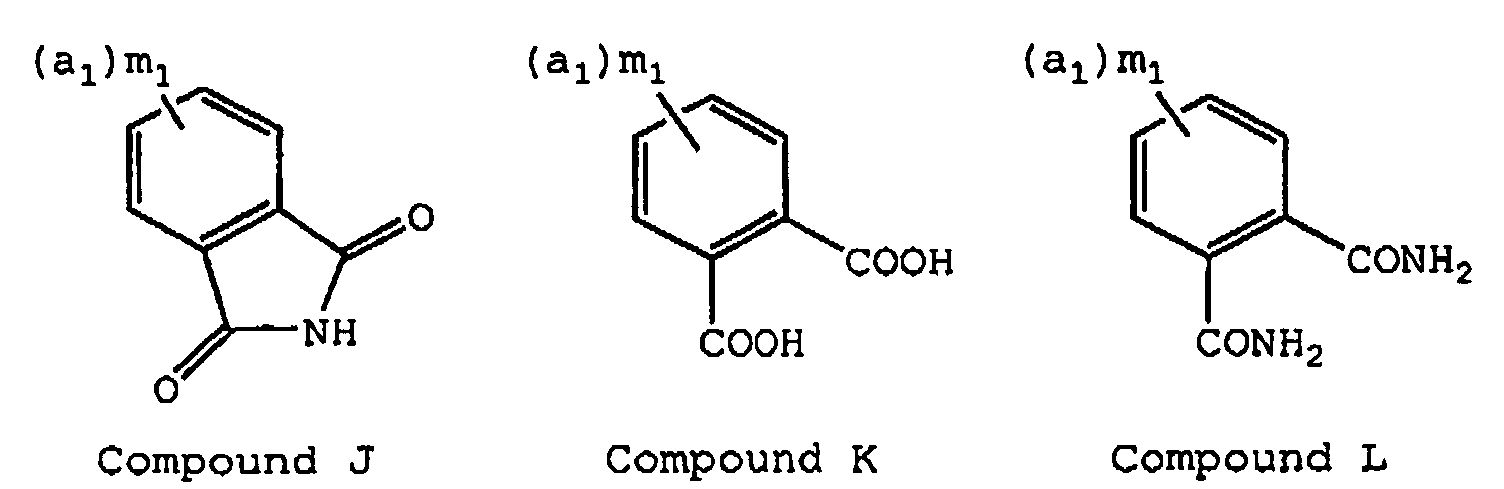
- 3. The process as described in the item 1 or 2,
wherein at least one of compounds selected from glycerin
and the compounds represented by the following formula
(III) is used as the reaction solvent:
wherein s and t each independently represents a positive integer and X represents a hydrogen atom or a methyl group.

- 4. The process as described in any one of the item
1 to 3, wherein the organic base includes at least one
selected from the compounds represented by the following
formula (IV):
wherein Y1, Y2 and Y3 each independently represents a hydrogen atom, an alkyl group, an alkenyl group, an alkynyl group, a cycloalkyl group, a cycloalkenyl group, an aryl group or a heterocyclic group, Y1, Y2 and Y3 may combine to form a condensed organic base, and each group may further have a substituent.

- 5. The process of any one of the item 1 to 4, wherein the acid has pKa of 0.0 to 7.0 at 25°C and ionic strength of 0.1.
- 6. The process of any one of the item 1 to 5, wherein the acid is an organic acid.
- 7. The process of any one of the item 1 to 6, wherein the reaction temperature is from 30 to 220°C.
- 8. The process of any one of the item 1 to 7, wherein the metal compound includes at least one of VO, TiO, Mn, Fe, Co, Ni, Cu, Zn, Pd, Cd and Mg.
- 9. The process of any one of the item 1 to 8, wherein the amount of the acid is from 0.05 to 20 equivalent based on the total amount of Compound A to F represented by formula (I).
- 10. The process of any one of the item 1 to 9, wherein the amount of the base is from 0.05 to 30 equivalent based on the total amount of Compound A to F represented by formula (I).
-
- According to the present invention, a process for industrially stably producing a high-purity metal phthalocyanine compound in a high yield can be obtained.
- As described above, in the process of producing a metal phthalocyanine compound from at least one of Compounds A to F represented by formula (I) and a metal compound, when a base is used as a catalyst for the condensation of phthalocyanine, the reaction is believed to proceed with good efficiency. Nevertheless, when a compound having an electron=withdrawing group among Compounds A to F represented by formula (I) is used, the decomposition of phthalonitrile is accelerated by a base. Particularly, in the case of a metal phthalocyanine compound substituted by an electron-withdrawing group having a high σp value, the decomposition outstandingly proceeds. It has been found that this decomposition can be suppressed when an acid is present together in the reaction system. More specifically, the reaction system eventually becomes a buffer solution comprising an acid and a base and in this solution, the reaction efficiently proceeds without causing decomposition of Compounds A to F represented by formula (I). Furthermore, even if an acid is generated as a by-product of the reaction, since the reaction is performed in a buffer solution, the pH can be maintained and the reaction can stably proceed.
- Here, the Hammett's substituent constant op value used in the present invention is described. The Hammett's rule is a rule of thumb advocated by L.P. Hammett in 1935 so as to quantitatively discuss the effect of substituent on the reaction or equilibrium of benzene derivatives and its propriety is widely admitted at present. The substituent constant determined by the Hammett's rule includes a σp value and a σm value and these values can be found in a large number of general publications but these are described in detail, for example, in J.A. Dean (compiler), Lange's Handbook of Chemistry, 12th ed., McGraw-Hill (1979), and Kagaku no Ryoiki (Chemistry Region), extra number, No. 122, pp. 96-103, Nankodo (1979). In the present invention, each substituent is limited or described using the Hammett's substituent constant σp value but this does not mean that the substituent is limited only to those having a known value which can be found in the publications. Needless to say, the substituent includes substituents of which σp value is not known in publications but when measured based on the Hammett's rule, falls within the range specified. The σp value is used as a measure for showing the electron effect of substituent irrespective of the substitution site. In the present invention, the σp value is used in this meaning.
- The buffer solution is a solution having a large buffering activity on the change in the concentration of a certain component in the solution. For example, in a mixed solution of a weak acid (AH) such as acetic acid and a conjugate base (A-) thereof, even when a slight amount of H+ or OH- is added, the change of pH can be suppressed as little as possible. The same activity is expressed also in a system containing a weak base (B) and a conjugate acid (BH+). Practical pH buffer solutions can be found in many general publications but are described in detail, for example, in Saburo Nagakura (compiler), Rikagaku Jiten (Dictionary of Physical Sciences), 5th ed., Iwanami Shoten (1999).
- The acid for use in the present invention is not particularly limited and as long as the dissociation index pKa in an aqueous solution at 25°C is 7.0 or less, either an organic compound or an inorganic compound can be preferably used. The pKa represents a logarithmic value of reciprocal of the acid dissociation constant and this value is determined at an ion intensity of 0.1 and 25°C. The acid having pKa of 0.0 to 7.0 may be either an inorganic acid such as phosphoric acid or an organic acid such as acetic acid, malonic acid and citric acid, however, the acid having pKa of 0.0 to 7.0 and exhibiting a greater effect in the above-described improvement is an organic acid. Among the organic acids, organic acids having a carboxyl group are most preferred. The organic acid having pKa of 0.0 to 7.0 may be either a monobasic organic acid or a polybasic organic acid. In the case of a polybasic organic acid, this can also be used in the form of a metal salt (for example, sodium salt or potassium salt) or an ammonium salt as long as the pKa thereof is from 0.0 to 7.0. Furthermore, organic acids having pKa of 0.0 to 7.0 may be used as a mixture of two or more thereof. Specific preferred examples of the organic acid having pKa of 0.0 to 7.0 for use in the present invention include aliphatic monobasic organic acids such as formic acid, acetic acid, monochloroacetic acid, monobromoacetic acid, glycolic acid, propionic acid, monochloropropionic acid, lactic acid, pyruvic acid, acrylic acid, butyric acid, isobutyric acid, pivalic acid, aminobutyric acid, valeric acid and isovaleric acid; amino acid-type compounds such as asparagine, alanine, arginine, ethionine, glycine, glutamine, cysteine, serine, methionine and leucine; aromatic monobasic organic acids such as benzoic acid, mono-substituted (e.g., chloro-, hydroxy-)benzoic acid and nicotinic acid; aliphatic dibasic organic acids such as oxalic acid, malonic acid, succinic acid, tartaric acid, malic acid, maleic acid, fumaric acid, oxalacetic acid, glutaric acid and adipic acid; amino acid-type dibasic organic acids such as aspartic acid, glutamic acid, glutaric acid, cystine and ascorbic acid; aromatic dibasic organic acids such as phthalic acid and terephthalic acid; and tribasic organic acids such as citric acid. In the present invention, among these organic acids, aliphatic monobasic organic acids are more preferred and formic acid, acetic acid and propionic acid are most preferred.
- The amount used of the compound (acid) having pKa of 7.0 or less is from 0.05 to 20 equivalent, preferably from 0.1 to 10 times, based on the total amount used of Compounds A to F represented by formula (I). With the content in this range, the activity of preventing the decomposition of compound represented by formula (I) can be obtained. If the amount used of the acid having pKa of 7.0 or less is less than 0.05 times the total amount used of Compounds A to F represented by formula (I), the decomposition of compounds represented by formula (I) cannot be satisfactorily suppressed, whereas if the amount used of the acid having pKa of 7.0 or less exceeds 20 times the total amount used of compounds represented by formula (I), the reaction system deviates to the acidic side to hinder the progress of reaction or since an excess base is used until a buffer solution is obtained, a salt of acid and base may be disadvantageously produced as a crystal.
- The base which can be used in the reaction is an alkali metal-containing inorganic base or an organic base. Preferred examples of the inorganic base include lithium carbonate, sodium carbonate, potassium carbonate, sodium hydrogencarbonate, lithium hydroxide, sodium hydroxide and potassium hydroxide. The organic base is preferably an amine (e.g., triethylamine, tributylamine, diisopropylethylamine, pyridine, dimethylaminopyridine), more preferably at least one compound selected from the compounds represented by the following formula (IV):
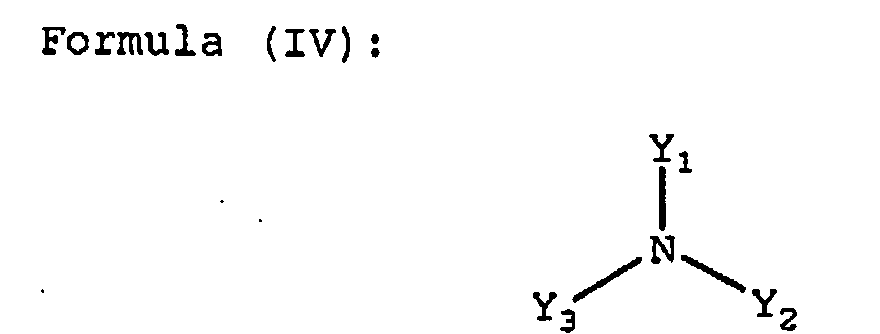
- In formula (IV), Y1, Y2 and Y3 each independently represents a hydrogen atom, an alkyl group, an alkenyl group, an alkynyl group, a cycloalkyl group, a cycloalkenyl group, an aryl group or a heterocyclic group. Examples of these substituents include a linear or branched alkyl group preferably having from 1 to 30 (more preferably from 1 to 12) carbon atoms, an aralkyl group preferably having from 7 to 30 (more preferably from 7 to 18) carbon atoms, an alkenyl group preferably having from 2 to 30 (more preferably from 2 to 12) carbon atoms, a linear or branched alkynyl group preferably having from 2 to 30 (more preferably from 2 to 12) carbon atoms, a cycloalkyl group preferably having from 3 to 30 (more preferably from 3 to 12) carbon atoms, which may have a side chain, a cycloalkenyl group preferably having from 3 to 30 (more preferably from 3 to 12) carbon atoms, which may have a side chain (specific examples of these groups include methyl, ethyl, propyl, isopropyl, tert-butyl, 2-methanesulfonylethyl, 3-phenoxypropyl, trifluoromethyl, cyclopentyl), an aryl group (a substituted or unsubstituted aryl group preferably having from 6 to 30 (more preferably from 6 to 18) carbon atoms, e.g., phenyl, 4-tert-butylphenyl, 2,4-di-tert-amylphenyl) and a heterocyclic group (preferably a 5- or 6-membered substituted or unsubstituted monovalent group resulting from removing one hydrogen atom of an aromatic or non-aromatic heterocyclic compound, more preferably a 5- or 6-membered aromatic heterocyclic group having from 3 to 30 carbon atoms, e.g., imidazolyl, pyrazolyl, triazolyl, 2-furyl, 2-thienyl, 2-pyrimidinyl, 2-benzothiazolyl). Two or more of Y1, Y2 and Y3 may form a ring. Preferred examples of the ring include pyridine, imidazole, diazabicycloundecene, piperidine, morpholine, azacrown. Among these, more preferred are pyridine, imidazole, piperidine and morpholine, and still more preferred are pyridine, piperidine and morpholine.
- Y1, Y2 and Y3 each is preferably an alkyl group, a cycloalkyl group, an aryl group or a heterocyclic group, more preferably an alkyl group, an aryl group or a heterocyclic group, and most preferably an alkyl group. These groups each may further have a substituent. Examples of this substituent include a linear or branched alkyl group preferably having from 1 to 30 (more preferably from 1 to 12) carbon atoms, an aralkyl group preferably having from 7 to 30 (more preferably from 7 to 18) carbon atoms, an alkenyl group preferably having from 2 to 30 (more preferably from 2 to 12) carbon atoms, a linear or branched alkynyl group preferably having from 2 to 30 (more preferably from 2 to 12) carbon atoms, a cycloalkyl group preferably having from 3 to 30 (more preferably from 3 to 12) carbon atoms, which may have a side chain, a cycloalkenyl group preferably having from 3 to 30 (more preferably from 3 to 12) carbon atoms, which may have a side chain (specific examples of these groups include methyl, ethyl, propyl, isopropyl, tert-butyl, 2-methanesulfonylethyl, 3-phenoxypropyl, trifluoromethyl, cyclopentyl), an aryl group (a substituted or unsubstituted aryl group preferably having from 6 to 30 (more preferably from 6 to 18) carbon atoms, e.g., phenyl, 4-tert-butylphenyl, 2,4-di-tert-amylphenyl), a heterocyclic group (preferably a 5- or 6-membered substituted or unsubstituted monovalent group resulting from removing one hydrogen atom of an aromatic or non-aromatic heterocyclic compound, more preferably a 5- or 6-membered aromatic heterocyclic group having from 3 to 30 carbon atoms, e.g., imidazolyl, pyrazolyl, triazolyl, 2-furyl, 2-thienyl, 2-pyrimidinyl, 2-benzothiazolyl), a halogeno group (e.g., fluorine atom, chlorine atom, bromine atom), an alkyloxy group (a substituted or unsubstituted alkyloxy group preferably having from 1 to 30, more preferably from 1 to 12, carbon atoms, e.g., methoxy, ethoxy, 2-methoxyethoxy, 2-methanesulfonylethoxy), an aryloxy group (a substituted or unsubstituted aryloxy group preferably having from 6 to 30, more preferably from 6 to 18, carbon atoms, e.g., phenoxy, 2-methylphenoxy, 4-tert-butylphenoxy, 3-nitrophenoxy, 3-tert-butyloxycarbamoylphenoxy, 3-methoxycarbamoyl), an acylamino group (preferably a formylamino group, a substituted or unsubstituted alkylcarbonylamino group having from 1 to 30 (more preferably from 1 to 12) carbon atoms and a substituted or unsubstituted arylcarbonylamino group having from 6 to 30 (more preferably from 6 to 18) carbon atoms, e.g., formamide, acetamide, benzamide, 4-(3-tert-butyl-4-hydroxyphenoxy)butanamide), an alkylamino group (a substituted or unsubstituted alkylamino group having from 1 to 30 (preferably from 1 to 12) carbon atoms, e.g., methylamino, butylamino, diethylamino, methylbutylamino), an arylamino group (a substituted or unsubstituted arylamino group preferably having from 6 to 30 (more preferably from 6 to 18) carbon atoms, e.g., phenylamino, 2-chloroanilino), a ureido group (a substituted or unsubstituted ureido group preferably having from 1 to 30 (more preferably from 1 to 12) carbon atoms, e.g., phenylureido, methylureido, N,N-dibutylureido), a sulfamoylamino group (a substituted or unsubstituted sulfamoylamino group preferably having from 0 to 30 (more preferably from 0 to 18) carbon atoms, e.g., N,N-dibutylsulfamoylamino), an alkylthio group (a substituted or unsubstituted alkylthio group preferably having from 1 to 30 (more preferably from 1 to 12) carbon atoms, e.g., methylthio, octylthio, 2-phenoxyethylthio), an arylthio group (a substituted or unsubstituted arylthio group preferably having from 6 to 30 (more preferably from 6 to 18) carbon atoms, e.g., phenylthio, 2-butoxy-5-tert-octylphenylthio, 2-carboxyphenylthio), an alkyloxycarbonylamino group (a substituted or unsubstituted alkyloxycarbonylamino group preferably having from 2 to 30 (more preferably from 2 to 12) carbon atoms, e.g., methoxycarbonylamino), a sulfonamido group (preferably a substituted or unsubstituted alkylsulfonylamino group having from 1 to 30 (more preferably from 1 to 12) carbon atoms and a substituted or unsubstituted arylsulfonylamino group having from 6 to 30 (more preferably from 6 to 18) carbon atoms, e.g., methanesulfonamido, benzenesulfonamido, p-toluenesulfonamido, octadecanesulfonamido), a carbamoyl group (a substituted or unsubstituted carbamoyl group preferably having from 1 to 30 (more preferably from 1 to 12) carbon atoms, e.g., N-ethylcarbamoyl, N,N-dibutylcarbamoyl), a sulfamoyl group (a substituted or unsubstituted sulfamoyl group preferably having from 0 to 30 carbon atoms, e.g., N-ethylsulfamoyl, N,N-dipropylsulfamoyl, N,N-diethylsulfamoyl), a sulfonyl group (preferably a substituted or unsubstituted alkylsulfonyl group having from 1 to 30 (more preferably from 1 to 12) carbon atoms and a substituted or unsubstituted arylsulfonyl group having from 6 to 30 (more preferably from 6 to 18) carbon atoms, e.g., methanesulfonyl, octanesulfonyl, benzenesulfonyl, toluenesulfonyl), an alkyloxycarbonyl group (a substituted or unsubstituted alkyloxycarbonyl group preferably having from 2 to 30 (more preferably from 2 to 12) carbon atoms, e.g., methoxycarbonyl, butyloxycarbonyl), a heterocyclic oxy group (a substituted or unsubstituted heterocyclic oxy group preferably having from 2 to 30 (more preferably from 2 to 12) carbon atoms, e.g., 1-phenyltetrazol-5-oxy, 2-tetrahydropyranyloxy), an azo group (preferably a substituted or unsubstituted arylazo group having from 6 to 30 (more preferably from 6 to 18) carbon atoms and a substituted or unsubstituted heterocyclic azo group having from 3 to 30 carbon atoms, e.g., phenylazo, 4-methoxyphenylazo, 4-pivaloylaminophenylazo, 2-hydroxy-4-propanoylphenylazo), an acyloxy group (preferably a formyloxy group, a substituted or unsubstituted alkylcarbonyloxy group having from 2 to 30 (more preferably from 2 to 12) carbon atoms and a substituted or unsubstituted arylcarbonyloxy group having from 7 to 30 (more preferably from 7 to 18) carbon atoms, e.g., acetoxy), a carbamoyloxy group (a substituted or unsubstituted carbamoyloxy group preferably having from 1 to 30 (more preferably from 1 to 12) carbon atoms, e.g., N-methylcarbamoyloxy, N-phenylcarbamoyloxy), a silyloxy group (a silyloxy group preferably having from 3 to 20 (more preferably from 3 to 12) carbon atoms, e.g., trimethylsilyloxy, dibutylmethylsilyloxy), an aryloxycarbonylamino group (a substituted or unsubstituted aryloxycarbonylamino group preferably having from 7 to 30 (more preferably from 7 to 18) carbon atoms, e.g., phenoxycarbonylamino), an imido group (e.g., N-succinimido, N-phthalimido), a heterocyclic thio group (a substituted or unsubstituted heterocyclic thio group preferably having from 2 to 30 (more preferably from 2 to 12) carbon atoms, e.g., 2-benzothiazolylthio, 2,4-diphenoxy-1,3,5-triazole-6-thio, 2-pyridylthio), a sulfinyl group (preferably a substituted or unsubstituted alkylsulfinyl group having from 1 to 30 (more preferably from 1 to 12) carbon atoms and a substituted or unsubstituted arylsulfinyl group having from 6 to 30 (more preferably from 6 to 18) carbon atoms, e.g., 3-phenoxypropylsulfinyl), a phosphonyl group (e.g., phenoxyphosphonyl, octyloxyphosphonyl, phenylphosphonyl), an aryloxycarbonyl group (a substituted or unsubstituted aryloxycarbonyl group preferably having from 7 to 30 (more preferably from 7 to 18) carbon atoms, e.g., phenoxycarbonyl), an acyl group (preferably a formyl group, a substituted or unsubstituted alkylcarbonyl group having from 2 to 30 (more preferably from 2 to 12) carbon atoms, a substituted or unsubstituted arylcarbonyl group having from 7 to 30 (more preferably from 7 to 18) carbon atoms and a substituted or unsubstituted heterocyclic carbonyl group having from 4 to 30 (more preferably from 4 to 12) carbon atoms, which is bonded to the carbonyl group through a carbon atom, e.g., acetyl, 3-phenylpropanoyl, benzoyl), an ionic hydrophilic group (e.g., carboxyl group, phosphono group, sulfo group, quaternary ammonium group), a cyano group, a hydroxyl group, a nitro group and an amino group. Among these substituents, preferred are a heterocyclic group, an alkyloxy group, an aryloxy group, an alkylamino group, an arylamino group, an alkylthio group, an arylthio group, an acyl group, an alkylcarbonyl group, an arylcarbonyl group, a heterocyclic carbonyl group, an ionic hydrophilic group, a hydroxyl group and an amino group, more preferred are a heterocyclic group, an alkyloxy group, an aryloxy group, an alkylamino group, an arylamino group, an acyl group, an alkylcarbonyl group, an arylcarbonyl group, a heterocyclic carbonyl group, an ionic hydrophilic group, a hydroxyl group and an amino group, still more preferred are an alkylcarbonyl group, an arylcarbonyl group, a heterocyclic carbonyl group, an ionic hydrophilic group, a hydroxyl group, and an amino group.
- In particular, Y1, Y2 and Y3 each is preferably an alkyl, cycloalkyl, aryl or heterocyclic group having a preferred substituent, more preferably an alkyl, aryl or heterocyclic group having a preferred substituent, still more preferably an alkyl group having a preferred substituent. In addition, an amine having a chelating ability for metal is preferred.
- Preferred examples of the organic base include triethylamine, tributylamine, diisopropylethylamine, pyridine, dimethylaminopyridine, ethanolamine, diethanolamine, triethanolamine, oxine, ethylenediamine, triethylenetriamine, glycine, iminoacetic acid and ethylenediaminetetraacetic acid. Among these, more preferred are triethylamine, pyridine, ethanolamine, diethanolamine, triethanolamine, oxine, ethylenediamine, triethylenetriamine, glycine, iminoacetic acid and ethylenediaminetetraacetic acid, and most preferred are ethanolamine, diethanolamine, triethanolamine, ethylenediamine, triethylenetriamine and ethylenediaminetetraacetic acid.
- Other examples include lithium acetate, potassium acetate, sodium oxalate and disodium ethylenediaminetetraacetate. In the present invention, the alkali metal salt of these organic acids is also defined as the inorganic base. In the present invention, an organic base and an inorganic base described above are preferably used in combination. However, when such a base is dissolved in a reaction solvent, the resulting solution acts as a buffer solution, therefore, a base having high solubility is preferred, an organic base is more preferred, and an organic acid salt with the cation being an alkali metal ion is still more preferred. The alkali metal ion is preferably lithium ion, sodium ion or potassium ion, and an organic acid salt with lithium ion or sodium ion is most preferred. The amount of the base used is from 0.05 to 30.0 equivalent, preferably from 0.5 to 15.0 equivalent, based on the amount used of compounds represented by formula (I).
- In the production process of a metal phthalocyanine compound of the present invention, at least one of Compounds A to F represented by formula (I) and a metal compound are preferably reacted in the presence of the above-described base and acid having pKa of 7.0 or less. As for the reaction conditions, the reaction temperature is from 30 to 220°C, preferably from 40 to 200°C, more preferably from 50 to 180°C. If the reaction temperature is less than 30°C, the reaction rate seriously decreases and this is unprofitable because the synthesis takes an extremely long time, whereas if the synthesis is performed at a high temperature exceeding 220°C, the amount of by-products produced disadvantageously increases.
- Among Compounds A to F represented by formula (I), preferred are Compounds A and B and more preferred is Compound A. Compounds A to F represented by formula (I) may be used individually or in combination of two or more thereof.
- In Compounds A to F represented by formula (I), the substituent a is preferably an alkyl group, an aralkyl group, an alkenyl group, an alkynyl group, a cycloalkyl group, a cycloalkenyl group, an aryl group, a heterocyclic group, an alkyloxy group, an aryloxy group, an acylamino group, an alkylamino group, an anilino group, a ureido group, a sulfamoylamino group, an alkylthio group, an arylthio group, a sulfonamido group, a carbamoyl group, a sulfamoyl group, a sulfonyl group, an alkyloxycarbonyl group, a heterocyclic oxy group, an azo group, an acyloxy group, a carbamoyloxy group, a silyloxy group, an aryloxycarbonylamino group, an imido group, a heterocyclic thio group, a sulfinyl group, a phosphonyl group, an aryloxycarbonyl group, an acyl group, an amino group or an ionic hydrophilic group.
- The substituent a is more preferably an aryl group, a heterocyclic group, a ureido group, a sulfonyl group, a sulfinyl group, a sulfonamido group, an acyl group, a carbamoyl group, a sulfamoyl group, an alkoxycarbonyl group or an ionic hydrophilic group.
- The substituent a is still more preferably a heterocyclic group, a sulfinyl group, a sulfonyl group, a sulfamoyl group, an acyl group, a carbamoyl group or an alkoxycarbonyl group, and particularly preferably a sulfonyl group.
- These groups each may further have a substituent such as ionic hydrophilic group, and/or an alkyl or aryl group substituted by an ionic hydrophilic group.
- In particular, a sulfonyl group (preferably an alkylsulfonyl group) substituted by an ionic hydrophilic group (preferably a sulfo group) is preferred.
- Examples of the ionic hydrophilic group as the substituent include a sulfo group, a carboxyl group, a phosphono group and a quaternary ammonium group. Among these ionic hydrophilic groups, a carboxyl group and a sulfo group are preferred, and a sulfo group is more preferred.
- The carboxyl group, phosphono group and sulfo group each may be in a salt state and examples of the counter ion for forming the salt include alkali metal ion (e.g., lithium ion, sodium ion, potassium ion) and organic cation (e.g., tetramethylguanidium ion).
- In Compounds A to F represented by formula (I), the substituent b is preferably a halogeno group, a cyano group, a hydroxyl group, a nitro group or an ionic hydrophilic group, more preferably a halogeno group, a cyano group, a nitro group or an ionic hydrophilic group, and most preferably a halogeno group, a cyano group or an ionic hydrophilic group.
- Examples of this substituent include a linear or branched alkyl group preferably having from 1 to 30 (more preferably from 1 to 12) carbon atoms, an aralkyl group preferably having from 7 to 30 (more preferably from 7 to 18) carbon atoms, an alkenyl group preferably having from 2 to 30 (more preferably from 2 to 12) carbon atoms, a linear or branched alkynyl group preferably having from 2 to 30 (more preferably from 2 to 12) carbon atoms, a cycloalkyl group preferably having from 3 to 30 (more preferably from 3 to 12) carbon atoms, which may have a side chain, a cycloalkenyl group preferably having from 3 to 30 (more preferably from 3 to 12) carbon atoms, which may have a side chain (specific examples of these groups include methyl, ethyl, propyl, isopropyl, tert-butyl, 2-methanesulfonylethyl, 3-phenoxypropyl, trifluoromethyl, cyclopentyl), an aryl group (a substituted or unsubstituted aryl group preferably having from 6 to 30 (more preferably from 6 to 18) carbon atoms, e.g., phenyl, 4-tert-butylphenyl, 2,4-di-tert-amylphenyl), a heterocyclic group (preferably a 5- or 6-membered substituted or unsubstituted monovalent group resulting from removing one hydrogen atom of an aromatic or non-aromatic heterocyclic compound, more preferably a 5- or 6-membered aromatic heterocyclic group having from 3 to 30 carbon atoms, e.g., imidazolyl, pyrazolyl, triazolyl, 2-furyl, 2-thienyl, 2-pyrimidinyl, 2-benzothiazolyl), a halogeno group (e.g., fluorine atom, chlorine atom, bromine atom), an alkyloxy group (a substituted or unsubstituted alkyloxy group preferably having from 1 to 30, more preferably from 1 to 12, carbon atoms, e.g., methoxy, ethoxy, 2-methoxyethoxy, 2-methanesulfonylethoxy), an aryloxy group (a substituted or unsubstituted aryloxy group preferably having from 6 to 30, more preferably from 6 to 18, carbon atoms, e.g., phenoxy, 2-methylphenoxy, 4-tert-butylphenoxy, 3-nitrophenoxy, 3-tert-butyloxycarbamoylphenoxy, 3-methoxycarbamoyl), an acylamino group (preferably a formylamino group, a substituted or unsubstituted alkylcarbonylamino group having from 1 to 30 (more preferably from 1 to 12) carbon atoms and a substituted or unsubstituted arylcarbonylamino group having from 6 to 30 (more preferably from 6 to 18) carbon atoms, e.g., formamide, acetamide, benzamide, 4-(3-tert-butyl-4-hydroxyphenoxy)butanamide), an alkylamino group (a substituted or unsubstituted alkylamino group having from 1 to 30 (preferably from 1 to 12) carbon atoms, e.g., methylamino, butylamino, diethylamino, methylbutylamino), an arylamino group (a substituted or unsubstituted arylamino group preferably having from 6 to 30 (more preferably from 6 to 18) carbon atoms, e.g., phenylamino, 2-chloroanilino), a ureido group (a substituted or unsubstituted ureido group preferably having from 1 to 30 (more preferably from 1 to 12) carbon atoms, e.g., phenylureido, methylureido, N,N-dibutylureido), a sulfamoylamino group (a substituted or unsubstituted sulfamoylamino group preferably having from 0 to 30 (more preferably from 0 to 18) carbon atoms, e.g., N,N-dibutylsulfamoylamino), an alkylthio group (a substituted or unsubstituted alkylthio group preferably having from 1 to 30 (more preferably from 1 to 12) carbon atoms, e.g., methylthio, octylthio, 2-phenoxyethylthio), an arylthio group (a substituted or unsubstituted arylthio group preferably having from 6 to 30 (more preferably from 6 to 18) carbon atoms, e.g., phenylthio, 2-butoxy-5-tertoctylphenylthio, 2-carboxyphenylthio), an alkyloxycarbonylamino group (a substituted or unsubstituted alkyloxycarbonylamino group preferably having from 2 to 30 (more preferably from 2 to 12) carbon atoms, e.g., methoxycarbonylamino), a sulfonamido group (preferably a substituted or unsubstituted alkylsulfonylamino group having from 1 to 30 (more preferably from 1 to 12) carbon atoms and a substituted or unsubstituted arylsulfonylamino group having from 6 to 30 (more preferably from 6 to 18) carbon atoms, e.g., methanesulfonamido, benzenesulfonamido, p-toluenesulfonamido, octadecanesulfonamido), a carbamoyl group (a substituted or unsubstituted carbamoyl group preferably having from 1 to 30 (more preferably from 1 to 12) carbon atoms, e.g., N-ethylcarbamoyl, N,N-dibutylcarbamoyl), a sulfamoyl group (a substituted or unsubstituted sulfamoyl group preferably having from 0 to 30 carbon atoms, e.g., N-ethylsulfamoyl, N,N-dipropylsulfamoyl, N,N-diethylsulfamoyl), a sulfonyl group (preferably a substituted or unsubstituted alkylsulfonyl group having from 1 to 30 (more preferably from 1 to 12) carbon atoms and a substituted or unsubstituted arylsulfonyl group having from 6 to 30 (more preferably from 6 to 18) carbon atoms, e.g., methanesulfonyl, octanesulfonyl, benzenesulfonyl, toluenesulfonyl), an alkyloxycarbonyl group (a substituted or unsubstituted alkyloxycarbonyl group preferably having from 2 to 30 (more preferably from 2 to 12) carbon atoms, e.g., methoxycarbonyl, butyloxycarbonyl), a heterocyclic oxy group (a substituted or unsubstituted heterocyclic oxy group preferably having from 2 to 30 (more preferably from 2 to 12) carbon atoms, e.g., 1-phenyltetrazol-5-oxy, 2-tetrahydropyranyloxy), an azo group (preferably a substituted or unsubstituted arylazo group having from 6 to 30 (more preferably from 6 to 18) carbon atoms and a substituted or unsubstituted heterocyclic azo group having from 3 to 30 carbon atoms, e.g., phenylazo, 4-methoxyphenylazo, 4-pivaloylaminophenylazo, 2-hydroxy-4-propanoylphenylazo), an acyloxy group (preferably a formyloxy group, a substituted or unsubstituted alkylcarbonyloxy group having from 2 to 30 (more preferably from 2 to 12) carbon atoms and a substituted or unsubstituted arylcarbonyloxy group having from 7 to 30 (more preferably from 7 to 18) carbon atoms, e.g., acetoxy), a carbamoyloxy group (a substituted or unsubstituted carbamoyloxy group preferably having from 1 to 30 (more preferably from 1 to 12) carbon atoms, e.g., N-methylcarbamoyloxy, N-phenylcarbamoyloxy), a silyloxy group (a silyloxy group preferably having from 3 to 20 (more preferably from 3 to 12) carbon atoms, e.g., trimethylsilyloxy, dibutylmethylsilyloxy), an aryloxycarbonylamino group (a substituted or unsubstituted aryloxycarbonylamino group preferably having from 7 to 30 (more preferably from 7 to 18) carbon atoms, e.g., phenoxycarbonylamino), an imido group (e.g., N-succinimido, N-phthalimido), a heterocyclic thio group (a substituted or unsubstituted heterocyclic thio group preferably having from 2 to 30 (more preferably from 2 to 12) carbon atoms, e.g., 2-benzothiazolylthio, 2,4-diphenoxy-1,3,5-triazole-6-thio, 2-pyridylthio), a sulfinyl group (preferably a substituted or unsubstituted alkylsulfinyl group having from 1 to 30 (more preferably from 1 to 12) carbon atoms and a substituted or unsubstituted arylsulfinyl group having from 6 to 30 (more preferably from 6 to 18) carbon atoms, e.g., 3-phenoxypropylsulfinyl), a phosphonyl group (e.g., phenoxyphosphonyl, octyloxyphosphonyl, phenylphosphonyl), an aryloxycarbonyl group (a substituted or unsubstituted aryloxycarbonyl group preferably having from 7 to 30 (more preferably from 7 to 18) carbon atoms, e.g., phenoxycarbonyl), an acyl group (preferably a formyl group, a substituted or unsubstituted alkylcarbonyl group having from 2 to 30 (more preferably from 2 to 12) carbon atoms, a substituted or unsubstituted arylcarbonyl group having from 7 to 30 (more preferably from 7 to 18) carbon atoms and a substituted or unsubstituted heterocyclic carbonyl group having from 4 to 30 (more preferably from 4 to 12) carbon atoms, which is bonded to the carbonyl group through a carbon atom, e.g., acetyl, 3-phenylpropanoyl, benzoyl), an ionic hydrophilic group (e.g., carboxyl group, phosphono group, sulfo group, quaternary ammonium group), a cyano group, a hydroxyl group, a nitro group and an amino group.
- In formula (I), m and n each represents an integer satisfying 1≤m≤4, 0≤n≤3 and 1≤m+n≤4, preferably 1≤m≤2 and 0≤n≤1, and most preferably m=1 or 2 and n=0.
- Compounds A to F represented by formula (I) are preferably Compounds G to L represented by formula (II), more preferably Compounds G and H, and still more preferably Compound G. Compounds G to L represented by formula (II) may be used individually or in combination of two or more thereof.
- In Compounds G to L represented by formula (II), the substituent represented by a1 is a sulfinyl group, a sulfonyl group, a sulfamoyl group, an acyl group or a carbamoyl group. These groups each may have a substituent such as ionic hydrophilic group, and/or an alkyl or aryl group substituted by an ionic hydrophilic group.
- m1 represents 1 or 2, preferably 1.
- Examples of the ionic hydrophilic group as the substituent include a sulfo group, a carboxyl group, a phosphono group and a quaternary ammonium group. Among these ionic hydrophilic groups, a carboxyl group and a sulfo group are preferred, and a sulfo group is more preferred.
- The carboxyl group, phosphono group and sulfo group each may be in a salt state and examples of the counter ion for forming the salt include alkali metal ion (e.g., lithium ion, sodium ion, potassium ion) and organic cation (e.g., tetramethylguanidium ion).
- The metal compound for use in the reaction of the present invention may be a metal, a metal oxide, a metal hydroxide, a metal chloride, a metal acetate or a metal complex such as aquo complex and ammine complex. Examples of the metal and metal oxide which can be introduced include VO, TiO, Mn, Fe, Co, Ni, Cu, Zn, Pd, Cd and Mg. Among these, Fe, Ni, Cu and Zn are preferred, and Ni Cu and Zn are more preferred. As the salt state, a chloride (e.g., copper chloride), an acetate and an aquo complex are preferred, and a chloride and an acetate are most preferred. The amount of the metal compound used is preferably from 0.01 to 10 times equivalent, more preferably from 0.05 to 5 times equivalent, still more preferably from 0.1 to 3 times equivalent, based on the total amount used of Compounds A to F represented by formula (I).
- In the present invention, a catalyst may be used at the same time. As the catalyst for use in the present invention, all catalysts commonly used in the synthesis of metal phthalocyanine compounds can be used. Examples thereof include molybdenum compounds such as ammonium molybdate, molybdic acid, ammonium phosphomolybdate and molybdenum oxide, tungsten compounds such as ammonium tungstate and ammonium phosphotungstate, arsenic vanadium compounds, and halides and oxyhalides of boric acid, titanium, tin and antimony. Among these, ammonium molybdate is excellent.
- The solvent for use in the process of the present invention may be a general organic solvent. In particular, organic solvents having a hydroxyl group and polar solvents (e.g., acetonitrile, formamide, N,N-dimethylformamide, N,N-dimethylacetamide, dimethylsulfoxide, sulfolane, propylene carbonate, N-methyl-2-pyrrolidone, N-vinyl-2-pyrrolidone, N,N-diethyldodecanamide) are preferred. More preferred examples of the alcohol include methanol, ethanol, pentanol, heptanol, octanol, cyclohexanol, benzyl alcohol, phenethyl alcohol, phenylpropyl alcohol, furfuryl alcohol and anise alcohol. Not only mono- but also oligo- (particularly, di- or tri-) or poly-C2-C4-alkylene glycol (simply "glycol") and their mono-C1-C8-alkyl- or monoaryl ether (simply "glycol monoether") are preferred. In addition, ethylene-based compounds are also advantageous. Examples thereof include ethylene glycol, 1,2-propylene glycol, 1,3-propylene glycol, diethylene glycol, butylene glycol, diethylene glycol, triethylene glycol, tetraethylene glycol, dipropylene glycol, tripropylene glycol, tetrapropylene glycol, polyethylene glycol, polypropylene glycol, ethylene glycol monomethyl ether, ethylene glycol monoethyl ether, ethylene glycol monopropyl ether, ethylene glycol monobutyl ether, ethylene glycol monohexyl ether, propylene glycol monomethyl ether, propylene glycol monoethyl ether, propylene glycol monopropyl ether, propylene glycol monobutyl ether, propylene glycol monohexyl ether, diethylene glycol monomethyl ether, triethylene glycol monomethyl ether, tetraethylene glycol monomethyl ether, diethylene glycol monoethyl ether, triethylene glycol monoethyl ether, tetraethylene glycol monoethyl ether, diethylene glycol monobutyl ether, triethylene glycol monobutyl ether, tetraethylene glycol monobutyl ether, dipropylene glycol monomethyl ether, tripropylene glycol monomethyl ether, tetrapropylene glycol monomethyl ether, dipropylene glycol monoethyl ether, tripropylene glycol monoethyl ether, tetrapropylene glycol monoethyl ether, dipropylene glycol monobutyl ether, tripropylene glycol monobutyl ether, tetrapropylene glycol monobutyl ether, ethylene glycol monophenyl ether and propylene glycol monophenyl ether. Furthermore, in the present invention, industrially employed inactive solvents can also be used. Examples thereof include nitrobenzene, trichlorobenzene, chloronaphthalene, methylnaphthalene, naphthalene, alkyl benzene, paraffin, naphthene and kerosine.
- One of these solvents may be used or an appropriate combination of two or more thereof may be used if they not affect each other. The amount of the solvent used is from 1 to 100 mass times, preferably from 1 to 20 mass times, more preferably from 1 to 5 mass times, the total amount used of Compounds A to F represented by formula (I).
- The solvent for use in the process of the present invention is more preferably glycerin, at least one compound selected from the compounds represented by formula (III), or, if not affect each other, an appropriately mixed solvent of the above-described organic solvents having a hydroxyl group and polar solvents. In the formula, s and t each independently represents a positive integer, preferably an integer of 1 to 10, more preferably from 1 to 5. X represents a hydrogen atom or a methyl group. Examples of the more preferred solvent include ethylene glycol, diethylene glycol, triethylene glycol, polypropylene glycol, propylene glycol, dipropylene glycol, a 1:2 (v/v) mixed solvent of ethylene glycol and diethylene glycol, a 3:1 (v/v) mixed solvent of propylene glycol and triethylene glycol, and 1:5 (v/v) mixed solvent of methanol and triethylene glycol. The amount of the solvent used is from 1 to 100 mass times, preferably from 1 to 20 mass times, more preferably from 1 to 5 mass times, the total amount used of Compounds A to F represented by formula (I).
- In the present invention, a prolonged reaction time is not preferred in view of stability of the objective compound or generation of side reaction and this is also unprofitable. The reaction time is preferably less than 10 hours, more preferably less than 5 hours, still more preferably less than 4 hours.
- When these are summarized, the production process of a metal phthalocyanine compound of the present invention is preferably a production process having a combination of the following features (i) to (x).
- (i) The acid for use in the present invention is not particularly limited and as long as the acid or conjugate acid has a dissociation index pKa of 7.0 or less in an aqueous solution at 25°C, either an organic compound or an inorganic compound can be preferably used. In particular, organic acids having pKa of 0.0 to 7.0 are preferred and organic acids having a carboxyl group are most preferred. Among the organic acids, aliphatic monobasic organic acids are preferred, and formic acid, acetic acid and propionic acid are most preferred.
- (ii) As the base, an inorganic or organic base comprising an alkali metal may be used. Preferred examples of the inorganic base include lithium carbonate, sodium carbonate, potassium carbonate, sodium hydrogencarbonate, lithium hydroxide and potassium hydroxide. The organic base is preferably at least one compound selected from the compounds represented by formula (IV). Particularly preferred examples thereof include ethanolamine, diethanolamine and triethanolamine. Other than these, organic acid salts such as lithium acetate, potassium acetate, sodium oxalate and disodium ethylenediaminetetraacetic acid may also be used.
- (iii) As for the reaction conditions, the reaction temperature is from 30 to 220°C, preferably from 40 to 200°C, more preferably from 50 to 180°C.
- (iv) In Compounds A to F represented by formula (I), the substituent a is preferably an aryl group, a heterocyclic group, a ureido group, a sulfonyl group, a sulfinyl group, a sulfonamide group, an acyl group, a carbamoyl group, a sulfamoyl group, an alkoxycarbonyl group or an ionic hydrophilic group, more preferably a heterocyclic group, a sulfinyl group, a sulfonyl group, a sulfamoyl group, an acyl group, a carbamoyl group or an alkoxycarbonyl group, still more preferably a sulfonyl group. These groups each preferably further has a substituent such as ionic hydrophilic group, and/or an alkyl or aryl group substituted by an ionic hydrophilic group, more preferably an alkyl or aryl group substituted by an ionic hydrophilic group, still more preferably an alkyl group substituted by an ionic hydrophilic group.
- (v) In Compounds A to F represented by formula (I), the substituent b is preferably a halogeno group, a cyano group, a hydroxyl group, a nitro group or an ionic hydrophilic group, more preferably a halogeno group, a cyano group or an ionic hydrophilic group.
- (vi) In formula (I), m and n each represents an integer satisfying 1≤m≤4, 0≤n≤3 and 1≤m+n<4, preferably 1≤m≤2 and 0≤n≤1, and most preferably m=1 or 2 and n=0.
- (vii) Examples of the metal or metal oxide which can be introduced include VO, TiO, Mn, Fe, Co, Ni, Cu, Zn, Pd, Cd and Mg. Among these, Ni, Cu and Zn are preferred. The salt state is preferably a chloride (for example, copper chloride) or an acetate. The amount used is preferably from 0.1 to 3 times equivalent based on the total amount used of Compounds A to F represented by formula (I).
- (viii) The solvent is most preferably ethylene glycol, diethylene glycol, triethylene glycol, polypropylene glycol, propylene glycol, dipropylene glycol, a 1:2 (v/v) mixed solvent of ethylene glycol and diethylene glycol, or a 4:1 (v/v) mixed solvent of propylene glycol and triethylene glycol. The amount used is particularly preferably from 1 to 5 mass times the total amount used of Compounds A to F represented by formula (I).
- (ix) The reaction time is particularly preferably less than 4 hours.
- (x) Compounds A to F represented by formula (I) of the present invention are preferably Compounds G to L represented by formula (II). In formula (II), a1 preferably represents a sulfinyl group, a sulfonyl group, a sulfamoyl group, an acyl group or a carbamoyl group. m1 represents 1 or 2.
-
- As for the preferred combination thereof, a combination satisfying at least one of the above-described preferred conditions is preferred, a combination satisfying a larger number of preferred conditions is more preferred, and a combination satisfying all of those preferred conditions is most preferred.
- The present invention is described in greater detail below by referring to Examples. The results are shown together in Table 1. The present invention is not limited to these Examples. In Examples, Compounds P, Q and R all belong to Compounds A to F represented by formula (I).

- Compound P (29.48 g) and 2.6 mL of acetic acid were suspended in 35 mL of ethylene glycol. After elevating the inner temperature to 50°C, 6.04 g of lithium acetate and 3.24 g of copper chloride were added and then the inner temperature was elevated to 70°C. After stirring for 5 hours, the inner temperature was elevated to 90°C and then 19.7 mL of concentrated hydrochloric acid was added dropwise. Subsequently, 4.49 g of lithium chloride was added and 210 mL of isopropanol was added dropwise to cause crystallization. The resulting mixture was cooled to 30°C and filtered by suction and the solid was washed by splashing thereon isopropanol and then dried. Thereafter, 28.77 g of the obtained crude crystal was dissolved in 115 mL of ion exchanged water and then 2.5N-LiOH aq. was added at 50°C until the pH reached 10.5. After stirring at 90°C for 30 minutes, 330 mL of isopropanol was added dropwise to cause crystallization. The resulting mixture was filtered by suction and the solid was washed by splashing thereon isopropanol. Yield: 27.33 g, percentage yield: 85.5%. The identification was performed by the following methods. Mass spectrometry: FAB-MS (NEGA 1343), elemental analysis (found: C, 36.69; H, 3.27; N, 7.79; calculated as C44H36CuLi4N8O20S4•5H2O: C, 36.83; H, 3.23; N, 7.81), absorption of solution: λmax=628.9 nm, ε67500 (H2O).
- Compound P (30.52 g), 11.83 g of Compound Q and 3.6 mL of acetic acid were dissolved in 100 mL of ethylene glycol at 110°C. After cooling to 50°C, 8.34 g of lithium acetate and 4.47 g of copper chloride were added and then the inner temperature was elevated to 70°C. After stirring for 3 hours, the inner temperature was elevated to 90°C and then 27.8 mL of concentrated hydrochloric acid was added dropwise. Subsequently, 6.20 g of lithium chloride was added and 300 mL of isopropanol was added dropwise to cause crystallization. The resulting mixture was cooled to 30°C and filtered by suction and the solid was washed by splashing thereon isopropanol and then dried. Thereafter, 35.29 g of the obtained crude crystal was dissolved in 140 mL of ion exchanged water and then 2.5N-LiOH aq. was added at 50°C until the pH reached 10.5. After stirring at 90°C for 30 minutes, 400 mL of isopropanol was added dropwise to cause crystallization. The resulting mixture was filtered by suction and the solid was washed by splashing thereon isopropanol. Yield: 33.75 g, percentage yield: 76.5%. The identification was performed by the following methods. Mass spectrometry: FAB-MS (NEGA 1395), elemental analysis (found: C, 39.02; H, 3.40; N, 8.72; calculated as C47H44CuLi3N9O20S8•3H2O: C, 38.94; H, 3.48; N, 8.69), absorption of solution: λmax=624.7 nm, ε56900 (H2O).
- Compound R (13.93 g) and 1.0 mL of acetic acid were suspended in 28 mL of ethylene glycol. After the temperature was elevated to 50°C, 2.21 g of lithium acetate and 1.19 g of copper chloride were added and then the inner temperature was elevated to 70°C. After stirring for 3 hours, the inner temperature was elevated to 90°C and then 100 mL of isopropanol was added dropwise to cause crystallization. The resulting mixture was cooled to 30°C and filtered by suction and the solid was washed by splashing thereon isopropanol and then dried. Thereafter, 10.53 g of the obtained crude crystal was dissolved in 140 mL of methanol and then 400 mL of isopropanol was added dropwise to cause crystallization. The resulting mixture was filtered by suction and the solid was washed by splashing thereon isopropanol. Yield: 10.02 g, percentage yield: 88.2%. The identification was performed by the following methods. Mass spectrometry: FAB-MS (NEGA 1715), elemental analysis (found: C, 47.28; H, 5.48; N, 9.70; calculated as C68H92CuN12O20S8•1H2O: C, 47.06; H, 5.46; N, 9.68), absorption of solution: λmax=598.3 nm, ε36800 (ethyl acetate).
- The operation was performed in the same manner as in Synthesis Example 2 except for changing the ethylene glycol, the amount used and the reaction temperature of Synthesis Example 2 as shown in Table 1.
- Compound P (29.48 g) was suspended in 35 mL of ethylene glycol and the resulting suspension was heated to an inner temperature of 120°C. Thereto, 3.24 g of copper chloride was added and after stirring for 2 hours, the mixture was cooled to an inner temperature of 80°C and then 19.7 mL of concentrated hydrochloric acid was added dropwise. Subsequently, 4.49 g of lithium chloride was added and 210 mL of isopropanol was added dropwise to cause crystallization. The resulting mixture was cooled to 30°C and filtered by suction and the solid was washed by splashing thereon isopropanol and then dried. Thereafter, 17.58 g of the obtained crude crystal was dissolved in 115 mL of ion exchanged water and then 2.5N-LiOH aq. was added at 50°C until the pH reached 10.5. After stirring at 90°C for 30 minutes, 330 mL of isopropanol was added dropwise to cause crystallization. The resulting mixture was filtered by suction and the solid was washed by splashing thereon isopropanol. Yield: 14.95 g, percentage yield: 46.8%. The identification was performed by the following methods. Mass spectrometry: FAB-MS (NEGA 1344), elemental analysis (found: C, 37.11; H, 3.14; N, 7.87; calculated as C44H36CuLi4N8O20S8•4H2O: C, 37.30; H, 3.13; N, 7.91).
- Compound P (30.52 g) and 11.83 g of Compound Q were dissolved in 100 mL of ethylene glycol at 110°C. After cooling to 50°C, 4.47 g of copper chloride was added and then the inner temperature was elevated to 70°C. After stirring for 3 hours, the inner temperature was elevated to 120°C and the mixture was further stirred for 2 hours. Thereto, 27.8 mL of concentrated hydrochloric acid was added dropwise. Subsequently, 6.20 g of lithium chloride was added and 300 mL of isopropanol was added dropwise to cause crystallization. The resulting mixture was cooled to 30°C and filtered by suction and the solid was washed by splashing thereon isopropanol and then dried. Thereafter, 24.17 g of the obtained crude crystal was dissolved in 140 mL of ion exchanged water and then 2.5N-LiOH aq. was added at 50°C until the pH reached 10.5. After stirring at 90°C for 30 minutes, 400 mL of isopropanol was added dropwise to cause crystallization. The resulting mixture was filtered by suction and the solid was washed by splashing thereon isopropanol. Yield: 21.84 g, percentage yield: 49.5%. The identification was performed by the following methods. Mass spectrometry: FAB-MS (NEGA 1395), elemental analysis (found: C, 37.80; H, 3.62; N, 8.53; calculated as C47H44CuLi3N9O20S8•5H2O: C, 37.99; H, 3.66; N, 8.48).
- Compound P (29.48 g) and 2.6 mL of acetic acid were suspended in 35 mL of ethylene glycol. After elevating the inner temperature to 50°C, 17.48 g of calcium acetate and 3.24 g of copper chloride were added and then the inner temperature was elevated to 70°C. After stirring for 5 hours, the inner temperature was elevated to 90°C and then 19.7 mL of concentrated hydrochloric acid was added dropwise. Subsequently, 4.49 g of lithium chloride was added and 210 mL of isopropanol was added dropwise to cause crystallization. The resulting mixture was cooled to 30°C and filtered by suction and the solid was washed by splashing thereon isopropanol and then dried. Thereafter, 10.96 g of the obtained crude crystal was dissolved in 115 mL of ion exchanged water and then 2.5N-LiOH aq. was added at 50°C until the pH reached 10.5. After stirring at 90°C for 30 minutes, 330 mL of isopropanol was added dropwise to cause crystallization. The resulting mixture was filtered by suction and the solid was washed by splashing thereon isopropanol. Yield: 9.08 g, percentage yield: 28.4%. The identification was performed by the following methods. Mass spectrometry: FAB-MS (NEGA 1343), elemental analysis (found: C, 35.84; H, 2.99; N, 7.55; calculated as C44H36CuLi4N8O20S4•8H2O: C, 35.93; H, 3.43; N, 7.62).
- Compound R (13.93 g) was suspended in 28 mL of ethylene glycol. After the temperature was elevated to 50°C, 1.19 g of copper chloride was added and then the inner temperature was elevated to 70°C. Thereto, 1 mL of DBU (diazabicycloundecene) was added and after stirring for 3 hours, the inner temperature was elevated to 120°C and the mixture was further stirred for 2 hours. Subsequently, 100 mL of isopropanol was added dropwise to cause crystallization. The resulting mixture was cooled to 30°C and filtered by suction and the solid was washed by splashing thereon isopropanol and then dried. Thereafter, 8.20 g of the obtained crude crystal was dissolved in 70 mL of methanol and then 200 mL of isopropanol was added dropwise to cause crystallization. The resulting mixture was filtered by suction and the solid was washed by splashing thereon isopropanol. Yield: 7.38 g, percentage yield: 63.0%. The identification was performed by the following methods. Mass spectrometry: FAB-MS (NEGA 1715), elemental analysis (found: C, 46.88; H, 5.49; N, 9.62; calculated as C68H92CuN12O20S8•1H2O: C, 47.06; H, 5.46; N, 9.68).
- The operation was performed in the same manner as in Synthesis Example 2 except for not using the acid and base of Synthesis Example 2 and changing the ethylene glycol, the amount used and the reaction temperature as shown in Table 1.
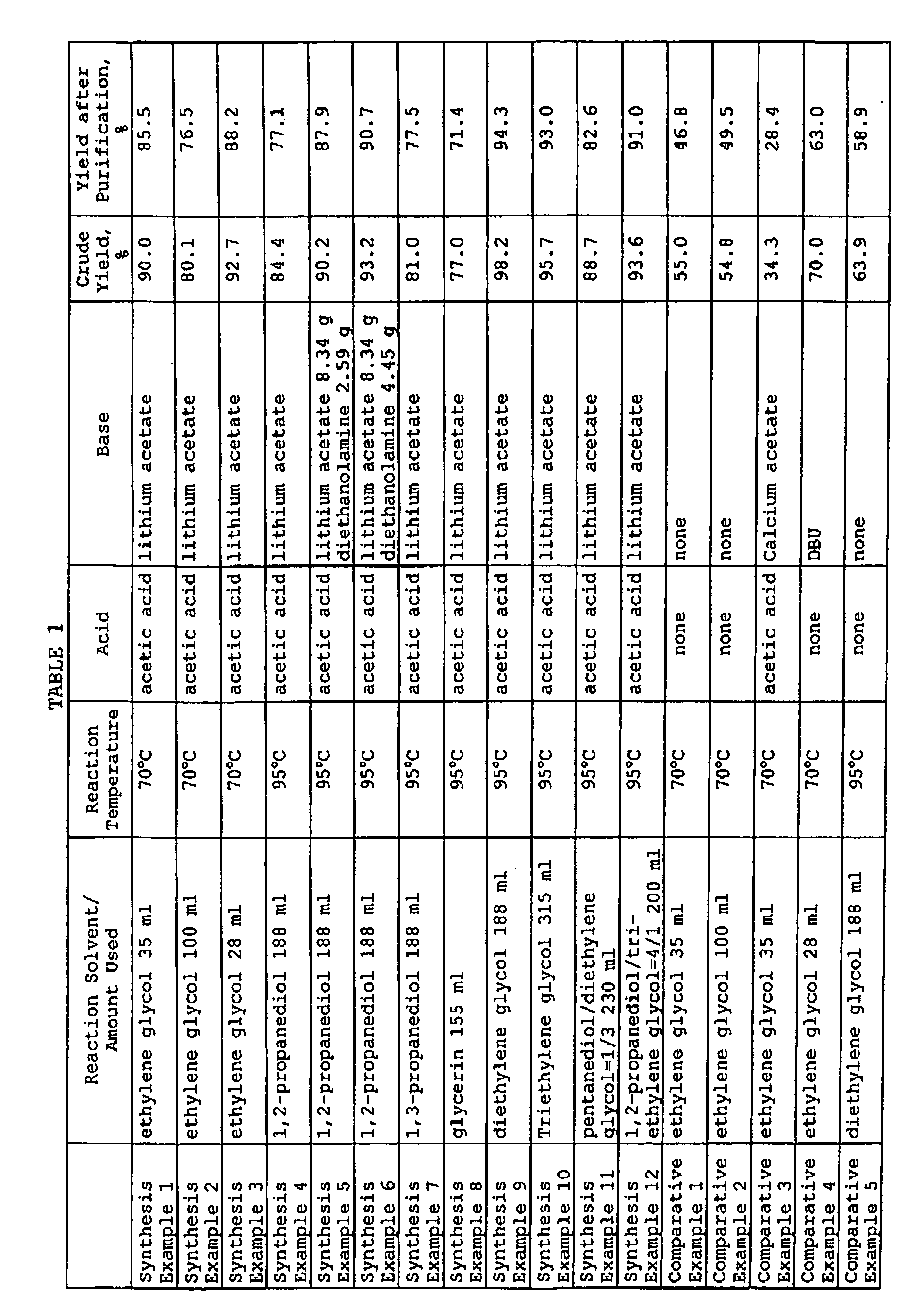
- As apparently seen from the results above, according to the constitution of the present invention, a metal phthalocyanine compound can be obtained in a high yield. It is revealed that when an alkaline earth metal base is used, the yield becomes extremely low.
Claims (10)
- A process for producing a metal phthalocyanine compound, which comprises reacting at least one of the Compounds A to F represented by the following formula (I) and a metal compound,
wherein said reaction is performed in a buffer solution comprising an acid and at least one of an organic base and an alkali metal-containing inorganic base:wherein a and b each independently represents a substituent, and the sum total of Hammett's substituent constant σp values thereof is 0.20 or more; m and n each represents an integer satisfying 1≤m≤4, 0≤n≤3 and 1≤m+n≤4.
- The process of claim 1, wherein the Compounds A to F represented by formula (I) are Compounds G to L represented by the following formula (II):
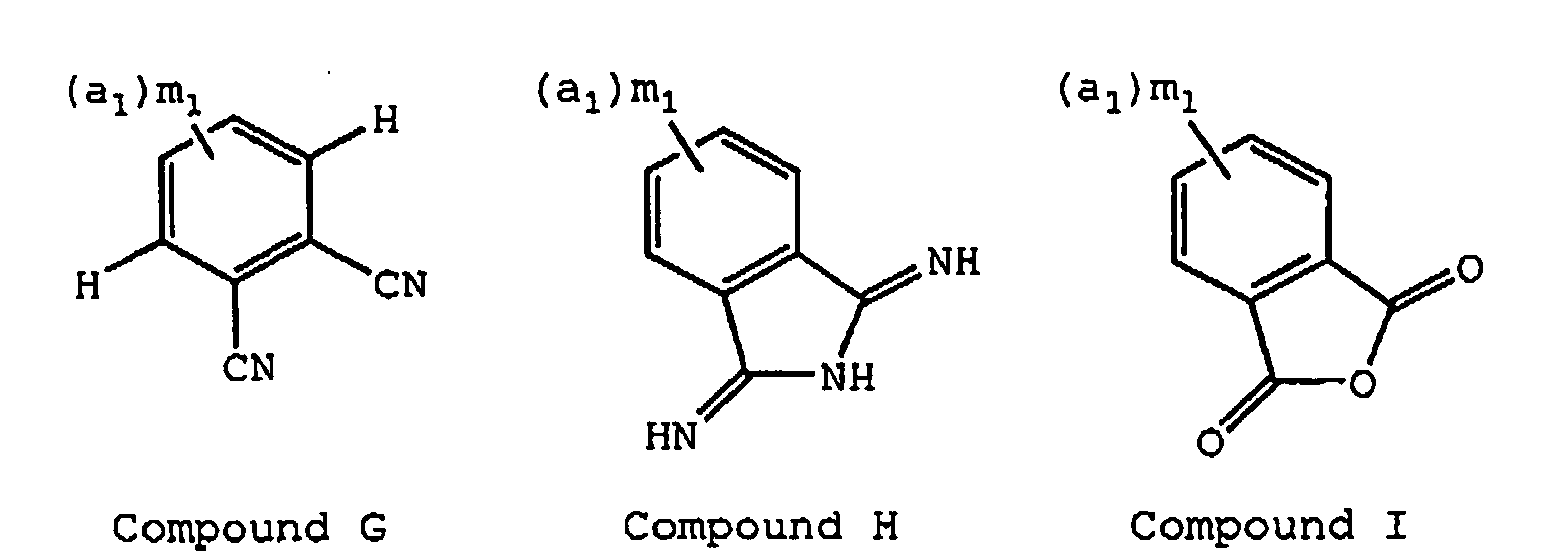 wherein a1 represents a sulfinyl group, a sulfonyl group, a sulfamoyl group, an acyl group or a carbamoyl group; m1 represents 1 or 2.
- The process of claim 1 or 2, wherein at least one of compounds selected from glycerin and the compounds represented by the following formula (III) is used as the reaction solvent:wherein s and t each independently represents a positive integer and X represents a hydrogen atom or a methyl group.

- The process of any one of claims 1 to 3,
wherein the organic base includes at least one selected from the compounds represented by the following formula (IV):wherein Y1, Y2 and Y3 each independently represents a hydrogen atom, an alkyl group, an alkenyl group, an alkynyl group, a cycloalkyl group, a cycloalkenyl group, an aryl group or a heterocyclic group, Y1, Y2 and Y3 may combine to form a condensed organic base, and each group may further have a substituent.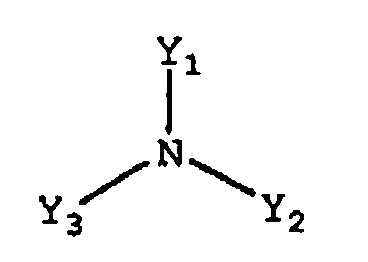
- The process of any one of claims 1 to 4, wherein the acid has pKa of 0.0 to 7.0 at 25°C and ionic strength of 0.1.
- The process of any one of claims 1 to 5, wherein the acid is an organic acid.
- The process of any one of claims 1 to 6, wherein the reaction temperature is from 30 to 220°C.
- The process of any one of claims 1 to 7, wherein the metal compound includes at least one of VO, TiO, Mn, Fe, Co, Ni, Cu, Zn, Pd, Cd and Mg.
- The process of any one of claims 1 to 8, wherein the amount of the acid is from 0.05 to 20 equivalent based on the total amount of Compound A to F represented by formula (I).
- The process of any one of claims 1 to 9, wherein the amount of the base is from 0.05 to 30 equivalent based on the total amount of Compound A to F represented by formula (I).
Applications Claiming Priority (4)
| Application Number | Priority Date | Filing Date | Title |
|---|---|---|---|
| JP2002358306 | 2002-12-10 | ||
| JP2002358306 | 2002-12-10 | ||
| JP2003271387 | 2003-07-07 | ||
| JP2003271387 | 2003-07-07 |
Publications (2)
| Publication Number | Publication Date |
|---|---|
| EP1428859A1 true EP1428859A1 (en) | 2004-06-16 |
| EP1428859B1 EP1428859B1 (en) | 2012-08-22 |
Family
ID=32328372
Family Applications (1)
| Application Number | Title | Priority Date | Filing Date |
|---|---|---|---|
| EP20030028229 Expired - Lifetime EP1428859B1 (en) | 2002-12-10 | 2003-12-09 | Production process of metal phthalocyanine compound |
Country Status (1)
| Country | Link |
|---|---|
| EP (1) | EP1428859B1 (en) |
Cited By (4)
| Publication number | Priority date | Publication date | Assignee | Title |
|---|---|---|---|---|
| JP2006124379A (en) * | 2004-09-30 | 2006-05-18 | Fuji Photo Film Co Ltd | Method for producing phthalocyanine compound and analogs thereof |
| WO2007037039A1 (en) | 2005-09-28 | 2007-04-05 | Fujifilm Corporation | Method of producing a metal phthalocyanine compound, and method of producing a phthalocyanine compound and an analogue thereof |
| JP2007224268A (en) * | 2006-01-24 | 2007-09-06 | Fujifilm Corp | Method for producing phthalocyanine compound |
| WO2011042735A1 (en) * | 2009-10-07 | 2011-04-14 | Fujifilm Imaging Colorants Limited | Azaphthalocyanines and their use in printing |
Citations (9)
| Publication number | Priority date | Publication date | Assignee | Title |
|---|---|---|---|---|
| DE658781C (en) * | 1936-01-30 | 1938-04-19 | I G Farbenindustrie Akt Ges | Process for the production of phthalocyanines |
| US3519641A (en) * | 1966-06-03 | 1970-07-07 | Basf Ag | Continuous production of copper phthalocyanines from phthalic anhydride and urea |
| EP0266219A2 (en) * | 1986-10-31 | 1988-05-04 | Sumitomo Chemical Company, Limited | Process for producing copper phthalocyanine pigment |
| JP2520476B2 (en) | 1989-06-19 | 1996-07-31 | オリヱント化学工業株式会社 | Method for producing β-type titanyl phthalocyanine |
| US5817154A (en) * | 1993-07-09 | 1998-10-06 | Zeneca Limited | Process for treating stained fabrics with manganese phthalocyanines |
| US5817804A (en) * | 1994-09-23 | 1998-10-06 | Ciba Specialty Chemicals Corporation | Process for the preparation of mixtures of isometric substituted phthalocyanines |
| GB2343187A (en) * | 1998-10-29 | 2000-05-03 | Nycomed Imaging As | Di- & octa-sulpho- phthalocyanine & naphthalocyanine dye derivatives for use in tissue demarcation, imaging & diagnosis of tumour cells & diseased lymph nodes |
| JP2000169743A (en) | 1998-12-04 | 2000-06-20 | Nippon Shokubai Co Ltd | Production of phthalocyanine compound |
| WO2003062324A1 (en) * | 2002-01-22 | 2003-07-31 | Fuji Photo Film Co., Ltd. | Dye mixture and ink containing the same |
-
2003
- 2003-12-09 EP EP20030028229 patent/EP1428859B1/en not_active Expired - Lifetime
Patent Citations (9)
| Publication number | Priority date | Publication date | Assignee | Title |
|---|---|---|---|---|
| DE658781C (en) * | 1936-01-30 | 1938-04-19 | I G Farbenindustrie Akt Ges | Process for the production of phthalocyanines |
| US3519641A (en) * | 1966-06-03 | 1970-07-07 | Basf Ag | Continuous production of copper phthalocyanines from phthalic anhydride and urea |
| EP0266219A2 (en) * | 1986-10-31 | 1988-05-04 | Sumitomo Chemical Company, Limited | Process for producing copper phthalocyanine pigment |
| JP2520476B2 (en) | 1989-06-19 | 1996-07-31 | オリヱント化学工業株式会社 | Method for producing β-type titanyl phthalocyanine |
| US5817154A (en) * | 1993-07-09 | 1998-10-06 | Zeneca Limited | Process for treating stained fabrics with manganese phthalocyanines |
| US5817804A (en) * | 1994-09-23 | 1998-10-06 | Ciba Specialty Chemicals Corporation | Process for the preparation of mixtures of isometric substituted phthalocyanines |
| GB2343187A (en) * | 1998-10-29 | 2000-05-03 | Nycomed Imaging As | Di- & octa-sulpho- phthalocyanine & naphthalocyanine dye derivatives for use in tissue demarcation, imaging & diagnosis of tumour cells & diseased lymph nodes |
| JP2000169743A (en) | 1998-12-04 | 2000-06-20 | Nippon Shokubai Co Ltd | Production of phthalocyanine compound |
| WO2003062324A1 (en) * | 2002-01-22 | 2003-07-31 | Fuji Photo Film Co., Ltd. | Dye mixture and ink containing the same |
Non-Patent Citations (6)
| Title |
|---|
| "Kagaku no Ryoiki", 1979, NANKODO, pages: 96 - 103 |
| J.A. DEAN: "Lange's Handbook of Chemistry", 1979, MCGRAW-HILL |
| KONDRATENKO N V ET AL: "Synthesis and characterization of polyfluoroalkoxysulfonyl phthalonitriles and corresponding zinc and cobalt phthalocyanines", DYES AND PIGMENTS, ELSEVIER APPLIED SCIENCE PUBLISHERS. BARKING, GB, vol. 41, no. 1-2, February 1999 (1999-02-01), pages 101 - 109, XP004157696, ISSN: 0143-7208 * |
| OHO SHIRAI; NAGAO KOBAYASHI: "Phthalocyanine -Kagaku to Kino", 1997, IPC |
| SABURO NAGAKURA: "Rikagaku Jiten", 1999, IWANAMI SHOTEN |
| XU H ET AL: "Synthesis of novel amphiphilic zinc phthalocyanines and fabrication of zinc phthalocyanine-titanium oxide multilayers", DYES AND PIGMENTS, ELSEVIER APPLIED SCIENCE PUBLISHERS. BARKING, GB, vol. 49, no. 1, April 2001 (2001-04-01), pages 9 - 14, XP004232681, ISSN: 0143-7208 * |
Cited By (9)
| Publication number | Priority date | Publication date | Assignee | Title |
|---|---|---|---|---|
| JP2006124379A (en) * | 2004-09-30 | 2006-05-18 | Fuji Photo Film Co Ltd | Method for producing phthalocyanine compound and analogs thereof |
| WO2007037039A1 (en) | 2005-09-28 | 2007-04-05 | Fujifilm Corporation | Method of producing a metal phthalocyanine compound, and method of producing a phthalocyanine compound and an analogue thereof |
| EP1940967A4 (en) * | 2005-09-28 | 2010-10-20 | Fujifilm Corp | Method of producing a metal phthalocyanine compound, and method of producing a phthalocyanine compound and an analogue thereof |
| US8299240B2 (en) | 2005-09-28 | 2012-10-30 | Fujifilm Corporation | Method of producing a metal phthalocyanine compound, and method of producing a phthalocyanine compound and an analogue thereof |
| US8703935B2 (en) | 2005-09-28 | 2014-04-22 | Fujifilm Corporation | Method of producing a metal phthalocyanine compound, and method of producing a phthalocyanine compound and an analogue thereof |
| JP2007224268A (en) * | 2006-01-24 | 2007-09-06 | Fujifilm Corp | Method for producing phthalocyanine compound |
| EP1984454A4 (en) * | 2006-01-24 | 2010-04-21 | Fujifilm Corp | Method of manufacturing phthalocyanine compound |
| WO2011042735A1 (en) * | 2009-10-07 | 2011-04-14 | Fujifilm Imaging Colorants Limited | Azaphthalocyanines and their use in printing |
| US8647425B2 (en) | 2009-10-07 | 2014-02-11 | Fujifilm Imaging Colorants Limited | Azaphthalocyanines and their use in printing |
Also Published As
| Publication number | Publication date |
|---|---|
| EP1428859B1 (en) | 2012-08-22 |
Similar Documents
| Publication | Publication Date | Title |
|---|---|---|
| US8703935B2 (en) | Method of producing a metal phthalocyanine compound, and method of producing a phthalocyanine compound and an analogue thereof | |
| JP5027674B2 (en) | Novel porphyrazine coloring matter, ink, ink set and colored body | |
| JP5260493B2 (en) | Novel porphyrazine coloring matter, ink, ink set and colored body | |
| EP1820831B1 (en) | Cyan ink for ink-jet recording | |
| EP2327747B1 (en) | Water-based ink for ink-jet recording, ink cartridge, and ink-jet recording apparatus | |
| JP2003034758A (en) | Water soluble anti-oxidative copper-phthalocyanine compound complex dye, and dye composition and recording liquid using the same | |
| EP2463345A1 (en) | Ink composition, recording method using the same and recorded material | |
| JP4691318B2 (en) | Process for producing water-soluble phthalocyanine compound and synthetic intermediate thereof | |
| EP1428859B1 (en) | Production process of metal phthalocyanine compound | |
| JPWO2009005125A1 (en) | Porphyrazine coloring matter and ink containing the same | |
| JP4512543B2 (en) | Method for producing metal phthalocyanine compound | |
| JP5796033B2 (en) | Method for producing metal phthalocyanine compound | |
| JP4516742B2 (en) | Method for producing metal phthalocyanine compound | |
| JP4625644B2 (en) | Method for producing phthalocyanine compound and intermediate thereof, and intermediate compound thereof | |
| CN100378102C (en) | Process for producing phthalocyanine compound and intermediate thereof, and intermediate compound | |
| JP4589116B2 (en) | Acid Red 82 in the mixture | |
| JP5212586B2 (en) | Cyan ink for inkjet recording | |
| JP4175640B2 (en) | Phthalocyanine compound, water-based ink composition, and colored body | |
| JP2002275383A (en) | Phthalocyanine compound, water ink composition and colored product | |
| JP2004083906A (en) | Method for producing water-soluble dye |
Legal Events
| Date | Code | Title | Description |
|---|---|---|---|
| PUAI | Public reference made under article 153(3) epc to a published international application that has entered the european phase |
Free format text: ORIGINAL CODE: 0009012 |
|
| AK | Designated contracting states |
Kind code of ref document: A1 Designated state(s): AT BE BG CH CY CZ DE DK EE ES FI FR GB GR HU IE IT LI LU MC NL PT RO SE SI SK TR |
|
| AX | Request for extension of the european patent |
Extension state: AL LT LV MK |
|
| 17P | Request for examination filed |
Effective date: 20040830 |
|
| AKX | Designation fees paid |
Designated state(s): AT BE BG CH CY CZ DE DK EE ES FI FR GB GR HU IE IT LI LU MC NL PT RO SE SI SK TR |
|
| RAP1 | Party data changed (applicant data changed or rights of an application transferred) |
Owner name: FUJIFILM CORPORATION |
|
| 17Q | First examination report despatched |
Effective date: 20090209 |
|
| GRAP | Despatch of communication of intention to grant a patent |
Free format text: ORIGINAL CODE: EPIDOSNIGR1 |
|
| GRAS | Grant fee paid |
Free format text: ORIGINAL CODE: EPIDOSNIGR3 |
|
| GRAA | (expected) grant |
Free format text: ORIGINAL CODE: 0009210 |
|
| AK | Designated contracting states |
Kind code of ref document: B1 Designated state(s): AT BE BG CH CY CZ DE DK EE ES FI FR GB GR HU IE IT LI LU MC NL PT RO SE SI SK TR |
|
| REG | Reference to a national code |
Ref country code: GB Ref legal event code: FG4D |
|
| REG | Reference to a national code |
Ref country code: CH Ref legal event code: EP |
|
| REG | Reference to a national code |
Ref country code: IE Ref legal event code: FG4D |
|
| REG | Reference to a national code |
Ref country code: AT Ref legal event code: REF Ref document number: 572003 Country of ref document: AT Kind code of ref document: T Effective date: 20120915 |
|
| REG | Reference to a national code |
Ref country code: DE Ref legal event code: R096 Ref document number: 60341876 Country of ref document: DE Effective date: 20121018 |
|
| REG | Reference to a national code |
Ref country code: NL Ref legal event code: VDEP Effective date: 20120822 |
|
| REG | Reference to a national code |
Ref country code: AT Ref legal event code: MK05 Ref document number: 572003 Country of ref document: AT Kind code of ref document: T Effective date: 20120822 |
|
| PG25 | Lapsed in a contracting state [announced via postgrant information from national office to epo] |
Ref country code: AT Free format text: LAPSE BECAUSE OF FAILURE TO SUBMIT A TRANSLATION OF THE DESCRIPTION OR TO PAY THE FEE WITHIN THE PRESCRIBED TIME-LIMIT Effective date: 20120822 Ref country code: FI Free format text: LAPSE BECAUSE OF FAILURE TO SUBMIT A TRANSLATION OF THE DESCRIPTION OR TO PAY THE FEE WITHIN THE PRESCRIBED TIME-LIMIT Effective date: 20120822 Ref country code: CY Free format text: LAPSE BECAUSE OF FAILURE TO SUBMIT A TRANSLATION OF THE DESCRIPTION OR TO PAY THE FEE WITHIN THE PRESCRIBED TIME-LIMIT Effective date: 20120822 |
|
| PG25 | Lapsed in a contracting state [announced via postgrant information from national office to epo] |
Ref country code: PT Free format text: LAPSE BECAUSE OF FAILURE TO SUBMIT A TRANSLATION OF THE DESCRIPTION OR TO PAY THE FEE WITHIN THE PRESCRIBED TIME-LIMIT Effective date: 20121224 Ref country code: BE Free format text: LAPSE BECAUSE OF FAILURE TO SUBMIT A TRANSLATION OF THE DESCRIPTION OR TO PAY THE FEE WITHIN THE PRESCRIBED TIME-LIMIT Effective date: 20120822 Ref country code: GR Free format text: LAPSE BECAUSE OF FAILURE TO SUBMIT A TRANSLATION OF THE DESCRIPTION OR TO PAY THE FEE WITHIN THE PRESCRIBED TIME-LIMIT Effective date: 20121123 Ref country code: SI Free format text: LAPSE BECAUSE OF FAILURE TO SUBMIT A TRANSLATION OF THE DESCRIPTION OR TO PAY THE FEE WITHIN THE PRESCRIBED TIME-LIMIT Effective date: 20120822 Ref country code: SE Free format text: LAPSE BECAUSE OF FAILURE TO SUBMIT A TRANSLATION OF THE DESCRIPTION OR TO PAY THE FEE WITHIN THE PRESCRIBED TIME-LIMIT Effective date: 20120822 |
|
| PGFP | Annual fee paid to national office [announced via postgrant information from national office to epo] |
Ref country code: GB Payment date: 20121011 Year of fee payment: 10 |
|
| PG25 | Lapsed in a contracting state [announced via postgrant information from national office to epo] |
Ref country code: NL Free format text: LAPSE BECAUSE OF FAILURE TO SUBMIT A TRANSLATION OF THE DESCRIPTION OR TO PAY THE FEE WITHIN THE PRESCRIBED TIME-LIMIT Effective date: 20120822 |
|
| PG25 | Lapsed in a contracting state [announced via postgrant information from national office to epo] |
Ref country code: CZ Free format text: LAPSE BECAUSE OF FAILURE TO SUBMIT A TRANSLATION OF THE DESCRIPTION OR TO PAY THE FEE WITHIN THE PRESCRIBED TIME-LIMIT Effective date: 20120822 Ref country code: DK Free format text: LAPSE BECAUSE OF FAILURE TO SUBMIT A TRANSLATION OF THE DESCRIPTION OR TO PAY THE FEE WITHIN THE PRESCRIBED TIME-LIMIT Effective date: 20120822 Ref country code: RO Free format text: LAPSE BECAUSE OF FAILURE TO SUBMIT A TRANSLATION OF THE DESCRIPTION OR TO PAY THE FEE WITHIN THE PRESCRIBED TIME-LIMIT Effective date: 20120822 Ref country code: EE Free format text: LAPSE BECAUSE OF FAILURE TO SUBMIT A TRANSLATION OF THE DESCRIPTION OR TO PAY THE FEE WITHIN THE PRESCRIBED TIME-LIMIT Effective date: 20120822 Ref country code: ES Free format text: LAPSE BECAUSE OF FAILURE TO SUBMIT A TRANSLATION OF THE DESCRIPTION OR TO PAY THE FEE WITHIN THE PRESCRIBED TIME-LIMIT Effective date: 20121203 |
|
| PGFP | Annual fee paid to national office [announced via postgrant information from national office to epo] |
Ref country code: DE Payment date: 20121221 Year of fee payment: 10 |
|
| PG25 | Lapsed in a contracting state [announced via postgrant information from national office to epo] |
Ref country code: IT Free format text: LAPSE BECAUSE OF FAILURE TO SUBMIT A TRANSLATION OF THE DESCRIPTION OR TO PAY THE FEE WITHIN THE PRESCRIBED TIME-LIMIT Effective date: 20120822 Ref country code: SK Free format text: LAPSE BECAUSE OF FAILURE TO SUBMIT A TRANSLATION OF THE DESCRIPTION OR TO PAY THE FEE WITHIN THE PRESCRIBED TIME-LIMIT Effective date: 20120822 |
|
| PLBE | No opposition filed within time limit |
Free format text: ORIGINAL CODE: 0009261 |
|
| STAA | Information on the status of an ep patent application or granted ep patent |
Free format text: STATUS: NO OPPOSITION FILED WITHIN TIME LIMIT |
|
| 26N | No opposition filed |
Effective date: 20130523 |
|
| PG25 | Lapsed in a contracting state [announced via postgrant information from national office to epo] |
Ref country code: BG Free format text: LAPSE BECAUSE OF FAILURE TO SUBMIT A TRANSLATION OF THE DESCRIPTION OR TO PAY THE FEE WITHIN THE PRESCRIBED TIME-LIMIT Effective date: 20121122 Ref country code: MC Free format text: LAPSE BECAUSE OF NON-PAYMENT OF DUE FEES Effective date: 20121231 |
|
| REG | Reference to a national code |
Ref country code: CH Ref legal event code: PL |
|
| REG | Reference to a national code |
Ref country code: DE Ref legal event code: R097 Ref document number: 60341876 Country of ref document: DE Effective date: 20130523 |
|
| REG | Reference to a national code |
Ref country code: IE Ref legal event code: MM4A |
|
| REG | Reference to a national code |
Ref country code: FR Ref legal event code: ST Effective date: 20130830 |
|
| PG25 | Lapsed in a contracting state [announced via postgrant information from national office to epo] |
Ref country code: IE Free format text: LAPSE BECAUSE OF NON-PAYMENT OF DUE FEES Effective date: 20121209 Ref country code: CH Free format text: LAPSE BECAUSE OF NON-PAYMENT OF DUE FEES Effective date: 20121231 Ref country code: LI Free format text: LAPSE BECAUSE OF NON-PAYMENT OF DUE FEES Effective date: 20121231 |
|
| PG25 | Lapsed in a contracting state [announced via postgrant information from national office to epo] |
Ref country code: FR Free format text: LAPSE BECAUSE OF NON-PAYMENT OF DUE FEES Effective date: 20130102 |
|
| PG25 | Lapsed in a contracting state [announced via postgrant information from national office to epo] |
Ref country code: TR Free format text: LAPSE BECAUSE OF FAILURE TO SUBMIT A TRANSLATION OF THE DESCRIPTION OR TO PAY THE FEE WITHIN THE PRESCRIBED TIME-LIMIT Effective date: 20120822 |
|
| PG25 | Lapsed in a contracting state [announced via postgrant information from national office to epo] |
Ref country code: LU Free format text: LAPSE BECAUSE OF NON-PAYMENT OF DUE FEES Effective date: 20121209 |
|
| REG | Reference to a national code |
Ref country code: DE Ref legal event code: R119 Ref document number: 60341876 Country of ref document: DE |
|
| PG25 | Lapsed in a contracting state [announced via postgrant information from national office to epo] |
Ref country code: HU Free format text: LAPSE BECAUSE OF FAILURE TO SUBMIT A TRANSLATION OF THE DESCRIPTION OR TO PAY THE FEE WITHIN THE PRESCRIBED TIME-LIMIT Effective date: 20031209 |
|
| GBPC | Gb: european patent ceased through non-payment of renewal fee |
Effective date: 20131209 |
|
| REG | Reference to a national code |
Ref country code: DE Ref legal event code: R119 Ref document number: 60341876 Country of ref document: DE Effective date: 20140701 |
|
| PG25 | Lapsed in a contracting state [announced via postgrant information from national office to epo] |
Ref country code: DE Free format text: LAPSE BECAUSE OF NON-PAYMENT OF DUE FEES Effective date: 20140701 |
|
| PG25 | Lapsed in a contracting state [announced via postgrant information from national office to epo] |
Ref country code: GB Free format text: LAPSE BECAUSE OF NON-PAYMENT OF DUE FEES Effective date: 20131209 |