EP1428831A1 - Method of storing hydrogen, hydrogen inclusion compound and process for producing the same - Google Patents
Method of storing hydrogen, hydrogen inclusion compound and process for producing the same Download PDFInfo
- Publication number
- EP1428831A1 EP1428831A1 EP03733334A EP03733334A EP1428831A1 EP 1428831 A1 EP1428831 A1 EP 1428831A1 EP 03733334 A EP03733334 A EP 03733334A EP 03733334 A EP03733334 A EP 03733334A EP 1428831 A1 EP1428831 A1 EP 1428831A1
- Authority
- EP
- European Patent Office
- Prior art keywords
- hydrogen
- tetrakis
- bis
- hydroxyphenyl
- compound
- Prior art date
- Legal status (The legal status is an assumption and is not a legal conclusion. Google has not performed a legal analysis and makes no representation as to the accuracy of the status listed.)
- Withdrawn
Links
Images








Classifications
-
- C—CHEMISTRY; METALLURGY
- C01—INORGANIC CHEMISTRY
- C01B—NON-METALLIC ELEMENTS; COMPOUNDS THEREOF; METALLOIDS OR COMPOUNDS THEREOF NOT COVERED BY SUBCLASS C01C
- C01B3/00—Hydrogen; Gaseous mixtures containing hydrogen; Separation of hydrogen from mixtures containing it; Purification of hydrogen; Reversible storage of hydrogen
- C01B3/0005—Reversible storage of hydrogen, e.g. by hydrogen getters or electrodes
- C01B3/001—Reversible storage of hydrogen, e.g. by hydrogen getters or electrodes characterised by the uptaking media; Treatment thereof
- C01B3/0015—Organic compounds, e.g. liquid organic hydrogen carriers [LOHC] or metalorganic compounds; Solutions thereof
-
- C—CHEMISTRY; METALLURGY
- C01—INORGANIC CHEMISTRY
- C01B—NON-METALLIC ELEMENTS; COMPOUNDS THEREOF; METALLOIDS OR COMPOUNDS THEREOF NOT COVERED BY SUBCLASS C01C
- C01B3/00—Hydrogen; Gaseous mixtures containing hydrogen; Separation of hydrogen from mixtures containing it; Purification of hydrogen; Reversible storage of hydrogen
-
- C—CHEMISTRY; METALLURGY
- C01—INORGANIC CHEMISTRY
- C01B—NON-METALLIC ELEMENTS; COMPOUNDS THEREOF; METALLOIDS OR COMPOUNDS THEREOF NOT COVERED BY SUBCLASS C01C
- C01B3/00—Hydrogen; Gaseous mixtures containing hydrogen; Separation of hydrogen from mixtures containing it; Purification of hydrogen; Reversible storage of hydrogen
- C01B3/02—Production of hydrogen; Production of gaseous mixtures containing hydrogen
-
- C—CHEMISTRY; METALLURGY
- C07—ORGANIC CHEMISTRY
- C07C—ACYCLIC OR CARBOCYCLIC COMPOUNDS
- C07C15/00—Cyclic hydrocarbons containing only six-membered aromatic rings as cyclic parts
- C07C15/12—Polycyclic non-condensed hydrocarbons
- C07C15/18—Polycyclic non-condensed hydrocarbons containing at least one group with formula
-
- C—CHEMISTRY; METALLURGY
- C07—ORGANIC CHEMISTRY
- C07C—ACYCLIC OR CARBOCYCLIC COMPOUNDS
- C07C15/00—Cyclic hydrocarbons containing only six-membered aromatic rings as cyclic parts
- C07C15/20—Polycyclic condensed hydrocarbons
- C07C15/27—Polycyclic condensed hydrocarbons containing three rings
-
- Y—GENERAL TAGGING OF NEW TECHNOLOGICAL DEVELOPMENTS; GENERAL TAGGING OF CROSS-SECTIONAL TECHNOLOGIES SPANNING OVER SEVERAL SECTIONS OF THE IPC; TECHNICAL SUBJECTS COVERED BY FORMER USPC CROSS-REFERENCE ART COLLECTIONS [XRACs] AND DIGESTS
- Y02—TECHNOLOGIES OR APPLICATIONS FOR MITIGATION OR ADAPTATION AGAINST CLIMATE CHANGE
- Y02E—REDUCTION OF GREENHOUSE GAS [GHG] EMISSIONS, RELATED TO ENERGY GENERATION, TRANSMISSION OR DISTRIBUTION
- Y02E60/00—Enabling technologies; Technologies with a potential or indirect contribution to GHG emissions mitigation
- Y02E60/30—Hydrogen technology
- Y02E60/32—Hydrogen storage
-
- Y—GENERAL TAGGING OF NEW TECHNOLOGICAL DEVELOPMENTS; GENERAL TAGGING OF CROSS-SECTIONAL TECHNOLOGIES SPANNING OVER SEVERAL SECTIONS OF THE IPC; TECHNICAL SUBJECTS COVERED BY FORMER USPC CROSS-REFERENCE ART COLLECTIONS [XRACs] AND DIGESTS
- Y10—TECHNICAL SUBJECTS COVERED BY FORMER USPC
- Y10S—TECHNICAL SUBJECTS COVERED BY FORMER USPC CROSS-REFERENCE ART COLLECTIONS [XRACs] AND DIGESTS
- Y10S502/00—Catalyst, solid sorbent, or support therefor: product or process of making
- Y10S502/526—Sorbent for fluid storage, other than an alloy for hydrogen storage
Definitions
- the present invention relates to a method for storing hydrogen capable of achieving the relatively light-weight and stable storage of hydrogen at or near the ordinary temperature and the ambient pressure and allowing easy takeoff of the stored hydrogen and also to a hydrogen clathrate which contains hydrogen and a production method thereof.
- fuel cell is based on an energy conversion technology of taking electric energy out of hydrogen and oxygen by converting chemical energy, produced when hydrogen and oxygen react with each other to form water, into electric energy.
- This technology draws attention as the most important next-generation technology to be used as a power source alternative to gasoline engine for vehicles, an on-site electric generator for household use, and a DC power supply for IT (information technology) use.
- the method for storing hydrogen of the present invention is characterized in that organic compound is brought into contact with hydrogen gas in a pressurized state.
- Organic compounds which can be used in the present invention do not include organic compounds consisting of carbon atoms only such as graphite, carbon nanotube, and fullerene and include organic metallic compounds containing metallic component.
- the organic compound is basically solid, but may be liquid if it can enclose hydrogen in the pressurized state. In case of solid organic compound, it may be in crystalloid form or in amorphous form.
- the molecular compound used in the present invention means a compound composed of two or more kinds of compounds each of which can stably exist alone in which such compounds are combined by relatively weak interaction, other than covalent bond, as typified by hydrogen bond and van der Waals force. Examples of such compounds include hydrate, solvate, addition compound, and clathrate.
- the hydrogen molecular compound as mentioned above can be formed by bringing organic compound capable of forming a hydrogen molecular compound into contact with hydrogen under a pressurized condition so as to react.
- the hydrogen molecular compound is relatively light weight and can store hydrogen at or near the ordinary temperature and the ambient pressure and allows emission of hydrogen therefrom by a simple method such as heating.
- the hydrogen molecular compound according to the present invention may be a hydrogen clathrate in which hydrogen molecules are enclosed by contact reaction between organic compound and hydrogen molecules.
- the hydrogen clathrate of the present invention is characterized in that hydrogen is enclosed by contact reaction between host compound and hydrogen.
- the hydrogen By the contact reaction between host compound and hydrogen, the hydrogen can be selectively and stably enclosed in the host compound so that the hydrogen can be stored at the ordinary temperature and the ambient pressure and the stored hydrogen can be emitted at a relatively low temperature.
- the host compound is preferably a host compound of multimolecular type, especially a phenol type host compound or an imidazole type host compound.
- a production method of a hydrogen clathrate of the present invention is characterized by dissolving a host compound into a solvent, recrystallizing the host compound with injecting hydrogen into the solvent, and inserting hydrogen molecules into crystal lattice of the host compound. According to this method, the hydrogen clathrate in which hydrogen is enclosed into the host compound can be effectively produced at the ordinary temperature and the ambient pressure.
- a production method of a hydrogen clathrate according to another embodiment of the present invention is characterized by bringing hydrogen gas into contact with a host compound in a pressurized state.
- an organic compound used in hydrogen storage may be any one of organic compounds capable of storing hydrogen when it is in contact with hydrogen gas under pressurized condition, except organic compounds consisting of carbon atoms only. Other than that, there is no particular limitation on the organic compound used in hydrogen storage.
- the organic compound may contain metallic component and may not contain metallic component.
- hydrogen molecular compounds known as organic compounds forming hydrogen clathrates containing hydrogen molecules are host compounds of monomolecular type, multimolecular type, high-molecular type, and the like.
- host compounds of monomolecular type include cyclodextrins, crown ethers, cryptands, cyclophanes, azacyclophanes, calixarenes, cyclotriveratrylenes, spherands, and cyclic oligopeptides.
- host compounds of multimolecular type include ureas, thioureas, deoxycholates, perhydrotriphenylenes, tri-o-thymotides, bianthryls, spirobifluorenes, cyclophosphazenes, monoalcohols, diols, acetylene alcohols, hydroxybenzophenones, phenols, bisphenols, trisphenols, tetrakis phenol-base, polyphenols, naphthols, bis-naphthols, diphenylmehanols, carboxylic amides, thioamides, bixanthene, carboxylic acids, imidazoles, and hydroquinones.
- host compounds of high-molecular type include celluloses, starchs, chitins, chitosans, andpolyvinyl alcohols, polymers of polyethylene glycol arm type of which core is 1,1,2,2-tetrakis phenyl ethane, and polymers of polyethylene glycol arm type of which core is ⁇ , ⁇ , ⁇ ' , ⁇ '-tetrakis phenyl xylene.
- examples of host compounds may also include organic phosphorous compounds and organic silicon compounds.
- organic metallic compounds have characteristics functioning as host compound and include, for examples, organic aluminum compounds, organic titanium compounds, organic boron compounds, organic zinc compounds, organic indium compounds, organic gallium compounds, organic tellurium compounds, organic tin compounds, organic zirconium compounds, and organic magnesium compounds.
- a metallic salt of organic carboxylic acid or an organic metallic complex may be employed.
- organic metallic compounds are not limited to those listed above.
- host compounds of multimolecular type of which enclosure capacity is hardly influenced by the size of molecules of guest compound are preferable.
- host compounds of multimolecular type are urea, 1,1,6,6-tetraphenyl-2,4-hexadiyn-1,6-diol, 1,1-bis(2,4-dimethylphenyl)-2-propyn-1-ol, 1,1,4,4-tetraphenyl-2-butyne-1,4-diol, 1,1,6, 6-tetrakis (2,4-dimethylphenyl)-2,4-hexadiyn-1,6-diol, 9,10-diphyenyl-9,10-dihydroanthracene-9,10-diol, 9,10-bis (4-methylphenyl) -9,10-dihydroanthracene-9,10-diol, 1,1,2,2-tetraphenylethane-1,2-diol, 4-methoxyphenol, 2,4-dihydroxybenzophenone, 4,4'-dihydroxybenzophenone, 2,2'
- phenol-based host compounds such as 1,1-bis(4-hydroxyphenyl)cyclohexane, 1,1,2,2-tetrakis(4-hydroxyphenyl)ethane, and 1,1,2,2-tetrakis(4-hydroxyphenyl)ethylene; aromatic host compounds such as tetrakis(p-methoxyphenyl)ethylene, tetrakis(p-iodophenyl)ethylene, 9,9'-bianthryl and 1,1,2,2-tetraphanylethane; amide-based host compounds such as bis(dicyclohexylamide)diphenirate and bis-dicyclohexylamide fumarate; alcohol-based host compounds such as ⁇ , ⁇ , ⁇ ', ⁇ '-tetraphenyl-1,1'-biphenyl-2,2'-dimethanol and 1,1,6,6-tetraphenyl-2,4-hexadiyn-1,6-d
- These host compounds may be used alone or may be used in combination with one or more among the others.
- the organic compound to be used is solid in powder form in view of contact efficiency with hydrogen gas.
- the organic compound is not limited thereto and may be in granular form or in aggregated form and also may be in crystalloid form or in amorphous form. Further, the organic compound may be liquid or gaseous.
- the organic compound is solid in powder form, there is no particular limitation on it particle diameter, but normally the particle diameter is preferably about 1 mm or less.
- the organic compound may be used to be a complex material containing the organic compound supported on a porous carrier or support.
- the porous carrier supporting the organic compound include, but not limited to, silicas, zeolites, or activated carbons, alternatively, interlaminar compounds such as a clay mineral or montmorillonite.
- the complex material containing the organic compound can be manufactured by, for example, a method of dissolving the organic compound in a solvent capable of dissolving the organic compound, impregnating the porous carrier with the organic compound solution, drying the solvent, and decompressing and drying them.
- the amount of the organic material supported on the porous carrier is normally in a range from 10 to 80 % by weight relative to the porous carrier.
- the aforementioned host compound such as 1,1-bis(4-hydroxyphenyl)cyclohexane or bis(dicyclohexylamide)diphenirate receives various guest molecules to form a crystal clathrate.
- a clathrate is formed by bringing the host compound in contact with a guest compound (may be solid, liquid, or gaseous).
- the gaseous molecular of hydrogen gas is brought in contact with the organic compound as the host compound in the pressurized state so that hydrogen molecules are enclosed in the clathrate, thereby stably storing hydrogen.
- the pressurizing condition under which hydrogen gas and solid organic compound are in contact with each other, higher pressure is preferable because larger storage amount and higher storage speed of hydrogen are possible.
- the pressurizer should be expensive and, in addition, it should be required to satisfy the regulations of High Pressure Gas Safety Law.
- the pressurizing condition is higher than the 1.0 ⁇ 10 -10 MPa and is preferably in a range from 1.0 ⁇ 10 -10 MPa to 200 MPa. It is more preferably higher than the ambient pressure by 0.1 MPa to 70 MPa, actually especially by 0.1 to 0.9 MPa.
- the contact time is longer, the hydrogen storage rate can be increased.
- the contact time is preferably in a range from 0.01 to 24 hours.
- the hydrogen gas to be brought in contact with the organic compound is preferably high-purity hydrogen. However, as will be described below, it may be a mixed gas of hydrogen gas and other gas in case of using host compound having selective enclosure capacity of hydrogen.
- a hydrogen clathrate obtained as mentioned above is a hydrogen clathrate normally having hydrogen molecules from 0.1 to 20 moles relative to 1 mole of the host compound, but somewhat depends on the kind of used host compound and the contact condition with hydrogen.
- Such a hydrogen clathrate as mentioned above can stably enclose hydrogen for a long period of time at ordinary temperature and ambient pressure. Moreover, the hydrogen clathrate is light as compared to hydrogen storage alloy and thus has excellent handling property. In addition, since the hydrogen clathrate is solid, the hydrogen clathrate can be in powder form having particle diameter of 1 mm or less and thus can be easily stored and transported in a container made of glass, metal, or plastic.
- the hydrogen in case that hydrogen is stored in the pressurized state, the hydrogen can be taken off from the stored state by depressurizing or heating.
- the hydrogen can be taken off from the stored state also by heating and depressurizing at the same time.
- hydrogen can be emitted from the hydrogen clathrate by heating the hydrogen clathrate to a temperature in a range from 30 °C to 200 °C, particularly in a range from 40 °C to 100 °C under ambient pressure or a reduced pressure lower than the ambient pressure by 1.0 ⁇ 10 -2 MPa to 1.0 ⁇ 10 -5 MPa, but the condition somewhat depends on the kind of the host compound. Therefore, hydrogen can be easily emitted from the hydrogen clathrate and used for various applications.
- the host compound after the hydrogen is emitted from the hydrogen clathrate still has the selective enclosure capacity of hydrogen so that it is effectively reusable.
- JIS Japan Industrial Standard
- H-7201 entitled “Method of termining the PCT relations of hydrogen absorbing alloys”
- the measurement was conducted by using a hydrogen emission evaluation equipment available from LESCA CORPORATION.
- test tube having volume of 25ml was filled with specimen of about 0.1g to 1g, and the weight of the specimen was measured precisely.
- the test tube was then filled with helium gas, and was measured its airtightness for more than 12 hours. It was found to have enough airtightness. After that, the inner volume of the tube other than the specimen was detected.
- the specimen was heated to 50 °C and was vacuumed and depressurized for 3 hours by a rotary pump.
- the test tube filled with the specimen was retained in a temperature-controlled bath at 25 °C during the test. Hydrogen gas was introduced with changing the pressure to balance the pressure. When the pressure was balanced, the storage amount was measured. The measurement was conducted under such a condition that the retention time at each balanced pressure was 1 hour or 8 hours.
- BHC 1,1-bis(4-hydroxyphenyl)oyclohexane
- Example 2 0.2361g of the BHC in solid power state, used in Example 1, of which hydrogen was emitted was prepared as a specimen.
- the specimen was evaluated according to the aforementioned test method under such a condition that the retention time at each pressure was 8 hour.
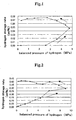
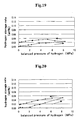
- the relation between the balanced pressure and the hydrogen storage rate was shown in Table 2 and Fig. 2.
- BA 9,9'-bianthryl
- THPEY 1,1,2,2-tetrakis(4-hydroxyphenyl)ethylene
- TMPE tetrakis(p-methoxyphenyl)ethylene
- TPE 1,1,2,2-tetraphenylethane
- DBDCA bis-dicyclohexylamide diphenirate
- FBDCA bis-dicyclohexylamide fumarate
- TPBDM ⁇ , ⁇ , ⁇ ', ⁇ '-tetraphenyl-1,1'-biphenyl-2,2'-dimethanol
- TPHDD 1,1,6,6-tetraphanyl-2,4-hexadiyn-1,6-diol
- CPPZZ 2- (m-cyanophenyl)phenanthro [9, 10-d] imidazole
- TPEA 1,1,2,2-tetrakis(4-hydroxyphenyl)ethane
- AC acetylene dicarboxyl acid
- CD ⁇ -cyclodextrin
- GAM methyl gallate
- DCA deocycholic acid
- TTP tri-m-tolyphosphine
- hydrogen can be stored at the ordinary temperature and the ambient pressure, thereby eliminating the necessity of a pressure tight vessel, a cryogenic vessel, and the like. Therefore, the storage and transport of hydrogen in relatively compact and light form is be achieved and, in addition, stored hydrogen can be easily emitted and used for various applications.
- host compound so that the host compound for enclosing hydrogen is any of compounds capable of enclosing hydrogen.
- Known host compounds are organic compounds of monomolecular type, multimolecular type, high-molecular type, and the like as described with regard to the method of hydrogen storage of the present invention and inorganic host compounds.
- the inorganic host compounds include clay minerals, montmorillonites, and zeolites.
- host compounds of multimolecular type of which enclosure capacity is hardly influenced by the size of molecules of guest compound are preferable.
- phenol-based host compounds such as 1,1-bis(4-hydroxyphenyl)cyclohexane are advantageous in view of enclosure capacity and industrial ready availability.
- the solvent for dissolving the host compound may be any of solvents capable of dissolving the host compound and is suitably selected according to the kind of the host compound.
- any of solvents including alcohols such as methanol and ethanol, ketones such as acetone and methyl ethyl ketone, esters such as ethyl acetate, ethers such as diethyl ether and dibutyl ether, furans such as etrahydrofuran, amides such as dimethyl acetamide, and aldehydes such as acetaldehyde and benzaldehyde can be employed as a solvent for a host compound of multimolecular type such as a phenol-based host compound as mentioned above.
- high volatile solvents are preferable.
- it is preferable to use a solvent which is not enclosed by the used host compound because, if using a solvent which can be enclosed by the used host compound, hydrogen, taken off from the obtained hydrogen clathrate, may unfortunately contain the solvent.
- a solvent which can be enclosed by the used host compound hydrogen, taken off from the obtained hydrogen clathrate, may unfortunately contain the solvent.
- three components i.e. a host compound, hydrogen and solvent, cooperate together to form a stable clathrate, so the solvent is thus not limited the aforementioned condition.
- concentration of the host compound in the solvent there is no particular limitation on the concentration of the host compound in the solvent because the solubility depends on the kind of host compound and the kind of solvent.
- the hydrogen clathrate obtained in the aforementioned manner is a hydrogen clathrate normally having hydrogen molecules from 0.2 to 20 moles relative to 1 mole of the host compound, but somewhat depends on the kind of used host compound and the contact condition with hydrogen.
- the hydrogen clathrate thus obtained can stably enclose hydrogen for a long period of time at the ordinary temperature and the ambient pressure. Moreover, the hydrogen clathrate is light as compared to hydrogen storage alloy and thus has excellent handling property. In addition, the hydrogen clathrate can be easily stored and transported in a container made of glass, metal, or plastic.
- the hydrogen can be taken off from the hydrogen clathrate by heating the hydrogen clathrate to a temperature in a range from 30 °C to 200 °C, particularly in a range from 40 °C to 100 °C.
- the temperature somewhat depends on the kind of host compound. Accordingly, hydrogen can be easily emitted from the hydrogen clathrate and collected.
- Hydrogen clathrate produced by injecting hydrogen into a solvent containing dissolved host compound as mentioned above normally consists of two components of the host compound and the hydrogen.
- the hydrogen clathrate includes used solvent in addition to host compound and hydrogen, that is, consist of three components of the host compound, the hydrogen, and the solvent.
- the hydrogen clathrate has a difference of 20 °C through 30 °C between the emission temperature of solvent and the emission temperature of hydrogen. In this case, it is especially preferable that the used solvent having a boiling point higher than the emission temperature of the hydrogen.
- the host compound after emitting hydrogen once enclosed therein can form a hydrogen clathrate enclosing hydrogen again by being in contact with hydrogen again. That is, the host compound is reusable repeatedly. Further, the host compound in solid state after emitting hydrogen once enclosed therein has improved selective enclosure capacity of hydrogen so that even when the host compound reacts with mixed gas containing hydrogen, the host compound selectively encloses hydrogen.
- BHC 1,1-bis(4-hydroxyphenyl)cyclohexane
- 3ml of methanol As hydrogen was bubbled from a commercially available gas cylinder into the solvent, the methanol as solvent evaporates, thereby obtaining crystals. These crystals were air-dried for 1 hour under room temperature to vaporize the methanol (Crystal A).
- Crystal B a solvent obtained by dissolving 0.2g of BHC in 3ml of methanol was left without reaction (with hydrogen). Crystals thus deposited were taken (Crystal B).
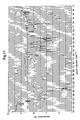
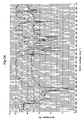
- IR spectrum measurements were made on Crystals A and B obtained above. The results of the measurements are shown in Figs. 20 and 21, respectively, and the superposed data of these results is shown in Fig. 22. From Figs. 20 through 23 showing IR spectrums, the IR spectrums of the crystal A and Crystal B are clearly different from each other in a range from 3100 to 3700 cm- 1 and around 1200 cm -1 depending on the hydrogen group of BHC as the host compound. This makes sure that different crystals were obtained.
- Crystal B has a component (it may be methanol) which evaporates in a temperature range of 80 °C to 110 °C and Crystal A has components which evaporate in two stages of a temperature range less than 50 °C and a temperature range around 80 °C. This means that Crystal A has a component which evaporates in a temperature range less than 50 °C and which was not found in Crystal B.
- the hydrogen clathrate and the production method thereof of the present invention can exhibit the following excellent effects:
Landscapes
- Chemical & Material Sciences (AREA)
- Organic Chemistry (AREA)
- Engineering & Computer Science (AREA)
- Combustion & Propulsion (AREA)
- Inorganic Chemistry (AREA)
- General Health & Medical Sciences (AREA)
- Health & Medical Sciences (AREA)
- Chemical Kinetics & Catalysis (AREA)
- Organic Low-Molecular-Weight Compounds And Preparation Thereof (AREA)
- Hydrogen, Water And Hydrids (AREA)
- Filling Or Discharging Of Gas Storage Vessels (AREA)
- Solid-Sorbent Or Filter-Aiding Compositions (AREA)
- Agricultural Chemicals And Associated Chemicals (AREA)
Abstract
Description
| Evaluation Results of Hydrogen Storage Capacity of BHC (25°C; Retention time at each pressure: 1 hour) | |
| Balanced Pressure (MPa) | Hydrogen Storage Rate (wt%) |
| 0.00001 | 0 |
| 0.28512 | 2.72E-05 |
| 2.56316 | 5.06E-04 |
| 3.58284 | 1.70E-02 |
| 4.74355 | 4.69E-02 |
| 4.37443 | 5.58E-02 |
| 3.59104 | 6.71E-02 |
| 2.69834 | 7.58E-02 |
| 1.54989 | 7.46E-02 |
| 0.85812 | 7.30E-02 |
| 0.31544 | 6.83E-02 |
| Evaluation Results of Hydrogen Enclosure Capacity of BHC (25°C; Retention time at each pressure: 8 hour) | |
| Balanced Pressure (MPa) | Hydrogen Storage Rate (wt%) |
| 0.00001 | 0 |
| 0.26998 | 8.99E-03 |
| 0.75076 | 2.43E-02 |
| 1.54598 | 4.25E-02 |
| 2.48468 | 7.11E-02 |
| 3.42314 | 1.08E-01 |
| 4.40393 | 1.39E-01 |
| 5.98982 | 2.53E-01 |
| 8.9985 | 2.86E-01 |
| 7.7586 | 3.41E-01 |
| 6.08094 | 3.93E-01 |
| 4.8332 | 3.57E-01 |
| 3.70449 | 3.72E-01 |
| 2.47191 | 3.99E-01 |
| 1.58845 | 4.09E-01 |
| 0.8876 | 4.11E-01 |
| 0.33885 | 4.02E-01 |
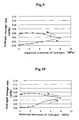
| Evaluation Results of Hydrogen Storage Capacity of BA (25°C; Retention time at each pressure: 1 hour) | |
| Balanced Pressure (MPa) | Hydrogen Storage Rate (wt%) |
| 0.00001 | 0 |
| 0.29628 | 2.51E-03 |
| 0.76323 | 1.99E-03 |
| 1.56556 | 1.34E-03 |
| 2.4644 | 5.50E-05 |
| 3.44561 | 4.59E-04 |
| 4.42035 | 7.60E-03 |
| 7.83902 | 2.44E-02 |
| 6.06874 | 3.10E-02 |
| 4.80743 | 3.93E-02 |
| 3.72473 | 4.50E-02 |
| 2.67821 | 4.41E-02 |
| 1.65635 | 4.55E-02 |
| 0.97333 | 4.55E-02 |
| 0.4255 | 4.32E-02 |
| 0.15678 | 4.48E-02 |
| Evaluation Results of Hydrogen Storage Capacity of THPEY (25°C; Retention time at each pressure: 1 hour) | |
| Balanced Pressure (MPa) | Hydrogen Storage Rate (wt%) |
| 0.00001 | 0 |
| 0.2859 | 2.86E-03 |
| 0.75946 | 2.51E-03 |
| 1.56681 | 4.67E-03 |
| 2.48916 | 7.66E-03 |
| 3.42975 | 1.87E-02 |
| 4.40985 | 2.89E-02 |
| 7.91528 | 4.98E-02 |
| 6.1531 | 5.87E-02 |
| 4.86329 | 6.50E-02 |
| 3.73287 | 7.12E-02 |
| 2.78108 | 7.30E-02 |
| 1.68593 | 7.43E-02 |
| 0.91052 | 7.20E-02 |
| 0.39254 | 7.04E-02 |
| 0.05198 | 6.90E-02 |
| Evaluation Results of Hydrogen Storage Capacity of TMPE (25°C; Retention time at each pressure: 1 hour) | |
| Balanced Pressure (MPa) | Hydrogen Storage Rate (wt%) |
| 0.00001 | 0 |
| 0.34802 | 2.00E-03 |
| 0.77991 | 1.34E-04 |
| 1.556 | 8.87E-04 |
| 2.47892 | 1.06E-03 |
| 3.43927 | 8.98E-04 |
| 4.41114 | 2.49E-04 |
| 7.82444 | 1.43E-02 |
| 6.03258 | 2.48E-02 |
| 4.77365 | 3.11E-02 |
| 3.66555 | 3.66E-02 |
| 2.6391 | 4.19E-02 |
| 1.62859 | 4.20E-02 |
| 0.93906 | 4.13E-02 |
| 0.41354 | 3.89E-02 |
| 0.15272 | 3.90E-02 |
| Evaluation Results of Hydrogen Storage Capacity of TPE (25°C; Retention time at each pressure: 1 hour) | |
| Balanced Pressure (MPa) | Hydrogen Storage Rate (wt%) |
| 0.00001 | 0 |
| 0.29124 | 2.08E-03 |
| 0.7583 | 3.31E-03 |
| 1.55817 | 9.53E-03 |
| 2.49921 | 1.79E-02 |
| 3.47931 | 3.37E-02 |
| 4.45467 | 4.56E-02 |
| 7.85865 | 7.99E-02 |
| 6.09663 | 7.89E-02 |
| 4.80934 | 7.35E-02 |
| 3.67186 | 7.14E-02 |
| 2.64523 | 6.48E-02 |
| 1.63782 | 5.95E-02 |
| 0.95366 | 5.56E-02 |
| 0.41393 | 4.98E-02 |
| 0.15164 | 4.87E-02 |
| Evaluation Results of Hydrogen Storage Capacity of DBDCA (25°C; Retention time at each pressure: 1 hour) | |
| Balanced Pressure (MPa) | Hydrogen Storage Rate(wt%) |
| 0.00001 | 0 |
| 0.26798 | 2.60E-03 |
| 0.61094 | 5.37E-03 |
| 1.5056 | 1.02E-02 |
| 2.50882 | 1.88E-02 |
| 3.46749 | 3.28E-02 |
| 4.50091 | 4.32E-02 |
| 7.98069 | 7.74E-02 |
| 6.12568 | 8.49E-02 |
| 4.82424 | 8.90E-02 |
| 3.71524 | 8.71E-02 |
| 2.68839 | 8.50E-02 |
| 1.67032 | 7.75E-02 |
| 0.88976 | 7.14E-02 |
| 0.39007 | 6.94E-02 |
| Evaluation Results of Hydrogen Storage Capacity of FBDCA (25°C; Retention time at each pressure: 1 hour) | |
| Balanced Pressure (MPa) | Hydrogen Storage Rate (wt%) |
| 0.00001 | 0 |
| 0.27639 | 0.00E+00 |
| 0.76462 | 0.00E+00 |
| 1.58534 | 0.00E+00 |
| 2.5095 | 3.33E-04 |
| 3.49362 | 5.11E-03 |
| 4.50578 | 8.88E-03 |
| 7.91723 | 2.13E-02 |
| 6.11502 | 3.74E-02 |
| 4.80353 | 5.04E-02 |
| 3.69892 | 5.68E-02 |
| 2.66783 | 6.15E-02 |
| 1.66457 | 6.39E-02 |
| 0.86552 | 6.55E-02 |
| 0.38038 | 6.58E-02 |
| 0.20061 | 6.71E-02 |
| 0.13619 | 6.58E-02 |
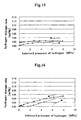
| Evaluation Results of Hydrogen Storage Capacity of TPBDM (25°C; Retention time at each pressure: 1 hour) | |
| Balanced Pressure (MPa) | Hydrogen Storage Rate (wt%) |
| 0.00001 | 0 |
| 0.27325 | 3.86E-03 |
| 0.76318 | 5.86E-03 |
| 1.57435 | 7.25E-03 |
| 2.52014 | 9.34E-03 |
| 3.51926 | 1.45E-02 |
| 4.48755 | 1.76E-02 |
| 7.94765 | 3.55E-02 |
| 6.14546 | 4.55E-02 |
| 4.82544 | 5.52E-02 |
| 3.72633 | 5.88E-02 |
| 2.68608 | 6.06E-02 |
| 1.66871 | 5.98E-02 |
| 1.3472 | 6.10E-02 |
| 0.56019 | 5.90E-02 |
| 0.26901 | 5.95E-02 |
| 0.16055 | 5.96E-02 |
| Evaluation Results of Hydrogen Storage Capacity of TPHDD (25°C; Retention time at each pressure: 1 hour) | |
| Balanced Pressure (MPa) | Hydrogen Storage Rate (wt%) |
| 0.00001 | 0 |
| 0.2846 | 3.86E-03 |
| 0.76446 | 1.15E-03 |
| 1.56681 | 4.67E-03 |
| 2.49036 | 7.66E-03 |
| 3.44995 | 1.87E-02 |
| 4.48085 | 2.89E-02 |
| 7.92517 | 4.98E-02 |
| 6.15209 | 5.87E-02 |
| 4.85724 | 6.50E-02 |
| 3.73289 | 7.12E-02 |
| 2.73198 | 7.30E-02 |
| 1.68694 | 7.43E-02 |
| 0.90154 | 7.20E-02 |
| 0.39853 | 7.04E-02 |
| 0.21299 | 6.90E-02 |
| 0.14233 | 6.85E-02 |
| 0.05198 | 6.90E-02 |
| Evaluation Results of Hydrogen Storage Capacity of CPPIZ (25°C; Retention time at each pressure: 1 hour) | |
| Balanced Pressure (MPa) | Hydrogen Storage Rate (wt%) |
| 0.00001 | 0 |
| 0.27501 | 3.67E-03 |
| 0.74744 | 6.10E-03 |
| 1.55025 | 1.05E-02 |
| 2.48037 | 1.42E-02 |
| 3.42067 | 1.95E-02 |
| 4.42905 | 3.54E-02 |
| 7.823 | 4.91E-02 |
| 6.09215 | 8.70E-02 |
| 4.83169 | 9.98E-02 |
| 3.70401 | 1.14E-01 |
| 2.66689 | 1.16E-01 |
| 1.67919 | 1.14E-01 |
| 0.92012 | 1.08E-01 |
| 0.41564 | 9.85E-02 |
| 0.22111 | 1.01E-01 |
| 0.41659 | 1.01E-01 |
| 0.05505 | 9.86E-02 |
| Evaluation Results of Hydrogen Storage Capacity of THPEA (25°C; Retention time at each pressure: 1 hour) | |
| Balanced Pressure (MPa) | Hydrogen Storage Rate (wt%) |
| 0.00001 | 0 |
| 0.29865 | 3.93E-03 |
| 0.68963 | 4.98E-03 |
| 1.38148 | 3.34E-03 |
| 2.16169 | 9.01E-04 |
| 3.59962 | 2.72E-03 |
| 4.8627 | 7.64E-03 |
| 8.21891 | 2.68E-02 |
| 6.4096 | 4.14E-02 |
| 5.14432 | 3.18E-02 |
| 3.55335 | 3.10E-02 |
| 2.44797 | 2.82E-02 |
| 1.50235 | 2.45E-02 |
| 0.85956 | 2.20E-02 |
| 0.38532 | 2.11E-02 |
| 0.14243 | 1.81E-02 |
| Evaluation Results of Hydrogen Storage Capacity of HQ (25°C; Retention time at each pressure: 1 hour) | |
| Balanced Pressure (MPa) | Hydrogen Storage Rate (wt%) |
| 0.00001 | 0 |
| 0.34576 | 5.92E-03 |
| 0.77692 | 1.02E-02 |
| 1.55369 | 1.99E-02 |
| 2.48608 | 2.69E-02 |
| 3.47638 | 3.21E-02 |
| 4.44271 | 3.94E-02 |
| 7.84616 | 8.34E-02 |
| 6.07125 | 7.89E-02 |
| 4.79427 | 7.32E-02 |
| 3.69405 | 6.47E-02 |
| 2.65721 | 5.42E-02 |
| 1.64583 | 4.88E-02 |
| 0.78016 | 3.64E-02 |
| 0.38000 | 3.05E-02 |
| 0.13936 | 2.76E-02 |
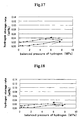
| Evaluation Results of Hydrogen Storage Capacity of urea (25°C; Retention time at each pressure: 1 hour) | |
| Balanced Pressure (MPa) | Hydrogen Storage Rate (wt%) |
| 0.00001 | 0 |
| 0.26619 | 1.09E-03 |
| 0.79056 | 1.22E-03 |
| 1.584 | 3.11E-03 |
| 2.51682 | 2.82E-03 |
| 3.49309 | 1.78E-04 |
| 4.46605 | 1.51E-02 |
| 7.91202 | 3.92E-02 |
| 6.08862 | 5.12E-02 |
| 4.81388 | 5.47E-02 |
| 3.70222 | 5.38E-02 |
| 2.64015 | 4.92E-02 |
| 1.62255 | 3.83E-02 |
| 0.96213 | 3.32E-02 |
| 0.40202 | 3.16E-02 |
| 0.1442 | 2.95E-02 |
| Evaluation Results of Hydrogen Storage Capacity of AC (25°C; Retention time at each pressure: 1 hour) | |
| Balanced Pressure (MPa) | Hydrogen Storage Rate (wt%) |
| 0.00001 | 0 |
| 0.27146 | 3.40E-03 |
| 0.74369 | 6.02E-03 |
| 1.5659 | 1.02E-02 |
| 2.50809 | 1.30E-02 |
| 3.47403 | 1.81E-02 |
| 4.45074 | 1.42E-02 |
| 7.88744 | 2.29E-02 |
| 6.11056 | 2.47E-02 |
| 4.78659 | 2.57E-02 |
| 3.69364 | 2.48E-02 |
| 2.65705 | 2.40E-02 |
| 1.63543 | 2.09E-02 |
| 0.86718 | 1.83E-02 |
| 0.37335 | 1.68E-02 |
| 0.1354 | 1.68E-02 |
| Evaluation Results of Hydrogen Storage Capacity of CD (25°C; Retention time at each pressure: 1 hour) | |
| Balanced Pressure(MPa) | Hydrogen Storage Rate (wt%) |
| 0.00001 | 0 |
| 0.29994 | 2.20E-03 |
| 0.63 | 1.30E-03 |
| 1.59541 | 2.29E-04 |
| 2.61668 | 5.74E-03 |
| 3.47134 | 1.37E-02 |
| 4.44424 | 2.14E-02 |
| 7.87665 | 5.17E-02 |
| 6.17737 | 4.61E-02 |
| 4.90025 | 3.92E-02 |
| 3.72096 | 3.15E-02 |
| 2.7198 | 2.45E-02 |
| 1.5438 | 1.53E-02 |
| 0.85297 | 9.75E-03 |
| 0.37524 | 5.25E-03 |
| 0.13649 | 2.22E-03 |
| Evaluation Results of Hydrogen Storage Capacity of GAM (25°C; Retention time at each pressure: 1 hour) | |
| Balanced Pressure (MPa) | Hydrogen Storage Rate (wt%) |
| 0.00001 | 0 |
| 0.29993 | 2.27E-03 |
| 0.70041 | 2.40E-03 |
| 1.9847 | 2.90E-03 |
| 2.7857 | 7.70E-03 |
| 3.53863 | 9.03E-03 |
| 4.6868 | 1.21E-02 |
| 7.98167 | 3.17E-02 |
| 6.36749 | 3.31E-02 |
| 5.03659 | 3.48E-02 |
| 3.9262 | 3.26E-02 |
| 2.59506 | 2.61E-02 |
| 1.54629 | 2.32E-02 |
| 0.86813 | 2.07E-02 |
| 0.38689 | 1.90E-02 |
| 0.14084 | 1.96E-02 |
| Evaluation Results of Hydrogen Storage Capacity of DCA (25°C; Retention time at each pressure: 1 hour) | |
| Balanced Pressure (MPa) | Hydrogen Storage Rate (wt%) |
| 0.00001 | 0 |
| 0.30282 | 3.91E-03 |
| 0.69569 | 3.72E-03 |
| 1.41085 | 3.74E-03 |
| 2.54758 | 3.92E-03 |
| 3.62008 | 7.68E-03 |
| 4.63304 | 1.19E-02 |
| 7.96485 | 1.80E-02 |
| 6.2381 | 1.80E-02 |
| 4.98709 | 2.04E-02 |
| 3.89659 | 1.90E-02 |
| 2.56303 | 1.70E-02 |
| 1.52619 | 1.45E-02 |
| 0.85848 | 1.26E-02 |
| 0.38068 | 1.09E-02 |
| 0.13748 | 1.08E-02 |
| Evaluation Results of Hydrogen Storage Capacity of cellulose (25°C; Retention time at each pressure: 1 hour) | |
| Balanced Pressure (MPa) | Hydrogen Storage Rate (wt%) |
| 0.00001 | 0 |
| 0.29382 | 3.44E-03 |
| 1.75806 | 6.91E-03 |
| 1.78015 | 8.20E-03 |
| 2.33393 | 9.45E-03 |
| 3.67005 | 1.60E-02 |
| 4.88507 | 1.69E-02 |
| 8.25992 | 2.46E-02 |
| 6.49236 | 2.78E-02 |
| 5.18519 | 3.48E-02 |
| 3.57395 | 3.27E-02 |
| 2.44579 | 2.89E-02 |
| 2.50406 | 3.13E-02 |
| 1.23267 | 2.62E-02 |
| 0.52372 | 2.29E-02 |
| 0.19309 | 2.11E-02 |
| Evaluation Results of Hydrogen Storage Capacity of chitosan (25°C; Retention time at each pressure: 1 hour) | |
| Balanced Pressure (MPa) | Hydrogen Storage Rate (wt%) |
| 0.00001 | 0 |
| 0.30279 | 3.44E-03 |
| 0.69235 | 2.12E-03 |
| 2.15133 | 4.39E-03 |
| 2.97406 | 1.25E-02 |
| 3.91867 | 1.65E-02 |
| 4.9564 | 2.57E-02 |
| 8.17041 | 5.08E-02 |
| 6.17912 | 4.88E-02 |
| 4.99404 | 4.49E-02 |
| 3.54056 | 3.78E-02 |
| 2.45056 | 3.15E-02 |
| 1.49881 | 2.50E-02 |
| 0.85259 | 2.11E-02 |
| 0.38412 | 1.85E-02 |
| 0.14203 | 1.70E-02 |
| Evaluation Results of Hydrogen Storage Capacity of TTP (25°C; Retention time at each pressure: 1 hour) | |
| Balanced Pressure (MPa) | Hydrogen Storage Rate (wt%) |
| 0.00001 | 0 |
| 0.30448 | 6.50E-03 |
| 0.70533 | 1.06E-02 |
| 1.72793 | 2.40E-02 |
| 2.74021 | 3.75E-02 |
| 3.552 | 4.73E-02 |
| 4.65216 | 6.82E-02 |
| 8.05616 | 1.25E-01 |
| 6.27169 | 1.15E-01 |
| 4.81187 | 9.71E-02 |
| 3.85328 | 8.07E-02 |
| 2.56244 | 5.96E-02 |
| 1.53375 | 4.23E-02 |
| 0.86878 | 3.32E-02 |
| 0.38471 | 2.73E-02 |
| 0.13945 | 2.45E-02 |
Claims (40)
- A method for storing hydrogen, said method comprising a step wherein organic compound is brought into contact with hydrogen gas in a pressurized state.
- A method for storing hydrogen according to claim 1, wherein said organic compound is supported on a porous carrier.
- A method for storing hydrogen according to claim 1 or 2, wherein said organic compound is capable of forming a hydrogen molecular compound by being brought into contact with hydrogen gas.
- A method for storing hydrogen according to claim 3, wherein said molecular compound is hydrogen clathrate containing said organic compound as a host compound.
- A method for storing hydrogen according to claim 4, wherein said organic compound is at least one selected from the group consisting of monomolecular type host compounds, multimolecular type host compounds, and high-molecular type host compounds.
- A method for storing hydrogen according to claim 5, wherein said monomolecular type host compound is at least one selected from the group consisting of cyclodextrins, crown ethers, cryptands, cyclophanes, azacyclophanes, calixarenes, cyclotriveratrylenes, spherands, and cyclic oligopeptides.
- A method for storing hydrogen according to claim 6, wherein said multimolecular type host compound is at least one selected from the group consisting of ureas, thioureas, deoxycholates, perhydrotriphenylenes, tri-o-thymotides, bianthryls, spirobifluorenes, cyclophosphazenes, monoalcohols, diols, acetylene alcohols, hydroxybenzophenones, phenols, bisphenols, trisphenols, tetrakis phenols, polyphenols, naphthols, bis-naphthols, diphenylmehanols, carboxylic amides, thioamides, bixanthene, carboxylic acids, imidazoles, hydroquinones, organic phosphorus compound, and organic silicon compound.
- A method for storing hydrogen according to claim 7 , wherein said multimolecular type host compound is at least one selected from the group consisting of urea, 1,1,6,6-tetraphenyl-2,4-hexadiyn-1,6-diol, 1,1-bis(2,4-dimethylphenyl)-2-propyn-1-ol, 1,1,4,4-tetraphenyl-2-butyne-1,4-diol, 1,1,6,6-tetrakis(2,4-dimethylphenyl)-2,4-hexadiyn-1,6-diol, 9,10-diphyenyl-9,10-dihydroanthracene-9,10-diol, 9,10-bis(4-methylphenyl)-9,10-dihydroanthracene-9,10-diol, 1,1,2,2-tetraphenyl-ethane-1,2-diol, 4-methoxyphenol, 2,4-dihydroxybenzophenone, 4,4'-dihydroxybenzophenone, 2,2'-dihydroxybenzophenone, 2,2',4,4'-tetrahydroxybenzophenone, 1,1-bis(4-hydroxyphenyl)cyclohexane, 4,4'-sulfonyl bisphenol, 2,2'-methylene bis(4-methyl-6-t-buthylphenol), 4,4'-ethylidene bisphenol, 4,4'-thiobis(3-methyl-6-t-butylphenol), 1,1,3-tris(2-methyl-4-hydroxy-5-t-buthylphenyl)butane, 1,1,2,2-tetrakis(4-hydroxyphenyl)ethane, 1,1,2,2-tetrakis(4-hydroxyphenyl)ethylene, 1,1,2,2-tetrakis(3-mehyl-4-hydroxyphenyl)ethane, 1,1,2,2-tetrakis(3-fluoro-4-hydroxyphenyl)ethane, α,α,α',α'-tetrakis(4-hydroxyphenyl)-p-xylene, tetrakis(p-methoxyphenyl)ethylene, 3,6,3',6'-tetramethoxy-9,9'-bi-9H-xanthene, 3, 6, 3' , 6' -tetra acetoxy-9,9'-bi-9H-xanthene, 3,6,3',6'-tetrahyroxy-9,9'-bi-9H-xanthene, gallic acid, methyl gallate, catechin, bis-β-naphthol, α,α,α',α'-tetraphenyl-1,1'-biphenyl-2,2'-dimethanol, bis-dicyclohexylamide diphenirate, bis-dicyclohexylamide fumarate, cholic acid, deoxycholic acid, 1,1,2,2-tetraphenylethane, tetrakis(p-iodophenyl)ethylene, 9,9'-bianthryl, 1,1,2,2-tetrakis(4-carboxyphenyl)ethane, 1,1,2,2-tetrakis(3-carboxyphenyl)ethane, acetylene dicarboxyl acid, 2,4,5-triphenyl imidazole, 1,2,4,5-tetraphenyl imidazole, 2-phenyl phenanthro[9,10-d]imidazole, 2-(o-cyanophenyl)phenanthro[9,10-d]imidazole, 2-(m-cyanophenyl)phenanthro[9,10-d]imidazole, 2-(p-cyanophenyl)phenanthro[9,10-d] imidazole, hydroquinone, 2-t-buthyl hydroquinone, 2,5-di-t-buthyl hydroquinone, 2,5-bis(2,4-dimethylphenyl)hydroquinone, and tri-m-trylphosphine.
- A method for storing hydrogen according to claim 8, wherein said multi molecular type host compound is at least one selected from the group consisting of 1,1-bis(4-hydroxyphenyl)cyclohexane, 1,1,2,2-tetrakis(4-hydroxyphenyl)ethane, 1,1,2,2-tetrakis(4-hydroxyphenyl)ethylene, tetrakis(p-methoxyphenyl)ethylene, tetrakis(p-iodophenyl)ethylene, 9,9'-bianthryl and 1,1,2,2-tetraphenylethane, bis(dicyclohexylamide)diphenirate, bis-dicyclohexylamide fumarate, α,α,α',α'-tetraphenyl-1,1'-biphenyl-2,2'-dimethanol, 1,1,6,6-tetraphenyl-2,4-hexadiyn-1,6-diol, and 2-(m-cyanophenyl)phenanthro[9,10-d]imidazole.
- A method for storing hydrogen according to claim 5, wherein said high-molecular type host compound is at least one selected from the group consisting of celluloses, starchs, chitins, chitosans, polyvinyl alcohols, polymers of polyethylene glycol arm type of which core is 1,1,2,2-tetrakis phenyl ethane, and polymers of polyethylene glycol arm type of which core is α,α,α',α'-tetrakis phenyl xylene.
- Amethod for storing hydrogen according to claim 4, wherein said organic compound is at least one selected from the group consisting of aromatic compounds, amide compounds, alcohol compounds, imidazole compounds, hydroquinones, ureas, corboxilic acids, cyclodexitrines, polyphenols, cholic acids, celluloses, and organic phosphorous compounds.
- A method for storing hydrogen according to claim 11, wherein said aromatic compounds are phenolic compounds.
- A method for storing hydrogen according to any one of claims 1-12, wherein hydrogen gas is brought into contact with said organic compound at a pressure of higher than 1.0×10⁻¹⁰MPa.
- A method for storing hydrogen according to any one of claims 1-13, wherein hydrogen gas is brought into contact with said organic compound at a pressure between 1.0×10⁻¹⁰MPa and 200MPa.
- Hydrogen clathrate enclosing hydrogen which is formed by contact reaction between a host compound and hydrogen.
- Hydrogen clathrate according to claim 15, wherein said host compound is at least one selected from the group consisting of monomolecular type host compounds, multimolecular type host compounds, high-molecular type host compounds, and inorganic host compounds.
- Hydrogen clathrate according to claim 16, wherein said monomolecular type host compound is at least one selected from the group consisting of cyclodextrins, crown ethers, cryptands, cyclophanes, azacyclophanes, calixarenes, cyclotriveratrylenes, spherands, and cyclic oligopeptides.
- Hydrogen clathrate according to claim 16, wherein said multimolecular type host compound is at least one selected from the group consisting of ureas, thioureas, deoxycholates, perhydrotriphenylenes, tri-o-thymotides, bianthryls, spirobifluorenes, cyclophosphazenes, monoalcohols, diols, acetylene alcohols, hydroxybenzophenones, phenols, bisphenols, trisphenols, tetrakis phenol-base, polyphenols, naphthols, bis-naphthols, diphenylmehanols, carboxylic amides, thioamides, bixanthene, carboxylic acids, imidazoles, hydroquinones, organic phosphorus compound, and organic silicon compound.
- Hydrogen clathrate according to claim 18, wherein said multimolecular type host compound is at least one selected from the group consisting of urea, 1,1,6,6-tetraphenyl-2,4-hexadiyn-1,6-diol, 1,1-bis(2,4-dimethylphenyl)-2-propyn-1-ol, 1,1,4,4-tetraphenyl-2-butyne-1,4-diol, 1,1,6,6-tetrakis(2,4-dixmethylphenyl)-2,4-hexadiyn-1,6-diol, 9,10-diphyenyl-9,10-dihydroanthracene-9,10-diol, 9,10-bis(4-methylphenyl)-9,10-dihydroanthracene-9,10-diol, 1,1,2,2-tetraphenylethane-1,2-diol, 4-methoxyphenol, 2,4-dihydroxybenzophenone, 4,4'-dihydroxybenzophenone, 2,2'-dihydroxybenzophenone, 2,2',4,4'-tetrahydroxybenzophenone, 1,1-bis(4-hydroxyphenyl)cyclohexane, 4,4'-sulfonyl bisphenol, 2,2'-methylene bis(4-methyl-6-t-buthylphenol), 4,4'-ethylidene bisphenol, 4,4'-thiobis(3-methyl-6-t-butylphenol), 1,1,3-tris(2-methyl-4-hydroxy-5-t-buthylphenyl)butane, 1,1,2,2-tetrakis(4-hydroxyphenyl)ethane, 1,1,2,2-tetrakis(4-hydroxyphenyl)ethylene, 1,1,2,2-tetrakis(3-mehyl-4-hydroxyphenyl)ethane, 1,1,2,2-tetrakis(3-fluoro-4-hydroxyphenyl)ethane, α,α,α',α'-tetrakis(4-hydroxyphenyl)-p-xylene, tetrakis(p-methoxyphenyl)ethylene, 3,6,3',6'-tetramethoxy-9,9'-bi-9H-xanthene, 3,6,3',6'-tetra acetoxy-9,9'-bi-9H-xanthene, 3,6,3',6'-tetrahyroxy-9,9'-bi-9H-xanthene, gallic acid, methyl gallate, catechin, bis-β-naphthol, α,α,α',α'-tetraphenyl-1,1'-biphenyl-2,2'-dimethanol, bis-dicyclohexylamide diphenirate, bis-dicyclohexylamide fumarate, cholic acid, deoxycholic acid, 1,1,2,2-tetraphenylethane, tetrakis(p-iodophenyl)ethylene, 9,9'-bianthryl, 1,1,2,2-tetrakis(4-carboxyphenyl)ethane, 1,1,2,2-tetrakis(3-carboxyphenyl)ethane, acetylene dicarboxyl acid, 2,4,5-triphenyl imidazole, 1,2,4,5-tetraphenyl imidazole, 2-phenyl phenanthro[9,10-d]imidazole, 2-(o-cyanophenyl)phenanthro[9,10-d]imidazole, 2-(m-cyanophenyl)phenanthro[9,10-d]imidazole, 2-(p-cyanophenyl)phenanthro[9,10-d]imidazole, hydroquinone, 2-t-buthyl hydroquinone, 2,5-di-t-buthyl hydroquinone, 2,5-bis(2,4-dimethylphenyl)hydroquinone, and tri-m-trylphosphine.
- Hydrogen clathrate according to claim 19, wherein said multi molecular type host compound is at least one selected from the group consisting of 1,1-bis(4-hydroxyphenyl)cyclohexane, 1,1,2,2-tetrakis(4-hydroxyphenyl)ethane, 1,1,2,2-tetrakis(4-hydroxyphenyl)ethylene, tetrakis(p-methoxyphenyl)ethylene, tetrakis(p-iodophenyl)ethylene, 9,9'-bianthryl, 1,1,2,2-tetraphenylethane, bis(dicyclohexylamide)diphenirate, bis-dicyclohexylamide fumarate, α,α,α',α'-tetraphenyl-1,1'-biphenyl-2,2'-dimethanol and 1,1,6,6-tetraphenyl-2,4-hexadiyn-1,6-diol, and 2-(m-cyanophenyl)phenanthro[9,10-d]imidazole.
- Hydrogen clathrate according to claim 16, wherein said high-molecular type host compound is at least one selected from the group consisting of celluloses, starchs, chitins, chitosans, polyvinyl alcohols, polymers of polyethylene glycol arm type of which core is 1,1,2,2-tetrakis phenyl ethane, and polymers of polyethylene glycol arm type of which core is α,α,α',α'-tetrakis phenyl xylene.
- Hydrogen clathrate according to claim 16, whrein said inorganic host compound is at least one selected from the group consisting of clay minerals, monomorillonites, and zeolites.
- Hydrogen clathrate according to claim 15, wherein said host compound is at least one selected from the group consisting of aromatic compounds, amide compounds, alocohol compounds, imidazole compounds, hydroquinones, ureas, corboxilic acids, cyclodexitrines, polyphenols, cholic acids, celluloses, and organic phosphorous compounds.
- Hydrogen clathrate according to claim 23, whrein said aromatic compounds are phenolic compounds.
- A production method of a hydrogen clathrate comprising a step of dissolving a host compound into a solvent, and a step of recrystallizing the host compound with injecting hydrogen into the solvent, and inserting hydrogen molecules into crystal lattice of the host compound.
- A production method of a hydrogen clathrate according to claim 25, wherein said host compound is at least one selected from the group consisting of monomolecular type host compounds, multimolecular type host compounds, and high-molecular type host compounds and inorganic host compounds.
- A production method of a hydrogen clathrate according to claim 26, wherein said monomolecular type host compounds is at least one selected from the group consisting of cyclodextrins, crown ethers, cryptands, cyclophanes, azacyclophanes, calixarenes, cyclotriveratrylenes, spherands, and cyclic oligopeptides.
- A production method of a hydrogen clathrate according to claim 27, wherein said multimolecular type host compound is at least one selected from the group consisting of ureas, thioureas, deoxycholates, perhydrotriphenylenes, tri-o-thymotides, bianthryls, spirobifluorenes, cyclophosphazenes, monoalcohols, diols, acetylene alcohols, hydroxybenzophenones, phenols, bisphenols, trisphenols, tetrakis phenol-base, polyphenols, naphthols, bis-naphthols, diphenylmehanols, carboxylic amides, thioamides, bixanthene, carboxylic acids, imidazoles, hydroquinones, organic phosphorus compound, and organic silicon compound.
- A production method of a hydrogen clathrate according to claim 28, wherein said multimolecular type host compound is at least one selected from the group consisting of urea, 1,1,6,6-tetraphenyl-2,4-hexadiyn-1,6-diol, 1,1-bis(2,4-dimethylphenyl)-2-propyn-1-ol, 1,1,4,4-tetraphenyl-2-butyne-1,4-diol, 1,1,6,6-tetrakis(2,4-dimethylphenyl)-2,4-hexadiyn-1,6-diol, 9,10-diphyenyl-9,10-dihydroanthracene-9,10-diol, 9,10-bis(4-methylphenyl)-9,10-dihydroanthracene-9,10-diol, 1,1,2,2-tetraphenylethane-1,2-diol, 4-methoxyphenol, 2,4-dihydroxybenzophenone, 4,4'-dihydroxybenzophenone, 2,2',-dihydroxybenzophenone, 2,2',4,4'-tetrahydroxybenzophenone, 1,1-bis(4-hydroxyphenyl)cyclohexane, 4,4'-sulfonyl bisphenol, 2,2'-methylene bis(4-methyl-6-t-buthylphenol), 4,4'-ethylidene bisphenol, 4,4'-thiobis(3-methyl-6-t-butylphenol), 1,1,3-tris(2-methyl-4-hydroxy-5-t-buthylphenyl)butane, 1,1,2,2-tetrakis(4-hydroxyphenyl)ethane, 1,1,2,2-tetrakis(4-hydroxyphenyl)ethylene, 1,1,2,2-tetrakis(3-mehyl-4-hydroxyphenyl)ethane, 1,1,2,2-tetrakis(3-fluoro-4-hydroxyphenyl)ethane, α,α,α',α'-tetrakis(4-hydroxyphenyl)-p-xylene, tetrakis(p-methoxyphenyl)ethylene, 3,6,3',6'-tetramethoxy-9,9'-bi-9H-xanthene, 3,6,3',6'-tetra acetoxy-9,9'-bi-9H-xanthene, 3,6,3',6'-tetrahydroxy-9,9'-bi-9H-xanthene, gallic acid, methyl gallate, catechin, bis-β-naphthol, α,α,α',α'-tetraphenyl-1,1'-biphenyl-2,2'-dimethanol, bis-dicyclohexylamide diphenirate, bis-dicyclohexylamide fumarate, cholic acid, deoxycholic acid, 1,1,2,2-tetraphenylethane, tetrakis(p-iodophenyl)ethylene, 9,9'-bianthryl, 1,1,2,2-tetrakis (4-carboxyphenyl) ethane, 1,1,2,2-tetrakis(3-carboxyphenyl)ethane, acetylene dicarboxyl acid, 2,4,5-triphenyl imidazole, 1,2,4,5-tetraphenyl imidazole, 2-phenyl phenanthro[9,10-d]imidazole, 2-(o-cyanophenyl)phenanthro[9,10-d]imidazole, 2-(m-cyanophenyl)phenanthro[9,10-d]imidazole, 2-(p-cyanophenyl)phenanthro[9,10-d]imidazole, hydroquinone, 2-t-buthyl hydroquinone, 2,5-di-t-buthyl hydroquinone, 2,5-bis(2,4-dimethylphenyl)hydroquinone, and tri-m-trylphosphine.
- A production method of a hydrogen clathrate according to claim 29, wherein said multi molecular type host compound is at least one selected from the group consisting of 1,1-bis(4-hydroxyphenyl)cyclohexane, 1,1,2,2-tetrakis(4-hydroxyphenyl)ethane, 1,1,2,2-tetrakis(4-hydroxyphenyl)ethylene, tetrakis(p-methoxyphenyl)ethylene, tetrakis(p-iodophenyl)ethylene, 9,9'-bianthryl, 1,1,2,2-tetraphenylethane, bis(dicyclohexylamide)diphenirate, bis-dicyclohexylamide fumarate, α,α,α',α'-tetraphenyl-1,1'-biphenyl-2,2'-dimethanol and 1,1,6,6-tetraphenyl-2,4-hexadiyn-1,6-diol, and 2-(m-cyanophenyl)phenanthro[9,10-d]imidazole.
- A production method of a hydrogen clathrate according to claim 26, wherein said high-molecular type host compound is at least one selected from the group consisting of celluloses, starchs, chitins, chitosans, polyvinyl alcohols, polymers of polyethylene glycol arm type of which core is 1,1,2,2-tetrakis phenyl ethane, and polymers of polyethylene glycol arm type of which core is α,α,α',α'-tetrakis phenyl xylene.
- A production method of a hydrogen clathrate according to claim 26, whrein said inorganic host compound is at least one selected from the group consisting of clay minerals, montmorillonites, and zeolites.
- A production method of a hydrogen clathrate as claimed in claim 25, wherein said host compound is a multimolecular type host compound such as phenolic type host compound, and wherein the solvent is at least one selected from the group consisting of alcohols such as methanol and ethanol, ketones such as acetone and methyl ethyl ketone, esters such as ethyl acetate, ethers such as diethyl ether and dibutyl ether, furans such as etrahydrofuran, amides such as dimethyl acetamide, and aldehydes such as acetaldehyde and benzaldehyde.
- A production method of a hydrogen clathrate comprising a step of bringing hydrogen gas into contact with a host compound in a pressurized state.
- A production method of a hydrogen clathrate according to claim 34, wherein said host compound is at least one selected from the group consisting of monomolecular type host compounds, multimolecular type host compounds, and high-molecular type host compounds.
- A production method of a hydrogen clathrate according to claim 35, wherein said monomolecular type compound is at least one selected from the group consisting of cyclodextrins, crown ethers, cryptands, cyclophanes, azacyclophanes, calixarenes, cyclotriveratrylenes, spherands, and cyclic oligopeptides.
- A production method of a hydrogen clathrate according to claim 35, wherein said multimolecular type host compound is at least one selected from the group consisting of ureas, thioureas, deoxycholates, perhydrotriphenylenes, tri-o-thymotides, bianthryls, spirobifluorenes, cyclophosphazenes, monoalcohols, diols, acetylene alcohols, hydroxybenzophenones, phenols, bisphenols, trisphenols, tetrakis phenol-base, polyphenols, naphthols, bis-naphthols, diphenylmehanols, carboxylic amides, thioamides, bixanthene, carboxylic acids, imidazoles, hydroquinones, organic phosphorus compound, and organic silicon compound.
- A production method of a hydrogen clathrate according to claim 37, wherein said multimolecular type host compound is at least one selected from the group consisting of urea, 1,1,6,6-tetraphenyl-2,4-hexadiyn-1,6-diol, 1,1-bis(2,4-dimethylphenyl)-2-propyn-1-ol, 1,1,4,4-tetraphenyl-2-butyne-1,4-diol, 1,1,6,6-tetrakis(2,4-dimethylphenyl)-2,4-hexadiyn-1,6-diol, 9,10-diphyenyl-9,10-dihydroanthracene-9,10-diol, 9,10-bis(4-methylphenyl)-9,10-dihydroanthracene-9,10-diol, 1,1,2,2-tetraphenylethane-1,2-diol, 4-methoxyphenol, 2,4-dihydroxybenzophenone, 4,4'-dihydroxybenzophenone, 2,2'-dihydroxybenzophenone, 2,2',4,4'-tetrahydroxybenzophenone, 1,1-bis(4-hydroxyphenyl)cyclohexane, 4,4'-sulfonyl bisphenol, 2,2'-methylene bis(4-methyl-6-t-buthylphenol), 4,4'-ethylidene bisphenol, 4,4'-thiobis(3-methyl-6-t-butylphenol), 1,1,3-tris(2-methyl-4-hydroxy-5-t-buthylphenyl)butane, 1,1,2,2-tetrakis(4-hydroxyphenyl)ethane, 1,1,2,2-tetrakis(4-hydroxyphenyl)ethylene, 1,1,2,2-tetrakis(3-mehyl-4-hydroxyphenyl)ethane, 2,1,2,2 -tetrakis(3-fluoro-4-hydroxyphenyl)ethane, α,α,α',α'-tetrakis(4-hydroxyphenyl)-p-xylene, tetrakis(p-methoxyphenyl)ethylene, 3,6,3',6'-tetramethoxy-9,9'-bi-9H-xanthene, 3,6,3',6'-tetra acetoxy-9,9'-bi-9H-xanthene, 3,6,3',6'-tetrahyroxy-9,9'-bi-9H-xanthene, gallic acid, methyl gallate, catechin, bis-β-naphthol, α,α,α',α'-tetraphenyl-1,1'-biphenyl-2,2'-dimethanol, bis-dicyclohexylamide diphenirate, bis-dicyclohexylamide fumarate, cholic acid, deoxycholic acid, 1,1,2,2-tetraphenylethane, tetrakis(p-iodophanyl)ethylene, 9,9'-bianthryl, 1,1,2,2-tetrakis(4-carboxyphenyl)ethane, 1,1,2,2-tetrakis(3-carboxyphenyl)ethane, acetylene dicarboxyl acid, 2,4,5-triphenyl imidazole, 1,2,4,5-tetraphenyl imidazole, 2-phenyl phenanthro[9,10-d]imidazole, 2-(o-cyanophenyl)phenanthro[9,10-d]imidazole, 2-(m-eyanophenyl)phenanthro[9,10-d]imidazole, 2-(p-cyanophenyl)phenanthro[9,10-d]imidazole, hydroquinone, 2-t-buthyl hydroquinone, 2,5-di-t-buthyl hydroquinone, 2,5-bis(2,4-dimethylphenyl)hydroquinone, and tri-m-trylphosphine.
- A production method of a hydrogen clathrate according to claim 38, wherein said multi molecular type host compound is at least one selected from the group consisting of 1,1-bis(4-hydroxyphenyl)cyclohexane, 1,1,2,2-tetrakis(4-hydroxyphenyl)ethane, 1,1,2,2-tetrakis(4-hydroxyphenyl)ethylene, tetrakis(p-methoxyphenyl)ethylene, tetrakis(p-iodophenyl)ethylene, 9,9'-bianthryl and 1,1,2,2-tetraphenylethane, bis(dicyclohexylamide)diphenirate, bis-dicyclohexylamide fumarate, α,α,α',α'-tetraphenyl-1,1'-biphenyl-2,2'-dimethanol, 1,1,6,6-tetraphenyl-2,4-hexadiyn-1,6-diol, and 2-(m-cyanophenyl)phenanthro[9,10-d]imidazole.
- A production method of a hydrogen clathrate according to claim 35, wherein said high-molecular type host compound is at least one selected from the group consisting of celluloses, starchs, chitins, chitosans, polyvinyl alcohols, polymers of polyethylene glycol arm type of which core is 1,1,2,2-tetrakis phenyl ethane, and polymers of polyethylene glycol arm type of which core is α,α,α',α'-tetrakis phenyl xylene.
Applications Claiming Priority (5)
| Application Number | Priority Date | Filing Date | Title |
|---|---|---|---|
| JP2002178755 | 2002-06-19 | ||
| JP2002178755 | 2002-06-19 | ||
| JP2003024590 | 2003-01-31 | ||
| JP2003024590 | 2003-01-31 | ||
| PCT/JP2003/007318 WO2004000857A1 (en) | 2002-06-19 | 2003-06-10 | Method of storing hydrogen, hydrogen inclusion compound and process for producing the same |
Publications (2)
| Publication Number | Publication Date |
|---|---|
| EP1428831A1 true EP1428831A1 (en) | 2004-06-16 |
| EP1428831A4 EP1428831A4 (en) | 2006-09-20 |
Family
ID=30002237
Family Applications (1)
| Application Number | Title | Priority Date | Filing Date |
|---|---|---|---|
| EP03733334A Withdrawn EP1428831A4 (en) | 2002-06-19 | 2003-06-10 | METHOD FOR PRESERVING HYDROGEN, HYDROGEN INCLUSION COMPOUND, AND PROCESS FOR PRODUCING THE SAME |
Country Status (10)
| Country | Link |
|---|---|
| US (1) | US7220294B2 (en) |
| EP (1) | EP1428831A4 (en) |
| JP (2) | JP4617880B2 (en) |
| KR (1) | KR100653662B1 (en) |
| CN (1) | CN100519570C (en) |
| AU (1) | AU2003242146A1 (en) |
| CA (1) | CA2482087C (en) |
| MY (1) | MY133622A (en) |
| TW (1) | TW200400935A (en) |
| WO (1) | WO2004000857A1 (en) |
Cited By (7)
| Publication number | Priority date | Publication date | Assignee | Title |
|---|---|---|---|---|
| JP2007511504A (en) * | 2003-11-14 | 2007-05-10 | ローラス セラピューティクス インコーポレーテッド | Arylimidazoles and their use as anticancer agents |
| US8148392B2 (en) | 2005-05-25 | 2012-04-03 | Lorus Therapeutics Inc. | 2-indolyl imidazo [4,5-d] phenanthroline derivatives and their use in the treatment of cancer |
| US8394815B2 (en) | 2002-08-19 | 2013-03-12 | Lorus Therapeutics Inc. | 2,4,5-trisubstituted imidazoles and their use as anti-microbial agents |
| US9309247B2 (en) | 2013-03-20 | 2016-04-12 | Lorus Therapeutics Inc. | 2-substituted imidazo[4,5-D]phenanthroline derivatives and their use in the treatment of cancer |
| US11104957B2 (en) | 2013-10-04 | 2021-08-31 | Aptose Biosciences, Inc. | Compositions and methods for treating cancers |
| US11149047B2 (en) | 2017-10-30 | 2021-10-19 | Aptose Biosciences, Inc. | Aryl imidazoles for treatment of cancer |
| WO2023222606A1 (en) * | 2022-05-20 | 2023-11-23 | Université De Pau Et Des Pays De L'adour | Porous composite and use thereof for gas storage |
Families Citing this family (24)
| Publication number | Priority date | Publication date | Assignee | Title |
|---|---|---|---|---|
| JP2004142985A (en) * | 2002-10-23 | 2004-05-20 | Kurita Water Ind Ltd | Hydrogen release device |
| JP4631309B2 (en) * | 2004-05-14 | 2011-02-16 | 栗田工業株式会社 | Fuel for solid oxide fuel cell, solid oxide fuel cell and method of using the same |
| EP1705740A4 (en) | 2003-12-18 | 2009-02-25 | Kurita Water Ind Ltd | FUEL FOR FUEL CELL, FUEL CELL AND USE THEREOF |
| NL1025907C2 (en) * | 2004-04-08 | 2005-10-11 | Univ Delft Tech | Hydrogen storage. |
| JP2006079838A (en) * | 2004-09-07 | 2006-03-23 | Konica Minolta Holdings Inc | Fuel for fuel cell and fuel cell using it |
| JP2006095389A (en) * | 2004-09-28 | 2006-04-13 | Kurita Water Ind Ltd | Hydrogen water manufacturing method and electronic component cleaning method |
| JP4792725B2 (en) * | 2004-09-29 | 2011-10-12 | 栗田工業株式会社 | Hydrogen storage method |
| JP5062421B2 (en) * | 2005-05-13 | 2012-10-31 | 栗田工業株式会社 | Hydrogen storage method |
| US7901661B2 (en) * | 2005-12-21 | 2011-03-08 | The Penn State Research Foundation | Synthesis of hydrogen-carbon clathrate material and hydrogen evolution therefrom at moderate temperatures and pressures |
| US7749304B2 (en) * | 2006-01-30 | 2010-07-06 | General Electric Company | Method for storing hydrogen, and related articles and systems |
| US7553996B2 (en) * | 2007-03-06 | 2009-06-30 | Conant Lawrence D | Gas clathrate hydrate compositions, synthesis and use |
| CN101798060B (en) * | 2010-03-31 | 2012-05-23 | 华南理工大学 | A kind of composite hydrogen storage method with cage structure |
| CN101804963B (en) * | 2010-03-31 | 2012-05-09 | 华南理工大学 | A kind of hydrogen clathrate composite hydrogen storage method |
| CN104761485A (en) * | 2015-03-09 | 2015-07-08 | 中国科学院成都生物研究所 | A novel hydrogen storage material and a hydrogen resolving method |
| KR102112786B1 (en) * | 2015-08-19 | 2020-05-20 | 롬엔드하스전자재료코리아유한회사 | Organic electroluminescent compounds and organic electroluminescent device comprising the same |
| KR102840102B1 (en) * | 2015-10-30 | 2025-08-01 | 듀폰스페셜티머터리얼스코리아 유한회사 | Electron buffering materials, electron transport materials and organic electroluminescent device comprising the same |
| WO2019015638A1 (en) * | 2017-07-19 | 2019-01-24 | 中国石油化工股份有限公司 | Olefin polymerization catalyst comprising cyclotriveratrylene and derivatives thereof |
| CN108006431A (en) * | 2017-12-09 | 2018-05-08 | 芜湖瑞德机械科技有限公司 | Insulated gas cylinder with excellent service life |
| CN109252984A (en) * | 2018-09-06 | 2019-01-22 | 北京铂陆氢能科技开发有限公司 | A kind of energy storage and distributed generation resource electricity generation system based on organic liquid hydrogen storage material |
| KR102107929B1 (en) * | 2019-01-31 | 2020-05-07 | 한국해양대학교 산학협력단 | Hydroquinone-resorcinol clathrate compounds and a method for capturing or storing small atoms and molecules using the same |
| JP7372130B2 (en) * | 2019-12-09 | 2023-10-31 | 日東電工株式会社 | Hydrogen storage method, hydrogen gas production method, and hydrogen gas production system |
| CN111204706B (en) * | 2020-01-15 | 2023-05-23 | 华南理工大学 | Method for storing hydrogen by utilizing H-type hydrate |
| JP7651811B2 (en) * | 2021-01-15 | 2025-03-27 | 大成建設株式会社 | Gas Storage and Release Compounds |
| CN116987380B (en) * | 2023-04-26 | 2024-12-31 | 东华大学 | A gas barrier nylon composite material and its preparation method and application |
Family Cites Families (27)
| Publication number | Priority date | Publication date | Assignee | Title |
|---|---|---|---|---|
| JPS5314513B2 (en) * | 1975-01-29 | 1978-05-18 | ||
| JPS5314513A (en) | 1976-07-26 | 1978-02-09 | Hitachi Ltd | Interface conversion device |
| FR2457709A1 (en) * | 1979-05-29 | 1980-12-26 | Anvar | NOVEL GAS ADSORPTION AGENTS USEFUL IN PARTICULAR FOR SEPARATING HYDROGEN FROM A PHASE CONTAINING IT |
| JPS56139129A (en) * | 1980-04-02 | 1981-10-30 | Toyo Soda Mfg Co Ltd | Zeolite occluding agent |
| JP2508651B2 (en) * | 1986-07-30 | 1996-06-19 | 栗田工業株式会社 | Method for producing clathrate compound |
| JPH0240304A (en) * | 1988-07-27 | 1990-02-09 | Kanebo Ltd | sustained release antibacterial agent |
| JPH02121957A (en) * | 1988-10-28 | 1990-05-09 | Kurita Water Ind Ltd | clathrate compound |
| JPH02178243A (en) * | 1988-12-28 | 1990-07-11 | Kurita Water Ind Ltd | 2,2'-bis(alpha-hydroxydiphenylmethyl)biphenyl and host compound consisting of the same |
| JPH06115901A (en) * | 1992-10-01 | 1994-04-26 | Jena Purusotam | New hydrogen reserve substance, device and its use |
| JP2985604B2 (en) * | 1993-10-01 | 1999-12-06 | 栗田工業株式会社 | Clathrate compound |
| JP3839859B2 (en) * | 1994-12-28 | 2006-11-01 | 日本曹達株式会社 | Method for producing inclusion compound |
| US5624598A (en) * | 1995-04-18 | 1997-04-29 | Shepodd; Timothy J. | Materials for the scavanging of hydrogen at high temperatures |
| DE19745549C2 (en) * | 1997-10-10 | 1999-11-04 | Mannesmann Ag | Gas storage |
| NO307986B1 (en) * | 1998-02-06 | 2000-07-03 | Inst Energiteknik | Method of storing hydrogen in a carbon material |
| JP2000210559A (en) * | 1999-01-22 | 2000-08-02 | Osaka Gas Co Ltd | Gas storable organic metal complex, manufacture thereof and gas storage device |
| JP2001056099A (en) * | 1999-08-18 | 2001-02-27 | Toyota Motor Corp | Hydrogen storage method |
| JP2001261301A (en) * | 2000-03-16 | 2001-09-26 | Toyota Central Res & Dev Lab Inc | Organic-based hydrogen storage material and hydrogen storage method |
| JP3551127B2 (en) * | 2000-04-21 | 2004-08-04 | トヨタ自動車株式会社 | Hydrogen storage material |
| US6626981B2 (en) * | 2000-07-07 | 2003-09-30 | Advanced Fuel Research, Inc. | Microporous carbons for gas storage |
| JP4519300B2 (en) * | 2000-09-29 | 2010-08-04 | 本田技研工業株式会社 | Boil-off gas processing equipment |
| US7291756B2 (en) * | 2000-12-11 | 2007-11-06 | Nippon Soda Co., Ltd. | Method for producing molecular compound |
| US6634321B2 (en) * | 2000-12-14 | 2003-10-21 | Quantum Fuel Systems Technologies Worldwide, Inc. | Systems and method for storing hydrogen |
| JP2002275673A (en) * | 2001-03-16 | 2002-09-25 | Norio Kudo | Electric power storage unit |
| US6735960B2 (en) * | 2001-10-30 | 2004-05-18 | Carnegie Institution Of Washington | Composition and method for hydrogen storage |
| JP2003212800A (en) * | 2002-01-23 | 2003-07-30 | Nippon Oil Corp | Process for producing decalin by hydrogenation of naphthalene |
| JP2004083385A (en) * | 2002-06-04 | 2004-03-18 | Sekisui Chem Co Ltd | Hydrogen supply medium and hydrogen storage / supply system using the same |
| JP2004026759A (en) * | 2002-06-27 | 2004-01-29 | Sekisui Chem Co Ltd | Method for producing hydrogen supplier |
-
2003
- 2003-06-10 KR KR1020047007765A patent/KR100653662B1/en not_active Expired - Fee Related
- 2003-06-10 AU AU2003242146A patent/AU2003242146A1/en not_active Abandoned
- 2003-06-10 EP EP03733334A patent/EP1428831A4/en not_active Withdrawn
- 2003-06-10 CN CNB038136619A patent/CN100519570C/en not_active Expired - Fee Related
- 2003-06-10 WO PCT/JP2003/007318 patent/WO2004000857A1/en not_active Ceased
- 2003-06-10 CA CA2482087A patent/CA2482087C/en not_active Expired - Fee Related
- 2003-06-10 JP JP2004515484A patent/JP4617880B2/en not_active Expired - Lifetime
- 2003-06-12 TW TW092115993A patent/TW200400935A/en not_active IP Right Cessation
- 2003-06-18 MY MYPI20032275A patent/MY133622A/en unknown
-
2004
- 2004-03-19 US US10/804,108 patent/US7220294B2/en not_active Expired - Lifetime
-
2009
- 2009-06-17 JP JP2009144222A patent/JP2009203159A/en active Pending
Cited By (11)
| Publication number | Priority date | Publication date | Assignee | Title |
|---|---|---|---|---|
| US8394815B2 (en) | 2002-08-19 | 2013-03-12 | Lorus Therapeutics Inc. | 2,4,5-trisubstituted imidazoles and their use as anti-microbial agents |
| US8987305B2 (en) | 2002-08-19 | 2015-03-24 | Aptose Biosciences Inc. | 2,4,5-trisubstituted imidazoles and their use as anti-microbial agents |
| JP2007511504A (en) * | 2003-11-14 | 2007-05-10 | ローラス セラピューティクス インコーポレーテッド | Arylimidazoles and their use as anticancer agents |
| US8969372B2 (en) | 2003-11-14 | 2015-03-03 | Aptose Boisciences Inc. | Aryl imidazoles and their use as anti-cancer agents |
| US10080739B2 (en) | 2003-11-14 | 2018-09-25 | Aptose Biosciences Inc. | Aryl imidazoles and their use as anti-cancer agents |
| US8148392B2 (en) | 2005-05-25 | 2012-04-03 | Lorus Therapeutics Inc. | 2-indolyl imidazo [4,5-d] phenanthroline derivatives and their use in the treatment of cancer |
| US9309247B2 (en) | 2013-03-20 | 2016-04-12 | Lorus Therapeutics Inc. | 2-substituted imidazo[4,5-D]phenanthroline derivatives and their use in the treatment of cancer |
| US11104957B2 (en) | 2013-10-04 | 2021-08-31 | Aptose Biosciences, Inc. | Compositions and methods for treating cancers |
| US11149047B2 (en) | 2017-10-30 | 2021-10-19 | Aptose Biosciences, Inc. | Aryl imidazoles for treatment of cancer |
| WO2023222606A1 (en) * | 2022-05-20 | 2023-11-23 | Université De Pau Et Des Pays De L'adour | Porous composite and use thereof for gas storage |
| FR3135629A1 (en) * | 2022-05-20 | 2023-11-24 | Université De Pau Et Des Pays De L'adour | Porous composite and its use for gas storage |
Also Published As
| Publication number | Publication date |
|---|---|
| WO2004000857A1 (en) | 2003-12-31 |
| JPWO2004000857A1 (en) | 2005-10-20 |
| US7220294B2 (en) | 2007-05-22 |
| US20040230084A1 (en) | 2004-11-18 |
| CA2482087A1 (en) | 2003-12-31 |
| JP2009203159A (en) | 2009-09-10 |
| TWI294418B (en) | 2008-03-11 |
| AU2003242146A1 (en) | 2004-01-06 |
| EP1428831A4 (en) | 2006-09-20 |
| CN1659174A (en) | 2005-08-24 |
| MY133622A (en) | 2007-11-30 |
| JP4617880B2 (en) | 2011-01-26 |
| KR100653662B1 (en) | 2006-12-05 |
| TW200400935A (en) | 2004-01-16 |
| CA2482087C (en) | 2011-04-19 |
| CN100519570C (en) | 2009-07-29 |
| KR20050013192A (en) | 2005-02-03 |
Similar Documents
| Publication | Publication Date | Title |
|---|---|---|
| CA2482087C (en) | Method of storing hydrogen, hydrogen inclusion compound and process for producing the same | |
| Luo et al. | Cobalt Nanoparticles‐catalyzed widely applicable successive C− C bond cleavage in alcohols to access esters | |
| Yang et al. | POM‐incorporated CoO nanowires for enhanced photocatalytic syngas production from CO2 | |
| US8657923B2 (en) | Microporous carbon material, manufacturing method thereof, and hydrogen storage method using microporous carbon material | |
| Li et al. | A simple and effective principle for a rational design of heterogeneous catalysts for dehydrogenation of formic acid | |
| Tian et al. | Surface and stability characterization of a nanoporous ZIF-8 thin film | |
| Noei et al. | Activation of carbon dioxide on ZnO nanoparticles studied by vibrational spectroscopy | |
| Zhang et al. | Long‐range π–π stacking brings high electron delocalization for enhanced photocatalytic activity in hydrogen‐bonded organic framework | |
| Pinkerton et al. | Thermogravimetric measurement of hydrogen absorption in alkali-modified carbon materials | |
| Franssen et al. | Dimethylammonium incorporation in lead acetate based MAPbI3 perovskite solar cells | |
| Dhakshinamoorthy et al. | Graphene oxide as catalyst for the acetalization of aldehydes at room temperature | |
| EP2256086B1 (en) | Microporous carbonaceous material, manufacturing method thereof, and hydrogen storage method using a microporous carbonaceous material | |
| Lan et al. | Hydrogen storage capacity characterization of carbon nanotubes by a microgravimetrical approach | |
| Li et al. | Improving the alkene selectivity of nanocarbon-catalyzed oxidative dehydrogenation of n-butane by refinement of oxygen species | |
| Zhang et al. | Formation of graphene oxide nanocomposites from carbon dioxide using ammonia borane | |
| Lee et al. | Amorphized defective fullerene with a single‐atom platinum for room‐temperature hydrogen storage | |
| Lazzarini et al. | Boronation of biomass-derived materials for hydrogen storage | |
| Bai et al. | Wall‐mesoporous graphitic carbon nitride nanotubes for efficient photocatalytic hydrogen evolution | |
| Bertram et al. | Norbornadiene photoswitches anchored to well-defined oxide surfaces: From ultrahigh vacuum into the liquid and the electrochemical environment | |
| Chithaiah et al. | A simple chemical route to borocarbonitride nanotubes | |
| Zhang et al. | Synergistic effect of B and N dopants in catalytic transfer hydrogenation | |
| Lei et al. | Glycerol Esterification to Glyceryl Diacetate over SO42−/W‐Zr Complex Solid Super Acid Catalysts | |
| JP4848614B2 (en) | Hydrogen storage method | |
| WO2006120808A1 (en) | Method of storing hydrogen | |
| Bordeiasu et al. | Magnetic Fe, Co‐Nanocarbon Frameworks Derived from Fe‐Doped Zeolitic Imidazolate Framework‐67 as Highly Active Catalysts for 5‐Hydroxymethylfurfural Oxidation |
Legal Events
| Date | Code | Title | Description |
|---|---|---|---|
| PUAI | Public reference made under article 153(3) epc to a published international application that has entered the european phase |
Free format text: ORIGINAL CODE: 0009012 |
|
| 17P | Request for examination filed |
Effective date: 20040319 |
|
| AK | Designated contracting states |
Kind code of ref document: A1 Designated state(s): AT BE BG CH CY CZ DE DK EE ES FI FR GB GR HU IE IT LI LU MC NL PT RO SE SI SK TR |
|
| AX | Request for extension of the european patent |
Extension state: AL LT LV MK |
|
| DAX | Request for extension of the european patent (deleted) | ||
| RIC1 | Information provided on ipc code assigned before grant |
Ipc: C01B 3/00 20060101AFI20060810BHEP |
|
| A4 | Supplementary search report drawn up and despatched |
Effective date: 20060822 |
|
| 17Q | First examination report despatched |
Effective date: 20070417 |
|
| STAA | Information on the status of an ep patent application or granted ep patent |
Free format text: STATUS: THE APPLICATION IS DEEMED TO BE WITHDRAWN |
|
| 18D | Application deemed to be withdrawn |
Effective date: 20121122 |