EP1428716A2 - Output control apparatus of internal combustion engine and clutch control device - Google Patents
Output control apparatus of internal combustion engine and clutch control device Download PDFInfo
- Publication number
- EP1428716A2 EP1428716A2 EP03028434A EP03028434A EP1428716A2 EP 1428716 A2 EP1428716 A2 EP 1428716A2 EP 03028434 A EP03028434 A EP 03028434A EP 03028434 A EP03028434 A EP 03028434A EP 1428716 A2 EP1428716 A2 EP 1428716A2
- Authority
- EP
- European Patent Office
- Prior art keywords
- clutch
- torque
- engine
- vehicle
- speed
- Prior art date
- Legal status (The legal status is an assumption and is not a legal conclusion. Google has not performed a legal analysis and makes no representation as to the accuracy of the status listed.)
- Withdrawn
Links
- 238000002485 combustion reaction Methods 0.000 title claims abstract description 43
- 230000005540 biological transmission Effects 0.000 claims abstract description 100
- 230000004044 response Effects 0.000 claims description 18
- 238000000034 method Methods 0.000 description 188
- 230000008569 process Effects 0.000 description 184
- 239000000446 fuel Substances 0.000 description 85
- 238000002347 injection Methods 0.000 description 84
- 239000007924 injection Substances 0.000 description 84
- 238000001514 detection method Methods 0.000 description 16
- 230000000694 effects Effects 0.000 description 13
- 238000004364 calculation method Methods 0.000 description 8
- 238000010276 construction Methods 0.000 description 8
- 230000001360 synchronised effect Effects 0.000 description 5
- 230000008859 change Effects 0.000 description 4
- 230000002349 favourable effect Effects 0.000 description 3
- 230000007423 decrease Effects 0.000 description 2
- 230000006866 deterioration Effects 0.000 description 2
- 230000004048 modification Effects 0.000 description 2
- 238000012986 modification Methods 0.000 description 2
- 230000002265 prevention Effects 0.000 description 2
- 230000009467 reduction Effects 0.000 description 2
- 230000035939 shock Effects 0.000 description 1
Images






Classifications
-
- B—PERFORMING OPERATIONS; TRANSPORTING
- B60—VEHICLES IN GENERAL
- B60W—CONJOINT CONTROL OF VEHICLE SUB-UNITS OF DIFFERENT TYPE OR DIFFERENT FUNCTION; CONTROL SYSTEMS SPECIALLY ADAPTED FOR HYBRID VEHICLES; ROAD VEHICLE DRIVE CONTROL SYSTEMS FOR PURPOSES NOT RELATED TO THE CONTROL OF A PARTICULAR SUB-UNIT
- B60W10/00—Conjoint control of vehicle sub-units of different type or different function
- B60W10/04—Conjoint control of vehicle sub-units of different type or different function including control of propulsion units
- B60W10/06—Conjoint control of vehicle sub-units of different type or different function including control of propulsion units including control of combustion engines
-
- B—PERFORMING OPERATIONS; TRANSPORTING
- B60—VEHICLES IN GENERAL
- B60W—CONJOINT CONTROL OF VEHICLE SUB-UNITS OF DIFFERENT TYPE OR DIFFERENT FUNCTION; CONTROL SYSTEMS SPECIALLY ADAPTED FOR HYBRID VEHICLES; ROAD VEHICLE DRIVE CONTROL SYSTEMS FOR PURPOSES NOT RELATED TO THE CONTROL OF A PARTICULAR SUB-UNIT
- B60W10/00—Conjoint control of vehicle sub-units of different type or different function
- B60W10/02—Conjoint control of vehicle sub-units of different type or different function including control of driveline clutches
-
- B—PERFORMING OPERATIONS; TRANSPORTING
- B60—VEHICLES IN GENERAL
- B60W—CONJOINT CONTROL OF VEHICLE SUB-UNITS OF DIFFERENT TYPE OR DIFFERENT FUNCTION; CONTROL SYSTEMS SPECIALLY ADAPTED FOR HYBRID VEHICLES; ROAD VEHICLE DRIVE CONTROL SYSTEMS FOR PURPOSES NOT RELATED TO THE CONTROL OF A PARTICULAR SUB-UNIT
- B60W10/00—Conjoint control of vehicle sub-units of different type or different function
- B60W10/04—Conjoint control of vehicle sub-units of different type or different function including control of propulsion units
-
- B—PERFORMING OPERATIONS; TRANSPORTING
- B60—VEHICLES IN GENERAL
- B60W—CONJOINT CONTROL OF VEHICLE SUB-UNITS OF DIFFERENT TYPE OR DIFFERENT FUNCTION; CONTROL SYSTEMS SPECIALLY ADAPTED FOR HYBRID VEHICLES; ROAD VEHICLE DRIVE CONTROL SYSTEMS FOR PURPOSES NOT RELATED TO THE CONTROL OF A PARTICULAR SUB-UNIT
- B60W30/00—Purposes of road vehicle drive control systems not related to the control of a particular sub-unit, e.g. of systems using conjoint control of vehicle sub-units
- B60W30/18—Propelling the vehicle
-
- B—PERFORMING OPERATIONS; TRANSPORTING
- B60—VEHICLES IN GENERAL
- B60W—CONJOINT CONTROL OF VEHICLE SUB-UNITS OF DIFFERENT TYPE OR DIFFERENT FUNCTION; CONTROL SYSTEMS SPECIALLY ADAPTED FOR HYBRID VEHICLES; ROAD VEHICLE DRIVE CONTROL SYSTEMS FOR PURPOSES NOT RELATED TO THE CONTROL OF A PARTICULAR SUB-UNIT
- B60W30/00—Purposes of road vehicle drive control systems not related to the control of a particular sub-unit, e.g. of systems using conjoint control of vehicle sub-units
- B60W30/18—Propelling the vehicle
- B60W30/18009—Propelling the vehicle related to particular drive situations
- B60W30/18027—Drive off, accelerating from standstill
-
- B—PERFORMING OPERATIONS; TRANSPORTING
- B60—VEHICLES IN GENERAL
- B60W—CONJOINT CONTROL OF VEHICLE SUB-UNITS OF DIFFERENT TYPE OR DIFFERENT FUNCTION; CONTROL SYSTEMS SPECIALLY ADAPTED FOR HYBRID VEHICLES; ROAD VEHICLE DRIVE CONTROL SYSTEMS FOR PURPOSES NOT RELATED TO THE CONTROL OF A PARTICULAR SUB-UNIT
- B60W30/00—Purposes of road vehicle drive control systems not related to the control of a particular sub-unit, e.g. of systems using conjoint control of vehicle sub-units
- B60W30/18—Propelling the vehicle
- B60W30/18009—Propelling the vehicle related to particular drive situations
- B60W30/18063—Creeping
-
- B—PERFORMING OPERATIONS; TRANSPORTING
- B60—VEHICLES IN GENERAL
- B60W—CONJOINT CONTROL OF VEHICLE SUB-UNITS OF DIFFERENT TYPE OR DIFFERENT FUNCTION; CONTROL SYSTEMS SPECIALLY ADAPTED FOR HYBRID VEHICLES; ROAD VEHICLE DRIVE CONTROL SYSTEMS FOR PURPOSES NOT RELATED TO THE CONTROL OF A PARTICULAR SUB-UNIT
- B60W30/00—Purposes of road vehicle drive control systems not related to the control of a particular sub-unit, e.g. of systems using conjoint control of vehicle sub-units
- B60W30/18—Propelling the vehicle
- B60W30/1819—Propulsion control with control means using analogue circuits, relays or mechanical links
-
- B—PERFORMING OPERATIONS; TRANSPORTING
- B60—VEHICLES IN GENERAL
- B60W—CONJOINT CONTROL OF VEHICLE SUB-UNITS OF DIFFERENT TYPE OR DIFFERENT FUNCTION; CONTROL SYSTEMS SPECIALLY ADAPTED FOR HYBRID VEHICLES; ROAD VEHICLE DRIVE CONTROL SYSTEMS FOR PURPOSES NOT RELATED TO THE CONTROL OF A PARTICULAR SUB-UNIT
- B60W30/00—Purposes of road vehicle drive control systems not related to the control of a particular sub-unit, e.g. of systems using conjoint control of vehicle sub-units
- B60W30/18—Propelling the vehicle
- B60W30/188—Controlling power parameters of the driveline, e.g. determining the required power
- B60W30/1884—Avoiding stall or overspeed of the engine
-
- F—MECHANICAL ENGINEERING; LIGHTING; HEATING; WEAPONS; BLASTING
- F02—COMBUSTION ENGINES; HOT-GAS OR COMBUSTION-PRODUCT ENGINE PLANTS
- F02D—CONTROLLING COMBUSTION ENGINES
- F02D31/00—Use of speed-sensing governors to control combustion engines, not otherwise provided for
- F02D31/001—Electric control of rotation speed
- F02D31/007—Electric control of rotation speed controlling fuel supply
- F02D31/009—Electric control of rotation speed controlling fuel supply for maximum speed control
-
- F—MECHANICAL ENGINEERING; LIGHTING; HEATING; WEAPONS; BLASTING
- F02—COMBUSTION ENGINES; HOT-GAS OR COMBUSTION-PRODUCT ENGINE PLANTS
- F02D—CONTROLLING COMBUSTION ENGINES
- F02D41/00—Electrical control of supply of combustible mixture or its constituents
- F02D41/02—Circuit arrangements for generating control signals
- F02D41/021—Introducing corrections for particular conditions exterior to the engine
- F02D41/0215—Introducing corrections for particular conditions exterior to the engine in relation with elements of the transmission
-
- F—MECHANICAL ENGINEERING; LIGHTING; HEATING; WEAPONS; BLASTING
- F02—COMBUSTION ENGINES; HOT-GAS OR COMBUSTION-PRODUCT ENGINE PLANTS
- F02D—CONTROLLING COMBUSTION ENGINES
- F02D41/00—Electrical control of supply of combustible mixture or its constituents
- F02D41/02—Circuit arrangements for generating control signals
- F02D41/021—Introducing corrections for particular conditions exterior to the engine
- F02D41/0215—Introducing corrections for particular conditions exterior to the engine in relation with elements of the transmission
- F02D41/022—Introducing corrections for particular conditions exterior to the engine in relation with elements of the transmission in relation with the clutch status
-
- F—MECHANICAL ENGINEERING; LIGHTING; HEATING; WEAPONS; BLASTING
- F16—ENGINEERING ELEMENTS AND UNITS; GENERAL MEASURES FOR PRODUCING AND MAINTAINING EFFECTIVE FUNCTIONING OF MACHINES OR INSTALLATIONS; THERMAL INSULATION IN GENERAL
- F16D—COUPLINGS FOR TRANSMITTING ROTATION; CLUTCHES; BRAKES
- F16D48/00—External control of clutches
- F16D48/06—Control by electric or electronic means, e.g. of fluid pressure
- F16D48/08—Regulating clutch take-up on starting
-
- B—PERFORMING OPERATIONS; TRANSPORTING
- B60—VEHICLES IN GENERAL
- B60W—CONJOINT CONTROL OF VEHICLE SUB-UNITS OF DIFFERENT TYPE OR DIFFERENT FUNCTION; CONTROL SYSTEMS SPECIALLY ADAPTED FOR HYBRID VEHICLES; ROAD VEHICLE DRIVE CONTROL SYSTEMS FOR PURPOSES NOT RELATED TO THE CONTROL OF A PARTICULAR SUB-UNIT
- B60W2510/00—Input parameters relating to a particular sub-units
- B60W2510/02—Clutches
- B60W2510/0208—Clutch engagement state, e.g. engaged or disengaged
- B60W2510/0225—Clutch actuator position
-
- B—PERFORMING OPERATIONS; TRANSPORTING
- B60—VEHICLES IN GENERAL
- B60W—CONJOINT CONTROL OF VEHICLE SUB-UNITS OF DIFFERENT TYPE OR DIFFERENT FUNCTION; CONTROL SYSTEMS SPECIALLY ADAPTED FOR HYBRID VEHICLES; ROAD VEHICLE DRIVE CONTROL SYSTEMS FOR PURPOSES NOT RELATED TO THE CONTROL OF A PARTICULAR SUB-UNIT
- B60W2510/00—Input parameters relating to a particular sub-units
- B60W2510/02—Clutches
- B60W2510/0275—Clutch torque
-
- B—PERFORMING OPERATIONS; TRANSPORTING
- B60—VEHICLES IN GENERAL
- B60W—CONJOINT CONTROL OF VEHICLE SUB-UNITS OF DIFFERENT TYPE OR DIFFERENT FUNCTION; CONTROL SYSTEMS SPECIALLY ADAPTED FOR HYBRID VEHICLES; ROAD VEHICLE DRIVE CONTROL SYSTEMS FOR PURPOSES NOT RELATED TO THE CONTROL OF A PARTICULAR SUB-UNIT
- B60W2510/00—Input parameters relating to a particular sub-units
- B60W2510/06—Combustion engines, Gas turbines
- B60W2510/0638—Engine speed
-
- B—PERFORMING OPERATIONS; TRANSPORTING
- B60—VEHICLES IN GENERAL
- B60W—CONJOINT CONTROL OF VEHICLE SUB-UNITS OF DIFFERENT TYPE OR DIFFERENT FUNCTION; CONTROL SYSTEMS SPECIALLY ADAPTED FOR HYBRID VEHICLES; ROAD VEHICLE DRIVE CONTROL SYSTEMS FOR PURPOSES NOT RELATED TO THE CONTROL OF A PARTICULAR SUB-UNIT
- B60W2540/00—Input parameters relating to occupants
- B60W2540/10—Accelerator pedal position
-
- B—PERFORMING OPERATIONS; TRANSPORTING
- B60—VEHICLES IN GENERAL
- B60W—CONJOINT CONTROL OF VEHICLE SUB-UNITS OF DIFFERENT TYPE OR DIFFERENT FUNCTION; CONTROL SYSTEMS SPECIALLY ADAPTED FOR HYBRID VEHICLES; ROAD VEHICLE DRIVE CONTROL SYSTEMS FOR PURPOSES NOT RELATED TO THE CONTROL OF A PARTICULAR SUB-UNIT
- B60W2710/00—Output or target parameters relating to a particular sub-units
- B60W2710/02—Clutches
- B60W2710/027—Clutch torque
-
- B—PERFORMING OPERATIONS; TRANSPORTING
- B60—VEHICLES IN GENERAL
- B60W—CONJOINT CONTROL OF VEHICLE SUB-UNITS OF DIFFERENT TYPE OR DIFFERENT FUNCTION; CONTROL SYSTEMS SPECIALLY ADAPTED FOR HYBRID VEHICLES; ROAD VEHICLE DRIVE CONTROL SYSTEMS FOR PURPOSES NOT RELATED TO THE CONTROL OF A PARTICULAR SUB-UNIT
- B60W2710/00—Output or target parameters relating to a particular sub-units
- B60W2710/06—Combustion engines, Gas turbines
- B60W2710/0644—Engine speed
-
- F—MECHANICAL ENGINEERING; LIGHTING; HEATING; WEAPONS; BLASTING
- F02—COMBUSTION ENGINES; HOT-GAS OR COMBUSTION-PRODUCT ENGINE PLANTS
- F02D—CONTROLLING COMBUSTION ENGINES
- F02D2250/00—Engine control related to specific problems or objectives
- F02D2250/18—Control of the engine output torque
-
- F—MECHANICAL ENGINEERING; LIGHTING; HEATING; WEAPONS; BLASTING
- F16—ENGINEERING ELEMENTS AND UNITS; GENERAL MEASURES FOR PRODUCING AND MAINTAINING EFFECTIVE FUNCTIONING OF MACHINES OR INSTALLATIONS; THERMAL INSULATION IN GENERAL
- F16D—COUPLINGS FOR TRANSMITTING ROTATION; CLUTCHES; BRAKES
- F16D2500/00—External control of clutches by electric or electronic means
- F16D2500/30—Signal inputs
- F16D2500/306—Signal inputs from the engine
- F16D2500/3067—Speed of the engine
-
- F—MECHANICAL ENGINEERING; LIGHTING; HEATING; WEAPONS; BLASTING
- F16—ENGINEERING ELEMENTS AND UNITS; GENERAL MEASURES FOR PRODUCING AND MAINTAINING EFFECTIVE FUNCTIONING OF MACHINES OR INSTALLATIONS; THERMAL INSULATION IN GENERAL
- F16D—COUPLINGS FOR TRANSMITTING ROTATION; CLUTCHES; BRAKES
- F16D2500/00—External control of clutches by electric or electronic means
- F16D2500/50—Problem to be solved by the control system
- F16D2500/502—Relating the clutch
- F16D2500/50206—Creep control
-
- F—MECHANICAL ENGINEERING; LIGHTING; HEATING; WEAPONS; BLASTING
- F16—ENGINEERING ELEMENTS AND UNITS; GENERAL MEASURES FOR PRODUCING AND MAINTAINING EFFECTIVE FUNCTIONING OF MACHINES OR INSTALLATIONS; THERMAL INSULATION IN GENERAL
- F16D—COUPLINGS FOR TRANSMITTING ROTATION; CLUTCHES; BRAKES
- F16D2500/00—External control of clutches by electric or electronic means
- F16D2500/50—Problem to be solved by the control system
- F16D2500/502—Relating the clutch
- F16D2500/50224—Drive-off
-
- F—MECHANICAL ENGINEERING; LIGHTING; HEATING; WEAPONS; BLASTING
- F16—ENGINEERING ELEMENTS AND UNITS; GENERAL MEASURES FOR PRODUCING AND MAINTAINING EFFECTIVE FUNCTIONING OF MACHINES OR INSTALLATIONS; THERMAL INSULATION IN GENERAL
- F16D—COUPLINGS FOR TRANSMITTING ROTATION; CLUTCHES; BRAKES
- F16D2500/00—External control of clutches by electric or electronic means
- F16D2500/70—Details about the implementation of the control system
- F16D2500/702—Look-up tables
- F16D2500/70252—Clutch torque
-
- F—MECHANICAL ENGINEERING; LIGHTING; HEATING; WEAPONS; BLASTING
- F16—ENGINEERING ELEMENTS AND UNITS; GENERAL MEASURES FOR PRODUCING AND MAINTAINING EFFECTIVE FUNCTIONING OF MACHINES OR INSTALLATIONS; THERMAL INSULATION IN GENERAL
- F16D—COUPLINGS FOR TRANSMITTING ROTATION; CLUTCHES; BRAKES
- F16D2500/00—External control of clutches by electric or electronic means
- F16D2500/70—Details about the implementation of the control system
- F16D2500/702—Look-up tables
- F16D2500/70252—Clutch torque
- F16D2500/7027—Engine speed
-
- F—MECHANICAL ENGINEERING; LIGHTING; HEATING; WEAPONS; BLASTING
- F16—ENGINEERING ELEMENTS AND UNITS; GENERAL MEASURES FOR PRODUCING AND MAINTAINING EFFECTIVE FUNCTIONING OF MACHINES OR INSTALLATIONS; THERMAL INSULATION IN GENERAL
- F16D—COUPLINGS FOR TRANSMITTING ROTATION; CLUTCHES; BRAKES
- F16D2500/00—External control of clutches by electric or electronic means
- F16D2500/70—Details about the implementation of the control system
- F16D2500/704—Output parameters from the control unit; Target parameters to be controlled
- F16D2500/70452—Engine parameters
- F16D2500/70458—Engine torque
Definitions
- the invention relates to an output control apparatus of an internal combustion engine for controlling the output torque of the engine in a vehicle equipped with an automatic clutch.
- the invention also relates to a clutch control device for changing an engaging condition of the clutch.
- an actuator for the clutch is operated in accordance with the operating conditions of the vehicle. Through the operation of the actuator, the clutch is engaged so that torque is transmitted from the engine to the transmission.
- the service life of the clutch may be reduced or stalling of the engine may take place, depending upon the manner of engaging the clutch.
- the vehicle is desired to exhibit favorable behavior or movements during the starting operation or creeping operation that involves the clutch engaging operation.
- clutch control devices for automatically engaging and releasing clutches in vehicles equipped with manual transmissions are in actual use.
- An example of such clutch control devices is disclosed in the above-identified publication (JP-A-11-508350).
- the clutch control device disclosed in this publication is adapted to calculate an operation amount of a clutch in the following manner when a request to drive the vehicle through a creeping operation or a starting operation is detected. Namely, a final clutch operation amount is calculated based on clutch operation amounts respectively calculated according to a computing algorithm for calculating a clutch operation amount during a creeping operation of the vehicle and a computing algorithm for calculating a clutch operation amount during a starting operation of the vehicle.
- the clutch control device then operates an actuator for a clutch in accordance with the calculated clutch operation amount, to thereby change the engaging condition of the clutch. In this manner, appropriately controlled torque is transmitted from the engine to the manual transmission so that the vehicle exhibits desired behavior that meets with a request from the driver.
- the final clutch operation amount is calculated based on the calculation results obtained from the two computing algorithms as described above, and thus a complicated computing algorithm is required for calculating the final clutch operation amount.
- an output control apparatus of an internal combustion engine for controlling output torque of the engine in response to an output request from a driver, for use in a vehicle including a clutch that permits and inhibits transmission of torque from the engine to a transmission and an actuator operable to engage the clutch when a request of the driver for starting or creeping of the vehicle is detected, characterized in that output control means is provided for controlling the output torque of the engine so that the speed of revolution of the engine is kept lower than a permissible upper limit value over a predetermined period during engagement of the clutch.
- the output control apparatus performs a process of controlling the output torque of the engine over a predetermined period so that the speed of revolution of the engine is kept lower than the permissible upper limit value.
- the output control apparatus is arranged to control the output torque of the engine in the above-described manner so as to protect the clutch. With this arrangement, the clutch can be engaged in a favorable manner by means of the actuator.
- an output control apparatus of an internal combustion engine for controlling output torque of the engine in response to an output request from a driver, for use in a vehicle including a clutch that permits and inhibits transmission of torque from the engine to a transmission and an actuator operable to engage the clutch when a request of the driver for starting or creeping of the vehicle is detected, characterized in that output control means is provided for controlling the output torque of the engine so that the speed of revolution of the engine is kept equal to or higher than a permissible lower limit value over a predetermined period during engagement of the clutch.
- the output control apparatus performs a process of controlling the output torque of the engine over a predetermined period so that the speed of revolution of the engine is kept equal to or higher than the permissible lower limit value.
- the output control apparatus is arranged to control the output torque of the engine in the above-described manner so as to favorably avoid stalling of the engine. With this arrangement, the clutch can be engaged in a favorable manner by means of the actuator.
- an output control apparatus of an internal combustion engine for controlling output torque of the engine in response to an output request from a driver, for use in a vehicle including a clutch that permits and inhibits transmission of torque from the engine to a transmission and an actuator operable to engage the clutch when a request of the driver for starting or creeping of the vehicle is detected, characterized in that output control means is provided for controlling the output torque of the engine so that the speed of revolution of the engine is kept lower than a permissible upper limit value and is kept equal to or higher than a permissible lower limit value over a predetermined period during engagement of the clutch.
- the output control apparatus performs a process of controlling the output torque of the engine over a predetermined period so that the speed of revolution of the engine is kept lower than the permissible upper limit value and is kept equal to or higher than the permissible lower limit value.
- the clutch can be protected, and stalling of the engine can be favorably avoided.
- the output control apparatus makes it possible to engage the clutch in a desirable manner by means of the actuator.
- the above-indicated output control means makes the permissible upper limit value variable depending upon an operation amount of an accelerator pedal provided in the vehicle.
- the permissible upper limit value is set to be variable depending upon the operation amount of the accelerator pedal of the vehicle.
- the permissible upper limit value is set to a fixed value, the output request of the driver (represented by the operation amount of the accelerator pedal) is not reflected by the behavior of the vehicle, resulting in deterioration of the driveability.
- the output control means makes the permissible lower limit value variable depending upon the speed of rotation of the transmission.
- the permissible lower limit value is set to be variable depending upon the transmission speed.
- the permissible lower limit value is set to a fixed value, the engine speed may fall below the transmission speed, namely, stalling of the engine may be induced.
- the predetermined period over which the output control means controls the output torque of the engine extends from a start of engagement of the clutch by the actuator to completion of the engagement of the clutch.
- the process of controlling the output torque of the engine is performed over the period from start of engagement of the clutch by the actuator to completion of the engagement of the clutch.
- the output control apparatus is able to provide the advantageous effects as described above during this period.
- an output control apparatus of an internal combustion engine for controlling output torque of the engine in response to an output request from a driver, for use in a vehicle including a clutch that permits and inhibits transmission of torque from the engine to a transmission and an actuator operable to engage the clutch when a request of the driver for starting or creeping of the vehicle is detected, characterized in that output control means is provided for controlling the output torque of the engine so that the speed of revolution of the engine is kept lower than a permissible upper limit value over a predetermined period during a starting operation or a creeping operation of the vehicle.
- the output control apparatus When the vehicle is in a starting operation or a creeping operation, the output control apparatus according to the fourth aspect of the invention performs a process of controlling the output torque of the engine over a predetermined period so that the engine speed is kept lower than the permissible upper limit value. With this arrangement, the engine speed is prevented from being excessively increased during a starting operation and a creeping operation, and therefore the vehicle is able to perform desirable starting and creeping operations.
- an output control apparatus of an internal combustion engine for controlling output torque of the engine in response to an output request from a driver, for use in a vehicle including a clutch that permits and inhibits transmission of torque from the engine to a transmission and an actuator operable to engage the clutch when a request of the driver for starting or creeping of the vehicle is detected, characterized in that output control means is provided for controlling the output torque of the engine so that the speed of revolution of the engine is kept equal to or higher than a permissible lower limit value over a predetermined period during a starting operation or a creeping operation of the vehicle.
- the output control apparatus When the vehicle is in a starting operation or a creeping operation, the output control apparatus according to the fifth aspect of the invention performs a process of controlling the output torque of the engine over a predetermined period so that the engine speed is kept equal to or higher than the permissible lower limit value.
- an output control apparatus of an internal combustion engine for controlling output torque of the engine in response to an output request from a driver, for use in a vehicle including a clutch that permits and inhibits transmission of torque from the engine to a transmission and an actuator operable to engage the clutch when a request of the driver for starting or creeping of the vehicle is detected, characterized in that output control means is provided for controlling the output torque of the engine so that the speed of revolution of the engine is kept lower than a permissible upper limit value and is kept equal to or higher than a permissible lower limit value, over a predetermined period during a starting operation or a creeping operation of the vehicle.
- the output control apparatus When the vehicle is in a starting operation or a creeping operation, the output control apparatus according to sixth aspect of the invention performs a process of controlling the output torque of the engine over a predetermined period so that the engine speed is kept lower than the permissible upper limit value and is kept equal to or higher than the permissible lower limit value.
- the output control apparatus of the sixth aspect of the invention provides advantageous effects similar to those provided according to the fifth and sixth aspects of the invention.
- a clutch control device including torque calculating means for calculating torque that can be transmitted by a clutch, based on the speed of revolution of an internal combustion engine installed on a vehicle.
- the clutch control device is adapted to determine an operation amount of the clutch based on the torque calculated by the torque calculating means, and the torque calculating means defines a relationship between the speed of revolution of the engine and the torque that can be transmitted by the clutch, in view of torque associated with a creeping operation of the vehicle and torque associated with a starting operation of the vehicle.
- the clutch control device includes the torque calculating means in which the relationship between the speed of revolution of the engine and the torque that can be transmitted by the clutch is set in the above-described manner.
- the torque calculating means in which the relationship between the speed of revolution of the engine and the torque that can be transmitted by the clutch is set in the above-described manner.
- a clutch control device including torque calculating means for calculating torque that can be transmitted by a clutch, based on the speed of revolution of an internal combustion engine installed on a vehicle.
- the clutch control device is adapted to determine an operation amount of the clutch based on the torque calculated by the torque calculating means, and the torque calculating means defines a relationship between the speed of revolution of the engine and the torque that can be transmitted by the clutch, such that the torque that can be transmitted by the clutch shifts from a first torque region associated with a creeping operation of the vehicle to a second torque region associated with a starting operation of the vehicle as the speed of revolution of the engine increases.
- the clutch control device includes the torque calculating means in which the relationship between the speed of revolution of the engine and the torque that can be transmitted by the clutch is set in the above-described manner. With this arrangement, the clutch control device is able to provide advantageous effects similar to those as provided by the clutch control device according to the seventh aspect of the invention.
- a clutch control device including torque calculating means for calculating torque that can be transmitted by a clutch and is required during a starting operation of a vehicle, based on the speed of revolution of an internal combustion engine installed on the vehicle.
- the clutch control device is adapted to determine an operation amount of the clutch based on the torque calculated by the torque calculating means, and the torque calculating means defines a relationship between the torque that can be transmitted by the clutch and the speed of revolution of the engine, such that the minimum value of the torque that can be transmitted by the clutch is set based on a torque value associated with a creeping operation of the vehicle.
- the clutch control device includes the torque calculating means in which the relationship between the speed of revolution of the engine and the torque that can be transmitted by the clutch is set in the above-described manner. With this arrangement, the clutch control device is able to provide advantageous effects similar to those as provided by the clutch control device according to the seventh aspect of the invention.
- the torque associated with the creeping operation of the vehicle is set to a constant value relative to the speed of revolution of the engine. With this arrangement, the vehicle is able to exhibit stable behavior during the creeping operation.
- a clutch control device including torque calculating means for calculating torque that can be transmitted by a clutch and is required during a starting operation of a vehicle, based on the speed of revolution of an internal combustion engine installed on the vehicle.
- the clutch control device is adapted to determine an operation amount of the clutch based on the torque calculated by the torque calculating means, and the torque calculating means is provided with a region in which the torque that can be transmitted by the clutch is calculated with respect to a creeping operation of the vehicle, and defines a relationship between the speed of revolution of the engine and the torque that can be transmitted by the clutch with respect to the creeping operation as well as the starting operation.
- the clutch control device includes the torque calculating means in which the relationship between the speed of revolution of the engine and the torque that can be transmitted by the clutch is set in the above-described manner. With this arrangement, the clutch control device is able to provide advantageous effects similar to those as provided by the clutch control device according to the seventh aspect of the invention.
- the torque that can be transmitted by the clutch during the creeping operation of the vehicle is set to a constant value relative to the speed of rotation of the engine.
- FIG. 1 through FIG. 7 an output control apparatus of an internal combustion engine according to the first embodiment of the invention will be described in detail.
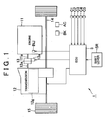
- FIG. 1 a system that employs the output control apparatus of the first embodiment will be described with reference to FIG. 1.
- a clutch 13 automated clutch
- the crankshaft 11a and an input shaft 12a of the transmission 12 are connected to each other via the clutch 13 so that rotation of the engine 11 can be transmitted to the transmission 12.
- the engine 11 includes an injector INJ for injecting and supplying fuel to the engine 11.
- the duration or period of injection of fuel from the injector INJ is changed so as to control the magnitude of output torque of the engine 11.
- the transmission 12 includes gears 12g for reducing the speed of rotation received from the crankshaft 11a.
- the rotation whose speed has been reduced by the gears 12g is transmitted to a drive shaft 14, and is then transmitted to drive wheels 15 so as to drive the vehicle 1.
- the clutch 13 is operated or actuated by a clutch actuator 13a so that its engaging condition is changed. Namely, the engaging condition of the clutch 13 is changed between a released condition (in which no rotation is transmitted from the crankshaft 11a to the input shaft 12a) and an engaged condition (in which no slip occurs between the crankshaft 11a and the input shaft 12a).
- the clutch 13 is in the released condition when the vehicle 1 is in an idling mode, and is in the engaged condition when the vehicle 1 is in any one of a normal running mode, a starting operation and a creeping operation.
- the clutch 13 is temporarily released.
- the vehicle 1 also includes an accelerator pedal AD, a brake pedal BK and a shift lever SR, which are operated by the driver, and an electronic control unit (ECU) 3 that controls the vehicle 1 in an integrated manner.
- ECU electronice control unit
- the ECU 3 receives detection data from respective sensors as follows:
- the ECU 3 performs the following operations, based on the detection data as indicated above.
- a clutch control device includes the ECU 3 and the clutch actuator 13a.
- the output control apparatus of the present embodiment controls the output of the engine through a process as explained below when the clutch control device operates to engage the clutch. In the following, the processes to be implemented upon engagement of the clutch will be described with reference to FIG. 2 to FIG. 6.
- step S101 it is initially determined in step S101 whether the vehicle 1 is in an idling state.
- the ECU 3 If it is determined that the vehicle 1 is in an idling state, the ECU 3 reads the detection data (i.e., the accelerator operation amount Accl and the brake operation amount Brk) from the accelerator position sensor C3 and the brake sensor C4 in step S102. The ECU 3 then determines a request from the driver in the following manners, based on the detection data thus read.
- the detection data i.e., the accelerator operation amount Accl and the brake operation amount Brk
- the subsequent process can be performed without clearly determining which one of a request for starting and a request for creeping is being made.
- step S103 the ECU 3 determines whether the driver makes either of a request for starting and a request for creeping, namely, whether the driver makes a request to drive the vehicle 1 through a starting operation or a creeping operation.
- step S104 If it is determined in step S103 that the driver makes a request to drive the vehicle 1 through a starting operation or a creeping operation, the ECU 3 starts a clutch engaging process for engaging the clutch 13 in step S104.
- the clutch engaging process which is performed separately from the process of FIG. 2, the clutch actuator 13a is suitably operated based on the operating conditions of the vehicle 1, so as to complete engagement of the clutch 13. The clutch engaging process is finished upon completion of the engagement of the clutch 13.
- step S105 an engagement determination and output control process (of FIG. 3 and FIG. 4) for controlling the magnitude of the output torque of the engine 11 is started.
- the engagement determination and output control process will be described later.
- step S101 determines whether the vehicle 1 is not in an idling state (i.e., if a negative determination (NO) is made in step S101), or if the driver makes no request to drive the vehicle 1 through a starting operation and a creeping operation (i.e., if a negative determination (NO) is made in step S103), the process of FIG. 2 is once finished.
- engagement of the clutch 13 is started when a request to drive the vehicle through a starting operation or a creeping operation is detected. Upon the start of the engagement of the clutch 13, the engagement determination and output control process is carried out.
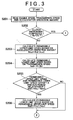
- the process of FIG. 3 and FIG. 4 includes a process of step S201 and step S202 corresponding to the engagement determination process, and a process of step S203 through step S211 corresponding to the output control process.
- the output control process is equivalent to a process executed by the output control means.
- the ECU 3 initially reads the engine speed Ne, transmission speed Ni and the accelerator operation amount Accl in step S201. The ECU 3 then determines whether engagement of the clutch 13 is completed in step S202.
- the completion of engagement of the clutch 13 can be determined by, for example, determining whether the crankshaft 11a and the input shaft 12a of the transmission 12 are in a state of synchronous rotation (in which the engine speed Ne and the transmission speed Ni are substantially equal to each other). Namely, it can be determined that engagement of the clutch 13 is completed if a condition that Ne ⁇ Ni is satisfied.
- step S202 If it is determined in step S202 that engagement of the clutch 13 is has not been completed, the output control process as described below is carried out. If it is determined that engagement of the clutch 13 is completed, on the other hand, the process of FIG. 3 and FIG. 4 is once finished. Namely, in the present embodiment, the output control process is executed over a certain period of time from a start of engagement of the clutch 13 to completion of the engagement.
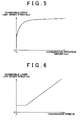
- step S203 is executed to calculate the permissible upper limit engine speed Neul (permissible upper limit value) that is set as the upper limit value of the speed of revolution of the engine 11, by applying the accelerator operation amount Accl read in step S201 to a map as shown in FIG. 5.
- the permissible upper limit engine speed Neul is set in view of the durability of the clutch 13.
- the clutch13 is protected against wear, damage, or the like, when the engine speed Ne is kept lower than the permissible upper limit speed Neul.
- the relationship between the parameters Neul and Accl is defined such that the permissible upper limit engine speed Neul has a larger value as the accelerator operation amount Accl increases.
- the maximum value of the permissible upper limit engine speed Neul may be set, for example, in the following manner: the upper limit value of the engine speed Ne that is permitted within a range in which the clutch 13 can be protected is set as the maximum value of the permissible upper limit engine speed Neul.
- step S204 is executed to calculate the permissible lower limit engine speed Nell (permissible lower limit value) set as the lower limit value of the speed of revolution of the engine 11, by applying the transmission speed Ni read in step S201 to a map as shown in FIG. 6.
- Nell permissible lower limit value
- the permissible lower limit engine speed Nell is set in view of stalling of the engine. By using this map, stalling of the engine is appropriately avoided when the engine speed Ne is kept equal to or higher than the permissible lower limit speed Nell.
- the relationship between the parameters Ni and Nell is defined such that (1) in a region where the transmission speed Ni is lower than a value corresponding to the engine speed Ne (idle speed Neid) established while the vehicle 1 is idling, the permissible lower limit engine speed Nell is set to a value equivalent to the idle speed Neid, and (2) in a region where the transmission speed Ni is equal to or higher than a value corresponding to the idle speed Neid, the permissible lower limit engine speed Nell is set to the same value as the transmission speed Ni.
- step S205 it is determined in step S205 whether the relationship between the permissible upper limit engine speed Neul and the permissible lower limit engine speed Nell satisfies a predetermined condition.
- the predetermined condition may be, for example, that when the permissible upper limit engine speed Neul involves a hysteresis characteristic when it is used as a judgment value, a value obtained by subtracting a predetermined value (a predetermined speed Neh provided for the hysteresis characteristic) from the permissible upper limit engine speed Neul is less than the permissible lower limit engine speed Nell.
- a condition that Nell > Neul ⁇ Neh is satisfied.
- step S206 is executed to apply the permissible upper limit engine speed Neul to a certain function Fllnd so as to calculate the permissible lower limit engine speed Nell again. Namely, an operation as expressed as Nell ⁇ Fllnd(Neul) is performed in step S206.
- step S205 If the condition indicated in step S205 is not satisfied, on the other hand, the permissible upper limit engine speed Neul and the permissible lower limit engine speed Nell calculated based on the maps of FIG. 5 and FIG. 6 are employed without being changed.
- step S207 is executed to determine whether the engine speed Ne is equal to or higher than the permissible upper limit speed Neul. Namely, it is determined in step S207 whether a condition that Ne ⁇ Neul is satisfied.
- the output torque of the engine 11 is reduced so that the engine speed Ne becomes lower than the permissible upper limit speed Neul in step S210.
- the fuel injection duration Tereq of the injector INJ is adjusted in step S210 so as to provide output torque that makes the engine speed Ne lower than the permissible upper limit speed Neul.
- the fuel injection duration Tereq is calculated, based on a certain function Fteul that defines the relationship between the engine speed Ne and the fuel injection duration Tereq and is used when the output torque of the engine 11 is to be reduced. Namely, the fuel injection duration Tereq is calculated through an operation as expressed as Tereq ⁇ Freul (Ne).
- step S208 determines whether the engine speed Ne is lower than the permissible upper limit speed Neul. Namely, step S208 determines whether a condition that Ne ⁇ Nell is satisfied.
- step S211 the fuel injection duration Tereq of the injector INJ is adjusted so as to provide output torque that makes the engine speed Ne equal to or higher than the permissible lower limit speed Nell.
- the fuel injection duration Tereq is calculated, based on a certain function Ftell that defines the relationship between the engine speed Ne and the fuel injection duration Tereq and is used when the output torque of the engine 11 is to be increased. Namely, the fuel injection duration Tereq is calculated through an operation as expressed as Tereq ⁇ Ftell (Ne).
- the fuel injection duration Tereq of the injector INJ is adjusted in step S209 so that the resulting output torque of the engine 11 varies depending upon the accelerator operation amount Accl.
- the fuel injection duration Tereq is calculated based on a certain function Ftenrm that defines the relationship between the accelerator operation amount Accl and the fuel injection duration Tereq. Namely, the fuel injection duration Tereq is calculated through an operation as expressed as Tereq ⁇ Ftenrm (Accl).
- the output torque of the engine 10 is controlled over a period up to completion of engagement of the clutch 13 so that the speed of revolution of the engine 11 is kept lower than the permissible upper limit speed Neul set based on the accelerator operation amount Accl, and is kept equal to or higher than the permissible lower limit speed Nell set based on the transmission speed Ni.
- the clutch 13 is protected and stalling of the engine is favorably avoided during engagement of the clutch 13 by the clutch control device.
- FIG. 7 one example of an engagement pattern of the clutch 13 according to the above-described processes (of FIG. 2 to FIG. 4) will be explained.
- the clutch engaging process and the engagement determination and output control process are started as shown in FIG. 7A to FIG. 7C.
- the permissible upper limit engine speed Neul and the permissible lower limit engine speed Nell are set as shown in FIG. 7E and FIG. 7F, and the output torque of the engine 11 is controlled based on a result of comparison between each of the upper and lower limit speeds and the engine speed Ne.
- the output control apparatus of the internal combustion engine according to the first embodiment as described above provides advantageous effects as follows.
- FIG. 8 and FIG. 9 An output control apparatus of an internal combustion engine according to the second embodiment of the invention will be described with reference to FIG. 8 and FIG. 9.
- the construction of a system that employs the output control apparatus of the second embodiment is similar to that of the first embodiment, and therefore explanation of the system will not be provided herein.
- the permissible upper limit engine speed is set in accordance with the operation amount of the accelerator pedal, and the output torque of the engine is controlled so that the engine speed is kept lower than the permissible upper limit speed over a period up to completion of engagement of the clutch by the clutch control device.
- the output control apparatus of the second embodiment is arranged to perform the engagement determination and output control process of FIG. 3 and FIG. 4 from which a process of setting the permissible lower limit engine speed is omitted or eliminated.
- protection of the clutch can be achieved by a relatively simple process.
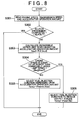
- the process of FIG. 8 includes a process of steps S301 and S302 corresponding to the engagement determination process, and a process of steps S303 - S306 corresponding to the output control process.
- the output control process is equivalent to a process executed by the output control means.
- the engagement determination and output control process of FIG. 8 is started when conditions that (a) the vehicle 1 is in an idling state, and (b) the driver makes a request to drive the vehicle 1 through a starting operation or a creeping operation are satisfied in a process similar to the request determination process (FIG. 2) of the first embodiment.
- step S301 the engine speed Ne, transmission speed Ni and the accelerator operation amount Accl are initially read in step S301.
- step S302 It is then determined in step S302 whether engagement of the clutch 13 is completed.
- the completion of engagement of the clutch 13 may be determined by, for example, determining whether the crankshaft 1a and the input shaft 12a of the transmission 12 are in a state of synchronous rotation. Namely, when a condition that Ne ⁇ Ni is satisfied, the ECU 3 determines that engagement of the clutch 13 is completed.
- step S302 If it is determined in step S302 that engagement of the clutch 13 has not been completed, the output control process as described below is carried out. If it is determined that engagement of the clutch 13 is completed, on the other hand, the process of FIG. 8 is once finished. Namely, in the present embodiment, the output control process is performed over a period from a start of engagement of the clutch 13 to completion of the engagement.
- step S303 is executed to calculate the permissible upper limit engine speed Neul set as the upper limit value of the speed of revolution of the engine 11, by applying the accelerator operation amount Accl read in step S301 to the map as shown in FIG. 5.
- next step S304 it is determined whether the engine speed Ne is equal to or higher than the permissible upper limit speed Neul. Namely, it is determined whether a condition that Ne ⁇ Neul is satisfied.
- step S306 the fuel injection duration Tereq of the injector INJ is adjusted so as to provide output torque that makes the engine speed Ne lower than the permissible upper limit speed Neul.
- the fuel injection duration Tereq is calculated, based on a certain function Fteul that defines the relationship between the engine speed Ne and the fuel injection duration Tereq and is used when the output torque of the engine 11 is to be reduced. Namely, the fuel injection duration Tereq is calculated through an operation as expressed as Tereq ⁇ Fteul (Ne).
- the fuel injection duration Tereq of the injector INJ is adjusted so that the output torque of the engine 11 varies depending upon the accelerator operation amount Accl in step S305.
- the fuel injection duration Tereq is calculated based on a certain function Ftenrm that defines the relationship between the accelerator operation amount Accl and the fuel injection duration Tereq. Namely, the fuel injection duration Tereq is calculated through an operation as expressed as Tereq ⁇ Ftenrm(Accl).
- the output torque of the engine 11 is controlled over the period up to completion of engagement of the clutch 13, so that the speed of revolution of the engine 11 is kept lower than the permissible upper limit speed Neul set based on the accelerator operation amount Accl.
- the clutch 13 is protected against wear or damage when the clutch is engaged by the clutch control device.
- FIG. 9 one example of an engagement pattern of the clutch according to the above-described processes (of FIG. 2 and FIG. 8) will be explained.
- the clutch engaging process and the engagement determination and output control process are started as shown in FIG. 9A to FIG. 9C.
- the permissible upper limit engine speed Neul is set, and the output torque of the engine 11 is controlled based on a result of comparison between the engine speed Ne and the permissible upper limit speed Neul.
- the output control apparatus of the internal combustion engine according to the second embodiment as described above provides advantageous effects as follows.
- FIG. 10 and FIG. 11 An output control apparatus of an internal combustion engine according to the third embodiment of the invention will be described with reference to FIG. 10 and FIG. 11.
- the construction of a system that employs the output control apparatus of the third embodiment is similar to that of the first embodiment, and therefore explanation of the system will not be provided herein.
- the permissible lower limit engine speed is set in accordance with the speed of rotation of the transmission 12, and the output torque of the engine is controlled so that the engine speed is kept equal to or higher than the permissible lower limit speed, over a period up to completion of engagement of the clutch by the clutch control device,
- the output control apparatus of the third embodiment is arranged to perform the engagement determination and output control process of FIG. 3 and FIG. 4 from which a process of setting the permissible upper limit engine speed is omitted or eliminated. With this arrangement, stalling of the engine can be properly avoided by a relatively simple process.
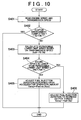
- the process of FIG. 10 includes a process of steps S401 and S402 corresponding to the engagement determination process, and a process of steps S403 - S406 corresponding to the output control process.
- the output control process is equivalent to a process executed by the output control means.
- the engagement determination and output control process of FIG. 10 is started when conditions that (a) the vehicle 1 is in an idling state, and (b) the driver makes a request to drive the vehicle 1 through a starting operation or a creeping operation are satisfied in a process similar to the request determination process (FIG. 2) of the first embodiment. This process is repeatedly executed at certain time intervals.
- step S401 the engine speed Ne and the transmission speed Ni are initially read in step S401.
- step S402 It is then determined in step S402 whether engagement of the clutch 13 is completed.
- the completion of engagement of the clutch 13 may be determined by, for example, determining whether the crankshaft 11a and the input shaft 12a of the transmission 12 are in a state of synchronous rotation. Namely, it is determined that engagement of the clutch 13 is completed if a condition that Ne ⁇ Ni is satisfied.
- the output control process as described below is performed. If it is determined that engagement of the clutch 13 is completed, on the other hand, the process of FIG. 10 is once finished. Namely, in the third embodiment, the output control process is performed over a period from a start of engagement of the clutch 13 to completion of the engagement.
- step S402 If it is determined in step S402 that engagement of the clutch 13 has not been completed, the permissible lower limit engine speed Nell to be set as the lower limit value of the speed of revolution of the engine 11 is calculated in step S403 by applying the transmission speed Ni read in step S401 to the map as shown in FIG. 6.
- step S404 it is determined whether the engine speed Ne is lower than the permissible lower limit speed Nell. Namely, it is determined whether a condition that Ne ⁇ Nell is satisfied.
- step S406 the fuel injection duration Tereq of the injector INJ is adjusted so that the engine speed Ne becomes equal to or higher than the permissible lower limit speed Nell.
- the fuel injection duration Tereq is calculated based on a certain function Ftell that defines the relationship between the engine speed Ne and the fuel injection duration Tereq and is used when the output torque of the engine 11 is to be increased. Namely, the fuel injection duration Tereq is calculated through an operation as expressed as Tereq ⁇ Ftell (Ne).
- the fuel injection duration Tereq of the injector INJ is adjusted in step S405 so that the output torque of the engine 11 varies depending upon the accelerator operation amount Accl.
- the fuel injection duration Tereq is calculated based on a certain function Ftenrm that defines the relationship between the accelerator operation amount Accl and the fuel injection duration Tereq. Namely, the fuel injection duration Tereq is calculated through an operation as expressed as Tereq ⁇ Ftenrm (Accl).
- the output torque of the engine 11 is controlled over a period up to completion of engagement of the clutch 13, so that the speed of revolution of the engine 11 is kept equal to or higher than the permissible lower limit speed Nell set based on the transmission speed Ni.
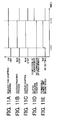
- FIG. 11 one example of an engagement pattern of the clutch according to the above-described processes (of FIG. 2 and FIG. 10) will be explained.
- the clutch engaging process and the engagement determination and output control process are started as shown in FIG. 11A to FIG. 11C.
- the permissible lower limit engine speed Nell is set, and the output torque of the engine 11 is controlled based on a result of comparison between the engine speed Ne and the permissible lower limit speed Nell.
- the output control apparatus of the internal combustion engine according to the third embodiment as described above provides advantageous effects as follows.
- FIG. 12 An output control apparatus of an internal combustion engine according to the fourth embodiment of the invention will be described with reference to FIG. 12.
- the construction of a system that employs the output control apparatus of the fourth embodiment is similar to that of the first embodiment, and therefore explanation of the system will not be provided herein.
- the output torque of the engine is controlled over a period up to completion of engagement of the clutch by the clutch control device, so that the engine speed is kept lower than a pre-set permissible upper limit speed, and is kept equal to or higher than a pre-set permissible lower limit speed.
- the output control apparatus of the fourth embodiment is arranged to perform the engagement determination and output control process (FIG. 3 and FIG. 4) of the first embodiment by using the permissible upper limit engine speed and permissible lower limit engine speed that are set in advance.
- the permissible upper limit engine speed and permissible lower limit engine speed that are set in advance.
- the process of FIG. 12 includes a process of steps S501 and S502 corresponding to the engagement determination process, and a process of steps S503 - S507 corresponding to the output control process.
- the output control process corresponds to a process executed by the output control means.
- the engagement determination and output control process of FIG. 12 is started when conditions that (a) the vehicle 1 is in an idling state, and (b) the driver makes a request to drive the vehicle 1 through a starting operation or a creeping operation are satisfied in a process similar to the request determination process (FIG. 2) of the first embodiment. This process is repeatedly executed at certain time intervals.
- step S501 the engine speed Ne, transmission speed Ni and the accelerator operation amount Accl are initially read in step S501.
- step S502 It is then determined in step S502 whether engagement of the clutch 13 is completed.
- the completion of engagement of the clutch 13 may be determined by, for example, determining whether the crankshaft 11a and the input shaft 12a of the transmission 12 are in a state of synchronous rotation. Namely, it can be determined that engagement of the clutch 13 is completed if a condition that Ne ⁇ Ni is satisfied.
- the output control process as described below is carried out. If it is determined that engagement of the clutch 13 is completed, the process of FIG. 12 is once finished. Namely, in the present embodiment, the output control process is performed over a period of time from a start of engagement of the clutch 13 to completion of the engagement.
- step S503 If it is determined in step S502 that engagement of the clutch 13 has not been completed, it is determined in step S503 whether the engine speed Ne is equal to or higher than the permissible upper limit speed Neul that is set in advance as a predetermined value. Namely, in step S503, it is determined whether a condition that Ne ⁇ Neul is satisfied.
- the permissible upper limit engine speed Neul is set in view of the durability of the clutch. Thus, the clutch 13 is protected against wear or damage if the engine speed Ne is kept lower than the permissible upper limit speed Neul.
- step S506 the fuel injection duration Tereq of the injector INJ is adjusted so as to provide output torque that makes the engine speed Ne lower than the permissible upper limit speed Neul.
- the fuel injection duration Tereq is calculated, based on a certain function Fteul that defines the relationship between the engine speed Ne and the fuel injection duration Tereq and is used when the output torque of the engine 11 is to be reduced. Namely, the fuel injection duration Tereq is calculated through an operation as expressed as Tereq ⁇ Fteul (Ne).
- step S504 it is determined in step S504 whether the engine speed Ne is lower than the permissible upper limit speed Neul. Namely, in step S504, it is determined whether a condition that Ne ⁇ Nell is satisfied.
- the permissible lower limit engine speed Nell is set in view of the possibility of stalling of the engine. Thus, stalling of the engine is favorably avoided if the engine speed Ne is kept equal to or higher than the permissible lower limit speed Nell.
- step S507 the fuel injection duration Tereq of the injector INJ is adjusted so as to provide output torque that makes the engine speed Ne equal to or higher than the permissible lower limit speed Nell.
- the fuel injection duration Tereq is calculated based on a certain function Ftell that defines the relationship between the engine speed Ne and the fuel injection duration Tereq and is used when the output torque of the engine 11 is to be increased. Namely, the fuel injection duration Tereq is calculated through an operation as expressed as Tereq ⁇ Ftell (Ne).
- the fuel injection duration Tereq of the injector INJ is adjusted in step S505 so that the output torque of the engine 11 varies depending upon the accelerator operation amount Accl.
- the fuel injection duration Tereq is calculated based on a certain function Ftenrm that defines the relationship between the accelerator operation amount Accl and the fuel injection duration Tereq. Namely, the fuel injection duration Tereq is calculated through an operation as expressed as Tereq ⁇ Ftenrm (Accl).
- the output torque of the engine 11 is controlled so that the speed of revolution of the engine 11 is kept lower than the pre-set permissible upper limit speed Neul, and is kept equal to or higher than the pre-set permissible lower limit speed Nell.
- protection of the clutch 13 and prevention of stalling of the engine 11 are favorably ensured when the clutch is engaged by means of the clutch control device.
- the output control apparatus of the internal combustion engine according to the fourth embodiment as described above provides advantageous effects as follows.
- request determination process is not limited to that of the illustrated embodiments, but may be modified when appropriate. In short, any suitable request determination process may be employed provided that the process permits appropriate determination of a request of the driver based on an operation of the accelerator pedal, an operation of the brake pedal, and the like.
- engagement determination and output control process (of FIG. 3 and FIG. 4) is performed as a single process that is a combination of the engagement determination process and the output control process in each of the illustrated embodiments, the engagement determination process and the output control process may be performed exclusively or separately from each other.
- the output control process is carried out over a period (clutch engagement period) that extends from a start of engagement of the clutch to completion of the engagement.
- this arrangement may be modified, for example, in the following manner: the output control process may be carried out over a certain period that is shorter than the clutch engagement period. Also, if desirable behavior of the vehicle can be provided, the output control process may be carried out over a certain period that is longer than the clutch engagement period.
- the output control process may be started at a point of time different from the time of a start of clutch engagement, and/or may be finished at a point of time different from the time of completion of clutch engagement.
- the output control process is carried out over at least a part of the period that extends from a start of engagement of the clutch to completion of the clutch engagement.
- the duration of the output control process according to the invention is not limited to that of the illustrated embodiments, but may be changed provided that the output control process is performed over a predetermined period during engagement of the clutch.
- the output control process is performed over the period (i.e., clutch engagement period) that extends from a start of engagement of the clutch to completion of the engagement.
- this arrangement may be modified, for example, in the following manner: the output control process may be performed over a certain period of time that extends from detection of a request for starting or creeping of the vehicle to an end of driving of the vehicle in a mode (starting or creeping mode) that conforms to the detected request.
- the starting operation or creeping operation of the vehicle is competed if each of the following conditions that (a) the crankshaft and the input shaft of the transmission are in a state of synchronous rotation and (b) the accelerator operation amount is equal to or larger than a predetermined operation amount that is set depending upon the operating conditions of the engine, is satisfied.
- the output control process may be performed over a certain period that is shorter than the period of the starting operation (or starting period) or the period of the creeping operation (or creeping period). If desirable behavior of the vehicle can be provided, the output control process may be performed over a certain period that is longer than the starting period or the creeping period.
- timing of a start and a finish of the output control process may be changed such that the output control process is started at a point of time different from the time of a start of the starting operation or the creeping operation, and/or is finished at a point of time different from the time of completion of the starting operation or the creeping operation.
- the output control process is performed over at least a part of the period that extends from a start of the starting operation or creeping operation to completion of the same operation.
- the duration of the output control process according to the invention is not limited to those as illustrated above, but may be changed provided that the output control process is performed over a predetermined period during the starting operation or creeping operation of the vehicle.
- the control of the output torque may be effected with respect to the case where the transmission is shifted from one gear stage (or speed) to another in response to an operation of the shift lever.
- the output torque of the engine may be controlled in a manner similar to that of each of the illustrated embodiments, until the engagement of the clutch is completed.
- the invention is not limitedly applied to this type of engine, but may be applied to any other type of engine.
- the output torque of the engine may be controlled in a manner similar to that of each of the illustrated embodiments, through adjustment of the opening angle of the throttle valve instead of adjustment of the fuel injection duration.
- the invention is embodied in the system as shown in FIG. 1 in each of the illustrated embodiments, the construction of the system to which the invention is applicable is not limited to that of FIG. 1, but may be changed when appropriate.
- the invention is applicable to any system including an internal combustion engine in a vehicle equipped with a clutch control device for engaging a clutch through an operation of an actuator. In this case, too, advantageous effects similar to those of the illustrated embodiments are provided.
- the transmission 33 reduces the speed of rotation received from the crankshaft 32, at a speed reduction ratio determined by the combination of gears 33G.
- the transmission 33 is provided with differential gears 35, to which the rotation whose speed has been reduced through the gears 33G is transmitted.
- the differential gears 35 are adapted to reduce the speed of the rotation received from the transmission 33, and transmit it to a drive shaft 36 so that drive wheels 37 are rotated in accordance with the rotation of the drive shaft 36.
- the vehicle 21 also includes a clutch actuator 38 for operating or actuating the clutch 34.
- the engaging condition of the clutch 34 can be changed by means of the clutch actuator 38. More specifically, the engaging condition of the clutch 34 is changed between a fully released condition (in which no rotation is transmitted from the engine 31 to the transmission 33), and a fully engaged or coupled condition (in which the speed of revolution of the engine 31 is substantially equal to the speed of rotation transmitted to the transmission 33 via the clutch 34), depending upon the operation amount of the clutch actuator 38.
- the vehicle 21 further includes a brake pedal BKP adapted to be operated by the driver.
- a brake pedal BKP adapted to be operated by the driver.
- a brake switch 41 is turned ON. Detection data from the brake switch 41 is transmitted to an electronic control unit (ECU) 23.
- ECU electronice control unit
- the ECU 23 determines a request from the driver as follows, based on the detection data from the brake switch 41.
- the ECU 23 also receives the speed of rotation of the crankshaft 32 (or engine speed Ne) detected by an engine speed sensor 42, and other information.
- the ECU 23 controls the clutch actuator 38 based on detection data of the engine speed sensor 42 and detection data of the brake switch 41.
- a final clutch operation amount by which the clutch actuator 38 operates or actuates the clutch 34 is calculated through a computing algorithm for calculating a clutch operation amount associated with a creeping operation of the vehicle, and a computing algorithm for calculating a clutch operation amount associated with a starting operation of the vehicle.
- a clutch operation process as described below is performed so as to solve the above problem.
- This process consists of a request determining process (FIG. 14) for determining a request of the driver, and a torque calculating process (FIG. 15) for calculating the clutch torque.
- step S600 if a request to drive the vehicle 21 through a creep operation or a starting operation is detected based on detection data from the brake switch 41 (i.e., if a negative determination (NO) is made in step S600), the torque calculating process (FIG. 15) as described later is executed in step S700. If a request to keep the vehicle 1 stopped is detected, on the other hand, the process of FIG. 14 is once finished.
- This process is also repeatedly executed at predetermined time intervals.
- the engine speed Ne detected by the engine speed sensor 42 is initially read in step S701.
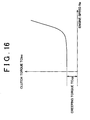
- clutch torque TClnc is calculated by applying the engine speed Ne read in step S701 to a map (of FIG. 16) that defines the relationship between the engine speed Ne and the clutch torque TClnc.
- the map that defines the relationship between the engine speed Ne and the clutch torque TClnc provides torque calculating means.
- the relationship defined by the map of FIG. 16, namely, the relationship between the engine speed Ne and the clutch torque TClnc will be explained.
- the relationship between parameters (Ne, TClnc) is defined such that the clutch torque TClnc shifts from torque values associated with the creeping operation of the vehicle to torque values associated with the starting operation of the vehicle, as the engine speed Ne increases from an idle speed Neid.
- the torque values associated with the creeping operation represent clutch torque TClnc (creeping torque TCcp) required during the creeping operation of the vehicle.
- the relationship between the parameters (Ne, TClnc) is defined such that the clutch torque TClnc required during the creeping operation of the vehicle has a constant value relative to the engine speed Ne.
- the torque values associated with the starting operation represent clutch torque TClnc required during the starting operation of the vehicle.
- the relationship between the parameters (Ne, TClnc) is defined such that the clutch torque required during the starting operation exponentially increases in accordance with an increase in the engine speed Ne.
- the clutch torque TClnc is calculated in accordance with the change in the engine speed Ne, so that the vehicle 21 smoothly shifts from the creeping operation to the starting operation.
- a certain map that defines the relationship between the engine speed Ne and the clutch torque TClnc required during a starting operation of the vehicle may be provided with an additional region in which the clutch torque TClnc required during a creeping operation is set in relation to the engine speed Ne, so as to provide a map equivalent to the above-described map of FIG. 16.
- the clutch torque TClnc calculated from the above-mentioned map (FIG. 16) is set as a target torque TCtgt in step S703, and the process of FIG. 15 is once finished.
- the above-mentioned target torque TCtgt is then converted into an operation amount of the clutch 34 through a process that is separately performed.
- the clutch actuator 38 is driven in accordance with the thus obtained operation amount of the clutch 34, so that the engaging condition of the clutch 34 is changed.
- torque required by the driver for achieving the desired behavior of the vehicle 21 can be transmitted from the engine 31 to the transmission 33.
- the clutch torque TClnc is calculated based on the map that defines the clutch torque TClnc in accordance with the progression of the engine speed Ne.
- the clutch torque associated with the creeping operation and the starting operation can be obtained by simply applying the engine speed to the above-described map (FIG. 16), without performing a process to clearly determine whether the required behavior of the vehicle is a creeping operation or a starting operation.
- the above arrangement eliminates the need to individually provide the computing algorithm for calculating the clutch torque associated with the creeping operation of the vehicle and the computing algorithm for calculating the clutch torque associated with the starting operation of the vehicle.
- the computing algorithm used for calculation of the clutch torque can be simplified.
- the map (FIG. 16) as described above defines the relationship between the parameters (Ne, TClnc) so that the clutch torque shifts from torque value(s) associated with the creeping operation to torque values associated with the starting operation, in accordance with changes in the engine speed.
- the vehicle can smoothly switch from the creeping operation to the starting operation.
- the clutch control device of this embodiment as described above provides advantageous effects as described below.
- the invention may be embodied in other forms, such as those as described below, by modifying the illustrated embodiment.
- An output control apparatus of an internal combustion engine (11) is provided in a vehicle (1) including a clutch (13) that permits and inhibits transmission of torque from the engine to a transmission (12) and an actuator (13a) for engaging the clutch when a driver's request for starting or creeping of the vehicle is detected.
- the apparatus controls the output torque of the engine so that the engine speed is kept lower than a permissible upper limit value and is kept equal to or higher than a permissible lower limit value over a predetermined period during engagement of the clutch.
- a clutch control device is also provided which determines an operation amount of the clutch based on clutch torque calculated based on the engine speed.
- the device includes a map that defines the relationship between the engine speed and the clutch torque, such that the clutch torque shifts from a torque region associated with a creeping operation of the vehicle to a torque region associated with a starting operation of the vehicle as the engine speed increases.
Landscapes
- Engineering & Computer Science (AREA)
- Mechanical Engineering (AREA)
- Chemical & Material Sciences (AREA)
- Combustion & Propulsion (AREA)
- Transportation (AREA)
- Automation & Control Theory (AREA)
- General Engineering & Computer Science (AREA)
- Physics & Mathematics (AREA)
- Fluid Mechanics (AREA)
- Hydraulic Clutches, Magnetic Clutches, Fluid Clutches, And Fluid Joints (AREA)
- Control Of Vehicle Engines Or Engines For Specific Uses (AREA)
Abstract
Description
Claims (19)
- An output control apparatus of an internal combustion engine (11) for controlling output torque of the engine in response to an output request from a driver, for use in a vehicle (1) including a clutch (13) that permits and inhibits transmission of torque from the engine to a transmission (12) and an actuator (13a) operable to engage the clutch when a request of the driver for starting or creeping of the vehicle is detected, characterized in that:output control means (3) is provided for controlling the output torque of the engine so that the speed of revolution of the engine is kept lower than a permissible upper limit value over a predetermined period during engagement of the clutch.
- An output control apparatus of an internal combustion engine (11) for controlling output torque of the engine in response to an output request from a driver, for use in a vehicle (1) including a clutch (13) that permits and inhibits transmission of torque from the engine to a transmission (12) and an actuator (13a) operable to engage the clutch when a request of the driver for starting or creeping of the vehicle is detected, characterized in that:output control means (3) is provided for controlling the output torque of the engine so that the speed of revolution of the engine is kept equal to or higher than a permissible lower limit value over a predetermined period during engagement of the clutch.
- An output control apparatus of an internal combustion engine (11) for controlling output torque of the engine in response to an output request from a driver, for use in a vehicle (1) including a clutch (13) that permits and inhibits transmission of torque from the engine to a transmission (12) and an actuator (13a) operable to engage the clutch when a request of the driver for starting or creeping of the vehicle is detected, characterized in that:output control means (3) is provided for controlling the output torque of the engine so that the speed of revolution of the engine is kept lower than a permissible upper limit value and is kept equal to or higher than a permissible lower limit value over a predetermined period during engagement of the clutch.
- An output control apparatus according to claim 1 or claim 3, characterized in that the output control means makes the permissible upper limit value variable depending upon an operation amount of an accelerator pedal (AC) provided in the vehicle.
- An output control apparatus according to claim 2 or claim 3, characterized in that the output control means makes the permissible lower limit value variable depending upon the speed of rotation of the transmission.
- An output control apparatus according to any one of claims 1-5, characterized in that the predetermined period over which the output control means controls the output torque of the engine extends from a start of engagement of the clutch by the actuator to completion of the engagement of the clutch.
- An output control apparatus of an internal combustion engine (11) for controlling output torque of the engine in response to an output request from a driver, for use in a vehicle (1) including a clutch (13) that permits and inhibits transmission of torque from the engine to a transmission (12) and an actuator (13a) operable to engage the clutch when a request of the driver for starting or creeping of the vehicle is detected, characterized in that:output control means (3) is provided for controlling the output torque of the engine so that the speed of revolution of the engine is kept lower than a permissible upper limit value over a predetermined period during a starting operation or a creeping operation of the vehicle.
- An output control apparatus of an internal combustion engine (11) for controlling output torque of the engine in response to an output request from a driver, for use in a vehicle (1) including a clutch (13) that permits and inhibits transmission of torque from the engine to a transmission (12) and an actuator (13a) operable to engage the clutch when a request of the driver for starting or creeping of the vehicle is detected, characterized in that:output control means (3) is provided for controlling the output torque of the engine so that the speed of revolution of the engine is kept equal to or higher than a permissible lower limit value over a predetermined period during a starting operation or a creeping operation of the vehicle.
- An output control apparatus of an internal combustion engine (11) for controlling output torque of the engine in response to an output request from a driver, for use in a vehicle (1) including a clutch (13) that permits and inhibits transmission of torque from the engine to a transmission (12) and an actuator (13a) operable to engage the clutch when a request of the driver for starting or creeping of the vehicle is detected, characterized in that:output control means (3) is provided for controlling the output torque of the engine so that the speed of revolution of the engine is kept lower than a permissible upper limit value and is kept equal to or higher than a permissible lower limit value, over a predetermined period during a starting operation or a creeping operation of the vehicle.
- An output control apparatus according to claim 7 or claim 9, characterized in that the output control means makes the permissible upper limit value variable depending upon an operation amount of an accelerator pedal (AC) provided in the vehicle.
- An output control apparatus according to claim 8 or claim 9, characterized in that the output control means makes the permissible lower limit value variable depending upon the speed of rotation of the transmission.
- An output control apparatus according to any one of claims 7-11, characterized in that the predetermined period over which the output control means controls the output torque of the engine extends from a start of the starting operation or creeping operation of the vehicle to completion of the starting operation or creeping operation.
- A clutch control device including torque calculating means (23) for calculating torque that can be transmitted by a clutch (34), based on the speed of revolution of an internal combustion engine (31) installed on a vehicle (21), the clutch control device being adapted to determine an operation amount of the clutch based on the torque calculated by the torque calculating means, characterized in that:the torque calculating means (23) defines a relationship between the speed of revolution of the engine and the torque that can be transmitted by the clutch, in view of torque associated with a creeping operation of the vehicle and torque associated with a starting operation of the vehicle.
- A clutch control device including torque calculating means (23) for calculating torque that can be transmitted by a clutch (34), based on the speed of revolution of an internal combustion engine (31) installed on a vehicle (21), the clutch control device being adapted to determine an operation amount of the clutch based on the torque calculated by the torque calculating means, characterized in that:the torque calculating means (23) defines a relationship between the speed of revolution of the engine and the torque that can be transmitted by the clutch, such that the torque that can be transmitted by the clutch shifts from a first torque region associated with a creeping operation of the vehicle to a second torque region associated with a starting operation of the vehicle as the speed of revolution of the engine increases.
- A clutch control device according to claim 14, wherein the torque calculating means (23) defines the relationship between the speed of revolution of the engine and the torque that can be transmitted by the clutch, such that the torque that can be transmitted by the clutch shifts from a first torque value associated with the creeping operation of the vehicle to a second torque value associated with the starting operation of the vehicle as the speed of revolution of the engine increases.
- A clutch control device including torque calculating means (23) for calculating torque which can be transmitted by a clutch (34), and which is required during a starting operation of a vehicle (21), based on the speed of revolution of an internal combustion engine (31) installed on the vehicle, the clutch control device being adapted to determine an operation amount of the clutch based on the torque calculated by the torque calculating means, characterized in that:the torque calculating means (23) defines a relationship between the torque that can be transmitted by the clutch and the speed of revolution of the engine, such that the minimum value of the torque that can be transmitted by the clutch is set based on a torque value associated with a creeping operation of the vehicle.
- A clutch control device according to any one of claims 13-16, characterized in that the torque associated with the creeping operation of the vehicle is set to a constant value relative to the speed of revolution of the engine.
- A clutch control device including torque calculating means (23) for calculating torque which can be transmitted by a clutch (34), and which is required during a starting operation of a vehicle (21), based on the speed of revolution of an internal combustion engine (31) installed on the vehicle, the clutch control device being adapted to determine an operation amount of the clutch based on the torque calculated by the torque calculating means, characterized in that:the torque calculating means (23) is provided with a region in which the torque that can be transmitted by the clutch is calculated with respect to a creeping operation of the vehicle, and defines a relationship between the speed of revolution of the engine and the torque that can be transmitted by the clutch with respect to the creeping operation as well as the starting operation.
- A clutch control device according to claim 18, characterized in that the torque that can be transmitted by the clutch during the creeping operation of the vehicle is set to a constant value relative to the speed of rotation of the engine.
Applications Claiming Priority (4)
| Application Number | Priority Date | Filing Date | Title |
|---|---|---|---|
| JP2002361054A JP2004190808A (en) | 2002-12-12 | 2002-12-12 | Clutch control device |
| JP2002361054 | 2002-12-12 | ||
| JP2002378993A JP3879667B2 (en) | 2002-12-27 | 2002-12-27 | Output control device for internal combustion engine |
| JP2002378993 | 2002-12-27 |
Publications (2)
| Publication Number | Publication Date |
|---|---|
| EP1428716A2 true EP1428716A2 (en) | 2004-06-16 |
| EP1428716A3 EP1428716A3 (en) | 2008-10-15 |
Family
ID=32328390
Family Applications (1)
| Application Number | Title | Priority Date | Filing Date |
|---|---|---|---|
| EP03028434A Withdrawn EP1428716A3 (en) | 2002-12-12 | 2003-12-11 | Output control apparatus of internal combustion engine and clutch control device |
Country Status (1)
| Country | Link |
|---|---|
| EP (1) | EP1428716A3 (en) |
Cited By (11)
| Publication number | Priority date | Publication date | Assignee | Title |
|---|---|---|---|---|
| WO2005084994A1 (en) * | 2004-02-26 | 2005-09-15 | Zf Friedrichshafen Ag | Method and device for the control of starting driving or switching processes on a motor vehicle |
| FR2920501A1 (en) * | 2007-08-29 | 2009-03-06 | Peugeot Citroen Automobiles Sa | Coupling unit e.g. dry clutch, controlling method for motor vehicle, involves estimating error by considering speed, engine torque, unit position and set point torque for providing torque disturbance estimation to correct set point torque |
| EP2070797A3 (en) * | 2007-12-03 | 2013-05-29 | Nissan Motor Co., Ltd. | Rapid acceleration control apparatus |
| CN105143644A (en) * | 2014-02-04 | 2015-12-09 | 铃木株式会社 | Internal combustion engine control device |
| EP2913503A4 (en) * | 2012-10-25 | 2016-04-20 | Aisin Seiki | Vehicular drive apparatus |
| EP2913505A4 (en) * | 2012-10-25 | 2016-04-20 | Aisin Seiki | Vehicular drive apparatus |
| EP2990630A4 (en) * | 2013-04-25 | 2016-10-05 | Aisin Seiki | Drive device for vehicle |
| EP2388459A4 (en) * | 2009-01-15 | 2017-01-25 | Toyota Jidosha Kabushiki Kaisha | Control device for vehicle |
| EP2980388B1 (en) * | 2014-02-04 | 2018-03-21 | Suzuki Motor Corporation | Drive control device |
| FR3104645A1 (en) * | 2019-12-13 | 2021-06-18 | Psa Automobiles Sa | PROCESS FOR DETERMINING A SPEED SETPOINT OF AN INTERNAL COMBUSTION ENGINE |
| CN114542713A (en) * | 2022-02-28 | 2022-05-27 | 重庆长安汽车股份有限公司 | Crawling control method and system for dual-clutch transmission |
Family Cites Families (8)
| Publication number | Priority date | Publication date | Assignee | Title |
|---|---|---|---|---|
| DE2833961A1 (en) * | 1978-08-03 | 1980-02-21 | Volkswagenwerk Ag | DEVICE FOR THE AUTOMATIC OPERATION OF A MOTOR VEHICLE CLUTCH |
| US4874070A (en) * | 1988-02-10 | 1989-10-17 | Eaton Corporation | Control for AMT system start from stop operation |
| US5314050A (en) * | 1992-12-09 | 1994-05-24 | Eaton Corporation | Clutch mode control logic |
| US5980428A (en) * | 1998-11-13 | 1999-11-09 | Eaton Corporation | Vehicle launch automated master clutch control |
| DE10127760A1 (en) * | 2000-06-23 | 2002-01-10 | Luk Lamellen & Kupplungsbau | Limiting engine revolution rate for vehicle clutch involves limiting maximum permissible engine revolution rate to certain value if engine operating temperature below certain value |
| EP1174303B1 (en) * | 2000-07-17 | 2004-11-10 | Hitachi, Ltd. | Control method and system for vehicle starting |
| JP3609713B2 (en) * | 2000-11-07 | 2005-01-12 | 本田技研工業株式会社 | Control device for vehicle start clutch |
| JP3830129B2 (en) * | 2001-05-15 | 2006-10-04 | 本田技研工業株式会社 | Power transmission device |
-
2003
- 2003-12-11 EP EP03028434A patent/EP1428716A3/en not_active Withdrawn
Cited By (15)
| Publication number | Priority date | Publication date | Assignee | Title |
|---|---|---|---|---|
| WO2005084994A1 (en) * | 2004-02-26 | 2005-09-15 | Zf Friedrichshafen Ag | Method and device for the control of starting driving or switching processes on a motor vehicle |
| US7584039B2 (en) | 2004-02-26 | 2009-09-01 | Zf Friedrichshafen Ag | Method and device for the control of starting driving or switching processes on a motor vehicle |
| FR2920501A1 (en) * | 2007-08-29 | 2009-03-06 | Peugeot Citroen Automobiles Sa | Coupling unit e.g. dry clutch, controlling method for motor vehicle, involves estimating error by considering speed, engine torque, unit position and set point torque for providing torque disturbance estimation to correct set point torque |
| EP2070797A3 (en) * | 2007-12-03 | 2013-05-29 | Nissan Motor Co., Ltd. | Rapid acceleration control apparatus |
| EP2388459A4 (en) * | 2009-01-15 | 2017-01-25 | Toyota Jidosha Kabushiki Kaisha | Control device for vehicle |
| EP2913503A4 (en) * | 2012-10-25 | 2016-04-20 | Aisin Seiki | Vehicular drive apparatus |
| EP2913505A4 (en) * | 2012-10-25 | 2016-04-20 | Aisin Seiki | Vehicular drive apparatus |
| EP2990630A4 (en) * | 2013-04-25 | 2016-10-05 | Aisin Seiki | Drive device for vehicle |
| EP2985441A4 (en) * | 2014-02-04 | 2016-05-11 | Suzuki Motor Corp | INTERNAL COMBUSTION ENGINE CONTROL DEVICE |
| CN105143644A (en) * | 2014-02-04 | 2015-12-09 | 铃木株式会社 | Internal combustion engine control device |
| CN105143644B (en) * | 2014-02-04 | 2017-10-13 | 铃木株式会社 | Combustion engine control |
| EP2980388B1 (en) * | 2014-02-04 | 2018-03-21 | Suzuki Motor Corporation | Drive control device |
| FR3104645A1 (en) * | 2019-12-13 | 2021-06-18 | Psa Automobiles Sa | PROCESS FOR DETERMINING A SPEED SETPOINT OF AN INTERNAL COMBUSTION ENGINE |
| CN114542713A (en) * | 2022-02-28 | 2022-05-27 | 重庆长安汽车股份有限公司 | Crawling control method and system for dual-clutch transmission |
| CN114542713B (en) * | 2022-02-28 | 2023-10-10 | 重庆长安汽车股份有限公司 | Creep control method and control system for double-clutch transmission |
Also Published As
| Publication number | Publication date |
|---|---|
| EP1428716A3 (en) | 2008-10-15 |
Similar Documents
| Publication | Publication Date | Title |
|---|---|---|
| KR101226321B1 (en) | Apparatus to control the transition phase of a fuel cut off state of an internal combustion engine | |
| JP3573202B2 (en) | Hybrid vehicle torque control device | |
| US7052434B2 (en) | Throttle opening degree control apparatus for internal combustion engine | |
| US6086510A (en) | Engine-output control unit | |
| US20030144784A1 (en) | Control system for vehicle | |
| EP3785964B1 (en) | Hybrid vehicle control system | |
| EP1428716A2 (en) | Output control apparatus of internal combustion engine and clutch control device | |
| US5405301A (en) | Automatic transmission control system | |
| US9290175B2 (en) | Vehicle control system | |
| CN1283915C (en) | Method and device for controlling the drive unit of a vehicle | |
| US7797992B2 (en) | Control apparatus for a source of rotational drive force | |
| JP4178891B2 (en) | Vehicle driving force control method and driving force control apparatus using the method | |
| EP2580454B1 (en) | Engine fuel economy unit | |
| US7496442B2 (en) | Method for operating a drive train of a motor vehicle | |
| JP2008298100A (en) | Starting clutch control device and control method for automatic transmission | |
| JP3879667B2 (en) | Output control device for internal combustion engine | |
| CN115217962B (en) | Engine torque compensation control method and system in gear shifting torque interaction stage | |
| US7070538B2 (en) | Clutch control for automated manual transmission (AMT) | |
| JP4089395B2 (en) | Control device and control method for automatic transmission | |
| JPH1018876A (en) | Control device for engine with automatic transmission | |
| JP4078940B2 (en) | Engine control device | |
| JP2005133895A (en) | Automatic transmission control device | |
| JP3564862B2 (en) | Driving force control device for vehicles | |
| US7278952B2 (en) | Terminating or disallowing signals to increase a throttle opening | |
| US11680534B1 (en) | Robust control of rolling engine start-stop |
Legal Events
| Date | Code | Title | Description |
|---|---|---|---|
| PUAI | Public reference made under article 153(3) epc to a published international application that has entered the european phase |
Free format text: ORIGINAL CODE: 0009012 |
|
| 17P | Request for examination filed |
Effective date: 20031211 |
|
| AK | Designated contracting states |
Kind code of ref document: A2 Designated state(s): AT BE BG CH CY CZ DE DK EE ES FI FR GB GR HU IE IT LI LU MC NL PT RO SE SI SK TR |
|
| AX | Request for extension of the european patent |
Extension state: AL LT LV MK |
|
| RIC1 | Information provided on ipc code assigned before grant |
Ipc: F16D 48/08 20060101ALI20080617BHEP Ipc: F02D 41/04 20060101AFI20080617BHEP |
|
| PUAL | Search report despatched |
Free format text: ORIGINAL CODE: 0009013 |
|
| AK | Designated contracting states |
Kind code of ref document: A3 Designated state(s): AT BE BG CH CY CZ DE DK EE ES FI FR GB GR HU IE IT LI LU MC NL PT RO SE SI SK TR |
|
| AX | Request for extension of the european patent |
Extension state: AL LT LV MK |
|
| STAA | Information on the status of an ep patent application or granted ep patent |
Free format text: STATUS: THE APPLICATION HAS BEEN WITHDRAWN |
|
| 18W | Application withdrawn |
Effective date: 20090130 |