EP1428572A1 - Zeolite laminated composite and zeolite membrane reactor using the same - Google Patents
Zeolite laminated composite and zeolite membrane reactor using the same Download PDFInfo
- Publication number
- EP1428572A1 EP1428572A1 EP02760823A EP02760823A EP1428572A1 EP 1428572 A1 EP1428572 A1 EP 1428572A1 EP 02760823 A EP02760823 A EP 02760823A EP 02760823 A EP02760823 A EP 02760823A EP 1428572 A1 EP1428572 A1 EP 1428572A1
- Authority
- EP
- European Patent Office
- Prior art keywords
- zeolite
- porous substrate
- substrate
- membrane
- type
- Prior art date
- Legal status (The legal status is an assumption and is not a legal conclusion. Google has not performed a legal analysis and makes no representation as to the accuracy of the status listed.)
- Granted
Links
Images
Classifications
-
- B—PERFORMING OPERATIONS; TRANSPORTING
- B01—PHYSICAL OR CHEMICAL PROCESSES OR APPARATUS IN GENERAL
- B01J—CHEMICAL OR PHYSICAL PROCESSES, e.g. CATALYSIS OR COLLOID CHEMISTRY; THEIR RELEVANT APPARATUS
- B01J19/00—Chemical, physical or physico-chemical processes in general; Their relevant apparatus
- B01J19/24—Stationary reactors without moving elements inside
- B01J19/2475—Membrane reactors
-
- B—PERFORMING OPERATIONS; TRANSPORTING
- B01—PHYSICAL OR CHEMICAL PROCESSES OR APPARATUS IN GENERAL
- B01D—SEPARATION
- B01D53/00—Separation of gases or vapours; Recovering vapours of volatile solvents from gases; Chemical or biological purification of waste gases, e.g. engine exhaust gases, smoke, fumes, flue gases, aerosols
- B01D53/22—Separation of gases or vapours; Recovering vapours of volatile solvents from gases; Chemical or biological purification of waste gases, e.g. engine exhaust gases, smoke, fumes, flue gases, aerosols by diffusion
- B01D53/228—Separation of gases or vapours; Recovering vapours of volatile solvents from gases; Chemical or biological purification of waste gases, e.g. engine exhaust gases, smoke, fumes, flue gases, aerosols by diffusion characterised by specific membranes
-
- B—PERFORMING OPERATIONS; TRANSPORTING
- B01—PHYSICAL OR CHEMICAL PROCESSES OR APPARATUS IN GENERAL
- B01D—SEPARATION
- B01D67/00—Processes specially adapted for manufacturing semi-permeable membranes for separation processes or apparatus
- B01D67/0039—Inorganic membrane manufacture
- B01D67/0051—Inorganic membrane manufacture by controlled crystallisation, e,.g. hydrothermal growth
-
- B—PERFORMING OPERATIONS; TRANSPORTING
- B01—PHYSICAL OR CHEMICAL PROCESSES OR APPARATUS IN GENERAL
- B01D—SEPARATION
- B01D71/00—Semi-permeable membranes for separation processes or apparatus characterised by the material; Manufacturing processes specially adapted therefor
- B01D71/02—Inorganic material
- B01D71/028—Molecular sieves
- B01D71/0281—Zeolites
-
- B—PERFORMING OPERATIONS; TRANSPORTING
- B01—PHYSICAL OR CHEMICAL PROCESSES OR APPARATUS IN GENERAL
- B01J—CHEMICAL OR PHYSICAL PROCESSES, e.g. CATALYSIS OR COLLOID CHEMISTRY; THEIR RELEVANT APPARATUS
- B01J29/00—Catalysts comprising molecular sieves
- B01J29/04—Catalysts comprising molecular sieves having base-exchange properties, e.g. crystalline zeolites
- B01J29/06—Crystalline aluminosilicate zeolites; Isomorphous compounds thereof
-
- B—PERFORMING OPERATIONS; TRANSPORTING
- B01—PHYSICAL OR CHEMICAL PROCESSES OR APPARATUS IN GENERAL
- B01J—CHEMICAL OR PHYSICAL PROCESSES, e.g. CATALYSIS OR COLLOID CHEMISTRY; THEIR RELEVANT APPARATUS
- B01J29/00—Catalysts comprising molecular sieves
- B01J29/04—Catalysts comprising molecular sieves having base-exchange properties, e.g. crystalline zeolites
- B01J29/06—Crystalline aluminosilicate zeolites; Isomorphous compounds thereof
- B01J29/18—Crystalline aluminosilicate zeolites; Isomorphous compounds thereof of the mordenite type
-
- B—PERFORMING OPERATIONS; TRANSPORTING
- B01—PHYSICAL OR CHEMICAL PROCESSES OR APPARATUS IN GENERAL
- B01J—CHEMICAL OR PHYSICAL PROCESSES, e.g. CATALYSIS OR COLLOID CHEMISTRY; THEIR RELEVANT APPARATUS
- B01J29/00—Catalysts comprising molecular sieves
- B01J29/04—Catalysts comprising molecular sieves having base-exchange properties, e.g. crystalline zeolites
- B01J29/06—Crystalline aluminosilicate zeolites; Isomorphous compounds thereof
- B01J29/40—Crystalline aluminosilicate zeolites; Isomorphous compounds thereof of the pentasil type, e.g. types ZSM-5, ZSM-8 or ZSM-11, as exemplified by patent documents US3702886, GB1334243 and US3709979, respectively
-
- B—PERFORMING OPERATIONS; TRANSPORTING
- B01—PHYSICAL OR CHEMICAL PROCESSES OR APPARATUS IN GENERAL
- B01J—CHEMICAL OR PHYSICAL PROCESSES, e.g. CATALYSIS OR COLLOID CHEMISTRY; THEIR RELEVANT APPARATUS
- B01J29/00—Catalysts comprising molecular sieves
- B01J29/04—Catalysts comprising molecular sieves having base-exchange properties, e.g. crystalline zeolites
- B01J29/06—Crystalline aluminosilicate zeolites; Isomorphous compounds thereof
- B01J29/65—Crystalline aluminosilicate zeolites; Isomorphous compounds thereof of the ferrierite type, e.g. types ZSM-21, ZSM-35 or ZSM-38, as exemplified by patent documents US4046859, US4016245 and US4046859, respectively
-
- B—PERFORMING OPERATIONS; TRANSPORTING
- B01—PHYSICAL OR CHEMICAL PROCESSES OR APPARATUS IN GENERAL
- B01J—CHEMICAL OR PHYSICAL PROCESSES, e.g. CATALYSIS OR COLLOID CHEMISTRY; THEIR RELEVANT APPARATUS
- B01J29/00—Catalysts comprising molecular sieves
- B01J29/04—Catalysts comprising molecular sieves having base-exchange properties, e.g. crystalline zeolites
- B01J29/06—Crystalline aluminosilicate zeolites; Isomorphous compounds thereof
- B01J29/70—Crystalline aluminosilicate zeolites; Isomorphous compounds thereof of types characterised by their specific structure not provided for in groups B01J29/08 - B01J29/65
- B01J29/7007—Zeolite Beta
-
- B—PERFORMING OPERATIONS; TRANSPORTING
- B01—PHYSICAL OR CHEMICAL PROCESSES OR APPARATUS IN GENERAL
- B01J—CHEMICAL OR PHYSICAL PROCESSES, e.g. CATALYSIS OR COLLOID CHEMISTRY; THEIR RELEVANT APPARATUS
- B01J35/00—Catalysts, in general, characterised by their form or physical properties
- B01J35/50—Catalysts, in general, characterised by their form or physical properties characterised by their shape or configuration
- B01J35/58—Fabrics or filaments
- B01J35/59—Membranes
-
- B—PERFORMING OPERATIONS; TRANSPORTING
- B01—PHYSICAL OR CHEMICAL PROCESSES OR APPARATUS IN GENERAL
- B01D—SEPARATION
- B01D2325/00—Details relating to properties of membranes
- B01D2325/10—Catalysts being present on the surface of the membrane or in the pores
-
- B—PERFORMING OPERATIONS; TRANSPORTING
- B01—PHYSICAL OR CHEMICAL PROCESSES OR APPARATUS IN GENERAL
- B01J—CHEMICAL OR PHYSICAL PROCESSES, e.g. CATALYSIS OR COLLOID CHEMISTRY; THEIR RELEVANT APPARATUS
- B01J2229/00—Aspects of molecular sieve catalysts not covered by B01J29/00
- B01J2229/60—Synthesis on support
- B01J2229/62—Synthesis on support in or on other molecular sieves
Definitions
- the present invention relates to a zeolite laminated composite and a zeolite membrane reactor using the zeolite laminated composite.
- Zeolite composite membranes obtained by forming a zeolite membrane as a separation membrane on a substrate have been known and have been used as a gas separation membrane or a liquid separation membrane.
- Zeolite composite membranes and zeolite laminated composites can also be used as a reaction and separation unit possessing a reaction function and a separation function, by being combined with a certain kind of catalyst or the like.
- a reaction apparatus which is called "membrane reactor” wherein the above-mentioned reaction and separation unit is provided inside a reactor; and an example thereof is introduced in, for example, Naoji Ito, Chemical Engineering (1997), October.
- the membrane reactor having such a constitution can remove, in a reversible reaction system, a produced substance selectively out of the reaction system and, therefore, has an advantage of allowing the reaction to proceed apparently at a conversion exceeding the equilibrium conversion.
- a xylene isomerization process is disclosed in Japanese Patent Application Kohyo No. 2000-515849.
- reaction and separation unit there is known a type in which a catalyst is filled in the vicinity of a porous substrate and/or a separation membrane composed of a zeolite.
- a silicalite a kind of zeolite
- MFI membrane low-silica MFI type zeolite membrane
- the MFI membrane when the MFI membrane has been formed on the alumina substrate, there may be a case that defects such as cracks in the MFI membrane may generate under, for example, a high temperature condition, owing to the difference in thermal expansion behavior between the alumina and the MFI membrane, i.e. the zeolite.
- the present invention has been made in view of the above-mentioned problems of the prior art, and aims at a zeolite laminated composite which shows a small pressure loss and hardly generates defects such as cracks in the separation membrane even under a high temperature condition, as well as a zeolite membrane reactor of high separation characteristic and high permeability, using the zeolite laminated composite.
- a zeolite laminated composite characterized in that it comprises a separation membrane being constituted by a zeolite, and a porous substrate being constituted by a zeolite and having a catalyst function, and that the separation membrane is formed on the porous substrate.
- the crystalline phase of the zeolite constituting the separation membrane and the crystalline phase of the zeolite constituting the porous substrate are the same. It is also preferred that the zeolite constituting the porous substrate has a SiO 2 /Al 2 O 3 (molar ratio) of below 200.
- each zeolite is either of an MFI type, an MOR type, an FER type and a BEA type.
- a zeolite membrane reactor characterized in that an interior of a reactor vessel is separated by a zeolite laminated composite set forth in any of Claims 1 to 4, into a raw material substance side contacting with a porous substrate having a catalyst function, of the composite and a produced substance side contacting with a separation membrane of the composite, and that a produced substance formed by the catalytic reaction of a raw material substance is permeated through the separation membrane from the raw material substance side to the produced substance side and is separated.
- the first aspect of the present invention lies in a zeolite laminated composite, characterized in that it comprises a separation membrane being constituted by a zeolite and a porous substrate being constituted by a zeolite and having a catalyst function and the separation membrane is formed on the porous substrate.
- the porous substrate has a catalyst function by itself. That is, the present zeolite laminated composite, unlike a reaction and separation unit of a conventional type wherein a catalyst is filled in the vicinity of the porous substrate and/or the separation membrane composed of a zeolite, has no independent layer having a catalyst function, such as catalyst layer, catalyst-filled layer or the like. Therefore, the present zeolite laminated composite, as compared with a reaction and separation unit of a conventional type, shows a small pressure loss and, inside the porous substrate, and it shows such an effect that the influence derived from the polarization of the substance formed by catalytic reaction of raw material substance, etc., (i.e.
- the raw material substance and the produced substance may each be a gas or a liquid.
- the porous substrate has a catalyst function, no catalyst function is needed for the separation membrane itself and a separation function is sufficient for the separation membrane.
- a separation membrane also composed of a zeolite; therefore, during the production or use of the composite, there can be avoided inconveniences such as crack generation in the separation membrane due to the difference in thermal expansion coefficient between the porous substrate and the separation membrane, and the separation membrane can maintain the required function.
- the crystalline phase of the zeolite constituting the separation membrane and the crystalline phase of the zeolite constituting the porous substrate are the same.
- the crystalline phase of zeolite referred to in the present invention indicates a widely known crystalline phase and there can be mentioned, for example, an MFI type, a BEA type, an FER type, an MOR type, an X type, a Y type, an A type, an MTW type, a DOH type, a DDR type, an MTN type and an AFI type.
- the SiO 2 /Al 2 O 3 of the zeolite constituting the porous substrate is preferably below 200, more preferably below 150, particularly preferably below 100.
- a SiO 2 /Al 2 O 3 of beyond 200 is not preferred because, with such a SiO 2 /Al 2 O 3 , the Al ratio is too small and no sufficient proton (H + ) for functioning as a catalyst can be present, which makes difficult the exhibition of catalyst function.
- the "SiO 2 /Al 2 O 3 (molar ratio)" referred to in the present invention is a value obtained by measurement by energy dispersive spectroscopy (EDS).
- the lower limit of SiO 2 /Al 2 O 3 there is no restriction as to the lower limit of SiO 2 /Al 2 O 3 .
- the lower limit may be roughly 40 or more when the crystalline phase of zeolite is presumed to be, for example, an MFI type, in order to avoid the generation of defects such as cracks in the separation membrane formed.
- the crystalline phase of zeolite is preferred to be either of a MFI type, a MOR type, a FER type and a BEA type.
- the kind of the crystalline phase of zeolite can be selected depending upon the kind of the reaction and separation to be conducted. For instance, a MFI type is preferred for the later-described reaction and separation of p-xylene.
- porous substrate being constituted by a zeolite and having a catalyst function
- a porous substrate is produced first by a widely known method and then a catalyst function is imparted thereto.
- TPAOH Tetrapropylammonium hydroxide
- silica sol silica sol
- NaAlO 2 etc.
- TPAOH Tetrapropylammonium hydroxide
- the resulting mixture is stirred and kneaded under a heating condition to vaporize water to obtain a dry gel.
- the dry gel is ground to obtain a powder and the powder is molded by an appropriate molding method to obtain a molded material. Then.
- the porous substrate obtained by this method is a MFI substrate into which sodium cation (Na + ) has been introduced (hereinafter, this substrate is referred to also as "Na-type MFI substrate").
- this substrate is referred to also as "Na-type MFI substrate”
- TPA structure-directing agent
- TPA-Na-type MFI substrate This structure-directing agent (TPA) is removable by firing, whereby the substrate can be converted into a Na-type MFI substrate.
- the Na-type MFI substrate wherein the structure-directing agent has been removed by firing is subjected to an ion exchange treatment, whereby can be obtained an MFI substrate wherein proton (H + ) has been introduced and which has a catalyst function (hereinafter, this substrate is referred to also as "H-type MFI substrate").
- the ion exchange treatment mentioned here refers to that a Na-type MFI substrate is immersed in, for example, an aqueous ammonium nitrate solution at a given temperature for an appropriate time. Thereby, sodium cation is replaced with ammonium cation (hereinafter, the resulting substrate is referred to also as "NH 4 -type MFI substrate").
- This NH 4 -type MFI substrate can be converted into an H-type MFI substrate by firing.
- the thus-obtained H-type MFI substrate has a catalyst function for xylene isomerization, etc., while the Na-type MFI substrate has no such catalyst function.
- a separation membrane being constituted by a zeolite, on the porous substrate having a catalyst function
- a widely known method such as hydrothermal synthesis method, gas phase transport method or the like.
- a sequence for forming a separation membrane on the porous substrate there can be mentioned, for example, (1) a sequence in which a MFI membrane is formed on a Na-type MFI substrate containing TPA (a structure-directing agent), (i.e. a TPA-Na-type MFI substrate), then firing is conducted to remove the TPA present in both the porous substrate and the separation membrane, thereafter ion exchange and firing are conducted to obtain a laminated composite consisting of an MFI membrane and a H-type MFI substrate, or (2) a sequence in which a TPA-Na-type MFI substrate is fired to obtain a Na-type MFI substrate, then ion exchange is made to obtain an NH 4 -type MFI substrate, an MFI membrane is formed on the NH 4 -type MFI substrate, thereafter firing is conducted to obtain a laminated composite consisting of an MFI membrane and an H-type MFI substrate.
- TPA structure-directing agent
- any of the sequence (1) and the sequence (2) may be used. However, when the separation membrane formed contains aluminum, the sequence (2) must be used. If the sequence (1) is used, ion exchange allows not only the porous substrate but also the separation membrane to have a catalyst function; when the resulting zeolite laminated composite is assembled into a membrane reactor, an reverse reaction takes place owing to the catalyst function, at the time of permeating of an intended substance through the separation membrane; this converts the intended substance into a non-intended substance and the membrane reactor has reduced capability.
- the porous substrate and the separation membrane may be different in SiO 2 /Al 2 O 3 as long as their crystalline phases are the same. They may contain different kinds of cations. Further, the porous substrate may load thereon a catalyst such as Pt, Pd, Cu or the like so as to have a catalyst function.
- a catalyst such as Pt, Pd, Cu or the like so as to have a catalyst function.
- the shape of the zeolite laminated composite there can be mentioned, for example, a bar shape, a pellet shape, a flat plate shape, a tube shape, a monolithic shape or a honeycomb shape.
- the second aspect of the present invention lies in a zeolite membrane reactor, characterized in that the interior of a reactor vessel is separated by any of the above-mentioned zeolite laminated composites, into a raw material substance side contacting with a porous substrate having a catalyst function, of the composite and a produced substance side contacting with a separation membrane of the composite and that a produced substance formed by the catalytic reaction of a raw material substance is permeated through the separation membrane from the raw material substance side to the produced substance side and is separated.
- the raw material substance fed into the raw material substance side of the zeolite membrane reactor of the present invention first contacts with the porous substance constituting the zeolite laminated composite and infiltrates into the inside thereof.
- the zeolite membrane reactor of the present invention is provided with any of the above-mentioned zeolite laminated composites, a catalytic reaction takes place on the porous substance having a catalyst function.
- the substance produced permeates through the separation membrane to the produced substance side and is separated, whereby an intended product (a produced substance) can be obtained.
- the zeolite membrane reactor of the present invention is provided with any of the above-mentioned zeolite laminated composites as a reaction and separation unit; therefore, the reactor, as compared with when using a reaction and separation unit containing an independent layer having a catalyst function, such as catalyst layer, catalyst-filled layer or the like, shows a small pressure loss and has high separation characteristic and high permeability. Further, having no catalyst-filled layer, the present membrane reactor can be made into a small size.
- the separation membrane constituting the reaction and separation unit hardly causes inconveniences such as cracks due to the difference in thermal expansion behavior between the porous substrate and the separation membrane. Consequently, with the zeolite membrane reactor of the present invention, the function of the reaction and separation unit is maintained stably and long-term use and operation is possible.
- the dry gel was ground to obtain a powder, after which the powder was subjected to uniaxial pressing with a die at a total pressure of 2 tons to obtain a cylindrical molded material having a diameter of 19 mm and a thickness of 2 mm.
- the molded material was set on a fluororesin plate in a stainless steel-made pressure vessel with a fluororesin-made inner cylindrical container provided with distilled water of the same weight as the molded material, in a state that there was no contact between the molded material and the water.
- the pressure vessel was placed in an oven of 180°C to make the contents react under a self steam pressure for 12 hours, whereby a porous substrate was obtained.
- the crystal phase of the porous substrate obtained was examined by X-ray diffractiometry. As a result, the porous substrate was found to be an MFI type zeolite of perfect crystal (a TPA-Na-type MFI substrate).
- the TPA-Na-type MFI substrate was fired at 600°C for 3 hours to obtain a Na-type MFI substrate (a porous substrate constituting Comparative Example 1).
- the Na-type MFI substrate was immersed for 1 hour in an aqueous solution containing 1 mol/l of ammonium nitrate, heated to 80°C
- the resulting material was washed with water and dried and then fired at 873K for 3 hours to obtain a H-type MFI substrate (a porous substrate constituting Example 1).
- Each porous substrate obtained was measured for crystalline phase by X-ray diffractiometry, which indicated that each porous substrate was a MFI type zeolite of perfect crystal.
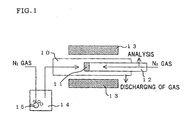
- Fig. 1 is a schematic view showing a mode for carrying out the test for evaluation of catalyst function for xylene isomerization and indicates a state in which there is placed, inside a test apparatus 10, a sample-holding section 12 to which a sample 11 (a porous substrate) is fitted.
- the test apparatus 10 is heatable by an electric oven 13.
- a carrier gas (a N 2 gas) is introduced at 50 cc/min into m-xylene through a bubbler 15 to generate an about 1 vol% of m-xylene gas.
- This m-xylene gas was fed to one side of the sample 11 (a porous substrate) under a heating (200°C) condition, and the permeated gas at the opposite side thereof was swept by a N 2 gas of 50 cc/min.
- the gas compositions at the both sides were analyzed by gas chromatography. The results are shown in Table 1.
- Each membrane-formed substrate was heated to 550°C in an electric oven and kept at that temperature for 4 hours to remove TPA, whereby were obtained laminated composites (of Comparative Examples 1 and 2) in which a silicalite membrane (a separation membrane) of about 20 ⁇ m was formed on each porous substrate.
- the composite of Comparative Example 1 was immersed in an aqueous solution containing 1 mol/l of ammonium nitrate, heated to 80°C, for 1 hour; the resulting composite was washed with water, dried, then heated to 550°C in an electric oven and kept for 4 hours to obtain a reaction and separation unit (of Example 1) in which a silicalite membrane (a separation membrane) of about 20 ⁇ m was formed on a porous substrate.
- each reaction and separation unit for xylene isomerization was evaluated at 200°C by the Wicke-Kallenbach method. Specifically the evaluation was made in the same manner as in the above-described evaluation of the catalyst function of porous substrate and was carried out using a test apparatus 10 shown in Fig. 1. Incidentally, each reaction and separation unit was fitted to a sample-holding section 12 so that the porous substrate of each unit was at the gas (m-xylene gas)-feeding side. The results are shown in Table 2.
- Each porous substrate is agglomerate of MFI type zeolite particles of about 10 ⁇ m and has no separation function. Therefore, if there is a difference in the composition of raw material gas and the composition of gas after permeation, it means that the porous substrate used has a catalyst function for isomerization.
- the proportion of p-xylene in the gas after permeation increased to about 8%. This is considered to be because m-xylene was converted into p-xylene by the catalytic action (for xylene isomerization) of the porous substrate of Example 1.
- the proportion of p-xylene in the gas after permeation was the same (less than 1%) as that in the raw material gas and there was no difference in composition between the raw material gas and the gas after permeation.
- the porous substrate of Example 1 has a catalyst function but the porous substrate of Comparative Example 1 has no catalyst function for xylene isomerization.
- Example 1 is constituted by a silicalite membrane and an H-type MFI substrate.
- Comparative Example 1 is constituted by a silicalite membrane and a Na-type MFI substrate, and Comparative Example 2 is constituted by a silicalite membrane and an alumina substrate.
- the silicalite membrane allows p-xylene present in xylene isomers to permeate therethrough selectively and separates p-xylene.
- the silicalite membrane has no proton which becomes an active site of catalyst for xylene isomerization. That is, the function of the silicalite membrane is only to allow p-xylene to permeate therethrough selectively.
- Example 1 As shown in Table 2, in Example 1 and Comparative Example 1, p-xylene, as compared with m-xylene and o-xylene, was permeated selectively, and the proportion of p-xylene in the gas after permeation was higher than that in the raw material gas and was about 93% (Example 1) and about 17% (Comparative Example 1). The concentration of p-xylene in the gas after permeation, in Example 1 was about 94 times that in Comparative Example 1.
- the Na-type MFI substrate has no activity for xylene isomerization.
- isomerization to p-xylene takes place, accordingly the p-xylene concentration in raw material gas increases in the porous substrate, this p-xylene permeates the separation membrane, and it is considered that thereby the p-xylene concentration in gas after permeation was increased.
- the p-xylene in raw material gas is not separated and the proportion of p-xylene in gas after permeation remained at less than 1%. This is considered to be because the alumina substrate has no catalyst function and moreover cracks generated in the MFI membrane, which gave a low p-xylene concentration.
- the zeolite laminated composite of the present invention has excellent separation characteristic and excellent permeability.
- the zeolite laminated composite of the present invention shows a small pressure loss because a particular separation membrane is formed on a particular porous substrate having a catalyst function, and hardly generates defects such as cracks in the separation membrane even under a high temperature condition because both the separation membrane and the porous substrate are constituted by a zeolite.
- the zeolite membrane reactor of the present invention has high separation characteristic and high permeability because it is constituted by the above-mentioned zeolite laminated composite.
Landscapes
- Chemical & Material Sciences (AREA)
- Chemical Kinetics & Catalysis (AREA)
- Engineering & Computer Science (AREA)
- Organic Chemistry (AREA)
- Materials Engineering (AREA)
- Crystallography & Structural Chemistry (AREA)
- Inorganic Chemistry (AREA)
- Analytical Chemistry (AREA)
- Life Sciences & Earth Sciences (AREA)
- Manufacturing & Machinery (AREA)
- Geology (AREA)
- General Chemical & Material Sciences (AREA)
- Oil, Petroleum & Natural Gas (AREA)
- Separation Using Semi-Permeable Membranes (AREA)
- Silicates, Zeolites, And Molecular Sieves (AREA)
- Organic Low-Molecular-Weight Compounds And Preparation Thereof (AREA)
- Catalysts (AREA)
- Physical Or Chemical Processes And Apparatus (AREA)
Abstract
Description
| p-Xylene (ppm) | m-Xylene (ppm) | o-Xylene (ppm) | Proportion of p-xylene in raw material gas or permeated gas | ||
| Raw material gas | 36 | 10213 | 48 | <1% | |
| Produc ed gas (gas after permeation | H-type MFI substrate (porous substrate of Exam. 1) | 49.5 | 535 | 2.9 | 8.10% |
| Na-type MFI substrate (porous substrate of Com. Exam. 1) | 0.0974 | 495.9 | 1.17 | <1% |
| p-Xylene (ppm) | m-Xylene (ppm) | o-Xylene (ppm) | Proportion of p-xylene in raw material gas or gas after permeation | ||
| Raw material gas | 36 | 10213 | 48 | <1 | |
| Produced gas (gas after permeation) permeation) | Exam. 1 | 41.3 | 2.71 | 0.278 | 93.3 |
| Comp. Exam. 1 | 0.44 | 2.2 | 0 | 16.7 | |
| Comp. Exam. 2 | 1.2 | 193 | 1.3 | <1 |
Claims (5)
- A zeolite laminated composite, characterized in that it comprises a separation membrane being constituted by a zeolite, and a porous substrate being constituted by a zeolite and having a catalyst function, and that the separation membrane is formed on the porous substrate.
- A zeolite laminated composite according to Claim 1, wherein a crystalline phase of the zeolite constituting the separation membrane and a crystalline phase of the zeolite constituting the porous substrate are same.
- A zeolite laminated composite according to Claim 1 or 2, wherein the zeolite constituting the porous substrate has a SiO2/Al2O3 (molar ratio) of below 200.
- A zeolite laminated composite according to any of Claims 1 to 3, wherein a crystalline phase of each zeolite is either of an MFI type, an MOR type, an FER type and a BEA type.
- A zeolite membrane reactor, characterized in that an interior of a reactor vessel is separated by a zeolite laminated composite set forth in any of Claims 1 to 4, into a raw material substance side contacting with a porous substrate having a catalyst function, of the composite and a produced substance side contacting with a separation membrane of the composite and that a produced substance formed by catalytic reaction of a raw material substance is penetrated through the separation membrane from the raw material substance side to the produced substance side and is separated.
Applications Claiming Priority (3)
| Application Number | Priority Date | Filing Date | Title |
|---|---|---|---|
| JP2001285740A JP4860851B2 (en) | 2001-09-19 | 2001-09-19 | Zeolite laminated composite and zeolite membrane reactor using the same |
| JP2001285740 | 2001-09-19 | ||
| PCT/JP2002/009318 WO2003026789A1 (en) | 2001-09-19 | 2002-09-12 | Zeolite laminated composite and zeolite membrane reactor using the same |
Publications (3)
| Publication Number | Publication Date |
|---|---|
| EP1428572A1 true EP1428572A1 (en) | 2004-06-16 |
| EP1428572A4 EP1428572A4 (en) | 2004-10-20 |
| EP1428572B1 EP1428572B1 (en) | 2007-02-07 |
Family
ID=19108844
Family Applications (1)
| Application Number | Title | Priority Date | Filing Date |
|---|---|---|---|
| EP02760823A Expired - Lifetime EP1428572B1 (en) | 2001-09-19 | 2002-09-12 | Zeolite laminated composite and zeolite membrane reactor using the same |
Country Status (12)
| Country | Link |
|---|---|
| US (1) | US6936560B2 (en) |
| EP (1) | EP1428572B1 (en) |
| JP (1) | JP4860851B2 (en) |
| CN (1) | CN1269562C (en) |
| AT (1) | ATE353248T1 (en) |
| BR (1) | BR0212610B1 (en) |
| CA (1) | CA2459578C (en) |
| DE (1) | DE60218054T2 (en) |
| MX (1) | MXPA04002548A (en) |
| NZ (1) | NZ531645A (en) |
| WO (1) | WO2003026789A1 (en) |
| ZA (1) | ZA200401875B (en) |
Families Citing this family (10)
| Publication number | Priority date | Publication date | Assignee | Title |
|---|---|---|---|---|
| WO2003024577A1 (en) * | 2001-09-17 | 2003-03-27 | Ngk Insulators, Ltd. | Method for preparing ddr type zeolite film, ddr type zeolite film, and composite ddr type zeolite film, and method for preparation thereof |
| JP4494685B2 (en) * | 2001-09-17 | 2010-06-30 | 日本碍子株式会社 | Zeolite laminated composite and production method thereof |
| DE602004007938T2 (en) * | 2003-08-27 | 2008-04-17 | Ngk Insulators, Ltd. | GASTRENNKÖRPER AND METHOD FOR THE MANUFACTURE THEREOF |
| JP2007203241A (en) * | 2006-02-03 | 2007-08-16 | Tottori Univ | Separation membrane, method for producing the same and method for separating substances |
| KR100789661B1 (en) * | 2007-01-05 | 2007-12-28 | 서강대학교산학협력단 | Method for producing substrate-molecular sieve complex |
| US20080196478A1 (en) * | 2007-02-20 | 2008-08-21 | Honeywell International Inc. | Transition metals doped zeolites for saw based CO2 gas sensor applications |
| US8501068B2 (en) * | 2007-11-05 | 2013-08-06 | Regents Of The University Of Minnesota | Layered zeolite materials and methods related thereto |
| JP2012066183A (en) * | 2010-09-22 | 2012-04-05 | Mitsubishi Chemicals Corp | Membrane reactor |
| DE112015005309T5 (en) * | 2014-11-25 | 2017-10-19 | Ngk Insulators, Ltd. | Process for the preparation of a zeolite membrane structure |
| JP7797193B2 (en) * | 2021-12-22 | 2026-01-13 | 日本碍子株式会社 | Reactor and liquid fuel synthesis method |
Family Cites Families (14)
| Publication number | Priority date | Publication date | Assignee | Title |
|---|---|---|---|---|
| JPS6028826A (en) * | 1983-07-26 | 1985-02-14 | Hiroshi Suzuki | Compound film having surface layer of thin film of cage zeolite and preparation thereof |
| JP3362451B2 (en) * | 1993-05-13 | 2003-01-07 | エヌオーケー株式会社 | Method of forming synthetic zeolite thin film |
| US5554286A (en) * | 1993-12-27 | 1996-09-10 | Mitsui Engineering & Shipbuilding Co., Ltd. | Membrane for liquid mixture separation |
| FR2742071B1 (en) * | 1995-12-08 | 1998-01-09 | Inst Francais Du Petrole | PROCESS FOR PRODUCING ZEOLITE MEMBRANES SUPPORTED BY POROUS GLASS |
| US6376733B1 (en) | 1996-01-25 | 2002-04-23 | Exxonmobil Chemical Patents Inc. | Process for production of paraxylene |
| SE9600970D0 (en) * | 1996-03-14 | 1996-03-14 | Johan Sterte | Process for making very thin films of molecular sieves |
| JPH1036113A (en) * | 1996-07-22 | 1998-02-10 | Fine Ceramics Center | Zeolite membrane, method for producing zeolite membrane, and method for separating gas mixture using zeolite membrane |
| JP3128517B2 (en) * | 1996-08-16 | 2001-01-29 | 株式会社ノリタケカンパニーリミテド | Zeolite separation membrane and method for producing the same |
| JP3502734B2 (en) * | 1996-11-15 | 2004-03-02 | 株式会社ノリタケカンパニーリミテド | Method for producing zeolite membrane |
| GB9803893D0 (en) * | 1998-02-25 | 1998-04-22 | British Nuclear Fuels Plc | Improvements in and relating to gas generators |
| US6734129B2 (en) * | 1998-07-02 | 2004-05-11 | Exxonmobil Research And Engineering Company | Zeolite membrane composites (LAW730) |
| US6037292A (en) * | 1998-07-02 | 2000-03-14 | Exxon Research And Engineering Co. | Compositions having two or more zeolite layers |
| AU754663B2 (en) * | 1998-10-20 | 2002-11-21 | Ngk Insulators, Ltd. | Zeolite composite film and process for producing the same |
| JP4527229B2 (en) * | 2000-02-28 | 2010-08-18 | 日本碍子株式会社 | Mordenite zeolite membrane and method for producing the same |
-
2001
- 2001-09-19 JP JP2001285740A patent/JP4860851B2/en not_active Expired - Fee Related
-
2002
- 2002-09-12 WO PCT/JP2002/009318 patent/WO2003026789A1/en not_active Ceased
- 2002-09-12 AT AT02760823T patent/ATE353248T1/en not_active IP Right Cessation
- 2002-09-12 BR BRPI0212610-9A patent/BR0212610B1/en not_active IP Right Cessation
- 2002-09-12 CN CNB028229967A patent/CN1269562C/en not_active Expired - Fee Related
- 2002-09-12 EP EP02760823A patent/EP1428572B1/en not_active Expired - Lifetime
- 2002-09-12 DE DE60218054T patent/DE60218054T2/en not_active Expired - Lifetime
- 2002-09-12 NZ NZ531645A patent/NZ531645A/en not_active IP Right Cessation
- 2002-09-12 MX MXPA04002548A patent/MXPA04002548A/en active IP Right Grant
- 2002-09-12 CA CA002459578A patent/CA2459578C/en not_active Expired - Fee Related
-
2004
- 2004-03-03 US US10/792,500 patent/US6936560B2/en not_active Expired - Fee Related
- 2004-03-08 ZA ZA2004/01875A patent/ZA200401875B/en unknown
Also Published As
| Publication number | Publication date |
|---|---|
| US6936560B2 (en) | 2005-08-30 |
| EP1428572A4 (en) | 2004-10-20 |
| ZA200401875B (en) | 2005-05-25 |
| JP2003088734A (en) | 2003-03-25 |
| EP1428572B1 (en) | 2007-02-07 |
| DE60218054T2 (en) | 2007-09-13 |
| BR0212610B1 (en) | 2012-06-26 |
| DE60218054D1 (en) | 2007-03-22 |
| US20040167011A1 (en) | 2004-08-26 |
| CN1269562C (en) | 2006-08-16 |
| BR0212610A (en) | 2004-08-17 |
| MXPA04002548A (en) | 2004-06-18 |
| CN1589175A (en) | 2005-03-02 |
| ATE353248T1 (en) | 2007-02-15 |
| WO2003026789A1 (en) | 2003-04-03 |
| JP4860851B2 (en) | 2012-01-25 |
| CA2459578C (en) | 2007-09-04 |
| NZ531645A (en) | 2005-01-28 |
| CA2459578A1 (en) | 2003-04-03 |
Similar Documents
| Publication | Publication Date | Title |
|---|---|---|
| US20070184967A1 (en) | Laminated zeolite composite and method for production thereof | |
| EP0460512B2 (en) | Membrane formed of crystalline molecular sieve material | |
| US5723397A (en) | Molecular sieve layers and processes for their manufacture | |
| US5069794A (en) | Separation of mixture components over membrane composed of a pure molecular sieve | |
| US5100596A (en) | Synthesis of membrane composed of a pure molecular sieve | |
| Takata et al. | Gas permeation properties of MFI zeolite membranes prepared by the secondary growth of colloidal silicalite and application to the methylation of toluene | |
| US5110478A (en) | Catalytic conversion over membrane composed of a pure molecular sieve | |
| US6936560B2 (en) | Zeolite laminated composite and zeolite membrane reactor using the same | |
| Lin et al. | A novel method for the synthesis of high performance silicalite membranes | |
| JPH0563410B2 (en) | ||
| JP4759724B2 (en) | Zeolite membrane and method for producing the same | |
| Den Exter et al. | Zeolite-based membranes preparation, performance and prospects | |
| Ernst | Advances in nanoporous materials | |
| Torres-Rodríguez et al. | Materials 2012, 5, 872-881; doi: 10.3390/ma5050872 OPEN ACCESS materials ISSN 1996-1944 www. mdpi. com/journal/materials |
Legal Events
| Date | Code | Title | Description |
|---|---|---|---|
| PUAI | Public reference made under article 153(3) epc to a published international application that has entered the european phase |
Free format text: ORIGINAL CODE: 0009012 |
|
| 17P | Request for examination filed |
Effective date: 20040330 |
|
| AK | Designated contracting states |
Kind code of ref document: A1 Designated state(s): AT BE BG CH CY CZ DE DK EE ES FI FR GB GR IE IT LI LU MC NL PT SE SK TR |
|
| AX | Request for extension of the european patent |
Extension state: AL LT LV MK RO SI |
|
| A4 | Supplementary search report drawn up and despatched |
Effective date: 20040902 |
|
| RIC1 | Information provided on ipc code assigned before grant |
Ipc: 7B 01D 71/02 B Ipc: 7B 01J 19/24 B Ipc: 7B 01J 19/00 A Ipc: 7B 01D 69/10 B Ipc: 7B 01J 29/40 B Ipc: 7C 01B 39/04 B |
|
| GRAP | Despatch of communication of intention to grant a patent |
Free format text: ORIGINAL CODE: EPIDOSNIGR1 |
|
| GRAS | Grant fee paid |
Free format text: ORIGINAL CODE: EPIDOSNIGR3 |
|
| GRAA | (expected) grant |
Free format text: ORIGINAL CODE: 0009210 |
|
| AK | Designated contracting states |
Kind code of ref document: B1 Designated state(s): AT BE BG CH CY CZ DE DK EE ES FI FR GB GR IE IT LI LU MC NL PT SE SK TR |
|
| PG25 | Lapsed in a contracting state [announced via postgrant information from national office to epo] |
Ref country code: AT Free format text: LAPSE BECAUSE OF FAILURE TO SUBMIT A TRANSLATION OF THE DESCRIPTION OR TO PAY THE FEE WITHIN THE PRESCRIBED TIME-LIMIT Effective date: 20070207 Ref country code: DK Free format text: LAPSE BECAUSE OF FAILURE TO SUBMIT A TRANSLATION OF THE DESCRIPTION OR TO PAY THE FEE WITHIN THE PRESCRIBED TIME-LIMIT Effective date: 20070207 Ref country code: FI Free format text: LAPSE BECAUSE OF FAILURE TO SUBMIT A TRANSLATION OF THE DESCRIPTION OR TO PAY THE FEE WITHIN THE PRESCRIBED TIME-LIMIT Effective date: 20070207 Ref country code: CH Free format text: LAPSE BECAUSE OF FAILURE TO SUBMIT A TRANSLATION OF THE DESCRIPTION OR TO PAY THE FEE WITHIN THE PRESCRIBED TIME-LIMIT Effective date: 20070207 Ref country code: LI Free format text: LAPSE BECAUSE OF FAILURE TO SUBMIT A TRANSLATION OF THE DESCRIPTION OR TO PAY THE FEE WITHIN THE PRESCRIBED TIME-LIMIT Effective date: 20070207 |
|
| REG | Reference to a national code |
Ref country code: GB Ref legal event code: FG4D |
|
| REG | Reference to a national code |
Ref country code: CH Ref legal event code: EP |
|
| REG | Reference to a national code |
Ref country code: IE Ref legal event code: FG4D |
|
| REF | Corresponds to: |
Ref document number: 60218054 Country of ref document: DE Date of ref document: 20070322 Kind code of ref document: P |
|
| PG25 | Lapsed in a contracting state [announced via postgrant information from national office to epo] |
Ref country code: BG Free format text: LAPSE BECAUSE OF THE APPLICANT RENOUNCES Effective date: 20070508 |
|
| PG25 | Lapsed in a contracting state [announced via postgrant information from national office to epo] |
Ref country code: ES Free format text: LAPSE BECAUSE OF FAILURE TO SUBMIT A TRANSLATION OF THE DESCRIPTION OR TO PAY THE FEE WITHIN THE PRESCRIBED TIME-LIMIT Effective date: 20070518 |
|
| REG | Reference to a national code |
Ref country code: SE Ref legal event code: TRGR |
|
| PG25 | Lapsed in a contracting state [announced via postgrant information from national office to epo] |
Ref country code: PT Free format text: LAPSE BECAUSE OF FAILURE TO SUBMIT A TRANSLATION OF THE DESCRIPTION OR TO PAY THE FEE WITHIN THE PRESCRIBED TIME-LIMIT Effective date: 20070709 |
|
| REG | Reference to a national code |
Ref country code: CH Ref legal event code: PL |
|
| ET | Fr: translation filed | ||
| PG25 | Lapsed in a contracting state [announced via postgrant information from national office to epo] |
Ref country code: SK Free format text: LAPSE BECAUSE OF FAILURE TO SUBMIT A TRANSLATION OF THE DESCRIPTION OR TO PAY THE FEE WITHIN THE PRESCRIBED TIME-LIMIT Effective date: 20070207 |
|
| PLBE | No opposition filed within time limit |
Free format text: ORIGINAL CODE: 0009261 |
|
| STAA | Information on the status of an ep patent application or granted ep patent |
Free format text: STATUS: NO OPPOSITION FILED WITHIN TIME LIMIT |
|
| PG25 | Lapsed in a contracting state [announced via postgrant information from national office to epo] |
Ref country code: CZ Free format text: LAPSE BECAUSE OF FAILURE TO SUBMIT A TRANSLATION OF THE DESCRIPTION OR TO PAY THE FEE WITHIN THE PRESCRIBED TIME-LIMIT Effective date: 20070207 |
|
| 26N | No opposition filed |
Effective date: 20071108 |
|
| PG25 | Lapsed in a contracting state [announced via postgrant information from national office to epo] |
Ref country code: GR Free format text: LAPSE BECAUSE OF FAILURE TO SUBMIT A TRANSLATION OF THE DESCRIPTION OR TO PAY THE FEE WITHIN THE PRESCRIBED TIME-LIMIT Effective date: 20070508 Ref country code: MC Free format text: LAPSE BECAUSE OF NON-PAYMENT OF DUE FEES Effective date: 20070930 |
|
| PG25 | Lapsed in a contracting state [announced via postgrant information from national office to epo] |
Ref country code: IE Free format text: LAPSE BECAUSE OF NON-PAYMENT OF DUE FEES Effective date: 20070912 |
|
| PG25 | Lapsed in a contracting state [announced via postgrant information from national office to epo] |
Ref country code: EE Free format text: LAPSE BECAUSE OF FAILURE TO SUBMIT A TRANSLATION OF THE DESCRIPTION OR TO PAY THE FEE WITHIN THE PRESCRIBED TIME-LIMIT Effective date: 20070207 |
|
| PG25 | Lapsed in a contracting state [announced via postgrant information from national office to epo] |
Ref country code: CY Free format text: LAPSE BECAUSE OF FAILURE TO SUBMIT A TRANSLATION OF THE DESCRIPTION OR TO PAY THE FEE WITHIN THE PRESCRIBED TIME-LIMIT Effective date: 20070207 |
|
| PG25 | Lapsed in a contracting state [announced via postgrant information from national office to epo] |
Ref country code: LU Free format text: LAPSE BECAUSE OF NON-PAYMENT OF DUE FEES Effective date: 20070912 |
|
| PG25 | Lapsed in a contracting state [announced via postgrant information from national office to epo] |
Ref country code: TR Free format text: LAPSE BECAUSE OF FAILURE TO SUBMIT A TRANSLATION OF THE DESCRIPTION OR TO PAY THE FEE WITHIN THE PRESCRIBED TIME-LIMIT Effective date: 20070207 |
|
| PGFP | Annual fee paid to national office [announced via postgrant information from national office to epo] |
Ref country code: NL Payment date: 20140809 Year of fee payment: 13 Ref country code: DE Payment date: 20140911 Year of fee payment: 13 |
|
| PGFP | Annual fee paid to national office [announced via postgrant information from national office to epo] |
Ref country code: GB Payment date: 20140910 Year of fee payment: 13 Ref country code: SE Payment date: 20140911 Year of fee payment: 13 |
|
| PGFP | Annual fee paid to national office [announced via postgrant information from national office to epo] |
Ref country code: IT Payment date: 20140807 Year of fee payment: 13 |
|
| PGFP | Annual fee paid to national office [announced via postgrant information from national office to epo] |
Ref country code: FR Payment date: 20140906 Year of fee payment: 13 |
|
| PGFP | Annual fee paid to national office [announced via postgrant information from national office to epo] |
Ref country code: BE Payment date: 20140912 Year of fee payment: 13 |
|
| REG | Reference to a national code |
Ref country code: DE Ref legal event code: R119 Ref document number: 60218054 Country of ref document: DE |
|
| PG25 | Lapsed in a contracting state [announced via postgrant information from national office to epo] |
Ref country code: IT Free format text: LAPSE BECAUSE OF NON-PAYMENT OF DUE FEES Effective date: 20150912 |
|
| REG | Reference to a national code |
Ref country code: SE Ref legal event code: EUG |
|
| GBPC | Gb: european patent ceased through non-payment of renewal fee |
Effective date: 20150912 |
|
| PG25 | Lapsed in a contracting state [announced via postgrant information from national office to epo] |
Ref country code: SE Free format text: LAPSE BECAUSE OF NON-PAYMENT OF DUE FEES Effective date: 20150913 |
|
| REG | Reference to a national code |
Ref country code: NL Ref legal event code: MM Effective date: 20151001 |
|
| REG | Reference to a national code |
Ref country code: FR Ref legal event code: ST Effective date: 20160531 |
|
| PG25 | Lapsed in a contracting state [announced via postgrant information from national office to epo] |
Ref country code: GB Free format text: LAPSE BECAUSE OF NON-PAYMENT OF DUE FEES Effective date: 20150912 Ref country code: DE Free format text: LAPSE BECAUSE OF NON-PAYMENT OF DUE FEES Effective date: 20160401 |
|
| PG25 | Lapsed in a contracting state [announced via postgrant information from national office to epo] |
Ref country code: FR Free format text: LAPSE BECAUSE OF NON-PAYMENT OF DUE FEES Effective date: 20150930 Ref country code: NL Free format text: LAPSE BECAUSE OF NON-PAYMENT OF DUE FEES Effective date: 20151001 |
|
| PG25 | Lapsed in a contracting state [announced via postgrant information from national office to epo] |
Ref country code: BE Free format text: LAPSE BECAUSE OF NON-PAYMENT OF DUE FEES Effective date: 20150930 |