EP1426385A1 - Catalyst for polymerization or copolymerization of olefins, preparation and use of the same - Google Patents
Catalyst for polymerization or copolymerization of olefins, preparation and use of the same Download PDFInfo
- Publication number
- EP1426385A1 EP1426385A1 EP02754132A EP02754132A EP1426385A1 EP 1426385 A1 EP1426385 A1 EP 1426385A1 EP 02754132 A EP02754132 A EP 02754132A EP 02754132 A EP02754132 A EP 02754132A EP 1426385 A1 EP1426385 A1 EP 1426385A1
- Authority
- EP
- European Patent Office
- Prior art keywords
- atom
- group
- group containing
- catalyst
- hydrocarbyl
- Prior art date
- Legal status (The legal status is an assumption and is not a legal conclusion. Google has not performed a legal analysis and makes no representation as to the accuracy of the status listed.)
- Granted
Links
- 0 CCC[C@](C)c1c(*(*)(*)C[C@](CC)**)c(*)c(*)c2c1*2 Chemical compound CCC[C@](C)c1c(*(*)(*)C[C@](CC)**)c(*)c(*)c2c1*2 0.000 description 4
Images

Classifications
-
- C—CHEMISTRY; METALLURGY
- C08—ORGANIC MACROMOLECULAR COMPOUNDS; THEIR PREPARATION OR CHEMICAL WORKING-UP; COMPOSITIONS BASED THEREON
- C08F—MACROMOLECULAR COMPOUNDS OBTAINED BY REACTIONS ONLY INVOLVING CARBON-TO-CARBON UNSATURATED BONDS
- C08F10/00—Homopolymers and copolymers of unsaturated aliphatic hydrocarbons having only one carbon-to-carbon double bond
-
- C—CHEMISTRY; METALLURGY
- C08—ORGANIC MACROMOLECULAR COMPOUNDS; THEIR PREPARATION OR CHEMICAL WORKING-UP; COMPOSITIONS BASED THEREON
- C08F—MACROMOLECULAR COMPOUNDS OBTAINED BY REACTIONS ONLY INVOLVING CARBON-TO-CARBON UNSATURATED BONDS
- C08F210/00—Copolymers of unsaturated aliphatic hydrocarbons having only one carbon-to-carbon double bond
- C08F210/16—Copolymers of ethene with alpha-alkenes, e.g. EP rubbers
Definitions
- This invention provides a new class of catalysts (catalyst systems) used for olefin polymerization and copolymerization, their synthesis and utility as homogeneous catalysts (used directly without supporting) or as heterogeneous catalysts (used after supported on the solids materials such as macromolecular materials, silica, alumina, magnesium chloride etc. or used as catalyst supported on polymer).
- the catalyst based on group 3 to group 11 transition metal complexes of multidentate ligands.
- the aim of the invention is to provide a new class of olefin polymerization and copolymerization catalysts (catalyst systems), which are the complexes based on group 3 to group 11 transition metals and multidentate ligands.
- the aim of the invention is to provide the synthesis of the catalysts, including the synthesis of the ligands and the catalysts by contacting of the ligands with transition metals.
- the aim of the invention is to provide the usage of the said catalysts and the catalyst systems, the said catalysts or the catalyst systems can be used as homogeneous (used directly without support) or heterogeneous catalysts (used after supported on the solids materials such as macromolecular materials, silica, alumina, magnesium chloride etc. or used as catalyst supported on polymer) to catalyze the polymerization of ethylene, ⁇ -olefin, and monomers containing functional group.
- the said polymerization means the homopolymerization, oligomerization and copolymerization of the monomers. It also provides the process of preparing the homopolymers, oligomers and copolymers of the said olefin monomers.
- the present invention provides a new class of olefin polymerization and copolymerization catalysts (or catalyst system), based on group 3 to group 11 transition metals with multidentate.
- the catalysts may be synthesized easily in high yield, they can be used to catalyze the homopolymerization (including oligomerization) and copolymerization of ethylene, ⁇ -olefin, olefins containing functional group;
- Another outstanding character of the catalyst is that the activity is still higher (10 5 g PE/mol Ti. h. atm) when AI/Cat is lowered to 100:1 even to 10:1.
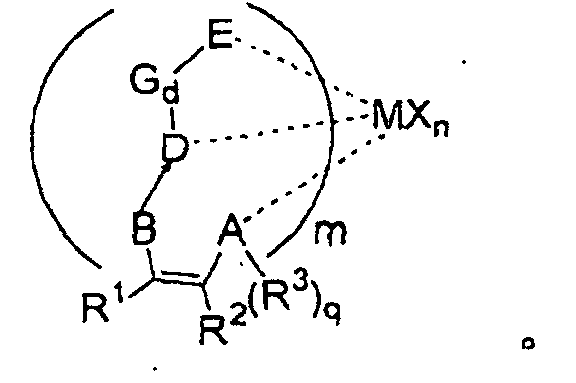
- the structure of the catalyst is showed below:
- the present invention provides a new class of olefin polymerization and copolymerization catalyst (catalyst systems) and its preparation and usage in catalyzing the homopolymerization (including the oligomerization and copolymerization) of ethylene, ⁇ -olefin and olefins containing functional group. It also provides the usage and the condition of polymerization about the said catalysts.
- the catalysts provided in this invention are group 3 to group 11 transition metal complexes of multidentate ligands.
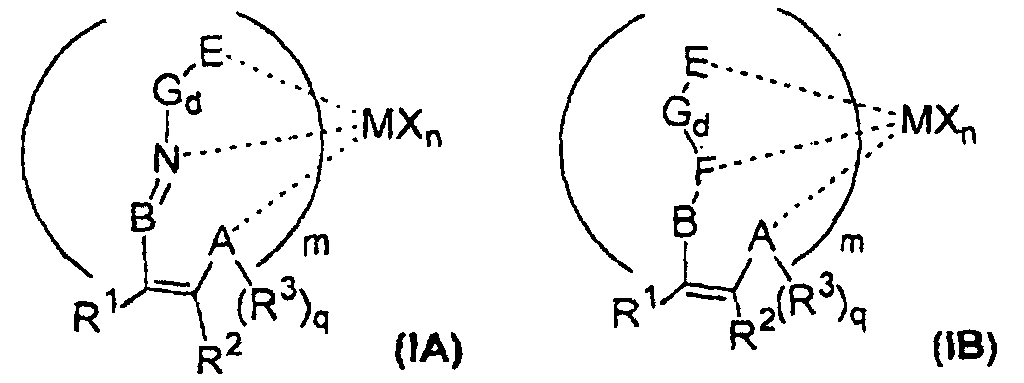
- the olefin polymerization and copolymerization catalysts provided in this invention are the transition metal complexes showed below (formula I):
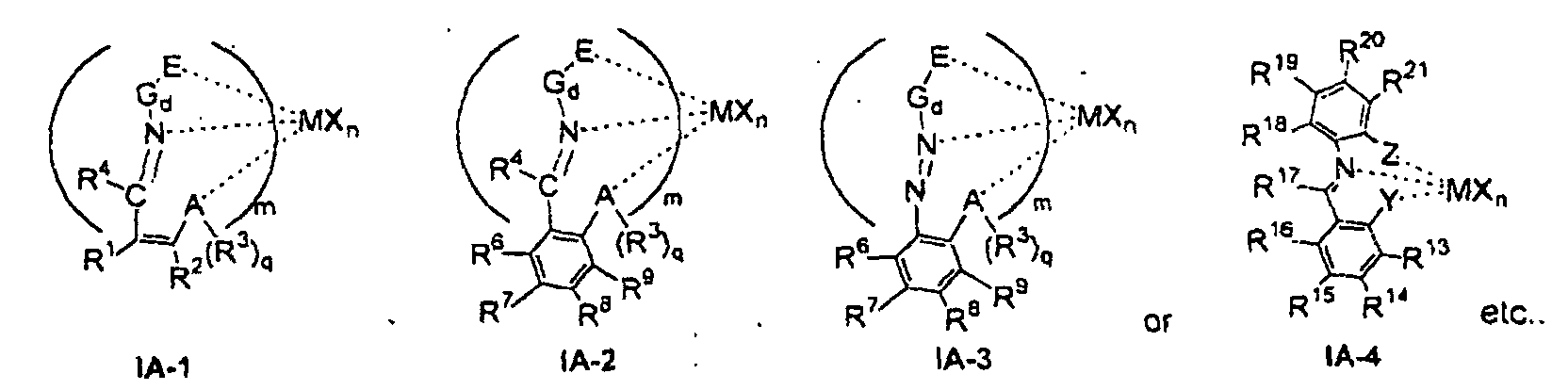
- Formula IA is represented by formula IA-1 ⁇ IA-4 in detail:
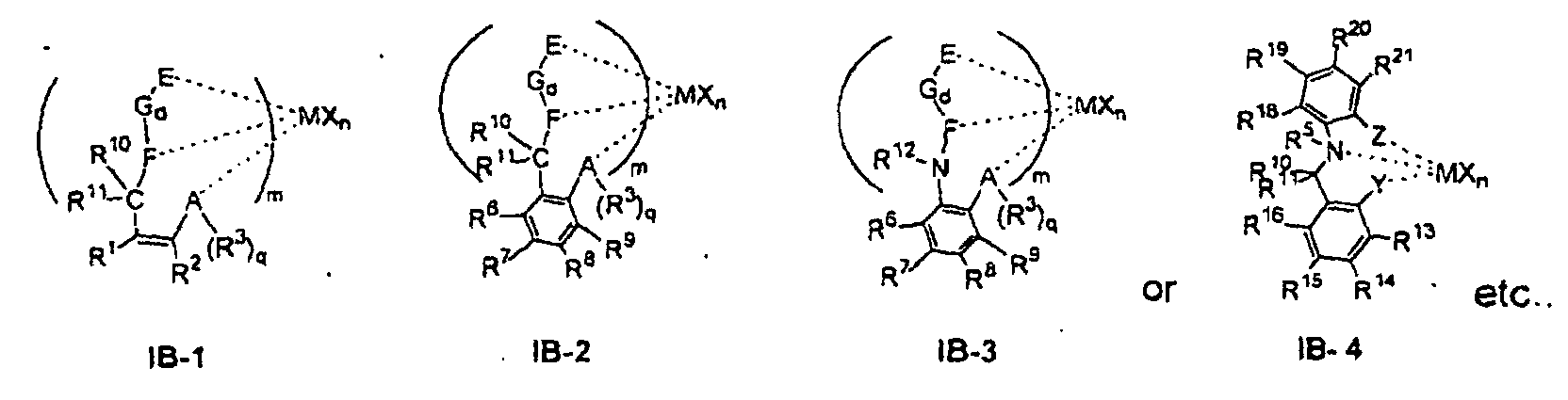
- Formula IB is represented by formula IB-1 ⁇ IB-4 in detail: Wherein:
- the said halogen atom include F, Cl, Br, I;
- the absolute value of total negative charges of all ligands in the formula is the same as the absolute value of positive charges of M in the formula; the ligands include each X and multidentate ligands.
- T is hydrocarbyl of C 1 -C 30 or substituted hydrocarbyl of C 1 -C 30 may be inert functional group.
- the catalyst system provided in this invention means the system containing the said catalyst and it comprises six classes including simply 1 ⁇ or 4 ⁇ or 1 ⁇ supported on 2 ⁇ or contacting 1 ⁇ and 3 ⁇ or 1 ⁇ and 3 ⁇ supported on 2 ⁇ or contacting 3 ⁇ and 4 ⁇ ; 1 ⁇ , 2 ⁇ , 3 ⁇ and 4 ⁇ are described below:
- the catalyst is prepared in organic solvent by mixing the ligand (II) or the anion of the ligand with transition metal complex (III) in mole ration 1:0.1 ⁇ 6 for 0.5 ⁇ 40 hours under the -78°C to reflux temperature, the reaction time has little effect on the result.
- the organic solvent may be THF, petroleum ether, toluene, CH 2 Cl 2 , CCl 4 , ethyl ether, dioxane or 1,2-CH 2 ClCH 2 Cl etc.
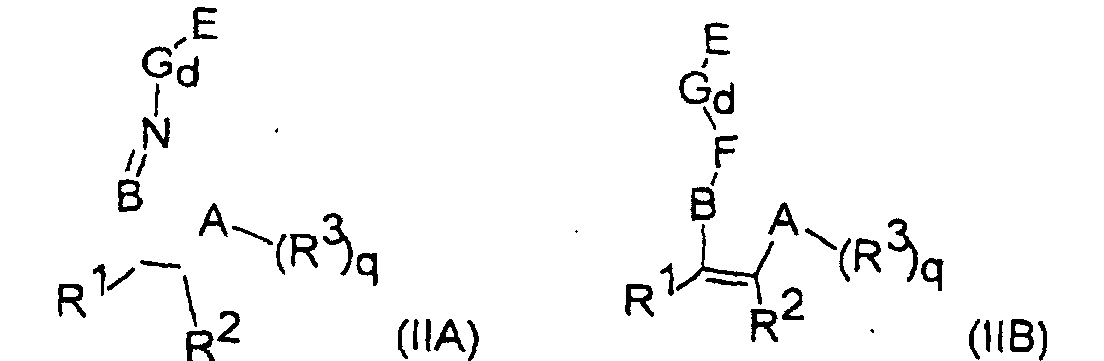
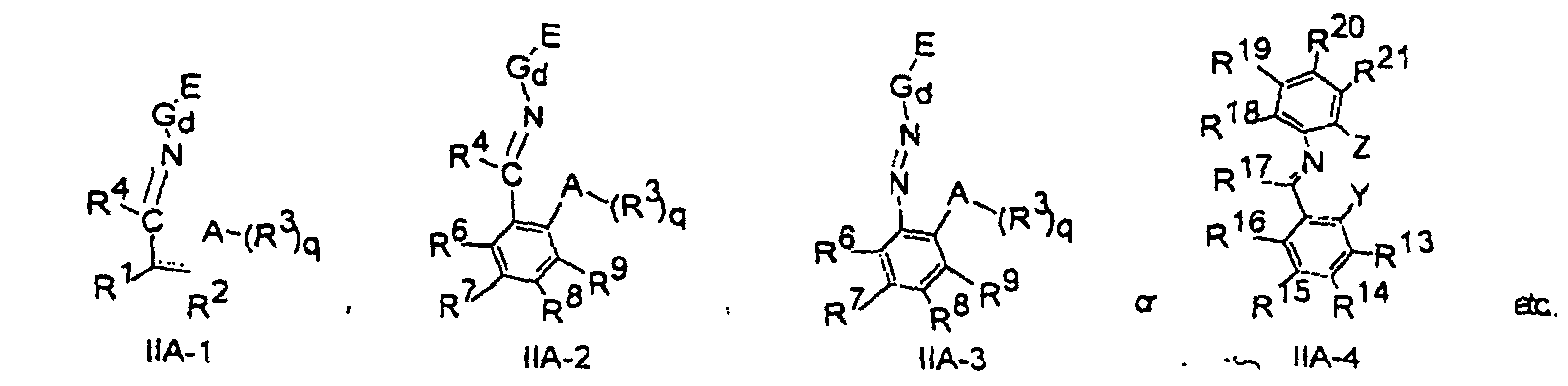
- Ligand (II) may be described by formula IIA and IIB as showed below:
- Formula IIA and IIB may be represented by formula ( IIA-1 ⁇ IIA-4 ) and ( IIB-1 ⁇ IIB-4 ) in detail: Wherein:
- T is hydrocarbyl of C 1 -C 30 or substituted hydrocarbyl of C 1 -C 30 or may be inert functional group.
- the said "metal complex” can be represent by the formula ( III ): MX g ( III ) Wherein:
- the said halogen atom include F, Cl, Br, I.
- the catalysts (catalyst system) provided in this invention may catalyze olefin polymerization as homogeneous catalyst (used directly without supporting) or heterogeneous catalyst (supported on macromolecular materials, silica, alumina, magnesium chloride etc. or the mixtures of several supports or used as catalyst supported on the polymer).
- the said polymerization includes oligomerization, homopolymerization and copolymerization, and the catalysts (catalyst system) may be used by itself or in the presence of co-catalyst.
- the polymerization temperature is preferable from about -100°C to about 200°C and the polymerization process provided in this invention at least includes contacting 4 ⁇ with 1 ⁇ or contacting 4 ⁇ with 5 ⁇ or contacting 4 ⁇ with 1 ⁇ supported on 2 ⁇ in certain order, 3 ⁇ also may be involved in the process. 1 ⁇ , 2 ⁇ , 3 ⁇ , 4 ⁇ and 5 ⁇ are described below:
- the catalyst system provided in the present invention may catalyze the polymerization of olefin monomers including ethylene, ⁇ -olefin, styrene, all kinds of olefinic acid and their derivatives, olefinic alcohol and their derivatives, dienes, cycloolefins etc.
- the said ⁇ -olefins are the olefins of C 3 -C 16 such as propene, 1-butene, 1-pentene, 1-hexene, 1-octene, 4-methyl-1-pentene etc. and the mixtures of them; the said cycloolefins are cyclopentene, cyclohexene, norbornene etc. and their derivatives.
- the term polymerization refers to the homopolymerization and copolymerization of the said monomers and the said homopolymerization includes the oligomerization.
- the polymerization can be run in the liquid process, slurry process, gas process, loop reactor or other polymerization processes.
- the polymerization process generally can be conducted in inert solvents such as alkanes, cycloalkanes or aromatic hydrocarbons.
- the said inert solvents prefer to but not limited to the hydrocarbon of C 1 ⁇ C 12 such as propane, i-butane, pentane, 2-methylbutane, hexane, toluene, chlorobenzene and/or their mixtures.
- the temperature at which the polymerization process conducted is from -50°C to 150°C, preferred 0°C to 120°C for higher activity and productivity.
- the polymerization process is generally conducted from 0.1 to 10MPa, preferably 0.1 to 3 MPa for better operating parameter and superior polymer product.
- the catalyst and co-catalyst may be introduced in any sequence and the mole ratio of the catalyst and the cocatalyst may be changed from 1:1 to 1:5000, preferably 1:10 to 1:2000 for higher activity and yielding polymer with superior morphology and the lower cost.
- the polymerization process may be conducted in flask, autoclave, loop reactor or other types of reactors, in addition, the polymerization may be conducted in single reactor, single reactor, reactors in series or in parallel or in reactors with a combination, the reaction condition in each reactor may be the same or may be not.
- catalyst system in this invention means the system comprising six classes including simply 1 ⁇ or 4 ⁇ or 1 ⁇ supported on 2 ⁇ or contacting 1 ⁇ with 3 ⁇ or contacting 1 ⁇ with 3 ⁇ supported on 2 ⁇ in certain order or contacting 3 ⁇ with 4 ⁇ ; 1 ⁇ , 2 ⁇ , 3 ⁇ and 4 ⁇ are described below:
- co-catalyst W refers to a neutral Lewis acid, which can remove X - from M to form (WX) - : when the produced (WX) - is an anion with weak coordination ability, W can transfer hydrogen to the center metal.
- the weak-coordinating anions are the anions that are relatively non-coordinated with the metal, the ability of the anions has been discussed in the literature (W. Beck.,et al., Chem . Rev ., 1988, 88 , 1405-1421; S. H. Strau ss, Chem.
- the hydrocarbon refers to the alkanes of C 1 -C 30 , cycloalkanes of C 2 -C 30 containing alkyne, aromatic hydrocarbons of C 6 -C 30 , hydrocarbon with fused rings of C8-C30 or heterocyclic compounds of C 4 -C 30 ;
- the substituted hydrocarbon is the hydrocarbon having one or more substituted groups which are inert, this means the groups wouldn't interfere with the process by coordinating with the metal atom. If not stated otherwise, it is preferred the halogen substituted groups of C 1 -C 30 or the halogen substituted aromatic hydrocarbons of C 6 -C 30 including the hydrocarbon with fused rings of C 8 -C 30 or heterocyclic of C 4 -C 30 ;
- the inert functional groups in this invention are functional groups other than hydrocarbons and substituted hydrocarbons which are inert and don't interfere with the process.
- the functional groups herein include halogen (F, Cl, Br, I), groups containing oxygen atom, groups containing nitrogen atom, groups containing silica atom, groups containing germanium atom, group containing sulfur atom or group containing stannum atom such as ether (-OR 34 or -TOR 35 ), ester of C 1 -C 10 , amine of C 1 -C 10 , alkoxyl of C 1 -C 10 , nitryl etc.
- the coordination ability of these inert functional groups with the metal atom is weaker than the groups of A, D, E, F, Y, Z in the formula (I), and coordination group A, D, E, Y, Z with the metal can not be substituted by these inert groups.
- Alkyl aluminium compound is the compound that substituents bound to aluminium atom directly and among them at least one group is alkyl.
- These groups may be same or different and the adjacent groups
- the present invention provides a new class of olefin polymerization and copolymerization catalysts (or catalyst systems), which is a new kind of multidentate complexes based on group 3 to group 11 transition metals.
- the present invention also provides the synthesis of the ligands and the catalysts and their usage in the olefin polymerization process.
- the catalysts are synthesized by contacting the ligand with the complex (III) in organic solvent.
- the catalyst provided in the invention may be used by itself or in the presence of co-catalyst as a homogeneous (used directly without supporting) or as a heterogeneous system (supported on macromolecular materials, inorganic oxide support materials such as silica, alumina, inorganic chloride materials such as magnesium chloride, or the mixtures of the said supports or as catalyst supported on polymer) to catalyze the homopolymerization and copolymerization of olefin monomers such as ethylene, ⁇ -olefin, olefins containing functional groups etc..
- co-catalyst as a homogeneous (used directly without supporting) or as a heterogeneous system (supported on macromolecular materials, inorganic oxide support materials such as silica, alumina, inorganic chloride materials such as magnesium chloride, or the mixtures of the said supports or as catalyst supported on polymer) to catalyze the homopolymerization and copolymerization of ole
- the following examples showed the different aspects of the invention.
- the examples provided include the synthesis of ligands, synthesis of metal complexes, polymerization process, polymerization conditions and polymer produced. All manipulations including reaction, preparation and storage were performed under inert atmosphere using standard Schlenk techniques. Molecular weight and molecular weight distribution were determined by Waters model 150 GPC (differential refractive index detector) at 140°C and 1. 2-Dichlorobenzene as eluent, polystyrene as reference sample.
- the ligands containing imine can be reduced or alkylated by the similar procedure, such as L10: Anal.:Found (Calcd): C: 77.68 (77.28), H: 7.85 (7.93), N: 3.03 (3.34); 1 H NMR (300 MHz CDCl 3 ): ⁇ 7.6-7.0 (m, Aryl-H), 5.1 (br s), 4.33 (s, CH 2 ), 1.33 (s, t-Bu-H), 1.31 (s, t-Bu-H).
- L18, L19, L20, L28, L29, L30, L31, L32, L33, L34 were synthesized by the same procedure as L1.
- L27 was prepared by the same method as L17.
- a solution of ligand L1 (740.5 mg, 1.5 mmol) in THF of 10 ml was added to KH (60 mg, 1.5 mmol) in THF of 10 ml at 0°C, stirred for an additional 1 h at room temperature. After the solvent was removed under vacuum, 30 ml of toluene was added to the residue, and then a solution of TiCl 4 0.20 ml (0.18 mmol) in toluene (30 ml) was added drop wise to the said solution at room temperature, the mixture was stirred for 3h at room temperature.
- Table 1 and Figure 1 give the X-ray analysis of Complex J-1. bond length and bond angle Ti-O 1.798(4) N-C(6) 1.447(7) Ti-Cl(1) 2.2583(19) N-C(7) 1.522(6) Ti-Cl(4) 2.279(2) Cl(1)-Ti-Cl(4) 98.46(8) Ti-Cl(2) 2.3720(18) Cl(1)-Ti-Cl(2) 94.45(7) Ti-Cl(3) 2.4119(19) Cl(4)-Ti-Cl(2) 91.07(7) Anal. Found (Calcd.) C: 58.31 (58.01), H: 5.28 (5.31), N: 2.02 (2.05); X-ray: See Figure 1.
- A-3, A-4, A-5, A-6, A-7, A-9, A-11, A-13, A-14, A-18, A-19, A-20, A-21, A-28, A-29, A-30, A-31, A-32, A-33, A-34 were synthesized as the said general procedure of A-I .
- the following are part of analysis results: (Anal: Found (Calcd.); 1 H NMR, 300 MHz CDCl 3 ) A-3 C: 59.04 (59.76), H: 5.58 (5.88), N: 2.26 (2.40); ⁇ 8.8 (s, CH N), 7.7-6.6 (m, Aryl-H).
- A-5 C: 50.04 (50.30), H: 4.01 (3.91), N: 2.32 (2.17); ⁇ 8.4 (s, CH N), 7.4-7.0 (m, Aryl-H), 1.5 (s, t- Bu), 1.4 (s, t-Bu-H).
- A-6 C: 56.74 (56.11), H: 5.48 (5.30), N: 5.26 (5.45); ⁇ 9.0 (s, CH N), 9.6 (d, pyridine-1H), 8.5 (d, pyridine-1H), 8.0 (q, Aryl-2H), 7.7 (m, Aryl-3H), 7.5 (d, Aryl-1H), 1.5 (s, t-Bu), 1.3 (s, t-Bu-H).
- A-7 C: 52.61 (52.80), H: 5.68 (5.70), N: 5.77 (5.86); ⁇ 9.4 (s, CH N), 8.4-7.1 (m, Aryl-H), 5.4 (s, CH 2 ), 1.56 (s, t-Bu), 1.32 (s, t-Bu-H).
- A-13 C: 59.77 (59.80), H: 5.20 (5.32), N: 2.43 (2.11); ⁇ 8.4 (s, CH N), 8.0-7.1 (m, Aryl-H), 1.6(d, t-Bu), 1.3 (d, t-Bu-H).
- A-18 C: 54.99 (54.42), H: 3.77 (3.57), N: 5.32 (5.52); ⁇ 8.0 (s, CH N), 7.4-6.1 (m, Aryl-H).
- A-19 ⁇ 8.2 (s, CH N), 8.8-6.9 (m, Aryl-H).
- A-20 C: 48.79 (49.08), H: 3.72 (3.81), N: 2.39 (2.12); ⁇ 8.9 (s, CH N), 7.5-6.8 (m, Aryl-H), 1.5 (s, t-Bu-H), 1.3 (s, t-Bu-H).
- A-21 Ti 8.39 (8.16); 7.6-6.8 (m, Aryl-H), 3.9 (s, CH 2 ), 2.4 (s, CH 3 ), 1.4 (s, t-Bu), 1.3 (s, t-Bu).
- A-28 Ti: 8.99 (9.16); ⁇ 8.4 (s, CH N), 7.5-6.8 (m, Aryl-H), 1.4, 1.3 ( t-Bu, Me ).
- A-29 Ti: 7.31 (7.11); ⁇ 8.7 (s, CH N), 7.6-6.8 (m, Aryl-H), 2.8 (s, CH 2 ).
- A-30 Ti: 8.20 (8.43); ⁇ 8.4 (s, CH N), 8.0-6.9 (m, Aryl-H), 1.5 (s, t-Bu-H), 1.3 ( s, Me).
- A-31 Ti: 7.01 (6.87); ⁇ 8.4 (s, CH N), 7.9-7.1 (m, Aryl-H), 1.4 (s, t-Bu-H), 1.3 (s, t-Bu).
- A-32 Ti: 8.07 (8.19); 9.2 (s, CH N), 7.9-6.9 (m, Aryl-H).
- A-33 Ti: 7.78 (7.75); 8.8 (s, CH N), 7.7-7.2 (m, Aryl-H), 1.5 (s, t-Bu-H), 1.35 (s, t-Bu-H).
- A-34 Ti: 8.91 (9.82); ⁇ 8.3 (s, CH N), 7.7-6.9 (m, Aryl-H), 1.5 (s, t-Bu-H), 1.3 (s, t-Bu).
- D-16 (83%), D-18 (57%), D-21 (69%), D-22 (80%)were prepared by the said general procedure. The following are part of analysis results: D-16 Fe: 8.44 (8.38); FID-MS (M + ): 666. D-18 Fe: 12.41 (12.56); FID-MS (M + ): 444. D-21 Fe: 9.98 (10.66); FID-MS (M + ): 523. D-22 Fe: 9.41 (9.97); FID-MS (M + ): 560.
- the anionic solution was added drop wise to a solution of ZrCl 4 •2THF (1.0 mmol) in 15ml of THF, after refluxing and stirring overnight, the solvent was removed under vacuum, the residue was dissolved completely in 20 ml of CH 2 Cl 2 , centrifugalizing, the organic layer was concentrated, a few drops of hexane was added to the mixture, cooled to give crude product, the crude product was recrystallized to give complex B-2, 215 mg (32%) .
- a solution of ligand L1 800 mg (1.62 mmol) in 20 ml of THF was added to a suspension of NaH (1.62mmol) in 10 ml of THF at 0°C to give yellow anionic solution, stirred for 1h at room temperature, a solution of TiCl 4 0.09 ml (0.8 mmol) in 5 ml of THF was added to the said solution, stirred for an additional 3h at room temperature.
- the solvent was removed under vacuum, the mixture was dissolved in 20 ml of CH 2 Cl 2 , centrifugalizing and the organic layer was concentrated under vacuum, cooled to give yellow crude product. recrystallized from toluene to give grange yellow product 550 mg (62.3%).
Landscapes
- Chemical & Material Sciences (AREA)
- Health & Medical Sciences (AREA)
- Chemical Kinetics & Catalysis (AREA)
- Medicinal Chemistry (AREA)
- Polymers & Plastics (AREA)
- Organic Chemistry (AREA)
- Transition And Organic Metals Composition Catalysts For Addition Polymerization (AREA)
Abstract
Description




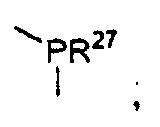


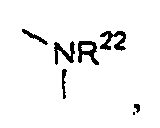
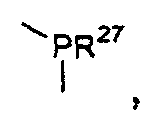
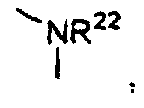
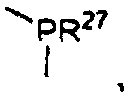


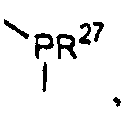


R22, R23, R24, R25, R26, R27, R28, R29, R30, R31, R32, R33, R34, R35, R36, R37, R38, R39, R40, R41, R42, R43, R44, R45, R46, R47, R48, R49, R50, R51, R52, R53, R54 independently represents H, hydrocarbyl of C1-C30, halogen atom, substituted hydrocarbyl of C1-C30 or inert functional group. These groups may be same or different and the adjacent groups may form a covalent bond or to form a cycle;

1H NMR (300 MHz CDCl3): δ 8.4 (s, CH=N), 7.4-6.8 (m, Aryl-H), 1.4 (s, t-Bu-H), 1.3 (s, t-Bu-H);
δ (31P)-13.63 (s) .
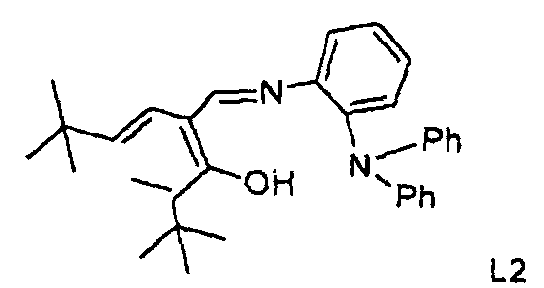
1H NMR (300 MHz CDCl3): δ 13.6 (s, O-H), 8.6 (s, CH=N), 7.5-7.0 (m, Aryl-H), 1.5 (s, t-Bu-H), 1.3 (s, t-Bu-H).

1H NMR (300 MHz CDCl3): δ 14.0 (s, O-H), 8.86 (s, CH=N), 7.46-6.43 (m, Aryl-H), 2.17(s, CH3), 1.50 (s, t-Bu-H), 1.31 (s, t-Bu-H).
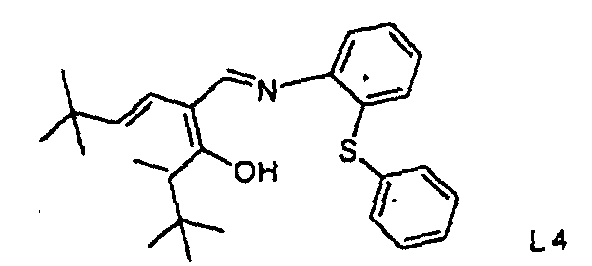
1H NMR (300 MHz CDCl3): δ 13.3 (s, O-H), 8.6 (s, CH=N), 7.45-7.11 (m, Aryl-H). 1.47 (s, t-Bu-H), 1.32 (s, t-Bu-H).
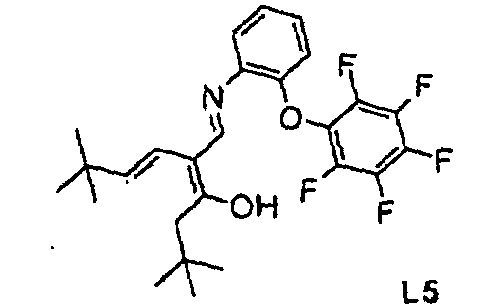
1H NMR (300 MHz CDCl3): δ 13.1 (s, O-H). 8.7 (s, CH=N), 7.4-7.1 (m, Aryl-H), 1.4 (s, t-Bu-H), 1.3 (s, t-Bu-H).

1H NMR (300 MHz CDCl3): 14.0 (s, O-H), 8.9 (s, CH=N), 9.0 (d, pyridine-2), 8.2 (d, pyridine-4), 7.6 (t, pyridine-3), 7.7-7.4 (m, Aryl-H), 1.5 (s, t-Bu-H), 1.4 (s, t-Bu-H).
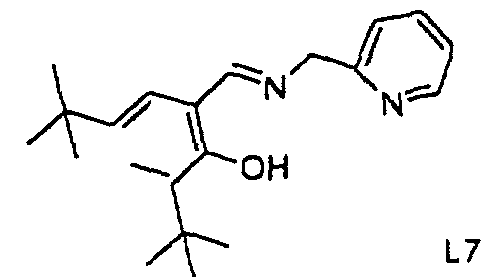
1H NMR (300 MHz CDCl3): δ 13.6 (s, O-H), 8.6 (m, 2H), 7.69-7.14 (m, Aryl-H), 4.93 (s,-CH2-), 1.45 (s, t-Bu-H), 1.32 (s, t-Bu-H).
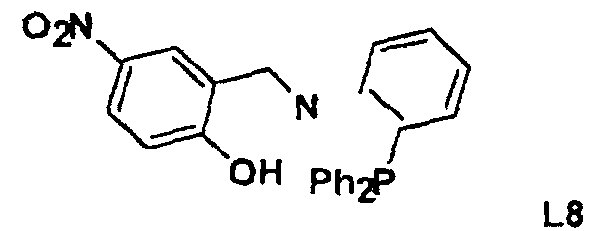
1H NMR (300 MHz CDCl3): δ 8.0 (s, CH=N), 7.7-6.6 (m, Aryl-H).
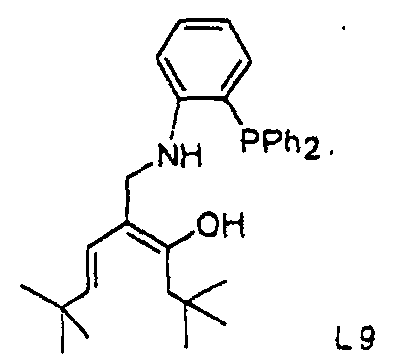
1H NMR (300 MHz CDCl3): 7.74-6.78 (m, 16H). 4.15 (s, 2H), 1.40 (s, t-Bu-H), 1.38 (s, 9H).
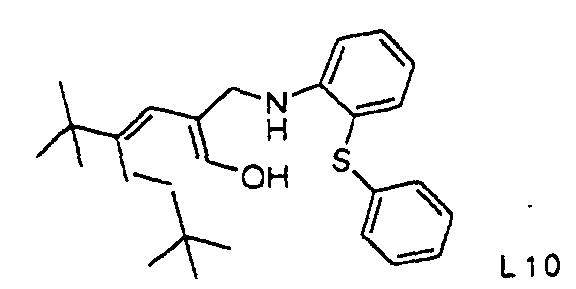
1H NMR (300 MHz CDCl3): δ 7.6-7.0 (m, Aryl-H), 5.1 (br s), 4.33 (s, CH2), 1.33 (s, t-Bu-H), 1.31 (s, t-Bu-H).
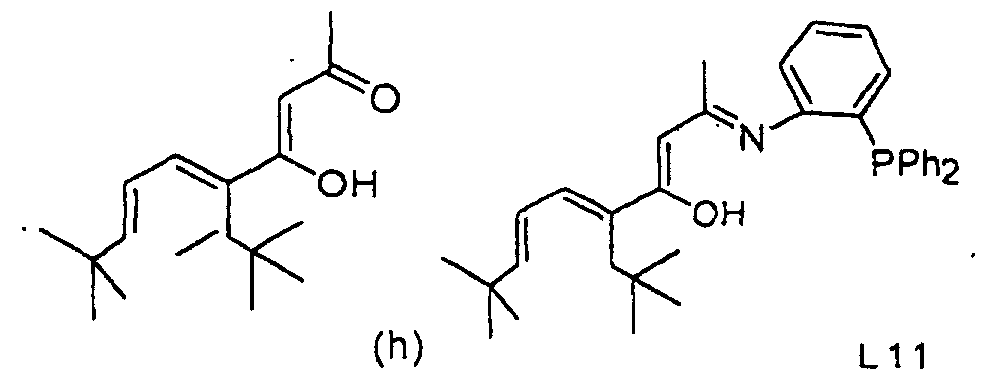
1H NMR (300 MHz CDCl3): 7.6-6.9 (m, 17H), 5.36 (s, I H), 2.10 (s, 3H), 1.44 (s, t-Bu-H), 1.38(s, 9H, 9H).

1H NMR (300 MHz CDCl3): 11.6 (s, O-H), 8.2 (s, CH=N), 8.0-7.0 (m, Aryl-H), 1.35 (s, t-Bu-H), 1.28 (s, t-Bu-H).

1H NMR (300 MHz CDCl3): 11.7 (s, O-H), 8.2 (s, CH=N), 7.75-7.0 (m, Aryl-H), 1.33 (s, t-Bu-H), 1.28 (s, t-Bu-H).
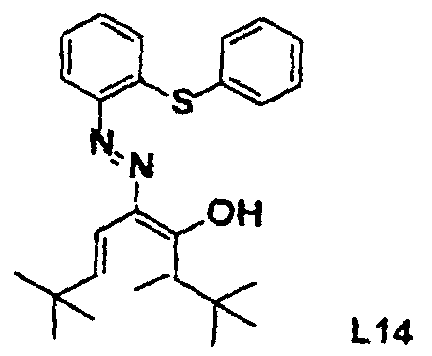
1H NMR (300 MHz CDCl3): δ 13.3 (s, OH), 7.8-7.1 (m, Aryl-H), 1.4 (s. t-Bu-H), 1.3 (s, t-Bu-H).
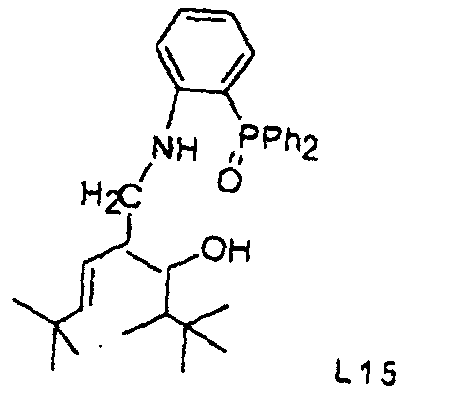
1H NMR (300 MHz CDCl3): δ 7.7-6.7 (m, Aryl-H), 4.3 (d, CH2N), 1.28 (s, t-Bu-H).

1H NMR (300 MHz CDCl3): δ 7.7-6.9 (m, Aryl-H), 4.3 (s, CH2), 3.6 (s, Ome), 2.2 (s, Me), 1.3(s, t-Bu-H), 1.2 (s, t-Bu-H).
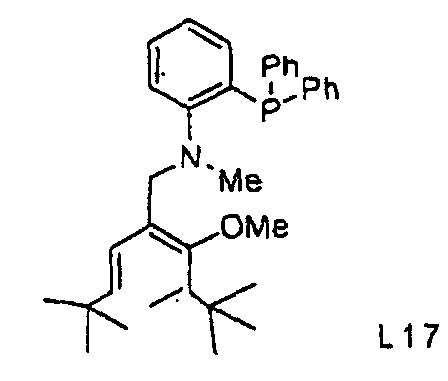
1H NMR (300 MHz CDCl3): δ 7.5-6.8 (m, Aryl-H), 4.2 (s, CH2), 3.7 (s, OMe), 2.5 (s, NMe), 1.5 (s, t-Bu-H), 1.2 (s, t-Bu-H).


Anal., Found (Calcd); 1H NMR, 300 MHz CDCl3
- L18:
- C: 77.84 (77.95), H: 5.31 (5.400, N: 7.66 (7.90);
8.1 (s, CH=N), 7.4-6.2 (m, Aryl-H), 1.9 (broad s, N-H). - L19:
- C: 83.75 (84.00), H: 5.38 (5.06), N: 2.87 (2.51);
13.5 (s, OH), 8.4 (s, CH=N), 8.9-7.0 (m, Aryl-H); - L20:
- C: 63.91 (63.89), H: 5.13 (5.16), N: 2.73 (2.76);
13.9 (s, OH), 8.3 (s, CH=N), 8.8-7.0 (m. Aryl-H), 1.5 (s, t-Bu-H), 1.3 (s, t-Bu-H); - L28:
- 8.3 (s, CH=N), 7.6-6.9 (m, Aryl-H), 1.4 (s, t-Bu-H), 1.3 (PMe);
- L29:
- 8.3 (s, CH=N), 7.5-6.9 (m, Aryl-H), 3.0 (s, CH2), 1.4 (s, t-Bu-H), 1.3 (s, t-Bu-H);
- L30:
- 8.4 (s, CH=N), 8.3-7.1 (m, Aryl-H), 1.4 (s, t-Bu-H), 1.3 (s, Me);
- L31:
- 8.4 (s, CH=N), 7.9-6.6 (m, Aryl-H), 1.31 (s, t-Bu-H), 1.29 (s, t-Bu-H);
- L32:
- 9.3 (s, CH=N), 8.0-6.9 (m, Aryl-H);
- L33:
- 13.2 (s, OH), 8.6 (s, CH=N), 7.6-7.1 (m, Aryl-H), 1.5 (s, t-Bu-H), 1.35 (s, t-Bu-H);
- L34:
- C: 78.85 (79.00), H: 7.85 (7.84), N: 8.33 (8.38).
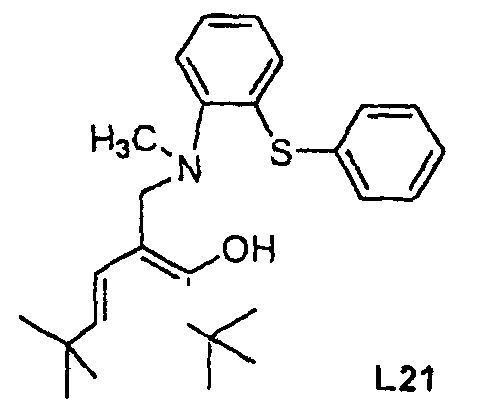
1H NMR (CDCl3): 7.7-6.8 (m, Aryl-H), 4.0 (s, 2H), 2.5 (s, 3H), 1.4 (s, 9H), 1.3 (s, 9H).

1H NMR (CDCl3): 7.5-6.7 (m, Ary-H), 5.3 (br s, NH), 4.34 (s, 2H), 3.7 (s, 3H), 1.4 (s, t-Bu-H), 1.2 (s, t-Bu-H).
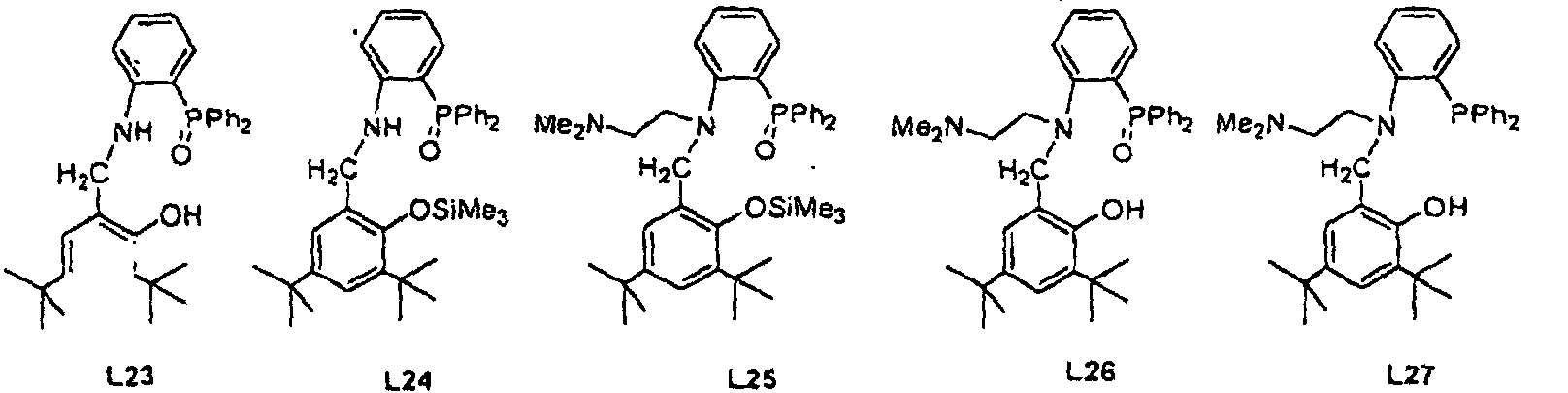
1H NMR (300 MHz CDCl3): 7.7-6.7 (m, Aryl-H), 3.9 (s, 2H), 2.6 (t, 2H), 2.2 (t, 2H), 1.9 (s, 3H), 1.4 (s, 9H), 1.3 (s, 9H).

1H NMR (300 MHz CDCl3): δ 8.2 (s, CH=N), 7.8-7.0 (in, Aryl-H), 1.51 (s, t-Bu-H), 1.34 (s, t-Bu-H). Complex A-1 isomerizated under the action of dry hydrochloric to give complex J-1:

| bond length and bond angle | |||
| Ti-O | 1.798(4) | N-C(6) | 1.447(7) |
| Ti-Cl(1) | 2.2583(19) | N-C(7) | 1.522(6) |
| Ti-Cl(4) | 2.279(2) | Cl(1)-Ti-Cl(4) | 98.46(8) |
| Ti-Cl(2) | 2.3720(18) | Cl(1)-Ti-Cl(2) | 94.45(7) |
| Ti-Cl(3) | 2.4119(19) | Cl(4)-Ti-Cl(2) | 91.07(7) |

1H NMR (300 MHz CDCl3): δ 8.3 (s, CH=N), 7.7-6.9 (m, Aryl-H), 1.6 (s, t-Bu-H), 1.3 (s, t-Bu-H).
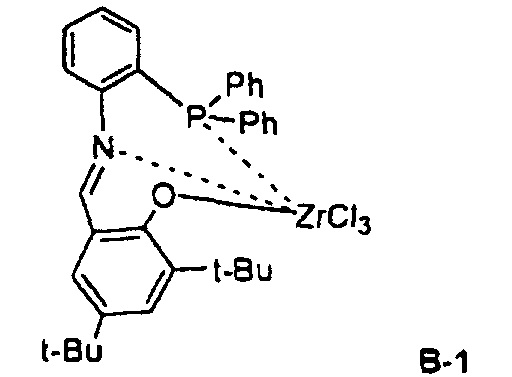
1H NMR (300 MHz CDCl3): δ 8.3 (s, CH=N), 7.8-7.0 (m, Aryl-H), 1.5 (s, t-Bu-H), 1.3 (s, t-Bu-H).

1H NMR (300 MHz CDCl3): δ 8.4 (s, CH=N), 8.0-6.9 (m, Aryl-H), 1.6 (s, t-Bu-H), 1.3 (s, t-Bu-H).


A-3
C: 59.04 (59.76), H: 5.58 (5.88), N: 2.26 (2.40);
δ 8.8 (s, CH=N), 7.7-6.6 (m, Aryl-H). 2.5 (s, CH3), 1.5 (s, t-Bu-H), 1.4 (s, t-Bu-H).
A-4
C: 57.04 (56.81), H: 5.11 (5.30), N: 2.13 (2.45);
8.9 (s, CH=N), 7.7-7.2 (m, Aryl-H), 1.5(s, t-Bu), 1.3 (s, t-Bu-H).
A-5
C: 50.04 (50.30), H: 4.01 (3.91), N: 2.32 (2.17);
δ 8.4 (s, CH=N), 7.4-7.0 (m, Aryl-H), 1.5 (s, t- Bu), 1.4 (s, t-Bu-H).
A-6
C: 56.74 (56.11), H: 5.48 (5.30), N: 5.26 (5.45);
δ 9.0 (s, CH=N), 9.6 (d, pyridine-1H), 8.5 (d, pyridine-1H), 8.0 (q, Aryl-2H), 7.7 (m, Aryl-3H), 7.5 (d,
Aryl-1H), 1.5 (s, t-Bu), 1.3 (s, t-Bu-H).
A-7
C: 52.61 (52.80), H: 5.68 (5.70), N: 5.77 (5.86);
δ 9.4 (s, CH=N), 8.4-7.1 (m, Aryl-H), 5.4 (s, CH2), 1.56 (s, t-Bu), 1.32 (s, t-Bu-H).
A-9
C: 61.32 (61.09), H: 5.78 (5.75), N: 7.44 (7.38);
δ 7.7-7.1 (m, Aryl-H), 4.7 (d, CH2), 1.3 (d, t-Bu-H) .
A-11
C: 62.33 (62.95), H: 5.60 (5.72), N: 2.41 (2.04), Cl: 15.83 (15.48).
A-13
C: 59.77 (59.80), H: 5.20 (5.32), N: 2.43 (2.11);
δ 8.4 (s, CH=N), 8.0-7.1 (m, Aryl-H), 1.6(d, t-Bu), 1.3 (d, t-Bu-H).
A-14
C: 60.98 (59.33), H: 5.39 (5.29), N: 4.55 (4.32), Cl: 16.76 (16.42);
7.5-7.1 (m, Aryl-H), 1.4 (s, t-Bu-H), 1.3 (s, t-Bu-H).
A-18
C: 54.99 (54.42), H: 3.77 (3.57), N: 5.32 (5.52);
δ 8.0 (s, CH=N), 7.4-6.1 (m, Aryl-H).
A-19
δ 8.2 (s, CH=N), 8.8-6.9 (m, Aryl-H).
A-20
C: 48.79 (49.08), H: 3.72 (3.81), N: 2.39 (2.12);
δ 8.9 (s, CH=N), 7.5-6.8 (m, Aryl-H), 1.5 (s, t-Bu-H), 1.3 (s, t-Bu-H).
A-21
Ti: 8.39 (8.16);
7.6-6.8 (m, Aryl-H), 3.9 (s, CH2), 2.4 (s, CH3), 1.4 (s, t-Bu), 1.3 (s, t-Bu).
A-28
Ti: 8.99 (9.16);
δ 8.4 (s, CH=N), 7.5-6.8 (m, Aryl-H), 1.4, 1.3 ( t-Bu, Me ).
A-29
Ti: 7.31 (7.11);
δ 8.7 (s, CH=N), 7.6-6.8 (m, Aryl-H), 2.8 (s, CH2).
A-30
Ti: 8.20 (8.43);
δ 8.4 (s, CH=N), 8.0-6.9 (m, Aryl-H), 1.5 (s, t-Bu-H), 1.3 ( s, Me).
A-31
Ti: 7.01 (6.87);
δ 8.4 (s, CH=N), 7.9-7.1 (m, Aryl-H), 1.4 (s, t-Bu-H), 1.3 (s, t-Bu).
A-32
Ti: 8.07 (8.19);
9.2 (s, CH=N), 7.9-6.9 (m, Aryl-H).
A-33
Ti: 7.78 (7.75);
8.8 (s, CH=N), 7.7-7.2 (m, Aryl-H), 1.5 (s, t-Bu-H), 1.35 (s, t-Bu-H).
A-34
Ti: 8.91 (9.82);
δ 8.3 (s, CH=N), 7.7-6.9 (m, Aryl-H), 1.5 (s, t-Bu-H), 1.3 (s, t-Bu).

B-6
δ 9.1 (s, CH=N), 9.6 (d, pyridine-1H), 8.6 (d, pyridine-1H), 7.9-7.3 (m, Aryl-H).
B-9
C: 58.01 (57.26), H: 5.78 (5.39), N: 1.77 (2.02);
δ 7.8-6.6 (m, Aryl-H), 1.2 (s, t-Bu-H).
B-13
δ 8.4 (s, CH=N), 8.1-7.0 (m, Aryl-H), 1.5 (d, t-Bu-H). 1.3 (d. t-Bu-H).
B-19
δ 8.1 (s, CH=N), 8.6-6.5 (m, Aryl-H).


D-16
Fe: 8.44 (8.38);
FID-MS (M+): 666.
D-18
Fe: 12.41 (12.56);
FID-MS (M+): 444.
D-21
Fe: 9.98 (10.66);
FID-MS (M+): 523.
D-22
Fe: 9.41 (9.97);
FID-MS (M+): 560.

1H NMR (300 MHz CDCl3): δ 8.1 (s, HC=N), 7.6-7.0 (m, Aryl-H), 1.2 (s, t-Bu-H), 1.1 (s, t-Bu-H).
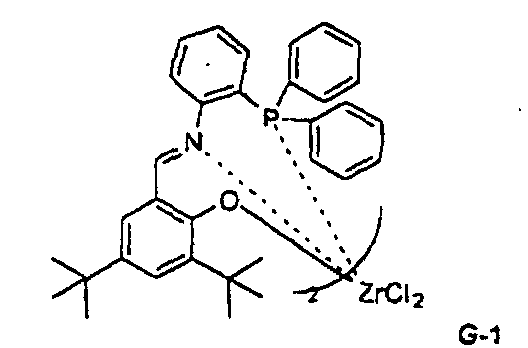
FID-MS (M+): 1148.
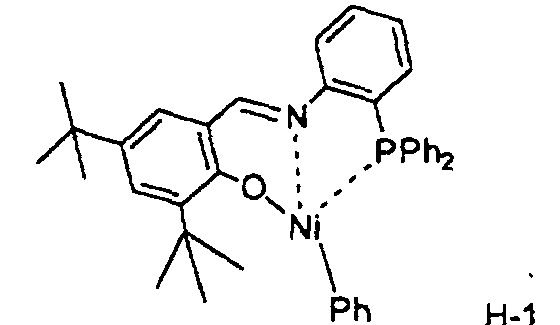
Anal. : 1H NMR (300 MHz C6D6): δ 9.1 (s, CH=N), 7.8-6.8 (m, Aryl-H), 1.3 (s, t-Bu-H), 1.1 (s, t-Bu-H), 0.7 (s, CH3).
Claims (12)
- , A catalyst or catalytic system for olefin polymerization and copolymerization, the catalyst has the following formula:wherein:
 → : is single bond or double bond;.....: is coordination bond, covalent bond or ionic bond;- : is covalent bond or ionic bond;m: 1, 2 or 3;q: 0 or 1;d: 0 or 1;M: transition metal from group 3 to group 11, examples of M are Ti, Zr, Ni, Pd, Fe, Co;n: 1, 2, 3 or 4;X is hydrogen, halogen, hydrocarbyl substituted hydrocarbyl group containing oxygen atom, group containing nitrogen atom, group containing sulfur atom, group containing boron atom, group containing aluminum atom, group containing phosphor atom, group containing silicon, group containing germanium atom or group containing selenium atom, each X in the formula could be the same or not, two or more canbe linked to form one or more cyclic substitutes;The absolute value of total negative charges of all ligands in the formula is as same as the absolute value of positive charges of metal M in the formula, the ligands include each X and multidentate ligand;A is O, S, Se,-NR23R24, -N(O)R25R26,
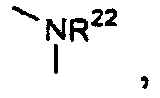 -PR28R29, -P(O)R30R31, sulfonyl, sulfoxidyl, -Se(O)R39;
 B is a group containing nitrogen atom, a group containing phosphor atom or hydrocarbyl;D is O, S, Se, a group containing nitrogen atom, a group containing phosphor atom, a group containing selenium atom, sulfonyl and sulfoxidyl ;E refers to the group containing nitrogen atom, the group containing oxygen atom, the group containing sulfur atom, the group containing selenium atom, the group containing phosphor atom wherein the N, O, S, Se and P are coordination atoms;G refers to an inert group, examples of the said inert group include hydrocarbyl, substituted hydrocarbyl and inert functional group;B, E, G could link to one another;A " hydrocarbyl " is a univalent group containing only carbon and hydrogen, including alkyl group, cycloalkyl group, alkenyl group, alkynyl group, aromatic group, condensed rings group, heterocyclic group. If not otherwise stated, it is preferred that hydocarbyl group herein containing I to about 30 carbon atoms;A "substituted hydrocarbyl" refers to a hydrocarbyl which contains one or more substituent groups which are inert under the process conditions to which the compound containing these groups is subjected. The substituent groups also do not substantially interfere with the process. In another word, these substituent groups do not coordinate with metal. If not otherwise stated, it is preferred that hydocarbyl group herein contain 1 to about 30 carbon atoms. Included in the meaning of "substituted hydrocarbyl" are aromatic group, heteroaromatic rings, condensed rings group, heterocyclic group;A " inert functional group" herein refers to a group other than hydrocarbyl or substituted hydrocarbyl which is inert under the process conditions to with the compound containing the group is subjected. The functional groups also do not substantially interfere with any process described herein that the compound in which they are present may take part in. The functional group herein include a group containing oxygen atom, a group containing nitrogen atom, a group containing silica atom, a group containing germanium atom, a group containing sulfur atom or group containing stannum atom. Examples of functional groups include halogen (fluorine, chlorine, bromine and iodine), ether (-OR34 or TOR34), ester of C1-C10, amine of C1-C10, alkoxyl of C1-C10, nitryl group. In case in which the functional group may be near an metal atom, the functional group should not coordinate to the metal atom more strongly than the group A, D, E, F, Y, Z which containing coordination atom and are shown as coordinating to metal atom, that is they should not displace the desired coordinating group:A "halogen" herein is fluorine, chlorine, bromine and iodine;A "group containing nitrogen atom" herein is-NR23R24, -T-NR23R24- N(O)R25R26, or -T-N(O)R25R26;
 T is hydrocarbyl, substituted hydrocarbyl and inert functional group. If not otherwise stated, it is preferred that group herein contain 1 to about 30 carbon atoms;A " weakly coordinating anion " herein is the anion whose coordinating ability is known and has been discussed in the literature, see for instance W. Beck, et al., Chem. Rev., vol. 88, p. 1405-1421 (1988), and S. H. Strauss, Chem. Rev., vol. 93, p. 927-942 (1993), both of which are hereby included by reference. Among such anions are those formed from the aluminum compounds in the immediately preceding paragraph and X-, including (R41)3AlX-, (R41)2AlX2 -, (R41)AlX3 -, "R41AlOX-". Other useful weakly coordinating anions include p-toluenesulfonate, SbF6 -, PF6 -, BF4 -, (C6F5)4B-, (RfSO2)2N-, CF3SO3 - or ((3,5-(CF3)2)C6H3)4B-.A "group containing phosphor atom" herein isPR28R29, -P(O)R30R31, -P(O)R32(OR33), -T-PR28R29, -T-P(O)R30R31 or -T-P(O)R32(OR33) ;
 A "ether" herein is -OR34 or -TOR34;A "group containing oxygen atom" herein is hydroxyl, alkoxy (-OR34), group with such as -T-OR34;A "group containing sulfur atom" herein is -SR35, -T-SR35, -S(O)R36, -T-SO2R37;A "group containing selenium atom" herein is -SeR38, -T-SeR38, -T-Se(O)R39, -Se(O)R39;A "group containing boron atom" herein is BF4 -, (C6F5)4B-, (R40BAr3)- etc.;A "group containing aluminum atom" herein is alkyl aluminum compound, AlPh4 -, AlF4 -, AlCl4 -, AlBr4 -, AlI4 -, R41AlAr3 -;A "group containing silicon atom" herein is -SiR42R43R44, -T-SiR45;A "group containing germanium atom" herein is -GeR46R47R48, -T-GeR49;A "group containing stannum atom" herein is -SnR50R51R52, -T-SnR53, -T-Sn(O)R54;A "alkyl aluminum compound" herein is a compound in which at least one alkyl group is bound to aluminum atom, and halogen can also be bound to aluminum atoms in the compound. Examples of alkyl aluminum compound include methyl aluminoxane(MAO), modified methyl aluminoxane (MMAO), AlEt3, AlMe3, Al(i-Bu)3;R1, R2, R3, R22, R23, R24, R25, R26, R27, R28, R29, R30, R31, R32, R33, R34, R35, R36, R37, R38, R39, R40, R41, R42, R43, R44, R45, R46, R47, R48, R49, R50, R51, R52, R53, R54 are each independently hydrogen, halogen (F, Cl, Br, I), hydrocarbyl, substituted hydrocarbyl or inert functional group. Each group above may be the same or not, and that any two of them which are vicinal may be linked to one another or to form a ring;A "catalytic system" herein is the system formed by catalyst mentioned above, or catalyst combined with cocatalyst W, or the catalyst supported on the carrier, or catalyst together with cocatalyst W supported on the carrier, or polymeric catalyst or polymeric catalyst combined with cocatalyst W;A "carrier" herein is polymer materials, silica, alumina, magnesium chloride titanium dioxide or the mixtures of two or more materials mentioned above.A "cocatalyst" herein is (a) a kind of neutral Lewis acid which could abstract X- from the metal to form (WX)-, and which is also capable of transferring an alkyl group or a hydride group to M, provided that (WX)- is a weakly coordinating anion. Examples of this kind of neutral Lewis acid include MAO and MMAO; or (b) a combination of following two kind of compounds, one kind compound is capable of transferring an alkyl or hydride group to metal and the other kind of compound is capable of abstracting X- from the metal and form weakly coordinating anion. Examples of the former kind of compound include alkyl aluminum compound such as AlEt3, AlMe3, Al(i-Bu)3 and the examples of the latter kind of compound include cationic Lewis acid (Na[B(3,5-(CF3)2C6H3)4] or Ag[B(3,5-(CF3)2C6H3)4], NaOSO2CF3 or AgOSO2CF3), alkyl aluminum compound or borane (B(C6F5)3 etc.);
 - A catalyst or catalytic system for olefin polymerization and copolymerization as recited in claim 1, the catalyst has the following formula:wherein:
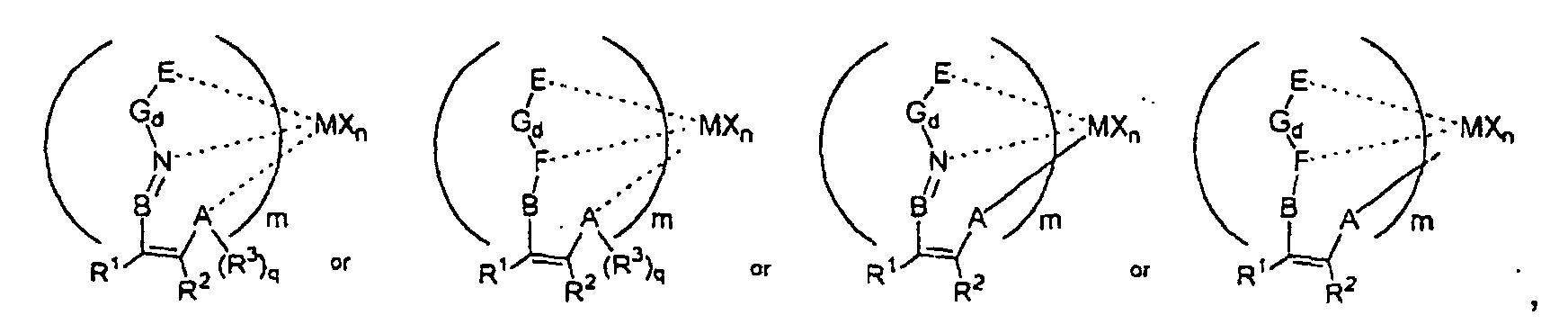 ......: refers to coordination bond, covalent bond or ionic bond;―: refers to covalent bond or ionic bond;The descriptions of "A", "B", "E ", "G", "d", "q", "m", "M", "n", "X'', "R1", "R2" and "R3" are each independently as same as those recited in claim 1;F is group containing oxygen atom, group containing nitrogen atom, group containing sulfur atom, group containing phosphor atom or group containing selenium atom, and among which the coordination atom is N, O, S, Se, P;The descriptions of "catalytic system", "group containing oxygen atom", "group containing nitrogen atom", "group containing sulfur atom", "group containing phosphor atom'' and "group containing selenium atom" are each independently as same as those recited in claim 1.
 - A catalyst or catalytic system for olefin polymerization and copolymerization as recited in claim 2, the catalyst has the following formula:wherein:
 ......: refers to coordination bond, covalent bond or ionic bond;― : refers to covalent bond or ionic bond;R4, R10, R11, R12 are each independently hydrogen, halogen, hydrocarbyl, substituted hydrocarbyl, or inert functional group, each said group may be same or different, and any two of the groups vicinal to one another may link to each other or form a ring;The descriptions of "A", "E", "F", "G", "d", "q", "m", "M", "n", "X", "R1", "R2" and "R3" are each independently as same as those recited in claim 2;The descriptions of "catalytic system", "hydrocarbyl", "substituted hydrocarbyl" and "inert functional group" are each independently as same as those recited in claim 1.
 - A catalyst or catalytic system for olefin polymerization and copolymerization as recited in claim 3, the catalyst has the following formula:wherein:
 ......: refers to coordination bond, covalent bond or ionic bond;―: refers to covalent bond or ionic bond;R6, R7, R8, R9: are each independently hydrogen, halogen, hydrocarbyl, substituted hydrocarbyl, or an inert functional group;The descriptions of "A", "E", "F", "G", "d", "q", "m", "M", "n", "X", "R3", "R4", "R10", "R11" and "R12" are each independently as same as those recited in claim 3;R3, R4, R6, R7, R8, R9, R10, R11, R12 may be same or different, and any two of the groups vicinal to one another may link to each other or form a ring;The descriptions of "catalytic system", "hydrocarbyl" and "substituted hydrocarbyl" are each independently as same as those recited in claim 1.
 - A catalyst or catalytic system for olefin polymerization and copolymerization as recited in claim 4, the catalyst has the following formula:wherein:
 ......: refers to coordination bond ,covalent bond or ionic bond;― : refers to covalent bond or ionic bond;Which, E binds M by coordination bond, A binds M by covalent bond and D binds M by coordination bond or by covalent bond;R10, R11, R12, R13, R14, R15, R16, R17, R18, R19, R20, R21 are each independently hydrogen, halogen, hydrocarbyl, substituted hydrocarbyl, or an inert functional group. Each said group may be same or different, and any two of the groups vicinal to one another may link to each other or form a ring;R5 is the lone pair electron of nitrogen atom, H, hydrocarbyl, substituted hydrocarbyl, group containing oxygen atom, group containing sulfur atom, group containing nitrogen atom, group containing phosphor atom. When R5 is one of the groups containing oxygen atom or sulfur atom or nitrogen atom or selenium atom or phosphor atom, the N or O or S or P or Se atom in the group may coordinate with metal (M);Y and Z are each independently group containing oxygen atom, group containing nitrogen atom, group containing sulfur atom, group containing phosphor atom or group containing selenium atom;The descriptions of "T", "M", "X", "n", "catalytic system", "hydrocarbyl", "substituted hydrocarbyl", "group containing oxygen atom", "group containing nitrogen atom", "group containing sulfur atom", "group containing phosphor atom" and "group containing selenium atom" are each independently as same as those recited in claim 1.
 - The synthesis procedure of catalyst used for the olefin polymerization and copolymerization as recited in claim 1 wherein the catalyst is prepared in organic solvent by mixing the ligand or the anion of the ligand with transition metal complex in mole ration 1:0.1∼6 for 0.5∼4.0 hours under the -78°C to reflux temperature;
The ligand has the following formula:wherein the descriptions of "d", "A", "B", "D", "E", "G", "→", "―", "R1", "R2" and "R3" are each independently as same as those recited in claim 1;
- The synthesis procedure of catalyst used for the olefin polymerization and copolymerization as recited in claim 1 wherein transition metal complex used in claim 6 has the formula MXg, wherein g is 1, 2, 3, 4, 5 or 6; the descriptions of M and X are each independently as same as those recited in claim 1."
- The usage of catalyst or catalytic system used for the olefin polymerization and copolymerization as recited in claim 1 wherein the catalyst or catalytic system with/without cocatalyst could catalyze olefin oligomerization, polymerization and copolymerization as homogeneous catalyst or heterogeneous catalyst; The said homogeneous catalyst is meant the catalyst or the catalytic system used directly without supported on the carrier; The said heterogeneous catalyst is meant the catalyst or the catalytic system used after supported on the carrier such as polymer materials, silica, alumina, magnesium chloride etc. or the mixtures of the said carrier; The said olefin is meant ethylene, α-olefin, styrene, alkenoic acid and its derivatives, alkenols and its derivatives, diene, cycloalkene, norbornene and its derivatives and other alkene with functional group; The said α-olefin is meant an alkene containing 1 to 30 carbon such as propylene, 1-butene, 1-pentene, 1-hexene, 1-octene, 4-methyl-l-pentene and mixtures of them; The said cycloalkene is meant cyclopentene, cyclohexene, norbomene and its derivatives; The said alkene with functional group is meant an alkene containing one or more inert functional group, such as vinyl acetate, phenylacetylene, acrylonitrile, acrylamide, alkenyl ether and alkenyl ester.
- The usage of catalyst or catalytic system used for the olefin polymerization and copolymerization as recited in claim 8 wherein the said copolymerization is meant the copolymerization of ethylene with α-olefin, the copolymerization of the ethylene with alkene with functional group, the copolymerization of α-olefin with alkene containing functional group and the copolymerization between the α-olefins; The descriptions of the said "olefin", "alkene with functional group" and "α-olefin" are independently as same as those recited in claim 8.
- The usage of catalyst or catalytic system used for the olefin polymerization and copolymerization as recited in claim 8 wherein the catalyst could be used directly, or used after supported on the carrier, or used as polymeric catalyst, or used as catalytic system.
- The usage of catalyst or catalytic system used for the olefin polymerization and copolymerization as recited in claim 8 wherein the said carrier is meant polymer materials, silica, alumina, magnesium chloride etc. or the mixtures of the said supports.
- The usage of catalyst or catalytic system used for the olefin polymerization and copolymerization as recited in claim 8 wherein the said the catalyst or catalytic system could be used as homogeneous or heterogenous catalyst (or catalytic system) to (co)polymerization olefin under the following conditions: polymerization pressure is 0.1∼10Mpa, polymerization temperature is -50∼150°C, the mole ratio of catalyst vs cocatalyst is 1:1∼5000. The descriptions of "catalyst", "catalytic system'' and " cocatalyst" are each independently as same as those recited in claim 1. The description of "olefin" is as same as those recited in claim 8.
Applications Claiming Priority (5)
| Application Number | Priority Date | Filing Date | Title |
|---|---|---|---|
| CN01126323 | 2001-07-23 | ||
| CN 01126323 CN1256351C (en) | 2001-07-23 | 2001-07-23 | Catalyst for polymerization and copolymerization of olefine and its synthesis and use |
| CN02110844 | 2002-02-09 | ||
| CN 02110844 CN1218970C (en) | 2002-02-09 | 2002-02-09 | New olefine polymerization catalyst |
| PCT/CN2002/000425 WO2003010207A1 (en) | 2001-07-23 | 2002-06-17 | Catalyst for polymerization or copolymerization of olefins, preparation and use of the same |
Publications (3)
| Publication Number | Publication Date |
|---|---|
| EP1426385A1 true EP1426385A1 (en) | 2004-06-09 |
| EP1426385A4 EP1426385A4 (en) | 2008-03-26 |
| EP1426385B1 EP1426385B1 (en) | 2012-08-22 |
Family
ID=25740473
Family Applications (1)
| Application Number | Title | Priority Date | Filing Date |
|---|---|---|---|
| EP02754132A Expired - Lifetime EP1426385B1 (en) | 2001-07-23 | 2002-06-17 | Catalyst for polymerization or copolymerization of olefins, preparation and use of the same |
Country Status (3)
| Country | Link |
|---|---|
| US (1) | US7253133B2 (en) |
| EP (1) | EP1426385B1 (en) |
| WO (1) | WO2003010207A1 (en) |
Cited By (5)
| Publication number | Priority date | Publication date | Assignee | Title |
|---|---|---|---|---|
| WO2004081020A1 (en) * | 2003-03-14 | 2004-09-23 | Ic Innovations Ltd | Transition metal complexes, especially iron complexes, used as a catalyst component in the polymerisation of olefins |
| WO2008061901A1 (en) | 2006-11-24 | 2008-05-29 | Total Petrochemicals Research Feluy | Polymerisation of ethylene and alpha-olefins with pyrroliminophenol complexes. |
| EP2113507A1 (en) * | 2008-04-28 | 2009-11-04 | Total Petrochemicals Research Feluy | Sterically emcumbered bidentate and tridentate naphthoxy-imine metallic complexes |
| JP2013506038A (en) * | 2009-10-26 | 2013-02-21 | 中国石油化工股▲ふん▼有限公司 | Supported nonmetallocene catalyst, process for its production and use thereof |
| DE102014204330B4 (en) | 2013-06-08 | 2022-08-04 | China Petroleum & Chemical Corporation | Supported non-metallocene catalyst, manufacture and use thereof |
Families Citing this family (42)
| Publication number | Priority date | Publication date | Assignee | Title |
|---|---|---|---|---|
| EP1426385B1 (en) | 2001-07-23 | 2012-08-22 | Shanghai Institute Of Organic Chemistry, Chinese Academy Of Sciences | Catalyst for polymerization or copolymerization of olefins, preparation and use of the same |
| JP5346469B2 (en) | 2004-12-17 | 2013-11-20 | 揚子石油化工股▲分▼有限公司 | Supported nonmetallocene olefin polymerization catalyst, preparation method and use method thereof |
| US7271121B2 (en) | 2005-07-21 | 2007-09-18 | Chevron Phillips Chemical Company Lp | Diimine metal complexes, methods of synthesis, and methods of using in oligomerization and polymerization |
| US7129304B1 (en) | 2005-07-21 | 2006-10-31 | Chevron Phillips Chemical Company Lp | Dimine metal complexes, methods of synthesis, and methods of using in oligomerization and polymerization |
| US7268096B2 (en) | 2005-07-21 | 2007-09-11 | Chevron Phillips Chemical Company Lp | Diimine metal complexes, methods of synthesis, and methods of using in oligomerization and polymerization |
| US7727926B2 (en) | 2005-07-21 | 2010-06-01 | Chevron Phillips Chemical Company Lp | Diimine metal complexes, methods of synthesis, and method of using in oligomerization and polymerization |
| CN100569734C (en) * | 2006-05-22 | 2009-12-16 | 中国科学院上海有机化学研究所 | A Class of Heteroatom-Containing Organic Compounds and Their Applications in Ziegler-Natta Catalysts |
| EP2174928B1 (en) * | 2007-07-04 | 2015-03-11 | Mitsui Chemicals, Inc. | Transition metal complex compound, olefin oligomerization catalyst containing the compound, and method for producing olefin oligomer performed in the presence of the catalyst |
| JP2009072665A (en) * | 2007-09-19 | 2009-04-09 | Mitsui Chemicals Inc | Catalyst for olefin polymerization, and manufacturing method of ethylene polymer |
| KR101207294B1 (en) | 2007-10-16 | 2012-12-03 | 시노펙 양지 페트로케미컬 컴퍼니 엘티디. | Supported non-metallocene catalyst and its preparation method |
| WO2009052701A1 (en) | 2007-10-16 | 2009-04-30 | Sinopec Yangzi Petrochemical Company Ltd. | Non-metallocene catalyst supported on magnesium compound and its preparation method |
| CN102421807B (en) * | 2009-03-06 | 2015-03-18 | 陶氏环球技术有限责任公司 | Catalyst, method for preparing catalyst, method for preparing polyolefin composition and polyolefin composition |
| US7858718B1 (en) | 2009-07-22 | 2010-12-28 | Equistar Chemicals, Lp | Catalysts based on 2-aryl-8-anilinoquinoline ligands |
| US8153544B2 (en) * | 2009-07-22 | 2012-04-10 | Equistar Chemicals, Lp | Method for preparing non-metallocene catalysts |
| US8158733B2 (en) | 2009-07-22 | 2012-04-17 | Equistar Chemicals, Lp | Catalysts based on 2-(2-aryloxy)quinoline or 2-(2-aryloxy)dihydroquinoline ligands |
| WO2011050565A1 (en) | 2009-10-26 | 2011-05-05 | 中国石油化工股份有限公司 | Supported non-metallocene catalyst, manufacturing method and application thereof |
| EP2493933A4 (en) * | 2009-10-28 | 2013-06-12 | Exxonmobil Chem Patents Inc | Catalyst compounds and use thereof |
| US8530593B2 (en) * | 2009-10-28 | 2013-09-10 | Exxonmobil Chemical Patents Inc. | Catalyst compounds and use thereof |
| EP2493935A4 (en) * | 2009-10-28 | 2013-06-26 | Exxonmobil Chem Patents Inc | Catalyst compounds and use thereof |
| WO2011056428A2 (en) * | 2009-10-28 | 2011-05-12 | Exxonmobil Chemical Patents Inc. | Catalyst compounds and use thereof |
| CN102753584A (en) * | 2009-10-28 | 2012-10-24 | 埃克森美孚化学专利公司 | Catalyst compounds and use thereof |
| EP2500364B1 (en) * | 2009-11-13 | 2020-03-04 | China Petroleum & Chemical Corporation | Supported non-metallocene catalyst preparation method and application thereof |
| US8952113B2 (en) | 2009-11-13 | 2015-02-10 | China Petroleum & Chemical Corp. | Supported nonmetallocene catalyst, preparation and use thereof |
| US20120016092A1 (en) | 2010-07-14 | 2012-01-19 | Sandor Nagy | Catalysts based on quinoline precursors |
| WO2013036546A2 (en) | 2011-09-07 | 2013-03-14 | Dow Corning Corporation | Titanium containing complex and condensation reaction catalysts, methods for preparing the catalysts, and compositions containing the catalysts |
| CN103781850B (en) | 2011-09-07 | 2016-10-26 | 道康宁公司 | Zirconium-containing complex and condensation reaction catalyst, method for preparing the catalyst, and composition comprising the catalyst |
| WO2013043787A2 (en) | 2011-09-20 | 2013-03-28 | Dow Corning Corporation | Ruthenium containing hydrosilylation catalysts and compositions containing the catalysts |
| WO2014021908A1 (en) | 2011-09-20 | 2014-02-06 | Dow Corning Corporation | Iridium containing hydrosilylation catalysts and compositions containing the catalysts |
| JP6101695B2 (en) | 2011-09-20 | 2017-03-22 | ダウ コーニング コーポレーションDow Corning Corporation | Nickel-containing hydrosilylation catalyst and composition containing the catalyst |
| US9139699B2 (en) | 2012-10-04 | 2015-09-22 | Dow Corning Corporation | Metal containing condensation reaction catalysts, methods for preparing the catalysts, and compositions containing the catalysts |
| EP2764052B1 (en) | 2011-10-04 | 2018-07-18 | Dow Silicones Corporation | Iron(iii) containing complex and condensation reaction catalysts, methods for preparing the catalysts, and compositions containing the catalysts |
| CN103958059B (en) | 2011-12-01 | 2017-04-26 | 道康宁公司 | Hydrosilylation reaction catalysts and curable compositions and methods of making and using them |
| US9586872B2 (en) | 2011-12-30 | 2017-03-07 | Chevron Phillips Chemical Company Lp | Olefin oligomerization methods |
| WO2014052957A1 (en) * | 2012-09-30 | 2014-04-03 | Bridgestone Corporation | Organometallic catalyst complex and polymerization method employing same |
| JP2015182992A (en) * | 2014-03-26 | 2015-10-22 | 三井化学株式会社 | Transition metal compound, catalyst for olefin polymerization, and method for producing olefin polymer |
| US9944661B2 (en) | 2016-08-09 | 2018-04-17 | Chevron Phillips Chemical Company Lp | Olefin hydroboration |
| JP7125569B2 (en) * | 2020-06-29 | 2022-08-24 | ポリプラスチックス株式会社 | Method for producing cyclic olefin copolymer and catalyst composition for copolymerization of norbornene monomer and ethylene |
| JP7775318B2 (en) | 2021-02-01 | 2025-11-25 | 中国石油化工股▲ふん▼有限公司 | Ultra-high molecular weight polyethylene and its manufacturing method |
| US20240117085A1 (en) | 2021-02-01 | 2024-04-11 | China Petroleum & Chemical Corporation | Ethylene polymer and preparation method therefor |
| CN115746181B (en) * | 2022-11-25 | 2023-12-29 | 郑州大学 | IVB-group tridentate catalyst, synthesis method and application |
| CN117362329A (en) * | 2023-10-09 | 2024-01-09 | 青岛科技大学 | Preparation method and application of an NNO tridentate coordination metal catalyst based on quinoline skeleton |
| WO2026015320A1 (en) * | 2024-07-08 | 2026-01-15 | The Penn State Research Foundation | Shapeshifting catalysts and methods of preparation and use thereof |
Family Cites Families (23)
| Publication number | Priority date | Publication date | Assignee | Title |
|---|---|---|---|---|
| CA920299A (en) * | 1968-08-01 | 1973-01-30 | Mitsui Petrochemical Industries | Process for the polymerization and/or copolymerization of olefins with use of ziegler-type catalytsts supported on carrier |
| WO1994000500A1 (en) | 1992-06-26 | 1994-01-06 | Exxon Chemical Patents Inc. | Solution phase polymerization process utilizing metallocene catalyst with production of olefin polymers |
| US5486585A (en) | 1993-08-26 | 1996-01-23 | Exxon Chemical Patents Inc. | Amidosilyldiyl bridged catalysts and method of polymerization using said catalysts. |
| JPH07268029A (en) | 1994-03-29 | 1995-10-17 | Tonen Corp | Olefin polymerization catalyst component |
| ES2143636T3 (en) | 1994-06-24 | 2000-05-16 | Exxon Chemical Patents Inc | POLYMERIZATION CATALYST SYSTEMS, THEIR PRODUCTION AND USE. |
| CA2202182C (en) | 1994-10-13 | 2008-03-18 | Agapios Kyriacos Agapiou | Polymerization catalyst systems, their production and use |
| EP0805826B1 (en) | 1995-01-24 | 2003-04-23 | E.I. Du Pont De Nemours And Company | Olefin polymers |
| WO1996034021A1 (en) | 1995-04-25 | 1996-10-31 | Lyondell Petrochemical Company | Azaborolinyl metal complexes as olefin polymerization catalysts |
| IL129929A0 (en) | 1996-12-17 | 2000-02-29 | Du Pont | Polymerization of ethylene with specific iron or cobalt complexes novel pyridinebis (imines) and novel complexes of pyridinebis(imines) with iron and cobalt |
| AU6018198A (en) | 1997-01-13 | 1998-08-03 | E.I. Du Pont De Nemours And Company | Polymerization of propylene |
| US6573345B1 (en) | 1997-03-24 | 2003-06-03 | Cryovac, Inc. | Catalyst compositions and processes for olefin oligomerization and polymerization |
| US6410664B1 (en) | 1997-03-24 | 2002-06-25 | Cryovac, Inc. | Catalyst compositions and processes for olefin polymers and copolymers |
| US6103946A (en) | 1997-07-15 | 2000-08-15 | E. I. Du Pont De Nemours And Company | Manufacture of α-olefins |
| DE69805638T2 (en) | 1997-09-05 | 2002-11-21 | Bp Chemicals Ltd., London | polymerization catalysts |
| TW562810B (en) | 1998-04-16 | 2003-11-21 | Mitsui Chemicals Inc | Catalyst for olefinic polymerization and method for polymerizing olefine |
| JP2002513823A (en) * | 1998-05-01 | 2002-05-14 | エクソンモービル・ケミカル・パテンツ・インク | Metal-catalyzed complexes containing tridentate ligands for olefin polymerization |
| US6271325B1 (en) | 1999-05-17 | 2001-08-07 | Univation Technologies, Llc | Method of polymerization |
| JP2001072654A (en) * | 1999-07-05 | 2001-03-21 | Toagosei Co Ltd | Production of transition metal complex |
| US6281303B1 (en) * | 1999-07-27 | 2001-08-28 | Eastman Chemical Company | Olefin oligomerization and polymerization catalysts |
| MXPA02004322A (en) * | 1999-11-01 | 2002-11-07 | W R Grace & Co Cohn | Active, heterogeneous supported bi or tri dentate olefin polymerisation catalyst. |
| US6531424B2 (en) * | 1999-12-17 | 2003-03-11 | E. I. Du Pont De Nemours And Company | Polymerization of olefins |
| GB0111341D0 (en) * | 2001-05-10 | 2001-07-04 | Bp Chem Int Ltd | Novel polymerisation catalysts |
| EP1426385B1 (en) | 2001-07-23 | 2012-08-22 | Shanghai Institute Of Organic Chemistry, Chinese Academy Of Sciences | Catalyst for polymerization or copolymerization of olefins, preparation and use of the same |
-
2002
- 2002-06-17 EP EP02754132A patent/EP1426385B1/en not_active Expired - Lifetime
- 2002-06-17 WO PCT/CN2002/000425 patent/WO2003010207A1/en not_active Ceased
-
2004
- 2004-01-21 US US10/761,827 patent/US7253133B2/en not_active Expired - Lifetime
Cited By (12)
| Publication number | Priority date | Publication date | Assignee | Title |
|---|---|---|---|---|
| WO2004081020A1 (en) * | 2003-03-14 | 2004-09-23 | Ic Innovations Ltd | Transition metal complexes, especially iron complexes, used as a catalyst component in the polymerisation of olefins |
| WO2008061901A1 (en) | 2006-11-24 | 2008-05-29 | Total Petrochemicals Research Feluy | Polymerisation of ethylene and alpha-olefins with pyrroliminophenol complexes. |
| US8497331B2 (en) | 2006-11-24 | 2013-07-30 | Total Petrochemicals Research Feluy | Polymerisation of ethylene and alpha-olefins with pyrrol-iminophenol complexes |
| EP2113507A1 (en) * | 2008-04-28 | 2009-11-04 | Total Petrochemicals Research Feluy | Sterically emcumbered bidentate and tridentate naphthoxy-imine metallic complexes |
| WO2009133026A1 (en) | 2008-04-28 | 2009-11-05 | Total Petrochemicals Research Feluy | Sterically emcumbered bidentate and tridentate naphthoxy-imine metallic complexes |
| US20110105704A1 (en) * | 2008-04-28 | 2011-05-05 | Total Petrochemicals Research Feluy | Sterically Emcumbered Bidentate and Tridentate Naphthoxy-Imine Metallic Complexes |
| EA018057B1 (en) * | 2008-04-28 | 2013-05-30 | Тотал Петрокемикалз Ресерч Фелюи | Sterically emcumbered bidentate and tridentate naphthoxy-imine ligands and metallic complexes |
| US8492493B2 (en) | 2008-04-28 | 2013-07-23 | Total Petrochemicals Research Feluy | Sterically emcumbered bidentate and tridentate naphthoxy-imine metallic complexes |
| JP2013506038A (en) * | 2009-10-26 | 2013-02-21 | 中国石油化工股▲ふん▼有限公司 | Supported nonmetallocene catalyst, process for its production and use thereof |
| EP2495263A4 (en) * | 2009-10-26 | 2013-03-20 | China Petroleum & Chemical | SUPPORTED NON-METALLOCENE CATALYST, PROCESS FOR PREPARING THE SAME AND USES THEREOF |
| US8981023B2 (en) | 2009-10-26 | 2015-03-17 | China Petroleum & Chemical Corp. | Supported nonmetallocene catalyst, preparation and use thereof |
| DE102014204330B4 (en) | 2013-06-08 | 2022-08-04 | China Petroleum & Chemical Corporation | Supported non-metallocene catalyst, manufacture and use thereof |
Also Published As
| Publication number | Publication date |
|---|---|
| US7253133B2 (en) | 2007-08-07 |
| EP1426385B1 (en) | 2012-08-22 |
| US20050004331A1 (en) | 2005-01-06 |
| WO2003010207A1 (en) | 2003-02-06 |
| EP1426385A4 (en) | 2008-03-26 |
Similar Documents
| Publication | Publication Date | Title |
|---|---|---|
| EP1426385B1 (en) | Catalyst for polymerization or copolymerization of olefins, preparation and use of the same | |
| EP0993464B1 (en) | Catalyst for the production of olefin polymers | |
| EP1196464B1 (en) | Bridged metallocenes for olefin copolymerization | |
| EP0849292B1 (en) | Olefin polymerisation catalysts and processes for producing olefin polymers | |
| EP1739103A1 (en) | Catalyst | |
| SK16712001A3 (en) | Method of polymerization and compounds forming an active component of catalysts used in this method | |
| JP2002513443A (en) | Catalyst for the production of olefin polymers | |
| EP1401880B1 (en) | Metallocene catalysts containing an indenyl moiety substituted at the 4-, 5-, 6- or 7-position by a siloxy or germyloxy group | |
| EP2456793A1 (en) | Catalysts based on 2-(2-aryloxy) quinoline or 2-(2-aryloxy) dihydroqunioline ligands | |
| CN1315883C (en) | Polymerisation catalyst | |
| AU4313399A (en) | Copolymerization of olefins | |
| AU2002231225A1 (en) | Catalyst composition and method of polymerization | |
| WO2002046201A1 (en) | Catalyst composition and method of polymerization | |
| KR102558310B1 (en) | Transition metal compound, catalystic composition comprising the same, and methode for preparing polymers using the same | |
| KR20190063602A (en) | A metallocene catalyst system for producing polyolefin and a method for producing polyolefin by using the same | |
| US7129305B2 (en) | Heterocyclic-amide catalyst compositions for the polymerization of olefins | |
| JP7679370B2 (en) | Titanium Biphenyl Phenol Polymerization Catalyst | |
| RU2854784C2 (en) | Biphenylphenol-based polymerisation catalysts with improved kinetic induction times | |
| KR102761660B1 (en) | Supported hybrid metallocene catalyst, method for preparing polyethylene using the same, and polyethylene copolymer | |
| CN111212845A (en) | Polyolefin catalyst and process for producing polyolefin using the same | |
| KR101818371B1 (en) | Tandem catalyst system and preparation method for polyethylene using the system | |
| EP4298135A1 (en) | Bis-phenoxy-ether ligands for group iv polyolefin catalysis | |
| CA2219816C (en) | Azaborolinyl metal complexes as olefin polymerization catalysts | |
| CN119731219A (en) | Method for producing multimodal polyethylene using at least one group III or lanthanide-based biphenylphenoxy catalyst | |
| CN116917354A (en) | Polyethylene for preparing fibers and preparation method thereof |
Legal Events
| Date | Code | Title | Description |
|---|---|---|---|
| PUAI | Public reference made under article 153(3) epc to a published international application that has entered the european phase |
Free format text: ORIGINAL CODE: 0009012 |
|
| 17P | Request for examination filed |
Effective date: 20040131 |
|
| AK | Designated contracting states |
Kind code of ref document: A1 Designated state(s): AT BE CH CY DE DK ES FI FR GB GR IE IT LI LU MC NL PT SE TR |
|
| AX | Request for extension of the european patent |
Extension state: AL LT LV MK RO SI |
|
| A4 | Supplementary search report drawn up and despatched |
Effective date: 20080227 |
|
| 17Q | First examination report despatched |
Effective date: 20080604 |
|
| REG | Reference to a national code |
Ref country code: DE Ref legal event code: R079 Ref document number: 60243563 Country of ref document: DE Free format text: PREVIOUS MAIN CLASS: C08F0004600000 Ipc: C08F0210160000 |
|
| RIC1 | Information provided on ipc code assigned before grant |
Ipc: C08F 210/16 20060101AFI20120203BHEP Ipc: C08F 4/60 20060101ALI20120203BHEP Ipc: C08F 10/02 20060101ALI20120203BHEP Ipc: C08F 4/70 20060101ALI20120203BHEP |
|
| GRAP | Despatch of communication of intention to grant a patent |
Free format text: ORIGINAL CODE: EPIDOSNIGR1 |
|
| GRAS | Grant fee paid |
Free format text: ORIGINAL CODE: EPIDOSNIGR3 |
|
| GRAA | (expected) grant |
Free format text: ORIGINAL CODE: 0009210 |
|
| AK | Designated contracting states |
Kind code of ref document: B1 Designated state(s): AT BE CH CY DE DK ES FI FR GB GR IE IT LI LU MC NL PT SE TR |
|
| REG | Reference to a national code |
Ref country code: GB Ref legal event code: FG4D |
|
| REG | Reference to a national code |
Ref country code: CH Ref legal event code: EP |
|
| REG | Reference to a national code |
Ref country code: IE Ref legal event code: FG4D |
|
| REG | Reference to a national code |
Ref country code: AT Ref legal event code: REF Ref document number: 571971 Country of ref document: AT Kind code of ref document: T Effective date: 20120915 |
|
| REG | Reference to a national code |
Ref country code: DE Ref legal event code: R096 Ref document number: 60243563 Country of ref document: DE Effective date: 20121018 |
|
| REG | Reference to a national code |
Ref country code: NL Ref legal event code: T3 |
|
| REG | Reference to a national code |
Ref country code: SE Ref legal event code: TRGR |
|
| REG | Reference to a national code |
Ref country code: AT Ref legal event code: MK05 Ref document number: 571971 Country of ref document: AT Kind code of ref document: T Effective date: 20120822 |
|
| PG25 | Lapsed in a contracting state [announced via postgrant information from national office to epo] |
Ref country code: CY Free format text: LAPSE BECAUSE OF FAILURE TO SUBMIT A TRANSLATION OF THE DESCRIPTION OR TO PAY THE FEE WITHIN THE PRESCRIBED TIME-LIMIT Effective date: 20120822 Ref country code: AT Free format text: LAPSE BECAUSE OF FAILURE TO SUBMIT A TRANSLATION OF THE DESCRIPTION OR TO PAY THE FEE WITHIN THE PRESCRIBED TIME-LIMIT Effective date: 20120822 Ref country code: FI Free format text: LAPSE BECAUSE OF FAILURE TO SUBMIT A TRANSLATION OF THE DESCRIPTION OR TO PAY THE FEE WITHIN THE PRESCRIBED TIME-LIMIT Effective date: 20120822 |
|
| PG25 | Lapsed in a contracting state [announced via postgrant information from national office to epo] |
Ref country code: PT Free format text: LAPSE BECAUSE OF FAILURE TO SUBMIT A TRANSLATION OF THE DESCRIPTION OR TO PAY THE FEE WITHIN THE PRESCRIBED TIME-LIMIT Effective date: 20121224 Ref country code: GR Free format text: LAPSE BECAUSE OF FAILURE TO SUBMIT A TRANSLATION OF THE DESCRIPTION OR TO PAY THE FEE WITHIN THE PRESCRIBED TIME-LIMIT Effective date: 20121123 |
|
| PG25 | Lapsed in a contracting state [announced via postgrant information from national office to epo] |
Ref country code: DK Free format text: LAPSE BECAUSE OF FAILURE TO SUBMIT A TRANSLATION OF THE DESCRIPTION OR TO PAY THE FEE WITHIN THE PRESCRIBED TIME-LIMIT Effective date: 20120822 Ref country code: ES Free format text: LAPSE BECAUSE OF FAILURE TO SUBMIT A TRANSLATION OF THE DESCRIPTION OR TO PAY THE FEE WITHIN THE PRESCRIBED TIME-LIMIT Effective date: 20121203 |
|
| PLBE | No opposition filed within time limit |
Free format text: ORIGINAL CODE: 0009261 |
|
| STAA | Information on the status of an ep patent application or granted ep patent |
Free format text: STATUS: NO OPPOSITION FILED WITHIN TIME LIMIT |
|
| 26N | No opposition filed |
Effective date: 20130523 |
|
| REG | Reference to a national code |
Ref country code: DE Ref legal event code: R097 Ref document number: 60243563 Country of ref document: DE Effective date: 20130523 |
|
| PG25 | Lapsed in a contracting state [announced via postgrant information from national office to epo] |
Ref country code: MC Free format text: LAPSE BECAUSE OF FAILURE TO SUBMIT A TRANSLATION OF THE DESCRIPTION OR TO PAY THE FEE WITHIN THE PRESCRIBED TIME-LIMIT Effective date: 20120822 |
|
| REG | Reference to a national code |
Ref country code: CH Ref legal event code: PL |
|
| REG | Reference to a national code |
Ref country code: IE Ref legal event code: MM4A |
|
| PG25 | Lapsed in a contracting state [announced via postgrant information from national office to epo] |
Ref country code: IE Free format text: LAPSE BECAUSE OF NON-PAYMENT OF DUE FEES Effective date: 20130617 Ref country code: LI Free format text: LAPSE BECAUSE OF NON-PAYMENT OF DUE FEES Effective date: 20130630 Ref country code: CH Free format text: LAPSE BECAUSE OF NON-PAYMENT OF DUE FEES Effective date: 20130630 |
|
| PG25 | Lapsed in a contracting state [announced via postgrant information from national office to epo] |
Ref country code: TR Free format text: LAPSE BECAUSE OF FAILURE TO SUBMIT A TRANSLATION OF THE DESCRIPTION OR TO PAY THE FEE WITHIN THE PRESCRIBED TIME-LIMIT Effective date: 20120822 |
|
| PG25 | Lapsed in a contracting state [announced via postgrant information from national office to epo] |
Ref country code: LU Free format text: LAPSE BECAUSE OF NON-PAYMENT OF DUE FEES Effective date: 20130617 |
|
| REG | Reference to a national code |
Ref country code: FR Ref legal event code: PLFP Year of fee payment: 15 |
|
| REG | Reference to a national code |
Ref country code: FR Ref legal event code: PLFP Year of fee payment: 16 |
|
| REG | Reference to a national code |
Ref country code: FR Ref legal event code: PLFP Year of fee payment: 17 |
|
| PGFP | Annual fee paid to national office [announced via postgrant information from national office to epo] |
Ref country code: DE Payment date: 20180625 Year of fee payment: 17 Ref country code: NL Payment date: 20180620 Year of fee payment: 17 |
|
| PGFP | Annual fee paid to national office [announced via postgrant information from national office to epo] |
Ref country code: FR Payment date: 20180620 Year of fee payment: 17 Ref country code: BE Payment date: 20180620 Year of fee payment: 17 |
|
| PGFP | Annual fee paid to national office [announced via postgrant information from national office to epo] |
Ref country code: SE Payment date: 20180620 Year of fee payment: 17 |
|
| PGFP | Annual fee paid to national office [announced via postgrant information from national office to epo] |
Ref country code: IT Payment date: 20180627 Year of fee payment: 17 Ref country code: GB Payment date: 20180620 Year of fee payment: 17 |
|
| REG | Reference to a national code |
Ref country code: DE Ref legal event code: R119 Ref document number: 60243563 Country of ref document: DE |
|
| REG | Reference to a national code |
Ref country code: SE Ref legal event code: EUG |
|
| PG25 | Lapsed in a contracting state [announced via postgrant information from national office to epo] |
Ref country code: SE Free format text: LAPSE BECAUSE OF NON-PAYMENT OF DUE FEES Effective date: 20190618 |
|
| REG | Reference to a national code |
Ref country code: NL Ref legal event code: MM Effective date: 20190701 |
|
| GBPC | Gb: european patent ceased through non-payment of renewal fee |
Effective date: 20190617 |
|
| REG | Reference to a national code |
Ref country code: BE Ref legal event code: MM Effective date: 20190630 |
|
| PG25 | Lapsed in a contracting state [announced via postgrant information from national office to epo] |
Ref country code: DE Free format text: LAPSE BECAUSE OF NON-PAYMENT OF DUE FEES Effective date: 20200101 Ref country code: GB Free format text: LAPSE BECAUSE OF NON-PAYMENT OF DUE FEES Effective date: 20190617 Ref country code: NL Free format text: LAPSE BECAUSE OF NON-PAYMENT OF DUE FEES Effective date: 20190701 Ref country code: IT Free format text: LAPSE BECAUSE OF NON-PAYMENT OF DUE FEES Effective date: 20190617 |
|
| PG25 | Lapsed in a contracting state [announced via postgrant information from national office to epo] |
Ref country code: BE Free format text: LAPSE BECAUSE OF NON-PAYMENT OF DUE FEES Effective date: 20190630 |
|
| PG25 | Lapsed in a contracting state [announced via postgrant information from national office to epo] |
Ref country code: FR Free format text: LAPSE BECAUSE OF NON-PAYMENT OF DUE FEES Effective date: 20190630 |