FIELD OF THE INVENTION
-
The present invention relates to an intermediate useful for the
synthesis of carbomethoxyvelbanamine unit, which composes one indole
ring derivative, useful for the total synthesis of viriblastine, the effective and
diversible synthetic method to form said intermediate, and the method for
preparation of the analogues of natural vinblastine with high
stereoselectivity using said intermediate.
BACK GROUND OF THE INVENTION
-
It was found that the natural vinblastine (X) which is an alkaloid
extracted from catharanthus roseus has a strong cancerocidal effect and
currently used as a remedy for vicious lymphoma or ciliary tumor
(Reference Document A). Further, aiming the development of novel
medicines, various derivatives making vinblastine as a lead compound are
investigated and synthesized (Reference Document B). However, in the
present conditions, the syntheses of the most of these derivatives depend on
partial syntheses from natural vinblastine or analogues thereof. There is a
limitation in the chemical transformation of the natural compound, and it is
impossible to investigate the wide and systematic structure-activity
relationships. For the effective and systematic synthesis of the derivatives,
it is necessary to establish the effective total synthesis of vinblastine.
Vinblastine (X) can be considered as a bisindole compound generated by
bonding two indole units, vindoline and carbomethoxyvelbanamine (Y).

-
Therefore, it is important to establish the method for synthesis of each
indole unit. However, in the synthesis of the compound composing vindoline
unit which is said one compound, the sufficient supplement of vindoline so
as to synthesize said vinblastine effectively was not established. In said
circumstance, the inventor of the present invention already proposed the
effective method for (-)- vindoline (JP application No. 2000-335349 filed on
November 7, 2000). Still more, as another problem, the problem that even if
the compound (Y) is used as the compound to lead the other indole unit
(called as the upper unit) into which vindoline is introduced, sometimes the
reaction proceeds with opposite stereoselectivity, is reported (Reference
Document C).
-
Therefore, it is not possible to accomplish the above desired subject,
namely, to synthesize vinblastine derivatives effectively, unless the indole
derivative which composing the upper unit into which vindoline can be
introduced with the desired stereoselectivity is designed and the method for
total synthesis of the derivative is established.
-
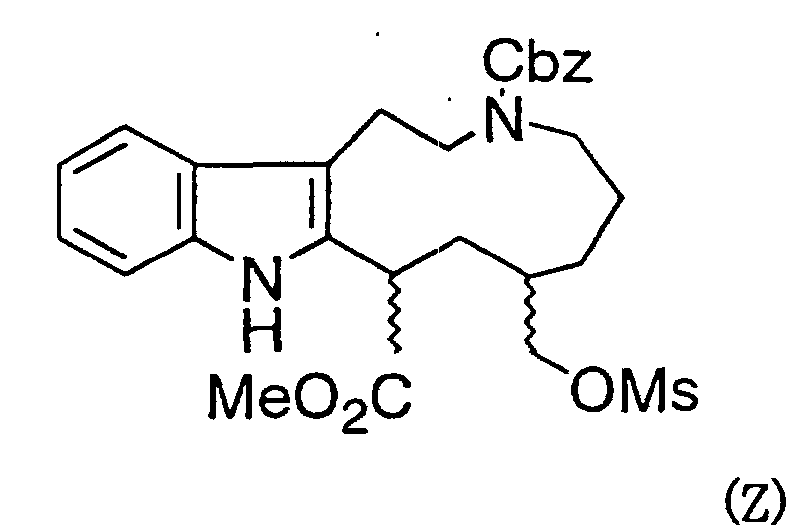
Regarding the design of the indole derivative which composing the
upper unit, Schill et al reported that vindoline can be introduced with the
desired stereoselectivity, when a compound (Z) possessing an
eleven-membered ring obtained by ring opening of piperidine ring is used
(Reference Document D).
-
However, since the process to obtain the above eleven-membered ring
compound is very complicated, the synthesis of vinblastine using compound
(Z) is far from an effective synthetic method from the view point of yield.
-
The subject of the present invention is based on the knowledge of the
above mentioned report by Schill et al, and is intending, (1) to establish an
effective and highly stereoselective synthetic method of an upper unit, and
to provide a method capable of synthesizing the upper unit derivative (2)
with high flexibility to synthesize various vinblastine analogous, and (3)
where control of the stereochemistry at the introduction of vindoline is
improved. For the purpose to accomplish the above mentioned subjects, the
inventors of the present invention have tried to combine the method for
synthesis of indole (Reference Document E) using a radical ring forming
reaction of thioanilide developed by the inventors of the present invention
and the method for synthesis of middle and large ring compound (Reference
Document F) using intramolecular alkylation of 2-nitrobenzenesulfonamide.
In said investigation, it has become clear that the compound which forms
said upper unit can be synthesized under relatively mild conditions when
above mentioned reactions are used by combination. Therefore, it is possible
to make various functional groups coexist in each reactant when these
reactions are used by combination, and said basic subjects of (1) and (2) are
dissolved.
DISCLOSURE OF THE INVENTION
-
The first one of the present invention is an intermediate for
vinblastine synthesis represented by general formula A.
(in the formula, R
1, R
2, R
3 and R
4 are the group selected independently from
the group consisting of H, lower alkyl group, lower alkoxy group, halogen,
lower perfluoro alkyl group, lower alkylthio group, hydroxyl group, amino
group, mono- or di-alkyl or acylamino group, lower alkyl or arylsulfonyloxy
group. R
5 is H, or a lower alkyl group or a substituted or non-substituted
aryl group, R
6 is an alkyl group of carbon number 4 or less, R
7 is a
substituted or non-substituted aryl group, R
8 is a substituted or
non-substituted aryl group or lower alkyl group and R
9 is an acyl group or
trialkylsilyl group.)
-
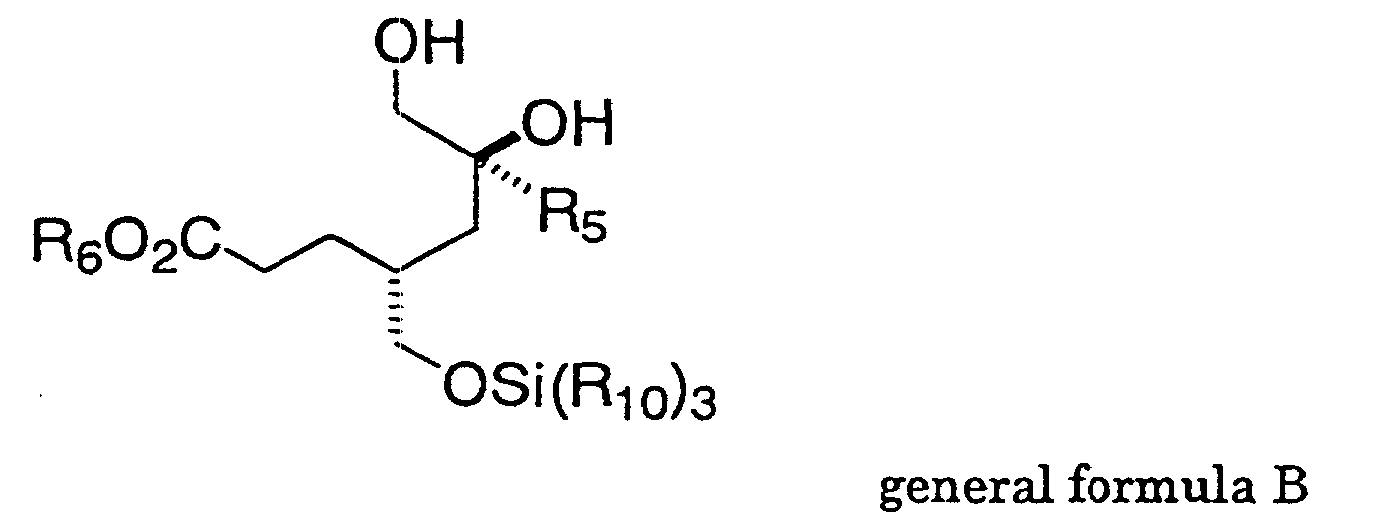
The second one of the present invention is an intermediate for
preparation of the compound of general formula A represented by general
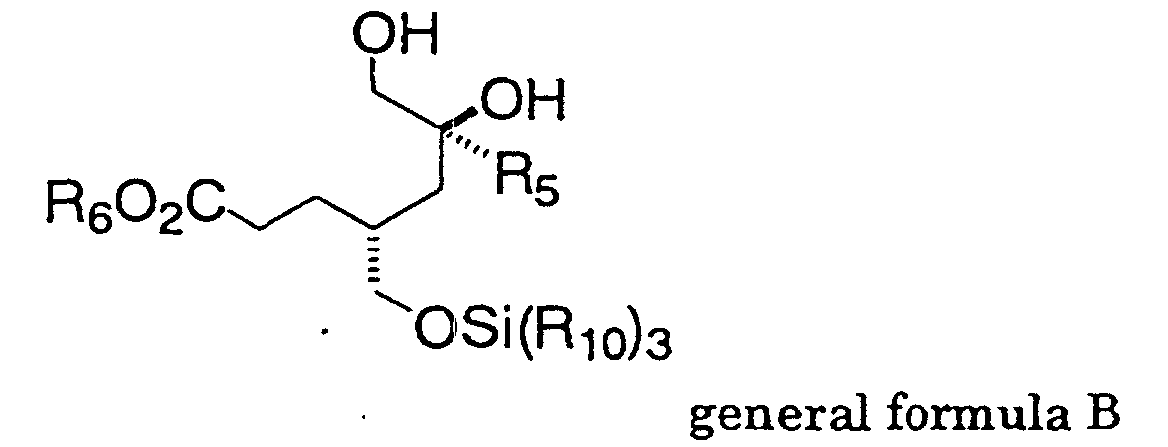
formula B.
(in general formula B, R
5 and R
6 are same as to general formula A. R
10 is
selected independently from the group consisting of alkyl group of carbon
number 4 or less and aryl group which can possess a substituent, and three
groups selected at each group can be same or different)
-
The third one of the present invention is an intermediate for
preparation of the compound of general formula A represented by general
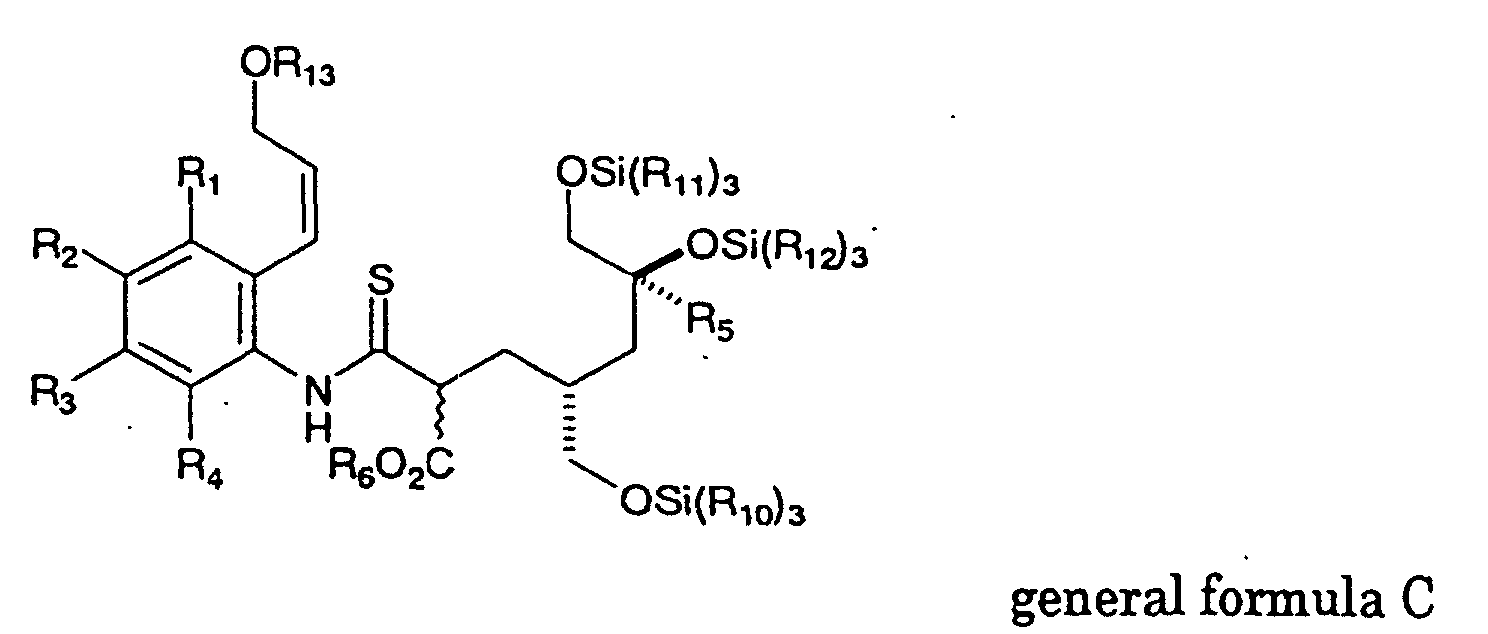
formula C.
(in general formula C, R
1, R
2, R
3, R
4, R
5, R
6 and R
10 have same meaning to
the case of general formula A and B. R
11 and R
12 are selected independently
from the group consisting of alkyl group of carbon number 4 or less and aryl
group which can possess a substituent, and three groups selected at each
group can be same or different. R
13 is trialkylsilyl group, tetrahydropyranyl
group or an acetal structure with other lower alcohol.)
-
The fourth one of the present invention is an intermediate for
preparation of the compound of general formula A represented by general
formula D.
(in general formula D, R
1, R
2, R
3, R
4, R
5, R
6, R
7 and R
10 have same meaning
to the case of general formula A and B. Boc is t-butoxycarbonyl group or H.)
-
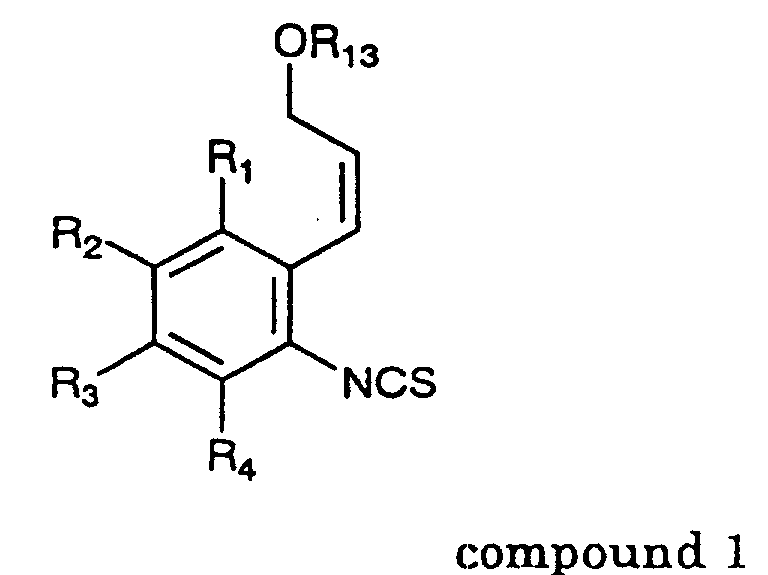
The fifth one of the present invention is the method for synthesis of the
compound of general formula A comprising, using the compound of general
formula B as the starting material, synthesizing thioanilide of general
formula C by the reaction with compound 1 and utilizing radical ring
forming reaction of thioanilides.
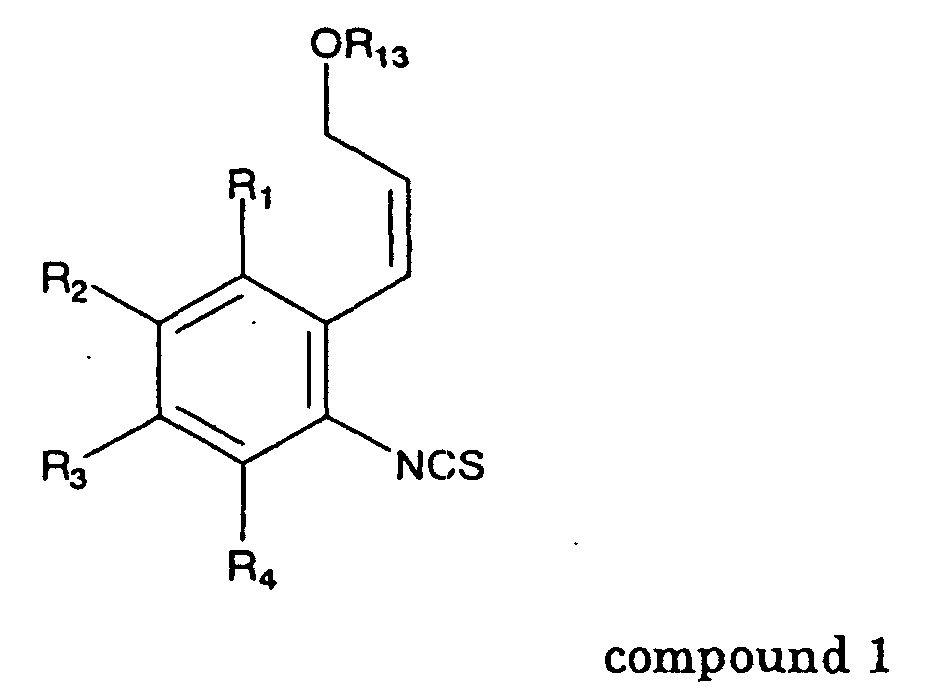
(in compound 1, R
1, R
2, R
3, R
4 and R
13 have same meaning to the case of
general formula A and C.)
-
The sixth one of the present invention is the method for preparation
of the compound A of claim 1 characterizing to synthesize general formula A
using middle ring compound forming reaction of above general formula D.
-
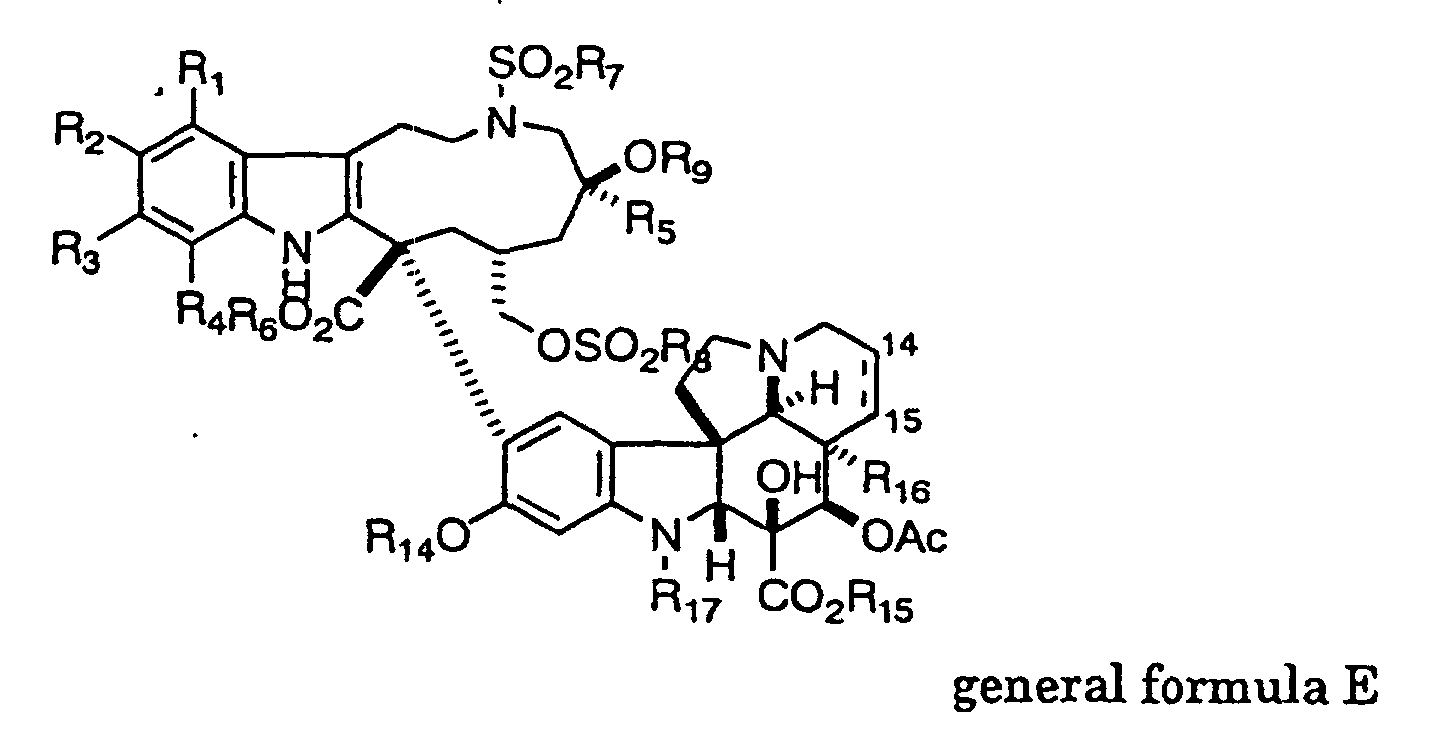
The seventh one of the present invention is the method for synthesis
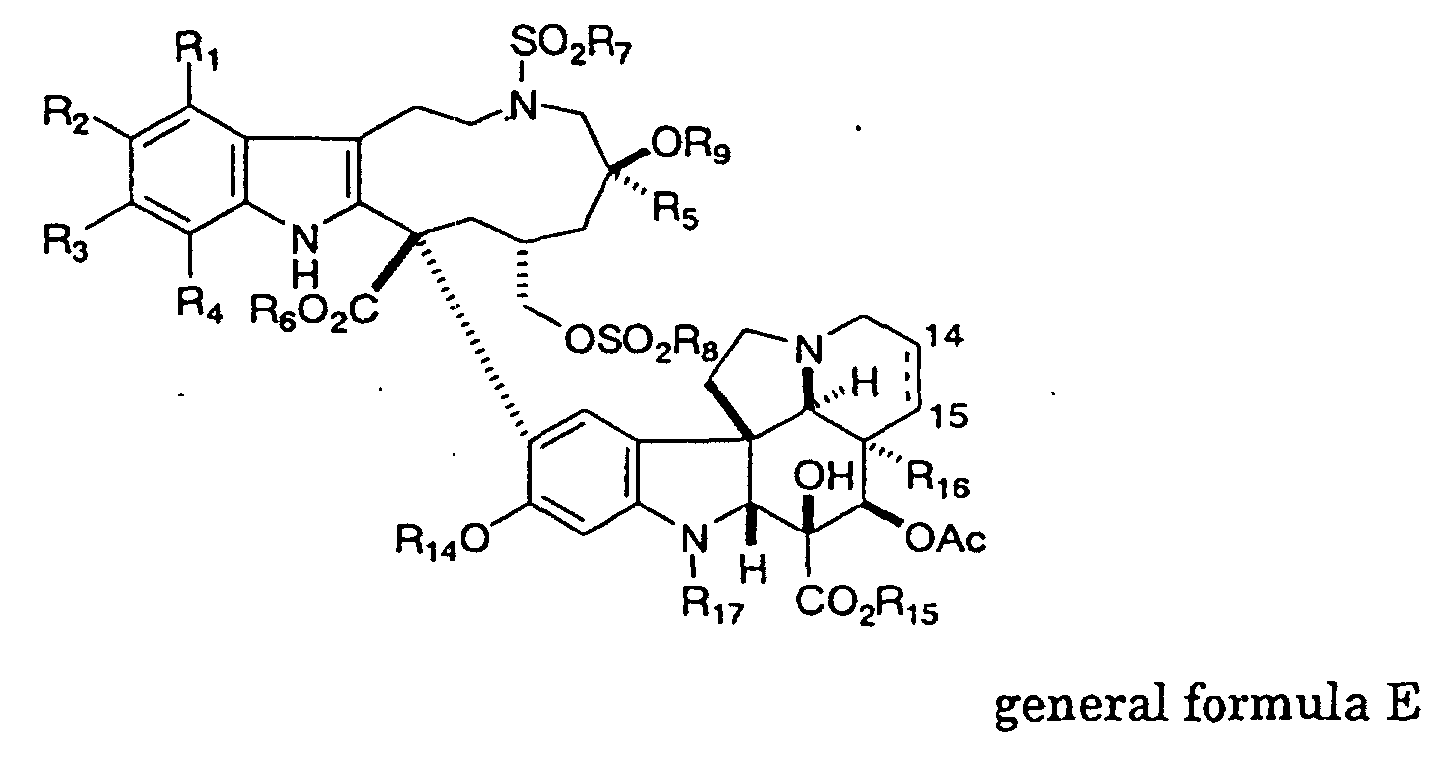
of (+)-vinblastines represented by general formula F comprising,
chlorination of 3 site of indole by treating indole derivatives of general
formula A with t-butyl hypochlorite, preparing the compound of general
formula E by coupling of vindolines by the treatment of the obtained
chlorinated product with trifluoroacetic acid in the presence of vindolines,
then removing trifluoroacetyl group and SO
2R
7, and forming a piperidine
ring.
[in general formulae E and F, R
1, R
2, R
3, R
4, R
5, R
6, R
7, R
8 and R
9 have same
meaning to the case of general formula A. R
14, R
15 and R
16 are an alkyl group
of carbon number 4 or less. R
17 is H or an alkyl group of carbon number 4 or
less. And, carbon 14-carbon 15 is an unsaturated double bond or saturated
bond. In this case, the numbering at nomenclature of vindolines is based on
the nomenclature method proposed by Men et al (Reference Document J).]
THE BEST EMBODYMENT TO CARRY OUT THE INVENTION
-
The present invention will be illustrated in more detail according to
the following description.
- A. The characteristics of the present invention will be illustrated by
describing a starting material, intermediate and the preparing method of
vinblastine.
- 1. Thioanilide of general formula C can be synthesized by reacting the
compound prepared by protecting two hydroxyl groups of general formula B
as silylether and isothiocyanate of compound 1. The process for synthesis is
follows. As the desirable group of R5, ethyl group can be mentioned, as the
desirable group of R5, methyl group can be mentioned, as the desirable
group of R10, the combination of t-butyl group and two phenyl groups can be
mentioned, as the desirable group of R11, ethyl group can be mentioned, as
the desirable group of R12, methyl group can be mentioned and as the
desirable group of R13, tetrahydropyranyl group can be mentioned.
- 2. Thioanilide compound of general formula C is reacted at the room
temperature by radical ring forming reaction in THF in which (Bu)3SnH and
Et3B are existing. The process is shown below. While, it is possible to use
toluene, benzene, acetonitrile or dioxane can be used instead of THF.
Further, it is possible to use AIBN in toluene or benzene at 80°C instead of
to use Et3B in THF at room temperature. Still further, it is possible to use
phosphonic acid, triethylamine and AIBN in n-propanol at 90°C instead of
using (Bu)3SnH and Et3B in THF at 80°C.
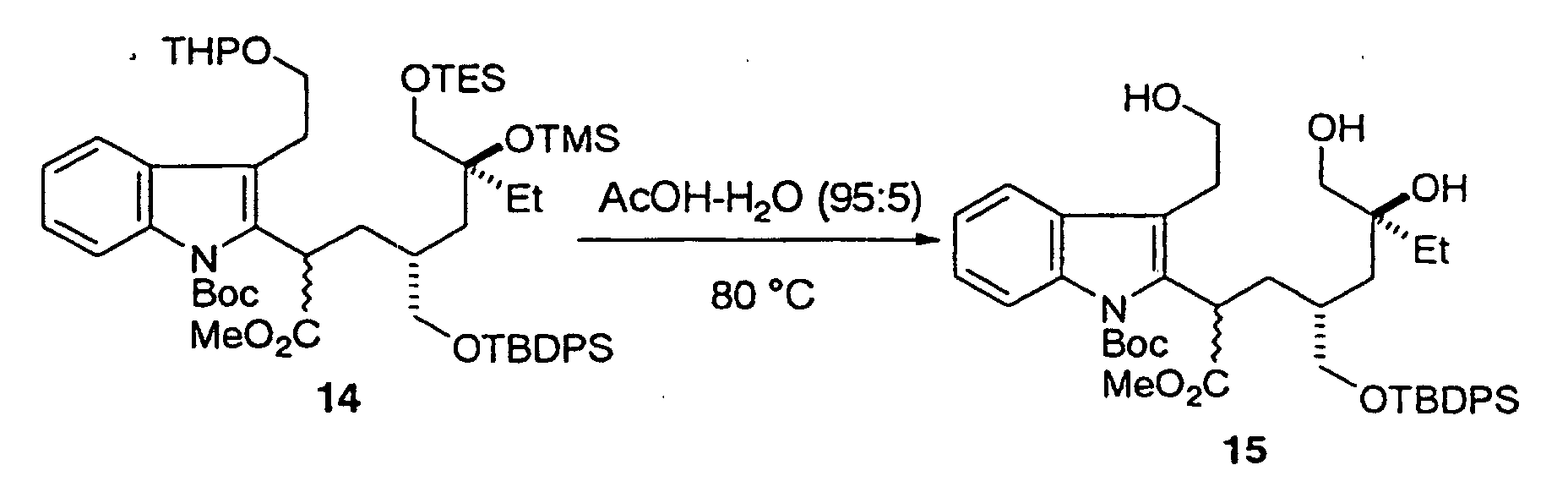
- 3. Then, compound 2 is reacted in CH2Cl in which Boc2O, Et3N and
4-dimethylaminopyridine (DMAP) are existing at room temperature, and
treated with aqueous acetic acid solution at 80°C, further, the compound 3
can be obtained by introduction of a protecting group (Boc) and by
deprotection. This process is illustrated by following scheme. In this process,
it is possible to use acetonitrile instead of CH2Cl2. The concentration of
aqueous solution of acetic acid can be voluntarily selected, however, the
desirable concentration is 95%. Still more, proton acid such as
camphorsulfonic acid or p-toluenesulfonic acid in lower alcohol solvent can
be used instead of using aqueous solution of acetic acid at 80°C.
- 4. The process to form eleven-membered ring of said general formula A
is carried out as follows, so as to use middle and large ring forming reaction
which uses alkylation reaction of Ns amide. Primary hydroxyl group of
1,2-diol of compound 3 is selectively tosylated in CH2Cl2 solution in which
tosylchloride (TsCl), Bu2SnO and Et3N are existing at the room temperature
(Reference Document G), and by heating at 80°C in DMF in which MHCO3
(wherein M is Na or K) is existing epoxide compound 4 is obtained. This
process is shown below. In this process, it is possible to use substituted or
non-substituted aryl sulfonyl chloride instead of TsCl.
- 5. After that, to the compound 4, sulfone amide is introduced to the
remaining primary hydroxyl group by Mitsunobu reaction in toluene in
which R7SO2NH2, for example, NsNH2, azodicarboxylic acid derivatives for
example, diethylazodicarboxylic acid (DEAD) and Ph3P are existing at the
room temperature and the compound represented by general formula D,
which is a ring forming precursor, is obtained. This process is shown below.
The compound intermediate to which sulfonamide is introduced is a key
compound to form eleven-membered ring.
- 6. The compound of general formula D is heated at 90°C in DMF or
acetonitrile in which M2CO3 (M is Na, K or Cs) is existing so as to proceed
middle or large ring forming reaction regioselectively, and eleven-membered
ring compound 5 is obtained. The process is shown as follows.
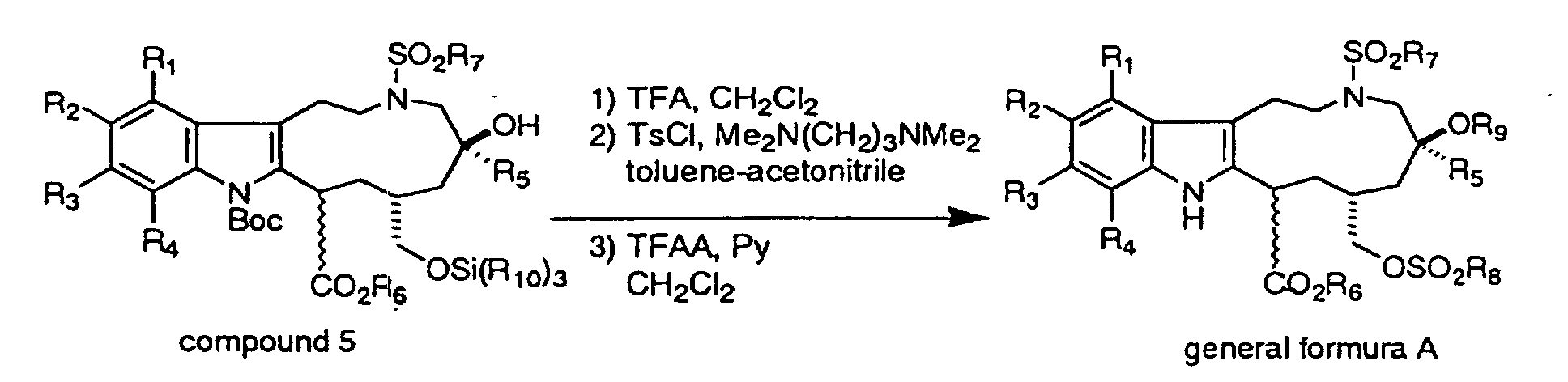
- 7. Compound 5 is treated by the treating process in CH2Cl2 in which
trifluoroacetic acid (TFA) is existing at the room temperature, the treating
process in CH3CN-toluene mixed solution in which TsCl and
Me2N(CH2)3NMe2 are existing at the room temperature (Reference
Document H) and the treating process in CH2Cl2 solution of trifluoroacetic
anhydride (TFAA) and pyridine at the room temperature, and the aimed
compound A is obtained by deprotection and introduction of a protecting
group. The process is shown below. While, it is possible to use substituted or
non-substituted aryl sulfonyl chloride instead of TsCl. Further, it is possible
to use tertiary amine such as pyridine, triethylamine or
diisopropylethylamine instead of Me2N(CH2)3NMe2. Further, the reaction of
CH3CN-toluene mixed solution can be changed voluntarily, and CH2Cl2 can
be use instead of said mixed solution.
- B. The example for synthesis of the compound represented by general
formula B, which is a starting material compound of the present invention,
is illustrated as follows.
The reaction process of series is summarized as follows.
-
EXAMPLE
-
The present invention will be illustrated more in detail according to
the Examples, however, not intending to limit the scope of the claim of the
present invention by the Examples.
The synthesis of the compound represented by general formula B, which is
the starting material.
Example 1
-
The process to produce carboxylic acid 2 from the public known
starting material 1 is shown as follows.
-
To triethyl orthoacetate solution of alcohol 1 (199.5g, 2.316mol),
propionic acid (0.86mL, 11.58mmol) was added and stirred at 135°C. The
generated ethanol was gathered in a dropping funnel attached to a flask.
When the generation of ethanol stopped, the reaction mixture was cooled
down less than 80°C, and the contain in the dropping funnel was put back
into the reaction mixture. The process mentioned above was continued until
the alcohol, which was the starting material, was gone.
After consumption of the alcohol, which was the starting material, was
confirmed, water (100ml) was added to the reaction mixture. After stirring
for 2 hours and half at room temperature, aqueous solution of potassium
hydroxide (390g, 6.95mol) was added, cooling with ice and stirred for
another 1 hour maintaining the same temperature and continued the
stirring for one night at room temperature. The reaction mixture was
neutralized with conc. hydrochloric acid, and the organic layer was
separated and extracted with dichloromethane and dried over anhydrous
magnesium sulfate. After concentration of the solution under the
atmospheric pressure, the residue was distilled under reduced pressure, and
carboxylic acid 2 (boiling point: from 93 to 96, 247.5g, 83.38%) was obtained
as a colorless liquid.
-
The characteristics of carboxylic acid 2;
IR (film): 3083, 2968, 1712, 1649, 1438, 1415, 1296, 892cm-1; 1HNMR (CDCl3,
400MHz) 11.63 (brs, 1H), 4.78 (d, J=0, 4Hz, 1H), 4.73 (d, J=0, 4Hz, 1H), 2.52
(t, J=7.7Hz, 2H), 2.36 (t, J=7.7Hz, 2H), 2.05 (q, J=7.2Hz, 2H), 1.04 (t,
J=7.2Hz, 3H); 13CNMR (CDCl3, 100MHz) 180.2, 149.4, 108.3, 32.6, 30.7, 29.0,
12.3; analysis; calculated value (Anal. Calcd for) C7H12O: C, 65.60, H, 9.44;
analytical result (found) C, 65.50, H, 9.37.
-
The process to produce imide 3 from carboxylic acid 2 is shown below.
-
To diethyl ether solution (1L) of carboxylic acid 2 (28.20g, 220.ommol)
and triethylamine (30.66ml, 220.0mmol), which was cooled with ice, pivaloyl
chroride (26.93mL, 220.0mmol) was dropped. Maintaining the same
temperature, the reaction mixture was stirred for 40 minutes, and then
cooled down to -78°C (mixed anhydride diethyl ether solution). While, to
tetrahydrofuran solution (500mL) of oxazolidinone (35.44g, 200mmol),
n-butyllithium (2.46M n-hexane solution, 81.3mL, 200mmol) was dropped at
-78°C. This solution was dropped to the mixed anhydride diethyl ether
solution using a canular. After dropping the reaction mixture was stirred for
50 minutes at -78°C and for another 30 minutes at 0°C. Then the saturated
aqueous solution of sodium bicarbonate was added to the reaction mixture
so as to separate organic layer and extracted with ethyl acetate. The organic
layer was combined, washed with brine, and then dried over anhydrous
magnesium sulfate. After concentration in vacuo, the residue was purified
by a silica gel column chromatography, and imide 3 (51.0g, 88.7%) was
obtained as a colorless oily product.
-
The characteristics of imide 3:
- [α] 26 D-52.0 (c1.15, CHCl3); IR(film) 3029, 2966, 2921, 1783, 1701, 1648,
1454, 1388, 1353, 1212, 1110, 892, 762, 743, 703 cm-1; 1HNMR (CDCl3,
400MHz) 7.33 (t, J=7.0Hz, 2H), 7.27 (t, J=7.0Hz, 1H), 7.20 (d, J=7.0Hz, 2H),
4.79 (d, J=1.1Hz, 1H), 4.77 (d, J=1.1Hz, 1H), 4.67 (ddt, J=9.8, 8.3, 3.3,
3.2Hz, 1H), 4.19 (dd, J=9.0, 8.3Hz, 1H), 4.15 (dd, J=9.0, 3.2Hz, 1H), 3.29 (dd,
J=13.5, 3.2Hz, 1H), 3.14 (ddd, J=17.0, 8.4, 7.2Hz, 1H), 2.76 (dd, J=13.5,
9.8Hz, 1H), 2.42 (m, 2H), 2.09 (q, J=7.3Hz, 2H), 1.06 (t, J=7.3Hz, 3H);
13CNMR (CDCl3, 100MHz) 172.9, 153.4, 149.6, 135.3, 129.4, 128.9, 127.3,
108.4, 66.2, 55.2, 37.9, 34.0, 30.4, 29.0, 12.3.
-
-
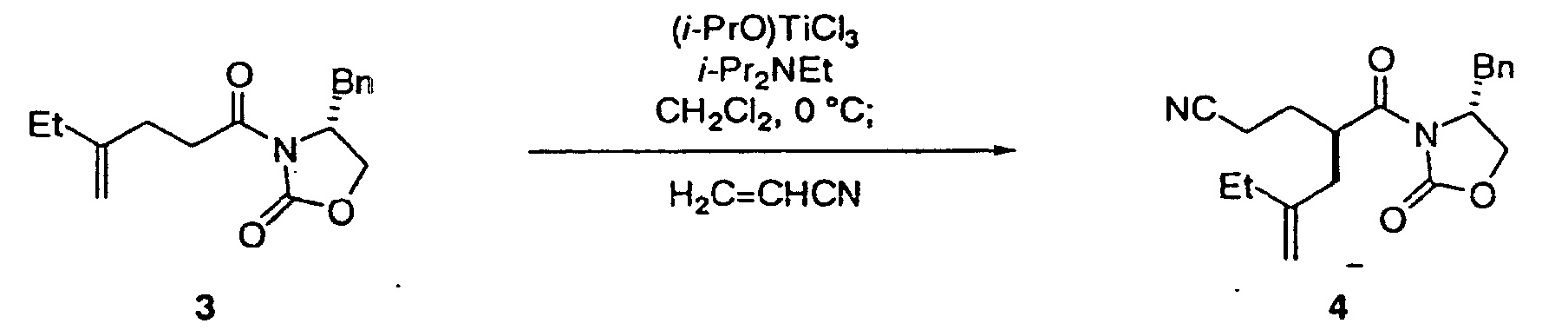
The process to produce adduct 4 from imide 3 is shown below.
-
Titanium tetrachloride (16.0mL, 145.5mmol) was dropped into
dichloromethane solution (265mL) of titanium tetraisopropoxide (14.4mL,
48.5mmol). This solution was dropped into dichloromethane solution
(176mL) of imide 3 (50.7g, 176mmol) and diisopropylethylamide (45.8mL,
265mmol), which was cooled with ice, and stirred for 40 minutes
maintaining the same temperature. Acrylonitrile (34.8mL, 529 mmol) was
dropped to the reaction mixture and further stirred for 9 hours and half at
the same temperature. Saturated ammonium chloride aqueous solution was
added to the reaction mixture so as to separate the organic layer, and then
extracted with ethyl acetate. The organic layer was combined, washed with
saturated sodium bicarbonate and brine, and then dried over anhydrous
magnesium sulfate. After concentration in vacuo, the residue was purified
by a silica gel column chromatography (5-12% ethyl acetate/n-hexane), and
adduct 4 (42.3g, 70.4%) was obtained as a colorless oily product.
-
The characteristics of adduct 4:
- [α] 26 D-36.4 (c0.978, CHCl3); IR (film) 3029, 2967, 2935, 2247, 1779, 1695,
1646, 1453, 1389, 1351, 1291, 1211, 1113, 1014, 902, 762, 742, 703cm-1;
1HNMR(CDCI3, 400MHz) 7.35 (t, J=7.0Hz, 2H), 7.29 (t, J=7.0Hz, 1H), 7.22
(d, J=7.0Hz, 2H), 4.83 (d, J=1.4Hz, 1H), 4.75 (d, J=1.4Hz, 1H), 4.65 (m, 1H),
4.19 (m, 2H), 4.09 (ddt, J=12.0, 7.3, 4.4Hz, 1H), 3.34 (dd, J=13.4, 3.4Hz, 1H),
2.78 (dd, J=13.4, 10.0Hz, 1H), 2.49 (dd, J=14.0, 7.0Hz, 1H), 2.38 (m, 2H),
2.15 (dd, J=14.0, 7.6Hz, 1H), 2.08 (m, 1H), 2.04 (q, J=7.3Hz, 1H), 1.90 (m,
1H), 1.03 (t, J=7.3Hz, 3H) ; 13CNMR(CDCI3, 100MHz) 174.7, 153.1, 147.6,
135.2, 129.4, 129.0, 127.4, 119.1, 110.9, 66.4, 55.6, 40.5, 39.0, 38.1, 28.3, 27.1,
15.1, 12.2 ;
-
-
The process to produce alcohol 5 from adduct 4 is shown below.
-
Sodium borohydride (22.6g, 597.4mmol) was dissolved in water
(150mL) and dropped into tetrahydrofuran solution (300mL) of adduct 4
(50.84g, 149.3mmol), which was cooled with ice. The temperature was
elevated to the room temperature and stirred for one night. The reaction
mixture was cooled down with ice, hydrochloric acid was added so as to
adjust the pH to 5, and then extracted with ethyl acetate 3 times. The
organic layer was combined, then washed with diluted hydrochloric acid,
saturated aqueous solution of sodium bicarbonate and brine and dried over
anhydrous magnesium sulfate. After concentration in vacuo, the residue was
refined by a silica gel column chromatography (25-35% ethyl
acetate/n-hexane), and alcohol 5 (22.9g, 91.7%) is obtained as a colorless oily
product.
-
The characteristics of alcohol 5:
- [α],27 D-1.56 (c0. 960, CHCI3); IR (film) 3449, 3078, 2965, 2931, 2249, 1644,
1450, 1328, 1037, 984, 895cm-1; 1HNMR (CDCI3, 400MHz) 4.84 (d, J=1.5Hz,
1H), 4.77 (d, J=1.5Hz, 1H), 3.64 (dd, J=10.9, 4.4Hz, 1H), 3.55 (dd, J=10.9,
5.4Hz, 1H), 2.46 (t, J=7.3Hz, 2H), 2.13 (dd, J=14.0, 7.7Hz, 1H), 2.03 (q,
J=7.4Hz, 2H), 2.02 (dd, J=14.0, 7.8Hz, 1H), 1.87 (m, 1H), 1.74 (m, 2H), 1.05
(t, J=7.4Hz,3H); 13CNMR(CDCl3, 100MHz) 148.6, 120.0, 110.3, 64.4, 38.2,
37.0, 28.1, 27,0, 15.0, 12.1 ;
-
-
The process to produce silylether 6 from alcohol 5 is shown below.
-
To a dimethylformamide solution (136mL) of alcohol 5 (22.8g,
136.3mmol) and imidazole (13.92g, 204.5mmol), t-butylchlorodiphenylsilane
(39.0mL) was dropped at room temperature, and stirred for 1 hour at room
temperature. The reaction mixture was diluted with diethyl ether, and
washed with water. The aqueous layer was extracted with diethyl ether, and
then the combined organic layer was washed with water and brine and
dried over anhydrous magnesium sulfate. After concentration in vacuo, the
residue was refined by a silica gel column chromatography (0-2%ethyl
acetate/n-hexane), and silyl ether 6 (50.6g, 91.5%) was obtained as a
colorless oily product.
-
The characteristics of silylether 6;
[α] 23 D+6.49 (c1.99, CHCI3); IR(film) 3071, 2961, 2931, 2858, 2246, 1644,
1589, 1471, 1428, 1112, 1083, 894, 823, 741, 703, 614, 505cm-1; 1HNMR
(CDCI3, 400MHz) 7.64 (d, J=7.3Hz, 4H), 7.44 (t, J=7.3Hz, 2H), 7.39 (t,
J=7.3Hz, 4H), 4.76 (d, J=1.4Hz, 1H), 4.67 (d, J=1.4Hz, 1H), 3.56 (dd, J=9.4,
3.4Hz, 1H), 3.53 (dd, J=9.4, 4.2Hz, 1H), 2.30 (ddd, J=16.8, 8.3, 6.3Hz, 2H),
2.23 (dd, J=16.8, 7.3Hz, 1H), 2.15 (dd, J=13.9, 6.6Hz, 1H), 1.94 (dd, J=13.9,
7.6Hz, 1H), 1.93 (q, J=7.3Hz, 2H), 1.79m, 1H), 1.74 (m, 2H), 1.06 (s, 9H),
0.99 (t, J=7.3Hz, 3H); 13CNMR (CDCl3, 100MHz) 148.5,135.6, 135.6, 133.4,
133.4, 129.8, 129.8, 127.8, 127.7, 120.0, 110.3, 65.3, 38.2, 37.4, 28.2, 27.2,
26.9, 19.3, 15.0, 12.0 ;
-
The process to produce isoxazoline 7 from silylether 6 is mentioned
below.
-
To a dichloromethane solution (90mL) of silyl ether (32.8g, 80.9mmol)
diisobutylaluminum hydride (DIBAL) (1.0M toluene solution, 88.9mL,
88.9mmol) was dropped at -78 °C and stirred for 20 minutes.
Dichloromethane solution of acetic acid (20mL) was added to the reaction
mixture and the temperature was elevated to room temperature. After
partition between ethyl acetate and dilute hydrochloric acid, the aqueous
layer was extracted with ethyl acetate. The combined organic layer was
washed with dilute hydrochloric acid, saturated aqueous solution of sodium
bicarbonate and brine, and then dried over anhydrous magnesium sulfate.
After concentration in vacuo, into the solution of the residue in ethanol
(120mL), sodium acetate (13.27g, 161.7mmol) and hydroxylamine
hydrochloride (8.43g, 121.3mmol) were added, and the resulting suspension
was stirred for 1 hour at room temperature. Saturated aqueous solution of
sodium bicarbonate was added to the solution and extracted with ethyl
acetate, and then the combined organic layer was washed with saturated
brine. After dryness over anhydrous sodium sulfate, the solution was
concentrated in vacuo. After the residue was dissolved in dichloromethane
(404mL), aqueous solution of sodium hypochlorite (approximately 5%,
190mL) was dropped at room temperature and stirred for 3 hours and half.
Cooling with ice, sodium sulfite was added to the reacted solution and
stirred for several minutes, and then the organic layer was separated. After
extraction of the aqueous layer with ethyl acetate, the combined organic
layer was washed with brine and dried over anhydrous sodium sulfate. After
concentration in vacuo, the residue was refined by a silica gel column
chromatography (5-8% ethyl acetate/n-hexane), and isoxazoline 7 (20.0g,
58.7%) was obtained as a colorless oily product.
-
The characteristics of isoxazoline 7;
[α] 25 D+8.5 (c2.06, CHCl3); IR (film) 3070, 2931, 2858, 1471, 1428, 1388,
1112; 1063, 846, 823, 741, 704, 614cm-1; 1HNMR (CDCI3, 400MHz) 7.63 (d,
J=7.4Hz, 4H), 7.44 (t, J=7.4Hz, 2H), 7.38 (t, J=7.4Hz, 4H), 4.27 (d, J=8.0Hz,
1H), 3.77 (d, J=8.0Hz, 1H), 3.52 (dd, J=9.3, 5.4Hz, 1H), 3.48 (dd, J=9.3,
5.5Hz, 1H), 2.67 (ddd, J=13.9, 4.9, 2.2Hz, 1H), 2.15 (td, J=13.9, 5.4Hz, 1H),
2.08 (dt, J=13.0, 2.4Hz, 1H), 2.02 (m, 1H), 1.88 (m, 1H), 1.67 (dq, J=14.1,
7.5Hz, 1H), 1.49 (dq, J=14.1, 7.5Hz, 1H), 1.20 (t, J=13.0Hz, 1H), 1.18 (qd,
J=13.9, 4.9Hz, 1H), 1.05 (s, 9H), 0.89 (t, J=7.5Hz, 3H) ; 13CNMR (CDCl3,
100MHz) 162.5, 135.5, 135.5, 133.6, 133.5, 1129.7, 129.7, 127.6, 127.6, 79.0,
68.0, 55.1, 39.1, 35.7, 29.5, 26.8, 26.4, 22.0, 19.2, 8.3;
-
The process to produce hydroxyketone 8 from isoxazoline 7 is
mentioned below.
-
The acetic acid suspension (165mL) of isoxazoline7 (17.4g, 41.3mmol)
and zinc dust (27.0g, 413mmol) was stirred at room temperature for 4 hours.
After the reaction mixture was diluted with dichloromethane, zinc dust was
removed using Celite column. Saturated aqueous solution of sodium
bicarbonate was added to the solution, which was neutralized by adding
solid sodium bicarbonate. After the organic layer was separated, the
aqueous layer was extracted with dichloromethane. The combined organic
layer was washed with water, and dried over anhydrous sodium sulfate.
After concentration in vacuo, the residue was refined by a silica gel column
chromatography (10-15% ethyl acetate/n-hexane), and hydroxylketone 8
(11.6g, 66.4%) was obtained as a light yellowish oily product.
-
The characteristics of hydroxyl ketone 8;
[α] 26 D+54.4 (c1.40, CHCl3); IR (film) 3489, 3070, 2981, 2858, 1699, 1471,
1427, 1389, 1191, 1112, 1056, 997, 823, 741, 703, 614, 506cm-1;
1HNMR(CDCl3, 400MHz) 7.65 (d, J=7.4Hz, 4H), 7.44 (t, J=7.4Hz, 2H), 7.39
(t, J=7.4Hz, 4H), 3.67 (dd, J=11.5, 7.3Hz, 1H), 3.55 (dd, J=8.8, 4.9Hz, 1H),
3.51 (dd, J=8.8, 5.2Hz, 1H), 3.33 (dd, J=11.5, 6.8Hz, 1H), 2.51 (td, J=14.6,
6.6Hz, 1H), 2.48, (dd, J=7.3, 6.8Hz,1H), 2.28 (ddd, J=14.6, 4.6, 2.4Hz, 1H),
2.12 (m, 2H), 1.83 (dq, J=15.4, 7.6Hz, 1H), 1.75 (dq, J=15.0, 3.9Hz, 1H), 1.52
(dq, J=15.4, 7.6Hz, 1H), 1.38t, J=15.0Hz, 1H), 1.32 (cq, J=14.6, 3.7Hz, 1H),
1.06 (s, 9H), 0.84 (t, J=7.6Hz, 3H); 13CNMR (CDCl3, 100MHz) 218.5, 135.6,
135.6, 133.7, 133.6,129.7, 129.7, 127.7, 127.768.1, 65.9, 52.6, 38.3, 34.8, 34.4,
29.5, 26.9, 25.4, 19.3, 7.7;
-
The process to produce diol 9 from hydroxyketone 8 is mentioned
below.
-
The acetic acid solution (62.8mL) of hydroxylketone 8 (10.66g,
25.10mmol), m-chloroperoxybenzoic acid (mCPBA) (17.32g, 75.29mmol) was
stirred at room temperature for 41hours. Cooling with ice, dimethyl sulfide
(5.53mL, 75.3mmol) was added to the solution, which was stirred for 20
minutes, and then concentrated in vacuo. The residue was dissolved in ethyl
acetate, which was washed with sodium bicarbonate and brine and dried
over anhydrous sodium sulfate. After concentration in vacuo, the residue
was dissolved in methanol (77mL) and potassium carbonate (382g,
27.6mmol) was added and stirred at room temperature for 45 minutes. After
the solution was diluted with diethyl ether, the organic layer was separated,
and then the aqueous layer was extracted with ethyl acetate. The combined
organic layer was washed with brine, then the residue was refined by a
silica gel column chromatography (20-40% ethyl acetate/n-hexane), and diol
9 (9.49g, 80.0%) was obtained as a light yellowish oily product.
-
The characteristics of diol 9;
[α]
27 D+10.0 (c1.50, CHCI
3) ; IR (film) 3441, 3071, 2932, 2859, 1738, 1462,
1428, 1362, 1172, 1112, 1071, 823, 741, 704, 614, 504cm
-1;
1HNMR(CDCl
3,
400MHz) 7.67 (m, 4H), 7.43 (t, J=6.7Hz, 2H), 7.40 (t, J=6.7Hz, 4H), 3.64 (s,
3H), 3.57 (dd, J=10.0, 4.6Hz, 1H), 3.51 (s, 1H), 3.46 (brs, 2H), 3.42 (dd,
J=10.0, 7.7Hz, OH), 2.23 (t, J=7.4Hz, 2H), 2.09 (m, 1H), 1.82 (m, 1H),
1.63-1.48 (m, 9H), 1.06 (s, 9H), 0.88 (t, J=7.6Hz, 3H);
13CNMR (CDCl
3,
100MHz) 174.4, 135.7,135.6, 132.9, 132.9, 129.9, 129.9, 127.8, 127.8, 74.0,
68.4, 67.5, 51.6, 38.5, 35.2, 31.4, 30.2, 28.1, 26.8, 19.1, 8.1;
The process to produce aimed silyl ether 10 from diol 9 is mentioned
below.
-
To the dimethylformamide solution (23.4mL) of diol 9 (5.532g,
11.70mmol) and imidazole (2.39g, 35.11mmol), chlorotriethylsilane (TESCl)
(2.35ml, 14.ommol) was added at room temperature and stirred for 1 hour.
After confirmation of disappearance of the starting material,
chlorotrimethylsilane (1.78ml, 14.0mmol) was added to the reaction mixture
and stirred for another 40 minutes. After the reaction mixture was
partitioned between diethyl ether and water, the aqueous layer was
extracted with diethyl ether. The combined organic layer was washed with
brine, and then dried over anhydrous magnesium sulfate. After
concentration in vacuo, the residue was refined by a silica gel column
chromatography (0-2% ethyl acetate/n-hexane), and silyl ether 10 (7.13g,
92.4%) was obtained as a colorless oily product.
-
The characteristics of silyl ether 9;
[α] 28 D-3.48 (c 1.04, CHCl3); IR (film) 2955, 2878, 1742, 1461, 1430, 1249,
1168, 1109, 1011, 839, 741, 704, 612cm-1; 1HNMR (CDCl3, 400MHz) 7.66 (d,
J=6.7Hz, 4H), 7.41 (t, J=6.7Hz, 2H), 7.36 (t, J=6.7Hz,4H), 3.65 (s, 3H), 3.63
(dd, J=10.0, 4.4Hz, 1H), 3.47 (dd, J=10.0, 6.1Hz, 1H), 3.41 (d, J=9.8Hz, 1H),
3.37 (d, J=9.8Hz, 1H), 2.27 (dd, J=9.0, 7.3Hz, 1H), 1.81 (m, 3H), 1.55 (m, 2H),
1.41 (dq, J=13.9, 7.4Hz, 1H), 1.25 (dd, J=14.4, 4.9Hz, 1H), 1.05 (s, 9H), 0.95
(t, J=7.9Hz, 9H), 9.77 (t, J=7.4Hz, 3H), 0.59 (q, J=7.9Hz, 6H), 9.01 (s, 9H);
13CNMR (CDCl3, 100MHz)174.6, 135.7, 133.9, 129.5, 127.6, 79.2, 68.0, 67.0,
51.4, 36.9, 35.5, 31.7, 31.6, 29.9, 27.8, 26.9, 8.3, 6.9, 4.4, 2.6;
-
II The synthesis of the compound contained in general formulae C, D
and A, The characteristics of silylether 9;
Example 2
-
- a. Synthesis of thioanilide 12 contained in general formula C from
isothiocyanate 11 corresponding to the compound wherein all of R1-R4 in
above mentioned silylether 10 and compound 1 are H. The process for
synthesis is illustrated below.
-
-
To a tetrahydrofuran (THF) solution (40.5ml) of diisopropylamine (3.17ml,
22.5mmol) n-butyllithium (hexane solution of 1.46M, 19.7mmol) was
dropped by cooling with ice, stirred for 10 minutes, then cooled down to
-78 °C . Tetrahydrofuran solution (40.5mL) of silyl ether 10 (9.268g,
14.06mmol) was dropped and stirred for 1 hour keeping said temperature.
Tetrahydrofuran solution (15mL) of isothiocyanate 11 (3.872g, 14.06mmol)
was dropped to the reaction mixture. Stirred for 50 minutes at said
temperature, then the temperature was elevated to 0°C and further stirred
for 15 minutes. After dilution with diethyl ether, saturated aqueous solution
of ammonium chloride was added. The organic layer was separated, and
then the aqueous layer was extracted with ethyl acetate. The combined
organic layer was washed with brine and dried over anhydrous sodium
sulfate. After concentration in vacuo, the residue was refined by a silica gel
column chromatography (5-10% ethyl acetate/n-hexane), and thioanilide 12
(9.95g, 75.7%) was obtained as a yellowish oily product.
The characteristics of thioanilide 12;
1HNMR (CDCl3, 400MHz) 9.78 (s, (1/4)1H), 9.74 (s, (1/4)1H), 9.63 (s, (1/4)
1H), 9.60 (s, (1/4)1H), 7.83 (d, J=7.8Hz, 1H), 7.67 (m, 5H), 9.38 (m, 8H), 6.50
(d, J=11.5Hz, 1H), 6.00 (ddd, J=11.5, 6.4, 3.9Hz, 1H), 4.60 (t, J=3.4Hz, 1H),
3.43 (ddd, J=12.7,5.8, 1.9Hz,1H), 4.16 (m, (1/2) 1H), 4.09 (ddd, J=12.7, 7.1,
1.6Hz, 1H), 4.03 (m, (1/2) 1H), 3.81 (m, 2H), 3.74 (s,3H), 3.57 (m, 1H),
3.49-3.40 (m, 3H), 2.24 M, 2H), 1.93 (m (1/2) 1H), 1.82 (m, 1H+(1/2)1H), 1.68
(m, 2H), 1.53 (m, 4H), 1.44-1.20 (m, 3H), 1.07 (s, (1/2) 9H), 1.05 (s, (1/2) 9H),
0.94 (t, J=7.9Hz, 9H), 0.79 (t, J=7.3Hz, (1/2) 3H), 0.77 (t, J=7.3Hz, (1/2) 3H),
0.59 (q, J=7.9Hz, (1/2) 6H), 0.58 (q, J=7.9Hz, (1/2) 6H), 0.01 (s, (1/2) 9H),
0.00 (s, (1/2) 9H);
-
The process to produce indole compound 13 contained in above
mentioned compound 2 by radical ring forming reaction of thioanilide 12 is
mentioned below.
-
To a tetrahydrofuran solution of thioanilide 12 (8.628g, 9.233mmol),
tributyltin hydride (4.97ml, 18.47mmol), triethylborane (1.0M hexane
solution, 1.85ml, 1.85mmol) was dropped at room temperature and stirred
for 1 hour. Saturated sodium bicarbonate aqueous solution is added to the
reaction mixture and extracted three times with ethyl acetate. The
combined organic layer was washed with brine, and dried over anhydrous
sodium sulfate. After concentration in vacuo, the residue was refined by a
silica gel column chromatography (2-8% ethyl acetate/n-hexane), and indole
13 (5.51g, 66.1%) was obtained as an yellowish oily product.
-
The characteristics of indole 13;
1HNMR (CDCI3, 400MHz) 8.68(s, (1/4) 1H), 8.65 (s, (1/4) 1H), 8.39 (s, (1/2)
1H), 7.61 (m, 6H), 7.37 (m, 6H), 7.12 (m1H), 7.06 (m, 1H), 4.54 (m, (1/2) 1H),
4.51 (m, (1/2) 1H), 4.12 (m, 1H), 3.96 (m, 1H), 3.83 (m, 1H), 3.66 (s, (1/2 3H),
3.63 (s, (1/2) 3H), 3.50 (m, 3H), 3.39 (m, 3H), 3.31 (m 1H), 2.96 (m, 2H), 2.85
(m, 1H), 2.33 (m, 1H), 2.23 (m, 1H), 2.13 (m, 1H), 1.79 (m, 2H), 1.60-1.37 (m,
4H), 1.27 (m, 2H), 1.06 (s, (1/2) 9H), 1.05 (s, (1/2) 9H), 0.99-0.81 (m, 9H),
0.74 (t, J=7.2HzH (1/2) 3H, 0.67 (t, J=7.2Hz, (1/4) 3H), 0.66 (t, J=7.2Hz, (1/4)
3H), 0.56 (m, 6H), 0.11 (s, (1/4) 9H), 0.10 (s, (1/4) 9H), 0.00 (s, (1/4) 9H), -0.01
(s, (1/4) 9H;
-
The compound 14 to which protecting group is introduced from indole
13 can be obtained by following process.
-
To a dichloromethane solution (16.8mL) of indole 13 (6.055g,
6.709mmol) and triethylamine (1.40mL, 10.1mmol), Boc2O (2.93g,
13.4mmol) and 4-dimethylaminopyridine (82mg, 0.67mmol) were added and
stirred for one night at room temperature. Water was added to the reaction
mixture and the organic layer was separated, then the aqueous layer was
extracted with ethyl acetate. The combined organic layer was washed with
brine, and then dried over anhydrous magnesium sulfate. After
concentration in vacuo, the residue was refined by a silica gel column
chromatography (3-8% ethyl acetate/n-hexane), and silyl ether compound 14
(5.83g, 86.7%) was obtained as an yellowish oily product.
-
The characteristics of silyl ether compound 14;
1HNMR (CDCl3, 400MHz) 7.95 (m, 1H), 7.67 (m, 3H), 7.53 (t, J=8.3Hz, 2H),
7.37 (m, 6H), 7.21 (m, 2H), 4.57 (m, 1H), 4.51 (m, 1H), 4.23 (m, (1/2) 1H),
4.12 (m, (1/2) 1H), 3.92 (m, (1/2) 1H), 3.85 (m, (1/2) 1H), 3.82 (m, 1H), 3.70
(m, 1H), 3.60 (s, (1/2) 3H), 3.59 (s, (1/4) 3H), 3.58 (s, (1/4) 3H), 3.57 (m, 2H),
3.43 (m, 3H), 3.19 (m, 2H), 2.92 (m,2H), 2.82 (m, 2H), 2.53 (m, (1/2) 1H), 2.12
(m, (1/2) 1H), 1.86 (m, 1H), 1.64 (s, (1/4) 9H), 1.60 (s, (1/4) 9H), 1.57 (s, (1/2)
9H), 1.72-1.40 (m,4H), 1.28 (m, 2H), 1.27 (brs, (1/2) 9H), 1.06 (s, (1/2) 9H),
0.93 (t, J=8.0Hz, (1/4) 9H), 0.89 (t, J=8.0Hz, (1/4) 9H), 0.85 (t, J=8.0Hz, (1/4)
9H), 0.84 (t, J=8.0Hz, (1/4) 9H), 0.74 (t, J=7.2Hz, (1/2) 3H), 0.65 (t, J=7.2Hz,
(1/2) 3H), 0.56 (q, J=8.0Hz, (1/2) 6H), 0.45 (q, J=8.0Hz, (1/4) 6H), 0.44 (q,
J=8.0Hz, (1/4) 6H), -0.03 (s, (1/2) 9H), -0.10 (s, (1/4) 9H), -0.11 (s, (1/4) 9H;
-
The process to produce triol compound 15 contained is above
mentioned compound 3 from silylether 14 is mentioned below.
-
The acetic acid-water (95:5) solution (7.4mL) of silyl ether compound
14 (184mg, 0.184mmol) was stirred for 30 minutes at 80 °C. After
concentration in vacuo, the residue was refined by a silica gel column
chromatography (20-80% ethyl acetate/n-hexane), and triol15 (101g, 75%)
was obtained as an light yellowish oily product.
-
Isomers were separated with silica gel thin layer chromatography, and
the instrument date was measured.
-
The characteristics of triol14;
I . Less polar isomer
-
[a] 26 D+78 (c 0.57, CHCl3) ; IR (film) 3423, 2934, 2860, 1731, 1457, 1431,
1366, 1325, 1231, 1163, 1131, 1113,1047, 910, 823, 738, 705, 614cm-1;
1HNMR (CDCl3, 400MHz) 7.96 (d, J=7.8Hz, 1H), 7.65 (d, J=7.8Hz, 2H), 7.62
(d, J=7.7Hz, 2H) 7.44 (m, 3H), 7.37 (m, 3H), 7.30 (td, J=7.8, 1.2Hz, 1H), 7.23
(dd, J=7.8, 2Hz, 1H), 4.05 (t, J=6.3Hz, 1H), 3.74 (m, 1H), 3.68z8m, 1H), 3.61
(s, 3H), 3.60 (dd, J=9.9, 4.9Hz, 1H), 3.36(dd, J=9.9, 7.9Hz,1H),3.28 (s, 2H),
2.82 (dt, J=14.4, 4.3Hz 1H), 2.67 (ddd, J=14.4, 9.0, 5.6Hz, 1H), 2.42 (dt,
J=13.7, 6.3Hz, 1H), 1.87 (m, 1H), 1.79 (ddd, J=13.7, 7.3, 5.6Hz, 1H), 1.63 (s,
9H), 1.62 (dd, J=15.0, 5.9Hz, 1H), 1.50 (dd, J=15.0, 4.3Hz, 1H), 1.34 (q,
J=7.6Hz, 2H), 1.03 (s, 9H), 0.75 (t, J=7.6Hz, 3H); 13CNMR(CDCl3, 100MHz)
173.2, 150.4, 135.8, 135.7, 135.6, 135.5, 132.9, 132.8, 129.9, 129.8, 129.1,
127.8, 127.8, 124.6, 122.7, 118.6, 117.8, 115.9, 84.4, 73.8, 68.6, 67.2, 61.7,
52.2, 41.3, 38.6, 34.1, 34.0, 30.0, 28.2, 27.7, 26.8, 19.1, 7.8;
II. More polar isomer
-
[α] 26.5 D-59 (c0.47, CHCl3); IR (film) 3430, 2934, 2863, 1728, 1458, 1430,
1366, 1362, 1230, 1163, 1131, 1116, 1048, 910, 738, 705, 614cm-1;
1HNMR(CDCl3, 400MHz) 7.93 (d, J=8.0Hz, 1H), 7.61 (d, J=8.1Hz, 2H), 7.58
(d, J=8.1Hz, 2H), 7.42(t, J=8.0Hz, 1H), 7.39 (t, J=8.1Hz, 2H), 7.32 (t,
J=8.1Hz, 4H), 7.26 (dd, J=8.0, 1.0Hz, 1H), 7.23 (td, J=8.0, 1.0Hz, 1H), 3,96
(brs, 1H), 3.66 (m, 2H), 3.63 (s, 3H), 3.55 (dd, J=10.2, 2Hz, 1H), 3.51 (d.
J=11.0Hz, 1H) , 3.47 (d, J=11.0Hz, 1H), 3.37 (dd, J=10.2, 8.4Hz, 1H), 2.74 (dt,
J=14.4, 4.7Hz, 1H), 2.58 (ddd, J=14.4, 8.3, 6.4Hz, 1H), 2.47 (ddd, J=14.7, 6.8,
5.1Hz, 1H), 1.98 (m, 1H), 1.68 (dd, J=14.9, 5.9Hz, 1H), 1.61 (dd, J=14.9,
7.1Hz, 1H), 1.60 (m, 2H), 1.60 (s, 9H), 1.45 (ddd, J=14.7, 7.6, 4.9Hz, 1H),
0.98 (s, 9H), 0.91 (t, J=7.4Hz, 3H); 13CNMR(CDCl3, 100MHz)173.5, 150.3,
135.8, 135.6, 135.6, 135.6, 132.9, 132.8, 129.8, 129.8, 129.2, 127.8, 127.7,
124.5, 122.7, 118.6, 116.9, 115.9, 84.4, 74.2, 68.9, 67.6, 61.8, 52.3, 42.0, 39.2,
35.6, 34.9, 30.2, 28.1, 27.7, 26.7, 19.0, 8.2 ;
-
The process to produce tosylate 16 from triol compound 15 is
mentioned below.
-
To a dichloromethane suspension (2mL) of triol 15 (148mg, 0.202mmol),
triethylamine (84µL, 0.606mmol) and dibutyltin oxide (15mg, 0.061mmol),
p-toluenesulfonyl chloride (40mg, 0.212mmol) was added and stirred at
room temperature for 20 hours. After the solid was removed using Celite
column, the filtrate was concentrated in vacuo. The residue was refined by a
silica gel column chromatography (25-40% ethyl acetate/n-hexane), and
tosylate 16 (149g, 83.2%) was obtained as a light yellowish oily product.
-
Isomers were separated by silica gel thin film chromatography, and the
instrument date was measured.
-
The characteristics of tosilate 16;
I. Less polar isomer
-
[α] 24 D+73 (c 0.41, CHCl3) ; IR (film) 3543, 3397, 2934, 1731, 1597, 1457,
1431, 1364, 1325, 1253, 1232, 1175, 1130, 1113, 1044, 973, 911, 842, 821, 740,
705, 667, 615, 555cm-1; 1HNMR (CDCl3, 400MHz) 7.96 (d, J=8.3Hz, 1H),
7.68 (d, J=8.1Hz, 2H), 7.50 (m, 5H), 7.39 (m, 2H), 7.32 (td, J=7.3, 1.2Hz,1H),
7.29 (t, J=7.3Hz, 4H), 7.26 (dd, J=7.3, 1.2Hz, 1H)7.23 (d, J=8.1Hz,2H), 3.96
(brs, 1H), 3.93 (d, J=9.2Hz, 1H), 3.79 (d, J=9.2Hz, 1H), 3.69 (m, 2H), 3.63 (s,
3H), 3.47 (dd, J=10.3, 3.8Hz, 1H), 3.33 (dd, J=10.3, 8.3Hz, 1H), 2.90 (dt,
J=14.4, 4.5Hz, 1H), 2.65 (ddd, J=14.4, 9.0, 6.1Hz, 1H),.2.41 (ddd, J=15.9, 6.1,
4.6Hz, 1H), 2.37 (s, 2H), 1.83 (m, 1H), 1.69 (dd, J=14.9, 4.4Hz, 1H), 1.61 (m,
1H), 1.58 (s, 9H), 1.51 (m, 1H), 1.00 (m, 2H), 0.91 (s, 9H), 0.79 (t, J=7.6Hz,
3H) ; 13CNMR(CDCl3, 100MHz) 173.2, 150.3, 144.7, 135.7, 135.5, 135.5,
135.4, 132.6, 132.5, 132.5, 129.9, 129.8, 129.8, 129.3, 128.0, 127.8, 127.8,
124.5, 122.7, 118.8, 117.5, 116.0, 84.4, 73.1, 72.4, 68.9, 61.8, 52.3, 41.8, 40.2,
35.3, 34.7, 30.5, 28.1, 27.8, 26.7, 21.6, 19.0, 7.5;
II. More polar isomer
-
[α] 25 D-20 (c 0.57, CHCl3); IR (film) 3416,2934, 1729, 1597, 1457, 1431,
1364, 1325, 1254, 1231, 1175, 1131, 1112, 1045, 974, 912, 841, 821, 739, 705,
667, 614, 556, 508cm-1 ; 1HNMR (CDCl3, 400MHz), 7.96 (d, J=7.6Hz, 1H),
7.68 (d, J=8.3Hz, 2H), 7.61 (m, 4H), 7.47 (t, J=7.6Hz, 1H), 7.43 (m, 2H), 7,37
(m, 4H), 7.29 (td, J=7.6, 1.2Hz, 1H), 7.26 (d, J=8.3Hz, 2H), 7.23 (dd, J=7.6,
2Hz, 1H), 3.98 (t, J=5.5Hz, 1H), 3.82 (d, J=9.3Hz, 1H), 3.74 (m, 2H), 3.64 (d,
J=9.3Hz, 1H), 3.63 (dd, J=10.0, 2.3Hz, 1H), 3.61 (s, 3H), 3.33 (dd, J=10.0,
8.3Hz, 1H), 2.92 (dt, J=14.2, 5.2Hz, 1H), 2.72 (dt, J=14.2, 8.0Hz, 1H), 2.41 (s,
2H), 2.40 (m, 1H), 1.98 (m, 1H), 1.65 (m, 1H), 1.61 (s, 9H), 1.58 (m, 2H), 1.37
(dq, J=14.4, 7.4Hz, 1H), 1.31 (dq, J=14.4, 7.4Hz, 1H), 1.00 (s, 9H), 0.68 (t,
J=7.4Hz, 3H); 13CNMR(CDCl3, 100MHz) 172.9, 150.3, 144.9, 135.8, 135.7,
135.6, 135.6, 132.5, 132.5, 132.5, 132.4, 130.0, 129.9, 129.3, 128.0, 127.9,
127.8, 124.4, 122.6, 118.6, 117.4, 116.0, 84.3, 72.9, 72.0, 68.8, 61.8, 52.1, 41.2,
39.4, 34.5, 34.2, 30.5, 28.1, 28.0, 26.8, 21.6, 19.1, 7.3;
-
The process to produce epoxide 17 which is contained in above
mentioned compound 4 from tosylate 16 is mentioned below.
-
A dimethylformamide suspension (2.7mL) of tosylate 17 (238mg,
0.269mmol) and sodium bicarbonate (113mg, 1.343mmol) was stirred for 2
hours and half at 90 °C. To the reaction mixture, saturated sodium
bicarbonate aqueous solution was added, and extracted with diethyl ether
three times. The combined organic layer was washed with brine and dried
over anhydrous magnesium sulfate. After concentration in vacuo, the
residue was refined by a silica gel column chromatography (25-40% ethyl
acetate/n-hexane), and epoxide17 (176g, 91.8%) was obtained as a white
solid foam.
Isomers were separated by silica gel thin layer chromatography, and the
instrument date was measured.
-
The characteristics of epoxide 17;
I . Less polar isomer
-
[α] 23 D+93 (c 0.31, CHCl3); IR (film) 3456, 2934, 2859, 1731, 1588, 1458,
1431, 1364, 1324, 1254, 1229, 1164, 1130, 1113, 1049, 1004, 910, 822, 741,
705, 616cm-1; 1HNMR (CDCl3, 400MHz) 7.98 (d, J=7.7Hz, 1H), 7.64 (m, 4H),
7.43 (m, 3H), 7.36 (m, 4H), 7.29 (td, J=7.7, 1.2Hz, 1H), 7.23 (td, J=7.7, 1.2Hz,
1H), 4.01 (dd, J=9.9, 4.3Hz,1H), 3.68 (m, 2H), 3.66 (s, 3H), 3.55 (dd, J=10.2,
4.1Hz, 1H), 3.47 (dd, J=10.2, 4.7Hz, 1H), 2.82 (dt, J=14.7, 3.9Hz, 1H), 2.55
(m, 2H), 2.34 (d, J=4.7Hz, 1H), 2.27 (d, J=4.7Hz, 1H), 2.11 (dd, J=9.6, 3.8Hz,
1H), 2.05 (ddd, J=14.7, 9.8, 3.4Hz,1H), 1.66 (m 1H), 1.65 (s, 9H), 1.44 (brs,
1H), 1.21 (qd, J=7.4, 3.6Hz, 2H), 1.05 (s, 9H), 0.64 (t, J=7.4Hz, 3H);
13CHMR(CDCl3, 100MHz) 173.0, 150.3, 136.0, 135.8, 135.6, 135.1, 133.5,
133.5, 129.8, 129.7, 129.7, 127.7, 127.7, 124.5, 122.7, 118.5, 118.3, 116.0, 84.4,
65.9, 61.7, 58.7, 52.1, 51.6, 41.8, 36.2, 35.0, 31.8, 28.2, 27.8, 26.9, 26.5, 19.3,
8.5;
II . More polar isomer
-
[α] 24 D-62 (c 0.36, CHCl3); IR (film) 3455, 2934, 2859, 1730, 1458, 1431,
1365, 1325, 1253, 1229, 1164, 1130, 1112, 1079, 1008, 910, 823, 742, 705,
615cm-1; 1HNMR (CDCl3, 400MHz) 7.99 (d, J=7.8Hz, 1H), 7.56 (d, J=8.0Hz,
4H), 7.50-7.20 (m, 9H), 4.14 (t, J=6.8Hz, 1H), 3.76 (m, 2H), 3.65 (s, 3H), 3.47
(d, J=4.6Hz, 2H), 2.93 (dt, J=14.4, 4.3Hz, 1H), 2.80 (ddd, J=14.4, 9.0, 5.9Hz,
1H), 2.45 (ddd, J=14.2, 6.8, 4.6Hz, 1H), 2.42 (d, J=4.6Hz, 1H), 2.40 (d,
J=4.6Hz, 1H), 2.27 (dd, J=9.5, 4.4Hz, 1H), 2.09 (ddd, J=14.2, 7.3, 4.9Hz, 1H),
1.63 (s, 9H), 1.62 (m, 1H), 1.39 (m, 2H), 1.06 (m, 1H), 0.90 (s, 9H), 0.76 (t,
J=7.6Hz, 3H); 13CNMR (CDCl3, 100MHz) 173.2,150.4, 135.9, 135.8, 135.6,
135.6, 133.6, 133.4, 129.6, 129.6, 129.3, 127.6, 127.5, 124.5, 122.7, 118.5,
117.6, 116.1, 84.4, 66.7, 61.9, 59.1, 52.3, 52.2, 41.7, 36.3, 36.0, 33.6, 28.1,
28.1, 26.8, 265.7, 19.1, 8.7;
-
The process to synthesize nosyl amide 18 contained in general formula
D by introducing sulfonamide into epoxide 17 is mentioned below.
-
To a toluene suspension of epoxide 17 (171mg, 0.240mmol),
2-nitrobenzene sulfonamide (97mg, 0.48mmol) and triphenylphosphine
(94mg, 0.36mmol), diethyl azodicarboxylate (40% toluene solution, 0.163mL,
0.358mmol) was dropped at room temperature, and stirred for 20 minutes.
After concentration the residue was refined by a silica gel column
chromatography (20-22.5% ethyl acetate/n-hexane), and nosyl amide 18
(187g, 86.9%) was obtained as a yellowish solid foam.
-
The characteristics of nocylamide 18;
IR (film) cm-1; 1HNMR (CDCl3, 400MHz) 8.04 (dd, J=8.0, 4.0Hz, (1/2) 1H),
7.97 (dd, J=6.8, 4.0Hz, (1/2) 1H), 7.94 (d, J=8.8Hz, (1/2) 1H), 7.91 (d,J-8.0Hz,
(1/2) 1H), 7.70-7.50 (m, 6H),7.46-7.36 (m 5H), 7.34-7.32 (m 2H), 7.23-7.17 (m,
2H+(1/2) 1H), 7.13 (d, J=6.8Hz, (1/2) 1H), 7.09 (t, J=7.4Hz, (1/2) 1H), 7.00 (t,
J=7.2Hz, (1/2) 1H), 5.73 (dd, J=6.8, 4.0Hz, (1/2) 1H), 5.48 (dd, J=6.8, 2.8Hz,
(1/2) 1H), 4.07 (m, (1/2) 1H), 3.87 (m, (1/2)1H), 3.71 (s, (1/2) 3H), 3.68 (s, (1/2)
3H), 3.53 (dd, J=10.8, 4.8Hz, (1/2) 1H), 3.47-3.32 (m, 2H), 3.24 (m, 1H) , 2.95
(m, (1/2) 1H), 2.92 (ddd, J=14.8, 5.6, 4.0Hz, (1/2) 1H), 2.84 (dd, J=16.8, 8.0Hz,
(1/2) 1H), 2.75 (dt, J=14.8,4.8Hz, (1/2) 1H), 2.59 (ddd, J=14.8, 10.0, 4.8Hz,
(1/2) 1H)<2.48 (d, J=4.8Hz, (1/2) 1H), 2.44 (m, 2H), 2.42 (d, J=4.8Hz, (1/2)
1H),2.36 (d, J=4.0Hz, (1/2) 1H), 2.30 (d, J=4.0Hz, (1/2) 1H), 2.05 (m, 1H),
1.67 (s, (1/2) 1H), 1.64 (s, (1/2) 1H), 1.62 (m, 1H), 1.45 (m, 1H), 1.27 (m, 2H),
1.05 (s, (1/2) 9H), 0.88 (s, (1/2) 9H)<0.74 (t, J=7.8Hz, (1/2) 3H), 0.54 (t,
J=7.8Hz, (1/2) 3H);
-
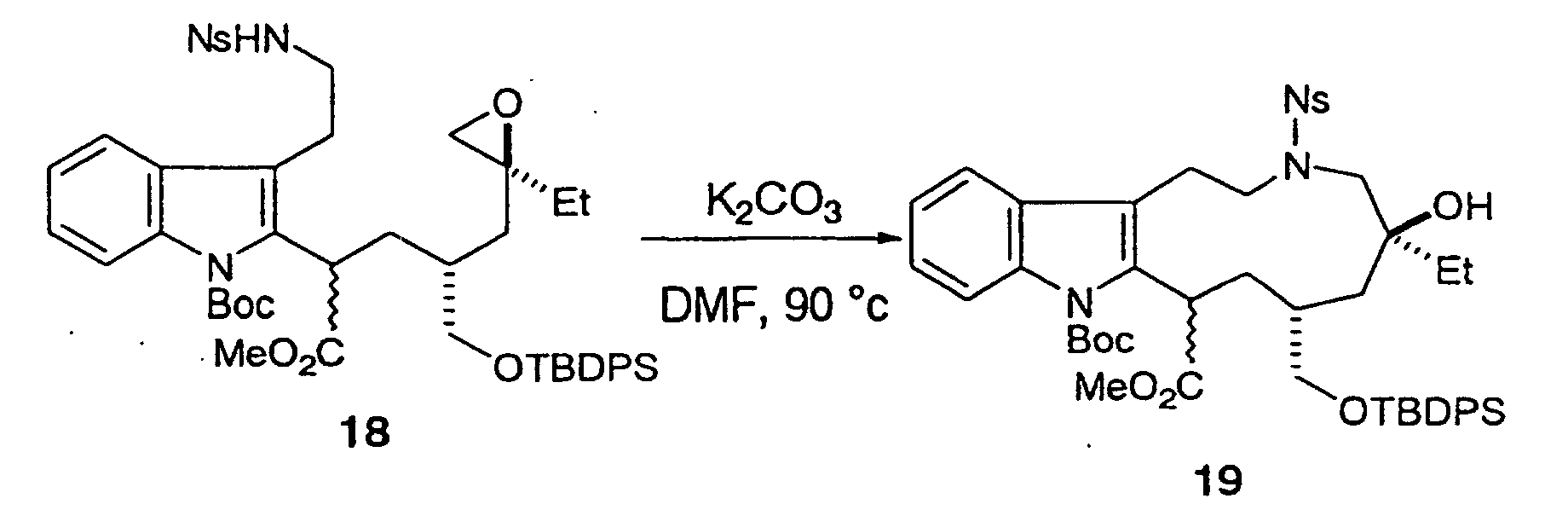
The process to synthesize 11-membered ring compound 19 contained in
above mentioned compound 5 by proceeding middle ring forming reaction of
nosyl amide 18 is mentioned below.
-
The suspension of nosyl amide 18 (113mg, 0.126mmol) and potassium
carbonate (35mg, 0.25mmol) was stirred for 13 hours at 90°C. After cooled
down to the room temperature, saturated aqueous solution of ammonium
chloride was added to the reaction mixture, which was extracted with
diethyl ether 3 times. The combined organic layer was washed with water
and brine, then dried over anhydrous sodium sulfate. The residue was
refined by a silica gel column chromatography (25-40% ethyl
acetate/n-hexane), and 11-members ring compound 19 (80mg, 71%) was
obtained as a yellowish solid foam.
-
The characteristics of 11-members ring compound 19;
1R (film) 3397, 3071, 2934, 2859, 1731, 1546, 1459, 1432, 1367, 1327, 1235,
1165, 1115, 910, 735, 705, 581cm-1; 1HNMR (CDCl3, 400MHz) 8.04 (d,
J=8.3Hz, 1H), 7.93 (m, (1/2) 1H), 7.89 (d, J=7.1Hz, (1/2) 1H), 7.78-7.16 (m,
13H+(1/2) 1H), 7.13 (d, J=7.3Hz, (1/2) 1H), 7.11 (d, J=7.3Hz, (1/2) 1H),
6.77(brs, (1/2) 3H), 4.83 (s, (1/2) 1H), 4.31 (brs, (1/2) 1H), 4.23 (m, (1/2) 2H),
3.82-3.19 (m, 4H+ (1/2) 1H)< 3.60 (s, (1/2) 3H), 3.56 (s, (1/2) 3H), 3.12 (m,
(1/2) 1H), 2.98 (m, 1H), 2.88 (d, J=14.9Hz, (1/2) 1H), 2.75 (m, (1/2) 1H), 2.51-1.71
(m, 3H), 1.64 (s, (1/2) 9H), 1.61 (s, (1/2) 9H), 1.42-1.15 (m, 4H), 1.06 (s,
(1/2) 9H), 0.98 (s, (1/2) 9H), 0.89 (t, J=7.6Hz, (1/2) 3H), 0.68 (t, J=7.6Hz, (1/2)
3H;
-
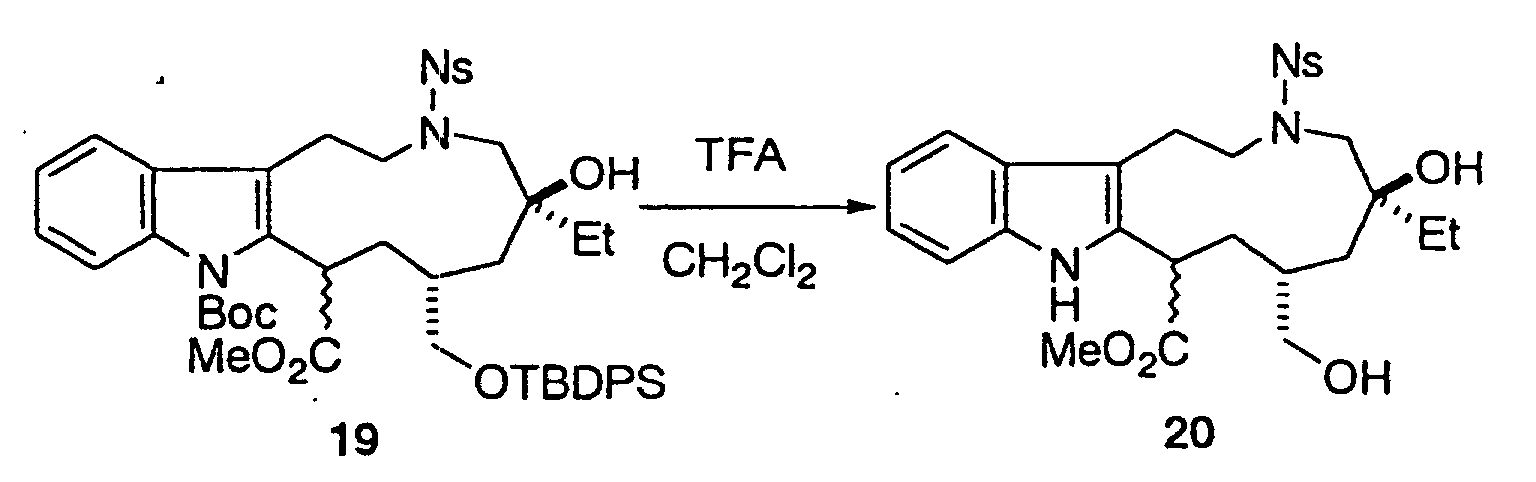
The process to synthesize diol 20 possessing 11-membered ring by
deprotection of 11-members ring compound 19 is mentioned below.
-
To a dichloromethane solution (2mL) of 11-membered ring compound
19 (124mg, 0.138mmol), trifluoroacetic acid (2mL) is added at room
temperature and stirred for 2 hours. After concentration in vacuo, the
residue was dissolved in methanol, into which triethylamine (0.2mL) was
added, and the resulting solution was stirred at room temperature. After
concentration in vacuo, the residue was refined by a silica gel column
chromatography (50-100% ethyl acetate/n-hexane), and diol 20 (71mg, 92%)
was obtained as an yellowish oily product.
Isomers were separated by silica gel thin layer chromatography, and the
instrument date was measured.
-
The characteristics of diol 20;
I . Less polar isomer
-
[α] 22 D-89 (c 0.37, CHCl3) ; IR (film) 3389, 2947, 1728, 1545, 1460, 1439,
1370, 1341, 1167, 910, 734, 580cm-1; 1HNMR (CDCl3, 400MHz) 8.76 (s, 1H),
7.93 (dd, J=7.6, 1.2Hz, 1H), 7.72 (td, J=7.6, 1.2Hz, 1H), 7.67 (td, J=7.6,1.2Hz,
1H), 7.62 (dd, J=7.6, 1.2Hz, 1H), 7.42 (d, J=8.0Hz, 1H), 7.31 (d, J=8.0Hz, 1H),
7.15 (td, J=8.0, 1.0Hz, 1H), 7.05 (td, J=8.0, 1.0Hz, 1H), 4.17 (dd, J=12.8,
3.3Hz, 1H), 4.07 (ddd, J=15.1, 8.5, 6.6Hz, 1H), 3.74 (s, 3H), 3.58 (d,
J=14.4Hz, 1H), 3.51 (dd, J=10.9, 4.0Hz, 1H), 3.46 (dd, J=10.9, 6.3Hz, 1H),
3.40 (dt, J=15.1, 7.9Hz, 1H), 3.11 (m, 2H), 3.10 (d, J=14.4Hz, 1H), 2.97 (ddd,
J=15.4, 6.6, 3.3Hz, 1H), 2.19 (d, J=15.4Hz, 1H), 2.10 (t, J=12.1Hz, 1H),
1.77-1.63 (m, 4H), 0.98 (t, J=7.4Hz, 3H) ; 13CNMR (CDCl3, 100MHz) 174.3,
148.9, 136.0, 133.9, 131.5, 131.3, 130.5, 129.8, 127.2, 124.2, 122.5, 119.8,
118.6, 112.6, 111.2, 74.3, 68.3, 60.4, 53.6, 52.6, 39.4, 37.9, 37.2, 33.7, 33.6,
26.4, 7.4;
II. More polar isomer
-
[α] 23 D+21 (c 0.24, CHCl3); IR (film) 3385, 2930, 1726, 1546, 1461, 1440,
1372, 1347, 1166, 909, 735, 581cm-1; 1HNMR (CDCl3, 400MHz) 8.56 (s, 1H),
7.98 (dd, J=7.7, 1.5Hz, 1H), 7.76 (td, J=7.7, 1.5Hz, 1H), 7.72 (td, J=7.7,
1.5Hz, 1H), 7.64 (dd, J=7.7, 1.5Hz, 1H), 7.50 (d, J=7.9Hz, 1H), 7.33
(d,J=7.9Hz, 1H), 7.16 (t, J=7.9Hz, 1H), 7.08 (t, J=7.9Hz, 1H), 4.15 (dd,
J=10.0, 2.4Hz, 1H), 4.02 (m, 1H), 3.70 (s, 3H), 3.58 (dd, J=10.8, 6.1Hz, 1H),
3.54 (dd, J=10.8, 5.7Hz, 1H), 3.40 (d, J=15.4Hz, 1H), 3.31 (m, 3H), 2.77 (d,
J=15.4Hz, 1H), 2.44 (m, 1H), 2.17 (dt, J=13.9, 2.4Hz, 1H), 1.80 (dt, J=13.9,
10.8Hz, 1H), 1.05 (m, 4H), 0.40 (t, J=7.4Hz, 3H); 13CNMR (CDCl3, 100MHz)
174.3, 149.0, 136.0, 134.1, 132.4, 131.5, 131.0, 130.3, 127.6, 124.2, 122.5,
119.8, 118.6, 111.1, 110.8, 73.0, 68.6, 61.8, 53.9, 52.5, 42.2, 37.5, 37.5, 36.0,
34.6, 25.6, 7.1;
-
The process to produce tosylate 21 by tosylation of diol 20 is mentioned
below.
-
To a toluene-acetonitrile solution (1mL-1mL) of diol 20 (57.0mg,
0.102mmol) and tetramethyldiaminopropane (26 µL, 0.15mmol)
p-toluenesulfonly chloride (22mg, 0.11mmol) was added at room
temperature and stirred for 3 hours. After solid was removed using Celite
colume, the filtrate was concentrated in vacuo. The residue was refined by a
silica gel column chromatography (30-50% ethyl acetate/n-hexane), and
tosylate 21 (55mg, 75%) was obtained as a yellowish oily product.
-
The characteristics of tosylate 21;
IR (film) 3514, 3393, 2956, 1728,1595, 1546,1461, 1440, 1354, 1173, 962, 754,
667, 580cm
-1;
1HNMR (CDCl
3, 400MHz) 8.67 (s, (1/2) 1H), 8.51 (s, (1/2) 1H),
7.89 (d, J=8.0Hz, (1/2) 1H), 7.81 (d, J=8.0Hz, (1/2) 1H), 7.77 (d, J=8.0Hz,
(1/2) 2H), 7.73-7.57 (m, 4H), 7.43 (d, J=7.1Hz, 1H), 7.36(d, J=7.1Hz, 1H),
7.32 (d, J=8.0Hz, (1/2) 2H), 7.18 (t, J=7.1Hz, (1/2) 1H), 7.16 (t, J=7.1Hz, (1/2)
1H), 7.11 (d, J=8.0Hz, (1/2) 2H), 7.06 (t, J=7.1Hz, (1/2) 1H), 7.04 (t, J=7.1Hz,
(1/2) 1H), 4.23-4.07 (m, 2H), 3.92 (dd, J=9.5, 6.6Hz, (1/2) 1H), 3.86 (dd, J=9.8,
7.1Hz, (1/2) 1H), 3.80 (m, (1/2) 1H), 3.70 (s, (1/2) 3H), 3.69 (s, (1/2) 3H), 3.38
(d, J-15.0Hz, 1H), 3.25 (m, 1H), 3.17 (m, (1/2) 1H), 3.10 (m, (1/2) 1H), 2.97 (d,
J=15.0Hz, (1/2) 1H), 2.63 (d, J=15.0Hz, (1/2) 1H), 2.50 (m, )1/2) 1H), 2.42 (s,
(1/2) ,3H)< 2.32 ( s, (1/2) 3H, 2.21 (dt, J=13.9,1.5Hz, (1/2) 1H), 1.94 (d,
J=15.9Hz, (1/2) 1H), 1.83 (m, 1H), 1.49 (m, 2H), 1.28 (m, 2H), 1 02 (m, 2H),
0.77 (t, J=7.4Hz, (1/2) 3H), 0.37 (t, J=7.4Hz, (1/2) 3H);
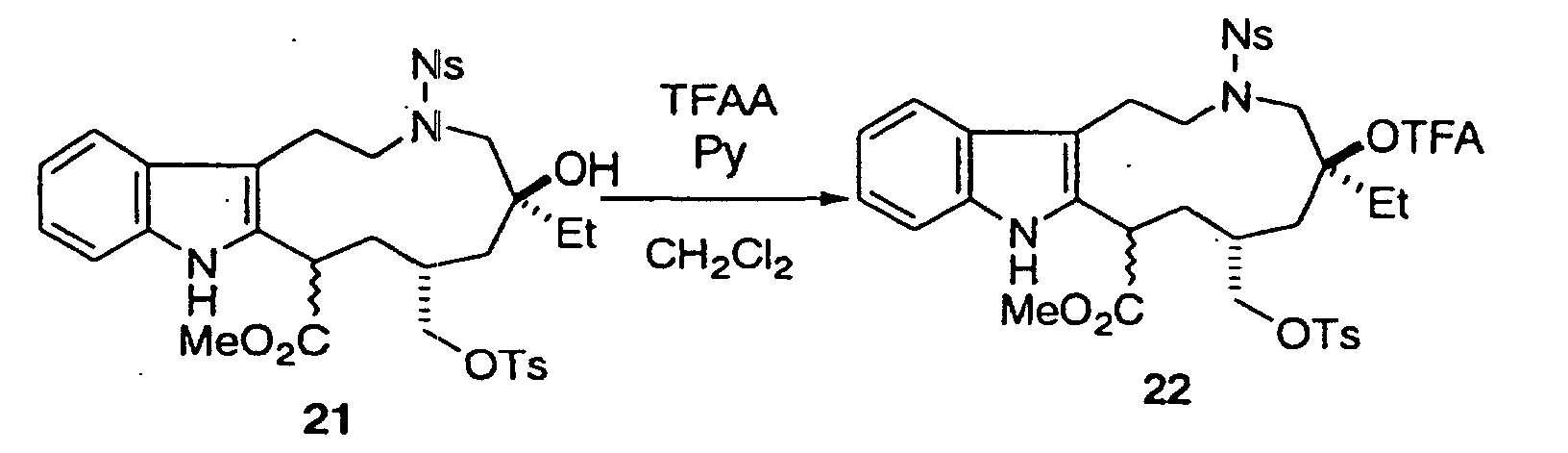
The process to produce ester 22 contained in general formula A by the
esterification of tosylate 21 with trifluoroacetic anhydride is mentioned
below.
-
To a dichloromethane solution (2mL) of tosylate 21 (55mg, 0.077mmol)
and pyridine (62µL, 0.77mmol), trifluoroacetic anhydride (44µL, 0.31mmol)
was added at room temperature and stirred for 1 hour. The saturated
aqueous solution of sodium hydrogencarbonate was added to the reaction
mixture, and after the organic layer was separated, the aqueous layer was
extracted with ethyl acetate. The combined organic layer was washed with
brine, and then dried over anhydrous sodium sulfate. After concentration in
vacuo, the residue was refined by a silica gel column chromatography
(20-40% ethyl acetate/n-hexane), and ester 22 (49mg, 79%) was obtained as
a light yellowish oily product.
-
The characteristics of ester 22;
IR (film) 3397, 2953, 1781, 1730, 1595, 1548, 1461, 1441, 1366, 1222, 1173,
965, 930, 817, 754, 667, 580, 556cm-1; 1HNMR (CDCl3, 400MHz), 8.74 (s,(1/2)
1H), 8.63 (s, (1/2) 1H), 7.93 (dd, J=7.3, 1.8Hz, (1/2) 1H), 7.73 (m,3H+ ( 1/2)
1H), 7.64 (dd, J=7.3, 1.8Hz, (1/2) 1H), 7.58 (dd, J=7.3, 1.8Hz, (1/2) 1H9, 7.53
(d, J=8.4Hz; (1/2) 2H), 7.36 (m, 3H), 7.20 (t, J=7.4Hz, (1/2) 1H), 7.18 ( t,
J=7.4Hz, (1/2) 1H), 7.08 (t, J=7.4Hz, (1/2) 1H), 7.06 (t,J=7.4Hz, (1/2) 1H),
6.99 (d, J=8.4Hz, (1/2) 2H), 4.49 (d, J=16.4Hz, (1/2) 1H), 4.14 (m, 1H+ (1/2)
1H), 4.05 (d, J=10.5Hz, (1/2) 1H), 3.87 (m, 1H+ (1/2) 1H), 3.74 (s, (1/2) 3H),
3.71 (s,(1/2) 3H), 3.38-3.08 (m, 3H), 2.78 (m, 1H), 2.64 (d, J=16.1Hz, (1/2)
1H), 2.42 (s, (1/2) 3H), 2.25 (s, (1/2) 3H), 2.16 (m, 1H+ (1/2) 1H), 2.00 (d,
J=14.2Hz, (1/2) 1H), 1.90 (d, J=16.1Hz, (1/2) 1H), 1.85-1.52 (m, 3H), 1.67
(brs, 1H), 1.02 (m, (1/2) 1H), 0.88 (t, J=7.4Hz, (1/2) 1H), 0.77 (t, J=7.4Hz,
(1/2) 3H), 0.62 (d, J=15.6Hz, (1/2) 1H), 0.25 (t, J=7.4Hz, (1/2) 3H);
-
III The synthesis of (+)-vinblastines by coupling vindolines with the
compound contained in general formula A synthesized in above mentioned
II, then removing trifluoroacetyl group and Ns, further forming piperidine
ring.
Example 3
a. The process to produce vinblastine precursor 23 contained in general
formula E by coupling vindoline with ester 22 contained in general formula
A is mentioned below.
-
-
To a dichloromethane solution (0.4mL) of ester 22 (10mg, 0.012mmol)
cooled with ice, dichloromethane solution of t-butyl hypochrorite (1.5µL,
0.013mmol) was dropped and stirred for 15 minutes. The reaction mixture
was refined directly by a silica gel thin layer chromatography and
chloroindolenin was obtained. To a dichloromethane solution of the
chloroindolenin and vindoline (5.6mg, 0.012mmol) cooled with ice,
trifluoroacetic acid (10µL, 0.12mol) was added and stirred at the same
temperature for 10 minutes and further stirred at room temperature for 20
minutes. The saturated aqueous solution of sodium hydrogencarbonate was
added to the reaction mixture, and after the organic layer was separated,
the aqueous layer was extracted with dichloromethane. The combined
organic layer was dried over sodium sulfate, and then concentrated in vacuo.
The residue was refined by a silica gel thin layer chromathography and the
compound 23 (12.5mg, 80.4%) was obtained as a colorless oily compound.
The characteristics of compound 23;
[α] 28 D+ 27 (c 0.32, CHCl3); IR (film) 3414, 2952, 2879, 1778, 1740, 1614,
1548, 1498, 14671, 1434, 1396, 1226, 1175, 1043, 913, 817, 734, 668, 580,
554cm-1; 1HNMR (CDCl3, 400MHz) 10.56 (brs, 1H), 9.42 ( brs, 1H), 7.86 (dd,
J=7.8, 1.2Hz, 1H), 7.78 (td, J=7.8, 1.2Hz, 1H), 7.76 ( d, J=8.3Hz, 1H), 7.70
( td, J=7.8, 1.2Hz, 1H), 7.64 (dd, J=7.8, 1.2Hz, 1H), 7.41 ( s, 1H), 7.34 ( d,
J=7.3Hz, 1H), 7.32 ( d, J=8.3Hz, 2H), 7.14 (d, J=7.3Hz, 1H), 7.11 ( t, J=7.3Hz,
1H), 6.94 (t, J=7.3Hz, 1H), 5.91 (dd, J=10.2, 3.7Hz, 1H), 5.81 ( dd, J=10.2,
3.7Hz, 1H), 5.57 (s, 1H), 5.27 (d, J=10.2Hz, 1H), 4.12 (d, J=9.7Hz, 1H), 3.90
(d, J=16.0Hz, 1H), 3.80 (s, 3H), 3.79 (m, 1H), 3.71 (s, 3H), 3.64 (d, J=9.7Hz,
1H), 3.44 (s, 3H), 3.44 (m, 1H), 3.36 (t, J=7.3Hz, 1H), 3.29 (m, 1H), 3.16 (dd,
J=16.0, 6.1Hz, 1H), 3.04 (d, J=16.6Hz, 1H), 2.94 (t, J=12.2Hz, 1H), 2.82 (m,
2H), 2.81 (s, 1H), 2.70 (m, 1H), 2.63 (s, 3H), 2.54 (m, 2H), 2.41 (s, 3H), 2.09 (s,
3H), 1.89 (m, 3H), 1.71 (m, 2H), 1.58 (brs, 2H), 1.30 (m, 3H), 0.59 (t, J=7.4Hz,
3H), 0.43 (t, J=7.3Hz, 3H); 13CNMR(CDCl3, 100MHz) 177.1, 177.0, 172.3,
170.9, 158.5, 155.4, 155.0, 153.2, 148.8, 145.0, 135.1, 134.5, 134.0, 132.4,
131.6, 131.3, 130.2, 129.9, 128.0, 127.7, 127.7, 125.4, 124.6, 124.0, 122.5,
121.6, 120.1, 119.0, 117.5, 115.1, 112.2, 111.1, 108.4, 94.4, 94.1, 77.2, 72.9,
68.0, 55.7, 54.1, 53.0, 52.8, 52.6, 52.4, 51.0, 50.7, 43.4, 39.5, 37.8, 37.7, 31.6,
30.7, 29.3, 25.2, 21.6, 21.1, 8.8, 7.0;
-
The process to produce detrifluoroacetyl vinblastine precursor 24 from
compound 23 is mentioned below.
-
To the methanol solution (1mL) of compound 23 (12.5mg, 0.0100mmol),
triethylamine (12µL) was dropped at room temperature and stirred for
45minutes. After concentration in vacuo, compound 24 (10mg, 90%) was
obtained as a white solid.
The characteristics of compound 24;
[α] 25 D+ 57 (c0.30, CHCl3); IR (film) 3750, 3464, 3414, 2951, 1739, 1614,
1545, 1500, 1459, 1434, 1358, 1250, 1174, 1042, 964, 914, 837, 739, 667, 581,
556cm-1; 1HNMR (CDCl3, 400MHz) 10.99 (s, 1H), 7.83 (d, J=7.7Hz, 1H), 7.79
(d, J=8.1Hz, 2H), 7.75 (d, J=7.7Hz, 1H), 7.68 (t, J=7.7Hz, 2H), 7.58 (s, 1H),
7.43 (d, J=7.8Hz, 1H), 7.34 (d, J=8.1Hz, 2H), 7.19 (d, J=7.8Hz, 1H), 7.17 (t,
J=7.8Hz, !H), 7.02 (t, J=7.8Hz, 1H), 5.86 (s, 1H), 5.81 (dd, J=10.1, 4.4Hz, 1H),
5.64 (s, 1H), 5.27 (d, J=10.1Hz, 1H), 3.95 (dd, J=15.0, 5.6Hz, 1H), 3.80 (s,
3H), 3.77 (s, 1H), 3.73 (dd, J=9.3, 6.6Hz, 1H), 3.66 (d, J=9.3Hz, 1H), 3.55 (s,
3H), 3.50 (m, 2H), 3.43 (s, 3H), 3.35 (m, 2H), 3.04 (m, 1H), 2.94 (s, 1H), 2.83
(m, 2H), 2.67 (m, 1H), 2.60 (s, 3H), 2.52 (dt, J=14.4, 4.4Hz, 1H), 2.44 (s, 3H),
2.09 (s, 3H), 1.95 (dd, J=15.1, 9.8Hz, 1H), 1.72 (dq, J=14.4, 7.3Hz, 1H), 1.41
(d, J=14.9Hz, 1H), 1.38-1.26 (m, 6H), 1.08 (dq, J=14.4, 7.3Hz, 1H), 0.99 (dq,
J=14.4, 7.3Hz, 1H), 0.86 (m, 1H), 0.62 (t, J=7.3Hz, 3H), 0.55 (t, J=7.3Hz,
3H); 13CNMR (CDCl3, 100MHz) 176.7, 172.7, 171.0, 157.7, 153.4, 148.8,
144.8, 137.8, 134.1, 133.9, 132.9, 131.1, 130.5, 130.1, 129.8, 128.0, 127.4,
126.1, 124.8, 124.0, 122.6, 122.2, 120.8, 119.6, 117.3, 111.7, 106.7, 93.6, 83.3,
79.1, 76.2, 7.1, 73.4, 68.1, 64.6, 55.6, 54.1, 53.0, 52.8, 52.3, 52.2, 50.9, 50.3,
45.6, 43.6, 43.4, 40.1, 38.5, 37.7, 35.7, 31.6, 29.7, 29.0, 26.9, 21.6, 21.1, 9.1,
6.9;
-
The process to produce (+)-vinblastines by ring forming reaction of
compound 24 is mentioned below.
-
To the acetonitrile solution of the compound 24 (16mg, 0.014mmol) and
1,8-diazabicyclo (5.4.0) undecene (DBU) (3µL, 0.02mmol) cooled with ice,
acetonitrile solution of mercaptoethanol (1µL, 0.02mmol) was dropped and
stirred for 1 hour. The reaction mixture was partitioned between ethyl
acetate and saturated aqueous solution of sodium hydrogencarbonate, and
the aqueous layer was extracted with ethyl acetate. The combined organic
layer was dried over anhydrous sodium sulfate and concentrated in vacuo.
The residue was refined by a silica gel thin layer chromatography and a
cyclization precursor (9.0mg, 67%) was obtained as a yellowish oily product.
To a acetone solution (0.3mL) of the cyclization precursor (2.0mg,
0.0020mmol), saturated aqueous solution of sodium hydrogencarbonate
(0.3mL) was added and stirred for one night. The reaction mixture was
partitioned between ethyl acetate and brine, and the aqueous layer was
extracted with ethyl acetate. The combined organic layer was dried over
anhydrous sodium sulfate and concentrated in vacuo. The residue was
refined by a silica gel thin layer chromatography and vinblastine (25, 1.3mg,
79%) was obtained as a white solid.
Each instrument data were coincided with data in the literature (Reference
Document I).
-
- AIBN = azobisisobutyronitrile
- Bn = benzyl
- Boc = t-butoxycarbonyl group
- DBU = 1,8-diazabicyclo[5.4.0]undecene
- DEAD = diethyl azodicarboxylate
- DIBAL = diisobutylaluminum hydride
- DMAP = 4-dimethylaminopyridine
- DMF = dimethylformamide
- Et = ethyl group
- LDA = lithium diisopropylamide
- Me = methyl group
- Ns = 2-nitrobenzene sulfonyl
- Ph = phenyl group
- Py = pyridine
- TBDPS = t-butyldiphenylsilyl
- TES = triethylsilyl group
- TFA = trifluoroacetyl group or trifluoroacetic acid
- TFAA = trifluoroacetic anhydride
- THF = tetrahydrofuran
- THP = tetrahydropyranyl group
- TMS = trimethylsilyl group
- Ts = p-tosyl group
-
Reference Documents:
-
- A ;
Noble, R.L.; Beer,C.T. ; Cutts, J. H. Ann. N. Y. Acad. Sci. 1958,76,882.
- B ;
Blasko, G.; Cordell, G. A.; Kuehne, M. E.; Marko, I.; Borman, L. S.; Pearce,
H. L.; McCormack, J. J. Neuss, N.; Neuss, M. N. The Alkaloids; Brossi, A.;
Suffness, M., Ed.; Academic Press : New York, 1990 ; Vo137.
- C ;
Kutney, J. P.; Beck, J.; Bylsma, F.; Cook, J.; Cretney, W. J.; Fuji, K.; Imhof,
R.; Treasurywala, A. M. Hwlv. Chim. Acta 1975, 58, 1690.
- D ;
Schill, G.; Priester, C. U. ; Windhovel, U. F.; Fritz, H. Heiv. Chim. Acta 1986,
69, 438.
- E ;
Tokuyama, H.; Yamashita, T.; Reding, M. T.; Kaburagi, Y.; Fukuyama, T. J.
Am. Chem. Soc. 1999, 121, 3791.
- F ;
Fujiwara, A.; Kan.; T. Fukuyama, T. Synlett 2000, 1667.
- G ;
Martinelli, M. J.; Nayyar, N. K.; Moher, E. D.; Dhokte, U. P.; Pawlak, J. M.;
Vaidyanathan, R. Org. Lett. 1999, 1, 447.
- H ;
Yoshida, Y.; Shimonishi, K.; Sakakura, Y.; Okada, S.; Aso, N.; Tanabe, Y.
Synthesis 1999, 1633.
- I ;
- a) Kuehne, M. E.; Matson,P. A.; Bornmann, W. G. J. Org. Chem. 1991, 56,
513.
- b) Magnus, P.; Mendoza, J. S.; Stamford, A.; Ladlow, M.; Willis, P. J. Am.
Chem. Soc. 1992, 1I4, 10232.
- J;
Men, J. L.; Taylor, W. I. Experientia 1965, 21,598.
-
INDUSTRIAL APPRICABILITY
-
As mentioned above, by way of an intermediate represented by general
formula A of the present invention, the coupling reaction of two indole
compounds and followed forming reaction of indole ring progress
streoselectively and effectively and natural type vinblastines can be
obtained with high efficiency. Further, an excellent effect, that the
production of said precursor can be performed under mild conditions, is
provided by the present invention.
 (in the formula, R1, R2, R3 and R4 are the group selected independently from
the group consisting of H, lower alkyl group, lower alkoxy group, halogen,
lower perfluoroalkyl group, lower alkylthio group, hydroxy group, amino
group, mono- or di-alkyl or acylamino group, lower alkyl or arylsulfonyloxy
group. R5 is H, or a lower alkyl group or a substituted or non-substituted
aryl group, R6 is an alkyl group of carbon number 4 or less, R7 is a
substituted or non-substituted aryl group, R8 is a substituted or
non-substituted aryl group or lower alkyl group and R9 is an acyl group or
trialkylsilyl group.)
(in the formula, R1, R2, R3 and R4 are the group selected independently from
the group consisting of H, lower alkyl group, lower alkoxy group, halogen,
lower perfluoroalkyl group, lower alkylthio group, hydroxy group, amino
group, mono- or di-alkyl or acylamino group, lower alkyl or arylsulfonyloxy
group. R5 is H, or a lower alkyl group or a substituted or non-substituted
aryl group, R6 is an alkyl group of carbon number 4 or less, R7 is a
substituted or non-substituted aryl group, R8 is a substituted or
non-substituted aryl group or lower alkyl group and R9 is an acyl group or
trialkylsilyl group.)



 [in general formulae E and F, R1, R2, R3, R4, R5, R6, R7, R8 and R9 have same meaning to the case of general formula A. R14, R15 and R16 are an alkyl group of carbon number 4 or less. R17 is H or an alkyl group of carbon number 4 or less. And, carbon 14-carbon 15 is an unsaturated double bond or saturated bond. In this case, the numbering at nomenclature of vindolines is based on the nomenclature method proposed by Men et al (Reference Document J).]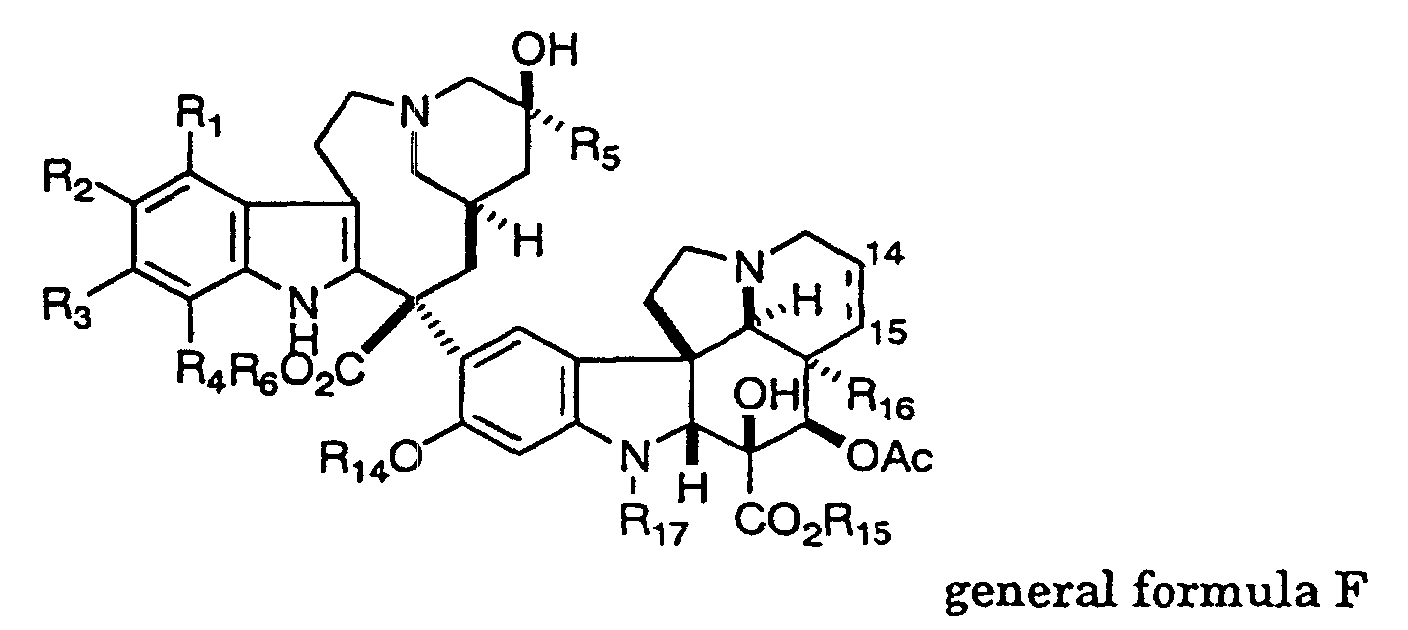












 wherein E and F, R1, R2, R3, R4,R5, R6, R7, R8 and R9 have same meaning to the case of general formula A, R14, R15 and R16 are an alkyl group of carbon number 4 or less, R17 is H or an alkyl group of carbon number 4 or less, and carbon 14-carbon 15 is an unsaturated double bond or saturated bond, wherein, the numbering at nomenclature of vindolines is based on the nomenclature method proposed by Men et al, which is a Reference Document J.