EP1425963B1 - Decentralized oxygen supply system for aquaculture - Google Patents
Decentralized oxygen supply system for aquaculture Download PDFInfo
- Publication number
- EP1425963B1 EP1425963B1 EP03027293A EP03027293A EP1425963B1 EP 1425963 B1 EP1425963 B1 EP 1425963B1 EP 03027293 A EP03027293 A EP 03027293A EP 03027293 A EP03027293 A EP 03027293A EP 1425963 B1 EP1425963 B1 EP 1425963B1
- Authority
- EP
- European Patent Office
- Prior art keywords
- oxygen
- aqueous medium
- containment
- injectors
- generators
- Prior art date
- Legal status (The legal status is an assumption and is not a legal conclusion. Google has not performed a legal analysis and makes no representation as to the accuracy of the status listed.)
- Expired - Lifetime
Links
- QVGXLLKOCUKJST-UHFFFAOYSA-N atomic oxygen Chemical compound [O] QVGXLLKOCUKJST-UHFFFAOYSA-N 0.000 title claims abstract description 318
- 239000001301 oxygen Substances 0.000 title claims abstract description 318
- 229910052760 oxygen Inorganic materials 0.000 title claims abstract description 318
- 238000009360 aquaculture Methods 0.000 title claims abstract description 27
- 244000144974 aquaculture Species 0.000 title abstract description 25
- 241001465754 Metazoa Species 0.000 claims abstract description 71
- 239000012736 aqueous medium Substances 0.000 claims abstract description 39
- 239000012530 fluid Substances 0.000 claims abstract description 37
- 238000004891 communication Methods 0.000 claims abstract description 22
- 241000238557 Decapoda Species 0.000 claims abstract description 17
- 238000012545 processing Methods 0.000 claims description 19
- 239000007789 gas Substances 0.000 claims description 14
- CBENFWSGALASAD-UHFFFAOYSA-N Ozone Chemical compound [O-][O+]=O CBENFWSGALASAD-UHFFFAOYSA-N 0.000 claims description 11
- 235000013305 food Nutrition 0.000 claims description 10
- 239000003814 drug Substances 0.000 claims description 9
- 238000003306 harvesting Methods 0.000 claims description 5
- 239000002028 Biomass Substances 0.000 claims description 3
- 230000000295 complement effect Effects 0.000 claims description 3
- 238000010521 absorption reaction Methods 0.000 claims description 2
- 239000010802 sludge Substances 0.000 claims 2
- 238000000034 method Methods 0.000 abstract description 16
- XLYOFNOQVPJJNP-UHFFFAOYSA-N water Substances O XLYOFNOQVPJJNP-UHFFFAOYSA-N 0.000 description 60
- QGZKDVFQNNGYKY-UHFFFAOYSA-N Ammonia Chemical compound N QGZKDVFQNNGYKY-UHFFFAOYSA-N 0.000 description 22
- 239000000654 additive Substances 0.000 description 16
- 238000005273 aeration Methods 0.000 description 16
- 238000004519 manufacturing process Methods 0.000 description 15
- MYMOFIZGZYHOMD-UHFFFAOYSA-N Dioxygen Chemical compound O=O MYMOFIZGZYHOMD-UHFFFAOYSA-N 0.000 description 14
- 238000005276 aerator Methods 0.000 description 14
- 229910021529 ammonia Inorganic materials 0.000 description 11
- 230000033001 locomotion Effects 0.000 description 10
- 238000009826 distribution Methods 0.000 description 8
- 239000000126 substance Substances 0.000 description 8
- 238000012544 monitoring process Methods 0.000 description 7
- 241000894006 Bacteria Species 0.000 description 6
- 230000007423 decrease Effects 0.000 description 6
- 230000008569 process Effects 0.000 description 6
- 241000251468 Actinopterygii Species 0.000 description 5
- 238000009313 farming Methods 0.000 description 5
- 241000894007 species Species 0.000 description 5
- 230000000153 supplemental effect Effects 0.000 description 5
- 229940088594 vitamin Drugs 0.000 description 5
- 239000011782 vitamin Substances 0.000 description 5
- 229930003231 vitamin Natural products 0.000 description 5
- 235000013343 vitamin Nutrition 0.000 description 5
- IJGRMHOSHXDMSA-UHFFFAOYSA-N Atomic nitrogen Chemical compound N#N IJGRMHOSHXDMSA-UHFFFAOYSA-N 0.000 description 4
- 230000008901 benefit Effects 0.000 description 4
- -1 feed Substances 0.000 description 4
- 238000002347 injection Methods 0.000 description 4
- 239000007924 injection Substances 0.000 description 4
- 231100000518 lethal Toxicity 0.000 description 4
- 230000001665 lethal effect Effects 0.000 description 4
- 230000029553 photosynthesis Effects 0.000 description 4
- 238000010672 photosynthesis Methods 0.000 description 4
- 239000002699 waste material Substances 0.000 description 4
- OKTJSMMVPCPJKN-UHFFFAOYSA-N Carbon Chemical compound [C] OKTJSMMVPCPJKN-UHFFFAOYSA-N 0.000 description 3
- 241000195493 Cryptophyta Species 0.000 description 3
- FAPWRFPIFSIZLT-UHFFFAOYSA-M Sodium chloride Chemical compound [Na+].[Cl-] FAPWRFPIFSIZLT-UHFFFAOYSA-M 0.000 description 3
- 229910052799 carbon Inorganic materials 0.000 description 3
- 229910001882 dioxygen Inorganic materials 0.000 description 3
- 229940079593 drug Drugs 0.000 description 3
- 230000000694 effects Effects 0.000 description 3
- 230000006870 function Effects 0.000 description 3
- 230000036541 health Effects 0.000 description 3
- 230000003601 intercostal effect Effects 0.000 description 3
- 235000013379 molasses Nutrition 0.000 description 3
- 230000036284 oxygen consumption Effects 0.000 description 3
- 230000029058 respiratory gaseous exchange Effects 0.000 description 3
- 239000011780 sodium chloride Substances 0.000 description 3
- 238000001179 sorption measurement Methods 0.000 description 3
- 241000143060 Americamysis bahia Species 0.000 description 2
- 238000013459 approach Methods 0.000 description 2
- 239000000919 ceramic Substances 0.000 description 2
- 230000003247 decreasing effect Effects 0.000 description 2
- 201000010099 disease Diseases 0.000 description 2
- 208000037265 diseases, disorders, signs and symptoms Diseases 0.000 description 2
- 230000005484 gravity Effects 0.000 description 2
- 239000000463 material Substances 0.000 description 2
- 239000002609 medium Substances 0.000 description 2
- 239000000203 mixture Substances 0.000 description 2
- 229910052757 nitrogen Inorganic materials 0.000 description 2
- 238000006213 oxygenation reaction Methods 0.000 description 2
- 150000003839 salts Chemical class 0.000 description 2
- 239000007787 solid Substances 0.000 description 2
- 238000003860 storage Methods 0.000 description 2
- 238000013517 stratification Methods 0.000 description 2
- 239000002352 surface water Substances 0.000 description 2
- 238000012360 testing method Methods 0.000 description 2
- 241000238424 Crustacea Species 0.000 description 1
- 230000001133 acceleration Effects 0.000 description 1
- 230000001154 acute effect Effects 0.000 description 1
- 230000000996 additive effect Effects 0.000 description 1
- 230000002411 adverse Effects 0.000 description 1
- 230000033228 biological regulation Effects 0.000 description 1
- 230000008859 change Effects 0.000 description 1
- 238000006243 chemical reaction Methods 0.000 description 1
- 230000001684 chronic effect Effects 0.000 description 1
- 238000004140 cleaning Methods 0.000 description 1
- 230000003749 cleanliness Effects 0.000 description 1
- 238000005094 computer simulation Methods 0.000 description 1
- 239000000356 contaminant Substances 0.000 description 1
- 230000001419 dependent effect Effects 0.000 description 1
- 238000009792 diffusion process Methods 0.000 description 1
- 238000004090 dissolution Methods 0.000 description 1
- 238000001704 evaporation Methods 0.000 description 1
- 230000008020 evaporation Effects 0.000 description 1
- 238000003872 feeding technique Methods 0.000 description 1
- 239000003337 fertilizer Substances 0.000 description 1
- 239000013505 freshwater Substances 0.000 description 1
- 239000000446 fuel Substances 0.000 description 1
- 230000002706 hydrostatic effect Effects 0.000 description 1
- 210000000987 immune system Anatomy 0.000 description 1
- 230000006872 improvement Effects 0.000 description 1
- 239000007788 liquid Substances 0.000 description 1
- 238000012423 maintenance Methods 0.000 description 1
- 238000007726 management method Methods 0.000 description 1
- 239000002184 metal Substances 0.000 description 1
- 150000002823 nitrates Chemical class 0.000 description 1
- 150000002826 nitrites Chemical class 0.000 description 1
- 230000001706 oxygenating effect Effects 0.000 description 1
- 230000000243 photosynthetic effect Effects 0.000 description 1
- 235000017924 poor diet Nutrition 0.000 description 1
- 230000010349 pulsation Effects 0.000 description 1
- 230000009467 reduction Effects 0.000 description 1
- 230000000241 respiratory effect Effects 0.000 description 1
- 210000003019 respiratory muscle Anatomy 0.000 description 1
- 238000000926 separation method Methods 0.000 description 1
- 235000015170 shellfish Nutrition 0.000 description 1
- 239000000243 solution Substances 0.000 description 1
- 230000035882 stress Effects 0.000 description 1
- 231100000331 toxic Toxicity 0.000 description 1
- 230000002588 toxic effect Effects 0.000 description 1
- 238000012546 transfer Methods 0.000 description 1
- 238000009827 uniform distribution Methods 0.000 description 1
- 238000004065 wastewater treatment Methods 0.000 description 1
Images




Classifications
-
- A—HUMAN NECESSITIES
- A01—AGRICULTURE; FORESTRY; ANIMAL HUSBANDRY; HUNTING; TRAPPING; FISHING
- A01K—ANIMAL HUSBANDRY; AVICULTURE; APICULTURE; PISCICULTURE; FISHING; REARING OR BREEDING ANIMALS, NOT OTHERWISE PROVIDED FOR; NEW BREEDS OF ANIMALS
- A01K63/00—Receptacles for live fish, e.g. aquaria; Terraria
- A01K63/04—Arrangements for treating water specially adapted to receptacles for live fish
- A01K63/042—Introducing gases into the water, e.g. aerators, air pumps
-
- A—HUMAN NECESSITIES
- A01—AGRICULTURE; FORESTRY; ANIMAL HUSBANDRY; HUNTING; TRAPPING; FISHING
- A01K—ANIMAL HUSBANDRY; AVICULTURE; APICULTURE; PISCICULTURE; FISHING; REARING OR BREEDING ANIMALS, NOT OTHERWISE PROVIDED FOR; NEW BREEDS OF ANIMALS
- A01K61/00—Culture of aquatic animals
- A01K61/50—Culture of aquatic animals of shellfish
- A01K61/59—Culture of aquatic animals of shellfish of crustaceans, e.g. lobsters or shrimps
Definitions
- the present invention relates generally to aquaculture farming. More specifically, the invention relates to an oxygen supply system for aquacultural farming of marine animals.
- Aquaculture is the culture and farming of marine animals such as fish or shellfish.
- Aquaculture of shrimp or other marine animals can be considered extensive, semi-intensive, or intensive.
- Extensive aquaculture facilities provide little or nor control over the environment, i.e., placing animals within a site and allowing them to grow on their own or trapping the animals in special enclosures and holding them until they reach market size.
- Intensive aquaculture facilities provide full control the environment such as temperature, salinity, flow rate, feed type, amount of feed, and light.
- Semi-intensive aquaculture facilities are a hybrid of extensive and intensive operations.
- the dissolved oxygen content of the water within the pond is one of the most important parameters of the water quality since oxygen is a vital condition for all marine animals living in the water and having an aerobic type of respiration.
- the solubility of oxygen within the water is influenced by several factors such as, but not limited to, atmospheric pressure, hydrostatic pressure, pond contaminants such as algae or bacteria, and temperature.
- the dissolved oxygen content of the water should be maintained above 3 mg/l and below about 15 mg/l to avoid stressing or killing the marine animals contained wherein.
- Line A in FIG. 1 provides a graph that shows the hourly fluctuations of the percentage of dissolved oxygen in a one-day time period within a typical shrimp pond using continuously running air based aeration devices.
- the most influential factor on the dissolved oxygen content, P is dependent upon light conditions because photosynthesis can only occur via utilization of solar energy.
- photosynthesis starts gradually from the early morning hours and increases the dissolved oxygen content of the water.
- the maximum value of the dissolved oxygen content can be observed early in the afternoon.
- Oxygen levels are usually adequate to meet the needs of the marine organisms within the pond as algae and other organisms release oxygen during the photosynthesis process. From the late afternoon hours, however, photosynthesis is rapidly decreasing and ceases after dark in absence of sunlight.
- plants and/or other organisms respirate during night hours and may further decrease the dissolved oxygen content.
- Lethal oxygen level is the dissolved oxygen content that cannot be tolerated by the given marine animal within a pond for a given period of time.
- supplemental oxygen may be needed when the oxygen consumption rate becomes greater than the available oxygen within the water supply.
- the oxygen consumption of a marine animal can significantly change at a given water temperature depending on the activity of animal and may be related to the oxygen saturation of the water.
- the oxygen consumption rate of marine animals may more than double, for example, during feeding periods. It is believed that increasing the dissolved oxygen content within the water may increase the feed consumption rate of marine animals. Consequently, increasing the feed rate may increase the growth rate.
- U.S. Pat. No. 5,893,337 describes a process for optimizing the growth of fish reared in a pond by injecting oxygen in a controlled quantity before feeding the fish.
- a decrease in dissolved oxygen content may cause stress, and ultimately death, to the marine animals.
- stress may suppress the immune system thereby putting the animal at a greater risk of disease.
- marine animals can sense a decrease of dissolved oxygen content of the water before it causes trouble to its respiration and may search for water of higher oxygen content.
- unlike food it is believed that marine animals cannot sense or detect those areas of higher oxygen within the water from a distance. If this random search for oxygen is unsuccessful and the dissolved oxygen content of the water decreases further, the respiratory motion of the marine animal may increase as long as the oxygen supply to respiratory muscles permits. This can reach a limit whereby further acceleration is hindered by lack of oxygen. Marine animals are tolerant until this level. If the dissolved oxygen content of the water decreases further, the pulsation of the heart slows down and the animal dies after a time depending on the resistance characteristic of the individual species.
- Aeration devices typically mechanically agitate the surface water causing oxygen to diffuse into the water as air and water mix. Examples of these devices include paddlewheels, gravity aerators, u-tubes, venturi aerators, surface aerators, or bubble diffusers (e.g., fine, medium, or coarse bubble diffusers).
- the efficiency of the aeration device is determined by the amount of surface area interface between the water and air and the energy required to produce that interface. Since aerators inject air, the amount of oxygen that can be dissolved in water is limited by the concentration of oxygen in the air (21%).
- W01/87052 relates to a device for oxygenating water in aqua-culture plants for marine organisms in the sea.
- blower feed part of the feed may be blown away from the pond or may be eaten by birds.
- the dimensions of the pond may also effect feeding efficiency.
- a blower-type feeder throws feed about 30 meters and it lands in a band about 5 meters wide so that the center of a large square pond would not receive much feed. Additionally, it has a high operating cost in terms of manpower, equipment, and fuel.
- aquaculture farms In addition to food and oxygen, aquaculture farms also need to periodically add feed chemicals, medicine, vitamins and other additives to the containment vessel or pond.
- Chemicals such as ozone, may be added to manage the pond water quality.
- Medicines may be added to protect the marine animals against disease.
- Vitamins may be added to improve the health and appearance of the animals.
- Other additives such as fertilizers, chemicals, or carbon sources (such as molasses) may be added for algae and bacteria control. The addition of these additives to the containment vessel presents a challenge in terms of rapid and even distribution as well as the labor effort.
- the present invention satisfies one, if not all, of the needs of the art by providing a system for providing oxygen, preferably having a purity level by volume of 30% or greater, preferably 50% or greater, more preferably 60% or greater, for the aquafarming of marine animals.
- a system for providing oxygen having a purity of 30% or greater, for the aquaculture of marine animals comprising: 20-1000 containment vessels capable of containing a plurality of marine animals and an aqueous medium; a plurality of oxygen injectors, at least one oxygen injector disposed in at least one location of each of said containment vessels; and a plurality of oxygen generators of said gas, wherein the number of said containment vessels are between 0.25 and 8 times the number of oxygen generators in the system; each of said plurality of oxygen generators are in fluid communication with at least one oxygen injector whereby the plurality of oxygen generators provides the containment vessels with an amount of oxygen sufficient to increase the percentage of dissolved oxygen within the aqueous medium ; wherein said oxygen generators are located proximally to said containment vessels or are disposed within the containment vessel they provide oxygen to.
- a system for controlling the supply of oxygen within a containment vessel for the farming of marine animals comprising: 20 - 1000 containment vessels, each of said containment vessels capable of containing a plurality of marine animals, and an aqueous medium, a plurality of sensors for measuring the content of dissolved oxygen C o within the aqueous medium, a plurality of oxygen injectors, at least one oxygen injector is disposed within at least one location of each of said containment vessels; a plurality of oxygen generators each of said oxygen generators is in fluid communication with at least one of said oxygen injectors wherein said oxygen generators provide the containment vessels with an amount of oxygen sufficient to increase the amount of dissolved oxygen within the aqueous medium above the oxygen content C o ; and a central processing unit in electrical communication with the sensors and at least one oxygen generator wherein the central processing unit compares the oxygen content C o against a set point value C set and activates the at least one oxygen generator when the oxygen content C o is below
- this system was used to sense when the dissolved oxygen levels were low and to activate the oxygen generator to introduce oxygen via the oxygen injectors into the pond when the level of dissolved oxygen fell below 4 milligram/liter (mg/l), and the oxygen generator was shut off when the dissolved oxygen was above 6 mg/l.
- the results of the the field test and the variation in the dissolved oxygen during the day is shown as Line B in FIG. 1.
- the amount of dissolved oxygen was maintained at a more even level throughout a twenty-four hour period using less energy than if the prior art mechanical aeration devices were run continuously.
- the inventors determined that it is more efficient and necessary for the maintenance of the desired dissolved oxygen levels to add more oxygen to the pond at night than during the day.
- FIG. 1 provides a graph that shows the hourly fluctuations of the percentage of dissolved oxygen in a one-day time period within a typical shrimp pond.
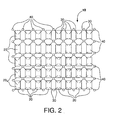
- FIG. 2 provides an illustration of an embodiment of the system of the present invention.
- FIG. 3 provides an illustration of an embodiment of the invention comprising a portable oxygen generator and a monitoring system of this invention.
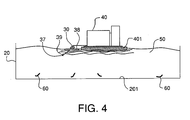
- FIG. 4 provides a cross-sectional view of a containment vessel and a floating oxygen generator useful in a system of this invention.
- FIG. 5 provides a top view of the flow patterns within a containment vessel.
- FIG. 6 provides a top view of the flow patterns within a containment vessel.
- the present invention provides a system for delivering gas comprising oxygen, preferably having a purity of 30% or greater via a plurality of oxygen generators located in the proximity of the containment vessels, in a decentralized fashion in an aquaculture facility.
- Previous methods of delivering oxygen such as the delivery of liquid oxygen, do not address the cost effectiveness issues or the infrastructure limitations of aquacultural facilities, which have up to the present time, made high purity oxygen injection impractical.
- having only aeration devices that are limited by the oxygen content of air providing oxygen to a containment vessel is less efficient. This may limit the amount of marine animals that can be raised in a given pond thereby limiting productivity increases.
- aquacultural facilities today practice inefficient methods of injecting feed and other additives to the water.
- the present invention provides a fail-safe method for providing oxygen, along with feed or other additives, to the water within the containment vessel.
- fluid as used herein relates to a flowing fluid composed of a gas, liquid, suspended solids, or combinations thereof.
- pond or “containment vessel” as used herein relates to not only natural or man-made outdoor pond, but also tanks constructed of metal, plastic, concrete, and the like.
- the term "aeration device” includes devices that inject air or gases having a higher concentration of oxygen than air into the water of a containment vessel, including the oxygen generators and oxygen injectors of this invention, and mechanically agitators of the surface water that cause oxygen to diffuse into the water as air and water mix.
- mechanical agitators include paddlewheels, gravity aerators, u-tubes, venturi aerators, surface aerators, or bubble diffusers (e.g., fine, medium, or coarse bubble diffusers).
- the present invention provides a system, which provides a means of producing and distributing oxygen via a gas comprising oxygen to one or more containment vessels in a decentralized fashion.
- the gas preferably is at least 30% by volume oxygen preferably at least 50%, more preferably at least 60% by volume oxygen, and the residue of the gas if any, may comprise mostly nitrogen.
- the dissolved oxygen content for a given containment vessel may be kept and managed within a range of from about 2 mg/l to about 15 mg/l, or more preferably from 4 mg/l to about 12 mg/l.
- stocking density is the weight or number of marine animals held per unit area or volume. Stocking densities may depend on the species of the marine animals and the animals' tolerance to the stress of increased overcrowding. Crustacean species such as shrimp, for example, may begin to fight amongst each other leading to the loss of limbs and reduction in market value if over stocked. Other species of marine animal such as finfish may bite or nip each other on the fins or eyes if overstocked.
- the system of the present invention by reducing the stress upon marine animals via improvement in the provision of oxygen and/or aspects of the aquacultural environment (e.g., cleanliness, food, chemical, and other additives)- can achieve efficient production at stocking densities of 25 animals per m 3 or greater, preferably 50 animals per m 3 or greater, and more preferably 100 animals per m 3 or greater.
- the system may allow efficient production at shrimp harvest biomass densities of 0.5 kg/m 2 or greater, preferably 1.2 kg/m 2 or greater, and most preferably 2.5 kg/m 2 or greater.
- the biomass density is a measure of the weight of the harvest shrimps per surface area of the pond.
- relatively higher dissolved oxygen levels may allow one to increase the stocking density of the pond.
- FIG. 2 provides one example of an embodiment of the system of the present invention.
- the system 10 is comprised of the following elements: containment vessels 20, a plurality of oxygen injectors 30, and a plurality of oxygen generators 40.
- Containment vessel 20 houses a plurality of marine animals 60 within an aqueous medium 50, preferably fresh or salt water depending upon the species of marine animals. (The marine animals 60, and the aqueous medium 50 are shown in the containment vessel 20 shown in Figure 4.)
- Oxygen generators 40 produce oxygen and are in fluid communication with oxygen injectors 30 to distribute oxygen to one or more locations within containment vessels 20. As FIG.
- a plurality of oxygen generators 40 are located throughout system 10 in such a way to provide a primary, as well as a secondary or "back-up" supply, to other containment vessels in the event of failure of one or more other oxygen injectors 30 and/or oxygen generators 40 within the system.
- each containment vessel 20 within system 10 is depicted as receiving oxygen from at least four different oxygen injectors 30 and/or oxygen generators 40.
- the exact location, size, and number of the oxygen injectors and/or generators will vary depending on such factors as system layout, the production capacity of the oxygen generators, the number and size of the containment vessels, and the desired stocking density.
- Each oxygen injector 30 and oxygen generator 40 can be turned on or off anywhere within system 10 depending on the demand for dissolved oxygen in the individual containment vessel 20 or within certain areas of the individual containment vessel 20.
- oxygen generators having one or more oxygen injectors could be located in various locations around or floating in the pond; each oxygen generator could be individually controlled to provide oxygen as needed to the areas of the containment vessel into which one or more oxygen injectors of the oxygen generator are located.
- the systems of this invention will consist of from 20 to more than 1,000 ponds.
- the oxygen generators each have at least one oxygen injector in fluid communication with the oxygen generator.
- Containment vessel 20 may be any vessel that is capable of containing a plurality of marine animals within an aqueous medium such as fresh or salt water. Depending upon the aquacultural facility, containment vessel 20 may be, but is not limited to, raceway, recirculation tanks, canal, pond, or caged areas within an intercostal area. Containment vessel 20 may be located in either an indoor or outdoor aquacultural facility. The volume of the containment vessel may range from a few hundred to a few thousand gallons.
- the size of the pond may range from 1 hectare or below (from 0.1 to 1 hectacre) for intensive aquaculture facilities, from 1 to 2 hectare for semi-intensive aquaculture facilities, and 5 hectare or greater for extensive aquaculture facilities.
- the annual production level, measured in kilogram of marine animal per hectare per harvest, for the intensive, semi-intensive, and extensive aquaculture facilities varies from 5,000 or greater, between 1000 to 5,000, and between 100 to 1,000, respectively.
- oxygen injector 30 preferably is located within close proximity to one or more containment vessels.
- Oxygen injector 30 may also be located within the containment vessel itself such as at one or more sidewalls of the vessel, disposed along the bottom of the containment vessel, or floating along the surface of the containment vessel. It is preferable that in the event that more than one oxygen injector supplies the containment vessel, the oxygen injectors are located complementary with respect to the other's location around or within the containment vessel to ensure a uniform and even distribution of oxygen and other vessel additives (i.e., food, medicine, vitamins, etc.). The placement of the oxygen injectors may be determined via computer simulation of the fluid dynamics within the vessel. In this manner, a relatively even and uniform distribution of oxygen and other vessel additives can be obtained.
- the location of oxygen injectors 30 should be located to minimize stratification, or the separation of different "layers" of the aqueous medium by distinct boundaries, within containment vessel 20 which can have adverse effects on the marine animals contained therein.
- One or more oxygen injectors 30 can be placed near or at the bottom of the containment vessel to provide sufficient water movement and minimize the occurrence of stratification.
- Oxygen injector 30 may consist of a variety of different types such as aspirator, venturi, bubble diffuser, U-tube, pipeline which preferably contains one or more perforations, column, bicone, or any other injection means.
- oxygen injector 30 and oxygen generator 40 may be integrated into one device such as an oxygen generator with a fixed or flexible attached pipe, diffuser, or the like. It is preferable that oxygen injector 30 is designed to increase the contact surface area, and that the angle or location of the oxygen injector in the pond also increases the contact time between the oxygen and the aqueous medium thereby allowing more oxygen to dissolve into the aqueous medium.
- the oxygen injector may be a venturi.
- a venturi is a device that operates by drawing one fluid media into another using the velocity of the second fluid media (caused by a pressure differential) as the energy source. As the water passes through a restriction in a pipe, it forms a vacuum at the end of the restriction. A hole bored into the pipe at the point where this vacuum occurs may cause air (or any other fluid) to be drawn into the main flow. The amount of fluid drawn in is a direct function of the difference in pressure between the venturi intake and the outlet, and the size of the restriction between them.
- An example of a venturi oxygen injector suitable for use in the system of the present invention is provided in U. S. Pat. No. 5,863,128.
- oxygen generator 40 is in fluid communication with one or more oxygen injectors 30 to supply one or more containment vessels 20.
- Oxygen generator preferably produces oxygen via adsorption techniques such as vacuum swing adsorption (VSA) or pressure swing adsorption (PSA) that removes the nitrogen from the air by a molecule filter.
- VSA vacuum swing adsorption
- PSA pressure swing adsorption
- oxygen generator 40 may be a VSA-based device such as VSA generator model number A150L manufactured by Air Products and Chemicals, Inc. of Allentown, PA the assignee of the present invention.
- Oxygen generator 40 is preferably a portable unit that can be relocated throughout system 10 and attached to one or more oxygen injectors 30 at any time.
- the oxygen generator may be mounted on a movable platform that can be, for example, moved around the periphery of the containment vessels or mounted on a floatable skid and disposed upon the surface of the containment vessel.
- Figure 3 shows oxygen generator 40 on a cart 401 having wheels 402 located adjacent to ponds 20 and providing oxygen to the aqueous medium 50 in the ponds 20 via oxygen injectors 30.
- the oxygen injectors 30 are located at the bottom 201 of the ponds 20.
- the oxygen injectors 30 are provided with holes 31 for a portion 32 of oxygen injectors 30 at the bottom 201 of the ponds 20.
- the oxygen injectors 30 can be made of flexible movable pipe.
- FIG 4 shows an oxygen generator 40 mounted on floatable platform 401 floating on the aqueous medium 50 in containment vessels 20. Marine animals 60 are in the containment vessel 20.
- the oxygen injector 30 shown connected to the oxygen generator 40 has a propeller 39, and a center pipe 37 in which there is an opening (not shown) at its lowermost portion.
- the center pipe is in fluid communication with the oxygen generator 40.
- the gas comprising oxygen is injected into the aqueous medium via the opening in the center pipe 37, and the movement of the propeller 39 helps the diffusion of the oxygen into the water by increasing the surface area of the oxygen in contact with the water.
- the oxygen injector 30 additionally has a floatable platform 38.
- any of the injectors that were described earlier could be used with the oxygen generator shown in Figure 4 to inject the oxygenated gas into the water.
- the oxygen generator 40 shown in Fig 4 may move about the pond or it may be anchored via an anchor (not shown) to a stationary object within or outside of the pond to hold the oxygen generator 40 in a single location, while the propeller 39 causes the aqueous medium 50 to move.
- the oxygen generators 40 are portable and may provide high purity oxygen to any of the containment vessels within system 10 on an as-needed basis. Depending upon its size, the unit capacity of each individual oxygen generator 40 may range from 5 l/min to 5000 l/min of oxygen. As with the oxygen injectors, the number and capacity of the oxygen generators may vary depending upon the system requirements. In certain embodiments, VSA oxygen generators may produce oxygen at a relatively low pressure, e.g., 0.21 to 0.34 bar (3 to 5 psi) thereby making them compatible when used to supply low pressure oxygen injectors such as aspirator, venturi, or bubble oxygen injectors. If, however, a higher gas pressure is needed within the system, a booster compressor may be added to the output of the oxygen generator to increase the pressure supplying the oxygen injector.
- a booster compressor may be added to the output of the oxygen generator to increase the pressure supplying the oxygen injector.
- the system of the present invention may be used in conjunction with other aquacultural systems such as, but not limited to, recirculation water treatment systems or aeration systems (i.e., paddle wheel aerators, large volume pumps, etc.). If sufficient water movement can be provided by other systems or means including other aeration devices in a containment vessel or by the oxygen injector alone, then only one oxygen injector present in a containment vessel may be necessary to maintain the dissolved oxygen at a sufficient level to maintain the health of the marine animals.
- recirculation water treatment systems or aeration systems i.e., paddle wheel aerators, large volume pumps, etc.
- the system may dispense feed during at least a portion, or simultaneously with, the oxygen introduction into the containment vessel.
- feed may be added before or after the oxygen is introduced into the containment vessel by the system.
- feed storage bins 500 as shown in Fig 3 are in fluid communication with the one or more oxygen injectors via connection 501.
- the feed is added to the oxygen gas stream or the oxygenated water stream for continual and even feed distribution. Since the oxygen system is operational at most times, feed can be added to the pond on an "as-needed" basis and in appropriate quantities.
- the marine animals can sense and are attracted to the feed while being drawn to the areas having higher dissolved oxygen within the aqueous medium.
- the marine animals may consume higher amounts of dissolved oxygen while consuming the feed. It has been established in references such as Water Quality in Ponds for Aquaculture , Boyd, C. E. (1990), pp. 304-309, that higher dissolved oxygen levels may improve feed consumption and lower the feed conversion ratio (e.g., the kg (lbs) of feed consumed per kg (lbs) of animal) and consequently raise the growth rate while loweing the feed cost.
- the marine animal comprises shrimp
- the system of the present invention may also facilitate the introduction of chemicals such as ozone, medicines, vitamins, and/or other additives to the containment vessel by co- injecting these additives with the oxygen gas stream or the oxygenated water stream.
- Medicines, vitamins and other pond additives may be added via hopper 502 and connection 503 in the oxygen injectors 30. This allows for distribution of these additives using the system installed already for oxygen and incurs no additional equipment or labor cost.
- the supply vessels for these additives are in fluid communication with the oxygen injectors. These materials can be added to the pond at any desired time and in as much quantity as needed through the oxygen injectors.
- the ozone generator may be in fluid communication with the oxygen generator to supply oxygen rather than air to the ozone generator that can be converted to ozone.
- the ozone may then be dispensed through the oxygen injector(s).
- Fig 3 shows ozone generator 600 incorporated into the oxygen generator 40.
- the system further comprises a monitoring system.
- the monitoring system may provide the user with certain information, preferably on a real-time basis, on various production parameters, such as temperature, dissolved oxygen, pH, ammonia, nitrates, nitrites, suspended solids, salinity, alkalinity, biochemical oxygen demand (BOD), hardness, turbidity, and water flow rate, within each containment vessel.
- the monitoring system may use this information to activate a variety of different supply sources such as oxygen, feed, medicine, or other additives, on automatic basis.
- One embodiment of the monitoring system 700 as part of the system of this invention is shown in Fig 3.
- the monitoring system 700 preferably consists of a central processing unit 701 that is in electrical communication via direct means, shown as a wire 703 in Fig 3, with one or more sensors 702 and the oxygen generator 40.
- the central processing unit 701 could be in communication with the sensor and/or the oxygen generator via a modem, radio, telecommunication or similar means.
- the monitoring system could also be in electrical communication with various supply sources such as feed hoppers, ozone generator, oxygen injectors, recirculation tank valves, medicine or other additive sources, and the like.
- Suitable central processing units include, but are not limited to, signal processors, process controllers, microprocessors, computers, or similar devices capable of retaining certain pre-programmed information into memory and performing a variety of functions such as simple algorithms, relaying data, and executing operations.
- the sensors may measure dissolved oxygen levels, temperature, pH, and other water parameters that are in electrical communication with a central processing unit. These parameters would be fed into a central processing unit, which would direct the system elements to provide the necessary injection of oxygen and other materials to the containment vessel in the appropriate quantities. Further, the central processing unit compares these parameters against a number of preset values to determine what each containment vessel needs at any given time.
- the senor 702 can be a sensor that measures the dissolved oxygen in the aqueous medium and the central processing unit 701 may compare the measured oxygen content C o of the aqueous medium within the containment vessel against a pre-programmed set point value C set and may activate the oxygen generator when the oxygen content C o of the aqueous medium is below set point value C set . Additionally, the central processing unit 701 may compare the measured oxygen content C o of the aqueous medium within the containment vessel against a second pre-programmed set point value C max and may deactivate the oxygen generator when the oxygen content C o of the aqueous medium is above set point value C max .
- the set point values C set and C max may vary within each containment vessel due to a variety of factors such as, but not limited to, time of day, size or growth of the marine animals, time of growth cycle, time of year, size of the containment vessel, water quality, etc. Despite these variations, the system of the present invention allows the user to manage a plurality of containment vessels independently. Additionally, although not shown in Fig. 3, the oxygen generator 40 may be supplied with means, e.g. valves, to provide oxygen to only one or less than all of the containment vessels to which it supplies oxygen.
- the central processing unit is an analog-based device. Unlike a digital-based device that can only instruct another to be “on” or “off", an analog device can instruct another device to be at a variety of other states between "on” and “off". For example, an analog signal can regulate the speed of the device (e.g. 20%, 30%, 40% of full operational capacity etc). Analog signals are increasingly being used for dosing functions using the feedback from a sensor. For example, an output from an oxygen sensor may tell the central processing unit that the oxygen concentration is decreasing in the containment vessel. The central processing unit may send an analog signal to partially open or close the valve to the oxygen injector, in an effort to maintain a steady oxygen concentration at all times. This is more preferable than having just an open or closed valve (such as from a digital signal), as this may cause peaks and troughs of oxygen concentration, which can stress the animals.
- an analog signal can regulate the speed of the device (e.g. 20%, 30%, 40% of full operational capacity etc).
- Analog signals are increasingly being used for dosing functions
- the system may also monitor and regulate the saline content of the aqueous medium or water within the containment vessel. Regulation of the saline content is important because variations in salinity can cause stress and acute or chronic mortalities amongst marine animals.
- the system can incorporate, for example, a hydrometer or refractometer that is in electrical communication with the central processing unit. The refractometer may detect if the salinity level of the water within the containment vessel to determine it has increased, for example, due to evaporation. The refractometer can communicate with the central processing unit that can direct a valve to open thereby allowing additional, saline or fresh water into the containment vessel to increase or decrease the salinity level.
- the system may also monitor and regulate the ammonia content within the aqueous medium or water of the containment vessel.
- the main source of ammonia is the waste generated by the marine animals themselves. If the level of ammonia within the aqueous medium is too high, it may be toxic to the marine animals contained therein. Bacteria within the water of the containment vessel consume ammonia thereby lowering the ammonia level. The consumption of ammonia by the bacteria may be aided by adding a carbon source such as molasses to the water. Further, bacteria also benefit from an increased level of dissolved oxygen within the water.
- the system may comprise an ammonia sensor to detect the level of ammonia within the water and communicate this information to the central processing unit. If the bacteria fail to keep the ammonia level in a certain range, the central processing unit may direct a valve to allow for molasses or other carbon source to be added to the water to increase the consumption of ammonia.
- the invention is particularly suitable for a fail-safe system and a method comprising for providing oxygen to containment vessels used in aquaculture, the invention is not limited thereto.
- the system and method of the present invention can be used for a variety of other applications wherein it is important to provide a reliable source of oxygen such as, for example, wastewater treatment plants or other applications.
- the movement of fluid within the containment vessel and the dissolution of oxygen can be optimized.
- the location and types of aeration devices can be moved around and changed. Different aeration devices can be used in different combinations to achieve the desired results.
- the oxygen generators and oxygen injectors of this invention can be used with prior art aeration devices to achieve the desired movement of fluid and oxygenation.
- the movement of the fluid relative to the upfront and operating costs of the devices can be compared to provide the most economical fluid movement.
- the movement of water is important to prevent areas of the containment vessel from having low levels of dissolved oxygen.
- all the water in the pond is moving at at least 4 cm/sec; however, because of the shape of most containment vessels, it is preferred that at least a majority of the volume of the fluid in the vessel moves at at least 4 cm/sec, preferably between from 4 to 20 cm/sec and more preferably between from 4 to 10 cm/sec. In more preferred embodiments greater than 80%, more preferably greater than 85%, of the volume of the fluid in the pond moves at between from 4 to 20 cm/sec, more preferably between from 4 to 10 cm/sec.
- the aqueous medium in the containment vessels of any shape should move in at least one circular vortex comprising the movement of at least a majority of said aqueous medium in at least one circular vortex, and if there are more than one circular vortexes within the containment vessels, then the vortexes should be complemetary circular vortexes.
- the injectors inject the oxygen/air across the radius or half the length of the vessel, and the flow of the fluid to be in single circular vortex.
- the injection across the radius or half the length of the vessel is uniform, if possible.
- the fluid moved by at least 3 aerator devices that will move the fluid in three complementing circlar vortexes as shown in Figure 7.
- the lighter areas are areas for which the flow rate is between from 4 cm/sec to 20 cm/sec.
- the dark areas 66 are areas that have a velocity less than 2 cm/sec or less. (Figure 7 shows the location of the aerator devices 88). The inventors have determined that the waste in the vessel will accumulate at the bottom of the vessel in the low or no velocity areas 66.
- the vessel clean and healthy for the marine animals it is recommended that this waste be removed routinely from the pond as often and regularly as possible. In plastic lined bottom ponds, it is recommended that this removal is done on a daily basis and in earthen bottom ponds it should be done at least once a week.
- the food for the marine animals should not be added to the low velocity areas, and should only be added to the areas of the vessel that are between from 4 cm/sec to 20 cm/sec, more preferably from 4 cm/sec to 10 cm/sec when aeration devices that move the water are operational.
- the aerator devices that move the fluid should be turned off preferably at least 5 minutes prior to feeding. By shutting off the aerators that move the fluid, the food will not be moved around by the fluid until it settles in the low velocity areas of the pond, which are where the dissolved oxygen levels are low and where the shrimp are not located. The feed is wasted in the low velocity areas and contributes to the poor aerobic pond conditions for shrimp. After allowing some time, preferably fifteen minutes to two hours for feeding, the aeration devices that move the fluid may be restarted.
- a 7570 l (2000 gallon) tank for the production of tilipia fish is maintained at a temperature of approximately 28°C.
- the percentage of dissolved oxygen within the tank was 2.0 mg/liter.
- the oxygen generator delivered oxygen having a purity of 90% or greater to the tank at a rate of 120 liters per minute or 250 SCFH at a pressure ranging from 0.21 to 0.34 bar (3 to 5 psi).
- the ceramic diffuser had a 3.4 bar (50 psi) backpressure.
- the oxygen generator was further connected to a 1 horsepower oxygen compressor to increase the output pressure from the oxygen generator to 4.1 bar (60 psi).
- the percentage of dissolved oxygen within the tank after 1 hour of being connected to the oxygen generator was 8.0 mg/liter.
- the present invention illustrates that a portable VSA oxygen generator may increase the percentage of dissolved oxygen within the tilipia production tank.
- a portable VSA oxygen generator may increase the percentage of dissolved oxygen within the tilipia production tank.
- the use of the portable VSA oxygen generator provides an amount of oxygen to the production tank at a fraction of the monthly operating costs of using a liquid oxygen supply tank system.
- the operating costs for the portably VSA oxygen generator was $280 per month versus $1,500 per month for the liquid oxygen supply system based on a price of $0.06 per kW.
- the cost for the liquid oxygen supply system was exclusive of costs associated with oxygen tank rental and management of oxygen supply.
- the user is limited to the amount of marine animals that can be stocked in the tank.
Landscapes
- Life Sciences & Earth Sciences (AREA)
- Environmental Sciences (AREA)
- Marine Sciences & Fisheries (AREA)
- Animal Husbandry (AREA)
- Biodiversity & Conservation Biology (AREA)
- Zoology (AREA)
- Farming Of Fish And Shellfish (AREA)
Abstract
Description
- The present invention relates generally to aquaculture farming. More specifically, the invention relates to an oxygen supply system for aquacultural farming of marine animals.
- Through history, marine animals such as shrimp, fish, and other species, have been captured in the wild. As demand for marine animals have grown and the wild catch has reached its limitations, an alternative supply source for marine animals referred to as aquacultural farming, or aquaculture, was developed. Aquaculture is the culture and farming of marine animals such as fish or shellfish.
- One of the more popular, as well as the most highly demanded, marine animals to be produced via aquaculture is shrimp. Aquaculture of shrimp or other marine animals can be considered extensive, semi-intensive, or intensive. Extensive aquaculture facilities provide little or nor control over the environment, i.e., placing animals within a site and allowing them to grow on their own or trapping the animals in special enclosures and holding them until they reach market size. Intensive aquaculture facilities, on the other hand, provide full control the environment such as temperature, salinity, flow rate, feed type, amount of feed, and light. Semi-intensive aquaculture facilities are a hybrid of extensive and intensive operations.
- Initial attempts at aquaculture of shrimp were relatively simple and were considered extensive facilities. Ocean water was pumped into large containment vessels referred to as ponds in intercostal or low-lying areas. Shrimp were placed in these ponds and after a certain period of time were harvested. The harvest yields at first were quite low. Due to increasing demand for marine animals, however, the need for higher yields and more productive processes grew. In order to achieve higher yields, the stocking density of the marine animals within the ponds, measured in terms of pounds of marine animal per gallon of water, needed to be increased.
- As stocking densities within the pond increase, oxygen depletion can become an issue. Marine animals like shrimp require oxygen to grow and maintain health. The dissolved oxygen content of the water within the pond is one of the most important parameters of the water quality since oxygen is a vital condition for all marine animals living in the water and having an aerobic type of respiration. The solubility of oxygen within the water is influenced by several factors such as, but not limited to, atmospheric pressure, hydrostatic pressure, pond contaminants such as algae or bacteria, and temperature. To be safe, the dissolved oxygen content of the water should be maintained above 3 mg/l and below about 15 mg/l to avoid stressing or killing the marine animals contained wherein.
- The dissolved oxygen content of water normally fluctuates over a 24-hour period. Line A in FIG. 1 provides a graph that shows the hourly fluctuations of the percentage of dissolved oxygen in a one-day time period within a typical shrimp pond using continuously running air based aeration devices. Diurnal changes of the dissolved oxygen content during a time period (t'' - t') can be expressed by the following equation (1):

where P is the quantity of oxygen produced during the photosynthetic process of the phytoplankton, the phytobenthos, and the water plants; R = quantity of oxygen consumed during the respiration of bacterial-, phyto- and zooplankton and organisms of animals and plants; Y = quantity of oxygen fixed by the mud of the pond bottom; and A = quantity of oxygen dissolved from the atmosphere, or in case of supersaturation, released to the atmosphere. - Referring to equation (1), the most influential factor on the dissolved oxygen content, P, is dependent upon light conditions because photosynthesis can only occur via utilization of solar energy. During the daylight hours, photosynthesis starts gradually from the early morning hours and increases the dissolved oxygen content of the water. The maximum value of the dissolved oxygen content can be observed early in the afternoon. Oxygen levels are usually adequate to meet the needs of the marine organisms within the pond as algae and other organisms release oxygen during the photosynthesis process. From the late afternoon hours, however, photosynthesis is rapidly decreasing and ceases after dark in absence of sunlight. In addition, plants and/or other organisms respirate during night hours and may further decrease the dissolved oxygen content. Thus, supplemental oxygen or aeration may be required because the level of dissolved oxygen can fall below the lethal oxygen level for marine animals. Lethal oxygen level is the dissolved oxygen content that cannot be tolerated by the given marine animal within a pond for a given period of time.
- In addition to need for supplemental oxygen due to diurnal changes, supplemental oxygen may be needed when the oxygen consumption rate becomes greater than the available oxygen within the water supply. The oxygen consumption of a marine animal can significantly change at a given water temperature depending on the activity of animal and may be related to the oxygen saturation of the water. The oxygen consumption rate of marine animals may more than double, for example, during feeding periods. It is believed that increasing the dissolved oxygen content within the water may increase the feed consumption rate of marine animals. Consequently, increasing the feed rate may increase the growth rate. U.S. Pat. No. 5,893,337 describes a process for optimizing the growth of fish reared in a pond by injecting oxygen in a controlled quantity before feeding the fish.
- A decrease in dissolved oxygen content may cause stress, and ultimately death, to the marine animals. In addition to changing the body to one that starts using energy, rather than storing it, stress may suppress the immune system thereby putting the animal at a greater risk of disease. It is believed that marine animals can sense a decrease of dissolved oxygen content of the water before it causes trouble to its respiration and may search for water of higher oxygen content. However, unlike food, it is believed that marine animals cannot sense or detect those areas of higher oxygen within the water from a distance. If this random search for oxygen is unsuccessful and the dissolved oxygen content of the water decreases further, the respiratory motion of the marine animal may increase as long as the oxygen supply to respiratory muscles permits. This can reach a limit whereby further acceleration is hindered by lack of oxygen. Marine animals are tolerant until this level. If the dissolved oxygen content of the water decreases further, the pulsation of the heart slows down and the animal dies after a time depending on the resistance characteristic of the individual species.
- Industry, up to a point, has been able to address the issues of oxygen depletion and supplemental oxygen through a variety of measures such as aeration devices. Aeration devices typically mechanically agitate the surface water causing oxygen to diffuse into the water as air and water mix. Examples of these devices include paddlewheels, gravity aerators, u-tubes, venturi aerators, surface aerators, or bubble diffusers (e.g., fine, medium, or coarse bubble diffusers). The efficiency of the aeration device is determined by the amount of surface area interface between the water and air and the energy required to produce that interface. Since aerators inject air, the amount of oxygen that can be dissolved in water is limited by the concentration of oxygen in the air (21%). Options to increase the amount of dissolved oxygen in the water with air are, therefore, somewhat limited. Further, due to the demand for higher productivity and stocking densities in intensive aquacultural facilities, the natural oxygen supply from air becomes increasingly insufficient and may be the limiting factor in production. W01/87052 relates to a device for oxygenating water in aqua-culture plants for marine organisms in the sea.
- Another solution to add oxygen to the water is through the transport of high purity oxygen in the form of liquid oxygen. This approach overcomes the limitation of using air as the oxygen source. The significant advantage of applying high purity oxygen is the high mass transfer rate between pure oxygen and water due to the differences in concentration. Further, increasing the dissolved oxygen content may allow one to achieve higher stocking densities. However, the logistics of transporting liquid oxygen to the farms and the distribution to individual ponds has proven to be not cost effective -and in some cases impossible- due to typical aquaculture farm infrastructure. For instance, typical shrimp farms are comprised of a large number of large, approximately 1 hectare, dirt ponds separated by narrow, weak levies. These levies are used as a means of transporting equipment, feed, and other supplies to the ponds. Since many of these farms are in intercostal areas, the ability to install oxygen lines in such conditions is limited. Even if the liquid oxygen plant was close to the farm, which can minimize the oxygen production, and delivery costs, this approach may not be practical due to the high capital costs involved in installing and maintaining the piping infrastructure. Further, larger, single on-site oxygen production and pipeline distribution system face the same logistical and infrastructure problems as liquid oxygen piping systems.
- Due to its high cost, high purity oxygen has not gained acceptance in aquaculture settings despite its many benefits. At the present time, mechanical aerators continue to be the industry choice in providing supplemental oxygen. As a result, the ability to further increase pond stocking densities is limited.
- Besides oxygen, there is a need for improved feed and feeding techniques in aquaculture farms in order to maintain or increase stocking density. The need for supplying large amounts of feed at regular and frequent intervals to the pond usually requires large on-site feed storage facilities, using intensive manual labor to drop the feed manually by hand and/or using expensive truck-mounted blowers. Feed is often distributed manually throughout the pond by walking or boating in the pond. The blowers are another means of distributing the feed around the periphery of the ponds. This feeding process is relatively inefficient because the marine animals may consume only a fraction of feed. Manually distributing the feed is labor intensive and distributes the feed unevenly and only in selected parts of the pond. In blower feed, part of the feed may be blown away from the pond or may be eaten by birds. The dimensions of the pond may also effect feeding efficiency. For example, a blower-type feeder throws feed about 30 meters and it lands in a band about 5 meters wide so that the center of a large square pond would not receive much feed. Additionally, it has a high operating cost in terms of manpower, equipment, and fuel.
- In addition to food and oxygen, aquaculture farms also need to periodically add feed chemicals, medicine, vitamins and other additives to the containment vessel or pond. Chemicals, such as ozone, may be added to manage the pond water quality. Medicines may be added to protect the marine animals against disease. Vitamins may be added to improve the health and appearance of the animals. Other additives such as fertilizers, chemicals, or carbon sources (such as molasses) may be added for algae and bacteria control. The addition of these additives to the containment vessel presents a challenge in terms of rapid and even distribution as well as the labor effort.
- Due to the relative inefficiencies and high costs in delivering oxygen, feed, medicine, and other additives to the pond, there is a need in the art to provide a system that would optimize the oxygen, feed, and chemical needs within an aquaculture facility. There is a further need to provide an automated, or semi-automated system, that can provide real-time feedback as to the various production needs of the pond and a distribution system to supply same. Such a system may significantly reduce cost and improve pond productivity. In some instances, such as when the dissolved oxygen content of the pond water falls below lethal levels, there is a need to provide a reliable, fail-safe system that alerts the user and supplies oxygen to the containment vessel to a level above the lethal level.
- The present invention satisfies one, if not all, of the needs of the art by providing a system for providing oxygen, preferably having a purity level by volume of 30% or greater, preferably 50% or greater, more preferably 60% or greater, for the aquafarming of marine animals. According to claim 1 there is a system for providing oxygen having a purity of 30% or greater, for the aquaculture of marine animals comprising: 20-1000 containment vessels capable of containing a plurality of marine animals and an aqueous medium; a plurality of oxygen injectors, at least one oxygen injector disposed in at least one location of each of said containment vessels; and a plurality of oxygen generators of said gas, wherein the number of said containment vessels are between 0.25 and 8 times the number of oxygen generators in the system; each of said plurality of oxygen generators are in fluid communication with at least one oxygen injector whereby the plurality of oxygen generators provides the containment vessels with an amount of oxygen sufficient to increase the percentage of dissolved oxygen within the aqueous medium ; wherein said oxygen generators are located proximally to said containment vessels or are disposed within the containment vessel they provide oxygen to.
- In a further aspect of the present invention, there is provided a system for controlling the supply of oxygen within a containment vessel for the farming of marine animals comprising: 20 - 1000 containment vessels, each of said containment vessels capable of containing a plurality of marine animals, and an aqueous medium, a plurality of sensors for measuring the content of dissolved oxygen C o within the aqueous medium, a plurality of oxygen injectors, at least one oxygen injector is disposed within at least one location of each of said containment vessels; a plurality of oxygen generators each of said oxygen generators is in fluid communication with at least one of said oxygen injectors wherein said oxygen generators provide the containment vessels with an amount of oxygen sufficient to increase the amount of dissolved oxygen within the aqueous medium above the oxygen content C o ; and a central processing unit in electrical communication with the sensors and at least one oxygen generator wherein the central processing unit compares the oxygen content C o against a set point value C set and activates the at least one oxygen generator when the oxygen content C o is below set point value C set . In an actual field test, as shown in FIG 1, this system was used to sense when the dissolved oxygen levels were low and to activate the oxygen generator to introduce oxygen via the oxygen injectors into the pond when the level of dissolved oxygen fell below 4 milligram/liter (mg/l), and the oxygen generator was shut off when the dissolved oxygen was above 6 mg/l. The results of the the field test and the variation in the dissolved oxygen during the day is shown as Line B in FIG. 1. By using the system of this invention the amount of dissolved oxygen was maintained at a more even level throughout a twenty-four hour period using less energy than if the prior art mechanical aeration devices were run continuously. The inventors determined that it is more efficient and necessary for the maintenance of the desired dissolved oxygen levels to add more oxygen to the pond at night than during the day.
- These and other aspects of the invention will become apparent from the following detailed description.
- FIG. 1 provides a graph that shows the hourly fluctuations of the percentage of dissolved oxygen in a one-day time period within a typical shrimp pond.
- FIG. 2 provides an illustration of an embodiment of the system of the present invention.
- FIG. 3 provides an illustration of an embodiment of the invention comprising a portable oxygen generator and a monitoring system of this invention.
- FIG. 4 provides a cross-sectional view of a containment vessel and a floating oxygen generator useful in a system of this invention.
- FIG. 5 provides a top view of the flow patterns within a containment vessel.
- FIG. 6 provides a top view of the flow patterns within a containment vessel.
- The present invention provides a system for delivering gas comprising oxygen, preferably having a purity of 30% or greater via a plurality of oxygen generators located in the proximity of the containment vessels, in a decentralized fashion in an aquaculture facility. Previous methods of delivering oxygen, such as the delivery of liquid oxygen, do not address the cost effectiveness issues or the infrastructure limitations of aquacultural facilities, which have up to the present time, made high purity oxygen injection impractical. Further, having only aeration devices that are limited by the oxygen content of air providing oxygen to a containment vessel is less efficient. This may limit the amount of marine animals that can be raised in a given pond thereby limiting productivity increases. Further, aquacultural facilities today practice inefficient methods of injecting feed and other additives to the water. The present invention provides a fail-safe method for providing oxygen, along with feed or other additives, to the water within the containment vessel.
- The term "fluid" as used herein relates to a flowing fluid composed of a gas, liquid, suspended solids, or combinations thereof.
- The term "pond" or "containment vessel" as used herein relates to not only natural or man-made outdoor pond, but also tanks constructed of metal, plastic, concrete, and the like.
- The term "aeration device" includes devices that inject air or gases having a higher concentration of oxygen than air into the water of a containment vessel, including the oxygen generators and oxygen injectors of this invention, and mechanically agitators of the surface water that cause oxygen to diffuse into the water as air and water mix. Examples of mechanical agitators include paddlewheels, gravity aerators, u-tubes, venturi aerators, surface aerators, or bubble diffusers (e.g., fine, medium, or coarse bubble diffusers).
- The present invention provides a system, which provides a means of producing and distributing oxygen via a gas comprising oxygen to one or more containment vessels in a decentralized fashion. The gas preferably is at least 30% by volume oxygen preferably at least 50%, more preferably at least 60% by volume oxygen, and the residue of the gas if any, may comprise mostly nitrogen. As a result of providing oxygen to the containment vessels using the system or method of the present invention, the dissolved oxygen content for a given containment vessel may be kept and managed within a range of from about 2 mg/l to about 15 mg/l, or more preferably from 4 mg/l to about 12 mg/l.
- One advantage of the system of the present invention is that it may allow one to improve the stocking density of the containment vessel relative to other prior-art containment vessels using only air-based mechanical systems. As mentioned previously, stocking density is the weight or number of marine animals held per unit area or volume. Stocking densities may depend on the species of the marine animals and the animals' tolerance to the stress of increased overcrowding. Crustacean species such as shrimp, for example, may begin to fight amongst each other leading to the loss of limbs and reduction in market value if over stocked. Other species of marine animal such as finfish may bite or nip each other on the fins or eyes if overstocked. It has been established that higher stocking densities can be tolerated by the marine animals if other stressors such as low dissolved oxygen, poor diet, etc. are eliminated. Thus, the system of the present invention -by reducing the stress upon marine animals via improvement in the provision of oxygen and/or aspects of the aquacultural environment (e.g., cleanliness, food, chemical, and other additives)- can achieve efficient production at stocking densities of 25 animals per m3 or greater, preferably 50 animals per m3 or greater, and more preferably 100 animals per m3 or greater. In certain preferred embodiments such as semi-intensive or intensive aquacultural facilities for the production of shrimp, the system may allow efficient production at shrimp harvest biomass densities of 0.5 kg/m2 or greater, preferably 1.2 kg/m2 or greater, and most preferably 2.5 kg/m2 or greater. The biomass density is a measure of the weight of the harvest shrimps per surface area of the pond. Thus, relatively higher dissolved oxygen levels may allow one to increase the stocking density of the pond.
- FIG. 2 provides one example of an embodiment of the system of the present invention. Referring to FIG. 2, the
system 10 is comprised of the following elements:containment vessels 20, a plurality ofoxygen injectors 30, and a plurality ofoxygen generators 40.Containment vessel 20 houses a plurality ofmarine animals 60 within anaqueous medium 50, preferably fresh or salt water depending upon the species of marine animals. (Themarine animals 60, and theaqueous medium 50 are shown in thecontainment vessel 20 shown in Figure 4.)Oxygen generators 40 produce oxygen and are in fluid communication withoxygen injectors 30 to distribute oxygen to one or more locations withincontainment vessels 20. As FIG. 2 illustrates, a plurality ofoxygen generators 40 are located throughoutsystem 10 in such a way to provide a primary, as well as a secondary or "back-up" supply, to other containment vessels in the event of failure of one or moreother oxygen injectors 30 and/oroxygen generators 40 within the system. - Referring again to FIG. 2, each
containment vessel 20 withinsystem 10 is depicted as receiving oxygen from at least fourdifferent oxygen injectors 30 and/oroxygen generators 40. The exact location, size, and number of the oxygen injectors and/or generators will vary depending on such factors as system layout, the production capacity of the oxygen generators, the number and size of the containment vessels, and the desired stocking density. Eachoxygen injector 30 andoxygen generator 40 can be turned on or off anywhere withinsystem 10 depending on the demand for dissolved oxygen in theindividual containment vessel 20 or within certain areas of theindividual containment vessel 20. In one embodiment, particularly for large ponds, several oxygen generators having one or more oxygen injectors could be located in various locations around or floating in the pond; each oxygen generator could be individually controlled to provide oxygen as needed to the areas of the containment vessel into which one or more oxygen injectors of the oxygen generator are located. There may be fewer or more oxygen generators than number of ponds in the aquafarm system. It is preferred that the number of ponds in the system is between 0.25 and 8 times the number of oxygen generators in the system. Typically the systems of this invention will consist of from 20 to more than 1,000 ponds. The oxygen generators each have at least one oxygen injector in fluid communication with the oxygen generator. -
Containment vessel 20 may be any vessel that is capable of containing a plurality of marine animals within an aqueous medium such as fresh or salt water. Depending upon the aquacultural facility,containment vessel 20 may be, but is not limited to, raceway, recirculation tanks, canal, pond, or caged areas within an intercostal area.Containment vessel 20 may be located in either an indoor or outdoor aquacultural facility. The volume of the containment vessel may range from a few hundred to a few thousand gallons. In certain embodiments wherein the containment vessel is a pond, the size of the pond may range from 1 hectare or below (from 0.1 to 1 hectacre) for intensive aquaculture facilities, from 1 to 2 hectare for semi-intensive aquaculture facilities, and 5 hectare or greater for extensive aquaculture facilities. The annual production level, measured in kilogram of marine animal per hectare per harvest, for the intensive, semi-intensive, and extensive aquaculture facilities varies from 5,000 or greater, between 1000 to 5,000, and between 100 to 1,000, respectively. - Referring again to FIG. 2,
oxygen injector 30 preferably is located within close proximity to one or more containment vessels.Oxygen injector 30 may also be located within the containment vessel itself such as at one or more sidewalls of the vessel, disposed along the bottom of the containment vessel, or floating along the surface of the containment vessel. It is preferable that in the event that more than one oxygen injector supplies the containment vessel, the oxygen injectors are located complementary with respect to the other's location around or within the containment vessel to ensure a uniform and even distribution of oxygen and other vessel additives (i.e., food, medicine, vitamins, etc.). The placement of the oxygen injectors may be determined via computer simulation of the fluid dynamics within the vessel. In this manner, a relatively even and uniform distribution of oxygen and other vessel additives can be obtained. - In certain preferred embodiments of the present invention, the location of
oxygen injectors 30 should be located to minimize stratification, or the separation of different "layers" of the aqueous medium by distinct boundaries, withincontainment vessel 20 which can have adverse effects on the marine animals contained therein. One ormore oxygen injectors 30 can be placed near or at the bottom of the containment vessel to provide sufficient water movement and minimize the occurrence of stratification. -
Oxygen injector 30 may consist of a variety of different types such as aspirator, venturi, bubble diffuser, U-tube, pipeline which preferably contains one or more perforations, column, bicone, or any other injection means. In certain embodiments,oxygen injector 30 andoxygen generator 40 may be integrated into one device such as an oxygen generator with a fixed or flexible attached pipe, diffuser, or the like. It is preferable thatoxygen injector 30 is designed to increase the contact surface area, and that the angle or location of the oxygen injector in the pond also increases the contact time between the oxygen and the aqueous medium thereby allowing more oxygen to dissolve into the aqueous medium. - In certain embodiments, the oxygen injector may be a venturi. Briefly, a venturi is a device that operates by drawing one fluid media into another using the velocity of the second fluid media (caused by a pressure differential) as the energy source. As the water passes through a restriction in a pipe, it forms a vacuum at the end of the restriction. A hole bored into the pipe at the point where this vacuum occurs may cause air (or any other fluid) to be drawn into the main flow. The amount of fluid drawn in is a direct function of the difference in pressure between the venturi intake and the outlet, and the size of the restriction between them. An example of a venturi oxygen injector suitable for use in the system of the present invention is provided in U. S. Pat. No. 5,863,128.
- As mentioned previously,
oxygen generator 40 is in fluid communication with one ormore oxygen injectors 30 to supply one ormore containment vessels 20. Oxygen generator preferably produces oxygen via adsorption techniques such as vacuum swing adsorption (VSA) or pressure swing adsorption (PSA) that removes the nitrogen from the air by a molecule filter. In certain preferred embodiments,oxygen generator 40 may be a VSA-based device such as VSA generator model number A150L manufactured by Air Products and Chemicals, Inc. of Allentown, PA the assignee of the present invention.Oxygen generator 40 is preferably a portable unit that can be relocated throughoutsystem 10 and attached to one ormore oxygen injectors 30 at any time. The oxygen generator may be mounted on a movable platform that can be, for example, moved around the periphery of the containment vessels or mounted on a floatable skid and disposed upon the surface of the containment vessel. Figure 3 showsoxygen generator 40 on acart 401 havingwheels 402 located adjacent toponds 20 and providing oxygen to the aqueous medium 50 in theponds 20 viaoxygen injectors 30. The oxygen injectors 30 are located at the bottom 201 of theponds 20. The oxygen injectors 30 are provided withholes 31 for aportion 32 ofoxygen injectors 30 at the bottom 201 of theponds 20. The oxygen injectors 30 can be made of flexible movable pipe. - Figure 4 shows an
oxygen generator 40 mounted onfloatable platform 401 floating on the aqueous medium 50 incontainment vessels 20.Marine animals 60 are in thecontainment vessel 20. Theoxygen injector 30 shown connected to theoxygen generator 40 has apropeller 39, and acenter pipe 37 in which there is an opening (not shown) at its lowermost portion. The center pipe is in fluid communication with theoxygen generator 40. The gas comprising oxygen is injected into the aqueous medium via the opening in thecenter pipe 37, and the movement of thepropeller 39 helps the diffusion of the oxygen into the water by increasing the surface area of the oxygen in contact with the water. Theoxygen injector 30 additionally has afloatable platform 38. Alternatively, any of the injectors that were described earlier could be used with the oxygen generator shown in Figure 4 to inject the oxygenated gas into the water. Theoxygen generator 40 shown in Fig 4 may move about the pond or it may be anchored via an anchor (not shown) to a stationary object within or outside of the pond to hold theoxygen generator 40 in a single location, while thepropeller 39 causes the aqueous medium 50 to move. - In contrast to hard-plumbed liquid oxygen systems, the
oxygen generators 40 are portable and may provide high purity oxygen to any of the containment vessels withinsystem 10 on an as-needed basis. Depending upon its size, the unit capacity of eachindividual oxygen generator 40 may range from 5 l/min to 5000 l/min of oxygen. As with the oxygen injectors, the number and capacity of the oxygen generators may vary depending upon the system requirements. In certain embodiments, VSA oxygen generators may produce oxygen at a relatively low pressure, e.g., 0.21 to 0.34 bar (3 to 5 psi) thereby making them compatible when used to supply low pressure oxygen injectors such as aspirator, venturi, or bubble oxygen injectors. If, however, a higher gas pressure is needed within the system, a booster compressor may be added to the output of the oxygen generator to increase the pressure supplying the oxygen injector. - The system of the present invention may be used in conjunction with other aquacultural systems such as, but not limited to, recirculation water treatment systems or aeration systems (i.e., paddle wheel aerators, large volume pumps, etc.). If sufficient water movement can be provided by other systems or means including other aeration devices in a containment vessel or by the oxygen injector alone, then only one oxygen injector present in a containment vessel may be necessary to maintain the dissolved oxygen at a sufficient level to maintain the health of the marine animals.
- In certain embodiments of the present invention, the system may dispense feed during at least a portion, or simultaneously with, the oxygen introduction into the containment vessel. Alternatively, feed may be added before or after the oxygen is introduced into the containment vessel by the system. In these embodiments,
feed storage bins 500 as shown in Fig 3 are in fluid communication with the one or more oxygen injectors viaconnection 501. The feed is added to the oxygen gas stream or the oxygenated water stream for continual and even feed distribution. Since the oxygen system is operational at most times, feed can be added to the pond on an "as-needed" basis and in appropriate quantities. The marine animals can sense and are attracted to the feed while being drawn to the areas having higher dissolved oxygen within the aqueous medium. As a result, the marine animals may consume higher amounts of dissolved oxygen while consuming the feed. It has been established in references such as Water Quality in Ponds for Aquaculture, Boyd, C. E. (1990), pp. 304-309, that higher dissolved oxygen levels may improve feed consumption and lower the feed conversion ratio (e.g., the kg (lbs) of feed consumed per kg (lbs) of animal) and consequently raise the growth rate while loweing the feed cost. In embodiments wherein the marine animal comprises shrimp, it is desirable that the growth rate be approximately 0.8 to 2.0 gram per week for a 16-24 week production cycle. - The system of the present invention may also facilitate the introduction of chemicals such as ozone, medicines, vitamins, and/or other additives to the containment vessel by co- injecting these additives with the oxygen gas stream or the oxygenated water stream. Medicines, vitamins and other pond additives may be added via
hopper 502 andconnection 503 in theoxygen injectors 30. This allows for distribution of these additives using the system installed already for oxygen and incurs no additional equipment or labor cost. The supply vessels for these additives are in fluid communication with the oxygen injectors. These materials can be added to the pond at any desired time and in as much quantity as needed through the oxygen injectors. In embodiments wherein the system may supply ozone in addition to oxygen through the oxygen injectors, the ozone generator may be in fluid communication with the oxygen generator to supply oxygen rather than air to the ozone generator that can be converted to ozone. The ozone may then be dispensed through the oxygen injector(s). Fig 3 showsozone generator 600 incorporated into theoxygen generator 40. - In certain preferred embodiments of the present invention, the system further comprises a monitoring system. The monitoring system may provide the user with certain information, preferably on a real-time basis, on various production parameters, such as temperature, dissolved oxygen, pH, ammonia, nitrates, nitrites, suspended solids, salinity, alkalinity, biochemical oxygen demand (BOD), hardness, turbidity, and water flow rate, within each containment vessel. The monitoring system may use this information to activate a variety of different supply sources such as oxygen, feed, medicine, or other additives, on automatic basis. One embodiment of the
monitoring system 700 as part of the system of this invention is shown in Fig 3. Themonitoring system 700 preferably consists of acentral processing unit 701 that is in electrical communication via direct means, shown as awire 703 in Fig 3, with one ormore sensors 702 and theoxygen generator 40. Alternatively, thecentral processing unit 701 could be in communication with the sensor and/or the oxygen generator via a modem, radio, telecommunication or similar means. Alternatively or additionally, although not shown, the monitoring system could also be in electrical communication with various supply sources such as feed hoppers, ozone generator, oxygen injectors, recirculation tank valves, medicine or other additive sources, and the like. Examples of a suitable central processing units include, but are not limited to, signal processors, process controllers, microprocessors, computers, or similar devices capable of retaining certain pre-programmed information into memory and performing a variety of functions such as simple algorithms, relaying data, and executing operations. - The sensors may measure dissolved oxygen levels, temperature, pH, and other water parameters that are in electrical communication with a central processing unit. These parameters would be fed into a central processing unit, which would direct the system elements to provide the necessary injection of oxygen and other materials to the containment vessel in the appropriate quantities. Further, the central processing unit compares these parameters against a number of preset values to determine what each containment vessel needs at any given time. For example, the
sensor 702 can be a sensor that measures the dissolved oxygen in the aqueous medium and thecentral processing unit 701 may compare the measured oxygen content C o of the aqueous medium within the containment vessel against a pre-programmed set point value C set and may activate the oxygen generator when the oxygen content C o of the aqueous medium is below set point value C set . Additionally, thecentral processing unit 701 may compare the measured oxygen content C o of the aqueous medium within the containment vessel against a second pre-programmed set point value C max and may deactivate the oxygen generator when the oxygen content C o of the aqueous medium is above set point value C max . The set point values C set and C max may vary within each containment vessel due to a variety of factors such as, but not limited to, time of day, size or growth of the marine animals, time of growth cycle, time of year, size of the containment vessel, water quality, etc. Despite these variations, the system of the present invention allows the user to manage a plurality of containment vessels independently. Additionally, although not shown in Fig. 3, theoxygen generator 40 may be supplied with means, e.g. valves, to provide oxygen to only one or less than all of the containment vessels to which it supplies oxygen. - In certain preferred embodiments, the central processing unit is an analog-based device. Unlike a digital-based device that can only instruct another to be "on" or "off", an analog device can instruct another device to be at a variety of other states between "on" and "off". For example, an analog signal can regulate the speed of the device (e.g. 20%, 30%, 40% of full operational capacity etc). Analog signals are increasingly being used for dosing functions using the feedback from a sensor. For example, an output from an oxygen sensor may tell the central processing unit that the oxygen concentration is decreasing in the containment vessel. The central processing unit may send an analog signal to partially open or close the valve to the oxygen injector, in an effort to maintain a steady oxygen concentration at all times. This is more preferable than having just an open or closed valve (such as from a digital signal), as this may cause peaks and troughs of oxygen concentration, which can stress the animals.
- In certain embodiments of the present invention, the system may also monitor and regulate the saline content of the aqueous medium or water within the containment vessel. Regulation of the saline content is important because variations in salinity can cause stress and acute or chronic mortalities amongst marine animals. The system can incorporate, for example, a hydrometer or refractometer that is in electrical communication with the central processing unit. The refractometer may detect if the salinity level of the water within the containment vessel to determine it has increased, for example, due to evaporation. The refractometer can communicate with the central processing unit that can direct a valve to open thereby allowing additional, saline or fresh water into the containment vessel to increase or decrease the salinity level.
- In still a further embodiment of the present invention, the system may also monitor and regulate the ammonia content within the aqueous medium or water of the containment vessel. The main source of ammonia is the waste generated by the marine animals themselves. If the level of ammonia within the aqueous medium is too high, it may be toxic to the marine animals contained therein. Bacteria within the water of the containment vessel consume ammonia thereby lowering the ammonia level. The consumption of ammonia by the bacteria may be aided by adding a carbon source such as molasses to the water. Further, bacteria also benefit from an increased level of dissolved oxygen within the water. In these embodiments, the system may comprise an ammonia sensor to detect the level of ammonia within the water and communicate this information to the central processing unit. If the bacteria fail to keep the ammonia level in a certain range, the central processing unit may direct a valve to allow for molasses or other carbon source to be added to the water to increase the consumption of ammonia.
- Although the invention is particularly suitable for a fail-safe system and a method comprising for providing oxygen to containment vessels used in aquaculture, the invention is not limited thereto. The system and method of the present invention can be used for a variety of other applications wherein it is important to provide a reliable source of oxygen such as, for example, wastewater treatment plants or other applications.
- By using a computer modeling program the movement of fluid within the containment vessel and the dissolution of oxygen can be optimized. The location and types of aeration devices can be moved around and changed. Different aeration devices can be used in different combinations to achieve the desired results. The oxygen generators and oxygen injectors of this invention can be used with prior art aeration devices to achieve the desired movement of fluid and oxygenation. The movement of the fluid relative to the upfront and operating costs of the devices can be compared to provide the most economical fluid movement.
- The movement of water is important to prevent areas of the containment vessel from having low levels of dissolved oxygen. To maximize the distribution of the amount of dissolved oxygen, it is preferred that all the water in the pond is moving at at least 4 cm/sec; however, because of the shape of most containment vessels, it is preferred that at least a majority of the volume of the fluid in the vessel moves at at least 4 cm/sec, preferably between from 4 to 20 cm/sec and more preferably between from 4 to 10 cm/sec. In more preferred embodiments greater than 80%, more preferably greater than 85%, of the volume of the fluid in the pond moves at between from 4 to 20 cm/sec, more preferably between from 4 to 10 cm/sec.
- It has been determined that for best results, the aqueous medium in the containment vessels of any shape should move in at least one circular vortex comprising the movement of at least a majority of said aqueous medium in at least one circular vortex, and if there are more than one circular vortexes within the containment vessels, then the vortexes should be complemetary circular vortexes. For circular-shaped containment vessels or square-shaped containment vessels where the length and width are within the ratio of less than 1.5 to 1, it is preferred to have the injectors inject the oxygen/air across the radius or half the length of the vessel, and the flow of the fluid to be in single circular vortex. Preferably the injection across the radius or half the length of the vessel is uniform, if possible. It has been determined that for most ponds having a length that is between 1.5 and 2.4 times the width (for example, rectangular ponds), it is preferred to have the fluid moved by at least 2 sets of aerator devices that will move the fluid in two complementing circular vortexes as shown by the arrows in Figure 6. As shown, complementary circular vortexes flow in the same direction in the volumes of the pond in which the vortexes meet or are adjacent to eachother. As shown in the top view of Figure 5, the circular vortexes are parallel to the top surface of the aqueous medium in the containment vessel. For rectangular ponds having a length that is between 2.5 and 3 times the width, it is preferred to have the fluid moved by at least 3 aerator devices that will move the fluid in three complementing circlar vortexes as shown in Figure 7. As shown in Figures 6 and 7, the lighter areas are areas for which the flow rate is between from 4 cm/sec to 20 cm/sec. As shown in Fig 6 and 7, the
dark areas 66 are areas that have a velocity less than 2 cm/sec or less. (Figure 7 shows the location of the aerator devices 88). The inventors have determined that the waste in the vessel will accumulate at the bottom of the vessel in the low or novelocity areas 66. To keep the vessel clean and healthy for the marine animals, it is recommended that this waste be removed routinely from the pond as often and regularly as possible. In plastic lined bottom ponds, it is recommended that this removal is done on a daily basis and in earthen bottom ponds it should be done at least once a week. By cleaning only the low velocity areas, most if not all of the waste from the pond can be efficiently removed from the vessel. Additionally, to avoid wasting food, the food for the marine animals should not be added to the low velocity areas, and should only be added to the areas of the vessel that are between from 4 cm/sec to 20 cm/sec, more preferably from 4 cm/sec to 10 cm/sec when aeration devices that move the water are operational. Any food that lands in the low velocity areas will deplete the oxygen even more when it decomposes. Additionally to avoid wasting food, the aerator devices that move the fluid should be turned off preferably at least 5 minutes prior to feeding. By shutting off the aerators that move the fluid, the food will not be moved around by the fluid until it settles in the low velocity areas of the pond, which are where the dissolved oxygen levels are low and where the shrimp are not located. The feed is wasted in the low velocity areas and contributes to the poor aerobic pond conditions for shrimp. After allowing some time, preferably fifteen minutes to two hours for feeding, the aeration devices that move the fluid may be restarted. - The invention will be illustrated in more detail with reference to the following examples, but it should be understood that the present invention is not deemed to be limited thereto.
- A 7570 l (2000 gallon) tank for the production of tilipia fish is maintained at a temperature of approximately 28°C. The percentage of dissolved oxygen within the tank was 2.0 mg/liter.
- A 7,36 kW (10 horsepower), portable vacuum swing absorption (VSA) oxygen generator provided by Air Products and Chemicals of Allentown, PA, was connected via an oxygen gas line to ceramic diffuser, oxygen injectors located at the bottom of the tank. The oxygen generator delivered oxygen having a purity of 90% or greater to the tank at a rate of 120 liters per minute or 250 SCFH at a pressure ranging from 0.21 to 0.34 bar (3 to 5 psi). The ceramic diffuser had a 3.4 bar (50 psi) backpressure. The oxygen generator was further connected to a 1 horsepower oxygen compressor to increase the output pressure from the oxygen generator to 4.1 bar (60 psi). The percentage of dissolved oxygen within the tank after 1 hour of being connected to the oxygen generator was 8.0 mg/liter.
- The present invention illustrates that a portable VSA oxygen generator may increase the percentage of dissolved oxygen within the tilipia production tank. Unlike previous methods of injecting oxygen within the tank, such as a liquid oxygen supply tank system, the use of the portable VSA oxygen generator provides an amount of oxygen to the production tank at a fraction of the monthly operating costs of using a liquid oxygen supply tank system. For example, the operating costs for the portably VSA oxygen generator was $280 per month versus $1,500 per month for the liquid oxygen supply system based on a price of $0.06 per kW. The cost for the liquid oxygen supply system was exclusive of costs associated with oxygen tank rental and management of oxygen supply. Further, unlike prior art methods such as aeration, the user is limited to the amount of marine animals that can be stocked in the tank.
- The present invention has been set forth with regard to several preferred embodiments, but the scope of the present invention is considered to be broader than those embodiments and should be ascertained from the claims below.
Claims (19)
- A system (10) of providing a gas comprising oxygen at a purity of 30% or greater by volume for the aquafarming of marine animals comprising: 20-1000 containment vessels (20), each of said containment vessels (20) capable of containing a plurality of marine animals and an aqueous medium (50); a plurality of oxygen injectors (30), at least one oxygen injector (30) disposed in at least one location of each of said containment vessels (20); and a plurality of oxygen generators (40) of said gas, wherein the number of said containment (20) vessels are between 0.25 and 8 times the number of oxygen generators (40) in the system (10); each of said plurality of oxygen generators (40) are in fluid communication with at least one of said plurality of oxygen injectors (30) whereby the plurality of oxygen generators (40) provides the containment vessels (20) with an amount of oxygen sufficient to increase the percentage of dissolved oxygen within the aqueous medium ; wherein said oxygen generators (40) are located proximally to said containment vessels (20) or are disposed within the containment vessel they provide oxygen to.
- The system of claim 1 further comprising a food source in fluid communication with at least one of said plurality of oxygen injectors.
- The system of claim 2 further comprising a medicine source in fluid communication with at least one of said plurality of oxygen injectors (30).
- The system of claim 1 further comprising an ozone source in fluid communication with the at least one of said plurality of oxygen injectors (30).
- The system of claim 4 wherein the ozone source is in fluid communication with at least one of said plurality of oxygen generators (40).
- The system of claim 1 wherein said plurality of oxygen generators operates (40) via vacuum swing absorption.
- The system of claim 1 wherein at least one of said plurality of oxygen generators (40) is mounted on wheels (402).
- The system of claim 1 wherein at least one of said plurality of oxygen generators (40) is mounted onto a floatable support (401, 402).
- The system of claim 1 wherein the dissolved oxygen content in said aqueous medium (50) is greater than 4 mg/l.
- The system of claim 1, wherein more oxygen is added via said oxygen injectors (30) to said containment vessels (20) at night than during the day.
- The system of claim 1 further comprising:a sensor (702) for measuring the content of dissolved oxygen C o within the aqueous medium in at least one of said plurality of containment vessels (20); anda central processing unit (701) in electrical communication with the sensor (702) and at least one of said plurality of oxygen generators (40) wherein the central processing unit (701) compares the oxygen content C o against a set point value C set and activates the at least one oxygen generator when the oxygen content C o is below set point value C set .
- The system of claim 1 wherein the at least one containment vessel comprises a plurality of shrimp having a shrimp biomass density at harvest of at least 0.5 kg/m2 or greater.
- The system of claim 1, further wherein each of said oxygen generators (40) acts as a primary supplier of said gas to at least one containment vessel (20) and a backup supplier of said gas to at least one other containment vessel (20).
- The system of claim 1 wherein said aqueous medium (50) comprises a to surface and wherein in said plurality of containment vessels (20) said aqueous medium (50) moves in at least one circular vortex parallel to said top surface.
- The system of claim 1 wherein said aqueous medium (50) comprises a top surface and wherein in said plurality of containment vessels (20) the majority of said aqueous medium (50) moves in at least two complementary circular vortexes parallel to said top surface.
- The system of claim 1, wherein the majority of said aqueous medium (50) moves at at least 4 cm/sec.
- The system of claim 1, wherein said containment vessels (20) further comprise a radius or a length, and said plurality of oxygen injectors (30) are located across said radius or half of said length of said containment vessel (20).
- The system of claim 26, further wherein said aqueous medium (50) comprises a top surface and said aqueous medium moves in at least one circular vortex parallel to said top surface.
- The system of claim 1 wherein each of said containment vessels (20) comprises a bottom and sludge, wherein said sludge collects in an area that is less than 20% of the area bottom.
Applications Claiming Priority (4)
| Application Number | Priority Date | Filing Date | Title |
|---|---|---|---|
| US31000102A | 2002-12-04 | 2002-12-04 | |
| US310001 | 2002-12-04 | ||
| US10/669,425 US20040149234A1 (en) | 2002-12-04 | 2003-09-24 | Decentralized oxygen supply system for aquaculture |
| US669425 | 2003-09-24 |
Publications (3)
| Publication Number | Publication Date |
|---|---|
| EP1425963A2 EP1425963A2 (en) | 2004-06-09 |
| EP1425963A3 EP1425963A3 (en) | 2004-08-25 |
| EP1425963B1 true EP1425963B1 (en) | 2006-11-08 |
Family
ID=32314403
Family Applications (1)
| Application Number | Title | Priority Date | Filing Date |
|---|---|---|---|
| EP03027293A Expired - Lifetime EP1425963B1 (en) | 2002-12-04 | 2003-11-28 | Decentralized oxygen supply system for aquaculture |
Country Status (8)
| Country | Link |
|---|---|
| US (1) | US20040149234A1 (en) |
| EP (1) | EP1425963B1 (en) |
| CN (1) | CN1615690A (en) |
| AT (1) | ATE344618T1 (en) |
| BR (1) | BR0305499A (en) |
| DE (1) | DE60309555T2 (en) |
| ES (1) | ES2275059T3 (en) |
| MX (1) | MXPA03011026A (en) |
Cited By (1)
| Publication number | Priority date | Publication date | Assignee | Title |
|---|---|---|---|---|
| US12599117B2 (en) | 2022-08-02 | 2026-04-14 | Poseidon Ocean Systems Ltd. | Aquaculture-feeding / oxygen-dissolution assembly for ocean applications and method thereof |
Families Citing this family (19)
| Publication number | Priority date | Publication date | Assignee | Title |
|---|---|---|---|---|
| DK2198704T4 (en) * | 2008-12-19 | 2019-11-18 | Linde Ag | Process for fish farming to enrich dissolved oxygen water |
| NO331769B1 (en) * | 2010-05-18 | 2012-03-26 | Uni I Stavanger | System and method for controlled feeding of farmed fish |
| US20140231360A1 (en) * | 2013-02-15 | 2014-08-21 | Amanda Lee Poole | NH3 Feed-Forward Control of Blower Output |
| ITMI20132008A1 (en) * | 2013-12-02 | 2015-06-03 | Air Liquide Italia S P A | METHOD AND PLANT TO INJECT OZONE IN TANKS OF PISCICULTURE OR AQUACULTURE IN GENERAL |
| WO2016050374A1 (en) * | 2014-09-29 | 2016-04-07 | Heimgård Bjørn Egil | Aeration system |
| CN106069958A (en) * | 2016-08-04 | 2016-11-09 | 鲁东大学 | The aquaculture environment Versatile apparatus of internet of things oriented and method |
| BR112019019072A8 (en) * | 2017-03-17 | 2022-08-30 | Imerys Usa Inc | COMPOSITIONS AND METHODS TO TREAT WATER |
| KR102387225B1 (en) * | 2017-08-09 | 2022-04-18 | 도시바 미쓰비시덴키 산교시스템 가부시키가이샤 | Ozone gas utilization system |
| CN107758887A (en) * | 2017-12-04 | 2018-03-06 | 环境保护部南京环境科学研究所 | A kind of solar energy intelligence aerating system for aquaculture system |
| CN108919846B (en) * | 2018-08-02 | 2021-06-04 | 中国水产科学研究院渔业机械仪器研究所 | Intelligent control method for euphausia superba homogenizing tank |
| CN112005887A (en) * | 2019-05-31 | 2020-12-01 | 湖南晶天科技实业有限公司 | Farm and breeding method for obtaining high-yield pathogenic microorganisms capable of isolating destructive infectious source |
| CN110313437B (en) * | 2019-07-04 | 2024-08-23 | 佛山顺德歌林美电子产品有限公司 | Oxygen generation system for breeding industry |
| CN111789072A (en) * | 2020-07-09 | 2020-10-20 | 盐城工业职业技术学院 | A kind of grass carp high-density culture aeration device |
| CN112209478A (en) * | 2020-09-15 | 2021-01-12 | 黄磊 | Fishpond disinfection device for aquaculture |
| JP6989097B1 (en) * | 2021-04-30 | 2022-01-05 | クアビット株式会社 | Feed production equipment, feed production method and breeding equipment |
| EP4410412A4 (en) * | 2021-09-30 | 2025-07-23 | Oxzo S A | MOBILE SYSTEM FOR IN-SITU GENERATION OF OXYGEN AND COMPRESSED AIR WITHOUT A STRUCTURE TO INCREASE THE REQUIRED CONCENTRATION OF DISSOLVED OXYGEN IN THE CAGES |
| MX2022016095A (en) | 2021-10-14 | 2023-05-15 | Rynan Tech Vietnam Joint Stock Company | Multi-function device used for intensive shrimp farming and intensive shrimp farming system using this device. |
| WO2024028661A1 (en) * | 2022-08-01 | 2024-02-08 | Rynan Technologies – Vietnam Joint Stock Company | Multi-function device for intensive shrimp farming, intensive shrimp farming pond using this device and method for operating this pond |
| US20250366448A1 (en) * | 2023-08-20 | 2025-12-04 | Anthony P. Brand | Land-based shrimp aquaculture |
Family Cites Families (27)
| Publication number | Priority date | Publication date | Assignee | Title |
|---|---|---|---|---|
| FR1248837A (en) * | 1959-02-20 | 1960-12-23 | Perma Pier Inc | Method and apparatus for aeration of water |
| US3452966A (en) * | 1967-08-24 | 1969-07-01 | Polcon Corp | Liquid treatment apparatus and method |
| US3704009A (en) * | 1971-05-03 | 1972-11-28 | Fmc Corp | Turboventilator for the input of oxygen into liquids |
| US3756197A (en) * | 1971-12-16 | 1973-09-04 | Marine Protein Corp | Fish husbandry system |
| US3913525A (en) * | 1972-07-07 | 1975-10-21 | Frank C Plocek | Shrimp tank |
| US4116164A (en) * | 1976-05-19 | 1978-09-26 | Air Products And Chemicals, Inc. | Method of fish farming |
| DE3805607A1 (en) * | 1988-02-24 | 1989-08-31 | Wilke Dr Engelbart | DEVICE FOR AQUACULTURE |
| US5014647A (en) * | 1988-03-21 | 1991-05-14 | Woltman Robert B | Fish culture system |
| US5046451A (en) * | 1988-05-19 | 1991-09-10 | Inslee Glenn E | Fish farm and hydroponic greenhouse |
| US4972801A (en) * | 1988-08-15 | 1990-11-27 | Hunt Robert D | Pumping system for producing oxygen enriched water useful in the growing of aquatic life |
| US5256309A (en) * | 1989-08-03 | 1993-10-26 | Kaiyo Kogyo Kabushiki Kaisha | Method of improving the quality of large amount of water, and quantity of dissolved oxygen therein |
| US5118415A (en) * | 1991-08-02 | 1992-06-02 | Smith & Loveless, Inc. | Oxidation ditch velocity control system |
| JP3323217B2 (en) * | 1991-12-27 | 2002-09-09 | 未来科学株式会社 | Water purification and activation equipment |
| NO180744C (en) * | 1994-02-07 | 1997-06-11 | Puraq As | Method and apparatus for purifying water |
| US5979363A (en) * | 1995-05-04 | 1999-11-09 | Gulf Gas Marine Limited | Aquaculture farming system |
| US5640930A (en) * | 1995-08-17 | 1997-06-24 | Kirby; Michael J. | Automatic cleaning aquarium |
| US5732654A (en) * | 1995-10-20 | 1998-03-31 | The First Republic Corporation Of America | Open air mariculture system and method of culturing marine animals |
| FR2746258B1 (en) * | 1996-03-22 | 1998-04-30 | Air Liquide | METHOD FOR OPTIMIZING FISH GROWTH BY CONTROLLED OXYGEN INJECTION |
| US5846298A (en) * | 1997-05-09 | 1998-12-08 | Air Products And Chemicals, Inc. | Ozone recovery by zeolite adsorbents |
| FR2764089B1 (en) * | 1997-05-29 | 1999-07-02 | Air Liquide | METHOD FOR CONTROLLING THE OXYGEN CONTENT OF WATER AT THE OUTPUT OF AN APPARATUS FOR DISSOLVING OXYGEN IN WATER AND APPARATUS FOR IMPLEMENTING THE PROCESS |
| US5938981A (en) * | 1997-06-19 | 1999-08-17 | Burgess; Harry L. | Water aerator and circulation system |
| US5863128A (en) * | 1997-12-04 | 1999-01-26 | Mazzei; Angelo L. | Mixer-injectors with twisting and straightening vanes |
| JP2000245297A (en) * | 1998-12-28 | 2000-09-12 | Denshi Bussei Sogo Kenkyusho:Kk | Fish breeding equipment |
| US6325842B1 (en) * | 1999-04-06 | 2001-12-04 | Dean A. Caldwell | Method and apparatus for aerating |
| FR2797561B1 (en) * | 1999-08-18 | 2001-11-09 | Air Liquide | PROCESS FOR IMPROVING THE CONDITIONS FOR BREEDING FISH OPERATING IN OZONE WATER |
| NO312236B1 (en) * | 2000-05-19 | 2002-04-15 | Oxseavision As | Oxygenation of seawater |
| US20050013700A1 (en) * | 2003-07-14 | 2005-01-20 | Renshaw Beverly B. | Hydraulic vacuum pump |
-
2003
- 2003-09-24 US US10/669,425 patent/US20040149234A1/en not_active Abandoned
- 2003-11-28 DE DE60309555T patent/DE60309555T2/en not_active Expired - Fee Related
- 2003-11-28 AT AT03027293T patent/ATE344618T1/en not_active IP Right Cessation
- 2003-11-28 EP EP03027293A patent/EP1425963B1/en not_active Expired - Lifetime
- 2003-11-28 ES ES03027293T patent/ES2275059T3/en not_active Expired - Lifetime
- 2003-12-01 MX MXPA03011026A patent/MXPA03011026A/en unknown
- 2003-12-03 BR BR0305499-3A patent/BR0305499A/en not_active IP Right Cessation
- 2003-12-04 CN CNA2003101240875A patent/CN1615690A/en active Pending
Cited By (1)
| Publication number | Priority date | Publication date | Assignee | Title |
|---|---|---|---|---|
| US12599117B2 (en) | 2022-08-02 | 2026-04-14 | Poseidon Ocean Systems Ltd. | Aquaculture-feeding / oxygen-dissolution assembly for ocean applications and method thereof |
Also Published As
| Publication number | Publication date |
|---|---|
| MXPA03011026A (en) | 2005-04-28 |
| BR0305499A (en) | 2004-07-20 |
| DE60309555D1 (en) | 2006-12-21 |
| DE60309555T2 (en) | 2007-03-08 |
| EP1425963A3 (en) | 2004-08-25 |
| ATE344618T1 (en) | 2006-11-15 |
| ES2275059T3 (en) | 2007-06-01 |
| EP1425963A2 (en) | 2004-06-09 |
| US20040149234A1 (en) | 2004-08-05 |
| CN1615690A (en) | 2005-05-18 |
Similar Documents
| Publication | Publication Date | Title |
|---|---|---|
| EP1425963A2 (en) | Decentralized oxygen supply system for aquaculture | |
| JP3184778B2 (en) | How to optimize fish growth by controlling oxygen infusion | |
| Rakocy | Tank Culture of Tilapia. | |
| Helfrich et al. | Fish farming in recirculating aquaculture systems (RAS) | |
| US6615767B1 (en) | Aquaculture method and system for producing aquatic species | |
| US8117992B2 (en) | Aquatic farming systems | |
| US5732654A (en) | Open air mariculture system and method of culturing marine animals | |
| US11484015B2 (en) | Systems and methods of intensive recirculating aquaculture | |
| US8651058B1 (en) | Organic fishery systems | |
| US8950361B1 (en) | Organic fishery system having cleaning and heating features | |
| CN109548720B (en) | Compound prawn farming systems based on heterotopic biological flocculation is cultivated and normal position is nitrified | |
| CN107027691A (en) | Culture environment of aquatic products control device, system and method | |
| US5692455A (en) | Fluidized bed production of oysters and other filter feeding bivalve mollusks using shrimp pond water | |
| JP7751816B2 (en) | Shellfish farming method and shellfish farming system | |
| Malone et al. | Design of recirculating soft crawfish shedding systems | |
| WO1990003729A1 (en) | A breeding facility for marine animals, particularly fish | |
| CN109874452A (en) | A biogas slurry precise application device and method | |
| CN111480609A (en) | A factory circulating aquaculture system | |
| Caba et al. | General aspects regarding the growth freshwater fish in cubes, an alternative for aquaculture in Romania | |
| Parker et al. | Oxygen management at a commercial freshwater recirculating aquaculture system | |
| CN121488894A (en) | A fish-plant symbiotic ecological landscape system | |
| CN111011288A (en) | A kind of safe directional flow increasing method in sea and freshwater fish and shrimp nursery pond | |
| Wells | High-rate channel catfish fingerling production in the Partitioned Aquaculture System | |
| QUE et al. | ESIGN OF YGENATI AQUA | |
| Pfeiffer | Development of an integrated algal/seed clam unit using recirculation, computer-control, and fluidization technologies |
Legal Events
| Date | Code | Title | Description |
|---|---|---|---|
| PUAI | Public reference made under article 153(3) epc to a published international application that has entered the european phase |
Free format text: ORIGINAL CODE: 0009012 |
|
| AK | Designated contracting states |
Kind code of ref document: A2 Designated state(s): AT BE BG CH CY CZ DE DK EE ES FI FR GB GR HU IE IT LI LU MC NL PT RO SE SI SK TR |
|
| AX | Request for extension of the european patent |
Extension state: AL LT LV MK |
|
| PUAL | Search report despatched |
Free format text: ORIGINAL CODE: 0009013 |
|
| AK | Designated contracting states |
Kind code of ref document: A3 Designated state(s): AT BE BG CH CY CZ DE DK EE ES FI FR GB GR HU IE IT LI LU MC NL PT RO SE SI SK TR |
|
| AX | Request for extension of the european patent |
Extension state: AL LT LV MK |
|
| 17P | Request for examination filed |
Effective date: 20041011 |
|
| 17Q | First examination report despatched |
Effective date: 20050114 |
|
| AKX | Designation fees paid |
Designated state(s): AT BE BG CH CY CZ DE DK EE ES FI FR GB GR HU IE IT LI LU MC NL PT RO SE SI SK TR |
|
| GRAP | Despatch of communication of intention to grant a patent |
Free format text: ORIGINAL CODE: EPIDOSNIGR1 |
|
| GRAS | Grant fee paid |
Free format text: ORIGINAL CODE: EPIDOSNIGR3 |
|
| GRAA | (expected) grant |
Free format text: ORIGINAL CODE: 0009210 |
|
| AK | Designated contracting states |
Kind code of ref document: B1 Designated state(s): AT BE BG CH CY CZ DE DK EE ES FI FR GB GR HU IE IT LI LU MC NL PT RO SE SI SK TR |
|
| PG25 | Lapsed in a contracting state [announced via postgrant information from national office to epo] |
Ref country code: IT Free format text: LAPSE BECAUSE OF FAILURE TO SUBMIT A TRANSLATION OF THE DESCRIPTION OR TO PAY THE FEE WITHIN THE PRESCRIBED TIME-LIMIT;WARNING: LAPSES OF ITALIAN PATENTS WITH EFFECTIVE DATE BEFORE 2007 MAY HAVE OCCURRED AT ANY TIME BEFORE 2007. THE CORRECT EFFECTIVE DATE MAY BE DIFFERENT FROM THE ONE RECORDED. Effective date: 20061108 Ref country code: FI Free format text: LAPSE BECAUSE OF FAILURE TO SUBMIT A TRANSLATION OF THE DESCRIPTION OR TO PAY THE FEE WITHIN THE PRESCRIBED TIME-LIMIT Effective date: 20061108 Ref country code: NL Free format text: LAPSE BECAUSE OF FAILURE TO SUBMIT A TRANSLATION OF THE DESCRIPTION OR TO PAY THE FEE WITHIN THE PRESCRIBED TIME-LIMIT Effective date: 20061108 Ref country code: BE Free format text: LAPSE BECAUSE OF FAILURE TO SUBMIT A TRANSLATION OF THE DESCRIPTION OR TO PAY THE FEE WITHIN THE PRESCRIBED TIME-LIMIT Effective date: 20061108 Ref country code: LI Free format text: LAPSE BECAUSE OF FAILURE TO SUBMIT A TRANSLATION OF THE DESCRIPTION OR TO PAY THE FEE WITHIN THE PRESCRIBED TIME-LIMIT Effective date: 20061108 Ref country code: SK Free format text: LAPSE BECAUSE OF FAILURE TO SUBMIT A TRANSLATION OF THE DESCRIPTION OR TO PAY THE FEE WITHIN THE PRESCRIBED TIME-LIMIT Effective date: 20061108 Ref country code: AT Free format text: LAPSE BECAUSE OF FAILURE TO SUBMIT A TRANSLATION OF THE DESCRIPTION OR TO PAY THE FEE WITHIN THE PRESCRIBED TIME-LIMIT Effective date: 20061108 Ref country code: CZ Free format text: LAPSE BECAUSE OF FAILURE TO SUBMIT A TRANSLATION OF THE DESCRIPTION OR TO PAY THE FEE WITHIN THE PRESCRIBED TIME-LIMIT Effective date: 20061108 Ref country code: SI Free format text: LAPSE BECAUSE OF FAILURE TO SUBMIT A TRANSLATION OF THE DESCRIPTION OR TO PAY THE FEE WITHIN THE PRESCRIBED TIME-LIMIT Effective date: 20061108 Ref country code: RO Free format text: LAPSE BECAUSE OF FAILURE TO SUBMIT A TRANSLATION OF THE DESCRIPTION OR TO PAY THE FEE WITHIN THE PRESCRIBED TIME-LIMIT Effective date: 20061108 Ref country code: CH Free format text: LAPSE BECAUSE OF FAILURE TO SUBMIT A TRANSLATION OF THE DESCRIPTION OR TO PAY THE FEE WITHIN THE PRESCRIBED TIME-LIMIT Effective date: 20061108 |
|
| REG | Reference to a national code |
Ref country code: GB Ref legal event code: FG4D |
|
| PG25 | Lapsed in a contracting state [announced via postgrant information from national office to epo] |
Ref country code: IE Free format text: LAPSE BECAUSE OF NON-PAYMENT OF DUE FEES Effective date: 20061128 |
|
| PG25 | Lapsed in a contracting state [announced via postgrant information from national office to epo] |
Ref country code: MC Free format text: LAPSE BECAUSE OF NON-PAYMENT OF DUE FEES Effective date: 20061130 |
|
| REG | Reference to a national code |
Ref country code: CH Ref legal event code: EP |
|
| REG | Reference to a national code |
Ref country code: IE Ref legal event code: FG4D |
|
| REF | Corresponds to: |
Ref document number: 60309555 Country of ref document: DE Date of ref document: 20061221 Kind code of ref document: P |
|
| PG25 | Lapsed in a contracting state [announced via postgrant information from national office to epo] |
Ref country code: BG Free format text: LAPSE BECAUSE OF FAILURE TO SUBMIT A TRANSLATION OF THE DESCRIPTION OR TO PAY THE FEE WITHIN THE PRESCRIBED TIME-LIMIT Effective date: 20070208 Ref country code: SE Free format text: LAPSE BECAUSE OF FAILURE TO SUBMIT A TRANSLATION OF THE DESCRIPTION OR TO PAY THE FEE WITHIN THE PRESCRIBED TIME-LIMIT Effective date: 20070208 Ref country code: DK Free format text: LAPSE BECAUSE OF FAILURE TO SUBMIT A TRANSLATION OF THE DESCRIPTION OR TO PAY THE FEE WITHIN THE PRESCRIBED TIME-LIMIT Effective date: 20070208 |
|
| PG25 | Lapsed in a contracting state [announced via postgrant information from national office to epo] |
Ref country code: PT Free format text: LAPSE BECAUSE OF FAILURE TO SUBMIT A TRANSLATION OF THE DESCRIPTION OR TO PAY THE FEE WITHIN THE PRESCRIBED TIME-LIMIT Effective date: 20070409 |
|
| ET | Fr: translation filed | ||
| NLV1 | Nl: lapsed or annulled due to failure to fulfill the requirements of art. 29p and 29m of the patents act | ||
| REG | Reference to a national code |
Ref country code: CH Ref legal event code: PL |
|
| REG | Reference to a national code |
Ref country code: ES Ref legal event code: FG2A Ref document number: 2275059 Country of ref document: ES Kind code of ref document: T3 |
|
| PLBE | No opposition filed within time limit |
Free format text: ORIGINAL CODE: 0009261 |
|
| STAA | Information on the status of an ep patent application or granted ep patent |
Free format text: STATUS: NO OPPOSITION FILED WITHIN TIME LIMIT |
|
| 26N | No opposition filed |
Effective date: 20070809 |
|
| PGFP | Annual fee paid to national office [announced via postgrant information from national office to epo] |
Ref country code: DE Payment date: 20071130 Year of fee payment: 5 Ref country code: ES Payment date: 20071126 Year of fee payment: 5 |
|
| PG25 | Lapsed in a contracting state [announced via postgrant information from national office to epo] |
Ref country code: GR Free format text: LAPSE BECAUSE OF FAILURE TO SUBMIT A TRANSLATION OF THE DESCRIPTION OR TO PAY THE FEE WITHIN THE PRESCRIBED TIME-LIMIT Effective date: 20070209 |
|
| PGFP | Annual fee paid to national office [announced via postgrant information from national office to epo] |
Ref country code: FR Payment date: 20071105 Year of fee payment: 5 Ref country code: GB Payment date: 20071005 Year of fee payment: 5 |
|
| PG25 | Lapsed in a contracting state [announced via postgrant information from national office to epo] |
Ref country code: EE Free format text: LAPSE BECAUSE OF FAILURE TO SUBMIT A TRANSLATION OF THE DESCRIPTION OR TO PAY THE FEE WITHIN THE PRESCRIBED TIME-LIMIT Effective date: 20061108 |
|
| PG25 | Lapsed in a contracting state [announced via postgrant information from national office to epo] |
Ref country code: LU Free format text: LAPSE BECAUSE OF NON-PAYMENT OF DUE FEES Effective date: 20061128 Ref country code: TR Free format text: LAPSE BECAUSE OF FAILURE TO SUBMIT A TRANSLATION OF THE DESCRIPTION OR TO PAY THE FEE WITHIN THE PRESCRIBED TIME-LIMIT Effective date: 20061108 Ref country code: HU Free format text: LAPSE BECAUSE OF FAILURE TO SUBMIT A TRANSLATION OF THE DESCRIPTION OR TO PAY THE FEE WITHIN THE PRESCRIBED TIME-LIMIT Effective date: 20070509 |
|
| PG25 | Lapsed in a contracting state [announced via postgrant information from national office to epo] |
Ref country code: CY Free format text: LAPSE BECAUSE OF FAILURE TO SUBMIT A TRANSLATION OF THE DESCRIPTION OR TO PAY THE FEE WITHIN THE PRESCRIBED TIME-LIMIT Effective date: 20061108 |
|
| GBPC | Gb: european patent ceased through non-payment of renewal fee |
Effective date: 20081128 |
|
| REG | Reference to a national code |
Ref country code: FR Ref legal event code: ST Effective date: 20090731 |
|
| PG25 | Lapsed in a contracting state [announced via postgrant information from national office to epo] |
Ref country code: DE Free format text: LAPSE BECAUSE OF NON-PAYMENT OF DUE FEES Effective date: 20090603 |
|
| PG25 | Lapsed in a contracting state [announced via postgrant information from national office to epo] |
Ref country code: GB Free format text: LAPSE BECAUSE OF NON-PAYMENT OF DUE FEES Effective date: 20081128 |
|
| REG | Reference to a national code |
Ref country code: ES Ref legal event code: FD2A Effective date: 20081129 |
|
| PG25 | Lapsed in a contracting state [announced via postgrant information from national office to epo] |
Ref country code: ES Free format text: LAPSE BECAUSE OF NON-PAYMENT OF DUE FEES Effective date: 20081129 |
|
| PG25 | Lapsed in a contracting state [announced via postgrant information from national office to epo] |
Ref country code: FR Free format text: LAPSE BECAUSE OF NON-PAYMENT OF DUE FEES Effective date: 20081130 |