EP1425343B1 - Random butadiene-isoprene copolymers with a trans-1,4 structure - Google Patents
Random butadiene-isoprene copolymers with a trans-1,4 structure Download PDFInfo
- Publication number
- EP1425343B1 EP1425343B1 EP02774542A EP02774542A EP1425343B1 EP 1425343 B1 EP1425343 B1 EP 1425343B1 EP 02774542 A EP02774542 A EP 02774542A EP 02774542 A EP02774542 A EP 02774542A EP 1425343 B1 EP1425343 B1 EP 1425343B1
- Authority
- EP
- European Patent Office
- Prior art keywords
- isoprene
- butadiene
- copolymers
- process according
- ranging
- Prior art date
- Legal status (The legal status is an assumption and is not a legal conclusion. Google has not performed a legal analysis and makes no representation as to the accuracy of the status listed.)
- Expired - Lifetime
Links
Images
Classifications
-
- C—CHEMISTRY; METALLURGY
- C08—ORGANIC MACROMOLECULAR COMPOUNDS; THEIR PREPARATION OR CHEMICAL WORKING-UP; COMPOSITIONS BASED THEREON
- C08F—MACROMOLECULAR COMPOUNDS OBTAINED BY REACTIONS ONLY INVOLVING CARBON-TO-CARBON UNSATURATED BONDS
- C08F236/00—Copolymers of compounds having one or more unsaturated aliphatic radicals, at least one having two or more carbon-to-carbon double bonds
- C08F236/02—Copolymers of compounds having one or more unsaturated aliphatic radicals, at least one having two or more carbon-to-carbon double bonds the radical having only two carbon-to-carbon double bonds
- C08F236/04—Copolymers of compounds having one or more unsaturated aliphatic radicals, at least one having two or more carbon-to-carbon double bonds the radical having only two carbon-to-carbon double bonds conjugated
- C08F236/06—Butadiene
-
- C—CHEMISTRY; METALLURGY
- C08—ORGANIC MACROMOLECULAR COMPOUNDS; THEIR PREPARATION OR CHEMICAL WORKING-UP; COMPOSITIONS BASED THEREON
- C08F—MACROMOLECULAR COMPOUNDS OBTAINED BY REACTIONS ONLY INVOLVING CARBON-TO-CARBON UNSATURATED BONDS
- C08F236/00—Copolymers of compounds having one or more unsaturated aliphatic radicals, at least one having two or more carbon-to-carbon double bonds
- C08F236/02—Copolymers of compounds having one or more unsaturated aliphatic radicals, at least one having two or more carbon-to-carbon double bonds the radical having only two carbon-to-carbon double bonds
- C08F236/04—Copolymers of compounds having one or more unsaturated aliphatic radicals, at least one having two or more carbon-to-carbon double bonds the radical having only two carbon-to-carbon double bonds conjugated
- C08F236/08—Isoprene
-
- C—CHEMISTRY; METALLURGY
- C08—ORGANIC MACROMOLECULAR COMPOUNDS; THEIR PREPARATION OR CHEMICAL WORKING-UP; COMPOSITIONS BASED THEREON
- C08L—COMPOSITIONS OF MACROMOLECULAR COMPOUNDS
- C08L9/00—Compositions of homopolymers or copolymers of conjugated diene hydrocarbons
-
- C—CHEMISTRY; METALLURGY
- C08—ORGANIC MACROMOLECULAR COMPOUNDS; THEIR PREPARATION OR CHEMICAL WORKING-UP; COMPOSITIONS BASED THEREON
- C08K—Use of inorganic or non-macromolecular organic substances as compounding ingredients
- C08K5/00—Use of organic ingredients
- C08K5/0091—Complexes with metal-heteroatom-bonds
-
- C—CHEMISTRY; METALLURGY
- C08—ORGANIC MACROMOLECULAR COMPOUNDS; THEIR PREPARATION OR CHEMICAL WORKING-UP; COMPOSITIONS BASED THEREON
- C08L—COMPOSITIONS OF MACROMOLECULAR COMPOUNDS
- C08L2205/00—Polymer mixtures characterised by other features
- C08L2205/02—Polymer mixtures characterised by other features containing two or more polymers of the same C08L -group
Definitions
- the present invention relates to random butadiene-isoprene copolymers with a trans-1,4 structure and the process for their preparation.
- 1,4-trans polybutadiene can be prepared either by using catalysts based on transition metals or with catalytic systems based on metals of group I and II.
- the transition metals include titanium, vanadium, chromium, rhodium, iridium, cobalt and nickel.
- the 1,4-trans polybutadiene obtained with catalysis based on transition metals is a material with resin characteristics having two melting points of 50°C and 150°C.
- Catalysts based on vanadium are by far the most important for the preparation of high molecular weight polybutadiene with a high 1,4-trans content.
- the AlEt 3 /VCl 3 system gives rise to the formation of polymers whose content of 1,4-trans unit is at least 99%.
- a polybutadiene with a high 1,4-trans content can be obtained using soluble vanadium catalysts.
- AlEt 3 , VCl 3 x 3 THF and AlEt 2 Cl-V(acac) 3 systems used in benzene or in toluene provide a polymer containing over 99% of 1,4-trans units.
- Soluble vanadium-based catalysts are used at temperatures lower than 20°C as their activity deteriorates considerably at higher temperatures.
- the use of chlorine donors however for example CCl 3 COOH which re-oxidize V(II) to V(III), also allow them to be used at 80°C.
- Butadiene-isoprene copolymers with a 1,4 trans structure are described in US-A-5,844,044 . These are used as elastomeric components mixed with other elastomers for the preparation of tyres. They have the disadvantage however of not being completely random, as they have softening temperatures (see Tables 1 and 3 of US-A-5,844,044 ). The structure of these copolymers, moreover, is not totally 1,4-trans.
- Ricci et al. (Macromolecular Chemistry and Physics, vol. 195, no. 4, 1389-1397 ) describes a process for polymerising butadiene and isoprene in presence of a catalyst system derived from vanadium tri-acetylacetonate and methylaluminoxane (MAO) in toluene.
- the process leads to the preparation of homopolymers of butadiene or isoprene with amount of 1,4-trans units higher than 99% for butadiene homopolymer or 94% for isoprene homopolymer.
- US-A-3 268 500 relates to a process for the preparation of polymers having a high trans-1,4 configuration from homopolymerizable of conjugated diolefins.
- Trans-1,4 polybutadiene characterised by a content of trans-1,4 units from 95% to 100% is prepared in presence of a catalyst system comprising a diorganoaluminium halide or triorganoaluminium and vanadium triacetylacetonate.
- GB-A-0 968 899 relates to a process for copolymerisation of butadiene and a conjugated diene such as 1,3-pentadiene.
- the copolymers are characterised by a highly crystalline product and a trans-1,4 microstructure for butadiene units and are prepared in presence of a catalyst comprising a vanadium compound and an organoaluminium compound.
- Butadiene-isoprene copolymers with a 1,4-trans structure have now been found, which are completely random and therefore do not have the disadvantages described above.
- a first object of the present invention relates to random butadiene-isoprene copolymers with a 1,4-trans structure, having a butadiene/isoprene molar composition ranging from 98/2 to 32/68, the above copolymers being crystalline or amorphous depending on the isoprene content wherein said copolymers are characterized in that they have an Mw value ranging from 200 x 10 3 to 500 x 10 3 and an Mw/Mn value ranging from 1,7 to 4.
- the present invention relates to random amorphous butadiene-isoprene copolymers with a trans-1,4 structure, having a butadiene/isoprene molar composition ranging from 80/20 to 32/68 and a glass transition temperature ranging from -75°C to -67°C wherein 1,4-cis and vinyl structures not being detected by the usual analytical techniques and wherein said copolymers are characterized in that they have an M w value ranging from 200 x 10 3 to 500 x 10 3 and an M w /M n value ranging from 1.7 to 4.
- the present invention also relates to random crystalline butadiene-isoprene copolymers with a trans-1,4 structure, having a butadiene/isoprene molar composition ranging from 85/15 to 98/2 and a melting point ranging from 100°C to 50°C wherein 1,4-cis and vinyl structures not being detected by the usual analytical techniques and wherein said copolymers are characterized in that they have an M w value ranging from 200 x 10 3 to 500 x 10 3 and an M w /M n value ranging from 1.7 to 4.
- trans-1,4 structure means that 1,4-cis and vinyl structures (1,2 of butadiene or 3,4 of isoprene) cannot be detected by the usual analytical techniques, in particular 13 CNMR.
- random means that the two monomers (isoprene and butadiene) are distributed statistically along the polymeric chain.
- the absence of blocks can be revealed by thermal and 13 CNMR analyses of the copolymers.
- a second object of the present invention relates to a process for the preparation of random butadiene-isoprene copolymers with a trans-1,4 structure as described above, by the copolymerization of 1,3 butadiene and isoprene, carried out in the presence of one or more solvents and a catalytic system, characterized in that the above catalytic system comprises:
- identity ligand refers to ligands selected from (i) carboxylic acids and (ii) compounds having the general formula R a -CO-R b , wherein:
- the bidentate ligands (ii) therefore comprise compounds having the following formulae wherein "alk” stands for alkyl radical: H-CO-CH 2 -CO-alk, alk-CO-CH 2 -CO-alk, alk-O-CO-CH 2 -CO-alk, H-CO-CH 2 -CO-O-alk, alk-CO-CH 2 -CO-O-alk, alk-O-CO-CH 2 -CO-O-alk.
- ligands L are therefore 1,3-diketones (for example 2,4-pentandione, or acetylacetone), ⁇ -keto esters (for example ethyl ester of 3-oxo butanoic acid CH 3 -CO-CH 2 -CO-OC 2 H 5 ), ⁇ -ketoaldehydes (for example 3-oxo butanal CH 3 -CO-CH 2 -CHO), ⁇ -diesters (for example diethylester of propandioic acid CH 3 CH 2 O-CO-CH 2 -CO-OCH 2 CH 3 ), monocarboxylic acids (for example acetic acid).
- 1,3-diketones for example 2,4-pentandione, or acetylacetone
- ⁇ -keto esters for example ethyl ester of 3-oxo butanoic acid CH 3 -CO-CH 2 -CO-OC 2 H 5
- ⁇ -ketoaldehydes for example 3-ox
- Typical but non-limiting examples of compounds (a1) are vanadyl acetylacetonate or VO(acac) 3 , VoCl(acac) 2 , VO(acetate) 3 , VOCl(acetate) 2 , VO(3-oxo-butanoate) 3 , VOCl(3-oxo-butanoate) 2 , VO(3-oxo-butanal) 3 , VOCl(3-oxo-butanal) 2 .
- Typical but non-limiting examples of compounds (a2) are V(acac) 3 , VCl(acac) 2 , V(acetate) 3 .
- aluminoxanes are compounds containing Al-O-Al bonds, with a varying O/A1 ratio, which can be obtained by the reaction, under controlled conditions, of an aluminum alkyl, or aluminum alkyl halide, with water or other compounds containing pre-established quantities of available water, as, for example, in the case of the reaction of aluminum trimethyl with aluminum hexahydrate sulfate, copper pentahydrate sulfate or iron pentahydrate sulfate.
- Aluminoxanes preferably used for the formation of the polymerization catalyst of the present invention are cyclic and/or linear, oligo- or polymeric compounds, characterized by the presence of repetitive units having the following formula: wherein R 15 is a C 1 -C 6 alkyl group, preferably methyl.
- Each aluminoxane molecule preferably contains from 4 to 70 repetitive units which may also not all be the same, but contain different R 15 groups.
- the process of the present invention can be carried out using a molar ratio aluminum/vanadium ranging from 10/1 to 10000/1, preferably from 100/1 to 1000/1 and a molar ratio monomers/vanadium ranging from 1 x 10 3 /1 to 1 x 10 5 /1, preferably from 20 x 10 3 /1 to 50 x 10 3 /1.
- the butadiene-isoprene copolymerization is preferably carried out in a polymerization medium comprising an inert hydrocarbon which is solvent of the monomers and catalytic system.
- Inert hydrocarbons which can be used in the copolymerization process comprise aliphatic, cycloaliphatic, aromatic hydrocarbons and relative mixtures. More specifically suitable hydrocarbons are those selected from the group of C 4 -C 8 aliphatic hydrocarbons, olefins included, the group of C 5 -C 10 cycloaliphatic hydrocarbons, the group of aromatic hydrocarbons (preferably toluene) and relative mixtures.
- the copolymerization process of the present invention is carried out at a temperature ranging from -50°C to +60°C, preferably from -20°C to +20°C.
- the copolymerization reaction can be stopped by the addition of one or more terminators suitable for deactivating the catalytic system, followed by the conventional desolventization, washing and drying phases, phases normally used in the production of polydienes.
- the terminator typically used for deactivating the catalytic system is a protic compound, which includes, but is not limited to, an alcohol, a carboxylic acid, an inorganic acid, water or a combination of these.
- An antioxidant such as 2,6-di-ter-butyl-1,4-methylphenol can be added, before, after or with the addition of the terminator.
- the quantity of antioxidant usually ranges from 0.2% to 1% by weight with respect to the polymer.
- the copolymer can be recovered using the standard techniques, preferably by means of the coagulation technique. Any possible residues of solvent can be removed from the polymer by evaporation, which can be facilitated by high temperatures and the application of a vacuum.
- the conversion is specifically kept low in order to maintain the ratio between the monomers as constant as possible. It is obviously also possible to operate at higher conversions, as required on an industrial scale, when operating in continuous processes, in which the two monomers are fed in continuous.
- the process of the present invention can also be carried out in the presence of the activators normally used with catalysts based on vanadium (for example chloro-esters).
- the process of the present invention requires a much simpler catalytic system than that described in US-A-5,844,044 .
- the catalytic system simply consists of the vanadium compound and aluminoxane.
- the process of US-A-5,844,044 comprises the use of an extremely complex catalytic system which includes (see example 1 of US-A-5,844,044 ) a suspension in hexane of aluminum triisobutyl, vanadium trichloride and titanium tetrachloride.
- the process of the present invention allows copolymers to be obtained having crystalline or amorphous characteristics in relation to the isoprene content in the copolymer.
- the crystalline products can be used for the modification of plastic materials; the amorphous products can be used in the sector of compound for tyres and in general in the field of rubber compounds.
- the copolymers obtained according to the process of the present invention have an M w value ranging from 200 x 10 3 to 500 x 10 3 and an M w /M n value ranging from_1.7 to 4, preferably an M w value ranging from 250 x 10 3 to 400 x 10 3 and an M w/ M n value ranging from 2.0 to 3.0.
- M w and M w /M n values make the copolymers of the present invention particularly suitable for application in the compound sector by means of closed mixers and continuous extruders.
- the butadiene (2 ml) is condensed in a 50 ml anhydrified glass reactor, maintained at -20°C. Isoprene and toluene are subsequently charged, in this order, into the above reactor. The solution thus prepared is brought to the desired temperature; the MAO and V(acac) 3 are then added as toluene solutions. The polymerization is terminated with methanol containing small quantities of hydrochloric acid; the polymer is coagulated, washed repeatedly with methanol and then dried at room temperature under vacuum.
- the B/I feed ratios represent the butadiene/isoprene molar ratios in the feeding, whereas B/I pol. represents the butadiene/isoprene molar ratio in the final copolymer.
- the differential scanning calorimetric analyses DSC are effected on a Perkin-Elmer Pyris instrument.
- the samples about 10 mg, were heated from -150°C to 150°C in an atmosphere of helium (30 ml/min) with a scanning rate of 20°C/min.
- the 13 CNMR analysis is carried out with a Bruker AM 270 instrument.
- the spectra are obtained in CDCl 3 at room temperature using tetramethylsilane (TMS) as internal standard, or in C 2 D 2 Cl 4 at 103°C with hexamethyldisiloxane (HMDS) as internal standard.
- the concentration of the polymer is about 10% by weight.
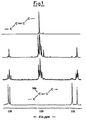
- Some 13 CNMR spectra are enclosed ( Figure 1 ) (olefinic zone; CDCl 3 as deuterated solvent; TMS as internal standard; a temperature of 25°C) of:
- the multiplicity shown by the signals relating to the CH olefinic carbons of the butadiene units (around 130 ppm), the quaternary carbons (around 135 ppm) and the tertiary CH carbons (around 124 ppm) of the isoprene units, indicates a random distribution of the monomeric units inside the polymeric chain and the absence of blocks, according to what is described in literature (see for example P. Sozzani, G. Di Silvestro, M. Grassi, M. Farina Macromolecules 17, 2538, 1984 ).
- the molecular weight determination is carried out by means of GPC analysis. All the polymers are dissolved in toluene and then eluted in THF for the determination of the molecular masses. The calculation of the latter was carried out with the universal calibration method, taking into consideration the percentage composition of butadiene and isoprene. TABLE 1a Ex. B/I feed. Time (min) Conv.* % B/I copol. m.p.
Landscapes
- Chemical & Material Sciences (AREA)
- Health & Medical Sciences (AREA)
- Chemical Kinetics & Catalysis (AREA)
- Medicinal Chemistry (AREA)
- Polymers & Plastics (AREA)
- Organic Chemistry (AREA)
- Transition And Organic Metals Composition Catalysts For Addition Polymerization (AREA)
- Addition Polymer Or Copolymer, Post-Treatments, Or Chemical Modifications (AREA)
- Organic Low-Molecular-Weight Compounds And Preparation Thereof (AREA)
Abstract
Description
- The present invention relates to random butadiene-isoprene copolymers with a trans-1,4 structure and the process for their preparation.
- 1,4-trans polybutadiene can be prepared either by using catalysts based on transition metals or with catalytic systems based on metals of group I and II. The transition metals include titanium, vanadium, chromium, rhodium, iridium, cobalt and nickel.
- The 1,4-trans polybutadiene obtained with catalysis based on transition metals is a material with resin characteristics having two melting points of 50°C and 150°C.
- Catalysts based on vanadium are by far the most important for the preparation of high molecular weight polybutadiene with a high 1,4-trans content. The AlEt3/VCl3 system gives rise to the formation of polymers whose content of 1,4-trans unit is at least 99%.
- A polybutadiene with a high 1,4-trans content can be obtained using soluble vanadium catalysts. AlEt3, VCl3 x 3 THF and AlEt2Cl-V(acac)3 systems used in benzene or in toluene provide a polymer containing over 99% of 1,4-trans units. Soluble vanadium-based catalysts are used at temperatures lower than 20°C as their activity deteriorates considerably at higher temperatures. The use of chlorine donors however (for example CCl3COOH) which re-oxidize V(II) to V(III), also allow them to be used at 80°C.
- Butadiene-isoprene copolymers with a 1,4 trans structure are described in
US-A-5,844,044 . These are used as elastomeric components mixed with other elastomers for the preparation of tyres. They have the disadvantage however of not being completely random, as they have softening temperatures (see Tables 1 and 3 ofUS-A-5,844,044 ). The structure of these copolymers, moreover, is not totally 1,4-trans. - Ricci et al. (Macromolecular Chemistry and Physics, vol. 195, no. 4, 1389-1397) describes a process for polymerising butadiene and isoprene in presence of a catalyst system derived from vanadium tri-acetylacetonate and methylaluminoxane (MAO) in toluene. The process leads to the preparation of homopolymers of butadiene or isoprene with amount of 1,4-trans units higher than 99% for butadiene homopolymer or 94% for isoprene homopolymer.
-
US-A-3 268 500 relates to a process for the preparation of polymers having a high trans-1,4 configuration from homopolymerizable of conjugated diolefins. Trans-1,4 polybutadiene characterised by a content of trans-1,4 units from 95% to 100% is prepared in presence of a catalyst system comprising a diorganoaluminium halide or triorganoaluminium and vanadium triacetylacetonate. -
GB-A-0 968 899 - Butadiene-isoprene copolymers with a 1,4-trans structure have now been found, which are completely random and therefore do not have the disadvantages described above.
- In accordance with this, a first object of the present invention relates to random butadiene-isoprene copolymers with a 1,4-trans structure, having a butadiene/isoprene molar composition ranging from 98/2 to 32/68, the above copolymers being crystalline or amorphous depending on the isoprene content wherein said copolymers are characterized in that they have an Mw value ranging from 200 x 103 to 500 x 103 and an Mw/Mn value ranging from 1,7 to 4.
- More specifically, the present invention relates to random amorphous butadiene-isoprene copolymers with a trans-1,4 structure, having a butadiene/isoprene molar composition ranging from 80/20 to 32/68 and a glass transition temperature ranging from -75°C to -67°C wherein 1,4-cis and vinyl structures not being detected by the usual analytical techniques and wherein said copolymers are characterized in that they have an Mw value ranging from 200 x 103 to 500 x 103 and an Mw/Mn value ranging from 1.7 to 4.
- The present invention also relates to random crystalline butadiene-isoprene copolymers with a trans-1,4 structure, having a butadiene/isoprene molar composition ranging from 85/15 to 98/2 and a melting point ranging from 100°C to 50°C wherein 1,4-cis and vinyl structures not being detected by the usual analytical techniques and wherein said copolymers are characterized in that they have an Mw value ranging from 200 x 103 to 500 x 103 and an Mw/Mn value ranging from 1.7 to 4.
- The term "trans-1,4 structure" means that 1,4-cis and vinyl structures (1,2 of butadiene or 3,4 of isoprene) cannot be detected by the usual analytical techniques, in particular 13CNMR.
- The term "random" means that the two monomers (isoprene and butadiene) are distributed statistically along the polymeric chain. The absence of blocks can be revealed by thermal and 13CNMR analyses of the copolymers.
- A second object of the present invention relates to a process for the preparation of random butadiene-isoprene copolymers with a trans-1,4 structure as described above, by the copolymerization of 1,3 butadiene and isoprene, carried out in the presence of one or more solvents and a catalytic system, characterized in that the above catalytic system comprises:
- (a) a first component consisting of a vanadium compound selected from:
- (a1) compounds having general formula (Ia) VO(L)n(X)m, wherein n is an integer from 1 to 3 and m ranges from zero to 2, n+m being equal to 2 or 3;
- (a2) compounds having general formula (Ib) V(L)p(X)q wherein p is an integer from 1 to 4, q ranges from zero to 3, the sum of p+q being equal to 3 or 4;
wherein L is a bidentate ligand and X is a halogen, preferably Chlorine;
- (b) a second component selected from aluminoxanes and relative derivatives.
- The term "bidentate ligand" refers to ligands selected from (i) carboxylic acids and (ii) compounds having the general formula Ra-CO-Rb, wherein:
- Ra is selected from H, a C1-C12 alkyl radical, -ORc wherein Rc is a C1-C12 alkyl radical, preferably from -H and -CH3;
- Rb is equal to -CH2-CO-(-O-)n-Rd, wherein Rd is selected from C1-C12 alkyl radicals, n is zero or 1.
- The bidentate ligands (ii) therefore comprise compounds having the following formulae wherein "alk" stands for alkyl radical: H-CO-CH2-CO-alk, alk-CO-CH2-CO-alk, alk-O-CO-CH2-CO-alk, H-CO-CH2-CO-O-alk, alk-CO-CH2-CO-O-alk, alk-O-CO-CH2-CO-O-alk.
- Typical examples of ligands L are therefore 1,3-diketones (for example 2,4-pentandione, or acetylacetone), β-keto esters (for example ethyl ester of 3-oxo butanoic acid CH3-CO-CH2-CO-OC2H5), β-ketoaldehydes (for example 3-oxo butanal CH3-CO-CH2-CHO), β-diesters (for example diethylester of propandioic acid CH3CH2O-CO-CH2-CO-OCH2CH3), monocarboxylic acids (for example acetic acid).
- Typical but non-limiting examples of compounds (a1) are vanadyl acetylacetonate or VO(acac)3, VoCl(acac)2, VO(acetate)3, VOCl(acetate)2, VO(3-oxo-butanoate)3, VOCl(3-oxo-butanoate)2, VO(3-oxo-butanal)3, VOCl(3-oxo-butanal)2.
- Typical but non-limiting examples of compounds (a2) are V(acac)3, VCl(acac)2, V(acetate)3. VCl(acetate)2, V(3-oxo-butanoate)3, VCl(3-oxo-butanoate)2, V(3-oxo-butanal)3, VCl(3-oxo-butanal)2.
- In the preferred embodiment the vanadium compound is selected from compounds (a2). Even more preferably, the vanadium compound is vanadium acetylacetonate (compound belonging to group a2 wherein L = acetylacetone, p = 3, q = 0).
- As far as aluminoxanes (a2) are concerned, it is known that these are compounds containing Al-O-Al bonds, with a varying O/A1 ratio, which can be obtained by the reaction, under controlled conditions, of an aluminum alkyl, or aluminum alkyl halide, with water or other compounds containing pre-established quantities of available water, as, for example, in the case of the reaction of aluminum trimethyl with aluminum hexahydrate sulfate, copper pentahydrate sulfate or iron pentahydrate sulfate.
- Aluminoxanes preferably used for the formation of the polymerization catalyst of the present invention are cyclic and/or linear, oligo- or polymeric compounds, characterized by the presence of repetitive units having the following formula:

- The process of the present invention can be carried out using a molar ratio aluminum/vanadium ranging from 10/1 to 10000/1, preferably from 100/1 to 1000/1 and a molar ratio monomers/vanadium ranging from 1 x 10³/1 to 1 x 10⁵/1, preferably from 20 x 103/1 to 50 x 103/1.
- The butadiene-isoprene copolymerization is preferably carried out in a polymerization medium comprising an inert hydrocarbon which is solvent of the monomers and catalytic system. Inert hydrocarbons which can be used in the copolymerization process comprise aliphatic, cycloaliphatic, aromatic hydrocarbons and relative mixtures. More specifically suitable hydrocarbons are those selected from the group of C4-C8 aliphatic hydrocarbons, olefins included, the group of C5-C10 cycloaliphatic hydrocarbons, the group of aromatic hydrocarbons (preferably toluene) and relative mixtures.
- The copolymerization process of the present invention is carried out at a temperature ranging from -50°C to +60°C, preferably from -20°C to +20°C.
- The copolymerization reaction can be stopped by the addition of one or more terminators suitable for deactivating the catalytic system, followed by the conventional desolventization, washing and drying phases, phases normally used in the production of polydienes. The terminator typically used for deactivating the catalytic system is a protic compound, which includes, but is not limited to, an alcohol, a carboxylic acid, an inorganic acid, water or a combination of these. An antioxidant such as 2,6-di-ter-butyl-1,4-methylphenol can be added, before, after or with the addition of the terminator. The quantity of antioxidant usually ranges from 0.2% to 1% by weight with respect to the polymer.
- At the end of the copolymerization, the copolymer can be recovered using the standard techniques, preferably by means of the coagulation technique. Any possible residues of solvent can be removed from the polymer by evaporation, which can be facilitated by high temperatures and the application of a vacuum.
- In the experimental examples provided further on, as the tests are carried out batchwise, the conversion is specifically kept low in order to maintain the ratio between the monomers as constant as possible. It is obviously also possible to operate at higher conversions, as required on an industrial scale, when operating in continuous processes, in which the two monomers are fed in continuous.
- The process of the present invention can also be carried out in the presence of the activators normally used with catalysts based on vanadium (for example chloro-esters).
- It should be noted that the process of the present invention requires a much simpler catalytic system than that described in
US-A-5,844,044 . In the process of the present invention, in fact, the catalytic system simply consists of the vanadium compound and aluminoxane. On the contrary, the process ofUS-A-5,844,044 comprises the use of an extremely complex catalytic system which includes (see example 1 ofUS-A-5,844,044 ) a suspension in hexane of aluminum triisobutyl, vanadium trichloride and titanium tetrachloride. - Finally, it should be pointed out that the catalytic activity of the catalytic system of
US-A-5,844,044 is lower than the catalytic activity of the catalytic system of the present invention. InUS-A-5,844,044 , in fact, the polymerization times are in the order of a few hours, whereas in the case of the present invention, they are in the order of minutes, obviously with the same conversion. - The process of the present invention allows copolymers to be obtained having crystalline or amorphous characteristics in relation to the isoprene content in the copolymer. The crystalline products can be used for the modification of plastic materials; the amorphous products can be used in the sector of compound for tyres and in general in the field of rubber compounds.
- As far as the molecular weights are concerned, the copolymers obtained according to the process of the present invention have an Mw value ranging from 200 x 103 to 500 x 103 and an Mw/Mn value ranging from_1.7 to 4, preferably an Mw value ranging from 250 x 103 to 400 x 103 and an Mw/Mn value ranging from 2.0 to 3.0. These Mw and Mw/Mn values make the copolymers of the present invention particularly suitable for application in the compound sector by means of closed mixers and continuous extruders.
- The following examples are provided for a better understanding of the present invention.
- The following materials were used in the examples provided below:
- ** Vanadium triacetylacetonate [V(acac)3] (Aldrich, purity > 97%);
- ** Methylalumoxane (Witco, solution at 10% by weight in toluene);
- ** Toluene (Baker, purity > 99% refluxed on Na for about 8 hours, then distilled and preserved on molecular sieves in an environment of dry nitrogen;
- ** Butadiene (Air Liquide, purity > 99.5%) evaporated from the container before each test, dried by passing it through a column packed with molecular sieves and finally condensed in the reactor previously cooled to -20°C;
- ** Isoprene (Aldrich, 99% purity) refluxed on CaH2 for about 2 hours, then distilled and preserved under dry nitrogen.
- The butadiene (2 ml) is condensed in a 50 ml anhydrified glass reactor, maintained at -20°C. Isoprene and toluene are subsequently charged, in this order, into the above reactor. The solution thus prepared is brought to the desired temperature; the MAO and V(acac)3 are then added as toluene solutions. The polymerization is terminated with methanol containing small quantities of hydrochloric acid; the polymer is coagulated, washed repeatedly with methanol and then dried at room temperature under vacuum.
- The following products were used in the examples of Table 1: butadiene 2 ml (except in tests 9C and 16C in which it was not used); toluene as solvent (total volume 30 ml); V(acac)3 5 x 10⁻⁶ moles; MAO/V = 1000 moles/moles.
- Again in Table 1, the B/I feed ratios represent the butadiene/isoprene molar ratios in the feeding, whereas B/I pol. represents the butadiene/isoprene molar ratio in the final copolymer.
- The differential scanning calorimetric analyses DSC are effected on a Perkin-Elmer Pyris instrument. The samples, about 10 mg, were heated from -150°C to 150°C in an atmosphere of helium (30 ml/min) with a scanning rate of 20°C/min.
- The 13CNMR analysis is carried out with a Bruker AM 270 instrument. The spectra are obtained in CDCl3 at room temperature using tetramethylsilane (TMS) as internal standard, or in C2D2Cl4 at 103°C with hexamethyldisiloxane (HMDS) as internal standard. The concentration of the polymer is about 10% by weight. Some 13CNMR spectra are enclosed (
Figure 1 ) (olefinic zone; CDCl3 as deuterated solvent; TMS as internal standard; a temperature of 25°C) of: - a) 1,4-trans polybutadiene (Table 1, Example 1c);
- b) butadiene-isoprene copolymer with a B/I composition = 86.5/13.5 (Table 1, Example 4);
- c) butadiene-isoprene copolymer with a B/I composition = 55.5/44.5 (Table 1, Example 7);
- d) polyisoprene with a mixed 1,4-cis/1,4-trans structure 60/40 (Table 1, Example 9c).
- The position of the peaks (value in ppm) relating to the olefinic carbons of the butadiene and isoprene units, on the basis of what is specified in literature (in particular (i) K.F. Elgert, G. Quack, B. Stutzel, Polymer 16, 154 (1975), (ii) F. Conti, A. Segre, P. Pini, L. Porri, Polymer 15, 5 (1974), (iii) P. Sozzani, G. Di Silvestro, M. Grassi, M. Farina, Macromolecules 17, 2532, 1984) clearly indicates that all the monomeric units present in the butadiene and isoprene copolymers have a 1,4-trans structure.
- The composition of the butadiene-isoprene copolymers is evaluated by the 13CNMR spectra by means of the relation:

- The multiplicity shown by the signals relating to the CH olefinic carbons of the butadiene units (around 130 ppm), the quaternary carbons (around 135 ppm) and the tertiary CH carbons (around 124 ppm) of the isoprene units, indicates a random distribution of the monomeric units inside the polymeric chain and the absence of blocks, according to what is described in literature (see for example P. Sozzani, G. Di Silvestro, M. Grassi, M. Farina Macromolecules 17, 2538, 1984).
- The molecular weight determination is carried out by means of GPC analysis. All the polymers are dissolved in toluene and then eluted in THF for the determination of the molecular masses. The calculation of the latter was carried out with the universal calibration method, taking into consideration the percentage composition of butadiene and isoprene.
TABLE 1a Ex. B/I feed. Time (min) Conv.* % B/I copol. m.p. °C Tg °C Mw x 103 Mw/Mn 1c 100/0 3 25.9 100/0 109 2 84/16 10 22.4 95.5/4.5 57 400 3.0 3 72/28 10 22.1 95/5 52 410 3.1 4 63.5/36.5 10 18.1 86.5/13.5 50 360 2.4 5 46.5/53.5 10 11.1 82.5/17.5 -5 -72 352 2.5 6 34/66 10 7.5 68.5/31.5 -21 -75 305 2.2 7 24.5/75.5 10 7.7 55.5/44.5 -72 290 2.2 8 13.5/86.5 10 7 46/54 -70 270 2.1 8b 10.5/89.5 10 5 37/63 -69 330 2.1 9c 0/100 1640 4.3 0/100 * The conversions were kept low (using short polymerization times, i.e. 10 minutes) in order to keep the molar ratio of the monomers as constant as possible (equal to that of the charge). - butadiene, 2 ml (in test 9c butadiene is not present); toluene as solvent (total volume, 30 ml); V, 5 x 10⁻⁶ moles; MAO/V = 1000; temperature: +20°C.
- Note: In all the copolymers indicated in the Table, the isoprene and butadiene units have a 1,4-trans structure. Only the polyisoprene has a mixed cis-1,4/trans-1,4 structure, 60/40.
TABLE 1b Ex. B/I feed. Time (min) Conv.* % B/I copol. m.p. °C Tg °C Mw x 103 Mw/Mn 10c 100/0 3 16.6 100/0 117 11 93/7 3 12.4 98/2 101 500 3.0 12 87/13 3 12.0 96/4 75 495 3.0 13 72/28 3 9.6 89.5/10.5 51 480 2.9 14 56.5/43.5 3 7.4 80.5/19.5 9 -73 355 2.5 15 39.5/60.5 4 10.3 75.5/24.5 -21 -70 382 2.2 16 24.5/75.5 4 6.1 50.5/49.5 -72 340 2.3 17 16.5/83.5 4 3.8 46.5/53.5 -71 350 2.0 17a 10/90 4 2.5 35.5/64.5 -69 330 2.1 17b 8.5/91.5 4 2.0 32/68 -67 340 2.2 18c 0/100 44 40.9 0/100 46 * The conversions were kept low (using short polymerization times, i.e. 3-4 minutes) in order to keep the molar ratio of the monomers as constant as possible (equal to that of the charge). - butadiene, 2 ml (in test 18c butadiene is not present); toluene as solvent (total volume, 30 ml); V, 5 x 10⁻⁶ moles; MAO/V = 1000; temperature: - 30°C.
- Note: In all the copolymers indicated in Table 1b, the isoprene and butadiene units have a 1,4-trans structure.
-
- ** At a temperature of +20°C, the catalytic system V(acac)3-MAO produces crystalline 1,4-trans polybutadiene (Table 1a, Example 1c) and amorphous polyisoprene with a mixed 1,4-cis and 1,4-trans structure (about 60:40 molar fraction, Table 1a, Example 9c).
- ** At a temperature of -30°C, both monomers produce crystalline polymers having a 1,4-trans structure (Table 1b, Examples 10c and 18c).
- **The isoprene units always have a 1,4-trans structure in the copolymers, regardless of the polymerization temperature. This result is particularly surprising for the tests effected at +20°C, as the homopolymerization of isoprene at room temperature gives a polymer with a mixed cis/trans structure (Table 1, Example 9c).
- ** When the butadiene content in the copolymers is ≥ 85%, crystalline 1,4-trans copolymers are obtained, whose melting point decreases with an increase in the isoprene content.
- ** When the butadiene content in the copolymer is less than 85%, amorphous copolymers are obtained, having a Tg ranging from -67°C to -75°C.
- ** On the basis of the feeding composition and composition of the copolymers determined by means of 13CNMR analysis, and applying the Fineman-Ross equation, the following reactivity coefficient values are obtained (subscript 1 refers to butadiene, subscript 2 to isoprene):
- +20°C r1 = 3.6; r2 = 0.17; r1 x r2 = 0.61;
- -30°C r1 = 3.0; r2 = 0.16; r1 x r2 = 0.48.
- The above values are in accordance with a random distribution of the comonomers inside the polymeric chain.
Claims (15)
- Random butadiene-isoprene copolymers with a 1,4-trans structure, having a butadiene/isoprene molar composition ranging from 98/2 to 32/68, the above copolymers being crystalline or amorphous depending on the isoprene content wherein 1,4-cis and vinyl structures not being detected by the usual analytical techniques and wherein said copolymers are characterized in that they have an Mw value ranging from 200 x 103 to 500 x 103 and an Mw/Mn value ranging from 1.7 to 4.
- The copolymers according to claim 1, having a butadiene/isoprene molar composition ranging from 80/20 to 32/68, characterized in that they are amorphous and have a glass transition temperature ranging from -75°C to -67°C.
- The copolymers according to claim 1, having a butadiene/isoprene molar composition ranging from 85/15 to 98/2, characterized in that they are crystalline and have a melting point ranging from 100°C to 50°C.
- The copolymers according to claim 3, characterized in that they have an Mw value ranging from 250 x 103 to 400 x 103 and an Mw/Mn value ranging from 2.0 to 3.0.
- A process for the preparation of random butadieneisoprene copolymers according to claim 1 by the copolymerization of 1,3-butadiene and isoprene, carried out in the presence of one or more solvents and a catalytic system, characterized in that the above catalytic system comprises:(a) a first component consisting of a vanadium compound selected from:(a1) compounds having general formula (Ia) VO(L)n(X)m wherein n is an integer from 1 to 3 and m ranges from zero to 2, n+m being equal to 2 or 3;(a2) compounds having general formula (Ib) V(L)p(X)q wherein p is an integer from 1 to 4, q ranges from zero to 3, the sum of p+q being equal to 3 or 4;wherein L is a bidentate ligand and X is a halogen, preferably Chlorine;(b) a second component selected from aluminoxanes and relative derivatives.
- The process according to claim 5, characterized in that the vanadium compound is selected from compounds (a2), or those having general formula (Ib) V(L)p(X)q.
- The process according to claim 6, characterized in that the compound having the formula (Ib) V(L)p(X)q is vanadium acetylacetonate (compound belonging to the group a2 wherein L = acetylacetone, p = 3, q = 0).
- The process according to claim 5, characterized in that the molar ratio aluminum/vanadium ranges from 10/1 to 10000/1.
- The process according to claim 8, wherein the molar ratio aluminum/vanadium ranges from 100/1 to 1000/1.
- The process according to claim 5, characterized in that the molar ratio monomers/vanadium ranges from 1 x 10³/1 to 1 x 10⁸/1.
- The process according to claim 10, characterized in that the molar ratio monomers/vanadium ranges from 20 x 103/1 to 50 x 103/1.
- The process according to claim 5, characterized in that the solvent is selected from aliphatic hydrocarbons, including olefins, cycloaliphatic, aromatic hydrocarbons and relative mixtures.
- The process according to claim 12, characterized in that the solvent is selected from the group of C4-C8 ali-, phatic hydrocarbons, olefins included, the group of C8-C10 cycloaliphatic hydrocarbons, the group of aromatic hydrocarbons (preferably toluene) and relative mixtures.
- The process according to claim 5, characterized in that it is carried out at a temperature ranging from -50°C to +60°C.
- The process according to claim 14, characterized in that it is carried out at a temperature ranging from -20°C to +20°C.
Applications Claiming Priority (3)
| Application Number | Priority Date | Filing Date | Title |
|---|---|---|---|
| IT2001MI001901A ITMI20011901A1 (en) | 2001-09-12 | 2001-09-12 | RANDOM BUTADIENE-ISOPRENE COPOLYMERS STRUCTURE TRANS-1,4 |
| ITMI20011901 | 2001-09-12 | ||
| PCT/EP2002/009672 WO2003022919A1 (en) | 2001-09-12 | 2002-08-27 | Random butadiene-isoprene copolymers with a trans-1,4 structure |
Publications (2)
| Publication Number | Publication Date |
|---|---|
| EP1425343A1 EP1425343A1 (en) | 2004-06-09 |
| EP1425343B1 true EP1425343B1 (en) | 2012-07-04 |
Family
ID=11448357
Family Applications (1)
| Application Number | Title | Priority Date | Filing Date |
|---|---|---|---|
| EP02774542A Expired - Lifetime EP1425343B1 (en) | 2001-09-12 | 2002-08-27 | Random butadiene-isoprene copolymers with a trans-1,4 structure |
Country Status (6)
| Country | Link |
|---|---|
| US (1) | US7074868B2 (en) |
| EP (1) | EP1425343B1 (en) |
| CA (1) | CA2460389C (en) |
| ES (1) | ES2390120T3 (en) |
| IT (1) | ITMI20011901A1 (en) |
| WO (1) | WO2003022919A1 (en) |
Families Citing this family (6)
| Publication number | Priority date | Publication date | Assignee | Title |
|---|---|---|---|---|
| US20050061418A1 (en) * | 2003-08-25 | 2005-03-24 | Bates Kenneth Allen | Pneumatic tire having a component containing high trans isoprene-butadiene rubber |
| CN105601814B (en) | 2016-03-24 | 2020-11-27 | 青岛科技大学 | Industrialized production method of trans-butadiene copolymer rubber and device for implementing the method |
| CN107686536B (en) * | 2017-09-30 | 2021-09-28 | 青岛科技大学 | Industrial production method of trans-1, 4-butadiene-isoprene copolymer rubber and device for implementing method |
| IT201800005841A1 (en) | 2018-05-30 | 2019-11-30 | PROCEDURE FOR THE PREPARATION OF RANDOM BUTADIENE-ISOPRENE COPOLYMERS WITH A HIGH CONTENT OF UNITS 1,4-CIS | |
| CN112552451B (en) * | 2019-09-25 | 2022-08-19 | 中国石油化工股份有限公司 | Random butadiene-isoprene copolymer, synthesis method thereof and low-rolling-resistance automobile tire tread rubber |
| CN114349904B (en) * | 2022-01-12 | 2023-08-15 | 青岛科技大学 | Industrial production method and device for polydiene in-kettle alloy |
Family Cites Families (5)
| Publication number | Priority date | Publication date | Assignee | Title |
|---|---|---|---|---|
| NL273511A (en) | 1961-01-20 | |||
| CS175641B1 (en) * | 1973-06-14 | 1977-05-31 | Boris D Babickij | Making method of 2-alkyl-1,3-butadiene's 1,4-transpolymers and/or 2-alkyl-1,3-butadiene's stereoregular 1,4 trans-copolymers with 1,3-butadiene |
| US5405815A (en) * | 1993-06-17 | 1995-04-11 | The Goodyear Tire & Rubber Company | Process for preparing a catalyst system useful in the synthesis of isoprene-butadiene rubber |
| US5405927A (en) * | 1993-09-22 | 1995-04-11 | The Goodyear Tire & Rubber Company | Isoprene-butadiene rubber |
| US5844044A (en) * | 1997-07-18 | 1998-12-01 | The Goodyear Tire & Rubber Company | Trans 1,4-butadiene/isoprene copolymers and tire with tread thereof |
-
2001
- 2001-09-12 IT IT2001MI001901A patent/ITMI20011901A1/en unknown
-
2002
- 2002-08-27 ES ES02774542T patent/ES2390120T3/en not_active Expired - Lifetime
- 2002-08-27 WO PCT/EP2002/009672 patent/WO2003022919A1/en not_active Ceased
- 2002-08-27 US US10/488,260 patent/US7074868B2/en not_active Expired - Lifetime
- 2002-08-27 EP EP02774542A patent/EP1425343B1/en not_active Expired - Lifetime
- 2002-08-27 CA CA002460389A patent/CA2460389C/en not_active Expired - Fee Related
Also Published As
| Publication number | Publication date |
|---|---|
| ITMI20011901A1 (en) | 2003-03-12 |
| EP1425343A1 (en) | 2004-06-09 |
| US20050222348A1 (en) | 2005-10-06 |
| ITMI20011901A0 (en) | 2001-09-12 |
| WO2003022919A1 (en) | 2003-03-20 |
| US7074868B2 (en) | 2006-07-11 |
| CA2460389A1 (en) | 2003-03-20 |
| CA2460389C (en) | 2008-10-28 |
| ES2390120T3 (en) | 2012-11-06 |
Similar Documents
| Publication | Publication Date | Title |
|---|---|---|
| EP0511015B1 (en) | Process for producing polybutadiene | |
| Bazzini et al. | Diethylbis (2, 2′‐bipyridine) iron/MAO. A Very Active and Stereospecific Catalyst for 1, 3‐Diene Polymerization | |
| CA1223396A (en) | Process for producing conjugated diene polymer | |
| US5879805A (en) | Gas phase polymerization of vinylpolybutadiene | |
| CA1124945A (en) | Copolymerization of conjugated diolefins using a chromium-containing catalyst system | |
| JP4651921B2 (en) | Pneumatic tire | |
| US20090264608A1 (en) | Method for producing norbornene based addition (co)polymer | |
| EP1078939A2 (en) | Process for copolymerisation of conjugated dienes and vinylaromatic monomers in presence of a catalyst containing a rare earth and the use of the copolymerisate in a rubber composition for a tire | |
| Ricci et al. | Polymerization of 1, 3-dienes with catalysts based on mono-and bis-cyclopentadienyl derivatives of vanadium | |
| EP1117713A1 (en) | Method for polymerizing conjugated diolefins (dienes) with rare earth catalysts in the presence of vinylaromatic solvents | |
| US3464965A (en) | Process for producing polybutadienes having reduced cold flow tendency | |
| EP0778291A1 (en) | Catalyst and process for producing conjugated diene polymer | |
| US3803106A (en) | Process for preparing a copolymer of ethylene and a conjugated diene | |
| US7074868B2 (en) | Random butadiene-isoprene copolymers with a trans-1, 4 structure | |
| US20050038209A1 (en) | Process for manufacturing vinyl-rich polybutadiene rubber | |
| US7056994B2 (en) | Catalyst composition | |
| JPS58196213A (en) | Preparation of cis-1,4-polybutadiene | |
| US4314045A (en) | Polymerization process for cis-1,4-polybutadiene using aliphatic solvents and an aromatic polymerization regulator | |
| KR100264513B1 (en) | Method for controlling degree of branching of polybutadiene having a high content of 1,4-cis | |
| US3445446A (en) | Process and catalyst for polymerizing butadiene or isoprene whereby the catalyst is composed of an organoaluminum compound,iodine,and tix2 or tix3 complexed with fatty acid amides | |
| US3451987A (en) | Process and catalytic compositions for obtaining amorphous 1,2-polybutadiene and the products thereof | |
| KR20010032176A (en) | Catalyst components for the polymerization of dienes, catalyst obtained therefrom, and process for the preparation of polydienes using the same | |
| US3639520A (en) | Production of butadiene-styrene graft copolymers with a nickel carboxylic acid salt or nickel organic complex compound-titanium tetrachloride-trialkylaluminum catalyst | |
| KR20010070978A (en) | Method for Polymerizing Conjugated Diolefins (Dienes) with Catalysts Based on Vanadium Compounds in the Presence of Vinylaromatic Solvents | |
| EP0745618A1 (en) | Process for preparing crystalline high, 1,4-trans polybutadiene |
Legal Events
| Date | Code | Title | Description |
|---|---|---|---|
| PUAI | Public reference made under article 153(3) epc to a published international application that has entered the european phase |
Free format text: ORIGINAL CODE: 0009012 |
|
| 17P | Request for examination filed |
Effective date: 20040310 |
|
| AK | Designated contracting states |
Kind code of ref document: A1 Designated state(s): AT BE BG CH CY CZ DE DK EE ES FI FR GB GR IE IT LI LU MC NL PT SE SK TR |
|
| AX | Request for extension of the european patent |
Extension state: AL LT LV MK RO SI |
|
| 17Q | First examination report despatched |
Effective date: 20041029 |
|
| GRAP | Despatch of communication of intention to grant a patent |
Free format text: ORIGINAL CODE: EPIDOSNIGR1 |
|
| GRAS | Grant fee paid |
Free format text: ORIGINAL CODE: EPIDOSNIGR3 |
|
| RAP1 | Party data changed (applicant data changed or rights of an application transferred) |
Owner name: ENI S.P.A. Owner name: POLIMERI EUROPA S.P.A. |
|
| RAP1 | Party data changed (applicant data changed or rights of an application transferred) |
Owner name: ENI S.P.A. Owner name: VERSALIS S.P.A. |
|
| GRAA | (expected) grant |
Free format text: ORIGINAL CODE: 0009210 |
|
| AK | Designated contracting states |
Kind code of ref document: B1 Designated state(s): AT BE BG CH CY CZ DE DK EE ES FI FR GB GR IE IT LI LU MC NL PT SE SK TR |
|
| REG | Reference to a national code |
Ref country code: GB Ref legal event code: FG4D |
|
| REG | Reference to a national code |
Ref country code: CH Ref legal event code: EP |
|
| REG | Reference to a national code |
Ref country code: AT Ref legal event code: REF Ref document number: 565166 Country of ref document: AT Kind code of ref document: T Effective date: 20120715 |
|
| REG | Reference to a national code |
Ref country code: IE Ref legal event code: FG4D |
|
| REG | Reference to a national code |
Ref country code: DE Ref legal event code: R096 Ref document number: 60243265 Country of ref document: DE Effective date: 20120830 |
|
| REG | Reference to a national code |
Ref country code: SE Ref legal event code: TRGR |
|
| REG | Reference to a national code |
Ref country code: NL Ref legal event code: T3 |
|
| REG | Reference to a national code |
Ref country code: ES Ref legal event code: FG2A Ref document number: 2390120 Country of ref document: ES Kind code of ref document: T3 Effective date: 20121106 |
|
| REG | Reference to a national code |
Ref country code: SK Ref legal event code: T3 Ref document number: E 12557 Country of ref document: SK |
|
| REG | Reference to a national code |
Ref country code: EE Ref legal event code: FG4A Ref document number: E007213 Country of ref document: EE Effective date: 20121001 |
|
| PG25 | Lapsed in a contracting state [announced via postgrant information from national office to epo] |
Ref country code: CY Free format text: LAPSE BECAUSE OF FAILURE TO SUBMIT A TRANSLATION OF THE DESCRIPTION OR TO PAY THE FEE WITHIN THE PRESCRIBED TIME-LIMIT Effective date: 20120704 |
|
| PG25 | Lapsed in a contracting state [announced via postgrant information from national office to epo] |
Ref country code: PT Free format text: LAPSE BECAUSE OF FAILURE TO SUBMIT A TRANSLATION OF THE DESCRIPTION OR TO PAY THE FEE WITHIN THE PRESCRIBED TIME-LIMIT Effective date: 20121105 Ref country code: GR Free format text: LAPSE BECAUSE OF FAILURE TO SUBMIT A TRANSLATION OF THE DESCRIPTION OR TO PAY THE FEE WITHIN THE PRESCRIBED TIME-LIMIT Effective date: 20121005 |
|
| REG | Reference to a national code |
Ref country code: CH Ref legal event code: PL |
|
| PG25 | Lapsed in a contracting state [announced via postgrant information from national office to epo] |
Ref country code: MC Free format text: LAPSE BECAUSE OF NON-PAYMENT OF DUE FEES Effective date: 20120831 |
|
| PG25 | Lapsed in a contracting state [announced via postgrant information from national office to epo] |
Ref country code: CH Free format text: LAPSE BECAUSE OF NON-PAYMENT OF DUE FEES Effective date: 20120831 Ref country code: LI Free format text: LAPSE BECAUSE OF NON-PAYMENT OF DUE FEES Effective date: 20120831 Ref country code: DK Free format text: LAPSE BECAUSE OF FAILURE TO SUBMIT A TRANSLATION OF THE DESCRIPTION OR TO PAY THE FEE WITHIN THE PRESCRIBED TIME-LIMIT Effective date: 20120704 |
|
| PLBE | No opposition filed within time limit |
Free format text: ORIGINAL CODE: 0009261 |
|
| STAA | Information on the status of an ep patent application or granted ep patent |
Free format text: STATUS: NO OPPOSITION FILED WITHIN TIME LIMIT |
|
| REG | Reference to a national code |
Ref country code: IE Ref legal event code: MM4A |
|
| 26N | No opposition filed |
Effective date: 20130405 |
|
| PG25 | Lapsed in a contracting state [announced via postgrant information from national office to epo] |
Ref country code: IE Free format text: LAPSE BECAUSE OF NON-PAYMENT OF DUE FEES Effective date: 20120827 Ref country code: BG Free format text: LAPSE BECAUSE OF FAILURE TO SUBMIT A TRANSLATION OF THE DESCRIPTION OR TO PAY THE FEE WITHIN THE PRESCRIBED TIME-LIMIT Effective date: 20121004 |
|
| REG | Reference to a national code |
Ref country code: DE Ref legal event code: R097 Ref document number: 60243265 Country of ref document: DE Effective date: 20130405 |
|
| PG25 | Lapsed in a contracting state [announced via postgrant information from national office to epo] |
Ref country code: LU Free format text: LAPSE BECAUSE OF NON-PAYMENT OF DUE FEES Effective date: 20120827 |
|
| REG | Reference to a national code |
Ref country code: FR Ref legal event code: PLFP Year of fee payment: 15 |
|
| REG | Reference to a national code |
Ref country code: FR Ref legal event code: PLFP Year of fee payment: 16 |
|
| REG | Reference to a national code |
Ref country code: FR Ref legal event code: PLFP Year of fee payment: 17 |
|
| PGFP | Annual fee paid to national office [announced via postgrant information from national office to epo] |
Ref country code: NL Payment date: 20190826 Year of fee payment: 18 |
|
| PGFP | Annual fee paid to national office [announced via postgrant information from national office to epo] |
Ref country code: TR Payment date: 20190805 Year of fee payment: 18 Ref country code: SE Payment date: 20190828 Year of fee payment: 18 Ref country code: CZ Payment date: 20190809 Year of fee payment: 18 Ref country code: FR Payment date: 20190826 Year of fee payment: 18 Ref country code: IT Payment date: 20190826 Year of fee payment: 18 Ref country code: ES Payment date: 20190902 Year of fee payment: 18 Ref country code: DE Payment date: 20190828 Year of fee payment: 18 Ref country code: FI Payment date: 20190828 Year of fee payment: 18 Ref country code: EE Payment date: 20190805 Year of fee payment: 18 Ref country code: SK Payment date: 20190731 Year of fee payment: 18 |
|
| PGFP | Annual fee paid to national office [announced via postgrant information from national office to epo] |
Ref country code: BE Payment date: 20190827 Year of fee payment: 18 |
|
| PGFP | Annual fee paid to national office [announced via postgrant information from national office to epo] |
Ref country code: GB Payment date: 20190827 Year of fee payment: 18 Ref country code: AT Payment date: 20190801 Year of fee payment: 18 |
|
| REG | Reference to a national code |
Ref country code: DE Ref legal event code: R119 Ref document number: 60243265 Country of ref document: DE |
|
| REG | Reference to a national code |
Ref country code: EE Ref legal event code: MM4A Ref document number: E007213 Country of ref document: EE Effective date: 20200831 |
|
| REG | Reference to a national code |
Ref country code: FI Ref legal event code: MAE |
|
| REG | Reference to a national code |
Ref country code: SE Ref legal event code: EUG |
|
| REG | Reference to a national code |
Ref country code: NL Ref legal event code: MM Effective date: 20200901 |
|
| REG | Reference to a national code |
Ref country code: AT Ref legal event code: MM01 Ref document number: 565166 Country of ref document: AT Kind code of ref document: T Effective date: 20200827 |
|
| GBPC | Gb: european patent ceased through non-payment of renewal fee |
Effective date: 20200827 |
|
| REG | Reference to a national code |
Ref country code: SK Ref legal event code: MM4A Ref document number: E 12557 Country of ref document: SK Effective date: 20200827 |
|
| PG25 | Lapsed in a contracting state [announced via postgrant information from national office to epo] |
Ref country code: FI Free format text: LAPSE BECAUSE OF NON-PAYMENT OF DUE FEES Effective date: 20200827 Ref country code: EE Free format text: LAPSE BECAUSE OF NON-PAYMENT OF DUE FEES Effective date: 20200831 Ref country code: CZ Free format text: LAPSE BECAUSE OF NON-PAYMENT OF DUE FEES Effective date: 20200827 |
|
| REG | Reference to a national code |
Ref country code: BE Ref legal event code: MM Effective date: 20200831 |
|
| PG25 | Lapsed in a contracting state [announced via postgrant information from national office to epo] |
Ref country code: SE Free format text: LAPSE BECAUSE OF NON-PAYMENT OF DUE FEES Effective date: 20200828 Ref country code: AT Free format text: LAPSE BECAUSE OF NON-PAYMENT OF DUE FEES Effective date: 20200827 |
|
| PG25 | Lapsed in a contracting state [announced via postgrant information from national office to epo] |
Ref country code: SK Free format text: LAPSE BECAUSE OF NON-PAYMENT OF DUE FEES Effective date: 20200827 |
|
| PG25 | Lapsed in a contracting state [announced via postgrant information from national office to epo] |
Ref country code: DE Free format text: LAPSE BECAUSE OF NON-PAYMENT OF DUE FEES Effective date: 20210302 Ref country code: FR Free format text: LAPSE BECAUSE OF NON-PAYMENT OF DUE FEES Effective date: 20200831 Ref country code: IT Free format text: LAPSE BECAUSE OF NON-PAYMENT OF DUE FEES Effective date: 20200827 |
|
| PG25 | Lapsed in a contracting state [announced via postgrant information from national office to epo] |
Ref country code: BE Free format text: LAPSE BECAUSE OF NON-PAYMENT OF DUE FEES Effective date: 20200831 Ref country code: GB Free format text: LAPSE BECAUSE OF NON-PAYMENT OF DUE FEES Effective date: 20200827 |
|
| PG25 | Lapsed in a contracting state [announced via postgrant information from national office to epo] |
Ref country code: NL Free format text: LAPSE BECAUSE OF NON-PAYMENT OF DUE FEES Effective date: 20200901 |
|
| REG | Reference to a national code |
Ref country code: ES Ref legal event code: FD2A Effective date: 20211229 |
|
| PG25 | Lapsed in a contracting state [announced via postgrant information from national office to epo] |
Ref country code: ES Free format text: LAPSE BECAUSE OF NON-PAYMENT OF DUE FEES Effective date: 20200828 |
|
| PG25 | Lapsed in a contracting state [announced via postgrant information from national office to epo] |
Ref country code: TR Free format text: LAPSE BECAUSE OF NON-PAYMENT OF DUE FEES Effective date: 20200827 |