EP1424127A1 - Thiopyryl cation and derivatives of same trapped in a zeolitic material - Google Patents
Thiopyryl cation and derivatives of same trapped in a zeolitic material Download PDFInfo
- Publication number
- EP1424127A1 EP1424127A1 EP02764894A EP02764894A EP1424127A1 EP 1424127 A1 EP1424127 A1 EP 1424127A1 EP 02764894 A EP02764894 A EP 02764894A EP 02764894 A EP02764894 A EP 02764894A EP 1424127 A1 EP1424127 A1 EP 1424127A1
- Authority
- EP
- European Patent Office
- Prior art keywords
- cation
- material according
- zeolite
- zeolitic material
- trapped
- Prior art date
- Legal status (The legal status is an assumption and is not a legal conclusion. Google has not performed a legal analysis and makes no representation as to the accuracy of the status listed.)
- Granted
Links
- 239000000463 material Substances 0.000 title claims abstract description 76
- 150000001768 cations Chemical class 0.000 title claims abstract description 41
- HNPSIPDUKPIQMN-UHFFFAOYSA-N dioxosilane;oxo(oxoalumanyloxy)alumane Chemical compound O=[Si]=O.O=[Al]O[Al]=O HNPSIPDUKPIQMN-UHFFFAOYSA-N 0.000 claims abstract description 57
- -1 2,4,6-triphenylthiopyryl Chemical group 0.000 claims abstract description 49
- 239000010457 zeolite Substances 0.000 claims abstract description 43
- 229910021536 Zeolite Inorganic materials 0.000 claims abstract description 33
- 229910000323 aluminium silicate Inorganic materials 0.000 claims abstract description 31
- 238000000034 method Methods 0.000 claims abstract description 18
- 230000015572 biosynthetic process Effects 0.000 claims abstract description 10
- 239000000203 mixture Substances 0.000 claims abstract description 9
- 150000002892 organic cations Chemical class 0.000 claims abstract description 9
- 238000003786 synthesis reaction Methods 0.000 claims abstract description 8
- 238000001179 sorption measurement Methods 0.000 claims abstract description 6
- 239000000725 suspension Substances 0.000 claims description 15
- RWSOTUBLDIXVET-UHFFFAOYSA-N Dihydrogen sulfide Chemical compound S RWSOTUBLDIXVET-UHFFFAOYSA-N 0.000 claims description 13
- 229910000037 hydrogen sulfide Inorganic materials 0.000 claims description 13
- 239000002243 precursor Substances 0.000 claims description 12
- 239000011148 porous material Substances 0.000 claims description 11
- 239000002904 solvent Substances 0.000 claims description 10
- WEVYAHXRMPXWCK-UHFFFAOYSA-N Acetonitrile Chemical class CC#N WEVYAHXRMPXWCK-UHFFFAOYSA-N 0.000 claims description 9
- RWSOTUBLDIXVET-UHFFFAOYSA-M hydrosulfide Chemical compound [SH-] RWSOTUBLDIXVET-UHFFFAOYSA-M 0.000 claims description 9
- 125000005842 heteroatom Chemical group 0.000 claims description 8
- WNWXXQTUESDFIN-UHFFFAOYSA-N 2,4,6-triphenylthiopyrylium Chemical compound C1=CC=CC=C1C1=CC(C=2C=CC=CC=2)=[S+]C(C=2C=CC=CC=2)=C1 WNWXXQTUESDFIN-UHFFFAOYSA-N 0.000 claims description 6
- VYPSYNLAJGMNEJ-UHFFFAOYSA-N Silicium dioxide Chemical compound O=[Si]=O VYPSYNLAJGMNEJ-UHFFFAOYSA-N 0.000 claims description 6
- 239000003960 organic solvent Substances 0.000 claims description 6
- 229920006395 saturated elastomer Polymers 0.000 claims description 6
- 239000007787 solid Substances 0.000 claims description 6
- 150000001875 compounds Chemical class 0.000 claims description 5
- RTAQQCXQSZGOHL-UHFFFAOYSA-N Titanium Chemical group [Ti] RTAQQCXQSZGOHL-UHFFFAOYSA-N 0.000 claims description 4
- 125000001624 naphthyl group Chemical group 0.000 claims description 4
- 125000001997 phenyl group Chemical group [H]C1=C([H])C([H])=C(*)C([H])=C1[H] 0.000 claims description 4
- 125000000217 alkyl group Chemical group 0.000 claims description 3
- 125000003118 aryl group Chemical group 0.000 claims description 3
- 238000010438 heat treatment Methods 0.000 claims description 3
- 238000004519 manufacturing process Methods 0.000 claims description 3
- 238000010992 reflux Methods 0.000 claims description 3
- 150000001335 aliphatic alkanes Chemical class 0.000 claims description 2
- 150000001924 cycloalkanes Chemical class 0.000 claims description 2
- 125000001495 ethyl group Chemical group [H]C([H])([H])C([H])([H])* 0.000 claims description 2
- 238000000605 extraction Methods 0.000 claims description 2
- 125000000623 heterocyclic group Chemical group 0.000 claims description 2
- 125000001449 isopropyl group Chemical group [H]C([H])([H])C([H])(*)C([H])([H])[H] 0.000 claims description 2
- 125000002496 methyl group Chemical group [H]C([H])([H])* 0.000 claims description 2
- 125000001436 propyl group Chemical group [H]C([*])([H])C([H])([H])C([H])([H])[H] 0.000 claims description 2
- 235000012239 silicon dioxide Nutrition 0.000 claims description 2
- 238000004090 dissolution Methods 0.000 abstract 1
- YMWUJEATGCHHMB-UHFFFAOYSA-N Dichloromethane Chemical compound ClCCl YMWUJEATGCHHMB-UHFFFAOYSA-N 0.000 description 6
- 239000002245 particle Substances 0.000 description 5
- 238000002360 preparation method Methods 0.000 description 5
- 238000002329 infrared spectrum Methods 0.000 description 4
- XDTMQSROBMDMFD-UHFFFAOYSA-N Cyclohexane Chemical compound C1CCCCC1 XDTMQSROBMDMFD-UHFFFAOYSA-N 0.000 description 3
- 238000010521 absorption reaction Methods 0.000 description 3
- 238000006243 chemical reaction Methods 0.000 description 3
- 238000010586 diagram Methods 0.000 description 2
- 238000000295 emission spectrum Methods 0.000 description 2
- 238000000985 reflectance spectrum Methods 0.000 description 2
- OKYDCMQQLGECPI-UHFFFAOYSA-N thiopyrylium Chemical compound C1=CC=[S+]C=C1 OKYDCMQQLGECPI-UHFFFAOYSA-N 0.000 description 2
- BHKKSKOHRFHHIN-MRVPVSSYSA-N 1-[[2-[(1R)-1-aminoethyl]-4-chlorophenyl]methyl]-2-sulfanylidene-5H-pyrrolo[3,2-d]pyrimidin-4-one Chemical compound N[C@H](C)C1=C(CN2C(NC(C3=C2C=CN3)=O)=S)C=CC(=C1)Cl BHKKSKOHRFHHIN-MRVPVSSYSA-N 0.000 description 1
- 238000005698 Diels-Alder reaction Methods 0.000 description 1
- DGAQECJNVWCQMB-PUAWFVPOSA-M Ilexoside XXIX Chemical group C[C@@H]1CC[C@@]2(CC[C@@]3(C(=CC[C@H]4[C@]3(CC[C@@H]5[C@@]4(CC[C@@H](C5(C)C)OS(=O)(=O)[O-])C)C)[C@@H]2[C@]1(C)O)C)C(=O)O[C@H]6[C@@H]([C@H]([C@@H]([C@H](O6)CO)O)O)O.[Na+] DGAQECJNVWCQMB-PUAWFVPOSA-M 0.000 description 1
- OAICVXFJPJFONN-UHFFFAOYSA-N Phosphorus Chemical compound [P] OAICVXFJPJFONN-UHFFFAOYSA-N 0.000 description 1
- UCKMPCXJQFINFW-UHFFFAOYSA-N Sulphide Chemical compound [S-2] UCKMPCXJQFINFW-UHFFFAOYSA-N 0.000 description 1
- 235000012211 aluminium silicate Nutrition 0.000 description 1
- 150000001449 anionic compounds Chemical class 0.000 description 1
- 230000015556 catabolic process Effects 0.000 description 1
- 150000001767 cationic compounds Chemical class 0.000 description 1
- 238000012512 characterization method Methods 0.000 description 1
- 239000003153 chemical reaction reagent Substances 0.000 description 1
- 239000007810 chemical reaction solvent Substances 0.000 description 1
- 238000003776 cleavage reaction Methods 0.000 description 1
- 238000009838 combustion analysis Methods 0.000 description 1
- 238000004132 cross linking Methods 0.000 description 1
- 239000013078 crystal Substances 0.000 description 1
- 238000006352 cycloaddition reaction Methods 0.000 description 1
- 238000006731 degradation reaction Methods 0.000 description 1
- 230000018044 dehydration Effects 0.000 description 1
- 238000006297 dehydration reaction Methods 0.000 description 1
- 238000000113 differential scanning calorimetry Methods 0.000 description 1
- 238000009826 distribution Methods 0.000 description 1
- 239000000945 filler Substances 0.000 description 1
- 239000007789 gas Substances 0.000 description 1
- 150000004820 halides Chemical class 0.000 description 1
- 150000002432 hydroperoxides Chemical class 0.000 description 1
- 238000010348 incorporation Methods 0.000 description 1
- 230000000977 initiatory effect Effects 0.000 description 1
- 229910001412 inorganic anion Inorganic materials 0.000 description 1
- 229910001411 inorganic cation Inorganic materials 0.000 description 1
- 238000006317 isomerization reaction Methods 0.000 description 1
- 238000006053 organic reaction Methods 0.000 description 1
- 230000003647 oxidation Effects 0.000 description 1
- 238000007254 oxidation reaction Methods 0.000 description 1
- 125000004430 oxygen atom Chemical group O* 0.000 description 1
- 239000008188 pellet Substances 0.000 description 1
- VLTRZXGMWDSKGL-UHFFFAOYSA-M perchlorate Inorganic materials [O-]Cl(=O)(=O)=O VLTRZXGMWDSKGL-UHFFFAOYSA-M 0.000 description 1
- VLTRZXGMWDSKGL-UHFFFAOYSA-N perchloric acid Chemical compound OCl(=O)(=O)=O VLTRZXGMWDSKGL-UHFFFAOYSA-N 0.000 description 1
- 150000002978 peroxides Chemical class 0.000 description 1
- 229910052698 phosphorus Inorganic materials 0.000 description 1
- 239000011574 phosphorus Substances 0.000 description 1
- 239000011941 photocatalyst Substances 0.000 description 1
- 238000000016 photochemical curing Methods 0.000 description 1
- 238000000206 photolithography Methods 0.000 description 1
- 230000000750 progressive effect Effects 0.000 description 1
- WVIICGIFSIBFOG-UHFFFAOYSA-N pyrylium Chemical class C1=CC=[O+]C=C1 WVIICGIFSIBFOG-UHFFFAOYSA-N 0.000 description 1
- 230000001105 regulatory effect Effects 0.000 description 1
- 238000009738 saturating Methods 0.000 description 1
- 230000007017 scission Effects 0.000 description 1
- 230000004936 stimulating effect Effects 0.000 description 1
- 239000000126 substance Substances 0.000 description 1
- 238000002411 thermogravimetry Methods 0.000 description 1
- 239000010936 titanium Substances 0.000 description 1
- 229910052719 titanium Inorganic materials 0.000 description 1
- OLFPYUPGPBITMH-UHFFFAOYSA-N tritylium Chemical compound C1=CC=CC=C1[C+](C=1C=CC=CC=1)C1=CC=CC=C1 OLFPYUPGPBITMH-UHFFFAOYSA-N 0.000 description 1
- 238000002371 ultraviolet--visible spectrum Methods 0.000 description 1
- XLYOFNOQVPJJNP-UHFFFAOYSA-N water Substances O XLYOFNOQVPJJNP-UHFFFAOYSA-N 0.000 description 1
Images

Classifications
-
- B—PERFORMING OPERATIONS; TRANSPORTING
- B01—PHYSICAL OR CHEMICAL PROCESSES OR APPARATUS IN GENERAL
- B01J—CHEMICAL OR PHYSICAL PROCESSES, e.g. CATALYSIS OR COLLOID CHEMISTRY; THEIR RELEVANT APPARATUS
- B01J31/00—Catalysts comprising hydrides, coordination complexes or organic compounds
- B01J31/02—Catalysts comprising hydrides, coordination complexes or organic compounds containing organic compounds or metal hydrides
- B01J31/0215—Sulfur-containing compounds
- B01J31/0218—Sulfides
-
- B—PERFORMING OPERATIONS; TRANSPORTING
- B01—PHYSICAL OR CHEMICAL PROCESSES OR APPARATUS IN GENERAL
- B01J—CHEMICAL OR PHYSICAL PROCESSES, e.g. CATALYSIS OR COLLOID CHEMISTRY; THEIR RELEVANT APPARATUS
- B01J29/00—Catalysts comprising molecular sieves
- B01J29/04—Catalysts comprising molecular sieves having base-exchange properties, e.g. crystalline zeolites
- B01J29/06—Crystalline aluminosilicate zeolites; Isomorphous compounds thereof
- B01J29/08—Crystalline aluminosilicate zeolites; Isomorphous compounds thereof of the faujasite type, e.g. type X or Y
- B01J29/084—Y-type faujasite
-
- B—PERFORMING OPERATIONS; TRANSPORTING
- B01—PHYSICAL OR CHEMICAL PROCESSES OR APPARATUS IN GENERAL
- B01J—CHEMICAL OR PHYSICAL PROCESSES, e.g. CATALYSIS OR COLLOID CHEMISTRY; THEIR RELEVANT APPARATUS
- B01J31/00—Catalysts comprising hydrides, coordination complexes or organic compounds
- B01J31/02—Catalysts comprising hydrides, coordination complexes or organic compounds containing organic compounds or metal hydrides
- B01J31/0215—Sulfur-containing compounds
-
- B—PERFORMING OPERATIONS; TRANSPORTING
- B01—PHYSICAL OR CHEMICAL PROCESSES OR APPARATUS IN GENERAL
- B01J—CHEMICAL OR PHYSICAL PROCESSES, e.g. CATALYSIS OR COLLOID CHEMISTRY; THEIR RELEVANT APPARATUS
- B01J35/00—Catalysts, in general, characterised by their form or physical properties
- B01J35/30—Catalysts, in general, characterised by their form or physical properties characterised by their physical properties
- B01J35/39—Photocatalytic properties
-
- C—CHEMISTRY; METALLURGY
- C07—ORGANIC CHEMISTRY
- C07D—HETEROCYCLIC COMPOUNDS
- C07D335/00—Heterocyclic compounds containing six-membered rings having one sulfur atom as the only ring hetero atom
- C07D335/02—Heterocyclic compounds containing six-membered rings having one sulfur atom as the only ring hetero atom not condensed with other rings
-
- B—PERFORMING OPERATIONS; TRANSPORTING
- B01—PHYSICAL OR CHEMICAL PROCESSES OR APPARATUS IN GENERAL
- B01J—CHEMICAL OR PHYSICAL PROCESSES, e.g. CATALYSIS OR COLLOID CHEMISTRY; THEIR RELEVANT APPARATUS
- B01J31/00—Catalysts comprising hydrides, coordination complexes or organic compounds
- B01J31/02—Catalysts comprising hydrides, coordination complexes or organic compounds containing organic compounds or metal hydrides
- B01J31/0234—Nitrogen-, phosphorus-, arsenic- or antimony-containing compounds
- B01J31/0235—Nitrogen containing compounds
- B01J31/0254—Nitrogen containing compounds on mineral substrates
Definitions
- the present invention is encompassed within the field of zeolitic materials which comprise cations trapped therein.
- the thiopyrylium cation and its derivatives are photochemical sensitizers suitable for photochemically initiating, stimulating and catalyzing a large number of organic reactions.
- photochemical sensitizers suitable for photochemically initiating, stimulating and catalyzing a large number of organic reactions.
- dimerisation reactions [2+2] and [2+4] cycloadditions including Diels-Alder reactions, isomerisation, oxidation, denitrogenation, and cleavages entailing the breakage of C-C bonds.
- Thiopyrylium cations are also used in combination with peroxides, hydroperoxides, azoalkanes, halogenated compounds, etc., as polymerisation and crosslinking photoinitiators in processes such as photolithography, photopolymerisation, photocrosslinking and photocuring.
- peroxides hydroperoxides, azoalkanes, halogenated compounds, etc.
- polymerisation and crosslinking photoinitiators in processes such as photolithography, photopolymerisation, photocrosslinking and photocuring.
- adequate sized particles of an inert material can be present, acting as a filler or charge providing a desired improvement in the mechanical properties such as hardness, resistance, etc.
- Zeolites are crystalline aluminium silicates of variable composition, the rigid structure of which defines perfectly regular channels and cavities called micropores. These inner spaces are accessible to organic molecules provided that the size of these is smaller than the dimensions of the micropores, and therefore, a mass transfer can occur from the outer part of the zeolite particles to the inner part of the micropores.
- Tridirectional large-pore zeolites also exist, which are those wherein the geometry of the inner spaces defines cavities arranged in the three dimensions of the crystal lattice, and which are interconnected by openings defined by rings of 12 oxygen atoms. Typically, the minimum dimensions of these openings are between 7 and 8 ⁇ .
- thiopyrylium cations are too bulky to be adsorbed inside the large-pore zeolite cavities from the outer to the inner areas of the particles. However, those cations with molecular dimensions of less than 13 ⁇ can fit inside the zeolite cavities.
- the object of the present invention is a material comprising an organic cation trapped in a support, characterised in that said cation is selected among a thiopyrylium cation, a thiopyrylium cation derivative and mixtures thereof, and said cation is trapped in a zeolitic material, such as zeolite or a structured porous aluminosilicate.
- a zeolitic material such as zeolite or a structured porous aluminosilicate.
- a further object of the present invention is a process for preparing a material comprising a cation selected among a thiopyrylium cation, a thiopyrylium cation derivative and mixtures thereof, trapped in a zeolitic material such as a zeolite or a structured porous aluminosilicate, characterised in that it comprises carrying out direct adsorption of the cation from solution or a boat in a bottle synthesis.
- the present invention describes a material comprising an organic cation trapped in a support, characterised in that said cation is selected among a thiopyrylium cation, a thiopyrylium cation derivative and mixtures thereof, and said cation is trapped in a zeolitic material such as a zeolite or any structured porous aluminosilicate.
- said zeolites can be tridirectional zeolites with a suitable pore size.
- the thiopyrylium cation and derivatives correspond to the formula: where R 1 , R 2 and R 3 can be equal or different and can be any combination of H, alkyl groups (CH 3 , CH 3 CH 2 , propyl, i -Pr, etc.) and aryl (phenyl and substituted phenyls, naphthyls and substituted naphthyls, heterocycles), etc.
- the cation is 2,4,6-triphenylthiopyrylium. Even more preferably, said cation is 2,4,6-triphenylthiopyrylium and is trapped in Y zeolite or Beta zeolite, in ratios by weight of the cation ranging between 0.1 and 10%.
- Zeolites, and particularly the Y zeolite and the Beta zeolite can comprise heteroatoms in the lattice.
- One preferred heteroatom is titanium.
- the material in which the cation is trapped is an MCM-41 or MCM-48 structured porous aluminosilicate.
- the aluminosilicate can comprise pure silica or can also comprise heteroatoms. Preferred heteroatoms are titanium atoms.
- the content of thiopyrylium ions trapped in the zeolitic material ranges at will between 0 and 15% by weight of the cation in the case where the zeolitic material is large-pore zeolites, and up to 50% by weight of the cation in the case where the zeolitic material is structured porous aluminosilicates.
- the ratio by weight of the organic cation is regulated by suitably varying the amount of reagent precursors.
- the amount of thiopyrylium cation contained in the material can be experimentally determined by elemental combustion analysis (C and S) and by thermogravimetry.
- UV-Vis diffuse reflectance spectra of these materials are in accordance with the UV-Vis absorption spectra for these same inorganic cations in acetonitrile, dichloromethane and other organic solvents. Only small solvatochromic shifts can be seen in the wavelength absorption maximums of less than 40 nm.
- IR spectra of the thiopyrylium cations trapped in large-pore zeolites and aluminosilicates also coincide with the IR spectra of the tetrafluoroborate salts of the same cations in KBr pellets in those areas where the aluminosilicate lattice does not interfere.
- the obtainment of these IR spectra is carried out at room temperature, but requires the prior removal of the coadsorbed water in the samples by means of heating under vacuum conditions of 10 -2 Pa at 200°C for 1 hour.
- the thiopyrylium samples incorporated in large-pore zeolites or in mesoporous aluminosilicates show emission after being stimulated at ⁇ max of the UV-Vis absorption band.
- the room temperature emission spectra correspond to a combination of fluorescence and phosphorescence, in which the latter generally predominates.
- a further object of the present invention is a process for preparing a material comprising at least one thiopyrylium cation or a thiopyrylium cation derivative, or mixtures thereof, trapped in a zeolitic material such as a zeolite or a structured porous aluminosilicate, characterised in that it comprises a direct adsorption of the cation from solution or a boat in a bottle synthesis.
- diagram 1 shows a boat in a bottle synthesis according to said process: where R 1 , R 2 and R 3 have the previously indicated meaning.
- the preparation process of the material of the present invention includes:
- any large-pore sized zeolite such as Y and Beta, and whatever its Si/Al ratio, charge compensation cations, particle size, surface area and crystallinity may be, can be used.
- the zeolitic material is a structured porous aluminosilicate
- this can be of the MCM-41 hexagonal or MCM-48 cubic type, with any Si/Al ratio, particle size, surface area and mesopore size between 20 and 100 ⁇ .
- the organic solvent used can be alkane, cycloalkane, halogenated compounds, acetonitrile or any other in general which dissolves the pyrylium salt precursor.
- the volume of solvent used can range between 1 to 20% by weight.
- a convenient manner of saturating the solvent with hydrogen sulfide is to slowly bubble this gas from a cylinder containing it under pressure for a sufficient length of time.
- Y zeolite Si/Al 2.4
- This material is dehydrated overnight in an oven under air atmosphere at 500°C. After its dehydration, the zeolite is left to cool to 150°C and is carefully poured onto a 100 ml cyclohexane solution which has been saturated with hydrogen sulfide. The suspension is stirred for 30 minutes in a hydrogen sulfide atmosphere.
Landscapes
- Chemical & Material Sciences (AREA)
- Organic Chemistry (AREA)
- Engineering & Computer Science (AREA)
- Materials Engineering (AREA)
- Chemical Kinetics & Catalysis (AREA)
- Crystallography & Structural Chemistry (AREA)
- Solid-Sorbent Or Filter-Aiding Compositions (AREA)
- Silicates, Zeolites, And Molecular Sieves (AREA)
- Organic Low-Molecular-Weight Compounds And Preparation Thereof (AREA)
- Curing Cements, Concrete, And Artificial Stone (AREA)
- Materials Applied To Surfaces To Minimize Adherence Of Mist Or Water (AREA)
- Cosmetics (AREA)
Abstract
Description
- The present invention is encompassed within the field of zeolitic materials which comprise cations trapped therein.
- The thiopyrylium cation and its derivatives are photochemical sensitizers suitable for photochemically initiating, stimulating and catalyzing a large number of organic reactions. Among the latter are included dimerisation reactions, [2+2] and [2+4] cycloadditions including Diels-Alder reactions, isomerisation, oxidation, denitrogenation, and cleavages entailing the breakage of C-C bonds.
- Thiopyrylium cations are also used in combination with peroxides, hydroperoxides, azoalkanes, halogenated compounds, etc., as polymerisation and crosslinking photoinitiators in processes such as photolithography, photopolymerisation, photocrosslinking and photocuring. In some of these processes, adequate sized particles of an inert material can be present, acting as a filler or charge providing a desired improvement in the mechanical properties such as hardness, resistance, etc.
- The positive charge of these organic cations is generally compensated by simple inorganic anions such as perchlorate, tetrafluoroborate, halides, phosphorus hexafluoride, etc.
- The different synthesis methodologies of these cations are described in the literature. In this way, a general means for obtaining these cations consists in the treatment of analogous pyrylium cations reacting with sulfide or bisulfide, as indicated below in diagram 1.
- Zeolites are crystalline aluminium silicates of variable composition, the rigid structure of which defines perfectly regular channels and cavities called micropores. These inner spaces are accessible to organic molecules provided that the size of these is smaller than the dimensions of the micropores, and therefore, a mass transfer can occur from the outer part of the zeolite particles to the inner part of the micropores. Tridirectional large-pore zeolites also exist, which are those wherein the geometry of the inner spaces defines cavities arranged in the three dimensions of the crystal lattice, and which are interconnected by openings defined by rings of 12 oxygen atoms. Typically, the minimum dimensions of these openings are between 7 and 8 Å.
- The majority of thiopyrylium cations are too bulky to be adsorbed inside the large-pore zeolite cavities from the outer to the inner areas of the particles. However, those cations with molecular dimensions of less than 13 Å can fit inside the zeolite cavities.
- To this end, it is necessary to develop a synthesis process of the type of those commonly named boat in a bottle types, which are based on the adsorption of suitable precursors of smaller molecular size and which can spread to the inside of the intracrystalline and inner spaces of the zeolites. Once inside, a chemical reaction occurs, causing the formation of the desired product. Once formed, this compound remains immobilised inside the cavities, since the dimensions thereof do not allow it to pass through the cavity openings.
- This strategy is sufficiently documented in the literature, as disclosed in J. C. Escaiano & H. Garcia, "Intrazeolite photochemistry: toward supramolecular control of molecular photochemistry", Accounts of Chemical Research, 1999, 32 783-793, for the formation of other organic cations, including the 2,4,6-triphenylpyrylium cation and tritylium. However, it has not been applied to the thiopyrylium cation nor to any of its derivatives. Therefore, the material described in the present report has not as yet been prepared.
- Neither has the reaction used here for the synthesis of the thiopyrylium cations been applied prior to the preparation of any material containing an organic cation in a zeolitic material.
- In the case of mesoporous aluminosilicates with a hexagonal channel structure (MCM-41) or cubic channel structure (MCM-48), these are materials where the walls do not have a crystalline structure, and are therefore amorphous materials. However, their structure defines hexagonal channels in one direction of space (MCM-41) or in the three directions (MCM-48), the size distribution of which is extremely regular, as with the zeolites. In the case of porous aluminosilicates, it is possible to control the dimensions of the channels at will by means of material preparation conditions between 20 and 100 Å.
- The object of the present invention is a material comprising an organic cation trapped in a support, characterised in that said cation is selected among a thiopyrylium cation, a thiopyrylium cation derivative and mixtures thereof, and said cation is trapped in a zeolitic material, such as zeolite or a structured porous aluminosilicate.
- A further object of the present invention is a process for preparing a material comprising a cation selected among a thiopyrylium cation, a thiopyrylium cation derivative and mixtures thereof, trapped in a zeolitic material such as a zeolite or a structured porous aluminosilicate, characterised in that it comprises carrying out direct adsorption of the cation from solution or a boat in a bottle synthesis.
- The present invention describes a material comprising an organic cation trapped in a support, characterised in that said cation is selected among a thiopyrylium cation, a thiopyrylium cation derivative and mixtures thereof, and said cation is trapped in a zeolitic material such as a zeolite or any structured porous aluminosilicate. In particular, said zeolites can be tridirectional zeolites with a suitable pore size.
- The thiopyrylium cation and derivatives correspond to the formula:where R1, R2 and R3 can be equal or different and can be any combination of H, alkyl groups (CH3, CH3CH2, propyl, i-Pr, etc.) and aryl (phenyl and substituted phenyls, naphthyls and substituted naphthyls, heterocycles), etc.

- Preferably, the cation is 2,4,6-triphenylthiopyrylium. Even more preferably, said cation is 2,4,6-triphenylthiopyrylium and is trapped in Y zeolite or Beta zeolite, in ratios by weight of the cation ranging between 0.1 and 10%.
- Zeolites, and particularly the Y zeolite and the Beta zeolite, can comprise heteroatoms in the lattice. One preferred heteroatom is titanium.
- In another preferred embodiment, the material in which the cation is trapped is an MCM-41 or MCM-48 structured porous aluminosilicate. In particular, the aluminosilicate can comprise pure silica or can also comprise heteroatoms. Preferred heteroatoms are titanium atoms.
- The content of thiopyrylium ions trapped in the zeolitic material ranges at will between 0 and 15% by weight of the cation in the case where the zeolitic material is large-pore zeolites, and up to 50% by weight of the cation in the case where the zeolitic material is structured porous aluminosilicates. The ratio by weight of the organic cation is regulated by suitably varying the amount of reagent precursors. The amount of thiopyrylium cation contained in the material can be experimentally determined by elemental combustion analysis (C and S) and by thermogravimetry. Differential scanning calorimetry under air current shows that the organic cation remains unaltered up to temperatures of 400°C, a progressive degradation occurring at higher temperatures. The peak at which the released heat curve maximum occurs is around 550°C for the 2,4,6- triphenylthiopyrylium sample in Y zeolite.
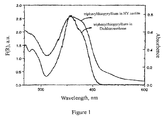
- The UV-Vis diffuse reflectance spectra of these materials are in accordance with the UV-Vis absorption spectra for these same inorganic cations in acetonitrile, dichloromethane and other organic solvents. Only small solvatochromic shifts can be seen in the wavelength absorption maximums of less than 40 nm.
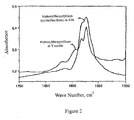
- The IR spectra of the thiopyrylium cations trapped in large-pore zeolites and aluminosilicates also coincide with the IR spectra of the tetrafluoroborate salts of the same cations in KBr pellets in those areas where the aluminosilicate lattice does not interfere. The obtainment of these IR spectra is carried out at room temperature, but requires the prior removal of the coadsorbed water in the samples by means of heating under vacuum conditions of 10-2 Pa at 200°C for 1 hour.
- The thiopyrylium samples incorporated in large-pore zeolites or in mesoporous aluminosilicates show emission after being stimulated at λmax of the UV-Vis absorption band. In this case the room temperature emission spectra correspond to a combination of fluorescence and phosphorescence, in which the latter generally predominates.
- A further object of the present invention is a process for preparing a material comprising at least one thiopyrylium cation or a thiopyrylium cation derivative, or mixtures thereof, trapped in a zeolitic material such as a zeolite or a structured porous aluminosilicate, characterised in that it comprises a direct adsorption of the cation from solution or a boat in a bottle synthesis.
- Below, diagram 1 shows a boat in a bottle synthesis according to said process:where R1, R2 and R3 have the previously indicated meaning.

- The preparation process of the material of the present invention includes:
- a first step wherein the zeolitic material is dehydrated, for example, by heating at a temperature of 500°C for 1 hour or more.
- a second step wherein the dehydrated zeolitic material is poured, still hot, in an organic solution saturated with hydrogen sulfide or bisulfide, and a first suspension is obtained.
- a third step wherein said first suspension is maintained in a hydrogen sulfide or bisulfide atmosphere and is magnetically or mechanically stirred for at least 30 minutes with a view to making the solid become saturated with hydrogen sulfide or bisulfide before proceeding with the preparation.
- a fourth step wherein the suitable amount of at least one corresponding pyrylium compound precursor of a thiopyrylium cation is added to said suspension. To this end, it is preferable for the required amount of pyrylium compound precursor to dissolve in the reaction solvent prior to its addition to the suspension of zeolite or aluminosilicate saturated with hydrogen sulfide. The amount of compound precursor, at a ratio with respect to the zeolite, ranges between 1 and 15%, and between 1 and 50% by weight for mesoporous aluminosilicates.
- a fifth step wherein the suspension is maintained at a temperature between room temperature and that of the reflux of the solvent in a hydrogen sulfide or bisulfide atmosphere, for a sufficient length of time.
- a sixth step wherein, once this time is elapsed, the solid contained in said suspension is filtered, washed with fresh solvent and thoroughly extracted with an organic solvent until the solvent no longer contains remains of the pyrylium compound precursor or any of the products derived therefrom, and
- a seventh step wherein said solid is evacuated at reduced pressure and is stored protected from the light and from the atmosphere.
- When the zeolitic material is a zeolite, any large-pore sized zeolite, such as Y and Beta, and whatever its Si/Al ratio, charge compensation cations, particle size, surface area and crystallinity may be, can be used.
- In the case where the zeolitic material is a structured porous aluminosilicate, this can be of the MCM-41 hexagonal or MCM-48 cubic type, with any Si/Al ratio, particle size, surface area and mesopore size between 20 and 100 Å.
- The organic solvent used can be alkane, cycloalkane, halogenated compounds, acetonitrile or any other in general which dissolves the pyrylium salt precursor. The volume of solvent used can range between 1 to 20% by weight. A convenient manner of saturating the solvent with hydrogen sulfide is to slowly bubble this gas from a cylinder containing it under pressure for a sufficient length of time.
- In the case of structured porous aluminosilicates with a pore size between 20 and 100 Å, an alternative preparation method to the one previously described is also possible, and consists of the direct incorporation of thiopyrylium salts from an organic solution towards the inner area of the aluminosilicate pores.
- The following figures and example show some aspects of the invention.
-
- Figure 1 shows a UV-Vis diffuse reflectance spectrum for the case of the 2,4,6-triphenylthiopyrylium cation in Y zeolite.
- Figure 2 shows a typical IR spectrum of the 2,4,6-triphenylthiopyrylium cation trapped in a zeolite and its comparison with that of the tetrafluoroborate salt of the same thiopyrylium cation.
- Figure 3 shows a typical emission spectrum after being stimulated at λmax of the UV-Vis absorption band, of the 2,4,6-triphenylthiopyrylium cation trapped in Y zeolite.
-
- In a preferred embodiment of the materials of the present invention, 10 grams of Y zeolite (Si/Al 2.4) are used in their sodium form and with an average particle size of 1 µm. This material is dehydrated overnight in an oven under air atmosphere at 500°C. After its dehydration, the zeolite is left to cool to 150°C and is carefully poured onto a 100 ml cyclohexane solution which has been saturated with hydrogen sulfide. The suspension is stirred for 30 minutes in a hydrogen sulfide atmosphere. Then, 10 ml of cyclohexane containing 0.8 g of 2,4,6-triphenylpyrylium tetrafluoroborate are added, and the suspension is stirred for 1 day at reflux temperature of the cyclohexane (68°C at the pressure of an atmosphere). After this time has elapsed, the suspension is filtered and the solid is thoroughly extracted with dichloromethane in Soxhlet equipment for one day. The remains of the solvent of the extraction are vacuum removed before proceeding to the spectroscopic characterisation of those materials and to their use as photocatalysts.
Claims (35)
- A material comprising an organic cation trapped in a support characterised in that said cation is selected among a thiopyrylium cation, a thiopyrylium cation derivative and mixtures thereof, and in that said cation is trapped in a zeolitic material.
- A material according to claim 1, characterised in that the zeolitic material is a zeolite or a structured porous aluminosilicate.
- A material according to claim 1, characterised in that the zeolitic material is a large-pore zeolite.
- A material according to claim 1 or 3, characterised in that the cation is trapped in an amount comprised between 0 and 15% by weight of cation.
- A material according to claim 1, characterised in that the zeolitic material is a structured porous aluminosilicate.
- A material according to claim 5, characterised in that the structured porous aluminosilicate contains trapped cation in an amount comprised between 0 and 50% by weight of cation.
- A material according to claim 1, characterised in that the thiopyrylium cation corresponds to the formula:where R1, R2 and R3 are equal or different groups selected among H, alkyl groups and aryl groups, and combinations thereof.

- A material according to claim 7, characterised in that the alkyl groups are selected among methyl, ethyl, propyl and iso-propyl.
- A material according to claim 7, characterised in that the aryl groups are selected among phenyl, substituted phenyl, naphthyl, substituted naphthyl, and heterocycle.
- A material according to claim 1, characterised in that the cation is 2,4,6-triphenylthiopyrylium.
- A material according to claim 1 or 3, characterised in that the zeolitic material is Y zeolite.
- A material according to claim 1, 10 or 11, characterised in that the cation is 2,4,6-triphenylthiopyrylium and is trapped in Y zeolite.
- A material according to claim 12, characterised in that the 2,4,6-triphenylthiopyrylium cation is trapped in Y zeolite in ratios by weight of the cation ranging between 0.1 and 10%.
- A material according to claim 1, characterised in that the zeolitic material is Beta zeolite.
- A material according to claim 1 or 14, characterised in that the Beta zeolite contains the trapped 2,4,6-triphenylthiopyrylium cation.
- A material according to claim 15, characterised in that the 2,4,6-triphenylthiopyrylium cation is present in ratios by weight of cation ranging between 0.1 and 10%.
- A material according to claim 1 or 14, characterised in that the zeolitic material is Beta zeolite comprising heteroatoms in the lattice.
- A material according to claim 17, characterised in that the heteroatoms are titanium atoms.
- A material according to claim 1, characterised in that the zeolitic material is an MCM-41 or MCM-48 structured porous aluminosilicate.
- A material according to claim 19, characterised in that MCM-41 or MCM-48 porous aluminosilicate contains the trapped 2,4,6-triphenylthiopyrylium cation.
- A material according to claim 19, characterised in that the structured porous aluminosilicate has a composition consisting of pure silica.
- A material according to claim 20, characterised in that the structured porous aluminosilicate also comprises heteroatoms.
- A material according to claim 22, characterised in that the heteroatoms are titanium atoms.
- A process for preparing a material comprising a cation selected among a thiopyrylium cation, a thiopyrylium cation derivative and mixtures thereof, trapped in a zeolitic material, characterised in that it comprises a direct adsorption of the cation from a solution or a boat in a bottle synthesis.
- A process according to claim 24, characterised in that the zeolitic material is a zeolite or a structured porous aluminosilicate.
- A process according to claim 24, characterised in that it comprises:a first step wherein the zeolitic material is dehydrated,a second step wherein the dehydrated zeolitic material is poured, still hot, in an organic solution saturated with hydrogen sulfide or bisulfide, and a first suspension is obtained,a third step wherein said first suspension is maintained in a hydrogen sulfide or bisulfide atmosphere and is magnetically or mechanically stirred for at least 30 minutes,a fourth step wherein the suitable amount of at least one corresponding pyrylium compound precursor of a thiopyrylium compound is added to said suspension,a fifth step wherein said suspension is maintained at a temperature between room temperature and the reflux temperature of the solvent in a hydrogen sulfide or bisulfide atmosphere,a sixth step wherein the solid contained in said suspension is filtered, washed with fresh solvent and thoroughly extracted with an organic solvent, anda seventh step wherein said solid is evacuated at reduced pressure and is stored protected from the light and from the atmosphere.
- A process according to claim 26 characterised in that in the first step the zeolitic material is dehydrated by heating at a temperature of 500 °C for at least 1 hour.
- A process according to claim 26, characterised in that in the fourth step the required amount of pyrylium compound precursor is dissolved in an organic solvent which is the same as that of the second step, prior to its addition to the suspension of zeolitic material saturated with hydrogen sulfide or bisulfide.
- A process according to claim 26, characterised in that the zeolitic material is a zeolite and the amount of pyrylium compound precursor ranges in a ratio between 1 to 15% by weight with respect to the zeolite.
- A process according to claim 26, characterised in that the zeolitic material is a structured porous aluminosilicate and the amount of pyrylium compound precursor ranges in a ratio between 1 and 50% by weight with respect to said structured porous aluminosilicate.
- A process according to claim 26, characterised in that in the sixth step the extraction is carried out until the solvent no longer contains remains of the pyrylium compound precursor or any other product derived therefrom.
- A process according to claim 26, characterised in that in the second step an organic solvent is used, selected among alkane, cycloalkane, halogenated compounds and acetonitrile.
- A process according to claim 26, characterised in that in the second step a volume of solvent is used comprised between 1 to 20% by weight.
- A process according to claim 26, characterised in that hydrogen sulfide is used and the thiopyrylium cation is 2,4,6-triphenylthiopyrylium.
- A process according to claim 24, characterised in that the zeolitic material is a porous aluminosilicate with a pore size exceeding 100 Å and a direct adsorption of the cation is carried out from solution.
Applications Claiming Priority (3)
| Application Number | Priority Date | Filing Date | Title |
|---|---|---|---|
| ES200101839 | 2001-07-27 | ||
| ES200101839A ES2181605B1 (en) | 2001-07-27 | 2001-07-27 | CATION TIOPIRILIO AND DERIVATIVES OF SUCH CATION CAUGHT IN A MATERIALZEOLITICO. |
| PCT/ES2002/000377 WO2003011456A1 (en) | 2001-07-27 | 2002-07-26 | Thiopyryl cation and derivatives of same trapped in a zeolitic material |
Publications (2)
| Publication Number | Publication Date |
|---|---|
| EP1424127A1 true EP1424127A1 (en) | 2004-06-02 |
| EP1424127B1 EP1424127B1 (en) | 2007-10-17 |
Family
ID=8498648
Family Applications (1)
| Application Number | Title | Priority Date | Filing Date |
|---|---|---|---|
| EP02764894A Expired - Lifetime EP1424127B1 (en) | 2001-07-27 | 2002-07-26 | Thiopyryl cation and derivatives of same trapped in a zeolitic material |
Country Status (5)
| Country | Link |
|---|---|
| EP (1) | EP1424127B1 (en) |
| AT (1) | ATE375822T1 (en) |
| DE (1) | DE60223055D1 (en) |
| ES (1) | ES2181605B1 (en) |
| WO (1) | WO2003011456A1 (en) |
Cited By (1)
| Publication number | Priority date | Publication date | Assignee | Title |
|---|---|---|---|---|
| CN102847557A (en) * | 2012-09-18 | 2013-01-02 | 山东大学 | Ship-in-bottle catalyst of Y-type zeolite immobilized phosphotungstic acid and preparation method of ship-in-bottle catalyst |
Families Citing this family (1)
| Publication number | Priority date | Publication date | Assignee | Title |
|---|---|---|---|---|
| CN108927206A (en) * | 2018-07-10 | 2018-12-04 | 大连理工大学 | The preparation method and its usage of metal-doped mesopore molecular sieve |
-
2001
- 2001-07-27 ES ES200101839A patent/ES2181605B1/en not_active Expired - Lifetime
-
2002
- 2002-07-26 DE DE60223055T patent/DE60223055D1/en not_active Expired - Lifetime
- 2002-07-26 EP EP02764894A patent/EP1424127B1/en not_active Expired - Lifetime
- 2002-07-26 AT AT02764894T patent/ATE375822T1/en not_active IP Right Cessation
- 2002-07-26 WO PCT/ES2002/000377 patent/WO2003011456A1/en not_active Ceased
Non-Patent Citations (1)
| Title |
|---|
| See references of WO03011456A1 * |
Cited By (1)
| Publication number | Priority date | Publication date | Assignee | Title |
|---|---|---|---|---|
| CN102847557A (en) * | 2012-09-18 | 2013-01-02 | 山东大学 | Ship-in-bottle catalyst of Y-type zeolite immobilized phosphotungstic acid and preparation method of ship-in-bottle catalyst |
Also Published As
| Publication number | Publication date |
|---|---|
| EP1424127B1 (en) | 2007-10-17 |
| DE60223055D1 (en) | 2007-11-29 |
| WO2003011456A1 (en) | 2003-02-13 |
| ES2181605A1 (en) | 2003-02-16 |
| ATE375822T1 (en) | 2007-11-15 |
| ES2181605B1 (en) | 2004-01-16 |
Similar Documents
| Publication | Publication Date | Title |
|---|---|---|
| US6331500B1 (en) | Functionalized molecular sieves | |
| Ramamurthy et al. | Generation, entrapment, and spectroscopic characterization of radical cations of. alpha.,. omega.-diphenyl polyenes within the channels of pentasil zeolites | |
| KR102356362B1 (en) | SCM-15 molecular sieve, preparation method thereof and use thereof | |
| Boukoussa et al. | Catalytic behavior of surfactant-containing-MCM-41 mesoporous materials for cycloaddition of 4-nitrophenyl azide | |
| KR102632794B1 (en) | Molecular sieve SSZ-113, its synthesis and uses | |
| CN105283416B (en) | Method for preparing molecular sieves | |
| JP7138697B2 (en) | Molecular sieve SSZ-112, its synthesis and use | |
| JP2017526608A (en) | Method for producing molecular sieve SSZ-98 | |
| KR102096040B1 (en) | Method for preparing zeolite ssz-52 | |
| JP7244502B2 (en) | Molecular sieve SSZ-110, its synthesis and use | |
| Zhu et al. | Oxidative desulfurization of model oil over Ta-Beta zeolite synthesized via structural reconstruction | |
| EP1679286B1 (en) | Method of preparing nano-zeolite zsm-5 having an increased outer surface by crystallisation of silylated nuclei | |
| HU208511B (en) | Process for producing christalline aluminium-phosphate compositions | |
| Lin et al. | Dealumination-controlled strategy mediates Ti–Y zeolite with cooperative active sites for selective oxidations | |
| Casades et al. | ‘Ship-in-a-bottle’synthesis and photochromism of spiropyrans encapsulated within zeolite Y supercages | |
| JP2021524430A (en) | A method for synthesizing a composite material composed of a mixture of AFX-structured and BEA-structured zeolites in the presence of an organic nitrogen-containing structuring agent. | |
| MX2014013006A (en) | ZEOLITICAL MATERIALS AND METHODS FOR PREPARATION USING ALQUENILTRIALQUILAMONIO COMPOUNDS. | |
| EP1424127B1 (en) | Thiopyryl cation and derivatives of same trapped in a zeolitic material | |
| EP0496647B1 (en) | Method for preparation of aluminophosphate compounds and substituted derivatives of VFI structural type | |
| Chatelard et al. | Synthesis of NaY zeolites with exceptionally high SiO2/Al2O3 ratios via a dissolution-recrystallization process | |
| US4430314A (en) | Method of preparing crystalline zeolite | |
| Liu et al. | Gallosilicate zeolite catalysts: structural features of [Si, Ga]-ZSM-5 | |
| JP7490783B2 (en) | Molecular sieve SSZ-116, its synthesis and use | |
| JP2708212B2 (en) | Method for modifying molecular sieve | |
| EP3801892B1 (en) | Method for preparing a high-purity afx structural zeolite with a nitrogen-containing organic structuring agent |
Legal Events
| Date | Code | Title | Description |
|---|---|---|---|
| PUAI | Public reference made under article 153(3) epc to a published international application that has entered the european phase |
Free format text: ORIGINAL CODE: 0009012 |
|
| 17P | Request for examination filed |
Effective date: 20040209 |
|
| AK | Designated contracting states |
Kind code of ref document: A1 Designated state(s): AT BE BG CH CY CZ DE DK EE ES FI FR GB GR IE IT LI LU MC NL PT SE SK TR |
|
| 17Q | First examination report despatched |
Effective date: 20061030 |
|
| GRAP | Despatch of communication of intention to grant a patent |
Free format text: ORIGINAL CODE: EPIDOSNIGR1 |
|
| GRAS | Grant fee paid |
Free format text: ORIGINAL CODE: EPIDOSNIGR3 |
|
| GRAA | (expected) grant |
Free format text: ORIGINAL CODE: 0009210 |
|
| AK | Designated contracting states |
Kind code of ref document: B1 Designated state(s): AT BE BG CH CY CZ DE DK EE ES FI FR GB GR IE IT LI LU MC NL PT SE SK TR |
|
| REG | Reference to a national code |
Ref country code: GB Ref legal event code: FG4D |
|
| REG | Reference to a national code |
Ref country code: CH Ref legal event code: EP |
|
| REG | Reference to a national code |
Ref country code: IE Ref legal event code: FG4D |
|
| REF | Corresponds to: |
Ref document number: 60223055 Country of ref document: DE Date of ref document: 20071129 Kind code of ref document: P |
|
| NLV1 | Nl: lapsed or annulled due to failure to fulfill the requirements of art. 29p and 29m of the patents act | ||
| PG25 | Lapsed in a contracting state [announced via postgrant information from national office to epo] |
Ref country code: CH Free format text: LAPSE BECAUSE OF FAILURE TO SUBMIT A TRANSLATION OF THE DESCRIPTION OR TO PAY THE FEE WITHIN THE PRESCRIBED TIME-LIMIT Effective date: 20071017 Ref country code: LI Free format text: LAPSE BECAUSE OF FAILURE TO SUBMIT A TRANSLATION OF THE DESCRIPTION OR TO PAY THE FEE WITHIN THE PRESCRIBED TIME-LIMIT Effective date: 20071017 Ref country code: SE Free format text: LAPSE BECAUSE OF FAILURE TO SUBMIT A TRANSLATION OF THE DESCRIPTION OR TO PAY THE FEE WITHIN THE PRESCRIBED TIME-LIMIT Effective date: 20080117 Ref country code: ES Free format text: LAPSE BECAUSE OF FAILURE TO SUBMIT A TRANSLATION OF THE DESCRIPTION OR TO PAY THE FEE WITHIN THE PRESCRIBED TIME-LIMIT Effective date: 20080128 Ref country code: NL Free format text: LAPSE BECAUSE OF FAILURE TO SUBMIT A TRANSLATION OF THE DESCRIPTION OR TO PAY THE FEE WITHIN THE PRESCRIBED TIME-LIMIT Effective date: 20071017 |
|
| REG | Reference to a national code |
Ref country code: CH Ref legal event code: PL |
|
| PG25 | Lapsed in a contracting state [announced via postgrant information from national office to epo] |
Ref country code: PT Free format text: LAPSE BECAUSE OF FAILURE TO SUBMIT A TRANSLATION OF THE DESCRIPTION OR TO PAY THE FEE WITHIN THE PRESCRIBED TIME-LIMIT Effective date: 20080317 Ref country code: BG Free format text: LAPSE BECAUSE OF FAILURE TO SUBMIT A TRANSLATION OF THE DESCRIPTION OR TO PAY THE FEE WITHIN THE PRESCRIBED TIME-LIMIT Effective date: 20080117 |
|
| PG25 | Lapsed in a contracting state [announced via postgrant information from national office to epo] |
Ref country code: AT Free format text: LAPSE BECAUSE OF FAILURE TO SUBMIT A TRANSLATION OF THE DESCRIPTION OR TO PAY THE FEE WITHIN THE PRESCRIBED TIME-LIMIT Effective date: 20071017 |
|
| PG25 | Lapsed in a contracting state [announced via postgrant information from national office to epo] |
Ref country code: DK Free format text: LAPSE BECAUSE OF FAILURE TO SUBMIT A TRANSLATION OF THE DESCRIPTION OR TO PAY THE FEE WITHIN THE PRESCRIBED TIME-LIMIT Effective date: 20071017 Ref country code: CZ Free format text: LAPSE BECAUSE OF FAILURE TO SUBMIT A TRANSLATION OF THE DESCRIPTION OR TO PAY THE FEE WITHIN THE PRESCRIBED TIME-LIMIT Effective date: 20071017 |
|
| EN | Fr: translation not filed | ||
| PLBE | No opposition filed within time limit |
Free format text: ORIGINAL CODE: 0009261 |
|
| STAA | Information on the status of an ep patent application or granted ep patent |
Free format text: STATUS: NO OPPOSITION FILED WITHIN TIME LIMIT |
|
| PG25 | Lapsed in a contracting state [announced via postgrant information from national office to epo] |
Ref country code: SK Free format text: LAPSE BECAUSE OF FAILURE TO SUBMIT A TRANSLATION OF THE DESCRIPTION OR TO PAY THE FEE WITHIN THE PRESCRIBED TIME-LIMIT Effective date: 20071017 Ref country code: BE Free format text: LAPSE BECAUSE OF FAILURE TO SUBMIT A TRANSLATION OF THE DESCRIPTION OR TO PAY THE FEE WITHIN THE PRESCRIBED TIME-LIMIT Effective date: 20071017 |
|
| 26N | No opposition filed |
Effective date: 20080718 |
|
| PG25 | Lapsed in a contracting state [announced via postgrant information from national office to epo] |
Ref country code: FR Free format text: LAPSE BECAUSE OF FAILURE TO SUBMIT A TRANSLATION OF THE DESCRIPTION OR TO PAY THE FEE WITHIN THE PRESCRIBED TIME-LIMIT Effective date: 20080801 Ref country code: DE Free format text: LAPSE BECAUSE OF FAILURE TO SUBMIT A TRANSLATION OF THE DESCRIPTION OR TO PAY THE FEE WITHIN THE PRESCRIBED TIME-LIMIT Effective date: 20080118 |
|
| PG25 | Lapsed in a contracting state [announced via postgrant information from national office to epo] |
Ref country code: GR Free format text: LAPSE BECAUSE OF FAILURE TO SUBMIT A TRANSLATION OF THE DESCRIPTION OR TO PAY THE FEE WITHIN THE PRESCRIBED TIME-LIMIT Effective date: 20080118 |
|
| PG25 | Lapsed in a contracting state [announced via postgrant information from national office to epo] |
Ref country code: FI Free format text: LAPSE BECAUSE OF FAILURE TO SUBMIT A TRANSLATION OF THE DESCRIPTION OR TO PAY THE FEE WITHIN THE PRESCRIBED TIME-LIMIT Effective date: 20071017 |
|
| GBPC | Gb: european patent ceased through non-payment of renewal fee |
Effective date: 20080726 |
|
| PG25 | Lapsed in a contracting state [announced via postgrant information from national office to epo] |
Ref country code: MC Free format text: LAPSE BECAUSE OF NON-PAYMENT OF DUE FEES Effective date: 20080731 |
|
| PG25 | Lapsed in a contracting state [announced via postgrant information from national office to epo] |
Ref country code: EE Free format text: LAPSE BECAUSE OF FAILURE TO SUBMIT A TRANSLATION OF THE DESCRIPTION OR TO PAY THE FEE WITHIN THE PRESCRIBED TIME-LIMIT Effective date: 20071017 |
|
| PG25 | Lapsed in a contracting state [announced via postgrant information from national office to epo] |
Ref country code: GB Free format text: LAPSE BECAUSE OF NON-PAYMENT OF DUE FEES Effective date: 20080726 |
|
| PG25 | Lapsed in a contracting state [announced via postgrant information from national office to epo] |
Ref country code: IE Free format text: LAPSE BECAUSE OF NON-PAYMENT OF DUE FEES Effective date: 20080728 Ref country code: CY Free format text: LAPSE BECAUSE OF FAILURE TO SUBMIT A TRANSLATION OF THE DESCRIPTION OR TO PAY THE FEE WITHIN THE PRESCRIBED TIME-LIMIT Effective date: 20071017 |
|
| PG25 | Lapsed in a contracting state [announced via postgrant information from national office to epo] |
Ref country code: LU Free format text: LAPSE BECAUSE OF NON-PAYMENT OF DUE FEES Effective date: 20080726 |
|
| PG25 | Lapsed in a contracting state [announced via postgrant information from national office to epo] |
Ref country code: TR Free format text: LAPSE BECAUSE OF FAILURE TO SUBMIT A TRANSLATION OF THE DESCRIPTION OR TO PAY THE FEE WITHIN THE PRESCRIBED TIME-LIMIT Effective date: 20071017 |
|
| PG25 | Lapsed in a contracting state [announced via postgrant information from national office to epo] |
Ref country code: IT Free format text: LAPSE BECAUSE OF NON-PAYMENT OF DUE FEES Effective date: 20080731 |