EP1424126A1 - Photooxidation catalysts and process for preparation of aldehydes - Google Patents
Photooxidation catalysts and process for preparation of aldehydes Download PDFInfo
- Publication number
- EP1424126A1 EP1424126A1 EP02763005A EP02763005A EP1424126A1 EP 1424126 A1 EP1424126 A1 EP 1424126A1 EP 02763005 A EP02763005 A EP 02763005A EP 02763005 A EP02763005 A EP 02763005A EP 1424126 A1 EP1424126 A1 EP 1424126A1
- Authority
- EP
- European Patent Office
- Prior art keywords
- group
- catalyst
- photooxidation
- aldehyde
- methyl group
- Prior art date
- Legal status (The legal status is an assumption and is not a legal conclusion. Google has not performed a legal analysis and makes no representation as to the accuracy of the status listed.)
- Withdrawn
Links
Classifications
-
- B—PERFORMING OPERATIONS; TRANSPORTING
- B01—PHYSICAL OR CHEMICAL PROCESSES OR APPARATUS IN GENERAL
- B01J—CHEMICAL OR PHYSICAL PROCESSES, e.g. CATALYSIS OR COLLOID CHEMISTRY; THEIR RELEVANT APPARATUS
- B01J31/00—Catalysts comprising hydrides, coordination complexes or organic compounds
- B01J31/02—Catalysts comprising hydrides, coordination complexes or organic compounds containing organic compounds or metal hydrides
- B01J31/0231—Halogen-containing compounds
-
- B—PERFORMING OPERATIONS; TRANSPORTING
- B01—PHYSICAL OR CHEMICAL PROCESSES OR APPARATUS IN GENERAL
- B01J—CHEMICAL OR PHYSICAL PROCESSES, e.g. CATALYSIS OR COLLOID CHEMISTRY; THEIR RELEVANT APPARATUS
- B01J31/00—Catalysts comprising hydrides, coordination complexes or organic compounds
- B01J31/006—Catalysts comprising hydrides, coordination complexes or organic compounds comprising organic radicals, e.g. TEMPO
-
- B—PERFORMING OPERATIONS; TRANSPORTING
- B01—PHYSICAL OR CHEMICAL PROCESSES OR APPARATUS IN GENERAL
- B01J—CHEMICAL OR PHYSICAL PROCESSES, e.g. CATALYSIS OR COLLOID CHEMISTRY; THEIR RELEVANT APPARATUS
- B01J31/00—Catalysts comprising hydrides, coordination complexes or organic compounds
- B01J31/02—Catalysts comprising hydrides, coordination complexes or organic compounds containing organic compounds or metal hydrides
- B01J31/0234—Nitrogen-, phosphorus-, arsenic- or antimony-containing compounds
- B01J31/0235—Nitrogen containing compounds
-
- B—PERFORMING OPERATIONS; TRANSPORTING
- B01—PHYSICAL OR CHEMICAL PROCESSES OR APPARATUS IN GENERAL
- B01J—CHEMICAL OR PHYSICAL PROCESSES, e.g. CATALYSIS OR COLLOID CHEMISTRY; THEIR RELEVANT APPARATUS
- B01J31/00—Catalysts comprising hydrides, coordination complexes or organic compounds
- B01J31/02—Catalysts comprising hydrides, coordination complexes or organic compounds containing organic compounds or metal hydrides
- B01J31/0234—Nitrogen-, phosphorus-, arsenic- or antimony-containing compounds
- B01J31/0271—Nitrogen-, phosphorus-, arsenic- or antimony-containing compounds also containing elements or functional groups covered by B01J31/0201 - B01J31/0231
-
- B—PERFORMING OPERATIONS; TRANSPORTING
- B01—PHYSICAL OR CHEMICAL PROCESSES OR APPARATUS IN GENERAL
- B01J—CHEMICAL OR PHYSICAL PROCESSES, e.g. CATALYSIS OR COLLOID CHEMISTRY; THEIR RELEVANT APPARATUS
- B01J35/00—Catalysts, in general, characterised by their form or physical properties
- B01J35/30—Catalysts, in general, characterised by their form or physical properties characterised by their physical properties
- B01J35/39—Photocatalytic properties
-
- C—CHEMISTRY; METALLURGY
- C07—ORGANIC CHEMISTRY
- C07C—ACYCLIC OR CARBOCYCLIC COMPOUNDS
- C07C253/00—Preparation of carboxylic acid nitriles
- C07C253/30—Preparation of carboxylic acid nitriles by reactions not involving the formation of cyano groups
-
- C—CHEMISTRY; METALLURGY
- C07—ORGANIC CHEMISTRY
- C07C—ACYCLIC OR CARBOCYCLIC COMPOUNDS
- C07C45/00—Preparation of compounds having >C = O groups bound only to carbon or hydrogen atoms; Preparation of chelates of such compounds
- C07C45/27—Preparation of compounds having >C = O groups bound only to carbon or hydrogen atoms; Preparation of chelates of such compounds by oxidation
- C07C45/32—Preparation of compounds having >C = O groups bound only to carbon or hydrogen atoms; Preparation of chelates of such compounds by oxidation with molecular oxygen
- C07C45/33—Preparation of compounds having >C = O groups bound only to carbon or hydrogen atoms; Preparation of chelates of such compounds by oxidation with molecular oxygen of CHx-moieties
-
- C—CHEMISTRY; METALLURGY
- C07—ORGANIC CHEMISTRY
- C07C—ACYCLIC OR CARBOCYCLIC COMPOUNDS
- C07C45/00—Preparation of compounds having >C = O groups bound only to carbon or hydrogen atoms; Preparation of chelates of such compounds
- C07C45/27—Preparation of compounds having >C = O groups bound only to carbon or hydrogen atoms; Preparation of chelates of such compounds by oxidation
- C07C45/32—Preparation of compounds having >C = O groups bound only to carbon or hydrogen atoms; Preparation of chelates of such compounds by oxidation with molecular oxygen
- C07C45/33—Preparation of compounds having >C = O groups bound only to carbon or hydrogen atoms; Preparation of chelates of such compounds by oxidation with molecular oxygen of CHx-moieties
- C07C45/34—Preparation of compounds having >C = O groups bound only to carbon or hydrogen atoms; Preparation of chelates of such compounds by oxidation with molecular oxygen of CHx-moieties in unsaturated compounds
- C07C45/36—Preparation of compounds having >C = O groups bound only to carbon or hydrogen atoms; Preparation of chelates of such compounds by oxidation with molecular oxygen of CHx-moieties in unsaturated compounds in compounds containing six-membered aromatic rings
-
- C—CHEMISTRY; METALLURGY
- C07—ORGANIC CHEMISTRY
- C07C—ACYCLIC OR CARBOCYCLIC COMPOUNDS
- C07C67/00—Preparation of carboxylic acid esters
- C07C67/30—Preparation of carboxylic acid esters by modifying the acid moiety of the ester, such modification not being an introduction of an ester group
- C07C67/313—Preparation of carboxylic acid esters by modifying the acid moiety of the ester, such modification not being an introduction of an ester group by introduction of doubly bound oxygen containing functional groups, e.g. carboxyl groups
-
- B—PERFORMING OPERATIONS; TRANSPORTING
- B01—PHYSICAL OR CHEMICAL PROCESSES OR APPARATUS IN GENERAL
- B01J—CHEMICAL OR PHYSICAL PROCESSES, e.g. CATALYSIS OR COLLOID CHEMISTRY; THEIR RELEVANT APPARATUS
- B01J2231/00—Catalytic reactions performed with catalysts classified in B01J31/00
- B01J2231/70—Oxidation reactions, e.g. epoxidation, (di)hydroxylation, dehydrogenation and analogues
Definitions
- the present invention relates to a catalyst useful for a photooxidation reaction and also relates to a novel process for producing aldehydes, particularly aromatic aldehydes, which are useful as an intermediate for the production of agrochemical and medical preparations.
- the catalyst is particularly suitable for the oxidation of a methyl group difficult to oxidize.
- the production method of aldehydes is generally not easy and various methods are being studied, such as oxidation of methyl group, reduction of carboxylic acid and reductive hydrolysis of nitrile.
- various methods are being studied, such as oxidation of methyl group, reduction of carboxylic acid and reductive hydrolysis of nitrile.
- the oxidation reaction terminates at the stage of an alcohol or continues until the production of a carboxylic acid in many cases and it is difficult to stop the reaction at the stage of an aldehyde by a general oxidation method.
- J. Am. Chem. Soc., 75, 1125 (1953) discloses a method of reducing cyanobenzoyl chloride by the Rosenmund reduction.
- JP-A-60-166655 discloses a method of reacting p-cyanobenzyl chloride with hexamethylenetetramine in an oil-water two-layer system.
- JP-A-9-227490 discloses a method of reacting dichloromethylbenzonitrile with morpholine and then hydrolyzing the reactant.
- a photooxidation reaction using a catalyst is a conventionally known method.
- a method of converting a toluene into an aromatic aldehyde by a photooxidation reaction discloses a method of oxidizing p-xylene with an oxygen using 9-phenyl-10-methylacridinium as a photocatalyst to produce p-tolualdehyde.
- this catalyst is not inexpensive and not easily available.
- One object of the present invention is to provide a catalyst useful for a photooxidation reaction. Another object of the present invention is to provide means for producing aromatic aldehydes which are useful as an intermediate in the production of agrochemical and medical preparations, by an industrially advantageous method.
- the present invention relates to the following matters.
- Halogenated aromatic nitriles as the catalyst for use in the present invention are put on the market and easily available.
- the nitrile group and the halogen are not limited on the number of bonds and the position of bonding. Examples of the halogen include chlorine and fluorine.
- halogenated aromatic nitriles represented by formula (1) include tetrafluorophthalonitile, tetrafluoroisophthalonitrile, tetrafluoroterephthalonitrile, pentafluorobenzonitrile, 2,3,5,6-tetrafluorobenzonitrile, 2,3,4,6-tetrafluorobenzonitrile, 2,3,4,5-tetrafluorobenzonitrile, 2,4,6-trifluoro-5-chloroisophthalonitrile, tetrachlorophthalonitrile, tetrachloroisophthalonitrile and tetrachloroterephthalonitrile.
- preferred are tetrafluorophthalonitrile, tetrafluoroisophthalonitrile and tetrafluoroterephthalonitrile, more preferred is tetrafluoroterephthalonitrile.
- halogenated aromatic nitriles may be used individually or in combination of two or more thereof.
- the photooxidation reaction is performed by applying light in the presence of an oxygen and a photooxidation catalyst. If the oxidizing power of the photooxidation catalyst is low, the oxidation reaction does not proceed, whereas if it is excessively high, a side reaction takes place and the selectivity decreases.
- the light applied is not particularly limited on the wavelength and the irradiation means, however, a mercury lamp or a xenon lamp is generally used.
- the photooxidation catalyst of the present invention can be used for various oxidations of substrates over a wide range.
- the photooxidation catalyst is used for the oxidation of a methyl group, aldehyde can be produced with good selectivity.
- the photooxidation catalyst is preferably used for the oxidation of a methyl group substituted on an aromatic ring, preferably for oxidizing a methyl group relatively difficult to oxidize, into an aldehyde.
- the photooxidation catalyst is more preferably used for the reaction of converting an ortho-, meta- or para-substituted tolunitrile into a cyanobenzaldehyde.
- methyl group-substituted aromatics as the substrate examples include toluene, o-cresol, m-cresol, p-cresol, 2-methylanisole, 3-methylanisole, 4-methylanisole, p-toluenesulfonic acid, o-tolunitrile, m-tolunitrile, p-tolunitrile, o-methylbenzoic acid, m-methylbenzoic acid, p-methylbenzoic acid, halogenated methylbenzene, 1-methylnaphthalene, 2-methylnaphthalene, ⁇ -picoline, ⁇ -picoline, ⁇ -picoline, 2-methylfuran, 2-methylthiophene, 3-methylthiophene, 1-methylpyrrole, 2-methylpyrrole, methylpyrazine, methylpyridazine, methylpyrimidine and methyltriazine.
- reaction of the present invention even if two or more methyl groups are present on one substrate, when one methyl group is oxidized, there arises a change in the oxidation/reduction potential between the product and the starting material. Therefore, when the reaction of the present invention is applied to compounds having two or more methyl groups, such as xylene derivatives, or compounds having a methyl group and an alkyl group, it is possible to selectively oxidize one methyl group.
- a solvent generally used for the photooxidation reaction may be used. It is also possible not to use a solvent.
- the tolunitrile may be used in place of the solvent and recovered by separation after the reaction.
- the reaction of the present invention may be performed by supplying an oxygen to be previously present in the reaction system or while blowing an oxygen into the reaction system.
- the amount used of the halogenated aromatic nitrile as the catalyst of the present invention is, although not particularly limited to, preferably 10 molar times or less that of the substrate, more preferably from 0.01 mol% to 2 molar times that of the substrate.
- the aromatic nitrile is used for the photooxidation reaction, it is generally deactivated by the coupling with the substrate. This coupling reaction hardly occurs in the use of the halogenated aromatic nitrile so that an optimal amount thereof varies depending on the substrate and the catalyst.
- the halogenated aromatic nitriles as the catalyst, the benzaldehydes as the product and the methylbenzenes as the raw material of the present invention can be separated by using differences in solubility in a solvent.
- the solvent used herein is not particularly limited as far as it can dissolve the benzaldehydes as the product without reaction therewith and if it has low solubility with the halogenated aromatic nitrile.
- the preferable solvents include aliphatic hydrocarbons, such as pentane, hexane, heptane, cyclohexane and methylcyclohexane, and aromatic hydrocarbons, such as benzene, toluene, o-xylene, m-xylene, p-xylene, ethylbenzene and cumene.
- aromatic hydrocarbons such as benzene, toluene, o-xylene, m-xylene, p-xylene, ethylbenzene and cumene.
- benzene and toluene are particularly preferable in view of solubility difference and after-treatment simplicity.
- the treatment temperature is preferably 0 to 60°C, particularly preferably 10 to 40°C.
- the solvent is used in such an amount that the resulting benzaldehyde can be completely dissolved therein, but can be used in an increased amount when the resulting benzaldehyde attach to the deposited halogenated aromatic nitrile to decrease its yield.
- the solvent is used in amounts of preferably 1 to 100 times by mass, more preferably 2 to 50 times by mass the raw material methylbenzene.
- the solvent can be subjected to distillation and concentration, followed by recrystallization of the product, or the solvent can be distilled under reduced pressure, followed by isolation of the product.
- the p-tolunitrile as the raw material has a boiling point of 103 to 106°C (20 Torr), whereas p-tolualdehyde as the product has a boiling point of 133°C (12 Torr) and p-cyanobenzyl alcohol as a byproduct has a boiling point of 130°C (5 Torr) so that isolation and purification can be made by vacuum distillation.
- a reactant mixture was prepared by dissolving 0.126 g (1 mmol) of o-chlorotoluene, and 0.200 g (1 mmol) of 2,3,5,6-tetrafluoroterephthalonitrile in 100 mL of acetonitrile saturated with oxygen. 2 mL of the reactant mixture was transferred into a UV-measuring quartz cell, which was then tightly stoppered, and light was applied thereto at room temperature for 8 hours using a high-pressure mercury lamp. Analysis by gas-chromatography gave an o-chlorotoluene conversion of 38% and an o-chlorobenzaldehyde yield of 18%.
- Example 2 was repeated, except that the o-chlorotoluene was replaced by methyl p-methylbenzoate, 0.150 g (1 mmol). Analysis by gas-chromatography gave a methyl p-methylbenzoate conversion of 50% and a methyl p-formylbenzoate yield of 18.5%.
- the reaction liquid obtained in Example 4 was concentrated and dried into a solid by means of an evaporator. This concentrating operation was repeated 30 times.
- a catalyst useful for a photooxidation reaction which is represented by formula (1).
- aldehydes particularly aromatic aldehydes can be produced advantageously in industry.
Landscapes
- Chemical & Material Sciences (AREA)
- Organic Chemistry (AREA)
- Chemical Kinetics & Catalysis (AREA)
- Engineering & Computer Science (AREA)
- Materials Engineering (AREA)
- Organic Low-Molecular-Weight Compounds And Preparation Thereof (AREA)
- Catalysts (AREA)
Abstract
The present invention relates to a catalyst useful
for a photooxidation reaction and also relates to a novel
process for producing aldehydes, particularly aromatic
aldehydes, which are useful as an intermediate for the
production of agrochemical and medical preparations. The
catalyst is particularly suitable for the oxidation of a
methyl group difficult to oxidize.
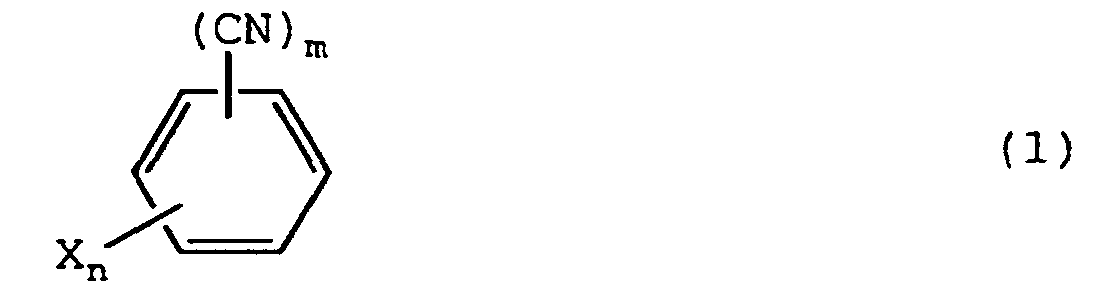
A photooxidation catalyst according to the invention
is a halogenated aromatic nitrile represented by the
following formula (1):
Description
The present invention relates to a catalyst useful
for a photooxidation reaction and also relates to a novel
process for producing aldehydes, particularly aromatic
aldehydes, which are useful as an intermediate for the
production of agrochemical and medical preparations. The
catalyst is particularly suitable for the oxidation of a
methyl group difficult to oxidize.
The production method of aldehydes is generally not
easy and various methods are being studied, such as
oxidation of methyl group, reduction of carboxylic acid and
reductive hydrolysis of nitrile. Particularly, according
to the method of oxidizing a methyl group, the oxidation
reaction terminates at the stage of an alcohol or continues
until the production of a carboxylic acid in many cases and
it is difficult to stop the reaction at the stage of an
aldehyde by a general oxidation method.
The production process for aldehydes is described by
referring to the case of producing cyanobenzaldehydes.
Several methods for the production of cyanobenzaldehydes
are known.
For example, J. Am. Chem. Soc., 75, 1125 (1953)
discloses a method of reducing cyanobenzoyl chloride by the
Rosenmund reduction. JP-A-60-166655 (the term "JP-A" as
used herein means an "unexamined published Japanese patent
application") discloses a method of reacting p-cyanobenzyl
chloride with hexamethylenetetramine in an oil-water two-layer
system. JP-A-9-227490 discloses a method of reacting
dichloromethylbenzonitrile with morpholine and then
hydrolyzing the reactant.
These methods all involve generation of a large
amount of wastes and cannot be an industrially excellent
production process.
A photooxidation reaction using a catalyst is a
conventionally known method. For example, as for the
method of converting a toluene into an aromatic aldehyde by
a photooxidation reaction, Org. Lett. 2000, 2, 3647
discloses a method of oxidizing p-xylene with an oxygen
using 9-phenyl-10-methylacridinium as a photocatalyst to
produce p-tolualdehyde. However, this catalyst is not
inexpensive and not easily available.
One object of the present invention is to provide a
catalyst useful for a photooxidation reaction. Another
object of the present invention is to provide means for
producing aromatic aldehydes which are useful as an
intermediate in the production of agrochemical and medical
preparations, by an industrially advantageous method.
The present invention relates to the following
matters.


The present invention is described in detail below.
Halogenated aromatic nitriles as the catalyst for use in
the present invention are put on the market and easily
available. In formula (1), the nitrile group and the
halogen are not limited on the number of bonds and the
position of bonding. Examples of the halogen include
chlorine and fluorine.
Specific examples of the halogenated aromatic
nitriles represented by formula (1) include tetrafluorophthalonitile,
tetrafluoroisophthalonitrile, tetrafluoroterephthalonitrile,
pentafluorobenzonitrile, 2,3,5,6-tetrafluorobenzonitrile,
2,3,4,6-tetrafluorobenzonitrile,
2,3,4,5-tetrafluorobenzonitrile, 2,4,6-trifluoro-5-chloroisophthalonitrile,
tetrachlorophthalonitrile, tetrachloroisophthalonitrile
and tetrachloroterephthalonitrile. Among
these, preferred are tetrafluorophthalonitrile,
tetrafluoroisophthalonitrile and tetrafluoroterephthalonitrile,
more preferred is tetrafluoroterephthalonitrile.
These halogenated aromatic nitriles may be used
individually or in combination of two or more thereof.
The photooxidation reaction is performed by applying
light in the presence of an oxygen and a photooxidation
catalyst. If the oxidizing power of the photooxidation
catalyst is low, the oxidation reaction does not proceed,
whereas if it is excessively high, a side reaction takes
place and the selectivity decreases.
The light applied is not particularly limited on the
wavelength and the irradiation means, however, a mercury
lamp or a xenon lamp is generally used.
The photooxidation catalyst of the present invention
can be used for various oxidations of substrates over a
wide range. When the photooxidation catalyst is used for
the oxidation of a methyl group, aldehyde can be produced
with good selectivity. In particular, the photooxidation
catalyst is preferably used for the oxidation of a methyl
group substituted on an aromatic ring, preferably for
oxidizing a methyl group relatively difficult to oxidize,
into an aldehyde. The photooxidation catalyst is more
preferably used for the reaction of converting an ortho-,
meta- or para-substituted tolunitrile into a cyanobenzaldehyde.
Examples of the methyl group-substituted aromatics as
the substrate include toluene, o-cresol, m-cresol, p-cresol,
2-methylanisole, 3-methylanisole, 4-methylanisole, p-toluenesulfonic
acid, o-tolunitrile, m-tolunitrile, p-tolunitrile,
o-methylbenzoic acid, m-methylbenzoic acid, p-methylbenzoic
acid, halogenated methylbenzene, 1-methylnaphthalene,
2-methylnaphthalene, α-picoline, β-picoline,
γ-picoline, 2-methylfuran, 2-methylthiophene, 3-methylthiophene,
1-methylpyrrole, 2-methylpyrrole,
methylpyrazine, methylpyridazine, methylpyrimidine and
methyltriazine.
In the reaction of the present invention, even if two
or more methyl groups are present on one substrate, when
one methyl group is oxidized, there arises a change in the
oxidation/reduction potential between the product and the
starting material. Therefore, when the reaction of the
present invention is applied to compounds having two or
more methyl groups, such as xylene derivatives, or
compounds having a methyl group and an alkyl group, it is
possible to selectively oxidize one methyl group.
In the present invention, a solvent generally used
for the photooxidation reaction may be used. It is also
possible not to use a solvent. For example, in the case of
converting a tolunitrile into a cyanobenzaldehyde, the
tolunitrile may be used in place of the solvent and
recovered by separation after the reaction.
The reaction of the present invention may be
performed by supplying an oxygen to be previously present
in the reaction system or while blowing an oxygen into the
reaction system.
The amount used of the halogenated aromatic nitrile
as the catalyst of the present invention is, although not
particularly limited to, preferably 10 molar times or less
that of the substrate, more preferably from 0.01 mol% to 2
molar times that of the substrate. When the aromatic
nitrile is used for the photooxidation reaction, it is
generally deactivated by the coupling with the substrate.
This coupling reaction hardly occurs in the use of the
halogenated aromatic nitrile so that an optimal amount
thereof varies depending on the substrate and the catalyst.
The halogenated aromatic nitriles as the catalyst,
the benzaldehydes as the product and the methylbenzenes as
the raw material of the present invention can be separated
by using differences in solubility in a solvent. The
solvent used herein is not particularly limited as far as
it can dissolve the benzaldehydes as the product without
reaction therewith and if it has low solubility with the
halogenated aromatic nitrile. Examples of the preferable
solvents include aliphatic hydrocarbons, such as pentane,
hexane, heptane, cyclohexane and methylcyclohexane, and
aromatic hydrocarbons, such as benzene, toluene, o-xylene,
m-xylene, p-xylene, ethylbenzene and cumene. Of these,
benzene and toluene are particularly preferable in view of
solubility difference and after-treatment simplicity.
When the treatment temperature is too high, the
solubility of the halogenated aromatic nitrile unfavorably
increases to impair ability of separation, and, when it is
too low, the solubility of the benzaldehyde as the product
too unfavorably decreases to necessitate further addition
of the solvent to avoid deposition. The treatment
temperature is preferably 0 to 60°C, particularly
preferably 10 to 40°C.
The solvent is used in such an amount that the
resulting benzaldehyde can be completely dissolved therein,
but can be used in an increased amount when the resulting
benzaldehyde attach to the deposited halogenated aromatic
nitrile to decrease its yield. Generally the solvent is
used in amounts of preferably 1 to 100 times by mass, more
preferably 2 to 50 times by mass the raw material
methylbenzene.
To isolate and purify the resulting benzaldehyde from
the solution after removal of the halogenated aromatic
nitrile, the solvent can be subjected to distillation and
concentration, followed by recrystallization of the product,
or the solvent can be distilled under reduced pressure,
followed by isolation of the product.
For example, when the reaction is carried out with
the raw material of p-tolunitrile, the p-tolunitrile as the
raw material has a boiling point of 103 to 106°C (20 Torr),
whereas p-tolualdehyde as the product has a boiling point
of 133°C (12 Torr) and p-cyanobenzyl alcohol as a byproduct
has a boiling point of 130°C (5 Torr) so that
isolation and purification can be made by vacuum
distillation.
The present invention is described below by referring
to Examples.
In an NMR tube were enclosed 0.6 mL of acetonitrile
saturated with oxygen, 2.1 mg (30 mM) of p-tolunitrile and
1.2 mg (10 mM) of 2,3,5,6-tetrafluoroterephthalonitrile.
Then light was applied thereto at room temperature using a
high-pressure mercury lamp. The conversion and yield with
the passage of 1, 2, 4 or 8 hours after the initiation of
light irradiation were measured by 1H NMR and the results
obtained are shown in Table 1. Products other than p-cyanobenzaldehyde
(hereinafter referred to as "CBAD") and
p-cyanobenzyl alcohol (hereinafter referred to as "CBAL")
were not detected.
| Reaction Time (hour) | Conversion (%) | Yield (%) | |
| CBAD | CBAL | ||
| 1 | 6 | 6 | 0 |
| 2 | 9 | 8 | 1 |
| 4 | 18 | 15 | 3 |
| 8 | 27 | 22 | 4 |
A reactant mixture was prepared by dissolving 0.126 g
(1 mmol) of o-chlorotoluene, and 0.200 g (1 mmol) of
2,3,5,6-tetrafluoroterephthalonitrile in 100 mL of
acetonitrile saturated with oxygen. 2 mL of the reactant
mixture was transferred into a UV-measuring quartz cell,
which was then tightly stoppered, and light was applied
thereto at room temperature for 8 hours using a high-pressure
mercury lamp. Analysis by gas-chromatography gave
an o-chlorotoluene conversion of 38% and an o-chlorobenzaldehyde
yield of 18%.
Example 2 was repeated, except that the o-chlorotoluene
was replaced by methyl p-methylbenzoate,
0.150 g (1 mmol). Analysis by gas-chromatography gave a
methyl p-methylbenzoate conversion of 50% and a methyl p-formylbenzoate
yield of 18.5%.
To a 500-mL glass photoreactor equipped with an
agitating function by a magnetic stirrer were added 300 mL
of oxygen-saturated acetonitrile, 0.35 g (3 mmol) of p-tolunitrile
and 0.60 g (3 mmol) of 2,3,5,6-tetrafluoroterephthalonitrile,
and light was applied
thereto at room temperature with stirring for 28 hours
using a high-pressure mercury lamp. Analysis by gas-chromatography
gave a p-tolunitrile conversion of 75% and a
CBAD yield of 30%.
The reaction liquid obtained in Example 4 was
concentrated and dried into a solid by means of an
evaporator. This concentrating operation was repeated 30
times.
The resulting residues were collected in a 100-mL
eggplant type flask, to which 25 g of toluene was further
added, and the mixture was agitated at room temperature for
1 hour. After the agitation, the solid matters were
filtered out and the filtrate was distilled to remove the
toluene by an evaporator and then vacuum distilled, thereby
3.5 g of CBAD was obtained.
According to the present invention, a catalyst useful
for a photooxidation reaction, which is represented by
formula (1), is provided. By using this catalyst,
aldehydes, particularly aromatic aldehydes can be produced
advantageously in industry.
Claims (11)
- A photooxidation catalyst which is a halogenated aromatic nitrile represented by the following formula (1):(wherein X represents a chlorine atom or a fluorine atom, m represents an integer of 1 to 5, n represents an integer of 1 to 5, m+n≤6, and when n is 2 or more, Xs may be the same or different).

- The photooxidation catalyst as claimed in claim 1, wherein the halogenated aromatic nitrile is at least one selected from the group consisting of tetrafluoroterephthalonitrile, tetrafluoroisophthalonitrile and tetrafluorophthalonitrile.
- The photooxidation catalyst as claimed in claim 2, wherein the halogenated aromatic nitrile is tetrafluoroterephthalonitrile.
- The photooxidation catalyst as claimed in any one of claims 1 to 3, wherein the catalyst is used for photooxidation reaction of converting a methyl group into an aldehyde group.
- The photooxidation catalyst as claimed in any one of claims 1 to 3, wherein the catalyst is used for photooxidation reaction of converting a methyl group of methyl group-substituted aromatics into an aldehyde group.
- The photooxidation catalyst as claimed in any one of claims 1 to 3, wherein the catalyst is used for photooxidation reaction of converting a methyl group of methylbenzene derivatives into an aldehyde group.
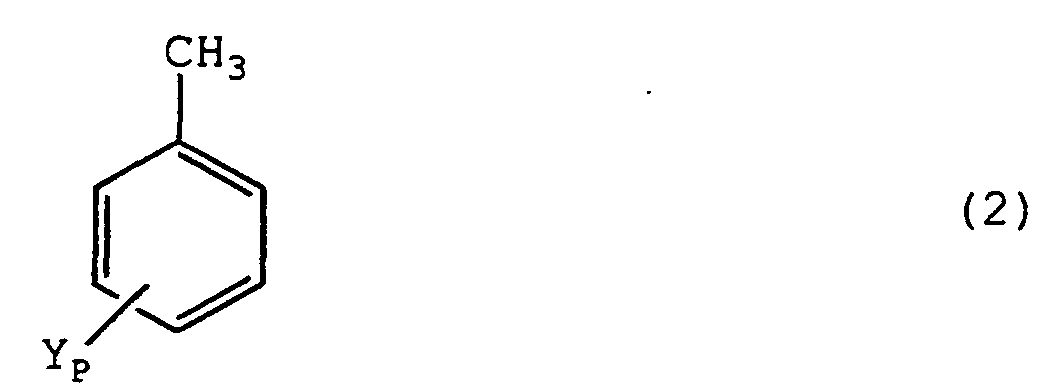
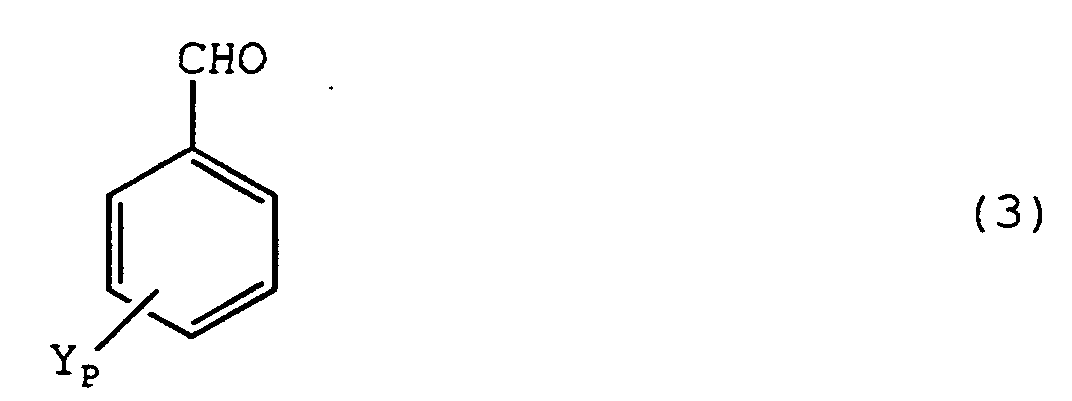
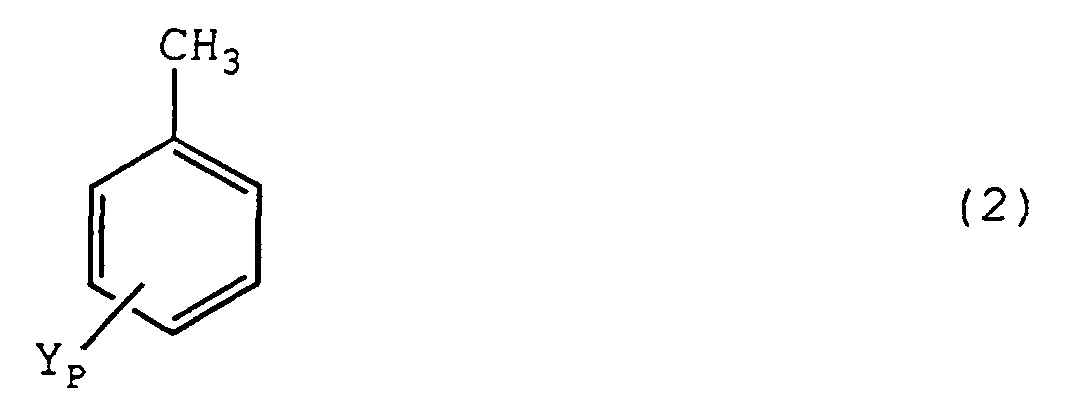
- The photooxidation catalyst as claimed in any one of claims 1 to 3, wherein the catalyst is used for photooxidation reaction of converting a methylbenzene represented by formula (2):(wherein Y represents a chlorine atom, a fluorine atom, a cyano group, a nitro group, a hydroxyl group, a carboxyl group, an alkyl group having from 1 to 4 carbon atoms which may have a substituent, an alkoxy group having from 1 to 4 carbon atoms which may have a substituent, or an aldehyde group, p represents an integer of 0 to 5, and when p is 2 or more, Ys may be the same or different) to a benzaldehyde represented by formula (3):
 (wherein Y represents a chlorine atom, a fluorine atom, a cyano group, a nitro group, a hydroxyl group, a carboxyl group, a sulfonic acid group, an alkyl group having from 1 to 4 carbon atoms which may have a substituent, an alkoxy group having from 1 to 4 carbon atoms which may have a substituent, or an aldehyde, p represents an integer of 0 to 5, when p is 2 or more, Ys may be the same or different).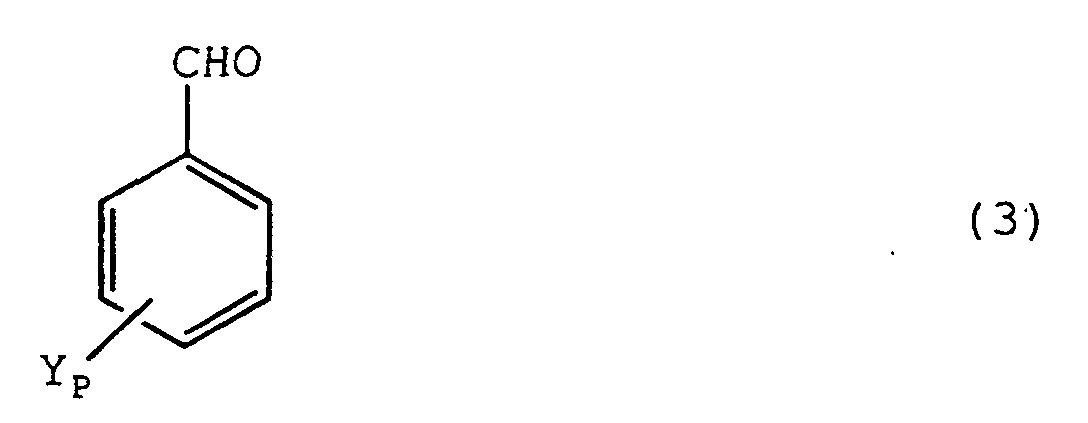
- A process for producing aldehydes, comprising photooxydizing a methyl group into an aldehyde group in the presence of the photooxidation catalyst as claimed in any one of claims 1 to 3.
- The process for producing aldehydes as claimed in claim 8, wherein the methyl group is a methyl group of methyl group-substituted aromatics, and thereby producing an aromatic aldehyde.
- The process for producing aldehydes as claimed in claim 9, wherein the methyl group of methyl group-substituted aromatics is a methyl group of methylbenzene, and thereby producing a benzaldehyde.
- The process for producing aldehydes as claimed in claim 10, wherein the methylbenzene is represented by formula (2):(wherein Y represents a chlorine atom, a fluorine atom, a cyano group, a nitro group, a hydroxyl group, a carboxyl group, an alkyl group having from 1 to 4 carbon atoms which may have a substituent, an alkoxy group having from 1 to 4 carbon atoms which may have a substituent, or an aldehyde group, p represents an integer of 0 to 5, and when p is 2 or more, Ys may be the same or different), and by photooxydizing the methyl group of said methylbenzene, thereby producing a benzaldehyde represented by formula (3):
 (wherein Y represents a chlorine atom, a fluorine atom, a cyano group, a nitro group, a hydroxyl group, a carboxyl group, a sulfonic acid group, an alkyl group having from 1 to 4 carbon atoms, which may have a substituent, an alkoxy group having from 1 to 4 carbon atoms, which may have a substituent, or an aldehyde, p represents an integer of 0 to 5, when p is 2 or more, Ys may be the same or different).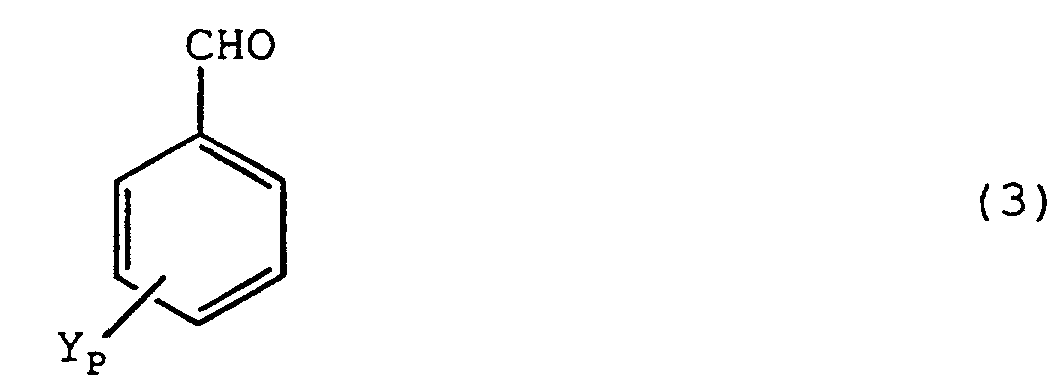
Applications Claiming Priority (3)
| Application Number | Priority Date | Filing Date | Title |
|---|---|---|---|
| JP2001272352 | 2001-09-07 | ||
| JP2001272352 | 2001-09-07 | ||
| PCT/JP2002/008981 WO2003022431A1 (en) | 2001-09-07 | 2002-09-04 | Photooxidation catalysts and process for preparation of aldehydes |
Publications (2)
| Publication Number | Publication Date |
|---|---|
| EP1424126A1 true EP1424126A1 (en) | 2004-06-02 |
| EP1424126A4 EP1424126A4 (en) | 2006-03-01 |
Family
ID=19097740
Family Applications (1)
| Application Number | Title | Priority Date | Filing Date |
|---|---|---|---|
| EP02763005A Withdrawn EP1424126A4 (en) | 2001-09-07 | 2002-09-04 | Photooxidation catalysts and process for preparation of aldehydes |
Country Status (3)
| Country | Link |
|---|---|
| EP (1) | EP1424126A4 (en) |
| JP (1) | JPWO2003022431A1 (en) |
| WO (1) | WO2003022431A1 (en) |
Family Cites Families (4)
| Publication number | Priority date | Publication date | Assignee | Title |
|---|---|---|---|---|
| JPS5581832A (en) * | 1978-12-13 | 1980-06-20 | Sumitomo Chem Co Ltd | Preparation of p-hydroxybenzaldehyde derivatives |
| EP0120575B1 (en) * | 1983-02-18 | 1989-06-14 | Nippon Shokubai Kagaku Kogyo Co., Ltd | Organic fluorine compounds |
| JPS60166655A (en) * | 1984-02-08 | 1985-08-29 | Toray Ind Inc | Preparation of p-cyanobenzaldehyde |
| JPH09227490A (en) * | 1996-02-21 | 1997-09-02 | Ihara Nikkei Kagaku Kogyo Kk | Production of 3-(or 4-)cyanobenzaldehyde |
-
2002
- 2002-09-04 JP JP2003526551A patent/JPWO2003022431A1/en active Pending
- 2002-09-04 EP EP02763005A patent/EP1424126A4/en not_active Withdrawn
- 2002-09-04 WO PCT/JP2002/008981 patent/WO2003022431A1/en not_active Ceased
Also Published As
| Publication number | Publication date |
|---|---|
| EP1424126A4 (en) | 2006-03-01 |
| WO2003022431A1 (en) | 2003-03-20 |
| JPWO2003022431A1 (en) | 2004-12-24 |
Similar Documents
| Publication | Publication Date | Title |
|---|---|---|
| Singhal et al. | An efficient aerobic oxidative cyanation of tertiary amines with sodium cyanide using vanadium based systems as catalysts | |
| JP2002502832A (en) | Preparation of macrocyclic products by ring-closing diyne metathesis | |
| CN113956148A (en) | An acid/photocatalyzed oxidation of benzylic carbon-hydrogen bonds in aromatic compounds | |
| Prakash et al. | Nafion-Ru: A sustainable catalyst for selective hydration of nitriles to amides | |
| EP0080700B2 (en) | A process for producing nitrile compounds | |
| Yamaguchi et al. | Green functional group transformations by supported ruthenium hydroxide catalysts | |
| US6720458B2 (en) | Photooxidation catalyst and production process for aldehyde derivatives | |
| Ishihara et al. | Crucial role of the ligand of silyl Lewis acid in the Mukaiyama aldol reaction | |
| Sakurai et al. | Aerobic oxygenation of benzylic ketones promoted by a gold nanocluster catalyst | |
| US20140066658A1 (en) | Method for Hydrogenating Nitroaromatic Systems with Selected Platinum Catalysts | |
| JP2010163412A (en) | Method for producing carbonyl compound | |
| Li et al. | Highly diastereoselective Friedel–Crafts reaction of arenes with N-tert-butanesulfinylimino ester towards the efficient synthesis of α-arylglycines | |
| JP2004533490A (en) | Process for the preparation of optically active cyanohydrins and their corresponding acids | |
| JP7232459B2 (en) | Method for air oxidation of benzylic position of organic compound and air oxidation catalyst | |
| JPWO2003022431A1 (en) | Photooxidation reaction catalyst and method for producing aldehydes | |
| JP4066679B2 (en) | Process for producing aralkyl ketones and catalyst thereof | |
| US20040236129A1 (en) | Optically active catalysts | |
| JP4862374B2 (en) | Method for producing 4,4,4-trifluorobutenoic acid | |
| JP3968427B2 (en) | Method for producing carboxylic acid | |
| Pu et al. | Copper‐Catalyzed Regioselective 1, 4‐Hydroxycyanation of 1, 3‐Enynes: Access Toward 2, 3‐Allenols | |
| JP2001302603A (en) | Method for producing amide compound | |
| EP1518853B1 (en) | Method for producing alkyl and/or cycloalkyl-substituted cyclic nitrile | |
| CN109369357B (en) | A kind of method for preparing symmetrical diaryl ketone by catalytic oxidative carbonylation | |
| JP2019501918A (en) | Method for producing ketone from secondary alcohol | |
| JPH01313451A (en) | Production of 2,3-dimethoxy-5-methylbenzoquinone |
Legal Events
| Date | Code | Title | Description |
|---|---|---|---|
| PUAI | Public reference made under article 153(3) epc to a published international application that has entered the european phase |
Free format text: ORIGINAL CODE: 0009012 |
|
| 17P | Request for examination filed |
Effective date: 20040324 |
|
| AK | Designated contracting states |
Kind code of ref document: A1 Designated state(s): AT BE BG CH CY CZ DE DK EE ES FI FR GB GR IE IT LI LU MC NL PT SE SK TR |
|
| AX | Request for extension of the european patent |
Extension state: AL LT LV MK RO SI |
|
| A4 | Supplementary search report drawn up and despatched |
Effective date: 20060116 |
|
| 17Q | First examination report despatched |
Effective date: 20070213 |
|
| STAA | Information on the status of an ep patent application or granted ep patent |
Free format text: STATUS: THE APPLICATION IS DEEMED TO BE WITHDRAWN |
|
| 18D | Application deemed to be withdrawn |
Effective date: 20070626 |