EP1422964A1 - Location registering method, program and apparatus for terminal equipment - Google Patents
Location registering method, program and apparatus for terminal equipment Download PDFInfo
- Publication number
- EP1422964A1 EP1422964A1 EP03257170A EP03257170A EP1422964A1 EP 1422964 A1 EP1422964 A1 EP 1422964A1 EP 03257170 A EP03257170 A EP 03257170A EP 03257170 A EP03257170 A EP 03257170A EP 1422964 A1 EP1422964 A1 EP 1422964A1
- Authority
- EP
- European Patent Office
- Prior art keywords
- information
- terminal
- terminal equipment
- user
- personal information
- Prior art date
- Legal status (The legal status is an assumption and is not a legal conclusion. Google has not performed a legal analysis and makes no representation as to the accuracy of the status listed.)
- Granted
Links
Images


Classifications
-
- H—ELECTRICITY
- H04—ELECTRIC COMMUNICATION TECHNIQUE
- H04W—WIRELESS COMMUNICATION NETWORKS
- H04W60/00—Affiliation to network, e.g. registration; Terminating affiliation with the network, e.g. de-registration
-
- H—ELECTRICITY
- H04—ELECTRIC COMMUNICATION TECHNIQUE
- H04L—TRANSMISSION OF DIGITAL INFORMATION, e.g. TELEGRAPHIC COMMUNICATION
- H04L63/00—Network architectures or network communication protocols for network security
- H04L63/08—Network architectures or network communication protocols for network security for authentication of entities
- H04L63/0861—Network architectures or network communication protocols for network security for authentication of entities using biometrical features, e.g. fingerprint, retina-scan
-
- H—ELECTRICITY
- H04—ELECTRIC COMMUNICATION TECHNIQUE
- H04W—WIRELESS COMMUNICATION NETWORKS
- H04W12/00—Security arrangements; Authentication; Protecting privacy or anonymity
- H04W12/06—Authentication
-
- H—ELECTRICITY
- H04—ELECTRIC COMMUNICATION TECHNIQUE
- H04W—WIRELESS COMMUNICATION NETWORKS
- H04W12/00—Security arrangements; Authentication; Protecting privacy or anonymity
- H04W12/60—Context-dependent security
- H04W12/69—Identity-dependent
- H04W12/72—Subscriber identity
-
- H—ELECTRICITY
- H04—ELECTRIC COMMUNICATION TECHNIQUE
- H04W—WIRELESS COMMUNICATION NETWORKS
- H04W8/00—Network data management
- H04W8/02—Processing of mobility data, e.g. registration information at HLR [Home Location Register] or VLR [Visitor Location Register]; Transfer of mobility data, e.g. between HLR, VLR or external networks
- H04W8/08—Mobility data transfer
-
- H—ELECTRICITY
- H04—ELECTRIC COMMUNICATION TECHNIQUE
- H04W—WIRELESS COMMUNICATION NETWORKS
- H04W8/00—Network data management
- H04W8/18—Processing of user or subscriber data, e.g. subscribed services, user preferences or user profiles; Transfer of user or subscriber data
-
- H—ELECTRICITY
- H04—ELECTRIC COMMUNICATION TECHNIQUE
- H04W—WIRELESS COMMUNICATION NETWORKS
- H04W8/00—Network data management
- H04W8/18—Processing of user or subscriber data, e.g. subscribed services, user preferences or user profiles; Transfer of user or subscriber data
- H04W8/20—Transfer of user or subscriber data
Definitions
- the present invention relates generally to a method, program and apparatus for registering the position of a terminal equipment, which are used when a single user uses a plurality of mobile communication terminal equipments, and more particularly to a method, program and apparatus for registering the position of a terminal equipment, which utilize biological information (biometrics information) such as user's fingerprint image.
- biological information biometrics information
- IC card transfer has traditionally been known as a position registration method used when a single user uses a plurality of cellular phones.
- Figs. 1A and 1B are explanatory diagrams showing the position registration procedure for GSM/WCDMA cellular phones.
- the user communicates with a position registration based on an international mobile subscriber identity (IMSI) 310 stored in an IC card (SIM/USIM card) 308 to identify himself or herself.
- IMSI international mobile subscriber identity
- SIM/USIM card IC card
- the same user has two cellular phones 300-1 and 300-2 and uses the new phone 300-2, he or she can use this phone as his or her cellular phone by removing the IC card 308 from the cellular phone 300-1 and inserts it into the cellular phone 300-2.
- position registration with an exchange 304 is required.
- the position registration 304 is requested to the exchange 304 by sending the international mobile subscriber identification number (IMSI) 310 to the exchange 304 after a radio channel establishment 312 between the cellular phone 300-1 and a radio station 302.
- IMSI international mobile subscriber identification number
- the exchange 304 performs a position registration 316 of user position information, linking a user telephone number and the international mobile subscriber identification number (IMSI-A) of the cellular phone 300-1 to position information 306.
- a position registration completion 318 is sent to the exchange 304 which then sends back a position registration completion 320 to the cellular phone 300-1, thus making the cellular phone 300-1 available for use.
- the office performs a radio resource establishment 324 with the radio station 302 by referencing the position information 306 and obtaining the international mobile subscriber identity (IMSI), performs a radio channel establishment 326 with the cellular phone 300-1 and calls up the cellular phone 300-1.
- IMSI international mobile subscriber identity
- the originating side is notified of an incoming call acknowledge 330 of the cellular phone 300-1 by the exchange 304 as an incoming call acknowledge 332, thus allowing a speech channel to be established.
- the exchange 304 issues a call clearing processing 336 to the originating side, causing the call to be terminated.
- the same user wishes to use the cellular phone 300-2 borrowed at an event site or other location, he or she takes out the IC card 308 from the cellular phone 300-1 and inserts the card into the cellular phone 300-2.
- the user performs a radio channel es tablishment 340 between the cellular phone 300-2 and the radio station 302 first and then sends the international mobile subscriber identification number (IMSI) 310 to the exchange 304 to request a position registration 342 as was done previously.
- IMSI international mobile subscriber identification number
- the exchange 304 performs a position registration 344 which changes registration of user position information linking the user telephone number and the international mobile subscriber identification number (IMSI-A) of the cellular phone 300-1 into that of user position information linking the user telephone number and the international mobile subscriber identification number (IMSI-A) of the cellular phone 300-2.
- IMSI-A international mobile subscriber identification number
- a position registration completion 346 is sent to the exchange 304 which then sends back a position registration completion 348 to the cellular phone 300-2, thus making the cellular phone 300-2 available for use.
- This borrowed cellular phone 300-2 originates and receives calls at a different telephone number rather than the telephone number of the cellular phone 300-1 normally used by the user.
- the IC card must be transferred from an old cellular phone to a new one, requiring time and effort unless the user is accustomed to doing so. Additionally, some users may not be able to transfer the IC card.
- the party on the receiving side may reject a call from the borrowed phone because the call is made from an unknown person.
- a method of registering the position of a terminal equipment by a server comprising:
- the cellular phone sends loaded biological information to a server, identifies a user's subscribed terminal number by performing authentication processing designed to identify personal information from among registered biological information and performs, based on this number, position registration of a cellular phone to be used with an exchange from the server, thus allowing even a cellular phone different from a phone having a subscriber telephone number to originate and receive calls using the user's subscribed telephone number.
- Cellular phone personal information is managed by a server constructing an authentication office, preventing possible personal information leaks even in the event of a cellular phone theft.
- the position registering method of the present invention may further comprise a use renouncement notification step, by a use renouncement notification unit, of notifying a terminal equipment which has been used so far of renouncement of its use when position information registration is requested of the exchange which enables call in and call out as a terminal equipment having the subscribed terminal number based on authentication of biological information from a new terminal equipment by the authentication request receiving step, the biological information authentication step and the posi tion registration proxy step .
- This allows the user to confirm that the terminal equipment such as cellular phone which he or she has used previously is no longer available for use.
- Biological information received in an authentication request receiving unit is biological information loaded in real time into the terminal equipment. Therefore,biologicalinformationsuch as fingerprint required for position registration authentication will not remain in the terminal equipment, thus eliminating the likelihood of biological information piracy even in the event of a theft of the cellular phone or other terminal equipment.
- the personal information management step may include registering charged user identification information of a specific person among group members as common charged user identification information in personal information of a plurality of terminal equipments owned by group members such that the specific person is charged.
- linking personal information - information identified by authentication of biological information of cellular phones or other terminal equipments possessed by group members such as family members - and a specific charged user identity together allows all calls to be charged to a specific user if group members make calls using position registration based on biological information authentication by a server.
- the terminal equipments used in the present invention are cellular phones.
- Biological information employed in the present invention includes user's fingerprints, venous vascular network, palm print, palm shape, facial image, ear shape or iris.
- the program allows a computer acting as the server to execute:
- the position registration apparatus comprises:
- Fig. 2 illustrates an explanatory diagram of a network environment to which the present invention is applied, taking, as examples of terminal equipments, cellular phones.
- cellular phones 10-1, 10-2 and 10-3 functioning as terminal equipments are all used by a user 11 alone.
- the user 11 has a subscriber telephone number for the cellular phone 10-1, but the cellular phones 10-2 and 10-3 are, for example, borrowed phones with no such numbers.
- the user 11 can normally use the cellular phone 10-1 having a subscriber telephone number to make calls with a cellular phone 22 owned by other user via a radio station 12, a mobile communication exchange 14, a telephone network 16, a mobile communication exchange 18 and a radio station 20 or with a fixed phone 26 connected to a fixed communication exchange 24.
- a server 28 which functions as a biological authentication office via an Internet 30, for example, to allow the user 11 to use any of the three cellular phones 10-1 to 10-3.
- Biological information of the user 11 such as fingerprint information linked to personal information of the cellular phone 10-1 is registered in advance in the server 28.
- this phone reads the fingerprint image of the user 11 with its fingerprint read sensor and sends it to the server 28 to request authentication.
- the server 28 identifies the personal information of the user 11 by the biological information sent from the cellular phone 10-1 and registers position information with the mobile communication exchange 14 to make the cellular phone 10-1 available for use.
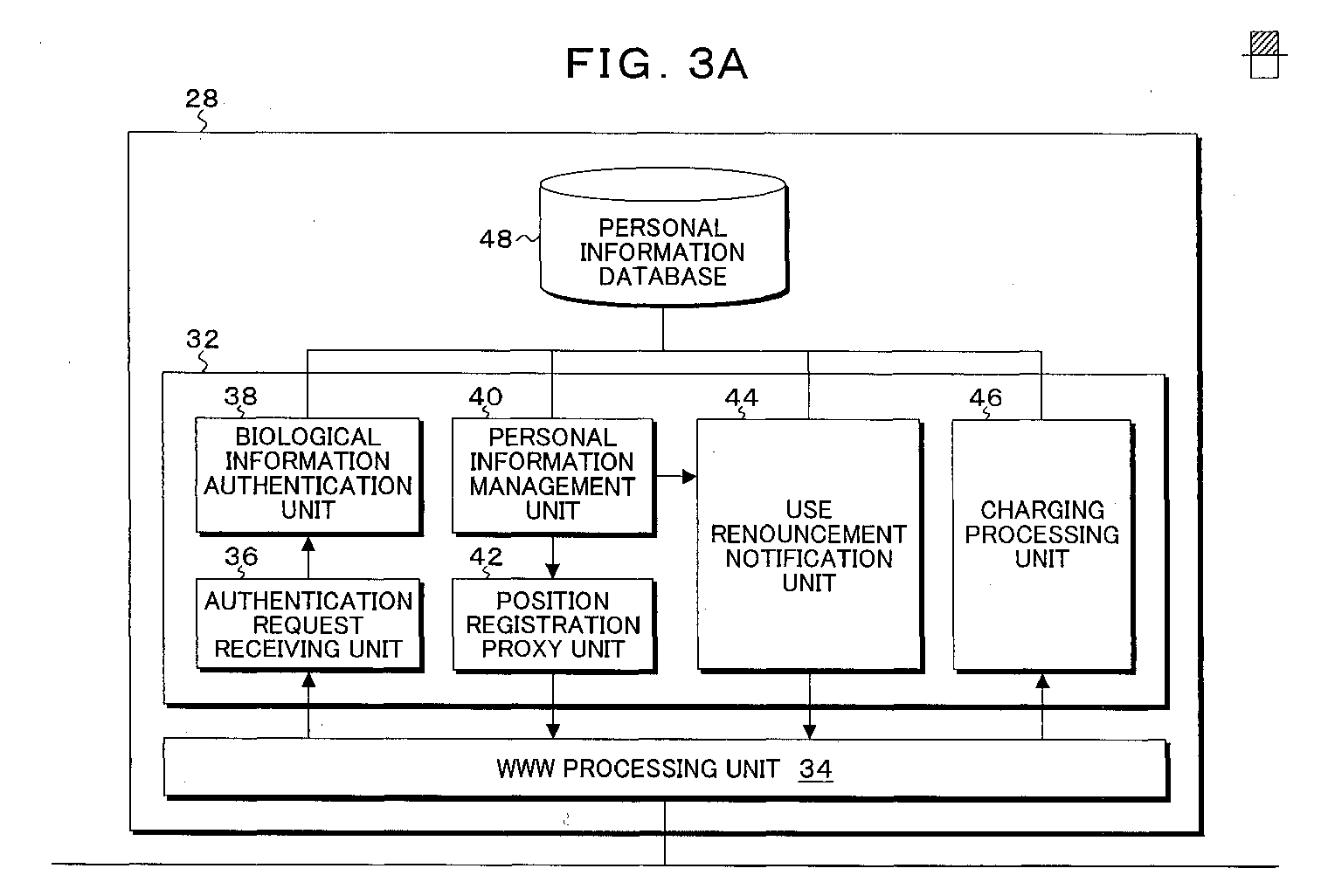
- Figs. 3A and 3B illustrate a functional configuration of the server 28 constructing the biological authentication office shown in Fig. 2 together with the cellular phone 10-1 and the mobile communication exchange 14.
- An authentication processing unit 32 and a WWW processing unit 34 are provided in the server 28.
- An authentication request receiving unit 36, a biological information authentication unit 38, a personal information management unit 40, a position registration proxy unit 42, a use renouncement notification unit 44 and a charging processing unit 46 are provided in the authentication processing unit 32 while a personal information database 48 is provided for the authentication processing unit 32.
- the cellular phone 10-1 is provided with a fingerprint read sensor 50 which reads, for example, fingerprint images as biological information. Placing a finger on the read window 50 of the fingerprint read sensor allows fingerprint information to be read and sent to the server 28 for biological information authentication.
- the mobile communication exchange 14 is provided with a position registration processing unit 54 which, upon request from the position registration proxy unit 42 of the server 28, registers position information 56 to make the cellular phone available for use.
- the server 28 in Figs. 3A and 3B is implemented, for example, using computer hardware resources shown in Fig. 4.
- a RAM 202 In the computer shown in Fig. 4, a RAM 202, a hard disk controller (software) 204, a floppy disk driver (software) 210, a CD-ROM driver (software) 214, a mouse controller 218, a keyboard controller 222, a display controller 226 and a communications board 230 are connected to a bus 201 of a CPU 200.
- the hard disk controller 204 connecting to a hard disk drive 206, is preloaded with an application program which performs terminal equipment position registration processing of the present invention, invokes necessary programs from the hard disk drive 206 at the computer startup, copies them into the RAM 202 and run them by the CPU 200.
- Afloppydisk drive (hardware) 212 is connected to the floppy disk driver 210 to allow a floppy disk (R) to be read from or written to.
- a CD drive (hardware) 216 is connected to the CD-ROM driver 214 to allow data and programs to be loaded from a CD.
- the mouse controller 218 informs the CPU 200 of input operations performed wi th a mouse 220.
- the keyboard controller 222 informs the CPU 200 of input operations performed with a keyboard 224.
- the display controller 226 displays information on a displayunit228.
- the communications board 230 uses communications circuits 232 including radio circuits to communicate with other computers and servers via networks such as the Internet.
- the personal information database 48 of the server 28 has personal information 58 with a record format as shown in Fig. 5 registered in advance for each user.
- the personal information 58 contains biological information 60 such as fingerprint image, a subscriber telephone number 62 of the cellular phone owned by a user, personal data 64 such as user phone book, an international mobile subscriber identification number (IMSI) 66 - a number used to access the cellular phone from the mobile communication exchange 14 - and a charged user identification number 68.
- the personal information 58 is registered with the personal information database 48 by the personal information management unit 40.
- the authentication request receiving unit 36 receives an authentication request containing the user biological information from the cellular phone 10-1 and the international mobile subscriber identification number (IMSI) and outputs reception information to the biological information authentication unit 38.
- IMSI international mobile subscriber identification number
- the biological information authentication unit 38 searches the personal information database 48 by user biological information received by the authentication request receiving unit 36 such as fingerprint image information, finds registered biological information which matches the received biological information to identify the personal information 58 as shown in Fig. 5 and records the received international mobile subscriber identification number of the cellular phone in the field of the international mobile subscriber identification number (IMSI) 66 in the identified personal information 58.
- IMSI international mobile subscriber identification number
- the position registration proxy unit 42 transfers the subscriber telephone number 62 and the received international mobile subscriber identification number (IMSI) in the personal information 58 identified by the biological information to the mobile communication exchange 14 to request that the two numbers be registered by the position registration processing unit 54 as the position information 56, thus allowing the cellular phone to receive and originate calls as a phone having a subscriber cellular phone number.
- IMSI international mobile subscriber identification number
- Fig. 6 illustrates a record format 70 of the position information 56 registered by the position registration processing unit 54 of the exchange 14 in response to the request from the server 28.
- a subscriber telephone number 72 and an international mobile subscriber identification number (IMSI) 74 are linked together and registered.
- IMSI international mobile subscriber identification number
- the position information 56 is normally registered by a cellular phone when the phone begins to be used, the server 28, which received an authentication request from the cellular phone, registers the position information on behalf of the cellular phone in the present invention.
- Figs. 7A and 7B illustrate a timing chart showing a specific processing procedure for cellular phone position registration by authentication processing using biological information according to the present invention.
- This example shows a processing assuming that the user 11 switches, by registering position information through biological authentication, to the cellular phone 10-2 which is, for example, a borrowed phone from the cellular phone 10-1 having a subscriber telephone number after he or she has started using the latter phone.
- Figs. 7A and 7B the user first performs position registration through authentication of biological information using his or her cellular phone 10-1 in order to start using the cellular phone 10-1 having a subscriber telephone number.
- Position registration of the cellular phone 10-1 is conducted by first performing a radio channel establishment 76 between the cellular phone 10-1 and the radio station 12, reading a fingerprint 78 placed on the fingerprint read sensor of the cellular phone 10-1 and sending the read fingerprint image information and the international mobile subscriber identification number (IMSI-A) to the server 28 which functions as the biological authentication office for an authentication registration 80.
- IMSI-A international mobile subscriber identification number
- the server 28 finds a registered fingerprint image matching the received fingerprint image and identifies personal information through search of the personal information database 48.
- identified personal information such as the subscriber telephone number 62 obtained from the personal information 58 and the international mobile subscriber identification number (IMSI-A) received from the cellular phone 10-1, both numbers shown in Fig. 5, are sent to the exchange 14 to request a position registration 82.
- IMSI-A international mobile subscriber identification number
- the exchange 14 In response to a request for the position registration 82 from the server 28, the exchange 14 performs a position registration 84 of the position information 56 of the cellular phone 10-1 in the position information 56.
- the server 28 is notified of a position registration completion 88 while the exchange 14 is notified of a position registration completion 86. Further, the exchange 14 notifies the cellular phone 10-1 of a position registration completion 90. This allows the cellular phone 10-1 to originate and receive calls using the subscriber telephone number.
- aradioresource establishment 94 is performed between the exchange 14 and the radio station 12 first followed by a radio channel establishment 96 between the radio station 12 and the cellular phone 10-1, after which the cellular phone 10-1 receives an incoming call 98 from the exchange 14.
- an incoming call acknowledge 102 is sent to the originating side such as a cellular phone via the exchange 14. Then , when the call ends on the cellular phone 10-1, a call clearing processing 104 is sent to the exchange 14. Further, the exchange 14 notifies the originating side of a call clearing processing 106.
- a radio channel establishment 108 is performed first between the cellular phone 10-2 and the radio station 12. Then, the user places his or her finger on the fingerprint read sensor of the cellular phone 10-2 in the same manner as for authentication of the cellular phone 10-1 to allow the sensor to read the same fingerprint 78 such that an authentication registration 112 is requested from the cellular phone 10-2 to the server 28.
- the fingerprint 78 and the international mobile subscriber identification number (IMSI-B) of the mobile phone 10-2 are sent for the purpose of the authentication registration 112.
- the server 28 In response to the request for the authentication registration 112 from the cellular phone 10-2, the server 28 identifies the personal information 58 having the matching registered fingerprint image, for example, as that shown in Fig. 5 through search of the personal information database 48 by fingerprint image as biological information.
- the server 28 transfers the subscriber telephone number 62 contained in the identified personal information 58 and the international mobile subscriber identification number (IMSI-B) received from the cellular phone 10-2 to the exchange 14 to request a position registration 114.
- IMSI-B international mobile subscriber identification number
- the exchange 14 In response to the request for the position registration from the server 28, the exchange 14 performs a position registration 116 of the subscriber telephone number contained in the personal information identified by the personal information database by biological information and the international mobile subscriber identification number of the cellular phone 10-2 in the position information 56.
- the exchange 14 notifies the server 28 of a position registration completion 120 while the server 28 notifies the exchange 14 of a position registration completion 118. Further, the exchange 14 notifies the cellular phone 10-2 of a position registration completion 122.
- the server 28 sends a use renouncement notification 124 to the previously used cellular phone 10-1 to notify the user that the cellular phone 10-1 is no longer available for use.
- the user wishes to switch back to the original cellular phone 10-1 after having switched once to the cellular phone 10-2, he or she can do so by performing position registration which allows the cellular phone 10-1 to originate and receive calls through sending of the image of the fingerprint 78 from the cellular phone 10-1 to the server 28 for biological authentication as the user did previously. Further, the user can switch to other cellular phone different from the cellular phone 10-2 in the same manner.
- Figs. 8A and 8B illustrate a flowchart showing the procedure for authentication processing by the server 28 shown in Figs. 3A and 3B.
- the flowchart concurrently provides the details of the program of the server functioning as the biological authentication office.
- Figs. 8A and 8B personal information is registered initially with the personal information database 48 in step S1.
- This initial registration of personal information is designed to link together biological information, a subscriber telephone number, an international mobile subscriber identification number and a charged user identification number for registration of such information in a position record format for each user.
- an international mobile subscriber identification number need not always be registered and may be left blank.
- step S2 whether an authentication request has been made by the cellular phone is checked in step S2. If a request has been made, the server receives biological information and an international mobile subscriber identification number (MISI-X) from the cellular phone in step S3 and checks the biological information registered with the personal information database against the received biological information in step S4.
- MIMI-X international mobile subscriber identification number
- the server registers the international mobile subscriber identification number (MISI-X) received from the cellular phone in the corresponding personal information in step S6. Then, the server sends the subscriber telephone number and the international mobile subscriber identification number (IMSI-X) to the exchange to request position registration in step S7.
- MIMI-X international mobile subscriber identification number
- IMSI-X international mobile subscriber identification number
- the exchange If, in response to the request for position registration, the exchange notifies the server of position registration completion in step S8, the server checks whether any cellular phone has been previously used in step S9. If a cellular phone has been previously used, the server sends a use renouncement notification to the cellular phone in step S10.
- step S5 If the received biological information does not match the registered one in step S5, the server notifies the cellular phone of an error in step S11 and waits for a new authentication request in step S12.
- Fig. 9 illustrates a flowchart of authentication processing by the cellular phone for cellular phone position registration according to the present invention.
- the cellular phone reads biological information such as fingerprint image in step S1 and requests authentication registration to the server 28 in step S2.
- the cellular phone If the cellular phone receives an acknowledge from the server in step S3, the cellular phone transfers biological information and its international mobile subscriber identification number (IMSI-X) in step S4. Then, if the cellular phone is not notified of an error by the server in step S5, it waits for position registration completion from the exchange in step S6, thus terminating a series of processings.
- IMSI-X international mobile subscriber identification number
- Fig. 10 illustrates a flowchart of charging processing by the server 28 functioning as the biological authentication office of the present invention.
- the server 28 receives a charging request from the exchange 14 in step S1
- the server 28 searches the personal information database 48 by a subscriber telephone number identified by the charging request and identifies personal information in step S2.
- the server 28 obtains a charged user identification number of the identified personal information.
- the server 28 processes charge billing based on the obtained charged user identification number in step S3.
- Fig. 11 illustrates an example of registration with the personal information database 48 for consolidating all charges onto a specific person among group members in the server charging processing shown in Fig. 10.
- the personal information database 48 has, for example, four pieces of personal information 58-1, 58-2, 58-3 and 58-4 on four users registered separately.
- the pieces of information 58-1, 58-2, 58-3 and 58-4 respectively contain pieces of biological information A, B, C and D different from one another on the four users, together with different subscriber telephone numbers of their respective cellular phones and different international mobile subscriber identification numbers (IMSI) (IMSI-A, B, C, D).
- IMSI international mobile subscriber identification numbers
- a charged user identification number As for charged user identification number, a charged user identification number (AAAAA) is registered in all the pieces of personal information 58-1 to 58-4 which specifies the user having the personal information 58-1 as the charged user.
- Such a registration with the personal information database 48 allows identification of the pieces of personal information 58-1 to 58-4 if a charging request is received from the exchange 14 which identifies the subscriber telephone numbers of the respective pieces of personal information 58-1 to 58-4, and allows all the four cellular phone charges to be billed to the same charged user since the charged user identification number in all the pieces of personal information is "AAAAA" in this case.
- venous vascular network venous vascular network
- palm print palm shape
- facial image facial image
- ear shape and iris are among other biological information which can be used as appropriate.
- the present invention is not limited to the aforementioned embodiments, but may include any modifications as appropriate without detriment to its object or advantages. Further, the present invention is not limited to the numerical values shown in the aforementioned embodiments.
- the present invention identifies a subscribed telephone number as a user' s subscriber terminal number by sending biological information, read from the input device of a terminal equipment such as cellular phone, to a server and performing authentication processing to identify personal information from registered biological information and then performs, based on this information, position registration of a terminal equipment to be used from the server to an exchange, thus allowing the user to originate and receive calls using a cellular phone different from the one having the subscriber telephone number, with calls charged to the telephone number subscribed by the user.
- a terminal equipment such as cellular phone
- the user can also use a different cellular phone as the phone having his or her subscriber telephone number by simply touching the phone and inputting the fingerprint, thus allowing instantaneous switching between a plurality of cellular phones.
Landscapes
- Engineering & Computer Science (AREA)
- Computer Networks & Wireless Communication (AREA)
- Signal Processing (AREA)
- Health & Medical Sciences (AREA)
- Biomedical Technology (AREA)
- General Health & Medical Sciences (AREA)
- Computer Hardware Design (AREA)
- Computer Security & Cryptography (AREA)
- Computing Systems (AREA)
- General Engineering & Computer Science (AREA)
- Mobile Radio Communication Systems (AREA)
- Telephonic Communication Services (AREA)
Abstract
Description
- The present invention relates generally to a method, program and apparatus for registering the position of a terminal equipment, which are used when a single user uses a plurality of mobile communication terminal equipments, and more particularly to a method, program and apparatus for registering the position of a terminal equipment, which utilize biological information (biometrics information) such as user's fingerprint image.
- IC card transfer has traditionally been known as a position registration method used when a single user uses a plurality of cellular phones.
- Figs. 1A and 1B are explanatory diagrams showing the position registration procedure for GSM/WCDMA cellular phones.
- The user communicates with a position registration based on an international mobile subscriber identity (IMSI) 310 stored in an IC card (SIM/USIM card) 308 to identify himself or herself.
- If the same user has two cellular phones 300-1 and 300-2 and uses the new phone 300-2, he or she can use this phone as his or her cellular phone by removing the
IC card 308 from the cellular phone 300-1 and inserts it into the cellular phone 300-2. - This can be described more specifically as follows. When the user uses the cellular phone 300-1 by inserting the
IC card 308 into the phone, position registration with anexchange 304 is required. Theposition registration 304 is requested to theexchange 304 by sending the international mobile subscriber identification number (IMSI) 310 to theexchange 304 after aradio channel establishment 312 between the cellular phone 300-1 and aradio station 302. In response to the position registration request, theexchange 304 performs aposition registration 316 of user position information, linking a user telephone number and the international mobile subscriber identification number (IMSI-A) of the cellular phone 300-1 to positioninformation 306. - When registration of the user position information is complete, a
position registration completion 318 is sent to theexchange 304 which then sends back aposition registration completion 320 to the cellular phone 300-1, thus making the cellular phone 300-1 available for use. - For example, if the
exchange 304 receives an incoming call for the phone number of the cellular phone 300-1, the office performs aradio resource establishment 324 with theradio station 302 by referencing theposition information 306 and obtaining the international mobile subscriber identity (IMSI), performs aradio channel establishment 326 with the cellular phone 300-1 and calls up the cellular phone 300-1. - The originating side is notified of an incoming call acknowledge 330 of the cellular phone 300-1 by the
exchange 304 as an incoming call acknowledge 332, thus allowing a speech channel to be established. When the cellular phone 300-1 issues acall clearing processing 334, theexchange 304 issues acall clearing processing 336 to the originating side, causing the call to be terminated. - If the same user wishes to use the cellular phone 300-2 borrowed at an event site or other location, he or she takes out the
IC card 308 from the cellular phone 300-1 and inserts the card into the cellular phone 300-2. The user performs a radiochannel es tablishment 340 between the cellular phone 300-2 and theradio station 302 first and then sends the international mobile subscriber identification number (IMSI) 310 to theexchange 304 to request aposition registration 342 as was done previously. - In response to the position registration request, the
exchange 304 performs a position registration 344 which changes registration of user position information linking the user telephone number and the international mobile subscriber identification number (IMSI-A) of the cellular phone 300-1 into that of user position information linking the user telephone number and the international mobile subscriber identification number (IMSI-A) of the cellular phone 300-2. - When registration of user position information is complete, a
position registration completion 346 is sent to theexchange 304 which then sends back aposition registration completion 348 to the cellular phone 300-2, thus making the cellular phone 300-2 available for use. - This borrowed cellular phone 300-2 originates and receives calls at a different telephone number rather than the telephone number of the cellular phone 300-1 normally used by the user.
- Japanese Patent Application Laid-open (Kokai) Pub. No. 2001-29078
- Japanese Patent Application Laid-open (Kokai) Pub. No. 2002-044727
- However, such a traditional position registration method employed when a single user uses a plurality of cellular phones presents the following problems:
- First, the IC card must be transferred from an old cellular phone to a new one, requiring time and effort unless the user is accustomed to doing so. Additionally, some users may not be able to transfer the IC card.
- When the user uses a borrowed cellular phone, he or she must register for call transfer or other service - a burdensome task - if the user wishes to receive calls for his or her usual phone with the borrowed one.
- If the receiving side is coordinated with a phone book based on cellular phone numbers , the party on the receiving side may reject a call from the borrowed phone because the call is made from an unknown person.
- Further, since user information is stored on the IC card, if the cellular phone is put in the hands of a third party with the IC card left in the phone, the user cannot use personal information and personal information may be read by the third party.
- It is therefore an object of the present invention to provide a terminal equipment position registration method, a registration program and a registration apparatus which make a cellular phone available for use as one' s own phone through simple operations and reliably prevent personal information leaks.
- According to a first aspect of the present invention there is provided a method of registering the position of a terminal equipment by a server, comprising:
- a personal information managing step, by a personal information management unit, of registering personal information for each user, the personal information linking a subscribed terminal number, a terminal subscriber identification number and user charging identification information to biological information of a user possessing the terminal equipment;
- an authentication request receiving step, by an authentication request receiving unit, of receiving from the terminal equipment an authentication request containing the user biological information and the terminal subscriber identification information;
- abiologicalinformation authentication step, by a biological information authentication unit, of retrieving personal information having biological information matching the received biological information and of changing terminal subscriber identification information in the retrieved personal information into the received terminal subscriber identification information; and
- a position registration proxy step, by a position registration proxy unit, of transferring the subscribed terminal number in the personal information retrieved and the received terminal subscriber identification information to an exchange and of requesting position information registration which enables call in and call out as a terminal equipment having the subscribed terminal number.
-
- Taking, as an example of a terminal equipment, a cellular phone for the description of the present invention, the cellular phone sends loaded biological information to a server, identifies a user's subscribed terminal number by performing authentication processing designed to identify personal information from among registered biological information and performs, based on this number, position registration of a cellular phone to be used with an exchange from the server, thus allowing even a cellular phone different from a phone having a subscriber telephone number to originate and receive calls using the user's subscribed telephone number.
- Even a different cellular phone can be made available for use to the user as his or her subscribed cellular phone by simply inputting the user's fingerprint through touching the phone, thus allowing instantaneous switching between a plurality of cellular phones.
- Cellular phone personal information is managed by a server constructing an authentication office, preventing possible personal information leaks even in the event of a cellular phone theft.
- The position registering method of the present invention may further comprise a use renouncement notification step, by a use renouncement notification unit, of notifying a terminal equipment which has been used so far of renouncement of its use when position information registration is requested of the exchange which enables call in and call out as a terminal equipment having the subscribed terminal number based on authentication of biological information from a new terminal equipment by the authentication request receiving step, the biological information authentication step and the posi tion registration proxy step . This allows the user to confirm that the terminal equipment such as cellular phone which he or she has used previously is no longer available for use.
- Biological information received in an authentication request receiving unit is biological information loaded in real time into the terminal equipment. Therefore,biologicalinformationsuch as fingerprint required for position registration authentication will not remain in the terminal equipment, thus eliminating the likelihood of biological information piracy even in the event of a theft of the cellular phone or other terminal equipment.
- The personal information management step may include registering charged user identification information of a specific person among group members as common charged user identification information in personal information of a plurality of terminal equipments owned by group members such that the specific person is charged.
- Thus, linking personal information - information identified by authentication of biological information of cellular phones or other terminal equipments possessed by group members such as family members - and a specific charged user identity together allows all calls to be charged to a specific user if group members make calls using position registration based on biological information authentication by a server.
- Here, the terminal equipments used in the present invention are cellular phones. Biological information employed in the present invention includes user's fingerprints, venous vascular network, palm print, palm shape, facial image, ear shape or iris.
- According to a second aspect of the present invention there is provided a program executed by a server which is accessible to a terminal equipment and an exchange. The program allows a computer acting as the server to execute:
- a personal information managing step of registering personal information for each user, the personal information linking a subscribed terminal number, a terminal subscriber identification number and user charging identification information to biological information of a user possessing the terminal equipment;
- an authentication request receiving step of receiving from the terminal equipment an authentication request containing the user biological information and the terminal subscriber identification information;
- a biological information authentication step of retrieving personal information having biological information matching the received biological information and of changing terminal subscriber identification information in the retrieved personal information into the received terminal subscriber identification information; and
- a position registration proxy step of transferring the subscribed terminal number in the personal information retrieved and the received terminal subscriber identification information to an exchange and of requesting position information registration which enables call in and call out as a terminal equipment having the subscribed terminal number.
-
- According to a third aspect of the present invention there is provided an apparatus for registering the position of a terminal equipment. The position registration apparatus (server) comprises:
- a personal information managing unit for registering personal information for each user, the personal information linking a subscribed terminal number, a terminal subscriber identification number and user charging identification information to biological information of a user possessing the terminal equipment;
- an authentication request receiving unit for receiving from the terminal equipment an authentication request containing the user biological information and the terminal subscriber identification information;
- a biological information authentication unit for retrieving personal information having biological information matching the received biological information and of changing terminal subscriber identification information in the retrieved personal information into the received terminal subscriber identification information; and
- a position registration proxy unit for transferring the subscribed terminal number in the personal information retrieved and the received terminal subscriber identification information to an exchange and of requesting position information registration which enables call in and call out as a terminal equipment having the subscribed terminal number.
-
- Note that the details of the program and the position registration apparatus of the present invention are basically the same as those of the position registration method.
- The above and other objects, aspects, features and advantages of the present invention will become more apparent from the following detailed description with reference to the drawings.
-
- Figs. 1A and 1B are timing charts of conventional position registration processing using IC card;
- Fig. 2 is an explanatory diagram of a network environment to which the present invention is applied;
- Figs. 3A and 3B are block diagrams showing the functional configuration of a server constructing a biological authentication office shown in Fig. 2 together with a cellular phone and a mobile communication exchange;
- Fig. 4 is an explanatory diagram of a computer hardware environment used for the server in Figs. 3A and 3B;
- Fig. 5 is an explanatory diagram of the record format of a personal information database shown in Figs. 3A and 3B;
- Fig. 6 is an explanatory diagram of the record format of position information whose setup is requested to the exchange in Figs. 3A and 3B;
- Figs. 7A and 7B are a timing chart of position registration processing by biological information authentication of the present invention;
- Figs. 8A and 8B are flowcharts of server authentication processing shown in Figs. 3A and 3B;
- Fig. 9 is a flowchart of authentication processing in cellular phone shown in Figs. 3A and 3B;
- Fig. 10 is a flowchart of server charging processing shown in Figs. 3A and 3B; and
- Fig. 11 is an explanatory diagram of contents registered in a personal information database which charges a specific person in a group.
-
- Fig. 2 illustrates an explanatory diagram of a network environment to which the present invention is applied, taking, as examples of terminal equipments, cellular phones.
- In Fig. 2, cellular phones 10-1, 10-2 and 10-3 functioning as terminal equipments are all used by a
user 11 alone. Theuser 11 has a subscriber telephone number for the cellular phone 10-1, but the cellular phones 10-2 and 10-3 are, for example, borrowed phones with no such numbers. - The
user 11 can normally use the cellular phone 10-1 having a subscriber telephone number to make calls with acellular phone 22 owned by other user via aradio station 12, amobile communication exchange 14, atelephone network 16, amobile communication exchange 18 and aradio station 20 or with a fixedphone 26 connected to a fixedcommunication exchange 24. - Thus, a
server 28 is provided which functions as a biological authentication office via anInternet 30, for example, to allow theuser 11 to use any of the three cellular phones 10-1 to 10-3. Biological information of theuser 11 such as fingerprint information linked to personal information of the cellular phone 10-1 is registered in advance in theserver 28. - For this reason, if the
user 11 uses the cellular phone 10-1, this phone reads the fingerprint image of theuser 11 with its fingerprint read sensor and sends it to theserver 28 to request authentication. In response to the authentication request, theserver 28 identifies the personal information of theuser 11 by the biological information sent from the cellular phone 10-1 and registers position information with themobile communication exchange 14 to make the cellular phone 10-1 available for use. - Figs. 3A and 3B illustrate a functional configuration of the
server 28 constructing the biological authentication office shown in Fig. 2 together with the cellular phone 10-1 and themobile communication exchange 14. - An
authentication processing unit 32 and aWWW processing unit 34 are provided in theserver 28. An authentication request receiving unit 36, a biologicalinformation authentication unit 38, a personal information management unit 40, a positionregistration proxy unit 42, a use renouncement notification unit 44 and a charging processing unit 46 are provided in theauthentication processing unit 32 while apersonal information database 48 is provided for theauthentication processing unit 32. - On the other hand, the cellular phone 10-1 is provided with a
fingerprint read sensor 50 which reads, for example, fingerprint images as biological information. Placing a finger on the readwindow 50 of the fingerprint read sensor allows fingerprint information to be read and sent to theserver 28 for biological information authentication. - The
mobile communication exchange 14 is provided with a positionregistration processing unit 54 which, upon request from the positionregistration proxy unit 42 of theserver 28, registers positioninformation 56 to make the cellular phone available for use. - The
server 28 in Figs. 3A and 3B is implemented, for example, using computer hardware resources shown in Fig. 4. - In the computer shown in Fig. 4, a
RAM 202, a hard disk controller (software) 204, a floppy disk driver (software) 210, a CD-ROM driver (software) 214, amouse controller 218, akeyboard controller 222, adisplay controller 226 and acommunications board 230 are connected to abus 201 of aCPU 200. - The
hard disk controller 204, connecting to ahard disk drive 206, is preloaded with an application program which performs terminal equipment position registration processing of the present invention, invokes necessary programs from thehard disk drive 206 at the computer startup, copies them into theRAM 202 and run them by theCPU 200. - Afloppydisk drive (hardware) 212 is connected to the
floppy disk driver 210 to allow a floppy disk (R) to be read from or written to. A CD drive (hardware) 216 is connected to the CD-ROM driver 214 to allow data and programs to be loaded from a CD. - The
mouse controller 218 informs theCPU 200 of input operations performed wi th amouse 220. Thekeyboard controller 222 informs theCPU 200 of input operations performed with akeyboard 224. Thedisplay controller 226 displays information on a displayunit228. Thecommunications board 230 usescommunications circuits 232 including radio circuits to communicate with other computers and servers via networks such as the Internet. - Next, the processing capability of the
server 28 functioning as the biological authentication office in Figs. 3A and 3B will be described in detail. First, thepersonal information database 48 of theserver 28 haspersonal information 58 with a record format as shown in Fig. 5 registered in advance for each user. - The
personal information 58 containsbiological information 60 such as fingerprint image, asubscriber telephone number 62 of the cellular phone owned by a user,personal data 64 such as user phone book, an international mobile subscriber identification number (IMSI) 66 - a number used to access the cellular phone from the mobile communication exchange 14 - and a chargeduser identification number 68. Thepersonal information 58 is registered with thepersonal information database 48 by the personal information management unit 40. - The authentication request receiving unit 36 receives an authentication request containing the user biological information from the cellular phone 10-1 and the international mobile subscriber identification number (IMSI) and outputs reception information to the biological
information authentication unit 38. - The biological
information authentication unit 38 searches thepersonal information database 48 by user biological information received by the authentication request receiving unit 36 such as fingerprint image information, finds registered biological information which matches the received biological information to identify thepersonal information 58 as shown in Fig. 5 and records the received international mobile subscriber identification number of the cellular phone in the field of the international mobile subscriber identification number (IMSI) 66 in the identifiedpersonal information 58. - Further, the position
registration proxy unit 42 transfers thesubscriber telephone number 62 and the received international mobile subscriber identification number (IMSI) in thepersonal information 58 identified by the biological information to themobile communication exchange 14 to request that the two numbers be registered by the positionregistration processing unit 54 as theposition information 56, thus allowing the cellular phone to receive and originate calls as a phone having a subscriber cellular phone number. - Fig. 6 illustrates a
record format 70 of theposition information 56 registered by the positionregistration processing unit 54 of theexchange 14 in response to the request from theserver 28. Asubscriber telephone number 72 and an international mobile subscriber identification number (IMSI) 74 are linked together and registered. Although theposition information 56 is normally registered by a cellular phone when the phone begins to be used, theserver 28, which received an authentication request from the cellular phone, registers the position information on behalf of the cellular phone in the present invention. - Figs. 7A and 7B illustrate a timing chart showing a specific processing procedure for cellular phone position registration by authentication processing using biological information according to the present invention. This example shows a processing assuming that the
user 11 switches, by registering position information through biological authentication, to the cellular phone 10-2 which is, for example, a borrowed phone from the cellular phone 10-1 having a subscriber telephone number after he or she has started using the latter phone. - In Figs. 7A and 7B, the user first performs position registration through authentication of biological information using his or her cellular phone 10-1 in order to start using the cellular phone 10-1 having a subscriber telephone number.
- Position registration of the cellular phone 10-1 is conducted by first performing a
radio channel establishment 76 between the cellular phone 10-1 and theradio station 12, reading afingerprint 78 placed on the fingerprint read sensor of the cellular phone 10-1 and sending the read fingerprint image information and the international mobile subscriber identification number (IMSI-A) to theserver 28 which functions as the biological authentication office for anauthentication registration 80. - In response to the authentication request from the cellular phone 10-1, the
server 28 finds a registered fingerprint image matching the received fingerprint image and identifies personal information through search of thepersonal information database 48. - Then, identified personal information such as the
subscriber telephone number 62 obtained from thepersonal information 58 and the international mobile subscriber identification number (IMSI-A) received from the cellular phone 10-1, both numbers shown in Fig. 5, are sent to theexchange 14 to request aposition registration 82. - In response to a request for the
position registration 82 from theserver 28, theexchange 14 performs aposition registration 84 of theposition information 56 of the cellular phone 10-1 in theposition information 56. When theposition registration 84 is complete, theserver 28 is notified of aposition registration completion 88 while theexchange 14 is notified of aposition registration completion 86. Further, theexchange 14 notifies the cellular phone 10-1 of aposition registration completion 90. This allows the cellular phone 10-1 to originate and receive calls using the subscriber telephone number. - For instance, if the
exchange 14 receives anincoming call 92 from a terminal equipment such as other cellular phone,aradioresource establishment 94 is performed between theexchange 14 and theradio station 12 first followed by aradio channel establishment 96 between theradio station 12 and the cellular phone 10-1, after which the cellular phone 10-1 receives anincoming call 98 from theexchange 14. - When the cellular phone 10-1 sends an incoming call acknowledge 100 to the
exchange 14 in response to theincoming call 98, an incoming call acknowledge 102 is sent to the originating side such as a cellular phone via theexchange 14. Then , when the call ends on the cellular phone 10-1, acall clearing processing 104 is sent to theexchange 14. Further, theexchange 14 notifies the originating side of acall clearing processing 106. - Next, we suppose that the user wishes to stop using the cellular phone 10-1 which he or she has used previously and start using the cellular phone 10-2 which is, for example, a borrowed phone. In this case, a
radio channel establishment 108 is performed first between the cellular phone 10-2 and theradio station 12. Then, the user places his or her finger on the fingerprint read sensor of the cellular phone 10-2 in the same manner as for authentication of the cellular phone 10-1 to allow the sensor to read thesame fingerprint 78 such that anauthentication registration 112 is requested from the cellular phone 10-2 to theserver 28. Thefingerprint 78 and the international mobile subscriber identification number (IMSI-B) of the mobile phone 10-2 are sent for the purpose of theauthentication registration 112. - In response to the request for the
authentication registration 112 from the cellular phone 10-2, theserver 28 identifies thepersonal information 58 having the matching registered fingerprint image, for example, as that shown in Fig. 5 through search of thepersonal information database 48 by fingerprint image as biological information. - Then, the
server 28 transfers thesubscriber telephone number 62 contained in the identifiedpersonal information 58 and the international mobile subscriber identification number (IMSI-B) received from the cellular phone 10-2 to theexchange 14 to request aposition registration 114. - In response to the request for the position registration from the
server 28, theexchange 14 performs aposition registration 116 of the subscriber telephone number contained in the personal information identified by the personal information database by biological information and the international mobile subscriber identification number of the cellular phone 10-2 in theposition information 56. Theexchange 14 notifies theserver 28 of aposition registration completion 120 while theserver 28 notifies theexchange 14 of aposition registration completion 118. Further, theexchange 14 notifies the cellular phone 10-2 of aposition registration completion 122. - Thus, when position registration is complete which allows the cellular phone 10-2 to receive and originate calls using the subscriber telephone number, the
server 28 sends ause renouncement notification 124 to the previously used cellular phone 10-1 to notify the user that the cellular phone 10-1 is no longer available for use. - Of course, if the user wishes to switch back to the original cellular phone 10-1 after having switched once to the cellular phone 10-2, he or she can do so by performing position registration which allows the cellular phone 10-1 to originate and receive calls through sending of the image of the
fingerprint 78 from the cellular phone 10-1 to theserver 28 for biological authentication as the user did previously. Further, the user can switch to other cellular phone different from the cellular phone 10-2 in the same manner. - Figs. 8A and 8B illustrate a flowchart showing the procedure for authentication processing by the
server 28 shown in Figs. 3A and 3B. The flowchart concurrently provides the details of the program of the server functioning as the biological authentication office. - In Figs. 8A and 8B, personal information is registered initially with the
personal information database 48 in step S1. This initial registration of personal information is designed to link together biological information, a subscriber telephone number, an international mobile subscriber identification number and a charged user identification number for registration of such information in a position record format for each user. For initial registration, an international mobile subscriber identification number need not always be registered and may be left blank. - Next, whether an authentication request has been made by the cellular phone is checked in step S2. If a request has been made, the server receives biological information and an international mobile subscriber identification number (MISI-X) from the cellular phone in step S3 and checks the biological information registered with the personal information database against the received biological information in step S4.
- If there is a match between the two pieces of the biological information in step S5, the server registers the international mobile subscriber identification number (MISI-X) received from the cellular phone in the corresponding personal information in step S6. Then, the server sends the subscriber telephone number and the international mobile subscriber identification number (IMSI-X) to the exchange to request position registration in step S7.
- If, in response to the request for position registration, the exchange notifies the server of position registration completion in step S8, the server checks whether any cellular phone has been previously used in step S9. If a cellular phone has been previously used, the server sends a use renouncement notification to the cellular phone in step S10.
- If the received biological information does not match the registered one in step S5, the server notifies the cellular phone of an error in step S11 and waits for a new authentication request in step S12.
- Fig. 9 illustrates a flowchart of authentication processing by the cellular phone for cellular phone position registration according to the present invention. In the cellular phone authentication processing,the cellular phone reads biological information such as fingerprint image in step S1 and requests authentication registration to the
server 28 in step S2. - If the cellular phone receives an acknowledge from the server in step S3, the cellular phone transfers biological information and its international mobile subscriber identification number (IMSI-X) in step S4. Then, if the cellular phone is not notified of an error by the server in step S5, it waits for position registration completion from the exchange in step S6, thus terminating a series of processings.
- Fig. 10 illustrates a flowchart of charging processing by the
server 28 functioning as the biological authentication office of the present invention. In the charging processing, if theserver 28 receives a charging request from theexchange 14 in step S1, theserver 28 searches thepersonal information database 48 by a subscriber telephone number identified by the charging request and identifies personal information in step S2. Then, theserver 28 obtains a charged user identification number of the identified personal information. Finally, theserver 28 processes charge billing based on the obtained charged user identification number in step S3. - Fig. 11 illustrates an example of registration with the
personal information database 48 for consolidating all charges onto a specific person among group members in the server charging processing shown in Fig. 10. - The
personal information database 48 has, for example, four pieces of personal information 58-1, 58-2, 58-3 and 58-4 on four users registered separately. The pieces of information 58-1, 58-2, 58-3 and 58-4 respectively contain pieces of biological information A, B, C and D different from one another on the four users, together with different subscriber telephone numbers of their respective cellular phones and different international mobile subscriber identification numbers (IMSI) (IMSI-A, B, C, D). - As for charged user identification number, a charged user identification number (AAAAA) is registered in all the pieces of personal information 58-1 to 58-4 which specifies the user having the personal information 58-1 as the charged user.
- Such a registration with the
personal information database 48, as shown in Fig. 11, allows identification of the pieces of personal information 58-1 to 58-4 if a charging request is received from theexchange 14 which identifies the subscriber telephone numbers of the respective pieces of personal information 58-1 to 58-4, and allows all the four cellular phone charges to be billed to the same charged user since the charged user identification number in all the pieces of personal information is "AAAAA" in this case. - While GSM, WCDMA, CDMA-ONE, CDMA2000, PDC, PHS and WLAN terminals, each different from the others in network system, are among terminal equipments which allow position information registration by biological information authentication of the present invention, position registration by biological information authentication of the present invention allows users to use such a plurality of terminal equipments differing in network system using their own subscriber telephone numbers, with charges billed to the subscriber telephone numbers.
- While the above embodiment took read fingerprint image as an example of biological information, venous vascular network, palm print, palm shape, facial image, ear shape and iris are among other biological information which can be used as appropriate.
- The present invention is not limited to the aforementioned embodiments, but may include any modifications as appropriate without detriment to its object or advantages. Further, the present invention is not limited to the numerical values shown in the aforementioned embodiments.
- The present invention, as described above, identifies a subscribed telephone number as a user' s subscriber terminal number by sending biological information, read from the input device of a terminal equipment such as cellular phone, to a server and performing authentication processing to identify personal information from registered biological information and then performs, based on this information, position registration of a terminal equipment to be used from the server to an exchange, thus allowing the user to originate and receive calls using a cellular phone different from the one having the subscriber telephone number, with calls charged to the telephone number subscribed by the user.
- The user can also use a different cellular phone as the phone having his or her subscriber telephone number by simply touching the phone and inputting the fingerprint, thus allowing instantaneous switching between a plurality of cellular phones.
- Since cellular phone personal information is managed by a server constructing a biological authentication office, personal information leaks can be reliably prevented, for example, through cancellation control of personal information on the server side even in the event of a phone theft.
- Further, if a plurality of cellular phones are used by individual members of a family or other group, use of the charged user identification number of a specific person - a number included in personal information - as the common number for all members allows all cellular phone charges to be consolidated onto the specific person.
Claims (14)
- A method of registering the position of a terminal equipment, comprising:a personal information managing step, by a personal information management unit, of registering personal information for each user, the personal information linking a subscribed terminal number, a terminal subscriber identification number and user charging identification information to biological information of a user possessing the terminal equipment;an authentication request receiving step, by an authentication request receiving unit, of receiving from the terminal equipment an authentication request containing the user biological information and the terminal subscriber identification information;a biological information authentication step, by a biological information authentication unit, of retrieving personal information having biological information matching the received biological information and of changing terminal subscriber identification information in the retrieved personal information into the received terminal subscriber identification information; anda position registration proxy step, by a position registration proxy unit, of transferring the subscribed terminal number in the personal information retrieved and the received terminal subscriber identification information to an exchange and of requesting position information registration which enables call in and call out as a terminal equipment having the subscribed terminal number.
- The method of registering the position of a terminal equipment according to claim 1, further comprising a use renouncement notification step of notifying a terminal equipment which has been used so far of renouncement of its use when position information registration is requested of the exchange which enables call in and call out as a terminal equipment having the subscribed terminal number based on authentication of biological information from a new terminal equipment by the authentication request receiving step, the biological information authentication step and the position registration proxy step.
- The method of registering the position of a terminal equipment according to claim 1, wherein the biological information received by the authenticationrequestreceivingstepisbiological information read in real time into the terminal equipment.
- The method of registering the position of a terminal equipment according to claim 1, wherein the personal information management step includes registering charged user identification information of a specific person among group members as common charged user identification information in personal information of a plurality of terminal equipments owned by group members such that the specific person is charged.
- The method of registering the position of a terminal equipment according to claim 1, wherein the terminal equipment is a cellular phone.
- The method of registering the position of a terminal equipment according to claim 1, wherein the biological information is user's fingerprints, venous vascular network, palm print, palm shape, facial image, ear shape or iris.
- A program executed by a computer acting as a server that is accessible between a terminal equipment and an exchange, the program comprising:a personal information managing step of registering personal information for each user, the personal information linking a subscribed terminal number, a terminal subscriber identification number and user charging identification information to biological information of a user possessing the terminal equipment;an authentication request receiving step of receiving from the terminal equipment an authentication request containing the user biological information and the terminal subscriber identification information;a biological information authentication step of retrieving personal information having biological information matching the received biological information and of changing terminal subscriber identification information in the retrieved personal information into the received terminal subscriber identification information; anda position registration proxy step of transferring the subscribed terminal number in the personal information retrieved and the received terminal subscriber identification information to an exchange and of requesting position information registration which enables call in and call out as a terminal equipment having the subscribed terminal number.
- The program according to claim 7, further comprising a use renouncement notification step of notifying a terminal equipment which has been used so far of renouncement of its use when position information registration is requested of the exchange which enables call in and call out as a terminal equipment having the subscribed terminal number based on authentication of biological information from a new terminal equipment by the authentication request receiving step, the biological information authentication step and the position registration proxy step.
- The program according to claim 7, wherein the biological information received by the authentication request receiving step is biological information read in real time into the terminal equipment.
- The program according to claim 7, wherein the personal information management step includes registering charged user identification information of a specific person among group members as common charged user identification information in personal information of a plurality of terminal equipments owned by group members such that the specific person is charged.
- An apparatus for registering the position of a terminal equipment, comprising:a personal information managing unit for registering personal information for each user, the personal information linking a subscribed terminal number, a terminal subscriber identification number and user charging identification information to biological information of a user possessing the terminal equipment;an authentication request receiving unit for receiving from the terminal equipment an authentication request containing the user biological information and the terminal subscriber identification information;a biological information authentication unit for retrieving personal information having biological information matching the received biological information and of changing terminal subscriber identification information in the retrieved personal information into the received terminal subscriber identification information; anda position registration proxy unit for transferring the subscribed terminal number in the personal information retrieved and the received terminal subscriber identification information to an exchange and of requesting position information registration which enables call in and call out as a terminal equipment having the subscribed terminal number.
- The apparatus for registering the position of a terminal equipment according to claim 11, further comprising a use renouncement notification unit for notifying a terminal equipment which has been used so far of renouncement of its use when position information registration is requested of the exchange which enables call in and call out as a terminal equipment having the subscribed terminal number based on authentication of biological information from a new terminal equipment by the authentication request receiving unit, the biological information authentication unit and the position registration proxy unit.
- The apparatus for registering the position of a terminal equipment according to claim 11, wherein the biological information received by the authentication request receiving step is biological information read in real time into the terminal equipment.
- The apparatus for registering the position of a terminal equipment according to claim 11, wherein the personal information management step includes registering charged user identification information of a specific person among group members as common charged user identification information in personal information of a plurality of terminal equipments owned by group members such that the specific person is charged.
Applications Claiming Priority (2)
| Application Number | Priority Date | Filing Date | Title |
|---|---|---|---|
| JP2002337482A JP4022131B2 (en) | 2002-11-21 | 2002-11-21 | Terminal device location registration method, program, and apparatus |
| JP2002337482 | 2002-11-21 |
Publications (2)
| Publication Number | Publication Date |
|---|---|
| EP1422964A1 true EP1422964A1 (en) | 2004-05-26 |
| EP1422964B1 EP1422964B1 (en) | 2007-06-27 |
Family
ID=32212114
Family Applications (1)
| Application Number | Title | Priority Date | Filing Date |
|---|---|---|---|
| EP03257170A Expired - Lifetime EP1422964B1 (en) | 2002-11-21 | 2003-11-13 | Location registering method, program and apparatus for terminal equipment |
Country Status (4)
| Country | Link |
|---|---|
| US (1) | US8423784B2 (en) |
| EP (1) | EP1422964B1 (en) |
| JP (1) | JP4022131B2 (en) |
| DE (1) | DE60314587T2 (en) |
Cited By (7)
| Publication number | Priority date | Publication date | Assignee | Title |
|---|---|---|---|---|
| WO2006119813A1 (en) * | 2005-05-12 | 2006-11-16 | Jens Hoffmeister | Interactive communication system |
| EP2061281A1 (en) | 2007-11-13 | 2009-05-20 | Vodafone Holding GmbH | Method and system for communicating with a mobile radio network |
| WO2013124635A1 (en) * | 2012-02-24 | 2013-08-29 | Sony Corporation | Mobile communication using reconfigurable user identification module |
| CN104980893A (en) * | 2014-04-11 | 2015-10-14 | 上海智向信息科技有限公司 | Group monitoring method based on iBeacon protocol and device thereof |
| CN105554751A (en) * | 2015-08-19 | 2016-05-04 | 宇龙计算机通信科技(深圳)有限公司 | Method and system of card-free terminal registration to mobile network, and equipment |
| CN105554734A (en) * | 2015-10-26 | 2016-05-04 | 东莞酷派软件技术有限公司 | Mobile network registration method and related equipment and system |
| WO2017088545A1 (en) * | 2015-11-26 | 2017-06-01 | 中兴通讯股份有限公司 | Alarm method for terminal and terminal |
Families Citing this family (14)
| Publication number | Priority date | Publication date | Assignee | Title |
|---|---|---|---|---|
| US7308273B2 (en) * | 2004-06-14 | 2007-12-11 | Nokia Corporation | Method for determining a location |
| JP2006060392A (en) * | 2004-08-18 | 2006-03-02 | Nec Corp | Unauthorized-use preventive system and identification method for information terminal device |
| JP2007150435A (en) * | 2005-11-24 | 2007-06-14 | Radioware:Kk | Communication system |
| JP2009044368A (en) * | 2007-08-08 | 2009-02-26 | Ntt Docomo Inc | Mobile communication system and mobile communication method |
| JP5223491B2 (en) * | 2008-06-24 | 2013-06-26 | 日本電気株式会社 | Terminal device, operation mode change method and operation mode change control program used for the terminal device |
| KR101479655B1 (en) * | 2008-09-12 | 2015-01-06 | 삼성전자주식회사 | Method and system for security setting of mobile terminal |
| JP5347864B2 (en) * | 2009-09-18 | 2013-11-20 | 富士通株式会社 | Mobile communication service processing method, mobile phone terminal, and mobile communication network side device |
| US8855600B2 (en) * | 2009-12-21 | 2014-10-07 | Verizon Patent And Licensing Inc. | Method and system for authenticating a non-native user of a mobile device |
| IL207176A0 (en) * | 2010-07-25 | 2011-04-28 | Verint Systems Ltd | System and method for video - assisted identification of mobile phone users |
| CN102104603A (en) * | 2011-02-22 | 2011-06-22 | 中兴通讯股份有限公司 | Method, system and device for registering mobile terminal in WEB server |
| US8571564B2 (en) * | 2011-11-14 | 2013-10-29 | Movirtu Limited | Method and system for enabling usage of mobile telephone services on a donor device |
| CN104145472B (en) * | 2012-02-29 | 2016-06-15 | 瑞典爱立信有限公司 | The method and apparatus of storage data record |
| GB2500823B (en) * | 2013-03-28 | 2014-02-26 | Paycasso Verify Ltd | Method, system and computer program for comparing images |
| JP7428025B2 (en) * | 2020-03-11 | 2024-02-06 | 株式会社Jvcケンウッド | Management device, program |
Citations (3)
| Publication number | Priority date | Publication date | Assignee | Title |
|---|---|---|---|---|
| WO1998024257A1 (en) * | 1996-11-27 | 1998-06-04 | Nokia Telecommunications Oy | Using two sim cards with same msisdn number |
| WO1998026626A2 (en) * | 1996-12-09 | 1998-06-18 | Ericsson Inc. | Method for associating one directory number with two mobile stations within a mobile telecommunications network |
| WO2001018760A1 (en) * | 1999-09-07 | 2001-03-15 | Swisscom Mobile Ag | Ordering method |
Family Cites Families (16)
| Publication number | Priority date | Publication date | Assignee | Title |
|---|---|---|---|---|
| FR2662880B1 (en) * | 1990-05-30 | 1993-05-07 | Cit Alcatel | METHOD FOR ACCESSING A USER TO THE DATA OF A WIRELESS TELEPHONY SUBSCRIPTION. |
| EP0576552A4 (en) * | 1991-03-04 | 1994-08-24 | Megatrend Telecommunications | Mobile telephone, system and method |
| US5784442A (en) * | 1996-02-02 | 1998-07-21 | Telefonaktiebologet Lm Ericsson (Publ) | System and method for real-time billing in a radio telecommunications network |
| US6219793B1 (en) * | 1996-09-11 | 2001-04-17 | Hush, Inc. | Method of using fingerprints to authenticate wireless communications |
| US5872834A (en) * | 1996-09-16 | 1999-02-16 | Dew Engineering And Development Limited | Telephone with biometric sensing device |
| FI105872B (en) * | 1997-08-28 | 2000-10-13 | Nokia Mobile Phones Ltd | Procedures and systems for conveying messages |
| US6151503A (en) * | 1997-12-17 | 2000-11-21 | Lucent Technologies Inc. | Subscriber activated wireless telephone call rerouting system |
| US6377699B1 (en) * | 1998-11-25 | 2002-04-23 | Iridian Technologies, Inc. | Iris imaging telephone security module and method |
| US6778828B1 (en) * | 1999-04-12 | 2004-08-17 | Lucent Technologies Inc. | Personal mobility registration system for registration of a user's identity in a telecommunications terminal |
| JP2001236324A (en) * | 2000-02-24 | 2001-08-31 | Fujitsu Ltd | Portable electronic device having personal authentication function based on biometric information |
| EP1191805A1 (en) * | 2000-08-25 | 2002-03-27 | Alcatel | Telecommunication system, and corresponding mobile station, database, and method |
| US20020060243A1 (en) * | 2000-11-13 | 2002-05-23 | Janiak Martin J. | Biometric authentication device for use in mobile telecommunications |
| FR2817102B1 (en) * | 2000-11-22 | 2003-01-24 | France Telecom | CALLING FROM A RADIOTELEPHONE TERMINAL WITH BIOMETRIC AUTHENTICATION |
| US7941669B2 (en) * | 2001-01-03 | 2011-05-10 | American Express Travel Related Services Company, Inc. | Method and apparatus for enabling a user to select an authentication method |
| US7155226B1 (en) * | 2001-04-17 | 2006-12-26 | Sprint Spectrum L.P. | Method and system for serving multiple subscriber stations under a common subscriber ID |
| ES2235065T3 (en) * | 2001-07-03 | 2005-07-01 | Telefonaktiebolaget Lm Ericsson (Publ) | METHOD AND SYSTEM FOR MANAGING MULTIPLE RECORDS. |
-
2002
- 2002-11-21 JP JP2002337482A patent/JP4022131B2/en not_active Expired - Fee Related
-
2003
- 2003-11-13 DE DE60314587T patent/DE60314587T2/en not_active Expired - Lifetime
- 2003-11-13 EP EP03257170A patent/EP1422964B1/en not_active Expired - Lifetime
- 2003-11-20 US US10/716,397 patent/US8423784B2/en not_active Expired - Fee Related
Patent Citations (3)
| Publication number | Priority date | Publication date | Assignee | Title |
|---|---|---|---|---|
| WO1998024257A1 (en) * | 1996-11-27 | 1998-06-04 | Nokia Telecommunications Oy | Using two sim cards with same msisdn number |
| WO1998026626A2 (en) * | 1996-12-09 | 1998-06-18 | Ericsson Inc. | Method for associating one directory number with two mobile stations within a mobile telecommunications network |
| WO2001018760A1 (en) * | 1999-09-07 | 2001-03-15 | Swisscom Mobile Ag | Ordering method |
Non-Patent Citations (1)
| Title |
|---|
| UCHIDA K: "Fingerprint-based user-friendly interface and pocket-PID for mobile authentication", PATTERN RECOGNITION, 2000. PROCEEDINGS. 15TH INTERNATIONAL CONFERENCE ON SEPTEMBER 3-7, 2000, LOS ALAMITOS, CA, USA,IEEE COMPUT. SOC, US, 3 September 2000 (2000-09-03), pages 205 - 209, XP010533057, ISBN: 0-7695-0750-6 * |
Cited By (12)
| Publication number | Priority date | Publication date | Assignee | Title |
|---|---|---|---|---|
| WO2006119813A1 (en) * | 2005-05-12 | 2006-11-16 | Jens Hoffmeister | Interactive communication system |
| EP2061281A1 (en) | 2007-11-13 | 2009-05-20 | Vodafone Holding GmbH | Method and system for communicating with a mobile radio network |
| WO2013124635A1 (en) * | 2012-02-24 | 2013-08-29 | Sony Corporation | Mobile communication using reconfigurable user identification module |
| CN104137585A (en) * | 2012-02-24 | 2014-11-05 | 索尼公司 | Mobile Communication Using Reconfigurable Subscriber Identity Module |
| US9591476B2 (en) | 2012-02-24 | 2017-03-07 | Sony Corporation | Mobile using reconfigurable user identification module |
| CN104980893A (en) * | 2014-04-11 | 2015-10-14 | 上海智向信息科技有限公司 | Group monitoring method based on iBeacon protocol and device thereof |
| CN104980893B (en) * | 2014-04-11 | 2018-06-19 | 上海智向信息科技有限公司 | Grouping monitor method and its device based on iBeacon agreements |
| CN105554751A (en) * | 2015-08-19 | 2016-05-04 | 宇龙计算机通信科技(深圳)有限公司 | Method and system of card-free terminal registration to mobile network, and equipment |
| CN105554751B (en) * | 2015-08-19 | 2019-06-11 | 宇龙计算机通信科技(深圳)有限公司 | A method, device and system for a cardless terminal to register a mobile network |
| CN105554734A (en) * | 2015-10-26 | 2016-05-04 | 东莞酷派软件技术有限公司 | Mobile network registration method and related equipment and system |
| WO2017071448A1 (en) * | 2015-10-26 | 2017-05-04 | 宇龙计算机通信科技(深圳)有限公司 | Mobile network registration method, related device, and system |
| WO2017088545A1 (en) * | 2015-11-26 | 2017-06-01 | 中兴通讯股份有限公司 | Alarm method for terminal and terminal |
Also Published As
| Publication number | Publication date |
|---|---|
| US20040103289A1 (en) | 2004-05-27 |
| US8423784B2 (en) | 2013-04-16 |
| DE60314587D1 (en) | 2007-08-09 |
| JP2004173030A (en) | 2004-06-17 |
| JP4022131B2 (en) | 2007-12-12 |
| EP1422964B1 (en) | 2007-06-27 |
| DE60314587T2 (en) | 2007-11-22 |
Similar Documents
| Publication | Publication Date | Title |
|---|---|---|
| US8423784B2 (en) | Position registering method, program and apparatus for terminal equipment | |
| JP2003511970A (en) | Method and apparatus for performing secure data transfer in a wireless communication network | |
| JPH06334755A (en) | Method and equipment for providing service for remote telephone | |
| CN110891266B (en) | A network roaming method, device, terminal device and storage medium | |
| EA013298B1 (en) | METHOD FOR INPUT AND SEARCHING INFORMATION ABOUT THE OBJECT IN THE REMOTE DATABASE | |
| CN113541981A (en) | Member management method and system for network slices | |
| US8719428B2 (en) | Session establishment method using gateway server and phone identification | |
| EP1176760A1 (en) | Method of establishing access from a terminal to a server | |
| CN107766164A (en) | Data calling method and device | |
| US10708762B2 (en) | Method and apparatus for virtualizing SIM card, terminal and network side device | |
| EP1484902B1 (en) | Method and apparatus for determining telecommunication number based on presence | |
| CN112181543B (en) | Service subscription entry management method, service platform and terminal | |
| US20100210252A1 (en) | Method and system for providing linkage service of address book data between telematics and mobile terminal | |
| CN117793931A (en) | Service processing method, device and system | |
| US20050259666A1 (en) | Method for distributing and collecting address information | |
| JP2003143646A (en) | Mobile telephone terminal device and terminal program thereof | |
| US20070201652A1 (en) | Method And Telecommunications System For Providing Authorisation To A User During A Telephone Connection | |
| CN114900831B (en) | A method, device and storage medium for managing online policy | |
| US11876866B2 (en) | Method for assisting unregistered user device to access end-to-end call service of private network and communication system | |
| CN116112925B (en) | Methods, devices, network elements and media for contract renewal | |
| JP2016171495A (en) | Mobile terminal and communication control method | |
| JP2002197061A (en) | Method and system for user authentication, and recording medium with recorded user authentication program | |
| CN117440357A (en) | Association methods, devices, communication equipment and storage media | |
| JP3130921B2 (en) | How to skip user authentication | |
| HK40026449A (en) | Network roaming method and device, terminal equipment and storage medium |
Legal Events
| Date | Code | Title | Description |
|---|---|---|---|
| PUAI | Public reference made under article 153(3) epc to a published international application that has entered the european phase |
Free format text: ORIGINAL CODE: 0009012 |
|
| AK | Designated contracting states |
Kind code of ref document: A1 Designated state(s): AT BE BG CH CY CZ DE DK EE ES FI FR GB GR HU IE IT LI LU MC NL PT RO SE SI SK TR |
|
| AX | Request for extension of the european patent |
Extension state: AL LT LV MK |
|
| 17P | Request for examination filed |
Effective date: 20040705 |
|
| 17Q | First examination report despatched |
Effective date: 20040729 |
|
| AKX | Designation fees paid |
Designated state(s): DE FR GB |
|
| GRAP | Despatch of communication of intention to grant a patent |
Free format text: ORIGINAL CODE: EPIDOSNIGR1 |
|
| GRAS | Grant fee paid |
Free format text: ORIGINAL CODE: EPIDOSNIGR3 |
|
| GRAA | (expected) grant |
Free format text: ORIGINAL CODE: 0009210 |
|
| AK | Designated contracting states |
Kind code of ref document: B1 Designated state(s): DE FR GB |
|
| REG | Reference to a national code |
Ref country code: GB Ref legal event code: FG4D |
|
| REF | Corresponds to: |
Ref document number: 60314587 Country of ref document: DE Date of ref document: 20070809 Kind code of ref document: P |
|
| ET | Fr: translation filed | ||
| PLBE | No opposition filed within time limit |
Free format text: ORIGINAL CODE: 0009261 |
|
| STAA | Information on the status of an ep patent application or granted ep patent |
Free format text: STATUS: NO OPPOSITION FILED WITHIN TIME LIMIT |
|
| 26N | No opposition filed |
Effective date: 20080328 |
|
| REG | Reference to a national code |
Ref country code: FR Ref legal event code: PLFP Year of fee payment: 13 |
|
| REG | Reference to a national code |
Ref country code: FR Ref legal event code: PLFP Year of fee payment: 14 |
|
| REG | Reference to a national code |
Ref country code: FR Ref legal event code: PLFP Year of fee payment: 15 |
|
| PGFP | Annual fee paid to national office [announced via postgrant information from national office to epo] |
Ref country code: DE Payment date: 20171108 Year of fee payment: 15 Ref country code: FR Payment date: 20171012 Year of fee payment: 15 |
|
| PGFP | Annual fee paid to national office [announced via postgrant information from national office to epo] |
Ref country code: GB Payment date: 20171108 Year of fee payment: 15 |
|
| REG | Reference to a national code |
Ref country code: DE Ref legal event code: R119 Ref document number: 60314587 Country of ref document: DE |
|
| GBPC | Gb: european patent ceased through non-payment of renewal fee |
Effective date: 20181113 |
|
| PG25 | Lapsed in a contracting state [announced via postgrant information from national office to epo] |
Ref country code: DE Free format text: LAPSE BECAUSE OF NON-PAYMENT OF DUE FEES Effective date: 20190601 Ref country code: FR Free format text: LAPSE BECAUSE OF NON-PAYMENT OF DUE FEES Effective date: 20181130 |
|
| PG25 | Lapsed in a contracting state [announced via postgrant information from national office to epo] |
Ref country code: GB Free format text: LAPSE BECAUSE OF NON-PAYMENT OF DUE FEES Effective date: 20181113 |