EP1422962A1 - Cellular network acquisition method and apparatus - Google Patents
Cellular network acquisition method and apparatus Download PDFInfo
- Publication number
- EP1422962A1 EP1422962A1 EP03026602A EP03026602A EP1422962A1 EP 1422962 A1 EP1422962 A1 EP 1422962A1 EP 03026602 A EP03026602 A EP 03026602A EP 03026602 A EP03026602 A EP 03026602A EP 1422962 A1 EP1422962 A1 EP 1422962A1
- Authority
- EP
- European Patent Office
- Prior art keywords
- characteristic
- series
- radio
- suitable cell
- signals
- Prior art date
- Legal status (The legal status is an assumption and is not a legal conclusion. Google has not performed a legal analysis and makes no representation as to the accuracy of the status listed.)
- Granted
Links
- 238000000034 method Methods 0.000 title claims abstract description 37
- 230000001413 cellular effect Effects 0.000 title claims abstract description 12
- 238000005516 engineering process Methods 0.000 claims abstract description 44
- 238000005259 measurement Methods 0.000 claims abstract description 39
- 238000004891 communication Methods 0.000 claims abstract description 18
- 230000009977 dual effect Effects 0.000 claims description 6
- 238000012935 Averaging Methods 0.000 claims description 4
- 230000000977 initiatory effect Effects 0.000 claims description 4
- 241000700159 Rattus Species 0.000 description 2
- 230000010267 cellular communication Effects 0.000 description 2
- 230000007794 irritation Effects 0.000 description 2
- 238000010295 mobile communication Methods 0.000 description 2
- 230000001934 delay Effects 0.000 description 1
- 238000010586 diagram Methods 0.000 description 1
- 230000000694 effects Effects 0.000 description 1
- 239000002699 waste material Substances 0.000 description 1
Images
Classifications
-
- H—ELECTRICITY
- H04—ELECTRIC COMMUNICATION TECHNIQUE
- H04W—WIRELESS COMMUNICATION NETWORKS
- H04W48/00—Access restriction; Network selection; Access point selection
- H04W48/16—Discovering, processing access restriction or access information
-
- H—ELECTRICITY
- H04—ELECTRIC COMMUNICATION TECHNIQUE
- H04W—WIRELESS COMMUNICATION NETWORKS
- H04W88/00—Devices specially adapted for wireless communication networks, e.g. terminals, base stations or access point devices
- H04W88/02—Terminal devices
- H04W88/06—Terminal devices adapted for operation in multiple networks or having at least two operational modes, e.g. multi-mode terminals
Definitions
- the present invention relates to a method and apparatus for use in network acquisition for cellular communications devices.
- the present invention seeks to provide for a network acquisition method and apparatus which exhibits advantages over known such methods and apparatus.
- a method of network acquisition for a cellular radio communications device arranged to operate on a plurality of radio technologies and comprising determining the most suitable cell based on a characteristic of signals received from a plurality of cells, the signals from each cell being provided over a band of frequencies, and the method being arranged for taking a series of measurements of the said characteristic for one radio technology and for each frequency, wherein prior to the final measurement in the said series, the said characteristic of at least one measured signal for each frequency is compared with a predetermined value and if the comparison indicates that the radio technology is unlikely to produce a suitable cell, the step of switching to an alternative radio technology prior to the said final measurement in the series being taken and searching signals associated with the alternative radio technology to search for a suitable cell.
- the invention is advantageous in that it can serve to significantly enhance the operation of network search in a multimode system and, in particular, where the preferred network is one that offers limited coverage such as in early third generation deployments.
- the invention therefore proves advantageous in reducing the dead time experienced by the user of the device, and also reducing the power requirements of the device for network acquisition procedures.
- the method involves searching the alternative radio technology in the same manner as the initial radio technology was searched.
- the characteristic of the first in the series of signals for each frequency is compared with the predetermined value so as to identify whether the radio technology is likely to produce a suitable cell.
- the said predetermined value relating to the characteristic for the signal is generally determined per device and per radio technology.
- a cellular radio communications device arranged for operation on a plurality of radio technologies and including means for determining the most suitable cell based upon a characteristic of signals received from a plurality of cells and the signals from each cell being provided over a band frequencies, means for taking a series of measurements of the said characteristic for one radio technology for each frequency, and including means for, prior to the final measurement in the said series being taken, comparing the said characteristic of at least one measured signal for each frequency with a predetermined value and determining that, if the comparison indicates that the radio technology is unlikely to produce a suitable cell, initiating means for switching to an alternative radio technology prior to the said final measurement in the series, and for searching signals associated with the alternative radio technology to search for a suitable cell.
- the device according to the present invention as defined above can be arranged to operate in accordance with any of the method steps mentioned hereinbefore.
- a handset or a radio communications device is required to search one entire radio access technology (RAT) at a time.
- RAT radio access technology
- the relative priority of RATs is set within the handset and so in a dual mode GSM/UMTS handset, an initial search of GSM (Global System for Mobile Communications) or UMTS (Universal Mobile Telecommunications System) will be undertaken and the process will only look at the second RAT during initial selection if no suitable cells are found on the first RAT.
- GSM Global System for Mobile Communications
- UMTS Universal Mobile Telecommunications System
- the initial search is a simple one, using signal strength, or a derivative thereof the cells are ranked in order of signal strength and the cell at the top of the list is accessed for suitability.
- the 3GPP requirements indicate that five measurements per frequency over a period of no less than three seconds should be averaged to produce this ranking.
- the invention proposes a quick check to be made after the first of the five measurements per frequency has been made if no frequencies have been found with the signal strengths of a usable level - which can be determined per handset and per RAT - then the entire RAT should be skipped and measurements begun on the next RAT.
- the method according to an embodiment of the present invention is carried out in a radio communications device 100 and commences at step 10 by initiating a search of the first RAT.
- Such activity involves commencement of the averaging sequence 12 in which five measurements 14, identified as A-E are taken on each frequency in the band of frequency in order to determine an average value per frequency at step 16.
- the result of measurement A per frequency is compared at step 18 with a predetermined value in order to assess whether or not the RAT being searched is likely to produce a suitable cell.
- This search is conducted on the basis of a stored characteristic of the signal such as signal strength or a derivative thereof.
- the method returns to the series of measurements 14 at the second measurement B so that this measurement, and the subsequent measurements C-E can be taken so as to arrive at the average value per frequency for the RAT being searched at step.
- step 18 the initial quick check against measurement A indicates that the RAT being searched is unlikely to produce a suitable cell, then the method proceeds to step 20 and switches to an alternative RAT available to the cellular radio communications device.
- step 20 the method returns to step 12 to commence an averaging sequence for the alternative RAT
- the complete sequence A-E can be conducted or, again, and particularly if multiple RATs are available, the procedure continuous by way of an initial loop via step 18 to determine if the alternative RAT is likely to produce a suitable cell.
- the method can be configured so that the averaging sequence of steps A-E is nevertheless conducted so as to verify the suitability. or lack of suitability, of that particular RAT.
Landscapes
- Engineering & Computer Science (AREA)
- Computer Security & Cryptography (AREA)
- Computer Networks & Wireless Communication (AREA)
- Signal Processing (AREA)
- Mobile Radio Communication Systems (AREA)
- Monitoring And Testing Of Transmission In General (AREA)
Abstract
Description
- The present invention relates to a method and apparatus for use in network acquisition for cellular communications devices.
- Cellular communications devices such as cell phones, have become increasingly popular and widely adopted and in many instances have become the prime means of communication both for business and domestic requirements
- As such usage becomes more widespread, potentially disadvantageous and limiting features of such devices become more apparent. For example, when a cell phone is first turned on, an acquisition procedure needs to be conducted so that the cell phone can acquire the appropriate communications network and subsequently take part in a communications exchange over that network. The period between turning the cell phone on and actually acquiring the network does not generally go unnoticed by the user and comprises dead time as far as the user is concerned since no other operations over and above network acquisition are conducted during that period. The longer the time period required to acquire the network, the more likely this period is to be noticed by the user and so as to lead to potential irritation. Also, network acquisition procedures require the cell phone handset to expend a significant amount of power relative to power requirements arising merely for communication procedures.
- Indeed, in view of the different mobile communication modes that have arisen, and the subsequent requirement for cell phone handsets to offer dual mode, or indeed multimode, operability, it will become increasingly necessary for each handset to search on more than one mode. Thus potential delays in network acquisition, and related user irritation, could become more frequently experienced. As explained further below network acquisition requires a search through a set of frequencies - generally defined by a frequency band in an attempt to identify the most suitable cell of a network. With dual mode operation, there will be multiple sets of frequencies to search through in order not only to find the most suitable cell, but also the most suitable network given the at least dual mode operability of the handset.
- The present invention seeks to provide for a network acquisition method and apparatus which exhibits advantages over known such methods and apparatus.
- According to one aspect of the present invention, there is provided a method of network acquisition for a cellular radio communications device arranged to operate on a plurality of radio technologies and comprising determining the most suitable cell based on a characteristic of signals received from a plurality of cells, the signals from each cell being provided over a band of frequencies, and the method being arranged for taking a series of measurements of the said characteristic for one radio technology and for each frequency, wherein prior to the final measurement in the said series, the said characteristic of at least one measured signal for each frequency is compared with a predetermined value and if the comparison indicates that the radio technology is unlikely to produce a suitable cell, the step of switching to an alternative radio technology prior to the said final measurement in the series being taken and searching signals associated with the alternative radio technology to search for a suitable cell.
- The invention is advantageous in that it can serve to significantly enhance the operation of network search in a multimode system and, in particular, where the preferred network is one that offers limited coverage such as in early third generation deployments.
- The invention therefore proves advantageous in reducing the dead time experienced by the user of the device, and also reducing the power requirements of the device for network acquisition procedures.
- Preferably, the method involves searching the alternative radio technology in the same manner as the initial radio technology was searched.
- In one particular embodiment. the characteristic of the first in the series of signals for each frequency is compared with the predetermined value so as to identify whether the radio technology is likely to produce a suitable cell.
- Of course, the earlier this determination is conducted within the series of measurements, the greater the time and power savings can prove to be. The said predetermined value relating to the characteristic for the signal is generally determined per device and per radio technology.
- According to another aspect of the present invention there is provided a cellular radio communications device arranged for operation on a plurality of radio technologies and including means for determining the most suitable cell based upon a characteristic of signals received from a plurality of cells and the signals from each cell being provided over a band frequencies, means for taking a series of measurements of the said characteristic for one radio technology for each frequency, and including means for, prior to the final measurement in the said series being taken, comparing the said characteristic of at least one measured signal for each frequency with a predetermined value and determining that, if the comparison indicates that the radio technology is unlikely to produce a suitable cell, initiating means for switching to an alternative radio technology prior to the said final measurement in the series, and for searching signals associated with the alternative radio technology to search for a suitable cell.
- As will be appreciated, the device according to the present invention as defined above can be arranged to operate in accordance with any of the method steps mentioned hereinbefore.
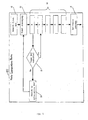
- A diagram of a radio communications device which carries out a network acquisition method according to an embodiment of this invention.
- The invention is described further hereinafter, by way of example only, with reference to the accompanying drawing.
- As will be appreciated, under the 3GPP (3rd Generation Partnership) specifications a handset (or a radio communications device) is required to search one entire radio access technology (RAT) at a time. The relative priority of RATs is set within the handset and so in a dual mode GSM/UMTS handset, an initial search of GSM (Global System for Mobile Communications) or UMTS (Universal Mobile Telecommunications System) will be undertaken and the process will only look at the second RAT during initial selection if no suitable cells are found on the first RAT.
- The initial search is a simple one, using signal strength, or a derivative thereof the cells are ranked in order of signal strength and the cell at the top of the list is accessed for suitability. The 3GPP requirements indicate that five measurements per frequency over a period of no less than three seconds should be averaged to produce this ranking.
- If there is no network present on the RAT being observed the above procedure is clearly wasteful. The invention propose that a quick check to be made after the first of the five measurements per frequency has been made if no frequencies have been found with the signal strengths of a usable level - which can be determined per handset and per RAT - then the entire RAT should be skipped and measurements begun on the next RAT.
- Turning to the drawing, the method according to an embodiment of the present invention is carried out in a
radio communications device 100 and commences atstep 10 by initiating a search of the first RAT. Such activity involves commencement of the averagingsequence 12 in which fivemeasurements 14, identified as A-E are taken on each frequency in the band of frequency in order to determine an average value per frequency atstep 16. - However, it is noted that conducting all of the measurements A-E can prove to be a potential waste of time and power if the RAT being searched does not eventually provide a suitable cell.
- Thus, according to an illustrated embodiment of the present invention, subsequent to the initial measurement A in the series of five
measurements 14, the result of measurement A per frequency is compared atstep 18 with a predetermined value in order to assess whether or not the RAT being searched is likely to produce a suitable cell. This search is conducted on the basis of a stored characteristic of the signal such as signal strength or a derivative thereof. - If, at
step 18, it is determined on the basis of the initial measurement A in the series of fivemeasurements 14 that the RAT identified for searching atstep 10 is likely to produce a suitable cell, then the method returns to the series ofmeasurements 14 at the second measurement B so that this measurement, and the subsequent measurements C-E can be taken so as to arrive at the average value per frequency for the RAT being searched at step. - If, however, at
step 18 the initial quick check against measurement A indicates that the RAT being searched is unlikely to produce a suitable cell, then the method proceeds to step 20 and switches to an alternative RAT available to the cellular radio communications device. - Once having switched to the alternative RAT at
step 20, the method returns tostep 12 to commence an averaging sequence for the alternative RAT - Here, the complete sequence A-E can be conducted or, again, and particularly if multiple RATs are available, the procedure continuous by way of an initial loop via
step 18 to determine if the alternative RAT is likely to produce a suitable cell. - If for some reason it is determined that a RAT that has been identified as unlikely to produce a suitable cell should still be searched further, then the method can be configured so that the averaging sequence of steps A-E is nevertheless conducted so as to verify the suitability. or lack of suitability, of that particular RAT.
- It should of course be appreciated that the present invention is not restricted to any particular form of dual mode, or multimode device.
Claims (15)
- A method of network acquisition for a cellular radio communications device arranged to operate on a plurality of radio technologies and comprising determining the most suitable cell based on a characteristic of signals received from a plurality of cells, the signals from each cell being provided over a band of frequencies, and the method being arranged for taking a series of measurements of the said characteristic for one radio technology and for each frequency, wherein prior to the final measurement in the said series, the said characteristic of at least one measured signal for each frequency is compared with a predetermined value and if the comparison indicates that the radio technology is unlikely to produce a suitable cell, the step of switching to an alternative radio technology prior to the said final measurement in the series being taken and searching signals associated with the alternative radio technology to search for a suitable cell.
- A method as claimed in Claim 1 and including the steps of searching on the alternative radio technology in the same manner as searching on an original radio technology.
- A method as claimed in Claim 1 or 2, wherein the characteristic of the received signals is compared with the predetermined value after the first measurement in the series of measurements to be taken so as to obtain an average value.
- A method as claimed in Claim 1, 2 or 3, wherein the said predetermined value is set in the cellular radio communications device.
- A method as claimed in any one of Claims 1-4, wherein the said predetermined value is set for each radio technology.
- A method as claimed in any one of Claims 1-5, wherein the said characteristic of the signals comprises signal strength.
- A method as claimed in any one of Claims 1-5, wherein the said characteristic of the signals comprises a derivative of the signal strength.
- A method as claimed in any one of Claims 1-7, and including the steps of continuing with the averaging sequence on a radio technology even if it is determined that no suitable cell is likely to be identified.
- A method as claimed in any one of Claims 1-8 and arranged for use in accordance with a dual mode. or multimode, device.
- A cellular radio communications device arranged for operation on a plurality of radio technologies and including means for determining the most suitable cell based upon a characteristic of signals received from a plurality of cells and the signals from each cell being provided over a band frequencies, means for taking a series of measurements of the said characteristic for one radio technology for each frequency, and including means for, prior to the final measurement in the said series being taken, comparing the said characteristic of at least one measured signal for each frequency with a predetermined value and determining that. if the comparison indicates that the radio technology is unlikely to produce a suitable cell, initiating means for switching to an alternative radio technology prior to the said final measurement in the series, and for searching signals associated with the alternative radio technology to search for a suitable cell.
- A device as claimed in Claim 10 and arranged to operate in accordance with the method of any one of Claims 2-9.
- A method of network acquisition for a cellular radio communications device and substantially as hereinbefore described with reference to, and as illustrated in, the accompanying drawing.
- A cellular radio communications device substantially as hereinbefore described with reference to, and as illustrating In, the accompanying drawing.
- A method of network acquisition for a cellular radio communications device arranged to operate on a plurality of radio access technologies and comprising determining the most suitable cell based on a characteristic of signals received from a plurality of cells, the signals from each cell being provided over a band of frequencies, and the method being arranged for taking a series of measurements of the said characteristic for one radio access technology and for each frequency, wherein prior to the final measurement in the said series, the said characteristic of at least one measured signal for each frequency is compared with a predetermined value and if the comparison indicates that the radio access technology is unlikely to produce a suitable cell, the step of switching to an alternative radio access technology prior to the said final measurement in the series being taken and searching signals associated with the alternative radio access technology to search for a suitable cell.
- A cellular radio communications device arranged for operation on a plurality of radio access technologies and including means for determining the most suitable cell based upon a characteristic of signals received from a plurality of cells and the signals from each cell being provided over a band frequencies, means for taking a series of measurements of the said characteristic for one radio access technology for each frequency, and including means for, prior to the final measurement in the said series being taken, comparing the said characteristic of at least one measured signal for each frequency with a predetermined value and determining that, if the comparison indicates that the radio access technology is unlikely to produce a suitable cell, initiating means for switching to an alternative radio access technology prior to the said final measurement in the series, and for searching signals associated with the alternative radio access technology to search for a suitable cell.
Applications Claiming Priority (2)
| Application Number | Priority Date | Filing Date | Title |
|---|---|---|---|
| GB0226977A GB2395619B (en) | 2002-11-19 | 2002-11-19 | Cellular network acquisition method and apparatus |
| GB0226977 | 2002-11-19 |
Publications (2)
| Publication Number | Publication Date |
|---|---|
| EP1422962A1 true EP1422962A1 (en) | 2004-05-26 |
| EP1422962B1 EP1422962B1 (en) | 2006-03-08 |
Family
ID=9948117
Family Applications (1)
| Application Number | Title | Priority Date | Filing Date |
|---|---|---|---|
| EP03026602A Expired - Lifetime EP1422962B1 (en) | 2002-11-19 | 2003-11-19 | Cellular network acquisition method and apparatus |
Country Status (6)
| Country | Link |
|---|---|
| US (1) | US7162265B2 (en) |
| EP (1) | EP1422962B1 (en) |
| JP (1) | JP2004173266A (en) |
| CN (1) | CN100348073C (en) |
| DE (1) | DE60303855T2 (en) |
| GB (1) | GB2395619B (en) |
Cited By (6)
| Publication number | Priority date | Publication date | Assignee | Title |
|---|---|---|---|---|
| EP1928195A1 (en) * | 2006-11-29 | 2008-06-04 | NEC Electronics Corporation | Frequency control during network search by a multi-RAT mobile radio communications device |
| WO2008077682A1 (en) * | 2006-12-22 | 2008-07-03 | Telefonaktiebolaget Lm Ericsson (Publ) | Efficient plmn search order |
| WO2010119048A1 (en) * | 2009-04-15 | 2010-10-21 | St-Ericsson (France) Sas | Method for processing a frequency band by a wireless communication device and corresponding device. |
| EP2632206A1 (en) * | 2012-02-21 | 2013-08-28 | Marvell International, Ltd. | Parallel Multi-Rat PLMN Search |
| US8897224B2 (en) | 2011-07-27 | 2014-11-25 | Marvell World Trade Ltd. | Reducing public land mobile network PLMN search time |
| US8938016B1 (en) | 2012-09-18 | 2015-01-20 | Marvell International Ltd. | Fast identification of OFDM signal |
Families Citing this family (13)
| Publication number | Priority date | Publication date | Assignee | Title |
|---|---|---|---|---|
| US8190163B2 (en) * | 2002-08-08 | 2012-05-29 | Qualcomm Incorporated | Methods and apparatus of enhanced coding in multi-user communication systems |
| US7363039B2 (en) | 2002-08-08 | 2008-04-22 | Qualcomm Incorporated | Method of creating and utilizing diversity in multiple carrier communication system |
| US7411895B2 (en) * | 2003-02-19 | 2008-08-12 | Qualcomm Incorporated | Controlled superposition coding in multi-user communication systems |
| US8593932B2 (en) * | 2003-05-16 | 2013-11-26 | Qualcomm Incorporated | Efficient signal transmission methods and apparatus using a shared transmission resource |
| US7917163B2 (en) * | 2003-08-27 | 2011-03-29 | Qualcomm, Incorporated | Intra-frequency searching in the presence of frequency gaps |
| US20070211669A1 (en) * | 2006-03-07 | 2007-09-13 | Bhupesh Manoharlal Umatt | Method and apparatus for searching radio technologies |
| CN100581282C (en) * | 2006-07-26 | 2010-01-13 | 广达电脑股份有限公司 | Method and apparatus for automatically switching frequency bands for mobile system |
| US8977301B2 (en) * | 2006-12-12 | 2015-03-10 | Nokia Corporation | System and method for implementing a selective paging model for use in a multi-access environment |
| JP2010516208A (en) | 2007-01-11 | 2010-05-13 | クゥアルコム・インコーポレイテッド | Using DTX and DRX in a wireless communication system |
| US8504021B1 (en) * | 2011-07-07 | 2013-08-06 | Sprint Communications Company L.P. | Performance scanning and correlation in wireless communication devices |
| CN104427577B (en) * | 2013-08-20 | 2019-05-07 | 中兴通讯股份有限公司 | Method and device for searching network signal |
| US9136892B2 (en) | 2013-12-11 | 2015-09-15 | Qualcomm Incorporated | Apparatus and method for utilizing a smart receiver switch for improving idle mode performance |
| DK3228125T3 (en) * | 2014-12-01 | 2018-11-12 | Ericsson Telefon Ab L M | CELL SEARCHING AND CONNECTING PROCEDURES IN A CELLULAR COMMUNICATION DEVICE |
Citations (3)
| Publication number | Priority date | Publication date | Assignee | Title |
|---|---|---|---|---|
| US5574973A (en) * | 1992-10-07 | 1996-11-12 | Motorola, Inc. | Method of registering/-reassigning a call in a dual mode communication network |
| EP0888026A2 (en) * | 1997-06-25 | 1998-12-30 | Nokia Mobile Phones Ltd. | Method for handover and cell re-selection |
| US6185435B1 (en) * | 1996-11-29 | 2001-02-06 | Nec Corporation | Radio communication apparatus for communicating with a plurality of different communication systems |
Family Cites Families (6)
| Publication number | Priority date | Publication date | Assignee | Title |
|---|---|---|---|---|
| FI112303B (en) * | 1995-05-16 | 2003-11-14 | Nokia Corp | Multiband Mobile Phone System |
| JPH10191419A (en) * | 1996-12-27 | 1998-07-21 | Matsushita Electric Ind Co Ltd | Mobile station equipment |
| JP3383618B2 (en) * | 1999-08-18 | 2003-03-04 | 松下電器産業株式会社 | Mobile communication terminal apparatus and reception strength detection method |
| DE10036141B4 (en) * | 2000-07-25 | 2005-09-08 | Siemens Ag | Method for improved selection of a communication network for a station |
| US6477372B1 (en) * | 2000-11-06 | 2002-11-05 | Motorola, Inc. | Method for a radiotelephone to scan for alternate radiotelephone systems |
| US7133702B2 (en) * | 2002-08-27 | 2006-11-07 | Qualcomm Incorporated | Idle mode cell reacquisition and reselection |
-
2002
- 2002-11-19 GB GB0226977A patent/GB2395619B/en not_active Expired - Fee Related
-
2003
- 2003-11-11 JP JP2003380938A patent/JP2004173266A/en active Pending
- 2003-11-18 US US10/714,847 patent/US7162265B2/en not_active Expired - Fee Related
- 2003-11-19 CN CNB2003101246072A patent/CN100348073C/en not_active Expired - Fee Related
- 2003-11-19 DE DE60303855T patent/DE60303855T2/en not_active Expired - Lifetime
- 2003-11-19 EP EP03026602A patent/EP1422962B1/en not_active Expired - Lifetime
Patent Citations (3)
| Publication number | Priority date | Publication date | Assignee | Title |
|---|---|---|---|---|
| US5574973A (en) * | 1992-10-07 | 1996-11-12 | Motorola, Inc. | Method of registering/-reassigning a call in a dual mode communication network |
| US6185435B1 (en) * | 1996-11-29 | 2001-02-06 | Nec Corporation | Radio communication apparatus for communicating with a plurality of different communication systems |
| EP0888026A2 (en) * | 1997-06-25 | 1998-12-30 | Nokia Mobile Phones Ltd. | Method for handover and cell re-selection |
Non-Patent Citations (1)
| Title |
|---|
| "TS 25.231 V0.3.0 (1999-06);Technical Specification; 3rd Generation Partnership Project (3GPP); Technical Specification Group (TSG) Radio Access Network (RAN); Working Group 1 (WG1); Physical layer - Measurements", 3RD GENERATION PARTNERSHIP PROJECT (3GPP);TECHNICAL SPECIFICATION GROUP (TSG) RADIO ACCESS NETWORK (RAN); WORKING GROUP 1 (WG1); PHYSICAL LAYER - MEASUREMENTS, XX, XX, XP002127381 * |
Cited By (14)
| Publication number | Priority date | Publication date | Assignee | Title |
|---|---|---|---|---|
| US8041352B2 (en) | 2006-11-29 | 2011-10-18 | Renesas Electronics Corporation | Frequency control |
| EP1928195A1 (en) * | 2006-11-29 | 2008-06-04 | NEC Electronics Corporation | Frequency control during network search by a multi-RAT mobile radio communications device |
| WO2008077682A1 (en) * | 2006-12-22 | 2008-07-03 | Telefonaktiebolaget Lm Ericsson (Publ) | Efficient plmn search order |
| CN101584239B (en) * | 2006-12-22 | 2012-05-30 | Lm爱立信电话有限公司 | Efficient PLMN search order |
| FR2944668A1 (en) * | 2009-04-15 | 2010-10-22 | St Nxp Wireless France | METHOD OF PROCESSING A FREQUENCY BAND BY A WIRELESS COMMUNICATION APPARATUS AND APPARATUS THEREFOR |
| KR20120031155A (en) * | 2009-04-15 | 2012-03-30 | 에스티-에릭슨 (프랑스) 에스에이에스 | Method for processing a frequency band by a wireless communication device and corresponding device |
| WO2010119048A1 (en) * | 2009-04-15 | 2010-10-21 | St-Ericsson (France) Sas | Method for processing a frequency band by a wireless communication device and corresponding device. |
| US8891437B2 (en) | 2009-04-15 | 2014-11-18 | St-Ericsson (France) Sas | Method for processing a frequency band by a wireless communication device and corresponding device |
| US8897224B2 (en) | 2011-07-27 | 2014-11-25 | Marvell World Trade Ltd. | Reducing public land mobile network PLMN search time |
| EP2632206A1 (en) * | 2012-02-21 | 2013-08-28 | Marvell International, Ltd. | Parallel Multi-Rat PLMN Search |
| CN103298069A (en) * | 2012-02-21 | 2013-09-11 | 马维尔国际有限公司 | Parallel multi-rat PLMN search |
| US8923858B2 (en) | 2012-02-21 | 2014-12-30 | Marvell World Trade Ltd. | Parallel multi-RAT PLMN search |
| CN103298069B (en) * | 2012-02-21 | 2017-12-01 | 翱捷科技(上海)有限公司 | Parallel multi-rat PLMN search |
| US8938016B1 (en) | 2012-09-18 | 2015-01-20 | Marvell International Ltd. | Fast identification of OFDM signal |
Also Published As
| Publication number | Publication date |
|---|---|
| JP2004173266A (en) | 2004-06-17 |
| GB2395619A (en) | 2004-05-26 |
| GB0226977D0 (en) | 2002-12-24 |
| EP1422962B1 (en) | 2006-03-08 |
| CN100348073C (en) | 2007-11-07 |
| US20040235474A1 (en) | 2004-11-25 |
| GB2395619B (en) | 2004-09-29 |
| DE60303855D1 (en) | 2006-05-04 |
| DE60303855T2 (en) | 2006-08-31 |
| CN1523919A (en) | 2004-08-25 |
| US7162265B2 (en) | 2007-01-09 |
Similar Documents
| Publication | Publication Date | Title |
|---|---|---|
| US7162265B2 (en) | Cellular network acquisition method and apparatus | |
| US8045989B2 (en) | Method and apparatus for reducing the number of times of measurements for cell reselection in mobile communication terminal | |
| KR101579636B1 (en) | Radio access technology selection | |
| US8744443B2 (en) | System and method for facilitating accelerated network selection using a weighted network list | |
| US9119139B2 (en) | System and method for facilitating accelerated network selection in a radio network environment | |
| US20070298790A1 (en) | Cellular network acquisition method and apparatus | |
| CA2589961C (en) | System and method for facilitating accelerated network selection using a weighted network list | |
| CN102917417A (en) | Communication device and cell measurement procedure integration method | |
| US9521598B2 (en) | Performing handover from a second generation RAT to a fourth generation RAT | |
| US20130252614A1 (en) | Methods for preferably camping on and staying in a cell belonging to a high data transmission throughput rat and communications apparatuses utilizing the same | |
| CN1203504A (en) | Method and apparatus to provide manual reselection on digital control channel | |
| US7620395B2 (en) | Cellular network acquisition method and apparatus | |
| CN113556788A (en) | Method for selecting network cell, User Equipment (UE) and network side equipment | |
| JP2004153311A (en) | Frequency selection method in mobile station, mobile station and frequency selection program | |
| CN100512481C (en) | System and method for measuring adjacent region between different mode networks | |
| GB2409606A (en) | Cellular network identification and acquisition | |
| GB2321162A (en) | Dual Mode Mobile Radio Telecommunications Device | |
| US20090017820A1 (en) | Cell selection method and mobile terminal using the same | |
| US9877248B2 (en) | Methods for efficient wireless communications and communication apparatus utilizing the same | |
| GB2395621A (en) | Cellular network acquisition method and apparatus |
Legal Events
| Date | Code | Title | Description |
|---|---|---|---|
| PUAI | Public reference made under article 153(3) epc to a published international application that has entered the european phase |
Free format text: ORIGINAL CODE: 0009012 |
|
| AK | Designated contracting states |
Kind code of ref document: A1 Designated state(s): AT BE BG CH CY CZ DE DK EE ES FI FR GB GR HU IE IT LI LU MC NL PT RO SE SI SK TR |
|
| AX | Request for extension of the european patent |
Extension state: AL LT LV MK |
|
| 17P | Request for examination filed |
Effective date: 20041117 |
|
| 17Q | First examination report despatched |
Effective date: 20050103 |
|
| AKX | Designation fees paid |
Designated state(s): DE FR IT |
|
| GRAP | Despatch of communication of intention to grant a patent |
Free format text: ORIGINAL CODE: EPIDOSNIGR1 |
|
| GRAS | Grant fee paid |
Free format text: ORIGINAL CODE: EPIDOSNIGR3 |
|
| GRAA | (expected) grant |
Free format text: ORIGINAL CODE: 0009210 |
|
| AK | Designated contracting states |
Kind code of ref document: B1 Designated state(s): DE FR IT |
|
| PG25 | Lapsed in a contracting state [announced via postgrant information from national office to epo] |
Ref country code: IT Free format text: LAPSE BECAUSE OF FAILURE TO SUBMIT A TRANSLATION OF THE DESCRIPTION OR TO PAY THE FEE WITHIN THE PRESCRIBED TIME-LIMIT;WARNING: LAPSES OF ITALIAN PATENTS WITH EFFECTIVE DATE BEFORE 2007 MAY HAVE OCCURRED AT ANY TIME BEFORE 2007. THE CORRECT EFFECTIVE DATE MAY BE DIFFERENT FROM THE ONE RECORDED. Effective date: 20060308 |
|
| REF | Corresponds to: |
Ref document number: 60303855 Country of ref document: DE Date of ref document: 20060504 Kind code of ref document: P |
|
| ET | Fr: translation filed | ||
| PLBE | No opposition filed within time limit |
Free format text: ORIGINAL CODE: 0009261 |
|
| STAA | Information on the status of an ep patent application or granted ep patent |
Free format text: STATUS: NO OPPOSITION FILED WITHIN TIME LIMIT |
|
| 26N | No opposition filed |
Effective date: 20061211 |
|
| REG | Reference to a national code |
Ref country code: FR Ref legal event code: TP Owner name: WARREN & LEWIS INVESTMENT CORPORATION, US Effective date: 20130102 |
|
| PGFP | Annual fee paid to national office [announced via postgrant information from national office to epo] |
Ref country code: DE Payment date: 20130430 Year of fee payment: 10 |
|
| PGFP | Annual fee paid to national office [announced via postgrant information from national office to epo] |
Ref country code: IT Payment date: 20130513 Year of fee payment: 10 Ref country code: FR Payment date: 20130531 Year of fee payment: 10 |
|
| REG | Reference to a national code |
Ref country code: DE Ref legal event code: R082 Ref document number: 60303855 Country of ref document: DE Representative=s name: PATENTANWAELTE BETTEN & RESCH, DE Effective date: 20130912 Ref country code: DE Ref legal event code: R081 Ref document number: 60303855 Country of ref document: DE Owner name: WARREN & LEWIS INVESTMENT CORPORATION, US Free format text: FORMER OWNER: NEC CORP., TOKYO, JP Effective date: 20130912 Ref country code: DE Ref legal event code: R081 Ref document number: 60303855 Country of ref document: DE Owner name: WARREN & LEWIS INVESTMENT CORPORATION, FALLS C, US Free format text: FORMER OWNER: NEC CORP., TOKYO, JP Effective date: 20130912 |
|
| REG | Reference to a national code |
Ref country code: DE Ref legal event code: R119 Ref document number: 60303855 Country of ref document: DE |
|
| REG | Reference to a national code |
Ref country code: FR Ref legal event code: ST Effective date: 20140731 |
|
| PG25 | Lapsed in a contracting state [announced via postgrant information from national office to epo] |
Ref country code: DE Free format text: LAPSE BECAUSE OF NON-PAYMENT OF DUE FEES Effective date: 20140603 Ref country code: IT Free format text: LAPSE BECAUSE OF NON-PAYMENT OF DUE FEES Effective date: 20131119 |
|
| REG | Reference to a national code |
Ref country code: DE Ref legal event code: R079 Ref document number: 60303855 Country of ref document: DE Free format text: PREVIOUS MAIN CLASS: H04Q0007380000 Ipc: H04W0004000000 |
|
| PG25 | Lapsed in a contracting state [announced via postgrant information from national office to epo] |
Ref country code: FR Free format text: LAPSE BECAUSE OF NON-PAYMENT OF DUE FEES Effective date: 20131202 |
|
| REG | Reference to a national code |
Ref country code: DE Ref legal event code: R079 Ref document number: 60303855 Country of ref document: DE Free format text: PREVIOUS MAIN CLASS: H04Q0007380000 Ipc: H04W0004000000 Effective date: 20141030 Ref country code: DE Ref legal event code: R119 Ref document number: 60303855 Country of ref document: DE Effective date: 20140603 |