EP1422869A1 - Procédé de vérification de l'état du plan de commande d'un réseau de télécommunications - Google Patents
Procédé de vérification de l'état du plan de commande d'un réseau de télécommunications Download PDFInfo
- Publication number
- EP1422869A1 EP1422869A1 EP03292467A EP03292467A EP1422869A1 EP 1422869 A1 EP1422869 A1 EP 1422869A1 EP 03292467 A EP03292467 A EP 03292467A EP 03292467 A EP03292467 A EP 03292467A EP 1422869 A1 EP1422869 A1 EP 1422869A1
- Authority
- EP
- European Patent Office
- Prior art keywords
- network
- nodes
- connections
- established
- connection
- Prior art date
- Legal status (The legal status is an assumption and is not a legal conclusion. Google has not performed a legal analysis and makes no representation as to the accuracy of the status listed.)
- Granted
Links
- 238000000034 method Methods 0.000 title claims abstract description 19
- 230000011664 signaling Effects 0.000 claims abstract description 12
- 238000012795 verification Methods 0.000 claims description 15
- 241000223080 Sweet potato virus C Species 0.000 claims description 3
- 238000004458 analytical method Methods 0.000 description 3
- 238000012546 transfer Methods 0.000 description 2
- 102100036255 Glucose-6-phosphatase 2 Human genes 0.000 description 1
- 101000930907 Homo sapiens Glucose-6-phosphatase 2 Proteins 0.000 description 1
- 238000004422 calculation algorithm Methods 0.000 description 1
- 238000004364 calculation method Methods 0.000 description 1
- 238000004891 communication Methods 0.000 description 1
- 230000000977 initiatory effect Effects 0.000 description 1
- 238000009434 installation Methods 0.000 description 1
- 238000012423 maintenance Methods 0.000 description 1
- 230000007246 mechanism Effects 0.000 description 1
- 238000012986 modification Methods 0.000 description 1
- 230000004048 modification Effects 0.000 description 1
- 238000012545 processing Methods 0.000 description 1
Images

Classifications
-
- H—ELECTRICITY
- H04—ELECTRIC COMMUNICATION TECHNIQUE
- H04L—TRANSMISSION OF DIGITAL INFORMATION, e.g. TELEGRAPHIC COMMUNICATION
- H04L41/00—Arrangements for maintenance, administration or management of data switching networks, e.g. of packet switching networks
- H04L41/02—Standardisation; Integration
- H04L41/0213—Standardised network management protocols, e.g. simple network management protocol [SNMP]
-
- H—ELECTRICITY
- H04—ELECTRIC COMMUNICATION TECHNIQUE
- H04L—TRANSMISSION OF DIGITAL INFORMATION, e.g. TELEGRAPHIC COMMUNICATION
- H04L9/00—Cryptographic mechanisms or cryptographic arrangements for secret or secure communications; Network security protocols
- H04L9/40—Network security protocols
-
- H—ELECTRICITY
- H04—ELECTRIC COMMUNICATION TECHNIQUE
- H04L—TRANSMISSION OF DIGITAL INFORMATION, e.g. TELEGRAPHIC COMMUNICATION
- H04L45/00—Routing or path finding of packets in data switching networks
- H04L45/02—Topology update or discovery
- H04L45/03—Topology update or discovery by updating link state protocols
Definitions
- the present invention relates to a method for verifying the state of the telecommunications network control.
- a routing protocol is a protocol implemented in a network so as to establish a route in the network for each communication function of different parameters.
- these routing protocols we can distinguish so-called distance vector protocols, such as the protocols known as RIP and IGRP acronyms and link state protocols, such as protocols whose acronyms are OSPF (Open Short Path First) and PNNI (Private Network-Node Interface or Private Network-Network Interface: Private node-network interface or private network-network interface).
- OSPF Open Short Path First
- PNNI Primary Network-Node Interface or Private Network-Network Interface: Private node-network interface or private network-network interface.
- a link-state protocol is a routing protocol dynamic looking for a route in the network that meets the criteria of bandwidth, transit time, regularity of transit, etc. requested by the caller. To do this, information concerning the state of the links between nodes of the network as well as the state of the switches present at these nodes are exchanged from regularly between these switches. These link states and switches are expressed as metrics and attributes and allow to take into account the quality of service requested by the user.
- the role of a link state routing protocol is to allow each node, by exchange of information between the different switches of the network concerning the state of the links between network nodes and the state of said switches, represent the complete network topology and get the list of addresses accessible. During a topological or accessibility modification, only the information that has changed is updated in each of the nodes. On the based on this information, the node then runs a route calculation algorithm for reach all possible destinations. The signaling protocol then allows establish the appropriate route in the network by requesting the reservation of resources in each node crossed.
- the OSPF protocol used as a routing protocol in networks implementing uses the MPLS technique (Multiprotocol Label Switching: multi-protocol switching by labels) and the PNNI protocol, inspired by the first, generally implemented in ATM networks (Asynchronous Transfer Mode: transfer mode asynchronous).
- the PNNI protocol is a link state protocol which, not only searches for a route in the network likely to suit the user but also establishes, by means of an integrated signaling protocol, said route.
- the OSPF protocol is the subject of various RFCs (Request For Comments) to the IETF (Internet Engineering Task Force).
- IETF Internet Engineering Task Force
- the PNNI protocol it is the subject, in its version 1.0 of March 1996, of the af-pnni-055.000 specification of the ATM Forum.
- the present invention applies equally to ATM networks which implements the PNNI routing protocol only to IP networks that implement the MPLS protocol and therefore a link state protocol such as the protocol OSPF.
- the problem which the present invention seeks to solve is to verify whether the topology information, address announcements, and routing mechanisms are correctly set up in the network during its installation phase or following evolutions. Generally speaking, it is to check the status of the control plan which, remember, concerns everything related to network control for establishing, maintaining and releasing connections.
- the object of the present invention is therefore to propose a verification method the status of the control plan of a telecommunications network using a link-state routing protocol which does not have the disadvantages of method of the prior art previously described.
- said network of telecommunications is an ATM network
- the routing protocol and the protocol signaling are included in a protocol of the so-called PNNI type
- the connections established between access nodes of said network are connection type connections virtual permanent software called SPVC.
- SPVC connection type connections virtual permanent software
- said network of telecommunications is an IP network implementing a protocol called MPLS and the connections established between access nodes of said network are so-called LSP paths.
- said system can include a database listing the so-called AESA addresses of each UNI or NNI port said access nodes.
- it may include a database listing couples VPI / VCI identifiers for the ends of each of the connections that can be established between two access nodes of said telecommunications network.
- This verification system can be provided to be connected to the centralized management of said network or on the contrary it can be an integral part of the system centralized management of said network.
- said program incorporates a database listing the so-called AESA addresses of each UNI or NNI port said access nodes. Likewise, it incorporates a database listing the pairs of VPI / VCI identifiers for the ends of each of the connections which can be established between two access nodes of said telecommunications network.
- This program can be implemented on a centralized management system of said network or, on the contrary, on a dedicated machine connectable to the management system centralized network.
- the present invention is based on the principle of verifying that any access node of a network can reach all other access nodes by directly establishing a connection of this access node to each of the other access nodes of the network.
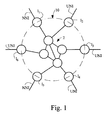
- the network 10 which is shown in FIG. 1 consists of access nodes 1 l to 1 n to which users, via user-network interfaces UNI (User Network Interface), or other networks, via network-network interfaces NNI (Network Network Interface), can have access and a set 2 of internal nodes linked to the network as well as to the access nodes 1 l to 1 n .
- UNI User Network Interface
- NNI Network Network Interface
- connections which are established are connections which are called SPVC (Either permanent virtual connection: flexible permanent virtual connection).
- SPVC Permanent virtual connection
- This type of connection has been standardized for allow the operator to establish permanent service connections using a signaling protocol integrated into PNNI protocol. They are the subject of the specification af-pnni-0055.000 of the ATM Forum, in particular of its appendix C, but also of the addendum af-cs-0127.000 of July 1999 of the ATM Forum also.
- LSPs Label Switch Paths
- This topology information can then be transmitted to a body of centralized management which analyzes it. This analysis of the state of these connections allows without complex processing to know if this node can reach another node.
- the connections that are established must be very undemanding in terms of bandwidth (a few cells per second) to, on the one hand, not overload the network links and, on the other hand, avoid rejection due to bandwidth unavailable.
- An access node can only establish a connection with a limited number other access nodes, for example following a minor evolution of the network.
- a system 20 for verifying the state of the control plane of a telecommunications network which includes a database 21 which lists the addresses of the UNI ports of the access nodes 1 l to 1 n of the network 10 (for example so-called AESA addresses), the identifiers of the virtual circuits of the connections to be established (these identifiers are, for an ATM network, the VPI / VCI identifiers (virtual path identifier / virtual circuit identifier: virtual circuit) and for an IP network implementing the MPLS protocol, the addresses of the network access nodes). It also identifies for each connection to establish the quality of service QoS required either in the form of traffic contract information for an ATM network or in the form of IP service class information for an IP network implementing the MPLS protocol. .
- connection management unit 22 which performs the command to establish a connection from a network access node between this access node and another access node of said network and this, depending on the data (addresses of the UNI ports of the nodes concerned, connection identifiers to create and QoS QoS information) which are listed in the database 21.
- the target access node can belong to a set of access nodes whose connections with the access node at the initiative of the connection is to be checked. It also places the order to collect the connection status information and node information for connections that have been established. This can be, for example, the state of establishment successful or unsuccessful establishment, the route taken between the internal nodes of the network if the connection has been established. It also orders the release of the previously established connection.
- connection status information established identifies for each connection established if this could be established (connection status information established), all status information collected from internal nodes which allows it to determine for example the route that was taken, for example in the form of a list of internal nodes borrowed if the connection has been established and, if this is not the case, the destination address of the target node that could not be reached. We remind here at any useful end that it is the originating node that is initiating a connection.
- connection management unit 22 is connected, via an appropriate interface 22i, to a centralized network management unit 30, itself interfaced at 30i to each of the routers constituting the internal nodes of the network 10.
- a centralized network management unit 30i can use any type of appropriate protocol such as the SNMP network management protocol (Simple Network Management Protocol: Simple network management protocol).
Landscapes
- Engineering & Computer Science (AREA)
- Computer Security & Cryptography (AREA)
- Computer Networks & Wireless Communication (AREA)
- Signal Processing (AREA)
- Data Exchanges In Wide-Area Networks (AREA)
- Exchange Systems With Centralized Control (AREA)
Abstract
Description
- à partir d'un noeud d'accès de réseau, demander l'établissement d'une connexion entre ce noeud d'accès et un autre noeud d'accès,
- recueillir les informations d'état de ladite connexion et, si celle-ci a pu être établie, également des informations concernant les noeuds du réseau empruntés par ladite connexion,
- libérer ladite connexion lorsque celle-ci avait pu être établie,
- recommencer pour tous les autres noeuds d'accès dont les connexions avec ledit noeud d'accès d'origine sont à vérifier,
- analyser les informations d'état des connexions à vérifier ainsi recueillies et les informations concernant les noeuds du réseau empruntés par ladite connexion lorsque celle-ci avait pu être établie à des fins de vérification de l'état du plan de commande dudit réseau.
- des moyens pour commander l'établissement et la libération, à partir de chaque noeud d'accès de réseau, d'une connexion entre ce noeud d'accès et un autre noeud d'accès dudit réseau dont les connexions avec ledit noeud d'accès d'origine sont à vérifier,
- des moyens pour recueillir les informations d'état des connexions dont l'établissement a été demandé,
- des moyens pour recueillir des informations concernant des noeuds du réseau empruntés par des connexions établies,
- des moyens pour analyser lesdites informations d'état de connexions à vérifier et des informations concernant des noeuds du réseau empruntés par des connexions à vérifier établies à des fins de vérification de l'état du plan de commande dudit réseau.
- des moyens pour, à partir d'un noeud d'accès de réseau, demander l'établissement d'une connexion entre ce noeud d'accès et un autre noeud d'accès,
- des moyens pour recueillir les informations d'état de ladite connexion et, si celle-ci a pu être établie, également des informations concernant les noeuds du réseau empruntés par ladite connexion,
- des moyens pour libérer ladite connexion lorsque celle-ci avait pu être établie,
- des moyens pour recommencer pour tous les autres noeuds d'accès dont les connexions avec ledit noeud d'accès d'origine sont à vérifier,
- des moyens d'analyse des informations d'état des connexions à vérifier et des informations concernant les noeuds du réseau empruntés par lesdites connexions lorsque celles-ci ont pu être établies à des fins de vérification du plan de commande dudit réseau.
- à partir d'un noeud d'accès de réseau d'origine, demander l'établissement d'une connexion entre ce noeud d'accès d'origine et un autre noeud d'accès cible dudit réseau,
- recueillir les informations d'état de ladite connexion et, lorsque celle-ci a pu être établie, également les informations concernant les noeuds empruntés par ladite connexion (ces informations sont disponibles auprès des noeuds du réseau grâce au protocole à état de liens que le réseau met en oeuvre),
- libérer ladite connexion lorsque celle-ci a pu être établie,
- recommencer pour tous les autres noeuds d'accès dont les connexions avec ledit noeud d'accès d'origine sont à vérifier,
- analyser les informations d'état des connexions à vérifier et des informations concernant les noeuds empruntés par ladite connexion lorsque celle-ci a pu être établie à des fins de vérification du plan de commande dudit réseau.
- Vérifier, dans le plan de commande, la connexité entre tous les routeurs constituant les noeuds d'accès du réseau pour garantir le maintien de la qualité d'établissement des connexions commutées. Ceci permet de s'assurer qu'il est possible d'atteindre toutes les destinations, que les canaux de signalisation et de routage sont opérationnels, que les informations topologiques et d'accessibilité sont bien diffusées par le protocole de routage,
- Vérifier une certaine cohérence entre la base de données topologiques du protocole de routage détenues par chaque routeur d'accès et les règles d'ingénierie du réseau. Par exemple, l'opérateur peut privilégier des noeuds ou liens lors de la configuration du plan de commande. Il est ainsi possible de contrôler que l'acheminement est conforme aux souhaits de l'opérateur,
- Optimiser le maillage du réseau. Par exemple, la méthode permet de voir si des liens ne sont jamais utilisés par le calcul de chemin,
- Déterminer si le réseau est responsable ou pas de l'échec de l'établissement de connexions commutées et donc détecter d'éventuelles pannes,
- Estimer la performance du plan de commande, en particulier le temps d'établissement des connexions.
Claims (15)
- Procédé de vérification de l'état du plan de commande d'un réseau de télécommunications comprenant des noeuds d'accès et des noeuds internes, ledit réseau mettant en oeuvre un protocole de routage à état de liens permettant de connaítre les informations d'état de connexions établies et les informations concernant les noeuds empruntés par lesdites connexions, ledit réseau mettant en oeuvre également un protocole de signalisation permettant d'établir des connexions entre deux noeuds d'accès dudit réseau à partir d'un desdits noeuds, caractérisé en ce qu'il comporte les étapes suivantes :à partir d'un noeud d'accès de réseau, demander l'établissement d'une connexion entre ce noeud d'accès et un autre noeud d'accès,recueillir des informations d'état de ladite connexion et, si celle-ci a pu être établie, également des informations concernant les noeuds du réseau empruntés par ladite connexion,libérer ladite connexion lorsque celle-ci a pu être établie,recommencer pour tous les autres noeuds d'accès dont les connexions avec ledit noeud d'accès d'origine sont à vérifier,analyser les informations d'état des connexions à vérifier ainsi recueillies et les informations concernant les noeuds du réseau empruntés par lesdites connexions qui avaient pu être établies à des fins de vérification de l'état du plan de commande dudit réseau.
- Procédé de vérification selon la revendication 1, caractérisé en ce que ledit réseau de télécommunications est un réseau ATM, en ce que le protocole de routage et le protocole de signalisation sont inclus dans un protocole du type dit PNNI, et en ce que les connexions établies entre noeuds d'accès dudit réseau sont des connexions du type connexion virtuelle soft permanente dite SPVC.
- Procédé de vérification selon la revendication 2, caractérisé en ce que pour établir lesdites connexions entre noeuds d'accès dudit réseau, est utilisée l'adresse dite AESA d'un port UNI de chacun desdits noeuds d'accès.
- Procédé de vérification selon la revendication 2 ou 3, caractérisé en ce que pour établir une connexion entre deux noeuds d'accès dudit réseau, est utilisé un couple d'identificateurs VPI/VCI pour les extrémités de ladite connexion.
- Procédé de vérification selon la revendication 1, caractérisé en ce que ledit réseau de télécommunications est un réseau IP mettant en oeuvre un protocole dit MPLS et en ce que les connexions établies entre noeuds d'accès dudit réseau sont des trajets dit LSP.
- Système de vérification de l'état du plan de commande d'un réseau de télécommunications comprenant des noeuds d'accès et des noeuds internes, ledit réseau mettant en oeuvre un protocole de routage à état de liens permettant de connaítre les informations d'état de connexions établies et les informations concernant les noeuds empruntés par lesdites connexions, ledit réseau mettant en oeuvre également un protocole de signalisation permettant d'établir des connexions entre deux noeuds d'accès dudit réseau à partir d'un desdits noeuds, caractérisé en ce qu'il comporte :des moyens (22) pour commander l'établissement et la libération, à partir de chaque noeud d'accès de réseau, d'une connexion entre ce noeud d'accès et un autre noeud d'accès dudit réseau dont les connexions avec ledit noeud d'accès d'origine sont à vérifier,des moyens (22) pour recueillir les informations d'état des connexions dont l'établissement a été demandé,des moyens (22) pour recueillir les informations concernant les noeuds du réseau empruntés par chaque connexion lorsque celle-ci a pu être établie,des moyens (23) pour analyser lesdites informations d'état des connexions et les informations concernant les noeuds du réseau empruntés par les connexions lorsque celles-ci avaient pu être établies à des fins de vérification de l'état du plan de commande dudit réseau.
- Système de vérification selon la revendication 5, caractérisé en ce qu'il comporte une base de données (21) recensant les adresses dites AESA des ports UNI ou NNI de chacun desdits noeuds d'accès.
- Système de vérification selon la revendication 5 ou 6, caractérisé en ce qu'il comporte une base de données (21) recensant les couples d'identificateurs VPI/VCI pour les extrémités de chacune des connexions qui peuvent être établies entre deux noeuds d'accès dudit réseau de télécommunications.
- Système de vérification selon une des revendications 6 à 8, caractérisé en ce qu'il est prévu pour être connecté au système de gestion centralisé dudit réseau.
- Système de vérification selon une des revendications 6 à 8, caractérisé en ce qu'il est partie intégrante du système de gestion centralisé dudit réseau.
- Programme destiné à être implémenté sur un système de vérification de l'état du plan de commande d'un réseau de télécommunications comprenant des noeuds d'accès et des noeuds internes, ledit réseau mettant en oeuvre un protocole de routage à état de liens permettant de connaítre les informations d'état de connexions établies et les informations concernant les noeuds empruntés par lesdites connexions, ledit réseau mettant en oeuvre également un protocole de signalisation permettant d'établir des connexions entre deux noeuds d'accès dudit réseau à partir d'un desdits noeuds, caractérisé en ce qu'il comporte :des moyens pour, à partir d'un noeud d'accès de réseau, demander l'établissement d'une connexion entre ce noeud d'accès et un autre noeud d'accès,des moyens pour recueillir les informations d'état de ladite connexion et, si celle-ci a pu être établie, également des informations concernant les noeuds du réseau empruntés par ladite connexion,des moyens pour libérer ladite connexion lorsque celle-ci avait pu être établie,des moyens pour recommencer pour tous les autres noeuds d'accès dont les connexions avec ledit noeud d'accès d'origine sont à vérifier,des moyens d'analyse des informations d'état des connexions à vérifier et des noeuds du réseau empruntés par lesdites connexions lorsque celles-ci avaient pu être établies.
- Programme selon la revendication 11, caractérisé en ce qu'il incorpore une base de données (21) recensant les adresses dites AESA des ports UNI ou NNI de chacun desdits noeuds d'accès.
- Programme selon la revendication 11 ou 12, caractérisé en ce qu'il comporte une base de données (21) recensant les couples d'identificateurs VPI/VCI pour les extrémités de chacune des connexions qui peuvent être établies entre deux noeuds d'accès dudit réseau de télécommunications.
- Programme selon une des revendications 11 à 12, caractérisé en ce qu'il est prévu pour être implémenté sur un système de gestion centralisé dudit réseau.
- Programme selon une des revendications 11 à 12, caractérisé en ce qu'il est prévu pour être implémenté sur une machine dédiée connectable au système de gestion centralisé dudit réseau.
Applications Claiming Priority (2)
| Application Number | Priority Date | Filing Date | Title |
|---|---|---|---|
| FR0213635 | 2002-10-30 | ||
| FR0213635A FR2846824A1 (fr) | 2002-10-30 | 2002-10-30 | Procede de verification de l'etat du plan de commande de telecommunications |
Publications (2)
| Publication Number | Publication Date |
|---|---|
| EP1422869A1 true EP1422869A1 (fr) | 2004-05-26 |
| EP1422869B1 EP1422869B1 (fr) | 2006-06-14 |
Family
ID=32104341
Family Applications (1)
| Application Number | Title | Priority Date | Filing Date |
|---|---|---|---|
| EP03292467A Expired - Lifetime EP1422869B1 (fr) | 2002-10-30 | 2003-10-07 | Procédé de vérification de l'état du plan de commande d'un réseau de télécommunications |
Country Status (5)
| Country | Link |
|---|---|
| EP (1) | EP1422869B1 (fr) |
| AT (1) | ATE330396T1 (fr) |
| DE (1) | DE60306075T2 (fr) |
| ES (1) | ES2266757T3 (fr) |
| FR (1) | FR2846824A1 (fr) |
Families Citing this family (1)
| Publication number | Priority date | Publication date | Assignee | Title |
|---|---|---|---|---|
| CN100361467C (zh) * | 2004-06-18 | 2008-01-09 | 华为技术有限公司 | 一种保证端到端业务质量构架中业务可靠性的方法 |
Citations (2)
| Publication number | Priority date | Publication date | Assignee | Title |
|---|---|---|---|---|
| US6069895A (en) * | 1997-08-29 | 2000-05-30 | Nortel Networks Corporation | Distributed route server |
| WO2001084787A1 (fr) * | 2000-04-28 | 2001-11-08 | Sheer Networks, Inc. | Decouverte de la topologie d'un reseau atm |
-
2002
- 2002-10-30 FR FR0213635A patent/FR2846824A1/fr active Pending
-
2003
- 2003-10-07 AT AT03292467T patent/ATE330396T1/de not_active IP Right Cessation
- 2003-10-07 DE DE60306075T patent/DE60306075T2/de not_active Expired - Lifetime
- 2003-10-07 EP EP03292467A patent/EP1422869B1/fr not_active Expired - Lifetime
- 2003-10-07 ES ES03292467T patent/ES2266757T3/es not_active Expired - Lifetime
Patent Citations (2)
| Publication number | Priority date | Publication date | Assignee | Title |
|---|---|---|---|---|
| US6069895A (en) * | 1997-08-29 | 2000-05-30 | Nortel Networks Corporation | Distributed route server |
| WO2001084787A1 (fr) * | 2000-04-28 | 2001-11-08 | Sheer Networks, Inc. | Decouverte de la topologie d'un reseau atm |
Non-Patent Citations (3)
| Title |
|---|
| AWDUCHE D O ET AL: "RSVP-TE: Extensions to RSVP for LSP Tunnels", INTERNET DRAFT <DRAFT-IETF-MPLS-RSVP-LSP-TUNNEL-08.TXT>, 1 February 2001 (2001-02-01), XP002199928 * |
| CISCO SYSTEMS INC: "Troubleshooting ATM Switch Router Network Connections", CATALYST 8540 MSR RELEASE 12.0(4A)W5(11A) DOCUMENTS - ATM SWITCH ROUTER TROUBLESHOOTING GUIDE, 3 March 2000 (2000-03-03), pages 5-1 - 5-62, XP002246925, Retrieved from the Internet <URL:http://www.cisco.com/univercd/cc/td/doc/product/atm/c8540/12_0/4a_11a/trouble/atm_net.pdf> [retrieved on 20030709] * |
| CISCO SYSTEMS INC: "Troubleshooting Tag Switching Connections", CATALYST 8540 MSR RELEASE 12.0(4A)W5(11A) DOCUMENTS - ATM SWITCH ROUTER TROUBLESHOOTING GUIDE, 3 March 2000 (2000-03-03), pages 7-1 - 7-12, XP002246926, Retrieved from the Internet <URL:http://www.cisco.com/univercd/cc/td/doc/product/atm/c8540/12_0/4a_11a/trouble/tag_sw.pdf> [retrieved on 20030709] * |
Also Published As
| Publication number | Publication date |
|---|---|
| ES2266757T3 (es) | 2007-03-01 |
| FR2846824A1 (fr) | 2004-05-07 |
| DE60306075T2 (de) | 2007-01-11 |
| DE60306075D1 (de) | 2006-07-27 |
| EP1422869B1 (fr) | 2006-06-14 |
| ATE330396T1 (de) | 2006-07-15 |
Similar Documents
| Publication | Publication Date | Title |
|---|---|---|
| JP3790658B2 (ja) | ネットワークにおけるルーティング情報マッピング装置、その方法及び記録媒体 | |
| KR100693059B1 (ko) | Mpls 기반의 vpn 제공 장치 및 방법 | |
| Chamania et al. | A survey of inter-domain peering and provisioning solutions for the next generation optical networks | |
| US20140219649A1 (en) | Managing alternate site switching in an optical communication system | |
| WO2003019870A2 (fr) | Procede et systeme efficaces permettant la decouverte et la verification automatiques d'itineraires optimaux a travers un reseau superpose maille multipoint dynamique | |
| KR20030017497A (ko) | 네트워크 최적화 방법 | |
| JP2002530939A (ja) | インターネット・プロトコル・コネクション指向サービスの管理方法 | |
| Kodialam et al. | Online multicast routing with bandwidth guarantees: a new approach using multicast network flow | |
| JP2002208939A (ja) | Atmプラットフォームにおけるmpls実装 | |
| Bryskin et al. | Policy-enabled path computation framework | |
| US7426186B2 (en) | Data path provisioning in a reconfigurable data network | |
| EP1422869B1 (fr) | Procédé de vérification de l'état du plan de commande d'un réseau de télécommunications | |
| Alotaibi et al. | Utilising SDN to counter BGP convergence delays | |
| Kodialam et al. | Online multicast routing with bandwidth guarantees: a new approach using multicast network flow | |
| JP4553304B2 (ja) | ネットワークトポロジ処理方法および異ネットワーク間接続処理方法 | |
| Dellsperger et al. | Leveraging Intent-Based Networking and SRv6 for Dynamic End-to-End Traffic Steering | |
| KR100684143B1 (ko) | 단순화된 mpls 메커니즘을 이용하여 다양한 l2vpn서비스를 제공하기 위한 방법 및 장치 | |
| Jia et al. | Next generation networks architecture and layered end-to-end QoS control | |
| Kim et al. | GLASS (GMPLS Lightwave Agile Switching Simulator)-A Scalable Discrete Event Network Simulator for GMPLS-based Optical Internet | |
| Wang et al. | A bandwidth guaranteed integrated routing algorithm in IP over WDM optical networks | |
| Rubayat | Path Computation Element in GMPLS Enabled Multi-layer Networks | |
| WO2001026308A2 (fr) | Architecture d'acheminement programmable dynamique a qualite de support de service | |
| Sabri | QoS in MPLS and IP Networks | |
| WO2006090024A1 (fr) | Procede de gestion d'une interconnexion entre reseaux de telecommunication et dispositif mettant en oeuvre ce procede | |
| Zubairi et al. | MPLS: Managing the New Internet |
Legal Events
| Date | Code | Title | Description |
|---|---|---|---|
| PUAI | Public reference made under article 153(3) epc to a published international application that has entered the european phase |
Free format text: ORIGINAL CODE: 0009012 |
|
| AK | Designated contracting states |
Kind code of ref document: A1 Designated state(s): AT BE BG CH CY CZ DE DK EE ES FI FR GB GR HU IE IT LI LU MC NL PT RO SE SI SK TR |
|
| AX | Request for extension of the european patent |
Extension state: AL LT LV MK |
|
| 17P | Request for examination filed |
Effective date: 20041026 |
|
| AKX | Designation fees paid |
Designated state(s): AT BE BG CH CY CZ DE DK EE ES FI FR GB GR HU IE IT LI LU MC NL PT RO SE SI SK TR |
|
| 17Q | First examination report despatched |
Effective date: 20050113 |
|
| GRAP | Despatch of communication of intention to grant a patent |
Free format text: ORIGINAL CODE: EPIDOSNIGR1 |
|
| GRAS | Grant fee paid |
Free format text: ORIGINAL CODE: EPIDOSNIGR3 |
|
| GRAA | (expected) grant |
Free format text: ORIGINAL CODE: 0009210 |
|
| AK | Designated contracting states |
Kind code of ref document: B1 Designated state(s): AT BE BG CH CY CZ DE DK EE ES FI FR GB GR HU IE IT LI LU MC NL PT RO SE SI SK TR |
|
| PG25 | Lapsed in a contracting state [announced via postgrant information from national office to epo] |
Ref country code: IT Free format text: LAPSE BECAUSE OF FAILURE TO SUBMIT A TRANSLATION OF THE DESCRIPTION OR TO PAY THE FEE WITHIN THE PRESCRIBED TIME-LIMIT;WARNING: LAPSES OF ITALIAN PATENTS WITH EFFECTIVE DATE BEFORE 2007 MAY HAVE OCCURRED AT ANY TIME BEFORE 2007. THE CORRECT EFFECTIVE DATE MAY BE DIFFERENT FROM THE ONE RECORDED. Effective date: 20060614 Ref country code: IE Free format text: LAPSE BECAUSE OF FAILURE TO SUBMIT A TRANSLATION OF THE DESCRIPTION OR TO PAY THE FEE WITHIN THE PRESCRIBED TIME-LIMIT Effective date: 20060614 Ref country code: RO Free format text: LAPSE BECAUSE OF FAILURE TO SUBMIT A TRANSLATION OF THE DESCRIPTION OR TO PAY THE FEE WITHIN THE PRESCRIBED TIME-LIMIT Effective date: 20060614 Ref country code: CZ Free format text: LAPSE BECAUSE OF FAILURE TO SUBMIT A TRANSLATION OF THE DESCRIPTION OR TO PAY THE FEE WITHIN THE PRESCRIBED TIME-LIMIT Effective date: 20060614 Ref country code: SI Free format text: LAPSE BECAUSE OF FAILURE TO SUBMIT A TRANSLATION OF THE DESCRIPTION OR TO PAY THE FEE WITHIN THE PRESCRIBED TIME-LIMIT Effective date: 20060614 Ref country code: NL Free format text: LAPSE BECAUSE OF FAILURE TO SUBMIT A TRANSLATION OF THE DESCRIPTION OR TO PAY THE FEE WITHIN THE PRESCRIBED TIME-LIMIT Effective date: 20060614 Ref country code: AT Free format text: LAPSE BECAUSE OF FAILURE TO SUBMIT A TRANSLATION OF THE DESCRIPTION OR TO PAY THE FEE WITHIN THE PRESCRIBED TIME-LIMIT Effective date: 20060614 Ref country code: FI Free format text: LAPSE BECAUSE OF FAILURE TO SUBMIT A TRANSLATION OF THE DESCRIPTION OR TO PAY THE FEE WITHIN THE PRESCRIBED TIME-LIMIT Effective date: 20060614 Ref country code: SK Free format text: LAPSE BECAUSE OF FAILURE TO SUBMIT A TRANSLATION OF THE DESCRIPTION OR TO PAY THE FEE WITHIN THE PRESCRIBED TIME-LIMIT Effective date: 20060614 |
|
| REG | Reference to a national code |
Ref country code: GB Ref legal event code: FG4D Free format text: NOT ENGLISH |
|
| REG | Reference to a national code |
Ref country code: CH Ref legal event code: EP |
|
| REG | Reference to a national code |
Ref country code: IE Ref legal event code: FG4D Free format text: LANGUAGE OF EP DOCUMENT: FRENCH |
|
| REF | Corresponds to: |
Ref document number: 60306075 Country of ref document: DE Date of ref document: 20060727 Kind code of ref document: P |
|
| PG25 | Lapsed in a contracting state [announced via postgrant information from national office to epo] |
Ref country code: DK Free format text: LAPSE BECAUSE OF FAILURE TO SUBMIT A TRANSLATION OF THE DESCRIPTION OR TO PAY THE FEE WITHIN THE PRESCRIBED TIME-LIMIT Effective date: 20060914 Ref country code: SE Free format text: LAPSE BECAUSE OF FAILURE TO SUBMIT A TRANSLATION OF THE DESCRIPTION OR TO PAY THE FEE WITHIN THE PRESCRIBED TIME-LIMIT Effective date: 20060914 |
|
| GBT | Gb: translation of ep patent filed (gb section 77(6)(a)/1977) |
Effective date: 20061002 |
|
| PG25 | Lapsed in a contracting state [announced via postgrant information from national office to epo] |
Ref country code: MC Free format text: LAPSE BECAUSE OF NON-PAYMENT OF DUE FEES Effective date: 20061031 |
|
| PG25 | Lapsed in a contracting state [announced via postgrant information from national office to epo] |
Ref country code: PT Free format text: LAPSE BECAUSE OF FAILURE TO SUBMIT A TRANSLATION OF THE DESCRIPTION OR TO PAY THE FEE WITHIN THE PRESCRIBED TIME-LIMIT Effective date: 20061114 |
|
| NLV1 | Nl: lapsed or annulled due to failure to fulfill the requirements of art. 29p and 29m of the patents act | ||
| REG | Reference to a national code |
Ref country code: IE Ref legal event code: FD4D |
|
| REG | Reference to a national code |
Ref country code: ES Ref legal event code: FG2A Ref document number: 2266757 Country of ref document: ES Kind code of ref document: T3 |
|
| PLBE | No opposition filed within time limit |
Free format text: ORIGINAL CODE: 0009261 |
|
| STAA | Information on the status of an ep patent application or granted ep patent |
Free format text: STATUS: NO OPPOSITION FILED WITHIN TIME LIMIT |
|
| 26N | No opposition filed |
Effective date: 20070315 |
|
| BERE | Be: lapsed |
Owner name: FRANCE TELECOM Effective date: 20061031 |
|
| PG25 | Lapsed in a contracting state [announced via postgrant information from national office to epo] |
Ref country code: GR Free format text: LAPSE BECAUSE OF FAILURE TO SUBMIT A TRANSLATION OF THE DESCRIPTION OR TO PAY THE FEE WITHIN THE PRESCRIBED TIME-LIMIT Effective date: 20060915 |
|
| REG | Reference to a national code |
Ref country code: CH Ref legal event code: PL |
|
| PG25 | Lapsed in a contracting state [announced via postgrant information from national office to epo] |
Ref country code: BG Free format text: LAPSE BECAUSE OF FAILURE TO SUBMIT A TRANSLATION OF THE DESCRIPTION OR TO PAY THE FEE WITHIN THE PRESCRIBED TIME-LIMIT Effective date: 20060914 Ref country code: EE Free format text: LAPSE BECAUSE OF FAILURE TO SUBMIT A TRANSLATION OF THE DESCRIPTION OR TO PAY THE FEE WITHIN THE PRESCRIBED TIME-LIMIT Effective date: 20060614 |
|
| PG25 | Lapsed in a contracting state [announced via postgrant information from national office to epo] |
Ref country code: LI Free format text: LAPSE BECAUSE OF NON-PAYMENT OF DUE FEES Effective date: 20071031 Ref country code: CH Free format text: LAPSE BECAUSE OF NON-PAYMENT OF DUE FEES Effective date: 20071031 Ref country code: LU Free format text: LAPSE BECAUSE OF NON-PAYMENT OF DUE FEES Effective date: 20061007 Ref country code: HU Free format text: LAPSE BECAUSE OF FAILURE TO SUBMIT A TRANSLATION OF THE DESCRIPTION OR TO PAY THE FEE WITHIN THE PRESCRIBED TIME-LIMIT Effective date: 20061215 Ref country code: TR Free format text: LAPSE BECAUSE OF FAILURE TO SUBMIT A TRANSLATION OF THE DESCRIPTION OR TO PAY THE FEE WITHIN THE PRESCRIBED TIME-LIMIT Effective date: 20060614 |
|
| PG25 | Lapsed in a contracting state [announced via postgrant information from national office to epo] |
Ref country code: CY Free format text: LAPSE BECAUSE OF FAILURE TO SUBMIT A TRANSLATION OF THE DESCRIPTION OR TO PAY THE FEE WITHIN THE PRESCRIBED TIME-LIMIT Effective date: 20060614 |
|
| PG25 | Lapsed in a contracting state [announced via postgrant information from national office to epo] |
Ref country code: BE Free format text: LAPSE BECAUSE OF FAILURE TO SUBMIT A TRANSLATION OF THE DESCRIPTION OR TO PAY THE FEE WITHIN THE PRESCRIBED TIME-LIMIT Effective date: 20061031 |
|
| PGFP | Annual fee paid to national office [announced via postgrant information from national office to epo] |
Ref country code: FR Payment date: 20131028 Year of fee payment: 11 |
|
| PGFP | Annual fee paid to national office [announced via postgrant information from national office to epo] |
Ref country code: GB Payment date: 20140924 Year of fee payment: 12 |
|
| PGFP | Annual fee paid to national office [announced via postgrant information from national office to epo] |
Ref country code: ES Payment date: 20141003 Year of fee payment: 12 Ref country code: DE Payment date: 20140924 Year of fee payment: 12 |
|
| PGFP | Annual fee paid to national office [announced via postgrant information from national office to epo] |
Ref country code: IT Payment date: 20140929 Year of fee payment: 12 |
|
| REG | Reference to a national code |
Ref country code: FR Ref legal event code: ST Effective date: 20150630 |
|
| PG25 | Lapsed in a contracting state [announced via postgrant information from national office to epo] |
Ref country code: FR Free format text: LAPSE BECAUSE OF NON-PAYMENT OF DUE FEES Effective date: 20141031 |
|
| REG | Reference to a national code |
Ref country code: DE Ref legal event code: R119 Ref document number: 60306075 Country of ref document: DE |
|
| GBPC | Gb: european patent ceased through non-payment of renewal fee |
Effective date: 20151007 |
|
| PG25 | Lapsed in a contracting state [announced via postgrant information from national office to epo] |
Ref country code: GB Free format text: LAPSE BECAUSE OF NON-PAYMENT OF DUE FEES Effective date: 20151007 Ref country code: IT Free format text: LAPSE BECAUSE OF NON-PAYMENT OF DUE FEES Effective date: 20151007 Ref country code: DE Free format text: LAPSE BECAUSE OF NON-PAYMENT OF DUE FEES Effective date: 20160503 |
|
| REG | Reference to a national code |
Ref country code: ES Ref legal event code: FD2A Effective date: 20161128 |
|
| PG25 | Lapsed in a contracting state [announced via postgrant information from national office to epo] |
Ref country code: ES Free format text: LAPSE BECAUSE OF NON-PAYMENT OF DUE FEES Effective date: 20151008 |