EP1422607A1 - Method for outputting a digital product definition of a printed product to a layout application - Google Patents
Method for outputting a digital product definition of a printed product to a layout application Download PDFInfo
- Publication number
- EP1422607A1 EP1422607A1 EP02102613A EP02102613A EP1422607A1 EP 1422607 A1 EP1422607 A1 EP 1422607A1 EP 02102613 A EP02102613 A EP 02102613A EP 02102613 A EP02102613 A EP 02102613A EP 1422607 A1 EP1422607 A1 EP 1422607A1
- Authority
- EP
- European Patent Office
- Prior art keywords
- application
- product
- product definition
- definition
- layout
- Prior art date
- Legal status (The legal status is an assumption and is not a legal conclusion. Google has not performed a legal analysis and makes no representation as to the accuracy of the status listed.)
- Withdrawn
Links
Classifications
-
- G—PHYSICS
- G06—COMPUTING OR CALCULATING; COUNTING
- G06F—ELECTRIC DIGITAL DATA PROCESSING
- G06F3/00—Input arrangements for transferring data to be processed into a form capable of being handled by the computer; Output arrangements for transferring data from processing unit to output unit, e.g. interface arrangements
- G06F3/12—Digital output to print unit, e.g. line printer, chain printer
- G06F3/1201—Dedicated interfaces to print systems
- G06F3/1202—Dedicated interfaces to print systems specifically adapted to achieve a particular effect
- G06F3/1203—Improving or facilitating administration, e.g. print management
- G06F3/1205—Improving or facilitating administration, e.g. print management resulting in increased flexibility in print job configuration, e.g. job settings, print requirements, job tickets
-
- G—PHYSICS
- G06—COMPUTING OR CALCULATING; COUNTING
- G06F—ELECTRIC DIGITAL DATA PROCESSING
- G06F3/00—Input arrangements for transferring data to be processed into a form capable of being handled by the computer; Output arrangements for transferring data from processing unit to output unit, e.g. interface arrangements
- G06F3/12—Digital output to print unit, e.g. line printer, chain printer
- G06F3/1201—Dedicated interfaces to print systems
- G06F3/1223—Dedicated interfaces to print systems specifically adapted to use a particular technique
- G06F3/1237—Print job management
- G06F3/1242—Image or content composition onto a page
-
- G—PHYSICS
- G06—COMPUTING OR CALCULATING; COUNTING
- G06F—ELECTRIC DIGITAL DATA PROCESSING
- G06F3/00—Input arrangements for transferring data to be processed into a form capable of being handled by the computer; Output arrangements for transferring data from processing unit to output unit, e.g. interface arrangements
- G06F3/12—Digital output to print unit, e.g. line printer, chain printer
- G06F3/1201—Dedicated interfaces to print systems
- G06F3/1223—Dedicated interfaces to print systems specifically adapted to use a particular technique
- G06F3/1237—Print job management
- G06F3/125—Page layout or assigning input pages onto output media, e.g. imposition
-
- G—PHYSICS
- G06—COMPUTING OR CALCULATING; COUNTING
- G06F—ELECTRIC DIGITAL DATA PROCESSING
- G06F3/00—Input arrangements for transferring data to be processed into a form capable of being handled by the computer; Output arrangements for transferring data from processing unit to output unit, e.g. interface arrangements
- G06F3/12—Digital output to print unit, e.g. line printer, chain printer
- G06F3/1201—Dedicated interfaces to print systems
- G06F3/1223—Dedicated interfaces to print systems specifically adapted to use a particular technique
- G06F3/1275—Print workflow management, e.g. defining or changing a workflow, cross publishing
-
- G—PHYSICS
- G06—COMPUTING OR CALCULATING; COUNTING
- G06F—ELECTRIC DIGITAL DATA PROCESSING
- G06F3/00—Input arrangements for transferring data to be processed into a form capable of being handled by the computer; Output arrangements for transferring data from processing unit to output unit, e.g. interface arrangements
- G06F3/12—Digital output to print unit, e.g. line printer, chain printer
- G06F3/1201—Dedicated interfaces to print systems
- G06F3/1278—Dedicated interfaces to print systems specifically adapted to adopt a particular infrastructure
- G06F3/1284—Local printer device
Definitions
- Digital Representation of a Printed Product the product that is to be printed, represented in digital form.
- Artwork the electronic document that is generated by the Designer, created while taking into account the Product Definition. Also called design, layout or publication.
- Product Definition definition for the final printed product, holding manufacturing specifications. Some specifications that are important for a designer are: page size, bleed size, number of pages, colors used, etc. A product definition often starts from a product intent.
- Scripting a way to automate operations in an application. could be used to preset and/or lock some attributes in a layout application.
- Layout application software application that is used by the Designer to generate the artwork.
- Common layout applications are InDesign from Adobe, Xpress from Quark, Illustrator from Adobe, FreeHand from Macromedia.
- a good example is a Word template. It is a special type of document that is set up with the proper information. When the designer starts to create the artwork, he asks the layout application to create a new document based on this template.
- the template is limited to one (or two facing) page(s). In this case, the exact number of pages cannot be controlled.
- Template Generator a software application that creates a template to be used by a layout application, based on certain parameters (of the product definition).
- Locked (template or artwork): crucial attributes of a template or document may be locked so that the Designer cannot modify them. E.g. page and bleed size, number of pages, color model, spot colors. Remark: the terms "attributes” and “parameters”, e.g. of the product definition, are used as synonyms.
- Planning system also called Planning Application , Project Management System or MIS : a system that creates the product definition.
- This product definition is to be used both by the creative department, that creates the artwork, and by the pre-press department, that sets up a pre-press workflow for the printed product.
- the product definition is also used by the finishing and the printing departments.
- Pre-press workflow application the software application that is used to generate the pre-press product.
- the designer needs to create the artwork according to the product definition. Later, the pre-press department will set up a workflow system also according to the product definition.
Landscapes
- Engineering & Computer Science (AREA)
- Theoretical Computer Science (AREA)
- Human Computer Interaction (AREA)
- Physics & Mathematics (AREA)
- General Engineering & Computer Science (AREA)
- General Physics & Mathematics (AREA)
- Management, Administration, Business Operations System, And Electronic Commerce (AREA)
Abstract
A method for making a digital representation of a printed product,
the method including (a) creating by a planning application a
product definition of the printed product and (b) outputting the
product definition by the planning application to a layout
application for using the product definition by the layout
application for creating an artwork for making the digital
representation of the printed product.
Description
- Digital Representation of a Printed Product: the product that is to be printed, represented in digital form.
- Artwork: the electronic document that is generated by the Designer, created while taking into account the Product Definition. Also called design, layout or publication.
- Designer: person in the creative department who will create an artwork in electronic format based on specific instructions and content.
- Product Definition: definition for the final printed product, holding manufacturing specifications. Some specifications that are important for a designer are: page size, bleed size, number of pages, colors used, etc. A product definition often starts from a product intent.
- Scripting: a way to automate operations in an application. Could be used to preset and/or lock some attributes in a layout application.
- Layout application: software application that is used by the Designer to generate the artwork. Common layout applications are InDesign from Adobe, Xpress from Quark, Illustrator from Adobe, FreeHand from Macromedia.
- A good example is a Word template. It is a special type of document that is set up with the proper information. When the designer starts to create the artwork, he asks the layout application to create a new document based on this template.
- For some applications, the template is limited to one (or two facing) page(s). In this case, the exact number of pages cannot be controlled.
- Do not confuse with Imposition templates.
- Starting document: similar to the template but it is now already a 'real' document. The application can 'Open' it directly and start working into it.
- Template Generator: a software application that creates a template to be used by a layout application, based on certain parameters (of the product definition).
- Locked (template or artwork): crucial attributes of a template or document may be locked so that the Designer cannot modify them. E.g. page and bleed size, number of pages, color model, spot colors. Remark: the terms "attributes" and "parameters", e.g. of the product definition, are used as synonyms.
- Planning system, also called Planning Application, Project Management System or MIS: a system that creates the product definition. This product definition is to be used both by the creative department, that creates the artwork, and by the pre-press department, that sets up a pre-press workflow for the printed product. Generally, the product definition is also used by the finishing and the printing departments.
- Pre-press workflow application: the software application that is used to generate the pre-press product.
- The designer needs to create the artwork according to the product definition. Later, the pre-press department will set up a workflow system also according to the product definition.
- Errors can occur:
- when transferring the instructions from a planning system to the designer;
- when the designer applies the instructions to the artwork;
- when the pre-press department gets instructions in a different way than the designer.
- This is especially a problem because the creative department and the pre-press department are really "two different worlds" ("creative" people versus "production" people). Often, the creative and the pre-press departments belong to different companies.
-
- Make sure that the same product definition is used both by the designer, in the creative department, and by the pre-press department. It is preferred that a central planning system (covering both creative department and pre-press department) is used to define the product BEFORE the creative work is started. In this way, no errors are introduced when transferring the product definition to another department.
- Create the basic document automatically, based on this product definition.
- Preferably lock at least one, more preferably lock all crucial attributes.
- Practical Examples:
- Example 1: Agfa Delano (as the planning application)
- creates the product definition in JDF format;
- sends the product definition to Adobe InDesign (as the layout application);
- sends the product definition to Agfa Apogee (as the pre-press workflow application).
- Example 2: Adobe InDesign
- creates a new document according to the product definition;
- locks the attributes to avoid errors.
- Remark: in example 1, "sending" the product definition from Agfa Delano to Adobe InDesign means that Agfa Delano, the planning application, outputs the product definition and that Adobe InDesign, the layout application, inputs it. In this document, "inputting" and "outputting" may be either directly (from the first application to the second one) or indirectly (from the first to the second application via an intermediate application - this is illustrated e.g. by the third example under the heading "Implementation" below).
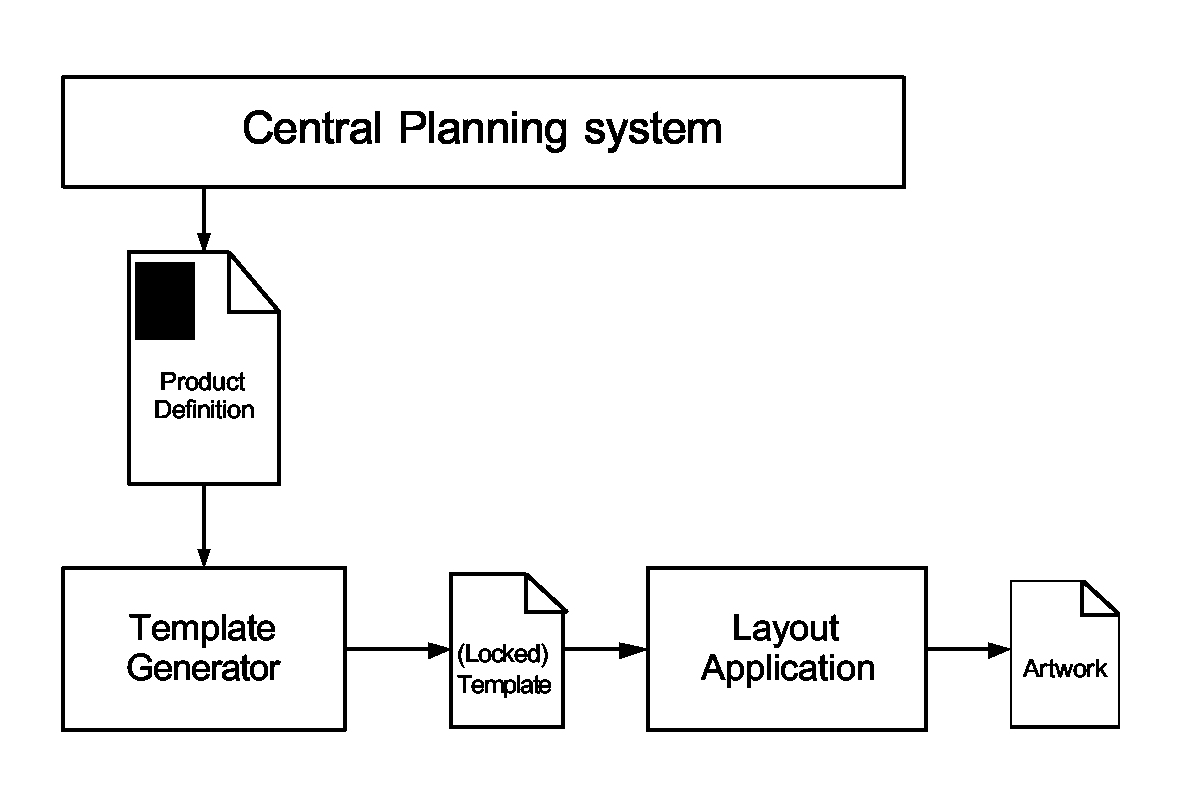
- There are several possible solutions depending on what the layout application supports, ordered here with the most integrated solution first. As mentioned above, preferably a central planning system (covering both creative department and pre-press department) is used; such a planning system is indicated in the drawings below. However, a planning system that creates the product definition and that only sends it to the layout application, not to the pre-press workflow application, may also be used in the embodiments illustrated by the drawings below.
- 1. Send the product definition (parameters) in a format that the
layout application understands.
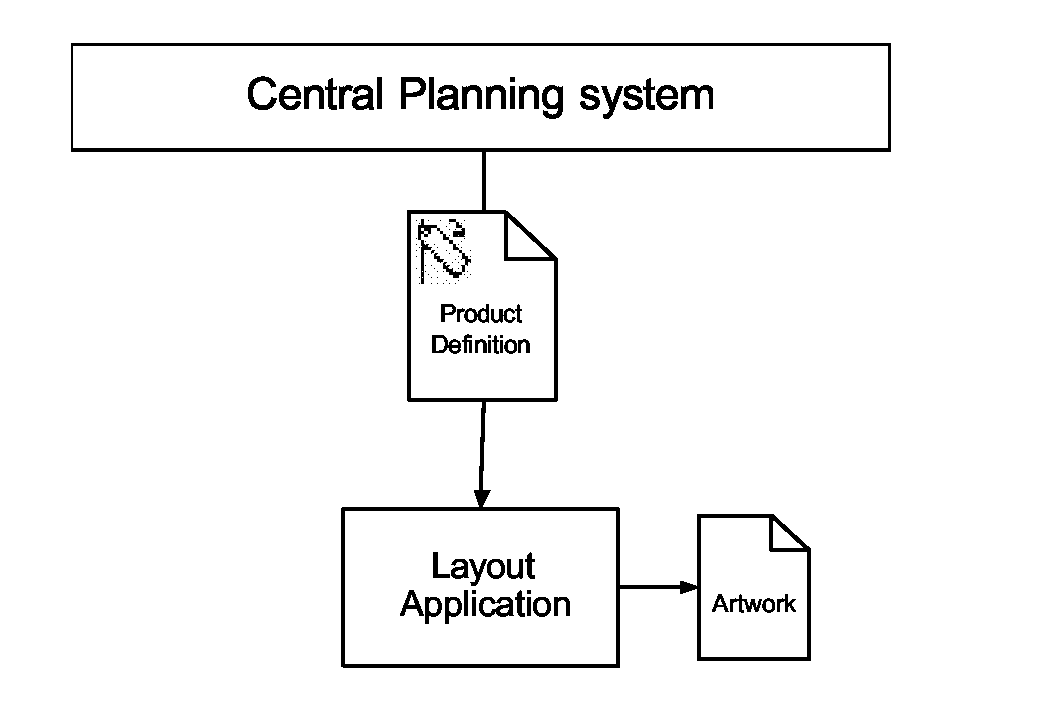
- 2. Send the product definition (parameters) to a script ("an
intermediate script") that drives the layout application to produce
the starting document (or template).

- 3. Send the product definition (parameters) to an intermediate
application that generates the document template or starting
document.
-
- Those skilled in the art will appreciate that numerous modifications and variations may be made to the embodiments disclosed above without departing from the scope of the present invention.
Claims (11)
- A method for making a digital representation of a printed product comprising the steps of:creating by a planning application a product definition of said printed product;outputting said product definition by said planning application to a layout application for using said product definition by said layout application for creating an artwork for making said digital representation of said printed product.
- The method according to claim 1 further comprising the steps of:outputting said product definition by said planning application to a pre-press workflow application for using said product definition by said pre-press workflow application for creating a pre-press product.
- A method for creating an artwork for making a digital representation of a printed product, the method comprising the steps of:inputting a product definition of said printed product by a layout application from a planning application;using said product definition for creating said artwork by said layout application.
- The method according to any one of the preceding claims wherein said product definition comprises a first parameter selected from the group of a page size, a number of pages, a bleed size and a set of colors used.
- The method according to any one of the preceding claims further comprising the step of:locking a second parameter of said product definition for protecting said second parameter from being modified by said layout application.
- The method according to any one of claims 1 to 5 further comprising the step of:creating said product definition in Job Definition Format, i.e. JDF.
- The method according to any one of claims 1 to 5 further comprising the step of:outputting said product definition by said planning application to an intermediate script for driving said layout application.
- The method according to any one of claims 1 to 5 further comprising the step of:outputting said product definition by said planning application to an intermediate application for sending said product definition in a particular format to said layout application.
- A data processing system comprising means for carrying out the steps of the method according to any one of claims 1 to 8.
- A computer program comprising computer program code means adapted to perform the method according to any one of claims 1 to 8 when said program is run on a computer.
- A computer readable medium comprising program code adapted to carry out the method according to any one of claims 1 to 8 when run on a computer.
Priority Applications (3)
| Application Number | Priority Date | Filing Date | Title |
|---|---|---|---|
| EP02102613A EP1422607A1 (en) | 2002-11-21 | 2002-11-21 | Method for outputting a digital product definition of a printed product to a layout application |
| EP20030104194 EP1422610A2 (en) | 2002-11-21 | 2003-11-14 | Method for outputting a digital product definition of a printed product to a layout application |
| US10/718,146 US20040120012A1 (en) | 2002-11-21 | 2003-11-20 | Method for outputting a digital product definition of a printed product to a layout application |
Applications Claiming Priority (1)
| Application Number | Priority Date | Filing Date | Title |
|---|---|---|---|
| EP02102613A EP1422607A1 (en) | 2002-11-21 | 2002-11-21 | Method for outputting a digital product definition of a printed product to a layout application |
Publications (1)
| Publication Number | Publication Date |
|---|---|
| EP1422607A1 true EP1422607A1 (en) | 2004-05-26 |
Family
ID=32187254
Family Applications (1)
| Application Number | Title | Priority Date | Filing Date |
|---|---|---|---|
| EP02102613A Withdrawn EP1422607A1 (en) | 2002-11-21 | 2002-11-21 | Method for outputting a digital product definition of a printed product to a layout application |
Country Status (1)
| Country | Link |
|---|---|
| EP (1) | EP1422607A1 (en) |
Citations (1)
| Publication number | Priority date | Publication date | Assignee | Title |
|---|---|---|---|---|
| EP1026876A2 (en) * | 1999-02-08 | 2000-08-09 | Agfa Corporation | System and method for output management |
-
2002
- 2002-11-21 EP EP02102613A patent/EP1422607A1/en not_active Withdrawn
Patent Citations (1)
| Publication number | Priority date | Publication date | Assignee | Title |
|---|---|---|---|---|
| EP1026876A2 (en) * | 1999-02-08 | 2000-08-09 | Agfa Corporation | System and method for output management |
Non-Patent Citations (3)
| Title |
|---|
| ANONYMOUS: "CIP3 Print Production Format (PPF) - workflow doesn't stop at prepress!", INTERNET CITATION, 1997, XP002262817, Retrieved from the Internet <URL:http://www.cip4.org/documents/ppf_overview/cip3_brochure_e.pdf> [retrieved on 20031124] * |
| ANONYMOUS: "Job Definition Format (JDF)", INTERNET CITATION, 14 March 2000 (2000-03-14), pages 1 - 8, XP002262816, Retrieved from the Internet <URL:http://www.cip4.org/documents/jdf_overview/jdf_wp.pdf> [retrieved on 20031124] * |
| ANONYMOUS: "Segmented job ticketing structure", RESEARCH DISCLOSURE, KENNETH MASON PUBLICATIONS, HAMPSHIRE, GB, vol. 459, no. 66, July 2002 (2002-07-01), XP007130785, ISSN: 0374-4353 * |
Similar Documents
| Publication | Publication Date | Title |
|---|---|---|
| US20070253029A1 (en) | Information processing apparatus, control method therefor, and program | |
| US20040163049A1 (en) | Document processing method | |
| JP7494629B2 (en) | Information processing device and information processing program | |
| US20080141121A1 (en) | Information processing apparatus and information processing method | |
| JP2009211176A (en) | Information processor, information processing method, and information processing program | |
| US9430174B2 (en) | Print production system, print production method, non-transitory storage medium storing print production program, and printing management server | |
| JP6900420B2 (en) | Systems and methods for automatic digital RFID printing and integration | |
| US20060082793A1 (en) | Methods and apparatus for adaptive imposition templates | |
| EP1352346A1 (en) | System and method for editing computer-generated documents independently of the creator software application | |
| CN110196697A (en) | Information processing equipment, information processing method and storage medium | |
| CN107832023A (en) | Message processing device, method and storage medium | |
| TW201637888A (en) | Data processing apparatus, recording apparatus and control method of the data processing apparatus | |
| US7907299B2 (en) | Method and server for processing an electronic workflow | |
| EP1422610A2 (en) | Method for outputting a digital product definition of a printed product to a layout application | |
| JP5228569B2 (en) | Variable printing method using web, variable printing system using web, and submitted data processing apparatus | |
| US20050134878A1 (en) | Printing system, print data generating method, and program | |
| US20040120012A1 (en) | Method for outputting a digital product definition of a printed product to a layout application | |
| JPH11203068A (en) | Color printing system | |
| JP7581688B2 (en) | Information processing device and program | |
| US7345789B2 (en) | Image processing apparatus for prepress printing and prepress printing system | |
| JP2002014792A (en) | Color printing system for monochrome forms | |
| US11379162B1 (en) | Printing system using job template | |
| JP4506371B2 (en) | Image forming method and image forming apparatus | |
| JP2005092413A (en) | Method of job processing | |
| JP2003526862A (en) | Method and apparatus for creating a print pattern |
Legal Events
| Date | Code | Title | Description |
|---|---|---|---|
| PUAI | Public reference made under article 153(3) epc to a published international application that has entered the european phase |
Free format text: ORIGINAL CODE: 0009012 |
|
| AK | Designated contracting states |
Kind code of ref document: A1 Designated state(s): AT BE BG CH CY CZ DE DK EE ES FI FR GB GR IE IT LI LU MC NL PT SE SK TR |
|
| AX | Request for extension of the european patent |
Extension state: AL LT LV MK RO SI |
|
| AKX | Designation fees paid | ||
| REG | Reference to a national code |
Ref country code: DE Ref legal event code: 8566 |
|
| STAA | Information on the status of an ep patent application or granted ep patent |
Free format text: STATUS: THE APPLICATION IS DEEMED TO BE WITHDRAWN |
|
| 18D | Application deemed to be withdrawn |
Effective date: 20041127 |