EP1422295A1 - Method for modifying chromosomes - Google Patents

Method for modifying chromosomes Download PDF

Info

Publication number
EP1422295A1
EP1422295A1 EP03256936A EP03256936A EP1422295A1 EP 1422295 A1 EP1422295 A1 EP 1422295A1 EP 03256936 A EP03256936 A EP 03256936A EP 03256936 A EP03256936 A EP 03256936A EP 1422295 A1 EP1422295 A1 EP 1422295A1
Authority
EP
European Patent Office
Prior art keywords
chromosome
splitting
sequence
vector
yeast
Prior art date
Legal status (The legal status is an assumption and is not a legal conclusion. Google has not performed a legal analysis and makes no representation as to the accuracy of the status listed.)
Withdrawn
Application number
EP03256936A
Other languages
German (de)
French (fr)
Inventor
Satoshi Harashima
Minetaka Sugiyama
Yoshinobu Kaneko
Current Assignee (The listed assignees may be inaccurate. Google has not performed a legal analysis and makes no representation or warranty as to the accuracy of the list.)
University of Osaka NUC
Original Assignee
Osaka University NUC
Priority date (The priority date is an assumption and is not a legal conclusion. Google has not performed a legal analysis and makes no representation as to the accuracy of the date listed.)
Filing date
Publication date
Application filed by Osaka University NUC filed Critical Osaka University NUC
Publication of EP1422295A1 publication Critical patent/EP1422295A1/en
Withdrawn legal-status Critical Current

Links

Images

Classifications

    • CCHEMISTRY; METALLURGY
    • C12BIOCHEMISTRY; BEER; SPIRITS; WINE; VINEGAR; MICROBIOLOGY; ENZYMOLOGY; MUTATION OR GENETIC ENGINEERING
    • C12NMICROORGANISMS OR ENZYMES; COMPOSITIONS THEREOF; PROPAGATING, PRESERVING, OR MAINTAINING MICROORGANISMS; MUTATION OR GENETIC ENGINEERING; CULTURE MEDIA
    • C12N15/00Mutation or genetic engineering; DNA or RNA concerning genetic engineering, vectors, e.g. plasmids, or their isolation, preparation or purification; Use of hosts therefor
    • C12N15/09Recombinant DNA-technology
    • C12N15/87Introduction of foreign genetic material using processes not otherwise provided for, e.g. co-transformation
    • C12N15/90Stable introduction of foreign DNA into chromosome
    • C12N15/902Stable introduction of foreign DNA into chromosome using homologous recombination
    • C12N15/907Stable introduction of foreign DNA into chromosome using homologous recombination in mammalian cells

Definitions

  • the present invention relates to a method for modifying chromosomes, employing chromosome splitting vectors. More specifically, the present invention relates to a method for modifying yeast chromosomes, employing two linear chromosome splitting vectors.
  • Techniques for modifying DNA include site-specific mutagenesis, treatments with restriction enzymes, and PCR. However, these techniques are only applicable to genes of a limited size, e.g. from about 10kbp, to about 40 kbp. The development of techniques for modifying large DNA molecules, such as chromosomes, is still in its infancy.
  • Yeast is a useful organism that has been used in the fermentation industry for a long time.
  • Yeast chromosomes can be modified by chromosome modification techniques such as splitting or loss of chromosomes so as to obtain information about, for example, the necessary number and length of chromosomes. Such information can be used to investigate the principles of yeast genome function and organization. Once these principles are understood, it may be possible to produce substances efficiently using yeast in which unnecessary genes, for example, energy consuming genes are removed. Furthermore, transferring particular regions of a chromosome into another yeast cell can provide information as to chromosome function. This information can then be used to breed useful yeast.
  • DNA libraries including large DNA molecules (e.g., 200 kbp or more) of plant chromosomes have been prepared by using, for example, yeast artificial chromosome vectors (YAC vector). If these large DNA molecules can be separated or manipulated, it may be possible to breed new and useful transgenic plants, to elucidate the structure and function of animal and plant chromosomes, to speed-up positional cloning, to provide simple and easy assays for animal and plant gene function, and to construct artificial chromosomes for animals or plants.
  • yeast artificial chromosome vectors YAC vector
  • telomere sequence In order to stabilize a chromosome in yeast, a telomere sequence is required at the terminals of the chromosome. For this reason, in the conventional technique for splitting a chromosome in yeast the telomere sequence of the yeast is added to the telomere sequence derived from Tetrahymena rDNA (hereinafter referred to as "Tr sequence") at a high frequency in order to stabilize the split chromosome (see Shampay et al. (1984) Nature (London) 310, 154-157). Figure 15 shows the outline of this conventional technique for splitting a chromosome.
  • This technique is based on the following phenomenon: when a vector having (i) a centromere (C), (ii) a telomere repetitive sequence (Tr-Tr) derived from Tetrahymena rDNA that are placed in opposite directions to each other, (iii) a selection marker (M) for a yeast transformation, and (iv) any target sequence, is introduced into a yeast chromosome by transformation ( Figure 15A), homologous recombination occurs within the target sequence ( Figure 15B).
  • telomere resolution occurs at the Tr-Tr sequence that has been introduced into the chromosome so as to split the chromosome ( Figure 15C), followed by the addition of telomere sequences of the yeast to the dissociated terminals (Tr sequence) of the split chromosomes ( Figure 15D).
  • Figure 16 shows the Tr sequence derived from Tetrahymena.
  • the Tr sequence consists of about 700 bp, in which an AT rich portion of about 400 bp is followed by a repetitive sequence element of 5'-CCCCAA-3' (C 4 A 2 ) of about 300 bp. It seems that this repetitive sequence serves as a signal to which the telomere sequence of the yeast can be added effectively (Figure 16A). It has been reported that the telomere sequence of the yeast can be added to a terminal sequence (C 4 A 2 ) 6 consisting of only 6 repeats of C 4 A 2 ( Figure 16B) (see Murray et al., (1988) Mol. Cell. Biol. 8(11), 4642-4650).
  • Figure 17 shows the splitting of a yeast chromosome with this splitting vector pCSV1.
  • the pCSV1 has CEN4, URA3 (not shown), Tr sequences that are placed in opposite directions each other, and a stuffer DNA (X) between the two Tr sequences.
  • the splitting includes the steps of: (Step 1) introducing a target sequence (Y) into the splitting vector pCSV1, wherein the target sequence (Y) has a splitting site; (Step 2) removing the stuffer DNA (X); (Step 3) cyclizing the plasmid from which the stuffer DNA (X) has been removed; and (Step 4) cleaving the cyclized plasmid at the target sequence (Y) to obtain a linear splitting vector so as to introduce it into a homologous region of a yeast chromosome. It seems that by introducing the linear splitting vector into a yeast cell, homologous recombination occurs within the target sequence, and then the oppositely-oriented telomere sequences are resolved so as to split the chromosome.
  • the two splitting vectors could not be amplified by PCR (see Figure 18C).
  • PCR was performed in order to obtain linear splitting vectors (A) and (B) using a plasmid that contained Tr sequence as a template as shown in Figure 18B.
  • the PCR products 7 and 8 were analyzed and it was found that non-specific amplification had occurred as shown in Figure 18C.
  • One of the reasons why the two splitting vectors could not specifically be amplified by PCR is that there is a repetitive sequence of about 300 bp in the Tr sequence, as described above.
  • An object of the present invention is to provide a method of modifying chromosomes, using chromosome splitting vectors.
  • a method is provided for modifying yeast chromosomes, using linear chromosome splitting vectors.
  • a further object of the present invention is to provide an improved method for preparing a chromosome splitting vector, said vector allowing efficient chromosome modification, in particular, the splitting, loss, and isolation of chromosomes.
  • the invention provides a method for modifying a chromosome in a cell comprising:
  • a vector kit comprising at least one of each of these vectors is also provided.
  • a method of amplifying a vector comprising amplifying the vector by PCR using:-
  • the inventors of the present invention have conducted in-depth research into methods for splitting chromosomes using chromosome splitting vectors. They have found that amplification of the chromosome splitting vector with PCR can be achieved when the number of repeat units of 5'-CCCCAA-3' is reduced to about 1/5 to 1/6 of that of the conventionally used Tr sequence, and that a chromosome splitting vector, even with these short repeat units can serve as the Tr sequence and can split a yeast chromosome.
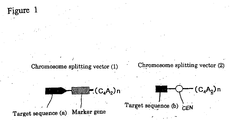
  • the present invention hence provides a method for modifying yeast chromosomes comprising preparing a linear chromosome splitting vector (1) having a target sequence (a), a marker gene sequence, and a (C 4 A 2 ) n sequence (a), in this order; preparing a linear chromosome splitting vector (2) having a target sequence (b), a centromere sequence of a yeast chromosome, and a (C 4 A 2 ) n sequence (b), in this order; and introducing the chromosome splitting vectors (1) and (2) into yeast, wherein n is each independently an integer of 1 to 30, preferably 4 to 15, more preferably 6 to 10.
  • the vectors contain no more than 30, preferably no more than 15, more preferably no more than 10, and in a specific embodiment no more than 6 (C 4 A 2 ) repeats.
  • the chromosome splitting vectors (1) and (2) are vectors obtained by PCR.
  • n of both (C 4 A 2 ) n sequences (a) and (b) is 6.
  • modification of the chromosome is caused by splitting and/or loss of a yeast chromosome.
  • the method for modifying a chromosome of the present invention uses a two-chromosome splitting vector system including chromosome splitting vectors (1) and (2).
  • the chromosome splitting vector (1) is linear and has a target sequence (a), a marker gene sequence, and a (C 4 A 2 ) n sequence (a), in this order.
  • the chromosome splitting vector (2) is linear and has a target sequence (b), a centromere sequence of a yeast chromosome, and a (C 4 A 2 ) n sequence (b), in this order.
  • the (C 4 A 2 ) n in the chromosome splitting vectors (1) and (2) means a sequence in which a nucleotide sequence of 5'-CCCCAA-3', which is a repetitive sequence unit of the Tr sequence, is repeated n times, and n is each independently an integer of 1-30, preferably 4-15, more preferably 6-10. Most preferably, n is 6 in both vectors (1) and (2).
  • Figure 1 shows the chromosome splitting vectors (1) and (2) used in the present invention.
  • the two chromosome splitting vectors (1) and (2) have only 1-30, preferably 4-15, more preferably 6-10 repetitive sequence units of 5'-CCCCAA-3', which is much less than in the conventionally used Tr sequence, they can function as a telomere sequence in yeast, so that a yeast chromosome can be split.
  • the vectors can be amplified with PCR and thus can be prepared easily.
  • the centromere sequence of a yeast chromosome refers to a sequence necessary for mitosis of a yeast chromosome.
  • the centromere sequence of any chromosome can be used without any particular limitation. In particular, CEN4 or CEN6 are preferably used.
  • the centromere sequence of a yeast chromosome can be prepared easily with PCR using a plasmid having a desired centromere sequence (e.g., pDW26 (Windiant, D. et al, J Ferment, Bioeng, 82, 199-204 (1996)) as a template. In preparation, if a pair of primers including appropriate restriction enzyme cleavage sites is used, a DNA fragment including a desired centromere sequence can be recovered easily.
  • the marker gene there is no particular limitation regarding the marker gene, as long as it can monitor whether a chromosome splitting vector has been introduced into yeast.
  • auxotrophic marker genes such as HIS3, HIS5, URA3, ADE2, LEU2, TRP1, and LYS2 can be used.
  • a drug resistance marker gene that can be expressed in an eukaryote for example, a kanamycin resistance gene (Km) can also be used.
  • Km kanamycin resistance gene
  • the sequence of a marker gene can be prepared easily with PCR, using a plasmid having the marker gene as a template. In preparation, if a pair of primers having appropriate restriction enzyme cleavage sites is used in the PCR amplification, a DNA fragment having a desired marker gene sequence can be recovered easily by digesting the PCR product with restriction enzymes.
  • the target sequence refers to a sequence in which a sequence of a splitting site of a chromosome (e.g., a yeast chromosome, a plant chromosome, an animal chromosome etc.) is included.
  • the target sequence can be obtained by synthesizing the sequence corresponding to the splitting site of the chromosome.
  • a DNA fragment having a desired target sequence can be prepared and recovered easily with PCR using the total DNA of yeast as a template, for example, using a pair of primers designed to add appropriate restriction enzyme cleavage sites.
  • the chromosome splitting vector (1) is a linear vector having a target sequence (a), a marker gene sequence, and a (C 4 A 2 ) n sequence (a), in this order.
  • the chromosome splitting vector (1) can be prepared by performing PCR, for example, using the (C 4 A 2 ) n sequence and the target sequence (a) as a pair of primers, and a vector having an appropriate marker gene as a template.
  • the plasmid that can be used as a template of the chromosome splitting vector (1) can be constructed in the simplest manner, for example, as follows: PCR is performed with appropriate primers, using a plasmid in which a HIS3 gene derived from Candida glabrata (CgHIS3 gene) is introduced into pUC18 (Kitada et al., (1995) Gene 165, 203-206) (this plasmid is referred to as "p1417" in this specification) as a template.
  • the obtained DNA fragment (PCR product) containing the CgHIS3 gene is collected and inserted in pBluescript II SK+ (STRATAGENE).
  • chromosome splitting vector (1) having a marker gene When the chromosome splitting vector (1) having a marker gene is used, a resultant transformant having the split chromosome cannot be used as a host for subsequent transformations because the marker gene still remains. This means that sequential splitting of the chromosome cannot be performed. If the marker gene contained in the transformant in which chromosome is split can be removed by some means after transformation, transformation (splitting of chromosomes) can be performed a plurality of times. If sequential splitting of the chromosome can be achieved, it is expected that knowledge of the number and the length of chromosomes necessary for growth of yeast can be obtained and the function of the yeast chromosome can be analyzed. Consequently, useful yeast, such as yeast having mini-chromosomes that are suitable for efficient production of a desired substance, can be bred.
  • Cre-IoxP system A site-specific recombination system (Cre-IoxP system) can be used to delete the marker gene. Therefore, a plasmid having the marker gene in a Cre-IoxP system can be preferably used as a template of the chromosome splitting vector (1) so that the marker gene can be removed after the transformation is completed.
  • This Cre-IoxP system is available in a plasmid pUG6 (Guldener et al. (1996) Nucleic Acids Res. 24(13), 2519-2524).
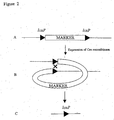
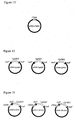
  • Figures 2A to 2C show the Cre-IoxP system.
  • the marker gene is inserted inbetween the IoxP genes.
  • site-specific recombination occurs by the expression of the Cre recombinase
  • the marker gene is removed by the Cre recombinase.
  • the expression of the Cre recombinase is regulated by a promoter of a GAL1 gene encoding a galactose metabolizing enzyme.
  • the plasmid used as a template of the chromosome splitting vector (1) can be constructed by using the plasmid pUG6, for example, in the following manner: (i) PCR is performed, using the plasmid p1417 having the CgHIS3 gene as a template so as to obtain a DNA fragment containing the CgHIS3 gene: (ii) the thus-obtained DNA fragment is cloned into a pT7Blue-T vector (Novagen); (iii) the DNA fragment containing the CgHIS3 gene is cut out again, recovered, and inserted into the plasmid pUG6 from which the kanamycin resistance gene has been removed; (iv) a DNA fragment containing the CgHIS3 gene is recovered from the obtained plasmid and inserted into a pBluescript II SK+ (STRATAGENE).
  • a plasmid (pUG6-CgHIS3: refer to Figure 12) that can be used as a template of the
  • Plasmid pUG6-CgLEU2 or pUG-CgTRP1 can be obtained from a plasmid containing CgLEU2 gene or CgTRP1 gene, respectively, in the same manner as the above described. Refer to Figure 12.
  • the plasmid containing the marker gene that is obtained through the steps of (i) to (iv) contains a selection marker gene in the site-specific recombination system (Cre-IoxP system) as shown in Figure 2 that is derived from the plasmid pUG6.
  • Cre-IoxP system site-specific recombination system
  • PCR is performed, using a plasmid having the Cre-IoxP system as a template, so as to include the marker gene sandwiched by the IoxP genes.
  • the thus obtained chromosome splitting vector (1) can be consecutively used for transformation in the same host.
  • the chromosome splitting vector (1) can be obtained by performing PCR with the plasmid having the marker gene as a template, using a primer having a target sequence (a1) having a homology to the area of the yeast chromosome to be split and a sequence (a2) homologous to the template plasmid, and a primer having a (C 4 A 2 ) n sequence and a sequence (a3) homologous with the template plasmid.
  • the sequences (a2) and (a3) having a homologous sequence with the template plasmid are selected so as to sandwich the marker gene sequence.
  • the chromosome splitting vector (2) is a linear vector having a target sequence (b), a centromere sequence of a yeast chromosome (CEN), and a (C 4 A 2 ) n sequence (b) in this order.
  • the chromosome splitting vector (2) is prepared by performing PCR, for example, using a vector having a centromere sequence of a yeast as a template, and the (C 4 A 2 ) n sequence and the target sequence (b) as primers.
  • the plasmid used as a template of the chromosome splitting vector (2) can be constructed, for example, in the following manner. PCR is performed with an appropriate primer, using a chromosomal DNA of yeast as a template; then, the obtained DNA fragment is cloned into pT7Blue-T vector (Novagen); and the DNA fragment containing centromere sequence (for example, CEN4 ) is recovered with an appropriate restriction enzyme and is inserted into pBluescript II SK+ (STRATAGENE).
  • PCR is performed with an appropriate primer, using a chromosomal DNA of yeast as a template
  • the obtained DNA fragment is cloned into pT7Blue-T vector (Novagen)
  • the DNA fragment containing centromere sequence for example, CEN4
  • STRATAGENE pBluescript II SK+
  • the chromosome splitting vector (2) can be obtained by performing PCR using the plasmid having the yeast centromere as a template, using a primer having a target sequence (b1) that has a homology with a site of the yeast chromosome to be split and a sequence (b2) homologous with the template plasmid, and a primer having a (C 4 A 2 ) n sequence and a sequence (b3) homologous with the template plasmid.
  • the sequences (b2) and (b3) having a homologous sequence with the template plasmid are selected so as to sandwich the yeast centromere sequence.
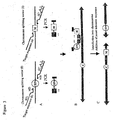
  • the method of the present invention will be described schematically with reference to Figures 3A to 3C by taking an example in which the (C 4 A 2 ) 6 sequence is used as a primer.
  • the chromosome splitting vectors (1) and (2) are prepared using a sequence having a target sequence (a) or a target sequence (b) and a (C 4 A 2 ) 6 sequence as a primer, and using a plasmid having a marker gene (M) or a centromere sequence ( CEN4 ).
  • the chromosome splitting vectors (1) and (2) are introduced into yeast.
  • the introduced chromosome splitting vectors cause homologous recombination at a homologous site of the yeast chromosome, and thus the chromosome splitting vectors (1) and (2) are inserted into the yeast chromosome.
  • the telomere sequence of the yeast appears to be added to the (C 4 A 2 ) 6 sequence, which provides the function as a chromosome.
  • the orientation of the target sequence (a) and (b) in the primers is designed so that each of the (C 4 A 2 ) 6 sequences in the splitting vectors (a) and (b) becomes a terminal of each two split chromosomes when telomere resolution has occurred.
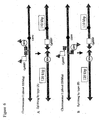
  • FIGS 4A to 4C show the manner in which splitting and/or loss occurs in a chromosome.
  • the target sequences (a) and (b) are constituted in such a manner that, sandwiching the splitting site, the target sequence (b) has the chromosome sequence on the left side of the splitting site, and the target sequence (a) has the chromosome sequence on the right side of the splitting site.
  • the linear chromosome splitting vectors (1) and (2) having such target sequences (a) and (b), respectively, are introduced into a yeast simultaneously, so that the chromosome can be split as shown in the lowest stage in Figure 4A.
  • chromosome splitting vector (1) or (2) alone participates in splitting or loss, as shown in Figures 4B and 4C. It seems that splitting or loss of a chromosome occurs in the manners shown in Figures 4A to 4C alone or in combination, or in another manner.
  • the obtained transformant having the split chromosomes includes the site-specific recombination system (Cre-IoxP system), it is possible to remove the marker gene by expressing the Cre enzyme so that chromosome splitting vectors having the same marker can be subsequently introduced into the transformant having the split chromosomes.
  • Cre-IoxP system site-specific recombination system
  • 0.2 ⁇ l of Takara Ex Taq DNA polymerase (Takara Shuzo Co. Ltd)
  • 4 ⁇ l of 10 ⁇ Reaction buffer (Takara Ex Taq DNA polymerase buffer)
  • 4 ⁇ l of dNTP mixed solution 2.5 mM each of dATP, dTTP, dGTP, and dCTP
  • 0.2 ⁇ l of the template DNA and 2 ⁇ l each of two types of primer DNA (20 pmol/ ⁇ l each) were put in a 0.2 ml tube for this purpose and were diluted to 40 ⁇ l with a sterile water.
  • the mixture was placed in a GeneAmp PCR System (PERKIN ELMER) and reactions at (1) 94°C for three minutes; (2) 94°C for one minute (denaturation of double stranded DNA); (3) 50 to 60 °C for 2 minutes (annealing of primers); (4) 72°C for 1 to 3 minutes (elongation of DNA with polymerase); and (5) 4°C for 10 minutes are repeated 25 times.
  • PERKIN ELMER GeneAmp PCR System
  • Chromosome I (230195 bp), which was the smallest of the 16 chromosomes of a haploid budding yeast, was used as the chromosome to be split.
  • the CgHIS3 gene was used as the selection marker, and the splitting site was set approximately at a center of chromosome l (between 119874 bp and 119875 bp). If the chromosome is split as desired, chromosome I should be split to about 120 kbp and about 110 kbp.
  • the haploid budding yeast is a SH5209(a) strain (formerly FY833 strain: MATa his3 ⁇ 200 ura3-52leu2 ⁇ 1lys2 ⁇ 202 trpl ⁇ 63 (Winston et al. (1995) Yeast 11, 53-55).
  • Reference Example 1 Construction of a plasmid pSK+CgHIS3 as a template for construction of the chromosome splitting vector (1)
  • a plasmid SK+CgHIS3 is obtained by incorporating a CgHIS3 gene, which is incorporated into IoxP sites of a Cre-IoxP system, into pBluescript II SK+ (STRATAGENE).
  • PCR was performed, using primers CgHIS3-1 and CgHIS3-2 having the following sequences, and a plasmid p1417 having a CgHIS3 gene as a template.
  • the obtained DNA fragment of about 1.62 kbp was cloned into pT7Blue-T vector (Novagen) with T4DNA ligase to construct a plasmid pT7-CgHIS3.
  • the primer CgHIS3-1 has a sequence that generates a restriction enzyme Xbal cleavage site.
  • the primer CgHIS3-2 has a sequence that generates a restriction enzyme Xhol cleavage site.
  • the plasmid pT7-CgHIS3 was digested with a restriction enzyme Xbal / Xhol.
  • a DNA fragment of about 1.62 kbp containing the CgHIS3 gene was recovered, using GENE CLEAN II KIT (Funakoshi Co. Ltd.), from agarose gel.
  • plasmid pUG6 was digested with Bglll / Xhol and Xbal / Xhol to remove about 1.54 kbp including a kanamycin resistant gene.
  • a DNA fragment without kanamycin resistant gene was recovered from the agarose gel, using GENE CLEAN II KIT (Funakoshi Co. Ltd.).
  • the DNA fragment of about 1.62 kbp containing the CgHIS3 gene was inserted into the Xbal / Xhol cleavage site of the recovered DNA fragment, so that a plasmid pUG6-CgHIS3 was constructed.
  • the plasmid pUG6-CgHIS3 was digested with Notl to obtain about 1.79 kbp fragment containing the CgHIS3 gene.
  • This 1.79 kbp fragment was inserted into a Notl site of pBluescript II SK+ (STRATAGENE), so that a plasmid pSK+CgHIS3 was constructed.
  • Reference Example 2 Construction of a plasmid pSK+CEN4 as a template for constructing the chromosome splitting vector (2)
  • a plasmid pSK+CEN4 is a plasmid having a centromere sequence of a yeast, and is used as a template for constructing the chromosome splitting vector (2).
  • a CEN4 gene is incorporated into pBluescript II SK+ (STRATAGENE) as centromere.
  • PCR was performed, using CEN4-1 and CEN4-2 having the following sequences as primers, and a chromosomal DNA of a wild-type budding yeast +strain S288C as a template.
  • the obtained DNA fragment of about 0.85 kbp was cloned into pT7Blue-T vector (Novagen) with T4DNA ligase to construct a plasmid pT7-CEN4.
  • Each primer CEN4-1 and CEN4-2 has a sequence that generates a restriction enzyme EcoRI cleavage site, respectively.
  • the obtained pT7-CEN4 was digested with a restriction enzyme EcoRI, and the DNA fragment of about 0.85 kbp containing the CEN4 was recovered.
  • This 0.85 kbp DNA fragment was inserted into an EcoRI site of pBluescript II SK+ (STRATAGENE), so that a plasmid pSK+CEN4 was constructed.
  • Example 1 Production of a chromosome splitting vector
  • Figure 5 is a schematic diagram showing production of chromosome splitting vectors (1A), (2A), (1 B) and (2B).
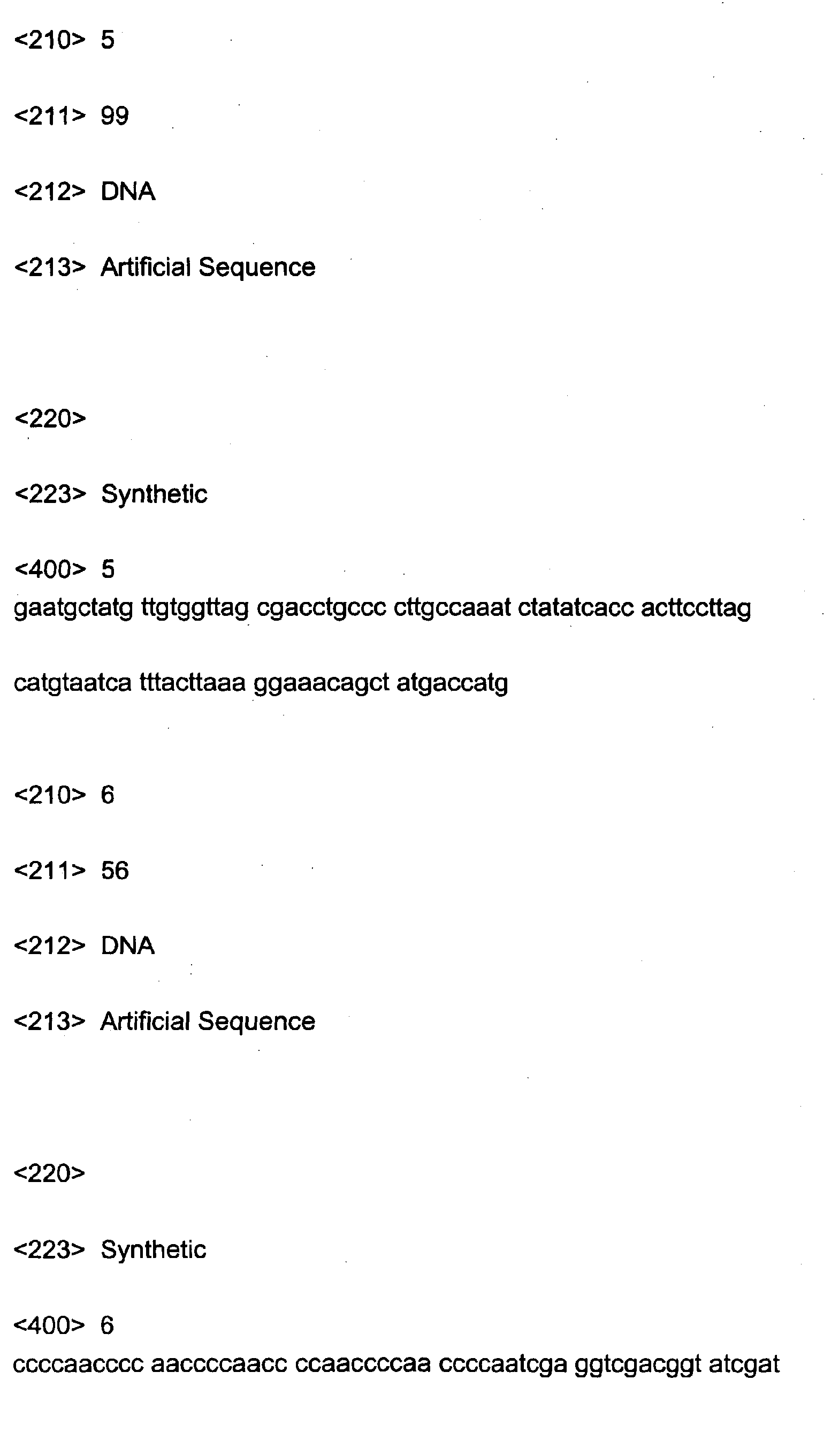
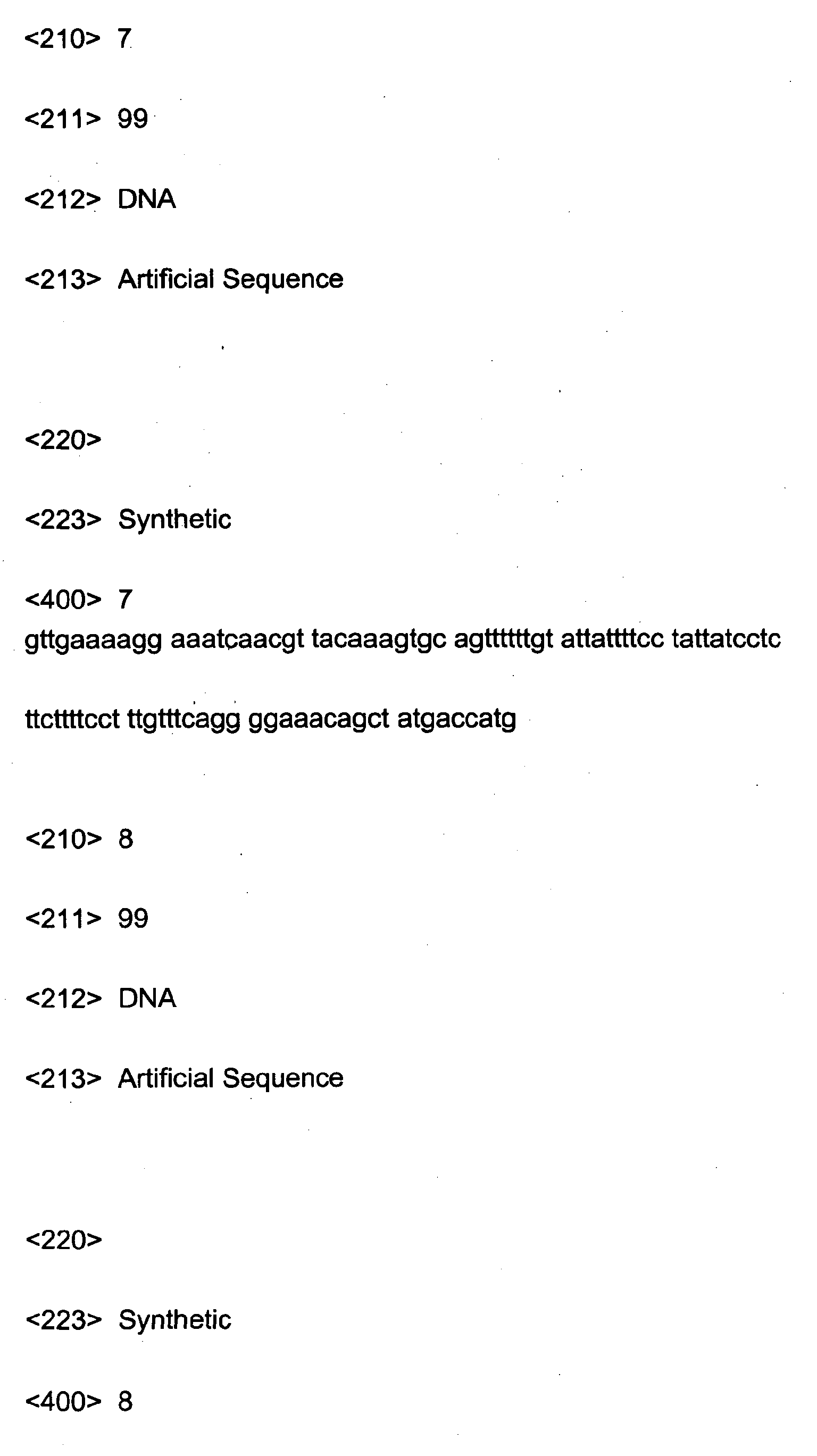
  • the primer chlY-11 (Sequence ID No.5) has 99 bases.
  • the 80 bases from the 5' terminal of the chlY-11 constitute a region homologous to the nucleotide sequence of 119795 bp to 119874 bp of chromosome I, which is the target sequence.
  • the remaining 19 bases constitute a region homologous to the plasmid pSK+CgHIS3.
  • the primer Tr6-1 has the (C 4 A 2 ) 6 sequence and 20-base sequence homologous to sequences of the plasmid pSK+CgHIS3. PCR was performed using these two primers, and the plasmid pSK+CgHIS3 as a template, and thus a PCR product 1 (chromosome splitting vector (1A) ) was obtained.
  • the primer chlY-12 (Sequence ID No.7) has 99 bases.
  • the 80 bases from the 5' terminal of the chlY-12 constitute a region homologous to the nucleotide sequence of 119875 bp to 119754 bp in chromosome I, which is the target sequence, and the remaining 19 bases constitute a region homologous to the plasmid pSK+CEN4.
  • PCR was performed using these two primers, and the plasmid pSK+CEN4 as a template, and thus a PCR product 2 (chromosome splitting vector (2A) ) was obtained.
  • the primer chlY-1 3 (Sequence ID No.8) has 99 bases.
  • the 80 bases from the 5' terminal of the chlY-13 constitute a region homologous to the nucleotide sequence of 119795 bp to 119874 bp in chromosome I, which is the target sequence, and the remaining 19 bases constitute a region homologous to the plasmid pSK+CEN4.
  • PCR was performed using these two primers, and the plasmid pSK+CEN4 as a template, and thus a PCR product 3 (chromosome splitting vector (2B) ) was obtained.
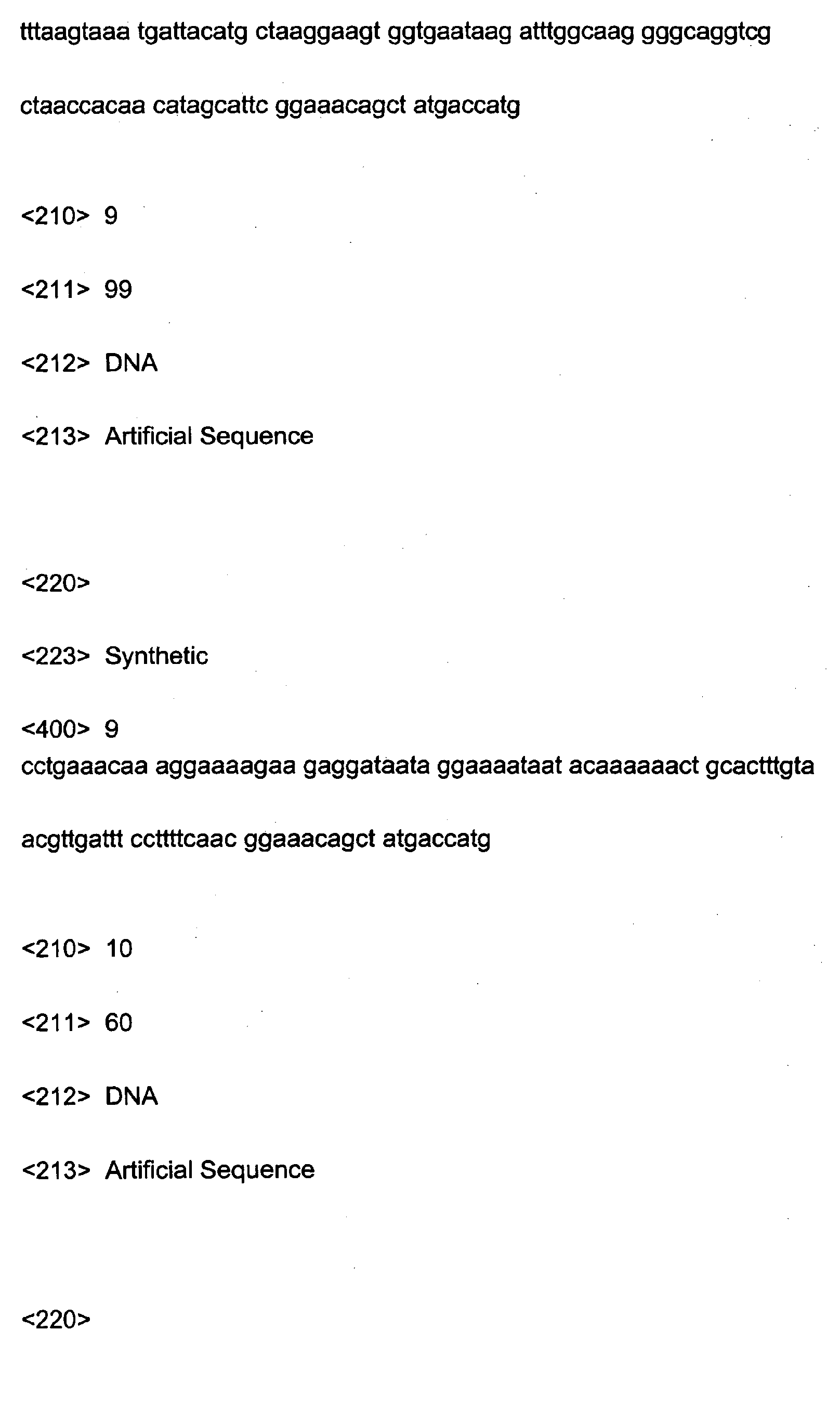
  • the primer chlY-14 (Sequence ID No.9) has 99 bases.
  • the 80 bases from the 5' terminal of the chlY-13 constitute a region homologous to the nucleotide sequence of 119875 bp to 119754 bp in chromosome I, which is the target sequence, and the remaining 19 bases constitute a region homologous to the plasmid pSK+CgHIS3.
  • PCR was performed using these two primers, and the plasmid pSK+CgHIS3 as a template, and thus a PCR product 4 (chromosome splitting vector (1B) ) was obtained.
  • Figure 5 shows a photograph of a gel electrophoresis of the PCR products 1 to 4. Fragments having a size of about 2.1 kbp are amplified specifically (PCR products 1 and 4), and fragments having a size of about 1.2 kbp are amplified specifically (PCR products 2 and 3). Thus, it is evident that specific amplification can be achieved by PCR using the repetitive sequence of (C 4 A 2 ) 6 as the primers. This confirms that the chromosome splitting vectors (1) and (2) can be prepared by PCR.
  • the obtained chromosome splitting vectors (1A) and (2A) perform splitting of a chromosome in such a manner that each of the target sequences is introduced into each split chromosome (hereinafter, referred to as "type (A)"), as shown in Figure 6A.
  • the chromosome splitting vectors (1 B) and (2B) perform splitting of a chromosome in such a manner that the target sequences are not introduced into each split chromosome (hereinafter, referred to as "type (B)”), as shown in Figure 6B.
  • a pair of the chromosome splitting vectors (1A) and (2A) or the chromosome splitting vectors (1B) and (2B) obtained by the above-described PCR were transformed into a yeast strain SH5209 by the lithium acetate method.
  • Transformants yeast in which chromosome I was expected to be split as desired
  • six transformants were obtained.
  • the splitting of type B was performed using the chromosome splitting vectors (2B) and (1B), fourtransformants were obtained.
  • a pulse field gel electrophoretic (PFGE) analysis and a Southern blotting were performed in order to investigate whether chromosome I had been split as desired ( Figure 7). If split as desired, chromosome I should be split into about 120 kbp and about 110 kbp. As a result of the PFGE analysis, the band of chromosome I disappeared and a new band was generated in the vicinity of 120 kbp in two transformants (lanes 2 and 4 in Figure 7) in the splitting of type (A), and also in two strains (lanes 10 and 11 in Figure 7) in the splitting of type (B).
  • PFGE pulse field gel electrophoretic
  • chromosome I should have been split into two fragments of about 120 kbp and about 110 kbp, but it seemed that the two bands overlapped each other in the vicinity of about 120 kbp. Then, a Southern blotting was performed. As a result, in both the analysis using CgHIS3 as a probe that should be incorporated in the split chromosome of about 110 kbp and the analysis using CEN4 as a probe that should be incorporated in the split chromosome of about 120 kbp, signals were obtained in the vicinity of 120 kbp in the lanes 2, 4, 10 and 11.
  • chromosome IV was not detected in any of the lanes. Because chromosome IV is very large (about 1.5 Mbp), chromosome IV could not be transferred onto a membrane for the Southern blotting. In the transformants in lanes 5, 6, 8 and 9, chromosome I did not appear to be split. From the result of Southern blotting analysis using CgHIS3 as a probe, it is believed that the CgHIS3 gene was introduced into a chromosome other than chromosome I, and therefore these strains were able to grow on a His-deficient medium.
  • chromosome I was not split, however, this transformant was able to grow in a His-deficient medium. This is most probably because the transformant had the split chromosome (about 110 kbp) containing CgHIS3 in a newly generated split chromosome. Summing up these results, chromosome I of a yeast was split at a frequency of 1/3 in the splitting vector of type (A) and a frequency of 1 ⁇ 2 in the splitting vector of type (B), and therefore, there is substantially no difference between the type (A) and (B) splitting. Thus, it is evident that the chromosome can be split at a high frequency using two chromosome splitting vectors that have been prepared with PCR in a simple manner.
  • Figure 8 shows a schematic diagram for construction of chromosome splitting vector (1C).
  • the primer chlY-15 (Sequence ID No.10) has 60 bases.
  • the 45 bases from the 5' terminal of the chlY-15 constitute a region homologous to the nucleotide sequence of 181165 bp to 181209 bp in chromosome I, which is the target sequence, and the remaining 15 bases constitute a region homologous to the plasmid pSK+CgHIS3.
  • PCR was performed using these two primers, and the plasmid pSK+CgHIS3 as a template, and thus a PCR product 5 (chromosome splitting vector (1C) ) was obtained.
  • Figure 8 shows a schematic diagram for construction of chromosome splitting vector (2C).
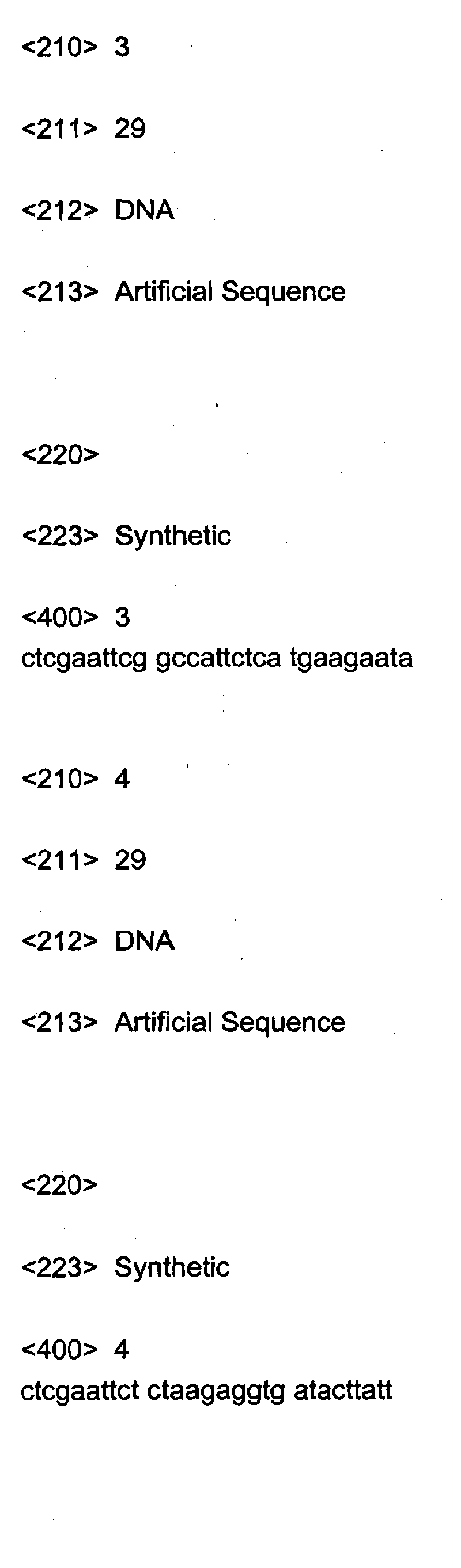
  • chlY-16 5'-GAAAAAATAATGGTTGCTAAGAGATTCGAACTC TTGCATCTTACGACAGCTATGACCATG-3' (Sequence ID No.11) and Tr6-1 (Sequence ID No. 6) were used.
  • PCR was performed using the plasmid pSK+CEN4 as a template.
  • the primer chlY-16 (Sequence ID No.11) has 60 bases.
  • the 45 bases from the 5' terminal of the chlY-16 constitute a region homologous to the nucleotide sequence of 181210 bp to 181254 bp in chromosome I, which is the target sequence, and the remaining 15 bases constitute a region homologous to the plasmid pSK+CEN4.
  • PCR was performed using these two primers, and the plasmid pSK+CEN4 as a template, and thus a PCR product 6 (chromosome splitting vector (2C) ) was obtained.
  • FIG. 8 A photograph of a gel electrophoresis of the PCR products 5 and 6 is shown in Figure 8. Fragments having a size of about 2.0 kbp and about 1.2 kbp are amplified specifically, which confirms that the chromosome splitting vectors (1C) and (2C) were obtained.
  • chromosome splitting vectors (1C) and (2C) are vectors for type (B) splitting of chromosomes shown in Figure 6B.
  • chromosome I should be split between the 181209 bp and 181210 bp, and into about 180 kbp and about 50 kbp fragments.
  • a pair of the chromosome splitting vectors (1C) and (2C) were introduced into a yeast strain SH5209 by the lithium acetate method. Transformants that can grow on a His-deficient medium were selected. Since a large number of transformants were obtained, 24 tranformants were selected at random and were subjected to PFGE.
  • Figure 9 shows the results.
  • the band of chromosome I of the transformant of a lane 8 has disappeared, and two new bands have been generated in the vicinity of 180 kbp and 50 kbp, respectively.
  • the Southern blotting was performed for in-depth examination ( Figure 10).
  • a signal was obtained in the vicinity of 180 kbp in the analysis using CgHIS3 as a probe, and a signal was obtained in the vicinity of about 50 kbp in the analysis using CEN4 as a probe.
  • chromosome I was split into two chromosomes of about 180 kbp and about 50 kbp, as desired. Therefore, also in a splitting using a homologous region of 45 mer, chromosome I can be split as desired at a frequency of 1/24.
  • the incidence of the transformants in which splitting occurred was low in Working Example 4, possibly due to the three following reasons: 1) the splitting efficiency varies significantly depending upon the structure of a site to be split; 2) the length of the homologous region to the chromosome is decreased about 50% from 80 bases to 45 bases; and 3) a gene necessary for growth (hereinafter, referred to as "essential gene") was not distributed to a split chromosome in this splitting.
  • chromosome I of these quasi-positive transformants were split into two split chromosomes of about 180 kbp and about 50 kbp as desired, but since there is no essential gene in the split chromosome of about 50 kbp, the split chromosome of about 50 kbp is lost during cultivation. However, in either case, even if the fragment with a 45 base homologous region was used, a transformant in which the chromosome was split was obtained.
  • transformant 8 chromosome I (230 kbp) sequentially into five fragments (45, 65, 25, 45, and 50 kbp) using the transformant in lane 8 obtained in Example 4 (hereinafter, referred to as "transformant 8") as the parent strain.
  • the primers used for isolation of a gene and preparation of chromosome splitting vectors are shown below.
  • the synthesis of the primers was entrusted to Hokkaido System Science CO., LTD.
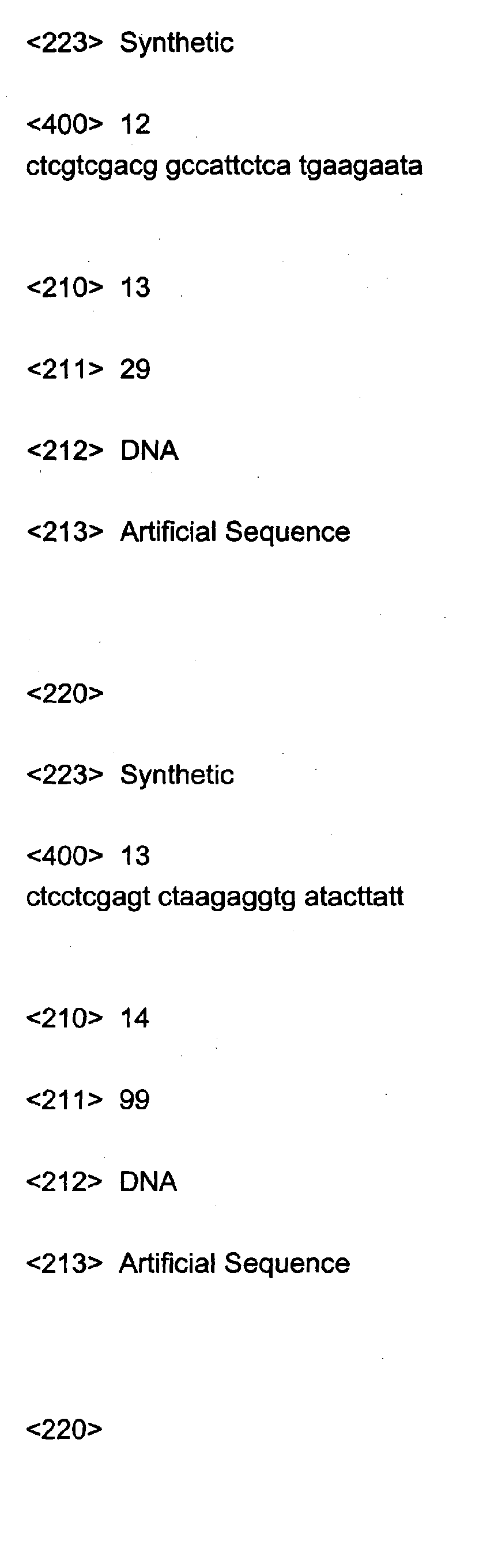
  • the Sequence ID Nos. 12 to 13 are primers for preparing the chromosome splitting vector (1), and the underlined portion indicates restriction enzyme cleavage site given in parentheses.
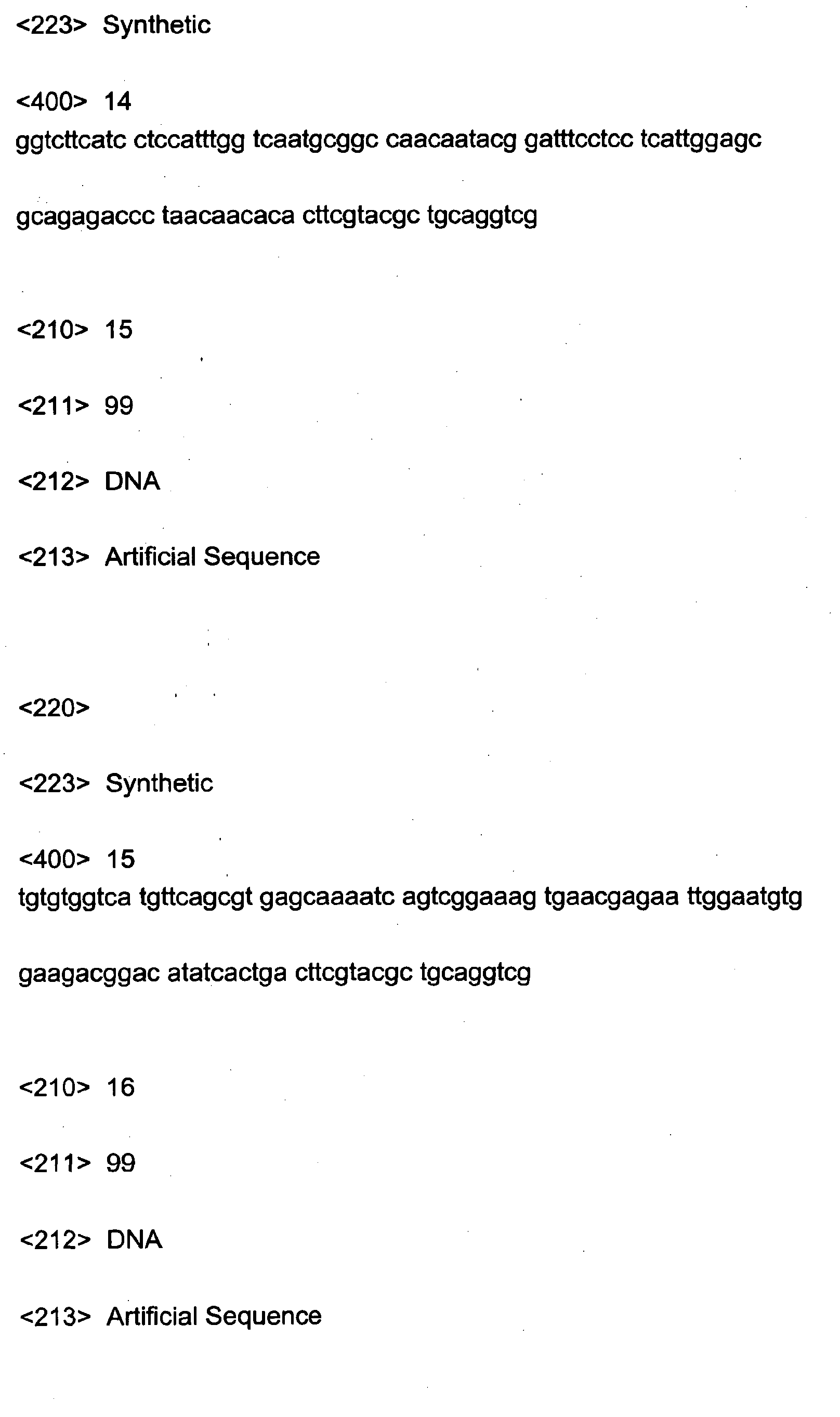
  • the Sequence ID Nos. 14 to 19 are 99-mer primers for preparing the chromosome splitting vector (2).
  • the 80 bases from the 5' terminal of the primer constitute a region homologous to chromosome l of yeast, and the positional information of chromosome l is given in parentheses.
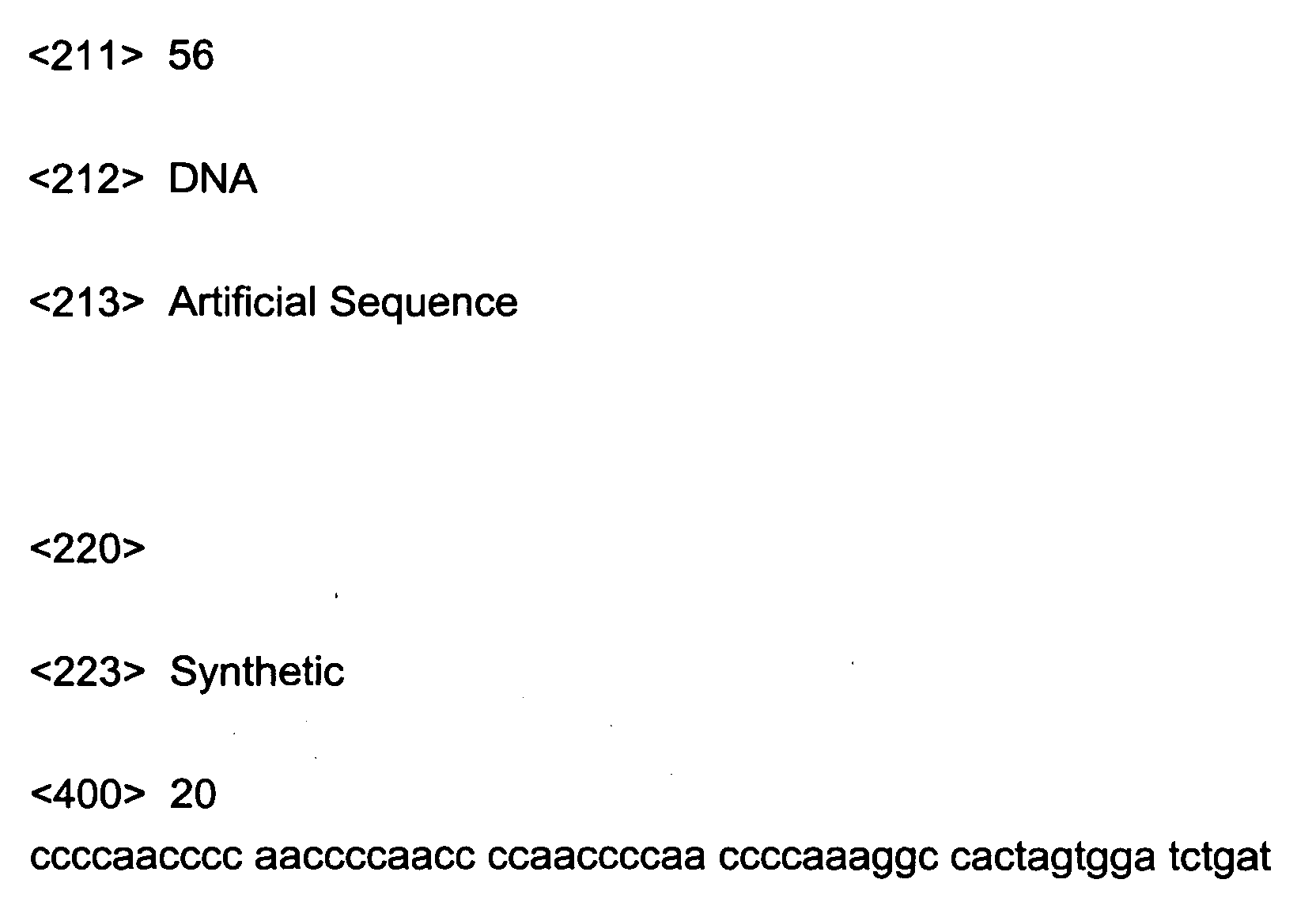
  • the Sequence ID No. 20 is a primer including (C 4 A 2 ) 6 for preparing the chromosome splitting vectors (1) and (2), and the underlined 20 mers show a region homologous to the plasmid used as a template.
  • the plasmid pT7-CEN4(S/X) obtained in B-1 was digested with Xhol / Smal, and a DNA fragment of about 0.85 kbp containing CEN4 was recovered from an agarose gel with GENE CLEAN II KIT (Funakoshi Co. Ltd.). Then, plasmid pUG6 (Güldener et al., (1996) Nucleic Acids Res. 24(13), 2519-2524) was digested with Sall / EcoRV, and a fragment that did not contain a kanamycin resistant gene was recovered from the agarose gel with GENE CLEAN II KIT (Funakoshi Co. Ltd.). Then, the DNA fragment of about 0.85 kbp containing CEN4 was inserted into the Sall / EcoRV site of the recovered fragment of the pUG6 to construct a plasmid pUG6-CEN4 ( Figure 11).
  • a DNA fragment of about 0.85 kbp containing CEN4 obtained by digesting the plasmid pT7-CEN4(S/X) with Xhol / Sall was recovered from an agarose gel with GENE CLEAN II KIT (Funakoshi Co. Ltd.). Then, a plasmid pUG6-CgHIS3, a plasmid pUG6-CgLEU2, and a plasmid pUG6-CgTRP1 containing markergenes shown in Figure 12 were digested with Sall, and DNA fragments were recovered from the agarose gel with GENE CLEAN II KIT (Funakoshi Co. Ltd.).
  • the DNA fragment of about 0.85 kbp containing CEN4 was inserted in the Sall site of each of the recovered fragments of plasmids pUG6-CgLEU2, pUG6-CgHIS3 and pUG6-CgTRP1 so that plasmids pUG6-CLCEN4, pUG6-CHCEN4 and pUG6-CTCEN4 were constructed ( Figure 13).
  • IoxP which is the target sequence of a Cre recombinase
  • CgLEU2 CgHIS3 and CgTRP1 genes, which are selection markers, can be removed by expressing the Cre recombinase.
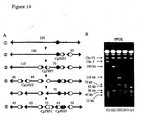
  • Chromosome of the transformant 8 having a size of 230 kbp as shown in Figure 14A (i) is split into two split chromosomes of about 180 kbp and about 50 kbp, as shown in Figure 14A (ii) and a lane (ii) of Figure 14B.
  • the bold portion is a portion that is believed to contain essential genes for growth so that splitting was planned not to split this portion.
  • PCR was performed using the plasmid pUG6-CEN4 as a template so as to prepare the chromosome splitting vector (2D). Furthermore, using primers chl-28 (Sequence ID No. 15) and Tr6-4 (Sequence ID No.20), PCR was performed using the plasmid pUG6-CgTRP1 as a template so as to prepare the chromosome splitting vector (1D). The transformant 8 was transformed with 10 ⁇ g of each of the chromosome splitting vectors (1D) and (2D).
  • PCR was performed using the plasmid pUG6-CEN4 as a template so as to prepare the chromosome splitting vector (2E). Furthermore, using primers chl-30 (Sequence ID No.17) and Tr6-4 (Sequence ID No.20), PCR was performed using the plasmid pUG6-CgLEU2 as a template so as to prepare the chromosome splitting vector (1E). The transformant 8-1 was transformed with 10 ⁇ g of each of the chromosome splitting vectors.
  • the selection marker contained in the transformant 8-2 was removed using the Cre-loxP system.
  • a plasmid pSH47 which has a URA3 gene as a selection marker and expresses a Cre recombinase in a galactose-containing medium, was introduced into the transformant 8-2, and was cultured in a YPGa1A medium for 12 hours. Then, the culture was diluted as appropriate so that about 100 colonies appear per plate and was applied onto a YPDA medium. Then, the clones that cannot grow in -Leu, -His, -Trp and -Ura medium were taken as selection marker-removed clones and were used for subsequent chromosome splitting.
  • PCR was performed using the plasmid pUG6-CTCEN4 as a template so as to prepare the chromosome splitting vector (2F). Furthermore, using primers chl-32 (Sequence ID No.19) and Tr6-4 (Sequence ID No.20), PCR was performed with the plasmid pUG6-CgHIS3 as a template so as to prepare the chromosome splitting vector (1F). The transformant 8-2 in which the selection markers were removed was transformed with 10 ⁇ g of each of the chromosome splitting vectors (1F) and (2F).
  • yeast chromosome I (230 kbp) could be split sequentially into five chromosomes (45, 65, 25, 45, and 50 kbp).
  • a transformant in which a left arm 45 kbp and a right arm 50 kbp of chromosome I are lost can be obtained (data not shown). This may be because that they do not contain essential genes.
  • the operation of the method for splitting a chromosome of the present invention is very simple and allows a desired chromosomal region to be split or removed, so that the method of the present invention is very useful as a method for modifying chromosomes on a large scale.
  • Example 6 Suitable values for "n" in (C 4 A 2 ) n
  • chromosome split was confirmed using Southern hybridization by detecting 670 kb and 410 kb fragments. Results are shown in Table 1. n number of (C 4 A 2 ) n PCR transformation efficiency (colonies/ ⁇ g DNA) Chromosome splitting efficiency 1 YES 1 1/5 4 YES 10 4/5 5 YES 29 5/5 6 YES 269 5/5 10 YES 480 5/5 13 YES 517 5/5
  • the inventors found that a DNA fragment having a repetitive sequence (C 4 A 2 ) n (Tr sequence) that previously could not be amplified with PCR can now be amplified with PCR by setting n of (C 4 A 2 ) n to 1-30, preferably 4-15, more preferably 6-10. It was also found that the chromosome splitting vector can be amplified with PCR in a simple manner by using this (C 4 A 2 ) n sequence as a primer. Therefore, the present invention can simplify preparation of the chromosome splitting vector remarkably, compared with the conventional method that requires complicated multiple steps for preparation of the chromosome splitting vector as shown in Figure 17, or the method for preparing two chromosome splitting vectors having a Tr sequence without PCR.
  • a chromosome can be split by introducing chromosome splitting vectors having the (C 4 A 2 ) n sequence (amplified with PCR) into a yeast, wherein a yeast telomere sequence binds to the (C 4 A 2 ) n sequence that is incorporated into the split chromosome, thereby allowing the split chromosome to function as an intact chromosome.
  • the splitting vectors can be used to split or separate plant or an animal chromosomes that are cloned into yeast artificial chromosome (YAC) vector.
  • YAC yeast artificial chromosome
  • the present invention is also useful for creating useful transgenic microorganisms, animals or plants, for accelerating structure analysis of chromosomes for the construction of plant artificial chromosomes, for speeding-up positional cloning, for providing precise and simplified functional tests of microorganism or animal or plant chromosomes and for studies of human chromosomes and applications in medicine.

Landscapes

  • Life Sciences & Earth Sciences (AREA)
  • Health & Medical Sciences (AREA)
  • Genetics & Genomics (AREA)
  • Engineering & Computer Science (AREA)
  • Wood Science & Technology (AREA)
  • Chemical & Material Sciences (AREA)
  • Organic Chemistry (AREA)
  • Molecular Biology (AREA)
  • Biomedical Technology (AREA)
  • Zoology (AREA)
  • Biotechnology (AREA)
  • General Engineering & Computer Science (AREA)
  • Bioinformatics & Cheminformatics (AREA)
  • Plant Pathology (AREA)
  • Microbiology (AREA)
  • Cell Biology (AREA)
  • Biophysics (AREA)
  • Mycology (AREA)
  • Biochemistry (AREA)
  • General Health & Medical Sciences (AREA)
  • Physics & Mathematics (AREA)
  • Micro-Organisms Or Cultivation Processes Thereof (AREA)
  • Measuring Or Testing Involving Enzymes Or Micro-Organisms (AREA)

Abstract

The present invention provides a method of modifying chromosomes, using chromosome splitting vectors. In a preferred embodiment, a method is provided for modifying yeast chromosomes, using linear chromosome splitting vectors. <??>The method of the invention includes preparing a first linear chromosome splitting vector comprising a first target sequence, a marker gene sequence, and a first (C4A2)n sequence; preparing a second linear chromosome splitting vector comprising a second target sequence, a centromere sequence of a chromosome, and a second (C4A2)n sequence; and introducing the chromosome splitting vectors into a cell, wherein n is independently an integer of 1 to 30, preferably 4-15, more preferably 6-10. <IMAGE>

Description

BACKGROUND OF THE INVENTION 1. Field of the Invention
The present invention relates to a method for modifying chromosomes, employing chromosome splitting vectors. More specifically, the present invention relates to a method for modifying yeast chromosomes, employing two linear chromosome splitting vectors.
2. Description of the Related Art
The development of recombinant DNA technology has led to the development of techniques for modifying or manipulating genes, and has made it possible to introduce modified genes into various organisms.
Techniques for modifying DNA include site-specific mutagenesis, treatments with restriction enzymes, and PCR. However, these techniques are only applicable to genes of a limited size, e.g. from about 10kbp, to about 40 kbp. The development of techniques for modifying large DNA molecules, such as chromosomes, is still in its infancy.
Yeast is a useful organism that has been used in the fermentation industry for a long time. Yeast chromosomes can be modified by chromosome modification techniques such as splitting or loss of chromosomes so as to obtain information about, for example, the necessary number and length of chromosomes. Such information can be used to investigate the principles of yeast genome function and organization. Once these principles are understood, it may be possible to produce substances efficiently using yeast in which unnecessary genes, for example, energy consuming genes are removed. Furthermore, transferring particular regions of a chromosome into another yeast cell can provide information as to chromosome function. This information can then be used to breed useful yeast.
DNA libraries including large DNA molecules (e.g., 200 kbp or more) of plant chromosomes have been prepared by using, for example, yeast artificial chromosome vectors (YAC vector). If these large DNA molecules can be separated or manipulated, it may be possible to breed new and useful transgenic plants, to elucidate the structure and function of animal and plant chromosomes, to speed-up positional cloning, to provide simple and easy assays for animal and plant gene function, and to construct artificial chromosomes for animals or plants.
In this context, attempts have been made to manipulate chromosomes, by, for example, the splitting or loss of chromosomes from yeast, animals or plants.
In order to stabilize a chromosome in yeast, a telomere sequence is required at the terminals of the chromosome. For this reason, in the conventional technique for splitting a chromosome in yeast the telomere sequence of the yeast is added to the telomere sequence derived from Tetrahymena rDNA (hereinafter referred to as "Tr sequence") at a high frequency in order to stabilize the split chromosome (see Shampay et al. (1984) Nature (London) 310, 154-157). Figure 15 shows the outline of this conventional technique for splitting a chromosome. This technique is based on the following phenomenon: when a vector having (i) a centromere (C), (ii) a telomere repetitive sequence (Tr-Tr) derived from Tetrahymena rDNA that are placed in opposite directions to each other, (iii) a selection marker (M) for a yeast transformation, and (iv) any target sequence, is introduced into a yeast chromosome by transformation (Figure 15A), homologous recombination occurs within the target sequence (Figure 15B). Then, telomere resolution occurs at the Tr-Tr sequence that has been introduced into the chromosome so as to split the chromosome (Figure 15C), followed by the addition of telomere sequences of the yeast to the dissociated terminals (Tr sequence) of the split chromosomes (Figure 15D).
Figure 16 shows the Tr sequence derived from Tetrahymena. The Tr sequence consists of about 700 bp, in which an AT rich portion of about 400 bp is followed by a repetitive sequence element of 5'-CCCCAA-3' (C4A2) of about 300 bp. It seems that this repetitive sequence serves as a signal to which the telomere sequence of the yeast can be added effectively (Figure 16A). It has been reported that the telomere sequence of the yeast can be added to a terminal sequence (C4A2)6 consisting of only 6 repeats of C4A2 (Figure 16B) (see Murray et al., (1988) Mol. Cell. Biol. 8(11), 4642-4650).
There has been a report of an attempt to split a yeast chromosome utilizing the phenomenon shown in Figure 16A, for example, using a yeast chromosome vector pCSV1 having a centromere gene (CEN4) of the yeast, a marker gene (URA3), two telomere sequences that are placed in opposite directions each other and a HIS3 gene as stuffer DNA between the two telomere sequences (see Japanese Laid-Open Patent Publication No. 10-84945).
Figure 17 shows the splitting of a yeast chromosome with this splitting vector pCSV1. In Figure 17, the pCSV1 has CEN4, URA3 (not shown), Tr sequences that are placed in opposite directions each other, and a stuffer DNA (X) between the two Tr sequences. The splitting includes the steps of: (Step 1) introducing a target sequence (Y) into the splitting vector pCSV1, wherein the target sequence (Y) has a splitting site; (Step 2) removing the stuffer DNA (X); (Step 3) cyclizing the plasmid from which the stuffer DNA (X) has been removed; and (Step 4) cleaving the cyclized plasmid at the target sequence (Y) to obtain a linear splitting vector so as to introduce it into a homologous region of a yeast chromosome. It seems that by introducing the linear splitting vector into a yeast cell, homologous recombination occurs within the target sequence, and then the oppositely-oriented telomere sequences are resolved so as to split the chromosome.
However, in the above-described method, a complicated four step procedure is necessary, and in this method, the following time-consuming work is required: (1) it is necessary to clone the target sequence to the splitting vector for every splitting; (2) the vector used in Step 1 to which the target sequence Y is introduced and the vector used in Step 3 that is re-cyclized have to be introduced into bacterial cells for amplification; and (3) the target sequence is cleaved at only one site with a restriction enzyme in order to increase an efficiency of oriented integration at a homologous region. Thus, in this method, a plurality of complicated steps is required, increasing the time taken for the splitting of chromosomes.
Therefore, it was attempted to split a chromosome by preparing a linear splitting vector (A) having a telomere sequence (i), a centromere sequence of a yeast chromosome, and a target sequence (i), in this order; and a linear splitting vector (B) having a target sequence (b), a marker gene sequence, and a telomere sequence (ii) in this order, and introducing them into yeast. When these two linear splitting vectors were introduced into the yeast, splitting of the yeast chromosome was confirmed. These two splitting vectors were obtained from vectors having a target sequence (δ), a CEN, and a Tr sequence, and vectors having a target sequence (δ), a marker gene, and a Tr sequence, as shown in Figure 18A. Therefore, there is no need for the complicated steps that are required in the conventional method using the chromosome splitting vectors, for example, as shown in Figure 17.
However, the two splitting vectors could not be amplified by PCR (see Figure 18C). PCR was performed in order to obtain linear splitting vectors (A) and (B) using a plasmid that contained Tr sequence as a template as shown in Figure 18B. The PCR products 7 and 8 were analyzed and it was found that non-specific amplification had occurred as shown in Figure 18C. One of the reasons why the two splitting vectors could not specifically be amplified by PCR is that there is a repetitive sequence of about 300 bp in the Tr sequence, as described above. For this reason, even with the method using the two splitting vectors, which is much simpler than the method shown in Figure 17, an operation of amplifying and cleaving a cyclic vector and collecting DNA fragments still has to be performed to obtain the splitting vectors, which is still complicated.
Therefore, it is desirable to develop a simpler technique for manipulating, or isolation of large DNA molecules such as, in particular, chromosomes, using yeast as a host.
SUMMARY OF THE INVENTION
An object of the present invention is to provide a method of modifying chromosomes, using chromosome splitting vectors. In a preferred embodiment, a method is provided for modifying yeast chromosomes, using linear chromosome splitting vectors.
A further object of the present invention is to provide an improved method for preparing a chromosome splitting vector, said vector allowing efficient chromosome modification, in particular, the splitting, loss, and isolation of chromosomes.
In one aspect, the invention provides a method for modifying a chromosome in a cell comprising:
  • preparing a first linear chromosome splitting vector comprising a first target sequence, a marker gene sequence, and a first (C4A2)n sequence;
  • preparing a second linear chromosome splitting vector comprising a second target sequence, a centromere sequence of a chromosome, and a second (C4A2)n sequence; and introducing the chromosome splitting vectors into a cell, wherein n is independently an integer of 1-30, preferably 4-15, more preferably 6-10.
  • The present invention also provides a linear chromosome splitting vector comprising a target sequence, a marker gene sequence and a (C4A2)n sequence wherein n=1 -30, preferably 4-15, more preferably 6-10; and a linear chromosome splitting vector comprising a target sequence, a centromere sequence of a chromosome and a (C4A2)n sequence wherein n=1-30, preferably 4-15, more preferably 6-10. A vector kit comprising at least one of each of these vectors is also provided.
    In a further aspect of the invention, a method of amplifying a vector is provided, comprising amplifying the vector by PCR using:-
  • i) a first primer which comprises (a) the target sequence or (b) a sequence complementary to (a); and
  • ii) a second primer which comprises (a) the (C4A2)n sequence or (b) a sequence complementary to (a)
  • The inventors of the present invention have conducted in-depth research into methods for splitting chromosomes using chromosome splitting vectors. They have found that amplification of the chromosome splitting vector with PCR can be achieved when the number of repeat units of 5'-CCCCAA-3' is reduced to about 1/5 to 1/6 of that of the conventionally used Tr sequence, and that a chromosome splitting vector, even with these short repeat units can serve as the Tr sequence and can split a yeast chromosome.
    The present invention hence provides a method for modifying yeast chromosomes comprising preparing a linear chromosome splitting vector (1) having a target sequence (a), a marker gene sequence, and a (C4A2)n sequence (a), in this order; preparing a linear chromosome splitting vector (2) having a target sequence (b), a centromere sequence of a yeast chromosome, and a (C4A2)n sequence (b), in this order; and introducing the chromosome splitting vectors (1) and (2) into yeast, wherein n is each independently an integer of 1 to 30, preferably 4 to 15, more preferably 6 to 10.
    It is further preferred that the vectors contain no more than 30, preferably no more than 15, more preferably no more than 10, and in a specific embodiment no more than 6 (C4A2) repeats.
    In a preferred embodiment, the chromosome splitting vectors (1) and (2) are vectors obtained by PCR.
    In a further preferred embodiment, n of both (C4A2)n sequences (a) and (b) is 6.
    In another preferred embodiment, modification of the chromosome is caused by splitting and/or loss of a yeast chromosome.
    BRIEF DESCRIPTION OF THE DRAWINGS
  • Figure 1 is a schematic diagram of a chromosome splitting vector used in the present invention.
  • Figures 2A to 2C are diagrams showing the manner in which a marker gene is deleted by a Cre-IoxP system.
  • Figures 3A to 3C are schematic diagrams showing the splitting of a chromosome using the method of the present invention.
  • Figures 4A to 4C are schematic diagrams showing the manner in which the splitting and the loss occur in a yeast chromosome.
  • Figure 5 is a schematic diagram showing the preparation of a chromosome splitting vector using PCR and a photograph of a gel electrophoresis of the PCR products.
  • Figures 6A and 6B are schematic diagrams showing the manner in which splitting with a chromosome splitting vector occurs.
  • Figure 7 shows a photograph of a pulse field gel electrophoresis (PFGE) and Southern blotting of the chromosomes of the transformants.
  • Figure 8 is a schematic diagram showing the preparation of a chromosome splitting vector using PCR and a photograph of a gel electrophoresis of the PCR products.
  • Figure 9 shows a photograph of a pulse field gel electrophoresis (PFGE) and Southern blotting of the chromosomes of the transformants.
  • Figure 10 shows photographs showing the Southern blotting of the PFGE of Figure 9.
  • Figure 11 is a schematic view of a plasmid pUG6-CEN4.
  • Figure 12 is a schematic view of plasmids pUG6-CgHIS3, pUG6-CgLEU2 and pUG6-CgTRP1 that are used as templates for preparation of chromosome splitting vectors.
  • Figure 13 is a schematic view of plasmids pUG6-CLCEN4, pUG6-CHCEN4 and pUG6-CTCEN4 that are used as templates for preparation of chromosome splitting vectors.
  • Figure 14A is a schematic view in which the first chromosome of yeast is sequentially split, and Figure 14B is a photograph of PFGE showing the process of the sequential splitting.
  • Figures 15A to 15D are schematic diagrams showing the basic principle of chromosome splitting.
  • Figures 16A and 16B are schematic diagrams showing a telomere sequence of Tetrahymena and addition of a yeast telomere sequence to the telomere sequence of Tetrahymena.
  • Figure 17 is a schematic diagram showing a conventional method for splitting a chromosome using pCSV1.
  • Figure 18A is a conventional method for splitting a chromosome using two splitting vectors having a Tr sequence, and Figure 18B is a photograph of a gel electrophoresis of PCR products when PCR is performed using two splitting vectors as templates.
  • DETAILED DESCRIPTION OF THE INVENTION
    The method for modifying a chromosome of the present invention uses a two-chromosome splitting vector system including chromosome splitting vectors (1) and (2). The chromosome splitting vector (1) is linear and has a target sequence (a), a marker gene sequence, and a (C4A2)n sequence (a), in this order. The chromosome splitting vector (2) is linear and has a target sequence (b), a centromere sequence of a yeast chromosome, and a (C4A2)n sequence (b), in this order. The (C4A2)n in the chromosome splitting vectors (1) and (2) means a sequence in which a nucleotide sequence of 5'-CCCCAA-3', which is a repetitive sequence unit of the Tr sequence, is repeated n times, and n is each independently an integer of 1-30, preferably 4-15, more preferably 6-10. Most preferably, n is 6 in both vectors (1) and (2).
    Figure 1 shows the chromosome splitting vectors (1) and (2) used in the present invention. Although the two chromosome splitting vectors (1) and (2) have only 1-30, preferably 4-15, more preferably 6-10 repetitive sequence units of 5'-CCCCAA-3', which is much less than in the conventionally used Tr sequence, they can function as a telomere sequence in yeast, so that a yeast chromosome can be split. Furthermore, the vectors can be amplified with PCR and thus can be prepared easily.
    Centromere sequence of a yeast chromosome
    The centromere sequence of a yeast chromosome refers to a sequence necessary for mitosis of a yeast chromosome. The centromere sequence of any chromosome can be used without any particular limitation. In particular, CEN4 or CEN6 are preferably used. The centromere sequence of a yeast chromosome can be prepared easily with PCR using a plasmid having a desired centromere sequence (e.g., pDW26 (Windiant, D. et al, J Ferment, Bioeng, 82, 199-204 (1996)) as a template. In preparation, if a pair of primers including appropriate restriction enzyme cleavage sites is used, a DNA fragment including a desired centromere sequence can be recovered easily.
    Marker gene
    There is no particular limitation regarding the marker gene, as long as it can monitor whether a chromosome splitting vector has been introduced into yeast. In general, auxotrophic marker genes such as HIS3, HIS5, URA3, ADE2, LEU2, TRP1, and LYS2 can be used. A drug resistance marker gene that can be expressed in an eukaryote, for example, a kanamycin resistance gene (Km) can also be used. The sequence of a marker gene can be prepared easily with PCR, using a plasmid having the marker gene as a template. In preparation, if a pair of primers having appropriate restriction enzyme cleavage sites is used in the PCR amplification, a DNA fragment having a desired marker gene sequence can be recovered easily by digesting the PCR product with restriction enzymes.
    Target sequence
    The target sequence refers to a sequence in which a sequence of a splitting site of a chromosome (e.g., a yeast chromosome, a plant chromosome, an animal chromosome etc.) is included. The target sequence can be obtained by synthesizing the sequence corresponding to the splitting site of the chromosome. A DNA fragment having a desired target sequence can be prepared and recovered easily with PCR using the total DNA of yeast as a template, for example, using a pair of primers designed to add appropriate restriction enzyme cleavage sites.
    Preparation of chromosome splitting vector (1)
    The chromosome splitting vector (1) is a linear vector having a target sequence (a), a marker gene sequence, and a (C4A2)n sequence (a), in this order. The chromosome splitting vector (1) can be prepared by performing PCR, for example, using the (C4A2)n sequence and the target sequence (a) as a pair of primers, and a vector having an appropriate marker gene as a template.
    The plasmid that can be used as a template of the chromosome splitting vector (1) can be constructed in the simplest manner, for example, as follows: PCR is performed with appropriate primers, using a plasmid in which a HIS3 gene derived from Candida glabrata (CgHIS3 gene) is introduced into pUC18 (Kitada et al., (1995) Gene 165, 203-206) (this plasmid is referred to as "p1417" in this specification) as a template. The obtained DNA fragment (PCR product) containing the CgHIS3 gene is collected and inserted in pBluescript II SK+ (STRATAGENE).
    When the chromosome splitting vector (1) having a marker gene is used, a resultant transformant having the split chromosome cannot be used as a host for subsequent transformations because the marker gene still remains. This means that sequential splitting of the chromosome cannot be performed. If the marker gene contained in the transformant in which chromosome is split can be removed by some means after transformation, transformation (splitting of chromosomes) can be performed a plurality of times. If sequential splitting of the chromosome can be achieved, it is expected that knowledge of the number and the length of chromosomes necessary for growth of yeast can be obtained and the function of the yeast chromosome can be analyzed. Consequently, useful yeast, such as yeast having mini-chromosomes that are suitable for efficient production of a desired substance, can be bred.
    Therefore, it is preferable to use a system that can delete the selection marker so that the transformant can be re-used as a host, which makes it possible to conduct the consecutive splitting of the chromosome. A site-specific recombination system (Cre-IoxP system) can be used to delete the marker gene. Therefore, a plasmid having the marker gene in a Cre-IoxP system can be preferably used as a template of the chromosome splitting vector (1) so that the marker gene can be removed after the transformation is completed. This Cre-IoxP system is available in a plasmid pUG6 (Guldener et al. (1996) Nucleic Acids Res. 24(13), 2519-2524). Figures 2A to 2C show the Cre-IoxP system. As shown in Figure 2A, the marker gene is inserted inbetween the IoxP genes. Then, as shown in Figure 2B, site-specific recombination occurs by the expression of the Cre recombinase, and as shown in Figure 2C, the marker gene is removed by the Cre recombinase. The expression of the Cre recombinase is regulated by a promoter of a GAL1 gene encoding a galactose metabolizing enzyme.
    The plasmid used as a template of the chromosome splitting vector (1) can be constructed by using the plasmid pUG6, for example, in the following manner: (i) PCR is performed, using the plasmid p1417 having the CgHIS3gene as a template so as to obtain a DNA fragment containing the CgHIS3gene: (ii) the thus-obtained DNA fragment is cloned into a pT7Blue-T vector (Novagen); (iii) the DNA fragment containing the CgHIS3 gene is cut out again, recovered, and inserted into the plasmid pUG6 from which the kanamycin resistance gene has been removed; (iv) a DNA fragment containing the CgHIS3 gene is recovered from the obtained plasmid and inserted into a pBluescript II SK+ (STRATAGENE). Thus, a plasmid (pUG6-CgHIS3: refer to Figure 12) that can be used as a template of the chromosome splitting vector (1) can be obtained.
    Plasmid pUG6-CgLEU2 or pUG-CgTRP1 can be obtained from a plasmid containing CgLEU2 gene or CgTRP1 gene, respectively, in the same manner as the above described. Refer to Figure 12.
    The plasmid containing the marker gene that is obtained through the steps of (i) to (iv) contains a selection marker gene in the site-specific recombination system (Cre-IoxP system) as shown in Figure 2 that is derived from the plasmid pUG6. Using the Cre-IoxP system, it becomes possible to split a chromosome consecutively in the same host. Therefore, PCR is performed, using a plasmid having the Cre-IoxP system as a template, so as to include the marker gene sandwiched by the IoxP genes. The thus obtained chromosome splitting vector (1) can be consecutively used for transformation in the same host.
    The chromosome splitting vector (1) can be obtained by performing PCR with the plasmid having the marker gene as a template, using a primer having a target sequence (a1) having a homology to the area of the yeast chromosome to be split and a sequence (a2) homologous to the template plasmid, and a primer having a (C4A2)n sequence and a sequence (a3) homologous with the template plasmid. The sequences (a2) and (a3) having a homologous sequence with the template plasmid are selected so as to sandwich the marker gene sequence. There is no particular limitation on the conditions of the PCR and the conditions routinely used by those skilled in the art can be used.
    Preparation of chromosome splitting vector (2)
    The chromosome splitting vector (2) is a linear vector having a target sequence (b), a centromere sequence of a yeast chromosome (CEN), and a (C4A2)n sequence (b) in this order. The chromosome splitting vector (2) is prepared by performing PCR, for example, using a vector having a centromere sequence of a yeast as a template, and the (C4A2)n sequence and the target sequence (b) as primers.
    The plasmid used as a template of the chromosome splitting vector (2) can be constructed, for example, in the following manner. PCR is performed with an appropriate primer, using a chromosomal DNA of yeast as a template; then, the obtained DNA fragment is cloned into pT7Blue-T vector (Novagen); and the DNA fragment containing centromere sequence (for example, CEN4) is recovered with an appropriate restriction enzyme and is inserted into pBluescript II SK+ (STRATAGENE). Thus, the plasmid that can be used as a template of the chromosome splitting vector (2) can be obtained.
    The chromosome splitting vector (2) can be obtained by performing PCR using the plasmid having the yeast centromere as a template, using a primer having a target sequence (b1) that has a homology with a site of the yeast chromosome to be split and a sequence (b2) homologous with the template plasmid, and a primer having a (C4A2)n sequence and a sequence (b3) homologous with the template plasmid. The sequences (b2) and (b3) having a homologous sequence with the template plasmid are selected so as to sandwich the yeast centromere sequence.
    Method for splitting a yeast chromosome
    The method of the present invention will be described schematically with reference to Figures 3A to 3C by taking an example in which the (C4A2)6 sequence is used as a primer. First, as shown in Figure 3A, the chromosome splitting vectors (1) and (2) are prepared using a sequence having a target sequence (a) or a target sequence (b) and a (C4A2)6 sequence as a primer, and using a plasmid having a marker gene (M) or a centromere sequence (CEN4). Then, as shown in Figure 3B, the chromosome splitting vectors (1) and (2) are introduced into yeast. It seems that the introduced chromosome splitting vectors cause homologous recombination at a homologous site of the yeast chromosome, and thus the chromosome splitting vectors (1) and (2) are inserted into the yeast chromosome. Then, as shown in Figure 3C, the telomere sequence of the yeast appears to be added to the (C4A2)6 sequence, which provides the function as a chromosome. The orientation of the target sequence (a) and (b) in the primers is designed so that each of the (C4A2)6 sequences in the splitting vectors (a) and (b) becomes a terminal of each two split chromosomes when telomere resolution has occurred.
    Splitting and/or loss of a yeast chromosome
    Splitting and/or loss of a yeast chromosome using the chromosome splitting vectors of the present invention will be described. When a chromosome is split, there are cases in which a loss in the chromosome occurs and cases in which it does not occur. Figures 4A to 4C show the manner in which splitting and/or loss occurs in a chromosome. For example, in Figure 4A, the target sequences (a) and (b) are constituted in such a manner that, sandwiching the splitting site, the target sequence (b) has the chromosome sequence on the left side of the splitting site, and the target sequence (a) has the chromosome sequence on the right side of the splitting site. It seems that the linear chromosome splitting vectors (1) and (2) having such target sequences (a) and (b), respectively, are introduced into a yeast simultaneously, so that the chromosome can be split as shown in the lowest stage in Figure 4A.
    It is also possible that the chromosome splitting vector (1) or (2) alone participates in splitting or loss, as shown in Figures 4B and 4C. It seems that splitting or loss of a chromosome occurs in the manners shown in Figures 4A to 4C alone or in combination, or in another manner.
    Furthermore, when the obtained transformant having the split chromosomes includes the site-specific recombination system (Cre-IoxP system), it is possible to remove the marker gene by expressing the Cre enzyme so that chromosome splitting vectors having the same marker can be subsequently introduced into the transformant having the split chromosomes.
    Examples
    Hereinafter, the present invention will be described by way of examples, but the present invention is not limited to the examples.
    Conditions of PCR
    In the following reference examples and working examples, amplification of DNA fragments with PCR and preparation of the chromosome vectors (1) and (2) were performed under the following conditions.
    First, 0.2 µl of Takara Ex Taq DNA polymerase (Takara Shuzo Co. Ltd), 4µl of 10 × Reaction buffer (Takara Ex Taq DNA polymerase buffer), 4µl of dNTP mixed solution (2.5 mM each of dATP, dTTP, dGTP, and dCTP), 0.2µl of the template DNA, and 2µl each of two types of primer DNA (20 pmol/µl each) were put in a 0.2 ml tube for this purpose and were diluted to 40µl with a sterile water. The mixture was placed in a GeneAmp PCR System (PERKIN ELMER) and reactions at (1) 94°C for three minutes; (2) 94°C for one minute (denaturation of double stranded DNA); (3) 50 to 60 °C for 2 minutes (annealing of primers); (4) 72°C for 1 to 3 minutes (elongation of DNA with polymerase); and (5) 4°C for 10 minutes are repeated 25 times.
    Yeast to be used and chromosome to be split
    Chromosome I (230195 bp), which was the smallest of the 16 chromosomes of a haploid budding yeast, was used as the chromosome to be split. The CgHIS3 gene was used as the selection marker, and the splitting site was set approximately at a center of chromosome l (between 119874 bp and 119875 bp). If the chromosome is split as desired, chromosome I should be split to about 120 kbp and about 110 kbp. The haploid budding yeast is a SH5209(a) strain (formerly FY833 strain: MATa his3Δ200 ura3-52leu2Δ1lys2Δ 202 trplΔ 63 (Winston et al. (1995) Yeast 11, 53-55).
    Reference Example 1: Construction of a plasmid pSK+CgHIS3 as a template for construction of the chromosome splitting vector (1)
    A plasmid SK+CgHIS3 is obtained by incorporating a CgHIS3 gene, which is incorporated into IoxP sites of a Cre-IoxP system, into pBluescript II SK+ (STRATAGENE).
    First, PCR was performed, using primers CgHIS3-1 and CgHIS3-2 having the following sequences, and a plasmid p1417 having a CgHIS3 gene as a template.
    Figure 00130001
    Figure 00140001
    Figure 00140002
    The obtained DNA fragment of about 1.62 kbp was cloned into pT7Blue-T vector (Novagen) with T4DNA ligase to construct a plasmid pT7-CgHIS3. The primer CgHIS3-1 has a sequence that generates a restriction enzyme Xbal cleavage site. Similarly, the primer CgHIS3-2 has a sequence that generates a restriction enzyme Xhol cleavage site.
    Then, the plasmid pT7-CgHIS3 was digested with a restriction enzyme Xbal/Xhol. A DNA fragment of about 1.62 kbp containing the CgHIS3 gene was recovered, using GENE CLEAN II KIT (Funakoshi Co. Ltd.), from agarose gel. Then, plasmid pUG6 was digested with Bglll/Xhol and Xbal/Xhol to remove about 1.54 kbp including a kanamycin resistant gene. A DNA fragment without kanamycin resistant gene was recovered from the agarose gel, using GENE CLEAN II KIT (Funakoshi Co. Ltd.). Then, the DNA fragment of about 1.62 kbp containing the CgHIS3 gene was inserted into the Xbal/Xhol cleavage site of the recovered DNA fragment, so that a plasmid pUG6-CgHIS3 was constructed.
    Then, the plasmid pUG6-CgHIS3 was digested with Notl to obtain about 1.79 kbp fragment containing the CgHIS3 gene. This 1.79 kbp fragment was inserted into a Notl site of pBluescript II SK+ (STRATAGENE), so that a plasmid pSK+CgHIS3 was constructed.
    Reference Example 2: Construction of a plasmid pSK+CEN4 as a template for constructing the chromosome splitting vector (2)
    A plasmid pSK+CEN4 is a plasmid having a centromere sequence of a yeast, and is used as a template for constructing the chromosome splitting vector (2). In this plasmid, a CEN4 gene is incorporated into pBluescript II SK+ (STRATAGENE) as centromere.
    First, PCR was performed, using CEN4-1 and CEN4-2 having the following sequences as primers, and a chromosomal DNA of a wild-type budding yeast +strain S288C as a template.
    Figure 00140003
    Figure 00150001
    The obtained DNA fragment of about 0.85 kbp was cloned into pT7Blue-T vector (Novagen) with T4DNA ligase to construct a plasmid pT7-CEN4. Each primer CEN4-1 and CEN4-2 has a sequence that generates a restriction enzyme EcoRI cleavage site, respectively.
    Then, the obtained pT7-CEN4 was digested with a restriction enzyme EcoRI, and the DNA fragment of about 0.85 kbp containing the CEN4 was recovered. This 0.85 kbp DNA fragment was inserted into an EcoRI site of pBluescript II SK+ (STRATAGENE), so that a plasmid pSK+CEN4 was constructed.
    Example 1: Production of a chromosome splitting vector
    Figure 5 is a schematic diagram showing production of chromosome splitting vectors (1A), (2A), (1 B) and (2B).
    Production of chromosome splitting vector (1A)
    The following primers were used:
    Figure 00150002
    Figure 00150003
    The primer chlY-11 (Sequence ID No.5) has 99 bases. The 80 bases from the 5' terminal of the chlY-11 constitute a region homologous to the nucleotide sequence of 119795 bp to 119874 bp of chromosome I, which is the target sequence. The remaining 19 bases constitute a region homologous to the plasmid pSK+CgHIS3. The primer Tr6-1 has the (C4A2)6 sequence and 20-base sequence homologous to sequences of the plasmid pSK+CgHIS3. PCR was performed using these two primers, and the plasmid pSK+CgHIS3 as a template, and thus a PCR product 1 (chromosome splitting vector (1A) ) was obtained.
    Production of chromosome splitting vector (2A)
    The following primers were used:
    Figure 00160001
    The primer chlY-12 (Sequence ID No.7) has 99 bases. The 80 bases from the 5' terminal of the chlY-12 constitute a region homologous to the nucleotide sequence of 119875 bp to 119754 bp in chromosome I, which is the target sequence, and the remaining 19 bases constitute a region homologous to the plasmid pSK+CEN4. PCR was performed using these two primers, and the plasmid pSK+CEN4 as a template, and thus a PCR product 2 (chromosome splitting vector (2A) ) was obtained.
    Production of chromosome splitting vector (2B)
    The following primers were used:
    Figure 00160002
    The primer chlY-1 3 (Sequence ID No.8) has 99 bases. The 80 bases from the 5' terminal of the chlY-13 constitute a region homologous to the nucleotide sequence of 119795 bp to 119874 bp in chromosome I, which is the target sequence, and the remaining 19 bases constitute a region homologous to the plasmid pSK+CEN4. PCR was performed using these two primers, and the plasmid pSK+CEN4 as a template, and thus a PCR product 3 (chromosome splitting vector (2B) ) was obtained.
    Production of chromosome splitting vector (1B)
    The following primers were used:
    Figure 00160003
    The primer chlY-14 (Sequence ID No.9) has 99 bases. The 80 bases from the 5' terminal of the chlY-13 constitute a region homologous to the nucleotide sequence of 119875 bp to 119754 bp in chromosome I, which is the target sequence, and the remaining 19 bases constitute a region homologous to the plasmid pSK+CgHIS3. PCR was performed using these two primers, and the plasmid pSK+CgHIS3 as a template, and thus a PCR product 4 (chromosome splitting vector (1B) ) was obtained.
    Figure 5 shows a photograph of a gel electrophoresis of the PCR products 1 to 4. Fragments having a size of about 2.1 kbp are amplified specifically (PCR products 1 and 4), and fragments having a size of about 1.2 kbp are amplified specifically (PCR products 2 and 3). Thus, it is evident that specific amplification can be achieved by PCR using the repetitive sequence of (C4A2)6 as the primers. This confirms that the chromosome splitting vectors (1) and (2) can be prepared by PCR.
    The obtained chromosome splitting vectors (1A) and (2A) perform splitting of a chromosome in such a manner that each of the target sequences is introduced into each split chromosome (hereinafter, referred to as "type (A)"), as shown in Figure 6A. The chromosome splitting vectors (1 B) and (2B) perform splitting of a chromosome in such a manner that the target sequences are not introduced into each split chromosome (hereinafter, referred to as "type (B)"), as shown in Figure 6B.
    Example 2: Splitting of a yeast chromosome -1
    A pair of the chromosome splitting vectors (1A) and (2A) or the chromosome splitting vectors (1B) and (2B) obtained by the above-described PCR were transformed into a yeast strain SH5209 by the lithium acetate method. Transformants (yeast in which chromosome I was expected to be split as desired) that can grow on a His-deficient medium were selected. When the splitting of type A was performed using the chromosome splitting vectors (1A) and (2A), six transformants were obtained. When the splitting of type B was performed using the chromosome splitting vectors (2B) and (1B), fourtransformants were obtained.
    Then, in these transformants, a pulse field gel electrophoretic (PFGE) analysis and a Southern blotting were performed in order to investigate whether chromosome I had been split as desired (Figure 7). If split as desired, chromosome I should be split into about 120 kbp and about 110 kbp. As a result of the PFGE analysis, the band of chromosome I disappeared and a new band was generated in the vicinity of 120 kbp in two transformants ( lanes 2 and 4 in Figure 7) in the splitting of type (A), and also in two strains ( lanes 10 and 11 in Figure 7) in the splitting of type (B). If split as desired, chromosome I should have been split into two fragments of about 120 kbp and about 110 kbp, but it seemed that the two bands overlapped each other in the vicinity of about 120 kbp. Then, a Southern blotting was performed. As a result, in both the analysis using CgHIS3 as a probe that should be incorporated in the split chromosome of about 110 kbp and the analysis using CEN4 as a probe that should be incorporated in the split chromosome of about 120 kbp, signals were obtained in the vicinity of 120 kbp in the lanes 2, 4, 10 and 11. Therefore, the split chromosome (about 110 kbp) containing CgHIS3 and the split chromosome (about 120 kbp) containing CEN4 overlapped each other, which indicated that in the transformants of the lanes 2, 4, 10 and 11, chromosome I was split as desired.
    In the analysis using CEN4 as a probe, chromosome IV was not detected in any of the lanes. Because chromosome IV is very large (about 1.5 Mbp), chromosome IV could not be transferred onto a membrane for the Southern blotting. In the transformants in lanes 5, 6, 8 and 9, chromosome I did not appear to be split. From the result of Southern blotting analysis using CgHIS3 as a probe, it is believed that the CgHIS3 gene was introduced into a chromosome other than chromosome I, and therefore these strains were able to grow on a His-deficient medium.
    In the transformant in lane 7, chromosome I was not split, however, this transformant was able to grow in a His-deficient medium. This is most probably because the transformant had the split chromosome (about 110 kbp) containing CgHIS3 in a newly generated split chromosome. Summing up these results, chromosome I of a yeast was split at a frequency of 1/3 in the splitting vector of type (A) and a frequency of ½ in the splitting vector of type (B), and therefore, there is substantially no difference between the type (A) and (B) splitting. Thus, it is evident that the chromosome can be split at a high frequency using two chromosome splitting vectors that have been prepared with PCR in a simple manner.
    Example 3: Construction of chromosome splitting vectors (1C) and (2C) Construction of chromosome splitting vector (1C)
    Figure 8 shows a schematic diagram for construction of chromosome splitting vector (1C).
    The following primers:
    chlY-15:5'-CAAGAAATATCTTGACCGCAGTGAACTGTGGGAATA CTCAGGTATACAGCTATGACCATG-3' (Sequence ID No.10) and Tr6-1 (Sequence ID No. 6) were used.
    The primer chlY-15 (Sequence ID No.10) has 60 bases. The 45 bases from the 5' terminal of the chlY-15 constitute a region homologous to the nucleotide sequence of 181165 bp to 181209 bp in chromosome I, which is the target sequence, and the remaining 15 bases constitute a region homologous to the plasmid pSK+CgHIS3. PCR was performed using these two primers, and the plasmid pSK+CgHIS3 as a template, and thus a PCR product 5 (chromosome splitting vector (1C) ) was obtained.
    Construction of chromosome splitting vector (2C)
    Figure 8 shows a schematic diagram for construction of chromosome splitting vector (2C).
    The following primers:
    chlY-16:5'-GAAAAAATAATGGTTGCTAAGAGATTCGAACTC TTGCATCTTACGACAGCTATGACCATG-3' (Sequence ID No.11) and Tr6-1 (Sequence ID No. 6) were used.

    PCR was performed using the plasmid pSK+CEN4 as a template. The primer chlY-16 (Sequence ID No.11) has 60 bases. The 45 bases from the 5' terminal of the chlY-16 constitute a region homologous to the nucleotide sequence of 181210 bp to 181254 bp in chromosome I, which is the target sequence, and the remaining 15 bases constitute a region homologous to the plasmid pSK+CEN4. PCR was performed using these two primers, and the plasmid pSK+CEN4 as a template, and thus a PCR product 6 (chromosome splitting vector (2C) ) was obtained.
    A photograph of a gel electrophoresis of the PCR products 5 and 6 is shown in Figure 8. Fragments having a size of about 2.0 kbp and about 1.2 kbp are amplified specifically, which confirms that the chromosome splitting vectors (1C) and (2C) were obtained.
    The obtained chromosome splitting vectors (1C) and (2C) are vectors for type (B) splitting of chromosomes shown in Figure 6B. When being split as desired, chromosome I should be split between the 181209 bp and 181210 bp, and into about 180 kbp and about 50 kbp fragments.
    Example 4: Splitting of yeast chromosome -2
    A pair of the chromosome splitting vectors (1C) and (2C) were introduced into a yeast strain SH5209 by the lithium acetate method. Transformants that can grow on a His-deficient medium were selected. Since a large number of transformants were obtained, 24 tranformants were selected at random and were subjected to PFGE.
    Figure 9 shows the results. The band of chromosome I of the transformant of a lane 8 has disappeared, and two new bands have been generated in the vicinity of 180 kbp and 50 kbp, respectively. Then, the Southern blotting was performed for in-depth examination (Figure 10). As a result, in the transformant of the lane 8, a signal was obtained in the vicinity of 180 kbp in the analysis using CgHIS3 as a probe, and a signal was obtained in the vicinity of about 50 kbp in the analysis using CEN4 as a probe. These results indicate that in the transformant of the lane 8, chromosome I was split into two chromosomes of about 180 kbp and about 50 kbp, as desired. Therefore, also in a splitting using a homologous region of 45 mer, chromosome I can be split as desired at a frequency of 1/24.
    Compared with the splitting in the central region of chromosome I (Working Example 2), the incidence of the transformants in which splitting occurred was low in Working Example 4, possibly due to the three following reasons: 1) the splitting efficiency varies significantly depending upon the structure of a site to be split; 2) the length of the homologous region to the chromosome is decreased about 50% from 80 bases to 45 bases; and 3) a gene necessary for growth (hereinafter, referred to as "essential gene") was not distributed to a split chromosome in this splitting.
    No essential gene is present in the obtained split chromosome of about 50 kbp. Therefore, even if recombination occurs with the chromosome splitting vector (1C) having CgHIS3, it is not necessary that recombination occurs with the chromosome splitting vector (2C) having CEN4. However, in the splitting at the central portion in chromosome I, the essential gene is distributed to the split chromosome, so that when recombination occurs only with a chromosome splitting vector (1 C) having CgHIS3, this essential gene is lost, and therefore the transformant cannot survive. Therefore, in the splitting at about 50kbp of the right arm of chromosome I that is not involved in the distribution of the essential gene (splitting in Working Example 4), the number of quasi-positive transformants ( lanes 2, 3, 21, 22, 23, 24 etc.) that grew on a His-deficient medium is larger than that in the splitting in the central portion of chromosome I that is involved in the distribution of the essential gene. As a result, the yield of the transformant having split chromosomes appears to be decreased. Alternatively, it is also possible that chromosome I of these quasi-positive transformants were split into two split chromosomes of about 180 kbp and about 50 kbp as desired, but since there is no essential gene in the split chromosome of about 50 kbp, the split chromosome of about 50 kbp is lost during cultivation. However, in either case, even if the fragment with a 45 base homologous region was used, a transformant in which the chromosome was split was obtained.
    Example 5: Sequential splitting of yeast chromosome
    It was attempted to split chromosome I (230 kbp) sequentially into five fragments (45, 65, 25, 45, and 50 kbp) using the transformant in lane 8 obtained in Example 4 (hereinafter, referred to as "transformant 8") as the parent strain.
    Hereinafter, first, (A) preparation of oligonucleotide primers for PCR and (B) preparation of plasmids to be used will be described, and then (C) the results of preparing chromosome splitting vectors (1) and (2) with PCR and splitting the chromosome will be described.
    A. Preparation of oligonucleotide primers for PCR
    The primers used for isolation of a gene and preparation of chromosome splitting vectors are shown below. The synthesis of the primers was entrusted to Hokkaido System Science CO., LTD. The Sequence ID Nos. 12 to 13 are primers for preparing the chromosome splitting vector (1), and the underlined portion indicates restriction enzyme cleavage site given in parentheses. The Sequence ID Nos. 14 to 19 are 99-mer primers for preparing the chromosome splitting vector (2). The 80 bases from the 5' terminal of the primer constitute a region homologous to chromosome l of yeast, and the positional information of chromosome l is given in parentheses. The underlined 19 mers of the Sequence ID Nos. 14 to 19 show a region homologous to the plasmid used as a template. The Sequence ID No. 20 is a primer including (C4A2)6 for preparing the chromosome splitting vectors (1) and (2), and the underlined 20 mers show a region homologous to the plasmid used as a template.
    Figure 00220001
    Figure 00220002
    Figure 00220003
    (Chromosome (I 109496bp-109575bp)
    Figure 00220004
    (Chromosome I 109576bp-109655bp)
    Figure 00220005
    (Chromosome I 42367bp-42446bp)
    Figure 00220006
    Figure 00220007
    (Chromosome I 137720bp-137799bp)
    Figure 00220008
    Figure 00230001
    (Chromosome I 137800 bp-137879 bp)
    Figure 00230002
    B. Construction of plasmids B-1. Construction of plasmid pT7-CEN4 (S/X)
    Using primers CEN4-1 S (Sequence ID No.12) and CEN4-2X (Sequence ID No.13) and a chromosomal DNA of a wild type budding yeast strain S288C as a template, PCR was performed and a DNA fragment of about 0.85 kbp was obtained and cloned into pT7Blue-T vector (Novagen), using T4 DNA ligase to construct a plasmid pT7-CEN4(S/X).
    B-2. Construction of plasmid pUG6-CEN4
    The plasmid pT7-CEN4(S/X) obtained in B-1 was digested with Xhol/Smal, and a DNA fragment of about 0.85 kbp containing CEN4 was recovered from an agarose gel with GENE CLEAN II KIT (Funakoshi Co. Ltd.). Then, plasmid pUG6 (Güldener et al., (1996) Nucleic Acids Res. 24(13), 2519-2524) was digested with Sall/EcoRV, and a fragment that did not contain a kanamycin resistant gene was recovered from the agarose gel with GENE CLEAN II KIT (Funakoshi Co. Ltd.). Then, the DNA fragment of about 0.85 kbp containing CEN4 was inserted into the Sall/EcoRV site of the recovered fragment of the pUG6 to construct a plasmid pUG6-CEN4 (Figure 11).
    B-3. Construction of plasmids pUG6-CLCEN4, pUG6-CHCEN4 and pUG6-CTCEN4
    A DNA fragment of about 0.85 kbp containing CEN4 obtained by digesting the plasmid pT7-CEN4(S/X) with Xhol/Sall was recovered from an agarose gel with GENE CLEAN II KIT (Funakoshi Co. Ltd.). Then, a plasmid pUG6-CgHIS3, a plasmid pUG6-CgLEU2, and a plasmid pUG6-CgTRP1 containing markergenes shown in Figure 12 were digested with Sall, and DNA fragments were recovered from the agarose gel with GENE CLEAN II KIT (Funakoshi Co. Ltd.). Then, the DNA fragment of about 0.85 kbp containing CEN4 was inserted in the Sall site of each of the recovered fragments of plasmids pUG6-CgLEU2, pUG6-CgHIS3 and pUG6-CgTRP1 so that plasmids pUG6-CLCEN4, pUG6-CHCEN4 and pUG6-CTCEN4 were constructed (Figure 13). In these plasmids, IoxP, which is the target sequence of a Cre recombinase, is inserted, and CgLEU2, CgHIS3 and CgTRP1 genes, which are selection markers, can be removed by expressing the Cre recombinase.
    C. Sequential splitting of chromosome I of transformant 8
    Chromosome of the transformant 8 having a size of 230 kbp as shown in Figure 14A (i) is split into two split chromosomes of about 180 kbp and about 50 kbp, as shown in Figure 14A (ii) and a lane (ii) of Figure 14B. In this experiment, as shown in Figure 14 (iii), (iv) and (v), the 180 kbp split chromosome of Figure 14A (ii) was subsequently split into two chromosomes of about 110 kbp and about 70 kbp (Figure 14A (iii)) and then the split 110 kbp fragment was further split into two chromosomes of about 45 kbp and about 65 kbp (Figure 14A (iv)). Then, it was attempted to further split the split- chromosome of about 70 kbp contained in the transformant of Figure 14A (iv) into two chromosomes of about 25 kbp and about 45 kbp, as designed.
    In Figure 14A, the bold portion is a portion that is believed to contain essential genes for growth so that splitting was planned not to split this portion.
    C-1. Splitting of 180 kbp chromosome
    Using primers chl-27 (Sequence ID No.14) and Tr6-4 (Sequence ID No. 20), PCR was performed using the plasmid pUG6-CEN4 as a template so as to prepare the chromosome splitting vector (2D). Furthermore, using primers chl-28 (Sequence ID No. 15) and Tr6-4 (Sequence ID No.20), PCR was performed using the plasmid pUG6-CgTRP1 as a template so as to prepare the chromosome splitting vector (1D). The transformant 8 was transformed with 10 µg of each of the chromosome splitting vectors (1D) and (2D). As a result, 6 of 17 transformants were found that split chromosome of about 180 kbp was subsequently split into about 110 kbp and about 70 kbp, as designed (see the lane (iii) of a PFGE photograph of Figure 14B). Transformant of this lane (iii) was named as a transformant 8-1 and used in the following experiments.
    C-2. Splitting of 110 kbp chromosome
    Using primers chl-29 (Sequence ID No.16) and Tr6-4 (Sequence ID No. 20), PCR was performed using the plasmid pUG6-CEN4 as a template so as to prepare the chromosome splitting vector (2E). Furthermore, using primers chl-30 (Sequence ID No.17) and Tr6-4 (Sequence ID No.20), PCR was performed using the plasmid pUG6-CgLEU2 as a template so as to prepare the chromosome splitting vector (1E). The transformant 8-1 was transformed with 10 µg of each of the chromosome splitting vectors. As a result, 5 of 29 transformants were found that the chromosome of about 110kbp was split into two chromosomes of about 45 kbp and about 65 kbp, as designed (the lane (iv) of Figure 14B). Transformants of the lane (iv) of Figure 14B was named as a transformant 8-2 and used in the following experiments
    C-3. Splitting of 70 kbp chromosome
    First, the selection marker contained in the transformant 8-2 was removed using the Cre-loxP system. A plasmid pSH47, which has a URA3 gene as a selection marker and expresses a Cre recombinase in a galactose-containing medium, was introduced into the transformant 8-2, and was cultured in a YPGa1A medium for 12 hours. Then, the culture was diluted as appropriate so that about 100 colonies appear per plate and was applied onto a YPDA medium. Then, the clones that cannot grow in -Leu, -His, -Trp and -Ura medium were taken as selection marker-removed clones and were used for subsequent chromosome splitting.
    Using primers chl-31 (Sequence ID No.18) and Tr6-4 (Sequence ID No. 20), PCR was performed using the plasmid pUG6-CTCEN4 as a template so as to prepare the chromosome splitting vector (2F). Furthermore, using primers chl-32 (Sequence ID No.19) and Tr6-4 (Sequence ID No.20), PCR was performed with the plasmid pUG6-CgHIS3 as a template so as to prepare the chromosome splitting vector (1F). The transformant 8-2 in which the selection markers were removed was transformed with 10 µg of each of the chromosome splitting vectors (1F) and (2F). As a result, 5 of 29 transformants were found that the 70kbp chromosome was split into two chromosomes of about 25 kbp and about 45 kbp, as designed (the lane (v) of Figure 14B). A Southern blotting analysis was performed with a probe specific to each split chromosome, and it was confirmed that splitting occurred as designed.
    As shown in Figure 14, using the method of the present invention, yeast chromosome I (230 kbp) could be split sequentially into five chromosomes (45, 65, 25, 45, and 50 kbp). A transformant in which a left arm 45 kbp and a right arm 50 kbp of chromosome I are lost can be obtained (data not shown). This may be because that they do not contain essential genes. The operation of the method for splitting a chromosome of the present invention is very simple and allows a desired chromosomal region to be split or removed, so that the method of the present invention is very useful as a method for modifying chromosomes on a large scale.
    Example 6: Suitable values for "n" in (C4A2)n
    Suitable values for "n" in (C4A2)n were investigated. Primers comprising the sequence of (C4A2)n (where n=1, 4, 5, 6, 10 and 13) were synthesized and the PCR performance of the primers was examined. Linear splitting vectors having a target sequence of chromosome XV, CgHIS3 and (C4A2)n, and a target sequence of chromosome XV, CEN4 and (C4A2)n, were prepared by PCR and transformation efficiency and chromosome splitting efficiency of the linear splitting vectors were examined. If splitting of chromosome XV occurred, the chromosome was split into 670 kb and 410 kb fragments. The chromosome split was confirmed using Southern hybridization by detecting 670 kb and 410 kb fragments. Results are shown in Table 1.
    n number of (C4A2)n PCR transformation efficiency
    (colonies/ µg DNA)
    Chromosome splitting efficiency
    1 YES 1 1/5
    4 YES 10 4/5
    5 YES 29 5/5
    6 YES 269 5/5
    10 YES 480 5/5
    13 YES 517 5/5
    As is apparent from the results, PCR could be performed when n=13. Further, even in the case of n=1, transformation and splitting of the chromosome occurred although the efficiency was low.
    As described, the inventors found that a DNA fragment having a repetitive sequence (C4A2)n (Tr sequence) that previously could not be amplified with PCR can now be amplified with PCR by setting n of (C4A2)n to 1-30, preferably 4-15, more preferably 6-10. It was also found that the chromosome splitting vector can be amplified with PCR in a simple manner by using this (C4A2)n sequence as a primer. Therefore, the present invention can simplify preparation of the chromosome splitting vector remarkably, compared with the conventional method that requires complicated multiple steps for preparation of the chromosome splitting vector as shown in Figure 17, or the method for preparing two chromosome splitting vectors having a Tr sequence without PCR. In the invention, a chromosome can be split by introducing chromosome splitting vectors having the (C4A2)n sequence (amplified with PCR) into a yeast, wherein a yeast telomere sequence binds to the (C4A2)n sequence that is incorporated into the split chromosome, thereby allowing the split chromosome to function as an intact chromosome.
    In a particular embodiment of the invention, the splitting vectors can be used to split or separate plant or an animal chromosomes that are cloned into yeast artificial chromosome (YAC) vector. The present invention is also useful for creating useful transgenic microorganisms, animals or plants, for accelerating structure analysis of chromosomes for the construction of plant artificial chromosomes, for speeding-up positional cloning, for providing precise and simplified functional tests of microorganism or animal or plant chromosomes and for studies of human chromosomes and applications in medicine.
    Figure 00280001
    Figure 00290001
    Figure 00300001
    Figure 00310001
    Figure 00320001
    Figure 00330001
    Figure 00340001
    Figure 00350001
    Figure 00360001
    Figure 00370001
    Figure 00380001
    Figure 00390001

    Claims (13)

    1. A method for modifying a chromosome in a cell comprising:
      (i) preparing a first linear chromosome splitting vector comprising a first target sequence, a marker gene sequence, and a first (C4A2)n sequence;
      (ii) preparing a second linear chromosome splitting vector comprising a second target sequence, a centromere sequence of a chromosome, and a second (C4A2)n sequence; and
      (iii) introducing the chromosome splitting vectors into a cell,
      wherein n is independently an integer of 1 to 30.
    2. The method according to Claim 1, wherein n is independently an integer of 4 to 15.
    3. The method according to Claim 1, wherein n is independently an integer of 6 to 10.
    4. The method according to any of Claims 1-3, wherein the chromosome splitting vectors are vectors obtained by PCR.
    5. The method according to any of Claims 1-4, wherein modification of the chromosome is caused by splitting and/or loss of a chromosome.
    6. The method according to any of Claims 1-5, wherein said cell is a yeast cell and said chromosome is a yeast chromosome.
    7. A linear chromosome splitting vector, comprising a target sequence, a marker gene sequence and a (C4A2)n sequence wherein n= 1-30.
    8. A linear chromosome splitting vector, comprising a target sequence, a centromere sequence of a chromosome and a (C4A2)n sequence wherein n=1-30.
    9. The linear chromosome splitting vector according to Claim 7 or 8, wherein n = 4-15.
    10. The linear chromosome splitting vector according to Claim 7 or 8, wherein n = 6-10.
    11. The linear chromosome splitting vector according to any of Claims 7-10, wherein the vector is a linear yeast chromosome splitting vector.
    12. A vector kit comprising a vector according to Claim 7 and a vector according to Claim 8.
    13. A method of amplifying a vector according any of Claims 7-11, comprising amplifying the vector by PCR using:-
      i) a first primer which comprises (a) the target sequence or (b) a sequence complementary to (a); and
      ii) a second primer which comprises (a) the (C4A2)n sequence or (b) a sequence complementary to (a).
    EP03256936A 2002-11-22 2003-11-03 Method for modifying chromosomes Withdrawn EP1422295A1 (en)

    Applications Claiming Priority (2)

    Application Number Priority Date Filing Date Title
    JP2002339259 2002-11-22
    JP2002339259A JP3921531B2 (en) 2002-11-22 2002-11-22 Chromosome modification method

    Publications (1)

    Publication Number Publication Date
    EP1422295A1 true EP1422295A1 (en) 2004-05-26

    Family

    ID=32212137

    Family Applications (1)

    Application Number Title Priority Date Filing Date
    EP03256936A Withdrawn EP1422295A1 (en) 2002-11-22 2003-11-03 Method for modifying chromosomes

    Country Status (3)

    Country Link
    US (1) US7456020B2 (en)
    EP (1) EP1422295A1 (en)
    JP (1) JP3921531B2 (en)

    Families Citing this family (1)

    * Cited by examiner, † Cited by third party
    Publication number Priority date Publication date Assignee Title
    WO2006062259A1 (en) * 2004-12-08 2006-06-15 Nippon Paper Industries Co., Ltd. Method for production of plant cell having chromosome loss

    Citations (2)

    * Cited by examiner, † Cited by third party
    Publication number Priority date Publication date Assignee Title
    JPH1084945A (en) * 1996-09-19 1998-04-07 Ajinomoto Co Inc Analysis and breeding method of effective yeast by using cleavage of chromosome at specified position
    WO1998054348A1 (en) * 1997-05-31 1998-12-03 Babraham Institute Telomere-associated chromosome fragmentation

    Patent Citations (2)

    * Cited by examiner, † Cited by third party
    Publication number Priority date Publication date Assignee Title
    JPH1084945A (en) * 1996-09-19 1998-04-07 Ajinomoto Co Inc Analysis and breeding method of effective yeast by using cleavage of chromosome at specified position
    WO1998054348A1 (en) * 1997-05-31 1998-12-03 Babraham Institute Telomere-associated chromosome fragmentation

    Non-Patent Citations (13)

    * Cited by examiner, † Cited by third party
    Title
    ASCENZIONI F ET AL., PLASMID, vol. 23, no. 1, 1990, pages 16 - 26
    ASCENZIONI F ET AL: "FUNCTIONAL TELOMERE FORMATION IN YEAST USING SYNTHETIC C-4A-2 SEQUENCES", PLASMID, vol. 23, no. 1, 1990, &, pages 16 - 26, XP009027860, ISSN: 0147-619X *
    MURRAY A W ET AL: "CHARACTERIZATION OF TWO TELOMERIC DNA PROCESSING REACTIONS IN SACCHAROMYCES-CEREVISIAE", MOLECULAR AND CELLULAR BIOLOGY, vol. 8, no. 11, 1988, &, pages 4642 - 4650, XP009027851, ISSN: 0270-7306 *
    MURRAY AW ET AL., CELL. BIOL., vol. 8, no. 11, 1988, pages 4642 - 4650
    PATENT ABSTRACTS OF JAPAN vol. 1998, no. 09 31 July 1998 (1998-07-31) *
    PAVAN W J ET AL: "High-efficiency yeast artificial chromosome fragmentation vectors.", GENE. 30 SEP 1991, vol. 106, no. 1, 30 September 1991 (1991-09-30), pages 125 - 127, XP001180254, ISSN: 0378-1119 *
    PAVAN WJ ET AL., GENE, vol. 106, no. 1, 30 September 1991 (1991-09-30), pages 125 - 127
    PLUTA A F ET AL: "RECOMBINATION OCCURS DURING TELOMERE FORMATION IN YEAST", NATURE (LONDON), vol. 337, no. 6206, 1989, &, pages 429 - 433, XP002273752, ISSN: 0028-0836 *
    REEVES R H ET AL: "Yeast artificial chromosome modification and manipulation.", METHODS IN ENZYMOLOGY. 1992, vol. 216, 1992, pages 584 - 603, XP000783840, ISSN: 0076-6879 *
    VOLLRATH D ET AL., PNAS, vol. 85, no. 16, 1988, pages 6027 - 6031
    VOLLRATH D ET AL: "PHYSICAL MAPPING OF LARGE DNA BY CHROMOSOME FRAGMENTATION", PROCEEDINGS OF THE NATIONAL ACADEMY OF SCIENCES OF THE UNITED STATES OF AMERICA, vol. 85, no. 16, 1988, &, pages 6027 - 6031, XP002273754, ISSN: 0027-8424 *
    WIDIANTO D ET AL: "ONE-STEP SPLITTING OF A CHROMOSOME IN HAPLOID CELLS OF SACCHAROMYCES CEREVISIAE AND ITS EFFECT ON THE CELL PROLIFERATION", JOURNAL OF FERMENTATION AND BIOENGINEERING, SOCIETY OF FERMENTATION TECHNOLOGY, JP, vol. 82, no. 3, 1996, pages 199 - 204, XP000677593, ISSN: 0922-338X *
    WIDIANTO DONNY ET AL: "Creating a Saccharomyces cerevisiae haploid strain having 21 chromosomes.", JOURNAL OF BIOSCIENCE AND BIOENGINEERING, vol. 95, no. 1, January 2003 (2003-01-01), &, pages 89 - 94, XP002273755, ISSN: 1389-1723 *

    Also Published As

    Publication number Publication date
    US20040224415A1 (en) 2004-11-11
    US7456020B2 (en) 2008-11-25
    JP3921531B2 (en) 2007-05-30
    JP2004166654A (en) 2004-06-17

    Similar Documents

    Publication Publication Date Title
    Delneri et al. Exploring redundancy in the yeast genome: an improved strategy for use of the cre–loxP system
    Thomason et al. Gene insertion and replacement in Schizosaccharomyces pombe mediated by the Streptomyces bacteriophage φC31 site-specific recombination system
    JP2721666B2 (en) Site-specific recombination of DNA in yeast
    US7314712B2 (en) Systems for in vivo site-directed mutagenesis using oligonucleotides
    Watson et al. Gene tagging and gene replacement using recombinase-mediated cassette exchange in Schizosaccharomyces pombe
    US6391642B1 (en) Transformation-associated recombination cloning
    AU2002319696A1 (en) Systems for in vivo site-directed mutagenesis using oligonucleotides
    EP0539490B1 (en) Library screening method
    Evans et al. A WD repeat protein, Rec14, essential for meiotic recombination in Schizosaccharomyces pombe
    WO2000075299A1 (en) Hybrid yeast-bacteria cloning system and uses thereof
    JP2018504916A (en) Method for producing a DNA vector from a molecular component containing a sequence of interest
    US7456020B2 (en) Method for modifying chromosomes
    CN112899296A (en) Transposase screening report vector and preparation method and application thereof
    WO2002044415A1 (en) Method for screening of dna libraries and generation of recombinant dna constructs
    EP0596885B1 (en) Dna library screening method
    KR102301301B1 (en) Multiplexed promoter engineering platform and method for manufacturing same
    Bruschi et al. Yeast artificial chromosomes
    CN115960867A (en) A Cas9 mutant that improves gene editing efficiency and its application
    JP3921527B2 (en) Chromosome modification method
    Arnak et al. Yeast artificial chromosomes
    US20030108990A1 (en) Method for preparing deletion mutants
    Dame Formulation of Cloning Strategies
    WO2023215399A1 (en) Assembling synthetic dna constructs from natural dna
    JP2003116551A (en) Use of a recognition sequence variant for multiple consecutive recombination with a recombinase in one genetic system
    JP2003153693A (en) Method for separating large DNA molecules

    Legal Events

    Date Code Title Description
    PUAI Public reference made under article 153(3) epc to a published international application that has entered the european phase

    Free format text: ORIGINAL CODE: 0009012

    AK Designated contracting states

    Kind code of ref document: A1

    Designated state(s): AT BE BG CH CY CZ DE DK EE ES FI FR GB GR HU IE IT LI LU MC NL PT RO SE SI SK TR

    AX Request for extension of the european patent

    Extension state: AL LT LV MK

    17P Request for examination filed

    Effective date: 20041105

    AKX Designation fees paid

    Designated state(s): AT BE BG CH CY CZ DE DK EE ES FI FR GB GR HU IE IT LI LU MC NL PT RO SE SI SK TR

    17Q First examination report despatched

    Effective date: 20070730

    RAP1 Party data changed (applicant data changed or rights of an application transferred)

    Owner name: OSAKA UNIVERSITY

    STAA Information on the status of an ep patent application or granted ep patent

    Free format text: STATUS: THE APPLICATION IS DEEMED TO BE WITHDRAWN

    18D Application deemed to be withdrawn

    Effective date: 20090601

    RIC1 Information provided on ipc code assigned before grant

    Ipc: C12N 15/90 20060101AFI20110919BHEP