EP1422284A2 - Method for marking hydrocarbons with anthraquinone imines - Google Patents
Method for marking hydrocarbons with anthraquinone imines Download PDFInfo
- Publication number
- EP1422284A2 EP1422284A2 EP03256979A EP03256979A EP1422284A2 EP 1422284 A2 EP1422284 A2 EP 1422284A2 EP 03256979 A EP03256979 A EP 03256979A EP 03256979 A EP03256979 A EP 03256979A EP 1422284 A2 EP1422284 A2 EP 1422284A2
- Authority
- EP
- European Patent Office
- Prior art keywords
- ppm
- dye
- group
- petroleum hydrocarbon
- aryl
- Prior art date
- Legal status (The legal status is an assumption and is not a legal conclusion. Google has not performed a legal analysis and makes no representation as to the accuracy of the status listed.)
- Withdrawn
Links
Classifications
-
- C—CHEMISTRY; METALLURGY
- C09—DYES; PAINTS; POLISHES; NATURAL RESINS; ADHESIVES; COMPOSITIONS NOT OTHERWISE PROVIDED FOR; APPLICATIONS OF MATERIALS NOT OTHERWISE PROVIDED FOR
- C09B—ORGANIC DYES OR CLOSELY-RELATED COMPOUNDS FOR PRODUCING DYES, e.g. PIGMENTS; MORDANTS; LAKES
- C09B5/00—Dyes with an anthracene nucleus condensed with one or more heterocyclic rings with or without carbocyclic rings
- C09B5/62—Cyclic imides or amidines of peri-dicarboxylic acids of the anthracene, benzanthrene, or perylene series
-
- C—CHEMISTRY; METALLURGY
- C10—PETROLEUM, GAS OR COKE INDUSTRIES; TECHNICAL GASES CONTAINING CARBON MONOXIDE; FUELS; LUBRICANTS; PEAT
- C10L—FUELS NOT OTHERWISE PROVIDED FOR; NATURAL GAS; SYNTHETIC NATURAL GAS OBTAINED BY PROCESSES NOT COVERED BY SUBCLASSES C10G OR C10K; LIQUIFIED PETROLEUM GAS; USE OF ADDITIVES TO FUELS OR FIRES; FIRE-LIGHTERS
- C10L1/00—Liquid carbonaceous fuels
- C10L1/003—Marking, e.g. coloration by addition of pigments
-
- C—CHEMISTRY; METALLURGY
- C10—PETROLEUM, GAS OR COKE INDUSTRIES; TECHNICAL GASES CONTAINING CARBON MONOXIDE; FUELS; LUBRICANTS; PEAT
- C10L—FUELS NOT OTHERWISE PROVIDED FOR; NATURAL GAS; SYNTHETIC NATURAL GAS OBTAINED BY PROCESSES NOT COVERED BY SUBCLASSES C10G OR C10K; LIQUIFIED PETROLEUM GAS; USE OF ADDITIVES TO FUELS OR FIRES; FIRE-LIGHTERS
- C10L1/00—Liquid carbonaceous fuels
- C10L1/10—Liquid carbonaceous fuels containing additives
- C10L1/14—Organic compounds
- C10L1/22—Organic compounds containing nitrogen
- C10L1/228—Organic compounds containing nitrogen containing at least one carbon-to-nitrogen double bond, e.g. guanidines, hydrazones, semicarbazones, imines; containing at least one carbon-to-nitrogen triple bond, e.g. nitriles
- C10L1/2283—Organic compounds containing nitrogen containing at least one carbon-to-nitrogen double bond, e.g. guanidines, hydrazones, semicarbazones, imines; containing at least one carbon-to-nitrogen triple bond, e.g. nitriles containing one or more carbon to nitrogen double bonds, e.g. guanidine, hydrazone, semi-carbazone, azomethine
-
- C—CHEMISTRY; METALLURGY
- C10—PETROLEUM, GAS OR COKE INDUSTRIES; TECHNICAL GASES CONTAINING CARBON MONOXIDE; FUELS; LUBRICANTS; PEAT
- C10M—LUBRICATING COMPOSITIONS; USE OF CHEMICAL SUBSTANCES EITHER ALONE OR AS LUBRICATING INGREDIENTS IN A LUBRICATING COMPOSITION
- C10M171/00—Lubricating compositions characterised by purely physical criteria, e.g. containing as base-material, thickener or additive, ingredients which are characterised exclusively by their numerically specified physical properties, i.e. containing ingredients which are physically well-defined but for which the chemical nature is either unspecified or only very vaguely indicated
- C10M171/007—Coloured or dyes-containing lubricant compositions
-
- C—CHEMISTRY; METALLURGY
- C10—PETROLEUM, GAS OR COKE INDUSTRIES; TECHNICAL GASES CONTAINING CARBON MONOXIDE; FUELS; LUBRICANTS; PEAT
- C10M—LUBRICATING COMPOSITIONS; USE OF CHEMICAL SUBSTANCES EITHER ALONE OR AS LUBRICATING INGREDIENTS IN A LUBRICATING COMPOSITION
- C10M2215/00—Organic non-macromolecular compounds containing nitrogen as ingredients in lubricant Compositions
- C10M2215/14—Containing carbon-to-nitrogen double bounds, e.g. guanidines, hydrazones, semicarbazones
-
- C—CHEMISTRY; METALLURGY
- C10—PETROLEUM, GAS OR COKE INDUSTRIES; TECHNICAL GASES CONTAINING CARBON MONOXIDE; FUELS; LUBRICANTS; PEAT
- C10M—LUBRICATING COMPOSITIONS; USE OF CHEMICAL SUBSTANCES EITHER ALONE OR AS LUBRICATING INGREDIENTS IN A LUBRICATING COMPOSITION
- C10M2215/00—Organic non-macromolecular compounds containing nitrogen as ingredients in lubricant Compositions
- C10M2215/22—Heterocyclic nitrogen compounds
-
- C—CHEMISTRY; METALLURGY
- C10—PETROLEUM, GAS OR COKE INDUSTRIES; TECHNICAL GASES CONTAINING CARBON MONOXIDE; FUELS; LUBRICANTS; PEAT
- C10N—INDEXING SCHEME ASSOCIATED WITH SUBCLASS C10M RELATING TO LUBRICATING COMPOSITIONS
- C10N2030/00—Specified physical or chemical properties which is improved by the additive characterising the lubricating composition, e.g. multifunctional additives
- C10N2030/20—Colour, e.g. dyes
-
- C—CHEMISTRY; METALLURGY
- C10—PETROLEUM, GAS OR COKE INDUSTRIES; TECHNICAL GASES CONTAINING CARBON MONOXIDE; FUELS; LUBRICANTS; PEAT
- C10N—INDEXING SCHEME ASSOCIATED WITH SUBCLASS C10M RELATING TO LUBRICATING COMPOSITIONS
- C10N2040/00—Specified use or application for which the lubricating composition is intended
- C10N2040/04—Oil-bath; Gear-boxes; Automatic transmissions; Traction drives
-
- C—CHEMISTRY; METALLURGY
- C10—PETROLEUM, GAS OR COKE INDUSTRIES; TECHNICAL GASES CONTAINING CARBON MONOXIDE; FUELS; LUBRICANTS; PEAT
- C10N—INDEXING SCHEME ASSOCIATED WITH SUBCLASS C10M RELATING TO LUBRICATING COMPOSITIONS
- C10N2040/00—Specified use or application for which the lubricating composition is intended
- C10N2040/08—Hydraulic fluids, e.g. brake-fluids
-
- C—CHEMISTRY; METALLURGY
- C10—PETROLEUM, GAS OR COKE INDUSTRIES; TECHNICAL GASES CONTAINING CARBON MONOXIDE; FUELS; LUBRICANTS; PEAT
- C10N—INDEXING SCHEME ASSOCIATED WITH SUBCLASS C10M RELATING TO LUBRICATING COMPOSITIONS
- C10N2040/00—Specified use or application for which the lubricating composition is intended
- C10N2040/12—Gas-turbines
- C10N2040/13—Aircraft turbines
-
- C—CHEMISTRY; METALLURGY
- C10—PETROLEUM, GAS OR COKE INDUSTRIES; TECHNICAL GASES CONTAINING CARBON MONOXIDE; FUELS; LUBRICANTS; PEAT
- C10N—INDEXING SCHEME ASSOCIATED WITH SUBCLASS C10M RELATING TO LUBRICATING COMPOSITIONS
- C10N2040/00—Specified use or application for which the lubricating composition is intended
- C10N2040/25—Internal-combustion engines
- C10N2040/252—Diesel engines
-
- C—CHEMISTRY; METALLURGY
- C10—PETROLEUM, GAS OR COKE INDUSTRIES; TECHNICAL GASES CONTAINING CARBON MONOXIDE; FUELS; LUBRICANTS; PEAT
- C10N—INDEXING SCHEME ASSOCIATED WITH SUBCLASS C10M RELATING TO LUBRICATING COMPOSITIONS
- C10N2040/00—Specified use or application for which the lubricating composition is intended
- C10N2040/25—Internal-combustion engines
- C10N2040/255—Gasoline engines
-
- C—CHEMISTRY; METALLURGY
- C10—PETROLEUM, GAS OR COKE INDUSTRIES; TECHNICAL GASES CONTAINING CARBON MONOXIDE; FUELS; LUBRICANTS; PEAT
- C10N—INDEXING SCHEME ASSOCIATED WITH SUBCLASS C10M RELATING TO LUBRICATING COMPOSITIONS
- C10N2040/00—Specified use or application for which the lubricating composition is intended
- C10N2040/42—Flashing oils or marking oils
Definitions
- This invention relates generally to a method for marking petroleum hydrocarbons with anthraquinone imines for subsequent identification.
- U.S. Pat. No. 4,755,012 discloses a ray absorption filter comprising a 1,4,5,8-tetra(arylamino)anthraquinone. This reference, however, does not suggest either a method for marking petroleum hydrocarbons, or the compounds used in the method of the present invention.
- Phthalocyanine dyes having absorption maxima above 700 nm are known as petroleum markers, but these materials suffer from disadvantages, including difficulty of preparation and high cost.
- the problem addressed by this invention is to find an improved method for marking petroleum hydrocarbons with compounds having an absorption maximum above 700 nm.
- the present invention is directed to a method for invisibly marking a liquid petroleum hydrocarbon.
- the method comprises adding to the liquid petroleum hydrocarbon at least one dye having formula (I) wherein R 1 , R 2 , R 3 and R 4 independently are aryl or aromatic heterocyclic; and wherein the dye has an absorption maximum in the range from 710 nm to 900 nm.
- ppm parts per million
- the term "petroleum hydrocarbons” refers to products having a predominantly hydrocarbon composition, although they may contain minor amounts of oxygen, nitrogen, sulfur or phosphorus, that are derived from petroleum refining processes, preferably lubricating oil, hydraulic fluid, brake fluid, gasoline, diesel fuel, kerosene, jet fuel and heating oil.
- An "alkyl” group is a hydrocarbyl group having from one to twenty carbon atoms in a linear, branched or cyclic arrangement. Alkyl groups optionally have one or more double or triple bonds.
- alkyl groups are substituted by one or more halo substituents.
- alkyl groups have no halo or alkoxy substituents.
- a "heteroalkyl” group is an alkyl group having at least one carbon that has been replaced by O, NR, or S, wherein R is hydrogen, alkyl, aryl or aralkyl.
- An "aryl” group is a substituent derived from an aromatic hydrocarbon compound. An aryl group has a total of from six to twenty ring atoms, and has one or more rings which are separate or fused.
- An “aralkyl” group is an “alkyl” group substituted by an “aryl” group.
- a “heterocyclic” group is a substituent derived from a heterocyclic compound having from five to twenty ring atoms, at least one of which is nitrogen, oxygen or sulfur. Preferably, heterocyclic groups do not contain sulfur. Substitution on aryl or heterocyclic groups of one or more halo, cyano, nitro, dialkylamino, alkylamino, amino, hydroxy, alkyl, heteroalkyl, alkanoyl, alkanoyloxy, aroyl, aryloxy, aralkyloxy or alkoxy groups is permitted. Preferably, aryl and heterocyclic groups do not contain halogen atoms.
- An “aromatic heterocyclic” group is a heterocyclic group derived from an aromatic heterocyclic compound.
- R 1 , R 2 , R 3 and R 4 are the same aryl or aromatic heterocyclic group.
- R 1 , R 2 , R 3 and R 4 are aryl; more preferably R 1 , R 2 , R 3 and R 4 are phenyl or substituted phenyl; and most preferably phenyl or phenyl substituted by one or more of hydroxy, alkyl, alkanoyl, aroyl, aryloxy, aralkyloxy and alkoxy.
- R 1 , R 2 , R 3 and R 4 are phenyl substituted by at least one alkyl group, preferably an alkyl group having at least four carbon atoms, more preferably a saturated, unsubstituted alkyl group.
- Compounds of formula (I) can be prepared by the condensation reaction of 1,4,5,8-tetraaminoanthraquinone and an aryl aldehyde or aromatic heterocyclic aldehyde, as shown below in Scheme 1.
- R represents an aryl or aromatic heterocyclic group.
- more than one aryl or aromatic heterocyclic aldehyde is used, producing a mixture of compounds as a product. Standard conditions known to those skilled in the art are used for removal of water formed during the condensation reaction.
- the amount of each dye of formula (I) added to the petroleum hydrocarbon is at least 0.01 ppm, more preferably at least 0.02 ppm, and most preferably at least 0.03 ppm.
- the amount of each dye is less than 10 ppm, more preferably less than 5 ppm, more preferably less than 2 ppm, and most preferably less than 1 ppm.
- the marking is invisible, i.e., the dye cannot be detected by simple visual observation of the marked hydrocarbon.
- a dye of formula (I) has an absorption maximum at a wavelength of at least 720 nm, more preferably at least 730 nm, and most preferably at least 750 nm; preferably, the absorption maximum is no greater than 880 nm, more preferably no greater than 860 nm.
- at least one other dye having an absorption maximum at a different wavelength in the range from 710 nm to 900 nm is added to the petroleum hydrocarbon.
- each of the other dyes is present in an amount of at least 0.01 ppm, more preferably at least 0.02 ppm, and most preferably at least 0.03 ppm.
- the amount of each other dye is less than 10 ppm, more preferably less than 5 ppm, more preferably less than 2 ppm, and most preferably less than 1 ppm.
- the dyes are detected by exposing the marked hydrocarbon to electromagnetic radiation having wavelengths in the portion of the spectrum containing the absorption maxima of the dyes and detecting the absorption of light or fluorescent emissions. It is preferred that the detection equipment is capable of calculating dye concentrations and concentration ratios in a marked hydrocarbon. Typical spectrophotometers known in the art are capable of detecting the dyes used in the method of this invention when they are present at a level of at least 0.01 ppm. It is preferred to use the detectors described in U.S. Pat. No.
- the sample may be returned to its source after testing, eliminating the need for handling and disposal of hazardous chemicals. This is the case, for example, when the dyes are detected simply by measuring light absorption by a sample of the marked petroleum hydrocarbon.
- the dye is formulated in a solvent to facilitate its addition to the liquid petroleum hydrocarbon.
- the preferred solvents for anthraquinone imines are N-methylpyrrolidinone, N,N-dimethyl propylene urea, nitrobenzene, toluene and N,N-dimethylformamide.
- the dye is present in the solvent at a concentration of from 0.1% to 10%.
- At least one dye having formula (I), and optionally another dye having an absorption maximum from 710 nm to 900 nm is added to a petroleum hydrocarbon with at least one visible dye; i.e., a dye having an absorption maximum in the range from 500 nm to 700 nm, preferably from 550 nm to 700 nm, and most preferably from 550 nm to 680 nm.
- each visible dye is added in an amount of at least 0.1 ppm, preferably at least 0.2 ppm, and most preferably at least 0.5 ppm.
- the amount of each visible dye is no more than 10 ppm, more preferably no more than 5 ppm, more preferably no more than 3 ppm, and most preferably no more than 2 ppm.
- the visible dyes are selected from the classes of anthraquinone dyes and azo dyes. Suitable anthraquinone dyes having an absorption maximum in this region include, for example, 1,4-disubstituted anthraquinones having alkylamino, arylamino or aromatic-heterocyclic-amino substituents.
- Specific examples of suitable commercial anthraquinone and bisazo dyes having an absorption maximum in this region are listed in the Colour Index, including C.I. Solvent Blue 98, C.I. Solvent Blue 79, C.I. Solvent Blue 99 and C.I. Solvent Blue 100.
- incorporación of at least one dye having an absorption maximum in the region from 710 nm to 900 nm allows identification of the liquid hydrocarbon by spectrophotometric means in a spectral region relatively free of interference. Low levels of these dyes are detectable in this region, allowing for a cost-effective marking process, and availability of multiple dyes allows coding of information via the amounts and ratios of the dyes. For these reasons, additional compounds absorbing in this range, and suitable as fuel markers, are extremely useful.
- Combinations of markers detectable at 710 nm to 900 nm with markers detectable in the visible range also are useful.
- Incorporation of higher levels of at least one visible dye having an absorption maximum in the region from 500 nm to 700 nm facilitates quantitative spectrophotometric determination in this region.
- Accurate determination of the dye levels allows the amounts and ratios of the dyes to serve as parts of a code identifying the hydrocarbon. Since dyes absorbing in this region often are less costly, use of a higher level will not greatly increase the overall cost of the marking process. Thus, the combination of the two kinds of dyes increases the flexibility and minimizes the cost of the marking process.
Landscapes
- Chemical & Material Sciences (AREA)
- Oil, Petroleum & Natural Gas (AREA)
- Organic Chemistry (AREA)
- Chemical Kinetics & Catalysis (AREA)
- General Chemical & Material Sciences (AREA)
- Engineering & Computer Science (AREA)
- Lubricants (AREA)
- Production Of Liquid Hydrocarbon Mixture For Refining Petroleum (AREA)
Abstract
A method for invisibly marking a liquid petroleum hydrocarbon. The
method comprises adding to the liquid petroleum hydrocarbon at least one dye
having formula (I)
 wherein R1, R2, R3 and R4 independently are aryl or aromatic heterocyclic; and
wherein the dye has an absorption maximum in the range from 710 nm to 900
nm.
wherein R1, R2, R3 and R4 independently are aryl or aromatic heterocyclic; and
wherein the dye has an absorption maximum in the range from 710 nm to 900
nm.
Description
- This invention relates generally to a method for marking petroleum hydrocarbons with anthraquinone imines for subsequent identification.
- U.S. Pat. No. 4,755,012 discloses a ray absorption filter comprising a 1,4,5,8-tetra(arylamino)anthraquinone. This reference, however, does not suggest either a method for marking petroleum hydrocarbons, or the compounds used in the method of the present invention.
- Phthalocyanine dyes having absorption maxima above 700 nm are known as petroleum markers, but these materials suffer from disadvantages, including difficulty of preparation and high cost. The problem addressed by this invention is to find an improved method for marking petroleum hydrocarbons with compounds having an absorption maximum above 700 nm.
- The present invention is directed to a method for invisibly marking a liquid petroleum hydrocarbon. The method comprises adding to the liquid petroleum hydrocarbon at least one dye having formula (I)wherein R1, R2, R3 and R4 independently are aryl or aromatic heterocyclic; and wherein the dye has an absorption maximum in the range from 710 nm to 900 nm.
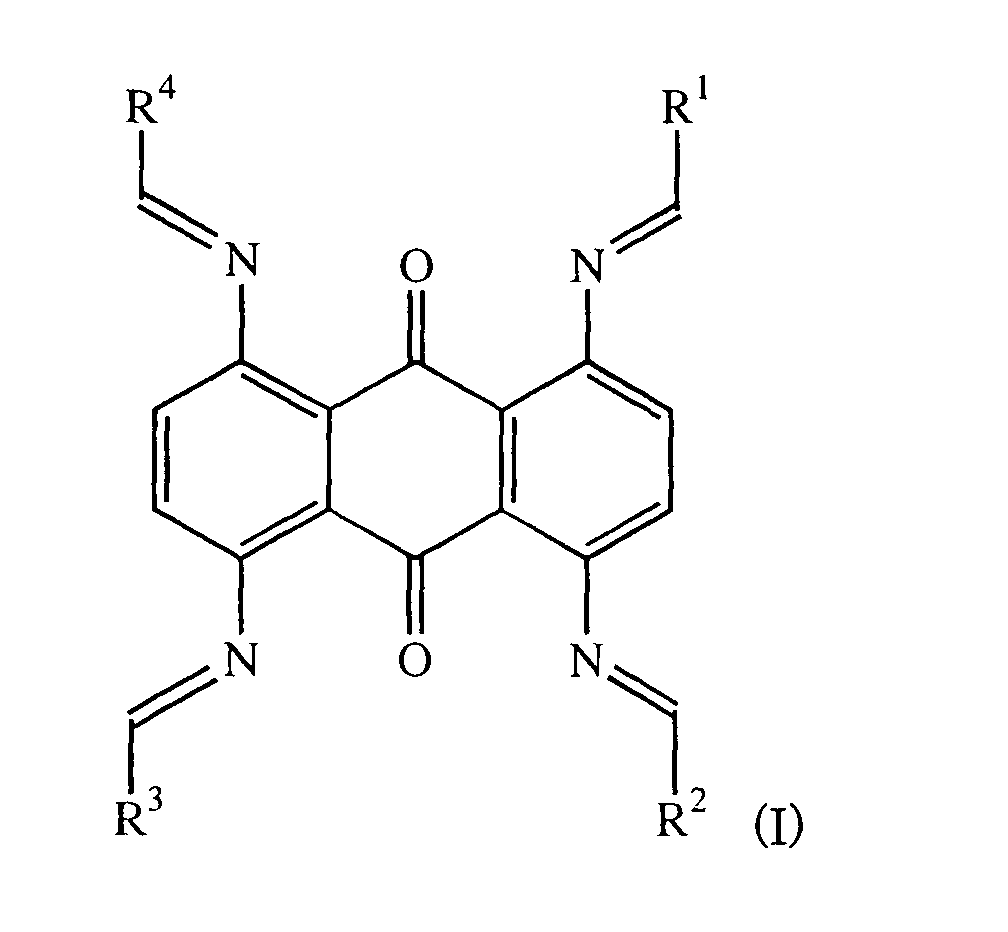
- All percentages are weight percentages, unless otherwise indicated. Concentrations in parts per million ("ppm") are calculated on a weight/volume basis. The term "petroleum hydrocarbons" refers to products having a predominantly hydrocarbon composition, although they may contain minor amounts of oxygen, nitrogen, sulfur or phosphorus, that are derived from petroleum refining processes, preferably lubricating oil, hydraulic fluid, brake fluid, gasoline, diesel fuel, kerosene, jet fuel and heating oil. An "alkyl" group is a hydrocarbyl group having from one to twenty carbon atoms in a linear, branched or cyclic arrangement. Alkyl groups optionally have one or more double or triple bonds. Substitution on alkyl groups of one or more halo, hydroxy or alkoxy groups is permitted; alkoxy groups may in turn be substituted by one or more halo substituents. Preferably, alkyl groups have no halo or alkoxy substituents. A "heteroalkyl" group is an alkyl group having at least one carbon that has been replaced by O, NR, or S, wherein R is hydrogen, alkyl, aryl or aralkyl. An "aryl" group is a substituent derived from an aromatic hydrocarbon compound. An aryl group has a total of from six to twenty ring atoms, and has one or more rings which are separate or fused. An "aralkyl" group is an "alkyl" group substituted by an "aryl" group. A "heterocyclic" group is a substituent derived from a heterocyclic compound having from five to twenty ring atoms, at least one of which is nitrogen, oxygen or sulfur. Preferably, heterocyclic groups do not contain sulfur. Substitution on aryl or heterocyclic groups of one or more halo, cyano, nitro, dialkylamino, alkylamino, amino, hydroxy, alkyl, heteroalkyl, alkanoyl, alkanoyloxy, aroyl, aryloxy, aralkyloxy or alkoxy groups is permitted. Preferably, aryl and heterocyclic groups do not contain halogen atoms. An "aromatic heterocyclic" group is a heterocyclic group derived from an aromatic heterocyclic compound.
- In a preferred embodiment of the invention, R1, R2, R3 and R4 are the same aryl or aromatic heterocyclic group. Preferably, R1, R2, R3 and R4 are aryl; more preferably R1, R2, R3 and R4 are phenyl or substituted phenyl; and most preferably phenyl or phenyl substituted by one or more of hydroxy, alkyl, alkanoyl, aroyl, aryloxy, aralkyloxy and alkoxy. In one preferred embodiment, R1, R2, R3 and R4 are phenyl substituted by at least one alkyl group, preferably an alkyl group having at least four carbon atoms, more preferably a saturated, unsubstituted alkyl group.
- Compounds of formula (I) can be prepared by the condensation reaction of 1,4,5,8-tetraaminoanthraquinone and an aryl aldehyde or aromatic heterocyclic aldehyde, as shown below in Scheme 1.R represents an aryl or aromatic heterocyclic group. Optionally, more than one aryl or aromatic heterocyclic aldehyde is used, producing a mixture of compounds as a product. Standard conditions known to those skilled in the art are used for removal of water formed during the condensation reaction.

- Preferably the amount of each dye of formula (I) added to the petroleum hydrocarbon is at least 0.01 ppm, more preferably at least 0.02 ppm, and most preferably at least 0.03 ppm. Preferably the amount of each dye is less than 10 ppm, more preferably less than 5 ppm, more preferably less than 2 ppm, and most preferably less than 1 ppm. Preferably, the marking is invisible, i.e., the dye cannot be detected by simple visual observation of the marked hydrocarbon. Preferably, a dye of formula (I) has an absorption maximum at a wavelength of at least 720 nm, more preferably at least 730 nm, and most preferably at least 750 nm; preferably, the absorption maximum is no greater than 880 nm, more preferably no greater than 860 nm. In one embodiment, at least one other dye having an absorption maximum at a different wavelength in the range from 710 nm to 900 nm is added to the petroleum hydrocarbon. Preferably, each of the other dyes is present in an amount of at least 0.01 ppm, more preferably at least 0.02 ppm, and most preferably at least 0.03 ppm. Preferably the amount of each other dye is less than 10 ppm, more preferably less than 5 ppm, more preferably less than 2 ppm, and most preferably less than 1 ppm. Preferably, the dyes are detected by exposing the marked hydrocarbon to electromagnetic radiation having wavelengths in the portion of the spectrum containing the absorption maxima of the dyes and detecting the absorption of light or fluorescent emissions. It is preferred that the detection equipment is capable of calculating dye concentrations and concentration ratios in a marked hydrocarbon. Typical spectrophotometers known in the art are capable of detecting the dyes used in the method of this invention when they are present at a level of at least 0.01 ppm. It is preferred to use the detectors described in U.S. Pat. No. 5,225,679, especially the SpecTrace™ analyzer available from Rohm and Haas Company, Philadelphia, PA. These analyzers use a filter selected based on the absorption spectrum of the dye, and use chemometric analysis of the signal by multiple linear regression methods to reduce the signal-to-noise ratio.
- When the detection method does not involve performing any chemical manipulation of the marked petroleum hydrocarbon, the sample may be returned to its source after testing, eliminating the need for handling and disposal of hazardous chemicals. This is the case, for example, when the dyes are detected simply by measuring light absorption by a sample of the marked petroleum hydrocarbon.
- In one embodiment of the invention, the dye is formulated in a solvent to facilitate its addition to the liquid petroleum hydrocarbon. The preferred solvents for anthraquinone imines are N-methylpyrrolidinone, N,N-dimethyl propylene urea, nitrobenzene, toluene and N,N-dimethylformamide. Preferably, the dye is present in the solvent at a concentration of from 0.1% to 10%.
- In one embodiment of the invention, at least one dye having formula (I), and optionally another dye having an absorption maximum from 710 nm to 900 nm, is added to a petroleum hydrocarbon with at least one visible dye; i.e., a dye having an absorption maximum in the range from 500 nm to 700 nm, preferably from 550 nm to 700 nm, and most preferably from 550 nm to 680 nm. Preferably, each visible dye is added in an amount of at least 0.1 ppm, preferably at least 0.2 ppm, and most preferably at least 0.5 ppm. Preferably, the amount of each visible dye is no more than 10 ppm, more preferably no more than 5 ppm, more preferably no more than 3 ppm, and most preferably no more than 2 ppm. In a preferred embodiment, the visible dyes are selected from the classes of anthraquinone dyes and azo dyes. Suitable anthraquinone dyes having an absorption maximum in this region include, for example, 1,4-disubstituted anthraquinones having alkylamino, arylamino or aromatic-heterocyclic-amino substituents. Suitable azo dyes having an absorption maximum in this region include the bisazo dyes, for example, those having the structure Ar-N=N-Ar-N=N-Ar, in which Ar is an aryl group, and each Ar may be different. Specific examples of suitable commercial anthraquinone and bisazo dyes having an absorption maximum in this region are listed in the Colour Index, including C.I. Solvent Blue 98, C.I. Solvent Blue 79, C.I. Solvent Blue 99 and C.I. Solvent Blue 100.
- Incorporation of at least one dye having an absorption maximum in the region from 710 nm to 900 nm allows identification of the liquid hydrocarbon by spectrophotometric means in a spectral region relatively free of interference. Low levels of these dyes are detectable in this region, allowing for a cost-effective marking process, and availability of multiple dyes allows coding of information via the amounts and ratios of the dyes. For these reasons, additional compounds absorbing in this range, and suitable as fuel markers, are extremely useful.
- Combinations of markers detectable at 710 nm to 900 nm with markers detectable in the visible range also are useful. Incorporation of higher levels of at least one visible dye having an absorption maximum in the region from 500 nm to 700 nm facilitates quantitative spectrophotometric determination in this region. Accurate determination of the dye levels allows the amounts and ratios of the dyes to serve as parts of a code identifying the hydrocarbon. Since dyes absorbing in this region often are less costly, use of a higher level will not greatly increase the overall cost of the marking process. Thus, the combination of the two kinds of dyes increases the flexibility and minimizes the cost of the marking process.
Claims (10)
- A method for invisibly marking a liquid petroleum hydrocarbon; said method comprising adding to said liquid petroleum hydrocarbon at least one dye having formula (I)wherein R1, R2, R3 and R4 independently are aryl or aromatic heterocyclic; and wherein said at least one dye has an absorption maximum in the range from 710 nm to 900 nm.

- The method of claim 1 in which the liquid petroleum hydrocarbon is selected from the group consisting of lubricating oil, hydraulic fluid, brake fluid, gasoline, diesel fuel, kerosene, jet fuel and heating oil.
- The method of claim 1 in which R1, R2, R3 and R4 are the same aryl or aromatic heterocyclic group.
- The method of claim 3 in which R1, R2, R3 and R4 are phenyl or substituted phenyl.
- The method of claim 1 in which each dye is present in an amount from 0.01 ppm to 5 ppm.
- The method of claim 5 in which said dye having formula (I) has an absorption maximum in the range from 750 nm to 900 nm.
- The method of claim 6 further comprising at least one visible dye in an amount from 0.1 ppm to 2 ppm.
- The method of claim 7 in which each dye having formula (I) is present in an amount from 0.01 ppm to 2 ppm, and each visible dye is present in an amount from 0.2 ppm to 2 ppm.
- The method of claim 8 in which R1, R2, R3 and R4 are phenyl or substituted phenyl.
- The method of claim 9 in which the liquid petroleum hydrocarbon is selected from the group consisting of lubricating oil, hydraulic fluid, brake fluid, gasoline, diesel fuel, kerosene, jet fuel and heating oil.
Applications Claiming Priority (2)
| Application Number | Priority Date | Filing Date | Title |
|---|---|---|---|
| US42841202P | 2002-11-22 | 2002-11-22 | |
| US428412P | 2002-11-22 |
Publications (1)
| Publication Number | Publication Date |
|---|---|
| EP1422284A2 true EP1422284A2 (en) | 2004-05-26 |
Family
ID=32230432
Family Applications (1)
| Application Number | Title | Priority Date | Filing Date |
|---|---|---|---|
| EP03256979A Withdrawn EP1422284A2 (en) | 2002-11-22 | 2003-11-05 | Method for marking hydrocarbons with anthraquinone imines |
Country Status (5)
| Country | Link |
|---|---|
| US (1) | US20040102340A1 (en) |
| EP (1) | EP1422284A2 (en) |
| JP (1) | JP2004182985A (en) |
| KR (1) | KR20040045306A (en) |
| BR (1) | BR0305272A (en) |
Cited By (1)
| Publication number | Priority date | Publication date | Assignee | Title |
|---|---|---|---|---|
| TWI461510B (en) * | 2011-04-22 | 2014-11-21 | Univ Ishou | Organic luminescent material |
Families Citing this family (3)
| Publication number | Priority date | Publication date | Assignee | Title |
|---|---|---|---|---|
| US7208451B2 (en) * | 2003-01-29 | 2007-04-24 | Authentic Inc. | IMS detection of chemical markers in petroleum products |
| CN100395806C (en) * | 2004-04-06 | 2008-06-18 | 友达光电股份有限公司 | Active matrix organic light emitting diode drive control circuit and white balance adjustment method |
| WO2009008476A1 (en) * | 2007-07-11 | 2009-01-15 | Cdm Consulting Co., Ltd | Agent for discriminating biodiesel fuel, fuel containing the same and quality guarantee system therefor |
Family Cites Families (7)
| Publication number | Priority date | Publication date | Assignee | Title |
|---|---|---|---|---|
| DE19818176A1 (en) * | 1998-04-23 | 1999-10-28 | Basf Ag | Process for marking liquids, e.g. fuels |
| US3164449A (en) * | 1961-03-01 | 1965-01-05 | Du Pont | Anthraquinone dyes for gasoline |
| JPS62903A (en) * | 1985-06-05 | 1987-01-06 | Sumitomo Chem Co Ltd | Near infrared ray absorbing filter |
| US5804447A (en) * | 1992-07-23 | 1998-09-08 | Basf Aktiengesellschaft | Use of compounds which absorb and/or fluoresce in the IR region as markers for liquids |
| US5525516B1 (en) * | 1994-09-30 | 1999-11-09 | Eastman Chem Co | Method for tagging petroleum products |
| US6274381B1 (en) * | 1998-11-09 | 2001-08-14 | Rohm And Haas Company | Method for invisibly tagging petroleum products using visible dyes |
| US6514917B1 (en) * | 2001-08-28 | 2003-02-04 | United Color Manufacturing, Inc. | Molecular tags for organic solvent systems |
-
2003
- 2003-11-04 US US10/700,993 patent/US20040102340A1/en not_active Abandoned
- 2003-11-05 EP EP03256979A patent/EP1422284A2/en not_active Withdrawn
- 2003-11-11 BR BR0305272-9A patent/BR0305272A/en not_active IP Right Cessation
- 2003-11-17 KR KR1020030080975A patent/KR20040045306A/en not_active Withdrawn
- 2003-11-21 JP JP2003391883A patent/JP2004182985A/en active Pending
Cited By (1)
| Publication number | Priority date | Publication date | Assignee | Title |
|---|---|---|---|---|
| TWI461510B (en) * | 2011-04-22 | 2014-11-21 | Univ Ishou | Organic luminescent material |
Also Published As
| Publication number | Publication date |
|---|---|
| JP2004182985A (en) | 2004-07-02 |
| KR20040045306A (en) | 2004-06-01 |
| US20040102340A1 (en) | 2004-05-27 |
| BR0305272A (en) | 2004-08-10 |
Similar Documents
| Publication | Publication Date | Title |
|---|---|---|
| EP1479749B1 (en) | Method for marking hydrocarbons with substituted anthraquinones | |
| EP1486554B1 (en) | Method for marking hydrocarbons with substituted anthraquinones | |
| US6811575B2 (en) | Method for marking hydrocarbons with anthraquinones | |
| US7157611B2 (en) | Pyrazinoporphyrazines as markers for liquid hydrocarbons | |
| KR20040052217A (en) | Molecular Tags for Organic Solvent Systems | |
| US20040106526A1 (en) | Method for marking liquid hydrocarbons | |
| US20040102340A1 (en) | Method for marking hydrocarbons with anthraquinone imines | |
| US20040110997A1 (en) | Method for marking liquid petroleum hydrocarbons | |
| US6977177B1 (en) | Method for marking hydrocarbons with substituted anthraquinones | |
| Babichenko et al. | Diagnosis of organic compounds in water quality monitoring | |
| FI83456B (en) | Method for detection of the marking agent of petroleum products |
Legal Events
| Date | Code | Title | Description |
|---|---|---|---|
| PUAI | Public reference made under article 153(3) epc to a published international application that has entered the european phase |
Free format text: ORIGINAL CODE: 0009012 |
|
| STAA | Information on the status of an ep patent application or granted ep patent |
Free format text: STATUS: THE APPLICATION HAS BEEN WITHDRAWN |
|
| 17P | Request for examination filed |
Effective date: 20031120 |
|
| AK | Designated contracting states |
Kind code of ref document: A2 Designated state(s): AT BE BG CH CY CZ DE DK EE ES FI FR GB GR HU IE IT LI LU MC NL PT RO SE SI SK TR |
|
| AX | Request for extension of the european patent |
Extension state: AL LT LV MK |
|
| 18W | Application withdrawn |
Effective date: 20040419 |