EP1422274A1 - Display element with a backprint - Google Patents
Display element with a backprint Download PDFInfo
- Publication number
- EP1422274A1 EP1422274A1 EP03078523A EP03078523A EP1422274A1 EP 1422274 A1 EP1422274 A1 EP 1422274A1 EP 03078523 A EP03078523 A EP 03078523A EP 03078523 A EP03078523 A EP 03078523A EP 1422274 A1 EP1422274 A1 EP 1422274A1
- Authority
- EP
- European Patent Office
- Prior art keywords
- dye
- infrared
- dyes
- latex
- silver halide
- Prior art date
- Legal status (The legal status is an assumption and is not a legal conclusion. Google has not performed a legal analysis and makes no representation as to the accuracy of the status listed.)
- Withdrawn
Links
- 239000000203 mixture Substances 0.000 claims abstract description 42
- 239000002245 particle Substances 0.000 claims abstract description 29
- -1 silver halide Chemical class 0.000 claims abstract description 29
- 238000007639 printing Methods 0.000 claims abstract description 27
- 229910052709 silver Inorganic materials 0.000 claims abstract description 25
- 239000004332 silver Substances 0.000 claims abstract description 25
- 239000000839 emulsion Substances 0.000 claims abstract description 22
- 229920001600 hydrophobic polymer Polymers 0.000 claims abstract description 9
- 239000000975 dye Substances 0.000 claims description 159
- 229920000126 latex Polymers 0.000 claims description 55
- 239000004816 latex Substances 0.000 claims description 48
- 238000000034 method Methods 0.000 claims description 26
- XLYOFNOQVPJJNP-UHFFFAOYSA-N water Substances O XLYOFNOQVPJJNP-UHFFFAOYSA-N 0.000 claims description 21
- 230000008569 process Effects 0.000 claims description 9
- 239000003086 colorant Substances 0.000 claims description 6
- 239000000980 acid dye Substances 0.000 claims description 4
- PWEBUXCTKOWPCW-UHFFFAOYSA-N squaric acid Chemical compound OC1=C(O)C(=O)C1=O PWEBUXCTKOWPCW-UHFFFAOYSA-N 0.000 claims 2
- ANRHNWWPFJCPAZ-UHFFFAOYSA-M thionine Chemical compound [Cl-].C1=CC(N)=CC2=[S+]C3=CC(N)=CC=C3N=C21 ANRHNWWPFJCPAZ-UHFFFAOYSA-M 0.000 claims 2
- 239000000976 ink Substances 0.000 description 55
- 239000000523 sample Substances 0.000 description 49
- 239000000049 pigment Substances 0.000 description 35
- 229920000642 polymer Polymers 0.000 description 34
- 239000010410 layer Substances 0.000 description 32
- 239000003381 stabilizer Substances 0.000 description 23
- MTHSVFCYNBDYFN-UHFFFAOYSA-N diethylene glycol Chemical compound OCCOCCO MTHSVFCYNBDYFN-UHFFFAOYSA-N 0.000 description 18
- 239000000243 solution Substances 0.000 description 17
- 239000013068 control sample Substances 0.000 description 16
- PEDCQBHIVMGVHV-UHFFFAOYSA-N Glycerine Chemical compound OCC(O)CO PEDCQBHIVMGVHV-UHFFFAOYSA-N 0.000 description 15
- OKKJLVBELUTLKV-UHFFFAOYSA-N Methanol Chemical compound OC OKKJLVBELUTLKV-UHFFFAOYSA-N 0.000 description 15
- 230000000052 comparative effect Effects 0.000 description 11
- 239000003960 organic solvent Substances 0.000 description 11
- 108010010803 Gelatin Proteins 0.000 description 9
- 229920000159 gelatin Polymers 0.000 description 9
- 239000008273 gelatin Substances 0.000 description 9
- 235000019322 gelatine Nutrition 0.000 description 9
- 235000011852 gelatine desserts Nutrition 0.000 description 9
- 238000005286 illumination Methods 0.000 description 9
- 238000012545 processing Methods 0.000 description 9
- 238000011160 research Methods 0.000 description 9
- 239000006185 dispersion Substances 0.000 description 8
- 238000001228 spectrum Methods 0.000 description 8
- 239000011550 stock solution Substances 0.000 description 8
- 229910021607 Silver chloride Inorganic materials 0.000 description 7
- 150000002009 diols Chemical class 0.000 description 7
- HKZLPVFGJNLROG-UHFFFAOYSA-M silver monochloride Chemical compound [Cl-].[Ag+] HKZLPVFGJNLROG-UHFFFAOYSA-M 0.000 description 7
- 239000004094 surface-active agent Substances 0.000 description 7
- NECRQCBKTGZNMH-UHFFFAOYSA-N 3,5-dimethylhex-1-yn-3-ol Chemical compound CC(C)CC(C)(O)C#C NECRQCBKTGZNMH-UHFFFAOYSA-N 0.000 description 6
- BAPJBEWLBFYGME-UHFFFAOYSA-N Methyl acrylate Chemical compound COC(=O)C=C BAPJBEWLBFYGME-UHFFFAOYSA-N 0.000 description 6
- PPBRXRYQALVLMV-UHFFFAOYSA-N Styrene Chemical compound C=CC1=CC=CC=C1 PPBRXRYQALVLMV-UHFFFAOYSA-N 0.000 description 6
- 230000008901 benefit Effects 0.000 description 6
- 238000007720 emulsion polymerization reaction Methods 0.000 description 6
- 238000003384 imaging method Methods 0.000 description 6
- CSCPPACGZOOCGX-UHFFFAOYSA-N Acetone Chemical compound CC(C)=O CSCPPACGZOOCGX-UHFFFAOYSA-N 0.000 description 5
- 238000000576 coating method Methods 0.000 description 5
- 230000007797 corrosion Effects 0.000 description 5
- 238000005260 corrosion Methods 0.000 description 5
- 239000000463 material Substances 0.000 description 5
- 239000000434 metal complex dye Substances 0.000 description 5
- 230000003287 optical effect Effects 0.000 description 5
- 229920002635 polyurethane Polymers 0.000 description 5
- 239000004814 polyurethane Substances 0.000 description 5
- BDERNNFJNOPAEC-UHFFFAOYSA-N propan-1-ol Chemical compound CCCO BDERNNFJNOPAEC-UHFFFAOYSA-N 0.000 description 5
- 230000005855 radiation Effects 0.000 description 5
- 239000000126 substance Substances 0.000 description 5
- BDHFUVZGWQCTTF-UHFFFAOYSA-M sulfonate Chemical compound [O-]S(=O)=O BDHFUVZGWQCTTF-UHFFFAOYSA-M 0.000 description 5
- QGKMIGUHVLGJBR-UHFFFAOYSA-M (4z)-1-(3-methylbutyl)-4-[[1-(3-methylbutyl)quinolin-1-ium-4-yl]methylidene]quinoline;iodide Chemical compound [I-].C12=CC=CC=C2N(CCC(C)C)C=CC1=CC1=CC=[N+](CCC(C)C)C2=CC=CC=C12 QGKMIGUHVLGJBR-UHFFFAOYSA-M 0.000 description 4
- SMZOUWXMTYCWNB-UHFFFAOYSA-N 2-(2-methoxy-5-methylphenyl)ethanamine Chemical compound COC1=CC=C(C)C=C1CCN SMZOUWXMTYCWNB-UHFFFAOYSA-N 0.000 description 4
- NIXOWILDQLNWCW-UHFFFAOYSA-N 2-Propenoic acid Natural products OC(=O)C=C NIXOWILDQLNWCW-UHFFFAOYSA-N 0.000 description 4
- JIGUQPWFLRLWPJ-UHFFFAOYSA-N Ethyl acrylate Chemical compound CCOC(=O)C=C JIGUQPWFLRLWPJ-UHFFFAOYSA-N 0.000 description 4
- LYCAIKOWRPUZTN-UHFFFAOYSA-N Ethylene glycol Chemical compound OCCO LYCAIKOWRPUZTN-UHFFFAOYSA-N 0.000 description 4
- PXHVJJICTQNCMI-UHFFFAOYSA-N Nickel Chemical compound [Ni] PXHVJJICTQNCMI-UHFFFAOYSA-N 0.000 description 4
- 229910019142 PO4 Inorganic materials 0.000 description 4
- 125000000129 anionic group Chemical group 0.000 description 4
- 239000003795 chemical substances by application Substances 0.000 description 4
- 125000005442 diisocyanate group Chemical group 0.000 description 4
- 150000002148 esters Chemical class 0.000 description 4
- 239000003112 inhibitor Substances 0.000 description 4
- 229910052751 metal Inorganic materials 0.000 description 4
- 239000002184 metal Substances 0.000 description 4
- 239000000178 monomer Substances 0.000 description 4
- PNJWIWWMYCMZRO-UHFFFAOYSA-N pent‐4‐en‐2‐one Natural products CC(=O)CC=C PNJWIWWMYCMZRO-UHFFFAOYSA-N 0.000 description 4
- NBIIXXVUZAFLBC-UHFFFAOYSA-K phosphate Chemical compound [O-]P([O-])([O-])=O NBIIXXVUZAFLBC-UHFFFAOYSA-K 0.000 description 4
- 239000010452 phosphate Substances 0.000 description 4
- 229920000728 polyester Polymers 0.000 description 4
- 238000002360 preparation method Methods 0.000 description 4
- 230000006641 stabilisation Effects 0.000 description 4
- 238000011105 stabilization Methods 0.000 description 4
- ZWEHNKRNPOVVGH-UHFFFAOYSA-N 2-Butanone Chemical compound CCC(C)=O ZWEHNKRNPOVVGH-UHFFFAOYSA-N 0.000 description 3
- YMWUJEATGCHHMB-UHFFFAOYSA-N Dichloromethane Chemical compound ClCCl YMWUJEATGCHHMB-UHFFFAOYSA-N 0.000 description 3
- LFQSCWFLJHTTHZ-UHFFFAOYSA-N Ethanol Chemical compound CCO LFQSCWFLJHTTHZ-UHFFFAOYSA-N 0.000 description 3
- KFZMGEQAYNKOFK-UHFFFAOYSA-N Isopropanol Chemical compound CC(C)O KFZMGEQAYNKOFK-UHFFFAOYSA-N 0.000 description 3
- ZMXDDKWLCZADIW-UHFFFAOYSA-N N,N-Dimethylformamide Chemical compound CN(C)C=O ZMXDDKWLCZADIW-UHFFFAOYSA-N 0.000 description 3
- ZLMJMSJWJFRBEC-UHFFFAOYSA-N Potassium Chemical compound [K] ZLMJMSJWJFRBEC-UHFFFAOYSA-N 0.000 description 3
- DNIAPMSPPWPWGF-UHFFFAOYSA-N Propylene glycol Chemical compound CC(O)CO DNIAPMSPPWPWGF-UHFFFAOYSA-N 0.000 description 3
- HEMHJVSKTPXQMS-UHFFFAOYSA-M Sodium hydroxide Chemical compound [OH-].[Na+] HEMHJVSKTPXQMS-UHFFFAOYSA-M 0.000 description 3
- GWEVSGVZZGPLCZ-UHFFFAOYSA-N Titan oxide Chemical compound O=[Ti]=O GWEVSGVZZGPLCZ-UHFFFAOYSA-N 0.000 description 3
- 239000000654 additive Substances 0.000 description 3
- 239000000987 azo dye Substances 0.000 description 3
- 239000003139 biocide Substances 0.000 description 3
- 150000001875 compounds Chemical class 0.000 description 3
- 238000001514 detection method Methods 0.000 description 3
- 239000012153 distilled water Substances 0.000 description 3
- 235000019441 ethanol Nutrition 0.000 description 3
- 238000004519 manufacturing process Methods 0.000 description 3
- 239000001007 phthalocyanine dye Substances 0.000 description 3
- 238000012643 polycondensation polymerization Methods 0.000 description 3
- 229910052700 potassium Inorganic materials 0.000 description 3
- 239000011591 potassium Substances 0.000 description 3
- IZMJMCDDWKSTTK-UHFFFAOYSA-N quinoline yellow Chemical compound C1=CC=CC2=NC(C3C(C4=CC=CC=C4C3=O)=O)=CC=C21 IZMJMCDDWKSTTK-UHFFFAOYSA-N 0.000 description 3
- 230000035945 sensitivity Effects 0.000 description 3
- 239000002904 solvent Substances 0.000 description 3
- 229910052723 transition metal Inorganic materials 0.000 description 3
- 150000003624 transition metals Chemical class 0.000 description 3
- 239000001043 yellow dye Substances 0.000 description 3
- MYRTYDVEIRVNKP-UHFFFAOYSA-N 1,2-Divinylbenzene Chemical compound C=CC1=CC=CC=C1C=C MYRTYDVEIRVNKP-UHFFFAOYSA-N 0.000 description 2
- JWAZRIHNYRIHIV-UHFFFAOYSA-N 2-naphthol Chemical compound C1=CC=CC2=CC(O)=CC=C21 JWAZRIHNYRIHIV-UHFFFAOYSA-N 0.000 description 2
- BCHZICNRHXRCHY-UHFFFAOYSA-N 2h-oxazine Chemical compound N1OC=CC=C1 BCHZICNRHXRCHY-UHFFFAOYSA-N 0.000 description 2
- SOGAXMICEFXMKE-UHFFFAOYSA-N Butylmethacrylate Chemical compound CCCCOC(=O)C(C)=C SOGAXMICEFXMKE-UHFFFAOYSA-N 0.000 description 2
- VTYYLEPIZMXCLO-UHFFFAOYSA-L Calcium carbonate Chemical compound [Ca+2].[O-]C([O-])=O VTYYLEPIZMXCLO-UHFFFAOYSA-L 0.000 description 2
- LZZYPRNAOMGNLH-UHFFFAOYSA-M Cetrimonium bromide Chemical compound [Br-].CCCCCCCCCCCCCCCC[N+](C)(C)C LZZYPRNAOMGNLH-UHFFFAOYSA-M 0.000 description 2
- VEXZGXHMUGYJMC-UHFFFAOYSA-M Chloride anion Chemical compound [Cl-] VEXZGXHMUGYJMC-UHFFFAOYSA-M 0.000 description 2
- IAZDPXIOMUYVGZ-UHFFFAOYSA-N Dimethylsulphoxide Chemical compound CS(C)=O IAZDPXIOMUYVGZ-UHFFFAOYSA-N 0.000 description 2
- MHAJPDPJQMAIIY-UHFFFAOYSA-N Hydrogen peroxide Chemical compound OO MHAJPDPJQMAIIY-UHFFFAOYSA-N 0.000 description 2
- UQSXHKLRYXJYBZ-UHFFFAOYSA-N Iron oxide Chemical compound [Fe]=O UQSXHKLRYXJYBZ-UHFFFAOYSA-N 0.000 description 2
- CERQOIWHTDAKMF-UHFFFAOYSA-N Methacrylic acid Chemical compound CC(=C)C(O)=O CERQOIWHTDAKMF-UHFFFAOYSA-N 0.000 description 2
- SECXISVLQFMRJM-UHFFFAOYSA-N N-Methylpyrrolidone Chemical compound CN1CCCC1=O SECXISVLQFMRJM-UHFFFAOYSA-N 0.000 description 2
- KDLHZDBZIXYQEI-UHFFFAOYSA-N Palladium Chemical compound [Pd] KDLHZDBZIXYQEI-UHFFFAOYSA-N 0.000 description 2
- 239000004721 Polyphenylene oxide Substances 0.000 description 2
- JUJWROOIHBZHMG-UHFFFAOYSA-N Pyridine Chemical compound C1=CC=NC=C1 JUJWROOIHBZHMG-UHFFFAOYSA-N 0.000 description 2
- 206010070834 Sensitisation Diseases 0.000 description 2
- BQCADISMDOOEFD-UHFFFAOYSA-N Silver Chemical compound [Ag] BQCADISMDOOEFD-UHFFFAOYSA-N 0.000 description 2
- WYURNTSHIVDZCO-UHFFFAOYSA-N Tetrahydrofuran Chemical compound C1CCOC1 WYURNTSHIVDZCO-UHFFFAOYSA-N 0.000 description 2
- 239000002253 acid Substances 0.000 description 2
- 150000001408 amides Chemical class 0.000 description 2
- ROOXNKNUYICQNP-UHFFFAOYSA-N ammonium persulfate Chemical compound [NH4+].[NH4+].[O-]S(=O)(=O)OOS([O-])(=O)=O ROOXNKNUYICQNP-UHFFFAOYSA-N 0.000 description 2
- 239000002518 antifoaming agent Substances 0.000 description 2
- TZCXTZWJZNENPQ-UHFFFAOYSA-L barium sulfate Chemical compound [Ba+2].[O-]S([O-])(=O)=O TZCXTZWJZNENPQ-UHFFFAOYSA-L 0.000 description 2
- DMSMPAJRVJJAGA-UHFFFAOYSA-N benzo[d]isothiazol-3-one Chemical compound C1=CC=C2C(=O)NSC2=C1 DMSMPAJRVJJAGA-UHFFFAOYSA-N 0.000 description 2
- QRUDEWIWKLJBPS-UHFFFAOYSA-N benzotriazole Chemical class C1=CC=C2N[N][N]C2=C1 QRUDEWIWKLJBPS-UHFFFAOYSA-N 0.000 description 2
- 230000003115 biocidal effect Effects 0.000 description 2
- 230000015572 biosynthetic process Effects 0.000 description 2
- CQEYYJKEWSMYFG-UHFFFAOYSA-N butyl acrylate Chemical compound CCCCOC(=O)C=C CQEYYJKEWSMYFG-UHFFFAOYSA-N 0.000 description 2
- 230000015556 catabolic process Effects 0.000 description 2
- ZBNARPCCDMHDDV-UHFFFAOYSA-N chembl1206040 Chemical compound C1=C(S(O)(=O)=O)C=C2C=C(S(O)(=O)=O)C(N=NC3=CC=C(C=C3C)C=3C=C(C(=CC=3)N=NC=3C(=CC4=CC(=CC(N)=C4C=3O)S(O)(=O)=O)S(O)(=O)=O)C)=C(O)C2=C1N ZBNARPCCDMHDDV-UHFFFAOYSA-N 0.000 description 2
- 238000006243 chemical reaction Methods 0.000 description 2
- 238000004581 coalescence Methods 0.000 description 2
- 239000011248 coating agent Substances 0.000 description 2
- 239000008199 coating composition Substances 0.000 description 2
- 239000002537 cosmetic Substances 0.000 description 2
- 239000013530 defoamer Substances 0.000 description 2
- 238000006731 degradation reaction Methods 0.000 description 2
- 125000000664 diazo group Chemical group [N-]=[N+]=[*] 0.000 description 2
- 238000001035 drying Methods 0.000 description 2
- 229920001971 elastomer Polymers 0.000 description 2
- 238000005516 engineering process Methods 0.000 description 2
- FJKIXWOMBXYWOQ-UHFFFAOYSA-N ethenoxyethane Chemical compound CCOC=C FJKIXWOMBXYWOQ-UHFFFAOYSA-N 0.000 description 2
- WGCNASOHLSPBMP-UHFFFAOYSA-N hydroxyacetaldehyde Natural products OCC=O WGCNASOHLSPBMP-UHFFFAOYSA-N 0.000 description 2
- 239000003999 initiator Substances 0.000 description 2
- QQVIHTHCMHWDBS-UHFFFAOYSA-N isophthalic acid Chemical compound OC(=O)C1=CC=CC(C(O)=O)=C1 QQVIHTHCMHWDBS-UHFFFAOYSA-N 0.000 description 2
- 238000011068 loading method Methods 0.000 description 2
- DZVCFNFOPIZQKX-LTHRDKTGSA-M merocyanine Chemical compound [Na+].O=C1N(CCCC)C(=O)N(CCCC)C(=O)C1=C\C=C\C=C/1N(CCCS([O-])(=O)=O)C2=CC=CC=C2O\1 DZVCFNFOPIZQKX-LTHRDKTGSA-M 0.000 description 2
- VNWKTOKETHGBQD-UHFFFAOYSA-N methane Chemical compound C VNWKTOKETHGBQD-UHFFFAOYSA-N 0.000 description 2
- 125000001434 methanylylidene group Chemical group [H]C#[*] 0.000 description 2
- AJDUTMFFZHIJEM-UHFFFAOYSA-N n-(9,10-dioxoanthracen-1-yl)-4-[4-[[4-[4-[(9,10-dioxoanthracen-1-yl)carbamoyl]phenyl]phenyl]diazenyl]phenyl]benzamide Chemical compound O=C1C2=CC=CC=C2C(=O)C2=C1C=CC=C2NC(=O)C(C=C1)=CC=C1C(C=C1)=CC=C1N=NC(C=C1)=CC=C1C(C=C1)=CC=C1C(=O)NC1=CC=CC2=C1C(=O)C1=CC=CC=C1C2=O AJDUTMFFZHIJEM-UHFFFAOYSA-N 0.000 description 2
- 150000002815 nickel Chemical class 0.000 description 2
- 229910052759 nickel Inorganic materials 0.000 description 2
- IEQIEDJGQAUEQZ-UHFFFAOYSA-N phthalocyanine Chemical compound N1C(N=C2C3=CC=CC=C3C(N=C3C4=CC=CC=C4C(=N4)N3)=N2)=C(C=CC=C2)C2=C1N=C1C2=CC=CC=C2C4=N1 IEQIEDJGQAUEQZ-UHFFFAOYSA-N 0.000 description 2
- BASFCYQUMIYNBI-UHFFFAOYSA-N platinum Chemical compound [Pt] BASFCYQUMIYNBI-UHFFFAOYSA-N 0.000 description 2
- 229920000570 polyether Polymers 0.000 description 2
- 230000001681 protective effect Effects 0.000 description 2
- 230000008313 sensitization Effects 0.000 description 2
- 239000007787 solid Substances 0.000 description 2
- 230000003595 spectral effect Effects 0.000 description 2
- 238000003756 stirring Methods 0.000 description 2
- 238000003786 synthesis reaction Methods 0.000 description 2
- 238000012360 testing method Methods 0.000 description 2
- 239000001016 thiazine dye Substances 0.000 description 2
- PAAFEISCFOZKEZ-UHFFFAOYSA-N 1,2-diphenyl-2-sulfanylideneethanone;nickel Chemical class [Ni].C=1C=CC=CC=1C(=O)C(=S)C1=CC=CC=C1.C=1C=CC=CC=1C(=O)C(=S)C1=CC=CC=C1 PAAFEISCFOZKEZ-UHFFFAOYSA-N 0.000 description 1
- OZFIGURLAJSLIR-UHFFFAOYSA-N 1-ethenyl-2h-pyridine Chemical compound C=CN1CC=CC=C1 OZFIGURLAJSLIR-UHFFFAOYSA-N 0.000 description 1
- ZFYKDNCOQBBOST-UHFFFAOYSA-N 1-phenylbut-3-en-1-one Chemical compound C=CCC(=O)C1=CC=CC=C1 ZFYKDNCOQBBOST-UHFFFAOYSA-N 0.000 description 1
- LXOFYPKXCSULTL-UHFFFAOYSA-N 2,4,7,9-tetramethyldec-5-yne-4,7-diol Chemical compound CC(C)CC(C)(O)C#CC(C)(O)CC(C)C LXOFYPKXCSULTL-UHFFFAOYSA-N 0.000 description 1
- LCPVQAHEFVXVKT-UHFFFAOYSA-N 2-(2,4-difluorophenoxy)pyridin-3-amine Chemical compound NC1=CC=CN=C1OC1=CC=C(F)C=C1F LCPVQAHEFVXVKT-UHFFFAOYSA-N 0.000 description 1
- IEORSVTYLWZQJQ-UHFFFAOYSA-N 2-(2-nonylphenoxy)ethanol Chemical compound CCCCCCCCCC1=CC=CC=C1OCCO IEORSVTYLWZQJQ-UHFFFAOYSA-N 0.000 description 1
- JAHNSTQSQJOJLO-UHFFFAOYSA-N 2-(3-fluorophenyl)-1h-imidazole Chemical compound FC1=CC=CC(C=2NC=CN=2)=C1 JAHNSTQSQJOJLO-UHFFFAOYSA-N 0.000 description 1
- OEPOKWHJYJXUGD-UHFFFAOYSA-N 2-(3-phenylmethoxyphenyl)-1,3-thiazole-4-carbaldehyde Chemical compound O=CC1=CSC(C=2C=C(OCC=3C=CC=CC=3)C=CC=2)=N1 OEPOKWHJYJXUGD-UHFFFAOYSA-N 0.000 description 1
- GOXQRTZXKQZDDN-UHFFFAOYSA-N 2-Ethylhexyl acrylate Chemical compound CCCCC(CC)COC(=O)C=C GOXQRTZXKQZDDN-UHFFFAOYSA-N 0.000 description 1
- SZTBMYHIYNGYIA-UHFFFAOYSA-N 2-chloroacrylic acid Chemical compound OC(=O)C(Cl)=C SZTBMYHIYNGYIA-UHFFFAOYSA-N 0.000 description 1
- BDOAOEZMTNGQSQ-UHFFFAOYSA-N 2-methyl-3-(oxolan-2-yl)prop-2-enoic acid Chemical compound OC(=O)C(C)=CC1CCCO1 BDOAOEZMTNGQSQ-UHFFFAOYSA-N 0.000 description 1
- CFVWNXQPGQOHRJ-UHFFFAOYSA-N 2-methylpropyl prop-2-enoate Chemical compound CC(C)COC(=O)C=C CFVWNXQPGQOHRJ-UHFFFAOYSA-N 0.000 description 1
- AGBXYHCHUYARJY-UHFFFAOYSA-N 2-phenylethenesulfonic acid Chemical compound OS(=O)(=O)C=CC1=CC=CC=C1 AGBXYHCHUYARJY-UHFFFAOYSA-N 0.000 description 1
- YZTJKOLMWJNVFH-UHFFFAOYSA-N 2-sulfobenzene-1,3-dicarboxylic acid Chemical compound OC(=O)C1=CC=CC(C(O)=O)=C1S(O)(=O)=O YZTJKOLMWJNVFH-UHFFFAOYSA-N 0.000 description 1
- KGIGUEBEKRSTEW-UHFFFAOYSA-N 2-vinylpyridine Chemical compound C=CC1=CC=CC=N1 KGIGUEBEKRSTEW-UHFFFAOYSA-N 0.000 description 1
- XBNVWXKPFORCRI-UHFFFAOYSA-N 2h-naphtho[2,3-f]quinolin-1-one Chemical compound C1=CC=CC2=CC3=C4C(=O)CC=NC4=CC=C3C=C21 XBNVWXKPFORCRI-UHFFFAOYSA-N 0.000 description 1
- XIOIVRXRQSRMCK-UHFFFAOYSA-N 3,3,4,5-tetraphenyldithiole Chemical class C1(=CC=CC=C1)C1(C(=C(SS1)C1=CC=CC=C1)C1=CC=CC=C1)C1=CC=CC=C1 XIOIVRXRQSRMCK-UHFFFAOYSA-N 0.000 description 1
- ZAWQXWZJKKICSZ-UHFFFAOYSA-N 3,3-dimethyl-2-methylidenebutanamide Chemical compound CC(C)(C)C(=C)C(N)=O ZAWQXWZJKKICSZ-UHFFFAOYSA-N 0.000 description 1
- JFGQHAHJWJBOPD-UHFFFAOYSA-N 3-hydroxy-n-phenylnaphthalene-2-carboxamide Chemical compound OC1=CC2=CC=CC=C2C=C1C(=O)NC1=CC=CC=C1 JFGQHAHJWJBOPD-UHFFFAOYSA-N 0.000 description 1
- MJFITTKTVWJPNO-UHFFFAOYSA-N 3h-dithiole;nickel Chemical compound [Ni].C1SSC=C1 MJFITTKTVWJPNO-UHFFFAOYSA-N 0.000 description 1
- VFXXTYGQYWRHJP-UHFFFAOYSA-N 4,4'-azobis(4-cyanopentanoic acid) Chemical compound OC(=O)CCC(C)(C#N)N=NC(C)(CCC(O)=O)C#N VFXXTYGQYWRHJP-UHFFFAOYSA-N 0.000 description 1
- BCFOOQRXUXKJCL-UHFFFAOYSA-N 4-amino-4-oxo-2-sulfobutanoic acid Chemical class NC(=O)CC(C(O)=O)S(O)(=O)=O BCFOOQRXUXKJCL-UHFFFAOYSA-N 0.000 description 1
- KFDVPJUYSDEJTH-UHFFFAOYSA-N 4-ethenylpyridine Chemical compound C=CC1=CC=NC=C1 KFDVPJUYSDEJTH-UHFFFAOYSA-N 0.000 description 1
- RVBXFOZIRRHESC-UHFFFAOYSA-N 4h-naphtho[2,3-f]quinazolin-1-one Chemical compound C1=CC=CC2=CC3=C4C(=O)NC=NC4=CC=C3C=C21 RVBXFOZIRRHESC-UHFFFAOYSA-N 0.000 description 1
- AGGCEDYMGLPKNS-UHFFFAOYSA-N 5,5,6-trimethylundec-3-yne-2,2-diol Chemical class CCCCCC(C)C(C)(C)C#CC(C)(O)O AGGCEDYMGLPKNS-UHFFFAOYSA-N 0.000 description 1
- HRPVXLWXLXDGHG-UHFFFAOYSA-N Acrylamide Chemical compound NC(=O)C=C HRPVXLWXLXDGHG-UHFFFAOYSA-N 0.000 description 1
- NLHHRLWOUZZQLW-UHFFFAOYSA-N Acrylonitrile Chemical compound C=CC#N NLHHRLWOUZZQLW-UHFFFAOYSA-N 0.000 description 1
- 239000005995 Aluminium silicate Substances 0.000 description 1
- 101001053401 Arabidopsis thaliana Acid beta-fructofuranosidase 3, vacuolar Proteins 0.000 description 1
- 241000283690 Bos taurus Species 0.000 description 1
- 229910052684 Cerium Inorganic materials 0.000 description 1
- MYMOFIZGZYHOMD-UHFFFAOYSA-N Dioxygen Chemical compound O=O MYMOFIZGZYHOMD-UHFFFAOYSA-N 0.000 description 1
- 241000233866 Fungi Species 0.000 description 1
- 241000282346 Meles meles Species 0.000 description 1
- VVQNEPGJFQJSBK-UHFFFAOYSA-N Methyl methacrylate Chemical compound COC(=O)C(C)=C VVQNEPGJFQJSBK-UHFFFAOYSA-N 0.000 description 1
- GYCMBHHDWRMZGG-UHFFFAOYSA-N Methylacrylonitrile Chemical compound CC(=C)C#N GYCMBHHDWRMZGG-UHFFFAOYSA-N 0.000 description 1
- WHNWPMSKXPGLAX-UHFFFAOYSA-N N-Vinyl-2-pyrrolidone Chemical compound C=CN1CCCC1=O WHNWPMSKXPGLAX-UHFFFAOYSA-N 0.000 description 1
- SJEYSFABYSGQBG-UHFFFAOYSA-M Patent blue Chemical compound [Na+].C1=CC(N(CC)CC)=CC=C1C(C=1C(=CC(=CC=1)S([O-])(=O)=O)S([O-])(=O)=O)=C1C=CC(=[N+](CC)CC)C=C1 SJEYSFABYSGQBG-UHFFFAOYSA-M 0.000 description 1
- ISWSIDIOOBJBQZ-UHFFFAOYSA-N Phenol Chemical compound OC1=CC=CC=C1 ISWSIDIOOBJBQZ-UHFFFAOYSA-N 0.000 description 1
- 239000004372 Polyvinyl alcohol Substances 0.000 description 1
- 235000017284 Pometia pinnata Nutrition 0.000 description 1
- 240000007653 Pometia tomentosa Species 0.000 description 1
- OFOBLEOULBTSOW-UHFFFAOYSA-N Propanedioic acid Natural products OC(=O)CC(O)=O OFOBLEOULBTSOW-UHFFFAOYSA-N 0.000 description 1
- NRCMAYZCPIVABH-UHFFFAOYSA-N Quinacridone Chemical compound N1C2=CC=CC=C2C(=O)C2=C1C=C1C(=O)C3=CC=CC=C3NC1=C2 NRCMAYZCPIVABH-UHFFFAOYSA-N 0.000 description 1
- XUIMIQQOPSSXEZ-UHFFFAOYSA-N Silicon Chemical compound [Si] XUIMIQQOPSSXEZ-UHFFFAOYSA-N 0.000 description 1
- DBMJMQXJHONAFJ-UHFFFAOYSA-M Sodium laurylsulphate Chemical compound [Na+].CCCCCCCCCCCCOS([O-])(=O)=O DBMJMQXJHONAFJ-UHFFFAOYSA-M 0.000 description 1
- 229920002125 Sokalan® Polymers 0.000 description 1
- 244000028419 Styrax benzoin Species 0.000 description 1
- 235000000126 Styrax benzoin Nutrition 0.000 description 1
- QAOWNCQODCNURD-UHFFFAOYSA-L Sulfate Chemical compound [O-]S([O-])(=O)=O QAOWNCQODCNURD-UHFFFAOYSA-L 0.000 description 1
- ULUAUXLGCMPNKK-UHFFFAOYSA-N Sulfobutanedioic acid Chemical class OC(=O)CC(C(O)=O)S(O)(=O)=O ULUAUXLGCMPNKK-UHFFFAOYSA-N 0.000 description 1
- 235000008411 Sumatra benzointree Nutrition 0.000 description 1
- 206010043458 Thirst Diseases 0.000 description 1
- GSEJCLTVZPLZKY-UHFFFAOYSA-N Triethanolamine Chemical compound OCCN(CCO)CCO GSEJCLTVZPLZKY-UHFFFAOYSA-N 0.000 description 1
- XTXRWKRVRITETP-UHFFFAOYSA-N Vinyl acetate Chemical compound CC(=O)OC=C XTXRWKRVRITETP-UHFFFAOYSA-N 0.000 description 1
- YIMQCDZDWXUDCA-UHFFFAOYSA-N [4-(hydroxymethyl)cyclohexyl]methanol Chemical compound OCC1CCC(CO)CC1 YIMQCDZDWXUDCA-UHFFFAOYSA-N 0.000 description 1
- SJOOOZPMQAWAOP-UHFFFAOYSA-N [Ag].BrCl Chemical compound [Ag].BrCl SJOOOZPMQAWAOP-UHFFFAOYSA-N 0.000 description 1
- XCFIVNQHHFZRNR-UHFFFAOYSA-N [Ag].Cl[IH]Br Chemical compound [Ag].Cl[IH]Br XCFIVNQHHFZRNR-UHFFFAOYSA-N 0.000 description 1
- HOLVRJRSWZOAJU-UHFFFAOYSA-N [Ag].ICl Chemical compound [Ag].ICl HOLVRJRSWZOAJU-UHFFFAOYSA-N 0.000 description 1
- BLVAOAZRKIPTCB-UHFFFAOYSA-N [Ni].NN=CN=N Chemical compound [Ni].NN=CN=N BLVAOAZRKIPTCB-UHFFFAOYSA-N 0.000 description 1
- 230000002745 absorbent Effects 0.000 description 1
- 239000002250 absorbent Substances 0.000 description 1
- 238000010521 absorption reaction Methods 0.000 description 1
- 238000000862 absorption spectrum Methods 0.000 description 1
- 238000013019 agitation Methods 0.000 description 1
- 150000001298 alcohols Chemical class 0.000 description 1
- 239000003513 alkali Substances 0.000 description 1
- 125000000217 alkyl group Chemical group 0.000 description 1
- 235000012211 aluminium silicate Nutrition 0.000 description 1
- 150000001412 amines Chemical class 0.000 description 1
- 229910001870 ammonium persulfate Inorganic materials 0.000 description 1
- PGEHNUUBUQTUJB-UHFFFAOYSA-N anthanthrone Chemical compound C1=CC=C2C(=O)C3=CC=C4C=CC=C5C(=O)C6=CC=C1C2=C6C3=C54 PGEHNUUBUQTUJB-UHFFFAOYSA-N 0.000 description 1
- PYKYMHQGRFAEBM-UHFFFAOYSA-N anthraquinone Natural products CCC(=O)c1c(O)c2C(=O)C3C(C=CC=C3O)C(=O)c2cc1CC(=O)OC PYKYMHQGRFAEBM-UHFFFAOYSA-N 0.000 description 1
- 239000001000 anthraquinone dye Substances 0.000 description 1
- 150000004056 anthraquinones Chemical class 0.000 description 1
- 230000000843 anti-fungal effect Effects 0.000 description 1
- 229940121375 antifungal agent Drugs 0.000 description 1
- 239000007864 aqueous solution Substances 0.000 description 1
- 239000012298 atmosphere Substances 0.000 description 1
- 239000000981 basic dye Substances 0.000 description 1
- 230000009286 beneficial effect Effects 0.000 description 1
- MYONAGGJKCJOBT-UHFFFAOYSA-N benzimidazol-2-one Chemical compound C1=CC=CC2=NC(=O)N=C21 MYONAGGJKCJOBT-UHFFFAOYSA-N 0.000 description 1
- ZYGHJZDHTFUPRJ-UHFFFAOYSA-N benzo-alpha-pyrone Natural products C1=CC=C2OC(=O)C=CC2=C1 ZYGHJZDHTFUPRJ-UHFFFAOYSA-N 0.000 description 1
- 238000009835 boiling Methods 0.000 description 1
- 210000000988 bone and bone Anatomy 0.000 description 1
- 150000001649 bromium compounds Chemical class 0.000 description 1
- 229910000019 calcium carbonate Inorganic materials 0.000 description 1
- 239000006229 carbon black Substances 0.000 description 1
- 150000001767 cationic compounds Chemical class 0.000 description 1
- 125000002091 cationic group Chemical group 0.000 description 1
- 150000001768 cations Chemical class 0.000 description 1
- 239000001913 cellulose Substances 0.000 description 1
- 229920002678 cellulose Polymers 0.000 description 1
- GWXLDORMOJMVQZ-UHFFFAOYSA-N cerium Chemical class [Ce] GWXLDORMOJMVQZ-UHFFFAOYSA-N 0.000 description 1
- 230000008859 change Effects 0.000 description 1
- 238000012993 chemical processing Methods 0.000 description 1
- HNEGQIOMVPPMNR-IHWYPQMZSA-N citraconic acid Chemical compound OC(=O)C(/C)=C\C(O)=O HNEGQIOMVPPMNR-IHWYPQMZSA-N 0.000 description 1
- 229940018557 citraconic acid Drugs 0.000 description 1
- 239000004927 clay Substances 0.000 description 1
- 229910052570 clay Inorganic materials 0.000 description 1
- 230000015271 coagulation Effects 0.000 description 1
- 238000005345 coagulation Methods 0.000 description 1
- 239000000084 colloidal system Substances 0.000 description 1
- 238000009833 condensation Methods 0.000 description 1
- 230000005494 condensation Effects 0.000 description 1
- 230000003750 conditioning effect Effects 0.000 description 1
- 150000004696 coordination complex Chemical class 0.000 description 1
- 235000001671 coumarin Nutrition 0.000 description 1
- 150000004775 coumarins Chemical class 0.000 description 1
- LDHQCZJRKDOVOX-NSCUHMNNSA-N crotonic acid Chemical compound C\C=C\C(O)=O LDHQCZJRKDOVOX-NSCUHMNNSA-N 0.000 description 1
- 239000013078 crystal Substances 0.000 description 1
- 230000001419 dependent effect Effects 0.000 description 1
- 238000000586 desensitisation Methods 0.000 description 1
- 150000004985 diamines Chemical class 0.000 description 1
- 238000010790 dilution Methods 0.000 description 1
- 239000012895 dilution Substances 0.000 description 1
- PPSZHCXTGRHULJ-UHFFFAOYSA-N dioxazine Chemical compound O1ON=CC=C1 PPSZHCXTGRHULJ-UHFFFAOYSA-N 0.000 description 1
- USIUVYZYUHIAEV-UHFFFAOYSA-N diphenyl ether Chemical compound C=1C=CC=CC=1OC1=CC=CC=C1 USIUVYZYUHIAEV-UHFFFAOYSA-N 0.000 description 1
- 239000000982 direct dye Substances 0.000 description 1
- 239000000986 disperse dye Substances 0.000 description 1
- 239000012769 display material Substances 0.000 description 1
- GVGUFUZHNYFZLC-UHFFFAOYSA-N dodecyl benzenesulfonate;sodium Chemical compound [Na].CCCCCCCCCCCCOS(=O)(=O)C1=CC=CC=C1 GVGUFUZHNYFZLC-UHFFFAOYSA-N 0.000 description 1
- 238000011143 downstream manufacturing Methods 0.000 description 1
- 230000000694 effects Effects 0.000 description 1
- 238000010894 electron beam technology Methods 0.000 description 1
- 239000003995 emulsifying agent Substances 0.000 description 1
- GLVVKKSPKXTQRB-UHFFFAOYSA-N ethenyl dodecanoate Chemical compound CCCCCCCCCCCC(=O)OC=C GLVVKKSPKXTQRB-UHFFFAOYSA-N 0.000 description 1
- UIWXSTHGICQLQT-UHFFFAOYSA-N ethenyl propanoate Chemical compound CCC(=O)OC=C UIWXSTHGICQLQT-UHFFFAOYSA-N 0.000 description 1
- 125000005670 ethenylalkyl group Chemical group 0.000 description 1
- RTZKZFJDLAIYFH-UHFFFAOYSA-N ether Substances CCOCC RTZKZFJDLAIYFH-UHFFFAOYSA-N 0.000 description 1
- SUPCQIBBMFXVTL-UHFFFAOYSA-N ethyl 2-methylprop-2-enoate Chemical compound CCOC(=O)C(C)=C SUPCQIBBMFXVTL-UHFFFAOYSA-N 0.000 description 1
- 238000011156 evaluation Methods 0.000 description 1
- 238000001704 evaporation Methods 0.000 description 1
- 230000008020 evaporation Effects 0.000 description 1
- 238000001125 extrusion Methods 0.000 description 1
- 239000007850 fluorescent dye Substances 0.000 description 1
- 238000009472 formulation Methods 0.000 description 1
- 238000010528 free radical solution polymerization reaction Methods 0.000 description 1
- 230000006870 function Effects 0.000 description 1
- WTIFIAZWCCBCGE-UUOKFMHZSA-N guanosine 2'-monophosphate Chemical compound C1=2NC(N)=NC(=O)C=2N=CN1[C@@H]1O[C@H](CO)[C@@H](O)[C@H]1OP(O)(O)=O WTIFIAZWCCBCGE-UUOKFMHZSA-N 0.000 description 1
- 235000019382 gum benzoic Nutrition 0.000 description 1
- 150000004820 halides Chemical class 0.000 description 1
- 239000003906 humectant Substances 0.000 description 1
- SMTJKYKQUOBAMY-UHFFFAOYSA-N hydrogen peroxide;iron(2+) Chemical compound [Fe+2].OO SMTJKYKQUOBAMY-UHFFFAOYSA-N 0.000 description 1
- 230000002209 hydrophobic effect Effects 0.000 description 1
- 239000011229 interlayer Substances 0.000 description 1
- 150000004694 iodide salts Chemical class 0.000 description 1
- 150000002500 ions Chemical class 0.000 description 1
- 230000001788 irregular Effects 0.000 description 1
- PXZQEOJJUGGUIB-UHFFFAOYSA-N isoindolin-1-one Chemical compound C1=CC=C2C(=O)NCC2=C1 PXZQEOJJUGGUIB-UHFFFAOYSA-N 0.000 description 1
- GWVMLCQWXVFZCN-UHFFFAOYSA-N isoindoline Chemical compound C1=CC=C2CNCC2=C1 GWVMLCQWXVFZCN-UHFFFAOYSA-N 0.000 description 1
- NLYAJNPCOHFWQQ-UHFFFAOYSA-N kaolin Chemical compound O.O.O=[Al]O[Si](=O)O[Si](=O)O[Al]=O NLYAJNPCOHFWQQ-UHFFFAOYSA-N 0.000 description 1
- 150000002576 ketones Chemical class 0.000 description 1
- PBOSTUDLECTMNL-UHFFFAOYSA-N lauryl acrylate Chemical compound CCCCCCCCCCCCOC(=O)C=C PBOSTUDLECTMNL-UHFFFAOYSA-N 0.000 description 1
- 239000003446 ligand Substances 0.000 description 1
- 239000001095 magnesium carbonate Substances 0.000 description 1
- ZLNQQNXFFQJAID-UHFFFAOYSA-L magnesium carbonate Chemical compound [Mg+2].[O-]C([O-])=O ZLNQQNXFFQJAID-UHFFFAOYSA-L 0.000 description 1
- 229910000021 magnesium carbonate Inorganic materials 0.000 description 1
- VZCYOOQTPOCHFL-UPHRSURJSA-N maleic acid Chemical compound OC(=O)\C=C/C(O)=O VZCYOOQTPOCHFL-UPHRSURJSA-N 0.000 description 1
- 239000011976 maleic acid Substances 0.000 description 1
- 239000006224 matting agent Substances 0.000 description 1
- NYGZLYXAPMMJTE-UHFFFAOYSA-M metanil yellow Chemical group [Na+].[O-]S(=O)(=O)C1=CC=CC(N=NC=2C=CC(NC=3C=CC=CC=3)=CC=2)=C1 NYGZLYXAPMMJTE-UHFFFAOYSA-M 0.000 description 1
- FQPSGWSUVKBHSU-UHFFFAOYSA-N methacrylamide Chemical compound CC(=C)C(N)=O FQPSGWSUVKBHSU-UHFFFAOYSA-N 0.000 description 1
- LVHBHZANLOWSRM-UHFFFAOYSA-N methylenebutanedioic acid Natural products OC(=O)CC(=C)C(O)=O LVHBHZANLOWSRM-UHFFFAOYSA-N 0.000 description 1
- 229940032007 methylethyl ketone Drugs 0.000 description 1
- 238000002156 mixing Methods 0.000 description 1
- 239000003607 modifier Substances 0.000 description 1
- VMGAPWLDMVPYIA-HIDZBRGKSA-N n'-amino-n-iminomethanimidamide Chemical compound N\N=C\N=N VMGAPWLDMVPYIA-HIDZBRGKSA-N 0.000 description 1
- OMNKZBIFPJNNIO-UHFFFAOYSA-N n-(2-methyl-4-oxopentan-2-yl)prop-2-enamide Chemical compound CC(=O)CC(C)(C)NC(=O)C=C OMNKZBIFPJNNIO-UHFFFAOYSA-N 0.000 description 1
- YRVUCYWJQFRCOB-UHFFFAOYSA-N n-butylprop-2-enamide Chemical compound CCCCNC(=O)C=C YRVUCYWJQFRCOB-UHFFFAOYSA-N 0.000 description 1
- PSZYNBSKGUBXEH-UHFFFAOYSA-M naphthalene-1-sulfonate Chemical compound C1=CC=C2C(S(=O)(=O)[O-])=CC=CC2=C1 PSZYNBSKGUBXEH-UHFFFAOYSA-M 0.000 description 1
- 238000006386 neutralization reaction Methods 0.000 description 1
- 230000003472 neutralizing effect Effects 0.000 description 1
- 150000002816 nickel compounds Chemical class 0.000 description 1
- 239000002736 nonionic surfactant Substances 0.000 description 1
- 229920000847 nonoxynol Polymers 0.000 description 1
- ANISOHQJBAQUQP-UHFFFAOYSA-N octyl prop-2-enoate Chemical compound CCCCCCCCOC(=O)C=C ANISOHQJBAQUQP-UHFFFAOYSA-N 0.000 description 1
- 239000003921 oil Substances 0.000 description 1
- CSVRUJBOWHSVMA-UHFFFAOYSA-N oxolan-2-yl 2-methylprop-2-enoate Chemical compound CC(=C)C(=O)OC1CCCO1 CSVRUJBOWHSVMA-UHFFFAOYSA-N 0.000 description 1
- FEUIEHHLVZUGPB-UHFFFAOYSA-N oxolan-2-yl prop-2-enoate Chemical compound C=CC(=O)OC1CCCO1 FEUIEHHLVZUGPB-UHFFFAOYSA-N 0.000 description 1
- 229910052763 palladium Inorganic materials 0.000 description 1
- 239000008188 pellet Substances 0.000 description 1
- DGBWPZSGHAXYGK-UHFFFAOYSA-N perinone Chemical compound C12=NC3=CC=CC=C3N2C(=O)C2=CC=C3C4=C2C1=CC=C4C(=O)N1C2=CC=CC=C2N=C13 DGBWPZSGHAXYGK-UHFFFAOYSA-N 0.000 description 1
- JRKICGRDRMAZLK-UHFFFAOYSA-L peroxydisulfate Chemical compound [O-]S(=O)(=O)OOS([O-])(=O)=O JRKICGRDRMAZLK-UHFFFAOYSA-L 0.000 description 1
- 125000002080 perylenyl group Chemical group C1(=CC=C2C=CC=C3C4=CC=CC5=CC=CC(C1=C23)=C45)* 0.000 description 1
- CSHWQDPOILHKBI-UHFFFAOYSA-N peryrene Natural products C1=CC(C2=CC=CC=3C2=C2C=CC=3)=C3C2=CC=CC3=C1 CSHWQDPOILHKBI-UHFFFAOYSA-N 0.000 description 1
- 229940110337 pigment blue 1 Drugs 0.000 description 1
- 229910052697 platinum Inorganic materials 0.000 description 1
- 229920000233 poly(alkylene oxides) Polymers 0.000 description 1
- 239000004584 polyacrylic acid Substances 0.000 description 1
- 229920000767 polyaniline Polymers 0.000 description 1
- 229920001610 polycaprolactone Polymers 0.000 description 1
- 125000003367 polycyclic group Chemical group 0.000 description 1
- 229920013716 polyethylene resin Polymers 0.000 description 1
- 239000004848 polyfunctional curative Substances 0.000 description 1
- 229920000098 polyolefin Polymers 0.000 description 1
- 229920003009 polyurethane dispersion Polymers 0.000 description 1
- 229920002451 polyvinyl alcohol Polymers 0.000 description 1
- USHAGKDGDHPEEY-UHFFFAOYSA-L potassium persulfate Chemical compound [K+].[K+].[O-]S(=O)(=O)OOS([O-])(=O)=O USHAGKDGDHPEEY-UHFFFAOYSA-L 0.000 description 1
- 230000002035 prolonged effect Effects 0.000 description 1
- HJWLCRVIBGQPNF-UHFFFAOYSA-N prop-2-enylbenzene Chemical compound C=CCC1=CC=CC=C1 HJWLCRVIBGQPNF-UHFFFAOYSA-N 0.000 description 1
- PNXMTCDJUBJHQJ-UHFFFAOYSA-N propyl prop-2-enoate Chemical compound CCCOC(=O)C=C PNXMTCDJUBJHQJ-UHFFFAOYSA-N 0.000 description 1
- 239000011241 protective layer Substances 0.000 description 1
- 150000003230 pyrimidines Chemical class 0.000 description 1
- FYNROBRQIVCIQF-UHFFFAOYSA-N pyrrolo[3,2-b]pyrrole-5,6-dione Chemical compound C1=CN=C2C(=O)C(=O)N=C21 FYNROBRQIVCIQF-UHFFFAOYSA-N 0.000 description 1
- 238000010791 quenching Methods 0.000 description 1
- 230000000171 quenching effect Effects 0.000 description 1
- 238000010526 radical polymerization reaction Methods 0.000 description 1
- 239000000985 reactive dye Substances 0.000 description 1
- 239000012966 redox initiator Substances 0.000 description 1
- 230000009467 reduction Effects 0.000 description 1
- 238000001055 reflectance spectroscopy Methods 0.000 description 1
- 238000002310 reflectometry Methods 0.000 description 1
- BOLDJAUMGUJJKM-LSDHHAIUSA-N renifolin D Natural products CC(=C)[C@@H]1Cc2c(O)c(O)ccc2[C@H]1CC(=O)c3ccc(O)cc3O BOLDJAUMGUJJKM-LSDHHAIUSA-N 0.000 description 1
- 230000004044 response Effects 0.000 description 1
- 238000012552 review Methods 0.000 description 1
- 150000003839 salts Chemical class 0.000 description 1
- 229910052710 silicon Inorganic materials 0.000 description 1
- 239000010703 silicon Substances 0.000 description 1
- ADZWSOLPGZMUMY-UHFFFAOYSA-M silver bromide Chemical compound [Ag]Br ADZWSOLPGZMUMY-UHFFFAOYSA-M 0.000 description 1
- ZUNKMNLKJXRCDM-UHFFFAOYSA-N silver bromoiodide Chemical compound [Ag].IBr ZUNKMNLKJXRCDM-UHFFFAOYSA-N 0.000 description 1
- 239000000344 soap Substances 0.000 description 1
- 229910000342 sodium bisulfate Inorganic materials 0.000 description 1
- 229940080264 sodium dodecylbenzenesulfonate Drugs 0.000 description 1
- 229940001584 sodium metabisulfite Drugs 0.000 description 1
- CHQMHPLRPQMAMX-UHFFFAOYSA-L sodium persulfate Substances [Na+].[Na+].[O-]S(=O)(=O)OOS([O-])(=O)=O CHQMHPLRPQMAMX-UHFFFAOYSA-L 0.000 description 1
- IZWPGJFSBABFGL-GMFCBQQYSA-M sodium;2-[methyl-[(z)-octadec-9-enoyl]amino]ethanesulfonate Chemical compound [Na+].CCCCCCCC\C=C/CCCCCCCC(=O)N(C)CCS([O-])(=O)=O IZWPGJFSBABFGL-GMFCBQQYSA-M 0.000 description 1
- IBBQVGDGTMTZRA-UHFFFAOYSA-N sodium;2-sulfobenzene-1,3-dicarboxylic acid Chemical compound [Na].OC(=O)C1=CC=CC(C(O)=O)=C1S(O)(=O)=O IBBQVGDGTMTZRA-UHFFFAOYSA-N 0.000 description 1
- 239000000992 solvent dye Substances 0.000 description 1
- 229910052950 sphalerite Inorganic materials 0.000 description 1
- 150000003440 styrenes Chemical class 0.000 description 1
- 239000000454 talc Substances 0.000 description 1
- 229910052623 talc Inorganic materials 0.000 description 1
- ISXSCDLOGDJUNJ-UHFFFAOYSA-N tert-butyl prop-2-enoate Chemical compound CC(C)(C)OC(=O)C=C ISXSCDLOGDJUNJ-UHFFFAOYSA-N 0.000 description 1
- YLQBMQCUIZJEEH-UHFFFAOYSA-N tetrahydrofuran Natural products C=1C=COC=1 YLQBMQCUIZJEEH-UHFFFAOYSA-N 0.000 description 1
- 229920001169 thermoplastic Polymers 0.000 description 1
- 239000004416 thermosoftening plastic Substances 0.000 description 1
- JOUDBUYBGJYFFP-FOCLMDBBSA-N thioindigo Chemical compound S\1C2=CC=CC=C2C(=O)C/1=C1/C(=O)C2=CC=CC=C2S1 JOUDBUYBGJYFFP-FOCLMDBBSA-N 0.000 description 1
- OGIDPMRJRNCKJF-UHFFFAOYSA-N titanium oxide Inorganic materials [Ti]=O OGIDPMRJRNCKJF-UHFFFAOYSA-N 0.000 description 1
- VZCYOOQTPOCHFL-UHFFFAOYSA-N trans-butenedioic acid Natural products OC(=O)C=CC(O)=O VZCYOOQTPOCHFL-UHFFFAOYSA-N 0.000 description 1
- LDHQCZJRKDOVOX-UHFFFAOYSA-N trans-crotonic acid Natural products CC=CC(O)=O LDHQCZJRKDOVOX-UHFFFAOYSA-N 0.000 description 1
- 125000005627 triarylcarbonium group Chemical group 0.000 description 1
- 229920001567 vinyl ester resin Polymers 0.000 description 1
- 229920002554 vinyl polymer Polymers 0.000 description 1
- 230000000007 visual effect Effects 0.000 description 1
- 239000001018 xanthene dye Substances 0.000 description 1
- 229910052984 zinc sulfide Inorganic materials 0.000 description 1
- CZPRKINNVBONSF-UHFFFAOYSA-M zinc;dioxido(oxo)phosphanium Chemical compound [Zn+2].[O-][P+]([O-])=O CZPRKINNVBONSF-UHFFFAOYSA-M 0.000 description 1
- 239000004711 α-olefin Substances 0.000 description 1
Classifications
-
- C—CHEMISTRY; METALLURGY
- C09—DYES; PAINTS; POLISHES; NATURAL RESINS; ADHESIVES; COMPOSITIONS NOT OTHERWISE PROVIDED FOR; APPLICATIONS OF MATERIALS NOT OTHERWISE PROVIDED FOR
- C09D—COATING COMPOSITIONS, e.g. PAINTS, VARNISHES OR LACQUERS; FILLING PASTES; CHEMICAL PAINT OR INK REMOVERS; INKS; CORRECTING FLUIDS; WOODSTAINS; PASTES OR SOLIDS FOR COLOURING OR PRINTING; USE OF MATERIALS THEREFOR
- C09D11/00—Inks
- C09D11/30—Inkjet printing inks
- C09D11/32—Inkjet printing inks characterised by colouring agents
-
- C—CHEMISTRY; METALLURGY
- C09—DYES; PAINTS; POLISHES; NATURAL RESINS; ADHESIVES; COMPOSITIONS NOT OTHERWISE PROVIDED FOR; APPLICATIONS OF MATERIALS NOT OTHERWISE PROVIDED FOR
- C09D—COATING COMPOSITIONS, e.g. PAINTS, VARNISHES OR LACQUERS; FILLING PASTES; CHEMICAL PAINT OR INK REMOVERS; INKS; CORRECTING FLUIDS; WOODSTAINS; PASTES OR SOLIDS FOR COLOURING OR PRINTING; USE OF MATERIALS THEREFOR
- C09D11/00—Inks
- C09D11/02—Printing inks
- C09D11/03—Printing inks characterised by features other than the chemical nature of the binder
- C09D11/037—Printing inks characterised by features other than the chemical nature of the binder characterised by the pigment
-
- C—CHEMISTRY; METALLURGY
- C09—DYES; PAINTS; POLISHES; NATURAL RESINS; ADHESIVES; COMPOSITIONS NOT OTHERWISE PROVIDED FOR; APPLICATIONS OF MATERIALS NOT OTHERWISE PROVIDED FOR
- C09D—COATING COMPOSITIONS, e.g. PAINTS, VARNISHES OR LACQUERS; FILLING PASTES; CHEMICAL PAINT OR INK REMOVERS; INKS; CORRECTING FLUIDS; WOODSTAINS; PASTES OR SOLIDS FOR COLOURING OR PRINTING; USE OF MATERIALS THEREFOR
- C09D11/00—Inks
- C09D11/50—Sympathetic, colour changing or similar inks
Definitions
- the present invention relates to silver halide display elements having printed on the back side a printing ink composition comprising coalesced hydrophobic polymer particles having associated therewith an infrared absorbing dye. It further comprises methods for making said display element.
- an infrared dye containing composition to the surface of an element carrying a photographic image.
- a protective overcoat including the infrared absorbing dye can be applied as a final overcoat to assist in the stabilization of the underlying dye stability in an ink jet print.
- infonnation can be encoded using an infrared absorbing ink that is invisible to the naked eye over the surface of a photographic print.
- the information that is in coated on the surface of the print can be, for example, sound information, in U.S. Application Serial No. 09/223,859 filed September 13, 2000.
- the sound information can be encoded, for example, using bar coding or some other form of the digital encoding.
- the surface of the print can then be "played" using a suitable infrared dye detecting apparatus.
- a surface may need to be marked for simple detection of such mark by silicon-based detectors. Such marks can be used to identify an element for further downstream processing events.
- the same types of stabilization issues exist for the use of infrared dye compositions on photographic elements.
- Dye stabilization is well known in the art. Mitsubishi Kasai (EP 0 483 387 A1) and TDK Corp. (U.S. Patent 4,713,314) describes the use of cyanine dyes combined with metal stabilizers. Nickel formazan dyes have been described by Kodak as stabilizers for infrared dyes (U.S. Patent 5,547,728). Additionally, metal dithiolene dyes alone have been disclosed as useful stable dyes for bar coding applications by Kodak (U.S. Patent 4,753,923).
- Patents 5,326,692 and 5,919,850 discloses the use of latex compositions for inkjet inks.
- U.S. Patents 4,401,787; 4,304,769; and 5,594,047 describe various methods of manufacturing loaded latex compositions and discuss the use of such compositions in photographic elements.
- U.S. Patent 6,361,916 B1 describes making latex dispersions of infrared dyes.
- the latex loading allows dispersion of otherwise aqueous insoluble dyes into aqueous solutions. It also allows more efficient dye stabilization due to increased proximity of dye and a co-loaded stabilizer. It further describes photographic elements where those infrared dispersions were added as an additional layer to the photographic surface of the element.
- This invention provides a silver halide photographic display element comprising a support, a front side which has at least one silver halide emulsion layer, and a back side, said front and back sides being on opposite sides of the support, wherein said photographic element further comprises printed on the back side a printing ink composition comprising coalesced hydrophobic polymer particles having associated therewith an infrared absorbing dye.
- the latex polymer compositions used in this invention provide a number of advantages over the prior art.
- One advantage is the ability to provide a printing ink composition with high infrared sensitivity.
- the display elements of this invention also have high sensitivity to optical sensors.
- the high sensitivity in both the infrared and colored spectrum allows for accurate detection by sensors in the processor, allowing the display elements of the invention to provide "instructions" to the processor.
- the printing ink composition also increases the stability of the infrared dye.
- Another advantage is that certain dyes that are otherwise unsuitable, for example, because of their low solubility, can now be provided in stable form in coated elements.
- infrared absorbing dyes can be loaded on latex polymer particles and then dispersed to form printing inks or added to preformed colored printing inks.
- the infrared dye on the latex therefore allows marking of a photographic element with a dye that would otherwise not be useful in aqueous based inks.
- the infrared dye must be "associated with" the hydrophobic latex particles in the latex composition.
- the infrared dye is attached to or located within the polymer particle--that is, the dye is not merely mixed or dispersed with the latex dispersion as is known in the art, but must become a part of the individual polymer particles--that is, substantially all of the infrared dye that is in the coating composition must be adsorbed, absorbed or otherwise become an integral part of the polymer particles.
- Stabilizers may be utilized with the hydrophobic polymer particles but are not required. In one embodiment of the invention the coalesced hydrophobic polymer particles do not contain a stabilizer.
- a broad range of infrared organic soluble dyes can be loaded onto polymer particles.
- Useful dyes are those which have a solubility of not less than about 0.5 milligrams per milliliter in an organic solvent such as methanol.
- Useful dye classes include, but are not limited to, coumarins, rhodamines, cyanines, phthalocyanine in naphthophthalocyanines, squararines and croconines.
- Examples of useful dyes include nickel-dithiolene dye complexes as described in U.S. Patent 5,036,040 and 4,753,923; a mixture of a metallized formazan dye with symmetrical and unsymmetrical cyanine dyes as described in U.S.
- Patent 5,773,193 tetraphenyldithiolene complexes, asymmetrically substituted benzoins as described in U.S. Patent 4,806,640; an infrared absorbent comprising a metal complex compound prepared by coordinating two thiorato bidentate ligands to a center metal and neutralizing a complex ion with a cation as described in U.S. Patent 4,763,966; and camphordithiolene complexes as described in U.S. Patent 4,675,423; naphtholactamsquaric acid dyes as described in U.S.
- Patent 4,830,951 and cyanine dyes as described in The Theory of the Photographic Process, 4 th Edition, Chapter 8, edited by T.H. James, 1997.
- the currently preferred infrared absorbing dyes are described in U.S. Patent 4,830,951 to Durst described above.
- infrared dyes which may be suitable for use in the invention include, but not limited to, the following compounds:
- useful stabilizers are also those which have a solubility of not less than about 0.5 milligrams per milliliter in an organic solvent such as methanol.
- useful stabilizers include nickel dithiolene dyes such as those described in "Nickel Dithiolene Complexes", Nakazumi, H. et al, JSDC, Vol. 106, 363-367, 1990; dithiolene dyes such as those described in "The Synthesis of Dithiolene Dyes with Strong Near -IR Absorption" Mueller-Westerhoff, U.T. et al, Tetrahedron Vol. 47, No.
- the IR dye and, optionally the stabilizer are associated with polymer particles. This can be accomplished by dissolving the dye and stabilizer in a water-miscible organic solvent, mixing the solution with the polymer particles, and then removing the solvent.
- a water-miscible organic solvent are water-miscible alcohols, ketones and amides, tetrahydrofuran, N-methyl-2-pyrrolidone, dimethylsulfoxide, and mixtures thereof.
- Particular examples of these solvents include acetone, ethyl alcohol, methyl alcohol, isopropyl alcohol, dimethylformamide, and methyl-ethyl ketone.
- the aqueous latices that are the preferred coating compositions consist essentially of water as a continuous phase and loaded polymer particles as a dispersed phase.
- the loadable polymer particles are those which meet the following test: At 25°C the loadable polymer particles being tested must (a) be capable of forming a latex with water at a polymer-particle concentration of from 0.2 to 50 percent by weight, preferably 1 to 20 percent by weight, based on total weight of the latex, and (b) exhibit no observable coagulation of the polymer particles when 100 ml of the latex is then mixed in an equal volume of the water-miscible organic solvent to be employed in forming the loaded polymeric latex composition, stirred, and allowed to stand for 10 minutes.
- Aqueous latices can be prepared by free radical polymerization or by condensation polymerization. Emulsion polymerization is the preferred method of preparing polymer latices.
- Monomers suitable to prepare the polymer latices for this application include an acrylic acid, for example, acrylic acid, ⁇ -chloroacrylic acid, an ⁇ -alkylacrylic acid (such as methacrylic acid), an ester or amide derived from an acrylic acid (for example, acrylamide, methacrylamide, n-butylacrylamide, t-butylacrylamide, diacetone acrylamide, methyl acrylate, ethyl acrylate, n-propyl acrylate, n-butyl acrylate, ter-butyl acrylate, isobutyl acrylate, 2-ethylhexyl acrylate, n-octyl acrylate, lauryl acrylate, tetrahydrofuryl acrylate, methyl methacrylate
- an ester of acrylic acid, an ester of methacrylic acid, and styrene and styrene derivatives are particularly preferred.
- Two or more ethylenic unsaturated monomers can be used together; for example, a combination of methyl acrylate and butyl acrylate, ethyl acrylate and styrene, tetrahydrofuryl methacrylate and ethylacrylate, methyl acrylate, and ethyl acrylate can be used.
- the polymer latex can be prepared by emulsion polymerization of solution polymerization technique. Emulsion polymerization is preferred. Emulsion polymerization is well known in the art and is described, for example, in F. A. Bovey, Emulsion Polymerization, issued by Interscience Publishers, Inc., New York, 1955.
- Examples of the chemical initiators which may be used include a thermally decomposable initiator, for example, a persulfate (such as ammonium persulfate, potassium persulfate, sodium persulfate), hydrogen peroxide, 4,4'-azobis(4-cyanovaleric acid), and redox initiators such as hydrogen peroxide-iron(II) salt, potassium persulfate-sodium hydrogensulfate, potassium persulfate-sodium metabisulfite, potassium persulfate-sodium hydrogen bisulfite, and cerium salt-alcohol.
- a thermally decomposable initiator for example, a persulfate (such as ammonium persulfate, potassium persulfate, sodium persulfate), hydrogen peroxide, 4,4'-azobis(4-cyanovaleric acid), and redox initiators such as hydrogen peroxide-iron(II) salt, potassium persulfate-sodium hydrogen
- Emulsifiers which may be used in the emulsion polymerization include soap, a sulfonate (for example, sodium N-methyl-N-oleoyltaurate, sodium dodecylbenzene sulfonate alpha-olefin sulfonate, diphenyloxide disulfonate, naphthalene sulfonate, sulfosuccinates and sulfosuccinamates, polyether sulfonate, alkyl polyether sulfonate, and alkylarylpolyether sulfonate), a sulfate (for example, sodium dodecyl sulfate), a phosphate (for example, nonylphenol ethoxylate phosphate, linear alcohol alkoxylate phosphate, alkylphenol ethoxylate phosphate, phenol ethoxylate), a cationic compound (for example, cetyl trimethylammonium
- a second class of polymer latices is aqueous dispersion of polyester such as Eastman AQ® polyesters produced by the Eastman Chemicals Company.
- the three polyesters, Eastman AQ 29, AQ 38, and AQ 55 are composed of varying amounts of isophthalic acid, sodium sulfoisophthalic acid, diethylene glycol, and 1,4-cyclohexanedimethanol.
- These thermoplastic, amorphous, ionic polyesters are prepared by a melt-phase condensation polymerization at high temperature and low pressure, and the molten product is extruded into small pellets. The solid polymer disperses readily in water at 70° C.
- a third class of polymer latices is aqueous dispersion of polyurethane such as Witcobond® anionic and cationic polyurethane dispersion by Witco Corp. or Sancure® polyurethane by B.F. Goodrich Company.
- a review reference on the aqueous dispersible polyurethane can be found in "Progress in Organic Coatings, 9(3), 281-340 (1981), by Dieterich, D.
- the synthesis of water dispersible polyurethane involves: (1) condensation polymerization of diols, diisocyanate, and a functional diol such as carboxyldiol, or sulfodiol in a water miscible organic solvent such as acetone or tetrahydrofaran; (2) neutralization of the polyurethane with amines or sodium hydroxide in water; and (3) chain extension with diamines and followed by removal of the low boiling organic solvent.
- diols include polytetrahydrofuryl diol, poly(tetramethylene adipate) glycol, poly(caprolactone) diol, and poly(ethylenen glycol).
- diisocyanate examples include hexamtethylene diisocyanate, 4,4'-bis(isocyanatocyclohexyl)methane, or other diisocyanates disclosed in column 6 of U.S. Patent 4,147,679.
- Examples of the functional diols can be found in "Progress in Organic Coatings", 9(3), p. 292 (1981) by Dieterich, D.
- the desired dye and optional stabilizer can be dissolved in an organic solvent and added dropwise to the polymer latex solution with vigorous stirring.
- Dye and stabilizer concentration in the organic solvent is preferably 0.1-5% by weight, more preferably 0.5-2% by weight.
- the latex solution preferably contains 1-20% polymer by weight, more preferably 2-10% by weight. Then the organic solvent can be removed by evaporation and the latex solution filtered through a 0.25 ⁇ m filter to obtain a dye loaded latex stock solution. The solution can be dialyzed to remove any remaining free dye molecules in water.
- the weight ratio of dye to latex polymer is not critical.
- Typical dye to polymer weight ratios can be from 1:100 to 1:5, preferably 1:80 to 1:8, and still more preferably 1:40 to 1:8. If stabilizer is utilized, while it is desirable to have at least the same amount of stabilizer compared to the dye present, here again the ratio of dye to stabilizer is not critical.
- Typical dye to stabilizer weight ratios can be from 2:1 1 to 1:10 with the preferred dye to stabilizer weight ratio being between 1:1 to 1:5. In one embodiment it is preferred to have the dye in close proximity to the stabilizer on the latex particle. Thus, it is desirable to have a high amount of dye to latex polymer and a high amount of stabilizer to dye. In weight ratio terms, it is preferred to have a weight ratio of dye to polymer of 1:40 or less and, at the same time, a weight ratio of dye to stabilizer of 1:1 to 1:2.
- the loaded latex compositon may contain a colorant if a visible mark is desired.
- Pigments which may be used in the invention include those as disclosed, for example, in U.S. Patents 5,026,427; 5,086,698; 5,141,556; 5,160,370; and 5,169,436. The exact choice of pigments will depend upon the specific application and performance requirements such as color reproduction and image stability.
- Pigments suitable for use in the present invention include, for example, azo pigments, monoazo pigments, diazo pigments, azo pigment lakes, ⁇ -Naphthol pigments, Naphthol AS pigments, benzimidazolone pigments, diazo condensation pigments, metal complex pigments, isoindolinone and isoindoline pigments, polycyclic pigments, phthalocyanine pigments, quinacridone pigments, perylene and perinone pigments, thioindigo pigments, anthrapyrimidone pigments, flavanthrone pigments, anthanthrone pigments, dioxazine pigments, triarylcarbonium pigments, quinophthalone pigments, diketopyrrolo pyrrole pigments, titanium oxide, iron oxide, and carbon black.
- azo pigments monoazo pigments, diazo pigments, azo pigment lakes, ⁇ -Naphthol pigments, Naphthol AS pigments, benzimidazol
- Typical examples of pigments which may be used include Color Index (C. I.) Pigment Yellow 1, 2, 3, 5, 6, 10, 12, 13, 14, 16, 17, 62, 65, 73, 74, 75, 81, 83, 87, 90, 93, 94, 95, 97, 98, 99, 100, 101, 104, 106, 108, 109, 110, 111, 113, 114, 116, 117, 120, 121, 123, 124, 126, 127, 128, 129, 130, 133, 136, 138, 139, 147, 148, 150, 151, 152, 153, 154, 155, 165, 166, 167, 168, 169, 170, 171, 172, 173, 174, 175, 176, 177, 179, 180, 181, 182, 183, 184, 185, 187, 188, 190, 191, 192, 193, 194; C.
- a broad range of water-insoluble dyes may be used in the invention such as an oil dye, a disperse dye, or a solvent dye, such as Ciba-Geigy Orasol Red G, Ciba-Geigy Orasol Blue GN, Ciba-Geigy Orasol Pink, and Ciba-Geigy Orasol Yellow.
- a solvent dye such as Ciba-Geigy Orasol Red G, Ciba-Geigy Orasol Blue GN, Ciba-Geigy Orasol Pink, and Ciba-Geigy Orasol Yellow.
- Preferred water-insoluble dyes can be xanthene dyes, methine dyes, polymethine dyes, anthroquinone dyes, merocyanine dyes, azamethine dyes, azine dyes, quinophthalone dyes, thiazine dyes, oxazine dyes, phthalocyanine dyes, mono or poly azo dyes, and metal complex dyes.
- the water insoluble dyes can be an azo dye such as a water insoluble analog of the pyrazoleazoindole dye disclosed in U.S. Patent 6,468,338, and the arylazoisothiazole dye disclosed in U. S.
- Patent 4,698,651 or a metal-complex dye, such as the water-insoluble analogues of the dyes described in U.S. Patents 5,997,622 and 6,001,161, i.e., a transition metal complex of an 8-heterocyclylazo-5-hydroxyquinoline.
- water-soluble dyes can be used in this invention.
- a water soluble dye include a reactive dye, direct dye, anionic dye, acid dye, basic dye, phthalocyanine dye, methine or polymethine dye, merocyanine dye, azamethine dye, azine dye, quinophthalone dye, thiazine dye, oxazine dye, anthraquinone, a metal-complex dye, or dyes as disclosed in U.S. Patent 5,973,026.
- the water-soluble dye may be an anionic dye.
- Anionic dyes which may be used include a mono or poly azo dye, such as a pyrazoleazoindole dye as disclosed in U.S. Patent 6,468,338, a metal-complex dye, such as the transition metal complexes as disclosed in U.S. Patents 5,997,622 and 6,001,161, i.e., a transition metal complex of an 8-heterocyclylazo-5-hydroxyquinoline; phthalocyanine dyes such as C. I. Direct Blue 199; C. I. Direct Blue 307; Reactive Black 31, Reactive Red 31, anthraquinone dyes, or anthrapyridone dyes, as disclosed, for example, in U.S. Patent 6,152,969; EP 1,063,268; EP 1,067,155; WO 00/23440; WO 01/18123; JP 2000-256587; and JP 2001-072884.
- a mono or poly azo dye such as a pyrazoleazoindole dye as disclosed
- a final printing ink composition which comprises a latex composition having water as a continuous phase and, as the dispersed phase, hydrophobic polymer particles having associated therewith an infrared dye, can be prepared by proper dilution of the dye loaded latex stock solution with distilled water and appropriate surfactants, humectants, and other ink colorants or additives known in the art.
- the concentration of the dye material in the ink solution can be 0.005% ⁇ 1% by weight, preferably 0.01% ⁇ 0.5% by weight.
- various additives may be added to the inks of the invention. Suitable additives, which may be dependent on the type of printer utilized, include surfactants, surface active agents, defoaming agents, corrosion inhibitors, and biocides.
- Preferred surface active agents or surfactants are the nonionic types containing polyalkylene oxide moieties.
- a particularly preferred type of nonionic surfactant is obtained by ethoxylating acetylenic diols, such as ethoxylated tetramethyl decynediol (Surfynol® 465, provided by Air Products and Chemicals, Inc., Allentown, Pa. 18195) that can be added at 0.5%-2% by weight, with the presence of 2-10% glycerol, 2-10% diethyleneglycol, 2-10% propanol, and 0%-2% triethanolamine.
- the activity of the surfactant may be controlled by addition of a defoaming agent or defoamer.
- a preferred defoamer is comprised of a mixture of tetramethyldecynediol and propylene glycol (Surfynol® 104 PG, provided by Air Products and Chemicals, Inc., Allentown, PA 18195).
- the term biocide is used to describe various antifungal compounds used to prevent or control the growth of various fungi upon prolonged standing of the ink compositions.
- a useful biocide is 1,2-benzisothiazolin-3-one (Proxel®GXL, ICI Americas Inc., Wilmington, DE 19897).
- Corrosion inhibitors are added to the ink formulations to inhibit or reduce corrosion of the metal parts, particularly the nozzles/orifices, of the ink jet printers.
- a preferred class of corrosion inhibitors are the 1H-benzotriazoles and 1H-benzotriazole itself is the preferred corrosion inhibitor (Cobratec® 99, PMC Specialties, Cincinnati, OH).
- the printing ink composition is printed onto to the back side of the silver halide photographic display element using a Gravuere printer or other means known to those skilled in the art, such as an inkjet printer.
- back side of the display element is meant on the opposite side of the support from the silver halide imaging layers.
- front side of the display element is meant the side of the display element comprising the imaging layers.
- the printing ink will be applied to the outermost surface of the back side of the display element, but it is possible that another layer, such as a protective layer, might be coated over the printing ink composition.
- the composition is coalesced on the surface. Coalescence can be accomplished by simply drying the composition. Alternatively, some heat may be applied to facilitate coalescence.
- the printing ink composition can be applied in a logo or pattern that represents digital data or which merely provides an infrared or optical signal.
- a media such as photographic paper, that has a printed detectable logo pattern or indicia on the backside can pass under a photo sensor, or optionally, a photo sensor can pass over stationary media.
- An infrared (IR) source directs an IR beam onto the surface or backside of media while a photo sensor detects IR illumination reflected off the surface of the media.
- IR illumination is used so that no damage will occur to visible light sensitive photographic paper and so that invisible marking may be utilized.
- the signal from the sensor is generally passed through conditioning electronics, such as amplifiers or filters, to improve the sensor signals and prepare it for conversion to digital form by an analog to digital converter or digitizer by way of a micro-controller or computer.
- conditioning electronics such as amplifiers or filters
- the digital data are thereafter placed into a buffer for processing by a Digital Signal Processor (DSP) or other computer of appropriate processing capacity such as micro-controller or computer.
- DSP Digital Signal Processor
- System operation begins with a start signal from a host or a system computer to the micro-controller. Thereafter, a result signal from the micro-controller is passed to the system or host computer.
- One method of utilizing such information relates to a method of detecting a type of media for use in an imaging apparatus which comprises the steps of directing a beam of infrared illumination onto a backside of media and detecting the presence of the indicia on the backside of the media based on the infrared illumination reflected from the backside of the media.
- Another method comprises directing a beam of infrared illumination onto the backside of media having repeating indicia thereon and detecting the infrared illumination reflected from the backside of the media to provide for a first signal; detecting a change in the reflected infrared illumination when the repeating indicia receives the beam of infrared illumination to provide for a second signal; calculating a repeat distance of the indicia based on the first and second signals, and comparing the calculated repeat distance to stored indicia repeat distances for reference media to determine the type of media, as described in more detail in U.S. Application Serial No. 10/144,487 filed May 13, 2002.
- inkjet printers such as HP Deskjet 560 or Epson Stylus Color 200 can used for testing, with a printing resolution of 300 or 360 dpi.
- infrared markings either logos, trademark symbols, step-wedge files, or bar code can be printed digitally onto various supports at the visual reflection density of 0.01-1.0, preferably 0.05-0.4.
- commercial rubber stamps can be used to apply the ink to a surface for evaluation purposes. Alternatively the inks may be sprayed using an airbrush.
- One airbrush used in this invention was purchased from Badger Air-Brush Co., 9128 W. Belmont Ave., Franklin Park, IL 60131 (Model 200).
- the silver halide emulsions utilized in this invention may be comprised of, for example, silver chloride, silver bromide, silver bromoiodide, silver bromochloride, silver iodochloride, silver bromoiodochloride, and silver iodobromochloride emulsions.
- the silver halide emulsions are preferably predominantly silver chloride emulsions.
- predominantly silver chloride it is meant that the grains of the emulsion are greater than about 50 mole percent silver chloride. Preferably, they are greater than about 90 mole percent silver chloride; and optimally greater than about 95 mole percent silver chloride.
- the predominantly silver chloride emulsions may take the form of a variety of morphologies including those with cubic, tabular and tetradecahedral grains with ⁇ 111 ⁇ and ⁇ 100 ⁇ crystal faces.
- the grains may take the form of any of the naturally occurring morphologies of cubic lattice type silver halide grains. Further, the grains may be irregular such as spherical grains. Additionally, these emulsions may contain iodides or bromides of less than 10% of the total halide composition.
- the grains can be contained in any conventional dispersing medium capable of being used in photographic emulsions.
- the dispersing medium be an aqueous gelatino-peptizer dispersing medium, of which gelatin--e.g., alkali treated gelatin (cattle bone and hide gelatin) or acid treated gelatin (pigskin gelatin) and gelatin derivatives--e.g., acetylated gelatin and phthalated gelatin are specifically contemplated.
- gelatin is preferably at levels of 0.01 to 100 grams per total silver mole
- the photographic display elements of the invention can be black-and-white elements, including chromogenic black-and-white elements, single color elements, or multicolor elements.
- the supports utilized in this invention are generally reflective supports such as are known in the art.
- Multicolor elements contain image dye-forming units sensitive to each of the three primary regions of the spectrum. Each unit can comprise a single emulsion layer or multiple emulsion layers sensitive to a given region of the spectrum.
- the layers of the element, including the layers of the image-forming units can be arranged in various orders as known in the art.
- the emulsions sensitive to each of the three primary regions of the spectrum can be disposed as a single segmented layer.
- a typical multicolor photographic element comprises a support bearing a cyan dye image-forming unit comprised of at least one red-sensitive silver halide emulsion layer having associated therewith at least one cyan dye-forming coupler, a magenta dye image-forming unit comprising at least one green-sensitive silver halide emulsion layer having associated therewith at least one magenta dye-forming coupler, and a yellow dye image-forming unit comprising at least one blue-sensitive silver halide emulsion layer having associated therewith at least one yellow dye-forming coupler.
- the element can contain additional layers, such as filter layers, interlayers, overcoat layers, and subbing layers.
- the pyrimidine compounds utilized in the invention are added to the yellow dye image-forming unit either in the silver halide emulsion or in the coupler dispersion.
- the photographic element can be used in conjunction with an applied magnetic layer as described in Research Disclosure, November 1992, Item 34390 published by Kenneth Mason Publications, Ltd., Dudley Annex, 12a North Street, Emsworth, Hampshire PO10 7DQ, ENGLAND.
- the photographic elements may utilize any traditional support known to those skilled in the art.
- One conventional photographic quality paper comprises cellulose paper with polyethylene resin waterproof coatings.
- the support may also consist of a multilayer film of biaxially oriented polyolefin which is attached to both the top and bottom of a photographic quality paper support by melt extrusion of a polymer tie layer.
- the biaxially oriented films may contain a plurality of layers in which at least one of the layers contains voids. The voids provide added opacity to the imaging element.
- This voided layer can also be used in conjunction with a layer that contains at least one pigment from the group consisting of TiO 2 , CaCO 3 , clay, BaSO 4 , ZnS, MgCO 3 , talc, kaolin, or other materials that provide a highly reflective white layer in said film of more than one layer.
- a pigmented layer with a voided layer provides advantages in the optical performance of the final image. These supports are described in more detail in U.S. Patents 5,866,282; 5,888,681; 6,030,742; 6,030,759; 6,107,014; and 6,153,351.
- Such biaxially oriented films may also be utilized for display materials having translucent or transparent supports.
- the photographic elements comprising the radiation sensitive high chloride emulsion layers can be conventionally optically printed, or can be imagewise exposed in a pixel-by-pixel mode using suitable high energy radiation sources typically employed in electronic printing methods.
- suitable actinic forms of energy encompass the ultraviolet, visible, and infrared regions of the electromagnetic spectrum, as well as electron-beam radiation and is conveniently supplied by beams from one or more light emitting diodes or lasers, including gaseous or solid state lasers. Exposures can be monochromatic, orthochromatic, or panchromatic.
- exposure can be provided by laser or light emitting diode beams of appropriate spectral radiation, for example, infrared, red, green or blue wavelengths, to which such element is sensitive.
- Multicolor elements can be employed which produce cyan, magenta, and yellow dyes as a function of exposure in separate portions of the electromagnetic spectrum, including at least two portions of the infrared region, as disclosed in the previously mentioned U.S. Patent No. 4,619,892.
- Suitable exposures include those up to 2000 nm, preferably up to 1500 nm.
- Suitable light emitting diodes and commercially available laser sources are known and commercially available.
- Imagewise exposures at ambient, elevated or reduced temperatures and/or pressures can be employed within the useful response range of the recording element determined by conventional sensitometric techniques, as illustrated by T.H. James, The Theory of the Photographic Process, 4th Ed., Macmillan, 1977, Chapters 4, 6, 17, 18, and 23.
- the quantity or level of high energy actinic radiation provided to the recording medium by the exposure source is generally at least 10 -4 ergs/cm 2 , typically in the range of about 10 -4 ergs/cm 2 to 10 -3 ergs/cm 2 , and often from 10 -3 ergs/cm 2 to 10 2 ergs/cm 2 .
- Exposure of the recording element in a pixel-by-pixel mode as known in the prior art persists for only a very short duration or time. Typical maximum exposure times are up to 100 ⁇ seconds, often up to 10 ⁇ seconds, and frequently up to only 0.5 ⁇ seconds. Single or multiple exposures of each pixel are contemplated.
- pixel density is subject to wide variation, as is obvious to those skilled in the art. The higher the pixel density, the sharper the images can be, but at the expense of equipment complexity. In general, pixel densities used in conventional electronic printing methods of the type described herein do not exceed 10 7 pixels/cm 2 and are typically in the range of about 10 4 to 10 6 pixels/cm 2 .
- An assessment of the technology of high-quality, continuous-tone, color electronic printing using silver halide photographic paper which discusses various features and components of the system, including exposure source, exposure time, exposure level and pixel density, and other recording element characteristics are provided in Firth et al, A Continuous-Tone Laser Color Printer, Journal of Imaging Technology, Vol. 14, No. 3, June 1988.
- Processing to form a visible dye image includes the step of contacting the element with a color developing agent to reduce developable silver halide and oxidize the color developing agent. Oxidized color developing agent in turn reacts with the coupler to yield a dye. With negative-working silver halide, the processing step described above provides a negative image.
- the described elements can be processed in the known color print processes such as the RA-4 process of Eastman Kodak Company, Rochester, New York.
- Example 1 Improved light stability of latex-loaded IR dyes versus water soluble dyes.
- a step wedge image was printed on a Kodak medium weight photographic quality inkjet paper with an Epson 200 inkjet printer at 360 dpi resolution or a Hewlett-Packard Deskjet 560 printer at 360 dpi resolution.
- the sample was then irradiated at 5.4 Klux daylight for a week; the light stability was calculated based on the percent density loss of the sample at ⁇ max at the highest density step. The results are shown in Table 1.
- a dye loaded latex stock solution similar to inventive Sample 1 was prepared except that dye (1) was replaced with dye (2) and was loaded onto polymer latex (P-3).
- the prepared inkjet ink solution was filled into a refillable inkjet cartridge.
- 15 g Surfynol® 465 (from Air Product), 0.75 g glycerol, 0.6 g diethyleneglycol, 0.75 g propanol was added to a calculated amount of the dye loaded stock solution prepared above.
- a makeup amount of distilled water was added so that the final ink contains 0.025% wt dye, and 1% wt Surfynol® 465, 5% wt glycerol, 4% wt diethyleneglycol and 5% wt propanol.
- the total amount of final ink solution was 15.0 g.
- the solution was filtered through a 0.45 ⁇ m filter and filled into a refillable cartridge.
- a step wedge image was printed on a Kodak medium weight photographic quality inkjet paper with an Epson 200 inkjet printer at 360 dpi resolution.
- the sample was then irradiated under 5.4 Klux daylight for a week; the light stability was calculated based on the percent density loss of the sample at ⁇ max for the highest density step. The results are shown in Table 1.
- dye (2) is the preferred dye for printing compositions of the invention. This dye shows the least amount of fade.
- Example 2 Dark Stability of water soluble dyes versus Loaded Latex
- Comparative Sample 1-A A sample similar to Comparative Sample 1-A was prepared except that comparative dye C-B was replaced with comparative dye C-C:
- Inks were made similar to that described in Example 1 and each printed using an HP-560 inkjet printer in the form of an image patch onto Kodak Premium Glossy inkjet media. Each patch was read before and after a week sitting in the dark at ambient atmosphere and read using a Perkin-Elmer Lambda 19 spectrophotometer fitted with a reflectance sphere. The data is presented in Table 2.
- Infrared density was imparted into preformed colored printing inks by adding the appropriate inventive latex-loaded IR material. By matching the appropriate inks with IR containing latex the impact of the addition of the IR density was minimal.
- the inks were printed on the surface of non-coated Kodak photographic paper as described in Control Sample 4.
- the table shows the IR density of the printed samples before and after the addition of the inventive IR materials:
- An ink was prepared similar to control Sample 4 except that 1 mL of the IR ink described in Inventive Sample 2, Example 2 was added.
- This Sample is similar to control Sample 4 except that the cyan ink was replaced with 10 mL of Novajet yellow (B/NJY/LYS/1).
- This Sample is similar to control Sample 4 except that the cyan ink was replaced with 10 mL of Novajet Magenta (B/NJM/LYS/1).
- This Sample is similar to control Sample 4 except that the cyan ink was replaced with 10 mL of Novajet Black (B/NJB/LYS/1).
Landscapes
- Chemical & Material Sciences (AREA)
- Life Sciences & Earth Sciences (AREA)
- Engineering & Computer Science (AREA)
- Materials Engineering (AREA)
- Wood Science & Technology (AREA)
- Organic Chemistry (AREA)
- Chemical Kinetics & Catalysis (AREA)
- General Chemical & Material Sciences (AREA)
- Inks, Pencil-Leads, Or Crayons (AREA)
- Silver Salt Photography Or Processing Solution Therefor (AREA)
Abstract
This invention relates to a silver halide photographic display
element comprising a support, a front side which has at least one silver halide
emulsion layer, and a back side, said front and back sides being on opposite sides
of the support; wherein said photographic element further comprises printed on
the back side a printing ink composition comprising coalesced hydrophobic
polymer particles having associated therewith an infrared absorbing dye.
Description
- The present invention relates to silver halide display elements having printed on the back side a printing ink composition comprising coalesced hydrophobic polymer particles having associated therewith an infrared absorbing dye. It further comprises methods for making said display element.
- Logos are often printed on objects using dyes for cosmetic purposes or as authentification needs. Marks may be a corporate name or other identifying trademarked symbols. For cosmetic reasons the visible color is chosen with great scrutiny. In fact, the actual color may be the most important element of authentification. A more sophisticated means of making a mark useful for authentification is to make the component that is unique invisible to the naked eye. One such way is to use a dye of very low concentration or even more ideally one which absorbs outside the visible region, preferably in the infrared. In fact, many applications in the art describe the use of infrared dyes for security marking purposes. However, dyes that absorb in the infrared region are generally not stable in solution or in air and are particularly susceptible to light fade. This degradation renders them useless for most applications without the presence of a stabilizer. When a dye is used for security or authentification elements, the degradation of this dye eventually results in the inability to recognize the authentification element.
- Additionally, there are several reasons why one might want to apply an infrared dye containing composition to the surface of an element carrying a photographic image. For example, a protective overcoat including the infrared absorbing dye can be applied as a final overcoat to assist in the stabilization of the underlying dye stability in an ink jet print. In another embodiment, infonnation can be encoded using an infrared absorbing ink that is invisible to the naked eye over the surface of a photographic print. The information that is in coated on the surface of the print can be, for example, sound information, in U.S. Application Serial No. 09/223,859 filed September 13, 2000. The sound information can be encoded, for example, using bar coding or some other form of the digital encoding. The surface of the print can then be "played" using a suitable infrared dye detecting apparatus. In another embodiment a surface may need to be marked for simple detection of such mark by silicon-based detectors. Such marks can be used to identify an element for further downstream processing events. The same types of stabilization issues exist for the use of infrared dye compositions on photographic elements.
- Dye stabilization is well known in the art. Mitsubishi Kasai (EP 0 483 387 A1) and TDK Corp. (U.S. Patent 4,713,314) describes the use of cyanine dyes combined with metal stabilizers. Nickel formazan dyes have been described by Kodak as stabilizers for infrared dyes (U.S. Patent 5,547,728). Additionally, metal dithiolene dyes alone have been disclosed as useful stable dyes for bar coding applications by Kodak (U.S. Patent 4,753,923).
- A further limitation on the use of infrared dyes has been solubility issues. One solution to this problem has been the use of loaded latex particles. Loaded latex particles are known for use in a variety of photographic and non-photographic applications. For example, in U.S. Patent 4,237,194 there is described an antistatic composition that uses a polyaniline salt loaded on a polymer latex particle. Coating of the latex composition followed by drying and core lessons of the latex, produce a suitable antistatic layer. It is also known to load latex particles with fluorescent labels in immunology research. (See, for example, U.S. Patent 4,259,313) Also, multiple fluorescent dyes can be loaded onto the same latex particle to achieve useful results (see, for example, U.S. Patents 5,326,692 and 5,919,850). U.S. Patent 5,852,074 discloses the use of latex compositions for inkjet inks. U.S. Patents 4,401,787; 4,304,769; and 5,594,047 describe various methods of manufacturing loaded latex compositions and discuss the use of such compositions in photographic elements.
- U.S. Patent 6,361,916 B1 describes making latex dispersions of infrared dyes. The latex loading allows dispersion of otherwise aqueous insoluble dyes into aqueous solutions. It also allows more efficient dye stabilization due to increased proximity of dye and a co-loaded stabilizer. It further describes photographic elements where those infrared dispersions were added as an additional layer to the photographic surface of the element.
- In the processing of photographic media in, for example, a printer or scanner, knowledge of the type of media being processed is beneficial to optimize the use of the media and to assure that the processing that is performed on the media is consistent with the specific type of media in the processor. There are many methods of detecting media type. Some of these methods require additional manufacturing steps, such as applying a special mark, a bar code, or a notch on the media. This adds to the cost of manufacturing the media and also creates unsightly markings on the media. Further, as noted above, many marking methods utilize dyes which have stability or solubility problems. There is still needed an improved method of marking media for detecting the type of media that is to be utilized in an imaging apparatus such as a printer or a scanner.
- This invention provides a silver halide photographic display element comprising a support, a front side which has at least one silver halide emulsion layer, and a back side, said front and back sides being on opposite sides of the support, wherein said photographic element further comprises printed on the back side a printing ink composition comprising coalesced hydrophobic polymer particles having associated therewith an infrared absorbing dye.
- The latex polymer compositions used in this invention provide a number of advantages over the prior art. One advantage is the ability to provide a printing ink composition with high infrared sensitivity. When the ink composition has a colorant highly absorbing in the visible region of the electromagnetic spectrum and a dye that is an infrared absorbing dye, the display elements of this invention also have high sensitivity to optical sensors. The high sensitivity in both the infrared and colored spectrum allows for accurate detection by sensors in the processor, allowing the display elements of the invention to provide "instructions" to the processor. The printing ink composition also increases the stability of the infrared dye. Another advantage is that certain dyes that are otherwise unsuitable, for example, because of their low solubility, can now be provided in stable form in coated elements.
- The inventors herein have found that infrared absorbing dyes can be loaded on latex polymer particles and then dispersed to form printing inks or added to preformed colored printing inks. The infrared dye on the latex therefore allows marking of a photographic element with a dye that would otherwise not be useful in aqueous based inks. According to the present invention, the infrared dye must be "associated with" the hydrophobic latex particles in the latex composition. By "associated with" it is meant that the infrared dye is attached to or located within the polymer particle--that is, the dye is not merely mixed or dispersed with the latex dispersion as is known in the art, but must become a part of the individual polymer particles--that is, substantially all of the infrared dye that is in the coating composition must be adsorbed, absorbed or otherwise become an integral part of the polymer particles. Reference is made to U.S. Patents 4,199,363; 4,304,769; 4,401,787; 5,594,047 and 6,361,916. Stabilizers may be utilized with the hydrophobic polymer particles but are not required. In one embodiment of the invention the coalesced hydrophobic polymer particles do not contain a stabilizer.
- A broad range of infrared organic soluble dyes can be loaded onto polymer particles. Useful dyes are those which have a solubility of not less than about 0.5 milligrams per milliliter in an organic solvent such as methanol. Useful dye classes include, but are not limited to, coumarins, rhodamines, cyanines, phthalocyanine in naphthophthalocyanines, squararines and croconines. Examples of useful dyes include nickel-dithiolene dye complexes as described in U.S. Patent 5,036,040 and 4,753,923; a mixture of a metallized formazan dye with symmetrical and unsymmetrical cyanine dyes as described in U.S. Patent 5,773,193; tetraphenyldithiolene complexes, asymmetrically substituted benzoins as described in U.S. Patent 4,806,640; an infrared absorbent comprising a metal complex compound prepared by coordinating two thiorato bidentate ligands to a center metal and neutralizing a complex ion with a cation as described in U.S. Patent 4,763,966; and camphordithiolene complexes as described in U.S. Patent 4,675,423; naphtholactamsquaric acid dyes as described in U.S. Patent 4,830,951; and cyanine dyes as described in The Theory of the Photographic Process, 4th Edition, Chapter 8, edited by T.H. James, 1997. The currently preferred infrared absorbing dyes are described in U.S. Patent 4,830,951 to Durst described above.
- Examples of infrared dyes which may be suitable for use in the invention include, but not limited to, the following compounds:
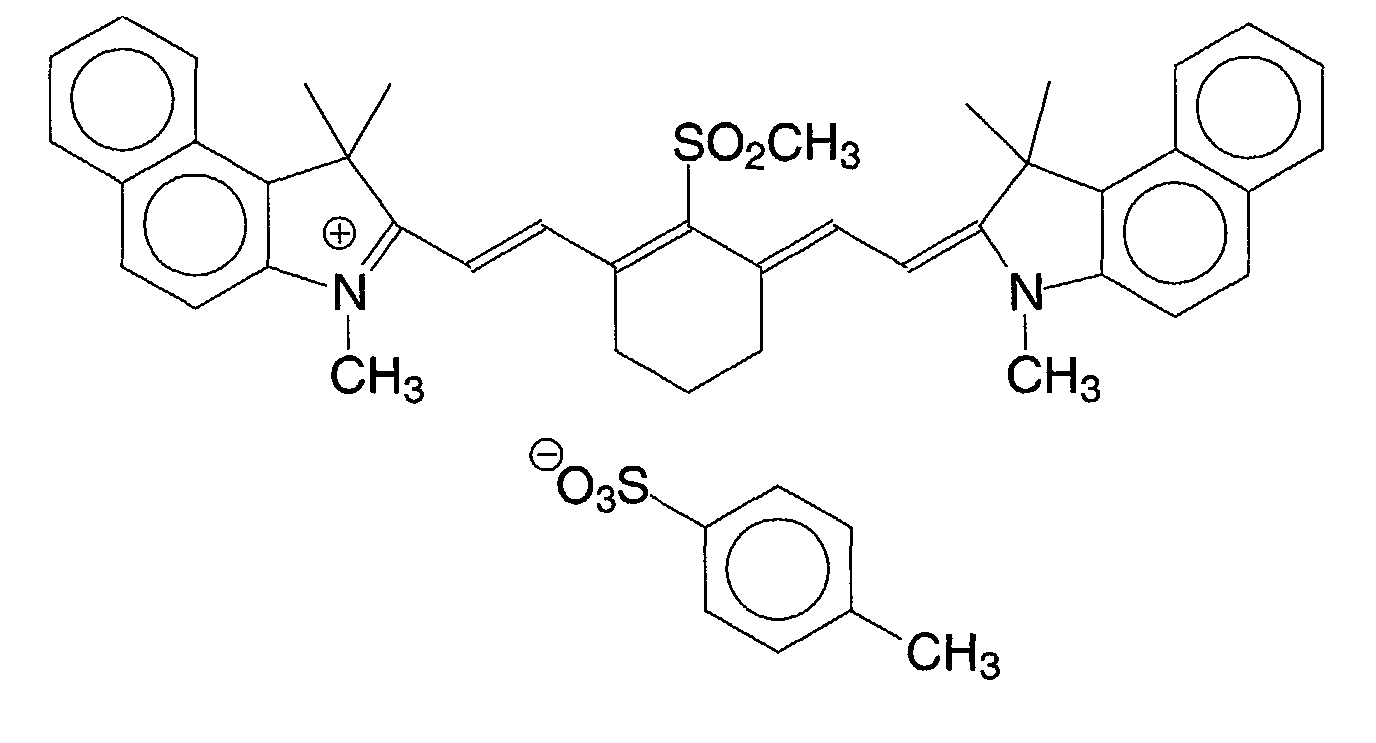

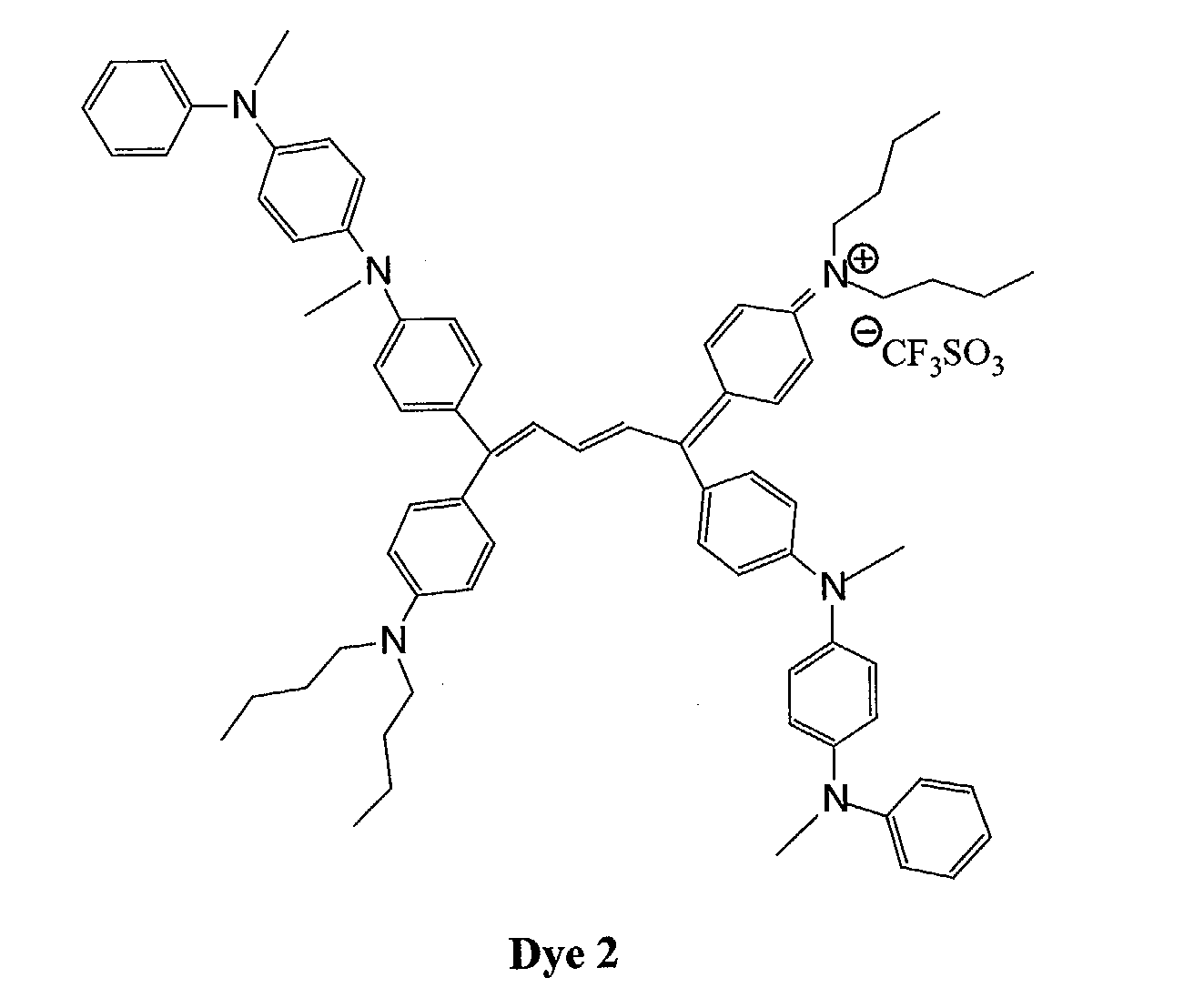


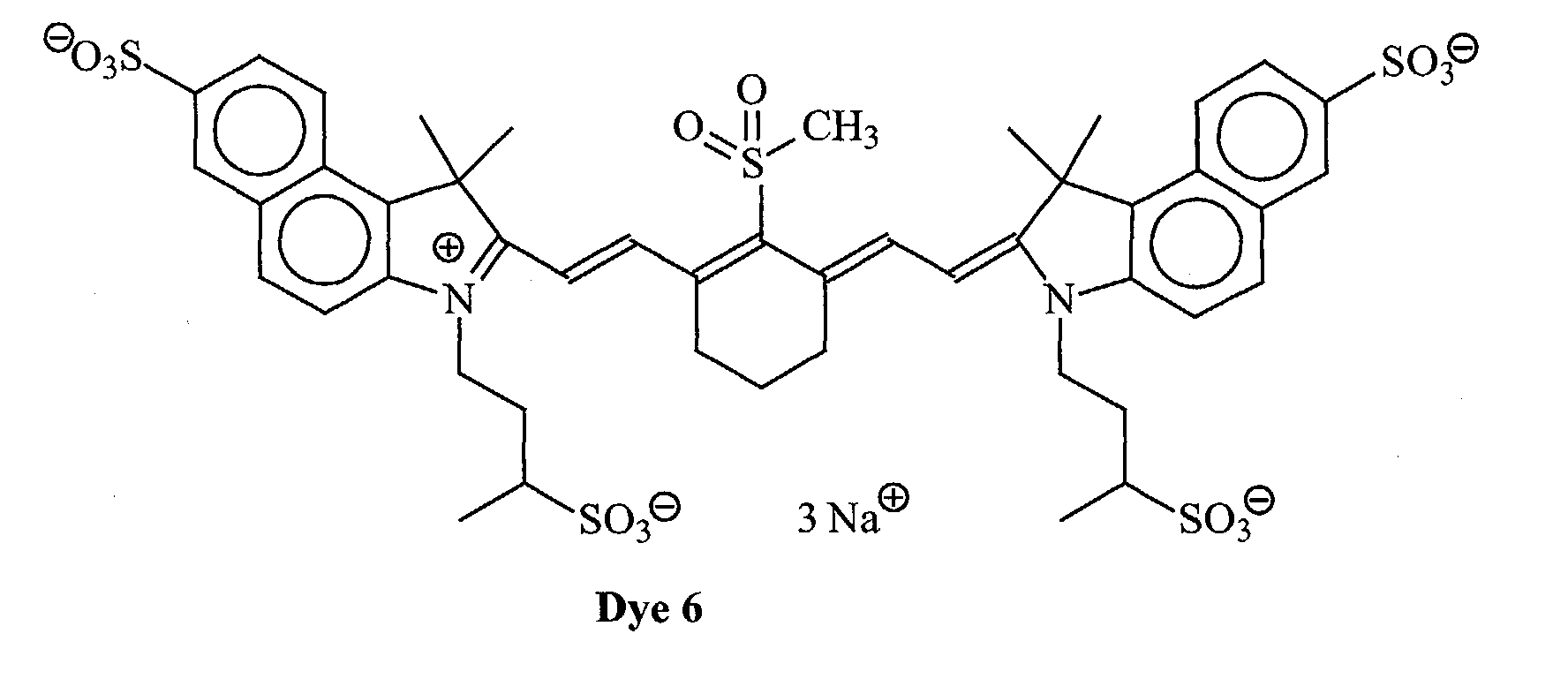
- If a stabilizer is utilized, useful stabilizers are also those which have a solubility of not less than about 0.5 milligrams per milliliter in an organic solvent such as methanol. Examples of useful stabilizers include nickel dithiolene dyes such as those described in "Nickel Dithiolene Complexes", Nakazumi, H. et al, JSDC, Vol. 106, 363-367, 1990; dithiolene dyes such as those described in "The Synthesis of Dithiolene Dyes with Strong Near -IR Absorption" Mueller-Westerhoff, U.T. et al, Tetrahedron Vol. 47, No. 6, 1991, 909-932; bisdithio-a-diketones such as those described in "Preparation, Reactions and Structure of Bisdithio-a-diketone Complexes of Nickel, Palladium and Platinum" Schtuazer, G and Mayweg, V., J. Am. Chem. Soc., 87, 1965, 1483; dithiolato nickel complexes such as those described in "The influence of dithiolato nickel complexes on the lightfastness of a thin layer of a nera infrared absorbing cyanine dye" Nakazumi, H. et al, JSDC, Vol. 105, 173-176, 1988; and bis-(thiobenzil) nickel compounds such as those described in "Bis-(thiobenzil) nickel compounds on their absorption spectra, reduction potential, and singlet oxygen quenching efficiency" Shiozaki, H. et al, JSDC, Vol. 105, 26-29,1989.
- In forming the polymer particle composition used in the invention, the IR dye and, optionally the stabilizer, are associated with polymer particles. This can be accomplished by dissolving the dye and stabilizer in a water-miscible organic solvent, mixing the solution with the polymer particles, and then removing the solvent. Useful water-miscible organic solvents are water-miscible alcohols, ketones and amides, tetrahydrofuran, N-methyl-2-pyrrolidone, dimethylsulfoxide, and mixtures thereof. Particular examples of these solvents include acetone, ethyl alcohol, methyl alcohol, isopropyl alcohol, dimethylformamide, and methyl-ethyl ketone.
- The aqueous latices that are the preferred coating compositions consist essentially of water as a continuous phase and loaded polymer particles as a dispersed phase. The loadable polymer particles are those which meet the following test: At 25°C the loadable polymer particles being tested must (a) be capable of forming a latex with water at a polymer-particle concentration of from 0.2 to 50 percent by weight, preferably 1 to 20 percent by weight, based on total weight of the latex, and (b) exhibit no observable coagulation of the polymer particles when 100 ml of the latex is then mixed in an equal volume of the water-miscible organic solvent to be employed in forming the loaded polymeric latex composition, stirred, and allowed to stand for 10 minutes.
- Aqueous latices can be prepared by free radical polymerization or by condensation polymerization. Emulsion polymerization is the preferred method of preparing polymer latices. Monomers suitable to prepare the polymer latices for this application include an acrylic acid, for example, acrylic acid, α-chloroacrylic acid, an α-alkylacrylic acid (such as methacrylic acid), an ester or amide derived from an acrylic acid (for example, acrylamide, methacrylamide, n-butylacrylamide, t-butylacrylamide, diacetone acrylamide, methyl acrylate, ethyl acrylate, n-propyl acrylate, n-butyl acrylate, ter-butyl acrylate, isobutyl acrylate, 2-ethylhexyl acrylate, n-octyl acrylate, lauryl acrylate, tetrahydrofuryl acrylate, methyl methacrylate, ethyl methacrylate, n-butyl methacrylate, β-hydroxy methacrylate, and tetrahydrofurylmethacrylate), a vinyl ester (for example, vinyl acetate, vinyl propionate, and vinyl laurate), acrylonitrile, methacrylonitrile, an aromatic vinyl compound (for example, styrene and a derivative thereof, vinyl toluene, divinyl benzene, vinyl acetophenone, and sulfostyrene), itaconic acid, citraconic acid, crotonic acid, vinylidene chloride, a vinyl alkyl ether (for example, vinyl ethyl ether), an ester of maleic acid, N-vinyl-2-pyrrolidone, N-vinylpyridine, and 2- or 4-vinylpyridine. Of these monomers, an ester of acrylic acid, an ester of methacrylic acid, and styrene and styrene derivatives are particularly preferred. Two or more ethylenic unsaturated monomers can be used together; for example, a combination of methyl acrylate and butyl acrylate, ethyl acrylate and styrene, tetrahydrofuryl methacrylate and ethylacrylate, methyl acrylate, and ethyl acrylate can be used.
- The polymer latex can be prepared by emulsion polymerization of solution polymerization technique. Emulsion polymerization is preferred. Emulsion polymerization is well known in the art and is described, for example, in F. A. Bovey, Emulsion Polymerization, issued by Interscience Publishers, Inc., New York, 1955. Examples of the chemical initiators which may be used include a thermally decomposable initiator, for example, a persulfate (such as ammonium persulfate, potassium persulfate, sodium persulfate), hydrogen peroxide, 4,4'-azobis(4-cyanovaleric acid), and redox initiators such as hydrogen peroxide-iron(II) salt, potassium persulfate-sodium hydrogensulfate, potassium persulfate-sodium metabisulfite, potassium persulfate-sodium hydrogen bisulfite, and cerium salt-alcohol. Emulsifiers which may be used in the emulsion polymerization include soap, a sulfonate (for example, sodium N-methyl-N-oleoyltaurate, sodium dodecylbenzene sulfonate alpha-olefin sulfonate, diphenyloxide disulfonate, naphthalene sulfonate, sulfosuccinates and sulfosuccinamates, polyether sulfonate, alkyl polyether sulfonate, and alkylarylpolyether sulfonate), a sulfate (for example, sodium dodecyl sulfate), a phosphate (for example, nonylphenol ethoxylate phosphate, linear alcohol alkoxylate phosphate, alkylphenol ethoxylate phosphate, phenol ethoxylate), a cationic compound (for example, cetyl trimethylammonium bromide and hexadecyl trimethylammonium bromide), an amphoteric compound and a high molecular weight protective colloid (for example, polyvinyl alcohol, polyacrylic acid, and gelatin).
- A second class of polymer latices is aqueous dispersion of polyester such as Eastman AQ® polyesters produced by the Eastman Chemicals Company. The three polyesters, Eastman AQ 29, AQ 38, and AQ 55 are composed of varying amounts of isophthalic acid, sodium sulfoisophthalic acid, diethylene glycol, and 1,4-cyclohexanedimethanol. These thermoplastic, amorphous, ionic polyesters are prepared by a melt-phase condensation polymerization at high temperature and low pressure, and the molten product is extruded into small pellets. The solid polymer disperses readily in water at 70° C. with minimal agitation to give translucent, low viscosity dispersions containing no added surfactants or solvents. Varying the amount of ionic monomers, i.e., sulfoisophthalic acid, can control the particle size. The particle sizes range from 20 to 100 nm. A third class of polymer latices is aqueous dispersion of polyurethane such as Witcobond® anionic and cationic polyurethane dispersion by Witco Corp. or Sancure® polyurethane by B.F. Goodrich Company. A review reference on the aqueous dispersible polyurethane can be found in "Progress in Organic Coatings, 9(3), 281-340 (1981), by Dieterich, D. The synthesis of water dispersible polyurethane involves: (1) condensation polymerization of diols, diisocyanate, and a functional diol such as carboxyldiol, or sulfodiol in a water miscible organic solvent such as acetone or tetrahydrofaran; (2) neutralization of the polyurethane with amines or sodium hydroxide in water; and (3) chain extension with diamines and followed by removal of the low boiling organic solvent. Examples of diols include polytetrahydrofuryl diol, poly(tetramethylene adipate) glycol, poly(caprolactone) diol, and poly(ethylenen glycol). Examples of diisocyanate include hexamtethylene diisocyanate, 4,4'-bis(isocyanatocyclohexyl)methane, or other diisocyanates disclosed in column 6 of U.S. Patent 4,147,679. Examples of the functional diols can be found in "Progress in Organic Coatings", 9(3), p. 292 (1981) by Dieterich, D.
- In a preferred preparation process, the desired dye and optional stabilizer can be dissolved in an organic solvent and added dropwise to the polymer latex solution with vigorous stirring. Dye and stabilizer concentration in the organic solvent is preferably 0.1-5% by weight, more preferably 0.5-2% by weight. The latex solution preferably contains 1-20% polymer by weight, more preferably 2-10% by weight. Then the organic solvent can be removed by evaporation and the latex solution filtered through a 0.25 µm filter to obtain a dye loaded latex stock solution. The solution can be dialyzed to remove any remaining free dye molecules in water.
- In the final composition, the weight ratio of dye to latex polymer is not critical. Typical dye to polymer weight ratios can be from 1:100 to 1:5, preferably 1:80 to 1:8, and still more preferably 1:40 to 1:8. If stabilizer is utilized, while it is desirable to have at least the same amount of stabilizer compared to the dye present, here again the ratio of dye to stabilizer is not critical. Typical dye to stabilizer weight ratios can be from 2:1 1 to 1:10 with the preferred dye to stabilizer weight ratio being between 1:1 to 1:5. In one embodiment it is preferred to have the dye in close proximity to the stabilizer on the latex particle. Thus, it is desirable to have a high amount of dye to latex polymer and a high amount of stabilizer to dye. In weight ratio terms, it is preferred to have a weight ratio of dye to polymer of 1:40 or less and, at the same time, a weight ratio of dye to stabilizer of 1:1 to 1:2.
- The loaded latex compositon may contain a colorant if a visible mark is desired. Pigments which may be used in the invention include those as disclosed, for example, in U.S. Patents 5,026,427; 5,086,698; 5,141,556; 5,160,370; and 5,169,436. The exact choice of pigments will depend upon the specific application and performance requirements such as color reproduction and image stability. Pigments suitable for use in the present invention include, for example, azo pigments, monoazo pigments, diazo pigments, azo pigment lakes, β-Naphthol pigments, Naphthol AS pigments, benzimidazolone pigments, diazo condensation pigments, metal complex pigments, isoindolinone and isoindoline pigments, polycyclic pigments, phthalocyanine pigments, quinacridone pigments, perylene and perinone pigments, thioindigo pigments, anthrapyrimidone pigments, flavanthrone pigments, anthanthrone pigments, dioxazine pigments, triarylcarbonium pigments, quinophthalone pigments, diketopyrrolo pyrrole pigments, titanium oxide, iron oxide, and carbon black. Typical examples of pigments which may be used include Color Index (C. I.) Pigment Yellow 1, 2, 3, 5, 6, 10, 12, 13, 14, 16, 17, 62, 65, 73, 74, 75, 81, 83, 87, 90, 93, 94, 95, 97, 98, 99, 100, 101, 104, 106, 108, 109, 110, 111, 113, 114, 116, 117, 120, 121, 123, 124, 126, 127, 128, 129, 130, 133, 136, 138, 139, 147, 148, 150, 151, 152, 153, 154, 155, 165, 166, 167, 168, 169, 170, 171, 172, 173, 174, 175, 176, 177, 179, 180, 181, 182, 183, 184, 185, 187, 188, 190, 191, 192, 193, 194; C. I. Pigment Orange 1, 2, 5, 6, 13, 15, 16, 17, 17:1, 19, 22, 24, 31, 34, 36, 38, 40, 43, 44, 46, 48, 49, 51, 59, 60, 61, 62, 64, 65, 66, 67, 68, 69; C. I. Pigment Red 1, 2, 3, 4, 5, 6, 7, 8, 9, 10, 11, 12, 13, 14, 15, 16, 17, 18, 21, 22, 23, 31, 32, 38, 48:1, 48:2, 48:3, 48:4, 49:1, 49:2, 49:3, 50:1, 51, 52:1, 52:2, 53:1, 57:1, 60:1, 63:1, 66, 67, 68, 81, 95, 112, 114, 119, 122, 136, 144, 146, 147, 148, 149, 150, 151, 164, 166, 168, 169,170,171,172,175,176,177,178,179,181,184,185,187,188,190, 192,194,200,202,204,206,207,210,211,212,213,214,216,220,222,237, 238,239,240,242,243,245,247,248,251,252,253,254,255,256,258,261, 264; C.I. Pigment Violet 1, 2, 3, 5:1, 13, 19, 23, 25, 27, 29, 31, 32, 37, 39, 42, 44, 50; C.I. Pigment Blue 1, 2, 9, 10, 14, 15:1, 15:2, 15:3, 15:4, 15:6, 15, 16, 18, 19, 24:1, 25, 56, 60, 61, 62, 63, 64, 66; C.I. Pigment Green 1, 2, 4, 7, 8, 10, 36, 45; C.I. Pigment Black 1, 7, 20, 31, 32, and C.I. Pigment Brown 1, 5, 22, 23, 25, 38, 41,42.
- A broad range of water-insoluble dyes may be used in the invention such as an oil dye, a disperse dye, or a solvent dye, such as Ciba-Geigy Orasol Red G, Ciba-Geigy Orasol Blue GN, Ciba-Geigy Orasol Pink, and Ciba-Geigy Orasol Yellow. Preferred water-insoluble dyes can be xanthene dyes, methine dyes, polymethine dyes, anthroquinone dyes, merocyanine dyes, azamethine dyes, azine dyes, quinophthalone dyes, thiazine dyes, oxazine dyes, phthalocyanine dyes, mono or poly azo dyes, and metal complex dyes. More preferably, the water insoluble dyes can be an azo dye such as a water insoluble analog of the pyrazoleazoindole dye disclosed in U.S. Patent 6,468,338, and the arylazoisothiazole dye disclosed in U. S. Patent 4,698,651, or a metal-complex dye, such as the water-insoluble analogues of the dyes described in U.S. Patents 5,997,622 and 6,001,161, i.e., a transition metal complex of an 8-heterocyclylazo-5-hydroxyquinoline.
- A broad range of water-soluble dyes can be used in this invention. Examples of a water soluble dye include a reactive dye, direct dye, anionic dye, acid dye, basic dye, phthalocyanine dye, methine or polymethine dye, merocyanine dye, azamethine dye, azine dye, quinophthalone dye, thiazine dye, oxazine dye, anthraquinone, a metal-complex dye, or dyes as disclosed in U.S. Patent 5,973,026. In a preferred embodiment of the invention, the water-soluble dye may be an anionic dye. Anionic dyes which may be used include a mono or poly azo dye, such as a pyrazoleazoindole dye as disclosed in U.S. Patent 6,468,338, a metal-complex dye, such as the transition metal complexes as disclosed in U.S. Patents 5,997,622 and 6,001,161, i.e., a transition metal complex of an 8-heterocyclylazo-5-hydroxyquinoline; phthalocyanine dyes such as C. I. Direct Blue 199; C. I. Direct Blue 307; Reactive Black 31, Reactive Red 31, anthraquinone dyes, or anthrapyridone dyes, as disclosed, for example, in U.S. Patent 6,152,969; EP 1,063,268; EP 1,067,155; WO 00/23440; WO 01/18123; JP 2000-256587; and JP 2001-072884.
- A final printing ink composition which comprises a latex composition having water as a continuous phase and, as the dispersed phase, hydrophobic polymer particles having associated therewith an infrared dye, can be prepared by proper dilution of the dye loaded latex stock solution with distilled water and appropriate surfactants, humectants, and other ink colorants or additives known in the art. The concentration of the dye material in the ink solution can be 0.005%~1% by weight, preferably 0.01%~0.5% by weight. As noted, various additives may be added to the inks of the invention. Suitable additives, which may be dependent on the type of printer utilized, include surfactants, surface active agents, defoaming agents, corrosion inhibitors, and biocides.
- Preferred surface active agents or surfactants are the nonionic types containing polyalkylene oxide moieties. A particularly preferred type of nonionic surfactant is obtained by ethoxylating acetylenic diols, such as ethoxylated tetramethyl decynediol (Surfynol® 465, provided by Air Products and Chemicals, Inc., Allentown, Pa. 18195) that can be added at 0.5%-2% by weight, with the presence of 2-10% glycerol, 2-10% diethyleneglycol, 2-10% propanol, and 0%-2% triethanolamine. The activity of the surfactant may be controlled by addition of a defoaming agent or defoamer. A preferred defoamer is comprised of a mixture of tetramethyldecynediol and propylene glycol (Surfynol® 104 PG, provided by Air Products and Chemicals, Inc., Allentown, PA 18195). The term biocide is used to describe various antifungal compounds used to prevent or control the growth of various fungi upon prolonged standing of the ink compositions. A useful biocide is 1,2-benzisothiazolin-3-one (Proxel®GXL, ICI Americas Inc., Wilmington, DE 19897).
- Corrosion inhibitors are added to the ink formulations to inhibit or reduce corrosion of the metal parts, particularly the nozzles/orifices, of the ink jet printers. A preferred class of corrosion inhibitors are the 1H-benzotriazoles and 1H-benzotriazole itself is the preferred corrosion inhibitor (Cobratec® 99, PMC Specialties, Cincinnati, OH).
- The printing ink composition is printed onto to the back side of the silver halide photographic display element using a Gravuere printer or other means known to those skilled in the art, such as an inkjet printer. By the "back side" of the display element is meant on the opposite side of the support from the silver halide imaging layers. By the "front side" of the display element is meant the side of the display element comprising the imaging layers. Generally the printing ink will be applied to the outermost surface of the back side of the display element, but it is possible that another layer, such as a protective layer, might be coated over the printing ink composition. After application, the composition is coalesced on the surface. Coalescence can be accomplished by simply drying the composition. Alternatively, some heat may be applied to facilitate coalescence.
- The printing ink composition can be applied in a logo or pattern that represents digital data or which merely provides an infrared or optical signal. For media detection, a media such as photographic paper, that has a printed detectable logo pattern or indicia on the backside can pass under a photo sensor, or optionally, a photo sensor can pass over stationary media. An infrared (IR) source directs an IR beam onto the surface or backside of media while a photo sensor detects IR illumination reflected off the surface of the media. The presence of an IR absorbing logo, or a reflectivity difference in the media, changes the amount of reflected IR illumination and, therefore, changes the signal produced by the sensor. Within the context of the present invention, IR illumination is used so that no damage will occur to visible light sensitive photographic paper and so that invisible marking may be utilized.
- The signal from the sensor is generally passed through conditioning electronics, such as amplifiers or filters, to improve the sensor signals and prepare it for conversion to digital form by an analog to digital converter or digitizer by way of a micro-controller or computer. The digital data are thereafter placed into a buffer for processing by a Digital Signal Processor (DSP) or other computer of appropriate processing capacity such as micro-controller or computer. System operation begins with a start signal from a host or a system computer to the micro-controller. Thereafter, a result signal from the micro-controller is passed to the system or host computer.
- One method of utilizing such information relates to a method of detecting a type of media for use in an imaging apparatus which comprises the steps of directing a beam of infrared illumination onto a backside of media and detecting the presence of the indicia on the backside of the media based on the infrared illumination reflected from the backside of the media. Another method comprises directing a beam of infrared illumination onto the backside of media having repeating indicia thereon and detecting the infrared illumination reflected from the backside of the media to provide for a first signal; detecting a change in the reflected infrared illumination when the repeating indicia receives the beam of infrared illumination to provide for a second signal; calculating a repeat distance of the indicia based on the first and second signals, and comparing the calculated repeat distance to stored indicia repeat distances for reference media to determine the type of media, as described in more detail in U.S. Application Serial No. 10/144,487 filed May 13, 2002.
- Commercial inkjet printers such as HP Deskjet 560 or Epson Stylus Color 200 can used for testing, with a printing resolution of 300 or 360 dpi. For infrared markings, either logos, trademark symbols, step-wedge files, or bar code can be printed digitally onto various supports at the visual reflection density of 0.01-1.0, preferably 0.05-0.4. Commercial rubber stamps can be used to apply the ink to a surface for evaluation purposes. Alternatively the inks may be sprayed using an airbrush. One airbrush used in this invention was purchased from Badger Air-Brush Co., 9128 W. Belmont Ave., Franklin Park, IL 60131 (Model 200).
- The silver halide emulsions utilized in this invention may be comprised of, for example, silver chloride, silver bromide, silver bromoiodide, silver bromochloride, silver iodochloride, silver bromoiodochloride, and silver iodobromochloride emulsions. The silver halide emulsions are preferably predominantly silver chloride emulsions. By predominantly silver chloride, it is meant that the grains of the emulsion are greater than about 50 mole percent silver chloride. Preferably, they are greater than about 90 mole percent silver chloride; and optimally greater than about 95 mole percent silver chloride.
- It is contemplated that the predominantly silver chloride emulsions may take the form of a variety of morphologies including those with cubic, tabular and tetradecahedral grains with {111} and {100} crystal faces. The grains may take the form of any of the naturally occurring morphologies of cubic lattice type silver halide grains. Further, the grains may be irregular such as spherical grains. Additionally, these emulsions may contain iodides or bromides of less than 10% of the total halide composition.
- The grains can be contained in any conventional dispersing medium capable of being used in photographic emulsions. Specifically, it is contemplated that the dispersing medium be an aqueous gelatino-peptizer dispersing medium, of which gelatin--e.g., alkali treated gelatin (cattle bone and hide gelatin) or acid treated gelatin (pigskin gelatin) and gelatin derivatives--e.g., acetylated gelatin and phthalated gelatin are specifically contemplated. When used, gelatin is preferably at levels of 0.01 to 100 grams per total silver mole
- The photographic display elements of the invention can be black-and-white elements, including chromogenic black-and-white elements, single color elements, or multicolor elements. The supports utilized in this invention are generally reflective supports such as are known in the art. Multicolor elements contain image dye-forming units sensitive to each of the three primary regions of the spectrum. Each unit can comprise a single emulsion layer or multiple emulsion layers sensitive to a given region of the spectrum. The layers of the element, including the layers of the image-forming units, can be arranged in various orders as known in the art. In an alternative format, the emulsions sensitive to each of the three primary regions of the spectrum can be disposed as a single segmented layer.
- A typical multicolor photographic element comprises a support bearing a cyan dye image-forming unit comprised of at least one red-sensitive silver halide emulsion layer having associated therewith at least one cyan dye-forming coupler, a magenta dye image-forming unit comprising at least one green-sensitive silver halide emulsion layer having associated therewith at least one magenta dye-forming coupler, and a yellow dye image-forming unit comprising at least one blue-sensitive silver halide emulsion layer having associated therewith at least one yellow dye-forming coupler. The element can contain additional layers, such as filter layers, interlayers, overcoat layers, and subbing layers. In one suitable embodiment the pyrimidine compounds utilized in the invention are added to the yellow dye image-forming unit either in the silver halide emulsion or in the coupler dispersion.
- If desired, the photographic element can be used in conjunction with an applied magnetic layer as described in Research Disclosure, November 1992, Item 34390 published by Kenneth Mason Publications, Ltd., Dudley Annex, 12a North Street, Emsworth, Hampshire PO10 7DQ, ENGLAND.
- In the following Table, reference will be made to (1) Research Disclosure, December 1978, Item 17643, (2) Research Disclosure, December 1989, Item 308119, (3) Research Disclosure, September 1994, Item 36544, and (4) Research Disclosure, September 1996, Item 38957, all published by Kenneth Mason Publications, Ltd., Dudley Annex, 12a North Street, Emsworth, Hampshire PO10 7DQ, ENGLAND. The Table and the references cited in the Table are to be read as describing particular components suitable for use in the elements of the invention. The Table and its cited references also describe suitable ways of preparing, exposing, processing and manipulating the elements, and the images contained therein. High chloride photographic elements and methods of processing such elements particularly suitable for use with this invention are described in Research Disclosure, February 1995, Item 37038, in Research Disclosure, September 1997, Item 40145 and, of particular interest, Research Disclosure, September 2000, Item 437013 published by Kenneth Mason Publications, Ltd., Dudley Annex, 12a North Street, Emsworth, Hampshire PO10 7DQ, ENGLAND.
Reference Section Subject Matter 1 I, II Grain composition, morphology and preparation. Emulsion preparation including hardeners, coating aids, addenda, etc. 2 I, II, IX, X, XI, XII, XIV, XV 3 & 4 I, II, III, IX A & B 1 III, IV Chemical sensitization and spectral sensitization/ desensitization 2 III, IV 3 & 4 IV, V 1 V UV dyes, optical brighteners, luminescent dyes 2 V 3 & 4 VI 1 VI Antifoggants and stabilizers 2 VI 3 & 4 VII 1 VIII Absorbing and scattering materials; Antistatic layers; matting agents 2 VIII, XIII, XVI 3 & 4 VIII, IX C & D 1 VII Image-couplers and image-modifying couplers; Wash-out couplers; Dye stabilizers and hue modifiers 2 VII 3 & 4 X 1 XVII Supports 2 XVII 3 & 4 XV 3 & 4 XI Specific layer arrangements 3 & 4 XII, XIII Negative working emulsions; Direct positive emulsions 2 XVIII Exposure 3 & 4 XVI 1 XIX, XX Chemical processing; Developing agents 2 XIX, XX, XXII 3 & 4 XVIII, XIX, XX 3 & 4 XIV Scanning and digital processing procedures - The photographic elements may utilize any traditional support known to those skilled in the art. One conventional photographic quality paper comprises cellulose paper with polyethylene resin waterproof coatings. The support may also consist of a multilayer film of biaxially oriented polyolefin which is attached to both the top and bottom of a photographic quality paper support by melt extrusion of a polymer tie layer. The biaxially oriented films may contain a plurality of layers in which at least one of the layers contains voids. The voids provide added opacity to the imaging element. This voided layer can also be used in conjunction with a layer that contains at least one pigment from the group consisting of TiO2, CaCO3, clay, BaSO4, ZnS, MgCO3, talc, kaolin, or other materials that provide a highly reflective white layer in said film of more than one layer. The combination of a pigmented layer with a voided layer provides advantages in the optical performance of the final image. These supports are described in more detail in U.S. Patents 5,866,282; 5,888,681; 6,030,742; 6,030,759; 6,107,014; and 6,153,351. Such biaxially oriented films may also be utilized for display materials having translucent or transparent supports.
- The photographic elements comprising the radiation sensitive high chloride emulsion layers can be conventionally optically printed, or can be imagewise exposed in a pixel-by-pixel mode using suitable high energy radiation sources typically employed in electronic printing methods. Suitable actinic forms of energy encompass the ultraviolet, visible, and infrared regions of the electromagnetic spectrum, as well as electron-beam radiation and is conveniently supplied by beams from one or more light emitting diodes or lasers, including gaseous or solid state lasers. Exposures can be monochromatic, orthochromatic, or panchromatic. For example, when the recording element is a multilayer multicolor element, exposure can be provided by laser or light emitting diode beams of appropriate spectral radiation, for example, infrared, red, green or blue wavelengths, to which such element is sensitive. Multicolor elements can be employed which produce cyan, magenta, and yellow dyes as a function of exposure in separate portions of the electromagnetic spectrum, including at least two portions of the infrared region, as disclosed in the previously mentioned U.S. Patent No. 4,619,892. Suitable exposures include those up to 2000 nm, preferably up to 1500 nm. Suitable light emitting diodes and commercially available laser sources are known and commercially available. Imagewise exposures at ambient, elevated or reduced temperatures and/or pressures can be employed within the useful response range of the recording element determined by conventional sensitometric techniques, as illustrated by T.H. James, The Theory of the Photographic Process, 4th Ed., Macmillan, 1977, Chapters 4, 6, 17, 18, and 23.
- The quantity or level of high energy actinic radiation provided to the recording medium by the exposure source is generally at least 10-4 ergs/cm2, typically in the range of about 10-4 ergs/cm2 to 10-3 ergs/cm2, and often from 10-3 ergs/cm2 to 102 ergs/cm2. Exposure of the recording element in a pixel-by-pixel mode as known in the prior art persists for only a very short duration or time. Typical maximum exposure times are up to 100 µ seconds, often up to 10 µ seconds, and frequently up to only 0.5 µ seconds. Single or multiple exposures of each pixel are contemplated. The pixel density is subject to wide variation, as is obvious to those skilled in the art. The higher the pixel density, the sharper the images can be, but at the expense of equipment complexity. In general, pixel densities used in conventional electronic printing methods of the type described herein do not exceed 107 pixels/cm2 and are typically in the range of about 104 to 106 pixels/cm2. An assessment of the technology of high-quality, continuous-tone, color electronic printing using silver halide photographic paper which discusses various features and components of the system, including exposure source, exposure time, exposure level and pixel density, and other recording element characteristics are provided in Firth et al, A Continuous-Tone Laser Color Printer, Journal of Imaging Technology, Vol. 14, No. 3, June 1988. A description of some of the details of conventional electronic printing methods, comprising scanning a recording element with high energy beams such as light emitting diodes or laser beams, are set forth in Hioki U.S. Patent 5,126,235, European Patent Applications 479 167 A1 and 502 508 A1.
- The photographic elements can then be processed to form a visible dye image. Processing to form a visible dye image includes the step of contacting the element with a color developing agent to reduce developable silver halide and oxidize the color developing agent. Oxidized color developing agent in turn reacts with the coupler to yield a dye. With negative-working silver halide, the processing step described above provides a negative image. In one embodiment the described elements can be processed in the known color print processes such as the RA-4 process of Eastman Kodak Company, Rochester, New York.
- The following examples illustrate the practice of this invention. They are not intended to be exhaustive of all possible variations of the invention. Parts and percentages are by weight unless otherwise indicated.
- In the examples, light stability was evaluated for 1 week at 5.4 Klux daylight, and the stability was evaluated based on the percent reflectance loss of the printed sample at dye concentration of 0.025% by weight in ink. The reflection spectra were obtained with the HP Lambda 19 UV/Vis/NIR spectrometer with an integrating sphere using an aperture mask to allow only the coated area of the paper to be measured.
- The following comparative dyes were used in the examples.


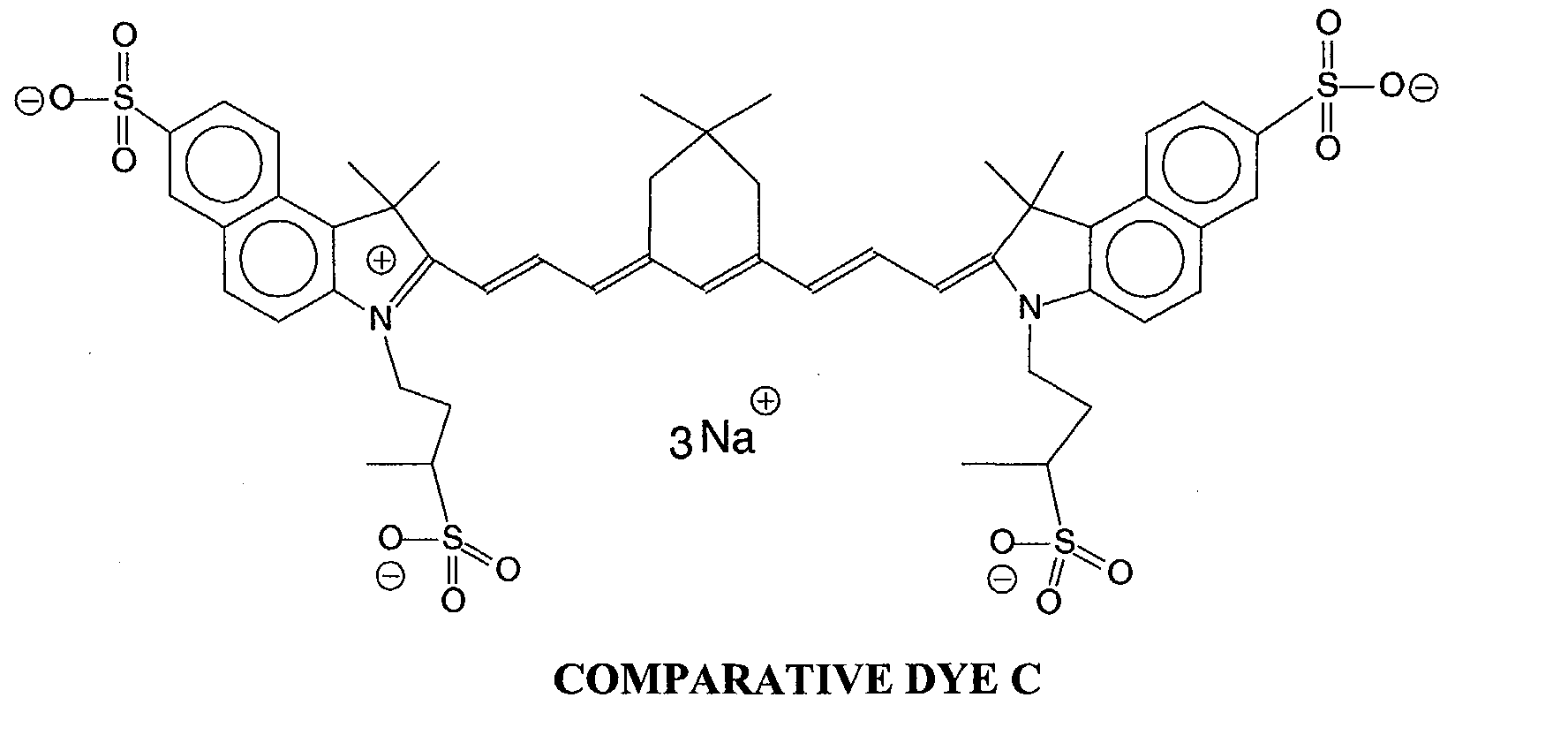
- The following polymer latices were used in the examples.


- To prepare comparative printing ink, 3.75 mg of the water soluble dye (A), 0.15g Surfynol® 465 (from Air Products), 0.75 g glycerol, 0.6 g diethyleneglycol, 0.75 g propanol were added to 5.4 g distilled water. The final ink contained 0.025% wt dye, and 1% wt Surfynol 465, 5% wt glycerol, 4% wt diethyleneglycol and 5% wt propanol. The solution was filtered through a 0.45 µm filter and filled into a refillable inkjet cartridge. A step wedge image was printed on a Kodak medium weight photographic quality inkjet paper with an Epson 200 inkjet printer at 360 dpi resolution or a Hewlett-Packard Deskjet 560 printer at 360 dpi resolution. The sample was then irradiated at 5.4 Klux daylight for a week; the light stability was calculated based on the percent density loss of the sample at λmax at the highest density step. The results are shown in Table 1.
- To 8.6 g of the stock solution of polymer latex (P-3) (29% wt) stock solution was added 16.4 g of water and 25.0 g of methanol. The resulting composition was stirred vigorously at room temperature to form the latex solution. To prepare a dye solution, 12.5 mg of dye (1) was dissolved in a mixture of 2.5 ml of methanol and 2.5 ml of methylene chloride. The dye solution was then added dropwise to the latex solution with continuous stirring. After 1 hour, the organic solvent was removed under reduced pressure. The resulting dye (1) loaded latex stock solution was filtered through a 0.45 µm filter. The concentration of dye (1) in the latex stock solution was estimated to be 500 ppm, and the polymer concentration was ~10% by weight.
- A dye loaded latex stock solution similar to inventive Sample 1 was prepared except that dye (1) was replaced with dye (2) and was loaded onto polymer latex (P-3).
- In general, the prepared inkjet ink solution was filled into a refillable inkjet cartridge. To prepare the ink containing dye loaded latex, 15 g Surfynol® 465 (from Air Product), 0.75 g glycerol, 0.6 g diethyleneglycol, 0.75 g propanol was added to a calculated amount of the dye loaded stock solution prepared above. A makeup amount of distilled water was added so that the final ink contains 0.025% wt dye, and 1% wt Surfynol® 465, 5% wt glycerol, 4% wt diethyleneglycol and 5% wt propanol. The total amount of final ink solution was 15.0 g. The solution was filtered through a 0.45 µm filter and filled into a refillable cartridge.
- A step wedge image was printed on a Kodak medium weight photographic quality inkjet paper with an Epson 200 inkjet printer at 360 dpi resolution. The sample was then irradiated under 5.4 Klux daylight for a week; the light stability was calculated based on the percent density loss of the sample at λmax for the highest density step. The results are shown in Table 1.
Sample Dye Polymer λmax (nm) Light Stability (5.4klux daylight, 1 week) % Reflectance @904 nm (Before) % Reflectance @904 nm (Before) % Loss C-A (A) - 882 - - -100.0 1 (1) AQ55 890 51.90 67.89 -31 2 (2) AQ55 860 60.49 62.79 -4 - The advantage of the ability of using organic soluble dyes such as the inventive dyes in a water based ink is obvious from the above examples, since the water soluble dyes, especially infrared dyes, are sometimes not easily accessible. It is clear from Table 1 that loading dyes onto latex polymers did also enhance the light stability of the dye (1) significantly.
- The results also show that dye (2) is the preferred dye for printing compositions of the invention. This dye shows the least amount of fade.
- A sample similar to Comparative Sample A of Element 1 was prepared except that comparative dye C-A was replaced with comparative dye C-B:
- A sample similar to Comparative Sample 1-A was prepared except that comparative dye C-B was replaced with comparative dye C-C:
- A sample similar to Inventive Sample 1 of Example 1 was prepared except that dye 1 was replaced with inventive dye 2:
- A sample similar to Inventive Sample 1 was prepared except that dye 2 was replaced with dye 3:
- A sample similar to Inventive Sample 2 was prepared except that dye 3 was replaced with inventive dye 4:
- Inks were made similar to that described in Example 1 and each printed using an HP-560 inkjet printer in the form of an image patch onto Kodak Premium Glossy inkjet media. Each patch was read before and after a week sitting in the dark at ambient atmosphere and read using a Perkin-Elmer Lambda 19 spectrophotometer fitted with a reflectance sphere. The data is presented in Table 2.
Sample Dye Polymer λmax (nm) Dark Stability (1 week) Reflectance Density @λ max (Before) Reflectance Density @λmax (Before) %Loss C-A (B) - 882 0.4 -0.15 -62.5 C-B (C) - 935 0.4 -0.20 -50 1 (2) AQ55 835 0.2 0.2 -0 2 (3) AQ55 933 0.25 0.22 -12 3 (4) AQ55 933 0.2 62.01 -15 - The data shown in Table 2 clearly indicate that there is an advantage when dyes are loaded on latex.
- Infrared density was imparted into preformed colored printing inks by adding the appropriate inventive latex-loaded IR material. By matching the appropriate inks with IR containing latex the impact of the addition of the IR density was minimal. The inks were printed on the surface of non-coated Kodak photographic paper as described in Control Sample 4. The table shows the IR density of the printed samples before and after the addition of the inventive IR materials:
- A solution of 10 mL of a cyan ink, Novajet Cyan B/NJY/LYS/1 (commercially purchased Lyson Incorporated, Suite 123, 1550 Higgins Road, Elk Grove Village, IL 60007) was loaded on a sponge. A rubber stamp was then used to apply the ink to the surface of non-coated Kodak photographic paper. The optical density of the mark was read using a Perkin Elmer UV/VIS/NIR (Lambda 19 RSA-PE-19) spectrometer fitted with the Reflectance Spectroscopy Assessory.
- An ink was prepared similar to control Sample 4 except that 1 mL of the IR ink described in Inventive Sample 2, Example 2 was added.
- This Sample is similar to control Sample 4 except that the cyan ink was replaced with 10 mL of Novajet yellow (B/NJY/LYS/1).
- An ink was prepared similar to Inventive Sample 4 except that the IR ink described in Inventive Sample 2 was replaced with 1 mL of the ink prepared in inventive Sample 3, Example 2.
- This Sample is similar to control Sample 4 except that the cyan ink was replaced with 10 mL of Novajet Magenta (B/NJM/LYS/1).
- An ink was prepared similar to inventive Sample 4 except that Novajet Cyan ink was replaced with the colorant shown below.

- This Sample is similar to control Sample 4 except that the cyan ink was replaced with 10 mL of Novajet Black (B/NJB/LYS/1).
- An ink was prepared similar to inventive Sample 4 except that the IR ink described in Inventive Sample 4 was replaced with 1 mL of an ink similar to the ink prepared in Inventive Sample 3, Example 1, except that dye 4 was replaced with dye 5.
- An ink was used similar to control Sample 3 except the Novajet Yellow was replaced with Pigment Yellow 155 (CAS Registry # 68134-22-5), purchased commercially from Clarient Corporation (Coventry Sample Department, 500 Washington St., Coventry, RI 02816)
- An ink was prepared similar to control Sample 8 except that 1 mL of the IR ink described in Inventive Sample 2, Example 1, was added.
Visible abs. Max Visible OD Near Infared abs. Max Near Infrared OD Control Sample 4 670 nm 0.40 None none Inventive Sample 4 670 nm 0.72 860 nm 0.42 Control Sample 5 440 nm 0.56 None none Inventive Sample 5 440 nm 0.81 960 nm 0.32 Control Sample 6 550 nm 0.38 None none Inventive Sample 6 550 nm 0.42 860 mn 0.23 Control Sample 7 400-680 nm 0.38 none none Inventive Sample 7 400-680 nm 0.42 890 nm 0.23 Control Sample 8 450 nm 0.35 none none Inventive Sample 8 450 nm 0.40 870 nm 0.3
Claims (10)
- A silver halide photographic display element comprising a support, a front side which has at least one silver halide emulsion layer, and a back side, said front and back sides being on opposite sides of the support; wherein said photographic element further comprises printed on the back side a printing ink composition comprising coalesced hydrophobic polymer particles having associated therewith an infrared absorbing dye.
- The silver halide photographic display element of claim 1 wherein the printing ink composition further comprises a colorant.
- The silver halide photographic display element of claims 1 and 2 wherein the printing ink composition forms a pattern or logo capable of being detected by a sensor.
- The silver halide photographic display element of claims 1 and 2 wherein the infrared dye is a squaric acid dye, a cyanine dye, or a tetraarylmethine dye.
- The silver halide photographic display element of claims 1 and 2 wherein the infrared dye is

- A process for producing a display element having printed on the back side a printing ink composition comprising coalesced hydrophobic polymer particles having associated therewith an infrared absorbing dye, comprising the steps of:(1) printing a latex composition having water as a continuous phase and, as the dispersed phase, hydrophobic polymer particles having associated therewith an infrared dye, in a digital pattern to said surface of said display element, and(2) coalescing said latex.
- The process of claim 6 wherein the printing ink composition further comprises a colorant.
- The process of claims 6 and 7 wherein the printing ink composition forms a pattern or logo capable of being detected by a sensor.
- The process of claims 6 and 7 wherein the infrared dye is a squaric acid dye, a cyanine dye, or a tetraarylmethine dye.
- The process of claims 6 and 7 wherein the infrared dye is
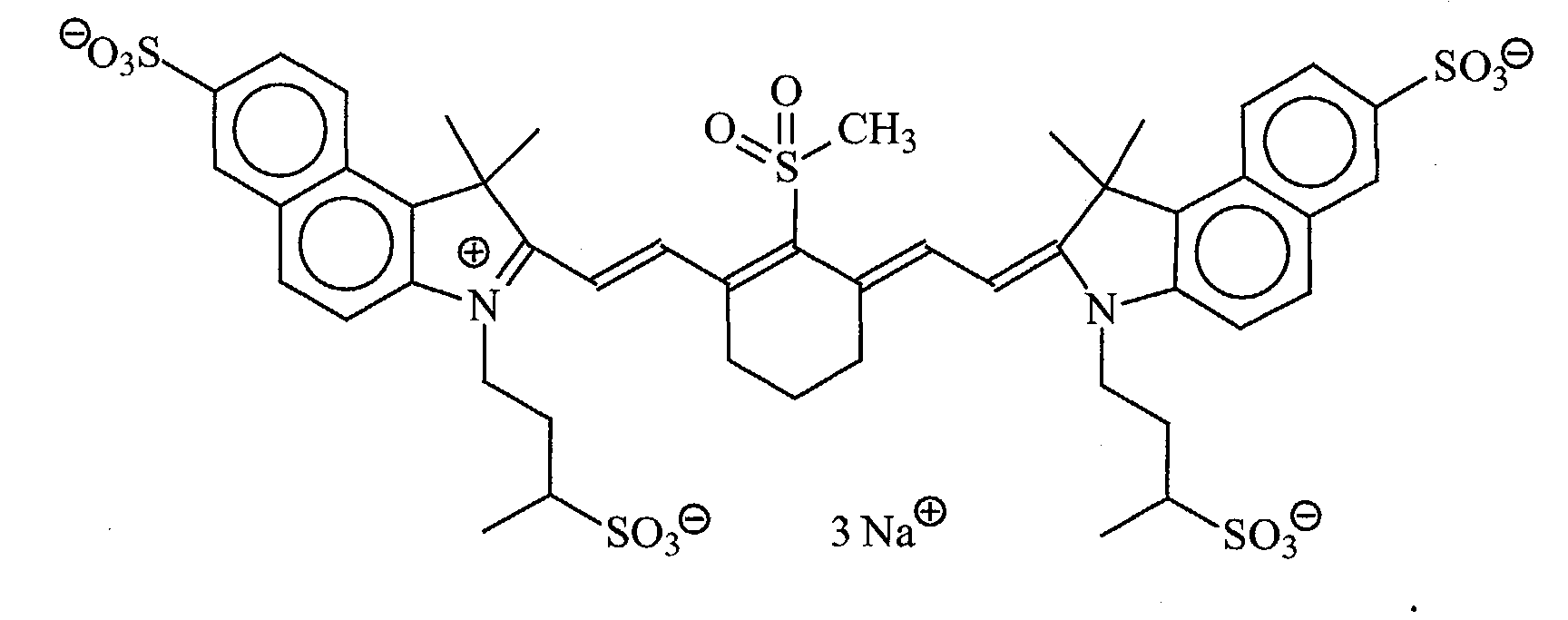
Applications Claiming Priority (2)
| Application Number | Priority Date | Filing Date | Title |
|---|---|---|---|
| US30054202A | 2002-11-20 | 2002-11-20 | |
| US300542 | 2002-11-20 |
Publications (1)
| Publication Number | Publication Date |
|---|---|
| EP1422274A1 true EP1422274A1 (en) | 2004-05-26 |
Family
ID=32229874
Family Applications (1)
| Application Number | Title | Priority Date | Filing Date |
|---|---|---|---|
| EP03078523A Withdrawn EP1422274A1 (en) | 2002-11-20 | 2003-11-10 | Display element with a backprint |
Country Status (3)
| Country | Link |
|---|---|
| EP (1) | EP1422274A1 (en) |
| JP (1) | JP2004170989A (en) |
| CN (1) | CN1502479A (en) |
Cited By (1)
| Publication number | Priority date | Publication date | Assignee | Title |
|---|---|---|---|---|
| US10509340B2 (en) | 2016-10-17 | 2019-12-17 | Hp Printing Korea Co., Ltd. | Image forming apparatus and method for color registration correction |
Families Citing this family (1)
| Publication number | Priority date | Publication date | Assignee | Title |
|---|---|---|---|---|
| US6831163B2 (en) * | 2002-12-26 | 2004-12-14 | Eastman Kodak Company | Bichromophoric molecules |
Citations (5)
| Publication number | Priority date | Publication date | Assignee | Title |
|---|---|---|---|---|
| EP0735120A2 (en) * | 1995-03-28 | 1996-10-02 | Videojet Systems International, Inc. | A jet ink composition |
| EP0933407A1 (en) * | 1998-02-02 | 1999-08-04 | Ncr International Inc. | Flexographic security ink with near infrared fluorophores |
| EP0933227A2 (en) * | 1998-02-02 | 1999-08-04 | Ncr International Inc. | Print media with near infrared fluorescent sense mark and printer therefor |
| US6361916B1 (en) * | 1999-12-14 | 2002-03-26 | Eastman Kodak Company | Loaded latex compositions with dye and stabilizer |
| WO2002083798A1 (en) * | 2001-04-17 | 2002-10-24 | Gentex Corporation | Ink compositions involving near-infrared absorber dyes and use in ink jet printing devices |
-
2003
- 2003-11-10 EP EP03078523A patent/EP1422274A1/en not_active Withdrawn
- 2003-11-19 JP JP2003388968A patent/JP2004170989A/en active Pending
- 2003-11-20 CN CNA2003101198524A patent/CN1502479A/en active Pending
Patent Citations (5)
| Publication number | Priority date | Publication date | Assignee | Title |
|---|---|---|---|---|
| EP0735120A2 (en) * | 1995-03-28 | 1996-10-02 | Videojet Systems International, Inc. | A jet ink composition |
| EP0933407A1 (en) * | 1998-02-02 | 1999-08-04 | Ncr International Inc. | Flexographic security ink with near infrared fluorophores |
| EP0933227A2 (en) * | 1998-02-02 | 1999-08-04 | Ncr International Inc. | Print media with near infrared fluorescent sense mark and printer therefor |
| US6361916B1 (en) * | 1999-12-14 | 2002-03-26 | Eastman Kodak Company | Loaded latex compositions with dye and stabilizer |
| WO2002083798A1 (en) * | 2001-04-17 | 2002-10-24 | Gentex Corporation | Ink compositions involving near-infrared absorber dyes and use in ink jet printing devices |
Cited By (2)
| Publication number | Priority date | Publication date | Assignee | Title |
|---|---|---|---|---|
| US10509340B2 (en) | 2016-10-17 | 2019-12-17 | Hp Printing Korea Co., Ltd. | Image forming apparatus and method for color registration correction |
| US10908524B2 (en) | 2016-10-17 | 2021-02-02 | Hewlett-Packard Development Company, L.P. | Image forming apparatus and method for color registration correction |
Also Published As
| Publication number | Publication date |
|---|---|
| JP2004170989A (en) | 2004-06-17 |
| CN1502479A (en) | 2004-06-09 |
Similar Documents
| Publication | Publication Date | Title |
|---|---|---|
| US6361916B1 (en) | Loaded latex compositions with dye and stabilizer | |
| US6706460B1 (en) | Stable IR dye composition for invisible marking | |
| US6300045B2 (en) | Polymer overcoat for imaging elements | |
| US6395459B1 (en) | Method of forming a protective overcoat for imaged elements and related articles | |
| EP1190866B1 (en) | Photocrosslinkable latex protective overcoat for imaging elements | |
| EP0893735B1 (en) | Pre-coated, fused plastic particles as a protective overcoat for color photographic prints | |
| US6130014A (en) | Overcoat material as protecting layer for image recording materials | |
| JP2002207282A (en) | Protective polycarbonate-polyurethane overcoat for image recording element | |
| US6767677B2 (en) | Display element with a backprint comprising a squarine dye | |
| EP1422274A1 (en) | Display element with a backprint | |
| US6426167B2 (en) | Water-resistant protective overcoat for image recording materials | |
| US6689518B1 (en) | Photographic display elements comprising stable IR dye compositions for invisible marking | |
| US6221546B1 (en) | Protecting layer for image recording materials | |
| EP0555458B1 (en) | Oxygen barrier coated photographic coupler dispersion particles for enhanced dye-stability | |
| EP1069472A1 (en) | Coating composition for a protecting layer for gelatin based photographic products containing a 1H-pyrazolo-[1,5-b][1,2,4]-triazole-type magenta coupler | |
| EP0609878B1 (en) | Oxygen barrier coated photographic agent milled dispersion particles for enhanced dye-stability | |
| WO2004046817A1 (en) | Silver halide photosensitive material | |
| JPS62189458A (en) | Image forming material and manufacture thereof | |
| JPH041633A (en) | Photographic element | |
| JPH0667340A (en) |
Legal Events
| Date | Code | Title | Description |
|---|---|---|---|
| PUAI | Public reference made under article 153(3) epc to a published international application that has entered the european phase |
Free format text: ORIGINAL CODE: 0009012 |
|
| AK | Designated contracting states |
Kind code of ref document: A1 Designated state(s): AT BE BG CH CY CZ DE DK EE ES FI FR GB GR HU IE IT LI LU MC NL PT RO SE SI SK TR |
|
| AX | Request for extension of the european patent |
Extension state: AL LT LV MK |
|
| AKX | Designation fees paid | ||
| REG | Reference to a national code |
Ref country code: DE Ref legal event code: 8566 |
|
| STAA | Information on the status of an ep patent application or granted ep patent |
Free format text: STATUS: THE APPLICATION IS DEEMED TO BE WITHDRAWN |
|
| 18D | Application deemed to be withdrawn |
Effective date: 20041129 |