EP1422260A2 - Curable fluoropolyether rubber compositions and rubber articles - Google Patents
Curable fluoropolyether rubber compositions and rubber articles Download PDFInfo
- Publication number
- EP1422260A2 EP1422260A2 EP03257157A EP03257157A EP1422260A2 EP 1422260 A2 EP1422260 A2 EP 1422260A2 EP 03257157 A EP03257157 A EP 03257157A EP 03257157 A EP03257157 A EP 03257157A EP 1422260 A2 EP1422260 A2 EP 1422260A2
- Authority
- EP
- European Patent Office
- Prior art keywords
- rubber
- composition
- perfluoroparaffin
- component
- compound
- Prior art date
- Legal status (The legal status is an assumption and is not a legal conclusion. Google has not performed a legal analysis and makes no representation as to the accuracy of the status listed.)
- Granted
Links
- DACPZKWWOMDOFO-UHFFFAOYSA-O C[SH+](C)(C)c1ccccc1 Chemical compound C[SH+](C)(C)c1ccccc1 DACPZKWWOMDOFO-UHFFFAOYSA-O 0.000 description 1
- KXFSUVJPEQYUGN-UHFFFAOYSA-N C[Si](C)(C)c1ccccc1 Chemical compound C[Si](C)(C)c1ccccc1 KXFSUVJPEQYUGN-UHFFFAOYSA-N 0.000 description 1
Classifications
-
- C—CHEMISTRY; METALLURGY
- C08—ORGANIC MACROMOLECULAR COMPOUNDS; THEIR PREPARATION OR CHEMICAL WORKING-UP; COMPOSITIONS BASED THEREON
- C08K—Use of inorganic or non-macromolecular organic substances as compounding ingredients
- C08K5/00—Use of organic ingredients
- C08K5/02—Halogenated hydrocarbons
-
- C—CHEMISTRY; METALLURGY
- C08—ORGANIC MACROMOLECULAR COMPOUNDS; THEIR PREPARATION OR CHEMICAL WORKING-UP; COMPOSITIONS BASED THEREON
- C08G—MACROMOLECULAR COMPOUNDS OBTAINED OTHERWISE THAN BY REACTIONS ONLY INVOLVING UNSATURATED CARBON-TO-CARBON BONDS
- C08G65/00—Macromolecular compounds obtained by reactions forming an ether link in the main chain of the macromolecule
- C08G65/002—Macromolecular compounds obtained by reactions forming an ether link in the main chain of the macromolecule from unsaturated compounds
- C08G65/005—Macromolecular compounds obtained by reactions forming an ether link in the main chain of the macromolecule from unsaturated compounds containing halogens
- C08G65/007—Macromolecular compounds obtained by reactions forming an ether link in the main chain of the macromolecule from unsaturated compounds containing halogens containing fluorine
-
- C—CHEMISTRY; METALLURGY
- C08—ORGANIC MACROMOLECULAR COMPOUNDS; THEIR PREPARATION OR CHEMICAL WORKING-UP; COMPOSITIONS BASED THEREON
- C08G—MACROMOLECULAR COMPOUNDS OBTAINED OTHERWISE THAN BY REACTIONS ONLY INVOLVING UNSATURATED CARBON-TO-CARBON BONDS
- C08G65/00—Macromolecular compounds obtained by reactions forming an ether link in the main chain of the macromolecule
- C08G65/02—Macromolecular compounds obtained by reactions forming an ether link in the main chain of the macromolecule from cyclic ethers by opening of the heterocyclic ring
- C08G65/32—Polymers modified by chemical after-treatment
- C08G65/329—Polymers modified by chemical after-treatment with organic compounds
- C08G65/336—Polymers modified by chemical after-treatment with organic compounds containing silicon
-
- C—CHEMISTRY; METALLURGY
- C08—ORGANIC MACROMOLECULAR COMPOUNDS; THEIR PREPARATION OR CHEMICAL WORKING-UP; COMPOSITIONS BASED THEREON
- C08K—Use of inorganic or non-macromolecular organic substances as compounding ingredients
- C08K5/00—Use of organic ingredients
- C08K5/54—Silicon-containing compounds
- C08K5/541—Silicon-containing compounds containing oxygen
- C08K5/5415—Silicon-containing compounds containing oxygen containing at least one Si—O bond
- C08K5/5419—Silicon-containing compounds containing oxygen containing at least one Si—O bond containing at least one Si—C bond
-
- Y—GENERAL TAGGING OF NEW TECHNOLOGICAL DEVELOPMENTS; GENERAL TAGGING OF CROSS-SECTIONAL TECHNOLOGIES SPANNING OVER SEVERAL SECTIONS OF THE IPC; TECHNICAL SUBJECTS COVERED BY FORMER USPC CROSS-REFERENCE ART COLLECTIONS [XRACs] AND DIGESTS
- Y10—TECHNICAL SUBJECTS COVERED BY FORMER USPC
- Y10T—TECHNICAL SUBJECTS COVERED BY FORMER US CLASSIFICATION
- Y10T428/00—Stock material or miscellaneous articles
- Y10T428/31504—Composite [nonstructural laminate]
- Y10T428/3154—Of fluorinated addition polymer from unsaturated monomers
- Y10T428/31544—Addition polymer is perhalogenated
Definitions
- This invention relates to curable fluoropolyether rubber compositions which cure into rubbers having good solvent resistance, chemical resistance, weather resistance, parting property, water repellency, oil repellency and heat resistance as well as improved mold release and compression set, and rubber articles obtained therefrom.
- JP-A 8-199070 discloses a composition comprising a straight-chain fluoropolyether compound having at least two alkenyl groups in a molecule and a perfluoropolyether structure in the backbone, an organosilicon compound having at least two H-SiOSiO structures in a molecule, and a hydrosilylation catalyst, which cures into parts having a good profile of heat resistance, chemical resistance, solvent resistance, water repellency, oil repellency, weather resistance and the like.
- This fluoropolyether rubber composition can be readily formed into most shapes. In the case of complex shape parts or thin-wall parts like diaphragms, however, it is difficult to remove the molded composition from the mold because of tackiness. Since the difficulty of mold release leads to low production yields of molding step and an increased duration of molding cycle, there is a need for further improvement in processability.
- mold release agents of the internal addition type for rubber materials based on silicone oil and surfactant (known as internal mold release agents) are incorporated, they invite a rise of viscosity and a loss of fluidity, leading to molding difficulties. It was then proposed to improve mold release by adding a compound containing at least one fluorine atom and at least one hydroxyl group in a molecule and having a melting point of at least 50°C in powder form as typified by bisphenol AF. This additive is effective for improving mold release, but is left in the molding composition. For molded parts, the additive becomes an essentially unnecessary impurity which can have a negative impact on the physical properties, chemical resistance and heat resistance of the molded parts.
- An aspect of the invention is to provide curable fluoropolyether rubber compositions which contain an internal mold release agent that will volatilize off by heat treatment and which cures into products exhibiting good heat resistance, chemical resistance, solvent resistance, water repellency, oil repellency and weather resistance, also good parting properties, especially mold release properties.
- Another object is to provide rubber articles made therefrom, and methods of making the articles.
- the present invention provides a curable fluoropolyether rubber composition
- a curable fluoropolyether rubber composition comprising
- the present invention provides a rubber article comprising the curable fluoropolyether rubber composition in the cured state.
- Other aspects are methods of making such articles by molding and curing such compositions.
- Component (A) of the curable fluoropolyether rubber composition according to the invention is a straight-chain fluoropolyether compound having at least two alkenyl groups in a molecule and a perfluoropolyether structure in the backbone.
- the alkenyl groups may be attached to the backbone of the straight-chain fluoropolyether compound at opposite ends either directly or through divalent linkages such as -CH 2 -, -CH 2 O- or -Y-NR 1 -CO-.
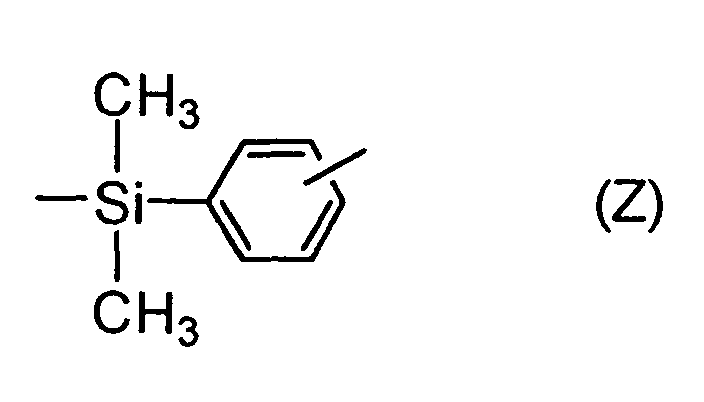
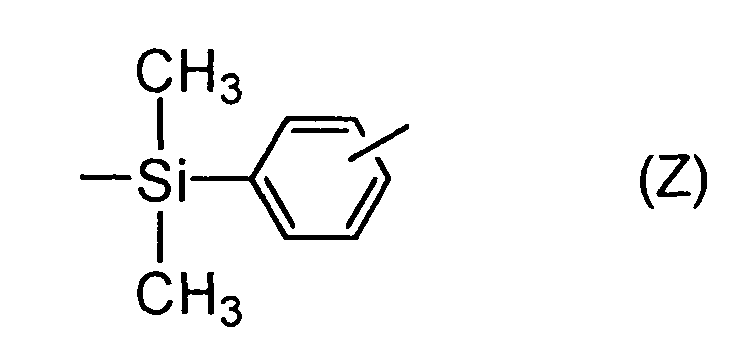
- Y is -CH 2 - or a dimethylphenylsilylene group of the formula: (inclusive of o-, m- and p-positions) and R 1 is hydrogen, methyl, phenyl or allyl.
- component (A) at least two alkenyl groups must be contained per molecule.
- the straight-chain fluoropolyether compound (A) has a perfluoropolyether structure in its backbone, which is described later.
- component (A) is a branched polyfluorodialkenyl compound having the following general formula (2).
- X is -CH 2 -, -CH 2 O-, -CH 2 OCH 2 - or -Y-NR 1 -CO- wherein Y is -CH 2 - or an o, m or p-dimethylsilylphenylene group of the following structural formula (Z): and R 1 is hydrogen or a substituted or unsubstituted monovalent hydrocarbon group
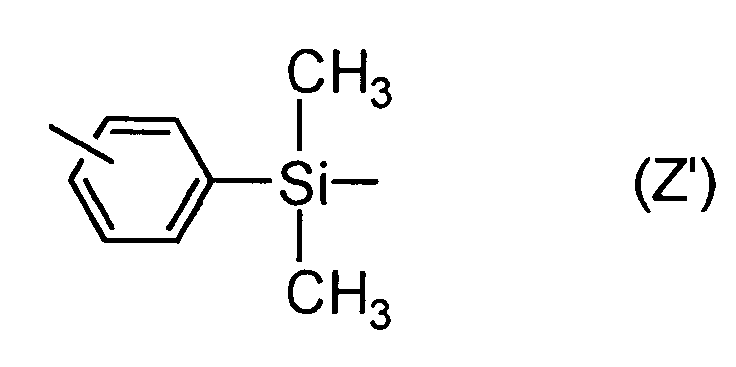
- X' is -CH 2 -, -OCH 2 -, -CH 2 OCH 2 - or -CO-NR 1 -Y'- wherein Y' is -CH 2 - or an o, m or p-dimethylsilylphenylene group of the following structural formula (Z'): and R 1 is as defined
- Rf 1 is a divalent perfluoropolyether structure, preferably having the following general formula (i) or (ii).
- p and q each are an integer of 1 to 150, the sum of p+q is 2 to 200 on average, r is an integer of 0 to 6, and t is 2 or 3.
- u is an integer of 1 to 200, v is an integer of 1 to 50, and t is as defined above.
- component (A) is a branched polyfluoromonoalkenyl compound having the following general formula (3).
- Rf 2 -(X') a -CH CH 2
- X' and "a" are as defined above
- Rf 2 is a group of the general formula (iii): wherein t is as defined above, and w is an integer of at least 1, which is smaller than any of the sum of p+q (average) and r and the sum of u and v for Rf 1 in formula (2).
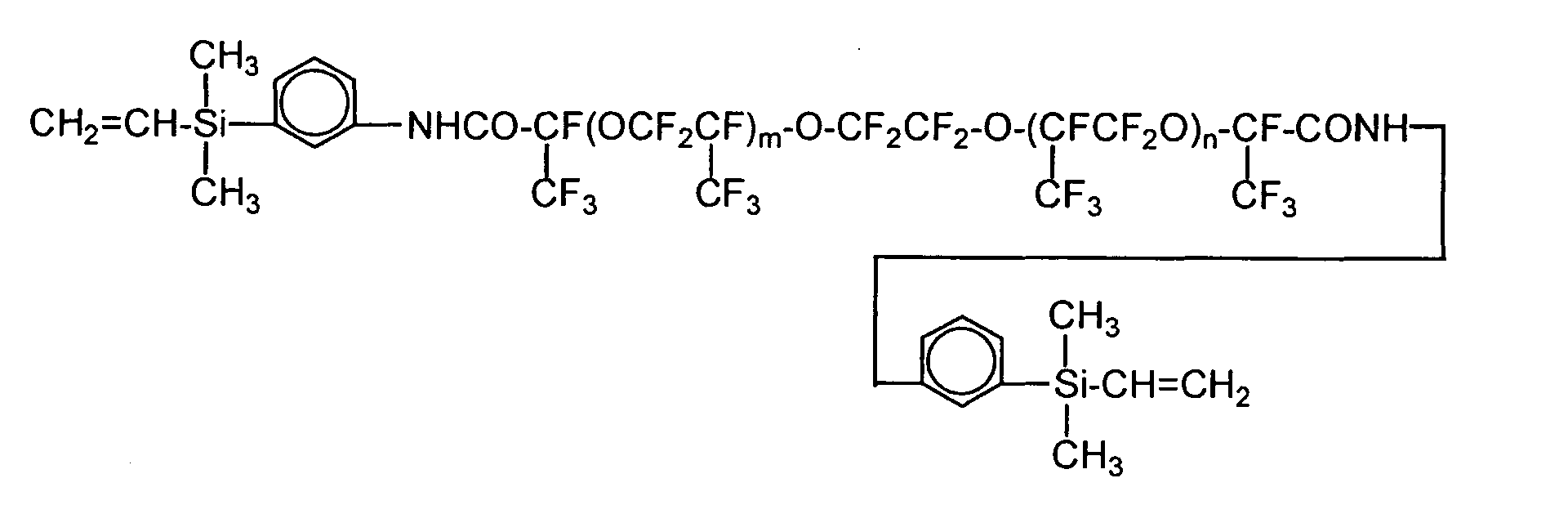
- component (A) are compounds having the following general formula (1).
- X is -CH 2 -, -CH 2 O-, -CH 2 OCH 2 - or -Y-NR 1 -CO- wherein Y is -CH 2 - or an o-, m- or p-dimethylsilylphenylene group of the following structural formula (Z): and R 1 is hydrogen, methyl, phenyl or allyl
- X' is -CH 2 -, -OCH 2 -, -CH 2 OCH 2 - or -CO-NR 1 -Y' - wherein Y' is -CH 2 - or an o-, m- or p-dimethylsilylphenylene group of the following structural formula (Z'): and R 1 is as defined above, "a” is independently 0 or 1, L is an integer of 2 to 6, and b and c each are an integer of 0 to 200.
- n and n each are an integer of 0 to 200, and the sum of m+n is 6 to 200.
- These straight-chain fluoropolyether compounds may be used alone or in admixture of any.
- Component (B) is an organosilicon compound having at least two silicon atom-bonded hydrogen atoms (i.e., SiH groups) in a molecule.
- the organosilicon compound (B) serves as a crosslinking agent and chain extender for component (A).
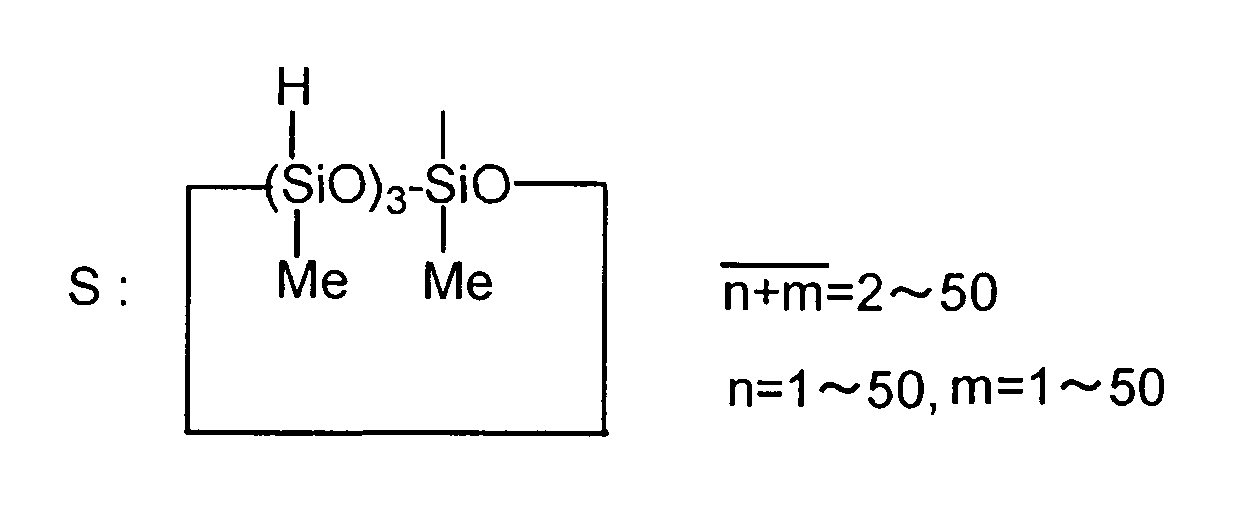
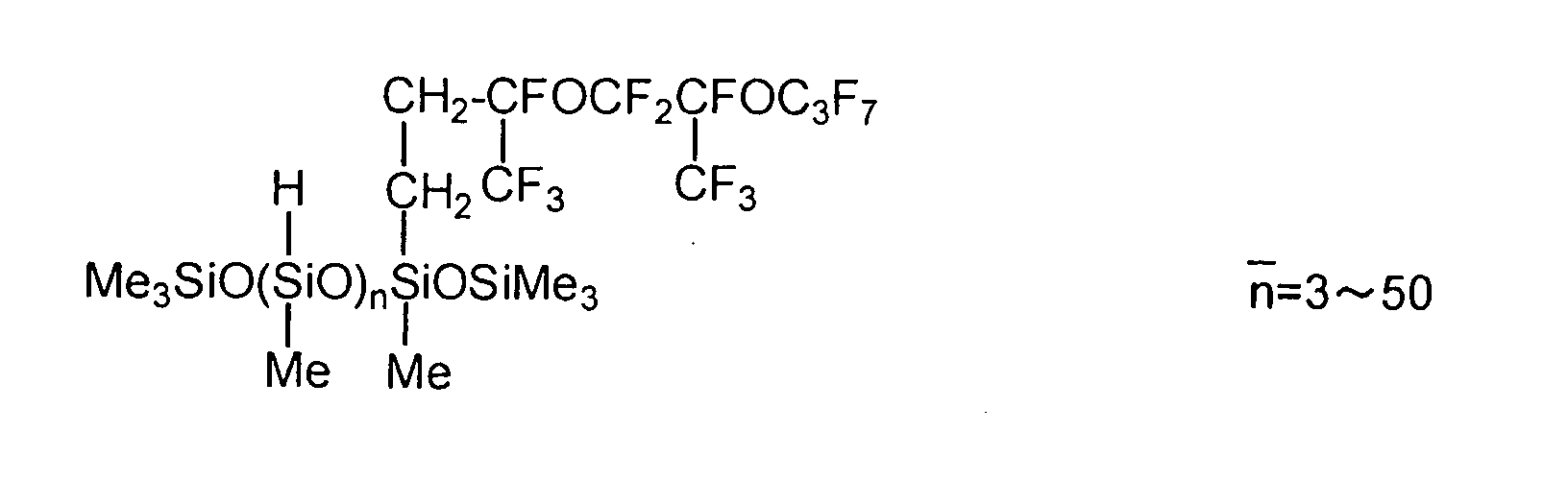
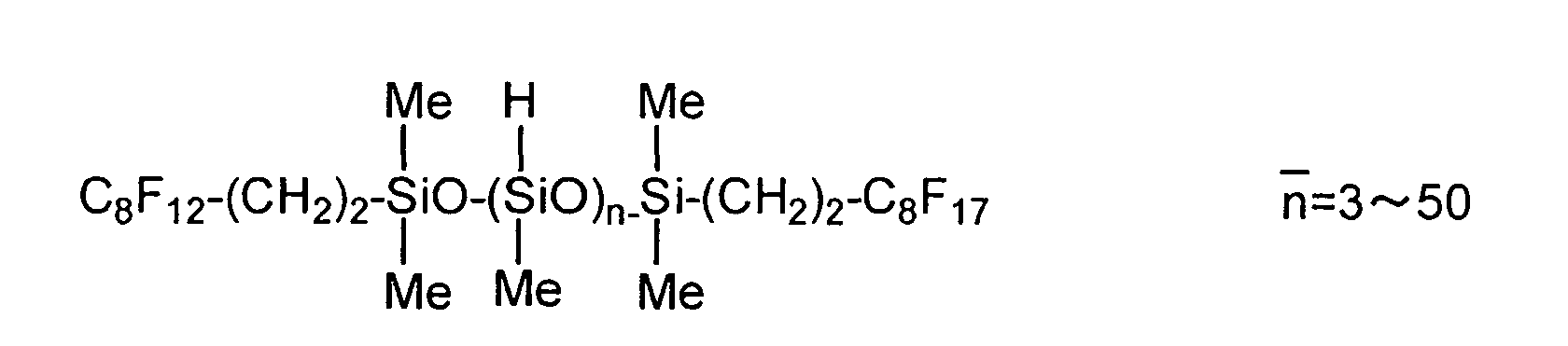
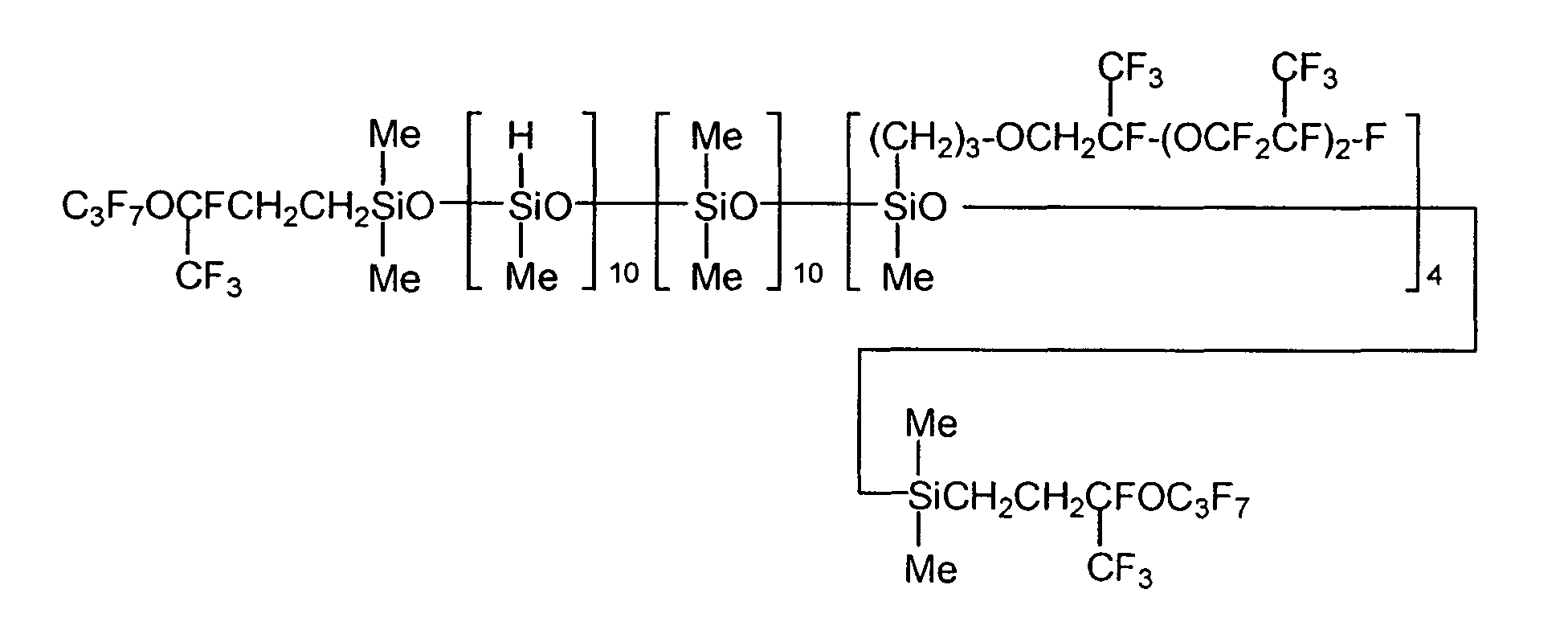
- the organosilicon compound should preferably have at least one fluorinated group in a molecule.
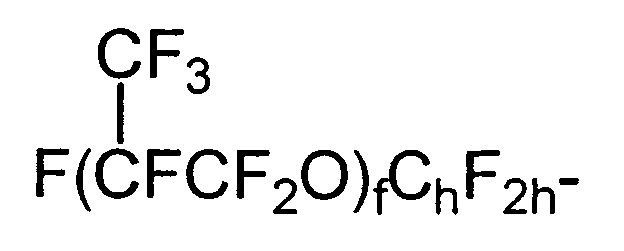
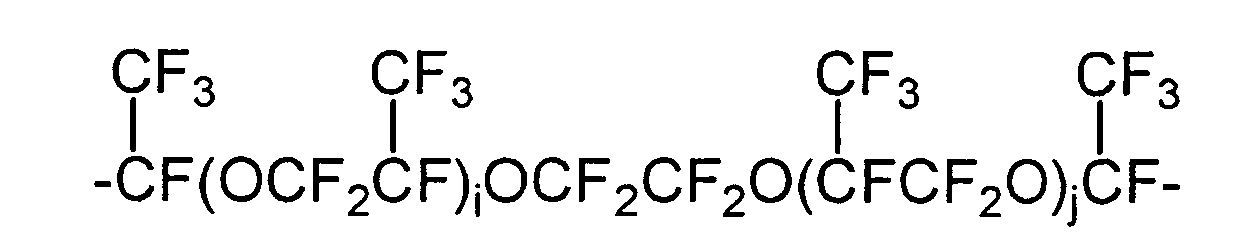
- Suitable fluorinated groups include those of the following general formulae. C g F 2g+1 -
- Letter g is an integer of 1 to 20, preferably 2 to 10.
- Letter g is an integer of 1 to 20, preferably 2 to 10.
- Letter f is an integer of 2 to 200, preferably 2 to 100, and h is an integer of 1 to 3.
- Letters i and j each are an integer of at least 1, and an average of i+j is from 2 to 200, preferably from 2 to 100. -(CF 2 O) r -(CF 2 CF 2 O) s -CF 2 -
- Each of r and s is an integer of 1 to 50.
- perfluoroalkyl, perfluorooxyalkyl, perfluoroalkylene and perfluorooxyalkylene groups may be attached to silicon atoms either directly or through divalent linking groups.
- divalent linking groups are alkylene and arylene groups and combinations thereof, which may have an intervening bond such as an ether bond-forming oxygen atom, amide bond, carbonyl bond or the like.
- divalent linking groups having 2 to 12 carbon atoms are preferred, examples of which are given below.
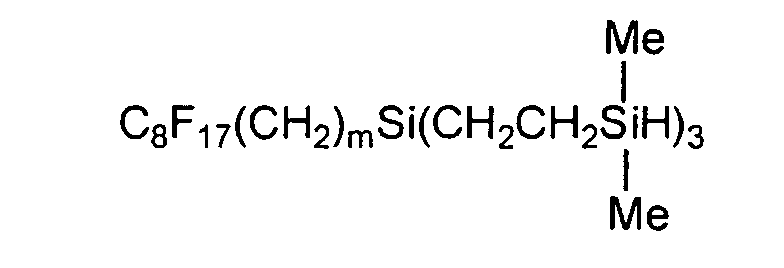
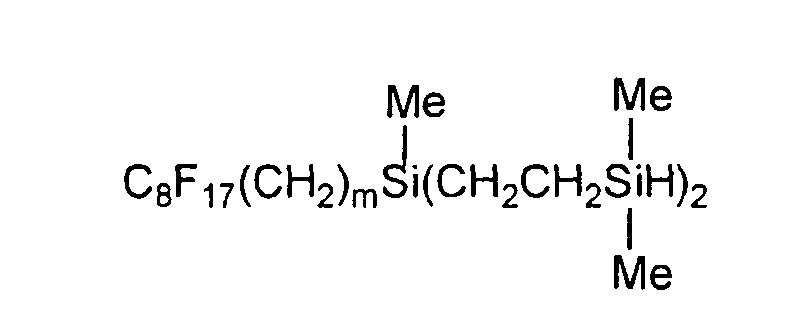
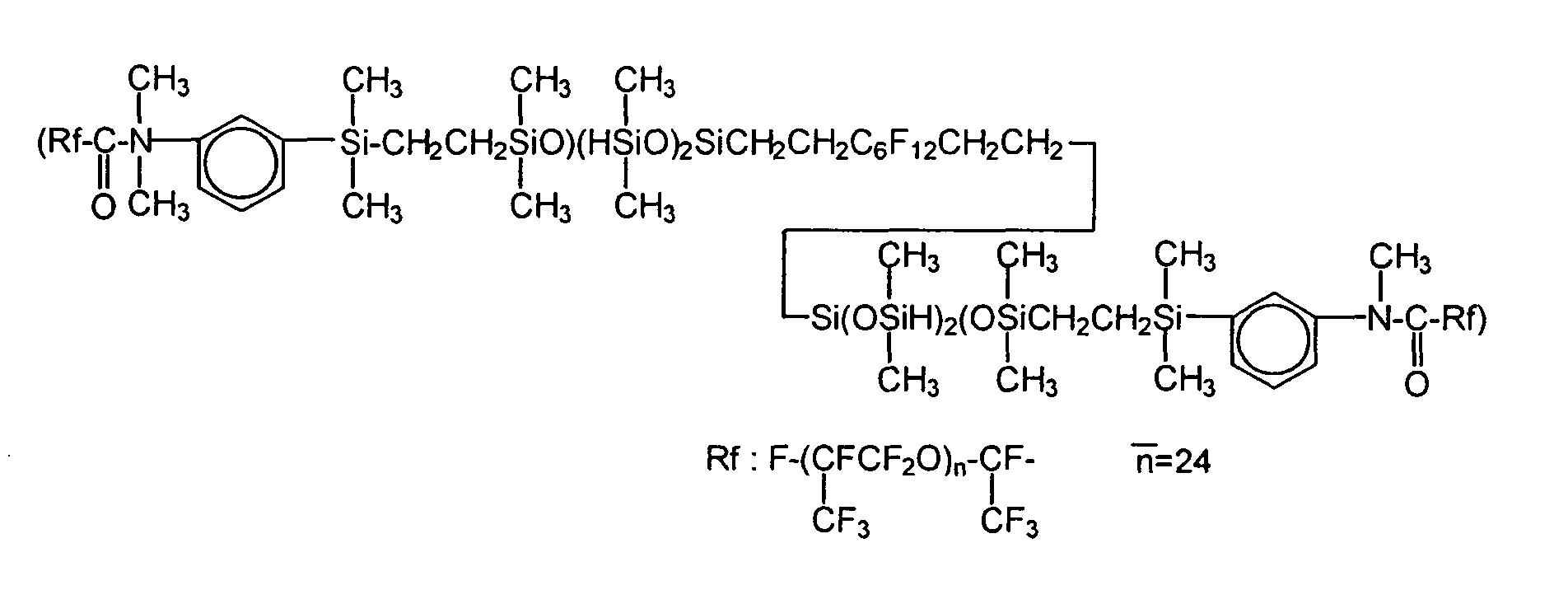
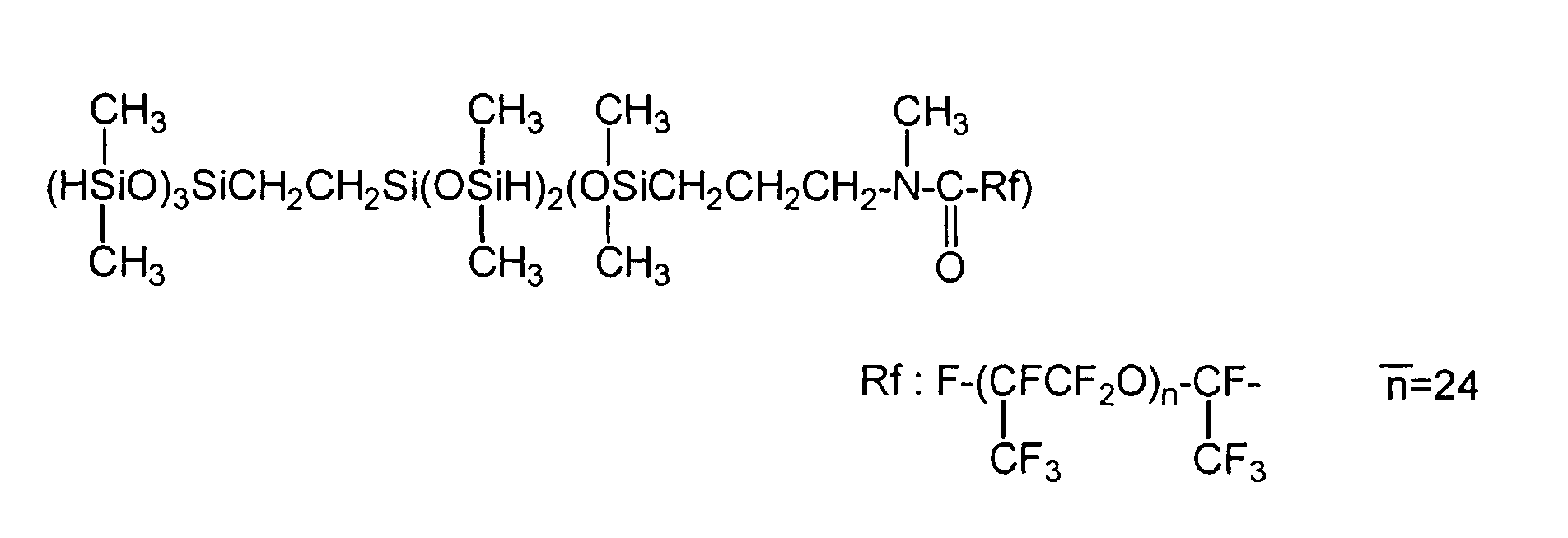
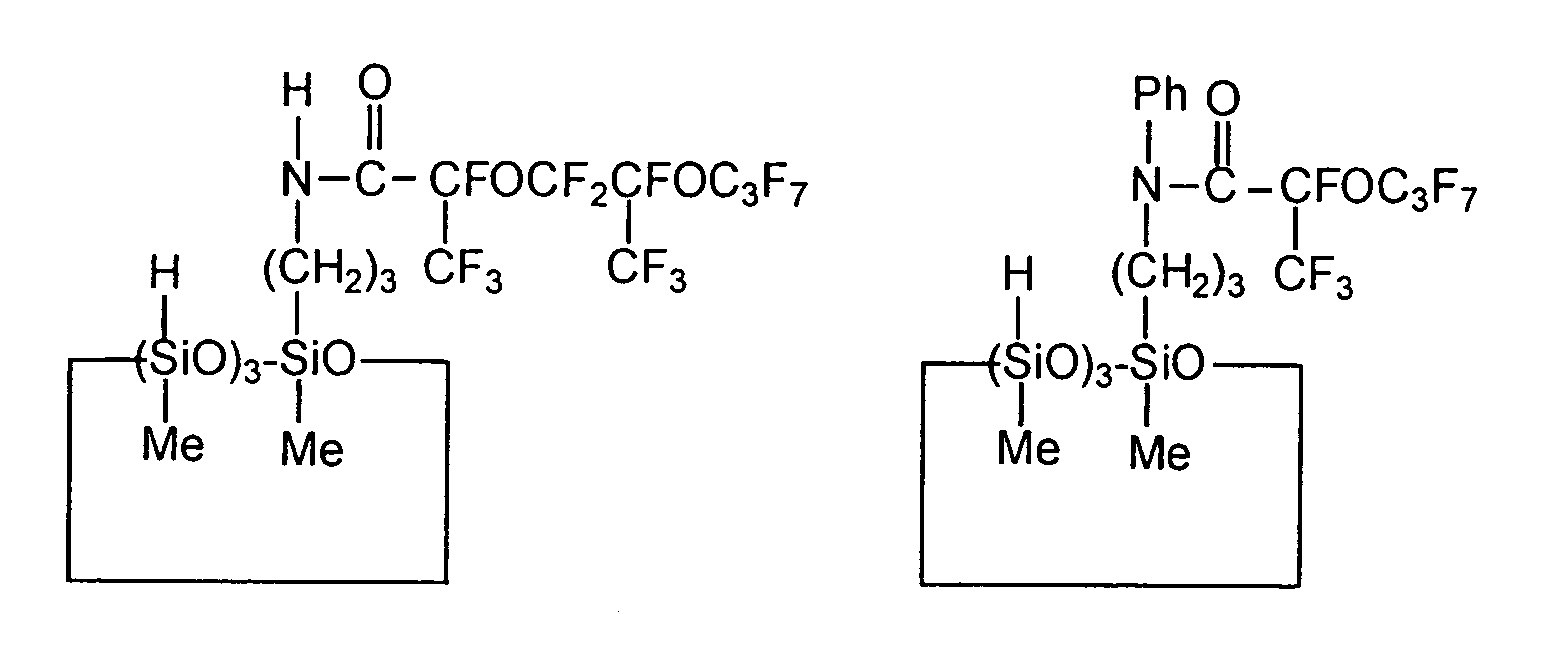
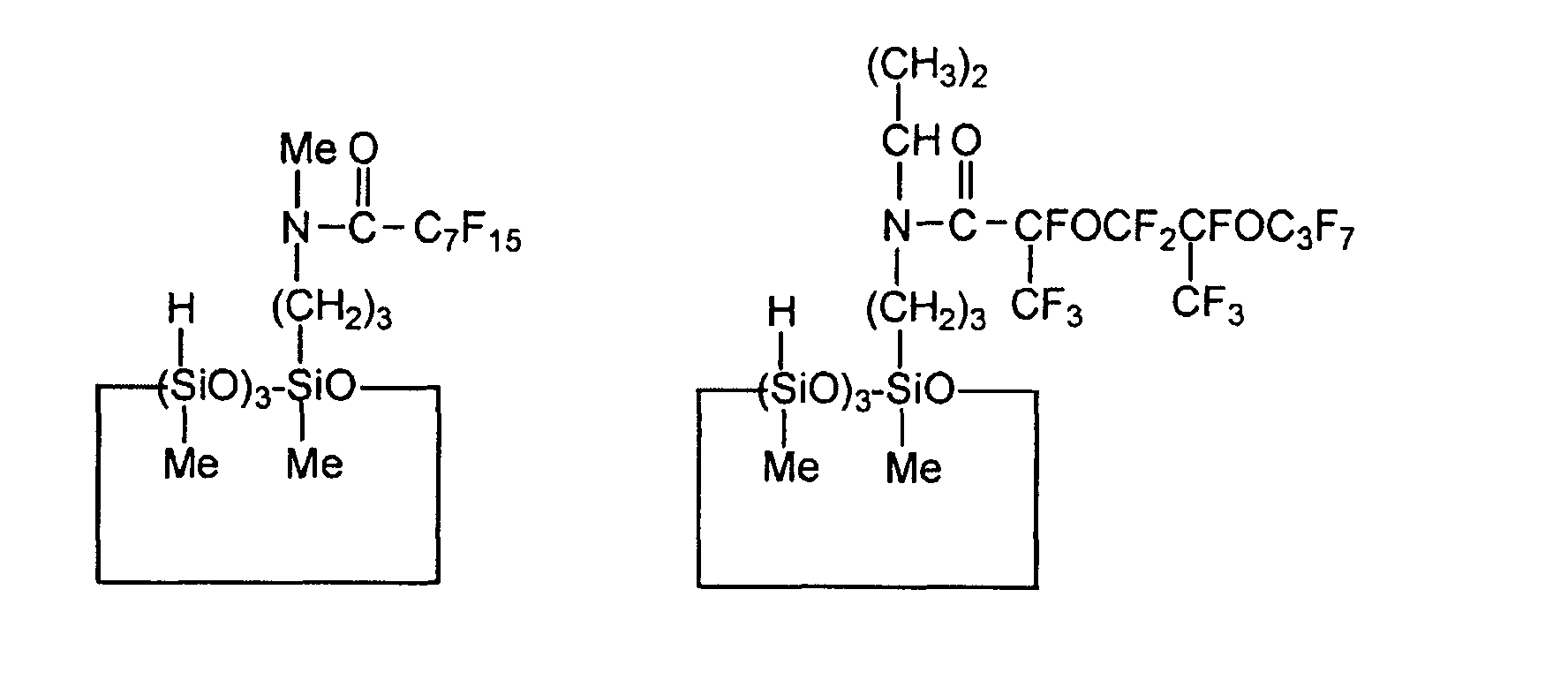
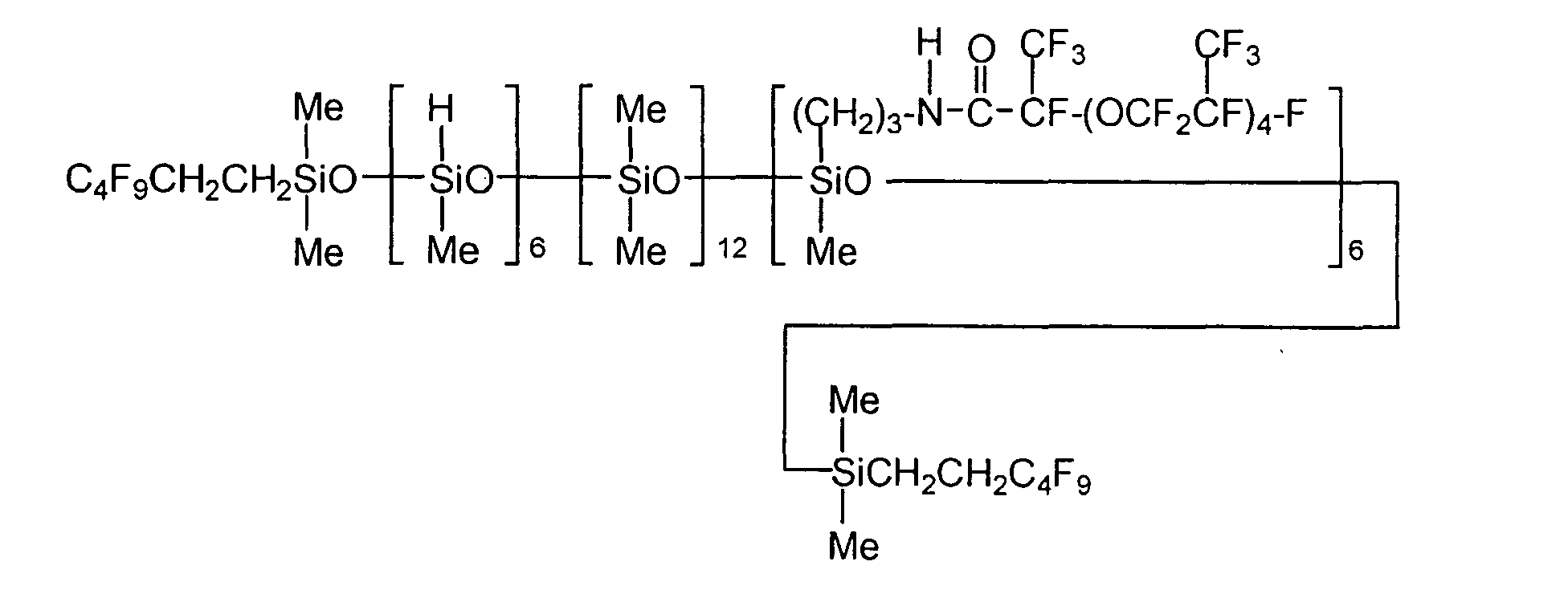
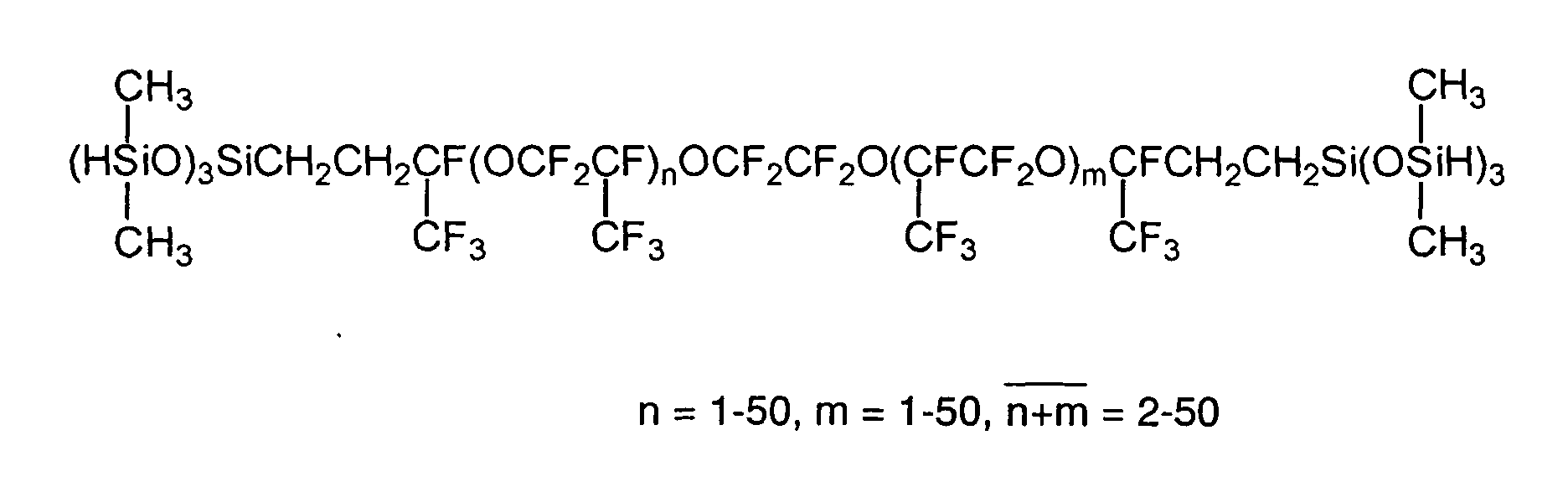
- organosilicon compounds having such fluorinated groups are shown below. Note that Me is methyl and Ph is phenyl.
- organosilicon compounds may be used alone or in admixture of two or more.
- Component (B) is blended in an effective amount to cure component (A). Most often, component (B) having hydrosilyl (or SiH) groups is blended in such an amount as to provide 0.5 to 5 mol, and more preferably 1 to 2 mol of SiH groups per mol of alkenyl groups (e.g., vinyl, allyl or cycloalkenyl) in component (A). Less amounts of component (B) may achieve an insufficient degree of crosslinking. Excessive amounts of component (B) may allow chain lengthening to become preferential, inviting under-curing, foaming, and degradation of heat resistance and compression set. These determinations are conventional per se.
- Component (C) is a perfluoroparaffin or perfluoroparaffin derivative in powder form which contains at least 80% by weight of a volatile component that volatilizes off when held in a drier at 200°C for 4 hours, and has a melting point of at least 50°C.
- Component (C) which is very important in the present invention functions to impart release properties in the step of shaping in a mold. Since component (C) can be removed by heat treatment after molding, it no longer becomes an impurity in molded parts. In this sense, component (C) is an internal mold release agent that imparts release properties in the molding step without the risk of detracting from the properties of molded parts.
- the resulting composition becomes thickened due to the lack of compatibility therebetween, and thus difficult to work. This approach is impractical.
- the liquid internal mold release agent will separate from the composition during storage. In this sense, it is crucial that the internal mold release agent (C) be solid or powder during storage at room temperature. Storage stability requires the additive to have a melting point of at least 50°C.
- the molecular structure of the additive should be perfluoroparaffin or perfluoroparaffin derivative.
- a non-perfluoroparaffin additive is difficult to disperse in the composition uniformly and cannot be volatilized off upon heating because the additive does not migrate through the rubber composition even when melted.
- Component (C) should meet the requirement that when about 1 gram of the material in a dish is dried at 200°C for 4 hours, 80% by weight or more of the material volatilizes off. This is necessary in order that upon heating, the additive migrate through the composition and volatilize off from the surface of molded part. If the additive is not volatile, it blooms on the surface of a molded rubber part to degrade the outer appearance. Since component (C) is uniformly dispersed in the inventive composition, it is kept bloomed on the surface of a molded rubber part to prevent the part from sticking to any object unless heat treatment is carried out.
- the bloomed layer on the surface serves as a release layer, preventing molded parts from sticking to each other or to any adjacent object during use under pressure contact conditions. That is, the molded part can be readily separated from the adjacent molded part or other object.
- the perfluoroparaffin or perfluoroparaffin derivative in powder form which contains at least 80% by weight of a volatile component that volatilizes off when held in a drier at 200°C for 4 hours, and has a melting point of at least 50°C is preferably selected from those having the general formulae (7) and (8).
- R is hydrogen, halogen exclusive of fluorine, or a hydrocarbon group of 1 to 30 carbon atoms
- x is a number in the range of 10 to 40
- y is a number in the range of 2 to 40
- each of x and y may be a single number or have a distribution in the range.
- Those compounds of formula (7) wherein x is less than 10 have a melting point below 50°C and thus does not take powder form so that they are melted into the polymer of component (A), causing a viscosity increase.
- the high molecular weight compounds of formula (7) wherein x is more than 40 are difficult to migrate through the rubber and volatilize off from the surface during heat treatment.
- These compounds may have a single molecular weight or a molecular weight distribution within the above-defined range.
- a mixture of compounds of formulae (7) and (8) may be used when incorporated in the composition.
- R is hydrogen, halogen exclusive of fluorine, such as chlorine or iodine, or a hydrocarbon group of 1 to 30 carbon atoms.
- hydrocarbon group of 1 to 30 carbon atoms include alkyl groups such as methyl, ethyl, propyl, butyl, hexyl, cyclohexyl, octyl and decyl, alkenyl groups such as vinyl and allyl, aryl groups such as phenyl, tolyl and naphthyl, and aralkyl groups such as benzyl and phenylethyl.
- perfluoroparaffins of the following formula having a molecular weight within the indicated range.
- CF 3 (CF 2 ) z CF 3 z 10 to 30
- perfluoroparaffin examples include CF 3 (CF 2 ) 10 CF 3 , CF 3 (CF 2 ) 14 CF 3 , CF 3 (CF 2 ) 20 CF 3 , CF 3 (CF 2 ) 6 C 12 H 25 , CF 3 (CF 2 ) 12 C 6 H 5 and CF 3 (CF 2 ) 14 C 2 H 5 .
- component (C) added is 0.1 to 20 parts by weight per 100 parts by weight of component (A).
- the preferred amount is 0.5 to 10 parts by weight. Mold release may not be expected at less than 0.1 pbw of component (C) whereas more than 20 pbw of component (C) may entail a substantial contraction after volatilization, which is undesirable for dimensional precision. Routine trials will show suitable amounts.
- Component (D) is a hydrosilylation catalyst for promoting the addition reaction between alkenyl groups in component (A) and hydrosilyl groups in component (B).
- the hydrosilylation catalyst is often selected from noble metal compounds which are expensive. Platinum and platinum compounds are thus used because they are readily available.
- platinum compounds include chloroplatinic acid, complexes of chloroplatinic acid with olefins such as ethylene, complexes of chloroplatinic acid with alcohols and vinylsiloxanes, and metallic platinum supported on silica, alumina or carbon though not limited thereto.
- Known platinum group metal compounds other than the platinum compounds include rhodium, ruthenium, iridium, and palladium compounds, for example, RhCl (PPh 3 ) 3 , RhCl (CO) (PPh 3 ) 2 , RU 3 (CO) 12 , IrCl (CO) (PPh 3 ) 2 , and Pd(PPh 3 ) 4 wherein Ph denotes phenyl.
- the hydrosilylation catalyst may be used in a catalytic amount. It is preferably added in an amount to give 0.1 to 100 parts by weight of platinum group metal per million parts by weight of components (A), (B) and (C) combined.
- fillers typically reinforcing fillers may be added to the composition for improving mechanical strength.
- Reinforcing fillers are added for the purposes of improving mechanical strength, thermal stability, weather resistance, chemical resistance and/or flame retardance, reducing thermal shrinkage upon curing, reducing the coefficient of thermal expansion of the cured elastomer, and/or lowering the gas permeability.
- the major purpose is to improve mechanical strength.
- Exemplary fillers include fumed silica, wet silica, ground silica, calcium carbonate, diatomaceous earth, carbon black and various metal oxide powders, which may be treated with surface treating agents, if desired.
- fumed silica is preferred from the standpoint of improving mechanical strength. Fumed silica treated with a silane base surface treating agent is especially preferred because it is effectively dispersible.
- the filler is preferably added in an amount of 5 to 200 parts by weight per 100 parts by weight of component (A).
- the amount of the filler preferred for the stability of mechanical properties is 10 to 60 parts by weight.
- pigments, dyes and the like may be compounded in the curable fluoropolyether rubber composition of the invention.
- various additives may be added to the inventive composition.
- Such optional additives include inhibitors of the hydrosilylation catalyst, for example, acetylene alcohols such as 1-ethynyl-1-hydroxycyclohexane, 3-methyl-1-butyn-3-ol, 3,5-dimethyl-1-hexyn-3-ol, 3-methyl-1-penten-3-ol, and phenylbutenol; 3-methyl-3-penten-1-yne, 3,5-dimethyl-3-hexen-1-yne, and the like; polymethylvinylsiloxane cyclic compounds; and organophosphorus compounds. Incorporation of such an inhibitor leads to a compromise between cure reactivity and storage stability.
- the method of preparing the curable fluoropolyether rubber composition of the invention is not critical.
- the composition may be formulated as a single composition by combining all the essential components.
- the rubber composition is formulated into two packs where the two packs are mixed together on use.
- Cured parts can be formed by prior art known techniques, for example, by feeding the inventive composition into a suitable mold and causing the composition to cure therein, or by applying the inventive composition onto a suitable substrate and causing the coating to cure. Often, the composition is cured simply by heating at a temperature of about 100 to 180°C for about 10 seconds to about 30 minutes.
- the curable fluoropolyether rubber composition of the invention in the cured state has heat resistance, chemical resistance, solvent resistance, water repellency, oil repellency and weather resistance.
- the molded (or cured) parts have satisfactory compression set and smooth parting properties, especially mold release properties. Because of these features, the cured parts find a variety of applications.
- Rubber articles using the cured composition of the invention are suitable for use in automobiles, chemical plants, ink jet printers, semiconductor manufacturing lines, analytical or scientific instruments, medical equipment, aircraft or fuel cells and as rubber parts such as diaphragms, valves, O-rings, oil seals, gaskets, packings, joints and face seals.
- rubber articles comprising the cured composition of the invention are used as rubber parts for automobiles, rubber parts for chemical plants, rubber parts for ink jet printers, rubber parts for semiconductor manufacturing lines, rubber parts for analytical or scientific instruments, rubber parts for medical equipment, and rubber parts for aircraft, as well as tent film materials, sealants, molded parts, extruded parts, coatings, copier roll materials, electrical moisture-proof coatings, sensor potting materials, fuel cell seals, and laminate rubber fabrics.
- Rubber articles made of the cured composition of the invention include, but are not limited to, rubber parts for automobiles, for example, diaphragms such as fuel regulator diaphragms, pulsation damper diaphragms, oil pressure switch diaphragms, and EGR diaphragms, valves such as canister valves and power control valves, O-rings such as quick connector O-rings and injector O-rings, and seals such as oil seals and cylinder head gaskets; rubber parts for chemical plants, for example, pump diaphragms, valves, O-rings, packings, oil seals, and gaskets; rubber parts for ink jet printers and semiconductor manufacturing lines, for example, diaphragms, valves, O-rings, packings, and gaskets; rubber parts for analytical and scientific instruments and medical equipment, for example, pump diaphragms, O-rings, packings, valves, and joints; rubber parts for aircraft, for example, O-rings, face
- a rubber composition was deaerated in vacuum, cast into a rectangular frame of 2 mm thick, deaerated again, and press cured at 100 kg/cm 2 and 150°C for 10 minutes.
- a test specimen was cut from the cured sample and measured for hardness, elongation, tensile strength and tear strength according to JIS K6251, K6252 and K6253. Note that tear strength was measured on crescent shaped specimens. Also the viscosity of a rubber composition was measured according to JIS K7117.
- a rubber composition was molded under the same conditions as above except that a mold having six O-ring-forming cavities of JIS P-8 size (whose surface was chromium plated) arranged in a rectangular frame of 2 mm thick was used. By examining how O-rings were removed from the mold, mold release was evaluated according to the following criterion.
- a rubber composition was molded integrally with a chromium-plated plate (25 mm wide) under the same conditions as in the measurement of rubber physical properties.
- the force needed to peel the rubber coating from the plate was measured by a strograph E-L (Toyo Seiki Co., Ltd.).
- a cured composition was measured for compression set under conditions: 200°C, 20 hours and 25% compression.
- Table 1 shows the structure and properties of Additives A to E.
- Tables 2 and 3 show the test results of the compositions to which the additives were added.
- the residue (%) on volatilization is determined by weighing 1 g of the additive in a glass dish, heating at 200°C for 4 hours in dry air at atmospheric pressure, and measuring the weight of the residue.
- compositions of Examples are significantly improved in mold release, substantially equal in compression set and approximately equal in viscosity and other physical properties.
- Additive F G or H, shown below, was added in the amount shown in Table 4.
- the resulting composition was mixed and cured, after which the rubber physical properties, mold release, peeling force and compression set of the cured composition were determined. The results are shown in Table 4.
- Additive F 2,2-bis(3,4-hydroxyphenyl)hexafluoropropane (also known as bisphenol AF)
- Additive G 2,2-bis(3,4-anhydrodicarboxyphenyl)hexafluoropropane
- Additive H 2,2-bis(4-carboxyphenyl)hexafluoropropane Blending amount (pbw) Comparative Example 2 3 4
- Base compound 100 100 100 100
- the fluoropolyether rubber compositions of the invention when cured, exhibit solvent resistance, chemical resistance and low moisture permeability because of a high fluorine content, smooth parting and water repellency because of low surface energy.
- Rubber articles comprising the cured compositions are useful in applications where acid resistance and oil resistance are required, as rubber materials for automobiles and aircraft, rubber materials for fuel cells, rubber materials for semiconductor manufacturing apparatus, tent film materials, sealants, molded parts, extruded parts, coatings, copier roll materials, electrical moisture-proof coatings, sensor potting materials, and release paper materials. Additionally, the curable fluoropolyether rubber compositions have good mold release and working efficiency. All these features enable the molding cycle to be completed within a short time and parts of complex shape to be molded in an effective way. Since molded parts themselves are little tacky, sticking is prohibited.
Landscapes
- Chemical & Material Sciences (AREA)
- Health & Medical Sciences (AREA)
- Chemical Kinetics & Catalysis (AREA)
- Medicinal Chemistry (AREA)
- Polymers & Plastics (AREA)
- Organic Chemistry (AREA)
- General Chemical & Material Sciences (AREA)
- Compositions Of Macromolecular Compounds (AREA)
- Fuel Cell (AREA)
- Manufacture Of Macromolecular Shaped Articles (AREA)
- Sealing Material Composition (AREA)
Abstract
Description

X' is -CH2-, -OCH2-, -CH2OCH2- or -CO-NR1-Y'- wherein Y' is -CH2- or an o, m or p-dimethylsilylphenylene group of the following structural formula (Z'):
Rf1 is a divalent perfluoropolyether group, and
"a" is independently 0 or 1.




X' is -CH2-, -OCH2-, -CH2OCH2- or -CO-NR1-Y' - wherein Y' is -CH2- or an o-, m- or p-dimethylsilylphenylene group of the following structural formula (Z'):

"a" is independently 0 or 1, L is an integer of 2 to 6, and b and c each are an integer of 0 to 200.


















Reinforcing fillers are added for the purposes of improving mechanical strength, thermal stability, weather resistance, chemical resistance and/or flame retardance, reducing thermal shrinkage upon curing, reducing the coefficient of thermal expansion of the cured elastomer, and/or lowering the gas permeability. The major purpose is to improve mechanical strength.
rubber parts for automobiles, for example, diaphragms such as fuel regulator diaphragms, pulsation damper diaphragms, oil pressure switch diaphragms, and EGR diaphragms, valves such as canister valves and power control valves, O-rings such as quick connector O-rings and injector O-rings, and seals such as oil seals and cylinder head gaskets;
rubber parts for chemical plants, for example, pump diaphragms, valves, O-rings, packings, oil seals, and gaskets;
rubber parts for ink jet printers and semiconductor manufacturing lines, for example, diaphragms, valves, O-rings, packings, and gaskets;
rubber parts for analytical and scientific instruments and medical equipment, for example, pump diaphragms, O-rings, packings, valves, and joints;
rubber parts for aircraft, for example, O-rings, face seals, packings, gaskets, diaphragms, and valves in fluid piping for engine oil, jet fuel, hydraulic oil and Skydrol®; and
rubber parts for fuel cells, for example, seals between electrodes, and O-rings, face seals, packings, gaskets, diaphragms and valves for hydrogen, air and coolant water feed conduits.



- o○:
- very smooth
- ○:
- smooth
- Δ:
- fairly smooth
- ×:
- difficult
- ××:
- very difficult
| Additive Additive | Structural formula | m.p. (°C) | Residue (%) on volatilization |
| A | CF3(CF2)10-20CF3 | 90-115 | 0 |
| B | CF3(CF2)10-22CF3 | 90-123 | 0 |
| C | CF3(CF2)12-20CF3 | 100-155 | 0 |
| D | CF3(CF2)14CF3 | 126-134 | 0 |
| E | C8F17C20H41 | 58-65 | 8.6 |
| Blending amount (pbw) | Example Example | Comparative Example | ||||
| 1 | 2 | 3 | 4 | 5 | 1 | |
| Base compound | 100 | 100 | 100 | 100 | 100 | 100 |
| Additive A | 2 | - | ||||
| Additive B | 2 | |||||
| Additive C | 2 | |||||
| Additive D | 2 | |||||
| Additive E | 2 | - | ||||
| Properties | ||||||
| Viscosity (Pa·s) | 854 | 868 | 866 | 872 | 883 | 855 |
| Hardness (Durometer A) | 51 | 49 | 50 | 50 | 51 | 52 |
| Elongation (%) | 590 | 590 | 580 | 580 | 580 | 560 |
| Tensile strength (MPa) | 10.9 | 11 | 10.8 | 9.8 | 10.4 | 9.9 |
| Tear strength (kN/m) | 31 | 33 | 33 | 32 | 38 | 34 |
| Mold release | ○ | ○ | ○ | ○ | ○ | ×× |
| Peeling force (kgf/25 mm) | 0.2 | 0.3 | 0.2 | 0.3 | 0.3 | 1.6 |
| Compression set (%) | 17 | 19 | 19 | 18 | 20 | 19 |
| Blending amount (pbw) | Example | ||||
| 6 | 7 | 8 | 9 | 10 | |
| Base compound | 100 | 100 | 100 | 100 | 100 |
| Additive D | 0.5 | 1 | 3 | 5 | 7 |
| Properties | |||||
| Viscosity (Pa·s) | 848 | 856 | 883 | 895 | 912 |
| Hardness (Durometer A) | 50 | 50 | 50 | 49 | 49 |
| Elongation (%) | 580 | 590 | 540 | 550 | 600 |
| Tensile strength (MPa) | 9.7 | 9.8 | 9.9 | 9.8 | 9.2 |
| Tear strength (kN/m) | 32 | 33 | 31 | 35 | 32 |
| Mold release | Δ | ○ | o ○ | o ○ | o ○ |
| Peeling force (kgf/25 mm) | 0.9 | 0.3 | 0.2 | 0.1 | 0.1 |
| Compression set (%) | 18 | 20 | 19 | 20 | 21 |
Additive F: 2,2-bis(3,4-hydroxyphenyl)hexafluoropropane (also known as bisphenol AF)


| Blending amount (pbw) | Comparative Example | ||
| 2 | 3 | 4 | |
| Base compound | 100 | 100 | 100 |
| Additive F | 2 | - | - |
| Additive G | - | 2 | - |
| Additive H | - | - | 2 |
| Properties | |||
| Viscosity (Pa·s) | 868 | 891 | 895 |
| Hardness (Durometer A) | 56 | 54 | 58 |
| Elongation (%) | 440 | 440 | 450 |
| Tensile strength (MPa) | 9.3 | 9.3 | 8.8 |
| Tear strength (kN/m) | 30 | 26 | 20 |
| Mold release | o ○ | ○ | ○ |
| Peeling force (kgf/25 mm) | 0.3 | 0.5 | 0.4 |
| Compression set (%) | 32 | 29 | 35 |
Claims (7)
- A curable fluoropolyether rubber composition comprising(A) straight-chain fluoropolyether compound having at least two alkenyl groups in the molecule and perfluoropolyether structure in the backbone,(B) organosilicon compound having at least two silicon atom-bonded hydrogen atoms in the molecule,(C) perfluoroparaffin or perfluoroparaffin derivative in powder form which contains at least 80% by weight of volatile component that volatilizes off when dried at 200°C for 4 hours, and has a melting point of at least 50°C, and(D) hydrosilylation catalyst.
- The composition of claim 1 wherein component (A) is straight-chain fluoropolyether compound of the following general formula (1):wherein X is -CH2-, -CH2O-, -CH2OCH2- or -Y-NR1-CO- wherein Y is -CH2- or a dimethylphenylsilylene group of the following structural formula (Z):
 (o, m or p-position) and R1 is hydrogen, methyl, phenyl or allyl,
X' is -CH2-, -OCH2-, -CH2OCH2- or -CO-NR1-Y' - wherein Y' is -CH2- or a dimethylphenylsilylene group of the following structural formula (Z'):(o, m or p-position) and R1 is as defined above,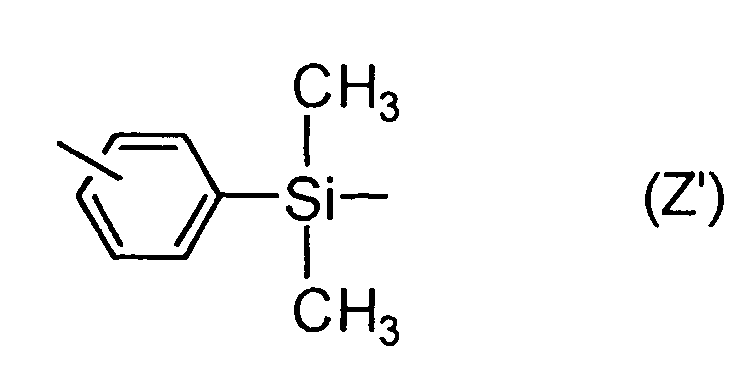
"a" is independently 0 or 1, L is an integer of 2 to 6, and b and c each are an integer of 0 to 200. - A composition of claim 1 or 2 wherein the perfluoroparaffin or perfluoroparaffin derivative (C) has the general formula (7) or (8):
- A rubber article comprising the curable fluoropolyether rubber composition of claim 1, 2 or 3 in the cured state.
- The rubber article of claim 4 for use in automobiles, chemical plants, ink jet printers, semiconductor manufacturing lines, analytical or scientific instruments, medical equipment, aircraft or fuel cells.
- The rubber article of claim 4 or 5 which is a diaphragm, valve, O-ring, oil seal, gasket, packing, joint or face seal.
- A method of making an article according to any one of claims 4 to 6 comprising curing and shaping a composition according to any one of claims 1 to 3.
Applications Claiming Priority (2)
| Application Number | Priority Date | Filing Date | Title |
|---|---|---|---|
| JP2002335129A JP4231997B2 (en) | 2002-11-19 | 2002-11-19 | Curable fluoropolyether rubber composition and rubber product |
| JP2002335129 | 2002-11-19 |
Publications (3)
| Publication Number | Publication Date |
|---|---|
| EP1422260A2 true EP1422260A2 (en) | 2004-05-26 |
| EP1422260A3 EP1422260A3 (en) | 2004-10-27 |
| EP1422260B1 EP1422260B1 (en) | 2008-12-31 |
Family
ID=32212061
Family Applications (1)
| Application Number | Title | Priority Date | Filing Date |
|---|---|---|---|
| EP20030257157 Expired - Lifetime EP1422260B1 (en) | 2002-11-19 | 2003-11-13 | Curable fluoropolyether rubber compositions and rubber articles |
Country Status (4)
| Country | Link |
|---|---|
| US (1) | US6979710B2 (en) |
| EP (1) | EP1422260B1 (en) |
| JP (1) | JP4231997B2 (en) |
| DE (1) | DE60325544D1 (en) |
Cited By (4)
| Publication number | Priority date | Publication date | Assignee | Title |
|---|---|---|---|---|
| EP1715005A1 (en) * | 2005-04-21 | 2006-10-25 | Shin-Etsu Chemical Co., Ltd. | Curable fluoropolyether rubber compositions and rubber articles |
| EP1818367A1 (en) | 2006-02-13 | 2007-08-15 | Shin-Etsu Chemical Co., Ltd. | Curable fluoropolyether compositions and integral molded resin/rubber articles |
| US11086444B2 (en) | 2013-12-13 | 2021-08-10 | Apple Inc. | Integrated touch and display architectures for self-capacitive touch sensors |
| EP4503210A4 (en) * | 2022-03-31 | 2026-04-08 | Shinetsu Chemical Co | FUEL BATTERY STACK AND FUEL BATTERY |
Families Citing this family (8)
| Publication number | Priority date | Publication date | Assignee | Title |
|---|---|---|---|---|
| JP4675907B2 (en) * | 2004-12-20 | 2011-04-27 | 日本バルカー工業株式会社 | Rubber composition, sealing material for plasma processing apparatus |
| JP5064012B2 (en) * | 2005-12-26 | 2012-10-31 | 信越化学工業株式会社 | Fluorine-containing organopolysiloxane, surface treatment agent containing the same, and article surface-treated with the surface treatment agent |
| JP5126869B2 (en) * | 2006-01-25 | 2013-01-23 | 信越化学工業株式会社 | Fluorine-containing organopolysiloxane, surface treatment agent containing the same, and article treated with the surface treatment agent |
| JP2007238928A (en) * | 2006-02-13 | 2007-09-20 | Shin Etsu Chem Co Ltd | Curable fluoropolyether composition and integrally molded product of cured rubber and organic resin using the same |
| JP6204916B2 (en) * | 2012-08-27 | 2017-09-27 | 日本バルカー工業株式会社 | Molded body with suppressed bleed and method for producing the same |
| JP5799930B2 (en) * | 2012-10-19 | 2015-10-28 | 信越化学工業株式会社 | Curable fluoropolyether gel composition and gel product using the cured product |
| JP6160540B2 (en) * | 2014-03-31 | 2017-07-12 | 信越化学工業株式会社 | Curable perfluoropolyether gel composition and gel product using the cured product |
| WO2021033529A1 (en) * | 2019-08-21 | 2021-02-25 | 信越化学工業株式会社 | Curable fluoropolyether adhesive composition and optical parts |
Family Cites Families (10)
| Publication number | Priority date | Publication date | Assignee | Title |
|---|---|---|---|---|
| EP0725113B1 (en) | 1995-01-23 | 2000-09-27 | Shin-Etsu Chemical Co., Ltd. | Fluorinated amide silicone compounds and curable siloxane compositions |
| JP2990646B2 (en) | 1995-01-23 | 1999-12-13 | 信越化学工業株式会社 | Curable composition |
| JP3017657B2 (en) * | 1995-02-03 | 2000-03-13 | 信越化学工業株式会社 | Curable fluoropolyether rubber composition |
| JP3413713B2 (en) * | 1996-12-04 | 2003-06-09 | 信越化学工業株式会社 | Fluorine-containing curable composition |
| JP4016239B2 (en) * | 2000-07-05 | 2007-12-05 | 信越化学工業株式会社 | Curable fluoropolyether rubber composition |
| JP3858966B2 (en) * | 2000-11-30 | 2006-12-20 | 信越化学工業株式会社 | Curable fluoropolyether rubber composition |
| JP2003292761A (en) * | 2002-04-01 | 2003-10-15 | Shin Etsu Chem Co Ltd | Curable fluoropolyether rubber composition and rubber product |
| JP2003327820A (en) * | 2002-05-14 | 2003-11-19 | Shin Etsu Chem Co Ltd | Curable fluoropolyether rubber composition and rubber product |
| JP2004043590A (en) * | 2002-07-10 | 2004-02-12 | Shin Etsu Chem Co Ltd | Curable composition and electric / electronic parts |
| JP4243827B2 (en) * | 2002-08-15 | 2009-03-25 | 信越化学工業株式会社 | Curable fluoropolyether rubber composition and rubber product |
-
2002
- 2002-11-19 JP JP2002335129A patent/JP4231997B2/en not_active Expired - Fee Related
-
2003
- 2003-11-13 DE DE60325544T patent/DE60325544D1/en not_active Expired - Lifetime
- 2003-11-13 EP EP20030257157 patent/EP1422260B1/en not_active Expired - Lifetime
- 2003-11-18 US US10/714,664 patent/US6979710B2/en not_active Expired - Fee Related
Cited By (5)
| Publication number | Priority date | Publication date | Assignee | Title |
|---|---|---|---|---|
| EP1715005A1 (en) * | 2005-04-21 | 2006-10-25 | Shin-Etsu Chemical Co., Ltd. | Curable fluoropolyether rubber compositions and rubber articles |
| US7718723B2 (en) | 2005-04-21 | 2010-05-18 | Shin-Etsu Chemical Co., Ltd. | Curable fluoropolyether rubber compositions and rubber articles |
| EP1818367A1 (en) | 2006-02-13 | 2007-08-15 | Shin-Etsu Chemical Co., Ltd. | Curable fluoropolyether compositions and integral molded resin/rubber articles |
| US11086444B2 (en) | 2013-12-13 | 2021-08-10 | Apple Inc. | Integrated touch and display architectures for self-capacitive touch sensors |
| EP4503210A4 (en) * | 2022-03-31 | 2026-04-08 | Shinetsu Chemical Co | FUEL BATTERY STACK AND FUEL BATTERY |
Also Published As
| Publication number | Publication date |
|---|---|
| EP1422260B1 (en) | 2008-12-31 |
| JP2004168861A (en) | 2004-06-17 |
| US6979710B2 (en) | 2005-12-27 |
| DE60325544D1 (en) | 2009-02-12 |
| JP4231997B2 (en) | 2009-03-04 |
| EP1422260A3 (en) | 2004-10-27 |
| US20040096667A1 (en) | 2004-05-20 |
Similar Documents
| Publication | Publication Date | Title |
|---|---|---|
| EP1389632B1 (en) | Curable fluoropolyether rubber compositions and rubber articles | |
| US20050159550A1 (en) | Injection molding fluoropolyether rubber compositions | |
| EP1033387B1 (en) | Curable fluoropolyether base rubber compositions | |
| EP0725113A1 (en) | Fluorinated amide silicone compounds and curable siloxane compositions | |
| US6759468B2 (en) | Curable fluoropolyether base rubber compositions | |
| US20020077451A1 (en) | Curable fluoropolyether rubber compositions | |
| EP1605018A1 (en) | Curable perfluoropolyether compositions and rubber or gel articles comprising the same | |
| EP1422260B1 (en) | Curable fluoropolyether rubber compositions and rubber articles | |
| US6441079B2 (en) | Curable fluoropolyether base rubber compositions | |
| EP1170320A1 (en) | Curable fluoropolyether base rubber compositions | |
| EP1614718A1 (en) | Curable fluoropolyether compositions, their preparation and use | |
| US6528562B2 (en) | Curable fluoropolyether rubber compositions | |
| US20030225200A1 (en) | Curable fluoropolyether rubber compositions and rubber articles | |
| EP1325942B1 (en) | Fluororubber compositions and articles thereof | |
| EP1715005B1 (en) | Curable fluoropolyether rubber compositions and rubber articles | |
| US20040229992A1 (en) | Curable fluoropolyether rubber compositions and rubber articles | |
| US7189789B2 (en) | Curable fluoropolyether composition and rubber article | |
| EP1371678A1 (en) | Fluororubber compositions and method for making them | |
| US20020137842A1 (en) | Curable fluoropolyether base rubber compositions | |
| JP2003292761A (en) | Curable fluoropolyether rubber composition and rubber product | |
| US7332538B2 (en) | Heat-curable fluoropolyether rubber compositions and rubber articles | |
| JP2001354764A (en) | Curable fluoropolyether rubber composition |
Legal Events
| Date | Code | Title | Description |
|---|---|---|---|
| PUAI | Public reference made under article 153(3) epc to a published international application that has entered the european phase |
Free format text: ORIGINAL CODE: 0009012 |
|
| AK | Designated contracting states |
Kind code of ref document: A2 Designated state(s): AT BE BG CH CY CZ DE DK EE ES FI FR GB GR HU IE IT LI LU MC NL PT RO SE SI SK TR |
|
| AX | Request for extension of the european patent |
Extension state: AL LT LV MK |
|
| PUAL | Search report despatched |
Free format text: ORIGINAL CODE: 0009013 |
|
| AK | Designated contracting states |
Kind code of ref document: A3 Designated state(s): AT BE BG CH CY CZ DE DK EE ES FI FR GB GR HU IE IT LI LU MC NL PT RO SE SI SK TR |
|
| AX | Request for extension of the european patent |
Extension state: AL LT LV MK |
|
| 17P | Request for examination filed |
Effective date: 20050124 |
|
| AKX | Designation fees paid |
Designated state(s): DE FR GB |
|
| 17Q | First examination report despatched |
Effective date: 20070108 |
|
| GRAP | Despatch of communication of intention to grant a patent |
Free format text: ORIGINAL CODE: EPIDOSNIGR1 |
|
| RIC1 | Information provided on ipc code assigned before grant |
Ipc: C08K 5/00 20060101AFI20080702BHEP |
|
| GRAS | Grant fee paid |
Free format text: ORIGINAL CODE: EPIDOSNIGR3 |
|
| GRAA | (expected) grant |
Free format text: ORIGINAL CODE: 0009210 |
|
| AK | Designated contracting states |
Kind code of ref document: B1 Designated state(s): DE FR GB |
|
| REG | Reference to a national code |
Ref country code: GB Ref legal event code: FG4D |
|
| REF | Corresponds to: |
Ref document number: 60325544 Country of ref document: DE Date of ref document: 20090212 Kind code of ref document: P |
|
| PLBE | No opposition filed within time limit |
Free format text: ORIGINAL CODE: 0009261 |
|
| STAA | Information on the status of an ep patent application or granted ep patent |
Free format text: STATUS: NO OPPOSITION FILED WITHIN TIME LIMIT |
|
| 26N | No opposition filed |
Effective date: 20091001 |
|
| GBPC | Gb: european patent ceased through non-payment of renewal fee |
Effective date: 20091113 |
|
| REG | Reference to a national code |
Ref country code: FR Ref legal event code: ST Effective date: 20100730 |
|
| PG25 | Lapsed in a contracting state [announced via postgrant information from national office to epo] |
Ref country code: FR Free format text: LAPSE BECAUSE OF NON-PAYMENT OF DUE FEES Effective date: 20091130 |
|
| PG25 | Lapsed in a contracting state [announced via postgrant information from national office to epo] |
Ref country code: GB Free format text: LAPSE BECAUSE OF NON-PAYMENT OF DUE FEES Effective date: 20091113 |
|
| PGFP | Annual fee paid to national office [announced via postgrant information from national office to epo] |
Ref country code: DE Payment date: 20101110 Year of fee payment: 8 |
|
| REG | Reference to a national code |
Ref country code: DE Ref legal event code: R119 Ref document number: 60325544 Country of ref document: DE Effective date: 20120601 |
|
| PG25 | Lapsed in a contracting state [announced via postgrant information from national office to epo] |
Ref country code: DE Free format text: LAPSE BECAUSE OF NON-PAYMENT OF DUE FEES Effective date: 20120601 |