EP1422232A1 - Method of obtaining cis-1-propenylphosphonate of diterbutyl - Google Patents
Method of obtaining cis-1-propenylphosphonate of diterbutyl Download PDFInfo
- Publication number
- EP1422232A1 EP1422232A1 EP02748879A EP02748879A EP1422232A1 EP 1422232 A1 EP1422232 A1 EP 1422232A1 EP 02748879 A EP02748879 A EP 02748879A EP 02748879 A EP02748879 A EP 02748879A EP 1422232 A1 EP1422232 A1 EP 1422232A1
- Authority
- EP
- European Patent Office
- Prior art keywords
- diterbutyl
- catalyst
- process according
- propenylphosphonate
- cis
- Prior art date
- Legal status (The legal status is an assumption and is not a legal conclusion. Google has not performed a legal analysis and makes no representation as to the accuracy of the status listed.)
- Granted
Links
- 238000000034 method Methods 0.000 title claims abstract description 27
- 239000003054 catalyst Substances 0.000 claims abstract description 31
- 229910003310 Ni-Al Inorganic materials 0.000 claims abstract description 11
- XWCIXXXLOAAWPU-UHFFFAOYSA-N prop-1-enylphosphonic acid Chemical compound CC=CP(O)(O)=O XWCIXXXLOAAWPU-UHFFFAOYSA-N 0.000 claims abstract description 11
- OPSHPJNGHQXCNF-UHFFFAOYSA-N propa-1,2-dienylphosphonic acid Chemical compound OP(O)(=O)C=C=C OPSHPJNGHQXCNF-UHFFFAOYSA-N 0.000 claims abstract description 11
- YXFVVABEGXRONW-UHFFFAOYSA-N Toluene Chemical compound CC1=CC=CC=C1 YXFVVABEGXRONW-UHFFFAOYSA-N 0.000 claims description 30
- 238000006243 chemical reaction Methods 0.000 claims description 19
- PXHVJJICTQNCMI-UHFFFAOYSA-N Nickel Chemical compound [Ni] PXHVJJICTQNCMI-UHFFFAOYSA-N 0.000 claims description 18
- 229910052759 nickel Inorganic materials 0.000 claims description 13
- YMWUJEATGCHHMB-UHFFFAOYSA-N Dichloromethane Chemical compound ClCCl YMWUJEATGCHHMB-UHFFFAOYSA-N 0.000 claims description 12
- 239000002245 particle Substances 0.000 claims description 7
- XEEYBQQBJWHFJM-UHFFFAOYSA-N Iron Chemical compound [Fe] XEEYBQQBJWHFJM-UHFFFAOYSA-N 0.000 claims description 6
- 229910052782 aluminium Inorganic materials 0.000 claims description 6
- 239000004411 aluminium Substances 0.000 claims description 5
- XAGFODPZIPBFFR-UHFFFAOYSA-N aluminium Chemical compound [Al] XAGFODPZIPBFFR-UHFFFAOYSA-N 0.000 claims description 5
- 229910052751 metal Inorganic materials 0.000 claims description 5
- 239000002184 metal Substances 0.000 claims description 5
- 150000002739 metals Chemical class 0.000 claims description 5
- 239000002904 solvent Substances 0.000 claims description 5
- 229910052742 iron Inorganic materials 0.000 claims description 4
- 229910052750 molybdenum Inorganic materials 0.000 claims description 4
- VYZAMTAEIAYCRO-UHFFFAOYSA-N Chromium Chemical compound [Cr] VYZAMTAEIAYCRO-UHFFFAOYSA-N 0.000 claims description 2
- ZOKXTWBITQBERF-UHFFFAOYSA-N Molybdenum Chemical compound [Mo] ZOKXTWBITQBERF-UHFFFAOYSA-N 0.000 claims description 2
- 229910052804 chromium Inorganic materials 0.000 claims description 2
- 239000011651 chromium Substances 0.000 claims description 2
- 239000011733 molybdenum Substances 0.000 claims description 2
- 230000007613 environmental effect Effects 0.000 abstract 1
- UHOVQNZJYSORNB-UHFFFAOYSA-N Benzene Chemical compound C1=CC=CC=C1 UHOVQNZJYSORNB-UHFFFAOYSA-N 0.000 description 18
- 239000000203 mixture Substances 0.000 description 11
- 150000001875 compounds Chemical class 0.000 description 7
- OAKJQQAXSVQMHS-UHFFFAOYSA-N Hydrazine Chemical compound NN OAKJQQAXSVQMHS-UHFFFAOYSA-N 0.000 description 4
- YMDXZJFXQJVXBF-STHAYSLISA-N fosfomycin Chemical compound C[C@@H]1O[C@@H]1P(O)(O)=O YMDXZJFXQJVXBF-STHAYSLISA-N 0.000 description 4
- 150000003839 salts Chemical class 0.000 description 4
- OKKJLVBELUTLKV-UHFFFAOYSA-N Methanol Chemical compound OC OKKJLVBELUTLKV-UHFFFAOYSA-N 0.000 description 3
- 238000009903 catalytic hydrogenation reaction Methods 0.000 description 3
- 229960000308 fosfomycin Drugs 0.000 description 3
- MHAJPDPJQMAIIY-UHFFFAOYSA-N Hydrogen peroxide Chemical compound OO MHAJPDPJQMAIIY-UHFFFAOYSA-N 0.000 description 2
- 239000003242 anti bacterial agent Substances 0.000 description 2
- 231100000086 high toxicity Toxicity 0.000 description 2
- 238000005984 hydrogenation reaction Methods 0.000 description 2
- 238000002360 preparation method Methods 0.000 description 2
- 238000003786 synthesis reaction Methods 0.000 description 2
- 231100000925 very toxic Toxicity 0.000 description 2
- RQEUFEKYXDPUSK-SSDOTTSWSA-N (1R)-1-phenylethanamine Chemical compound C[C@@H](N)C1=CC=CC=C1 RQEUFEKYXDPUSK-SSDOTTSWSA-N 0.000 description 1
- GYDBYATURBDGIF-UHFFFAOYSA-N (2-methyloxiran-2-yl)phosphonic acid Chemical compound OP(=O)(O)C1(C)CO1 GYDBYATURBDGIF-UHFFFAOYSA-N 0.000 description 1
- NWZSZGALRFJKBT-KNIFDHDWSA-N (2s)-2,6-diaminohexanoic acid;(2s)-2-hydroxybutanedioic acid Chemical compound OC(=O)[C@@H](O)CC(O)=O.NCCCC[C@H](N)C(O)=O NWZSZGALRFJKBT-KNIFDHDWSA-N 0.000 description 1
- RQEUFEKYXDPUSK-UHFFFAOYSA-N 1-phenylethylamine Chemical compound CC(N)C1=CC=CC=C1 RQEUFEKYXDPUSK-UHFFFAOYSA-N 0.000 description 1
- 238000004566 IR spectroscopy Methods 0.000 description 1
- 239000007868 Raney catalyst Substances 0.000 description 1
- 241000187747 Streptomyces Species 0.000 description 1
- DKGAVHZHDRPRBM-UHFFFAOYSA-N Tert-Butanol Chemical compound CC(C)(C)O DKGAVHZHDRPRBM-UHFFFAOYSA-N 0.000 description 1
- 244000052616 bacterial pathogen Species 0.000 description 1
- 230000003115 biocidal effect Effects 0.000 description 1
- 230000015572 biosynthetic process Effects 0.000 description 1
- 230000000711 cancerogenic effect Effects 0.000 description 1
- 231100000315 carcinogenic Toxicity 0.000 description 1
- 239000003153 chemical reaction reagent Substances 0.000 description 1
- 238000009826 distribution Methods 0.000 description 1
- 238000006735 epoxidation reaction Methods 0.000 description 1
- 238000001914 filtration Methods 0.000 description 1
- IKDUDTNKRLTJSI-UHFFFAOYSA-N hydrazine monohydrate Substances O.NN IKDUDTNKRLTJSI-UHFFFAOYSA-N 0.000 description 1
- 238000009776 industrial production Methods 0.000 description 1
- 208000015181 infectious disease Diseases 0.000 description 1
- 238000009434 installation Methods 0.000 description 1
- 239000013067 intermediate product Substances 0.000 description 1
- 231100001231 less toxic Toxicity 0.000 description 1
- SYSQUGFVNFXIIT-UHFFFAOYSA-N n-[4-(1,3-benzoxazol-2-yl)phenyl]-4-nitrobenzenesulfonamide Chemical class C1=CC([N+](=O)[O-])=CC=C1S(=O)(=O)NC1=CC=C(C=2OC3=CC=CC=C3N=2)C=C1 SYSQUGFVNFXIIT-UHFFFAOYSA-N 0.000 description 1
- 230000003287 optical effect Effects 0.000 description 1
- 229910052763 palladium Inorganic materials 0.000 description 1
- 239000000825 pharmaceutical preparation Substances 0.000 description 1
- 229940127557 pharmaceutical product Drugs 0.000 description 1
- 230000035484 reaction time Effects 0.000 description 1
- 238000010956 selective crystallization Methods 0.000 description 1
- XMVONEAAOPAGAO-UHFFFAOYSA-N sodium tungstate Chemical compound [Na+].[Na+].[O-][W]([O-])(=O)=O XMVONEAAOPAGAO-UHFFFAOYSA-N 0.000 description 1
- 230000000707 stereoselective effect Effects 0.000 description 1
- 238000003756 stirring Methods 0.000 description 1
- 239000013589 supplement Substances 0.000 description 1
- 231100000331 toxic Toxicity 0.000 description 1
- 230000002588 toxic effect Effects 0.000 description 1
- 239000003440 toxic substance Substances 0.000 description 1
- 230000009466 transformation Effects 0.000 description 1
- XLYOFNOQVPJJNP-UHFFFAOYSA-N water Substances O XLYOFNOQVPJJNP-UHFFFAOYSA-N 0.000 description 1
Classifications
-
- C—CHEMISTRY; METALLURGY
- C07—ORGANIC CHEMISTRY
- C07F—ACYCLIC, CARBOCYCLIC OR HETEROCYCLIC COMPOUNDS CONTAINING ELEMENTS OTHER THAN CARBON, HYDROGEN, HALOGEN, OXYGEN, NITROGEN, SULFUR, SELENIUM OR TELLURIUM
- C07F9/00—Compounds containing elements of Groups 5 or 15 of the Periodic Table
- C07F9/02—Phosphorus compounds
- C07F9/28—Phosphorus compounds with one or more P—C bonds
- C07F9/38—Phosphonic acids [RP(=O)(OH)2]; Thiophosphonic acids ; [RP(=X1)(X2H)2(X1, X2 are each independently O, S or Se)]
- C07F9/40—Esters thereof
- C07F9/4003—Esters thereof the acid moiety containing a substituent or a structure which is considered as characteristic
- C07F9/4015—Esters of acyclic unsaturated acids
Definitions
- This invention relates to a process to synthesize an intermediate useful in the preparation of an antibiotic known as fosfomycin and/or its salts.
- This intermediate product is diterbutyl cis-1-propenylphosphonate.
- Fosfomycin (Merck Index no. 4280, page 721, 12 th edition) is (-)-(1R, 2S)-(1,2-epoxypropyl)phosphonic acid.
- This compound initially isolated from certain strains of the Streptomyces genus is useful, either as it is or in the form of salt, as an antibacterial agent in the treatment of infections caused by gram-positive and gram-negative germs. Its industrial production is currently carried out by chemical synthesis.
- optical resolution of the isomers is carried out by means of selective crystallization with (+)- ⁇ -phenylethylamine, obtaining the salt (+)- ⁇ -phenylethylammonium (-)-cis,-1,2-epoxypropylphosphonate.
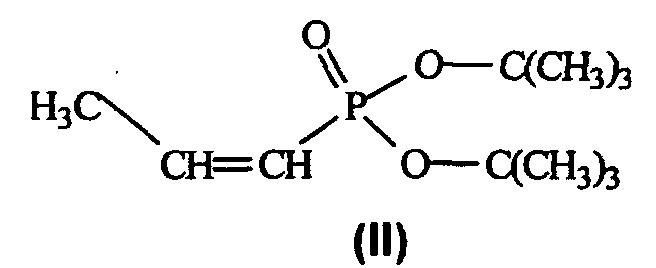
- the present invention relates to a new process to obtain diterbutyl cis-1-propenylphosphonate (II): from diterbutyl propadienylphosphonate, (III):
- the methods disclosed, up to the present date, to carry out this reaction include catalytic hydrogenations, which are stereospecific.
- the patent ES 359,534 discloses catalytic hydrogenation as a method to obtain the intermediate (II).
- the examples are carried out with a 5% Pd/ C catalyst, using benzene as a solvent, although it also states that other catalysts can be used.
- This method has the drawbacks of the high toxicity of the benzene and the losses of the Pd catalysts caused, which, due to their high costs, has a serious economic disadvantage.
- the present invention provides a process for the transformation of compound (III) in (II) by means of catalytic hydrogenation, which avoids the majority of the drawbacks of the processes disclosed up to the present date.
- One aspect of this invention is to provide a process that avoids the use of benzene, using less toxic solvents such as toluene or methylene chloride as an alternative.
- Another aspect of this invention is to provide the use of catalysts that contain nickel and aluminium, which can additionally contain other metals such as iron, molybdenum and chromium, which permit carrying out the abovementioned hydrogenation reaction, with high yields, short reaction times and gentle pressure and temperature conditions.
- compound (III) dissolved in a suitable solvent such as, e.g. toluene, methylene chloride
- a suitable solvent such as, e.g. toluene, methylene chloride
- the reaction takes place quickly, generally in less than 1 hour and in gentle pressure and temperature conditions.
- the reaction yield is higher than 95%, and can even be higher than 98% in some conditions.
- the process according to the invention is essentially the following: A quantity of Ni-Al catalyst is added to a solution of compound (III) in toluene, stirring sufficiently so that it is distributed homogeneously. The mixture is inerted with N 2 and a vacuum, and H 2 is passed through it, maintaining constant pressure and temperature conditions. The hydrogenation is carried out at a temperature between 10°C and 50°C, preferably between 15°C and 30°C; and at a pressure between 0.5-5 atm, preferably between 1-3 atm. The reaction generally ends after a time ranging from 10 to 90 minutes. The catalyst is recovered by filtering and can be used in successive reactions. The compound (II) formed can be transformed into fosfomycin or its salts following the abovementioned known methods.
- catalysts that contain Ni, Al and which may contain other metals, with different characteristics as regards composition and particle size, can be used. In general larger particle size produces a reduction in reaction rate.
Landscapes
- Chemical & Material Sciences (AREA)
- Organic Chemistry (AREA)
- Health & Medical Sciences (AREA)
- Life Sciences & Earth Sciences (AREA)
- Biochemistry (AREA)
- General Health & Medical Sciences (AREA)
- Molecular Biology (AREA)
- Low-Molecular Organic Synthesis Reactions Using Catalysts (AREA)
- Organic Low-Molecular-Weight Compounds And Preparation Thereof (AREA)
Abstract
Description
- This invention relates to a process to synthesize an intermediate useful in the preparation of an antibiotic known as fosfomycin and/or its salts. This intermediate product is diterbutyl cis-1-propenylphosphonate.
- Fosfomycin (Merck Index no. 4280, page 721, 12th edition) is (-)-(1R, 2S)-(1,2-epoxypropyl)phosphonic acid.

- This compound, initially isolated from certain strains of the Streptomyces genus is useful, either as it is or in the form of salt, as an antibacterial agent in the treatment of infections caused by gram-positive and gram-negative germs. Its industrial production is currently carried out by chemical synthesis.
- The usual methods of synthesis include obtaining an intermediate: diterbutyl propadienylphosphonate, which is hydrogenated to give diterbutyl cis-1 propenylphosphonate, which is subsequently converted into cis-1-propenylphosphonic acid liberating ter-butanol, followed by epoxidation with hydrogen peroxide in the presence of sodium tungstate to obtain cis-1,2-epoxypropylphosphonic acid, as a mixture of isomers. The optical resolution of the isomers is carried out by means of selective crystallization with (+)-α-phenylethylamine, obtaining the salt (+)-α-phenylethylammonium (-)-cis,-1,2-epoxypropylphosphonate.
- The present invention relates to a new process to obtain diterbutyl cis-1-propenylphosphonate (II):from diterbutyl propadienylphosphonate, (III):

- The methods disclosed, up to the present date, to carry out this reaction include catalytic hydrogenations, which are stereospecific. The patent ES 359,534 discloses catalytic hydrogenation as a method to obtain the intermediate (II). The examples are carried out with a 5% Pd/ C catalyst, using benzene as a solvent, although it also states that other catalysts can be used. This method has the drawbacks of the high toxicity of the benzene and the losses of the Pd catalysts caused, which, due to their high costs, has a serious economic disadvantage.
- The patent US 4,222,970 discloses the preparation of the intermediate (II) from a benzene solution of compound (III) to which a methanol: water (1:1) mixture is added that contains hydrazine hydrate and a Ni-Raney catalyst with a yield higher than 90%. The high toxicity of benzene continues to make the industrial application of the process disclosed in this patent problematic. In addition, hydrazine is also a very toxic compound whose use should be avoided. Finally, the 90% yield attributed is insufficient for a reaction with these characteristics.
- The present invention provides a process for the transformation of compound (III) in (II) by means of catalytic hydrogenation, which avoids the majority of the drawbacks of the processes disclosed up to the present date.
- One aspect of this invention is to provide a process that avoids the use of benzene, using less toxic solvents such as toluene or methylene chloride as an alternative.
- Another aspect of this invention is to provide the use of catalysts that contain nickel and aluminium, which can additionally contain other metals such as iron, molybdenum and chromium, which permit carrying out the abovementioned hydrogenation reaction, with high yields, short reaction times and gentle pressure and temperature conditions.
- In the course of the research carried out, it has been found, surprisingly, that compound (III) dissolved in a suitable solvent (such as, e.g. toluene, methylene chloride) is transformed into compound (II) when it is made to react with H2, in the presence of catalysts that contain nickel and aluminium, or catalysts what contain nickel, aluminium and other metals in smaller proportions. The reaction takes place quickly, generally in less than 1 hour and in gentle pressure and temperature conditions. The reaction yield is higher than 95%, and can even be higher than 98% in some conditions.
- This process permits avoiding the drawbacks mentioned in the previous patents:
- Avoiding the use of benzene, a highly toxic solvent that belongs to class I of the International Conference Harmonisation (ICH), according to the 1999 supplement of European Pharmacopoeia, whose use should be avoided in pharmaceutical products.
- Also avoiding the use of hydrazine, which is a very toxic, potentially carcinogenic reagent.
- Permitting the use of catalysts that contain Ni-Al, which are much more economic that those of Pd.
- Permitting greater safety and economy in industrial installations, as the reaction takes place in gentle pressure and temperature conditions.
- The process according to the invention is essentially the following: A quantity of Ni-Al catalyst is added to a solution of compound (III) in toluene, stirring sufficiently so that it is distributed homogeneously. The mixture is inerted with N2 and a vacuum, and H2 is passed through it, maintaining constant pressure and temperature conditions. The hydrogenation is carried out at a temperature between 10°C and 50°C, preferably between 15°C and 30°C; and at a pressure between 0.5-5 atm, preferably between 1-3 atm. The reaction generally ends after a time ranging from 10 to 90 minutes. The catalyst is recovered by filtering and can be used in successive reactions. The compound (II) formed can be transformed into fosfomycin or its salts following the abovementioned known methods.
- In accordance with this invention, different types of catalysts that contain Ni, Al and which may contain other metals, with different characteristics as regards composition and particle size, can be used. In general larger particle size produces a reduction in reaction rate.
- The following examples are intended to illustrate the invention but should not be understood as restrictive of it.
- Add 8 g of a Ni-Al catalyst to a solution containing 112 g of diterbutyl propadienylphosphonate in 1000 ml of toluene. The catalyst contains at least 93% Ni, with a particle size of less than 80 µm. The mixture is inerted, and is heated to 30° C passing H2 through it until a pressure of 2 atm is reached. The reaction ends after 18 minutes. 110 g of diterbutyl cis-1 propenylphosphonate is obtained, which means a yield of 98%. The reaction is monitored using infrared spectroscopy.
- Add 16.5 g of a Ni-Al catalyst to a solution containing 230 g of diterbutyl propadienylphosphonate in 2000 ml of toluene. The catalyst contains at least 93% Ni, and a particle distribution of less than 200 µm. The mixture is inerted, and the temperature is maintained at 22°C passing H2 through it until a pressure of 1.5 atm is reached. The reaction ends after 55 minutes. 226 g of diterbutyl cis-1 propenylphosphonate is obtained, which means a yield of 98%.
- Add 8 g of a Ni-Al catalyst to a solution containing 60 g of diterbutyl propadienylphosphonate in 1000 ml of toluene. The catalyst contains at least 93% Ni and an average particle size of 27 µm. The mixture is inerted, and the temperature is maintained at 15° C passing H2 through it until a pressure of 2.2 atm is reached. The reaction ends after 19 minutes. 58 g of diterbutyl cis-1 propenylphosphonate is obtained, which means a yield of 97%.
- Add 16 g of a Ni-Al catalyst to a solution containing 232 g of diterbutyl propadienylphosphonate in 3000 ml of toluene. The dry catalyst contains at least 93% Ni and an average particle size of 42 µm. The mixture is inerted, and the temperature is maintained at 15° C passing H2 through it until a pressure of 2 atm is reached. The reaction ends after 70 minutes. 225 g of diterbutyl cis-1 propenylphosphonate is obtained, which means a yield of 97%.
- Add 7 g of a Ni-Al catalyst to a solution containing 112 g of diterbutyl propadienylphosphonate in 1000 ml of toluene. The catalyst contains 93% Ni. The mixture is inerted, and is heated to 30° C passing H2 through it until a pressure of 2 atm is reached. The reaction ends after 50 minutes. 110 g of diterbutyl cis-1 propenylphosphonate is obtained, which means a yield of 98%.
- Add 8 g of a Ni-Al catalyst to a solution containing 112 g of diterbutyl propadienylphosphonate in 1000 ml of toluene. The catalyst contains 93% Ni, and, in addition to Al contains Mo and Fe. The mixture is inerted, and is heated to 30° C passing H2 through it until a pressure of 2 atm is reached. The reaction ends after 45 minutes. 109 g of diterbutyl cis-1 propenylphosphonate is obtained, which means a yield of 97%.
- Add 8.5 g of a Ni-Al catalyst to a solution containing 112 g of diterbutyl propadienylphosphonate in 1000 ml of methylene chloride. The catalyst contains 93% Ni, and, in addition to Al contains Mo and Fe. The mixture is inerted, and is heated to 20° C passing H2 through it until a pressure of 2.2 atm is reached. The reaction ends after 52 minutes. 107 g of diterbutyl cis-1 propenylphosphonate is obtained, which means a yield of 95%.
Claims (9)
- A process to obtain diterbutyl cis-1 propenylphosphonate characterized in that it starts from diterbutyl propadienylphosphonate, and proceeds to reduce this with H2 in the presence of Ni-Al catalysts
- A process according to claim 1, characterized in that the solvent used in the reaction is toluene or methylene chloride.
- A process according to claim 1, characterized in that the reaction temperature ranges from 10°C to 50°C, preferably from 15°C to 30°C.
- A process according to claim 1, characterized in that the reaction takes place at a pressure between 0.5 and 5 atm, preferably between 1-3 atm.
- A process according to claim 1, characterized in that the catalyst used contains nickel and aluminium, and can further contain other metals.
- A process according to claim 5, characterized in that the nickel content of the catalyst is higher than 93%.
- A process according to claim 5, characterized in that the aluminium content of the catalyst is less than 7%.
- A process according to claim 5, characterized in that the catalyst contains other metals such as molybdenum, iron and chromium.
- A process according to claim 5, characterized in that the particle size of the catalyst is less than 200 µm.
Applications Claiming Priority (3)
| Application Number | Priority Date | Filing Date | Title |
|---|---|---|---|
| ES200101841 | 2001-08-06 | ||
| ES200101841A ES2184632B1 (en) | 2001-08-06 | 2001-08-06 | A PROCEDURE FOR OBTAINING CIS-1-PROPENYLPHOSPHONATE FROM DITERC-BUTILO. |
| PCT/ES2002/000345 WO2003014132A1 (en) | 2001-08-06 | 2002-07-11 | Method of obtaining cis-1-propenylphosphonate of diterbutyl |
Publications (2)
| Publication Number | Publication Date |
|---|---|
| EP1422232A1 true EP1422232A1 (en) | 2004-05-26 |
| EP1422232B1 EP1422232B1 (en) | 2005-03-09 |
Family
ID=8498651
Family Applications (1)
| Application Number | Title | Priority Date | Filing Date |
|---|---|---|---|
| EP02748879A Expired - Lifetime EP1422232B1 (en) | 2001-08-06 | 2002-07-11 | Method of obtaining cis-1-propenylphosphonate of diterbutyl |
Country Status (7)
| Country | Link |
|---|---|
| EP (1) | EP1422232B1 (en) |
| JP (1) | JP4001578B2 (en) |
| AT (1) | ATE290539T1 (en) |
| DE (1) | DE60203187D1 (en) |
| ES (2) | ES2184632B1 (en) |
| MX (1) | MXPA04000930A (en) |
| WO (1) | WO2003014132A1 (en) |
Cited By (1)
| Publication number | Priority date | Publication date | Assignee | Title |
|---|---|---|---|---|
| CN101759719A (en) * | 2010-01-18 | 2010-06-30 | 张庆武 | Method for synthesizing fosfomycin phenylethylamine calt |
Families Citing this family (2)
| Publication number | Priority date | Publication date | Assignee | Title |
|---|---|---|---|---|
| ES2270703B1 (en) * | 2005-05-20 | 2008-06-01 | Universidad De Huelva | CONTINUOUS HYDROGENATION PROCEDURE OF THE DI-TERC-BUTILO PROPANEDIENYLPHOSPHONATE ESTER. |
| CN116947923B (en) * | 2023-06-26 | 2026-01-30 | 南京道尔医药研究院有限公司 | A method for preparing fosfomycin intermediate levoflusamide salt |
Family Cites Families (1)
| Publication number | Priority date | Publication date | Assignee | Title |
|---|---|---|---|---|
| IT1065240B (en) * | 1976-08-04 | 1985-02-25 | Stabil Bioterapico Farmachim | PHOSPHOMYCIN MANUFACTURING PROCEDURE |
-
2001
- 2001-08-06 ES ES200101841A patent/ES2184632B1/en not_active Expired - Fee Related
-
2002
- 2002-07-11 WO PCT/ES2002/000345 patent/WO2003014132A1/en not_active Ceased
- 2002-07-11 EP EP02748879A patent/EP1422232B1/en not_active Expired - Lifetime
- 2002-07-11 JP JP2003519081A patent/JP4001578B2/en not_active Expired - Fee Related
- 2002-07-11 ES ES02748879T patent/ES2235066T3/en not_active Expired - Lifetime
- 2002-07-11 MX MXPA04000930A patent/MXPA04000930A/en active IP Right Grant
- 2002-07-11 DE DE60203187T patent/DE60203187D1/en not_active Expired - Lifetime
- 2002-07-11 AT AT02748879T patent/ATE290539T1/en not_active IP Right Cessation
Non-Patent Citations (1)
| Title |
|---|
| See references of WO03014132A1 * |
Cited By (1)
| Publication number | Priority date | Publication date | Assignee | Title |
|---|---|---|---|---|
| CN101759719A (en) * | 2010-01-18 | 2010-06-30 | 张庆武 | Method for synthesizing fosfomycin phenylethylamine calt |
Also Published As
| Publication number | Publication date |
|---|---|
| WO2003014132A1 (en) | 2003-02-20 |
| ATE290539T1 (en) | 2005-03-15 |
| ES2235066T3 (en) | 2005-07-01 |
| ES2184632A1 (en) | 2003-04-01 |
| EP1422232B1 (en) | 2005-03-09 |
| MXPA04000930A (en) | 2004-10-27 |
| JP4001578B2 (en) | 2007-10-31 |
| DE60203187D1 (en) | 2005-04-14 |
| ES2184632B1 (en) | 2004-08-01 |
| JP2004537602A (en) | 2004-12-16 |
Similar Documents
| Publication | Publication Date | Title |
|---|---|---|
| JP4338401B2 (en) | Synthesis of 4-phenylbutyric acid | |
| EP1422232B1 (en) | Method of obtaining cis-1-propenylphosphonate of diterbutyl | |
| EP1343750B1 (en) | Process for the preparation of phenethylamine derivatives | |
| EP1770084B1 (en) | Method for producing (z)-1-phenyl-1-diethylaminocarbonyl-2-aminomethyl cyclopropane hydrochloride | |
| MXPA03000779A (en) | Method for production of rare carotenoids from commercially available lutein. | |
| CA2028909C (en) | Preparation of intermediates and the synthesis of n-(2-hydroxy-ethyl)-2-hydroxymethyl-3,4,5-trihydroxypiperidines | |
| HUE033184T2 (en) | Method for synthesizing sapropterin dihydrochloride | |
| CN115806543A (en) | Articaine hydrochloride intermediate and preparation method and application thereof | |
| EP3956339A1 (en) | Trimethylplatinum(iv) iodide | |
| JPH07106991B2 (en) | Partial hydrogenation method | |
| CN110698358A (en) | Synthesis of continuous oseltamivir phosphate | |
| EP0152090A2 (en) | Process for preparation of aminated phthalideisoquinolines | |
| KR19990087905A (en) | A process for the preparation of 4-(des-dimethylamino)-tetracyclines | |
| CN112457353A (en) | Synthesis method of beta-nicotinamide riboside chloride | |
| JP2594774B2 (en) | Method for producing amine-borane | |
| DE2515011C2 (en) | Process for the production of symmetrical olefins | |
| CA2376703C (en) | Method for preparing lysergic acid | |
| WO2000037425A1 (en) | Method for producing fluoxetin | |
| JP4870296B2 (en) | Method for producing hinokitiol glycoside | |
| DE69605520T2 (en) | Sodium-orthohydroxymandelate-phenol-water complexes, process for their preparation and use for isolating the sodium orthohydroxymandelate | |
| IT9022506A1 (en) | PROCEDURE FOR PREPARING AN INTERMEDIATE | |
| JP4864247B2 (en) | Selective production method of p-iodophenol | |
| JPH03127752A (en) | Production of methylcyclohexanone | |
| EP1887013A1 (en) | A process for preparing didanosine | |
| EP0161499B1 (en) | Process for preparation of aminophthalideisoquinolines |
Legal Events
| Date | Code | Title | Description |
|---|---|---|---|
| PUAI | Public reference made under article 153(3) epc to a published international application that has entered the european phase |
Free format text: ORIGINAL CODE: 0009012 |
|
| 17P | Request for examination filed |
Effective date: 20040212 |
|
| AK | Designated contracting states |
Kind code of ref document: A1 Designated state(s): AT BE BG CH CY CZ DE DK EE ES FI FR GB GR IE IT LI LU MC NL PT SE SK TR |
|
| AX | Request for extension of the european patent |
Extension state: AL LT LV MK RO SI |
|
| GRAP | Despatch of communication of intention to grant a patent |
Free format text: ORIGINAL CODE: EPIDOSNIGR1 |
|
| GRAS | Grant fee paid |
Free format text: ORIGINAL CODE: EPIDOSNIGR3 |
|
| GRAA | (expected) grant |
Free format text: ORIGINAL CODE: 0009210 |
|
| AK | Designated contracting states |
Kind code of ref document: B1 Designated state(s): AT BE BG CH CY CZ DE DK EE ES FI FR GB GR IE IT LI LU MC NL PT SE SK TR |
|
| PG25 | Lapsed in a contracting state [announced via postgrant information from national office to epo] |
Ref country code: CH Free format text: LAPSE BECAUSE OF FAILURE TO SUBMIT A TRANSLATION OF THE DESCRIPTION OR TO PAY THE FEE WITHIN THE PRESCRIBED TIME-LIMIT Effective date: 20050309 Ref country code: EE Free format text: LAPSE BECAUSE OF FAILURE TO SUBMIT A TRANSLATION OF THE DESCRIPTION OR TO PAY THE FEE WITHIN THE PRESCRIBED TIME-LIMIT Effective date: 20050309 Ref country code: SK Free format text: LAPSE BECAUSE OF FAILURE TO SUBMIT A TRANSLATION OF THE DESCRIPTION OR TO PAY THE FEE WITHIN THE PRESCRIBED TIME-LIMIT Effective date: 20050309 Ref country code: TR Free format text: LAPSE BECAUSE OF FAILURE TO SUBMIT A TRANSLATION OF THE DESCRIPTION OR TO PAY THE FEE WITHIN THE PRESCRIBED TIME-LIMIT Effective date: 20050309 Ref country code: FI Free format text: LAPSE BECAUSE OF FAILURE TO SUBMIT A TRANSLATION OF THE DESCRIPTION OR TO PAY THE FEE WITHIN THE PRESCRIBED TIME-LIMIT Effective date: 20050309 Ref country code: LI Free format text: LAPSE BECAUSE OF FAILURE TO SUBMIT A TRANSLATION OF THE DESCRIPTION OR TO PAY THE FEE WITHIN THE PRESCRIBED TIME-LIMIT Effective date: 20050309 Ref country code: NL Free format text: LAPSE BECAUSE OF FAILURE TO SUBMIT A TRANSLATION OF THE DESCRIPTION OR TO PAY THE FEE WITHIN THE PRESCRIBED TIME-LIMIT Effective date: 20050309 Ref country code: BE Free format text: LAPSE BECAUSE OF FAILURE TO SUBMIT A TRANSLATION OF THE DESCRIPTION OR TO PAY THE FEE WITHIN THE PRESCRIBED TIME-LIMIT Effective date: 20050309 Ref country code: CZ Free format text: LAPSE BECAUSE OF FAILURE TO SUBMIT A TRANSLATION OF THE DESCRIPTION OR TO PAY THE FEE WITHIN THE PRESCRIBED TIME-LIMIT Effective date: 20050309 |
|
| REG | Reference to a national code |
Ref country code: GB Ref legal event code: FG4D |
|
| REG | Reference to a national code |
Ref country code: CH Ref legal event code: EP |
|
| REG | Reference to a national code |
Ref country code: IE Ref legal event code: FG4D |
|
| REF | Corresponds to: |
Ref document number: 60203187 Country of ref document: DE Date of ref document: 20050414 Kind code of ref document: P |
|
| PG25 | Lapsed in a contracting state [announced via postgrant information from national office to epo] |
Ref country code: BG Free format text: LAPSE BECAUSE OF FAILURE TO SUBMIT A TRANSLATION OF THE DESCRIPTION OR TO PAY THE FEE WITHIN THE PRESCRIBED TIME-LIMIT Effective date: 20050609 Ref country code: DK Free format text: LAPSE BECAUSE OF FAILURE TO SUBMIT A TRANSLATION OF THE DESCRIPTION OR TO PAY THE FEE WITHIN THE PRESCRIBED TIME-LIMIT Effective date: 20050609 Ref country code: GR Free format text: LAPSE BECAUSE OF FAILURE TO SUBMIT A TRANSLATION OF THE DESCRIPTION OR TO PAY THE FEE WITHIN THE PRESCRIBED TIME-LIMIT Effective date: 20050609 |
|
| PG25 | Lapsed in a contracting state [announced via postgrant information from national office to epo] |
Ref country code: DE Free format text: LAPSE BECAUSE OF FAILURE TO SUBMIT A TRANSLATION OF THE DESCRIPTION OR TO PAY THE FEE WITHIN THE PRESCRIBED TIME-LIMIT Effective date: 20050610 |
|
| REG | Reference to a national code |
Ref country code: ES Ref legal event code: FG2A Ref document number: 2235066 Country of ref document: ES Kind code of ref document: T3 |
|
| PG25 | Lapsed in a contracting state [announced via postgrant information from national office to epo] |
Ref country code: LU Free format text: LAPSE BECAUSE OF NON-PAYMENT OF DUE FEES Effective date: 20050711 Ref country code: CY Free format text: LAPSE BECAUSE OF FAILURE TO SUBMIT A TRANSLATION OF THE DESCRIPTION OR TO PAY THE FEE WITHIN THE PRESCRIBED TIME-LIMIT Effective date: 20050711 |
|
| PG25 | Lapsed in a contracting state [announced via postgrant information from national office to epo] |
Ref country code: MC Free format text: LAPSE BECAUSE OF NON-PAYMENT OF DUE FEES Effective date: 20050731 |
|
| NLV1 | Nl: lapsed or annulled due to failure to fulfill the requirements of art. 29p and 29m of the patents act | ||
| PG25 | Lapsed in a contracting state [announced via postgrant information from national office to epo] |
Ref country code: PT Free format text: LAPSE BECAUSE OF FAILURE TO SUBMIT A TRANSLATION OF THE DESCRIPTION OR TO PAY THE FEE WITHIN THE PRESCRIBED TIME-LIMIT Effective date: 20050907 |
|
| REG | Reference to a national code |
Ref country code: CH Ref legal event code: PL |
|
| ET | Fr: translation filed | ||
| PLBE | No opposition filed within time limit |
Free format text: ORIGINAL CODE: 0009261 |
|
| STAA | Information on the status of an ep patent application or granted ep patent |
Free format text: STATUS: NO OPPOSITION FILED WITHIN TIME LIMIT |
|
| 26N | No opposition filed |
Effective date: 20051212 |
|
| PG25 | Lapsed in a contracting state [announced via postgrant information from national office to epo] |
Ref country code: GB Free format text: LAPSE BECAUSE OF NON-PAYMENT OF DUE FEES Effective date: 20060711 |
|
| GBPC | Gb: european patent ceased through non-payment of renewal fee |
Effective date: 20060711 |
|
| PG25 | Lapsed in a contracting state [announced via postgrant information from national office to epo] |
Ref country code: SE Free format text: LAPSE BECAUSE OF FAILURE TO SUBMIT A TRANSLATION OF THE DESCRIPTION OR TO PAY THE FEE WITHIN THE PRESCRIBED TIME-LIMIT Effective date: 20050609 |
|
| PGFP | Annual fee paid to national office [announced via postgrant information from national office to epo] |
Ref country code: ES Payment date: 20080717 Year of fee payment: 7 |
|
| PGFP | Annual fee paid to national office [announced via postgrant information from national office to epo] |
Ref country code: IE Payment date: 20080707 Year of fee payment: 7 Ref country code: IT Payment date: 20080729 Year of fee payment: 7 Ref country code: AT Payment date: 20080731 Year of fee payment: 7 Ref country code: FR Payment date: 20080715 Year of fee payment: 7 |
|
| REG | Reference to a national code |
Ref country code: FR Ref legal event code: ST Effective date: 20100331 |
|
| REG | Reference to a national code |
Ref country code: IE Ref legal event code: MM4A |
|
| PG25 | Lapsed in a contracting state [announced via postgrant information from national office to epo] |
Ref country code: FR Free format text: LAPSE BECAUSE OF NON-PAYMENT OF DUE FEES Effective date: 20090731 |
|
| PG25 | Lapsed in a contracting state [announced via postgrant information from national office to epo] |
Ref country code: AT Free format text: LAPSE BECAUSE OF NON-PAYMENT OF DUE FEES Effective date: 20090711 |
|
| PG25 | Lapsed in a contracting state [announced via postgrant information from national office to epo] |
Ref country code: IE Free format text: LAPSE BECAUSE OF NON-PAYMENT OF DUE FEES Effective date: 20090713 |
|
| REG | Reference to a national code |
Ref country code: ES Ref legal event code: FD2A Effective date: 20090713 |
|
| PG25 | Lapsed in a contracting state [announced via postgrant information from national office to epo] |
Ref country code: ES Free format text: LAPSE BECAUSE OF NON-PAYMENT OF DUE FEES Effective date: 20090713 |
|
| PG25 | Lapsed in a contracting state [announced via postgrant information from national office to epo] |
Ref country code: IT Free format text: LAPSE BECAUSE OF NON-PAYMENT OF DUE FEES Effective date: 20090711 |