EP1422138A2 - Attitude acquisition method and spacecraft attitude acquisition and control system - Google Patents
Attitude acquisition method and spacecraft attitude acquisition and control system Download PDFInfo
- Publication number
- EP1422138A2 EP1422138A2 EP03026297A EP03026297A EP1422138A2 EP 1422138 A2 EP1422138 A2 EP 1422138A2 EP 03026297 A EP03026297 A EP 03026297A EP 03026297 A EP03026297 A EP 03026297A EP 1422138 A2 EP1422138 A2 EP 1422138A2
- Authority
- EP
- European Patent Office
- Prior art keywords
- star
- spacecraft
- sensor signals
- view
- sensor
- Prior art date
- Legal status (The legal status is an assumption and is not a legal conclusion. Google has not performed a legal analysis and makes no representation as to the accuracy of the status listed.)
- Granted
Links
- 238000000034 method Methods 0.000 title claims abstract description 58
- 235000019892 Stellar Nutrition 0.000 claims abstract description 17
- 230000004044 response Effects 0.000 claims abstract description 14
- 238000000926 separation method Methods 0.000 claims description 12
- 238000012545 processing Methods 0.000 claims description 10
- 230000008859 change Effects 0.000 claims description 7
- 238000007670 refining Methods 0.000 claims 4
- 238000001914 filtration Methods 0.000 claims 1
- 230000008569 process Effects 0.000 abstract description 8
- 238000004891 communication Methods 0.000 description 5
- 238000005259 measurement Methods 0.000 description 5
- 238000012546 transfer Methods 0.000 description 3
- 238000010586 diagram Methods 0.000 description 2
- 230000004075 alteration Effects 0.000 description 1
- 230000000694 effects Effects 0.000 description 1
- 238000012986 modification Methods 0.000 description 1
- 230000004048 modification Effects 0.000 description 1
- 230000008707 rearrangement Effects 0.000 description 1
- 239000004065 semiconductor Substances 0.000 description 1
- 230000035939 shock Effects 0.000 description 1
Images



Classifications
-
- G—PHYSICS
- G01—MEASURING; TESTING
- G01C—MEASURING DISTANCES, LEVELS OR BEARINGS; SURVEYING; NAVIGATION; GYROSCOPIC INSTRUMENTS; PHOTOGRAMMETRY OR VIDEOGRAMMETRY
- G01C21/00—Navigation; Navigational instruments not provided for in groups G01C1/00 - G01C19/00
- G01C21/02—Navigation; Navigational instruments not provided for in groups G01C1/00 - G01C19/00 by astronomical means
- G01C21/025—Navigation; Navigational instruments not provided for in groups G01C1/00 - G01C19/00 by astronomical means with the use of startrackers
-
- B—PERFORMING OPERATIONS; TRANSPORTING
- B64—AIRCRAFT; AVIATION; COSMONAUTICS
- B64G—COSMONAUTICS; VEHICLES OR EQUIPMENT THEREFOR
- B64G1/00—Cosmonautic vehicles
- B64G1/22—Parts of, or equipment specially adapted for fitting in or to, cosmonautic vehicles
- B64G1/24—Guiding or controlling apparatus, e.g. for attitude control
- B64G1/244—Spacecraft control systems
-
- B—PERFORMING OPERATIONS; TRANSPORTING
- B64—AIRCRAFT; AVIATION; COSMONAUTICS
- B64G—COSMONAUTICS; VEHICLES OR EQUIPMENT THEREFOR
- B64G1/00—Cosmonautic vehicles
- B64G1/22—Parts of, or equipment specially adapted for fitting in or to, cosmonautic vehicles
- B64G1/24—Guiding or controlling apparatus, e.g. for attitude control
- B64G1/36—Guiding or controlling apparatus, e.g. for attitude control using sensors, e.g. sun-sensors, horizon sensors
- B64G1/361—Guiding or controlling apparatus, e.g. for attitude control using sensors, e.g. sun-sensors, horizon sensors using star sensors
-
- B—PERFORMING OPERATIONS; TRANSPORTING
- B64—AIRCRAFT; AVIATION; COSMONAUTICS
- B64G—COSMONAUTICS; VEHICLES OR EQUIPMENT THEREFOR
- B64G1/00—Cosmonautic vehicles
- B64G1/22—Parts of, or equipment specially adapted for fitting in or to, cosmonautic vehicles
- B64G1/24—Guiding or controlling apparatus, e.g. for attitude control
- B64G1/26—Guiding or controlling apparatus, e.g. for attitude control using jets
-
- B—PERFORMING OPERATIONS; TRANSPORTING
- B64—AIRCRAFT; AVIATION; COSMONAUTICS
- B64G—COSMONAUTICS; VEHICLES OR EQUIPMENT THEREFOR
- B64G1/00—Cosmonautic vehicles
- B64G1/22—Parts of, or equipment specially adapted for fitting in or to, cosmonautic vehicles
- B64G1/24—Guiding or controlling apparatus, e.g. for attitude control
- B64G1/28—Guiding or controlling apparatus, e.g. for attitude control using inertia or gyro effect
- B64G1/285—Guiding or controlling apparatus, e.g. for attitude control using inertia or gyro effect using momentum wheels
-
- B—PERFORMING OPERATIONS; TRANSPORTING
- B64—AIRCRAFT; AVIATION; COSMONAUTICS
- B64G—COSMONAUTICS; VEHICLES OR EQUIPMENT THEREFOR
- B64G1/00—Cosmonautic vehicles
- B64G1/22—Parts of, or equipment specially adapted for fitting in or to, cosmonautic vehicles
- B64G1/24—Guiding or controlling apparatus, e.g. for attitude control
- B64G1/36—Guiding or controlling apparatus, e.g. for attitude control using sensors, e.g. sun-sensors, horizon sensors
- B64G1/369—Guiding or controlling apparatus, e.g. for attitude control using sensors, e.g. sun-sensors, horizon sensors using gyroscopes as attitude sensors
Definitions
- the present invention relates generally to spacecraft attitude control systems.
- Spacecraft attitude control is essential because spacecraft must generally be properly oriented to perform their intended service.
- Communication spacecraft for example, typically provide communication services for service areas. Accordingly, antenna systems of these spacecraft generate payload beams that form payload footprints on the earth and it is critically important to reduce service error which is any difference between a payload footprint and its respective service area. This can only be accomplished by precise control of a spacecraft's attitude.
- a spacecraft's attitude is sensed with star sensors of a stellar attitude determination system and appropriately altered with torque generators that are coupled to the spacecraft's body.
- Star sensors are complex semiconductor systems which generally include a) an array of light sensitive elements that collect charge in response to incident star light, b) an arrangement of charge-transfer elements that readout the collected charges and c) an output structure that converts the transferred charges to corresponding star-sensor signals.
- the collected charges of the array are generally processed into star centroids and each transfer of the processed charges from the star sensor is typically referred to as a data frame.
- Star-sensor signals are thus provided at a frame rate and denote vertical and horizontal coordinates of stars in the star-sensor's field-of-view.
- the star-sensor signals also denote the magnitudes of these stars.
- An estimate of the spacecraft's attitude at the time of a data frame can be formed by identifying the stars that generated the star-sensor signals of that data frame. Identification is generally realized by matching the star-sensor signals to a known set of stars and the known set is typically accessed from stored star catalogs. However, star-sensor fields-of-view are limited (e.g., to horizontal and vertical ranges of 8°) so that attitude determination systems sometimes fail to provide sufficient star-sensor signals to enable an identification. The probability of such failure is increased when the intensity of the star-sensor signals is reduced by maneuvers (e.g., those during transfer orbits) that rotate the spacecraft at a rate that denies sufficient time for the star-sensor light sensitive elements to fully charge in response to incident star light.
- maneuvers e.g., those during transfer orbits
- the present invention is directed to attitude acquisition methods and systems which reduce the time generally required to acquire spacecraft attitude estimates and enhance the probability of realizing such estimates.
- FIGS. 1 and 2 illustrate spacecraft structures of the present invention and FIGS. 3, 4A, 4B, 4C and 5 illustrate methods that can be practiced with these structures to acquire and control spacecraft attitudes.
- the methods process star-sensor signals that correspond to successive star-sensor fields-of-view into a processed set of star-sensor signals that denote star positions across an expanded field-of-view that exceeds any of the successive star-sensor fields-of-view.
- FIG. 1 shows a spacecraft 20 which has a body 22 that carries an exemplary service system in the form, for example, of a communication system 24.
- This system provides services (e.g., communication services) to a service area on the earth with a transponder system 26 that interfaces with antennas 28.
- This service can only be effected if the spacecraft is controlled to have a service attitude.
- the body 22 also carries an attitude determination and control system 40 which comprises attitude-control processors 42, a star sensor system 44 that includes at least one star sensor, angular velocity sensors 46 and torque generators 48.
- attitude-control processors In response to attitude sense signals from the star sensor system 44 and the angular velocity sensors 46, the attitude-control processors generate control signals 50.
- the torque generators 48 induce torques in the body 22 which cause it to assume a commanded attitude (e.g., the spacecraft's service attitude). Because their torques alter the attitude of the body 22, the torque generators effectively generate a feedback path 52 that alters the attitude sense signals of the star sensor system 44 and the angular velocity sensors 46.
- Attitude of the spacecraft 20 can be defined with reference to a body-centered coordinate system that comprises a roll axis 56, a pitch axis 57 and a yaw axis 58 (directed towards the viewer).
- the systems of the spacecraft 20 are preferably powered with currents that are generated, for example, by at least one solar panel 59.
- the attitude-control processors 42 of the attitude determination and control system 40 comprise a star data processor 60, at least one star catalog 61, a stellar attitude acquisition system 62, a recursive filter system 64, an attitude determination and controller 66, an attitude and rate command section 68 and an ephemeris determination system 69.
- the stellar attitude acquisition system 62 receives star sensor signals 70 from the star sensor system 44 and accesses data from the star catalogs 61 to thereby identify the stars that generated the star-sensor signals 70. If this identification is successful, the stellar attitude acquisition system 62 provides an initial attitude estimate 72 to the attitude determination and control system 66.
- the star data processor 60 also receives star sensor signals 70 from the star sensor system 44 and has access to data from the star catalogs 61.
- Star measurement signals 74 from the star data processor 60 are processed by the recursive filter system 64 into subsequent attitude estimates 76 which are then provided to the attitude determination and controller 66.
- the star data processor 60 and the stellar attitude acquisition system 62 couple tracked-star commands 77 to the star sensor system 44 to thereby control which stars are tracked by the star sensors.
- the attitude and rate command 68 With access to ephemeris data 69 (e.g., earth and sun locations), the attitude and rate command 68 provides a commanded attitude 78 to the attitude determination and controller 66 which also receives rate signals 79 from the angular velocity sensors 46. In response, the attitude determination and controller 66 delivers torque command signals 80 to the torque generators 48 (e.g., thrusters 82, momentum wheels 83 and magnetic torquers 84). The resultant torque induces rotation of the spacecraft body (22 in FIG.
- the torque generators 48 e.g., thrusters 82, momentum wheels 83 and magnetic torquers 84
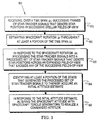
- the flow chart 90 of FIG. 3 illustrates process steps 91-95 in a method embodiment of the invention which acquires and controls the attitude of the spacecraft 20 of FIG. 1.
- process step 91 successive frames of star-sensor signals that denote star positions in successive stellar fields-of-view are received (from a star sensor) over a time span ⁇ t.
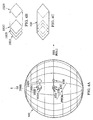
- FIG. 4A shows a spherical coordinate system 100 that is centered on the spacecraft (20 in FIG. 1) and also shows the spacecraft roll, pitch and yaw axes 56, 57 and 58 (wherein the pitch axis 57 is directed away from the viewer).
- the spacecraft is rotating about its yaw axis 58 at an exemplary rate of 0.05°/second and that the field-of-view 102A represents the field-of-view at a time t1 of one of the star sensors (e.g., star sensor 44A) of FIG. 1 that is angled as shown in the figure and that the field-of-view is projected onto the spherical coordinate system 100.
- the star sensors e.g., star sensor 44A
- FIG. 4A only shows additional successive fields-of-view 102B and 102 C at successive times t2 and t3 which occur at the ends of successive intervals of one minute and a successive field-of-view 102N at a time tn that is six minutes after time t1 because illustrating additional successive fields-of view at shorter successive times would diminish the clarity of FIG. 4.
- Corresponding positions of the pitch axis are indicated as 57A-57N.
- the position of the roll axis at time t1 is shown as 56A; later portions are not shown.
- FIG. 5 is an enlarged view of FIG. 4 which shows that the field-of-view 102A provides a frame of star-sensor signals at time t1 that denote star positions of dim stars 104 and 105 and a medium-brightness star 106 (the positions are typically in terms of horizontal and vertical coordinates ch and cv of respective fields-of-view).
- the successive field-of-view 102B provides a frame of star-sensor signals at time t2 that denote star positions of the dim star 105 and of additional dim stars 108 and one bright star 110 but fails to provide star-sensor signals corresponding to the dim star 104 nor the medium-brightness star 106.
- process step 92 estimates spacecraft rotation ⁇ r throughout at least a portion of the time span ⁇ t. It is further noted in FIG. 5 that the dim star 105 would generate a first set of position coordinates at time t1 relative to the field-of-view 102A and a different second set of position coordinates at time t2 relative to the field-of-view 102B. The position change represented by these respective position coordinates results from the spacecraft rotation ⁇ r that occurred in an elapsed time between the times t1 and t2.
- one method embodiment of the invention observes a position change of at least one star in at least two selected ones of the successive fields-of-view that differ by an elapsed time and estimates the spacecraft rotation ⁇ r from the position change and the elapsed time.
- the elapsed time is preferably long enough (e.g., on the order of one minute) to facilitate estimation of the spacecraft rotation ⁇ r but short enough to keep the relevant measurement stars within a successive field-of-view.
- Another method embodiment simply estimates the spacecraft rotation ⁇ r from attitude rate signals that are received from at least one spacecraft gyroscope such as one of the angular velocity sensors 46 of FIG. 2 which may comprise a set of gyroscopes that respectively sense rotation about the spacecraft's roll, pitch and yaw axes (56, 57 and 58 in FIGS. 1 and 4A).
- at least one spacecraft gyroscope such as one of the angular velocity sensors 46 of FIG. 2 which may comprise a set of gyroscopes that respectively sense rotation about the spacecraft's roll, pitch and yaw axes (56, 57 and 58 in FIGS. 1 and 4A).
- Process step 93 of FIG. 3 processes, with knowledge of the spacecraft rotation ⁇ r, the star-sensor signals into a processed set of star-sensor signals that denote star positions across an expanded field-of-view that exceeds any of the successive fields-of-view.
- this processing step is realized by conforming, with knowledge of the spacecraft rotation ⁇ r, star positions in successive stellar fields-of-view to conformed positions that correspond to a common time tcm in the expanded field-of-view.
- field-of-view 102B of FIG. 5 provides star-sensor signals at time t2 that denote star positions of the dim star 105, dim stars 108 and the bright star 110 but this field-of-view fails to sense the dim star 104 and the medium-brightness star 106.
- the position coordinates of these latter stars in the field-of-view 102A can be conformed to conformed position coordinates at time t2 in an extended field-of-view formed by a combination of the fields-of-view 102A and 102B.
- This process can be successively continued to field-of view 102C and on to field-of-view 102N so that all of the stars shown in FIG. 5 have been conformed to conformed position coordinates at a common time tcm (which is the time tn) in an extended field-of-view 120 that is shown in FIG. 4C.
- FIG. 4B shows an enlarged view of the fields-of-view 102A-N and these fields-of-view are indicated in broken lines in FIG. 4B.
- the processed set of star-sensor signals now denote star positions for bright stars 110 and 112, medium-brightness stars 106 and 114 and numerous dim stars which include dim stars 104, 105 and 108 at the common time tcm.
- process step 94 identifies at least a portion of the stars that generated the processed set of star-sensor signals to thereby acquire an initial attitude estimate.
- the identifying step generally includes a process step of matching the processed set of star-sensor signals to a known set of stars and this, in turn, generally requires that the processed set of star-sensor signals correspond to a predetermined criterion so as to enhance the probability that a match can be realized.
- an exemplary criterion is assumed which requires star-sensor signals that correspond to a bright-star pair, the separation of that star pair and a confirming pair of medium-brightness stars. It is apparent in FIG. 5 that the processed set of star-sensor signals corresponding to the extended field-of-view that comprises fields-of-view 102A-N does meet this criterion since it incudes a bright-star pair (110 and 112), the corresponding separation 116 and a pair of medium-brightness stars (106 and 114).
- star parameters and parameter combinations may be used as an identifying criterion in other embodiments of the invention.
- star catalogs may be organized in various ways (e.g., to include star-pair catalogs) in other embodiments of the invention.
- the stellar attitude acquisition system (62 in FIG. 2) should now be able to identify the stars that generated the processed set of star-sensor signals to thereby acquire an initial attitude estimate.
- the initial attitude estimate follows from the identification because spatial relationships between the horizontal and vertical coordinates of the star sensors (e.g., 44A of FIGS. 1 and 2) and a spacecraft body-centered coordinate system (e.g., comprising pitch, roll and yaw axes) are predetermined and known and spatial relationships between the star sensors and an earth-centered inertial (ECI) coordinate system) follow from the identified stars.
- ECI earth-centered inertial
- the estimate of the relative alignments of the sensors may be refined.
- the determined orientation of one star sensor e.g., sensor 44A of FIGS. 1 and 2) with respect to ECI
- may be used in conjunction with the determined orientation of another star sensor e.g., sensor 44B of FIGS. 1 and 2) with respect to ECI, to refine the estimate of the relative alignments of the sensors.
- spatial relationships between the star sensors and the spacecraft body were predetermined, these spatial relationships are typically altered by various disturbing sources (e.g., launch vibration, launch shock and thermal distortion). Accordingly, the effects of this alteration can be mitigated with the refined estimates of the sensors' relative alignment.
- estimates of this relationship e.g., the initial attitude estimate described above
- estimates of the spatial relationships between the spacecraft body and the star sensors can be revised to be consistent with the refined estimates of the sensors' relative alignment (also described above).
- this revision is realized by assuming that one of the predetermined spatial relationships between the star sensors and the spacecraft body is accurate and revising the other spatial relationship to be consistent with a refined estimate of the sensors' relative alignment.
- the final process step 95 of FIG. 3 responds to the initial attitude estimate by altering the spacecraft attitude with spacecraft torque generators to realize a commanded attitude (e.g., the commanded attitude 78 provided by the attitude and rate command section 68 of FIG. 2).
- a commanded attitude e.g., the commanded attitude 78 provided by the attitude and rate command section 68 of FIG. 2.
- the teachings of the invention may be practiced in numerous embodiments.
- the processes of FIG. 3 can be realized with star-sensor signals that indicate only position coordinates of stars in the field-of-view, the star-sensor signals preferably also indicate star magnitudes.
- the invention can be practiced with a single star sensor as indicated in FIG. 4A, spacecraft attitude accuracy can often be enhanced with multiple star sensors (e.g., two) whose fields-of-view are tilted away from each other.
- Two exemplary spacecraft embodiments would thus respectively include a) one operational star sensor and a spare backup star sensor and b) two operational star sensors and a spare backup star sensor.
- the matching step referred to above may include an initial process step of identifying candidate star pairs (e.g., from one of the star catalogs 61 of FIG. 2) whose magnitude and separation substantially match the magnitudes and separation of the star pair 110 and 112 of FIG. 5).
- candidate star pairs are successively discarded if they are not associated (e.g., as determined from the star catalogs) with a pair of stars whose relative positions substantially match those of the confirming pair of the processed set of star-sensor signals.
- These process steps will generally identify one of the candidate star pair and an associated pair of stars as the stars that generated the processed set of star-sensor signals.
- Star sensors are typically limited to a maximum number (e.g., five) of stars that they can simultaneously track. Accordingly, process step 93 of FIG. 3 is preferably practiced by adding newer ones of the star-sensor signals to the processed set of star-sensor signals and, if necessary to avoid exceeding the maximum number, discarding older ones until the identification criterion is satisfied. Newer star-sensor signals are preferred because they do not include conforming inaccuracies contributed by the estimated spacecraft rotation ⁇ r.
- the process of discarding older star-sensor signals comprises the step of breaking track on the corresponding stars and this is realized with the tracked-star commands (77 in FIG. 2) which are sent from the stellar attitude acquisition system (62 in FIG. 2) to control which stars are currently tracked by the star sensors.
- tracking is first breaked on stars that are closest to moving off of the current field-of-view (e.g., star 105 in FIG. 5 with respect to field-of-view 102B).
- the identification criterion described above is modified by requiring that the star-pair separation (116 in FIG. 5) not extend across different fields-of-view.
- the bright star pair 110 and 112 would not satisfy the criterion unless they were both contained within one of the successive fields-of-view.
- the accuracy of the observed separation is thus enhanced because it does not require the spacecraft rotation ⁇ r (found in process step 92) for its determination. Accordingly, the probability of success in the identifying step (94 in FIG. 3) is enhanced.
- the attitude of the spacecraft (20 in FIG. 1) can continue to be controlled in accordance with the process steps of FIG. 3. That is, the stellar attitude acquisition system (62 in FIG. 2) can successively obtain attitude estimates and provide them to the attitude determination and controller (66 in FIG. 2).
- the tracked-star commands 77 from the stellar attitude acquisition system 62 preferably commands the relevant star sensor to track its maximum number of stars to enhance the probability of matching an imaged star pattern to that of the star catalogs 61.
- the star measurement signals 74 from the star data processor 60 of FIG. 2 can be processed by an optimal estimator to provide subsequent attitude estimates 76 whose variance (i.e., inaccuracy) is reduced from the variance of the measurement signals 74.
- the optimal estimator is the recursive filter system 64 of FIG. 2 which may, for example, be a Kalman filter.
- the attitude determination and controller 66 initially responds to the initial attitude estimate 72 and subsequently responds to the subsequent attitude estimates 76.
- the tracked-star commands 77 from the star data processor 60 preferably limits the tracking of the relevant star sensor to less than its maximum number of stars to simplify processing and thus enhance processing speed.
- Attitude acquisition and control systems of the present invention substantially increase the field-of-view that can be obtained from star-sensor signals and thus reduce the time required to acquire attitude estimates and enhance the probability of such acquisition.
- the communication system 24 of FIG. 1 has been shown and described to thereby indicate an exemplary requirement for controlling a spacecraft's service attitude. This system is for illustrative purposes only and the teachings of the invention may be applied to realize attitude acquisition and control of any spacecraft.
Landscapes
- Engineering & Computer Science (AREA)
- Remote Sensing (AREA)
- Radar, Positioning & Navigation (AREA)
- Physics & Mathematics (AREA)
- Automation & Control Theory (AREA)
- Chemical & Material Sciences (AREA)
- Combustion & Propulsion (AREA)
- Aviation & Aerospace Engineering (AREA)
- Astronomy & Astrophysics (AREA)
- General Physics & Mathematics (AREA)
- Navigation (AREA)
- Control Of Position, Course, Altitude, Or Attitude Of Moving Bodies (AREA)
Abstract
Description
- The present invention relates generally to spacecraft attitude control systems.
- Spacecraft attitude control is essential because spacecraft must generally be properly oriented to perform their intended service. Communication spacecraft, for example, typically provide communication services for service areas. Accordingly, antenna systems of these spacecraft generate payload beams that form payload footprints on the earth and it is critically important to reduce service error which is any difference between a payload footprint and its respective service area. This can only be accomplished by precise control of a spacecraft's attitude.
- In an exemplary star sensor-based attitude determination and control system, a spacecraft's attitude is sensed with star sensors of a stellar attitude determination system and appropriately altered with torque generators that are coupled to the spacecraft's body. Star sensors are complex semiconductor systems which generally include a) an array of light sensitive elements that collect charge in response to incident star light, b) an arrangement of charge-transfer elements that readout the collected charges and c) an output structure that converts the transferred charges to corresponding star-sensor signals.
- The collected charges of the array are generally processed into star centroids and each transfer of the processed charges from the star sensor is typically referred to as a data frame. Star-sensor signals are thus provided at a frame rate and denote vertical and horizontal coordinates of stars in the star-sensor's field-of-view. Preferably, the star-sensor signals also denote the magnitudes of these stars.
- An estimate of the spacecraft's attitude at the time of a data frame can be formed by identifying the stars that generated the star-sensor signals of that data frame. Identification is generally realized by matching the star-sensor signals to a known set of stars and the known set is typically accessed from stored star catalogs. However, star-sensor fields-of-view are limited (e.g., to horizontal and vertical ranges of 8°) so that attitude determination systems sometimes fail to provide sufficient star-sensor signals to enable an identification. The probability of such failure is increased when the intensity of the star-sensor signals is reduced by maneuvers (e.g., those during transfer orbits) that rotate the spacecraft at a rate that denies sufficient time for the star-sensor light sensitive elements to fully charge in response to incident star light.
- The present invention is directed to attitude acquisition methods and systems which reduce the time generally required to acquire spacecraft attitude estimates and enhance the probability of realizing such estimates.
- These goals are realized with methods and systems that, over a time span Δt, receive successive frames of star-sensor signals that correspond to successive stellar fields-of-view, estimate spacecraft rotation Δr throughout at least a portion of the time span Δt, and, in response to the spacecraft rotation Δr, process the star-sensor signals into a processed set of star-sensor signals that denote star positions across an expanded field-of-view that exceeds any of the successive fields-of-view. The expanded field-of-view facilitates identification of the stars that generated the processed set of star-sensor signals to thereby acquire an initial attitude estimate.
- The novel features of the invention are set forth with particularity in the appended claims. The invention will be best understood from the following description when read in conjunction with the accompanying drawings.
-
- FIG. 1 is a block diagram of a spacecraft of the present invention;
- FIG. 2 is a detailed block diagram of an attitude determination and control system in the spacecraft of FIG. 1;
- FIG. 3 is a flow chart which illustrates processes in an attitude acquisition and control method of the present invention that is practiced with the spacecraft of FIG. 1;
- FIG. 4A illustrates fields-of-view of a star sensor of the spacecraft of FIG. 1 as projected onto a spherical coordinate system that is centered on the spacecraft;
- FIG. 4B is an enlarged view of the fields-of-view of FIG. 4A;
- FIG. 4C illustrates an expanded star-sensor field-of-view that is
formed from the fields-of-view of FIG. 4B;
and - FIG. 5 is another enlarged view of the fields-of-view of FIG. 4A which illustrates process steps in the flow chart of FIG. 3.
-
- FIGS. 1 and 2 illustrate spacecraft structures of the present invention and FIGS. 3, 4A, 4B, 4C and 5 illustrate methods that can be practiced with these structures to acquire and control spacecraft attitudes. In particular, the methods process star-sensor signals that correspond to successive star-sensor fields-of-view into a processed set of star-sensor signals that denote star positions across an expanded field-of-view that exceeds any of the successive star-sensor fields-of-view. These structures and methods reduce the time to acquire spacecraft attitude and enhance the probability of successful acquisition as will become apparent in the following description.
- FIG. 1 shows a
spacecraft 20 which has abody 22 that carries an exemplary service system in the form, for example, of acommunication system 24. This system provides services (e.g., communication services) to a service area on the earth with atransponder system 26 that interfaces withantennas 28. This service can only be effected if the spacecraft is controlled to have a service attitude. - Accordingly, the
body 22 also carries an attitude determination andcontrol system 40 which comprises attitude-control processors 42, astar sensor system 44 that includes at least one star sensor,angular velocity sensors 46 andtorque generators 48. In response to attitude sense signals from thestar sensor system 44 and theangular velocity sensors 46, the attitude-control processors generatecontrol signals 50. - In response to the control signals, the
torque generators 48 induce torques in thebody 22 which cause it to assume a commanded attitude (e.g., the spacecraft's service attitude). Because their torques alter the attitude of thebody 22, the torque generators effectively generate afeedback path 52 that alters the attitude sense signals of thestar sensor system 44 and theangular velocity sensors 46. - Attitude of the
spacecraft 20 can be defined with reference to a body-centered coordinate system that comprises aroll axis 56, apitch axis 57 and a yaw axis 58 (directed towards the viewer). The systems of thespacecraft 20 are preferably powered with currents that are generated, for example, by at least one solar panel 59. - As shown in FIG. 2, the attitude-
control processors 42 of the attitude determination andcontrol system 40 comprise astar data processor 60, at least onestar catalog 61, a stellarattitude acquisition system 62, arecursive filter system 64, an attitude determination andcontroller 66, an attitude andrate command section 68 and anephemeris determination system 69. - The stellar
attitude acquisition system 62 receivesstar sensor signals 70 from thestar sensor system 44 and accesses data from thestar catalogs 61 to thereby identify the stars that generated the star-sensor signals 70. If this identification is successful, the stellarattitude acquisition system 62 provides aninitial attitude estimate 72 to the attitude determination andcontrol system 66. - The
star data processor 60 also receivesstar sensor signals 70 from thestar sensor system 44 and has access to data from thestar catalogs 61.Star measurement signals 74 from thestar data processor 60 are processed by therecursive filter system 64 intosubsequent attitude estimates 76 which are then provided to the attitude determination andcontroller 66. Thestar data processor 60 and the stellarattitude acquisition system 62 couple tracked-star commands 77 to thestar sensor system 44 to thereby control which stars are tracked by the star sensors. - With access to ephemeris data 69 (e.g., earth and sun locations), the attitude and
rate command 68 provides acommanded attitude 78 to the attitude determination andcontroller 66 which also receives rate signals 79 from theangular velocity sensors 46. In response, the attitude determination andcontroller 66 deliverstorque command signals 80 to the torque generators 48 (e.g.,thrusters 82,momentum wheels 83 and magnetic torquers 84). The resultant torque induces rotation of the spacecraft body (22 in FIG. 1) which forms an effectivefeedback rotation signal 52 that is sensed by thestar sensor system 44,angular velocity sensors 46 and any other attitude sensors 86 (e.g., sun sensor) that provideother sense signals 87 to the attitude determination and controller 66 (theother attitude sensors 86 are also shown in FIG. 1). - The
flow chart 90 of FIG. 3 illustrates process steps 91-95 in a method embodiment of the invention which acquires and controls the attitude of thespacecraft 20 of FIG. 1. In process step 91, successive frames of star-sensor signals that denote star positions in successive stellar fields-of-view are received (from a star sensor) over a time span Δt. - This step is exemplified in FIG. 4A which shows a
spherical coordinate system 100 that is centered on the spacecraft (20 in FIG. 1) and also shows the spacecraft roll, pitch andyaw axes pitch axis 57 is directed away from the viewer). For illustrative purposes, it is assumed in FIG. 4A that the spacecraft is rotating about itsyaw axis 58 at an exemplary rate of 0.05°/second and that the field-of-view 102A represents the field-of-view at a time t1 of one of the star sensors (e.g.,star sensor 44A) of FIG. 1 that is angled as shown in the figure and that the field-of-view is projected onto thespherical coordinate system 100. - For simplicity of illustration, FIG. 4A only shows additional successive fields-of-
view view 102N at a time tn that is six minutes after time t1 because illustrating additional successive fields-of view at shorter successive times would diminish the clarity of FIG. 4. Corresponding positions of the pitch axis are indicated as 57A-57N. The position of the roll axis at time t1 is shown as 56A; later portions are not shown. - FIG. 5 is an enlarged view of FIG. 4 which shows that the field-of-
view 102A provides a frame of star-sensor signals at time t1 that denote star positions ofdim stars view 102B provides a frame of star-sensor signals at time t2 that denote star positions of thedim star 105 and of additionaldim stars 108 and onebright star 110 but fails to provide star-sensor signals corresponding to thedim star 104 nor the medium-brightness star 106. - Temporarily returning to the
flow chart 90 of FIG. 3, it is noted that process step 92 estimates spacecraft rotation Δr throughout at least a portion of the time span Δt. It is further noted in FIG. 5 that thedim star 105 would generate a first set of position coordinates at time t1 relative to the field-of-view 102A and a different second set of position coordinates at time t2 relative to the field-of-view 102B. The position change represented by these respective position coordinates results from the spacecraft rotation Δr that occurred in an elapsed time between the times t1 and t2. - Accordingly, one method embodiment of the invention observes a position change of at least one star in at least two selected ones of the successive fields-of-view that differ by an elapsed time and estimates the spacecraft rotation Δr from the position change and the elapsed time. In this embodiment, the elapsed time is preferably long enough (e.g., on the order of one minute) to facilitate estimation of the spacecraft rotation Δr but short enough to keep the relevant measurement stars within a successive field-of-view.
- Another method embodiment simply estimates the spacecraft rotation Δr from attitude rate signals that are received from at least one spacecraft gyroscope such as one of the
angular velocity sensors 46 of FIG. 2 which may comprise a set of gyroscopes that respectively sense rotation about the spacecraft's roll, pitch and yaw axes (56, 57 and 58 in FIGS. 1 and 4A). - Process step 93 of FIG. 3 processes, with knowledge of the spacecraft rotation Δr, the star-sensor signals into a processed set of star-sensor signals that denote star positions across an expanded field-of-view that exceeds any of the successive fields-of-view. In one method embodiment, this processing step is realized by conforming, with knowledge of the spacecraft rotation Δr, star positions in successive stellar fields-of-view to conformed positions that correspond to a common time tcm in the expanded field-of-view.
- For example, field-of-
view 102B of FIG. 5 provides star-sensor signals at time t2 that denote star positions of thedim star 105,dim stars 108 and thebright star 110 but this field-of-view fails to sense thedim star 104 and the medium-brightness star 106. With knowledge of the spacecraft rotation Δr between the fields-of-view view 102A can be conformed to conformed position coordinates at time t2 in an extended field-of-view formed by a combination of the fields-of-view - This process can be successively continued to field-of
view 102C and on to field-of-view 102N so that all of the stars shown in FIG. 5 have been conformed to conformed position coordinates at a common time tcm (which is the time tn) in an extended field-of-view 120 that is shown in FIG. 4C. FIG. 4B shows an enlarged view of the fields-of-view 102A-N and these fields-of-view are indicated in broken lines in FIG. 4B. The processed set of star-sensor signals now denote star positions forbright stars brightness stars dim stars - Returning again to the
flow chart 90 of FIG. 3, it is noted that process step 94 identifies at least a portion of the stars that generated the processed set of star-sensor signals to thereby acquire an initial attitude estimate. The identifying step generally includes a process step of matching the processed set of star-sensor signals to a known set of stars and this, in turn, generally requires that the processed set of star-sensor signals correspond to a predetermined criterion so as to enhance the probability that a match can be realized. - For illustrative purposes, an exemplary criterion is assumed which requires star-sensor signals that correspond to a bright-star pair, the separation of that star pair and a confirming pair of medium-brightness stars. It is apparent in FIG. 5 that the processed set of star-sensor signals corresponding to the extended field-of-view that comprises fields-of-
view 102A-N does meet this criterion since it incudes a bright-star pair (110 and 112), thecorresponding separation 116 and a pair of medium-brightness stars (106 and 114). - It is noted, however, that various star parameters and parameter combinations (other than the exemplary one of a bright-star pair, the separation of that star pair and a confirming pair of medium-brightness stars) may be used as an identifying criterion in other embodiments of the invention. It is further noted the star catalogs (61 in FIG. 2) may be organized in various ways (e.g., to include star-pair catalogs) in other embodiments of the invention.
- With access to the star catalogs, the stellar attitude acquisition system (62 in FIG. 2) should now be able to identify the stars that generated the processed set of star-sensor signals to thereby acquire an initial attitude estimate. The initial attitude estimate follows from the identification because spatial relationships between the horizontal and vertical coordinates of the star sensors (e.g., 44A of FIGS. 1 and 2) and a spacecraft body-centered coordinate system (e.g., comprising pitch, roll and yaw axes) are predetermined and known and spatial relationships between the star sensors and an earth-centered inertial (ECI) coordinate system) follow from the identified stars.
- When two or more operational star sensors are used to practice the invention, the estimate of the relative alignments of the sensors may be refined. The determined orientation of one star sensor (e.g.,
sensor 44A of FIGS. 1 and 2) with respect to ECI, may be used in conjunction with the determined orientation of another star sensor (e.g.,sensor 44B of FIGS. 1 and 2) with respect to ECI, to refine the estimate of the relative alignments of the sensors. Although spatial relationships between the star sensors and the spacecraft body were predetermined, these spatial relationships are typically altered by various disturbing sources (e.g., launch vibration, launch shock and thermal distortion). Accordingly, the effects of this alteration can be mitigated with the refined estimates of the sensors' relative alignment. - Although no direct measurement of the spatial relationship between the spacecraft body-centered coordinate system and the ECI coordinate system is available, estimates of this relationship (e.g., the initial attitude estimate described above) and of the spatial relationships between the spacecraft body and the star sensors can be revised to be consistent with the refined estimates of the sensors' relative alignment (also described above). In a method embodiment, this revision is realized by assuming that one of the predetermined spatial relationships between the star sensors and the spacecraft body is accurate and revising the other spatial relationship to be consistent with a refined estimate of the sensors' relative alignment.
- The final process step 95 of FIG. 3 responds to the initial attitude estimate by altering the spacecraft attitude with spacecraft torque generators to realize a commanded attitude (e.g., the commanded
attitude 78 provided by the attitude andrate command section 68 of FIG. 2). - The teachings of the invention may be practiced in numerous embodiments. For example, although the processes of FIG. 3 can be realized with star-sensor signals that indicate only position coordinates of stars in the field-of-view, the star-sensor signals preferably also indicate star magnitudes. Although the invention can be practiced with a single star sensor as indicated in FIG. 4A, spacecraft attitude accuracy can often be enhanced with multiple star sensors (e.g., two) whose fields-of-view are tilted away from each other. Two exemplary spacecraft embodiments would thus respectively include a) one operational star sensor and a spare backup star sensor and b) two operational star sensors and a spare backup star sensor.
- A variety of predetermined criterion can be used in practicing process step 94 of FIG. 3 and one has been exemplified above which requires star-sensor signals that correspond to a bright-star pair, the separation of that star pair and a confirming pair of medium-brightness stars. Corresponding to this exemplary criterion, the matching step referred to above may include an initial process step of identifying candidate star pairs (e.g., from one of the star catalogs 61 of FIG. 2) whose magnitude and separation substantially match the magnitudes and separation of the
star pair - In a subsequent step, candidate star pairs are successively discarded if they are not associated (e.g., as determined from the star catalogs) with a pair of stars whose relative positions substantially match those of the confirming pair of the processed set of star-sensor signals. These process steps will generally identify one of the candidate star pair and an associated pair of stars as the stars that generated the processed set of star-sensor signals.
- Star sensors are typically limited to a maximum number (e.g., five) of stars that they can simultaneously track. Accordingly, process step 93 of FIG. 3 is preferably practiced by adding newer ones of the star-sensor signals to the processed set of star-sensor signals and, if necessary to avoid exceeding the maximum number, discarding older ones until the identification criterion is satisfied. Newer star-sensor signals are preferred because they do not include conforming inaccuracies contributed by the estimated spacecraft rotation Δr.
- The process of discarding older star-sensor signals comprises the step of breaking track on the corresponding stars and this is realized with the tracked-star commands (77 in FIG. 2) which are sent from the stellar attitude acquisition system (62 in FIG. 2) to control which stars are currently tracked by the star sensors. Preferably, tracking is first breaked on stars that are closest to moving off of the current field-of-view (e.g.,
star 105 in FIG. 5 with respect to field-of-view 102B). - In another method embodiment, the identification criterion described above is modified by requiring that the star-pair separation (116 in FIG. 5) not extend across different fields-of-view. For example, the
bright star pair - After initial attitude acquisition and control, the attitude of the spacecraft (20 in FIG. 1) can continue to be controlled in accordance with the process steps of FIG. 3. That is, the stellar attitude acquisition system (62 in FIG. 2) can successively obtain attitude estimates and provide them to the attitude determination and controller (66 in FIG. 2). In this embodiment, the tracked-star commands 77 from the stellar
attitude acquisition system 62 preferably commands the relevant star sensor to track its maximum number of stars to enhance the probability of matching an imaged star pattern to that of the star catalogs 61. - Alternatively, the star measurement signals 74 from the
star data processor 60 of FIG. 2 can be processed by an optimal estimator to provide subsequent attitude estimates 76 whose variance (i.e., inaccuracy) is reduced from the variance of the measurement signals 74. The optimal estimator is therecursive filter system 64 of FIG. 2 which may, for example, be a Kalman filter. - In this embodiment, the attitude determination and
controller 66 initially responds to theinitial attitude estimate 72 and subsequently responds to the subsequent attitude estimates 76. In this embodiment, the tracked-star commands 77 from thestar data processor 60 preferably limits the tracking of the relevant star sensor to less than its maximum number of stars to simplify processing and thus enhance processing speed. - Attitude acquisition and control systems of the present invention substantially increase the field-of-view that can be obtained from star-sensor signals and thus reduce the time required to acquire attitude estimates and enhance the probability of such acquisition.
- Although the teachings of the invention can be practiced with a hardware attitude controller, it is preferably realized, at least in part, with one or more suitably-programmed data processors (i.e., the
processors 42 of FIG. 1). - The
communication system 24 of FIG. 1 has been shown and described to thereby indicate an exemplary requirement for controlling a spacecraft's service attitude. This system is for illustrative purposes only and the teachings of the invention may be applied to realize attitude acquisition and control of any spacecraft. - The preferred embodiments of the invention described herein are exemplary and numerous modifications, variations and rearrangements can be readily envisioned to achieve substantially equivalent results, all of which are intended to be embraced within the scope of the invention as defined in the appended claims.
Claims (30)
- A method of obtaining an attitude estimate (76) of a spacecraft (20), comprising the steps of:over a time span Δt, receiving (91) successive frames of star-sensor signals (70) that denote star positions in successive stellar fields-of-view (102A-102N);estimating (92) spacecraft rotation Δr throughout at least a portion of said time span Δt;in response to said spacecraft rotation Δr, processing (93) said star-sensor signals (70) into a processed set of star-sensor signals that denote star positions across an expanded field-of-view (120) that exceeds any of said successive fields-of-view (102A-120N);identifying (94) at least a portion of the stars (104, 105, 106, 108, 110, 112, 114) that generated said processed set of star-sensor signals to thereby acquire an initial attitude estimate (72).
- A method of controlling the attitude of a spacecraft (20), comprising the steps of:over a time span Δt, receiving (91) successive frames of star-sensor signals (70) that denote star positions in successive stellar fields-of-view (102A-102N);estimating (92) spacecraft rotation Δr throughout at least a portion of said time span Δt;in response to said spacecraft rotation Δr, processing (93) said star-sensor signals (70) into a processed set of star-sensor signals (70) that denote star positions across an expanded field-of-view (120) that exceeds any of said successive fields-of-view (102A-102N);identifying (94) at least a portion of the stars (104-114) that generated said processed set of star-sensor signals (70) to thereby acquire an initial attitude estimate (72); andin response to said initial attitude estimate (72), altering (95) said attitude, with spacecraft torque generators (48) to realize a commanded attitude (78).
- The method of claim 1 or 2, further including the steps of:providing said star-sensor signals (70) with at least two star sensors (44A; 44B) that have respective fields-of-view (102A-102N) with respective predetermined spatial relationships to said spacecraft (20); anddetermining said initial attitude estimate (72) from said predetermined spatial relationships.
- The method of claim 3, wherein said identifying step (94) provides a set of identified stars (104-114) and said determining step includes the steps of:in response to said identified stars (104-114) and with respect to an earth-centered inertial (ECI) coordinate system, determining respective star-sensor-to-ECI spatial relationships between said star sensors (44A; 44B) and said ECI system; andcalculating said initial attitude estimate (72) from said predetermined spatial relationships and said star-sensor-to-ECI spatial relationships.
- The method of claim 4, further including the step of refining an estimated relative alignment between said star sensors (44A; 44B) with the aid of said star-sensor-to-ECI spatial relationships.
- The method of claim 5, further including the step of refining said predetermined spatial relationships with the aid of said star-sensor-to-ECI spatial relationships.
- The method of claims 1 to 6, wherein said estimating step (92) includes the steps of:observing a position change of at least one star (104-114) in at least two fields-of-view (102A-102N) that differ by an elapsed time; anddetermining said spacecraft rotation Δr from said position change and said elapsed time.
- The method of one of claims 1 to 7, wherein said estimating step (92) includes the step of receiving attitude rate signals (79) from at least one spacecraft gyroscope.
- The method of one of claims 1 to 8, wherein said star-sensor signals (70) also denote star magnitudes.
- The method of one of claims 1 to 9, wherein said processing step (93) includes the step of conforming, with knowledge of said spacecraft rotation Δr, star positions in said successive stellar fields-of-view (102A-102N) to conformed positions that correspond to a common time tcm in said expanded field-of-view (120).
- The method of one of claims 1 to 10, further including the step of continuing said processing step (93) until said processed set of star-sensor signals (70) satisfies a predetermined criterion.
- The method of claim 11, wherein said processing step (93) includes the step of adding newer ones of said star-sensor signals (70) to said processed set of star-sensor signals (70) until said criterion is satisfied.
- The method of claim 11, wherein said processing step (93) includes the step of replacing, in said processed set of star-sensor signals (70), older ones of said star-sensor signals (70) with newer ones until said criterion is satisfied.
- The method of claim 11, wherein said criterion requires star-sensor signals (70) that correspond to a star pair, the separation (116) of said star pair and a confirming pair of stars.
- The method of claim 14, wherein said separation (116) does not exceed any of said successive fields-of-view (102A-102N).
- The method of claim 14, further including the step of distinguishing said star pair on the basis of the brightness of its stars.
- The method of one of claims 1 to 16, wherein said identifying step (94) includes the step of matching said processed set of star-sensor signals (70) to a known set of stars (104-114).
- The method of claim 17, wherein said matching step includes the step of accessing said known set from star catalogs (61).
- The method of claim 17, wherein said matching step includes the steps of:identifying candidate star pairs whose magnitude and separation (116) substantially match the magnitude and separation (116) of a first pair of said processed set of star-sensor signals (70); anddiscarding candidate star pairs that are not associated with a pair of stars whose relative positions substantially match a second pair of said processed set of star-sensor signals (70).
- The method of claim 19, wherein said matching step includes the step of discarding candidate star pairs whose positions relative to an ECI coordinate system are not consistent with a predetermined attitude estimate (76).
- The method of one of claims 1 to 20, further including the step of recursively filtering subsequent frames of star-sensor signals (70) to realize improved subsequent estimates of said initial attitude estimate (72).
- A spacecraft, comprising:a spacecraft body (22);at least one star sensor (44A; 44B) that is coupled with a known spatial relationship to said body (22);a torque-generation system (48) that is coupled to said body (22); andat least one data processor (42) that is programmed to perform the steps of:a) over a time span Δt, receiving (91), from said star sensor (44A; 44B), successive frames of star-sensor signals (70) that denote star positions in successive stellar fields-of-view (102A-102N);b) estimating (92) spacecraft rotation Δr throughout at least a portion of said time span Δt;c) in response to said spacecraft rotation Δr, processing (93) said star-sensor signals (70) into a processed set of star-sensor signals (70) that denote star positions across an expanded field-of-view (120) that exceeds any of said successive fields-of-view (102A-102N);d) identifying (94) at least a portion of the stars (104-114) that generated said processed set of star-sensor signals (70) to thereby acquire an initial attitude estimate (72); ande) in response to said initial attitude estimate (72), altering (95) the attitude of said spacecraft (20) with said torque generation system (48) to realize a commanded attitude (78).
- The spacecraft of claim 22, wherein said torque-generation system (48) includes a momentum wheel (83).
- The spacecraft of claim 22 or 23, wherein said torque generation system (48) includes a thruster (82).
- The spacecraft of one of claims 22 to 24, wherein said spacecraft further includes at least one gyroscope coupled to said body (22) and said estimating step (92) includes the step of receiving attitude rate signals (79) from said gyroscope.
- The spacecraft of one of claims 22 to 25, further including the steps of:providing said star-sensor signals (70) with at least two star sensors (44A; 44B) that have respective fields-of-view (102A-102N) with respective predetermined spatial relationships to said spacecraft (20); anddetermining said initial attitude estimate (72) from said predetermined spatial relationships.
- The spacecraft of claim 26, wherein said identifying step (94) provides a set of identified stars (104-114) and said determining step includes the steps of:in response to said identified stars (104-114) and with respect to an earth-centered inertial (ECI) coordinate system, determining respective star-sensor-to-ECI spatial relationships between said star sensors (44A; 44B) and said ECI system; andcalculating said initial attitude estimate (72) from said predetermined spatial relationships and said star-sensor-to-ECI spatial relationships.
- The spacecraft of claim 27, further including the step of refining an estimated relative alignment between said star sensors (44A; 44B) with the aid of said star-sensor-to-ECI spatial relationships.
- The spacecraft of claim 28, further including the step of refining said predetermined spatial relationships with the aid of said star-sensor-to-ECI spatial relationships.
- The spacecraft of one of claims 22 to 29, wherein said estimating step (92) includes the steps of:observing a position change of at least one star (104-114) in at least two fields-of-view (102A-102N) that differ by an elapsed time; anddetermining said spacecraft rotation Δr from said position change and said elapsed time.
Applications Claiming Priority (2)
| Application Number | Priority Date | Filing Date | Title |
|---|---|---|---|
| US300454 | 2002-11-19 | ||
| US10/300,454 US6766227B2 (en) | 2002-11-19 | 2002-11-19 | Attitude-acquisition methods and systems for controlled spacecraft attitude |
Publications (3)
| Publication Number | Publication Date |
|---|---|
| EP1422138A2 true EP1422138A2 (en) | 2004-05-26 |
| EP1422138A3 EP1422138A3 (en) | 2008-07-02 |
| EP1422138B1 EP1422138B1 (en) | 2014-07-02 |
Family
ID=32229872
Family Applications (1)
| Application Number | Title | Priority Date | Filing Date |
|---|---|---|---|
| EP03026297.6A Expired - Lifetime EP1422138B1 (en) | 2002-11-19 | 2003-11-15 | Attitude acquisition method and spacecraft attitude acquisition and control system |
Country Status (2)
| Country | Link |
|---|---|
| US (1) | US6766227B2 (en) |
| EP (1) | EP1422138B1 (en) |
Cited By (1)
| Publication number | Priority date | Publication date | Assignee | Title |
|---|---|---|---|---|
| CN105883006A (en) * | 2015-01-23 | 2016-08-24 | 北京空间飞行器总体设计部 | Deep-space reentry-return service platform and recoverable capsule separation attitude designing method |
Families Citing this family (19)
| Publication number | Priority date | Publication date | Assignee | Title |
|---|---|---|---|---|
| US7410130B2 (en) * | 2003-12-03 | 2008-08-12 | The Boeing Company | Star-tracker-based attitude determination for spinning spacecraft |
| US7665695B2 (en) * | 2003-12-03 | 2010-02-23 | The Boeing Company | Unified attitude control for spacecraft transfer orbit operations |
| US7546983B2 (en) * | 2003-12-03 | 2009-06-16 | The Boeing Company | Spacecraft power acquisition method for wing-stowed configuration |
| US7382448B1 (en) | 2005-03-16 | 2008-06-03 | Celestron Acquisition, Llc | Alignment system for observation instruments |
| US7693619B2 (en) * | 2005-11-30 | 2010-04-06 | Honeywell International Inc. | Method and system for controlling sets of collinear control moment gyroscopes with offset determination without attitude trajectory of spacecraft |
| US8041118B2 (en) * | 2007-02-16 | 2011-10-18 | The Boeing Company | Pattern recognition filters for digital images |
| US8213803B2 (en) * | 2008-05-29 | 2012-07-03 | The Boeing Company | Method and system for laser based communication |
| US8265804B1 (en) | 2009-05-29 | 2012-09-11 | The Boeing Company | Method and system for controlling a vehicle |
| US20110007167A1 (en) * | 2009-07-10 | 2011-01-13 | Starvision Technologies Inc. | High-Update Rate Estimation of Attitude and Angular Rates of a Spacecraft |
| CN102372093B (en) * | 2010-08-17 | 2013-12-18 | 上海卫星工程研究所 | Method for configuration of star sensor head |
| US20130006449A1 (en) * | 2011-06-30 | 2013-01-03 | George William Hindman | Apparatus, system and method for spacecraft navigation using extrasolar planetary systems |
| US20140267696A1 (en) * | 2013-03-18 | 2014-09-18 | National Applied Research Laboratories (Narl) | Glitch-free data fusion method for combining multiple attitude solutions |
| CN103363987B (en) * | 2013-06-26 | 2015-09-02 | 哈尔滨工业大学 | The method for recognising star map of a kind of many visual fields star sensor |
| CN103723286B (en) * | 2013-12-19 | 2015-09-23 | 上海卫星工程研究所 | The visual field aggregate analysis method of multi-sensor and many actuating units |
| CN105277195B (en) * | 2015-11-04 | 2018-06-26 | 上海新跃仪表厂 | A kind of opposite installation error in-orbit identification method between star sensor unit |
| US11168984B2 (en) | 2019-02-08 | 2021-11-09 | The Boeing Company | Celestial navigation system and method |
| KR20230155576A (en) * | 2021-03-16 | 2023-11-10 | 에이에스티 앤 사이언스, 엘엘씨 | Momentum wheels and recoil wheels for objects in space |
| CN114440924B (en) * | 2021-12-22 | 2024-07-23 | 北京控制工程研究所 | A method for evaluating the thermal drift of the optical axis of a star sensor in a vacuum cryogenic environment |
| WO2024015326A1 (en) * | 2022-07-15 | 2024-01-18 | Applied Research Associates, Inc. | Initial orbit determination using angular velocity and angular acceleration measurements |
Family Cites Families (9)
| Publication number | Priority date | Publication date | Assignee | Title |
|---|---|---|---|---|
| US4837699A (en) * | 1985-07-18 | 1989-06-06 | Hughes Aircraft Company | Method for controlling the spin axis attitude of a spinning spacecraft |
| DE3935609C1 (en) | 1989-10-26 | 1990-12-13 | Messerschmitt-Boelkow-Blohm Gmbh, 8012 Ottobrunn, De | |
| AU7118896A (en) | 1995-09-28 | 1997-04-17 | Lockheed Martin Corporation | Techniques for optimizing an autonomous star tracker |
| JP3034807B2 (en) * | 1996-08-30 | 2000-04-17 | 三菱電機株式会社 | Satellite attitude determination device |
| US6108594A (en) | 1998-05-29 | 2000-08-22 | Hughes Electronics Corporation | Autonomous attitude acquisition for a stellar inertial attitude determination system |
| US6087646A (en) * | 1998-06-30 | 2000-07-11 | Hughes Electronics Corporation | Wide field-of-view radiation sensors and methods |
| US6470270B1 (en) | 2000-11-07 | 2002-10-22 | The Boeing Company | Lost-in-space stellar attitude acquisition using multiple star trackers |
| JP3871891B2 (en) * | 2001-02-27 | 2007-01-24 | 三菱電機株式会社 | Satellite attitude determination device |
| US6621453B2 (en) * | 2001-09-21 | 2003-09-16 | Honeywell International Inc. | Satellite attitude adjustment for GPS initialization |
-
2002
- 2002-11-19 US US10/300,454 patent/US6766227B2/en not_active Expired - Lifetime
-
2003
- 2003-11-15 EP EP03026297.6A patent/EP1422138B1/en not_active Expired - Lifetime
Non-Patent Citations (1)
| Title |
|---|
| None |
Cited By (1)
| Publication number | Priority date | Publication date | Assignee | Title |
|---|---|---|---|---|
| CN105883006A (en) * | 2015-01-23 | 2016-08-24 | 北京空间飞行器总体设计部 | Deep-space reentry-return service platform and recoverable capsule separation attitude designing method |
Also Published As
| Publication number | Publication date |
|---|---|
| US20040098177A1 (en) | 2004-05-20 |
| EP1422138B1 (en) | 2014-07-02 |
| EP1422138A3 (en) | 2008-07-02 |
| US6766227B2 (en) | 2004-07-20 |
Similar Documents
| Publication | Publication Date | Title |
|---|---|---|
| EP1422138B1 (en) | Attitude acquisition method and spacecraft attitude acquisition and control system | |
| US6195044B1 (en) | Laser crosslink satellite attitude determination system and method | |
| US6108594A (en) | Autonomous attitude acquisition for a stellar inertial attitude determination system | |
| US6470270B1 (en) | Lost-in-space stellar attitude acquisition using multiple star trackers | |
| EP0277217B1 (en) | Spacecraft accelerometer auto-alignment | |
| US6285927B1 (en) | Spacecraft attitude determination system and method | |
| EP0461394B1 (en) | Spacecraft earth-pointing attitude acquisition method | |
| US6289268B1 (en) | Attitude determination system and method | |
| US7739045B2 (en) | Rapid self-alignment of a strapdown inertial system through real-time reprocessing | |
| US20040098178A1 (en) | Integrated inertial stellar attitude sensor | |
| EP0738947B1 (en) | An attitude control and navigation system for high resolution imaging | |
| US6012000A (en) | Simplified onboard attitude control based on star sensing | |
| US20070228218A1 (en) | Spacecraft three-axis attitude acquisition from sun direction measurement | |
| US6417798B1 (en) | Method and apparatus for position and attitude control of a satellite | |
| JPH10318778A (en) | Method and device for finding position of satellite in the inside of it independently | |
| Van Bezooijen | SIRTF autonomous star tracker | |
| US20050071055A1 (en) | Refinement of spacecraft angular velocity and attitude estimates using star data | |
| JP2736122B2 (en) | Target position estimation device | |
| CN110667892B (en) | Satellite despinning control method based on geomagnetic measurement | |
| Grewal et al. | Application of Kalman filtering to gyroless attitude determination and control system for environmental satellites | |
| US20050246073A1 (en) | Multiple stayout zones for ground-based bright object exclusion | |
| Wang et al. | Integration of star and inertial sensors for spacecraft attitude determination | |
| US7219014B2 (en) | Method and apparatus for real-time star exclusion from a database | |
| Gil-Fernandez et al. | Autonomous GNC algorithms for rendezvous missions to near-Earth-objects | |
| Rao et al. | Star tracker alignment determination for resourcesat-I |
Legal Events
| Date | Code | Title | Description |
|---|---|---|---|
| PUAI | Public reference made under article 153(3) epc to a published international application that has entered the european phase |
Free format text: ORIGINAL CODE: 0009012 |
|
| AK | Designated contracting states |
Kind code of ref document: A2 Designated state(s): AT BE BG CH CY CZ DE DK EE ES FI FR GB GR HU IE IT LI LU MC NL PT RO SE SI SK TR |
|
| AX | Request for extension of the european patent |
Extension state: AL LT LV MK |
|
| PUAL | Search report despatched |
Free format text: ORIGINAL CODE: 0009013 |
|
| AK | Designated contracting states |
Kind code of ref document: A3 Designated state(s): AT BE BG CH CY CZ DE DK EE ES FI FR GB GR HU IE IT LI LU MC NL PT RO SE SI SK TR |
|
| AX | Request for extension of the european patent |
Extension state: AL LT LV MK |
|
| 17P | Request for examination filed |
Effective date: 20081211 |
|
| AKX | Designation fees paid |
Designated state(s): AT BE BG CH CY CZ DE DK EE ES FI FR GB GR HU IE IT LI LU MC NL PT RO SE SI SK TR |
|
| 17Q | First examination report despatched |
Effective date: 20091203 |
|
| GRAP | Despatch of communication of intention to grant a patent |
Free format text: ORIGINAL CODE: EPIDOSNIGR1 |
|
| INTG | Intention to grant announced |
Effective date: 20140113 |
|
| GRAS | Grant fee paid |
Free format text: ORIGINAL CODE: EPIDOSNIGR3 |
|
| GRAA | (expected) grant |
Free format text: ORIGINAL CODE: 0009210 |
|
| AK | Designated contracting states |
Kind code of ref document: B1 Designated state(s): AT BE BG CH CY CZ DE DK EE ES FI FR GB GR HU IE IT LI LU MC NL PT RO SE SI SK TR |
|
| REG | Reference to a national code |
Ref country code: GB Ref legal event code: FG4D |
|
| REG | Reference to a national code |
Ref country code: CH Ref legal event code: EP Ref country code: AT Ref legal event code: REF Ref document number: 675771 Country of ref document: AT Kind code of ref document: T Effective date: 20140715 |
|
| REG | Reference to a national code |
Ref country code: IE Ref legal event code: FG4D |
|
| REG | Reference to a national code |
Ref country code: DE Ref legal event code: R096 Ref document number: 60346414 Country of ref document: DE Effective date: 20140814 |
|
| REG | Reference to a national code |
Ref country code: AT Ref legal event code: MK05 Ref document number: 675771 Country of ref document: AT Kind code of ref document: T Effective date: 20140702 |
|
| REG | Reference to a national code |
Ref country code: NL Ref legal event code: VDEP Effective date: 20140702 |
|
| PG25 | Lapsed in a contracting state [announced via postgrant information from national office to epo] |
Ref country code: BG Free format text: LAPSE BECAUSE OF FAILURE TO SUBMIT A TRANSLATION OF THE DESCRIPTION OR TO PAY THE FEE WITHIN THE PRESCRIBED TIME-LIMIT Effective date: 20141002 Ref country code: CZ Free format text: LAPSE BECAUSE OF FAILURE TO SUBMIT A TRANSLATION OF THE DESCRIPTION OR TO PAY THE FEE WITHIN THE PRESCRIBED TIME-LIMIT Effective date: 20140702 Ref country code: ES Free format text: LAPSE BECAUSE OF FAILURE TO SUBMIT A TRANSLATION OF THE DESCRIPTION OR TO PAY THE FEE WITHIN THE PRESCRIBED TIME-LIMIT Effective date: 20140702 Ref country code: PT Free format text: LAPSE BECAUSE OF FAILURE TO SUBMIT A TRANSLATION OF THE DESCRIPTION OR TO PAY THE FEE WITHIN THE PRESCRIBED TIME-LIMIT Effective date: 20141103 Ref country code: FI Free format text: LAPSE BECAUSE OF FAILURE TO SUBMIT A TRANSLATION OF THE DESCRIPTION OR TO PAY THE FEE WITHIN THE PRESCRIBED TIME-LIMIT Effective date: 20140702 Ref country code: GR Free format text: LAPSE BECAUSE OF FAILURE TO SUBMIT A TRANSLATION OF THE DESCRIPTION OR TO PAY THE FEE WITHIN THE PRESCRIBED TIME-LIMIT Effective date: 20141003 Ref country code: SE Free format text: LAPSE BECAUSE OF FAILURE TO SUBMIT A TRANSLATION OF THE DESCRIPTION OR TO PAY THE FEE WITHIN THE PRESCRIBED TIME-LIMIT Effective date: 20140702 |
|
| PG25 | Lapsed in a contracting state [announced via postgrant information from national office to epo] |
Ref country code: AT Free format text: LAPSE BECAUSE OF FAILURE TO SUBMIT A TRANSLATION OF THE DESCRIPTION OR TO PAY THE FEE WITHIN THE PRESCRIBED TIME-LIMIT Effective date: 20140702 Ref country code: CY Free format text: LAPSE BECAUSE OF FAILURE TO SUBMIT A TRANSLATION OF THE DESCRIPTION OR TO PAY THE FEE WITHIN THE PRESCRIBED TIME-LIMIT Effective date: 20140702 Ref country code: NL Free format text: LAPSE BECAUSE OF FAILURE TO SUBMIT A TRANSLATION OF THE DESCRIPTION OR TO PAY THE FEE WITHIN THE PRESCRIBED TIME-LIMIT Effective date: 20140702 |
|
| REG | Reference to a national code |
Ref country code: DE Ref legal event code: R097 Ref document number: 60346414 Country of ref document: DE |
|
| PG25 | Lapsed in a contracting state [announced via postgrant information from national office to epo] |
Ref country code: DK Free format text: LAPSE BECAUSE OF FAILURE TO SUBMIT A TRANSLATION OF THE DESCRIPTION OR TO PAY THE FEE WITHIN THE PRESCRIBED TIME-LIMIT Effective date: 20140702 Ref country code: SK Free format text: LAPSE BECAUSE OF FAILURE TO SUBMIT A TRANSLATION OF THE DESCRIPTION OR TO PAY THE FEE WITHIN THE PRESCRIBED TIME-LIMIT Effective date: 20140702 Ref country code: EE Free format text: LAPSE BECAUSE OF FAILURE TO SUBMIT A TRANSLATION OF THE DESCRIPTION OR TO PAY THE FEE WITHIN THE PRESCRIBED TIME-LIMIT Effective date: 20140702 Ref country code: RO Free format text: LAPSE BECAUSE OF FAILURE TO SUBMIT A TRANSLATION OF THE DESCRIPTION OR TO PAY THE FEE WITHIN THE PRESCRIBED TIME-LIMIT Effective date: 20140702 Ref country code: IT Free format text: LAPSE BECAUSE OF FAILURE TO SUBMIT A TRANSLATION OF THE DESCRIPTION OR TO PAY THE FEE WITHIN THE PRESCRIBED TIME-LIMIT Effective date: 20140702 |
|
| PLBE | No opposition filed within time limit |
Free format text: ORIGINAL CODE: 0009261 |
|
| STAA | Information on the status of an ep patent application or granted ep patent |
Free format text: STATUS: NO OPPOSITION FILED WITHIN TIME LIMIT |
|
| 26N | No opposition filed |
Effective date: 20150407 |
|
| PG25 | Lapsed in a contracting state [announced via postgrant information from national office to epo] |
Ref country code: BE Free format text: LAPSE BECAUSE OF NON-PAYMENT OF DUE FEES Effective date: 20141130 Ref country code: LU Free format text: LAPSE BECAUSE OF FAILURE TO SUBMIT A TRANSLATION OF THE DESCRIPTION OR TO PAY THE FEE WITHIN THE PRESCRIBED TIME-LIMIT Effective date: 20141115 Ref country code: MC Free format text: LAPSE BECAUSE OF FAILURE TO SUBMIT A TRANSLATION OF THE DESCRIPTION OR TO PAY THE FEE WITHIN THE PRESCRIBED TIME-LIMIT Effective date: 20140702 |
|
| REG | Reference to a national code |
Ref country code: CH Ref legal event code: PL |
|
| PG25 | Lapsed in a contracting state [announced via postgrant information from national office to epo] |
Ref country code: CH Free format text: LAPSE BECAUSE OF NON-PAYMENT OF DUE FEES Effective date: 20141130 Ref country code: LI Free format text: LAPSE BECAUSE OF NON-PAYMENT OF DUE FEES Effective date: 20141130 |
|
| REG | Reference to a national code |
Ref country code: IE Ref legal event code: MM4A |
|
| PG25 | Lapsed in a contracting state [announced via postgrant information from national office to epo] |
Ref country code: IE Free format text: LAPSE BECAUSE OF NON-PAYMENT OF DUE FEES Effective date: 20141115 |
|
| REG | Reference to a national code |
Ref country code: FR Ref legal event code: PLFP Year of fee payment: 13 |
|
| PG25 | Lapsed in a contracting state [announced via postgrant information from national office to epo] |
Ref country code: SI Free format text: LAPSE BECAUSE OF FAILURE TO SUBMIT A TRANSLATION OF THE DESCRIPTION OR TO PAY THE FEE WITHIN THE PRESCRIBED TIME-LIMIT Effective date: 20140702 |
|
| PG25 | Lapsed in a contracting state [announced via postgrant information from national office to epo] |
Ref country code: TR Free format text: LAPSE BECAUSE OF FAILURE TO SUBMIT A TRANSLATION OF THE DESCRIPTION OR TO PAY THE FEE WITHIN THE PRESCRIBED TIME-LIMIT Effective date: 20140702 Ref country code: HU Free format text: LAPSE BECAUSE OF FAILURE TO SUBMIT A TRANSLATION OF THE DESCRIPTION OR TO PAY THE FEE WITHIN THE PRESCRIBED TIME-LIMIT; INVALID AB INITIO Effective date: 20031115 Ref country code: BE Free format text: LAPSE BECAUSE OF FAILURE TO SUBMIT A TRANSLATION OF THE DESCRIPTION OR TO PAY THE FEE WITHIN THE PRESCRIBED TIME-LIMIT Effective date: 20140702 |
|
| REG | Reference to a national code |
Ref country code: FR Ref legal event code: PLFP Year of fee payment: 14 |
|
| REG | Reference to a national code |
Ref country code: FR Ref legal event code: PLFP Year of fee payment: 15 |
|
| PGFP | Annual fee paid to national office [announced via postgrant information from national office to epo] |
Ref country code: GB Payment date: 20221128 Year of fee payment: 20 Ref country code: FR Payment date: 20221123 Year of fee payment: 20 Ref country code: DE Payment date: 20221125 Year of fee payment: 20 |
|
| P01 | Opt-out of the competence of the unified patent court (upc) registered |
Effective date: 20230516 |
|
| REG | Reference to a national code |
Ref country code: DE Ref legal event code: R071 Ref document number: 60346414 Country of ref document: DE |
|
| REG | Reference to a national code |
Ref country code: GB Ref legal event code: PE20 Expiry date: 20231114 |
|
| PG25 | Lapsed in a contracting state [announced via postgrant information from national office to epo] |
Ref country code: GB Free format text: LAPSE BECAUSE OF EXPIRATION OF PROTECTION Effective date: 20231114 |
|
| PG25 | Lapsed in a contracting state [announced via postgrant information from national office to epo] |
Ref country code: GB Free format text: LAPSE BECAUSE OF EXPIRATION OF PROTECTION Effective date: 20231114 |