EP1420353A2 - Medical service assisting system - Google Patents
Medical service assisting system Download PDFInfo
- Publication number
- EP1420353A2 EP1420353A2 EP03022858A EP03022858A EP1420353A2 EP 1420353 A2 EP1420353 A2 EP 1420353A2 EP 03022858 A EP03022858 A EP 03022858A EP 03022858 A EP03022858 A EP 03022858A EP 1420353 A2 EP1420353 A2 EP 1420353A2
- Authority
- EP
- European Patent Office
- Prior art keywords
- examination
- information
- unit
- conducting
- conduct information
- Prior art date
- Legal status (The legal status is an assumption and is not a legal conclusion. Google has not performed a legal analysis and makes no representation as to the accuracy of the status listed.)
- Ceased
Links
Images





Classifications
-
- G—PHYSICS
- G16—INFORMATION AND COMMUNICATION TECHNOLOGY [ICT] SPECIALLY ADAPTED FOR SPECIFIC APPLICATION FIELDS
- G16H—HEALTHCARE INFORMATICS, i.e. INFORMATION AND COMMUNICATION TECHNOLOGY [ICT] SPECIALLY ADAPTED FOR THE HANDLING OR PROCESSING OF MEDICAL OR HEALTHCARE DATA
- G16H40/00—ICT specially adapted for the management or administration of healthcare resources or facilities; ICT specially adapted for the management or operation of medical equipment or devices
- G16H40/20—ICT specially adapted for the management or administration of healthcare resources or facilities; ICT specially adapted for the management or operation of medical equipment or devices for the management or administration of healthcare resources or facilities, e.g. managing hospital staff or surgery rooms
Definitions
- the present invention relates to a technology for assisting in a medical service, and more particularly, to a technology for assisting in administrative operations of each type of an examination.
- Japanese Patent Publication No. 2002-73615 discloses the invention of a medical image filing system assisting in such administrative operations of an examination.
- setting of a required time which is expected for an examination when a reservation is made, can be controlled.
- a time required for an examination, and the number of staff members such as a doctor, a nurse, etc., who are responsible for the examination are fixedly preplanned according to prediction based on examination experiences in the past.
- a medical service assisting system as one embodiment of the present invention is configured to comprise an examination conduct information storing unit storing examination conduct information, which is information occurring by conducting an examination in a medical institution, each time the examination is conducted, and a totaling unit calculating a total amount of time required for conducting the examination, which is indicated by the examination conduct information stored in the examination conduct information storing unit.
- the system may be configured to further comprise an obtaining unit obtaining an input of the examination conduct information, and a displaying unit displaying a result of the total.
- the total amount of time may be a total for each doctor who is responsible for the examination, for each number of assisting persons who assist in the examination, or for each examination technique in the examination.
- the totaling unit may calculate an average of the required time as a result of the total.
- the system may comprise a display controlling unit graphing the result of the total, and causing the displaying unit to display the result.
- FIG. 1 shows a principle configuration of a medical service assisting system implementing the present invention.
- An examination conduct information storing unit 1 stores examination conduct information, which is information occurring by conducting an examination in a medical institution, each time the examination is conducted.
- a totaling unit 2 calculates total amount of time required for conducting the examination, which is indicated by the examination conduct information stored in the examination conduct information storing unit 1.
- the above described medical service assisting system implementing the present invention may be configured to further comprise an obtaining unit obtaining an input of the above described examination conduct information, and a displaying unit displaying a result of the above described total.
- the total calculated by the totaling unit 2 may be a total for each doctor who is responsible for an examination, for each number of assisting persons who assist in the examination, or for each technique of the examination.
- a prediction of a required time, which is expected for an examination newly reserved can be made based on a doctor who is responsible for the examination, the number of assisting persons who assist in the examination, or a technique of the examination, so that a more probable prediction can be made.
- the totaling unit 2 may calculate an average amount of time required for conducting an examination as a result of the total.
- a display controlling unit graphing a result of the total calculated by the totaling unit 2, and causing the displaying unit to display the result may be further comprised.
- the result of the total calculated by the totaling unit 2 is visually provided by means of a graph, so that the result of the total can be grasped with ease.
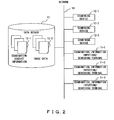
- FIG. 2 shows a specific configuration of the system implementing the present invention.
- the system shown in this figure is a system assisting in administrative operations of an endoscopic examination in an endoscopic examination department in a hospital, and comprises functions such as reservation management of an endoscopic examination, recording management of the conduct status of an endoscopic examination, storage management of a shot image, creation/management of an examination result report, etc.
- the system shown in Fig. 2 is configured by connecting examination information inputting/searching terminals 11-1, 11-2, and 11-3, examining devices 12-1, 12-2, and 12-3, and a data server 13 respectively to a network 14.
- Various types of data can be mutually exchanged among these appliances via the network 14.
- All of the examination information inputting/searching terminals 11-1, 11-2, and 11-3 are terminals used by users of this system, and are used to reserve an endoscopic examination or verify the reserved contents, to input or browse the conduct status of an endoscopic examination, or to create or browse an examination result report.
- All of the examining devices 12-1, 12-2, and 12-3 are electronic endscopes, and have a function for outputting to the network 14 image data that represents a shot image, and information about shooting of that image, such as shooting date and time, a used instrument name, etc.
- the data server 13 is a data server that altogether stores various types of data such as examination conduct information 13-1 obtained by the examination information inputting/searching terminal 11-1, 11-2, or 11-3, image data 13-2 output from the examining device 12-1, 12-2, or 12-3, and the like, and provides these data by a request made from the examination information inputting/searching terminal 11-1, 11-2, or 11-3.
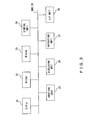
- FIG. 3 shows the configuration of the examination information inputting/searching terminals 11-1, 11-2, and 11-3, and the data server 13, which are shown in Fig. 2.
- the device shown in Fig. 3 is configured by interconnecting a CPU 21, a ROM 22, a RAM 23, a storing unit 24, an inputting unit 25, a displaying unit 26, an outputting unit 27, and an I/F unit 28 via a bus 29, and these memories and units can mutually exchange data under the management of the CPU 21.
- the CPU (Central Processing Unit) 21 is a central processing unit that governs the operation control of the entire device shown in Fig. 3.
- the ROM (Read Only Memory) 22 is a memory in which a basic control program executed by the CPU 21 is prestored.
- the CPU 21 executes this basic control program when this device is started up, whereby the basic control of the operations of the entire device is performed by the CPU 21.
- the RAM (Random Access Memory) 23 is a memory that is used as a working memory when the CPU 21 executes each type of a control program, and also serves as a main memory used as a temporary storage area of each type of data depending on need.
- the storing unit 24 is configured by comprising, for example, an HDD (Hard Disk Drive).
- HDD Hard Disk Drive
- the storing unit 24 serves as a data storing device which stores various types of data such as the examination conduct information 13-1, image data 13-2, etc.
- the storing unit 24 prestores a control program for causing the CPU 21 to perform a data operation process for this database according to an instruction of each type of data operation transmitted from the examination information inputting/searching terminal 11-1, 11-2, or 11-3.
- the inputting unit 25 is intended to receive an external input, and to pass its contents to the CPU 21, and comprises an inputting device, such as a keyboard, a mouse, etc., which receives an instruction from an operator who operates this device. Additionally, the inputting unit 25 is configured by comprising, depending on need, a reading device of a portable storage medium such as an FD (Flexible Disk), a CD-ROM (Compact Disc -ROM), a DVD-ROM (Digital Versatile Disc-ROM), an MO (Magneto-Optics) disk, etc.
- FD Flexible Disk
- CD-ROM Compact Disc -ROM
- DVD-ROM Digital Versatile Disc-ROM
- MO Magnetto-Optics
- the displaying unit 26 is intended to display various types of information according to an instruction from the CPU 21, and is configured by comprising, for example, a CRT (Cathode Ray Tube), an LCD (Liquid Crystal Display), etc.
- a CRT Cathode Ray Tube
- LCD Liquid Crystal Display
- the outputting unit 27 is intended to output various types of information according to an instruction from the CPU 21, and is, for example, a printer device for printing contents of a display made on the displaying unit 26 on a sheet unchanged, or the like.
- the I/F (interface) unit 28 makes communication management when data is exchanged with another device by connecting this device to the network 14 shown in Fig. 2.
- the device shown in Fig. 3 is merely a device normally comprised by a computer system having a standard hardware configuration. Therefore, the examination information inputting/searching terminal 11-1, 11-2, or 11-3, or the data server 13 can be also configured by diverting such a computer system.
- 11-1 and 13-1 which are shown in Fig. 2, are used respectively as an examination information inputting/searching terminal and an examining device, unless otherwise noted.
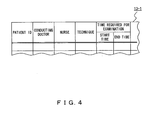
- FIG. 4 This figure exemplifies part of a data structure of the examination conduct information 13-1 stored in the image and data server 13.
- one file is created for each examination day in the data server 13.
- fields for storing various items of information such as a number of a "patient ID" for identifying a patient, a name of a "conducting doctor” who is responsible for an examination, a name of a "nurse” who is an assisting person assisting in conducting the examination, contents of a "technique” of the examination, and "start time” and "end time” of the examination as information indicating the conduct time of the examination, and the like are provided.
- a record is created for each "technique” when a plurality of "techniques” are conducted in one examination.
- a plurality of names can be stored in the "nurse" field in one record.
- FIG. 5 shows a work flow of administrative operations of an endoscopic examination conducted by using the system shown in Fig. 2.
- the inputting unit 25 of the examination information inputting/searching terminal 11-1 is operated, and an examination order (reservation) is input.
- This examination order may be generated in a way such that the examination information inputting/searching terminal 11-1 receives data from an appliance such as an HIS (Hospital Information Server), etc., which is connected to the network 14, is not shown in Fig. 2, and governs the information management of the entire hospital as indicated by S102.
- HIS Hospital Information Server
- contents of a request in the examination order that is obtained with the operation in S101 or S102 is displayed on the displaying unit 26 comprised by the examination information inputting/searching terminal 11-1, and verification of the contents of the request by a responsible person in an examination department, settings of date and time when the examination is conducted, responsible staff members, and the like are made.
- pre-procedures required prior to the endoscopic examination are performed.
- the inputting unit 25 of the examination information inputting/searching terminal 11-1 is operated, and information about the pre-procedures, such as date and time when the pre-procedures are performed, a person who performs the pre-procedures, a drug used for the pre-procedures, and the like are input.
- the endoscopic examination is conducted by using the examining device 12-1, and an image is shot.
- the inputting unit 25 of the examination information inputting/searching terminal 11-1 is operated, and information about the examination conducted in S105, such as a technique conducted, a medical expense item added, a person who conducted the examination, a drug and an instrument used for the examination, and the like are input.
- the inputting unit 25 of the examination information inputting/searching terminal 11-1 is operated, and a report that summarizes findings of a doctor about the result of the examination conducted in S105, and the like is input.
- the image obtained in S105 is stored in the data server 13 as the image data 13-2, and at the same time, the information obtained by the examination information inputting/searching terminal 11-1 with the operations up to S107 are altogether stored in the data server 13 as the examination conduct information 13-1.
- FIG. 6 is a flowchart showing the contents of a registration process for registering the examination conduct information 13-1 to the data server 13.
- This process is a process performed in common in the operations of S104, S106, etc. in the work flow shown in Fig. 5.
- Process steps that are not particularly noted in the subsequent explanation among respective process steps shown in this figure are performed by the CPU 21 of the examination information inputting/searching terminal 11-1.
- the CPU 21 implements these processes by reading and executing the control program stored in the storing unit 24 of the examination information inputting/searching terminal 11-1.
- This registration process shown in Fig. 6 is started when an instruction to input examination information, which is issued with an operation for the inputting unit 25 of the examination information inputting/searching terminal 11-1, is detected.
- the patient information is information about an ID (Identification) number preassigned to each patient, a patient name, a birth date/age, sex, type (inpatient or outpatient, and the like), etc.
- the examination information is information about requested contents of an examination, such as an examination type, an examination item, a disease name at the time of request, scheduled date and time when the examination is conducted, a requested department of the examination, a requested doctor, etc.
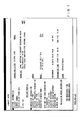
- Fig. 7 is a screen on which contents of respective information items to be registered to the data server 13 as the examination conduct information 13-1 with this registration process are displayed.
- a name of a "conducting doctor” who is responsible for an examination a name of a "nurse” who is responsible for the examination, contents of a "technique” of the examination, a medical expense item to be “added”, a “drug” used for pre-procedures or the examination, an "instrument” used for the examination, "start time” and “end time” of the examination, and contents of information for identifying an endoscope ("scope”) used for the examination are arranged and displayed by item.
- This figure indicates the state where no inputs are made to the "nurse” and “added” items, namely, the state where there are no targets for the "nurse” and "added” items.
- S202 it is determined whether or not any of the respective items of the examination conduct information 13-1 is clicked, namely, whether or not a position indicating cursor, which is overlaid and displayed on the examination information input screen displayed on the displaying unit 26, is moved according to an operation for a mouse, etc. comprised by the inputting unit 25, and a mouse button, etc. is operated when the position indicating cursor is placed on a character string that indicates each underscored item on the right side of Fig. 7. If a result of this determination is "Yes”, the process proceeds to S203. If the result of this determination is "No", the process proceeds to S207.
- an input cursor which indicates a character input position is displayed in an input field for an item selected on the examination information input screen, namely, the item clicked with the process of the preceding step.
- S205 it is determined whether or not the contents of the operation for the inputting unit 25 of the examination information inputting/searching terminal 11-1 is an instruction to confirm the input of the character string. If a result of this determination is "Yes”, the process proceeds to S206. If the result of this determination is "No”, the process returns to S204, and the process for obtaining an input of a character string is continued.
- the character string obtained with the process of S204 is corresponded to the aforementioned selected item, and displayed on the examination information input screen.
- data that becomes the examination conduct information 13-1 is created based on the contents of the display made on the examination information input screen displayed on the displaying unit 26, and the created data is addressed to the data server 13, and transmitted to the network 14.
- the CPU 21 that is executing the control program newly creates a record of the examination conduct information 13-1, in which this data is indicated in the respective fields, and stores the record in the storing unit 24 of the data server 13.
- a character input made to the inputting unit 25 is obtained to acquire the contents of the respective items.
- the contents of the respective items may be obtained by displaying a list of words and phrases, which are assumed as the contents of the items, on the displaying unit, and by selecting suitable words and phrases from the list. By doing so, a workload imposed on an operator of the examination information inputting/searching terminal 11-1 in order to input the contents of the respective items is reduced.
- contents such as an "examination time", a "scope”, etc., which are indicated on the examination information input screen, may be automatically obtained from the examining device 12 via the network 14. Also by doing so, the workload of the operations for inputting these items, which is imposed on the operator of the examination information inputting/searching terminal 11-1, is reduced, and besides that, the operator is prevented from forgetting about obtaining such information when an examination is conducted.
- FIGs. 8A and 8B depict the flowcharts representing the contents of the process for calculating a total of the examination conduct information 13-1 stored in the data server 13.
- This process is a process performed in the operations in S109 and S110 in the work flow shown in Fig. 5.
- Process steps, which are not particularly noted in the subsequent explanation, among respective steps shown in this figure, are performed by the CPU 21 of the examination information inputting/searching terminal 11-1.
- the CPU 21 implements these processes by reading and executing the control program stored in the storing unit 24 of the examination information inputting/searching terminal 11-1.
- the totaling process shown in Figs. 8A and 8B is started when an instruction to calculate a total of the examination conduct information 13-1, which is issued with an operation for the inputting unit 25 of the examination information inputting/searching terminal 11-1, is detected.
- a condition of the totaling made with the operation for the inputting unit 25 is obtained.
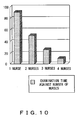
- This totaling condition is intended to specify any of an output of an average value of a time required for an examination, which is obtained with the total, for each doctor who conducts an examination, an output of the average value for each number of nurses who assists in the examination, or an output of the average value for each contents of a technique of the examination.
- a process for extracting a record, in which the doctor name extracted with the process of the preceding step is indicated in the "conducting doctor" field, from all of the files of the examination conduct information 13-1 in the data server 13 is performed.
- a process for calculating a time required for the examination with a technique indicated by the extracted record from times indicated by the "start time” field and the "end time” field of the record, and for calculating a total of that examination time in all of records is performed.
- a process for obtaining an average of times required for the examination by dividing the totaled time required for the examination by the number of records extracted with the process of S305 is performed.
- a series of these processes in S305 to S307 is performed when an instruction to perform a corresponding process is addressed and transmitted from the examination information inputting/searching terminal 11-1 to the data server 13, and reception of this instruction is detected by the CPU 21 of the data server 13, which is executing the control program. Thereafter, upon termination of this process, the obtained average time required for the examination is transmitted from the data server 13 to the examination information inputting/searching terminal 11-1.
- S308 it is determined whether or not the processes in S304 to S307 are performed for all of the doctor names obtained with the process of S303, and an average time required for the examination is obtained. If a result of this determination is "Yes”, the process proceeds to S309. On the other hand, if the result of this determination in S308 is "No”, the process returns to S304, and the processes in and after S304 are performed for a "conducting doctor" whose average time required for the examination is yet to be obtained.
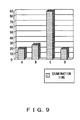
- a process for plotting a bar graph that takes doctor names obtained with the process of S303 as a horizontal axis, and average times required for an examination as a vertical axis, for example, in units of minutes on the displaying unit 26 is performed.
- An example of thus plotted graph that represents the examination times against the respective doctors is shown in Fig. 9.
- a process for causing the data server 13 to extract a record, in which names of the nurses the number of which is the variable N are indicated by the "nurse" field, from all of the files of the examination conduct information 13-1 in the data server 13 is performed.
- a process for calculating a time required for the examination with a technique indicated by the extracted record from the times indicated by the "start time” field and the "end time” field of the record, and for calculating a total of all of the records of that examination time is performed.
- a process for obtaining an average of the times required for the examination by dividing the totaled time required for the examination by the number of records extracted with the process of S312 is performed.
- a series of these processes in S312 to S314 is performed when an instruction to perform a corresponding process is addressed and transmitted from the examination information inputting/searching terminal 11-1 to the data server 13, and reception of this instruction is detected by the CPU 21 of the data server 13, which is executing the control program.
- these processes are terminated, the obtained average time required for the examination is transmitted from the data server 13 to the examination information inputting/searching terminal 11-1.
- S315 a process for decrementing the value of the variable N by 1 is executed.
- S316 it is determined whether or not the value of the variable N reaches 0. Here, if a result of this determination is "Yes”, the totaling for each number of nurses is regarded as being completed, and the process proceeds to S317. If the result of this determination is "No”, the process returns to S312, and the above described processes are repeated.
- S320 a process for extracting a record, in which the contents of the examination technique extracted with the process of the preceding step is indicated in the "technique" field, from all of the files of the examination conduct information 13-1 in the data server 13 is performed.
- a process for calculating a time required for the examination with the examination technique indicated by the extracted record from the times indicated by the "start time” field and the "end time” field of the record, and for calculating a total of all of records of that examination time is performed.
- a process for obtaining an average amount of time required for the examination by dividing the totaled time required for the examination by the number of records extracted with the process of S320 is performed.
- a series of these processes in S320 to S322 is performed when an instruction to perform a corresponding process is addressed and transmitted from the examination information inputting/searching terminal 11-1 to the data server 13, and reception of this instruction is detected by the CPU 21 of the data server 13, which is executing the control program. Thereafter, upon termination of this process, the obtained average time required for the examination is transmitted from the data server 13 to the examination information inputting/searching terminal 11-1.
- S323 it is determined whether or not the processes in S319 to S322 are performed for all of the contents of examination techniques obtained with the process of S318, and an average time required for the examination is obtained. If a result of this determination is "Yes”, the process proceeds to S324. On the other hand, if the result of this determination in S323 is "No”, the process returns to S319, and the processes in and after S319 are performed for a technique whose average time required for an examination is yet to be obtained.
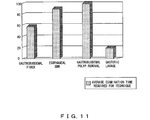
- a process for plotting a bar graph that takes the contents of the examination techniques obtained with the process of S318 as a horizontal axis, and average times required for the examination as a vertical axis, for example, in units of minutes on the displaying unit 26 is performed.
- An example of thus plotted graph that represents the examination times against the respective examination techniques is shown in Fig. 11.
- a name of a conducting doctor and the contents of an examination technique are obtained from the examination conduct information 13-1 with the process of S303 or S318.
- a table that indicates a name of a conducting doctor, and the contents of an examination technique is sometimes prepared beforehand in the data server 13, the above described HIS, or the like. Therefore, these information items may be obtained from these tables in that case.
- the output for each number of nurses who assist in an examination is selected as a totaling condition.
- the output for each nurse who assists in an examination may be selected as a totaling condition.
- a process similar to that in the case where the output for each doctor who conducts an examination is selected as a totaling condition may be performed.
- one of the three types of outputs such as the output for each doctor who conducts an examination, the output for each number of nurses who assist in an examination, and the output for each contents of an examination technique is selected as a totaling condition.
- a combination of these outputs can be also set as a totaling condition.
- a record that meets a combined totaling condition may be extracted in the process of S305 or S312 of Fig. 8A, or S320 of Fig. 8B, in which records that meet a totaling condition are extracted from all of files of the examination conduct information 13-1.
- a display of an average time required for an examination on the displaying unit 26 under each totaling condition is made by plotting a bar graph with the process of S309, S317, or S324.
- other types of graphs such as a line graph, a circle graph, etc. may be plotted instead of a bar graph, and besides, an average time required for an examination may be displayed directly with a numerical value as a matter of course.
- a process for calculating each average time required for an examination for all of the three types of the above described totaling conditions may be performed, and their graphs may be arranged and displayed on the same screen of the displaying unit 26.
- the present invention can be also implemented by creating a program for causing a computer having a standard configuration to perform the above described registration process and totaling process, and by causing such a computer to execute this program. Additionally, the present invention can be also implemented by recording such a program on a computer-readable storage medium, by causing a computer to read the program from the storage medium, and by causing a CPU comprised by the computer to execute the program.
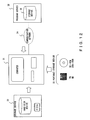
- a storage medium from which a recorded control program can be read by a computer is exemplified in Fig. 12.
- a storage medium for example, a storage device 32 such as a ROM, a hard disk device, etc., which is comprised as an included/externally attached device in/to the computer 31, a portable storage medium 33 etc., such as an FD (Flexible Disk), an MO (Magneto-Optical disk), a CD-ROM, a DVD-ROM, etc., are available.
- a storage device 36 which is included/externally attached in/to a program server 35 connected to the computer 31 via a communications network 34, may be a storage medium.
- a transmission signal obtained by modulating a carrier wave with a control program recorded on the storage device 36 on the program server 35 side may be transmitted from the program server 35 side, and the control program may be demodulated from the transmission signal received via the communications network 34, and the CPU may be made to execute the control program on the computer 31 side.
- examination conduct information which occurs by conducting an examination in a medical institution, is stored in a storing unit each time the examination is conducted, and total amount of time required for conducting the examination, which is indicated by the examination conduct information stored in the storing unit, is calculated.
Landscapes
- Business, Economics & Management (AREA)
- General Business, Economics & Management (AREA)
- Health & Medical Sciences (AREA)
- Engineering & Computer Science (AREA)
- General Health & Medical Sciences (AREA)
- Epidemiology (AREA)
- Biomedical Technology (AREA)
- Medical Informatics (AREA)
- Primary Health Care (AREA)
- Public Health (AREA)
- Measuring And Recording Apparatus For Diagnosis (AREA)
- Medical Treatment And Welfare Office Work (AREA)
- Management, Administration, Business Operations System, And Electronic Commerce (AREA)
Abstract
Description
Claims (8)
- A system assisting in a medical service, comprising:an examination conduct information storing unit (1,13) storing examination conduct information, which is information occurring by conducting an examination in a medial institution, each time the examination is conducted; anda totaling unit (2,11-1) calculating a total amount of time required for conducting the examination, which is indicated by the examination conduct information stored in the examination conduct information storing unit.
- The system according to claim 1, further comprising:an obtaining unit (25) obtaining an input of the examination conduct information; anda displaying unit (26) displaying a result of the total.
- The system according to claim 1, wherein
the total is a total for each doctor who is responsible for the examination, for each number of assisting persons who assist in the examination, or for each examination technique in the examination. - The system according to claim 1, wherein
the totaling unit calculates an average of required times as a result of the total. - The system according to claim 4, further comprising
a display controlling unit graphing the result of the total, and causing the displaying unit to display the result. - A method assisting in a medical service, comprising:storing examination conduct information, which is information occurring by conducting an examination in a medical institution, each time the examination is conducted; andcalculating a total amount of time required for conducting the examination, which is indicated by the stored examination conduct information.
- A storage medium on which is recorded a program for causing a computer to assist in a medical service, and from which the program can be read by the computer, the program, by being executed by the computer, causing the computer to perform:storing examination conduct information, which is information occurring by conducting an examination in a medical institution, in a storing unit, each time the examination is conducted; andcalculating a total amount of time required for conducting the examination, which is indicated by the examination conduct information stored in the storing unit.
- A system assisting in a medical service, comprising:examination conduct information storing means for storing examination conduct information, which is information occurring by conducting an examination in a medical institution, each time the examination is conducted; andtotaling means for calculating a total amount of time required for conducting the examination, which is indicated by the examination conduct information stored in the examination conduct information storing unit.
Applications Claiming Priority (2)
| Application Number | Priority Date | Filing Date | Title |
|---|---|---|---|
| JP2002322216A JP2004157725A (en) | 2002-11-06 | 2002-11-06 | Medical service support system and program |
| JP2002322216 | 2002-11-06 |
Publications (2)
| Publication Number | Publication Date |
|---|---|
| EP1420353A2 true EP1420353A2 (en) | 2004-05-19 |
| EP1420353A3 EP1420353A3 (en) | 2007-03-07 |
Family
ID=32171329
Family Applications (1)
| Application Number | Title | Priority Date | Filing Date |
|---|---|---|---|
| EP03022858A Ceased EP1420353A3 (en) | 2002-11-06 | 2003-10-08 | Medical service assisting system |
Country Status (3)
| Country | Link |
|---|---|
| US (1) | US20040088213A1 (en) |
| EP (1) | EP1420353A3 (en) |
| JP (1) | JP2004157725A (en) |
Families Citing this family (2)
| Publication number | Priority date | Publication date | Assignee | Title |
|---|---|---|---|---|
| JP6373674B2 (en) * | 2014-07-17 | 2018-08-15 | オリンパス株式会社 | Medical work support device |
| US20170147764A1 (en) * | 2015-11-20 | 2017-05-25 | Hitachi, Ltd. | Method and system for predicting consultation duration |
Family Cites Families (2)
| Publication number | Priority date | Publication date | Assignee | Title |
|---|---|---|---|---|
| JP3586183B2 (en) * | 2000-10-13 | 2004-11-10 | 俊忠 亀田 | Medical plan and record support system and machine readable medium recording program |
| JP2004528643A (en) * | 2001-04-05 | 2004-09-16 | インスツルメンタリウム コーポレイション | Method and system for detecting differences in a tracking environment |
-
2002
- 2002-11-06 JP JP2002322216A patent/JP2004157725A/en active Pending
-
2003
- 2003-10-06 US US10/679,585 patent/US20040088213A1/en not_active Abandoned
- 2003-10-08 EP EP03022858A patent/EP1420353A3/en not_active Ceased
Also Published As
| Publication number | Publication date |
|---|---|
| JP2004157725A (en) | 2004-06-03 |
| US20040088213A1 (en) | 2004-05-06 |
| EP1420353A3 (en) | 2007-03-07 |
Similar Documents
| Publication | Publication Date | Title |
|---|---|---|
| EP1865458A1 (en) | Medical image management method for managing medical images, and medical image management apparatus and report preparation method using the same | |
| CN104823211B (en) | Medical examination result display device and working method thereof | |
| US20050197861A1 (en) | Examination management system and examination management method | |
| US20020128872A1 (en) | Medical data recordation system | |
| CA2526149A1 (en) | System and method for managing an endoscopic lab | |
| JP2005149107A (en) | Medical image management system | |
| JP2005085200A (en) | Medical image display system | |
| JPH1097582A (en) | Medical information system | |
| WO2002031743A1 (en) | Method and system of managing the information for a hospital | |
| US20050159981A1 (en) | Hospital information system | |
| JP2001155100A (en) | Regional electronic medical record system and recording medium recording program | |
| US20100002919A1 (en) | Auto-Deletion of Image Related Data in an Imaging System | |
| EP2704044A2 (en) | Apparatus and method for providing medical support | |
| JP2008217389A (en) | Examination waiting time prediction program, recording medium, apparatus and method | |
| US20090164436A1 (en) | Medical image information management system and program product | |
| JP4474846B2 (en) | Medical information management system and medical information management method | |
| WO2009128296A1 (en) | Regional medical cooperation system, registration terminal, and program | |
| US20040088213A1 (en) | Medical service assisting system | |
| KR20190107714A (en) | Non-transitory recording medium that records medical information management system, clinical information acquisition server, medical information management method and program | |
| JP2005202690A (en) | Medical information provision system. | |
| EP1426889A1 (en) | Examination request management apparatus | |
| JPH11306261A (en) | Patient information sharing system | |
| JP5027436B2 (en) | Radiation equipment operation assist system and processing method thereof | |
| JP2011067475A (en) | Medical image display device and program | |
| FR2850769A1 (en) | METHOD FOR RECONCILING PATIENT AND PROCEDURE INFORMATION IN A MEDICAL ESTABLISHMENT COMPUTER NETWORK, AND ACQUISITION STATION |
Legal Events
| Date | Code | Title | Description |
|---|---|---|---|
| PUAI | Public reference made under article 153(3) epc to a published international application that has entered the european phase |
Free format text: ORIGINAL CODE: 0009012 |
|
| 17P | Request for examination filed |
Effective date: 20031008 |
|
| AK | Designated contracting states |
Kind code of ref document: A2 Designated state(s): AT BE BG CH CY CZ DE DK EE ES FI FR GB GR HU IE IT LI LU MC NL PT RO SE SI SK TR |
|
| AX | Request for extension of the european patent |
Extension state: AL LT LV MK |
|
| PUAL | Search report despatched |
Free format text: ORIGINAL CODE: 0009013 |
|
| AK | Designated contracting states |
Kind code of ref document: A3 Designated state(s): AT BE BG CH CY CZ DE DK EE ES FI FR GB GR HU IE IT LI LU MC NL PT RO SE SI SK TR |
|
| AX | Request for extension of the european patent |
Extension state: AL LT LV MK |
|
| 17Q | First examination report despatched |
Effective date: 20070618 |
|
| AKX | Designation fees paid |
Designated state(s): DE ES FR GB NL |
|
| STAA | Information on the status of an ep patent application or granted ep patent |
Free format text: STATUS: THE APPLICATION HAS BEEN REFUSED |
|
| 18R | Application refused |
Effective date: 20120403 |