EP1420332A2 - Power controlling system - Google Patents
Power controlling system Download PDFInfo
- Publication number
- EP1420332A2 EP1420332A2 EP03078573A EP03078573A EP1420332A2 EP 1420332 A2 EP1420332 A2 EP 1420332A2 EP 03078573 A EP03078573 A EP 03078573A EP 03078573 A EP03078573 A EP 03078573A EP 1420332 A2 EP1420332 A2 EP 1420332A2
- Authority
- EP
- European Patent Office
- Prior art keywords
- power
- transformer
- controller
- saving part
- diode
- Prior art date
- Legal status (The legal status is an assumption and is not a legal conclusion. Google has not performed a legal analysis and makes no representation as to the accuracy of the status listed.)
- Granted
Links
Images


Classifications
-
- G—PHYSICS
- G06—COMPUTING OR CALCULATING; COUNTING
- G06F—ELECTRIC DIGITAL DATA PROCESSING
- G06F1/00—Details not covered by groups G06F3/00 - G06F13/00 and G06F21/00
- G06F1/26—Power supply means, e.g. regulation thereof
- G06F1/32—Means for saving power
- G06F1/3203—Power management, i.e. event-based initiation of a power-saving mode
- G06F1/3206—Monitoring of events, devices or parameters that trigger a change in power modality
- G06F1/3215—Monitoring of peripheral devices
- G06F1/3218—Monitoring of peripheral devices of display devices
-
- G—PHYSICS
- G06—COMPUTING OR CALCULATING; COUNTING
- G06F—ELECTRIC DIGITAL DATA PROCESSING
- G06F1/00—Details not covered by groups G06F3/00 - G06F13/00 and G06F21/00
- G06F1/26—Power supply means, e.g. regulation thereof
-
- G—PHYSICS
- G06—COMPUTING OR CALCULATING; COUNTING
- G06F—ELECTRIC DIGITAL DATA PROCESSING
- G06F1/00—Details not covered by groups G06F3/00 - G06F13/00 and G06F21/00
- G06F1/26—Power supply means, e.g. regulation thereof
- G06F1/32—Means for saving power
- G06F1/3203—Power management, i.e. event-based initiation of a power-saving mode
- G06F1/3234—Power saving characterised by the action undertaken
- G06F1/325—Power saving in peripheral device
- G06F1/3265—Power saving in display device
-
- G—PHYSICS
- G09—EDUCATION; CRYPTOGRAPHY; DISPLAY; ADVERTISING; SEALS
- G09G—ARRANGEMENTS OR CIRCUITS FOR CONTROL OF INDICATING DEVICES USING STATIC MEANS TO PRESENT VARIABLE INFORMATION
- G09G1/00—Control arrangements or circuits, of interest only in connection with cathode-ray tube indicators; General aspects or details, e.g. selection emphasis on particular characters, dashed line or dotted line generation; Preprocessing of data
- G09G1/005—Power supply circuits
-
- H—ELECTRICITY
- H02—GENERATION; CONVERSION OR DISTRIBUTION OF ELECTRIC POWER
- H02J—ELECTRIC POWER NETWORKS; CIRCUIT ARRANGEMENTS OR SYSTEMS FOR SUPPLYING OR DISTRIBUTING ELECTRIC POWER; SYSTEMS FOR STORING ELECTRIC ENERGY
- H02J9/00—Circuit arrangements for emergency or stand-by power supply, e.g. for emergency lighting
- H02J9/005—Circuit arrangements for emergency or stand-by power supply, e.g. for emergency lighting using a power saving mode
-
- G—PHYSICS
- G09—EDUCATION; CRYPTOGRAPHY; DISPLAY; ADVERTISING; SEALS
- G09G—ARRANGEMENTS OR CIRCUITS FOR CONTROL OF INDICATING DEVICES USING STATIC MEANS TO PRESENT VARIABLE INFORMATION
- G09G2330/00—Aspects of power supply; Aspects of display protection and defect management
- G09G2330/02—Details of power systems and of start or stop of display operation
- G09G2330/021—Power management, e.g. power saving
- G09G2330/022—Power management, e.g. power saving in absence of operation, e.g. no data being entered during a predetermined time
-
- H—ELECTRICITY
- H04—ELECTRIC COMMUNICATION TECHNIQUE
- H04N—PICTORIAL COMMUNICATION, e.g. TELEVISION
- H04N5/00—Details of television systems
- H04N5/63—Generation or supply of power specially adapted for television receivers
-
- Y—GENERAL TAGGING OF NEW TECHNOLOGICAL DEVELOPMENTS; GENERAL TAGGING OF CROSS-SECTIONAL TECHNOLOGIES SPANNING OVER SEVERAL SECTIONS OF THE IPC; TECHNICAL SUBJECTS COVERED BY FORMER USPC CROSS-REFERENCE ART COLLECTIONS [XRACs] AND DIGESTS
- Y02—TECHNOLOGIES OR APPLICATIONS FOR MITIGATION OR ADAPTATION AGAINST CLIMATE CHANGE
- Y02D—CLIMATE CHANGE MITIGATION TECHNOLOGIES IN INFORMATION AND COMMUNICATION TECHNOLOGIES [ICT], I.E. INFORMATION AND COMMUNICATION TECHNOLOGIES AIMING AT THE REDUCTION OF THEIR OWN ENERGY USE
- Y02D10/00—Energy efficient computing, e.g. low power processors, power management or thermal management
-
- Y—GENERAL TAGGING OF NEW TECHNOLOGICAL DEVELOPMENTS; GENERAL TAGGING OF CROSS-SECTIONAL TECHNOLOGIES SPANNING OVER SEVERAL SECTIONS OF THE IPC; TECHNICAL SUBJECTS COVERED BY FORMER USPC CROSS-REFERENCE ART COLLECTIONS [XRACs] AND DIGESTS
- Y02—TECHNOLOGIES OR APPLICATIONS FOR MITIGATION OR ADAPTATION AGAINST CLIMATE CHANGE
- Y02D—CLIMATE CHANGE MITIGATION TECHNOLOGIES IN INFORMATION AND COMMUNICATION TECHNOLOGIES [ICT], I.E. INFORMATION AND COMMUNICATION TECHNOLOGIES AIMING AT THE REDUCTION OF THEIR OWN ENERGY USE
- Y02D30/00—Reducing energy consumption in communication networks
- Y02D30/50—Reducing energy consumption in communication networks in wire-line communication networks, e.g. low power modes or reduced link rate
Definitions
- the present invention relates to a power controlling system of a display monitor, more particularly, to a power controlling system of a computer monitor and a method thereof, capable of minimizing power consumption for automatically converting a monitor power mode to a power off mode in case that the computer is not used for a certain period of time.
- a power supply circuit in the computer monitor automatically switches a power mode of the computer to a power saving mode until a user presses any key on a keyboard, thereby saving unnecessary power consumption.
- Recent monitors in the current market mostly have this function.
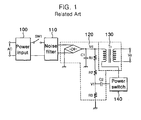
- Fig. 1 is a circuit diagram of a related art power supply circuit of a monitor. The discussion on the related art power supply circuit follows below.
- the power supply circuit includes a power input 100 for decompressing input power (AC), a noise filter 110 for filtering noises using output voltage of the power input 100 when a power switch SW1 is turned on, a rectifier 120 for rectifying the output voltage of the noise filter 100 at a bridge diode (BD1) and a condenser C1 and for dividing the rectified voltage Vd through resistors R1 to R3, a power switch 140 for outputting a switching signal by means of voltage division of the rectifier 120, and a voltage output 130 for outputting DC voltage by inducing an output of the rectifier to a secondary side transformer T1 according to an output of the power switch 140.
- AC decompressing input power
- BD1 bridge diode
- C1 condenser
- the problem of the above power supply circuit is that unless the user turns off the power of the monitor, power is continuously supplied to the monitor even when the user is not currently using the computer. As a result, element lifespans in the circuit are dramatically shortened, and thus the reliability of the power supply circuit is lowered.
- Korean patent application No. 10-1998-0048370 disclosed an embodiment of a power-saving circuit.
- Fig. 2 is a circuit diagram of a power-saving circuit disclosed in the above patent application.
- the power-saving circuit includes a rectifier 200 for rectifying and smoothing AC power, a power factor controller 210 for outputting the AC power as power factor-compensated DC voltage, power controllers 220 and 240 for controlling a plurality of transformers, having them output a plurality of different voltages from the applied DC voltage, a microcomputer 270 (Micom) used as a controller for controlling the overall power circuit and for outputting a plurality of DPM (Display Power Management) control signals in DPM mode, power-saving parts 250 and 260 for outputting a heater power or light emitting signal in response to the DPM control signal, and a main power switch 230 for supplying or switching off power voltage Vcc applied to the power controller 220 under the light emitting signal.
- a microcomputer 270 Microcomputer 270
- DPM Display Power Management
- the power-saving circuit satisfies the 2000 IECC, i.e. its power is set at 3 Watt in the power off mode.
- this type of power-saving circuit does not satisfy the European regulations, Blue Angel, requiring the power consumption in the power off mode to be less than 1 Watt.
- the sub power controller 240, the Micom power (+B7), and the heater power (+B8) continue their operation by an output of the rectifier, by the sub power, and by the first power-saving part, respectively.
- An object of the invention is to solve at least the above problems and/or disadvantages and to provide at least the advantages described hereinafter.
- one object of the present invention is to solve the above problems by providing a power controlling system for a computer, whose power consumption in a power off mode is less than 1 Watt.
- a power controlling system including: a power supply means for rectifying and/or compensating an input power; a plurality of transformers for receiving power from the power supply means and for outputting a voltage therefrom; a controller for controlling a power circuit and for outputting a plurality of DPM control signals according to the DPM mode; a power control means connected to the transformers and the controller, for controlling power to other elements except the controller according to the DPM mode; and a transformer controller for outputting power to control the transformers under the control of the power control means.
- a power controlling system having a main transformer and a sub transformer, which, in response to first and second DPM signals output from a display controller, from an AC voltage being input from outside, induces at least one voltage, for use in a display, from secondary sides of the main transformer and the sub transformer, and outputs the induced voltages
- the system includes: a first power-saving part connected to an arbitrary point of a secondary side of the main transformer, for outputting a predetermined voltage in response to the first DPM signal output from the controller; a second power-saving part connected to an arbitrary point of a secondary side of the main transformer, for outputting a predetermined voltage in response to the second DPM signal output from the controller; a third power-saving part connected to the first and second power-saving parts, which turns off as the first power-saving part is turned off; a main power switch connected to one end of a primary side of the main transformer, for controlling an operation of the main transformer; and a transformer controller for controlling an operation of the main power switch according to an
- Another aspect of the invention provides a power controlling method, which includes the steps of: determining an input DPM mode to a power-saving part used as a power control means; controlling an output of the power-saving part according to the input signals, when input DPM signals are all low level signals; controlling at least one of the power-saving part, another power-saving part, and a transformer controller used as a main power controller, under an operation of the power-saving part or an output thereof; and operating a sub power to supply power only to the controller, after controlling the main power controller.
- a power off mode in a power off mode, only the Micom is being turned on and the rest of elements are all turned off.
- Power consumption of a display in the power off mode is less than 1 Watt, which satisfies the European regulations, Blue Angel.
- the operation of the Micom is more stabilized.
- Fig. 1 is a schematic block diagram illustrating a power supply circuit for a monitor according to a related art
- Fig. 2 is a schematic block diagram illustrating a power supply circuit with a power saving function according to a related art
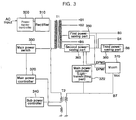
- Fig. 3 is a schematic block diagram illustrating a power supply circuit for a monitor according to a preferred embodiment of the present invention
- Fig. 4 is a detailed view of Fig. 3;
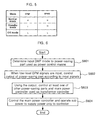
- Fig. 5 is a diagram illustrating first and second DPM signals according to respective DPM (Display Power Management) modes of the Micom;
- Fig. 6 is an operational flow chart of a power supply circuit according to the present invention.
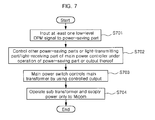
- Fig. 7 is an operational flow chart of a power supply circuit of the present invention when DPM mode is low.
- Figs. 3 through 7 show the organization and the operation of the power supply circuit for a monitor.
- +B1 denotes horizontally deflected DC/DC Converter input power
- +B2 denotes video output circuit power
- +B3 denotes horizontal/vertical power
- +B4 denotes other circuit power
- +B5 denotes vertical IC driving power
- +B6 denotes heater power.
- Fig. 3 is a schematic block diagram illustrating a power supply circuit for a monitor according to a preferred embodiment of the present invention
- Fig. 4 is a detailed view of Fig. 3.
- the power controlling system includes a main transformer T1, a sub transformer T2, a power factor controller 300, a rectifier 310, a main power switch 330, a main power controller consisting of a light-transmitting part 322 and a light-receiving part 320, a sub power controller 340, a first power-saving part 350, a second power-saving part 360, a third power-saving part 380, and a microcomputer 370 (Micom) that is used as a controller.
- a microcomputer 370 Micom
- the power factor controller 300 and the rectifier 310 are connected between an input power and a primary side of the main transformer T1, compensating power factor of the AC power that is input from outside, rectifying and smoothing the AC power, and finally supplying the DC voltage to the main transformer T1.
- the primary sides of the main transformer T1 and the sub transformer T2 receive DC voltage from the rectifier 310, and output to the secondary sides different voltages to be used for each circuit in the monitor.
- One end of the primary side of the main transformer T1 is connected to the rectifier 310 and the other end is connected to the main power switch 330.
- one end of the primary side of the sub transformer T2 is connected to the rectifier 310 and the other end is connected to the sub power controller 340.
- the first power-saving part 350 is connected to an arbitrary position of the secondary side of the main transformer T1, and in DPM mode, outputs a designated voltage (+B3) in response to a DPMF (Display Power Management First) signal from the Micom 370.
- DPMF Display Power Management First
- the first power-saving part 350 includes transistors Q1 and Q2, and resistors R1, R2 and R3.
- the emitter of the transistor Q1 is connected to an arbitrary position of the secondary side of the main transformer T1 via a diode D1, the collector of the transistor, which is an output terminal, outputs the +B3 voltage, and the base is connected to the collector of the transistor Q2 through the resistor R2.
- the base of the transistor Q2 is where a first DPM signal (DPMF signal) of the Micom is input via the resistor R3.
- the emitter of the transistor Q2 is put to earth.
- the resistor R1 is inserted between the emitter and the base of the transistor Q1.
- the transistor Q1 and Q2 is a PNP transistor and an NPN transistor, respectively.
- the second power-saving part 360 is connected to an arbitrary position of the secondary side of the main transformer T1, and in DPM mode, outputs a designated voltage (+B4) in response to a second DPM signal (DPMS signal) from the Micom 370.
- DPMS signal second DPM signal
- the second power-saving part 360 includes transistors Q3 and Q5, a diode D5, and resistors R4 and R5.
- the transistors Q3 and Q5 are preferably a PNP transistor and an NPN transistor, respectively.
- the emitter of the transistor Q3 is connected to an arbitrary point of the secondary side of the main transformer T1 via a diode D2, the base of the transistor Q3 is connected to the collector of the transistor Q5 via the resistor R5, and the collector of the transistor Q3, which is an output terminal, outputs the +B4 voltage.
- the base of the transistor Q5 is where a DPMS signal from the Micom is input, the collector of the transistor Q5 is connected to the base of the transistor Q1 via the resistor R5, and the emitter of the transistor Q5 is earthed.
- the resistor R4 is inserted between the emitter and the base of the transistor Q3.
- the cathode of the diode D5 is connected to the emitter of the transistor Q3, and the anode of the diode D5 is connected to the secondary side of the sub transformer T2 via the diode D6.
- the third power-saving part 380 is connected to the output end of the first and second power-saving parts 350 and 360, and outputs a designated voltage (+B6).
- the third power-saving part 380 includes a transistor Q4, a Zener diode ZD1, and a diode D3.
- the transistor Q4 is preferably an NPN transistor.
- the base of the transistor Q4 is connected to the collector of the transistor Q1 of the first power-saving part 350 via a resistor R9, the collector of the transistor Q4 of the third power-saving part 380 is connected to the collector of the transistor Q3 of the second power-saving part 360, and the emitter of the transistor Q4 of the third power-saving part 380, which is an output terminal, outputs the +B6 voltage.
- the anode of the Zener diode ZD1 is connected to the anode of the diode D3, and the cathode of the Zener diode ZD1 is connected to the base of the transistor Q4.
- the anode of the diode D3 is connected to the anode of the Zener diode ZD1, and the cathode of the diode D3 is earthed.
- the main power controller includes the light-transmitting part 322 and the light-receiving part 320.
- the light-transmitting part 322 is connected to one end of the second power-saving part and to the secondary side of the sub transformer T2.
- the light-receiving part 320 is connected to the main power switch 330 and to the tertiary side of the sub transformer T2.
- the light-transmitting part 322 includes a diode D4 and a photo diode PD1
- the light-receiving part 320 includes a diode D7, a resistor R7, and a phototransistor PT1.
- the photo diode PD1 of the light-transmitting part and the phototransistor PT1 of the light-receiving part are used as a light-emitting element and a light-receiving element, respectively.
- the cathode of the diode D4 is connected to the base of the transistor Q3 of the second power-saving part, and the anode of the diode D4 is connected to the cathode of the photo diode PD1.
- the anode of the photo diode PD1 is connected to the secondary side of the sub transformer T2 via the diode D6.
- the phototransistor PT1, together with the photo diode PD1, composes a photo coupler.
- the emitter of the phototransistor PT1 is connected to Vcc of the main power switch 330, and the collector of the phototransistor PT1 is connected to the cathode of the diode D7 via the resistor R7.
- the anode of the diode D7 is connected to one end of the tertiary side sub transformer T2.
- the main power switch 330 is turned on or off, being controlled by an output signal from the light-receiving part 320 of the main power controller.
- the input voltage Vcc to the main power switch 330 is connected to the emitter of the phototransistor PT1 of the light-receiving part 320.
- the power controlling system controls the first and second power-saving parts according to the first DPM signal (DPMF signal) and the second DPM signal (DPMS signal) from the Micom, and using at least one output of the first and second power-saving parts, controls the third power-saving part and/or the main power controller.
- the power factor controller 300 compensates the power factor of the AC voltage and applies the AC voltage to the rectifier 310.
- the rectifier 310 converts the AC voltage to a DC voltage, and supplies the DC voltage to the primary side of the main transformer T1 and the primary side of the sub transformer T2.
- the power supplied to the primary side of the main transformer T1 is controlled by the main power switch 330, that is in turn controlled by the main power controller.
- the power supplied to the primary side of the sub transformer T2 is controlled by the sub power controller 340.
- Fig. 5 is a diagram illustrating a first and a second DPM signal in DPM mode. As shown in Fig. 5, in normal mode, the DPMF signal is high and the DPMS signal is also high.
- the DPMF signal is low and the DPMS signal is high.
- the DPMF signal output from the Micom is a high level signal.
- the transistor Q2 of the first power-saving part 350 is turned on, and the +B3 voltage is supplied. Accordingly, the voltage is fed to the base of the transistor Q4 of the third power-saving part 380, so the transistor Q4 is turned on and the +B6 voltage is supplied.
- the transistor Q5 and the transistor Q3 of the second power-saving part 360 are turned on, and as a result thereof, the +B4 and +B6 voltage are output.
- the voltage on the base of the transistor Q3 is lowered, and thus, a current flows in the photo diode PD1 of the light-transmitting part 322, turning on the photo diode PD1. Therefore, the phototransistor PT1 of the light-receiving part 320 is turned on, and as a result thereof, the voltage Vcc is supplied to the main power switch 330.
- the transistors Q5 and Q3 of the second power-saving part 360 are turned on, and as a result thereof, the +B4 voltage is output. Moreover, the voltage on the base of the transistor Q3 is lowered, and thus, a current flows in the photodiode PD1 of the light-transmitting part 322. Therefore, the phototransistor PT1 of the light-receiving part 320 of the main power controller is turned on, and the voltage Vcc is supplied to the main power switch 330. Accordingly, energy is transferred to the secondary side of the main transformer T1, and B1, B2, B4, B5 and B7 voltages are supplied thereby.
- the +B3 and +B6 voltages are not output because the DPMF signal is a low level signal.
- the transistor Q1 of the first power-saving part 350 is turned off and the +B3 voltage is not output.
- the transistor Q4 of the third power-saving part is turned off and the +B6 voltage is not output, either.
- the transistor Q5 of the second power-saving part 360 is turned off.
- the transistor Q3 is turned off and the +B4 voltage is not output.
- the photo coupler Ph1 which is a photo diode for the light-transmitting part 322 and for the light-receiving part 320, is turned off, and thus, Vcc is not supplied to the main power switch 330. Therefore, no voltage can be induced to the secondary side of the main transformer T1, and the +B1, +B2, and +B5 voltages are not output.
- the +B1 through +B6 voltages are off, and the power mode of the monitor becomes the power off mode to which the +B7 voltage only is applied.
- Fig. 6 is an operational flow chart of a power supply circuit according to the present invention.
- DPM mode being input to a power-saving part or power output control means is determined (S601).
- input DPM signals are the DPMF signal and the DPMS signal, and depending on the signal, the DPM mode can be in standby mode or in off mode.
- the power-saving part By the operation or output of the power-saving part, the power-saving part, the other power-saving part, and the main power controller that controls the transformer, are all or respectively controlled (S603).
- a transistor of the power-saving part As a transistor of the power-saving part, to which low DPM signals are applied, is controlled, a base voltage of the corresponding transistor is increased. Then, a main power controller including a light-transmitting part is controlled and only sub power is supplied to a controller (S604).
- Fig. 7 is an operational flow chart of a power supply circuit of the present invention when DPM mode is low.
- At least one DPM signals i.e., DPMF and DPMS signals, are input to a power-saving part as low level signals (S701).
- the power-saving part By the operation or output of the power-saving part, the power-saving part, the other power-saving part, and the main power controller including the light-transmitting and light-receiving parts, are all or respectively controlled (S702).
- a main power switch controls a main transformer (S703), and a sub transformer supplies power only to Micom, i.e., the controller (S704).
- the transistor Q5 when the DPMF/DPMS signals are output in "Low” and “Low” levels, the transistor Q5 is turned off, the base voltage of the transistor Q3 is increased higher than +B6 voltage. This cuts off the current to the PD1 322 so the PT1 320 and the main power switch are turned off.
Landscapes
- Engineering & Computer Science (AREA)
- Theoretical Computer Science (AREA)
- Physics & Mathematics (AREA)
- General Physics & Mathematics (AREA)
- General Engineering & Computer Science (AREA)
- Remote Sensing (AREA)
- Radar, Positioning & Navigation (AREA)
- Computer Hardware Design (AREA)
- Business, Economics & Management (AREA)
- Emergency Management (AREA)
- Power Engineering (AREA)
- Dc-Dc Converters (AREA)
- Control Of Electrical Variables (AREA)
- Direct Current Feeding And Distribution (AREA)
Abstract
Description
Claims (49)
- A power controlling system, comprising:characterized in that the power controlling system further comprises:a power supply means for rectifying and/or compensating an input power;a plurality of transformers for receiving power from the power supply means and for outputting a voltage therefrom;a controller for controlling a power circuit and for outputting a plurality of DPM (Display Power Management) control signals according to the DPM mode,a power control means connected to the transformers and the controller, for controlling power to other elements except the controller according to the DPM mode; anda transformer controller for outputting power to control the transformers under the control of the power control means.
- The system according to claim 2, characterized in that it further comprises a main power switch for controlling the transformers by an output of the transformer controller.
- The system according to claim 1, characterized in that the power supply means comprises a power factor controller and a rectifier, which are connected between an input power and a primary side of a main transformer, for feeding an output voltage to the main transformer by compensating a power factor and/or smoothing an input power from outside.
- The system according to claim 1, characterized in that the transformers comprises a main transformer and a sub transformer, and a primary side thereof receives a DC voltage from the rectifier and a secondary side thereof outputs at least one voltage for use in each circuit in a display.
- The system according to claim 4, characterized in that one end of the primary side of the main transformer is connected to the rectifier and the other end is connected to a main power switch.
- The system according to claim 4, characterized in that one end of the primary side of the sub transformer is connected to the rectifier and the other end is connected to a sub power controller.
- The system according to claim 4, characterized in that the power control means comprises at least one power-saving part that is connected to an arbitrary point of a secondary side of the main transformer, and another separate power-saving part connected to the at least one power-saving part.
- The system according to claim 7, characterized in that a first power-saving part out of the at least one power-saving part is connected to an arbitrary point of the secondary side of the main transformer, and outputs a predetermined voltage in response to a DPMF signal, which is a first DPM signal that is output from the controller according to the DPM mode.
- The system according to claim 8, characterized in that the first power-saving part comprises at least one transistor (Q1, Q2) and at least one resistor.
- The system according to claim 9, characterized in that an emitter of Q1 is connected to an arbitrary point of a main transformer via a diode (D1).
- The system according to claim 9, characterized in that a collector of Q1 is an output terminal for outputting a predetermined voltage, and a base of Q1 is connected to a collector of Q2 via a resistor.
- The system according to claim 9, characterized in that a DPMF signal, which is a first DPM signal of the controller, is input to the base of Q2 via a resistor.
- The system according to claim 9, characterized in that the transistor Q1 and Q2 is a PNP transistor and an NPN transistor, respectively.
- The system according to claim 7, characterized in that a second power-saving part out of the at least one power-saving part is connected to an arbitrary point of the secondary side of the main transformer, and outputs a predetermined voltage in response to a DPMS signal, that is a second DPM signal output from the controller, according to the DPM mode.
- The system according to claim 14, characterized in that the second power-saving part comprises at least one transistor (Q3, Q5), a diode (D5), and at least one resistor.
- The system according to claim 15, characterized in that the transistor Q3 and Q5 is a PNP transistor and an NPN transistor, respectively.
- The system according to claim 16, characterized in that an emitter of Q3 is connected to an arbitrary point of a secondary side of a main transformer via a diode (D2).
- The system according to claim 16, characterized in that a base of Q3 is connected to a collector of Q5 via a resistor.
- The system according to claim 16, characterized in that a DPMS signal of the controller is input to a base of Q5.
- The system according to claim 16, characterized in that a collector of Q5 is connected to a base of Q3 via a resistor.
- The system according to claim 16, characterized in that a resistor is inserted between an emitter and a base of Q3.
- The system according to claim 15, characterized in that a cathode of the diode is connected to an emitter of Q3, and an anode of the diode is connected to a secondary side of a sub transformer via a different diode.
- The system according to claim 7, characterized in that a third power-saving part out of the at least one power-saving part is connected to the first power-saving part and/or the second power-saving part, and outputs a predetermined voltage.
- The system according to claim 23, characterized in that the third power-saving part comprises at least one of a transistor Q4, a Zener diode (ZD1), and a diode (D3).
- The system according to claim 24, characterized in that the transistor is an NPN transistor.
- The system according to claim 25, characterized in that a base of the transistor is connected to a collector of a first power-saving part via a resistor.
- The system according to claim 25, characterized in that a collector of the transistor is connected to a collector of Q3 of a second power-saving part.
- The system according to claim 24, characterized in that an anode of the Zener diode (ZD1) is connected to an anode of the diode (D3), and a cathode of the Zener diode is connected to a base of Q4.
- The system according to claim 24, characterized in that an anode of the diode (D3) is connected to an anode of the Zener diode (ZD1).
- The system according to claim 1, characterized in that the transformer controller comprises at least one of a light-transmitting part and a light-receiving part.
- The system according to claim 30, characterized in that the light-receiving part is connected to one end of the second power-saving part and to the secondary side of the sub transformer.
- The system according to claim 30, characterized in that an operation of the light-transmitting part is controlled by an operation of the second power-saving part.
- The system according to claim 30, characterized in that the light-transmitting part comprises a diode (D4) and a photo diode (PD1).
- The system according to claim 33, characterized in that a cathode of the diode is connected to a base of Q3 of a second power-saving part, and an anode of the diode is connected to a cathode of the photo diode (PD1).
- The system according to claim 33, characterized in that an anode of the photo diode (PD1) is connected to a secondary side of a sub transformer via a diode (D6).
- The system according to claim 30, characterized in that the light-receiving part is connected to a main power switch and a tertiary side of a sub transformer.
- The system according to claim 30, characterized in that the light-receiving part comprises at least one of a diode (D7), a resistor (R7), and a phototransistor (PT1).
- The system according to claim 37, characterized in that an emitter of the phototransistor (PT1) is connected to a power of a main power switch, and a collector of the phototransistor (PT1) is connected to a cathode of the diode via the resistor.
- The system according to claim 37, characterized in that an anode of the diode is connected to one end of a tertiary side of a sub transformer (T2).
- The system according to claim 30, characterized in that a photo diode (PD1) of the light-transmitting part and a phototransistor (PT1) of the light-receiving part are used as a light-emitting element and a light-receiving element of a photo coupler, respectively.
- A power controlling system having a main transformer and a sub transformer, which, in response to first and second DPM signals output from a display controller, from an AC voltage being input from outside, induces at least one voltage, for use in a display, from secondary sides of the main transformer and the sub transformer, and outputs the induced voltages, characterized in that the system comprises:a first power-saving part connected to an arbitrary point of a secondary side of the main transformer, for outputting a predetermined voltage in response to the first DPM signal output from the controller;a second power-saving part connected to an arbitrary point of a secondary side of the main transformer, for outputting a predetermined voltage in response to the second DPM signal output from the controller;a main power switch connected to one end of a primary side of the main transformer, for controlling an operation of the main transformer; anda transformer controller for controlling an operation of the main power switch according to an operation of the second power-saving part.
- The system according to claim 41, characterized in that it further comprises:a third power-saving part connected to the first and second power-saving parts, wherein the third power-saving part is turned off when the first power-saving part is turned off.
- The system according to claim 41, characterized in that when an applied signal from the transformer controller to the second power-saving part is a low level signal, a corresponding switching means is turned off, and an applied voltage to the transformer controller becomes greater than a voltage of another switch connected to the switching means.
- The system according to claim 43, characterized in that when DPMF/DPMS signals, which are first and second DPM signals, respectively, from the transformer controller is "Low" and "Low", a transistor Q5 of the second power-saving part is turned off, and a base voltage of another transistor Q3 of the second power-saving part becomes greater than an applied voltage (+B7) to the transformer controller, cutting off a current to a photodiode PD1, whereby a phototransistor PT1 and a main power switch are turned off.
- The system according to claim 41, characterized in that it further comprises a sub power controller for controlling the sub transformer that operates by an applied voltage from a rectifier.
- The system according to claim 45, characterized in that the transformer controller's voltage is output, being induced by an applied voltage to a primary side of the sub transformer.
- A power controlling method, comprising :characterized in that the method further comprises:determining an input DPM mode to a power-saving part used as a power control means,controlling an output of the power-saving part according to the input signals, when input DPM signals are all low level signals;controlling at least one of the power-saving part, another power-saving part, and a transformer controller used as a main power controller, under an operation of the power-saving part or an output thereof; andoperating a sub power to supply power only to the controller, after controlling the main power controller.
- The method according to claim 47, characterized in that the input DPM signals are first and second DPM signals.
- A power controlling method, comprising:characterized in that the method further comprises:inputting at least one low-level DPM signal to a power-saving part,controlling the power-saving part, another power-saving part, or a light-transmitting part/a light-receiving part of a main power controller, under an operation of the power-saving part or an output thereof;controlling a main transformer, in a main power switch, by using the controlled output; andoperating a sub transformer to apply a voltage only to a controller.
Applications Claiming Priority (2)
| Application Number | Priority Date | Filing Date | Title |
|---|---|---|---|
| KR2002071053 | 2002-11-15 | ||
| KR10-2002-0071053A KR100474636B1 (en) | 2002-11-15 | 2002-11-15 | Power supply device for a monitor |
Publications (3)
| Publication Number | Publication Date |
|---|---|
| EP1420332A2 true EP1420332A2 (en) | 2004-05-19 |
| EP1420332A3 EP1420332A3 (en) | 2004-09-08 |
| EP1420332B1 EP1420332B1 (en) | 2008-05-28 |
Family
ID=36292617
Family Applications (1)
| Application Number | Title | Priority Date | Filing Date |
|---|---|---|---|
| EP20030078573 Expired - Lifetime EP1420332B1 (en) | 2002-11-15 | 2003-11-17 | Power controlling system |
Country Status (7)
| Country | Link |
|---|---|
| US (1) | US7071933B2 (en) |
| EP (1) | EP1420332B1 (en) |
| KR (1) | KR100474636B1 (en) |
| CN (2) | CN100498651C (en) |
| DE (1) | DE60321296D1 (en) |
| MX (1) | MXPA03010393A (en) |
| TW (1) | TWI266278B (en) |
Cited By (1)
| Publication number | Priority date | Publication date | Assignee | Title |
|---|---|---|---|---|
| EP2434479A3 (en) * | 2010-09-24 | 2013-01-02 | YAMAHA Corporation | Electronic apparatus |
Families Citing this family (14)
| Publication number | Priority date | Publication date | Assignee | Title |
|---|---|---|---|---|
| KR100826246B1 (en) * | 2004-08-27 | 2008-04-29 | 삼성전자주식회사 | Power supply and power supply method |
| US8964779B2 (en) * | 2007-11-30 | 2015-02-24 | Infineon Technologies Ag | Device and method for electronic controlling |
| US8077118B2 (en) * | 2008-03-28 | 2011-12-13 | Casio Computer Co., Ltd. | Display apparatus and driving method thereof |
| CN101551988B (en) * | 2008-03-31 | 2011-09-21 | 神基科技股份有限公司 | A method for a display to operate in DPMS mode |
| CN102023580B (en) * | 2009-09-09 | 2013-08-14 | 深圳Tcl新技术有限公司 | Standby control device |
| CN102054462B (en) * | 2009-11-05 | 2013-08-14 | 晨星软件研发(深圳)有限公司 | Low power consumption display control method and relevant display controller |
| KR100974334B1 (en) * | 2010-02-19 | 2010-08-05 | 코칩 주식회사 | Standby power reduction device |
| US9099890B2 (en) * | 2011-07-19 | 2015-08-04 | General Electric Company | Apparatus for decentralized coordinated Volt/Var control (CVVC) |
| TWI486755B (en) * | 2012-06-22 | 2015-06-01 | Askey Computer Corp | Power supply mode switching circuit and method |
| KR101960309B1 (en) * | 2012-09-13 | 2019-03-20 | 엘지전자 주식회사 | Laundry Treating Apparatus |
| CN104750222A (en) * | 2013-12-31 | 2015-07-01 | 鸿富锦精密工业(武汉)有限公司 | Power circuit |
| CN103984400A (en) * | 2014-05-28 | 2014-08-13 | 浪潮电子信息产业股份有限公司 | A method for peak-staggered power-on of a server system |
| CN104484025A (en) * | 2014-12-16 | 2015-04-01 | 北京百度网讯科技有限公司 | Power-on control system and method for equipment cluster |
| CN104991628B (en) * | 2015-06-30 | 2020-05-26 | 北京百度网讯科技有限公司 | Data center intelligent power monitoring system and monitoring method |
Family Cites Families (14)
| Publication number | Priority date | Publication date | Assignee | Title |
|---|---|---|---|---|
| KR950005216B1 (en) * | 1993-03-31 | 1995-05-22 | 삼성전자주식회사 | Power saving apparatus for pc |
| CN2182426Y (en) * | 1994-05-26 | 1994-11-09 | 周焱 | Electricity-saving device for computer |
| KR0150419B1 (en) * | 1995-05-09 | 1998-10-15 | 김주용 | Power saving circuit by reset circuit |
| KR0177940B1 (en) * | 1995-08-23 | 1999-05-15 | 구자홍 | Power saving circuit of monitor |
| KR970066807A (en) * | 1996-03-08 | 1997-10-13 | 구자홍 | Power saving automatic power saving circuit for computer monitor |
| KR100224085B1 (en) * | 1996-08-14 | 1999-10-15 | 윤종용 | Power saving display device and method for controlling power thereof |
| KR100201955B1 (en) * | 1996-09-20 | 1999-06-15 | 구자홍 | Power saving circuit |
| KR200160532Y1 (en) * | 1997-03-08 | 1999-11-15 | 윤종용 | Power supply on the primary side of power |
| JP3392024B2 (en) * | 1997-11-14 | 2003-03-31 | キヤノン株式会社 | Display device and power saving control method thereof |
| KR100281529B1 (en) * | 1998-04-11 | 2001-02-15 | 윤종용 | Power supply control circuit of display device with universal serial bus device |
| KR100282333B1 (en) * | 1998-11-12 | 2001-03-02 | 구자홍 | Monitor power-saving circuit |
| JP3831538B2 (en) * | 1998-11-26 | 2006-10-11 | インターナショナル・ビジネス・マシーンズ・コーポレーション | Power saving method and apparatus for display |
| TW472186B (en) * | 2000-02-11 | 2002-01-11 | Mitac Int Corp | Power saving circuit and method of display light source |
| KR100528478B1 (en) * | 2003-09-16 | 2005-11-15 | 삼성전자주식회사 | Display device and its synchronizing signal detecting device and detecting method |
-
2002
- 2002-11-15 KR KR10-2002-0071053A patent/KR100474636B1/en not_active Expired - Fee Related
-
2003
- 2003-11-13 US US10/706,049 patent/US7071933B2/en not_active Expired - Lifetime
- 2003-11-13 TW TW92131885A patent/TWI266278B/en not_active IP Right Cessation
- 2003-11-14 MX MXPA03010393A patent/MXPA03010393A/en active IP Right Grant
- 2003-11-17 EP EP20030078573 patent/EP1420332B1/en not_active Expired - Lifetime
- 2003-11-17 DE DE60321296T patent/DE60321296D1/en not_active Expired - Lifetime
- 2003-11-17 CN CNB2003101161394A patent/CN100498651C/en not_active Expired - Fee Related
- 2003-11-17 CN CN2006101086734A patent/CN1912802B/en not_active Expired - Fee Related
Cited By (2)
| Publication number | Priority date | Publication date | Assignee | Title |
|---|---|---|---|---|
| EP2434479A3 (en) * | 2010-09-24 | 2013-01-02 | YAMAHA Corporation | Electronic apparatus |
| US8680708B2 (en) | 2010-09-24 | 2014-03-25 | Yamaha Corporation | Electronic apparatus |
Also Published As
| Publication number | Publication date |
|---|---|
| TWI266278B (en) | 2006-11-11 |
| CN1912802B (en) | 2010-09-29 |
| CN1501212A (en) | 2004-06-02 |
| US7071933B2 (en) | 2006-07-04 |
| CN100498651C (en) | 2009-06-10 |
| TW200414122A (en) | 2004-08-01 |
| KR20040043051A (en) | 2004-05-22 |
| KR100474636B1 (en) | 2005-03-11 |
| US20040135569A1 (en) | 2004-07-15 |
| EP1420332B1 (en) | 2008-05-28 |
| EP1420332A3 (en) | 2004-09-08 |
| MXPA03010393A (en) | 2004-10-15 |
| CN1912802A (en) | 2007-02-14 |
| DE60321296D1 (en) | 2008-07-10 |
Similar Documents
| Publication | Publication Date | Title |
|---|---|---|
| US6333862B1 (en) | Switched mode power supply and controlling method thereof | |
| EP1420332B1 (en) | Power controlling system | |
| KR100281529B1 (en) | Power supply control circuit of display device with universal serial bus device | |
| US6031748A (en) | Power saving circuit of power factor adjusting type | |
| KR100344532B1 (en) | A power-saving circuit in a AC/DC adapter used a mobile computer | |
| JP3471683B2 (en) | Monitor power saving circuit and power saving method | |
| KR0185856B1 (en) | Power supply | |
| KR19990052738A (en) | Monitor power saving circuit | |
| KR100266174B1 (en) | Microcomputer stabilization device in DPMS off mode. | |
| KR100208993B1 (en) | An apparatus for instantaneously controlling a monitor of power-savings type | |
| KR100248289B1 (en) | Monitor power supply circuit | |
| KR0177940B1 (en) | Power saving circuit of monitor | |
| KR0114761Y1 (en) | The power fail detection circuit | |
| KR100208990B1 (en) | Power control monitor momentary control | |
| KR20000015608A (en) | Electricity saving circuit of a monitor | |
| KR19990003849A (en) | Monitor power circuit | |
| KR20000010084A (en) | Super power saving circuit for a monitor | |
| KR20000015102U (en) | Standby power saving device | |
| KR970002217Y1 (en) | Transferring circuit between main power circuit and subsidiary power circuit | |
| KR19990020096U (en) | Control Circuit of Switching Mode Power Supply | |
| KR20000011142U (en) | The power-saving circuit of the monitor | |
| KR19980027235U (en) | Micom's Supply Voltage Stabilization Circuit for Monitors | |
| KR19980067992U (en) | In the monitor, the overcurrent limiting circuit | |
| MXPA97000428A (en) | Circuit and supply of energy for vi presentation apparatus | |
| KR19980028005U (en) | Supply Voltage Stabilization Circuit for Power-Saving Monitors |
Legal Events
| Date | Code | Title | Description |
|---|---|---|---|
| PUAI | Public reference made under article 153(3) epc to a published international application that has entered the european phase |
Free format text: ORIGINAL CODE: 0009012 |
|
| AK | Designated contracting states |
Kind code of ref document: A2 Designated state(s): AT BE BG CH CY CZ DE DK EE ES FI FR GB GR HU IE IT LI LU MC NL PT RO SE SI SK TR |
|
| AX | Request for extension of the european patent |
Extension state: AL LT LV MK |
|
| PUAL | Search report despatched |
Free format text: ORIGINAL CODE: 0009013 |
|
| AK | Designated contracting states |
Kind code of ref document: A3 Designated state(s): AT BE BG CH CY CZ DE DK EE ES FI FR GB GR HU IE IT LI LU MC NL PT RO SE SI SK TR |
|
| AX | Request for extension of the european patent |
Extension state: AL LT LV MK |
|
| RIC1 | Information provided on ipc code assigned before grant |
Ipc: 7H 04N 3/18 B Ipc: 7G 06F 1/32 A Ipc: 7G 09G 1/00 B Ipc: 7H 04N 5/63 B |
|
| 17P | Request for examination filed |
Effective date: 20050221 |
|
| 17Q | First examination report despatched |
Effective date: 20050324 |
|
| AKX | Designation fees paid |
Designated state(s): DE FR GB |
|
| 17Q | First examination report despatched |
Effective date: 20050324 |
|
| GRAP | Despatch of communication of intention to grant a patent |
Free format text: ORIGINAL CODE: EPIDOSNIGR1 |
|
| RIN1 | Information on inventor provided before grant (corrected) |
Inventor name: YUN, YEO SUNG |
|
| RAP1 | Party data changed (applicant data changed or rights of an application transferred) |
Owner name: LG ELECTRONICS INC. |
|
| GRAS | Grant fee paid |
Free format text: ORIGINAL CODE: EPIDOSNIGR3 |
|
| GRAA | (expected) grant |
Free format text: ORIGINAL CODE: 0009210 |
|
| AK | Designated contracting states |
Kind code of ref document: B1 Designated state(s): DE FR GB |
|
| REG | Reference to a national code |
Ref country code: GB Ref legal event code: FG4D |
|
| REF | Corresponds to: |
Ref document number: 60321296 Country of ref document: DE Date of ref document: 20080710 Kind code of ref document: P |
|
| PLBE | No opposition filed within time limit |
Free format text: ORIGINAL CODE: 0009261 |
|
| STAA | Information on the status of an ep patent application or granted ep patent |
Free format text: STATUS: NO OPPOSITION FILED WITHIN TIME LIMIT |
|
| 26N | No opposition filed |
Effective date: 20090303 |
|
| PGFP | Annual fee paid to national office [announced via postgrant information from national office to epo] |
Ref country code: FR Payment date: 20091123 Year of fee payment: 7 |
|
| REG | Reference to a national code |
Ref country code: FR Ref legal event code: ST Effective date: 20110801 |
|
| PG25 | Lapsed in a contracting state [announced via postgrant information from national office to epo] |
Ref country code: FR Free format text: LAPSE BECAUSE OF NON-PAYMENT OF DUE FEES Effective date: 20101130 |
|
| PGFP | Annual fee paid to national office [announced via postgrant information from national office to epo] |
Ref country code: GB Payment date: 20151023 Year of fee payment: 13 Ref country code: DE Payment date: 20151028 Year of fee payment: 13 |
|
| REG | Reference to a national code |
Ref country code: DE Ref legal event code: R119 Ref document number: 60321296 Country of ref document: DE |
|
| GBPC | Gb: european patent ceased through non-payment of renewal fee |
Effective date: 20161117 |
|
| PG25 | Lapsed in a contracting state [announced via postgrant information from national office to epo] |
Ref country code: DE Free format text: LAPSE BECAUSE OF NON-PAYMENT OF DUE FEES Effective date: 20170601 Ref country code: GB Free format text: LAPSE BECAUSE OF NON-PAYMENT OF DUE FEES Effective date: 20161117 |