EP1419828A1 - Method of coating a porous polymeric layer - Google Patents
Method of coating a porous polymeric layer Download PDFInfo
- Publication number
- EP1419828A1 EP1419828A1 EP03025812A EP03025812A EP1419828A1 EP 1419828 A1 EP1419828 A1 EP 1419828A1 EP 03025812 A EP03025812 A EP 03025812A EP 03025812 A EP03025812 A EP 03025812A EP 1419828 A1 EP1419828 A1 EP 1419828A1
- Authority
- EP
- European Patent Office
- Prior art keywords
- coating
- blowing agents
- ink
- layer
- blowing agent
- Prior art date
- Legal status (The legal status is an assumption and is not a legal conclusion. Google has not performed a legal analysis and makes no representation as to the accuracy of the status listed.)
- Withdrawn
Links
- 238000000576 coating method Methods 0.000 title claims abstract description 63
- 239000011248 coating agent Substances 0.000 title claims abstract description 60
- 238000000034 method Methods 0.000 title claims description 19
- 239000013047 polymeric layer Substances 0.000 title description 5
- 239000004604 Blowing Agent Substances 0.000 claims abstract description 39
- 239000000463 material Substances 0.000 claims abstract description 12
- 229920000642 polymer Polymers 0.000 claims abstract description 10
- 238000004519 manufacturing process Methods 0.000 claims abstract description 7
- 230000004913 activation Effects 0.000 claims abstract description 4
- 230000009977 dual effect Effects 0.000 claims description 10
- 239000000155 melt Substances 0.000 claims description 7
- 239000010410 layer Substances 0.000 description 31
- 239000004372 Polyvinyl alcohol Substances 0.000 description 13
- 229920002451 polyvinyl alcohol Polymers 0.000 description 13
- NLXLAEXVIDQMFP-UHFFFAOYSA-N Ammonia chloride Chemical compound [NH4+].[Cl-] NLXLAEXVIDQMFP-UHFFFAOYSA-N 0.000 description 12
- LPXPTNMVRIOKMN-UHFFFAOYSA-M sodium nitrite Chemical compound [Na+].[O-]N=O LPXPTNMVRIOKMN-UHFFFAOYSA-M 0.000 description 12
- 239000007789 gas Substances 0.000 description 8
- 239000004094 surface-active agent Substances 0.000 description 7
- 235000019270 ammonium chloride Nutrition 0.000 description 6
- 235000010288 sodium nitrite Nutrition 0.000 description 6
- 230000015572 biosynthetic process Effects 0.000 description 5
- 238000000354 decomposition reaction Methods 0.000 description 4
- 230000000977 initiatory effect Effects 0.000 description 4
- 238000007641 inkjet printing Methods 0.000 description 4
- 239000006260 foam Substances 0.000 description 3
- 230000006911 nucleation Effects 0.000 description 3
- 238000010899 nucleation Methods 0.000 description 3
- 238000001878 scanning electron micrograph Methods 0.000 description 3
- CBENFWSGALASAD-UHFFFAOYSA-N Ozone Chemical compound [O-][O+]=O CBENFWSGALASAD-UHFFFAOYSA-N 0.000 description 2
- 230000000694 effects Effects 0.000 description 2
- 229920001477 hydrophilic polymer Polymers 0.000 description 2
- 230000002265 prevention Effects 0.000 description 2
- 230000008569 process Effects 0.000 description 2
- 239000011347 resin Substances 0.000 description 2
- 229920005989 resin Polymers 0.000 description 2
- 230000003746 surface roughness Effects 0.000 description 2
- QTBSBXVTEAMEQO-UHFFFAOYSA-M Acetate Chemical compound CC([O-])=O QTBSBXVTEAMEQO-UHFFFAOYSA-M 0.000 description 1
- BVKZGUZCCUSVTD-UHFFFAOYSA-M Bicarbonate Chemical class OC([O-])=O BVKZGUZCCUSVTD-UHFFFAOYSA-M 0.000 description 1
- 229920002799 BoPET Polymers 0.000 description 1
- 108010010803 Gelatin Proteins 0.000 description 1
- 229920003171 Poly (ethylene oxide) Polymers 0.000 description 1
- 238000010521 absorption reaction Methods 0.000 description 1
- 230000009471 action Effects 0.000 description 1
- 239000011324 bead Substances 0.000 description 1
- 239000011230 binding agent Substances 0.000 description 1
- 238000007664 blowing Methods 0.000 description 1
- 150000004649 carbonic acid derivatives Chemical class 0.000 description 1
- 239000002666 chemical blowing agent Substances 0.000 description 1
- 238000001035 drying Methods 0.000 description 1
- 230000007613 environmental effect Effects 0.000 description 1
- 238000005187 foaming Methods 0.000 description 1
- 238000013012 foaming technology Methods 0.000 description 1
- 229920000159 gelatin Polymers 0.000 description 1
- 239000008273 gelatin Substances 0.000 description 1
- 235000019322 gelatine Nutrition 0.000 description 1
- 235000011852 gelatine desserts Nutrition 0.000 description 1
- 238000003384 imaging method Methods 0.000 description 1
- 229910010272 inorganic material Inorganic materials 0.000 description 1
- 239000011147 inorganic material Substances 0.000 description 1
- 230000014759 maintenance of location Effects 0.000 description 1
- 239000011159 matrix material Substances 0.000 description 1
- 230000007246 mechanism Effects 0.000 description 1
- 238000002844 melting Methods 0.000 description 1
- 230000008018 melting Effects 0.000 description 1
- 229910052751 metal Inorganic materials 0.000 description 1
- 239000002184 metal Substances 0.000 description 1
- 239000000203 mixture Substances 0.000 description 1
- 238000012986 modification Methods 0.000 description 1
- 230000004048 modification Effects 0.000 description 1
- 239000002245 particle Substances 0.000 description 1
- 229920000036 polyvinylpyrrolidone Polymers 0.000 description 1
- 239000001267 polyvinylpyrrolidone Substances 0.000 description 1
- 235000013855 polyvinylpyrrolidone Nutrition 0.000 description 1
- 239000011148 porous material Substances 0.000 description 1
- 238000007639 printing Methods 0.000 description 1
- 238000004439 roughness measurement Methods 0.000 description 1
- 230000008961 swelling Effects 0.000 description 1
Images
Classifications
-
- B—PERFORMING OPERATIONS; TRANSPORTING
- B41—PRINTING; LINING MACHINES; TYPEWRITERS; STAMPS
- B41M—PRINTING, DUPLICATING, MARKING, OR COPYING PROCESSES; COLOUR PRINTING
- B41M5/00—Duplicating or marking methods; Sheet materials for use therein
- B41M5/50—Recording sheets characterised by the coating used to improve ink, dye or pigment receptivity, e.g. for ink-jet or thermal dye transfer recording
- B41M5/52—Macromolecular coatings
Definitions
- This invention relates to a method of making a material, in particular to a method of making a foamed polymeric material suitable for use as an inkjet printing medium.
- Inkjet printing is a process in which a stream of ink, preferably in the form of droplets, is ejected at high speed from nozzles against a medium so as to create an image.
- Media used for inkjet recording need to be dimensionally stable, absorptive of ink, capable of providing a fixed image and compatible with the imaging materials and hardware.
- Inkjet media having a porous layer are typically formed of inorganic materials with a polymeric binder.
- ink When ink is applied to the medium it is absorbed into the porous layer by capillary action.
- the ink is absorbed very quickly but the open nature of the porous layer can contribute to the instability of printed images, particularly when the images are exposed to environmental gases such as ozone.
- Inkjet media which have a non porous layer are typically formed of one or more polymeric layers that swell and absorb the applied ink. Due to the limitations of the swelling mechanism this type of media is slow to absorb the ink. However, once dry the printed images are often stable when subjected to light and ozone.
- UK patent application GB 0218505.6 discloses an inkjet printing medium formed by a foamed polymeric layer. This medium may be created by the use of blowing agents.
- a method of making a material comprising the steps of coating a support with a solution comprising a polymer and at least one blowing agent, activation of the blowing agent being prevented until after coating.
- the invention further provides a material formed by the method described above, in particular an inkjet printing/recording medium.
- the present invention provides a method of making an inkjet media having a porous hydrophilic polymer layer with improved surface characteristics. Significantly smoother surfaces can be achieved with the method of the invention.
- the method also produces better quality coating. As the blowing agents are prevented from being activated prior to the coating process there are no pre-formed bubbles passing down the hopper. As described earlier these pre-formed bubbles cause lines, streaks and edge retraction so the coating quality is improved using the method of the invention.
- the present invention provides a method of making a material.
- the material may have many different uses, including use as an inkjet medium.
- the medium comprises a support layer, such as resin coated paper, PET film base, acetate, printing plate or any other suitable support, and a polymeric layer supported on the support layer.
- a support layer such as resin coated paper, PET film base, acetate, printing plate or any other suitable support
- a polymeric layer supported on the support layer.
- the polymeric layer comprises a hydrophylic polymer.
- hydrophylic polymer examples could include polyvinyl alcohol, polyethylene oxide, polyvinyl pyrrolidone and gelatin
- the polymeric layer is created by the use of blowing agents.
- suitable blowing agents include a mixture of sodium nitrite and ammonium chloride, metal carbonates and bicarbonates. Further examples of suitable blowing agents are described in, for example, the Handbook of Polymeric Foams and Foam Technology, edited by Daniel Klempner and Kurt C.Frisch, Chapter 17: Blowing Agents for Polymer Foams, Section 3 Chemical Blowing Agents (chapter written by Dr. Fyodor A.Shutov). Heat causes the blowing agents to decompose and create gas bubbles within the solution which causes foaming of the polymer.
- the foam is effectively a network of either open or closed cell arrangements of voids within a polymer matrix.
- the prevention of any pre-formed bubbles can also be achieved by adding one of the components to the melts prior to coating and dual melting the other one or more at the hopper. This method prevents the components being able to react until they all come together in the hopper.
- a further method of achieving prevention of initiation of decomposition is to add each component required to a separate layer of the coating. Once again, this method prevents the components being able to react until all the layers are coated together.
- a resin-coated paper support was coated on the front with three ink-receiving layers.
- Each layer comprised polyvinyl alcohol (PVA), blowing agents (a total of 50% by weight compared to the PVA laydown) and some surfactant.
- PVA polyvinyl alcohol
- blowing agents a total of 50% by weight compared to the PVA laydown
- surfactant some surfactant.
- Coating A was a control coating in which the blowing agents were added directly to the melts prior to coating.
- the ink-receiving layer nearest the support consisted of 5.7 g/m 2 of PVA, 1.61 g/m 2 of sodium nitrite, 1.24 g/m 2 of ammonium chloride and 0.106 g/m 2 of surfactant.
- the middle ink-receiving layer consisted of 6.2 g/m 2 of PVA, 1.75 g/m 2 of sodium nitrite, 1.35 g/m 2 of ammonium chloride and 0.212 g/m 2 of surfactant.
- the top ink-receiving layer consisted of 7.1 g/m 2 of PVA, 2.00 g/m 2 of sodium nitrite, 1.55 g/m 2 of ammonium chloride and 0.318 g/m 2 of surfactant. Therefore the total PVA laydown of the entire coating pack was 19.0 g/m 2 and the total laydown of the blowing agents was 9.5 g/m 2 .
- the three layers were then coated simultaneously on a bead-coating machine using a standard slide hopper.
- Coating B was a coating where the blowing agents were dual melted into the top ink receiving layer at the hopper.
- the ink-receiving layer nearest the support consisted of 6.4 g/m 2 of PVA and 0.106 g/m 2 of surfactant.
- the middle ink-receiving layer consisted of 7.2 g/m 2 of PVA and 0.212 g/m 2 of surfactant.
- the top ink-receiving layer consisted of 5.4 g/m 2 of PVA and 0.318 g/m 2 of surfactant.
- the blowing agents were then dual melted into the top ink receiving layer.
- the 40% sodium nitrite solution was dual melted using a laydown of 13.4 mls/m 2 (which is equivalent to 5.35 g/m 2 of sodium nitrite).
- the 20% ammonium chloride solution was dual melted using a laydown of 20.8 mls/m 2 (which is equivalent to 4.15 g/m 2 of ammonium chloride). Therefore the total PVA laydown of the entire coating pack was 19.0 g/m 2 and the total laydown of the blowing agents was 9.5 g/m 2 i.e. the same as for coating A.
- the three layers were then coated simultaneously on a bead-coating machine using a standard slide hopper
- the dryers inside the coating track were set to 90 °C through which the coating according to the present invention, coating B, and the control coating, coating A, were passed.
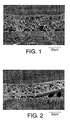
- FIGS 1 and 2 show scanning electron micrographs for coating A and coating B respectively. The figures indicate that bubble formation is unaffected by the method of addition of the blowing agents. This is important since the ink retention of the surface is therefore unaffected.
- Table 1 shows the surface roughness measurement from both coating A and coating B. The table shows how the method of addition of the blowing agent effects the surface roughness of the resulting ink receiving layer.
- Rpm Average height
- blowing agents can affect the surface characteristics and coating quality of a foamed polymeric inkjet reciever. Both improved surface quality and coating quality can be achieved by preventing the activation of the blowing agent(s) until after coating has taken place.
Landscapes
- Application Of Or Painting With Fluid Materials (AREA)
- Ink Jet Recording Methods And Recording Media Thereof (AREA)
- Ink Jet (AREA)
- Coating Of Shaped Articles Made Of Macromolecular Substances (AREA)
Abstract
A method of making a material comprises the steps of coating a support
with a solution, the solution comprising a polymer and at least one blowing agent.
Activation of the blowing agent is prevented until after coating.
Description
- This invention relates to a method of making a material, in particular to a method of making a foamed polymeric material suitable for use as an inkjet printing medium.
- Inkjet printing is a process in which a stream of ink, preferably in the form of droplets, is ejected at high speed from nozzles against a medium so as to create an image.
- Media used for inkjet recording need to be dimensionally stable, absorptive of ink, capable of providing a fixed image and compatible with the imaging materials and hardware.
- Most commercial photo quality inkjet media can be classified in one of two categories according to whether the principle component material forms a layer that is porous or non porous in nature. Inkjet media having a porous layer are typically formed of inorganic materials with a polymeric binder. When ink is applied to the medium it is absorbed into the porous layer by capillary action. The ink is absorbed very quickly but the open nature of the porous layer can contribute to the instability of printed images, particularly when the images are exposed to environmental gases such as ozone.
- Inkjet media which have a non porous layer are typically formed of one or more polymeric layers that swell and absorb the applied ink. Due to the limitations of the swelling mechanism this type of media is slow to absorb the ink. However, once dry the printed images are often stable when subjected to light and ozone.
- Alternatives to pure "porous" or "non porous" media are hybrids which take the merits of each pure medium. These hybrids have swellable porous layers. One such media is created from foamed polymer layers using a swellable hydrophilic polymer and blowing agents. This results in the formation of voids in the polymer layer which lead to improved absorption of the ink. Instead of the ink being held in pores which are located in-between particles, as in conventional porous media, the ink is located within the polymer. This results in improved image stability.
- UK patent application GB 0218505.6 discloses an inkjet printing medium formed by a foamed polymeric layer. This medium may be created by the use of blowing agents.
- It has been found that when blowing agents are added to the coating solutions prior to coating the surface of the final foamed polymeric inkjet media is quite rough. This is due to gas bubbles present in the melt, and therefore in the coating, acting as nucleation sites for further bubbles to form around. Coating quality can also be poor due to the pre-formed gas bubbles passing down the hopper slide. These gas bubbles cause lines, streaks and edge retraction.
- It is an aim of the invention to provide a method of improving the surface characteristics and/or coating quality of a foamed polymeric material.
- According to the present invention there is provided a method of making a material comprising the steps of coating a support with a solution comprising a polymer and at least one blowing agent, activation of the blowing agent being prevented until after coating.
- The invention further provides a material formed by the method described above, in particular an inkjet printing/recording medium.
- The present invention provides a method of making an inkjet media having a porous hydrophilic polymer layer with improved surface characteristics. Significantly smoother surfaces can be achieved with the method of the invention.
- The method also produces better quality coating. As the blowing agents are prevented from being activated prior to the coating process there are no pre-formed bubbles passing down the hopper. As described earlier these pre-formed bubbles cause lines, streaks and edge retraction so the coating quality is improved using the method of the invention.
- The invention will now be described, by way of example, with reference to the accompanying drawings, in which:
- Figure 1 is a scanning electron micrograph of a section through an inkjet receiver showing the bubble formation in an ink receiving layer formed with coating A as described below; and
- Figure 2 is a scanning electron micrograph of a section through an inkjet receiver showing the bubble formation in an ink receiving layer formed with coating B as described below.
-
- The present invention provides a method of making a material. The material may have many different uses, including use as an inkjet medium.
- The medium comprises a support layer, such as resin coated paper, PET film base, acetate, printing plate or any other suitable support, and a polymeric layer supported on the support layer.
- The polymeric layer comprises a hydrophylic polymer. Examples could include polyvinyl alcohol, polyethylene oxide, polyvinyl pyrrolidone and gelatin
- The polymeric layer is created by the use of blowing agents. Examples of suitable blowing agents include a mixture of sodium nitrite and ammonium chloride, metal carbonates and bicarbonates. Further examples of suitable blowing agents are described in, for example, the Handbook of Polymeric Foams and Foam Technology, edited by Daniel Klempner and Kurt C.Frisch, Chapter 17: Blowing Agents for Polymer Foams, Section 3 Chemical Blowing Agents (chapter written by Dr. Fyodor A.Shutov). Heat causes the blowing agents to decompose and create gas bubbles within the solution which causes foaming of the polymer. The foam is effectively a network of either open or closed cell arrangements of voids within a polymer matrix. Full details of such an inkjet medium are disclosed in UK patent application GB 0218505.6. If the blowing agents are added to the coating solution prior to coating it is possible that gas bubbles can form prior to coating. Whether or not bubbles are formed depends on the temperature required for initiation of the decomposition of the blowing agent or agents and the pH of the solution. When gas bubbles are present in the melt and therefore in the coating solution it has been found that they can act as nucleation sites for other bubbles to form around when the blowing agents decompose vigorously in the drying section of the coating track. This results in quite rough surfaces on the inkjet receiver. Coating quality can also be affected when the pre-formed bubbles pass down the hopper, causing lines, streaks and edge retraction.
- It has been found that if the blowing agents are dual melted into one of the layers at the hopper there is not enough time or heat available for the blowing agents to begin to decompose before the coating process begins: 'Therefore no bubbles are pre-formed, the bubbles not beginning to form until the coating solution containing the blowing agents passes into the dryers where the heat can initiate the gas formation. As there are no pre-formed bubbles to act as nucleation sites for new bubbles to form around significantly smoother surfaces can be achieved on the inkjet medium. The coating quality is also improved due to there being no pre-formed bubbles in the melts.
- If two or more components are required for initiation of decomposition of the blowing agents the prevention of any pre-formed bubbles can also be achieved by adding one of the components to the melts prior to coating and dual melting the other one or more at the hopper. This method prevents the components being able to react until they all come together in the hopper. A further method of achieving prevention of initiation of decomposition is to add each component required to a separate layer of the coating. Once again, this method prevents the components being able to react until all the layers are coated together.
- It has been shown that improved surface quality and coating quality can be achieved by preventing the initiation of the decomposition of the blowing agents prior to coating.
- The following example demonstrates the invention.
- A resin-coated paper support was coated on the front with three ink-receiving layers. Each layer comprised polyvinyl alcohol (PVA), blowing agents (a total of 50% by weight compared to the PVA laydown) and some surfactant.
- Coating A was a control coating in which the blowing agents were added directly to the melts prior to coating.
- In coating A the ink-receiving layer nearest the support consisted of 5.7 g/m2 of PVA, 1.61 g/m2 of sodium nitrite, 1.24 g/m2 of ammonium chloride and 0.106 g/m2 of surfactant. The middle ink-receiving layer consisted of 6.2 g/m2 of PVA, 1.75 g/m2 of sodium nitrite, 1.35 g/m2 of ammonium chloride and 0.212 g/m2 of surfactant. The top ink-receiving layer consisted of 7.1 g/m2 of PVA, 2.00 g/m2 of sodium nitrite, 1.55 g/m2 of ammonium chloride and 0.318 g/m2 of surfactant. Therefore the total PVA laydown of the entire coating pack was 19.0 g/m2 and the total laydown of the blowing agents was 9.5 g/m2. The three layers were then coated simultaneously on a bead-coating machine using a standard slide hopper.
- Coating B was a coating where the blowing agents were dual melted into the top ink receiving layer at the hopper.
- In coating B the ink-receiving layer nearest the support consisted of 6.4 g/m2 of PVA and 0.106 g/m2 of surfactant. The middle ink-receiving layer consisted of 7.2 g/m2 of PVA and 0.212 g/m2 of surfactant. The top ink-receiving layer consisted of 5.4 g/m2 of PVA and 0.318 g/m2 of surfactant. The blowing agents were then dual melted into the top ink receiving layer. The 40% sodium nitrite solution was dual melted using a laydown of 13.4 mls/m2 (which is equivalent to 5.35 g/m2 of sodium nitrite). The 20% ammonium chloride solution was dual melted using a laydown of 20.8 mls/m2 (which is equivalent to 4.15 g/m2 of ammonium chloride). Therefore the total PVA laydown of the entire coating pack was 19.0 g/m2 and the total laydown of the blowing agents was 9.5 g/m2 i.e. the same as for coating A. The three layers were then coated simultaneously on a bead-coating machine using a standard slide hopper
- To initiate the blowing process, the dryers inside the coating track were set to 90 °C through which the coating according to the present invention, coating B, and the control coating, coating A, were passed.
- Figures 1 and 2 show scanning electron micrographs for coating A and coating B respectively. The figures indicate that bubble formation is unaffected by the method of addition of the blowing agents. This is important since the ink retention of the surface is therefore unaffected.
- Table 1 shows the surface roughness measurement from both coating A and coating B. The table shows how the method of addition of the blowing agent effects the surface roughness of the resulting ink receiving layer.
Coating Blowing Agent Addition Method Rt (µm) Rz (µm) Rpm (µm) A Added to pots 34.259 33.196 25.919 B Dual Melted 25.816 22.423 12.666 Rt = Maximum value from peak to valley Rz = Average peak to valley height Rpm = Average height - From the data in Table 1, it can be seen that significantly smoother surfaces are achieved when the blowing agents are dual melted (coating B) into one of the ink receiving layers at the hopper (indicated by lower roughness figures), compared to adding the blowing agents to the PVA melts prior to coating (coating A).
- It can thus be seen that the method of addition of the blowing agents can affect the surface characteristics and coating quality of a foamed polymeric inkjet reciever. Both improved surface quality and coating quality can be achieved by preventing the activation of the blowing agent(s) until after coating has taken place.
- It will be understood by those skilled in the art that the invention is not limited to use with bead coating. Any conventional coating method may be used.
- The invention has been described in detail with reference to preferred embodiments thereof. It will be understood by those skilled in the art that variations and modifications can be effected within the scope of the invention.
Claims (5)
- A method of making a material comprising the steps of coating a support with a solution comprising a polymer and at least one blowing agent, activation of the blowing agent being prevented until after coating.
- A method as claimed in claim 1 wherein the blowing agent is dual melted into a layer of solution prior to coating.
- A method as claimed in claim 1 wherein one component of the blowing agent is dual melted into a layer of solution prior to coating and one component is added to a melt prior to coating.
- A material formed by a method as claimed in any previous claim.
- An inkjet recording medium formed by a method as claimed in any of claims 1 to 3.
Applications Claiming Priority (2)
| Application Number | Priority Date | Filing Date | Title |
|---|---|---|---|
| GB0226309 | 2002-11-12 | ||
| GBGB0226309.3A GB0226309D0 (en) | 2002-11-12 | 2002-11-12 | Method of making a material |
Publications (1)
| Publication Number | Publication Date |
|---|---|
| EP1419828A1 true EP1419828A1 (en) | 2004-05-19 |
Family
ID=9947632
Family Applications (1)
| Application Number | Title | Priority Date | Filing Date |
|---|---|---|---|
| EP03025812A Withdrawn EP1419828A1 (en) | 2002-11-12 | 2003-11-10 | Method of coating a porous polymeric layer |
Country Status (4)
| Country | Link |
|---|---|
| US (1) | US6929824B2 (en) |
| EP (1) | EP1419828A1 (en) |
| JP (1) | JP2004162069A (en) |
| GB (1) | GB0226309D0 (en) |
Families Citing this family (2)
| Publication number | Priority date | Publication date | Assignee | Title |
|---|---|---|---|---|
| GB0218505D0 (en) * | 2002-08-09 | 2002-09-18 | Eastman Kodak Co | Inkjet recording medium |
| GB0402573D0 (en) * | 2004-02-05 | 2004-03-10 | Eastman Kodak Co | Method of ink-jet printing |
Citations (6)
| Publication number | Priority date | Publication date | Assignee | Title |
|---|---|---|---|---|
| US4657938A (en) * | 1985-08-26 | 1987-04-14 | Uniroyal Chemical Company, Inc. | Sprayable and foamable insulating composition |
| US5356853A (en) * | 1990-09-07 | 1994-10-18 | Dai Nippon Printing Co., Ltd. | Thermal transfer image receiving sheet, production process therefor and thermal transfer sheet |
| EP0816113A1 (en) * | 1996-06-28 | 1998-01-07 | Dai Nippon Printing Co., Ltd. | Thermal transfer recording method |
| US20010021726A1 (en) * | 1997-09-02 | 2001-09-13 | Brown James F. | Porous surface compositions and methods of retaining biological samples on said surface |
| EP1315032A1 (en) * | 2001-11-21 | 2003-05-28 | Eastman Kodak Company | Ionic liquids as addenda in photothermographic systems |
| EP1388609A1 (en) * | 2002-08-09 | 2004-02-11 | Eastman Kodak Company | Inkjet recording medium |
Family Cites Families (2)
| Publication number | Priority date | Publication date | Assignee | Title |
|---|---|---|---|---|
| US3794548A (en) * | 1970-04-02 | 1974-02-26 | Hooker Chemical Corp | Method of introducing breathability to a non-porous continuous plastic film |
| US6228476B1 (en) * | 1998-10-30 | 2001-05-08 | Johns Manville International, Inc. | Coated foam insulation and method of making the same |
-
2002
- 2002-11-12 GB GBGB0226309.3A patent/GB0226309D0/en not_active Ceased
-
2003
- 2003-10-16 US US10/687,331 patent/US6929824B2/en not_active Expired - Fee Related
- 2003-11-10 EP EP03025812A patent/EP1419828A1/en not_active Withdrawn
- 2003-11-11 JP JP2003381157A patent/JP2004162069A/en active Pending
Patent Citations (6)
| Publication number | Priority date | Publication date | Assignee | Title |
|---|---|---|---|---|
| US4657938A (en) * | 1985-08-26 | 1987-04-14 | Uniroyal Chemical Company, Inc. | Sprayable and foamable insulating composition |
| US5356853A (en) * | 1990-09-07 | 1994-10-18 | Dai Nippon Printing Co., Ltd. | Thermal transfer image receiving sheet, production process therefor and thermal transfer sheet |
| EP0816113A1 (en) * | 1996-06-28 | 1998-01-07 | Dai Nippon Printing Co., Ltd. | Thermal transfer recording method |
| US20010021726A1 (en) * | 1997-09-02 | 2001-09-13 | Brown James F. | Porous surface compositions and methods of retaining biological samples on said surface |
| EP1315032A1 (en) * | 2001-11-21 | 2003-05-28 | Eastman Kodak Company | Ionic liquids as addenda in photothermographic systems |
| EP1388609A1 (en) * | 2002-08-09 | 2004-02-11 | Eastman Kodak Company | Inkjet recording medium |
Also Published As
| Publication number | Publication date |
|---|---|
| GB0226309D0 (en) | 2002-12-18 |
| US20040091626A1 (en) | 2004-05-13 |
| JP2004162069A (en) | 2004-06-10 |
| US6929824B2 (en) | 2005-08-16 |
Similar Documents
| Publication | Publication Date | Title |
|---|---|---|
| US7582335B2 (en) | Foamed material and a method of making a foamed material | |
| JP2000141883A (en) | Ink jet recording method, recording material reproducing method, recording material, and ink | |
| JP2000053797A (en) | Method for producing microporous film and image forming method using microporous film | |
| US20070141277A1 (en) | Inkjet recording element and a method of use | |
| EP0650850B1 (en) | Ink-jet recording medium | |
| JP2004203044A (en) | Method for increasing diameter of ink-jet ink dot | |
| US6929824B2 (en) | Method of making a material | |
| EP1592562B1 (en) | Method of making a foamed polymeric material, foamed polymeric material obtained thereby and inkjet recording medium | |
| US6814437B2 (en) | Ink jet printing method | |
| US7790250B2 (en) | Inkjet recording medium | |
| US20050276935A1 (en) | Ink-jet recording medium | |
| US20080284836A1 (en) | Method of Ink-Jet Printing | |
| JPS62183382A (en) | Recording method | |
| JP2004203037A (en) | Ink-jet recording element | |
| JP2002029142A (en) | Recording material for back print | |
| JP2004114468A (en) | Ink jet recording medium | |
| JPH11348412A (en) | Manufacture of recording sheet | |
| WO2005075209A1 (en) | Method of making an ink-jet receiver | |
| US7211294B2 (en) | Method of making a material | |
| JPH0717089B2 (en) | Inkjet recording method | |
| JPH09244224A (en) | Original plate for printing | |
| JPH06218896A (en) | Highly accurate printing paper | |
| JP2002248856A (en) | Inkjet recording element | |
| JPH11321087A (en) | Inkjet recording media | |
| JP2001199155A (en) | INK JET RECORDING MEDIUM, ITS MANUFACTURING METHOD, AND RECORDING METHOD |
Legal Events
| Date | Code | Title | Description |
|---|---|---|---|
| PUAI | Public reference made under article 153(3) epc to a published international application that has entered the european phase |
Free format text: ORIGINAL CODE: 0009012 |
|
| AK | Designated contracting states |
Kind code of ref document: A1 Designated state(s): AT BE BG CH CY CZ DE DK EE ES FI FR GB GR HU IE IT LI LU MC NL PT RO SE SI SK TR |
|
| AX | Request for extension of the european patent |
Extension state: AL LT LV MK |
|
| 17P | Request for examination filed |
Effective date: 20041007 |
|
| AKX | Designation fees paid |
Designated state(s): DE FR GB |
|
| 17Q | First examination report despatched |
Effective date: 20071004 |
|
| STAA | Information on the status of an ep patent application or granted ep patent |
Free format text: STATUS: THE APPLICATION IS DEEMED TO BE WITHDRAWN |
|
| 18D | Application deemed to be withdrawn |
Effective date: 20100526 |