EP1419143B1 - 24-sulfur-substituted analogs of 1alpha,25-dihydroxy vitamin d3 - Google Patents
24-sulfur-substituted analogs of 1alpha,25-dihydroxy vitamin d3 Download PDFInfo
- Publication number
- EP1419143B1 EP1419143B1 EP02752924A EP02752924A EP1419143B1 EP 1419143 B1 EP1419143 B1 EP 1419143B1 EP 02752924 A EP02752924 A EP 02752924A EP 02752924 A EP02752924 A EP 02752924A EP 1419143 B1 EP1419143 B1 EP 1419143B1
- Authority
- EP
- European Patent Office
- Prior art keywords
- alkyl
- compound according
- group
- nhc
- compounds
- Prior art date
- Legal status (The legal status is an assumption and is not a legal conclusion. Google has not performed a legal analysis and makes no representation as to the accuracy of the status listed.)
- Expired - Lifetime
Links
- GMRQFYUYWCNGIN-NKMMMXOESA-N calcitriol Chemical compound C1(/[C@@H]2CC[C@@H]([C@]2(CCC1)C)[C@@H](CCCC(C)(C)O)C)=C\C=C1\C[C@@H](O)C[C@H](O)C1=C GMRQFYUYWCNGIN-NKMMMXOESA-N 0.000 title abstract description 43
- 239000011612 calcitriol Substances 0.000 title abstract description 42
- 235000020964 calcitriol Nutrition 0.000 title abstract description 13
- GMRQFYUYWCNGIN-UHFFFAOYSA-N 1,25-Dihydroxy-vitamin D3' Natural products C1CCC2(C)C(C(CCCC(C)(C)O)C)CCC2C1=CC=C1CC(O)CC(O)C1=C GMRQFYUYWCNGIN-UHFFFAOYSA-N 0.000 title abstract 3
- 150000001875 compounds Chemical class 0.000 claims abstract description 208
- 208000037265 diseases, disorders, signs and symptoms Diseases 0.000 claims abstract description 36
- 201000010099 disease Diseases 0.000 claims abstract description 21
- 125000004178 (C1-C4) alkyl group Chemical group 0.000 claims description 59
- -1 amino acid esters Chemical class 0.000 claims description 51
- 150000003839 salts Chemical class 0.000 claims description 43
- 239000000651 prodrug Substances 0.000 claims description 25
- 229940002612 prodrug Drugs 0.000 claims description 25
- 125000003118 aryl group Chemical group 0.000 claims description 22
- 125000005843 halogen group Chemical group 0.000 claims description 20
- 125000001072 heteroaryl group Chemical group 0.000 claims description 20
- 125000001997 phenyl group Chemical group [H]C1=C([H])C([H])=C(*)C([H])=C1[H] 0.000 claims description 19
- 238000011282 treatment Methods 0.000 claims description 19
- 206010028980 Neoplasm Diseases 0.000 claims description 16
- 201000011510 cancer Diseases 0.000 claims description 16
- 239000012453 solvate Substances 0.000 claims description 16
- 208000035475 disorder Diseases 0.000 claims description 14
- 150000002148 esters Chemical class 0.000 claims description 14
- 239000003814 drug Substances 0.000 claims description 13
- 125000002496 methyl group Chemical group [H]C([H])([H])* 0.000 claims description 11
- 125000000876 trifluoromethoxy group Chemical group FC(F)(F)O* 0.000 claims description 11
- 125000002023 trifluoromethyl group Chemical group FC(F)(F)* 0.000 claims description 11
- 125000001931 aliphatic group Chemical group 0.000 claims description 10
- 150000004677 hydrates Chemical class 0.000 claims description 10
- 125000001434 methanylylidene group Chemical group [H]C#[*] 0.000 claims description 10
- 125000000956 methoxy group Chemical group [H]C([H])([H])O* 0.000 claims description 10
- 201000004681 Psoriasis Diseases 0.000 claims description 9
- 125000003178 carboxy group Chemical group [H]OC(*)=O 0.000 claims description 9
- 229910006074 SO2NH2 Inorganic materials 0.000 claims description 8
- 125000005042 acyloxymethyl group Chemical group 0.000 claims description 8
- 125000000565 sulfonamide group Chemical group 0.000 claims description 8
- 125000004169 (C1-C6) alkyl group Chemical class 0.000 claims description 7
- 150000004657 carbamic acid derivatives Chemical class 0.000 claims description 7
- 125000000325 methylidene group Chemical group [H]C([H])=* 0.000 claims description 7
- 230000004663 cell proliferation Effects 0.000 claims description 6
- 208000000236 Prostatic Neoplasms Diseases 0.000 claims description 5
- 208000024799 Thyroid disease Diseases 0.000 claims description 5
- 239000008194 pharmaceutical composition Substances 0.000 claims description 5
- 230000029663 wound healing Effects 0.000 claims description 5
- 125000001255 4-fluorophenyl group Chemical group [H]C1=C([H])C(*)=C([H])C([H])=C1F 0.000 claims description 4
- 208000020084 Bone disease Diseases 0.000 claims description 4
- 208000001132 Osteoporosis Diseases 0.000 claims description 4
- 206010060862 Prostate cancer Diseases 0.000 claims description 4
- 208000026310 Breast neoplasm Diseases 0.000 claims description 3
- 239000003937 drug carrier Substances 0.000 claims description 3
- 125000002541 furyl group Chemical group 0.000 claims description 3
- 208000020816 lung neoplasm Diseases 0.000 claims description 3
- 125000003854 p-chlorophenyl group Chemical group [H]C1=C([H])C(*)=C([H])C([H])=C1Cl 0.000 claims description 3
- 125000001037 p-tolyl group Chemical group [H]C1=C([H])C(=C([H])C([H])=C1*)C([H])([H])[H] 0.000 claims description 3
- 125000004076 pyridyl group Chemical group 0.000 claims description 3
- 125000001544 thienyl group Chemical group 0.000 claims description 3
- 125000004172 4-methoxyphenyl group Chemical group [H]C1=C([H])C(OC([H])([H])[H])=C([H])C([H])=C1* 0.000 claims description 2
- MDFFNEOEWAXZRQ-UHFFFAOYSA-N aminyl Chemical compound [NH2] MDFFNEOEWAXZRQ-UHFFFAOYSA-N 0.000 claims description 2
- 229910052801 chlorine Inorganic materials 0.000 claims description 2
- 125000002147 dimethylamino group Chemical group [H]C([H])([H])N(*)C([H])([H])[H] 0.000 claims description 2
- 229910052731 fluorine Inorganic materials 0.000 claims description 2
- 125000001153 fluoro group Chemical group F* 0.000 claims description 2
- 206010006187 Breast cancer Diseases 0.000 claims 2
- 206010058467 Lung neoplasm malignant Diseases 0.000 claims 2
- 201000005202 lung cancer Diseases 0.000 claims 2
- 125000006645 (C3-C4) cycloalkyl group Chemical group 0.000 claims 1
- 125000004189 3,4-dichlorophenyl group Chemical group [H]C1=C([H])C(Cl)=C(Cl)C([H])=C1* 0.000 claims 1
- 230000035407 negative regulation of cell proliferation Effects 0.000 claims 1
- 125000000636 p-nitrophenyl group Chemical group [H]C1=C([H])C(=C([H])C([H])=C1*)[N+]([O-])=O 0.000 claims 1
- 239000000203 mixture Substances 0.000 abstract description 54
- 101000861278 Homo sapiens 1,25-dihydroxyvitamin D(3) 24-hydroxylase, mitochondrial Proteins 0.000 abstract description 23
- 102100027518 1,25-dihydroxyvitamin D(3) 24-hydroxylase, mitochondrial Human genes 0.000 abstract description 21
- 238000000034 method Methods 0.000 abstract description 21
- 230000008901 benefit Effects 0.000 abstract description 7
- 229940124639 Selective inhibitor Drugs 0.000 abstract 1
- HEDRZPFGACZZDS-MICDWDOJSA-N Trichloro(2H)methane Chemical compound [2H]C(Cl)(Cl)Cl HEDRZPFGACZZDS-MICDWDOJSA-N 0.000 description 172
- XEKOWRVHYACXOJ-UHFFFAOYSA-N Ethyl acetate Chemical compound CCOC(C)=O XEKOWRVHYACXOJ-UHFFFAOYSA-N 0.000 description 151
- VLKZOEOYAKHREP-UHFFFAOYSA-N n-Hexane Chemical class CCCCCC VLKZOEOYAKHREP-UHFFFAOYSA-N 0.000 description 84
- WYURNTSHIVDZCO-UHFFFAOYSA-N Tetrahydrofuran Chemical compound C1CCOC1 WYURNTSHIVDZCO-UHFFFAOYSA-N 0.000 description 82
- 239000000243 solution Substances 0.000 description 82
- HEDRZPFGACZZDS-UHFFFAOYSA-N Chloroform Chemical compound ClC(Cl)Cl HEDRZPFGACZZDS-UHFFFAOYSA-N 0.000 description 76
- 235000019439 ethyl acetate Nutrition 0.000 description 68
- LFQSCWFLJHTTHZ-UHFFFAOYSA-N Ethanol Chemical compound CCO LFQSCWFLJHTTHZ-UHFFFAOYSA-N 0.000 description 62
- OKKJLVBELUTLKV-UHFFFAOYSA-N Methanol Chemical compound OC OKKJLVBELUTLKV-UHFFFAOYSA-N 0.000 description 54
- 210000004027 cell Anatomy 0.000 description 53
- 238000005160 1H NMR spectroscopy Methods 0.000 description 44
- CSNNHWWHGAXBCP-UHFFFAOYSA-L Magnesium sulfate Chemical compound [Mg+2].[O-][S+2]([O-])([O-])[O-] CSNNHWWHGAXBCP-UHFFFAOYSA-L 0.000 description 44
- YMWUJEATGCHHMB-UHFFFAOYSA-N Dichloromethane Chemical compound ClCCl YMWUJEATGCHHMB-UHFFFAOYSA-N 0.000 description 43
- XLYOFNOQVPJJNP-UHFFFAOYSA-N water Substances O XLYOFNOQVPJJNP-UHFFFAOYSA-N 0.000 description 36
- 238000002360 preparation method Methods 0.000 description 34
- 238000001644 13C nuclear magnetic resonance spectroscopy Methods 0.000 description 33
- 239000003153 chemical reaction reagent Substances 0.000 description 30
- 239000011734 sodium Substances 0.000 description 30
- 238000006243 chemical reaction Methods 0.000 description 27
- 150000002576 ketones Chemical class 0.000 description 27
- FPGGTKZVZWFYPV-UHFFFAOYSA-M tetrabutylammonium fluoride Chemical compound [F-].CCCC[N+](CCCC)(CCCC)CCCC FPGGTKZVZWFYPV-UHFFFAOYSA-M 0.000 description 26
- 230000000694 effects Effects 0.000 description 24
- 239000011541 reaction mixture Substances 0.000 description 23
- 239000012267 brine Substances 0.000 description 22
- 229910052943 magnesium sulfate Inorganic materials 0.000 description 22
- 125000006239 protecting group Chemical group 0.000 description 22
- HPALAKNZSZLMCH-UHFFFAOYSA-M sodium;chloride;hydrate Chemical compound O.[Na+].[Cl-] HPALAKNZSZLMCH-UHFFFAOYSA-M 0.000 description 22
- 239000010409 thin film Substances 0.000 description 21
- 239000002609 medium Substances 0.000 description 20
- 239000003921 oil Substances 0.000 description 19
- 150000003457 sulfones Chemical class 0.000 description 19
- VYPSYNLAJGMNEJ-UHFFFAOYSA-N Silicium dioxide Chemical compound O=[Si]=O VYPSYNLAJGMNEJ-UHFFFAOYSA-N 0.000 description 18
- 238000004440 column chromatography Methods 0.000 description 18
- 239000007983 Tris buffer Substances 0.000 description 17
- 238000003818 flash chromatography Methods 0.000 description 16
- 239000000047 product Substances 0.000 description 16
- LENZDBCJOHFCAS-UHFFFAOYSA-N tris Chemical compound OCC(N)(CO)CO LENZDBCJOHFCAS-UHFFFAOYSA-N 0.000 description 16
- UHOVQNZJYSORNB-UHFFFAOYSA-N Benzene Chemical compound C1=CC=CC=C1 UHOVQNZJYSORNB-UHFFFAOYSA-N 0.000 description 15
- 230000005764 inhibitory process Effects 0.000 description 14
- RTZKZFJDLAIYFH-UHFFFAOYSA-N Diethyl ether Chemical compound CCOCC RTZKZFJDLAIYFH-UHFFFAOYSA-N 0.000 description 13
- MZRVEZGGRBJDDB-UHFFFAOYSA-N N-Butyllithium Chemical compound [Li]CCCC MZRVEZGGRBJDDB-UHFFFAOYSA-N 0.000 description 13
- 239000012230 colorless oil Substances 0.000 description 13
- 238000004128 high performance liquid chromatography Methods 0.000 description 13
- 238000012360 testing method Methods 0.000 description 13
- GMRQFYUYWCNGIN-ZVUFCXRFSA-N 1,25-dihydroxy vitamin D3 Chemical compound C1([C@@H]2CC[C@@H]([C@]2(CCC1)C)[C@@H](CCCC(C)(C)O)C)=CC=C1C[C@@H](O)C[C@H](O)C1=C GMRQFYUYWCNGIN-ZVUFCXRFSA-N 0.000 description 12
- 239000002253 acid Substances 0.000 description 12
- 239000003610 charcoal Substances 0.000 description 12
- ASCDEFWCUMHIMI-UHFFFAOYSA-N cyclopropylsulfonylbenzene Chemical compound C=1C=CC=CC=1S(=O)(=O)C1CC1 ASCDEFWCUMHIMI-UHFFFAOYSA-N 0.000 description 12
- 238000010790 dilution Methods 0.000 description 12
- 239000012895 dilution Substances 0.000 description 12
- 239000007787 solid Substances 0.000 description 12
- DOPJJCFLVZFOAG-UHFFFAOYSA-N triethyl-[2-(2-triethylsilyloxyphenyl)sulfonylphenoxy]silane Chemical compound CC[Si](CC)(CC)OC1=CC=CC=C1S(=O)(=O)C1=CC=CC=C1O[Si](CC)(CC)CC DOPJJCFLVZFOAG-UHFFFAOYSA-N 0.000 description 11
- 108050000156 vitamin D receptors Proteins 0.000 description 11
- 102000009310 vitamin D receptors Human genes 0.000 description 11
- 238000003556 assay Methods 0.000 description 10
- 229960005084 calcitriol Drugs 0.000 description 10
- 239000000741 silica gel Substances 0.000 description 10
- 229910002027 silica gel Inorganic materials 0.000 description 10
- 229960001866 silicon dioxide Drugs 0.000 description 10
- 239000002904 solvent Substances 0.000 description 10
- 238000003756 stirring Methods 0.000 description 10
- 229920002307 Dextran Polymers 0.000 description 9
- 239000006144 Dulbecco’s modified Eagle's medium Substances 0.000 description 9
- 108010010803 Gelatin Proteins 0.000 description 9
- 125000001559 cyclopropyl group Chemical group [H]C1([H])C([H])([H])C1([H])* 0.000 description 9
- 239000008273 gelatin Substances 0.000 description 9
- 229920000159 gelatin Polymers 0.000 description 9
- 235000019322 gelatine Nutrition 0.000 description 9
- 235000011852 gelatine desserts Nutrition 0.000 description 9
- DLEDOFVPSDKWEF-UHFFFAOYSA-N lithium butane Chemical compound [Li+].CCC[CH2-] DLEDOFVPSDKWEF-UHFFFAOYSA-N 0.000 description 9
- JCDWETOKTFWTHA-UHFFFAOYSA-N methylsulfonylbenzene Chemical compound CS(=O)(=O)C1=CC=CC=C1 JCDWETOKTFWTHA-UHFFFAOYSA-N 0.000 description 9
- 102000004190 Enzymes Human genes 0.000 description 8
- 108090000790 Enzymes Proteins 0.000 description 8
- 238000005481 NMR spectroscopy Methods 0.000 description 8
- 102000050760 Vitamin D-binding protein Human genes 0.000 description 8
- 101710179590 Vitamin D-binding protein Proteins 0.000 description 8
- 239000002585 base Substances 0.000 description 8
- JWUBBDSIWDLEOM-DTOXIADCSA-N calcidiol Chemical compound C1(/[C@@H]2CC[C@@H]([C@]2(CCC1)C)[C@@H](CCCC(C)(C)O)C)=C\C=C1\C[C@@H](O)CCC1=C JWUBBDSIWDLEOM-DTOXIADCSA-N 0.000 description 8
- 230000002829 reductive effect Effects 0.000 description 8
- QYSXJUFSXHHAJI-YRZJJWOYSA-N vitamin D3 Chemical compound C1(/[C@@H]2CC[C@@H]([C@]2(CCC1)C)[C@H](C)CCCC(C)C)=C\C=C1\C[C@@H](O)CCC1=C QYSXJUFSXHHAJI-YRZJJWOYSA-N 0.000 description 8
- OKTJSMMVPCPJKN-UHFFFAOYSA-N Carbon Chemical compound [C] OKTJSMMVPCPJKN-UHFFFAOYSA-N 0.000 description 7
- GNOIPBMMFNIUFM-UHFFFAOYSA-N hexamethylphosphoric triamide Chemical compound CN(C)P(=O)(N(C)C)N(C)C GNOIPBMMFNIUFM-UHFFFAOYSA-N 0.000 description 7
- XMBWDFGMSWQBCA-UHFFFAOYSA-N hydrogen iodide Chemical compound I XMBWDFGMSWQBCA-UHFFFAOYSA-N 0.000 description 7
- 230000002401 inhibitory effect Effects 0.000 description 7
- 238000001890 transfection Methods 0.000 description 7
- 239000011710 vitamin D Substances 0.000 description 7
- XMAYWYJOQHXEEK-OZXSUGGESA-N (2R,4S)-ketoconazole Chemical compound C1CN(C(=O)C)CCN1C(C=C1)=CC=C1OC[C@@H]1O[C@@](CN2C=NC=C2)(C=2C(=CC(Cl)=CC=2)Cl)OC1 XMAYWYJOQHXEEK-OZXSUGGESA-N 0.000 description 6
- XKRFYHLGVUSROY-UHFFFAOYSA-N Argon Chemical compound [Ar] XKRFYHLGVUSROY-UHFFFAOYSA-N 0.000 description 6
- OYPRJOBELJOOCE-UHFFFAOYSA-N Calcium Chemical compound [Ca] OYPRJOBELJOOCE-UHFFFAOYSA-N 0.000 description 6
- 241001465754 Metazoa Species 0.000 description 6
- 229930003316 Vitamin D Natural products 0.000 description 6
- QYSXJUFSXHHAJI-XFEUOLMDSA-N Vitamin D3 Natural products C1(/[C@@H]2CC[C@@H]([C@]2(CCC1)C)[C@H](C)CCCC(C)C)=C/C=C1\C[C@@H](O)CCC1=C QYSXJUFSXHHAJI-XFEUOLMDSA-N 0.000 description 6
- 125000005002 aryl methyl group Chemical group 0.000 description 6
- 239000011575 calcium Substances 0.000 description 6
- 239000005556 hormone Substances 0.000 description 6
- 229940088597 hormone Drugs 0.000 description 6
- RCBVKBFIWMOMHF-UHFFFAOYSA-L hydroxy-(hydroxy(dioxo)chromio)oxy-dioxochromium;pyridine Chemical compound C1=CC=NC=C1.C1=CC=NC=C1.O[Cr](=O)(=O)O[Cr](O)(=O)=O RCBVKBFIWMOMHF-UHFFFAOYSA-L 0.000 description 6
- 229960004125 ketoconazole Drugs 0.000 description 6
- 239000000463 material Substances 0.000 description 6
- AUONHKJOIZSQGR-UHFFFAOYSA-N oxophosphane Chemical compound P=O AUONHKJOIZSQGR-UHFFFAOYSA-N 0.000 description 6
- 238000010898 silica gel chromatography Methods 0.000 description 6
- 235000019166 vitamin D Nutrition 0.000 description 6
- 229940046008 vitamin d Drugs 0.000 description 6
- PEDCQBHIVMGVHV-UHFFFAOYSA-N Glycerine Chemical compound OCC(O)CO PEDCQBHIVMGVHV-UHFFFAOYSA-N 0.000 description 5
- 230000002159 abnormal effect Effects 0.000 description 5
- 150000001450 anions Chemical class 0.000 description 5
- 230000001028 anti-proliverative effect Effects 0.000 description 5
- 239000000872 buffer Substances 0.000 description 5
- 230000000125 calcaemic effect Effects 0.000 description 5
- 229910052791 calcium Inorganic materials 0.000 description 5
- 230000009702 cancer cell proliferation Effects 0.000 description 5
- 230000015556 catabolic process Effects 0.000 description 5
- 239000003795 chemical substances by application Substances 0.000 description 5
- 229940079593 drug Drugs 0.000 description 5
- 239000012458 free base Substances 0.000 description 5
- 238000001727 in vivo Methods 0.000 description 5
- 239000012442 inert solvent Substances 0.000 description 5
- 239000000543 intermediate Substances 0.000 description 5
- 230000007935 neutral effect Effects 0.000 description 5
- 230000002062 proliferating effect Effects 0.000 description 5
- 150000003462 sulfoxides Chemical class 0.000 description 5
- 239000000725 suspension Substances 0.000 description 5
- 238000012546 transfer Methods 0.000 description 5
- 150000003710 vitamin D derivatives Chemical class 0.000 description 5
- GQHTUMJGOHRCHB-UHFFFAOYSA-N 2,3,4,6,7,8,9,10-octahydropyrimido[1,2-a]azepine Chemical compound C1CCCCN2CCCN=C21 GQHTUMJGOHRCHB-UHFFFAOYSA-N 0.000 description 4
- QKNYBSVHEMOAJP-UHFFFAOYSA-N 2-amino-2-(hydroxymethyl)propane-1,3-diol;hydron;chloride Chemical compound Cl.OCC(N)(CO)CO QKNYBSVHEMOAJP-UHFFFAOYSA-N 0.000 description 4
- KWYHDKDOAIKMQN-UHFFFAOYSA-N N,N,N',N'-tetramethylethylenediamine Chemical compound CN(C)CCN(C)C KWYHDKDOAIKMQN-UHFFFAOYSA-N 0.000 description 4
- UIIMBOGNXHQVGW-UHFFFAOYSA-M Sodium bicarbonate Chemical compound [Na+].OC([O-])=O UIIMBOGNXHQVGW-UHFFFAOYSA-M 0.000 description 4
- 230000009286 beneficial effect Effects 0.000 description 4
- 230000015572 biosynthetic process Effects 0.000 description 4
- 210000000988 bone and bone Anatomy 0.000 description 4
- 229910052799 carbon Inorganic materials 0.000 description 4
- 125000004432 carbon atom Chemical group C* 0.000 description 4
- 239000006285 cell suspension Substances 0.000 description 4
- 238000004587 chromatography analysis Methods 0.000 description 4
- 239000012043 crude product Substances 0.000 description 4
- 238000001952 enzyme assay Methods 0.000 description 4
- 230000000121 hypercalcemic effect Effects 0.000 description 4
- 238000000338 in vitro Methods 0.000 description 4
- 238000011534 incubation Methods 0.000 description 4
- 239000007800 oxidant agent Substances 0.000 description 4
- 230000001590 oxidative effect Effects 0.000 description 4
- 239000012071 phase Substances 0.000 description 4
- 239000000758 substrate Substances 0.000 description 4
- 238000002560 therapeutic procedure Methods 0.000 description 4
- 102100036285 25-hydroxyvitamin D-1 alpha hydroxylase, mitochondrial Human genes 0.000 description 3
- CSCPPACGZOOCGX-UHFFFAOYSA-N Acetone Chemical compound CC(C)=O CSCPPACGZOOCGX-UHFFFAOYSA-N 0.000 description 3
- WEVYAHXRMPXWCK-UHFFFAOYSA-N Acetonitrile Chemical compound CC#N WEVYAHXRMPXWCK-UHFFFAOYSA-N 0.000 description 3
- IAZDPXIOMUYVGZ-UHFFFAOYSA-N Dimethylsulphoxide Chemical compound CS(C)=O IAZDPXIOMUYVGZ-UHFFFAOYSA-N 0.000 description 3
- LYCAIKOWRPUZTN-UHFFFAOYSA-N Ethylene glycol Chemical compound OCCO LYCAIKOWRPUZTN-UHFFFAOYSA-N 0.000 description 3
- 101000875401 Homo sapiens Sterol 26-hydroxylase, mitochondrial Proteins 0.000 description 3
- 208000037147 Hypercalcaemia Diseases 0.000 description 3
- 206010020751 Hypersensitivity Diseases 0.000 description 3
- UTGQNNCQYDRXCH-UHFFFAOYSA-N N,N'-diphenyl-1,4-phenylenediamine Chemical compound C=1C=C(NC=2C=CC=CC=2)C=CC=1NC1=CC=CC=C1 UTGQNNCQYDRXCH-UHFFFAOYSA-N 0.000 description 3
- ZMXDDKWLCZADIW-UHFFFAOYSA-N N,N-Dimethylformamide Chemical compound CN(C)C=O ZMXDDKWLCZADIW-UHFFFAOYSA-N 0.000 description 3
- 102100036325 Sterol 26-hydroxylase, mitochondrial Human genes 0.000 description 3
- ZMANZCXQSJIPKH-UHFFFAOYSA-N Triethylamine Chemical compound CCN(CC)CC ZMANZCXQSJIPKH-UHFFFAOYSA-N 0.000 description 3
- 239000000443 aerosol Substances 0.000 description 3
- 150000001299 aldehydes Chemical class 0.000 description 3
- 230000007815 allergy Effects 0.000 description 3
- 229910052786 argon Inorganic materials 0.000 description 3
- 239000012300 argon atmosphere Substances 0.000 description 3
- 239000012298 atmosphere Substances 0.000 description 3
- 238000004364 calculation method Methods 0.000 description 3
- 238000002512 chemotherapy Methods 0.000 description 3
- 238000001816 cooling Methods 0.000 description 3
- 239000003085 diluting agent Substances 0.000 description 3
- 239000006185 dispersion Substances 0.000 description 3
- 239000012530 fluid Substances 0.000 description 3
- 238000009472 formulation Methods 0.000 description 3
- 238000005805 hydroxylation reaction Methods 0.000 description 3
- 230000000148 hypercalcaemia Effects 0.000 description 3
- 208000030915 hypercalcemia disease Diseases 0.000 description 3
- RAXXELZNTBOGNW-UHFFFAOYSA-N imidazole Natural products C1=CNC=N1 RAXXELZNTBOGNW-UHFFFAOYSA-N 0.000 description 3
- 239000003112 inhibitor Substances 0.000 description 3
- 229910052740 iodine Inorganic materials 0.000 description 3
- 238000002955 isolation Methods 0.000 description 3
- 210000003734 kidney Anatomy 0.000 description 3
- 229910052744 lithium Inorganic materials 0.000 description 3
- 231100000252 nontoxic Toxicity 0.000 description 3
- 230000003000 nontoxic effect Effects 0.000 description 3
- TWLXDPFBEPBAQB-UHFFFAOYSA-N orthoperiodic acid Chemical compound OI(O)(O)(O)(O)=O TWLXDPFBEPBAQB-UHFFFAOYSA-N 0.000 description 3
- 230000003647 oxidation Effects 0.000 description 3
- 238000007254 oxidation reaction Methods 0.000 description 3
- 230000000849 parathyroid Effects 0.000 description 3
- 239000004033 plastic Substances 0.000 description 3
- 229920003023 plastic Polymers 0.000 description 3
- CHKVPAROMQMJNQ-UHFFFAOYSA-M potassium bisulfate Chemical compound [K+].OS([O-])(=O)=O CHKVPAROMQMJNQ-UHFFFAOYSA-M 0.000 description 3
- 229910000343 potassium bisulfate Inorganic materials 0.000 description 3
- 230000035755 proliferation Effects 0.000 description 3
- IJTSQCOXRMHSCS-UHFFFAOYSA-N propan-2-ylsulfonylbenzene Chemical compound CC(C)S(=O)(=O)C1=CC=CC=C1 IJTSQCOXRMHSCS-UHFFFAOYSA-N 0.000 description 3
- 238000000159 protein binding assay Methods 0.000 description 3
- 238000000746 purification Methods 0.000 description 3
- 230000002285 radioactive effect Effects 0.000 description 3
- 239000000018 receptor agonist Substances 0.000 description 3
- 229940044601 receptor agonist Drugs 0.000 description 3
- 229920006395 saturated elastomer Polymers 0.000 description 3
- 210000003491 skin Anatomy 0.000 description 3
- 238000010561 standard procedure Methods 0.000 description 3
- 239000000126 substance Substances 0.000 description 3
- 230000004083 survival effect Effects 0.000 description 3
- 239000006188 syrup Substances 0.000 description 3
- 235000020357 syrup Nutrition 0.000 description 3
- 239000003826 tablet Substances 0.000 description 3
- RMVRSNDYEFQCLF-UHFFFAOYSA-N thiophenol Chemical compound SC1=CC=CC=C1 RMVRSNDYEFQCLF-UHFFFAOYSA-N 0.000 description 3
- 231100000419 toxicity Toxicity 0.000 description 3
- 230000001988 toxicity Effects 0.000 description 3
- WWJVZVWKQLCHIX-UHFFFAOYSA-N triethyl-[5-methoxy-2-(4-methoxy-2-triethylsilyloxyphenyl)sulfonylphenoxy]silane Chemical compound CC[Si](CC)(CC)OC1=CC(OC)=CC=C1S(=O)(=O)C1=CC=C(OC)C=C1O[Si](CC)(CC)CC WWJVZVWKQLCHIX-UHFFFAOYSA-N 0.000 description 3
- 239000003981 vehicle Substances 0.000 description 3
- 239000011647 vitamin D3 Substances 0.000 description 3
- GBBJBUGPGFNISJ-YDQXZVTASA-N (4as,7r,8as)-9,9-dimethyltetrahydro-4h-4a,7-methanobenzo[c][1,2]oxazireno[2,3-b]isothiazole 3,3-dioxide Chemical group C1S(=O)(=O)N2O[C@@]32C[C@@H]2C(C)(C)[C@]13CC2 GBBJBUGPGFNISJ-YDQXZVTASA-N 0.000 description 2
- JKBCENKBTQPCCH-UHFFFAOYSA-N 1-methylsulfonyl-4-(trifluoromethyl)benzene Chemical compound CS(=O)(=O)C1=CC=C(C(F)(F)F)C=C1 JKBCENKBTQPCCH-UHFFFAOYSA-N 0.000 description 2
- XONGBDXIFQIQBN-UHFFFAOYSA-N 1-methylsulfonyl-4-nitrobenzene Chemical compound CS(=O)(=O)C1=CC=C([N+]([O-])=O)C=C1 XONGBDXIFQIQBN-UHFFFAOYSA-N 0.000 description 2
- 108010073030 25-Hydroxyvitamin D3 1-alpha-Hydroxylase Proteins 0.000 description 2
- KALSSBOXPTUUGR-UHFFFAOYSA-N 3-chloro-6-(4-chloro-6-oxocyclohexa-2,4-dien-1-yl)sulfonylcyclohexa-2,4-dien-1-one Chemical compound C1=CC(Cl)=CC(=O)C1S(=O)(=O)C1C(=O)C=C(Cl)C=C1 KALSSBOXPTUUGR-UHFFFAOYSA-N 0.000 description 2
- NHQDETIJWKXCTC-UHFFFAOYSA-N 3-chloroperbenzoic acid Chemical compound OOC(=O)C1=CC=CC(Cl)=C1 NHQDETIJWKXCTC-UHFFFAOYSA-N 0.000 description 2
- VHBJTCGFTQTPMY-UHFFFAOYSA-N 3-fluoro-6-(4-fluoro-6-oxocyclohexa-2,4-dien-1-yl)sulfonylcyclohexa-2,4-dien-1-one Chemical compound C1=CC(F)=CC(=O)C1S(=O)(=O)C1C(=O)C=C(F)C=C1 VHBJTCGFTQTPMY-UHFFFAOYSA-N 0.000 description 2
- MCSXGCZMEPXKIW-UHFFFAOYSA-N 3-hydroxy-4-[(4-methyl-2-nitrophenyl)diazenyl]-N-(3-nitrophenyl)naphthalene-2-carboxamide Chemical compound Cc1ccc(N=Nc2c(O)c(cc3ccccc23)C(=O)Nc2cccc(c2)[N+]([O-])=O)c(c1)[N+]([O-])=O MCSXGCZMEPXKIW-UHFFFAOYSA-N 0.000 description 2
- HBAQYPYDRFILMT-UHFFFAOYSA-N 8-[3-(1-cyclopropylpyrazol-4-yl)-1H-pyrazolo[4,3-d]pyrimidin-5-yl]-3-methyl-3,8-diazabicyclo[3.2.1]octan-2-one Chemical class C1(CC1)N1N=CC(=C1)C1=NNC2=C1N=C(N=C2)N1C2C(N(CC1CC2)C)=O HBAQYPYDRFILMT-UHFFFAOYSA-N 0.000 description 2
- QGZKDVFQNNGYKY-UHFFFAOYSA-N Ammonia Chemical compound N QGZKDVFQNNGYKY-UHFFFAOYSA-N 0.000 description 2
- IJGRMHOSHXDMSA-UHFFFAOYSA-N Atomic nitrogen Chemical compound N#N IJGRMHOSHXDMSA-UHFFFAOYSA-N 0.000 description 2
- YTZOOYIBQDBRSU-UHFFFAOYSA-N C1=CC(CCC(C)(C)O[Si](C)(C)C(C)(C)C)=CC(=O)C1S(=O)(=O)C1C(=O)C=C(CCC(C)(C)O[Si](C)(C)C(C)(C)C)C=C1 Chemical compound C1=CC(CCC(C)(C)O[Si](C)(C)C(C)(C)C)=CC(=O)C1S(=O)(=O)C1C(=O)C=C(CCC(C)(C)O[Si](C)(C)C(C)(C)C)C=C1 YTZOOYIBQDBRSU-UHFFFAOYSA-N 0.000 description 2
- 101100007328 Cocos nucifera COS-1 gene Proteins 0.000 description 2
- 201000002980 Hyperparathyroidism Diseases 0.000 description 2
- 208000000038 Hypoparathyroidism Diseases 0.000 description 2
- KFZMGEQAYNKOFK-UHFFFAOYSA-N Isopropanol Chemical compound CC(C)O KFZMGEQAYNKOFK-UHFFFAOYSA-N 0.000 description 2
- 206010025476 Malabsorption Diseases 0.000 description 2
- 208000004155 Malabsorption Syndromes Diseases 0.000 description 2
- 208000029725 Metabolic bone disease Diseases 0.000 description 2
- BAVYZALUXZFZLV-UHFFFAOYSA-N Methylamine Chemical compound NC BAVYZALUXZFZLV-UHFFFAOYSA-N 0.000 description 2
- 108010074633 Mixed Function Oxygenases Proteins 0.000 description 2
- 102000008109 Mixed Function Oxygenases Human genes 0.000 description 2
- 101100114658 Mus musculus Cyp24a1 gene Proteins 0.000 description 2
- 239000012425 OXONE® Substances 0.000 description 2
- 102000052812 Ornithine decarboxylases Human genes 0.000 description 2
- 108700005126 Ornithine decarboxylases Proteins 0.000 description 2
- 206010049088 Osteopenia Diseases 0.000 description 2
- 201000000023 Osteosclerosis Diseases 0.000 description 2
- CBENFWSGALASAD-UHFFFAOYSA-N Ozone Chemical compound [O-][O+]=O CBENFWSGALASAD-UHFFFAOYSA-N 0.000 description 2
- KDLHZDBZIXYQEI-UHFFFAOYSA-N Palladium Chemical compound [Pd] KDLHZDBZIXYQEI-UHFFFAOYSA-N 0.000 description 2
- JUJWROOIHBZHMG-UHFFFAOYSA-N Pyridine Chemical compound C1=CC=NC=C1 JUJWROOIHBZHMG-UHFFFAOYSA-N 0.000 description 2
- 229910019891 RuCl3 Inorganic materials 0.000 description 2
- 208000005770 Secondary Hyperparathyroidism Diseases 0.000 description 2
- WQDUMFSSJAZKTM-UHFFFAOYSA-N Sodium methoxide Chemical compound [Na+].[O-]C WQDUMFSSJAZKTM-UHFFFAOYSA-N 0.000 description 2
- 206010041969 Steatorrhoea Diseases 0.000 description 2
- NINIDFKCEFEMDL-UHFFFAOYSA-N Sulfur Chemical group [S] NINIDFKCEFEMDL-UHFFFAOYSA-N 0.000 description 2
- 241000282898 Sus scrofa Species 0.000 description 2
- YZCKVEUIGOORGS-NJFSPNSNSA-N Tritium Chemical compound [3H] YZCKVEUIGOORGS-NJFSPNSNSA-N 0.000 description 2
- CODRGDFPKOFJEV-UHFFFAOYSA-N [2,3-dichloro-6-(3,4-dichloro-2-triethylsilyloxyphenyl)sulfonylphenoxy]-triethylsilane Chemical compound CC[Si](CC)(CC)OC1=C(Cl)C(Cl)=CC=C1S(=O)(=O)C1=CC=C(Cl)C(Cl)=C1O[Si](CC)(CC)CC CODRGDFPKOFJEV-UHFFFAOYSA-N 0.000 description 2
- 150000007513 acids Chemical class 0.000 description 2
- 239000013543 active substance Substances 0.000 description 2
- 239000004479 aerosol dispenser Substances 0.000 description 2
- 125000000217 alkyl group Chemical group 0.000 description 2
- 208000026935 allergic disease Diseases 0.000 description 2
- 230000008485 antagonism Effects 0.000 description 2
- 230000001773 anti-convulsant effect Effects 0.000 description 2
- 239000001961 anticonvulsive agent Substances 0.000 description 2
- 229960003965 antiepileptics Drugs 0.000 description 2
- 125000004429 atom Chemical group 0.000 description 2
- 150000007514 bases Chemical class 0.000 description 2
- 230000004071 biological effect Effects 0.000 description 2
- 230000008512 biological response Effects 0.000 description 2
- 230000010261 cell growth Effects 0.000 description 2
- 229910001914 chlorine tetroxide Inorganic materials 0.000 description 2
- 208000020832 chronic kidney disease Diseases 0.000 description 2
- 206010012601 diabetes mellitus Diseases 0.000 description 2
- JRONPIZRZBBOBR-UHFFFAOYSA-N dichlorine tetroxide Inorganic materials ClOCl(=O)(=O)=O JRONPIZRZBBOBR-UHFFFAOYSA-N 0.000 description 2
- SAUMVKNLVQDHMJ-UHFFFAOYSA-N dichlorine trioxide Inorganic materials ClOCl(=O)=O SAUMVKNLVQDHMJ-UHFFFAOYSA-N 0.000 description 2
- 230000004069 differentiation Effects 0.000 description 2
- 150000002009 diols Chemical class 0.000 description 2
- KPUWHANPEXNPJT-UHFFFAOYSA-N disiloxane Chemical compound [SiH3]O[SiH3] KPUWHANPEXNPJT-UHFFFAOYSA-N 0.000 description 2
- VHJLVAABSRFDPM-QWWZWVQMSA-N dithiothreitol Chemical compound SC[C@@H](O)[C@H](O)CS VHJLVAABSRFDPM-QWWZWVQMSA-N 0.000 description 2
- 239000002552 dosage form Substances 0.000 description 2
- 239000003480 eluent Substances 0.000 description 2
- 230000029142 excretion Effects 0.000 description 2
- 238000000605 extraction Methods 0.000 description 2
- 239000000706 filtrate Substances 0.000 description 2
- 238000005187 foaming Methods 0.000 description 2
- 239000007789 gas Substances 0.000 description 2
- 239000003862 glucocorticoid Substances 0.000 description 2
- 235000011187 glycerol Nutrition 0.000 description 2
- 230000012010 growth Effects 0.000 description 2
- 229910052736 halogen Inorganic materials 0.000 description 2
- 150000002367 halogens Chemical class 0.000 description 2
- 238000010438 heat treatment Methods 0.000 description 2
- 125000002887 hydroxy group Chemical group [H]O* 0.000 description 2
- 230000033444 hydroxylation Effects 0.000 description 2
- 230000006698 induction Effects 0.000 description 2
- 150000007529 inorganic bases Chemical class 0.000 description 2
- 230000003993 interaction Effects 0.000 description 2
- 210000000936 intestine Anatomy 0.000 description 2
- 125000002346 iodo group Chemical group I* 0.000 description 2
- 210000002510 keratinocyte Anatomy 0.000 description 2
- 208000023356 medullary thyroid gland carcinoma Diseases 0.000 description 2
- 238000002844 melting Methods 0.000 description 2
- 230000008018 melting Effects 0.000 description 2
- 238000002156 mixing Methods 0.000 description 2
- 230000004048 modification Effects 0.000 description 2
- 238000012986 modification Methods 0.000 description 2
- 125000002950 monocyclic group Chemical group 0.000 description 2
- 229910052757 nitrogen Inorganic materials 0.000 description 2
- 150000007530 organic bases Chemical class 0.000 description 2
- 208000005368 osteomalacia Diseases 0.000 description 2
- MPQXHAGKBWFSNV-UHFFFAOYSA-N oxidophosphanium Chemical class [PH3]=O MPQXHAGKBWFSNV-UHFFFAOYSA-N 0.000 description 2
- 229910052760 oxygen Inorganic materials 0.000 description 2
- ZRSNZINYAWTAHE-UHFFFAOYSA-N p-methoxybenzaldehyde Chemical compound COC1=CC=C(C=O)C=C1 ZRSNZINYAWTAHE-UHFFFAOYSA-N 0.000 description 2
- NFHFRUOZVGFOOS-UHFFFAOYSA-N palladium;triphenylphosphane Chemical compound [Pd].C1=CC=CC=C1P(C=1C=CC=CC=1)C1=CC=CC=C1.C1=CC=CC=C1P(C=1C=CC=CC=1)C1=CC=CC=C1.C1=CC=CC=C1P(C=1C=CC=CC=1)C1=CC=CC=C1.C1=CC=CC=C1P(C=1C=CC=CC=1)C1=CC=CC=C1 NFHFRUOZVGFOOS-UHFFFAOYSA-N 0.000 description 2
- 238000007911 parenteral administration Methods 0.000 description 2
- 239000002245 particle Substances 0.000 description 2
- 230000037361 pathway Effects 0.000 description 2
- 239000008188 pellet Substances 0.000 description 2
- 239000003208 petroleum Substances 0.000 description 2
- 239000008363 phosphate buffer Substances 0.000 description 2
- BWHMMNNQKKPAPP-UHFFFAOYSA-L potassium carbonate Chemical compound [K+].[K+].[O-]C([O-])=O BWHMMNNQKKPAPP-UHFFFAOYSA-L 0.000 description 2
- OKBMCNHOEMXPTM-UHFFFAOYSA-M potassium peroxymonosulfate Chemical compound [K+].OOS([O-])(=O)=O OKBMCNHOEMXPTM-UHFFFAOYSA-M 0.000 description 2
- 229910052939 potassium sulfate Inorganic materials 0.000 description 2
- OTYBMLCTZGSZBG-UHFFFAOYSA-L potassium sulfate Chemical compound [K+].[K+].[O-]S([O-])(=O)=O OTYBMLCTZGSZBG-UHFFFAOYSA-L 0.000 description 2
- 239000000843 powder Substances 0.000 description 2
- 108090000765 processed proteins & peptides Proteins 0.000 description 2
- 239000003380 propellant Substances 0.000 description 2
- 201000003651 pulmonary sarcoidosis Diseases 0.000 description 2
- 208000008128 pulmonary tuberculosis Diseases 0.000 description 2
- 102000005962 receptors Human genes 0.000 description 2
- 108020003175 receptors Proteins 0.000 description 2
- 230000001105 regulatory effect Effects 0.000 description 2
- 230000004044 response Effects 0.000 description 2
- 238000004007 reversed phase HPLC Methods 0.000 description 2
- 208000007442 rickets Diseases 0.000 description 2
- YBCAZPLXEGKKFM-UHFFFAOYSA-K ruthenium(iii) chloride Chemical compound [Cl-].[Cl-].[Cl-].[Ru+3] YBCAZPLXEGKKFM-UHFFFAOYSA-K 0.000 description 2
- 239000012679 serum free medium Substances 0.000 description 2
- 239000000377 silicon dioxide Substances 0.000 description 2
- 229910000030 sodium bicarbonate Inorganic materials 0.000 description 2
- 239000007858 starting material Substances 0.000 description 2
- 208000001162 steatorrhea Diseases 0.000 description 2
- 150000003431 steroids Chemical class 0.000 description 2
- 125000001424 substituent group Chemical group 0.000 description 2
- 229910052717 sulfur Inorganic materials 0.000 description 2
- 208000024891 symptom Diseases 0.000 description 2
- 238000003786 synthesis reaction Methods 0.000 description 2
- VZGDMQKNWNREIO-UHFFFAOYSA-N tetrachloromethane Chemical compound ClC(Cl)(Cl)Cl VZGDMQKNWNREIO-UHFFFAOYSA-N 0.000 description 2
- CZDYPVPMEAXLPK-UHFFFAOYSA-N tetramethylsilane Chemical compound C[Si](C)(C)C CZDYPVPMEAXLPK-UHFFFAOYSA-N 0.000 description 2
- 230000001225 therapeutic effect Effects 0.000 description 2
- JOXIMZWYDAKGHI-UHFFFAOYSA-N toluene-4-sulfonic acid Chemical compound CC1=CC=C(S(O)(=O)=O)C=C1 JOXIMZWYDAKGHI-UHFFFAOYSA-N 0.000 description 2
- 230000002103 transcriptional effect Effects 0.000 description 2
- CYRMSUTZVYGINF-UHFFFAOYSA-N trichlorofluoromethane Chemical compound FC(Cl)(Cl)Cl CYRMSUTZVYGINF-UHFFFAOYSA-N 0.000 description 2
- DZRKPVHAAQEKCE-UHFFFAOYSA-N triethyl-[5-methyl-2-(4-methyl-2-triethylsilyloxyphenyl)sulfonylphenoxy]silane Chemical compound CC[Si](CC)(CC)OC1=CC(C)=CC=C1S(=O)(=O)C1=CC=C(C)C=C1O[Si](CC)(CC)CC DZRKPVHAAQEKCE-UHFFFAOYSA-N 0.000 description 2
- MIAKKCZERJMYJQ-UHFFFAOYSA-N triethyl-[5-nitro-2-(4-nitro-2-triethylsilyloxyphenyl)sulfonylphenoxy]silane Chemical compound CC[Si](CC)(CC)OC1=CC([N+]([O-])=O)=CC=C1S(=O)(=O)C1=CC=C([N+]([O-])=O)C=C1O[Si](CC)(CC)CC MIAKKCZERJMYJQ-UHFFFAOYSA-N 0.000 description 2
- GETQZCLCWQTVFV-UHFFFAOYSA-N trimethylamine Chemical compound CN(C)C GETQZCLCWQTVFV-UHFFFAOYSA-N 0.000 description 2
- RIOQSEWOXXDEQQ-UHFFFAOYSA-N triphenylphosphine Chemical compound C1=CC=CC=C1P(C=1C=CC=CC=1)C1=CC=CC=C1 RIOQSEWOXXDEQQ-UHFFFAOYSA-N 0.000 description 2
- 229910052722 tritium Inorganic materials 0.000 description 2
- 206010044697 tropical sprue Diseases 0.000 description 2
- 210000002700 urine Anatomy 0.000 description 2
- 239000013598 vector Substances 0.000 description 2
- 208000030402 vitamin D-dependent rickets Diseases 0.000 description 2
- 125000005913 (C3-C6) cycloalkyl group Chemical group 0.000 description 1
- DNWUINQASFDJJS-UHFFFAOYSA-N 1,2-dichloro-4-methylsulfonylbenzene Chemical compound CS(=O)(=O)C1=CC=C(Cl)C(Cl)=C1 DNWUINQASFDJJS-UHFFFAOYSA-N 0.000 description 1
- RYHBNJHYFVUHQT-UHFFFAOYSA-N 1,4-Dioxane Chemical compound C1COCCO1 RYHBNJHYFVUHQT-UHFFFAOYSA-N 0.000 description 1
- AZUYLZMQTIKGSC-UHFFFAOYSA-N 1-[6-[4-(5-chloro-6-methyl-1H-indazol-4-yl)-5-methyl-3-(1-methylindazol-5-yl)pyrazol-1-yl]-2-azaspiro[3.3]heptan-2-yl]prop-2-en-1-one Chemical compound ClC=1C(=C2C=NNC2=CC=1C)C=1C(=NN(C=1C)C1CC2(CN(C2)C(C=C)=O)C1)C=1C=C2C=NN(C2=CC=1)C AZUYLZMQTIKGSC-UHFFFAOYSA-N 0.000 description 1
- LMCOQDVJBWVNNI-UHFFFAOYSA-N 1-chloro-4-methylsulfonylbenzene Chemical compound CS(=O)(=O)C1=CC=C(Cl)C=C1 LMCOQDVJBWVNNI-UHFFFAOYSA-N 0.000 description 1
- DPJHZJGAGIWXTD-UHFFFAOYSA-N 1-fluoro-4-methylsulfonylbenzene Chemical compound CS(=O)(=O)C1=CC=C(F)C=C1 DPJHZJGAGIWXTD-UHFFFAOYSA-N 0.000 description 1
- 125000004066 1-hydroxyethyl group Chemical group [H]OC([H])([*])C([H])([H])[H] 0.000 description 1
- GSTCKFVNJNBRQY-UHFFFAOYSA-N 1-methoxy-2-methylsulfonylbenzene Chemical compound COC1=CC=CC=C1S(C)(=O)=O GSTCKFVNJNBRQY-UHFFFAOYSA-N 0.000 description 1
- KAZUCVUGWMQGMC-UHFFFAOYSA-N 1-methoxy-4-methylsulfonylbenzene Chemical compound COC1=CC=C(S(C)(=O)=O)C=C1 KAZUCVUGWMQGMC-UHFFFAOYSA-N 0.000 description 1
- 238000004293 19F NMR spectroscopy Methods 0.000 description 1
- PKXXLBYFJIRTRC-UHFFFAOYSA-N 2,3-dichloro-6-(4,5-dichloro-6-oxocyclohexa-2,4-dien-1-yl)sulfonylcyclohexa-2,4-dien-1-one Chemical compound O=C1C(C=CC(=C1Cl)Cl)S(=O)(=O)C1C(C(=C(C=C1)Cl)Cl)=O PKXXLBYFJIRTRC-UHFFFAOYSA-N 0.000 description 1
- BSKHPKMHTQYZBB-UHFFFAOYSA-N 2-methylpyridine Chemical compound CC1=CC=CC=N1 BSKHPKMHTQYZBB-UHFFFAOYSA-N 0.000 description 1
- SPJQDMKTFSPPLO-UHFFFAOYSA-N 2-tert-butylsulfonyl-2-methylpropane Chemical class CC(C)(C)S(=O)(=O)C(C)(C)C SPJQDMKTFSPPLO-UHFFFAOYSA-N 0.000 description 1
- HUMVTAHLKXAESZ-UHFFFAOYSA-N 3-nitro-6-(4-nitro-6-oxocyclohexa-2,4-dien-1-yl)sulfonylcyclohexa-2,4-dien-1-one Chemical compound O=C1C(C=CC(=C1)[N+](=O)[O-])S(=O)(=O)C1C(C=C(C=C1)[N+](=O)[O-])=O HUMVTAHLKXAESZ-UHFFFAOYSA-N 0.000 description 1
- CGBNEGBVBMZSPK-UHFFFAOYSA-N 4-(4-formylphenyl)sulfonylbenzaldehyde Chemical compound C1=CC(C=O)=CC=C1S(=O)(=O)C1=CC=C(C=O)C=C1 CGBNEGBVBMZSPK-UHFFFAOYSA-N 0.000 description 1
- PSVPUHBSBYJSMQ-UHFFFAOYSA-N 4-methylsulfonylbenzaldehyde Chemical compound CS(=O)(=O)C1=CC=C(C=O)C=C1 PSVPUHBSBYJSMQ-UHFFFAOYSA-N 0.000 description 1
- LLSCDGSDCRIHOW-UHFFFAOYSA-N 6-(6-oxocyclohexa-2,4-dien-1-yl)sulfonylcyclohexa-2,4-dien-1-one Chemical compound O=C1C(C=CC=C1)S(=O)(=O)C1C(C=CC=C1)=O LLSCDGSDCRIHOW-UHFFFAOYSA-N 0.000 description 1
- MLIFDHPRNMSBRQ-UHFFFAOYSA-N 6-[6-oxo-4-(trifluoromethyl)cyclohexa-2,4-dien-1-yl]sulfonyl-3-(trifluoromethyl)cyclohexa-2,4-dien-1-one Chemical compound O=C1C(C=CC(=C1)C(F)(F)F)S(=O)(=O)C1C(C=C(C=C1)C(F)(F)F)=O MLIFDHPRNMSBRQ-UHFFFAOYSA-N 0.000 description 1
- ZCYVEMRRCGMTRW-UHFFFAOYSA-N 7553-56-2 Chemical compound [I] ZCYVEMRRCGMTRW-UHFFFAOYSA-N 0.000 description 1
- 241000416162 Astragalus gummifer Species 0.000 description 1
- 208000023275 Autoimmune disease Diseases 0.000 description 1
- 206010005949 Bone cancer Diseases 0.000 description 1
- 208000018084 Bone neoplasm Diseases 0.000 description 1
- 108010015742 Cytochrome P-450 Enzyme System Proteins 0.000 description 1
- 102000003849 Cytochrome P450 Human genes 0.000 description 1
- 108010052832 Cytochromes Proteins 0.000 description 1
- 102000018832 Cytochromes Human genes 0.000 description 1
- 206010061818 Disease progression Diseases 0.000 description 1
- KCXVZYZYPLLWCC-UHFFFAOYSA-N EDTA Chemical compound OC(=O)CN(CC(O)=O)CCN(CC(O)=O)CC(O)=O KCXVZYZYPLLWCC-UHFFFAOYSA-N 0.000 description 1
- 238000008157 ELISA kit Methods 0.000 description 1
- 238000005033 Fourier transform infrared spectroscopy Methods 0.000 description 1
- 241001326189 Gyrodactylus prostae Species 0.000 description 1
- 229910004003 H5IO6 Inorganic materials 0.000 description 1
- 241000238631 Hexapoda Species 0.000 description 1
- 101000875403 Homo sapiens 25-hydroxyvitamin D-1 alpha hydroxylase, mitochondrial Proteins 0.000 description 1
- 101001075374 Homo sapiens Gamma-glutamyl hydrolase Proteins 0.000 description 1
- 101000664737 Homo sapiens Somatotropin Proteins 0.000 description 1
- 229920002153 Hydroxypropyl cellulose Polymers 0.000 description 1
- DGAQECJNVWCQMB-PUAWFVPOSA-M Ilexoside XXIX Chemical compound C[C@@H]1CC[C@@]2(CC[C@@]3(C(=CC[C@H]4[C@]3(CC[C@@H]5[C@@]4(CC[C@@H](C5(C)C)OS(=O)(=O)[O-])C)C)[C@@H]2[C@]1(C)O)C)C(=O)O[C@H]6[C@@H]([C@H]([C@@H]([C@H](O6)CO)O)O)O.[Na+] DGAQECJNVWCQMB-PUAWFVPOSA-M 0.000 description 1
- 206010061218 Inflammation Diseases 0.000 description 1
- 235000010643 Leucaena leucocephala Nutrition 0.000 description 1
- 240000007472 Leucaena leucocephala Species 0.000 description 1
- WHXSMMKQMYFTQS-UHFFFAOYSA-N Lithium Chemical compound [Li] WHXSMMKQMYFTQS-UHFFFAOYSA-N 0.000 description 1
- FYYHWMGAXLPEAU-UHFFFAOYSA-N Magnesium Chemical compound [Mg] FYYHWMGAXLPEAU-UHFFFAOYSA-N 0.000 description 1
- AFVFQIVMOAPDHO-UHFFFAOYSA-N Methanesulfonic acid Chemical class CS(O)(=O)=O AFVFQIVMOAPDHO-UHFFFAOYSA-N 0.000 description 1
- GMPKIPWJBDOURN-UHFFFAOYSA-N Methoxyamine Chemical compound CON GMPKIPWJBDOURN-UHFFFAOYSA-N 0.000 description 1
- YNAVUWVOSKDBBP-UHFFFAOYSA-N Morpholine Natural products C1COCCN1 YNAVUWVOSKDBBP-UHFFFAOYSA-N 0.000 description 1
- 241001529936 Murinae Species 0.000 description 1
- 241000699670 Mus sp. Species 0.000 description 1
- 241000238367 Mya arenaria Species 0.000 description 1
- 239000007832 Na2SO4 Substances 0.000 description 1
- 229910019142 PO4 Inorganic materials 0.000 description 1
- XYFCBTPGUUZFHI-UHFFFAOYSA-N Phosphine Chemical compound P XYFCBTPGUUZFHI-UHFFFAOYSA-N 0.000 description 1
- 206010034962 Photopsia Diseases 0.000 description 1
- 239000004698 Polyethylene Substances 0.000 description 1
- ZLMJMSJWJFRBEC-UHFFFAOYSA-N Potassium Chemical compound [K] ZLMJMSJWJFRBEC-UHFFFAOYSA-N 0.000 description 1
- 241000700159 Rattus Species 0.000 description 1
- 101000667918 Rattus norvegicus Vitamin D3 receptor Proteins 0.000 description 1
- PMZURENOXWZQFD-UHFFFAOYSA-L Sodium Sulfate Chemical compound [Na+].[Na+].[O-]S([O-])(=O)=O PMZURENOXWZQFD-UHFFFAOYSA-L 0.000 description 1
- UCKMPCXJQFINFW-UHFFFAOYSA-N Sulphide Chemical compound [S-2] UCKMPCXJQFINFW-UHFFFAOYSA-N 0.000 description 1
- 239000005864 Sulphur Chemical group 0.000 description 1
- 108091008874 T cell receptors Proteins 0.000 description 1
- 102000016266 T-Cell Antigen Receptors Human genes 0.000 description 1
- 210000001744 T-lymphocyte Anatomy 0.000 description 1
- YXFVVABEGXRONW-UHFFFAOYSA-N Toluene Chemical compound CC1=CC=CC=C1 YXFVVABEGXRONW-UHFFFAOYSA-N 0.000 description 1
- 229920001615 Tragacanth Polymers 0.000 description 1
- 206010052779 Transplant rejections Diseases 0.000 description 1
- DBLKCGHFVNWOIZ-UHFFFAOYSA-N [4-(4-formyloxyphenyl)sulfonylphenyl] formate Chemical compound O=COC1=CC=C(C=C1)S(=O)(=O)C1=CC=C(C=C1)OC=O DBLKCGHFVNWOIZ-UHFFFAOYSA-N 0.000 description 1
- DPXIXITUFIWQGN-UHFFFAOYSA-N [5-chloro-2-(4-chloro-2-triethylsilyloxyphenyl)sulfonylphenoxy]-triethylsilane Chemical compound CC[Si](CC)(CC)OC1=CC(Cl)=CC=C1S(=O)(=O)C1=CC=C(Cl)C=C1O[Si](CC)(CC)CC DPXIXITUFIWQGN-UHFFFAOYSA-N 0.000 description 1
- 230000001594 aberrant effect Effects 0.000 description 1
- 230000002378 acidificating effect Effects 0.000 description 1
- 230000009471 action Effects 0.000 description 1
- 239000004480 active ingredient Substances 0.000 description 1
- 125000003158 alcohol group Chemical group 0.000 description 1
- 125000002723 alicyclic group Chemical group 0.000 description 1
- 125000003545 alkoxy group Chemical group 0.000 description 1
- 150000001412 amines Chemical class 0.000 description 1
- 229910021529 ammonia Inorganic materials 0.000 description 1
- 238000004458 analytical method Methods 0.000 description 1
- 230000003110 anti-inflammatory effect Effects 0.000 description 1
- 230000001857 anti-mycotic effect Effects 0.000 description 1
- 239000012296 anti-solvent Substances 0.000 description 1
- 239000002543 antimycotic Substances 0.000 description 1
- 238000013459 approach Methods 0.000 description 1
- 239000008346 aqueous phase Substances 0.000 description 1
- 239000007864 aqueous solution Substances 0.000 description 1
- 239000003125 aqueous solvent Substances 0.000 description 1
- QVGXLLKOCUKJST-UHFFFAOYSA-N atomic oxygen Chemical group [O] QVGXLLKOCUKJST-UHFFFAOYSA-N 0.000 description 1
- RQPZNWPYLFFXCP-UHFFFAOYSA-L barium dihydroxide Chemical compound [OH-].[OH-].[Ba+2] RQPZNWPYLFFXCP-UHFFFAOYSA-L 0.000 description 1
- 229910001863 barium hydroxide Inorganic materials 0.000 description 1
- 239000011324 bead Substances 0.000 description 1
- 150000003935 benzaldehydes Chemical class 0.000 description 1
- 125000000499 benzofuranyl group Chemical group O1C(=CC2=C1C=CC=C2)* 0.000 description 1
- WPYMKLBDIGXBTP-UHFFFAOYSA-N benzoic acid group Chemical group C(C1=CC=CC=C1)(=O)O WPYMKLBDIGXBTP-UHFFFAOYSA-N 0.000 description 1
- RWCCWEUUXYIKHB-UHFFFAOYSA-N benzophenone Chemical compound C=1C=CC=CC=1C(=O)C1=CC=CC=C1 RWCCWEUUXYIKHB-UHFFFAOYSA-N 0.000 description 1
- 239000012965 benzophenone Substances 0.000 description 1
- 238000012925 biological evaluation Methods 0.000 description 1
- 230000033228 biological regulation Effects 0.000 description 1
- 210000004369 blood Anatomy 0.000 description 1
- 239000008280 blood Substances 0.000 description 1
- 238000009835 boiling Methods 0.000 description 1
- 239000006189 buccal tablet Substances 0.000 description 1
- 239000008366 buffered solution Substances 0.000 description 1
- 229910001861 calcium hydroxide Inorganic materials 0.000 description 1
- 208000035269 cancer or benign tumor Diseases 0.000 description 1
- 239000002775 capsule Substances 0.000 description 1
- 125000002837 carbocyclic group Chemical group 0.000 description 1
- 239000003054 catalyst Substances 0.000 description 1
- 230000003197 catalytic effect Effects 0.000 description 1
- 230000024245 cell differentiation Effects 0.000 description 1
- 238000001516 cell proliferation assay Methods 0.000 description 1
- 239000001913 cellulose Substances 0.000 description 1
- 229920002678 cellulose Polymers 0.000 description 1
- VDQQXEISLMTGAB-UHFFFAOYSA-N chloramine T Chemical compound [Na+].CC1=CC=C(S(=O)(=O)[N-]Cl)C=C1 VDQQXEISLMTGAB-UHFFFAOYSA-N 0.000 description 1
- 125000001309 chloro group Chemical group Cl* 0.000 description 1
- 229940110456 cocoa butter Drugs 0.000 description 1
- 235000019868 cocoa butter Nutrition 0.000 description 1
- 239000002299 complementary DNA Substances 0.000 description 1
- 229940125904 compound 1 Drugs 0.000 description 1
- 229940125890 compound Ia Drugs 0.000 description 1
- 230000008878 coupling Effects 0.000 description 1
- 238000010168 coupling process Methods 0.000 description 1
- 238000005859 coupling reaction Methods 0.000 description 1
- 239000013078 crystal Substances 0.000 description 1
- YIBKCPJOFAUAKY-UHFFFAOYSA-N cyclopropylsulfanylbenzene Chemical compound C1CC1SC1=CC=CC=C1 YIBKCPJOFAUAKY-UHFFFAOYSA-N 0.000 description 1
- 238000010511 deprotection reaction Methods 0.000 description 1
- FDSGHYHRLSWSLQ-UHFFFAOYSA-N dichloromethane;propan-2-one Chemical compound ClCCl.CC(C)=O FDSGHYHRLSWSLQ-UHFFFAOYSA-N 0.000 description 1
- 235000005911 diet Nutrition 0.000 description 1
- 230000037213 diet Effects 0.000 description 1
- KZTYYGOKRVBIMI-UHFFFAOYSA-N diphenyl sulfone Chemical compound C=1C=CC=CC=1S(=O)(=O)C1=CC=CC=C1 KZTYYGOKRVBIMI-UHFFFAOYSA-N 0.000 description 1
- 230000005750 disease progression Effects 0.000 description 1
- BNIILDVGGAEEIG-UHFFFAOYSA-L disodium hydrogen phosphate Chemical compound [Na+].[Na+].OP([O-])([O-])=O BNIILDVGGAEEIG-UHFFFAOYSA-L 0.000 description 1
- 239000006196 drop Substances 0.000 description 1
- 230000000668 effect on calcium Effects 0.000 description 1
- 238000000921 elemental analysis Methods 0.000 description 1
- 210000000750 endocrine system Anatomy 0.000 description 1
- 238000005516 engineering process Methods 0.000 description 1
- 230000009483 enzymatic pathway Effects 0.000 description 1
- 210000003979 eosinophil Anatomy 0.000 description 1
- 230000002327 eosinophilic effect Effects 0.000 description 1
- 125000001495 ethyl group Chemical group [H]C([H])([H])C([H])([H])* 0.000 description 1
- 238000001914 filtration Methods 0.000 description 1
- 235000013305 food Nutrition 0.000 description 1
- 239000012634 fragment Substances 0.000 description 1
- 239000012737 fresh medium Substances 0.000 description 1
- 239000000499 gel Substances 0.000 description 1
- 239000007903 gelatin capsule Substances 0.000 description 1
- 239000011521 glass Substances 0.000 description 1
- 230000036541 health Effects 0.000 description 1
- 125000005842 heteroatom Chemical group 0.000 description 1
- 229910052739 hydrogen Inorganic materials 0.000 description 1
- 239000001257 hydrogen Substances 0.000 description 1
- 150000002431 hydrogen Chemical class 0.000 description 1
- 238000005984 hydrogenation reaction Methods 0.000 description 1
- 229910052588 hydroxylapatite Inorganic materials 0.000 description 1
- 125000004029 hydroxymethyl group Chemical group [H]OC([H])([H])* 0.000 description 1
- 239000001863 hydroxypropyl cellulose Substances 0.000 description 1
- 235000010977 hydroxypropyl cellulose Nutrition 0.000 description 1
- 230000002519 immonomodulatory effect Effects 0.000 description 1
- 210000000987 immune system Anatomy 0.000 description 1
- 230000001939 inductive effect Effects 0.000 description 1
- 239000003701 inert diluent Substances 0.000 description 1
- 230000004968 inflammatory condition Effects 0.000 description 1
- 208000027866 inflammatory disease Diseases 0.000 description 1
- 230000004054 inflammatory process Effects 0.000 description 1
- 238000002329 infrared spectrum Methods 0.000 description 1
- 238000001802 infusion Methods 0.000 description 1
- 239000004615 ingredient Substances 0.000 description 1
- 229910017053 inorganic salt Inorganic materials 0.000 description 1
- 239000013067 intermediate product Substances 0.000 description 1
- 238000007918 intramuscular administration Methods 0.000 description 1
- 238000007912 intraperitoneal administration Methods 0.000 description 1
- 238000007913 intrathecal administration Methods 0.000 description 1
- 238000001990 intravenous administration Methods 0.000 description 1
- 230000026045 iodination Effects 0.000 description 1
- 238000006192 iodination reaction Methods 0.000 description 1
- 239000011630 iodine Substances 0.000 description 1
- 238000005342 ion exchange Methods 0.000 description 1
- 125000001972 isopentyl group Chemical group [H]C([H])([H])C([H])(C([H])([H])[H])C([H])([H])C([H])([H])* 0.000 description 1
- 125000001449 isopropyl group Chemical group [H]C([H])([H])C([H])(*)C([H])([H])[H] 0.000 description 1
- 238000005304 joining Methods 0.000 description 1
- 230000029411 keratinocyte apoptotic process Effects 0.000 description 1
- 230000000670 limiting effect Effects 0.000 description 1
- 150000002632 lipids Chemical class 0.000 description 1
- 239000007788 liquid Substances 0.000 description 1
- WMFOQBRAJBCJND-UHFFFAOYSA-M lithium hydroxide Inorganic materials [Li+].[OH-] WMFOQBRAJBCJND-UHFFFAOYSA-M 0.000 description 1
- 230000007774 longterm Effects 0.000 description 1
- 239000007937 lozenge Substances 0.000 description 1
- 210000004072 lung Anatomy 0.000 description 1
- 239000011777 magnesium Substances 0.000 description 1
- 229910001862 magnesium hydroxide Inorganic materials 0.000 description 1
- 235000019341 magnesium sulphate Nutrition 0.000 description 1
- 230000003211 malignant effect Effects 0.000 description 1
- 238000004949 mass spectrometry Methods 0.000 description 1
- 238000005259 measurement Methods 0.000 description 1
- 230000007246 mechanism Effects 0.000 description 1
- 230000001404 mediated effect Effects 0.000 description 1
- 230000037353 metabolic pathway Effects 0.000 description 1
- 239000002207 metabolite Substances 0.000 description 1
- 229910052751 metal Chemical class 0.000 description 1
- 239000002184 metal Chemical class 0.000 description 1
- 244000005700 microbiome Species 0.000 description 1
- 230000003278 mimic effect Effects 0.000 description 1
- 150000007522 mineralic acids Chemical class 0.000 description 1
- 230000002438 mitochondrial effect Effects 0.000 description 1
- 239000002808 molecular sieve Substances 0.000 description 1
- 125000001624 naphthyl group Chemical group 0.000 description 1
- 230000017066 negative regulation of growth Effects 0.000 description 1
- 210000005170 neoplastic cell Anatomy 0.000 description 1
- 230000001613 neoplastic effect Effects 0.000 description 1
- 238000000655 nuclear magnetic resonance spectrum Methods 0.000 description 1
- 230000003287 optical effect Effects 0.000 description 1
- 150000007524 organic acids Chemical class 0.000 description 1
- 235000005985 organic acids Nutrition 0.000 description 1
- 239000012044 organic layer Substances 0.000 description 1
- 239000003960 organic solvent Substances 0.000 description 1
- 125000001979 organolithium group Chemical group 0.000 description 1
- 125000002524 organometallic group Chemical group 0.000 description 1
- 125000001181 organosilyl group Chemical group [SiH3]* 0.000 description 1
- 210000000963 osteoblast Anatomy 0.000 description 1
- 238000012261 overproduction Methods 0.000 description 1
- 150000003891 oxalate salts Chemical class 0.000 description 1
- 239000001301 oxygen Substances 0.000 description 1
- LPNBBFKOUUSUDB-UHFFFAOYSA-M p-toluate Chemical compound CC1=CC=C(C([O-])=O)C=C1 LPNBBFKOUUSUDB-UHFFFAOYSA-M 0.000 description 1
- 210000000496 pancreas Anatomy 0.000 description 1
- QULYNCCPRWKEMF-UHFFFAOYSA-N parachlorobenzotrifluoride Chemical compound FC(F)(F)C1=CC=C(Cl)C=C1 QULYNCCPRWKEMF-UHFFFAOYSA-N 0.000 description 1
- 239000002807 parathyroid gland hormone Substances 0.000 description 1
- 230000036961 partial effect Effects 0.000 description 1
- 235000010603 pastilles Nutrition 0.000 description 1
- XYJRXVWERLGGKC-UHFFFAOYSA-D pentacalcium;hydroxide;triphosphate Chemical compound [OH-].[Ca+2].[Ca+2].[Ca+2].[Ca+2].[Ca+2].[O-]P([O-])([O-])=O.[O-]P([O-])([O-])=O.[O-]P([O-])([O-])=O XYJRXVWERLGGKC-UHFFFAOYSA-D 0.000 description 1
- 239000000546 pharmaceutical excipient Substances 0.000 description 1
- 230000003285 pharmacodynamic effect Effects 0.000 description 1
- 230000000144 pharmacologic effect Effects 0.000 description 1
- WLJVXDMOQOGPHL-UHFFFAOYSA-N phenylacetic acid Chemical compound OC(=O)CC1=CC=CC=C1 WLJVXDMOQOGPHL-UHFFFAOYSA-N 0.000 description 1
- NBIIXXVUZAFLBC-UHFFFAOYSA-K phosphate Chemical compound [O-]P([O-])([O-])=O NBIIXXVUZAFLBC-UHFFFAOYSA-K 0.000 description 1
- 239000010452 phosphate Substances 0.000 description 1
- 229910000065 phosphene Inorganic materials 0.000 description 1
- 235000011007 phosphoric acid Nutrition 0.000 description 1
- 150000003016 phosphoric acids Chemical class 0.000 description 1
- 239000003880 polar aprotic solvent Substances 0.000 description 1
- 229920001467 poly(styrenesulfonates) Polymers 0.000 description 1
- 229920001223 polyethylene glycol Polymers 0.000 description 1
- 239000011148 porous material Substances 0.000 description 1
- 239000011591 potassium Substances 0.000 description 1
- 229910000027 potassium carbonate Inorganic materials 0.000 description 1
- KWYUFKZDYYNOTN-UHFFFAOYSA-M potassium hydroxide Inorganic materials [OH-].[K+] KWYUFKZDYYNOTN-UHFFFAOYSA-M 0.000 description 1
- 239000012286 potassium permanganate Substances 0.000 description 1
- 239000002243 precursor Substances 0.000 description 1
- 239000003755 preservative agent Substances 0.000 description 1
- 230000002335 preservative effect Effects 0.000 description 1
- 230000002265 prevention Effects 0.000 description 1
- 125000000075 primary alcohol group Chemical group 0.000 description 1
- 230000008569 process Effects 0.000 description 1
- 102000004196 processed proteins & peptides Human genes 0.000 description 1
- SNOAHAUUBQMVGW-UHFFFAOYSA-N propan-2-ylsulfanylbenzene Chemical compound CC(C)SC1=CC=CC=C1 SNOAHAUUBQMVGW-UHFFFAOYSA-N 0.000 description 1
- 125000001436 propyl group Chemical group [H]C([*])([H])C([H])([H])C([H])([H])[H] 0.000 description 1
- 210000002307 prostate Anatomy 0.000 description 1
- 201000001514 prostate carcinoma Diseases 0.000 description 1
- UMJSCPRVCHMLSP-UHFFFAOYSA-N pyridine Natural products COC1=CC=CN=C1 UMJSCPRVCHMLSP-UHFFFAOYSA-N 0.000 description 1
- 238000011084 recovery Methods 0.000 description 1
- 230000009467 reduction Effects 0.000 description 1
- 208000037803 restenosis Diseases 0.000 description 1
- 206010039073 rheumatoid arthritis Diseases 0.000 description 1
- HJORMJIFDVBMOB-UHFFFAOYSA-N rolipram Chemical compound COC1=CC=C(C2CC(=O)NC2)C=C1OC1CCCC1 HJORMJIFDVBMOB-UHFFFAOYSA-N 0.000 description 1
- 229950005741 rolipram Drugs 0.000 description 1
- 150000003870 salicylic acids Chemical class 0.000 description 1
- 125000003198 secondary alcohol group Chemical group 0.000 description 1
- 230000028327 secretion Effects 0.000 description 1
- 238000007086 side reaction Methods 0.000 description 1
- 239000002002 slurry Substances 0.000 description 1
- URGAHOPLAPQHLN-UHFFFAOYSA-N sodium aluminosilicate Chemical compound [Na+].[Al+3].[O-][Si]([O-])=O.[O-][Si]([O-])=O URGAHOPLAPQHLN-UHFFFAOYSA-N 0.000 description 1
- 235000017557 sodium bicarbonate Nutrition 0.000 description 1
- HEMHJVSKTPXQMS-UHFFFAOYSA-M sodium hydroxide Inorganic materials [OH-].[Na+] HEMHJVSKTPXQMS-UHFFFAOYSA-M 0.000 description 1
- RMBAVIFYHOYIFM-UHFFFAOYSA-M sodium methanethiolate Chemical compound [Na+].[S-]C RMBAVIFYHOYIFM-UHFFFAOYSA-M 0.000 description 1
- 229910052938 sodium sulfate Inorganic materials 0.000 description 1
- FVAUCKIRQBBSSJ-FXMLPJBTSA-M sodium;iodine-125(1-) Chemical compound [Na+].[125I-] FVAUCKIRQBBSSJ-FXMLPJBTSA-M 0.000 description 1
- 238000005797 stannylation reaction Methods 0.000 description 1
- 230000004936 stimulating effect Effects 0.000 description 1
- 239000011550 stock solution Substances 0.000 description 1
- 238000003860 storage Methods 0.000 description 1
- 238000007920 subcutaneous administration Methods 0.000 description 1
- 238000006467 substitution reaction Methods 0.000 description 1
- 235000000346 sugar Nutrition 0.000 description 1
- 150000003460 sulfonic acids Chemical class 0.000 description 1
- HHVIBTZHLRERCL-UHFFFAOYSA-N sulfonyldimethane Chemical compound CS(C)(=O)=O HHVIBTZHLRERCL-UHFFFAOYSA-N 0.000 description 1
- 239000011593 sulfur Substances 0.000 description 1
- AKEJUJNQAAGONA-UHFFFAOYSA-N sulfur trioxide Chemical class O=S(=O)=O AKEJUJNQAAGONA-UHFFFAOYSA-N 0.000 description 1
- 239000000829 suppository Substances 0.000 description 1
- 239000002511 suppository base Substances 0.000 description 1
- 230000001629 suppression Effects 0.000 description 1
- 238000006557 surface reaction Methods 0.000 description 1
- 239000004094 surface-active agent Substances 0.000 description 1
- 125000000999 tert-butyl group Chemical group [H]C([H])([H])C(*)(C([H])([H])[H])C([H])([H])[H] 0.000 description 1
- IRAWKZHKZOBOKD-UHFFFAOYSA-N tert-butyl-[4-[4-[4-[3-[tert-butyl(dimethyl)silyl]oxy-3-methylbutyl]phenyl]sulfonylphenyl]-2-methylbutan-2-yl]oxy-dimethylsilane Chemical compound C1=CC(CCC(C)(C)O[Si](C)(C)C(C)(C)C)=CC=C1S(=O)(=O)C1=CC=C(CCC(C)(C)O[Si](C)(C)C(C)(C)C)C=C1 IRAWKZHKZOBOKD-UHFFFAOYSA-N 0.000 description 1
- VEBIWLISGZJDNZ-UHFFFAOYSA-N tert-butyl-dimethyl-[2-methyl-4-(4-methylsulfonylphenyl)butan-2-yl]oxysilane Chemical compound CC(C)(C)[Si](C)(C)OC(C)(C)CCC1=CC=C(S(C)(=O)=O)C=C1 VEBIWLISGZJDNZ-UHFFFAOYSA-N 0.000 description 1
- YLQBMQCUIZJEEH-UHFFFAOYSA-N tetrahydrofuran Natural products C=1C=COC=1 YLQBMQCUIZJEEH-UHFFFAOYSA-N 0.000 description 1
- OSBSFAARYOCBHB-UHFFFAOYSA-N tetrapropylammonium Chemical compound CCC[N+](CCC)(CCC)CCC OSBSFAARYOCBHB-UHFFFAOYSA-N 0.000 description 1
- 210000001519 tissue Anatomy 0.000 description 1
- 230000000699 topical effect Effects 0.000 description 1
- 229960001479 tosylchloramide sodium Drugs 0.000 description 1
- 239000000196 tragacanth Substances 0.000 description 1
- 235000010487 tragacanth Nutrition 0.000 description 1
- 229940116362 tragacanth Drugs 0.000 description 1
- 238000013518 transcription Methods 0.000 description 1
- 230000035897 transcription Effects 0.000 description 1
- 239000012096 transfection reagent Substances 0.000 description 1
- 125000004665 trialkylsilyl group Chemical group 0.000 description 1
- 150000003628 tricarboxylic acids Chemical class 0.000 description 1
- PPLMQFARLJLZAO-UHFFFAOYSA-N triethyl(iodo)silane Chemical compound CC[Si](I)(CC)CC PPLMQFARLJLZAO-UHFFFAOYSA-N 0.000 description 1
- LNOVGIZGRPLZPP-UHFFFAOYSA-N triethyl-[2-[2-triethylsilyloxy-4-(trifluoromethyl)phenyl]sulfonyl-5-(trifluoromethyl)phenoxy]silane Chemical compound CC[Si](CC)(CC)OC1=CC(C(F)(F)F)=CC=C1S(=O)(=O)C1=CC=C(C(F)(F)F)C=C1O[Si](CC)(CC)CC LNOVGIZGRPLZPP-UHFFFAOYSA-N 0.000 description 1
- YSHXNXPQTPVBBL-UHFFFAOYSA-N triethyl-[5-fluoro-2-(4-fluoro-2-triethylsilyloxyphenyl)sulfonylphenoxy]silane Chemical compound CC[Si](CC)(CC)OC1=CC(F)=CC=C1S(=O)(=O)C1=CC=C(F)C=C1O[Si](CC)(CC)CC YSHXNXPQTPVBBL-UHFFFAOYSA-N 0.000 description 1
- LYRCQNDYYRPFMF-UHFFFAOYSA-N trimethyltin Chemical class C[Sn](C)C LYRCQNDYYRPFMF-UHFFFAOYSA-N 0.000 description 1
- CCRMAATUKBYMPA-UHFFFAOYSA-N trimethyltin Chemical compound C[Sn](C)C.C[Sn](C)C CCRMAATUKBYMPA-UHFFFAOYSA-N 0.000 description 1
- 230000006433 tumor necrosis factor production Effects 0.000 description 1
- 241000701447 unidentified baculovirus Species 0.000 description 1
- 230000002485 urinary effect Effects 0.000 description 1
- 235000012431 wafers Nutrition 0.000 description 1
- 230000004584 weight gain Effects 0.000 description 1
- 235000019786 weight gain Nutrition 0.000 description 1
Images


Classifications
-
- C—CHEMISTRY; METALLURGY
- C07—ORGANIC CHEMISTRY
- C07C—ACYCLIC OR CARBOCYCLIC COMPOUNDS
- C07C401/00—Irradiation products of cholesterol or its derivatives; Vitamin D derivatives, 9,10-seco cyclopenta[a]phenanthrene or analogues obtained by chemical preparation without irradiation
-
- A—HUMAN NECESSITIES
- A61—MEDICAL OR VETERINARY SCIENCE; HYGIENE
- A61P—SPECIFIC THERAPEUTIC ACTIVITY OF CHEMICAL COMPOUNDS OR MEDICINAL PREPARATIONS
- A61P11/00—Drugs for disorders of the respiratory system
-
- A—HUMAN NECESSITIES
- A61—MEDICAL OR VETERINARY SCIENCE; HYGIENE
- A61P—SPECIFIC THERAPEUTIC ACTIVITY OF CHEMICAL COMPOUNDS OR MEDICINAL PREPARATIONS
- A61P13/00—Drugs for disorders of the urinary system
- A61P13/08—Drugs for disorders of the urinary system of the prostate
-
- A—HUMAN NECESSITIES
- A61—MEDICAL OR VETERINARY SCIENCE; HYGIENE
- A61P—SPECIFIC THERAPEUTIC ACTIVITY OF CHEMICAL COMPOUNDS OR MEDICINAL PREPARATIONS
- A61P15/00—Drugs for genital or sexual disorders; Contraceptives
-
- A—HUMAN NECESSITIES
- A61—MEDICAL OR VETERINARY SCIENCE; HYGIENE
- A61P—SPECIFIC THERAPEUTIC ACTIVITY OF CHEMICAL COMPOUNDS OR MEDICINAL PREPARATIONS
- A61P17/00—Drugs for dermatological disorders
-
- A—HUMAN NECESSITIES
- A61—MEDICAL OR VETERINARY SCIENCE; HYGIENE
- A61P—SPECIFIC THERAPEUTIC ACTIVITY OF CHEMICAL COMPOUNDS OR MEDICINAL PREPARATIONS
- A61P17/00—Drugs for dermatological disorders
- A61P17/06—Antipsoriatics
-
- A—HUMAN NECESSITIES
- A61—MEDICAL OR VETERINARY SCIENCE; HYGIENE
- A61P—SPECIFIC THERAPEUTIC ACTIVITY OF CHEMICAL COMPOUNDS OR MEDICINAL PREPARATIONS
- A61P19/00—Drugs for skeletal disorders
-
- A—HUMAN NECESSITIES
- A61—MEDICAL OR VETERINARY SCIENCE; HYGIENE
- A61P—SPECIFIC THERAPEUTIC ACTIVITY OF CHEMICAL COMPOUNDS OR MEDICINAL PREPARATIONS
- A61P19/00—Drugs for skeletal disorders
- A61P19/08—Drugs for skeletal disorders for bone diseases, e.g. rachitism, Paget's disease
- A61P19/10—Drugs for skeletal disorders for bone diseases, e.g. rachitism, Paget's disease for osteoporosis
-
- A—HUMAN NECESSITIES
- A61—MEDICAL OR VETERINARY SCIENCE; HYGIENE
- A61P—SPECIFIC THERAPEUTIC ACTIVITY OF CHEMICAL COMPOUNDS OR MEDICINAL PREPARATIONS
- A61P35/00—Antineoplastic agents
-
- A—HUMAN NECESSITIES
- A61—MEDICAL OR VETERINARY SCIENCE; HYGIENE
- A61P—SPECIFIC THERAPEUTIC ACTIVITY OF CHEMICAL COMPOUNDS OR MEDICINAL PREPARATIONS
- A61P43/00—Drugs for specific purposes, not provided for in groups A61P1/00-A61P41/00
-
- A—HUMAN NECESSITIES
- A61—MEDICAL OR VETERINARY SCIENCE; HYGIENE
- A61P—SPECIFIC THERAPEUTIC ACTIVITY OF CHEMICAL COMPOUNDS OR MEDICINAL PREPARATIONS
- A61P5/00—Drugs for disorders of the endocrine system
Definitions
- the present invention relates to novel analogs of the hormone 1 ⁇ ,25-dihydroxy vitamin D 3 that show selective inhibition of the enzyme CYP24 and which are low-calcemic, to pharmaceutical and diagnostic compositions containing them and to their medical use, particularly in the treatment and/or prevention of cancer, dermatological disorders, bone disorders, thyroid disorders, wound healing and osteoporosis.
- the vitamin D metabolic pathway is part of a vital endocrine system that is highly regulated at certain stages and produces metabolites that control the secretion of the parathyroid gland hormones ( Beckman, M., and DeLuca, H. (1997) Methods in Enzymol. 282, 200-223 ; Jones, G., Strugnell, S., and DeLuca, H. (1998) Physiol. Rev. 78, 1193-1231 ).
- 1 ⁇ ,25-Dihydroxy vitamin D 3 also known as calcitriol (see below), a hormone produced in the vitamin D pathway, regulates phosphate and calcium levels in the blood which in turn control bone mass, the state of bones, and affects cellular differentiation in the skin and the immune system ( Armbrecht, H.J., Okuda, K., Wongsurawat, N., Nemani, R., Chen, M., and Boltz, M. (1992) J. Steroid Biochem. Molec. Biol. 43, 1073-1081 ).
- cytochrome P450s are enzymes that introduce functional groups by hydroxylation, usually at positions 1, 25, and 24, of vitamin D 3 ( Beckman, M., and DeLuca, H. (1997) Methods in Enzymol. 282, 200-223 ).
- 1 ⁇ ,25-Dihydroxy vitamin D 3 is converted to 1 ⁇ ,24,25-trihydroxy-D 3 by a mitochondrial P450 known as CYP 24 ( Bell, N.H., (1998) J. Bone Miner. Res 13, 350- 35211 ).
- CYP 24 is induced by 1 ⁇ ,25-dihydroxy-D 3 and is found in the kidney as well as other vitamin D target tissues such as the parathyroid cells, keratinocytes, osteoblasts, and enteroctyes ( Jones, G., Strugnell, S., and DeLuca, H. (1998) Physiol. Rev. 78, 1193-1231 ).
- 1 ⁇ ,25-Dihydroxy vitamin D 3 (1,25-D3) has an important role in the antiproliferative and growth regulatory effects on normal and neoplastic cells (for e.g. prostate cancer cells).
- Clinical use of 1,25-D3 analogs as effective drugs requires separating desirable antiproliferative and pro-differentiating activities from undesirable calcemic activity.
- synthetic analogs of 1 ⁇ ,25-dihydroxy vitamin D 3 that selectively exhibit desirable pharmacological activities but do not exhibit hypercalcemic and other undesirable activity.
- vitamin D 3 -like non-fluorinated and fluorinated 16-ene side chain tert-butyl sulfones have been synthesized (Posner et al (1999) 42, no. 18, 3425-3435). Even though these novel C, D-ring side chain analogues of the hormone 1 ⁇ ,25-dihydroxyvitamin D 3 lack a terminal OH group, thought previously to be essential for high biological activity, they are taught as being anti-proliferative and, in several cases, transcriptionally active in vitro but desirably non-calcemic in vivo .
- WO 94/10139 discloses vitamin D 3 analogues. Amongst other substitutions, the 24-methylene of 1 ⁇ ,25-dihydroxy-20-epi-vitamin D 3 , has been replaced by the group, (CH 2 ) n -Y-(CH 2 ) m , where n is 0, 1 or 2, m is 1 or 2, and Y is oxygen or sulphur. WO 94/10139 states that the compounds show anti-inflammatory and immuno-modulating effects as well as strong activity in inducing differentiation and inhibiting undesirable proliferation of certain cells.
- deltanoids have been synthesized with modifications to the 1 ⁇ and/or 25-hydroxyl groups, positions traditionally considered essential for stimulating biological responses (Kensler et al (2000) 21, no. 7, 1341-1345). The biological response produced in mice as a result of administration of these deltanoids was also tested.
- WO 00/59513 discloses sulfur-containing analogues of 1 ⁇ ,25-dihydroxyvitamin D 3 .
- the analogues are synthesized in a convergent manner by joining A-ring and C, D ring fragments.
- WO 00/59513 states that each analogue with 1 ⁇ ,3 ⁇ -substituent stereochemistry shows a pharmacologically desirable combination of high anti-proliferative and high transcriptional activities in vitro and also low calcemic activity in vivo.
- the present invention therefore provides compounds of Formula I, and pharmaceutically acceptable salts, hydrates, solvates and prodrugs thereof, wherein the prodrug is an ester prodrug selected from the group consisting of phenyl esters, aliphatic C 8 -C 24 esters, acyloxymethyl esters, carbamates and amino acid esters: wherein R 1 and R 2 are independently selected from the group consisting of OH, OC 1-4 alkyl, and halo; R 3 is C 1-4 alkyl; R 4 is selected from the group consisting of aryl and heteroaryl with both aryl and heteroaryl being unsubstituted or substituted with 1-5 groups independently selected from C 1-4 alkyl, hydroxy-substituted C 1-6 alkyl, OC 1-4 alkyl, OH, CF 3 , OCF 3 , halo, SH, SC 1-4 alkyl, NH 2 , NHC 1-4 alkyl, N(C 1-4 alkyl)(C 1-4
- the present invention provides compounds of Formula I wherein the stereochemistry is that of natural 1 ⁇ ,25-dihydroxy vitamin D 3 .
- the present invention relates to a compound of Formula I, and pharmaceutically acceptable salts, hydrates, solvates and prodrugs thereof, wherein the prodrug is an ester prodrug selected from the group consisting of phenyl esters, aliphatic C 8 -C 24 esters, acyloxymethyl esters, carbamates and amino acid esters: wherein R 1 and R 2 are independently selected from the group consisting of OH, OC 1-4 alkyl, and halo; R 3 is C 1-4 alkyl; R 4 is selected from the group consisting of aryl and heteroaryl with both aryl and hetetoaryl being unsubstituted or substituted with 1-5 groups independently selected from C 1-4 alkyl, hydroxy-substituted C 1-4 alkyl, OC 1-4 alkyl, OH, CF 3 , O
- the compounds of Formula I are those wherein R 6 and R 7 are H.
- a pharmaceutical composition comprising a compound as defined in the claims and a pharmaceutically acceptable carrier or diluent.
- the enzyme that metabolizes 1 ⁇ ,25-dihydroxy vitamin D 3 the levels of 1 ⁇ ,25-dihydroxy, vitamin D 3 may also be modulated. Diseases that benefit from a modulation of the levels of 1 ⁇ ,25-dihydroxy vitamin D 3 can therefore be treated using a modulator of CYP24. By acting preferentially on CYP24, side effects caused by interaction with other enzymes and receptors may be reduced.
- Inhibition of CYP24 should inhibit the catabolism of 1 ⁇ ,25-dihydroxy vitamin D 3 which is expected to lengthen the biological lifetime of this hormone and thus allow smaller amounts of it to be used for effective disease treatment. Such smaller dosing is expected to avoid, or at least minimize, the hypercalcemic toxicity associated with medicinal use of 1 ⁇ ,25-dihydroxy vitamin D 3 (calcitriol).
- the invention further includes a use of a compound as defined in the claims to prepare a medicament to inhibit cell proliferation.
- the invention further includes a use of a compound as defined in the claims to prepare a medicament to inhibit cancer cell proliferation.
- C 1-4 alkyl as used herein means straight and/or branched chain alkyl groups containing from one to four carbon atoms and includes methyl, ethyl, propyl, isopropyl, t-butyl and the like.
- hydroxy-substituted C 1-4 alkyl as used herein means straight and/or branched chain alkyl groups containing from one to four carbon atoms and substituted with 1-2 hydroxyl groups and includes hydroxymethyl, 1-hydroxyethyl, 2-hydroxyl-2-propyl and the like.
- C 1-4 alkoxyl as used herein means straight and/or branched chain alkoxy groups containing from one to four carbon atoms and includes methoxy, ethoxy, propyoxyl, isopropyloxy, t-butoxy and the like.
- C 3-6 cycloalkyl as used herein means a 3- to 6-membered saturated carbocyclic ring.
- aryl as used herein means unsubstituted or substituted mono- or bicyclic aromatic groups containing from 6 to 10 carbon atoms and includes phenyl and naphthyl and the like.
- heteroaryl as used herein means unsubstituted or substituted mono- or bicyclic heteroaromatic groups containing from 5 to 10 atoms, of which 1-3 atoms may be a heteroatom selected from the group consisting of S, O and N, and includes furanyl, thienyl, pyrrolo, pyridyl, indolo, benzofuranyl and the like.
- halo as used herein means halogen and includes chloro, flouro, bromo, iodo and the like.
- pharmaceutically acceptable salt means an acid addition salt or a basic addition salt which is suitable for or compatible with the treatment of patients.
- pharmaceutically acceptable acid addition salt means any non-toxic organic or inorganic salt of any base compound of the invention, or any of its intermediates.
- Basic compounds of the invention that may form an acid addition salt include those where R 4 is substituted with a group having a basic nitrogen, for example NH 2 and NHC 1-4 alkyl.
- Illustrative inorganic acids which form suitable salts include hydrochloric, hydrobromic, sulfuric and phosphoric acids, as well as metal salts such as sodium monohydrogen orthophosphate and potassium hydrogen sulfate.
- Illustrative organic acids that form suitable salts include mono-, di-, and tricarboxylic acids such as glycolic, lactic, pyruvic, malonic, succinic, glutaric, fumaric, malic, tartaric, citric, ascorbic, maleic, benzoic, phenylacetic, cinnamic and salicylic acids, as well as sulfonic acids such as p-toluene sulfonic and methanesulfonic acids. Either the mono or di-acid salts can be formed, and such salts may exist in either a hydrated, solvated or substantially anhydrous form.
- mono-, di-, and tricarboxylic acids such as glycolic, lactic, pyruvic, malonic, succinic, glutaric, fumaric, malic, tartaric, citric, ascorbic, maleic, benzoic, phenylacetic, cinnamic and salicylic acids, as well as sul
- the acid addition salts of the compounds of the invention are more soluble in water and various hydrophilic organic solvents, and generally demonstrate higher melting points in comparison to their free base forms.
- the selection of the appropriate salt will be known to one skilled in the art.
- Other non-pharmaceutically acceptable salts e.g. oxalates, may be used, for example, in the isolation of the compounds of the invention, for laboratory use, or for subsequent conversion to a pharmaceutically acceptable acid addition salt.
- compositions of the invention as used herein means any non-toxic organic or inorganic base addition salt of any acid compound of the invention, or any of its intermediates.
- Acidic compounds of the invention that may form a basic addition salt include those where R 4 is substituted with a group having acidic hydrogen, for example C(O)OH.
- Illustrative inorganic bases which form suitable salts include lithium, sodium, potassium, calcium, magnesium or barium hydroxide.
- Illustrative organic bases which form suitable salts include aliphatic, alicyclic or aromatic organic amines such as methylamine, trimethylamine and picoline or ammonia. The selection of the appropriate salt will be known to a person skilled in the art.
- solvate means a compound of the invention, or a pharmaceutically acceptable salt of a compound of the invention, wherein molecules of a suitable solvent are incorporated in the crystal lattice.
- a suitable solvent is physiologically tolerable at the dosage administered. Examples of suitable solvents are ethanol, water and the like. When water is the solvent, the molecule is referred to as a "hydrate”.
- compound(s) of the invention means compound(s) of Formula I, and salts, hydrates, solvates and prodrugs thereof.
- an "effective amount” or a “sufficient amount " of an agent as used herein is that amount sufficient to effect beneficial or desired results, including clinical results, and, as such, an "effective amount” depends upon the context in which it is being applied.
- an effective amount of an agent is, for example, an amount sufficient to achieve such a reduction in cancer cell proliferation as compared to the response obtained without administration of the agent
- treatment is an approach for obtaining beneficial or desired results, including clinical results.
- beneficial or desired clinical results can include, but are not limited to, alleviation or amelioration of one or more symptoms or conditions, diminishment of extent of disease, stabilized (i.e. not worsening) state of disease, preventing spread of disease, delay or slowing of disease progression, amelioration or palliation of the disease state, and remission (whether partial or total), whether detectable or undetectable.
- Treatment can also mean prolonging survival as compared to expected survival if not receiving treatment.
- “Palliating" a disease or disorder means that the extent and/or undesirable clinical manifestations of a disorder or a disease state are lessened and/or time course of the progression is slowed or lengthened, as compared to not treating the disorder.
- modulate includes the inhibition or suppression of a function or activity (such as cell proliferation) as well as the enhancement of a function or activity.
- To “inhibit” of "suppress” or “reduce” a function or activity, such as cancer cell proliferation, is to reduce the function or activity when compared to otherwise same conditions except for a condition or parameter of interest, or alternatively, as compared to another conditions.
- animal as used herein includes all members of the animal kingdom including human.
- the animal is preferably a human.
- a cell as used herein includes a plurality of cells. Administering a compound to a cell includes in vivo , ex vivo and in vitro treatment.
- cancer cells as used herein includes all forms of cancer or neoplastic disease.
- Novel compounds showing selective inhibition of the enzyme GYP24 have been prepared as such, the compounds as defined in the claims are useful for treatment cell proliferative diseases, such as cancer.
- the present invention provides compounds of Formula I, and pharmaceutically acceptable salts, hydrates, solvates and prodrugs thereof, wherein the prodrug is an ester prodrug selected from the group consisting of phenyl esters, aliphatic C 8- C 24 esters, acyloxymethyl esters, carbamates and amino acid esters: wherein R 1 and R 2 are independently selected from the group consisting of OH OC 1-4 alkyl, and halo; R 3 is C 1-4 alkyl; R 4 is selected from the group consisting of aryl and Heteroaryl with both aryl and heteroaryl being unsubstituted or substituted with 1-5 groups independently selected from C 1-4 alkyl, hydroxy-substituted C 1-4 alkyl, OC 1-4 alkyl, OH, CF 3 , OCF 3 , halo, SH, SC 1-4 alkyl, NH 2 , NHC 1-4 alkyl, N(C 1-4 alkyl)(C
- the compounds of Formula I include those in which R 1 and R 2 are independently selected from the group consisting of OH, OC 1-4 alkyl, and halo.
- R 1 and R 2 are independently selected from the group consisting of OH, OCH 3 , and fluoro.
- R 1 and R 2 are both OH.
- the present invention includes compounds of Formula I wherein R 3 is C 1-4 alkyl. In embodiments of the invention, R 3 is CH 3 .
- R 4 is selected from the group consisting of phenyl, 4-chlorophenyl, 3,4-dichloropheny, 4-(3-hydroxy-3-pentyl)phenyl, 4-fluorophenyl and 4-methylphenyl.
- the compounds of Formula I include those where R 5 are either both H or, together, R 5 form the group -CH 2 .
- the compounds of Formula I include those where R 6 and R 7 are independently H, C 1-4 alkyl or are taken together to form a C 3-6 cyloalkyl ring. In embodiments of the invention, R 6 and R 7 are independently H, methyl or are taken together to form a C 3-4 cyloalkyl ring. In further embodiments of the invention, R 6 and R 7 are both H or are taken together to form a C 3-4 cyloalkyl ring.
- the present invention further includes compounds of Formula I wherein x is 0-2. In embodiments of the invention, x is 2.
- the present invention also includes compounds of Formula I wherein ---- represents a single or a double bond.
- All of the compounds of Formula I have more than one asymmetric centre. Where the compounds according to the invention possess more than one asymmetric centre, they may exist as diastereomers. It is to be understood that all such isomers and mixtures thereof in any proportion are encompassed within the scope of the present invention.
- the stereochemistry of the compounds of the invention is preferably that of natural 1 ⁇ ,25-dihydroxy vitamin D 3 .
- the present invention provides compounds of Formula I, and pharmaceutically acceptable salts, hydrates, solvates and prodrugs thereof wherein the prodrug is an ester prodrug selected from the group consisting of phenyl esters, aliphatic C 8 -C 24 esters, acyloxymethyl esters, carbamates and amino acid esters: wherein R 1 and R 1 are independently selected from the group consisting of OH, OC 1-4 alkyl, and halo; R 3 is C 1-4 alkyl; R 4 is selected from the group consisting of aryl and heteroaryl with both aryl and heteroaryl being unsubstituted or substituted with 1-5 groups independently selected from C 1-4 alkyl, hydroxy-substituted C 1-6 alkyl, OC 1-4 alkyl; OH CF 3 , OCF 3 , halo, SH, SC 1-4 alkyl, NH 2 , NHC 1-4 alkyl, N(C 1-4 alkyl)(C
- stereochemistry at carbon 17 is that of natural 1 ⁇ ,25-dihydroxy vitamin D 3 (i.e. R). It is to be understood that, while the relative stereochemistry for compounds of Formula I in an embodiment of the invention, is that of natural 1 ⁇ ,25-dihydroxy vitamin D 3 such compounds may contain certain amounts of the unnatural isomer, for example, less than about 25%, preferably less than about 20%, more preferably, less than about 10%.
- the compounds of the invention include: and pharmaceutically acceptable salts, hydrates, solvates and prodrugs thereof, wherein the prodrug is an ester prodrug selected from the group consisting of phenyl esters, aliphatic C 8 -C 24 esters, acyloxymethyl esters, carbomates and amino acid esters.
- the compounds as defined in the claims can be prepared by processes analogous to those established in the art. Therefore, compounds as defined in the claims may be prepared, for example, by the reaction sequence shown in Scheme 1:
- Ketones of Formula III wherein R 3 , R 4 , R 5 , R 6 , x and ---- are as defined in Formulae I ad II, may be reacted with phosphine oxides of Formula IV, wherein R 1 , R 2 and R 5 are as defined in Formula I, under standard Homer-Wadsworth-Emmons (HWE) coupling conditions.
- HWE Homer-Wadsworth-Emmons
- phosphine oxides IV wherein R 1 , R 2 and R 5 are as defined in Formula I, are treated with a strong base, for example an alkyl lithium such as n-butyl lithum, under anhydrous conditions in an inert atmosphere and solvent, for example tetrahydrofuran and, at temperatures in the range of about -60 °C to about 90 °C, suitably at about -78 °C.
- a strong base for example an alkyl lithium such as n-butyl lithum
- solvent for example tetrahydrofuran
- Ketones of Formula III wherein wherein R 3 , R 4 , R 5 , R 6 , x and are as defined in Formula I, may be prepared, for example, as shown in Scheme 2: Suitably protected oxysulfones V, wherein R 3 , R 4 , R 5 , R 6 , x and ---- are as defined in Formula I and PG is a suitable protecting group, are first deprotected and then oxidized to provide ketones III, wherein R 3 , R 4 , R 5 , R 6 , x and ---- are as defined in Formula I.
- PG is trialkyl silyl, such as triethyl silyl
- deprotection may be affected by reacting compounds of Formula V with tetrabutylammonium fluoride (TBAF) in an inert solvent, such as THF, and in an inert atmosphere, suitably at about room temperature.
- Oxidation of the resulting alcohol may be performed, for example, using pyridinium dichromate (PDC), tetrapropylammonium perruthenate (TPAP)/morpholine N-oxide (NMO), or any other suitable oxidizing agent, in an inert solvent such as methylene chloride, under standard conditions.
- PDC pyridinium dichromate
- TPAP tetrapropylammonium perruthenate
- NMO morpholine N-oxide
- any other suitable oxidizing agent in an inert solvent such as methylene chloride, under standard conditions.
- the anions of compounds of Formula VII may be prepared by treating compounds of Formula VII with a strong base, for example an alkyl lithium such as n-butyl lithium, under inert conditions and, in the presence of hexamethyl phosphoramide (HMPA), for example, or N,N,N 1 ,N 1 -tetramethylethylenediamine (TMEDA).
- a strong base for example an alkyl lithium such as n-butyl lithium
- HMPA hexamethyl phosphoramide
- TEDA N,N,N 1 ,N 1 -tetramethylethylenediamine
- Compounds of Formula VII wherein R 4 , R 6 and R 7 are as defined in Formula I and x is 1 or 2, are either commercially available or may be prepared, for example, by the oxidation of the corresponding compounds of Formula VII, wherein R 4 , R 6 and R 7 are as defined in Formula I and x is 0, as shown in Scheme 4.
- Suitable oxidizing agents include Ozone®, m-chloroperbenzoic acid and RuCL 3 ⁇ H 2 O/periodic acid (H 5 IO 6 ).
- An example of such an oxidizing reagent is camphorsulfonyl oxaziridine (available as pure enantiomers which can lead to the formation of enantiomerically enriched sulfoxides).
- Suitable oxidizing agents include, for example Ozone®, m-chloroperbenzoic acid and RuCl 3 ⁇ H 2 O/periodic acid (H 5 IO 6 ).
- An example of such an oxidizing reagent is camphorsulfonyl oxaziridine (available as pure enantiomers which can lead to the formation of enantiomerically enriched sulfoxides).
- a compound of Formula VII wherein R 4 is as defined in Formula I, R 6 and R 7 are both H, and x is 1 or 2, is first treated with a strong base, such as an alkyl lithium, such as n-butyl lithium, under inert conditions and, in the presence of hexamethyl phosphoramide (HMPA), for example, or N,N,N 1 ,N 1 -tetramethylethylenediamine (TMEDA), to generate the corresponding anion, which is then reacted with a compound of Formula XI, wherein R 3 and ---- are as defined in Formula I and PG is a suitable protecting group, under anhydrous conditions at temperatures in the range of about -60 °C to about 90 °C, suitably at about -78 °C.
- HMPA hexamethyl phosphoramide
- TEDA N,N,N 1 ,N 1 -tetramethylethylenediamine
- the resulting ⁇ , ⁇ -unsaturated sulfone may then be hydrogenated, for example, in the presence of H 2 over palladium on carbon, to provide compounds of Formula V, wherein R 3 , R 4 and ---- are as defined in Formula I, x is 1 or 2, R 7 and R 8 are both H and PG is a suitable protecting group.
- Aldehydes of Formula XI, wherein R 3 and ---- are as defined in Formula I and PG is a suitable protecting group may be prepared using standard chemistries, for example as shown in Scheme 8.
- the alcohol groups of compounds of Formula XII, wherein R 3 and ---- are as defined in Formula I may be selectively protected to form compounds of Formula XII, wherein PG and PG are the protecting groups for the primary and secondary alcohol groups respectively, using standard chemistries (see " Protective Groups in Organic Chemistry” McOmie, J.F.W. Ed., Plenum Press, 1973 and in Greene, T.W. and Wuts, P.G.M., "Protective Groups in Organic Synthesis", John Wiley & Sons, 1991 .).
- the primary protected alcohol tosylate of compounds of Formula XII may then be selectively oxidized directly to the corresponding aldehyde XI, for example, in the presence of sodium hydrogen carbonate in a polar aprotic solvent such as dimethlysulfoxide (DMSO) at an elevated temperature, for example 150°C, using a procedure described in Komblum, et al. J. Am Chem. Soc. 1959, 81:4113-4116 .
- DMSO dimethlysulfoxide
- enantiomerically pure compounds of Formula I and or II may be accomplished by using enantiomerically pure compounds of Formula III and IV in the reaction shown in Scheme I.
- a mixture of the 1 ⁇ , 3 ⁇ and 1 ⁇ , 3 ⁇ diasteromers is typically obtained, with the 1 ⁇ ,3 ⁇ diastereomer as the major product.
- These diasteromers may be separated using chromatography, for example using high performance liquid chromatography (HPLC).
- the chemistries outlined above may have to be modified, for instance by use of protective groups, to prevent side reactions due to reactive groups, such as reactive groups attached as substituents.
- protective groups to prevent side reactions due to reactive groups, such as reactive groups attached as substituents. This may be achieved by means of conventional protecting groups, for example as described in " Protective Groups in Organic Chemistry” McOmie, J.F.W. Ed., Plenum Press, 1973 and in Greene, T.W. and Wuts, P.G.M., "Protective Groups in Organic Synthesis", John Wiley & Sons, 1991 .
- a desired compound salt is achieved using standard techniques. For example, the neutral compound is treated with an acid or base in a suitable solvent and the Formed salt is isolated by filtration, extraction or any other suitable method.
- solvates of the compounds as defined in the claims will vary depending on the compound and the solvate.
- solvates are formed by dissolving the compound in the appropriate solvent and isolating the solvate by cooling or using an antisolvent.
- the solvate is typically dried or azeotroped under ambient conditions.
- Prodrugs of the compounds as defined in the claims are phenyl esters, aliphatic (C 8 -C 24 ) esters, acyloxymethyl esters, carbamates and amino acid esters.
- a radiolabeled compound as defined in the claims may be prepared using standard methods known in the art.
- tritium may be incorporated into a compound of the invention using standard techniques, for example by hydrogenation of a suitable precursor to a compound of the invention using tritium gas and a catalyst
- a compound of the invention containing radioactive iodo may be prepared from the corresponding trialkyltin (suitably trimethyltin) derivative using standard iodination conditions, such as [ 125 I] sodium iodide in the presence of chloramine-T in a suitable solvent, such as dimethylformamide.
- the trialkyltin compound may be prepared from the corresponding non-radioactive halo, suitably iodo, compound using standard palladium-catalyzed stannylation conditions, for example hexamethylditin in the presence of tetrakis(triphenylphosphine) palladium (0) in an inert solvent, such as dioxane, and at elevated temperatures, suitably 50-100°C.
- novel compounds of the Formula I have been prepared. Accordingly, the present invention includes all uses of the compounds as defined in the claims including their use in therapeutic methods and compositions for modulating cell prolifieration.
- Inhibiting catabolism of calcitriol is expected to lengthen the biological lifetime of this hormone and thus to allow smaller amounts of it to be used for effective human chemotherapy; such smaller dosing is expected to avoid, or at least to the hypercalcemic toxicity associated with medicinal use of calcitriol.
- Selectively inhibiting the cytochrome P450 enzymatic pathway, through which calcitriol is catabolized (mainly via C-24 hydroxylation), is one important way to prolong the lifetime of this hormone. Therefore, the compounds of Formula I were tested in vitro, using a standard protocol, for their ability to inhibit specifically CYP24, responsible for 24-hydroxylation of calcitriol.
- Antimycotic ketoconazole a drug used clinically for chemotherapy of human prostate cancer ( Trachtenberg, J. et al. J. Urol. 1984, J32,61-63 ), was used as a control standard for inhibition of CYP24.
- Compounds of the invention have been shown to Selectively inhibit the CYP24 (see Table 1).
- compound Ia did not increase the levels of calcium in the urine at concentration that were 20-fold higher than the concentration of calcitriol (1 ⁇ ,25-dihydroxy vitamin D 3 ) that provided an increase in the calcium levels in the urine, Compound 1(u) was also tested and found to be strongly non-calcemic.
- the compounds as defined in the claims are CYP24 modulators and are useful in modulating CYP24 activity, including the inhibition of CYP24 activity, for the treatment of various conditions such as all cell proliferative disorders.
- the enzyme that metabolizes 1 ⁇ ,25-dihydroxy vitamin D 3 By selectively modulating CYP24, the enzyme that metabolizes 1 ⁇ ,25-dihydroxy vitamin D 3 , the levels of 1 ⁇ ,25-dihydroxy vitamin D 3 may also be modulated. Diseases that benefit from a modulation of the levels of 1 ⁇ ,25-dihydroxy vitamin D 3 can therefore be treated using a modulator of CYP24. By acting preferentially on CYP24, side effects caused by interaction with other enzymes and receptors may be reduced.
- Inhibition of CYP24 should inhibit the catabolism 1 ⁇ ,25-dihydroxy vitamin D 3 .
- the present invention further includes a use of a compound as defined in the claims to prepare a medicament to inhibit cell proliferation, preferably cancer cell proliferation.
- the method of the invention is useful in inhibiting the proliferation of abnormal but not normal cells.
- Abnormal cells include any type of cell that is causative of or involved in a disease or condition and wherein it is desirable to modulate, or inhibit the proliferation of the abnormal cell to treat the disease or condition.
- Examples of abnormal cells include malignant or cancerous cells as well as cell that over-proliferate in inflammatory conditions such as psoriasis.
- the cell proliferative disorder is cancer, in particular cancer of the breast, prostate and lung.
- One skilled in the art can determine which compounds would have therapeutic utility, for example, in inhibiting cell proliferation in any type of cancer or cell proliferate disorder.
- Compounds may be examine for their efficacy in inhibiting cell growth in cell proliferation assays such as inhibition of growth of murine keratinocyte cells (cell line PE) and for the inhibition of TPA induced ornithine decarboxylase (ODC) activity as described in US. Patent No. 5,830,885 , the contents of which are incorporated herein by reference.
- the compounds as defined in the claims are useful in treating other conditions involving aberrant or abnormal cell proliferation.
- Other cell proliferative disorders that may be treated by the present invention include inflammatory diseases, allergies, autoimmune disease, graft rejection, psoriasis, restenosis, artherosclerosis, and any other disorder wherein it is desirable to inhibit, prevent or suppress cell growth.
- Compounds of the invention may be tested for their efficacy in a particular cell proliferation disorder using assays and techniques known to those of skiN in the art.
- the compounds as defined in the claims are preferably formulated into pharmaceutical compositions for administration to human subjects in a biologically compatible form suitable for administration in vivo. Accordingly, in another aspect, the present invention provides a pharmaceutical composition comprising a compound as defined in the claims in admixture with a suitable diluent or carrier.
- compositions containing the compounds as defined in the claims can be prepared by known methods for the preparation of pharmaceutically acceptable compositions which can be administered to subjects, such that an effective quantity of the active substance is combined in a mixture with a pharmaceutically acceptable vehicle.
- suitable vehicles are described, for example, in Remington's Pharmaceutical Sciences ( Remington's Pharmaceutical Sciences, Mack Publishing Company, Easton, Pa., USA 1985 ).
- the compositions include, albeit not exclusively, solutions of the substances in association with one or more pharmaceutically acceptable vehicles or diluents, and contained in buffered solutions with a suitable pH and iso-osmotic with the physiological fluids.
- the compounds as defined in the claims may be used in the form of the free base, in the form of salts, solvates and as hydrates. All forms are within the scope of the invention. Acid addition salts may be formed and provide a more convenient form for use; in practice, use of the salt form inherently amounts to use of the base form.
- the acids which can be used to prepare the acid addition salts include preferably those which produce, when combined with the free base, form pharmaceutically acceptable salts, that is, salts whose anions are non-toxic to the animal organism in pharmaceutical doses of the salts, so that the beneficial properties inherent in the free base are not vitiated by side effects ascribable to the anions.
- compositions as defined in the claims may be administered, for example, by oral, parenteral, buccal, sublingual, nasal, rectal, patch, pump or transdermal administration and the pharmaceutical compositions formulated accordingly.
- Parenteral administration includes intravenous, intraperitoneal, subcutaneous, intramuscular, transepithelial, nasal, intrapulmonary, intrathecal, rectal and topical modes of administration. Parenteral administration may be by continuous infusion over a selected period of time.
- a compound as defined in the claims may be orally administered, for example, with an inert diluent or with an assimilable edible carder, or it may be enclosed in hard or soft shell gelatin capsules, or it may be compressed into tablets, or it may be incorporated directly, with the food of the diet.
- the compound as defined in the claims may be incorporated with excipient and used in the form of ingestible tablets, buccal tablets, troches, capsules, elixirs, suspensions, syrups, wafers, and the like.
- a compound of the invention may also be administered parenterally.
- Solutions of a compound of the invention can be prepared in water suitably mixed with a surfactant such as hydroxypropylcellulose.
- Dispersions can also be prepared in glycerol, liquid polyethylene glycols, DMSO and mixtures thereof with or without alcohol, and in oils. Under ordinary conditions of storage and use, these preparations contain a preservative to prevent the growth of microorganisms.
- a person skilled in the art would know how to prepare suitable formulations. Conventional procedures and ingredients for the selection and preparation of suitable formulations are described, for example, in Remington's Pharmaceutical Sciences (1990 - 18th edition) and in The United States Pharmacopeia: The National Formulary (USP 24 NF19) published in 1999 .
- the pharmaceutical forms suitable for injectable use include sterile aqueous solutions or dispersion and sterile powders for the extemporaneous preparation of sterile injectable solutions or dispersions. In all cases the form must be sterile and must be fluid to the extent that easy syringability exists.
- compositions for nasal administration may conveniently be formulated as aerosols, drops, gels and powders.
- Aerosol formulations typically comprise a solution or fine suspension of the active substance in a physiologically acceptable aqueous or non-aqueous solvent and are usually presented in single or multidose quantities in sterile form in a sealed container, which can take the form of a cartridge or refill for use with an atomizing device.
- the sealed container may be a unitary dispensing device such as a single dose nasal inhaler or an aerosol dispenser fitted with a metering valve which is intended for disposal after use.
- the dosage form comprises an aerosol dispenser, it will contain a propellant which can be a compressed gas such as compressed air or an organic propellant such as fluorochlorohydrocarbon.
- the aerosol dosage forms can also take the form of a pump-atomizer.
- compositions suitable for buccal or sublingual administration include tablets, lozenges, and pastilles, wherein the active ingredient is formulated with a carrier such as sugar, acacia, tragacanth, or gelatin and glycerine.
- Compositions for rectal administration are conveniently in the form of suppositories containing a conventional suppository base such as cocoa butter.
- the compounds as defined in the claims may be administered to an animal alone or in combination with pharmaceutically acceptable carriers, as noted above, the proportion of which is determined by the solubility and chemical nature of the compound, chosen route of administration and standard pharmaceutical practice.
- the dosage of the compounds and/or compositions as defined in the claims can vary depending on many factors such as the pharmacodynamic properties of the compound, the mode of administration, the age, health and weight of the recipient, the nature and extent of the symptoms, the frequency of the treatment and the type of concurrent treatment, if any, and the clearance rate of the compound in the animal to be treated.
- One of skill in the art can determine the dosage based on the above factors.
- the compounds as defined in the claims may be administered initially in a suitable dosage that may be adjusted as required, depending on the clinical response. For ex vivo treatment of cells over a short period, for example for 30 minutes to 1 hour or longer, higher doses of compound may be used than for long term in vivo therapy.
- the compounds as defined in the claims can be used alone or in combination with other agents that modulate CYP24 activity or in combination with other types of treatment. (which may or may not modulate CYP24) for cell proliferative disorders or other disorders that benefit from a modulation in the levels of 1 ⁇ ,25-dihydroxy vitamin D 3 and/or an inhibition of the catabolism of 1 ⁇ ,25-dihydroxy vitamin D 3 .
- the compounds of the invention may be administered in combination with 1 ⁇ ,25-dihydroxy vitamin D 3 (calcitriol) or other vitamin D receptor agonists.
- Inhibiting catabolism of vitamin D receptor agonists is expected, to lengthen the biological lifetime or efficacy of these therapies and thus to allow smaller amounts of the drug to be used for effective human chemotherapy; such smaller dosing is expected to avoid, or at least to minimize, the hypercalcemic toxicity associated with medicinal use of calcitriol or other vitamin D receptor agonists.
- the general treatments are based on the cancer type and do not specifically target CYP24 activity.
- the compounds as defined in the claims may be used in combination with other therapies and therapeutics to treat dermatological disorders, bone disorders, cancer and osteoporosis.
- HPLC was carried out using a Rainin HPLX TM system equipped with two 25-mL/min preparative pump heads using (1) a Chiral Technologies CHIRALCEL ® OJ 10-mm x 250-mm (semipreparative) column packed with cellulose tris(4-methylbenzoate) on a 10 ⁇ m silica-gel substrate or (2) a Phenomenex LUNA TM 10-mm x 250-mm (semipreparative) column packed with 110 ⁇ silica gel (5 ⁇ m pore size) as C-18-bonded silica and a Rainin Dynamax TM UV-C dual-beam variable-wavelength detector set at 254 nm.
- the phosphine oxide Posner, G. H. et al. J. Med. Chem. 1992, 35, 3280-3287
- C,D-ring ketone of Example 3a were azeotrophically dried with benzene and left under vacuum for 48 h.
- a solution of n -BuLi in hexanes (58 ⁇ L, 0.086 mmol, 1.48 M in hexanes) was added dropwise to a cold (-78 °C) solution of phosphine oxide (50 mg, 0.086 mmol) in THF (1.30 mL) under dry argon.
- reaction mixture was quenched with H 2 O (1 mL), warmed to rt, extracted with Et 2 O (3 x 10 mL), washed with brine, dried over MgSO 4 , filtered, concentrated, and purified by silica gel column chromatography (20 ⁇ 50% EtOAc/hexanes) to afford the coupled products as a clear oil.
- This oil was immediately dissolved in THF (5.0 mL) and treated with TBAF (215 ⁇ L, 0.215 mmol, 1.0 M in THF) in the dark for 16 h. Concentration of the reaction mixture and column chromatography (EtOAc) yielded a mixture of diastereomers.
- the latter mixture was treated with MeONH 2 •HCl (8.9 mg, 0.104 mmol), several beads of molecular sieves 4A, and pyridine (1.2 mL).
- the reaction mixture was diluted with EtOAc, washed with 1N aq.
- the reaction kept going until the reddish orange color faded to yellow (about 4 hr).
- the reaction was quenched by adding 1.0 mL of pH 7 buffer at -78 °C, then warmed to room temperature, extracted with EtOAc (20 mL x 2), washed with brine, dried over MgSO 4 , concentrated. The residue was subjected to column chromatography with EtOAc/hexanes (1/3) as eluent to afford 19 mg (80 %) of the coupled product as a colorless oil.
- the amount of 1,25(OH) 2 D 3 to displace 50 percent [ 3 H]-1,25(OH) 2 D 3 from VDR is calculated as B 50 for 1,25(OH) 2 D 3 .
- the VDR binding of other compounds is calculated as B 50 relative to a value of 1 for 1,25(OH) 2 D 3 .
- pSG5-hVDR1/3 from DRs. Mark Haussler and Kerr Whitfield, (University of Arizona, Arlington AZ); hVDR1/3 DNA inserted into the EcoRI site of pSG5vector (CT4) 4 TKGR from DRs. Mark Haussler and Kerr Whitfield, (University of Arizona, Arlington, AZ); Four copies of the CT4 synthetic rat osteocalcin VDRE ligated and annealed into pTKGH vector which has a thymidine promoter linked to the human GH gene.
- hGH ELISA kit Boehringer Mannheim Fugene 6 transfection reagent COS-1 cells DMEM medium and DMEM medium+10%FCS 1,25(OH) 2 D 3 and test compounds
- 1,25(OH) 2 D 3 (as control) and test compounds are added to the medium in 20 ⁇ l medium.
- concentration range for 1,25(OH) 2 D 3 is 10 -10 to 10 -8 M (10 -10 , 3*10 -9 , 10 -9 ,3*10 -8 ,10 -8 , M) and for test compounds is from 3*10 -9 M to 10 -7 M (3* 10 -9 10 -9 ,3* 10 -8 ,10 -8 , 3*10 -8 , 10 -7 M). Incubation continues for 24 hours.
- Tris buffer Mix equal volume of two Tris buffer. 2. Dextran coated charcoal solution (1) preparation of charcoal solution Norit decolorizing neutral charcoal 2.0 g Tris buffer 150 mL Stirring (2) preparation of dextran solution Dextran T - 70 0.2 g Tris buffer 50 ml (3) preparation of dextran coated charcoal solution Slowly drip the dextran solution into charcoal solution with stirring. Keep in refrigerate overnight Thirty minute before use, keep it on ice with continuous mixing. This solution can be kept in 4°C for 2 month. 3. Tris buffer/Gelatin solution 250 mg swine gelatin 50 ml Tris buffer heating, stirring and cooling on ice. Prepared just before use. 4. DBP solution Human plasma is diluted to 1:5000 with Tris buffer/gelatin solution 5.
- the amount of 25(OH)D 3 to displace 50 percent [ 3 H]-25(OH)D 3 is calculated as B 50 for 25(OH)D 3 DBP binding.
- the DBP binding of other compounds is calculated as B 50 relative to a value of 1 for 25(OH)D 3 .
- Compound I(a) was tested for its effect on calcium excretion and weight gain in rats using a protocol described in Posner et al. J. Med. Chem. 41, 3008-3014, 1998 . At a concentration that was 20 fold greater than the concentration of calcitriol (1 ⁇ ,25-dihydroxy vitamin D 3 ), compound I(a) did not show an increase in urinary calcium levels. Compound I(u) was also tested and found to be strongly non-calcemic.
Landscapes
- Health & Medical Sciences (AREA)
- Chemical & Material Sciences (AREA)
- Organic Chemistry (AREA)
- Animal Behavior & Ethology (AREA)
- Public Health (AREA)
- Veterinary Medicine (AREA)
- Chemical Kinetics & Catalysis (AREA)
- General Chemical & Material Sciences (AREA)
- Medicinal Chemistry (AREA)
- Nuclear Medicine, Radiotherapy & Molecular Imaging (AREA)
- Pharmacology & Pharmacy (AREA)
- Life Sciences & Earth Sciences (AREA)
- General Health & Medical Sciences (AREA)
- Bioinformatics & Cheminformatics (AREA)
- Engineering & Computer Science (AREA)
- Physical Education & Sports Medicine (AREA)
- Rheumatology (AREA)
- Endocrinology (AREA)
- Dermatology (AREA)
- Orthopedic Medicine & Surgery (AREA)
- Reproductive Health (AREA)
- Urology & Nephrology (AREA)
- Pulmonology (AREA)
- Diabetes (AREA)
- Pharmaceuticals Containing Other Organic And Inorganic Compounds (AREA)
- Medicines That Contain Protein Lipid Enzymes And Other Medicines (AREA)
- Organic Low-Molecular-Weight Compounds And Preparation Thereof (AREA)
Abstract
Description
- This invention was made with government support under NIH Grant Number CA 44530. The government has certain rights in the invention.
- The present invention relates to novel analogs of the hormone 1α,25-dihydroxy vitamin D3 that show selective inhibition of the enzyme CYP24 and which are low-calcemic, to pharmaceutical and diagnostic compositions containing them and to their medical use, particularly in the treatment and/or prevention of cancer, dermatological disorders, bone disorders, thyroid disorders, wound healing and osteoporosis.
- The vitamin D metabolic pathway is part of a vital endocrine system that is highly regulated at certain stages and produces metabolites that control the secretion of the parathyroid gland hormones (Beckman, M., and DeLuca, H. (1997) Methods in Enzymol. 282, 200-223; Jones, G., Strugnell, S., and DeLuca, H. (1998) Physiol. Rev. 78, 1193-1231). 1α,25-Dihydroxy vitamin D3, also known as calcitriol (see below), a hormone produced in the vitamin D pathway, regulates phosphate and calcium levels in the blood which in turn control bone mass, the state of bones, and affects cellular differentiation in the skin and the immune system (Armbrecht, H.J., Okuda, K., Wongsurawat, N., Nemani, R., Chen, M., and Boltz, M. (1992) J. Steroid Biochem. Molec. Biol. 43, 1073-1081). In the vitamin D pathway, cytochrome P450s are enzymes that introduce functional groups by hydroxylation, usually at
positions 1, 25, and 24, of vitamin D3 (Beckman, M., and DeLuca, H. (1997) Methods in Enzymol. 282, 200-223).
- 1α,25-Dihydroxy vitamin D3 is converted to 1α,24,25-trihydroxy-D3 by a mitochondrial P450 known as CYP 24 (Bell, N.H., (1998) J. Bone Miner. Res 13, 350- 35211). CYP 24 is induced by 1α,25-dihydroxy-D3 and is found in the kidney as well as other vitamin D target tissues such as the parathyroid cells, keratinocytes, osteoblasts, and enteroctyes (Jones, G., Strugnell, S., and DeLuca, H. (1998) Physiol. Rev. 78, 1193-1231). 1α,25-Dihydroxy vitamin D3 (1,25-D3) has an important role in the antiproliferative and growth regulatory effects on normal and neoplastic cells (for e.g. prostate cancer cells). Clinical use of 1,25-D3 analogs as effective drugs requires separating desirable antiproliferative and pro-differentiating activities from undesirable calcemic activity. There is a continuing need for synthetic analogs of 1α,25-dihydroxy vitamin D3 that selectively exhibit desirable pharmacological activities but do not exhibit hypercalcemic and other undesirable activity.
- A series of vitamin D3-like non-fluorinated and fluorinated 16-ene side chain tert-butyl sulfones have been synthesized (Posner et al (1999) 42, no. 18, 3425-3435). Even though these novel C, D-ring side chain analogues of the hormone 1α,25-dihydroxyvitamin D3 lack a terminal OH group, thought previously to be essential for high biological activity, they are taught as being anti-proliferative and, in several cases, transcriptionally active in vitro but desirably non-calcemic in vivo.
-
WO 94/10139 WO 94/10139 - Additionally, further deltanoids have been synthesized with modifications to the 1α and/or 25-hydroxyl groups, positions traditionally considered essential for stimulating biological responses (Kensler et al (2000) 21, no. 7, 1341-1345). The biological response produced in mice as a result of administration of these deltanoids was also tested.
-
WO 00/59513 WO 00/59513 - It has been found that 24-aryl sulfone analogs of 1α,25-dihydroxy vitamin D3 show selective inhibition of the enzyme CYP24.
- The present invention therefore provides compounds of Formula I, and pharmaceutically acceptable salts, hydrates, solvates and prodrugs thereof, wherein the prodrug is an ester prodrug selected from the group consisting of phenyl esters, aliphatic C8-C24 esters, acyloxymethyl esters, carbamates and amino acid esters:

R1 and R2 are independently selected from the group consisting of OH, OC1-4alkyl, and halo;
R3 is C1-4alkyl;
R4 is selected from the group consisting of aryl and heteroaryl with both aryl and heteroaryl being unsubstituted or substituted with 1-5 groups independently selected from C1-4alkyl, hydroxy-substituted C1-6alkyl, OC1-4alkyl, OH, CF3, OCF3, halo, SH, SC1-4alkyl, NH2, NHC1-4alkyl, N(C1-4alkyl)(C1-4alkyl), CN, C(O)OH, C(O)OC1-4alkyl, C(O)NHC1-C1-4alkyl, CH=N-OC1-4akyl, NHC(O)C1-4akyl, OC(O)C1-4alkyl, SOC1-4alkyl, SO2C1-4alkyl, SO2NHC1-4alkyl and SO2NH2;
R5 are either both H or together form =CH2;
R6 and R7 are independently H, C1-4alkyl or are taken together to form a C3-6cyloalkyl ring;
x is 0-2; and
= represents a single or a double bond. - In an embodiment, the present invention provides compounds of Formula I wherein the stereochemistry is that of natural 1α,25-dihydroxy vitamin D3. Accordingly, the present invention relates to a compound of Formula I, and pharmaceutically acceptable salts, hydrates, solvates and prodrugs thereof, wherein the prodrug is an ester prodrug selected from the group consisting of phenyl esters, aliphatic C8-C24 esters, acyloxymethyl esters, carbamates and amino acid esters:

R1 and R2 are independently selected from the group consisting of OH, OC1-4alkyl, and halo;
R3 is C1-4alkyl;
R4 is selected from the group consisting of aryl and heteroaryl with both aryl and hetetoaryl being unsubstituted or substituted with 1-5 groups independently selected from C1-4alkyl, hydroxy-substituted C1-4alkyl, OC1-4alkyl, OH, CF3, OCF3, halo, SH, SC1-4alkyl, NH2, NHC1-4alkyl, N(C1-4alkyl)(C1-4alkyl). CN, C(O)OH, C(O)OC1-4alkyl, C(O)NHC1-4alkyl, CH=N-OC1-4alkyl, NHC(O)C1-4alkyl, OC(O)C1-4alkyL, SOC1-4alkyl, SO2C1-4alkyl, SO2NHC1-4alkyl, and SO2NH2;
R5 are either both H or together form = CH2;
and R7 are independently H. C1-4alkyl or are taken together to form a C3-6cyloalkyl ring;
x is 0-2; and
---- represents a single or a double bond. - In a further embodiment of the invention, the compounds of Formula I are those wherein R6 and R7 are H.
- According to another aspect of the present invention, there is provided a pharmaceutical composition comprising a compound as defined in the claims and a pharmaceutically acceptable carrier or diluent.
- In a further embodiment, there is provided a compound as defined in the claims for use as a medicament.
- By selectively modulating CYP24, the enzyme that metabolizes 1α,25-dihydroxy vitamin D3, the levels of 1α,25-dihydroxy, vitamin D3 may also be modulated. Diseases that benefit from a modulation of the levels of 1α,25-dihydroxy vitamin D3 can therefore be treated using a modulator of CYP24. By acting preferentially on CYP24, side effects caused by interaction with other enzymes and receptors may be reduced.
- Inhibition of CYP24, should inhibit the catabolism of 1α,25-dihydroxy vitamin D3 which is expected to lengthen the biological lifetime of this hormone and thus allow smaller amounts of it to be used for effective disease treatment. Such smaller dosing is expected to avoid, or at least minimize, the hypercalcemic toxicity associated with medicinal use of 1α,25-dihydroxy vitamin D3 (calcitriol).
- Diseases which may benefit for a modulation in the levels of 1α,25-dihydroxy vitamin D3 include, but are not limited to:
- (i) in the parathyroid - hyper- and hypo-parathyroidism, Osudohypo-parathyroidism, Secondary hyperparathyroidism;
- (ii) in the pancreas-diabetes;
- (iii) in the thyroid-medullary carcinoma;
- (iv) in the skin - psoriasis, wound healing;
- (v) in the lung -sarcoidosis and tuberculosis;
- (vi) in the kidney - chronic renal disease hypophosphtatemic VDRR, vitamin D dependent rickets;
- (vii) in the bone- anticonvulsant treatment, fibrogenisis imperfecta ossium, osteitits fibrosa cystica, osteomalacia, osteporosis, osteopenia, osteosclerosis, renal osteodytrophy, rickets;
- (viii) in the intestine glucocorticoid antagonism, idopathic hypercalcemia, malabsorption syndrome, steatorrhea, tropical sprue.
- The invention further includes a use of a compound as defined in the claims to prepare a medicament to inhibit cell proliferation.
- The invention further includes a use of a compound as defined in the claims to prepare a medicament to inhibit cancer cell proliferation.
- Other features and advantages of the present invention will become apparent from the following detailed description.
- The invention will now be described in relation to the drawings in which:
-
Figure 1A is a graph showing the inhibition of CYP24 activity by compound I(a) (indicated as KRC24SO2Ph-1) compared to ketoconazole. -
Figure 1B is a graph showing the inhibition of CYP27B1 activity by compound I(a) (indicated as KRC24SO2Ph-1) compared to ketoconazole. -
Figure 1C is a graph showing the inhibition of CYP27A1 activity by compound I(a) (indicated as KRC24SO2Ph-1) compared to ketoconazole. -
Figure 2 is a graph showing the binding of compound I(a) (indicated as KRC24SO2Ph-1) compared to 1α,25-dihydroxy vitamin D3 at the vitamin D receptor. -
Figure 3 is a graph showing the activity of compound I(a) (indicated as KRC24SO2Ph-1) in the vitamin D transcription assay compared to 1α,25-dihydroxy vitamin D3. -
Figure 4 is a graph showing the activity of compound I(a) (indicated as KRC24SO2Ph-1) in the DBP binding assay compared to 1α,25-dihydroxy vitamin D3. - The term "C1-4alkyl" as used herein means straight and/or branched chain alkyl groups containing from one to four carbon atoms and includes methyl, ethyl, propyl, isopropyl, t-butyl and the like.
- The term "hydroxy-substituted C1-4alkyl" as used herein means straight and/or branched chain alkyl groups containing from one to four carbon atoms and substituted with 1-2 hydroxyl groups and includes hydroxymethyl, 1-hydroxyethyl, 2-hydroxyl-2-propyl and the like.
- The term "C1-4alkoxyl" as used herein means straight and/or branched chain alkoxy groups containing from one to four carbon atoms and includes methoxy, ethoxy, propyoxyl, isopropyloxy, t-butoxy and the like.
- The term "C3-6cycloalkyl" as used herein means a 3- to 6-membered saturated carbocyclic ring.
- The term "aryl" as used herein means unsubstituted or substituted mono- or bicyclic aromatic groups containing from 6 to 10 carbon atoms and includes phenyl and naphthyl and the like.
- The term "heteroaryl" as used herein means unsubstituted or substituted mono- or bicyclic heteroaromatic groups containing from 5 to 10 atoms, of which 1-3 atoms may be a heteroatom selected from the group consisting of S, O and N, and includes furanyl, thienyl, pyrrolo, pyridyl, indolo, benzofuranyl and the like.
- The term "halo" as used herein means halogen and includes chloro, flouro, bromo, iodo and the like.
- The term "pharmaceutically acceptable salt" means an acid addition salt or a basic addition salt which is suitable for or compatible with the treatment of patients.
- The term "pharmaceutically acceptable acid addition salt" as used herein means any non-toxic organic or inorganic salt of any base compound of the invention, or any of its intermediates. Basic compounds of the invention that may form an acid addition salt include those where R4 is substituted with a group having a basic nitrogen, for example NH2 and NHC1-4alkyl. Illustrative inorganic acids which form suitable salts include hydrochloric, hydrobromic, sulfuric and phosphoric acids, as well as metal salts such as sodium monohydrogen orthophosphate and potassium hydrogen sulfate. Illustrative organic acids that form suitable salts include mono-, di-, and tricarboxylic acids such as glycolic, lactic, pyruvic, malonic, succinic, glutaric, fumaric, malic, tartaric, citric, ascorbic, maleic, benzoic, phenylacetic, cinnamic and salicylic acids, as well as sulfonic acids such as p-toluene sulfonic and methanesulfonic acids. Either the mono or di-acid salts can be formed, and such salts may exist in either a hydrated, solvated or substantially anhydrous form. In general, the acid addition salts of the compounds of the invention are more soluble in water and various hydrophilic organic solvents, and generally demonstrate higher melting points in comparison to their free base forms. The selection of the appropriate salt will be known to one skilled in the art. Other non-pharmaceutically acceptable salts, e.g. oxalates, may be used, for example, in the isolation of the compounds of the invention, for laboratory use, or for subsequent conversion to a pharmaceutically acceptable acid addition salt.
- The term "pharmaceutically acceptable basic addition salt" as used herein means any non-toxic organic or inorganic base addition salt of any acid compound of the invention, or any of its intermediates. Acidic compounds of the invention that may form a basic addition salt include those where R4 is substituted with a group having acidic hydrogen, for example C(O)OH. Illustrative inorganic bases which form suitable salts include lithium, sodium, potassium, calcium, magnesium or barium hydroxide. Illustrative organic bases which form suitable salts include aliphatic, alicyclic or aromatic organic amines such as methylamine, trimethylamine and picoline or ammonia. The selection of the appropriate salt will be known to a person skilled in the art.
- The term "solvate" as used herein means a compound of the invention, or a pharmaceutically acceptable salt of a compound of the invention, wherein molecules of a suitable solvent are incorporated in the crystal lattice. A suitable solvent is physiologically tolerable at the dosage administered. Examples of suitable solvents are ethanol, water and the like. When water is the solvent, the molecule is referred to as a "hydrate".
- The term "compound(s) of the invention" as used herein means compound(s) of Formula I, and salts, hydrates, solvates and prodrugs thereof.
- The term an "effective amount" or a "sufficient amount " of an agent as used herein is that amount sufficient to effect beneficial or desired results, including clinical results, and, as such, an "effective amount" depends upon the context in which it is being applied. For example, in the context of administering an agent that inhibits cancer cell proliferation, an effective amount of an agent is, for example, an amount sufficient to achieve such a reduction in cancer cell proliferation as compared to the response obtained without administration of the agent
- As used herein, and as well understood in the art, "treatment" is an approach for obtaining beneficial or desired results, including clinical results. Beneficial or desired clinical results can include, but are not limited to, alleviation or amelioration of one or more symptoms or conditions, diminishment of extent of disease, stabilized (i.e. not worsening) state of disease, preventing spread of disease, delay or slowing of disease progression, amelioration or palliation of the disease state, and remission (whether partial or total), whether detectable or undetectable. "Treatment" can also mean prolonging survival as compared to expected survival if not receiving treatment.
- "Palliating" a disease or disorder means that the extent and/or undesirable clinical manifestations of a disorder or a disease state are lessened and/or time course of the progression is slowed or lengthened, as compared to not treating the disorder.
- The term "modulate" as used herein includes the inhibition or suppression of a function or activity (such as cell proliferation) as well as the enhancement of a function or activity.
- To "inhibit" of "suppress" or "reduce" a function or activity, such as cancer cell proliferation, is to reduce the function or activity when compared to otherwise same conditions except for a condition or parameter of interest, or alternatively, as compared to another conditions.
- The term "animal" as used herein includes all members of the animal kingdom including human. The animal is preferably a human.
- The term "a cell" as used herein includes a plurality of cells. Administering a compound to a cell includes in vivo, ex vivo and in vitro treatment.
- The term "cancer cells" as used herein includes all forms of cancer or neoplastic disease.
- Novel compounds showing selective inhibition of the enzyme GYP24 have been prepared As such, the compounds as defined in the claims are useful for treatment cell proliferative diseases, such as cancer.
- Accordingly, the present invention provides compounds of Formula I, and pharmaceutically acceptable salts, hydrates, solvates and prodrugs thereof, wherein the prodrug is an ester prodrug selected from the group consisting of phenyl esters, aliphatic C8-C24 esters, acyloxymethyl esters, carbamates and amino acid esters:

R1 and R2 are independently selected from the group consisting of OH OC1-4alkyl, and halo;
R3 is C1-4alkyl;
R4 is selected from the group consisting of aryl and Heteroaryl with both aryl and heteroaryl being unsubstituted or substituted with 1-5 groups independently selected from C1-4alkyl, hydroxy-substituted C1-4alkyl, OC1-4alkyl, OH, CF3, OCF3, halo, SH, SC1-4alkyl, NH2, NHC1-4alkyl, N(C1-4alkyl)(C1-4alkyl), CN, C(O)OH, C(4)OC1-4alkyl, C(O)NHC1-4alkyl, CH=N -OC1-4alkyl, NHC(O)C1-4alkyl, OC(O)C1-4alkyl SOC1-4alkyl, SO2C1-4alkyl, SO2NHC1-4alkyl and SO2NH2;
R5 are either both H or together form =CH2;
R6 and R7 are independently H, C1-4alkyl or are taken together to form a C3-6cyloalkyl ring;
x is 0.2; and
---- represents a single or a double bond. - The compounds of Formula I include those in which R1 and R2 are independently selected from the group consisting of OH, OC1-4alkyl, and halo. In embodiments of the invention, R1 and R2 are independently selected from the group consisting of OH, OCH3, and fluoro. In a further embodiment, R1 and R2 are both OH.
- The present invention includes compounds of Formula I wherein R3 is C1-4alkyl. In embodiments of the invention, R3 is CH3.
- The present invention includes compounds of Formula wherein R4 is selected from the group consisting of C1-6alkyl, aryl and heteroaryl with both aryl and heteroaryl being unsubstituted or substituted with 1-5 groups independently selected from C1-4alkyl, hydroxy-substituted C1-6alkyl, OC1-4alkyl, OH, CF3, OCF3, halo, SH, SC1-4alkyl, NH2, NHC1-4alkyl, N(C1-4alkyl)(C1-4alkyl), CN, C(O)OH, C(O)OC1-4alkyl, C(O)NHC1-4alkyl, CH=N-OC1-4alkyl, NHC(O)C1-4alkyl, OC(O)C1-4alkyl, SOC1-4alkyl, SO2C1-4alkyl, SO2NHC1-4alkyl and SO2NH2. In embodiments of the invention, R4 is selected from unsubstituted or substituted phenyl, pyridyl, thienyl, furanyl and pyrrolo. In further embodiments, R4 is selected from unsubstituted or substituted phenyl, In still further embodiments of the present invention both aryl and heteroaryl may be either unsubstituted or substituted with 1-3 groups independently selected from C1-4alkyl, hydroxy-substituted C1-6alkyl, OC1-4alkyl, OH, CF3, OCF3, halo, SH, SC1-4alkyl, NH2, NHC1-4alkyl, N(C1-4alkyl)(C1-4alkyl), CN, C(O)OH, C(O)OC1-4alkyl, CH=N-OC1-4alkyl, C(O)NHC1-4alkyl, NHC(O)C1-4alkyl, OC(O)C1-4alkyl, SOC1-4alkyl, SO2C1-4alkyl, SO2C1-4alkyl and SO2NH2. Preferably the substituent is located at a position other than that ortho to the SO2 group. In further embodiments, both aryl and heteroaryl may be either unsubstituted or substituted with 1-2 groups independently selected from methyl, 3-hydroxy-3-pentyl, methoxy, OR, CF3, OCF3, halo, NH2, NMe2 and CH=N-OMe. In further embodiment, both aryl and heteroaryl may be either unsubstituted or substituted with 1-2 groups independently selected from methyl, 3-hydroxy-3-pentyl, Cl, F and CH=N-OMe. In specific embodiments of the invention, R4 is selected from the group consisting of phenyl, 4-chlorophenyl, 3,4-dichloropheny, 4-fluorophenyl, 4-methylphenyl, 3,4-difluorophenyl, 4-(3-hydroxy-3-pentyl)phenyl, 4-(CH=N-OMe)phenyl, 4-methoxyphenyl, 4-trifluormethylpheny and 4-ntirophenyl. In more specific embodiments of the invention, R4 is selected from the group consisting of phenyl, 4-chlorophenyl, 3,4-dichloropheny, 4-(3-hydroxy-3-pentyl)phenyl, 4-fluorophenyl and 4-methylphenyl.
- The compounds of Formula I include those where R5 are either both H or, together, R5 form the group -CH2.
- The compounds of Formula I include those where R6 and R7 are independently H, C1-4alkyl or are taken together to form a C3-6cyloalkyl ring. In embodiments of the invention, R6 and R7 are independently H, methyl or are taken together to form a C3-4cyloalkyl ring. In further embodiments of the invention, R6 and R7 are both H or are taken together to form a C3-4cyloalkyl ring.
- The present invention further includes compounds of Formula I wherein x is 0-2. In embodiments of the invention, x is 2.
- The present invention also includes compounds of Formula I wherein ---- represents a single or a double bond.
- All of the compounds of Formula I have more than one asymmetric centre. Where the compounds according to the invention possess more than one asymmetric centre, they may exist as diastereomers. It is to be understood that all such isomers and mixtures thereof in any proportion are encompassed within the scope of the present invention. The stereochemistry of the compounds of the invention is preferably that of natural 1α,25-dihydroxy vitamin D3. Therefore, in an embodiment, the present invention provides compounds of Formula I, and pharmaceutically acceptable salts, hydrates, solvates and prodrugs thereof wherein the prodrug is an ester prodrug selected from the group consisting of phenyl esters, aliphatic C8-C24 esters, acyloxymethyl esters, carbamates and amino acid esters:

R1 and R1 are independently selected from the group consisting of OH, OC1-4alkyl, and halo;
R3 is C1-4alkyl;
R4 is selected from the group consisting of aryl and heteroaryl with both aryl and heteroaryl being unsubstituted or substituted with 1-5 groups independently selected from C1-4alkyl, hydroxy-substituted C1-6alkyl, OC1-4alkyl; OH CF3, OCF3, halo, SH, SC1-4alkyl, NH2, NHC1-4alkyl, N(C1-4alkyl)(C1-4alkyl), CN, C(O)OH, C(O)OC1-4alkyl, C(O)NHC1-4alkyl, NHC(O)C1-4alkyl, OC(O)C1-4alkyl, SOC1-4alkyl, SO2C1-4alkyl, SO2NHC1-4alkyl and SO2NH2;
R5 are either both H or together form =CH2;
R6 and R7 are independently H, C1-4alkyl or are taken together to form a C3-6cyloalkyl ring;
x is 0-2; and
---- represents a single or a double bond. - When ---- is a single bond in the compounds of Formula I, it is an embodiment of the invention that the stereochemistry at carbon 17 is that of natural 1α,25-dihydroxy vitamin D3(i.e. R). It is to be understood that, while the relative stereochemistry for compounds of Formula I in an embodiment of the invention, is that of natural 1α,25-dihydroxy vitamin D3 such compounds may contain certain amounts of the unnatural isomer, for example, less than about 25%, preferably less than about 20%, more preferably, less than about 10%.
- In specific embodiments of the present invention, the compounds of the invention include:


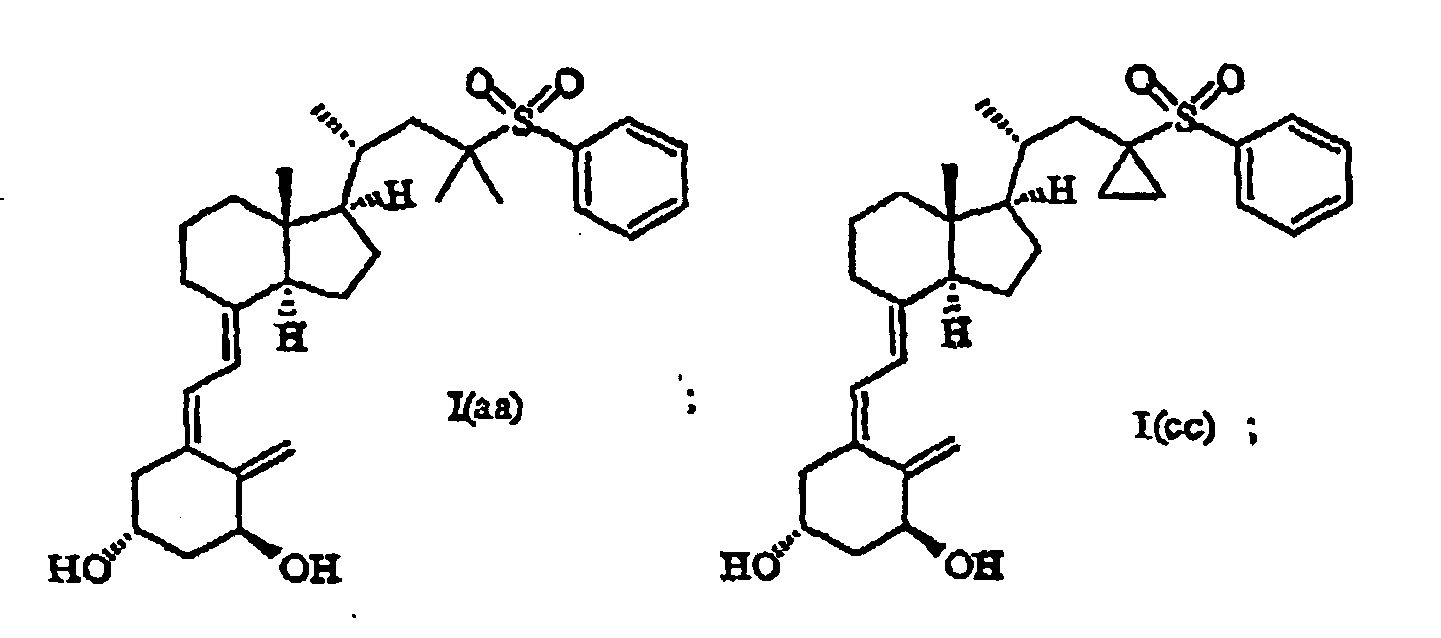

- In accordance with another aspect of the present invention, the compounds as defined in the claims can be prepared by processes analogous to those established in the art. Therefore, compounds as defined in the claims may be prepared, for example, by the reaction sequence shown in Scheme 1:

- Ketones of Formula III, wherein R3, R4, R5, R6, x and ---- are as defined in Formulae I ad II, may be reacted with phosphine oxides of Formula IV, wherein R1, R2 and R5 are as defined in Formula I, under standard Homer-Wadsworth-Emmons (HWE) coupling conditions. Therefore phosphine oxides IV, wherein R1, R2 and R5 are as defined in Formula I, are treated with a strong base, for example an alkyl lithium such as n-butyl lithum, under anhydrous conditions in an inert atmosphere and solvent, for example tetrahydrofuran and, at temperatures in the range of about -60 °C to about 90 °C, suitably at about -78 °C. To the resulting intermediate ylide is added a cold, preferably at about -78 °C, solution of a ketone III in an inert solvent such as THF while maintaining the anhydrous conditions. After removal of any protecting groups using standard chemistries (if needed), compounds of Formula I may be obtained.
- Ketones of Formula III, wherein wherein R3, R4, R5, R6, x andare as defined in Formula I, may be prepared, for example, as shown in Scheme 2:


- Compounds of Formula V, wherein R3, R4, R6, R7, x and ---- are as defined in Formula I and PG is a suitable protecting group, may be obtained, for example, as shown in Scheme 3:

- Compounds of Formula VII, wherein R4, R6 and R7 are as defined in Formula I and x is 1 or 2, are either commercially available or may be prepared, for example, by the oxidation of the corresponding compounds of Formula VII, wherein R4, R6 and R7 are as defined in Formula I and x is 0, as shown in Scheme 4. Suitable oxidizing agents include Ozone®, m-chloroperbenzoic acid and RuCL3·H2O/periodic acid (H5IO6). The use of sterically hindered oxidizing reagents assists in the isolation of the sulfoxide (i.e. compounds of Formula VII, where x = 1). An example of such an oxidizing reagent is camphorsulfonyl oxaziridine (available as pure enantiomers which can lead to the formation of enantiomerically enriched sulfoxides).

- Compounds of Formula VII, wherein R4, R6 and R7 are as defined in Formula I and x is 0, are either commercially available or may be prepared, for example, as shown in Scheme 5. Therefore a reagent of Formula VIII, wherein R6 and R7 are as defined in Formula I and LG is a suitable leaving group, such as halogen, may be reacted with a compound of Formula IX, wherein R4 is as defined in Formula I, in the presence of a base, for example sodium methoxide and an inert solvent, to provide compounds of Formula VII, wherein R4, R6 and R7 are as defined in Formula I and x is 0.

- An alternate route to the compounds of Formula V, wherein R3, R4, x and ---- are as defined in Formula I, R6 and R7 are H and PG is a suitable protecting group, is shown in Scheme 6. Accordingly, a compound of Formula X wherein R3 and ---- are as defined in Formula I and PG is a suitable protecting group, may be reacted with a compound of Formula IX, wherein R4 is as defined in Formula I, in the presence of a base such as 1,8-diazabicyclo[5.4.0]undec-7-ene (DBU), at elevated temperatures, such as about 110-150 °C, suitably at about 130 °C, in an inert, high-boiling solvent, such as benzene, to provide a compound of Formula V, wherein R3, R4, and ---- are as defined in Formula I, R6 and R7 are H, x is 0 and PG is a suitable protecting group. Oxidation of a compound of Formula V, wherein R3, R4, and ---- are as defined in Formula I, R6 and R7 are H, x is 0 and PG is a suitable protecting group, with suitable oxidizing agents, provides compounds of Formula V, wherein R3, R4, and ---- are as defined in Formula I, R6 and R7 are H, x is 1 or 2 and PG is a suitable protecting group. Suitable oxidizing agents include, for example Ozone®, m-chloroperbenzoic acid and RuCl3·H2O/periodic acid (H5IO6). The use of sterically hindered oxidizing reagents assists in the isolation of the sulfoxide (i.e. compounds of Formula V, where x = 1). An example of such an oxidizing reagent is camphorsulfonyl oxaziridine (available as pure enantiomers which can lead to the formation of enantiomerically enriched sulfoxides).

- Compounds of Formula V, wherein R3, R4 and ---- are as defined in Formula I, x is 1 or 2, R7 and R8 are both H and PG is a suitable protecting group, may alternatively be prepared from aldehyde XI as shown in Scheme 7. Therefore, a compound of Formula VII, wherein R4 is as defined in Formula I, R6 and R7 are both H, and x is 1 or 2, is first treated with a strong base, such as an alkyl lithium, such as n-butyl lithium, under inert conditions and, in the presence of hexamethyl phosphoramide (HMPA), for example, or N,N,N1,N1-tetramethylethylenediamine (TMEDA), to generate the corresponding anion, which is then reacted with a compound of Formula XI, wherein R3 and ---- are as defined in Formula I and PG is a suitable protecting group, under anhydrous conditions at temperatures in the range of about -60 °C to about 90 °C, suitably at about -78 °C. The resulting α,β-unsaturated sulfone may then be hydrogenated, for example, in the presence of H2 over palladium on carbon, to provide compounds of Formula V, wherein R3, R4 and ---- are as defined in Formula I, x is 1 or 2, R7 and R8 are both H and PG is a suitable protecting group.

- Aldehydes of Formula XI, wherein R3 and ---- are as defined in Formula I and PG is a suitable protecting group may be prepared using standard chemistries, for example as shown in
Scheme 8. The alcohol groups of compounds of Formula XII, wherein R3 and ---- are as defined in Formula I, may be selectively protected to form compounds of Formula XII, wherein PG and PG are the protecting groups for the primary and secondary alcohol groups respectively, using standard chemistries (see "Protective Groups in Organic Chemistry" McOmie, J.F.W. Ed., Plenum Press, 1973 and in Greene, T.W. and Wuts, P.G.M., "Protective Groups in Organic Synthesis", John Wiley & Sons, 1991.). The primary protected alcohol tosylate of compounds of Formula XII may then be selectively oxidized directly to the corresponding aldehyde XI, for example, in the presence of sodium hydrogen carbonate in a polar aprotic solvent such as dimethlysulfoxide (DMSO) at an elevated temperature, for example 150°C, using a procedure described in Komblum, et al. J. Am Chem. Soc. 1959, 81:4113-4116 .
- The preparation of compounds of Formula VI, wherein R3 and ---- are as defined in Formula I, and PG is a suitable protecting group, is known in the art. Therefore compounds of Formula VI may be prepared as described in Posner, G. H. et al. J. Med Chem .1992, 42, 3425-3435, the contents of which are incorporated herein by reference.
- The preparation of compounds of Formula X, wherein R3 and ---- are as defined in Formula I, and PG is a suitable protecting group, is known in the art. Therefore compounds of Formula X may be prepared as described in Posner, G. H. et al. J Med. Chem .1992, 42, 3425-3435; in Jaekyoo Lee, Ph.D. Thesis, 1997, Johns Hopkins University; or in
Posner G.H. et al. US Patent No. 6,380,408 , the contents of which are incorporated herein by reference. - The preparation of compounds of Formula IV, wherein R1, R2 and R5 are as defined in Formula I is known in the art Therefore compounds of Formula IV, wherein R1 and R2 are as define in Formula I and both R5's together form =CH2, may be prepared as described in Posner, G. H. et al. J. Med Chem. 1992, 35, 3280-3287, the contents of which are incorporated herein by reference. Compounds of Formula IV, wherein R1 and R2 are as define in Formula I and both R5's are is H, may be prepared as described in Hilpert, H. and Wirz, B. Tetrahedron 2001, 57, 681-694 , the contents of which are incorporated herein by reference.
- The preparation of compounds of Formula XII, where R3 and ---- are as defined in Formula I is known. Therefore compounds of Formula XII, where R3 and ---- are as defined in Formula I, may be prepared as described in Posner, G. H. et al. J. Org. Chem. 1997, 62, 3299-3314, the contents of which are incorporated herein by reference.
- The preparation of enantiomerically pure compounds of Formula I and or II, may be accomplished by using enantiomerically pure compounds of Formula III and IV in the reaction shown in Scheme I. In this reaction, a mixture of the 1α, 3β and 1β, 3α diasteromers is typically obtained, with the 1α,3β diastereomer as the major product. These diasteromers may be separated using chromatography, for example using high performance liquid chromatography (HPLC).
- In some cases the chemistries outlined above may have to be modified, for instance by use of protective groups, to prevent side reactions due to reactive groups, such as reactive groups attached as substituents. This may be achieved by means of conventional protecting groups, for example as described in "Protective Groups in Organic Chemistry" McOmie, J.F.W. Ed., Plenum Press, 1973 and in Greene, T.W. and Wuts, P.G.M., "Protective Groups in Organic Synthesis", John Wiley & Sons, 1991.
- The formation of a desired compound salt is achieved using standard techniques. For example, the neutral compound is treated with an acid or base in a suitable solvent and the Formed salt is isolated by filtration, extraction or any other suitable method.
- The formation of solvates of the compounds as defined in the claims will vary depending on the compound and the solvate. In general, solvates are formed by dissolving the compound in the appropriate solvent and isolating the solvate by cooling or using an antisolvent. The solvate is typically dried or azeotroped under ambient conditions.
- Prodrugs of the compounds as defined in the claims are phenyl esters, aliphatic (C8-C24) esters, acyloxymethyl esters, carbamates and amino acid esters.
- A radiolabeled compound as defined in the claims may be prepared using standard methods known in the art. For example, tritium may be incorporated into a compound of the invention using standard techniques, for example by hydrogenation of a suitable precursor to a compound of the invention using tritium gas and a catalyst Alternatively, a compound of the invention containing radioactive iodo may be prepared from the corresponding trialkyltin (suitably trimethyltin) derivative using standard iodination conditions, such as [125I] sodium iodide in the presence of chloramine-T in a suitable solvent, such as dimethylformamide. The trialkyltin compound may be prepared from the corresponding non-radioactive halo, suitably iodo, compound using standard palladium-catalyzed stannylation conditions, for example hexamethylditin in the presence of tetrakis(triphenylphosphine) palladium (0) in an inert solvent, such as dioxane, and at elevated temperatures, suitably 50-100°C.
- As hereinbefore mentioned, novel compounds of the Formula I have been prepared. Accordingly, the present invention includes all uses of the compounds as defined in the claims including their use in therapeutic methods and compositions for modulating cell prolifieration.
- Inhibiting catabolism of calcitriol is expected to lengthen the biological lifetime of this hormone and thus to allow smaller amounts of it to be used for effective human chemotherapy; such smaller dosing is expected to avoid, or at least to the hypercalcemic toxicity associated with medicinal use of calcitriol. Selectively inhibiting the cytochrome P450 enzymatic pathway, through which calcitriol is catabolized (mainly via C-24 hydroxylation), is one important way to prolong the lifetime of this hormone. Therefore, the compounds of Formula I were tested in vitro, using a standard protocol, for their ability to inhibit specifically CYP24, responsible for 24-hydroxylation of calcitriol. Antimycotic ketoconazole, a drug used clinically for chemotherapy of human prostate cancer (Trachtenberg, J. et al. J. Urol. 1984, J32,61-63), was used as a control standard for inhibition of CYP24. Compounds of the invention have been shown to Selectively inhibit the CYP24 (see Table 1).
- In standard hypercalcemia assays, compound Ia did not increase the levels of calcium in the urine at concentration that were 20-fold higher than the concentration of calcitriol (1α,25-dihydroxy vitamin D3) that provided an increase in the calcium levels in the urine, Compound 1(u) was also tested and found to be strongly non-calcemic.
- The compounds as defined in the claims are CYP24 modulators and are useful in modulating CYP24 activity, including the inhibition of CYP24 activity, for the treatment of various conditions such as all cell proliferative disorders.
- By selectively modulating CYP24, the enzyme that metabolizes 1α,25-dihydroxy vitamin D3, the levels of 1α,25-dihydroxy vitamin D3 may also be modulated. Diseases that benefit from a modulation of the levels of 1α,25-dihydroxy vitamin D3 can therefore be treated using a modulator of CYP24. By acting preferentially on CYP24, side effects caused by interaction with other enzymes and receptors may be reduced.
- Inhibition of CYP24, should inhibit the catabolism 1α,25-dihydroxy vitamin D3.
- Other diseases which may benefit for a modulation in the levels of 1α,25-dihydroxy vitamin D3 include, but are not limited to:
- i. in the parathyroid - hyper- and hypo-parathyroidism, Osudohypo-parathyroidism, Secondary hyperparathyroidism;
- ii. in the pancreas - diabetes;
- iii. in the thyroid - medullary carcinoma;
- iv. in the skin-psoriasis, wound healing;
- v. in the lung - sarcoidosis and tuberculosis;
- vi. in the kidney - chronic renal disease, hypophosphtatemic VDRR, vitamin D dependent rickets;
- vii. in the bone - anticonvulsant treatment, fibrogenisis imperfecta ossium, osteitits fibrosa cystica, osteomalacia, osteporosis, osteopenia, osteosclerosis, renal osteodytrophy, rickets;
- viii. in the intestine - glucocorticoid antagonism, idopathic hypercalcemia, malabsorption syndrome, steatorrhea, tropical sprue.
- The present invention further includes a use of a compound as defined in the claims to prepare a medicament to inhibit cell proliferation, preferably cancer cell proliferation. In particular, the method of the invention is useful in inhibiting the proliferation of abnormal but not normal cells. Abnormal cells include any type of cell that is causative of or involved in a disease or condition and wherein it is desirable to modulate, or inhibit the proliferation of the abnormal cell to treat the disease or condition. Examples of abnormal cells include malignant or cancerous cells as well as cell that over-proliferate in inflammatory conditions such as psoriasis. Preferably, the cell proliferative disorder is cancer, in particular cancer of the breast, prostate and lung.
- While the compounds as defined in the claims may act by modulating CYP24 activity, one of skill in the art will appreciate that other modes or mechanisms of action for the compounds of the invention are possible.
- One skilled in the art can determine which compounds would have therapeutic utility, for example, in inhibiting cell proliferation in any type of cancer or cell proliferate disorder. Compounds may be examine for their efficacy in inhibiting cell growth in cell proliferation assays such as inhibition of growth of murine keratinocyte cells (cell line PE) and for the inhibition of TPA induced ornithine decarboxylase (ODC) activity as described in
US. Patent No. 5,830,885 , the contents of which are incorporated herein by reference. - In addition to cancer, the compounds as defined in the claims are useful in treating other conditions involving aberrant or abnormal cell proliferation. Other cell proliferative disorders that may be treated by the present invention include inflammatory diseases, allergies, autoimmune disease, graft rejection, psoriasis, restenosis, artherosclerosis, and any other disorder wherein it is desirable to inhibit, prevent or suppress cell growth. Compounds of the invention may be tested for their efficacy in a particular cell proliferation disorder using assays and techniques known to those of skiN in the art. For example, the following references provide assays for various conditions: Rheumatoid Arthritis: "Regulation of IL-15 - Simulated TNF-alpha Production by Rolipram", Journal of Immunology (1999) volume 163 page 8236 by C. S. Kasyapa et al.; Allergy: "A novel Lyn-Binding Peptide Inhibitor Blocks Eosinophil Differentiation, Survival, and Airway eosinophilic inflammation". Journal of Immunology (1999) volume 163 page 939 by T. Adachi et al; Psoriasis: Journal of Immunology (2000) volume 165 page 224 "Inhibition of Keratinocyte apoptosis by IL-15: a new parameter in the pathegenosis of psoriasis" by R. Üchert; and Psoriasis: International Archives of allergy and Immunology (2000) Volume 123 page 275. "T-cell receptor mimic peptides and their potential application in T-cell mediated disease "by A. H. Enk.
- The compounds as defined in the claims are preferably formulated into pharmaceutical compositions for administration to human subjects in a biologically compatible form suitable for administration in vivo. Accordingly, in another aspect, the present invention provides a pharmaceutical composition comprising a compound as defined in the claims in admixture with a suitable diluent or carrier.
- The compositions containing the compounds as defined in the claims can be prepared by known methods for the preparation of pharmaceutically acceptable compositions which can be administered to subjects, such that an effective quantity of the active substance is combined in a mixture with a pharmaceutically acceptable vehicle. Suitable vehicles are described, for example, in Remington's Pharmaceutical Sciences (Remington's Pharmaceutical Sciences, Mack Publishing Company, Easton, Pa., USA 1985). On this basis, the compositions include, albeit not exclusively, solutions of the substances in association with one or more pharmaceutically acceptable vehicles or diluents, and contained in buffered solutions with a suitable pH and iso-osmotic with the physiological fluids.
- The compounds as defined in the claims may be used in the form of the free base, in the form of salts, solvates and as hydrates. All forms are within the scope of the invention. Acid addition salts may be formed and provide a more convenient form for use; in practice, use of the salt form inherently amounts to use of the base form. The acids which can be used to prepare the acid addition salts include preferably those which produce, when combined with the free base, form pharmaceutically acceptable salts, that is, salts whose anions are non-toxic to the animal organism in pharmaceutical doses of the salts, so that the beneficial properties inherent in the free base are not vitiated by side effects ascribable to the anions. Although pharmaceutically acceptable salts of the basic compounds are preferred, all acid addition salts are useful as sources of the free base form even if the particular salt per se is desired only as an intermediate product as, for example, when the salt is formed only for the purposes of purification and identification, or when it is used as an intermediate in preparing a pharmaceutically acceptable salt by ion exchange procedures.
- The compositions as defined in the claims may be administered, for example, by oral, parenteral, buccal, sublingual, nasal, rectal, patch, pump or transdermal administration and the pharmaceutical compositions formulated accordingly. Parenteral administration includes intravenous, intraperitoneal, subcutaneous, intramuscular, transepithelial, nasal, intrapulmonary, intrathecal, rectal and topical modes of administration. Parenteral administration may be by continuous infusion over a selected period of time.
- A compound as defined in the claims may be orally administered, for example, with an inert diluent or with an assimilable edible carder, or it may be enclosed in hard or soft shell gelatin capsules, or it may be compressed into tablets, or it may be incorporated directly, with the food of the diet. For oral therapeutic administration, the compound as defined in the claims may be incorporated with excipient and used in the form of ingestible tablets, buccal tablets, troches, capsules, elixirs, suspensions, syrups, wafers, and the like.
- A compound of the invention may also be administered parenterally. Solutions of a compound of the invention can be prepared in water suitably mixed with a surfactant such as hydroxypropylcellulose. Dispersions can also be prepared in glycerol, liquid polyethylene glycols, DMSO and mixtures thereof with or without alcohol, and in oils. Under ordinary conditions of storage and use, these preparations contain a preservative to prevent the growth of microorganisms. A person skilled in the art would know how to prepare suitable formulations. Conventional procedures and ingredients for the selection and preparation of suitable formulations are described, for example, in Remington's Pharmaceutical Sciences (1990 - 18th edition) and in The United States Pharmacopeia: The National Formulary (USP 24 NF19) published in 1999.
- The pharmaceutical forms suitable for injectable use include sterile aqueous solutions or dispersion and sterile powders for the extemporaneous preparation of sterile injectable solutions or dispersions. In all cases the form must be sterile and must be fluid to the extent that easy syringability exists.
- Compositions for nasal administration may conveniently be formulated as aerosols, drops, gels and powders. Aerosol formulations typically comprise a solution or fine suspension of the active substance in a physiologically acceptable aqueous or non-aqueous solvent and are usually presented in single or multidose quantities in sterile form in a sealed container, which can take the form of a cartridge or refill for use with an atomizing device. Alternatively, the sealed container may be a unitary dispensing device such as a single dose nasal inhaler or an aerosol dispenser fitted with a metering valve which is intended for disposal after use. Where the dosage form comprises an aerosol dispenser, it will contain a propellant which can be a compressed gas such as compressed air or an organic propellant such as fluorochlorohydrocarbon. The aerosol dosage forms can also take the form of a pump-atomizer.
- Compositions suitable for buccal or sublingual administration include tablets, lozenges, and pastilles, wherein the active ingredient is formulated with a carrier such as sugar, acacia, tragacanth, or gelatin and glycerine. Compositions for rectal administration are conveniently in the form of suppositories containing a conventional suppository base such as cocoa butter.
- The compounds as defined in the claims may be administered to an animal alone or in combination with pharmaceutically acceptable carriers, as noted above, the proportion of which is determined by the solubility and chemical nature of the compound, chosen route of administration and standard pharmaceutical practice.
- The dosage of the compounds and/or compositions as defined in the claims can vary depending on many factors such as the pharmacodynamic properties of the compound, the mode of administration, the age, health and weight of the recipient, the nature and extent of the symptoms, the frequency of the treatment and the type of concurrent treatment, if any, and the clearance rate of the compound in the animal to be treated. One of skill in the art can determine the dosage based on the above factors. The compounds as defined in the claims may be administered initially in a suitable dosage that may be adjusted as required, depending on the clinical response. For ex vivo treatment of cells over a short period, for example for 30 minutes to 1 hour or longer, higher doses of compound may be used than for long term in vivo therapy.
- The compounds as defined in the claims can be used alone or in combination with other agents that modulate CYP24 activity or in combination with other types of treatment. (which may or may not modulate CYP24) for cell proliferative disorders or other disorders that benefit from a modulation in the levels of 1α,25-dihydroxy vitamin D3 and/or an inhibition of the catabolism of 1α,25-dihydroxy vitamin D3. Preferably the compounds of the invention may be administered in combination with 1α,25-dihydroxy vitamin D3 (calcitriol) or other vitamin D receptor agonists. Inhibiting catabolism of vitamin D receptor agonists is expected, to lengthen the biological lifetime or efficacy of these therapies and thus to allow smaller amounts of the drug to be used for effective human chemotherapy; such smaller dosing is expected to avoid, or at least to minimize, the hypercalcemic toxicity associated with medicinal use of calcitriol or other vitamin D receptor agonists.
- The general treatments are based on the cancer type and do not specifically target CYP24 activity. In a particular aspect of the present invention, the compounds as defined in the claims may be used in combination with other therapies and therapeutics to treat dermatological disorders, bone disorders, cancer and osteoporosis.
- The following non-limiting examples are illustrative of the present invention:
- Unless otherwise noted, all reactions were performed in oven-dried glassware stirred under an atmosphere of ultra-high-purity argon. THF was distilled from Na/benzophenone ketyl and CH2Cl2, distilled from CaH2 immediately prior to use. Organolithiums were titrated prior to use following known methods (Suffert, J. J. Org. Chem. 1989, 54, 509-510). All other reagents were used as received from commercial suppliers. Analytical TLC analysis was conducted on precoated glass-backed silica gel plates (Merck Kieselgel 60 F254, 250 mm thickness) and visualized with p-anisaldehyde or KMnO4 stains. Column chromatography was performed using short path silica gel (particle size < 230 mesh) or flash silica gel (particle size 230-400 mesh). Preparative-plate chromatography was performed using silica-gel-coated glass preparative plates (500-1000 µm) from Analtech and analyzed by UV. HPLC was carried out using a Rainin HPLX™ system equipped with two 25-mL/min preparative pump heads using (1) a Chiral Technologies CHIRALCEL® OJ 10-mm x 250-mm (semipreparative) column packed with cellulose tris(4-methylbenzoate) on a 10 µm silica-gel substrate or (2) a Phenomenex LUNA™ 10-mm x 250-mm (semipreparative) column packed with 110 Å silica gel (5 µm pore size) as C-18-bonded silica and a Rainin Dynamax™ UV-C dual-beam variable-wavelength detector set at 254 nm. Yields are reported for pure products (>95% based on their chromatographic and spectroscopic homogeneity) and are unoptimized. Melting points were determined in open capillaries using a Mel-Temp metal-block apparatus and are uncorrected. Optical rotations were measured at the Na line using a Perkin-Elmer 141 Polarimeter. NMR spectra were obtained on a Varian XL-400 spectrometer operating at 400 MHz for 1H, 376 MHz for 19F, and 100 MHz for 13C and a Bruker 300 AMX spectrometer operating at 300 MHz for 1H. Chemical shifts are reported in ppm (δ) and are referenced to CDCl3 (7.26 ppm for 1H and 77.0 ppm for 13C), tetramethylsilane (TMS, 0.00 ppm for 1H), and CFCl3 (0.00 ppm for 19F). IR spectra were obtained using a Perkin Elmer 1600 Series FT-IR instrument HRMS were obtained at the mass spectrometry facility at the Ohio State University on a Micromass QTOF Electrospray mass spectrometer. Elemental analyses were performed by Atlantic Microlab Inc., Norcross, GA.
- To an ice-cold solution containing the appropriate aryl methyl sulfide (6.00 mmol) in MeOH (24.0 mL) was added oxone® (9.00 mmol) as a solution in H2O (20.0 mL) dropwise via addition funnel. The resulting cloudy slurry was stirred at room temperature overnight, diluted with water, and extracted with CHCl3 (3X). The combined organics were washed with water and brine, dried over Na2SO4, and concentrated under reduced pressure to give essentially quantitative recovery of the aryl methyl sulfones VII (a-c) as crystalline solids.
- a) Methyl-(4-methozyphenyl) sulfone. According to the general procedure for the preparation of aryl methyl sulfones described above, 1-methanesulfanyl-4-methoxybenzene (1.00 g, 6.48 mmol) gave 1.20 g (99%) of the title compound as a white solid: mp 114-115 °C (lit. mp 115 °C, Helv. Chim. Acta. 1999, 82, 372-388); 1H NMR (400 MHz, CDCl3) δ 7.89-7.83 (dt, J = 9.5, 2.8, 2.2 Hz, 2H), 7.04-6.99 (dt, J = 9.5, 2.8, 2.2 Hz, 2H), 3.88 (s, 3H), 3.02 (s, 3H); 13C NMR (100 MHz, CDCl3) δ 163.6, 132.3, 129.5, 114.5, 55.7, 44.8; IR (neat) 3020, 3010, 2982, 1575, 1412, 1323, 1293, 1142, 1092, 1023, 835, 766, 544, 528 cm-1; Anal. Calcd for C8H10O3S: C, 51.60; H, 5.41. Found: C, 51.64; H, 5.43.
- b) Methyl-(4-nitrophenyn sulfone. According to the general procedure for the preparation of aryl methyl sulfones described above, 1-methanesulfanyl-4-nitrobenzene (1.00 g, 5.41 mmol) gave 1.19 g (100%) of the title compound as a yellow solid: mp 137-139 °C; 1H NMR (400 MHz; CDCl3) δ 8.45-8.40 (dt, J = 9.0, 2.5 Hz, 2H), 8.19-8.14 (dt, J = 9.0, 2.5 Hz, 2H), 3.12 (s, 3H).
- c) Methyl-(4-trifluoromethylphenyl) sulfone. According to the general procedure for the preparation of aryl methyl sulfones described above, 1-methanesulfanyl-4-trifluoromethylbenzene synthesized from 4-chloro-l-trifluoromethyl benzene and sodium methanethiolate as described in Cabiddu, M.G. et al., J. Organometallic Chem. 1997, 531, 125-140. (1.07 g, 5.57 mmol) gave 1.21 g (97%) of the title compound as a white solid: mp 100-101 °C; 1H NMR (300 MHz, CDCl3) δ 8.13-8.07 (d, J = 11.1 Hz, 2H), 7.89-7.83 (d, J = 11.1 Hz, 2H), 3.09 (s, 3H); 13C NMR (100 MHz, CDCl3) δ 143.9, 135.4 (d, J = 32.6 Hz), 128.1, 126.5 (d, J = 0.8 Hz), 123.0 (d, J = 123.0 Hz), 44.3; 19F NMR (375 MHz, CDCl3, CFCl3) δ -69.4 (m).
-

- A mixture of 4-methylsulphonyl benzaldehyde(750 mg, 3.87 mmol, 95% purity) and ethylene glycol (0.9 mL, 16.0 mmol) in benzene (10 mL) in the presence of catalytic amount of p-TsOH was refluxed for 6.5 h. After benzene was distilled off, the residue was dissolved into EtOAc. The organic layer was washed with brine, saturated aq. NaHCO3, and brine again, dried over MgSO4, filtered, concentrated to afford 781.9 mg (88%) of a crude product which was directly used for the next reaction without further purification. Rf 0.37 (1:1-EtOAc:Hex); 1H NMR (400 MHz, CDCl3) δ 7.95-7.98 (m, 2H), 7.68-7.71 (m, 2H), 5.89 (s, 1H), 4.05-4.15 (m, 4H), 3.05 (s, 3H).
-
- (a) (Triethylsilyl)-oxy-phenyl Sulfone


In a like manner, the following additional compounds were prepared: - (b) (+)-(Triethylsilyl)-oxy-(4-fluorophenyl) Sulfone: By replacing methyl phenyl sulfone with methyl (4-fluorophenyl) sulfone. The crude mixture was purified by flash chromatography (EtOAc:Hex = 1:15 to 1:13) to afford 78 mg (85%) of C24-p-fluorophenyl sulfone. Rf 0.37 (1:9-EtOAc:Hex); [α]D 26 +36.0 (c 1.11, CHCl3); 1H NMR (400 MHz, CDCl3) δ 7.90-7.94 (m, 2H), 7.23-7.27 (m, 2H), 4.01 (d, J= 2.4 Hz, 1H), 3.12 (ddd, J = 4.0, 12.0, 13.6 Hz, 1H), 2.98 (ddd, J = 4.8, 11.6, 14.0 Hz, 1H), 1.70-1.88 (m, 2H), 1.61-1.68 (m, 2H), 1.40-1.57 (m, 3H), 1.02-1.38 (m, 8H), 0.93 (t, J = 7.6 Hz, 9H), 0.86 (s, 3H), 0.85 (d, J= 7.2 Hz, 3H), 0.54 (q, J= 8.0 Hz, 6H); 13C NMR (100 MHz, CDCl3) δ 165.7 (d, J= 255.1), 135.2 (d, J= 3.2), 130.9 (d, J= 9.6), 116.5 (d, J = 22.3), 69.2, 55.9, 53.8, 52.9, 42.1, 40.6, 34.5, 34.2, 28.3, 27.0, 22.8, 18.3, 17.6, 13.5, 6.9, 4.9; IR (thin film) 2950, 2876, 1592, 1494, 1321, 1289, 1236, 1148, 1087 cm-1; HRMS calc'd for [M+Na]: 505.2578 for C26H43FO3SSiNa. found: 505.2561.
- (c) (+)-Triethylsilyl)-oxy-(4-chlorophenyl) Sulfone: By replacing methyl phenyl sulfone with methyl (4-chlorophenyl) sulfone. The crude mixture was purified by flash chromatography (EtOAc:Hex = 1:12 to 1:7) to afford 87.5 mg (96%) of C24-p-chlorophenyl sulfone. Rf 0.35 (1:9-EtOAc:Hex); [α]D 26 +37.8 (c 0.91, CHCl3); 1H NMR (400 MHz, CDCl3) δ 7.82-7.86 (m, 2H), 7.53-7.56 (m, 2H), 4.01 (m, 1H), 3.11 (ddd, J= 4.8,12.0,13.6 Hz, 1H), 2.97 (ddd, J= 4.8, 11.6, 14.0 Hz, 1H), 1.76-1.90 (m, 2H), 1.60-1.69 (m, 2H), 1.40-1.58 (m, 3H), 1.02-1.36 (m, 8H), 0.93 (t, J = 8.0 Hz, 9H), 0.86 (s, 3H), 0.85 (d, J = 6.4 Hz, 3H), 0.54 (q, J = 8.0 Hz, 6H); 13C NMR (100 MHz, CDCl3) δ 140.3, 137.6, 129.5, 69.1, 55.9, 53.7, 52.9, 42.1, 40.6, 34.4, 34.2, 28.2, 27.0, 22.8, 18.2, 17.6, 13.4, 6.9, 4.9; IR (thin film) 2950, 2875, 1312, 1150, 1088 cm-1; HRMS calc'd for [M+Na]: 521.2288 for C26H43ClO3SSiNa. found: 521.2275.
- (d) (+)-(Triethylsilyl)-oxy-(4-methylphenyl) Sulfone: By replacing methyl phenyl sulfone with methyl (4-methyphenyl) sulfone. The crude mixture was purified by flash chromatography (EtOAc:Hex=1:12 to 1:10) to afford 84.6 mg (93%) of C24-p-tolyl sulfone. Rf 0.23 (1:9-EtOAc:Hex); [α]D 26 +36.9 (c 0.96, CHCl3); 1H NMR (400 MHz, CDCl3) δ 7.76-7.78 (m, 2H), 7.33-7.36 (m, 2H), 3.99 (d, J= 2.4 Hz, 1H), 3.09 (ddd, J= 4.0, 12.0, 13.6 Hz, 1H), 2.95 (ddd, J= 4.8, 11.6, 14.0 Hz,1H), 2.44 (s, 3H), 1.72-1.87 (m, 3H), 1.62-1.68 (m, 2H), 1.38-1.60 (m, 3H), 1.00-1.35 (m, 7H), 0.92 (t, J = 7.6 Hz, 9H), 0.84 (s, 3H), 0.82 (d, J = 6.4 Hz, 3H), 0.52 (q, J = 7.6 Hz, 6H); 13C NMR (100 MHz, CDCl3) δ 144.4, 136.2, 129.8, 128.0, 69.2, 55.9, 53.7, 52.9, 42.1, 40.6, 34.5, 34.2, 28.3, 27.0, 22.8, 21.6, 18.2, 17.6, 13.4, 6.9, 4.9; IR (thin film) 2950, 2875, 1598, 1456, 1316, 1148, 1088 cm-1; HRMS [M+Na] calc'd 501.2829 for C27H46O3SSiNa found: 501.2810.
- (e) (+)-(Triethylsilyl)-oxy-(3,4-dichlorophenyl) Sulfone: By replacing methyl phenyl sulfone with methyl (3,4-dichlorophenyl) sulfone, The crude mixture was purified by flash chromatography (EtOAc:Hex = 1:12) to afford 65.6 mg (66%) of C24-3,4-dichlorophenyl sulfone. Rf 0.38 (1:9-EtOAc:Hex); [α]D 26 +32.2 (c 1.03, CHCl3); 1H NMR (400 MHz, CDCl3) δ 8.00 (d, J = 2.0 Hz, 1H), 7.73 (dd, J= 2.0, 8.4 Hz, 1H), 7.66 (d, J = 8.4 Hz, 1H), 4.02 (d, J = 2.4 Hz, 1H), 3.13 (ddd, J = 4.8, 12.0, 14.0 Hz, 1H), 2.99 (ddd, J = 4.8, 11.6, 14.0 Hz, 1H), 1.76-1.90 (m, 3H), 1.62-1.73 (m, 2H), 1.42-1.59 (m, 4H), 1.28-1.38 (m, 3H), 1.14-1.26 (m, 2H), 1.06 (dt, J= 3.2, 13.2 Hz, 1H), 0.94 (t, J= 8.0 Hz, 9H), 0.87 (s, 3H), 0.86 (d, J= 6.0 Hz, 3H), 0.54 (q, J = 8.0 Hz, 6H); 13C NMR (100 MHz, CDCl3) δ 139.0, 138.6, 134.0, 131.3, 130.0, 127.1, 69.1, 55.8, 53.7, 52.9, 42.1, 40.6, 34.4, 34.2, 28.1, 27.0, 22.8, 18.2, 17.5, 13.4, 6.9, 4.8; IR (thin film) 2950, 2875, 1455, 1370, 1322, 1156, 1091 cm-1; HRMS [M+Na] calc'd 555.1893 for C26H42Cl2O3SSiNa. found: 555.1886.
- (f) (+)-(Triethylsilyl)-oxy-p-[3-(tert-Butyldimethylsiloxy)isopentylphenyl sulfone: By replacing methyl phenyl sulfone with p-(3-(tert-Butyldimethylsiloxy)isopentyl)phenyl methyl sulfone. The crude mixture was purified by flash chromatography (EtOAc:Hex = 1:19 to 1:15) to afford 107.7 mg (94%) of C24-p-[3-(tert-Butyldimethylsiloxy)isopentyl]phenyl sulfone. Rf 0.39 (1:9-EtOAc:Hex); [α]D 26 +21.3 (c 0.97, CHCl3); 1H NMR (400 MHz, CDCl3) δ 7.82-7.85 (m, 2H), 7.54-7.57 (m, 2H), 4.00 (m, 1H), 3.11 (ddd, J= 4.0, 12.0, 13.6 Hz, 1H), 2.98 (ddd, J = 4.8, 11.2, 13.6 Hz, 1H), 1.75-1.96 (m, 7H), 1.43-1.66 (m, 5H), 1.24-1.35 (m, 5H), 1.00- 1.20 (m, 2H), 1.00 (s, 9H), 0.93 (s, 9H), 0.84 (d, J = 6.0 Hz, 3H), 0.84 (s, 3H), 0.63 (t, J= 7.2 Hz, 6H), 0.53 (q, J= 8.0 Hz, 6H), 0.16 (s, 6H); 13C NMR (100 MHz, CDCl3) δ 152.6, 136.5, 127.5, 126.8, 81.5, 69.2, 55.8, 53.6, 52.9, 42.1, 40.6, 35.65, 35.62,34.5, 34.2, 28.3,26.9,26.2,22.8,18.9,18.3,17.6,13.5, 8.2,6.9,4.9, -2.1; IR (thin film) 2952, 2877, 1462, 1318, 1256, 1151, 1025, 836, 800, 771 cm-1; HRMS [M+Na] calc'd 687.4269 for C37H68O4SSi2Na. found: 687.4293.
- (g) (+)-(Triethylsilyl)-oxy-p-Acetalphenyl sulfone: By replacing methyl phenyl sulfone with p-acetalphenyl methyl sulfone (Example 2). The crude mixture was purified by flash chromatography (EtOAc:Hex = 1:4) to afford 83.5 mg (74%) of C24-p-acetalphenyl sulfone. Rf 0.26 (1:4-EtOAc:Hex); [α]D 26 +33.2 (c 1.10, CHCl3); 1H NMR (400 MHz, CDCl3) δ 7.91-7.93 (m, 2H), 7.67-7.69 (m, 2H), 5.89 (s, 1H), 4.05-4.15 (m, 4H), 4.01 (m, 1H), 3.14 (ddd, J = 4.0, 12.0,13.6 Hz, 1H), 2.97 (ddd, J = 4.8, 11.6, 13.6 Hz, 1H), 1.75-1.89 (m, 3H), 1.60-1.70 (m, 2H), 1.40-1.58 (m, 3H), 1.28-1.36 (m, 3H), 1.02- 1.21 (m, 4H), 0.93 (t, J = 8.4.Hz, 9H), 0.86 (s, 3H), 0.83 (d, J = 6.0 Hz, 3H), 0.54 (q, J = 8.4 Hz, 6H); 13C NMR (100 MHz, CDCl3) δ 143.8, 139.7, 128.1, 127.2, 102.4, 69.1, 65.4, 55.9, 53.6, 52.9, 42.1, 40.6, 34.4, 34.2, 28.1, 26.9, 22.8, 18.2, 17.5, 13.4, 6.8, 4.8; IR (thin film) 2950, 2876, 1316, 1149, 1085, 1018, 973, 948, 744, 725, 547 cm-1; HRMS [M+Na] calc'd 559.2884 for C29H48O5SSiNa. found: 559.2930.
In a like manner, the following additional compounds can be prepared: - (h) (Triethylsilyl)-oxy-(4-methoxyphenyl) sulfone: By replacing methyl phenyl sulfone with methyl (4-methoxyphenyl) sulfone (Example 1a);
- (i) (Triethylsilyl)-oxy-(4-nitrophenyl) sulfone: By replacing methyl phenyl sulfone with methyl (4-nitrophenyl) sulfone (Example 1b); and
- (j) (Triethysilyl)-oxy-(4-trifluoromethyl phenyl) sulfone: By replacing methylpheny sulfone with methyl (4-trifluoromethyl phenyl) sulfone (Example 1c).
-
- (a) (+)-Ketophenyl sulfone
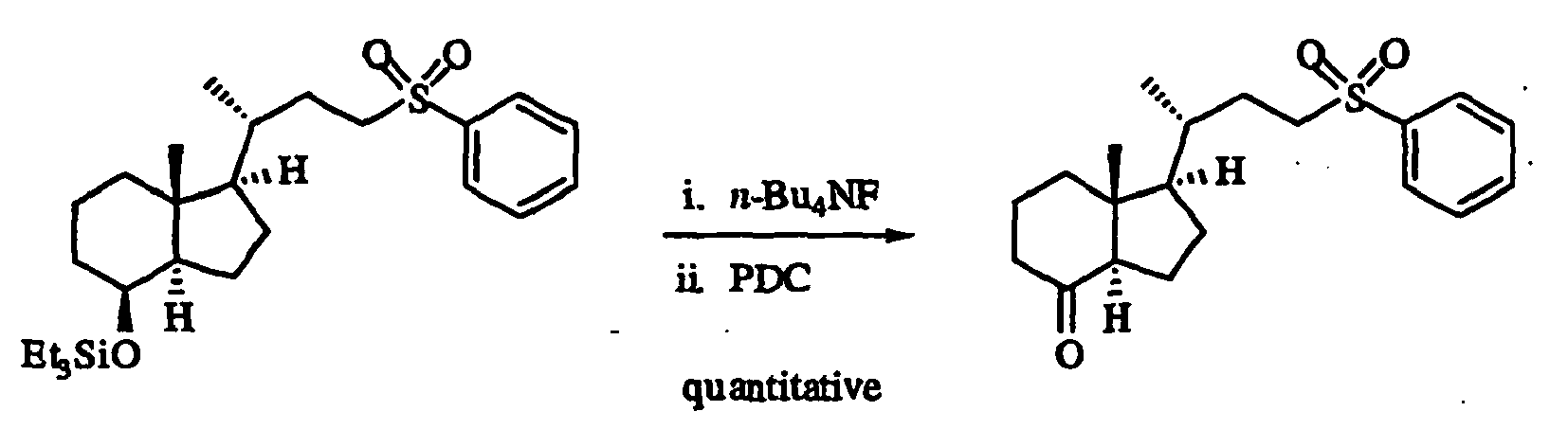
In a like manner, the following additional compounds were prepared: - (b) (+)-Keto-(4-fluorophenyl) Sulfone: By replacing (triethylsilyl)-oxyphenyl sulfone with (tricthylsilyl)-oxy-(4-fluorophenyl) sulfone (Example 3b). The reaction mixture was directly purified by short path flash chromatography (CH2Cl2 then EtOAc:Hex = 1:2) to give 50.5 mg (85% for 2 steps) of keto-p-fluorophenyl sulfone. Rf 0.30 (1:2-EtoAc:Hex); [α]D 26 +11.5 (c 0.96, CHCl3); 1H NMR (400 MHz, CDCl3) δ 7.90-7.95 (m, 2H), 7.24-7.28 (m, 2H), 3.13 (ddd, J = 4.4, 12.0, 13.6 Hz, 1H), 3.00 (ddd, J = 4.8, 11.2, 14.0 Hz, 1H), 2.43 (dd, J= 7.6, 1.6 Hz, 1H), 2.17-2.32 (m, 2H), 1.97-2.08 (m, 2H), 1.67-1.94 (m, 4H), 1.45-1.60 (m, 4H), 1.39 (q, J = 9.2 Hz, 1H), 1.27 (m, 1H), 0.93 (d, J= 6.0 Hz, 3H), 0.61 (s, 3H); 13C NMR (100 MHz, CDCl3) δ 211.4,165.7 (d, J= 255.1), 135.1 (d,J= 3.0), 130.8 (d, J= 9.9), 116.6 (d, J = 22.8), 61.6, 55.8, 53.6, 49.7, 40.8, 38.7, 34.4, 28.2, 27.2, 23.8, 18.9, 18.3, 12.4; IR (thin film) 2957, 2876, 1710, 1591,1494,1316, 1289,1232, 1144, 1086 cm-1; HRMS [M+Na] calc'd 389.1557 for C20H27FO3SNa. found: 389.1547.
- (c) (+)-Keto-(4-chlorophenyl) Sulfone: By replacing (triethylsilyl)-oxyphenyl sulfone with (triethylsilyl)-oxy-(4-chlorophenyl) sulfone (Example 3c). The reaction mixture was directly purified by short path flash chromatography (CH2Cl2 then EtOAc:Hex = 1:2) to give 56.2 mg (82% for 2 steps) of keto-p-chlorophenyl sulfone. Rf 0.34 (1:2-EtOAc:Hex); [α]D 26 +12.5 (c 0.97, CHCl3); 1H NMR (400 MHz, CDCl3) δ 7.83-7.86 (m, 2H), 7.54-7.58 (m, 2H), 3.13 (ddd, J= 4.8, 12.0, 14.0 Hz, 1H), 3.00 (ddd, J= 4.8, 11.2, 14.0 Hz, 1H), 2.43 (m, 1H), 2.17-2.31 (m, 2H), 1.97-2.08 (m, 2H), 1.68-1.94 (m, 4H), 1.22-1.59 (m, 4M, 0.93 (d, J= 6.4 Hz, 3H), 0.61 (s, 3H); 13C NMR (100 MHz, CDCl3) δ 211.4, 140.4, 137.5, 129.6, 129.5, 61.7, 55.8, 53.6, 49.7, 40.8, 38.8, 34.4, 28.2, 27.2, 23.8, 18.9, 18.3, 12.4; IR (thin film) 2957, 2876, 1710, 1315, 1149, 1088 cm-1; HRMS [M+Na] calc'd 405.1267 for C20H27ClO3SNa found: 405.1263.
- (d) (+)-Keto-(4-methylphenyl) Sulfone: By replacing (triethylsilyl)-oxyphenyl sulfone with (triethylsilyl)-oxy-(4-methylphenyl) sulfone (Example 3d). The reaction mixture was directly purified by short path flash chromatography (CH2Cl2 then EtOAc:Hex = 1:2) to give 57.4 mg (89% for 2 steps) of keto-p-fluorophenyl. Rf 0.26 (1:2-EtOAc:Hex); [α]D 26 +9.4 (c 1.15, CHCl3); 1H NMR (400 MHz, CDCl3) δ 7.77-7.79 (m, 2H), 7.36-7.38 (m, 2H), 3.11 (ddd, J = 4.4, 12.0, 13.6 Hz, 1H), 2.98 (ddd, J = 4.8, 11.2, 13.6 Hz, 1H), 2.46 (s, 3H), 2.42 (dd, J = 8.0, 12.0 Hz, 1H), 2.16-2.31 (m, 2H), 1.96-2.08 (m, 2H), 1.66-1.94 (m, 4M, 1.44-1.58 (m, 4H), 1.38 (q, J= 9.2 Hz, 1H), 1.25 (m, 1H), 0.92 (d, J = 6.4 Hz, 3H), 0.60 (s, 3H); 13C NMR (100 MHz, CDCl3) δ 211.5, 144.6, 136.0, 129.8, 127.9, 61.6, 55.8, 53.5,49.6, 40.7, 38.7, 34.3, 28.2, 27.1, 23.8, 21.6, 18.9, 18.3, 12.4; IR (thin film) 2956, 2875, 1710, 1314, 1143, 1087 cm-1; HRMS [M+Na] calc'd 385.1808 for C21H30O3SNa. found: 385.1825.
- (e) (+)-Keto-(3,4-dichlorophenyl) Sulfone: By replacing (triethylsilyl)-oxyphenyl sulfone with (triethylsilyl)-oxy-(3,4-dichlorophenyl) sulfone (Example 3e). The reaction mixture was directly purified by short path flash chromatography (CH2Cl2 then EtOAc:Hex = 1:2) to give 47.3 mg (94% for 2 steps) of keto-3,4-dichlororophenyl sulfone. Rf 0.39 (1:2-EtOAc-Hex); [α]D 26 +10.9 (c 0.99, CHCl3); 1H NMR (400 MHz, CDCl3 ) δ 8.00 (dd, J = 0.4, 2.0 Hz, 1H), 7.73 (dd, J= 2.0, 8.4 Hz, 1H), 7.67 (dd, J= 0.4, 8.4 Hz, 1H), 3.14 (ddd, J= 4.8, 11.6, 14.0 Hz, 1H), 3.01 (ddd, J= 4.8, 11.2, 14.0 Hz, 1H), 2.44 (dd, J= 7.6, 12.0 Hz, 1H), 2.17-2.32 (m, 2H), 1.98-2.09 (m, 2H), 1.69-1.95 (m, 41-1), 1.46-1.60 (m, 4H), 1.40 (q, J = 9.2 Hz, 1H), 1.29 (m, 1H), 0.94 (d, J= 6.4 Hz, 3H), 0.62 (s, 3H); 13C NMR (100 MHz, CDCl3) δ 211.4, 138.85, 138.81, 134.0, 131.4, 130.0, 127.0, 61.7, 55.8, 53.6, 49.7, 40.8, 38.8, 34.5, 28.0, 27.3, 23.8, 18.9, 18.3, 12.4; IR (thin film) 3086, 2957, 2876, 1710, 1455, 1370, 1317, 1150, 1094, 1034, 824, 753, 676, 634 cm-1; HRMS [M+Na] calc'd 439.0872 for C20H26Cl2O3SNa. found: 439.0832.
- (f) (+)-Keto-p-[3-(tert-Butyldimethylsiloxy)isopentyl]phenyl Sulfone: By replacing (triethylsilyl)-oxyphenyl sulfone with p-[3-(tert-butyldimethylsiloxy)isopentyl]phenyl sulfone (Example 3f). The reaction mixture was directly purified by short path flash chromatography (CH2Cl2 then EtOAc:Hex = 1:2) to give 75.8 mg (97% for 2 steps) of keto-p-(3-(tert Butyldimethylsiloxy)isopentyl)phenyl sulfone. Rf 0.53 (1:2-EtOAc:Hex); [α]D 26 +3.6 (c 1.64, CHCl3); 1H NMR (400 MHz, CDCl3) δ 7.83-7.85 (m, 2H), 7.55-7.58 (m, 2H), 3.12 (ddd, J= 4.0, 12.0, 14.0 Hz, 1H), 3.00 (ddd, J= 4.8,10.8,13.6 Hz, 1H), 2.41 (dd, J= 7.6, 11.2, 1H), 2.16-2.30 (m, 2H), 1.79-2.07 (m, 8H), 1.63-1.74 (m, 2H), 1.45-1.57 (m, 3H), 1.34-1.42 (m, 1H), 1.14-1.28 (m, 2H), 1.00 (s, 9H), 0.92 (d, J= 6.8 Hz, 3H), 0.62 (t, J= 7.2 Hz, 6H), 0.58 (s, 3H), 0.17 (s, 6H); 13C NMR (100 MHz, CDCl3) δ 211.4, 152.8, 136.3, 127.5, 126.8, 81.4, 61.6, 55.7, 53.4, 49.6, 40.8, 38.7, 35.59, 35.56, 27.1, 26.2, 23.8, 18.9, 18.8, 18.3, 12.4, 8.2, -2.2; IR (thin film) 2956, 1713, 1458, 1315, 1256, 1147, 1062, 836, 798, 771 cm-1; HRMS [M+Na] calc'd 571.3248 for C31H52O4SSiNa. found: 571.3284
- (g) (+)-Keto-p-Acetalphenyl Sulfone: By replacing (triethylsilyl)-oxyphenyl sulfone with (+)-(triethylsilyl)-oxy-p-Acetalphenyl sulfone (Example 3g). The reaction mixture was directly purified by short path flash chromatography (CH2Cl2 then EtOAc:Hex = 1:1) to give 66 mg (100% for 2 steps) of keto-p-acetalphenyl sulfone. Rf 0.38 (1:1-EtOAc:Hex); [α]D 26 +11.1 (c 0.97, CHCl3); 1H NMR (400 MHz, CDCl3) δ 7.91-7.93 (m, 2H), 7.68-7.70 (m, 2H), 5.88 (s, 1H), 4.06-4.15 (m, 4H), 3.12 (ddd, J= 4.4, 11.6, 14.0 Hz, 1H), 2.99 (ddd, J= 4.8, 11.2, 14.0 Hz, 1H), 2.42 (dd, J= 7.6,12.0 Hz, 1H), 2.17-2.31 (m, 2H), 1.97-2.06 (m, 2H), 1.66-1.94 (m, 4H), 1.44-1.58 (m, 3H), 1.37 (q, J = 9.6 Hz, 1H), 0.92 (d, J = 6.4 Hz, 3H), 0.60 (s, 3H); 13C NMR (100 MHz, CDCl3) δ 211.4, 143.9, 139.6, 128.0, 127.3, 102.3, 65.4, 61.6, 55.8, 53.5, 49.6, 40.7, 38.7, 34.4, 28.1, 27.1, 23.8, 18.9,18.2, 12.4; IR (thin film) 2957, 2879, 1709, 1381, 1145, 1086, 943, 754, 549 cm-1; HRMS [M+Na] calc'd 443.1863 for C23H32O5SNa. found: 443.1843.
In a like manner, the following additional compounds can be prepared: - (h) Keto-(4-methoxyphenyl) sulfone: By replacing (triethylsilyl)-oxyphenyl sulfone with (triethylsilyl)-oxy-(4-methoxyphenyl) sulfone (Example 3h);
- (i) Keto-(4-nitrophenyl) sulfone: By replacing (triethylsilyl)-oxyphenyl sulfone with (triethylsilyl)-oxy-(4-nitrophenyl) sulfone (Example 3i); and
- (j) Keto-(4-trifluoromethylphenyl) sulfone: By replacing (triethylsilyl)-oxyphenyl sulfone with (triethylsilyl)-oxy-(4-trifluoromethylphenyl) sulfone (Example 3j).
-

- Prior to reaction, the phosphine oxide (Posner, G. H. et al. J. Med. Chem. 1992, 35, 3280-3287) and C,D-ring ketone of Example 3a were azeotrophically dried with benzene and left under vacuum for 48 h. A solution of n-BuLi in hexanes (58 µL, 0.086 mmol, 1.48 M in hexanes) was added dropwise to a cold (-78 °C) solution of phosphine oxide (50 mg, 0.086 mmol) in THF (1.30 mL) under dry argon. The resulting deep red solution was stirred for 1 h, at which time a cold (-78 °C) solution of C,D-ring ketone (Example 3a, 15 mg, 0.043 mmol) in THF (1.2 mL) was added dropwise via cannula. The resulting solution was stirred at -78 °C in the dark for approximately 3 h, then slowly warmed to -40 °C over 2 h. The reaction mixture was quenched with H2O (1 mL), warmed to rt, extracted with Et2O (3 x 10 mL), washed with brine, dried over MgSO4, filtered, concentrated, and purified by silica gel column chromatography (20→50% EtOAc/hexanes) to afford the coupled products as a clear oil. This oil was immediately dissolved in THF (5.0 mL) and treated with TBAF (215 µL, 0.215 mmol, 1.0 M in THF) in the dark for 16 h. Concentration of the reaction mixture and column chromatography (EtOAc) yielded a mixture of diastereomers. This diastereomeric mixture was separated by HPLC (CHIRALCEL® OJ semipreparative column, 15% EtOH/hexanes, 3 mL/min) giving enantiomerically pure, hybrid vitamin-D3 analogs I(a) (9 mg, 43%, 1α,3β, Rf 37.2 min) and I(b) (4 mg, 19%, 1β,3α, Rf 31.7 min). I(a) (1α,3β):


In a like manner, the following additional compounds were prepared: -

-

-

The diastereomers were purified by HPLC (Chiralcel OJ column, 17% EtOH in Hexanes, 2.5 mL/min, 254 nm) to afford 6.2 mg (53%) of (+)-I(g) (1α,3β, tR 37.7 min) as a viscous oil and 2.0 mg (17%) of (+)-I(h) (1β,3α, tR 31.4 min) as a viscous oil. (+)-I(g): Rf 0.61 (EtOAc); [α]D26 +38.6 (c 0.70, CHCl3); 1H NMR (400 MHz, CDCl3) δ 7.77-7.80 (m, 2H), 7.35-7.37 (m, 2H), 6.36 (d, J=11.2 Hz, 1H), 6.00 (d, J = 11.6 Hz, 1H), 5.32 (dd, J= 1.6,1.6 Hz, 1H), 4.99 (dd, J=1.2, 1.2 Hz, 1H), 4.43 (m, 1H), 4.23 (m, 1H), 3.11 (ddd, J = 4.8, 12.0, 14.0 Hz, 1H), 2.97 (ddd, J = 4.8, 11.2, 13.6 Hz, 1H), 2.81 (dd, J= 4.4, 12.4 Hz, 1H), 2.59 (dd, J= 4.0, 13.2 Hz, 1H), 2.46 (s, 3H), 2.31 (dd, J= 6.4, 13.2 Hz, 1H), 1.89-2.03 (m, 4H), 1.74-1.86 (m, 2H), 1.43-1.72 (m, 8H), 1.17-1.30 (m, 4H), 0.88 (d, J= 6.0 Hz, 3H), 0.50 (s, 3H); 13C NMR (100 MHz, CDCl3) δ 147.6, 144.5, 142.6, 136.3, 133.2, 129.8, 128.0, 124.8, 117.2, 111.8, 70.8, 66.8, 56.2, 55.7, 53.7, 45.8, 45.2, 42.8, 40.3, 35.0, 28.9, 28.3, 27.3, 23.4, 22.1, 21.6, 18.5, 12.0; IR (thin film) 3392, 2926, 2873, 1597, 1448, 1313, 1302, 1285, 1142, 1087, 1054, 754, 668 cm-1; HRMS [M+Na] calc'd 521.2696 for C30H42O4SNa. found: 521.2662; UV (MeOH) λmax 262 nm (ε 18000). (+)-I(h): Rf 0.61 (EtOAc); [α]D 26 +22.8 (c 0.20, CHCl3); 1H NMR (400 MHz, CDCl3) δ 7.77-7.79 (m, 2H), 7.35-7.37 (m, 2H), 6.37 (d, J= 11.6 Hz, 1H), 5.99 (d, J=10.8 Hz, 1H), 5.31 (dd, J= 1.2, 1.2 Hz, 1H), 4.99 (m, 1H), 4.44 (m, 1H), 4.22 (m, 1H), 3.11 (ddd, J = 4.0, 12.0, 14.0 Hz, 1H), 2.97 (ddd, J = 4.8, 11.2, 14.0 Hz, 1H), 2.81 (dd, J = 4.8, 12.8 Hz, 1H), 2.61 (dd, J= 4.0, 13.6 Hz, 1H), 2.46 (s, 3H), 2.29 (dd, J= 7.6,13.2 Hz, 1H), 1.90-2.04 (m, 3H), 1.74-1.87 (m, 2H), 1.43-1.70 (m, 9H), 1.17-1.29 (m, 4H), 0.88 (d, J= 6.4 Hz, 3H), 0.50 (s, 3H); 13C NMR (100 MHz, CDCl3) δ 147.3, 144.5, 142.6, 136.3, 133.0, 129.8, 128.0, 124.8, 117.2, 112.5, 71.3, 66.8, 56.2, 55.7, 53.7, 45.8, 45.4, 42.8, 40.3, 35.0, 28.9, 28.4, 27.3, 23.4, 22.2, 21.6, 18.5, 12.0; IR (thin film) 3400, 2926, 2872, 1597, 1449, 1313, 1302, 1286, 1142, 1087, 1053, 754, 668 cm-1; HRMS [M+Na] calc'd 521.2696 for C30H42O4SNa. found: 521.2707; UV (MeOH) λmax 264 nm (ε 8700). -

The diastereomers were purified by HPLC (Chiralcel OJ column, 22% EtOH in Hexanes, 2.5 mL/min, 254 nm) to afford 17.7 mg (52%) of (+)-I(i) (1α,3β tR 36.4 min) as a viscous oil and 5.3 mg (16%) of (+)-I(j) (1β,3α, tR 29.0 min) as a viscous oil. (+)-I(i): Rf 0.73 (EtOAc); [α]D 26 +28.3 (c 2.10, CHCl3); 1H NMR (400 MHz, CDCl3) δ 8.00 (d, J= 2.0 Hz, 1H), 7.73 (dd, J= 2.4, 8.4 Hz, 2H), 7.66 (d, J= 8.4 Hz, 1H), 6.36 (d, J= 11.6 Hz, 1H), 6.01 (d, J= 11.2 Hz, 1H), 5.33 (dd, J= 1.2, 1.6 Hz, 1H), 4.99 (m, 1H), 4.43 (dd, J= 4.4, 7.6 Hz, 1H), 4.23 (m, 1H), 3.14 (ddd, J= 4.4, 12.0, 14.0 Hz, 1H), 3.00 (ddd, J= 4.8,11.2, 14.0 Hz, 1H), 2.82 (dd, J= 4.4, 12.0 Hz, 1H), 2.59 (dd, J = 3.6, 13.6 Hz, 1H), 2.31 (dd, J= 6.4, 13.6 Hz, 1H), 1.92-2.04 (m, 4H), 1.76-1.90 (m, 2H), 1.64-1.71 (m, 4H), 1.45-1.58 (m, 5H), 1.20-1.31 (m, 3H), 0.90 (d, J= 6.0 Hz, 3H), 0.52 (s, 3H); 13C NMR (100 MHz, CDCl3) δ 147.6, 142.4, 139.0, 138.8, 134.1, 133.3, 131.4, 130.0, 127.l, 124.8, 117.3, 111.8, 70.8,66.8,56.1, 55.7, 53.7, 45.8, 45.2, 42.8, 40.3, 35.0, 28.9, 28.2, 27.4, 23.4, 22.1, 18.4, 12.0; IR (thin film) 3375, 2945, 1454, 1370, 1316, 1149, 1093,1053, 1034, 824, 754, 676, 633 cm-1; HRMS [M+Na] calc'd 575.1760 for C29H38Cl2O4SNa. found: 575.1764; UV (MeOH) λmax 262 nm (e 12000). (+)-I(j): Rf 0.73 (EtOAc); [α]D26 +22.6 (c 0.54, CHCl3); 1H NMR (400 MHz, CDCl3) δ 8.00 (d, J = 2.0 Hz, 1H), 7.73 (dd, J = 2.0, 8.4Hz, 2H), 7.66 (d, J= 8.4 Hz, 1H), 6.37 (d, J= 11.2 Hz, 1H), 6.00 (d, J= 11.2 Hz, 1H), 5.32 (m, 1H), 4.99 (m, 1H), 4.44 (m, 1H), 4.22 (m, 1H), 3.14 (ddd, J= 4.4, 12.0, 14.0 Hz, 1H), 3.00 (ddd, J= 4.4, 11.6, 14.0 Hz, 1H), 2.82 (dd, J= 4.4, 12.4 Hz, 1H), 2.61 (dd, J= 4.0, 13.2 Hz, 1H), 2.30 (dd, J= 7.6, 13.2 Hz, 1H), 1.90-2.04 (m, 4H), 1.76-1.89 (m, 2H), 1.46-1.72 (m, 9H), 1.20-1.31 (m, 3H), 0.91 (d, J= 6.0 Hz, 3H), 0.52 (s, 3H); 13C NMR (100 MHz, CDCl3) δ 147.2, 142.4, 139.0, 138.8, 134.1, 133.1, 131.4, 130.1, 127.1, 124.8, 117.3, 112.6, 71.3, 66.8, 56.1, 55.7, 53.8, 45.8, 45.4, 42.8, 40.3, 35.0, 28.9, 28.2, 27.4, 23.4, 22.2, 18.5, 12.0; IR (thin film) 3371, 2945, 2872, 1454, 1370, 1316, 1149, 1093, 1053, 1034, 824, 754, 676 cm-1; HRMS [M+Na] calc'd 575.1760 for C29H38Cl2O4SNa. found: 575.1764; UV (MeOH) λmax 264 nm (ε 11000). -

The diastereomers were then purified by HPLC (Chiralcel OJ column, 15% EtOH in Hexanes, 2.5 mL/min, 254 nm) to afford 8.2 mg (47%) of (+)-I(k) (1α,3β, tR 36.3 min) as a viscous oil and 5.1 mg (29%) of I(I) (1β,3α, tR 30.5 min) as a viscous oil. (+)-I(k): Rf 0.56 (EtOAc); [α]D 26 +25.1 (c 2.10, CHCl3); 1H NMR (400 MHz, CDCl3) δ 7.85-7.88 (m, 2H), 7.58-7.60 (m, 2H), 6.36 (d, J=10.8 Hz, 1H), 5.99 (d, J =11.2 Hz, 1H), 5.32 (dd, J=1.2, 2.0 Hz, 1H), 4.98 (m, 1H), 4.43 (dd, J= 4.4, 7.6 Hz, 1H), 4.22 (tt, J= 3.6, 6.4 Hz, 1H), 3.13 (ddd, J= 4.4, 12.0, 14.0 Hz, 1H), 3.00 (ddd, J = 4.8,11.2,13.6 Hz, 1H), 2.81 (dd, J= 4.4, 12.4 Hz, 1H), 2.59 (dd, J= 3.2, 13.6 Hz, 1H), 2.31 (dd, J= 6.4, 13.6 Hz, 1H), 1.79-2.05 (m, 10H), 1.40-1.75 (m, 9H), 1.11-1.29 (m, 4H), 0.89 (d, J = 6.4 Hz, 3H), 0.75 (t, J = 7.2 Hz, 6H), 0.49 (s, 3H); 13C NMR (100 MHz, CDCl3) δ 152.2, 147.6, 142.5, 137.0, 133.2, 127.8, 126.5, 124.8, 117.2, 111.8, 77.4, 70.8, 66.8, 56.2, 55.6, 53.6, 45.8, 45.2, 42.8, 40.3, 35.29, 35.26, 35.0, 29.0, 28.3, 27.2, 23.4, 22.1, 18.5, 12.0, 7.6; IR (thin film) 3456, 2937, 1458, 1311, 1144, 1086, 1054, 967, 755 cm-1; HRMS [M+Na] calc'd 593.3271 for C34H50O5SNa. found: 593.3237; UV (MeOH) λmax 261 nm (ε 8600). I(l): Rf 0.73 (EtOAc); 1H NMR (400 MHz, CDCl3) δ 7.86-7.88 (m, 2H), 7.58-7.61 (m, 2H), 6.37 (d, J= 11.2 Hz, 1H), 5.98 (d, J= 11.2 Hz, 1H), 5.31 (m, 1H), 4.98 (m, 1H), 4.43 (dd, J= 4.4, 6.4 Hz, 1H), 4.21 (tt, J= 3.6, 7.2 Hz, 1H), 3.13 (ddd, J= 4.4, 12.0, 14.0 Hz, 1H), 3.00 (ddd, J= 4.8, 11.2, 14.0 Hz, 1H), 2.81 (dd, J= 4.4, 12.8 Hz, 1H), 2.61 (dd, J= 4.0, 13.2 Hz, 1H), 2.29 (dd, J= 7.2, 13.2 Hz, 1H), 1.80-2.03 (m, 10H), 1.40-1.75 (m, 9H), 1.13-1.29 (m, 4H), 0.89 (d, J = 6.4 Hz, 3H), 0.75 (t, J= 7.2 Hz, 6H), 0.49 (s, 3H); The title compound I(I) was decomposed during overnight 13C NMR -

-
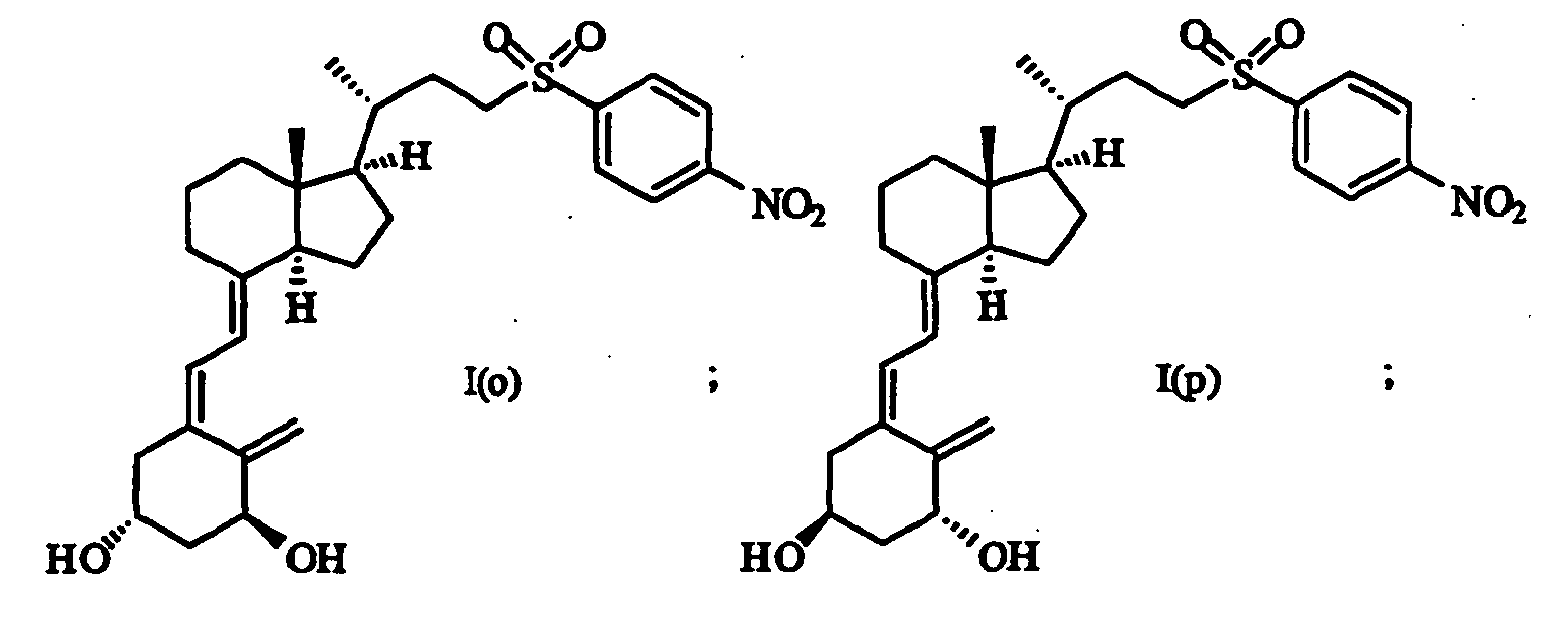
-

-

- To a solution of (±)-A-ring phosphine oxide (Posner, G. H. et al. J. Med Chem. 1992, 35, 3280-3287) (72.8 mg, 0.125 mmol) in THF (2 mL) was added 0.047 mL of n-BuLi (2.67 M in Hexane, 0.125 mmol) at -78 °C, then the reddish solution was stirred for 10 min at the same temperature. A precooled (-78 °C) solution of C24-p-acetalphenyl sulfone C/D ring ketone from Example 4g (32.4 mg, 0.0770 mmol) in THF (2 mL) was added to the above solution at -78 °C via cannula. The resulting reddish orange solution was stirred for 6 hrs at -78 °C. The reaction was quenched with 2 mL of pH 7 buffer, then warmed to room temperature, extracted with EtOAc, washed with brine, dried over MgSO4, filtered, concentrated in vacuo, and purified by flash chromatography (EtOAc:Hex = 1:4) to give 31.5 mg (52%) of a diastereomeric mixture of bis TBS protected p-acetalphenyl sulfone coupled products. A solution of this latter product (20 mg, 0.0255 mmol) and Dowex 50WX4-400 (794 mg) in CH2Cl2-aceton (2 mL-2 mL) was stirred for 24h. The reaction mixture was filtered and purified by flash chromatography (EtOAc:Hex =1:1 to 2:1) to afford 5.4 mg of a diastereomeric mixture of the corresponding bishydroxy benzaldehydes along with some unreacted starting material. The latter mixture was treated with MeONH2•HCl (8.9 mg, 0.104 mmol), several beads of molecular sieves 4A, and pyridine (1.2 mL). The reaction mixture was diluted with EtOAc, washed with 1N aq. HCl and brine, dried over MgSO4, filtered, and concentrated in vacuo to give a crude mixture which was then purified by flash chromatography (EtOAc:Hex = 3:1) to afford 3.7 mg (65%) of a diastereomeric mixture of I(s) and I(t). The diastereomers were then purified by HPLC (Chiralcel OJ column, 30% EtOH in Hexanes, 2.5 mL/min, 254 nm) to afford I(s) (1α,3β, tR 32.7 min) as a viscous oil and I(t) (1β,3α, tR 25.1 min) as a viscous oil.
-

- A solution of 58 mg (0.10 mmol) of 19-nor-phosphine oxide (Hilpert, H. and Wirz, B. Tetrahedron 2001, 57, 681-694) in 2.0 mL of anhydrous THF was cooled to -78 °C and treated with 64 µL (0.10 mmol, 1.6 M in hexanes) of n-BuLi under argon atmosphere. The mixture turned deep reddish and was stirred for 15 min at -78 °C. To the solution was added dropwise a precooled (-78 °C) solution of 12 mg (0.034 mmol) of the C,D-ring ketone from Example 3a in 1.5 mL of anhydrous THF via cannula. The reaction kept going until the reddish orange color faded to yellow (about 4 hr). The reaction was quenched by adding 1.0 mL of pH 7 buffer at -78 °C, then warmed to room temperature, extracted with EtOAc (20 mL x 2), washed with brine, dried over MgSO4, concentrated. The residue was subjected to column chromatography with EtOAc/hexanes (1/3) as eluent to afford 19 mg (80 %) of the coupled product as a colorless oil.
The coupled product (19 mg, 0.027 mmol) was dissolved in 3 mL of anhydrous THF, and to the solution was added 0.40 mL (0.40 mmol) of a 1.0 M solution of TBAF in THF. The resulting mixture was stirred overnight at room temperature, then quenched with 2 mL of water. The solution was extracted with EtOAc (20 mL x 3), washed with brine, dried over MgSO4, concentrated. The residue was subjected to column chromatography with EtOAc as eluent to give 12 mg (94 %) of the crude product of (+)-I(u) as a colorless oil. The crude product was purified by HPLC (Chiralcel OJ column, 20 % EtOH in Hexanes, 2.5 mL/min, 254 nm) to afford 10.5 mg of (+)-I(u) (1a, 3b, tR = 29.1 min). : [α]24. D = +91.2 (c = 0.19, MeOH). 1H NMR (400 MHz, CDCl3) δ 7.90-793 (m, 2H), 7.67 (m, 1H), 7.56-7.60 (m, 2H), 6.29 (d, J = 11.2 Hz, 1H), 5.83 (d, J=11.2 Hz, 1H), 4.11 (m, 1H), 4.05 (m, 1H), 3.14 (ddd, J= 13.6, 12.0, 4.0 Hz, 1H), 3.00 (ddd, J= 13.6, 11.2, 4.8 Hz, 1H), 2.78 (dd, J= 12.4, 4.0 Hz, 1H), 2.72 (dd, J = 13.2, 4.0 Hz, 1H), 2.47 (dd, J= 13.2, 3.6 Hz, 1H), 2.17-2.43 (m, 2H), 1.74-1.99 (m, 6H), 1.44-1.68 (m, 9H), 1.17-1.30 (m, 3H), 0.89 (d, J= 6.0 Hz, 3H), 0.50 (s, 3H). 13C NMR (100 MHz, CDCl3,) δ 142.4, 139.2,133.6, 131.4,129.2, 128.0, 123.7, 115.5, 67.4, 67.2, 56.1, 55.7, 53.6, 45.7, 44.6, 42.1, 40.3, 37.1, 35.0, 28.8, 28.3, 27.3, 23.3, 22.1, 18.5, 12.0. IR (neat, cm-1) 3362, 2943, 1447, 1306, 1145, 1086, 1048, 753, 689, 537. HRMS ([M+Na]+) calcd. 495.2539, found 495.2526. -

- To a solution of isopropyl phenyl sulphide (500 mg, 3.28 mmol) in MeOH (20 mL) was added a solution of potassium peroxymonosulfate (2KHSO5•KHSO4•K2SO4, Oxone®) (3.03 g, 9.85 mmol) in water (20 mL) at 0 °C. The resulting white suspension was warmed to room temperature and then stirred for 5h. The mixture was diluted with water (10 mL), extracted with EtOAc (80 mL x 2), washed with brine, dried over MgSO4, concentrated in vacuo, and then purified by column chromatography (25% EtOAc/hexanes) to give 512 mg (85%) of isopropyl phenyl sulfone VII (R4 = Ph, R6,R7 = Me) as a colorless oil: 1H NMR (400 MHz, CDCl3) δ 7.74-7.64 (m, 2H). 7.55-7.51 (m, 1H), 7.46-7.42 (m, 2H), 3.08 (septet, J = 6.8 Hz, 1H), 1.50 (d, J= 6.8 Hz, 6H); 13NMR (100 MHz, CDCl3) δ 136.54, 133.31, 128.73, 128.55,55.05,15.26.
-

- To a solution of cyclopropyl phenyl sulphide (450 mg, 3.00 mmol) in MeOH (15 mL) was added a solution of potassium peroxymonosulfate (2KHSO5•KHSO4•K2SO4, Oxone®) (5.52 g, 8.99 mmol) in water (15 mL) at 0 °C. The resulting white suspension was warmed to room temperature and then stirred for 5h. The mixture was diluted with water (10 mL), extracted with EtOAc (60 mL x 2), washed with brine, dried over MgSO4, concentrated in vacuo, and then purified by column chromatography (25% EtOAc/hexanes) to give 494 mg (91%) of cyclopropyl phenyl sulfone VII (R4 = Ph, R6,R7 = cyclopropyl) as a colorless oil: 1H NMR (400 MHz, CDCl3) δ 7.92-7.90 (m, 2H). 7.66-7.62 (m, 1H), 7.58-7.54 (m, 2H), 3.08 (m, 1H), 1.38-1.33 (m, 2H), 1.06-1,00 (m, 2H); 13NMR (100 MHz, CDCl3) δ 140.67, 133.33, 129.19,127.53, 32.89, 5.94.
-

- To a solution of bis-silylated diol (508 mg, 1.15 mmol) in 10 mL of anhydrous THF was added 1.15 mL of TBAF (1M in THF) dropwise at 0 °C. After being stirred for 1 h at 0 °C, the reaction mixture was extracted with EtOAc (30 mL x 2), washed with brine, dried over MgSO4, concentrated in vacuo, and then purified by column chromatography (20% EtOAc/hexanes) to give 351 mg (93%) of mono-silylated alcohol as a colorless oil.
To a solution of triphenylphosphine (986 mg, 3.76 mmol), imidazole (578 mg, 8.49 mmol) in 20 mL of CH2Cl2 was slowly added a solution of iodine (954 mg, 3.76 mmol) in 30 mL of CH2Cl2 at 0 °C. After 15 min, a solution of mono-silylated alcohol (351 mg, 1.07 mmol) in 10 mL of CH2Cl2 was added into the mixture. After being stirred for 6 h at room temperature, the reaction mixture was extracted with EtOAc (100 mL x 2), washed with brine, dried over MgSO4, concentrated in vacuo, and then purified by column chromatography (100% Hexanes) to give 448 mg (96%) of 22-iodo silyl ether VI (= single bond) as a colorless oil: 1H NMR (400 MHz, CDCl3) δ 4.03 (m, 1H), 3.33 (dd, J = 9.6, 2.8 Hz, 1H), 3.18 (dd, J = 9.6, 5.2 Hz, 1H), 1.92-1.75 (m, 3H), 1.70-1.55 (m, 2H), 1.43-1.06 (m, 8H), 0.99 (d, J= 6.0 Hz, 3H), 0.94 (t, J= 8.0 Hz, 9H), 0.94 (s, 3H), 0.55 (q, J= 8.0 Hz, 6H).
-

- (a) 23-Dimethyl Silyl Ether V (R4 = Ph, R6, R7 = Me): To a solution of isopropyl phenyl sulfone VII (R4 = Ph, R6, R7 = Me, Example 12) (38mg, 0.21 mmol) in THF (3mL) at -78 °C was added 0.13 mL (0.21 mmol) of n-BuLi (1.6 M in hexanes). After 15 min stirring, 0.3 mL of HMPA was added at 78 °C. After another 15 min stirring, a precooled (-78 °C) solution of iodide VI (---- = single bond, Example 14) (30 mg, 0.069 mmol) in THF (1 mL) was added at -78 °C. The reaction mixture was slowly warmed to room temperature and stirred for 2 h, and then quenched with water, extracted with ether (50 mL x 2), washed with brine, dried over MgSO4, concentrated in vacuo, and then purified by column chromatography (20% EtOAc/hexanes) to give 30 mg (88%) of 23-dimethyl silyl ether V (R4 = Ph, R6, R7 = Me) as a colorless oil: [α]24.4 D+27.7 (c 0.57, CHCl3); 1H NMR (400 MHz, CDCl3) δ 7.88-7.85 (m, 2H), 17.66-7.62 (m, 1H), 7.57-7.53 (m, 2H), 4.00 (m, 1H), 1.94-1.84 (m, 2H), 1.81-1.60 (m, 6H), 1.57-1.40 (m, 4H), 0.91(t, J= 8.0 Hz, 9H), 0.54 (q, J= 8.0 Hz, 6H), 1.34 (s, 3H), 1.30 (s, 3H), 1.26 (s, 3H), 1.14-1.04 (m, 4H), 0.95 (d, J= 6.0 Hz, 3H); 13NMR (100 MHz, CDCl3) δ 135.45, 133.39, 130.67, 128.58, 69.32, 64.10, 57.77, 53.08, 42.23, 40.71, 39.40, 34.50, 32.12, 29.70, 27.90, 22.82, 21.10, 17.59, 14.13. 13.28, 6.94, 4.92; IR (neat, cm-1) 2949, 2925, 2872, 1463, 1448, 1378, 1366, 1294, 1282, 1164, 1121, 1075, 1002, 730; HRMS mlz (M+ + Na+) calcd 515.2986 for C28H48O3SSiNa+, found 515.2966.
- (b) 23-Dimethyl C,D-ring Ketone III (R4 = Ph, R6, R7 = Me). To a solution of silyl ether V (R4 = Ph, R6, R7 =Me) (40 mg, 0.080 mmol) in THF (3 mL) was added 0.24 mL (0.24 mmol) of a 1.0 M solution of TBAF in THF, and then it was stirred at 0 °C for 1 h and stirred overnight at room temperature. The reaction mixture was quenched with water (5 mL), extracted with EtOAc (10 mL x 2), washed with brine, dried over MgSO4, concentrated in vacuo, and then purified by column chromatography (25% EtOAc/hexanes) to give 30 mg (99%) of alcohol as a white solid. To a solution of the C,D-ring alcohol (30 mg, 0.080 mmol) in CH2Cl2 (6 mL) was added 80 mg of oven-dried Celite and PDC (84 mg, 0.22 mmol) at room temperature. The reaction mixture was stirred overnight and then passed through a 2 cm pad of flash silica gel and washed with EtOAc. The filtrate was concentrated and purified by column chromatography (33% EtOAc/hexanes) to give 28 mg (91%) of the desired C,D-ring ketone III (R4 = Ph, R6, R7 = Me) as a white solid: mp 149-151 °C; [α]24.7 D +22.3 (c 0.96, CHCl3); 1H NMR (400 MHz, CDCl3) δ 7.85-7.82 (m, 2H), 7.65-7.61 (m, 1H), 7.55-7.51 (m, 2H), 2.41 (dd, J=12.4, 11.2 Hz, 1H), 2.28-2.15 (m, 2H), 2.11-2.06 (m, 1H), 1.96 (m, 1H), 1.91-1.79 (m, 3H), 1.73-1.62 (m, 2H), 1.60-1.43 (m, 6H), 1.32 (s, 3H), 1.27 (s, 3H), 1.00 (d, J= 5.6 Hz, 2H), 0.61 (s, 3H); 13NMR (100 MHz, CDCl3) δ 211.67, 135.29, 133.52, 130.63, 128.66, 63.81, 61.92, 57.62, 49.74, 40.87, 39.48, 38.89, 32.31, 28.03, 23.91, 22.34, 21.26, 21.24, 18.90, 12.31; IR (neat, cm-1) 2959, 1715, 1442, 1378, 1305, 1140, 1084, 730, 695; HRMS m/z (M+ + Na+) calcd 399.1964 for C22H32O3SNa+, found 399.1968.
- (c) 23-Dimethyl-24-SO2Ph analogues (+)-I(aa) and (-)-I(bb). A solution of 63 mg (0.11 mmol) of racemic phosphene oxide (±)-IV in 2.0 mL of anhydrous THF was cooled to -78 °C and treated with 67.6 µL (0.11 mmol, 1.6 M in hexanes) of n-BuLi under argon atmosphere. The mixture turned reddish orange and was stirred for 10 min at -78 °C. To the solution was added dropwise a solution of 33 mg (0.088 mmol) of the C,D-ring ketone III (R4 = Ph, R6, R7 = Me) in 1.0 mL of anhydrous THF. The reaction kept going until the reddish orange color faded to yellow (about 4 h). The reaction was quenched by adding 3.0 mL of pH 7 buffer, then warmed to room temperature, extracted with EtOAc (30 mL x 2), washed with brine, dried over MgSO4, concentrated in vacuo, and then purified by column chromatography (10% EtOAc/hexanes) to afford 30 mg (54%) of the coupled product as a colorless oil.
The coupled product (30 mg, 0.040 mmol) was dissolved in 3 mL of anhydrous THF, and to this solution was added 0.16 mL (0.16 mmol) of a 1.0 M solution of TBAF in THF. The reaction was run in darkness overnight, then extracted with EtOAc (30 mL x 2), washed with brine, dried over MgSO4, concentrated in vacuo, and then purified by column chromatography (80% EtOAc/hexanes) to give 14 mg (67%) of a mixture of two diastereomers as a white solid. The diastereomers were separated by reverse-phase HPLC (C-18 semipreparative column, 49% MeCN/H2O, 3.0 mL/min) to afford 2.5 mg (12%) of (+)-I(aa) (1α, 3β, tR 116 min) and trace amount of (-)-I(bb) (1β, 3α, tR 111 min) as foaming solids. (+)-I(aa): [α]24.2D +25.1 (c 0.12, CHCl3); 1H NMR (400 MHz, CDCl3) δ 7.88-7.85 (m, 2H), 7.67-7.63 (m, 1H), 7.57-7.54(m, 2H), 6.36 (d, J = 11.2 Hz, 1H), 6.00 (d, J = 11.2 Hz, 1H), 5.32 (s, 1H), 4.98 (s, 1H), 4.43 (m, 1H), 4.23 (m, 1H), 2.82 (m, 1H), 2.60 (m, 1H), 2.31 (m, 1H), 2.03-1.82 (m, 8H), 1.70-1.44 (m, 10H), 1.34 (s, 3H), 1.30 (s, 3H), 1.00 (d, J = 5.6 Hz, 3H), 0.54 (s, 3H); 13NMR (100 MHz, CDCl3) δ 147.58, 142.66, 135.38, 133.45, 133.09, 130.66, 128.62, 124.84, 117.21, 111.75, 70.75, 66.81, 63.99, 57.52, 56.31, 45.84, 45.11, 42.79, 40.42, 39.53, 32.85, 28.96, 28.11, 23.46, 22.43, 22.10, 21.30, 21.05, 11.86; IR (neat, cm-1) 3436, 2931, 2861, 1719, 1649, 1443, 1296, 11SS, 1126, 1073, 756, 568; UV (MeOH) λmax 264 nm (ε 5774); HRMS mlz (M+ + Na+) calcd 535.2853 for C31H44O4SNa+, found 535.2898. -

- (a) 25-Cyclopropyl Silyl Ether V (R4 = Ph, R6, R7 = cyclopropyl): To a solution of cyclopropyl phenyl sulfone VII (R4 = Ph, R6, R7 = cyclopropyl) (Example 13, 50mg, 0.27 mmol) in THF (3mL) at -78°C was added 0.17 mL (0.27 mmol) of nBuLi (1.6 M in hexanes). After 15 min stirring, 0.3 mL of HMPA was added at -78 °C. After another 15 min stirring, a precooled (-78 °C) solution of iodide VI (Example 14, 40 mg, 0.091 mmol) in THF (1 mL) was added at -78 °C. The reaction mixture was slowly warmed to room temperature and stirred for 3 h, and then quenched with water, extracted with ether (50 mL x 2), washed with brine, dried over MgSO4, concentrated in vacuo, and then purified by column chromatography (15% EtOAc/hexanes) to give 41 mg (93%) of 23-cyclopropyl silyl ether V (R4 = Ph, R6, R7 = cyclopropyl) as a colorless oil: [α]23.8D+22.2 (c 1.85, CHCl3); 1H NMR (400 MHz, CDCl3) δ 7.90-7.87 (m, 2M, 7.66-7.61 (m, 1H), 7.58-7.53 (m, 2H), 3.98 (m, 1H), 2.10-2.06 (m, 1H), 1.90-1.85 (m, 1H), 1.83-1.71 (m, 2H), 1.66-1.43 (m, 5H), 1.34-1.22 (m, 3H), 1.15-1.01 (m, 2H), 0.94(t, J= 8.0 Hz, 9H), 0.96-0.80 (m, 2H), 0.85 (s, 3H), 0.78 (d, J = 6.4 Hz, 3H), 0.74-0.69 (m, 3H), 0.54 (q, J = 8.0 Hz, 6H); 13NMR (100 MHz, CDCl3) 8 139.18, 133.26, 128.88, 128.73, 69.22, 57.38, 52.93, 42.29, 40.65, 39.29, 37.43, 34.50, 33.56, 27.28, 22.88, 18.81, 17.57, 13.52. 12.57, 12.08, 6.93, 4.90; IR (neat, cm-1) 2949, 2875, 1446, 1304, 1142, 1084, 1021, 974, 807, 727, 690; HRMS m/z (M+ + Na+) calcd 513.2829 for C29446O3SSiNa+, found 513.2863.
- (b) 23-Cycolpropyl C,D-ring Ketone will (R4 = Ph, R6, R7 = cyclopropyl) To a solution of silyl ether V (R4 = Ph, R6, R7 = cyclopropyl) (36 mg, 0.073 mmol) in THF (3.0 mL) was added 0.22 mL (0.22 mmol) of a 1.0 M solution of TBAF in THF, and then it was stirred at 0 °C for 1 h and stirred overnight at room temperature. The reaction mixture was quenched with water (4 mL), extracted with EtOAc (10 mL x 2), washed with brine, dried over MgSO4, concentrated in vacuo, and then purified by column chromatography (30% EtOAc/hexanes) to give 27 mg (99%) of alcohol as a colorless oil.
To a solution of the C,D-ring alcohol (27 mg, 0.073 mmol) in CH2Cl2 (5 mL) was added 70 mg of oven-dried Celite and PDC (77 mg, 0.21 mmol) at room temperature. The reaction mixture was stirred overnight and then passed through a 2 cm pad of flash silica gel and washed with EtOAc. The filtrate was concentrated and purified by column chromatography (33% EtOAc/hexanes) to give 26 mg (93%) of the desired C,D-ring ketone III (R4 = Ph, R6, R7 = cyclopropyl) as a white solid: mp 125-127 °C; [α]24.5 D +3.62 (c 1.20, CHCl3); 1H NMR (400 MHz, CDCl3) δ 7.88-7.86 (m, 2H); 7.66-7.62 (m, 1H), 7.57-7.53 (m, 2H), 2.35 (dd, J=11.6, 11.2 Hz, 1H), 2.29-2.14 (m, 2H), 2.08-2.04 (m, 2H), 2.00-1.95 (m, 1H), 1.89-1.78 (m, 2H), 1.72-1.41 (m, 6H), 1.23 (m, 1H), 1.00-0.95 (m, 2H), 0.90 (d, J= 6.4 Hz, 3H), 0.85 (m, 1H), 0.73-0.69 (m, 1H), 0.59 (s, 3H); 13NMR (100 MHz, CDCl3) δ 211.62, 139.02, 133.43, 128.98, 128.60, 61.74, 57.19, 49.87, 40.85, 39.16, 38.85, 37.85, 33.96, 27.34, 23.90, 18.98, 18.82,12.76, 12.53,12.31; IR (neat, cm-1) 2958, 1710, 1446,1379, 1302, 1141, 1083, 728, 692, 643; HRMS m/z (M + + Na+) calcd 397.1808 for C22H30O3SNa+, found 397.1807. - (c) 23-Cyclopropyl-24-SO2Ph analogues (+)-I(cc) and (-)-I(dd). A solution of 57 mg (0.098 mmol) of racemic phosphine oxide (±)-IV, in 2.0 mL of anhydrous THF was cooled to -78°C and treated with 61.1 µL (0.098 mmol, 1.6 M in hexanes) of n-BuLi under argon atmosphere. The mixture turned reddish orange and was stirred for 10 min at -78 °C. To the solution was added dropwise a solution of 17 mg (0.046 mmol) of the C,D-ring ketone III (R4 = Ph, R6, R7 = cyclopropyl) in 1.0 mL of anhydrous THF. The reaction kept going until the reddish orange color faded to yellow (about 2.5 h). The reaction was quenched by adding 2.0 mL of pH 7 buffer, then warmed to room temperature, extracted with EtOAc (20 mL x 2), washed with brine, dried over MgSO4, concentrated in vacuo, and then purified by column chromatography (30% EtOAc/hexanes) to afford 13 mg (38%) of the coupled product as a colorless oil.
The coupled product (13 mg, 0.018 mmol) was dissolved in 3 mL of anhydrous THF, and to this solution was added 0.07 mL (0.07 mmol) of a 1.0 M solution of TBAF in THF. The reaction was run in darkness overnight, then extracted with EtOAc (20 mL x 2), washed with brine, dried over MgSO4, concentrated in vacuo, and then purified by column chromatography (80% EtOAc/hexanes) to give 10 mg (100%) of a mixture of two diastereomers as a white solid. The diastereomers were separated by reverse-phase HPLC (C-18 semipreparative column, 50% MeCN/H2O, 3.0 mL/min) to afford 2.6 mg (26%) of (+)-I(cc) (1α, 3β, tR 74 min) and trace amount of (-)-I(dd) (1β), 3α, tR 71 min) as foaming solids. (+)-I(cc): [α]24.1 D +18.6 (c 0.22, CHCl3); 1H NMR (400 MHz, CDCl3) δ 7.90-7.87 (m, 2H), 7.67-7.62 (m, 1H), 7.58-7.54(m, 2H), 6.36 (d, J= 11.2 Hz, 1H), 5.99 (d, J=11.2 Hz, 1H), 5.33 (s, 1H), 4.99 (s, 1H), 4.43 (m, 1H), 4.23 (m, 1H), 2.79 (m, 1H), 2.59 (m, 1H), 2.30 (m, 1H), 2.10-1.87 (m, 4H), 1.82-1.74 (m, 2H), 1.28-1.19 (m, 2H), 1.11-1.07 (m, 2H), 1.67-1.53 (m, 8H), 1.00-0.93 (m, 2H), 0.86 (d, J= 6.4 Hz, 3H), 0.74-0.68 (m, 2H), 0.50 (s, 3H); 13NMR (100 MHz, CDCl3) δ 147.61, 142.71, 139.14, 133.34, 133.06, 128.94, 128.68, 124.88, 117.18, 111.78, 70.83, 57.13, 56.17, 45.96, 45.23, 42.86, 40.36, 39.26, 37.78, 34.45, 28.97, 27.54, 23.45, 22.21, 18.99, 12.64, 12.23, 12.04; IR (neat, cm-1) 3401, 2944, 2861, 1647, 1445, 1303, 1142, 1077,1053, 721, 691, 573. -

- (a) Compound V (x = 0, ---- double bond, R4 = Ph). To a flask, 25 mL, containing iodide X(---- double bond) (45 mg, 0.100 mmol) was added acetone (2 mL), K2CO3 (70 mg, 0.502 mmol) and finally thiophenol (52 µL, 0.502 mmol) via a syringe. This mixture was stirred at rt. for 1.5 h and quenched with pH 7.0 phosphate buffer (2 mL). The reaction was extracted with Et2O (3x, 20 mL), dried over MgSO4, reduced under pressure and purified by silica gel chromatography (100% petroleum ether) to give 45 mg of product as an oil (95%): [a]2.5 D + 18.02 (c 0.3925, CHCl3); 1H NMR (400 MHz, CDCl3) δ 7.27 (m, 4H), 7.14 (m, 1H), 5.25 (m, 1H), 4.10 (d, J= 2.4 Hz, 1H), 2.91 (ddd, J= 12.8, 9.6, 5.6 Hz, 1H), 2.80 (ddd, J = 12.8, 9.2, 6.0 Hz, 1H), 2.21 (m, 2H), 1.93-1.77 (m, 3H), 1.72-1.58 (m, 4H), 1.50-1.39 (m, 2H), 1.33 (dt, J= 12.8,3.6 Hz 1H), 0.99 (s, 3H), 0.96 (d, J= 6.8 Hz, 3H), 0.94 (t, J= 8.0 Hz, 9H), 0.55 (q, J= 8.0 Hz, 6H); 13C NMR (100 MHz, CDCl3) δ 159.30, 136.93, 128.84, 128.76, 125.58, 120.22, 68.91, 55.07, 48.77, 46.65, 35.68, 34.91, 31.69, 31.05, 30.74, 22.36, 18.72, 18.04, 6.94, 4.91; IR (CHCl3, cm-1) 3025, 2954, 1586, 1456, 1028; HRMS mlz (M+) calcd 453.261780 for C26H42OSSiNa+ found 453.26329.
- (b) Compound (+)-V (x = 2, ---- = double bond, R4 = Ph. To a flask, 10 mL, was sequentially added sulfide V (x = 0, ---- = double bond, R4 = Ph) (40 mg, 0.093 mmol), CCl4 (0.5 mL), CH3CN (0.5 mL), H2O (1 mL) and H5IO6 (45 mg, 0.195 mmol). This mixture was stirred vigorously for 5 min at rt., after which was added RuCl3•H2O (0.4 mg, 0.0018 mmol) turning the reaction a dark green color. The reaction was stirred until all starting material and intermediate sulfoxide had disappeared by TLC (~2 h) and then passed over a plug of silica gel. The organics were reduced under pressure and purified by silica gel chromatography (85% petroleum ether, 15% ethyl acetate) to give 30 mg of product as an oil (70%): [a]25 D + 21.5 (c 0.893, CHCl3); 1H NMR (400 MHz, CDCl3) δ 7.90 (m, 2H), 7.65 (m, 1H), 7.57 (m, 2H), 5.11 (m, 1H), 4.09 (d, J = 2.4 Hz, 1H), 3.12 (ddd, J = 14.0, 10.8, 4.8 Hz, 1H), 2.97 (ddd, J = 14.0, 11.2, 5.6 Hz, 1H), 2.20 (tt, J = 12.8, 1.2 H4 1H, 2.07 (m, 1H), 1.89-1.72 (m, 4H), 1.69-1.54 (m, 2H), 1.48-1.37 (m, 2H), 1.25 (m, 2H), 0.96 (d, J= 6.8 Hz, 3H), 0.94 (t, J = 8.0 Hz, 9H), 0.92 (s, 3H), 0.55 (q, J = 8.0 Hz, 6H); 13C NMR (100 MHz, CDCl3) δ 157.76, 139.07, 133.54, 129.18, 128.05, 121.13, 68.74, 54.98, 54.69, 46.47, 35.52, 34.75, 30.92, 30.68, 28.66, 22.35, 18.70, 17.93, 6.91, 4.87; IR (CHCl3, cm-1) 3015, 2933, 1448, 1317, 1149, 1083; HRMS m/z (M+) calcd 485.251610 for C26H42O3SSiNa+ found 485.25125.
- (c) Compound (+)-III (x = 2, ---- = double bond, R4 = Ph). In a flask, 25 mL, was dissolved the sulfone V (x = 2, ---- double bond, R4 = Ph) (28 mg, 0.060 mmol) in THF (1.5 mL). To this was added TBAF (195 µL, 0.195 mmol, 1.0 M in THF) via syringe and the reaction was stirred at rt. for 6 h. The reaction was quenched with water, extracted with Et2O (3x, 25 mL) and reduced under pressure to give 24 mg of crude product, which was used in the next reaction without further purification.
The crude alcohol was dissolved in CH2Cl2 (1.5 mL), to which 4 Å ms (~20 mg), NMO (15 mg, 0.130 mmol) and finally TPAP (1.1 mg, 0.0033 mmol) were added. The reaction was vigorously stirred at rt. for 5 h. The crude reaction mixture was passed over a plug of silica and reduced under pressure. The product was then purified by silica gel chromatography (60% hexanes, 40% ethyl acetate) to give 19.1 mg of product (91%): [α]25 D + 22.8 (c 0.955, CHCl3); 1H NMR (400 MHz, CDCl3) δ 7.89 (m, 2H), 7.64 (m, 1H), 7.57 (m, 2H), 5.16 (m, 1H), 4.09 (d, J= 2.4 Hz, 1H), 3.06 (ddd, J=14.0,.10.4, 5.2 Hz, 1H), 2.98 (ddd, J= 14.0,10.4, 5.6 Hz, 1H), 2.80 (m, 1H), 2.40 (ddt, J = 15.6, 10.8, 1.6 Hz, 1H), 2.27-2.19 (m, 3H), 2.10-2.01 (m, 2H), 1.99-1.90 (m, 1H), 1.89-1.78 (m, 3H), 1.69 (m, 1H), 1.04 (d, J= 7.2 Hz, 3H), 0.73 (s, 3H);13C NMR (100 MHz, CDCl3) δ 210.41, 155.62, 139.04, .133.68, 129.28, 127.99, 121.82, 62.94, 54.39, 53.51, 40.37, 34.16, 31.81, 28.41, 2707, 23.87, 21.57, 17.18; IR (CHCl3, cm-1) 3018, 2935, 1716, 1450, 1337, 1149, 1096; HRMS mlz (M+) calcd 369.149483 for C20H26O3SNa+ found 369.14909. - (d) Preparation of Compounds I(ee) and I(ff): Prior to reaction, phosphine oxide (±)-IV and C,D-ring ketone III (x = 2, ---- = double bond, R4 = Ph) were azeotrophically dried with benzene and left under vacuum for 24 h. A solution of n-BuLi in hexanes (67 µL, 0.110 mmol) was added dropwise to a cold (-78 °C) solution of phosphine oxide (±)-IV (64 mg, 0.110 mmol) in THE (1.20 mL) under dry argon. The resulting deep red solution was stirred for 40 min, at which time a cold (-78 °C) solution of C,D-ring ketone III (x = 2, ---- = double bond, R4 = Ph) (19.1 mg, 0.0551 mmol) in THF (1.0 mL) was added dropwise via cannula. The resulting solution was stirred at -78°C in the dark for approximately 4 h, after which the dark red color had faded to a light orange color. The reaction mixture was quenched with pH 7.0 phosphate buffer (1 mL), warmed to rt, extracted with Et2O (3 x 20 mL), washed with brine, dried over MgSO4, filtered, concentrated, and purified by silica gel column chromatography (80% hexanes, 20% ethyl acetate) to afford the coupled products as a clear oil (31.5 mg). This oil was immediately dissolved in THF (1.5 mL) and treated with triethylamine (31 µL, 0.221 mmol) and TBAF (221 µL, 0.221 mmol, 1.0 M in THF) and stirred in the dark for 16 h. The reaction mixture was quenched with H2O (1 mL), extracted with EtOAc (3 x 15 mL), dried over MgSO4, filtered, concentrated, and purified by silica gel column chromatography (85% ethyl acetate, 15% hexanes) to afford the diol (21 mg) as a mixture of diastereomers. This diastereomeric mixture was separated by HPLC (CHIRALCEL OJ) giving enantiomerically pure, vitamin-D3 analogs I(ee) and I(ff) in 35% and 15% yield respectively. I(ee): [α]25 D + 14.7 (c 0.230, CHCl3); 1H NMR (400 MHz, CDCl3) δ 7.9 (m, 2H), 7.66 (m, 1H), 7.58 (m, 2H), 6.35 (d, J=11.2 Hz, 1H), 6.08 (d, J=11.2 Hz, 1H), 5.34 (m,1H), 5.18 (m, 1H) 5.00 (m, 1H), 4.44 (m, 1H), 4.24 (m, 1H), 3.08 (ddd, J= 14, 10.8, 4.8 Hz, 1H), 2.97 (ddd, J= 14.0, 10.8, 4.8 Hz, 1H), 2.79 (m, 1H), 2.59 (dd, J= 13.6, 3.2 Hz, 1H), 2.32 (m, 2H), 2.17 (m, 2H), 2.07-2.01 (m, 1H), 1.97 (m, 1H), 1.92-1.86 (m, 1H), 1.74 (m, 2H), 1.67-1.51 (m, 2H), 1.40 (m, 1H), 1.02 (d, J = 6.8 Hz, 3H), 0.60 (s, 3H); 13C NMR (100 MHz, CDCl3) δ 157.28, 147.62, 141.86, 139.07, 133.60, 133.31, 129.24,
-
- 1,25(OH)2D3 10-5 M
- [3H]- 1,25(OH)2D3 25,000 CPM/µl
- HPK1A-ras cells
- 48-well plate
- Methanol
- Dichlorimethane Saturated KCI: KCI 30g, H2O400 ml
-
- 1. Induction of HPK1A-ras cells (The day before assay)
When the HPK1A-ras cells are 80-90% confluent, add 1 µL 10-5M 1,25(OH)2D3 to 1 mL medium in the plate (final concentration is 10-8 M). - 2. Preparation of cell suspension
After 18 to 20 hours induction, remove the medium and wash the cell twice with PBS. Then tripsinize the cells from plate, centrifuge (2,000 rpm, 5 min) and suspend cells pellet in DMEM medium+1%BSA.
Count the cells and adjust cells density to 250,000/150 µL, add 150 µL cell suspension to each well in 48-well plate. (including 3 well as no cell control, and 3 well cells without drug or inhibitor as control). - 3. Add 25 µL ketoconazole (final concentration 10-5 M, 10-6 M, 10-7 M, 10-8 M) or drugs into each designated well. Keep the plate in 37°C for 10 min.
- 4. Preparation of substrate
Take certain amount of DMEM+1%BSA medium (25*Well number+200)µL to a tube, add certain amount of 3H-1,25(OH)2D3 (well number+2) µL and certain amount of 100mM DPPD (well number/5)µL and mix them by vortex. - 5. Incubation
Add 25 µL substrate to each well, incubate the plate at 37°C for 3 hour.
Add 25 µL substrate to counting plate (2 well) as a total count. - 6. Lipid extraction and counting
Add 500 µL methanol to each well to stop the reaction, transfer them to tube
Add 250 µL dichloromethane and vortex.
Add 250 µL dichloromethane and 250 µL saturated KCI, and vortex.
Centrifuge at 4000 rpm for 5 min.
Transfer 100 µL of aqueous phase (upper phase) to counting plastic counting plate. Add 600 µL of scintillation fluid to each well. Count the plate in scintillation counter. - 7. Calculation enzyme activity
CPM of cell control after subtraction of CPM of NCC is as 100% enzyme activity.
- See
Figure 1A for Compound I(a) and see Table 1. -
- Ray S, Ray R, Holick M. Metabolism of 3H-1alpha, 25-dihydroxyvitamin D3 in the cultured human keratinocytes (1995) 59:117-122
- Dilworth F J, Scott I, Green A, Strugnell S, Guo Y D, Roberts E A, Kremer R, Calverley, M J, Makin H L J, Jones G. Different mechanisms of hydroxylation site selection by liver and kidney cytochrome P450 species (CYP27 and CYP24) involved in Vitamin D metabolism. (1995) J Biochem 270(28):16766-16774
-
- (i) Reagent and material
- 1. COS-1 cells (50-80% confluent)
- 2. FuGene 6 Transfection Reagent
- 3. PcDNA vector containing CYP-1alpha hydroxylase cDNA(1µg/µl)
- 4. DMEM Medium + 10% FCS
- 5. DMEM Medium (serum-free)
- 6. 6-well plate
- (ii) Transfection cocktail preparation (The mount depends on how many wells transfected)
- 1. To a sterile tube, add serum-free medium (100 µl per well), Then add FuGene 6 Reagent (3 (µl per well). Tap gently to mix. Pay attention to the order. Add FuGene 6 Reagent directly to medium, do not allow undiluted Fugene 6 Reagent to come in contact with plastic surfaces other than the pipette tip.
- 2. Add DNA solution (1 µg per well) to the prediluted FuGene 6 Reagent from step 2
- 3. Gentyl tap the tube to mix the contents. Do not vortex. Incubate for 15 min at room temperature (no more than 45 min).
- (iii) Cells preparation.
- 1. Trypsinize Cos-1 cells, centrifuge cell suspension, suspend cells pellet in DMEM medium +10% FCS..
- 2. Dilate the cells suspension to 750,000 cell/ml (75cell/square),
- (iv) Transfection
- 1. Add 1.7 ml DMEM medium+10%FCS to each well of 6 well plate.
- 2. Transfer the correct volume of the cell suspension (200 µl/well) to the transfection cocktail. Mix them gently
- 3. Add 0.3 ml of the mixture to each well. Make sure that the same amount cells are added to each well. Swirl the wells to ensure even dispersal.
- 4. Incubate the cells for 24 hours at 37°C, 5% CO2 until enzyme activity assay.
-
- (i) Reagent and material
DMEM medium +1% BSA
PBS
[3H-26,27]-25(OH)D3
DPPD 100mM - (ii) Procedure
- 1. Wash cells once with PBS. Be careful, don't disturb the attached cells
- 2. Add 0.55 ml medium (DMFM+1%BSA) each well.
- 3. Add 0.025 ml medium containing test compounds
- 4. Incubate the cells for 10 minutes
- 5. Add 0.025ml medium containing [3H-26,27]-25(OH)D3 (50,000 CPM) and DPPD (0.6 µl stock)
- 6. Incubate the cells for 2 hour.
- 7. Add 1.5 ml Methanol to stop reaction
- 8. Add internal standard.
- 9. Transfer the medium to labeled tube.
- 10. Add 0.75 ml dichloromethane, vortex and keep in room temperature for 15 minutes.
- 11. Add 0.75 ml dichloromethane and 0.75 ml saturated KCl
- 12. Vortex and centrifuge
- 13. Remove upper phase and dry the lower phase in Speed-Vac
- 14. Add 110 µl mobile phase, vortex and centrifuge for 5 min.
- 15. Transfer 105 µl to the insert in HPLC vial.
- 16. HPLC analysis conditions:
- Solvent: Hexane/isopropanol/methanol (91/7/2)
- Column SIL 3µm column
- Flow rate: 2 ml/min
- Detector: UV detector and radioactive detector.
- See
Figure 1B for Compound I(a) and see Table 1. -
- Shink T, Shimada H, Wakino S, Anazawa H, Hayashi M, Saruta T, Deluca H, Suda T. Cloning and expression of rat 25-hydroxyvitamin D3-1-alpha -hydroxylase cDNA. (1997) Pro. Natl. Acad Sci 94:12920-12925 Muralidharan K R, Rowland-goldsmith M, Lee S A, Park G, Norman A W, Henry H L, Okamura W H. Inhibitors of 25-hydroxyvitamin D3-1alpha-hydroxylase: Thiavitamin D analogues and biological evaluation. (1997) J Steroid Biochem. Molec. Biol. 62(1):73-78.
- As described in:
- Dilworth F J, Black S M, Guo Y D, Miller W L, Jones G. Construction of a P450c27 fusion enzyme: a useful tool for analysis of vitamin D3 25-hydroxylase (1996) Biochem J 320:267-271
- Sawada N, Sakaki T, Ohta M, Inouye K. Metabolism of vitamin D (3)by human CYP27A1 (2000) Biochem Biophys Res Commun 273(3):977-84
- See
Figure 1C for compounds I(a) and Table 1. -
- 1.
VDR - 2. [3H]-1,25(OH)2D3 in ethanol
- 3. 1,25(OH)2D3 in ethanol
- 4. TEK300
- Tris-HCl 50 mM
- EDTA 1.5 mM
- KCl 300 mM
- Adjust pH to 7.4 (25°C)
- 5. TEDK300
TEK300
DTT (dithiothreitol) 10 mM (MW 154.24) - 6. Tris buffer
22.50 g Tris-HCl
500 ml H2O
13.25 g Tris-base
500 ml H2O
Kept in 4°C - 7. Dextran-T70 (Mol 70,000) Pharmacia
- 8. Charcoal (carbon decolorizing neutral, norit) Fishery
- 9. Gelatin (G-2625 Sigma)
-
1. Charcoal dextran solution - (1) Tris buffer
Mix equal amount of Tris-HCl and Tris-base. - (2) Norit decolorizing neutral charcoal 2.0 g
Tris buffer 150 mL
Stirring - (3) Dextran T - 70 0.2 g
Tris buffer 50 ml. - (4) Slowly drip the suspended dextran into charcoal solution with stirring.
Keep in refrigerate overnight.
Thirty minute before use, store on ice with continuous mixing -
label Standards NSB
bufferVDR 1h
RT3 H-1,25(OH) 2 D 3 1h
RT -Reagent C -charcoal On ice 30 min Spin at 4°C TC
(Total)25µL
reagent D 100 µL
reagent L500µL
reagent A50µL
reagent B100µL
reagent C 2000
rpm, 10
minNSB
(non-specific b)500 µL
reagent
Lmix all tubes mix all tubes Add 100 µl to counting rack Max b 0
binding500 µL
reagent AStandard 25 µL of each standard Count 5-10 min Test 25 µL
of each concentration of samplemix all tubes - The amount of 1,25(OH)2D3 to displace 50 percent [3H]-1,25(OH)2D3 from VDR is calculated as B50 for 1,25(OH)2D3. The VDR binding of other compounds is calculated as B50 relative to a value of 1 for 1,25(OH)2D3.
Dilution of 1,25(OH)D3 Concentration (pg/25ul) Final concentration M 10-5 M Ethanol (ul) 4,000 2*10-8 6 144 2,000 10-8 70 70 1,000 5*10-9 70 70 500 2.5*10-9 70 70 250 1.25*10-9 70 70 125 6.25*10-10 70 70 Dilution of test compounds Concentration (pg/50ul) Final concentration M 10-3 M Ethanol 400,000 2*10-6 6 144 200,000 10-6 70 70 10,000 5*10-7 70 70 5,000 2.5*10-7 70 70 25,000 1.25*10-7 70 70 12,500 6.25*10-8 70 70 - See
Figure 2 and Table 1. -
- 1. Ross T K, Prahl J M, DeLuka H. Overproduction of
- 2. Wecksler W R, Norman A W. An hydroxylapatite batch assay for the quantitation of 1alpha, 25-dihydroxyvitamin D3-receptor complexes (1979) Anal Biochem 92:314-323
- pSG5-hVDR1/3 from DRs. Mark Haussler and Kerr Whitfield, (University of Arizona, Tucson AZ); hVDR1/3 DNA inserted into the EcoRI site of pSG5vector (CT4)4TKGR from DRs. Mark Haussler and Kerr Whitfield, (University of Arizona, Tucson, AZ); Four copies of the CT4 synthetic rat osteocalcin VDRE ligated and annealed into pTKGH vector which has a thymidine promoter linked to the human GH gene.
hGH ELISA kit Boehringer Mannheim
Fugene 6 transfection reagent
COS-1 cells
DMEM medium and DMEM medium+10%FCS
1,25(OH)2D3 and test compounds -
- 1. Subculture COS cells into 24-well plate (5,000 cell/well) one day before transfection.
- 2. Cocktail preparation (the amount depends on how may wells transfected).
- (1) To a sterile tube, add serum-free medium (100 µl per well), Then add FuGene 6 Reagent (0.6 µl per well). Tap gently to mix. Pay attention to the order. Add FuGene 6 Reagent directly to medium, do not allow undiluted Fugene 6 Reagent to come in contact with plastic surfaces other than the pipette tip.
- (2) Add DNA solution (pSG5-hVDR1/3 and (CT4)4TKGH vectors) (0.1 µg each per well) to the prediluted FuGene 6 Reagent from step 2
- (3) Gently tap the tube to mix the contents. Do not vortex. Incubate for 15 min at room temperature (no more than 45 min).
- 3. Remove the medium and replaced by 0.4 ml fresh medium
- 4. Add the 100µl cocktail to each well in drop-wise manner.
- 30 min to 1 hour after transfection, 1,25(OH)2D3 (as control) and test compounds are added to the medium in 20 µl medium. The concentration range for 1,25(OH)2D3 is 10-10 to 10-8 M (10-10, 3*10-9, 10-9,3*10-8,10-8, M) and for test compounds is from 3*10-9M to 10-7M (3* 10-9 10-9,3* 10-8,10-8, 3*10-8, 10-7 M). Incubation continues for 24 hours.
- After 24 hour incubation, 200 µL diluted aliquots of medium (dilution of 20-50 times) are used for human GH determination. Sample is assayed according to instruction of hGH ELISA kit
- See
Figure 3 and Table 1. - Hashimoto Y, Ikeda I, Ikeda M, Takahashi Y, Hosaka M, Uchida H, Kono N, Fukui H, Makino T, Honjo M. Construction of a specific and sensitive sandwich enzyme immunoassay for 20 KD human growth hormone (1998) J Immumol Methods 221:77-85
Jone G, Byford V, Makin H L J, Kremer R, Rice R H, deGraffenried L A, Knutson J C, Bishop C W. Anti-proliferative activity and target cell catabolism of the vitamin D analogue 1alpha, 24(OH)2D2 in normal and immortalized human epidermal cells (1996) Biochem Pharmacol 52:133-140 -
- 1. Tris buffer: .
22.50 g Tris-HCl
500 ml H2O - 2. 13.25 g Tris-base
500 ml H2O
Kept in 4°C - 3. Dextran-T70 (Mol 70,000) Pharmacia
- 4. Charcoal (carbon decolorizing neutral, norit) Fishery
- 5. DBP (vitamin D binding protein) (human plasma)
- 6. [3H]25(OH)D3
- 7. Gelatin (G-2625 Sigma)
-
1. Tris buffer
Mix equal volume of two Tris buffer.
2. Dextran coated charcoal solution
(1) preparation of charcoal solutionNorit decolorizing neutral charcoal 2.0 g Tris buffer 150 mL Stirring
(2) preparation of dextran solution
Dextran T - 70 0.2 g
Tris buffer 50 ml
(3) preparation of dextran coated charcoal solution
Slowly drip the dextran solution into charcoal solution with stirring.
Keep in refrigerate overnight
Thirty minute before use, keep it on ice with continuous mixing.
This solution can be kept in 4°C for 2 month.
3. Tris buffer/Gelatin solution
250 mg swine gelatin
50 ml Tris buffer
heating, stirring and cooling on ice.
Prepared just before use.
4. DBP solution
Human plasma is diluted to 1:5000 with Tris buffer/gelatin solution
5. Dilution of Standard 25(OH)D3
Stock 10,000pg/50 µl
Diluted to 0, 62.5, 125, 250, 500, 750, 1000,10,000 pg/50 µl with ethanol
6. Dilution ofStandard 1,25(OH)2D3
Stock 200,000 pg/50 µl (10-5 M/50 ul)
Diluted to 6,250,12,500, 25,000, 50,000, 100,000, 200,000 pg/50 µl with ethanol
7. Dilution of test compounds
Stock 200,000pg /50 µl (10-3 M)
Diluted to 12,500, 25,000, 50,000, 100,000, 200,000 and 400,000pg/50 µl with
ethanol
8. [3H-26,27]-25(OH)2D3 solution
The stock solution is diluted in Tris buffer, 20,000 CPM/50µl. -
Label 25(OH)
D3Test compounds
(µl)3H-25(OH)
D3 (µl)DBP
(µl)Super mix Incubation
(Rm T)Charcoal dextran
(µl)On ice Centrifuge Counting 1-3 ----- ----- 50 ----- 600 ----- ----- ----- ----- (total) 600 ----- 4-8 ----- ----- 50 500 ----- ----- ----- ----- STD 5-35 50 ----- 50 - 4 h 200 1h 2000rpm 15min, 4°C 200 µl Super+ 600 µl Supermix Test 36- ----- 50 50 - - The amount of 25(OH)D3 to displace 50 percent [3H]-25(OH)D3 is calculated as B50 for 25(OH)D3 DBP binding. The DBP binding of other compounds is calculated as B50 relative to a value of 1 for 25(OH)D3.
-
Amount (mol/50ul) From previous steps (µl) Ethanol (µl) 2.5*10-11 (5*10-7 M) 5*10-7 M 2.5*10-12 40 360 1.875*10-12 90 30 1.25*10-12 130 130 6.25*10-13 130 130 3.125*10-13 130 130 1.5625*10-13 130 130 -
Amount (mol in 50µl) From previous steps (µl) Ethanol (µl) 5*10-10 (10-3 M) 2.5*10-10 130 130 125*10-10 130 130 6.25*10-11 130 130 3.215*10-11 130 130 1.625*10-11 130 130 -
Amount (mol in 50µl) From previous steps (µl) Ethanol (µl) Stock (10-3 M) 1.0*10-9 5 245 5.0*10-10 130 130 2.5*10-10 130 130 1.25*10-10 130 130 6.25*10-11 130 130 3.125*10-11 130 130 - See
Figure 4 . -
- Bouillon R, van Baelen H, Moor P D. Comparative study of the affinity of the serum vitamin D -binding protein. (1980) 1 Steroid Biochem 13:1029-44.
- Jones L, Byrnes B, Palma P, Segev D, Mazur E. Displacement potency of vitamin D2 analogue in competitive protein-binding assay for 25-hydroxyvitamin D3, 24,25-dihydroxyvitamin D3 and 1,25-dihydroxyvitamin. D3 (1980) J Clin Endocrinol Metab 50:773-775
- Compound I(a) was tested for its effect on calcium excretion and weight gain in rats using a protocol described in Posner et al. J. Med. Chem. 41, 3008-3014, 1998. At a concentration that was 20 fold greater than the concentration of calcitriol (1α,25-dihydroxy vitamin D3), compound I(a) did not show an increase in urinary calcium levels. Compound I(u) was also tested and found to be strongly non-calcemic.
- While the present invention has been described with reference to what are presently considered to be the preferred examples, it is to be understood that the invention is not limited to the disclosed examples. To the contrary, the invention is intended to cover various modifications and equivalent arrangements included within the spirit and scope of the appended claims.
- All publications, patents and patent applications are herein incorporated by reference in their entirety to the same extent as if each individual publication, patent or patent application was specifically and individually indicated to be incorporated by reference in its entirety.
Table 1: Summary of Biological Activity for Compounds of the Invention Cpd # Structure IC50
(nM)CYP27B1
IC50 (nM)CYP27A1
IC50 (nM)Cell Anti-Proliferative Activity* I(a) 
28 >10,000 >10,000 I(e) 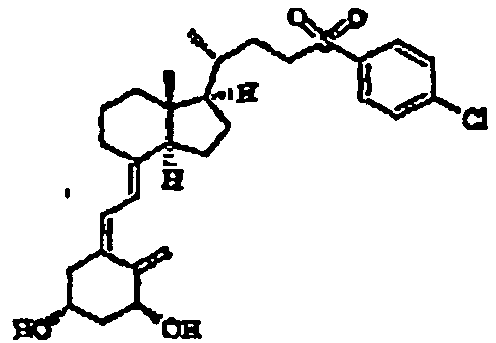
94 >1000 I(g) 
212 >1000 I(i) 
92 >1000 I(u) 
160 I(cc) 
27 467 * compared to calcitrol
| Stock 10-2 M | |||
| Concentration (final) |
From previous step | DMEM + 1%BSA | Concentration (actual) |
| 10-5 M | 4 | 496 | 8*10-5 M |
| 10-6 M | 12.5 | 112.5 | 8*10-6 M |
| 10-7 M | 12.5 | 112.5 | 8* 10-7 M |
| 10-8 M | 12.5 | 112.5 | 8*10-8 M |
| Stock 10-3 M | |||
| Concentration (final) |
From previous step (µL) |
DMEM + 1%BSA (µL) |
Concentration (actual) |
| 10-5 |
10 | 115 | 8*10-5 M |
| 10-6 M | 12.5 | 112.5 | 8*10-6 M |
| 10-7 M | 12.5 | 112.5 | 8*10-7 M |
| 10-8 M | 12.5 | 112.5 | 8*10-8 M |
2. TEK300/Gelatin solution
50 mg swine gelatin
5 ml TEDK300 solution
heating, stirring then cooling to 4°C.
5 ml TEDK300 solution
3. Preparation of 1,25(OH)2D3 and test compounds in ethanol
1,25(OH)2D3: 125, 250, 500, 1000, 2000, 4000 pg/250. (stock 10-5 M/25µL = 100,000pg/25µL)
Test compounds: 12,500, 25,000, 50,000, 100,000, 200,000 and 400,000 pg/25 µL. (4*10-5M/25µL = 400,000 pg/25µL)
| Label | Concentration (ng/mL) | Amount (pg/50µL) |
| 5.0 | 125 | |
| Std F | 10.0 | 250 |
| Std G | 20.0 | 500 |
| Std H | 40.0 | 1000 |
| 80.0 | 2000 | |
| Std I | 160.0 | 4000 |
4. Dilution of VDR
1 µl stock VDR in 2.5 ml TEDK300/Gelatin solution (500µl/tube), (keep on ice)
Claims (29)
- A compound of Formula I, and pharmaceutically acceptable salts, hydrates, solvates and prodrugs thereof, wherein the prodrug is an ester prodrug selected from the group consisting of phenyl esters, aliphatic C8-C24 esters, acyloxymethyl esters, carbamates and amino acid esters:

R1 and R2 are independently selected from the group consisting of OH, OC1-4alkyl, and halo;
R3 is C1-4alkyl;
R4 is selected from the group consisting of aryl and heteroaryl with both aryl and heteroaryl being unsubstituted or substituted with 1-5 groups independently selected from C1-4alkyl, hydroxy-substituted C1-6alkyl, OC1-4alkyl, OH, CF3, OCF3, halo, SH, SC1-4alkyl, NH2, NHC1-4alkyl, N(C1-4alkyl)(C1-4alkyl), CN, C(O)OH, C(O)OC1-4alkyl, C(O)NHC1-4alkyl, CH=N-OC1-4alkyl, NHC(O)C1-4alkyl, OC(O)C1-4alkyl, SOC1-4alkyl, SO2C1-4alkyl, SO2NHC1-alkyl and SO2NH2:
R5 are either both H or together form =CH2;
R6 and R7 are independently H, C1-4alkyl or are taken together to form a C3-6cyloalkyl ring;
x is 0-2; and
---- represents a single or a double bond. - A compound according to claim 1, wherein R1 and R2 are independently selected from the group consisting OH, OCH3, and fluoro.
- A compound according to claim 2, wherein R1 and R2 are both OH.
- A compound according to claim 1, 2 or 3 wherein R3 is CH3.
- A compound according to any one of claims 1 to 4, wherein R4 is selected from the group consisting of unsubstituted and substituted phenyl, pyridyl, thienyl, furanyl and pyrrolo.
- A compound according to claim 5, wherein R4 is selected from unsubstituted or substituted phenyl.
- A compound according to any one of claims 1 to 4, wherein both aryl and heteroaryl are either unsubstituted or substituted with 1-3 groups independently selected from C1-4alkyl, hydroxy-substituted C1-6alkyl, OC1-4alkyl, OH, CF3, OCF3, halo, SH, SC1-4alkyl, NH2, NHC1-4alkyl, N(C1-4alkyl)(C1-aalkyl), CN, C(O)OH, C(O)OC1-4alkyl, CH=N-OC1-4alkyl, C(O)NHC1-4alkyl, NHC(O)C1-4alkyl, OC(O)C1-4alkyl, SOC1-4alkyl, SO2C1-4alkyl, SO2NHC1-4alkyl and SO2NH2.
- A compound according to claim 7, wherein both aryl and heteroaryl are either unsubstituted or substituted with 1-2 groups independently selected from methyl, 3-hydroxy-3-pentyl, methoxy, OH, CF3, OCF3, halo, NH2, NMe2 and CH=N-OMe.
- A compound according to claim 8, wherein both aryl and heteroaryl are either unsubstituted or substituted with 1-2 groups independently selected from methyl, 3-hydroxy-3-pentyl, Cl, F and CH=N-OMe.
- A compound according to claim 6, wherein R4 is selected from the group consisting of phenyl, 4-chlorophenyl, 3,4-dichloropheny, 4-fluorophenyl, 4-methylphenyl, 3,4-difluorophenyl, 4-(3-hydroxy-3-pentyl)phenyl, 4-(CH=N-OMe)phenyl, 4-methoxyphenyl, 4-trifluormethylpheny and 4-nitrophenyl.
- A compound according to claim 10, wherein R4 is selected from the group consisting of phenyl 4-chlorophenyl, 3,4-dichlorophenyl, 4-(3-hydroxy-3-pentyl)phenyl, 4-fluorophenyl and 4-methylphenyL
- A compound according to any one of claims 1 to 11, wherein R6 and R7 are independently H, methyl or are taken together to form a C3-4cyloalkyl ring.
- A compound according to claim 12, wherein R6 and R7 an both H or are taken together to form a C3-4cycloalkyl ring.
- A compound according to any one of claims 1 to 13, wherein x is 2.
- A compound according to any one of claims 1 to 14, whereinis a single bond.

- A compound according to claim 1, of Formula I', and pharmaceutically acceptable salts, hydrates, solvates and prodrugs thereof, wherein the prodrug is an ester selected from the group consisting of phenyl esters, aliphatic C8-C24 esters, acyloxymethyl esters carbamates and amino acid esters:

R1 and R2 are independently selected from the group consisting of OH, OC1-4alkyl, and halo;
R3 is C1-4alkyl;
R4 is selected from the group consisting of aryl and heteroaryl with both aryl and heteroaryl being unsubstituted or substituted with 1-5 groups independently selected from C1-4alkyl, hydroxy-substituted C1-4alkyl, OC1-4alkyl; OH, CF3, OCF3, halo, SH, SC1-4alkyl, NH2, NHC1-4alkyl, N(C1-4alkyl)(C1-4alkyl), CN, C(O)OH, C(O)OC1-4alkyl, C(O)NHC1-4alkyl, NHC(O)C1-4alkyl, OC(O)C1-4alkyl, SOC1-4alkyl, SO2C1-4alkyl, SO2NHC1-4alkyl and SO2NH2;
R5 are either both H or together form =CH2;
R6 and R7 are independently H, C1-4alkyl or are taken together to form a C3-6cyloakyl ring;
x is 0-2; and
---- represents a single or a double bond. - A compound according to claim 1 selected from:
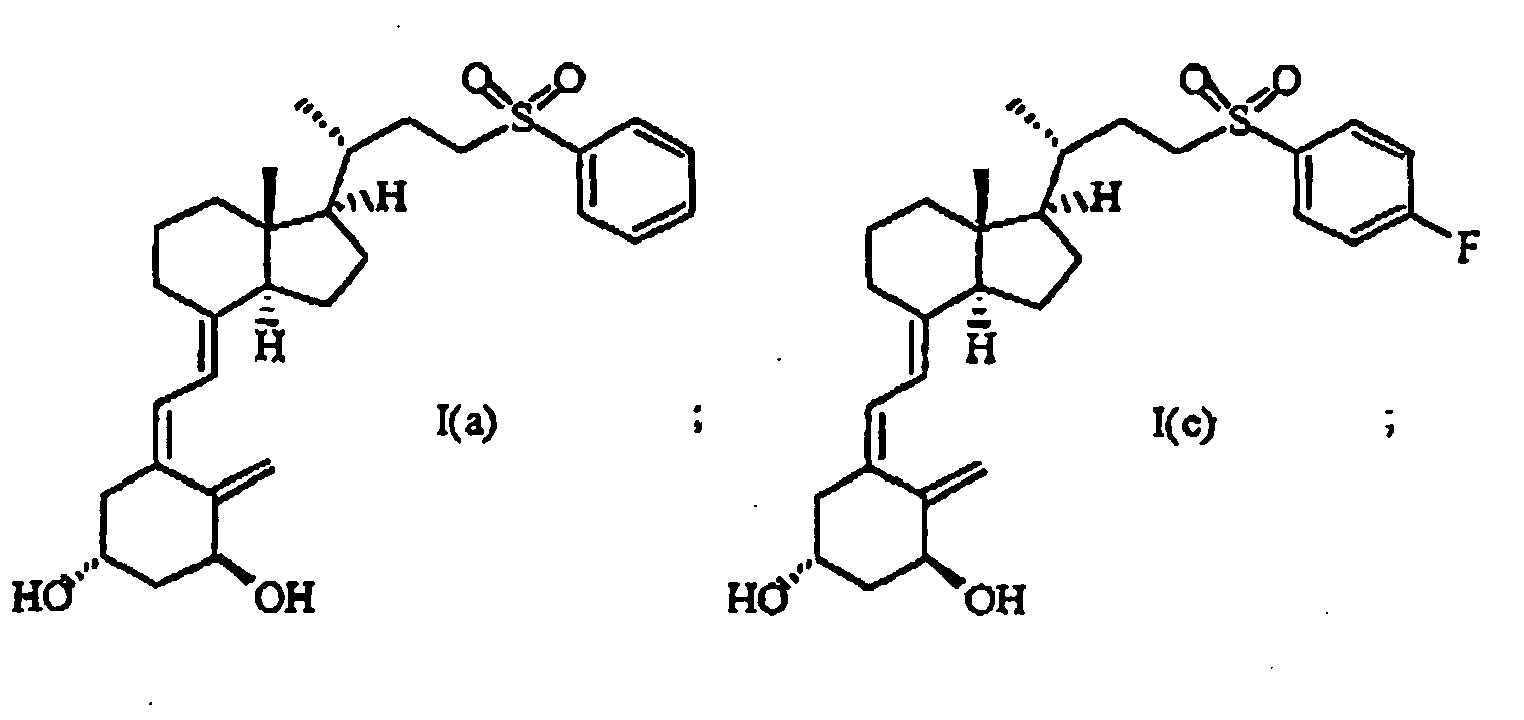


- A compound according to any one of claims 1 to 17 for use as a medicament.
- A pharmaceutical composition comprising a compound according to any of claims 1-17 and a pharmaceutically acceptable carrier.
- A use of a compound according to any of claims 1-17 to prepare a medicament for the treatment of a disease selected from the group consisting of cancer, dermatological disorders, thyroid disorders, wound healing and bone disorders.
- Use according to claim 19, wherein the disease is selected from the group consisting of cancer, psoriasis, thyroid disorders and osteoporosis.
- A use of a compound according to any of claims 1-17 to prepare a medicament to inhibit cell proliferation.
- Use according to claim 21, wherein the cell is a cancer cell.
- Use according to claim 22, wherein the cancer is selected from breast cancer, lung cancer and prostate cancer.
- A compound according to any one of claims 1 to 17 for the treatment of a disease selected from the group consisting of cancer, dermatological disorders, thyroid disorders, wound healing and bone disorders.
- A compound according to claim 25 wherein the disease is selected from the group consisting of cancer, psoriasis, thyroid disorders and osteoporosis.
- A compound according to any one of claims 1 to 17 for inhibition of cell proliferation.
- A compound according to claim 27 wherein the cell is a cancer cell
- A compound according to claim 28 wherein the cancer is selected from breast cancer, lung cancer and prostate cancer.
Applications Claiming Priority (7)
| Application Number | Priority Date | Filing Date | Title |
|---|---|---|---|
| US31376901P | 2001-08-22 | 2001-08-22 | |
| US313769P | 2001-08-22 | ||
| US32842901P | 2001-10-12 | 2001-10-12 | |
| US328429P | 2001-10-12 | ||
| US38793102P | 2002-06-13 | 2002-06-13 | |
| US387931P | 2002-06-13 | ||
| PCT/CA2002/001294 WO2003018545A1 (en) | 2001-08-22 | 2002-08-22 | 24-sulfur-substituted analogs of 1α,25-dihydroxy vitamin d¿3? |
Publications (2)
| Publication Number | Publication Date |
|---|---|
| EP1419143A1 EP1419143A1 (en) | 2004-05-19 |
| EP1419143B1 true EP1419143B1 (en) | 2009-04-15 |
Family
ID=27405675
Family Applications (1)
| Application Number | Title | Priority Date | Filing Date |
|---|---|---|---|
| EP02752924A Expired - Lifetime EP1419143B1 (en) | 2001-08-22 | 2002-08-22 | 24-sulfur-substituted analogs of 1alpha,25-dihydroxy vitamin d3 |
Country Status (6)
| Country | Link |
|---|---|
| EP (1) | EP1419143B1 (en) |
| JP (1) | JP2005500402A (en) |
| AT (1) | ATE428692T1 (en) |
| CA (1) | CA2458415C (en) |
| DE (1) | DE60231987D1 (en) |
| WO (1) | WO2003018545A1 (en) |
Families Citing this family (5)
| Publication number | Priority date | Publication date | Assignee | Title |
|---|---|---|---|---|
| CA2581693A1 (en) * | 2004-07-28 | 2006-02-02 | Lipopeptide Ab | New use |
| WO2006036892A2 (en) * | 2004-09-24 | 2006-04-06 | Sapphire Therapeutics, Inc. | Use of inhibitors of 24-hydroxylase in the treatment of cancer |
| WO2006037023A2 (en) * | 2004-09-24 | 2006-04-06 | Sapphire Therapeutics, Inc. | Use of inhibitors of 24-hydroxylase in the treatment of cancer |
| JP2010524973A (en) * | 2007-04-18 | 2010-07-22 | ジョンズ ホプキンス ユニバーシティ | A hypocalcemic, highly antiproliferative analog of calcitriol |
| WO2025094144A1 (en) | 2023-11-02 | 2025-05-08 | Eirgen Pharma Ltd. | Controlling loss of kidney function |
Family Cites Families (5)
| Publication number | Priority date | Publication date | Assignee | Title |
|---|---|---|---|---|
| US4973584A (en) * | 1989-03-09 | 1990-11-27 | Deluca Hector F | Novel 1α-hydroxyvitamin D2 epimer and derivatives |
| GB9007236D0 (en) * | 1990-03-30 | 1990-05-30 | Leo Pharm Prod Ltd | Chemical compounds |
| GB9223061D0 (en) * | 1992-11-04 | 1992-12-16 | Leo Pharm Prod Ltd | Chemical compounds |
| GB9226877D0 (en) * | 1992-12-23 | 1993-02-17 | Leo Pharm Prod Ltd | Chemical compounds |
| WO2000059513A1 (en) * | 1999-04-01 | 2000-10-12 | Johns Hopkins University | NON-CALCEMIC, ANTIPROLIFERATIVE, TRANSCRIPTIONALLY ACTIVE SULFUR-CONTAINING ANALOGS OF 1α, 25-DIHYDROXY VITAMIN D¿3? |
-
2002
- 2002-08-22 AT AT02752924T patent/ATE428692T1/en not_active IP Right Cessation
- 2002-08-22 WO PCT/CA2002/001294 patent/WO2003018545A1/en not_active Ceased
- 2002-08-22 CA CA2458415A patent/CA2458415C/en not_active Expired - Fee Related
- 2002-08-22 DE DE60231987T patent/DE60231987D1/en not_active Expired - Lifetime
- 2002-08-22 EP EP02752924A patent/EP1419143B1/en not_active Expired - Lifetime
- 2002-08-22 JP JP2003523209A patent/JP2005500402A/en active Pending
Also Published As
| Publication number | Publication date |
|---|---|
| CA2458415A1 (en) | 2003-03-06 |
| JP2005500402A (en) | 2005-01-06 |
| WO2003018545A1 (en) | 2003-03-06 |
| WO2003018545B1 (en) | 2003-07-31 |
| ATE428692T1 (en) | 2009-05-15 |
| DE60231987D1 (en) | 2009-05-28 |
| CA2458415C (en) | 2010-09-21 |
| EP1419143A1 (en) | 2004-05-19 |
Similar Documents
| Publication | Publication Date | Title |
|---|---|---|
| EP1436257B1 (en) | Low-calcemic oxime analogs of 1alpha, 25-dihydroxy vitamin d3 | |
| JP3630101B2 (en) | Sulfur-containing analogs of 1α, 25-dihydroxyvitamin D3 exhibiting non-calcemic growth suppression and transcriptional regulatory activity | |
| EP1511725B1 (en) | 24-sulfoximine vitamin d3 compounds | |
| CZ403197A3 (en) | Derivatives of vitamin d with substituents in position c-25, process of their preparation, intermediates for such process as well as their use for preparing medicaments | |
| US8106035B2 (en) | 25-SO2-substituted analogs of 1μ,25-dihydroxyvitamin D3 | |
| US7166585B2 (en) | 24-Sulfur-substituted analogs of 1α,25-dihydroxy vitamin D3 | |
| US20030149005A1 (en) | 24-sulfur-substituted analogs of 1alpha, 25-dihydroxy vitamin D3 | |
| CA2458415C (en) | 24-sulfur-substituted analogs of 1.alpha.,25-dihydroxy vitamin d3 | |
| EP1883626B1 (en) | Low-calcemic 16,23-diene 25-oxime analogs of 1alpha,25-dihydroxy vitamin d3 | |
| JP2006525367A (en) | Gemini vitamin D3 compound and method of use thereof | |
| AU2005309747A1 (en) | 2-methylene-18,19-dinor-1alpha-hydroxy-homopregnacalciferol and its uses | |
| KR20000010702A (en) | New vitamin d analogue | |
| HK1100066B (en) | Non-calcemic, antiproliferative, transcriptionally active sulfur-containing analogs of 1-alpha 25-dihydroxy vitamin d3 |
Legal Events
| Date | Code | Title | Description |
|---|---|---|---|
| PUAI | Public reference made under article 153(3) epc to a published international application that has entered the european phase |
Free format text: ORIGINAL CODE: 0009012 |
|
| 17P | Request for examination filed |
Effective date: 20040310 |
|
| AK | Designated contracting states |
Kind code of ref document: A1 Designated state(s): AT BE BG CH CY CZ DE DK EE ES FI FR GB GR IE IT LI LU MC NL PT SE SK TR |
|
| AX | Request for extension of the european patent |
Extension state: AL LT LV MK RO SI |
|
| RIN1 | Information on inventor provided before grant (corrected) |
Inventor name: JONES, GLENVILLE Inventor name: SUH, BYUNG-CHUL Inventor name: WHITE, JAY, A. Inventor name: CRAWFORD, KENNETH, R. Inventor name: POSNER, GARY, H. Inventor name: HATCHER, MARK Inventor name: YANG, HONG, WOON Inventor name: JEON, HEUNGBAE |
|
| RAP1 | Party data changed (applicant data changed or rights of an application transferred) |
Owner name: CYTOCHROMA INC. Owner name: JOHNS HOPKINS UNIVERSITY |
|
| 17Q | First examination report despatched |
Effective date: 20070608 |
|
| RIN1 | Information on inventor provided before grant (corrected) |
Inventor name: WHITE, JAY, A. Inventor name: YANG, HONG, WOON Inventor name: JEON, HEUNGBAE Inventor name: HATCHER, MARK Inventor name: POSNER, GARY, H. Inventor name: JONES, GLENVILLE Inventor name: CRAWFORD, KENNETH, R. Inventor name: SUH, BYUNG-CHUL |
|
| GRAP | Despatch of communication of intention to grant a patent |
Free format text: ORIGINAL CODE: EPIDOSNIGR1 |
|
| GRAS | Grant fee paid |
Free format text: ORIGINAL CODE: EPIDOSNIGR3 |
|
| GRAA | (expected) grant |
Free format text: ORIGINAL CODE: 0009210 |
|
| AK | Designated contracting states |
Kind code of ref document: B1 Designated state(s): AT BE BG CH CY CZ DE DK EE ES FI FR GB GR IE IT LI LU MC NL PT SE SK TR |
|
| REG | Reference to a national code |
Ref country code: GB Ref legal event code: FG4D Ref country code: CH Ref legal event code: EP |
|
| REG | Reference to a national code |
Ref country code: IE Ref legal event code: FG4D |
|
| REF | Corresponds to: |
Ref document number: 60231987 Country of ref document: DE Date of ref document: 20090528 Kind code of ref document: P |
|
| REG | Reference to a national code |
Ref country code: CH Ref legal event code: NV Representative=s name: MICHELI & CIE SA |
|
| NLV1 | Nl: lapsed or annulled due to failure to fulfill the requirements of art. 29p and 29m of the patents act | ||
| PG25 | Lapsed in a contracting state [announced via postgrant information from national office to epo] |
Ref country code: ES Free format text: LAPSE BECAUSE OF FAILURE TO SUBMIT A TRANSLATION OF THE DESCRIPTION OR TO PAY THE FEE WITHIN THE PRESCRIBED TIME-LIMIT Effective date: 20090726 Ref country code: AT Free format text: LAPSE BECAUSE OF FAILURE TO SUBMIT A TRANSLATION OF THE DESCRIPTION OR TO PAY THE FEE WITHIN THE PRESCRIBED TIME-LIMIT Effective date: 20090415 Ref country code: FI Free format text: LAPSE BECAUSE OF FAILURE TO SUBMIT A TRANSLATION OF THE DESCRIPTION OR TO PAY THE FEE WITHIN THE PRESCRIBED TIME-LIMIT Effective date: 20090415 Ref country code: PT Free format text: LAPSE BECAUSE OF FAILURE TO SUBMIT A TRANSLATION OF THE DESCRIPTION OR TO PAY THE FEE WITHIN THE PRESCRIBED TIME-LIMIT Effective date: 20090915 |
|
| PG25 | Lapsed in a contracting state [announced via postgrant information from national office to epo] |
Ref country code: SE Free format text: LAPSE BECAUSE OF FAILURE TO SUBMIT A TRANSLATION OF THE DESCRIPTION OR TO PAY THE FEE WITHIN THE PRESCRIBED TIME-LIMIT Effective date: 20090715 Ref country code: NL Free format text: LAPSE BECAUSE OF FAILURE TO SUBMIT A TRANSLATION OF THE DESCRIPTION OR TO PAY THE FEE WITHIN THE PRESCRIBED TIME-LIMIT Effective date: 20090415 |
|
| PG25 | Lapsed in a contracting state [announced via postgrant information from national office to epo] |
Ref country code: DK Free format text: LAPSE BECAUSE OF FAILURE TO SUBMIT A TRANSLATION OF THE DESCRIPTION OR TO PAY THE FEE WITHIN THE PRESCRIBED TIME-LIMIT Effective date: 20090415 Ref country code: EE Free format text: LAPSE BECAUSE OF FAILURE TO SUBMIT A TRANSLATION OF THE DESCRIPTION OR TO PAY THE FEE WITHIN THE PRESCRIBED TIME-LIMIT Effective date: 20090415 Ref country code: CZ Free format text: LAPSE BECAUSE OF FAILURE TO SUBMIT A TRANSLATION OF THE DESCRIPTION OR TO PAY THE FEE WITHIN THE PRESCRIBED TIME-LIMIT Effective date: 20090415 |
|
| PLBE | No opposition filed within time limit |
Free format text: ORIGINAL CODE: 0009261 |
|
| STAA | Information on the status of an ep patent application or granted ep patent |
Free format text: STATUS: NO OPPOSITION FILED WITHIN TIME LIMIT |
|
| PG25 | Lapsed in a contracting state [announced via postgrant information from national office to epo] |
Ref country code: BE Free format text: LAPSE BECAUSE OF FAILURE TO SUBMIT A TRANSLATION OF THE DESCRIPTION OR TO PAY THE FEE WITHIN THE PRESCRIBED TIME-LIMIT Effective date: 20090415 Ref country code: SK Free format text: LAPSE BECAUSE OF FAILURE TO SUBMIT A TRANSLATION OF THE DESCRIPTION OR TO PAY THE FEE WITHIN THE PRESCRIBED TIME-LIMIT Effective date: 20090415 |
|
| 26N | No opposition filed |
Effective date: 20100118 |
|
| PG25 | Lapsed in a contracting state [announced via postgrant information from national office to epo] |
Ref country code: BG Free format text: LAPSE BECAUSE OF FAILURE TO SUBMIT A TRANSLATION OF THE DESCRIPTION OR TO PAY THE FEE WITHIN THE PRESCRIBED TIME-LIMIT Effective date: 20090715 Ref country code: MC Free format text: LAPSE BECAUSE OF NON-PAYMENT OF DUE FEES Effective date: 20090831 |
|
| PG25 | Lapsed in a contracting state [announced via postgrant information from national office to epo] |
Ref country code: IE Free format text: LAPSE BECAUSE OF NON-PAYMENT OF DUE FEES Effective date: 20090822 |
|
| PG25 | Lapsed in a contracting state [announced via postgrant information from national office to epo] |
Ref country code: GR Free format text: LAPSE BECAUSE OF FAILURE TO SUBMIT A TRANSLATION OF THE DESCRIPTION OR TO PAY THE FEE WITHIN THE PRESCRIBED TIME-LIMIT Effective date: 20090716 |
|
| PG25 | Lapsed in a contracting state [announced via postgrant information from national office to epo] |
Ref country code: LU Free format text: LAPSE BECAUSE OF NON-PAYMENT OF DUE FEES Effective date: 20090822 |
|
| PG25 | Lapsed in a contracting state [announced via postgrant information from national office to epo] |
Ref country code: TR Free format text: LAPSE BECAUSE OF FAILURE TO SUBMIT A TRANSLATION OF THE DESCRIPTION OR TO PAY THE FEE WITHIN THE PRESCRIBED TIME-LIMIT Effective date: 20090415 |
|
| PG25 | Lapsed in a contracting state [announced via postgrant information from national office to epo] |
Ref country code: CY Free format text: LAPSE BECAUSE OF FAILURE TO SUBMIT A TRANSLATION OF THE DESCRIPTION OR TO PAY THE FEE WITHIN THE PRESCRIBED TIME-LIMIT Effective date: 20090415 |
|
| REG | Reference to a national code |
Ref country code: FR Ref legal event code: PLFP Year of fee payment: 14 |
|
| REG | Reference to a national code |
Ref country code: FR Ref legal event code: PLFP Year of fee payment: 15 |
|
| REG | Reference to a national code |
Ref country code: FR Ref legal event code: PLFP Year of fee payment: 16 |
|
| PGFP | Annual fee paid to national office [announced via postgrant information from national office to epo] |
Ref country code: GB Payment date: 20170829 Year of fee payment: 16 Ref country code: DE Payment date: 20170829 Year of fee payment: 16 Ref country code: IT Payment date: 20170823 Year of fee payment: 16 Ref country code: FR Payment date: 20170825 Year of fee payment: 16 Ref country code: CH Payment date: 20170827 Year of fee payment: 16 |
|
| REG | Reference to a national code |
Ref country code: DE Ref legal event code: R119 Ref document number: 60231987 Country of ref document: DE |
|
| REG | Reference to a national code |
Ref country code: CH Ref legal event code: PL |
|
| GBPC | Gb: european patent ceased through non-payment of renewal fee |
Effective date: 20180822 |
|
| PG25 | Lapsed in a contracting state [announced via postgrant information from national office to epo] |
Ref country code: LI Free format text: LAPSE BECAUSE OF NON-PAYMENT OF DUE FEES Effective date: 20180831 Ref country code: CH Free format text: LAPSE BECAUSE OF NON-PAYMENT OF DUE FEES Effective date: 20180831 |
|
| PG25 | Lapsed in a contracting state [announced via postgrant information from national office to epo] |
Ref country code: IT Free format text: LAPSE BECAUSE OF NON-PAYMENT OF DUE FEES Effective date: 20180822 Ref country code: DE Free format text: LAPSE BECAUSE OF NON-PAYMENT OF DUE FEES Effective date: 20190301 |
|
| PG25 | Lapsed in a contracting state [announced via postgrant information from national office to epo] |
Ref country code: FR Free format text: LAPSE BECAUSE OF NON-PAYMENT OF DUE FEES Effective date: 20180831 |
|
| PG25 | Lapsed in a contracting state [announced via postgrant information from national office to epo] |
Ref country code: GB Free format text: LAPSE BECAUSE OF NON-PAYMENT OF DUE FEES Effective date: 20180822 |