EP1418540A2 - Physics based neural network for isolating faults - Google Patents
Physics based neural network for isolating faults Download PDFInfo
- Publication number
- EP1418540A2 EP1418540A2 EP03256159A EP03256159A EP1418540A2 EP 1418540 A2 EP1418540 A2 EP 1418540A2 EP 03256159 A EP03256159 A EP 03256159A EP 03256159 A EP03256159 A EP 03256159A EP 1418540 A2 EP1418540 A2 EP 1418540A2
- Authority
- EP
- European Patent Office
- Prior art keywords
- output
- pbnn
- nodes
- input
- layer
- Prior art date
- Legal status (The legal status is an assumption and is not a legal conclusion. Google has not performed a legal analysis and makes no representation as to the accuracy of the status listed.)
- Withdrawn
Links
Images
Classifications
-
- G—PHYSICS
- G06—COMPUTING OR CALCULATING; COUNTING
- G06N—COMPUTING ARRANGEMENTS BASED ON SPECIFIC COMPUTATIONAL MODELS
- G06N3/00—Computing arrangements based on biological models
- G06N3/02—Neural networks
- G06N3/04—Architecture, e.g. interconnection topology
-
- G—PHYSICS
- G06—COMPUTING OR CALCULATING; COUNTING
- G06N—COMPUTING ARRANGEMENTS BASED ON SPECIFIC COMPUTATIONAL MODELS
- G06N3/00—Computing arrangements based on biological models
- G06N3/02—Neural networks
- G06N3/04—Architecture, e.g. interconnection topology
- G06N3/042—Knowledge-based neural networks; Logical representations of neural networks
-
- G—PHYSICS
- G06—COMPUTING OR CALCULATING; COUNTING
- G06N—COMPUTING ARRANGEMENTS BASED ON SPECIFIC COMPUTATIONAL MODELS
- G06N3/00—Computing arrangements based on biological models
- G06N3/02—Neural networks
- G06N3/04—Architecture, e.g. interconnection topology
- G06N3/0499—Feedforward networks
-
- G—PHYSICS
- G06—COMPUTING OR CALCULATING; COUNTING
- G06N—COMPUTING ARRANGEMENTS BASED ON SPECIFIC COMPUTATIONAL MODELS
- G06N3/00—Computing arrangements based on biological models
- G06N3/02—Neural networks
- G06N3/08—Learning methods
- G06N3/09—Supervised learning
Definitions
- the present invention relates to a physics based neural network (PBNN) for faults in physical systems. More specifically, the present invention relates to a PBNN for identifying the cause of a singular event caused by independent external or internal systems or interrelated combinations such as a propagating fault within a module or between modules.
- PBNN physics based neural network
- Fault isolation whereby a plurality of inputs representing components of a physical system are examined to detect failures of the system components, has usually been done manually using "fingerprint” charts, as well as manually with excel spreadsheets that use influence coefficients, with neural networks trained on examples of faults, and with Kalman filters.
- Spreadsheet solutions are the easiest to set up but do not rigorously handle data accuracy and are not easily automated. It is necessary to first generate the signatures of the separate faults to train neural networks to recognize faults.
- neural networks require event data and are produced in reaction to events not proactively to detect the early stages of events.
- Typical Kalman Filters typically are configured as multiple fault detectors and therefore are not accurate for separating out rapid changes in single faults involving just one or two components, or particular sections of one component. As a result Kalman Filters and neural networks are adept at selecting the most probable causes of system faults but cannot determine with confidence the individual component contributing to a system fault.
- PBNN for identifying the cause of a singular event caused by independent external or internal systems or interrelated combinations such as a propagating fault within a module or between modules.
- a PBNN for isolating faults in a plurality of components forming a physical system comprises a plurality of input nodes each input node comprising a plurality of inputs comprising a measurement of the physical system, and an input transfer function comprising a hyperplane representation of at least one fault for converting the at least one input into a first layer output, a plurality of hidden layer nodes each receiving at least one first layer output and comprising a hidden layer transfer function for converting the at least one of at least one first layer output into a hidden layer output comprising a root sum square of a plurality of distances of at least one of the at least one first layer outputs, and a plurality of output nodes each receiving at least one of the at least one hidden layer outputs and comprising an output transfer function for converting the at least one hidden layer outputs into an output.
- PBNN physics based neural network
- PBNNs provide efficient computational mechanisms for the identification, representation, and solution of physical systems based on a partial understanding of the physics and without the need for extensive experimental data. Therefore, PBNNs form quasi-neural networks which recognize the fractal nature of real neural networks.
- fractal relates to the property of PBNNs scale up and down the concepts embedded within them. Scaling down is the process whereby individual neural functions are tailored using domain knowledge to create fully structured but partially understood processes that can be trained. Scaling up is the process whereby whole heuristic or computational processes are configured in a neural network and trained without the need for extensive experimental data.
- a PBNN is a network of nodes, each of which consists of a set of inputs, a single output, and a transfer function between them.
- a single PBNN node is defined by specifying its transfer function and designating the outputs of other PBNN nodes as its input quantities. Processing through the node consists of collecting the input quantities, evaluating the transfer function, and setting the output to the result.
- the transfer function can consist of a connected collection of other PBNNs (called internal nodes) or any other mathematical relationship defined between the input and output values.
- Internal nodes in a PBNN network can be other PBNN networks. Assembling a PBNN network for a given problem is done by decomposing its defined set of mathematical equations into a collection of nodes. Complex functions can then be decomposed of collections of more elementary functions, down to a reasonably low level of definition.
- Elementary PBNN nodes have been used to represent simple mathematical operations like sums or products, exponentials, and elementary trigonometric functions. Since a PBNN node in one network can consist of a complete network itself, the internal transfer function can become as complex as desired.
- PBNN node One interesting type of elementary PBNN node is the "parameter" node, where the underlying transfer function simply sets a constant output regardless of input. These nodes are used to represent parameters in a computation. They can be, however, designated as adaptive, and thereby tuned to a given problem.
- a complete PBNN network is built from a set of PBNN nodes, with the internal connectivity defined by the underlying model. Once the individual nodes are defined and connected as desired, the user then selects which nodes will represent "output" quantities in the overall calculation. Additional nodes are designated as “training” quantities, which are modified as the network is tuned to a given problem. Finally, a set of nodes is designated as "input” nodes, whose values are set externally during each processing run.
- the collection of PBNN networks, input node set, training node set, and output node set makes up a complete PBNN.
- PBNN networks are run in two stages.
- the first, training stage consists of presenting a known set of inputs and outputs to the PBNN network, and adjusting the training nodes to minimize the resulting error. This can be done in a variety of ways including, but not limited to, varieties of the backpropagation algorithm used in traditional neural networks, conjugate gradient methods, genetic algorithms, and the Alopex algorithm.
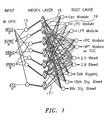
- a PBNN of the present invention configured to detect faults in an engine. While illustrated with reference to an engine system, the present invention is drawn broadly to include any physical system which can be modeled by a PBNN.
- the first layer of neurons 13 is embedded with the domain knowledge efficiency and flow influence coefficients for the parameter changes that occur for every individual fault or combination of faults that is anticipated as possible. It can include the individual influence coefficients for each module, desired portion of a module, or for specific combinations of modules to be monitored.
- inputs are formed from percent changes in a plurality of system measurements comprised of readings for engine temperature (EGT), fuel flow (WF), high rotor speed (N2), low rotor speed (N1), and compressor temperature (T3). Therefore each of the first layer's nodes is a hyperplane representation of the fault or combination of faults to be detected.
- Each parameter is normalized with its own standard deviation before being compared with each hyperplane.
- the root sum square of the distances (Gausian distance) of the parameters from each hyperspace forms the non-dimensional error term outputted by hidden layer of nodes 15 to the output layer nodes 19 of the PBNN.
- Each output layer node 19 represents the classification for one of each of the original events selected for isolation. The smallest total error represents the best overall match of the event.
- the output neurons are not trained to fire above a certain predefined threshold.
- each output neuron's level reflects the classification error, therefore lower is better.
- weights 21 leading to the output layer can then be trained or optimized to better separate the events as is done with vector machines, in a preferred embodiment, it is better to not optimize the weights 21 for two reasons.
- the error terms computed at the output nodes are related to the accuracy of the output decision and to the ambiguity inherent in the classification.
- the lower the error term the more closely the solution matches the pattern within the data. But the closer the error term becomes between two output solutions, the more ambiguous the solution is. Training the output to separate and distinguish between solutions can hide ambiguity and therefore can be misleading.
- the closeness of the classification pattern match is important additional information for the next process which for example could be the selecting of a specific order of maintenance actions.
- the maintenance decision usually inversely weights the probability that the classification is correct with the cost of the maintenance action. Therefore it is best to keep the error terms as pure as possible.
- the PBNN provides the hierarchy of possible causes and the measure of confidence in each possible cause.
Landscapes
- Engineering & Computer Science (AREA)
- Theoretical Computer Science (AREA)
- Physics & Mathematics (AREA)
- General Health & Medical Sciences (AREA)
- Computing Systems (AREA)
- Biomedical Technology (AREA)
- Biophysics (AREA)
- Computational Linguistics (AREA)
- Data Mining & Analysis (AREA)
- Evolutionary Computation (AREA)
- Life Sciences & Earth Sciences (AREA)
- Molecular Biology (AREA)
- Artificial Intelligence (AREA)
- General Engineering & Computer Science (AREA)
- General Physics & Mathematics (AREA)
- Mathematical Physics (AREA)
- Software Systems (AREA)
- Health & Medical Sciences (AREA)
- Test And Diagnosis Of Digital Computers (AREA)
- Debugging And Monitoring (AREA)
Abstract
A PBNN for isolating faults in a plurality of components forming a physical system comprising a plurality of input nodes each input node comprising a plurality of inputs comprising a measurement of the physical system, and an input transfer function comprising a hyperplane representation of at least one fault for converting the at least one input into a first layer output, a plurality of hidden layer nodes each receiving at least one first layer output and comprising a hidden transfer function for converting the at least one of at least one first layer output into a hidden layer output comprising a root sum square of a plurality of distances of at least one of the at least one first layer outputs, and a plurality of output nodes each receiving at least one of the at least one hidden layer outputs and comprising an output transfer function for converting the at least one hidden layer outputs into an output. <IMAGE>
Description
The present invention relates to a physics based neural
network (PBNN) for faults in physical systems. More
specifically, the present invention relates to a PBNN for
identifying the cause of a singular event caused by independent
external or internal systems or interrelated combinations such
as a propagating fault within a module or between modules.
Fault isolation, whereby a plurality of inputs representing
components of a physical system are examined to detect failures
of the system components, has usually been done manually using
"fingerprint" charts, as well as manually with excel
spreadsheets that use influence coefficients, with neural
networks trained on examples of faults, and with Kalman filters.
Spreadsheet solutions are the easiest to set up but do not
rigorously handle data accuracy and are not easily automated.
It is necessary to first generate the signatures of the separate faults to train neural networks to recognize faults. In addition, neural networks require event data and are produced in reaction to events not proactively to detect the early stages of events. Typical Kalman Filters typically are configured as multiple fault detectors and therefore are not accurate for separating out rapid changes in single faults involving just one or two components, or particular sections of one component. As a result Kalman Filters and neural networks are adept at selecting the most probable causes of system faults but cannot determine with confidence the individual component contributing to a system fault.
It is necessary to first generate the signatures of the separate faults to train neural networks to recognize faults. In addition, neural networks require event data and are produced in reaction to events not proactively to detect the early stages of events. Typical Kalman Filters typically are configured as multiple fault detectors and therefore are not accurate for separating out rapid changes in single faults involving just one or two components, or particular sections of one component. As a result Kalman Filters and neural networks are adept at selecting the most probable causes of system faults but cannot determine with confidence the individual component contributing to a system fault.
What is therefore needed is an automated system for
identifying the cause of a single event that is caused by
independent external or internal system or interrelated
combinations such as a propagating fault within a module or
between modules.
Accordingly, it is an object of the present invention to
provide a PBNN for identifying the cause of a singular event
caused by independent external or internal systems or
interrelated combinations such as a propagating fault within a
module or between modules.
In accordance with the present invention, a PBNN for
isolating faults in a plurality of components forming a physical
system comprises a plurality of input nodes each input node
comprising a plurality of inputs comprising a measurement of the
physical system, and an input transfer function comprising a
hyperplane representation of at least one fault for converting
the at least one input into a first layer output, a plurality of
hidden layer nodes each receiving at least one first layer
output and comprising a hidden layer transfer function for
converting the at least one of at least one first layer output
into a hidden layer output comprising a root sum square of a
plurality of distances of at least one of the at least one first
layer outputs, and a plurality of output nodes each receiving at
least one of the at least one hidden layer outputs and
comprising an output transfer function for converting the at
least one hidden layer outputs into an output.
It is the central purpose of this invention to provide a
physics based neural network (PBNN) for identifying the cause of
a single event that is caused by independent external or
internal systems or interrelated combinations such as a
propagating fault within a module or between modules.
PBNNs, as will be described more fully below, provide
efficient computational mechanisms for the identification,
representation, and solution of physical systems based on a
partial understanding of the physics and without the need for
extensive experimental data. Therefore, PBNNs form quasi-neural
networks which recognize the fractal nature of real neural
networks. As used herein "fractal" relates to the property of
PBNNs scale up and down the concepts embedded within them.
Scaling down is the process whereby individual neural functions
are tailored using domain knowledge to create fully structured
but partially understood processes that can be trained. Scaling
up is the process whereby whole heuristic or computational
processes are configured in a neural network and trained without
the need for extensive experimental data.
A PBNN is a network of nodes, each of which consists of a
set of inputs, a single output, and a transfer function between
them. A single PBNN node is defined by specifying its transfer
function and designating the outputs of other PBNN nodes as its
input quantities. Processing through the node consists of
collecting the input quantities, evaluating the transfer
function, and setting the output to the result. The transfer
function can consist of a connected collection of other PBNNs
(called internal nodes) or any other mathematical relationship
defined between the input and output values.
Internal nodes in a PBNN network can be other PBNN
networks. Assembling a PBNN network for a given problem is done
by decomposing its defined set of mathematical equations into a
collection of nodes. Complex functions can then be decomposed
of collections of more elementary functions, down to a
reasonably low level of definition. Elementary PBNN nodes have
been used to represent simple mathematical operations like sums
or products, exponentials, and elementary trigonometric
functions. Since a PBNN node in one network can consist of a
complete network itself, the internal transfer function can
become as complex as desired.
One interesting type of elementary PBNN node is the
"parameter" node, where the underlying transfer function simply
sets a constant output regardless of input. These nodes are
used to represent parameters in a computation. They can be,
however, designated as adaptive, and thereby tuned to a given
problem.
A complete PBNN network is built from a set of PBNN nodes,
with the internal connectivity defined by the underlying model.
Once the individual nodes are defined and connected as desired,
the user then selects which nodes will represent "output"
quantities in the overall calculation. Additional nodes are
designated as "training" quantities, which are modified as the
network is tuned to a given problem. Finally, a set of nodes is
designated as "input" nodes, whose values are set externally
during each processing run. The collection of PBNN networks,
input node set, training node set, and output node set, makes up
a complete PBNN.
PBNN networks are run in two stages. The first, training
stage, consists of presenting a known set of inputs and outputs
to the PBNN network, and adjusting the training nodes to
minimize the resulting error. This can be done in a variety of
ways including, but not limited to, varieties of the
backpropagation algorithm used in traditional neural networks,
conjugate gradient methods, genetic algorithms, and the Alopex
algorithm.
With reference to Fig. 1, there is illustrated a PBNN of
the present invention configured to detect faults in an engine.
While illustrated with reference to an engine system, the
present invention is drawn broadly to include any physical
system which can be modeled by a PBNN. The first layer of
neurons 13 is embedded with the domain knowledge efficiency and
flow influence coefficients for the parameter changes that occur
for every individual fault or combination of faults that is
anticipated as possible. It can include the individual
influence coefficients for each module, desired portion of a
module, or for specific combinations of modules to be monitored.
In the example illustrated herein, inputs are formed from
percent changes in a plurality of system measurements comprised
of readings for engine temperature (EGT), fuel flow (WF), high
rotor speed (N2), low rotor speed (N1), and compressor
temperature (T3). Therefore each of the first layer's nodes is
a hyperplane representation of the fault or combination of
faults to be detected. Each parameter is normalized with its
own standard deviation before being compared with each
hyperplane. The root sum square of the distances (Gausian
distance) of the parameters from each hyperspace forms the non-dimensional
error term outputted by hidden layer of nodes 15 to
the output layer nodes 19 of the PBNN. Each output layer node 19
represents the classification for one of each of the original
events selected for isolation. The smallest total error
represents the best overall match of the event. In this PBNN 1
the output neurons are not trained to fire above a certain
predefined threshold. In this PBNN each output neuron's level
reflects the classification error, therefore lower is better.
In the present example, there are illustrated ten
individual engine modules being monitored for the presence of
faults by output layer nodes 19. When the output of one such
output layer node 19 exceeds the predefined threshold for the
node, the node's output indicates the presence of a fault.
While the weights 21 leading to the output layer can then
be trained or optimized to better separate the events as is done
with vector machines, in a preferred embodiment, it is better to
not optimize the weights 21 for two reasons.
First, the error terms computed at the output nodes are
related to the accuracy of the output decision and to the
ambiguity inherent in the classification. The lower the error
term the more closely the solution matches the pattern within
the data. But the closer the error term becomes between two
output solutions, the more ambiguous the solution is. Training
the output to separate and distinguish between solutions can
hide ambiguity and therefore can be misleading.
Second, the closeness of the classification pattern match
is important additional information for the next process which
for example could be the selecting of a specific order of
maintenance actions. The maintenance decision usually inversely
weights the probability that the classification is correct with
the cost of the maintenance action. Therefore it is best to
keep the error terms as pure as possible. The PBNN provides the
hierarchy of possible causes and the measure of confidence in
each possible cause.
It is apparent that there has been provided in accordance
with the present invention a PBNN for identifying the cause of a
singular event caused by independent external or internal
systems or interrelated combinations such as a propagating fault
within a module or between modules. While the present invention
has been described in the context of specific embodiments
thereof, other alternatives, modifications, and variations will
become apparent to those skilled in the art having read the
foregoing description. Accordingly, it is intended to embrace
those alternatives, modifications, and variations as fall within
the broad scope of the appended claims.
Claims (6)
- A PBNN for isolating faults in a plurality of components forming:a physical system comprising:a plurality of input nodes each input node comprising:a plurality of inputs comprising a measurement of said physical system; andan input transfer function comprising a hyperplane representation of at least one fault for converting said at least one input into a first layer output;a plurality of hidden layer nodes each receiving at least one first layer output and comprising a hidden transfer function for converting said at least one of at least one first layer output into a hidden layer output comprising a root sum square of a plurality of distances of at least one of said at least one first layer outputs; anda plurality of output nodes each receiving at least one of said at least one hidden layer outputs and comprising an output transfer function for converting said at least one hidden layer outputs into an output.
- The PBNN of claim 1 wherein each of said input transfer functions comprise a domain knowledge efficiency and a flow influence coefficient.
- The PBNN of claim 1 wherein each of said plurality of measurements is comprised of a percent change.
- The PBNN of claim 3 wherein each of said measurements is normalized with a standard deviation of said measurements.
- The PBNN of claim 1 wherein each of said plurality of output nodes further comprises at least one weight each associated with one of said at least one hidden layer outputs.
- The PBNN of claim 5, wherein said at least one weight is altered to a value sufficient to provide increased functionality.
Applications Claiming Priority (2)
| Application Number | Priority Date | Filing Date | Title |
|---|---|---|---|
| US10/261,265 US20040064427A1 (en) | 2002-09-30 | 2002-09-30 | Physics based neural network for isolating faults |
| US261265 | 2002-09-30 |
Publications (1)
| Publication Number | Publication Date |
|---|---|
| EP1418540A2 true EP1418540A2 (en) | 2004-05-12 |
Family
ID=32029932
Family Applications (1)
| Application Number | Title | Priority Date | Filing Date |
|---|---|---|---|
| EP03256159A Withdrawn EP1418540A2 (en) | 2002-09-30 | 2003-09-30 | Physics based neural network for isolating faults |
Country Status (3)
| Country | Link |
|---|---|
| US (1) | US20040064427A1 (en) |
| EP (1) | EP1418540A2 (en) |
| JP (1) | JP2004272878A (en) |
Families Citing this family (2)
| Publication number | Priority date | Publication date | Assignee | Title |
|---|---|---|---|---|
| CN106127301B (en) * | 2016-01-16 | 2019-01-11 | 上海大学 | A kind of stochastic neural net hardware realization apparatus |
| JP7091174B2 (en) * | 2018-07-09 | 2022-06-27 | キヤノン株式会社 | System, system control method and program |
Family Cites Families (8)
| Publication number | Priority date | Publication date | Assignee | Title |
|---|---|---|---|---|
| US4974169A (en) * | 1989-01-18 | 1990-11-27 | Grumman Aerospace Corporation | Neural network with memory cycling |
| US4945494A (en) * | 1989-03-02 | 1990-07-31 | Texas Instruments Incorporated | Neural network and system |
| JPH04266153A (en) * | 1991-02-20 | 1992-09-22 | Honda Motor Co Ltd | Neural network |
| US5263122A (en) * | 1991-04-22 | 1993-11-16 | Hughes Missile Systems Company | Neural network architecture |
| JPH0713951A (en) * | 1992-10-01 | 1995-01-17 | Sony Electron Inc | How to train a neural network |
| WO1995024684A1 (en) * | 1994-03-08 | 1995-09-14 | Alstroem Preben | A neural network |
| US5574387A (en) * | 1994-06-30 | 1996-11-12 | Siemens Corporate Research, Inc. | Radial basis function neural network autoassociator and method for induction motor monitoring |
| US6269351B1 (en) * | 1999-03-31 | 2001-07-31 | Dryken Technologies, Inc. | Method and system for training an artificial neural network |
-
2002
- 2002-09-30 US US10/261,265 patent/US20040064427A1/en not_active Abandoned
-
2003
- 2003-09-30 JP JP2003341680A patent/JP2004272878A/en active Pending
- 2003-09-30 EP EP03256159A patent/EP1418540A2/en not_active Withdrawn
Also Published As
| Publication number | Publication date |
|---|---|
| JP2004272878A (en) | 2004-09-30 |
| US20040064427A1 (en) | 2004-04-01 |
Similar Documents
| Publication | Publication Date | Title |
|---|---|---|
| CN116757534B (en) | A reliability analysis method for smart refrigerators based on neural training network | |
| Yazdani et al. | A novel gas turbine fault detection and identification strategy based on hybrid dimensionality reduction and uncertain rule-based fuzzy logic | |
| CN102265227B (en) | Method and apparatus for creating state estimation models in machine condition monitoring | |
| CN109766583A (en) | Based on no label, unbalanced, initial value uncertain data aero-engine service life prediction technique | |
| CN109035488A (en) | Aero-engine time series method for detecting abnormality based on CNN feature extraction | |
| US20040002928A1 (en) | Pattern recognition method for reducing classification errors | |
| US11989013B2 (en) | Abnormality detection apparatus, abnormality detection system, and learning apparatus, and methods for the same and non-temporary computer-readable medium storing the same | |
| US20120016824A1 (en) | Method for computer-assisted analyzing of a technical system | |
| Loboda et al. | Gas Turbine Fault Diagnosis Using Probabilistic Neural Networks. | |
| CN110083593B (en) | Power station operation parameter cleaning and repairing method and repairing system | |
| JPH10222493A (en) | Mutual causality analysis system | |
| CN120654154A (en) | Multi-parameter fusion motor performance evaluation method | |
| Yousefi et al. | Intelligent fault diagnosis of manufacturing processes using extra tree classification algorithm and feature selection strategies | |
| US8301584B2 (en) | System and method for adaptive pruning | |
| CN117193184A (en) | Intelligent manufacturing factory process quality monitoring method hybridized by VAE and deep neural network | |
| Loboda et al. | A benchmarking analysis of a data-driven gas turbine diagnostic approach | |
| CN119202829A (en) | A method for verifying abnormal water use data based on deep learning neural network | |
| Habib et al. | Machine learning-based predictive maintenance: Using CNN–LSTM network | |
| CN121351884A (en) | A method and system for early warning and diagnosis of faults in thermal power plants based on nebula systems | |
| Tang et al. | The improvement of remaining useful life prediction for aero-engines by classification and deep learning | |
| EP1418540A2 (en) | Physics based neural network for isolating faults | |
| Febriansyah et al. | Outlier detection and decision tree for wireless sensor network fault diagnosis | |
| JP2002169611A (en) | Failure diagnosis system and automatic design method thereof | |
| US20040064426A1 (en) | Physics based neural network for validating data | |
| CN119202716A (en) | A temperature sensor fault diagnosis and fault data reconstruction method, system, device and medium |
Legal Events
| Date | Code | Title | Description |
|---|---|---|---|
| PUAI | Public reference made under article 153(3) epc to a published international application that has entered the european phase |
Free format text: ORIGINAL CODE: 0009012 |
|
| AK | Designated contracting states |
Kind code of ref document: A2 Designated state(s): AT BE BG CH CY CZ DE DK EE ES FI FR GB GR HU IE IT LI LU MC NL PT RO SE SI SK TR |
|
| AX | Request for extension of the european patent |
Extension state: AL LT LV MK |
|
| STAA | Information on the status of an ep patent application or granted ep patent |
Free format text: STATUS: THE APPLICATION HAS BEEN WITHDRAWN |
|
| 18W | Application withdrawn |
Effective date: 20071016 |