EP1418223A1 - Thickener - Google Patents
Thickener Download PDFInfo
- Publication number
- EP1418223A1 EP1418223A1 EP20030025632 EP03025632A EP1418223A1 EP 1418223 A1 EP1418223 A1 EP 1418223A1 EP 20030025632 EP20030025632 EP 20030025632 EP 03025632 A EP03025632 A EP 03025632A EP 1418223 A1 EP1418223 A1 EP 1418223A1
- Authority
- EP
- European Patent Office
- Prior art keywords
- surfactant
- fatty acid
- carbon atoms
- thickener
- group
- Prior art date
- Legal status (The legal status is an assumption and is not a legal conclusion. Google has not performed a legal analysis and makes no representation as to the accuracy of the status listed.)
- Granted
Links
- 239000002562 thickening agent Substances 0.000 title claims abstract description 20
- 235000014113 dietary fatty acids Nutrition 0.000 claims abstract description 38
- 239000000194 fatty acid Substances 0.000 claims abstract description 38
- 229930195729 fatty acid Natural products 0.000 claims abstract description 38
- 150000004665 fatty acids Chemical class 0.000 claims abstract description 34
- 239000004094 surface-active agent Substances 0.000 claims abstract description 32
- 125000004432 carbon atom Chemical group C* 0.000 claims abstract description 19
- 239000000203 mixture Substances 0.000 claims abstract description 19
- 230000008719 thickening Effects 0.000 claims abstract description 13
- 125000000217 alkyl group Chemical group 0.000 claims abstract description 10
- 238000002156 mixing Methods 0.000 claims abstract description 7
- 125000002887 hydroxy group Chemical group [H]O* 0.000 claims abstract description 6
- 125000003342 alkenyl group Chemical group 0.000 claims abstract description 4
- 125000005702 oxyalkylene group Chemical group 0.000 claims abstract description 4
- 239000003945 anionic surfactant Substances 0.000 claims description 5
- 238000000034 method Methods 0.000 claims description 5
- 125000002496 methyl group Chemical group [H]C([H])([H])* 0.000 claims description 2
- 150000001875 compounds Chemical class 0.000 description 20
- 150000001412 amines Chemical class 0.000 description 17
- 238000006243 chemical reaction Methods 0.000 description 17
- IJGRMHOSHXDMSA-UHFFFAOYSA-N Atomic nitrogen Chemical compound N#N IJGRMHOSHXDMSA-UHFFFAOYSA-N 0.000 description 12
- -1 for example Chemical class 0.000 description 12
- WQDUMFSSJAZKTM-UHFFFAOYSA-N Sodium methoxide Chemical compound [Na+].[O-]C WQDUMFSSJAZKTM-UHFFFAOYSA-N 0.000 description 10
- UQDUPQYQJKYHQI-UHFFFAOYSA-N methyl laurate Chemical compound CCCCCCCCCCCC(=O)OC UQDUPQYQJKYHQI-UHFFFAOYSA-N 0.000 description 8
- 239000003599 detergent Substances 0.000 description 7
- 229940058020 2-amino-2-methyl-1-propanol Drugs 0.000 description 6
- 125000002947 alkylene group Chemical group 0.000 description 6
- CBTVGIZVANVGBH-UHFFFAOYSA-N aminomethyl propanol Chemical compound CC(C)(N)CO CBTVGIZVANVGBH-UHFFFAOYSA-N 0.000 description 6
- 229910052757 nitrogen Inorganic materials 0.000 description 6
- RTZKZFJDLAIYFH-UHFFFAOYSA-N Diethyl ether Chemical compound CCOCC RTZKZFJDLAIYFH-UHFFFAOYSA-N 0.000 description 5
- ULQISTXYYBZJSJ-UHFFFAOYSA-N 12-hydroxyoctadecanoic acid Chemical compound CCCCCCC(O)CCCCCCCCCCC(O)=O ULQISTXYYBZJSJ-UHFFFAOYSA-N 0.000 description 4
- XDOFQFKRPWOURC-UHFFFAOYSA-N 16-methylheptadecanoic acid Chemical compound CC(C)CCCCCCCCCCCCCCC(O)=O XDOFQFKRPWOURC-UHFFFAOYSA-N 0.000 description 4
- 238000007664 blowing Methods 0.000 description 4
- 239000003054 catalyst Substances 0.000 description 4
- 239000003240 coconut oil Substances 0.000 description 4
- 235000019864 coconut oil Nutrition 0.000 description 4
- 238000001816 cooling Methods 0.000 description 4
- GHVNFZFCNZKVNT-UHFFFAOYSA-N decanoic acid Chemical compound CCCCCCCCCC(O)=O GHVNFZFCNZKVNT-UHFFFAOYSA-N 0.000 description 4
- POULHZVOKOAJMA-UHFFFAOYSA-N dodecanoic acid Chemical compound CCCCCCCCCCCC(O)=O POULHZVOKOAJMA-UHFFFAOYSA-N 0.000 description 4
- 239000003925 fat Substances 0.000 description 4
- 235000019197 fats Nutrition 0.000 description 4
- 238000004817 gas chromatography Methods 0.000 description 4
- IPCSVZSSVZVIGE-UHFFFAOYSA-N hexadecanoic acid Chemical compound CCCCCCCCCCCCCCCC(O)=O IPCSVZSSVZVIGE-UHFFFAOYSA-N 0.000 description 4
- 238000002844 melting Methods 0.000 description 4
- 230000008018 melting Effects 0.000 description 4
- WWZKQHOCKIZLMA-UHFFFAOYSA-N octanoic acid Chemical compound CCCCCCCC(O)=O WWZKQHOCKIZLMA-UHFFFAOYSA-N 0.000 description 4
- 239000003921 oil Substances 0.000 description 4
- 235000019198 oils Nutrition 0.000 description 4
- 239000003346 palm kernel oil Substances 0.000 description 4
- 235000019865 palm kernel oil Nutrition 0.000 description 4
- 150000003839 salts Chemical class 0.000 description 4
- CSCPPACGZOOCGX-UHFFFAOYSA-N Acetone Chemical compound CC(C)=O CSCPPACGZOOCGX-UHFFFAOYSA-N 0.000 description 3
- KFZMGEQAYNKOFK-UHFFFAOYSA-N Isopropanol Chemical compound CC(C)O KFZMGEQAYNKOFK-UHFFFAOYSA-N 0.000 description 3
- KWYUFKZDYYNOTN-UHFFFAOYSA-M Potassium hydroxide Chemical compound [OH-].[K+] KWYUFKZDYYNOTN-UHFFFAOYSA-M 0.000 description 3
- HEMHJVSKTPXQMS-UHFFFAOYSA-M Sodium hydroxide Chemical compound [OH-].[Na+] HEMHJVSKTPXQMS-UHFFFAOYSA-M 0.000 description 3
- 125000005907 alkyl ester group Chemical group 0.000 description 3
- 239000007864 aqueous solution Substances 0.000 description 3
- 239000007795 chemical reaction product Substances 0.000 description 3
- 239000002537 cosmetic Substances 0.000 description 3
- 239000000047 product Substances 0.000 description 3
- WRIDQFICGBMAFQ-UHFFFAOYSA-N (E)-8-Octadecenoic acid Natural products CCCCCCCCCC=CCCCCCCC(O)=O WRIDQFICGBMAFQ-UHFFFAOYSA-N 0.000 description 2
- 229940114072 12-hydroxystearic acid Drugs 0.000 description 2
- LQJBNNIYVWPHFW-UHFFFAOYSA-N 20:1omega9c fatty acid Natural products CCCCCCCCCCC=CCCCCCCCC(O)=O LQJBNNIYVWPHFW-UHFFFAOYSA-N 0.000 description 2
- QSBYPNXLFMSGKH-UHFFFAOYSA-N 9-Heptadecensaeure Natural products CCCCCCCC=CCCCCCCCC(O)=O QSBYPNXLFMSGKH-UHFFFAOYSA-N 0.000 description 2
- 239000005632 Capric acid (CAS 334-48-5) Substances 0.000 description 2
- 239000005635 Caprylic acid (CAS 124-07-2) Substances 0.000 description 2
- OKTJSMMVPCPJKN-UHFFFAOYSA-N Carbon Chemical compound [C] OKTJSMMVPCPJKN-UHFFFAOYSA-N 0.000 description 2
- IAYPIBMASNFSPL-UHFFFAOYSA-N Ethylene oxide Chemical compound C1CO1 IAYPIBMASNFSPL-UHFFFAOYSA-N 0.000 description 2
- 239000005639 Lauric acid Substances 0.000 description 2
- 239000005642 Oleic acid Substances 0.000 description 2
- ZQPPMHVWECSIRJ-UHFFFAOYSA-N Oleic acid Natural products CCCCCCCCC=CCCCCCCCC(O)=O ZQPPMHVWECSIRJ-UHFFFAOYSA-N 0.000 description 2
- 235000021314 Palmitic acid Nutrition 0.000 description 2
- CDBYLPFSWZWCQE-UHFFFAOYSA-L Sodium Carbonate Chemical compound [Na+].[Na+].[O-]C([O-])=O CDBYLPFSWZWCQE-UHFFFAOYSA-L 0.000 description 2
- 235000021355 Stearic acid Nutrition 0.000 description 2
- 125000002252 acyl group Chemical group 0.000 description 2
- 239000003513 alkali Substances 0.000 description 2
- 229910052783 alkali metal Inorganic materials 0.000 description 2
- 239000002585 base Substances 0.000 description 2
- 229910052799 carbon Inorganic materials 0.000 description 2
- 238000013329 compounding Methods 0.000 description 2
- 230000000694 effects Effects 0.000 description 2
- 230000001747 exhibiting effect Effects 0.000 description 2
- KWIUHFFTVRNATP-UHFFFAOYSA-N glycine betaine Chemical compound C[N+](C)(C)CC([O-])=O KWIUHFFTVRNATP-UHFFFAOYSA-N 0.000 description 2
- QXJSBBXBKPUZAA-UHFFFAOYSA-N isooleic acid Natural products CCCCCCCC=CCCCCCCCCC(O)=O QXJSBBXBKPUZAA-UHFFFAOYSA-N 0.000 description 2
- 239000007788 liquid Substances 0.000 description 2
- 238000004519 manufacturing process Methods 0.000 description 2
- WQEPLUUGTLDZJY-UHFFFAOYSA-N n-Pentadecanoic acid Natural products CCCCCCCCCCCCCCC(O)=O WQEPLUUGTLDZJY-UHFFFAOYSA-N 0.000 description 2
- QIQXTHQIDYTFRH-UHFFFAOYSA-N octadecanoic acid Chemical compound CCCCCCCCCCCCCCCCCC(O)=O QIQXTHQIDYTFRH-UHFFFAOYSA-N 0.000 description 2
- OQCDKBAXFALNLD-UHFFFAOYSA-N octadecanoic acid Natural products CCCCCCCC(C)CCCCCCCCC(O)=O OQCDKBAXFALNLD-UHFFFAOYSA-N 0.000 description 2
- 229960002446 octanoic acid Drugs 0.000 description 2
- ZQPPMHVWECSIRJ-KTKRTIGZSA-N oleic acid Chemical compound CCCCCCCC\C=C/CCCCCCCC(O)=O ZQPPMHVWECSIRJ-KTKRTIGZSA-N 0.000 description 2
- 235000021313 oleic acid Nutrition 0.000 description 2
- 239000003960 organic solvent Substances 0.000 description 2
- WBHHMMIMDMUBKC-XLNAKTSKSA-N ricinelaidic acid Chemical compound CCCCCC[C@@H](O)C\C=C\CCCCCCCC(O)=O WBHHMMIMDMUBKC-XLNAKTSKSA-N 0.000 description 2
- 229960003656 ricinoleic acid Drugs 0.000 description 2
- FEUQNCSVHBHROZ-UHFFFAOYSA-N ricinoleic acid Natural products CCCCCCC(O[Si](C)(C)C)CC=CCCCCCCCC(=O)OC FEUQNCSVHBHROZ-UHFFFAOYSA-N 0.000 description 2
- 239000008117 stearic acid Substances 0.000 description 2
- TUNFSRHWOTWDNC-HKGQFRNVSA-N tetradecanoic acid Chemical compound CCCCCCCCCCCCC[14C](O)=O TUNFSRHWOTWDNC-HKGQFRNVSA-N 0.000 description 2
- FKKAGFLIPSSCHT-UHFFFAOYSA-N 1-dodecoxydodecane;sulfuric acid Chemical compound OS(O)(=O)=O.CCCCCCCCCCCCOCCCCCCCCCCCC FKKAGFLIPSSCHT-UHFFFAOYSA-N 0.000 description 1
- IMSODMZESSGVBE-UHFFFAOYSA-N 2-Oxazoline Chemical compound C1CN=CO1 IMSODMZESSGVBE-UHFFFAOYSA-N 0.000 description 1
- RJICLMDXEDUMAK-UHFFFAOYSA-N 2-amino-2-ethylbutan-1-ol Chemical compound CCC(N)(CC)CO RJICLMDXEDUMAK-UHFFFAOYSA-N 0.000 description 1
- DGAQECJNVWCQMB-PUAWFVPOSA-M Ilexoside XXIX Chemical compound C[C@@H]1CC[C@@]2(CC[C@@]3(C(=CC[C@H]4[C@]3(CC[C@@H]5[C@@]4(CC[C@@H](C5(C)C)OS(=O)(=O)[O-])C)C)[C@@H]2[C@]1(C)O)C)C(=O)O[C@H]6[C@@H]([C@H]([C@@H]([C@H](O6)CO)O)O)O.[Na+] DGAQECJNVWCQMB-PUAWFVPOSA-M 0.000 description 1
- 229910019142 PO4 Inorganic materials 0.000 description 1
- 235000019482 Palm oil Nutrition 0.000 description 1
- 229920003171 Poly (ethylene oxide) Polymers 0.000 description 1
- UIIMBOGNXHQVGW-DEQYMQKBSA-M Sodium bicarbonate-14C Chemical compound [Na+].O[14C]([O-])=O UIIMBOGNXHQVGW-DEQYMQKBSA-M 0.000 description 1
- 238000007259 addition reaction Methods 0.000 description 1
- 125000003545 alkoxy group Chemical group 0.000 description 1
- 150000008051 alkyl sulfates Chemical class 0.000 description 1
- 150000003863 ammonium salts Chemical class 0.000 description 1
- 239000002280 amphoteric surfactant Substances 0.000 description 1
- 229960003237 betaine Drugs 0.000 description 1
- 150000003842 bromide salts Chemical class 0.000 description 1
- 239000006227 byproduct Substances 0.000 description 1
- 125000003178 carboxy group Chemical group [H]OC(*)=O 0.000 description 1
- 239000003093 cationic surfactant Substances 0.000 description 1
- 150000001805 chlorine compounds Chemical class 0.000 description 1
- 230000000052 comparative effect Effects 0.000 description 1
- 230000018044 dehydration Effects 0.000 description 1
- 238000006297 dehydration reaction Methods 0.000 description 1
- 125000004494 ethyl ester group Chemical group 0.000 description 1
- 235000019387 fatty acid methyl ester Nutrition 0.000 description 1
- 238000005187 foaming Methods 0.000 description 1
- 125000005456 glyceride group Chemical group 0.000 description 1
- 150000004820 halides Chemical class 0.000 description 1
- 125000005843 halogen group Chemical group 0.000 description 1
- 238000010438 heat treatment Methods 0.000 description 1
- 125000004435 hydrogen atom Chemical group [H]* 0.000 description 1
- 230000007062 hydrolysis Effects 0.000 description 1
- 238000006460 hydrolysis reaction Methods 0.000 description 1
- 239000002198 insoluble material Substances 0.000 description 1
- 150000004702 methyl esters Chemical class 0.000 description 1
- 239000002736 nonionic surfactant Substances 0.000 description 1
- 125000006353 oxyethylene group Chemical group 0.000 description 1
- 239000002540 palm oil Substances 0.000 description 1
- 235000021317 phosphate Nutrition 0.000 description 1
- 159000000001 potassium salts Chemical class 0.000 description 1
- 230000009257 reactivity Effects 0.000 description 1
- 238000010992 reflux Methods 0.000 description 1
- 229910052708 sodium Inorganic materials 0.000 description 1
- 239000011734 sodium Substances 0.000 description 1
- 229910000029 sodium carbonate Inorganic materials 0.000 description 1
- 159000000000 sodium salts Chemical class 0.000 description 1
- XLYOFNOQVPJJNP-UHFFFAOYSA-N water Substances O XLYOFNOQVPJJNP-UHFFFAOYSA-N 0.000 description 1
Classifications
-
- C—CHEMISTRY; METALLURGY
- C11—ANIMAL OR VEGETABLE OILS, FATS, FATTY SUBSTANCES OR WAXES; FATTY ACIDS THEREFROM; DETERGENTS; CANDLES
- C11D—DETERGENT COMPOSITIONS; USE OF SINGLE SUBSTANCES AS DETERGENTS; SOAP OR SOAP-MAKING; RESIN SOAPS; RECOVERY OF GLYCEROL
- C11D1/00—Detergent compositions based essentially on surface-active compounds; Use of these compounds as a detergent
- C11D1/38—Cationic compounds
- C11D1/52—Carboxylic amides, alkylolamides or imides or their condensation products with alkylene oxides
- C11D1/523—Carboxylic alkylolamides, or dialkylolamides, or hydroxycarboxylic amides (R1-CO-NR2R3), where R1, R2 or R3 contain one hydroxy group per alkyl group
-
- C—CHEMISTRY; METALLURGY
- C11—ANIMAL OR VEGETABLE OILS, FATS, FATTY SUBSTANCES OR WAXES; FATTY ACIDS THEREFROM; DETERGENTS; CANDLES
- C11D—DETERGENT COMPOSITIONS; USE OF SINGLE SUBSTANCES AS DETERGENTS; SOAP OR SOAP-MAKING; RESIN SOAPS; RECOVERY OF GLYCEROL
- C11D1/00—Detergent compositions based essentially on surface-active compounds; Use of these compounds as a detergent
- C11D1/38—Cationic compounds
- C11D1/52—Carboxylic amides, alkylolamides or imides or their condensation products with alkylene oxides
- C11D1/526—Carboxylic amides (R1-CO-NR2R3), where R1, R2 or R3 are polyalkoxylated
Definitions
- the present invention relates to a thickener and also a surfactant composition containing the thickener.
- Detergents are improved in handling characteristics by imparting a proper viscosity corresponding to each use or each system of these detergents is increased in viscosity as required to maintain the dispersibility of water-insoluble materials to be formulated.
- alkanolamide type surfactants e.g., betaine type surfactants and semi-polar type surfactants (e.g., alkyldimethylamine oxides) are known as thickeners and used in many detergent applications at present.
- betaine type surfactants e.g., betaine type surfactants
- semi-polar type surfactants e.g., alkyldimethylamine oxides
- Alkanolamide type surfactants are classified into a monoalkanolamide type and a dialkanolamide type.
- the monoalkanolamide type is superior in thickening action but is not regarded as thickeners having good handling characteristics because it has a high melting point.
- the dialkanolamide type has high blending stability but is not always regarded as bases having excellent thickening characteristics.
- a trimethylol type compound is disclosed in US-A 2927081 and a dialkanol type compound is disclosed in JP-A 2001-131132.
- the trimethylol type has high crystallinity and therefore there is a difficulty in handling characteristics and low-temperature stability.
- the dialkanol type is not always regarded as a base having excellent thickening characteristics.
- thickeners which are superior in handling characteristics and blending stability, have high thickening characteristics and foam-increasing effect and are preferably used as detergent compositions and the like have been desired.
- a specific fatty acid alkanolamide type compound has a low melting point and is a liquid at normal temperature and therefore superior in handling characteristics, has high thickening action, exhibiting high thickening action when it is added to various surfactants.
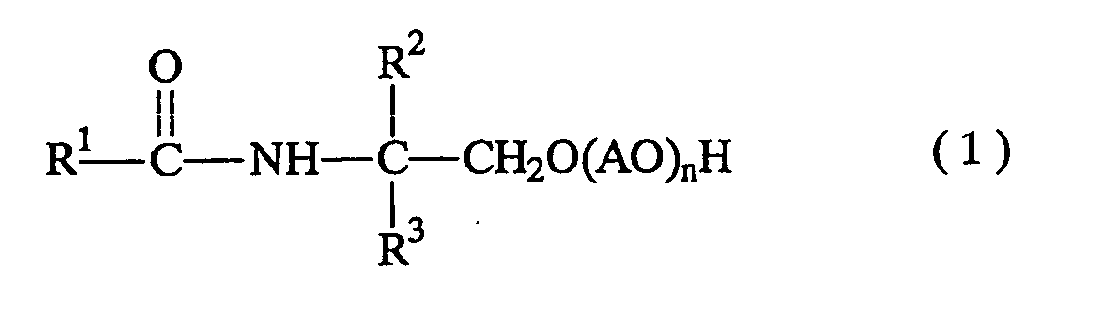
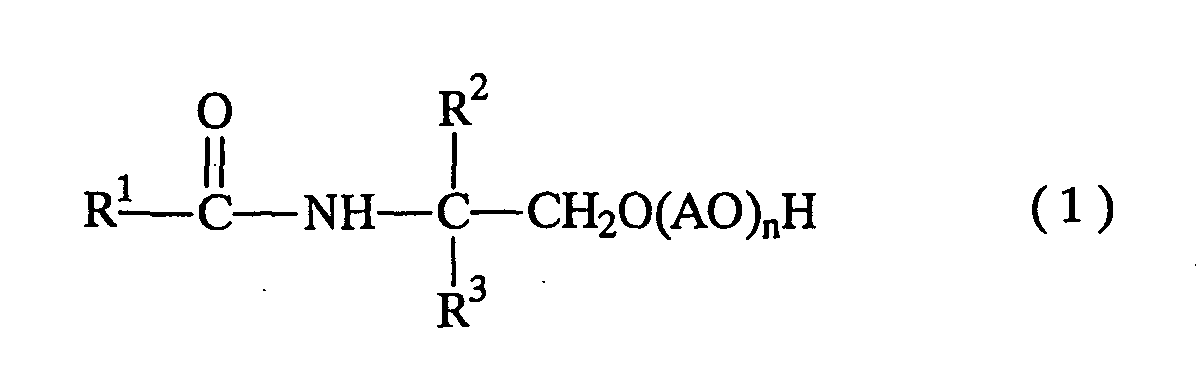
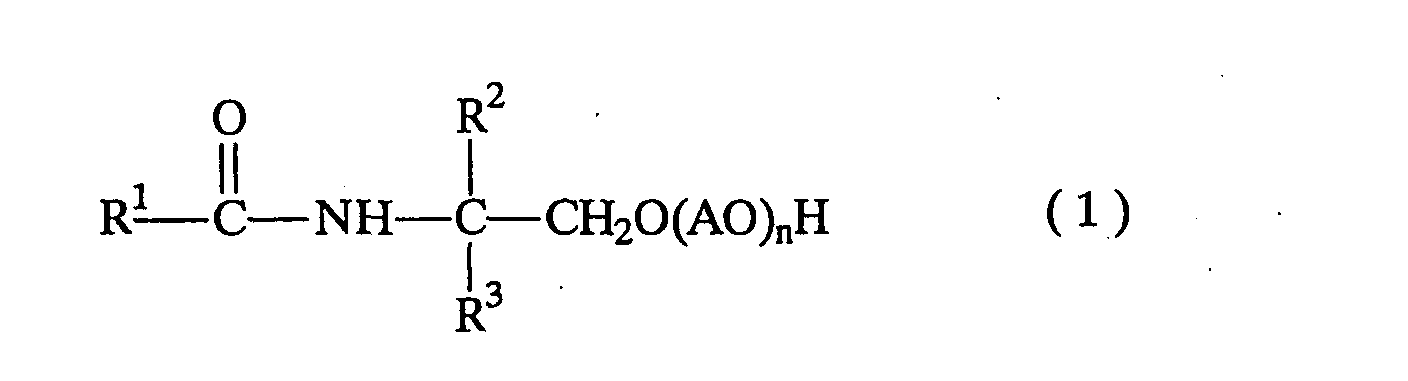
- the present invention provides a thickener comprising a fatty acid alkanolamide (hereinafter, referred to as compound (1)) represented by the general formula (1): wherein R 1 represents a straight-chain or branched alkyl or alkenyl group having 5 to 21 carbon atoms which may be substituted with at least one hydroxyl group, R 2 and R 3 independently represent an alkyl group having 1 to 2 carbon atoms, AO represents an oxyalkylene group having 2 to 4 carbon atoms and n denotes a number of 0 to 10 in average.
- compound (1) a fatty acid alkanolamide represented by the general formula (1): wherein R 1 represents a straight-chain or branched alkyl or alkenyl group having 5 to 21 carbon atoms which may be substituted with at least one hydroxyl group, R 2 and R 3 independently represent an alkyl group having 1 to 2 carbon atoms, AO represents an oxyalkylene group having 2 to 4 carbon atoms and n denotes a
- the invention then provides a surfactant composition comprising the thickener and at least one surfactant.
- the invention then provides use of a fatty acid alkanolamide as defined above to thicken a surfactant and a method of thickening a surfactant, which comprises mixing a fatty acid alkanolamide as defined above with the surfactant.
- R 1 represents a straight-chain or branched alkyl or alkenyl group having 5 to 21 carbon atoms which may be substituted with at least one hydroxyl group and is preferably those having 7 to 17 carbon atoms.
- R 1 include residues obtained by excluding a carboxyl group from fatty acids such as caprylic acid, capric acid, lauric acid, myristic acid, palmitic acid, stearic acid, oleic acid, ricinoleic acid, 12-hydroxystearic acid and isostearic acid.
- R 2 and R 3 independently represent an alkyl group having 1 to 2 carbon atoms.
- the compound (1) in which R 2 and R 3 are both methyl groups are preferable.
- AO represents an oxyalkylene group having 2 to 4 carbon atoms and is preferably an oxyethylene group.
- n denotes a number of 0 to 10 which shows the average addition mol number of alkylene oxides and is preferably 0 to 5.
- the compound (1) may be produced by reacting a higher fatty acid represented by the general formula (2): wherein R 1 has the same meaning as above, R 4 represents a hydroxyl group, an alkoxy group having 1 to 3 carbon atoms, a group represented by the formula -CH 2 CH (OY) -CH 2 (OZ) (where Y and Z independently represent a hydrogen atom or a straight-chain or branched acyl group having 6 to 22 carbon atoms which may be substituted with at least one hydroxyl group) or a halogen atom; or its derivatives (hereinafter, referred to as fatty acid component (2)) with an alkanolamine represented by the general formula (3): wherein R 2 and R 3 have the same meanings as above: and by further adding an alkylene oxide having 2 to 4 carbon atoms according to the need.
- R 1 has the same meaning as above
- R 4 represents a hydroxyl group, an alkoxy group having 1 to 3 carbon atoms, a group represented by the formula -
- Examples of the fatty acid component (2) to be used for the production of the compound (1) include fatty acids such as caprylic acid, capric acid, lauric acid, myristic acid, palmitic acid, stearic acid, oleic acid, ricinoleic acid, 12-hydroxystearic acid and isostearic acid; lower alkyl esters of these fatty acids, for example, methyl esters and ethyl esters; glycerides of these fatty acids, for example, natural oil and fats such as coconut oil, palm oil and palm kernel oil and mixtures of these natural oil and fats; and halides of these fatty acids such as chlorides and bromides.
- fatty acids, fatty acid lower alkyl esters and fatty acid glycerides are particularly preferable because these compounds are not accompanied by the generation of inorganic salts.
- Examples of the amine (3) include 2-amino-2-methyl-1-propanol and 2-amino-2-ethyl-1-butanol. 2-amino-2-methyl-1-propanol is preferable.
- the reaction between the fatty acid component (2) and the amine (3) may be run in a generally known reaction condition and proceeds in the presence of a catalyst using an alcoholate or also in the presence of no catalyst.
- a catalyst using an alcoholate or also in the presence of no catalyst.
- the reaction temperature between the fatty acid component (2) and the amine (3) proceeds at temperatures ranging from 50 to 130°C in the case of using sodium methylate as a catalyst and at temperatures ranging from 130 to 220°C in the case of using no catalyst.
- the reaction between the fatty acid component (2) and the amine (3) proceeds at a reaction temperature of 120 to 220°C.
- the reaction temperature is high, there is the case where the intermolecular dehydration of the product takes place to form oxazoline. In this case, it is necessary to run hydrolysis by adding water.
- the reaction with the amine (3) can also be run by a known method.
- the amine (3) is charged in an aqueous solution system in the presence of an organic solvent or in an aqueous solution system and a reaction is allowed to proceed at a reaction temperature of -20 to 50°C with adding dropwise a fatty acid chloride and an alkali simultaneously by controlling the system pH to 7 to 12.
- the organic solvent in this case include acetone, isopropyl alcohol, diethyl ether, etc.
- the alkali are sodium hydroxide, potassium hydroxide, sodium carbonate, sodium bicarbonate, etc.
- the molar ratio ((2) :(3)) of the amine (3) to fatty acid component (2) to be charged is preferably in the range of 1 : 1 to 1 : 1.3 and more preferably in the range of 1 : 1 to 1 : 1.1, specially preferably 1:1 to 1:1.01, when the fatty acid component (2) is other than oil and fats in view of reactivity and economical aspect. Also, when the fatty acid component (2) is oil and fats, the molar ratio ((2) : (3)) is preferably in the range of 1 : 3.0 to 1 : 3.9 and more preferably in the range of 1 : 3.0 to 1 : 3.3.
- an alkylene oxide having 2 to 4 carbon atoms is further added to the reaction product obtained by the reaction of the fatty acid component (2) with the amine (3).
- An addition reaction of an alkylene oxide may be run using a known method.
- the alkylene oxide is reacted at 80 to 200°C and preferably 80 to 130°C with charging it continuously or intermittently or in a batch system in a pressure closed container, whereby an alkylene oxide adduct can be produced with ease.
- the compound (1) obtained after the reaction is finished may contain unreacted products and byproducts in such an amount as to give no hindrance to actual use.
- the compound (1) of the present invention allows the viscosity of a blended composition to be increased by compounding a surfactant and is therefore useful as a thickener for such a composition, and also has the effect of improving foaming characteristics.
- the surfactant examples include anionic surfactants, amphoteric surfactants, cationic surfactants, nonionic surfactants and semi-polar surfactants (e.g., alkyldimethylamine oxides).
- anionic surfactants amphoteric surfactants
- cationic surfactants cationic surfactants
- nonionic surfactants nonionic surfactants
- semi-polar surfactants e.g., alkyldimethylamine oxides.
- the compound (1) has a significant thickening action in an anionic surfactant system.
- anionic surfactant used in the present invention examples include alkyl sulfates, polyoxyethylenealkyl ether sulfates, alkylbenzene sulfonates, alkyl fatty acid salts, alkyl phosphates, acylated amino acid salts, alkylamide ether sulfates, etc.
- alkyl groups of these anionic surfactants those having 5 to 30 and particularly 8 to 18 carbon atoms are preferable.
- acyl group those having 6 to 31 and particularly 7 to 17 carbon atoms are preferable.
- examples of the salts include alkali metal salts, ammonium salts, alkyl or alkenylamine salts having a total carbon number of 1 to 22, alkanolamine salts having a total carbon number of 1 to 22, basic amino acid salts, etc.
- Alkali metal salts are preferable and sodium salts and potassium salts are particularly preferable.
- the content of the compound (1) is preferably 0.1 to 50% by weight and more preferably 0.5 to 20% by weight.
- the content of the surfactant is preferably 0.5 to 90% by weight and more preferably 1 to 50% by weight.
- the compound (1) of the present invention may be compounded in detergents and cosmetics in, for example, household or personal care applications.
- the proportion of the compound (1) when compounded in these detergents and cosmetics is preferably 0.1 to 50% by weight and particularly preferably 0.5 to 20% by weight in these detergents or cosmetics though no particular limitation is imposed on it.
- a two-component system consisting of the compound (1) and a surfactant may be adopted or the compound (1) may be added to a combination of various surfactants without any problem.
- the thickener of the present invention has a low melting point and is therefore a liquid at normal temperature, exhibiting excellent handling characteristics and blending stability. Also, it has high thickening action and can therefore impart high thickening ability when it is blended in various surfactants.
- a 1 l reactor equipped with a temperature gage, a stirrer, a nitrogen introducing pipe and a reflux condenser was charged with 214 g (MW: 214, 1 mol) of methyl laurate and 91 g (MW: 89.1, 1.02 mol) of 2-amino-2-methyl-1-propanol.
- the mixture was raised up to 85°C with blowing nitrogen into the reactor and then 5 g of 28% sodium methylate was added thereto. Then, the mixture was kept for 3 hours.
- gas chromatography was used to confirm that the methyl laurate left was less than 1%, to carry out cooling.
Landscapes
- Chemical & Material Sciences (AREA)
- Life Sciences & Earth Sciences (AREA)
- Engineering & Computer Science (AREA)
- Chemical Kinetics & Catalysis (AREA)
- Oil, Petroleum & Natural Gas (AREA)
- Wood Science & Technology (AREA)
- Organic Chemistry (AREA)
- Detergent Compositions (AREA)
- Organic Low-Molecular-Weight Compounds And Preparation Thereof (AREA)
- Cosmetics (AREA)
Abstract
Description
- The present invention relates to a thickener and also a surfactant composition containing the thickener.
- Detergents are improved in handling characteristics by imparting a proper viscosity corresponding to each use or each system of these detergents is increased in viscosity as required to maintain the dispersibility of water-insoluble materials to be formulated.
- Generally, alkanolamide type surfactants, betaine type surfactants and semi-polar type surfactants (e.g., alkyldimethylamine oxides) are known as thickeners and used in many detergent applications at present.
- Alkanolamide type surfactants are classified into a monoalkanolamide type and a dialkanolamide type. The monoalkanolamide type is superior in thickening action but is not regarded as thickeners having good handling characteristics because it has a high melting point. On the other hand, the dialkanolamide type has high blending stability but is not always regarded as bases having excellent thickening characteristics.
- Also, though a trimethylol type compound is disclosed in US-A 2927081 and a dialkanol type compound is disclosed in JP-A 2001-131132. However, the trimethylol type has high crystallinity and therefore there is a difficulty in handling characteristics and low-temperature stability. Also, the dialkanol type is not always regarded as a base having excellent thickening characteristics.
- In view of this situation, thickeners which are superior in handling characteristics and blending stability, have high thickening characteristics and foam-increasing effect and are preferably used as detergent compositions and the like have been desired.
- It is a purpose of the present invention to provide a thickener which is superior in handling characteristics and blending stability and has a high thickening action and to provide a surfactant composition containing the thickener.
- The present inventors have found that a specific fatty acid alkanolamide type compound has a low melting point and is a liquid at normal temperature and therefore superior in handling characteristics, has high thickening action, exhibiting high thickening action when it is added to various surfactants.
- Accordingly, the present invention provides a thickener comprising a fatty acid alkanolamide (hereinafter, referred to as compound (1)) represented by the general formula (1):wherein R1 represents a straight-chain or branched alkyl or alkenyl group having 5 to 21 carbon atoms which may be substituted with at least one hydroxyl group, R2 and R3 independently represent an alkyl group having 1 to 2 carbon atoms, AO represents an oxyalkylene group having 2 to 4 carbon atoms and n denotes a number of 0 to 10 in average.
- The invention then provides a surfactant composition comprising the thickener and at least one surfactant.
- The invention then provides use of a fatty acid alkanolamide as defined above to thicken a surfactant and a method of thickening a surfactant, which comprises mixing a fatty acid alkanolamide as defined above with the surfactant.
- In the compound (1), R1 represents a straight-chain or branched alkyl or alkenyl group having 5 to 21 carbon atoms which may be substituted with at least one hydroxyl group and is preferably those having 7 to 17 carbon atoms.
Specific examples of R1 include residues obtained by excluding a carboxyl group from fatty acids such as caprylic acid, capric acid, lauric acid, myristic acid, palmitic acid, stearic acid, oleic acid, ricinoleic acid, 12-hydroxystearic acid and isostearic acid. - R2 and R3 independently represent an alkyl group having 1 to 2 carbon atoms. The compound (1) in which R2 and R3 are both methyl groups are preferable. AO represents an oxyalkylene group having 2 to 4 carbon atoms and is preferably an oxyethylene group. n denotes a number of 0 to 10 which shows the average addition mol number of alkylene oxides and is preferably 0 to 5.
- The compound (1) may be produced by reacting a higher fatty acid represented by the general formula (2):wherein R1 has the same meaning as above, R4 represents a hydroxyl group, an alkoxy group having 1 to 3 carbon atoms, a group represented by the formula -CH2CH (OY) -CH2 (OZ) (where Y and Z independently represent a hydrogen atom or a straight-chain or branched acyl group having 6 to 22 carbon atoms which may be substituted with at least one hydroxyl group) or a halogen atom; or its derivatives (hereinafter, referred to as fatty acid component (2)) with an alkanolamine represented by the general formula (3):
 wherein R2 and R3 have the same meanings as above: and by further adding an alkylene oxide having 2 to 4 carbon atoms according to the need.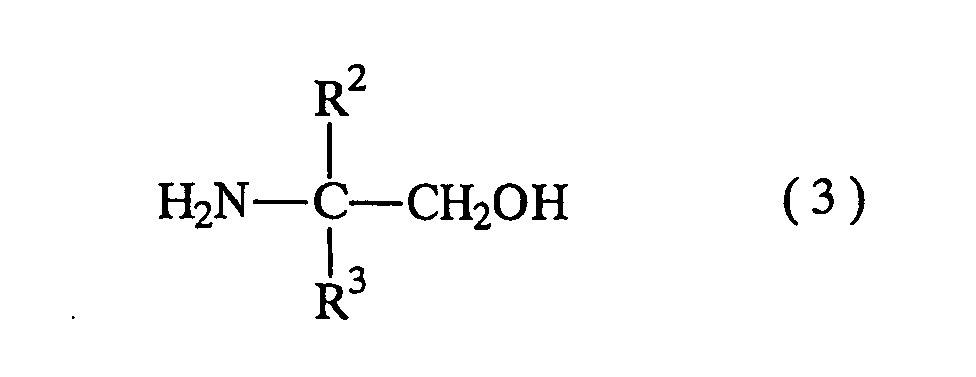
- Examples of the fatty acid component (2) to be used for the production of the compound (1) include fatty acids such as caprylic acid, capric acid, lauric acid, myristic acid, palmitic acid, stearic acid, oleic acid, ricinoleic acid, 12-hydroxystearic acid and isostearic acid; lower alkyl esters of these fatty acids, for example, methyl esters and ethyl esters; glycerides of these fatty acids, for example, natural oil and fats such as coconut oil, palm oil and palm kernel oil and mixtures of these natural oil and fats; and halides of these fatty acids such as chlorides and bromides. Among these fatty acid components (2), fatty acids, fatty acid lower alkyl esters and fatty acid glycerides are particularly preferable because these compounds are not accompanied by the generation of inorganic salts.
- Examples of the amine (3) include 2-amino-2-methyl-1-propanol and 2-amino-2-ethyl-1-butanol. 2-amino-2-methyl-1-propanol is preferable.
- In the production of the compound (1), the reaction between the fatty acid component (2) and the amine (3) may be run in a generally known reaction condition and proceeds in the presence of a catalyst using an alcoholate or also in the presence of no catalyst. For example, when a fatty acid lower alkyl ester such as fatty acid methyl ester or a fatty acid glyceride such as coconut oil or palm kernel oil is used as the fatty acid component (2), the reaction temperature between the fatty acid component (2) and the amine (3) proceeds at temperatures ranging from 50 to 130°C in the case of using sodium methylate as a catalyst and at temperatures ranging from 130 to 220°C in the case of using no catalyst. Also, in the case of using a fatty acid as the fatty acid component (2) , the reaction between the fatty acid component (2) and the amine (3) proceeds at a reaction temperature of 120 to 220°C. When the reaction temperature is high, there is the case where the intermolecular dehydration of the product takes place to form oxazoline. In this case, it is necessary to run hydrolysis by adding water.
- Also, when a fatty acid halide is used as the fatty acid component (2), the reaction with the amine (3) can also be run by a known method. For example, as to the reaction between a fatty acid chloride and the amine (3), the amine (3) is charged in an aqueous solution system in the presence of an organic solvent or in an aqueous solution system and a reaction is allowed to proceed at a reaction temperature of -20 to 50°C with adding dropwise a fatty acid chloride and an alkali simultaneously by controlling the system pH to 7 to 12. Examples of the organic solvent in this case include acetone, isopropyl alcohol, diethyl ether, etc. Also, given as examples of the alkali are sodium hydroxide, potassium hydroxide, sodium carbonate, sodium bicarbonate, etc.
- The molar ratio ((2) :(3)) of the amine (3) to fatty acid component (2) to be charged is preferably in the range of 1 : 1 to 1 : 1.3 and more preferably in the range of 1 : 1 to 1 : 1.1, specially preferably 1:1 to 1:1.01, when the fatty acid component (2) is other than oil and fats in view of reactivity and economical aspect. Also, when the fatty acid component (2) is oil and fats, the molar ratio ((2) : (3)) is preferably in the range of 1 : 3.0 to 1 : 3.9 and more preferably in the range of 1 : 3.0 to 1 : 3.3.
- To the reaction product obtained by the reaction of the fatty acid component (2) with the amine (3) is further added an alkylene oxide having 2 to 4 carbon atoms according to the need. An addition reaction of an alkylene oxide may be run using a known method. For example, the alkylene oxide is reacted at 80 to 200°C and preferably 80 to 130°C with charging it continuously or intermittently or in a batch system in a pressure closed container, whereby an alkylene oxide adduct can be produced with ease.
- The compound (1) obtained after the reaction is finished may contain unreacted products and byproducts in such an amount as to give no hindrance to actual use.
- The compound (1) of the present invention allows the viscosity of a blended composition to be increased by compounding a surfactant and is therefore useful as a thickener for such a composition, and also has the effect of improving foaming characteristics.
- Examples of the surfactant include anionic surfactants, amphoteric surfactants, cationic surfactants, nonionic surfactants and semi-polar surfactants (e.g., alkyldimethylamine oxides). Particularly, the compound (1) has a significant thickening action in an anionic surfactant system.
- Examples of the anionic surfactant used in the present invention include alkyl sulfates, polyoxyethylenealkyl ether sulfates, alkylbenzene sulfonates, alkyl fatty acid salts, alkyl phosphates, acylated amino acid salts, alkylamide ether sulfates, etc. As the alkyl groups of these anionic surfactants, those having 5 to 30 and particularly 8 to 18 carbon atoms are preferable. As the acyl group, those having 6 to 31 and particularly 7 to 17 carbon atoms are preferable. Also, examples of the salts include alkali metal salts, ammonium salts, alkyl or alkenylamine salts having a total carbon number of 1 to 22, alkanolamine salts having a total carbon number of 1 to 22, basic amino acid salts, etc. Alkali metal salts are preferable and sodium salts and potassium salts are particularly preferable.
- In the surfactant composition containing the compound (1) and a surfactant according to the present invention, the content of the compound (1) is preferably 0.1 to 50% by weight and more preferably 0.5 to 20% by weight. The content of the surfactant is preferably 0.5 to 90% by weight and more preferably 1 to 50% by weight.
- The compound (1) of the present invention may be compounded in detergents and cosmetics in, for example, household or personal care applications. The proportion of the compound (1) when compounded in these detergents and cosmetics is preferably 0.1 to 50% by weight and particularly preferably 0.5 to 20% by weight in these detergents or cosmetics though no particular limitation is imposed on it. Also, a two-component system consisting of the compound (1) and a surfactant may be adopted or the compound (1) may be added to a combination of various surfactants without any problem.
- The thickener of the present invention has a low melting point and is therefore a liquid at normal temperature, exhibiting excellent handling characteristics and blending stability. Also, it has high thickening action and can therefore impart high thickening ability when it is blended in various surfactants.
- A 1 l reactor equipped with a temperature gage, a stirrer, a nitrogen introducing pipe and a reflux condenser was charged with 214 g (MW: 214, 1 mol) of methyl laurate and 91 g (MW: 89.1, 1.02 mol) of 2-amino-2-methyl-1-propanol. The mixture was raised up to 85°C with blowing nitrogen into the reactor and then 5 g of 28% sodium methylate was added thereto. Then, the mixture was kept for 3 hours. Upon completion of the reaction, gas chromatography was used to confirm that the methyl laurate left was less than 1%, to carry out cooling.
- The same reactor that was used in Synthetic Example 1 was charged with 217 g (MW: 657.5, 0.33 mol) of coconut oil and 90 g (1.01 mol) of 2-amino-2-methyl-1-propanol. The mixture was raised up to 85°C with blowing nitrogen into the reactor and then 5 g of 28% sodium methylate was added thereto. Then, the mixture was kept for 3 hours. Upon completion of the reaction, gas chromatography was used to confirm that the coconut oil left was less than 1%, to carry out cooling.
- The same reactor that was used in Synthetic Example 1 was charged with 226.4 g (MW: 686.0, 0.33 mol) of palm kernel oil and 90 g (1.01 mol) of 2-amino-2-methyl-1-propanol. The mixture was raised up to 85°C with blowing nitrogen into the reactor and then 5 g of 28% sodium methylate was added thereto. Then, the mixture was kept for 3 hours. Upon completion of the reaction, gas chromatography was used to confirm that the palm kernel oil left was less than 1%, to carry out cooling.
- The same reactor that was used in Synthetic Example 1 was charged with 214 g (1 mol) of methyl laurate and 91 g (1.02 mol) of 2-amino-2-methyl-1-propanol. The mixture was raised up to 85°C with blowing nitrogen into the reactor and then 5 g of 28% sodium methylate was added thereto. Then, the mixture was kept for 3 hours. Upon completion of the reaction, gas chromatography was used to confirm that the methyl laurate left was less than 1%, to carry out cooling.
- Next, a 1 l pressure reactor was charged with all the reaction product and the atmosphere in the reactor was replaced by nitrogen. Then, the temperature of the reaction product was raised and 44 g (MW: 44) of ethylene oxide was charged over 10 minutes when the temperature reached 100°C. After kept for 1 hour as it was, the resulting product was cooled to complete the reaction. The average addition mols of the ethylene oxide was 1.0.
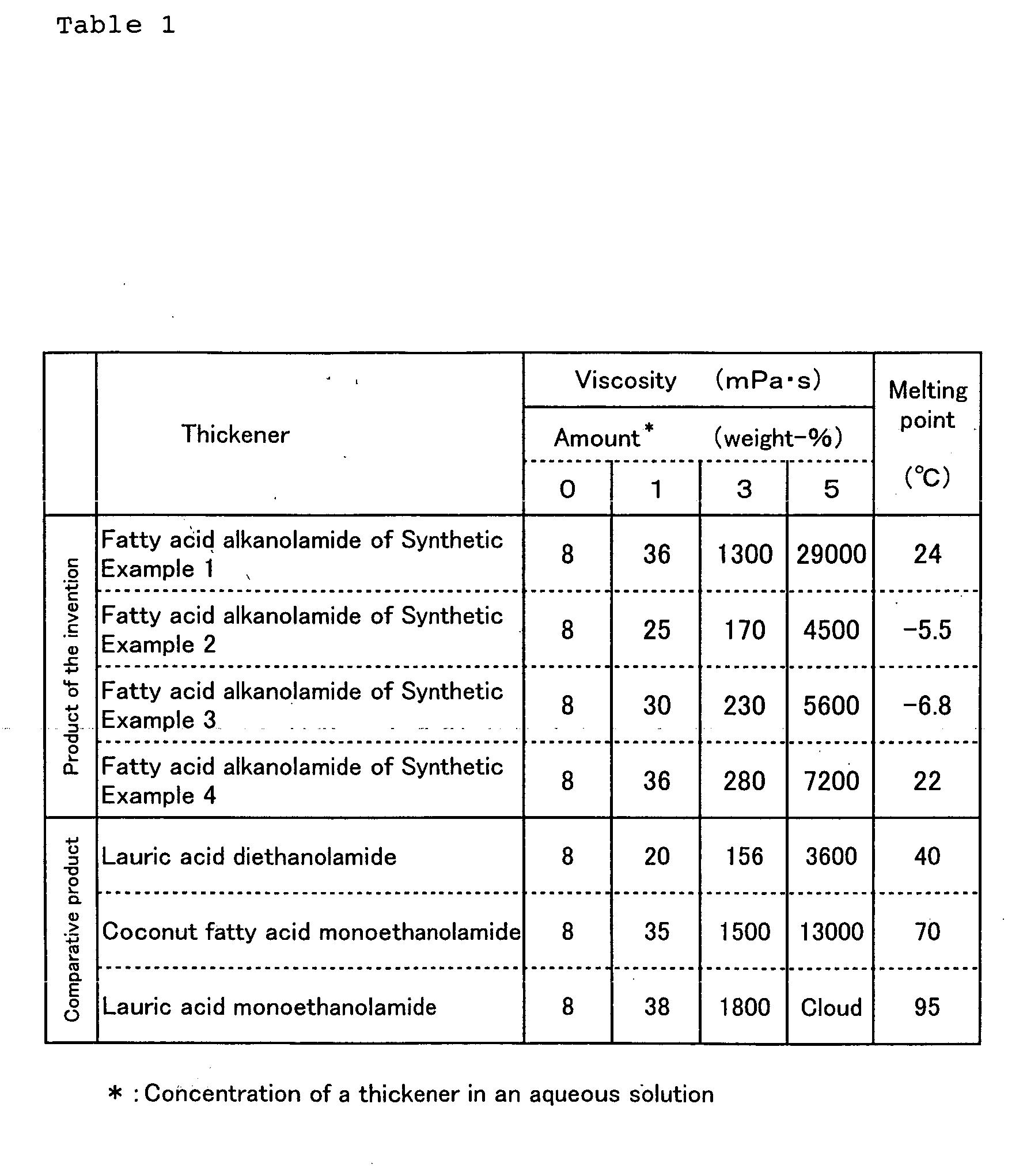
- With regard to aqueous solutions obtained by compounding the fatty acid alkanolamides obtained in Synthetic Examples 1 to 4 and thickeners selected from the comparative compounds shown in Table 1 in a surfactant "sodium polyoxyethylene (average EO addition mols = 2) lauryl ether sulfate" in the concentrations shown in Table 1, each viscosity was measured in the following condition. Also, the melting point of each thickener was measured by a capillary heating method. The results are shown in Table 1.
- Total concentration of a thickener and a surfactant: 20% by weight
- Measuring pH: 7.0
- Measuring temperature: 25°C
- Viscometer: B-type viscometer
Claims (6)
- A thickener comprising a fatty acid alkanolamide represented by the general formula (1):wherein R1 represents a straight-chain or branched alkyl or alkenyl group, having 5 to 21 carbon atoms, which may be substituted with at least one hydroxyl group, R2 and R3 independently represent an alkyl group having 1 to 2 carbon atoms, AO represents an oxyalkylene group having 2 to 4 carbon atoms and n denotes a number of 0 to 10 in average.
- The thickener according to Claim 1, wherein R2 and R3 represent a methyl group.
- A surfactant composition comprising the thickener as claimed in Claim 1 or 2 and at least one surfactant.
- The surfactant composition according to Claim 3, wherein the surfactant is an anionic surfactant.
- Use of a fatty acid alkanolamide as defined in Claim 1 or 2 to thicken a surfactant.
- A method of thickening a surfactant, which comprises mixing a fatty acid alkanolamide as defined in Claim 1 or 2 with the surfactant.
Applications Claiming Priority (2)
| Application Number | Priority Date | Filing Date | Title |
|---|---|---|---|
| JP2002324777 | 2002-11-08 | ||
| JP2002324777A JP3938541B2 (en) | 2002-11-08 | 2002-11-08 | Thickener |
Publications (2)
| Publication Number | Publication Date |
|---|---|
| EP1418223A1 true EP1418223A1 (en) | 2004-05-12 |
| EP1418223B1 EP1418223B1 (en) | 2005-10-19 |
Family
ID=32105489
Family Applications (1)
| Application Number | Title | Priority Date | Filing Date |
|---|---|---|---|
| EP03025632A Expired - Lifetime EP1418223B1 (en) | 2002-11-08 | 2003-11-06 | Thickener |
Country Status (6)
| Country | Link |
|---|---|
| US (1) | US6956014B2 (en) |
| EP (1) | EP1418223B1 (en) |
| JP (1) | JP3938541B2 (en) |
| CN (1) | CN1290987C (en) |
| DE (1) | DE60301932T2 (en) |
| ES (1) | ES2247472T3 (en) |
Families Citing this family (1)
| Publication number | Priority date | Publication date | Assignee | Title |
|---|---|---|---|---|
| US20050274399A1 (en) * | 2004-06-15 | 2005-12-15 | Heise Karl A | Method of fomulating a cleaning composition in a concentrated form |
Citations (7)
| Publication number | Priority date | Publication date | Assignee | Title |
|---|---|---|---|---|
| US2927081A (en) * | 1956-01-31 | 1960-03-01 | Lever Brothers Ltd | Detergent composition containing n-tris (methylol) methyl amides |
| WO1997003646A1 (en) * | 1995-07-21 | 1997-02-06 | Cussons (International) Limited | Cleaning composition |
| US5688978A (en) * | 1993-12-15 | 1997-11-18 | Witco Corporation | Preparation of beta hydroxylakyl-terminally branched fatty acid amides |
| DE19827304A1 (en) * | 1997-07-28 | 1999-02-25 | Henkel Kgaa | Preparation of fatty acid alkanol-amide useful as thickener in surfactant formulation |
| EP1033363A1 (en) * | 1999-03-02 | 2000-09-06 | Goldschmidt Rewo GmbH & Co. KG | Process for the preparation of thickeners based on fatty acid mono-isopropylamides, their use and compositions containing them |
| JP2001131132A (en) * | 1999-08-26 | 2001-05-15 | Kawaken Fine Chem Co Ltd | New fatty acid alkanolamide compound and surfactant composition comprising the same |
| WO2003040253A1 (en) * | 2001-11-08 | 2003-05-15 | Kao Corporation | Thickener |
Family Cites Families (3)
| Publication number | Priority date | Publication date | Assignee | Title |
|---|---|---|---|---|
| GB8602589D0 (en) * | 1986-02-03 | 1986-03-12 | Unilever Plc | Detergent compositions |
| ES2270588T3 (en) * | 1998-03-11 | 2007-04-01 | Mona Industries, Inc. | IMPROVED ALCANOLAMIDS. |
| US6514918B1 (en) * | 2000-08-18 | 2003-02-04 | Johnson & Johnson Consumer Companies, Inc. | Viscous, mild, and effective cleansing compositions |
-
2002
- 2002-11-08 JP JP2002324777A patent/JP3938541B2/en not_active Expired - Fee Related
-
2003
- 2003-10-29 US US10/694,820 patent/US6956014B2/en not_active Expired - Lifetime
- 2003-11-06 EP EP03025632A patent/EP1418223B1/en not_active Expired - Lifetime
- 2003-11-06 ES ES03025632T patent/ES2247472T3/en not_active Expired - Lifetime
- 2003-11-06 DE DE60301932T patent/DE60301932T2/en not_active Expired - Lifetime
- 2003-11-07 CN CN200310114827.7A patent/CN1290987C/en not_active Expired - Fee Related
Patent Citations (7)
| Publication number | Priority date | Publication date | Assignee | Title |
|---|---|---|---|---|
| US2927081A (en) * | 1956-01-31 | 1960-03-01 | Lever Brothers Ltd | Detergent composition containing n-tris (methylol) methyl amides |
| US5688978A (en) * | 1993-12-15 | 1997-11-18 | Witco Corporation | Preparation of beta hydroxylakyl-terminally branched fatty acid amides |
| WO1997003646A1 (en) * | 1995-07-21 | 1997-02-06 | Cussons (International) Limited | Cleaning composition |
| DE19827304A1 (en) * | 1997-07-28 | 1999-02-25 | Henkel Kgaa | Preparation of fatty acid alkanol-amide useful as thickener in surfactant formulation |
| EP1033363A1 (en) * | 1999-03-02 | 2000-09-06 | Goldschmidt Rewo GmbH & Co. KG | Process for the preparation of thickeners based on fatty acid mono-isopropylamides, their use and compositions containing them |
| JP2001131132A (en) * | 1999-08-26 | 2001-05-15 | Kawaken Fine Chem Co Ltd | New fatty acid alkanolamide compound and surfactant composition comprising the same |
| WO2003040253A1 (en) * | 2001-11-08 | 2003-05-15 | Kao Corporation | Thickener |
Non-Patent Citations (1)
| Title |
|---|
| PATENT ABSTRACTS OF JAPAN vol. 2000, no. 22 9 March 2001 (2001-03-09) * |
Also Published As
| Publication number | Publication date |
|---|---|
| JP3938541B2 (en) | 2007-06-27 |
| CN1290987C (en) | 2006-12-20 |
| JP2004155976A (en) | 2004-06-03 |
| ES2247472T3 (en) | 2006-03-01 |
| US20040142849A1 (en) | 2004-07-22 |
| DE60301932D1 (en) | 2005-11-24 |
| CN1498955A (en) | 2004-05-26 |
| US6956014B2 (en) | 2005-10-18 |
| EP1418223B1 (en) | 2005-10-19 |
| DE60301932T2 (en) | 2006-07-27 |
Similar Documents
| Publication | Publication Date | Title |
|---|---|---|
| US6057282A (en) | High purity imidazoline-based amphoacetate surfactants | |
| JPH08103646A (en) | Anionic surface active agent and detergent composition containing same | |
| JP4823430B2 (en) | Surfactant composition | |
| EP0199131A2 (en) | Surfactants derived from citric acid | |
| JP2007177085A (en) | Liquid detergent composition | |
| EP1418223B1 (en) | Thickener | |
| EP1062310B1 (en) | Improved alkanolamides | |
| JP4337585B2 (en) | Thickener composition and method for producing the same, and thickening method using the thickener composition | |
| EP1395357B1 (en) | Pumpable liquid surfactant compositions comprising alkanolamine salts of alkyl phosphate esters | |
| JP4166537B2 (en) | Thickener | |
| JP2001323297A (en) | Thickening / foaming agent, method for producing the same, and detergent composition containing the same | |
| ES2353656T3 (en) | THICK | |
| GB2046321A (en) | Bleaching compositions | |
| CN101160383B (en) | Additive for high concentration anionic surfactant | |
| JP5032786B2 (en) | Additive for high concentration anionic surfactant | |
| EP1208080B1 (en) | Process for making salt-free amphoterics with high mono amphopropionate content | |
| JPH09100490A (en) | Polyoxyalkylene fatty acid amide type surfactant, hue stabilizing method thereof and detergent composition containing the same | |
| JP2006117770A (en) | Method for producing anionic surfactant composition | |
| JPH08283228A (en) | Process for producing N-alkylamide alkanol sulfate or salt thereof | |
| HK1034739B (en) | Improved alkanolamides |
Legal Events
| Date | Code | Title | Description |
|---|---|---|---|
| PUAI | Public reference made under article 153(3) epc to a published international application that has entered the european phase |
Free format text: ORIGINAL CODE: 0009012 |
|
| AK | Designated contracting states |
Kind code of ref document: A1 Designated state(s): AT BE BG CH CY CZ DE DK EE ES FI FR GB GR HU IE IT LI LU MC NL PT RO SE SI SK TR |
|
| AX | Request for extension of the european patent |
Extension state: AL LT LV MK |
|
| 17P | Request for examination filed |
Effective date: 20041021 |
|
| AKX | Designation fees paid |
Designated state(s): DE ES FR GB |
|
| GRAP | Despatch of communication of intention to grant a patent |
Free format text: ORIGINAL CODE: EPIDOSNIGR1 |
|
| GRAS | Grant fee paid |
Free format text: ORIGINAL CODE: EPIDOSNIGR3 |
|
| GRAA | (expected) grant |
Free format text: ORIGINAL CODE: 0009210 |
|
| AK | Designated contracting states |
Kind code of ref document: B1 Designated state(s): DE ES FR GB |
|
| REG | Reference to a national code |
Ref country code: GB Ref legal event code: FG4D |
|
| REF | Corresponds to: |
Ref document number: 60301932 Country of ref document: DE Date of ref document: 20051124 Kind code of ref document: P |
|
| REG | Reference to a national code |
Ref country code: ES Ref legal event code: FG2A Ref document number: 2247472 Country of ref document: ES Kind code of ref document: T3 |
|
| ET | Fr: translation filed | ||
| PLBE | No opposition filed within time limit |
Free format text: ORIGINAL CODE: 0009261 |
|
| STAA | Information on the status of an ep patent application or granted ep patent |
Free format text: STATUS: NO OPPOSITION FILED WITHIN TIME LIMIT |
|
| 26N | No opposition filed |
Effective date: 20060720 |
|
| PGFP | Annual fee paid to national office [announced via postgrant information from national office to epo] |
Ref country code: GB Payment date: 20131106 Year of fee payment: 11 |
|
| PGFP | Annual fee paid to national office [announced via postgrant information from national office to epo] |
Ref country code: ES Payment date: 20131011 Year of fee payment: 11 |
|
| GBPC | Gb: european patent ceased through non-payment of renewal fee |
Effective date: 20141106 |
|
| REG | Reference to a national code |
Ref country code: FR Ref legal event code: PLFP Year of fee payment: 13 |
|
| PG25 | Lapsed in a contracting state [announced via postgrant information from national office to epo] |
Ref country code: GB Free format text: LAPSE BECAUSE OF NON-PAYMENT OF DUE FEES Effective date: 20141106 |
|
| REG | Reference to a national code |
Ref country code: ES Ref legal event code: FD2A Effective date: 20151229 |
|
| PG25 | Lapsed in a contracting state [announced via postgrant information from national office to epo] |
Ref country code: ES Free format text: LAPSE BECAUSE OF NON-PAYMENT OF DUE FEES Effective date: 20141107 |
|
| REG | Reference to a national code |
Ref country code: FR Ref legal event code: PLFP Year of fee payment: 14 |
|
| REG | Reference to a national code |
Ref country code: FR Ref legal event code: PLFP Year of fee payment: 15 |
|
| REG | Reference to a national code |
Ref country code: FR Ref legal event code: PLFP Year of fee payment: 16 |
|
| PGFP | Annual fee paid to national office [announced via postgrant information from national office to epo] |
Ref country code: DE Payment date: 20191022 Year of fee payment: 17 |
|
| PGFP | Annual fee paid to national office [announced via postgrant information from national office to epo] |
Ref country code: FR Payment date: 20191015 Year of fee payment: 17 |
|
| REG | Reference to a national code |
Ref country code: DE Ref legal event code: R119 Ref document number: 60301932 Country of ref document: DE |
|
| PG25 | Lapsed in a contracting state [announced via postgrant information from national office to epo] |
Ref country code: FR Free format text: LAPSE BECAUSE OF NON-PAYMENT OF DUE FEES Effective date: 20201130 |
|
| PG25 | Lapsed in a contracting state [announced via postgrant information from national office to epo] |
Ref country code: DE Free format text: LAPSE BECAUSE OF NON-PAYMENT OF DUE FEES Effective date: 20210601 |
|
| P01 | Opt-out of the competence of the unified patent court (upc) registered |
Effective date: 20230522 |