EP1416738A2 - Adaptive DCT/IDCT apparatus based on energy and method for controlling the same - Google Patents
Adaptive DCT/IDCT apparatus based on energy and method for controlling the same Download PDFInfo
- Publication number
- EP1416738A2 EP1416738A2 EP03008876A EP03008876A EP1416738A2 EP 1416738 A2 EP1416738 A2 EP 1416738A2 EP 03008876 A EP03008876 A EP 03008876A EP 03008876 A EP03008876 A EP 03008876A EP 1416738 A2 EP1416738 A2 EP 1416738A2
- Authority
- EP
- European Patent Office
- Prior art keywords
- image
- dct
- blocks
- energy
- block
- Prior art date
- Legal status (The legal status is an assumption and is not a legal conclusion. Google has not performed a legal analysis and makes no representation as to the accuracy of the status listed.)
- Withdrawn
Links
Images



Classifications
-
- H—ELECTRICITY
- H04—ELECTRIC COMMUNICATION TECHNIQUE
- H04N—PICTORIAL COMMUNICATION, e.g. TELEVISION
- H04N19/00—Methods or arrangements for coding, decoding, compressing or decompressing digital video signals
- H04N19/60—Methods or arrangements for coding, decoding, compressing or decompressing digital video signals using transform coding
-
- H—ELECTRICITY
- H04—ELECTRIC COMMUNICATION TECHNIQUE
- H04N—PICTORIAL COMMUNICATION, e.g. TELEVISION
- H04N19/00—Methods or arrangements for coding, decoding, compressing or decompressing digital video signals
- H04N19/10—Methods or arrangements for coding, decoding, compressing or decompressing digital video signals using adaptive coding
- H04N19/134—Methods or arrangements for coding, decoding, compressing or decompressing digital video signals using adaptive coding characterised by the element, parameter or criterion affecting or controlling the adaptive coding
- H04N19/136—Incoming video signal characteristics or properties
- H04N19/14—Coding unit complexity, e.g. amount of activity or edge presence estimation
-
- H—ELECTRICITY
- H04—ELECTRIC COMMUNICATION TECHNIQUE
- H04N—PICTORIAL COMMUNICATION, e.g. TELEVISION
- H04N19/00—Methods or arrangements for coding, decoding, compressing or decompressing digital video signals
- H04N19/10—Methods or arrangements for coding, decoding, compressing or decompressing digital video signals using adaptive coding
- H04N19/102—Methods or arrangements for coding, decoding, compressing or decompressing digital video signals using adaptive coding characterised by the element, parameter or selection affected or controlled by the adaptive coding
- H04N19/12—Selection from among a plurality of transforms or standards, e.g. selection between discrete cosine transform [DCT] and sub-band transform or selection between H.263 and H.264
- H04N19/122—Selection of transform size, e.g. 8x8 or 2x4x8 DCT; Selection of sub-band transforms of varying structure or type
-
- H—ELECTRICITY
- H04—ELECTRIC COMMUNICATION TECHNIQUE
- H04N—PICTORIAL COMMUNICATION, e.g. TELEVISION
- H04N19/00—Methods or arrangements for coding, decoding, compressing or decompressing digital video signals
- H04N19/10—Methods or arrangements for coding, decoding, compressing or decompressing digital video signals using adaptive coding
- H04N19/102—Methods or arrangements for coding, decoding, compressing or decompressing digital video signals using adaptive coding characterised by the element, parameter or selection affected or controlled by the adaptive coding
- H04N19/132—Sampling, masking or truncation of coding units, e.g. adaptive resampling, frame skipping, frame interpolation or high-frequency transform coefficient masking
-
- H—ELECTRICITY
- H04—ELECTRIC COMMUNICATION TECHNIQUE
- H04N—PICTORIAL COMMUNICATION, e.g. TELEVISION
- H04N19/00—Methods or arrangements for coding, decoding, compressing or decompressing digital video signals
- H04N19/10—Methods or arrangements for coding, decoding, compressing or decompressing digital video signals using adaptive coding
- H04N19/169—Methods or arrangements for coding, decoding, compressing or decompressing digital video signals using adaptive coding characterised by the coding unit, i.e. the structural portion or semantic portion of the video signal being the object or the subject of the adaptive coding
- H04N19/17—Methods or arrangements for coding, decoding, compressing or decompressing digital video signals using adaptive coding characterised by the coding unit, i.e. the structural portion or semantic portion of the video signal being the object or the subject of the adaptive coding the unit being an image region, e.g. an object
- H04N19/176—Methods or arrangements for coding, decoding, compressing or decompressing digital video signals using adaptive coding characterised by the coding unit, i.e. the structural portion or semantic portion of the video signal being the object or the subject of the adaptive coding the unit being an image region, e.g. an object the region being a block, e.g. a macroblock
Definitions
- the present invention relates to a coding unit for a MPEG4/H.263 video coder, and more particularly to an adaptive DCT/IDCT (Discrete Cosine Transform / Inverse Discrete Cosine Transform) apparatus based on energy, for processing DCT and IDCT operations with a high image quality at a high speed by calculating energy of an input image in block units, and a method for controlling the same.
- DCT/IDCT Discrete Cosine Transform / Inverse Discrete Cosine Transform
- a mobile communication service began with the first-generation analog service, and has gradually developed from the second-generation digital communication service to the third-generation IMT-2000 service.
- the IMT-2000 service is a communication service for enabling the next generation mobile communication terminal using standard technology proposed by ITU-T (International Telecommunications Union ⁇ Telecommunication).
- ITU-T International Telecommunications Union ⁇ Telecommunication
- the IMT-2000 service enables users to receive a variety of services such as a voice phone service, a telex service, a pager service, and an E-mail service, etc., anywhere in the whole world.
- Current mobile communication services such as a cellular or PCS phone service for mainly providing users with voice services are being developed for the IMT-2000 service for supporting multimedia personal communications such as high-speed data, packets or images.
- the IMT-2000 mobile terminal provides users with global broadband roaming service at a high speed, displays moving images on its own screen with a VOD (Video On Demand) scheme, and enables the users to exchange their images via a camera mounted to the terminal.
- VOD Video On Demand
- the IMT-2000 terminal is of importance to a multimedia application service processor rather than a modem function. So, a chip and an additional memory for processing the multimedia application service besides a modem chip are needed to implement a wireless video mobile communication service with an optimal amount of processing capacity and a minimum amount of errors.
- the development of the compression technology for storing/transmitting the large amount of data and standardization thereof are needed to implement the aforementioned audio and moving image services.
- the digital image technology has been developed from still images to moving images, and therefore the fundamental basis for multimedia services has been established.
- the H.261 is used for a video telephone or video conference service with a transfer rate of 64kbps ⁇ 2Mbps.
- the MPEG-1 is used for a digital storage medium with a transfer rate of about 1.5Mbps.
- the MPEG-2 is applicable to a digital TV or HDTV with a transfer rate of 3Mbps ⁇ 15Mbps.
- the H.263 is adapted as a short-term standardization for applications with very low transfer rates less than 64kbps.
- the H.263 uses almost the same method as a mixed method of a motion compensation and a DCT used as a moving image compression method of the H.261, MPEG-1, or MPEG-2. It therefore has disadvantages in that a blocking phenomenon is caused in case of highly compressing images in the conventional H.261, MPEG-1, or MPEG-2 system and an image quality of a reproduced image is abruptly degraded.
- a video coding method for displaying MPEG-4/H.263-format moving images on an LCD screen of an IMT-2000 terminal performs a coding or encoding operation using a DCT with 8x8-sized image blocks and performs a decoding operation using an IDCT.
- the decoding operation is performed using the whole 8x8-sized frequency coefficient block. In this manner, provided that such an IDCT is performed using the whole 8x8-sized frequency coefficient block, a clearly reproduced image can be obtained.
- the present invention has been made in view of the above problems, and it is the object of the present invention to provide an adaptive DCT/IDCT apparatus and method for calculating energy by dividing an image into predetermined blocks, performing a DCT on 8x8 blocks of the image, comparing mean energy of the whole image with energy for every block, adaptively selecting only a DCT coefficient corresponding to one of 1x1, 3x3 and 4x4 blocks on the basis of the upper left end of the image blocks upon receiving the compared result, making the remaining DCT coefficients equal to zero, and performing a decoding operation to establish image restoration.
- It is another aspect of the present invention to provide an adaptive DCT/IDCT apparatus which includes an energy calculator for dividing an input image into predetermined blocks and calculating an energy value for each block, a DCT unit for performing a DCT in 8x8-block units upon receiving the input image, an image coefficient processor for adaptively processing DCT coefficients according to the energy value for each for 8x8 - block unit, and an IDCT unit for performing an IDCT using frequency coefficients reconstructed by the image coefficient processor and establishing image restoration, in such a way that the adaptive DCT/IDCT apparatus performs adaptive DCT/IDCT operations according to energy of the input image in case of coding MPEG4/H.263-format moving images.
- an adaptive DCT/IDCT Discrete Cosine Transform / Inverse Discrete Cosine Transform
- the apparatus comprising: an energy calculator for receiving an input image, dividing the input image into blocks of predetermined size, calculating energy values for respective blocks and a mean energy value for the input image, and comparing the energy values of the blocks with the mean energy value; a DCT unit for dividing the input image into blocks corresponding to the blocks of the energy calculator, and performing a DCT operation on the divided blocks; an image coefficient processor for receiving DCT coefficients for respective blocks from the DCT unit according to a result of the comparison of the block's energy value and the mean energy value, and recasting the DCT coefficients; and an IDCT unit for receiving recasted DCT coefficients from the image coefficient processor, performing an IDCT operation on the recast DCT coefficients
- an adaptive DCT/IDCT method based on energy in case of performing an image processing operation at a coding unit of a MPEG4/H.263 video coder, the method comprising the steps of: a) receiving an image; b) dividing the image into predetermined blocks, and calculating energy values for the blocks; c) calculating a mean energy value of the image; d) upon receiving the image, performing a DCT operation in the predetermined block units, calculating DCT coefficients, and storing the calculated DCT coefficients; e) comparing the energy values for respective blocks with the mean energy value; f) receiving DCT coefficients for corresponding blocks and recasting the DCT coefficients according to a result of the comparison of the step (e); and g) performing an IDCT operation on the recast DCT coefficients, and creating a restored image.
- Fig. 1 is a view illustrating a block diagram of a coding unit 40 of a MPEG4 video coder or a H.263 video coder in accordance with a preferred embodiment of the present invention.
- an input unit 20 receives an image
- an energy calculator 24 receives the image from the input unit 20, divides it into blocks of predetermined size, calculates an energy value for each block, and calculates a mean energy value of the whole image, and compares the mean energy value with the energy value of each block.
- a DCT unit 22 also divides the input image into blocks of the predetermined size, and performs a coding operation by performing a DCT operation on the blocks.
- An image coefficient processor 26 receives a result of the comparison of the mean energy value and the energy value of each block from the energy calculator 24, receives DCT coefficients for the blocks of predetermined size from the DCT unit 22.
- Image coefficient processor 26 performs rearrangement of the DCT coefficients for each block based on the corresponding energy value of the block.
- An IDCT unit 28 performs an IDCT using the DCT coefficients rearranged by the image coefficient processor 26, and performs a decoding operation to create a restored image.
- An output unit 30 outputs the restored image received from the IDCT unit 28.
- the present invention obtains energy for each block of the input image, calculates total mean energy of the input image, and reconstructs an image with a partial DCT coefficient generated from the DCT unit 22 upon receiving the energy for each block and the total mean energy in such a way that it establishes image restoration.
- Equation 1 a mathematical equation for obtaining energy values processed in the energy calculator 24 in association with the input image is represented as the following Equation 1: where P MB is an energy value of the image, S is
- E ( f ) of a 8x8 sized image block is defined as
- Eq. 1 is used for computing the energy value of each blocks (8x8 sized) in a whole image.
- P MB is the energy value of a 8x8 sized image block in a whole image.
- P MB_mean the mean energy value
- Equation 3 a mathematical equation for performing an IDCT in the IDCT unit 28 and performing a decoding operation therein is represented as the following Equation 3:
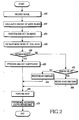
- Fig. 2 is a flow chart illustrating a method for adaptively processing an input image on the basis of energy at the coding unit 40 of the MPEG4/H.263 video coder shown in Fig. 1 in accordance with a preferred embodiment of the present invention.
- the energy calculator 24 sets up an 8x8-block on the upper left end of the input image, and calculates an energy value as shown in the Equation 1.
- a plurality of the 8x8-blocks may be provided according to a size of the image, and the energy calculator 24 calculates an energy value of each 8x8 block at step S52.
- the DCT unit 22 performs a DCT on an 8x8-block positioned at the upper left end of the input image using the Equation 2, performs a coding operation on the DCT-processed 8x8-block, and stores DCT coefficients.
- the DCT unit 22 divides the whole image into 8x8 blocks, performs a DCT on the blocks, and calculates a DCT coefficient for each block at step S54.
- the energy calculator 24 calculates a mean energy value of the whole image at step S56 to compare the mean energy value with an energy value for each 8x8 block.
- the energy calculator 24 compares the mean energy value of the whole image with the energy value for each 8x8 block, and separately classifies 8x8 blocks each having energy more than the mean energy value and other 8x8 blocks each having energy less than the mean energy value at step S58.
- the image coefficient processor 26 selects a DCT coefficient corresponding to a 4x4-sized block on the basis of the upper left end of the 8x8 block received from the DCT unit 22 corresponding to the particular block, and makes the remaining coefficients equal zero. That is, the image coefficient processor 26 receives only a DCT coefficient corresponding to a 4x4-block positioned at a corresponding block's upper left end, and makes DCT coefficients of the remaining blocks equal zero at step S60.
- the image coefficient processor 26 selects a DCT coefficient corresponding to a 3x3-sized block on the basis of the upper left end of the 8x8 block, and makes the remaining coefficients other then the selected one equal zero. That is, the image coefficient processor 26 receives only a DCT coefficient corresponding to a 3x3-block positioned at a corresponding block's upper left end, and makes DCT coefficients of the remaining blocks equal zero at step S64.
- the image coefficient processor 26 selects a DCT coefficient corresponding to a 1x1-sized block on the basis of the upper left end of the 8x8 block, and makes the remaining coefficients equal zero. That is, the image coefficient processor 26 receives only a DCT coefficient corresponding to a 1 ⁇ 1-block positioned at a corresponding block's upper left end, and makes DCT coefficients of the remaining blocks equal zero at step 566.
- the IDCT unit 28 performs an IDCT shown in the above Equation 3 at step S68 upon receiving a DCT coefficient reconstructed by the above comparing result of the mean energy value of the whole image and the energy value of each block, such that it obtains a newly restored image and transmits it to the output unit 30 at step S70.
- the present invention divides an input image into 8x8 blocks, and calculates an energy value for each block. Also, the present invention divides the input image into 8x8 blocks, calculates a DCT coefficient of each block, and compares mean energy of a whole image with energy of each 8x8 block. In this case, an image restoration is performed with a 4x4 DCT coefficient when the 8x8 block's energy is higher than the mean energy, is performed with a 3x3 DCT coefficient when the 8x8 block's energy is a positive value but less than the mean energy, or is performed with a 1x1 DCT coefficient when the 8x8 block's energy is a negative value (-). Then, an IDCT operation is performed to form a new image.
- Fig. 3 is a flow chart illustrating a method for adaptively processing an input image on the basis of energy at the coding unit 40 of the MPEG4/H.263 video coder shown in Fig. 1 in accordance with another preferred embodiment of the present invention.
- the energy calculator 24 performs a sub-sampling operation at step S82 to reduce the size of the input image by half.
- the energy calculator 24 sets up a 4x4-block on the upper left end of a half-sized image, and calculates an energy value as shown in the Equation 1.
- a plurality of the 4x4-blocks may be provided according to the size of the image, and the energy calculator 24 calculates an energy value of each 4x4 block at step S84.
- the DCT unit 22 performs a DCT on an 8x8-block positioned at the upper left end of the original input image using the Equation 2, performs a coding operation on the DCT-processed 8x8-block, and stores DCT coefficients. That is, the DCT unit 22 divides the whole image into 8x8 blocks, performs a DCT on the divided blocks, and calculates a DCT coefficient for each block at step S86.
- the energy calculator 24 calculates a mean energy value of the sub-sampled image at step S88 to compare the mean energy value with the energy value for each 4x4 block. (Thus, the sub-sampled 4x4 blocks correspond to the 8x8 blocks in the DCT unit.)
- the energy calculator 24 compares the mean energy value of the whole image with the energy value for each 4x4 block, and discriminates between 4x4 blocks each having energy more than the mean energy value and other 4x4 blocks each having energy less than the mean energy value at step S90.
- the image coefficient processor 26 selects a DCT coefficient corresponding to a 4x4-sized block on the basis of the upper left end of the 8x8 block, and makes the remaining coefficients equal zero. That is, the image coefficient processor 26 receives only a DCT coefficient corresponding to a 4x4-block positioned at a corresponding block's upper left end, and makes DCT coefficients of the remaining blocks equal zero at step S92.
- the image coefficient processor 26 selects a DCT coefficient corresponding to a 3x3-sized block on the basis of the upper left end of the 8x8 block, and makes the remaining coefficients equal zero. That is, the image coefficient processor 26 receives only a DCT coefficient corresponding to a 3x3-block positioned at a corresponding block's upper left end, and makes DCT coefficients of the remaining blocks equal zero at step S96.
- the image coefficient processor 26 selects a DCT coefficient corresponding to a 1 ⁇ 1-sized block on the basis of the upper left end of the 8x8 block, and makes the remaining coefficients equal zero at step S98. That is, the image coefficient processor 26 receives only a DCT coefficient corresponding to a 1x1-block positioned at a corresponding block's upper left end, and makes DCT coefficients of the remaining blocks equal zero at step S98.
- the IDCT unit 28 performs an IDCT shown in the above Equation 3 at step S100 upon receiving a DCT coefficient reconstructed by the above comparing result of the mean energy value of the sub-sampled image and the energy value of each block, such that it obtains a newly restored image and transmits it to the output unit 30 at step S 102.
- the present invention performs a sub-sampling operation to reduce the size of the input image by half, divides the input image into 4x4 blocks, and calculates an energy value for each block. Also, the present invention divides the original input image into 8x8 blocks, calculates a DCT coefficient of each block, and compares mean energy of a half-sized image with energy of each 4x4 block. In this case, an image restoration is performed with a 4x4 DCT coefficient when the 4x4 block's energy is higher than the mean energy, is performed with a 3x3 DCT coefficient when the 4x4 block's energy is positive but less than the mean energy, or is performed with a 1x1 DCT coefficient when the 4x4 block's energy is a negative value (-). Then, an IDCT operation is performed to form a new image.
- the method shown in Fig. 3 makes a coding or decoding speed faster because it performs a sub-sampling operation for reducing the size of the input image by half.
- Fig. 4 is a flow chart illustrating a method for adaptively processing an input image on the basis of energy at the coding unit 40 of the MPEG4/H.263 video coder shown in Fig. 1 in accordance with a still another preferred embodiment of the present invention.
- the energy calculator 24 performs a sub-sampling operation at step S 112 to reduce the size of the input image by half.
- the energy calculator 24 sets up an 8x8-block on the upper left end of a half-sized image, and calculates an energy value as shown in the Equation 1.
- a plurality of the 8x8-blocks may be provided according to the size of the image, and the energy calculator 24 calculates an energy value of each 8x8 block at step S114.
- the DCT unit 22 performs a DCT on an 8x8-block positioned at the upper left end of the original input image using the Equation 2, performs a coding operation on the DCT-processed 8x8-block, and stores DCT coefficients. That is, the DCT unit 22 divides the whole image into 8x8 blocks, performs a DCT on the divided blocks, and calculates a DCT coefficient for each block at step S 116.
- the energy calculator 24 calculates a mean energy value of the sub-sampled image at step S 118 to compare the mean energy value with the energy value for each 8x8 block.
- the mean energy value is obtained on condition that the energy values of every block are all added and the added result is divided by the number of blocks at step S118.
- the energy calculator 24 compares the mean energy value of the sub-sampled image with the energy value for each 8x8 block, and discriminates between 8x8 blocks each having energy more than the mean energy value and other 8x8 blocks each having energy less than the mean energy value at step S 120.
- the image coefficient processor 26 selects a DCT coefficient corresponding to a 4x4-sized block on the basis of the upper left end of the 8x8 block, and makes the remaining coefficients equal zero. That is, the image coefficient processor 26 receives only a DCT coefficient corresponding to a 4x4-block positioned at a corresponding block's upper left end, and makes DCT coefficients of the remaining blocks equal zero at step S122.
- the image coefficient processor 26 selects a DCT coefficient corresponding to a 3x3-sized block on the basis of the upper left end of the 8x8 block, and makes the remaining coefficients equal zero at step S126.
- the image coefficient processor 26 selects a DCT coefficient corresponding to a 1x1-sized block on the basis of the upper left end of the 8x8 block, and makes the remaining coefficients equal zero. That is, the image coefficient processor 26 receives only a DCT coefficient corresponding to a 1x1-block positioned at a corresponding block's upper left end, and makes DCT coefficients of the remaining blocks equal zero at step S128.
- the IDCT unit 28 performs an IDCT shown in the above Equation 3 at step S130 upon receiving a DCT coefficient reconstructed by the above comparing result of the mean energy value of the sub-sampled image and the energy value of each block, such that it obtains a newly restored image and transmits it to the output unit 30 at step S 132.
- the present invention performs a sub-sampling operation to reduce the size of the input image by half, divides the input image into 8x8 blocks, and calculates an energy value for each block. Also, the present invention divides the original input image into 8x8 blocks, calculates a DCT coefficient of each block, and compares mean energy of a half-sized image with energy of each 8x8 block. In this case, an image restoration is performed with a 4x4 DCT coefficient when the 8x8 block's energy is higher than the mean energy, is performed with a 3x3 DCT coefficient when the 8x8 block's energy is positive but less than the mean energy, or is performed with a 1x1 DCT coefficient when the 8x8 block's energy is a negative value (-). Then, an IDCT operation is performed to form a new image.
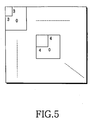
- Fig. 5 is a view illustrating structural rearrangement of DCT coefficients according to energy values in accordance with the present invention.
- a 4x4 DCT coefficient is used and DCT coefficients of the remaining pixels equal zero when an energy value of each block is higher than the mean energy value on the basis of the upper left end of 8x8 blocks
- a 3x3 DCT coefficient is used and DCT coefficients of the remaining pixels equal zero when an energy value of each block is positive but less than the mean energy value
- a 1x1 DCT coefficient is used (comprised of the scalar value of the first column of the first row of each 8x8 DCT block) and DCT coefficients of the remaining pixels equal zero when an energy value of each block is a negative value (-).
- the present invention divides an input image into blocks, and calculates an energy value for each block. Also, the present invention divides the input image into blocks, calculates a DCT coefficient of each block, and compares mean energy of a whole image with energy of each block. In this case, an image restoration is performed with one of 4x4, 3x3 and 1x1 DCT coefficients on the basis of 8x8 blocks upon receiving the comparing result of the mean energy of the whole image and the energy of each block, and the remaining DCT coefficients equal zero. Then, an IDCT operation is performed to form a newly restored image.
- the present invention considerably reduces the level of computational complexity and the number of calculations needed to perform an image processing operation in comparison with the conventional art. Therefore, the present invention can be implemented with less memory at a high speed, provides a wireless mobile terminal with excellent image quality, reduces the cost of production, and is able to add additional functions to the terminal.
- the present invention performs an IDCT by adaptively using only one of 1 ⁇ 1, 3x3 and 4x4 - sized DCT coefficients according to a result of the comparison of a mean energy value of an input image and an energy value for each block, in such a way that it creates a restored image. Therefore, the present invention obtains an excellent result in the light of a PSNR (Peak Signal Noise Ratio), and greatly reduces the amount of memories and the length of a processing time, thereby increasing system efficiency.
- PSNR Peak Signal Noise Ratio
- the present invention is applicable to a wireless mobile communication field within a narrow band of an IMT-2000 terminal, and is effectively useful to a moving image transmission service or a wireless video phone service.
Landscapes
- Engineering & Computer Science (AREA)
- Multimedia (AREA)
- Signal Processing (AREA)
- Physics & Mathematics (AREA)
- Discrete Mathematics (AREA)
- General Physics & Mathematics (AREA)
- Compression Or Coding Systems Of Tv Signals (AREA)
- Compression Of Band Width Or Redundancy In Fax (AREA)
Abstract
Description
- The present invention relates to a coding unit for a MPEG4/H.263 video coder, and more particularly to an adaptive DCT/IDCT (Discrete Cosine Transform / Inverse Discrete Cosine Transform) apparatus based on energy, for processing DCT and IDCT operations with a high image quality at a high speed by calculating energy of an input image in block units, and a method for controlling the same.
- A mobile communication service began with the first-generation analog service, and has gradually developed from the second-generation digital communication service to the third-generation IMT-2000 service. The IMT-2000 service is a communication service for enabling the next generation mobile communication terminal using standard technology proposed by ITU-T (International Telecommunications Union ― Telecommunication). The IMT-2000 service enables users to receive a variety of services such as a voice phone service, a telex service, a pager service, and an E-mail service, etc., anywhere in the whole world. Current mobile communication services such as a cellular or PCS phone service for mainly providing users with voice services are being developed for the IMT-2000 service for supporting multimedia personal communications such as high-speed data, packets or images.
- The IMT-2000 mobile terminal provides users with global broadband roaming service at a high speed, displays moving images on its own screen with a VOD (Video On Demand) scheme, and enables the users to exchange their images via a camera mounted to the terminal.
- Therefore, the IMT-2000 terminal is of importance to a multimedia application service processor rather than a modem function. So, a chip and an additional memory for processing the multimedia application service besides a modem chip are needed to implement a wireless video mobile communication service with an optimal amount of processing capacity and a minimum amount of errors.
- The development of the compression technology for storing/transmitting the large amount of data and standardization thereof are needed to implement the aforementioned audio and moving image services. The digital image technology has been developed from still images to moving images, and therefore the fundamental basis for multimedia services has been established.
- In the meantime, the MPEG (Moving Picture Experts Groups) standardization has started to compression-store the moving images in a storage media.
- There have been proposed a variety of established standardizations such as a H.261 recommended by the ITU, an MPEG-1, a MPEG-2, and a H.263 recommend by the ITU. The H.261 is used for a video telephone or video conference service with a transfer rate of 64kbps ~ 2Mbps. The MPEG-1 is used for a digital storage medium with a transfer rate of about 1.5Mbps. The MPEG-2 is applicable to a digital TV or HDTV with a transfer rate of 3Mbps ~ 15Mbps. The H.263 is adapted as a short-term standardization for applications with very low transfer rates less than 64kbps.
- In more detail, the H.263 uses almost the same method as a mixed method of a motion compensation and a DCT used as a moving image compression method of the H.261, MPEG-1, or MPEG-2. It therefore has disadvantages in that a blocking phenomenon is caused in case of highly compressing images in the conventional H.261, MPEG-1, or MPEG-2 system and an image quality of a reproduced image is abruptly degraded.
- A video coding method for displaying MPEG-4/H.263-format moving images on an LCD screen of an IMT-2000 terminal performs a coding or encoding operation using a DCT with 8x8-sized image blocks and performs a decoding operation using an IDCT. In this case, the decoding operation is performed using the whole 8x8-sized frequency coefficient block. In this manner, provided that such an IDCT is performed using the whole 8x8-sized frequency coefficient block, a clearly reproduced image can be obtained.
- However, in the case where the IDCT is performed using the whole 8x8-sized frequency coefficient block and then a decoding operation is performed, too many calculations are needed and high computational complexity results even though the resulting reproduced image has high quality, such that the above conventional video coding method unavoidably requires both a large amount of memory and a long processing time.
- Therefore, the present invention has been made in view of the above problems, and it is the object of the present invention to provide an adaptive DCT/IDCT apparatus and method for calculating energy by dividing an image into predetermined blocks, performing a DCT on 8x8 blocks of the image, comparing mean energy of the whole image with energy for every block, adaptively selecting only a DCT coefficient corresponding to one of 1x1, 3x3 and 4x4 blocks on the basis of the upper left end of the image blocks upon receiving the compared result, making the remaining DCT coefficients equal to zero, and performing a decoding operation to establish image restoration.
- This object is solved by the subject matters of the independent claims.
- Preferred embodiments are defined in the dependent claims.
- It is another aspect of the present invention to provide an adaptive DCT/IDCT apparatus which includes an energy calculator for dividing an input image into predetermined blocks and calculating an energy value for each block, a DCT unit for performing a DCT in 8x8-block units upon receiving the input image, an image coefficient processor for adaptively processing DCT coefficients according to the energy value for each for 8x8 - block unit, and an IDCT unit for performing an IDCT using frequency coefficients reconstructed by the image coefficient processor and establishing image restoration, in such a way that the adaptive DCT/IDCT apparatus performs adaptive DCT/IDCT operations according to energy of the input image in case of coding MPEG4/H.263-format moving images.
- In accordance with one aspect of the present invention, the above and other objects can be accomplished by the provision of an adaptive DCT/IDCT (Discrete Cosine Transform / Inverse Discrete Cosine Transform) apparatus based on energy in a coding unit of a MPEG4/H.263 video coder, the apparatus comprising: an energy calculator for receiving an input image, dividing the input image into blocks of predetermined size, calculating energy values for respective blocks and a mean energy value for the input image, and comparing the energy values of the blocks with the mean energy value; a DCT unit for dividing the input image into blocks corresponding to the blocks of the energy calculator, and performing a DCT operation on the divided blocks; an image coefficient processor for receiving DCT coefficients for respective blocks from the DCT unit according to a result of the comparison of the block's energy value and the mean energy value, and recasting the DCT coefficients; and an IDCT unit for receiving recasted DCT coefficients from the image coefficient processor, performing an IDCT operation on the recast DCT coefficients, and creating a restored image.
- In accordance with another aspect of the present invention, there is provided an adaptive DCT/IDCT method based on energy in case of performing an image processing operation at a coding unit of a MPEG4/H.263 video coder, the method comprising the steps of: a) receiving an image; b) dividing the image into predetermined blocks, and calculating energy values for the blocks; c) calculating a mean energy value of the image; d) upon receiving the image, performing a DCT operation in the predetermined block units, calculating DCT coefficients, and storing the calculated DCT coefficients; e) comparing the energy values for respective blocks with the mean energy value; f) receiving DCT coefficients for corresponding blocks and recasting the DCT coefficients according to a result of the comparison of the step (e); and g) performing an IDCT operation on the recast DCT coefficients, and creating a restored image.
- The above object, features and other advantages of the present invention will be more clearly understood from the following detailed description taken in conjunction with the accompanying drawings, in which:
- Fig. 1 is a view illustrating a block diagram of a coding unit of a MPEG4 or H.263 video coder in accordance with a preferred embodiment of the present invention;
- Fig. 2 is a flow chart illustrating an adaptive DCT/IDCT procedure based on energy in accordance with a preferred embodiment of the present invention;
- Fig. 3 is a flow chart illustrating an adaptive DCT/IDCT procedure based on energy in accordance with another preferred embodiment of the present invention;
- Fig. 4 is a flow chart illustrating an adaptive DCT/IDCT procedure based on energy in accordance with a still another preferred embodiment of the present invention; and
- Fig. 5 is a view illustrating structural rearrangement of DCT coefficients according to energy values in accordance with the present invention.
-
- Now, preferred embodiments of the present invention will be described in detail with reference to the annexed drawings. In the drawings, the same or similar elements are denoted by the same reference numerals even though they are depicted in different drawings. In the following description, a detailed description of known functions and configurations incorporated herein will be omitted when they are well-known in the art.
- Fig. 1 is a view illustrating a block diagram of a
coding unit 40 of a MPEG4 video coder or a H.263 video coder in accordance with a preferred embodiment of the present invention. - Referring to Fig. 1, an input unit 20 receives an image, an energy calculator 24 receives the image from the input unit 20, divides it into blocks of predetermined size, calculates an energy value for each block, and calculates a mean energy value of the whole image, and compares the mean energy value with the energy value of each block. A
DCT unit 22 also divides the input image into blocks of the predetermined size, and performs a coding operation by performing a DCT operation on the blocks. An image coefficient processor 26 receives a result of the comparison of the mean energy value and the energy value of each block from the energy calculator 24, receives DCT coefficients for the blocks of predetermined size from theDCT unit 22. Image coefficient processor 26 performs rearrangement of the DCT coefficients for each block based on the corresponding energy value of the block. An IDCT unit 28 performs an IDCT using the DCT coefficients rearranged by the image coefficient processor 26, and performs a decoding operation to create a restored image. Anoutput unit 30 outputs the restored image received from the IDCT unit 28. - In this manner, the present invention obtains energy for each block of the input image, calculates total mean energy of the input image, and reconstructs an image with a partial DCT coefficient generated from the
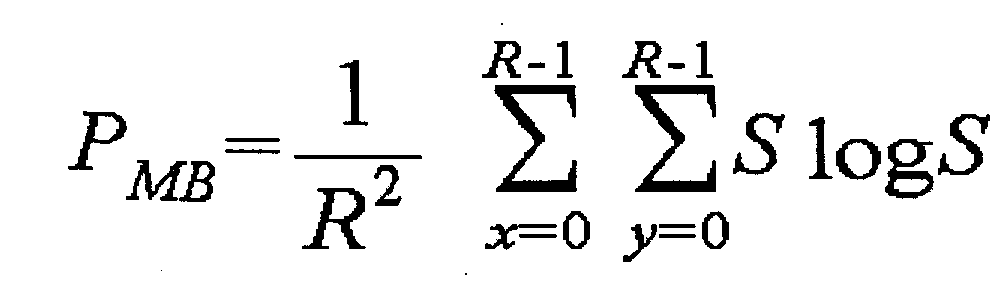
DCT unit 22 upon receiving the energy for each block and the total mean energy in such a way that it establishes image restoration. - In the meantime, a mathematical equation for obtaining energy values processed in the energy calculator 24 in association with the input image is represented as the following Equation 1:where PMB is an energy value of the image, S is |f(x,y) - E(f)|, f(x,y) is a pixel value of the image, E(f) is a mean value of image pixels, and R is a size of the image block.

- The mean value, E(f) of a 8x8 sized image block is defined as

- Eq. 1 is used for computing the energy value of each blocks (8x8 sized) in a whole image. In other words, PMB is the energy value of a 8x8 sized image block in a whole image. In order to calculate the mean energy value, PMB_mean, of all 8x8 sized image blocks in the whole image,where,

- Q =
- Size of a whole image
- R =
- 8, the size of an image block
- x, y =
- Indices for horizontal and vertical axes respectively
- PMB (x,y) =
- The energy of an image block at (x,y) index position in the whole image.
- Also, a mathematical equation for dividing the input image received from the
DCT unit 22 into predetermined blocks, performing a DCT on the blocks, and performing a coding operation at the energy calculator 24 is represented as the following Equation 2:where u, v, x, y = 0,1,2,...N-1 (where N is the size of an image block, that is, 8), x, y are horizontal and vertical axes, respectively (where the horizontal axis corresponds to the column index and the vertical axis corresponds to the row index of the image square of eight rows and eight columns), u, v are axes of a transform domain, and

- Further, a mathematical equation for performing an IDCT in the IDCT unit 28 and performing a decoding operation therein is represented as the following Equation 3:

- Fig. 2 is a flow chart illustrating a method for adaptively processing an input image on the basis of energy at the
coding unit 40 of the MPEG4/H.263 video coder shown in Fig. 1 in accordance with a preferred embodiment of the present invention. - Referring to Fig. 2, if the input unit 20 receives an input image at step S50, the energy calculator 24 sets up an 8x8-block on the upper left end of the input image, and calculates an energy value as shown in the
Equation 1. A plurality of the 8x8-blocks may be provided according to a size of the image, and the energy calculator 24 calculates an energy value of each 8x8 block at step S52. - The
DCT unit 22 performs a DCT on an 8x8-block positioned at the upper left end of the input image using the Equation 2, performs a coding operation on the DCT-processed 8x8-block, and stores DCT coefficients. In the same manner as the energy calculator 24, theDCT unit 22 divides the whole image into 8x8 blocks, performs a DCT on the blocks, and calculates a DCT coefficient for each block at step S54. - The energy calculator 24 calculates a mean energy value of the whole image at step S56 to compare the mean energy value with an energy value for each 8x8 block.
- The energy calculator 24 compares the mean energy value of the whole image with the energy value for each 8x8 block, and separately classifies 8x8 blocks each having energy more than the mean energy value and other 8x8 blocks each having energy less than the mean energy value at step S58.
- In the case where an 8x8 block's energy is higher than the mean energy value at step S58 as determined for a particular block by energy calculator 24, the image coefficient processor 26 selects a DCT coefficient corresponding to a 4x4-sized block on the basis of the upper left end of the 8x8 block received from the
DCT unit 22 corresponding to the particular block, and makes the remaining coefficients equal zero. That is, the image coefficient processor 26 receives only a DCT coefficient corresponding to a 4x4-block positioned at a corresponding block's upper left end, and makes DCT coefficients of the remaining blocks equal zero at step S60. - In the case where the 8x8 block's energy is a positive value (+) but less than the mean energy value at step S62, the image coefficient processor 26 selects a DCT coefficient corresponding to a 3x3-sized block on the basis of the upper left end of the 8x8 block, and makes the remaining coefficients other then the selected one equal zero. That is, the image coefficient processor 26 receives only a DCT coefficient corresponding to a 3x3-block positioned at a corresponding block's upper left end, and makes DCT coefficients of the remaining blocks equal zero at step S64.
- In the case where the 8x8 block's energy is a negative value (-) because of the characteristics of a logarithmic function at step S52, the image coefficient processor 26 selects a DCT coefficient corresponding to a 1x1-sized block on the basis of the upper left end of the 8x8 block, and makes the remaining coefficients equal zero. That is, the image coefficient processor 26 receives only a DCT coefficient corresponding to a 1×1-block positioned at a corresponding block's upper left end, and makes DCT coefficients of the remaining blocks equal zero at step 566.
- The IDCT unit 28 performs an IDCT shown in the
above Equation 3 at step S68 upon receiving a DCT coefficient reconstructed by the above comparing result of the mean energy value of the whole image and the energy value of each block, such that it obtains a newly restored image and transmits it to theoutput unit 30 at step S70. - As described above, the present invention divides an input image into 8x8 blocks, and calculates an energy value for each block. Also, the present invention divides the input image into 8x8 blocks, calculates a DCT coefficient of each block, and compares mean energy of a whole image with energy of each 8x8 block. In this case, an image restoration is performed with a 4x4 DCT coefficient when the 8x8 block's energy is higher than the mean energy, is performed with a 3x3 DCT coefficient when the 8x8 block's energy is a positive value but less than the mean energy, or is performed with a 1x1 DCT coefficient when the 8x8 block's energy is a negative value (-). Then, an IDCT operation is performed to form a new image.
- Fig. 3 is a flow chart illustrating a method for adaptively processing an input image on the basis of energy at the
coding unit 40 of the MPEG4/H.263 video coder shown in Fig. 1 in accordance with another preferred embodiment of the present invention. - Referring to Fig. 3, if the input unit 20 receives an input image at step S80, the energy calculator 24 performs a sub-sampling operation at step S82 to reduce the size of the input image by half.
- The energy calculator 24 sets up a 4x4-block on the upper left end of a half-sized image, and calculates an energy value as shown in the
Equation 1. A plurality of the 4x4-blocks may be provided according to the size of the image, and the energy calculator 24 calculates an energy value of each 4x4 block at step S84. - The
DCT unit 22 performs a DCT on an 8x8-block positioned at the upper left end of the original input image using the Equation 2, performs a coding operation on the DCT-processed 8x8-block, and stores DCT coefficients. That is, theDCT unit 22 divides the whole image into 8x8 blocks, performs a DCT on the divided blocks, and calculates a DCT coefficient for each block at step S86. - The energy calculator 24 calculates a mean energy value of the sub-sampled image at step S88 to compare the mean energy value with the energy value for each 4x4 block. (Thus, the sub-sampled 4x4 blocks correspond to the 8x8 blocks in the DCT unit.)
- The energy calculator 24 compares the mean energy value of the whole image with the energy value for each 4x4 block, and discriminates between 4x4 blocks each having energy more than the mean energy value and other 4x4 blocks each having energy less than the mean energy value at step S90.
- In the case where the 4x4 block's energy is higher than the mean energy value at step S90, the image coefficient processor 26 selects a DCT coefficient corresponding to a 4x4-sized block on the basis of the upper left end of the 8x8 block, and makes the remaining coefficients equal zero. That is, the image coefficient processor 26 receives only a DCT coefficient corresponding to a 4x4-block positioned at a corresponding block's upper left end, and makes DCT coefficients of the remaining blocks equal zero at step S92.
- In the case where the 4x4 block's energy is a positive value (+) but less than the mean energy value at step S94, the image coefficient processor 26 selects a DCT coefficient corresponding to a 3x3-sized block on the basis of the upper left end of the 8x8 block, and makes the remaining coefficients equal zero. That is, the image coefficient processor 26 receives only a DCT coefficient corresponding to a 3x3-block positioned at a corresponding block's upper left end, and makes DCT coefficients of the remaining blocks equal zero at step S96.
- In the case where the 4x4 block's energy is a negative value (-) because of the characteristics of a logarithmic function at step S84, the image coefficient processor 26 selects a DCT coefficient corresponding to a 1×1-sized block on the basis of the upper left end of the 8x8 block, and makes the remaining coefficients equal zero at step S98. That is, the image coefficient processor 26 receives only a DCT coefficient corresponding to a 1x1-block positioned at a corresponding block's upper left end, and makes DCT coefficients of the remaining blocks equal zero at step S98.
- The IDCT unit 28 performs an IDCT shown in the
above Equation 3 at step S100 upon receiving a DCT coefficient reconstructed by the above comparing result of the mean energy value of the sub-sampled image and the energy value of each block, such that it obtains a newly restored image and transmits it to theoutput unit 30 at step S 102. - As described above, the present invention performs a sub-sampling operation to reduce the size of the input image by half, divides the input image into 4x4 blocks, and calculates an energy value for each block. Also, the present invention divides the original input image into 8x8 blocks, calculates a DCT coefficient of each block, and compares mean energy of a half-sized image with energy of each 4x4 block. In this case, an image restoration is performed with a 4x4 DCT coefficient when the 4x4 block's energy is higher than the mean energy, is performed with a 3x3 DCT coefficient when the 4x4 block's energy is positive but less than the mean energy, or is performed with a 1x1 DCT coefficient when the 4x4 block's energy is a negative value (-). Then, an IDCT operation is performed to form a new image.
- The method shown in Fig. 3 makes a coding or decoding speed faster because it performs a sub-sampling operation for reducing the size of the input image by half.
- Fig. 4 is a flow chart illustrating a method for adaptively processing an input image on the basis of energy at the
coding unit 40 of the MPEG4/H.263 video coder shown in Fig. 1 in accordance with a still another preferred embodiment of the present invention. - Referring to Fig. 4, if the input unit 20 receives an input image at step S110, the energy calculator 24 performs a sub-sampling operation at step S 112 to reduce the size of the input image by half.
- The energy calculator 24 sets up an 8x8-block on the upper left end of a half-sized image, and calculates an energy value as shown in the
Equation 1. A plurality of the 8x8-blocks may be provided according to the size of the image, and the energy calculator 24 calculates an energy value of each 8x8 block at step S114. - The
DCT unit 22 performs a DCT on an 8x8-block positioned at the upper left end of the original input image using the Equation 2, performs a coding operation on the DCT-processed 8x8-block, and stores DCT coefficients. That is, theDCT unit 22 divides the whole image into 8x8 blocks, performs a DCT on the divided blocks, and calculates a DCT coefficient for each block at step S 116. - The energy calculator 24 calculates a mean energy value of the sub-sampled image at step S 118 to compare the mean energy value with the energy value for each 8x8 block. In this case, the mean energy value is obtained on condition that the energy values of every block are all added and the added result is divided by the number of blocks at step S118.
- The energy calculator 24 compares the mean energy value of the sub-sampled image with the energy value for each 8x8 block, and discriminates between 8x8 blocks each having energy more than the mean energy value and other 8x8 blocks each having energy less than the mean energy value at
step S 120. - In the case where the 8x8 block's energy is higher than the mean energy value at step S120, the image coefficient processor 26 selects a DCT coefficient corresponding to a 4x4-sized block on the basis of the upper left end of the 8x8 block, and makes the remaining coefficients equal zero. That is, the image coefficient processor 26 receives only a DCT coefficient corresponding to a 4x4-block positioned at a corresponding block's upper left end, and makes DCT coefficients of the remaining blocks equal zero at step S122.
- In the case where the 8x8 block's energy is a positive value (+) but less than the mean energy value at
step S 124, the image coefficient processor 26 selects a DCT coefficient corresponding to a 3x3-sized block on the basis of the upper left end of the 8x8 block, and makes the remaining coefficients equal zero at step S126. - In the case where the 8x8 block's energy is a negative value (-) because of the characteristics of a logarithmic function at
step S 114, the image coefficient processor 26 selects a DCT coefficient corresponding to a 1x1-sized block on the basis of the upper left end of the 8x8 block, and makes the remaining coefficients equal zero. That is, the image coefficient processor 26 receives only a DCT coefficient corresponding to a 1x1-block positioned at a corresponding block's upper left end, and makes DCT coefficients of the remaining blocks equal zero at step S128. - The IDCT unit 28 performs an IDCT shown in the
above Equation 3 at step S130 upon receiving a DCT coefficient reconstructed by the above comparing result of the mean energy value of the sub-sampled image and the energy value of each block, such that it obtains a newly restored image and transmits it to theoutput unit 30 at step S 132. - As described above, the present invention performs a sub-sampling operation to reduce the size of the input image by half, divides the input image into 8x8 blocks, and calculates an energy value for each block. Also, the present invention divides the original input image into 8x8 blocks, calculates a DCT coefficient of each block, and compares mean energy of a half-sized image with energy of each 8x8 block. In this case, an image restoration is performed with a 4x4 DCT coefficient when the 8x8 block's energy is higher than the mean energy, is performed with a 3x3 DCT coefficient when the 8x8 block's energy is positive but less than the mean energy, or is performed with a 1x1 DCT coefficient when the 8x8 block's energy is a negative value (-). Then, an IDCT operation is performed to form a new image.
- Fig. 5 is a view illustrating structural rearrangement of DCT coefficients according to energy values in accordance with the present invention. As shown in Fig. 5, in case of performing an image restoration, a 4x4 DCT coefficient is used and DCT coefficients of the remaining pixels equal zero when an energy value of each block is higher than the mean energy value on the basis of the upper left end of 8x8 blocks, a 3x3 DCT coefficient is used and DCT coefficients of the remaining pixels equal zero when an energy value of each block is positive but less than the mean energy value, or a 1x1 DCT coefficient is used (comprised of the scalar value of the first column of the first row of each 8x8 DCT block) and DCT coefficients of the remaining pixels equal zero when an energy value of each block is a negative value (-).
- The present invention divides an input image into blocks, and calculates an energy value for each block. Also, the present invention divides the input image into blocks, calculates a DCT coefficient of each block, and compares mean energy of a whole image with energy of each block. In this case, an image restoration is performed with one of 4x4, 3x3 and 1x1 DCT coefficients on the basis of 8x8 blocks upon receiving the comparing result of the mean energy of the whole image and the energy of each block, and the remaining DCT coefficients equal zero. Then, an IDCT operation is performed to form a newly restored image.
- As apparent from the above description, the present invention considerably reduces the level of computational complexity and the number of calculations needed to perform an image processing operation in comparison with the conventional art. Therefore, the present invention can be implemented with less memory at a high speed, provides a wireless mobile terminal with excellent image quality, reduces the cost of production, and is able to add additional functions to the terminal.
- Also, the present invention performs an IDCT by adaptively using only one of 1×1, 3x3 and 4x4 - sized DCT coefficients according to a result of the comparison of a mean energy value of an input image and an energy value for each block, in such a way that it creates a restored image. Therefore, the present invention obtains an excellent result in the light of a PSNR (Peak Signal Noise Ratio), and greatly reduces the amount of memories and the length of a processing time, thereby increasing system efficiency.
- Further, the present invention is applicable to a wireless mobile communication field within a narrow band of an IMT-2000 terminal, and is effectively useful to a moving image transmission service or a wireless video phone service.
- Although the preferred embodiments of the present invention have been disclosed for illustrative purposes, those skilled in the art will appreciate that various modifications, additions and substitutions are possible, without departing from the scope of the invention as disclosed in the accompanying claims.
Claims (12)
- An adaptive DCT/IDCT (Discrete Cosine Transform / Inverse Discrete Cosine Transform) apparatus based on energy in a coding unit of a MPEG4/H.263 video coder, said apparatus comprising:an energy calculator for receiving an input image, dividing the input image into blocks of predetermined size, calculating energy values for respective blocks and a mean energy value for the input image, and comparing the energy values of the blocks with the mean energy value;a DCT unit for dividing the input image into blocks corresponding to the blocks of the energy calculator, and performing a DCT operation on the divided blocks;an image coefficient processor for receiving DCT coefficients for respective blocks from the DCT unit according to a result of the comparison of the block's energy value and the mean energy value, and recasting the DCT coefficients; andan IDCT unit for receiving recasted DCT coefficients from the image coefficient processor, performing an IDCT operation on the recast DCT coefficients, and creating a restored image.
- The apparatus as set forth in claim 1, wherein the energy calculator performs a sub-sampling operation on an input image to reduce a size of the input image by half.
- The apparatus as claimed in claim 1 or 2, wherein the energy calculator calculates energy values of the input image and blocks thereof using the following equation:where PMB is an energy value of the image, S is |f(x,y) - E(f)|, f(x,y) is a pixel value of the image, E(f) is a mean value of image pixels, and R is a size of the image.
- An adaptive DCT/IDCT method based on energy in case of performing an image processing operation at a coding unit of a MPEG4/H.263 video coder, said method comprising the steps of:a) dividing an image into predetermined blocks, and calculating energy values for the blocks;b) calculating a mean energy value of the image;c) upon receiving the image, performing a DCT operation in the predetermined block units, calculating DCT coefficients, and storing the calculated DCT coefficients;d) comparing the energy values for respective blocks with the mean energy value;e) receiving DCT coefficients for corresponding blocks, and recasting the DCT coefficients according to a result of the comparison of the step (d); andf) performing an IDCT operation on the recast DCT coefficients, and creating a restored image.
- The method as set forth in claim 4, further comprising the step of:receiving said image.
- The method as set forth in claim 4 or 5, wherein the step of dividing includes the steps of:dividing the image into 8x8 blocks, and performing an image processing operation in units of 8x8 blocks.
- The method as set forth in claim 4, further comprising the steps of:receiving an input image; andperforming a sub-sampling operation on the input image to reduce a size of the input image by half to obtain the image that is divided into predetermined blocks.
- The method as set forth in claim 7, wherein the image of which the calculating step b) calculates a mean energy value is the sub-sampled image.
- The method as set forth in claim 7 or 8, wherein the step of performing a DCT operation in the predetermined units comprises performing a DCT operation in block units of the whole image,
wherein the block units correspond to the predetermined blocks. - The method as set forth in one of claims 4 to 9, wherein the step of dividing divides the image into 4x4 or 8x8 blocks, and calculates energy values in units of the 4x4 or 8x8 blocks.
- The method as set forth in one of claims 4 to 10, wherein the step of performing a DCT operation on the image in the predetermined block units, calculating DCT coefficients, and storing the calculated DCT coefficients includes the steps of:dividing the image into 8x8 blocks, and calculating the DCT coefficients.
- The method as set forth in one of claims 4 to 11, wherein the step of receiving DCT coefficients for corresponding blocks, and recasting the DCT coefficients according to a result of the comparison includes the steps of:al) if the block energy value is higher than the mean energy value, receiving only a 4x4 DCT coefficient positioned at the upper left end on the basis of a 8x8 size, and making DCT coefficients of the remaining pixels equal zero;b1) if the block energy value is a positive value but less than the mean energy value, receiving only a 3x3 DCT coefficient positioned at the upper left end on the basis of a 8x8 size, and making DCT coefficients of the remaining pixels equal zero; andc1) if the block energy value is a negative value, receiving only a 1x1 DCT coefficient positioned at the upper left end on the basis of a 8x8 size, and making DCT coefficients of the remaining pixels equal zero.
Applications Claiming Priority (2)
| Application Number | Priority Date | Filing Date | Title |
|---|---|---|---|
| KR1020020067850A KR100922941B1 (en) | 2002-11-04 | 2002-11-04 | Apparatus and Method for Adaptive Discrete Cosine Transformation / Inverse Discrete Cosine Transformation Based on Energy |
| KR2002067850 | 2002-11-04 |
Publications (2)
| Publication Number | Publication Date |
|---|---|
| EP1416738A2 true EP1416738A2 (en) | 2004-05-06 |
| EP1416738A3 EP1416738A3 (en) | 2004-09-01 |
Family
ID=32089788
Family Applications (1)
| Application Number | Title | Priority Date | Filing Date |
|---|---|---|---|
| EP03008876A Withdrawn EP1416738A3 (en) | 2002-11-04 | 2003-04-29 | Adaptive DCT/IDCT apparatus based on energy and method for controlling the same |
Country Status (4)
| Country | Link |
|---|---|
| US (1) | US7142598B2 (en) |
| EP (1) | EP1416738A3 (en) |
| KR (1) | KR100922941B1 (en) |
| CN (1) | CN1222172C (en) |
Cited By (3)
| Publication number | Priority date | Publication date | Assignee | Title |
|---|---|---|---|---|
| US7587093B2 (en) | 2004-07-07 | 2009-09-08 | Mediatek Inc. | Method and apparatus for implementing DCT/IDCT based video/image processing |
| EP1503594A3 (en) * | 2003-07-28 | 2012-02-15 | Samsung Electronics Co., Ltd. | Discrete wavelet transform unit and method for adaptively encoding a still image based on energy of each block |
| TWI412281B (en) * | 2010-12-28 | 2013-10-11 | Nat Univ Chung Cheng | A Method of Calculating Reverse Conversion of Low Complexity |
Families Citing this family (11)
| Publication number | Priority date | Publication date | Assignee | Title |
|---|---|---|---|---|
| JP3679083B2 (en) * | 2002-10-08 | 2005-08-03 | 株式会社エヌ・ティ・ティ・ドコモ | Image encoding method, image decoding method, image encoding device, image decoding device, image encoding program, image decoding program |
| KR100547853B1 (en) * | 2003-07-28 | 2006-01-31 | 삼성전자주식회사 | Discrete wavelet transform apparatus and method for adaptively encoding still images based on energy of each block |
| US7627180B2 (en) * | 2004-02-17 | 2009-12-01 | Toa Corporation | Image compression apparatus |
| KR100776983B1 (en) * | 2006-04-12 | 2007-11-21 | 서강대학교산학협력단 | DCT operation execution processing device and method |
| JP4635016B2 (en) * | 2007-02-16 | 2011-02-16 | 株式会社東芝 | Information processing apparatus and inter prediction mode determination method |
| JP4922101B2 (en) * | 2007-08-21 | 2012-04-25 | 株式会社東芝 | Information processing apparatus and inter prediction mode determination method |
| US8325801B2 (en) * | 2008-08-15 | 2012-12-04 | Mediatek Inc. | Adaptive restoration for video coding |
| CN102215406B (en) * | 2011-07-15 | 2012-10-24 | 东南大学 | DCT (Discrete Cosine Transformation)-based fast decoding method of segmented encoded signal |
| GB2499843B (en) * | 2012-03-02 | 2014-12-03 | Canon Kk | Methods for encoding and decoding an image, and corresponding devices |
| US9674523B2 (en) * | 2012-11-14 | 2017-06-06 | Advanced Micro Devices, Inc. | Methods and apparatus for transcoding digital video |
| WO2016154366A1 (en) * | 2015-03-23 | 2016-09-29 | Arris Enterprises, Inc. | System and method for selectively compressing images |
Citations (2)
| Publication number | Priority date | Publication date | Assignee | Title |
|---|---|---|---|---|
| US5719961A (en) | 1994-07-22 | 1998-02-17 | Apple Computer, Inc. | Adaptive technique for encoder and decoder signal transformation |
| US20020186770A1 (en) * | 2001-05-07 | 2002-12-12 | Bjorn Jawerth | Color video codec method and system |
Family Cites Families (11)
| Publication number | Priority date | Publication date | Assignee | Title |
|---|---|---|---|---|
| DE69225365T2 (en) * | 1991-08-30 | 1998-11-19 | Fuji Xerox Co Ltd | Image signal coding device |
| JP2664032B2 (en) * | 1991-08-30 | 1997-10-15 | 富士ゼロックス株式会社 | Image signal encoding device |
| US5270813A (en) | 1992-07-02 | 1993-12-14 | At&T Bell Laboratories | Spatially scalable video coding facilitating the derivation of variable-resolution images |
| GB2285359A (en) | 1993-12-31 | 1995-07-05 | Philips Electronics Uk Ltd | Disparity coding images for bandwidth reduction |
| KR0183688B1 (en) * | 1994-01-12 | 1999-05-01 | 김광호 | Image encoding method and device |
| JPH07322252A (en) | 1994-05-23 | 1995-12-08 | Canon Inc | Image coding device |
| KR100229791B1 (en) * | 1996-06-26 | 1999-11-15 | 전주범 | Adaptive Video Coding System with Band Limit Function |
| KR100236526B1 (en) * | 1996-11-01 | 2000-01-15 | 윤종용 | Adaptive Discrete Cosine Transform Coding Method and Apparatus |
| US6192080B1 (en) * | 1998-12-04 | 2001-02-20 | Mitsubishi Electric Research Laboratories, Inc. | Motion compensated digital video signal processing |
| KR100327395B1 (en) * | 1999-09-03 | 2002-03-13 | 구자홍 | Deinterlacing method based on motion-compensated inter-field interpolation |
| JP3496613B2 (en) * | 2000-02-10 | 2004-02-16 | 日本電気株式会社 | Digital content copy control method and apparatus |
-
2002
- 2002-11-04 KR KR1020020067850A patent/KR100922941B1/en not_active Expired - Fee Related
-
2003
- 2003-03-24 US US10/395,616 patent/US7142598B2/en not_active Expired - Fee Related
- 2003-04-29 EP EP03008876A patent/EP1416738A3/en not_active Withdrawn
- 2003-04-29 CN CNB031241913A patent/CN1222172C/en not_active Expired - Fee Related
Patent Citations (2)
| Publication number | Priority date | Publication date | Assignee | Title |
|---|---|---|---|---|
| US5719961A (en) | 1994-07-22 | 1998-02-17 | Apple Computer, Inc. | Adaptive technique for encoder and decoder signal transformation |
| US20020186770A1 (en) * | 2001-05-07 | 2002-12-12 | Bjorn Jawerth | Color video codec method and system |
Non-Patent Citations (2)
| Title |
|---|
| GARCIA N. ET AL: "PIXEL-BASED VIDEO COMPRESSION SCHEMES", 1 January 1996, VIDEO CODING : THE SECOND GENERATION APPROACH, DORDRECHT : KLUWER ACADEMIC PUBL, NL, PAGE(S) 31 - 78,TITLEPAGE, ISBN: 978-0-7923-96, XP000976928 * |
| WIEGAND T. ET AL: "Overview of the H.264/AVC video coding standard", IEEE TRANSACTIONS ON CIRCUITS AND SYSTEMS FOR VIDEO TECHNOLOGY, IEEE SERVICE CENTER, PISCATAWAY, NJ, US, vol. 13, no. 7, 1 July 2003 (2003-07-01), pages 560 - 576, XP011221093, ISSN: 1051-8215, DOI: 10.1109/TCSVT.2003.815165 * |
Cited By (3)
| Publication number | Priority date | Publication date | Assignee | Title |
|---|---|---|---|---|
| EP1503594A3 (en) * | 2003-07-28 | 2012-02-15 | Samsung Electronics Co., Ltd. | Discrete wavelet transform unit and method for adaptively encoding a still image based on energy of each block |
| US7587093B2 (en) | 2004-07-07 | 2009-09-08 | Mediatek Inc. | Method and apparatus for implementing DCT/IDCT based video/image processing |
| TWI412281B (en) * | 2010-12-28 | 2013-10-11 | Nat Univ Chung Cheng | A Method of Calculating Reverse Conversion of Low Complexity |
Also Published As
| Publication number | Publication date |
|---|---|
| KR100922941B1 (en) | 2009-10-22 |
| CN1499846A (en) | 2004-05-26 |
| US7142598B2 (en) | 2006-11-28 |
| KR20040039705A (en) | 2004-05-12 |
| EP1416738A3 (en) | 2004-09-01 |
| CN1222172C (en) | 2005-10-05 |
| US20040086042A1 (en) | 2004-05-06 |
Similar Documents
| Publication | Publication Date | Title |
|---|---|---|
| CN100553321C (en) | Coded Dynamic Filter | |
| AU2002324085B2 (en) | Method for sub-pixel value interpolation | |
| JP5479470B2 (en) | Moving picture coding method, moving picture coding apparatus, program, and integrated circuit | |
| RU2350040C1 (en) | Method and device for instructions of quantiser parameters in video coding system | |
| Akramullah | Digital video concepts, methods, and metrics: quality, compression, performance, and power trade-off analysis | |
| US20040158719A1 (en) | Video encoder capable of differentially encoding image of speaker during visual call and method for compressing video signal using the same | |
| EP1416738A2 (en) | Adaptive DCT/IDCT apparatus based on energy and method for controlling the same | |
| JP5361896B2 (en) | Moving picture coding method and moving picture coding apparatus | |
| Nguyen et al. | Adaptive downsampling/upsampling for better video compression at low bit rate | |
| US6188730B1 (en) | Highly programmable chrominance filter for 4:2:2 to 4:2:0 conversion during MPEG2 video encoding | |
| EP1575294A1 (en) | Method and apparatus for improving the average image refresh rate in a compressed video bitstream | |
| KR100584422B1 (en) | Compression device and method of image data | |
| US7342960B2 (en) | Data storage unit for image compression device | |
| KR100351568B1 (en) | Apparatus and method for high compression to consider edge direction of motion compensated prediction | |
| KR100626651B1 (en) | Selective microparticle scalable coding device and method thereof | |
| Cho et al. | An adaptive quantization algorithm for video coding | |
| GB2379820A (en) | Interpolating values for sub-pixels | |
| KR100517906B1 (en) | Method of compressing moving pictures for mobile devices | |
| Bhaskaran et al. | The H. 261 Video Coding Standard | |
| AU2007237319B2 (en) | Method for sub-pixel value interpolation | |
| Talluri | Algorithms for low bit rate video coding |
Legal Events
| Date | Code | Title | Description |
|---|---|---|---|
| PUAI | Public reference made under article 153(3) epc to a published international application that has entered the european phase |
Free format text: ORIGINAL CODE: 0009012 |
|
| 17P | Request for examination filed |
Effective date: 20030429 |
|
| AK | Designated contracting states |
Kind code of ref document: A2 Designated state(s): AT BE BG CH CY CZ DE DK EE ES FI FR GB GR HU IE IT LI LU MC NL PT RO SE SI SK TR |
|
| AX | Request for extension of the european patent |
Extension state: AL LT LV MK |
|
| PUAL | Search report despatched |
Free format text: ORIGINAL CODE: 0009013 |
|
| AK | Designated contracting states |
Kind code of ref document: A3 Designated state(s): AT BE BG CH CY CZ DE DK EE ES FI FR GB GR HU IE IT LI LU MC NL PT RO SE SI SK TR |
|
| AX | Request for extension of the european patent |
Extension state: AL LT LV MK |
|
| RIC1 | Information provided on ipc code assigned before grant |
Ipc: 7H 04N 7/46 B Ipc: 7H 04N 7/26 B Ipc: 7H 04N 7/30 A |
|
| AKX | Designation fees paid |
Designated state(s): DE FR GB |
|
| 17Q | First examination report despatched |
Effective date: 20050503 |
|
| RBV | Designated contracting states (corrected) |
Designated state(s): DE FR GB |
|
| RAP1 | Party data changed (applicant data changed or rights of an application transferred) |
Owner name: SAMSUNG ELECTRONICS CO., LTD. |
|
| STAA | Information on the status of an ep patent application or granted ep patent |
Free format text: STATUS: THE APPLICATION IS DEEMED TO BE WITHDRAWN |
|
| 18D | Application deemed to be withdrawn |
Effective date: 20171103 |