EP1416674A2 - Relay and communication system - Google Patents
Relay and communication system Download PDFInfo
- Publication number
- EP1416674A2 EP1416674A2 EP03012836A EP03012836A EP1416674A2 EP 1416674 A2 EP1416674 A2 EP 1416674A2 EP 03012836 A EP03012836 A EP 03012836A EP 03012836 A EP03012836 A EP 03012836A EP 1416674 A2 EP1416674 A2 EP 1416674A2
- Authority
- EP
- European Patent Office
- Prior art keywords
- communication
- traffic density
- communication method
- client
- ieee
- Prior art date
- Legal status (The legal status is an assumption and is not a legal conclusion. Google has not performed a legal analysis and makes no representation as to the accuracy of the status listed.)
- Withdrawn
Links
- 238000004891 communication Methods 0.000 title claims abstract description 159
- 238000000034 method Methods 0.000 claims abstract description 71
- 238000010586 diagram Methods 0.000 description 6
- 230000004044 response Effects 0.000 description 4
- 230000006870 function Effects 0.000 description 2
- 230000000694 effects Effects 0.000 description 1
Images




Classifications
-
- H—ELECTRICITY
- H04—ELECTRIC COMMUNICATION TECHNIQUE
- H04W—WIRELESS COMMUNICATION NETWORKS
- H04W72/00—Local resource management
- H04W72/50—Allocation or scheduling criteria for wireless resources
- H04W72/52—Allocation or scheduling criteria for wireless resources based on load
-
- H—ELECTRICITY
- H04—ELECTRIC COMMUNICATION TECHNIQUE
- H04W—WIRELESS COMMUNICATION NETWORKS
- H04W84/00—Network topologies
- H04W84/02—Hierarchically pre-organised networks, e.g. paging networks, cellular networks, WLAN [Wireless Local Area Network] or WLL [Wireless Local Loop]
- H04W84/10—Small scale networks; Flat hierarchical networks
- H04W84/12—WLAN [Wireless Local Area Networks]
-
- H—ELECTRICITY
- H04—ELECTRIC COMMUNICATION TECHNIQUE
- H04W—WIRELESS COMMUNICATION NETWORKS
- H04W88/00—Devices specially adapted for wireless communication networks, e.g. terminals, base stations or access point devices
- H04W88/08—Access point devices
- H04W88/10—Access point devices adapted for operation in multiple networks, e.g. multi-mode access points
Definitions
- Such clients produce only light traffic, and even if more than a predetermined number of such clients are connected, the throughput does not decrease. However, accesses are limited even with a margin for the communication band, failing to effectively use the communication band.
- the communication I/F 11 is an interface for communicating with the clients 2a to 2e.
- the controller 13 controls the overall wireless LAN access point 1, and executes the operation of the wireless LAN system according to the first embodiment of the present invention. This processing will be described later.
- a wireless LAN system according to the second embodiment of the present invention will be described below.
- the hardware arrangement of the wireless LAN system according to the second embodiment of the present invention is the same as that shown in FIG. 1.
- the traffic density when the traffic density is equal to or larger than a predetermined traffic density, an association from a client is denied, and a message for an association by another communication method is sent to the client.
- a client which has already achieved an association is disassociated from the access point side.
- FIG. 6 is a functional block diagram showing an access point in the wireless LAN system according to the second embodiment of the present invention.
- an access point 1 comprises a communication unit 41, traffic density detecting unit 42, field intensity measuring unit 43, communication time measuring unit 44, table 45, client selecting unit 46, association unit 47, message sending unit 48, and wireless connection releasing unit 49.
- the communication unit 41 performs wireless communication between the access point and a client.
- the communication unit 41 comprises an IEEE 802.11a communication unit 41a and IEEE 802.11b communication unit 41b according to two communication methods.
- the traffic density detecting unit 42 detects traffic densities produced by the IEEE 802.11a communication unit 41a and IEEE 802.11b communication unit 41b. More specifically, the traffic density detecting unit 42 detects that the communication band use amount of the IEEE 802.11a communication unit 41a exceeds a predetermined use amount. Also, the traffic density detecting unit 42 detects that the communication band use amount of the IEEE 802.11b communication unit 41b exceeds a predetermined use amount.
- the field intensity measuring unit 43 measures the field intensity of radio waves transmitted by a client.
- the communication time measuring unit 44 measures communication times with a plurality of associated wireless LAN clients.
- the table 45 stores the priority levels of a plurality of associated wireless LAN clients. For example, as shown in FIG. 6, client numbers "1" and “2" are set to priority “A”; client number “3", to priority "C”; and client number "4", to priority "B”.
- the client selecting unit 46 selects a wireless LAN client having the lowest field intensity among the field intensities of a plurality of wireless LAN clients that are measured by the field intensity measuring unit 43.
- the client selecting unit 46 selects a wireless LAN client having the shortest communication time among the communication times of a plurality of wireless LAN clients that are measured by the communication time measuring unit 44.
- the client selecting unit 46 selects a wireless LAN client having the lowest priority by referring to the table 45 in which the client number and priority are associated.
- the wireless connection releasing unit 49 cuts off communication with a client selected by the client selecting unit 46.
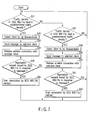
- Whether the traffic density in the IEEE 802.11a band is equal to or larger than a predetermined traffic density is decided (S31). If YES in S31, a client to be disassociated is selected (S32).
- the client selecting method complies with any one of the following rules.
- an error message is sent to the selected client (S33).
- the contents of the error message prompt reconnection in the IEEE 802.11b communication band because the IEEE 802.11a communication band is crowded.
- Wireless communication with the selected client is cut off (S34). Whether an association request has been issued-by the IEEE 802.11b communication method in response to the error message is decided (S35).
- An error message is sent. to the selected client (S39).
- the contents of the error message prompt reconnection in the IEEE 802.11a communication band because the IEEE 802.11b communication band is crowded.
- Wireless communication with the selected client is cut off (S40). Whether an association request has been issued by the IEEE 802.11a communication method in response to the error message is decided (S41).
- the wireless LAN system when a given communication band is crowded, a message which prompts reconnection in another communication band is sent from an access point to a client, releasing connection with the associated client.
- the wireless LAN system can effectively utilize the communication band.
- the access point decides a communication status, and the topology is changed by an action of the access point.
- the client may grasp the status and change the topology.
- an access point operates not as a switching hub (which sends packets to only a port corresponding to an MAC address), but as a bridge or dumb hub (which sends all packets by broadcasting). Packets received by an access point and packets received by a client are the same.
- the client side can satisfactorily decide the traffic density, and preferably performs settings in accordance with its purpose.
- an IEEE 802.11b path may be decided to be more preferable than a crowded IEEE 802.11a path.
- a client which transfers moving pictures that become useless without any IEEE 802.11a band is set not to shift to IEEE 802.11b.
- the client decides the traffic density, disassociates connection with IEEE 802.11a, and shifts to IEEE 802.11b.
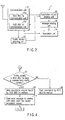
- FIG. 8 is a flow chart for explaining an operation of deciding the traffic density by a client and releasing wireless connection.
- two communication methods are switched on the basis of the traffic density in the wireless LAN access point and client.
- the number of communication methods is not limited to two, that is, three or more communication methods may be adopted.
- a message which prompts reconnection by a communication method using the least crowded band may be inserted in an error message.
- the client can access an access point by the optimal communication method.
- one access point performs communication by two communication methods.
- the access point may have only a function of performing communication by one communication method.
- the access point sends to a client an error message that reconnection is done by another communication method.
- the client which has received the error message associates with another access point by the reconnection communication method.
- the present invention is not limited to the above-described embodiments, and can be variously modified without departing from the spirit and scope of the invention in practical use.
- the respective embodiments can be combined as properly as possible. In this case, the effects of the combination can be obtained.
- the embodiments include inventions on various stages, and various inventions can be extracted by an appropriate combination of building components disclosed. For example, when an invention is extracted by omitting several building components from all those described in the embodiments, the omission is properly compensated for by a well-known technique in practicing the extracted invention.
Landscapes
- Engineering & Computer Science (AREA)
- Computer Networks & Wireless Communication (AREA)
- Signal Processing (AREA)
- Mobile Radio Communication Systems (AREA)
- Small-Scale Networks (AREA)
Abstract
Description
Claims (9)
- A relay comprising:a communication unit (31) capable of communication by a first communication method;means (32) for detecting that a traffic density in a communication band used by the first communication method exceeds a predetermined traffic density; andmeans (33) for limiting the traffic density in the communication band of the first communication method by a client device when the traffic density is detected to exceed the predetermined traffic density.
- A relay according to claim 1, characterized in that the communication unit performs communication by a second communication method using a communication band different from the communication band of the first communication method.
- A relay according to claim 1, characterized in that the limiting means denies an association request using the first communication method from the client device when the traffic density is detected to exceed the predetermined traffic density.
- A relay according to claim 2, characterized in that the first communication method includes a first wireless communication method using the first communication band, and the second communication method includes a second wireless communication method using the second communication band.
- A relay according to claim 3, characterized by further comprising:means for sending an error message to the client device by using the first communication method when the association request is denied; andmeans for receiving an association request corresponding to the error message from the client device by using the second communication method, and associating with the client device by the second communication method.
- A relay according to claim 4, characterized in that the limiting means comprises
means for selecting a client device to be disassociated from a plurality of associated client devices when the traffic density is detected to exceed the predetermined traffic density, and
means for releasing wireless connection with the selected client device. - A relay according to claim 6, characterized in that the selection means includes
means for measuring field intensities of radio waves transmitted by the plurality of associated client devices, and
means for selecting a client device which transmits radio waves at the lowest field intensity among the measured field intensities. - A relay according to claim 6, characterized in that the selection means includes
means for measuring communication times with the plurality of associated client devices, and
means for selecting a client device having the shortest communication time among the measured communication times. - A relay according to claim 6, which further comprises a table that stores priority levels of the plurality of associated client devices, and in which the selection means selects a client device having the lowest priority by referring to the table.
Applications Claiming Priority (2)
| Application Number | Priority Date | Filing Date | Title |
|---|---|---|---|
| JP2002315911 | 2002-10-30 | ||
| JP2002315911A JP3779673B2 (en) | 2002-10-30 | 2002-10-30 | Relay device and communication system |
Publications (2)
| Publication Number | Publication Date |
|---|---|
| EP1416674A2 true EP1416674A2 (en) | 2004-05-06 |
| EP1416674A3 EP1416674A3 (en) | 2006-07-05 |
Family
ID=32089529
Family Applications (1)
| Application Number | Title | Priority Date | Filing Date |
|---|---|---|---|
| EP03012836A Withdrawn EP1416674A3 (en) | 2002-10-30 | 2003-06-05 | Relay and communication system |
Country Status (4)
| Country | Link |
|---|---|
| US (1) | US7139579B2 (en) |
| EP (1) | EP1416674A3 (en) |
| JP (1) | JP3779673B2 (en) |
| CN (1) | CN1494233A (en) |
Families Citing this family (29)
| Publication number | Priority date | Publication date | Assignee | Title |
|---|---|---|---|---|
| US7333829B2 (en) * | 2003-03-24 | 2008-02-19 | Quorum Systems | Multi-mode wireless bridge system and method using a single-radio transceiver |
| US7916803B2 (en) | 2003-04-10 | 2011-03-29 | Qualcomm Incorporated | Modified preamble structure for IEEE 802.11a extensions to allow for coexistence and interoperability between 802.11a devices and higher data rate, MIMO or otherwise extended devices |
| US8743837B2 (en) | 2003-04-10 | 2014-06-03 | Qualcomm Incorporated | Modified preamble structure for IEEE 802.11A extensions to allow for coexistence and interoperability between 802.11A devices and higher data rate, MIMO or otherwise extended devices |
| US7586884B2 (en) | 2003-08-15 | 2009-09-08 | Qualcomm Incorporated | Joint packet detection in wireless communication system with one or more receiver |
| US20050135239A1 (en) * | 2003-12-19 | 2005-06-23 | International Business Machines Corporation | Autonomic optimization of wireless local area networks via protocol concentration |
| ES2623882T3 (en) | 2004-05-27 | 2017-07-12 | Qualcomm Incorporated | Modified preamble structure for extensions of the IEEE802.11A to allow coexistence and interoperability between 802.11A devices and devices with a higher data transmission rate, MIMO or other extensions |
| CN101103597A (en) * | 2004-11-11 | 2008-01-09 | 艾利森电话股份有限公司 | Method and apparatus for routing packets |
| JP4762735B2 (en) | 2005-02-16 | 2011-08-31 | 株式会社エヌ・ティ・ティ・ドコモ | Wireless communication apparatus, communication path control apparatus, communication path control method, and communication system |
| US8233469B2 (en) * | 2005-03-10 | 2012-07-31 | Panasonic Corporation | Relay device |
| EP1861976A1 (en) * | 2005-03-21 | 2007-12-05 | Airgo Networks, Inc. | Joint packet detection in a wireless communication system with one or more receiver |
| US20090061767A1 (en) * | 2005-03-30 | 2009-03-05 | Matsushita Electric Industrial Co., Ltd. | Wireless communication apparatus and wireless communication method |
| US7577453B2 (en) * | 2006-06-01 | 2009-08-18 | Trapeze Networks, Inc. | Wireless load balancing across bands |
| JP2008042451A (en) | 2006-08-04 | 2008-02-21 | Nec Corp | Wireless lan network system, policy control device, access point, and load control method |
| US9392445B2 (en) | 2007-08-17 | 2016-07-12 | Qualcomm Incorporated | Handoff at an ad-hoc mobile service provider |
| US20090049158A1 (en) * | 2007-08-17 | 2009-02-19 | Qualcomm Incorporated | Ad hoc service provider topology |
| US20090046598A1 (en) * | 2007-08-17 | 2009-02-19 | Qualcomm Incorporated | System and method for acquiring or distributing information related to one or more alternate ad hoc service providers |
| US9398453B2 (en) * | 2007-08-17 | 2016-07-19 | Qualcomm Incorporated | Ad hoc service provider's ability to provide service for a wireless network |
| US9179367B2 (en) | 2009-05-26 | 2015-11-03 | Qualcomm Incorporated | Maximizing service provider utility in a heterogeneous wireless ad-hoc network |
| JP5333065B2 (en) * | 2009-08-28 | 2013-11-06 | ブラザー工業株式会社 | Telephone device, telephone communication system, and computer program |
| US8560604B2 (en) | 2009-10-08 | 2013-10-15 | Hola Networks Ltd. | System and method for providing faster and more efficient data communication |
| CN102948241A (en) | 2010-06-21 | 2013-02-27 | 松下电器产业株式会社 | Access-point terminal, wireless communication terminal, wireless communication system, wireless communication method, program, and integrated circuit |
| US9241044B2 (en) | 2013-08-28 | 2016-01-19 | Hola Networks, Ltd. | System and method for improving internet communication by using intermediate nodes |
| US11023846B2 (en) | 2015-04-24 | 2021-06-01 | United Parcel Service Of America, Inc. | Location-based pick up and delivery services |
| US11057446B2 (en) | 2015-05-14 | 2021-07-06 | Bright Data Ltd. | System and method for streaming content from multiple servers |
| US11190374B2 (en) | 2017-08-28 | 2021-11-30 | Bright Data Ltd. | System and method for improving content fetching by selecting tunnel devices |
| LT3761613T (en) | 2017-08-28 | 2023-03-10 | Bright Data Ltd. | Method for improving content fetching by selecting tunnel devices |
| WO2019198681A1 (en) * | 2018-04-10 | 2019-10-17 | パナソニックIpマネジメント株式会社 | Radio wave environment display system and radio wave environment display method |
| WO2020174460A2 (en) | 2019-02-25 | 2020-09-03 | Luminati Networks Ltd. | System and method for url fetching retry mechanism |
| US10911131B1 (en) * | 2019-09-12 | 2021-02-02 | Cisco Technology, Inc. | Hybrid relay for high density venues |
Family Cites Families (16)
| Publication number | Priority date | Publication date | Assignee | Title |
|---|---|---|---|---|
| JPH0646082A (en) * | 1992-07-22 | 1994-02-18 | Toshiba Corp | Information transfer control method |
| US5666348A (en) * | 1995-09-18 | 1997-09-09 | Telefonaktiebolaget L M Ericsson (Publ.) | Packet switched radio channel admission control in a cellular telecommunications system |
| JPH1155286A (en) | 1997-08-07 | 1999-02-26 | Kokusai Electric Co Ltd | Wireless LAN system |
| JP3471588B2 (en) | 1997-10-30 | 2003-12-02 | 株式会社エヌ・ティ・ティ・ドコモ | Packet data bandwidth control method and packet switching network system in packet switching network |
| US6456858B1 (en) * | 1998-12-21 | 2002-09-24 | Verizon Wireless | System and methods in a dual mode wireless system for transmitting rescan command based on detected network conditions |
| KR20000072944A (en) * | 1999-05-03 | 2000-12-05 | 윤종용 | Method for limiting reverse call in mobile telecommunication base station |
| EP1058473A1 (en) * | 1999-05-26 | 2000-12-06 | Motorola, Inc. | Group handover in a cellular communications network |
| JP2001078260A (en) * | 1999-09-06 | 2001-03-23 | Yrp Kokino Idotai Tsushin Kenkyusho:Kk | Congestion control method in mobile communication system, mobile terminal and base station |
| US6990082B1 (en) * | 1999-11-08 | 2006-01-24 | Intel Corporation | Wireless apparatus having a transceiver equipped to support multiple wireless communication protocols |
| JP2001251335A (en) * | 2000-03-06 | 2001-09-14 | Toshiba Corp | Equipment with data transmission function |
| JP2001326658A (en) * | 2000-03-10 | 2001-11-22 | Fujitsu Ltd | Network load management device, communication device, communication method, medium, and program |
| US6659947B1 (en) * | 2000-07-13 | 2003-12-09 | Ge Medical Systems Information Technologies, Inc. | Wireless LAN architecture for integrated time-critical and non-time-critical services within medical facilities |
| US20020141382A1 (en) * | 2001-03-13 | 2002-10-03 | Winther Matthew T. | Wireless communication network for enabling internet access |
| US7961616B2 (en) * | 2001-06-07 | 2011-06-14 | Qualcomm Incorporated | Method and apparatus for congestion control in a wireless communication system |
| JP2003101551A (en) * | 2001-09-21 | 2003-04-04 | Canon Inc | Wireless communication device, connection request processing method, storage medium, and program |
| JP2004048250A (en) * | 2002-07-10 | 2004-02-12 | Toshiba Corp | Wireless base station, network subscription control method, wireless terminal, and communication control method |
-
2002
- 2002-10-30 JP JP2002315911A patent/JP3779673B2/en not_active Expired - Fee Related
-
2003
- 2003-06-05 EP EP03012836A patent/EP1416674A3/en not_active Withdrawn
- 2003-06-17 US US10/462,597 patent/US7139579B2/en not_active Expired - Fee Related
- 2003-06-30 CN CNA03148350XA patent/CN1494233A/en active Pending
Non-Patent Citations (1)
| Title |
|---|
| None * |
Also Published As
| Publication number | Publication date |
|---|---|
| EP1416674A3 (en) | 2006-07-05 |
| US7139579B2 (en) | 2006-11-21 |
| JP2004153529A (en) | 2004-05-27 |
| US20040087268A1 (en) | 2004-05-06 |
| JP3779673B2 (en) | 2006-05-31 |
| CN1494233A (en) | 2004-05-05 |
Similar Documents
| Publication | Publication Date | Title |
|---|---|---|
| US7139579B2 (en) | Relay and communication system | |
| JP3459635B2 (en) | Method and apparatus for managing packet data transfer in a cellular system | |
| TWI506994B (en) | Enhanced winding multiplex method and device | |
| EP1704654B1 (en) | Transport format combination selection in a wireless transmit/receive unit | |
| TWI326992B (en) | System and method for fast dynamic link adaptationsetup protocol | |
| JP4018549B2 (en) | Load balancing method in wireless system | |
| US20050215265A1 (en) | Method and system for load balancing in a wireless communication system | |
| US20060040663A1 (en) | Access point apparatus, radio communication system and connection method | |
| US20130315221A1 (en) | Method and apparatus for transferring antenna capability information | |
| JP2009027737A (en) | Network with adaptation of modulation method | |
| TW200525940A (en) | Wireless local area network (WLAN) methods and components that utilize traffic prediction | |
| JP2000152321A (en) | Channel assignment method and apparatus | |
| EP1436947B1 (en) | Methods and devices for radio link adaptation | |
| JP2003524328A (en) | Method and apparatus for providing configurable layers and protocols in a communication system | |
| JP2003298592A (en) | Wireless LAN system, main device and program | |
| WO2001031950A1 (en) | Channel-type switching from a common channel to a dedicated channel based on common channel load | |
| JP2010268523A (en) | Frame transmission interval | |
| KR100556164B1 (en) | CDMA communication system and its communication method | |
| JP2003533928A (en) | Method and apparatus for changing the transmission rate of a communication channel | |
| US7822422B2 (en) | Wireless communication system for improved transmission priority control | |
| JP2005269185A (en) | Radio relay apparatus and relay method | |
| JP2002185462A (en) | Radio data communication apparatus and system thereof | |
| JP4534492B2 (en) | Radio network controller and mobile communication system using the same | |
| JP7637420B2 (en) | Base station, communication system and communication method | |
| JP2004007078A (en) | Wireless communication system, wireless management device, accommodation device selection method, and program |
Legal Events
| Date | Code | Title | Description |
|---|---|---|---|
| PUAI | Public reference made under article 153(3) epc to a published international application that has entered the european phase |
Free format text: ORIGINAL CODE: 0009012 |
|
| 17P | Request for examination filed |
Effective date: 20030605 |
|
| AK | Designated contracting states |
Kind code of ref document: A2 Designated state(s): AT BE BG CH CY CZ DE DK EE ES FI FR GB GR HU IE IT LI LU MC NL PT RO SE SI SK TR |
|
| AX | Request for extension of the european patent |
Extension state: AL LT LV MK |
|
| PUAL | Search report despatched |
Free format text: ORIGINAL CODE: 0009013 |
|
| AK | Designated contracting states |
Kind code of ref document: A3 Designated state(s): AT BE BG CH CY CZ DE DK EE ES FI FR GB GR HU IE IT LI LU MC NL PT RO SE SI SK TR |
|
| AX | Request for extension of the european patent |
Extension state: AL LT LV MK |
|
| 17Q | First examination report despatched |
Effective date: 20061220 |
|
| AKX | Designation fees paid |
Designated state(s): DE FR GB |
|
| STAA | Information on the status of an ep patent application or granted ep patent |
Free format text: STATUS: THE APPLICATION IS DEEMED TO BE WITHDRAWN |
|
| 18D | Application deemed to be withdrawn |
Effective date: 20100104 |