EP1416666A1 - Method to simplify the management and enhance the security of passwords - Google Patents
Method to simplify the management and enhance the security of passwords Download PDFInfo
- Publication number
- EP1416666A1 EP1416666A1 EP20020405914 EP02405914A EP1416666A1 EP 1416666 A1 EP1416666 A1 EP 1416666A1 EP 20020405914 EP20020405914 EP 20020405914 EP 02405914 A EP02405914 A EP 02405914A EP 1416666 A1 EP1416666 A1 EP 1416666A1
- Authority
- EP
- European Patent Office
- Prior art keywords
- passwords
- computing
- user
- values
- vector
- Prior art date
- Legal status (The legal status is an assumption and is not a legal conclusion. Google has not performed a legal analysis and makes no representation as to the accuracy of the status listed.)
- Withdrawn
Links
Images
Classifications
-
- H—ELECTRICITY
- H04—ELECTRIC COMMUNICATION TECHNIQUE
- H04L—TRANSMISSION OF DIGITAL INFORMATION, e.g. TELEGRAPHIC COMMUNICATION
- H04L9/00—Cryptographic mechanisms or cryptographic arrangements for secret or secure communications; Network security protocols
- H04L9/32—Cryptographic mechanisms or cryptographic arrangements for secret or secure communications; Network security protocols including means for verifying the identity or authority of a user of the system or for message authentication, e.g. authorization, entity authentication, data integrity or data verification, non-repudiation, key authentication or verification of credentials
- H04L9/3226—Cryptographic mechanisms or cryptographic arrangements for secret or secure communications; Network security protocols including means for verifying the identity or authority of a user of the system or for message authentication, e.g. authorization, entity authentication, data integrity or data verification, non-repudiation, key authentication or verification of credentials using a predetermined code, e.g. password, passphrase or PIN
-
- H—ELECTRICITY
- H04—ELECTRIC COMMUNICATION TECHNIQUE
- H04L—TRANSMISSION OF DIGITAL INFORMATION, e.g. TELEGRAPHIC COMMUNICATION
- H04L9/00—Cryptographic mechanisms or cryptographic arrangements for secret or secure communications; Network security protocols
- H04L9/002—Countermeasures against attacks on cryptographic mechanisms
-
- H—ELECTRICITY
- H04—ELECTRIC COMMUNICATION TECHNIQUE
- H04L—TRANSMISSION OF DIGITAL INFORMATION, e.g. TELEGRAPHIC COMMUNICATION
- H04L9/00—Cryptographic mechanisms or cryptographic arrangements for secret or secure communications; Network security protocols
- H04L9/08—Key distribution or management, e.g. generation, sharing or updating, of cryptographic keys or passwords
- H04L9/0894—Escrow, recovery or storing of secret information, e.g. secret key escrow or cryptographic key storage
-
- H—ELECTRICITY
- H04—ELECTRIC COMMUNICATION TECHNIQUE
- H04L—TRANSMISSION OF DIGITAL INFORMATION, e.g. TELEGRAPHIC COMMUNICATION
- H04L9/00—Cryptographic mechanisms or cryptographic arrangements for secret or secure communications; Network security protocols
- H04L9/14—Cryptographic mechanisms or cryptographic arrangements for secret or secure communications; Network security protocols using a plurality of keys or algorithms
-
- H—ELECTRICITY
- H04—ELECTRIC COMMUNICATION TECHNIQUE
- H04L—TRANSMISSION OF DIGITAL INFORMATION, e.g. TELEGRAPHIC COMMUNICATION
- H04L9/00—Cryptographic mechanisms or cryptographic arrangements for secret or secure communications; Network security protocols
- H04L9/32—Cryptographic mechanisms or cryptographic arrangements for secret or secure communications; Network security protocols including means for verifying the identity or authority of a user of the system or for message authentication, e.g. authorization, entity authentication, data integrity or data verification, non-repudiation, key authentication or verification of credentials
- H04L9/3236—Cryptographic mechanisms or cryptographic arrangements for secret or secure communications; Network security protocols including means for verifying the identity or authority of a user of the system or for message authentication, e.g. authorization, entity authentication, data integrity or data verification, non-repudiation, key authentication or verification of credentials using cryptographic hash functions
- H04L9/3242—Cryptographic mechanisms or cryptographic arrangements for secret or secure communications; Network security protocols including means for verifying the identity or authority of a user of the system or for message authentication, e.g. authorization, entity authentication, data integrity or data verification, non-repudiation, key authentication or verification of credentials using cryptographic hash functions involving keyed hash functions, e.g. message authentication codes [MACs], CBC-MAC or HMAC
Definitions
- the present invention is concerned with the use and storage of passwords. Password checking is a very straightforward way to protect access to computer systems and similar devices. Along the same lines, the security of these systems can be further enhanced by the use of non-fixed passwords.
- the present invention is particularly concerned with a method to simplify the use of multiple passwords and to enhance the storage security of these passwords.
- a well-known proposal regarding the second requirement i.e., handling and organizing the regular change of each password, consists in using a set of several passwords that are used in a round-robin base.
- the robustness can be improved for instance by replacing two or three letters in the password by the alphabetically next or previous letters every time the password is changed - e.g., replacing the second letter of the original password by the alphabetically next and the third letter by the alphabetically previous leads to the sequence Tbgw#D
- many proposals to meet the third requirement i.e., creating a "hard" password, have been made.
- a good password should include: lower and upper case letters, numbers, special characters like punctuation marks and mathematical symbols and extended ASCII characters.
- Proposed methods for generating a hard password include: using two unrelated words, pronounceable nonsense words or the first characters of a phrase. Following the last strategy, starting from Look: It is my old 65 Buick!, one would obtain: L:Iimo 6B!, i.e., a password that includes lower and upper case letters, numbers and special characters.
- L:Iimo 6B! i.e., a password that includes lower and upper case letters, numbers and special characters.
- the access control device must store user/password pairs.
- the storage In order to prevent password stealing by attackers who have gained access to the storage medium, the storage must be achieved in a secure manner. It is thus a well-known technique to immediately encrypt the password chosen by the user and to store only the encrypted version thereof. At any subsequent login, the password entered by the user is then encrypted again and the result is checked against the stored encrypted version. Examples thereof can be found in Bruce Schneier: Applied Cryptography, John Wiley & Sons, 2 nd Ed. 1996.
- storing passwords in the access device represents a potential vulnerability to attackers who have succeeded in accessing the storage medium and in breaking the encryption method on the device: if an attacker has gained access to the system, it is not unlikely that he could also be successful in cracking the encrypted passwords stored thereon.
- the present invention discloses a method that incorporates the concept of multiple passwords. This concept, when used according to the method of the present invention, not only leads to easy-to-remember passwords which are still "hard”, but also to the possibility of storing these passwords in a very secure way.
- the method for simplifying the use and enhancing the storage security of non-fixed passwords makes use of multiple passwords p 1 , ..., p n and (n,m)-threshold schemes for storing the passwords on an access control medium, representing the passwords as numbers in a finite field of size p and performing all executions modulo p where p is a prime number larger than all possible passwords, and comprises the following steps of:
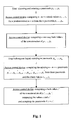
- FIG. 1 shows a flow chart illustrating the login and storage procedure.
- the present invention makes use of different, or multiple, passwords. Contrary to the first requirement mentioned above, these different passwords are not used for different applications but for the login in one application. This not only enhances the security during login but also leads to the possibility to store these passwords in a very secure alternative way. In the following, the login procedure and the storage will be described in more detail.
- n passwords After login, i.e., during or at the end of a session on logout, the user is requested to choose and enter n passwords, where n > 1. These passwords p 1 , ..., p n may possibly, but not necessarily, only be accepted if they are different from any previous choice. In order to ease the task of remembering these several different passwords at the next login, the present invention introduces a new simple rule: at the next login, matching of m passwords is sufficient for passing the user authentication, where m ⁇ n. In case the login procedure shall be further simplified, the following - optional - measure can be taken.
- the (partial) order for entering the m passwords may be any permutation of the original order of the n passwords - this simplifies the login for the user even further since he does not have to remember the correct order of the passwords. In case a higher security level is desired, it can of course be determined that the (partial) order for entering the m passwords has to be correct.
- N 1 90 6 ⁇ 5,31 ⁇ 10 11 .
- the present invention takes such a scheme as its set-up (see below), but instead of using it for computing and then handing out keys, it inverts the direction: the passwords are chosen by the user himself, and the system must securely store them.
- the set-up is as follows.
- the passwords p i are represented as numbers in a finite field of size p, a prime number p is chosen which is larger than all possible p i s , and all further computations are then performed modulo p.
- the steps described above are qualitatively illustrated in the flow chart in Fig.1.
- the method described above requires that the user enters the m passwords p ' / n 1 ,..., p ' / n m at login in the right (partial) order.
- the values c 1 , ..., c s and c can be encrypted for storage, but c 1 , ..., c s will have to be decrypted before solving (2).
- Some further protection would be achieved by keeping H secret, i.e., storing H in some hard-to-access part of the access control device.
- some keyed one-way hash function (message authentication code) could be used for F for additional protection.
- the method according to the present invention leads to sufficient security at the login stage. At the same time, handling the passwords is simplified. Furthermore, the method leads to an enhanced storage security of the passwords on the access control device.
- a computer program for simplifying the use and enhancing the storage security of non-fixed passwords according to the invention is loadable into an internal memory of a digital computer, and comprises computer program code means to make, when said computer program code means is loaded in the computer, the computer execute the method according to the invention.
- a computer program product comprises a computer readable medium, having the computer program code means recorded thereon.
- a data processing system for simplifying the use and enhancing the storage security of non-fixed passwords according to the invention comprises means for carrying out the steps of the method according to the invention.
- the data processing system is an apparatus comprising a data processor, a memory coupled to the processor and computer program code means stored in said memory, where said computer program code means, when executed by the processor, causes the method according to the invention to be executed.
Landscapes
- Engineering & Computer Science (AREA)
- Computer Security & Cryptography (AREA)
- Computer Networks & Wireless Communication (AREA)
- Signal Processing (AREA)
- Power Engineering (AREA)
- Storage Device Security (AREA)
Abstract
The check values are computed from input n passwords, by multiplying fixed matrix with vector consisting of n passwords. One-way hash value 'c' is calculated from the passwords. User is requested to enter m passwords at subsequent login, for computing missing passwords from check values, based on which another hash value is calculated and compared with the value c, and validating c if compared values are in accord. Independent claims are also included for the following: (1) data processing system; and (2) non-fixed password storage security enhancing program.
Description
- The present invention is concerned with the use and storage of passwords. Password checking is a very straightforward way to protect access to computer systems and similar devices. Along the same lines, the security of these systems can be further enhanced by the use of non-fixed passwords. The present invention is particularly concerned with a method to simplify the use of multiple passwords and to enhance the storage security of these passwords.
- The use of computers or similar systems for data storage, data processing and data transfer purposes immediately gives rise to security issues in connection with accessing the system and, therewith, the data thereon. As in various instances of daily life, only authenticated persons should be permitted to change, transfer or even see the data. A natural way to protect the computer system from unwanted access is to introduce passwords, and in practice, password or pass sentence checking is still the most essential way to protect access to computing and communication systems: cash cards, computer accounts, dial-up services, home banking access etc. all are protected by codes or passwords. Passwords are used to authenticate and authorize users at the login stage, and to derive cryptographic keys for subsequent actions. Because of their importance regarding the security of the computer system, it is well-known that
- different passwords should be chosen for different applications,
- passwords should be changed regularly and
- passwords should generally be as "hard" as possible - "hard" meaning that the problem to crack the password is hard to solve.
- There have been various proposals how to meet the above-mentioned requirements. One such proposal regarding the first requirement, i.e., handling and organizing a plurality of different passwords for different applications, results in the following scheme: once a "good" password has been chosen, one or two of its characters are replaced by codes for the function of the password or by letter(s) of the name of the system the password is valid for - e.g., the chosen password Tbgw#D|3 is replaced by Tbg + [1st letter of host] + #D| + [3rd letter of host, upper case if server]. A well-known proposal regarding the second requirement, i.e., handling and organizing the regular change of each password, consists in using a set of several passwords that are used in a round-robin base. The robustness can be improved for instance by replacing two or three letters in the password by the alphabetically next or previous letters every time the password is changed - e.g., replacing the second letter of the original password by the alphabetically next and the third letter by the alphabetically previous leads to the sequence Tbgw#D|3 -> Tcfn#D|3 -> Tden#D|3 -> Tedn#D|3 -> ... Finally, many proposals to meet the third requirement, i.e., creating a "hard" password, have been made. According to these proposals, a good password should include: lower and upper case letters, numbers, special characters like punctuation marks and mathematical symbols and extended ASCII characters. Proposed methods for generating a hard password include: using two unrelated words, pronounceable nonsense words or the first characters of a phrase. Following the last strategy, starting from Look: It is my old 65 Buick!, one would obtain: L:Iimo 6B!, i.e., a password that includes lower and upper case letters, numbers and special characters. However, all these rules are rarely observed, as following them very soon becomes impractical or even unacceptable for typical users whose main difficulty is to remember all currently valid and/or complex passwords.
- Besides these problems regarding the handling of passwords by the user there is another aspect that cannot be neglected, either - i.e., the storage of the passwords on the computer system. Generally, the access control device must store user/password pairs. In order to prevent password stealing by attackers who have gained access to the storage medium, the storage must be achieved in a secure manner. It is thus a well-known technique to immediately encrypt the password chosen by the user and to store only the encrypted version thereof. At any subsequent login, the password entered by the user is then encrypted again and the result is checked against the stored encrypted version. Examples thereof can be found in Bruce Schneier: Applied Cryptography, John Wiley & Sons, 2nd Ed. 1996. On the other hand, storing passwords in the access device, even in encrypted form, represents a potential vulnerability to attackers who have succeeded in accessing the storage medium and in breaking the encryption method on the device: if an attacker has gained access to the system, it is not unlikely that he could also be successful in cracking the encrypted passwords stored thereon.
- In view of these drawbacks concerning handling as well as storage of passwords, there is thus a need for a method that not only makes the handling of passwords simple without depriving them of being "hard" enough, but also enhances the storage security of these passwords.
- It is thus an object of the present invention to provide a method that allows a simple handling of "hard" passwords and that ensures a secure storage of these passwords at the same time.
- This is achieved by a method with the features as described in claim 1. The present invention discloses a method that incorporates the concept of multiple passwords. This concept, when used according to the method of the present invention, not only leads to easy-to-remember passwords which are still "hard", but also to the possibility of storing these passwords in a very secure way.
- According to the present invention the method for simplifying the use and enhancing the storage security of non-fixed passwords makes use of multiple passwords p1, ..., pn and (n,m)-threshold schemes for storing the passwords on an access control medium, representing the passwords as numbers in a finite field of size p and performing all executions modulo p where p is a prime number larger than all possible passwords, and comprises the following steps of:
- requesting the user to choose and enter n passwords p1, ..., pn and computing n - m = s check values c1,..., cs for m < n from the n passwords by multiplying a fixed (n x s)-matrix H = [(h ij )] with the vector p = [(pi )] consisting of the n passwords p1, ..., pn where H is chosen such that any (s x s)-submatrix Hs is invertible,
- computing a one-way hash value c of the concatenation of p1 , ..., pn using a hash function F and storing the values c1 ,..., cs and c,
- requesting the user at a subsequent login to enter m passwords p ' / n 1, ..., p ' / n m and computing the missing n - m = s passwords p ' / 1,...,p ' / n 1-1,p ' / n 1+1,...,p ' / n m -1,p ' / n m +1,...,p ' / 1 n by multiplying the (s x s)-submatrix Hs with the vector p s consisting of the n - m = s missing passwords and by multiplying the (m x s)-submatrix Hm with the vector p m , consisting of the m passwords entered by the user and solving the equation c = Hs p s + Hm p m for p s, where the vector c consists of c1,..., cs,
- computing a hash value c' of the concatenation of p ' / 1, ..., p ' / n by using the hash function F, comparing the values c and c' and accepting the passwords if c = c'.
- Further advantages and objects of the present invention are described in the dependent claims.
- In the following the present invention will be described in more detail in connection with the enclosed drawing, Fig. 1, which shows a flow chart illustrating the login and storage procedure.
- The present invention makes use of different, or multiple, passwords. Contrary to the first requirement mentioned above, these different passwords are not used for different applications but for the login in one application. This not only enhances the security during login but also leads to the possibility to store these passwords in a very secure alternative way. In the following, the login procedure and the storage will be described in more detail.
- After login, i.e., during or at the end of a session on logout, the user is requested to choose and enter n passwords, where n > 1. These passwords p1 , ..., pn may possibly, but not necessarily, only be accepted if they are different from any previous choice. In order to ease the task of remembering these several different passwords at the next login, the present invention introduces a new simple rule: at the next login, matching of m passwords is sufficient for passing the user authentication, where m < n. In case the login procedure shall be further simplified, the following - optional - measure can be taken. The (partial) order for entering the m passwords may be any permutation of the original order of the n passwords - this simplifies the login for the user even further since he does not have to remember the correct order of the passwords. In case a higher security level is desired, it can of course be determined that the (partial) order for entering the m passwords has to be correct. An example will illustrate the login procedure. At first, the user chooses n = 5 passwords which are stored in the access device in a manner described below. At the next login, the user must enter only m = 3 passwords. If these three passwords match with any three of the originally five chosen passwords, the login is successful. Furthermore, the selected three passwords may be entered in a different sequence than originally entered.
- Because of the use of more than one password, this scheme leads to an improved security: the number of possible passwords increases exponentially, thus making password guessing or brute force attacks correspondingly more difficult. Although allowing m out of n passwords for ease of remembering will decrease the strength somewhat the effort for a brute force attack is still high as compared to the case of only one password. The following estimation shows these relations.
- For a password character set of 90 characters and a password length of 6 characters, the number of possible passwords - which is a measure for the effort for a brute force attack - is
- Thus, a single random guess has a probability ofWith the scheme described above for m = 3 out of n = 5 passwords, the probability for hitting m out of n passwords is given by


- Obviously, this comes much closer to the probability P2 of guessing three passwords and is a great improvement over the case of one password.
- But the use of multiple passwords leads to an enhanced security not only regarding the login procedure but also regarding the storage of the passwords in the system. As already mentioned, storing passwords in the access device, even in encrypted form, generally represents a potential vulnerability to attackers who have succeeded in accessing the storage medium and in breaking the encryption method on the device. This drawback can be avoided with the present invention because it uses multiple passwords which in turn leads to the possibility of checking the user login against the passwords p1, ..., pn without storing the passwords themselves. Instead of storing the passwords, the method according to the invention only stores the difference information of n - m passwords. In this case, the attacker cannot retrieve the passwords, even if he succeeds in accessing and code-breaking the stored information on the storage medium. The storage according to the invention works in the following way.
- In the context of shared secret systems, it is known from the art to use so-called (m,n)-threshold schemes. In general, such schemes allow to take any message and divide it into n pieces (called shadows or shares) such that any m of them can be used to reconstruct the original message, i.e., it only takes m participants to share the secret. Examples for these schemes are the LaGrange Interpolating Polynomial Scheme, the Vector Scheme, the Asmuth-Bloom Scheme, the Karnin-Green-Hellman Scheme etc. This concept is used in the context of shared keys in such a way that the partial keys are computed and then handed out to the users (c.f. Bruce Schneier: Applied Cryptography, John Wiley & Sons, 2nd Ed. 1996, chap. 3.7 & 23.2). The present invention takes such a scheme as its set-up (see below), but instead of using it for computing and then handing out keys, it inverts the direction: the passwords are chosen by the user himself, and the system must securely store them. The set-up is as follows. The passwords p i are represented as numbers in a finite field of size p, a prime number p is chosen which is larger than all possible pis, and all further computations are then performed modulo p.
- In a first step, on receiving n passwords p1 , ..., pn chosen by the user, the access control device computes n - m = s check values c1,..., cs for m < n from the n passwords by multiplying a fixed (n x s)-matrix H = [(hij)] with the vector p = [(pi)] consisting of the n passwords p1, ..., pn

- In a second step, the access control device computes a one-way hash value of the concatenation of p1, ..., pn using a hash function F
- In a third step, on a subsequent login, the user is requested to enter m passwords p ' / n 1 , ..., p ' / n m which are used by the access control device to compute the missing n - m = s passwords p ' / 1,..., p ' / n 1-1,p ' / n 1+1,···,p ' / n m +1,p ' / n m +1,···,p ' / n by multiplying the (s x s)-submatrix Hs with the vector p s consisting of the n - m = s missing passwords and by multiplying the (m x s)-submatrix Hm with the vector p m , consisting of the m passwords entered by the user and solving the equation c = Hs p s + Hm p m for p s

- It is essential that (2) can be solved - this places conditions on the matrix H = [(hij)]: it is required that the sub-matrices Hs consisting of any permutation of the n-m= s column vectors h i are invertible.
- A simple method to construct an admissible H is to select the coefficients hij randomly and then to check this condition. Alernatively, the polynomial selection hij = (xi)j , where xi are different integers, satisfies the condition. It should be noted that this computation is to be performed in the same finite field as (1) and (2).
- In a fourth step, the access control device computes the hash value
- Storing only the check values c1, ..., cs and c in the access device is more secure than storing all passwords p1 , ..., pn even in encrypted form. Given the check values c1,...,cs, it is not possible to easily find m matching passwords. Using a one-way hash function in the second and fourth step also prevents an attacker from finding the passwords p 1, ..., p n , given c.
- So far, the method described above requires that the user enters the m passwords p ' / n 1,..., p ' / n m at login in the right (partial) order. As already mentioned before, it may be desirable to simplify the login procedure by allowing to enter the m passwords in any order, though. In this case, the computations in steps three and four have to be performed for all possible permutations of the m passwords chosen for login, until either the check in step four, i.e., whether c = c', matches or the combination of m passwords p ' / n 1,..., p ' / n m is rejected.
- For further protection of the system, the values c1, ..., cs and c can be encrypted for storage, but c1, ..., cs will have to be decrypted before solving (2). Some further protection would be achieved by keeping H secret, i.e., storing H in some hard-to-access part of the access control device. Also, some keyed one-way hash function (message authentication code) could be used for F for additional protection.
- As can easily be seen from the above description, due to its use of multiple passwords, the method according to the present invention leads to sufficient security at the login stage. At the same time, handling the passwords is simplified. Furthermore, the method leads to an enhanced storage security of the passwords on the access control device.
- A computer program for simplifying the use and enhancing the storage security of non-fixed passwords according to the invention is loadable into an internal memory of a digital computer, and comprises computer program code means to make, when said computer program code means is loaded in the computer, the computer execute the method according to the invention. In a preferred embodiment of the invention, a computer program product comprises a computer readable medium, having the computer program code means recorded thereon.
- A data processing system for simplifying the use and enhancing the storage security of non-fixed passwords according to the invention comprises means for carrying out the steps of the method according to the invention. In a preferred embodiment of the invention, the data processing system is an apparatus comprising a data processor, a memory coupled to the processor and computer program code means stored in said memory, where said computer program code means, when executed by the processor, causes the method according to the invention to be executed.
Claims (8)
- Method for simplifying the use and enhancing the storage security of non-fixed passwords, wherein multiple passwords p1, ..., pn and (n,m)-threshold schemes for storing the passwords on an access control medium are used representing the passwords as numbers in a finite field of size p and performing all executions modulo p where p is a prime number larger than all possible passwords, characterized in that the method comprises the following steps of:requesting the user to choose and enter n passwords p 1 , ..., pn and computing n - m = s check values c1,..., cs for m < n from the n passwords by multiplying a fixed (n x s)-matrix H = [(hij)] with the vector p = [(pi)] consisting of the n passwords p1 , ..., pn where H is chosen such that any (s x s)-submatrix Hs is invertible,computing a one-way hash value c of the concatenation of p1 , ..., pn using a hash function F and storing the values c1,..., cs and c,requesting the user at a subsequent login to enter m passwords p ' / n 1,..., p ' / n m and computing the missing n - m = s passwords p ' / 1,..., p ' / n i-1, p ' / n 1+1,... p ' / n m -1, p ' / n m +1,..., p ' / n by multiplying the invertible (s x s)-submatrix Hs with the vector p s consisting of the n - m = s missing passwords and by multiplying the (m x s)-submatrix Hm with the vector p m consisting of the m passwords entered by the user and solving the equation c = Hs p s + Hm p m for p s where the vector c consists of c1 ,..., cs,computing a hash value c' of the concatenation of p ' / 1, ..., p ' / n by using the hash function F, comparing the values c and c' and accepting the passwords if c = c'.
- Method according to claim 1, characterized in that the method requires the m passwords p ' / n 1, ..., p ' / n m to be entered in the original (partial) order.
- Method according to claim 1, characterized in that the method allows the m passwords p ' / n 1, ..., p ' / n m to be entered in any order.
- Method according to one of the preceding claims, characterized in that the values c1 ,..., cs are encrypted before storage and are decrypted again before computing the missing n - m = s passwords p ' / 1,..., p ' / n 1-1,p ' / n 1+1,... p ' / n m -1, p ' / n m +1,..., P ' / n.
- Method according to one of the preceding claims, characterized in that a keyed one-way hash function F (message authentication code) is used for additional protection.
- Method according to one of the preceding claims, characterized in that the matrix H is kept secret.
- Computer program for simplifying the use and enhancing the storage security of non-fixed passwords which is loadable and executable on a data processing unit and which computer program, when being executed, performs the steps according to one of the preceding claims.
- Data processing system comprising means for carrying out the steps of the method according to any one of the claims 1 to 6.
Priority Applications (1)
| Application Number | Priority Date | Filing Date | Title |
|---|---|---|---|
| EP20020405914 EP1416666A1 (en) | 2002-10-28 | 2002-10-28 | Method to simplify the management and enhance the security of passwords |
Applications Claiming Priority (1)
| Application Number | Priority Date | Filing Date | Title |
|---|---|---|---|
| EP20020405914 EP1416666A1 (en) | 2002-10-28 | 2002-10-28 | Method to simplify the management and enhance the security of passwords |
Publications (1)
| Publication Number | Publication Date |
|---|---|
| EP1416666A1 true EP1416666A1 (en) | 2004-05-06 |
Family
ID=32088104
Family Applications (1)
| Application Number | Title | Priority Date | Filing Date |
|---|---|---|---|
| EP20020405914 Withdrawn EP1416666A1 (en) | 2002-10-28 | 2002-10-28 | Method to simplify the management and enhance the security of passwords |
Country Status (1)
| Country | Link |
|---|---|
| EP (1) | EP1416666A1 (en) |
Cited By (2)
| Publication number | Priority date | Publication date | Assignee | Title |
|---|---|---|---|---|
| WO2007110853A1 (en) * | 2006-03-29 | 2007-10-04 | Nds Limited | Password protection |
| CN112714040A (en) * | 2020-12-11 | 2021-04-27 | 深圳供电局有限公司 | Holographic message detection method, device, equipment and storage medium |
-
2002
- 2002-10-28 EP EP20020405914 patent/EP1416666A1/en not_active Withdrawn
Non-Patent Citations (3)
| Title |
|---|
| ABADI M, LOMAS T M A, NEEDHAM R: "Strengthening Passwords", SRC TECHNICAL NOTE 1997-033, DIGITAL EQUIPMENT CORPORATION, SYSTEMS RESEARCH CENTER, 4 September 1997 (1997-09-04), Palo Alto, California, US, pages 1 - 11, XP002246509, Retrieved from the Internet <URL:http://citeseer.nj.nec.com/cs> [retrieved on 20030703] * |
| CHIEN H-Y ET AL: "A PRACTICAL (T,N) MULTI-SECRET SHARING SCHEME", IEICE TRANSACTIONS ON FUNDAMENTALS OF ELECTRONICS, COMMUNICATIONS AND COMPUTER SCIENCES, INSTITUTE OF ELECTRONICS INFORMATION AND COMM. ENG. TOKYO, JP, vol. E83-A, no. 12, December 2000 (2000-12-01), pages 2762 - 2765, XP001036438, ISSN: 0916-8508 * |
| VAN DIJK M: "A linear construction of perfect secret sharing schemes", ADVANCES IN CRYPTOLOGY - EUROCRYPT '94, SPRINGER-VERLAG, 12 May 1994 (1994-05-12), Perugia, Italy, pages 23 - 34, XP002246508, ISBN: 3-540-60176-7 * |
Cited By (4)
| Publication number | Priority date | Publication date | Assignee | Title |
|---|---|---|---|---|
| WO2007110853A1 (en) * | 2006-03-29 | 2007-10-04 | Nds Limited | Password protection |
| CN101401351B (en) * | 2006-03-29 | 2012-02-01 | Nds有限公司 | Password protection |
| US8566604B2 (en) | 2006-03-29 | 2013-10-22 | Cisco Technology Inc | Password protection |
| CN112714040A (en) * | 2020-12-11 | 2021-04-27 | 深圳供电局有限公司 | Holographic message detection method, device, equipment and storage medium |
Similar Documents
| Publication | Publication Date | Title |
|---|---|---|
| US9117065B2 (en) | Dynamic interactive identity authentication method and system | |
| EP1043862B1 (en) | Generation of repeatable cryptographic key based on varying parameters | |
| US9684780B2 (en) | Dynamic interactive identity authentication method and system | |
| US8181234B2 (en) | Authentication system in client/server system and authentication method thereof | |
| Wu | A Real-World Analysis of Kerberos Password Security. | |
| US6959394B1 (en) | Splitting knowledge of a password | |
| US6950523B1 (en) | Secure storage of private keys | |
| JP5058600B2 (en) | System and method for providing contactless authentication | |
| US8997177B2 (en) | Graphical encryption and display of codes and text | |
| JP4881119B2 (en) | User authentication method, user side authentication device, and program | |
| US20090063850A1 (en) | Multiple factor user authentication system | |
| WO2013165317A1 (en) | Method and system for protecting a password during an authentication process | |
| Pagar et al. | Strengthening password security through honeyword and Honeyencryption technique | |
| KR20060027347A (en) | Method and apparatus for authenticating a password | |
| EP2569725B1 (en) | Methods, devices and computer program supports for password generation and verification | |
| Dandash et al. | Fraudulent Internet Banking Payments Prevention using Dynamic Key. | |
| JP4612951B2 (en) | Method and apparatus for securely distributing authentication credentials to roaming users | |
| JP2003152716A (en) | Qualification authentication method using variable authentication information | |
| EP1416666A1 (en) | Method to simplify the management and enhance the security of passwords | |
| Mangipudi et al. | A Hash-based Strong Password Authentication Protocol with User Anonymity. | |
| JP3746919B2 (en) | Qualification authentication method using variable authentication information | |
| EP1440549B1 (en) | Authentication of a remote user to a host in a data communication system | |
| Varshney et al. | Three level password authentication system using cryptography approaches | |
| KR20230065481A (en) | Text encryption module with text encryption algorithm applied | |
| Tritilanunt | A biometric smart card based remote user authentication for telecare medicine information system |
Legal Events
| Date | Code | Title | Description |
|---|---|---|---|
| PUAI | Public reference made under article 153(3) epc to a published international application that has entered the european phase |
Free format text: ORIGINAL CODE: 0009012 |
|
| AK | Designated contracting states |
Kind code of ref document: A1 Designated state(s): AT BE BG CH CY CZ DE DK EE ES FI FR GB GR IE IT LI LU MC NL PT SE SK TR |
|
| AX | Request for extension of the european patent |
Extension state: AL LT LV MK RO SI |
|
| AKX | Designation fees paid | ||
| REG | Reference to a national code |
Ref country code: DE Ref legal event code: 8566 |
|
| STAA | Information on the status of an ep patent application or granted ep patent |
Free format text: STATUS: THE APPLICATION IS DEEMED TO BE WITHDRAWN |
|
| 18D | Application deemed to be withdrawn |
Effective date: 20041109 |