EP1416406A1 - License information converter - Google Patents
License information converter Download PDFInfo
- Publication number
- EP1416406A1 EP1416406A1 EP02755844A EP02755844A EP1416406A1 EP 1416406 A1 EP1416406 A1 EP 1416406A1 EP 02755844 A EP02755844 A EP 02755844A EP 02755844 A EP02755844 A EP 02755844A EP 1416406 A1 EP1416406 A1 EP 1416406A1
- Authority
- EP
- European Patent Office
- Prior art keywords
- license information
- conversion
- information
- terminal apparatus
- terminal
- Prior art date
- Legal status (The legal status is an assumption and is not a legal conclusion. Google has not performed a legal analysis and makes no representation as to the accuracy of the status listed.)
- Withdrawn
Links
Images











Classifications
-
- G—PHYSICS
- G06—COMPUTING OR CALCULATING; COUNTING
- G06F—ELECTRIC DIGITAL DATA PROCESSING
- G06F21/00—Security arrangements for protecting computers, components thereof, programs or data against unauthorised activity
- G06F21/10—Protecting distributed programs or content, e.g. vending or licensing of copyrighted material ; Digital rights management [DRM]
- G06F21/107—License processing; Key processing
- G06F21/1073—Conversion
-
- G—PHYSICS
- G06—COMPUTING OR CALCULATING; COUNTING
- G06F—ELECTRIC DIGITAL DATA PROCESSING
- G06F21/00—Security arrangements for protecting computers, components thereof, programs or data against unauthorised activity
- G06F21/10—Protecting distributed programs or content, e.g. vending or licensing of copyrighted material ; Digital rights management [DRM]
- G06F21/108—Transfer of content, software, digital rights or licenses
Definitions
- the present invention relates to a conversion apparatus, and more particularly to a conversion apparatus for converting license information, which controls use of content data in a terminal apparatus.
- DRM Digital Rights Management
- a server and terminal apparatuses are coupled so as to be capable of data communications via a network.
- the server stores at least one set of content data, a content decryption key, and license information.
- the content data which may be digital data representing music, for example, is encrypted by a predetermined scheme.
- the content decryption key is a key for decrypting encrypted content data.
- the license information represents usage rules for the content data.
- a typical example of a usage rule is a number of times of using the content data.
- a terminal apparatus requests the server to distribute content data.
- a request for content data is made by a terminal apparatus transmitting a content identifier and terminal-specific information to the server via the network.
- the content identifier is information which uniquely identifies the content data.
- the terminal-specific information which is previously retained in the terminal apparatus, is information which can uniquely identify the terminal apparatus which has made the request for the content data.
- the server In response to the request from the terminal apparatus, the server encrypts the content decryption key by using the currently-received terminal-specific information. Thereafter, the server transmits the encrypted content data, the content decryption key which has been encrypted with the terminal-specific information, and the license information to the terminal apparatus.
- the terminal apparatus receives the content data, the content decryption key, and the license information which have been distributed from the server, and stores them in an internal memory device.
- the terminal apparatus After storing the above, the currently-decrypted content data becomes usable to the user of the terminal apparatus.
- the terminal apparatus determines whether or not the current use complies with a usage rule represented by the license information within the memory device. The terminal apparatus performs the subsequent processes only when the usage rule is complied with.
- the terminal apparatus since the content decryption key within the memory device is encrypted, the terminal apparatus decrypts the content decryption key by using the terminal-specific information retained therein.
- the terminal apparatus since the content data within the memory device is also encrypted as described above, the terminal apparatus decrypts the content data by using the decrypted content decryption key, and thereafter reproduces the decrypted content data.
- the user of the terminal apparatus may desire to pass his or her own license information, i.e., a license for content data, over to another user (hereinafter referred to as the second user).
- the second user may not necessarily be subscribing to the aforementioned content distribution system, and may be subscribing to another content distribution system.
- the structure of the license information may differ between the two content distribution systems. As a result, even if the second user's the terminal apparatus can receive the license information from the first user's terminal apparatus, it cannot interpret the received license information. Therefore, under the conventional content distribution system, it is impossible to pass one's own license information over to others.
- a user may be subscribing to different first and second content distribution systems, and may possess a first terminal apparatus which can only interpret license information obtained from the first content distribution system and a second terminal apparatus which can only interpret license information obtained from the second content distribution system.
- the structure of the license information used may differ between the first and second content distribution systems. Therefore, even if the second terminal apparatus can receive the license information from the first content distribution system, the second terminal apparatus cannot interpret it. Therefore, in the above situation, it may be possible that the license information owned by a user cannot be utilized on his or her own terminal apparatus.
- an object of the present invention is to provide a conversion apparatus which converts license information so that it can be utilized by another, or so that it can be utilized on another terminal apparatus.
- a first aspect of the present invention is directed to a conversion apparatus for converting license information which is compatible with a first terminal apparatus into that which is compatible with a second terminal apparatus, wherein the first and second terminal apparatuses use content data in accordance with first and second license information which are different from each other.
- the conversion apparatus comprises: a working area for storing first license information compatible with the first terminal apparatus, and a processing section for converting the first license information stored in the working area into second license information compatible with the second terminal apparatus.
- the first license information at least contains first usage admission information for permitting the use of the content data at the first terminal apparatus.
- the processing section converts at least the first usage admission information contained in the first license information into second usage admission information for permitting the use of the content data at the second terminal apparatus.
- the processing section converts the first usage admission information contained in the first license information into the second usage admission information for permitting the use of the content data at the second terminal apparatus in accordance with a predetermined conversion ratio.
- the content data is distributed to the first and second terminal apparatuses in states encrypted with first and second encryption keys which are different from each other.
- the first license information further contains a first decryption key for decrypting the content data encrypted with the first encryption key.
- the processing section further replaces the first decryption key in the first license information with a second decryption key for decrypting the content data encrypted with the second encryption key.
- the conversion apparatus converts first license information which is compatible with a first terminal apparatus into second license information which is compatible with a second terminal apparatus.
- a first user can pass, to a second user, second license information which has been generated based on the user's first license information and is usable at the second terminal apparatus.
- the first and second terminal apparatuses are connected to first and second servers.
- the first and second servers at least generate the first and second license information and transmit the first and second license information to the first and second terminal apparatuses.
- the first and second servers retain first and second format data representing formats of the first and second license information.
- the conversion apparatus further comprises a communication section for communicating with the first and second servers to receive the first and second format data.
- the processing section converts the first license information stored in the working area into the second license information compatible with the second terminal apparatus in accordance with the first and second format data received by the communication section.
- the conversion apparatus further comprises a format storage section for storing first and second format data representing formats of the first and second license information.
- the processing section converts the first license information stored in the working area into the second license information compatible with the second terminal apparatus in accordance with the first and second format data stored in the format storage section.
- the conversion apparatus further comprises a communication section for communicating with the first terminal apparatus to receive the first license information retained in the first terminal apparatus.
- the working area stores the first license information received by the communication section.
- the conversion apparatus is connected in a communicable manner to a first server for generating the first license information compatible with the first terminal apparatus.
- the conversion apparatus further comprises: a communication section for communicating with the first server to receive the first license information generated so as to be compatible with the first terminal apparatus.
- the working area stores the first license information received by the communication section.
- the conversion apparatus is incorporated in the first terminal apparatus.
- the processing section determines whether the first and second terminal apparatuses are authorized users or not, and if both first and second terminal apparatuses are authorized users, converts the first license information stored in the working area into the second license information compatible with the second terminal apparatus.
- the processing section sends the first license information stored in the working area back to the first terminal apparatus if one or both of the first and second terminal apparatuses is not an authorized user.
- a request for conversion processing of license information from an unauthorized user can be eliminated.
- the processing section determines whether conversion processing is permitted or not with respect to each component element of the first license information stored in the working area, and comprises a processing section which converts the first license information stored in the working area into the second license information compatible with the second terminal apparatus by only employing a component element for which conversion processing is determined to be permitted.
- the license information contains convertibility information which indicates whether conversion processing for the component element is permitted or not.
- the processing section determines whether conversion processing is permitted or not with respect to each component element in the first license information stored in the working area by employing the convertibility information contained in the first license information.
- the processing section externally acquires convertibility information which indicates whether conversion processing is permitted or not with respect to each component element of the first license information stored in the working area, and determines whether conversion processing is permitted or not with respect to each component element of the first license information stored in the working area by employing the acquired convertibility information.
- the conversion process can be controlledwith respect to each component element of the first license information. Therefore, it is possible to provide a conversion apparatus which reflects the intent of the provider of contents data.
- the first terminal apparatus is connected to a first server, and the processing section sends a component element for which conversion processing is not permitted in the first license information stored in the working area back to the first server.
- the processing section internally retainsacomponent element for which conversion processing is not permitted in the first license information stored in the working area.
- a component element for which conversion processing is not permitted in the first license information can be returned to the first server or internally retained, and therefore can typically be used when reconverting the converted second license information into the first license information.
- a seventeenth aspect is directed to a conversion method which is applicable to an environment in which first and second terminal apparatuses use content data in accordance with first and second license information which are different from each other, comprising: a storing step of storing first license information which is compatible with the first terminal apparatus in a working area, and a conversion step of converting the first license information stored in the working area into second license information which is compatible with the second terminal apparatus.
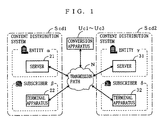
- FIG. 1 is a block diagram illustrating a conversion apparatus Uc1 according to a first embodiment of the present invention and the peripheral environments thereof.
- the conversion apparatus Uc1 is coupled to content distribution systems Scd1 and Scd2 via a wired or wireless transmission path N, in a manner capable of data communications.
- the content distribution system Scd1 at least one server 21 and at least one terminal apparatus 22 are coupled in a manner capable of data communications via the transmission path N.
- the server 21 is installed at an entity ⁇ , which is engaged in music distribution as an example of content distribution.
- the terminal apparatus 22 is installed at a subscriber ⁇ , who enjoys music distribution based on an agreement with the entity ⁇ .
- At least one server 31 and at least one terminal apparatus 32 are coupled to the content distribution system Scd2 in a manner capable of data communications via the transmission path N.
- the server 31 is installed at an entity ⁇ , which is engaged in music distribution as an example of content distribution.
- the terminal apparatus 32 is installed at a subscriber ⁇ , who enjoys music distribution based on an agreement with the entity ⁇ .
- the present embodiment assumes that the entity ⁇ is different from the entity ⁇ , and that the subscriber ⁇ is different from subscriber ⁇ . However, the subscriber ⁇ may be the same person as the subscriber ⁇ .
- the conversion apparatus Uc1 is applicable in the case where a single user who is at once the subscriber ⁇ and the subscriber ⁇ is subscribing to both of the different content distribution systems Scd1 and Scd2 and possesses both the terminal apparatus 22 and the terminal apparatus 32.
- FIG. 2 is a block diagram illustrating the detailed structure of the server 21 and the terminal apparatus 22 in FIG. 1.
- the server 21 comprises a content database (hereinafter referred to as a content DB) 211, a decryption key database (hereinafter referred to as a decryption key DB) 212, a user information database (hereinafter referred to as a user information DB) 213, a license database (hereinafter referred to as a license DB) 214, a central processing section 215, a working area 216, a communication section 217, and a format storage section 218.
- the terminal apparatus 22 comprises an identifier storage section 221, a communication section 222, a central processing section 223, a working area 224, and a storage device 225.
- the preparation which is needed in the content distribution system Scd1 before the subscriber ⁇ receives a content distributed from the entity ⁇ will be described.
- the content DB 211, the decryption key DB 212, and the user information DB 213 shown in FIG. 2 are built by the entity ⁇ .
- the entity ⁇ prepares content data Dct1 to be provided to the subscriber ⁇ .
- the content data Dct1 is usable to the terminal apparatus 22, and represents music in the present embodiment.
- the entity ⁇ assigns a content identifier Ict1 to each piece of content data Dct1.
- the content identifier Ict1 is a code which uniquely identifies the substance of the content data Dct1.
- ISRC International Standard Recording Code
- a description of ISRC can be found at http://www.ifpi.org/index.html as of July 23, 2001.
- the entity ⁇ assigns an encryption key Ke1 to each piece of content data Dct1.
- the content data Dct1 is encrypted with the dedicated encryption key Ke1, thereby generating encrypted content data Dect1.
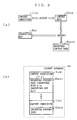
- the content DB 211 is a collection of combinations of such content identifiers Ict1 and encrypted content data Dect1.
- a content identifier Ict1 uniquely identifies encrypted content data Dect1 in the same set.
- "a" is allocated as a content identifier Ict1 to a piece of encrypted content data Dect1 shown in FIG. 3(a).
- the encrypted content data Dect1 is encrypted with "b" as an encryption key Ke1.
- the encrypted content data Dect1 is distributed from the server 21 to the terminal apparatus 22. Therefore, a decryption key Kd1 which is capable of decrypting the encrypted content data Dect1 needs to be provided to the terminal apparatus 22. Accordingly, the entity ⁇ prepares a decryption key Kd1 corresponding to each encryption key Ke1 in the content DB 211 (see FIG. 4(a)).
- the decryption key Kd1 may be composed of the same bit sequence as that of the encryption key Ke1 (common key encryption scheme), or composed of a different bit sequence from that of the encryption key Ke1 (public key encryption scheme). As shown in FIG.
- the decryption key DB 212 is a collection of combinations of the above-described content identifiers Ict1 and decryption keys Kd1.
- each decryption key Kd1 is employed for the decryption of the encrypted content data Dect1 which can be identified by the content identifier Ict1 in the same set.
- the subscriber ⁇ makes a subscription agreement for enjoying music distribution from the entity ⁇ . Based on the subscription agreement, the entity ⁇ assigns a terminal identifier Itn1 to the subscriber ⁇ .
- the terminal identifier Itnl uniquely identifies the terminal apparatus 22 of the subscriber ⁇ in the content distribution system Scd1.
- the user information DB 213 is a collection of such terminal identifiers Itn1.
- the aforementioned terminal identifier Itn1 is also set in the identifier storage section 221 of the terminal apparatus 22 of the subscriber ⁇ .
- the terminal identifier Itn1 may be previously set in the identifier storage section 221, at the time of shipping the terminal apparatus 22. In such cases, the subscriber ⁇ will notify the terminal identifier Itn1 which is set in the terminal apparatus 22 to the entity ⁇ at the time of concluding the aforementioned subscription agreement. The entity ⁇ registers the notified terminal identifier Itnl in the user information DB 213.
- x1" is registered in the user information DB 213 as a terminal identifier Itn1 for the terminal apparatus 22.
- "x1" is set as the terminal identifier Itn1 in the identifier storage section 221.
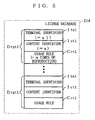
- FIG. 5 illustrates the license DB 214, which will be described later.
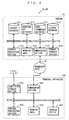
- FIG. 6 is a block diagram illustrating the detailed structure of the server 31 and the terminal apparatus 32 in FIG. 1.
- the server 31 comprises a content database (hereinafter referred to as a content DB) 311, a decryption key database (hereinafter referred to as a decryption key DB) 312, a user information database (hereinafter referred to as a user information DB) 313, a license database (hereinafter referred to as a license DB) 314, a central processing section 315, a working area 316, a communication section 317, and a format storage section 318.
- the terminal apparatus 32 comprises an identifier storage section 321, a communication section 322, a central processing section 323, a working area 324, and a storage device 325.
- the content DB 311, the decryption key DB 312, and the user information DB 313 are first built by the entity ⁇ .
- the entity ⁇ prepares a content data Dct2 (not shown) to be provided to the subscriber ⁇ .
- the content data Dct2 is usable to the terminal apparatus 32, and represents music.
- a content identifier Ict2 (see FIG. 7(a)) which uniquely identifies its substance is assigned. Note that although the content data Dct1 and Dct2 are prepared by the entities ⁇ and ⁇ on their own, they may represent the same substance. One example would be the case where both the content data Dct1 and Dct2 represent the same song by the same singer.
- an encryption key Ke2 (see FIG. 7(a))is assigned to each piece of content data Dct2.
- the content data Dct2 is encrypted with the dedicated encryption key Ke2, thereby generating encrypted content data Dect2 (see FIG. 7(a)).
- the encryption key Ke2 is the same as the aforementioned encryption key Ke1 in the content distribution systems Scd1 and Scd2.
- the content DB 311 is a collection of combinations of content identifiers Ict2 and encrypted content data Dect2.
- the content DB 311 at least one piece of encrypted content data Dect2 has the aforementioned identicalness to encrypted content data Dect1 in the content DB 211.
- a content identifier Ict2 having the same code as that of the content identifier Ict1 allocated to the corresponding encrypted content data Dect1 is allocated.
- the entity ⁇ prepares a decryption key Kd2 corresponding to each encryption key Ke2 in the content DB 311.
- the decryption key Kd2 may be composed of the same bit sequence as that of the encryption key Ke2 (common key encryption scheme), or composed of a different bit sequence from that of the encryption key Ke2 (public key encryption scheme).
- the decryption key Kd2 is identical to the aforementioned decryption key Kd1.
- the decryption key DB 312 is a collection of combinations of the above-described content identifiers Ict2 and decryption keys Kd2.
- the aforementioned subscriber ⁇ also makes a subscription agreement for enjoying music distribution from the entity ⁇ . Therefore, the entity ⁇ either assigns a terminal identifier Itn2 to the subscriber or receives it from the subscriber ⁇ .
- the terminal identifier Itn2 uniquely identifies the terminal apparatus 32 of the subscriber ⁇ .
- the user information DB 313 is a collection of such terminal identifiers Itn2.
- the terminal identifier Itn2 is also set in the identifier storage section 321 of the terminal apparatus 32.
- FIG. 8(b) illustrates a license DB 314, which will be described later.
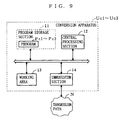
- FIG. 9 is a block diagram illustrating the structure of the conversion apparatus Uc1 shown in FIG. 1.
- the conversion apparatus Uc1 comprises a program storage section 11, a central processing section 12, a working area 13, and a communication section 14.
- the central processing section 12 operates in accordance with the program Pc1, andperformsconversionprocessing (see FIG. 17 and FIG. 18) for license information, which is a feature of the present embodiment.
- the working area 13 is employed when the central processing section 12 performs various processes.
- the communication section 14 is connected to the aforementioned transmission path N, and performs communications with the content distribution systems Scd1 and Scd2.
- the subscriber ⁇ accesses the server 21 to specify the content identifier Ict1 of one of the content data Dct1 stocked in the content DB 211 that is to be acquired this time.
- the currently specified content data Dct1 will be referred to as content data Dct1 to be acquired.
- the subscriber ⁇ designates a usage rule Cct1 for using the content data Dct1 to be acquired.
- the typical usage rule Cct1 is a valid period, a number of times of reproduction, a maximum continuous reproduction time, a total reproduction time, or reproduction quality.
- the usage rule Cct1 may be a combination of two or more of a valid period, a number of times of reproduction, a maximum continuous reproduction time, a total reproduction time, and reproduction quality.
- the valid period as a usage rule Cct1 may be set to be from June 1, 2001 to August 31, 2001, for example, so that the terminal apparatus 22 can reproduce the content data Dct1 only during the set period.
- the number of times of reproduction may be set to be 5 times, for example, so that the terminal apparatus 22 can reproduce the content data Dct1 no more than the set number of times.
- the maximum continuous reproduction time which may be set to be 10 seconds, for example, defines a maximum time during which the reproduction of the content data Dct1 is permitted for one instance of reproduction by the terminal apparatus 22. Such a maximum continuous reproduction time is especially effective for music promotion purposes.
- the total reproduction time may be set to be 10 hours, for example, so that the terminal apparatus 22 can freely reproduce the content data Dct1 within the set time.
- the reproduction quality may be set to be a CD (Compact Disc) quality, for example, so that the terminal apparatus 22 can reproduce the content data Dct1 at the set reproduction quality. Since the type of the usage rule Cct1 is not an essential feature of the present embodiment, the present embodiment will conveniently assume in the following description that the usage rule Cct1 is a number of times of reproduction for the content data Dct1.
- the subscriber ⁇ operates the terminal apparatus 22 to designate the content identifier Ict1 and the usage rule Cct1.
- the content identifier Ict1 and the usage rule Cct1 are stored in the working area 224 of the terminal apparatus 22.
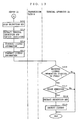
- the central processing section 223 In response to this storage, the central processing section 223 generates an acquisition request Drr shown in FIG. 11(a) (FIG. 10; step S11).
- the acquisition request Drr is information for requesting the server 11 to distribute the content data Dct1 to be acquired.
- step S11 first, the central processing section 223 transfers the terminal identifier Itn1 in the identifier storage section 221 to the working area 224.
- the central processing section 223 allocates a predetermined acquisition request identifier Irr to the terminal identifier Itn1, the content identifier Ict1, and the usage rule Cct1 on the working area 224, thereby generating an acquisition request Drr (see FIG. 11(a)).
- the acquisition request identifier Irr is employed by the server 21 to identify the acquisition request Drr.
- the central processing section 223 transfers the generated acquisition request Drr from the working area 224 to the communication section 222, and the communication section 222 transmits the received acquisition request Drr to the server 21 via the transmission path N (step S12).
- the communication section 217 receives the acquisition request Drr from the transmission path N, and transfers and stores it to the working area 216.
- the central processing section 215 confirms whether or not any match for the terminal identifier Itn1 which is set in the acquisition request Drr is registered in the aforementioned user information DB 213 (see FIG. 4(b)) (step S13). If no matching terminal identifier Itn1 is found registered, the central processing section 215 determines that the current acquisition request Drr is not from the subscriber ⁇ , and discards it (step S14), and ends the process. Otherwise, the central processing section 215 determines that an acquisition request Drr from the subscriber ⁇ is being received, and performs a license registration process (step S15).
- the central processing section 215 first confirms the acquisition request identifier Irr, and recognizes that the acquisition request Drr has currently been received. Next, the central processing section 215 extracts the terminal identifier Itn1, the content identifier Ict1, and the usage rule Cct1 from the current acquisition request Drr, and registers this combination in the license DB 214. Note that, based on the acquisition request Drr, the terminal apparatus 22 is not only acquiring the content data Dct1 but also requesting a license for the content data Dct1 to be acquired.
- the combination of the terminal identifier Itn1, the content identifier Ict1, and the usage rule Cct1 represents a right for the terminal apparatus 22 to use the content data Dct1 to be acquired in accordance with the usage rule Cct1.
- the central processing section 215 regards the combination extracted from the acquisition request Drr as license information Drgt1.
- the license DB 214 is a collection of combinations of license information Drgt1, which is composed of a terminal identifier Itn1, a content identifier Ict1, and a usage rule Cct1.
- license information Drgt1 registered in the above-described license DB 214 will be described.
- the usage rule Cct1 is a number of times of reproduction.
- the terminal identifier Itn1 is set as the terminal identifier Itn1
- "a” is set as the content identifier Ict1
- "m times of reproduction” is set as the usage rule Cct1.
- the terminal identifier Itn1 "x1” the content identifier Ict1 "a”
- the usage rule Cct1 "m times of reproduction are set in one piece of license information Drgt1.
- step S15 the central processing section 215 may bill the subscriber ⁇ for each registration of license information Drgt1.
- the central processing section 215 accesses the content DB 211 (see FIG. 3(b)), and reads out the content identifier Ict1 designated by the current acquisition request Drr and the encrypted content data Dect1 to which the content identifier Ict1 is assigned onto the working area 216 as a data set Dst1 as shown in FIG. 11(b) (step S16).
- the central processing section 215 transfers the data set Dst1 which has been read out from the working area 216 to the communication section 217, and the communication section 217 transmits the received data set Dst1 to the terminal apparatus 22 via the transmission path N (step S17).
- the communication section 222 receives the data set Dst1 from the transmission path N (step S18), and transfers and stores it to the working area 224.
- the central processing section 223 recognizes that the currently transmit encrypted content data Dct1 has been received. Thereafter, the central processing section 223 stores the content identifier Ict1 and the encrypted content data Dect1 in the storage device 225 (step S19).
- encrypted content data Dect1 is received by the terminal apparatus 22. Therefore, in order to utilize this, it is necessary to decrypt the encrypted content data Dect1 with the decryption key Kd1 provided from the server 21.
- license information Dlc1 (described later in detail) is employed in order to provide the decryption key Kd1 to the terminal apparatus 22.
- the subscriber ⁇ operates the terminal apparatus 22 to designate one of the encrypted content data Dect1 stored in the storage device 225 that is currently desired to be used as the content data Dect1 to be decrypted.
- the content data Dect1 to be decrypted and the content identifier Ict1 thereof are transferred from the storage device 225 to be stored to the working area 224 (FIG. 12; step S21).
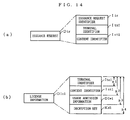
- the central processing section 223 In response to this storage, the central processing section 223 generates an issuance request Dir shown in FIG. 14(a) (step S22).
- the issuance request Dir is information for requesting the server 21 to provide the license information Dlc1, i.e., to obtain usage admission for the content data Dect1 to be decrypted.
- the central processing section 223 first transfers the terminal identifier Itn1 in the identifier storage section 221 to the working area 224. Thereafter, the central processing section 223 allocates a predetermined issuance request identifier Iir to the terminal identifier Itn1 and the content identifier Ict1 in the working area 224, thereby generating the issuance request Dir (see FIG. 14(a)).
- the issuance request identifier Iir is employed by the server 21 to identify the issuance request Dir.
- the central processing section 223 transfers the generated issuance request Dir from the working area 224 to the communication section 222, and the communication section 222 transmits the received issuance request Dir to the server 21 via the transmission path N (step S23).
- the communication section 217 receives the issuance request Dir from the transmission path N, and transfers and stores it to the working area 216.
- the central processing section 215 performs a process similar to step S13 in FIG. 10 for the issuance request Dir (step S24), and if the targeted terminal identifier Itn1 is not found, discards the current issuance request Dir (step S25), as in the aforementioned step S14.
- the central processing section 215 first confirms its issuance request identifier Iir to recognize that the issuance request Dir has currently been received.
- the central processing section 215 determines whether or not the license information Drgt1 containing the same terminal identifier Itn1 andcontent identifier Ict1 as those in the current issuance request Dir is registered in the license DB 214 (see FIG. 5) (step S26).
- the central processing section 215 If such license information Drgt1 is not registered, the central processing section 215 generates a usage denial, which is information indicating denial of the use of the content data Dect1 to be decrypted, and transmits it to the terminal apparatus 22 via the communication section 217 and the transmission path N (step S27). In the terminal apparatus 22, the central processing section 223 receives the usage denial via the communication section 222 (step S28). However, the central processing section 223 no longer performs processes that are necessary for the decryption of the content data Dect1 to be decrypted. Thus, in accordance with the present content distribution system Scd1, the server 21 denies decryption at the terminal apparatus 22 in the case where the license information Drgt1 is not registered in the license DB 214. As a result, it becomes possible to protect the aforementioned digital rights.
- a usage denial which is information indicating denial of the use of the content data Dect1 to be decrypted
- step S26 finds that the license information Drgt1 has been registered, the central processing section 215 refers to the usage rule Cct1 contained therein to determine whether or not usage admission can be granted to the terminal apparatus 22 (step S29). If usage admission cannot be granted, the central processing section 215 performs the aforementioned step S27. As a result, no processes related to the decryption of the content data Dect1 to be decrypted are performed in the terminal apparatus 22. Thus, in accordance with the present content distribution system Scd1, the server 21 denies decryption at the terminal apparatus 22 also in the case where valid license information Drgt1 is not registered in the license DB 114. Therefore, as described above, it becomes possible to protect the digital rights.
- step S29 finds that usage admission can be granted, the central processing section 215 generates usage admission information Dlw1, and stores it in the working area 216 (step S210).
- the usage admission information Dlw1 is information for permitting the terminal apparatus 22 identified by the current issuance request Dir to use the content data Dct1.
- the aforementioned usage admission information Dlw1 indicates under which condition usage admission should be given to the terminal apparatus 22.
- the usage rule Cct1 in the license information Drgt1 represents under what condition the content data Dct1 is used by the terminal apparatus 22.
- the usage admission information Dlw1 indicates usage admission for the terminal apparatus 22 within the limits of the usage rule Cct1.
- the central processing section 215 updates the employed license information Drgt1 (step S211).
- step S26 to S211 a specific example of the process from step S26 to S211 will be described. It is assumed that, as shown in FIG. 5, license information Drgt1 composed of a terminal identifier Itn1 "x1", a content identifier Ict1 "a” , and a usage rule Cct1 "m times of reproduction" is registered in the license DB 214. It is also assumed that, the current issuance request Dir contains the terminal identifier Itn1 "x1" and the content identifier Ict1 "a”.
- step S26 it is determined that license information Drgt1 containing the terminal identifier Itn1 "x1" and the content identifier Ict1 "a" has been registered. Furthermore, it is determined at step S29 that usage admission can be given to the terminal apparatus 22 because "m times of reproduction" is set in this license information Drgt1.
- usage admission information Dlw1 is generated at step S210.
- the generated usage admission information Dlw1 may represent, for example, "n times of reproduction".
- n is a natural number not exceeding m, and more preferably is set in accordance with the processing ability of the terminal apparatus 22.
- n is preferably set to be a minimum value which makes the content data Dect1 to be decrypted is usable the terminal apparatus 22, e.g. , "1",.
- the terminal apparatus 22 (whose terminal identifier Itn1 is “x1”) will use the license for the content data Dct1 (whose content identifier Ict1 is “a”) n times. Therefore, at step S211, the usage rule Cct1 is updated from "m times of reproduction” to "(m-n) times of reproduction".
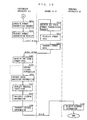
- step S211 the central processing section 215 reads out, from the decryption key DB 212 (see FIG. 4(a)), the decryption key Kd1 in the same set as the content identifier Ict1 that is contained in the current issuance request Dir into the working area 216 (FIG. 13; step S212).
- the central processing section 215 extracts from the current issuance request Dir the terminal identifier Itn1 and the content identifier Ict1, into the working area 216 (step S213).
- the terminal identifier Itn1, the content identifier Ict1, the usage admission information Dlw1, and the decryption key Kd1 become ready on the working area 216 through this step S213.
- the central processing section 215 places the terminal identifier Itn1, the content identifier Ict1, the usage admission information Dlw1, and the decryption key Kd1 on the working area 216 in order, thereby generating license information Dlc1 as shown in FIG. 14(b) (step S214).
- the license information Dlc1 as described above is information for controlling the use of the content data Dect1 to be decrypted by the terminal apparatus 22. Note that p1 to p4 in FIG. 14(b) will be described later.
- the terminal identifier Itn1 is "x1”
- the content identifier Ict1 is "a”
- the usage admission information Dlw1 is "1”.
- the decryption key Kd1 is "c”.
- the central processing section 215 transfers the license information Dlc1 which has been generated as above from the working area 216 to the communication section 217.
- the communication section 217 transmits the received license information Dlc1 to the terminal apparatus 22 via the transmission path N (step S215). Since the license information Dlc1 should not be utilized by a person unrelated to the subscriber ⁇ , it is preferable that the server 21 and the terminal apparatus 22 exchange the license information Dlc1 under secure communications such as SSL (Secure Socket Layer).
- the communication section 222 receives the license information Dlc1 from the transmission path N and determines whether or not it is directed to this terminal apparatus based on the received license information Dlc1 (step S216). If the received license information Dlc1 is not directed to the terminal apparatus 22, the central processing section 223 does not perform subsequent processing. On the other hand, if it is determined that license information Dlc1 directed to the terminal apparatus 22 has been received, the central processing section 223 transfers and stores it to the working area 224. In response to this storage, the central processing section 223 refers to the usage admission information Dlw1 in the current license information Dlc1, and determines whether or not usage admission for the content data Dect1 to be decrypted has been granted (step S217).
- the central processing section 223 does not perform subsequent processing.
- the terminal apparatus 22 cannot decrypt the content data Dect1 to be decrypted. As a result, it becomes possible to protect the aforementioned digital rights.
- step S217 finds that usage admission has been granted, the central processing section 223 extracts the decryption key Kd1 from the received license information Dlc1 (step S218).
- steps S217 and S218 will be described.
- reproduction of the content data Dct1 is permitted only once based on the usage admission information Dlw1 in the current license information Dlc1.
- the central processing section 223 determines at step S217 that usage admission for the content data Dect1 to be decrypted has been granted, and extracts the decryption key Kd1 "c" from the received license information Dlc1 at step S218.
- the content data Dect1 to be decrypted is already stored in the working area 224 (FIG. 12; see step S21).
- the central processing section 223 decrypts this content data Dect1 to be decrypted with the decryption key Kd1 obtained at step S218 (step S219).
- the central processing section 223 becomes capable of obtaining the content data Dct1, and causes music to be outputted via loudspeakers (not shown).
- the subscriber ⁇ can listen to desired music.
- the central processing section 223 decrements the usage admission information Dlw1 in the current license information Did by "1" every time the above - de scribed reproduct ion of the content data Dct1 is completed.
- the terminal apparatus 32 receives content distribution and license information from the server 31.
- the processes by these during content distribution will be apparent from FIG. 10, and the processes by these during the provision of license information will be apparent from FIG. 12 and FIG. 13, and the descriptions thereof are omitted.
- the server 31 generates license information Dlc2 for controlling the use of content data Dct2 by the terminal apparatus 32, by referring to the license DB 314 shown in FIG. 8(b).
- the content data Dct1 is not limited to those representing music, but may be any data which is usable to the terminal apparatus 22.
- the content data Dct1 may represent a television program, a movie, a radio program, music, a book or printed material.
- the above description illustrates the usage rule Cct1 in the case where the content data Dct1 represents music.
- the usage rule Cct1 is preferably set in an appropriate manner according to the substance represented by the content data Dct1. The above description conveniently assumes that, since the content data Dct1 represents music, the terminal apparatus 22 outputs the music the content data Dct1 decrypted at step S218 via loudspeakers.
- the terminal apparatus 22 may be substituted with those which can produce video output of television programs, movies, books and printed material, and game contents, or produce audio output of radio programs.
- the terminal apparatus 22 may comprise an interface which can transfer the decrypted content data Dct1 to an external device (a television set, a radio receiver, a music player, an electronic book reader, a game machine, a PC, a personal digital assistance, amobilephone, anexternalmemorydevice, etc.). This also applies to the content distribution system Scd2.
- the terminal apparatus 22 is illustrated as controlling the use of the content data Dct1 by employing the license information Dlc1 provided from the server 21.
- the subscriber ⁇ may desire to pass his/her own license information Dlc1 to the subscriber ⁇ , who is subscribing to content distribution by the entity ⁇ , without employing it for the sake of using the content data Dct1.
- it has been difficult to pass license information Dlc1 because the content distribution systems Scd1 and Scd2 are managed by the entities ⁇ and ⁇ , which have different policies in various aspects.
- the user may desire to employ the license information Dlc1, which is usable in the content distribution system Scd1, at the terminal apparatus 32, which corresponds to the content distribution system Scd2.
- the license information Dlc1 has also been difficult due to the entities ⁇ and ⁇ having different policies from each other.
- the difference in policies between the entities ⁇ and ⁇ is in the formats of the license information Dlc1 and Dlc2. While the license information Dlc1 has been described with reference to FIG. 14(b), more specifically speaking, the terminal identifier Itn1 is set down to the p1 th bit as counted from the start bit of the license information Dlc1; the content identifier Ict1 is set from the (p1 +1) th bit to the p2 th bit; the usage admission information Dlw1 is set from the (p2 +1) th bit to the p3 th bit; and the decryption key Kd1 is set from the (p3 +1) th bit to the p4 th bit.
- p1 to p4 are natural numbers satisfying p1 ⁇ p2 ⁇ p3 ⁇ p4.
- Format data Dfm1, representing such a format for the license information Dlc1 is stored in the format storage section 218 of the server 21.
- the license information Dlc1 is composed of the following component elements: a terminal identifier Itn1, a content identifier Ict1, usage admission information Dlw1, and a decryption key Kd1.
- the format data Dfm1 is composed of 4 sets --from element information Imt11 and bit position information Ibp11 to element information Imt14 and bit position information Ibp14--which corresponds to the number of component elements in the license information Dlc1.
- the element information Imt11 specifies the terminal identifier Itn1.
- the element information Imt12 specifies the content identifier Ict1.
- the element information Imt13 specifies the usage admission information Dlw1.
- the element information Imt14 specifies the decryption key Kd1.
- the bit position information Ibp11 is composed of "1" as a start bit position of the terminal identifier Itn1 and "p1" as an end bit position thereof.
- the bit position information Ibp12 is composed of "(p1 +1)" as a start bit position of the content identifier Ict1 and "p2" as an end bit position.
- the bit position information Ibp13 is composed of "(p2 +1)” as a start bit position of the usage admission information Dlw1 and "p3” as an end bit position.
- the bit position information Ibp14 is composed of "(p3 +1)” as a start bit position of the decryption key Kd1 and "p4" as an end bit position.
- the license information Dlc2 is information which is generated in the server 32 as described above, and, as shown in FIG. 15(b), contains a terminal identifier Itn2, a content identifierIct2, usageadmissioninformationDlw2, andadecryption key Kd2.
- the usage admission information Dlw2 is information for controlling the use of the content data Dct2 by the terminal apparatus 32.
- the terminal identifier Itn2 is set down to the q1 th bit as counted from the start bit of the license information Dlc2; the content identifier Ict2 is set from the (q1 +1) th bit to the q2 th bit; the usage admission information Dlw2 is set from the (q2 +1) th bit to the q3 th bit; and the decryption key Kd2 is set from the (q3 +1) th bit to the q4 th bit.
- q1 to q4 are natural numbers satisfying q1 ⁇ q2 ⁇ q3 ⁇ q4.
- the license information Dlc1 is information for controlling the use of the content data Dct1 identified by the content identifier Ict1. Therefore, in the license information Dlc2, the content identifier Ict2 needs to pertain to content data Dct2 having identicalness to the content data Dct1 which is usable based on the license information Dlc1. Moreover, in the present embodiment, the content identifiers Ict1 and Ict2 having the same code are assigned to content data Dct1 and Dct2 having identicalness to each other. Therefore, the following description will assume that p1 and q1 have the same value. As mentioned earlier, the present embodiment also assumes that the decryption keys Kd1 and Kd2 are the same.
- Format data Dfm2, representing such a format for the license information Dlc2, is stored in the format storage section 318 of the server 31.
- the format data Dfm2 is composed of 4 sets --from element information Imt21 and bit position information Ibp21 to element information Imt24 and bit position information Ibp24-- in connection with the component elements in the license information Dlc2.
- the element information Imt21 specifies the terminal identifier Itn2.
- the element information Imt22 specifies the content identifier Ict2.
- the element information Imt23 specifies the usage admission information Dlw2.
- the element information Imt24 specifies the decryption key Kd2.
- the bit position information Ibp21 is composed of "1" as a start bit position of the terminal identifier Itn2 and "q1" as an end bit position q1 thereof.
- the bit position information Ibp22 is composed of "(q1 +1)" as a start bit position of the content identifier Ict2 and an end bit position q2.
- the bit position information Ibp23 is composed of a start bit position (q2 +1) and an end bit position q3 of the usage admission information Dlw2.
- the bit position information Ibp24 is composed of a start bit position (q3 +1) and an end bit position q4 of the decryption key Kd2.
- the conversion apparatus Uc1 performs a license conversion process to convert the format of the license information Dlc1 so that it can be used at the terminal apparatus 32.
- the subscriber ⁇ operates the terminal apparatus 22 to designate license information Dlc1 to be converted currently. Furthermore, the subscriber ⁇ operates the terminal apparatus 22 to designate a terminal identifier Itn2 which the license information Dlc1 to be converted is eventually employed. Furthermore, the subscriber ⁇ operates the terminal apparatus 22 to designate a content distribution system Scd1 in which the pre-conversion license information Dlc1 can be employed, and a content distribution system Scd2 corresponding to the post-conversion format.
- license information Dlc1, a terminal identifier Itn2 , pre-conversion identification information Ici and post-conversion identification information Idi are stored in the working area 224.
- the pre-conversion identification information Ici is information which identifies the server 21 in the content distribution system Scd1
- the post-conversion identification information Idi is information which identifies the server 31 in the content distribution system Scd2.
- the central processing section 223 In response to this storage, the central processing section 223 generates a conversion request Dcr as shown in FIG. 19(a) on the working area 224 (FIG. 17; step S31).
- the conversion request Dcr which is information for requesting the conversion apparatus Uc1 to convert the aforementioned license information Dlc1, contains a terminal identifier Itn2, the aforementioned pre-conversion identification information Ici and the post-conversion identification information Idi, as shown in FIG. 19(a).
- the central processing section 223 transfers the generated conversion request Dcr and the license information Dlc1 from the working area 224 to the communication section 222.
- the communication section 222 transmits the received conversion request Dcr and license information Dlc1 to the conversion apparatus Uc1 via the transmission path N (step S32). Since the license information Dlc1 should not be utilized by a person unrelated to the subscriber ⁇ , it is preferable that the conversion apparatus Uc1 and the terminal apparatus 22 exchange at least the license information Dlc1 under secure communications such as SSL (Secure Socket Layer).
- the communication section 14 receives the conversion request Dcr and the license information Dlc1 from the transmission path N, and transfers and stores them to the working area 13 (step S33).
- the central processing section 12 operates in accordance with the program Pc1 in the program storage section 11, and first extracts the terminal identifier Itn2, the pre-conversion identification information Ici, and the post-conversion identification information Idi from the current conversion request Dcr (step S34). Thereafter, the central processing section 12 generates convertibility requests Dcq1 and Dcq2 as shown in FIG. 19(b) and FIG. 19(c) on the working area 13 (step S35).
- the convertibility request Dcq1 which is information for requesting the server 21 to transmit the first convertibility information Iack1 indicating whether or not the terminal apparatus 22 which has sent the license information Dlc1 to be converted is the authorized subscriber ⁇ in the content distribution system Scd1, contains at least the terminal identifier Itn1 for the terminal apparatus 22 and the pre-conversion identification information Ici, as shown in FIG. 19(b). Note that since the conversion apparatus Uc1 has established a connection for secure communications with the terminal apparatus 22, the conversion apparatus Uc1 can acquire the terminal identifier Itnl without setting the terminal identifier Itn1 in the conversion request Dcr.
- the convertibility request Dcq2 which is information for requesting the server 32 to transmit the first convertibility information Iack2 indicating whether or not the terminal apparatus 32, which employs the license information Dlc2 after conversion is the authorized subscriber ⁇ in the content distribution system Scd2, contains at least the terminal identifier Itn2 for the terminal apparatus 32 and the post-conversion identification information Idi, as shown in FIG. 19(c).
- the central processing section 12 transfers the generated convertibility requests Dcq1 and Dcq2 from the working area 13 to the communication section 14.
- the communication section 14 transmits the received convertibility requests Dcq1 and Dcr2 to the servers 21 and 31 via the transmission path N (step S36).
- the communication sections 217 and 317 receive the convertibility requests Dcq1 and Dcq2 from the transmission path N, and transfers and stores them to the working areas 216 and 316 (step S37).
- the central processing sections 215 and 315 check whether or not the terminal identifiers Itn1 and Itn2 which are respectively set therein are registered in the user lists (not shown) of the content distribution systems Scd1 and Scd2 (step S38).
- both central processing sections 215 and 315 generate the first convertibility information Iack1 and Iack2 on the working areas 216 and 316 as shown in FIG. 19(d) and FIG. 19(e) (step S39).
- the first convertibility information Iack1 contains information indicating the result of the check of step S38 by the server 21, i.e., whether or not the terminal apparatus 22 is an authorized user of the content distribution system Scd1.
- the first convertibility information Iack2 contains information indicating whether or not the terminal apparatus 32 is an authorized user of the content distribution system Scd2.
- the central processing sections 215 and 315 transfer the generated first convertibility information Iack1 and Iack2 from the working areas 216 and 316 to the communication sections 217 and 317.
- the communication sections 217 and 317 transmit the received first convertibility information Iack1 and Iack2 to the conversion apparatus Uc1 via the transmission path N (step S310).
- the communication section 14 receives the first convertibility information Iack1 and Iack2 from the transmission pathN, and stores them in the working area 13 (step S311). Thereafter, the central processing section 12 interprets the stored first convertibility information Iack1 and Iack2 to determine whether or not the terminal apparatuses 22 and 32 is an authorized user of the content distribution systems Scd1 and Scd2 (step S312).
- the central processing section 12 determines that even one of the terminal apparatuses 22 and 23 is not an authorized user, the central processing section 12 sends the current license information Dlc1 back to the terminal apparatus 22 (step S313). Thereafter, the process of FIG. 17 and FIG. 18 is over.
- the central processing section 12 if it is determined at step S312 that the terminal apparatuses 22 and 23 are both authorized users, the central processing section 12 generates format transmission requests Dfr1 and Dfr2 as shown in FIG. 19(f) and FIG. 19(g) on the working area 13 (FIG. 18; step S314).
- the format transmission requests Dfr1 and Dfr2 is information for requesting the servers 21 and 31 identified by the pre-conversion identification information Ici and the post-conversion identification information Idi to transmit the format data Dfm1 and Dfm2.
- the central processing section 12 transfers the generated format transmission requests Dfm1 and Dfm2 from the working area 13 to the communication section 14.
- the communication section 14 transmits the received format transmission requests Dfr1 and Dfr2 to the servers 21 and 31 via the transmission path N (step S315).
- the communication sections 217 and 317 receive format transmission requests Dfr1 and Dfr2 from the transmission path N, and transfer and store them to the working areas 216 and 316 (step S316).
- the central processing sections 215 and 315 retrieve the format data Dfm1 and Dfm2 stored in the format storage sections 218 and 318 onto the working areas 216 and 316 (step S317).
- the central processing sections 215 and 315 transfer the retrieved format data Dfm1 and Dfm2 from the working areas 216 and 316 to the communication sections 217 and 317.
- the communication sections 217 and 317 transmit the received format data Dfm1 and Dfm2 to the conversion apparatus Uc1 via the transmission path N (step S318).
- the communication section 14 receives format data Dfm1 and Dfm2 from the transmission path N, and transfers and stores them to the working area 13 (step S319).
- the central processing section 12 converts the license information Dlc1 into the license information Dlc2 (step S320).
- step S320 under the aforementioned assumption, the central processing section 12 recognizes by comparing the format data Dfm1 and Dfm2 that the numbers of bits employed in the usage admission information Dlw1 and the usage admission information Dlw2 differ. Therefore, the central processing section 12 extracts the usage admission information Dlw1 from the license information Dlc1, and interprets it. Thereafter, the central processing section 12 converts the extracted usage admission information Dlw1 into (q2-q1) bits of usage admission information Dlw2 which correspondings to such an interpretation result (step S321).
- the central processing section 12 extracts the terminal identifier Itn2 from the current conversion request Dcr (step S322). Note that, as mentioned earlier, it is assumed that, both the codes and the numbers of bits are the same in the content identifiers Ict1 and Ict2 and that the decryption keys Kd1 andKd2 are the same. Therefore, the central processing section 12 employ the content identifier Ict1 and the decryption key Kd1 in the license information Dlc1 themselves as the content identifier Ict2 and the decryption key Kd2 in the license information Dlw2.
- the central processing section 12 orders these component elements in accordance with the bit positions indicated in the format data Dfm2, thereby constructing the license information Dlc2 as shown in FIG. 15 (b) (step S323).
- the central processing section 12 places the terminal identifier Itn2, the content identifier Ict2, the usage admission information Dlw2, and the decryption key Kd2 in this order.
- the license information Dlc2 having been converted from the license information Dlc1 is completed on the working area 13.
- the central processing section 12 transfers the license information Dlc2 on the working area 13 to the communication section 14.
- the communication section 14 transmits the received license information Dlc2 to the terminal apparatus 22 via the transmission path N (step S324). Since the license information Dlc2 should not be utilized by a person unrelated to the subscriber ⁇ , it is preferable that the conversion apparatus Uc1 and the terminal apparatus 22 exchange the license information Dlc2 under secure communications such as SSL (Secure Socket Layer).
- the communication section 222 receives the license information Dlc2 from the transmission path N (step S325).
- the conversion apparatus Uc1 converts the license information Dlc1 which is compatible with the terminal apparatus 22 of the subscriber ⁇ to the license information Dlc2 which is compatible with the terminal apparatus 32 of the subscriber ⁇ , and returns it to the terminal apparatus 22.
- the subscriber ⁇ can receive the license information Dlc2, which has been converted from its own license information Dlc1 and which can be properly employed at the terminal apparatus 32.
- the subscriber ⁇ passes the license information Dlc2 as such to the subscriber on-line or off-line.
- the terminal apparatus 32 transmits a content acquisition request containing the content identifier Ict2 in the received license information Dlc2 to the server 31.
- the terminal apparatus 32 utilizes the resultant encrypted content data Dect2 by decrypting it with the license information Dlc2.
- the aforementioned conversion apparatus Uc1 By installing the aforementioned conversion apparatus Uc1 on the transmission path N, the problem of conventional content distribution systems can be solved and it becomes possible to easily pass one's own license information Dlc1 to others.
- the above conversion processing of license information is not performed in the terminal apparatus 22, but in the conversion apparatus Uc1, which is on the transmission path N. As a result, the processing load for conversion processing at the terminal apparatus 22 can be reduced.
- the conversion apparatus Uc1 determines whether the terminal apparatuses 22 and 32 are authorized users or not by employing the first convertibility information Iack1 and Iack2 acquired through communications with the servers 21 and 31.
- the conversion apparatus Uc1 may employ first convertibility information Iack1 and Iack2 acquired from other than the servers 21 and 31 to make the determination at step S312, or employ first convertibility information Iack1 and Iack2 previously retained in a local auxiliary memory device to make the determination at step S312.
- the content data Dct1 and Dct2 having identicalness to each other are encrypted by the identical encryption keys Ke1 and Ke2. Therefore, the terminal apparatuses 22 and 32 employ identical decryption keys Kd1 and Kd2 to decrypt the encrypted content data Dect1 and Dect2.
- different encryption schemes may be employed in the content distribution systems Scd1 and Scd2, so that the terminal apparatuses 22 and 32 may employ different decryption keys Kd1 and Kd2. In such cases, a problem may arise in that the terminal apparatus 32 cannot decrypt the encrypted content data Dect2 by employing the license information Dlc2 as converted by the conversion apparatus Uc1 according to the first embodiment.
- the second embodiment provides a conversion apparatus Uc2 which, even in the case where different encryption schemes are adopted in the content distribution systems Scd1 and Scd2, converts the license information Dlc1 for the terminal apparatus 22 into license information Dlc2 which can be properly employed by the terminal apparatus 32, thus solving the above problem.
- the block structure of the conversion apparatus Uc2 is the same as the structure of the conversion apparatus Uc1 shown in FIG. 9. Moreover, the peripheral environment of the conversion apparatus Uc2 is as shown in FIG. 1. Therefore, in the conversion apparatus Uc2, any elements corresponding to those constituting the conversion apparatus Uc1 will be denoted by like numerals. Note, however, that a program Pc2 is stored in the program storage section 11 of the conversion apparatus Uc2, instead of the program Pc1.
- steps S31 and S32 in FIG. 17 are performed, whereby a conversion request Dcr and license information Dlc1 are transmitted to the conversion apparatus Uc2 via the transmission path N.
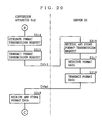
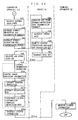
- the program Pc2 begins to be executed. More specifically, the central processing section 12 executes the processing procedure shown in FIG. 20 and FIG. 21 in accordance with the program Pc2.
- FIG. 20 and FIG. 21 partly include identical steps to those in FIG. 18. Therefore, in FIG. 20 and FIG. 21, any steps corresponding to those in the flowchart of FIG. 18 will be denoted by like step numbers, and the descriptions thereof will be simplified.
- the central processing section 12 performs a process similar to steps S314 to S315 by only employing pre-conversion identification information Ici, as shown in FIG. 20, to generate a format transmission request Dfr1, which is transmitted to the server 21.
- the format data Dfm1 transmitted by the server 21 is stored in the working area 13 of the conversion apparatus Uc2 (see step S316 to S319).
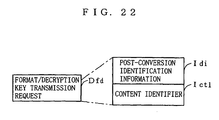
- the central processing section 12 extracts a content identifier Ict1 from the current license information Dlc1 (FIG. 21; step S41). Thereafter, as shown in FIG. 22, the central processing section 12 generates a format/decryption key transmission request Dfd containing the content identifier Ictl on the working area 13 (step S42).
- the format/decryption key transmission request Dfd is information for requesting the server 31 identified by the post-conversion identification information Idi to transmit the format data Dfm2 and the decryption key Kd2.
- the central processing section 12 transfers the generated format/decryption key transmission request Dfd from the working area 13 to the communication section 14.
- the communication section 14 transmits the received format/decryption key transmission request Dfd to the server 31 via the transmission path N (step S43).
- the communication section 317 receives the format/decryption key transmission request Dfd from the transmission path N, and transfers and stores it to the working area 316 (step S44). After interpreting the stored format/decryption key transmission request Dfd, the central processing section 315 first retrieves the format data Dfm2 stored in the format storage section 318 onto the working area 316 (step S45).
- the central processing section 315 looks up within the decryption key DB 312 a content identifier Ict2 having the same code as the content identifier Ict1 contained in the current format/decryption key transmission request Dfd, and reads out onto the working area 324 a decryption key Kd2 which is in the same set as the content identifier Ict2 that has been looked up (step S46). Thereafter, the central processing section 315 transfers the format data Dfm2 and the decryption key Kd2 on the working area 316 to the communication section 317, as a data set Dst2.
- the communication section 317 transmits the received data set Dst2 to the conversion apparatus Uc2 via the transmission path N (step S47).
- the communication section 14 receives the data set Dst2 from the transmission path N, and transfers and stores it to the working area 13 (step S48).
- the central processing section 12 converts the license information Dlc1 into the license information Dlc2 (step S49).
- step S49 the central processing section 12 first performs step S321 as described above to convert the usage admission information Dlw1 into usage admission information Dlw2, and further performs step S322 to extract a terminal identifier Itn2. Furthermore, the central processing section 12 extracts the decryption key Kd2 from the data set Dst2 obtained at step S48 (step S410). Moreover, as described earlier, the central processing section 12 employs the content identifier Ict1 in the license information Dlc1 itself as the content identifier Ict2 in the license information Dlw2.
- the central processing section 12 constructs the license information Dlc2 as shown in FIG. 15(b) (step S411). Through steps S410 and S411, the decryption key Kd1 in the license information Dlc1 is replaced by the decryption key Kd2.
- the central processing section 12 executes step S324 to transmit the constructed license information Dlc2 to the terminal apparatus 22, via the communication section 14 and the transmission path N.
- the communication section 222 executes step S325 to receive the license information Dlc2 from the transmission path N.
- the conversion apparatus Uc2 returns the license information Dlc2 which is compatible with the terminal apparatus 32 to the terminal apparatus 22.
- the conversion apparatus Uc2 employs the content identifier Ict1 in the license information Dlc1 to obtain the decryption key Kd2 allocated to the corresponding content identifier Ict2 through data communications with the server 32.
- the conversion apparatus Uc2 sets the obtained decryption key Kd2 in the license information Dlc2.
- a conversion apparatus Uc2 which, even in the case where different encryption schemes are adopted in the content distribution systems Scd1 and Scd2, converts the license information Dlc1 for the terminal apparatus 22 into license information Dlc2 which can be properly employed by the terminal apparatus 32.
- the conversion apparatus Uc2 acquires the decryption key Kd2 through communications with the server 31 at steps S47 and S48.
- the conversion apparatus Uc2 may generate the license information Dlc2 by employing a decryption key Kd2 which is acquired from other than the server 31, or generate the license information Dlc2 by employing a decryption key Kd2 previously retained in a local auxiliary memory device.
- both conversion apparatuses Uc1 and Uc2 performs conversion processing for license information unconditionally in response to a conversion request Dcr from the terminal apparatus 22.
- the third embodiment provides a conversion apparatus Uc3 which can restrict the conversion processing of license information.
- the conversion apparatus Uc3 has a block structure similar to the structure of conversion apparatus Uc1 shown in FIG. 9. Moreover, the peripheral environment of the conversion apparatus Uc3 is as shown in FIG. 1. Therefore, in the conversion apparatus Uc3, any elements corresponding to those constituting the conversion apparatus Uc1 will be denoted by like numerals. Note, however, that a program Pc3 is stored in the program storage section 11 of the conversion apparatus Uc3, instead of the program Pc1.
- the license information Dlc1 differs from that shown in FIG. 14(b) in that second convertibility information Ica1 is allocated as shown in FIG. 23(a). Otherwise, there are no differences in the license information Dlc1. Therefore, in FIG. 23(a), any information shown in FIG. 14(b) is denoted by like numerals, and the descriptions thereof are omitted.
- the second convertibility information Ica1, which is allocated based on the policies of the entity ⁇ , is information indicating whether or not to approve of conversion processing for the usage admission information Dlw1 contained in the same license information Dlc1.
- the license information Dlc1 contains a terminal identifier Itn1, a content identifier Ict1, second convertibility information Ica1, usage admission information Dlw11 and Dlw12 as an exemplary plurality of usage admission information Dlw1, and a decryption key Kd1.
- the usage admission information Dlw11 represents a number of times of reproduction, for example.
- the usage admission information Dlw12 represents a number of times of printing, for example.
- the second convertibility information Ica1 indicates whether or not to approve of conversion processing for all such usage admission information Dlw11 and Dlw12.
- FIG. 23(b) the license information Dlc1 contains a terminal identifier Itn1, a content identifier Ict1, second convertibility information Ica1, usage admission information Dlw11 and Dlw12 as an exemplary plurality of usage admission information Dlw1, and a decryption key Kd1.
- the usage admission information Dlw11 represents a number of times of reproduction, for example.
- the license information Dlc1 contains a terminal identifier Itn1, a content identifier Ict1, second convertibility information Ica11 and usage admission information Dlw11 and second convertibility information Ica12 and usage admission information Dlw12 as an exemplary set of one or more second convertibility information Ica1 and usage admission information Dlw1, and a decryption key Kd1.
- the usage admission information Dlw11 and Dlw12 indicates a number of times of reproduction and a number of times of printing, for example.
- the second convertibility information Ica11 indicates whether or not to approve of conversion processing for the usage admission information Dlw11 in the same set.
- the second convertibility information Ica12 indicates whether or not to approve of conversion processing for the usage admission information Dlw12 in the same set.
- the program Pc3 begins to be executed. More specifically, the central processing section 12 executes a processing procedure shown in FIG. 24 in accordance with the program Pc3.
- FIG. 24 partly include identical steps to those in FIG. 17. Therefore, in FIG. 24, any steps corresponding to those in the flowchart of FIG. 17 will be denoted by like step numbers, and the descriptions thereof will be simplified.
- the central processing section 12 checks the second convertibility information Ica1 to determine whether conversion processing for all usage admission information Dlw1 is unapproved of (step S51). If conversion processing for all usage admission information Dlw1 is unapproved of, the central processing section 12 sends the current received license information Dlc1 back to the terminal apparatus 22 (step S52), and the process of FIG. 24 is over.
- the conversion apparatus Uc3 may perform steps S35 and S36 (see FIG. 17) before step S51 to acquire first convertibility information Iack1 and Iack2 from the servers 21 and 31, and thereafter determine whether or not the terminal apparatuses 22 and 32 are authorized users of the content distribution systems Scd1 and Scd2, and then perform step S51.
- step S51 if it is determined at step S51 that conversion processing for some or all of the usage admission information Dlw1 is approved of, the central processing section 12 stores the conversion request Dcr and the license information Dlc1 as described in the first embodiment (step S33). Thereafter, in accordance with the second convertibility information Ica1, the central processing section 12 determines whether or not conversion of all usage admission information Dlw1 is approved of (step S53). If conversion of all usage admission information Dlc1 is approved of, central the processing section 12 performs the process from steps S34 to S316 (see FIG. 18).
- the central processing section 12 classifies the usage admission information Dlw1 into those for which conversion processing is approved of and those for which conversion processing is not approved of, in accordance with the second convertibility information Ica1 (step S54). Thereafter, the central processing section 12 sends those usage admission information Dlw1 for which conversion processing is not approved of, back to the terminal apparatus 22 (step S55). Thereafter, the process from steps S34 to S316 (see FIG. 18) is performed for those usage admission information Dlw1 for which conversion processing is approved of.
- the conversion apparatus Uc3 employs the second convertibility information Ica1, thereby making it possible to restrict the conversion processing for license information.
- the resultant conversion apparatus Uc3 can reflect the policies of the entity ⁇ .
- the third embodiment illustrates that the second convertibility information Ica1 is allocated in license information Dlc1.
- the second convertibility information Ica1 does not need to be allocated in the license information Dlc1.
- the conversion apparatus Uc3 may typically inquire the server 31 to acquire the second convertibility information Ica1 corresponding to each piece of usage admission information Dlw1, and thereafter perform the process from step S51.
- the conversion apparatus Uc3 may have second convertibility information Ica1 previously retained in a local auxiliary memory device, and after the arrival of the conversion request Dcr and the license information Dlc1, perform the process from step S51 by employing the local second convertibility information Ica1.
- the central processing section 12 classifies the usage admission information Dlw1 into those for which conversion processing is approved of and those for which conversion processing is not approved of at step S54. As a result, there may only be a single piece of usage admission information Dlw1 left to be subjected to the process from step S34. Furthermore, in some cases, such usage admission information Dlw1 is meaningless when it is by itself. For example, in the case where the usage admission information Dlw1 indicates permission of replication of the content data Dect1, even if the terminal apparatus 23 acquires the license information Dlc2 after conversion, the terminal apparatus 22 can merely replicate the content data Dect1, without being able to reproduce or print the content data Dect1. In other words, such license information Dlc2 is meaningless by itself.
- the central processing section 12 examines the substance usage admission information Dlw1 left in step S54 to determine whether or not it is meaningful, and ensures that those which is meaningless will not be the subject of the process from step S34.
- the central processing section 12 sends those usage admission information Dlw1 for which conversion processing is not approved of, back to the terminal apparatus 22 at steps S52 and S55.
- the central processing section 12 may determine that conversion processing therefor is not approved of, and send the usage admission information Dlw1 back to the terminal apparatus 22 at step S55.
- the conversion apparatus Uc3 may retain unconvertible license information Dlw1 in a local or remote auxiliary memory device or return it to the server 31.
- the conversion apparatuses Uc1 to Uc3 are employed for the subscriber ⁇ to pass his/her own license information Dlc1 to the subscriber ⁇ .
- the conversion apparatuses Uc1 to Uc3 are applicable in other situations, e.g., where the subscriber ⁇ has somehow obtained the license information Dlc2 which can be employed in the second content distribution system Scd2, and converts the obtained license information Dlc2 into license information Dlc1 which is usable in the content distribution system Scd1 to which he/she subscribes.
- the conversion apparatuses Uc1 to Uc3 are also applicable in the case of converting the obtained license information Dlc2 to that which is usable in another content distribution system to which one is not subscribing.
- the conversion apparatuses Uc1 to Uc3 return license information Dlc2 after conversion to the terminal apparatus 22 at step S314 (see FIG. 18, FIG. 21).
- the terminal apparatus 22 transmits information which uniquely identifies the terminal apparatus 32 serving as a recipient of the passing of the license information Dlc2, together with the conversion request Dcr, to the conversion apparatuses Uc1 to Uc3.
- the conversion apparatuses Uc1 to Uc3 may transmit the license information Dlc2 after conversion to the terminal apparatus 32.
- the license information Dlc2 after conversion may come to the terminal apparatus 32 by any method.
- the conversion apparatus Uc1 performs conversion processing for license information.
- a program composed of the process from steps S314 to S323 may be stored in the terminal apparatus 22.
- the conversion apparatus Uc2 performs conversion processing for license information.
- a program composed of the process from steps S314 to S411 may be stored in the terminal apparatus 22.
- the conversion apparatus Uc3 performs conversion processing for license information.
- the terminal apparatus 22 may be arranged so as to perform the process from step S51 (see FIG. 24).
- the terminal apparatus 22 itself can convert license information Dlc1 which is compatible with itself into license information Dlc2 which is compatible with the terminal apparatus 32.
- the terminal apparatus 22 does not need to perform data communications with the conversion apparatuses Uc1 to Uc3, it becomes possible to reduce communication costs and the like, and to quickly obtain the license information Dlc2 which is compatible with the terminal apparatus 32.
- the conversion apparatuses Uc1 to Uc3 convert license information Dlc1 which is issued for the terminal apparatus 22 into license information Dlc2 so that it can be utilized at the terminal apparatus 23.
- the conversion apparatuses Uc1 to Uc3 may convert, for example, license information Drgt1 (see FIG. 5) which is assigned to the subscriber ⁇ , and generate license information Drgt2 for another subscriber ⁇ .
- the license information Dlc1 is not limited to those described in the first to third embodiments, but also includes the license information Drgt1 shown in FIG. 5.
- the conversion apparatuses Uc1 to Uc3 convert an identifier (not shown in FIG. 5) which is set in the license information Drgt1 for identifying the subscriber ⁇ into an identifier for identifying the subscriber ⁇ .
- adjustment of the number of bits in the usage admission information Dlw1 and Dlw2 is illustrated as conversion processing for license information.
- the license information Dlc1 and Dlc2 may be generated with different character sets, for example.
- the conversion apparatuses Uc1 to Uc3 communicate with both servers 21 and 31 to confirm what sort of character sets are employed in the content distribution systems Scd1 and Scd2. Based on the result of such confirmation, the conversion apparatuses Uc1 to Uc3 may convert the character set of license information Dlc1 into that of license information Dlc2.
- the conversion apparatuses Uc1 to Uc3 may refer to such a table and convert the character set of license information Dlc1 into that of license information Dlc2.
- the license information Dlc1 and Dlc2 may be described in a description language such as XML(eXtensible Markup Language) or XrML (extensible rights Markup Language).
- the conversion apparatuses Uc1 to Uc3 may convert tag values in XML or XrML, or convert the description language itself, thereby carrying out conversion processing from license information Dlc1 to Dlc2.
- the license information Dlc1 and Dlc2 may have different component elements.
- a typical example is where the license information Dlc1 includes usage admission information Dlw1 but the license information Dlc2 does not include any corresponding usage admission information Dlw2.
- the conversion apparatuses Uc1 to Uc3 communicate with both servers 21 and 31 to confirm what component elements the license information Dlc1 and Dlc2 are composed of in the content distribution systems Scd1 and Scd2. Based on the result of such confirmation, the conversion apparatuses Uc1 to Uc3 may perform conversion processing so that the component elements of the license information Dlc1 match those of the license information Dlc2.
- the conversion apparatuses Uc1 to Uc3 may refer to such a table and perform conversion processing so that the component elements of the license information Dlc1 match those of the license information Dlc2.
- the license information Dlc1 and Dlc2 may have the same component elements, but the component elements in the license information Dlc1 and Dlc2 may be in different arrangements.
- the conversion apparatuses Uc1 to Uc3 communicate with both servers 21 and 31 to confirm what sort of arrangement of component elements the license information Dlc1 and Dlc2 are composed of in the content distribution systems Scd1 and Scd2. Based on the result of such confirmation, the conversion apparatuses Uc1 to Uc3 may perform conversion processing so that the component element arrangement of the license information Dlc1 matches that of the license information Dlc2.
- the conversion apparatuses Uc1 to Uc3 may refer to such a table and perform conversion processing so that the component element arrangement of the license information Dlc1 matches that of the license information Dlc2.
- content identifiers Ict1 and Ict2 having the same code are assigned to content data Dct1 and Dct2 having identicalness.
- content identifiers Ict1 and Ict2 having unique codes may be assigned to content data Dct1 and Dct2 having identicalness in the content distribution systems Scd1 and Scd2.
- the conversion apparatuses Uc1 to Uc3 need to convert the content identifier Ict1 contained in the license information Dlc1 into the content identifier Ict2.
- the conversion apparatuses Uc1 to Uc3 previously retain a table describing correspondence between the content identifiers Ict1 and Ict2 which are assigned to the content data Dct1 and Dct2 having identicalness in the content distribution systems Scd1 and Scd2.
- the conversion apparatuses Uc1 to Uc3 refer to such a table and convert the content identifier Ict1 contained in the license information Dlc1 to the content identifier Ict2.
- the conversion apparatuses Uc1 to Uc3 receive from the terminal apparatus 22 the license information Dlc1 to be subjected to conversion processing.
- the conversion apparatuses Uc1 to Uc3 may perform data communications with the server 21 to acquire license information Dlc1 which is compatible with the terminal apparatus 22.
- the server 21 transmits the content data Dct1 and the license information Dlc1 to the terminal apparatus 22 at different times.
- the server 21 may embed the license information Dlc1 in the content data Dct1 as an electronic watermark, and transmit the content data Dct1 to the terminal apparatus 22 at the same time. This also applies to the server 31.
- the conversion apparatuses Uc1 to Uc3 acquire the format data Dfm1 and Dfm2 from the servers 21 and 31 through communications (step S315 to S319).
- the conversion apparatuses Uc1 to Uc3 do not need to constantly retain the format data Dfm1 and Dfm2 in an auxiliary memory device.
- the conversion apparatuses Uc1 to Uc3 may retain the format data Dfm1 and Dfm2 in a local auxiliary memory device.
- the conversion apparatuses Uc1 to Uc3 do not need to perform communications with the servers 21 and 31, so that it becomes possible to quickly perform conversion processing for license information.
- the conversion apparatuses Uc1 to Uc3 convert the format of license information Dlc1 into that of license information Dlc2, as an example of conversion processing for license information (step S320). More specifically, the number of times of reproduction as a usage rule Cct1 is set to be one time in the usage admission information Dlw1, and the conversion apparatuses Uc1 to Uc3 convert such usage admission information Dlw1 into usage admission information Dlw2 in which the number of times of reproduction is set to be one time.
- the conversion apparatuses Uc1 to Uc3 may alter the usage rule Cct1 itself which is contained in the license information Dlc1, and generate license information Dlc2 containing a different usage rule Cct2. More specifically, the conversion apparatus Uc1 employs a conversion ratio between usage rules Cct1 and Cct2 to alter the usage rule Cct1 in the license information Dlc1 into the usage rule Cct2. As a result, for example, a number of times of reproduction n1 as the usage rule Cct1 is altered to a number of times of reproduction n2 as the usage rule Cct2.
- a number of times of reproduction n1 as the usage rule Cct1 is altered to a number of times of printing n2 as the usage rule Cct2.
- a valid period as the usage rule Cct1 is altered to an indefinite usage period as the usage rule Cct2.
- the conversion apparatuses Uc1 to Uc3 may externally acquire a conversion ratio, as with the format data Dfm1 and the like, or locally retain it.
- the programs Pc1 to Pc3 are stored in the conversion apparatuses Uc1 to Uc3.
- the programs Pc1 to Pc3 may be provided in a recorded form on a recording medium such as a CD-ROM, or distributed via the transmission path N.
- anti-tampering techniques may be introduced in any portions in the conversion apparatuses Uc1 to Uc3, the servers 21 and 31, and the terminal apparatuses 22 and 32 as necessary.
- information which is necessary for detecting alterations, such as hash may be allocated in at least the usage admission information Dlw1.
- the conversion apparatus according to the present invention can be incorporated in a system which incorporates DRM (Digital Rights Management), i.e., a right management technique.
- DRM Digital Rights Management
Landscapes
- Engineering & Computer Science (AREA)
- Theoretical Computer Science (AREA)
- Software Systems (AREA)
- General Physics & Mathematics (AREA)
- Computer Hardware Design (AREA)
- Computer Security & Cryptography (AREA)
- Physics & Mathematics (AREA)
- General Engineering & Computer Science (AREA)
- Technology Law (AREA)
- Multimedia (AREA)
- Storage Device Security (AREA)
- Management, Administration, Business Operations System, And Electronic Commerce (AREA)
- Reverberation, Karaoke And Other Acoustics (AREA)
- Devices For Checking Fares Or Tickets At Control Points (AREA)
- Peptides Or Proteins (AREA)
- Traffic Control Systems (AREA)
Abstract
Each of at least two terminal apparatuses uses content data
in accordance with license information which is generated by a
content distribution system to which it subscribes. A conversion
apparatus (Uc1) includes a working area (13) for storing license
information which is compatible with one of the terminal
apparatuses, and a central processing section (12) for converting
the license information stored in the working area (13) into license
information which is compatible with the other terminal apparatus.
Thus, there is provided a conversion apparatus (Uc1) which can
convert one' s own license information so as to be passable to others.
Description
The present invention relates to a conversion apparatus,
and more particularly to a conversion apparatus for converting
license information, which controls use of content data in a
terminal apparatus.
In recent years, content distribution has been
familiarized by broadband networks such as the Internet and
flat-rate connection environments. Since protection of rights
concerning content data (e.g., copyrights or sales rights) is vital
to a further prevalence of such content distribution, various right
management technologies have conventionally been researched and
developed. In the present specification, any rights concerning
content data will be referred to as "digital rights". A
representative right management technology is DRM (Digital Rights
Management). Hereinafter, a content distribution system
incorporating DRM will be described.
To a conventional content distribution system, a server
and terminal apparatuses are coupled so as to be capable of data
communications via a network. The server stores at least one set
of content data, a content decryption key, and license information.
The content data, which may be digital data representing music,
for example, is encrypted by a predetermined scheme. The content
decryption key is a key for decrypting encrypted content data.
In the case of DRM, the license information represents usage rules
for the content data. A typical example of a usage rule is a number
of times of using the content data.
In a content distribution system having the above
structure, content data is distributed as follows. First, a
terminal apparatus requests the server to distribute content data.
In general, a request for content data is made by a terminal apparatus
transmitting a content identifier and terminal-specific
information to the server via the network. The content identifier
is information which uniquely identifies the content data. The
terminal-specific information, which is previously retained in
the terminal apparatus, is information which can uniquely identify
the terminal apparatus which has made the request for the content
data.
In response to the request from the terminal apparatus,
the server encrypts the content decryption key by using the
currently-received terminal-specific information. Thereafter,
the server transmits the encrypted content data, the content
decryption key which has been encrypted with the terminal-specific
information, and the license information to the terminal apparatus.
The terminal apparatus receives the content data, the content
decryption key, and the license information which have been
distributed from the server, and stores them in an internal memory
device.
After storing the above, the currently-decrypted
content data becomes usable to the user of the terminal apparatus.
When actually using the content data, the user so instructs the
terminal apparatus. In response to this instruction, the terminal
apparatus operates as follows. The terminal apparatus determines
whether or not the current use complies with a usage rule represented
by the license information within the memory device. The terminal
apparatus performs the subsequent processes only when the usage
rule is complied with. Next, since the content decryption key
within the memory device is encrypted, the terminal apparatus
decrypts the content decryption key by using the terminal-specific
information retained therein. Furthermore, since the content
data within the memory device is also encrypted as described above,
the terminal apparatus decrypts the content data by using the
decrypted content decryption key, and thereafter reproduces the
decrypted content data.
Next, the problems of the above-described content
distribution system will be described. The user of the terminal
apparatus (hereinafter referred to as the first user) may desire
to pass his or her own license information, i.e., a license for
content data, over to another user (hereinafter referred to as
the second user). However, the second user may not necessarily
be subscribing to the aforementioned content distribution system,
and may be subscribing to another content distribution system.
Furthermore, the structure of the license information may differ
between the two content distribution systems. As a result, even
if the second user's the terminal apparatus can receive the license
information from the first user's terminal apparatus, it cannot
interpret the received license information. Therefore, under the
conventional content distribution system, it is impossible to pass
one's own license information over to others.
Moreover, a user may be subscribing to different first and
second content distribution systems, and may possess a first
terminal apparatus which can only interpret license information
obtained from the first content distribution system and a second
terminal apparatus which can only interpret license information
obtained from the second content distribution system. In such
a situation, as described above, the structure of the license
information used may differ between the first and second content
distribution systems. Therefore, even if the second terminal
apparatus can receive the license information from the first
content distribution system, the second terminal apparatus cannot
interpret it. Therefore, in the above situation, it may be possible
that the license information owned by a user cannot be utilized
on his or her own terminal apparatus.
Therefore, an object of the present invention is to provide
a conversion apparatus which converts license information so that
it can be utilized by another, or so that it can be utilized on
another terminal apparatus.
To achieve the above objects, the present invention has the
following features. A first aspect of the present invention is
directed to a conversion apparatus for converting license
information which is compatible with a first terminal apparatus
into that which is compatible with a second terminal apparatus,
wherein the first and second terminal apparatuses use content data
in accordance with first and second license information which are
different from each other. The conversion apparatus comprises:
a working area for storing first license information compatible
with the first terminal apparatus, and a processing section for
converting the first license information stored in the working
area into second license information compatible with the second
terminal apparatus.
In a second aspect based on the first aspect, the first license
information at least contains first usage admission information
for permitting the use of the content data at the first terminal
apparatus. The processing section converts at least the first
usage admission information contained in the first license
information into second usage admission information for permitting
the use of the content data at the second terminal apparatus.
In a third aspect based on the second aspect, the processing
section converts the first usage admission information contained
in the first license information into the second usage admission
information for permitting the use of the content data at the second
terminal apparatus in accordance with a predetermined conversion
ratio.
In a fourth aspect based on the second aspect, the content
data is distributed to the first and second terminal apparatuses
in states encrypted with first and second encryption keys which
are different from each other. The first license information
further contains a first decryption key for decrypting the content
data encrypted with the first encryption key. The processing
section further replaces the first decryption key in the first
license information with a second decryption key for decrypting
the content data encrypted with the second encryption key.
According to the first to fourth aspects above, the
conversion apparatus converts first license information which is
compatible with a first terminal apparatus into second license
information which is compatible with a second terminal apparatus.
As a result, a first user can pass, to a second user, second license
information which has been generated based on the user's first
license information and is usable at the second terminal apparatus.
In a fifth aspect based on the first aspect, the first and
second terminal apparatuses are connected to first and second
servers. The first and second servers at least generate the first
and second license information and transmit the first and second
license information to the first and second terminal apparatuses.
Furthermore, the first and second servers retain first and second
format data representing formats of the first and second license
information. The conversion apparatus further comprises a
communication section for communicating with the first and second
servers to receive the first and second format data. The processing
section converts the first license information stored in the
working area into the second license information compatible with
the second terminal apparatus in accordance with the first and
second format data received by the communication section.
In a sixth aspect based on the first aspect, the conversion
apparatus further comprises a format storage section for storing
first and second format data representing formats of the first
and second license information. The processing section converts
the first license information stored in the working area into the
second license information compatible with the second terminal
apparatus in accordance with the first and second format data stored
in the format storage section.
In a seventh aspect based on the first aspect, the conversion
apparatus further comprises a communication section for
communicating with the first terminal apparatus to receive the
first license information retained in the first terminal apparatus.
The working area stores the first license information received
by the communication section.
In an eighth aspect based on the first aspect, the conversion
apparatus is connected in a communicable manner to a first server
for generating the first license information compatible with the
first terminal apparatus. The conversion apparatus further
comprises: a communication section for communicating with the
first server to receive the first license information generated
so as to be compatible with the first terminal apparatus. The
working area stores the first license information received by the
communication section.
In a ninth aspect based on the first aspect, the conversion
apparatus is incorporated in the first terminal apparatus.
In a tenth aspect based on the first aspect, the processing
section determines whether the first and second terminal
apparatuses are authorized users or not, and if both first and
second terminal apparatuses are authorized users, converts the
first license information stored in the working area into the second
license information compatible with the second terminal apparatus.
In an eleventh aspect based on the tenth aspect, the
processing section sends the first license information stored in
the working area back to the first terminal apparatus if one or
both of the first and second terminal apparatuses is not an
authorized user.
According to the tenth and eleventh aspects, a request for
conversion processing of license information from an unauthorized
user can be eliminated.
In a twelfth aspect based on the first aspect, the processing
section determines whether conversion processing is permitted
or not with respect to each component element of the first license
information stored in the working area, and comprises a processing
section which converts the first license information stored in
the working area into the second license information compatible
with the second terminal apparatus by only employing a component
element for which conversion processing is determined to be
permitted.
In a thirteenth aspect based on the twelfth aspect, the
license information contains convertibility information which
indicates whether conversion processing for the component element
is permitted or not. The processing section determines whether
conversion processing is permitted or not with respect to each
component element in the first license information stored in the
working area by employing the convertibility information contained
in the first license information.
In a fourteenth aspect based on the twelfth aspect, the
processing section externally acquires convertibility
information which indicates whether conversion processing is
permitted or not with respect to each component element of the
first license information stored in the working area, and
determines whether conversion processing is permitted or not with
respect to each component element of the first license information
stored in the working area by employing the acquired convertibility
information.
According to the twelfth to fourteenth aspects, the
conversion process can be controlledwith respect to each component
element of the first license information. Therefore, it is
possible to provide a conversion apparatus which reflects the
intent of the provider of contents data.
In a fifteenth aspect based on the twelfth aspect, the first
terminal apparatus is connected to a first server, and the
processing section sends a component element for which conversion
processing is not permitted in the first license information stored
in the working area back to the first server.
In a sixteenth aspect based on the twelfth aspect, the
processing section internally retainsacomponent element for which
conversion processing is not permitted in the first license
information stored in the working area.
According to fifteenth and sixteenth aspects, a component
element for which conversion processing is not permitted in the
first license information can be returned to the first server or
internally retained, and therefore can typically be used when
reconverting the converted second license information into the
first license information.
A seventeenth aspect is directed to a conversion method which
is applicable to an environment in which first and second terminal
apparatuses use content data in accordance with first and second
license information which are different from each other,
comprising: a storing step of storing first license information
which is compatible with the first terminal apparatus in a working
area, and a conversion step of converting the first license
information stored in the working area into second license
information which is compatible with the second terminal apparatus.
In an eighteenth aspect based on the seventeenth aspect,
implemented as a computer program executed by a computer apparatus.
In a nineteenth aspect based on the seventeenth aspect,
recorded on a recording medium as a computer program executed by
a computer apparatus.
FIG. 1 is a block diagram illustrating a conversion
apparatus Uc1 according to a first embodiment of the present
invention and the peripheral environments thereof. Referring to
FIG. 1, the conversion apparatus Uc1 is coupled to content
distribution systems Scd1 and Scd2 via a wired or wireless
transmission path N, in a manner capable of data communications.
To the content distribution system Scd1, at least one server 21
and at least one terminal apparatus 22 are coupled in a manner
capable of data communications via the transmission path N. The
server 21 is installed at an entity α, which is engaged in music
distribution as an example of content distribution. The terminal
apparatus 22 is installed at a subscriber β, who enjoys music
distribution based on an agreement with the entity α. Moreover,
at least one server 31 and at least one terminal apparatus 32 are
coupled to the content distribution system Scd2 in a manner capable
of data communications via the transmission path N. The server
31 is installed at an entity γ, which is engaged in music
distribution as an example of content distribution. The terminal
apparatus 32 is installed at a subscriber δ, who enjoys music
distribution based on an agreement with the entity γ. In order
to facilitate the understanding of the description, the present
embodiment assumes that the entity γ is different from the entity
α, and that the subscriber δ is different from subscriber β.
However, the subscriber β may be the same person as the subscriber
δ. In other words, the conversion apparatus Uc1 according to
the present embodiment is applicable in the case where a single
user who is at once the subscriber β and the subscriber δ is
subscribing to both of the different content distribution systems
Scd1 and Scd2 and possesses both the terminal apparatus 22 and
the terminal apparatus 32.
Hereinafter, the detailed structure of the content
distribution systems Scd1 and Scd2 and then the conversion
apparatus Uc1 will be described.
FIG. 2 is a block diagram illustrating the detailed
structure of the server 21 and the terminal apparatus 22 in FIG. 1.
Referring to FIG. 2, the server 21 comprises a content database
(hereinafter referred to as a content DB) 211, a decryption key
database (hereinafter referred to as a decryption key DB) 212,
a user information database (hereinafter referred to as a user
information DB) 213, a license database (hereinafter referred to
as a license DB) 214, a central processing section 215, a working
area 216, a communication section 217, and a format storage section
218. The terminal apparatus 22 comprises an identifier storage
section 221, a communication section 222, a central processing
section 223, a working area 224, and a storage device 225.
Next, the preparation which is needed in the content
distribution system Scd1 before the subscriber β receives a
content distributed from the entity α will be described. First,
the content DB 211, the decryption key DB 212, and the user
information DB 213 shown in FIG. 2 are built by the entity α.
More specifically, as shown in FIG. 3(a), the entity
α prepares content data Dct1 to be provided to the subscriber
β. The content data Dct1 is usable to the terminal apparatus
22, and represents music in the present embodiment. The entity
α assigns a content identifier Ict1 to each piece of content data
Dct1. The content identifier Ict1 is a code which uniquely
identifies the substance of the content data Dct1. In the case
where the content data Dct1 represents music as mentioned above,
ISRC (International Standard Recording Code) is applicable as the
content identifier Ict1. A description of ISRC can be found at
http://www.ifpi.org/index.html as of July 23, 2001.
Furthermore, the entity α assigns an encryption key
Ke1 to each piece of content data Dct1. The content data Dct1
is encrypted with the dedicated encryption key Ke1, thereby
generating encrypted content data Dect1. As shown in FIG. 3(b),
the content DB 211 is a collection of combinations of such content
identifiers Ict1 and encrypted content data Dect1. In the content
DB 211, in particular, a content identifier Ict1 uniquely
identifies encrypted content data Dect1 in the same set. For
convenience of the following description, it is assumed that "a"
is allocated as a content identifier Ict1 to a piece of encrypted
content data Dect1 shown in FIG. 3(a). It is further assumed that
the encrypted content data Dect1 is encrypted with "b" as an
encryption key Ke1.
The encrypted content data Dect1 is distributed from
the server 21 to the terminal apparatus 22. Therefore, a decryption
key Kd1 which is capable of decrypting the encrypted content data
Dect1 needs to be provided to the terminal apparatus 22.
Accordingly, the entity α prepares a decryption key Kd1
corresponding to each encryption key Ke1 in the content DB 211
(see FIG. 4(a)). The decryption key Kd1 may be composed of the
same bit sequence as that of the encryption key Ke1 (common key
encryption scheme), or composed of a different bit sequence from
that of the encryption key Ke1 (public key encryption scheme).
As shown in FIG. 4(a), the decryption key DB 212 is a collection
of combinations of the above-described content identifiers Ict1
and decryption keys Kd1. In the decryption key DB 212, each
decryption key Kd1 is employed for the decryption of the encrypted
content data Dect1 which can be identified by the content identifier
Ict1 in the same set.
For convenience of the following description, in
FIG. 4(a), it is assumed that "c" is registered as a decryption
key Kd1 in the same set as the content identifier Ict1 "a". As
is clear from the above, the decryption key Kd1 "c" corresponds
to the encryption key Ke1 "b".
The subscriber β makes a subscription agreement for
enjoying music distribution from the entity α. Based on the
subscription agreement, the entity α assigns a terminal
identifier Itn1 to the subscriber β. The terminal identifier
Itnl uniquely identifies the terminal apparatus 22 of the
subscriber β in the content distribution system Scd1. As shown
in FIG. 4(b), the user information DB 213 is a collection of such
terminal identifiers Itn1.
Referring back to FIG. 2, the aforementioned terminal
identifier Itn1 is also set in the identifier storage section 221
of the terminal apparatus 22 of the subscriber β.
The terminal identifier Itn1 may be previously set in
the identifier storage section 221, at the time of shipping the
terminal apparatus 22. In such cases, the subscriber β will
notify the terminal identifier Itn1 which is set in the terminal
apparatus 22 to the entity α at the time of concluding the
aforementioned subscription agreement. The entity α registers
the notified terminal identifier Itnl in the user information DB
213.
For convenience of the following description, as shown
in FIG. 4(b), it is assumed that x1" is registered in the user
information DB 213 as a terminal identifier Itn1 for the terminal
apparatus 22. Under this assumption, as shown in FIG. 2, "x1"
is set as the terminal identifier Itn1 in the identifier storage
section 221.
FIG. 5 illustrates the license DB 214, which will be
described later.
FIG. 6 is a block diagram illustrating the detailed
structure of the server 31 and the terminal apparatus 32 in FIG. 1.
Referring to FIG. 6, the server 31 comprises a content database
(hereinafter referred to as a content DB) 311, a decryption key
database (hereinafter referred to as a decryption key DB) 312,
a user information database (hereinafter referred to as a user
information DB) 313, a license database (hereinafter referred to
as a license DB) 314, a central processing section 315, a working
area 316, a communication section 317, and a format storage section
318. The terminal apparatus 32 comprises an identifier storage
section 321, a communication section 322, a central processing
section 323, a working area 324, and a storage device 325.
In the content distribution system Scd2 having the above
structure, as is the case with the content distribution system
Scd1, the content DB 311, the decryption key DB 312, and the user
information DB 313 are first built by the entity γ.
More specifically, as described with reference to
FIG. 3(a), the entity γ prepares a content data Dct2 (not shown)
to be provided to the subscriber δ . In the present embodiment,
the content data Dct2 is usable to the terminal apparatus 32, and
represents music. To each piece of content data Dct2, as in the
case of the aforementioned ISRC, a content identifier Ict2 (see
FIG. 7(a)) which uniquely identifies its substance is assigned.
Note that although the content data Dct1 and Dct2 are prepared
by the entities α and γ on their own, they may represent the same
substance. One example would be the case where both the content
data Dct1 and Dct2 represent the same song by the same singer.
In other words, in the present embodiment, what is represented
by the content data Dct2 has identicalness to that of the content
data Dct1. To content data Dct1 and Dct2 having such identicalness,
content identifiers Ict1 and Ict2 having the same code are assigned.
Furthermore, an encryption key Ke2 (see FIG. 7(a))is
assigned to each piece of content data Dct2. The content data
Dct2 is encrypted with the dedicated encryption key Ke2, thereby
generating encrypted content data Dect2 (see FIG. 7(a)). In the
present embodiment, it is assumed that the encryption key Ke2 is
the same as the aforementioned encryption key Ke1 in the content
distribution systems Scd1 and Scd2.
As shown in FIG. 7(a), the content DB 311 is a collection
of combinations of content identifiers Ict2 and encrypted content
data Dect2. Note that, in the content DB 311, at least one piece
of encrypted content data Dect2 has the aforementioned
identicalness to encrypted content data Dect1 in the content DB
211. Thus, to any such encrypted content data Dect2 having
identicalness, a content identifier Ict2 having the same code as
that of the content identifier Ict1 allocated to the corresponding
encrypted content data Dect1 is allocated.
For convenience of the description, it is assumed that
a piece of encrypted content data Dect2 shown in FIG. 7(a) is
encrypted by an encryption key Ke2 "b" which is identical to the
encryption key Ke1, and has identicalness to the encrypted content
data Dect1 illustrated in the upper half of FIG. 3(b). Under this
assumption, to the aforementioned encrypted content data Dect2,
a content identifier Ict2 "a" which has the same code as that of
the content identifier Ict1 of the encrypted content data Dect1
having identicalness with respect thereto is allocated.
For the same reason as that for the entity α, the entity
γ prepares a decryption key Kd2 corresponding to each encryption
key Ke2 in the content DB 311. Herein, the decryption key Kd2
may be composed of the same bit sequence as that of the encryption
key Ke2 (common key encryption scheme), or composed of a different
bit sequence from that of the encryption key Ke2 (public key
encryption scheme). In the present embodiment, it is conveniently
assumed that the decryption key Kd2 is identical to the
aforementioned decryption key Kd1. As shown in FIG. 7(b), the
decryption key DB 312 is a collection of combinations of the
above-described content identifiers Ict2 and decryption keys Kd2.
For convenience of the description, in FIG. 7(b), it
is assumed that "c" is registered as a decryption key Kd2 in the
same set as the content identifier Ict2 "a". As is clear from
the above, the decryption key Kd2 "c" is employed for the decryption
of the encrypted content data Dect2 having been encrypted with
the encryption key Ke2 "b".
The aforementioned subscriber δ also makes a
subscription agreement for enjoying music distribution from the
entity γ. Therefore, the entity γ either assigns a terminal
identifier Itn2 to the subscriber or receives it from the subscriber
δ. In the content distribution system Scd2, the terminal
identifier Itn2 uniquely identifies the terminal apparatus 32 of
the subscriber δ. As shown in FIG. 8(a), the user information
DB 313 is a collection of such terminal identifiers Itn2. As shown
in FIG. 6, the terminal identifier Itn2 is also set in the identifier
storage section 321 of the terminal apparatus 32.
For convenience of the description, as shown in FIG. 8(a),
it is assumed that "x2" is registered in the user information DB
313 as a terminal identifier Itn2. Under this assumption, as shown
in FIG. 6, the terminal identifier Itn2 "x2" is set in the identifier
storage section 321.
FIG. 8(b) illustrates a license DB 314, which will be
described later.
FIG. 9 is a block diagram illustrating the structure
of the conversion apparatus Uc1 shown in FIG. 1. Referring to
FIG. 9, the conversion apparatus Uc1 comprises a program storage
section 11, a central processing section 12, a working area 13,
and a communication section 14. The program storage section 11,
which is typically composed of a ROM or a hard disk drive, stores
a program Pc1. The central processing section 12 operates in
accordance with the program Pc1, andperformsconversionprocessing
(see FIG. 17 and FIG. 18) for license information, which is a
feature of the present embodiment. The working area 13 is employed
when the central processing section 12 performs various processes.
The communication section 14 is connected to the aforementioned
transmission path N, and performs communications with the content
distribution systems Scd1 and Scd2.
Next, operations of the conversion apparatus Uc1, and
the content distribution systems Scd1 and Scd2 having the above
structures will be described.
Hereinafter, first referring to FIG. 10, the processes
of the respective sections when the terminal apparatus 22 receives
a content distributed from the server 21 in the content distribution
system Scd1 will be described. First, by operating the terminal
apparatus 22, the subscriber β accesses the server 21 to specify
the content identifier Ict1 of one of the content data Dct1 stocked
in the content DB 211 that is to be acquired this time. In the
following description, the currently specified content data Dct1
will be referred to as content data Dct1 to be acquired.
Furthermore, the subscriber β designates a usage rule Cct1 for
using the content data Dct1 to be acquired.
Hereinafter, the usage rule Cct1 will be described in
more detail. When the content data Dct1 represents music, the
typical usage rule Cct1 is a valid period, a number of times of
reproduction, a maximum continuous reproduction time, a total
reproduction time, or reproduction quality. The usage rule Cct1
may be a combination of two or more of a valid period, a number
of times of reproduction, a maximum continuous reproduction time,
a total reproduction time, and reproduction quality. The valid
period as a usage rule Cct1 may be set to be from June 1, 2001
to August 31, 2001, for example, so that the terminal apparatus
22 can reproduce the content data Dct1 only during the set period.
The number of times of reproduction may be set to be 5 times, for
example, so that the terminal apparatus 22 can reproduce the content
data Dct1 no more than the set number of times. The maximum
continuous reproduction time, which may be set to be 10 seconds,
for example, defines a maximum time during which the reproduction
of the content data Dct1 is permitted for one instance of
reproduction by the terminal apparatus 22. Such a maximum
continuous reproduction time is especially effective for music
promotion purposes. The total reproduction time may be set to
be 10 hours, for example, so that the terminal apparatus 22 can
freely reproduce the content data Dct1 within the set time. The
reproduction quality may be set to be a CD (Compact Disc) quality,
for example, so that the terminal apparatus 22 can reproduce the
content data Dct1 at the set reproduction quality. Since the type
of the usage rule Cct1 is not an essential feature of the present
embodiment, the present embodiment will conveniently assume in
the following description that the usage rule Cct1 is a number
of times of reproduction for the content data Dct1.
As described above, the subscriber β operates the
terminal apparatus 22 to designate the content identifier Ict1
and the usage rule Cct1. Through such designation, the content
identifier Ict1 and the usage rule Cct1 are stored in the working
area 224 of the terminal apparatus 22. In response to this storage,
the central processing section 223 generates an acquisition request
Drr shown in FIG. 11(a) (FIG. 10; step S11). The acquisition
request Drr is information for requesting the server 11 to
distribute the content data Dct1 to be acquired. To more
specifically describe step S11, first, the central processing
section 223 transfers the terminal identifier Itn1 in the
identifier storage section 221 to the working area 224. Thereafter,
the central processing section 223 allocates a predetermined
acquisition request identifier Irr to the terminal identifier Itn1,
the content identifier Ict1, and the usage rule Cct1 on the working
area 224, thereby generating an acquisition request Drr (see
FIG. 11(a)). Herein, the acquisition request identifier Irr is
employed by the server 21 to identify the acquisition request Drr.
The central processing section 223 transfers the
generated acquisition request Drr from the working area 224 to
the communication section 222, and the communication section 222
transmits the received acquisition request Drr to the server 21
via the transmission path N (step S12).
In the server 21 (see FIG. 2), the communication section
217 receives the acquisition request Drr from the transmission
path N, and transfers and stores it to the working area 216. In
response to this storage, the central processing section 215
confirms whether or not any match for the terminal identifier Itn1
which is set in the acquisition request Drr is registered in the
aforementioned user information DB 213 (see FIG. 4(b)) (step S13).
If no matching terminal identifier Itn1 is found registered, the
central processing section 215 determines that the current
acquisition request Drr is not from the subscriber β , and discards
it (step S14), and ends the process. Otherwise, the central
processing section 215 determines that an acquisition request Drr
from the subscriber β is being received, and performs a license
registration process (step S15).
At step S15, the central processing section 215 first
confirms the acquisition request identifier Irr, and recognizes
that the acquisition request Drr has currently been received. Next,
the central processing section 215 extracts the terminal identifier
Itn1, the content identifier Ict1, and the usage rule Cct1 from
the current acquisition request Drr, and registers this combination
in the license DB 214. Note that, based on the acquisition request
Drr, the terminal apparatus 22 is not only acquiring the content
data Dct1 but also requesting a license for the content data Dct1
to be acquired. In other words, the combination of the terminal
identifier Itn1, the content identifier Ict1, and the usage rule
Cct1 represents a right for the terminal apparatus 22 to use the
content data Dct1 to be acquired in accordance with the usage rule
Cct1. In this respect, the central processing section 215 regards
the combination extracted from the acquisition request Drr as
license information Drgt1. In other words, as shown in FIG. 5,
the license DB 214 is a collection of combinations of license
information Drgt1, which is composed of a terminal identifier Itn1,
a content identifier Ict1, and a usage rule Cct1.
Now, a specific example of license information Drgt1
registered in the above-described license DB 214 will be described.
As has already been described above, the present embodiment assumes
that the usage rule Cct1 is a number of times of reproduction.
Furthermore, it is assumed that, in the current acquisition request
Drr, "x1" is set as the terminal identifier Itn1, "a" is set as
the content identifier Ict1, and "m times of reproduction" (where
m is a natural number) is set as the usage rule Cct1. Under the
above assumption, as shown in FIG. 5, the terminal identifier Itn1
"x1", the content identifier Ict1 "a", and the usage rule Cct1
"m times of reproduction" are set in one piece of license information
Drgt1.
Although unrelated to the technological features of the
present embodiment, in step S15, the central processing section
215 may bill the subscriber β for each registration of license
information Drgt1.
Next, the central processing section 215 accesses the
content DB 211 (see FIG. 3(b)), and reads out the content identifier
Ict1 designated by the current acquisition request Drr and the
encrypted content data Dect1 to which the content identifier Ict1
is assigned onto the working area 216 as a data set Dst1 as shown
in FIG. 11(b) (step S16).
The central processing section 215 transfers the data
set Dst1 which has been read out from the working area 216 to the
communication section 217, and the communication section 217
transmits the received data set Dst1 to the terminal apparatus
22 via the transmission path N (step S17).
In the terminal apparatus 22, the communication section
222 receives the data set Dst1 from the transmission path N (step
S18), and transfers and stores it to the working area 224. In
response to this storage, from the content identifier Ict1
contained therein, the central processing section 223 recognizes
that the currently transmit encrypted content data Dct1 has been
received. Thereafter, the central processing section 223 stores
the content identifier Ict1 and the encrypted content data Dect1
in the storage device 225 (step S19).
From the perspective of digital rights protection,
encrypted content data Dect1 is received by the terminal apparatus
22. Therefore, in order to utilize this, it is necessary to decrypt
the encrypted content data Dect1 with the decryption key Kd1
provided from the server 21. In the present content distribution
system Scd1, license information Dlc1 (described later in detail)
is employed in order to provide the decryption key Kd1 to the terminal
apparatus 22.
Hereinafter, referring to FIG. 12 and FIG. 13, the
processes of the respective sections when the terminal apparatus
22 receives the license information Dlc provided from the server
21 will be described.
First, the subscriber β operates the terminal apparatus
22 to designate one of the encrypted content data Dect1 stored
in the storage device 225 that is currently desired to be used
as the content data Dect1 to be decrypted. Through such designation,
the content data Dect1 to be decrypted and the content identifier
Ict1 thereof are transferred from the storage device 225 to be
stored to the working area 224 (FIG. 12; step S21). In response
to this storage, the central processing section 223 generates an
issuance request Dir shown in FIG. 14(a) (step S22). The issuance
request Dir is information for requesting the server 21 to provide
the license information Dlc1, i.e., to obtain usage admission for
the content data Dect1 to be decrypted. To more specifically
describe step S22, the central processing section 223 first
transfers the terminal identifier Itn1 in the identifier storage
section 221 to the working area 224. Thereafter, the central
processing section 223 allocates a predetermined issuance request
identifier Iir to the terminal identifier Itn1 and the content
identifier Ict1 in the working area 224, thereby generating the
issuance request Dir (see FIG. 14(a)). Herein, the issuance
request identifier Iir is employed by the server 21 to identify
the issuance request Dir.
The central processing section 223 transfers the
generated issuance request Dir from the working area 224 to the
communication section 222, and the communication section 222
transmits the received issuance request Dir to the server 21 via
the transmission path N (step S23).
In the server 21 (see FIG. 2), the communication section
217 receives the issuance request Dir from the transmission path
N, and transfers and stores it to the working area 216. In response
to this storage, the central processing section 215 performs a
process similar to step S13 in FIG. 10 for the issuance request
Dir (step S24), and if the targeted terminal identifier Itn1 is
not found, discards the current issuance request Dir (step S25),
as in the aforementioned step S14. On the other hand, if the
targeted terminal identifier Itn1 is found, the central processing
section 215 first confirms its issuance request identifier Iir
to recognize that the issuance request Dir has currently been
received.
Having recognized the above, the central processing
section 215 determines whether or not the license information Drgt1
containing the same terminal identifier Itn1 andcontent identifier
Ict1 as those in the current issuance request Dir is registered
in the license DB 214 (see FIG. 5) (step S26).
If such license information Drgt1 is not registered,
the central processing section 215 generates a usage denial, which
is information indicating denial of the use of the content data
Dect1 to be decrypted, and transmits it to the terminal apparatus
22 via the communication section 217 and the transmission path
N (step S27). In the terminal apparatus 22, the central processing
section 223 receives the usage denial via the communication section
222 (step S28). However, the central processing section 223 no
longer performs processes that are necessary for the decryption
of the content data Dect1 to be decrypted. Thus, in accordance
with the present content distribution system Scd1, the server 21
denies decryption at the terminal apparatus 22 in the case where
the license information Drgt1 is not registered in the license
DB 214. As a result, it becomes possible to protect the
aforementioned digital rights.
On the other hand, if step S26 finds that the license
information Drgt1 has been registered, the central processing
section 215 refers to the usage rule Cct1 contained therein to
determine whether or not usage admission can be granted to the
terminal apparatus 22 (step S29). If usage admission cannot be
granted, the central processing section 215 performs the
aforementioned step S27. As a result, no processes related to
the decryption of the content data Dect1 to be decrypted are
performed in the terminal apparatus 22. Thus, in accordance with
the present content distribution system Scd1, the server 21 denies
decryption at the terminal apparatus 22 also in the case where
valid license information Drgt1 is not registered in the license
DB 114. Therefore, as described above, it becomes possible to
protect the digital rights.
On the other hand, if step S29 finds that usage admission
can be granted, the central processing section 215 generates usage
admission information Dlw1, and stores it in the working area 216
( step S210). The usage admission information Dlw1 is information
for permitting the terminal apparatus 22 identified by the current
issuance request Dir to use the content data Dct1. However, since
it is undesirable from the perspective of digital rights protection
to unconditionally grant usage admission to the terminal apparatus
22, it is preferable that the aforementioned usage admission
information Dlw1 indicates under which condition usage admission
should be given to the terminal apparatus 22. Herein, as described
earlier, the usage rule Cct1 in the license information Drgt1
represents under what condition the content data Dct1 is used by
the terminal apparatus 22. In this respect, in the present
embodiment, it is more preferable that the usage admission
information Dlw1 indicates usage admission for the terminal
apparatus 22 within the limits of the usage rule Cct1.
Moreover, in the present embodiment, a part or whole
of the license information Drgt1 of the terminal apparatus 22 is
employed for the generation of the usage admission information
Dlw1. Therefore, next to step S210, the central processing section
215 updates the employed license information Drgt1 (step S211).
Now, a specific example of the process from step S26
to S211 will be described. It is assumed that, as shown in FIG. 5,
license information Drgt1 composed of a terminal identifier Itn1
"x1", a content identifier Ict1 "a" , and a usage rule Cct1 "m times
of reproduction" is registered in the license DB 214. It is also
assumed that, the current issuance request Dir contains the
terminal identifier Itn1 "x1" and the content identifier Ict1 "a".
Under the above assumption, at step S26, it is determined
that license information Drgt1 containing the terminal identifier
Itn1 "x1" and the content identifier Ict1 "a" has been registered.
Furthermore, it is determined at step S29 that usage admission
can be given to the terminal apparatus 22 because "m times of
reproduction" is set in this license information Drgt1. Once so
determined, usage admission information Dlw1 is generated at step
S210. The generated usage admission information Dlw1 may
represent, for example, "n times of reproduction". Herein, n is
a natural number not exceeding m, and more preferably is set in
accordance with the processing ability of the terminal apparatus
22. For example, in the case where the terminal apparatus 22
incorporates hardware having a relatively low performance, n is
preferably set to be a minimum value which makes the content data
Dect1 to be decrypted is usable the terminal apparatus 22, e.g. ,
"1",. The present embodiment conveniently assumes that n=1 in
the following description.
Thus, the terminal apparatus 22 (whose terminal
identifier Itn1 is "x1") will use the license for the content data
Dct1 (whose content identifier Ict1 is "a") n times. Therefore,
at step S211, the usage rule Cct1 is updated from "m times of
reproduction" to "(m-n) times of reproduction".
Next to step S211, the central processing section 215
reads out, from the decryption key DB 212 (see FIG. 4(a)), the
decryption key Kd1 in the same set as the content identifier Ict1
that is contained in the current issuance request Dir into the
working area 216 (FIG. 13; step S212). Next, the central
processing section 215 extracts from the current issuance request
Dir the terminal identifier Itn1 and the content identifier Ict1,
into the working area 216 (step S213). The terminal identifier
Itn1, the content identifier Ict1, the usage admission information
Dlw1, and the decryption key Kd1 become ready on the working area
216 through this step S213. Next, the central processing section
215 places the terminal identifier Itn1, the content identifier
Ict1, the usage admission information Dlw1, and the decryption
key Kd1 on the working area 216 in order, thereby generating license
information Dlc1 as shown in FIG. 14(b) (step S214). The license
information Dlc1 as described above is information for controlling
the use of the content data Dect1 to be decrypted by the terminal
apparatus 22. Note that p1 to p4 in FIG. 14(b) will be described
later.
Based on the earlier-mentioned assumptions, in the
current license information Dlc1, the terminal identifier Itn1
is "x1", the content identifier Ict1 is "a" , and the usage admission
information Dlw1 is "1". Furthermore, the decryption key Kd1 is
"c".
The central processing section 215 transfers the license
information Dlc1 which has been generated as above from the working
area 216 to the communication section 217. The communication
section 217 transmits the received license information Dlc1 to
the terminal apparatus 22 via the transmission path N (step S215).
Since the license information Dlc1 should not be utilized by a
person unrelated to the subscriber β, it is preferable that the
server 21 and the terminal apparatus 22 exchange the license
information Dlc1 under secure communications such as SSL (Secure
Socket Layer).
In the terminal apparatus 22, the communication section
222 receives the license information Dlc1 from the transmission
path N and determines whether or not it is directed to this terminal
apparatus based on the received license information Dlc1 (step
S216). If the received license information Dlc1 is not directed
to the terminal apparatus 22, the central processing section 223
does not perform subsequent processing. On the other hand, if
it is determined that license information Dlc1 directed to the
terminal apparatus 22 has been received, the central processing
section 223 transfers and stores it to the working area 224. In
response to this storage, the central processing section 223 refers
to the usage admission information Dlw1 in the current license
information Dlc1, and determines whether or not usage admission
for the content data Dect1 to be decrypted has been granted (step
S217).
If usage admission has not been granted, the central
processing section 223 does not perform subsequent processing.
Thus, in accordance with the present content distribution system
Scd1, unless usage admission is granted from the server 21, the
terminal apparatus 22 cannot decrypt the content data Dect1 to
be decrypted. As a result, it becomes possible to protect the
aforementioned digital rights.
On the other hand, if step S217 finds that usage admission
has been granted, the central processing section 223 extracts the
decryption key Kd1 from the received license information Dlc1 (step
S218).
Now, a specific example of steps S217 and S218 will be
described. Under the aforementioned assumption, reproduction of
the content data Dct1 is permitted only once based on the usage
admission information Dlw1 in the current license information Dlc1.
In this case, since the number of times of reproduction which is
set in the usage admission information Dlw1 is "1", the central
processing section 223 determines at step S217 that usage admission
for the content data Dect1 to be decrypted has been granted, and
extracts the decryption key Kd1 "c" from the received license
information Dlc1 at step S218.
As described earlier, the content data Dect1 to be
decrypted is already stored in the working area 224 (FIG. 12; see
step S21). The central processing section 223 decrypts this
content data Dect1 to be decrypted with the decryption key Kd1
obtained at step S218 (step S219). As a result, the central
processing section 223 becomes capable of obtaining the content
data Dct1, and causes music to be outputted via loudspeakers (not
shown). Thus, the subscriber β can listen to desired music. In
the case where the usage admission information Dlw1 represents
a number of times of reproduction as in the present embodiment,
it is preferable that the central processing section 223 decrements
the usage admission information Dlw1 in the current license
information Did by "1" every time the above - de scribed reproduct ion
of the content data Dct1 is completed.
In the content distribution system Scd2 shown in FIG. 6,
as is the case with the content distribution system Scd1, the
terminal apparatus 32 receives content distribution and license
information from the server 31. The processes by these during
content distribution will be apparent from FIG. 10, and the
processes by these during the provision of license information
will be apparent from FIG. 12 and FIG. 13, and the descriptions
thereof are omitted. During the provision of license information,
as in the case of the license information Dlc1, the server 31
generates license information Dlc2 for controlling the use of
content data Dct2 by the terminal apparatus 32, by referring to
the license DB 314 shown in FIG. 8(b).
In the above description, the content data Dct1 is not
limited to those representing music, but may be any data which
is usable to the terminal apparatus 22. For example, the content
data Dct1 may represent a television program, a movie, a radio
program, music, a book or printed material. The above description
illustrates the usage rule Cct1 in the case where the content data
Dct1 represents music. However, rather than being limited to the
above, the usage rule Cct1 is preferably set in an appropriate
manner according to the substance represented by the content data
Dct1. The above description conveniently assumes that, since the
content data Dct1 represents music, the terminal apparatus 22
outputs the music the content data Dct1 decrypted at step S218
via loudspeakers. However, rather than being limited to the above,
depending on the kind of content data Dct1, the terminal apparatus
22 may be substituted with those which can produce video output
of television programs, movies, books and printed material, and
game contents, or produce audio output of radio programs.
Furthermore, the terminal apparatus 22 may comprise an interface
which can transfer the decrypted content data Dct1 to an external
device (a television set, a radio receiver, a music player, an
electronic book reader, a game machine, a PC, a personal digital
assistance, amobilephone, anexternalmemorydevice, etc.). This
also applies to the content distribution system Scd2.
In the above description, the terminal apparatus 22 is
illustrated as controlling the use of the content data Dct1 by
employing the license information Dlc1 provided from the server
21. In addition, the subscriber β may desire to pass his/her own
license information Dlc1 to the subscriber δ, who is subscribing
to content distribution by the entity γ, without employing it
for the sake of using the content data Dct1. However,
conventionally, it has been difficult to pass license information
Dlc1 because the content distribution systems Scd1 and Scd2 are
managed by the entities α and γ, which have different policies
in various aspects. If the subscriber β is the same person as
the subscriber δ , the user may desire to employ the license
information Dlc1, which is usable in the content distribution
system Scd1, at the terminal apparatus 32, which corresponds to
the content distribution system Scd2. However, conventionally,
such change in the license information Dlc1 has also been difficult
due to the entities α and γ having different policies from each
other.
In the present embodiment, it is assumed that the
difference in policies between the entities α and γ is in the
formats of the license information Dlc1 and Dlc2. While the license
information Dlc1 has been described with reference to FIG. 14(b),
more specifically speaking, the terminal identifier Itn1 is set
down to the p1th bit as counted from the start bit of the license
information Dlc1; the content identifier Ict1 is set from the (p1
+1)th bit to the p2th bit; the usage admission information Dlw1
is set from the (p2 +1)th bit to the p3th bit; and the decryption
key Kd1 is set from the (p3 +1)th bit to the p4th bit. Herein,
p1 to p4 are natural numbers satisfying p1 <p2 <p3 <p4.
Format data Dfm1, representing such a format for the
license information Dlc1, is stored in the format storage section
218 of the server 21. As described above, the license information
Dlc1 is composed of the following component elements: a terminal
identifier Itn1, a content identifier Ict1, usage admission
information Dlw1, and a decryption key Kd1. In this case, as shown
in FIG. 15(a), the format data Dfm1 is composed of 4 sets --from
element information Imt11 and bit position information Ibp11 to
element information Imt14 and bit position information Ibp14--which
corresponds to the number of component elements in the license
information Dlc1. The element information Imt11 specifies the
terminal identifier Itn1. The element information Imt12
specifies the content identifier Ict1. The element information
Imt13 specifies the usage admission information Dlw1.
Furthermore, the element information Imt14 specifies the
decryption key Kd1. The bit position information Ibp11 is composed
of "1" as a start bit position of the terminal identifier Itn1
and "p1" as an end bit position thereof. The bit position
information Ibp12 is composed of "(p1 +1)" as a start bit position
of the content identifier Ict1 and "p2" as an end bit position.
The bit position information Ibp13 is composed of "(p2 +1)" as
a start bit position of the usage admission information Dlw1 and
"p3" as an end bit position. The bit position information Ibp14
is composed of "(p3 +1)" as a start bit position of the decryption
key Kd1 and "p4" as an end bit position.
The license information Dlc2 is information which is
generated in the server 32 as described above, and, as shown in
FIG. 15(b), contains a terminal identifier Itn2, a content
identifierIct2, usageadmissioninformationDlw2, andadecryption
key Kd2. The usage admission information Dlw2 is information for
controlling the use of the content data Dct2 by the terminal
apparatus 32. The terminal identifier Itn2 is set down to the
q1th bit as counted from the start bit of the license information
Dlc2; the content identifier Ict2 is set from the (q1 +1)th bit
to the q2th bit; the usage admission information Dlw2 is set from
the (q2 +1)th bit to the q3th bit; and the decryption key Kd2 is
set from the (q3 +1)th bit to the q4th bit. Herein, q1 to q4 are
natural numbers satisfying q1 <q2 <q3 <q4.
Note that, as described above, the license information
Dlc1 is information for controlling the use of the content data
Dct1 identified by the content identifier Ict1. Therefore, in
the license information Dlc2, the content identifier Ict2 needs
to pertain to content data Dct2 having identicalness to the content
data Dct1 which is usable based on the license information Dlc1.
Moreover, in the present embodiment, the content identifiers Ict1
and Ict2 having the same code are assigned to content data Dct1
and Dct2 having identicalness to each other. Therefore, the
following description will assume that p1 and q1 have the same
value. As mentioned earlier, the present embodiment also assumes
that the decryption keys Kd1 and Kd2 are the same. Therefore,
the following description will assume that (p3 -p2) and (q3 -q2)
have the same value. In other words, in the present embodiment,
the numbers of bits for expressing the terminal identifier Itn1
and the terminal identifier Itn2 and the number of bits for
expressing the usage admission information Dlw1 and Dlw2 differ.
Format data Dfm2, representing such a format for the
license information Dlc2, is stored in the format storage section
318 of the server 31. As shown in FIG 16, the format data Dfm2
is composed of 4 sets --from element information Imt21 and bit
position information Ibp21 to element information Imt24 and bit
position information Ibp24-- in connection with the component
elements in the license information Dlc2. The element information
Imt21 specifies the terminal identifier Itn2. The element
information Imt22 specifies the content identifier Ict2. The
element information Imt23 specifies the usage admission
information Dlw2. Furthermore, the element information Imt24
specifies the decryption key Kd2. The bit position information
Ibp21 is composed of "1" as a start bit position of the terminal
identifier Itn2 and "q1" as an end bit position q1 thereof. The
bit position information Ibp22 is composed of "(q1 +1)" as a start
bit position of the content identifier Ict2 and an end bit position
q2. The bit position information Ibp23 is composed of a start
bit position (q2 +1) and an end bit position q3 of the usage admission
information Dlw2. The bit position information Ibp24 is composed
of a start bit position (q3 +1) and an end bit position q4 of the
decryption key Kd2.
As mentioned earlier, there has been a problem in that
the terminal apparatus 32 at the subscriber δ can interpret the
license information Dlc2 but cannot interpret the license
information Dlc1 received as it is. Accordingly, the conversion
apparatus Uc1 performs a license conversion process to convert
the format of the license information Dlc1 so that it can be used
at the terminal apparatus 32.
Hereinafter, referring to FIG. 17 and FIG. 18, the
processes by the conversion apparatus Uc1 and the terminal
apparatus 22 during license conversion will be described. First,
the subscriber β operates the terminal apparatus 22 to designate
license information Dlc1 to be converted currently. Furthermore,
the subscriber β operates the terminal apparatus 22 to designate
a terminal identifier Itn2 which the license information Dlc1 to
be converted is eventually employed. Furthermore, the subscriber
β operates the terminal apparatus 22 to designate a content
distribution system Scd1 in which the pre-conversion license
information Dlc1 can be employed, and a content distribution system
Scd2 corresponding to the post-conversion format. Through such
designation, license information Dlc1, a terminal identifier Itn2 ,
pre-conversion identification information Ici and
post-conversion identification information Idi (see FIG. 19(a))
are stored in the working area 224. Herein, the pre-conversion
identification information Ici is information which identifies
the server 21 in the content distribution system Scd1, and the
post-conversion identification information Idi is information
which identifies the server 31 in the content distribution system
Scd2.
In response to this storage, the central processing
section 223 generates a conversion request Dcr as shown in
FIG. 19(a) on the working area 224 (FIG. 17; step S31). The
conversion request Dcr, which is information for requesting the
conversion apparatus Uc1 to convert the aforementioned license
information Dlc1, contains a terminal identifier Itn2, the
aforementioned pre-conversion identification information Ici and
the post-conversion identification information Idi, as shown in
FIG. 19(a).
The central processing section 223 transfers the
generated conversion request Dcr and the license information Dlc1
from the working area 224 to the communication section 222. The
communication section 222 transmits the received conversion
request Dcr and license information Dlc1 to the conversion
apparatus Uc1 via the transmission path N (step S32). Since the
license information Dlc1 should not be utilized by a person
unrelated to the subscriber β , it is preferable that the conversion
apparatus Uc1 and the terminal apparatus 22 exchange at least the
license information Dlc1 under secure communications such as SSL
(Secure Socket Layer).
In the conversion apparatus Uc1 (see FIG. 9), the
communication section 14 receives the conversion request Dcr and
the license information Dlc1 from the transmission path N, and
transfers and stores them to the working area 13 (step S33). In
response to this storage, the central processing section 12
operates in accordance with the program Pc1 in the program storage
section 11, and first extracts the terminal identifier Itn2, the
pre-conversion identification information Ici, and the
post-conversion identification information Idi from the current
conversion request Dcr (step S34). Thereafter, the central
processing section 12 generates convertibility requests Dcq1 and
Dcq2 as shown in FIG. 19(b) and FIG. 19(c) on the working area
13 (step S35). Herein, the convertibility request Dcq1, which
is information for requesting the server 21 to transmit the first
convertibility information Iack1 indicating whether or not the
terminal apparatus 22 which has sent the license information Dlc1
to be converted is the authorized subscriber β in the content
distribution system Scd1, contains at least the terminal identifier
Itn1 for the terminal apparatus 22 and the pre-conversion
identification information Ici, as shown in FIG. 19(b). Note that
since the conversion apparatus Uc1 has established a connection
for secure communications with the terminal apparatus 22, the
conversion apparatus Uc1 can acquire the terminal identifier Itnl
without setting the terminal identifier Itn1 in the conversion
request Dcr. The convertibility request Dcq2, which is
information for requesting the server 32 to transmit the first
convertibility information Iack2 indicating whether or not the
terminal apparatus 32, which employs the license information Dlc2
after conversion is the authorized subscriber δ in the content
distribution system Scd2, contains at least the terminal identifier
Itn2 for the terminal apparatus 32 and the post-conversion
identification information Idi, as shown in FIG. 19(c).
The central processing section 12 transfers the
generated convertibility requests Dcq1 and Dcq2 from the working
area 13 to the communication section 14. The communication section
14 transmits the received convertibility requests Dcq1 and Dcr2
to the servers 21 and 31 via the transmission path N (step S36).
In the servers 21 and 31 (see FIG. 2 and FIG. 6), the
communication sections 217 and 317 receive the convertibility
requests Dcq1 and Dcq2 from the transmission path N, and transfers
and stores them to the working areas 216 and 316 (step S37). After
interpreting the store convertibility requests Dcq1 and Dcq2, the
central processing sections 215 and 315 check whether or not the
terminal identifiers Itn1 and Itn2 which are respectively set
therein are registered in the user lists (not shown) of the content
distribution systems Scd1 and Scd2 (step S38).
Thereafter, in accordance with the result of the check
of step S38, both central processing sections 215 and 315 generate
the first convertibility information Iack1 and Iack2 on the working
areas 216 and 316 as shown in FIG. 19(d) and FIG. 19(e) (step S39).
The first convertibility information Iack1 contains information
indicating the result of the check of step S38 by the server 21,
i.e., whether or not the terminal apparatus 22 is an authorized
user of the content distribution system Scd1. The first
convertibility information Iack2 contains information indicating
whether or not the terminal apparatus 32 is an authorized user
of the content distribution system Scd2.
The central processing sections 215 and 315 transfer
the generated first convertibility information Iack1 and Iack2
from the working areas 216 and 316 to the communication sections
217 and 317. The communication sections 217 and 317 transmit the
received first convertibility information Iack1 and Iack2 to the
conversion apparatus Uc1 via the transmission path N (step S310).
In the conversion apparatus Uc1 (see FIG. 9), the
communication section 14 receives the first convertibility
information Iack1 and Iack2 from the transmission pathN, and stores
them in the working area 13 (step S311). Thereafter, the central
processing section 12 interprets the stored first convertibility
information Iack1 and Iack2 to determine whether or not the terminal
apparatuses 22 and 32 is an authorized user of the content
distribution systems Scd1 and Scd2 (step S312).
If the central processing section 12 determines that
even one of the terminal apparatuses 22 and 23 is not an authorized
user, the central processing section 12 sends the current license
information Dlc1 back to the terminal apparatus 22 (step S313).
Thereafter, the process of FIG. 17 and FIG. 18 is over. On the
other hand, if it is determined at step S312 that the terminal
apparatuses 22 and 23 are both authorized users, the central
processing section 12 generates format transmission requests Dfr1
and Dfr2 as shown in FIG. 19(f) and FIG. 19(g) on the working area
13 (FIG. 18; step S314). Herein, the format transmission requests
Dfr1 and Dfr2 is information for requesting the servers 21 and
31 identified by the pre-conversion identification information
Ici and the post-conversion identification information Idi to
transmit the format data Dfm1 and Dfm2.
The central processing section 12 transfers the
generated format transmission requests Dfm1 and Dfm2 from the
working area 13 to the communication section 14. The communication
section 14 transmits the received format transmission requests
Dfr1 and Dfr2 to the servers 21 and 31 via the transmission path
N (step S315).
In the servers 21 and 31 (see FIG. 2 and FIG. 6), the
communication sections 217 and 317 receive format transmission
requests Dfr1 and Dfr2 from the transmission path N, and transfer
and store them to the working areas 216 and 316 (step S316). After
interpreting the stored format transmission requests Dfr1 andDfr2 ,
the central processing sections 215 and 315 retrieve the format
data Dfm1 and Dfm2 stored in the format storage sections 218 and
318 onto the working areas 216 and 316 (step S317).
The central processing sections 215 and 315 transfer
the retrieved format data Dfm1 and Dfm2 from the working areas
216 and 316 to the communication sections 217 and 317. The
communication sections 217 and 317 transmit the received format
data Dfm1 and Dfm2 to the conversion apparatus Uc1 via the
transmission path N (step S318).
In the conversion apparatus Uc1 (see FIG. 9), the
communication section 14 receives format data Dfm1 and Dfm2 from
the transmission path N, and transfers and stores them to the working
area 13 (step S319). Next, by referring to the format data Dfm1
and Dfm2, the central processing section 12 converts the license
information Dlc1 into the license information Dlc2 (step S320).
To more specifically describe step S320, under the
aforementioned assumption, the central processing section 12
recognizes by comparing the format data Dfm1 and Dfm2 that the
numbers of bits employed in the usage admission information Dlw1
and the usage admission information Dlw2 differ. Therefore, the
central processing section 12 extracts the usage admission
information Dlw1 from the license information Dlc1, and interprets
it. Thereafter, the central processing section 12 converts the
extracted usage admission information Dlw1 into (q2-q1) bits of
usage admission information Dlw2 which correspondings to such an
interpretation result (step S321).
Furthermore, the central processing section 12 extracts
the terminal identifier Itn2 from the current conversion request
Dcr (step S322). Note that, as mentioned earlier, it is assumed
that, both the codes and the numbers of bits are the same in the
content identifiers Ict1 and Ict2 and that the decryption keys
Kd1 andKd2 are the same. Therefore, the central processing section
12 employ the content identifier Ict1 and the decryption key Kd1
in the license information Dlc1 themselves as the content
identifier Ict2 and the decryption key Kd2 in the license
information Dlw2.
Through the above process, the terminal identifier Itn2,
the content identifier Ict2, the usage admission information Dlw2,
and the decryption key Kd2, which are the component elements of
the license information Dlc2, become ready on the working area
13. Next, the central processing section 12 orders these component
elements in accordance with the bit positions indicated in the
format data Dfm2, thereby constructing the license information
Dlc2 as shown in FIG. 15 (b) (step S323). Under the aforementioned
assumption, the central processing section 12 places the terminal
identifier Itn2, the content identifier Ict2, the usage admission
information Dlw2, and the decryption key Kd2 in this order.
Through the construct up to step S323, the license
information Dlc2 having been converted from the license information
Dlc1 is completed on the working area 13. Next, the central
processing section 12 transfers the license information Dlc2 on
the working area 13 to the communication section 14. The
communication section 14 transmits the received license
information Dlc2 to the terminal apparatus 22 via the transmission
path N (step S324). Since the license information Dlc2 should
not be utilized by a person unrelated to the subscriber β, it
is preferable that the conversion apparatus Uc1 and the terminal
apparatus 22 exchange the license information Dlc2 under secure
communications such as SSL (Secure Socket Layer). In the terminal
apparatus 22 (see FIG. 2), the communication section 222 receives
the license information Dlc2 from the transmission path N (step
S325).
As described above, the conversion apparatus Uc1
according to the present embodiment converts the license
information Dlc1 which is compatible with the terminal apparatus
22 of the subscriber β to the license information Dlc2 which is
compatible with the terminal apparatus 32 of the subscriber δ,
and returns it to the terminal apparatus 22. As a result, the
subscriber β can receive the license information Dlc2, which has
been converted from its own license information Dlc1 and which
can be properly employed at the terminal apparatus 32. The
subscriber β passes the license information Dlc2 as such to the
subscriber on-line or off-line. In accordance with the operation
by the subscriber δ, the terminal apparatus 32 transmits a content
acquisition request containing the content identifier Ict2 in the
received license information Dlc2 to the server 31. The terminal
apparatus 32 utilizes the resultant encrypted content data Dect2
by decrypting it with the license information Dlc2. By installing
the aforementioned conversion apparatus Uc1 on the transmission
path N, the problem of conventional content distribution systems
can be solved and it becomes possible to easily pass one's own
license information Dlc1 to others.
The above conversion processing of license information
is not performed in the terminal apparatus 22, but in the conversion
apparatus Uc1, which is on the transmission path N. As a result,
the processing load for conversion processing at the terminal
apparatus 22 can be reduced.
In the first embodiment above, through steps S35 to S312,
the conversion apparatus Uc1 determines whether the terminal
apparatuses 22 and 32 are authorized users or not by employing
the first convertibility information Iack1 and Iack2 acquired
through communications with the servers 21 and 31. However, rather
than being limited to the above, the conversion apparatus Uc1 may
employ first convertibility information Iack1 and Iack2 acquired
from other than the servers 21 and 31 to make the determination
at step S312, or employ first convertibility information Iack1
and Iack2 previously retained in a local auxiliary memory device
to make the determination at step S312.
In the above-described first embodiment, the content
data Dct1 and Dct2 having identicalness to each other are encrypted
by the identical encryption keys Ke1 and Ke2. Therefore, the
terminal apparatuses 22 and 32 employ identical decryption keys
Kd1 and Kd2 to decrypt the encrypted content data Dect1 and Dect2.
However, due to the difference in policies between the entities
α and γ, different encryption schemes may be employed in the
content distribution systems Scd1 and Scd2, so that the terminal
apparatuses 22 and 32 may employ different decryption keys Kd1
and Kd2. In such cases, a problem may arise in that the terminal
apparatus 32 cannot decrypt the encrypted content data Dect2 by
employing the license information Dlc2 as converted by the
conversion apparatus Uc1 according to the first embodiment.
Accordingly, the second embodiment provides a conversion apparatus
Uc2 which, even in the case where different encryption schemes
are adopted in the content distribution systems Scd1 and Scd2,
converts the license information Dlc1 for the terminal apparatus
22 into license information Dlc2 which can be properly employed
by the terminal apparatus 32, thus solving the above problem.
The block structure of the conversion apparatus Uc2 is
the same as the structure of the conversion apparatus Uc1 shown
in FIG. 9. Moreover, the peripheral environment of the conversion
apparatus Uc2 is as shown in FIG. 1. Therefore, in the conversion
apparatus Uc2, any elements corresponding to those constituting
the conversion apparatus Uc1 will be denoted by like numerals.
Note, however, that a program Pc2 is stored in the program storage
section 11 of the conversion apparatus Uc2, instead of the program
Pc1.
Hereinafter, the processes by the conversion apparatus
Uc2 and the terminal apparatus 22 during license conversion will
be described. In the terminal apparatus 22, steps S31 and S32
in FIG. 17 are performed, whereby a conversion request Dcr and
license information Dlc1 are transmitted to the conversion
apparatus Uc2 via the transmission path N.
In the conversion apparatus Uc2 (see FIG. 9), as the
conversion request Dcr and the license information Dlc1 arrive
via the transmission path N, the program Pc2 begins to be executed.
More specifically, the central processing section 12 executes the
processing procedure shown in FIG. 20 and FIG. 21 in accordance
with the program Pc2. FIG. 20 and FIG. 21 partly include identical
steps to those in FIG. 18. Therefore, in FIG. 20 and FIG. 21,
any steps corresponding to those in the flowchart of FIG. 18 will
be denoted by like step numbers, and the descriptions thereof will
be simplified.
First, once the conversion request Dcr and the license
information Dlc1 have arrived, after determining that the terminal
apparatuses 22 and 23 are authorized users of the content
distribution systems Scd1 and Scd2 at step S312 in FIG. 17, the
central processing section 12 performs a process similar to steps
S314 to S315 by only employing pre-conversion identification
information Ici, as shown in FIG. 20, to generate a format
transmission request Dfr1, which is transmitted to the server 21.
As a result, only the format data Dfm1 transmitted by the server
21 is stored in the working area 13 of the conversion apparatus
Uc2 (see step S316 to S319).
Furthermore, the central processing section 12 extracts
a content identifier Ict1 from the current license information
Dlc1 (FIG. 21; step S41). Thereafter, as shown in FIG. 22, the
central processing section 12 generates a format/decryption key
transmission request Dfd containing the content identifier Ictl
on the working area 13 (step S42). The format/decryption key
transmission request Dfd is information for requesting the server
31 identified by the post-conversion identification information
Idi to transmit the format data Dfm2 and the decryption key Kd2.
The central processing section 12 transfers the
generated format/decryption key transmission request Dfd from the
working area 13 to the communication section 14. The communication
section 14 transmits the received format/decryption key
transmission request Dfd to the server 31 via the transmission
path N (step S43).
In the server 31 (see FIG. 6), the communication section
317 receives the format/decryption key transmission request Dfd
from the transmission path N, and transfers and stores it to the
working area 316 (step S44). After interpreting the stored
format/decryption key transmission request Dfd, the central
processing section 315 first retrieves the format data Dfm2 stored
in the format storage section 318 onto the working area 316 (step
S45).
Furthermore, the central processing section 315 looks
up within the decryption key DB 312 a content identifier Ict2 having
the same code as the content identifier Ict1 contained in the current
format/decryption key transmission request Dfd, and reads out onto
the working area 324 a decryption key Kd2 which is in the same
set as the content identifier Ict2 that has been looked up (step
S46). Thereafter, the central processing section 315 transfers
the format data Dfm2 and the decryption key Kd2 on the working
area 316 to the communication section 317, as a data set Dst2.
The communication section 317 transmits the received data set Dst2
to the conversion apparatus Uc2 via the transmission path N (step
S47). In the conversion apparatus Uc2 (see FIG. 9), the
communication section 14 receives the data set Dst2 from the
transmission path N, and transfers and stores it to the working
area 13 (step S48).
Next, by referring to the format data Dfm1 and Dfm2,
the central processing section 12 converts the license information
Dlc1 into the license information Dlc2 (step S49).
To more specifically describe step S49, the central
processing section 12 first performs step S321 as described above
to convert the usage admission information Dlw1 into usage
admission information Dlw2, and further performs step S322 to
extract a terminal identifier Itn2. Furthermore, the central
processing section 12 extracts the decryption key Kd2 from the
data set Dst2 obtained at step S48 (step S410). Moreover, as
described earlier, the central processing section 12 employs the
content identifier Ict1 in the license information Dlc1 itself
as the content identifier Ict2 in the license information Dlw2.
Through the above process, the content identifier Ict2,
the usage admission information Dlw2, and the decryption key Kd2,
which are the component elements of the license information Dlc2,
become ready on the working area 13. Next, the central processing
section 12 constructs the license information Dlc2 as shown in
FIG. 15(b) (step S411). Through steps S410 and S411, the
decryption key Kd1 in the license information Dlc1 is replaced
by the decryption key Kd2. Next, the central processing section
12 executes step S324 to transmit the constructed license
information Dlc2 to the terminal apparatus 22, via the
communication section 14 and the transmission path N. In the
terminal apparatus 22 (see FIG. 2), the communication section 222
executes step S325 to receive the license information Dlc2 from
the transmission path N.
As described above, as does the conversion apparatus
Uc1, the conversion apparatus Uc2 according to the present
embodiment returns the license information Dlc2 which is compatible
with the terminal apparatus 32 to the terminal apparatus 22. In
particular, the conversion apparatus Uc2 employs the content
identifier Ict1 in the license information Dlc1 to obtain the
decryption key Kd2 allocated to the corresponding content
identifier Ict2 through data communications with the server 32.
The conversion apparatus Uc2 sets the obtained decryption key Kd2
in the license information Dlc2. As a result, there is provided
a conversion apparatus Uc2 which, even in the case where different
encryption schemes are adopted in the content distribution systems
Scd1 and Scd2, converts the license information Dlc1 for the
terminal apparatus 22 into license information Dlc2 which can be
properly employed by the terminal apparatus 32.
In the second embodiment above, the conversion apparatus
Uc2 acquires the decryption key Kd2 through communications with
the server 31 at steps S47 and S48. However, rather than being
limited to the above, the conversion apparatus Uc2 may generate
the license information Dlc2 by employing a decryption key Kd2
which is acquired from other than the server 31, or generate the
license information Dlc2 by employing a decryption key Kd2
previously retained in a local auxiliary memory device.
In the previous embodiments, both conversion
apparatuses Uc1 and Uc2 performs conversion processing for license
information unconditionally in response to a conversion request
Dcr from the terminal apparatus 22. However, depending on the
policies of the entity α, there may be a usage rule Cct1 which
is desired to be exempted from license information conversion
processing. Accordingly, the third embodiment provides a
conversion apparatus Uc3 which can restrict the conversion
processing of license information.
The conversion apparatus Uc3 has a block structure
similar to the structure of conversion apparatus Uc1 shown in FIG. 9.
Moreover, the peripheral environment of the conversion apparatus
Uc3 is as shown in FIG. 1. Therefore, in the conversion apparatus
Uc3, any elements corresponding to those constituting the
conversion apparatus Uc1 will be denoted by like numerals. Note,
however, that a program Pc3 is stored in the program storage section
11 of the conversion apparatus Uc3, instead of the program Pc1.
Hereinafter, the processes by the conversion apparatus
Uc3 and the terminal apparatus 22 during license conversion will
be described. At the terminal apparatus 22, steps S31 and S32
in FIG. 17 are performed, whereby a conversion request Dcr and
license information Dlc1 are transmitted to the conversion
apparatus Uc3 via the transmission path N. In the present
embodiment, the license information Dlc1 differs from that shown
in FIG. 14(b) in that second convertibility information Ica1 is
allocated as shown in FIG. 23(a). Otherwise, there are no
differences in the license information Dlc1. Therefore, in
FIG. 23(a), any information shown in FIG. 14(b) is denoted by like
numerals, and the descriptions thereof are omitted. The second
convertibility information Ica1, which is allocated based on the
policies of the entity α, is information indicating whether or
not to approve of conversion processing for the usage admission
information Dlw1 contained in the same license information Dlc1.
Next, referring to FIG. 23(b) and FIG. 23(c), two
specific examples of second convertibility information Ica1 will
be described. First, in FIG. 23(b), the license information Dlc1
contains a terminal identifier Itn1, a content identifier Ict1,
second convertibility information Ica1, usage admission
information Dlw11 and Dlw12 as an exemplary plurality of usage
admission information Dlw1, and a decryption key Kd1. The usage
admission information Dlw11 represents a number of times of
reproduction, for example. The usage admission information Dlw12
represents a number of times of printing, for example. The second
convertibility information Ica1 indicates whether or not to approve
of conversion processing for all such usage admission information
Dlw11 and Dlw12. In FIG. 23(c), the license information Dlc1
contains a terminal identifier Itn1, a content identifier Ict1,
second convertibility information Ica11 and usage admission
information Dlw11 and second convertibility information Ica12 and
usage admission information Dlw12 as an exemplary set of one or
more second convertibility information Ica1 and usage admission
information Dlw1, and a decryption key Kd1. As described above,
the usage admission information Dlw11 and Dlw12 indicates a number
of times of reproduction and a number of times of printing, for
example. The second convertibility information Ica11 indicates
whether or not to approve of conversion processing for the usage
admission information Dlw11 in the same set. The second
convertibility information Ica12 indicates whether or not to
approve of conversion processing for the usage admission
information Dlw12 in the same set.
In the conversion apparatus Uc3 (see FIG. 9), as the
conversion request Dcr and license information Dlc1 from the
terminal apparatus 22 arrive via the transmission path N, the
program Pc3 begins to be executed. More specifically, the central
processing section 12 executes a processing procedure shown in
FIG. 24 in accordance with the program Pc3. FIG. 24 partly include
identical steps to those in FIG. 17. Therefore, in FIG. 24, any
steps corresponding to those in the flowchart of FIG. 17 will be
denoted by like step numbers, and the descriptions thereof will
be simplified.
First, after the conversion request Dcr and the license
information Dlc1 have arrived, the central processing section 12
checks the second convertibility information Ica1 to determine
whether conversion processing for all usage admission information
Dlw1 is unapproved of (step S51). If conversion processing for
all usage admission information Dlw1 is unapproved of, the central
processing section 12 sends the current received license
information Dlc1 back to the terminal apparatus 22 (step S52),
and the process of FIG. 24 is over. Alternatively, the conversion
apparatus Uc3 may perform steps S35 and S36 (see FIG. 17) before
step S51 to acquire first convertibility information Iack1 and
Iack2 from the servers 21 and 31, and thereafter determine whether
or not the terminal apparatuses 22 and 32 are authorized users
of the content distribution systems Scd1 and Scd2, and then perform
step S51.
On the other hand, if it is determined at step S51 that
conversion processing for some or all of the usage admission
information Dlw1 is approved of, the central processing section
12 stores the conversion request Dcr and the license information
Dlc1 as described in the first embodiment (step S33). Thereafter,
in accordance with the second convertibility information Ica1,
the central processing section 12 determines whether or not
conversion of all usage admission information Dlw1 is approved
of (step S53). If conversion of all usage admission information
Dlc1 is approved of, central the processing section 12 performs
the process from steps S34 to S316 (see FIG. 18).
On the other hand, if it is determined at step S53 that
conversion processing for some of the usage admission information
Dlw1 is approved of, the central processing section 12 classifies
the usage admission information Dlw1 into those for which
conversion processing is approved of and those for which conversion
processing is not approved of, in accordance with the second
convertibility information Ica1 (step S54). Thereafter, the
central processing section 12 sends those usage admission
information Dlw1 for which conversion processing is not approved
of, back to the terminal apparatus 22 (step S55). Thereafter,
the process from steps S34 to S316 (see FIG. 18) is performed for
those usage admission information Dlw1 for which conversion
processing is approved of.
Through the above process, the conversion apparatus Uc3
according to the present embodiment employs the second
convertibility information Ica1, thereby making it possible to
restrict the conversion processing for license information. Thus,
the resultant conversion apparatus Uc3 can reflect the policies
of the entity α.
The third embodiment illustrates that the second
convertibility information Ica1 is allocated in license
information Dlc1. However, the second convertibility information
Ica1 does not need to be allocated in the license information Dlc1.
In this case, after the conversion request Dcr and the license
information Dlc1 have arrived, for example, the conversion
apparatus Uc3 may typically inquire the server 31 to acquire the
second convertibility information Ica1 corresponding to each piece
of usage admission information Dlw1, and thereafter perform the
process from step S51. Alternatively, for each piece of usage
admission information Dlw1 used in the content distribution system
Scd1, the conversion apparatus Uc3 may have second convertibility
information Ica1 previously retained in a local auxiliary memory
device, and after the arrival of the conversion request Dcr and
the license information Dlc1, perform the process from step S51
by employing the local second convertibility information Ica1.
In the third embodiment, the central processing section
12 classifies the usage admission information Dlw1 into those for
which conversion processing is approved of and those for which
conversion processing is not approved of at step S54. As a result,
there may only be a single piece of usage admission information
Dlw1 left to be subjected to the process from step S34. Furthermore,
in some cases, such usage admission information Dlw1 is meaningless
when it is by itself. For example, in the case where the usage
admission information Dlw1 indicates permission of replication
of the content data Dect1, even if the terminal apparatus 23 acquires
the license information Dlc2 after conversion, the terminal
apparatus 22 can merely replicate the content data Dect1, without
being able to reproduce or print the content data Dect1. In other
words, such license information Dlc2 is meaningless by itself.
In order to avoid execution of conversion processing for such
meaningless license information, it is preferable that the central
processing section 12 examines the substance usage admission
information Dlw1 left in step S54 to determine whether or not it
is meaningful, and ensures that those which is meaningless will
not be the subject of the process from step S34.
In the third embodiment, the central processing section
12 sends those usage admission information Dlw1 for which
conversion processing is not approved of, back to the terminal
apparatus 22 at steps S52 and S55. Rather than being limited to
the above, if the usage admission information Dlw1 which is set
in the license information Dlc1 is not defined as usage admission
information in the content distribution system Scd2, the central
processing section 12 may determine that conversion processing
therefor is not approved of, and send the usage admission
information Dlw1 back to the terminal apparatus 22 at step S55.
Alternatively, even when the above determination is made, the
conversion apparatus Uc3 may retain unconvertible license
information Dlw1 in a local or remote auxiliary memory device or
return it to the server 31.
In the first to third embodiments, the conversion
apparatuses Uc1 to Uc3 are employed for the subscriber β to pass
his/her own license information Dlc1 to the subscriber δ. However,
the conversion apparatuses Uc1 to Uc3 are applicable in other
situations, e.g., where the subscriber β has somehow obtained
the license information Dlc2 which can be employed in the second
content distribution system Scd2, and converts the obtained license
information Dlc2 into license information Dlc1 which is usable
in the content distribution system Scd1 to which he/she subscribes.
The conversion apparatuses Uc1 to Uc3 are also applicable in the
case of converting the obtained license information Dlc2 to that
which is usable in another content distribution system to which
one is not subscribing.
In the above first to third embodiments, the conversion
apparatuses Uc1 to Uc3 return license information Dlc2 after
conversion to the terminal apparatus 22 at step S314 (see FIG. 18,
FIG. 21). However, rather than being limited to the above, the
terminal apparatus 22 transmits information which uniquely
identifies the terminal apparatus 32 serving as a recipient of
the passing of the license information Dlc2, together with the
conversion request Dcr, to the conversion apparatuses Uc1 to Uc3.
Furthermore, based on the received information, the conversion
apparatuses Uc1 to Uc3 may transmit the license information Dlc2
after conversion to the terminal apparatus 32. Generically
speaking, the license information Dlc2 after conversion may come
to the terminal apparatus 32 by any method.
In the first embodiment, the conversion apparatus Uc1
performs conversion processing for license information.
Alternatively, a program composed of the process from steps S314
to S323 (see FIG. 18) may be stored in the terminal apparatus 22.
In the second embodiment, the conversion apparatus Uc2 performs
conversion processing for license information. Alternatively,
a program composed of the process from steps S314 to S411 (see
FIG. 20 and FIG. 21) may be stored in the terminal apparatus 22.
In the third embodiment, the conversion apparatus Uc3 performs
conversion processing for license information. Alternatively,
the terminal apparatus 22 may be arranged so as to perform the
process from step S51 (see FIG. 24). As a result, the terminal
apparatus 22 itself can convert license information Dlc1 which
is compatible with itself into license information Dlc2 which is
compatible with the terminal apparatus 32. Thus, since the
terminal apparatus 22 does not need to perform data communications
with the conversion apparatuses Uc1 to Uc3, it becomes possible
to reduce communication costs and the like, and to quickly obtain
the license information Dlc2 which is compatible with the terminal
apparatus 32.
In the first to third embodiments, the conversion
apparatuses Uc1 to Uc3 convert license information Dlc1 which is
issued for the terminal apparatus 22 into license information Dlc2
so that it can be utilized at the terminal apparatus 23. However,
rather than being limited to the above, the conversion apparatuses
Uc1 to Uc3 may convert, for example, license information Drgt1
(see FIG. 5) which is assigned to the subscriber β , and generate
license information Drgt2 for another subscriber δ. In other
words, the license information Dlc1 is not limited to those
described in the first to third embodiments, but also includes
the license information Drgt1 shown in FIG. 5. As a typical process
in this case, the conversion apparatuses Uc1 to Uc3 convert an
identifier (not shown in FIG. 5) which is set in the license
information Drgt1 for identifying the subscriber β into an
identifier for identifying the subscriber δ.
In the first to third embodiments above, adjustment of
the number of bits in the usage admission information Dlw1 and
Dlw2 is illustrated as conversion processing for license
information. However, rather than being limited to this, the
license information Dlc1 and Dlc2 may be generated with different
character sets, for example. In this case, the conversion
apparatuses Uc1 to Uc3 communicate with both servers 21 and 31
to confirm what sort of character sets are employed in the content
distribution systems Scd1 and Scd2. Based on the result of such
confirmation, the conversion apparatuses Uc1 to Uc3 may convert
the character set of license information Dlc1 into that of license
information Dlc2. In another case where a table describing what
sort of character sets are employed in the content distribution
systems Scd1 and Scd2 is previously retained, the conversion
apparatuses Uc1 to Uc3 may refer to such a table and convert the
character set of license information Dlc1 into that of license
information Dlc2.
Moreover, the license information Dlc1 and Dlc2 may be
described in a description language such as XML(eXtensible Markup
Language) or XrML (extensible rights Markup Language). In this
case, the conversion apparatuses Uc1 to Uc3 may convert tag values
in XML or XrML, or convert the description language itself, thereby
carrying out conversion processing from license information Dlc1
to Dlc2.
In another case, the license information Dlc1 and Dlc2
may have different component elements. A typical example is where
the license information Dlc1 includes usage admission information
Dlw1 but the license information Dlc2 does not include any
corresponding usage admission information Dlw2. In such a case,
too, the conversion apparatuses Uc1 to Uc3 communicate with both
servers 21 and 31 to confirm what component elements the license
information Dlc1 and Dlc2 are composed of in the content
distribution systems Scd1 and Scd2. Based on the result of such
confirmation, the conversion apparatuses Uc1 to Uc3 may perform
conversion processing so that the component elements of the license
information Dlc1 match those of the license information Dlc2. In
another case where a table describing what sort of component
elements the license information Dlc1 and Dlc2 are composed of
in the content distribution systems Scd1 and Scd2 is previously
retained, the conversion apparatuses Uc1 to Uc3 may refer to such
a table and perform conversion processing so that the component
elements of the license information Dlc1 match those of the license
information Dlc2.
In another case, the license information Dlc1 and Dlc2
may have the same component elements, but the component elements
in the license information Dlc1 and Dlc2 may be in different
arrangements. In such cases, too, the conversion apparatuses Uc1
to Uc3 communicate with both servers 21 and 31 to confirm what
sort of arrangement of component elements the license information
Dlc1 and Dlc2 are composed of in the content distribution systems
Scd1 and Scd2. Based on the result of such confirmation, the
conversion apparatuses Uc1 to Uc3 may perform conversion processing
so that the component element arrangement of the license
information Dlc1 matches that of the license information Dlc2.
In another case where a table describing what sort of arrangement
of component elements the license information Dlc1 and Dlc2 are
composed of in the content distribution systems Scd1 and Scd2 is
previously retained, the conversion apparatuses Uc1 to Uc3 may
refer to such a table and perform conversion processing so that
the component element arrangement of the license information Dlc1
matches that of the license information Dlc2.
In the descriptions of the first to third embodiments,
it is assumed that content identifiers Ict1 and Ict2 having the
same code are assigned to content data Dct1 and Dct2 having
identicalness. However, rather than being limited to the above,
content identifiers Ict1 and Ict2 having unique codes may be
assigned to content data Dct1 and Dct2 having identicalness in
the content distribution systems Scd1 and Scd2. However, in this
case, the conversion apparatuses Uc1 to Uc3 need to convert the
content identifier Ict1 contained in the license information Dlc1
into the content identifier Ict2. Therefore, it is preferable
that the conversion apparatuses Uc1 to Uc3 previously retain a
table describing correspondence between the content identifiers
Ict1 and Ict2 which are assigned to the content data Dct1 and Dct2
having identicalness in the content distribution systems Scd1 and
Scd2. The conversion apparatuses Uc1 to Uc3 refer to such a table
and convert the content identifier Ict1 contained in the license
information Dlc1 to the content identifier Ict2.
In the first to third embodiments, the conversion
apparatuses Uc1 to Uc3 receive from the terminal apparatus 22 the
license information Dlc1 to be subjected to conversion processing.
However, rather than being limited to the above, the conversion
apparatuses Uc1 to Uc3 may perform data communications with the
server 21 to acquire license information Dlc1 which is compatible
with the terminal apparatus 22.
In the first to third embodiments, the server 21
transmits the content data Dct1 and the license information Dlc1
to the terminal apparatus 22 at different times. However, rather
than being limited to the above, the server 21 may embed the license
information Dlc1 in the content data Dct1 as an electronic watermark,
and transmit the content data Dct1 to the terminal apparatus 22
at the same time. This also applies to the server 31.
In the first to third embodiments, the conversion
apparatuses Uc1 to Uc3 acquire the format data Dfm1 and Dfm2 from
the servers 21 and 31 through communications (step S315 to S319).
As a result, the conversion apparatuses Uc1 to Uc3 do not need
to constantly retain the format data Dfm1 and Dfm2 in an auxiliary
memory device. However, rather than being limited to acquisition
through communications, the conversion apparatuses Uc1 to Uc3 may
retain the format data Dfm1 and Dfm2 in a local auxiliary memory
device. As a result, the conversion apparatuses Uc1 to Uc3 do
not need to perform communications with the servers 21 and 31,
so that it becomes possible to quickly perform conversion
processing for license information.
In the first to third embodiments, the conversion
apparatuses Uc1 to Uc3 convert the format of license information
Dlc1 into that of license information Dlc2, as an example of
conversion processing for license information (step S320). More
specifically, the number of times of reproduction as a usage rule
Cct1 is set to be one time in the usage admission information Dlw1,
and the conversion apparatuses Uc1 to Uc3 convert such usage
admission information Dlw1 into usage admission information Dlw2
in which the number of times of reproduction is set to be one time.
However, rather than being limited to such format conversion, the
conversion apparatuses Uc1 to Uc3 may alter the usage rule Cct1
itself which is contained in the license information Dlc1, and
generate license information Dlc2 containing a different usage
rule Cct2. More specifically, the conversion apparatus Uc1
employs a conversion ratio between usage rules Cct1 and Cct2 to
alter the usage rule Cct1 in the license information Dlc1 into
the usage rule Cct2. As a result, for example, a number of times
of reproduction n1 as the usage rule Cct1 is altered to a number
of times of reproduction n2 as the usage rule Cct2. In another
exemplary case where the content data Dct1 represents a still image,
a number of times of reproduction n1 as the usage rule Cct1 is
altered to a number of times of printing n2 as the usage rule Cct2.
Furthermore, a valid period as the usage rule Cct1 is altered to
an indefinite usage period as the usage rule Cct2. Moreover, the
conversion apparatuses Uc1 to Uc3 may externally acquire a
conversion ratio, as with the format data Dfm1 and the like, or
locally retain it.
In the first to third embodiments above, the programs
Pc1 to Pc3 are stored in the conversion apparatuses Uc1 to Uc3.
However, rather than being limited to the above, the programs Pc1
to Pc3 may be provided in a recorded form on a recording medium
such as a CD-ROM, or distributed via the transmission path N.
In the first to third embodiments above, anti-tampering
techniques may be introduced in any portions in the conversion
apparatuses Uc1 to Uc3, the servers 21 and 31, and the terminal
apparatuses 22 and 32 as necessary. Moreover, information which
is necessary for detecting alterations, such as hash, may be
allocated in at least the usage admission information Dlw1.
The conversion apparatus according to the present invention
can be incorporated in a system which incorporates DRM (Digital
Rights Management), i.e., a right management technique.
Claims (19)
- A conversion apparatus for converting license information which is compatible with a first terminal apparatus into that which is compatible with a second terminal apparatus,
wherein the first and second terminal apparatuses use content data in accordance with first and second license information which are different from each other, and
the conversion apparatus comprises:a working area for storing first license information compatible with the first terminal apparatus, anda processing section for converting the first license information stored in the working area into second license information compatible with the second terminal apparatus. - The conversion apparatus according to claim 1,
wherein the first license information at least contains first usage admission information for permitting the use of the content data at the first terminal apparatus, and
the processing section converts at least the first usage admission information contained in the first license information into second usage admission information for permitting the use of the content data at the second terminal apparatus. - The conversion apparatus according to claim 2,
wherein the processing section converts the first usage admission information contained in the first license information into the second usage admission information for permitting the use of the content data at the second terminal apparatus in accordance with a predetermined conversion ratio. - The conversion apparatus according to claim 2,
wherein the content data is distributed to the first and second terminal apparatuses in states encrypted with first and second encryption keys which are different from each other,
the first license information further contains a first decryption key for decrypting the content data encrypted with the first encryption key,
the processing section further replaces the first decryption key in the first license information with a second decryption key for decrypting the content data encrypted with the second encryption key. - The conversion apparatus according to claim 1,
wherein the first and second terminal apparatuses are connected to first and second servers,
the first and second servers at least generate the first and second license information and transmit the first and second license information to the first and second terminal apparatuses, and retain first and second format data representing formats of the first and second license information,
the conversion apparatus further comprises a communication section for communicating with the first and second servers to receive the first and second format data, and
the processing section converts the first license information stored in the working area into the second license information compatible with the second terminal apparatus in accordance with the first and second format data received by the communication section. - The conversion apparatus according to claim 1, further comprising a format storage section for storing first and second format data representing formats of the first and second license information,
wherein the processing section converts the first license information stored in the working area into the second license information compatible with the second terminal apparatus in accordance with the first and second format data stored in the format storage section. - The conversion apparatus according to claim 1, further comprising a communication section for communicating with the first terminal apparatus to receive the first license information retained in the first terminal apparatus,
wherein the working area stores the first license information received by the communication section. - The conversion apparatus according to claim 1,
wherein the conversion apparatus is connected in a communicable manner to a first server for generating the first license information compatible with the first terminal apparatus, and
the conversion apparatus further comprises:a communication section for communicating with the first server to receive the first license information generated so as to be compatible with the first terminal apparatus, andthe working area stores the first license information received by the communication section. - The conversion apparatus according to claim 1 as incorporated in the first terminal apparatus.
- The conversion apparatus according to claim 1,
wherein the processing section
determines whether the first and second terminal apparatuses are authorized users or not, and
if both first and second terminal apparatuses are authorized users, converts the first license information stored in the working area into the second license information compatible with the second terminal apparatus. - The conversion apparatus according to claim 10,
wherein the processing section
sends the first license information stored in the working area back to the first terminal apparatus if one or both of the first and second terminal apparatuses is not an authorized user. - The conversion apparatus according to claim 1,
wherein the processing section
determines whether conversion processing is permitted or not with respect to each component element of the first license information stored in the working area, and
comprises a processing section which converts the first license information stored in the working area into the second license information compatible with the second terminal apparatus by only employing a component element for which conversion processing is determined to be permitted. - The conversion apparatus according to claim 12,
wherein the license information contains convertibility information which indicates whether conversion processing for the component element is permitted or not, and
the processing section determines whether conversion processing is permitted or not with respect to each component element in the first license information stored in the working area by employing the convertibility information contained in the first license information. - The conversion apparatus according to claim 12,
wherein the processing section
externally acquires convertibility information which indicates whether conversion processing is permitted or not with respect to each component element of the first license information stored in the working area, and
determines whether conversion processing is permitted or not with respect to each component element of the first license information stored in the working area by employing the acquired convertibility information. - The conversion apparatus according to claim 12,
wherein the first terminal apparatus is connected to a first server, and
the processing section sends a component element for which conversion processing is not permitted in the first license information stored in the working area back to the first server. - The conversion apparatus according to claim 12,
wherein the processing section internally retains a component element for which conversion processing is not permitted in the first license information stored in the working area. - A conversion method which is applicable to an environment in which first and second terminal apparatuses use content data in accordance with first and second license information which are different from each other, comprising:a storing step of storing first license information which is compatible with the first terminal apparatus in a working area, anda conversion step of converting the first license information stored in the working area into second license information which is compatible with the second terminal apparatus.
- The conversion method according to claim 17, implemented as a computer program executed by a computer apparatus.
- The conversion method according to claim 17, recorded on a recording medium as a computer program executed by a computer apparatus.
Priority Applications (1)
| Application Number | Priority Date | Filing Date | Title |
|---|---|---|---|
| EP09000394A EP2043020B1 (en) | 2001-08-08 | 2002-08-06 | License information conversion apparatus |
Applications Claiming Priority (3)
| Application Number | Priority Date | Filing Date | Title |
|---|---|---|---|
| JP2001241095 | 2001-08-08 | ||
| JP2001241095 | 2001-08-08 | ||
| PCT/JP2002/008009 WO2003014992A1 (en) | 2001-08-08 | 2002-08-06 | License information converter |
Related Child Applications (1)
| Application Number | Title | Priority Date | Filing Date |
|---|---|---|---|
| EP09000394A Division EP2043020B1 (en) | 2001-08-08 | 2002-08-06 | License information conversion apparatus |
Publications (2)
| Publication Number | Publication Date |
|---|---|
| EP1416406A1 true EP1416406A1 (en) | 2004-05-06 |
| EP1416406A4 EP1416406A4 (en) | 2008-12-03 |
Family
ID=19071602
Family Applications (2)
| Application Number | Title | Priority Date | Filing Date |
|---|---|---|---|
| EP02755844A Withdrawn EP1416406A4 (en) | 2001-08-08 | 2002-08-06 | USER PERMIT INFORMATION CONVERSION DEVICE |
| EP09000394A Expired - Lifetime EP2043020B1 (en) | 2001-08-08 | 2002-08-06 | License information conversion apparatus |
Family Applications After (1)
| Application Number | Title | Priority Date | Filing Date |
|---|---|---|---|
| EP09000394A Expired - Lifetime EP2043020B1 (en) | 2001-08-08 | 2002-08-06 | License information conversion apparatus |
Country Status (8)
| Country | Link |
|---|---|
| US (1) | US7715564B2 (en) |
| EP (2) | EP1416406A4 (en) |
| JP (3) | JP3734461B2 (en) |
| KR (1) | KR100878973B1 (en) |
| CN (2) | CN1320487C (en) |
| AT (1) | ATE519171T1 (en) |
| ES (1) | ES2371140T3 (en) |
| WO (1) | WO2003014992A1 (en) |
Cited By (9)
| Publication number | Priority date | Publication date | Assignee | Title |
|---|---|---|---|---|
| EP1710969A1 (en) * | 2005-04-08 | 2006-10-11 | Siemens Aktiengesellschaft | A method and system for enabling a first party to provide a second party with personalized digital content |
| WO2009045242A1 (en) * | 2007-09-28 | 2009-04-09 | Disney Enterprises, Inc. | Method and system for identifying a device implementing a digital rights managament protocol |
| EP1758290A4 (en) * | 2004-05-26 | 2010-07-14 | Toshiba Kk | Storing medium converting method, program and device |
| EP1859403A4 (en) * | 2005-03-15 | 2012-06-20 | Limelight Networks Inc | ELECTRONIC FILING AUTHORITY OF COPYRIGHT LICENSES |
| WO2012087953A1 (en) * | 2010-12-22 | 2012-06-28 | General Instrument Corporation | System and method for securely moving content |
| EP2232402A4 (en) * | 2007-12-14 | 2012-08-22 | Lg Electronics Inc | METHOD FOR MOVING RIGHTS OBJECT AND METHOD FOR MANAGING RIGHTS OF OBJECT PUBLICATION AND CORRESPONDING SYSTEM |
| EP1817687A4 (en) * | 2004-10-20 | 2014-01-01 | Korea Electronics Telecomm | DEVICE AND METHOD FOR EXCHANGING CONTENT BETWEEN DIFFERENT DRM DOMAINS |
| EP1751758A4 (en) * | 2004-06-01 | 2014-01-29 | Samsung Electronics Co Ltd | METHOD AND APPARATUS FOR READING CONTENT BASED ON DIGITAL RIGHTS MANAGEMENT BETWEEN PORTABLE STORAGE AND DEVICE, AND ASSOCIATED PORTABLE STORAGE |
| EP2027545A4 (en) * | 2006-05-12 | 2016-08-31 | Samsung Electronics Co Ltd | APPARATUS AND METHOD FOR ESTABLISHING CORRESPONDENCE TABLE OF RIGHTS OBJECTS |
Families Citing this family (73)
| Publication number | Priority date | Publication date | Assignee | Title |
|---|---|---|---|---|
| JP2003131930A (en) * | 2001-10-26 | 2003-05-09 | Nec Corp | Apparatus for contents conversion processing, method for automatic selection of style sheet and program thereof |
| JP2004118327A (en) * | 2002-09-24 | 2004-04-15 | Sony Corp | Content use control device, content use control method, and computer program |
| JP2004265333A (en) * | 2003-03-04 | 2004-09-24 | Sony Corp | Information processing apparatus and method, and program |
| CN100507931C (en) * | 2003-05-15 | 2009-07-01 | 诺基亚公司 | Transferring content between digital rights management systems |
| US20050010531A1 (en) * | 2003-07-09 | 2005-01-13 | Kushalnagar Nandakishore R. | System and method for distributing digital rights management digital content in a controlled network ensuring digital rights |
| US20050044391A1 (en) * | 2003-07-25 | 2005-02-24 | Matsushita Electric Industrial Co., Ltd. | Data processing apparatus and data distribution apparatus |
| WO2005010762A1 (en) * | 2003-07-25 | 2005-02-03 | Matsushita Electric Industrial Co., Ltd. | Data processing apparatus |
| JP5008822B2 (en) * | 2003-10-27 | 2012-08-22 | パナソニック株式会社 | Content reproduction control method and content reproduction control terminal |
| JP4732746B2 (en) * | 2004-01-08 | 2011-07-27 | パナソニック株式会社 | Content distribution system, license distribution method, and terminal device |
| EP1702251A2 (en) * | 2004-01-08 | 2006-09-20 | Matsushita Electric Industries Co., Ltd. | Content distribution system, license distribution method and terminal device |
| KR101254209B1 (en) * | 2004-03-22 | 2013-04-23 | 삼성전자주식회사 | Apparatus and method for moving and copying right objects between device and portable storage device |
| KR101043336B1 (en) * | 2004-03-29 | 2011-06-22 | 삼성전자주식회사 | Method and apparatus for acquiring and removing informations of digital right objects |
| US8266429B2 (en) | 2004-07-20 | 2012-09-11 | Time Warner Cable, Inc. | Technique for securely communicating and storing programming material in a trusted domain |
| US8312267B2 (en) | 2004-07-20 | 2012-11-13 | Time Warner Cable Inc. | Technique for securely communicating programming content |
| KR100677344B1 (en) * | 2004-07-29 | 2007-02-02 | 엘지전자 주식회사 | Message for processing rights object and method and system for processing rights object using same |
| KR100636169B1 (en) * | 2004-07-29 | 2006-10-18 | 삼성전자주식회사 | Method for transmitting content which is processed by various DRM System, and the method for reproducing the contents |
| JP2006079733A (en) * | 2004-09-09 | 2006-03-23 | Toshiba Corp | Information recording medium, information reproducing apparatus and information reproducing method |
| JP4220448B2 (en) * | 2004-09-09 | 2009-02-04 | 株式会社東芝 | Information reproducing apparatus and information reproducing method |
| KR100694064B1 (en) * | 2004-10-08 | 2007-03-12 | 삼성전자주식회사 | DDR conversion method and apparatus |
| US8156049B2 (en) * | 2004-11-04 | 2012-04-10 | International Business Machines Corporation | Universal DRM support for devices |
| US8660961B2 (en) * | 2004-11-18 | 2014-02-25 | Contentguard Holdings, Inc. | Method, system, and device for license-centric content consumption |
| US20100004938A1 (en) * | 2004-12-30 | 2010-01-07 | Abb Ab | Software licensing system |
| JP4563450B2 (en) * | 2005-02-28 | 2010-10-13 | 三菱電機株式会社 | Content distribution system |
| JP4591143B2 (en) * | 2005-03-17 | 2010-12-01 | 株式会社日立製作所 | Claim management system, claim management method and program |
| DE102005015113A1 (en) * | 2005-04-01 | 2006-10-05 | Siemens Ag | Method for managing rights of use of electronic data objects by a rights purchaser |
| US7552429B2 (en) * | 2005-04-21 | 2009-06-23 | International Business Machines Corporation | Integrated development environment for managing software licensing restrictions |
| DE102005033698A1 (en) | 2005-07-19 | 2007-02-01 | Siemens Ag | Method for exporting usage rights to electronic data objects |
| KR100763193B1 (en) * | 2005-10-13 | 2007-10-04 | 삼성전자주식회사 | Method and system for providing DRM license |
| CN100486297C (en) * | 2005-12-28 | 2009-05-06 | 佳能株式会社 | Image processing apparatus, information processing apparatus, and methods thereof |
| US20070156601A1 (en) * | 2006-01-03 | 2007-07-05 | International Business Machines Corporation | Method and system for providing interoperability between digital rights management systems |
| KR100813973B1 (en) * | 2006-01-03 | 2008-03-14 | 삼성전자주식회사 | Apparatus and method for importing a content including a plurality of Usage constraint Informations |
| US20070162400A1 (en) * | 2006-01-12 | 2007-07-12 | International Business Machines Corporation | Method and apparatus for managing digital content in a content management system |
| KR100757845B1 (en) * | 2006-02-13 | 2007-09-11 | (주)잉카엔트웍스 | A method for providing a license corresponding to an encrypted content to a client device and a DDR conversion system employing the method |
| US20070255659A1 (en) * | 2006-05-01 | 2007-11-01 | Wei Yen | System and method for DRM translation |
| KR100793022B1 (en) | 2006-07-28 | 2008-01-08 | 엘지전자 주식회사 | Digital Content Management Method and Device |
| JP4353221B2 (en) * | 2006-08-31 | 2009-10-28 | ダイキン工業株式会社 | Device, network system, method and computer program for function activation in multiple devices |
| KR101366277B1 (en) * | 2006-09-07 | 2014-02-20 | 엘지전자 주식회사 | Method and terminal for verifying membership in order to move rights object in domain |
| CN101165698B (en) * | 2006-10-17 | 2011-07-27 | 华为技术有限公司 | Export permitting method and system |
| US8520850B2 (en) | 2006-10-20 | 2013-08-27 | Time Warner Cable Enterprises Llc | Downloadable security and protection methods and apparatus |
| US8732854B2 (en) | 2006-11-01 | 2014-05-20 | Time Warner Cable Enterprises Llc | Methods and apparatus for premises content distribution |
| KR100948384B1 (en) * | 2006-11-29 | 2010-03-22 | 삼성전자주식회사 | A device capable of moving a rights object, a portable storage device, and a method of moving a rights object |
| US8621540B2 (en) | 2007-01-24 | 2013-12-31 | Time Warner Cable Enterprises Llc | Apparatus and methods for provisioning in a download-enabled system |
| KR20080084481A (en) * | 2007-03-16 | 2008-09-19 | 삼성전자주식회사 | Method and system for transferring content between devices |
| US9043603B2 (en) * | 2008-01-28 | 2015-05-26 | Seagate Technology Llc | Security threshold enforcement in anchor point-based digital rights management |
| JP2009271780A (en) * | 2008-05-08 | 2009-11-19 | Canon Inc | Unit and method for converting electronic document |
| JP2010039567A (en) * | 2008-07-31 | 2010-02-18 | Toshiba Corp | Distribution device and management device |
| US9866609B2 (en) | 2009-06-08 | 2018-01-09 | Time Warner Cable Enterprises Llc | Methods and apparatus for premises content distribution |
| US9602864B2 (en) | 2009-06-08 | 2017-03-21 | Time Warner Cable Enterprises Llc | Media bridge apparatus and methods |
| CN101610256B (en) * | 2009-07-14 | 2012-08-22 | 中国联合网络通信集团有限公司 | License information transfer request, transfer method and assign method and devices therefor |
| US10783504B2 (en) * | 2010-02-26 | 2020-09-22 | Red Hat, Inc. | Converting standard software licenses for use in cloud computing environments |
| US9053472B2 (en) * | 2010-02-26 | 2015-06-09 | Red Hat, Inc. | Offering additional license terms during conversion of standard software licenses for use in cloud computing environments |
| US10657507B2 (en) * | 2010-05-17 | 2020-05-19 | Adobe Inc. | Migration between digital rights management systems without content repackaging |
| US9906838B2 (en) | 2010-07-12 | 2018-02-27 | Time Warner Cable Enterprises Llc | Apparatus and methods for content delivery and message exchange across multiple content delivery networks |
| JP5572112B2 (en) * | 2011-02-24 | 2014-08-13 | Kddi株式会社 | License transfer device, license transfer system, and license transfer method |
| US9565472B2 (en) | 2012-12-10 | 2017-02-07 | Time Warner Cable Enterprises Llc | Apparatus and methods for content transfer protection |
| US20140282786A1 (en) | 2013-03-12 | 2014-09-18 | Time Warner Cable Enterprises Llc | Methods and apparatus for providing and uploading content to personalized network storage |
| US10368255B2 (en) | 2017-07-25 | 2019-07-30 | Time Warner Cable Enterprises Llc | Methods and apparatus for client-based dynamic control of connections to co-existing radio access networks |
| US9066153B2 (en) | 2013-03-15 | 2015-06-23 | Time Warner Cable Enterprises Llc | Apparatus and methods for multicast delivery of content in a content delivery network |
| US9313568B2 (en) | 2013-07-23 | 2016-04-12 | Chicago Custom Acoustics, Inc. | Custom earphone with dome in the canal |
| CN103559429B (en) * | 2013-11-15 | 2016-08-17 | 北京华胜天成科技股份有限公司 | The method and system of software processes |
| US9621940B2 (en) | 2014-05-29 | 2017-04-11 | Time Warner Cable Enterprises Llc | Apparatus and methods for recording, accessing, and delivering packetized content |
| US10320757B1 (en) * | 2014-06-06 | 2019-06-11 | Amazon Technologies, Inc. | Bounded access to critical data |
| US11540148B2 (en) | 2014-06-11 | 2022-12-27 | Time Warner Cable Enterprises Llc | Methods and apparatus for access point location |
| US9935833B2 (en) | 2014-11-05 | 2018-04-03 | Time Warner Cable Enterprises Llc | Methods and apparatus for determining an optimized wireless interface installation configuration |
| US9986578B2 (en) | 2015-12-04 | 2018-05-29 | Time Warner Cable Enterprises Llc | Apparatus and methods for selective data network access |
| US9918345B2 (en) | 2016-01-20 | 2018-03-13 | Time Warner Cable Enterprises Llc | Apparatus and method for wireless network services in moving vehicles |
| US10492034B2 (en) | 2016-03-07 | 2019-11-26 | Time Warner Cable Enterprises Llc | Apparatus and methods for dynamic open-access networks |
| US10164858B2 (en) | 2016-06-15 | 2018-12-25 | Time Warner Cable Enterprises Llc | Apparatus and methods for monitoring and diagnosing a wireless network |
| US10645547B2 (en) | 2017-06-02 | 2020-05-05 | Charter Communications Operating, Llc | Apparatus and methods for providing wireless service in a venue |
| US10638361B2 (en) | 2017-06-06 | 2020-04-28 | Charter Communications Operating, Llc | Methods and apparatus for dynamic control of connections to co-existing radio access networks |
| KR102297425B1 (en) * | 2019-04-10 | 2021-09-02 | 주식회사 비클립 | method of distributing digital content by the amount of issuance, server performing the method, and computer program |
| US11227591B1 (en) | 2019-06-04 | 2022-01-18 | Amazon Technologies, Inc. | Controlled access to data |
| JP7301648B2 (en) * | 2019-07-11 | 2023-07-03 | エイベックス株式会社 | Authentication system, authentication method and program |
Family Cites Families (25)
| Publication number | Priority date | Publication date | Assignee | Title |
|---|---|---|---|---|
| EP0268139A3 (en) | 1986-11-05 | 1991-04-10 | International Business Machines Corporation | Manipulating rights-to-execute in connection with a software copy protection mechanism |
| US5119465A (en) * | 1989-06-19 | 1992-06-02 | Digital Equipment Corporation | System for selectively converting plurality of source data structures through corresponding source intermediate structures, and target intermediate structures into selected target structure |
| US5138712A (en) * | 1989-10-02 | 1992-08-11 | Sun Microsystems, Inc. | Apparatus and method for licensing software on a network of computers |
| JP3270102B2 (en) | 1991-03-11 | 2002-04-02 | ヒューレット・パッカード・カンパニー | Licensing method and system |
| JPH08192541A (en) * | 1995-01-18 | 1996-07-30 | Brother Ind Ltd | Multicolor printing device |
| JP3688356B2 (en) * | 1995-08-31 | 2005-08-24 | 富士通株式会社 | Licensee notification system |
| JP3625983B2 (en) * | 1997-03-12 | 2005-03-02 | 三菱商事株式会社 | Data management system |
| US6996533B2 (en) * | 1997-03-21 | 2006-02-07 | Fujitsu Limited | Information processing system |
| US6428782B1 (en) | 1997-05-23 | 2002-08-06 | Hadasit Medical Research Services And Development Ltd. | Non-myeloablative tolerogenic treatment |
| JP3609256B2 (en) * | 1998-05-19 | 2005-01-12 | 株式会社日立製作所 | Network management device, node device, and network management system |
| US6820063B1 (en) * | 1998-10-26 | 2004-11-16 | Microsoft Corporation | Controlling access to content based on certificates and access predicates |
| JP3891721B2 (en) | 1999-02-22 | 2007-03-14 | コロムビアミュージックエンタテインメント株式会社 | Recording medium and recording / reproducing apparatus |
| EP1045388A1 (en) | 1999-04-16 | 2000-10-18 | Deutsche Thomson-Brandt Gmbh | Method and apparatus for preventing illegal usage of multimedia content |
| CN100358034C (en) * | 1999-04-28 | 2007-12-26 | 松下电器产业株式会社 | Optical disc recording and reproducing apparatus and optical disc recording and reproducing method |
| JP2000347638A (en) * | 1999-06-07 | 2000-12-15 | Hitachi Ltd | OSD device, encoded video decoding device using the same, and digital broadcast receiving device using the decoding device |
| WO2001013358A1 (en) | 1999-08-10 | 2001-02-22 | Fujitsu Limited | Memory card |
| JP2001067787A (en) | 1999-08-31 | 2001-03-16 | Victor Co Of Japan Ltd | Signal processor, transmission method and transmission medium |
| AU776920B2 (en) * | 1999-10-25 | 2004-09-23 | Sony Corporation | Method for managing content data |
| JP4329258B2 (en) * | 1999-10-25 | 2009-09-09 | ソニー株式会社 | Content data control apparatus and method, and storage medium |
| JP2001209312A (en) * | 2000-01-26 | 2001-08-03 | Sony Corp | Data processing system, recording device, data processing method, and program providing medium |
| JP2001211162A (en) * | 2000-01-26 | 2001-08-03 | Sony Corp | Data processing system, recording device, data processing method, and program providing medium |
| SG103829A1 (en) | 2000-01-28 | 2004-05-26 | Canon Kk | Digital contents distribution system, digital contents distribution method, roaming server, information processor, and information processing method |
| US20010056398A1 (en) * | 2000-04-14 | 2001-12-27 | E-Vantage International, Inc. | Method and system for delivering foreign exchange risk management advisory solutions to a designated market |
| JP2002169785A (en) * | 2000-08-29 | 2002-06-14 | Matsushita Electric Ind Co Ltd | Content distribution system control method, system, content distribution control program, and recording medium recording the program |
| US20030014630A1 (en) * | 2001-06-27 | 2003-01-16 | Spencer Donald J. | Secure music delivery |
-
2002
- 2002-08-05 JP JP2002227805A patent/JP3734461B2/en not_active Expired - Fee Related
- 2002-08-06 KR KR1020037014980A patent/KR100878973B1/en not_active Expired - Fee Related
- 2002-08-06 WO PCT/JP2002/008009 patent/WO2003014992A1/en not_active Ceased
- 2002-08-06 AT AT09000394T patent/ATE519171T1/en not_active IP Right Cessation
- 2002-08-06 US US10/212,068 patent/US7715564B2/en active Active
- 2002-08-06 CN CNB028115775A patent/CN1320487C/en not_active Expired - Lifetime
- 2002-08-06 ES ES09000394T patent/ES2371140T3/en not_active Expired - Lifetime
- 2002-08-06 CN CN200710103441.4A patent/CN101046839B/en not_active Expired - Lifetime
- 2002-08-06 EP EP02755844A patent/EP1416406A4/en not_active Withdrawn
- 2002-08-06 EP EP09000394A patent/EP2043020B1/en not_active Expired - Lifetime
-
2005
- 2005-07-11 JP JP2005202169A patent/JP4076998B2/en not_active Expired - Fee Related
-
2007
- 2007-10-22 JP JP2007274319A patent/JP4729552B2/en not_active Expired - Fee Related
Cited By (19)
| Publication number | Priority date | Publication date | Assignee | Title |
|---|---|---|---|---|
| EP1758290A4 (en) * | 2004-05-26 | 2010-07-14 | Toshiba Kk | Storing medium converting method, program and device |
| US7890773B2 (en) | 2004-05-26 | 2011-02-15 | Kabushiki Kaisha Toshiba | Storage medium conversion method, non-transitory computer readable storage medium and device |
| EP1751758A4 (en) * | 2004-06-01 | 2014-01-29 | Samsung Electronics Co Ltd | METHOD AND APPARATUS FOR READING CONTENT BASED ON DIGITAL RIGHTS MANAGEMENT BETWEEN PORTABLE STORAGE AND DEVICE, AND ASSOCIATED PORTABLE STORAGE |
| EP1817687A4 (en) * | 2004-10-20 | 2014-01-01 | Korea Electronics Telecomm | DEVICE AND METHOD FOR EXCHANGING CONTENT BETWEEN DIFFERENT DRM DOMAINS |
| EP1859403A4 (en) * | 2005-03-15 | 2012-06-20 | Limelight Networks Inc | ELECTRONIC FILING AUTHORITY OF COPYRIGHT LICENSES |
| US8494965B2 (en) | 2005-03-15 | 2013-07-23 | Limelight Networks, Inc. | Electronic copyright license repository |
| US8122516B2 (en) | 2005-04-08 | 2012-02-21 | Siemens Aktiengesellschaft | Method and system for enabling a first party to provide a second party with personalized digital content |
| CN101156410B (en) * | 2005-04-08 | 2013-04-24 | 西门子公司 | A method and system for enabling a first party to provide a second party with personalized digital content |
| EP1710969A1 (en) * | 2005-04-08 | 2006-10-11 | Siemens Aktiengesellschaft | A method and system for enabling a first party to provide a second party with personalized digital content |
| WO2006108778A3 (en) * | 2005-04-08 | 2006-12-07 | Siemens Ag | A method and system for enabling a first party to provide a second party with personalized digital content |
| EP2027545A4 (en) * | 2006-05-12 | 2016-08-31 | Samsung Electronics Co Ltd | APPARATUS AND METHOD FOR ESTABLISHING CORRESPONDENCE TABLE OF RIGHTS OBJECTS |
| US9853953B2 (en) | 2006-05-12 | 2017-12-26 | Samsung Electronics Co., Ltd. | Method of transferring rights object and electronic device |
| EP2024846A4 (en) * | 2006-05-12 | 2016-09-14 | Samsung Electronics Co Ltd | RIGHT OBJECT TRANSFER METHOD AND ELECTRONIC DEVICE |
| US7870273B2 (en) | 2007-09-28 | 2011-01-11 | Disney Enterprises, Inc. | Method and system for indentifying a device implementing a digital rights management protocol |
| WO2009045242A1 (en) * | 2007-09-28 | 2009-04-09 | Disney Enterprises, Inc. | Method and system for identifying a device implementing a digital rights managament protocol |
| US8595848B2 (en) | 2007-12-14 | 2013-11-26 | Lg Electronics Inc. | Method for moving rights object and method for managing rights of issuing rights object and system thereof |
| EP2232402A4 (en) * | 2007-12-14 | 2012-08-22 | Lg Electronics Inc | METHOD FOR MOVING RIGHTS OBJECT AND METHOD FOR MANAGING RIGHTS OF OBJECT PUBLICATION AND CORRESPONDING SYSTEM |
| US8904173B2 (en) | 2010-12-22 | 2014-12-02 | Google Technology Holdings LLC | System and method for securely moving content |
| WO2012087953A1 (en) * | 2010-12-22 | 2012-06-28 | General Instrument Corporation | System and method for securely moving content |
Also Published As
| Publication number | Publication date |
|---|---|
| JP2003162600A (en) | 2003-06-06 |
| CN101046839B (en) | 2014-03-12 |
| US7715564B2 (en) | 2010-05-11 |
| CN1514981A (en) | 2004-07-21 |
| CN1320487C (en) | 2007-06-06 |
| US20030048907A1 (en) | 2003-03-13 |
| WO2003014992A1 (en) | 2003-02-20 |
| KR100878973B1 (en) | 2009-01-19 |
| EP1416406A4 (en) | 2008-12-03 |
| EP2043020A2 (en) | 2009-04-01 |
| JP4076998B2 (en) | 2008-04-16 |
| ES2371140T3 (en) | 2011-12-27 |
| KR20040028761A (en) | 2004-04-03 |
| JP2008108259A (en) | 2008-05-08 |
| ATE519171T1 (en) | 2011-08-15 |
| EP2043020A3 (en) | 2009-04-29 |
| EP2043020B1 (en) | 2011-08-03 |
| JP3734461B2 (en) | 2006-01-11 |
| JP2006031703A (en) | 2006-02-02 |
| CN101046839A (en) | 2007-10-03 |
| JP4729552B2 (en) | 2011-07-20 |
Similar Documents
| Publication | Publication Date | Title |
|---|---|---|
| EP2043020B1 (en) | License information conversion apparatus | |
| KR101242140B1 (en) | Method of and system for generating an authorized domain | |
| US7359883B2 (en) | License management system, license management device, relay device and terminal device | |
| CN1924876B (en) | Method of granting digital rights management permission to support multiple devices | |
| EP1509024B1 (en) | Method for sharing rights objects between users | |
| US8856072B2 (en) | Method for providing of content data to a client | |
| JP4694482B2 (en) | Complex device and individual-based authorized domain architecture | |
| KR101537527B1 (en) | Improved access to domain | |
| US8108313B2 (en) | Rights expression profile system and method using templates | |
| JP5101951B2 (en) | How to import digital rights management for a user domain | |
| WO2004084013A2 (en) | Rights expression profile system and method | |
| WO2004066586A2 (en) | Categorization of host security levels based on functionality implemented inside secure hardware | |
| JP2004046790A (en) | System for digital contents protection and management | |
| KR20060017774A (en) | Information server, information equipment, information processing system, information processing method and information processing program | |
| JP4898699B2 (en) | License-centric system and shared license repository | |
| JP4125454B2 (en) | Object linkage device | |
| Marušič et al. | TIRAMISU: A novel approach to content representation and key management for seamless super-distribution of protected media | |
| KR20060002654A (en) | Language expression method and device for multimedia content protection and management |
Legal Events
| Date | Code | Title | Description |
|---|---|---|---|
| PUAI | Public reference made under article 153(3) epc to a published international application that has entered the european phase |
Free format text: ORIGINAL CODE: 0009012 |
|
| 17P | Request for examination filed |
Effective date: 20040117 |
|
| AK | Designated contracting states |
Kind code of ref document: A1 Designated state(s): AT BE BG CH CY CZ DE DK EE ES FI FR GB GR IE IT LI LU MC NL PT SE SK TR |
|
| RAP1 | Party data changed (applicant data changed or rights of an application transferred) |
Owner name: PANASONIC CORPORATION |
|
| A4 | Supplementary search report drawn up and despatched |
Effective date: 20081103 |
|
| 17Q | First examination report despatched |
Effective date: 20090922 |
|
| STAA | Information on the status of an ep patent application or granted ep patent |
Free format text: STATUS: THE APPLICATION IS DEEMED TO BE WITHDRAWN |
|
| 18D | Application deemed to be withdrawn |
Effective date: 20100203 |