EP1416056A1 - Oligonucleotide-immobilized substrate for detecting methylation - Google Patents
Oligonucleotide-immobilized substrate for detecting methylation Download PDFInfo
- Publication number
- EP1416056A1 EP1416056A1 EP20030256258 EP03256258A EP1416056A1 EP 1416056 A1 EP1416056 A1 EP 1416056A1 EP 20030256258 EP20030256258 EP 20030256258 EP 03256258 A EP03256258 A EP 03256258A EP 1416056 A1 EP1416056 A1 EP 1416056A1
- Authority
- EP
- European Patent Office
- Prior art keywords
- oligonucleotide
- nucleotide sequence
- immobilized
- methylation
- capture oligonucleotides
- Prior art date
- Legal status (The legal status is an assumption and is not a legal conclusion. Google has not performed a legal analysis and makes no representation as to the accuracy of the status listed.)
- Ceased
Links
- 230000011987 methylation Effects 0.000 title claims abstract description 41
- 238000007069 methylation reaction Methods 0.000 title claims abstract description 41
- 239000000758 substrate Substances 0.000 title claims abstract description 24
- 108091034117 Oligonucleotide Proteins 0.000 claims abstract description 134
- JLCPHMBAVCMARE-UHFFFAOYSA-N [3-[[3-[[3-[[3-[[3-[[3-[[3-[[3-[[3-[[3-[[3-[[5-(2-amino-6-oxo-1H-purin-9-yl)-3-[[3-[[3-[[3-[[3-[[3-[[5-(2-amino-6-oxo-1H-purin-9-yl)-3-[[5-(2-amino-6-oxo-1H-purin-9-yl)-3-hydroxyoxolan-2-yl]methoxy-hydroxyphosphoryl]oxyoxolan-2-yl]methoxy-hydroxyphosphoryl]oxy-5-(5-methyl-2,4-dioxopyrimidin-1-yl)oxolan-2-yl]methoxy-hydroxyphosphoryl]oxy-5-(6-aminopurin-9-yl)oxolan-2-yl]methoxy-hydroxyphosphoryl]oxy-5-(6-aminopurin-9-yl)oxolan-2-yl]methoxy-hydroxyphosphoryl]oxy-5-(6-aminopurin-9-yl)oxolan-2-yl]methoxy-hydroxyphosphoryl]oxy-5-(6-aminopurin-9-yl)oxolan-2-yl]methoxy-hydroxyphosphoryl]oxyoxolan-2-yl]methoxy-hydroxyphosphoryl]oxy-5-(5-methyl-2,4-dioxopyrimidin-1-yl)oxolan-2-yl]methoxy-hydroxyphosphoryl]oxy-5-(4-amino-2-oxopyrimidin-1-yl)oxolan-2-yl]methoxy-hydroxyphosphoryl]oxy-5-(5-methyl-2,4-dioxopyrimidin-1-yl)oxolan-2-yl]methoxy-hydroxyphosphoryl]oxy-5-(5-methyl-2,4-dioxopyrimidin-1-yl)oxolan-2-yl]methoxy-hydroxyphosphoryl]oxy-5-(6-aminopurin-9-yl)oxolan-2-yl]methoxy-hydroxyphosphoryl]oxy-5-(6-aminopurin-9-yl)oxolan-2-yl]methoxy-hydroxyphosphoryl]oxy-5-(4-amino-2-oxopyrimidin-1-yl)oxolan-2-yl]methoxy-hydroxyphosphoryl]oxy-5-(4-amino-2-oxopyrimidin-1-yl)oxolan-2-yl]methoxy-hydroxyphosphoryl]oxy-5-(4-amino-2-oxopyrimidin-1-yl)oxolan-2-yl]methoxy-hydroxyphosphoryl]oxy-5-(6-aminopurin-9-yl)oxolan-2-yl]methoxy-hydroxyphosphoryl]oxy-5-(4-amino-2-oxopyrimidin-1-yl)oxolan-2-yl]methyl [5-(6-aminopurin-9-yl)-2-(hydroxymethyl)oxolan-3-yl] hydrogen phosphate Polymers Cc1cn(C2CC(OP(O)(=O)OCC3OC(CC3OP(O)(=O)OCC3OC(CC3O)n3cnc4c3nc(N)[nH]c4=O)n3cnc4c3nc(N)[nH]c4=O)C(COP(O)(=O)OC3CC(OC3COP(O)(=O)OC3CC(OC3COP(O)(=O)OC3CC(OC3COP(O)(=O)OC3CC(OC3COP(O)(=O)OC3CC(OC3COP(O)(=O)OC3CC(OC3COP(O)(=O)OC3CC(OC3COP(O)(=O)OC3CC(OC3COP(O)(=O)OC3CC(OC3COP(O)(=O)OC3CC(OC3COP(O)(=O)OC3CC(OC3COP(O)(=O)OC3CC(OC3COP(O)(=O)OC3CC(OC3COP(O)(=O)OC3CC(OC3COP(O)(=O)OC3CC(OC3COP(O)(=O)OC3CC(OC3COP(O)(=O)OC3CC(OC3CO)n3cnc4c(N)ncnc34)n3ccc(N)nc3=O)n3cnc4c(N)ncnc34)n3ccc(N)nc3=O)n3ccc(N)nc3=O)n3ccc(N)nc3=O)n3cnc4c(N)ncnc34)n3cnc4c(N)ncnc34)n3cc(C)c(=O)[nH]c3=O)n3cc(C)c(=O)[nH]c3=O)n3ccc(N)nc3=O)n3cc(C)c(=O)[nH]c3=O)n3cnc4c3nc(N)[nH]c4=O)n3cnc4c(N)ncnc34)n3cnc4c(N)ncnc34)n3cnc4c(N)ncnc34)n3cnc4c(N)ncnc34)O2)c(=O)[nH]c1=O JLCPHMBAVCMARE-UHFFFAOYSA-N 0.000 claims abstract description 92
- 108020004414 DNA Proteins 0.000 claims abstract description 80
- 239000000463 material Substances 0.000 claims abstract description 62
- 239000002773 nucleotide Substances 0.000 claims abstract description 58
- 125000003729 nucleotide group Chemical group 0.000 claims abstract description 58
- 238000009396 hybridization Methods 0.000 claims abstract description 35
- 108091029430 CpG site Proteins 0.000 claims abstract description 12
- 230000003321 amplification Effects 0.000 claims abstract description 9
- 238000003199 nucleic acid amplification method Methods 0.000 claims abstract description 9
- 230000009615 deamination Effects 0.000 claims abstract description 8
- 238000006481 deamination reaction Methods 0.000 claims abstract description 8
- 229910052799 carbon Inorganic materials 0.000 claims abstract description 5
- 238000000034 method Methods 0.000 claims description 34
- DWAQJAXMDSEUJJ-UHFFFAOYSA-M Sodium bisulfite Chemical compound [Na+].OS([O-])=O DWAQJAXMDSEUJJ-UHFFFAOYSA-M 0.000 claims description 9
- 235000010267 sodium hydrogen sulphite Nutrition 0.000 claims description 9
- VPKDCDLSJZCGKE-UHFFFAOYSA-N carbodiimide group Chemical group N=C=N VPKDCDLSJZCGKE-UHFFFAOYSA-N 0.000 claims description 6
- 239000000523 sample Substances 0.000 description 39
- 239000011521 glass Substances 0.000 description 29
- OPTASPLRGRRNAP-UHFFFAOYSA-N cytosine Chemical compound NC=1C=CNC(=O)N=1 OPTASPLRGRRNAP-UHFFFAOYSA-N 0.000 description 22
- 239000000243 solution Substances 0.000 description 21
- 108090000623 proteins and genes Proteins 0.000 description 17
- -1 hMLH1 Proteins 0.000 description 16
- 108091029523 CpG island Proteins 0.000 description 15
- 206010028980 Neoplasm Diseases 0.000 description 13
- 201000011510 cancer Diseases 0.000 description 13
- YBJHBAHKTGYVGT-ZKWXMUAHSA-N (+)-Biotin Chemical compound N1C(=O)N[C@@H]2[C@H](CCCCC(=O)O)SC[C@@H]21 YBJHBAHKTGYVGT-ZKWXMUAHSA-N 0.000 description 12
- VYPSYNLAJGMNEJ-UHFFFAOYSA-N silicon dioxide Inorganic materials O=[Si]=O VYPSYNLAJGMNEJ-UHFFFAOYSA-N 0.000 description 12
- 108700039691 Genetic Promoter Regions Proteins 0.000 description 9
- 238000006243 chemical reaction Methods 0.000 description 9
- 238000001514 detection method Methods 0.000 description 9
- 229920001519 homopolymer Polymers 0.000 description 9
- 230000000295 complement effect Effects 0.000 description 8
- 229940104302 cytosine Drugs 0.000 description 8
- 125000000524 functional group Chemical group 0.000 description 8
- 108020004707 nucleic acids Proteins 0.000 description 8
- 102000039446 nucleic acids Human genes 0.000 description 8
- 150000007523 nucleic acids Chemical class 0.000 description 8
- 230000035945 sensitivity Effects 0.000 description 8
- 239000002904 solvent Substances 0.000 description 8
- 150000001875 compounds Chemical class 0.000 description 7
- 239000011347 resin Substances 0.000 description 7
- 229920005989 resin Polymers 0.000 description 7
- 239000000126 substance Substances 0.000 description 7
- XLYOFNOQVPJJNP-UHFFFAOYSA-N water Substances O XLYOFNOQVPJJNP-UHFFFAOYSA-N 0.000 description 7
- 108020004711 Nucleic Acid Probes Proteins 0.000 description 6
- 238000012408 PCR amplification Methods 0.000 description 6
- 239000011616 biotin Substances 0.000 description 6
- 229960002685 biotin Drugs 0.000 description 6
- 235000020958 biotin Nutrition 0.000 description 6
- 230000014509 gene expression Effects 0.000 description 6
- UYTPUPDQBNUYGX-UHFFFAOYSA-N guanine Chemical compound O=C1NC(N)=NC2=C1N=CN2 UYTPUPDQBNUYGX-UHFFFAOYSA-N 0.000 description 6
- 239000002853 nucleic acid probe Substances 0.000 description 6
- 239000004033 plastic Substances 0.000 description 6
- 229920003023 plastic Polymers 0.000 description 6
- 102000053602 DNA Human genes 0.000 description 5
- 102100025825 Methylated-DNA-protein-cysteine methyltransferase Human genes 0.000 description 5
- 108040008770 methylated-DNA-[protein]-cysteine S-methyltransferase activity proteins Proteins 0.000 description 5
- IJGRMHOSHXDMSA-UHFFFAOYSA-N nitrogen Substances N#N IJGRMHOSHXDMSA-UHFFFAOYSA-N 0.000 description 5
- QKNYBSVHEMOAJP-UHFFFAOYSA-N 2-amino-2-(hydroxymethyl)propane-1,3-diol;hydron;chloride Chemical compound Cl.OCC(N)(CO)CO QKNYBSVHEMOAJP-UHFFFAOYSA-N 0.000 description 4
- LRSASMSXMSNRBT-UHFFFAOYSA-N 5-methylcytosine Chemical compound CC1=CNC(=O)N=C1N LRSASMSXMSNRBT-UHFFFAOYSA-N 0.000 description 4
- OKTJSMMVPCPJKN-UHFFFAOYSA-N Carbon Chemical compound [C] OKTJSMMVPCPJKN-UHFFFAOYSA-N 0.000 description 4
- HEDRZPFGACZZDS-UHFFFAOYSA-N Chloroform Chemical compound ClC(Cl)Cl HEDRZPFGACZZDS-UHFFFAOYSA-N 0.000 description 4
- XEEYBQQBJWHFJM-UHFFFAOYSA-N Iron Chemical compound [Fe] XEEYBQQBJWHFJM-UHFFFAOYSA-N 0.000 description 4
- ISWSIDIOOBJBQZ-UHFFFAOYSA-N Phenol Chemical compound OC1=CC=CC=C1 ISWSIDIOOBJBQZ-UHFFFAOYSA-N 0.000 description 4
- 239000007984 Tris EDTA buffer Substances 0.000 description 4
- 125000003277 amino group Chemical group 0.000 description 4
- 239000000919 ceramic Substances 0.000 description 4
- 238000010438 heat treatment Methods 0.000 description 4
- 229920000592 inorganic polymer Polymers 0.000 description 4
- 238000002372 labelling Methods 0.000 description 4
- 229910052751 metal Inorganic materials 0.000 description 4
- 239000002184 metal Substances 0.000 description 4
- 150000002739 metals Chemical class 0.000 description 4
- 229920005615 natural polymer Polymers 0.000 description 4
- 229910052757 nitrogen Inorganic materials 0.000 description 4
- BASFCYQUMIYNBI-UHFFFAOYSA-N platinum Chemical compound [Pt] BASFCYQUMIYNBI-UHFFFAOYSA-N 0.000 description 4
- 239000000377 silicon dioxide Substances 0.000 description 4
- LSNNMFCWUKXFEE-UHFFFAOYSA-M Bisulfite Chemical compound OS([O-])=O LSNNMFCWUKXFEE-UHFFFAOYSA-M 0.000 description 3
- 238000000018 DNA microarray Methods 0.000 description 3
- 108091028043 Nucleic acid sequence Proteins 0.000 description 3
- 108020004682 Single-Stranded DNA Proteins 0.000 description 3
- 230000027455 binding Effects 0.000 description 3
- 230000000903 blocking effect Effects 0.000 description 3
- 239000000872 buffer Substances 0.000 description 3
- 208000032839 leukemia Diseases 0.000 description 3
- 238000004519 manufacturing process Methods 0.000 description 3
- 230000004048 modification Effects 0.000 description 3
- 238000012986 modification Methods 0.000 description 3
- 229920001308 poly(aminoacid) Polymers 0.000 description 3
- 238000002360 preparation method Methods 0.000 description 3
- 235000018102 proteins Nutrition 0.000 description 3
- 102000004169 proteins and genes Human genes 0.000 description 3
- 238000005406 washing Methods 0.000 description 3
- WYTZZXDRDKSJID-UHFFFAOYSA-N (3-aminopropyl)triethoxysilane Chemical compound CCO[Si](OCC)(OCC)CCCN WYTZZXDRDKSJID-UHFFFAOYSA-N 0.000 description 2
- 239000004925 Acrylic resin Substances 0.000 description 2
- 229920000178 Acrylic resin Polymers 0.000 description 2
- GFFGJBXGBJISGV-UHFFFAOYSA-N Adenine Chemical compound NC1=NC=NC2=C1N=CN2 GFFGJBXGBJISGV-UHFFFAOYSA-N 0.000 description 2
- 229930024421 Adenine Natural products 0.000 description 2
- 229920000936 Agarose Polymers 0.000 description 2
- 229910052580 B4C Inorganic materials 0.000 description 2
- 108091003079 Bovine Serum Albumin Proteins 0.000 description 2
- 102000014837 CACNA1G Human genes 0.000 description 2
- 229920002101 Chitin Polymers 0.000 description 2
- 229920001661 Chitosan Polymers 0.000 description 2
- 206010009944 Colon cancer Diseases 0.000 description 2
- 208000001333 Colorectal Neoplasms Diseases 0.000 description 2
- RYGMFSIKBFXOCR-UHFFFAOYSA-N Copper Chemical compound [Cu] RYGMFSIKBFXOCR-UHFFFAOYSA-N 0.000 description 2
- 230000008836 DNA modification Effects 0.000 description 2
- KCXVZYZYPLLWCC-UHFFFAOYSA-N EDTA Chemical compound OC(=O)CN(CC(O)=O)CCN(CC(O)=O)CC(O)=O KCXVZYZYPLLWCC-UHFFFAOYSA-N 0.000 description 2
- 108090000790 Enzymes Proteins 0.000 description 2
- 102000004190 Enzymes Human genes 0.000 description 2
- 101000725401 Homo sapiens Cytochrome c oxidase subunit 2 Proteins 0.000 description 2
- 101000605127 Homo sapiens Prostaglandin G/H synthase 2 Proteins 0.000 description 2
- 101000867850 Homo sapiens Voltage-dependent T-type calcium channel subunit alpha-1G Proteins 0.000 description 2
- 239000002033 PVDF binder Substances 0.000 description 2
- 239000004952 Polyamide Substances 0.000 description 2
- 239000004698 Polyethylene Substances 0.000 description 2
- 239000004642 Polyimide Substances 0.000 description 2
- 239000004743 Polypropylene Substances 0.000 description 2
- 239000004793 Polystyrene Substances 0.000 description 2
- 102100038280 Prostaglandin G/H synthase 2 Human genes 0.000 description 2
- 229910052581 Si3N4 Inorganic materials 0.000 description 2
- BQCADISMDOOEFD-UHFFFAOYSA-N Silver Chemical compound [Ag] BQCADISMDOOEFD-UHFFFAOYSA-N 0.000 description 2
- FAPWRFPIFSIZLT-UHFFFAOYSA-M Sodium chloride Chemical compound [Na+].[Cl-] FAPWRFPIFSIZLT-UHFFFAOYSA-M 0.000 description 2
- ISAKRJDGNUQOIC-UHFFFAOYSA-N Uracil Chemical compound O=C1C=CNC(=O)N1 ISAKRJDGNUQOIC-UHFFFAOYSA-N 0.000 description 2
- 229960000643 adenine Drugs 0.000 description 2
- 230000001070 adhesive effect Effects 0.000 description 2
- 239000000783 alginic acid Substances 0.000 description 2
- 235000010443 alginic acid Nutrition 0.000 description 2
- 229920000615 alginic acid Polymers 0.000 description 2
- 229960001126 alginic acid Drugs 0.000 description 2
- 150000004781 alginic acids Chemical class 0.000 description 2
- 229910052782 aluminium Inorganic materials 0.000 description 2
- XAGFODPZIPBFFR-UHFFFAOYSA-N aluminium Chemical compound [Al] XAGFODPZIPBFFR-UHFFFAOYSA-N 0.000 description 2
- PNEYBMLMFCGWSK-UHFFFAOYSA-N aluminium oxide Inorganic materials [O-2].[O-2].[O-2].[Al+3].[Al+3] PNEYBMLMFCGWSK-UHFFFAOYSA-N 0.000 description 2
- 229910052586 apatite Inorganic materials 0.000 description 2
- 239000003125 aqueous solvent Substances 0.000 description 2
- 239000012472 biological sample Substances 0.000 description 2
- INAHAJYZKVIDIZ-UHFFFAOYSA-N boron carbide Chemical compound B12B3B4C32B41 INAHAJYZKVIDIZ-UHFFFAOYSA-N 0.000 description 2
- 229940098773 bovine serum albumin Drugs 0.000 description 2
- 150000001718 carbodiimides Chemical class 0.000 description 2
- 239000001913 cellulose Substances 0.000 description 2
- 229920002678 cellulose Polymers 0.000 description 2
- 230000008859 change Effects 0.000 description 2
- 238000002512 chemotherapy Methods 0.000 description 2
- 239000013611 chromosomal DNA Substances 0.000 description 2
- 229910052802 copper Inorganic materials 0.000 description 2
- 239000010949 copper Substances 0.000 description 2
- 239000013078 crystal Substances 0.000 description 2
- 201000010099 disease Diseases 0.000 description 2
- 208000037265 diseases, disorders, signs and symptoms Diseases 0.000 description 2
- 230000000694 effects Effects 0.000 description 2
- 238000001962 electrophoresis Methods 0.000 description 2
- 239000003822 epoxy resin Substances 0.000 description 2
- ZMMJGEGLRURXTF-UHFFFAOYSA-N ethidium bromide Chemical compound [Br-].C12=CC(N)=CC=C2C2=CC=C(N)C=C2[N+](CC)=C1C1=CC=CC=C1 ZMMJGEGLRURXTF-UHFFFAOYSA-N 0.000 description 2
- 229960005542 ethidium bromide Drugs 0.000 description 2
- PCHJSUWPFVWCPO-UHFFFAOYSA-N gold Chemical compound [Au] PCHJSUWPFVWCPO-UHFFFAOYSA-N 0.000 description 2
- 229910052737 gold Inorganic materials 0.000 description 2
- 239000010931 gold Substances 0.000 description 2
- 229910002804 graphite Inorganic materials 0.000 description 2
- 239000010439 graphite Substances 0.000 description 2
- 229910052742 iron Inorganic materials 0.000 description 2
- 239000003446 ligand Substances 0.000 description 2
- 238000007855 methylation-specific PCR Methods 0.000 description 2
- 239000003960 organic solvent Substances 0.000 description 2
- VSIIXMUUUJUKCM-UHFFFAOYSA-D pentacalcium;fluoride;triphosphate Chemical compound [F-].[Ca+2].[Ca+2].[Ca+2].[Ca+2].[Ca+2].[O-]P([O-])([O-])=O.[O-]P([O-])([O-])=O.[O-]P([O-])([O-])=O VSIIXMUUUJUKCM-UHFFFAOYSA-D 0.000 description 2
- 239000005011 phenolic resin Substances 0.000 description 2
- 229910052697 platinum Inorganic materials 0.000 description 2
- 229920002647 polyamide Polymers 0.000 description 2
- 229920000515 polycarbonate Polymers 0.000 description 2
- 239000004417 polycarbonate Substances 0.000 description 2
- 229920000647 polyepoxide Polymers 0.000 description 2
- 229920000573 polyethylene Polymers 0.000 description 2
- 229920001721 polyimide Polymers 0.000 description 2
- 229920001155 polypropylene Polymers 0.000 description 2
- 229920002223 polystyrene Polymers 0.000 description 2
- 229920000915 polyvinyl chloride Polymers 0.000 description 2
- 239000004800 polyvinyl chloride Substances 0.000 description 2
- 229920002981 polyvinylidene fluoride Polymers 0.000 description 2
- 239000010453 quartz Substances 0.000 description 2
- 238000001959 radiotherapy Methods 0.000 description 2
- 229910002027 silica gel Inorganic materials 0.000 description 2
- 239000000741 silica gel Substances 0.000 description 2
- 229910010271 silicon carbide Inorganic materials 0.000 description 2
- HBMJWWWQQXIZIP-UHFFFAOYSA-N silicon carbide Chemical compound [Si+]#[C-] HBMJWWWQQXIZIP-UHFFFAOYSA-N 0.000 description 2
- HQVNEWCFYHHQES-UHFFFAOYSA-N silicon nitride Chemical compound N12[Si]34N5[Si]62N3[Si]51N64 HQVNEWCFYHHQES-UHFFFAOYSA-N 0.000 description 2
- 229910052709 silver Inorganic materials 0.000 description 2
- 239000004332 silver Substances 0.000 description 2
- RWQNBRDOKXIBIV-UHFFFAOYSA-N thymine Chemical compound CC1=CNC(=O)NC1=O RWQNBRDOKXIBIV-UHFFFAOYSA-N 0.000 description 2
- 102100036464 Activated RNA polymerase II transcriptional coactivator p15 Human genes 0.000 description 1
- 102100034540 Adenomatous polyposis coli protein Human genes 0.000 description 1
- 102100036514 Amyloid-beta A4 precursor protein-binding family A member 1 Human genes 0.000 description 1
- 102100036441 Amyloid-beta A4 precursor protein-binding family A member 2 Human genes 0.000 description 1
- 241000972773 Aulopiformes Species 0.000 description 1
- 108090001008 Avidin Proteins 0.000 description 1
- 208000005623 Carcinogenesis Diseases 0.000 description 1
- 102000012666 Core Binding Factor Alpha 3 Subunit Human genes 0.000 description 1
- 108010079362 Core Binding Factor Alpha 3 Subunit Proteins 0.000 description 1
- 102100024458 Cyclin-dependent kinase inhibitor 2A Human genes 0.000 description 1
- 102100028843 DNA mismatch repair protein Mlh1 Human genes 0.000 description 1
- 102100038587 Death-associated protein kinase 1 Human genes 0.000 description 1
- 102100030943 Glutathione S-transferase P Human genes 0.000 description 1
- 101000928690 Homo sapiens Amyloid-beta A4 precursor protein-binding family A member 1 Proteins 0.000 description 1
- 101000928677 Homo sapiens Amyloid-beta A4 precursor protein-binding family A member 2 Proteins 0.000 description 1
- 101000956145 Homo sapiens Death-associated protein kinase 1 Proteins 0.000 description 1
- 101000942970 Homo sapiens E3 ubiquitin-protein ligase CHFR Proteins 0.000 description 1
- 101001010139 Homo sapiens Glutathione S-transferase P Proteins 0.000 description 1
- 101000659879 Homo sapiens Thrombospondin-1 Proteins 0.000 description 1
- 208000026350 Inborn Genetic disease Diseases 0.000 description 1
- 208000024556 Mendelian disease Diseases 0.000 description 1
- 241001465754 Metazoa Species 0.000 description 1
- 102000014171 Milk Proteins Human genes 0.000 description 1
- 108010011756 Milk Proteins Proteins 0.000 description 1
- 108010026664 MutL Protein Homolog 1 Proteins 0.000 description 1
- 239000000020 Nitrocellulose Substances 0.000 description 1
- 102000004160 Phosphoric Monoester Hydrolases Human genes 0.000 description 1
- 108090000608 Phosphoric Monoester Hydrolases Proteins 0.000 description 1
- 206010035226 Plasma cell myeloma Diseases 0.000 description 1
- 229920001213 Polysorbate 20 Polymers 0.000 description 1
- 102100022154 Ragulator complex protein LAMTOR2 Human genes 0.000 description 1
- 101150043341 Socs3 gene Proteins 0.000 description 1
- 102000058015 Suppressor of Cytokine Signaling 3 Human genes 0.000 description 1
- 108700027337 Suppressor of Cytokine Signaling 3 Proteins 0.000 description 1
- 239000006180 TBST buffer Substances 0.000 description 1
- 102100036034 Thrombospondin-1 Human genes 0.000 description 1
- 102000044209 Tumor Suppressor Genes Human genes 0.000 description 1
- 108700025716 Tumor Suppressor Genes Proteins 0.000 description 1
- 125000003172 aldehyde group Chemical group 0.000 description 1
- 239000000427 antigen Substances 0.000 description 1
- 108091007433 antigens Proteins 0.000 description 1
- 102000036639 antigens Human genes 0.000 description 1
- 239000011324 bead Substances 0.000 description 1
- 230000033228 biological regulation Effects 0.000 description 1
- 230000015572 biosynthetic process Effects 0.000 description 1
- QKSKPIVNLNLAAV-UHFFFAOYSA-N bis(2-chloroethyl) sulfide Chemical compound ClCCSCCCl QKSKPIVNLNLAAV-UHFFFAOYSA-N 0.000 description 1
- 230000001680 brushing effect Effects 0.000 description 1
- 230000036952 cancer formation Effects 0.000 description 1
- 231100000504 carcinogenesis Toxicity 0.000 description 1
- 239000005018 casein Substances 0.000 description 1
- BECPQYXYKAMYBN-UHFFFAOYSA-N casein, tech. Chemical compound NCCCCC(C(O)=O)N=C(O)C(CC(O)=O)N=C(O)C(CCC(O)=N)N=C(O)C(CC(C)C)N=C(O)C(CCC(O)=O)N=C(O)C(CC(O)=O)N=C(O)C(CCC(O)=O)N=C(O)C(C(C)O)N=C(O)C(CCC(O)=N)N=C(O)C(CCC(O)=N)N=C(O)C(CCC(O)=N)N=C(O)C(CCC(O)=O)N=C(O)C(CCC(O)=O)N=C(O)C(COP(O)(O)=O)N=C(O)C(CCC(O)=N)N=C(O)C(N)CC1=CC=CC=C1 BECPQYXYKAMYBN-UHFFFAOYSA-N 0.000 description 1
- 235000021240 caseins Nutrition 0.000 description 1
- 238000004113 cell culture Methods 0.000 description 1
- 230000001413 cellular effect Effects 0.000 description 1
- 239000003153 chemical reaction reagent Substances 0.000 description 1
- 239000011248 coating agent Substances 0.000 description 1
- 238000000576 coating method Methods 0.000 description 1
- 238000004040 coloring Methods 0.000 description 1
- 238000010586 diagram Methods 0.000 description 1
- 238000007598 dipping method Methods 0.000 description 1
- 238000001035 drying Methods 0.000 description 1
- 239000000975 dye Substances 0.000 description 1
- 230000002255 enzymatic effect Effects 0.000 description 1
- 230000008995 epigenetic change Effects 0.000 description 1
- 238000012869 ethanol precipitation Methods 0.000 description 1
- 239000000835 fiber Substances 0.000 description 1
- 239000007850 fluorescent dye Substances 0.000 description 1
- 239000006260 foam Substances 0.000 description 1
- 239000000499 gel Substances 0.000 description 1
- 230000003100 immobilizing effect Effects 0.000 description 1
- 230000002779 inactivation Effects 0.000 description 1
- IQPQWNKOIGAROB-UHFFFAOYSA-N isocyanate group Chemical group [N-]=C=O IQPQWNKOIGAROB-UHFFFAOYSA-N 0.000 description 1
- 239000004816 latex Substances 0.000 description 1
- 229920000126 latex Polymers 0.000 description 1
- 230000007246 mechanism Effects 0.000 description 1
- 239000012528 membrane Substances 0.000 description 1
- 230000001035 methylating effect Effects 0.000 description 1
- 230000000813 microbial effect Effects 0.000 description 1
- 235000013336 milk Nutrition 0.000 description 1
- 239000008267 milk Substances 0.000 description 1
- 210000004080 milk Anatomy 0.000 description 1
- 235000021239 milk protein Nutrition 0.000 description 1
- 239000000203 mixture Substances 0.000 description 1
- 201000000050 myeloid neoplasm Diseases 0.000 description 1
- 229920001220 nitrocellulos Polymers 0.000 description 1
- 230000009871 nonspecific binding Effects 0.000 description 1
- 238000002515 oligonucleotide synthesis Methods 0.000 description 1
- 239000000123 paper Substances 0.000 description 1
- 239000002245 particle Substances 0.000 description 1
- 239000000256 polyoxyethylene sorbitan monolaurate Substances 0.000 description 1
- 235000010486 polyoxyethylene sorbitan monolaurate Nutrition 0.000 description 1
- 238000004393 prognosis Methods 0.000 description 1
- 238000000746 purification Methods 0.000 description 1
- 230000009257 reactivity Effects 0.000 description 1
- 230000010076 replication Effects 0.000 description 1
- 235000019515 salmon Nutrition 0.000 description 1
- 239000011780 sodium chloride Substances 0.000 description 1
- 239000007787 solid Substances 0.000 description 1
- 238000010532 solid phase synthesis reaction Methods 0.000 description 1
- 238000001179 sorption measurement Methods 0.000 description 1
- 238000005507 spraying Methods 0.000 description 1
- 238000006467 substitution reaction Methods 0.000 description 1
- 230000001629 suppression Effects 0.000 description 1
- 238000003786 synthesis reaction Methods 0.000 description 1
- 230000002194 synthesizing effect Effects 0.000 description 1
- 229940113082 thymine Drugs 0.000 description 1
- 229940035893 uracil Drugs 0.000 description 1
- 238000009834 vaporization Methods 0.000 description 1
- 230000008016 vaporization Effects 0.000 description 1
Images


Classifications
-
- C—CHEMISTRY; METALLURGY
- C12—BIOCHEMISTRY; BEER; SPIRITS; WINE; VINEGAR; MICROBIOLOGY; ENZYMOLOGY; MUTATION OR GENETIC ENGINEERING
- C12Q—MEASURING OR TESTING PROCESSES INVOLVING ENZYMES, NUCLEIC ACIDS OR MICROORGANISMS; COMPOSITIONS OR TEST PAPERS THEREFOR; PROCESSES OF PREPARING SUCH COMPOSITIONS; CONDITION-RESPONSIVE CONTROL IN MICROBIOLOGICAL OR ENZYMOLOGICAL PROCESSES
- C12Q1/00—Measuring or testing processes involving enzymes, nucleic acids or microorganisms; Compositions therefor; Processes of preparing such compositions
- C12Q1/68—Measuring or testing processes involving enzymes, nucleic acids or microorganisms; Compositions therefor; Processes of preparing such compositions involving nucleic acids
- C12Q1/6813—Hybridisation assays
- C12Q1/6827—Hybridisation assays for detection of mutation or polymorphism
-
- C—CHEMISTRY; METALLURGY
- C12—BIOCHEMISTRY; BEER; SPIRITS; WINE; VINEGAR; MICROBIOLOGY; ENZYMOLOGY; MUTATION OR GENETIC ENGINEERING
- C12Q—MEASURING OR TESTING PROCESSES INVOLVING ENZYMES, NUCLEIC ACIDS OR MICROORGANISMS; COMPOSITIONS OR TEST PAPERS THEREFOR; PROCESSES OF PREPARING SUCH COMPOSITIONS; CONDITION-RESPONSIVE CONTROL IN MICROBIOLOGICAL OR ENZYMOLOGICAL PROCESSES
- C12Q2600/00—Oligonucleotides characterized by their use
- C12Q2600/156—Polymorphic or mutational markers
Definitions
- the present invention relates to an oligonucleotide-immobilized substrate and method for detecting methylation of cytosine in DNA.
- Methylation of DNA plays an important role in regulation of replication and expression of DNA and so forth.
- methylation of DNA is frequently occurs at the 5'-position of C (cytosine) present on the 5' side of G (guanine) (henceforth referred to as "CpG dinucleotide").
- CpG dinucleotide many CpG dinucleotides are found in promoter regions of many genes, and such a region is called CpG island (non-patent document 1). Although most of these CpG islands of autosome are generally methylated, CpG islands crowdedly exist in promoter regions are not methylated (non-patent document 2).
- CpG islands in the promoter regions of P16 and P15 which are tumor suppressor genes, are methylated in leukemia or myeloma, and cancerization is caused by inactivation or change of expression amounts of these genes as a result of the methylation (non-patent document 3, 4).
- C located on the 5' side of a nucleotide other than G may also be methylated (non-patent document 5).
- methylation is a modification scheme of DNA responsible for epigenetic change, and in genome imprinting, there is a mechanism for methylating either one of allelic genes for suppression of expression to suppress the expression so that a gene derived from one of parents should be expressed. Therefore, if the state of methylation is changed, there may be caused onsets of viviparous fatality, hereditary diseases and so forth (non-patent document 6, 7, 8).
- methylation of cytosine plays a significant role in control of gene expression, and change of the methylation pattern should cause diseases and so forth. Therefore, elucidation of the methylation pattern is important information for treatment and inference of prognosis of diseases.
- a method of detecting 5-methylcytosine comprises treating chromosomal DNA with a chemical reagent whose reactivity on 5-methylcytosine is different from one on cytosine and hybridizing the chromosomal DNA with oligonucleotide, followed by a polymerase reaction, where the elongation of a nucleotide sequence depends on the state of methylation (patent document 1).
- the detection of 5-methylcytosine is performed one by one.
- An object of the present invention is to provide a method of detecting methylated cytosine in DNA in a simple manner and an oligonucleotide-immobilized substrate required for the detection.
- methylation of cytosine in a CpG island in a specific region does not vary from one CpG dinucleotide to another but CpG islands are divided into two, one with methylated cytosine in most of CpG dinucleotides and the other without methylated cytosine in most of CpG dinucleotides (Figs. 1B and 1C).
- the presence or absence of methylation in CpG dinucleotides can be detected using two different types of oligonucleotides, one capable of detecting a nucleotide sequence being methylated in all the CpG dinucleotides and the other oligonucleotide capable of detecting a nucleotide sequence without being methylated.
- the present invention provides the followings.
- methylated cytosine in DNA can be accurately detected in a simple manner without the need of numerous oligonucleotides.
- the oligonucleotide-immobilized substrate of the present invention is used in order to detect the presence or absence of methylation of C's in a sample DNA.
- the sample DNA includes a target sequence containing dinucleotides (CpG dinucleotides) each of which consists of C capable of being methylated and G on the 3' side of the C at a plurality of sites.
- the number of target sequences present in the sample DNA may be one or two or more.
- the oligonucleotide-immobilized substrate comprises a base material and multiple kinds of capture oligonucleotides immobilized on the base material.
- the capture oligonucleotides include at least an oligonucleotide having a nucleotide sequence complimentary to or identical to a nucleotide sequence corresponding to the target sequence in which C's other than C's in CpG dinucleotides are replaced with T's (henceforth also referred to as "C-specific oligonucleotide”) and an oligonucleotide having a nucleotide sequence complimentary to or identical to a nucleotide sequence corresponding to the target sequence in which all of C's are replaced with T's (henceforth also referred to as "T-specific oligonucleotide”).
- capture oligonucleotides as described above are allowed to hybridize with the sample DNA in which non-methylated cytosines are converted into uracils by deamination or an amplification product thereof, the C-specific oligonucleotide hybridizes to the target sequence, but the T-specific oligonucleotide does not hybridize thereto. That is, if C's in CpG dinucleotides are methylated, these C's are not converted into uracils, but C's other than C's in CpG dinucleotides are converted into uracils.
- C's of CpG dinucleotides in the target sequence are not methylated, all of C's including those C's of CpG dinucleotides are converted into uracils. Therefore, the C-specific oligonucleotide does not hybridize to the target sequence, but the T-specific oligonucleotide hybridizes thereto. Thus, presence or absence of methylation of C's in CpG dinucleotides can be detected based on the result of the aforementioned hybridization.
- methylation of CpG dinucleotides in a CpG island is not individually detected, and methylation of a plurality of adjacent CpG dinucleotides can be collectively detected.
- Figs. 1 illustrates models of states of methylation.
- Fig. 1A shows a state in which the presence or absence of methylation varies from one CpG to another
- Fig. 1B shows a state in which a plurality of adjacent CpG islands are being methylated or not
- Fig. 1C shows a state in which all of CpG islands are not methylated.
- capture oligonucleotides are designed such that the capture oligonucleotides correspond to a plurality of adjacent CpG islands among CpG islands shown in Fig. 1B to be methylated.
- the sample DNA targeted for the detection of methylation according to the present invention is preferably human DNA.
- the target sequence is not limited to a particular one as far as it is a region to be methylated.
- the target sequence include carcinogenesis-related genes such as MGMT, hMLH1, MRD1, MINT31, CACNA1G, DCC, P16, MINT1, MINT2, COX2, p16, p14, p15, APC, RASSF1A, THBS1, COX2, MLH1, MGMT, GSTP1, DAPK, SOCS3, RUNX3, E-CADHERIN, CACNA1G and CHFR genes. Particularly preferable are promoter regions of these genes.
- the sample DNA may be a single-stranded DNA or a double-stranded DNA.
- the capture oligonucleotides comprises an oligonucleotide having a nucleotide sequence complementary to a nucleotide sequence of target sequence in which C's other than C's of CpG dinucleotides are replaced with T's and an oligonucleotide having a nucleotide sequence complementary to a nucleotide sequence of target sequence in which all of C's are replaced with T's.
- the capture oligonucleotides comprises a strand containing a target sequence and a strand complementary thereto, and since CpG dinucleotides are symmetrically present in each strand, the capture oligonucleotides may be the same oligonucleotides as those in the case of single-stranded DNA or oligonucleotides having nucleotide sequences complementary thereto.
- sequence and length of the capture oligonucleotides are not particularly limited so long as difference of a plurality of nucleotides can be detected by hybridization, the capture oligonucleotides usually have a length of preferably 10- to 100-mer, more preferably 10- to 25-mer, particularly preferably 13- to 25-mer.
- Oligonucleotides used as the capture oligonucleotides can be chemically synthesized by a usual solid-phase synthesis method.
- the aforementioned capture oligonucleotides are immobilized on a substrate.
- At least one pair of capture oligonucleotides corresponding to one target sequence (T-specific oligonucleotide and C-specific oligonucleotide) are immobilized, and two or more of capture oligonucleotide pairs corresponding to two or more target sequences may be immobilized on a substrate.
- Each oligonucleotide is preferably immobilized at a 5' end portion or 3' end portion on a base material.
- the base material used for the present invention is not particularly limited so long as it can immobilize oligonucleotides by physical adsorption or chemical bonding and bear usual hybridization conditions. Specifically, there can be mentioned those insoluble in solvents used for immobilization and hybridization of oligonucleotides etc. and being in the form of solid or gel at an ordinary temperature or within a temperature range around it (e.g., 0°C to 100°C).
- a base material is insoluble in a solvent
- a substance having a property of bonding to oligonucleotides such as carbodiimide group is carried on the base material and oligonucleotides are immobilized on the base material as described later, the base material is substantially insoluble in various solvents including aqueous solvents and organic solvents used in various process steps when it is used as, for example, DNA chip.
- the material of such a base material include plastics, inorganic polymers, metals, natural polymers, ceramics and so forth.
- plastics include polyethylene, polystyrene, polycarbonate, polypropylene, polyamide, phenol resin, epoxy resin, polycarbodiimide resin, polyvinyl chloride, polyvinylidene fluoride, polyethylene fluoride, polyimide, acrylic resin and so forth.
- inorganic polymers include glass, quartz crystal, carbon, silica gel, graphite and so forth.
- metals include gold, platinum, silver, copper, iron, aluminum, magnet, paramagnet, apatite and so forth.
- Examples of the natural polymers include polyamino acids, cellulose, chitin, chitosan, alginic acid and derivatives thereof.
- the ceramics include alumina, silica, silicon carbide, silicon nitride, boron carbide and so forth.
- shape of the aforementioned base materials include, for example, film, plate, particle, molded parts (bead, strip, well of multi-well plate, strip, tube, mesh, continuous foam, membrane, paper, needle, fiber, plate, slide, cell culture vessel etc.), latex and so forth. Sizes of these are not particularly limited.
- the oligonucleotides When oligonucleotides are immobilized on the base material, the oligonucleotides may be immobilized directly on the base material, or a carrier may be carried on the base material and the oligonucleotides may be immobilized on the base material via the carrier.
- the base material itself may have a property of bonding to the oligonucleotides, or it may be one that can immobilize the oligonucleotides via a ligand having a property of bonding to oligonucleotides.
- carrier used herein means that the oligonucleotides do not substantially dissociate from the base material in various solvents including aqueous solvents and organic solvents used when the oligonucleotides are immobilized on the base material, the oligonucleotide-immobilized base material is used as a DNA chip and so forth.
- the carrier used for the present invention may be carried by utilizing only physical adhesion or it may be chemically carried via a covalent bond or the like so long as it is carried on the aforementioned base material. Further, the carrier may be carried on the entire surface of the base material or a part thereof, as required.
- Examples of the carrier include low molecular weight organic molecules, plastics, inorganic polymers, metals, natural polymers, ceramics and so forth.
- low molecular weight organic molecules include carbodiimide group-containing compounds, isocyanate group-containing compounds, nitrogen yperite group-containing compounds, aldehyde group-containing compounds, amino group-containing compounds and so forth.
- plastics include polyethylene, polystyrene, polycarbonate, polypropylene, polyamide, phenol resin, epoxy resin, polycarbodiimide resin, polyvinyl chloride, polyvinylidene fluoride, polyethylene fluoride, polyimide, acrylic resin and so forth.
- inorganic polymers include glass, quartz crystal, carbon, silica gel, graphite and so forth.
- metals include gold, platinum, silver, copper, iron, aluminum, magnet, paramagnet, apatite and so forth.
- Examples of the natural polymers include polyamino acids, cellulose, chitin, chitosan, alginic acid and derivatives thereof.
- the ceramics include alumina, silica, silicon carbide, silicon nitride, boron carbide and so forth.
- Such a carrier has a highly adhesive property to the aforementioned base material, and it is adhered to the base material by utilizing this adhesive property.
- a typical shape of the carrier in the case where it is carried on the base material by utilizing physical adhesion property is a coated film.
- the method of providing the carrier as a coated film carried on the base material there can be used known methods such as coating using spraying, dipping, brushing, stamp, vaporization, film coater and so forth.
- a glass base material is first immersed in a solution obtained by dissolving an amino-substituted organoalkoxysilane such as 3-aminopropyltriethoxysilane in a suitable solvent under a temperature condition of 70 to 80°C for about 2 to 3 hours, then the base material is taken out, and after the solution is washed out, the base material is dried by heating under a temperature condition of 100 to 120°C for about 4 to 5 hours.
- an amino-substituted organoalkoxysilane such as 3-aminopropyltriethoxysilane
- the base material can be immersed into an appropriate solvent, and the solvent can be added with a carbodiimide resin and stirred for washing under a temperature condition of 30 to 170°C for about 12 hours. Further, it is also possible to allow the amino group of the 3-aminopropyltriethoxysilane and a functional group of nitrogen yperite group other than the oligonucleotide binding group to react by using an appropriate solvent to introduce the nitrogen yperite group on the surface of glass base material.
- plastic base materials among those mentioned above properly have such functional groups as mentioned above.
- the materials can be used as they are for the production of the base material without introducing functional groups onto surfaces thereof. Further, even such plastic base materials may be further introduced with functional groups and used for the production of the base material.
- the capture oligonucleotides are immobilized on such a base material as described above at a 5' end portion or 3' end portion.
- the method for immobilizing oligonucleotides can suitably determined according to types of base material, functional groups on the surface of the base material, ligand and so forth.
- the capture oligonucleotides may be bonded with a homopolymer consisting of three or more nucleotides on the side of an end to be immobilized on the base material.
- a base material having carbodiimide groups on the surface is used, in particular, the oligonucleotides having such a homopolymer are firmly immobilized on the base material.
- a known method can be used as the method of bonding such a homopolymer to ends of the oligonucleotides.
- a method of binding a homopolymer to an oligonucleotide by using a chemical or enzymatic technique and so forth.
- the nucleobases constituting the homopolymer are selected from adenine, guanine, cytosine or thymine when the nucleic acid is DNA, or selected from adenine, guanine, cytosine or uracil when it is RNA.
- the homopolymer preferably has a length of 3 to 100 nucleotides, more preferably 5 to 50 nucleotides, particularly preferably 10 to 40 nucleotides. If the number of nucleotide is 2 or less, a sufficient amount of nucleic acid cannot be immobilized on the base material. If the number of nucleotides is 101 or more, yield is markedly reduced in the nucleic acid production process.
- the homopolymer may be formed from a homopolymer consisting of a certain kind of nucleotides and another homopolymer consisting of another kind of nucleotides ligated together.
- the 5' end of the nucleotide may be immobilized via an amino linker.
- the oligonucleotides are preferably immobilized in dot-like areas.
- To immobilize in dot-like areas means that the areas on which the oligonucleotides are immobilized have a size sufficiently smaller than the size of the base material in such a degree that a plurality of the oligonucleotide-immobilized sites can be provided on the base material.
- shape of the dots is not particularly limited, it is generally preferably a circular shape.
- the oligonucleotides are usually immobilized on a plurality of sites on the base material, and the oligonucleotide-immobilized substrate is prepared as a so-called DNA array or DNA chip.
- the oligonucleotides are usually provided, for example, so as to be contained in water or a buffer so that activities of the oligonucleotides to be immobilized should be maintained during contact of the oligonucleotide and the base material for reaction. Temperature for the contact is preferably about 0 to 100°C so that the activities of the oligonucleotides should not be degraded.
- the immobilization can also be attained by irradiation of electromagnetic waves such as UV rays after the contact of the oligonucleotides and the base material. Further, the immobilization can also be attained by contacting a mixture of the oligonucleotides and a known compound such as carbodiimide resin, nitrogen yperite, polyamino acids and nitrocellulose, which are chemically bonded or physically associated, with the base material. Even in such a case, the immobilization can also be attained by irradiation of electromagnetic waves such as UV rays.
- means for providing oligonucleotides, usually in the form of water or buffer containing the oligonucleotides, in dot-like areas on the base material includes a method of utilizing a dispenser, method of utilizing a pin, method of utilizing bubble jet and so forth.
- the present invention is not limited to these.
- Such apparatuses for providing solutions in small amounts are commercially available, and they can be used for the present invention.
- the capture oligonucleotide-immobilized base material is preferably brought into contact with an excessive amount of bovine serum albumin (BSA), casein, salmon sperm DNA or the like to block unreacted portions after the capture oligonucleotides are immobilized on the base material in dot-like areas as described above in order to prevent non-specific binding of sample DNA.
- BSA bovine serum albumin
- the sample or amplification product thereof is hybridized with the capture oligonucleotides by using the aforementioned capture oligonucleotide-immobilized substrate.
- the sample DNA is not particularly limited so long as it contains CpG dinucleotides and presence of methylation of C is expected for it, and DNA of various organisms may be used depending on the purpose.
- the sample DNA is prepared from microbial cell, various tissues of animals or plants.
- the sample DNA can be prepared in the same manner as usual preparation of DNA from cells. Further, although DNA prepared from cells can also be used as it is as the sample DNA, DNA of which target sequence or a region including the target sequence is amplified by PCR method or the like may also be used.
- a region containing multiple CpG's can be amplified with two kinds of primers.
- a primer is designed so that its 3' end should correspond to cytosine of CpG. Therefore, when many CpG dinucleotides exist as in CpG island, methylation of CpG can be detected only for a relatively narrow region.
- a primer may be designed so that C of CpG should not correspond to the 3' end, and thus PCR amplification is possible irrespective of methylation of C in CpG.
- C's not methylated are converted into uracils by deamination prior to the hybridization.
- This deamination of non-methylated C's can be performed by treating the sample DNA with bisulfite such as sodium bisulfite. Specifically, a solution containing the sample DNA is added with sodium bisulfite (pH 5) at a concentration of 2.5 M to 3.0 M and heated at 50°C for 16 hours (J.G. Herman et al., Proc. Natl. Acad. Sci. USA, 93, 9821-9826, 1996). After the reaction with heating, the sample DNA is adsorbed on a silica-based filter for purification to remove the sodium bisulfite. After the removal, the sample DNA is collected from the silica-based filter and concentrated by ethanol precipitation or the like.
- bisulfite such as sodium bisulfite
- specific procedure of the hybridization is not particularly limited, it can be performed by, for example, immersing a substrate on which the capture oligonucleotides are immobilized in a solution containing the sample DNA, or spotting a solution containing the sample DNA onto areas where the capture oligonucleotides are immobilized. Further, areas where the capture oligonucleotides are immobilized may be covered with frames so that the frames should include the areas, and a solution containing the sample DNA may be poured into the frames.
- the solution is not particularly limited so long as it allows hybridization of DNA, and various buffers can be used for it.
- Tris-HCl having pH of about 6.5 to 8 can be mentioned.
- the solution is heated to a temperature at which base pairs formed in molecules of DNA or oligonucleotides dissociate, e.g., 90 to 100°C, and then adjusted to a temperature at which the capture oligonucleotides and a target sequence in the sample nucleic acid anneal.
- this temperature is preferably 5 to 80°C in general, although it depends on length of the capture oligonucleotides.
- the method for detecting the hybridization is not particularly limited, it can be detected by, for example, labeling the sample nucleic acid with a labeling substance beforehand and detecting the label after the hybridization and washing of the substrate.
- the labeling substance is not particularly limited, examples thereof include substances usually used for detection of hybridization, for example, radioisotopes, fluorescent dyes, biotin, haptens, antigens and so forth.
- biotin When biotin is used as a labeling substance, for example, a conjugate of a protein specifically binding to biotin (avidin or streptoavidin) and an enzyme chemically bonded to biotin can be bound after the hybridization operation, and a reaction can be performed by adding a compound that is degraded with the enzyme to form a dye that can deposit to readily detect presence or absence and location of hybridization.
- biotin avidin or streptoavidin
- an enzyme chemically bonded to biotin can be bound after the hybridization operation, and a reaction can be performed by adding a compound that is degraded with the enzyme to form a dye that can deposit to readily detect presence or absence and location of hybridization.
- oligonucleotides having nucleotide sequences represented by SEQ ID NOS: 1-13 were synthesized using an oligonucleotide synthesizer (Perkin-Elmer Applied Biosystems). The 5' ends of the respective oligonucleotides represented by SEQ ID NOS: 3, 4, and 5 were biotinylated. These oligonucleotides were dissolved in a 1 x TE buffer (10 mM Tris-HCl, pH 8 / 1 mM EDTA) to a concentration of 1 pmol/ ⁇ l.
- Three spots of each of the oligonucleotide solutions of SEQ NOS: 6-13 were respectively formed on predetermined positions on a slide glass coated with a polycarbodiimide resin prepared by the method described in Japanese Patent Laid-Open Publication No. 08-334509. Each spot was 0.5 ⁇ l in volume and about 1 mm in diameter. Then, the slide glass was placed in a drier and dried for 20 minutes at 42°C. Subsequently, using UV stratalinker 2,400 (manufactured by STRATAGENE, Inc.), the slide glass was irradiated with ultraviolet rays of 600 mJ/cm 2 including a ray with a wavelength of 280-nm. After that, the slide glass was washed in water while the slide glass was shaken for 30 minutes, followed by being dried.
- UV stratalinker 2,400 manufactured by STRATAGENE, Inc.
- a nucleic acid-free solution (1 x TE buffer) was spotted on a slide glass and immobilization procedure was performed in a manner similar to that described above
- PCR amplification was performed on a CpG site of the promoter region of a gene that encodes MGMT protein derived from each of affected cell and normal cell of the identical cancer patient diagnosed as colorectal cancer.
- a nucleotide sequence of this region is shown in SEQ ID NO: 14.
- "y” denotes "c” or "t”.
- the nucleotide sequence and positions which correspond to each of the primers (SEQ ID NOS: 1-5) and capture oligonucleotides (SEQ ID NOS: 1-6) are shown in Fig. 2.
- Each of the samples 1-10 was derived from the individual patient who had not received chemotherapy and radiotherapy before performing a surgical operation.
- the biological test sample was surgically removed from the patient at an operation, and immediately after that the biological test sample was then frozen and stored at -80°C.
- DNA was extracted from each of the above biological samples by a conventional phenol/chloroform method. Then, 100 ng of the resulting DNA was modified for non-methylated cytosine with sodium bisulfite using a DNA modification kit (CpGenome, Intergen).
- the DNA modified with sodium bisulfite was provided as a template and then PCR amplification was performed on the template using PCR primers represented by SEQ ID NOS: 1 and 2. Furthermore, 1 ⁇ L of the resulting PCR product was provided as a template and then PCR amplification was performed on the template using PCR primers represented by each of SEQ ID NOS: 3 and 4 (gene derived from a cancer cell was used as a template) or SEQ ID NOS: 4 and 5 (gene derived from a normal cell was used as a template).
- the number of nucleotides in the resulting PCR product was analyzed through agarose electrophoresis and ethidium bromide stain, resulting in about 500 bp for each of the samples 1-10 derived from cancer and normal cells.
- the resulting nucleic acid probe was labeled with biotin.
- the slide glass was subjected to post-hybridization washing once for one minute at room temperature to remove probes that non-specifically adsorbed on the oligonucleotide-immobilized slide glass.
- a blocking solution (Block Ace, manufactured by Snow Brand Milk Products, Co., Ltd.) containing milk proteins was applied on the area of the slide glass where the hybridization solution was applied, and was then subjected to a blocking reaction for 30 minutes at room temperature. After the blocking solution was removed, 1.5 ml of a streptoavidin-alkaline phosphatase conjugate solution (manufactured by Vector Laboratories, Inc.) was applied on the above slide glass to allow a reaction for 30 minutes at room temperature.
- a streptoavidin-alkaline phosphatase conjugate solution manufactured by Vector Laboratories, Inc.
- the slide glass was immersed in a TBST solution (50 mM Tris-HCl (pH 7.5), 0.15 M NaCl, 0.05% Tween 20) and shaken for five minutes to remove non-reacted conjugates.
- a substrate solution TMB was applied on the area of the slide glass on which the hybridization solution was applied and was then left stand for 30 minutes to perform a coloring reaction.
- Oligomers represented by SEQ ID NOS: 6, 8, 10, and 12 are complementary with DNA derived from a cancer cell.
- oligomers represented by SEQ ID NOS: 7, 9, 11, and 13 are complementary with DNA derived from a normal cell.
- Hybridization Signals DNA derived from cancer cell DNA derived from normal cell SEQ ID NO: 6 o ⁇ ⁇ SEQ ID NO: 7 ⁇ o ⁇ SEQ ID NO: 8 o ⁇ ⁇ SEQ ID NO: 9 ⁇ o ⁇ SEQ ID NO: 10 o ⁇ ⁇ SEQ ID NO: 11 ⁇ o ⁇ SEQ ID NO: 12 o ⁇ ⁇ SEQ ID NO: 13 ⁇ o ⁇ o ⁇ : Most signals emerged in extremely high sensitivity and extremely high clarity. : Most signals clearly emerged in high sensitivity and high clarity. : Some signals emerged in low sensitivity or unclearly. ⁇ : Most signals emerged in low sensitivity or unclearly, or no signal emerged at all.
- the DNA derived from the cancer cell and the DNA derived from the normal cell could be clearly distinguished by detecting a sequence having two or more nucleotide different from those of another sequence.
- oligonucleotides having nucleotide sequences represented by SEQ ID NOS: 15-28 were synthesized using an oligonucleotide synthesizer (Perkin-Elmer Applied Biosystems).
- the 5' ends of the respective oligonucleotides represented by SEQ ID NOS: 15 and 16 were biotinylated.
- These oligonucleotides were dissolved in a 1 x TE buffer (10 mM Tris-HCl, pH 8 / 1 mM EDTA) to a concentration of 1 pmol/ ⁇ l.
- the oligonucleotides of SEQ ID NOS: 15-28 were immobilized on a slide glass coated with a polycarbodiimide resin.
- a nucleic acid-free solution (1 x TE buffer) was spotted on a slide glass and immobilization procedure was performed in the same manner as above.
- PCR amplification was performed on a CpG site of the promoter region of a gene that encodes hMLH1 protein derived from each of affected cell and normal cell of the identical cancer patient diagnosed as colorectal cancer.
- a nucleotide sequence of this site is represented as SEQ ID NO: 29.
- "y” denotes "c” or "t”.
- the nucleotide sequence and positions which correspond to each of the primers (SEQ ID NOS: 15 and 16) and capture oligonucleotides (SEQ ID NOS: 17-28) are shown in Fig. 3.
- Each of the samples 11 and 12 was derived from the individual patient who had not received chemotherapy and radiotherapy before performing a surgical operation.
- the biological test sample was surgically removed from the patient at an operation, and immediately after that the biological test sample was then frozen and stored at -80°C.
- DNA was extracted from the above biological sample by a conventional phenol/chloroform method. Then, 100 ng of the resulting DNA was modified for non-methylated cytosine with sodium bisulfite using a DNA modification kit (CpGenome, Intergen).
- the DNA modified with sodium bisulfite was provided as a template, and then PCR amplification was performed on the template using each of PCR primers represented by SEQ ID NOS: 15 and 16.
- the number of nucleotides in the resulting PCR product was analyzed through agarose electrophoresis and ethidium bromide stain, resulting in about 780 bp for each of the samples 11 and 12 derived from cancer and normal cells.
- the resulting nucleic acid probe was labeled with biotin.
- a hybridization solution (Arrayit UniHyb, Telechem International, Inc.) containing the nucleic acid probe (about 780 bp) of the sample 11 derived from cancer and normal cells was applied on the area where the nucleic acid was immobilized on the slide glass. Subsequently, the slide glass was placed in a case (Hybrid Cassette, Telechem International Inc.) to prevent the slide glass from being immersed in water. Then, the case containing the slide glass was immersed in a water bath, followed by heating at 55°C for 2 hours.
- Oligomers represented by SEQ ID NO: 17, SEQ ID NO: 19, SEQ ID NO: 21, SEQ ID NO: 23, SEQ ID NO: 25, and SEQ ID NO: 27 were complementary with DNA derived from a cancer cell.
- oligomers represented by SEQ ID NO: 18, SEQ ID NO: 20, SEQ ID NO: 22, SEQ ID NO: 24, SEQ ID NO: 26, and SEQ ID NO: 28 were complementary with DNA derived from a normal cell.
- Hybridization Signals DNA derived from cancer cell DNA derived from normal cell SEQ ID NO: 17 o ⁇ ⁇ SEQ ID NO: 18 ⁇ o ⁇ SEQ ID NO: 19 o ⁇ ⁇ SEQ ID NO: 20 ⁇ o ⁇ SEQ ID NO: 21 o ⁇ ⁇ SEQ ID NO: 22 ⁇ o ⁇ SEQ ID NO: 23 o ⁇ ⁇ SEQ ID NO: 24 ⁇ o ⁇ SEQ ID NO: 25 o ⁇ ⁇ SEQ ID NO: 26 ⁇ o ⁇ SEQ ID NO: 27 o ⁇ ⁇ SEQ ID NO: 28 ⁇ o ⁇ o ⁇ : Most signals emerged in extremely high sensitivity and extremely high clarity. : Most signals clearly emerged in high sensitivity and high clarity. : Some signals emerged in low sensitivity or unclearly. ⁇ : Most signals emerged in low sensitivity or unclearly, or no signal emerged at all.
- the DNA derived from the cancer cell and the DNA derived from the normal cell could be clearly distinguished by detecting a sequence having two or more bases different from those of another sequence.
Landscapes
- Chemical & Material Sciences (AREA)
- Organic Chemistry (AREA)
- Life Sciences & Earth Sciences (AREA)
- Zoology (AREA)
- Wood Science & Technology (AREA)
- Proteomics, Peptides & Aminoacids (AREA)
- Health & Medical Sciences (AREA)
- Engineering & Computer Science (AREA)
- Microbiology (AREA)
- Biochemistry (AREA)
- Physics & Mathematics (AREA)
- Molecular Biology (AREA)
- Biotechnology (AREA)
- Biophysics (AREA)
- Analytical Chemistry (AREA)
- Immunology (AREA)
- Bioinformatics & Cheminformatics (AREA)
- General Engineering & Computer Science (AREA)
- General Health & Medical Sciences (AREA)
- Genetics & Genomics (AREA)
- Measuring Or Testing Involving Enzymes Or Micro-Organisms (AREA)
- Apparatus Associated With Microorganisms And Enzymes (AREA)
Abstract
Oligonucleotide-immobilized substrate (I) for detecting presence or absence of methylation of C in sample DNA, on which multiple kinds of capture oligonucleotides are immobilized, where the sample DNA contains a target sequence containing dinucleotides and the capture oligonucleotides include an oligonucleotide having a nucleotide sequence complimentary to or identical to a nucleotide sequence corresponding to the target sequence. Oligonucleotide-immobilized substrate (I) for detecting presence or absence of methylation of C in a sample DNA, on which multiple kinds of capture oligonucleotides are immobilized, where the sample DNA contains a target sequence containing dinucleotides consisting of C that can be methylated and G on the 3' side of the C at several sites, the capture oligonucleotides include an oligonucleotide having a nucleotide sequence complimentary to or identical to a nucleotide sequence corresponding to the target sequence in which all of C's other than C's in the all of CpG dinucleotides are replaced with T's and an oligonucleotide having a nucleotide sequence complimentary to or identical to a nucleotide sequence corresponding to the target sequence in which all of C's are replaced with T's, and the presence or absence of methylation is detected based on hybridization of the sample DNA in which non-methylated C's have been converted into U's by deamination or its amplification product and the capture oligonucleotides. An independent claim is also included for detecting (M1) presence or absence of methylation of C's in CpG dinucleotides in a sample DNA containing a target sequence containing CpG dinucleotides, where multiple kinds of capture oligonucleotides immobilized on a base material includes an oligonucleotide having a nucleotide sequence complimentary to or identical to a nucleotide sequence corresponding to the target sequence in which all of C's other than C's in the all of CpG dinucleotide are replaced with T's and an oligonucleotide having a nucleotide sequence complimentary to or identical to a nucleotide sequence corresponding to the target sequence in which all of C's are replaced with T's are hybridized with the sample DNA in which non-methylated C's have been converted into U's by determination or its amplification product, and the presence or absence of methylation is detected based on the result of the hybridization.
Description
- The present invention relates to an oligonucleotide-immobilized substrate and method for detecting methylation of cytosine in DNA.
- Methylation of DNA plays an important role in regulation of replication and expression of DNA and so forth. In eucaryocytes, methylation of DNA is frequently occurs at the 5'-position of C (cytosine) present on the 5' side of G (guanine) (henceforth referred to as "CpG dinucleotide"). In particular, many CpG dinucleotides are found in promoter regions of many genes, and such a region is called CpG island (non-patent document 1). Although most of these CpG islands of autosome are generally methylated, CpG islands crowdedly exist in promoter regions are not methylated (non-patent document 2). It is also known that CpG islands in the promoter regions of P16 and P15, which are tumor suppressor genes, are methylated in leukemia or myeloma, and cancerization is caused by inactivation or change of expression amounts of these genes as a result of the methylation (non-patent document 3, 4).
- Further, it is also reported that C located on the 5' side of a nucleotide other than G may also be methylated (non-patent document 5).
- Furthermore, methylation is a modification scheme of DNA responsible for epigenetic change, and in genome imprinting, there is a mechanism for methylating either one of allelic genes for suppression of expression to suppress the expression so that a gene derived from one of parents should be expressed. Therefore, if the state of methylation is changed, there may be caused onsets of viviparous fatality, hereditary diseases and so forth (non-patent document 6, 7, 8).
- Based on the above, it can be said that methylation of cytosine plays a significant role in control of gene expression, and change of the methylation pattern should cause diseases and so forth. Therefore, elucidation of the methylation pattern is important information for treatment and inference of prognosis of diseases.
- Heretofore, for example, it has been considered that the presence or absence of methylation was different every CpG dinucleotide in CpG islands in the promoter region of a gene such as MGMT, hMLH1, or MRD1, considered to cause cellular cancerization (Fig. 1A). Therefore, for detecting the methylation through hybridization with capture oligonucleotides, the number of capture oligonucleotides to be used depends on the pattern of methylation. For this reason, capture oligonucleotides have been designed and synthesized in a complicated manner, while requiring an expensive device for detection.
- As a method of detecting 5-methylcytosine, there is disclosed a method of detecting 5-methylcytosine that comprises treating chromosomal DNA with a chemical reagent whose reactivity on 5-methylcytosine is different from one on cytosine and hybridizing the chromosomal DNA with oligonucleotide, followed by a polymerase reaction, where the elongation of a nucleotide sequence depends on the state of methylation (patent document 1). In this method, the detection of 5-methylcytosine is performed one by one.
- (patent document 1) WO 01/62064 A2
- (non-patent document 1) Bird, A., Cell, 70, 5-8, 1992
- (non-patent document 2) Ng, H-H. et al., Curr. Opin. Genet. Dev., 9, 158-163, 1999
- (non-patent document 3) Shu-Xia Gao et al., Leukemia Res., 24, 39-46, 2000
- (non-patent document 4) M. Gonzalez et al., Leukemia, 14, 183-187, 2000
- (non-patent document 5) Gruenbaum, H., et al 1981. Nature 292:860-62
- (non-patent document 6) Li, E., et al., Cell, 69, 915-926, 1992
- (non-patent document 7) Okano, M., et al., Cell, 99, 247-257, 1999
- (non-patent document 8) Xu, G-L., Nature, 402, 187-191, 1999
-
- An object of the present invention is to provide a method of detecting methylated cytosine in DNA in a simple manner and an oligonucleotide-immobilized substrate required for the detection.
- The inventors of the present invention have made extensive studies for attaining the object and they have finally completed the present invention by finding out the following facts. That is, methylation of cytosine in a CpG island in a specific region does not vary from one CpG dinucleotide to another but CpG islands are divided into two, one with methylated cytosine in most of CpG dinucleotides and the other without methylated cytosine in most of CpG dinucleotides (Figs. 1B and 1C). In addition, the presence or absence of methylation in CpG dinucleotides can be detected using two different types of oligonucleotides, one capable of detecting a nucleotide sequence being methylated in all the CpG dinucleotides and the other oligonucleotide capable of detecting a nucleotide sequence without being methylated.
- That is, the present invention provides the followings.
- (1) An oligonucleotide-immobilized substrate used for
detecting presence or absence of methylation of C in a
sample DNA, on which multiple kinds of capture
oligonucleotides are immobilized, wherein
the sample DNA contains a target sequence containing dinucleotides consisting of C that can be methylated and G on the 3' side of the C (henceforth referred to as "CpG dinucleotide") at a plurarity of sites,
the capture oligonucleotides include an oligonucleotide having a nucleotide sequence complimentary to or identical to a nucleotide sequence corresponding to the target sequence in which all of C's other than C's in the all of CpG dinucleotides are replaced with T's and an oligonucleotide having a nucleotide sequence complimentary to or identical to a nucleotide sequence corresponding to the target sequence in which all of C's are replaced with T's, and
the presence or absence of methylation is detected based on hybridization of the sample DNA in which non-methylated C's have been converted into U's by deamination or an amplification product thereof and the capture oligonucleotides. - (2) The oligonucleotide-immobilized substrate according to (1), wherein the capture oligonucleotides are immobilized as dots on a base material, and each dot has an occupied area of 0.1 cm2 or less.
- (3) The oligonucleotide-immobilized substrate according to (1) or (2), wherein the capture oligonucleotides are oligonucleotides of 100-mer or less.
- (4) The oligonucleotide-immobilized substrate according to any one of (1) to (3), wherein the capture oligonucleotides are immobilized via carbodiimide groups.
- (5) A method for detecting presence or absence of
methylation of C's in CpG dinucleotides in a sample DNA
containing a target sequence containing CpG
dinucleotides, wherein
multiple kinds of capture oligonucleotides immobilized on a base material and including an oligonucleotide having a nucleotide sequence complimentary to or identical to a nucleotide sequence corresponding to the target sequence in which all of C's other than C's in the all of CpG dinucleotide are replaced with T's and an oligonucleotide having a nucleotide sequence complimentary to or identical to a nucleotide sequence corresponding to the target sequence in which all of C's are replaced with T's are hybridized with the sample DNA in which non-methylated C's have been converted into U's by deamination or an amplification product thereof, and
the presence or absence of methylation is detected based on the result of the hybridization. - (6) The method according to claim 5, wherein the non-methylated C's have been deaminated by treatment with sodium bisulfite.
-
- According to the present invention, methylated cytosine in DNA can be accurately detected in a simple manner without the need of numerous oligonucleotides.
-
- Figs. 1 is a diagram for illustrating a model for the methylation in CpG dinucleotides, where a closed circle represents a state in which C's in CpG dinucleotide are methylated and an open circle represents a state in which C's in CpG dinucleotide are not methylated. Fig. 1A shows a state in which the presence or absence of methylation varies from one CpG to another, Fig. 1B shows a state in which a plurality of adjacent CpG islands are being methylated or not, and Fig. 1C shows a state in which all of CpG islands are not methylated; and
- Fig. 2 illustrates a nucleotide sequence of a promoter region of a gene encoding a MGMT protein and corresponding positions of PCR primers and capture oligonucleotides.
- Fig. 3 illustrates a nucleotide sequence of a promoter region of a gene encoding a hMLH1 protein and corresponding positions of PCR primers and capture oligonucleotides.
-
- Hereinafter, the present invention is explained in detail.
- The oligonucleotide-immobilized substrate of the present invention is used in order to detect the presence or absence of methylation of C's in a sample DNA. The sample DNA includes a target sequence containing dinucleotides (CpG dinucleotides) each of which consists of C capable of being methylated and G on the 3' side of the C at a plurality of sites. The number of target sequences present in the sample DNA may be one or two or more.
- The oligonucleotide-immobilized substrate comprises a base material and multiple kinds of capture oligonucleotides immobilized on the base material. The capture oligonucleotides include at least an oligonucleotide having a nucleotide sequence complimentary to or identical to a nucleotide sequence corresponding to the target sequence in which C's other than C's in CpG dinucleotides are replaced with T's (henceforth also referred to as "C-specific oligonucleotide") and an oligonucleotide having a nucleotide sequence complimentary to or identical to a nucleotide sequence corresponding to the target sequence in which all of C's are replaced with T's (henceforth also referred to as "T-specific oligonucleotide").
- If such capture oligonucleotides as described above are allowed to hybridize with the sample DNA in which non-methylated cytosines are converted into uracils by deamination or an amplification product thereof, the C-specific oligonucleotide hybridizes to the target sequence, but the T-specific oligonucleotide does not hybridize thereto. That is, if C's in CpG dinucleotides are methylated, these C's are not converted into uracils, but C's other than C's in CpG dinucleotides are converted into uracils. On the other hand, if C's of CpG dinucleotides in the target sequence are not methylated, all of C's including those C's of CpG dinucleotides are converted into uracils. Therefore, the C-specific oligonucleotide does not hybridize to the target sequence, but the T-specific oligonucleotide hybridizes thereto. Thus, presence or absence of methylation of C's in CpG dinucleotides can be detected based on the result of the aforementioned hybridization.
- Furthermore, in the present invention, methylation of CpG dinucleotides in a CpG island is not individually detected, and methylation of a plurality of adjacent CpG dinucleotides can be collectively detected.
- Figs. 1 illustrates models of states of methylation. Fig. 1A shows a state in which the presence or absence of methylation varies from one CpG to another, Fig. 1B shows a state in which a plurality of adjacent CpG islands are being methylated or not, and Fig. 1C shows a state in which all of CpG islands are not methylated. In this model, capture oligonucleotides are designed such that the capture oligonucleotides correspond to a plurality of adjacent CpG islands among CpG islands shown in Fig. 1B to be methylated. As a result, there are two or more different bases between a C-specific oligonucleotide and a T-specific oligonucleotide, thereby enabling a more sensitive and precise detection, compared with the case where substitution of only one base is detected.
- The sample DNA targeted for the detection of methylation according to the present invention is preferably human DNA. In addition, the target sequence is not limited to a particular one as far as it is a region to be methylated. Examples of the target sequence include carcinogenesis-related genes such as MGMT, hMLH1, MRD1, MINT31, CACNA1G, DCC, P16, MINT1, MINT2, COX2, p16, p14, p15, APC, RASSF1A, THBS1, COX2, MLH1, MGMT, GSTP1, DAPK, SOCS3, RUNX3, E-CADHERIN, CACNA1G and CHFR genes. Particularly preferable are promoter regions of these genes.
- The sample DNA may be a single-stranded DNA or a double-stranded DNA. When the sample DNA is a single-stranded DNA, the capture oligonucleotides comprises an oligonucleotide having a nucleotide sequence complementary to a nucleotide sequence of target sequence in which C's other than C's of CpG dinucleotides are replaced with T's and an oligonucleotide having a nucleotide sequence complementary to a nucleotide sequence of target sequence in which all of C's are replaced with T's. When the sample DNA is a double-stranded DNA, the capture oligonucleotides comprises a strand containing a target sequence and a strand complementary thereto, and since CpG dinucleotides are symmetrically present in each strand, the capture oligonucleotides may be the same oligonucleotides as those in the case of single-stranded DNA or oligonucleotides having nucleotide sequences complementary thereto.
- Although sequence and length of the capture oligonucleotides are not particularly limited so long as difference of a plurality of nucleotides can be detected by hybridization, the capture oligonucleotides usually have a length of preferably 10- to 100-mer, more preferably 10- to 25-mer, particularly preferably 13- to 25-mer.
- Oligonucleotides used as the capture oligonucleotides can be chemically synthesized by a usual solid-phase synthesis method. The aforementioned capture oligonucleotides are immobilized on a substrate. At least one pair of capture oligonucleotides corresponding to one target sequence (T-specific oligonucleotide and C-specific oligonucleotide) are immobilized, and two or more of capture oligonucleotide pairs corresponding to two or more target sequences may be immobilized on a substrate.
- Each oligonucleotide is preferably immobilized at a 5' end portion or 3' end portion on a base material. The base material used for the present invention is not particularly limited so long as it can immobilize oligonucleotides by physical adsorption or chemical bonding and bear usual hybridization conditions. Specifically, there can be mentioned those insoluble in solvents used for immobilization and hybridization of oligonucleotides etc. and being in the form of solid or gel at an ordinary temperature or within a temperature range around it (e.g., 0°C to 100°C). The expression that "a base material is insoluble in a solvent" means that, after a substance having a property of bonding to oligonucleotides such as carbodiimide group is carried on the base material and oligonucleotides are immobilized on the base material as described later, the base material is substantially insoluble in various solvents including aqueous solvents and organic solvents used in various process steps when it is used as, for example, DNA chip.
- Specific examples of the material of such a base material include plastics, inorganic polymers, metals, natural polymers, ceramics and so forth.
- Specific examples of the plastics include polyethylene, polystyrene, polycarbonate, polypropylene, polyamide, phenol resin, epoxy resin, polycarbodiimide resin, polyvinyl chloride, polyvinylidene fluoride, polyethylene fluoride, polyimide, acrylic resin and so forth.
- Specific examples of the inorganic polymers include glass, quartz crystal, carbon, silica gel, graphite and so forth.
- Specific examples of the metals include gold, platinum, silver, copper, iron, aluminum, magnet, paramagnet, apatite and so forth.
- Examples of the natural polymers include polyamino acids, cellulose, chitin, chitosan, alginic acid and derivatives thereof.
- Specific examples of the ceramics include alumina, silica, silicon carbide, silicon nitride, boron carbide and so forth.
- Examples of shape of the aforementioned base materials include, for example, film, plate, particle, molded parts (bead, strip, well of multi-well plate, strip, tube, mesh, continuous foam, membrane, paper, needle, fiber, plate, slide, cell culture vessel etc.), latex and so forth. Sizes of these are not particularly limited.
- When oligonucleotides are immobilized on the base material, the oligonucleotides may be immobilized directly on the base material, or a carrier may be carried on the base material and the oligonucleotides may be immobilized on the base material via the carrier. The base material itself may have a property of bonding to the oligonucleotides, or it may be one that can immobilize the oligonucleotides via a ligand having a property of bonding to oligonucleotides. The term "carry" used herein means that the oligonucleotides do not substantially dissociate from the base material in various solvents including aqueous solvents and organic solvents used when the oligonucleotides are immobilized on the base material, the oligonucleotide-immobilized base material is used as a DNA chip and so forth.
- The carrier used for the present invention may be carried by utilizing only physical adhesion or it may be chemically carried via a covalent bond or the like so long as it is carried on the aforementioned base material. Further, the carrier may be carried on the entire surface of the base material or a part thereof, as required.
- Examples of the carrier include low molecular weight organic molecules, plastics, inorganic polymers, metals, natural polymers, ceramics and so forth.
- Specific examples of the low molecular weight organic molecules include carbodiimide group-containing compounds, isocyanate group-containing compounds, nitrogen yperite group-containing compounds, aldehyde group-containing compounds, amino group-containing compounds and so forth.
- Specific examples of the plastics include polyethylene, polystyrene, polycarbonate, polypropylene, polyamide, phenol resin, epoxy resin, polycarbodiimide resin, polyvinyl chloride, polyvinylidene fluoride, polyethylene fluoride, polyimide, acrylic resin and so forth.
- Specific examples of the inorganic polymers include glass, quartz crystal, carbon, silica gel, graphite and so forth.
- Specific examples of the metals include gold, platinum, silver, copper, iron, aluminum, magnet, paramagnet, apatite and so forth.
- Examples of the natural polymers include polyamino acids, cellulose, chitin, chitosan, alginic acid and derivatives thereof.
- Specific examples of the ceramics include alumina, silica, silicon carbide, silicon nitride, boron carbide and so forth.
- Such a carrier has a highly adhesive property to the aforementioned base material, and it is adhered to the base material by utilizing this adhesive property. A typical shape of the carrier in the case where it is carried on the base material by utilizing physical adhesion property is a coated film. As the method of providing the carrier as a coated film carried on the base material, there can be used known methods such as coating using spraying, dipping, brushing, stamp, vaporization, film coater and so forth.
- For example, in order to provide a resin having carbodiimide groups carried on the whole surface of glass base material, a glass base material is first immersed in a solution obtained by dissolving an amino-substituted organoalkoxysilane such as 3-aminopropyltriethoxysilane in a suitable solvent under a temperature condition of 70 to 80°C for about 2 to 3 hours, then the base material is taken out, and after the solution is washed out, the base material is dried by heating under a temperature condition of 100 to 120°C for about 4 to 5 hours. After the drying, the base material can be immersed into an appropriate solvent, and the solvent can be added with a carbodiimide resin and stirred for washing under a temperature condition of 30 to 170°C for about 12 hours. Further, it is also possible to allow the amino group of the 3-aminopropyltriethoxysilane and a functional group of nitrogen yperite group other than the oligonucleotide binding group to react by using an appropriate solvent to introduce the nitrogen yperite group on the surface of glass base material.
- Introduction of various functional groups onto surfaces of such materials as described above has conventionally and generally been used, and methods therefor are known. Therefore, as also for cases where functional groups other than amino group are allowed to exist on a glass base material or the base material consists of a material other than glass, functional groups can be introduced onto the base material surface by using such known techniques.
- Furthermore, some plastic base materials among those mentioned above properly have such functional groups as mentioned above. In such a case, the materials can be used as they are for the production of the base material without introducing functional groups onto surfaces thereof. Further, even such plastic base materials may be further introduced with functional groups and used for the production of the base material.
- The capture oligonucleotides are immobilized on such a base material as described above at a 5' end portion or 3' end portion. The method for immobilizing oligonucleotides can suitably determined according to types of base material, functional groups on the surface of the base material, ligand and so forth.
- The capture oligonucleotides may be bonded with a homopolymer consisting of three or more nucleotides on the side of an end to be immobilized on the base material. When a base material having carbodiimide groups on the surface is used, in particular, the oligonucleotides having such a homopolymer are firmly immobilized on the base material.
- A known method can be used as the method of bonding such a homopolymer to ends of the oligonucleotides. For example, there can be specifically mentioned a method of synthesizing an oligonucleotide so that three or more nucleotides should be polymerized as an integral part of the oligonucleotide by using a commercially available nucleic acid synthesizer. There can also mentioned a method of binding a homopolymer to an oligonucleotide by using a chemical or enzymatic technique and so forth. The nucleobases constituting the homopolymer are selected from adenine, guanine, cytosine or thymine when the nucleic acid is DNA, or selected from adenine, guanine, cytosine or uracil when it is RNA.
- The homopolymer preferably has a length of 3 to 100 nucleotides, more preferably 5 to 50 nucleotides, particularly preferably 10 to 40 nucleotides. If the number of nucleotide is 2 or less, a sufficient amount of nucleic acid cannot be immobilized on the base material. If the number of nucleotides is 101 or more, yield is markedly reduced in the nucleic acid production process.
- The homopolymer may be formed from a homopolymer consisting of a certain kind of nucleotides and another homopolymer consisting of another kind of nucleotides ligated together.
- Further, the 5' end of the nucleotide may be immobilized via an amino linker.
- The oligonucleotides are preferably immobilized in dot-like areas. To immobilize in dot-like areas means that the areas on which the oligonucleotides are immobilized have a size sufficiently smaller than the size of the base material in such a degree that a plurality of the oligonucleotide-immobilized sites can be provided on the base material. Although shape of the dots is not particularly limited, it is generally preferably a circular shape. The oligonucleotides are usually immobilized on a plurality of sites on the base material, and the oligonucleotide-immobilized substrate is prepared as a so-called DNA array or DNA chip.
- Specifically, the oligonucleotides are usually provided, for example, so as to be contained in water or a buffer so that activities of the oligonucleotides to be immobilized should be maintained during contact of the oligonucleotide and the base material for reaction. Temperature for the contact is preferably about 0 to 100°C so that the activities of the oligonucleotides should not be degraded.
- The immobilization can also be attained by irradiation of electromagnetic waves such as UV rays after the contact of the oligonucleotides and the base material. Further, the immobilization can also be attained by contacting a mixture of the oligonucleotides and a known compound such as carbodiimide resin, nitrogen yperite, polyamino acids and nitrocellulose, which are chemically bonded or physically associated, with the base material. Even in such a case, the immobilization can also be attained by irradiation of electromagnetic waves such as UV rays.
- In the present invention, means for providing oligonucleotides, usually in the form of water or buffer containing the oligonucleotides, in dot-like areas on the base material includes a method of utilizing a dispenser, method of utilizing a pin, method of utilizing bubble jet and so forth. However, the present invention is not limited to these. Such apparatuses for providing solutions in small amounts are commercially available, and they can be used for the present invention.
- The capture oligonucleotide-immobilized base material is preferably brought into contact with an excessive amount of bovine serum albumin (BSA), casein, salmon sperm DNA or the like to block unreacted portions after the capture oligonucleotides are immobilized on the base material in dot-like areas as described above in order to prevent non-specific binding of sample DNA.
- In the present invention, the sample or amplification product thereof is hybridized with the capture oligonucleotides by using the aforementioned capture oligonucleotide-immobilized substrate.
- The sample DNA is not particularly limited so long as it contains CpG dinucleotides and presence of methylation of C is expected for it, and DNA of various organisms may be used depending on the purpose. The sample DNA is prepared from microbial cell, various tissues of animals or plants. The sample DNA can be prepared in the same manner as usual preparation of DNA from cells. Further, although DNA prepared from cells can also be used as it is as the sample DNA, DNA of which target sequence or a region including the target sequence is amplified by PCR method or the like may also be used.
- In the conventional methylation-specific PCR, at least three kinds of primers are required for one CpG. However, according to the present invention, a region containing multiple CpG's can be amplified with two kinds of primers. Further, in the methylation-specific PCR, a primer is designed so that its 3' end should correspond to cytosine of CpG. Therefore, when many CpG dinucleotides exist as in CpG island, methylation of CpG can be detected only for a relatively narrow region. On the other hand, according to the present invention, a primer may be designed so that C of CpG should not correspond to the 3' end, and thus PCR amplification is possible irrespective of methylation of C in CpG.
- As for the sample DNA or its amplification product, C's not methylated are converted into uracils by deamination prior to the hybridization. This deamination of non-methylated C's can be performed by treating the sample DNA with bisulfite such as sodium bisulfite. Specifically, a solution containing the sample DNA is added with sodium bisulfite (pH 5) at a concentration of 2.5 M to 3.0 M and heated at 50°C for 16 hours (J.G. Herman et al., Proc. Natl. Acad. Sci. USA, 93, 9821-9826, 1996). After the reaction with heating, the sample DNA is adsorbed on a silica-based filter for purification to remove the sodium bisulfite. After the removal, the sample DNA is collected from the silica-based filter and concentrated by ethanol precipitation or the like.
- Although specific procedure of the hybridization is not particularly limited, it can be performed by, for example, immersing a substrate on which the capture oligonucleotides are immobilized in a solution containing the sample DNA, or spotting a solution containing the sample DNA onto areas where the capture oligonucleotides are immobilized. Further, areas where the capture oligonucleotides are immobilized may be covered with frames so that the frames should include the areas, and a solution containing the sample DNA may be poured into the frames.
- The solution is not particularly limited so long as it allows hybridization of DNA, and various buffers can be used for it. For example, Tris-HCl having pH of about 6.5 to 8 can be mentioned. Usually, the solution is heated to a temperature at which base pairs formed in molecules of DNA or oligonucleotides dissociate, e.g., 90 to 100°C, and then adjusted to a temperature at which the capture oligonucleotides and a target sequence in the sample nucleic acid anneal. Specifically, this temperature is preferably 5 to 80°C in general, although it depends on length of the capture oligonucleotides.
- Although the method for detecting the hybridization is not particularly limited, it can be detected by, for example, labeling the sample nucleic acid with a labeling substance beforehand and detecting the label after the hybridization and washing of the substrate. Although the labeling substance is not particularly limited, examples thereof include substances usually used for detection of hybridization, for example, radioisotopes, fluorescent dyes, biotin, haptens, antigens and so forth. When biotin is used as a labeling substance, for example, a conjugate of a protein specifically binding to biotin (avidin or streptoavidin) and an enzyme chemically bonded to biotin can be bound after the hybridization operation, and a reaction can be performed by adding a compound that is degraded with the enzyme to form a dye that can deposit to readily detect presence or absence and location of hybridization.
- Hereinafter, the present invention will be explained more specifically with reference to the following examples. However, the present invention is not only applied on genes exemplified in these examples.
- According to conventional procedures, oligonucleotides having nucleotide sequences represented by SEQ ID NOS: 1-13 were synthesized using an oligonucleotide synthesizer (Perkin-Elmer Applied Biosystems). The 5' ends of the respective oligonucleotides represented by SEQ ID NOS: 3, 4, and 5 were biotinylated. These oligonucleotides were dissolved in a 1 x TE buffer (10 mM Tris-HCl, pH 8 / 1 mM EDTA) to a concentration of 1 pmol/µl.
- Three spots of each of the oligonucleotide solutions of SEQ NOS: 6-13 were respectively formed on predetermined positions on a slide glass coated with a polycarbodiimide resin prepared by the method described in Japanese Patent Laid-Open Publication No. 08-334509. Each spot was 0.5 µl in volume and about 1 mm in diameter. Then, the slide glass was placed in a drier and dried for 20 minutes at 42°C. Subsequently, using UV stratalinker 2,400 (manufactured by STRATAGENE, Inc.), the slide glass was irradiated with ultraviolet rays of 600 mJ/cm2 including a ray with a wavelength of 280-nm. After that, the slide glass was washed in water while the slide glass was shaken for 30 minutes, followed by being dried.
- On the other hand, as a control, a nucleic acid-free solution (1 x TE buffer) was spotted on a slide glass and immobilization procedure was performed in a manner similar to that described above
- PCR amplification was performed on a CpG site of the promoter region of a gene that encodes MGMT protein derived from each of affected cell and normal cell of the identical cancer patient diagnosed as colorectal cancer. A nucleotide sequence of this region is shown in SEQ ID NO: 14. In the sequence, "y" denotes "c" or "t".
In addition, the nucleotide sequence and positions which correspond to each of the primers (SEQ ID NOS: 1-5) and capture oligonucleotides (SEQ ID NOS: 1-6) are shown in Fig. 2. - Each of the samples 1-10 was derived from the individual patient who had not received chemotherapy and radiotherapy before performing a surgical operation.
The biological test sample was surgically removed from the patient at an operation, and immediately after that the biological test sample was then frozen and stored at -80°C. - DNA was extracted from each of the above biological samples by a conventional phenol/chloroform method. Then, 100 ng of the resulting DNA was modified for non-methylated cytosine with sodium bisulfite using a DNA modification kit (CpGenome, Intergen).
- Subsequently, the DNA modified with sodium bisulfite was provided as a template and then PCR amplification was performed on the template using PCR primers represented by SEQ ID NOS: 1 and 2. Furthermore, 1 µL of the resulting PCR product was provided as a template and then PCR amplification was performed on the template using PCR primers represented by each of SEQ ID NOS: 3 and 4 (gene derived from a cancer cell was used as a template) or SEQ ID NOS: 4 and 5 (gene derived from a normal cell was used as a template). The number of nucleotides in the resulting PCR product was analyzed through agarose electrophoresis and ethidium bromide stain, resulting in about 500 bp for each of the samples 1-10 derived from cancer and normal cells. The resulting nucleic acid probe was labeled with biotin.
- 10 µl of a hybridization solution (Arrayit UniHyb, Telechem International, Inc.) containing the nucleic acid probe (about 500 bp) of the sample 1 derived from cancer and normal cells was applied on the area where the nucleic acid has been immobilized on the slide glass. Subsequently, the slide glass was placed in a case (Hybrid Cassette, Telechem International Inc.) to prevent the slide glass from being immersed in water. Then, the case containing the slide glass was immersed in a water bath, followed by heating at 45°C for 1 hour.
- After the above hybridization, using 2 x SSC, the slide glass was subjected to post-hybridization washing once for one minute at room temperature to remove probes that non-specifically adsorbed on the oligonucleotide-immobilized slide glass.
- 1.5 ml of a blocking solution (Block Ace, manufactured by Snow Brand Milk Products, Co., Ltd.) containing milk proteins was applied on the area of the slide glass where the hybridization solution was applied, and was then subjected to a blocking reaction for 30 minutes at room temperature. After the blocking solution was removed, 1.5 ml of a streptoavidin-alkaline phosphatase conjugate solution (manufactured by Vector Laboratories, Inc.) was applied on the above slide glass to allow a reaction for 30 minutes at room temperature.
- Subsequently, the slide glass was immersed in a TBST solution (50 mM Tris-HCl (pH 7.5), 0.15 M NaCl, 0.05% Tween 20) and shaken for five minutes to remove non-reacted conjugates. At last, 1.5 ml of a substrate solution (TMB) was applied on the area of the slide glass on which the hybridization solution was applied and was then left stand for 30 minutes to perform a coloring reaction.
- The results are shown in Table 1. Oligomers represented by SEQ ID NOS: 6, 8, 10, and 12 are complementary with DNA derived from a cancer cell. On the other hand, oligomers represented by SEQ ID NOS: 7, 9, 11, and 13 are complementary with DNA derived from a normal cell.
Hybridization Signals (Sample 1) DNA derived from cancer cell DNA derived from normal cell SEQ ID NO: 6 o ○ × SEQ ID NO: 7 × o ○ SEQ ID NO: 8 o ○ × SEQ ID NO: 9 × o ○ SEQ ID NO: 10 o ○ × SEQ ID NO: 11 × o ○ SEQ ID NO: 12 o ○ × SEQ ID NO: 13 × o ○ o ○: Most signals emerged in extremely high sensitivity and extremely high clarity. : Most signals clearly emerged in high sensitivity and high clarity. : Some signals emerged in low sensitivity or unclearly. ×: Most signals emerged in low sensitivity or unclearly, or no signal emerged at all. - As was apparent from the results in Table 1, the DNA derived from the cancer cell and the DNA derived from the normal cell could be clearly distinguished by detecting a sequence having two or more nucleotide different from those of another sequence.
- According to conventional procedures, oligonucleotides having nucleotide sequences represented by SEQ ID NOS: 15-28 were synthesized using an oligonucleotide synthesizer (Perkin-Elmer Applied Biosystems). In addition, the 5' ends of the respective oligonucleotides represented by SEQ ID NOS: 15 and 16 were biotinylated. These oligonucleotides were dissolved in a 1 x TE buffer (10 mM Tris-HCl, pH 8 / 1 mM EDTA) to a concentration of 1 pmol/µl.
- In the same manner as in Example 1, the oligonucleotides of SEQ ID NOS: 15-28 were immobilized on a slide glass coated with a polycarbodiimide resin.
- On the other hand, as a control, a nucleic acid-free solution (1 x TE buffer) was spotted on a slide glass and immobilization procedure was performed in the same manner as above.
- PCR amplification was performed on a CpG site of the promoter region of a gene that encodes hMLH1 protein derived from each of affected cell and normal cell of the identical cancer patient diagnosed as colorectal cancer. A nucleotide sequence of this site is represented as SEQ ID NO: 29. In the sequence, "y" denotes "c" or "t". In addition, the nucleotide sequence and positions which correspond to each of the primers (SEQ ID NOS: 15 and 16) and capture oligonucleotides (SEQ ID NOS: 17-28) are shown in Fig. 3.
- Each of the samples 11 and 12 was derived from the individual patient who had not received chemotherapy and radiotherapy before performing a surgical operation.
The biological test sample was surgically removed from the patient at an operation, and immediately after that the biological test sample was then frozen and stored at -80°C. - DNA was extracted from the above biological sample by a conventional phenol/chloroform method. Then, 100 ng of the resulting DNA was modified for non-methylated cytosine with sodium bisulfite using a DNA modification kit (CpGenome, Intergen).
- Subsequently, the DNA modified with sodium bisulfite was provided as a template, and then PCR amplification was performed on the template using each of PCR primers represented by SEQ ID NOS: 15 and 16.
The number of nucleotides in the resulting PCR product was analyzed through agarose electrophoresis and ethidium bromide stain, resulting in about 780 bp for each of the samples 11 and 12 derived from cancer and normal cells. The resulting nucleic acid probe was labeled with biotin. - 20 µl of a hybridization solution (Arrayit UniHyb, Telechem International, Inc.) containing the nucleic acid probe (about 780 bp) of the sample 11 derived from cancer and normal cells was applied on the area where the nucleic acid was immobilized on the slide glass. Subsequently, the slide glass was placed in a case (Hybrid Cassette, Telechem International Inc.) to prevent the slide glass from being immersed in water. Then, the case containing the slide glass was immersed in a water bath, followed by heating at 55°C for 2 hours.
- In the same manner as in Example 1, post hybridization, and the detection of immobilized oligonucleotide and hybridization were performed.
- The results are shown in Table 2. Oligomers represented by SEQ ID NO: 17, SEQ ID NO: 19, SEQ ID NO: 21, SEQ ID NO: 23, SEQ ID NO: 25, and SEQ ID NO: 27 were complementary with DNA derived from a cancer cell. On the other hand, oligomers represented by SEQ ID NO: 18, SEQ ID NO: 20, SEQ ID NO: 22, SEQ ID NO: 24, SEQ ID NO: 26, and SEQ ID NO: 28 were complementary with DNA derived from a normal cell.
Hybridization Signals (Samples 11 and 12) DNA derived from cancer cell DNA derived from normal cell SEQ ID NO: 17 o ○ × SEQ ID NO: 18 × o ○ SEQ ID NO: 19 o ○ × SEQ ID NO: 20 × o ○ SEQ ID NO: 21 o ○ × SEQ ID NO: 22 × o ○ SEQ ID NO: 23 o ○ × SEQ ID NO: 24 × o ○ SEQ ID NO: 25 o ○ × SEQ ID NO: 26 × o ○ SEQ ID NO: 27 o ○ × SEQ ID NO: 28 × o ○ o ○: Most signals emerged in extremely high sensitivity and extremely high clarity. : Most signals clearly emerged in high sensitivity and high clarity. : Some signals emerged in low sensitivity or unclearly. ×: Most signals emerged in low sensitivity or unclearly, or no signal emerged at all. - As was apparent from the results in Table 2, the DNA derived from the cancer cell and the DNA derived from the normal cell could be clearly distinguished by detecting a sequence having two or more bases different from those of another sequence.
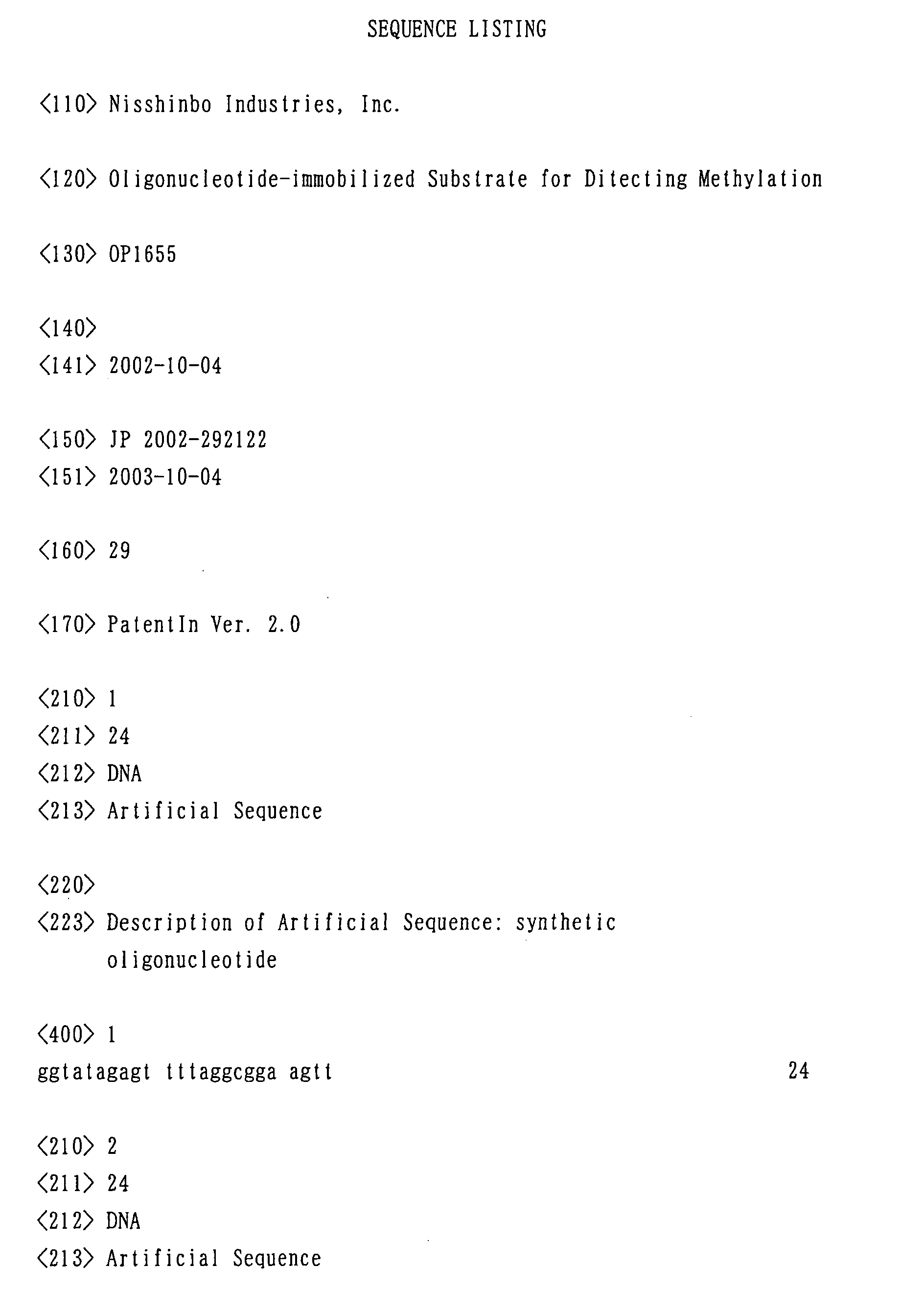


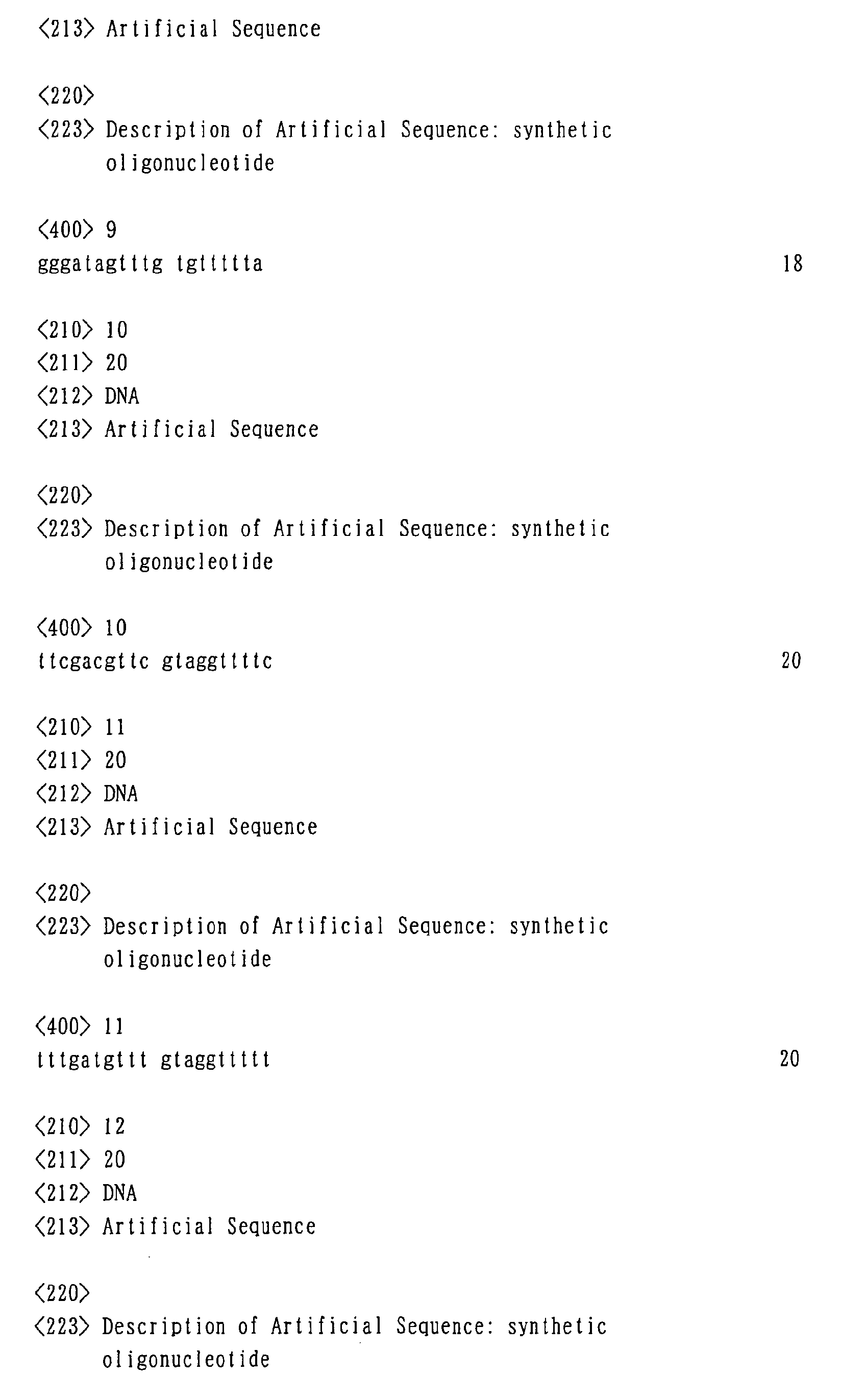
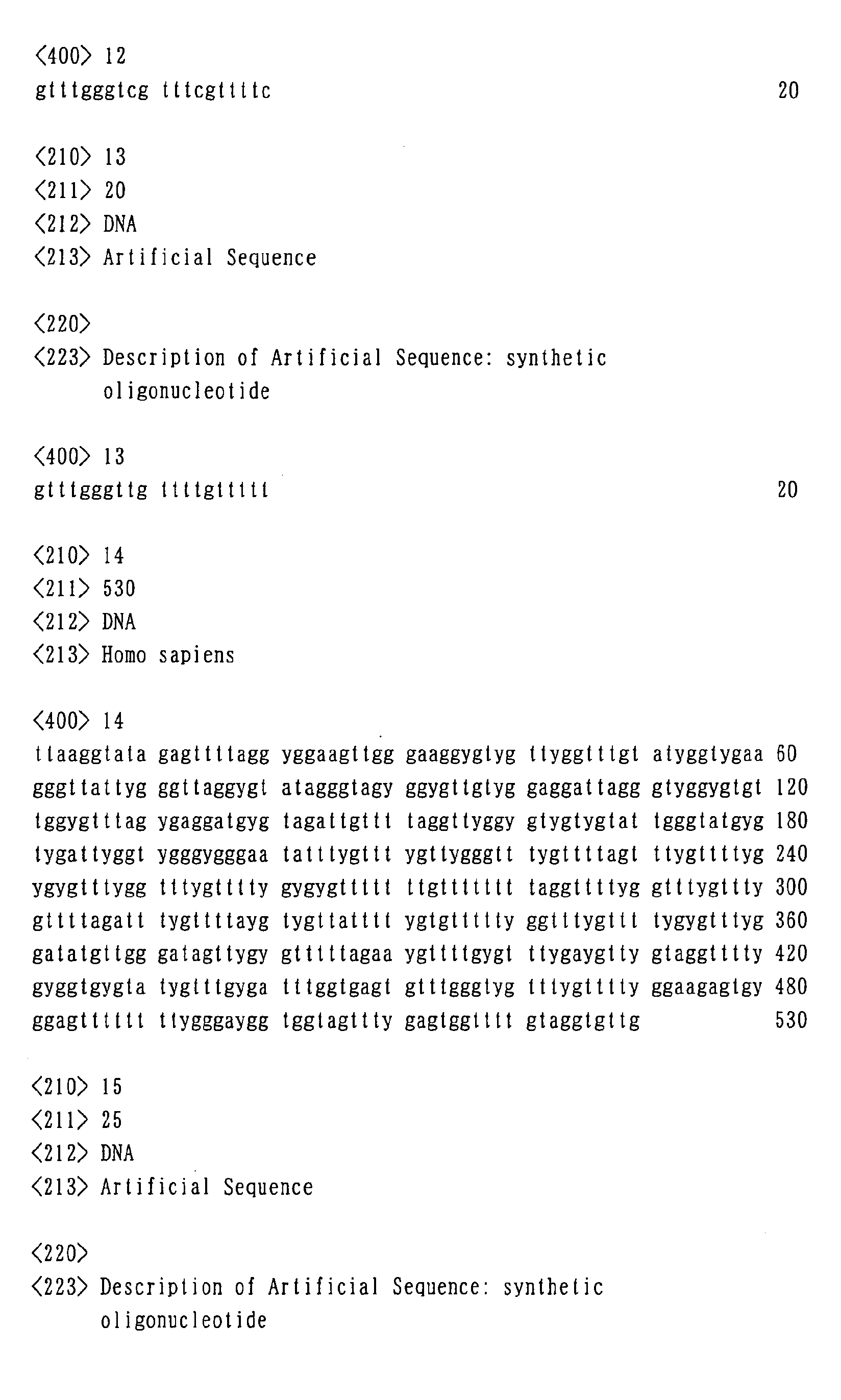


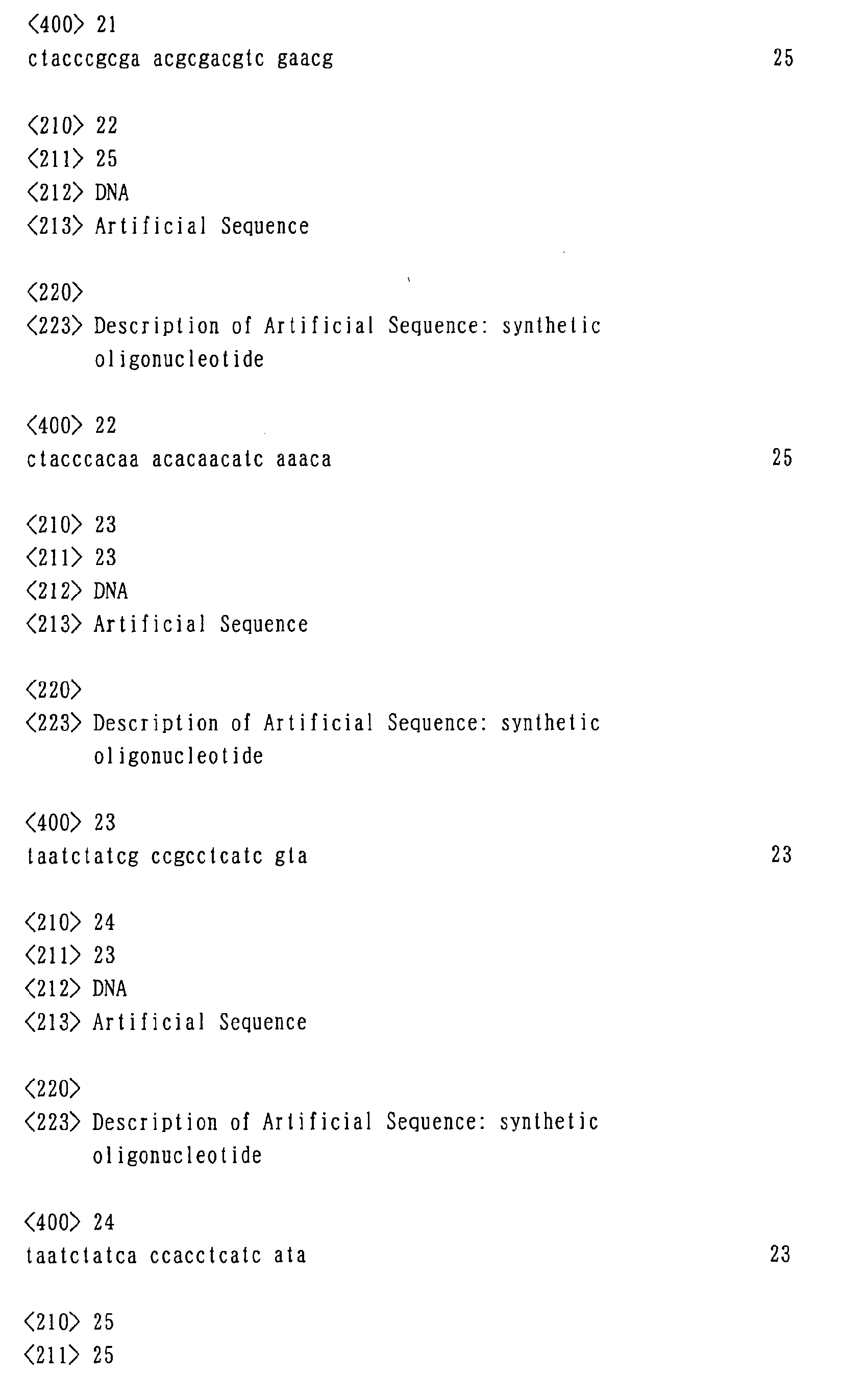

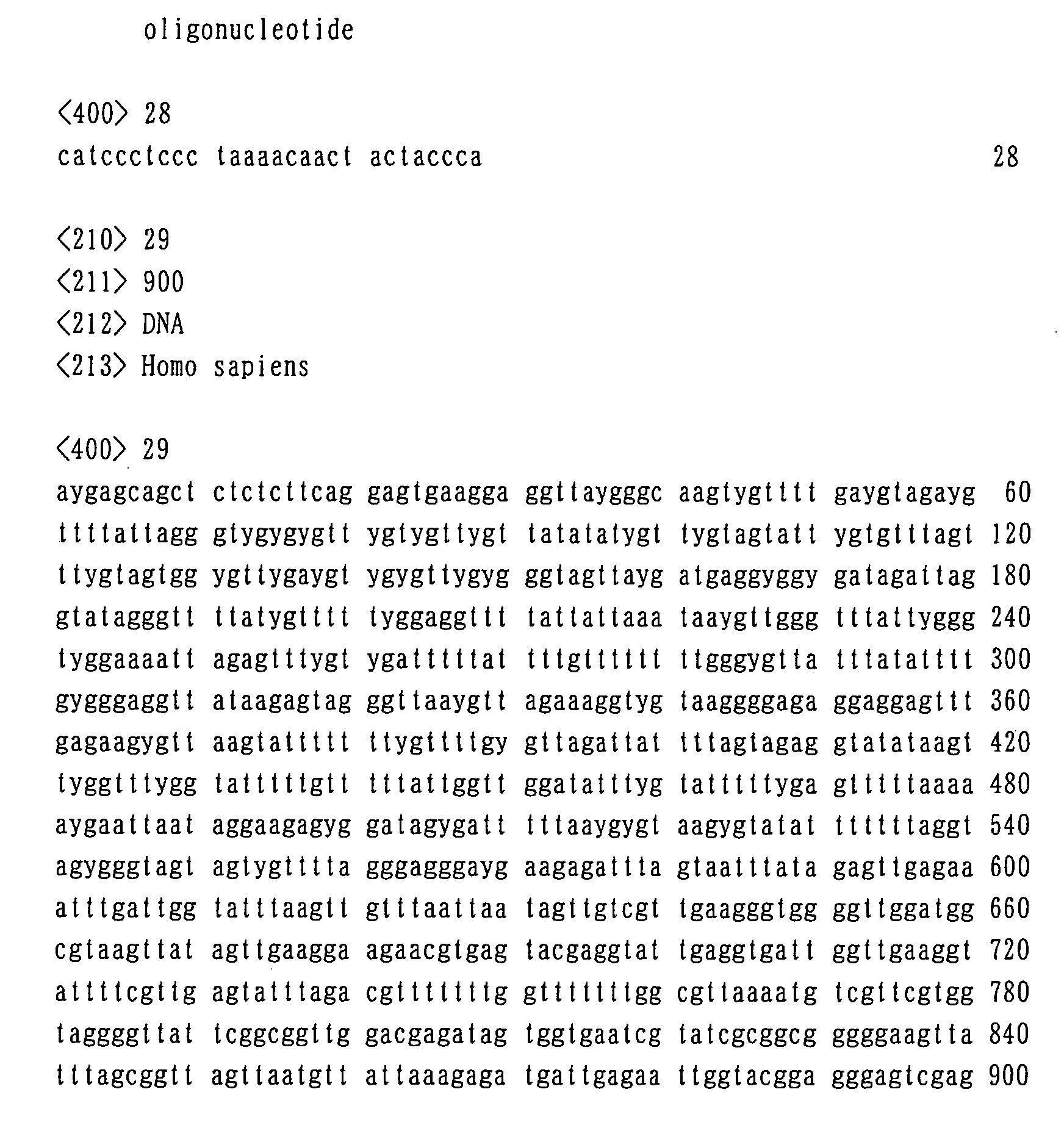
Claims (6)
- An oligonucleotide-immobilized substrate used for detecting presence or absence of methylation of C in a sample DNA, on which multiple kinds of capture oligonucleotides are immobilized, wherein
the sample DNA contains a target sequence containing dinucleotides consisting of C that can be methylated and G on the 3' side of the C (henceforth referred to as "CpG dinucleotide") at a plurarity of sites,
the capture oligonucleotides include an oligonucleotide having a nucleotide sequence complimentary to or identical to a nucleotide sequence corresponding to the target sequence in which all of C's other than C's in the all of CpG dinucleotides are replaced with T's and an oligonucleotide having a nucleotide sequence complimentary to or identical to a nucleotide sequence corresponding to the target sequence in which all of C's are replaced with T's, and
the presence or absence of methylation is detected based on hybridization of the sample DNA in which non-methylated C's have been converted into U's by deamination or an amplification product thereof and the capture oligonucleotides. - The oligonucleotide-immobilized substrate according to claim 2, wherein the capture oligonucleotides are immobilized as dots on a base material, and each dot has an occupied area of 0.1 cm2 or less.
- The oligonucleotide-immobilized substrate according to claim 1 or 2, wherein the capture oligonucleotides are oligonucleotides of 100-mer or less.
- The oligonucleotide-immobilized substrate according to any one of claims 1 to 3, wherein the capture oligonucleotides are immobilized via carbodiimide groups.
- A method for detecting presence or absence of methylation of C's in CpG dinucleotides in a sample DNA containing a target sequence containing CpG dinucleotides, wherein
multiple kinds of capture oligonucleotides immobilized on a base material and including an oligonucleotide having a nucleotide sequence complimentary to or identical to a nucleotide sequence corresponding to the target sequence in which all of C's other than C's in the all of CpG dinucleotide are replaced with T's and an oligonucleotide having a nucleotide sequence complimentary to or identical to a nucleotide sequence corresponding to the target sequence in which all of C's are replaced with T's are hybridized with the sample DNA in which non-methylated C's have been converted into U's by deamination or an amplification product thereof, and
the presence or absence of methylation is detected based on the result of the hybridization. - The method according to claim 5, wherein the non-methylated C's have been deaminated by treatment with sodium bisulfite.
Applications Claiming Priority (2)
| Application Number | Priority Date | Filing Date | Title |
|---|---|---|---|
| JP2002292122 | 2002-10-04 | ||
| JP2002292122 | 2002-10-04 |
Publications (1)
| Publication Number | Publication Date |
|---|---|
| EP1416056A1 true EP1416056A1 (en) | 2004-05-06 |
Family
ID=32089165
Family Applications (1)
| Application Number | Title | Priority Date | Filing Date |
|---|---|---|---|
| EP20030256258 Ceased EP1416056A1 (en) | 2002-10-04 | 2003-10-03 | Oligonucleotide-immobilized substrate for detecting methylation |
Country Status (3)
| Country | Link |
|---|---|
| US (1) | US7238518B2 (en) |
| EP (1) | EP1416056A1 (en) |
| CA (1) | CA2442438C (en) |
Cited By (2)
| Publication number | Priority date | Publication date | Assignee | Title |
|---|---|---|---|---|
| WO2008004719A1 (en) * | 2006-07-05 | 2008-01-10 | Orientbio Co., Ltd | Method for diagnosing cancer by detecting the methylation of transitional zones |
| EP1900825A1 (en) * | 2006-09-13 | 2008-03-19 | Rheinische Friedrich-Wilhelms-Universität Bonn | Sensitive and reproducible method for the determination of MGMT promoter methylation in clinical samples |
Families Citing this family (4)
| Publication number | Priority date | Publication date | Assignee | Title |
|---|---|---|---|---|
| US20080213870A1 (en) * | 2007-03-01 | 2008-09-04 | Sean Wuxiong Cao | Methods for obtaining modified DNA from a biological specimen |
| US9315853B2 (en) | 2012-01-30 | 2016-04-19 | Exact Sciences Corporation | Modification of DNA on magnetic beads |
| US10138524B2 (en) * | 2013-12-19 | 2018-11-27 | Exact Sciences Development Company, Llc | Synthetic nucleic acid control molecules |
| US10058502B2 (en) | 2015-12-31 | 2018-08-28 | L'oreal | Nail polish compositions |
Citations (5)
| Publication number | Priority date | Publication date | Assignee | Title |
|---|---|---|---|---|
| WO1999055905A1 (en) * | 1998-04-23 | 1999-11-04 | Commonwealth Scientific And Industrial Research Organisation | ASSAY FOR METHYLATION IN THE GST-Pi GENE |
| EP1104687A2 (en) * | 1999-11-29 | 2001-06-06 | Nisshinbo Industries, Inc. | Nucleic acid-immobilized substrate |
| WO2001068911A2 (en) * | 2000-03-15 | 2001-09-20 | Epigenomics Ag | Diagnosis of diseases associated with the cell cycle |
| WO2002077272A2 (en) * | 2001-03-26 | 2002-10-03 | Epigenomics Ag | Methods and nucleic acids for the analysis of hematopoietic cell proliferative disorders |
| EP1312685A2 (en) * | 2001-11-16 | 2003-05-21 | Nisshinbo Industries, Inc. | Oligonucleotide array for detecting the methylation state |
Family Cites Families (7)
| Publication number | Priority date | Publication date | Assignee | Title |
|---|---|---|---|---|
| US6582908B2 (en) * | 1990-12-06 | 2003-06-24 | Affymetrix, Inc. | Oligonucleotides |
| US6017704A (en) | 1996-06-03 | 2000-01-25 | The Johns Hopkins University School Of Medicine | Method of detection of methylated nucleic acid using agents which modify unmethylated cytosine and distinguishing modified methylated and non-methylated nucleic acids |
| US6331393B1 (en) | 1999-05-14 | 2001-12-18 | University Of Southern California | Process for high-throughput DNA methylation analysis |
| DE19951189C2 (en) | 1999-10-15 | 2003-11-06 | Epigenomics Ag | Method to distinguish 5-position methylation changes from cytosine bases and cytosine to thymine mutations and to detect single nucleotide polymorphisms (SNPs) or point mutations in genomic DNA |
| DE19957827C2 (en) * | 1999-11-25 | 2003-06-12 | Epigenomics Ag | Use of an oligomer array with PNA and / or DNA oligomers on a surface |
| DE10010280B4 (en) | 2000-02-25 | 2006-08-10 | Epigenomics Ag | Method for the detection of cytosine methylation in DNA samples |
| US20030152950A1 (en) * | 2001-06-27 | 2003-08-14 | Garner Harold R. | Identification of chemically modified polymers |
-
2003
- 2003-10-02 US US10/677,853 patent/US7238518B2/en not_active Expired - Fee Related
- 2003-10-02 CA CA2442438A patent/CA2442438C/en not_active Expired - Fee Related
- 2003-10-03 EP EP20030256258 patent/EP1416056A1/en not_active Ceased
Patent Citations (5)
| Publication number | Priority date | Publication date | Assignee | Title |
|---|---|---|---|---|
| WO1999055905A1 (en) * | 1998-04-23 | 1999-11-04 | Commonwealth Scientific And Industrial Research Organisation | ASSAY FOR METHYLATION IN THE GST-Pi GENE |
| EP1104687A2 (en) * | 1999-11-29 | 2001-06-06 | Nisshinbo Industries, Inc. | Nucleic acid-immobilized substrate |
| WO2001068911A2 (en) * | 2000-03-15 | 2001-09-20 | Epigenomics Ag | Diagnosis of diseases associated with the cell cycle |
| WO2002077272A2 (en) * | 2001-03-26 | 2002-10-03 | Epigenomics Ag | Methods and nucleic acids for the analysis of hematopoietic cell proliferative disorders |
| EP1312685A2 (en) * | 2001-11-16 | 2003-05-21 | Nisshinbo Industries, Inc. | Oligonucleotide array for detecting the methylation state |
Non-Patent Citations (4)
| Title |
|---|
| ADORJÁN P ET AL: "Tumour class prediction and discovery by microarray-based DNA methylation analysis", NUCLEIC ACIDS RESEARCH, OXFORD UNIVERSITY PRESS, SURREY, GB, vol. 30, no. 5, 1 March 2002 (2002-03-01), pages e21, XP002242367, ISSN: 0305-1048 * |
| GITAN RAAD S ET AL: "Methylation-specific oligonucleotide microarray: a new potential for high-throughput methylation analysis", GENOME RESEARCH, COLD SPRING HARBOR LABORATORY PRESS, US, vol. 12, no. 1, January 2002 (2002-01-01), pages 158 - 164, XP002208051, ISSN: 1088-9051 * |
| MODEL F ET AL: "FEATURE SELECTION FOR DNA METHYLATION BASED CANCER CLASSIFICATION", BIOINFORMATICS, OXFORD UNIVERSITY PRESS, OXFORD,, GB, vol. 17, no. SUPPL 1, 2001, pages 157 - 164, XP001154594, ISSN: 1367-4803 * |
| TAKESHI N ET AL.: "CpG island microarray to analyse methylation profiles of O6 methylguanine-DNA methyltransferase in colon cancer", PROCEEDINGS OF THE AMERICAN ASSOCIATION FOR CANCER RESEARCH ANNUAL MEETING, vol. 43, March 2002 (2002-03-01), pages 1129, XP001188170 * |
Cited By (2)
| Publication number | Priority date | Publication date | Assignee | Title |
|---|---|---|---|---|
| WO2008004719A1 (en) * | 2006-07-05 | 2008-01-10 | Orientbio Co., Ltd | Method for diagnosing cancer by detecting the methylation of transitional zones |
| EP1900825A1 (en) * | 2006-09-13 | 2008-03-19 | Rheinische Friedrich-Wilhelms-Universität Bonn | Sensitive and reproducible method for the determination of MGMT promoter methylation in clinical samples |
Also Published As
| Publication number | Publication date |
|---|---|
| US20050089870A1 (en) | 2005-04-28 |
| US7238518B2 (en) | 2007-07-03 |
| CA2442438C (en) | 2012-06-19 |
| CA2442438A1 (en) | 2004-04-04 |
Similar Documents
| Publication | Publication Date | Title |
|---|---|---|
| JP4718181B2 (en) | Reverse transcription on microarray | |
| KR100557329B1 (en) | Hybridization Portion Control Oligonucleotide and Its Uses | |
| CA2390312C (en) | Oligomer array with pna and/or dna oligomers on a surface | |
| AU772002B2 (en) | Method for relative quantification of methylation of cytosin-type bases in DNA samples | |
| EP0777750B1 (en) | High throughput screening method for sequences or genetic alterations in nucleic acids | |
| CN112154216A (en) | Biomolecular probes and methods for detecting gene and protein expression | |
| CZ90596A3 (en) | Composition for effective sequencing of nucleic acid and process for preparing such composition | |
| JP2003527867A (en) | Microarray-based analysis of polynucleotide sequence alterations | |
| JP2000232883A (en) | Gene expression using nucleic acid microalley and simultaneous measurement of genomic aberration | |
| CA2555377A1 (en) | Genetic analysis by sequence-specific sorting | |
| WO1997012062A1 (en) | Polynucleotide detection by isothermal amplification | |
| US7659068B1 (en) | Carrier for gene detection and its use for detecting validity of interferon therapy | |
| US20030096289A1 (en) | Oligonucleotide-immobilized substrate for detecting methylation | |
| US20090075275A1 (en) | Nucleic acid probe-immobilized substrate and method of detecting the presence of target nucleic acid by using the same | |
| US7238518B2 (en) | Oligonucleotide-immobilized substrate for detecting methylation | |
| JP2001054400A (en) | Genotype determining two allele marker | |
| US7851159B2 (en) | Method for detecting target nucleic acid with specific base sequence and set of nucleic acids for detection | |
| WO2018049260A1 (en) | Reusable microarray compositions and methods | |
| JP2004141160A (en) | Oligonucleotide-immobilized substrate for methylation detection | |
| US7105299B2 (en) | Method for determining chum salmon haplotype using mitochondrial DNA | |
| JP4731081B2 (en) | Method for selectively isolating nucleic acids | |
| JP2004191098A (en) | Oligonucleotide-immobilized substrate | |
| JP2006340651A (en) | RNA adjustment method | |
| CA2205234A1 (en) | High throughput screening method for sequences or genetic alterations in nucleic acids |
Legal Events
| Date | Code | Title | Description |
|---|---|---|---|
| PUAI | Public reference made under article 153(3) epc to a published international application that has entered the european phase |
Free format text: ORIGINAL CODE: 0009012 |
|
| AK | Designated contracting states |
Kind code of ref document: A1 Designated state(s): AT BE BG CH CY CZ DE DK EE ES FI FR GB GR HU IE IT LI LU MC NL PT RO SE SI SK TR |
|
| AX | Request for extension of the european patent |
Extension state: AL LT LV MK |
|
| 17P | Request for examination filed |
Effective date: 20040920 |
|
| AKX | Designation fees paid |
Designated state(s): DE FR GB |
|
| RAP1 | Party data changed (applicant data changed or rights of an application transferred) |
Owner name: BIO-DIXAM LLC |
|
| STAA | Information on the status of an ep patent application or granted ep patent |
Free format text: STATUS: THE APPLICATION HAS BEEN REFUSED |
|
| 18R | Application refused |
Effective date: 20101017 |