EP1416043A1 - Leguminous bacterium having potentiated nitrogen fixation ability - Google Patents
Leguminous bacterium having potentiated nitrogen fixation ability Download PDFInfo
- Publication number
- EP1416043A1 EP1416043A1 EP02743878A EP02743878A EP1416043A1 EP 1416043 A1 EP1416043 A1 EP 1416043A1 EP 02743878 A EP02743878 A EP 02743878A EP 02743878 A EP02743878 A EP 02743878A EP 1416043 A1 EP1416043 A1 EP 1416043A1
- Authority
- EP
- European Patent Office
- Prior art keywords
- root nodule
- nodule bacteria
- catalase
- gene
- leguminous crops
- Prior art date
- Legal status (The legal status is an assumption and is not a legal conclusion. Google has not performed a legal analysis and makes no representation as to the accuracy of the status listed.)
- Withdrawn
Links
Classifications
-
- C—CHEMISTRY; METALLURGY
- C12—BIOCHEMISTRY; BEER; SPIRITS; WINE; VINEGAR; MICROBIOLOGY; ENZYMOLOGY; MUTATION OR GENETIC ENGINEERING
- C12N—MICROORGANISMS OR ENZYMES; COMPOSITIONS THEREOF; PROPAGATING, PRESERVING, OR MAINTAINING MICROORGANISMS; MUTATION OR GENETIC ENGINEERING; CULTURE MEDIA
- C12N9/00—Enzymes; Proenzymes; Compositions thereof; Processes for preparing, activating, inhibiting, separating or purifying enzymes
- C12N9/0004—Oxidoreductases (1.)
- C12N9/0065—Oxidoreductases (1.) acting on hydrogen peroxide as acceptor (1.11)
-
- C—CHEMISTRY; METALLURGY
- C05—FERTILISERS; MANUFACTURE THEREOF
- C05F—ORGANIC FERTILISERS NOT COVERED BY SUBCLASSES C05B, C05C, e.g. FERTILISERS FROM WASTE OR REFUSE
- C05F11/00—Other organic fertilisers
- C05F11/08—Organic fertilisers containing added bacterial cultures, mycelia or the like
Definitions
- the invention of this application relates to root nodule bacteria whose nitrogen-fixation ability is enhanced by expression of a catalase gene introduced, and a preparation for leguminous crops containing the root nodule bacteria as an active ingredient.
- Leguminous crops such as soybeans, adzuki beans and kidney beans can be grown well even in soil with low nitrogen content by atmospheric nitrogen-fixation resulting from bacteroid formed in the root nodules that are symbiotically formed therein according to infection with root nodule bacteria.
- leguminous crops are generally grown from seeds previously coated with root nodule bacteria.
- JP-T-2000-514663 disclosed the root nodule bacteria that were modified with incorporation of the trifolitoxin gene and efficient in suppression of growth of other competent root nodule bacteria.
- root nodule bacteria play key role in growth and yield of leguminous crops.
- degree of dependence on root nodule bacteria in nitrogen absorption ranges from 30% to 65%, and is extremely high. Accordingly, root nodule bacteria having enhanced nitrogen-fixation ability are expected to greatly enlarge a possibility of cultivating leguminous crops in various soils or increasing yields thereof.
- such efficient nitrogen absorption of leguminous crops with root nodule bacteria necessarily decreases dependence on inorganic nitrogen fertilizers such as ammonium sulfate, and therefore contributes greatly toward reduction of agricultural cost and alleviation of environmental pollution.
- root nodule bacteria whose nitrogen-fixation ability is enhanced to a practical extent have been provided neither by a screening of novel root nodule bacteria from the natural world nor by a production of modified root nodule bacteria through gene manipulation.
- a catalase has an activity to catalyze decomposition of hydrogen peroxide acting harmfully on animal and plant individuals into water and oxygen.
- the inventors of this application previously isolated new Vibrio rumoiensis strain S-1 having quite a strong catalase activity (J. Ferment. Bioeng. 85:113-116, 1998), and further specified the catalase gene of this strain (JP-A-2000-316584; Appl. Environ. Microbiol. 65:67-72, 1999; J. Biosci. Bioeng. 90:530-534, 2000).
- JP-A-2000-316584 Appl. Environ. Microbiol. 65:67-72, 1999; J. Biosci. Bioeng. 90:530-534, 2000.
- root nodule bacteria whose nitrogen-fixation ability is enhanced by introduction of a catalase gene have been absolutely unknown.
- the invention of this application has been proposed by concerning above-mentioned circumstances, and aims to provide novel root nodule bacteria whose nitrogen-fixation ability is enhanced by gene introduction.
- leguminous plants At the' initial stage of infection with root nodule bacteria, leguminous plants generate cytotoxic hydrogen peroxide.
- they have an enzyme (catalase) that catalyzes decomposition of hydrogen peroxide. Therefore, root nodule bacteria , which acquire high catalase activity, provide such effective suppression of cytotoxicity of hydrogen peroxide that it is expected to promote growth of leguminous crops and to improve yields of leguminous crops.
- catalase gene vktA
- the invention of this application provides root nodule bacteria transformed with a catalase gene, of which nitrogen-fixation ability is enhanced by a catalase produced from the catalase gene.
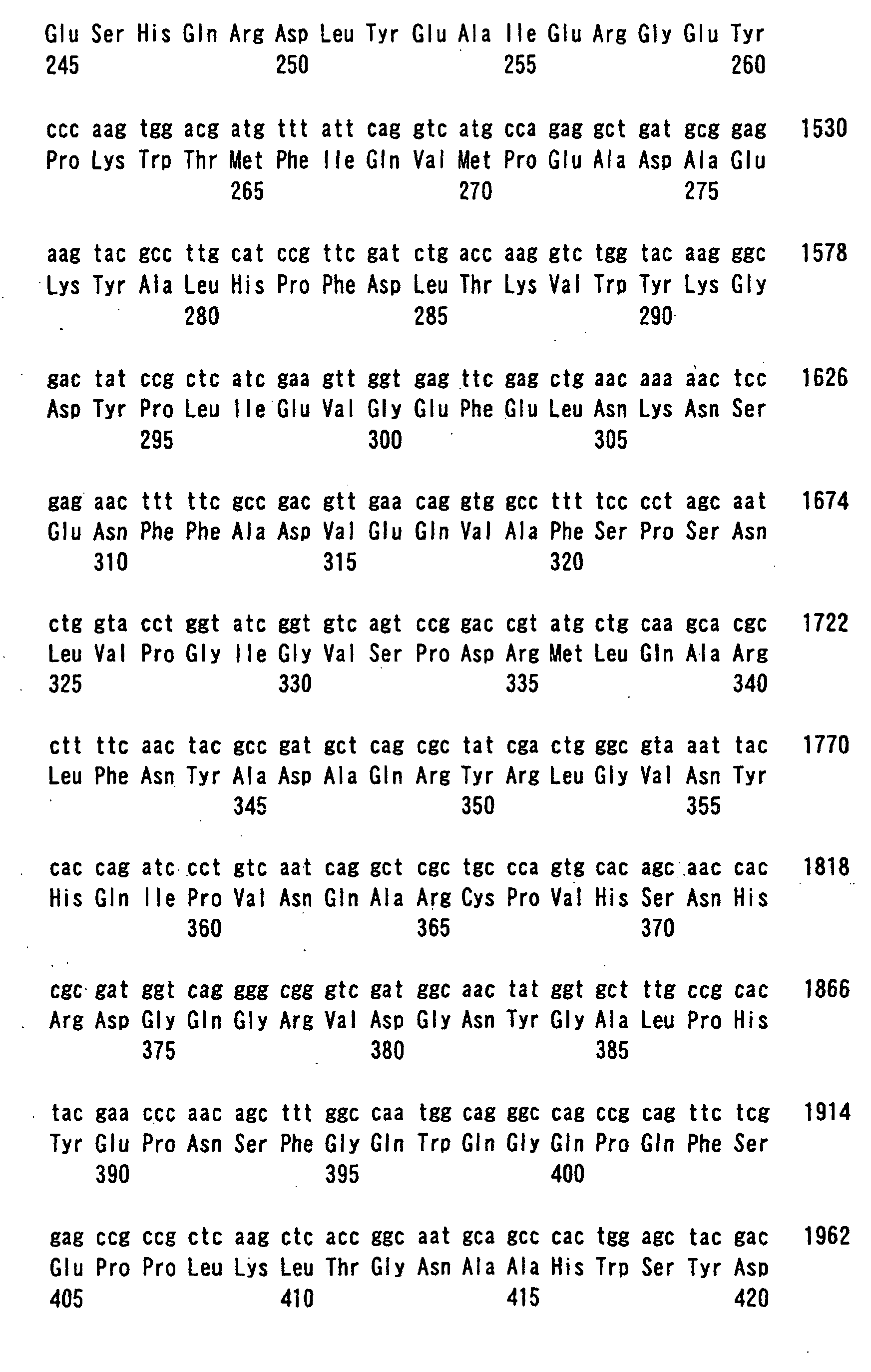
- the catalase gene is a DNA fragment containing the base sequence of SEQ ID No. 1 that is the catalase gene derived from Vibrio rumoiensis S-1 strain.
- the invention of this application provides a preparation for leguminous crops containing the root nodule bacteria as an active ingredient.
- the invention of this application provides a method of cultivating leguminous crops, which comprises contacting seeds of leguminous crops with the above-mentioned root nodule bacteria or the preparation.
- the root nodule bacteria of this invention are transformant bacteria having introduced therein a catalase gene.
- a catalase gene a polynucleotide (genomic DNA, mRNA, cDNA or the like) encoding a catalase produced from various organisms can be used.
- Many types of the catalase gene are known, for example, as follows: Legionella pneumophilla-derived catalase gene (J. Bacteriol. 182:6679-6686, 2000; GenBank AF276752, FEMS Microbiol. Lett. 176:339-344, 1999; GenBank AB017595), Aspergillus nidulans-derived catalase gene (J. Bacteriol.
- GenBank AF316033 Pseudomonas fluorescence-derived catalase gene (FEMS Microbiol. Lett. 200:235-240, 2001; GenBank U72068), Nicotiana tabacum-derived catalase gene (Plant J. 11:993-1005, 1997; GenBank U93244), Straphyrococcus aureus-derived catalase gene (Microbiology 146:465-475, 2000; GenBank AJ000471, AJ000472), Xanthomonas campestris pv.
- the root nodule bacteria of this invention entirely include both the catalase genes already known in the literature, the database or the like, and yet unknown catalase genes which might be identified in future.
- the catalase gene to be introduced may additionally contain expression control region (promoter/enhancer) inherently concordant therewith or may be a fusion sequence connected therewith an expression control region of a gene which is expressed in root nodule bacteria with high frequency.
- expression control region promoter/enhancer
- one embodiment of the transformant root nodule bacteria in this invention is transformant bacteria in which a DNA fragment, containing the vktA gene and having the base sequence of SEQ ID No. 1, is introduced.
- the root nodule bacteria are, as shown in Example, root nodule bacteria having introduced therein a DNA fragment (4.9 kb) containing the sequence of SEQ ID No. 1 that consists of both coding region and promoter sequence of the vktA gene.
- the vktA gene can be used by being isolated from Vibrio rumoiensis strain S-1 by the method described in JP-A-2000-315684.
- the root nodule bacteria are Gram-negative bacteria that form root nodules by infection in roots of leguminous crops.
- Known root nodule bacteria species that have the growth promoting effect on the leguminous crops may be used. Specifically, they are microorganisms belonging to the Genus Rhizobium, Bradyrhizobium, Azorhizorium or the like. More specifically, they are Rhizobium meliloti, Rhizobium trifolii, Rhizobium lupini, Rhizobium fredii, Rhizobium loti, Rhizobium leguminosarum, Bradyrhizobium japonicum, Azorhizorium caulinodans and the like.
- root nodule bacteria are inoculated in a medium (TY medium or the like) which is suitable for their growth, and grown by shaking culture at from 25 to 30°C for from 12 to 36 hours, and cells are harvested by centrifugation and subjected to transformation.
- a medium TY medium or the like
- vktA gene into the root nodule bacteria can be conducted by introducing a recombinant vector consisting the introduction gene into root nodule bacteria by conventional method such as an electroporation method, a calcium phosphate method, a liposome method or a DEAE dextran method.
- transformant root nodule bacteria can be formed by a transfer method through co-culture with root nodule bacteria, a bacterial host (E. coli or the like) carrying recombinant vector and a bacterial host containing helper plasmid.
- the thus-formed transformant root nodule bacteria have, as shown in Example, a high nitrogen-fixation ability, and can form root nodules satisfactorily by co-existence of seeds of leguminous crops.
- the preparations for leguminous crops in this invention contain the transformant root nodule bacteria as an active ingredient.
- the preparations can be prepared as mixture of the root nodule bacteria of this invention at a concentration of from 10 5 to 10 8 cells/ml in a liquid medium (for example, TY medium) viable for growing root nodule bacteria.
- a liquid medium for example, TY medium
- they can be mixed with an organic or inorganic carrier.
- the inorganic carrier examples include akadama tsuchi, calcined akadama tsuchi, Kanuma tsuchi, kuroboku soil, vermiculite, pearlite and zeolite, and that of the organic carrier include peat-moss, charcoal, pulp, straw, bagasse, oil meal, fish meal, bone meal, blood meal, shell fossil and crab shell.
- the way of fixing root nodule bacteria of this invention on the carrier may be conducted by mixing suspension of the root nodule bacteria. At this time, sufficient content of the root nodule bacteria may be at a concentration of from 10 5 to 10 8 cells per gram of the carrier.
- the stability of the root nodule bacteria can be improved by incorporating 40% or more of water in a mixture of the root nodule bacteria and the carrier. Still further, the storage stability of the root nodule bacteria can be more improved by incorporating charcoal ash or the like as a part of a carrier to adjust pH of the preparations ranging from pH 5.5 to pH 8.0.
- the thus-formed preparations can be mixed with seeds before sowing or sprayed in sowing in an agricultural land together with fertilizers.
- Example The invention of this application is illustrated specifically in more detail below by referring to Example. However, the invention of this application is not limited by the following Example.
- the DNA fragment of SEQ ID No. 1 containing the vktA gene (catalase coding region) and its promoter sequence was introduced into the vector (pBBR1MCS-2: Gene 166:175-176, 1995) that is adaptable to wide host range.
- pBBR1MCS-2 Gene 166:175-176, 1995
- the recombinant vector pBBR1MCS-2:vktA carrying the vktA gene was constructed.
- Rhizobium leguminosarum bv. phaseoli 2676 kidney bean bacterium
- Rhizobium fredii USDA 191 Rhizobium fredii USDA 191
- Escherichia coli JM109 transformed with the recombinant vector pBBR1MCS-2:vktA was used.
- helper plasmid-carrying bacteria Escherichia coli MM294 carrying pRK2013 was used.
- the recipient, the donor and the helper plasmid-carrying bacteria were subjected respectively to shaking culture (100 strokes/min) on 5 ml of TY medium at 30°C, and grown up to logarithmic growth anaphase.
- 40 ⁇ l of respective Escherichia coli cultures and 100 ⁇ l of the root nodule bacteria culture were mixed in a 1.5-ml microtube, and the mixture was centrifuged at 10,000 rpm for 1 minute to collect cells. After the supernatant was removed, the cells were suspended in 100 ⁇ l of sterile water, and centrifuged at 10,000 rpm for 1 minute to wash the cells.
- the cells were suspended in 100 ⁇ l of sterile distilled water, and 50 ⁇ l of the mixed cell solution was put on a millipore filter placed on TY agar medium, and mated overnight at 30°C. Then, a filter portion to which the cells were adhered was cut out, put in a 1.5-ml microtube, and completely suspended in 1 ml of sterile distilled water. After the filter was removed, the suspension was centrifuged at 10,000 rpm for 1 minute, and the cells were harvested and further suspended in 1 ml of sterile distilled water.
- diluted cell solution which was prepared by 10 5 times-dilution of the suspension with sterile distilled water, was cultured at 30°C for from 4 to 5 days while being coated in 100- ⁇ l portions on a selective agar-medium (Sodium succinate 1.35 g, Sodium glutamate 1.1 g, K 2 HPO 4 220 mg, MgSO 4 100 mg, FeCl 2 440 mg, CaCl 2 440 mg, Biotin 0.2 mg/L distilled water (pH 7.0)).
- a transformant strain of the root nodule bacteria transformed with the vktA was screened.
- a cell solution (preculture medium) at logarithmic growth anaphase obtained from reciprocal shaking culture (100 strokes/min) in TY liquid medium (5 ml) at 30°C was subjected to main culture performed in TY medium (200 ml) from logarithmic growth anaphase to stationary initial phase at 30°C.
- H 2 O 2 was used as a substrate, and 2.645 ml of H 2 O, 0.3 ml of 0.5 M KPB (pH 6.9) and 5 ⁇ l of 30% H 2 O 2 were mixed in a quartz cell. The mixture was incubated at 25°C for 3 minutes to make temperature equilibrium. Then, 50 ⁇ l of the cell-free extract was added, and enzyme activity was measured from the change in absorbance at 240 nm. A molar extinction coefficient, 0.0436 M -1 cm -1 of H 2 O 2 was used.
- CBB Coomassie brilliant blue
- Catalase activities of Rhizobium leguminosarum bv. phaseoli 2676 and Rhizobium fredii USDA 191 transformed with vktA gene were 7,500 U/mg protein and 6,100 U/mg protein respectively, showing significantly high enzyme activities in comparison to catalase activities (3.4 and 2.9 U/mg protein) of their parent strains.
- Soybeans cultivar Kitamusume and kidney beans (cultivar Yukitebou) were used. Their seeds were dipped in 70% ethanol for 2 minutes, and then washed three times with sterile distilled water, further surface-sterilized with 10% sodium hypochlorite, and washed six times with sterile distilled water. Further, seed bags (15 x 16 cm) were used in cultivation of the respective crops. The seed bags, in which 30 ml of nitrogen-free culture solution (Norris-Date solution) was poured, was totally wrapped with an aluminum foil and autoclaved.
- nitrogen-free culture solution Neorris-Date solution
- Rhizobium leguminosarum bv. phaseoli 2676 (kidney bean bacterium) and Rhizobium fredii USDA 191 (soybean bacterium) respectively transformed with the vktA gene was used, and also their parent strains were used. Each of the strains was grown on 5 ml of TY medium (bactotripton 5 g, yeast extract 3 g, calcium chloride 6-hydrate 1.3 g/L) under reciprocal shaking-culture (100 strokes/min) conditions up to logarithmic growth anaphase (detected by 1.0 or more of OD 660 , 10 9 cells/ml).
- TY medium bactotripton 5 g, yeast extract 3 g, calcium chloride 6-hydrate 1.3 g/L
- the cells were diluted to 1,000 times with a sterilized phosphate buffered saline (PBS: 0.7 g KH 2 PO 4 , 6.8 g NaCl and 2.4 g Na 2 HPO 4 ⁇ 12H 2 O/L distilled water (pH 7.0))to adjust a cell density to 10 6 cells/ml. In this manner,inoculation cell solution was prepared.
- PBS sterilized phosphate buffered saline
- pH 7.0 sterilized phosphate buffered saline
- the measurement was performed after 40 days (kidney beans) or 50 days (soybeans).
- the plant was put in a 1,000-ml glass pot, and sealed with a rubber stopper. From inside each pot, 100 ml of air (10% of an air amount in the pot) was removed by aspiration with syringe penetrated through the rubber stopper. The same volume of acetylene was then charged therein.
- the plant was withdrawn from the pot.
- the root nodules were separated, and dried overnight in a desiccator. The weight (dry weight) thereof was measured.
- the invention of this application provides the root nodule bacteria transformed by introduction of a catalase gene and excellent in nitrogen-fixation ability.
- the acceleration of growth of leguminous crops and the multiplication of crop yield of beans are enabled thereby.
- reduction of nitrogen fertilizers thereby encourages the reduction of agricultural cost and the alleviation of environmental pollution.
Landscapes
- Chemical & Material Sciences (AREA)
- Life Sciences & Earth Sciences (AREA)
- Organic Chemistry (AREA)
- Health & Medical Sciences (AREA)
- Biochemistry (AREA)
- Zoology (AREA)
- Wood Science & Technology (AREA)
- Engineering & Computer Science (AREA)
- Bioinformatics & Cheminformatics (AREA)
- Genetics & Genomics (AREA)
- Biotechnology (AREA)
- Biomedical Technology (AREA)
- Microbiology (AREA)
- Molecular Biology (AREA)
- Medicinal Chemistry (AREA)
- General Engineering & Computer Science (AREA)
- General Health & Medical Sciences (AREA)
- Micro-Organisms Or Cultivation Processes Thereof (AREA)
- Agricultural Chemicals And Associated Chemicals (AREA)
- Enzymes And Modification Thereof (AREA)
- Pretreatment Of Seeds And Plants (AREA)
- Cultivation Of Plants (AREA)
Abstract
Description
| Strain | Number of root nodules on each cultivation day (number of days) | Weight of root nodule (mg dry wet) | ARA (µmol/h·mg) | ||||||||
| 18 | 21 | 24 | 30 | 36 | 40 | 50 | per nodule | per plant | per nodule | per plant | |
| Parent | 5.5 | 8.6 | 11.3 | 133 | 15.7 | 17.1 | 18.8 | 0.61±0.11 | 11.46±1.22 | 0.08±0.03 | 0.87±0.19 |
| Tf | 8.6 | 12.0 | 13.8 | 180 | 20.7 | 25.1 | 26.4 | 0.53±0.08 | 13.84±1.79 | 0.09±0.02 | 1.23±0.27 |
| Strain | Number of root nodules on each cultivation day (number of days) | Weight of root nodule (mg dry wet) | ARA (µmol/h·mg) | |||||||||
| 18 | 21 | 24 | 27 | 30 | 33 | 36 | 40 | per nodule | per plant | per nodule | per plant | |
| Parent | 71 | 82 | 88 | 101 | 112 | 120 | 127 | 129 | 0:30±0.03 | 36.6±1.6 | 0.7±0.06 | 25.6±2.0 |
| Tf | 57 | 72 | 78 | 84 | 96 | 104 | 110 | 111 | 0.29±0.02 | 31.6±1.8 | 1.2±0.09 | 36.5±2.7 |



Claims (4)
- Root nodule bacteria transformed with a catalase gene, of which nitrogen-fixation ability is enhanced by a catalase produced from the catalase gene.
- The root nodule bacteria of claim 1, wherein the catalase gene is a DNA fragment containing the base sequence ,of SEQ ID No. 1 that is the catalase gene derived from Vibrio rumoiensis S-1 strain.
- A preparation for leguminous crops, which contains the root nodule bacteria of claim 1 or 2 as an active ingredient.
- A method of cultivating leguminous crops, which comprises contacting seeds of leguminous crops with the root nodule bacteria of claim lor 2, or the preparation of claim 3, and cultivating the seeds.
Applications Claiming Priority (3)
| Application Number | Priority Date | Filing Date | Title |
|---|---|---|---|
| JP2001209214A JP2003033174A (en) | 2001-07-10 | 2001-07-10 | Rhizobium with enhanced nitrogen fixation |
| JP2001209214 | 2001-07-10 | ||
| PCT/JP2002/006950 WO2003006631A1 (en) | 2001-07-10 | 2002-07-09 | Leguminous bacterium having potentiated nitrogen fixation ability |
Publications (2)
| Publication Number | Publication Date |
|---|---|
| EP1416043A1 true EP1416043A1 (en) | 2004-05-06 |
| EP1416043A4 EP1416043A4 (en) | 2006-05-24 |
Family
ID=19044901
Family Applications (1)
| Application Number | Title | Priority Date | Filing Date |
|---|---|---|---|
| EP02743878A Withdrawn EP1416043A4 (en) | 2001-07-10 | 2002-07-09 | LEGUMINOUS BACTERIUM HAVING POTENTIALIZED NITROGEN FIXATION FIXATION |
Country Status (6)
| Country | Link |
|---|---|
| US (2) | US7109020B2 (en) |
| EP (1) | EP1416043A4 (en) |
| JP (1) | JP2003033174A (en) |
| CN (1) | CN1537160A (en) |
| CA (1) | CA2453672A1 (en) |
| WO (1) | WO2003006631A1 (en) |
Cited By (1)
| Publication number | Priority date | Publication date | Assignee | Title |
|---|---|---|---|---|
| WO2007116323A3 (en) * | 2006-04-10 | 2008-06-12 | Inst Microbiologie De L Academ | Novel fertiliser combination and method for treatment of seeds and plants therewith |
Families Citing this family (28)
| Publication number | Priority date | Publication date | Assignee | Title |
|---|---|---|---|---|
| JP4686395B2 (en) * | 2005-04-01 | 2011-05-25 | 有限会社S.Gラボラトリー | Catalase high productivity Rhizobium microorganism |
| WO2011116708A1 (en) * | 2010-03-26 | 2011-09-29 | 中国科学院上海生命科学研究院 | Method of changing plants' characters |
| JP5878524B2 (en) * | 2010-06-14 | 2016-03-08 | 株式会社アモーレパシフィックAmorepacific Corporation | Novel soil microorganisms, novel oxidoreductases isolated from the soil microorganisms, genes encoding the oxidoreductases, and methods for producing aglycosides using them |
| WO2011161617A1 (en) * | 2010-06-24 | 2011-12-29 | Basf Plant Science Company Gmbh | Plants having enhanced yield-related traits and method for making the same |
| EP2721153B1 (en) | 2011-06-16 | 2019-08-28 | The Regents of The University of California | Synthetic gene clusters |
| CN104204211B (en) | 2012-03-03 | 2017-07-04 | 科技部生物技术局 | Restructuring nitrogen-fixing microorganism and application thereof |
| WO2014071182A1 (en) | 2012-11-01 | 2014-05-08 | Massachusetts Institute Of Technology | Directed evolution of synthetic gene cluster |
| US20140352376A1 (en) * | 2013-05-28 | 2014-12-04 | BiOWiSH Technologies, Inc. | Fertilizer compositions methods of making and using same |
| JP2014230534A (en) * | 2013-05-30 | 2014-12-11 | 国立大学法人東北大学 | Rhizobium with enhanced n2o reduction ability, and the method for removing n2o |
| WO2015119681A1 (en) * | 2014-02-04 | 2015-08-13 | University Of Florida Research Foundation, Inc. | Pteris vittata phytase nucleotide and amino acid sequences and methods of use |
| KR102197507B1 (en) | 2015-07-13 | 2020-12-31 | 피벗 바이오, 인크. | Methods and compositions for improving plant traits |
| WO2017062412A1 (en) | 2015-10-05 | 2017-04-13 | Massachusetts Institute Of Technology | Nitrogen fixation using refactored nif clusters |
| PT3208254T (en) | 2016-02-17 | 2020-08-27 | Fertinagro Biotech Sl | Fertilizing composition which includes ions complexed with humic substances to improve the biological fixation of nitrogen by microorganisms present in the soil |
| WO2018039639A1 (en) * | 2016-08-26 | 2018-03-01 | Synthetic Genomics, Inc. | Genetically engineered vibrio sp. and uses thereof |
| UA129256C2 (en) | 2017-01-12 | 2025-03-05 | Півот Байо, Інк. | Methods and compositions for improving plant traits |
| CN107164261B (en) * | 2017-05-09 | 2019-06-11 | 中国农业科学院农业资源与农业区划研究所 | A rhizobia that promotes the growth of A. chinensis and its application |
| US12151988B2 (en) | 2017-10-25 | 2024-11-26 | Pivot Bio, Inc. | Gene targets for nitrogen fixation targeting for improving plant traits |
| JP7420712B2 (en) | 2017-10-25 | 2024-01-23 | ピボット バイオ, インコーポレイテッド | Methods and compositions for improving engineered microorganisms that fix nitrogen |
| EP3813511A4 (en) | 2018-06-27 | 2022-08-03 | Pivot Bio, Inc. | GUIDED MICROBIAL REMODELING, PLATFORM FOR THE RATIONAL IMPROVEMENT OF MICROBIAL SPECIES FOR AGRICULTURE |
| EP3814302A4 (en) | 2018-06-27 | 2022-06-29 | Pivot Bio, Inc. | Agricultural compositions comprising remodeled nitrogen fixing microbes |
| US12391624B2 (en) | 2018-07-11 | 2025-08-19 | Pivot Bio, Inc. | Temporally and spatially targeted dynamic nitrogen delivery by remodeled microbes |
| US12421519B2 (en) | 2019-01-07 | 2025-09-23 | Pivot Bio, Inc. | Plant colonization assays using natural microbial barcodes |
| WO2020190363A1 (en) | 2019-03-19 | 2020-09-24 | Massachusetts Institute Of Technology | Control of nitrogen fixation in rhizobia that associate with cereals |
| CN114008221A (en) | 2019-04-25 | 2022-02-01 | 皮沃特生物股份有限公司 | High throughput method for isolating and characterizing pools of ammonium secreting mutants generated by chemical mutagenesis |
| AU2020445067A1 (en) | 2020-05-01 | 2022-12-01 | Pivot Bio, Inc. | Measurement of nitrogen fixation and incorporation |
| WO2021222643A1 (en) | 2020-05-01 | 2021-11-04 | Pivot Bio, Inc. | Stable liquid formulations for nitrogen-fixing microorganisms |
| CN115508509B (en) * | 2022-09-16 | 2023-04-28 | 吉林省农业科学院 | Soybean seedling stage low nitrogen resistance evaluation method |
| CN118184451A (en) * | 2024-02-01 | 2024-06-14 | 中国农业科学院油料作物研究所 | Use of ARC microbial agent in the production of ARC+ rhizobium fertilizer (agent) |
Family Cites Families (2)
| Publication number | Priority date | Publication date | Assignee | Title |
|---|---|---|---|---|
| US5906929A (en) * | 1997-05-01 | 1999-05-25 | Wisconsin Alumni Research Foundation | Enhanced inoculant for soybean cultivation |
| JP2000316584A (en) * | 1999-05-14 | 2000-11-21 | Japan Science & Technology Corp | Catalase gene |
-
2001
- 2001-07-10 JP JP2001209214A patent/JP2003033174A/en active Pending
-
2002
- 2002-07-09 CA CA002453672A patent/CA2453672A1/en not_active Abandoned
- 2002-07-09 WO PCT/JP2002/006950 patent/WO2003006631A1/en not_active Ceased
- 2002-07-09 EP EP02743878A patent/EP1416043A4/en not_active Withdrawn
- 2002-07-09 CN CNA028138171A patent/CN1537160A/en active Pending
- 2002-07-09 US US10/483,225 patent/US7109020B2/en not_active Expired - Fee Related
-
2006
- 2006-08-15 US US11/503,954 patent/US20060270555A1/en not_active Abandoned
Cited By (1)
| Publication number | Priority date | Publication date | Assignee | Title |
|---|---|---|---|---|
| WO2007116323A3 (en) * | 2006-04-10 | 2008-06-12 | Inst Microbiologie De L Academ | Novel fertiliser combination and method for treatment of seeds and plants therewith |
Also Published As
| Publication number | Publication date |
|---|---|
| US20060270555A1 (en) | 2006-11-30 |
| WO2003006631A1 (en) | 2003-01-23 |
| JP2003033174A (en) | 2003-02-04 |
| US7109020B2 (en) | 2006-09-19 |
| CA2453672A1 (en) | 2003-01-23 |
| CN1537160A (en) | 2004-10-13 |
| EP1416043A4 (en) | 2006-05-24 |
| US20040241847A1 (en) | 2004-12-02 |
Similar Documents
| Publication | Publication Date | Title |
|---|---|---|
| US7109020B2 (en) | Leguminous bacterium having potentiated nitrogen fixation ability | |
| CN104603260B (en) | For improving crop production rate and reducing the azotobacteria Inoculant of nitrous oxide emission | |
| US5951978A (en) | Microorganisms for improving plant productivity | |
| US10757946B2 (en) | Microbial inoculant formulations | |
| Singh et al. | Associative effect of Azospirilium brasilense with Rhizobium japonicum on nodulation and yield of soybean (Glycine max) | |
| Jayaraj et al. | Characterization of a Pseudomonas fluorescens strain from tomato rhizosphere and its use for integrated management of tomato damping-off | |
| HU230555B1 (en) | Environment-friend micro-organism produce and producing thereof | |
| HUE030268T2 (en) | Microorganism fermentation processes and preparations | |
| EP0510188A1 (en) | Process for preparation of bacterial agricultural products | |
| CN101709217B (en) | Pseudomonas fluorescens CKD18 and application thereof | |
| CN117431195B (en) | Saline-alkali resistant growth-promoting bacterium, growth-promoting bacterium agent and application thereof | |
| Alazard | Nitrogen fixation in pure culture by rhizobia isolated from stem nodules of tropical Aeschynomene species | |
| CN105733982A (en) | Bacillus amyloliquefaciens used for preventing blueberry lasiodiplodia theobromae branch withering and inoculant and preparation method thereof | |
| CN110423718B (en) | Method and application of producing Trichoderma chlamydospore by using Bacillus fermented liquid | |
| CN109852561B (en) | Acinetobacter 3P29, and multifunctional microbial agent, composite microbial agent and application thereof | |
| JP4955431B2 (en) | Rhizobia | |
| JP4630627B2 (en) | Plant seed germination rate improver | |
| ES2234417B1 (en) | NEW BIOLOGICAL FERTILIZER AND OBTAINING PROCEDURE. | |
| Tallapragada et al. | Potassium solubilizing microorganisms (KSM) a very promising biofertilizers | |
| JP2002233246A (en) | Microorganisms with plant growth promoting ability and plant disease controlling ability | |
| KR100460634B1 (en) | The novel enterobacter intermedius ksj16 which solves insouble phosphate in soil | |
| JP2005013003A (en) | Endogenous and living nitrogen-fixing bacteria with enhanced nitrogen-fixing ability | |
| KR890004023B1 (en) | Manufacturing method of mycorrhizal inoculator using perlite | |
| JP3574686B2 (en) | Microbial preparations for legumes | |
| JP3173990B2 (en) | Microorganism for controlling disease and method of controlling disease using the same |
Legal Events
| Date | Code | Title | Description |
|---|---|---|---|
| PUAI | Public reference made under article 153(3) epc to a published international application that has entered the european phase |
Free format text: ORIGINAL CODE: 0009012 |
|
| 17P | Request for examination filed |
Effective date: 20040126 |
|
| AK | Designated contracting states |
Kind code of ref document: A1 Designated state(s): AT BE BG CH CY CZ DE DK EE ES FI FR GB GR IE IT LI LU MC NL PT SE SK TR |
|
| RAP1 | Party data changed (applicant data changed or rights of an application transferred) |
Owner name: JAPAN SCIENCE AND TECHNOLOGY AGENCY |
|
| RIC1 | Information provided on ipc code assigned before grant |
Ipc: C12N 15/53 20060101ALI20060324BHEP Ipc: C12N 1/21 20060101AFI20030124BHEP Ipc: A01G 7/00 20060101ALI20060324BHEP |
|
| A4 | Supplementary search report drawn up and despatched |
Effective date: 20060406 |
|
| 17Q | First examination report despatched |
Effective date: 20070205 |
|
| STAA | Information on the status of an ep patent application or granted ep patent |
Free format text: STATUS: THE APPLICATION IS DEEMED TO BE WITHDRAWN |
|
| 18D | Application deemed to be withdrawn |
Effective date: 20070616 |