EP1416006A1 - Novel polyurethane materials for pigmented ink jet ink - Google Patents
Novel polyurethane materials for pigmented ink jet ink Download PDFInfo
- Publication number
- EP1416006A1 EP1416006A1 EP20030078301 EP03078301A EP1416006A1 EP 1416006 A1 EP1416006 A1 EP 1416006A1 EP 20030078301 EP20030078301 EP 20030078301 EP 03078301 A EP03078301 A EP 03078301A EP 1416006 A1 EP1416006 A1 EP 1416006A1
- Authority
- EP
- European Patent Office
- Prior art keywords
- ink
- water
- ink jet
- composition
- monomeric unit
- Prior art date
- Legal status (The legal status is an assumption and is not a legal conclusion. Google has not performed a legal analysis and makes no representation as to the accuracy of the status listed.)
- Withdrawn
Links
- 239000004814 polyurethane Substances 0.000 title claims abstract description 25
- 229920002635 polyurethane Polymers 0.000 title claims abstract description 25
- 239000000463 material Substances 0.000 title description 16
- 239000000049 pigment Substances 0.000 claims abstract description 57
- 239000000203 mixture Substances 0.000 claims abstract description 46
- XLYOFNOQVPJJNP-UHFFFAOYSA-N water Substances O XLYOFNOQVPJJNP-UHFFFAOYSA-N 0.000 claims abstract description 38
- 150000003077 polyols Chemical class 0.000 claims abstract description 21
- 229920005862 polyol Polymers 0.000 claims abstract description 20
- 238000000034 method Methods 0.000 claims abstract description 14
- 239000000178 monomer Substances 0.000 claims abstract description 14
- 238000007641 inkjet printing Methods 0.000 claims abstract description 13
- 238000006116 polymerization reaction Methods 0.000 claims abstract description 12
- 150000002009 diols Chemical class 0.000 claims abstract description 11
- 239000006184 cosolvent Substances 0.000 claims abstract description 9
- 150000004985 diamines Chemical class 0.000 claims abstract description 6
- 238000007639 printing Methods 0.000 claims abstract description 5
- 125000005442 diisocyanate group Chemical group 0.000 claims abstract description 4
- 150000007942 carboxylates Chemical class 0.000 claims abstract 3
- UEZVMMHDMIWARA-UHFFFAOYSA-M phosphonate Chemical compound [O-]P(=O)=O UEZVMMHDMIWARA-UHFFFAOYSA-M 0.000 claims abstract 3
- 239000002245 particle Substances 0.000 claims description 8
- 229920000515 polycarbonate Polymers 0.000 claims description 5
- 239000004417 polycarbonate Substances 0.000 claims description 5
- 229920005906 polyester polyol Polymers 0.000 claims description 2
- 125000001273 sulfonato group Chemical group [O-]S(*)(=O)=O 0.000 claims 2
- BDHFUVZGWQCTTF-UHFFFAOYSA-M sulfonate Chemical compound [O-]S(=O)=O BDHFUVZGWQCTTF-UHFFFAOYSA-M 0.000 abstract 1
- 239000000976 ink Substances 0.000 description 99
- LYCAIKOWRPUZTN-UHFFFAOYSA-N Ethylene glycol Chemical compound OCCO LYCAIKOWRPUZTN-UHFFFAOYSA-N 0.000 description 42
- MTHSVFCYNBDYFN-UHFFFAOYSA-N diethylene glycol Chemical compound OCCOCCO MTHSVFCYNBDYFN-UHFFFAOYSA-N 0.000 description 34
- WYURNTSHIVDZCO-UHFFFAOYSA-N Tetrahydrofuran Chemical compound C1CCOC1 WYURNTSHIVDZCO-UHFFFAOYSA-N 0.000 description 22
- XEKOWRVHYACXOJ-UHFFFAOYSA-N Ethyl acetate Chemical compound CCOC(C)=O XEKOWRVHYACXOJ-UHFFFAOYSA-N 0.000 description 21
- KWYUFKZDYYNOTN-UHFFFAOYSA-M Potassium hydroxide Chemical compound [OH-].[K+] KWYUFKZDYYNOTN-UHFFFAOYSA-M 0.000 description 20
- HJOVHMDZYOCNQW-UHFFFAOYSA-N isophorone Chemical compound CC1=CC(=O)CC(C)(C)C1 HJOVHMDZYOCNQW-UHFFFAOYSA-N 0.000 description 18
- PTBDIHRZYDMNKB-UHFFFAOYSA-N 2,2-Bis(hydroxymethyl)propionic acid Chemical compound OCC(C)(CO)C(O)=O PTBDIHRZYDMNKB-UHFFFAOYSA-N 0.000 description 16
- 239000002253 acid Substances 0.000 description 16
- 230000009477 glass transition Effects 0.000 description 16
- 229920000642 polymer Polymers 0.000 description 16
- DKIDEFUBRARXTE-UHFFFAOYSA-N 3-mercaptopropanoic acid Chemical compound OC(=O)CCS DKIDEFUBRARXTE-UHFFFAOYSA-N 0.000 description 14
- 239000007787 solid Substances 0.000 description 14
- 239000000243 solution Substances 0.000 description 13
- RTZKZFJDLAIYFH-UHFFFAOYSA-N Diethyl ether Chemical compound CCOCC RTZKZFJDLAIYFH-UHFFFAOYSA-N 0.000 description 12
- PEDCQBHIVMGVHV-UHFFFAOYSA-N Glycerine Chemical compound OCC(O)CO PEDCQBHIVMGVHV-UHFFFAOYSA-N 0.000 description 12
- 239000005058 Isophorone diisocyanate Substances 0.000 description 12
- 239000003054 catalyst Substances 0.000 description 12
- NIMLQBUJDJZYEJ-UHFFFAOYSA-N isophorone diisocyanate Chemical compound CC1(C)CC(N=C=O)CC(C)(CN=C=O)C1 NIMLQBUJDJZYEJ-UHFFFAOYSA-N 0.000 description 12
- YLQBMQCUIZJEEH-UHFFFAOYSA-N tetrahydrofuran Natural products C=1C=COC=1 YLQBMQCUIZJEEH-UHFFFAOYSA-N 0.000 description 11
- WERYXYBDKMZEQL-UHFFFAOYSA-N butane-1,4-diol Chemical compound OCCCCO WERYXYBDKMZEQL-UHFFFAOYSA-N 0.000 description 10
- ZWEHNKRNPOVVGH-UHFFFAOYSA-N 2-Butanone Chemical compound CCC(C)=O ZWEHNKRNPOVVGH-UHFFFAOYSA-N 0.000 description 9
- CSCPPACGZOOCGX-UHFFFAOYSA-N Acetone Chemical compound CC(C)=O CSCPPACGZOOCGX-UHFFFAOYSA-N 0.000 description 9
- -1 alkylene glycols Chemical class 0.000 description 9
- IISBACLAFKSPIT-UHFFFAOYSA-N bisphenol A Chemical compound C=1C=C(O)C=CC=1C(C)(C)C1=CC=C(O)C=C1 IISBACLAFKSPIT-UHFFFAOYSA-N 0.000 description 9
- KORSJDCBLAPZEQ-UHFFFAOYSA-N dicyclohexylmethane-4,4'-diisocyanate Chemical compound C1CC(N=C=O)CCC1CC1CCC(N=C=O)CC1 KORSJDCBLAPZEQ-UHFFFAOYSA-N 0.000 description 9
- DNIAPMSPPWPWGF-UHFFFAOYSA-N Propylene glycol Chemical compound CC(O)CO DNIAPMSPPWPWGF-UHFFFAOYSA-N 0.000 description 8
- UKLDJPRMSDWDSL-UHFFFAOYSA-L [dibutyl(dodecanoyloxy)stannyl] dodecanoate Chemical compound CCCCCCCCCCCC(=O)O[Sn](CCCC)(CCCC)OC(=O)CCCCCCCCCCC UKLDJPRMSDWDSL-UHFFFAOYSA-L 0.000 description 8
- 238000006243 chemical reaction Methods 0.000 description 8
- 239000012975 dibutyltin dilaurate Substances 0.000 description 8
- 229940093499 ethyl acetate Drugs 0.000 description 7
- 235000019439 ethyl acetate Nutrition 0.000 description 7
- 238000003756 stirring Methods 0.000 description 7
- 238000012360 testing method Methods 0.000 description 7
- 239000006185 dispersion Substances 0.000 description 6
- 239000012456 homogeneous solution Substances 0.000 description 6
- 239000012948 isocyanate Substances 0.000 description 6
- 150000002513 isocyanates Chemical class 0.000 description 6
- 230000003287 optical effect Effects 0.000 description 6
- 238000000113 differential scanning calorimetry Methods 0.000 description 5
- 239000012153 distilled water Substances 0.000 description 5
- 238000001704 evaporation Methods 0.000 description 5
- 230000008020 evaporation Effects 0.000 description 5
- SLCVBVWXLSEKPL-UHFFFAOYSA-N neopentyl glycol Chemical compound OCC(C)(C)CO SLCVBVWXLSEKPL-UHFFFAOYSA-N 0.000 description 5
- 239000001042 pigment based ink Substances 0.000 description 5
- 229920001223 polyethylene glycol Polymers 0.000 description 5
- 239000004970 Chain extender Substances 0.000 description 4
- NBIIXXVUZAFLBC-UHFFFAOYSA-N Phosphoric acid Chemical compound OP(O)(O)=O NBIIXXVUZAFLBC-UHFFFAOYSA-N 0.000 description 4
- 239000007864 aqueous solution Substances 0.000 description 4
- 150000001732 carboxylic acid derivatives Chemical class 0.000 description 4
- 239000012860 organic pigment Substances 0.000 description 4
- 229920001610 polycaprolactone Polymers 0.000 description 4
- 239000004632 polycaprolactone Substances 0.000 description 4
- 238000002360 preparation method Methods 0.000 description 4
- BDERNNFJNOPAEC-UHFFFAOYSA-N propan-1-ol Chemical compound CCCO BDERNNFJNOPAEC-UHFFFAOYSA-N 0.000 description 4
- 239000011541 reaction mixture Substances 0.000 description 4
- 230000000717 retained effect Effects 0.000 description 4
- 239000000758 substrate Substances 0.000 description 4
- 239000004094 surface-active agent Substances 0.000 description 4
- KSBAEPSJVUENNK-UHFFFAOYSA-L tin(ii) 2-ethylhexanoate Chemical compound [Sn+2].CCCCC(CC)C([O-])=O.CCCCC(CC)C([O-])=O KSBAEPSJVUENNK-UHFFFAOYSA-L 0.000 description 4
- KFZMGEQAYNKOFK-UHFFFAOYSA-N Isopropanol Chemical compound CC(C)O KFZMGEQAYNKOFK-UHFFFAOYSA-N 0.000 description 3
- WMFOQBRAJBCJND-UHFFFAOYSA-M Lithium hydroxide Chemical compound [Li+].[OH-] WMFOQBRAJBCJND-UHFFFAOYSA-M 0.000 description 3
- OKKJLVBELUTLKV-UHFFFAOYSA-N Methanol Chemical compound OC OKKJLVBELUTLKV-UHFFFAOYSA-N 0.000 description 3
- LRHPLDYGYMQRHN-UHFFFAOYSA-N N-Butanol Chemical compound CCCCO LRHPLDYGYMQRHN-UHFFFAOYSA-N 0.000 description 3
- 239000002202 Polyethylene glycol Substances 0.000 description 3
- HEMHJVSKTPXQMS-UHFFFAOYSA-M Sodium hydroxide Chemical compound [OH-].[Na+] HEMHJVSKTPXQMS-UHFFFAOYSA-M 0.000 description 3
- ZMANZCXQSJIPKH-UHFFFAOYSA-N Triethylamine Chemical compound CCN(CC)CC ZMANZCXQSJIPKH-UHFFFAOYSA-N 0.000 description 3
- 230000003115 biocidal effect Effects 0.000 description 3
- 239000003139 biocide Substances 0.000 description 3
- 229940106691 bisphenol a Drugs 0.000 description 3
- 230000007812 deficiency Effects 0.000 description 3
- 238000001035 drying Methods 0.000 description 3
- 239000001041 dye based ink Substances 0.000 description 3
- XPFVYQJUAUNWIW-UHFFFAOYSA-N furfuryl alcohol Chemical compound OCC1=CC=CO1 XPFVYQJUAUNWIW-UHFFFAOYSA-N 0.000 description 3
- 239000003906 humectant Substances 0.000 description 3
- 239000001023 inorganic pigment Substances 0.000 description 3
- 239000007788 liquid Substances 0.000 description 3
- 238000003801 milling Methods 0.000 description 3
- 229920002523 polyethylene Glycol 1000 Polymers 0.000 description 3
- 239000002904 solvent Substances 0.000 description 3
- BSYVTEYKTMYBMK-UHFFFAOYSA-N tetrahydrofurfuryl alcohol Chemical compound OCC1CCCO1 BSYVTEYKTMYBMK-UHFFFAOYSA-N 0.000 description 3
- SVTBMSDMJJWYQN-UHFFFAOYSA-N 2-methylpentane-2,4-diol Chemical compound CC(O)CC(C)(C)O SVTBMSDMJJWYQN-UHFFFAOYSA-N 0.000 description 2
- JWAZRIHNYRIHIV-UHFFFAOYSA-N 2-naphthol Chemical compound C1=CC=CC2=CC(O)=CC=C21 JWAZRIHNYRIHIV-UHFFFAOYSA-N 0.000 description 2
- RPNUMPOLZDHAAY-UHFFFAOYSA-N Diethylenetriamine Chemical compound NCCNCCN RPNUMPOLZDHAAY-UHFFFAOYSA-N 0.000 description 2
- IAZDPXIOMUYVGZ-UHFFFAOYSA-N Dimethylsulphoxide Chemical compound CS(C)=O IAZDPXIOMUYVGZ-UHFFFAOYSA-N 0.000 description 2
- LFQSCWFLJHTTHZ-UHFFFAOYSA-N Ethanol Chemical compound CCO LFQSCWFLJHTTHZ-UHFFFAOYSA-N 0.000 description 2
- OAKJQQAXSVQMHS-UHFFFAOYSA-N Hydrazine Chemical compound NN OAKJQQAXSVQMHS-UHFFFAOYSA-N 0.000 description 2
- 238000004566 IR spectroscopy Methods 0.000 description 2
- UQSXHKLRYXJYBZ-UHFFFAOYSA-N Iron oxide Chemical compound [Fe]=O UQSXHKLRYXJYBZ-UHFFFAOYSA-N 0.000 description 2
- SECXISVLQFMRJM-UHFFFAOYSA-N N-Methylpyrrolidone Chemical compound CN1CCCC1=O SECXISVLQFMRJM-UHFFFAOYSA-N 0.000 description 2
- NRCMAYZCPIVABH-UHFFFAOYSA-N Quinacridone Chemical compound N1C2=CC=CC=C2C(=O)C2=C1C=C1C(=O)C3=CC=CC=C3NC1=C2 NRCMAYZCPIVABH-UHFFFAOYSA-N 0.000 description 2
- DKGAVHZHDRPRBM-UHFFFAOYSA-N Tert-Butanol Chemical compound CC(C)(C)O DKGAVHZHDRPRBM-UHFFFAOYSA-N 0.000 description 2
- UWHCKJMYHZGTIT-UHFFFAOYSA-N Tetraethylene glycol, Natural products OCCOCCOCCOCCO UWHCKJMYHZGTIT-UHFFFAOYSA-N 0.000 description 2
- 238000010521 absorption reaction Methods 0.000 description 2
- 239000000654 additive Substances 0.000 description 2
- WNLRTRBMVRJNCN-UHFFFAOYSA-N adipic acid Chemical compound OC(=O)CCCCC(O)=O WNLRTRBMVRJNCN-UHFFFAOYSA-N 0.000 description 2
- 229910000147 aluminium phosphate Inorganic materials 0.000 description 2
- DMSMPAJRVJJAGA-UHFFFAOYSA-N benzo[d]isothiazol-3-one Chemical compound C1=CC=C2C(=O)NSC2=C1 DMSMPAJRVJJAGA-UHFFFAOYSA-N 0.000 description 2
- BTANRVKWQNVYAZ-UHFFFAOYSA-N butan-2-ol Chemical compound CCC(C)O BTANRVKWQNVYAZ-UHFFFAOYSA-N 0.000 description 2
- 239000003795 chemical substances by application Substances 0.000 description 2
- 239000003086 colorant Substances 0.000 description 2
- 150000001875 compounds Chemical class 0.000 description 2
- 230000008021 deposition Effects 0.000 description 2
- SWXVUIWOUIDPGS-UHFFFAOYSA-N diacetone alcohol Chemical compound CC(=O)CC(C)(C)O SWXVUIWOUIDPGS-UHFFFAOYSA-N 0.000 description 2
- 125000000664 diazo group Chemical group [N-]=[N+]=[*] 0.000 description 2
- 239000002270 dispersing agent Substances 0.000 description 2
- 238000009826 distribution Methods 0.000 description 2
- 235000019441 ethanol Nutrition 0.000 description 2
- LZCLXQDLBQLTDK-UHFFFAOYSA-N ethyl 2-hydroxypropanoate Chemical compound CCOC(=O)C(C)O LZCLXQDLBQLTDK-UHFFFAOYSA-N 0.000 description 2
- 238000010438 heat treatment Methods 0.000 description 2
- NAQMVNRVTILPCV-UHFFFAOYSA-N hexane-1,6-diamine Chemical compound NCCCCCCN NAQMVNRVTILPCV-UHFFFAOYSA-N 0.000 description 2
- 239000004615 ingredient Substances 0.000 description 2
- ZXEKIIBDNHEJCQ-UHFFFAOYSA-N isobutanol Chemical compound CC(C)CO ZXEKIIBDNHEJCQ-UHFFFAOYSA-N 0.000 description 2
- BDJRBEYXGGNYIS-UHFFFAOYSA-N nonanedioic acid Chemical compound OC(=O)CCCCCCCC(O)=O BDJRBEYXGGNYIS-UHFFFAOYSA-N 0.000 description 2
- 230000000704 physical effect Effects 0.000 description 2
- 229920003009 polyurethane dispersion Polymers 0.000 description 2
- CXMXRPHRNRROMY-UHFFFAOYSA-N sebacic acid Chemical compound OC(=O)CCCCCCCCC(O)=O CXMXRPHRNRROMY-UHFFFAOYSA-N 0.000 description 2
- 238000001542 size-exclusion chromatography Methods 0.000 description 2
- TYFQFVWCELRYAO-UHFFFAOYSA-N suberic acid Chemical compound OC(=O)CCCCCCC(O)=O TYFQFVWCELRYAO-UHFFFAOYSA-N 0.000 description 2
- 150000005846 sugar alcohols Polymers 0.000 description 2
- 125000000542 sulfonic acid group Chemical group 0.000 description 2
- ZIBGPFATKBEMQZ-UHFFFAOYSA-N triethylene glycol Chemical compound OCCOCCOCCO ZIBGPFATKBEMQZ-UHFFFAOYSA-N 0.000 description 2
- NQPDZGIKBAWPEJ-UHFFFAOYSA-N valeric acid Chemical compound CCCCC(O)=O NQPDZGIKBAWPEJ-UHFFFAOYSA-N 0.000 description 2
- DGVVWUTYPXICAM-UHFFFAOYSA-N β‐Mercaptoethanol Chemical compound OCCS DGVVWUTYPXICAM-UHFFFAOYSA-N 0.000 description 2
- BYEAHWXPCBROCE-UHFFFAOYSA-N 1,1,1,3,3,3-hexafluoropropan-2-ol Chemical compound FC(F)(F)C(O)C(F)(F)F BYEAHWXPCBROCE-UHFFFAOYSA-N 0.000 description 1
- ZWVMLYRJXORSEP-UHFFFAOYSA-N 1,2,6-Hexanetriol Chemical compound OCCCCC(O)CO ZWVMLYRJXORSEP-UHFFFAOYSA-N 0.000 description 1
- CYSGHNMQYZDMIA-UHFFFAOYSA-N 1,3-Dimethyl-2-imidazolidinon Chemical compound CN1CCN(C)C1=O CYSGHNMQYZDMIA-UHFFFAOYSA-N 0.000 description 1
- RYHBNJHYFVUHQT-UHFFFAOYSA-N 1,4-Dioxane Chemical compound C1COCCO1 RYHBNJHYFVUHQT-UHFFFAOYSA-N 0.000 description 1
- DURPTKYDGMDSBL-UHFFFAOYSA-N 1-butoxybutane Chemical compound CCCCOCCCC DURPTKYDGMDSBL-UHFFFAOYSA-N 0.000 description 1
- CMJUNAQINNWKAU-KTKRTIGZSA-N 2-[[(z)-2-oxononadec-10-enyl]amino]ethanesulfonic acid Chemical compound CCCCCCCC\C=C/CCCCCCCC(=O)CNCCS(O)(=O)=O CMJUNAQINNWKAU-KTKRTIGZSA-N 0.000 description 1
- POAOYUHQDCAZBD-UHFFFAOYSA-N 2-butoxyethanol Chemical compound CCCCOCCO POAOYUHQDCAZBD-UHFFFAOYSA-N 0.000 description 1
- QWGRWMMWNDWRQN-UHFFFAOYSA-N 2-methylpropane-1,3-diol Chemical compound OCC(C)CO QWGRWMMWNDWRQN-UHFFFAOYSA-N 0.000 description 1
- HUWXDEQWWKGHRV-UHFFFAOYSA-N 3,3'-Dichlorobenzidine Chemical compound C1=C(Cl)C(N)=CC=C1C1=CC=C(N)C(Cl)=C1 HUWXDEQWWKGHRV-UHFFFAOYSA-N 0.000 description 1
- NECRQCBKTGZNMH-UHFFFAOYSA-N 3,5-dimethylhex-1-yn-3-ol Chemical compound CC(C)CC(C)(O)C#C NECRQCBKTGZNMH-UHFFFAOYSA-N 0.000 description 1
- JFGQHAHJWJBOPD-UHFFFAOYSA-N 3-hydroxy-n-phenylnaphthalene-2-carboxamide Chemical compound OC1=CC2=CC=CC=C2C=C1C(=O)NC1=CC=CC=C1 JFGQHAHJWJBOPD-UHFFFAOYSA-N 0.000 description 1
- YBRVSVVVWCFQMG-UHFFFAOYSA-N 4,4'-diaminodiphenylmethane Chemical compound C1=CC(N)=CC=C1CC1=CC=C(N)C=C1 YBRVSVVVWCFQMG-UHFFFAOYSA-N 0.000 description 1
- LGCBVEQNSDSLIH-UHFFFAOYSA-N 4-pyridin-3-ylbutanal Chemical compound O=CCCCC1=CC=CN=C1 LGCBVEQNSDSLIH-UHFFFAOYSA-N 0.000 description 1
- RVBXFOZIRRHESC-UHFFFAOYSA-N 4h-naphtho[2,3-f]quinazolin-1-one Chemical compound C1=CC=CC2=CC3=C4C(=O)NC=NC4=CC=C3C=C21 RVBXFOZIRRHESC-UHFFFAOYSA-N 0.000 description 1
- NIXOWILDQLNWCW-UHFFFAOYSA-M Acrylate Chemical compound [O-]C(=O)C=C NIXOWILDQLNWCW-UHFFFAOYSA-M 0.000 description 1
- VHUUQVKOLVNVRT-UHFFFAOYSA-N Ammonium hydroxide Chemical compound [NH4+].[OH-] VHUUQVKOLVNVRT-UHFFFAOYSA-N 0.000 description 1
- OKTJSMMVPCPJKN-UHFFFAOYSA-N Carbon Chemical compound [C] OKTJSMMVPCPJKN-UHFFFAOYSA-N 0.000 description 1
- KMTRUDSVKNLOMY-UHFFFAOYSA-N Ethylene carbonate Chemical compound O=C1OCCO1 KMTRUDSVKNLOMY-UHFFFAOYSA-N 0.000 description 1
- PIICEJLVQHRZGT-UHFFFAOYSA-N Ethylenediamine Chemical compound NCCN PIICEJLVQHRZGT-UHFFFAOYSA-N 0.000 description 1
- OFOBLEOULBTSOW-UHFFFAOYSA-N Malonic acid Chemical compound OC(=O)CC(O)=O OFOBLEOULBTSOW-UHFFFAOYSA-N 0.000 description 1
- CBENFWSGALASAD-UHFFFAOYSA-N Ozone Chemical compound [O-][O+]=O CBENFWSGALASAD-UHFFFAOYSA-N 0.000 description 1
- YGYAWVDWMABLBF-UHFFFAOYSA-N Phosgene Chemical compound ClC(Cl)=O YGYAWVDWMABLBF-UHFFFAOYSA-N 0.000 description 1
- 239000004721 Polyphenylene oxide Substances 0.000 description 1
- KDYFGRWQOYBRFD-UHFFFAOYSA-N Succinic acid Natural products OC(=O)CCC(O)=O KDYFGRWQOYBRFD-UHFFFAOYSA-N 0.000 description 1
- NINIDFKCEFEMDL-UHFFFAOYSA-N Sulfur Chemical compound [S] NINIDFKCEFEMDL-UHFFFAOYSA-N 0.000 description 1
- GWEVSGVZZGPLCZ-UHFFFAOYSA-N Titan oxide Chemical compound O=[Ti]=O GWEVSGVZZGPLCZ-UHFFFAOYSA-N 0.000 description 1
- 239000001089 [(2R)-oxolan-2-yl]methanol Substances 0.000 description 1
- ORLQHILJRHBSAY-UHFFFAOYSA-N [1-(hydroxymethyl)cyclohexyl]methanol Chemical class OCC1(CO)CCCCC1 ORLQHILJRHBSAY-UHFFFAOYSA-N 0.000 description 1
- GKXVJHDEWHKBFH-UHFFFAOYSA-N [2-(aminomethyl)phenyl]methanamine Chemical compound NCC1=CC=CC=C1CN GKXVJHDEWHKBFH-UHFFFAOYSA-N 0.000 description 1
- 238000007792 addition Methods 0.000 description 1
- 230000000996 additive effect Effects 0.000 description 1
- 239000001361 adipic acid Substances 0.000 description 1
- 235000011037 adipic acid Nutrition 0.000 description 1
- 150000001298 alcohols Chemical class 0.000 description 1
- 125000002723 alicyclic group Chemical group 0.000 description 1
- 125000001931 aliphatic group Chemical group 0.000 description 1
- 125000000217 alkyl group Chemical group 0.000 description 1
- 239000000908 ammonium hydroxide Substances 0.000 description 1
- 125000000129 anionic group Chemical group 0.000 description 1
- 239000003945 anionic surfactant Substances 0.000 description 1
- PGEHNUUBUQTUJB-UHFFFAOYSA-N anthanthrone Chemical compound C1=CC=C2C(=O)C3=CC=C4C=CC=C5C(=O)C6=CC=C1C2=C6C3=C54 PGEHNUUBUQTUJB-UHFFFAOYSA-N 0.000 description 1
- 239000008365 aqueous carrier Substances 0.000 description 1
- 238000000149 argon plasma sintering Methods 0.000 description 1
- 125000003118 aryl group Chemical group 0.000 description 1
- 239000011324 bead Substances 0.000 description 1
- MYONAGGJKCJOBT-UHFFFAOYSA-N benzimidazol-2-one Chemical compound C1=CC=CC2=NC(=O)N=C21 MYONAGGJKCJOBT-UHFFFAOYSA-N 0.000 description 1
- KDYFGRWQOYBRFD-NUQCWPJISA-N butanedioic acid Chemical compound O[14C](=O)CC[14C](O)=O KDYFGRWQOYBRFD-NUQCWPJISA-N 0.000 description 1
- 239000006229 carbon black Substances 0.000 description 1
- 150000001735 carboxylic acids Chemical class 0.000 description 1
- 239000003093 cationic surfactant Substances 0.000 description 1
- 238000012512 characterization method Methods 0.000 description 1
- 238000001246 colloidal dispersion Methods 0.000 description 1
- 239000000084 colloidal system Substances 0.000 description 1
- 238000009833 condensation Methods 0.000 description 1
- 230000005494 condensation Effects 0.000 description 1
- 150000004696 coordination complex Chemical class 0.000 description 1
- XCJYREBRNVKWGJ-UHFFFAOYSA-N copper(II) phthalocyanine Chemical compound [Cu+2].C12=CC=CC=C2C(N=C2[N-]C(C3=CC=CC=C32)=N2)=NC1=NC([C]1C=CC=CC1=1)=NC=1N=C1[C]3C=CC=CC3=C2[N-]1 XCJYREBRNVKWGJ-UHFFFAOYSA-N 0.000 description 1
- IFDVQVHZEKPUSC-UHFFFAOYSA-N cyclohex-3-ene-1,2-dicarboxylic acid Chemical compound OC(=O)C1CCC=CC1C(O)=O IFDVQVHZEKPUSC-UHFFFAOYSA-N 0.000 description 1
- 239000008367 deionised water Substances 0.000 description 1
- 229910021641 deionized water Inorganic materials 0.000 description 1
- 239000002274 desiccant Substances 0.000 description 1
- 238000001514 detection method Methods 0.000 description 1
- 125000004427 diamine group Chemical group 0.000 description 1
- 238000010790 dilution Methods 0.000 description 1
- 239000012895 dilution Substances 0.000 description 1
- PPSZHCXTGRHULJ-UHFFFAOYSA-N dioxazine Chemical compound O1ON=CC=C1 PPSZHCXTGRHULJ-UHFFFAOYSA-N 0.000 description 1
- 238000007599 discharging Methods 0.000 description 1
- 239000004815 dispersion polymer Substances 0.000 description 1
- 230000002708 enhancing effect Effects 0.000 description 1
- 230000032050 esterification Effects 0.000 description 1
- 238000005886 esterification reaction Methods 0.000 description 1
- 150000002148 esters Chemical class 0.000 description 1
- 150000002170 ethers Chemical class 0.000 description 1
- 229940116333 ethyl lactate Drugs 0.000 description 1
- 238000002474 experimental method Methods 0.000 description 1
- 239000004744 fabric Substances 0.000 description 1
- 238000001914 filtration Methods 0.000 description 1
- 238000005189 flocculation Methods 0.000 description 1
- 230000016615 flocculation Effects 0.000 description 1
- 239000012530 fluid Substances 0.000 description 1
- 238000005187 foaming Methods 0.000 description 1
- 238000009472 formulation Methods 0.000 description 1
- 125000000524 functional group Chemical group 0.000 description 1
- 150000002334 glycols Chemical class 0.000 description 1
- 230000005484 gravity Effects 0.000 description 1
- SYQCAFAVQURTAX-UHFFFAOYSA-N hexane-1,2,6-triol;2-methylpentane-2,4-diol Chemical compound CC(O)CC(C)(C)O.OCCCCC(O)CO SYQCAFAVQURTAX-UHFFFAOYSA-N 0.000 description 1
- XXMIOPMDWAUFGU-UHFFFAOYSA-N hexane-1,6-diol Chemical compound OCCCCCCO XXMIOPMDWAUFGU-UHFFFAOYSA-N 0.000 description 1
- 150000002429 hydrazines Chemical class 0.000 description 1
- 125000001183 hydrocarbyl group Chemical group 0.000 description 1
- 238000003384 imaging method Methods 0.000 description 1
- 150000007529 inorganic bases Chemical class 0.000 description 1
- 230000010354 integration Effects 0.000 description 1
- 229940035429 isobutyl alcohol Drugs 0.000 description 1
- PXZQEOJJUGGUIB-UHFFFAOYSA-N isoindolin-1-one Chemical compound C1=CC=C2C(=O)NCC2=C1 PXZQEOJJUGGUIB-UHFFFAOYSA-N 0.000 description 1
- GWVMLCQWXVFZCN-UHFFFAOYSA-N isoindoline Chemical compound C1=CC=C2CNCC2=C1 GWVMLCQWXVFZCN-UHFFFAOYSA-N 0.000 description 1
- 150000002576 ketones Chemical class 0.000 description 1
- 239000005367 kimax Substances 0.000 description 1
- 238000002372 labelling Methods 0.000 description 1
- 238000004519 manufacturing process Methods 0.000 description 1
- 229910000000 metal hydroxide Inorganic materials 0.000 description 1
- 150000004692 metal hydroxides Chemical class 0.000 description 1
- NYGZLYXAPMMJTE-UHFFFAOYSA-M metanil yellow Chemical group [Na+].[O-]S(=O)(=O)C1=CC=CC(N=NC=2C=CC(NC=3C=CC=CC=3)=CC=2)=C1 NYGZLYXAPMMJTE-UHFFFAOYSA-M 0.000 description 1
- 230000000813 microbial effect Effects 0.000 description 1
- 238000002156 mixing Methods 0.000 description 1
- IDLYKAUVSYIDOE-UHFFFAOYSA-N n,n'-bis(2-chlorophenyl)methanediamine;ethene Chemical compound C=C.ClC1=CC=CC=C1NCNC1=CC=CC=C1Cl IDLYKAUVSYIDOE-UHFFFAOYSA-N 0.000 description 1
- OEIJHBUUFURJLI-UHFFFAOYSA-N octane-1,8-diol Chemical compound OCCCCCCCCO OEIJHBUUFURJLI-UHFFFAOYSA-N 0.000 description 1
- 150000007530 organic bases Chemical class 0.000 description 1
- 239000003960 organic solvent Substances 0.000 description 1
- 239000008188 pellet Substances 0.000 description 1
- DGBWPZSGHAXYGK-UHFFFAOYSA-N perinone Chemical compound C12=NC3=CC=CC=C3N2C(=O)C2=CC=C3C4=C2C1=CC=C4C(=O)N1C2=CC=CC=C2N=C13 DGBWPZSGHAXYGK-UHFFFAOYSA-N 0.000 description 1
- 125000002080 perylenyl group Chemical group C1(=CC=C2C=CC=C3C4=CC=CC5=CC=CC(C1=C23)=C45)* 0.000 description 1
- CSHWQDPOILHKBI-UHFFFAOYSA-N peryrene Natural products C1=CC(C2=CC=CC=3C2=C2C=CC=3)=C3C2=CC=CC3=C1 CSHWQDPOILHKBI-UHFFFAOYSA-N 0.000 description 1
- 150000004986 phenylenediamines Chemical class 0.000 description 1
- IEQIEDJGQAUEQZ-UHFFFAOYSA-N phthalocyanine Chemical compound N1C(N=C2C3=CC=CC=C3C(N=C3C4=CC=CC=C4C(=N4)N3)=N2)=C(C=CC=C2)C2=C1N=C1C2=CC=CC=C2C4=N1 IEQIEDJGQAUEQZ-UHFFFAOYSA-N 0.000 description 1
- 229940110337 pigment blue 1 Drugs 0.000 description 1
- 229920000233 poly(alkylene oxides) Polymers 0.000 description 1
- 125000003367 polycyclic group Chemical group 0.000 description 1
- 229920000728 polyester Polymers 0.000 description 1
- 229920000570 polyether Polymers 0.000 description 1
- 239000002861 polymer material Substances 0.000 description 1
- XAEFZNCEHLXOMS-UHFFFAOYSA-M potassium benzoate Chemical compound [K+].[O-]C(=O)C1=CC=CC=C1 XAEFZNCEHLXOMS-UHFFFAOYSA-M 0.000 description 1
- RUOJZAUFBMNUDX-UHFFFAOYSA-N propylene carbonate Chemical compound CC1COC(=O)O1 RUOJZAUFBMNUDX-UHFFFAOYSA-N 0.000 description 1
- AOHJOMMDDJHIJH-UHFFFAOYSA-N propylenediamine Chemical compound CC(N)CN AOHJOMMDDJHIJH-UHFFFAOYSA-N 0.000 description 1
- KIDHWZJUCRJVML-UHFFFAOYSA-N putrescine Chemical compound NCCCCN KIDHWZJUCRJVML-UHFFFAOYSA-N 0.000 description 1
- VHNQIURBCCNWDN-UHFFFAOYSA-N pyridine-2,6-diamine Chemical compound NC1=CC=CC(N)=N1 VHNQIURBCCNWDN-UHFFFAOYSA-N 0.000 description 1
- HNJBEVLQSNELDL-UHFFFAOYSA-N pyrrolidin-2-one Chemical compound O=C1CCCN1 HNJBEVLQSNELDL-UHFFFAOYSA-N 0.000 description 1
- FYNROBRQIVCIQF-UHFFFAOYSA-N pyrrolo[3,2-b]pyrrole-5,6-dione Chemical compound C1=CN=C2C(=O)C(=O)N=C21 FYNROBRQIVCIQF-UHFFFAOYSA-N 0.000 description 1
- IZMJMCDDWKSTTK-UHFFFAOYSA-N quinoline yellow Chemical compound C1=CC=CC2=NC(C3C(C4=CC=CC=C4C3=O)=O)=CC=C21 IZMJMCDDWKSTTK-UHFFFAOYSA-N 0.000 description 1
- 150000003839 salts Chemical class 0.000 description 1
- 230000035945 sensitivity Effects 0.000 description 1
- 238000000926 separation method Methods 0.000 description 1
- 239000003381 stabilizer Substances 0.000 description 1
- 238000003860 storage Methods 0.000 description 1
- 239000000126 substance Substances 0.000 description 1
- HXJUTPCZVOIRIF-UHFFFAOYSA-N sulfolane Chemical compound O=S1(=O)CCCC1 HXJUTPCZVOIRIF-UHFFFAOYSA-N 0.000 description 1
- 229910052717 sulfur Inorganic materials 0.000 description 1
- 239000011593 sulfur Substances 0.000 description 1
- UFDHBDMSHIXOKF-UHFFFAOYSA-N tetrahydrophthalic acid Natural products OC(=O)C1=C(C(O)=O)CCCC1 UFDHBDMSHIXOKF-UHFFFAOYSA-N 0.000 description 1
- 239000002562 thickening agent Substances 0.000 description 1
- YODZTKMDCQEPHD-UHFFFAOYSA-N thiodiglycol Chemical compound OCCSCCO YODZTKMDCQEPHD-UHFFFAOYSA-N 0.000 description 1
- JOUDBUYBGJYFFP-FOCLMDBBSA-N thioindigo Chemical compound S\1C2=CC=CC=C2C(=O)C/1=C1/C(=O)C2=CC=CC=C2S1 JOUDBUYBGJYFFP-FOCLMDBBSA-N 0.000 description 1
- OGIDPMRJRNCKJF-UHFFFAOYSA-N titanium oxide Inorganic materials [Ti]=O OGIDPMRJRNCKJF-UHFFFAOYSA-N 0.000 description 1
- VOZKAJLKRJDJLL-UHFFFAOYSA-N tolylenediamine group Chemical group CC1=C(C=C(C=C1)N)N VOZKAJLKRJDJLL-UHFFFAOYSA-N 0.000 description 1
- 231100000331 toxic Toxicity 0.000 description 1
- 230000002588 toxic effect Effects 0.000 description 1
- 125000005627 triarylcarbonium group Chemical group 0.000 description 1
- JSPLKZUTYZBBKA-UHFFFAOYSA-N trioxidane Chemical class OOO JSPLKZUTYZBBKA-UHFFFAOYSA-N 0.000 description 1
- 229940005605 valeric acid Drugs 0.000 description 1
- PAPBSGBWRJIAAV-UHFFFAOYSA-N ε-Caprolactone Chemical compound O=C1CCCCCO1 PAPBSGBWRJIAAV-UHFFFAOYSA-N 0.000 description 1
Classifications
-
- C—CHEMISTRY; METALLURGY
- C09—DYES; PAINTS; POLISHES; NATURAL RESINS; ADHESIVES; COMPOSITIONS NOT OTHERWISE PROVIDED FOR; APPLICATIONS OF MATERIALS NOT OTHERWISE PROVIDED FOR
- C09D—COATING COMPOSITIONS, e.g. PAINTS, VARNISHES OR LACQUERS; FILLING PASTES; CHEMICAL PAINT OR INK REMOVERS; INKS; CORRECTING FLUIDS; WOODSTAINS; PASTES OR SOLIDS FOR COLOURING OR PRINTING; USE OF MATERIALS THEREFOR
- C09D11/00—Inks
- C09D11/30—Inkjet printing inks
-
- C—CHEMISTRY; METALLURGY
- C08—ORGANIC MACROMOLECULAR COMPOUNDS; THEIR PREPARATION OR CHEMICAL WORKING-UP; COMPOSITIONS BASED THEREON
- C08G—MACROMOLECULAR COMPOUNDS OBTAINED OTHERWISE THAN BY REACTIONS ONLY INVOLVING UNSATURATED CARBON-TO-CARBON BONDS
- C08G18/00—Polymeric products of isocyanates or isothiocyanates
- C08G18/06—Polymeric products of isocyanates or isothiocyanates with compounds having active hydrogen
- C08G18/08—Processes
- C08G18/0804—Manufacture of polymers containing ionic or ionogenic groups
- C08G18/0819—Manufacture of polymers containing ionic or ionogenic groups containing anionic or anionogenic groups
- C08G18/0823—Manufacture of polymers containing ionic or ionogenic groups containing anionic or anionogenic groups containing carboxylate salt groups or groups forming them
-
- C—CHEMISTRY; METALLURGY
- C08—ORGANIC MACROMOLECULAR COMPOUNDS; THEIR PREPARATION OR CHEMICAL WORKING-UP; COMPOSITIONS BASED THEREON
- C08G—MACROMOLECULAR COMPOUNDS OBTAINED OTHERWISE THAN BY REACTIONS ONLY INVOLVING UNSATURATED CARBON-TO-CARBON BONDS
- C08G18/00—Polymeric products of isocyanates or isothiocyanates
- C08G18/06—Polymeric products of isocyanates or isothiocyanates with compounds having active hydrogen
- C08G18/28—Polymeric products of isocyanates or isothiocyanates with compounds having active hydrogen characterised by the compounds used containing active hydrogen
- C08G18/65—Low-molecular-weight compounds having active hydrogen with high-molecular-weight compounds having active hydrogen
- C08G18/66—Compounds of groups C08G18/42, C08G18/48, or C08G18/52
- C08G18/6633—Compounds of group C08G18/42
- C08G18/6659—Compounds of group C08G18/42 with compounds of group C08G18/34
-
- C—CHEMISTRY; METALLURGY
- C09—DYES; PAINTS; POLISHES; NATURAL RESINS; ADHESIVES; COMPOSITIONS NOT OTHERWISE PROVIDED FOR; APPLICATIONS OF MATERIALS NOT OTHERWISE PROVIDED FOR
- C09D—COATING COMPOSITIONS, e.g. PAINTS, VARNISHES OR LACQUERS; FILLING PASTES; CHEMICAL PAINT OR INK REMOVERS; INKS; CORRECTING FLUIDS; WOODSTAINS; PASTES OR SOLIDS FOR COLOURING OR PRINTING; USE OF MATERIALS THEREFOR
- C09D11/00—Inks
- C09D11/30—Inkjet printing inks
- C09D11/32—Inkjet printing inks characterised by colouring agents
- C09D11/322—Pigment inks
Definitions
- This invention relates to pigmented inks for ink jet printing employing water-dispersible polyurethanes of preferred composition.
- Ink jet printing is a non-impact method for producing images by the deposition of ink droplets on a substrate (paper, transparent film, fabric, etc.) in response to digital signals.
- Ink jet printers have found broad applications across markets ranging from industrial labeling to short run printing to desktop document and pictorial imaging.
- ink jet recording processes it is necessary that the inks being used meet various performance requirements. Such performance requirements are generally more stringent than those for other liquid ink applications, such as for writing instruments (e.g., a fountain pen, felt pen, etc.). In particular, the following conditions are generally required for inks utilized in ink jet printing processes:
- the inks used in various ink jet printers can be classified as either dye-based or pigment-based.
- a dye is a colorant that is molecularly dispersed or solvated by a carrier medium.
- the carrier medium can be a liquid or a solid at room temperature.
- a commonly used carrier medium is water or a mixture of water and organic cosolvents. Each individual dye molecule is surrounded by molecules of the carrier medium.
- dye-based inks no particles are observable under the microscope.
- Pigment-based inks have been gaining in popularity as a means of addressing these limitations.
- the colorant exists as discrete particles. These pigment particles are usually treated with addenda known as dispersants or stabilizers that serve to keep the pigment particles from agglomerating and/or settling out.
- Pigment-based inks suffer from a different set of deficiencies than dye-based inks.
- One deficiency is that pigment-based inks interact differently with specially coated papers and films, such as transparent films used for overhead projection and glossy papers and opaque white films used for high quality graphics and pictorial output.
- pigment-based inks produce imaged areas that are entirely on the surface of coated papers and films, which results in images that have poor dry and wet adhesion properties and can be easily smudged.
- ink jet receivers have been developed to have both high gloss and high porosity to give fast drying capabilities. However, scratch mark smudges are more visible on high gloss receivers.
- polymers are often used as additive in pigmented inks.
- U.S. Patent 6,533,408 discloses classes of water-dispersible polymers, including aqueous polyurethane dispersions, that may be used in pigmented inks for both durability and ozone stability improvement. However, not all such dispersible polymers can be jetted from inkjet printhead easily and reliably.
- JP 2000-1639A discloses the use of water-dispersible polyurethane consisting of a segment of general formula (1) below. - (CH 2 -CH 2 -O) n - wherein: n is an integer of 4 to 220.
- the polyurethane has an acid number of 10 to 200 mg/KOH/g polymer, and a molecular weight of 2000 to 100000. Acid number is generally defined as mg of KOH required to neutralize 1 g of polymer solids.
- images formed from pigmented inks containing these polymers exhibit poor durability, especially if the imaged area has been damped by aqueous fluids. It is believed that the polyether polyol segment of structure (1) confers water sensitivity.
- an ink jet ink composition comprising water, preferably from 40.0-99.0% by weight; a pigment, preferably from 0.1-20.0% and most preferably from 0.2-15.0 by weight; a water miscible co-solvent, usually from 0-70%, preferably from 1-50%, and most preferably from 5-40% by weight; and a polyurethane, from 0.1 to 20.0, % preferably 0.2-15.0, the polyurethane having the general formula (II) described below. All weight percentages above are based on the weight of the entire ink composition.
- R 1 moiety is the central portion of the monomeric unit that is the polymerization product of a diisocyanate monomer
- R 2 represents the central portion of a monomeric unit that is the polymerization product of a diamine, a diol or a polyol, such as polyester polyol, polycarbonate polyol and polylactone polyol
- R 3 is the central portion of a monomeric unit containing a phosphoric acid, carboxylic acid or sulfonic acid group, carboxylic acid being preferred
- X and Y can independently be the same or different, are -O- or - N- atom.
- central portion is meant the monomeric unit minus the functional groups in the monomeric unit.
- the polyurethane of this invention has a Tg of -40 to 200 degrees C, preferably 20 to 180 degrees C, and an weight average molecular weight of 2,000 to 200,000, preferably 4,000 to 100,000, wherein the polymer has a calculated acid number of 20 to 200, wherein the amount of acid containing monomer, based on the total weight of the polymer is at least 4 percent, preferably 5 to 25 percent.
- Pigments which may be used in the invention include organic and inorganic pigments, alone or in combination, such as those as disclosed, for example in U.S. Patents 5,026,427; 5,086,698; 5,141,556; 5,160,370; and 5,169,436.
- the exact choice of pigments will depend upon the specific application and performance requirements such as color reproduction and image stability.
- Pigments suitable for use in the present invention include, for example, azo pigments, monoazo pigments, disazo pigments, azo pigment lakes, ⁇ -Naphthol pigments, Naphthol AS pigments, benzimidazolone pigments, disazo condensation pigments, metal complex pigments, isoindolinone and isoindoline pigments, polycyclic pigments, phthalocyanine pigments, quinacridone pigments, perylene and perinone pigments, thioindigo pigments, anthrapyrimidone pigments, flavanthrone pigments, anthanthrone pigments, dioxazine pigments, triarylcarbonium pigments, quinophthalone pigments, diketopyrrolo pyrrole pigments, titanium oxide, iron oxide, and carbon black.
- azo pigments monoazo pigments, disazo pigments, azo pigment lakes, ⁇ -Naphthol pigments, Naphthol AS pigments, benzimidazol
- Typical examples of pigments which may be used include Color Index (C. I.) Pigment Yellow 1, 2, 3, 5, 6, 10, 12, 13, 14, 16, 17, 62, 65, 73, 74, 75, 81, 83, 87, 90, 93, 94, 95, 97, 98, 99, 100, 101, 104, 106, 108, 109, 110, 111, 113, 114, 116, 117, 120, 121, 123, 124, 126, 127, 128, 129, 130, 133, 136, 138, 139, 147, 148, 150, 151, 152, 153, 154, 155, 165, 166, 167, 168, 169, 170, 171, 172, 173, 174, 175, 176, 177, 179, 180, 181, 182, 183, 184, 185, 187, 188, 190, 191, 192, 193, 194; C.
- the pigment employed is C.I. Pigment Blue 15:3, C.I. Pigment Red 122, C.I. Pigment Yellow 155, C.I. Pigment Yellow 74, bis(phthalocyanylalumino)tetraphenyldisiloxane or C.I. Pigment Black 7.
- the aqueous carrier medium for the ink composition employed in the invention is water or a mixture of water and at least one water miscible co-solvent. Selection of a suitable mixture depends on the requirements of the specific application, such as desired surface tension and viscosity, the selected pigment, drying time of the pigmented ink jet ink, and the type of paper onto which the ink will be printed.
- water-miscible cosolvents that may be selected include (1) alcohols, such as methyl alcohol, ethyl alcohol, n-propyl alcohol, isopropyl alcohol, n-butyl alcohol, sec-butyl alcohol, t-butyl alcohol, iso-butyl alcohol, furfuryl alcohol, and tetrahydrofurfuryl alcohol; (2) ketones or ketoalcohols such as acetone, methyl ethyl ketone and diacetone alcohol; (3) ethers, such as tetrahydrofuran and dioxane; (4) esters, such as ethyl acetate, ethyl lactate, ethylene carbonate and propylene carbonate; (5) polyhydric alcohols, such as ethylene glycol, diethylene glycol, triethylene glycol, tetraethylene glycol, propylene glycol, polyethylene glycol, glycerol, 2-methyl-2,4-pentanediol 1,2,6
- the amount of water-miscible co-solvent is in the range of approximately 0 to 70 weight %, preferably approximately 1 to 50 weight %, based on the total weight of the ink.
- a pigmented ink jet ink in the form of a concentrated mill grind, which is subsequently diluted to the appropriate concentration for use in the ink jet printing system.
- This technique permits preparation of a greater quantity of pigmented ink from the equipment. If the mill grind was made in a solvent, it is diluted with water and optionally other solvents to the appropriate concentration. If it was made in water, it is diluted with either additional water or water miscible solvents to the desired concentration. By dilution, the ink is adjusted to the desired viscosity, color, hue, saturation density, and print area coverage for the particular application.
- the method for the preparation of the mill grind is disclosed in U.S. Patents 5,679,138; 5,670,139 and 6,152,999.
- a dispersant is also added to the ink jet ink composition and is used to break down the pigment to submicron size during the milling process and keeps the colloidal dispersion stable and free from flocculation for a long period of time.
- at least 50% by weight of the pigment particles have a particle size equal to or smaller than 200 nm and more preferably equal to or smaller than 100 nm.
- the amount of pigment will generally be in the range of approximately 0.1 to 20%, preferably 0.2 -15.0 by weight of the total ink composition for most ink jet printing applications. If an inorganic pigment is selected, the ink will tend to contain higher weight percentages of pigment than with comparable inks employing organic pigments, and may be as high as approximately 75% in some cases, since inorganic pigments generally have higher specific gravities than organic pigments.
- the water-dispersible polyurethane used in this invention has the general formula of (II) wherein R 1 in the structure (2) above is the central portion of the monomer unit that is the polymerization product of a diisocyante, and is preferably a hydrocarbon group having a valence of two, more preferably containing a substituted or unsubstituted alicyclic, aliphatic, or aromatic group, preferably represented by one or more of the following structures: R 2 represents the central portion of a monomeric unit that is the polymerization product of a diamine, diol or polyol; and X and Y can be the same or different and are -O- or -N- atom.
- Suitable well known diamine chain extenders useful herein include ethylene diamine, diethylene triamine, propylene diamine, butylene diamine, hexamethylene diamine, cyclohexylene diamine, phenylene diamine, tolylene diamine, xylylene diamine, 3,3'-dinitrobenzidene, ethylene methylenebis(2-chloroaniline), 3,3'-dichloro-4,4'-biphenyl diamine. 2,6-diaminopyridine, 4,4'-diamino diphenylmethane, adducts of diethylene triamine with acrylate or its hydrolyzed products, hydrazine, and substituted hydrazines.
- Suitable well known diol chain extenders useful herein include glycols such as ethylene glycol, propylene-1,2-glycol, propylene-1,3-glycol, diethylene glycol, butane-1,4-diol, hexane-1,6-diol, octane-1,8-diol, neopentyl glycol, 2-methyl propane-1,3-diol, or the various isomeric bis-hydroxymethylcyclohexanes.
- glycols such as ethylene glycol, propylene-1,2-glycol, propylene-1,3-glycol, diethylene glycol, butane-1,4-diol, hexane-1,6-diol, octane-1,8-diol, neopentyl glycol, 2-methyl propane-1,3-diol, or the various isomeric bis-hydroxymethylcyclohexanes.
- Suitable well known polyol chain extenders useful herein include a) a dihydroxy polyester obtained by esterification of a dicarboxylic acid such as succinic acid, adipic acid, suberic acid, azelaic acid, sebacic acid, phthalic, isophthalic, terephthalic, tetrahydrophthalic acid, and the like; b) a polylactone such as polymers of ⁇ -caprolactone and one of the above mentioned diols; and c) a polycarbonate obtained, for example, by reacting one of the above-mentioned diols with diaryl carbonates or phosgene.
- a dicarboxylic acid such as succinic acid, adipic acid, suberic acid, azelaic acid, sebacic acid, phthalic, isophthalic, terephthalic, tetrahydrophthalic acid, and the like
- a polylactone such as polymers of ⁇ -caprolact
- R 3 is the central portion of a monomeric unit containing a phosphoric acid, carboxylic acid or sulfonic acid group, preferably being carboxylic acids, such as 2,2'-bis(hydroxymethyl)propionic acid and hydroxyethylether of 4,4'-bis(4-hydroxyphenyl)valeric acid.
- carboxylic acids such as 2,2'-bis(hydroxymethyl)propionic acid and hydroxyethylether of 4,4'-bis(4-hydroxyphenyl)valeric acid.
- the amount of acid monomer used in polymerization based on the total weight of the polymer preferred to be at least 4 percent, more preferably 5 to 40 percent.
- the carboxylic acid is converted into its salt using organic or inorganic bases, preferably aqueous alkaline metal hydroxides, such as potassium hydroxide, sodium hydroxide or lithium hydroxide, and ammonium hydroxide are preferred.
- the polyurethane of this invention has a Tg of -40 to 200 degrees C, preferably 20 to 180 degrees C, and an weight average molecular weight of 2,000 to 200,000 preferably 4,000 to 100,000, and most preferably 4,000 to 50,000; wherein the amount of acid containing monomer, based on the total weight of the polymer is at least 4 percent, preferably 5 to 25 percent, with a calculated acid number of 20 to 200, preferably 20-160.
- the polyurethane used in the invention is present in the ink jet ink generally from 0.1% to 20% by weight, preferably from 0.1% to 10% by weight based on the total weight of the ink.
- Pigmented ink jet inks suitable for use with ink jet printing systems should have a surface tension in the range of 20 dynes/cm to 60 dynes/cm and, more preferably, in the range 30 dynes/cm to 50 dynes/cm. Control of surface tensions in aqueous inks is accomplished by additions of small amounts of surfactants. The level of surfactants to be used can be determined through simple trial and error experiments. Anionic and cationic surfactants may be selected from those disclosed in U. S.
- Commercial surfactants include the Surfynols® from Air Products; the Zonyls® from DuPont and the Fluorads® from 3M.
- a humectant is added to the composition employed in the process of the invention to help prevent the ink from drying out or crusting in the orifices of the ink jet printhead.
- Polyhydric alcohol humectants useful in the composition employed in the invention for this purpose include, for example, ethylene glycol, diethylene glycol, triethylene glycol, propylene glycol, tetraethylene glycol, polyethylene glycol, glycerol, 2-methyl-2,4-pentanediol, 1,2,6-hexanetriol and thioglycol.
- the humectant may be employed in a concentration of from 10 to 50% by weight.
- diethylene glycol or a mixture of glycerol and diethylene glycol is employed at a concentration of between 10 and 20%. by weight.
- the ink has physical properties compatible with a wide range of ejecting conditions, i.e., driving voltages and pulse widths for thermal ink jet printing devices, driving frequencies of the piezo element for either a drop-on-demand device or a continuous device, and the shape and size of the nozzle.
- a penetrant (0-10% by weight) may also be added to the ink composition employed in the process of the invention to help the ink penetrate the receiving substrate, especially when the substrate is a highly sized paper.
- a preferred penetrant for the inks employed in the present invention is n-propanol at a final concentration of 1-6% by weight.
- a biocide (0.01-1.0% by weight) may also be added to the ink composition employed in the process of the invention to prevent unwanted microbial growth which may occur in the ink over time.
- a preferred biocide for the inks employed in the present invention is Proxel® GXL (Zeneca Colours Co.) at a concentration of 0.05-0.5% by weight.
- Additional additives which may optionally be present in ink jet inks include thickeners, conductivity enhancing agents, anti-kogation agents, drying agents, and defoamers.
- Ink jet inks made using water-dispersible polymers employed in this invention are employed in ink jet printing wherein liquid ink drops are applied in a controlled fashion to an ink receiving substrate, by ejecting ink droplets from plurality of nozzles, or orifices, in a print head of ink jet printers.
- a droplet of ink is ejected from an orifice directly to a position on the ink receiving layer by pressure created by, for example, a piezoelectric device, an acoustic device, or a thermal process controlled in accordance digital data signals.
- An ink droplet is not generated and ejected through the orifices of the print head unless it is needed.
- Ink jet printing methods, and related printers are commercially available and need not be described in detail.
- Magenta pigment dispersion was prepared as described below.
- Magenta Pigment Dispersion Polymeric beads, mean diameter of 50 micron (milling media) 325 g Quinacridone magenta (Pigment Red 122) from Sun Chemical Co. 30 g Oleoyl methyl taurine, (OMT) potassium salt 9 g Deionized water 210.8 g Proxel GXL ® (biocide from Zeneca) 0.2 g
- the above components were milled in a 2 liter double walled vessel obtained from BYK-Gardner using a high energy media mill manufactured by Morehouse-Cowles Hochmeyer. The mill was run for approximately 8 hours at room temperature. The dispersion was separated from the milling media by filtering the millgrind through a 4-8 ⁇ m KIMAX® Buchner Funnel obtained from VWR Scientific Products.
- the temperature was adjusted to 80°C, and when a homogeneous solution was obtained, 235.2 g (1.06 moles) of isophorone diisocyanate was slowly added, followed by 20 g of 2-butanone. The temperature was raised to 85°C and maintained for 16 hours to complete the reaction, resulting in an intermediate containing less than 3% free isocyanate.
- the free isocyanate content was monitored by Infrared spectroscopy of the absorption peak at 2240 wave number.
- the reaction mixture was diluted with acetone and neutralized with 20.64 g of 45% potassium hydroxide solution to achieve 95% stoichiometric ionization based on dimethylol propionic acid.
- Thirteen hundred grams of distilled water were added to the neutralized mixture under high shear to form a stable aqueous dispersion.
- 2-Butanone and acetone were removed by heating under vacuum to give an aqueous dispersion at 25% solids.
- Two glass transition temperatures at 39°C and 79°C respectively were observed by DSC. Weight average molecular weight was 60,800.
- the reaction mixture was neutralized with 5.73 g of 45% potassium hydroxide solution.
- 500 g of distilled water was added to the neutralized mixture under high shear to form a stable aqueous solution followed by evaporation under vacuum to remove ethylacetate.
- the final solution was 25% in solids.
- Glass transition temperature was 91.6°C as observed by DSC.
- Weight average molecular weight was 53,700.
- the reaction mixture was neutralized with 8.87 g of 45% potassium hydroxide solution. 750 g of distilled water was added to the neutralized mixture under high shear to form a stable aqueous solution followed by evaporation under vacuum to remove ethylacetate. The final solution was 18% in solids. Glass transition temperature was 90°C, and weight average molecular weight was 46,600.
- the reaction mixture was neutralized with 8.87 g of 45% potassium hydroxide solution. 750 g of distilled water was added to the neutralized mixture under high shear to form a stable aqueous solution followed by evaporation under vacuum to remove ethyl acetate. The final solution was 18% in solids. Glass transition temperature was 95°C, and weight average molecular weight was 31,550.
- the temperature was adjusted to 74°C, and when a homogeneous solution was obtained, 174.76 g (0.666 moles) 4,4'-methylenebis(cyclohexyl isocyanate) and 10.0 g of tetrahydrofuran were added. The temperature was maintained at 74°C for 16 hours to complete the reaction.
- the mixture was diluted with acetone and neutralized with 22.78 g potassium hydroxide pellets. 600 g of distilled water was added to the neutralized mixture under high shear to form a stable aqueous solution followed by evaporation under vacuum to remove organic solvents. The final solution was 29.04% in solids. Glass transition temperature was 62.3°C, and weight average molecular weight was 19,300.
- PU-5 was prepared similar to PU-4, except the following materials were used, 100.00 g 2-butanone, 32.46 g (0.242 moles) 2,2-bis(hydroxymethyl) propionic acid, 14.78 g (0.164 moles) of 1,4-butanediol, 10.00 g (0.094 moles) of di(ethylene glycol), 20 drops of dibutyltin dilaurate (catalyst) and 111.20 g (0.500 moles) of isophorone diisocyante. The final solution was 26.22% in solids. Glass transition temperature was 118.3°C, and weight average molecular weight was 22,900.
- PU-6 was prepared similar to PU-4, except the following materials were used, 100.00 g tetrahydrofuran, 33.50 g (0.250 moles) 2,2-bis(hydroxymethyl) propionic acid, 8.83 g (0.083 moles) of di(ethylene glycol), 10 drops of dibutyltin dilaurate (catalyst) and 87.38 g (0.333 moles) of 4,4'-methylenebis(cyclohexyl isocyanate). The final solution was 19.28% in solids. Glass transition temperature was 115°C, and weight average molecular weight was 54,600.
- PU-7 was prepared similar to PU-4, except the following materials were used, 100.00 g tetrahydrofuran, 29.78 g (0.222 moles) 2,2-bis(hydroxymethyl) propionic acid, 5.98 g (0.056 moles) of di(ethylene glycol), 12.67 g (0.056 mole) of bisphenol A, 10 drops of dibutyltin dilaurate (catalyst) and 87.38 g (0.333 moles) of 4,4'-methylenebis(cyclohexyl isocyanate). The final solution was 18.08% in solids. Glass transition temperature was 158.7°C, and weight average molecular weight was 85,400.
- PU-8 was prepared similar to PU-4, except the following materials were used, 100.00 g tetrahydrofuran, 45.07 g (0.336 moles) 2,2-bis(hydroxymethyl) propionic acid, 14.76 g (0.164 moles) of 1,4-butanediol, 043 g of Fascat 2003 (stannous octoate catalyst, ATOCHEM) and 111.20 g (0.500 moles) of isophorone diisocyante. The final solution was 23.81 % in solids. Glass transition temperature was 176.3°C, and weight average molecular weight was 57,700.
- Glass transition temperature (Tg) of the dry polymer material was determined by differential scanning calorimetry (DSC), using a heating rate of 20°C/minute. Tg is defined herein as the inflection point of the glass transition.
- the samples were analyzed by size-exclusion chromatography (SEC) with light-scattering detection at 15 and 90 degrees from the incident beam in 1,1,1,3,3,3-hexafluoroisopropanol (HFIP) containing 0.01M tetraethylammonium nitrate at 45°C using two 7.5 mm x 300 mm Plgel mixed-C columns.
- SEC size-exclusion chromatography
- HFIP 1,1,1,3,3,3-hexafluoroisopropanol
- the absolute molecular weight distribution was calculated from excess Raleigh scattering assuming a random coil model.
- the specific refractive index increment was obtained by integration of the differential refractive index detector response.
- Weight average molecular weights (Mw) in HFIP at 45°C are reported. Distributions and molecular weight averages have been corrected for axial dispersion assuming a Gaussian band-broadening function, when appropriate.
- the total monomer mixture to prepare PU-C3 was 312.9 g including polyol, diol, isocyanate and acid compounds.
- mixture there was 0.18 moles of bis(hydroxymethyl) propionic acid.
- PU-C 1, PU-C2 and PU-C3 are materials for comparison, they have acid number less than 20 or polyalkylene oxide polyol.
- An ink formulation employed in this invention was prepared by mixing all ingredients with mild stirring at room temperature.
- the ink also contained glycerol at 6%, diethylene glycol at 2%, Dowanol EB ® at 2.5%, and Surfynol 465 ® at 0.2%, all by weight.
- Epson Premium Glossy Photo Paper® S041286 (Epson Corporation), which is a porous glossy receiver, was used for ink jet printing.
- the above inks were coated on the above inkjet recording elements.
- a wet rub resistance test was carried out by placing an approximately 2.54 cm diameter water droplet on the ink-coated sample surface for 2 minutes, after which the excess water was gently wiped off using a paper towel. The above treated area was then rubbed with a dry paper towel for 8 passes under a pressure of 200 grams over a 3.5 cm diameter area. Status A reflectance density as measured by an X-Rite® densitometer on the tested area was recorded and compared to the optical density before testing. Wet rub resistance is defined as the percentage of optical density (OD) retained after testing. A wet rub resistance of 90% or higher is desirable.
- a dry rub resistance test was carried out by rubbing the samples with a dry paper towel for 8 passes under a pressure of 200 grams over a 3.5 cm diameter area. Status A reflectance density as measured by an X-Rite® densitometer on the tested area was recorded and compared to the optical density before testing. Dry rub resistance is defined as the percentage of optical density (OD) retained after testing. A dry rub resistance of 90% or higher is desirable. The results are listed in Table 4 below. Ink No.
Landscapes
- Chemical & Material Sciences (AREA)
- Organic Chemistry (AREA)
- Engineering & Computer Science (AREA)
- Medicinal Chemistry (AREA)
- Wood Science & Technology (AREA)
- Materials Engineering (AREA)
- Health & Medical Sciences (AREA)
- Chemical Kinetics & Catalysis (AREA)
- Life Sciences & Earth Sciences (AREA)
- Polymers & Plastics (AREA)
- Manufacturing & Machinery (AREA)
- Inks, Pencil-Leads, Or Crayons (AREA)
- Ink Jet Recording Methods And Recording Media Thereof (AREA)
- Ink Jet (AREA)
- Polyurethanes Or Polyureas (AREA)
Abstract
An ink jet ink composition comprises pigment; water and an optional water-miscible co-solvent; and a water-dispersible polyurethane. An ink jet ink composition comprises pigment; water and an optional water-miscible co-solvent; and polyurethane of formula (II). [Image] R1central portion of the monomeric unit that is the polymerization product of a diisocyanate monomer; R2central portion of a monomeric unit that is the polymerization product of a diamine, diol or polyol; R3central portion of a monomeric unit containing a phosphonate, carboxylate or sulfonate; X, Y : -O- or -N-. An independent claim is also included for an ink jet printing method comprising providing an ink jet printer that is responsive to digital data signals; loading the printer with an ink jet ink composition of the invention; loading the printer with an ink-receiving component comprising a support having an ink-receiving layer; and printing on the ink-receiving layer using the ink jet ink in response to the digital data signals.
Description
- This invention relates to pigmented inks for ink jet printing employing water-dispersible polyurethanes of preferred composition.
- Ink jet printing is a non-impact method for producing images by the deposition of ink droplets on a substrate (paper, transparent film, fabric, etc.) in response to digital signals. Ink jet printers have found broad applications across markets ranging from industrial labeling to short run printing to desktop document and pictorial imaging.
- In ink jet recording processes, it is necessary that the inks being used meet various performance requirements. Such performance requirements are generally more stringent than those for other liquid ink applications, such as for writing instruments (e.g., a fountain pen, felt pen, etc.). In particular, the following conditions are generally required for inks utilized in ink jet printing processes:
- (1) The ink should possess physical properties such as viscosity, surface tension, and electric conductivity matching the discharging conditions of the printing apparatus, such as the driving voltage and driving frequency of a piezoelectric electric oscillator, the form and material of printhead orifices, the diameter of orifices, etc;
- (2) The ink should be capable of being stored for a long period of time without causing clogging of printhead orifices during use;
- (3) The ink should be quickly fixable onto recording media, such as paper, film, etc., such that the outlines of the resulting ink dots are smooth and there is minimal blotting of the dotted ink;
- (4) The printed image should be of high quality, such as having a clear color tone and high density, have high gloss and high color gamut;
- (5) The printed image should exhibit excellent waterfastness (water resistance) and lightfastness (light resistance);
- (6) The printed (ink) images should have good adhesion to the surface of image receiving elements and should be durable and highly resistant to physical and mechanical scratches or damages;
- (7) The ink should not chemically attack, corrode or erode surrounding materials such as the ink storage container, printhead components, orifices, etc;
- (8) The ink should not have an unpleasant odor and should not be toxic or inflammable; and
- (9) The ink should exhibit low foaming and high pH stability characteristics.
-
- The inks used in various ink jet printers can be classified as either dye-based or pigment-based. A dye is a colorant that is molecularly dispersed or solvated by a carrier medium. The carrier medium can be a liquid or a solid at room temperature. A commonly used carrier medium is water or a mixture of water and organic cosolvents. Each individual dye molecule is surrounded by molecules of the carrier medium. In dye-based inks, no particles are observable under the microscope. Although there have been many recent advances in the art of dye-based ink jet inks, such inks still suffer from deficiencies such as low optical densities on plain paper and poor lightfastness. When water is used as the carrier medium, such inks also generally suffer from poor waterfastness.
- Pigment-based inks have been gaining in popularity as a means of addressing these limitations. In pigment-based inks, the colorant exists as discrete particles. These pigment particles are usually treated with addenda known as dispersants or stabilizers that serve to keep the pigment particles from agglomerating and/or settling out.
- Pigment-based inks suffer from a different set of deficiencies than dye-based inks. One deficiency is that pigment-based inks interact differently with specially coated papers and films, such as transparent films used for overhead projection and glossy papers and opaque white films used for high quality graphics and pictorial output. In particular, it has been observed that pigment-based inks produce imaged areas that are entirely on the surface of coated papers and films, which results in images that have poor dry and wet adhesion properties and can be easily smudged. In recent years, ink jet receivers have been developed to have both high gloss and high porosity to give fast drying capabilities. However, scratch mark smudges are more visible on high gloss receivers. In order to provide a pigmented ink composition which can be used in printing images on an ink jet porous glossy receiving element having acceptable durability and smudging resistance, polymers are often used as additive in pigmented inks.
- U.S. Patent 6,533,408 discloses classes of water-dispersible polymers, including aqueous polyurethane dispersions, that may be used in pigmented inks for both durability and ozone stability improvement. However, not all such dispersible polymers can be jetted from inkjet printhead easily and reliably.
- JP 2000-1639A discloses the use of water-dispersible polyurethane consisting of a segment of general formula (1) below.
n is an integer of 4 to 220.
Furthermore, the polyurethane has an acid number of 10 to 200 mg/KOH/g polymer, and a molecular weight of 2000 to 100000. Acid number is generally defined as mg of KOH required to neutralize 1 g of polymer solids. However, images formed from pigmented inks containing these polymers exhibit poor durability, especially if the imaged area has been damped by aqueous fluids. It is believed that the polyether polyol segment of structure (1) confers water sensitivity. - It is an object of this invention to provide an ink jet ink composition containing a water-dispersible polyurethane so that images printed on the surface of an ink jet receiving element using the ink composition will have improved physical durability such as scratch and smudging resistance while maintaining reliable jettability from ink jet printheads to produce quality images at all time.
- These and other objects are achieved in accordance with this invention which relates to an ink jet ink composition comprising water, preferably from 40.0-99.0% by weight; a pigment, preferably from 0.1-20.0% and most preferably from 0.2-15.0 by weight; a water miscible co-solvent, usually from 0-70%, preferably from 1-50%, and most preferably from 5-40% by weight; and a polyurethane, from 0.1 to 20.0, % preferably 0.2-15.0, the polyurethane having the general formula (II) described below. All weight percentages above are based on the weight of the entire ink composition.wherein:

The R1 moiety is the central portion of the monomeric unit that is the polymerization product of a diisocyanate monomer, R2 represents the central portion of a monomeric unit that is the polymerization product of a diamine, a diol or a polyol, such as polyester polyol, polycarbonate polyol and polylactone polyol; R3 is the central portion of a monomeric unit containing a phosphoric acid, carboxylic acid or sulfonic acid group, carboxylic acid being preferred, X and Y can independently be the same or different, are -O- or - N- atom. By the term "central portion" is meant the monomeric unit minus the functional groups in the monomeric unit. - Furthermore, the polyurethane of this invention has a Tg of -40 to 200 degrees C, preferably 20 to 180 degrees C, and an weight average molecular weight of 2,000 to 200,000, preferably 4,000 to 100,000, wherein the polymer has a calculated acid number of 20 to 200, wherein the amount of acid containing monomer, based on the total weight of the polymer is at least 4 percent, preferably 5 to 25 percent.
- Pigments which may be used in the invention include organic and inorganic pigments, alone or in combination, such as those as disclosed, for example in U.S. Patents 5,026,427; 5,086,698; 5,141,556; 5,160,370; and 5,169,436. The exact choice of pigments will depend upon the specific application and performance requirements such as color reproduction and image stability. Pigments suitable for use in the present invention include, for example, azo pigments, monoazo pigments, disazo pigments, azo pigment lakes, β-Naphthol pigments, Naphthol AS pigments, benzimidazolone pigments, disazo condensation pigments, metal complex pigments, isoindolinone and isoindoline pigments, polycyclic pigments, phthalocyanine pigments, quinacridone pigments, perylene and perinone pigments, thioindigo pigments, anthrapyrimidone pigments, flavanthrone pigments, anthanthrone pigments, dioxazine pigments, triarylcarbonium pigments, quinophthalone pigments, diketopyrrolo pyrrole pigments, titanium oxide, iron oxide, and carbon black. Typical examples of pigments which may be used include Color Index (C. I.) Pigment Yellow 1, 2, 3, 5, 6, 10, 12, 13, 14, 16, 17, 62, 65, 73, 74, 75, 81, 83, 87, 90, 93, 94, 95, 97, 98, 99, 100, 101, 104, 106, 108, 109, 110, 111, 113, 114, 116, 117, 120, 121, 123, 124, 126, 127, 128, 129, 130, 133, 136, 138, 139, 147, 148, 150, 151, 152, 153, 154, 155, 165, 166, 167, 168, 169, 170, 171, 172, 173, 174, 175, 176, 177, 179, 180, 181, 182, 183, 184, 185, 187, 188, 190, 191, 192, 193, 194; C. I. Pigment Orange 1, 2, 5, 6, 13, 15, 16, 17, 17:1, 19, 22, 24, 31, 34, 36, 3 8, 40, 43, 44, 46, 48, 49, 51, 59, 60, 61, 62, 64, 65, 66, 67, 68, 69; C. I. Pigment Red 1, 2, 3, 4, 5, 6, 7, 8, 9, 10, 11, 12, 13, 14, 15, 16, 17, 18, 21, 22, 23, 31, 32, 38, 48:1, 48:2, 48:3, 48:4, 49:1, 49:2, 49:3, 50:1, 51, 52:1, 52:2, 53:1, 57:1, 60:1, 63:1, 66, 67, 68,81,95,112,114,119,122,136,144,146,147,148,149,150,151,164,166, 168,169,170,171,172,175,176,177,178,179,181,184,185,187,188,190, 192,194,200,202,204,206,207,210,211,212,213,214,216,220,222,237, 238,239,240,242,243,245,247,248,251,252,253,254,255,256,258,261, 264; C.I. Pigment Violet 1, 2, 3, 5:1, 13, 19, 23, 25, 27, 29, 31, 32, 37, 39, 42, 44, 50; C.I. Pigment Blue 1, 2, 9, 10, 14, 15:1, 15:2, 15:3, 15:4, 15:6, 15, 16, 18, 19, 24:1, 25, 56, 60, 61, 62, 63, 64, 66; C.I. Pigment Green 1, 2, 4, 7, 8, 10, 36, 45; C.I. Pigment Black 1, 7, 20, 31, 32, and C.I. Pigment Brown 1, 5, 22, 23, 25, 38, 41, 42. In a preferred embodiment of the invention, the pigment employed is C.I. Pigment Blue 15:3, C.I. Pigment Red 122, C.I. Pigment Yellow 155, C.I. Pigment Yellow 74, bis(phthalocyanylalumino)tetraphenyldisiloxane or C.I. Pigment Black 7.
- The aqueous carrier medium for the ink composition employed in the invention is water or a mixture of water and at least one water miscible co-solvent. Selection of a suitable mixture depends on the requirements of the specific application, such as desired surface tension and viscosity, the selected pigment, drying time of the pigmented ink jet ink, and the type of paper onto which the ink will be printed. Representative examples of water-miscible cosolvents that may be selected include (1) alcohols, such as methyl alcohol, ethyl alcohol, n-propyl alcohol, isopropyl alcohol, n-butyl alcohol, sec-butyl alcohol, t-butyl alcohol, iso-butyl alcohol, furfuryl alcohol, and tetrahydrofurfuryl alcohol; (2) ketones or ketoalcohols such as acetone, methyl ethyl ketone and diacetone alcohol; (3) ethers, such as tetrahydrofuran and dioxane; (4) esters, such as ethyl acetate, ethyl lactate, ethylene carbonate and propylene carbonate; (5) polyhydric alcohols, such as ethylene glycol, diethylene glycol, triethylene glycol, tetraethylene glycol, propylene glycol, polyethylene glycol, glycerol, 2-methyl-2,4-pentanediol 1,2,6-hexanetriol and thioglycol; (6) lower alkyl mono-or di-ethers derived from alkylene glycols, such as ethylene glycol mono-methyl (or -ethyl) ether, diethylene glycol mono-methyl (or -ethyl) ether, diethylene glycol mono-butyl (or -ethyl) ether, propylene glycol mono-methyl (or -ethyl) ether, poly(ethylene glycol) butyl ether, triethylene glycol mono-methyl (or-ethyl) ether and diethylene glycol di-methyl (or -ethyl) ether, (7) nitrogen containing cyclic compounds, such as pyrrolidone, N-methyl-2-pyrrolidone, and 1,3-dimethyl-2-imidazolidinone; and (8) sulfur-containing compounds such as dimethyl sulfoxide, 2,2'-thiodiethanol, and tetramethylene sulfone.
- The amount of water-miscible co-solvent is in the range of approximately 0 to 70 weight %, preferably approximately 1 to 50 weight %, based on the total weight of the ink.
- In general it is desirable to make a pigmented ink jet ink in the form of a concentrated mill grind, which is subsequently diluted to the appropriate concentration for use in the ink jet printing system. This technique permits preparation of a greater quantity of pigmented ink from the equipment. If the mill grind was made in a solvent, it is diluted with water and optionally other solvents to the appropriate concentration. If it was made in water, it is diluted with either additional water or water miscible solvents to the desired concentration. By dilution, the ink is adjusted to the desired viscosity, color, hue, saturation density, and print area coverage for the particular application. The method for the preparation of the mill grind is disclosed in U.S. Patents 5,679,138; 5,670,139 and 6,152,999. In a preferred embodiment of the invention, a dispersant is also added to the ink jet ink composition and is used to break down the pigment to submicron size during the milling process and keeps the colloidal dispersion stable and free from flocculation for a long period of time. In the present ink composition, at least 50% by weight of the pigment particles have a particle size equal to or smaller than 200 nm and more preferably equal to or smaller than 100 nm.
- In the case of organic pigments, the amount of pigment will generally be in the range of approximately 0.1 to 20%, preferably 0.2 -15.0 by weight of the total ink composition for most ink jet printing applications. If an inorganic pigment is selected, the ink will tend to contain higher weight percentages of pigment than with comparable inks employing organic pigments, and may be as high as approximately 75% in some cases, since inorganic pigments generally have higher specific gravities than organic pigments.
- The water-dispersible polyurethane used in this invention has the general formula of (II)wherein R1 in the structure (2) above is the central portion of the monomer unit that is the polymerization product of a diisocyante, and is preferably a hydrocarbon group having a valence of two, more preferably containing a substituted or unsubstituted alicyclic, aliphatic, or aromatic group, preferably represented by one or more of the following structures:

 R2 represents the central portion of a monomeric unit that is the polymerization product of a diamine, diol or polyol; and X and Y can be the same or different and are -O- or -N- atom.
- Suitable well known diamine chain extenders useful herein include ethylene diamine, diethylene triamine, propylene diamine, butylene diamine, hexamethylene diamine, cyclohexylene diamine, phenylene diamine, tolylene diamine, xylylene diamine, 3,3'-dinitrobenzidene, ethylene methylenebis(2-chloroaniline), 3,3'-dichloro-4,4'-biphenyl diamine. 2,6-diaminopyridine, 4,4'-diamino diphenylmethane, adducts of diethylene triamine with acrylate or its hydrolyzed products, hydrazine, and substituted hydrazines. Suitable well known diol chain extenders useful herein include glycols such as ethylene glycol, propylene-1,2-glycol, propylene-1,3-glycol, diethylene glycol, butane-1,4-diol, hexane-1,6-diol, octane-1,8-diol, neopentyl glycol, 2-methyl propane-1,3-diol, or the various isomeric bis-hydroxymethylcyclohexanes.
- Suitable well known polyol chain extenders useful herein include a) a dihydroxy polyester obtained by esterification of a dicarboxylic acid such as succinic acid, adipic acid, suberic acid, azelaic acid, sebacic acid, phthalic, isophthalic, terephthalic, tetrahydrophthalic acid, and the like; b) a polylactone such as polymers of ε-caprolactone and one of the above mentioned diols; and c) a polycarbonate obtained, for example, by reacting one of the above-mentioned diols with diaryl carbonates or phosgene. One or more diamine or diol chain extender can be used.
- R3 is the central portion of a monomeric unit containing a phosphoric acid, carboxylic acid or sulfonic acid group, preferably being carboxylic acids, such as 2,2'-bis(hydroxymethyl)propionic acid and hydroxyethylether of 4,4'-bis(4-hydroxyphenyl)valeric acid. The amount of acid monomer used in polymerization, based on the total weight of the polymer preferred to be at least 4 percent, more preferably 5 to 40 percent. The carboxylic acid is converted into its salt using organic or inorganic bases, preferably aqueous alkaline metal hydroxides, such as potassium hydroxide, sodium hydroxide or lithium hydroxide, and ammonium hydroxide are preferred. These materials may be prepared as described in United States Patent: 4,335,029 Dadi, et al. assignee Witco Chemical Corporation (New York,NY) and in Aqueous Polyurethane Dispersions B.K. Kim, Colloid & Polymer Science, Vol. 274, No. 7 (1996) 599-611 © Steinopff Verlag 1996.
- Furthermore, the polyurethane of this invention has a Tg of -40 to 200 degrees C, preferably 20 to 180 degrees C, and an weight average molecular weight of 2,000 to 200,000 preferably 4,000 to 100,000, and most preferably 4,000 to 50,000; wherein the amount of acid containing monomer, based on the total weight of the polymer is at least 4 percent, preferably 5 to 25 percent, with a calculated acid number of 20 to 200, preferably 20-160.
- The polyurethane used in the invention is present in the ink jet ink generally from 0.1% to 20% by weight, preferably from 0.1% to 10% by weight based on the total weight of the ink.
- Jet velocity, separation length of the droplets, drop size and stream stability are greatly affected by the surface tension and the viscosity of the ink. Pigmented ink jet inks suitable for use with ink jet printing systems should have a surface tension in the range of 20 dynes/cm to 60 dynes/cm and, more preferably, in the range 30 dynes/cm to 50 dynes/cm. Control of surface tensions in aqueous inks is accomplished by additions of small amounts of surfactants. The level of surfactants to be used can be determined through simple trial and error experiments. Anionic and cationic surfactants may be selected from those disclosed in U. S. Patents 5,324,349; 4,156,616 and 5,279,654 as well as many other surfactants known in the ink jet ink art. Commercial surfactants include the Surfynols® from Air Products; the Zonyls® from DuPont and the Fluorads® from 3M.
- A humectant is added to the composition employed in the process of the invention to help prevent the ink from drying out or crusting in the orifices of the ink jet printhead. Polyhydric alcohol humectants useful in the composition employed in the invention for this purpose include, for example, ethylene glycol, diethylene glycol, triethylene glycol, propylene glycol, tetraethylene glycol, polyethylene glycol, glycerol, 2-methyl-2,4-pentanediol, 1,2,6-hexanetriol and thioglycol. The humectant may be employed in a concentration of from 10 to 50% by weight. In a preferred embodiment, diethylene glycol or a mixture of glycerol and diethylene glycol is employed at a concentration of between 10 and 20%. by weight.
- The ink has physical properties compatible with a wide range of ejecting conditions, i.e., driving voltages and pulse widths for thermal ink jet printing devices, driving frequencies of the piezo element for either a drop-on-demand device or a continuous device, and the shape and size of the nozzle.
- A penetrant (0-10% by weight) may also be added to the ink composition employed in the process of the invention to help the ink penetrate the receiving substrate, especially when the substrate is a highly sized paper. A preferred penetrant for the inks employed in the present invention is n-propanol at a final concentration of 1-6% by weight.
- A biocide (0.01-1.0% by weight) may also be added to the ink composition employed in the process of the invention to prevent unwanted microbial growth which may occur in the ink over time. A preferred biocide for the inks employed in the present invention is Proxel® GXL (Zeneca Colours Co.) at a concentration of 0.05-0.5% by weight. Additional additives which may optionally be present in ink jet inks include thickeners, conductivity enhancing agents, anti-kogation agents, drying agents, and defoamers.
- Ink jet inks made using water-dispersible polymers employed in this invention are employed in ink jet printing wherein liquid ink drops are applied in a controlled fashion to an ink receiving substrate, by ejecting ink droplets from plurality of nozzles, or orifices, in a print head of ink jet printers.
- Commercially available ink jet printers use several different methods to control the deposition of the ink droplets. Such methods are generally of two types: continuous stream and drop-on-demand.
- In drop-on-demand systems, a droplet of ink is ejected from an orifice directly to a position on the ink receiving layer by pressure created by, for example, a piezoelectric device, an acoustic device, or a thermal process controlled in accordance digital data signals. An ink droplet is not generated and ejected through the orifices of the print head unless it is needed. Ink jet printing methods, and related printers, are commercially available and need not be described in detail.
- The following examples illustrate the utility of the present invention.
- Magenta pigment dispersion was prepared as described below.
Magenta Pigment Dispersion (MD) Polymeric beads, mean diameter of 50 micron (milling media) 325 g Quinacridone magenta (Pigment Red 122) from Sun Chemical Co. 30 g Oleoyl methyl taurine, (OMT) potassium salt 9 g Deionized water 210.8 g Proxel GXL ® (biocide from Zeneca) 0.2 g - The above components were milled in a 2 liter double walled vessel obtained from BYK-Gardner using a high energy media mill manufactured by Morehouse-Cowles Hochmeyer. The mill was run for approximately 8 hours at room temperature. The dispersion was separated from the milling media by filtering the millgrind through a 4-8 µm KIMAX® Buchner Funnel obtained from VWR Scientific Products.
- In a 2-liter round bottom flask equipped with thermometer, stirrer, water condenser and a vacuum outlet was placed 240.6 g (0.08 moles) polycaprolactone polyol TONE0260 (MW=3000) (Union Carbide). It was dewatered under vacuum at 100°C. The vacuum was released and the following were added at 40°C while stirring: 23.4 g (0.17 moles) 2,2-bis(hydroxymethyl) propionic acid, 54.6 g (0.24 moles) bisphenol-A, 46.2 g (0.51 moles) 1,4-butanediol, 180 g 2-butanone, and 40 drops of dibutyltin dilaurate (catalyst). The temperature was adjusted to 80°C, and when a homogeneous solution was obtained, 235.2 g (1.06 moles) of isophorone diisocyanate was slowly added, followed by 20 g of 2-butanone. The temperature was raised to 85°C and maintained for 16 hours to complete the reaction, resulting in an intermediate containing less than 3% free isocyanate. The free isocyanate content was monitored by Infrared spectroscopy of the absorption peak at 2240 wave number.
- The reaction mixture was diluted with acetone and neutralized with 20.64 g of 45% potassium hydroxide solution to achieve 95% stoichiometric ionization based on dimethylol propionic acid. Thirteen hundred grams of distilled water were added to the neutralized mixture under high shear to form a stable aqueous dispersion. 2-Butanone and acetone were removed by heating under vacuum to give an aqueous dispersion at 25% solids. Two glass transition temperatures at 39°C and 79°C respectively were observed by DSC. Weight average molecular weight was 60,800.
- In a 2-liter round bottom flask equipped with thermometer, stirrer, water condenser and a vacuum outlet, the following materials were added at 40°C while stirring: 150.00 g ethyl acetate, 6.50 g (0.05 moles) 2,2-bis(hydroxymethyl) propionic acid, 47.91 g (0.45 moles) di(ethylene glycol), and 0.41 g Fascat 2003 (stannous octoate catalyst, ATOCHEM). The temperature was adjusted to 78°C, and when a homogeneous solution was obtained, 111.20 g (0.50 moles) of isophorone diisocyante was added. The temperature was maintained at 76°C for 16 hours to complete the reaction, resulting in an intermediate containing less than 3% free isocyanate. The free isocyanate content was monitored by Infrared spectroscopy of the absorption peak at 2240 wave number.
- The reaction mixture was neutralized with 5.73 g of 45% potassium hydroxide solution. 500 g of distilled water was added to the neutralized mixture under high shear to form a stable aqueous solution followed by evaporation under vacuum to remove ethylacetate. The final solution was 25% in solids. Glass transition temperature was 91.6°C as observed by DSC. Weight average molecular weight was 53,700.
- In a 1-liter round bottom flask equipped with thermometer, stirrer, water condenser and a vacuum outlet was placed 200.0 g (0.20 moles) polyethyleneglycol polyol (PEG1000, MW=1000) (Aldrich). 88.8 g (0.40 moles)of isophorone diisocyante was added dropwise to the reaction flask. The mixture was stirred at 100°C for 3 hours, then added 24.1 g (0.18 moles) of 2,2-bis(hydroxymethyl) propionic acid. The temperature was maintained at 100°C for additional 3 hours to complete the reaction, resulting in an viscous intermediate. 209.0 g of di(ethylene glycol), 19.6 g of triethylamine and 487.0 g of water were added to the mixture sequentially to obtain a polyurethane solution. Due to the difficulty of removing di(ethylene glycol) to obtain a completely dry sample, DSC was not done. Weight average molecular weight was 47,700.
- In a 1-liter 3-neck round bottom flask equipped with thermometer; stirrer, water condenser and a vacuum outlet, the following materials were added at 40°C while stirring: 150.00 g ethyl acetate, 10.06 g (0.075 moles) 2,2-bis(hydroxymethyl) propionic acid, 45.10 g (0.425 moles) di(ethylene glycol), and 0.41 g Fascat 2003 (stannous octoate catalyst). The temperature was adjusted to 70°C, and when a homogeneous solution was obtained, 111.20 g (0.50 moles) of isophorone diisocyante and 10.0 g of ethyl acetate were added. The temperature was increased to 75°C and maintained for 30 hours to complete the reaction.
- The reaction mixture was neutralized with 8.87 g of 45% potassium hydroxide solution. 750 g of distilled water was added to the neutralized mixture under high shear to form a stable aqueous solution followed by evaporation under vacuum to remove ethylacetate. The final solution was 18% in solids. Glass transition temperature was 90°C, and weight average molecular weight was 46,600.
- In a 2-liter 3-neck round bottom flask equipped with thermometer, stirrer, water condenser and a vacuum outlet, the following materials were added at 40°C while stirring: 300.00 g tetrahydrofuran, 71.46 g (0.53 moles) 2,2-bis(hydroxymethyl) propionic acid, 14.14 g (0.13 moles) di(ethylene glycol), and 15 drops of dibutyltin dilaurate (catalyst). The temperature was adjusted to 72°C, and when a homogeneous solution was obtained, 174.76 g (0.67 moles) of 4,4'-methylenebis(cyclohexyl isocyanate) was added. The temperature was maintained at 72°C for 30 hours to complete the reaction.
- The reaction mixture was neutralized with 8.87 g of 45% potassium hydroxide solution. 750 g of distilled water was added to the neutralized mixture under high shear to form a stable aqueous solution followed by evaporation under vacuum to remove ethyl acetate. The final solution was 18% in solids. Glass transition temperature was 95°C, and weight average molecular weight was 31,550.
- In a 2-liter 3-neck round bottom flask equipped with thermometer, stirrer, water condenser and a vacuum outlet, the following materials were added at 40°C while stirring: 100.00 g tetrahydrofuran, 59.56 g (0.444 moles) 2,2-bis(hydroxymethyl) propionic acid, 23.12 g (0.222 moles) neopentyl glycol, and 0.64 g Fascat 2003 (stannous octoate catalyst, ATOCHEM). The temperature was adjusted to 74°C, and when a homogeneous solution was obtained, 174.76 g (0.666 moles) 4,4'-methylenebis(cyclohexyl isocyanate) and 10.0 g of tetrahydrofuran were added. The temperature was maintained at 74°C for 16 hours to complete the reaction.
- 700 g of tetrahydrofuran, 52.49 g of 45% potassium hydroxide solution and 1500 g of water were added to the mixture sequentially to obtain a polyurethane solution, followed by evaporation under vacuum to remove tetrahydrofuran. The final solution was 14.22% in solids. Glass transition temperature was 125.8°C, and weight average molecular weight was 26,800.
- In a 2-liter 3-neck round bottom flask equipped with thermometer, stirrer, water condenser and a vacuum outlet, the following materials were added at 40°C while stirring: 100.00 g 2-butanone, 54.46 g (0.406 moles) 2,2-bis(hydroxymethyl) propionic acid, 10.00 g (0.094 moles) di(ethylene glycol), and 20 drops of dibutyltin dilaurate (catalyst). The temperature was adjusted to 70°C, and when a homogeneous solution was obtained, 112.20 g (0.500 moles) isophorone diisocyante and 10.0 g of 2-butanone were added. The temperature was adjusted to 80°C and maintained for 16 hours to complete the reaction.
- The mixture was diluted with acetone and neutralized with 22.78 g potassium hydroxide pellets. 600 g of distilled water was added to the neutralized mixture under high shear to form a stable aqueous solution followed by evaporation under vacuum to remove organic solvents. The final solution was 29.04% in solids. Glass transition temperature was 62.3°C, and weight average molecular weight was 19,300.
- PU-5 was prepared similar to PU-4, except the following materials were used, 100.00 g 2-butanone, 32.46 g (0.242 moles) 2,2-bis(hydroxymethyl) propionic acid, 14.78 g (0.164 moles) of 1,4-butanediol, 10.00 g (0.094 moles) of di(ethylene glycol), 20 drops of dibutyltin dilaurate (catalyst) and 111.20 g (0.500 moles) of isophorone diisocyante. The final solution was 26.22% in solids. Glass transition temperature was 118.3°C, and weight average molecular weight was 22,900.
- PU-6 was prepared similar to PU-4, except the following materials were used, 100.00 g tetrahydrofuran, 33.50 g (0.250 moles) 2,2-bis(hydroxymethyl) propionic acid, 8.83 g (0.083 moles) of di(ethylene glycol), 10 drops of dibutyltin dilaurate (catalyst) and 87.38 g (0.333 moles) of 4,4'-methylenebis(cyclohexyl isocyanate). The final solution was 19.28% in solids. Glass transition temperature was 115°C, and weight average molecular weight was 54,600.
- PU-7 was prepared similar to PU-4, except the following materials were used, 100.00 g tetrahydrofuran, 29.78 g (0.222 moles) 2,2-bis(hydroxymethyl) propionic acid, 5.98 g (0.056 moles) of di(ethylene glycol), 12.67 g (0.056 mole) of bisphenol A, 10 drops of dibutyltin dilaurate (catalyst) and 87.38 g (0.333 moles) of 4,4'-methylenebis(cyclohexyl isocyanate). The final solution was 18.08% in solids. Glass transition temperature was 158.7°C, and weight average molecular weight was 85,400.
- PU-8 was prepared similar to PU-4, except the following materials were used, 100.00 g tetrahydrofuran, 45.07 g (0.336 moles) 2,2-bis(hydroxymethyl) propionic acid, 14.76 g (0.164 moles) of 1,4-butanediol, 043 g of Fascat 2003 (stannous octoate catalyst, ATOCHEM) and 111.20 g (0.500 moles) of isophorone diisocyante. The final solution was 23.81 % in solids. Glass transition temperature was 176.3°C, and weight average molecular weight was 57,700.
- PU-9 was prepared similar to PU-4, except the following materials were used, 150.00 g tetrahydrofuran, 62.77 g (0.468 moles) 2,2-bis(hydroxymethyl) propionic acid, 64.00 g (0.032 moles) of polycarbonate polyol KM101122 (Mw = 2000) (Stahl Co.), 20 drops of dibutyltin dilaurate (catalyst) and 111.20 g (0.500 moles) of isophorone diisocyante. The final solution was 31.94% in solids. Two glass transition temperatures at 77°C and 86°C respectively were observed by DSC. Weight average molecular weight was 27,700.
- PU-10 was prepared similar to PU-4, except the following materials were used, 150.00 g tetrahydrofuran, 60.22 g (0.449 moles) 2,2-bis(hydroxymethyl) propionic acid, 63.75 g (0.051 moles) of polycaprolactone polyol TONE0230 (Mw = 1250) (Union Carbide), 20 drops of dibutyltin dilaurate (catalyst) and 111.20 g (0.500 moles) of isophorone diisocyante. The final solution was 31.94% in solids. Glass transition temperature was 49°C, and weight average molecular weight was 76, 800.
- Glass transition temperature (Tg) of the dry polymer material was determined by differential scanning calorimetry (DSC), using a heating rate of 20°C/minute. Tg is defined herein as the inflection point of the glass transition.
- The samples were analyzed by size-exclusion chromatography (SEC) with light-scattering detection at 15 and 90 degrees from the incident beam in 1,1,1,3,3,3-hexafluoroisopropanol (HFIP) containing 0.01M tetraethylammonium nitrate at 45°C using two 7.5 mm x 300 mm Plgel mixed-C columns. The absolute molecular weight distribution was calculated from excess Raleigh scattering assuming a random coil model. The specific refractive index increment was obtained by integration of the differential refractive index detector response. Weight average molecular weights (Mw) in HFIP at 45°C are reported. Distributions and molecular weight averages have been corrected for axial dispersion assuming a Gaussian band-broadening function, when appropriate.
- The calculated acid number is obtained based on the equation shown below.
- For example, the total monomer mixture to prepare PU-C3 was 312.9 g including polyol, diol, isocyanate and acid compounds. In which mixture, there was 0.18 moles of bis(hydroxymethyl) propionic acid. The calculation to obtain acid number is: 0.18 mole x 56 g/mole / 312.9 g = 32.
- Compositions and properties of the polyurethane described above are summarized in Tables 1 and 2 below for reference. PU-C 1, PU-C2 and PU-C3 are materials for comparison, they have acid number less than 20 or polyalkylene oxide polyol.
Polymer Diol of MW<750
(wt% of total monomers)Isocyanate
(wt% of total monomers)Acid
(wt% of total monomers)PU-C1 TONE0260/BPA/BD
(40.1%/9.1%/7.7%)IPDI
(39.2%)BMPA
(3.9%)PU-C2 DEG
(28.9%)IPDI
(67.2%)BMPA
(3.9%)PU-C3 PEG(1000)
(63.9%)IPDI
(28.4%)BMPA
(7.7%)PU-1 DEG
(27.1 %)IPDI
(66.8%)BMPA
(6.0%)PU-2 DEG
(5.4%)HMDI
(67.1%)BMPA
(27.4%)PU-3 NPG
(10.2%)HMDI
(76.8%)BMPA
(26.2%)PU-4 DEG
(5.7%)IPDI
(63.3%)BMPA
(31.0%)PU-5 BD / DEG
(8.8% / 5.9%)IPDI
(66.0%)BMPA
(19.3%)PU-6 DEG
(6.8%)IPDI
(67.4%)BMPA
(25.8%PU-7 BPA / DEG
(9.3% / 4.3%)HMDI
(64.4%)BMPA
(21.9%)PU-8 BD
(8.6%)IPDI
(65.0%)BMPA
(26.4%)PU-9 KM101122
(26.9%)IPDI
(46.7%)BMPA
(23.4%)PU-10 TONE0230
(27.1%)IPDI
(47.3%)BMPA
(25.6%)Note:
BD=1,4-butanediol
BMPA=bis(hydroxymethyl) propionic acid
BPA=bisphenol A
DEG=di(ethylene glycol)
NPG=neopentyl glycol
HMDI=4,4'-methylenebis(cyclohexyl isocyanate)
IPDI= isophorone diisocyante
KM101122=polycarbonate polyol, MW=2000
PEG(1000)=poly(ethylene glycol) polyol, MW=1000 TONE0260=polycaprolactone, polyol, MW=3000
TONE0230=polycaprolactone polyol, MW=1250Polymer Calculated Acid Number Weight Average Molecular Weight Glass Transition Temperature
(°C)PU-C1 16 60,800 36 & 79 PU-C2 16 57,700 91.6 PU-C3 32 47,700 Not available PU-1 25 46,600 90.0 PU-2 115 31,550 95.0 PU-3 109 26,800 125.8 PU-4 129 19,300 62.3 PU-5 80 22,900 118.3 PU-6 108 54,600 115.0 PU-7 92 85,400 158.7 PU-8 110 57,700 176.3 PU-9 110 27,700 77.86 PU-10 107 76,800 49 - An ink formulation employed in this invention was prepared by mixing all ingredients with mild stirring at room temperature. In addition to magenta pigment PR122 at 2.2% and water-dispersible polyurethane at 2.0%, the ink also contained glycerol at 6%, diethylene glycol at 2%, Dowanol EB ® at 2.5%, and Surfynol 465 ® at 0.2%, all by weight.
- The pigment and water-dispersible polyurethanes used in the inks employed in this invention and four comparison inks are given in the following Table 3:
Ink Polymer Dispersion C-1 (Comp.) None C-2 (Comp.) PU-C1 C-3 (Comp.) PU-C2 C-4 (Comp.) PU-C3 I-1 PU-1 I-2 PU-2 I-3 PU-3 I-4 PU-4 I-5 PU-5 I-6 PU-6 I-7 PU-7 I-8 PU-8 I-9 PU-9 I-10 PU-10 Comp. = Comparison - Epson Premium Glossy Photo Paper® S041286, (Epson Corporation), which is a porous glossy receiver, was used for ink jet printing.
- A series of inks having the ingredients shown in Table 3 were added to empty Hewlett-Packard HP 692C ink cartridges and loaded into an HP 692C printer to print on Epson Ink jet receiver. Status A reflectance density as measured by an X-Rite® densitometer on the imaged area of 100% ink coverage was recorded. In addition, these samples were also subjected to dry and wet durability tests. The results are shown in Table 4.
- The above inks were coated on the above inkjet recording elements. A wet rub resistance test was carried out by placing an approximately 2.54 cm diameter water droplet on the ink-coated sample surface for 2 minutes, after which the excess water was gently wiped off using a paper towel. The above treated area was then rubbed with a dry paper towel for 8 passes under a pressure of 200 grams over a 3.5 cm diameter area. Status A reflectance density as measured by an X-Rite® densitometer on the tested area was recorded and compared to the optical density before testing. Wet rub resistance is defined as the percentage of optical density (OD) retained after testing. A wet rub resistance of 90% or higher is desirable.
- A dry rub resistance test was carried out by rubbing the samples with a dry paper towel for 8 passes under a pressure of 200 grams over a 3.5 cm diameter area. Status A reflectance density as measured by an X-Rite® densitometer on the tested area was recorded and compared to the optical density before testing. Dry rub resistance is defined as the percentage of optical density (OD) retained after testing. A dry rub resistance of 90% or higher is desirable. The results are listed in Table 4 below.
Ink No. Polyurethane in Ink Optical density at 100% coverage Dry Durability (% density retained) Wet Durability (% density retained) C-1 None 2.20 67.3 46.8 C-2 PU-C1 1.06 90.6 99.1 C-3 PU-C2 0.70 84.3 102.9 C-4 PU-C3 2.25 92.0 81.8 I-1 PU-1 1.91 1010 104.7 I-2 PU-2 2.06 99.0 100.0 I-3 PU-3 2.25 100.0 99.1 I-4 PU-4 2.10 99.0 97.6 I-5 PU-5 2.08 101.4 99.5 I-6 PU-6 2.18 98.2 99.1 I-7 PU-7 2.01 100.0 98.0 I-8 PU-8 1.83 100.5 102.7 I-9 PU-9 1.81 105.0 100.0 I-10 PU-10 1.87 99.5 100.5 - The above results show that ink jet inks containing water-dispersible polyurethane in accordance with the invention where printed on porous glossy receiver had good jettability, improved dry and wet rub resistance as compared to the comparison inks.
Claims (10)
- An ink jet ink composition comprising:wherein:pigment;water or water and an optional water-miscible co-solvent;polyurethane of the general Formula II
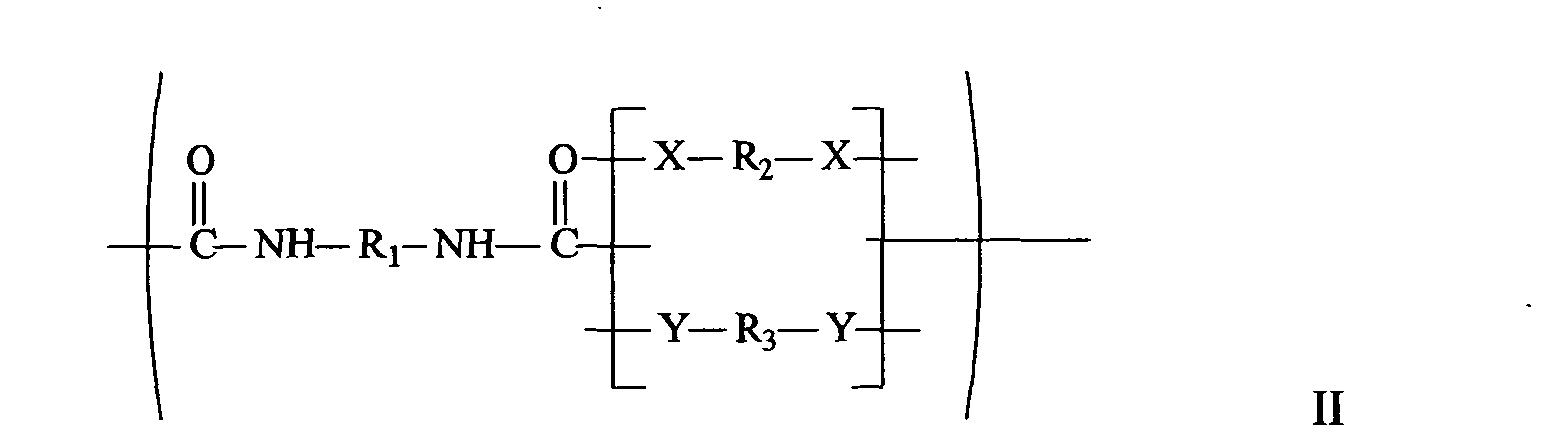 R1 represents the central portion of the monomeric unit that is the polymerization product of a diisocyanate monomer,R2 represents the central portion of a monomeric unit that is the polymerization product of a diamine, a diol or a polyol;R3 is the central portion of a monomeric unit containing a phosphonate, carboxylate or sulfonate group; andX and Y can be the same or different and are -O- or -N- atom.
 - The composition of claim 1 wherein R2 represents the central portion of a monomeric unit that is the polymerization product of polyester polyol, polycarbonate polyol or polylactone polyol.
- The composition of claim 1 wherein water is 40.0 to 99.0% by weight of the entire ink composition.
- The composition of claim 1 wherein the pigment is from 0.1 to 20.0% by weight of the entire ink composition.
- The composition of claim 1 wherein the polyurethane is from 0.1 to 20.0% by weight of the entire ink composition.
- The composition of claim 1 wherein the polyurethane has a Tg of -40 to 200 degrees C.
- The composition of claim 1 wherein the polyurethane has a weight average molecular weight of 4,000 to 100,000.
- The composition of claim 1 wherein at least 50% by weight of the pigment particles have a particle size equal to or smaller than 200 nm.
- An ink jet printing method, comprising the steps of:A) providing an ink jet printer that is responsive to digital data signals;B) loading said printer with an ink comprising:wherein:pigment;water or water and an optional water-miscible co-solvent;polyurethane of the general Formula II
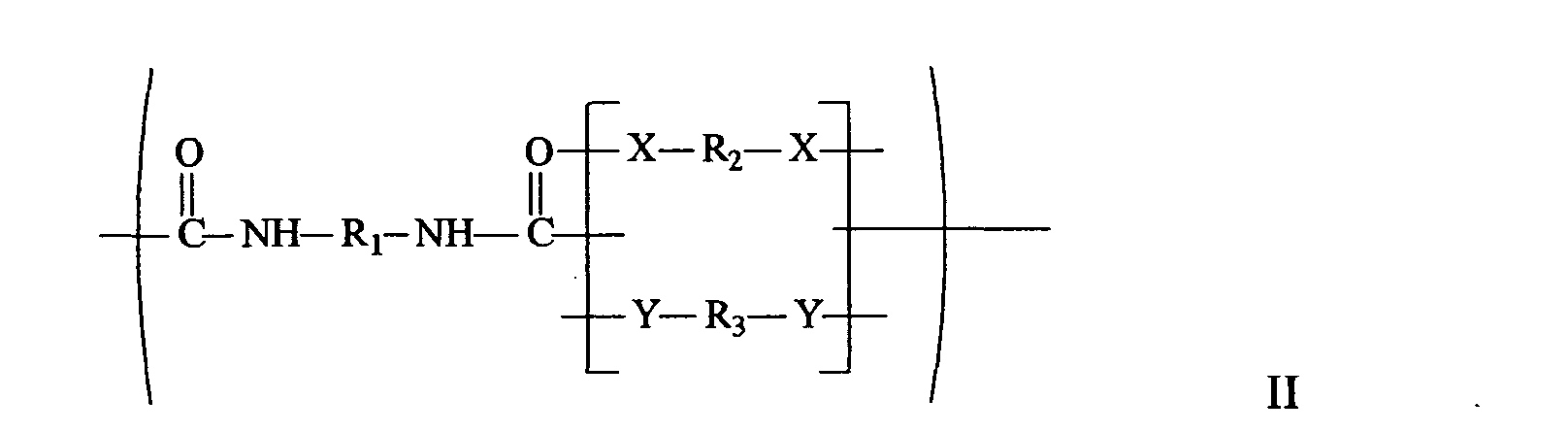 R1 represents the central portion of the monomeric unit that is the polymerization product of a diisocyanate monomer;R2 represents the central portion of a monomeric unit that is the polymerization product of a diamine, a diol or a polyol;R3 is the central portion of a monomeric unit containing a phosphonate, carboxylate or sulfonate group; andX and Y can be the same or different and are -O- or -N- atom;C) loading said printer with an ink-receiving element comprising a support having thereon an ink-receiving layer; andD) printing on said ink-receiving layer using said ink jet ink in response to said digital data signals.
 - The method of claim 9 wherein the ink-receiving element comprises a support having thereon a continuous, coextensive, porous ink-receiving layer having interconnecting voids.
Applications Claiming Priority (2)
| Application Number | Priority Date | Filing Date | Title |
|---|---|---|---|
| US284958 | 1988-12-15 | ||
| US10/284,958 US20040085419A1 (en) | 2002-10-31 | 2002-10-31 | Novel polyurethane materials for pimgented ink jet ink |
Publications (1)
| Publication Number | Publication Date |
|---|---|
| EP1416006A1 true EP1416006A1 (en) | 2004-05-06 |
Family
ID=32093544
Family Applications (1)
| Application Number | Title | Priority Date | Filing Date |
|---|---|---|---|
| EP20030078301 Withdrawn EP1416006A1 (en) | 2002-10-31 | 2003-10-20 | Novel polyurethane materials for pigmented ink jet ink |
Country Status (3)
| Country | Link |
|---|---|
| US (1) | US20040085419A1 (en) |
| EP (1) | EP1416006A1 (en) |
| JP (1) | JP2004149806A (en) |
Cited By (5)
| Publication number | Priority date | Publication date | Assignee | Title |
|---|---|---|---|---|
| WO2007035505A1 (en) * | 2005-09-15 | 2007-03-29 | E. I. Du Pont De Nemours And Company | Aqueous inkjet ink |
| WO2008106147A1 (en) * | 2007-02-28 | 2008-09-04 | Eastman Kodak Company | Pigment based inks for inkjet printing |
| WO2010024858A1 (en) * | 2008-08-28 | 2010-03-04 | Eastman Kodak Company | Inkjet printing system and fluorinated ink |
| WO2010024904A1 (en) * | 2008-08-28 | 2010-03-04 | Eastman Kodak Company | Inkjet printing system and ink |
| US8187371B2 (en) | 2007-02-28 | 2012-05-29 | Eastman Kodak Company | Pigment based inks for high speed durable inkjet printing |
Families Citing this family (26)
| Publication number | Priority date | Publication date | Assignee | Title |
|---|---|---|---|---|
| US7435765B2 (en) * | 2002-12-06 | 2008-10-14 | Eastman Kodak Company | Additive for ink jet ink |
| US20060100308A1 (en) * | 2004-11-09 | 2006-05-11 | Eastman Kodak Company | Overcoat composition for printed images |
| US7872060B2 (en) * | 2006-03-23 | 2011-01-18 | Hewlett-Packard Development Company, L.P. | Inkjet ink composition |
| US8940821B2 (en) * | 2007-12-27 | 2015-01-27 | Eastman Kodak Company | Inks for high speed durable inkjet printing |
| US20090169748A1 (en) * | 2007-12-27 | 2009-07-02 | House Gary L | Inks for high speed durable inkjet printing |
| US8563634B2 (en) | 2009-02-03 | 2013-10-22 | Hewlett-Packard Development Company, L.P. | Inkjet ink including polyurethane |
| US20130053485A1 (en) * | 2010-02-01 | 2013-02-28 | Dic Corporation | Ink composition for inkjet recording |
| BR112012023996A2 (en) | 2010-03-31 | 2016-08-02 | Lubrizol Advanced Mat Inc | aqueous inkjet inkjet composition, and inkjet print image |
| US8430492B2 (en) | 2010-08-31 | 2013-04-30 | Eastman Kodak Company | Inkjet printing fluid |
| US8434857B2 (en) | 2010-08-31 | 2013-05-07 | Eastman Kodak Company | Recirculating fluid printing system and method |
| JP6025353B2 (en) * | 2011-03-30 | 2016-11-16 | キヤノン株式会社 | Ink jet ink, ink cartridge, and ink jet recording method |
| JP6025352B2 (en) * | 2011-03-30 | 2016-11-16 | キヤノン株式会社 | Ink jet ink, ink cartridge, and ink jet recording method |
| JP6025351B2 (en) * | 2011-03-30 | 2016-11-16 | キヤノン株式会社 | Ink jet ink, ink cartridge, and ink jet recording method |
| US8465578B2 (en) | 2011-03-31 | 2013-06-18 | Eastman Kodak Company | Inkjet printing ink set |
| WO2013039941A1 (en) | 2011-09-16 | 2013-03-21 | Eastman Kodak Company | Ink composition for continuous inkjet printer |
| GB201117093D0 (en) | 2011-10-05 | 2011-11-16 | Fujifilm Imaging Colorants Ltd | Dispersions, process for preparing dispersions, inks and users |
| US9067448B2 (en) | 2012-05-02 | 2015-06-30 | Eastman Kodak Company | Pre-treatment composition for inkjet printing |
| KR101747007B1 (en) | 2012-09-14 | 2017-06-13 | 휴렛-팩커드 디벨롭먼트 컴퍼니, 엘.피. | Latexes and associated ink-jet inks |
| CN106661358B (en) | 2014-06-26 | 2020-12-15 | 克里奥瓦克公司 | Ink compositions containing polyurethane |
| US9868869B2 (en) | 2015-10-01 | 2018-01-16 | R.R. Donnelley & Sons Company | Ink composition for use on non-absorbent surfaces |
| WO2020121932A1 (en) * | 2018-12-11 | 2020-06-18 | 三井化学株式会社 | Polyurethane dispersion and layered product |
| US12409668B2 (en) | 2020-03-12 | 2025-09-09 | Cryovac, Llc | Systems and methods for printing a flexible web and printing compositions |
| US12600157B2 (en) | 2020-03-12 | 2026-04-14 | Cryovac, Llc | Printing compositions and methods therefor |
| CN113828353B (en) * | 2020-06-08 | 2023-07-11 | 万华化学集团股份有限公司 | A recyclable catalyst for recycling waste polyurethane and its preparation method |
| EP4321340A4 (en) * | 2021-05-27 | 2024-10-09 | DIC Corporation | Pigment dispersion for ink-jet ink, ink-jet ink, and printed matter |
| JP2023110271A (en) * | 2022-01-28 | 2023-08-09 | サカタインクス株式会社 | Ink set and printed matter |
Citations (4)
| Publication number | Priority date | Publication date | Assignee | Title |
|---|---|---|---|---|
| EP0438090A1 (en) * | 1990-01-13 | 1991-07-24 | Herberts Gesellschaft mit beschränkter Haftung | Binder composition for the preparation of pigment pastes and aqueous coating compositions containing these pigment pastes |
| WO1999050364A1 (en) * | 1998-03-31 | 1999-10-07 | Avecia Limited | Composition based on water-dissipatable polyurethane |
| US6136890A (en) * | 1998-02-17 | 2000-10-24 | 3M Innovative Properties Company | Ink jet ink containing polyurethane dispersant |
| WO2003029318A1 (en) * | 2001-09-26 | 2003-04-10 | Basf Aktiengesellschaft | Cross-linkable polyurethane block copolymers and their use in dispersion binding agent systems |
-
2002
- 2002-10-31 US US10/284,958 patent/US20040085419A1/en not_active Abandoned
-
2003
- 2003-10-20 EP EP20030078301 patent/EP1416006A1/en not_active Withdrawn
- 2003-10-31 JP JP2003372283A patent/JP2004149806A/en active Pending
Patent Citations (4)
| Publication number | Priority date | Publication date | Assignee | Title |
|---|---|---|---|---|
| EP0438090A1 (en) * | 1990-01-13 | 1991-07-24 | Herberts Gesellschaft mit beschränkter Haftung | Binder composition for the preparation of pigment pastes and aqueous coating compositions containing these pigment pastes |
| US6136890A (en) * | 1998-02-17 | 2000-10-24 | 3M Innovative Properties Company | Ink jet ink containing polyurethane dispersant |
| WO1999050364A1 (en) * | 1998-03-31 | 1999-10-07 | Avecia Limited | Composition based on water-dissipatable polyurethane |
| WO2003029318A1 (en) * | 2001-09-26 | 2003-04-10 | Basf Aktiengesellschaft | Cross-linkable polyurethane block copolymers and their use in dispersion binding agent systems |
Cited By (7)
| Publication number | Priority date | Publication date | Assignee | Title |
|---|---|---|---|---|
| WO2007035505A1 (en) * | 2005-09-15 | 2007-03-29 | E. I. Du Pont De Nemours And Company | Aqueous inkjet ink |
| WO2008106147A1 (en) * | 2007-02-28 | 2008-09-04 | Eastman Kodak Company | Pigment based inks for inkjet printing |
| US8187371B2 (en) | 2007-02-28 | 2012-05-29 | Eastman Kodak Company | Pigment based inks for high speed durable inkjet printing |
| WO2010024858A1 (en) * | 2008-08-28 | 2010-03-04 | Eastman Kodak Company | Inkjet printing system and fluorinated ink |
| WO2010024904A1 (en) * | 2008-08-28 | 2010-03-04 | Eastman Kodak Company | Inkjet printing system and ink |
| US7828426B2 (en) | 2008-08-28 | 2010-11-09 | Eastman Kodak Company | Inkjet printing system and fluorinated ink |
| US8192008B2 (en) | 2008-08-28 | 2012-06-05 | Eastman Kodak Company | Inkjet printing system and ink |
Also Published As
| Publication number | Publication date |
|---|---|
| US20040085419A1 (en) | 2004-05-06 |
| JP2004149806A (en) | 2004-05-27 |
Similar Documents
| Publication | Publication Date | Title |
|---|---|---|
| US20040085419A1 (en) | Novel polyurethane materials for pimgented ink jet ink | |
| RU2613941C2 (en) | Jet ink and recording method using thereof | |
| US8940821B2 (en) | Inks for high speed durable inkjet printing | |
| US6533408B1 (en) | Ink jet printing method | |
| US8044115B2 (en) | Pigment-based inks with improved jetting latency | |
| US7176248B2 (en) | Smear resistant inkjet inks | |
| US20090169748A1 (en) | Inks for high speed durable inkjet printing | |
| US9493001B2 (en) | Inkjet recording method, inkjet recorded matter, and inkjet recording device | |
| US20010001103A1 (en) | Water-soluble addition polymer and aqueous ink using the same | |
| EP2960308B1 (en) | Ink, inkjet recording method, ink cartridge, recorded matter, and inkjet recording device | |
| US10000067B2 (en) | Ink, inkjet recording method, and inkjet recorded matter | |
| US8623126B1 (en) | Pigment-based inkjet inks | |
| CN108340676A (en) | Cleaning solution, cleaning method and its device, ink jet recording method and its device | |
| WO2008106147A1 (en) | Pigment based inks for inkjet printing | |
| US20040110865A1 (en) | Additive for ink jet ink | |
| US20030027893A1 (en) | Ink jet printing method | |
| JP2020125469A (en) | Ink set, printer and printing method | |
| US20060100308A1 (en) | Overcoat composition for printed images | |
| US20030187098A1 (en) | Inkjet ink composition and printing method | |
| JP5418937B2 (en) | Pigment water dispersion for inkjet printer water-based ink | |
| JP2004315751A (en) | Ink composition and method for producing the same | |
| US20250066630A1 (en) | Aqueous inkjet inks containing a polyurethane polymer | |
| JP2024012949A (en) | Ink set for non-permeable substrate, image forming method, and image forming device | |
| JP2026019408A (en) | Inkjet ink, ink set, printing method, and printing device |
Legal Events
| Date | Code | Title | Description |
|---|---|---|---|
| PUAI | Public reference made under article 153(3) epc to a published international application that has entered the european phase |
Free format text: ORIGINAL CODE: 0009012 |
|
| AK | Designated contracting states |
Kind code of ref document: A1 Designated state(s): AT BE BG CH CY CZ DE DK EE ES FI FR GB GR HU IE IT LI LU MC NL PT RO SE SI SK TR |
|
| AX | Request for extension of the european patent |
Extension state: AL LT LV MK |
|
| AKX | Designation fees paid | ||
| REG | Reference to a national code |
Ref country code: DE Ref legal event code: 8566 |
|
| STAA | Information on the status of an ep patent application or granted ep patent |
Free format text: STATUS: THE APPLICATION IS DEEMED TO BE WITHDRAWN |
|
| 18D | Application deemed to be withdrawn |
Effective date: 20041108 |