EP1415967A1 - Method for producing bisphenol-a - Google Patents
Method for producing bisphenol-a Download PDFInfo
- Publication number
- EP1415967A1 EP1415967A1 EP02755792A EP02755792A EP1415967A1 EP 1415967 A1 EP1415967 A1 EP 1415967A1 EP 02755792 A EP02755792 A EP 02755792A EP 02755792 A EP02755792 A EP 02755792A EP 1415967 A1 EP1415967 A1 EP 1415967A1
- Authority
- EP
- European Patent Office
- Prior art keywords
- acetone
- bisphenol
- phenol
- catalyst
- reactor unit
- Prior art date
- Legal status (The legal status is an assumption and is not a legal conclusion. Google has not performed a legal analysis and makes no representation as to the accuracy of the status listed.)
- Granted
Links
Images
Classifications
-
- C—CHEMISTRY; METALLURGY
- C07—ORGANIC CHEMISTRY
- C07C—ACYCLIC OR CARBOCYCLIC COMPOUNDS
- C07C37/00—Preparation of compounds having hydroxy or O-metal groups bound to a carbon atom of a six-membered aromatic ring
- C07C37/11—Preparation of compounds having hydroxy or O-metal groups bound to a carbon atom of a six-membered aromatic ring by reactions increasing the number of carbon atoms
- C07C37/20—Preparation of compounds having hydroxy or O-metal groups bound to a carbon atom of a six-membered aromatic ring by reactions increasing the number of carbon atoms using aldehydes or ketones
-
- B—PERFORMING OPERATIONS; TRANSPORTING
- B01—PHYSICAL OR CHEMICAL PROCESSES OR APPARATUS IN GENERAL
- B01J—CHEMICAL OR PHYSICAL PROCESSES, e.g. CATALYSIS OR COLLOID CHEMISTRY; THEIR RELEVANT APPARATUS
- B01J31/00—Catalysts comprising hydrides, coordination complexes or organic compounds
- B01J31/02—Catalysts comprising hydrides, coordination complexes or organic compounds containing organic compounds or metal hydrides
- B01J31/06—Catalysts comprising hydrides, coordination complexes or organic compounds containing organic compounds or metal hydrides containing polymers
- B01J31/08—Ion-exchange resins
- B01J31/10—Ion-exchange resins sulfonated
-
- B—PERFORMING OPERATIONS; TRANSPORTING
- B01—PHYSICAL OR CHEMICAL PROCESSES OR APPARATUS IN GENERAL
- B01J—CHEMICAL OR PHYSICAL PROCESSES, e.g. CATALYSIS OR COLLOID CHEMISTRY; THEIR RELEVANT APPARATUS
- B01J2231/00—Catalytic reactions performed with catalysts classified in B01J31/00
- B01J2231/30—Addition reactions at carbon centres, i.e. to either C-C or C-X multiple bonds
- B01J2231/34—Other additions, e.g. Monsanto-type carbonylations, addition to 1,2-C=X or 1,2-C-X triplebonds, additions to 1,4-C=C-C=X or 1,4-C=-C-X triple bonds with X, e.g. O, S, NH/N
- B01J2231/341—1,2-additions, e.g. aldol or Knoevenagel condensations
- B01J2231/347—1,2-additions, e.g. aldol or Knoevenagel condensations via cationic intermediates, e.g. bisphenol A type processes
-
- C—CHEMISTRY; METALLURGY
- C07—ORGANIC CHEMISTRY
- C07C—ACYCLIC OR CARBOCYCLIC COMPOUNDS
- C07C2531/00—Catalysts comprising hydrides, coordination complexes or organic compounds
- C07C2531/02—Catalysts comprising hydrides, coordination complexes or organic compounds containing organic compounds or metal hydrides
- C07C2531/06—Catalysts comprising hydrides, coordination complexes or organic compounds containing organic compounds or metal hydrides containing polymers
- C07C2531/08—Ion-exchange resins
Definitions
- the present invention relates to a process for producing bisphenol A in which the life of the catalyst, acidic cation-exchange resin used can be prolonged.
- Bisphenol A is useful as a material for polycarbonate resin, epoxy resin, polyarylate resin, etc.
- Bisphenol A 2,2-bis(4-hydroxyphenyl)propane
- bisphenol A is produced by condensing acetone and excess phenol in the presence of an acidic cation-exchange resin catalyst and optionally a sulfur compound promoter such as alkylmercaptan.
- the acidic cation-exchange resin catalyst degrades with time.
- Aprincipal cause of the catalyst degradation is the heavy material derived from the starting compounds, and the catalyst begins to degrade first around the inlet port of the reactor. Since its degradation speed is high, an excess amount of the catalyst is charged into the reactor for long-term continuous operation for bisphenol A production.
- the amount of acetone to be fed into the reactor must be time-dependently increased for keeping the product yield (that is, for keeping the intended degree of phenol conversion).
- the present invention has been made in consideration of the above-mentioned matters, and its object is to provide a process for producing bisphenol A in which the life of the catalyst, acidic cation-exchange resin used can be prolonged.
- the present inventors have assiduously studied, and, as a result, have found that, in a process of producing bisphenol A by continuously feeding phenol and acetone into a reactor unit having at least two reaction zones connected in series, when an acidic cation-exchange resin that has been specifically partially neutralized is used as the catalyst and when acetone having a specific methanol concentration is separately fed into at least two reaction zones in the reactor unit, then the process ensures a high degree of phenol conversion. On the basis of this finding, we have completed the present invention.
- the invention provides a process for producing a bisphenol A by continuously feeding phenol and acetone into a reactor unit having at least two reaction zones connected in series, which is characterized in that an acidic cation-exchange resin partially neutralized with a sulfur-containing nitrogen compound in from 15 to 50 % of the acid site thereof is used as the catalyst, and acetone having a methanol concentration of at most 3, 000 ppm is separately fed into at least two reaction zones in the reactor unit.
- Bisphenol A is produced by reacting acetone with excess phenol in the presence of an acidic cation-exchange resin catalyst and optionally an alkylmercaptan serving as a promoter.
- an acidic cation-exchange resin catalyst generally preferred is a sulfonic acid-type cation-exchange resin.
- a sulfonic acid-type cation-exchange resin includes sulfonated styrene-divinylbenzene copolymer, sulfonated crosslinked styrene polymer, phenol-formaldehyde-sulfonic acid resin, and benzene-formaldehyde-sulfonic acid resin. Singly or as combined, one or more of these may be used as the catalyst.
- reaction mixture contains non-reacted phenol, non-reacted acetone, catalyst, by-produced water, alkylmercaptan, as well as side products such as organic sulfur compounds and color substances.
- Step (2) step of recovering by-produced water and non-reacted compounds
- the reaction mixture obtained in the step (1) is distilled under reduced pressure, whereby the non-reacted acetone, by-produced water and alkylmercaptan are removed through the top of the distillation column and a liquid mixture that contains bisphenol A and phenol is taken out through the bottom thereof.
- the condition for the reduced-pressure distillation in this step is as follows: The pressure falls between 7 and 80 kPa, and the temperature falls between 70 and 180°C. In that condition, the non-reacted phenol forms an azeotrope and a part of it is removed out of the system through the top of the distillation column.
- Step (3) step of condensing bisphenol A
- the bottom liquid of the reaction mixture from which the substances as above have been removed is then distilled under reduced pressure to remove phenol from it, and the product bisphenol A is thereby condensed.
- the resulting condensate residue is crystallized in the next step.
- the condensation condition is not specifically defined. In general, the temperature falls between 100 and 170°C, and the pressure falls between 5 and 67 kPa. If the temperature is lower than 100°C, the condensation will require high vacuum; but if higher than 170°C, the next crystallization step will require an additional treatment for heat removal.
- the bisphenol A concentration of the condensate residue may fall between 20 and 50 % by mass, but preferably between 20 and 40 % by mass. If the concentration is lower than 20 % by mass, the bisphenol A recovery will be low; but if higher than 50 % by mass, the slurry transfer after crystallization will be difficult.
- the condensate residue obtained in the step (3) is cooled to 40 to 70°C to give a crystal of bisphenol A-phenol adduct (hereinafter this is abbreviated as phenol adduct), and it becomes slurry. Cooling the residue may be effected by applying water to the external heat exchanger or crystallizer fitted to the reactor unit for heat removal from the residue through vaporization of water.
- the condensate residue slurry is filtered or centrifuged to separate the phenol adduct from the crystal-free mother liquid that contains side products.
- the mother liquid is directly or partly recycled into the reactor unit, or a part or all of it is decomposed with alkali into phenol and isopropenylphenol and they are recovered. As the case may be, a part or all of the mother liquid may be isomerized and recycled to crystallization.
- Step (5) step of heating and melting phenol adduct
- the crystal of 1:1 adduct of bisphenol Aand phenol obtained in the step (4) is melted under heat at 100 to 160°C into a liquid mixture.
- Step (6) (step of recovering bisphenol A)
- Step (7) step of granulating bisphenol A
- the bisphenol A obtained in melt in the step (6) is formed into liquid drops in a granulator such as spray drier, then cooled and solidified. This is the final product of the invention.
- the liquid drops are formed by spraying or sprinkling the melt and then cooled by exposing them to nitrogen or air.
- the process of the invention is for producing bisphenol A by continuously feeding phenol and acetone into a reactor unit having at least two reaction zones connected in series, and is characterized in that an acidic cation-exchange resin partially neutralized with a sulfur-containing nitrogen compound in from 15 to 50 % of the acid site thereof is used as the catalyst, and acetone having a methanol concentration of at most 3,000 ppm is separately fed into at least two reaction zones in the reactor unit.
- the catalyst to be used is an acidic cation-exchange resin partially neutralized with a sulfur-containing nitrogen compound in from 15 to 50 % of the acid site thereof. If the degree of neutralization of the cation-exchange resin used as the catalyst in the process is lower than 15 %, the catalyst will lose the methanol resistance of itself and the separate addition of acetone to different reactors will be ineffective. If higher than 50 %, on the other hand, it is unfavorable since the catalyst activity greatly lowers. Preferably, the degree of neutralization of the catalyst falls between 20 and 30 %.
- the sulfur-containing nitrogen compound to be used for the catalyst neutralization includes, for example, pyridinealkanethiols such as 3-mercaptomethylpyridine, 3-mercaptoethylpyridine, 2-mercaptoethylpyridine, 4-mercaptoethylpyridine; pyridylalkanethioacetals to be obtained from such pyridinealkanethiols with ketones such as acetone, methyl ethyl ketone, methyl isobutyl ketone, acetophenone, cyclohexanone; aminoalkanethiols such as 2-mercaptoethylamine, 3-mercaptobutylamine, 3-n-propylamino-1-propylmercaptan; and thiazolidines such as thiazolidine, 2,2-dimethylthiazolidine, cycloalkylthiazolidines. Above all, preferred are 2,2-dimethylthiazolidine and 2-mercaptoethylamine
- the methanol concentration of acetone is at most 3,000 ppm. If higher than 3,000 ppm, it is unfavorable since the influence of methanol on the process is too great.
- the methanol concentration is at most 2,000 ppm.
- the reaction temperature preferably falls between 60 and 100°C. If lower than 60°C, it is unfavorable since the phenol phase will solidify; but if higher than 100°C, it is also unfavorable since the ion-exchange resin used will be too much degraded. More preferably, the reaction temperature falls between 65 ad 95°C.
- the ratio (bymol) of phenol/total acetone falls between 6 and 13. If smaller than 6, it is unfavorable since the color of the product, bisphenol A will be unstable; but if higher than 13, it is also unfavorable since the reaction speed will be low and the amount of phenol to be recovered will increase. More preferably, the ratio falls between 8 and 12.
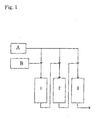
- Fig. 1 is a flowchart showing one example of the invention that uses a three-stage reactor unit.
- the liquid hourly space velocity (LHSV) in each reactor falls between 0.2 and 30 hr -1 , morepreferablybetween 0.5 and 6 hr -1 .
- Example 1 In the same reactor unit as in Example 1, all acetone was fed into the first reactor column at a flow rate of 24 cc/hr, and reacted with phenol in the same manner as in Example 1. In the initial stage of reaction, the phenol conversion at the outlet port of the third reactor column was 14.0 %, but after 500 hours, it was 12.0 %. There is a significant difference between the data, 12.8 % in Example 1 and 12.0 % in Comparative Example 1.
- Example 2 In the same reactor unit as in Example 1, an ion-exchange resin having a degree of neutralization of 10 % was used and acetone and phenol were reacted in the same manner as in Example 1. In the initial stage of reaction, the phenol conversion at the outlet port of the third reactor column was 14.0 %, but after 500 hours, it was 11.2 %.
- an acidic cation-exchange resin partially neutralized with a sulfur-containing nitrogen compound in from 15 to 50 % of the acid site thereof is used as the catalyst, and acetone having a methanol concentration of at most 3, 000 ppm is separately fed into at least two reaction zones in the reactor unit.
Landscapes
- Chemical & Material Sciences (AREA)
- Organic Chemistry (AREA)
- Chemical Kinetics & Catalysis (AREA)
- Engineering & Computer Science (AREA)
- Materials Engineering (AREA)
- Organic Low-Molecular-Weight Compounds And Preparation Thereof (AREA)
- Catalysts (AREA)
- Low-Molecular Organic Synthesis Reactions Using Catalysts (AREA)
Abstract
Description
Claims (6)
- A process for producing a bisphenol A by continuously feeding phenol and acetone into a reactor unit having at least two reaction zones connected in series, which is characterized in that an acidic cation-exchange resin partially neutralized with a sulfur-containing nitrogen compound in from 15 to 50 % of the acid site thereof is used as the catalyst, and acetone having a methanol concentration of at most 3, 000 ppm is separately fed into at least two reaction zones in the reactor unit.
- The process for producing bisphenol A as claimed in claim 1, wherein the ratio (by mol) of phenol/all acetone falls between 6 and 13.
- The process for producing bisphenol A as claimed in claim 1, wherein the sulfur-containing nitrogen compound is at least one selected from pyridinealkanethiols, pyridylalkanethioacetals, aminoalkanethiols and thiazolidines.
- The process for producing bisphenol A as claimed in claim 1, wherein the reaction temperature falls between 60 and 100°C.
- The process for producing bisphenol A as claimed in claim 1, wherein from 30 to 50 % of all acetone to be fed into the reactor unit is fed into the first reaction zone.
- The process for producing bisphenol A as claimed in claim 1, wherein the liquid hourly space velocity (LHSV) in each reaction zone falls between 0.2 and 30 hr-1.
Applications Claiming Priority (3)
| Application Number | Priority Date | Filing Date | Title |
|---|---|---|---|
| JP2001237889A JP2003055286A (en) | 2001-08-06 | 2001-08-06 | Method for producing bisphenol a |
| JP2001237889 | 2001-08-06 | ||
| PCT/JP2002/007924 WO2003014049A1 (en) | 2001-08-06 | 2002-08-02 | Method for producing bisphenol-a |
Publications (3)
| Publication Number | Publication Date |
|---|---|
| EP1415967A1 true EP1415967A1 (en) | 2004-05-06 |
| EP1415967A4 EP1415967A4 (en) | 2005-03-16 |
| EP1415967B1 EP1415967B1 (en) | 2006-12-20 |
Family
ID=19068897
Family Applications (1)
| Application Number | Title | Priority Date | Filing Date |
|---|---|---|---|
| EP02755792A Expired - Lifetime EP1415967B1 (en) | 2001-08-06 | 2002-08-02 | Method for producing bisphenol-a |
Country Status (9)
| Country | Link |
|---|---|
| US (1) | US6943273B2 (en) |
| EP (1) | EP1415967B1 (en) |
| JP (1) | JP2003055286A (en) |
| KR (1) | KR100873749B1 (en) |
| CN (1) | CN1476423A (en) |
| DE (1) | DE60216931T2 (en) |
| ES (1) | ES2274994T3 (en) |
| TW (1) | TW575548B (en) |
| WO (1) | WO2003014049A1 (en) |
Cited By (2)
| Publication number | Priority date | Publication date | Assignee | Title |
|---|---|---|---|---|
| US10005709B2 (en) | 2016-05-10 | 2018-06-26 | Sabic Global Technologies B.V. | Method for producing a Bisphenol |
| EP4696673A1 (en) * | 2023-12-14 | 2026-02-18 | Tianjin University | Bisphenol a preparation process and device thereof |
Families Citing this family (11)
| Publication number | Priority date | Publication date | Assignee | Title |
|---|---|---|---|---|
| JP4723105B2 (en) * | 2001-03-01 | 2011-07-13 | 出光興産株式会社 | Method for producing bisphenol A |
| US7112702B2 (en) | 2002-12-12 | 2006-09-26 | General Electric Company | Process for the synthesis of bisphenol |
| US7132575B2 (en) * | 2003-07-01 | 2006-11-07 | General Electric Company | Process for the synthesis of bisphenol |
| EP1683779A4 (en) * | 2003-11-13 | 2007-08-29 | Mitsubishi Chem Corp | PROCESS FOR MANUFACTURING BISPHENOL A |
| DE102004005726A1 (en) * | 2004-02-05 | 2005-08-25 | Bayer Materialscience Ag | Drainage of circulatory streams in the production of bisphenol A |
| ES2432042T3 (en) * | 2004-07-02 | 2013-11-29 | Mitsui Chemicals, Inc. | Modified ion exchange resin and procedure to produce bisphenols |
| PL206165B1 (en) * | 2004-07-19 | 2010-07-30 | Kałędkowska Małgorzatakałędkowska Małgorzata | Method for obtaining bisphenol A with optical purity |
| JP5395079B2 (en) * | 2007-08-29 | 2014-01-22 | ダウ グローバル テクノロジーズ エルエルシー | Method for reducing methanol during recirculation in bisphenol A production process |
| WO2014002787A1 (en) * | 2012-06-28 | 2014-01-03 | 出光興産株式会社 | Bisphenol-a production method |
| KR102292786B1 (en) | 2013-07-16 | 2021-08-23 | 미츠비시 가스 가가쿠 가부시키가이샤 | METHOD FOR PRODUCING α-HYDROXYISOBUTYRIC ACID AMIDE AND REACTOR |
| CN118324607B (en) | 2024-04-11 | 2024-10-01 | 天津大学 | A process for reducing by-products in a bisphenol A reaction system |
Family Cites Families (11)
| Publication number | Priority date | Publication date | Assignee | Title |
|---|---|---|---|---|
| GB1578225A (en) * | 1977-07-11 | 1980-11-05 | Shell Int Research | Preparation of bisphenols |
| US4400555A (en) * | 1981-10-06 | 1983-08-23 | General Electric Company | Ion exchange catalyzed bisphenol synethesis |
| DE4213870C2 (en) * | 1992-04-28 | 1996-07-04 | Bayer Ag | Bisphenol synthesis on modified ion exchange resins using specially purified carbonyl compounds |
| JP3475960B2 (en) * | 1992-09-11 | 2003-12-10 | 出光石油化学株式会社 | Method for producing 2,2-bis (4-hydroxyphenyl) propane |
| JP3217598B2 (en) | 1994-08-02 | 2001-10-09 | 新日鐵化学株式会社 | Method for preparing fixed bed of acidic cation exchange resin |
| KR100469197B1 (en) * | 1995-12-19 | 2005-07-11 | 셀 인터나쵸나아레 레사아치 마아츠샤피 비이부이 | Improved Bisphenol Preparation |
| JPH11246458A (en) | 1998-02-26 | 1999-09-14 | Mitsubishi Chemical Corp | Bisphenol production method |
| TW530045B (en) * | 1999-04-13 | 2003-05-01 | Idemitsu Petrochemical Co | Method of producing bisphenol A |
| KR20010102516A (en) * | 2000-01-07 | 2001-11-15 | 가즈토 도미나가 | Process for producing bisphenol a |
| JP2002193862A (en) | 2000-12-28 | 2002-07-10 | Idemitsu Petrochem Co Ltd | Method for producing bisphenol a |
| JP4723105B2 (en) * | 2001-03-01 | 2011-07-13 | 出光興産株式会社 | Method for producing bisphenol A |
-
2001
- 2001-08-06 JP JP2001237889A patent/JP2003055286A/en active Pending
-
2002
- 2002-07-24 TW TW091116498A patent/TW575548B/en not_active IP Right Cessation
- 2002-08-02 CN CNA028030605A patent/CN1476423A/en active Pending
- 2002-08-02 KR KR1020037007303A patent/KR100873749B1/en not_active Expired - Fee Related
- 2002-08-02 ES ES02755792T patent/ES2274994T3/en not_active Expired - Lifetime
- 2002-08-02 US US10/433,155 patent/US6943273B2/en not_active Expired - Fee Related
- 2002-08-02 EP EP02755792A patent/EP1415967B1/en not_active Expired - Lifetime
- 2002-08-02 WO PCT/JP2002/007924 patent/WO2003014049A1/en not_active Ceased
- 2002-08-02 DE DE60216931T patent/DE60216931T2/en not_active Expired - Fee Related
Cited By (2)
| Publication number | Priority date | Publication date | Assignee | Title |
|---|---|---|---|---|
| US10005709B2 (en) | 2016-05-10 | 2018-06-26 | Sabic Global Technologies B.V. | Method for producing a Bisphenol |
| EP4696673A1 (en) * | 2023-12-14 | 2026-02-18 | Tianjin University | Bisphenol a preparation process and device thereof |
Also Published As
| Publication number | Publication date |
|---|---|
| WO2003014049A1 (en) | 2003-02-20 |
| TW575548B (en) | 2004-02-11 |
| KR20040019263A (en) | 2004-03-05 |
| US6943273B2 (en) | 2005-09-13 |
| DE60216931T2 (en) | 2007-04-05 |
| EP1415967B1 (en) | 2006-12-20 |
| ES2274994T3 (en) | 2007-06-01 |
| JP2003055286A (en) | 2003-02-26 |
| CN1476423A (en) | 2004-02-18 |
| EP1415967A4 (en) | 2005-03-16 |
| DE60216931D1 (en) | 2007-02-01 |
| US20040030196A1 (en) | 2004-02-12 |
| KR100873749B1 (en) | 2008-12-15 |
Similar Documents
| Publication | Publication Date | Title |
|---|---|---|
| US6414199B1 (en) | Method of producing bisphenol A | |
| EP0210366B1 (en) | Process for making bisphenol a | |
| KR100582808B1 (en) | Manufacturing method of bisphenol A | |
| EP0342758B1 (en) | Preparation of bisphenols | |
| US6943273B2 (en) | Method for producing bisphenol-A | |
| US6586637B2 (en) | Process for producing bisphenol A | |
| US6429343B1 (en) | Process for producing bisphenol a | |
| USH1943H1 (en) | Process for the manufacture of bisphenol-A | |
| US20050222467A1 (en) | Process for production of bisphenol a | |
| EP1657272B2 (en) | Process for producing aromatic polycarbonate | |
| EP0323831B1 (en) | Process for preparing bisphenol a | |
| KR20020097249A (en) | Process for producing bisphenol a | |
| EP1985602A1 (en) | Process for producing bisphenol a | |
| US7045664B2 (en) | Process for producing bisphenol A | |
| KR100813452B1 (en) | Method for producing aromatic polycarbonate | |
| JP2000229899A (en) | Production of bisphenol a | |
| JP4590188B2 (en) | Method for producing prill of bisphenol A | |
| JP2003160524A (en) | Method and facility for producing bisphenol a | |
| JP2003160523A (en) | Method and facility for producing bisphenol a |
Legal Events
| Date | Code | Title | Description |
|---|---|---|---|
| PUAI | Public reference made under article 153(3) epc to a published international application that has entered the european phase |
Free format text: ORIGINAL CODE: 0009012 |
|
| 17P | Request for examination filed |
Effective date: 20030808 |
|
| AK | Designated contracting states |
Kind code of ref document: A1 Designated state(s): AT BE BG CH CY CZ DE DK EE ES FI FR GB GR IE IT LI LU MC NL PT SE SK TR |
|
| RAP1 | Party data changed (applicant data changed or rights of an application transferred) |
Owner name: IDEMITSU KOSAN CO., LTD. |
|
| A4 | Supplementary search report drawn up and despatched |
Effective date: 20050201 |
|
| RIC1 | Information provided on ipc code assigned before grant |
Ipc: 7B 01J 31/10 B Ipc: 7B 01J 31/02 B Ipc: 7C 07C 39/16 B Ipc: 7C 07C 37/20 A |
|
| 17Q | First examination report despatched |
Effective date: 20050622 |
|
| GRAP | Despatch of communication of intention to grant a patent |
Free format text: ORIGINAL CODE: EPIDOSNIGR1 |
|
| GRAS | Grant fee paid |
Free format text: ORIGINAL CODE: EPIDOSNIGR3 |
|
| GRAA | (expected) grant |
Free format text: ORIGINAL CODE: 0009210 |
|
| AK | Designated contracting states |
Kind code of ref document: B1 Designated state(s): BE DE ES FR GB NL |
|
| REG | Reference to a national code |
Ref country code: GB Ref legal event code: FG4D |
|
| REF | Corresponds to: |
Ref document number: 60216931 Country of ref document: DE Date of ref document: 20070201 Kind code of ref document: P |
|
| REG | Reference to a national code |
Ref country code: ES Ref legal event code: FG2A Ref document number: 2274994 Country of ref document: ES Kind code of ref document: T3 |
|
| ET | Fr: translation filed | ||
| PGFP | Annual fee paid to national office [announced via postgrant information from national office to epo] |
Ref country code: ES Payment date: 20070911 Year of fee payment: 6 |
|
| PLBE | No opposition filed within time limit |
Free format text: ORIGINAL CODE: 0009261 |
|
| STAA | Information on the status of an ep patent application or granted ep patent |
Free format text: STATUS: NO OPPOSITION FILED WITHIN TIME LIMIT |
|
| 26N | No opposition filed |
Effective date: 20070921 |
|
| PGFP | Annual fee paid to national office [announced via postgrant information from national office to epo] |
Ref country code: GB Payment date: 20070720 Year of fee payment: 6 |
|
| PGFP | Annual fee paid to national office [announced via postgrant information from national office to epo] |
Ref country code: NL Payment date: 20070817 Year of fee payment: 6 Ref country code: DE Payment date: 20071017 Year of fee payment: 6 Ref country code: BE Payment date: 20070712 Year of fee payment: 6 |
|
| PGFP | Annual fee paid to national office [announced via postgrant information from national office to epo] |
Ref country code: FR Payment date: 20070821 Year of fee payment: 6 |
|
| GBPC | Gb: european patent ceased through non-payment of renewal fee |
Effective date: 20080802 |
|
| NLV4 | Nl: lapsed or anulled due to non-payment of the annual fee |
Effective date: 20090301 |
|
| PG25 | Lapsed in a contracting state [announced via postgrant information from national office to epo] |
Ref country code: NL Free format text: LAPSE BECAUSE OF NON-PAYMENT OF DUE FEES Effective date: 20090301 |
|
| REG | Reference to a national code |
Ref country code: FR Ref legal event code: ST Effective date: 20090430 |
|
| PG25 | Lapsed in a contracting state [announced via postgrant information from national office to epo] |
Ref country code: BE Free format text: LAPSE BECAUSE OF NON-PAYMENT OF DUE FEES Effective date: 20080831 |
|
| PG25 | Lapsed in a contracting state [announced via postgrant information from national office to epo] |
Ref country code: FR Free format text: LAPSE BECAUSE OF NON-PAYMENT OF DUE FEES Effective date: 20080901 Ref country code: DE Free format text: LAPSE BECAUSE OF NON-PAYMENT OF DUE FEES Effective date: 20090303 |
|
| REG | Reference to a national code |
Ref country code: ES Ref legal event code: FD2A Effective date: 20080804 |
|
| PG25 | Lapsed in a contracting state [announced via postgrant information from national office to epo] |
Ref country code: GB Free format text: LAPSE BECAUSE OF NON-PAYMENT OF DUE FEES Effective date: 20080802 |
|
| PG25 | Lapsed in a contracting state [announced via postgrant information from national office to epo] |
Ref country code: ES Free format text: LAPSE BECAUSE OF NON-PAYMENT OF DUE FEES Effective date: 20080804 |