EP1415594A1 - System, apparatus and method of radiographing medical image and program - Google Patents
System, apparatus and method of radiographing medical image and program Download PDFInfo
- Publication number
- EP1415594A1 EP1415594A1 EP03024607A EP03024607A EP1415594A1 EP 1415594 A1 EP1415594 A1 EP 1415594A1 EP 03024607 A EP03024607 A EP 03024607A EP 03024607 A EP03024607 A EP 03024607A EP 1415594 A1 EP1415594 A1 EP 1415594A1
- Authority
- EP
- European Patent Office
- Prior art keywords
- radiographing
- medical image
- radiographer
- section
- instruction
- Prior art date
- Legal status (The legal status is an assumption and is not a legal conclusion. Google has not performed a legal analysis and makes no representation as to the accuracy of the status listed.)
- Withdrawn
Links
- 238000000034 method Methods 0.000 title claims description 33
- 230000005855 radiation Effects 0.000 claims abstract description 36
- 230000005540 biological transmission Effects 0.000 claims description 18
- 230000001678 irradiating effect Effects 0.000 claims description 17
- 238000004891 communication Methods 0.000 description 32
- 238000012545 processing Methods 0.000 description 27
- OAICVXFJPJFONN-UHFFFAOYSA-N Phosphorus Chemical compound [P] OAICVXFJPJFONN-UHFFFAOYSA-N 0.000 description 12
- 230000006870 function Effects 0.000 description 5
- 238000010586 diagram Methods 0.000 description 4
- 238000006243 chemical reaction Methods 0.000 description 3
- 201000010099 disease Diseases 0.000 description 3
- 208000037265 diseases, disorders, signs and symptoms Diseases 0.000 description 3
- 230000003287 optical effect Effects 0.000 description 3
- 238000002601 radiography Methods 0.000 description 3
- 239000004065 semiconductor Substances 0.000 description 3
- 208000035473 Communicable disease Diseases 0.000 description 2
- 206010013700 Drug hypersensitivity Diseases 0.000 description 2
- 238000002591 computed tomography Methods 0.000 description 2
- 238000010276 construction Methods 0.000 description 2
- 238000009548 contrast radiography Methods 0.000 description 2
- 201000005311 drug allergy Diseases 0.000 description 2
- 230000000694 effects Effects 0.000 description 2
- 230000005284 excitation Effects 0.000 description 2
- 230000000474 nursing effect Effects 0.000 description 2
- 230000035935 pregnancy Effects 0.000 description 2
- 230000004044 response Effects 0.000 description 2
- 230000035945 sensitivity Effects 0.000 description 2
- 230000001629 suppression Effects 0.000 description 2
- 238000012546 transfer Methods 0.000 description 2
- 208000010392 Bone Fractures Diseases 0.000 description 1
- 208000006670 Multiple fractures Diseases 0.000 description 1
- 230000002411 adverse Effects 0.000 description 1
- 210000004204 blood vessel Anatomy 0.000 description 1
- 230000002490 cerebral effect Effects 0.000 description 1
- 239000000470 constituent Substances 0.000 description 1
- 239000003814 drug Substances 0.000 description 1
- 239000000284 extract Substances 0.000 description 1
- 208000015181 infectious disease Diseases 0.000 description 1
- 239000004973 liquid crystal related substance Substances 0.000 description 1
- 238000002595 magnetic resonance imaging Methods 0.000 description 1
- 238000012986 modification Methods 0.000 description 1
- 230000004048 modification Effects 0.000 description 1
- 238000013421 nuclear magnetic resonance imaging Methods 0.000 description 1
- 238000002834 transmittance Methods 0.000 description 1
Images


Classifications
-
- A—HUMAN NECESSITIES
- A61—MEDICAL OR VETERINARY SCIENCE; HYGIENE
- A61B—DIAGNOSIS; SURGERY; IDENTIFICATION
- A61B6/00—Apparatus or devices for radiation diagnosis; Apparatus or devices for radiation diagnosis combined with radiation therapy equipment
- A61B6/42—Arrangements for detecting radiation specially adapted for radiation diagnosis
- A61B6/4208—Arrangements for detecting radiation specially adapted for radiation diagnosis characterised by using a particular type of detector
- A61B6/4216—Arrangements for detecting radiation specially adapted for radiation diagnosis characterised by using a particular type of detector using storage phosphor screens
-
- A—HUMAN NECESSITIES
- A61—MEDICAL OR VETERINARY SCIENCE; HYGIENE
- A61B—DIAGNOSIS; SURGERY; IDENTIFICATION
- A61B6/00—Apparatus or devices for radiation diagnosis; Apparatus or devices for radiation diagnosis combined with radiation therapy equipment
-
- A—HUMAN NECESSITIES
- A61—MEDICAL OR VETERINARY SCIENCE; HYGIENE
- A61B—DIAGNOSIS; SURGERY; IDENTIFICATION
- A61B6/00—Apparatus or devices for radiation diagnosis; Apparatus or devices for radiation diagnosis combined with radiation therapy equipment
- A61B6/46—Arrangements for interfacing with the operator or the patient
- A61B6/467—Arrangements for interfacing with the operator or the patient characterised by special input means
Definitions
- the present invention relates to a system, an apparatus and a method of radiographing a medical image and a program.
- a medical image radiographing (or tomographing) system having a computed tomographing apparatus (hereinafter, named “computed tomography (CT)”), a computed radiation image radiographing apparatus (hereinafter, named “computed radiography (CR)”), a nuclear magnetic resonance imaging apparatus (hereinafter, named “magnetic resonance imaging (MRI)”) or the like has been used.
- CT computed tomography
- CR computed radiation image radiographing apparatus
- MRI nuclear magnetic resonance imaging
- a medical image conversion panel with a photostimulable phosphor layer formed on a support member is in use.
- the photostimulable phosphor layer of the medical image conversion panel absorbs radiations transmitted through the subject to accumulate the energy of the radiations corresponding to the radiation transmittance of each part of the subject in the photostimulable phosphor layer and to form a latent image in the photostimulable phosphor layer.
- the photostimulable phosphor layer is scanned by excitation light such as infrared rays or the like to release the accumulated energy of the radiations as fluorescence, and the fluorescence is photoelectrically converted to obtain a signal of a medical image.
- Image processing is performed for the obtained medical image.
- the processed medical image is output to a film, a cathode ray tube (CRT) or the like to be visualized, or is stored in a filing device such as a server or the like along with patient information.
- a filing device such as a server or the like along with patient information.
- the medical image radiographing system using the CR is classified into two system types.
- One system type is an earlier developed medical image radiographing system in which both an apparatus for radiographing a subject to read out an image of the subject and a photostimulable phosphor plate are fixedly arranged in a radiographing room, and the radiographing is performed in the radiographing room.
- the radiographing of the subject and the reading-out of the image can be performed together in the radiographing room.
- the other system type is a medical image radiographing system recently widely used for patients such as patients having broken bones, patients having diseases of cerebral blood vessels, patients placed in intensive care units and/or the like.
- a movable radiographing apparatus applied to a doctor's round of visits and a portable cassette containing a phosphor plate are used, and the radiographing of each patient is performed at a visited patient's position.
- the cassette is inserted into a reader only used for the cassette, and the obtained medical image is read out.
- the procedure of the radiographing performed by an operator in the medical image radiographing system relating to the doctor's round of visits will be described.
- the operator initially prints out radiographing order information prepared according to a doctor's instruction on an instruction sheet by using an information management system of a hospital (hereinafter, named “hospital information system (HIS)") or an information management system of a radiation treatment department (hereinafter, named “radiology information system (RIS)").
- the radiographing order information includes information (hereinafter, named "patient information”) relating to each radiographed patient such as a name, a sex and the like and information (hereinafter, named “radiographing information”) relating to the radiographing such as a radiographic part of the patient, a radiographing method and the like. Therefore, the radiographing order information has the instruction indicating which type of radiographing is to be performed for each patient.
- a movable radiographing apparatus, a cassette and the instruction sheet are then transferred to a hospital room in which a patient to be radiographed stays, and the patient is identified according to the radiographing order information printed out on the instruction sheet.
- the operator operates the radiographing apparatus to radiograph the patient, and records a medical image of the patient in the cassette.
- the operator inserts the cassette having the recorded medical image into the reader to read out the medical image from the cassette.
- a well-known medical application portable terminal for example, refer to a patent document disclosed in Unexamined Japanese Patent Publication (Tokkai) 2002-83065
- a medical performer(s) such as a doctor(s), a nurse(s) and/or the like. Accordingly, each medical treatment act performed by the medical performers for each patient can be made clear, and the occurrence of the wrong medical treatment can be suppressed.
- the movable medical image radiographing apparatus described above is usually used in the outside of the radiographing room, and persons other than the operators can operate the radiographing apparatus. Therefore, there is a probability that a third person erroneously operates the radiographing apparatus. Because the medical image radiographing apparatus irradiates a human body with X-rays exerting adverse influence on the human body, the radiographing apparatus requires to be handled safely and accurately.
- an object of the present invention is to provide a medical image radiographing system, a medical image radiographing apparatus, a medical image radiographing method and a program, which manage a medical treatment act of an operator at high safety and reliability while improving the security of the medical image radiographing apparatus.
- a medical image radiographing system comprises:
- a medical image radiographing apparatus to perform the radiographing of a medical image by irradiating with radiations, the medical image radiographing apparatus comprises:
- a medical image radiographing method for radiographing a medical image by irradiating with radiations comprises:
- a program makes a computer obtain identification information of a radiographer and a radiographing instruction; perform authentication of the radiographer according to the obtained identification information of the radiographer; and instruct to perform a radiographing operation according to the obtained radiographing instruction by irradiating with radiations when the radiographer is authenticated.
- the medical image radiographing apparatus when the medical image radiographing apparatus is operated, the medical image radiographing apparatus obtains the identification information of the radiographer.
- the medical image radiographing apparatus succeeds in the authentication of the radiographer, the radiographing of the medical image is performed according to the radiographing instruction. Accordingly, the radiographing of the medical image according to a radiographing instruction other than the radiographing instruction registered as the radiographer in advance is prohibited, and the medical image radiographing apparatus can be prevented from being carelessly operated by a third person.
- the obtaining section obtains the identification information of the radiographer and the radiographing instruction by inputting the identification information and the radiographing instruction.
- the system further comprises a medical image terminal, the medical image terminal comprising:
- the system further comprises a medical image terminal, the medical image terminal comprising:
- the obtaining section obtains the identification information of the radiographer and the radiographing instruction by inputting the identification information and the radiographing instruction.
- the obtaining section obtains the identification information of the radiographer by receiving the identification information and obtains the radiographing instruction by inputting the radiographing instruction.
- the obtaining section obtains the identification information of the radiographer and the radiographing instruction by receiving the identification information and the radiographing instruction.
- the medical image radiographing apparatus can be prevented from being erroneously operated by a third person, and the medical image radiographing apparatus can be safely handled.
- the input section of the medical image terminal inputs a radiographing condition
- the transmitting section of the medical image terminal transmits the radiographing condition
- the obtaining section of the medical image radiographing apparatus obtains the radiographing condition by receiving the radiographing condition from the transmitting section
- the radiographing operation control section of the medical image radiographing apparatus controls the irradiation section to perform the radiographing operation according to the radiographing condition obtained by the obtaining section and the obtained radiographing instruction.
- the obtaining section obtains a radiographing condition by inputting the radiographing condition
- the radiographing operation control section controls the irradiation section to perform the radiographing operation according to the radiographing condition and the radiographing instruction obtained by the obtaining section.
- the method further comprises:
- the method further comprises:
- the program further makes the computer obtain a radiographing condition and instruct to perform the radiographing operation according to the radiographing condition and the radiographing instruction by irradiating with the radiations.
- the apparatus, the method and the program because the radiographing condition can be inputted to the medical image radiographing apparatus through the medical image terminal, the operability of the medical image radiographing apparatus is superior. Moreover, because the input section of the medical image radiographing apparatus can be miniaturized, when the radiographing is performed by carrying the medical image radiographing apparatus to the visited patients position, the medical image radiographing apparatus can be easily carried, and the radiographing of the medical image can be quickly performed.
- the medical image radiographing apparatus further comprises a storage to store radiographing history information including the radiographing condition of the radiographing operation while setting the correspondence of the radiographing history information to the identification information of the radiographer when the radiographing operation is performed under control of the radiographing operation control section.
- the apparatus further comprises a storage to store radiographing history information including a radiographing condition of the radiographing operation while setting the correspondence of the radiographing history information to the identification information of the radiographer when the radiographing operation is performed under control of the radiographing operation control section.
- the method further comprises the storing of radiographing history information including the radiographing condition of the radiographing operation while setting the correspondence of the radiographing history information to the identification information of the radiographer when the radiographing operation is performed.
- the program further makes the computer perform the storing of radiographing history information including the radiographing condition of the radiographing operation while setting the correspondence of the radiographing history information to the identification information of the radiographer when the radiographing operation is performed.
- the apparatus, the method and the program because the history of the radiographing performed by the radiographer is stored while setting the correspondence to the identification information of the radiographer, when wrong medical treatment is performed, the cause of the occurrence of the wrong medical treatment can be immediately examined, and the recurrence of the wrong medical treatment can be prevented. Moreover, because the history of the radiographing performed by the radiographer is stored, the effect of the suppression of the occurrence of the wrong medical treatment can be expected to the radiographer.
- the medical image terminal is a portable terminal.
- each of the radiographers can bring his/her own medical image terminal. Accordingly, only the specific radiographer can operate his/her medical image terminal, and the security of the medical image radiographing system can be improved. Moreover, when the radiographing is performed at the visited patient's position, radiographing members can be easily carried by miniaturizing the medical image terminal, and the burden of the radiographer can be mitigated.
- each of fhe irradiation section, the obtaining section, the radiographing operation control section and the like in the medical image radiographing apparatus may comprise a single unit or a plurality of units. Further, it will be appreciated that one unit or units are arranged in common in two sections or more selected from the irradiation section, the obtaining section, the radiographing operation control section and the like. As an example that one unit or units are arranged in common in two sections or more, the obtaining section comprises a keyboard and a central processing unit (CPU), and the CPU is used as a unit of the radiographing operation control section.
- CPU central processing unit
- each of the input section, the transmission section and the like in the medical image terminal may comprise a single unit or a plurality of units. Further, it will be appreciated that one unit or units are arranged in common in two sections or more selected from the input section, the transmission section and the like. As an example that one unit or units are arranged in common in two sections or more, the input section comprises a barcode reader with transmission function and a communication unit, and the communication unit is used as a unit of the transmission section.
- a medical image terminal according to the present invention is, as an example, applied to a portable radiographing information apparatus (hereinafter, named "Personal Digital Assistant (PDA)").
- PDA Personal Digital Assistant
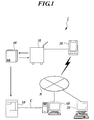
- FIG. 1 is a conceptual view showing the configuration of a medical image radiographing system 1 according to the embodiment of the present invention.
- the medical image radiographing system 1 comprises a PDA 10, an information management apparatus 20, a medical image radiographing apparatus 30, a cassette 40, a medical image reader 50 and a control section 60.
- the PDA 10, the information management apparatus 20 and the control section 60 are connected with one another through a network N so as to be able to gain access to one another.
- the PDA 10 is a portable radiographing information apparatus which is carried by a radiographing operator operating the medical image radiographing apparatus 30.
- the PDA 10 is connected to the medical image radiographing apparatus 30 through a cable B to authenticate an operator (or radiographer) in cooperation with the medical image radiographing apparatus 30 and to transmit radiographing conditions and a radiographing instruction to the medical image radiographing apparatus 30. Further the PDA 10 receives radiographing order information from the information management apparatus 20 through the network N.
- the information management apparatus 20 acts as a terminal to manage pieces of radiographing order information based on the radiographing instructions of a doctor(s), extracts radiographing order information corresponding to a radiographing instruction transmitted from the PDA 10 and transmits the extracted radiographing order information to the PDA 10 through the network N.
- a reception apparatus (not shown) to receive the reservation of the radiographing order information may be applied as another information management apparatus, and an information management system such as a hospital information system (HIS), a radiology information system (RIS) or the like may be applied as another information management apparatus.
- HIS hospital information system
- RIS radiology information system
- the medical image radiographing apparatus (hereinafter, abbreviated to "radiographing apparatus") 30 is a movable radiographing apparatus, radiographs each of patients at a visited patient's position and records a medical image of the patient in the cassette 40 detachable from the radiographing apparatus 30.
- the cassette 40 has a photostimulable phosphor sheet in which energy of a portion of radiations can be accumulated.
- the radiations are output from an irradiation source and are transmitted through a subject placed between the irradiation source and the cassette 40, and energy of a portion of the radiations is accumulated in the photostimulable phosphor sheet.
- the medical image reader 50 reads out the medical image recorded in the cassette 40.
- the medical image reader 50 irradiates the photostimulable phosphor sheet of the cassette 40 with excitation light, photoelectrically converts stimulated light emitted from the sheet and performs analog-to-digital conversion for an obtained image signal to obtain the medical image.
- the control section 60 controls a read-out operation of the medical image reader 50.
- the control section 60 sets the correspondence of the medical image read out from the cassette 40 to the radiographing order information received from the information management apparatus 20 and stores the medical image and the radiographing order information in a data base to manage the medical image.
- Various networks such as a local area network (LAN), a wide area network (WAN), an internet and the like can be applied to the network N. Further, wireless communication or infrared communication may be applied to the network N on condition that the communication is allowed in medical institutions such as a hospital and the like.
- the radiographing order information includes important patient information, the radiographing order information is preferably enciphered in the transmission and reception of the radiographing order information.
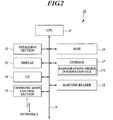
- FIG. 2 is a block diagram showing the functional configuration of the PDA 10.
- the PDA 10 comprises a central processing unit (CPU) 11, an operation section 12, a display 13, a communication control section 15, a random access memory (RAM) 16, a storage 17 and a barcode reader 18.
- CPU central processing unit
- RAM random access memory
- storage 17 a storage 17
- barcode reader 18 Each of the constituent elements of the PDA 10 is connected to a bus 19.
- the CPU 11 expands a program which is designated and selected from a system program and various types of application programs stored in the storage 17 and controls intensively each element of the PDA 10 according to the designated program.
- the CPU 11 loads a medical image radiographing processing program from the storage 17 and performs medical image radiographing processing (refer to FIG. 5) described later.
- the CPU 11 receives an operator identification number (ID) through the operation section 12 or the barcode reader 18, the CPU 11 transmits the operator ID to the radiographing apparatus 30 connected to the cable B through an interface (I/F) 14. Further, the CPU 11 receives an authentication result from the radiographing apparatus 30 through the I/F 14 and judges according to the authentication result whether or not the radiographing performed by an operator is allowed.
- the CPU 11 displays an error screen on the display 13 to urge the operator to again input his operator ID.
- the CPU 11 finishes the medical image radiographing processing.
- the radiographing conditions include detailed conditions such as information of resolution, sensitivity, a radiographing size, a radiographic part, a radiographing direction, a radiation dose of X-rays and the like, in addition to radiographing information included in the radiographing order information.
- the radiographing order information obtained from the storage 17 may be transmitted with the radiographing conditions.
- the operation section 12 is an example of an input section described according to the present invention and comprises a cursor key, numeral input keys and various functional keys.
- the operation section 12 outputs an operation signal corresponding to a key operated by the operator.
- the operation section 12 receives, for example, the operator ID denoting identification information of the operator in response to the manipulation of the operator.
- the operation section 12 may further comprises a pointing device such as a touch panel or the like or another input apparatus, if necessary.
- the display 13 comprises a liquid crystal display (LCD) or the like and displays various types of information such as the radiographing order information, the operator ID and the like according to a display instruction transmitted from the CPU 11.
- LCD liquid crystal display
- the I/F 14 is an example of a transmission section described according to the present invention and adjusts the form and the transfer rate of data transmitted and received through the cable B to intermediate the transmission and reception of the data between the radiographing apparatus 30 and the PDA 10.
- the connection of the I/F 14 with the radiographing apparatus 30 is not limited to a wire, and the I/F 14 may be connected with the radiographing apparatus 30 in wireless communication.
- the I/F 14 has a data communication control function to control a data communication protocol according to a data communication method such as the Infrared Data Association (IrDA) or the like and performs short-range communication by using infrared rays.
- the communication method performing the wireless communication is not limited to IrDA, and a Bluetooth method may be adopted as the communication method performing the wireless communication.
- a reception section and a transmission section of the communication control section 15 comprise a network interface card, a modem or a terminal adapter and the like, and the communication control section 15 controls the communication with an external apparatus through the network N.
- the communication control section 15 establishes the wireless communication with the information management apparatus 20, transmits an instruction indicating a request of the radiographing order information through the network N and receives the radiographing order information from the information management apparatus 20.
- the wireless communication may be established by using a portable telephone terminal such as Personal Handyphone System (PHS) or the like.
- PHS Personal Handyphone System
- the RAM 16 has a work memory area to store the designated application program described before, an inputted instruction, input data, processing results and the like.
- the storage 17 comprises a storage medium (not shown) in which programs and data are stored in advance.
- the storage medium stores a system program, various application programs corresponding to the system program and data obtained by executing each of various processing programs.
- the storage medium comprises a magnetic or optical storage medium or a semiconductor memory and is attached to the storage 17 fixedly or detachably.
- the storage 17 stores a radiographing order information file 171 to store pieces of radiographing order information received from the information management apparatus 20.
- the radiographing order information file 171 has columns of a radiographing instruction identification number (ID), a patient ID, a name, a sex, an age, a hospital room, a department in charge, a radiographic part, a radiographing direction, the number of radiographing sheets and a cassette ID and stores data of the columns for each piece of radiographing order information.
- ID radiographing instruction identification number
- the radiographing order information has the patient information and the radiographing information.
- the patient information of each patient may comprise, for example, a name of a doctor in charge of the patient, warning information indicating the warning of infectious diseases and the like, the/no existence of a drug allergy, pregnancy or not, a clinical history, the/no necessity of special nursing such as the/no necessity of a wheel chair, the/no necessity of a stretcher or the like, a clinically diagnosed disease, privileged information to be protected and the like, in addition to a patient ID, a name, a sex and an age of the patient.
- the radiographing information may comprises, for example, a radiographing method (simple radiography, contrast radiography or the like), an expected date of the radiographing and the like, in addition to information of a radiographic part, a radiographing direction and a radiographing apparatus and the number of radiographing sheets.
- a radiographing method simple radiography, contrast radiography or the like
- an expected date of the radiographing and the like in addition to information of a radiographic part, a radiographing direction and a radiographing apparatus and the number of radiographing sheets.
- the barcode reader 18 is an example of an input section to receive the operator ID denoting identification information of the operator and has a scanner denoting an optical reader.
- the scanner reads out a barcode, and information indicated by the barcode is obtained by decoding the barcode according to a predetermined standard.
- the barcode reader 18 reads out a barcode attached to an ID card of the operator to obtain the operator ID, reads out a barcode attached to a bed side of the patient or a part of the patient body to obtain the patient ID, and reads out a barcode attached to the cassette recording the medical image to obtain the cassette ID.
- the predetermined standard denotes JAN code, UPC code, CODE 39, CDE 93, CODE 128, NW-7, INDUSTRIAL 2 of 5, ITF physical distribution code or the like.
- FIG. 3 is a block diagram showing the functional configuration of the radiographing apparatus 30.
- the medical image radiographing apparatus 30 comprises a CPU 31, an input section 32, a display 33, a communication control section (I/F) 34, an RAM 35, an irradiation section 36, a cassette container 37 and a storage 38.
- I/F communication control section
- Each of the constitutional sections of the radiographing apparatus 30 is connected to a bus 39.
- the CPU 31 loads the system program and various control programs from the storage 38, expands the programs in the RAM 35 and controls intensively the operation of each element of the radiographing apparatus 30 according to the corresponding control program. Further, the CPU 31 performs various types of processing according to the programs expanded in the RAM 35, temporarily stores processing results in the RAM 35 and makes the display 33 display the processing results.
- the CPU 31 loads the medical image radiographing processing program and performs the medical image radiographing processing (refer to FIG. 5) described later to act as an authentication section and a radiographing operation control section.
- the CPU 31 receives the operator ID from the PDA 10 connected to the cable B through the I/F 34, the CPU 31 obtains an operator management file 381 described later from the storage 38 and searches the operator management file 381 for the corresponding operator ID.
- the CPU 31 can retrieve the corresponding operator ID from the operator management file 381, the CPU 31 judges that the operator is a regular operator, and the CPU 31 transmits an authentication result indicating the successful authentication to the PDA 10.
- the CPU 31 when the CPU 31 receives information of the radiographing conditions from the PDA 10 through the I/F 34, the CPU 31 obtains the information of the radiographing conditions and sets the radiographing conditions. Further when the CPU 31 receives a radiographing instruction from the PDA 10 through the I/F 34, the CPU 31 makes the irradiation section 36 irradiate a subject (or a patient) with X-rays and radiograph the subject in response to the radiographing instruction. After the radiographing, the CPU 31 sets the correspondence of the radiographing order information and radiographing history information to the operator ID and stores them in the operator management file 381.
- the radiographing history information indicates the history of the radiographs taken by the operator and includes, for example, a date, resolution, sensitivity, a size, a direction, a radiation dose of X-rays and the like as conditions of the radiographing actually performed.
- the CPU 31 receives an instruction indicating the finish of the radiographing from the PDA 10, the medical image radiographing processing is finished. Once the medical image radiographing processing is finished, unless the operator is successfully authenticated by again inputting the operator ID, the operator cannot radiograph the subject. In contrast, when the operator intends to successively radiograph the subject, the operator can successively radiograph the subject without authentication. However, when there is no input operation during a predetermined period of time (for example, around 15 minutes), the CPU 31 preferably makes the operator again input the operator ID to perform the authentication of the operator. Therefore, the security of the radiographing apparatus 30 can be further improved.
- a predetermined period of time for example, around 15 minutes
- the input section 32 includes a keyboard having a cursor key, numeral input keys and various functional keys and outputs a push-down signal corresponding to a pushed-down key of the keyboard to the CPU 31.
- the input section 32 receives, for example, the radiographing conditions in the radiographing for the medical image, a radiographing instruction and the like.
- the input section 32 may comprise a pointing device such as a mouse, a touch panel or the like and another input apparatus, if necessary.
- the display 33 comprises an LCD, a cathode ray tube (CRT) or the like and displays an inputted instruction and data transmitted from the input section 32 according to a display signal transmitted from the CPU 31.
- CTR cathode ray tube
- the I/F 34 is an example of a reception section described according to the present invention and adjusts the form and the transfer rate of data transmitted and received through the cable B to intermediate the transmission and reception of the data between the radiographing apparatus 30 and the PDA 10.
- the connection of the I/F 34 with the PDA 10 is not limited to a wire, and the I/F 34 may be connected to the PDA 10 in wireless communication.
- the I/F 34 may have a data communication control function to control a data communication protocol according to the data communication method such as Infrared Data Association (IrDA) or the like to perform the short-range communication by using infrared rays.
- the communication method performing the wireless communication is not limited to IrDA, and the Bluetooth method may be, for example, adopted as the communication method performing the wireless communication.
- the RAM 35 forms a storing area to temporarily store a system program and control programs read out from the storage 38 and capable to be executed in the CPU 31, input or output data, parameters and the like for each of various types of processing performed and controlled by the CPU 31.
- the irradiation section 36 conically irradiates the subject with radiations under the control of the CPU 31 at both a radiation dose set according to the radiographing conditions and the irradiation timing instructed by the PDA 10 or the input section 32.
- the cassette container 37 has a holding means to place the cassette 40 in the radiographing apparatus 30 to fix and protect the cassette 40. Further, because the medical image recorded in the photostimulable phosphor sheet due to the accumulated energy of the radiations is erased by irradiating the photostimulable phosphor sheet with light after the radiographing, the cassette container 37 prevents the erasure of the recorded medical image.
- the storage 38 comprises a hard disc drive (HDD), a non-volatile semiconductor memory or the like and stores the programs (the system program and various processing programs corresponding to the system program) executed in the CPU 31 and processing results.
- the storage 38 further has a storage medium (not shown) to record programs and data in advance.
- the storage medium comprises a magnetic or optical storage medium or a semiconductor memory and is fixedly or detachably attached to the storage 38.
- the programs are stored in the storage 38 in the form of a readable program code, and the CPU 31 repeatedly performs an operation according to the program code.
- the storage 38 is an example of a storage to store radiographing history information described according to the present invention and stores the operator management file 381 fo store the operator IDs, pieces of radiographing order information and pieces of radiographing history information while setting the correspondence of the radiographing order information and the radiographing history information to each operator ID.
- the operator management file 381 is used when the operator ID is checked for the authentication of the operator.
- Each operator ID registered in the operator management file 381 denotes an operator ID of an operator who is allowed in advance to operate the radiographing apparatus 30.
- FIG. 4 is a view showing an example of the data construction of the operator management file 381.
- the operator management file 381 stores the operator IDs, the pieces of radiographing order information and the pieces of radiographing history information.
- the operator of an operator ID "sato1234" performs the radiographing four times, and pieces of data of columns included in the radiographing order information and pieces of data of columns included in the radiographing history information are stored for each radiographing ID.
- Each of the programs embodying functions described in flow charts described later are stored in the storage 17 of the PDA 10 or the storage 38 of the radiographing apparatus 30 in the form of a program code readable by a computer, and the CPU 11 of the PDA 10 or the CPU 31 of the radiographing apparatus 30 performs the operations one after another according to the program code.
- FIG. 5 is a flow chart showing the medical image radiographing processing performed by the CPU 11 of the PDA 10.
- the CPU 11 transmits the inputted operator ID to the medical image radiographing apparatus 30 through the I/F 14 (step S2).
- the CPU 11 receives an authentication result from the radiographing apparatus 30 through the I/F 14 (step S3) and judges whether or not the operator is successfully authenticated (step S4).
- step S4 When the operator fails in authentication (NO in step S4), the procedure returns to the step S1, the CPU 11 urges the operator to again input his operator ID and performs the authentication of the operator according to the operator ID.
- the operator fails in authentication a predetermined number of times for example, three times
- the medical image radiographing processing is preferably finished.
- the CPU 11 urges the operator to input the radiographing conditions through the operation section 12 (step S5) and transmits the inputted radiographing conditions to the radiographing apparatus 30 through the I/F 14 (step S6).
- the CPU 11 preferably transmits the radiographing order information together with the radiographing conditions.
- step S7 the CPU 11 transmits the radiographing instruction to the radiographing apparatus 30 through the I/F 14 to make the operator perform the radiographing according to the radiographing conditions while operating the radiographing apparatus 30 (step S8).
- the CPU 11 urges the operator to input either an indication of the completion of the radiographing or an indication of the continuation of the radiographing.
- the procedure proceeds to the step S5, and the CPU 11 urges the operator to input new radiographing conditions and makes the operator perform the radiographing according to the new radiographing conditions while operating the radiographing apparatus 30.
- the CPU 11 ends the medical image radiographing processing.
- FIG. 6 is a flow chart showing the medical image radiographing processing performed by the CPU 31 of the radiographing apparatus 30.
- the CPU 31 when receiving an indication of the power supply, the CPU 31 loads a start program from the storage 38 and performs the start processing for the radiographing apparatus 30 (step S11).
- the CPU 31 then controls the display 33 to display an authentication screen (step S12) and urges the operator to input the operator ID through the PDA 10.
- the CPU 31 When receiving the operator ID through the I/F 34 (step S13), the CPU 31 obtains the operator management file 381 from the storage 38 (step S14) and searches the file 381 for the corresponding operator ID (step S15). When the corresponding operator ID is not registered in the operator management file 381, the CPU 31 judges that the operator fails. in authentication (NO in step S16) and transmits an authentication result indicating the failure of the authentication to the PDA 10 (step S24). The procedure proceeds to the step S13, and the CPU 31 urges the operator to again input the operator ID. The CPU 31 then performs the authentication of the operator according to the again-inputted operator ID.
- the CPU 31 judges that the operator is successfully authenticated (YES in step S16) and transmits an authentication result indicating the success of the authentication to the PDA 10 (step S17). Thereafter, the CPU 31 receives the information of the radiographing conditions from the PDA 10 (step S18) and performs the setting of the radiographing conditions according to the received information of the radiographing conditions (step S19).
- the CPU 31 controls the irradiation section 36 according to the set radiographing conditions and makes the irradiation section 36 irradiate the subject with radiations to perform the radiographing according to the radiographing conditions (step S21).
- the CPU 31 controls the operator management file 381 to store the operator ID and the radiographing history information while setting the correspondence of the radiographing history information to the operator ID (step S22).
- the operator management file 381 may store the radiographing order information while setting the correspondence of the radiographing order information to the operator ID.
- the CPU 31 judges whether or not the radiographing should be finished (step S23).
- the CPU 31 judges that the radiographing should be finished (YES in step S23), and the CPU 31 ends the medical image radiographing processing.
- the CPU 31 judges that the radiographing should be continued (NO in step S23), and the CPU 31 repeatedly performs the medical image radiographing processing.
- the medical image radiographing system 1 which radiographs the patient at the visited patient's position while operating the movable radiographing apparatus 30 to obtain the medical image, urges the operator to input the operator ID specifying the operator to the PDA 10 connected to the radiographing apparatus 30 and makes the radiographing apparatus 30 perform the authentication of the operator according to the operator ID.
- the radiographing system 1 urges the operator to perform the radiographing while operating the radiographing apparatus 30 through the PDA 10.
- the radiographing apparatus 30 sets the correspondence of the radiographing history information including the date of the radiographing, the radiographing conditions and the like to the operator ID of the operator and stores the radiographing history information and the operator ID in the operator management file 381.
- the radiographing apparatus 30 cannot be operated. That is, when the operator fails in authentication or the authentication of the radiographer is not performed, even though the radiographing instruction is inputted through the operation section 12 of the PDA 10 or the input section 32 of the radiographing apparatus 30, the reception of the radiographing instruction is rejected in the radiographing apparatus 30, and there is no probability that the radiographing apparatus 30 is operated according to the radiographing instruction. Accordingly, an imprudent operation of the radiographing apparatus 30 by a third person can be prevented, and the radiographing can be safely performed even at the visited patient's position to obtain the medical image.
- the radiographing history information and the operator ID are stored in the operator management file 381 while setting the correspondence of the radiographing history information to the operator ID. Accordingly, the history of the radiographs taken by the operator while operating the radiographing apparatus 30 can be stored.
- wrong medical treatment such as the radiographing of a wrong patient
- the radiographing of a patient according to a radiographing instruction to radiograph another patient or the like is, for example, performed
- the cause of the occurrence of the wrong medical treatment can be immediately investigated, and the reoccurrence of the wrong medical treatment can be prevented.
- the radiographing history information is recorded, the occurrence of the wrong medical treatment for the patients can be suppressed.
- the operator ID is input by using the barcode reader 18, a mistake about the input operation can be prevented, the troublesomeness in the authentication can be mitigated, and the operator can efficiently perform the radiographing to obtain the medical image. Further, because the operator ID can be input through the operation section 12, the operator ID can be input by using an appropriate input section according to the situation. Accordingly, the radiographing system 1 and the radiographing apparatus 30 can be operated at excellent convenience.
- the radiographing conditions and the radiographing instruction can be input by using the PDA 10, the operability of the radiographing apparatus 30 can be improved. Further, because the configuration of the input section of the radiographing apparatus 30 can be simplified to minimize the radiographing apparatus 30, the radiographing apparatus 30 can be easily carried, and the burden of the operator can be mitigated.
- the portable PDA 10 applied to the medical image terminal and the radiographing apparatus 30 applied to a movable radiographing apparatus are, for example, described.
- the medical image terminal may comprise a general personal computer (PC)
- the radiographing apparatus may comprise a radiographing apparatus fixedly arranged in the radiographing room.
- the PDA 10 may comprise a portable communication terminal such as a portable telephone, a note type personal computer or the like.
- the operator ID having a plurality of numerals combined with one another and the barcode of the operator ID are applied as identification information of the operator.
- the present invention is not limited to this embodiment.
- a method to identify the operator by data of his/her name or birth day or the like and identifying the operator by data of his/her fingerprint, the palm-print of his/her hand, his/her voiceprint, his/her face, his/her iris or his/her ID card or the like may be applied.
- the input section of the PDA 10 preferably receives the pieces of data.
- the operator may be identified by the combination of pieces of information. Accordingly, the security of the medical image radiographing system can be improved by performing the authentication of the operator according to the operator ID with more accurate.
- the authentication of the operator may be performed according to identification information peculiar to the PDA 10 such as serial numbers or the like transmitted to the radiographing apparatus 30 as the identification information of the operator.
- identification information peculiar to the PDA 10 such as serial numbers or the like transmitted to the radiographing apparatus 30 as the identification information of the operator.
- the operator can be specified by the serial numbers of the PDA 10, and the troublesomeness of inputting the operator ID can be mitigated.
- the authentication of the operator may be performed according to both the operator ID and the serial numbers of the PDA 10. In this case, a stronger security system can be obtained.
- the radiographing order information may comprises a name of a doctor in charge, warning information indicating the warning of an infectious disease, the/no existence of a drug allergy, pregnancy or not, a clinical history, the/no necessity of special nursing such as the/no necessity of a wheel chair, the/no necessity of a stretcher or the like, a clinically diagnosed disease, privileged information to be protected, a radiographing method (simple radiography, contrast radiography or the like), an expected date and the like. Further, the configuration that the radiographing order information is not stored in the operator management file 381 may be applied.
- the radiographing apparatus 30 may make the information managing apparatus 20 perform the authentication of the operator. Moreover, the information managing apparatus 20 may perform the authentication of the operator by directly communicating with the PDA 10.
- the medical image radiographing apparatus when the medical image radiographing apparatus is operated, the medical image radiographing apparatus obtains the identification information of the radiographer through the medical image terminal.
- the medical image radiographing apparatus succeeds in the authentication of the radiographer, the radiographing of the medical image is performed according to the radiographing instruction transmitted from the medical image terminal. Accordingly, the radiographing of the medical image according to a radiographing instruction other than the radiographing instruction registered as the radiographer in advance is prohibited, and the medical image radiographing apparatus can be prevented from being carelessly operated by a third person.
- the medical image radiographing apparatus can be prevented from being erroneously operated by a third person, and the medical image radiographing apparatus can be safely handled.
- the radiographing condition can be inputted to the medical image radiographing apparatus through the medical image terminal, the operability of the medical image radiographing apparatus is superior. Moreover, because the input section of the medical image radiographing apparatus can be miniaturized, when the radiographing is performed by carrying the medical image radiographing apparatus to the visited patients position, the medical image radiographing apparatus can be easily carried, and the radiographing of the medical image can be quickly performed.
- the history of the radiographing performed by the radiographer is stored while setting the correspondence to the identification information of the radiographer, when wrong medical treatment is performed, the cause of the occurrence of the wrong medical treatment can be immediately examined, and the recurrence of the wrong medical treatment can be prevented. Moreover, because the history of the radiographing performed by the radiographer is stored, the effect of the suppression of the occurrence of the wrong medical treatment can be expected to the radiographer.
- the medical image radiographing terminal is a portable terminal
- each of the radiographers can bring his/her own medical image radiographing terminal. Accordingly, only the specific radiographer can operate his/her medical image radiographing terminal, and the security of the medical image radiographing system can be improved.
- radiographing members can be easily carried by miniaturizing the medical image radiographing terminal, and the burden of the radiographer can be mitigated.
Landscapes
- Health & Medical Sciences (AREA)
- Life Sciences & Earth Sciences (AREA)
- Medical Informatics (AREA)
- Engineering & Computer Science (AREA)
- Radiology & Medical Imaging (AREA)
- Molecular Biology (AREA)
- Biophysics (AREA)
- Nuclear Medicine, Radiotherapy & Molecular Imaging (AREA)
- Optics & Photonics (AREA)
- Pathology (AREA)
- Physics & Mathematics (AREA)
- Biomedical Technology (AREA)
- Heart & Thoracic Surgery (AREA)
- High Energy & Nuclear Physics (AREA)
- Surgery (AREA)
- Animal Behavior & Ethology (AREA)
- General Health & Medical Sciences (AREA)
- Public Health (AREA)
- Veterinary Medicine (AREA)
- Apparatus For Radiation Diagnosis (AREA)
- Measuring And Recording Apparatus For Diagnosis (AREA)
- Medical Treatment And Welfare Office Work (AREA)
Abstract
A medical image radiographing system can improve the
safety and reliability in the medical image radiographing
by managing medical treatment acts of an operator while
improving the security of a medical image radiographing
apparatus. The medical image radiographing apparatus of
the medical image radiographing system has an irradiation
section to irradiate a subject with the radiations, an
obtaining section to obtain identification information of a
radiographer and a radiographing instruction, and a
radiographing operation control section to control the
irradiation section to perform a radiographing operation
according to the radiographing instruction obtained by the
obtaining section when the radiographer is authenticated
according to the identification information of the
radiographer obtained by the obtaining section.
Description
The present invention relates to a system, an
apparatus and a method of radiographing a medical image and
a program.
In a field of medicine, a medical image radiographing
(or tomographing) system having a computed tomographing
apparatus (hereinafter, named "computed tomography (CT)"),
a computed radiation image radiographing apparatus
(hereinafter, named "computed radiography (CR)"), a nuclear
magnetic resonance imaging apparatus (hereinafter, named
"magnetic resonance imaging (MRI)") or the like has been
used. In this medical image radiographing system, a
patient denoting a subject is radiographed, and a
radiographed medical image is obtained as digital image
data.
Particularly, in the CR, a medical image conversion
panel with a photostimulable phosphor layer formed on a
support member is in use. The photostimulable phosphor
layer of the medical image conversion panel absorbs
radiations transmitted through the subject to accumulate
the energy of the radiations corresponding to the radiation
transmittance of each part of the subject in the
photostimulable phosphor layer and to form a latent image
in the photostimulable phosphor layer. Thereafter, the
photostimulable phosphor layer is scanned by excitation
light such as infrared rays or the like to release the
accumulated energy of the radiations as fluorescence, and
the fluorescence is photoelectrically converted to obtain a
signal of a medical image. Image processing is performed
for the obtained medical image. Thereafter, the processed
medical image is output to a film, a cathode ray tube (CRT)
or the like to be visualized, or is stored in a filing
device such as a server or the like along with patient
information. Thereby, the output medical image or the
stored medical image can be used for medical service.
The medical image radiographing system using the CR
is classified into two system types. One system type is an
earlier developed medical image radiographing system in
which both an apparatus for radiographing a subject to read
out an image of the subject and a photostimulable phosphor
plate are fixedly arranged in a radiographing room, and the
radiographing is performed in the radiographing room. In
this system, the radiographing of the subject and the
reading-out of the image can be performed together in the
radiographing room.
The other system type is a medical image
radiographing system recently widely used for patients such
as patients having broken bones, patients having diseases
of cerebral blood vessels, patients placed in intensive
care units and/or the like. In this system, because the
radiographing cannot be performed for the patients in the
radiographing room, a movable radiographing apparatus
applied to a doctor's round of visits and a portable
cassette containing a phosphor plate are used, and the
radiographing of each patient is performed at a visited
patient's position. In this system, after the
radiographing, the cassette is inserted into a reader only
used for the cassette, and the obtained medical image is
read out.
The procedure of the radiographing performed by an
operator in the medical image radiographing system relating
to the doctor's round of visits will be described. The
operator initially prints out radiographing order
information prepared according to a doctor's instruction on
an instruction sheet by using an information management
system of a hospital (hereinafter, named "hospital
information system (HIS)") or an information management
system of a radiation treatment department (hereinafter,
named "radiology information system (RIS)"). The
radiographing order information includes information
(hereinafter, named "patient information") relating to each
radiographed patient such as a name, a sex and the like and
information (hereinafter, named "radiographing
information") relating to the radiographing such as a
radiographic part of the patient, a radiographing method
and the like. Therefore, the radiographing order
information has the instruction indicating which type of
radiographing is to be performed for each patient.
A movable radiographing apparatus, a cassette and the
instruction sheet are then transferred to a hospital room
in which a patient to be radiographed stays, and the
patient is identified according to the radiographing order
information printed out on the instruction sheet. After
successfully identifying the patient, the operator operates
the radiographing apparatus to radiograph the patient, and
records a medical image of the patient in the cassette.
After completing the radiographing, the operator inserts
the cassette having the recorded medical image into the
reader to read out the medical image from the cassette.
As described above, when the instruction indicated by
the doctor is correctly transferred to each patient's
position and the radiographing is carefully performed
according to the instruction, the medical image of each
patient can be correctly obtained. However, if wrong
medical treatment is performed by radiographing a wrong
patient or radiographing a patient according to a
radiographing instruction to radiograph another patient, it
is difficult to specify the cause of the occurrence of the
wrong medical treatment in a medical treatment place in
which many medical treatment stuffs such as a doctor(s), a
nurse(s), an operator(s) (or a radiographer(s)), a
therapist(s), a pharmacist(s) and the like work together.
Therefore, to prevent the wrong medical treatment, there is
provided a well-known medical application portable terminal
(for example, refer to a patent document disclosed in
Unexamined Japanese Patent Publication (Tokkai) 2002-83065)
to record medical treatment acts performed by a medical
performer(s) such as a doctor(s), a nurse(s) and/or the
like. Accordingly, each medical treatment act performed by
the medical performers for each patient can be made clear,
and the occurrence of the wrong medical treatment can be
suppressed.
However, in the earlier developed medical image
radiographing systems, medical treatment acts of the
operator are hardly managed by the medical application
portable terminal. Further, the movable medical image
radiographing apparatus described above is usually used in
the outside of the radiographing room, and persons other
than the operators can operate the radiographing apparatus.
Therefore, there is a probability that a third person
erroneously operates the radiographing apparatus. Because
the medical image radiographing apparatus irradiates a
human body with X-rays exerting adverse influence on the
human body, the radiographing apparatus requires to be
handled safely and accurately.
In instruction to solve the above problem, an object
of the present invention is to provide a medical image
radiographing system, a medical image radiographing
apparatus, a medical image radiographing method and a
program, which manage a medical treatment act of an
operator at high safety and reliability while improving the
security of the medical image radiographing apparatus.
In accordance with the first aspect of the present
invention, a medical image radiographing system comprises:
- an irradiation section to irradiate a subject with the radiations;
- an obtaining section to obtain identification information of a radiographer and a radiographing instruction; and
- a radiographing operation control section to control the irradiation section to perform a radiographing operation according to the radiographing instruction obtained by the obtaining section when the radiographer is authenticated according to the identification information of the radiographer obtained by the obtaining section.
In accordance with the second aspect of the present
invention, a medical image radiographing apparatus to
perform the radiographing of a medical image by irradiating
with radiations, the medical image radiographing apparatus
comprises:
In accordance with the third aspect of the present
invention, a medical image radiographing method for
radiographing a medical image by irradiating with
radiations, the method comprises:
In accordance with the fourth aspect of the present
invention, a program makes a computer
obtain identification information of a radiographer and a radiographing instruction;
perform authentication of the radiographer according to the obtained identification information of the radiographer; and
instruct to perform a radiographing operation according to the obtained radiographing instruction by irradiating with radiations when the radiographer is authenticated.
obtain identification information of a radiographer and a radiographing instruction;
perform authentication of the radiographer according to the obtained identification information of the radiographer; and
instruct to perform a radiographing operation according to the obtained radiographing instruction by irradiating with radiations when the radiographer is authenticated.
In the system in accordance with the first aspect of
the present invention, the apparatus in accordance with the
second aspect of the present invention, the method in
accordance with the third aspect of the present invention
and the program in accordance with the fourth aspect of the
present invention, when the medical image radiographing
apparatus is operated, the medical image radiographing
apparatus obtains the identification information of the
radiographer. When the medical image radiographing
apparatus succeeds in the authentication of the
radiographer, the radiographing of the medical image is
performed according to the radiographing instruction.
Accordingly, the radiographing of the medical image
according to a radiographing instruction other than the
radiographing instruction registered as the radiographer in
advance is prohibited, and the medical image radiographing
apparatus can be prevented from being carelessly operated
by a third person.
Preferably, in the medical image radiographing
apparatus of the system, the obtaining section obtains the
identification information of the radiographer and the
radiographing instruction by inputting the identification
information and the radiographing instruction.
Preferably, the system further comprises a medical
image terminal,
the medical image terminal comprising:
the medical image terminal comprising:
Preferably, the system further comprises a medical
image terminal,
the medical image terminal comprising:
the medical image terminal comprising:
Preferably, in the apparatus, the obtaining section
obtains the identification information of the radiographer
and the radiographing instruction by inputting the
identification information and the radiographing
instruction.
Preferably, in the apparatus, the obtaining section
obtains the identification information of the radiographer
by receiving the identification information and obtains the
radiographing instruction by inputting the radiographing
instruction.
Preferably, in the apparatus, the obtaining section
obtains the identification information of the radiographer
and the radiographing instruction by receiving the
identification information and the radiographing
instruction.
Therefore, when the radiographer is not authenticated,
even though the radiographing instruction is inputted from
the input section of the medical image radiographing
apparatus or the medical image terminal, the radiographing
operation cannot be performed. Accordingly, the medical
image radiographing apparatus can be prevented from being
erroneously operated by a third person, and the medical
image radiographing apparatus can be safely handled.
Preferably, in the medical image terminal of the
system, the input section of the medical image terminal
inputs a radiographing condition, the transmitting section
of the medical image terminal transmits the radiographing
condition, the obtaining section of the medical image
radiographing apparatus obtains the radiographing condition
by receiving the radiographing condition from the
transmitting section, and the radiographing operation
control section of the medical image radiographing
apparatus controls the irradiation section to perform the
radiographing operation according to the radiographing
condition obtained by the obtaining section and the
obtained radiographing instruction.
Preferably, in the apparatus, the obtaining section
obtains a radiographing condition by inputting the
radiographing condition, and the radiographing operation
control section controls the irradiation section to perform
the radiographing operation according to the radiographing
condition and the radiographing instruction obtained by the
obtaining section.
Preferably, the method further comprises:
Preferably, the method further comprises:
Preferably, the program further makes the computer
obtain a radiographing condition and instruct to perform
the radiographing operation according to the radiographing
condition and the radiographing instruction by irradiating
with the radiations.
In the system, the apparatus, the method and the
program, because the radiographing condition can be
inputted to the medical image radiographing apparatus
through the medical image terminal, the operability of the
medical image radiographing apparatus is superior.
Moreover, because the input section of the medical image
radiographing apparatus can be miniaturized, when the
radiographing is performed by carrying the medical image
radiographing apparatus to the visited patients position,
the medical image radiographing apparatus can be easily
carried, and the radiographing of the medical image can be
quickly performed.
Preferably, the medical image radiographing apparatus
further comprises a storage to store radiographing history
information including the radiographing condition of the
radiographing operation while setting the correspondence of
the radiographing history information to the identification
information of the radiographer when the radiographing
operation is performed under control of the radiographing
operation control section.
Preferably, the apparatus further comprises a storage
to store radiographing history information including a
radiographing condition of the radiographing operation
while setting the correspondence of the radiographing
history information to the identification information of
the radiographer when the radiographing operation is
performed under control of the radiographing operation
control section.
Preferably, the method further comprises the storing
of radiographing history information including the
radiographing condition of the radiographing operation
while setting the correspondence of the radiographing
history information to the identification information of
the radiographer when the radiographing operation is
performed.
Preferably, the program further makes the computer
perform the storing of radiographing history information
including the radiographing condition of the radiographing
operation while setting the correspondence of the
radiographing history information to the identification
information of the radiographer when the radiographing
operation is performed.
In the system, the apparatus, the method and the
program, because the history of the radiographing performed
by the radiographer is stored while setting the
correspondence to the identification information of the
radiographer, when wrong medical treatment is performed,
the cause of the occurrence of the wrong medical treatment
can be immediately examined, and the recurrence of the
wrong medical treatment can be prevented. Moreover,
because the history of the radiographing performed by the
radiographer is stored, the effect of the suppression of
the occurrence of the wrong medical treatment can be
expected to the radiographer.
Preferably, in the system, the medical image terminal
is a portable terminal.
In the system, because the medical image terminal is
a portable terminal, each of the radiographers can bring
his/her own medical image terminal. Accordingly, only the
specific radiographer can operate his/her medical image
terminal, and the security of the medical image
radiographing system can be improved. Moreover, when the
radiographing is performed at the visited patient's
position, radiographing members can be easily carried by
miniaturizing the medical image terminal, and the burden of
the radiographer can be mitigated.
It will be appreciated that each of fhe irradiation
section, the obtaining section, the radiographing operation
control section and the like in the medical image
radiographing apparatus may comprise a single unit or a
plurality of units. Further, it will be appreciated that
one unit or units are arranged in common in two sections or
more selected from the irradiation section, the obtaining
section, the radiographing operation control section and
the like. As an example that one unit or units are
arranged in common in two sections or more, the obtaining
section comprises a keyboard and a central processing unit
(CPU), and the CPU is used as a unit of the radiographing
operation control section.
It will be appreciated that each of the input section,
the transmission section and the like in the medical image
terminal may comprise a single unit or a plurality of units.
Further, it will be appreciated that one unit or units are
arranged in common in two sections or more selected from
the input section, the transmission section and the like.
As an example that one unit or units are arranged in common
in two sections or more, the input section comprises a
barcode reader with transmission function and a
communication unit, and the communication unit is used as a
unit of the transmission section.
The present invention will become more fully
understood from the detailed description given hereinbelow
and the accompanying drawing which are given by way of
illustration only, and thus are not intended as a
definition of the limits of the present invention, and
wherein;
An embodiment of the present invention will be
explained hereinafter with reference to the drawings. A
medical image terminal according to the present invention
is, as an example, applied to a portable radiographing
information apparatus (hereinafter, named "Personal Digital
Assistant (PDA)").
The configuration of a medical image radiographing
system is initially described.
FIG. 1 is a conceptual view showing the configuration
of a medical image radiographing system 1 according to the
embodiment of the present invention. As shown in FIG. 1,
the medical image radiographing system 1 comprises a PDA 10,
an information management apparatus 20, a medical image
radiographing apparatus 30, a cassette 40, a medical image
reader 50 and a control section 60. The PDA 10, the
information management apparatus 20 and the control section
60 are connected with one another through a network N so as
to be able to gain access to one another.
The PDA 10 is a portable radiographing information
apparatus which is carried by a radiographing operator
operating the medical image radiographing apparatus 30.
The PDA 10 is connected to the medical image radiographing
apparatus 30 through a cable B to authenticate an operator
(or radiographer) in cooperation with the medical image
radiographing apparatus 30 and to transmit radiographing
conditions and a radiographing instruction to the medical
image radiographing apparatus 30. Further the PDA 10
receives radiographing order information from the
information management apparatus 20 through the network N.
The information management apparatus 20 acts as a
terminal to manage pieces of radiographing order
information based on the radiographing instructions of a
doctor(s), extracts radiographing order information
corresponding to a radiographing instruction transmitted
from the PDA 10 and transmits the extracted radiographing
order information to the PDA 10 through the network N. A
reception apparatus (not shown) to receive the reservation
of the radiographing order information may be applied as
another information management apparatus, and an
information management system such as a hospital
information system (HIS), a radiology information system
(RIS) or the like may be applied as another information
management apparatus.
The medical image radiographing apparatus
(hereinafter, abbreviated to "radiographing apparatus") 30
is a movable radiographing apparatus, radiographs each of
patients at a visited patient's position and records a
medical image of the patient in the cassette 40 detachable
from the radiographing apparatus 30. The cassette 40 has a
photostimulable phosphor sheet in which energy of a portion
of radiations can be accumulated. The radiations are
output from an irradiation source and are transmitted
through a subject placed between the irradiation source and
the cassette 40, and energy of a portion of the radiations
is accumulated in the photostimulable phosphor sheet.
The medical image reader 50 reads out the medical
image recorded in the cassette 40. In detail, the medical
image reader 50 irradiates the photostimulable phosphor
sheet of the cassette 40 with excitation light,
photoelectrically converts stimulated light emitted from
the sheet and performs analog-to-digital conversion for an
obtained image signal to obtain the medical image.
The control section 60 controls a read-out operation
of the medical image reader 50. In detail, the control
section 60 sets the correspondence of the medical image
read out from the cassette 40 to the radiographing order
information received from the information management
apparatus 20 and stores the medical image and the
radiographing order information in a data base to manage
the medical image.
Various networks such as a local area network (LAN),
a wide area network (WAN), an internet and the like can be
applied to the network N. Further, wireless communication
or infrared communication may be applied to the network N
on condition that the communication is allowed in medical
institutions such as a hospital and the like. However,
because the radiographing order information includes
important patient information, the radiographing order
information is preferably enciphered in the transmission
and reception of the radiographing order information.
Next, main constitutional elements of the medical
image radiographing system 1 according to the present
invention will be described in detail.
FIG. 2 is a block diagram showing the functional
configuration of the PDA 10. As shown in FIG. 2, the PDA
10 comprises a central processing unit (CPU) 11, an
operation section 12, a display 13, a communication control
section 15, a random access memory (RAM) 16, a storage 17
and a barcode reader 18. Each of the constituent elements
of the PDA 10 is connected to a bus 19.
The CPU 11 expands a program which is designated and
selected from a system program and various types of
application programs stored in the storage 17 and controls
intensively each element of the PDA 10 according to the
designated program. In detail, the CPU 11 loads a medical
image radiographing processing program from the storage 17
and performs medical image radiographing processing (refer
to FIG. 5) described later.
To perform the medical image radiographing processing,
when the CPU 11 receives an operator identification number
(ID) through the operation section 12 or the barcode reader
18, the CPU 11 transmits the operator ID to the
radiographing apparatus 30 connected to the cable B through
an interface (I/F) 14. Further, the CPU 11 receives an
authentication result from the radiographing apparatus 30
through the I/F 14 and judges according to the
authentication result whether or not the radiographing
performed by an operator is allowed. When the operator
fails in authentication, the CPU 11 displays an error
screen on the display 13 to urge the operator to again
input his operator ID. When the operator fails in
authentication a predetermined number of times (for example,
three times), the CPU 11 finishes the medical image
radiographing processing.
When the operator is successfully authenticated, the
CPU 11 urges the operator to input a radiographing
condition(s) through the operation section 12. The
radiographing conditions include detailed conditions such
as information of resolution, sensitivity, a radiographing
size, a radiographic part, a radiographing direction, a
radiation dose of X-rays and the like, in addition to
radiographing information included in the radiographing
order information. In the transmission of the
radiographing conditions, the radiographing order
information obtained from the storage 17 may be transmitted
with the radiographing conditions. When the CPU 11
receives a radiographing instruction from the operator
through the operation section 12, the CPU 11 transmits the
received radiographing instruction to the radiographing
apparatus 30 to make the radiographing apparatus 30
radiograph a subject.
The operation section 12 is an example of an input
section described according to the present invention and
comprises a cursor key, numeral input keys and various
functional keys. The operation section 12 outputs an
operation signal corresponding to a key operated by the
operator. The operation section 12 receives, for example,
the operator ID denoting identification information of the
operator in response to the manipulation of the operator.
The operation section 12 may further comprises a pointing
device such as a touch panel or the like or another input
apparatus, if necessary.
The display 13 comprises a liquid crystal display
(LCD) or the like and displays various types of information
such as the radiographing order information, the operator
ID and the like according to a display instruction
transmitted from the CPU 11.
The I/F 14 is an example of a transmission section
described according to the present invention and adjusts
the form and the transfer rate of data transmitted and
received through the cable B to intermediate the
transmission and reception of the data between the
radiographing apparatus 30 and the PDA 10. The connection
of the I/F 14 with the radiographing apparatus 30 is not
limited to a wire, and the I/F 14 may be connected with the
radiographing apparatus 30 in wireless communication. In
this case, the I/F 14 has a data communication control
function to control a data communication protocol according
to a data communication method such as the Infrared Data
Association (IrDA) or the like and performs short-range
communication by using infrared rays. The communication
method performing the wireless communication is not limited
to IrDA, and a Bluetooth method may be adopted as the
communication method performing the wireless communication.
A reception section and a transmission section of the
communication control section 15 comprise a network
interface card, a modem or a terminal adapter and the like,
and the communication control section 15 controls the
communication with an external apparatus through the
network N. For example, the communication control section
15 establishes the wireless communication with the
information management apparatus 20, transmits an
instruction indicating a request of the radiographing order
information through the network N and receives the
radiographing order information from the information
management apparatus 20. In this case, if necessary, the
wireless communication may be established by using a
portable telephone terminal such as Personal Handyphone
System (PHS) or the like.
The RAM 16 has a work memory area to store the
designated application program described before, an
inputted instruction, input data, processing results and
the like.
The storage 17 comprises a storage medium (not shown)
in which programs and data are stored in advance. The
storage medium stores a system program, various application
programs corresponding to the system program and data
obtained by executing each of various processing programs.
The storage medium comprises a magnetic or optical storage
medium or a semiconductor memory and is attached to the
storage 17 fixedly or detachably.
The storage 17 stores a radiographing order
information file 171 to store pieces of radiographing order
information received from the information management
apparatus 20. The radiographing order information file 171
has columns of a radiographing instruction identification
number (ID), a patient ID, a name, a sex, an age, a
hospital room, a department in charge, a radiographic part,
a radiographing direction, the number of radiographing
sheets and a cassette ID and stores data of the columns for
each piece of radiographing order information.
The radiographing order information has the patient
information and the radiographing information. The patient
information of each patient may comprise, for example, a
name of a doctor in charge of the patient, warning
information indicating the warning of infectious diseases
and the like, the/no existence of a drug allergy, pregnancy
or not, a clinical history, the/no necessity of special
nursing such as the/no necessity of a wheel chair, the/no
necessity of a stretcher or the like, a clinically
diagnosed disease, privileged information to be protected
and the like, in addition to a patient ID, a name, a sex
and an age of the patient. The radiographing information
may comprises, for example, a radiographing method (simple
radiography, contrast radiography or the like), an expected
date of the radiographing and the like, in addition to
information of a radiographic part, a radiographing
direction and a radiographing apparatus and the number of
radiographing sheets.
The barcode reader 18 is an example of an input
section to receive the operator ID denoting identification
information of the operator and has a scanner denoting an
optical reader. The scanner reads out a barcode, and
information indicated by the barcode is obtained by
decoding the barcode according to a predetermined standard.
In detail, the barcode reader 18 reads out a barcode
attached to an ID card of the operator to obtain the
operator ID, reads out a barcode attached to a bed side of
the patient or a part of the patient body to obtain the
patient ID, and reads out a barcode attached to the
cassette recording the medical image to obtain the cassette
ID. The predetermined standard denotes JAN code, UPC code,
CODE 39, CDE 93, CODE 128, NW-7, INDUSTRIAL 2 of 5, ITF
physical distribution code or the like.
FIG. 3 is a block diagram showing the functional
configuration of the radiographing apparatus 30. As shown
in FIG. 3, the medical image radiographing apparatus 30
comprises a CPU 31, an input section 32, a display 33, a
communication control section (I/F) 34, an RAM 35, an
irradiation section 36, a cassette container 37 and a
storage 38. Each of the constitutional sections of the
radiographing apparatus 30 is connected to a bus 39.
The CPU 31 loads the system program and various
control programs from the storage 38, expands the programs
in the RAM 35 and controls intensively the operation of
each element of the radiographing apparatus 30 according to
the corresponding control program. Further, the CPU 31
performs various types of processing according to the
programs expanded in the RAM 35, temporarily stores
processing results in the RAM 35 and makes the display 33
display the processing results.
In detail, the CPU 31 loads the medical image
radiographing processing program and performs the medical
image radiographing processing (refer to FIG. 5) described
later to act as an authentication section and a
radiographing operation control section.
To perform the medical image radiographing processing,
when the CPU 31 receives the operator ID from the PDA 10
connected to the cable B through the I/F 34, the CPU 31
obtains an operator management file 381 described later
from the storage 38 and searches the operator management
file 381 for the corresponding operator ID. When the CPU
31 can retrieve the corresponding operator ID from the
operator management file 381, the CPU 31 judges that the
operator is a regular operator, and the CPU 31 transmits an
authentication result indicating the successful
authentication to the PDA 10.
Further, when the CPU 31 receives information of the
radiographing conditions from the PDA 10 through the I/F 34,
the CPU 31 obtains the information of the radiographing
conditions and sets the radiographing conditions. Further
when the CPU 31 receives a radiographing instruction from
the PDA 10 through the I/F 34, the CPU 31 makes the
irradiation section 36 irradiate a subject (or a patient)
with X-rays and radiograph the subject in response to the
radiographing instruction. After the radiographing, the
CPU 31 sets the correspondence of the radiographing order
information and radiographing history information to the
operator ID and stores them in the operator management file
381. The radiographing history information indicates the
history of the radiographs taken by the operator and
includes, for example, a date, resolution, sensitivity, a
size, a direction, a radiation dose of X-rays and the like
as conditions of the radiographing actually performed.
Further, when the CPU 31 receives an instruction
indicating the finish of the radiographing from the PDA 10,
the medical image radiographing processing is finished.
Once the medical image radiographing processing is finished,
unless the operator is successfully authenticated by again
inputting the operator ID, the operator cannot radiograph
the subject. In contrast, when the operator intends to
successively radiograph the subject, the operator can
successively radiograph the subject without authentication.
However, when there is no input operation during a
predetermined period of time (for example, around 15
minutes), the CPU 31 preferably makes the operator again
input the operator ID to perform the authentication of the
operator. Therefore, the security of the radiographing
apparatus 30 can be further improved.
The input section 32 includes a keyboard having a
cursor key, numeral input keys and various functional keys
and outputs a push-down signal corresponding to a pushed-down
key of the keyboard to the CPU 31. The input section
32 receives, for example, the radiographing conditions in
the radiographing for the medical image, a radiographing
instruction and the like. The input section 32 may
comprise a pointing device such as a mouse, a touch panel
or the like and another input apparatus, if necessary.
The display 33 comprises an LCD, a cathode ray tube
(CRT) or the like and displays an inputted instruction and
data transmitted from the input section 32 according to a
display signal transmitted from the CPU 31.
The I/F 34 is an example of a reception section
described according to the present invention and adjusts
the form and the transfer rate of data transmitted and
received through the cable B to intermediate the
transmission and reception of the data between the
radiographing apparatus 30 and the PDA 10. The connection
of the I/F 34 with the PDA 10 is not limited to a wire, and
the I/F 34 may be connected to the PDA 10 in wireless
communication. In this case, the I/F 34 may have a data
communication control function to control a data
communication protocol according to the data communication
method such as Infrared Data Association (IrDA) or the like
to perform the short-range communication by using infrared
rays. The communication method performing the wireless
communication is not limited to IrDA, and the Bluetooth
method may be, for example, adopted as the communication
method performing the wireless communication.
The RAM 35 forms a storing area to temporarily store
a system program and control programs read out from the
storage 38 and capable to be executed in the CPU 31, input
or output data, parameters and the like for each of various
types of processing performed and controlled by the CPU 31.
The irradiation section 36 conically irradiates the
subject with radiations under the control of the CPU 31 at
both a radiation dose set according to the radiographing
conditions and the irradiation timing instructed by the PDA
10 or the input section 32.
The cassette container 37 has a holding means to
place the cassette 40 in the radiographing apparatus 30 to
fix and protect the cassette 40. Further, because the
medical image recorded in the photostimulable phosphor
sheet due to the accumulated energy of the radiations is
erased by irradiating the photostimulable phosphor sheet
with light after the radiographing, the cassette container
37 prevents the erasure of the recorded medical image.
The storage 38 comprises a hard disc drive (HDD), a
non-volatile semiconductor memory or the like and stores
the programs (the system program and various processing
programs corresponding to the system program) executed in
the CPU 31 and processing results. The storage 38 further
has a storage medium (not shown) to record programs and
data in advance. The storage medium comprises a magnetic
or optical storage medium or a semiconductor memory and is
fixedly or detachably attached to the storage 38. The
programs are stored in the storage 38 in the form of a
readable program code, and the CPU 31 repeatedly performs
an operation according to the program code.
The storage 38 is an example of a storage to store
radiographing history information described according to
the present invention and stores the operator management
file 381 fo store the operator IDs, pieces of radiographing
order information and pieces of radiographing history
information while setting the correspondence of the
radiographing order information and the radiographing
history information to each operator ID. The operator
management file 381 is used when the operator ID is checked
for the authentication of the operator. Each operator ID
registered in the operator management file 381 denotes an
operator ID of an operator who is allowed in advance to
operate the radiographing apparatus 30.
FIG. 4 is a view showing an example of the data
construction of the operator management file 381. As shown
in FIG. 4, the operator management file 381 stores the
operator IDs, the pieces of radiographing order information
and the pieces of radiographing history information. The
operator of an operator ID "sato1234" performs the
radiographing four times, and pieces of data of columns
included in the radiographing order information and pieces
of data of columns included in the radiographing history
information are stored for each radiographing ID.
Next, an operation in this embodiment will be
described hereinafter.
Each of the programs embodying functions described in
flow charts described later are stored in the storage 17 of
the PDA 10 or the storage 38 of the radiographing apparatus
30 in the form of a program code readable by a computer,
and the CPU 11 of the PDA 10 or the CPU 31 of the
radiographing apparatus 30 performs the operations one
after another according to the program code.
FIG. 5 is a flow chart showing the medical image
radiographing processing performed by the CPU 11 of the PDA
10. As shown in FIG. 5, when the operator ID is input
through the operation section 12 or the barcode reader 18
(step S1), the CPU 11 transmits the inputted operator ID to
the medical image radiographing apparatus 30 through the
I/F 14 (step S2). The CPU 11 then receives an
authentication result from the radiographing apparatus 30
through the I/F 14 (step S3) and judges whether or not the
operator is successfully authenticated (step S4).
When the operator fails in authentication (NO in step
S4), the procedure returns to the step S1, the CPU 11 urges
the operator to again input his operator ID and performs
the authentication of the operator according to the
operator ID. When the operator fails in authentication a
predetermined number of times (for example, three times),
the medical image radiographing processing is preferably
finished. In contrast, when the operator is successfully
authenticated (YES in step S4), the CPU 11 urges the
operator to input the radiographing conditions through the
operation section 12 (step S5) and transmits the inputted
radiographing conditions to the radiographing apparatus 30
through the I/F 14 (step S6). The CPU 11 preferably
transmits the radiographing order information together with
the radiographing conditions.
Thereafter, when a radiographing instruction is input
through the operation section 12 (step S7), the CPU 11
transmits the radiographing instruction to the
radiographing apparatus 30 through the I/F 14 to make the
operator perform the radiographing according to the
radiographing conditions while operating the radiographing
apparatus 30 (step S8). The CPU 11 then urges the operator
to input either an indication of the completion of the
radiographing or an indication of the continuation of the
radiographing. When the operator inputs the indication of
the continuation of the radiographing (NO in step S9), the
procedure proceeds to the step S5, and the CPU 11 urges the
operator to input new radiographing conditions and makes
the operator perform the radiographing according to the new
radiographing conditions while operating the radiographing
apparatus 30. In contrast, when the operator inputs the
indication of the completion of the radiographing (YES in
step S9), the CPU 11 ends the medical image radiographing
processing.
FIG. 6 is a flow chart showing the medical image
radiographing processing performed by the CPU 31 of the
radiographing apparatus 30. As shown in FIG. 6, when
receiving an indication of the power supply, the CPU 31
loads a start program from the storage 38 and performs the
start processing for the radiographing apparatus 30 (step
S11). The CPU 31 then controls the display 33 to display
an authentication screen (step S12) and urges the operator
to input the operator ID through the PDA 10.
When receiving the operator ID through the I/F 34
(step S13), the CPU 31 obtains the operator management file
381 from the storage 38 (step S14) and searches the file
381 for the corresponding operator ID (step S15). When the
corresponding operator ID is not registered in the operator
management file 381, the CPU 31 judges that the operator
fails. in authentication (NO in step S16) and transmits an
authentication result indicating the failure of the
authentication to the PDA 10 (step S24). The procedure
proceeds to the step S13, and the CPU 31 urges the operator
to again input the operator ID. The CPU 31 then performs
the authentication of the operator according to the again-inputted
operator ID.
In contrast, when the corresponding operator ID is
registered in the operator management file 381, the CPU 31
judges that the operator is successfully authenticated (YES
in step S16) and transmits an authentication result
indicating the success of the authentication to the PDA 10
(step S17). Thereafter, the CPU 31 receives the
information of the radiographing conditions from the PDA 10
(step S18) and performs the setting of the radiographing
conditions according to the received information of the
radiographing conditions (step S19). When receiving the
radiographing instruction from the PDA 10 through the I/F
34 (step S20), the CPU 31 controls the irradiation section
36 according to the set radiographing conditions and makes
the irradiation section 36 irradiate the subject with
radiations to perform the radiographing according to the
radiographing conditions (step S21).
Further, the CPU 31 controls the operator management
file 381 to store the operator ID and the radiographing
history information while setting the correspondence of the
radiographing history information to the operator ID (step
S22). In addition, the operator management file 381 may
store the radiographing order information while setting the
correspondence of the radiographing order information to
the operator ID. The CPU 31 then judges whether or not the
radiographing should be finished (step S23). When
receiving the indication of the completion of the
radiographing from the PDA 10, the CPU 31 judges that the
radiographing should be finished (YES in step S23), and the
CPU 31 ends the medical image radiographing processing. In
contrast, when receiving the indication of the continuation
of the radiographing from the PDA 10, the CPU 31 judges
that the radiographing should be continued (NO in step S23),
and the CPU 31 repeatedly performs the medical image
radiographing processing.
As described above, the medical image radiographing
system 1, which radiographs the patient at the visited
patient's position while operating the movable
radiographing apparatus 30 to obtain the medical image,
urges the operator to input the operator ID specifying the
operator to the PDA 10 connected to the radiographing
apparatus 30 and makes the radiographing apparatus 30
perform the authentication of the operator according to the
operator ID. When the radiographing apparatus 30
successfully authenticates the operator, the radiographing
system 1 urges the operator to perform the radiographing
while operating the radiographing apparatus 30 through the
PDA 10. When the operator performs the radiographing while
operating the radiographing apparatus 30, the radiographing
apparatus 30 sets the correspondence of the radiographing
history information including the date of the radiographing,
the radiographing conditions and the like to the operator
ID of the operator and stores the radiographing history
information and the operator ID in the operator management
file 381.
Therefore, even though the radiographing apparatus 30
is carried to a visited patient's position so as to set the
radiographing apparatus 30 in a condition operable by a
person other than the operator, unless the operator is
correctly authenticated by inputting his/her operator ID
registered in advance, the radiographing apparatus 30
cannot be operated. That is, when the operator fails in
authentication or the authentication of the radiographer is
not performed, even though the radiographing instruction is
inputted through the operation section 12 of the PDA 10 or
the input section 32 of the radiographing apparatus 30, the
reception of the radiographing instruction is rejected in
the radiographing apparatus 30, and there is no probability
that the radiographing apparatus 30 is operated according
to the radiographing instruction. Accordingly, an
imprudent operation of the radiographing apparatus 30 by a
third person can be prevented, and the radiographing can be
safely performed even at the visited patient's position to
obtain the medical image.
Further, when the operator performs the radiographing
after the authentication of the operator, the radiographing
history information and the operator ID are stored in the
operator management file 381 while setting the
correspondence of the radiographing history information to
the operator ID. Accordingly, the history of the
radiographs taken by the operator while operating the
radiographing apparatus 30 can be stored. Thereby, when
wrong medical treatment such as the radiographing of a
wrong patient, the radiographing of a patient according to
a radiographing instruction to radiograph another patient
or the like is, for example, performed, the cause of the
occurrence of the wrong medical treatment can be
immediately investigated, and the reoccurrence of the wrong
medical treatment can be prevented. Further, because the
radiographing history information is recorded, the
occurrence of the wrong medical treatment for the patients
can be suppressed.
Moreover, because the operator ID is input by using
the barcode reader 18, a mistake about the input operation
can be prevented, the troublesomeness in the authentication
can be mitigated, and the operator can efficiently perform
the radiographing to obtain the medical image. Further,
because the operator ID can be input through the operation
section 12, the operator ID can be input by using an
appropriate input section according to the situation.
Accordingly, the radiographing system 1 and the
radiographing apparatus 30 can be operated at excellent
convenience.
More further, because the radiographing conditions
and the radiographing instruction can be input by using the
PDA 10, the operability of the radiographing apparatus 30
can be improved. Further, because the configuration of the
input section of the radiographing apparatus 30 can be
simplified to minimize the radiographing apparatus 30, the
radiographing apparatus 30 can be easily carried, and the
burden of the operator can be mitigated.
An example of the medical image terminal and the
medical image radiographing system preferable in the
present invention is described in this embodiment, though
not exclusively.
In this embodiment, when the operator radiographs the
patient at the visited patient's position, the portable PDA
10 applied to the medical image terminal and the
radiographing apparatus 30 applied to a movable
radiographing apparatus are, for example, described.
However, the present invention is not limited to this
example. For example, the medical image terminal may
comprise a general personal computer (PC), and the
radiographing apparatus may comprise a radiographing
apparatus fixedly arranged in the radiographing room.
Further, the PDA 10 may comprise a portable communication
terminal such as a portable telephone, a note type personal
computer or the like.
The operator ID having a plurality of numerals
combined with one another and the barcode of the operator
ID are applied as identification information of the
operator. However, the present invention is not limited to
this embodiment. For example, a method to identify the
operator by data of his/her name or birth day or the like
and identifying the operator by data of his/her fingerprint,
the palm-print of his/her hand, his/her voiceprint, his/her
face, his/her iris or his/her ID card or the like may be
applied. To perform this method, the input section of the
PDA 10 preferably receives the pieces of data. Further,
the operator may be identified by the combination of pieces
of information. Accordingly, the security of the medical
image radiographing system can be improved by performing
the authentication of the operator according to the
operator ID with more accurate.
Further, the authentication of the operator may be
performed according to identification information peculiar
to the PDA 10 such as serial numbers or the like
transmitted to the radiographing apparatus 30 as the
identification information of the operator. When each
operator has his own PDA 10, the operator can be specified
by the serial numbers of the PDA 10, and the
troublesomeness of inputting the operator ID can be
mitigated. Further, the authentication of the operator may
be performed according to both the operator ID and the
serial numbers of the PDA 10. In this case, a stronger
security system can be obtained.
The pieces of information stored in the operator
management file 381 are described as an example, and the
present invention is not limited to this example. For
example, the radiographing order information may comprises
a name of a doctor in charge, warning information
indicating the warning of an infectious disease, the/no
existence of a drug allergy, pregnancy or not, a clinical
history, the/no necessity of special nursing such as the/no
necessity of a wheel chair, the/no necessity of a stretcher
or the like, a clinically diagnosed disease, privileged
information to be protected, a radiographing method (simple
radiography, contrast radiography or the like), an expected
date and the like. Further, the configuration that the
radiographing order information is not stored in the
operator management file 381 may be applied.
Further, the radiographing apparatus 30 may make the
information managing apparatus 20 perform the
authentication of the operator. Moreover, the information
managing apparatus 20 may perform the authentication of the
operator by directly communicating with the PDA 10.
It will be appreciated by those skilled in the art
that modifications of the configuration and function of
each constitutional element of the medical image
radiographing system 1 may be made to the embodiment
hereinbefore described without departing from the scope of
the present invention.
According to the present invention, when the medical
image radiographing apparatus is operated, the medical
image radiographing apparatus obtains the identification
information of the radiographer through the medical image
terminal. When the medical image radiographing apparatus
succeeds in the authentication of the radiographer, the
radiographing of the medical image is performed according
to the radiographing instruction transmitted from the
medical image terminal. Accordingly, the radiographing of
the medical image according to a radiographing instruction
other than the radiographing instruction registered as the
radiographer in advance is prohibited, and the medical
image radiographing apparatus can be prevented from being
carelessly operated by a third person.
Further, when the radiographer is not authenticated,
even though the radiographing instruction is inputted from
the input section of the medical image radiographing
apparatus or the medical image terminal, the radiographing
operation cannot be performed. Accordingly, the medical
image radiographing apparatus can be prevented from being
erroneously operated by a third person, and the medical
image radiographing apparatus can be safely handled.
Further, because the radiographing condition can be
inputted to the medical image radiographing apparatus
through the medical image terminal, the operability of the
medical image radiographing apparatus is superior.
Moreover, because the input section of the medical image
radiographing apparatus can be miniaturized, when the
radiographing is performed by carrying the medical image
radiographing apparatus to the visited patients position,
the medical image radiographing apparatus can be easily
carried, and the radiographing of the medical image can be
quickly performed.
Further, because the history of the radiographing
performed by the radiographer is stored while setting the
correspondence to the identification information of the
radiographer, when wrong medical treatment is performed,
the cause of the occurrence of the wrong medical treatment
can be immediately examined, and the recurrence of the
wrong medical treatment can be prevented. Moreover,
because the history of the radiographing performed by the
radiographer is stored, the effect of the suppression of
the occurrence of the wrong medical treatment can be
expected to the radiographer.
Further, because the medical image radiographing
terminal is a portable terminal, each of the radiographers
can bring his/her own medical image radiographing terminal.
Accordingly, only the specific radiographer can operate
his/her medical image radiographing terminal, and the
security of the medical image radiographing system can be
improved. Moreover, when the radiographing is performed at
the visited patient's position, radiographing members can
be easily carried by miniaturizing the medical image
radiographing terminal, and the burden of the radiographer
can be mitigated.
The entire disclosure of Japanese Patent Application
No. Tokugan 2002-317228 filed on October 31, 2002 including
specification, claims, drawings and summary are
incorporated herein by reference in its entirety.
Claims (22)
- A medical image radiographing system comprising:a medical image radiographing apparatus to perform radiographing of a medical image by irradiating with radiations,the medical image radiographing apparatus comprising:an irradiation section to irradiate a subject with the radiations;an obtaining section to obtain identification information of a radiographer and a radiographing instruction; anda radiographing operation control section to control the irradiation section to perform a radiographing operation according to the radiographing instruction obtained by the obtaining section when the radiographer is authenticated according to the identification information of the radiographer obtained by the obtaining section.
- The system of claim 1; wherein the obtaining section obtains the identification information of the radiographer and the radiographing instruction by inputting the identification information of the radiographer and the radiographing instruction.
- The system of claim 1; further comprising a medical image terminal,
the medical image terminal comprising:wherein the obtaining section obtains the identification information of the radiographer by receiving the identification information transmitted by the transmission section and obtains the radiographing instruction by inputting the radiographing instruction.an input section to input the identification information of the radiographer; anda transmission section to transmit the identification information of the radiographer inputted by the input section, - The system of claim 1; further comprising a medical image terminal, the medical image terminal comprising:wherein the obtaining section obtains the identification information of the radiographer and the radiographing instruction by receiving the identification information and the radiographing instruction transmitted by the transmission section.an input section to input the identification information of the radiographer and the radiographing instruction; anda transmission section to transmit the identification information of the radiographer and the radiographing instruction inputted by the input section,
- The system of claim 1, 2, 3 or 4; wherein the obtaining section of the medical image radiographing apparatus obtains a radiographing condition, and the radiographing operation control section controls the irradiation section to perform the radiographing operation according to the radiographing condition and the radiographing instruction obtained by the obtaining section.
- The system of claim 3 or 4; wherein the input section of the medical image terminal inputs a radiographing condition,
the transmitting section of the medical image terminal transmits the radiographing condition,
the obtaining section of the medical image radiographing apparatus obtains the radiographing condition by receiving the radiographing condition from the transmitting section, and
the radiographing operation control section of the medical image radiographing apparatus controls the irradiation section to perform the radiographing operation according to the radiographing condition obtained by the obtaining section and the obtained radiographing instruction. - The system of claim 6; wherein the medical image radiographing apparatus further comprises a storage to store radiographing history information including the radiographing condition of the radiographing operation while setting the correspondence of the radiographing history information to the identification information of the radiographer when the radiographing operation is performed under control of the radiographing operation control section.
- The system of any one of claims 1 to 7; wherein the medical image terminal is a portable terminal.
- The system of any one of claims 1 to 8; further comprising:an authentication section to perform authentication of the radiographer according to the identification information of the radiographer obtained by the obtaining section.
- A medical image radiographing apparatus to perform the radiographing of a medical image by irradiating with radiations,
the medical image radiographing apparatus comprising:an irradiation section to irradiate a subject with the radiations;an obtaining section to obtain identification information of a radiographer and a radiographing instruction; anda radiographing operation control section to control the irradiation section to perform a radiographing operation according to the radiographing instruction obtained by the obtaining section when the radiographer is authenticated according to the identification information of the radiographer obtained by the obtaining section. - The apparatus of claim 10; wherein the obtaining section obtains the identification information of the radiographer and the radiographing instruction by inputting the identification information and the radiographing instruction.
- The apparatus of claim 10; wherein the obtaining section obtains the identification information of the radiographer by receiving the identification information and obtains the radiographing instruction by inputting the radiographing instruction.
- The apparatus of claim 10; wherein the obtaining section obtains the identification information of the radiographer and the radiographing instruction by receiving the identification information and the radiographing instruction.
- The apparatus of claim 10, 11, 12 or 13; wherein the obtaining section obtains a radiographing condition by inputting the radiographing condition, and the radiographing operation control section controls the irradiation section to perform the radiographing operation according to the radiographing condition and the radiographing instruction obtained by the obtaining section.
- The apparatus of claim 10, 11, 12, 13 or 14, further comprising a storage to store radiographing history information including a radiographing condition of the radiographing operation while setting the correspondence of the radiographing history information to the identification information of the radiographer when the radiographing operation is performed under control of the radiographing operation control section.
- A medical image radiographing method for radiographing a medical image by irradiating with radiations,
the medical image radiographing method comprising:obtaining identification information of a radiographer;performing authentication of the radiographer according to the obtained identification information of the radiographer;obtaining a radiographing instruction; andperforming a radiographing operation according to the obtained radiographing instruction by irradiating with the radiations when the radiographer is authenticated. - The method of claim 16, further comprising:obtaining a radiographing condition, andthe performing of the radiographing operation includes performing the radiographing operation according to the obtained radiographing instruction and the obtained radiographing condition by irradiating with the radiations when the radiographer is authenticated.
- The method of claim 16, further comprising:inputting a radiographing condition;transmitting the radiographing condition;receiving the radiographing condition; andirradiating with the radiations to perform the radiographing operation according to the received radiographing condition and the obtained radiographing instruction.
- The method of claim 17 or 18, further comprising:storing radiographing history information including the radiographing condition of the radiographing operation while setting the correspondence of the radiographing history information to the identification information of the radiographer when the radiographing operation is performed.
- A program to make a computer
obtain identification information of a radiographer and a radiographing instruction;
perform authentication of the radiographer according to the obtained identification information of the radiographer; and
instruct to perform a radiographing operation according to the obtained radiographing instruction by irradiating with radiations when the radiographer is authenticated. - The program of claim 20, further making the computer
obtain a radiographing condition; and
instruct to perform the radiographing operation according to the radiographing condition and the radiographing instruction by irradiating with the radiations. - The program of claim 21, further making the computer perform
the storing of radiographing history information including the radiographing condition of the radiographing operation while setting the correspondence of the radiographing history information to the identification information of the radiographer when the radiographing operation is performed.
Applications Claiming Priority (2)
| Application Number | Priority Date | Filing Date | Title |
|---|---|---|---|
| JP2002317228A JP2004147907A (en) | 2002-10-31 | 2002-10-31 | Medical imaging system, medical imaging apparatus, medical imaging method, and program |
| JP2002317228 | 2002-10-31 |
Publications (1)
| Publication Number | Publication Date |
|---|---|
| EP1415594A1 true EP1415594A1 (en) | 2004-05-06 |
Family
ID=32089568
Family Applications (1)
| Application Number | Title | Priority Date | Filing Date |
|---|---|---|---|
| EP03024607A Withdrawn EP1415594A1 (en) | 2002-10-31 | 2003-10-25 | System, apparatus and method of radiographing medical image and program |
Country Status (4)
| Country | Link |
|---|---|
| US (1) | US20040086077A1 (en) |
| EP (1) | EP1415594A1 (en) |
| JP (1) | JP2004147907A (en) |
| CN (1) | CN1512431A (en) |
Cited By (1)
| Publication number | Priority date | Publication date | Assignee | Title |
|---|---|---|---|---|
| EP1671587A1 (en) * | 2004-12-20 | 2006-06-21 | Agfa-Gevaert HealthCare GmbH | System and method for reading out x-ray information from a storage phosphor layer |
Families Citing this family (22)
| Publication number | Priority date | Publication date | Assignee | Title |
|---|---|---|---|---|
| US20050053199A1 (en) * | 2003-09-04 | 2005-03-10 | Miles Dale A. | Portable x-ray device and method |
| JP2006141506A (en) * | 2004-11-17 | 2006-06-08 | Toshiba Corp | Medical image diagnostic apparatus and medical diagnostic system |
| WO2006101233A1 (en) * | 2005-03-25 | 2006-09-28 | Konica Minolta Medical & Graphic, Inc. | Radiation image acquisition system, console, and program executed in console |
| JP4707563B2 (en) * | 2006-01-12 | 2011-06-22 | 株式会社日立メディコ | Mobile X-ray device |
| US8284208B2 (en) * | 2006-05-24 | 2012-10-09 | General Electric Company | Processes and apparatus for information transfer |
| JP5575394B2 (en) * | 2006-08-04 | 2014-08-20 | 株式会社リソースワン | Fluoroscopic imaging system |
| US20090272905A1 (en) * | 2008-05-05 | 2009-11-05 | Roderick Bernhard Richards | Wireless x-ray detector plate |
| JP5170432B2 (en) * | 2008-10-01 | 2013-03-27 | 株式会社島津製作所 | Mobile X-ray imaging device |
| US8021045B2 (en) * | 2008-10-27 | 2011-09-20 | Carestream Health, Inc. | Integrated portable digital X-ray imaging system |
| US9357974B2 (en) | 2008-10-27 | 2016-06-07 | Carestream Health, Inc. | Integrated portable digital X-ray imaging system |
| WO2011004632A1 (en) * | 2009-07-06 | 2011-01-13 | コニカミノルタエムジー株式会社 | Cooperation system and information terminal |
| US8576986B2 (en) | 2011-01-21 | 2013-11-05 | General Electric Company | X-ray system and method for sampling image data |
| US8396188B2 (en) | 2011-01-21 | 2013-03-12 | General Electric Company | X-ray system and method for producing X-ray image data |
| US9629591B2 (en) | 2011-01-21 | 2017-04-25 | General Electric Company | X-ray system and method with digital image acquisition |
| US8768035B2 (en) | 2011-04-27 | 2014-07-01 | General Electric Company | X-ray system and method for processing image data |
| CN102961155A (en) * | 2011-08-31 | 2013-03-13 | Ge医疗系统环球技术有限公司 | Portable control console, workstation and X-ray imaging system |
| KR20140079596A (en) * | 2012-12-17 | 2014-06-27 | 주식회사 뷰웍스 | Portable x-ray detecting apparatus and method thereof |
| JP5775559B2 (en) * | 2013-11-22 | 2015-09-09 | キヤノン株式会社 | Radiation generator and control method thereof |
| JP6300556B2 (en) * | 2014-02-12 | 2018-03-28 | キヤノン株式会社 | Imaging management system, control method and program |
| JP2019051012A (en) * | 2017-09-14 | 2019-04-04 | コニカミノルタ株式会社 | Radiography support device and radiography support method |
| KR102318133B1 (en) * | 2019-02-28 | 2021-10-27 | 인더스마트 주식회사 | Apparatus and recoding medium for managing image data for medical treatment |
| JP7324505B2 (en) | 2019-11-18 | 2023-08-10 | 株式会社吉田製作所 | X-ray dose control system and X-ray dose control method |
Citations (3)
| Publication number | Priority date | Publication date | Assignee | Title |
|---|---|---|---|---|
| EP0599207A2 (en) * | 1992-11-27 | 1994-06-01 | Shimadzu Corporation | Digital x-ray radiographic apparatus |
| US6069933A (en) * | 1996-09-02 | 2000-05-30 | Siemens Aktiengesellschaft | Method for operating a medical X-ray machine utilizing plural X-ray pulses |
| EP1364616A1 (en) * | 2002-05-21 | 2003-11-26 | Canon Kabushiki Kaisha | Mobile radiographic apparatus communicating with external information system |
Family Cites Families (2)
| Publication number | Priority date | Publication date | Assignee | Title |
|---|---|---|---|---|
| CA2350648A1 (en) * | 1998-11-20 | 2000-06-02 | Direct Radiography Corporation | Interactive digital radiographic system |
| US6475146B1 (en) * | 2001-09-24 | 2002-11-05 | Siemens Medical Solutions Usa, Inc. | Method and system for using personal digital assistants with diagnostic medical ultrasound systems |
-
2002
- 2002-10-31 JP JP2002317228A patent/JP2004147907A/en active Pending
-
2003
- 2003-10-25 EP EP03024607A patent/EP1415594A1/en not_active Withdrawn
- 2003-10-27 US US10/694,667 patent/US20040086077A1/en not_active Abandoned
- 2003-10-31 CN CNA2003101237764A patent/CN1512431A/en active Pending
Patent Citations (3)
| Publication number | Priority date | Publication date | Assignee | Title |
|---|---|---|---|---|
| EP0599207A2 (en) * | 1992-11-27 | 1994-06-01 | Shimadzu Corporation | Digital x-ray radiographic apparatus |
| US6069933A (en) * | 1996-09-02 | 2000-05-30 | Siemens Aktiengesellschaft | Method for operating a medical X-ray machine utilizing plural X-ray pulses |
| EP1364616A1 (en) * | 2002-05-21 | 2003-11-26 | Canon Kabushiki Kaisha | Mobile radiographic apparatus communicating with external information system |
Cited By (2)
| Publication number | Priority date | Publication date | Assignee | Title |
|---|---|---|---|---|
| EP1671587A1 (en) * | 2004-12-20 | 2006-06-21 | Agfa-Gevaert HealthCare GmbH | System and method for reading out x-ray information from a storage phosphor layer |
| US7227168B2 (en) | 2004-12-20 | 2007-06-05 | Agfa-Gevaert Healthcare Gmbh | System and method for reading out X-ray information stored in a phosphor layer |
Also Published As
| Publication number | Publication date |
|---|---|
| US20040086077A1 (en) | 2004-05-06 |
| JP2004147907A (en) | 2004-05-27 |
| CN1512431A (en) | 2004-07-14 |
Similar Documents
| Publication | Publication Date | Title |
|---|---|---|
| EP1415594A1 (en) | System, apparatus and method of radiographing medical image and program | |
| US7944478B2 (en) | Medical image photographing system and medical image managing method | |
| US20040086163A1 (en) | Medical image radiographing system, medical image management method and portable terminal | |
| US20040086164A1 (en) | Medical image radiographing system, method for displaying radiographing order information, portable terminal, display control method and program | |
| US7324679B2 (en) | Medical image radiographing system and portable radiographing information apparatus | |
| JP4525095B2 (en) | Medical image photographing system and medical image management method | |
| US20040071263A1 (en) | Apparatus, system and program for controlling operation of photographing medical image | |
| US20090103796A1 (en) | Method of discriminating between right and left breast images and breast radiographing system | |
| WO2007141985A1 (en) | Radiogram reader | |
| US7664842B2 (en) | Mobile radiography apparatus, control method thereof, and program | |
| US20040088194A1 (en) | Medical image terminal device, medical image padiographing system, display control method and program | |
| JP2004171386A (en) | Medical test system, medical test method, and computer-readable storage medium | |
| JP2004298225A (en) | Medical image radiographing system | |
| JP2002281210A (en) | Medical image processor and medical network system | |
| JP2005111054A (en) | Fpd photographing system | |
| JP2004147910A (en) | Medical imaging system | |
| JP4258249B2 (en) | Medical imaging system | |
| JP4380195B2 (en) | Medical imaging system | |
| JP4400168B2 (en) | Medical imaging system | |
| JP2004287904A (en) | Medical image radiographing system and medical image management method | |
| JP2004147913A (en) | Portable photographing data device in medical imaging system, display control method for data related to patient, program and medical imaging system | |
| JP2004275479A (en) | Medical image pickup system and method of administrating medical image | |
| JP2004267667A (en) | Medical image photographing system and method for managing medical image | |
| JP2002288344A (en) | Device for generating medical image, device for processing medical image and medical network system | |
| JP2004295850A (en) | System for photographing medical image and method for managing medical image |
Legal Events
| Date | Code | Title | Description |
|---|---|---|---|
| PUAI | Public reference made under article 153(3) epc to a published international application that has entered the european phase |
Free format text: ORIGINAL CODE: 0009012 |
|
| AK | Designated contracting states |
Kind code of ref document: A1 Designated state(s): AT BE BG CH CY CZ DE DK EE ES FI FR GB GR HU IE IT LI LU MC NL PT RO SE SI SK TR |
|
| AX | Request for extension of the european patent |
Extension state: AL LT LV MK |
|
| 17P | Request for examination filed |
Effective date: 20040311 |
|
| AKX | Designation fees paid |
Designated state(s): DE FR GB |
|
| 17Q | First examination report despatched |
Effective date: 20050531 |
|
| STAA | Information on the status of an ep patent application or granted ep patent |
Free format text: STATUS: THE APPLICATION IS DEEMED TO BE WITHDRAWN |
|
| 18D | Application deemed to be withdrawn |
Effective date: 20060221 |