EP1413577A1 - Process for production of additives for lubricating oils - Google Patents
Process for production of additives for lubricating oils Download PDFInfo
- Publication number
- EP1413577A1 EP1413577A1 EP20030255805 EP03255805A EP1413577A1 EP 1413577 A1 EP1413577 A1 EP 1413577A1 EP 20030255805 EP20030255805 EP 20030255805 EP 03255805 A EP03255805 A EP 03255805A EP 1413577 A1 EP1413577 A1 EP 1413577A1
- Authority
- EP
- European Patent Office
- Prior art keywords
- alkyl
- alkenyl
- hydrogen
- aryl
- chr
- Prior art date
- Legal status (The legal status is an assumption and is not a legal conclusion. Google has not performed a legal analysis and makes no representation as to the accuracy of the status listed.)
- Withdrawn
Links
- 238000000034 method Methods 0.000 title claims abstract description 39
- 239000000654 additive Substances 0.000 title abstract description 5
- 239000010687 lubricating oil Substances 0.000 title description 3
- 238000004519 manufacturing process Methods 0.000 title description 3
- 125000000217 alkyl group Chemical group 0.000 claims abstract description 57
- 125000003342 alkenyl group Chemical group 0.000 claims abstract description 41
- PDQAZBWRQCGBEV-UHFFFAOYSA-N Ethylenethiourea Chemical compound S=C1NCCN1 PDQAZBWRQCGBEV-UHFFFAOYSA-N 0.000 claims abstract description 38
- 125000003118 aryl group Chemical group 0.000 claims abstract description 35
- 125000003710 aryl alkyl group Chemical group 0.000 claims abstract description 33
- 239000011541 reaction mixture Substances 0.000 claims abstract description 21
- 229910052717 sulfur Inorganic materials 0.000 claims abstract description 17
- 229910052760 oxygen Inorganic materials 0.000 claims abstract description 14
- 150000001875 compounds Chemical class 0.000 claims abstract description 12
- 238000010438 heat treatment Methods 0.000 claims abstract description 6
- 238000002955 isolation Methods 0.000 claims abstract description 4
- 229910052739 hydrogen Inorganic materials 0.000 claims description 38
- 239000001257 hydrogen Substances 0.000 claims description 38
- UFHFLCQGNIYNRP-UHFFFAOYSA-N Hydrogen Chemical compound [H][H] UFHFLCQGNIYNRP-UHFFFAOYSA-N 0.000 claims description 14
- XLYOFNOQVPJJNP-UHFFFAOYSA-N water Substances O XLYOFNOQVPJJNP-UHFFFAOYSA-N 0.000 claims description 13
- 150000002431 hydrogen Chemical class 0.000 claims description 12
- 125000004435 hydrogen atom Chemical group [H]* 0.000 claims description 12
- 229910052799 carbon Inorganic materials 0.000 claims description 9
- 239000002904 solvent Substances 0.000 claims description 9
- 125000004178 (C1-C4) alkyl group Chemical group 0.000 claims description 8
- 125000002496 methyl group Chemical group [H]C([H])([H])* 0.000 claims description 7
- 125000004432 carbon atom Chemical group C* 0.000 claims description 6
- 229910000288 alkali metal carbonate Inorganic materials 0.000 claims description 3
- 150000008041 alkali metal carbonates Chemical class 0.000 claims description 3
- 238000002360 preparation method Methods 0.000 abstract description 5
- 125000002915 carbonyl group Chemical group [*:2]C([*:1])=O 0.000 abstract description 4
- 101100516572 Caenorhabditis elegans nhr-8 gene Proteins 0.000 abstract description 2
- 230000000996 additive effect Effects 0.000 abstract description 2
- 101150009274 nhr-1 gene Proteins 0.000 abstract 2
- 238000006561 solvent free reaction Methods 0.000 abstract 2
- 108020001305 NR1 subfamily Proteins 0.000 abstract 1
- HEDRZPFGACZZDS-MICDWDOJSA-N Trichloro(2H)methane Chemical compound [2H]C(Cl)(Cl)Cl HEDRZPFGACZZDS-MICDWDOJSA-N 0.000 description 44
- 239000000203 mixture Substances 0.000 description 27
- WEVYAHXRMPXWCK-UHFFFAOYSA-N Acetonitrile Chemical compound CC#N WEVYAHXRMPXWCK-UHFFFAOYSA-N 0.000 description 21
- WSFSSNUMVMOOMR-UHFFFAOYSA-N formaldehyde Natural products O=C WSFSSNUMVMOOMR-UHFFFAOYSA-N 0.000 description 17
- 238000006243 chemical reaction Methods 0.000 description 16
- 239000000047 product Substances 0.000 description 16
- 239000003921 oil Substances 0.000 description 15
- ZWEHNKRNPOVVGH-UHFFFAOYSA-N 2-Butanone Chemical compound CCC(C)=O ZWEHNKRNPOVVGH-UHFFFAOYSA-N 0.000 description 13
- 238000005160 1H NMR spectroscopy Methods 0.000 description 12
- IJGRMHOSHXDMSA-UHFFFAOYSA-N Atomic nitrogen Chemical compound N#N IJGRMHOSHXDMSA-UHFFFAOYSA-N 0.000 description 12
- FJDQFPXHSGXQBY-UHFFFAOYSA-L caesium carbonate Chemical compound [Cs+].[Cs+].[O-]C([O-])=O FJDQFPXHSGXQBY-UHFFFAOYSA-L 0.000 description 12
- 229910000024 caesium carbonate Inorganic materials 0.000 description 11
- 230000000052 comparative effect Effects 0.000 description 11
- 238000001644 13C nuclear magnetic resonance spectroscopy Methods 0.000 description 10
- -1 acrylate ester Chemical class 0.000 description 10
- 150000001412 amines Chemical class 0.000 description 9
- 239000007787 solid Substances 0.000 description 9
- CSCPPACGZOOCGX-UHFFFAOYSA-N Acetone Chemical compound CC(C)=O CSCPPACGZOOCGX-UHFFFAOYSA-N 0.000 description 8
- 150000002466 imines Chemical class 0.000 description 7
- 150000002576 ketones Chemical class 0.000 description 7
- 229910052757 nitrogen Inorganic materials 0.000 description 7
- NLXLAEXVIDQMFP-UHFFFAOYSA-N Ammonia chloride Chemical compound [NH4+].[Cl-] NLXLAEXVIDQMFP-UHFFFAOYSA-N 0.000 description 6
- 125000002485 formyl group Chemical class [H]C(*)=O 0.000 description 6
- 238000006467 substitution reaction Methods 0.000 description 6
- UYJXRRSPUVSSMN-UHFFFAOYSA-P ammonium sulfide Chemical compound [NH4+].[NH4+].[S-2] UYJXRRSPUVSSMN-UHFFFAOYSA-P 0.000 description 5
- 125000001589 carboacyl group Chemical group 0.000 description 5
- 239000007788 liquid Substances 0.000 description 5
- 239000000314 lubricant Substances 0.000 description 5
- 125000004434 sulfur atom Chemical group 0.000 description 5
- GOXQRTZXKQZDDN-UHFFFAOYSA-N 2-Ethylhexyl acrylate Chemical compound CCCCC(CC)COC(=O)C=C GOXQRTZXKQZDDN-UHFFFAOYSA-N 0.000 description 4
- HEDRZPFGACZZDS-UHFFFAOYSA-N Chloroform Chemical compound ClC(Cl)Cl HEDRZPFGACZZDS-UHFFFAOYSA-N 0.000 description 4
- XFXPMWWXUTWYJX-UHFFFAOYSA-N Cyanide Chemical compound N#[C-] XFXPMWWXUTWYJX-UHFFFAOYSA-N 0.000 description 4
- 125000003545 alkoxy group Chemical group 0.000 description 4
- 125000003368 amide group Chemical group 0.000 description 4
- 239000007864 aqueous solution Substances 0.000 description 4
- 150000001721 carbon Chemical group 0.000 description 4
- JHIVVAPYMSGYDF-UHFFFAOYSA-N cyclohexanone Chemical compound O=C1CCCCC1 JHIVVAPYMSGYDF-UHFFFAOYSA-N 0.000 description 4
- LELOWRISYMNNSU-UHFFFAOYSA-N hydrogen cyanide Chemical group N#C LELOWRISYMNNSU-UHFFFAOYSA-N 0.000 description 4
- BWHMMNNQKKPAPP-UHFFFAOYSA-L potassium carbonate Chemical compound [K+].[K+].[O-]C([O-])=O BWHMMNNQKKPAPP-UHFFFAOYSA-L 0.000 description 4
- 239000006188 syrup Substances 0.000 description 4
- 235000020357 syrup Nutrition 0.000 description 4
- NIXOWILDQLNWCW-UHFFFAOYSA-M Acrylate Chemical compound [O-]C(=O)C=C NIXOWILDQLNWCW-UHFFFAOYSA-M 0.000 description 3
- 238000004566 IR spectroscopy Methods 0.000 description 3
- NINIDFKCEFEMDL-UHFFFAOYSA-N Sulfur Chemical compound [S] NINIDFKCEFEMDL-UHFFFAOYSA-N 0.000 description 3
- 125000005250 alkyl acrylate group Chemical group 0.000 description 3
- 235000019270 ammonium chloride Nutrition 0.000 description 3
- QVGXLLKOCUKJST-UHFFFAOYSA-N atomic oxygen Chemical compound [O] QVGXLLKOCUKJST-UHFFFAOYSA-N 0.000 description 3
- CQEYYJKEWSMYFG-UHFFFAOYSA-N butyl acrylate Chemical compound CCCCOC(=O)C=C CQEYYJKEWSMYFG-UHFFFAOYSA-N 0.000 description 3
- KXZJHVJKXJLBKO-UHFFFAOYSA-N chembl1408157 Chemical compound N=1C2=CC=CC=C2C(C(=O)O)=CC=1C1=CC=C(O)C=C1 KXZJHVJKXJLBKO-UHFFFAOYSA-N 0.000 description 3
- 239000003153 chemical reaction reagent Substances 0.000 description 3
- 239000012230 colorless oil Substances 0.000 description 3
- 239000012948 isocyanate Substances 0.000 description 3
- 150000002513 isocyanates Chemical class 0.000 description 3
- 150000002540 isothiocyanates Chemical class 0.000 description 3
- VLKZOEOYAKHREP-UHFFFAOYSA-N n-Hexane Chemical compound CCCCCC VLKZOEOYAKHREP-UHFFFAOYSA-N 0.000 description 3
- 239000001301 oxygen Substances 0.000 description 3
- 238000000935 solvent evaporation Methods 0.000 description 3
- 239000011593 sulfur Substances 0.000 description 3
- YIDSTEJLDQMWBR-UHFFFAOYSA-N 1-isocyanatododecane Chemical compound CCCCCCCCCCCCN=C=O YIDSTEJLDQMWBR-UHFFFAOYSA-N 0.000 description 2
- QRDTXMBZZMHTDY-UHFFFAOYSA-N 2-octylsulfanylethyl prop-2-enoate Chemical compound CCCCCCCCSCCOC(=O)C=C QRDTXMBZZMHTDY-UHFFFAOYSA-N 0.000 description 2
- OKTJSMMVPCPJKN-UHFFFAOYSA-N Carbon Chemical compound [C] OKTJSMMVPCPJKN-UHFFFAOYSA-N 0.000 description 2
- BAPJBEWLBFYGME-UHFFFAOYSA-N Methyl acrylate Chemical compound COC(=O)C=C BAPJBEWLBFYGME-UHFFFAOYSA-N 0.000 description 2
- NTIZESTWPVYFNL-UHFFFAOYSA-N Methyl isobutyl ketone Chemical compound CC(C)CC(C)=O NTIZESTWPVYFNL-UHFFFAOYSA-N 0.000 description 2
- UIHCLUNTQKBZGK-UHFFFAOYSA-N Methyl isobutyl ketone Natural products CCC(C)C(C)=O UIHCLUNTQKBZGK-UHFFFAOYSA-N 0.000 description 2
- HCHKCACWOHOZIP-UHFFFAOYSA-N Zinc Chemical compound [Zn] HCHKCACWOHOZIP-UHFFFAOYSA-N 0.000 description 2
- 150000001252 acrylic acid derivatives Chemical class 0.000 description 2
- 238000005804 alkylation reaction Methods 0.000 description 2
- AEOCXXJPGCBFJA-UHFFFAOYSA-N ethionamide Chemical compound CCC1=CC(C(N)=S)=CC=N1 AEOCXXJPGCBFJA-UHFFFAOYSA-N 0.000 description 2
- 239000000706 filtrate Substances 0.000 description 2
- 239000012530 fluid Substances 0.000 description 2
- 125000001475 halogen functional group Chemical group 0.000 description 2
- 125000005842 heteroatom Chemical group 0.000 description 2
- 125000004356 hydroxy functional group Chemical group O* 0.000 description 2
- PBOSTUDLECTMNL-UHFFFAOYSA-N lauryl acrylate Chemical compound CCCCCCCCCCCCOC(=O)C=C PBOSTUDLECTMNL-UHFFFAOYSA-N 0.000 description 2
- 239000003879 lubricant additive Substances 0.000 description 2
- 229910000027 potassium carbonate Inorganic materials 0.000 description 2
- 239000004576 sand Substances 0.000 description 2
- 239000007858 starting material Substances 0.000 description 2
- 150000003568 thioethers Chemical class 0.000 description 2
- 229910052725 zinc Inorganic materials 0.000 description 2
- 239000011701 zinc Substances 0.000 description 2
- MFYSUUPKMDJYPF-UHFFFAOYSA-N 2-[(4-methyl-2-nitrophenyl)diazenyl]-3-oxo-n-phenylbutanamide Chemical compound C=1C=CC=CC=1NC(=O)C(C(=O)C)N=NC1=CC=C(C)C=C1[N+]([O-])=O MFYSUUPKMDJYPF-UHFFFAOYSA-N 0.000 description 1
- 0 BN(C(*)(*)*C1(*)*)C1=[S@](B)C Chemical compound BN(C(*)(*)*C1(*)*)C1=[S@](B)C 0.000 description 1
- CERQOIWHTDAKMF-UHFFFAOYSA-M Methacrylate Chemical compound CC(=C)C([O-])=O CERQOIWHTDAKMF-UHFFFAOYSA-M 0.000 description 1
- 238000007126 N-alkylation reaction Methods 0.000 description 1
- OAICVXFJPJFONN-UHFFFAOYSA-N Phosphorus Chemical compound [P] OAICVXFJPJFONN-UHFFFAOYSA-N 0.000 description 1
- 125000002777 acetyl group Chemical group [H]C([H])([H])C(*)=O 0.000 description 1
- 229910052783 alkali metal Inorganic materials 0.000 description 1
- 150000001340 alkali metals Chemical group 0.000 description 1
- 150000003973 alkyl amines Chemical class 0.000 description 1
- 239000002168 alkylating agent Substances 0.000 description 1
- 229940100198 alkylating agent Drugs 0.000 description 1
- 230000029936 alkylation Effects 0.000 description 1
- 125000003277 amino group Chemical group 0.000 description 1
- 150000003863 ammonium salts Chemical class 0.000 description 1
- 238000004458 analytical method Methods 0.000 description 1
- 239000003125 aqueous solvent Substances 0.000 description 1
- 150000001491 aromatic compounds Chemical class 0.000 description 1
- 125000006615 aromatic heterocyclic group Chemical group 0.000 description 1
- 125000004429 atom Chemical group 0.000 description 1
- 239000002199 base oil Substances 0.000 description 1
- 230000005540 biological transmission Effects 0.000 description 1
- 239000006227 byproduct Substances 0.000 description 1
- 230000003197 catalytic effect Effects 0.000 description 1
- 238000002485 combustion reaction Methods 0.000 description 1
- LDHQCZJRKDOVOX-NSCUHMNNSA-M crotonate Chemical class C\C=C\C([O-])=O LDHQCZJRKDOVOX-NSCUHMNNSA-M 0.000 description 1
- 125000004122 cyclic group Chemical group 0.000 description 1
- 150000003997 cyclic ketones Chemical class 0.000 description 1
- 239000002274 desiccant Substances 0.000 description 1
- 238000004821 distillation Methods 0.000 description 1
- 230000008030 elimination Effects 0.000 description 1
- 238000003379 elimination reaction Methods 0.000 description 1
- 125000001495 ethyl group Chemical group [H]C([H])([H])C([H])([H])* 0.000 description 1
- 125000005843 halogen group Chemical group 0.000 description 1
- 125000001183 hydrocarbyl group Chemical group 0.000 description 1
- 238000011065 in-situ storage Methods 0.000 description 1
- 230000010354 integration Effects 0.000 description 1
- 230000001050 lubricating effect Effects 0.000 description 1
- 230000008018 melting Effects 0.000 description 1
- 238000002844 melting Methods 0.000 description 1
- 238000005555 metalworking Methods 0.000 description 1
- 150000002825 nitriles Chemical class 0.000 description 1
- 229910052698 phosphorus Inorganic materials 0.000 description 1
- 239000011574 phosphorus Substances 0.000 description 1
- 239000000843 powder Substances 0.000 description 1
- 150000003141 primary amines Chemical class 0.000 description 1
- 238000000425 proton nuclear magnetic resonance spectrum Methods 0.000 description 1
- 238000000746 purification Methods 0.000 description 1
- 239000000376 reactant Substances 0.000 description 1
- 125000006413 ring segment Chemical group 0.000 description 1
- 239000008247 solid mixture Substances 0.000 description 1
- 125000003003 spiro group Chemical group 0.000 description 1
- 239000012258 stirred mixture Substances 0.000 description 1
- 238000003756 stirring Methods 0.000 description 1
- 125000001424 substituent group Chemical group 0.000 description 1
- 125000004014 thioethyl group Chemical group [H]SC([H])([H])C([H])([H])* 0.000 description 1
Classifications
-
- C—CHEMISTRY; METALLURGY
- C07—ORGANIC CHEMISTRY
- C07D—HETEROCYCLIC COMPOUNDS
- C07D233/00—Heterocyclic compounds containing 1,3-diazole or hydrogenated 1,3-diazole rings, not condensed with other rings
- C07D233/54—Heterocyclic compounds containing 1,3-diazole or hydrogenated 1,3-diazole rings, not condensed with other rings having two double bonds between ring members or between ring members and non-ring members
-
- C—CHEMISTRY; METALLURGY
- C07—ORGANIC CHEMISTRY
- C07D—HETEROCYCLIC COMPOUNDS
- C07D233/00—Heterocyclic compounds containing 1,3-diazole or hydrogenated 1,3-diazole rings, not condensed with other rings
- C07D233/04—Heterocyclic compounds containing 1,3-diazole or hydrogenated 1,3-diazole rings, not condensed with other rings having one double bond between ring members or between a ring member and a non-ring member
- C07D233/28—Heterocyclic compounds containing 1,3-diazole or hydrogenated 1,3-diazole rings, not condensed with other rings having one double bond between ring members or between a ring member and a non-ring member with hetero atoms or with carbon atoms having three bonds to hetero atoms with at the most one bond to halogen, e.g. ester or nitrile radicals, directly attached to ring carbon atoms
- C07D233/30—Oxygen or sulfur atoms
- C07D233/42—Sulfur atoms
Definitions
- This invention relates generally to a method for producing oil-soluble additives for lubricating oils.
- Zinc dialkyldithiophosphates are widely used as lubricant additives.
- the principal disadvantages of these compounds are that an ash residue is produced by the zinc as the additive is consumed, and that phosphorus is known to affect the efficiency of catalytic converters in motor vehicles, thereby causing emissions problems.
- Imidazolidinethione compounds useful as non-metallic lubricant additives, and processes for their production are disclosed in European Patent Application No. 1,229,023, published August 7, 2002.
- the problem addressed by this invention is to find improved processes for producing imidazolidinethione additives, including those disclosed in the aforementioned reference.
- the present invention is directed to a method for making a compound of formula (I) wherein bonds a and b are single or double bonds, provided that one of a and b is a single bond and the other is a double bond; one of B 1 and B 2 is -CHR 5 -CHR 6 -C(Y)ZR 7 or hydrogen and the other is absent; B 3 is -C(W)NHR 8 or hydrogen; provided that one of B 1 , B 2 and B 3 is not hydrogen; R 1 , R 2 , R 3 and R 4 are independently hydrogen, alkyl, alkenyl, aryl or aralkyl; or R 1 and R 2 , or R3 and R 4 , combine with the carbon atom to which they are attached to form an alkyl or alkenyl ring; provided that at least three of R 1 , R 2 , R 3 and R 4 are alkyl, alkenyl, aryl or aralkyl; Y and W are O or S; Z is O, S or
- the present invention is further directed to a method for making a compound of formula (I) wherein bonds a and b are single or double bonds, provided that one of a and b is a single bond and the other is a double bond; one of B 1 and B 2 is -CR 10 R 11 -NHR 12 and the other is absent; R 1 , R 2 , R 3 and R 4 are independently hydrogen, alkyl, alkenyl, aryl or aralkyl; or R 1 and R 2 , or R 3 and R 4 , combine with the carbon atom to which they are attached to form an alkyl or alkenyl ring; provided that at least three of R 1 , R 2 , R 3 and R 4 are alkyl, alkenyl, aryl or aralkyl; R 10 and R 11 independently are hydrogen, alkyl, alkenyl, aryl or aralkyl; and R 12 is alkyl, alkenyl, aryl or aralkyl; said method comprising adding
- the present invention is further directed to a method for making a compound of formula (I) wherein bonds a and b are single or double bonds, provided that one of a and b is a single bond and the other is a double bond; one of B 1 and B 2 is -CHR 5 -CHR 6 -C(Y)ZR 7 , -CR 10 R 11 -NHR 12 or hydrogen and the other is absent; B 3 is -C(W)NHR 8 or hydrogen; provided that one of B 1 , B 2 and B 3 is not hydrogen; R 1 , R 2 , R 3 and R 4 are independently hydrogen, alkyl, alkenyl, aryl or aralkyl; or R 1 and R 2 , or R 3 and R 4 , combine with the carbon atom to which they are attached to form an alkyl or alkenyl ring; provided that at least three of R 1 , R 2 , R 3 and R 4 are alkyl, alkenyl, aryl or aralkyl;
- alkyl is a saturated hydrocarbyl group having from one to twenty-two carbon atoms in a linear, branched or cyclic arrangement, and having from 0 to 2 oxygen, nitrogen or sulfur atoms. Substitution on alkyl groups of one or more halo, hydroxy, alkoxy, alkanoyl or amido groups is permitted; alkoxy, alkanoyl and amido groups may in turn be substituted by one or more halo substituents.
- alkyl groups contain from one to twelve carbon atoms and from 0 to 1 oxygen, nitrogen or sulfur atoms; in another preferred embodiment, alkyl groups contain from 12 to 22 carbon atoms, and more preferably, no heteroatoms.
- An "alkenyl” group is an “alkyl” group in which at least one single bond has been replaced with a double bond.
- An “alkanoyl” group is an alkyl group linked through a carbonyl group, e.g., an acetyl group.
- An "aryl” group is a substituent derived from an aromatic compound, including heterocyclic aromatic compounds having heteroatoms chosen from among nitrogen, oxygen and sulfur.
- An aryl group has a total of from five to twenty ring atoms, and has one or more rings which are separate or fused. Substitution on aryl groups of one or more halo, alkyl, alkenyl, hydroxy, alkoxy, alkanoyl or amido groups is permitted, with substitution by one or more halo groups being possible on alkyl, alkenyl, alkoxy, alkanoyl or amido groups.
- An "aralkyl” group is an "alkyl” group substituted by an "aryl” group.
- a “lubricating oil” is a natural or synthetic oil, or a mixture thereof, having suitable viscosity for use as a lubricant, e.g., as crankcase oil in an internal combustion engine, automatic transmission fluid, turbine lubricant, gear lubricant, compressor lubricant, metal-working lubricant, hydraulic fluid, etc.
- R 1 , R 2 , R 3 and R 4 are alkyl, alkenyl, aryl, aralkyl; or R 1 and R 2 , or R 3 and R 4 , combine with the carbon atom to which they are attached to form an alkyl or alkenyl ring. More preferably all of R 1 , R 2 , R 3 and R 4 are alkyl.
- the letter a or b represents the total bonding between the atoms adjacent to each letter, e.g., when "a" represents a single bond, the sulfur atom and ring carbon to which it is attached are connected by a single bond.
- These letters are used in formula I to indicate that the compound may exist in different tautomeric forms, e.g., when the sulfur shown in formula I is substituted, i.e., B 2 is present, a is a single bond, b is a double bond and B 1 is absent, as will be understood by one skilled in the art.
- the imidazolidinethione is formed by known methods of combining a cyanide source, a sulfide salt, and at least one ketone or aldehyde.
- the cyanide source is hydrogen cyanide, a water-soluble cyanide salt in combination with an ammonium salt, a ketone cyanohydrin or an aldehyde cyanohydrin.
- a cyclic ketone is used as a starting material, an imidazolidinethione is produced which has a ring fused to the imidazolidinethione ring at a spiro ring juncture.
- the sulfide salt is an alkali metal or ammonium sulfide, most preferably ammonium sulfide.
- Y and Z are O, and R 5 and R 6 independently are hydrogen or methyl.
- R 7 is alkyl or aralkyl, more preferably C 4 -C 20 alkyl, and most preferably C 8 -C 20 alkyl.
- TAIT tetraalkylimidazolidinethione
- R 1 , R 2 , R 3 and R 4 are all methyl, the TAIT is known as TMIT.
- the extent of N-alkylation versus S-alkylation varies with the identity of the R groups on the imidazolidinethione ring and with the alkylating agent, as shown below in the Examples.
- an alkali metal carbonate most preferably cesium carbonate, is added to promote the reaction.
- the amount of alkali metal carbonate is no more than 10 mole %, based on the amount of acrylate, more preferably no more than 5 mole %.
- Substitution typically occurs on the amine nitrogen of the imidazolidinethione ring.
- R 8 is aryl, alkyl or aralkyl, more preferably aryl or C 8 -C 20 alkyl.
- W is O.
- the isocyanate or isothiocyanate is added to a reaction mixture obtained from preparation of an imidazolidinethione without isolating the imidazolidinethione, preferably substantially all of the water is removed from the reaction mixture by known techniques, i.e., distillation of a water-containing azeotrope, use of drying agents, etc., prior to addition of the isocyanate or isothiocyanate to the reaction mixture.
- a solvent is any liquid other than the reactants or products of this reaction.
- the reaction mixture contains no more than 5% of solvent by weight, more preferably no more than 2%, more preferably the reaction mixture contains no solvent. Elimination of the solvent increases the efficiency of the process by reducing the cost and the reaction volume.
- the reaction may be followed by well-known methods to determine reaction completion, e.g., IR spectroscopy.
- the reaction is complete in 0.5 to 4 hours.
- Substitution of acrylate occurs on the thioamide nitrogen or sulfur atom, thereby producing a -CHR 5 -CHR 6 -C(Y)ZR 7 group as B 1 or B 2 , respectively.
- R 12 is C 12 -C 22 alkyl.
- R 10 and R 11 independently are alkyl or hydrogen.
- R 12 is derived from an unsubstituted C 16 -C 22 alkyl amine, R 12 NH 2 , preferably one which is an oil-soluble amine.
- the alkyl amine is a tertiary alkyl primary amine, i.e., a primary amine in which the alkyl group is attached to the amino group through a tertiary carbon. Examples of commercially available tertiary alkyl primary amines are the PrimeneTM amines available from Rohm and Haas Company, Philadelphia, PA.
- an imidazolidinethione is prepared, resulting in a reaction mixture containing the imidazolidinethione, a solvent (typically water or a partially aqueous solvent), and possibly starting materials and byproducts.
- a solvent typically water or a partially aqueous solvent
- the water is partially or substantially completely removed from the reaction mixture prior to addition of one of the aforementioned reagents.
- the group ZR 7 in a -CHR 5 CHR 6 C(Y)ZR 7 side chain contains a thioethyl group, i.e., a group having the structure -CH 2 CH 2 S-, where one of the CH 2 and the sulfur is attached to the C(Y) functionality and the other is attached to an alkyl, alkenyl or aralkyl group.
- ZR 7 can be OCH 2 CH 2 S-R, where R is alkyl, alkenyl or aralkyl; when Y is O, and R 5 and R 6 are H, the side chain is -CH 2 CH 2 C(O)OCH 2 CH 2 S-R.
- TMIT was prepared according to the procedure given in U.S. Pat. No. 5,057,612, as follows.
- tetraalkylimidazolidinethiones were allowed to react with alkyl acrylates in acetonitrile in the presence of 50 mole% of Cs 2 CO 3 at room temperature for 10-15 hours (TMIT) to produce compounds having the following structure: Detailed procedures and product analyses for several products are presented in subsequent Comparative Examples.
- N/S N-alkylated adduct to S-alkylated adduct
- Example 2 A procedure similar to that of Example 2 was used. Starting from TMIT (1.0 g, 6.33 mmol), lauryl acrylate (1.5 g, 6.33 mmol) and cesium carbonate (1.0 g, 3.3 mmol) in acetonitrile (15 mL), the product was isolated as a colorless oil (1.7 g, 68 %). IR: 3326, 2925, 1732 1596, 1480 cm -1 ; 1 H NMR (CDCl 3 , 500 MHz): ⁇ 4.18 (overlapping d, 2H), 3.86 (t, 1.78 H), 3.36 (t, 0.22 H), 2.85 (t, 1.78 H), 2.
- Example 2 A procedure similar to that of Example 2 was used. Starting from TMIT (1.0 g, 6.33 mmol), n-butyl acrylate (0.81 g, 6.33 mmol) and cesium carbonate (1.0 g, 3.3 mmol) in acetonitrile (15 mL), the product was isolated as a colorless oil (1.3 g, 72 %).
- a TAIT mixture was prepared from an equimolar mixture of the four title ketones according to the procedure used for preparation of TMIT, using ammonium sulfide (136 mL, 0.4 moles, 20 wt% aqueous solution), sodium cyanide (14.7 g, 0.3 moles), ammonium chloride (16.1 g, 0.3 moles), water (80 mL), cyclohexanone (14.7 g, 0.15 moles), acetone (8.7 g, 0.15 moles) ethyl methyl ketone (10.8 g, 0.15 moles), and methyl isobutyl ketone (15.0 g, 0.15 moles) to obtain an oily layer at the end of the heating period.
- Example 2 A procedure similar to that of Example 2 was used for the reaction with 2-EHA. Starting from the TAIT product described in the preceding paragraph (1.0 g, ca. 4.5 mmol), 2-ethylhexyl acrylate (0.82 g, 4.5 mmol) and cesium carbonate (0.75 g, 2.25 mmol) in acetonitrile (20 mL), the product was isolated as a yellow oil and solid mixture (1.8 g, 99 %). IR: 3325, 2933, 2860, 1732, 1480 cm -1 .
- a cis-trans TAIT mixture was obtained by applying the procedure used for preparation of TMIT to ammonium sulfide (136 mL, 0.4 moles, 20 wt% aqueous solution), sodium cyanide (14.7 g, 0.3 moles), ammonium chloride (16.1 g, 0.3 moles), water (80 mL), and ethyl methyl ketone (54.1 g, 0.75 moles) to obtain an oily layer at the end of the heating period. The oil layer was extracted into chloroform (350 mL), washed with water and dried with anhydrous potassium carbonate. Solvent evaporation yielded the product as a thick oil that turned into a sticky dirty-white solid.
- Example 2 A procedure similar to that of Example 2 was used for the reaction with BA. Starting from the TAIT product described in the preceding paragraph (4.0 g, 21.5 mmol), n-butyl acrylate (2.8 g, 21.5 mmol) and cesium carbonate (3.5 g, 10.8 mmol) in acetonitrile (50 mL), the product was isolated as a yellow oil (6.1 g, 90%).
- Example 2 A procedure similar to that of Example 2 was used. Starting from TMIT (1.0 g, 6.33 mmol), 3-thiaundecyl acrylate (1.4 g, 6.33 mmol) and cesium carbonate (1.0 g, 3.3 mmol) in acetonitrile (20 mL), the product was isolated as a light yellow oil (2.0 g, 83 %).
- a mixture of TMIT (7.9 g, 50 mmol) and the formaldehyde imine of a mixture of branched C 18 -C 22 tertiary alkyl primary amines (mixture of amines available from Rohm and Haas Co. under the name PrimeneTM 81-R Amine) (9.85 g, 50 mmol) were heated in a sample vial at 120-150°C for about 2h, and the obtained liquid was cooled to room temperature yielding a thick syrup.
- Comparative Example 10 Adduct of a cis-trans Methyl, Ethyl TAIT Mixture and an Imine Mixture
- Example 2 In-situ generation of Adduct of TMIT and an Imine (from TMIT, a PrimeneTM amine and formaldehyde):
Landscapes
- Chemical & Material Sciences (AREA)
- Organic Chemistry (AREA)
- Organic Low-Molecular-Weight Compounds And Preparation Thereof (AREA)
- Lubricants (AREA)
Abstract
Description
- This invention relates generally to a method for producing oil-soluble additives for lubricating oils.
- Zinc dialkyldithiophosphates (ZDDP) are widely used as lubricant additives. The principal disadvantages of these compounds are that an ash residue is produced by the zinc as the additive is consumed, and that phosphorus is known to affect the efficiency of catalytic converters in motor vehicles, thereby causing emissions problems. Imidazolidinethione compounds useful as non-metallic lubricant additives, and processes for their production are disclosed in European Patent Application No. 1,229,023, published August 7, 2002.
- The problem addressed by this invention is to find improved processes for producing imidazolidinethione additives, including those disclosed in the aforementioned reference.
- The present invention is directed to a method for making a compound of formula (I)

said method comprising adding to an imidazolidinethione having formula
- The present invention is further directed to a method for making a compound of formula (I)

said method comprising adding R10R11C=O and R12NH2 to an imidazolidinethione having formula
- The present invention is further directed to a method for making a compound of formula (I)


- All percentages are weight percentages based on the entire composition described, unless specified otherwise. An "alkyl" group is a saturated hydrocarbyl group having from one to twenty-two carbon atoms in a linear, branched or cyclic arrangement, and having from 0 to 2 oxygen, nitrogen or sulfur atoms. Substitution on alkyl groups of one or more halo, hydroxy, alkoxy, alkanoyl or amido groups is permitted; alkoxy, alkanoyl and amido groups may in turn be substituted by one or more halo substituents. In one preferred embodiment, alkyl groups contain from one to twelve carbon atoms and from 0 to 1 oxygen, nitrogen or sulfur atoms; in another preferred embodiment, alkyl groups contain from 12 to 22 carbon atoms, and more preferably, no heteroatoms. An "alkenyl" group is an "alkyl" group in which at least one single bond has been replaced with a double bond. An "alkanoyl" group is an alkyl group linked through a carbonyl group, e.g., an acetyl group. An "aryl" group is a substituent derived from an aromatic compound, including heterocyclic aromatic compounds having heteroatoms chosen from among nitrogen, oxygen and sulfur. An aryl group has a total of from five to twenty ring atoms, and has one or more rings which are separate or fused. Substitution on aryl groups of one or more halo, alkyl, alkenyl, hydroxy, alkoxy, alkanoyl or amido groups is permitted, with substitution by one or more halo groups being possible on alkyl, alkenyl, alkoxy, alkanoyl or amido groups. An "aralkyl" group is an "alkyl" group substituted by an "aryl" group. A "lubricating oil" is a natural or synthetic oil, or a mixture thereof, having suitable viscosity for use as a lubricant, e.g., as crankcase oil in an internal combustion engine, automatic transmission fluid, turbine lubricant, gear lubricant, compressor lubricant, metal-working lubricant, hydraulic fluid, etc.
- Preferably, all of R1, R2, R3 and R4 are alkyl, alkenyl, aryl, aralkyl; or R1 and R2, or R3 and R4, combine with the carbon atom to which they are attached to form an alkyl or alkenyl ring. More preferably all of R1, R2, R3 and R4 are alkyl.
- In formula I, the letter a or b represents the total bonding between the atoms adjacent to each letter, e.g., when "a" represents a single bond, the sulfur atom and ring carbon to which it is attached are connected by a single bond. These letters are used in formula I to indicate that the compound may exist in different tautomeric forms, e.g., when the sulfur shown in formula I is substituted, i.e., B2 is present, a is a single bond, b is a double bond and B1 is absent, as will be understood by one skilled in the art.
- Preferably, the imidazolidinethione is formed by known methods of combining a cyanide source, a sulfide salt, and at least one ketone or aldehyde. Preferably, the cyanide source is hydrogen cyanide, a water-soluble cyanide salt in combination with an ammonium salt, a ketone cyanohydrin or an aldehyde cyanohydrin. When the cyanide source is hydrogen cyanide, it is combined with ketones or aldehydes, R1R2C=O and R3R4C=O, which may be the same or different. When the cyanide source is a ketone cyanohydrin or an aldehyde cyanohydrin, R1R2C(CN)OH, it is combined with at least one ketone or aldehyde, R3R4C=O. When a cyclic ketone is used as a starting material, an imidazolidinethione is produced which has a ring fused to the imidazolidinethione ring at a spiro ring juncture. Preferably, the sulfide salt is an alkali metal or ammonium sulfide, most preferably ammonium sulfide.
- Preferably, Y and Z are O, and R5 and R6 independently are hydrogen or methyl. Preferably, R7 is alkyl or aralkyl, more preferably C4-C20 alkyl, and most preferably C8-C20 alkyl. In one aspect of the invention, a tetraalkylimidazolidinethione (TAIT), or an imidazolidinethione having from one to three alkyl groups, is alkylated with an acrylate ester to produce a compound having a -CHR5CHR6C(O)OR7 group, as shown below for an alkyl acrylate, resulting in R5=R6=H and R7=alkyl. Reaction with methacrylate or crotonate esters, resulting in R5=H and R6=CH3 or R6=H and R5=CH3, respectively, also is possible. If R1, R2, R3 and R4 are all methyl, the TAIT is known as TMIT.

- In another aspect of this invention, a TAIT or an imidazolidinethione having from one to three alkyl groups reacts with an isocyanate or isothiocyanate, R8N=C=W, with W being O or S, respectively, to produce a compound having a -C(O)NHR8 or -C(S)NHR8 group, respectively. Substitution typically occurs on the amine nitrogen of the imidazolidinethione ring. Preferably, R8 is aryl, alkyl or aralkyl, more preferably aryl or C8-C20 alkyl. Preferably, W is O. When the isocyanate or isothiocyanate is added to a reaction mixture obtained from preparation of an imidazolidinethione without isolating the imidazolidinethione, preferably substantially all of the water is removed from the reaction mixture by known techniques, i.e., distillation of a water-containing azeotrope, use of drying agents, etc., prior to addition of the isocyanate or isothiocyanate to the reaction mixture.
- In one embodiment of the invention, the imidazolidinethione reacts with CHR5=CHR6-C(Y)ZR7 or R8N=C=W substantially in the absence of a solvent. A solvent is any liquid other than the reactants or products of this reaction. Preferably, the reaction mixture contains no more than 5% of solvent by weight, more preferably no more than 2%, more preferably the reaction mixture contains no solvent. Elimination of the solvent increases the efficiency of the process by reducing the cost and the reaction volume. Preferably, the reaction with CHR5=CHR6-C(Y)ZR7 or R8N=C=W is performed at a temperature from 50°C to 180°C, more preferably from 60°C to 170°C, and most preferably from 90°C to 130°C. The reaction may be followed by well-known methods to determine reaction completion, e.g., IR spectroscopy. Typically, the reaction is complete in 0.5 to 4 hours. Substitution of acrylate occurs on the thioamide nitrogen or sulfur atom, thereby producing a

- In another aspect of this invention, a TAIT or an imidazolidinethione having from one to three alkyl groups is alkylated with an imine, CR10R11=NR12, or with R10R11C=O and R12NH2, to produce a -CR10R11-NHR12 side chain on the thioamide nitrogen or sulfur atom. Use of R10R11C=O and R12NH2 increases the efficiency of the reaction by eliminating the step of pre-forming and isolating the imine from these reagents prior to reaction with the imidazolidinethione. Preferably, R12 is C12-C22 alkyl. Preferably, R10 and R11 independently are alkyl or hydrogen. In one embodiment of the invention, CR10R11=NR12 is a formaldehyde imine, CH2=NR12. In one preferred embodiment, R12 is derived from an unsubstituted C16-C22 alkyl amine, R12NH2, preferably one which is an oil-soluble amine. In one preferred embodiment, the alkyl amine is a tertiary alkyl primary amine, i.e., a primary amine in which the alkyl group is attached to the amino group through a tertiary carbon. Examples of commercially available tertiary alkyl primary amines are the Primene™ amines available from Rohm and Haas Company, Philadelphia, PA.
- Preferably, the imine, CR10R11=NR12, or the ketone or aldehyde and amine, R10R11C=O and R12NH2, is heated with the imidazolidinethione to a temperature from 60°C to 170°C. More preferably, the temperature is from 90°C to 160°C, and most preferably from 100°C to 140°C.
- In one embodiment of the invention, an imidazolidinethione is prepared, resulting in a reaction mixture containing the imidazolidinethione, a solvent (typically water or a partially aqueous solvent), and possibly starting materials and byproducts. In this embodiment, one of: (i) CHR5=CHR6-C(Y)ZR7; (ii) R10R11C=O and R12NH2; (iii) R10R11C=NR12; and (ii) R8N=C=W is added to the reaction mixture without isolation of the imidazolidinethione. Addition of one of these reagents directly to the imidazolidinethione reaction mixture increases the efficiency of the process by eliminating a costly purification step. In one preferred embodiment, the water is partially or substantially completely removed from the reaction mixture prior to addition of one of the aforementioned reagents.
- In one embodiment of the invention, the group ZR7 in a -CHR5CHR6C(Y)ZR7 side chain contains a thioethyl group, i.e., a group having the structure -CH2CH2S-, where one of the CH2 and the sulfur is attached to the C(Y) functionality and the other is attached to an alkyl, alkenyl or aralkyl group. For example, ZR7 can be OCH2CH2S-R, where R is alkyl, alkenyl or aralkyl; when Y is O, and R5 and R6 are H, the side chain is -CH2CH2C(O)OCH2CH2S-R.
- TMIT was prepared according to the procedure given in U.S. Pat. No. 5,057,612, as follows.
- To a mechanically-stirred mixture of ammonium sulfide (0.4 moles, 136 mL, 20 wt% aqueous solution), sodium cyanide (14.7 g, 0.3 moles), ammonium chloride (16.1 g, 0.3 moles) and water (80 mL), acetone (44 mL, 0.6 moles) was added drop-wise over a period of 30 min.; during the addition of acetone, the reaction temperature rose to about 36°C. The reaction mixture was then externally heated to 65°C for a period of 6-7 hours. The reaction mixture was cooled to 0-5°C using an ice bath, and the white solid was filtered, washed with cold water and suction-dried. The yield of TMIT was 44.6 grams (94 %); melting point: 155°C. IR: 3521, 2976, 1657, 1524, 1462 cm-1; 1H NMR (CDCl3, 500 MHz): δ 1.46 (s, 6 H), 1.44 (s, 6 H) ppm; 13C NMR (CDCl3, 125 MHz): δ 207.7, 78.4, 70.9, 29.9, 29.9 ppm.
- Unless otherwise specified, tetraalkylimidazolidinethiones were allowed to react with alkyl acrylates in acetonitrile in the presence of 50 mole% of Cs2CO3 at room temperature for 10-15 hours (TMIT) to produce compounds having the following structure:

- A mixture of TMIT (1.0 g, 6.33 mmol), 2-ethylhexyl acrylate (1.16 g, 6.33 mmol) and cesium carbonate (1.0 g, 3.3 mmol) in acetonitrile (15 mL) was stirred at room temperature for 24 h. The reaction mixture was filtered to separate solid cesium carbonate and solvent was evaporated from the filtrate to obtain the product as a colorless oil (1.9 g, 88 %). IR: 3325, 2961, 1732, 1595, 1480 cm-1; 1H NMR (CDCl3, 500 MHz): δ 3.96 (overlapping d, 2 H), 3.83 (t, 1.72 H), 3.22 (t, 0.28 H), 2.82 (t, 1.72 H), 2.71 (t, 0.28 H), 1.91 (bs, 1H), 1.42 (s, 6 H), 1.40 (s, 6H), 1.35-1.20 (m, 8 H), 0.85 (overlapping t, 6 H) ppm; 13C NMR (CDCl3, 125 MHz): δ 205.8, 173.6, 171.9, 171.3, 130.2, 128.5, 88.7, 82.9, 70.35, 69.6, 67.2, 66.9, 66.8, 40.6, 38.6, 33.9, 31.4, 30.26, 30.21, 28.79, 28.71, 28.23, 25.8, 23.64, 22.83, 13.9, 10.9 ppm. N/S ratio: 86/14.
- A procedure similar to that of Example 2 was used. Starting from TMIT (1.0 g, 6.33 mmol), lauryl acrylate (1.5 g, 6.33 mmol) and cesium carbonate (1.0 g, 3.3 mmol) in acetonitrile (15 mL), the product was isolated as a colorless oil (1.7 g, 68 %). IR: 3326, 2925, 1732 1596, 1480 cm-1; 1H NMR (CDCl3, 500 MHz): δ 4.18 (overlapping d, 2H), 3.86 (t, 1.78 H), 3.36 (t, 0.22 H), 2.85 (t, 1.78 H), 2. 75 (t, 0.22 H), 1.90 (bs, 1H), 1.62 (m, 2H), 1.48 (s, 6H), 1.44 (s, 6H), 1.4-1.2 (m, 18 H), 0.88 (t, 3H) ppm. N/S ratio: 89/11.
- A procedure similar to that of Example 2 was used. Starting from TMIT (1.0 g, 6.33 mmol), n-butyl acrylate (0.81 g, 6.33 mmol) and cesium carbonate (1.0 g, 3.3 mmol) in acetonitrile (15 mL), the product was isolated as a colorless oil (1.3 g, 72 %). IR: 3323, 2961, 1732, 1582, 1483 cm-1; 1H NMR (CDCl3, 500 MHz): δ 4.08 (t, 2H), 3.85 (t, 2H), 2.84 (t, 2H), 1.95 (bs, 1 H), 1.60 (m, 2H), 1.46 (s, 6H), 1.42 (s, 6H), 1.36 (m, 2H), 0.91 (t, 3H) ppm. N/S ratio: >97/<3.
- A TAIT mixture was prepared from an equimolar mixture of the four title ketones according to the procedure used for preparation of TMIT, using ammonium sulfide (136 mL, 0.4 moles, 20 wt% aqueous solution), sodium cyanide (14.7 g, 0.3 moles), ammonium chloride (16.1 g, 0.3 moles), water (80 mL), cyclohexanone (14.7 g, 0.15 moles), acetone (8.7 g, 0.15 moles) ethyl methyl ketone (10.8 g, 0.15 moles), and methyl isobutyl ketone (15.0 g, 0.15 moles) to obtain an oily layer at the end of the heating period. The oil layer was extracted into chloroform (350 mL), washed with water and dried with anhydrous potassium carbonate. Solvent evaporation yielded the product as a thick oil that slowly turned into a sticky gray solid (36 grams, yield: 55 % for an average molecular weight of 220). IR: 3361, 2962, 2874, 1605, 1520, 1459 cm-1; 1H NMR (CDCl3, 500 MHz): δ 2.24 (d), 2.06 (s), 1.85-1.91 (m), 1.86-1.56 (m), 1.50-1.46 (m), 1.45-1.34 (m), 1.26-1.11 (bm), 1.39 (t), 0.99 (dd), 0.95-0.84 (m) ppm; 13C NMR (CDCl3, 125 MHz): δ 207.8, 207.62, 207.60, 207.43, 207.40, 207.01, 206.89, 206.68, 206.66, 81.6, 81.18, 81.14, 80.70, 80.65, 78.38, 78.31, 73.95, 73.30, 72.82, 70.79, 70.46, 70.18 and several peaks between 40-10 ppm.
- A procedure similar to that of Example 2 was used for the reaction with 2-EHA. Starting from the TAIT product described in the preceding paragraph (1.0 g, ca. 4.5 mmol), 2-ethylhexyl acrylate (0.82 g, 4.5 mmol) and cesium carbonate (0.75 g, 2.25 mmol) in acetonitrile (20 mL), the product was isolated as a yellow oil and solid mixture (1.8 g, 99 %). IR: 3325, 2933, 2860, 1732, 1480 cm-1.
- A cis-trans TAIT mixture was obtained by applying the procedure used for preparation of TMIT to ammonium sulfide (136 mL, 0.4 moles, 20 wt% aqueous solution), sodium cyanide (14.7 g, 0.3 moles), ammonium chloride (16.1 g, 0.3 moles), water (80 mL), and ethyl methyl ketone (54.1 g, 0.75 moles) to obtain an oily layer at the end of the heating period. The oil layer was extracted into chloroform (350 mL), washed with water and dried with anhydrous potassium carbonate. Solvent evaporation yielded the product as a thick oil that turned into a sticky dirty-white solid. This solid was washed quickly with cold water and suction dried to give a white powder (23 g, yield: 41%) that melted at 72°C. IR: 3320, 3128, 2966, 1533, 1457, 1371 cm-1; 1H NMR (CDCl3, 500 MHz): δ 1.85-1.65 (m, 4H), 1.44-1.36 (4s, 6H), 0.99-0.91 (m, 6H) ppm; 13C NMR (CDCl3, 125 MHz): δ 207.15, 207.07, 81.24, 81.17, 73.69, 73.51, 35.49, 34.99, 33.85, 33.56, 28,56, 28.29, 27.82, 27.24, 8.55, 8.46, 8.25 ppm.
- A procedure similar to that of Example 2 was used for the reaction with BA. Starting from the TAIT product described in the preceding paragraph (4.0 g, 21.5 mmol), n-butyl acrylate (2.8 g, 21.5 mmol) and cesium carbonate (3.5 g, 10.8 mmol) in acetonitrile (50 mL), the product was isolated as a yellow oil (6.1 g, 90%). IR: 3351, 2965, 2875, 1732, 1482 cm-1; 1H NMR (CDCl3, 500 MHz): δ 4.05 (t, 2H), 3.95 (m), 3.80 (m), 3.63 (m), 2.95 (m), 2.82 (m), 2.67 (m), 1.80-1.51 (m, 6 H), 1.35 (m, 8H), 0.88 (m, 9H) ppm; 13C NMR (CDCl3, 125 MHz): δ 205.31, 205.05, 171.2, 85.77, 85.67, 72.44, 72.21, 64.48, 40.28, 34.55, 33.93, 32.65, 33.63, 31.06, 31.03, 30.38, 28.61, 28.21, 26.46, 26.33, 18.91, 13.49 ppm.
-
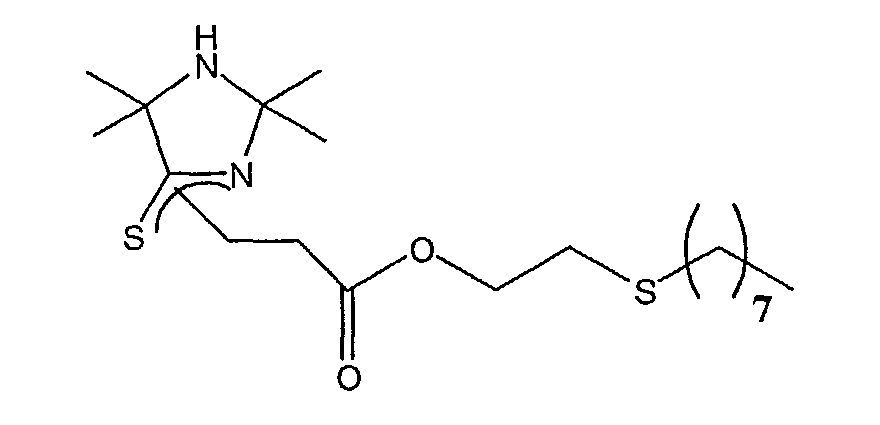
- A procedure similar to that of Example 2 was used. Starting from TMIT (1.0 g, 6.33 mmol), 3-thiaundecyl acrylate (1.4 g, 6.33 mmol) and cesium carbonate (1.0 g, 3.3 mmol) in acetonitrile (20 mL), the product was isolated as a light yellow oil (2.0 g, 83 %). IR: 2961, 1734,1481 cm-1; 1H NMR (CDCl3, 500 MHz): δ 4.22 (t, 2H), 3.84 (t, 2H), 2.84 (t, 2H), 2.71 (t, 2H), 2.52 (t, 2H), 1.55 (m, 2H), 1.46 (s, 6H), 1.42 (s, 6H), 1.4-1.2 (m, 10H), 0.85 (t, 3H) ppm; 13C NMR (CDCl3, 125 MHz): δ 205.9, 170.9, 82.9, 69.5, 63.7, 40.4, 32.2, 31.6, 31.3, 30.2, 30.1, 29.5, 29.0, 28.6, 28.2, 22.4, 13.9 ppm. N/S ratio: >95/<5.
-

- A mixture of TMIT (0.5 g, 3.16 mmol) and the formaldehyde imine (1.17 g, 3.2 mmol) of a mixture of branched C18-C22 tertiary alkyl primary amines (mixture of amines available from Rohm and Haas Co. under the name Primene™ JM-T Amine) was heated in a sample vial at 120°C for 1h and the obtained liquid was cooled to room temperature yielding a thick syrup. IR: 3302, 1672, 1481, 1465, 1377 cm-1; 1H NMR (CDCl3, 500 MHz): δ 5.4 (bm), 5.1 (s), 4.45-4.33 (5 s), 1.56-0.81 (3 m) ppm; 13C NMR (CDCl3, 125 MHz): δ 208.4, 208.0, 206.5, 82.78, 82.42, 78.05, 70.88, 69.58, 69.42, 69.27, 68.35, 54.95, and several peaks at 40-14 ppm. The product was soluble in EXCEL HC 100 at 10 weight % at 100°C; at room temperature, 5% of the solid precipitated overnight.
-

- A mixture of TMIT (7.9 g, 50 mmol) and the formaldehyde imine of a mixture of branched C18-C22 tertiary alkyl primary amines (mixture of amines available from Rohm and Haas Co. under the name Primene™ 81-R Amine) (9.85 g, 50 mmol) were heated in a sample vial at 120-150°C for about 2h, and the obtained liquid was cooled to room temperature yielding a thick syrup. IR: 3305, 2959, 1687, 1481, 1465, 1378, 11756, 769 cm-1; 1H NMR (CDCl3, 500 MHz): δ 4.5-4.3 (bm), 1.5-1.38 (several sharp & overlapping singlets), 1.3-0.7 (bm) ppm; 13C NMR (CDCl3, 125 MHz): δ 208.6, 208.0, 206.5, 82.79, 82.78, 78.04, 70.88, 69.42, 68.32, 54.42, and several peaks at 35-5 ppm.
-

- A mixture of cis-trans TAIT mixture prepared from methyl ethyl ketone (see Example 7) (0.56 g, 3 mmol) and the formaldehyde imine of a mixture of branched C18-C22 tertiary alkyl primary amines (mixture of amines available from Rohm and Haas Co. under the name Primene™ 81-R Amine) (0.59 g, 3 mmol) were heated in a sample vial at 110 °C for 1h and the obtained liquid was cooled to room temperature yielding a thick syrup. IR: 3311, 3143, 2962, 1689, 1485, 1378, 1161, 787, 738 cm-1; 1H NMR (CDCl3, 500 MHz): δ 4.95 (m) 4.5-4.0 (m), 2.25 (bm), 1.8-0.6 (three broad multiplets) ppm; 13C NMR (CDCl3, 125 MHz): δ 207.6, 207.3, 207.2, 206.2, 205.9, 85.6-85.3 (overlapping peaks), 80.9, 80.8, 73.6, 73.4, 72.1, 71.9, 67.9, 54.0, and several peaks at 36-8 ppm.
- A mixture of TMIT (2.37 g, 15 mmol), 2-ethylhexyl acrylate (2.76 g, 15 mmol) and cesium carbonate (0.12 g, 0.38 mmol, 2.5 mole% based on acrylate) was heated in a sand bath at 100-120 °C for 2h, while the progress of the reaction was being followed by IR spectroscopy. The reaction mixture was cooled to room temperature, and to the resulting thick oil was added hexane (40 mL), and the mixture was filtered to remove solid cesium carbonate. Solvent evaporation from the filtrate yielded product as a light-yellow oil (4.4 g, 86%). IR: 3323, 2961, 1733, 1481 cm-1.
-

- To a mixture of TMIT (1.58 g, 10 mmol) and Primene™ 81-R amine (2.0 g, 10 mmol), formaldehyde (1.2 mL, 37 wt% aqueous solution, 15 mmol) was added at room temperature with stirring. The resulting mixture was heated for 2h at 65°C, followed by an additional hour of heating between 100-140°C to complete the reaction as well as remove water and excess formaldehyde from the reaction mixture. The product was obtained as a yellow syrup (3.13 g, 85%). IR: 3302, 1672, 1481, 1465, 1377 cm-1.
-

- A mixture of TMIT (0.4 g, 0.25 mmol), dodecylisocyanate (0.5 g, 0.25 mmol) was heated in a sand bath at 100-120°C for 4h, while the progress of the reaction was being followed by IR spectroscopy. The reaction mixture was cooled to room temperature to obtain a thick oil that slowly solidified into a soft solid (0.9 g, 100 %). IR: 3491, 3235, 2924, 2853, 1639, 1515, 1466 cm-1; 1H NMR (CDCl3, 500 MHz): δ 4.48 (t, 1H), 3.32 (q, 2H), 1.70 (s, 3H), 1.67 (s, 3H), 1.5 (m, 2H), 1.3-1.16 (m, 18H), 0.82 (t, 3H) ppm; 13C NMR (CDCl3, 125 MHz): δ 207.7, 202.3, 154.2, 80.7, 70.2, 40.5, 31.8, 29.9, 29.5, 29.4, 29.22, 29.19, 28.12, 28.07, 26.9, 22.6, 14 ppm.
Claims (9)
- A method for making a compound of formula (I)

said method comprising adding to an imidazolidinethione having formula
- The method of claim 1 in which CHR5=CHR6-C(O)OR7 is added to the imidazolidinethione; R5 is hydrogen; and R6 is hydrogen or methyl.
- The method of claim 2 further comprising an alkali metal carbonate in an amount less than 10 mole % relative to CHR5=CHR6-C(O)OR7.
- A method for making a compound of formula (I)

said method comprising adding R10R11C=O and R12NH2 to an imidazolidinethione having formula
- A method for making a compound of formula (I)

said method comprising steps of:(a) preparing an imidazolidinethione having formulaand (b) adding to the imidazolidinethione, without isolation of the imidazolidinethione, one of: (i) CHR5=CHR6-C(Y)ZR7; (ii) R10R11C=O and R12NH2; (iii) R10R11C=NR12; and (iv) R8N=C=W.
- The method of claim 5 in which R10R11C=O and R12NH2 are added to the imidazolidinethione.
- The method of claim 5 in which CHR5=CHR6-C(O)OR7 is added to the imidazolidinethione; R5 is hydrogen; and R6 is hydrogen or methyl.
- The method of claim 5 in which R8N=C=W is added to the imidazolidinethione and further comprising removal of substantially all water prior to addition of R8N=C=W.
- The method of claim 8 in which W is O, and R8 is aryl or C8-C20 alkyl.
Applications Claiming Priority (2)
| Application Number | Priority Date | Filing Date | Title |
|---|---|---|---|
| US42089502P | 2002-10-24 | 2002-10-24 | |
| US420895P | 2002-10-24 |
Publications (1)
| Publication Number | Publication Date |
|---|---|
| EP1413577A1 true EP1413577A1 (en) | 2004-04-28 |
Family
ID=32069968
Family Applications (1)
| Application Number | Title | Priority Date | Filing Date |
|---|---|---|---|
| EP20030255805 Withdrawn EP1413577A1 (en) | 2002-10-24 | 2003-09-17 | Process for production of additives for lubricating oils |
Country Status (3)
| Country | Link |
|---|---|
| US (1) | US7074937B2 (en) |
| EP (1) | EP1413577A1 (en) |
| JP (1) | JP2004161759A (en) |
Citations (4)
| Publication number | Priority date | Publication date | Assignee | Title |
|---|---|---|---|---|
| DE2500313A1 (en) * | 1974-01-12 | 1975-07-17 | Ciba Geigy Ag | CHEMICAL COMPOUNDS |
| US5057612A (en) * | 1990-01-22 | 1991-10-15 | Auburn Research Foundation | N,n'-dihaloimidazolidin-4-ones |
| EP1227144A1 (en) * | 2001-01-24 | 2002-07-31 | Rohm And Haas Company | Oil-soluble additive compositions for lubricating oils comprising imidazolidine thione |
| EP1229023A1 (en) * | 2001-01-24 | 2002-08-07 | Rohm And Haas Company | Thioimidazolidine derivatives as oil-soluble additives for lubricating oils |
Family Cites Families (3)
| Publication number | Priority date | Publication date | Assignee | Title |
|---|---|---|---|---|
| US2806036A (en) * | 1957-09-10 | Process for preparation of | ||
| US2842553A (en) * | 1955-07-13 | 1958-07-08 | Monsanto Chemicals | Process of preparing imidazolidinethiones |
| US2785175A (en) * | 1955-12-15 | 1957-03-12 | Monsanto Chemicals | Imidazolidinethiones |
-
2003
- 2003-09-15 US US10/663,159 patent/US7074937B2/en not_active Expired - Fee Related
- 2003-09-17 EP EP20030255805 patent/EP1413577A1/en not_active Withdrawn
- 2003-10-24 JP JP2003364182A patent/JP2004161759A/en active Pending
Patent Citations (4)
| Publication number | Priority date | Publication date | Assignee | Title |
|---|---|---|---|---|
| DE2500313A1 (en) * | 1974-01-12 | 1975-07-17 | Ciba Geigy Ag | CHEMICAL COMPOUNDS |
| US5057612A (en) * | 1990-01-22 | 1991-10-15 | Auburn Research Foundation | N,n'-dihaloimidazolidin-4-ones |
| EP1227144A1 (en) * | 2001-01-24 | 2002-07-31 | Rohm And Haas Company | Oil-soluble additive compositions for lubricating oils comprising imidazolidine thione |
| EP1229023A1 (en) * | 2001-01-24 | 2002-08-07 | Rohm And Haas Company | Thioimidazolidine derivatives as oil-soluble additives for lubricating oils |
Also Published As
| Publication number | Publication date |
|---|---|
| US20040082797A1 (en) | 2004-04-29 |
| US7074937B2 (en) | 2006-07-11 |
| JP2004161759A (en) | 2004-06-10 |
Similar Documents
| Publication | Publication Date | Title |
|---|---|---|
| FI59991C (en) | PROCEDURE FOR THE FRAMSTATION OF AV 2-ARYLAMINO-2-IMIDAZOLINE DERIVATIVES AND DERAS SALTER | |
| US6602831B2 (en) | Oil-soluble additives for lubricating oils | |
| US20040082797A1 (en) | Method for production of additives for lubricating oils | |
| EP1227144B1 (en) | Oil-soluble additive compositions for lubricating oils comprising imidazolidine thione | |
| EP1215206B1 (en) | Processes for the preparation of 4(5)-amino-5(4)-carboxamidoimidazoles and intermediates thereof | |
| US5155257A (en) | Process for the preparation of acylaminomethanephosphonic acids | |
| US6734149B2 (en) | Combination of additives for lubricating oils | |
| EP1361217B1 (en) | 4-Thionoimidazolidine derivatives as oil-soluble additives for lubricating oils | |
| US5719317A (en) | Process for the preparation of nitrobenzene derivatives | |
| WO2005100306A1 (en) | N, n’, n’’-tris-(3-dimethylaminopropyl)-guanidine. the procedure of preparation from carbodiimide and application in reactions of transesterification of oil | |
| US2853513A (en) | Nu. nu'-bis-(carboxyalkylthiocarbamyl) polymethylenediamines | |
| US20040029744A1 (en) | Cyclic thioamides as additives for lubricating oils | |
| EP1394242A2 (en) | Cyclic thioureas and their use as additives for lubricating oils | |
| WO1999044996A1 (en) | Process for preparing 3- hydroxy- 5-[(1, 4,5,6- tetrahydro-5-hydroxy- 2- pyrimidinyl)amino]benzoic acid | |
| EP1394240A1 (en) | Bicyclic thioamides as additives for lubricating oils | |
| FI73417B (en) | BIS- (2-ALCOXYCARBONYLAMINOBENSIMIDAZOL-5-YL) DISULFIDERED SOM ANVAENDS SOM UTGAONGSMATERIAL VID FRAMSTAELLNING AV 5 (6) -TIOBENSIMIDAZOLDERIVAT. | |
| KR900004216B1 (en) | Method for producing dialkyldithiophosphate zinc salt | |
| US20040029745A1 (en) | Cyclic nitroxyl compounds as additives for lubricating oils | |
| US20040029746A1 (en) | Cyclic aminothioureas as additives for lubricating oils | |
| US20040006225A1 (en) | Preparation of enantiomerically enriched amine-functionalized compounds | |
| US3340330A (en) | Bis-mercaptoalkylene spirophosphorodithioates | |
| EP0080245A1 (en) | Diazabicyclo(2,2,2)octadiones and process for their preparation | |
| EP0010851A2 (en) | Process for the preparation of tetramisole | |
| PL97585B2 (en) | ||
| JPH0558420B2 (en) |
Legal Events
| Date | Code | Title | Description |
|---|---|---|---|
| PUAI | Public reference made under article 153(3) epc to a published international application that has entered the european phase |
Free format text: ORIGINAL CODE: 0009012 |
|
| 17P | Request for examination filed |
Effective date: 20030927 |
|
| AK | Designated contracting states |
Kind code of ref document: A1 Designated state(s): AT BE BG CH CY CZ DE DK EE ES FI FR GB GR HU IE IT LI LU MC NL PT RO SE SI SK TR |
|
| AX | Request for extension of the european patent |
Extension state: AL LT LV MK |
|
| RAP1 | Party data changed (applicant data changed or rights of an application transferred) |
Owner name: ROHM AND HAAS COMPANY |
|
| AKX | Designation fees paid |
Designated state(s): DE FR GB IT |
|
| RAP1 | Party data changed (applicant data changed or rights of an application transferred) |
Owner name: ROHM AND HAAS COMPANY |
|
| STAA | Information on the status of an ep patent application or granted ep patent |
Free format text: STATUS: THE APPLICATION HAS BEEN WITHDRAWN |
|
| 18W | Application withdrawn |
Effective date: 20080619 |